7th February 2019
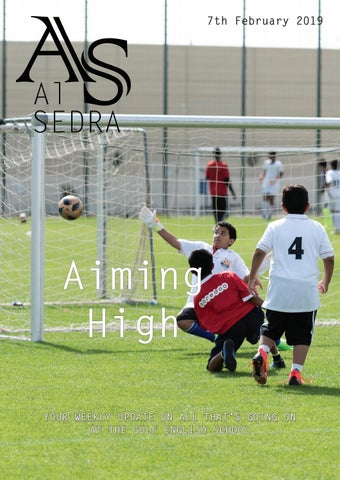
Aiming High YOUR WEEKLY UPDATE ON ALL THAT’S GOING ON AT THE GULF ENGLISH SCHOOL
7th February 2019
INFANTS The children of Pre School have been learning about ‘Under the Sea’. They have been participating in many wonderful activities, which have involved many skills. For example, we baked sea-creature cookies and decorated them with different coloured icing. This activity encouraged maths skills, as students counted how many spoons we needed for the ingriedents. Then it was time to make jello aquariums, and the children noticed how the jello began as a liquid and changed into a solid. As the sea creatures live in the water, the children had the chance to blow bubbles in the water tray and enjoyed splashing around with the animals and learning the sea creatures’ names and identifiying each one. This term, the children have started learning their phonic sounds s, a, t, p, i, n. To help remember the sounds, the children have been playing many different games which involve fine motor control such as colouring, cutting, printing, and painting. We have also been having fun singing songs.
7th February 2019
JUNIORS Junior Music Students have had a very rhythmic start in the second term- they learnt to play ‘Switch’. No, not the PlayStation game, but a musical game that requires intense concentration. How do we play ‘Switch’? The leader taps a rhythm and students join in. After two bars, the leader starts tapping a new rhythm, but students have to continue with the first rhythm. When the leader says ‘switch’, students change to the new rhythm. The leader then starts another new rhythm. This game develops listening skills, concentration, sense of beat and rhythm, and is fun to play! Students have all learnt a song from Jamaica by Bob Marley, called ‘Three little birds’. They enjoy the laid-back mood of the song and were very interested in the differences between Standard English and Jamaican English. They also learnt ‘Baiskeli’, a song in two parts about riding on a bicycle. This song is in Swahili, a mixture of Kenyan languages and Arabic. Through this song we discovered an Arabic sailor’s journeys to East Africa. Year Three has been learning rhythmic raps, involving lots of animals and even a space shuttle. Right now, they are learning a rhythmic poem about all the strange places that cats choose to sleep. They were very amused to see a presentation of weird places cats choose to snooze!
Year Four is exploring music that paints a picture or tells a story. They have discovered how music can create an atmosphere through various sound effects. They took a journey around the world through sound pictures and created their own sound picture of jogging around the world, using a variety of instruments and body percussion. They particularly enjoyed learning about sea sounds and the differences between a beach in England and a beach in Qatar.
Year Five is exploring sound sources. They started with strange sounding tone clusters, and learnt about the attack and decay of notes. They laughed heartily at various vocal effects to demonstrate attack and decay! They watched a short video clip about the first moon landing and went on the create their own ‘soundscapes’ about sounds in space. Year Six is exploring electronic sound sources. They had enormous fun using a voice changer in class. Students took turns to record a sentence about the weather, and then chose various effects to change their voices. It was a hoot! We learnt about samplers, loops and synthesizers. They were surprised to discover that the piano in the music room is not a real piano, but really a synthesizer with some pre-recorded sounds and some synthesizer sounds. We explored composing with software on computers and were amazed by the results. This unit ends with exploring sound in space and creating a space composition.
7th February 2019
JUNIORS Over past few weeks ASL students from Years 3 – 6 have been learning about the ‘Ingenious Inventors’, who have helped to change our world. We have been learning about Thomas Edison, and his influence on electricity, as well as Marie Curie who helped to enhance healthcare and medicine, by inventing the x-ray machine. As part of our learning, we decided to create our very own 3D x-rays, using creativity, problem solving and a range of art materials. Please take a look at some of our Y6 art work!
7th February 2019
SECONDARY Students and staff in Secondary Learning Support have had a great start to the term and to 2019! One of the secondary school focuses will be on literacy, and Key Stage Three students will be completing literacy based tasks for one registration session every week. Key Stage Four students will also be encouraged to take part. With this in mind, we thought you would appreciate some ways that you could support and encourage your child with their reading at home. Here are ten top tips to help you! 1. Keep things real. Make clear connections between your child’s ability to read and their future options in life. If they are thinking about college, university or a specific career path, have open, honest discussions about the ways reading might be necessary for their success. 2. Let your child choose. The best way to encourage your child to read is to allow them to read whatever they find engaging - whether it’s comic books, cookbooks or adventure novels. The books they are drawn to might not be your favourites, but don’t discourage their preferences. 3. Look for books at their reading level. If your child struggles with reading in school, it can be challenging to find high-interest books at their reading level. Look for books that specifically target reluctant young readers and it’s also a good idea to let your child use assistive technology that makes reading easier, such as audiobooks and electronic books from Audible and Kindle. Getting practice with an accessible text is better than giving up on a traditional book that is geared for more advanced readers. Model reading for them. 4. The best way to create a culture of reading in your home is to read as much as possible. The more your child sees you reading, the more likely they are to follow suit. This doesn’t change once your child enters secondary school. Teenagers are even more resistant to any message that implies ‘do as I say, not as I do’. Discuss what they read. 5. Talk in meaningful ways about what your child reads. Ask questions and encourage debate. Create an environment of deep discussion and critical thinking. Talking frequently about what your child is reading can help in more ways than one.
Resist the urge to criticise. 6. If your teenager is a reluctant reader, it is important to prevent them from shutting down about reading altogether. This means keeping negative opinions about what they read to yourself. If you think e-books are inferior to paperbacks, don’t share that opinion while your child is reading an e-book. Be tolerant and encourage their reading, whatever form that takes. 7. Find a compelling series. Readers who get hooked on the first book in a series can follow the same characters or themes through many more books. For some teenagers, starting a new book can be daunting, but the familiarity of a series can make it easier to understand the text and can reduce the negative feelings associated with starting a new reading task. Find the right characters or themes, and even reluctant readers will be eager to pick up the next book in the series. 8. Connect reading to your child’s passion. By secondary school, your struggling reader may have lost their motivation to work on their reading skills. But you can encourage them to stay engaged by looking for ways to connect reading to subjects that are relevant to them. For example, if your child is a reluctant reader who wants to work with animals, make it clear how important reading will be to learn more about veterinary science. 9. Link reading to social media. If your child likes texting friends and posting on social networks, you can give them mini-assignments that use those interests. For example, encourage them to start following a blog and ask them to read interesting posts aloud to you occasionally. Or you could ask them to be on the lookout for interesting abbreviations people use in texts and get them to make a cheat sheet or to quiz you on what these abbreviations stand for. Leverage their interest in current events. 10. Highlight the ways that your child can use reading to keep tabs on what’s happening in the world. Encourage your child to pick up a newspaper or subscribe to a magazine. For some children, reading might seem frustrating or boring. But if your child is interested in sports, politics, celebrities, music, gaming, you name it, there will always be something they might want to read!
7th February 2019
SECONDARY Ocean Pollution The Service Learning focus for this month is ‘Ocean Pollution’. The issue of littering on the beach is heavily underestimated. Did you know that Qatar has one of the largest populations of dugongs and whale sharks in the world? Unfortunately, in our day and age, such sea life is becoming more and more endangered. We, as a community, need to help stop this and protect the wildlife and marine life of Qatar. The IB1 class, along with Year 5, went with DEAP (Doha Environmental Actions Project) representatives to clean up one of the beaches in Qatar. DEAP is a voluntary environmental group who meet with volunteers every Friday to clean up beaches in Qatar. Prior to our cleanup, we met with Jose who is the lead representative of DEAP, to discuss what we would be doing and how we can contribute further to reducing our use of plastic after the cleanup. In conjunction with students in Year 5, we went to Semaisma beach on 17th January 2019. We were astonished by the amount of trash we found on the beach that day. We collected at least 20 bags (15 kg each) of trash and not only that, but so much more was discovered on the beach such as a car wreck, tires and fences that had been put there by local residents and people who visited the beach. We also found coals from barbecues, shirts, boots, sandals, hats and carpets! All of these materials, along with the plastic and rubber, can cause major impacts on the health of the sea life. If any of the sea life living in the ocean or on the land had eaten this garbage, then their lives would be at risk. Therefore, it is important for everybody to help clean up the beaches and, not only that, we can help our earth live longer and healthier. We can do this by simply putting our trash in trash cans rather than throwing it on the street and we can also do this by helping spread awareness and stopping others from throwing
trash on the streets, beaches and alleyways. You could also help by volunteering with friends and family and joining DEAP in their mission to clean up the beaches of Qatar every Friday. DEAP usually has between 100-250 volunteers per week to help them clean up the beaches and deserts of Qatar. We might not be able to do much on our own but together we can truly make a difference to helping our country not only by cleaning up but also by recycling our products, using reusable water bottles and doing simple things like turning off the tap when we brush her teeth or turning off the lights when we leave our rooms. We hope that by raising awareness about our use of plastic and the damage it causes to our seas and oceans, it will highlight how important our environment is and why it is even more important it is to keep the environment clean and safe not only for us but for future generations as well.
7th February 2019
CONTACT The Gulf English School PO Box 2440, Doha, Qatar Main School: Tel: +974 44578777 Main School: Fax: +974 44861256 Infant Unit: Tel: +974 44886791/90 +974 44886201/93 Infant Unit: Fax: +974 44876821
Email: info@gulfenglishschool.com
Website: www.gulfenglishschool.com