18th October 2018
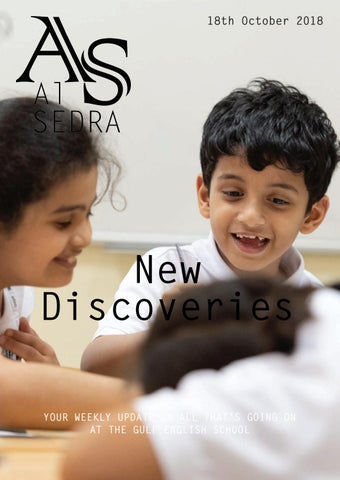
New Discoveries YOUR WEEKLY UPDATE ON ALL THAT’S GOING ON AT THE GULF ENGLISH SCHOOL
18th October 2018
INFANTS Music
classroom, some of us used tuned instruments
Preschool students are enjoying singing a variety
such as bells and xylophones using the notes D
of animal songs such as ‘Jenny Has a Dog’,
and G so that the overall sounds harmonised
‘Monkey Song’ and ‘Elephants Have Wrinkles’. We
nicely. Miss Natalie also brought her viola into
are also familiar with playing maracas, egg shakers
school, we spoke about using the bow and used
and djembe drums. Working on our ability to play
our fingers to pluck. We also did some acting to
and stop.
the story of ‘Peter and the Wolf’ to further solidify our musical learning. We enjoyed it very much!
In Reception, we are enjoying building a significant repertoire of songs and stories. We are singing songs to help us with our phonics. ‘Alligator Alarm’, ‘Bebop the Bear’, ‘Cool Cat’ and ‘Dance Doggie Dance’ are what we have worked on so far. We love acting out the stories and playing the different characters and have become very good at remembering to sing and perform actions simultaneously. Year 1 students Have been enjoying learning how to keep a steady beat. We have been using instruments to demonstrate how to remain steady. We have recently started to look at basic theory too, including knowing the value of a crotchet, minim and quaver. We have incorporated movement and are starting to play instruments with focus and control. Year 2 students have been learning about instruments of the orchestra. We have learnt that instruments are generally categorised into sections such as strings, brass, woodwind and percussion. We sung ‘I am a Fine Musician’ and explored a variety of instruments in the
18th October 2018
JUNIORS Junior Music
Students in Year Three started their first year in Junior School Music lessons by learning singing games and chants. This has been hugely enjoyable. They first learnt selection games such as ‘One Potato, Two Potato, Three Potato, Four’ and clapping games such as ‘The One Legged Sailor’. This was followed by skipping games the following week- ‘High low Dolly Pepper’ and ‘Salt Pepper Vinegar Mustard’. The purpose was to sing and chant to a steady beat. Students also played ball games, such as ‘Over The Garden Wall’, which required good hand eye co-ordination. The lyrics of the song made them laugh a lot. The following week they learnt about passing games. ‘Pass the pebble on’ was played at various speeds and the pebble had to be passed on the beat. This was enormous fun. STUDENTS then had to identify and read rhythms from the games which they did really well. They learnt ‘Chop, chop, choppity chop’ and ‘Double this’ this week. Overall, this has been a most enjoyable unit of work! A Sailor went to Sea, Sea, Sea. Year Four students have been exploring rhythmic patterns from India, Wales and America. They learnt about the Kartal, which is an Indian percussion instrument, similar to castanets, and watched breathtaking performances on the Kartal. They sang a Welsh lullaby, ‘SuoGan’, and discovered phrases in music. Then they learnt a rhyme, ‘Jelly on a plate’, and built the rhythms of the rhyme on the floor with hearts and lolly sticks. Students listened to a very catchy piece of music, ‘Unsquare Dance’ by Dave Brubeck. They spontaneously started clapping and moving to the beat. They learnt to clap a rhythm from this piece with seven beats in a bar! This was quite a challenge, but they did it really well. They have learnt a very funny rap called ‘Hip Hoppy Kid’ and will soon create their own rap. This will be performed in class. They also play clapping games such as ‘Pass The Beat’ and ‘Double This’ to establish a steady beat. Year 4 playing ‘Double This’ Year Five have been focusing on African music. They have learnt African greetings, which they performed as call and response songs. They have learnt about cyclic patterns (repetitive patterns) in African music, and
have performed these with body percussion. They have learnt two cyclic patterns, which was performed by two groups of students, while a third group tapped a steady beat. This was a challenging task. We made a video of this class performance, so that students could assess themselves and discuss what they could do better in future. Students found it very funny to watch their own performance! Students improvised rhythms on the Djembe Drum to speech rhythms. They visited Mali, a West African country, to learn about the music of the Bambara people. They found the country beautiful and the people colourful. They learnt a song, ‘Degu, Degu, Degu’ in the Bambara language. It is a humorous song about a man who wears trousers that are way too big for him! Students will develop cyclic patterns on the drums and with body percussion to accompany this song, and will end the unit with a class performance. Year Six have been exploring rounds and learnt a song called ‘Relay Race’. Students performed the song in three groups, each starting at a different time. It was quite a challenge to keep singing against the other groups, but eventually most students managed to perform the round successfully. The accompaniment was played on two xylophones by two members of the class. Class performances were recorded on video for them to assess their own performances. This unit culminated in a performance by 6BL in assembly. It was an excellent performance. They are now learning an African song, ‘Nanuma’, which they will sing as a round. They will improvise an ostinato accompaniment for it. They will figure out which notes are used in the melody in a keyboard assignment. The unit will conclude with another four part round, ‘Junkanoo’, performed in class with percussion instruments.
18th October 2018
SECONDARY Organisation tips for school—how to get your child organised Students and staff in Learning Support have had a busy and productive start to the term. One thing most of us struggle with at some point is staying organised. Below is some information, helpful tips and ideas about why good organisation is important and how to get organised! Organisation is one of the key factors to success in school. In fact, disorganisation can lead to: • lower grades, increased frustration and stress, • low self-esteem. • Students who have better organisation habits often: perform better on assignments, • • complete more work, have more free time than their disorganised • peers. However, organisation is not an inherited trait—it is learnt. This means that it’s important to make sure your child is developing and practicing good organisational habits regularly. POOR PERFORMANCE OR ORGANISATION PROBLEMS? Organisation issues can look different for each student. Some of the most common signs of organisational issues include: • always forgetting pens, pencils, and papers, forgetting when assignments are due, • not planning enough time to complete assign• ments, having trouble staying focused on one task at a • time, poor grades. • These issues need to be corrected as early as possible in order to put students on the path to performing well in school. Thankfully, there are a number of ways that you as parents can help reinforce good organisation practices at home. ORGANISATION IDEAS AND TIPS FOR STUDENTS OF ALL AGES CREATE CHECKLISTS Help your child create checklists that can be easily read and referred to. Create daily and weekly to-do lists for homework, tests, and assignments that need to be completed. ORGANISE TIME AND ASSIGNMENTS Organising your child’s school work will help him or her prioritise homework and other assignments. Use
an agenda to have your child write down when assignments are due so he or she knows when to work on them. DESIGNATE A STUDY SPACE AND TIME Complete school work in a specific spot and at a specific time. This will help reinforce good scheduling and time management skills. The area should be: • uncluttered, free of distractions, • • and have the required materials so your child can stay organised and on task. LABEL, SEPARATE, AND IDENTIFY Clearly identify books, notebooks, and other school materials with labels or stickers. Use different colours for each subject so your child can easily tell which is which. This will help forgetful students keep track of their materials more easily. CLEAN OUT CLUTTER Every week, clear out book bags and notebooks of miscellaneous papers and other clutter. Ask your child what each paper is before deciding whether to throw it away. This will help him or her learn to identify what things he or she should keep and which can be thrown away. BRING THE RIGHT MATERIALS Help your child make sure everything has its proper place. By keeping items in the same spot, it is much less likely that they will be lost. Having some backup supplies, such as extra pencils, pens, and paper, will also help make sure your child is always prepared. PREPARE FOR THE NEXT DAY TOGETHER Before bed each night, go over everything your child will need for the next day. Help him or her pack his or her school bag. This will keep students from forgetting important things, and will save parents plenty of headaches in the mornings. BETTER ORGANISATIONAL SKILLS = BETTER GRADES By teaching your child organisational skills, you’ll create a system that can help him or her perform better in school. Once your child sees how much easier school can be when you are prepared, encourage him or her to continue to be better organised. The result will be a more successful, stress-free school experience. If your child needs some extra help developing better organisational skills, the Study Skills Programme below can help! https://gradepowerlearning.com/organization-tips-for-school/
18th October 2018
BIN OMRAN The Preschoolers at Bin Omran have been going wild this week while learning all about Jungle animals. They have been investigating and comparing the different patterns and sizes of each animal. Did you know that the tiger belongs to the Cat Family? The children will soon be driving safari jeeps around the savannah in search of their jungle friends. I wonder how many animals they will be able to tick off their spotter sheet.
Art Attack at Bin Omran. Students at Bin Omran have been developing a wide range of art and design techniques, such as using drawing to create a self-portrait. Here are some examples of their amazing artwork!
18th October 2018
CONTACT The Gulf English School PO Box 2440, Doha, Qatar Main School: Tel: +974 44578777 Main School: Fax: +974 44861256 Infant Unit: Tel: +974 44886791/90 +974 44886201/93 Infant Unit: Fax: +974 44876821
Email: info@gulfenglishschool.com
Website: www.gulfenglishschool.com