1st November 2018
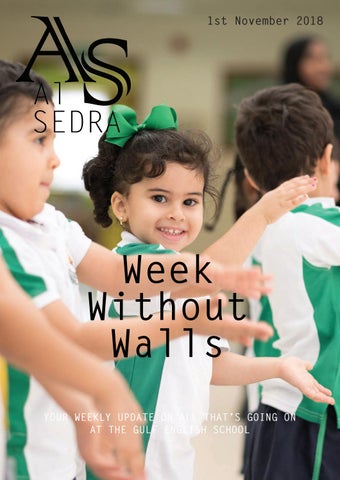
Week Without Walls YOUR WEEKLY UPDATE ON ALL THAT’S GOING ON AT THE GULF ENGLISH SCHOOL
1st November 2018
INFANTS Infant Learning Support Department We are having a busy but fun time in the Infant Learning Support Department this term. We have been working on a range of academic skills, including developing the student’s fine and gross motor skills and memory skills as well as listening and concentration skills. These are the basic fundamental skills that enable us to become lifelong learners. Our Reception students have been busy settling into school and starting to familiarise themselves with their daily routine. They have been busy learning to write their names and to be able to recognise, count and order numbers to 10 using Numicon, and a range of practical activities. Our Year 1 and 2 students have been learning to recognise, count, order and match quantities to numerals, first with numbers to 10 then progressing to 20. They have achieved this by immersing themselves in a variety of practical and fun activities, using Numicon and a range of everyday objects to develop and enhance their one to one counting skills and number recognition. Students in Year 2 have also used mathematical vocabulary to explain and give reasons for their thoughts. They have become more confident in counting forwards and backwards starting from a given number.
1st November 2018
JUNIORS Promoting thinking and problem-solving at home In this article I have used the female gender when referring to a child, but the suggestions and recommendations apply perfectly to boys as well.
From the moment your child is born, she is acquiring skills that enable her to develop complex thoughts. As she grows and becomes more independent, she reveals a natural thirst for knowledge and wants to learn, question and make sense of the world around her. She is developing cognitively. In other words, she is learning how to think for herself and solve problems. For a child to grow into an independent and successful adult, she needs to develop her thinking skills in order to be able to formulate questions and find solutions by herself and with others. The process of questioning, discovery, reflection, evaluation and finding solutions is encouraged at good schools, and helps children become lifelong learners. So often we put the emphasis on the answer to a problem, but the skills learnt when tackling problem-solving are the key to effective learning that lasts a lifetime. How can we develop our children’s thinking skills at home? • Listen to your child’s questions and opinions. Let her know that her opinions are valued. Encourage her to ask questions and help develop her confidence.
• Ask your child questions to help her think for herself. Encourage her to produce original ideas. Listen to her as she formulates an argument. Show genuine respect for her conclusions before pointing out possible alternatives. • Encourage your child to experiment with different ways to solve a problem. Support your child so that she doesn’t give up too easily. Help her find a solution that works for her. • Take trips to interesting places like museums, libraries, wilderness areas, cities and countries, to stimulate your child’s sense of curiosity and wonder. Discuss together what you have seen and evaluate its impact on the world. • Play games with your child. Playing a board game or completing a puzzle together creates a wonderful opportunity to share ideas and discuss solutions. • Choose toys and games for your child that promote creativity and problem-solving. Painting, modelling and building all exercise and develop thinking. Avoid ‘mindless’ games on mobile phones, tablets and computers. • Give your child responsibilities and chores at home, even when there are many helpers working in the household. Encourage your child to do things for themselves and become independent. A child who does very little for herself at home will struggle to become independent and self-reliant at school. • Allow your child to make decisions even if they lead to failure sometimes. ‘A person who never made a mistake, never made anything.’ Help her to learn from her mistakes and do it differently next time. Remember, your child is braver than you believe, stronger than she seems and smarter than you think. Guide and teach your child so that she becomes a strong and independent individual. Tim Jackson Year 3 Learning Support Teacher
1st November 2018
SECONDARY This year, the students in Years 7, 8 and 9 have been
Students are now studying topics which are more
exploring Scratch programming and taking their
geared towards Computing/ Computer Science, as this
understanding of coding to a higher level. This platform
is the direction in which the courses and the industry
has proved to be a very student friendly approach
are heading. Digital literacy, Computer Science and
towards understanding and building the skills needed
Information Technology all need to be practiced and
in the IT industry.
learnt to achieve success in the subject area.
Technology is forever advancing, more than most other areas of research and study. IT literate students and vastly skilled individuals are now required to enable our lives to be enriched with gadgets and technology which can make our lives better and empower us to be more globally connected.
1st November 2018
WEEK WITHOUT WALLS
1st November 2018
CONTACT The Gulf English School PO Box 2440, Doha, Qatar Main School: Tel: +974 44578777 Main School: Fax: +974 44861256 Infant Unit: Tel: +974 44886791/90 +974 44886201/93 Infant Unit: Fax: +974 44876821
Email: info@gulfenglishschool.com
Website: www.gulfenglishschool.com