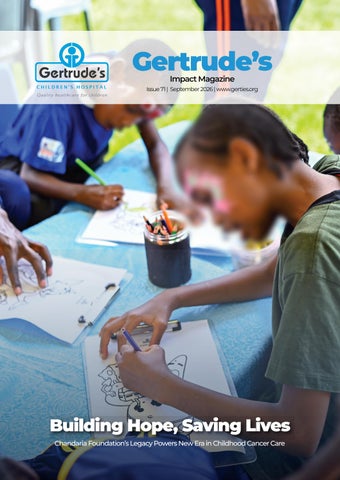
Gertrude’s Impact Magazine
Issue 71 | September 2026 | www.gerties.org
Building Hope, Saving Lives Chandaria Foundation’s Legacy Powers New Era in Childhood Cancer Care G E R T R U D E ’ S I M PA C T M A G A Z I N E |
1
2
| G E R T R U D E ’ S I M P A C T M A G A Z I N E
Contents
08
06
06: From the CEO 08: Building Hope, Saving Lives 11: No Child Left Behind 13: Every Step, Every Hope 19: Closer to Home
11
13
16 19
23
26
31
23: Talent Meets Good Health 26: Building Hope for Children with Sickle Cell 31: Health on Wheels
33
37
33: Building Stronger Partnerships 37: From Hospital to Classroom
G E R T R U D E ’ S I M PA C T M A G A Z I N E |
3
4
| G E R T R U D E ’ S I M P A C T M A G A Z I N E
Issue 071 | September 2026 | www.gerties.org
Impact Magazine
Gertrude’s Organization accredited by Joint Commission International
Editorial Mar tin Mulwa - Digital Communications Lead Chief Editors Julia Thitai - Chief Marketing Officer Diana Gachugi - Corporate Affairs Lead Dr. David Kiptum - Chief Paediatrician Dr. Carol Waweru - Impact Programmes Manager
Ger trude’s Children’s Hospital 34 Muthaiga Road Nairobi +254-709-529-000 +254-733-645-000 www.ger ties.org
Executive Producer Dr. Rober t Nyarango - CEO Consul tant Editor Intent Media Africa
© Ger trude’s Impact Magazine. All rights reser ved. No par t of this publication may be reproduced, stored in a retrieval system or transmitted in any form or by any means, electronic , photocopying or other wise, without prior permission of the publisher and copyright owner. Whilst ever y effor t has been made to ensure the accuracy of the information in this publication, the publisher accepts no responsibility for errors or omissions. The products and ser vices adver tised are not endorsed by or connected with the publisher or its associates. The editorial opinions expressed in this publication are those of individual authors and not necessarily those of the publisher or of its associates. This magazine is issued free of charge.
G E R T R U D E ’ S I M PA C T M A G A Z I N E |
5
From the CEO’s Desk
I
t gives me great pleasure to welcome you to this refreshed edition of our publication, now proudly renamed Gertrude’s Impact Magazine. While the name is simpler, easier to remember and more engaging, it continues to reflect the trusted identity of Gertrude’s Children’s Hospital and, more importantly, our enduring commitment to delivering quality healthcare for children. More than a publication, this magazine is a living record of the lives we touch, the partnerships we nurture and the milestones we achieve in our mission of transforming child health across Kenya and the wider region. As you turn these pages, you will discover compelling stories that illustrate the transformative power of compassion, collaboration and innovation in improving the lives of children and their families. Every feature reflects our shared purpose 6
| G E R T R U D E ’ S I M P A C T M A G A Z I N E
of ensuring that every child receives timely, specialized and high-quality healthcare, regardless of where they live or their socioeconomic circumstances. This edition captures significant milestones in our journey as Eastern and Central Africa’s leading paediatric healthcare institution. From expanding access to Bone Marrow Transplant services and strengthening childhood cancer care to extending specialized healthcare through telemedicine to underserved regions such as Samburu, each story demonstrates our unwavering commitment to bringing world-class, child-centred care closer to the families who need it most. Equally inspiring are the stories of courage and resilience shared by the children and caregivers we serve. Mercy Lashimbera’s
remarkable journey reminds us that healthcare extends far beyond diagnosis and treatment. It is about restoring hope, preserving dignity and creating opportunities for every child to dream again, learn again and thrive.
Beyond clinical excellence, we remain deeply committed to holistic child-centred healthcare by promoting emotional wellbeing, social inclusion, caregiver empowerment and joyful experiences that support every child’s overall development. As Gertrude’s Children’s Hospital continues to grow and innovate, Gertrude’s Impact Magazine will play an equally important role in documenting our journey, celebrating achievements and sharing knowledge with our staff, partners, patients, donors and the wider community. It is a platform that reflects our mission, advances our vision and showcases the collective impact of everyone who walks this journey with us. I extend my heartfelt appreciation to our dedicated staff, partners, caregivers and supporters whose commitment and trust continue to make this work possible. Together, we are doing far more than treating illness. We are building healthier futures, stronger families and brighter possibilities for every child.
‘‘
We remain deeply committed to holistic child-centred healthcare by promoting emotional wellbeing, social inclusion, caregiver empowerment and joyful experiences that support every child’s overall development.
‘‘
Our progress is also a testament to the strength of purposeful partnerships. Through collaboration with organisations including the M-PESA Foundation, SanlamAllianz Life Insurance Kenya Holdings (Kenya) PLC, healthcare professionals and many other valued stakeholders, we continue to expand access to specialized care, strengthen caregiver support and advance community health initiatives that are changing lives every day.
Dr. Robert Nyarango Chief Executive Officer Gertrude’s Children’s Hospital
G E R T R U D E ’ S I M PA C T M A G A Z I N E |
7
Building Hope, Saving Lives: Chandaria Foundation’s Legacy Powers New Era in Childhood Cancer Care
T
he Bone Marrow Transplant Centre at Gertrude’s Children’s Hospital, whose establishment was made possible through the support of the Chandaria Foundation, is already transforming the future of childhood cancer care in Kenya, offering renewed hope to hundreds of children battling life-threatening blood disorders and cancers who previously had limited access to specialized treatment. The state-of-the-art facility marks a significant milestone in Kenya’s paediatric healthcare landscape, strengthening the country’s capacity to provide advanced bone marrow transplant services closer to home. Beyond reducing the financial
and emotional burden associated with seeking treatment abroad, the centre is expected to improve survival outcomes for children diagnosed with complex blood diseases and cancers while positioning Kenya as a regional leader in specialized paediatric care. The impact of that investment was evident recently when sixyear-old Nyay Mehta Cutright, the great-granddaughter of renowned Kenyan industrialist and philanthropist Dr. Manu Chandaria, visited the hospital to tour the Bone Marrow Transplant Centre alongside Gertrude’s Children’s Hospital team led by Chief Operating Officer Edwin Onchari and Chief Nursing Officer Caroline Ayilo. Although young in age, Nyay’s visit reflected the enduring spirit of philanthropy that has defined the Chandaria family for generations. “I want to help people feel better when they are sick,” Nyay said during the tour in the company of her great grandfather Dr. Manu Chandaria signaling a simple but heartfelt aspiration that resonated deeply with healthcare workers caring for children undergoing complex treatment. Her words echoed the values that have shaped the Chandaria Foundation’s long-standing commitment to improving access to healthcare, education and community development across Kenya. Through its support for the Bone Marrow Transplant Centre, the Foundation has reinforced a partnership with Gertrude’s
8
| G E R T R U D E ’ S I M P A C T M A G A Z I N E
Hospital leaders say the investment represents far more than the construction of a modern medical facility. It is a longterm commitment to ensuring children diagnosed with serious blood disorders receive timely, world-class treatment within Kenya.
“
I hope I can help many people one day, just like my great-grandfather has done.”
“
Children’s Hospital that is helping redefine the standard of specialized paediatric care in the country.
Speaking during the visit, the hospital’s Chief Operating Officer Edwin Onchari said the Chandaria Foundation’s contribution would continue changing lives for many years to come by expanding access to highly specialized services that were previously beyond the reach of many families. “It is humbling to see a six-year-old already carrying that same spirit of care,” said Onchari. “That is the kind of foundation this partnership was built on. The Bone Marrow Transplant Centre is not simply about infrastructure; it represents hope for children and families facing some of the most difficult medical journeys. Through partners such as the Chandaria Foundation, we are strengthening our ability to provide life-saving treatment Nyay Mehta Cutright
G E R T R U D E ’ S I M PA C T M A G A Z I N E |
9
while ensuring more children receive quality healthcare closer to home.” Onchari noted that partnerships between healthcare institutions and philanthropic organizations remain critical in accelerating investments in specialized paediatric medicine, particularly in areas where treatment has historically been limited or unavailable. Nyay, meanwhile, said seeing children receiving care at the hospital strengthened her desire to continue her family’s tradition of giving back to society. “I hope I can help many people one day, just like my great-grandfather has done,” she said. Her visit served as a powerful reminder that philanthropy is sustained not only through financial investment but also through the values passed from one generation to the next. The Bone Marrow Transplant Centre at Gertrude’s represents another milestone in its mission of delivering quality healthcare for children. As Eastern and Central Africa’s leading not-for-profit paediatric hospital, the institution continues to invest in world-class, child-centred healthcare that serves children from birth through young adulthood. With the Chandaria Foundation’s support helping establish one of Kenya’s most important paediatric oncology facilities, the hospital is giving families renewed confidence that advanced treatment can
10
| G E R T R U D E ’ S I M P A C T M A G A Z I N E
Edwin Onchari - Chief Operating Officer
now be accessed locally. More importantly, it is creating opportunities for hundreds of children diagnosed with cancer and other complex blood disorders to receive lifesaving care, recover closer to their loved ones and look forward to healthier futures. In many ways, Nyay’s visit symbolized the passing of a torch from one generation of philanthropists to the next underscoring how compassion, when matched with strategic investment in healthcare, can change not only individual lives but the future of paediatric medicine in Kenya.
No Child Left Behind Building a Bone Marrow Transplant Ecosystem
G
ertrude’s Children’s Hospital’s journey to establish a comprehensive Bone Marrow Transplant (BMT) programme is steadily redefining childhood cancer care in Kenya, with new referral pathways now ensuring that children from every corner of the country have a clearer route to life-saving treatment. That progress formed the backdrop of a high-level stakeholder engagement forum held at the hospital’s Muthaiga campus, where clinicians, pharmacists, laboratory specialists, nurses and development partners came together to chart the future of bone marrow transplantation in Kenya. Their shared message was unequivocal: building a sustainable transplant ecosystem requires far more than sophisticated medical technology.
It demands coordinated partnerships, strong referral systems and long-term investment in specialised care. Opening the meeting, Gertrude’s Children’s Hospital Chief Marketing Officer Julia Thitai welcomed participants before inviting healthcare leaders to explore practical solutions that could transform access to advanced paediatric cancer treatment. Delivering the keynote address, Dr. Thomas Ngwiri, Head of Clinical Services at Gertrude’s Children’s Hospital, traced the institution’s bone marrow transplant journey, highlighting the milestones already achieved and the referral pathways now available to connect families with specialised services regardless of where they live. For many children diagnosed with blood cancers and other complex blood disorders, timely referral often determines whether treatment begins early enough to improve survival. Dr. Ngwiri said the hospital continues to strengthen partnerships with healthcare providers across Kenya to ensure patients are identified promptly and guided to specialised care without unnecessary delays. “Every referral pathway we build is really a promise that a child doesn’t have to fall through the cracks because of geography or access,” said Dr. Ngwiri. His remarks underscored an emerging
Dr. Thomas Ngwiri - Head, Clinical Services
G E R T R U D E ’ S I M PA C T M A G A Z I N E |
11
national vision in which county hospitals, paediatricians, oncologists and specialised centres work seamlessly together to ensure that every eligible child can access potentially curative treatment. The keynote was followed by a multidisciplinary panel discussion examining what it will take to establish a resilient and sustainable bone marrow transplant ecosystem for Kenya. The panel brought together Dr. Brian Nderu, Paediatric HaematologistOncologist; Dr. Susan Mutua, Consultant Clinical Pharmacist; Dr. Beatrice Kabera, Chief Pathologist; and Mathew Bartinga, ICU Manager. Collectively, the specialists demonstrated that successful transplantation extends well beyond the operating theatre, relying on coordinated expertise across clinical medicine, pharmacy, laboratory diagnostics and critical care. From patient preparation and donor matching to infection prevention, laboratory monitoring and intensive post-transplant support, the discussion highlighted the complexity of delivering comprehensive transplant services while maintaining the highest standards of patient safety. Dr. Susan Mutua explained that medicines remain one of the most critical pillars of transplant success. Patients require carefully managed pharmaceutical care before, during and long after the transplant procedure, making continuity of medication and close monitoring indispensable. “Sustainability isn’t just about the day of the transplant. It’s about the medicines, the monitoring and the months of care
12
| G E R T R U D E ’ S I M P A C T M A G A Z I N E
that come after,” Dr. Mutua observed. Her comments reinforced the reality that successful transplantation depends on sustained multidisciplinary care, with pharmacists playing a central role in preventing complications, managing immunosuppressive therapies and supporting long-term recovery. The forum also illustrated the importance of collaboration between Kenya’s healthcare institutions, philanthropic organisations and clinical experts in expanding access to advanced paediatric services. Participants agreed that strengthening referral networks, investing in specialised human resources and improving coordination between health facilities will be essential if bone marrow transplantation is to become more accessible nationwide. As conversations continued well beyond the formal programme, the atmosphere reflected cautious optimism that Kenya is steadily laying the foundation for a stronger national transplant ecosystem capable of serving children with life-threatening blood disorders and cancers. The stakeholder engagement represented more than a professional meeting for Gertrude’s Children’s Hospital. It signalled a growing national commitment to ensuring that no child is denied a second chance at life simply because specialised treatment remains out of reach. The hospital’s evolving Bone Marrow Transplant Programme is increasingly becoming a model for integrated paediatric cancer care: one built on clinical excellence, multidisciplinary collaboration and a shared determination to ensure that every Kenyan child who needs a bone marrow transplant has a pathway to receive one.
Every Step, Every Hope Men’s Health, Women’s Health, Prevention
Thousands turn out to give critically ill children a fighting chance
F
or thousands of children diagnosed with cancer and other lifethreatening illnesses, access to timely specialized treatment can mean the difference between hope and heartbreak. Yet for many families, the cost of complex medical care remains one of the greatest barriers to recovery. That reality inspired more than 7,000 Kenyans to lace up their walking shoes and converge at Uhuru Gardens in Nairobi’s Lang’ata area for the 5th edition of the 2026 Gertrude’s Hospital Foundation Charity Walk, an event that has steadily evolved into one of the country’s most influential child health fundraising initiatives. Beyond promoting healthy living, the walk sought to mobilize public support for lifesaving treatment, raise awareness about childhood cancer and other complex medical conditions, and reaffirm that every child deserves access to quality healthcare regardless of financial circumstances.
“I hope every child fighting illness knows that they are not alone” Dr. Robert Nyarango, CEO
G E R T R U D E ’ S I M PA C T M A G A Z I N E |
13
From the first rays of dawn, the venue came alive with families, healthcare professionals, corporate teams, cancer survivors, school children, volunteers and well-wishers all united by a common purpose: giving vulnerable children a better chance at life. Dressed in brightly branded shirts and carrying placards bearing messages of hope, participants embarked on either the 5-kilometre or 13-kilometre routes, transforming the walk into a moving symbol of compassion, resilience and shared responsibility. The annual charity event, now in its fifth edition, has become a cornerstone of the Gertrude’s Hospital Foundation’s efforts to bridge healthcare gaps for children requiring highly specialized medical interventions. Funds raised will support access to advanced treatment, critical procedures, supportive therapies and holistic care for children battling cancer and other serious illnesses whose families often struggle to meet overwhelming medical costs. Gertrude’s Children’s Hospital Chief Executive Officer, Dr Robert Nyarango, said the growing public participation reflects a shared national commitment to safeguarding children’s health and ensuring that financial hardship does not deny any child an opportunity to receive specialized care. “Every step taken today represents hope for a child and support for families navigating difficult medical journeys. Together, we are building healthier futures for children.” Dr Nyarango noted that the Hospital continues to strengthen its commitment to delivering world-class, child-centred healthcare by working closely with communities, development partners and corporate organisations to expand access to specialized paediatric services. “When communities, healthcare professionals, businesses and families unite behind one cause, they become a powerful force for change. The Charity Walk demonstrates that investing in children’s health today creates healthier communities and brighter futures for generations to come,” he said.
14
| G E R T R U D E ’ S I M P A C T M A G A Z I N E
with us gave us strength. I hope every child fighting illness knows that they are not alone.”
Champions of Hope The event also celebrated the remarkable journeys of several former patients known as the Foundation’s “Champions of Hope” - young people whose recovery from serious childhood illnesses now serves as a source of inspiration for countless other families facing similar battles. Jane*, one of the Champions of Hope, whose real name has been withheld described the event as a reminder that recovery is never a journey walked alone. “There was a time when my family did not know what tomorrow would look like. Today, seeing thousands of people walking for children like me reminds us that hope is real and that kindness from strangers can change a life.” Another Champion of Hope encouraged families currently navigating difficult diagnoses to remain optimistic despite the uncertainty. “Treatment was difficult, but every encouraging word, every healthcare worker and every person who stood
Beyond fundraising, the Charity Walk offered participants an opportunity to learn more about preventive child healthcare through wellness sessions, nutrition education, immunization awareness activities and interactive health exhibitions conducted by paediatric specialists. Families also enjoyed recreational activities that created an atmosphere of celebration while reinforcing the importance of healthy lifestyles and early medical intervention in improving longterm outcomes. Speaking during the event, Concepter Muoti, Fundraising Manager at Gertrude’s Hospital Foundation, said the Foundation remains focused on building sustainable partnerships that extend quality healthcare to children who would otherwise struggle to access specialized services. “Every contribution made today whether through registration, sponsorship, volunteering or simply showing up helps strengthen our ability to support children requiring specialized medical care. This collective commitment demonstrates what is possible when communities place children’s wellbeing at the centre of development.” She added that the Charity Walk has become much more than an annual fundraising event. “On behalf of The Gertrude’s Hospital Foundation, I extend sincere appreciation to all participants, sponsors, volunteers, healthcare teams and partners whose support has made the 2026 Charity Walk a remarkable success.” As the final walkers crossed the finish line,
G E R T R U D E ’ S I M PA C T M A G A Z I N E |
15
the day’s greatest achievement was not measured by kilometres completed but by the renewed promise that every child deserves a fair chance to grow, thrive and dream.
to walk together so that the region’s most vulnerable children can receive the lifesaving treatment they need, when they need it most.
For Gertrude’s Children’s Hospital Eastern and Central Africa’s leading notfor-profit paediatric referral hospital the Charity Walk reaffirmed that quality healthcare for children is a responsibility shared far beyond hospital walls. It is a mission powered by communities willing
A Shot at Life Protecting Kenya’s Children Through Immunization Every day, vaccines quietly save lives.
L
ong before a child takes their first steps or speaks their first words, routine immunization begins building an invisible shield against diseases that once claimed millions of young lives. Across Kenya, childhood vaccination programmes continue to transform public health by protecting children from life-threatening illnesses while strengthening communities against disease outbreaks. At Gertrude’s Children’s Hospital, immunization remains one of the most powerful investments in ensuring every child enjoys a healthy start to life. Guided by its commitment to Quality Healthcare for Children, the hospital continues to expand access to safe, evidence-based vaccination services that safeguard children from birth through adolescence while supporting Kenya’s 16
| G E R T R U D E ’ S I M P A C T M A G A Z I N E
broader public health agenda. Medical experts agree that vaccines remain among the greatest achievements of modern medicine. They have dramatically reduced deaths from infectious diseases and continue to prevent severe illness, disability and complications caused by conditions such as measles, polio, pneumonia, meningitis
Vaccines Save lives A vaccinated community is protected At Gertrude’s, we ensure children receive protection at every critical stage of development.
and whooping cough. Unlike adults, whose immune systems have developed over many years, infants rely on vaccinations to strengthen their natural defences after the temporary immunity received from their mothers begins to wane during the first months of life. According to Dr Thomas Ngwiri, Gertrude’s Head of Clinical Services, every vaccine administered represents an important milestone in protecting a child’s future. “Childhood immunization is one of the most effective ways of protecting children against diseases that can cause lifelong disability or even death. Every vaccine given on time is an investment in a healthier future for that child,” he said adding that vaccines prepare a child’s immune system to recognise and fight dangerous infections before they have an opportunity to cause serious illness. Dr Ngwiri said immunization is not only about protecting individual children but also about safeguarding entire
communities from preventable disease outbreaks. “Vaccinations also protect communities through herd immunity. When a large percentage of people are vaccinated, the spread of disease is limited, safeguarding individuals who may be unable to receive vaccines due to medical conditions. Immunization is a shared responsibility that benefits everyone, especially our most vulnerable children.” At Gertrude’s, immunization services form an integral part of comprehensive child healthcare, combining vaccination with growth monitoring, developmental assessments, health education and preventive wellness programmes. The approach enables healthcare providers to identify potential health concerns early while ensuring children receive protection at every critical stage of development. Healthcare professionals caution that although vaccines are highly effective, their protective benefits depend greatly on receiving every dose according to the recommended national immunization
G E R T R U D E ’ S I M PA C T M A G A Z I N E |
17
Source: National Collaborating Centre for Infectious Diseases. (Canada)
schedule.
progress in disease prevention.
Caroline Ayilo, the hospital’s Chief Nursing Officer, said parents should understand that timing is just as important as the vaccines themselves.
Dr Ngwiri urged parents to rely on scientifically verified information and seek guidance from qualified healthcare professionals whenever they have concerns about vaccine safety or effectiveness. He emphasized that decades of global research continue to demonstrate that vaccines are safe, rigorously tested and among the most successful public health interventions ever developed.
“Delays in vaccination can leave children exposed to preventable diseases and may increase the risk of infection within the wider community. Parents and caregivers are encouraged to follow the national immunization schedule and ensure children receive every vaccine dose on time.” She noted that while many parents become concerned after missing an appointment, healthcare workers are always available to guide families through catch-up vaccination programmes so that children can regain protection without starting the schedule afresh. “No parent should assume it is too late to vaccinate a child. We encourage families to speak with qualified healthcare providers who can assess each child’s vaccination history and recommend the appropriate catch-up schedule. The important thing is to resume immunization as soon as possible.” Public health specialists say one of the emerging challenges facing immunization programmes worldwide is the growing spread of misinformation and disinformation through digital platforms. False claims about vaccines have contributed to vaccine hesitancy in many countries, threatening decades of
18
| G E R T R U D E ’ S I M P A C T M A G A Z I N E
The hospital also continues to educate parents on the importance of routine childhood immunization during out patient visits, well-baby clinics and preventive healthcare programmes, reinforcing the message that protecting children from preventable diseases requires consistent partnership between healthcare providers and families. As Kenya continues working to improve child survival and reduce the burden of infectious diseases, Gertrude’s Children’s Hospital remains committed to ensuring that every child has access to highquality immunization services delivered with compassion, clinical excellence and evidence-based care. The message from healthcare professionals is clear: childhood vaccination is far more than a routine hospital visit. It is one of the simplest, safest and most effective ways of protecting children’s lives, strengthening community health and building a healthier future for generations to come.
Closer to Home, Better for Children Gertrude’s Brings World-Class Paediatric Care to Utawala For thousands of young families living in Nairobi’s fast-growing eastern suburbs, a visit to a children’s hospital has often meant battling heavy traffic, spending hours on the road and incurring transport costs before their child even sees a doctor. Gertrude’s Children’s Hospital is changing that reality.
Rosebella Ojiambo, Chair, Kenya Private Schools Association cutting the ribbon as Dr. Robert Nyarango, CEO Gertrude’s, Angela Kyongo, Outpatient Manager (left) and Diane Mulatya, Utawala Manager (right) look on.
In line with its mission of delivering quality healthcare for children, Gertrude’s Children’s Hospital has expanded its footprint with the opening of the Utawala Medical Centre, bringing world-class, child-centred healthcare within easier reach of families in one of Nairobi’s fastestgrowing residential neighbourhoods. The new facility reflects the hospital’s long-standing commitment to ensuring that specialized healthcare is not defined by geography but by every child’s right to receive timely, high-quality treatment close to home. Situated along the rapidly developing Eastern Bypass corridor, Utawala has transformed over the past decade into a thriving residential hub attracting thousands of young families, professionals and first-time homeowners. Yet despite the area’s remarkable population growth,
many parents have continued travelling to Nairobi’s central business district and other parts of the city whenever their children required specialized paediatric care. The newly opened medical centre is expected to bridge that gap by providing comprehensive outpatient services in a welcoming child-friendly environment designed around the unique healthcare needs of children from birth through to adolescence. Addressing the gathering, the national chairperson of the Kenya Private Schools Association (KPSA), Rosebella Ojiambo, who was the Chief Guest, said proximity alone would not have been enough were it not for the hospital’s reputation. “What excites us is not simply having a clinic nearby. It is knowing that our children can now receive the same quality healthcare that Gertrude’s Children’s
G E R T R U D E ’ S I M PA C T M A G A Z I N E |
19
Hospital is known for without travelling all the way to the city centre. That gives parents tremendous confidence.” She added that the fact that families in Utawala and its environs can now access paediatric consultations, immunization services, wellbaby clinics, nutrition support, laboratory testing, pharmacy services and preventive child wellness programmes without undertaking lengthy journeys across the city is gratifying. Dr Robert Nyarango, Gertrude’s Children’s Hospital CEO, said the expansion reflects the hospital’s broader vision of bringing specialized paediatric healthcare closer to communities where children live and grow.
“Parents should never have to choose between
quality
healthcare
and
convenience. By bringing our services to Utawala, we are making it easier for families to access the same trusted paediatric expertise that Gertrude’s Children’s Hospital has built over decades while reducing the burden of long-distance travel.”
Dr Robert Nyarango Gertrude’s Children’s Hospital CEO
20
| G E R T R U D E ’ S I M P A C T M A G A Z I N E
“Parents should never have to choose between quality healthcare and convenience. By bringing our services to Utawala, we are making it easier for families to access the same trusted paediatric expertise that Gertrude’s Children’s Hospital has built over decades while reducing the burden of long-distance travel.” He said the hospital continues to strengthen its network of outpatient medical centres to ensure families receive timely medical attention before illnesses become more severe. “Children thrive when healthcare is accessible, preventive and family-centred. Our outpatient centres enable parents to seek care early, keep up with immunization schedules, monitor
growth and receive specialist guidance without disrupting their daily lives. That is how healthier communities are built.” For many residents, the opening of the facility represents both convenience and peace of mind. Faith*, a mother of two from Utawala, said visits to specialist facilities previously consumed an entire day. “Whenever my children needed specialized care, we had to leave home very early to beat traffic into town. Between transport, parking and the hours spent travelling, it became expensive and exhausting. Having Gertrude’s here means we can spend more time focusing on our children’s recovery instead of worrying about the journey.” The launch of the Utawala Medical Centre also brought together healthcare professionals, community members and hospital staff in celebration of another
milestone in Gertrude’s Children’s Hospital’s continued expansion across Nairobi. The hospital now operates 18 out-patient medical centres, strategically located to make specialized paediatric services more accessible to families across the city and its environs. “Our outpatient centres operate from 8.00 a.m. to 8.00 p.m. on weekdays and 9.00 a.m. to 7.00 p.m. on Sundays and public holidays, while the main Muthaiga hospital provides round-the-clock care every day,” said Edwin Onchari, Gertrude’s Chief Operations Officer. Onchari said expanding quality outpatient services closer to residential communities plays a critical role in improving child survival by encouraging early diagnosis, reducing missed immunizations and strengthening continuity of care for children living with both acute and chronic conditions.
G E R T R U D E ’ S I M PA C T M A G A Z I N E |
21
“Utawala Medical Centre represents more than another facility on the map. It is another step in fulfilling a promise that has defined our hospital for decades: ensuring that every child, regardless of where they live, has access to compassionate,
evidence-based and world-class healthcare,” Onchari concluded. The facility also emphasizes growth monitoring, developmental assessments, routine screening and health education, reinforcing the importance of early diagnosis healthcare children’s outcomes.
and preventive in improving long-term health
As Nairobi’s eastern suburbs continue to expand, so too does the hospital’s vision of meeting families where they are, bringing specialized paediatric care closer to home and giving every child the healthier start they deserve.
Left: Gertrude’s CEO Dr. Robert Nyarango gifting Chief Guest Rosebella Ojiambo, Chairperson, Kenya Private Schools Association
22
| G E R T R U D E ’ S I M P A C T M A G A Z I N E
L
aughter echoed across The Nairobi Club
as children raced between activity stations, showcased their talents and cheered one another during the Akili TV Treasure Hunt Talent Mania.
Where Talent Meets Good Health Gertrude’s Children’s Hospital Brings Wellness to Family Fun Day
But beyond the excitement, games and entertainment was a powerful message: healthy children thrive best when healthcare, learning and play come together within the communities where families live.
That is why Gertrude’s Children’s Hospital joined the family-centred event to promote child health and wellness beyond the traditional hospital setting. Through health education, wellness screening and direct engagement with parents and caregivers, the hospital reaffirmed its commitment to ensuring that quality preventive healthcare reaches children wherever they are. The event transformed the Nairobi Club into a vibrant space where children explored their creativity, discovered new talents and participated in exciting challenges alongside their families.
Amid the colourful performances and interactive activities, healthcare professionals from GCH’s Junction Medical Centre provided on-site wellness checks while educating parents on child growth, nutrition and the importance of early health screening. The outreach reflected the hospital’s belief that preventive healthcare extends beyond hospital walls. By taking health services into community spaces, families are empowered with knowledge that enables them to identify potential health concerns early and seek timely
G E R T R U D E ’ S I M PA C T M A G A Z I N E |
23
medical intervention before conditions become more serious. Gertrude’s Junction Medical Centre Manager Peninah Chege said such community engagements provide an invaluable opportunity to connect with families in a relaxed environment while reinforcing healthy behaviours. “Children
learn
best
academics healthcare.
and
routine
One parent, Grace Mwangi*, whose daughter participated in the talent activities, said opportunities that nurture children’s abilities are equally important for their emotional wellbeing. “Every child has unique gifts waiting to be discovered. When children are encouraged to sing, dance, solve challenges and interact with others, they build confidence while simply enjoying being children. That is an important part of healthy
24
when they are engaged, active and enjoying themselves. Events like these allow us to combine health education with fun, making important wellness messages more meaningful for both children and their parents.” She said the hospital remains committed to taking preventive healthcare closer to communities through partnerships that encourage healthy
growth.” Another parent, Paul Mutua, said the combination of entertainment and health education made the event especially valuable for families. “We came here expecting a fun family day, but we are also leaving with useful health information. It is reassuring to have Gertrude’s Children’s Hospital here because parents can enjoy the activities while receiving professional guidance on keeping their children healthy.”
| G E R T R U D E ’ S I M P A C T M A G A Z I N E
childhood development. “Our goal is to support families beyond the clinical setting. By meeting parents where they are, we can promote healthier lifestyles, encourage early screening and help children grow into healthier adults.” Parents attending the event welcomed the initiative, saying it demonstrated that child development goes beyond
Medical experts note that preventive care remains one of the most effective ways of improving child health outcomes. Routine wellness assessments, growth monitoring and early screening can help detect developmental or medical concerns before they become more complex, enabling children to receive timely care and improving their long-term wellbeing. For Gertrude’s, community events such as the Akili TV Treasure Hunt Talent Mania provide an opportunity to strengthen relationships with families
while advancing its mission of delivering Quality Healthcare for Children. By combining preventive healthcare with learning, talent development and family recreation, the hospital continues to demonstrate that healthier futures are built not only in consultation rooms but also in the everyday spaces where children learn, play and discover their potential.
‘‘Our goal is to support families beyond the clinical setting. By meeting parents where they are, we can promote healthier lifestyles, encourage early screening and help children grow into healthier adults.’’
G E R T R U D E ’ S I M PA C T M A G A Z I N E |
25
Building Hope for Children Living with Sickle Cell Disease For thousands of Kenyan families living with sickle cell disease, every day brings unique challenges - from managing recurring pain crises to navigating frequent hospital visits and coping with uncertainty about the future.
Y
et healthcare experts say one of the greatest obstacles remains limited public awareness, which often delays diagnosis, fuels stigma and prevents children from receiving timely, lifesaving care. To change that narrative, Gertrude’s Children’s H o s p i t a l recently brought t o g e t h e r healthcare professionals, researchers, caregivers, p a r t n e r s and patient advocates for a dedicated Sickle Cell Disease (SCD) awareness forum aimed at improving public understanding, strengthening care pathways and empowering affected families through education and support. The initiative reflects the hospital’s enduring commitment to delivering quality healthcare while
26
ensuring that no child living with a chronic condition is left behind. The awareness event created a valuable platform for families to engage directly with medical specialists,
discuss emerging treatment options and better understand the latest advances in the management of sickle cell disease. Discussions explored clinical research trials, comprehensive treatment approaches and the growing role of bone marrow transplantation as a potential treatment option for eligible patients. Equally important, the
| G E R T R U D E ’ S I M P A C T M A G A Z I N E
forum provided families with an opportunity to ask questions, share experiences and connect with others navigating similar journeys, reinforcing the importance of community support alongside quality clinical care. Dr. Olivia G a t h o n i , Gertrude’s Medical Study Doctor in the Clinical Research Depar tment, who spoke d u r i n g the event, said public education remains one of the most effective tools for improving outcomes for children living with sickle cell disease. “Sickle cell disease is a lifelong condition, but early diagnosis and comprehensive care enable children to live healthier, more productive lives. The earlier families understand the condition
and begin appropriate treatment, the better the long-term health outcomes.” Dr. Gathoni e m p h a s i z e d that successful management extends beyond medication. “Families need accurate information, regular medical follow-up and strong psychosocial support. When healthcare providers, caregivers and communities work together, children living with sickle cell disease have a far greater opportunity to thrive.” The hospital’s Corporate Affairs Lead, Diana Gachugi said creating awareness is central to reducing misconceptions surrounding sickle cell disease while encouraging families to seek timely medical advice. “Awareness transforms lives. By bringing together healthcare professionals, partners and families, we are creating opportunities for learning, early intervention and stronger support systems that give children living with sickle cell disease every chance to enjoy healthier and more fulfilling lives.”
For many parents attending the event, the greatest value lay not only in receiving medical information but also in realizing they were not facing the journey alone. One mother of a nineyear-old living with sickle cell disease said the event renewed her family’s confidence. “When our son was diagnosed, we felt isolated and overwhelmed. Listening to specialists and meeting other families has given us hope and practical knowledge. We now understand that with proper care, our child can continue pursuing his dreams just like any other child.” The awareness programme also underscored the growing importance of partnerships in improving care for children living with chronic illnesses. The initiative brought
together Gertrude’s Children’s Hospital alongside partners including Novo Nordisk, Ruaraka Uhai Neema Hospital, World Friends Kenya, Children Sickle Cell Foundation, Community Health Promoters and Sickle Cell Warriors, demonstrating how collaborative action can strengthen support for affected children and their families. Healthcare professionals say increasing public awareness remains critical to improving early diagnosis, reducing preventable complications and ensuring more children receive comprehensive multidisciplinary care. They also encourage parents to seek medical evaluation whenever a child experiences recurrent pain episodes, unexplained anaemia or persistent infections, particularly where there is a family history of the condition. As research to expand possibilities, Children’s
continues treatment Gertrude’s Hospital
G E R T R U D E ’ S I M PA C T M A G A Z I N E |
27
remains committed to combining clinical excellence with education, advocacy and family-centred care. Through initiatives that inform communities and connect families with expert support, the hospital is helping replace fear and uncertainty with knowledge, resilience and hope.
For children living with sickle cell disease, that growing understanding may prove to be one of the most powerful forms of medicine of all.
Beyond Diagnosis: Why Parents of Children Living with Disabilities Need More Than Medical Care
F
or many families, the journey of raising a child living with a disability begins not in a hospital ward but at home, where parents and caregivers must navigate uncertainty, emotional strain and social stigma, often with little guidance.
caregivers and specialists to strengthen the support systems that children living with disabilities need to thrive. The initiative reflects a
Equipping them with practical skills, emotional support and the confidence to advocate for their children has therefore become as important as the medical care the children receive. That was the central message during a caregiver empowerment workshop organised by Gertrude’s Children’s Hospital, in partnership with Sanlam Allianz Life Insurance Holdings (Kenya) PLC, bringing together over 40 parents,
28
growing recognition that quality healthcare extends beyond diagnosis and treatment. It also means empowering families with the knowledge, resilience and practical tools to nurture children’s communication,
| G E R T R U D E ’ S I M P A C T M A G A Z I N E
independence and social inclusion. During the workshop, caregivers received practical training on communication t e c h n i q u e s , b e h a v i o u r a l management, educational advocacy and strategies for promoting social inclusion. Equally important, the forum created a safe environment where parents could openly discuss the emotional realities of raising children with disabilities experiences that are often hidden behind closed doors because of fear, discrimination or misunderstanding. For many participants, the conversations were a reminder that they are not alone. Despite growing
awareness of disability rights, many Kenyan families continue to face significant barriers ranging from delayed diagnosis and limited rehabilitation services to persistent social stigma. These challenges frequently leave caregivers carrying a heavy emotional burden while trying to secure education, healthcare and community acceptance for their children. According to the 2019 Kenya Population and Housing Census, about 2.2 per cent of Kenyans live with a disability. Experts, however, believe childhood disability remains under-reported because many families delay seeking support due to stigma or lack of access to specialised assessment and therapy services.
SanlamAllianz Life Insurance Kenya CEO J. Karasha with Gertrude’s CEO Dr. R. Nyarango
L to R: Dr. Carol Waweru, Ger trude’s Head of Impact Programs, Jacqueline Karasha, CEO SanlamAllianz Life Insurance Kenya, Dr. Rober t Nyarango Ger trude’s CEO and Margaret Kariuki, SanlamAllianz Life Insurance Kenya Head of Sustainability in EA .
Speaking during the workshop, Gertrude’s Chief Executive Officer, Dr Robert Nyarango, said parents and caregivers are indispensable partners in helping children realise their full potential. “Parents and caregivers play a crucial role in the social development of children. Beyond managing the challenges associated with disability, they need the skills to help children communicate effectively, build confidence and participate fully within their communities. By empowering caregivers, we strengthen children’s functional abilities, independence and social inclusion.”
G E R T R U D E ’ S I M PA C T M A G A Z I N E |
29
Dr Nyarango noted that meaningful progress is achieved when healthcare professionals work alongside families, ensuring therapy continues beyond the clinic and becomes part of everyday life. Such partnerships, he said, create environments where children are encouraged to develop socially, emotionally and academically.
to participate, grow and achieve their potential.”
The caregiver empowerment programme forms part of broader efforts by GCH and its partners to build inclusive communities where children with disabilities are recognised for their abilities rather than defined by their limitations.
The workshop is part of an ongoing collaborative programme that promotes caregiver education, therapy support and community awareness and inclusivity initiatives aimed at improving the quality of life for children living with disabilities and future employability. Previous activities have included inclusive sports, arts and occupational therapy programmes designed to enhance children’s social and functional skills while strengthening family participation in rehabilitation.
For Sanlam Allianz Life Insurance Holdings (Kenya) PLC, the partnership reflects a shared commitment to investing in people by strengthening families and communities. Sanlam Allianz Life Insurance Kenya Chief Executive Officer, Jacqueline Karasha, said empowering caregivers creates lasting change because parents become stronger advocates for inclusion both at home and in society. “Supporting parents and caregivers goes beyond providing information. It equips them to become confident advocates for children living with disabilities, creating homes, schools and communities where every child has an opportunity
30
| G E R T R U D E ’ S I M P A C T M A G A Z I N E
She observed that when caregivers receive the right support, they are better prepared to challenge misconceptions surrounding disability while fostering environments that encourage acceptance and dignity.
Healthcare professionals say the conversation must now move beyond medical interventions to building stronger social support networks. Children living with disabilities flourish when families, schools, healthcare providers, employers and communities work together to remove barriers to participation. Ultimately, the greatest measure of success is not simply improved clinical outcomes,
but ensuring every child is seen, heard and given the opportunity to live with dignity, confidence and hope.
Healthcare on Wheels:
By investing in caregivers, Gertrude’s Children’s Hospital and SanlamAllianz are demonstrating that quality healthcare for children also means strengthening the people who stand beside them every day.
Gertrude’s Mobile Clinics Bring Hope to Nairobi’s Most Vulnerable Children
‘‘Conversation must now move beyond medical interventions to building stronger social support networks.’’
F
or many families living in Nairobi’s informal settlements, accessing quality healthcare for a sick child often means overcoming long distances, transport costs and lost income before reaching a medical facility. These barriers frequently delay treatment, placing children at greater risk of preventable illness and complications. Gertrude’s Children’s Hospital is helping to bridge that gap through its Mobile Clinic Outreach Programme which is bringing essential child healthcare directly into underserved communities. Through this programme, the hospital is strengthening equitable access to preventive and curative paediatric services, ensuring that children receive timely medical attention regardless
of where they live or their family’s financial circumstances. Operating five days a week, the mobile clinic serves as an extension of the hospital’s communitycentred healthcare model, delivering free curative services to economically and socially vulnerable neighbourhoods across Nairobi and its environs. By taking healthcare closer to families, the programme addresses persistent barriers such as affordability, delayed health-seeking behaviour and limited access to specialised paediatric services. In addition to treating common childhood illnesses, the outreach programme supports early diagnosis, provides health education to caregivers and links children requiring
G E R T R U D E ’ S I M PA C T M A G A Z I N E |
31
specialised treatment to Gertrude’s for further care. This integrated approach helps ensure continuity of care while reducing avoidable delays in treatment. Between September 2025 and April 2026, the mobile clinic reached 9,778 children under the age of 18, highlighting both the growing demand for accessible paediatric services and the impact of taking healthcare directly into vulnerable communities. The programme also contributes to Kenya’s broader efforts to advance universal health coverage by ensuring that quality healthcare reaches children who might otherwise remain underserved. According to Dr Carol Waweru - Head of Impact Programmes at Gertrude’s Children’s Hospital, the initiative is transforming healthcare delivery by bringing services closer to
32
children who need them most. “Every child deserves timely access to quality healthcare regardless of where they live. Our mobile clinics remove many of the barriers that prevent vulnerable families from seeking early medical attention.” Dr Waweru said the programme focuses not only on treating illness but also on preventing complications through early intervention and appropriate referral. “By identifying health concerns early and linking children to specialised care when necessary, we are improving health outcomes while strengthening trust between healthcare providers and the communities we serve.” For many parents, the outreach programme has eased both the financial and emotional burden of seeking healthcare.
| G E R T R U D E ’ S I M P A C T M A G A Z I N E
One mother from Mukuru kwa Ruben informal settlement, whose threeyear-old daughter received treatment through the mobile clinic, said the service had made a significant difference to her family. “Travelling to hospital with a sick child is expensive and sometimes we simply cannot afford the transport. Having Gertrude’s Children’s Hospital bring healthcare into our community means my daughter receives quality treatment quickly, and we save both time and money.” Healthcare experts say community-based outreach programmes are increasingly becoming an important component of modern paediatric care, particularly in rapidly growing urban centres where vulnerable families often face significant socio-economic barriers to accessing essential services. Gertrude’s
Mobile
Clinic
Outreach Programme is more than a healthcare initiative. It is a practical demonstration of the hospital’s mission to ensure that every child has an opportunity to grow up healthy, regardless of geography or economic status. By taking expert paediatric care beyond hospital walls and into the heart of underserved communities, the hospital continues to strengthen health equity, improve early intervention and build healthier futures for thousands of Kenyan children.
Building Stronger Partnerships: How Gertrude’s is Redefining Corporate Care for Children
G
ertrude’s Children’s Hospital is strengthening its corporate healthcare partnerships through new service innovations designed to simplify claims processing, improve patient experience and deepen collaboration with insurers and corporate organisations, moves that are expected to make quality paediatric healthcare more accessible and efficient for thousands of Kenyan families. The hospital is introducing enhanced corporate offerings, streamlining claims and service delivery for partner insurers and rolling out new initiatives aimed at fostering closer engagement with corporate clients. Together, these efforts
G E R T R U D E ’ S I M PA C T M A G A Z I N E |
33
Julia Thitai, Gertrude’s Chief Marketing Officer
Bernard Mpara, Gertrude’s Head of Corporate Business
signal a deliberate shift towards building long-term partnerships that place children’s health at the heart of every interaction between healthcare providers and medical insurers.
partners, employers and, ultimately, the families seeking care for their children.
These developments took centre stage during the Gertrude’s Children’s Hospital Care Managers’ Dinner held in Nairobi where representatives from leading insurance companies joined the hospital’s leadership for an evening of dialogue on the future of paediatric healthcare financing and service delivery. The forum provided an opportunity for the hospital to reaffirm its commitment to transparency, collaboration and continuous improvement as demand for specialised child healthcare continues to grow across the country. Addressing the gathering, Bernard Mpara, Head of Corporate Business at Gertrude’s, outlined the hospital’s evolving corporate strategy highlighting recent improvements in customer engagement, operational efficiency and insurer relations. He said the hospital is investing in systems and processes that reduce administrative bottlenecks while creating a more seamless experience for insurance
34
| G E R T R U D E ’ S I M P A C T M A G A Z I N E
“We don’t want our care managers hearing about changes on our end after the fact,” said Mpara. “Evenings like this exist so that you’re partners in the process, not just recipients of it.” He noted that regular engagement with insurers enables the hospital to respond proactively to emerging challenges, align expectations and strengthen mutual accountability. Such collaboration, he added, creates an environment where decisions are informed by continuous dialogue rather than reactive problemsolving. As Kenya’s healthcare landscape becomes increasingly dynamic, closer partnerships between hospitals and insurers are emerging as a critical pillar in delivering timely, high-quality and affordable healthcare services. Efficient claims management, clear communication and coordinated patient pathways not only improve operational performance but also reduce stress for parents navigating complex medical journeys. The evening also featured a spotlight presentation by Dr. Thomas Ngwiri, Gertrude’s Head of Clinical Services,
who underscored the importance of maintaining a child-centred approach in every aspect of healthcare delivery. While advances in technology, clinical expertise and administrative systems continue to improve hospital operations, he observed that the ultimate measure of success remains the wellbeing of every child receiving care. “Behind every policy and every claim is a child,” Dr. Ngwiri said. “Keeping that at the centre of how we work together is what this evening is really about.” His remarks reinforced the hospital’s longstanding philosophy that quality paediatric care extends beyond clinical excellence. It also depends on strong partnerships that allow children
to access specialised treatment promptly, without unnecessary administrative delays. The discussions continued during an interactive panel session that brought together representatives from several insurance companies alongside Dr. Ngwiri and Baraka Kerich, Gertrude’s Children’s Hospital’s Chief Finance Officer. The conversation explored practical ways of strengthening collaboration between healthcare providers and insurers, improving claims efficiency and enhancing the overall experience for families. Participants agreed that sustained engagement between hospitals and insurers helps build trust, resolve operational challenges more quickly and support continuous
improvements in patient care. Reflecting on the value of such collaboration, Kerich observed that meaningful partnerships ultimately translate into better healthcare outcomes for children. “When insurers and providers sit at the same table like this, families feel it in terms of shorter waits, fewer disputes and better care,” he said. The evening concluded with networking and renewed commitments to deepen collaboration between the hospital and its corporate partners. For a hospital whose mission is anchored on delivering quality healthcare for children, the gathering represented more than a stakeholder
G E R T R U D E ’ S I M PA C T M A G A Z I N E |
35
engagement event. It reflected an evolving healthcare ecosystem in which hospitals, insurers and employers increasingly recognise that working together creates greater value for every child and family they serve. As Gertrude’s Children’s Hospital continues to expand its corporate partnerships, its message remains clear: stronger relationships behind the scenes lead to better healthcare experiences where it matters most: at the bedside of every child.
“When insurers and providers sit at the same table like this, families feel it in terms of shorter waits, fewer disputes and better care.”
36
| G E R T R U D E ’ S I M P A C T M A G A Z I N E
From Hospital Bed to Classroom Daktari Smart Programme Gives Mercy Her Future Back For as long as she can remember, Mercy Lashimbera dreamed of becoming a doctor. She imagined herself wearing a white coat, caring for sick children and bringing hope to families in need.
B
ut as a young girl growing up in Samburu County, those dreams were repeatedly interrupted by a debilitating heart condition that left her too weak to enjoy childhood, let alone attend school consistently. Instead of spending her days in the classroom with friends, Mercy’s childhood became a cycle of illness, hospital visits and uncertainty. Every episode of sickness pushed her further away from the future she longed for, while her family struggled to find specialised medical care in one of Kenya’s most remote regions. “I used to be very sick,” Mercy deny children timely access to paediatric specialists, recalls. “I could not go to school forcing many families to live with illnesses that could consistently or do many things otherwise be treated. with my friends.” But there is a ray of hope. Gertrude’s Children’s Hospital Mercy’s story mirrors the reality is helping rewrite that story through its Daktari Smart facing many children living Telemedicine Programme. Delivered in partnership in Kenya’s arid and semi-arid with Samburu County Referral Hospital and supported counties, where specialist by the M-PESA Foundation, the initiative is connecting healthcare remains difficult frontline clinicians in remote communities with to access. In Samburu County, paediatric specialists at Gertrude’s Children’s Hospital vast distances, limited health in Nairobi, ensuring that distance is no longer a barrier infrastructure, harsh terrain to quality healthcare for children. and the high cost of travel often For Mercy’s family, that connection became the turning
G E R T R U D E ’ S I M PA C T M A G A Z I N E |
37
point. “When a child develops a serious heart condition here, most families lose hope,” explains Clinical Officer Joyce Lolmeweti. “Specialized treatment is expensive, and many patients are unable to access cardiologists or paediatric specialists.” Through the Daktari Smart Programme, clinicians in Samburu were able to consult directly with paediatric cardiologists at Gertrude’s Children’s Hospital. Mercy’s medical history was reviewed remotely, investigations coordinated and a clear treatment pathway developed without requiring repeated, costly journeys to Nairobi. “My work involves assessing patients and
38
then presenting the cases to consultants at Gertrude’s Children’s Hospital,” says Joyce. “Through telemedicine, we can now access specialist support daily instead of waiting for occasional reviews.” The collaboration also unlocked additional support through the partnership between Gertrude’s Hospital Foundation and the M-PESA Foundation, enabling Mercy to receive the specialised cardiac care that would otherwise have remained beyond her family’s reach. “In Samburu, many families come from very low socioeconomic backgrounds,” Joyce explains. “Without support, most children requiring specialized treatment would simply go back home untreated.”
| G E R T R U D E ’ S I M P A C T M A G A Z I N E
As treatment progressed, Mercy gradually regained her strength. The frequent illness that had once defined her childhood began to fade, allowing her to return to school, reconnect with friends and rediscover the dreams that illness had placed on hold. “Now I can go to school and do the things I could not do before,” she says proudly. “I would like to become a doctor in future so that I can help other people.” For healthcare workers across Samburu, Mercy’s recovery demonstrates the transformative potential of telemedicine in expanding access to specialised paediatric care for underserved communities. What once required longdistance referrals can
now begin with a virtual consultation, enabling earlier diagnosis, faster clinical decision-making and more coordinated care for children with complex medical conditions. “To us, access to specialists through telemedicine is a major milestone,” says Joyce. “It has brought hope to families who previously had nowhere to turn.” Head of Impact Programmes at Gertrude’s, Dr Carol Waweru, said that the Daktari Smart Telemedicine Programme continues to strengthen healthcare delivery by connecting remote health facilities with expert paediatric teams. “The
programme
has
reduced unnecessary referrals and improved continuity of care for vulnerable children. For families living in farflung parts of Kenya, the programme is proving that specialised healthcare no longer has to be defined by geography.”
and strategic partnerships come together, they can restore hope, transform lives and open doors to brighter futures for children across Kenya.
Mercy’s journey is living proof of that transformation. Once confined by illness and limited access to specialist care, she is now back where every child belongs: in school, building friendships and pursuing her dream of becoming a doctor. Her story is not simply one of recovery. It is a powerful reminder that when technology, compassionate healthcare
G E R T R U D E ’ S I M PA C T M A G A Z I N E |
39
Healthy Bodies, Bright Futures Championing Wellness Through Youth Sports Every great sporting journey begins with more than talent. It begins with good health.
R
ecognising that healthy children are better equipped to excel both on and off the field, Gertrude’s Children’s Hospital continues to champion preventive healthcare by supporting wellness initiatives that nurture the next generation of athletes. Through routine wellness checks for young sportsmen and sportswomen, the hospital is reinforcing the vital role that health and wellbeing play in helping children pursue their talents safely while developing lifelong healthy habits. That commitment was demonstrated during a special speed skating event held at Kenya’s first dedicated speed skating rink at the Two Rivers Sports District, where the Gertrude’s Children’s Hospital team joined young athletes and their families in celebrating sport, discipline and personal growth. The event attracted talented skaters aged between three and 14 years, creating an energetic atmosphere that showcased the growing popularity of speed skating 40
among Kenyan children. As part of the hospital’s participation, healthcare professionals conducted wellness checks for the young competitors, underscoring the
importance of preventive healthcare in supporting children’s physical development and overall wellbeing. The initiative highlighted how regular health assessments can help identify potential concerns early while encouraging children to remain active and healthy as they pursue their sporting ambitions. Beyond
| G E R T R U D E ’ S I M P A C T M A G A Z I N E
competition,
the event celebrated the broader value of sport in shaping children’s lives. Participation in organised sporting activities helps young people develop confidence, resilience, teamwork, discipline and healthy lifestyle habits that contribute to both physical fitness and emotional wellbeing. These qualities are essential in helping children reach their full potential in sport, school and everyday life. For Gertrude’s, promoting wellness through sports reflects its wider commitment to delivering quality healthcare for children by taking preventive health services into community settings where families live, learn and play. By combining healthcare with recreation and youth development, the hospital continues to demonstrate that healthier futures are built not only through treatment but also by empowering children to lead active, confident and healthy lives from an early age.
G E R T R U D E ’ S I M PA C T M A G A Z I N E |
41
Gertrude’s Impact Magazine
A publication of Gertrude’s Children’s Hospital
42
| G E R T R U D E ’ S I M P A C T M A G A Z I N E