1/2026 http://thailand.ahk.de
T H E M A G A Z I N E O F T H E G E R M A N -T H A I C H A M B E R O F CO M M E R C E
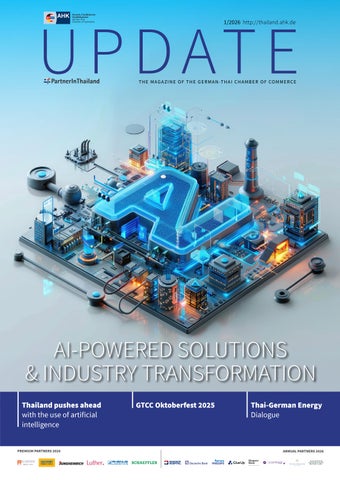
AI-POWERED SOLUTIONS & INDUSTRY TRANSFORMATION Thailand pushes ahead with the use of artificial intelligence PREMIUM PARTNERS 2026
GTCC Oktoberfest 2025
Thai-German Energy Dialogue
ANNUAL PARTNERS 2026
FROM THE EDITOR Dear readers, Thailand is positioning itself as one of the leading countries in Artificial Intelligence (AI) adoption within the ASEAN region. The government actively supports AI development through the National AI Strategy (2022–2027), alongside initiatives such as "Digital Thailand”, which plans to develop 30,000 AI-skilled workers by 2027, and “AI for Workforce”, which aims to upskill 150,000 workers. The Thai AI market is projected to reach 130 billion baht by 2030, growing at 18 per cent annuallyfrom 48 billion baht in 2024, according to a white paper by Thailand Development Research Institute (TDRI). Thailand is also developing comprehensive AI legislation, influenced by the EU AI Act, while tailoring many provisions to local conditions. The legislation proposes establishing AI regulatory sandboxes that allow innovators to test new AI technologies under regulatory supervision. The Artificial Intelligence Governance Center (AIGC), which operates under Thailand’s Electronic Transactions Development Agency (ETDA), will oversee implementation and monitor international AI developments. Key sectors driving AI adoption include manufacturing, healthcare, automotive, finance, hospitality, retail and creative industries. In manufacturing, the TDRI forecasts that AI could improve productivity by 20 per cent and reduce machine downtime by 53 per cent through predictive maintenance. At the same time, AI is transforming healthcare through disease screening technology, achieving over 92 per cent accuracy in detecting heart disease, lung cancer, and tuberculosis. Major hospitals, including Bangkok Hospital, use AI-powered facial recognition, symptom checkers, and automated insurance verification, cutting wait times by up to 50 per cent. Thailand’s automotive industry is also rapidly integrating AI for autonomous driving systems, predictive maintenance, and software-defined vehicles, although large-scale autonomous driving deployment remains limited. The Thailand Board of Investment (BOI) provides incentives for investments in the digital sector and AI, including up to eight years of corporate income tax exemption, and non-tax benefits. Major German companies like SAP, Siemens, and Bosch, along with other technology providers, including Google Cloud, Amazon Web Services (AWS), and IBM, are partnering with Thai organisations to accelerate AI adoption through infrastructure, training, and consulting expertise. The German-Thai Chamber of Commerce (GTCC) is preparing for the AI transformation within the organisation. One of the efforts is the employment of an AI Project Assistant who will begin working with us from February 1, to support internal AI transformation in GTCC and assist with planning, execution, and monitoring of related projects, also leveraging opportunities in this rapidly growing sector. (Read more on page 33) I trust you will enjoy informative and interesting reads.
Dr. Roland Wein UPDATE is published quarterly by the German-Thai Chamber of Commerce (GTCC) and distributed through an electronic platform to members and qualified non-members in Thailand and abroad. It is also available on our website: thailand.ahk.de/en/publications. Any opinions expressed in articles in this e-magazine do not necessarily reflect the views of the Chamber. UPDATE welcomes story and photo contributions from members and non-members alike. Articles may be reproduced with acknowledgement, except for those taken from other sources. For inquiries, please contact: communications@gtcc.org. Publisher/Editor-in-Chief: Dr. Roland Wein
Editor & Communications Director: Chadaphan Maliphan
Design & Layout: Sorapol Liengboonlertchai
Sub-Editor: Bruce Scott
CONTENTS
AI-POWERED SOLUTIONS & INDUSTRY TRANSFORMATION
30 GTCC Executive Director’s activities abroad
04 Thailand pushes ahead with the use of artificial
31 GTCC Customers and Partners Appreciation
intelligence
08 Driving the future of mobility: AI, safety, and innovation with Bosch Thailand
12 Driving innovation while redefining an industry: How Mercedes-Benz Thailand is integrating AI technology into the customer experience
14 BMW and the power of AI: Shaping the future of intelligent mobility
16 AI-powered solutions & healthcare transformation: Elevating health globally
18 AI-powered solutions and industry transformation in manufacturing
CHAMBER ACTIVITIES
32 GTCC Inter-Chamber Young Professionals Networking Evening
33 GTCC AFTERWORK Networking - Christmas edition
BUSINESS BRIEFS 34 Welcome Martin Liebenow to Luther Law Firm 34 VNU Asia Pacific and NCSA extend multi-year partnership to elevate Thailand’s role in regional cybersecurity
35 Smart Siam Consulting and Germany’s erfi bring 70 years of innovation to Thailand
20 AI-driven innovations in healthcare transformation 22 Thailand emerges as Southeast Asia’s high-tech powerhouse in the AI race
GTDEE INSIGHT 38 Panelists discussion at DIDACTA ASIA and DIDACDA ASIA Congress 2025
CHAMBER ACTIVITIES
41 AHK-ASIA-Pacific Regional Meeting for DVET 2025
24 GTCC Oktoberfest 2025
41 Organising final examination part 1 for automotive
26 GTCC Meets the German Ambassador 27 SAF Working Group Milestone Meeting 28 GTCC AFTERWORK Networking - Trination Edition 29 Thai-German Energy Dialogue
mechatronics
MEMBERS’ CORNER 44 New GTCC members
04 AI-POWERED SOLUTIONS & INDUSTRY TRANSFORMATION
Thailand pushes ahead with the use of artificial intelligence Frank Malerius Artificial intelligence is regarded worldwide as a major source of hope for increasing productivity. Governments around the globe are therefore drawing up AI strategies, and Thailand has launched the Thailand National AI Strategy and Action Plan (2022–2027). The aims are to train 30,000 AI specialists within six years, to rank among the top 50 countries in the AI Readiness Index, and to generate a ‘Business and Social Impact’ equivalent to 1.5 billion US dollars (US$). At least 600 authorities and companies are expected to be using AI by 2027. In the specific priority sectors of the Thai economy there are countless possible applications for AI. In the regionally leading agriculture and food processing sectors it can improve cultivation methods and product quality. In the booming medical tourism sector AI will refine diagnostics. For the millions of tourists in the country it can make travel planning and local orientation easier. In industry, AI driven efficiency gains can compensate for the foreseeable shortage of labour.
UPDATE 1/2026
However, Thailand – like most countries worldwide – is only just beginning to introduce AI. A legal framework for AI is currently emerging, while training programmes need to be created, and the necessary data centres must first be built. Individual lighthouse projects are frequently highlighted and, according to its own statements, the telecommunications provider Thaicom has independently developed an AI system that can better detect forest fires and air pollution. Of course, AI technologies are also already in everyday use, including self-learning language translation programmes that help Thais communicate with foreigners.
CONSTRUCTION OF NEW DATA CENTRES
International cloud operators are building new data centres across Thailand.
AI-POWERED SOLUTIONS & INDUSTRY TRANSFORMATION 05
Thailand has, in many respects, good prerequisites for the forthcoming AI era. The kingdom has strong telecommunications and internet infrastructure, and in urban centres 5G is available. There is also an investment boom in data centres, and leading international digital companies such as Amazon Web Services (AWS), Google, Microsoft, TikTok and Alibaba are applying for incentive programmes from the Thai Board of Investment (BOI). Colliers Thailand expects the market value of cloud services and data centres to double between 2022 and 2025 to the equivalent of US$2.2 billion. The energy supply for the new data centres is also secure. In recent years, Thailand’s lower than expected economic growth has created significant overcapacity in electricity generation. In fact, the state electricity provider EGAT has even shut down four power plants recently. The electricity mix is advantageous by regional standards, as it is based on natural gas. Due to hydropower imports from Laos, around a quarter of Thailand’s electricity is at least green. Current pilot projects to liberalise the electricity market allow data centre operators, in particular, to purchase green electricity directly from producers.
New data centre facilities support the expansion of AI and cloud services in Thailand.
“ In the AI Preparedness Index 2023, by the International Monetary Fund (IMF), Thailand ranks 54th out of 180 evaluated countries.”
A very specific demographic factor also provides an incentive for the increased use of AI, namely the fact that Thailand’s population is shrinking against the trend of all ASEAN mainland countries. As a consequence, sectors such as agriculture, construction, food processing, and tourism already rely on millions of migrant workers from neighbouring countries, especially Myanmar. By 2040 the number of Thais of working age (20 to 59 years) will shrink by 5 million, but partial replacement of these workers by self-learning systems could ease the challenges of this demographic change. One of the obstacles to the development of AI in Thailand is the weak education and training system. In international education studies Thailand ranks near the bottom, well behind regional competitors such as Malaysia and Vietnam. Only 1.2 per cent of gross national product is invested in research and development, and all higher value technology in Thailand comes from abroad.
Agriculture is one of the first sectors in Thailand to benefit from AI-based solutions.
BEHIND MALAYSIA, AHEAD OF VIETNAM Taking together all prerequisites for the introduction of AI, Thailand is reasonably well positioned for the forthcoming AI era, in relation to its level of development. The Global AI Index 2024 by Tortoise Media, regarded as an industry benchmark, ranks Thailand at 43 out
www.thailand.ahk.de
06 AI-POWERED SOLUTIONS & INDUSTRY TRANSFORMATION
AI AS A GROWTH BOOSTER AI offers opportunities for Thailand, as the kingdom has been in an economic crisis for several years, with growth rates that are the weakest in ASEAN. The country, which for decades was by far the second largest economy in the region, was first overtaken by Singapore. In the coming years, Vietnam the Philippines, and probably also Malaysia, will pull ahead. Thailand has not succeeded in attracting higher value industries, and the biggest obstacle to this is the low level of education and training. Wherever AI can provide the previously missing know-how – for example, in industrial process planning or automation – it can make an important contribution in terms of attracting more value-added production to the country. Thailand’s digital competitiveness remains low compared with its regional peers.
of 83 predominantly industrial and emerging countries – only slightly behind Malaysia, on a level with Greece and Croatia, and clearly ahead of Vietnam. In the infrastructure category, Thailand ranks 23rd, placing it ahead of many Western European countries (and in government strategy it ranks 16th). Weak points, unfortunately, lie in the categories of talent, research, and development. Here, Thailand also lags behind most ASEAN competitors. In the AI Preparedness Index 2023, by the International Monetary Fund (IMF), Thailand ranks 54th out of 180 evaluated countries. Here too, the kingdom ranks behind Malaysia and ahead of Vietnam. The placements in the Government AI Readiness Index 2024 by Oxford Insights, which is used as a reference by UNESCO and the G20, are similar
Contact details: Frank Malerius Director Thailand, Cambodia, Myanmar and Laos German Trade & Invest (GTAI) https://www.gtai.de/en/invest
Total Market Value of Data Centres and cloud Services in Thailand (2018-2025F) Value (Billion Baht)
Notes: Year-on-year growth shown above the columns. Source: Colliers Thailand/Bangkok Post
UPDATE 1/2026
AI-POWERED SOLUTIONS & INDUSTRY TRANSFORMATION 07
Thailand's AI regulation and framework development Thailand's development of artificial intelligence (AI) governance has accelerated significantly in recent years, driven by combined efforts across government agencies, research institutions, and the private sector. A major milestone took place in July 2022, when Thailand's Cabinet approved the National AI Strategy and Action Plan (2022– 2027). The strategy aims to build an effective, trustworthy AI ecosystem to enhance economic growth and quality of life by 2027. The framework is categorised into five strategic areas, including developing digital and data infrastructure, strengthening human capital, enabling legal and regulatory foundations, and promoting AI adoption across key sectors. To support implementation of the strategy, Thailand began drafting new AI-related legislation which includes: • Draft Royal Decree on Business Operations that Use Artificial Intelligence Systems, which adopts a risk-based regulatory structure classifying AI systems into risk categories and outlining requirements such as registration, transparency, and oversight. • A complementary draft AI law intended to support responsible AI development and innovation, including provisions on governance mechanisms and duties for high-risk AI providers. Thailand's AI regulations have been significantly influenced by the EU AI Act, but the country has adapted the framework to its own context. Unlike the EU's approach, Thailand opts for a voluntary AI Sandbox system and relies more on subordinate laws for specific requirements such as lists of prohibited and high-risk AI categories, detailed compliance criteria for high-risk systems, sector-specific risk management codes, technical documentation procedures, and registration requirements for AI providers. Throughout 2024–2025, Thailand held
a series of public consultations and explanatory sessions—led by the Electronic Transactions Development Agency (ETDA)— to refine the draft law's principles, focusing on a risk-based approach and obligations for high-risk AI developers and operators. In April 2025, the government strengthened overall AI governance by convening the National AI Committee to coordinate national AI policy and progress the regulatory framework. Thailand's regulatory approach draws on international best practices, including principles from UNESCO and major global AI governance models, while tailoring them to local needs and contexts. In parallel with regulatory developments, Thailand has made significant progress
in digenous AI model development. Thai researchers and organisations have developed Typhoon, a Thai-optimised large language model (LLM), and national science agencies such as NSTDA, in partnership with private-sector players, have launched initiatives to build a dedicated Thai LLM to support the country's digital transformation and AI readiness.
Contact details: Membership, Events & Communications German-Thai Chamber of Commerce (GTCC) Tel: +66 2 055 0623 communications@gtcc.org
References (Shortlisted): - National AI Strategy and Action Plan (2022–2027): http://www.ai.in.th/en/about-ai-thailand/ - Thailand’s draft AI Law: A new era for governance and innovation (2025): https://www.nortonrosefulbright.com/en/knowledge/publications/0fec663b/thailands-draft-ai-law-anew-era-for-governance-and-innovation - NSTDA News on AI Technology Tailored to Thai Context and Culture (2025): https://www.nstda.or.th/ en/news/news-years-2025/pathumma-llm-ai-technology-tailored-to-thai-context-and-culture.html - AI regulation in Thailand: Current state and future directions (2023): https://insightplus.bakermckenzie. com/bm/attachment_dw.action
www.thailand.ahk.de
08 INTERVIEW
Driving the future of mobility: AI, safety, and innovation with Bosch Thailand Dr. Rick Hilchner Thailand is entering a pivotal stage in the digital transformation of its mobility sector, as artificial intelligence (AI) shapes vehicle safety, efficiency, and intelligent driving systems. From advanced driver-assistance systems to AI-enhanced braking and steering, innovation is accelerating across the industry. As Bosch is one of the companies heavily investing in the application of AI, focusing on developing safer, more efficient mobility solutions, the GTCC interviewed Dr. Rick Hilchner, the Managing Director and Chairman of Bosch Automotive Thailand and regional lead for Bosch’s Vehicle Motion Division in ASEAN. Responsible for key systems such as braking, steering, and vehicle motion management, Dr. Hilchner shares how AI is transforming Bosch’s products and operations, contributing to safer roads and smarter mobility in Thailand and ASEAN. How does your role at Bosch connect to its vision for AI-driven mobility? As Managing Director of Bosch Automotive Thailand and regional lead for Vehicle Motion in ASEAN, my role is to ensure that our strategies and solutions align with Bosch’s global vision for intelligent, safe, and
UPDATE 1/2026
sustainable mobility. AI is central to this vision. On the product side, it powers advanced driver-assistance systems and autonomous driving technologies, enabling vehicles to interact seamlessly with their environment. On the operational side, AI enhances efficiency across manufacturing, logistics, HR, finance, and beyond. At Bosch, AI is not a separate initiative - it is embedded throughout our ecosystem, driving innovation and operational excellence at every level. How is AI transforming the global automotive industry? A I i s funda m e nta l l y re s ha p ing th e automotive industry, driving change in both products and operations at a pace we have never experienced before. On the product side, vehicles are evolving from mechanical machines into intelligent, connected platforms. Customers today expect more than transportation - they want a seamless digital experience. Cars now integrate with smartphones, smart infrastructure, and broader data ecosystems,
INTERVIEW 09
becoming part of a connected network rather than a standalone product. This shift is comparable to the leap from a basic mobile phone to a modern smartphone. In the near future, vehicles will communicate with each other, with roads, and with cities, creating a fully integrated mobility ecosystem. On the operational side, AI is revolutionising how we design, manufacture, and deliver these products. Advanced automation, robotics, and data-driven processes are enabling highly efficient production environments. Fully automated “dark factories,” where machines operate autonomously, are no longer a concept—they are becoming reality. At Bosch, we are moving beyond descriptive and prescriptive AI toward agentic AI capable of executing tasks independently. This marks a fundamental shift in how automotive companies innovate and operate. Are there any particular innovations or milestones that stand out to you, either at Bosch or in the automotive industry? One innovation at Bosch that illustrates the potential is our automated parking solution in Stuttgart, developed in collaboration with Mercedes-Benz. Drivers simply leave their vehicles at the entrance, and the car parks itself. When they return, the car is ready—an intuitive example of how automation enhances convenience and safety. Internally, we are leveraging agentic AI through solutions like the Mobility Manufacturing Agent (MMA). Previously, troubleshooting a machine required manual inspection and documentation. Today, technicians report issues via smartphone, and the AI agent diagnoses the problem, provides step-by-step repair instructions, and automatically generates structured reports. This approach accelerates problem-solving, improves data quality, and reduces manual effort—creating a more efficient and resilient manufacturing environment. How would you define Bosch's vision for AI-driven mobility today, and especially in Thailand? Our vision is a fully connected and automated mobility ecosystem that prioritises safety, efficiency, and sustainability. Vehicles will communicate seamlessly with each other and their environment, reducing accidents and optimising performance. At the same time, we aim to deliver an exceptional user experience—making driving safer, greener, and more enjoyable. In Thailand, this vision aligns with the country’s rapid digital transformation and growing focus on road safety and environmental responsibility. Bosch is committed to supporting this evolution by introducing advanced technologies and collaborating with stakeholders to create a smarter, safer mobility landscape. What advanced driving systems is Bosch developing and implementing in Thailand to enhance road safety?
Control Unit (ECU), which commands braking without driver input. AEB is already available globally—including in Thailand—and helps reduce collisions while protecting pedestrians, vehicles, and property. We also employ the Electronic Stability Control (ESC) to help prevent loss of control, as well as impact‑sensing technology that ensures the appropriate restraint systems like airbags are deployed in the event of a collision. Even before an impact, our recently developed Vehicle Motion Management (VMM) coordinates steering, braking, and chassis control to stabilise the vehicle and support obstacle avoidance. In Thailand, we go further by conducting accident research. Our corporate research team in Germany analyses real‑world car and motorcycle crashes in the country a nd t ra ns l ate s t he s e i ns i g hts into recommendations for improving road safety. One notable outcome is broader adoption of motorcycle Anti-lock Braking System (ABS), which helps prevent wheel lockup and maintain stability—especially on wet roads. Thai authorities have moved to require ABS on motorcycles above 125 cc, and Bosch contributed expertise, data, and research to support this policy direction. Through ongoing data collection and analytics, we remain committed to improving road safety in alignment with the country’s needs - applying a “local-for-local” approach and leveraging fact-based, data-driven decision-making to define Thai-specific requirements. These technologies and insights are evolving continuously - making mobility safer and more reliable for everyone.
We have already deployed a range of safety solutions in Thailand, beginning with systems that are straightforward in concept yet highly effective in practice. A prime example is Automatic Emergency Braking (AEB). If, for instance, a pedestrian steps into the roadway, the vehicle detects the hazard and can apply the brakes automatically. The system fuses inputs from radar, camera, and ultrasonic sensors to identify obstacles - whether a child, another vehicle, a motorcycle, or a stationary object. These sensors interface with the Electronic
www.thailand.ahk.de
10 INTERVIEW
“ I see AI as an incredible opportunity - both professionally and personally. In business, it frees us from repetitive tasks, giving us more time to focus on creativity, strategy, and what truly matters: People.” How does Bosch Thailand contribute to AI development within the company, and what is its role in driving operational innovation? In Thailand, our focus is on applying AI to operational processes. For instance, we use AIenabled cameras in production to verify assembly accuracy—detecting errors that are difficult for the human eye to spot. These solutions improve quality and efficiency while reducing fatigue-related mistakes. Historically, automation in Thailand was limited because competitive labor costs made human capital more economical than investing in expensive automated machinery. Today, the landscape has changed. Affordable AI-driven solutions have made automation feasible even in cost-sensitive environments. Technologies such as collaborative robots, AI-enabled systems, and automated forklifts are now accessible at lower cost, enabling manufacturers to automate processes without compromising product competitiveness. These innovations not only improve productivity but also enhance workplace safety and allow employees to focus on higher-value tasks. In which areas has AI most significantly transferred Bosch automotive operations from production to the design or the customer experience? The most immediate impact has been in manufacturing and operations, where AI delivers measurable efficiency gains. However, its influence is expanding rapidly into HR, marketing, and sales—streamlining processes such as pricing, claims management, and negotiation preparation.
UPDATE 1/2026
To accelerate adoption, I recently have tasked each department with identifying at least one agentic AI use case within three months and implementing it within six. Harmonising data across the organisation is essential to enable these solutions. In a highly competitive industry, speed of adaptation is critical, and Bosch is committed to leading this transformation. Yo u ’ v e m e n t i o n e d s e v e ra l B o s c h innovations. Is there one you are especially proud of, which you believe can set you ahead of competitors? If we look at automotive products and the supply side of the industry, Bosch is in a strong position because we have a significant market share and decades of expertise in hardware as well as software. Now the software side is becoming more important. New players are very good in software, but they don’t have the same hardware background. We have both, and that combination is a real advantage. One of the products that I'm really proud of, and which combines this legacy of hardware with software, is our already mentioned Vehicle Motion Management (VMM) system. It brings together all the sensors in a car – braking, steering, and chassis control – and links them through a software layer that
INTERVIEW 11
solutions and supporting partners, but globally, the automotive sector must accelerate to keep up. To end on a personal note, what excites you most about the AI era in mobility?
essentially acts as the brain for the car’s dynamics. It ensures that everything in the vehicle communicates seamlessly, resulting in a driving experience that is safe, engaging, and economically sustainable. Adoption of AI is one concern, but what other challenges do you see, whether technical, cultural, or regulatory, in bringing AI-driven mobility to life in Thailand and beyond? Globally, the automotive industry faces several interconnected challenges. One major issue is balancing the expectations of different customer segments. Established manufacturers often try to satisfy both traditional buyers—who value mechanical reliability—and a new generation that prioritises digitalisation and seamless connectivity. This dual focus can slow decision-making and dilute innovation speed. Organisationally, many legacy companies are structured around hardware and mechanical engineering. Developing AI-driven solutions and software requires a mindset closer to that of technology firms, demanding cultural change, new skill sets, and agile processes. Resistance to change - particularly among older generations of employees and customers can further complicate this transition. Data privacy is another critical concern. As vehicles become connected and AI systems process vast amounts of personal and operational data, ensuring compliance with regulations such as GDPR and local privacy laws is essential. Striking the right balance between innovation and data protection will remain a key challenge. For Thailand, the outlook is encouraging. EV adoption is accelerating, and new entrants are reshaping the market. “Bosch is well-positioned as a trusted partner to OEMs across all major global markets (including leading German, Japanese, and Chinese brands), leveraging worldwide expertise to deliver tailored solutions for regional needs. However, the pace of adaptation remains the defining factor. In a rapidly evolving industry, those who embrace AI and digitalisation quickly will lead. At Bosch Thailand, we are moving decisively, developing
I see AI as an incredible opportunity - both professionally and personally. In business, it frees us from repetitive tasks, giving us more time to focus on creativity, strategy, and what truly matters: People. Far from making organisations less human, AI actually helps us invest more in meaningful work and human connection. On a personal level, I use AI to optimise my lifestyle—from training and nutrition to overall well-being. It’s like having a personal coach who never sleeps—though I’m still waiting for it to let me skip leg day! Of course, responsible use is important, but the real challenge is ensuring innovation moves forward in a way that benefits everyone. That means collaboration between businesses, policymakers, and academia to create frameworks that enable progress while maintaining trust. Ultimately, AI is a transformative force. The question is not whether it will change our world—it already has. Our responsibility is to embrace it thoughtfully and harness its potential for good. Interviewed by Louisa Bornhöft, Trainee, GTCC Membership, Events and Communications Department, and Janna Plönjes, Trainee, GTCC Corporate Services Department Dr. Rick Hilchner Managing Director and Chairman, Robert Bosch Automotive Technologies (Thailand) Co., Ltd. Bosch Automotive (Thailand) Co., Ltd. Contact details: Intira Park Corporate Communications and Governmental Affairs Robert Bosch Limited Tel. +66 2 0128636 IntiraP@th.bosch.com www.bosch.co.th
www.thailand.ahk.de
12 AI-POWERED SOLUTIONS & INDUSTRY TRANSFORMATION
Driving innovation while redefining an industry How Mercedes-Benz Thailand is integrating AI technology into the customer experience In today’s world, artificial intelligence (AI) has become a transformative force reshaping every industry, and the automotive sector is no exception. As a global leader and pioneer in mobility, Mercedes-Benz has been driving innovation and redefining the industry ever since creating the world’s first automobile in 1886. Over the intervening decades, the brand has introduced countless breakthroughs; from powertrain technologies and safety innovations to advanced driverassistance systems, next-generation operating systems, connectivity solutions, and immersive entertainment experiences. By integrating this technology into a wide range of vehicle functions – thereby enabling systems to respond more intelligently to the needs of both drivers and passengers – AI now acts as a personal assistant within the vehicle, enhancing comfort, safety, and convenience, ultimately making everyday life simpler for customers. Through it all, “safety” remains a core principle for the brand. In fact, MercedesBenz has been a global pioneer in introducing groundbreaking automotive safety
UPDATE 1/2026
innovations, including the world’s first crumple zone (1959), the anti-lock braking system, or ABS (1978), airbag and seatbelt pretensioner systems (1980s), the electronic stability program, or ESP (1995), and the ‘PRE-SAFE’ predictive protection system (2002). These advancements established new benchmarks for how vehicles protect not only occupants, but everyone using the road.
AI IN ROAD SAFETY: FROM REACTIVE TO PREDICTIVE Having long led the industry in developing AI-powered advanced driver assistance systems (ADAS), Mercedes-Benz customers are now experiencing these innovations through models equipped with autonomous Level 2 and Level 2+ capabilities. Active safety features such as Adaptive Distance Assist, Active Lane Keeping Assist, Active Blind Spot Assist, and Active Emergency Stop Assist enable the vehicle to sense, predict, and react more intelligently to complex environments. In Thailand, the automaker has reinforced
its position as a leader in world-class safety technology by presenting three top-end luxur y models – the EQS 450+ AMG Premium, the EQS 450 4MATIC SUV AMG Dynamic, and the S 350 d Exclusive – for ADAS demonstrations during ‘Road Safety Week’, organised by the United Nations Economic and Social Commission for Asia and the Pacific (UNESCAP). Held at the UN Conference Centre (UNCC) earlier this year, this initiative aimed to promote and elevate road safety standards in Thailand and across the wider Asia-Pacific region, showcasing how advanced safety systems can support safer mobility for all road users. A key milestone in the journey towards a future of ADAS and automated driving is DRIVE PILOT, Mercedes-Benz’s Level 3 automated driving system, which has now received approval from the German Federal Motor Transport Authority. Under defined conditions, it allows drivers to temporarily hand over driving responsibility to the vehicle, marking a significant transition from advanced driver assistance to conditionally automated driving.
AI-POWERED SOLUTIONS & INDUSTRY TRANSFORMATION 13
In parallel, beginning in July 2025, the automaker started utilising anonymised sensor and video data from its customer fleet to further improve system accuracy in identifying diverse road users and atypical traffic situations. Together, these advancements reinforce a longterm commitment to road safety, while supporting the aim of ‘Vision Zero’, the EU’s goal of achieving zero road fatalities by 2050.
AI IN EVERYDAY MOBILITY: FROM OPERATING SYSTEM TO PERSONAL ASSISTANCE AI is reshaping how vehicles operate, learn, and adapt, and using machine learning across multiple domains – from predictive energy management and thermal optimisation to smart route planning that incorporates data on traffic, elevation, weather, and charging availability – results in a more efficient, more responsive, and more intuitive driving experience. AI transforms the vehicle from a traditional mechanical product into a dynamic, evolving, and constantly improving digital ecosystem. At the heart of this transformation is MB.OS, Mercedes-Benz’s in-house operating system that unifies all digital domains – from infotainment and powertrain management to comfort features and safety systems – into one cohesive architecture. Designed for real-time processing, personalised learning, and seamless over-the-air updates, it allows vehicles to evolve continuously throughout their lifecycle. Building on this foundation is the new AI-powered MBUX Virtual Assistant, which features an updated avatar with improved visual expression, multilingual capability, and emotion recognition. Developed with advanced generative AI, through partnerships with Google and Microsoft, the assistant enables drivers to manage navigation, communication, entertainment,
“ AI now acts as a personal assistant within the vehicle, enhancing comfort, safety, and convenience, ultimately making everyday life simpler for customers.”
and in-car functions simply by speaking. Enhanced tools such as advanced POI search and the Car Expert function further elevate usability, creating a digital companion that understands context, adapts to individual preferences, and personalises every journey. Amazingly, these technologies are not concepts, but are already in use in the brand’s latest models, including the new CLA. Built on the advanced MMA (MercedesBenz Modular Architecture) platform, it’s a clear demonstration of how software-driven strategy is turning cutting-edge innovation into real, tangible value for drivers in Thailand. The new CLA also incorporates AI-powered energy management to optimise real-time efficiency, supporting an impressive driving range of up to 792 km (WLTP) and offering 320 kW DC fast charging that can deliver up to 325 km of electric range in just 10 minutes. Machine learning further enhances predictive thermal management, coordinating battery temperature, charging curves, and power delivery, while AI-assisted navigation evaluates traffic, weather, elevation, and charging availability to generate the most efficient route. In the end, this deep integration of AI not only enhances everyday convenience, but also defines a new era of intelligent electric mobility for Thai customers.
Contact details: Marketing & Communications Mercedes-Benz (Thailand) Ltd. www.mercedes-benz.co.th
www.thailand.ahk.de
14 AI-POWERED SOLUTIONS & INDUSTRY TRANSFORMATION
BMW and the power of AI: Shaping the future of intelligent mobility Krisda Utamote Artificial Intelligence (AI) has emerged as a pivotal element driving significant changes within the automotive sector. At BMW, AI transcends being merely a technological instrument – it embodies a core philosophy that is molding the future of mobility, safety, and user engagement. From advanced driver-assistance systems to fully autonomous driving capabilities, the BMW Group is embedding AI throughout every phase of its value chain, thereby redefining the essence of driving, manufacturing, and vehicle interaction.
driving initiative is the BMW Personal Pilot L3, a significant advancement in conditional automation that has been introduced in select models. This system facilitates hands-free driving on highways under designated conditions, allowing drivers to momentarily disengage while AI maintains constant situational awareness.
LEADING THE WAY IN AUTONOMOUS AND ADVANCED DRIVER-ASSISTANCE SYSTEMS (ADAS)
At the core of BMW's innovation lies an unwavering dedication to road safety. AI is revolutionising how BMW vehicles foresee and react to hazards.
BMW’s vision for future mobility is anchored in the belief that technology should empower individuals, enhancing safety, efficiency, and enjoyment in driving. The company has been at the forefront of developing AI-powered autonomous and advanced driver-assistance systems (ADAS) that blend precision with emotional engagement. The cornerstone of BMW’s autonomous
UPDATE 1/2026
In addition to BMW Personal Pilot, BMW is making strides towards higher levels of automation through partnerships with technology leaders such as Qualcomm’s Snapdragon Ride, Intel and Mobileye. These collaborations harness high-performance computing and deep-learning algorithms to analyse extensive real-time data from sensors, cameras, radar, and LiDAR systems. The outcome is a vehicle capable of “seeing”, “thinking”, and “reacting” more swiftly than the human brain, thereby enhancing both safety and comfort on the road.
AI AS A PROTECTOR OF ROAD SAFETY
Utilising predictive algorithms, cars in the future can identify potential collisions before they happen, automatically modifying steering or braking, and providing alerts to nearby vehicles in real time. The incorporation of AI-driven driver monitoring systems ensures that safety encompasses the individual behind the wheel. By evaluating driver focus and conduct through camera sensors, BMW’s system can notify drowsy or distracted drivers, aiding in the prevention of accidents attributed to human error – the primary cause of most road incidents. This fusion of human and machine intelligence reflects BMW’s philosophy of “co-pilot” technology: where AI assists, but never replaces, the human driver's decision-making.
AI-POWERED SOLUTIONS & INDUSTRY TRANSFORMATION 15
“ AI is reshaping the future of driving, and BMW is steering this transformation with both precision and purpose.” INTELLIGENT MOBILITY BEYOND THE DRIVER’S SEAT AI is not limited to what happens behind the wheel – it encompasses the entire framework of intelligent mobility. The BMW Operating System 9 (OS 9) represents a major leap forward in digital intelligence, providing a customised, adaptive interface driven by AI. From voice recognition through the BMW Intelligent Personal Assistant to real-time route optimisation, the system continuously learns from driver preferences to offer a smooth experience tailored to each user. In urban mobility, BMW’s ConnectedDrive and My BMW app leverage AI to analyse real-time traffic information, enhance charging routes for electric vehicles, and suggest energy-efficient driving behaviour. These innovations contribute to reducing energ y consumption and promoting sustainable driving habits.
AI IN PRODUCTION AND DESIGN: THE SMART FACTORY Beyond the vehicle, AI is transforming the way BMW designs and produces cars. The BMW iFACTORY – a novel production strategy founded on the principles of lean, green, and digital – positions AI at its centre. Intelligent systems enhance logistics, quality control, and energy consumption, ensuring maximum efficiency and minimal waste. Within BMW facilities, AI-driven image recognition inspects every component for precision, reducing human error and elevating quality assurance. In logistics, AI-enabled robots and predictive analytics optimise the supply chain, while digital twins simulate production processes to evaluate and improve factory layouts prior to execution. These innovations illustrate how AI is converting BMW’s manufacturing into a model of smart, sustainable industrial transformation.
THE HUMAN-CENTERED FUTURE OF AUTONOMOUS DRIVING Although many perceive AI as the path to full autonomy, BMW envisions it as a tool to enhance human-centred mobility. The company’s exploration of Level 4 and Level 5 autonomous driving explores how vehicles can coexist with human drivers, pedestrians, and cyclists in complex environments. This vision extends beyond technology – it encompasses ethical decision-making, data transparency, and a sustained focus on the emotional bond between driver and vehicle. BMW’s conceptual vehicles, such as the BMW Vision Neue Klasse, exemplify this ideology. Merging cutting-edge AI, digital interfaces, and sustainable design, they signify a future where technology and humanity coexist harmoniously. The automobile evolves into more than just a means of transportation; it becomes an intelligent companion that learns, adapts, and grows alongside its driver.
CONCLUSION AI is reshaping the future of driving, and BMW is steering this transformation with both precision and purpose. From autonomous driving capabilities and predictive safety measures to smart manufacturing and interconnected ecosystems, AI is at the core of BMW’s mission to create the “Sheer Driving Pleasure” for a new era. In the coming decades, as vehicles evolve to become more intelligent, sustainable, and emotionally engaging, BMW remains committed to one guiding principle: ensuring that technology serves people, not the other way around. In this vision, AI is not just an innovation – it is the soul of future mobility. Special thanks to Erik Ruge, Managing Director, BMW Group Manufacturing Thailand, for contributing to this article
Contact details: Krisda Utamote Director Corporate Communications BMW Group Thailand krisda.utamote@bmw.co.th www.bmw.co.th
www.thailand.ahk.de
16 AI-POWERED SOLUTIONS & INDUSTRY TRANSFORMATION
AI-powered solutions & healthcare transformation: Elevating health globally Napassorn Thammarom Non-communicable diseases (NCDs) are reshaping the future of healthcare. Alzheimer’s disease affects one in nine people over 65, stealing memories and independence. Cardiovascular disease kills 20.5 million people every year. Stroke strikes 12 million more, often within minutes. Cancer cases are projected to rise from 20 million today to 30 million by 2040.
imaging, to enable earlier detection, deeper disease understanding, and more precise treatment decisions. Clinicians gain clarity and confidence. Patients gain time, hope, and better outcomes.
Behind these numbers are individuals and families facing uncertainty. Healthcare systems, already strained, struggle to deliver timely, equitable, and personalised care. Clinicians must balance heavy caseloads with limited time. Patients wait weeks for results. Staff face burnout.
Siemens Healthineers is a global leader in medical technology and digital health, committed to empowering clinicians to deliver exceptional, personalised care. Its comprehensive portfolio spans diagnostic imaging, image-guided therapy, in-vitro diagnostics, and digital health platforms, driving the global transformation of precision medicine.
Neurodegenerative diseases, cardiovascular disease, stroke, and cancer share one truth: every patient’s journey is unique. Onesize-fits-all approaches no longer suffice. Personalised care that recognises individual needs has become essential. The path forward lies in personalised care, empowered by artificial intelligence (AI) and advanced
UPDATE 1/2026
SIEMENS HEALTHINEERS: PIONEERING INNOVATION IN MEDICAL TECHNOLOGY
Innovation underpins this mission. The NAEOTOM Alpha, the world’s first photoncounting CT (PCCT), delivers superior image quality with lower radiation dose and enhanced diagnostic capability. Beyond hardware excellence, Siemens Healthineers
continues to advance AI-driven digital solutions, merging technology and insight to reshape the future of healthcare. This innovation leadership is grounded in three core clinical growth vectors: Patient Twining through precision diagnosis and advanced imaging; Precision Therapy through image-guided and personalized minimally-invasive interventions and HealthCare AI through AI-powered digital health platforms. Together, these vectors enable the shift toward truly personalised, patient-centered medicine, and help address the global NCD crisis.
FROM ONE-SIZE-FITS-ALL TO PERSONALISED CARE Personalisation starts with detecting disease earlier, characterising it more precisely, planning therapy individually, and monitoring outcomes continuously. The Siemens Healthineers portfolio integrates imaging, diagnostics, personalized minimally-invasive interventions and therapy, and Healthcare
AI-POWERED SOLUTIONS & INDUSTRY TRANSFORMATION 17
“ The path forward lies in personalised care, empowered by artificial intelligence (AI) […]” AI, creating a seamless, patient centered care continuum.
PATIENT TWINNING Pat i e n t Tw i n n i n g b u i l d s a d i g i ta l representation of each patient by integrating multi-modal data, allowing clinicians to visualise disease progression, simulate treatment options, and turn uncertainty into informed decisions. It supports early detection, accurate diagnosis, individualised therapy selection, and simulation-based planning for truly personalised care.
PRECISION THERAPY As cancer and cardiovascular burden increases, minimally invasive, image-guided, and robotic-assisted procedures become critical to achieving better outcomes with fewer complications. Photon-counting CT such as NAEOTOM Alpha improves vascular imaging, mobile CT accelerates stroke triage, and PET-Theranostics enable targeted tumor treatment. Tools like myExam Companion guide technologists through MRI and CT scans for consistent, high-quality imaging—an essential foundation for precision interventions.
HEALTHCARE AI: THE SYSTEM ORCHESTRATOR Real transformation happens when isolated tools become an integrated system. Healthcare AI unifies imaging, diagnostics, clinical notes, medications, and risk factors into a single view, flags urgent findings automatically, and automates routine tasks, freeing clinicians and staff to focus on complex decisions and human connection. More than 1,200 AI-related patent families, position the organisation as one of the leaders advancing digital transformation in healthcare. Across modalities, Healthcare AI now drives clinical excellence: • Deep Resolve accelerates MRI scans by over
70% while doubling resolution—delivering earlier detection, improved patient comfort, and lower energy use per exam. • Organs RT applies AI-powered autocontouring for radiotherapy planning, cutting contouring time by up to 79% while achieving 95% contour usability—helping patients start treatment faster. • AI-Rad Companion enhances the radiology w o r k f lo w e nd to e nd— from i m a ge acquisition to structured reporting.
TANGIBLE IMPACT The impact of these innovations is evident across key disease areas: • Neuro-degenerative and stroke: Advanced CT and AI-assisted triage accelerate critical treatment decisions, reducing disability and saving lives. • Cardiovascular disease: High-resolution imaging minimises invasive procedures, lowers risk, and supports faster recovery. • Cancer: AI-enhanced detection and precise radiotherapy improve survival rates and reduce side effects, giving patients better quality of life.
innovations, but essential tools for expanding access to quality care and improving patient outcomes. Hospitals that adopt AI-driven technologies, are positioning themselves to close critical healthcare gaps and enhance both access and outcomes for patients" said Chris Poray, Managing Director, Siemens Healthineers Thailand “The success of this transition will depend not only on investment in advanced technologies, but also on robust workforce training and effective change management. Ultimately, the entire healthcare ecosystem, and every patient within it, stands to benefit.”
RESPONSIBLE AND SUSTAINABLE INNOVATION Siemens Healthineers' approach to AI is built on robust data privacy and security aligned with regulations such as Thailand's PDPA; transparent and explainable algorithms that clinicians can trust; continuous validation ensuring safety across diverse patient populations; human-centered design supporting clinicians; and sustainable computing practices minimising environmental impact. Through this responsible AI framework, Siemens Healthineers aims to build long-term trust among patients, clinicians, regulators, and society. For more information: www.siemenshealthineers.com or scan
These solutions align with Siemens Healthineers' purpose-driven ambition: to help patients live longer and better lives.
SOLVING WORKFORCE AND COST PRESSURES AI and digitalisation help healthcare providers by reducing manual, repetitive tasks in imaging and reporting; supporting less experienced staff through guided workflows; increasing throughput without compromising quality; and reducing unnecessar y hospitalisations and readmissions. These capabilities enable health systems to do more with fewer resources without sacrificing safety or compassion. "We are entering a pivotal era where medical technology and AI are no longer optional
Contact details: Napassorn Thammarom Head of Marketing, Sales Operations and Comunications Siemens Healthineers Thailand Tel: +66 63 230 5186 napassorn.thammarom@siemenshealthineers.com www.siemens-healthineers.com
www.thailand.ahk.de
18 AI-POWERED SOLUTIONS & INDUSTRY TRANSFORMATION
AI-powered solutions and industry transformation in manufacturing Enrico Sielaff As an engineer, I like simplicity so let’s oversimplify what Artificial Intelligence (AI) and AI tools are and how they fundamentally work as a guideline for the upcoming industry examples.
AI BACKGROUND Someone in the AI industry described LLMs (Large Language Models) as “autocorrect on steroids” and I haven’t seen a better description yet. I would even go a step further that AI, as it is most commonly used, is a “search engine on steroids”. This is also why it feels so different for normal users because it provides access to resources because the LLMs allow via chat functions (prompts) to describe the problem without knowing the specific industry phrases and is possible to fine tune the results which traditional search engines did not support. This is true for text-based results but also for picture- and video-based results. The main point to consider before we move to industrial solutions is why it was possible to achieve this leap forward. Neural network’s functionality is based on large datasets which come with certain rule sets which can be used to train/weigh neural networks. These two conditions are given for language with grammar as the rule set and all books or the whole internet as the data available. The conditions are also met with pictures as we have pixel positions, colors, saturation as the rule set. The same applies to audio and video. All these systems have defined rule sets and sufficient data to train the models. I hope this helps evaluating opportunities and challenges in AI implementations beside the following examples.
AI IN INTRALOGISTICS The easiest implementations are trained recognition and identification of objects in video streams. One problem many companies with a high number of material movements and shipments have, is the location of the material at any time. Traditionally this was solved by
UPDATE 1/2026
manually scanning barcodes, QR-codes or RFID tags to then assign a pallet to a storage location. Sophisticated AI systems currently track the delivery truck’s location in reference to the shipment data, followed by capturing the truck load and then the fork lift as well as the location in the warehouse automatically. These systems also apply inside factories where manual scanning of products or manual data entries are one of the most underestimated cost drivers so video streams allow automatic material tracking using AI analysis. With a pull-system in production where the machine can request the raw material it requires for the job order, the material movement from storage to machine can be requested automatically and does not require low level planning if implemented correctly.
AI IN QUALITY Another area where AI tools are pushing efficiency is quality control. Here also the easiest implementations are vision based which traditionally required to specify what
AI-POWERED SOLUTIONS & INDUSTRY TRANSFORMATION 19
needs to be measured when inspecting but now with sufficient clean data it can be trained. Instead of defining which kind of defect to look for, simply good and bad can be trained which allows for higher accuracy for many applications as the pattern recognition is not predefined but trained. The main difference is that traditionally defects had to be classified or described by highly skilled vision programmers and then the system measured against the description. With AI tools however defects are being trained directly without the need for a sophisticated defect specification.
AI IN SAFETY Many AI solutions are emerging which use AI object recognition to identify for example if operators use correct personal protection equipment before access to areas is allowed. In easier applications this directly linked to door controls prohibiting access if safety equipment rules are violated and in more sophisticated applications whole shopfloors are monitored under similar requirements. It is worth to mention that for safety improvements I’m in favor of these implementations however cases from China have shown that these systems are also used to monitor operator job executions in detail with punishments for deviations. This trend to dehumanise operators by using AI to make humans behave robotic is concerning and in my opinion should be avoided.
AI IN MACHINES The biggest challenge brought up over the years is predictive maintenance. In the past my answer often had to be that most machines did not generate enough data, so a simple spare part tracking and analysis was more cost effective. However, this limiting factor is becoming less relevant over time as driven by Industry 4.0 and smart manufacturing efforts many smart components provide additional data and diagnostics. Combined with further developments of industrial standards like OPC UA (Open Platform Communication Unified Architecture) more data with a defined rule set, the communication protocol, is created which will enable the use of AI tools and therefore analysis and improvements. The usage here will be split in information being used by the manufacturer and by the user. The manufacturer
“ For many companies their assets will not only be the buildings, machines, etc. but the manufacturing know-how […]”
can inform about predictive maintenance as a service just like in aerospace where turbines are monitored. For the user, the access to additional system data allows AI based analysis and improvements in relation to the product being manufactured which then can generate a Know How model. As an example, in jewelry cost estimation is a highly skilled job which requires experience and is hard to scale. By training the product master pieces with their material composition data, a proposed product routing with estimated process times can be generated which then allows the automated cost estimation. The same can be done for an automotive part stamping line under the assumption enough clean data is available or can be generated. Here companies already working towards Industry 4.0 or a smart factory have the head start moving forward as these data sources are available for AI adaptation.
OUTLOOK We see in the AI discussion already the shift from the AI tools itself to the data required to train the models as the next big leap forward. This means for many companies their assets will not only be the buildings, machines, etc. but the manufacturing knowhow because experience now can be digitised and scaled faster than ever. However, this also increases the risk and need for efficient cyber security tremendously and should be everyone’s priority before implementation. The unfortunate downside of the general AI development is that attackers have more powerful tools than ever before and I can’t stress enough that this can not be ignored by any company with or without a plan for internal implementation of AI. (This article was generated without AI)
Contact details: Enrico Sielaff CEO gerenga group Tel: +66 2 105 4519 contact@gerenga.com https://www.gerenga.co.th
www.thailand.ahk.de
20 AI-POWERED SOLUTIONS & INDUSTRY TRANSFORMATION
AI-driven innovations in healthcare transformation Dr. Kewalin Rungsinaporn Artificial intelligence is reshaping global healthcare, rapidly enhancing the way hospitals deliver diagnoses, operations, and personalised care. At Bangkok Hospital Headquarters, this transformation aligns with our strategic vision to become a Smart Hospital – a healthcare system that integrates advanced technologies, including AI, across clinical and non-clinical workflows to elevate quality, safety, and patient experience. Our approach is rooted in a simple principle: we select AI only when it benefits patients, enhances accuracy, and empowers clinicians. AI is used as a supportive tool for doctors, ensuring better decisions – not replacing medical expertise.
AI-DRIVEN WEBSITE: FROM PATIENT JOURNEY TO PATIENT INSIGHT To better serve international visitors and patients, Bangkok Hospital’s website integrates AI translation into eight languages. Guided by the concept “Better AI”, the website functions as a digital health assistant with three key capabilities: • AI-generated audio for health articles • AI-matched specialist recommendations for appointments • Real-time, AI-curated health content based on user interest This enables smoother navigation, easier access to trusted medical information, and a more personalised patient experience.
UPDATE 1/2026
AI-POWERED SOLUTIONS & INDUSTRY TRANSFORMATION 21
TRANSFORMING DIAGNOSTIC RADIOLOGY WITH AI (X-RAY AND MAMMOGRAPHY) • AI for chest X-ray analysis Chest imaging workload continues to grow, increasing the risk of delays and diagnostic fatigue. Inspectra CXR functions as a radiologist’s assistant – trained on over 2.1 million global images and reinforced with 900,000 Thai images. It detects multiple lung abnormalities, including tuberculosis and small lung nodules (as small as 4mm), and helps prioritise urgent cases for faster treatment decisions. • AI mammography for early breast cancer detection AI enhances breast cancer detection by analysing digital mammography images for subtle abnormalities such as masses, calcifications, or suspicious lymph nodes. Radiologists maintain full control of interpretation, using AI as a second reader to improve accuracy and reduce overlooked findings, ultimately leading to better treatment planning and outcomes.
“ AI is used as a supportive tool for doctors, ensuring better decisions – not replacing medical expertise.”
SPEECHTECH: ENHANCING CONSULTATION WORKFLOW The speech-to-text AI system allows doctors to convert clinical conversations into structured medical text through domainspecific voice recognition. By reducing time spent on typing, physicians can stay fully focused on their patients while maintaining clear, accurate medical records – improving both communication and workflow efficiency.
AI-ENABLED PATIENT FLOW AND SERVICE MANAGEMENT Through Agnos Health, AI helps manage complex operational tasks, including real-time queue updates, electronic forms, patient flow optimisation, and automated check-up package suggestions. This results in smoother service delivery, reduced congestion, and improved patient satisfaction – key pillars of a Smart Hospital ecosystem.
BUILDING A SMART HOSPITAL FOR THE FUTURE Bangkok Hospital Headquarters is committed to transforming Thai healthcare to global standards through purposeful, patient-centered AI adoption. Our Smart Hospital strategy integrates prevention, screening, diagnosis, and treatment within one intelligent ecosystem – where AI strengthens clinical decision-making, enhances operational efficiency, and supports doctors in delivering accurate, timely, and compassionate care.
Dr. Kewalin Rungsinaporn Diagnostic Radiologist Assistant Director Bangkok Hospital Headquarters Contact details: Prayurapat Krewer International Marketing Communication, Bangkok Hospital Headquarters Tel: +66 2 3103105 Prayurapat.tr@bangkokhospital.com https://www.bangkokhospital.com/ en/bangkok
www.thailand.ahk.de
22 AI-POWERED SOLUTIONS & INDUSTRY TRANSFORMATION
Thailand emerges as Southeast Asia’s high-tech powerhouse in the AI race Thailand Board of Investment (BOI) World Investment Report 2025 by the United Nations Conference on Trade and Development highlights a striking shift in global investment flows. As companies diversify supply chains and reduce geopolitical risk, Southeast Asia has emerged as the world’s most attractive destinations for foreign direct investment (FDI).
In response, the Thai government and the Thailand Board of Investment (BOI) have taken a sustained and proactive approach to promoting critical digital infrastructure investment, particularly from global hyperscale data center providers, while also scaling up the country’s AI infrastructure capabilities.
Over the past few years, the region has exhibited comparatively low geopolitical risk, strong logistics networks, supportive investment policies, and market. While global FDI contracted in 2024, Southeast Asia continued to gain momentum, achieving a new record high with double-digit growth.
In an increasingly multipolar world, Thailand has a well-regarded stance of neutrality, combined with its strategic location at the heart of Southeast Asia’s market of over 700 million consumers and between key maritime corridors. The country offers advanced industrial infrastructure, a sophisticated and expanding digital and electronics supply chain, top-tier internet connectivity, and a regulatory environment supportive of innovation including initiatives such as AI sandbox.
Digital transformation is deepening, and a surging wave of FDI is sweeping across Southeast Asia — call it the AI race. Significant investment was poured into advanced manufacturing as well as AI data centers and cloud service which are essential enablers of digital transformation and innovation.
UPDATE 1/2026
It also provides a competitive, market-based framework for securing clean energy, and
water supply together with high trade openness underpinned by 17 free trade agreements and membership of the Regional Comprehensive Economic Partnership, a robust digital regulatory framework, and a sizeable domestic market. Moreover, Thailand offers significantly lower construction and operating costs and greater land availability, while retaining strong digital infrastructure fundamentals. Thailand’s attractiveness as a livable location for both work and family, combined with the strengths outlined above and a suite of targeted investment incentives, has also made the country an increasingly competitive base for regional headquarters operations. The significant wave of investment from global electronics manufacturers in recent years further underscores Thailand’s comparative advantage in the digital economy landscape. These projects range from hard disk drives, printed circuit boards,
AI-POWERED SOLUTIONS & INDUSTRY TRANSFORMATION 23
IC packaging and testing to the country’s first silicon carbide wafer factory. These investments are driving the continued upgrading and global integration of Thailand’s digital economy and semiconductor supply chain.
well-equipped with robust infrastructure, including a reliable power supply and direct access to submarine cable connections.
Thailand is emerging as one of the region’s most attractive investment hubs for digital infrastructure and hyperscale data centers in ASEAN. With internet penetration exceeding 90% and project IT spending expected to reach almost THB 1 trillion by 2025, the country’s digital economy is thriving—now valued at THB 2.5 trillion. The data center and cloud services markets are also expanding accordingly, underpinned by advanced digital infrastructure, enabling regulations, and continuous investment in workforce development. These investments in digital sector, coming from leading companies across the United States, Australia, China, Hong Kong, Singapore, Japan, India, and Thailand, underscore Southeast Asia’s expanding adoption of cloud services and AI.
The Thai government has outlined a comprehensive strategy to strengthen the country’s AI ecosystem, including training thousands of professionals and developers, expanding digital infrastructure and opensource platforms, integrating AI across healthcare, tourism, and agriculture, enhancing the AI governance framework, and establishing specialised AI centers that strategically combine large and small language models to drive innovation.
From 2022 to September 2025, the BOI received 57 investment applications in data centers and cloud services, with a total value of approximately US$25 billion. These include investments from global hyperscale data center leaders such as Beijing Haoyang Cloud Data Technology (US$2.2 billion); Amazon Web Services (US$763 million, with a total investment commitment of US$6 billion by 2037); Google (US$1 billion); and DayOne (US$861 million). For cloud services, notable investments include Siam AI (US$100 million), marking the first Thai NVIDIA Cloud Partner (NCP). Reflecting the surge in investment, Thailand’s data center capacity is projected to triple from 350 MW in 2024 to over 1 GW by 2027. This growth reinforces Thailand’s potential in digital infrastructure and its positioning as a regional hub for AI and high-tech innovation. 1 These data centers are primarily located in EEC, Bangkok and its metropolitan area, enabling seamless business operations and reducing data transmission latency. Additionally, the Eastern Economic Corridor (EEC), a government-designated strategic investment hub, is
“ The BOI provides incentives for the digital sector, including up to eight years of corporate income tax exemption and non-tax benefits […]”
The BOI provides incentives for the digital sector, including up to eight years of corporate income tax exemption and nontax benefits designed to enhance project competitiveness and operational efficiency. Moreover, projects may qualify for meritbased, area-based, or agenda-based incentives, which offer extended tax holidays or reductions depending on project characteristics and their contribution to national priorities. In early November 2025, the BOI also approved certain adjustments to the promotion of data center investments. To encourage the transfer of technology and expertise to Thai personnel, projects are required to employ the Thai executives and professionals of at least 50 percent of the total number of such positions within three years. To promote energy-efficient data centers, the duration of the tax holiday will be determined based on the location and the Power Usage Effectiveness (PUE) ratio. 2 Wi t h i ts st rateg i c l ocat i on, robust infrastructure, competitive costs, and forward-looking policies, Thailand is not just keeping pace with the digital revolution— it is positioning itself as Southeast Asia’s premier destination for AI-driven innovation and high-tech investment.
Contact details: Thailand Board of Investment (BOI) Tel: +66 2 553 8111 head@boi.go.th www.boi.go.th
As of 31 October 2025, the exchange rate 1 USD = 32.5070 THB (BOT) 1 https://www.bangkokpost.com/life/tech/3089988/thai-data-centre-capacity-may-triple-on-surging-demand-for-ai 2 https://www.boi.go.th/index.php?page=press_releases_detail&topic_id=138169&_module=news&from_page=press_releases2
www.thailand.ahk.de
24 CHAMBER ACTIVITIES
GTCC Oktoberfest 2025 A record-breaking celebration
GTCC Oktoberfest 2025 marked a triumphant return to pre-pandemic celebration levels, welcoming over 1,300 guests across two spectacular evenings – 17-18 October 2025 – at the Sofitel Bangkok Sukhumvit. This number of attendees represents the highest turnout since before the COVID-19 pandemic, underscoring the event’s position as Thailand’s largest and most authentic Oktoberfest celebration. This year’s event also featured an unprecedented selection of 13 beer varieties, from five premium German brands, making it the most comprehensive beer offering in GTCC Oktoberfest history.
DAY ONE: 17 OCTOBER 2025 The GTCC Oktoberfest 2025 officially commenced with the traditional beer keg tapping ceremony, performed by distinguished guests Ebba Sabine Elisabeth Scholl, Deputy Chief of Mission at the German Embassy Bangkok, together with GTCC President Alexander Donau and GTCC Executive Director Dr. Roland Wein.
DAY TWO: 18 OCTOBER 2025 His Excellency Dr. Ernst Reichel, Ambassador of the Federal Republic of Germany to Thailand, joined Chadchart Sittipunt, Governor of Bangkok, along with the GTCC President and GTCC Executive Director to perform the traditional beer keg tapping ceremony, officially launching Day 2 of the celebrations.
UPDATE 1/2026
The venue recreated the Munich Oktoberfest ambiance, complete with traditional wooden Festzelt benches and authentic Bavarian décor. The O’zapft band, flown in directly from Bavaria, provided genuine Oktoberfest atmosphere and music throughout both nights, filling the venue with traditional festive melodies. Guests enjoyed a wide
CHAMBER ACTIVITIES 25
selection of traditional German feasts and delicacies, complemented by an impressive beverage selection featuring 13 beer varieties from five premium German brands, including genuine Oktoberfest beers. Interactive entertainment kept guests engaged throughout both evenings, with games, competitions, and exciting lucky draws featuring prizes from generous sponsors. As both evenings progressed, the celebrations continued with energetic after-parties led by DJ Kenny on the first night, and Michael Knapp on the second night. We would like to express our heartfelt gratitude to our partners who made this event possible: • Diamond partners: B.Grimm, ERGO Insurance, and Schaeffler Manufacturing • Gold partners: DACHSER, Deufol Doehle Projects, Luther Law Firm, and Rhenus Logistics • Silver partners: Alliance Ayutthaya, BASF, Bayer, FLS Group, Isegrim-X, Munich RE, and Wissen & Co • In-kind partner: Bangkok International Hospital • Venue partner: Sofitel Bangkok Sukhumvit • Beverage suppliers: Arcobräu by Flow Inter, Hacklberg by Bavarian Craft, Hofbräu by Janhom Classic, and Weihenstephan & Schneider Weisse by SM Retail Here are some of the most wonderful and joyful moments of GTCC Oktoberfest 2025.
www.thailand.ahk.de
26 CHAMBER ACTIVITIES
GTCC New Members Meet-up The third New Members Meet-Up of 2025 took place on 1 October 2025. Jantarath Korbuakesorn, GTCC Head of Membership, Events & Communications, welcomed representatives from our new member companies and new representatives of established members, including: Patrick Günthart, Günthart (Thailand) Ltd.; Tippawan Patthawee, Somphong Logistics Group; Amitava Biswas, Rittal Ltd.; Kachin Klainin, Aero Group (1992) Co. Ltd.; Thanaporn Sapsermsong, Rembrandt Hotel & Suites Bangkok; and Pattaralapa Bubphachart, LODEC Metal Trade (Thailand) Co. Ltd. We sincerely thank all the representatives for joining us at our GTCC office at the AIA Sathorn Tower, and we look forward to our future collaborations with all of you!
GTCC Meets the German Ambassador The GTCC Meets the German Ambassador event was hosted on 30 October 2025, at the Le Meridien Bangkok, where H.E. Dr. Ernst Reichel, Ambassador of the Federal Republic of Germany to Thailand, shared invaluable insights from his distinguished diplomatic career, as well as seasoned perspectives on GermanThai relations. The event began with a welcome by President Alexander Donau, offering condolences and leading a moment of silence in remembrance of Her Majesty Queen Sirikit, The Queen Mother. We are grateful to the German Ambassador for sharing his insights with GTCC members, and to Dr. Nattha Komolvadhin, News Director at The Standard, for moderating the engaging talk. Thanks also to venue partner Schaeffler Manufacturing, and beverage partner Arcobräu by Flow Inter, for their generous support.
UPDATE 1/2026
CHAMBER ACTIVITIES 27
SAF Working Group Milestone Meeting
The SAF Working Group Milestone Meeting took place on 30 October 2025, as part of the International Hydrogen Ramp-Up Programme (H2Uppp), in collaboration with GIZ Thailand, ENTEC, and the GTCC. The meeting provided a platform for continued dialogue and collaboration among key stakeholders across Thailand’s aviation value chain, with the shared objective of advancing the development and deployment of Sustainable Aviation Fuel (SAF) as a critical component in the transition toward a more sustainable aviation sector. Approximately 80 representatives from over 35 organisations participated in the meeting. The session commenced with opening remarks by Dr. Dominika Kalinowska, Director of Transport Projects, GIZ Thailand & ASEAN, followed by a keynote address delivered by Krittima Shoosanglertwijit, Director of the Strategy and Planning Division, Department of Energy Business (DOEB), Ministry of Energy, Thailand, who offered strategic insights into the national SAF landscape. The programme featured expert contributions from the following speakers: • Dr. Nuwong Chollacoop, Director, Low Carbon Energy Research Group, ENTEC • Arif Fajari, Regional Officer, Environment and Climate Change, International Civil Aviation Organization (ICAO) • Gloyta Nathalang, Senior Executive Vice President – Sustainability Management and Corporate Communications, Bangchak Corporation • Pahoong Thammaratdumrong, Vice President, EA Bio Innovation and Vice
President of Sales and Marketing, Energy Absolute Co. Ltd. • Dr. Ruethai Onbhuddha, Researcher, National Metal and Materials Technology Center (MTEC) • Arianna Baldo, Programme Director, Roundtable on Sustainable Biomaterials Association (RSB) Tim Nees, the Project Manager of H2Uppp at GIZ Thailand, delivered the closing remarks, emphasising the importance of fostering collaboration among public institutions, private sector actors, and research organisations. He underscored the need for sustained efforts to establish a robust foundation for SAF development in Thailand, alongside promoting tangible investment in SAF production technologies aligned with the aviation sector’s decarbonisation goals.
www.thailand.ahk.de
28 CHAMBER ACTIVITIES
GTCC AFTERWORK Briefing with Luther It was an informative and engaging GTCC AFTERWORK Briefing with Luther Law Firm that took place on 13 November 2025. Our speakers, Fabian Lorenz, Partner at Luther Law Firm (Thailand), and Lukas Baumgärtner, Senior Associate, provided valuable insights on the "Thailand Employment Law Update 2025: A Practical Playbook from Hiring to Termination." A big thank you to our speakers for sharing their expertise, practical guidance and real case experiences. Also, thanks to all participants for joining and contributing to an enriching discussion.
GTCC AFTERWORK Networking - Trination Edition On 13 November 2025, the GTCC organised a GTCC AFTERWORK Networking "Tri-Nation" event, in cooperation with Advantage Austria and the Swiss-Thai Chamber of Commerce (STCC). It was opened by GTCC President Alexander Donau, and this special evening brought together three nations, three chambers, and one shared vision – to strengthen bilateral business relations and foster meaningful connections across our communities. W e w e re d e e p l y h o n o u r e d b y t h e participation of our distinguished guests of honour: H.E. Dr. Ernst Reichel, German Ambassador to Thailand; Mag. Wilhelm
UPDATE 1/2026
Donko, Austrian Ambassador to Thailand; Christine Löw, Deputy Head of Mission, Embassy of Switzerland in Bangkok; Michael Friedl, Austrian Commercial Counsellor and Head of Advantage Austria Thailand; Thomas Keller, President of the STCC; and Marco Rudin, Executive Director of the STCC. We highly appreciate the great support from our event partners Bangkok Hospital, Forvis Mazars, Luther Law Firm, and Skywave Technologiea; our beverage partners Arcobräu by Flow Inter; Bavarian Craft Trading for Hacklberg; Janhom Classic for Hofbräu; and SM Retail for Weihenstephan; and our venue partner the Anantara Siam Bangkok Hotel.
CHAMBER ACTIVITIES 29
Thai-German Energy Dialogue
The Thai-German Energy Dialogue (TGED) on “Advancing Industrial Energy Efficiency in Thailand through Digitalisation: German Innovations for Sustainable Cooling, Refrigeration, and Heating” was organised on 18 November 2025, at the Eastin Grand Phaya Thai hotel, in collaboration with GIZ Thailand, with support from the Federal Ministry for Economic Affairs and Energy (BMWE) and the Ministry of Energy. The event brought together more than 120 stakeholders from across Thailand’s heating and cooling sector, and provided a platform for continued dialogue and collaboration among industry leaders, policymakers, consulates, and technical experts. It followed the successful launch of the Thai-German Energy Dialogue back in 2023. The event was opened with remarks from Dr. Pongpan Vorasayan, Director of Energy Regulation and Conservation Division, Ministry of Energy, and Johannes Kerner, Economic and Commercial Counsellor, the German Embassy Bangkok. This was followed by a keynote speech delivered by Dr. Peter du Pont (Asia Clean Energy Partners) on “Empowering Industrial Energy Efficiency in Thailand: Global Practices, Smart Technologies, and Business -Driven Investment.” Participants gained valuable insights during the four technologies showcase “German Solutions in Action”, featuring cutting-edge
innovations and practical applications by representatives of the following leading German technology providers in cooling, re f r i ge rat i o n , a n d h eat i n g : S e r ge i Polikarpov (GEA Thailand Co. Ltd.); Sutham Katekaewklieng (Robert Bosch Ltd.); Wisit Pacharatanasarn (The Auto-Info Co. Ltd., value partner of Siemens); and Domy Aguilar (Ziehl-Abegg (Thailand) Ltd.). The showcase was followed by a panel discussion on “Voices from the Field – Thai Industries Share Their Energy Efficiency Journey,” moderated by Dr. Pramote Puengjinda (GIZ Thailand), with esteemed panelists: Dr. Athapol Pecharaply, Director of Engineering for Sustainability, CPF (Thailand) PCL; Peerasut Thirakomen, Senior Vice President, Goldmarktech Co. Ltd.; Visit Kittirujiraphan, Managing Director, Thai Ice Industry Co. Ltd. Nataphol Naewthai (Siemens Limited) delivered an inspiring session on “AI-Powered Efficiency: Technology Solutions Driving Smarter Energy Use in Thai Industry,” that demonstrated how intelligent systems are transforming industrial operations and unlocking new levels of sustainability and performance. The conference concluded with closing remarks from Insa Illgen, Programme Director of the Thai-German Cooperation on Energy, Mobility and Climate (TGC EMC), GIZ Thailand.
www.thailand.ahk.de
30 CHAMBER ACTIVITIES
GTCC Executive Director’s activities abroad MEETING WITH STMWI GTCC Executive Director Dr. Roland Wein had a meeting with Armin Schwimmbeck, Head of Division Asia, Bavarian Ministry of Economic Affairs, Regional Development and Energy (STMWI), together with Beate Jaeckel, Deputy Head of Division Asia, at the STMWI office in Munich on 18 November 2025. They discussed planned activities, including the preparations for the establishment of a Bavarian Trade and Investment Office for Southeast Asia in Thailand – at the GTCC office – in 2026.
IHK TRADE & CONNECT 2025 GTCC Executive Director Dr. Roland Wein participated in the IHK Trade & Connect 2025 event on 19 November 2025. Together with experts from other German Chambers of Commerce Abroad (AHKs), he provided consultations on Thailand’s industrial situation and investment opportunities. The Trade & Connect 2025 was organised by the Chamber of Industry and Commerce for Munich and Upper Bavaria (IHK München), and opened by Dr. Manfred Gößl, IHK München Chief Executive Officer.
UPDATE 1/2026
CHAMBER ACTIVITIES 31
GTCC Customers and Partners Appreciation On 6 November 2025, the GTCC hosted the GTCC Partners and Customers Appreciation event at the Kimpton Maa-Lai Bangkok, celebrating another amazing year of collaboration, trust, and success. The event was also organised to express our heartfelt appreciation to all our partners, sponsors, and customers for their incredible support throughout 2025. The GTCC looks forward to continuing close and successful cooperation with partners and customers in 2026!
GTCC x AutoStore On 14 November 2025, participants in the exclusive GTCC x AutoStore event visited "AutoStore Academy", which featured expert insights on supply chain challenges and automation trends, as well as live demonstrations of the revolutionar y AutoStore System, and real-world use cases from successful implementations. There was also an interactive Q&A session with AutoStore specialists, followed by a networking session at the InterContinental Pattaya. The GTCC and GTCC members wish to thank Philipp Schiller, Vice President SEA, Managing Director, AutoStore System Pte Ltd., and Clement Yew, Business Development Director SEA, AutoStore System Pte Ltd., as well as their team and partners, for the warm welcome and for sharing insights on the future of warehouse automation.
www.thailand.ahk.de
32 CHAMBER ACTIVITIES
GTCC Inter-Chamber Young Professionals Networking Evening The GTCC Inter-Chamber Young Professionals Network Evening on 26 November 2025, brought together members, partners, and friends of the international chambers of commerce from Germany, Austria, Australia, Belgium, Canada, Ireland, Netherlands, New Zealand, Singapore, Spain, Sweden, the UK, and the USA. It not only strengthened the cross-culture network of young professionals in Thailand, but also their partnerships and friendships. Our appreciation goes out to our venue partner The Westin Grande Sukhumvit Bangkok, our F&B partner Captain Hook’s Smokehouse, and the 12 co-chambers for the great support.
Farewell dinner for GTCC President The GTCC Board members and Executive Director hosted a farewell dinner on 2 December 2025 at Sindhorn Kempinski Hotel Bangkok for Alexander Donau, GTCC outgoing President, to express their sincere appreciation for his strong commitment and great support to GTCC as President (2024-2025) and Board director (2019-2023). We wish him all the best, and success in his future endeavours!
UPDATE 1/2026
CHAMBER ACTIVITIES 33
GTCC AFTERWORK Networking - Christmas edition GTCC members, partners, and friends celebrated the festive season on 11 December 2025, at Spectrum Rooftop, at the Hyatt Regency Bangkok Sukhumvit, for the final GTCC AFTERWORK networking event of the year. We gathered together toast to the season, reflecting on 2025’s successes, and embrace the holiday spirit. Highlights from the night included festive cheer with authentic Glühwein and seasonal delights, meaningful connections and conversations under the stars, breathtaking views that made the celebration even more memorable, live jazz music performed by Jazziam, and a warm holiday ambiance that brought our community together. Thanks to event partners Dachser and Luther Law Firm, and venue partner Hyatt Regency Bangkok Sukhumvit for the great support, and to everyone who made this evening unforgettable. We wish you a Merry Christmas and look forward to a brighter 2026.
GTCC updates in 2026: New team members
• Wilaiwan Schroeder will assume the role of Representative of the Bavarian Trade and Investment Office Southeast Asia, effective 15 January 2026. In this capacity, she will promote economic ties by connecting Bavarian companies with business opportunities across the region.
• Wannapon Ngamlamom will join the Corporate Services team as AI Project Assistant, effective 1 February 2026, reporting directly to the Deputy Executive Director. Her responsibilities include supporting GTCC's internal AI transformation and assisting with the planning, execution, and monitoring of related projects.
www.thailand.ahk.de
34 BUSINESS BRIEFS
Welcome Martin Liebenow to Luther Law Firm Luther Law Firm has announced Martin Liebenow has joined the team as Head of Tax at Luther Law Firm (Thailand) Co., Ltd. on 1 October 2025. Martin Liebenow brings 25 years of taxation experience. He is a Certified German Tax Consultant (Steuerberater), who started his career as German tax officer with the German Tax Authorities. He then moved to the private sector, holding management positions in the tax teams of large international audit firms in Germany and in Thailand for many years. H is e x p e r ie n ce in c lu d es ad v i si ng international companies and multinational groups, of all industries and all sizes, operating both in and outside Thailand on Thai tax, international tax and German tax issues, as well as tax structuring and strategies, M&A tax and cross-border tax structuring and optimization, Transfer Pricing regulations and Transfer Pricing documentation requirements, among many others.
Thanks to his experience in taxation across geographies and industries, Martin Liebenow will help strengthen Luther’s commitment to providing the best tax-related consulting services, offering a thorough understanding of the requirements and regulations in the various international markets.
VNU Asia Pacific and NCSA extend multi-year partnership to elevate Thailand’s role in regional cybersecurity With Cybersec Asia x Thailand International Cyber Week 2026, scheduled for February 4–5, 2026, the partnership between VNU Asia Pacific and NCSA will continue to drive strategic development and regional collaboration. “The consistent growth of Cybersec Asia reflects the increasing urgency and relevance of cybersecurity across all sectors. As technology rapidly evolves, this event remains perfectly aligned with global trends, offering a crucial platform for dialogue, innovation, and partnership. We are proud to continue working closely with NCSA to drive forward a secure digital future and to further position Thailand as a regional hub for cybersecurity excellence,” said Justin Pau, CEO of VNU Asia Pacific.
VNU Asia Pacific and the National Cyber Security Agency of Thailand (NCSA) announce the continued collaboration for the upcoming 2026 and 2027 edition of Cybersec Asia.
UPDATE 1/2026
AVM Amorn Chomchoey, Secretary General, NCSA Thailand, stated that “Cybersec Asia x Thailand International Cyber Week" is a key platform in advancing Thailand’s national cybersecurity agenda and fostering regional cooperation. Our continued collaboration with VNU Asia Pacific brings together key stakeholders - government bodies, industry leaders, national and global experts - to drive collective action, knowledge exchange and innovation that strengthen our digital future.”
BUSINESS BRIEFS 35
Smart Siam Consulting and Germany’s erfi bring 70 years of innovation to Thailand’s testing and laboratory sector Smart Siam Consulting Limited has partnered with erfi GmbH + Co. KG (erfi.de/en), a German industry leader with over 70 years of expertise in modular laboratory and testsystem design. erfi's innovative elneos® system has earned international recognition, including the prestigious Red Dot Design Award for engineering excellence and industrial design. The technology was recently showcased at Powerex 2025 at BITEC Bangna, Bangkok in November 2025. This collaboration delivers world-class didactic, testing, and laboratory solutions to Thailand's educational and industrial sectors—including universities, colleges, professional training centers, and R&D facilities. The partnership covers a comprehensive range of applications, from ESD production lines and wet or medical laboratories to electronics labs and high-voltage functional testing, combining German engineering precision with local market expertise. Learn more about erfi GmbH + Co. KG: https://smartsiam. com/erfi
lebua × Thai Airways: A Historic Collaboration lebua Bangkok has announced a significant collaboration with Thai Airways International Public Company Limited (THAI), bringing the culinary artistry of Mezzaluna by lebua and Chef’s Table by lebua—both acclaimed with two Michelin stars—to Royal First Class and Royal Silk Class passengers on select long-haul routes. Under the shared concept “The Journey of Taste,” lebua and Thai Airways have worked closely to reimagine inflight dining through dishes that reflect craftsmanship, emotion, and the warmth of Thai hospitality. This collaboration marks an important moment for two Thai brands presenting excellence on the global stage.
www.thailand.ahk.de
36 GTDEE INSIGHT
MoU signing ceremony on DVET collaboration of Pathumthani Brewery with BKC, E.Tech & TATC On 27 August 2025, there was a ceremony for the Memorandum of Understanding (MoU) signing on Dual Vocational Education and Training (DVET) made by Pathumthani Brewery with Bangkaewfa College (BKC), Eastern Technological College (E.Tech), and Sattahip College (Thai-Austrian Technical College / TATC). GTCC Executive Director Dr. Roland Wein delivered a congratulatory speech at the MoU signing ceremony, which was presided over by Piti Bhirombhakdi, the Chief Production Officer of Boon Rawd Brewery, at Singha Complex, Bangkok. The MoU signing reflects successful bilateral cooperation between Thailand and Germany under the German Thai Dual Excellence Education (GTDEE) programme. It is also a modern approach to develop the competency of young students in Thailand.
OVEC’s launch seminar of the “Developing Skills Strategy in Thailand” project report On 17 September 2025, GTDEE Senior Manager Dr. Kamonsak Suradom participated in the launch seminar of the “Developing Skills Strategy in Thailand” project report, held at the Royal Orchid Sheraton Riverside Hotel in Bangkok. This significant event, hosted by the Office of the Vocational Education Commission (OVEC), marked a milestone in Thailand’s collaboration with the OECD under the Country Programme Phase II. The seminar provided valuable insights into Thailand's skills system assessment, policy recommendations, and implementation strategies.
UPDATE 1/2026
GTDEE INSIGHT 37
Meeting with technical teachers in automotive mechatronics at BMW Training Center On 30 September 2025, the GTDEE / GTCC organised a meeting with technical teachers in automotive from five partner colleges of the BMW Service Apprentice Programme, together with in-company trainers and experts from the College of Industrial Technology (CIT), King Mongkut's University of Technology North Bangkok (KMUTNB). The meeting was held at the BMW Training Centre, Pathum Thani, and its aimed to consider the timetable of apprentice batch 2024 and 2025 who plan to undergo practical training at BMW dealers and then return to theoretical study. This group work was important for the apprentices to share experiences together under implementing new curriculum of Por-Wor-Sor B.E 2567 version and GTDEE senior manager focused on competencies standard, standard books and scheduled to organise final examination part 1 and part 2.
Final examination part 1 in mechatronics On 8 October 2025, GTDEE / GTCC organised the final examination part 1 for Don Bosco Technological College Bangkok batch 2024. This is the first examination for three mechatronics students (pilot programme), and the students from this group finished a small project about automation control systems. They are completing an internship at Pathumthani Brewery from May, 2025, to 28 February, 2026. While independent examiners are experts in mechanics comprising representatives of the ThaiGerman Pre-Engineering School, CIT at KMUTNB, the industrial sector and the GTCC.
www.thailand.ahk.de
38 GTDEE INSIGHT
Panelists discussion at DIDACTA ASIA and DIDACDA ASIA Congress 2025 On 16 October 2025, the GTDEE Senior Manager joined the Singha Academy Manager, the Head of the Mechatronics Department at Sattahip Technical College, the Head of the Industrial Programme at E.Tech, and the Supervisor Technician of Pathumthani Brewery as panelists in a discussion entitled ‘DVET and PjBLs in German Standard: Strengthening In-Company Trainer and Vocational School Teacher Collaboration for Future-Ready Classrooms’. The talk was part of the DIDACTA ASIA and DIDATA ASIA Congress 2025, held in Hall 99 at BITEC Bangkok, and was moderated by Parkin Saengvijit, the Design Director of Siam Racing Automobiles, and Business Development Manager at Summit Auto Body Industry. Alexander Leutge, Economic and Climate Affairs, German Embassy Bangkok, gave the opening speech for this panel discussion.
Handover of Mechatronics certificates
On 16 October 2025, the GTDEE Senior Manager handed over the certificates for graduating mechatronics students from E.Tech batch 2023, under Project-Based Learning. Dr. Prasert Klinnchoo, the College Director, and Alexander Leutge, Economic and Climate Affairs, German Embassy Bangkok, presided over the ceremony on stage.
UPDATE 1/2026
GTDEE INSIGHT 39
Workshop on examination preparation in mechatronics part 1 On 27 October2025, the GTDEE / GTCC organised a workshop to prepare for the final examination part 1 for the Chiangmai Beverage Mechatronics Apprentice Programme batch 2024 at Chiangmai Beverage Co. Ltd. The workshop was led by an expert from the CIT at KMUTNB, who instructed the students in the technical practice on producing mechanical parts for mechatronics, materials technology, and calibration measurement tools. This workshop also focused on competencies development, following the training plan under the supervision of a qualified trainer in AdA International.
DVET collaboration ceremony at Bangkaewfa College On 29 October 2025, GTDEE Senior Manager was invited by Bangkaewfa Industrial and Community Education College to deliver a keynote speech on DVET at a handover ceremony e vent for 18 companies collaborating with Bangkaewfa College. Dr. Kamonsak mentioned the important aspects of DVET German Standard, including AdA International (Train the Trainer), the roles and responsibilities of both company and college, basic skills preparation before training at the company, hard skills and soft skills development, and quality of work. The GTDEE / GTCC was one of the organisations that received a plaque award, together with GTDEE partners such as Pathumthani Brewery and two BMW dealers (Nakhon Pathom and Rangsit branches).
www.thailand.ahk.de
40 GTDEE INSIGHT
Monitoring practical training at BMW dealers Between September and mid-November 2025, the GTDEE Senior Manager, together with partner colleges collaborating with the BMW Service Apprentice Programme, visited BMW dealers in the Bangkok, Pathum Thani, and Nakhon Pathom areas. This is one of the important aspects of monitoring apprentice training in practice under the supervision of trainers or senior technicians. This is part of our collaborative work with the BMW Service Apprentice Programme batches 2024 and 2025.The GTDEE / GTCC supports co o p e ratio n b etw ee n co llege s and companies working closely together to develop apprentices of a high standard, both practical and theoretical, in German quality.
Programme orientation at Ayutthaya Technical College On 12 November 2025, the GTDEE Senior Manager provided a GTDEE introduction to Wangnoi Beverage Apprentice Programme batch 2025 at Ayutthaya Technical College. The Human Resources Team of Wangnoi Beverage, and the Singha Academy Manager, introduced the DVET Programme to 90 students in mechatronics, industrial mechanics, electrical power and electronics, who participated in the Por-wor-sor 1 programme.
UPDATE 1/2026
GTDEE INSIGHT 41
AHK-ASIA-Pacific Regional Meeting for DVET 2025 From 16-18 November 2025, GTDEE / GTCC Senior Manager Dr. Kamonsak Suradom participated in the ‘AHK-A sia-Pacific Regional Meeting for Dual Vocational Education and Training’ at AHK Greater China, Shanghai, and shared experiences in implementing DVET. The meeting started on 17 November with a welcome speech by Jonathan Schoo, the Vice President of AHK Greater China, which focused on sharing experiences on DVET, AdA International (Train the Trainer), and development, as well as DIHK-AHK training courses. It was moderated by Tobias Bolle, from DIHK, with the participation of experts in the field of DVET, TVET, and Educator Development from AHK in ASIA-Pacific. On the final day (November 18), all delegates visited the Suzhou Chien-Shiung Institute of Technology & Schaeffler Training Center, the Taicang Sino-German Dual VET Industrial Park, and the AHK Greater China Academy, to gain first-hand experiences and enhance regional perspectives.
Organising final examination part 1 for automotive mechatronics Between 24-27 November, 2025, the GTDEE / GTCC organised the final examination part 1 for automotive mechatronics at the BMW Training Centre, Pathum Thani, comprised of a theoretical examination on 24 November, and a practical examination between 25-27 November. The examinees trained a ppre nt i ce s from t he BM W S er v ice Apprentice Programme batch 2024, who came from five vocational colleges and trained at ten BMW dealers. The independent examiners were experts in automotive mechatronics consisting of representatives of CIT at KMUTNB, the industrial sector, and the GTCC.
42 GTDEE INSIGHT
A technician supervisor’s journey to BMW Barcelona Motor Interview with Chainarong Sakdatthumrong activities. Basic automotive electrical knowledge and workplace safety practices are particularly important skills that remain useful throughout our daily work. How important is the dual education model for youth development? Very important. The dual education model offers great opportunities for apprentices, vocational colleges, and dealerships alike. Young people can be developed in both technical skills-knowledge, abilities, and work experience and behavioral aspects like social interaction and professionalism. Knowledge combined with experience is key. When apprentices face real-world issues in a service centre, they must apply theoretical knowledge to analyse and solve problems more deeply than in the classroom. At BMW Barcelona Motor Bangkhae, we work like a family, with seniors guiding juniors on all aspects, including behavior and teamwork. Communication is also important to the aftersales service. In the fast-paced world of automotive service, few paths are as inspiring as that of Chainarong Sakdatthumrong, who began his journey as an apprentice and has become a technician supervisor at BMW Barcelona Motor Bangkhae. With over 20 years of hands-on experience, Chainarong shares his insights on vocational education, the dual education model, and the role of passion in shaping a successful automotive career. What was your dream during your vocational studies regarding the BMW brand? During my vocational education, I only knew the BMW brand by name and wondered what made this European brand special. Since our practical lessons mostly focused on Japanese car brands, I was curious about how BMW differed and what its strengths were. Please tell us about your life as part of the BMW Barcelona Motor family. I feel extremely proud of being part of the Barcelona Motor family. I started as a mechanic, focusing on doing my best in my assigned work and I gladly assisted and worked as a team. This approach allowed me to gain more knowledge and experience while enjoying a great work environment. The company and management have supported my growth, enabling me to progress to where I am today. What are the essential skills vocational colleges should develop for automotive mechanics before they start practical training at a dealership? Both theoretical knowledge and practical work are the foundations of our careers. In class, we learn not only from instructors but also from classmates through teamwork and group
UPDATE 1/2026
What would be your suggestion to Thai youth who dream of becoming professional automotive mechanics? Set life goals, be dedicated and attentive to their work. Do everything with determination and patience. Learn from technical teachers, team, mentors, supervisors, and environment. Education is as important as family in shaping individuals. I hope educational institutions focus on instilling good values for society as we need wellrounded youth who are capable in all aspects of life, not just academics.
Contact details: Chainarong Sakdatthumrong Technician Supervisor BMW Barcelona Motor Bangkhae chainarong.sakdatthumrong@bmwbarcelonamotor.com
GTDEE INSIGHT 43
The power of vocational students: Showcasing inventions at DIDACTA ASIA 2025
Five teachers and seven students from the mechatronics programme based on German Standard at the Eastern Technological College (E.Tech) recently showcased their skills and competencies at DIDACTA Asia, one of the region's premier education and technology exhibitions, held during 15-17 October 2025 at BITEC, Bangkok. We spoke with the participating students about their experiences and the valuable lessons they gained from this prestigious event. What were your impressions of participating in DIDACTA Asia? Suppharoek Saetiao: "I am extremely impressed by this rare opportunity to represent our college. Meeting and exchanging experiences with people from diverse backgrounds broadened my perspectives tremendously. It also highlighted the importance of improving my language skills for future opportunities." Sagkarin Mung-ngarm: "My first impression was the honor of showcasing E.Tech students' potential to visitors at our booth. This was a step towards professionalism—from communicating and problem-solving on the spot to presenting to international guests. This invaluable experience is something many others haven't had." Tanyalak Chankun: "I was impressed by the technology and innovation aspects. Gaining knowledge outside the classroom reflected a systematic approach to development that creates real benefits for the future." What aspects can you develop further to advance your professionalism? Sorayut Utthatananon: "I believe I can further develop my communication and questionanswering skills, as well as seek more academic knowledge and improve my foreign language abilities. These will boost my confidence in presenting work and collaborating with others."
How do you view technological advancements and their application to the German Program project? S irapo p S o panna: "Te chnological advancements in IoT, safety systems, and automation are developing rapidly. Our project operates automatically but lacks connectivity between systems. We should develop internet-based control and add comprehensive safety features to improve efficiency and prepare skilled personnel for the industrial sector." How are Safety and Environmental concepts applied to teaching materials? Arisa Jun-In: "These concepts are integrated from design through to usage techniques. Our curriculum simulates real industry conditions—using equipment with safety features, selecting environmentally friendly materials, and conducting factory-scenario experiments. Students don't just learn technical skills; they develop ethical decision-making focused on safety and sustainability before entering the industry."
44 MEMBERS’ CORNER
New GTCC members up to 31 December 2025
German-Thai Chamber of Commerce warmly welcomes 8 new members A.I. Technology (Thailand) Co., Ltd
Mr. Florian Ultsch
Mr. Poom Popattanachai Senior Marketing Manager Mr. Yothin Teerasutagon Oversea Sales Engineer support_mk@aitech.co.th https://www.aitech.co.th/ Manufacture of other special-purpose machinery
florian@ultsch-consult.com
Airborne Support Co. Ltd.
GUS Germany GmbH
Mr. Yotin Suanmalee Director info@airborne-support.com https://www.airborne-support.com Repair and maintenance of aircraft and spacecraft
Mr. Ernst Suganandarajah Managing Director - Berlin School of Business & Innovation Co-CEO University of Europe for Applied Sciences Mr. Vishal Dixit Regional Director South Asia - International Business Development info@gusgermany.de https://www.gusgermany.de/ Higher education
Austro Thai Gourmet Co., Ltd.
Tanaka Precision (Thailand) Co., Ltd
Mr. Klaus Schneider Managing Partner Mrs. Pitchayapa Sangchompu Managing Director austrothaigourmet@gmail.com www.austrothaigourmet.com Manufacture of bakery and farinaceous products
Mr. Hidenori Kaneko President Mr. Teerasak Suwannasri Business Development Manager https://tanaka.co.th/ Manufacture of parts and accessories for motor vehicles
Mr. Florian Scholten
Thai and International Food Technological College (TIFTEC)
florian.scholten@haskoning.com
Dr. Yingsak Jonglertjesdawong Founder Ms. Marina Jonglertjesdawong Director yingsakfood@hotmail.com https://www.tiftec.ac.th/ Other education | Food and beverage service activities
UPDATE 1/2026