COMMUNITY
THE MAGAZINE OF PINNER SYNAGOGUE
ROSH HASHANAH 2019
Supervised Kosher Platters & cakes to suit any occasion Large Selection of Kosher products & Wines Large Selection of Special Dietary products Supply to caterers
Wishing You All SHANA TOVA 43 High Road, Bushey Heath WD23 1EE Tel: 020 8950 4749 flaxsfood@gmail.com flaxsdeli
Your local kosher food one stop shop.
CONTENTS FIRST THINGS FIRST 4
| Dear Friends Rabbi Kurzer
6
| A New Year And New Beginnings Rebbetzen Abi Kurzer
7
| Chairman's Report Jonathan Mindell
8
| From The Editor
26 |
Gillian Simson
27
| Jnetics And The GENEius Programme Anne Erdunast
28 | 29 | 30 |
| Chief Rabbi’s RH Message Chief Rabbi Ephraim Mirvis
10
| US President's RH Message Michael Goldstein
11
| BoD President’s Message | 150 Not Out
14
| Our Council Of Management 2019-20 Ruth Stuber
16
| Our N'Shot Chayil Marion Siskin
18
20 |
Yom Hashoah Commemoration Sharon Mire
22 |
Care Corner From Judengasse To The Tower Ernest Simon
25 |
The Pinner United Security Team Jonathan Cohen
The Essence Of Pinner In Spaces And Objects Keith Simons, Andrew Cohen & Margaret Summers
56 |
Parashat Bo Dvar Torah Judy Roth
58 |
Politics And Prejudice Benji Hyer
Pinner In Pictures You’d Be Mad To Be A Rabbi
59 |
Run Kinsley Run Run Kinsley Run
Rabbi Kurzer
37
| The Pinner Three Faith Dialogue Angela Achenbach (St Luke’s Church)
38 | 40 | 41 |
Baby Blessing Letters To The Editor
Confessions Of A New Eruv Checker Jonathan Freedman
42 |
Behind the Scenes At The US Burial Society
People’s Page Rosh Hashanah Greetings Simcha Photos
HOME AND AWAY 63 |
Pinner Shul Book Club Jenny Nemko
65 |
Don’t See The Mountain, See The Path Rabbi Kurzer
Auschwitz Our Summer Adventure Natalie Levy
66 |
Salmon With Rice, Herbs & Spices Anthony Nicholls
Letter Tet
67
Simon Hodes
49 |
60 | 61 | 62 |
Matt Dias
44 | 46 |
PEOPLE’S PAGES
64 |
THOUGHTS & PERSPECTIVES
Karen Kinsley
24 |
52 |
Stephen Nelken
| At Home With The Kurzers Caron Dias
Richard Breger
Moriah News
Alex Kramer
Elkan Levy
COMMUNITY MATTERS
Their Legacy: A Jewish Journey Through Time
54 | Kitchener Camp
My Anim Z’mirot And Ashrei Journey
Marie van der Zyl
12
Kids’ Corner
32 | 34 | 36 |
50 |
Local Community Matters
Kirsten Jowett
Caron Dias
9
My Life In The Forces
Tashlich: Sinking Your Sins In The Water
| Miso & Tahini Salmon Anne Shooter (Levy)
Margery Cohen
Editorial team: Caron Dias, Marion Siskin, Sonya Daniels, Ruth Stuber, Margery Cohen Photos: Steve Gee and contributors
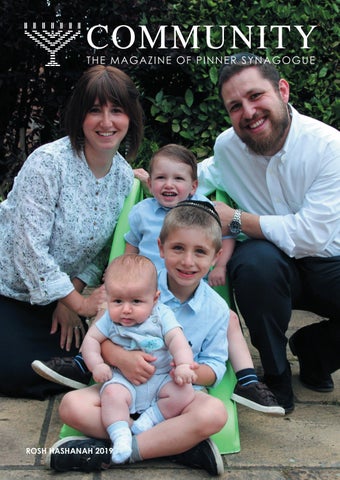
Front Cover: The Kurzers join the Pinner community Magazine designed and printed by: Express Print Ltd Harrow Business Centre, 429-433 Pinner Road, North Harrow, HA1 4HN t: 020 8567 8727 e: hello@expressprint.co.uk www.expressprint.co.uk
Pinner Synagogue www.pinnershul.org Office Hours: Monday to Thursday 08:30am – 12:00 noon Sunday 10:00am – 12:00 noon Administrator: Carolyn Abrahams Tel: 020 8868 7204 Email: admin@pinnershul.org
Disclaimer: Pinner Synagogue does not accept any responsibility for the accuracy of the content of any articles in Community Magazine or the consequences of relying on it. Any views, beliefs, viewpoints or opinions expressed by the various contributors and participants are those of the contributor or participant at the time of submission, and do not reflect the opinions, beliefs and viewpoints of Pinner Synagogue, the Editor or any of its employees, agents or subcontractors. Pinner Synagogue shall have no responsibility for any action or omission taken by any person on the basis of reading information or contributions in Community magazine. Advertisers should pay close attention to the requirements of all applicable legislative requirements and advertising codes of conduct when advertising in Community magazine, particularly regarding the accurate descriptions of all goods and services offered to readers of Community magazine. Pinner Synagogue shall have no responsibility or liability in relation to the provision of goods or services offered by advertisers in Community magazine.
First Things First
Dear Friends
by Rabbi Kurzer
A
Abi and I are very much looking forward to our first Rosh Hashanah with the Pinner community. We feel fortunate to be here and, together with our children, are proud to call Pinner our new home. It has been a pleasure to begin our time here and meet many of you and we hope to be able to get to know each and every one of you over the coming years. This festival is particularly auspicious in the sense that it sets a tone for the entire year and is an opportunity to consider anew our dreams, aspirations and goals. It is in that spirit that I take this opportunity to wish each of you a year of blessing, growth, happiness and all the goodness you would hope for yourself.
s a child I remember feeling a strange mix of new and old at the beginning of a new school year. In most senses nothing had changed – I would return to the same buildings in the same uniform with most of the same teachers. Yet the new year also seemed to carry with it a fresh feeling that things were different. This paradox is at the heart of the Torah’s view of time and particularly relevant in the upcoming weeks.
This is no easy feat and we are blessed to be working together with a special Executive and Synagogue Council to take Pinner forward over the coming years. We have begun to get to know them and have found them to be supportive, innovative and passionate. In truth, every single member contributes to the success of a community and I look forward to getting to know each and every one of you as a key part of Pinner’s future.
Rosh Hashanah is simply translated as the ‘head of the year’ but the word ‘shana’ meaning ‘year’ actually has a double meaning. In one sense it indicates a repetition and is related to the word ‘shenit’ meaning ‘second’. As the new year begins we are going for ‘another round’ – repeating the festivals, the school year, birthdays, etc. once again.
Between this Rosh Hashanah and next, we will complete one loop of the spiral and the Kurzers will get to experience all different parts of Pinner’s yearly cycle. There will be much to do over the coming months but, in particular, I hope we can focus on three key areas.
But ‘shana’ also connotes the opposite and is linked to the word ‘shinui’ – ‘a change’. The Jewish concept of time reflects these two opposing concepts in unison – each year we repeat the same things we did the previous year but we also want to ensure that they are different in some way. The cycle of the Jewish year (and life in general) is designed to encourage this balance. Each Rosh Hashanah, each Chanukah and each Pesach should be somewhat different to the last, while retaining the core. The Jewish perspective of time is that it is not linear but moves in a spiral, returning each year to the same place, but hopefully slightly higher up. On Rosh Hashanah, the ‘head of repetition/change’, this is particularly important. The day itself asks us, ‘how will you change things for the better while ensuring that you maintain and strengthen all that you have already done?’
❝
The Mishna in Pirkei Avot teaches that the world stands on three things: Torah – authentic Jewish education, Avoda – growth through prayer, and gemillut chassadim – creating bonds through acts of loving kindness, and it is on these three pillars that we look to strengthen and grow in our own small ‘world’ in Pinner. Torah - The role of a rabbi has evolved over the centuries but the one constant is the meaning of the word – teacher. I feel passionate about authentic Torah study, exploring sources to understand G-d’s world and using the Torah as a guide to understanding ourselves. Primarily this will be through a variety of teaching, but also in enabling the community to learn for themselves and by facilitating a range of guest Torah teachers to each bring their own character and style.
Connecting to prayer, at times spontaneously and at times through formal services, is something I would like us to work on together.
For Abi and myself this year, that question is particularly significant. We feel immensely privileged to be given the honour to serve as the Rabbi and Rebbetzen of Pinner and have spent much time thinking about what that means. We are excited to join a vibrant and active community and look forward to bringing our own fresh ideas to hopefully enhance all that goes on. While we look to innovate, we also look to strengthen and preserve the traditions, ideals and mission of the community.
4 | Rosh Hashanah 2019
Torah study in the 21st century must be accessible to one and all and we will explore ways to facilitate that. Yet it must also remain genuine and authentic. It is essential to open Torah study to anyone who wants while avoiding the pitfall of watering down our heritage so that it becomes unrecognisable as the gift G-d gave us at Mt Sinai. Perhaps this challenge is particularly acute when using social media and is hopefully balanced by a recognition that a soundbite is just an opening into a much deeper idea.
❞
We are also proud of the growth of women’s role in Torah
First Things First study and will continue to support and develop that. Particularly once Abi begins her role as Maayan, she will take an active role in helping, guiding and nurturing opportunities for women’s Torah study. Avoda - Our Sages refer to prayer as ‘avoda shebalev’ – the service/work of the heart. Growing up I sat through many hundreds of prayer services and said many of the words, but it was not until I began to study Jewish prayer that I slowly started to genuinely experience tefilla. Judaism teaches that one can pray and connect to the Almighty anytime and anywhere, whilst we also recognise that prayer services are at the core of a shul. Connecting to prayer, at times spontaneously and at times through formal services, is something I would like us to work on together. It is an increasing challenge in the world we live in for a multitude of reasons – we are held back by our understanding of what tefilla is, the Hebrew words, the time it takes out of our busy lives and much more. Together, I hope that we can focus on improving our prayers, thereby growing as individuals and strengthening the shul services as a central engine room around which our community will flourish. Gemillut chassadim - In Jewish thought, the highest emulation of our Creator is when we give selflessly, just as He gives and gives despite receiving and needing nothing in return. We can give to others not just financially but in so many ways, for example giving of our time, showing empathy or demonstrating patience.
There is a special prayer that many say at the end of Shabbat giving thanks for many aspects of our life. Towards the end of the prayer there is a paragraph that tells us that wherever we find mention of how great and powerful G-d is we also find mention of His compassion and humility. Throughout our history, true Jewish leaders have concerned themselves not only with great accomplishments but with otherwise forgotten individuals and, according to many sources, that is part of the definition of greatness. Alongside the exciting big projects we hope to be part of, there will be much time spent behind the scenes helping individuals within the community. As Rabbi and Rebbetzen, we hope to lead by example in creating a culture of giving in every sense. We are thrilled to be able to work with Karen, our welfare co-ordinator, as well as the entire team, but we also feel it goes beyond this. A great Jewish community is one where everyone chooses to give in whatever way they can. And everyone has something to give. These three pillars, Torah, Avodah and Gemillut Chassadim, are the columns that I am sure will support our community as it goes from strength to strength. Please join us in reinforcing those pillars to bolster what we can accomplish, as individuals and as a community, vechol ma’aseinnu yiheyu leshem shamayim – may all our actions be for the sake of Heaven. Wishing you and your family a Shana Tova U’Metuka, a good and sweet year. Rabbi Ben Kurzer
“Cancer made me voiceless, isolated and scared. Chai is inclusive and enriching, a cocoon of safety and joy in my world.”
For more information on our 58 specialised services from 11 locations across the UK and our Home Support Service, visit chaicancercare.org or call 0808 808 4567 Chai Lifeline Cancer Care Registered Charity No. 1078956
5 | Rosh Hashanah 2019
First Things First
A New Year And New Beginnings The smoothness of the first page of a new notebook, the squeak of a new pair of shoes and the fresh feeling of the first day back to work. Beginnings are exciting, full of potential and opportunity.
W
e even have a special blessing for starting something new – whether it is the first day of a chag, wearing new clothing or eating a new fruit – in which we say ‘shehechiyanu v’kiymanu v’higiyanu lazman ha’zeh’. by Abi Kurzer Thank - you G-d, who has kept us alive, sustained us and enabled us to reach this season. We don’t take anything for granted. This year on Rosh Hashanah as I say this blessing when lighting my candles and eating my new fruit on the second night of chag, I will have special kavannah (intention) as this year marks a very special beginning for me and my family, a new start in our new home in our new community, Pinner. It is especially meaningful that our start in Pinner coincides with so many other beginnings – a new Jewish year, a new school year, and even a new baby! However, there is another phrase from our sages (Mechilta Shmot 19:5) which is also worth mentioning: ‘all beginnings are hard’ – so while we relish in the newness of it all it is important to acknowledge that beginnings have their challenges too. It takes time to settle in to a new routine, get used to a new environment and learn how to navigate new systems. We also recognise that being in a new rabbinic role comes with its own unique set of challenges as we try to get to know so many new faces, names, personalities and individual stories. It reminds me of my first day of my gap year in Israel, everybody was walking around excitedly asking each other ‘what’s your name? Where are you from?’ after a while of this, I - together with my new Canadian friend - had enough of the endless repetition, so we made ourselves labels. Hers said ‘Zippy Canada’ and mine said ‘Abi London’. For a while everyone just assumed those were our surnames! Although we recognise all beginnings, there is special celebration for a new home called a ‘chanukat habayit’ loosely translated as a housewarming party! This originates from the dedication of the new Temple, the Beit HaMikdash in Jerusalem. Interestingly, the word ‘chanukat’ shares its root with the word ‘chinuch’ which we translate as ‘education’ – but education is not something we would usually associate with a housewarming party! The best way to understand the real meaning of any Hebrew word is to explore when that word is first mentioned in the Torah, its first expression in existence. In Bereishit (14:14) we come across this root when Avraham has just heard that his nephew, Lot, has been taken captive. The verse refers to the people Avraham takes with him to save Lot as ‘chanichav’. Rashi explains that he initiated them into keeping mitzvot and we see that the core of the word ‘chinuch’ implies initiating a person or object into an activity that you want them to do for the rest of their lives. We ‘initiate’ a child when we teach them (chinuch) and we ‘initiate’ our home for positive use when we begin using it (chanukat habayit). How we begin something new puts it on the track for how it will 6 | Rosh Hashanah 2019
continue. The early years of a child’s education are crucial, they are the building blocks for their future. When we start a new job, a new relationship or a new class we want to set off on the right foot. On Rosh Hashanah the effort we put in to create a meaningful, enjoyable and spiritual yom tov sets us up for the year ahead. A Jewish housewarming party is therefore one where people come into a new home to instil it with values in which we want it to continue. We would like our home to be one where people feel comfortable to connect with each other and with us, a friendly environment with a positive and growing atmosphere and a home that highlights the beauty and joy of Torah. So, on that note, Rabbi Kurzer and I, together with Ahron, Yehuda and Shaya look forward to welcoming you, our new community, to a chanukat habayit in our new home at 65 Cecil Park on Sunday 22nd September. For logistical reasons, we ask everyone whose surname begins with A-K to join us for brunch from 10am-12pm and all those whose surname begins with L-Z to join us for tea from 2-4pm. There will be activities for kids so please bring everyone along and help us to meet you, get to know you and begin our time in Pinner in the way that we intend to continue.
Samtouch y d Han man’s
a wo Add
— — — — —
Flatpack furniture building Repair work Painting Baby Proofing Hanging shelves, curtains, blinds and pictures — Building childrens toys
First Things First
Chairman’s Report I am completing this report just two weeks after the arrival of Rabbi Ben and Rebbetzen Abi Kurzer and their three boys, Ahron, Yehuda and Shaya in Pinner. Already it is noticeable how having a Rabbi in the community is making a big difference to so many aspects of life in Pinner.
by Jonathan Mindell
H
owever, before talking about the future under Rabbi Kurzer’s leadership, let me dwell on this last year.
Whilst we were without a community Rabbi, we did nevertheless, as a community, pull together and did, in my view, much more than just keeping the show on the road in the absence of a permanent incumbent in the Rabbi’s box. Having said that, we did have some help and support along the way……. Rabbi Geoffrey Shisler and Rabbi Michael Pollak, provided some level of continuity, but also variety, over this period. Their complementary yet contrasting approaches certainly enhanced our Shabbat services. The regularity of their visits, combined with other guest rabbis (including our Emeritus Rabbi Yaacov Grunewald) who have come for a one-off weekend, meant that on more Shabbats than not we have had a ‘Rabbi in residence’ – something that I think has been appreciated over the year. We have also been fortunate to continue to benefit from Rabbi Stanley Coten’s support with his very well received approach to pastoral care. He has officiated at a number of levoyahs and stone settings and has also made many visits and phone calls to members when they have been needed. With Karen Kinsley now in her second year in the role as part-time Welfare Coordinator, Rabbi Coten’s continuing involvement has been a welcome addition to the support she organises in a very professional way across our excellent band of volunteers, a team of unsung heroes who do a fantastic job. In mentioning Karen I should just add that, whilst we try and be as well informed as we can be about what’s going on across our membership, if there is any need for support, at an individual or family level, then Karen is the first port of call. Returning to my theme of rabbinic support, Shavuot was one of those occasions when we had a rabbinic scholar in residence, this year Rabbi Rafi Zarum. We probably made it easier for him to accept our offer for Shavuot as his motherin-law Barbara Nicholls (together with Margery Cohen) was our N’Shot Chayil! Across the three days of Shabbat and Yom Tov we had an Aufruf, a Baby blessing and our N’Shot Chayil celebration – together with the Tikun Leil programme
where over 60 people were still there at 1am in the morning – a great example of how we have managed to pull together as a community over this last year. Together with our homegrown talent we have been pretty much self-sufficient, not just in leading the services, but also in providing, for example, the inspiring and entertaining shiurim not just on Shabbat but on other days of the week too. For all their hard work over the year to pull all of this together I want to thank the Executive team, our Council of Management as well as Carolyn in the office and our caretakers. One final thank you goes to James and Judith Mindell who left Pinner at the end of July after 3 years as Youth Directors. In that time they have done a great job to keep our youth involved and engaged. They (and their son Netanel) will be missed. By the time you read this, Rabbi and Rebbetzen Kurzer will have been in Pinner for a couple of months. It has been an invaluable period in the run up to the Yamim Noraim for them to get to know the community and its membership. However, they have not just been in ‘listening’ mode, having already got involved across many aspects of the community. After our welcome Seudah in August, the Kurzers reciprocated with an ‘Open House’ on 22nd September. They are planning a number of events and activities beyond the Yamim Noraim, details of which will be circulated. My early sighting of the plans suggests that we can look forward to an autumn of education and entertainment as their plans come to fruition. Before then we have Rosh Hashanah and Yom Kippur and, supporting Rabbi Kurzer, we have secured the services of Rabbi Gavriel Rosen, originally from London but currently in Israel. The details of our programme for the Yamim Noraim have been circulated and our aim is to provide a welcoming environment with religious, educational and social enlightenment across the High Holydays, wherever you will be spending your time. Once again, thank you to everyone who will be supporting us over this very busy time within the community. All that remains is for me to wish everyone a very sweet and happy New Year – Shana Tova U’metuka. Jonathan Mindell
Visit www.Bookshuk.co.uk to fill your Jewish bookshelf. Merrill will help you find the Jewish book you need call 077 189 128 55 7 | Rosh Hashanah 2019
First Things First
From the Editor
I
There is no other baking recipe that divides opinion like honey cake. The chicken soup of the New Year, everyone knows a methodology passed down through the generations and everyone’s is – of course – the best. Make ahead or just before, syrup or honey, the variations are many. And albeit more obviously palatable, it invites the same question that the egg is salt water provokes on Pesach: ‘why only on this night do we eat it when it tastes so totally delicious?’
by Caron Dias
remember one year, having hailed from a family that buys in their honey cake from Noshers, my mum presented us with a Tetris-inspired array of various shaped and sized cakes. Admittedly they didn’t look fresh out of Nigella’s kitchen, but the taste was truly extraordinary. So much so, my poor mum spent the rest of the afternoon trying to prove to us all that she had indeed baked these sweet, delightful offerings. It was – undeniably – a fluke. I never tasted honey cake like it, but I’ve never tasted it like that again since. I have no idea what recipe she used (if in fact she followed one at all) and I wish so much that I could ask her so that I could attempt to make it for my own children this year.
fold. May this New Year and this edition of Community mark the start of an exciting new chapter for Pinner Shul. Finally, thanks as ever to the brilliant magazine committee, who make each edition what it is and who make my job pretty easy. My gratitude is endless. I wish you all a Chag Sameach and a Shana Tova. I hope that you all find comfort and pleasure in your own traditions, whatever they may be. Caron journalist@caronkemp.co.uk
People comment how strange our traditions are and how fixated we are on symbolic foods; you’d be hard pressed to find any chag without something special to eat. But it’s these very traditions that provide us with a thread that binds us with one another and also – importantly - connect us to our past. Chagim can be trying when you’re going through a difficult time; a stark and harsh reminder of all that’s missing and all that’s changed. I know for me personally that the first New Year without either of my darling parents here will sting. But I also know that these stories, these recipes and these familial traditions offer some comfort too. I might not be making my mum’s honey cake this year, but I’ll certainly remember it and the wonderful Rosh Hashanahs I shared with my family until now as I tuck into an Osem alternative.
WE NEED YOUR GOOD QUALITY DONATIONS
I am actually told that many of you reserve reading your Rosh Hashanah Community until the chag itself; perusing the pages while nibbling on your own honey cake. If that’s you, or indeed whenever you are reading this, I hope you enjoy this edition as much as we enjoyed putting it together. As ever it’s packed with a variety that’s reflective of the creative and dynamic individuals that comprise this community and I must thank everyone who contributed an article. Bucking the trend, I penned one myself this time too, following a lovely visit to the home of our new Rabbi and Rebbetzen. And in that vein I would like to take this opportunity – as the first edition with them at the helm – to wish them the warmest of welcomes to Pinner. Having spent a few hours in their company for the purposes of writing my article, I am in no doubt that we are very blessed to have the Kurzers in the 8 | Rosh Hashanah 2019
Contact us to arrange your collection
First Things First
The Chief Rabbi’s Rosh Hashanah Message 5780 On 23rd June 2019, something extraordinary happened in Turkey; something which provides an insight into how each of us might successfully navigate a society which feels more divided and despondent than it has for many years.
I
ncreasingly, when faced with a major problem, public figures discover that they find acclaim by apportioning blame. Immediate, oversimplified solutions are promised and their impassioned rhetoric alone can be enough to generate widespread public support. Over time, those holding an opposing view feel compelled to resort to many of the same tactics in order to be heard and society becomes polarised. Those who might be cast as an obstacle to the success of one side or another are scapegoated. Before long, people become defined by their perceived ‘allegiances’ and a destructive culture of demonisation of ‘the other’ sets in. Citizens in every country are prompted to make a choice: Will we do the easy thing? Will we sit back and allow ourselves to be swept up by the dangerous currents of hostility to ‘the other’? Or, can we find a port somewhere in the storm where we can remain considered and temperate; where we can be discerning about truth and justice within our fragile world? The signs thus far have been less than encouraging, but earlier this year a Turkish man, Ates Ilyas Bassoy, provided a flicker of light in the darkness. Mr Bassoy had observed how actor, Robert De Niro had publicly insulted President Donald Trump at a high profile awards ceremony the previous year. His expletive-ridden remarks were greeted by a standing ovation, but they also served to motivate and embolden the President’s supporters. Not surprisingly, anger generated yet more anger. Mr Bassoy concluded that a more effective strategy would be one of what he called ‘radical love’ - to meet aggression with peace, insults with praise and hatred with love. To most, it sounded like a naïve – if honourable – approach, but he was provided with an opportunity to prove it could work when he became the campaign manager for a virtually unknown district mayor, Ekrem Imamoglu. Mr Imamoglu was to stand for Mayor of Istanbul against the might of President Recep Tayyip Erdogan’s powerful party regime. Bassoy described his campaign strategy as having two simple rules: Ignore Erdogan and love those who love Erdogan. Few people believed that his candidate stood any chance. After all, Istanbul had long been a stronghold of the ruling AKP party and President Erdogan had a large base of support in the Turkish capital. Astonishingly, on 23rd June this year, against all the odds, Ekrem Imamoglu was elected mayor of Istanbul, striking a blow for civility, selflessness and decency.
the port in the storm is not in fact beyond our reach, nor is it something that we must wait for others to provide. On the contrary, the answer is and has always been right under our noses. Our societies can take a lesson from our Torah tradition:םרד ה “The Torah’s ways are pleasant and all its paths are peace.” (Proverbs 3:17) It is within our power to break free from the cycle of polarisation. It begins by modelling what Rav Kook, the first Chief Rabbi of the Holy Land, referred to as ‘Ahavat Chinam’ – causeless love: making time to give of ourselves to others with no expectation of reward or reciprocity. Our Sages taught: We become truly wise by learning from TheWe Chief Rabbi’struly Pesach Message 5778 every person. become mighty by conquering our own negative inclinations. We become truly honourable by We have a fascinating family custom: at the Pesach Seder our family sings the words of the honouring andPesach’ we become truly heroic byTzur. turning passage known asothers ‘Chasal Siddur to the tune of Chanukah’s Maoz enemies into friends. This has prompted me to consider what the festivals of Pesach and Chanukah have in
common. Of course, both celebrate the miraculous intervention of the Almighty to save our people and both are eight days long in the Diaspora. Interestingly, if necessary, Jewish law requires one to sell one’s clothing or receive tzedakah in order to purchase candles for the Chanukiah. This is strikingly similar to Pesach, when one is required to sell one’s clothing or receive tzedakah in order to buy wine for the required four cups. There was also a fascinating and beautiful custom among the Jews of Izmir in Turkey to use their leftover oil from the previous Chanukah to light a small oil lamp, which they used for Bedikat Chametz, the search for chametz, on the night before Pesach.
A highlight of our Yom Kippur services is the repetitive chanting of the 13 attributes of Hashem’s mercy. The Talmud explains that we do so in order to inspire us to emulate the ways of the Almighty: just as He is merciful, so too should Yet, substantive,just thematic between and Pesach the kind. centrality wethebemostmerciful; as connection He is kind, soChanukah too should we isbe of education as a Jewish value. Both festivals lead us to appreciate the crucial importance of learning in our tradition; a lesson encapsulated by our Sages, who declared, Vetalmud Torah (Shabbat 133b). Keneged Kulam – the study of Torah supersedes all (Mishnah Pe’ah 1). Over the High Holy Day period, when we lower our heads for viduy (confession), we will admit to the sins of sneering, impertinence and obduracy; of disrespect, hard-heartedness The primary purpose of the Pesach seder is education - “And you shall relate to your child on that and insincerity; deception, tale-bearing baseless day saying, “It is becauseof of this that the Almighty performed theseand miracles for me when I left Egypt” (Shemot 13:8). But, more than that, the Pesach seder itself sets out the ideal framework hatred. these not among the most transgressed sins utilises of for the mostAre impactful education – an audio-visual, experiential encounter which storytelling, questioning and a veritable assault on our senses to ensure that the experience is the social media generation? In these times, when decency an unforgettable treat. It is no accident that of all our traditions, the seder night remains the most widely observed, even in families who would otherwise consider themselves entirely secular. is no longer the and humility is mistaken forthose weakness, Research has shown that norm more Jews attend a Pesach seder every year than who fast on Yom Kippur. Pesach teaches us what the best teachers already know – that the most effective Rosh Hashanah and Yom Kippur inspire us to buck the trend education must be experiential. and to ischange deeply thatis blessed thosetoaround us This lesson of particularourselves relevance to usso today. British Jewry have truly outstanding schools which, year on year, are heralded as being amongst the finest in the country. I am always cannotmoved fail to bededication influenced it. Thisgovernors is howandthe for personally by the shown by by trustees, staffseeds at our wonderful schools and they would be the first to say that there is nothing more impactful or foundational to real global change are sown. a Jewish child’s identity, than a powerful Jewish experience. The Hebrew word Chanukah (dedication) comes from the same root as chinuch (education). Indeed, dedication to education is a key feature of the Chanukah narrative. The survival of our spiritual legacy, despite the intentions of the Hellenists, was rooted in our commitment to teaching Torah and its values.
Valerie and I extend our heartfelt wishes to you all for a happy, peaceful and fulfilling New Year.
Whatever the setting; formal or informal, at school or at home, may this Pesach present an opportunity for us to refocus on a truism of Jewish life – the greatest key to a successful Jewish future is quality Jewish education. Valerie and I wish you a chag kasher ve sameach.
Chief Rabbi Ephraim Mirvis March 2018 • Nisan 5778
Chief Rabbi Ephraim Mirvis
The lesson of this most unlikely political earthquake is that 9 | Rosh Hashanah 2019
First Things First
President of the United Synagogue’s Rosh Hashanah message 5780 Suppose you were alive in 1885 and were approached by an aspiring entrepreneur who had developed the world’s most efficient horse carriage. Would you have invested?
I
t would have been wise not to, since one year later, another inventor by the name of Karl Benz would patent what is now considered the first automobile. Innovations can be revolutionary in nature: the Michael Goldstein automobile, the phonograph, the internet. Others are evolutionary: better engines for cars, better sound systems for the phonograph and the World Wide Web for the internet. I was reminded of this as we approach 2020 and are getting ready to celebrate the 150th anniversary of the United Synagogue with open top bus tours, a gala dinner, burying a time capsule and a series of heritage talks and walks.A decade before Karl Benz, another innovation took place that was no less revolutionary for Jewish communal life.Back in 1870 five Ashkenazi shuls in London decided that they were stronger together. The Great, The Hambro, The New, Central and Bayswater all joined forces to become the United Synagogue. Instead of duplicating resources, they worked together for the good of the community. This was a revolutionary idea.Since then, the United Synagogue has evolved further. Further communities have joined, including a growing number of regional communities and new Jewish areas. Recent innovations include the creation of a Women’s Officer to ensure our communities are inclusive and welcoming. ShabbatUK provides a focal point for communities to engage members across the spectrum.There is much to celebrate as we approach our 150th birthday. 1,167 new members joined last year. We established a multi academy trust to support Jewish schools. More than 700 young people took part in a Tribe residential programme this year. We launched two volunteer-run asylum seeker drop-in centres in Hendon and Woodfod Forest United Synagogues. A National Lottery Heritage Fund grant will transform Willesden cemetery into a heritage and educational site. But it is time for us to evolve again to address the challenges we face.How can we ensure our children and grandchildren have the same love of yiddishkeit that we do? What can we do to support people with disabilities and non-traditional families? How can we attract young people and young married couples to our communities? Change is not easy. My fellow Trustees and I will support our communities, lay leaders, Rabbis and Rebbetzens to come up with ideas to do just that. Innovation applies to us as individuals, too. At Rosh Hashanah we consider the evolution of our own Jewish development. How 10 | Rosh Hashanah 2019
can we take one step forward on our Jewish journey? Might we attend one of our wonderful community services, learn Hebrew or volunteer to help people in need? The Talmud teaches “It’s not possible for there to be a House of Study without innovation” (Chagiga 3a). 1,500 years later, this message remains as urgent as ever. Shana tova
Michael Goldstein, President. United Synagogue
All of us at Gideon’s would like to wish the community a Shana Tovah, a year of good health, prosperity, happiness and peace! We look forward to welcoming you and your families very soon at our new restaurant in Edgware. To celebrate the New Year, here is a money off coupon for your first visit.
£5
T&C’s: Valid 01.09.19 - 01.11.19. Please present coupon at time of ordering food. Minimum spend of £35 applies.
60-62 Edgware Way Edgware HA8 8JS 020 8958 7062 Kosher Mehadrin
First Things First
TISHREI 5780
Message from the President Last year, my Rosh Hashanah message told of the way the Jewish community came together to proclaim in a loud and firm voice, “enough is enough” on antisemitism in the Labour Party.
S
ince then, the antisemitism crisis has not gone away. However, our campaign against those who pursue this most ancient form Marie van der Zyl of racism has had great successes, notably the suspension of serial offenders including Chris Williamson and Peter Willsman and the expulsion of Jackie Walker. There is understandable anxiety in our community about the way racists within Labour have been emboldened to express their disgraceful views by the indifference, and at times the collusion, of the party’s leadership. However, as I have been saying since I assumed the presidency of this great organisation in 2018, there is another story to be told. This is the story of a longstanding community that has lived peacefully in the UK for centuries; a community which, since we were allowed back into this country by Oliver Cromwell, has had the freedom to practise our religion and live a truly Jewish life within a respectful society. In return, our community has contributed great things, in the arts, in society, in business and in politics and science. We have produced major figures from Abba Eban to Amy Winehouse, from Isaiah Berlin to Mark Ronson. With the prevailing conditions of freedom and respect our community has flourished over the past centuries, and despite worries over the revival of mainstream antisemitism, most of us lead happy Jewish lives. However, there is a reason that the Board of Deputies has existed since 1760; that is to protect those hard-won freedoms and to ensure that the Jewish community in all its forms and denominations, continues to flourish. At the Board of Deputies, we are in constant campaign mode, challenging Labour antisemitism through advocacy in the media, and to those in Labour and outside who support us and can make a difference. Of course, Labour’s antisemitism problem is not the only problem with which we are grappling. Brexit is an issue of enormous national significance, and it will impact on British Jews. We have been working with the Government to ensure that Jewish interests are safeguarded in all circumstances.
last autumn by ending the artificial distinction between Hizballah’s political and military wings. We continue to confront and challenge divisive and unhelpful boycotts of Israel. Through our Invest in Peace projects, where we bring Israelis and Palestinians to speak to interfaith audiences, we show that there are better ways to address and resolve differences over the conflict. We made a significant intervention into the Government’s legislation on organ donation. As we moved from an opt-in to an opt-out system, we acted to ensure that Jews of all denominations were protected. We also obtained compromises from the Department for Education on relationships and sex education that will allow all parts of our community to teach according to their ethos. We work to educate non-Jewish children and adults throughout the UK on the Jewish way of life. One way we do this is through our mobile exhibition, the Jewish Living Experience which is visited by thousands of children and adults. We ensure high standard of religious education in schools through our Pikuach inspection service – ‘the Jewish Ofsted’ which is accredited by the Department for Education. Our honorary officers and staff reach out to local councillors at Local Councillors Seminars across the UK, to ensure that they understand and are sympathetic to Jewish concerns. Through Milah UK, for which the Board of Deputies provides the secretariat, we campaign for the right of every Jewish boy to be circumcised according to Jewish law. Our contribution to UK Jewish life is crucial. We will continue to represent you in the coming year to ensure we continue to live freely and safely as Jews as we have done here for centuries. May this Rosh Hashanah bring you, your families and all of Am Yisrael health, strength and peace.
Marie van der Zyl President
The Board of Deputies played a prominent role in campaigning for the terrorist group Hizballah to be banned in its entirety. The Government listened and responded 11 | Rosh Hashanah 2019
First Things First
150 not out The United Synagogue (US) was formed in 1870 by the union of three major Ashkenazi synagogues in the City of London (The Great, The Hambro’, and The New), and two branch synagogues (the Central and Bayswater) .The vision of Lionel Louis Cohen and Chief Rabbi Nathan Marcus Adler was to unify and strengthen London Jewry. The Jewish United Synagogues Act of 1870 was the result. The US is still the only Jewish religious body established by an act of secular legislature. The organisation grew rapidly, and expanded to the suburbs as the community moved. The appointment of Rabbi J H Hertz as Chief Rabbi in 1913, and the outbreak of the First World War, produced both support and opposition for the emerging Zionist movement. Chaplaincy for the Armed Forces largely came from the Ministers of the United Synagogue. The development of suburbia in the interwar period led to the growth of many important communities, and membership of the US was perceived as a step in the acculturation of those whose parents and grandparents had been part of the great immigration from Russia. The Second World War brought renewed problems. Evacuation from London produced small wartime communities. Many ministers served as chaplains, and their place was taken temporarily by those who had escaped from Europe.
The Great Synagogue in 1809 (from Ackerman’s Microcosm of London)
bodies. Its structure has enabled have spread to other Jewish communities new congregations to grow and old that look to the US for a lead in so many congregations to different fields. In rapid post-war In rapid post-war downsize gently with expansion 40 new As the United Synagogue celebrates its their assets used expansion 40 new congregations joined the 150th anniversary in 2020, we have so to support other congregations United Synagogue in the much to be proud of: vibrant communities communities. The 25 years from 1945. led by dynamic Rabbinic teams and lay joined the United Chief Rabbinate, leaders, Tribe and Young US providing Synagogue in the 25 When J H Hertz today headed by high quality young people’s programmes, died in 1946 he was years from 1945 Chief Rabbi Ephraim support for our Jewish schools, high succeeded by Rabbi Mirvis, developed from quality educational publications and Israel Brodie, only the second Chief the rabbinate of the Great Synagogue hundreds of volunteers supporting Rabbi to have been born in England. has proved a unifying force, restraining vulnerable members and beyond. It is the Educated at Oxford, Brodie had served internal argument and break up. The people both behind the scenes and in the a community in Melbourne Australia, London Beth Din and its attendant public eye, who have created a vigorous acted as a chaplain in both World Wars, Kashrut division has an international and innovative force raising the standards been taken off the beaches of Dunkirk, reach. The Burial Society has established of Judaism for its members and for the and concluded the war as a Lt Colonel standards of dignity whole community and the Senior Jewish Chaplain. He and care at the most Today the United to help ensure that was succeeded in due course by Rabbi vulnerable stage the US continues to Synagogue remains one Immanuel Jakobovits and then Rabbi of life. The Singer’s be at the forefront Jonathan Sacks, who have raised the of the most influential Prayer book (today in of British Jewish status of the Chief Rabbinate within its most recent greenreligious bodies Life. Kol Hakavod! British society and have made it into one coloured edition) Celebrating 150 Years of the Great Offices of State. settled customs of prayer and the dignity Elkan D Levy was President of the of tefillot (services). Improvements in the Today the United Synagogue remains United Synagogue from 1996 to 1999“ status and conditions of the Rabbinate one of the most influential religious
❝
❞
❝
❞
12 | Rosh Hashanah 2019
First Things First
PROTECTING JEWISH LIFE IN THE UK Our goal at CST is to protect you. We want to ensure
This year and last year we have seen appalling
that you, your family, friends and community can lead
terrorist attacks against places of worship, including
the Jewish life of your choice.
synagogues in the USA. After these tragedies, it has been truly humbling to be repeatedly thanked for
We know that these are difficult times, with the
keeping the UK Jewish community as safe as possible,
terrorist threat and the overall political situation
but really it shows exactly why CST does its work,
causing deep concern to British Jews. Our staff and
and why we need the total partnership of our whole
volunteers promise to always do everything that we
community. We thank you for supporting our security
can to protect the community.
measures and ask that you report any suspicious or offensive behaviour to our security teams.
CST exists to facilitate Jewish life, not to publicise antisemitism. We will always be honest about how
Finally, our warmest wishes for a happy Rosh Hashanah.
things stand, without spreading panic or fear; and by placing antisemitism in the wider context of the
Please consider volunteering for CST or donating to us.
positive reality that is normal, daily Jewish life. That
We are a charity and we cannot do our work without
normal positive Jewish life may not make the news, but
your help. For more information, visit www.cst.org.uk
we should keep it in mind when we look at how things
In an emergency, call the Police and then call our
now stand.
24-hour National Emergency Number 0800 032 3263.
www.cst.org.uk Community Security Trust
@CST_UK
CSTmedia
National Emergency Number (24-hour) 0800 032 3263 London (Head Off ice) 020 8457 9999
Manchester (Northern Regional Off ice) 0161 792 6666 Community Security Trust is a registered charity in England and Wales (1042391) and Scotland (SC043612)
13 | Rosh Hashanah 2019
Community Matters
Our Council of Management 2019
- 2020
by Ruth Stuber
Since Jonathan Mindell became chairman in 2017, he has led a loyal team of volunteers. So in the interests of originality, we decided this edition to simply ask each member of the newly named Council, ‘why do you love Pinner Shul?’ Here’s what they had to say… Jonathan Mindell, Chairman I love Pinner because we are a caring community, with a tremendous number of members who give of their time to support individuals in need as well as the community as a whole. We welcome strangers in shul without fuss or formality but with a warmth not found in many communities across London.
Lisa Olins, Vice-Chairperson I love Pinner Shul because it has provided us with a Jewish environment close to home. Our community is both nurturing and educational - a combination envied by other communities.
Nigel Presky - Warden I love Pinner as it is great to be Warden of a friendly and welcoming Shul. I challenge myself most days and am always striving to improve my Jewish knowledge and spirituality.
Ashley Reece I love Pinner Shul because it is friendly, warm and welcoming, and with so many people involved in an unassuming small or more obvious big way, means we have a true sense of identity as a great local community with a provincial feel.
Phil Gershuny Shereen Presky, Vice-Chairperson I love Pinner Shul because I love Pinner Shul !
Jon Sober - Financial Representative I love Pinner Shul because the community is open to whatever way people want to be involved and benefit from it; religious, social, pastoral, active or passive. That’s where we individually can feel the real meaning and value of belonging to a community and something that we all are part of.
Gerald Isaac – Warden I love Pinner Shul because it provides endless opportunities to contribute to, participate in and benefit from the community.
14 | Rosh Hashanah 2019
I love Pinner Shul because it is such a warm and supportive community.
Martin Grossman What I love about Pinner Shul is the warm and friendly environment that is non-judgemental, supportive, egalitarian and not egotistical.
Simon Hodes It is a warm, caring and inclusive community, with a provincial and friendly atmosphere, providing a range of activities and services across the religious spectrum where everyone is welcome.
Community Matters Matt Dias
Debra Levin
The reason I love Pinner Shul is simple. It is a reflection of the village/town in which it exists. It may not be the biggest, but it has a warmth and a real charm about it.
We have been members of Pinner Synagogue for 25 years and I love that after all this time we are still making new friends and enjoying many of the communal events that take place, especially Friday Night Shabbatons.
Yvette Brown I like Pinner Shul because it is welcoming to all, non-judgemental, accepting of all levels of traditional orthodox observance and there are a great variety of activities both religious, cultural and social.
Edna Terret I love Pinner Shul because it’s where I belong.
Penny Grossman I love Pinner Shul because I have found it a very caring, friendly and unique community.
Zara Spilka Wishing the community a Shanah Tovah Umetukah. I look forward to working with the Council and the wider community to support the continued success of the shul.
Accounting for the ambitious We will provide you with an accountancy service that perfectly “fits the bill” (and hopefully reduces it in the process too). You can also choose from a range of cloud & digital software solutions so the process of sharing paperwork between us, couldn’t be simpler. If you have a tax or accountancy question you need an answer to, please get in touch.
Paul jo He is ined Pin ne a tru stee r Synag ogu of H Scho arrow J e in 1979 . ol Tr ewis ust. h Da y
riah nd Mo ynsey r atte L e e t h if g w dau his 03. son & ol. He and in 20 e o Ben’s u h g Sc go y a a n y D h yS Jewis ed Bushe join
020 8861 7575
be-ambitious@lawrencegrant.co.uk lawrencegrant.co.uk
15 | Rosh Hashanah 2019
Community Matters
Our N’shot Chayil By Marion Siskin
Both our N’shot Chayil grew up far from Pinner and made the choice to move here later in life, partly attracted by the reputation of the growing Jewish community, and partly by the fact it is a lovely place to live. Having joined the shul, they were welcomed and started to make their own contribution to Pinner Synagogue. love of choral singing. She started off in the Bombay Madrigal Choir, joining the Zemel Choir when she moved to London. From there she became part of the London Symphony Chorus and now sings with the Tonic Choir, a community choir that has a wide repertoire. She says that singing ‘brings her alive’. Settling in London, Margery started work and soon after joining the Zemel Choir met her husband David, whom she married in 1964. They started their married life in Edgware, where David’s father had been a founding member of Edgware Yeshrun Synagogue. As her children grew up, Margery became involved in Rosh Pinah nursery.
Margery Cohen
M
argery Cohen had already seen quite a lot of the world before she moved to Pinner. Growing up in Bombay within the Jewish community of about 30,000, life was very different from an upbringing in the UK. Her parents, both from Baghdad, followed the Sephardi tradition. Margery points out that, in retrospect, one of the most remarkable things about living on the Indian subcontinent, was that the Second World War and all the fighting in Europe, passed them by, and they had no knowledge of the Holocaust until years later. After the events of 1947/48 in India, there was a general exodus of the Jewish community. Margery’s parents wanted to come to the UK, but could not, so they headed for Australia. However, Margery got itchy feet and after 18 months down under headed to England and stayed with family in Golders Green. As a child, Margery had started piano lessons, but an injury to a finger her enforced a temporary break. Her music teacher suggested that she try singing instead – and started off a life-long 16 | Rosh Hashanah 2019
However, Margery had a revelation. In 2002 she was driven through Pinner by Ronnie Jacobs and she fell in love with it. Subsequent visits only increased her desire to live here. With David’s agreement she started looking around for somewhere to live and in 2005, they left Edgware for Pinner. Margery felt welcome at Pinner Shul straight away – she particularly remembers the friendship of Judy Nagler, but there were many others who made her feel part of the community. For many new members, friendships are forged through their children, but Margery’s and David’s son and daughter were adults. Margery joined the Rosh Chodesh study group, and with her background in accounting, responded to a notice in the Shabbat leaflet, asking for an honorary treasurer for PJK. She stayed in the role for seven years. David, meanwhile, was the Financial Rep for the shul from 2009-2011. Margery’s skills lie both in numeracy and literacy. She has been a stalwart of Community magazine, commissioning, researching and writing articles for the past three years. She has also been
the ‘go-to’ person when a meticulous editorial eye has been needed for major projects. The first publication was the book ‘Zachor…Remember’ to commemorate 70 years since the Shoah, and was published in 2015. This was part of a Pinner Synagogue initiative for the 70 Days for 70 Years Project, where shul members shared personal and sometimes harrowing narratives that they had never related before. The articles ranged from personal experience of being part of the Kindertransport to reflections by younger members of the community on visits to Poland. Margery edited the stories, which often involved re-writing them to make them suitable for a publication, as opposed to hearing them spoken. The second publication coincided with Pinner’s 75th anniversary, and celebrated 25 years of Divrei Torah given by lay members after the Shabbat morning service. The Dvar Torah project started small in 1991, and grew as more people started delivering a talk on the weekly sedra. Now it is a regular feature of the Shabbat service. Margery’s task was to cover every sedra in the Chumash, from a range of contributors. Again, this required editing and re-writing from notes, in order to transcribe a spoken talk into an article suitable for a reader. The result was an impressive celebration, of nearly 150 pages of the thoughts and learning of our community, which Margery dedicated to her husband David z”l. Margery has also been part of the ‘Synema’ committee, bringing a range of films to the shul that the community might not be able to access. Margery still works, and in her ‘spare time’ enjoys crosswords – her methodical approach ensures she reads every clue first before committing to paper.
Community Matters Campaign for Soviet Jewry, going on demonstrations (complete with son in buggy), arranging functions to raise funds and becoming co-chairman. She recalls that the branch based at the shul was a very vibrant group and enjoyed the active role she played. After Natan Sharansky was freed in 1986 the group disbanded.
Barbara Nicholls
O
ur second Eshet Chayil also grew up far from Pinner. Born in Manchester, Barbara’s parents moved to Bournemouth, where she spent her childhood. There she got involved with B’nai Brith, and continued this interest when she moved up to London. She had only meant to stay temporarily with family in Golders Green, but lived with them until she married Anthony, who she met through B’nai Brith. Her early-married life was spent moving around approximately every six months as Anthony finished his medical training. They lived in Lewisham, Edgware, Cheam and Nottingham before settling in Pinner in 1972. Her first two children were born ‘on the move’, and it was only her son who was born in Pinner. The Nicholls’ could have easily just ended up in somewhere like Ilford, but they had heard how welcoming the Pinner community was. As Barbara says – it was a small community where every stranger was noticed and welcomed, and Barbara (and Anthony) volunteered in various capacities. In the early years, for Barbara it was helping out at the playgroup that all her children attended. While they were growing up they took full advantage of all the opportunities on offer – such as Brownies, Cubs, BBYO and football. She became a member, then chair of the Ladies’ Guild. In the 1970s and 80s she was a very active campaigner for the Russian Refuseniks, as a member of the 35 Women’s
Barbara has been one of the cohort that work quietly in the background, keeping Pinner Shul running smoothly, especially in the realm of community care. Working along with Pinner Care she has been a home visitor, hosted tea parties for our more elderly members, taken meals to shiva houses and been a volunteer driver for both the late lamented Friendship Club and the more recent games afternoons. She also took on the responsibility of organising the kiddush rota. There is always a lovely kiddush after the Shabbat service (and over some of the chagim) and it is the co-ordinator’s task to ensure there are always enough people to be in the right place at the right time for this to magically appear. Not always straightforward.
Since ‘retiring’ from her daytime job in administration, Barbara has been busier than ever. Their eight grandchildren, from their two daughters and son, keep them busy (including the two that live in Israel) and they spend as much time as possible with them. She still manages take her place on the security rota. If there is any time left over after that, then she and Anthony indulge in their newfound discovery of Rummikub. Barbara is very aware of how the community has helped her over the years through difficult times, such as sitting shiva, and is grateful for it. What seems to have passed her by is that she is part of that supportive framework that makes Pinner such a special place and has more than played her part in sustaining others through difficult times. It is never too late to join the community and be part of it as Margery and Barbara have so amply demonstrated. They are appreciative of how the community has supported them, but they have both contributed greatly and are worthy of their title of N’shot Chayil.
S O B E L L
R H O D E S
LLP Chartered Accountants Chartered Accountants
Wouldn’t it be great to work with an accounting firm who understands S O B E L L your challenges? R H O D E S LLP Chartered Accountants
Tel: + 44 (0)20 8429 8800 info@sobellrhodes.co.uk www.sobellrhodes.co.uk S O B E L L
R H O D E S
Elstree office: LLP Unit 501 Centennial Park | Centennial Avenue Chartered Accountants Elstree | Hertfordshire | WD6 3FG Central London office: 33 Cavendish Square | London | W1G 0PW
17 | Rosh Hashanah 2019
Home
N
By Caron Dias
Family, food and the traditions that they harvest have ensured that along their globetrotting journey thus far, they have stayed grounded and purposeful.
Opting for a fast-track Masters course in social work, Abi graduated while nine months pregnant with the couple’s firstborn son Ahron. ‘I used to sit in lectures feeling him hiccupping inside me,’ she remembers.
‘To me they’re a labour of love and despite being a very capable cook myself, I’ve never managed to emulate those holishkes that were whipped out at every occasion growing up by my mum,’ recalls Abi.
Whilst originally hailing from the confines of North West London, the pair were first introduced during separate holidays in Israel. At the time, Rabbi Kurzer was working towards his Smicha at Yeshiva University in Manhattan and Abi was working at JFS.
‘She hails from a line of strong matriarchs, each represented by their signature dish. My 86-year-old Grandma still makes the finest kreplach and blintzes and we hold dear recipes for soup and strudel that have passed down through the generations.’
Months of transatlantic flights and Skype calls later, the couple were married at Kinloss Synagogue in February 2011, following which Abi relocated to America so that Rabbi Kurzer could complete his studies, which included a degree in Jewish History.
And while Rabbi Kurzer is genuinely complimentary of his wife’s offerings, there’s one dish he’ll always pine for. ‘I could eat my mum’s pesto on anything,’ he admits. ‘My mother is Portuguese, so our meals were heavily Mediterranean influenced and to this day I have never found a pesto to beat my mum’s, though I must concede that Abi now makes it too and it’s wonderful.’
‘I knew a few people who’d moved there after we’d been at Seminary together in Israel, but mostly I was starting again socially and professionally,’ explains Abi.
othing evokes wonderful memories of Abi and Rabbi Kurzer’s own childhood homes like holishkes and pesto.
18 | Rosh Hashanah 2019
‘We were a newly married couple with all those extra pressures and it was definitely challenging, but we made friends that essentially became family and I threw myself into my own work.’
‘The culture over there is so different though. There are so few provisions for pregnant women so I started working when he was just four months old, as a counselor for the Jewish Board of Family and Children’s Services. My husband was in full-time study and as a newbie on the scene, I had to do the most unsociable shifts so it was tough for sure. We had two babysitters and it was a real team effort. I couldn’t call my mum to come rescue me so we just had to rely on each other. At the time it was stressful, but looking back I think it enabled us to grow.’ But Ahron had just turned one when the United Synagogue alerted the couple to an opportunity at Edgware Synagogue. ‘It just felt right,’ acknowledges Rabbi Kurzer. ‘We felt blessed to have amazing friends around us, but we wanted our children to grow up with their grandparents. We wanted birthday parties filled with
Community Matters the rabbinate duties, Abi will soon return to work part-time as a social worker at Norwood, while fulfilling her additional role as Maayan; a higher level communal educator. That is, of course, as well as raising three young boys.
So what does time out look like for them and do they have any at all? ‘Religion provides certain constants that help to keep you grounded,’ Rabbi Kurzer explains. ‘But while my role is busy, it does allow me to sometimes go for a walk in the middle of the day with Abi and things like that. It’s important to find time for family and for each other and also for yourself. We love doing escape rooms together and I play seven-a-side football which makes such a difference to my week.’ Though Abi is keen to convey how hard the perpetual juggle of work, marriage and kids – whatever your calling in life – can be.
family too. So while we never mapped out where this journey would take us, we knew moving back onto home turf was the right decision.’ And in the five years they’ve been with and flourished with the Edgware community, they’ve also moved twice and added two more children into the fold; Yehuda, who is just three and Shaya who was born in March. ‘Pinner will be our fifth move in eight years so we are well practiced,’ jests Abi. ‘While I am used to finding myself in unfamiliar environments, making somewhere feel like home is so important. For me, it’s about family, photos, memories, fun and the smell of comforting cooking permeating the walls. ‘But it’s also about people. I want people to feel comfortable coming into our home and to establish friendships and for the children to have people to play with. I think once you have people around you that you can call in your time of need, then you’ve created something special.’ What’s certain is that life in the Kurzer household – wherever that might be situated – is far from quiet. As well as
‘People think I am superwoman sometimes but I’m just doing what all women do and I don’t want to paint a false picture that it’s easy and painless,’ she admits. ‘I often walk in and wish my house was cleaner, sometimes I have to say no to things just to give myself some space and I try my best to practice self care because we all matter and it can be easy to forget that when you’re pulled from pillar to post. I need to be real with who I am and I want us to be honest and have realistic expectations of ourselves in this world.’ Profoundly comfortable not only in their own skin but with the path that has been chosen for them, it would be easy to believe that this was always their calling. But while Abi’s mum paved the way for her daughter’s choices - herself an educational psychologist - as well as having four brothers, three of whom are Rabbis, Rabbi Kurzer’s influences were slightly less obvious. ‘My family became more religious as I got older, but it is medicine that runs through my family’s veins,’ he admits. ‘My dad and his brother are doctors and my mum is a nurse. My younger sister is a doctor in Israel – the first woman in five generations of doctors. I do have two other siblings who also broke the mould but the problem for me was that
while I always loved science and working with people, I am just too squeamish for medicine. As my religious commitment and passion grew, the rabbinate just made sense to me.’ And that decision is what ultimately brings the Kurzers to Pinner this summer.
So what does all their experience thus far tell them about what community really means? ‘We need to shift our paradigm,’ explains Rabbi Kurzer. ‘It’s not about what a community can offer someone, but how someone can survive without a community. Humans are made for connection. In recent years, ironically, in part with the advent of social media, we have isolated ourselves more than ever. We communicate increasingly often without being in each other’s presence, but I see a change once more. ‘I think people are waking up again to the need for human experience and interaction. In a world that sometimes moves at 150mph and yet can feel very lonely, it’s easy to understand why people feel they’re missing something. As a shul, we provide the ultimate in community – kiddush, social clubs, learning groups, supporting each other – all of that and more makes us uniquely placed to provide something people can’t get elsewhere.’
While their passion for the role of a community is palpable, even they need a time out occasionally. So, if moored on a desert island, what three things would they take with? ‘I feel we’d probably have to take the children,’ Abi considers. ‘But if we didn’t, I’d take Green and Blacks dark chocolate, my kindle and a coffee machine.’ Rabbi Kurzer is perhaps slightly more practical. ‘I’d be tempted to take a Ferrari, though I know a 4X4 would be more useful,’ he contemplates. ‘OK I’d also take a tool kit so I can make stuff and build things and a book of Jewish law, so that wherever I am, wherever I make my home, I always stay on the right path.’ 19 | Rosh Hashanah 2019
Community Matters
Yom Hashoah Commemoration 1st May 2019 By Sharon Mire
A packed shul hall and standing ovation for our speaker, Lili Stern Pohlmann, marked this year’s successful commemoration of Yom Hashoah. The evening’s focus was Poland at the outbreak of World War Two, 80 years ago. Guests included the Deputy Mayor and Deputy Mayoress of Harrow, the Ambassador of the Republic of Poland, the Lithuanian Ambassador and senior diplomats from Germany, Hungary, Lithuania and The Netherlands. Also attending were the Head of the Ukrainian Catholic Church in the UK, local politicians and church representatives and teenagers from several local schools.
Guest speaker, Lili Stern Pohlmann, aged nine when war broke out, was interviewed by her colleague Antony Lishak, the founder of ‘Learning from the Righteous’, a Holocaust education charity of which Lili is the Honorary President. With amazing wit and candour Lili explained how she grew up with her younger brother Uriel in a happy, assimilated home in Krakow. She showed the few family photos that exist
non- Jews heroically saved and protected Lili and her mother at great personal risk. Many ordinary Poles also chose not to denounce young Lili when they could easily have done so. In particular a German, Frau Irmgard Wieth and the Greek-Catholic Archbishop, Metropolitan Andrey Count Sheptytsky, showed extraordinary courage. Frau Wieth allowed Lili to stay in her apartment in an SS-occupied area of Lwow for over a year, and eventually took in Lili’s mother and two other Jews. The Archbishop later sheltered them in a convent.
Liberation came in July 1944 as Soviet troops entered Lwow. In 1946 Lili arrived by boat with other Polish Jewish children brought over by Rabbi The candle lighting Dr Solomon Schonfeld. ceremony was solemnly A year later her mother Candle lighters from L to R: Helena Kaut-Howson, Henry Margulies, Helen performed by six Polish Aronson, Lili Stern Pohlmann, Ralph Lubinsky, Jan Goldberger. joined her. They were born survivors, ably Photo credit: Stephen Gee the only survivors of a assisted by third generation large extended family. synagogue members of her mother, a dress designer, and Lily has become a committed survivor Daniella Hall, Matthew Hodes, Amelie father, a bank manager. speaker and a passionate humanitarian Kalms, Jack Kalms, Asher MarksLili’s secure childhood was turned upside dedicated to bringing together Polish Woldman, Amelie Reback and Charlie down when, a day before the German and Jewish communities. Solomon - who also contributed readings invasion, Lili’s father put his family on the and poems. Just children themselves Gaby Glassman, chair of the Yom last train east from Krakow to Lwow for when the Germans invaded Poland in Hashoah committee explained: ‘the safety. He fought in the Polish army reSeptember 1939, Helen Aronson, Jan evening’s importance is growing each joining them later, by which time Lwow Goldberger, Helena Kaut-Howson, year. Our social, economic and political was occupied by the Soviets. But in 1941 Ralph Lubinsky, Henry Margulies and circumstances now resemble those of 80 German forces entered Lwow and Lili’s Lili Stern Pohlmann suffered greatly and years ago. One group is pitted against father and brother were taken away and lost close family members but managed another and the danger now, like then, is murdered in the death camp Belzec in to miraculously beat the odds; tragically, that the racism that started with the Jews August 1942. Lili and her mother were 90% of Polish Jews were annihilated by will soon infect the fabric of society as incarcerated in the Lwow ghetto. the Nazis during the war. a whole. Events like this aim to stop us Lili recounted what happened next by In his address, the Polish Ambassador HE sleepwalking into that horror.’ way of interview prompts as the story Prof Arkady Rzegocki recalled the long Prayers were movingly led by Rabbi grew more and more frightening. history and heritage of Jews in Poland over Zerbib. A kind and heartfelt thanks was eight centuries prior to 1939. Taking pride Lili had the audience spellbound as she delivered by Norman Terret, bringing to in the number of Righteous Gentiles who told of a daring escape from the Lwow a close a truly inspirational evening. helped protect Jews, he also acknowledged ghetto one snowy night in November Please put next year’s date in your diaries: the atrocities committed by many 1942. Unlike many survivor stories Lili Sunday 19th April 2020 individual Poles against Jewish neighbours chooses not to focus on family losses and before, during and after the war. horrors but instead on how remarkable 20 | Rosh Hashanah 2019
NEW RETIREMENT APARTMENTS FOR SALE IN PINNER
Peace of mind Safe and secure Low maintenance A brand new Churchill apartment is safe and secure, with a Lodge Manager to keep an eye on things. What’s more, you’ll have a sense of community with like-minded neighbours, use of a stunning rooftop terrace, and a sociable Owners’ Lounge, so you can enjoy your retirement to the full. HEATH LODGE Marsh Road - Open Tues to Sat, 10am to 5pm.
CALL TODAY TO REGISTER YOUR INTEREST
020 8023 5661 Visit churchillretirement.co.uk DON’T LEAVE IT TOO LATE
Heath Lodge, Pinner
• Lodge Manager • Owners’ Lounge with coffee bar • Guest Suite for friends and family • Rooftop terrace • Landscaped gardens • 24-hour support • Video entry system • Free parking • Lift to all floors
Community Matters
CARE CORNER
M
by Karen Kinsley Welfare Coordinator
y first year in post has gone by quickly. I’ve been busy maintaining what was already in place and establishing some new initiatives. Getting to know many members of the community and some of their needs has been challenging but also wonderful. The volunteers for Pinner Care are an experienced team with many skills and a joy to get to know.
My special interest this year has been in looking at mental health awareness. We all have mental health, just as we all have physical health. It is key that we know how to support people with mental health disorders because sadly, there’s still a stigma around mental health disorders. Whether you’re dealing with anxiety, depression, loneliness, self-harm or schizophrenia, you can feel alone and isolated, even amongst your own community. Mental disorders do not discriminate. We as a community need to raise awareness of mental health disorders and promoting wellbeing in our community. We need to help build resilience within our families and our communities. Community centres, churches, synagogues, mosques are increasingly thinking about what they can do to help people and are hoping to work together to do this.
Mental Health Awareness Shabbat As part of this new initiative, Pinner Shul hosted a discussion led by JAMI (the Jewish community’s mental health service) on mental health and what our community can do to support people. This linked in with Mental Health Awareness Shabbat – a special Shabbat where synagogues’ focussed raising the profile on mental health. JAMI has been around for more than 30 years and has been committed to providing practical and emotional support for the mental health of the Jewish community. They have community hubs, outreach, education and training and bespoke recovery support plans. Their Head of Services, Tanya Harris, joined us. More than 35 people attended. As a community, we decided to hold more talks and discussions on these issues and get some training for those interested.
Screenagers Viewing Young people are growing up in an increasingly complicated digital age and we decided to hold one event to support them. More than 40 people gathered together to watch the groundbreaking American documentary ‘Screenagers’ in April. We decided to show the documentary as it has been a massive success in looking at how growing up in the digital age affects us all, but especially teenagers. Afterwards we held a Q and A session with Emma Jacobs (Clinical Psychologist), Adam Kinsley (Director of Internet Matters) and Elizabeth Feigin 22 | Rosh Hashanah 2019
(Head of Pastoral Care at Immanuel College). We covered topics that included: gaming addiction, parenting, communication, mental health disorders, trust and how to keep safe online.
Mental Health Training Maisie Holland and Elyse Sultan from Pinner Synagogue attended a ‘First Aid for Mental Health’ training course run by JAMI. They gained a certificate and ran a ‘passing on information’ session to other volunteers in July. This internationally recognised training course is the gold standard in equipping volunteers with skills they can use as a first aid response to help someone in distress. The course looks at and explores recognising and supporting people in crisis. The course also looks at increasing volunteers’ confidence in supporting others. Maisie and Elyse are happy to be on standby for Pinner Care to offer some support to people in distress. Elyse said: ‘Having a better understanding of mental health issues is empowering as it helps you understand your own mental health as well as helping you to identify issues amongst our community, family and friends. Being more aware of mental health issues enables you to direct people to the most appropriate support or professional help. On a more day to day basis the importance of effectively and nonjudgementally listening to others and being able to discuss your own issues can really help maintain good mental health for yourself and those around you.’
The Future It is so important to equip us, as a community, to support people with mental health disorders and challenges. The training and discussions are all part of that. I am also in the process of creating a library of resources to help and support people going through crises. I hope that this will make us a more inclusive and supporting community. If you have any ideas, thoughts or want to get involved, do contact me. ●● Do you have new ideas to support our community’s welfare needs? ●● Do you know anyone in the community who might need support or is poorly? ●● Do you have an interest in volunteering to be a driver, befriender, organiser/supporter or phone caller? Contact Karen Kinsley: welfare@pinnershul.org | 07946 515 363 Tuesday, Thursday and Sunday mornings
Introducing the beautiful Sandringham with Anita Dorfman House and Wolfson Assisted Living Nestled in over 16 acres of stunning land on the Hertfordshire borders, Sandringham will consist of a brand new care home and assisted living as part of a contemporary and vibrant Jewish community hub. The home offers 24/7 personal, dementia and nursing care.Additional on-site facilities opening in 2020 will include The Ronson Family Community Centre, Pears Court independent living, a synagogue, specialised dementia day centre, shop, hairdressers, restaurant and wellbeing facilities.
Charity Reg No. 802559
To find out more: 020 8922 2222 | helpline@jcare.org | jewishcare.org
Community Matters
From Judengasse To The Tower By Ernest Simon
It’s been a long and interesting journey from the Judengasse of the Eisenstadt ghetto, where I was born, to the forthcoming British Empire Medal investiture in November at the Tower of London; a journey that started in May 1930 and I have been asked to write about my experiences for Community.
A
fter spending 41 years living and working in Europe - Switzerland, Germany, Austria, France, Belgium and Hungary - my wife and I decided in March 2001 to return to England and by chance found ourselves in Pinner, a place that neither of us had heard of. Shortly after settling in, we became members of the Association of Jewish Refugees (AJR) and I became active as a volunteer visiting and befriending elderly Holocaust survivors. Some seven or eight years ago I was approached by AJR asking if I would be prepared to talk of my Kindertransport experiences to a group planning an event to mark Holocaust Memorial Day, a totally new experience for me. The talk went well and was followed by one or two others, all talks to adults. Soon after this came the contact with the Holocaust Educational Trust (HET) whose prime objective is holocaust education in schools. An obligatory part of a school’s curriculum, it is essential that this subject is handled skillfully and sensitively.
Ernest greets U.S. Air Force Lt. Col. Matthew Cottrill, 95th Reconnaissance Squadron commander, on the flight line at RAF Mildenhall, England
●● How was it leaving my parents? The subject of the Kindertransport, which ●● How did I feel on the train? succeeded in saving the lives of nearly ●● What do I feel today about Germans? 10.000 mostly Jewish children from Germany, Austria and Czechoslovakia ●● What happened to me on Kristallnacht? is a very positive story highlighting the ●● Was I bullied at school in Leeds? humanity of Britain and its government in 1938 at a time when the world was closed ●● How did I feel when I saw my parents again? to Jews trying to escape the horrors of ●● How has my experiences affected my Naziism. I try to link this story with some Ernest speaks about his childhood belief in G-d? of the refugee and immigrant problems experience escaping the Nazis ●● Can I forgive the Nazis? facing the world today and to lead the students towards a balanced approach to such matters. I’m quite regularly invited to speak to adult audiences, HET personnel are experienced in this process. They have particularly towards the end of January, around Holocaust contact with schools throughout the country and I receive Memorial Day. Several civic authorities around London mark requests through them. During the last school year I talked in this occasion and usually need a speaker. Hounslow, Ealing, about 25 schools, from Birmingham to Liverpool to Dartford, Islington and Chelmsford have been venues for me during practically never in London itself, since, unlike some of my recent years. Within the last 12 months there have been colleagues who might be older and frailer than I, a train two rather unusual invitations. The first, at the instigation of journey to Birmingham and back in one day is no difficulty. Keith Simons, was to speak to a group of prisoners who were In most cases the students in front of me, and there might marking Holocaust Memorial Day; a very moving experience. be anything from 100 to 500, are from Year 9, occasionally One of the Jewish inmates donned a talith and beautifully older ones. The schools differ enormously from a state sang the memorial prayer. The second was an invitation school in a deprived area, to a Muslim school for boys in the to speak to United States airmen and their families at RAF Midlands and a private boarding school where parents are Mildenhall, an excellent occasion with an audience of about paying at least £30,000 per year. 100. The Commanding Officer insisted that I should view the A question and answer session follows each talk. It always interior of one of their very latest reconnaissance aircraft. The needs one brave one to ask the first question, after which letter from the Cabinet Office in early May, informing me of they come thick and fast and often include: the honour which was about to be bestowed on me, came as a real surprise. It goes without saying that I am delighted. 24 | Rosh Hashanah 2019
Community Matters
Behind the Scenes… The Pinner United Security Team by Jonathan Cohen
It is impossible to describe in a few words my security work for the shul. It is impossible because security at our shul has always been achieved by a team. And as the security situation for Jewish communities worldwide becomes evermore challenging, the team needs the community’s help and active participation as never before. We have the privilege of living in an area where the vast majority of our neighbours are our friends. It is now more than 30 years since the Vicar of St John the Baptist Church invited Rabbi Grunewald to lead part of the annual armistice service, and since Gaby Glassman’s first Yom Hashoah evening drew people from all over Pinner and Harrow who wished to pay their respects to the victims. But the impact of social media has consigned to ancient history our ways of thinking and planning as we did back in the 1990s. All the more so given the litany of atrocities since then in Istanbul, New York, Madrid, London, Toulon, Paris, Copenhagen, Manchester, Pittsburgh, Christchurch and San Diego. The impact of and learning from those earlier attacks has led to the most visible changes to our shul, what was then the controversial physical upgrade three years ago which we now take for granted and value; the wall, the bollards, the bullet proof glass and the airlock entry system. They also led to better levels of protection for our volunteers, including the Kevlar bullet and stab proof vests, and the Community Security Trust (CST) training and qualification now mandatory for United Synagogue CST security volunteers. Pinner has been and remains at the forefront of each of those accomplishments. In particular, David Summers was the moving force behind the physical security improvements. And he continues to lead. With advice from the emergency services he has now drafted from scratch a lockdown procedure for the shul in the event of a Pittsburgh-type attack. That policy complements our invacuation and evacuation procedures. It will be rolled out over the coming months in Pinner - some of the more observant of you will have seen as yet unexplained features appearing throughout our estate. The CST intends to adapt the procedure for each of the thousands of Jewish community locations in the UK. Equally critical for your safety has been the work of Harvey Kasin for two decades and, since last year, Howard Erdunast in organising Shabbat rotas. Not to mention all the volunteers standing outside shul over the years whatever the weather and the unsociable hours;
they are too numerous to mention but they know who they are, and you have all seen them. Not only do they secure services but also the social, educational and user group events which our shul hosts week in, week out. Their work enables our community to punch way above its weight in comparison to the larger London communities. And that is where you come in. We ask members to help secure the community just once a quarter, four times a year, plus the High Holy Days. From our perspective, whether you are in shul twice a day or twice a year, the community needs you to help in this critically important work. And rest assured, we understand that members’ interests, obligations and commitments vary, from those who lead services, those who care for family members and those who need to manage their lives around fixture lists at White Hart Lane or the Emirates. We are happy to work round you and can re-arrange security slots, no embarrassing questions asked. As the community ages and some of our most dedicated volunteers reach 75 and are required by the US insurance policy to stand down, we need to bring on board more volunteers as a matter of urgency. Please volunteer for team member or team leader training. Howard or I can direct you on to a local course. (if you don’t know us, Carolyn in the shul office can put us in touch). To improve our Shabbat security arrangements and for the lockdown procedure to work properly, we are now recruiting volunteers to watch the screens in the security room and act quickly in an emergency to trigger the locks and raise the alarm. After years of helping with security as a team leader, Ray Langford has kindly agreed to establish and run a rota of people to fulfil this important role. We hope to sign up about 40 people for the screens rota so no-one will have to complete more than one shift of no more than about 90 minutes on a Shabbat every quarter. We will be holding short briefing sessions to take the community through the lockdown procedure. We hope as many of you as possible will attend.
25 | Rosh Hashanah 2019
Community Matters
WHEN I GROW UP I WANT TO BE... became a special branch officer. My poor parents took a little sigh of relief at the thought of my uniform days working the streets being over. Vetting took a while with not only my family background of Syrian and Russian roots but also my time spent in Israel as a kid. Even less Jews in my new line in work!
My Life In The Forces
L
by Gillian Simson
et’s just be honest, I am a nice Jewish girl from Stanmore. However, after becoming divorced a couple of times with young triplets in tow I realised that my ambition of becoming a police officer since I was four years of age could finally turn into a reality. It was now or never and time wasn’t on my side as far as age was concerned. Passing my initial assessments for Hendon was met with protestations and reservations from my orthodox parents. ‘What, you couldn’t get a job as a part time secretary? Think of the children!’ Oy, the double lashings of guilt were like thick treacle cascading down on my dreams of leading such a nonorthodox lifestyle. And in a way, she was right, it wasn’t easy being a mum and a Jewish one at that in a world dominated by the white male where I’d be working all sorts of unsociable shifts, chasing burglars and gangs on mopeds down dark alleys in areas you’d never normally frequent. But never one to say never, I did those six months of arduous training at Hendon Police College and five years of hard response policing. Despite always feeling different to my colleagues, I made some lifelong friends who put their lives on the line for me as I did for them at times. I became an advanced covert driver and had other varied courses thrown at me. But then I realised it wasn’t enough for me – it turns out I was pretty successful at interviewing subjects and speaking several languages mapped out my next career move. After passing numerous exams I entered the world of the Mets’ SO15 Counter Terrorism Command and based at Heathrow Airport I
My day consists of…well…things I am unable to talk about. But rest assured, every time you catch a flight, we will have done our homework and made your travel safe. Make no bones, the threat is always there but we have directive powers to ensure that every time you get on a plane, it is safe to do so. We use legislation that enables us to speak, challenge and search anyone without grounds. This legislation is fairly contentious and parliamentary libertarians often question it, so we operate adhering rigidly to our Codes of Practice ensuring all parties are safeguarded. Our remit covers cargo and we work in partnership with border force and customs who assist us with various technical dogs and kit that enables us to cover flights outbound as well as inbound. Just to add to my busy life, I also recently became a reservist in the RAF as a service police officer based in RAF Honington, Suffolk. I trained at RAF Halton with people half my age and double my energy levels, but managed to win the award for Top Shot at the end of it. If it wasn’t for my lovely girlfriends from Pinner and Northwood shuls sending me ‘Private Benjamin-esque’ ditties every day, I wouldn’t have survived I have to say! I thought ten years being part of JLGB Stanmore band would have prepared me somehow in some sort of basic training - how very wrong and naive I was. I came home with scars, no nails, a broken finger, gut rot from eating rations all day but essential survival and battle skills necessary to do my bit to make this country safe. This job takes me away once a month and I carry out a range of roles, which hold a very different remit to my day job. Still working around aircraft, my force protection squadron ensures squaddies behave themselves both in the UK and abroad and furthermore in conflict times in theatre. We get up close and personal with an array of military aircraft, which takes my breath away every time. The work is varied and interesting and the legislation we use is in accordance with the Armed Forces Act 2006 so again, a completely different set of rules and Codes of Practice.
If you would like to feature in a future edition of Career Stories email journalist@caronkemp.co.uk 26 | Rosh Hashanah 2018
CAREER
I am yet to take a long deployment, STORIES but in the unfortunate event of war, I will be obliged to become a ‘regular’ and Heathrow will just have to wait. My kids are very blasé about my roles as a police officer and a soldier – I’m just their mum and believe it or not, I’m still a nice Jewish girl from North West London.
Community Matters
Helping Hands Jnetics and the GENEius programme By Anne Erdunast
A
fter more than 30 years working as a clinical cytogeneticist for the NHS I decided it was time to move on. Not that I was considering the ‘r’ word, you understand, just the feeling that it was time to take control of my life and aim for the oft dreamed of work-life balance. So two years ago, I handed in my notice and set off in to the sunset with a long list of activities I wanted to pursue. Well, it didn’t quite work out like that. Within a week I was back, but this time on my own terms - two days per week, no rush hour travel and only doing the work that I really wanted to do. Result! A clinical cytogeneticist is a laboratory scientist involved in screening for some types of genetic abnormalities that may be the cause of a variety of pre and postnatal disorders such as Down’s syndrome, other congenital abnormalities, developmental delay and infertility. With some of my spare time, I volunteer for Jnetics, a charity dedicated to raising awareness of Jewish genetic disorders (JGDs) that are more prevalent in our community than other populations, and supporting screening for individuals and couples as appropriate. The current screening is for the nine most common lifethreatening/shortening recessive JGDs, at least one of which is carried by one in five Ashkenazi Jews. If two carriers of the same recessive disorder have a child, there is a one in four chance of that child suffering from the disorder, with devastating results. My role is as a screening advisor for the
GENEius programme designed for young Jewish adults, with the aim of identifying as many carriers of these recessive conditions as possible, thereby enabling appropriate prenatal testing and avoiding the birth of affected individuals. For further details, see my article in the Community magazine Pesach 2018 and the Jnetics website www.jnetics.org.
As you might expect with a large cohort of students, there is a range of engagement and interest in the subject with some students asking pertinent questions and others just looking around the room whilst we are speaking! However, I generally really enjoy engaging with this age group and have even met an unknown cousin of mine in the process!
The GENEius programme is currently delivered to Year 12 students in mainstream Jewish schools and is now being expanded to universities. Following an education session for the students, the team return to the school a week later to collect samples from those who opt for screening.
Having access to our mainstream Jewish schools has been both interesting and on occasion, alarming. At one of my early sessions an alarm sounded and before I could turn around all the students in the room were under the tables swiftly followed by the rest of us - a stark reminder of the threats that our young people are growing up with as this was a drill for a potential terrorist attack. We are always supervised by a teacher for safeguarding reasons at such times as these.
As a screening advisor I ensure that the students understand the information given to them, answer any questions and recap where needed. Data and referral forms have to be completed and checked for accuracy, ensuring that consent for testing has been given. Once the admin is done, it's time to collect a saliva sample; this seems to be quite challenging for some of the students and usually produces some hilarity! Samples are sent away for testing and the advisor's role ends here. The Jnetics team is very well organised and appreciative of their volunteers. As a result, screening sessions run in a smooth and relaxed fashion and by the end of the session we all feel a great sense of achievement of a job well done, knowing that we are arming these potential parents with important information.
I was given training before starting, but with a background in genetics and a bit of experience of counselling it was not too arduous. Other volunteers include a mohel, medical students, doctors, scientists and genetic counsellors, but as long as you have an interest in the subject there are no prerequisites for volunteering. One of the good things about this role is its flexibility; we sign up for sessions that suit us, so still have plenty of time to follow other interests. If anyone is interested in learning more about the issues raised in this article, please feel free to contact me on abre1@btinternet.com
27 | Rosh Hashanah 2018
Local Community Matters Jazzology
Bring Your Own Baby
20
Comedy
26
th
September –
21
st
th
Eastcote House Stables
November
Harrow Arts Centre
Bring Your Own Baby Comedy is the UK’s top baby friendly comedy club! All shows feature the funniest comedy stars from the circuit and TV and you can bring your baby!
October
Part of a three-part series of concerts to take place at the stables by The Friends of Eastcote House Gardens.
Tickets £12
Jack And The Heath Robinson Watercolours
7
th
September –
24
th
November
Heath Robinson Museum
Beanstalk
5
th
December –
5
th
January
Compass Theatre
Hillingdon Council and DKproDuKtions present their 10th co-produced pantomime at Compass Theatre; Jack and the Beanstalk.
See Heath Robinson’s unpublished watercolours, many never exhibited before.
Tickets from £10
Grimsdyke Brass Festive Concert
1
st
December at 7.30pm Harrow Arts Centre
The band are celebrating their 40th year of music and have had a successful year playing several concerts at different venues and were placed sixth in the London and South East music completion. The concert will be of two halves the first containing regular brass music and the second half traditional festive music adapted for brass bands. Tickets £10
An Underground Guide to 1950s London
5
th
December at 8pm
Pinner Village Hall
Enjoy a virtual underground ride to yesterday’s London with the Pinner Historical Society.Contact the club on 020-8866 8846 for more details.
Kids' Corner
Community Matters
Moriah News By Kirsten Jowett, Executive Headteacher
In some recent and very exciting news, everyone at school is delighted that we have been ranked outstanding for Jewish education provision in every category by Pikuach; the Board of Deputies-run inspection service.
I
nspectors commented that the curriculum provision was outstanding, enabling pupils to link Jewish learning to their everyday lives, while the strong new leadership and management team was praised for driving improvement and supporting staff to gain excellent outcomes. There are so many positive headlines here, but I am particularly proud that they noted our dynamic and creative vision, our ability to understand every pupil’s needs and to support them to achieve their potential and the sincere respect that our school community has for one another. In other news, our SATs results this year showed strong performance. In Year 2 the children reaching expected standard in Reading was 85%, Writing 81% and Maths 89%. In Year 6 those that reached the expected standard in Reading was 81%, Writing 71%, Maths 81% and Spelling and Grammar at 78%. We have more children working at greater depth than ever before, including 50% in Maths. In order to maximize opportunities to learn, this year we introduced an extra 75 minutes teaching a week through interventions where needed, as well as new assessment frameworks and clear leadership for each year group to name but some of our successes. This term specifically there have been many highlights, including our wonderful sports day, our summer arts showcase, the inter-school quiz day Etgar at Wembley Stadium and our Fiver Challenge, where we encourage our year 6 children to create entrepreneurial opportunities with £5 in their pocket. Collectively they raised £500 for Chai Cancer Care.
30 | Rosh Hashanah 2019
The giving of tzedakah is a very important value at Moriah and throughout the year we have offered a variety of opportunities to raise funds for good causes. In addition to the Fiver Challenge, our most recent effort was the brainchild of one of our year 4 pupils, who led the school in a charity paper aeroplane competition, raising money for Camp Simcha. The children have enjoyed some fantastic school trips this year, including our most recent visit to London Zoo and our year 6 residential in Kingswood. We’ve also participated in and come home victorious from the Maccabi inter-school football tournament and we’ve made some lovely friends from our link schools; Guru Nanak Sikh School in Hillingdon and Ben Zvi in Israel. You may also have heard that our year 6 children won the Tribe Kosher Apprentice; fending off the competition from some 300 other participants. Their creation the ‘Capple’ - a cored apple filled with marshmallows and coated in melted chocolate, mini marshmallows and glace cherries - led them to meet the Chief Rabbi and take a tour of The Beth Din, as well as enjoy a pizza lunch with Tribe. And finally, we are delighted that from September we will have an on-site, all day nursery provision called Mini Moriah, taking children from age two and open from 7.45am until 6pm, with the option of holiday camps outside of term time. A great new option for working parents, the provision will be run by the team behind three nurseries in North London and Hertfordshire, including its flagship Gan Kinneret setting in Edgware, which achieved an outstanding Ofsted grading at its latest inspection. For more information email admin@minimoriah.co.uk
ry e s r u n w e Brand n r e n n i P n i opens 2019 eptember
Mini
s from S
king Taking boo
Brought to you by the team at Gan Kinneret, drawing on 40 years of outstanding education provision Open 7.45am to 6pm with holiday camps too Morning and afternoon sessions available Offering FEE2 funding as well as 15 & 30 hour entitlements for three-year-olds Inspiring education and exceptional care
acticality r P & e c n Convenie Stanmore
Where mini learners grow
From age two to reception
and m Bushey o fr s te u in 20 m ay parking d ll a e it s n , free, o Secure tion lk to the sta a w s te u in ine 7m opolitan L tr e M e th utes on 25 min n into Londo
Contact:
o.uk inimoriah.c m @ in m d a 2 553 Email: se: 07958 33 li E • 4 10 6 2 2 o.uk Lucy: 07956 iahschool.c r o .m w w w ore at ities Find out m -built facil e s o p r u p e th ined within hool ish Day Sc Fully conta w e J h ia r o of M
Community Matters
My Anim Z’mirot and Ashrei Journey I first started learning Anim Z’mirot when I was seven so that I could do it for my sister Eva’s Bat Mitzvah in January 2018.
I by Alex Kramer
had lessons with Judith and James along with my friends Louis and Leon every Shabbat afternoon. At the lessons, we learnt a lot but we also managed to have fun at the same time. We spent a lot of time laughing!
Because I needed to learn it fast before my sister’s Bat Mitzvah I also had a couple of lessons with Ray on a Sunday. Ray always says I go so fast and always tries to slow me down! The morning before my first time in shul I was nervous and excited at the same time. When I went up there I tried not to focus on the crowd but just concentrated on the words and I got through it. By the time it was Eva’s Bat Mitzah I had done it a few times in shul so I wasn’t nervous anymore.
It was a great feeling that everyone in shul would shake your hand as you came back to sit back down in your seat. When I first learnt Ashrei I again learnt with Judith and James and Louis and I went back to enjoying our Saturday afternoon lessons. When I did Ashrei for the first time I didn’t think I could feel a better high than when everyone shook my hand but it was even better this time as I got to follow the Torah back to the ark and everyone shook my hand as I was following. I don’t get nervous anymore so hopefully when I come to do my Bar Mitzvah in a few years time it will feel just like a normal week on the rota as I am so used to being on the bimah now. I am also looking forward to Ray teaching me some new tunes.
Shana Tova from the
team
Wishing the community a happy and sweet New Year As part of our extensive Wills and Estate Planning service, our experienced legal team will write or amend your Will, entirely free of charge*, provided you leave a gift to JNF UK to help build, protect and develop a brighter future for Israel and its people. Contact us for a free, no-obligation consultation with one of our highly qualified professionals.
Call 0800 358 3587 Email: wills@kkl.org.uk or visit www.kkl.org.uk
*Terms and conditions apply. KKL Executor and Trustee Company Ltd (a Company registered in England No. 453042), is a subsidiary of JNF Charitable Trust (Charity No. 225910) and a registered Trust Corporation (authorised capital £250,000).
32 | Rosh Hashanah 2019
LONDON • WATFORD
Contact Howard Freeman / Stephen Nelken Stephen Sasto / Rebekah Gershuny
Our Services Include: Family • Litigation/Dispute Resolution Crime • Immigration • Employment Corporate • Residential/Commercial Property Wills • Probate • Lasting Powers of Attorney Call us now on
020 7935 3522 for our London office
Head Office:
By appointment
22 Upper Woburn Place London WC1H 0HW
Watford Office:
www.freemanssolicitors.net
Iveco House, Station Road Watford Junction Herts WD17 1ET Incorporating
Community Matters 1
3
2
4
6 5 7 8
9
34 | Rosh Hashanah 2019
Community Matters
PINNER IN PICTURES
1.
It’s been a fun and exciting few months for New Generation, Pinner Synagogue's committee for families with children aged 0-11. The start of 2019 heralded a new leadership for the committee, with Liz Singer and Judith Moore now co-chairs. Highlights for the year so far include a sell-out stay and play family lunch on Shabbat UK, a fantastic fancy dress pyjama party for Purim (with a superhero Megillah reading!) and Pesach picnic in the park, where we were blessed with amazingly sunny and warm weather. A huge thank you to all the families and children who have come to our events and made them so enjoyable - we are looking forward to seeing you again soon and extend our welcome to all new families. We would also love to hear from any parents interested in joining the committee. Please save the dates for our forthcoming events: ●●Rosh Hashanah family Kiddush - 30th Sept and 1st Oct ●●Yom Kippur Children's lunch - 9th October ●●Pizza in the Hut with amazing entertainment - 20th October ●●Mitzvah Day - 17th November ●●Chanukah Party -22nd December Contact Judith on 07947 126 362 or Judithsmoore@outlook.com or Liz on 07904 919912 or elizabeth_singer@outlook.com for further information
2. 10
9th Pinner Cub Scouts - what a happy bunch of Cubs….we really enjoyed our visit to Harrow Fire Station! Loads of other fun activities during the year too, including packing bags at Sainsbury’s for Red Nose Day, a cycling evening, crazy golf and the fabulous ‘JSAC' Jewish jamboree camp held in May. Why not come and join us? We’ve places available for boys & girls age 8 to 11 - please email enquiries@9thPinner.org. uk for details.
3.
In July the Pinner Israel Committee held an excellent talk by James Sorene, CEO of Bicom, about the political situation in Israel vis-à-vis the election results and what happens now. In September we were lucky enough to have along Hugo Rifkind, son of Sir Malcolm, a well-known journalist with the Times newspaper, to talk about his life as a journalist. Over the past year we have sent substantial sums to our Israeli charity, Habayit shel Benji, which has
helped furnish new rooms for lone soldiers. Please put in your diaries November 20th when we have an exciting speaker whom you will not want to miss. More details will be given in the weekly newssheet.
4.
Music is a unique therapy tool and the recent advances in Neuroimaging have shown the unique capacity that music and auditory stimuli have within the brain. Rosie Axon, the founder and Managing Director of Chiltern Music Therapy, gave the Pinner AJR an interactive talk about ‘Reaching the Parts That Others Cannot Reach’ demonstrating why music interacts with the brain more than other stimuli and how the skilled therapists bring benefit to an incredibly broad range of clients. Our members did well to keep up with the rhythm on their instruments.
5.
Here are some of our brownies getting creative during a lovely warm evening meeting in May. To join the 10th Pinner Brownies in the shul on Mondays from 5.45pm-7.15pm, please email nicky. jayson@email.com
6.
The Maturians were delighted to welcome Charles Hanson, auctioneer and television personality well know or his appearances on various antiques progrmmes on 15th May, when he captivated the audience with many stories of his experiences. A fascinating speaker who also helped raise money on the night for shul funds.
7.
We spent this term outside as often as possible. We cooked on open fires at the allotments and everyone participated in many park activities including climbing. It is lovely to watch the girls from 10 to 14 mixing together in one group. We meet on Tuesday nights. Please contact Jo Mindell at joannapinnerguides@gmail.com for further details.
8.
Professor Colin Shindler talked to shul members about the rise of the far right in Israel.
9.
Jeffrey Samuels gave the shiur for Fast of the Firstborn on Erev Pesach this year.
10.
Rabbi Dr Akiva Tatz addressed shul members in June on the subject of organ transplants in Jewish Law.
35 | Rosh Hashanah 2019
You’d be mad to be a Rabbi! By Rabbi Kurzer
‘You’d be mad to be a rabbi,’ said his grandpa with a shudder, How vill you pay de bills? You can’t just rely on your bruder, You’ll be penniless and destitute, vit nutting to enjoy, Listen to me – ‘tis not a job for a nice young Jewish boy!’ ‘You’d be mad to be a rabbi,’ said the rabbi down the road, ‘They’ll claim their pound of flesh and more and say it’s what they’re owed! If I had my time again, an accountant I would be, Work 9-5, then close the books and focus time on me.’ ‘You’d be mad to be a rabbi,’ said the chairman of the shul, ‘The politics, the arguments, the name-calling so cruel, A year or two or six at most – but that’s all I can take, To do it for a lifetime you must be a fruitcake!’ ‘You’d be mad to be a rabbi,’ said the butcher with a frown, ‘Everything you ever say will be the talk of the town. They’ll analyse your every word and watch your every move, Monitored and overseen – everything must be approved.’ ‘You’d be mad to be a rabbi,’ the millennial boldly stated, ‘Religion is irrelevant, obsolete and outdated, Google is my bible, Apple: my inspiration, Facebook: my community – get a proper occupation!’
36 | Rosh Hashanah 2019
‘You’d be mad to be a rabbi,’ said the local rabbi’s child, ‘You’ll be busy with the shul while your kids are running wild, No time for your family – pulled from pillar to post, Ignoring your loved ones – in the community engrossed.’ The young man sat there and thought about the things he had heard, The warnings made him worry – he began to be deterred, Being a rabbi had seemed such a good choice to make, Yet everyone told him he was making a mistake. He sat there and thought of the Torah he loved to teach, Of the people he could support, of the souls he could reach, Answering questions, doubts and concerns, Guiding so many through life’s twists and turns, Helping them out in times good or grim, Inspiring the masses at Yamim Noraim. He relished the challenge of leading the way, How meaningful life would feel each day, Fulfilling a role so important, so essential, Steering a community to maximise its potential, The ever-changing hurdles, never a moment that’s dim, The excitement of growing, filling life to the brim. Constantly moving, never gathering moss, The profound privilege of working for the real Boss. He got up determined, his decision was made, He was back where he started – he would not be swayed, ‘Some people may think that this road is mistaken, But I know what I want and my faith is unshaken, There’ll be bumps on the road – some I’ll lose, some I’ll win, But if madness they call this, sign me up! I’m in!’
Community Matters
The Pinner Three Faith Dialogue By Angela Achenbach (St Luke’s Church)
The current Pinner Three Faith Dialogue had its first tentative beginnings 40 years ago, when the Pinner Association of Churches (PAC) – comprising the six Christian churches in Pinner – made overtures to the community at Pinner Synagogue with a view to engaging in dialogue together.
A
group of interested people from both communities met and agreed that a forum for communication would be a good idea, under the title of the Jewish/Christian Dialogue. From the outset, it was felt that the dialogue should be a Pinner venture and not be subsumed into the wider Council of Christians and Jews (CCJ), which was an option. The original steering group, which took the dialogue forward, comprised representatives from each of the six Pinner churches, Pinner Synagogue, and, in early days, the Liberal Synagogue in Northwood. A recent addition has been the Kol Chai Community in Hatch End.
Some of the original members are still enthusiasts under the chairmanship of Robin Woolf. It was decided that dialogue was to be the main focus of the meetings to be organised, so that audience participation would be in group discussion where possible, and not lecture format. It was found that there was a thirst among local people to learn about our diverse practices and beliefs. The public meetings we arrange are open to everyone and follow the routine of introduction to the topic by a speaker from each faith, followed by lively group discussion or questions as appropriate. Over the years, Pinner has become a multicultural society, so it seemed natural
to incorporate the third great Abrahamic faith and welcome our Muslim neighbours into the dialogue. Instead of Jewish/Christian Dialogue we became The Pinner Three Faith Dialogue. Our Muslim neighbours include those from the Harrow Central Mosque and, more recently, from the expanding Salaam Centre in North Harrow. It has been a blessing and a joy to share in and learn about our differing beliefs and practices, and realise that in Pinner we can co-exist in diversity while accepting our differences with generosity and friendship. For more information contact Robin Woolf on 020 8855 5438 or ra_woolf@ uwclub.net
37 | Rosh Hashanah 2019
Community Matters
Baby Blessing Meet our newest recruits
On first day Shavuot, Sunday 9th June 2019, the shul was full of proud parents, grandparents and even greatgrandparents, as a crowd of new babies was taken up onto the Bimah. They were welcomed into the Pinner community in a warm and touching baby blessing ceremony led by warden Nigel Presky. Rabbi Zarum who was visiting for Shavuot, blessed the babies, who then each received from Chairman Jonathan Mindell a beautiful personalised certificate, as well as their very own Pinner Shul teddy bear. The certificates, kindly produced by Mel Lawson, include the babies' Hebrew and English names and dates of birth. The proud parents and grandparents were able to show off their babies afterwards at a special strawberries and ice cream kiddush, generously sponsored by all the families who participated.
Isabella Hilda Charlton Born on 19th September 2018 Parents Richard and Manuella, grandparents Sherrie and Jonny Charlton (Pinner members) & Keith and Steph Mount (Keith was a member when Pinner was first established) Isabella’s nicknames are Izzy and Izzy-bear Her favourite pastime is eating socks, chasing socks and attacking socks Her favourite food is plain yoghurt Her favourite thing about Pinner is all the family When Isabella is older she will likely be a bigger, more professional sock eater
Leo Marcus Greenberg
Her parents said: ‘The ceremony and Rafi’s mini speech were lovely. She loves the teddy and it was extra special to be with family, including her second cousin who was also being blessed.’
Born on 18th October 2018 Parents Laura and Jeffrey and big brother Joshua Leo’s nickname is miracle baby He loves to play and splish splash in the bath His favourite food is salmon, mash and peas He loves to go to the park in Pinner and watch the ducks According to his parents, looking at Leo’s cheeky personality and confidence, they think he will be an actor when he’s older His parents said: ‘We all felt so emotional seeing all the babies at the blessing. We prayed for 13 years for little Leo, he really is a blessing and loved the love that filled the room when he was blessed. ‘
To register your interest for Pinner's next baby blessing ceremony (date tbc) please contact Elizabeth Singer (07904 919912 / elizabeth_singer@outlook.com) 38 | Rosh Hashanah 2019
Community Matters
Ezra Joseph Forman Born on 30th June 2018 Parents Emma and Josh Forman and Grandma Michelle Jay (Pinner member) Ezra’s nickname is Ez His favourite pastime is dancing to Incy Wincy Spider & climbing up everything in sight!!! His favourite food is challah and cream cheese His favourite thing about Pinner is being at Grandma and Dov Dov’s house and playing with all his toys When he’s older he’s most likely to be a food taster! His parents said: ‘We are very proud that we took part in the baby blessing ceremony and standing on the Bimah together, with our family able to watch the proceedings.’
Quinn Maya Roni Stoller Born on 17th October 2018 Parents Natasha & Jonathan Stoller, siblings Peyton & Scarlett, grandparents Gill & Mike Stolle (Pinner members) New nickname is Quinny Her favourite pastime is chewing wires and pulling hair Her favourite food is sweet potato Her favourite thing about Pinner is Grandma and Grandpa’s puppy When he is older she’s most likely to be a rocket scientist Her parents said: ‘It was lovely for Quinn to have her moment in the spotlight in front of our whole family and the Pinner community.’
Lewis Harold Singer Born on 25th March 2019 Parents Davina and David Singer, grandparents Ruth and John Singer (Pinner members) and Maggie and Phillip Gee Lewis’ nicknames are Luigi and Spaghetti Lewis’ favourite pastime is staring at his feet as he wiggles his toes Lewis is a big fan of milk but is also happy to eat mittens and sleeves His favourite thing about Pinner is the long walks to the park followed by trips to family for bagels! When he is older he is most likely to be Superman!
Grace Mindell
His parents said: ‘We’re so lucky that Lewis is so adored by his parents, grandparents, aunts & uncles.’
Born on 7th December 2018 Parents Francesca and Robert Mindell, grandparents Joanna and Jonathan Mindell (Pinner members), great-grandparents (who also live in Pinner) Ruth and Bertram Mindell Grace’s nicknames are Gracie-Boo or Bam-Bam Her favourite pastime is playing in her Jumperoo Grace’s favourite food is porridge of any sort Her favourite thing about Pinner is taking walks in Pinner Memorial Park with Grandma Jo Jo and Grandpa Jonathan Her future career has not been invented yet Her parents said: ‘The baby blessing was so lovely. It was such a privilege to read out the English translation of the blessing and see my daughter smiling away.’
39 | Rosh Hashanah 2019
Community Matters
Letters to the Editor Dear Friends, Second Generation Network 2GN
Having belonged to this non-professional volunteer organisation for many years, others and I found it supportive and helpful to deal with the long-term effects of the Holocaust on our own lives and more recently on the lives of the Third Generation. Ongoing studies in the new science of epigenetics show that trauma can be passed on genetically through generation and the effects are demonstrated subconsciously. For many people, meetings on 2GN provide the only platform where they feel free to talk about these feelings and explore their memories with likeminded people in an informal non-judgemental situation. Groups meet in many parts of the country. The London group hosts bimonthly meetings in the Wiener Library. We also produce a magazine, Second Generation Voices, reflecting the wide variety of opinions and experiences. Other activities include different workshops and round table discussions on relevant topics, our AGM with a speaker and regular emails. Personal involvement is very flexible. One can become a member and just receive the notifications and the Voices, or go occasionally as a visitor to a meeting. Participants are of all ages and backgrounds and personal disclosure is voluntary. For more information you can contact me or visit: www.secondgeneration.org.uk and the Second Generation Network Facebook page or email: info@secondgeneration.org.uk Vera Bernstein
veronika@thebernsteins.co.uk 40 | Rosh Hashanah 2019
Last Succot marked the 25th anniversary of my suppling Arba Minim and Succahs to Pinner Shul members and other communities and schools in the area. Now the time has come to move on. It has been an interesting journey and I’ll look back fondly on the experience. Imagine the scene that faced me when I first started. Pinner to Golders Green and enter into another world. Suppliers all busily displaying their wares on the pavements and in pop-up shops. Our supplier is based in a hall attached to a shul – mostly men – many in black garb and young boys busily constructing Lulavim. In the middle of this ‘balagan’ ME, almost the lone female in the room. Everyone intent on sourcing the perfect Etrog - I hardly got a glance. The seriousness of the task at hand was something to see , some with magnifying glasses and others holding Etrogim up to the light to detect perfection. Lots of discussion – one could only but admire their dedication. Try to explain this to an outsider: ‘We spend time looking for a perfect “lemon”, we can pay a small fortune for it, we keep it for a week and then usually dispose of it.’ Although to be fair, some will make marmalade or press cloves in to form a B’samim box for Havdallah. Thanks to my unflappable suppliers who work tirelessly year round to supply us with the Arba Minim – usually from Israel, Italy or Morocco. And thank you all for your support over the years. Best wishes Sandra Breger
Community Matters
Confessions Of A New Eruv Checker By Jonathan Freedman
Long ago when the Pinner Eruv was first discussed, I was happy to support its construction, on the basis that for at least some of our community, this was an important improvement to their enjoyment of Shabbat, and was to be funded outside the shul fees.
N
ow, several years later, with a huge amount of unseen and unsung work from the committee, it’s up and running, and I offered to become a ‘checker’.
If you want to see its route, and indeed those of the other eruvim in London, have a look at www.eruv.co.uk . As well as advising whether any particular London eruv is operational, it has a wealth of information on the halachic and practical background, so is worth a look. So, what’s involved? Well, there I was in April this year, being driven around Greater Pinner by Raymond Sharon, armed with a checklist, which I have now distilled into a set of driving instructions, with a note of the 33 places where the eruv consists of wires that need to be checked as being intact. The boundary of the eruv is known as a mechitzah. It’s the same word as the mechitzah in shul, but this time it is the partition or division between the areas where the eruv does and does not apply, rather than between the sexes! In simple terms, the wires are only needed where there is a boundary gap of more than approximately five metres, and/or the gap is a public thoroughfare, such as a footpath. While I had noticed a few of the posts on my earlier travels, you would hardly notice most of them unless you are looking, which means we need to be sharp-eyed in our checking. On my first couple of outings, I needed to refer to the list frequently, to ensure that I hadn’t missed something. My more experienced colleagues briefed me on their tips for spotting the wires, as well as their individual tweaks to the route, to prevent that happening. Having travelled the route a few times, it’s starting to become second nature, but not yet to the point where I am counting eruv posts rather than sheep at night! Volunteers go out each week after Shabbat, usually on a Sunday, to ensure that the eruv is intact. Every Friday morning, specific individuals pre-approved by the Beth Din, one from our community and another paid, carry out the pre-Shabbat check to ensure that the confirmatory e-mail or text can be sent to the community. While this means checking the 30 or so sets of wires, we also need to ensure that the fencing, which we are relying on, is still in place, and is not the victim of winds or construction. If wires need repair, this is done by other volunteers or by contractors, who will respond
promptly if work needs to be undertaken on a Friday before Shabbat. I also understand that David Summers went out on several consecutive Fridays, to reinstate some fencing removed during construction, which gives you an idea of the care being taken in these matters. In case you are wondering how I ensure that I am following the correct route, focus on the driving, check the wires and record the outcomes, all at the same time, you will be relieved to know that I don’t! We check in pairs, one to drive and the other to do the primary checking along the 15-mile route. The whole process takes about an hour when there is no traffic. There are nine Sunday checkers at present, so we are on the rota once a month. Whatever the degree of our individual observance, and whether you think this is a legal fiction, as indeed are many things in English law which affect our lives but which we choose not to notice, an eruv defines us as an inclusive, modern-Orthodox community. It is for this reason, if no other, that I am happy and proud to be one of your eruv checkers. 41 | Rosh Hashanah 2019
Community Matters
Behind the scenes at the United Synagogue Burial Society The Burial Society is responsible for funerals at a number of cemeteries; Bushey (Old and New), Waltham Abbey, Willesden, East Ham and Sheffield. As well as these, they maintain the grounds at a number of disused cemeteries and arrange for these to be opened on request should someone wish to visit.
T
he Burial Society has in excess of 70 members of staff employed to ensure that funerals and stone settings are administered in a caring and professional manner, tombstones are cleaned and repaired as requested and all our grounds are maintained in as best a condition as possible. Burials commenced in Bushey New Cemetery in September 2018. We are very proud of this site, which has attracted architectural accolades for its design. We anticipate that all burials at Bushey, excluding those where a reserve has been pre-arranged at Bushey Old, will be at Bushey New in the very near future. We carry out around 870 funerals per year and nearly the same amount of stone settings. The vast majority of those buried are members, the remainder being non-members, for whom a charge for burial is made. Included in the non-members are a small number of charity funerals; the United Synagogue is renowned for burying 42 | Rosh Hashanah 2019
halachically Jewish people who have sadly passed away with no resources and in some cases no family. The Burial Society will only arrange a burial for someone whose halachic identity has been proven. In the case of members, this is established on their joining the United Synagogue, for non-members we work with the Beth Din to obtain all the relevant facts. It could be as simple as a birth certificate proving that their mother was buried in one of our cemeteries, or it could be harder to establish, working sometimes with foreign Beth Din. As everyone is aware, people are living to greater ages. In 2018 almost 65% of those we buried were aged 85 and over. Approximately 50% of our burials are in reserved plots. These are either reserved at a low cost by the surviving spouse at the time of the first passing or can be reserved in advance in a selected position – if you wish to do this, please contact the Burial Society and we will assist and advise you of relevant costs.
Community Matters Provided you subscribe to the funeral expense scheme, there will be no cost attached to a funeral. The main exceptions to this include transport to Bushey or Waltham Abbey from outside the M25 area or costs incurred should a person pass away somewhere without mortuary facilities when the offices are shut for Shabbat or Yom Tov and an independent firm of undertakers is asked to safely keep your loved one until the Burial Society can collect them. Details of these undertakers should they be required are on the website, https://www. theus.org.uk/arrangingaburial. However at all times, despite the need for a Jewish person to be buried as soon as possible, we have to abide by the law of the United Kingdom. We are also very mindful of health and safety requirements. There are a number of instances when a coroner has to become involved. These include the following: ●● Death in a hospital following an operation ●● Death in a hospital if the hospital stay has been for less than 24 hours ●● Death following a fall of any sort ●● Death following a motor accident ●● Death at home if the deceased has not seen their GP during the previous two weeks In addition, should someone pass away at home and the ambulance is called, they are legally obliged to contact the police who will always refer the death to the coroner. Should someone pass away at home, particularly if the death is expected, the emergency GP should be contacted rather than an ambulance.
will communicate with all people involved, including your Rabbi and will arrange for the Tahara (ritual cleansing) to be carried out. As well as Burial Society staff, we have teams of men and women who voluntarily do this. A huge thanks goes to all the people who give so much of their time to doing such an important mitzvah, one that you can never be thanked for by the person who is the recipient. At all stages, we endeavour to give relevant advice; please do not hesitate to call should you need to discuss anything. Burials Office 020 8950 7767, option 1 office@usburial.org.uk Melvyn Hartog, Head of Burial 020 8343 6283 mhartog@theus.org.uk Stone settings can be arranged through our Cemeteries and Maintenance Department, who will also arrange for periodic cleaning and maintenance of tombstones. Please call 020 8950 7767, option 2, to discuss this. Further information can be found on the website, https:// www.theus.org.uk/burial Melvyn Hartog, Head of Burial mhartog@theus.org.uk Linda Boxer, Operations Manager, United Synagogue Burial Society linda@usburial.org.uk
Such instances will inevitably lead to delays in arranging the burial and we will work with the coroner at all times to facilitate the burial as quickly as possible. We work with Mr Sidney Sinitsky in these instances and must thank him for the huge amount of time he voluntarily spends with all Burial Societies, expediting such cases speedily. In many instances, the coroner will request a post mortem, Mr Sinitsky then requests that a non-invasive CT scan be carried out rather than a post mortem, which is not halachically acceptable. The cost of this is covered within funeral expense scheme payments. If you call the Burial Society (020 8950 7767) out of hours, you can ask to be re-directed to our helpline, manned by amazing dedicated volunteers, who will do all they can to advise you. The information taken is communicated to the office who will contact you the following morning. If you call over Shabbat or Yom Tov, any message left will be responded to once it is over. The Burial Office will advise you of what you need to do at all stages in arranging a funeral, and work with you to at all times during this period, which we appreciate is so hard for those loved ones who have been bereaved. There are various certificates that need to be issued before we can bring the deceased to their last place of rest. Until all these have been obtained, we cannot legally confirm a funeral time. We 43 | Rosh Hashanah 2019
Thoughts & Perspectives
❝
Don’t See The Mountain, See The Path By Rabbi Kurzer
❞
Earlier this year, Jaxon Krzysik tackled the Three Peaks. The Three Peaks Challenge, to climb Britain’s highest mountains, has gained popularity recently with many thousands attempting it each year, but what makes Jaxon’s feat so impressive is that he is just three years old! As the father of a three-year-old, I was particularly impressed by this – it truly outshines our family’s Walk-To-Shul Challenge and our FrontDoor-To-Car-Without-Dawdling Challenge of which we’re so proud.
I
imagined myself standing at the bottom of Snowdon (which I have climbed twice) with my three-yearold and how little I would believe we could make it to the top. I simply cannot imagine the patience, commitment and perseverance that was required to help Jaxon complete 23 miles in 20 hours walking up mountainous terrain. As I contemplated this, I realised that I have experienced similar feelings many times over Rosh Hashanah. The charge of Yamim Noraim can be somewhat overwhelming. The theme 44 | Rosh Hashanah 2019
of the month is that of teshuva, often translated as repentance. In reality, teshuva is supposed to be a sincere self-analysis, followed by genuine improvement. It comes from the root ‘sh-o-v’, linking it to the word ‘return’ because the goal is to recognise that we have strayed away from a path that maximises our potential and seek a route back. But to do that in the fullest, genuine sense is immense. To truly analyse every part of our lives, identify the flaws, change the problematic patterns and make profound,
permanent change is almost impossible. So instead we avoid. We flee the colossal mountain of meaningful growth and hide ourselves in the comfortable forest of feel-good stagnation. Most difficult of all is that we don’t even realise when we’re doing this. It’s so natural that it is almost impossible to recognise that when we begin to appreciate our potential and how much we can achieve we suddenly notice how steep the slope is and search for an easier route. But the biggest mistake a climber can make is to look up at the peak and be daunted
Thoughts & Perspectives these two notions – allowing ourselves to take the first step without being overwhelmed, while recognising the importance of each and every step. Recently I got into a conversation with someone about global warming and they told me that they’re not bothered by it at all. I asked why and they explained that it’s not that they don’t believe in global warming, they just feel that while enormous countries like China, India and the USA are doing very little to save the environment, what an individual in the UK does means nothing. The impact each of us has on the environment is too small and insignificant for us to bother! As I considered this pronouncement, I was reminded of a famous story that I heard many times growing up. A boy is walking along the beach littered with starfish and he sees a man picking them up and throwing them into the water. The boy approaches the man and asks him, ‘why do you bother throwing them back? There are thousands here – you’ll never manage to help them all!’ In answer, the man picks up the nearest starfish, casts it into the sea and says, ‘I managed to help that one!’
by how much there is still left to do. What we should do instead is just put our head down and start moving. The Mishna emboldens us not to be overwhelmed by how much there is to do by not expecting to accomplish it all – we simply manage our expectations of ourselves.
(Avot 2:16). Yet it continues,
alecha hamelacha ligmor – you ❝ Lo do not have to complete the work ❞ We should not use this as an excuse to not try our best, it is about balancing
ata ben chorin lehibatel mimena ❝ velo – nor are you free to desist from it ❞
In Jewish thought, each action we do is viewed with great significance. The smallest, seemingly trivial, act takes potential and makes it real, thereby introducing into the world a new positive or negative energy that was latent until now. We cannot say that our actions do not matter because they are overwhelmed by the actions of millions, or even billions, of others – everything we do makes a difference, even if only to ourselves. This is powerfully illustrated in the story of the humble beginnings of one of our greatest sages, Rabbi Akiva. Akiva ben Yosef came from humble beginnings and began his adult life as an uneducated shepherd. One day he was sitting by a brook and noticed a rock with water running onto it. This rock had an indentation that had been caused by dripping water and Akiva began to ponder, ‘if drops of water can have the power to make a hole in this rock, perhaps Torah can penetrate me.’ Despite being 40 years old and unable to read, he began to study and slowly but surely became a great Torah scholar with thousands of students.
There are many remarkable elements to this story but there is one that always strikes me. If I were to have been there I might have responded to Rabbi Akiva, ‘do you know how long it took for the water to erode that rock?! That is thousands of years of work!’ It is remarkable that Rabbi Akiva took the first small step after seeing the end result of an immensely long process. Rather than be overwhelmed by the fact that he did not have thousands of years to complete his task, he saw in that rock that it required each drop of water to fall in order to achieve its end. There is an irony described in modern psychology that people are more likely to help when a tragedy seems small, as opposed to big. We might naturally think that a worse problem would rouse us to act but in reality it seems to do the opposite. If we’re told about just one person who needs help we may well feel a desire to help but if we hear of a tragedy that has affected hundreds, we feel overwhelmed and close ourselves off to feelings of sympathy. We ‘harden our hearts’ because we feel unable to help but we also don’t want to feel bad for not helping. That is true in our interactions with others but it is also true in how we view ourselves. When we feel that we are unable to make the changes required we ‘harden our heart’ and shield ourselves from the remorse that we may otherwise experience. If it will take too much to significantly improve we make excuses to ourselves so that we don’t need to deal with this seemingly huge challenge. Teshuva may seem like an impossible mountain to climb but in reality it just requires one simple step after another. A recognition that we’re not where we should be. A commitment to do better. A minor change that begins to shift the pattern of behaviour. Dedication to keep trying even after inevitable stumbles. But most of all we must recognise that each of these steps is significant on its own. We do not have to complete the task but we must ensure that we start it off. Ultimately, if we just stand there on Rosh Hashanah and feel slightly bad for something, that is great. If we think of ways to do better, that is fantastic. And if we do one small action as a result, that is spectacular. 45 | Rosh Hashanah 2019
Thoughts & Perspectives
Letter Tet Welcome to the ninth in a series on the letters of the Hebrew alphabet, in which we are exploring the meaning behind the Aleph-Bet letters including their names, shapes, sounds and numerical values. In addition, we have seen that the order, orientation and direction of the letters holds much significance.
by Simon Hodes
The ninth letter is Tet, and with this being the Rosh Hashana edition let us also try to connect the Tet to our festival season…..
Tet in Hebrew terms is associated with good and goodness. The letter Tet first appears in the Torah in the word טוב tov (good), and when G-d creates the world he ‘saw it was good’ (Tov). Later in the Torah when Moses is born his ‘mother saw he was good’ - and the sages describe that when Moses was born his entire house was filled with light, and it was clear that he was special - he was born circumcised and did not cry - allowing him to be hidden from the Egyptians. Remember that although the world talks of our greatest prophet as Moses, this was in fact the Egyptian name given to him by Pharoah’s daughter Basya. One of Moses’ Hebrew names was said to be Tov-Yah / Tevya (think Fiddler on the Roof) - a name comprised of tov (good) and yah (G-d).
טוב
(tov) is a word we all know well and use regularly in
46 | Rosh Hashanah 2019
greetings such as ‘good Yom Tov, shavua tov, mazal tov’ to wish each other a happy and successful day / week / occasion. When we say tov in this respect we might allude to healthy / happy / prosperous / successful - tov is an all encompassing word in this respect and like many Hebrew words difficult to translate. As the letter Tet represents goodness it is conspicuously absent from the first set of ten ‘commandments’ that Moses received. However, in the second set there is some subtly different wording - and the letter Tet is then included. The sages explain that this was to reassure mankind that there was still goodness in the world despite the sin of the Golden Calf that led to Moses smashing the first set of tablets and praying for the forgiveness of the Nation. The letter Tet has the numerical value of nine, which is synonymous with the months of pregnancy. Some people think the letter itself looks somewhat like a pregnant woman. Mathematically, nine is a unique number as when you
Thoughts & Perspectives multiply any whole number by 9 the sum of the answer is 9 (eg 3 x 9 = 27 and 2+7 = 9, 4x9 = 36 and 3+6 = 9). The shape of the Tet has a solid dependable base, and is said to represent a person bowed in prayer (on the right side) facing the upright G-d (on the left). Another interpretation of the shape is of someone giving charity - with their head bowed - so as not to embarrass the recipient (this is said to be a higher form of charity). As modern psychology teaches us, if we look for the best in things it will make us feel happier (glass half full approach), so let me share a story from the Talmud (c/o Aish.com) about the great Torah sage Nachum Ish Gamzu who always said, ‘gam zu letovah’ - ‘this too is for the best’ in every circumstance - teaching trust and faith in G-d that everything is for a reason, and will work out good in the end even if we might feel differently at the time. One day, Nachum Ish Gamzu travelled to the Roman Emperor to give him a treasure chest full of precious metals and jewels as a gift on behalf of his community. On his way Nacham Ish Gamzu slept at an inn where he stowed the jewel-laden chest in a secret hiding place for safe keeping. However, while he was asleep, the crooked innkeeper raided the chest, stole the precious contents and filled it with sand. The next morning,when Nachum Ish Gamzu was about to leave the inn, he opened his chest, and to his dismay there were no longer diamonds and rubies inside. Instead, the entire vessel was filled with sand. Rather than despairing, Nachum Ish Gamzu said, ‘gam zu letovah’ and continued on his way. He arrived at the palace and said, ‘Emperor, because of our great respect for you, my town is presenting this gift to you.’ The Emperor opened the chest and saw the sand. He thought, well, there must be something else beneath it. He sifted through the sand. He dug his hand into one side of the chest, then the other. But all he found was sand. The Emperor said, ‘for mocking me, I will have you put to death.’ Nachum Ish Gamzu’s reaction was, of course, ‘gam zu letovah.’ Immediately, in walked one of the sovereign’s advisers (the Talmud tells us it was Elijah the Prophet in the guise
of a Roman senator). ‘What are you talking about?’ Elijah declared. ‘Do you think the Jews are so stupid? Do you think they are so foolish they’d give you simple sand?! This must be the same sand that Abraham (the Patriarch) used when he fought against the four kings. Abraham single-handedly conquered the most powerful kings of his time. Do you know how he did it? He possessed magic sand. He threw it into the air and the sand turned into knives and spears and arrows.’ ‘Really?’ responded the Emperor. ‘Let’s try it out.’ At that time, the Emperor’s forces were in the midst of a war. They were trying to conquer a neighbouring province, so the Emperor sent this chest to the front lines with his soldiers and they began to throw handfuls of sand toward the enemy. Lo and behold, the sand was transformed into these magic secret weapons! In a day or two, the Roman army was able to overwhelm the entire province. The Emperor thanked Nachum Ish Gamzu, saying, ‘because you did this for me, I’m going to reward you with a chest of gold and silver. Take it back to your people and tell them that if they should ever need anything, they should come to me. I’ll be happy to oblige them.’ On his way back home, Nachum Ish Gamzu stopped at the same inn. The crooked innkeeper asked him, ‘what gift did you bring the Emperor that he showed you such honour?’ He replied, ‘well, you know, I had this chest full of sand. I brought it to the Emperor and this magical sand turned into arrows and spears when thrown at his enemies.’ The innkeeper heard this and said to himself, ‘wow! That’s the sand in my backyard!’ So what did the man do? He filled up an entire wagon full of sand. The innkeeper brought it to the Emperor and said, ‘you know that sand Nachum Ish Gamzu brought you last week? This is the same stuff.’ The Emperor was overjoyed and immediately sent the wagon of sand to the troops. When the magic sand turned out to be a sham, the infuriated Emperor ordered the execution of this deceitful innkeeper. Wishing you and your families a good Yom Tov - a happy, healthy, prosperous and successful year ahead. And maybe if things don’t run to plan this year - just think - ‘gam zu l’tova’.
47 | Rosh Hashanah 2019
Is your child getting their FREE monthly Jewish book? Hearing the shofar! Lighting the Chanukah candles! Singing manish tana on Seder night! Judaism is filled with big moments throughout the calendar that children marvel at and enjoy. But it’s often the daily book before bedtime, as they cuddle up with a parent or grandparent, that provides the time and space for little voices to ask a question about these moments. PJ Library launched in the UK just over four years ago and now sends books to over 7,500 Jewish children every month. This newly created canon of children’s literature celebrates Jewish values, normalising our traditions through beautifully illustrated titles. In September, ahead of the chagim (festivals) PJ Library sent these books to families.
Even Higher. In this old-world tale, a sceptical visitor to a village investigates where the rabbi goes when he disappears just before Rosh Hashanah. Sammy Spiders First Book of Jewish Holidays. Sammy Spider is curious about everything, especially Jewish holidays. But as his mother reminds him, spiders don’t celebrate holidays, spiders spin webs. Rabbi Benjamin’s Buttons. His congregants love him, so they make him a waistcoat for Rosh Hashanah and delicious foods throughout the year leading to amusing yet heartwarming consequences. A Watermelon in the Sukkah. Michael’s teacher told the class to bring their favourite fruit to hang in the school’s sukkah. But Michael’s is a watermelon and the roof of a sukkah is just branches! How will they solve this problem? Know a child aged eight or under? Sign them up for their free monthly Jewish book at pjlibrary.org.uk/RHMag or if you have a question email info@pjlibrary.org.uk
Thoughts & Perspectives
Jewish Dictionary
Tashlich: Sinking your sins in the water
B
ack in the olden days, on Rosh Hashanah, Jews traditionally walked to a stream, pond, lake, river, or even an ocean. The idea was to find a body of flowing water, so that they could throw away their sins. That’s the meaning of the Hebrew word, tashlich - to cast by Margery Cohen off or throw away - from the Hebrew root sh-l-kh. Also from the same root are the words ‘shelach’ to send and ‘shallekhet’ - falling. The ceremony itself, which includes psalms, readings and the actual tossing of bread crumbs to symbolize our sins over the past year, originated in the Middle Ages. It soon caught on in Jewish communities around the world, to the chagrin of many rabbis who were afraid that tashlich superstitions would become more important than the more solemn themes of Rosh Hashanah, such as forgiveness and teshuvah. Although it has traditionally been a solemn ceremony, in recent years it has become a very social mitzvah, as people gather at the same body of water to perform the ritual. So, here’s what you need to do. ●● Go to your favourite local body of water ●● Bring stale bread with you ●● Take some time to think over the past year ●● Let each piece of bread that you throw in represent something from the past year that you’re ready to cast off ●● Count your blessings and eat something sweet to celebrate the New Year The words of the prophet Micah provide the tashlich theme: ‘G-d will take us back in love and cover up our iniquities. G-d will cast our sins into the depths of the sea.’ In recent years, this ritual has had an eco-friendly makeover. Following concerns about the ill effects on local wildlife from eating bread tossed into their habitat, some congregations have evaluated other environmentally friendly options ranging from birdseed to small pebbles. After some rabbinical consideration, it was concluded that small pebbles had greater resonance than birdseed. Pebbles will sink to the bottom of the water and echo the metaphor of the ‘depths of the sea’. Many historians believe that ancient superstitions influenced the popularity of tashlich, probably because primitive people believed that the best way to win favour from evil spirits
that lived in waterways was to give them gifts. There were communities who sent ‘sin-filled’ containers out into the water. The Talmud records an ancient practice where families wove baskets made of reeds, and presented these to each child in the family. The baskets, filled with beans or peas representative of last year’s sins, were held above the head, swung around and then tossed into the water, a practice that still continues in some communities to this day! It was the prophet Ezekiel (Ch 31:18) who received G-d’s guidance near a body of water with the words ‘cast away from yourselves all your transgressions, and create within yourselves a new heart and a new spirit.’ Throughout Jewish history our heroes and sages have felt G-d’s presence beside lakes and streams, rivers and wells. Whether it’s history or folklore, in recent years tashlich has become a popular ritual that offers congregations an opportunity for inclusion and participation, and provides a fun ritual for young children. Here is a list, which is a light-hearted way to get people to think about tashlich.
white bread french bread pumpernickel multi-grain pretzels waffles matzah shmurah matzah For arson - toast For being sulky - sourdough For not giving full value - short bread For telling bad jokes - corn bread For being holier-than-thou - bagels For unfairly up-braiding others - challah For snobbery - upper crusts For pride - puff pastry For davening out of tune - flat bread For impetuosity - quick bread For silliness - nut bread
For ordinary sins For exotic sins For particularly dark sins For complex sins For twisted sins For sins of indecision For sins committed in haste For sins committed in less than eighteen minutes -
Remember, you don't have to show your crumbs to anyone. For those who require a wide selection of crumbs, a prepackaged tashlich mix will be available in three grades at your local store - tashlich lite, medium and industrial strength! 49 | Rosh Hashanah 2019
Thoughts & Perspectives
Dona Gracia Nasi Dona Gracia Nasi has been largely forgotten, but after 500 years her remarkable story is coming into the public conscience once again. She was a great Jewish heroine. It is impossible to do her story justice in a short article. It twists and turns at a dizzying pace and reads like fiction.
D
by Richard Breger
But let’s start at the beginning.
ona Gracia Nisi was born in Portugal in 1510 to a family of wealthy merchants, who had most likely fled the Spanish Inquisition of 1492. When the Jews were expelled from Portugal, her family remained and became ‘Conversos’ – publicly living as converts to Christianity but in private maintaining their Jewish lives as best they could. Dona Gracia married her uncle at 18, had a daughter, was widowed at 28, and inherited a business empire in her early thirties.
in Venice she moved on to Ferrara. There, for the first time in her life, she publicly declared her Jewishness and changed her public name of Beatrice de Luna, to her Jewish name – Gracia Nasi. In 1551 Jews were forced to leave Ferrara as they were blamed for an outbreak of the plague. Her next stop was Constantinople. Turkey was tolerant of Jews, and she continued building her trading empire, accumulating enormous wealth. Her personal strength and resilience in doing this against the odds is an amazing story in itself.
She became a successful and powerful businesswoman on a very large scale, having to conceal her Jewish identity to run the business – all the time yearning to live openly as a Jew.
50 | Rosh Hashanah 2019
Along with the merchandise they carried, her agents ferried these refugees across borders. On stopping over in Amsterdam, many worked in her warehouses and were advised by her agents on safe routes to take across Europe. Cecil Roth* wrote in 1946 that ‘Gracia was the brains behind this whole elaborate organisation’ and that ‘there is nothing similar in Jewish history, or perhaps in any history, until our own day and the organisation of the ‘underground railway’ for saving Jews from the hell of Nazi and post-Nazi Europe and securing their entry…to the Land of Israel.’
For much of her life she was ‘on the run’.
When authorities got wind of her true identity she had to move on. From Portugal she went to the Netherlands, then France and on to Italy - settling in Venice. When Jewish persecution began
Jews’ escape from Spain and Portugal into Italy and Turkey. She developed a hidden network of escape routes across Europe via her extensive business interests and contacts. One of the stopping points en-route was Southampton – especially hazardous as Jews had been expelled from England.
But there is so much more to her story. One of her remarkable projects was helping many thousands of ‘secret
When she lived openly as a Jew in Constantinople, she assumed a leadership role in the Sephardi world of the Ottoman
Thoughts & Perspectives Empire, immersing herself in acts of charity, humanitarian causes and in supporting community development and education. She established a synagogue and yeshiva in Constantinople as well as in Salonika, in Greece, where many secret Jews from Spain were finding refuge. Daily she distributed free meals to scores of people from her home, she paid to redeem Jewish slaves who were seized by pirates and she supported schools, hospitals, charities and synagogues across the country. And so on to Israel where she embarked on one of her most ambitious projects. She successfully petitioned the Turkish Sultan for permission to resettle Spanish Jews in Tiberias (part of the Ottoman Empire at the time) where she had bought a
long-term lease on the area. She rebuilt abandoned towns and villages and succeeded in her aim of establishing a centre of Jewish settlement, trade and learning.
has issued a stamp and commemorative medal in her name. In Tiberias, a small museum, the Dona Gracia Museum tells her story. It is located inside a hotel of the same name.
Dona Gracia Nasi died in 1569 and was largely forgotten.
In October this year a period drama, ‘Dona Gracia’ starts production across Europe and in Israel. It is being directed by the acclaimed Israeli Director Amos Gitai.
In recent years there has been a surge of interest in her story. She has come to be venerated by descendants of the Conversos, and her story resonates with many women today. In 2010, the 500th anniversary of her birth, Israel honoured her for the first time and New York designated a Dona Gracia day. There have been lectures and festivals held in her honour across Europe, and a wine in Italy has been named after her. Israel
Many of us are sometimes held back by self- limiting beliefs - ‘I can’t’,’ I’m not up to’, ‘I’m no good at’ and so on. Dona Gracia Nasi exemplifies a ‘can do attitude’ to life in the face of personal threat, adversity and enormous obstacles - many of them in hostile environments. She was unyielding in facing the challenges to her Jewish identity and in supporting her fellow Jews. As a result of her remarkable courage, resilience and indomitable spirit she has emerged from the mists of time as a role model for all. *Dona Gracia of the House of Nasi. Cecil Roth. 1946
Shereen & Nigel Presky wish the Pinner Community a Happy, Healthy & Peaceful New Year and well over the Fast
Call to arrange a coffee or a chat (020) 8567 8727 hello@expressprint.co.uk www.expressprint.co.uk
Design • Print • Websites • Merchandise • Exhibitions
51 | Rosh Hashanah 2019
Thoughts & Perspectives
The Essence of Pinner
in Spaces and Objects Part Two
By Keith Simons, Andrew Cohen and Margaret Summers
The Henry Jackson Youth Centre The year 1981 saw the consecration of our new synagogue building to accommodate the growing community, including many young families. There was now an urgent need for a youth centre, and many possible sites were considered. One possibility was to buy the houses along Marsh Road next to the synagogue, but this did not work out. Some eight to nine frustrating years followed, after which it was suggested that we buy the disused builders yard owned by Fowlers in Cecil Park. It was in an extreme state of disrepair, but the big advantage was that it had planning permission for office development, which was soon to expire. Ronny Brickman z’l set to work, and plans of the present building were drawn up. Meanwhile the Pinner Functions Committee had raised funds for the project but there was still a sizeable shortfall. 52 | Rosh Hashanah 2019
Planning permission was eventually obtained after much difficulty involving awkward discussions with Harrow Council. Subject to raising the total of £420,000 needed we were ready to go ahead. A Trust – The Pinner Jewish Youth Centre Trust – was set up but we needed to satisfy the United Synagogue that the project was financially viable before they would agree to let the development proceed. All communities suffer tragic events from time to time and in 1992 Henry Jackson z’l, was tragically killed in a car accident. He and his wife Suzanne had been long standing and committed members of Pinner together with their three children Ilana, Matthew and Oliver. Sometime after the tragedy, Keith Simons received a phone call from Suzanne, with a request to meet. At that meeting, she offered a substantial donation as a tribute and lasting memorial to Henry. This enabled the plans for the building to go ahead and work commenced in
1995 under the watchful eye of Ronny Brickman, who succeeded in bringing the project to completion within budget and on time – possibly a first for a US building project? The centre, named after Henry Jackson, was opened and consecrated on the 8th December 1996 (27th Kislev 5757) by the then Chief Rabbi Dr Jonathan Sacks, in the presence of the Jackson family and many dignitaries. The hall (subsequently named in memory of Ronny Brickman z’l) and the upstairs classrooms have been, and continue to be, well used. Initially, the building was used by Moriah School during its first two years. Today the hall is used on almost every Shabbat for the weekly kiddush and for a variety of youth activities. A lot of people – too many to list here have been involved in the ‘HJC’, both in the original project and in the activities which take place. That it is as busy as was originally envisaged is a fitting and on-going reward for all those who have dedicated the time and effort to its
Thoughts & Perspectives realisation, funding, building and dayto-day running. The Pinner Youth Centre Trust is still alive and well and helps to fund maintenance of the building, youth activities and projects. It is always open for new donations should you feel like giving!
Roma’s Chuppah My mother, Roma Cohen, has been a member of Pinner Synagogue for almost 60 years. She and my father Dennis moved to Pinner in 1959, where my sister Sharon and I grew up, and joined the then very small community in the old synagogue building in the Baptist Church on the corner of Cecil Park and Marsh Road. They were both very involved members and served on a number of committees, including the Ladies Guild, Functions Committee and New Members Committee, helping to build the community up to what it has now become. Sharon and I went to Hebrew classes at the synagogue and at the Rabbi’s house, which was then in Cannon Lane. We also attended the shul’s youth groups over the years. My father got involved in starting the 9th Pinner Scouts with Cedric Lauder, and Cedric’s son Simon and I were the first cubs to be invested in this pack. I then became a scout, venture scout and then a leader for a number of years. Just before Sharon’s wedding, which was to be held in the new synagogue, my mother - who worked from home as a dress maker and seamstress - decided to make something for the synagogue building. She thought about what she could make, but she wanted it to be something that would be used and also be seen and not just put away when not being used. She finally chose to make a chuppah that could also double up as a decorative piece of wall art. After a lot of designs, she chose to make the chuppah with a tapestry made up of different materials, depicting the twelve tribes of Israel. She had already made a number of ark curtains and bimah covers for both regular services and Yom Tov services for Pinner, Greenford, Ruislip and recently Hatch End synagogues.
could be hung on a curtain rod as a wall decoration. Sharon and I, together with many more couples, have stood under this chuppah to celebrate our wedding day, and hopefully the chuppah will still be used for many more weddings in the future. Today, if you face the Harrow Memorial Board and look upwards, you will see it on permanent display, which is what my mother always wanted. My mother has recently moved to a care home in Edgware, suffering from dementia. But she still remembers the happy years spent as a member of Pinner Synagogue.
The Garden – the view from outside As part of the enhanced security provision outside the shul, in October 2015 (when the rather unsightly bollards were put up in Cecil Park) and the rearrangement of the main entrance with its double doors in March 2016, David, who was very involved in the resultant upheaval thoughtfully incorporated an extra flowerbed in the protective wall.
I realised that the wall and ‘garden’ beds outside the shul and the Henry Jackson Centre needed some tlc so I was asked if I could spare the time and use my love of gardening to make these areas more attractive. Whilst David’s involvement in the security arrangements only lasted a few months, I now realise that my commitment seems on going! However, it is not often that one can have the chance to create a garden from scratch and I have enjoyed the pleasant and rewarding experience. I have always preferred the outdoors whether it be walking or gardening and enjoying the wildlife and peace to be found. Alas, I have to say that birdsong is in short supply in Marsh Road and the sound of police cars is more common! One of the nicest aspects, apart from the obvious improvement to the outside of the shul, is the positive reaction from the public at large. Passers by often stop for a chat, admire the garden, and start to ask me about the various flowers. The ‘garden’ has really helped to integrate our shul with the wider community in Pinner.
L’Shana Tova From Simon Woldman Consultant Cardiologist Clementine Churchill Hospital www.drsimonwoldman.com Appointments: 020 8872 3939
She made the chuppah with the lining as the tapestry, so that when not in use it 53 | Rosh Hashanah 2019
Thoughts & Perspectives
Kitchener Camp By Stephen Nelken
As part of the shul’s Adult Education Programme, the shul was delighted to welcome Prof Claire Ungerson, the author of 4,000 Lives – The Rescue of German Jewish Men to Britain, 1939’, to give a talk to the community about the Kitchener Camp, a transit camp established in Richborough, Sandwich in Kent which provided refuge from Nazi persecution on the continent during the Second World War to approximately 5,000 men.
T
he Council for German Jewry was set up in 1936 to raise funds for the resettlement of refugees. It arranged to lease part of the vast site of the disused former World War I army camp at Richborough from its then owners, Pearson Dorman Long Steel, intending to convert it to accommodate up to 3,500 young men (between the ages of 18 and 40) who had to flee Nazi persecution in Germany, Austria, Czechoslovakia and other parts of Europe. A Kitchener Camp Committee was formed and this body persuaded the Home Office to admit refugees on a block permit on the condition that they would neither find employment in England nor become a public charge and seek eventual immigration elsewhere. The Jewish Lads Brigade (JLB) was approached to help set up the camp and the JLB’s secretary, Jonas May, found himself seconded to the Kitchener Camp in the capacity of director for the duration of its existence. Lothar in January 1939 after Buchenwald Lothar in January 1939 after Buchenwald
Those in charge decided to get the refugees to fit up the camp themselves both for economic reasons and as an exercise in maintaining morale amongst men who had been through the great trauma of separation from their families. The renovation of the camp was organised with an advance party of 100 skilled refugee craftsmen to begin the work and, by July 1938, the reinstated camp boasted its full complement of 3,500 mostly Jewish refugees but this number also included a number of non-Aryan Christians who had also fled from Nazi Europe. Inmates included the cream of the central European Jewish intelligentsia; some 80 doctors, lawyers, university professors, scientists and musicians, as well as some youngsters who had not yet had the chance to receive any professional or vocational training. In this illustrious company, the camp, which was run on collectivist lines, buzzed with educational and cultural activity. A camp university taught a wide range of courses; English, Hebrew and Spanish and practical skills such as building, typing, photography and watchmaking. 54 | Rosh Hashanah 2019
The camp boasted a library as well as a cinema provided by Oscar Deutch of the Odeon chain and an orchestra, a dance band, string quartet and a choir. The residents of the camp regularly put on entertainment. Even the local residents of Sandwich and surrounding towns regularly attended such performances. The camp also produced its own monthly journal ‘The Kitchener Camp Review’. The editor of the review was Jonas May’s brother, Phineas May, who became welfare and entertainment officer at the camp. The JLB loaned its camp synagogue for use. The resident camp Padre was reform Rabbi Dr Werner van der Zyl who was also a refugee himself. The camp, set up on the eve of the Second World War, was the only converted army camp used to house refugees in Britain. It lasted for some 18 months. Many of its members managed to bring out their families in time and some succeeded in emigrating to the British colonies or to Palestine or America. In July 1939, 50 refugees from the steamship St Louis arrived at the camp and they were followed by more than 100 pupils and staff from the ORT Berlin Technical School in November. At the outbreak of war in 1939, those who remained at the camp became enemy aliens and were threatened with internment. An Aliens Tribunal sat but eventually decided to draft the refugees into the Royal Pioneer Corps, (a combative military auxiliary force) soon nicknamed ‘The King’s Own Enemy Aliens’ by its members. The Kitchener Camp became the first training ground for the Pioneer Corps under the command of Lord Reading. With the threat of invasion in 1940, the camp was hastily evacuated and the remaining civilian population was interned at Ramsey on the Isle of Man and a substantial number of men were deported from there on the notorious SS Dunera to Australia in terrible conditions. The Pioneer Corps, however, on the other hand, eventually saw frontline service in France in 1940. It is estimated that 5,000 men passed through the Kitchener Camp from 1939 to 1940 and that up to 15,000 men, women and children were rescued from the Nazis owing to its existence. The Kitchener Camp was not a closed camp and the refugees, whilst having to undertake work in the camp, were also free to visit the town of Sandwich and also make trips to other nearby towns in Kent and also to London.
Thoughts & Perspectives The population of Sandwich seemed to welcome the refugees and they would frequent the pubs and tea places of Sandwich and neighbouring towns as well as visiting the local cinema. Although care needed to be taken as this part of Kent was also a hotbed of support for Oswald Mosley’s fascists. My late father was a resident of the camp from July 1939 until February 1940 when he came to London. I have unearthed and had translated a diary that he kept whilst there. I quote from his diary, ‘in the evening after dinner another trip to Sandwich with two others. We go to a pub: I order my first English beer; it cost a small fortune and tastes different from German beer but good. We had hardly sat down at a table when an Englishman, sat at a neighbouring table, sent us another round.’
good speech in English, which is easy to understand and is received with huge applause. The theme of his speech was ‘sympathy, pride and hope’. Sympathy for us; pride in his nation that took us in; hope in a good future for us. He tells us that 50 years ago he studied in Goettingen, that he knows our troubles that we lost our occupations, jobs, careers and that our nations lost the talent that we represent. He emphasised that he felt in his heart a deep sympathy for us who had created a beautiful camp fellowship; he hoped that we would have a good future and be admitted as fellow workers. It was a truly encouraging feeling to be so honoured with beautiful words in our time of distress by one of the greatest and most elevated English citizens.’
‘16th of Marcheshvan, The camp boasted the Jewish day two synagogues, one Outside a Kitchener Camp hut (Lothar third on right in back row) of mourning orthodox and one to commemorate the 10th of November 1938 reform and services were held on Friday nights and Shabbat, (Kristallnacht). A memorial service takes place in the with High Holy Days and Festivals also celebrated. There follow gym. It was very solemn and moving. Rabbi Dr Werner a number of quotes from his diary about Jewish life there: van der Zyl and Cantor Dr Broch and choir together ‘Friday 22nd September 1939, we prepare for Yom with several hundred camp inmates.’ Kippur. The evening service takes place in the individual ‘Friday 10th November 1939. First anniversary of the huts because of a blackout. Festivals in the camp due to action against the Jews in Germany. We arrange a special circumstances have to be different from the norm. memorial service in our hut. I give a speech and we also Nevertheless, a definite festive mood. Everyone adapts say Kaddish in the synagogue on Friday night (Erev also in the way they dress.’ Shabbat). The attendance at the service was greater ‘Saturday 23rd September 1939, Yom Kippur. I than ever before.’ go to the service already at 8:00am in the cinema; As a result of my friendship with Claire Ungerson we the service is very solemn. In the afternoon around have established a Kitchener Camp Descendants Group. 1:00pm after Mussaf we go to the hut and lie down The steering committee has created a website www. until 3:45pm then return for Mincha and the Evening kitchenercamp.co.uk which provides information and Service. The room is overcrowded.’ ‘Thursday 28th September 1939, Sukkot. During the morning service we are able (after many years) to hold in our hands a Lulav and Etrog. After the service there is Kiddush and Hamotzi in the Sukkah.’ ‘Monday 9th October brought a proper English autumn downpour. It poured all morning so that we almost feared that the Archbishop of Canterbury will cancel. But this does not happen. In the afternoon the rain eases and we make our way over to the concert hall from where his Lordship will be speaking. The hall is packed to the last seat. The Archbishop gives a very
documentation about it. It is worth a look.
Unfortunately, the camp itself no longer exists but there is a small exhibition in the Sandwich Town Guildhall and Sandwich is certainly a lovely coastal town to visit. The first print run of Claire Ungerson’s book has sold out, but by the time you read this a new paperback edition will have been published. It is certainly worth a read. I know that there are a couple of other Pinner members whose late fathers had started their lives in Kitchener Camp. If there are any other members with a connection, who would like to know more about the group please get in touch with me. 55 | Rosh Hashanah 2019
Thoughts & Perspectives
Parashat Bo Dvar Torah 12th January 2019
P
by Judy Roth
For the JAMI Head on Mental Health Awareness Shabbat in memory of my father-in-law Joseph Roth. I wrote this Dvar Torah to increase awareness of mental health issues in the Pinner community and to encourage inclusion and support for those in need of it.
arashat Bo records the three final plagues: locusts, darkness and the death of the firstborn. It outlines the Pesach offering, matza and bitter herbs, and the children of Israel leaving Egypt. I focus on the ninth plague of darkness, themes of light and darkness and the link between darkness and mental health. There are also some positive tips for a calmer and brighter future. Rabbi Jonathan Sacks highlights the text of the parasha as pointing us to answer the following questions about our lives: Who am I? Why am I here? How then shall I live? For a people leaving slavery for freedom, exchanging Egypt for the much hoped-for destination of Israel, with the message to recall the journey and tell it to future generations via the seder these are useful and thoughtful places to start. The children of Israel are often described as a light to the nations, which is an impressive aspirational outlook for a new nation. The Darkness was the ninth plague. The Egyptians worshipped Ra, the sun G-d, and Pharaoh was considered to be the child of the sun G-d. So the plague of darkness represented the power of Hashem over the Egyptian sun G-d, according to Rabbi Sacks. We all have some physical darkness in our lives but not in the same way as in previous times. We no longer get the power cuts of the 1970s where we only had candlelight to see by or the smogs of the 1950s where people described not even being able to see their own feet.
56 | Rosh Hashanah 2019
The parasha states ‘And the Lord said unto Moses “stretch out thy hand toward heaven that there may be darkness over the land of Egypt, even darkness which may be felt”’. Vayehi hoshef al eretz mitzrayim veyamesh hoshef. – According Nachmanides, the darkness was not due to lack of sun but due to a thick fog that settled over Egypt. This isolated people who were disconnected from others and unaware of their situations. Abraham ibn Ezra remarked that the Egyptians could not tell night from day and only knew the length of time from the Israelites. He had had personal experience of dense fog when at sea for a period of five days when it was impossible to determine night from day. Rabbi Grunewald describes the darkness as being accompanied by a Chamsin – a heat wave. A hot southerly Egyptian wind blew in from the Sahara with dust and sand, which blocked out the sun. However, it did not affect the Israelites living in Goshen. He goes on to mention that the Torah says that the Hasidic masters teach us an ethical message from this verse about the darkness. When people do not pay attention to their neighbours the result may be that their society disintegrates and does not rise again. This happened in Egypt. Nobody took note of the suffering of the Israelites and the consequence of this was the disappearance of the civilisation. Darkness is relative. In Israel there is a museum where a blind guide will take tourists through a dark exhibit where the blind guides are the ones who can ‘see’.
The experience is more challenging for sighted visitors. I have not visited but it reminds me of an exercise I had to do years ago to experience disability in nurse training. We had to go through the streets of the East End blindfolded with a sighted partner for safety to navigate a local area. It was a frightening experience and demonstrated our reliance on others for survival. Rabbi Dwek on his visit to Pinner talked about the galut - exile - as darkness and clear thoughts as ‘seeing the light’ (and understanding). He also mentioned types of darkness: Absolute darkness where you can see nothing and Darkness that distorts, where we can barely make out what we are seeing. He stated that Hashem said ‘there will be light’ and there was light. In the other days of creation it says ‘and it was so’. Light is planted for a righteous person. The light flows through all things. The link from darkness to mental health lies in the ability to be able to see ahead in order to escape the present alienation being experienced. There is the hope of a lighter future, however impossible it may seem at the time. Sufferers of Seasonal Affective Disorder (SAD) that affects people in the deep winter months when daylight is limited, can look forward to longer days (though not necessarily sun). One in four of us will suffer from mental health issues, which means that we are all likely to be affected directly or indirectly.
Thoughts & Perspectives Many eminent and powerful people throughout history have suffered; Churchill famously described his own depression as a black dog, which he feared and managed in spite of his achievements and life/work pressures. The issue of mental health is more in the public domain than it was a few years back. Mental health in the Jewish community can be stigmatised, people feeling ashamed of taking medication, and the ‘I’m fine’ response by sufferers who do not expect anyone who asks them about it to want to actually hear the details. Rabbi Nachman of Breslov (1772-1810) tells of a story of a prince who thought he was a chicken. He took off all his clothes and got under the table, eating crumbs, flapping his arms like wings and making crowing noises. No doctor or
advisor could help or relieve his madness. A wise man said ‘I can help him’. He visited the prince. He took off his clothes and got under the table with the prince. He behaved like the prince and told him ‘I am a chicken too’. The prince began to trust the wise man, who told the prince that he understood and that he would not be judged. He explained that wearing clothes did not stop them being chickens. One step at a time he encouraged the man to stand up, sit at the table to eat and to talk to people again. The prince progressed to be a great king, but did not forget he was a chicken.
However, every 30 seconds worldwide someone takes their own life due to depression, so there is a lot more our society needs to do. Kevin Breel in his TED talk considers how he feels about his depression and concludes that ‘it has dragged me through the dark but only to show me the light’. Help and support is available at jamiuk.org
Help and professional support available now is the best it has ever been, and more accessible than before. We should feel hopeful that treatment can achieve its aim more readily than previously.
25% of us at any one time will experience a mental health problem Sharon’s struggle with depression led to social isolation. At Jami’s writing group she rediscovered a talent for creative expression and regained her self-esteem. Jami’s bespoke approach had an enormous impact, giving her hope for the future.
“Hope is that border that lies between negativity and positivity, in that it is a seam heavily sewn uniting two pieces of cloth” - Sharon, Jami Service User and Creative Writer
Jami provides practical help and support to recover a meaningful life to over 1300 people, like Sharon, every year. This Rosh Hashanah, please enable Jami to keep giving hope by donating at www.jamiuk.org
Visit jamiuk.org | Call 020 8458 2223 | Email info@jamiuk.org
Registered Charity 1003345. A Company Limited by Guarantee 2618170
57 | Rosh Hashanah 2019
Thoughts & Perspectives
Politics and Prejudice US President Donald Trump, Italy’s recent Deputy Prime Minister Matteo Salvini, and Brazilian President Jair Bolsonaro. These are the sorts of figures who, whenever mentioned, should force a shiver down the spine of every Jew. by Benji Hyer
W
hilst they may appear smiling side-by-side with the likes of Benjamin Netanyahu, these men openly stand for populism, protectionism and neo-nationalism. With their hostility towards refugees and total disregard for preserving the planet’s ecology, they hold in contempt fundamental values which we as Jews are meant to espouse. Some might even describe these world leaders as fascistic, the very ideology which has put our religion in such peril over the last century. Yet when Trump, Salvini and Bolsonaro were hailed as the ‘last bastions against supra-national bodies that run our countries’ by a UKIP MEP to a roomful of Jewish people at an event in the heart of North-West London in early July, it was met not with repugnance, but with raucous applause. And that acclaim was only eclipsed by the ovation offered to Israel-supporting right-wing agitator Katie Hopkins, whose condemnatory views on Islam were warmly welcomed by the impassioned audience. We are often told by community leaders and newspaper columnists that a frighteningly high number of British Muslims subscribe to extremist or anti-Semitic views. This may unfortunately be true. However, it would also be right to claim that a vocal sect of Anglo-Jewry sympathises with Islamophobic and xenophobic rhetoric, either from politicians or even amongst friends. This is no more apparent than on social media. For instance, ‘Jewish Britain’ — with its almost 8,000 members — is one of the largest and best-known Facebook groups in the community. As well as being a forum to quite justly share news articles calling out Labour leader Jeremy 58 | Rosh Hashanah 2019
Corbyn, the group is regrettably known to attract anti-Muslim commentary. Following the barbaric and despicable attack on two mosques in Christchurch, most Jews stood in solidarity with the victims in New Zealand. Nevertheless, several people on ‘Jewish Britain’ took exception to a post suggesting that we should express such sentiments for our Muslim ‘cousins’. Without a hint of irony, one user wrote that ‘Jews have empathy with humanity, whatever the race or religion they are – hate is not instilled into them like some other peoples’. I am proud that so many Jews, given our past, are intently aware of antiSemitism and are therefore making vociferous efforts to expose and rid of it in society. The #NeverAgain brigade ensures that we are brought up mindful of what constitutes hate speech because we have faced it ourselves in previous years. But it is for this very reason that I am overwhelmingly disturbed at how the Jewish community has allowed Islamophobic thoughts to drift further
into the mainstream. It goes without saying that hardcore Islamophobics are still thankfully in the minority. Yet if we don’t highlight this issue now, it will only become more manifest. The question is: how can this intolerance be countered or prevented? There are already numerous campaigns run by individuals intent on instigating more inter-faith activities, a couple of whom are members of this synagogue. Realistically though, those opportunities must begin at a younger age. One of the wonderful things about the Jewish community is its cohesive nature. The fact that over 26,000 pupils attend Jewish schools will likely strengthen identities, initiate life-long friendships, and increase the chance of inner-marriage. Several of my non-Jewish friends were envious that I could point out almost everybody on campus through the university’s JSoC (Jewish Society). But as much as this is a blessing, we must make sure that it does not become a curse. I realise how lucky I was with my upbringing, yet I also recognise that it was incredibly sheltered, and I left school hardly knowing a non-Jew. I had almost no understanding of any other religion. And it would have been easy for it to stay that way throughout university if I was so inclined. What is taught relentlessly throughout Jewish education is Zionism, which I have no issue with. In fact, I encourage it, providing there is a context to the debate. The risk is, however, that those being brought up learning about the concept of Zionism, without being exposed to the importance of multiculturism, will be more susceptible to believing that the Trumps, Salvinis and Bolsonaros of this world are the answer to our problems. In reality, for all their pro-Israel declarations, following their dogmas would mean imparting the same prejudice on minorities that Jews have cruelly experienced over the course of our long history.
Thoughts & Perspectives
Run Kinsley Run
I
By Adam Kinsley
can often be seen running on the streets of Pinner and sometimes a little further afield. I typically run for between 30-60 mins four or five times a week, which adds up to more than 1,000 miles a year. People often assume that this is some Olympian feat, something out of reach for them. I’m not so sure and am delighted to have been joined on my runs by fellow Pinner Synagogue members. In fact, we even have a dedicated WhatsApp group. I want to explain my journey and encourage you to join our WhatsApp group too! My fitness story started ten years ago when I got a call from the doctor inviting me for a check up. Apparently, this is something the NHS does when men hit 40. I had worked in the City the previous ten years and had a very unhealthy lifestyle. I did no exercise whatsoever and weighed over 18 stone. The doctor politely commented I was on the heavy side and my cholesterol was high. He suggested I take up an activity I like, watch my diet and come back in three months to redo the cholesterol. With that I joined a gym, started off walking on the treadmill and engaging in other ‘gentler’ endeavours in the gym. It worked, as the cholesterol came right down I was blown away by the results, and my fitness journey had started. Over a period of many months I built up to running for up to 30 minutes, but still on the treadmill. It actually took me a long time to have the confidence to
get outside. I thought that was just for serious athletes. But once I did, it was literally a life changer. It really helped me lose weight, and the more weight I lost, the faster and further I could run, leading to a fantastic virtuous circle. For me, the benefits of running are far more than physical. Being outside and running is a real stress-buster and clears the mind. It has known physiological effects, with those participating often describing a ‘runners, high’, which comes from endorphins which are released,
interacting with opiate receptors in the brain, producing a great feeling of wellbeing. And of course, it has some very physical benefits as it can lead to very efficient weight-loss, improved fitness and significantly reduce susceptibility to cardiovascular diseases. So with my improved fitness and reduced weight, in the summer of 2012, I entered a 10km event through the streets of central London. It was great to have a training goal, and it didn’t take long to be able to build up the stamina to run this far. The run itself was incredible, passing all the iconic
sites. It was amazing taking part in a mass participation event with more than 30,000 people. That was the first time I seriously had the thought of running the London Marathon. I gradually increased my distances, and by the end of the year I had reached 16km (or ten miles in Jacob Rees-Mogg language). And so I arranged to run in the 2013 London Marathon in aid of World Jewish Relief. I followed a beginners' training programme, which got me over the line. Whilst my time of four hours 45 minutes wasn’t fast, the sense of achievement was enormous. In under three years I had achieved so much. But it wasn’t the end. I ran the London Marathon the following year and recorded a time of three hours 58 minutes. And since then I have experienced a total change in lifestyle. Whilst I haven’t done the marathon again, I have done around ten half-marathons, running regularly with friends and despite getting older, I have improved my 5km time each year, if only by a few seconds. And since that first marathon, I have run more than 11,000 kms (from Pinner to Buenos Aries as the crow flies). But that’s not the main point. It’s getting outside and enjoying all the physical, mental and social benefits. I find it the perfect time to catch up on a natter, and it can make the run a lot more enjoyable. So download one of the popular couch to 5km apps, and join in the Pinner Shul Runners WhatsApp group, and find a running buddy to change you for life too. 59 | Rosh Hashanah 2019
People's Pages
People’s Page WELCOME TO NEW MEMBERS
MAZAL TOV ON THEIR 2ND BAR MITZVAH
Alex Harris
David Messias
MAZALTOV TO NEW GRANDPARENTS
MAZALTOV ON THEIR BAT MITZVAH
Zippy & Neil Auerbach - Grandson Rabbi & Shevi Grunewald - Grandson Helen & Paul Levy - Granddaughter Germaine & Raymond Sharon - Granddaughter Melanie & Martin Shepsman - Granddaughter Ruth & John Singer - Grandson Lesley & David Zideman - Grandson
Libby Goldring
MAZALTOV TO NEW GREAT GRANDPARENTS Shirley & Gerald Gold - Two Great Granddaughters Ruth & Bertram Mindell - Great Grandson MAZALTOV ON THEIR ENGAGEMENT Daniel Fenton to Lucy Silverstone Michael Silverstone to Emily Hiller Andrew Singer to Nicola Cane MAZALTOV ON THEIR WEDDING Emma Breger to Sam Severijnse Natasha Levin to Yonni Tahor Sam Roth to Olivia Stephany MAZALTOV ON THEIR SPECIAL WEDDING ANNIVERSARY Julie & Paul Freedman - 25th Wedding Anniversary Sharon & Howard Freeman - 30th Wedding Anniversary Linda & Larry Leigh - 30th Wedding Anniversary Sonya & Steven Daniels - 35th Wedding Anniversary Merrill & Stewart Dresner - 40th Wedding Anniversary Penny & Martin Grossman - 40th Wedding Anniversary Suzanne & Ian Abrahams - 50th Wedding Anniversary Joy & David Hodes - 50th Wedding Anniversary Jenny & Terry Nemko - 50th Wedding Anniversary Gloria & Stephen Sweden - 50th Wedding Anniversary Patricia & Michael Adams - 60th Wedding Anniversary Brenda & Jack Coleman - 60th Wedding Anniversary Marion & Bernard Aaronson - 65th Wedding Anniversary MAZALTOV ON THEIR BAR MITZVAH Oliver Canter Alfie Goldring Sam Hall George Leach Louis & Zak Rosenbaum Ben Tobias 60 | Rosh Hashanah 2019
MAZALTOV ON THEIR SPECIAL BIRTHDAY Adam Kinsley - 50th Jonathan Mindell - 60th David Kaye - 65th David Lawson - 65th Helen Levy - 65th Graham West - 65th Ray Langford - 70th Mike Stoller - 70th Allen Bergson - 75th Brian Eisenberg - 75th Helen Lewis - 75th Ruth Breckman - 80th Brian Conway - 80th Rose Gilbey - 85th Bernard Woolf - 85th Robin Woolf - 90th Renee Binstock - 99th MAZALTOV ON RECEIVING A BRITISH EMPIRE MEDAL Ernest Simon CONDOLENCES ON BEREAVEMENT Marion Aaronson - Husband Marsha Collins - Mother Caron Dias - Father Clive Freedman - Mother Emma Kisner - Father Bronia Kleinman - Father Lisa Olins - Mother Dominic Olins - Grandmother Toby Olins - Grandmother Alan Silver - Mother CONDOLENCES TO THE FAMILY OF Esther Hayes Beryl Melleck Kay Sackwild
as at 31st August 2019
People's Pages
Rosh Hashanah Greetings BROOKARSH Wishing all the Pinner community a Happy, Healthy and Sweet New Year and well over the Fast. Ruth, Nigel, Ben, Naomi and Zara
ROME Shana Tova from the Rome family both here and in Israel.
KLEINMAN Bronia and Alan Kleinman wish their family, friends and Pinner community a Shanah Tova.
TERRET We wish all our friends in the community a happy, healthy and peaceful New Year. Edna and Norman Terret
LEWIS Leonie & Howard wish our family, friends and the entire Pinner community a happy and healthy New Year and well over the Fast.
WEST Hilary and Graham, together with their children wish our family, friends and Pinner community Shana Tova and well over the Fast.
NICHOLLS Wishing the Pinner Community a very happy, peaceful and healthy New Year and well over the Fast. Barbara & Anthony Nicholls and family. NEW GENERATION Wishing all our New Generation families a happy, healthy and sweet New Year and well over the Fast. Liz Singer, Judith Moore and Phillipa Gerrard. For more details about New Generation and our amazing events for 0-11’s, please contact Judith Moore on judithmoore@outlook.com
בס''ד
The London Soup Kitchen BEIS HATAVSHIL
A brief insight of the daily and seasonal operations at the soup kitchen; The soup kitchen was established in 2003 with its solely goal to feed hungry and finally disadvantaged individuals and families, all done on a very respectful manner and in a friendly environment. First and foremost is the day to day operation of our soup kitchen where healthy, nourishing meals are provided six days a week twice daily to over 100 people from all walks of life who rely heavily on us to provide the most basic of human needs and a warm and caring social environment. We also run a service of distributing hot meals to poor families and the elderly in London who are unable to attend the soup kitchen. This operation is executed with the utmost discretion and professionalism by experienced volunteers, so that the dignity of the recipients remains uncompromised. In many cases The Chicken Soup Shelter is the last retreat for these lonely and downtrodden individuals without family or friends to care for them. It is hard to imagine for most of us, who are surrounded by family and friends, what it must be like to be placed in this situation. The operation of the soup kitchen and the distribution of hot meals reaches the annual cost of approximately £280,000. This includes food supplies, utilities, transportation, personnel and maintenance. A few years ago, we’ve introduced a support scheme for vulnerable families such as widows and young orphans and families who struggle financially, to help them with the astronomic cost in the run up to the Jewish festive seasons of Passover and the High Holidays. With this scheme we support families who manage their monthly expenses independently, but when it comes to the Chagim rely on our support to help pay for essentials such as groceries, meat, and fish.
This seasonal support is instrumental in preventing families on limited income streams from falling into a downward spiral of debt. The cost of running this scheme is approximately £210,000 annually. It is quite obvious that we are in desperate need of financial support to continue our crucial work. Please have in mind the lonely individuals, hungry children and heartbroken people who rely on us urgently.We actually aid numerous families. Among those are ones, who manage to make ends meet throughout the year but struggle to stay afloat with all the additional costs associated with the Chagim, As Rosh Hashanah is approaching and our expenses are very high at this time of the year. I turn to you to ask whether there would be any possibility that you could contribute to the soup kitchen, As every donation makes a big difference. May the merit of this great Mitzvah bring you and yours health, happiness, success, a Shanah Tovah and may The One Above bless you to always be on the giving side. Thanking you in advance for your support. Kind regards, Shloimeh Blonder
Donations can be sent c/o Mr A.Merlin, 20 Darenth Road, London N16 6EJ payable to The Chicken Soup Shelter Charity no.1119905 Account details the chicken soup shelter H.S.B.C. SORT CODE 40 06 27 ACCOUNT NO. 21468561 phone no 02088093002
61 | Rosh Hashanah 2019
People's Pages
Emma Breger & Sam Severijnse
Reva Lee & Phillip Weinberg
Olivia Stephany & Sam Roth
Nicki Secker & Andrew Peters
Renee Binstock 99 & Tiferet 8
Natasha Levin & Yonni Tahor
Oliver Canter
Romy Becker & Adam Presky
62 | Rosh Hashanah 2019
George Leach
Ben Tobias
Sam Hall
Home & Away
Pinner Shul
Book Club THE IMPACT OF ZIONISM AND ISRAEL ON ANGLO-JEWRY’S IDENTITY 1948 -1982 by Jack Omer-Jackaman
J
ack Omer-Jackaman differentiates Israel’s physical existence and actions from Zionism’s ideas and perceptions. He chronologically traces the effect of Zionism and Israel on Anglo-Jewish identity from the founding of the State in 1948 until the 1982 invasion of Lebanon. To start with, the author detects two distinct Reviewed by attitudes towards the fledgling State Jenny Nemko represented by the Board of Deputies of British Jews (BoD) and by the Anglo-Jewish Association (AJA). The BoD is fiercely supportive whilst the AJA is more concerned with the negative UK public perception of dual loyalty. Will I be accepted as British and at the same time can I be a supporter of the new homeland for the Jewish people? This was the sort of question that my Jewish parents and their friends were asking in the 1950s and early 1960s. And their answers echoed both the BoD and the AJA. Some, including many Holocaust survivors, were victorious. Others, like my parents, more ambivalent and rather anxious that their new identity does not imply any doubt of their loyalty to the country that had made them so welcome. The next major shift in identity occurred in 1967 when Jews all over the world feared annihilation with the build-up of Arab armies on every Israeli border. When the Six Day War was over, British Jews were proud of their new warrior status. They no longer perceived themselves as victims. No longer identifying with the Prophet Hosea’s ‘trembling‘ Israelites; a motif that Omer-Jackaman uses throughout the book. The fight begun in 1948 for security in the Jewish state was over. For secular Jews, a new and exciting pride in their Jewish identity. For religious Jews, a powerful spiritual experience with the re-gaining of many holy sites and the Temple in Jerusalem. Omer-Jackaman agrees with David Cesarani who describes the war as the means by which Zionism replaced Judaism as a unifying force in Anglo-Jewry1. The author spells out the responses of British Jews to the different Zionist visions before describing the memorable shift in Anglo-Jewish identity that arose after the 1982 invasion of Lebanon. The attempted assassination of the Israeli
ambassador to the UK, Shlomo Argov, plus the renewed shelling of Israeli settlements on the border with Lebanon led to ‘Operation Peace for Galilee’. The assassination of the Maronite leader, Bashir Gemayel triggered the Phalangists supported by Ariel Sharon’s directive to the IDF to enter Sabra and Shatila refugee camps where 2,300 people were murdered. Anglo-Jewish identity took a beating. The feminist magazine Spare Rib banned Jewish writers, anti-Zionist, antiIsrael and anti-war demonstrations broke out and Jews were once again divided as to how to act. The BoD encouraged Jews not to criticise Israel but not everyone agreed. Jewish activists from Peace Now with the backing of Knesset member Peres thought otherwise. Dual loyalty came back into the ring with accusations that Jews who criticise Israeli policy are doing it to impress gentiles and out of fear that their acculturated lives will change. Others said that a Jewish homeland in Israel must be defended at all costs citing the refusal of western nations to take in the survivors of the Holocaust. Lebanon marked the end of an era and the end of this book. What particularly interests me is looking at the antisemitism that we see in Britain today in the light of past Anglo-Jewish experience. For me, a bit of a rude awakening. I was not aware of antisemitism growing up in South London 60 years ago. I was not aware of antisemitism in North London in the intervening years. Only in the last few years have I had to call out the overt and covert antisemitism that I now see in all walks of life. From Omer-Jackaman’s book, I understand that antisemitism never went away. I am not at all sure that I have done justice to this amazingly accessible yet nuanced book full of interesting Anglo-Jewish history. Read it. Just read it and demand the next volume!
Our Rating:
1
One Hundred Years of Zionism in England
63 | Rosh Hashanah 2019
Home & Away
on our travels....
Auschwitz
Not Long Ago. Not Far Away. A New York Exhibition
L
By Matt Dias
eaving my hotel on Wall Street, coffee and oatmeal consumed, it was a lovely 20-minute walk through Battery Park in glorious conditions. On the journey along the most southern tip of Manhattan you cannot help but be impressed by the famous landmarks you pass by, even if you have seen them before. The Brooklyn Bridge stands tall and proud to your left and the iconic Statue of Liberty - the American symbol of freedom and liberty - in front of you. So, as you make your way around the corner, the stark contrast of a single carriage of a train that no doubt travelled between Bergen Belsen and Auschwitz sat directly in front of the entrance to the Museum of Jewish Heritage, really resonates. Until 3rd January, this museum is hosting a pop-up exhibition entitled ‘Auschwitz – Not Long Ago. Not Far Away.’ I have no doubt that the timing of this must surely be aligned to the shift in politics in the US, nay across the globe, and acts as a clear reminder that there is an absolute duty on us to never forget. The Daily News New York refers to the exhibition as ‘a stark reminder of hatred’. The museum has been curated brilliantly; going chronically through the war, focusing in on Auschwitz, the place and the individuals there and most brilliantly includes the video testimonies of survivors. Quotes cover the walls and newspaper 64 | Rosh Hashanah 2019
clippings from the New York papers of the time can be read, but the emotive nature of some of the artifacts that have been collated through personal collections and from other museums across the world are the real stand out elements of this visit. The tzitzit of a child and the iconic striped pajamas that you so easily associate with the films make the stories feel so real. A single red shoe alongside the quote: ‘we are the shoes, we are the lost witnesses. We are the shoes from grandchildren and grandfathers. From Prague, Paris and Amsterdam. And because we are only made of fabric and leather and not of blood and flesh, each one of us avoided the hellfire.’ One of the many videos that stood out to me was the one depicting Todesmarsche, the death marches, specifically Auschwitz to Loslau. Tales of starving men running to the front of the march, so that they could rest until
they met the back of the march, only to run again, with no food or sleep and bodies of other camp members on previous marches dead on the side of the road was powerful and disturbing at once. That anyone survived is a miracle. The exhibition ends with a technological twist, an opportunity to have a conversation with a survivor via the use of artificial intelligence. A thoroughly brilliant touch and a fantastic example of what technology can bring, and hopefully something that can be replicated for generations ahead, so that we never forget. Whilst shopping and sightseeing might be the primary objective of being in New York, should you have time, I would highly recommend this as a breathtaking and important use of a few hours.
happened, therefore it can ❝Ithappen again; that is the core of what we have to say. I can happen, and it can happen everywhere.
❞
Primo Levy – Auschwitz Survivor
on our travels....
Our Summer Adventure
with a Romantic Twist by Natalie Levy
In June this year Philip and I headed back to one of our favourite holiday destinations, The Grand Canyon in Arizona.
A
fter hiking the 7.5 miles down to the Colorado River at the bottom of the Canyon, we joined a group of river rafters to spend nine amazing days rowing 180 miles along the length of the river. The full group was made up of 23 guests and seven river guides. Both groups comprised an eclectic group of individuals, the guests ranging in age from 17 to 75 and from backgrounds including students, doctors, scientists, engineers and teachers. Equally, our river guides were from wide ranging backgrounds (including one, a professor and lecturer in Astro Physics!). The common factor between the guides was a deep knowledge and passion for the history, geography and geology of the Grand Canyon. Their skills and duties for our trip ranged from navigating our six rafts through raging rapids along the length of the river, guiding us on hikes to discover side canyons, rock drawings from ancient tribes, hidden waterfalls and fossilised rocks dating back millions of years, sharing with us their remarkable knowledge of the Canyon and ensuring our safety in a vast and often challenging environment. Nights were spent on sand bank campsites or ‘pull-ins’ along
the river and evenings allowed time to relax and chat over a couple of drinks. Philip enjoyed a common interest with a few of the guides and would join them on one of the rafts to share in a few whiskies. For one of the guides, Howie, this was an emotional final river trip after guiding for more than 40 years. Howie also came prepared with his own favourite blend and when Philip, one evening, commented on his somewhat unusual hip flask, Howie told Philip it dated back to his wedding when he presented one to each of his ushers filled with their ‘favourite tipple’. He then produced two photos, one of himself with his bride holding the flask and the other, to Philip’s great surprise, of their wedding ceremony - under a chuppah precariously perched at one of the stunning south rim overlooks, Shoshone Point. Philip and I re-visited the south rim before the end of our trip and drove to Shoshone Point. Looking across the majestic view of the Canyon we could see for ourselves what a magical backdrop this must have been for Howie and his wife’s wedding and how appropriate a setting for someone who devoted so much of his life to sharing his love for the Grand Canyon with others like ourselves. 65 | Rosh Hashanah 2019
Home & Away
Salmon With Rice, Herbs & Spices By Anthony Nicholls For my last birthday my children arranged for me to have a private cookery lesson with Fabienne Viner-Luzzato and this is one of the dishes I made under her instruction. It has become a favourite in our household.
Ingredients: »» 500g of fresh salmon (skinned and filleted) cut into medium pieces »» 250g basmati rice »» 250g fresh broccoli florets cut into small pieces »» 250g fresh spinach »» 20g fresh dill (finely chopped) »» One large onion (chopped)
»» 5 or 6 cloves of garlic cut into small pieces »» 90mls sunflower oil »» 1 teaspoon sumac »» 1 tablespoon harissa (you can use two but I think that is a bit too strong) »» Salt and pepper »» One lemon
Method: 1. You will need a large non-stick saucepan (I use a 25cm stockpot) 2. Rinse the rice to remove excess starch and wash the herbs. 3. Fry the chopped onion and garlic in the sunflower oil at medium heat until they are soft and beginning to turn brown. Add the rice and mix; then add the herbs, the salmon and the spices and mix. Add about 350 to 400mls of water and mix.
66 | Rosh Hashanah 2019
4. Cook uncovered at high heat initially and then lower the heat to medium, stirring regularly to ‘flake’ the fish and mix the ingredients. The water will gradually evaporate. 5. Once the water has evaporated continue the heat for another ten minutes to form a crust at the bottom of the mixture. Try tapping the bottom of the pan to feel if a crust has formed.
Home & Away
Miso And Tahini Salmon With Sweet Potatoes & Tenderstem Broccoli
By Anne Shooter (Levy) This is a very simple but delicious recipe that’s perfect for over Rosh Hashanah as it has a sweetness without being cloyingly so. It also involves everything being cooked in one tray, which always makes me happy! Miso and tahini might sound like an uncomfortable cultural clash but believe me the sweet and savoury flavours work really well together. If possible I highly recommend getting decent sized salmon fillets from a fishmonger rather than those piddly little pieces you get in the supermarket packs that cook too quickly and dry out. JA Corney in Edgware delivers to Pinner and is my fishmonger of choice - their salmon is wonderful and I like fillets of about 180g in size. Their chopped fish is fantastic, too!
Ingredients: »» »» »» »» »» »»
(Serves 4)
4 sweet potatoes 1 tsp Chinese five spice Salt 2 tbsp sunflower or vegetable oil 300g tenderstem broccoli 2 tbsp white miso paste 2 tbsp runny honey
»» »» »» »» »» »»
2 tbsp tahini 2 tbsp soy sauce 2 tbsp rice vinegar 4 tbsp cold water 4 salmon fillets, approx 180g each 4 tbsp sesame seeds
Method: 1. Preheat the oven to 220C / fan 200C /gas 6. 2. Peel the sweet potatoes and cut lengthways into eight ‘chips’ each by cutting into quarters and then halving each wedge. 3. Toss the sweet potato pieces in 1 tbsp sunflower oil, the five spice and a good pinch of salt. 4. Spread the sweet potato out on a large baking tray and bake for 15 minutes while you prepare everything else. 5. Trim the tenderstem broccoli, rinse & toss in the remaining oil with a pinch of salt. 6. In a small bowl, mix together the miso, honey, tahini, soy, rice vinegar and water. It might feel like it’s seizing up but keep mixing and it will become a silky mixture. Depending on the tahini you use, it might need a little more water. You
want it to be light enough to drizzle, like the consistency of salad cream. 7. Take the tray out of the oven and carefully push the sweet potatoes to the edge of the tray and put the salmon fillets in the middle. Scatter the broccoli around the tray. 8. Spread the miso mixture over the salmon fillets then sprinkle them liberally with a coating of sesame seeds. You can sprinkle a pinch or two of seeds over the vegetables too. 9. Turn the oven down to 200C/180C fan/ gas 5 and put the tray back in for a further 20 minutes. 10. Serve straight away or allow to cool and refrigerate for up to two days - it works really well as a cold dish too. 67 | Rosh Hashanah 2019
INDEPENDENCE. DIGNITY. CHOICE.
“This is the best thing in the world for Ros! She could not be happier. She has made a home for herself!” Ros’s sister, Stacy. Ros has been living in a Jewish Blind & Disabled apartment for over three years.
WELCOMED Registered Charity No. 259480
To make a donation or to apply for an apartment visit www.jbd.org or call 020 8371 6611