Tbilisi Shopping Festival to Make Its Debut on June 27

this week’s
Tbilisi to Host Taste Tbilisi Food and Music Festival on June 20–21
Strike on Kyiv Pechersk Lavra Draws International Condemnation
European Parliament Backs Georgian People, Warns of Democratic Backsliding, Calls for Release of Political Prisoners
Karl Schliogel: "What is the Russian nation? Nobody really knows"
The Concert That Did Not Need to Be Heard: Ye in Tbilisi and the Age of the Post-Musical Spectacle
Topuria Suffers First Career Defeat as Gaethje Retains Lightweight Title at White House UFC Event



Tbilisi to Host Taste Tbilisi Food and Music Festival on June 20–21
BY LANA KOKAIA
The Taste Tbilisi festival will return to the capital on June 20–21, bringing together street food, live music and culinary experiences for its eighth edition.
The two-day event will take place at Leonidze Park, with entrance from Khazini Street No. 4, and will once again transform Tbilisi into a hub for food lovers, music and social gatherings.
The festival will feature top chefs presenting a special menu created exclusively for Taste Tbilisi, alongside a range of food and drink offerings, including natural wine, Georgian cider, craft beer, a gin bar, and fermented products at the “Tsintsili” pop-up space.
Visitors will also have access to an agro-market showcasing products made by Georgian entrepreneurs from rural
regions, as well as entertainment zones and collaborative cultural spaces.
This year, the festival will introduce a dedicated live music stage for the first time. On June 20, performances will include VAQO, On The Road, and Lexo Ratiani. On June 21, the program will be dedicated to French music as part of Fête de la Musique.
The EZO Festival will also curate an alternative space with special collaborations and music performances throughout the event.
Organizers say free entry will be available until 17:00, while teenagers under 16 will have free access throughout the day. Tickets will be available both online and at the entrance, with prices ranging from 15 GEL to 30 GEL depending on the pass type.
The festival is supported by the Embassy of France in Georgia, the French Institute of Georgia, and the Union of French Citizens Abroad (UFE), alongside partners Pepsi, Ori Katkha and Sno.
Putin Cultural Envoy Visits Tbilisi, Calls for Closer Ties with Georgia

BY LANA KOKAIA
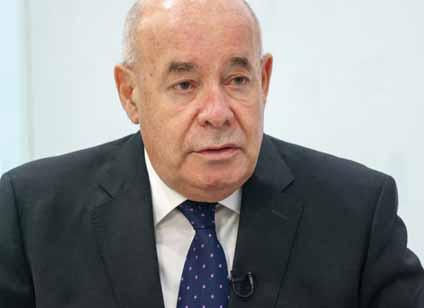
Mikhail Shvydkoy, special representative of Russian President Vladimir Putin for international cultural cooperation, visited Tbilisi, Russian state news agency TASS reports.
Shvydkoy, who is also the artistic director of the Moscow Musical Theater, attended screenings of the theater’s productions ‘The Circus Princess’ and the film ‘Reverse’ in Tbilisi on June 14 and 15.
During the visit, he said culture could play an important role in restoring trust between Russia and Georgia.
“I think that culture is an area that can restore the atmosphere of trust that existed between our countries. People always strive toward each other, and we have quite deep ties,” Shvydkoy said. He suggested that the Moscow Theat-
POLITICO: Trump’s Renewed Focus on Ukraine Raises Concerns in Europe
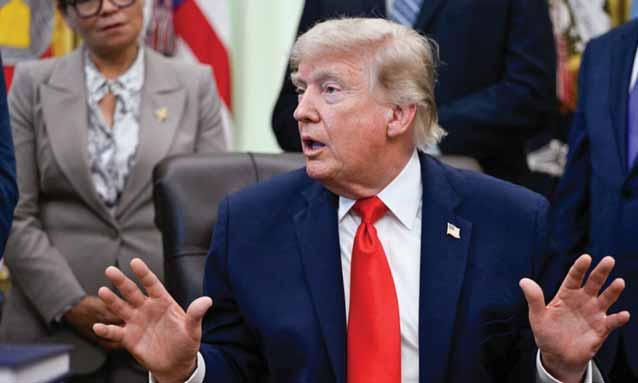
U.S. President Donald Trump speaks in the Oval Office at the White House in Washington, D.C., U.S., June 11, 2026. REUTERS/Daniel Heuer
BY TEAM GT
Ukraine’s allies are seeking to avoid a confrontation with US President Donald Trump at the G7 summit as he turns his attention away from the Iran crisis and back toward Russia’s war against Ukraine, as reported by POLITICO.
Speaking in France ahead of the summit, Trump said he would now focus on efforts to end the war in Ukraine.
“Now that this [the Iran issue] is over, we will focus on that [Ukraine] and see if we can get it done,” Trump said during a meeting with French President Emmanuel Macron.
POLITICO reports that Trump’s remarks have done little to reassure Europe’s strongest supporters of Ukraine.
Behind the scenes, European officials fear the US president could attempt to regain control of peace negotiations, sideline European allies, and undermine their strategy of maintaining maximum
pressure on Russia while providing unwavering support to Kyiv.
“Trump being distracted was not necessarily a bad thing,” one EU diplomat told the publication on condition of anonymity.
European officials are also concerned about Trump’s recent lengthy phone conversation with Russian President Vladimir Putin, which reportedly took place on Putin’s birthday.
“We had a very good conversation yesterday with President Zelensky and President Putin, and I think we may be able to do something. I believe both of them are very open to it,” Trump said.
Further concerns emerged after Kremlin aide Yuri Ushakov announced that Trump’s special envoys, Steve Witkoff and Jared Kushner, are expected to visit Moscow in the near future.
Another key issue is who should lead future negotiations and what framework should be used. In recent meetings with European leaders, Ukrainian President Volodymyr Zelensky argued that Europe should participate in negotiations not as a mediator but as an ally with shared
interests.
Ahead of the G7 summit, European and Ukrainian officials stressed the importance of maintaining a strong common negotiating position backed by the United States, including rejecting any assumptions that Kyiv should surrender territory as part of a settlement.
POLITICO also noted that Germany, France, and the United Kingdom took their first cautious steps toward direct engagement with Moscow last week, sending representatives to meet Russian Deputy Foreign Minister Mikhail Galuzin.
The three countries reiterated longstanding European demands for a full and immediate ceasefire, robust security guarantees for Ukraine, and the use of the current front line as the starting point for any future negotiations.
However, POLITICO warns that if Trump becomes more actively involved in the peace process, he may not share Europe’s vision for how negotiations should proceed—or may not want European allies at the negotiating table at all.
Russian Airline Red Wings Expands Georgia Flight Network for Summer Season
er’s productions could help deepen contacts with representatives of Georgian society.
“I think this will arouse interest among our colleagues because we want to introduce Georgia to contemporary Russian art, painting, cinematography, and the work of contemporary artists as much as possible. Of course, we will do only what will be acceptable and comfortable for our Georgian partners, although, in my opinion, such cultural initiatives have their own significance,” he said.
Shvydkoy also stated that Russia remains open to Georgian artists and performers.
“Many Georgian artists work in Russia. Large Georgian groups regularly tour there, and a number of famous musicians and performers live and work in Russia,” he said.
This is Shvydkoy’s second visit to Georgia in the past three months. He previously visited Tbilisi as one of the heads of the Russian delegation attending a funeral ceremony of Catholicos-Patriarch of Georgia, Ilia II.

BY TEAM GT
Russian airline Red Wings has expanded its summer flight program to Georgia and is now operating services from 15 Russian cities, reads a statement by the Russian Interests Section at the Swiss Embassy in Georgia. The airline has added six new direct routes to Batumi this month, further strengthening air connectivity between Russia and Georgia’s Black Sea resort city. Batumi is now directly connected with Volgograd, Orenburg, Perm, Sara-
tov, Tyumen, and Chelyabinsk.
“Batumi continues to strengthen its position as one of the most popular summer holiday destinations among Russian travelers. The clearest evidence of this is the expanded summer flight program of Red Wings. This month alone, six new routes from various cities across the Russian Federation have been launched to Georgia’s main seaside resort,” the statement reads.
In total, during the 2026 summer season, Red Wings is operating flights to Georgia from 15 cities across Russia.
The expansion comes alongside growing tourist traffic between the two countries and increasing demand for direct air connections to Georgia’s Black Sea
coast during the summer months. Direct flights between Georgia and Russia resumed in May 2023 after Russian President Vladimir Putin lifted a ban on direct air travel to Georgia that had been in place since 2019. Since then, several Russian airlines have launched or expanded routes to Georgia, while the number of direct flights and destinations has steadily increased.
The restoration of air links sparked political debate in Georgia, with critics arguing that the move undermines international efforts to isolate Russia following its full-scale invasion of Ukraine, while supporters point to the economic benefits of increased tourism and connectivity.
Event banner. Source: Taste Tbilisi
Mikhail Shvydkoy. Photo by Kirill Kukhmar/TASS
A Red Wings aircraft. Source: FB
Ukraine Latest: Russia Presses forward on the Front as the War Expands beyond the Battlefield
COMPILED BY ANA DUMBADZE
Russia stepped up pressure across several sectors of the front line this week, launching relentless assaults in eastern and southern Ukraine while continuing large-scale missile and drone attacks on Ukrainian cities. At the same time, Kyiv pushed deeper into Russia's economic rear, targeting oil refineries, fuel depots, and logistics infrastructure in a campaign that is increasingly disrupting domestic fuel supplies. As both sides expanded their long-range strike operations and casualties mounted, another week of war passed without a decisive breakthrough. Instead, the conflict continued to evolve into a grinding contest of endurance stretching from the trenches of Donetsk to the energy facilities of central Russia.
The heaviest fighting once again centered on Donetsk Oblast, particularly around Pokrovsk, where Russian troops pressed against Ukrainian defensive positions in an effort to widen local gains and threaten supply routes. According to Ukrainian military reports, the Pokrovsk sector remained one of the most active areas of the battlefield, with dozens of assaults recorded near Rodynske, Novooleksandrivka, Hryshyne, Kotlyne, Udachne, Shevchenko, Myrne, and Novopavlivka. Ukrainian forces said they repelled repeated attacks, but the tempo of the fighting suggests Moscow continues to view this axis as one of its principal efforts.
Further north, the Lyman and Sloviansk areas also came under sustained pressure. Russian troops attempted to break through Ukrainian defensive lines near
Zarichne, Yampil, Drobysheve, Dibrova, and surrounding settlements, part of a broader effort to stretch Ukraine's eastern defenses and force Kyiv to commit reserves across multiple sectors at once. Around Kostiantynivka, the situation remained particularly difficult. Fighting continued near Pleshchiivka, Illinivka, Stepanivka, and on the approaches to the city itself. Ukrainian officials reported that small Russian groups had infiltrated parts of the area, though there was no confirmation of a major Russian seizure of the city. The battle matters because Kostiantynivka forms a key part of Ukraine's defensive network in Donetsk Oblast.
Russia also intensified its long-range campaign against Ukrainian cities and infrastructure. One of the largest attacks of the week came overnight on June 14-15, when Russian forces launched a combined strike involving missiles and hundreds of drones. Ukrainian air defenses intercepted many of the incoming targets, but some ballistic missiles and drones still reached their objectives.
Kyiv was the primary target. Damage was reported across several districts, with fires breaking out, power disruptions affecting residents, and civilians among the casualties. Dnipro and Kharkiv were also struck. Ukrainian authorities said people were killed and injured, including rescue workers who died while responding to emergencies in northeastern Ukraine. The attack underscored Russia's continued reliance on complex waves of missiles and drones designed to overwhelm air defenses and maximize disruption.
Among the sites damaged was the KyivPechersk Lavra, one of Ukraine's most important religious and cultural landmarks and a UNESCO World Heritage
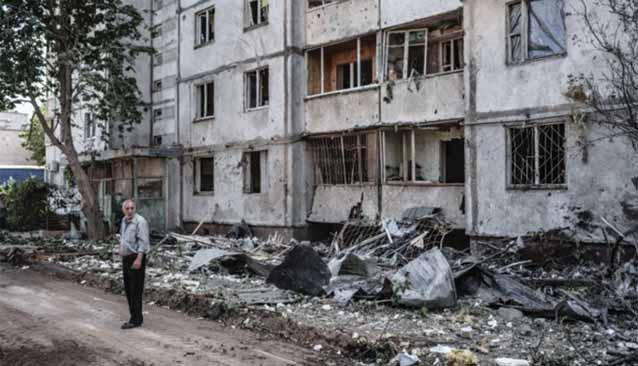
site. Ukrainian officials said several buildings within the historic monastery complex were affected, drawing renewed concern over the vulnerability of the country's cultural and spiritual heritage as the war continues to reach far beyond the front line. The impact of Ukraine's strikes on Russian oil infrastructure is becoming increasingly visible. Repeated attacks on refineries, pipelines, and fuel storage facilities have reportedly created growing supply problems inside Russia. In an unusual development for one of the world's largest oil producers, Moscow has reportedly moved toward importing gasoline by sea, while fuel restrictions
have appeared in some regions. Although Russia continues to earn substantial revenue from crude exports, disruptions to refining capacity are emerging as a strategic vulnerability that Kyiv appears determined to exploit.
Diplomatically, the week brought renewed discussions among Ukraine's partners over air defense, military aid, and economic pressure on Russia. President Volodymyr Zelensky used the G7 summit to press for additional air defense systems, greater support for Ukraine's energy infrastructure, and tougher sanctions on Moscow. Western leaders again pledged support, but Ukraine continues to face urgent shortages, particularly of
advanced interceptor missiles needed to defend against Russia's growing missile and drone campaign.
Talk of possible negotiations also resurfaced, though there was little sign of a genuine diplomatic breakthrough. Ukraine has repeatedly said it is ready for a leader-level meeting if Russia is serious about ending the war, while Moscow continues to pursue battlefield pressure and maintain demands that Kyiv considers unacceptable. The contrast between diplomacy and reality remained stark: while international leaders spoke of peace, missiles continued to strike cities and fighting raged across hundreds of kilometers of front line.

Russia has threatened to step up its attacks on Kyiv. Photo by Serhii Korovayny for WSJ
Strike on Kyiv Pechersk Lavra Draws International Condemnation
BY TEAM GT
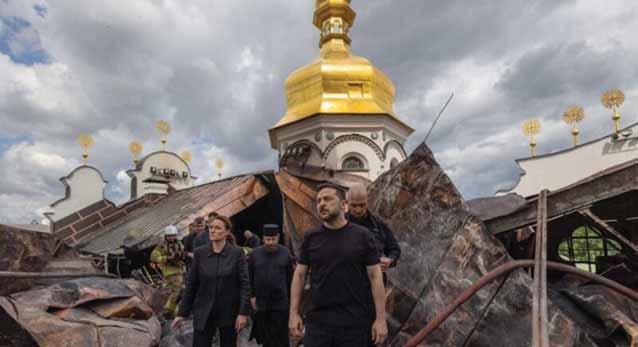
The Russian missile and drone attack that damaged the historic Kyiv Pechersk Lavra during a massive overnight assault on Ukraine on June 15 prompted strong reactions from Ukrainian officials, international organizations, and religious leaders, who described the strike as an attack on a site of global cultural and spiritual significance.
According to Ukrainian authorities, the attack sparked a fire at the Dormition Cathedral within the monastery complex. Emergency crews later extinguished the blaze, but reports indicated that both the exterior and interior of the cathedral suffered significant damage. Adjacent historic structures, including sections of the Lavra's fortification com-
plex and the Ivan Kushnik Tower, were also reportedly affected.
The strike formed part of a wider Russian assault in which, according to President Volodymyr Zelensky, Moscow launched 70 missiles and 611 drones against targets across Ukraine. Preliminary reports indicated that four people were killed and 28 injured in Kyiv alone.
Founded in the 11th century, the Kyiv Pechersk Lavra, also known as the Monastery of the Caves, is one of Eastern Orthodoxy's most revered spiritual centers and a symbol of Ukrainian religious and cultural identity. Together with Saint Sophia Cathedral, it forms part of a UNESCO World Heritage Site.
Zelensky described the strike as "an attack on the Christian community and humanity's cultural heritage," adding that it represented "one of the most serious crimes committed by Russia against Christian culture to date."
Ukraine's Foreign Minister Andrii

Sybiha issued an equally forceful response: "By striking the Kyiv Pechersk Lavra, one of the greatest holy sites of Christianity, Putin has forever put his name on the list of history's worst barbarians," Sybiha wrote on social media. "Only Russian scum who have nothing sacred can deliberately damage the Kyiv Pechersk Lavra, a unique UNESCO heritage site under special protection."
UNESCO subsequently condemned the strike, saying it stood ready to assist Ukrainian authorities in assessing the damage and identifying urgent protective measures.
The wording of UNESCO's initial statement, however, drew criticism from Ukraine's Foreign Ministry, which argued that the organization had failed to explic-
itly state that Russia was responsible for the attack. Foreign Ministry spokesperson Heorhii Tykhyi described the omission as "absurd."
The strike also prompted reactions from abroad. Ecumenical Patriarch Bartholomew I condemned what he called a "barbaric and destructive attack" on a site that forms part of Christianity's shared heritage. French Foreign Minister Jean-Noël Barrot compared the strike to "a bombing of Notre Dame," while French President Emmanuel Macron wrote that nothing could justify an attack on "our shared universal heritage."
EU foreign policy chief Kaja Kallas condemned the attack on Ukrainian civilians and the centuries-old Kyiv Pechersk Lavra, describing the strike as
a war crime and stating that "Russia will have to answer for it."
Russian authorities, however, rejected responsibility. State media cited the Russian Defense Ministry as claiming that the Lavra was struck by a US-supplied Patriot air defense missile, which it alleged had malfunctioned or been part of a batch of expired missiles provided to Ukraine by Western countries.
Archimandrite Avraamiy, vicar of the Kyiv-Pechersk Lavra, told RFE/RL hours after the attack that the strike was “yet another act of Russian barbarism” and showed that “nothing is sacred to them.”
“The feeling was as if an enemy bullet had hit you straight in the heart,” he added.
European Parliament Backs Georgian People, Warns of Democratic Backsliding, Calls for Release of Political Prisoners
BY TEAM GT
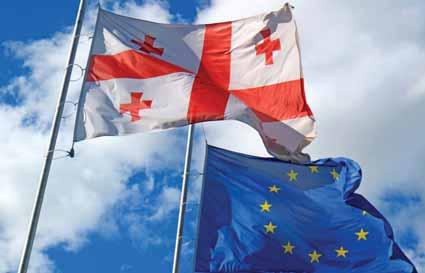
The European Parliament this week adopted a wideranging report on Georgia, expressing strong support for the Georgian people while warning that the country's democratic decline and stalled reforms have effectively halted its progress toward European Union membership.
The report, adopted by 436 votes to 145, states that the European Parliament stands in "full solidarity" with the Georgian people, who it says continue to support a European and democratic future despite growing repression, arrests, hostile rhetoric, disinformation campaigns, and political pressure.
According to the document, nearly 75% of Georgians continue to favor closer integration with the European Union. MEPs stressed that the EU's door remains open should Georgia return to the path of democratic reforms and alignment with European values.
At the same time, the report delivers a sharply critical assessment of the country's current political trajectory. MEPs argue that the ruling Georgian Dream party has "not only suspended but effectively reversed" Georgia's European integration course, and expressed concern over what they describe as backsliding in the implementation of the nine priorities established by the European Union as conditions for candidate status.
The report further alleges that senior government officials and governmentaffiliated media have promoted anti-EU narratives, disinformation, and conspir-
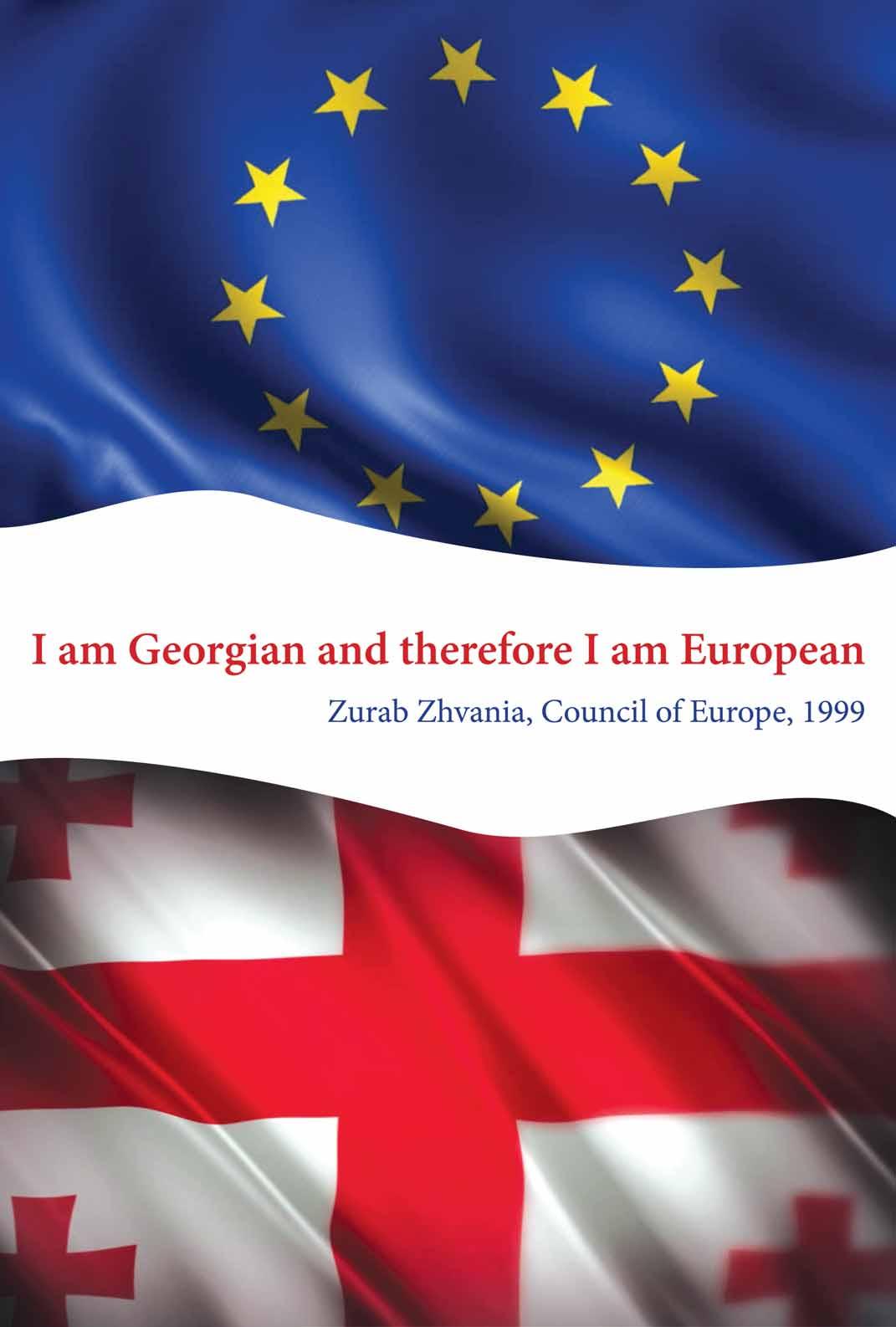
The Georgian and EU flags. Source: emerging-europe
acy theories targeting the European Union and its representatives.
Particular concern is expressed over developments following the October 2024 parliamentary elections, which the report describes as "rigged." According to MEPs, the elections were followed by an acceleration of authoritarian tendencies, including the weakening of democratic institutions, restrictions on fundamental freedoms, and a decline in political pluralism.
The European Parliament also reiterates concerns regarding the independence of key state institutions, including the Central Election Commission, the Communications Commission, the High Council of Justice, the Constitutional Court, the Prosecutor's Office, the National Bank, and law enforcement and security agencies.
The report argues that Georgia will be
unable to advance in the EU accession process unless it undertakes substantial democratic reforms, guarantees free and competitive elections, strengthens institutional independence, addresses oligarchic influence, and improves protections for human rights and media freedom.
A significant portion of the document focuses on concerns about politically motivated prosecutions and imprisonment. MEPs call for the immediate and unconditional release of all individuals they describe as political prisoners, including opposition politicians and former government officials.
The report states that the imprisonment of former Prime Minister Irakli Garibashvili raises serious questions regarding compliance with fair trial standards. It argues that, despite a guilty plea and what it describes as credible public evidence of corruption, the pro-
ceedings raise broader concerns about politically influenced justice, informal power structures, and divisions within the ruling Georgian Dream party.
MEPs also condemn what they characterize as continuing efforts to pressure political opponents through arrests, detention, threats, and physical attacks.
They criticize the imprisonment of opposition politicians who refused to appear before the Temporary Investigative Commission of what the report refers to as Georgia's "de facto parliament," arguing that the commission was used as a political instrument to increase pressure on opposition figures and potentially facilitate future bans on opposition parties.
"The existence of political prisoners is incompatible with Georgia's obligations under the EU-Georgia Association Agreement," the report states.
The European Parliament additionally renewed its call for the release of former President Mikheil Saakashvili on humanitarian grounds so that he can receive medical treatment abroad. The document also urges Georgian authorities to grant Members of the European Parliament unrestricted access to Saakashvili and other detainees described as political prisoners.
The report further highlights what it calls the lack of progress in de-oligarchization efforts and urges the adoption of stronger transparency mechanisms, conflict-of-interest regulations, and safeguards against undue influence in political and economic decision-making.
On June 11, Georgian and EU officials met in Brussels for an enhanced dialogue following the suspension of visa-free travel privileges for holders of Georgian diplomatic, service, and official passports.
While the Georgian Foreign Ministry described the talks as constructive and expressed a "positive" outlook, European officials reportedly viewed the meeting less favorably. According to reports citing an EU official, the discussions were "rather unfruitful," with Brussels remaining dissatisfied with Georgia's position on legislation that the EU has repeatedly urged the government to repeal. The meeting formed part of a procedure required under the EU's visa suspension mechanism. European Commission officials reiterated that the suspension was linked to concerns over Georgia's compliance with commitments undertaken within the visa-free travel framework, particularly regarding democracy and fundamental rights. The Georgian side rejected the measure as unfair and politically motivated, while emphasizing its willingness to continue dialogue with the European Union at a higher political level.
In the report, the MEPs welcomed visa restrictions and other sanctions already imposed by several EU member states on Georgian officials and called on additional countries to adopt similar measures. The report reiterates previous calls for targeted sanctions against Bidzina Ivanishvili, his family members, and associated companies, including the freezing of assets and coordination with international partners such as the United Kingdom and the United States.
Although European Parliament reports are not legally binding, they represent the official political position of the EU legislature and may influence future discussions and policy decisions concerning relations between the European Union and Georgia.
Rescue workers try to put out a fire at the Kyiv Pechersk Lavra. Source: AP
Zelensky inspects the ruins of the Lavra. Source: FB
Kremlin Envoy Marat Kambolov Appointed So-called PM of Tskhinvali Region
BY LANA KOKAIA
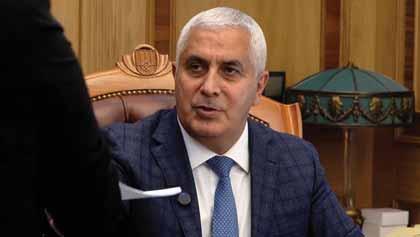
The de facto parliament of “South Ossetia”/Tskhinvali region has unanimously approved Marat Kambolov as the region’s so-called Prime Minister.
Kambolov, a Russian official from North Ossetia, arrived in Tskhinvali in early June and was quickly promoted from chief advisor to the region’s de facto leader, Alan Gagloev, to head of the socalled government.
JAMnews reports that Kambolov’s nomination was submitted by Alan Gagloev. However, local political observers reportedly see the appointment as more than a routine personnel change.
There is growing speculation in Tskhinvali that Moscow’s new representative could eventually be positioned to assume the role of the region’s de facto leader.
Kambolov has held senior positions in several Russian federal institutions, including the Federal Antimonopoly Service and agencies responsible for nationality and regional policy.
Speaking before the parliament after his appointment, Kambolov identified the demographic crisis as the region’s most pressing challenge. He said the population of “South Ossetia” has nearly halved over the past three decades, creating social, economic, and political difficulties.
“The economy does not work without people, schools lose their meaning without children, and villages disappear without a population,” Kambolov said.
He added that government decisions should focus on creating opportunities for residents.
The new so-called Prime Minister also stressed the importance of preserving Ossetian language, traditions, and historical memory.
Kambolov devoted significant attention to relations with Russia, describing Moscow’s support as crucial to the region’s development. He said Russia had played a key role in maintaining security and stability during difficult periods.
His appointment follows an agreement signed in May between Russian President Vladimir Putin and Alan Gagloev to deepen alliance relations between Russia and the occupied region. Shortly afterward, Gagloev appointed Kambolov as an advisor and tasked him with coordinating implementation of the agreement.
Many observers interpreted his rapid rise as a sign of increasing Kremlin involvement in the internal governance of the region. Some local political figures reportedly believe Moscow is dissatisfied with the performance of the current administration and is seeking greater control over local affairs.
The appointment also comes as allegations continue that officials in the occupied region may have misused billions of dollars in loans provided by Russian financial institutions. Some local experts suggest one of Kambolov’s key responsibilities could be overseeing an audit of the financial system and state-funded projects.
Two Fined over Social Media Comments as Georgia's New Hate Speech Unit Begins Operations
BY TEAM GT
Two Georgian citizens have been fined over social media comments directed at politicians in some of the first court cases linked to the Ministry of Internal Affairs' newly established Department for Combating Hate Speech.
On June 17, Tbilisi City Court fined citizen Gia Kachkachuri GEL 2,000 for a Facebook comment containing insulting and profane language directed at opposition politician Levan Sanikidze, Deputy Chair of the United National Movement. The ruling was issued by Judge Manuchar Tsatsua. The case stemmed from a comment posted under an Imedi TV social media card quoting Sanikidze as saying that the ruling Georgian Dream party had "three tasks from Russia: no NATO, no European Union, and no Misha."
Following the ruling, Sanikidze distanced himself from the proceedings, stating that he had not filed a complaint against Kachkachuri.
"Who is this fined man? What complaint did I file? Who needs your protection and for what?" Sanikidze wrote on social media, adding that he did not require others to defend his dignity.
On the same day, lawyer Shota Tutberidze was fined GEL 4,000 over a comment posted under a Facebook post by Georgian Dream MP Nino Tsilosani regarding her visit to Canada. The ruling was issued by Judge Davit Makaradze. Both investigations were conducted by the Ministry of Internal Affairs' Depart-
European Parliament Report Accuses Georgian Dream of Turning toward China, Russia and Iran
BY TEAM GT
The European Parliament has adopted a report on Georgia that accuses the ruling Georgian Dream of abandoning the country’s Euro-Atlantic course and pursuing closer cooperation with China, Russia and Iran.
The report claims that the ruling party’s foreign policy direction represents a departure from Georgia’s constitutional commitment to European and Euro-Atlantic integration and contradicts the aspirations of a majority of Georgian citizens.
“Having abandoned the path of EuroAtlantic integration, Georgian Dream is making a strategic turn towards cooperation with China, Russia and Iran, as confirmed in numerous reports,” the document states.
The European Parliament said this reorientation demonstrates disregard for both Georgia’s constitutional obligations and the “clear and consistently expressed will” of Georgian society.
The report also criticizes investigations launched against individuals who have published reports on the growing influence of authoritarian states in Georgia, including Hudson Institute researcher Giorgi Kandelaki and former Defense Minister Tinatin Khidasheli.
MEPs expressed concern over the involvement of Chinese state-owned companies in strategic infrastructure projects, particularly the Anaklia Deep Sea Port project, which was initially developed with Western partners and envisioned as a key component of EastWest connectivity independent of Russian and Chinese influence.
The report emphasizes that the success of the Middle Corridor and future investment initiatives under the EU’s Global Gateway strategy depend on Georgia maintaining the rule of law, transparency and stability.
The European Parliament also highlighted the strategic importance of Black Sea connectivity projects, including the Black Sea Digital Connectivity Subma-

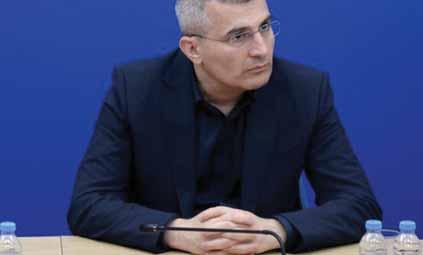
Mamuka Mdinaradze, Georgian Dream State Minister for Coordination of Law Enforcement Bodies. Source: FB
ment for Combating Hate Speech, which relied on provisions of the Code of Administrative Offenses concerning verbal insults directed at political officials.
Tsilosani welcomed the decision, describing it as an important precedent: "It turned out that the offensive comment made on my post was the first precedent, and I am glad that a very good practice has been established," she told Imedi TV, arguing that offensive statements on social media should no longer go unanswered.
The Department for Combating Hate Speech officially began operating on June 1, following a government decision announced in May. According to senior Georgian Dream figure Mamuka Mdinaradze, the unit is tasked with the systematic monitoring of hate speech, offensive campaigns, and what authori-
ties describe as aggressive communication in public spaces, including social media platforms. Officials have said the department will proactively identify potential violations and will not rely solely on citizen complaints.
The initiative has drawn criticism from opposition politicians and civil society groups, who argue that it risks restricting freedom of expression under the pretext of combating hate speech.
Tamta Mikeladze, Equality Policy Program Director at the Social Justice Center, warned that placing monitoring functions within police structures creates risks of political control and abuse of power. She also criticized the use of terms such as "aggressive communication," describing them as vague concepts that could be applied to a broad range of critical or emotional political expression.
rine Cable and the Black Sea Submarine Electricity Cable, which aim to strengthen links between the European Union and the South Caucasus.
The document further raises concerns about Russian influence operations in Georgia. While acknowledging the important role of the Georgian Orthodox Church in public life, MEPs warned that religious networks may be used by Russia to spread disinformation and undermine pro-European sentiment.
The report also points to what it describes as growing Iranian influence in Georgia through religious, educational and economic structures. Based on the document, some economic actors linked to the Iranian regime may be facilitating sanctions circumvention, money laundering and illicit trade activities.
In addition, the European Parliament reaffirmed its support for Georgia’s sovereignty and territorial integrity and strongly condemned Russia’s continued occupation of Abkhazia and the Tskhinvali region, as well as the ongoing “borderization” process along the occupation line.
MEPs expressed concern over continued detentions of ethnic Georgians in the occupied territories and condemned what they described as politically motivated arrests, intimidation and discrimination.
The report also criticizes the development of a Russian naval base in Ochamchire, describing it as both a violation of Georgia’s territorial integrity and a threat to security in the Black Sea region.
The European Parliament reiterated its call for the immediate and unconditional withdrawal of Russian forces from Georgia’s occupied territories and called for targeted sanctions against individuals responsible for human rights violations in Abkhazia and the Tskhinvali region, building on precedents such as the Otkhozoria–Tatunashvili List.
Although European Parliament reports are not legally binding, they reflect the official position of the EU legislature and can influence broader discussions on European Union policy toward Georgia.
Zhorzholiani Says UNM May Need a ‘Crisis Manager’ Rather than a Traditional Politician
BY TEAM GT
Television host and journalist, Nanuka Zhorzholiani says Georgia’s largest opposition party, the United National Movement, may need a “crisis manager” rather than a traditional politician to lead it through its current challenges.
In a social media post, Zhorzholiani commented on the ongoing discussion surrounding the party’s future leadership after imprisoned former president Mikheil Saakashvili publicly endorsed her candidacy for the position of party chair.
Zhorzholiani said she had initially hoped to work within the party under the leadership of current chairperson Tina Bokuchava.
“It would have been ideal for me and Misha to integrate into the National Movement under the chairmanship of Tina Bokuchava. As I have said before, she is smarter than me, more experienced than me, she knows things that I do not know, and perhaps she lacks some of the skills that I have. We would have been ideal partners, and it is a pity that it did not work out that way,” Zhorzholiani wrote.
She stressed that Saakashvili remains the party’s principal leader and praised several opposition figures currently imprisoned, including Levan Khabeishvili and Irakli Nadiradze, for their dedication to the opposition cause.
Zhorzholiani argued that the party should increasingly be led by younger figures, while experienced politicians
should continue to provide guidance and support.
“Now the main thing is that this party should be taken over by young people. The veterans will strengthen the backs,” she wrote.
Zhorzholiani claimed that her strengths lie in management rather than traditional politics.
“I consider myself a manager in this party. Maybe the chairman could be like that. Maybe politics no longer needs a politician with a tie. If the party is in crisis now, maybe it needs a crisis manager,” she said.
She also emphasized the importance of strengthening the party’s international engagement, arguing that foreign relations require expertise, experience and an independent team capable of advancing the party’s interests abroad.
The journalist suggested that she could help restore the pace, priorities and public visibility associated with Saakashvili’s leadership style.
“In this century, the crazier the idea, the more effectively it works, so maybe it will work here too,” Zhorzholiani concluded.
Her comments come alongside growing debate within the United National Movement over its future leadership and strategy ahead of internal party elections expected later this year.
Chair of the United National Movement, Tina Bokuchava, has expressed disappointment after imprisoned former president Mikheil Saakashvili announced his support for television host Nanuka Zhorzholiani as the party’s next chairperson.
Marat Kambolov. Source: alaniatv.ru
Karl Schliogel:
nation?
INTERVIEW
BY
VAZHA TAVBERIDZE FOR RFERL
Only after 2014 did I realize and take seriously the fact that Ukraine has its own history, its own culture, and its own language. I have to admit this openly, - says renowned German historian Karl Schlögel, one of the keynote speakers at the recent Debates on Europe conference in Tbilisi. He spoke to Radio Free Europe / Radio Liberty’s Georgian Service about Putin's Russia, the war in Ukraine, Russia's imperial legacy, and the extent to which Russian society can break free from the "cage" of empire. In his assessment, the war against Ukraine has changed not only the European security architecture, but also the West's perception of Ukraine and Russia itself.
IN 2014, YOU SAID, "WE DO NOT PROPERLY UNDERSTAND WHAT IS GOING ON IN PUTIN'S MIND, NOR WHAT IS HAPPENING IN POSTSOVIET RUSSIA SOCIALLY AND MENTALLY." TWELVE YEARS AND ONE FULL-SCALE AGGRESSION LATER, HOW WELL HAVE WE STUDIED PUTIN'S RUSSIA?
We have learned a lot, but we still don't fully understand what is happening and why. We have new experiences with hybrid warfare, subversion, sabotage and propaganda, but we still have difficulty properly dealing with what I would call Russia's dominance through escalation. Look at what Putin said at the St. Petersburg Economic Forum: we heard threats again and again. Again he preaches about the greatness of Russia's military power. This is clearly not a man who is serious about resolving all this through diplomatic means. His rhetoric is again one of intimidation, and he hopes that Europe will follow suit and reduce its military support for Ukraine.
DO YOU THINK HIS HOPES WILL BE JUSTIFIED? WILL EUROPE COME TO TERMS WITH IT?
I would like to hope not, but I think it is still an open question how the West, or Europe, will ultimately respond to this strategy. We have learned a lot, but perhaps not enough yet.
WHAT DO YOU THINK ABOUT HIS SUGGESTION THAT FORMER GERMAN CHANCELLOR GERHARD SCHRÖDER SHOULD PLAY THE ROLE OF AN ACCEPTABLE MEDIATOR FOR RUSSIA?
Without any irony, I think that it was actually a rather sophisticated maneuver. Of course, the main goal here was not that Putin really expected Schröder to be appointed as a mediator. He would not allow it for a second. But he tested the ground, tested how the West would react, who would say what, to what extent and who was ready to seriously consider such a thing.
Putin plays his own game, plays it well: he is a master of it, and we have yet to fully understand him. He is a player who coldly refuses to accept the rules of the diplomatic world to which we are accustomed.
IF YOU PLAY AGAINST THE SAME OPPONENT FOR MORE THAN 20 YEARS, AS A RULE, YOU SHOULD KNOW HIS TACTICS, UNDERSTAND HIS STRATEGY, AND HAVE A CERTAIN CHANCE OF PREDICTING HIS NEXT MOVE. BUT THAT'S NOT THE CASE WITH PUTIN.
My interpretation is this: the generations
"What is the
Nobody
Russian
really knows"
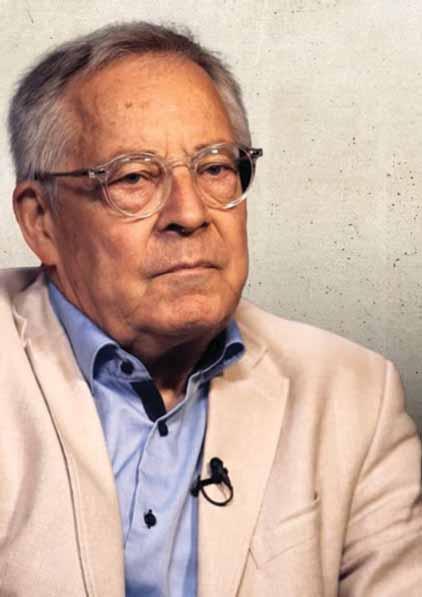
Schlögel. Source RFERL
that lived in the post-1945 world lived in a world of containment, and to some extent this containment worked. At least my generation, I was born after the war, was used to the idea that we could live in peace. War and violence were something we only saw on TV, in documentaries or on the evening news, somewhere far away from us.
And suddenly realizing that war was back in Europe, confronting this reality was a completely new experience. It's not easy to abandon the worldview that you were raised and socialized with. It's a process of destroying your understanding of the world. And it's a difficult, painful process.
I must admit that being in Donbas in the spring of 2014 had a transformative effect on me. It was the first time in my life when I saw with my own eyes how war is born and develops.
What I'm about to say may sound selfrighteous, but only recently, in my old age, have I come to understand a fundamental truth. I am a professional historian who has spent my entire life studying Eastern Europe, but it was only after 2014 that I realized and took seriously the fact that Ukraine has its own history, its own culture, and its own language. I have to admit this openly. But I will also say that this was not just my perception. Ukraine was always presented as part of a broader imperial framework: The Russian Empire, the Habsburg Empire, the Polish-Lithuanian Commonwealth. I saw Ukraine as part of a larger whole. There was a strong bias in Western historiography. It was deeply Russocentric and Muscocentric. The majority of scholars working in the field of Eastern Europe viewed events from that Muscocentric, Russocentric perspective. Everything that existed outside of Moscow was considered peripheral. And this remains a problem to some extent today, although we are in the process of rethinking this approach.
It is noteworthy that it took a war to establish Ukraine on the mental map of Western academia. For a long time,
Ukraine was perceived as a peripheral region, the so-called hinterland; the backyard of great empires.
Of course, all of us specialists knew about the Ukrainian national movement, the nation-building process, Taras Shevchenko, and the events of the nineteenth century. But knowing something and transforming the mental map that your education, academic training, and professional life have shaped are not the same thing.
THIS WAR IS BEING FOUGHT ON MANY FRONTS, AND ONE OF THEM IS UNDOUBTEDLY THE WAR OF HISTORICAL NARRATIVES. ON ONE SIDE IS MOSCOW'S INTERPRETATION AND ITS ROLE IN PUTIN'S CONCEPT OF THE "RUSSKY MIR," ON THE OTHER IS UKRAINE'S CONTRASTING VISION. WHICH SIDE DO YOU STAND ON?
I was young when I first came to Kyiv, and I remember being deeply impressed by what was often called the Orthodox Vatican: The Monastery of the Caves and the Cathedral of Saint Sophia. These are the oldest monuments of Eastern Christianity, and it was clear from the very beginning that Kievan Rus was older, earlier, and historically more prestigious than Moscow. Moscow came into being much later. This is a fact.
At the same time, claiming that the Ukrainian nation already existed in the ninth or tenth century would be a retrospective construction. The process of nation formation began much later. We see these processes in the national movement, the Hetmanate, the Cossacks, and the gradual formation of Ukrainian statehood. Historically, this process can be reconstructed. But Ukraine, as a nation, did not exist in the era of Kievan Rus. AND RUSSIA AS A NATION EXISTED DURING THE ERA OF KIEVAN RUS?
Of course not. This is entirely part of
Putin's historical fantasies. That is why he erected a monument to Prince Vladimir near the Kremlin: to show that there has always been one common Russian nation, that Ukraine has never been a separate nation, and has always been part of a larger Russian whole.
HAVE ALL THE BRIDGES FINALLY BEEN BURNED BETWEEN THE TWO PEOPLES, OR IS THERE STILL A HISTORICAL LEGACY THAT BOTH NATIONS CAN EQUALLY VALUE?
I cannot imagine any kind of reunification after what happened and what is happening to this day. I can't imagine this after all the violence, the cruelty, and the ruthless destruction of the bonds that once existed.
Anyone who has traveled to Ukraine, Russia, and the former Soviet Union knows how closely these two nations were connected. Millions of families, hundreds of thousands of careers, and personal lives were intertwined.
This heritage, what I would even call the spiritual heritage of coexistence, has been destroyed. In my opinion, it will take generations to rebuild anything like it. The rift, the gap that has emerged, is now so deep that I find it difficult to imagine how it can be bridged within the next generation or two. The prerequisite for this would be radical changes in Russia. The Russians still do not know who they are. What is Russia after the collapse of the empire? What is the Russian nation? No one knows what the Russian nation is. They talk about the “Russian people,” the “Russian world,” or ethnic Russians. But everyone knows that the Russian Federation is not just the “Russian world.” These are different things.
I don't know how the citizens of the Russian Federation will solve this problem. To this day, Russians clearly support this war to some extent. This is not just Putin's decision. The question is how Russians will find a way out of this imperial framework and become a modern nation.
ONE POSSIBLE WAY OUT OF THIS IMPASSE COULD BE RUSSIA'S DEFEAT IN THIS WAR. WHAT KIND OF DEFEAT COULD SERVE AS THE BASIS FOR POSITIVE CHANGE?
We don't know. But I think failure would be a great opportunity for Russia and Russians to understand that the era of empire is over. This could be the shock that makes them think: what should they do, what can they do to modernize their country? To reflect and put these obsessive adventures of empire expansion in the past. Why does such a huge country need more territory? Why is it trying to frantically expand territory it doesn't really need, when it can't even manage the vast territory it already has? They have to find a way to modernize this huge state, this huge country, for the twenty-first century. And if they can't do that, the Russians will be left behind in history.
Today, the only real leverage that Russia has is nuclear weapons. Russia is a nuclear state. The West and Europe continue to talk to Russia. Why? Is it because it is creating some revolutionary innovation, inventing a new Apple, implementing a digital revolution, or offering world-changing inventions to humanity? No. The only reason anyone takes Russia seriously is because it has nuclear weapons.
Nuclear weapons create fear. And Putin is a true master of manipulating fear.
THIS IS PRECISELY WHAT PREVENTS RUSSIA FROM BEING COMPLETELY DEFEATED: THE RISK IS SO GREAT THAT ITS ADVERSARIES ARE UNWILLING
TO PUSH FOR A FINAL DEFEAT. GIVEN THAT REALITY, IS DEFEAT NECESSARY FOR RUSSIA TO RETHINK ITSELF AND ABANDON IMPERIAL AMBITIONS, OR COULD MERELY FAILING TO WIN IN UKRAINE BE ENOUGH?
Putin needs war to stay in power. War is the main tool by which he keeps this huge country in a state of permanent emergency. He has no vision for Russia's development, progress, or modernization. What it has is war, threats, and a barrack-like setup.
That's why I can't imagine how Putin himself might disappear, but the problems that Russia has won't be solved by that.
IF PUTIN WERE TO DISAPPEAR TOMORROW, HOW WOULD HISTORY REMEMBER HIM?
I think the history books will describe him as a destructive, chaotic figure. He will be recorded in history as a war criminal. As the man who brought genocide back to Europe.
He began as a leader on whom many people pinned their hopes: the hope of making the transformation of Russia, of a modern Russia, of a Russia integrated into a globalized and open world, a reality.
But eventually, war returned to Europe. And, of course, we still don't know how its story will end.
But it can already be said that he will go down in history books as a man who was supposed to bring a new future to Russia, but instead became a destructive figure, first of all, for his own state and nation. From the point of view of history, he is a failed leader.
THERE IS A DIFFERENCE BETWEEN WHAT WESTERN HISTORIANS WILL WRITE IN THEIR BOOKS AND WHAT RUSSIAN HISTORIANS WILL WRITE IN RUSSIAN TEXTBOOKS. WHAT DO YOU THINK THE RUSSIANS WILL ULTIMATELY WRITE ABOUT PUTIN?
If he is not defeated, if he remains in power after the war, he will of course declare all this a victory, and a huge, laudatory historiography will emerge in Russia, presenting him as the greatest Russian leader since Peter the Great. Perhaps even as a new Stalin, the savior of Russia.
But I don't think that's going to happen. I believe that defeat for Russia, the Crimean War and the Russo-Japanese War, has historically always signaled the beginning of deep crises, from which society finds its voice. Not immediately, not the next day, but such setbacks create a moment when society is forced to face reality and make a choice.
THIS CONFLICT ALSO HAS A CULTURAL DIMENSION. ONE OF ITS MOST VISIBLE MANIFESTATIONS IS WHAT IS CALLED THE “WAR ON MONUMENTS” IN UKRAINE. THE LATEST EXAMPLE IS THE REMOVAL OF THE BULGAKOV MONUMENT IN KYIV. WHAT DO YOU THINK ABOUT IT?
Bulgakov was a radically anti-Ukrainian and pro-Russian figure. Yes, he was born in Ukraine and wrote one of the greatest books about the civil war in Ukraine. He was undoubtedly a great writer. But at the same time, he was a fanatical opponent of Ukrainian national aspirations. That's why I understand these feelings around his monument.
Yet I think there will come a time when a nation that has endured so much and finally achieved victory will be able to be magnanimous. It is within this magnanimity that perhaps even a citizen of Kyiv like Bulgakov can find his place in the memory of this city.
Karl
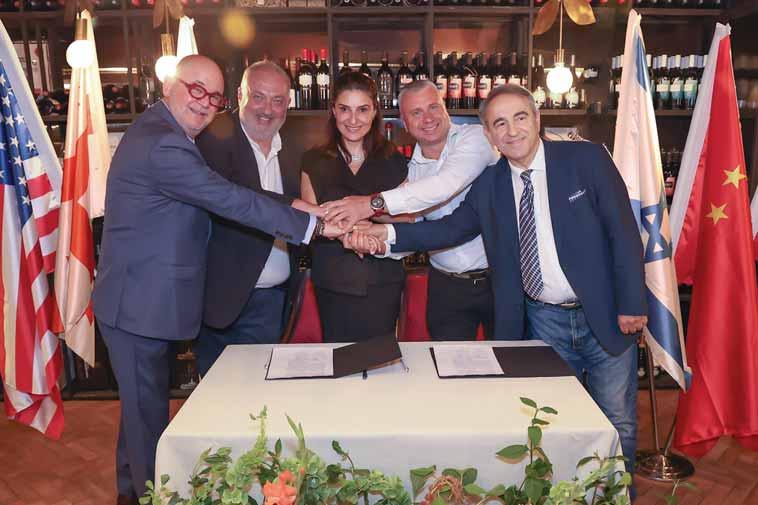
Cooperation with the Israeli Business Community: Preparations in Georgia for the Jerusalem Business Forum
BY TEAM GT
Economic cooperation between Georgia and Israel is gaining new momentum. The first stage of preparations has been completed as part of the official visit of Dr. Akram Hasson, a member of the Israeli Knesset, one of whose key objectives was the organization of the upcoming Georgia-Israel Business Forum in Jerusalem. Israeli House NET hosted a member of the Knesset within the framework of public diplomacy. According to Dr. Hasson, the forum will encourage Israeli business circles to further expand their investments in Georgia. He noted that a new wave of investment will build on the successful track record of Israeli investors already operating in the country, as well as on the support that will be available to new business initiatives.
WYNDHAM HOTELS & RESORTS DEMONSTRATES STRONG INTEREST IN GEORGIA
One of the key areas of focus for the Jerusalem Business Forum is cooperation between Israeli companies and Wyndham Hotels & Resorts, one of the world's largest hotel chains. This partnership is viewed as an important catalyst for the introduction of international standards, the attraction of new investment, and the continued development of the tourism sector.
Itsik Moshe, President of the IsraelGeorgia Chamber of Business and founder of Israeli House NET, presented Wyndham executives with 15 new hotel and aparthotel projects across the countries where Israeli House NET operates.
Approximately 50 percent of the projects presented are being developed in Georgia, including two owned by Badagoni, one of the country's leading wine companies.
Particular interest was drawn to the Art Registry Collection project, a unique seven-star hotel complex located in the historic district of Old Tbilisi. The project stands out for both its location and its architectural concept. Following years of planning, negotiations, and the acquisition of the necessary permits, the project has entered its final phase and is expected to be ready for the continuation of construction by the end of the summer.
The meeting at Israeli House NET was attended by senior representatives of
BY TEAM GT
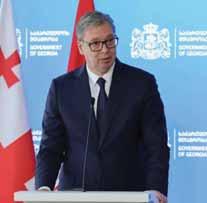
Serbian President Aleksandar
Vucic praised Georgia’s economic development and governance achievements during a joint briefing with Georgian Prime Minister Irakli Kobakhidze, saying only a few countries in Europe have achieved comparable results.
Wyndham Hotels & Resorts, including Dimitris Manikis, President for the EMEA region, and Sergey Egorov, Head of Development for Israel, Eastern Europe, Georgia, Central Asia, and the CIS countries. They reaffirmed that Wyndham's operating model is regarded as one of the most flexible and developer-friendly systems in the global hospitality industry.
EXPANDING TOURISM POTENTIAL
Tourism ties between Georgia and Israel began in the late 1990s through the efforts of the Israel-Georgia Chamber of Business, at the request of the Government of Georgia and with the involvement of the Government of Israel, and have continued to strengthen ever since.
According to the latest figures, tourist arrivals from Israel to Georgia are growing at an average rate of 30 percent annually, making the hospitality and tourism sectors increasingly attractive destinations for investment.
The Israel-Georgia Chamber of Business, which has played an important role in the revival of tourism from Israel to Georgia, together with the governmental and institutional bodies involved in this process, has been one of the key organizations promoting tourism development. According to its forecasts, the number of Israeli visitors to Georgia will exceed 500,000 in 2026, while their contribution to the Georgian economy is expected to reach USD 700 million.
The growth of the tourism sector is further supported by the European Association for the Preservation and Promotion of Jewish Culture and Heritage (AEPJ), which develops international Jewish heritage tourism routes with the support of the Council of Europe. In Georgia, this initiative is coordinated by Israeli House NET, creating significant opportunities for the development of Jewish and Biblical tourism.
BADAGONI: EXPANDING FROM WINE INTO TOURISM AND REAL ESTATE
Badagoni, one of Georgia's leading wine producers, is actively expanding its presence in the tourism and real estate sectors.
Located adjacent to the historic Alaverdi Cathedral, the company's Alaverdi Resort has already become one of its flagship developments. The resort is seamlessly integrated into Alaverdi's cultural and natural environment, attracting considerable interest from both
international investors and representatives of the tourism industry.
A further indication of this interest is Wyndham Hotels & Resorts' decision to select Alaverdi Resort for inclusion in its global network.
At the same time, Badagoni is developing another large-scale project in Ponichala Wyndham Residence Tbilisi Gate, which will also include capital from Israeli investors. The development envisages the creation of modern residential and tourism infrastructure. The combined investment value of the Alaverdi and Ponichala projects is estimated at approximately USD 100 million.
The strategic importance of the Ponichala project is further enhanced by its proximity to large-scale investment zones planned by EMAAR, one of the world's leading real estate development companies. EMAAR is implementing multibillion-dollar developments in the Tbilisi and Gonio areas, with a combined investment value estimated at USD 6.5 billion.
The international promotion of these projects is being actively supported by the Israel-Georgia Chamber of Business, which plans to officially present both hotels at the upcoming Jerusalem Business Forum. Cooperation with the Chinese company Leapmotor in the field of high-tech infrastructure development is also under discussion.
WYNDHAM GRAND BATUMI
GONIO: A NEW LANDMARK ON THE BLACK SEA COAST
On 16 June, the Georgian-Israeli holding company European Village unveiled its new project, Wyndham Grand Batumi Gonio / Sky Castle.
The development will be constructed on the Adjara coastline in the architectural style of a medieval fortress and will be based on the concept of an "Instagram Hotel-Monument." Its ambition is to serve both as a tourist attraction and as a modern high-end hotel destination.
Particular significance is attached to the fact that Wyndham Grand Batumi Gonio will become Georgia's first fully fledged all-inclusive hotel, introducing an entirely new offering to the country's tourism market.
A STRATEGIC PARTNERSHIP CREATING NEW OPPORTUNITIES
Israel was one of the first countries in the 1990s where private investment played a leading role.
The ongoing initiatives between Geor-

gia and Israel once again highlight the breadth of cooperation between the two countries across tourism, real estate, infrastructure, hospitality, and investment. The projects currently underway are creating new economic opportunities, supporting the attraction of international capital, and contributing to the full real-
ization of Georgia's tourism potential. Following the global crises of the past seven years, the upcoming Georgia-Israel Business Forum may become an important platform for advancing bilateral cooperation to a new stage and laying the foundation for numerous future investment projects.
Vucic Praises Georgia’s Economic Success, Says Serbia Hopes to Achieve Similar Results
“Only a few countries have managed to achieve results in Europe like you have, and that is something to be very proud of. I cannot say I am envious, because I do not like that word, but I would wish my country to achieve similar success in all areas,” Vucic said.
The Serbian president highlighted Georgia’s economic performance since 2012, noting that the country’s 9.3% economic growth in the first quarter and strong expansion in sectors such as construction and tourism have attracted attention across Europe.
“Europe does not have such figures. We are proud of your results and are learning a great deal from your experience. If such growth rates existed in Western Europe, they would be consid-
ered extraordinary,” he stated.
Vucic said Georgia and Serbia share more than diplomatic ties, pointing to common Orthodox Christian traditions, mutual respect and longstanding friendship between the two nations. He also noted that his visit marks the first-ever visit to Georgia by a Serbian president.
The Serbian leader thanked Georgia for its warm hospitality and commended the country’s efforts to protect its sovereignty, territorial integrity and national interests.
“There are many countries in the world that are carefully studying Georgia’s approaches and trying to improve themselves based on your experience,” he said.
Vucic also announced that Georgia and
Serbia are close to signing a free trade agreement, describing the deal as a major step forward in bilateral relations.
The Serbian president claimed that trade turnover between the two countries increased by 36.4% in the first quarter of the year, while cooperation in tourism and services continues to grow, supported by direct flights between Georgia and Serbia.
“We are only a small step away from completing negotiations and signing a free trade agreement. Once it enters into force, trade and economic cooperation between our countries will accelerate significantly,” Vucic said.
He added that Serbia plans to open an embassy in Georgia in the near future and expressed hope that Georgia would
also establish a diplomatic mission in Serbia, further strengthening political and economic ties.
The Serbian president also praised Georgia’s tourism sector, noting that he was impressed not only by the country’s wine tourism but also by its ski resorts and winter tourism infrastructure.
“I was amazed to discover that, besides wine tourism, you also have ski tourism. Many people come to Georgia for different reasons, and your tourism infrastructure is comparable to that of Europe,” Vucic said.
Concluding his remarks, the Serbian leader thanked the Georgian authorities for their hospitality and said he would leave Tbilisi with “great memories” of the visit.
Aleksandar Vucic. Source: FB
Obsessed Much?
BLOG BY TONY HANMER
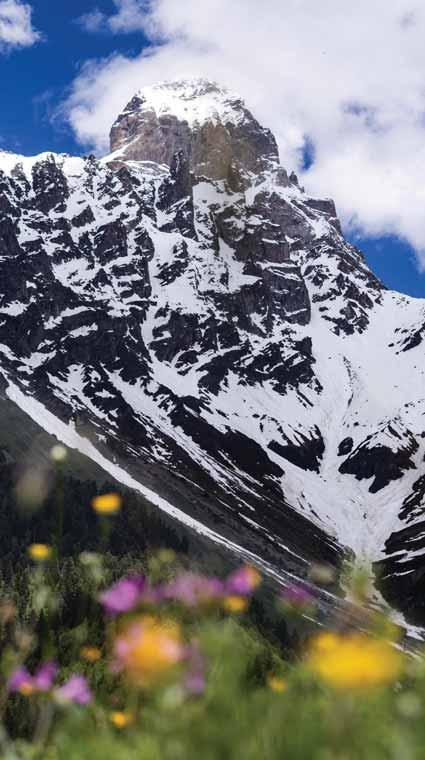
Look, if you lived just out of sight of Ushba, you’d want to see him more often, too. Especially if you were a photographer.
We can glimpse only his shoulder from our house in Etseri, Svaneti. For the peak
you have to walk 10 minutes or so away from the house in one of several directions.
I confess to having taken probably a thousand pictures of him over the last 27 years, from every vantage point I could. There is still a range of angles, though, which will put Ushba, Tetnuldi and the highest mountain in the Caucasus, Elbrus, in the same frame. That’s still on my list. It’s from somewhere
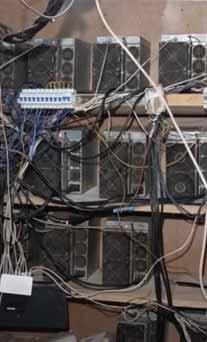
MIA Seizes 76 More Crypto Mining Devices in Mestia
BY LANA KOKAIA
searches conducted in Mestia municipality, within the Samegrelo-Zemo Svaneti region.
The ministry says the devices were confiscated as evidence as part of an investigation into violations of rules on the use of energy resources.
In total, police have now seized 330 so-called mining devices during the ongoing probe.
The MIA says the investigation established that local residents were systematically generating digital currency using the equipment and receiving illegal income through unlawful consumption of large amounts of electricity.
Law enforcement officers are continuing investigative activities to identify other individuals involved in the alleged crime and take appropriate legal measures, the ministry says.
The investigation is ongoing under Article 229, Part 2, Subparagraph “b” of the Criminal Code of Georgia, which carries a penalty of up to three years in prison.
Earlier, the ministry said 148 cryptominers were seized in Svaneti on June 4, followed by another 42 devices on June 11.
The crackdown follows comments by Vice Prime Minister Mamuka Mdinaradze, who said metering measures were
above the village of Nakra, I think. Tetnuldi is basically a pyramid; Elbrus is essentially two rounded bumps, scalable with no actual mountaineering gear or experience, just a guide and the willingness to trudge through deep snow. Tetnuldi has killed people, yes. But Ushba, at about 4700mmore beautiful than the other two by far, is also the hardest climb in the Caucasus, and holds the record here for deaths. Lovely but heartless. That’s how I write him in my short stories about Svaneti, based on both what I see and hear.
Sunrise shots are not the best for Ushba due to the light’s angle. Midday onwards, right through sunset, are the best times. Late sun will also bathe the mountain in gold.
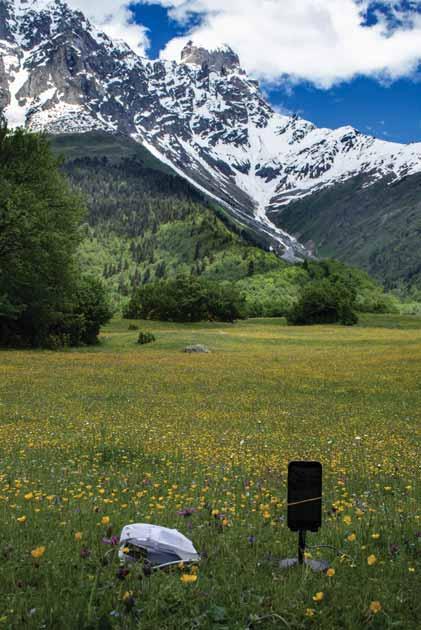
I recently made a short drive to Becho, next village up from us, because it has Max Ushba along its more than 5 km of length. Indeed, there is only one short stretch along the main road from which a foreground hill blocks Ushba entirely from view. I would never choose to live there, knowing what I was missing. So I parked at the top of Mazeri hamlet. Here, I set up my iPhone on a holder on the car’s hood, with a cabled battery supplying power, and ran a couple of timelapse videos. These take a shot every 6 seconds, and then compile them all into a video at normal frame rate, with clouds and shadows practically racing by. It’s magic. At the same time, I was shooting still photos on my big Canon digital camera, to get the best of everything.
The weather was kind, with Ushba’s peak remaining visible most of the time despite clouds drifting through the scene. Grandfather and Grandmother, the two legendary figures sticking up from the mountain’s shoulder, were also in nice relief, standing out well. Ushba turned them to stone untold centuries ago, and now they are glacially slowly teaching him about a new thing of which he used to know nothing: love.
I suppose I will continue shooting Ushba as long as I am here. From Latali you get a 3/4 view of the two peaks; from Mestia they are side by side, and the mountain looks completely different. Becho’s views are basically of the south peak blocking the north one, but this is no less dramatic, if not more so than the other angles. You really can’t count on
visibility, though, so I always tell my trekking guests: If you see Ushba, get a shot straight away! My record shortest available time was 10 seconds, before clouds obscured the peak, but I got what I had come for. Beautiful, cruel, and also surprisingly shy. That’s our Ushba.
Tony Hanmer has lived in Georgia since
1999, in Svaneti since 2007, and been a weekly writer and photographer for GT since early 2011. He runs the “Svaneti Renaissance” Facebook group, now with over 2000 members, at www.facebook.com/ groups/SvanetiRenaissance/ He and his wife also run their own guest house in Etseri: www.facebook.com/hanmer.house.svaneti
Tbilisi Shopping Festival to Make Its Debut on June 27
Continued from page 1
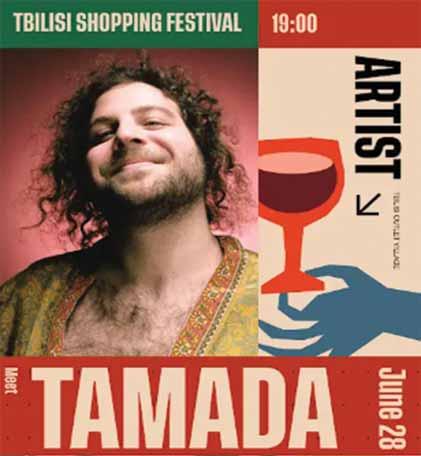
On June 28, the program continues with live music at 13:00 and 17:00. At 15:00, visitors can join a public talk by Ubani Architecture. One of the main highlights of the weekend will be a live performance by TAMADA at 19:00, followed by an evening live music session at 20:30.
In addition to the main program, the festival will feature a variety of activities for children, special entertainment moments and surprise experiences throughout both days.
Tbilisi Outlet Village is located just 30 minutes from Tbilisi city center and brings together more than 40 local and international brands. Several international labels are available exclusively at Tbilisi Outlet Village. The outlet offers year-round discounts of 30–70%, exclusive deals and an open-air shopping experience with distinctive architecture.
Tbilisi Shopping Festival aims to create a memorable summer experience where shopping, culture, entertainment and social moments come together in one place.
Further details about the July 4–5 program, special offers and additional festival activities will be announced soon.
Ushba. Photo by the author
Ushba. Photo by the author
MIA seizes 76 more crypto mining devices in Mestia. Video grab: MIA
Haute Couture in the Land
BLOG BY NUGZAR B. RUHADZE
Why is the overly expensive Haute Couture considered to be a good thing in today's world, where hundreds of millions go unclad and unfed, without any prospect of someday being a little better off? And incidentally, what does a country like Sakartvelo have to do with this swanky culture, and how has it contributed to this modern glamorous phenomenon, if at all?
As we are not powerful enough to handle human need and economic injustice, let us not try to find a universally accepted answer to these questions. Yet, in response to the first one, it is widely thought that the fashion-design industry functions, first and foremost, as a popular genre of art. Secondly, it has the valuable mission of preserving craftsmanship. Thirdly, it serves as a mother of innovation while providing employment.
Meanwhile, its moral side is just as profound an issue, posing a dilemma for society as it seeks justification for creating dresses that cost tens or hundreds of thousands of dollars, only to be worn once and displayed as symbols of wealth in a world marked by glaring inequality. This assessment of the trend is as old as fashion itself, yet this glitzy human pursuit continues unabated and with remarkable success.
The relationship between this country and Haute Couture is not without interest, although it is relatively recent rather than foundational. The phenomenon itself originated in nineteenth-century France, with Paris serving as its renowned
hub. This design culture refers to custommade, handcrafted luxury fashion created by elite fashion houses under strict standards.
Georgia's influence has come primarily through several contemporary, influential, and well-known fashion specialists who have built outstanding careers abroad. At the same time, there is a broader generation of Georgian designers who have attracted attention for combining cultural traditions, craftsmanship, and modern design. One of the most prominent among them is Temo Cherie, whose Christian and family name is Temur Tvalavadze.
It would not be an exaggeration to say that Georgia's artistic individuality, expressed through the dramatic outline of the chokha, the traditional male dress of the peoples of the Caucasus, its complex metalwork, rich carpet traditions, and powerful visual symbolism, has provided cultural inspiration and educational encouragement for designers from Sakartvelo. These are elements they continue to reinvent for global consumers and audiences.
If you ask the designers themselves, the fair and intelligent question is not whether someone out there would buy a couture dress. The more pertinent and clarifying question is whether humankind is capable of preserving beauty and artistic excellence while at the same time ensuring that nobody is deprived of food and clothing. The ideal world, one imagines, should strive for both, maintaining a reasonable balance among luxury, beauty, innovation, equality, and, most importantly, human well-being and happiness.
Judging by his innate human nature, family upbringing, taste, and education, Temo Cherie is undoubtedly committed to such

a standard. Suffice it to look at his sister Tekla and speak with her for a minute. One might quickly understand the kind of family these young people come from and the human ideals to which these remarkable siblings dedicate themselves. One of their close friends, Nina Tsagareli, a prominent figure in Georgian culture and an organizer of major international arts projects, has enthusiastically shared her assessment of Temo Cherie's talent and work: "Amazing personality, caring brother, wonderful son, and, of course, an outstanding designer of world class." True, very true! Temo Cherie's elevated sense of color, form, and line, his powerful design solutions balanced between the modern and the traditional, and his daring yet restrained vision for each of his emerging works of art make him, I would say, one of the strongest fashion designers in the world. There is nothing odd, bizarre, embarrassing, or disconnected in his gorgeous creations. They are marked by class and allure. And who do you think he is in real life? A sweet, gentle, and witty young man, deeply in love with his native Georgia, whose thoughts are in complete harmony with what we call universal human ideals. Easy-going, smiling, and the epitome of human benevolence, Temo Cherie is always dressed and conducts himself as a professional designer should, serving as an example worthy of emulation. This Georgian designer travels the globe, sharing his talent and skill with the rest of the world. And there is one final point worth mentioning: he wishes to remain in Georgia, to live here, and to influence the fashion world from his beloved Sakartvelo. Lovely, isn't it? Bravissimo, Temo!
The City of Eighty-Eight Keys: Tbilisi Piano Fest 2026
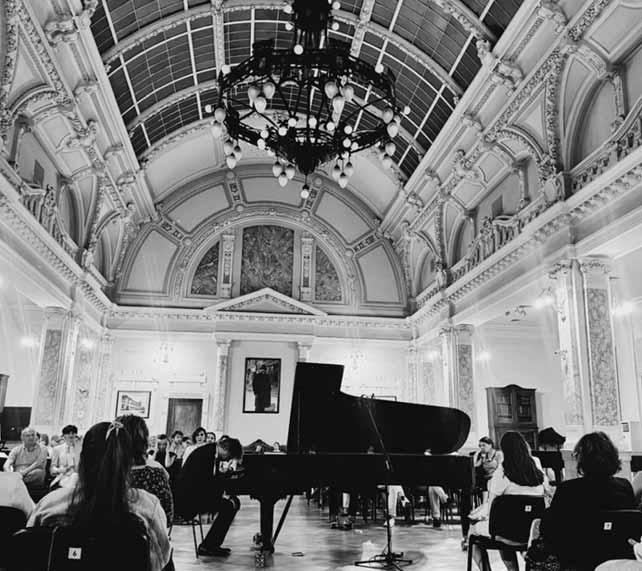
Photo by the author
REVIEW BY IVAN NECHAEV
There are festivals that exist to confirm a cultural status, and there are festivals that gradually transform the cultural metabolism of a
city. The Tbilisi Piano Fest belongs to the latter category. Every June, for a few weeks, Tbilisi enters a different temporal rhythm: one dictated not by the speed of the city but by the measured breathing of a phrase, the weight of a silence, the almost invisible movement of a hand over eighty-eight keys. Over the past years, under the artistic
direction of pianist Dudana Mazmanishvili, the festival has become one of the most ambitious musical initiatives in Georgia. What distinguishes Mazmanishvili’s curatorial approach is her refusal to treat the piano recital as a museum object. The programme is built not around predictable virtuoso fireworks, but around different traditions of pianism: intellec-
tual rigor, historical awareness, individual sound, and artistic personality.
The 2026 edition demonstrated this philosophy with exceptional clarity. The festival opened with Alexei Volodin and Edith Peña, continued with the Georgianborn composer-pianist Nikoloz Namoradze, and welcomed internationally celebrated artists such as Paul Lewis, one of the most important Beethoven interpreters of our time; the legendary Cyprien Katsaris with special guests; Simon Ghraichy, whose programmes move freely between traditions and cultures; and Konstantin Lifschitz, a pianist renowned for his profound intellectual engagement with the repertoire.
The festival also included an open-air finale at Orbeli Square with Carlo Ponti conducting the Georgian Philharmonic Orchestra alongside Dudana Mazmanishvili herself: a symbolic moment where the artistic director stepped out of her role as curator and became part of the musical dialogue she had created.
Yet perhaps the evening that clearly revealed the spirit of the festival was the recital by the Lithuanian-American pianist Andrius Žlabys at the National Library. Žlabys belongs to a rare category of musicians whose virtuosity never announces itself as virtuosity. There is no theatrical struggle with the instrument, no attempt to dominate the piano.
Instead, one has the impression of listening to someone exploring the interior architecture of a score.
The programme itself was a journey through three centuries of musical thought.
Bach’s ‘French Overture in B minor’ opened the evening with a fascinating paradox: a German composer imagining the elegance of a French court through a highly personal musical language. The work requires not only technical precision but a sense of rhetorical gesture: the ability to make every dance movement speak with a distinct character.
This sense of structure became even more striking in Beethoven’s Sonata No. 30 in E major, Op. 109: a work standing at the threshold of Beethoven’s late style,
where classical architecture begins to dissolve into something almost metaphysical. The sudden violence of the Prestissimo movement did not appear as a display of energy but as an interruption, a fracture inside a deeply intimate musical universe.
After Beethoven’s philosophical landscapes came Debussy’s Suite bergamasque, a work often reduced in public imagination to the famous Clair de lune. Yet Žlabys approached the suite as a complete ecosystem of colors and gestures. The transparency of texture, the flexibility of rhythm, and the subtle transitions between light and shadow revealed Debussy not as a composer of beautiful impressions but as an architect of sound.
The evening culminated in Prokofiev’s Seventh Sonata and its final movement, Precipitato: one of the twentieth century’s most relentless musical machines. In many performances, this piece becomes a demonstration of physical endurance. Žlabys found something more unsettling: beneath the mechanical rhythm, one could hear the anxiety of a century marked by war, industrial force, and the transformation of human beings into parts of a larger mechanism. This is precisely why the Tbilisi Piano Fest has become indispensable for the city. It does not simply import famous names. The world has many festivals capable of doing that. Its achievement lies in creating encounters with artists who bring not only their fingers to the stage but an entire way of thinking about music.
In an era when cultural events increasingly compete for attention through spectacle and speed, the piano recital remains one of the last radical forms of concentration. A single person sits in front of a black instrument. Nothing moves. Nothing flashes. There are no screens, no visual effects, no distractions. And yet an entire universe can appear. For two weeks every summer, Tbilisi has the privilege of entering that universe.
Temo Cherie. Source IG
The Concert That Did Not Need to Be Heard: Ye in Tbilisi and the Age of the Post-Musical Spectacle
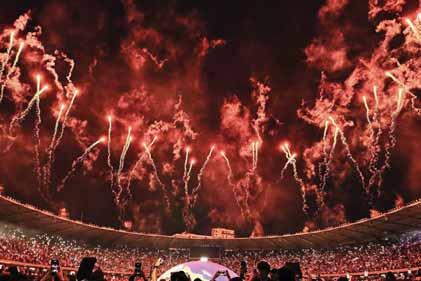
There was something almost perfectly symbolic about Ye’s performance in Tbilisi: a concert where the music itself became the least important element. This is not merely a complaint about poor acoustics, although the technical failure was impossible to ignore. The sound system appeared to be designed almost exclusively for certain sections of the stadium, leaving large areas of the audience trapped
inside acoustic dead zones where songs could not be heard but only guessed. Even in places where the speakers were directed, the sound was muddy, distorted, and strangely two-dimensional: a collapse of exactly the sonic precision upon which Ye built his reputation as one of the most influential producers of the last three decades.
The paradox was painful. Here was an artist who transformed the possibilities of hip-hop production, who taught a generation of musicians to think about texture, silence, distortion, sampling, and the architecture of sound. Yet the audience was placed in a situation where
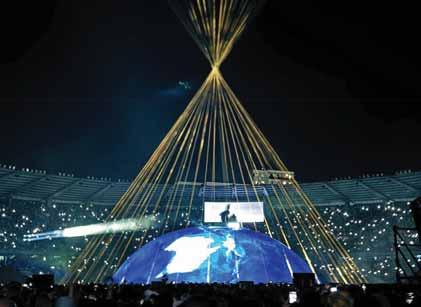
they were asked not to listen but to remember.
The concert worked only for those who already carried the songs inside their heads. A change in rhythm, a familiar bass line, a fragment of a vocal phrase: these became enough for thousands of fans to mentally reconstruct tracks that the venue itself failed to deliver. It was less a concert than a collective act of musical memory.
In this sense, the evening became an unexpected portrait of contemporary fandom. Many people did not come to hear music; they came to document proximity to an event. The glowing screens of smartphones often became more visible than the performer himself. The value of the evening was increasingly located not in the experience of sound, but in the evidence of attendance: the selfie with the stage in the background, the Instagram story proving that one had been there.
The stage design reinforced this contradiction. A giant spherical structure, with Ye moving on top of it for nearly two hours, was clearly intended to create an image of cosmic loneliness or monumental distance. In practice, however, the metaphor quickly exhausted itself. Watching a solitary figure slowly walking around a sphere for such an extended period produced a less philosophical impression, almost as if someone had tied the artist to a planet and he was spending the entire evening looking for a way down. It was an unintentionally comic image: a prisoner of his own mythology. This perhaps captures a broader problem of the contemporary mega-concert. Spectacle has become increasingly detached from performance. The visual icon must be recognizable from a hundred meters away and fit into a fifteen-second video clip. It no longer needs to reveal itself gradually, to reward close attention, or to sustain two hours of live presence.
A great concert is built around a fragile exchange between performer and audience: a breath, an unexpected phrase, a change of tempo, a moment when thousands of people suddenly become aware of the same sound. In Tbilisi, that exchange was largely absent. The crowd did not react to what they heard, but to what they knew was supposed to be happening.
And yet, the evening cannot be dismissed entirely. Its strange power came precisely from this contradiction. It was
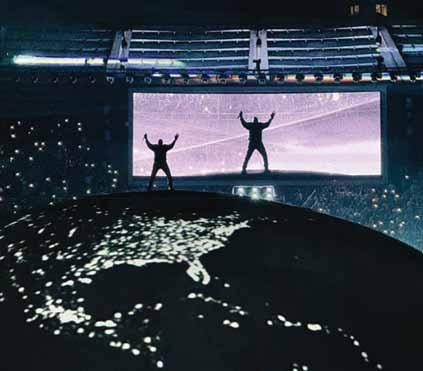
a failure as a live musical event and a success as a cultural ritual. People gathered not because the performance offered something unique in that moment, but because Ye has already become a historical figure: an artist whose catalogue has entered the collective imagination of the 21st century.
The tragedy of the evening was that
one of the most innovative ears in contemporary music was represented by a concert where listening became almost impossible. Perhaps that is the ultimate irony of Ye in Tbilisi: thousands of people came to hear a musician who changed the way the world listens, and spent two hours proving that they no longer needed to hear him at all.
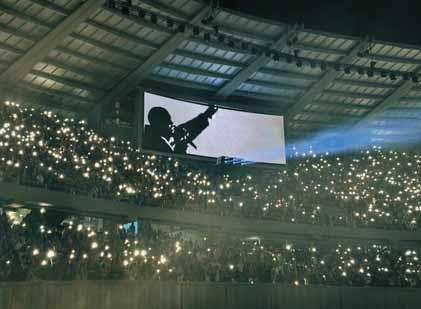
“Georgian on My Mind” Returns Home
BY
There is a peculiar danger that awaits every ancient culture: the moment it becomes too proud of its own past, it risks turning itself into an exhibition. The songs remain, the costumes remain, the stories remain, but they survive behind glass, protected and untouched. The most interesting moments in contemporary culture happen when artists refuse this kind of preservation.
‘Georgian on My Mind,’ the collaboration between pianist Giorgi Gigashvili and singer Nini Nutsubidze, is not an evening about “bringing Georgian folklore to classical audiences.” Such a description would immediately establish an unnecessary hierarchy, placing European art music in the position of the universal language and Georgian musical memory as something that requires translation. The evening proposes the opposite. It asks a more uncomfortable and more interesting question: what if Georgian musical imagination itself is the center from which we listen? This shift becomes evident already in the structure of the
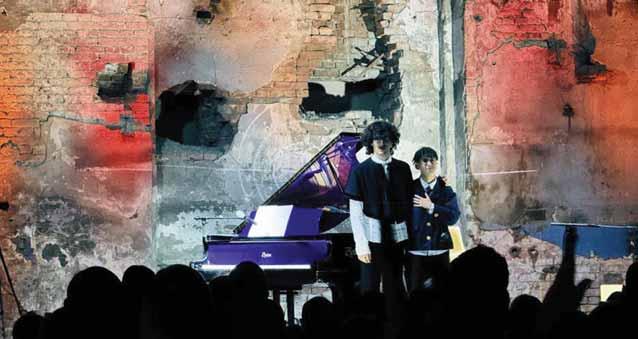
program. A Chopin mazurka is not simply a monument of the piano repertoire; it is itself a transformation of folk dance into intimate musical speech. Ravel’s ‘Une barque sur l’océan’ is a study of movement, colour, and fluidity. Schumann’s lyrical introspection, Beethoven’s radical frag-
mentation in the late sonatas, Prokofiev’s almost mechanical violence in Precipitato: all these works are examples of composers taking inherited forms and pushing them toward something personal and new. Placed next to them are the voices of Georgia: the urban melancholy of Irakli
Charkviani, the unmistakable lyricism of twentieth-century Georgian song, and the contemporary textures of composers who treat Georgian identity not as a monument but as a living material. What makes the project particularly compelling is that it avoids the usual
language of “fusion.” Fusion often implies a diplomatic compromise: a little of this, a little of that. Here, the encounter is much more radical. These musical worlds are allowed to remain different. The roughness of a folk gesture does not have to become polished by classical technique, and the classical repertoire is not reduced to a decorative frame.
Giorgi Gigashvili’s piano playing has the rare ability to move between these worlds without changing his artistic seriousness. A Scarlatti sonata and a Georgian song receive the same degree of attention, curiosity, and emotional investment. This equality of listening may be the project’s most important ethical statement.
Nini Nutsubidze’s voice, meanwhile, reminds us of something that Western concert culture occasionally forgets: before music became a score, it was a human body breathing in front of another human body.
Perhaps this explains why the first Georgian performance of a project already welcomed by Europe’s major concert halls felt less like a triumphal return and more like a necessary conversation. After travelling through institutions that define the European classical tradition, the music came back to the place where many of its questions originated.
OP-ED BY IVAN NECHAEV
Photo by the author
Photo by the author
Photo by the author
Photo by the author
IVAN NECHAEV
Photo by the author
CULTURE
Urban Landscapes between Memory and Inner Perception: The Giorgi
Kukhalashvili Solo Show in Berlin
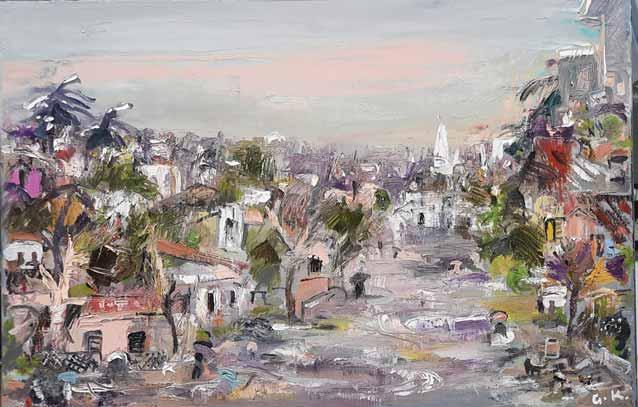
BY LILY FÜRSTENOW
Created in Berlin, Giorgi Kuhalashvili's series of urban landscapes presents a sensitive interpretation of the city, oscillating between observation and imagination.
Painted in delicate pastel tones, with subtle transitions from different shades
SPORTS
of grey to water-green glazes, as well as pink, magenta, and violet hues, the works reveal urban spaces not as precise topographical representations, but as emotional and atmospheric experiences.
The streets, squares, and green spaces are inhabited by people, pets, flowers, and trees. Rather than documenting Berlin realistically, the artist transforms observed fragments of everyday life into personal visions, merging external impressions with memories, emotions,
and poetic associations. The city becomes a living organism in which nature, human presence and architecture exist in constant dialogue.
The miniature works intensify this intimate perspective: passengers in the Berlin underground, views of the city’s largest park, the Tiergarten, and imagined places appear like visual notes from a personal urban diary. Everyday scenes are transformed into dreamlike moments, suspended between reality
and inner experience. In this interplay between the visible world and subjective perception, the series connects to an artistic tradition associated with Expressionism. Like the Expressionists, the artist does not seek an objective depiction of reality, but rather explores how places are emotionally experienced and transformed through individual perception. For example, similar to the urban visions of Ernst Ludwig Kirchner, Berlin becomes not only a place to be observed, but a space to be felt. The works create poetic cityscapes in which Berlin appears simultaneously familiar and transformed: a space between reality, memory, and imagination.
EXPULSION FROM PARADISE
The small-format series ‘Expulsion from
Paradise’ combines human bodies, plants, and flowers in poetic compositions that move between fragility and beauty.
Painted in delicate shades of blue and ochre, the works evoke a sense of memory, dreams and lost states of harmony. Nature is not merely a background, but an equal participant in a symbolic narrative about human existence, intimacy, and transience. Balancing serenity and melancholy, the series explores the timeless relationship between humanity and the natural world.
Giorgi Kuhalashvili's selected works are part of the permanent collection of the Georgian Museum of Fine Arts in Tbilisi and are now on view at the Begegnungsstätte Spandauerstraße Community Center in Berlin-Mitte. Discover more about the exhibition online on the project website: www.e-mergingartists.art
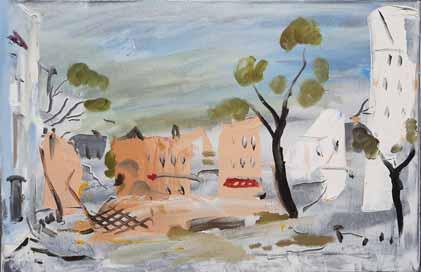
Topuria Suffers First Career Defeat as Gaethje Retains Lightweight Title at White House UFC Event
BY TEAM GT
Georgian MMA star Ilia
Topuria suffered the first defeat of his professional career after losing to Justin Gaethje in the main event of UFC Freedom 250, a historic tournament staged on the grounds of the White House. The lightweight championship bout served as the headline event of a card organized to mark the 250th anniversary of American independence. A special octagon was erected in the White House courtyard, where approximately 4,000 spectators, including US President Donald Trump, First Lady Melania Trump, and UFC President Dana White, gathered to witness one of the most ambitious events in UFC history.
Topuria entered the contest with a perfect professional record of 17 victories and no defeats. However, after four punishing rounds against Gaethje, the fifth round never began as the Georgian fighter's corner stopped the fight due to injuries sustained during the bout, allowing the American to retain the UFC lightweight title.
The defeat brought an end to Topuria's unbeaten run and marked the first setback of a career that has made him one of Georgia's most celebrated athletes. The fighter captured the UFC featherweight championship in February 2024 before moving up in weight and claiming the lightweight title in June 2025, becoming one of only 11 athletes in UFC history to win championship belts in two different weight classes.
The extent of the damage suffered during the bout became clearer in the days
COMMERCIAL DEPARTMENT
Commercial Director: Iva Merabishvili
Marketing Manager: Natalia Chikvaidze
EDITORIAL DEPARTMENT:
Editor-In-Chief: Katie Ruth Davies

Journalists: Ana Dumbadze
Tony Hanmer
Nugzar B. Ruhadze
Ivan Nechaev
Lana Kokaia
Layout: Misha Mchedlishvili
Photographer: Aleksei Serov
International Relations & Communications
Sofia Bochoidze E: sbochoidze@georgiatoday.ge
Website Editor: Katie Ruth Davies
Webmaster: Sergey Gevenov
Circulation Managers: David Kerdikashvili David Djandjgava
ADDRESS
22 Janashia Str. Tbilisi, 0179, Georgia
that followed. According to Eurosport journalist Álvaro Colmenero, medical examinations in Washington revealed fractures to both of Topuria's eye sockets. Doctors reportedly determined that there was no bone displacement, meaning surgery will not be necessary, although his right eye sustained more damage than his left.
Topuria has since been discharged from hospital and is expected to undergo further medical monitoring before any decision is made regarding his return to training and competition. Neither the fighter nor his team have yet provided details on his recovery timeline. Despite the defeat, Topuria remains one of the UFC's biggest stars and a national sporting icon in Georgia. His championship success and rise through the ranks have earned him widespread support both at home and among MMA fans worldwide.
Tel.: +995 32 229 59 19
E: info@georgiatoday.ge F: GeorgiaToday
ADVERTISING & SUBSCRIPTION
+995 577 72 52 61
E-mail: marketing@georgiatoday.ge
Reproducing material, photos and advertisements without prior editorial permission is strictly forbidden. The author is responsible for all material. Rights of authors are preserved. The newspaper is registered in Mtatsminda district court.
Artworks by Giorgi Kukhalashvili. Source: The artist
Artworks by Giorgi Kukhalashvili. Source: The artist
Ilia Topuria post-fight. Source: FB