“Russia perceives us as temporarily lost territory” – Interview with Armenian Political Scientist Ruben Merabyan
- Ruben Merabyan,
political scientist and one of the leaders of the pro-Western party ‘Republic,’ says. In his assessment, the parliamentary elections in Armenia were not just an internal political struggle: they were an attempt to defend Armenia's statehood, sovereignty, and democracy against the backdrop of Russia's hybrid aggression. In his interview with Radio Free Europe/Radio Liberty’s Georgian Service, Merabyan talks about the pro-Russian opposition, the role of the Church, the peace process with Baku, Moscow's possible revenge, and why he believes that the European future of Armenia and Georgia is still a common agenda. WHAT CAN BE SAID ABOUT THE RESULTS OF THE PARLIAMENTARY ELECTIONS IN ARMENIA?
If we were to summarize the results in one sentence, I would say that the citizens of Armenia defended their statehood, which had become the target of Russia's hybrid aggression before the elections.
In this week’s issue...
14 More Demonstrators Released under Plea Agreements in ‘October 4 Case’
NEWS PAGE 2
Ukraine Latest: Russia Advances Slowly in the East as Ukraine Escalates Strategic Strikes behind the Front
NEWS PAGE 3
The South Caucasus and the Flames of the Middle East
POLITICS PAGE 4
Kobakhidze Cites China as a Model of Strategic Partnership despite US Concerns over Beijing’s Influence in Georgia
BUSINESS PAGE 6
The Heritage of German Colonists in Georgia. Part 2
SOCIETY PAGE 8
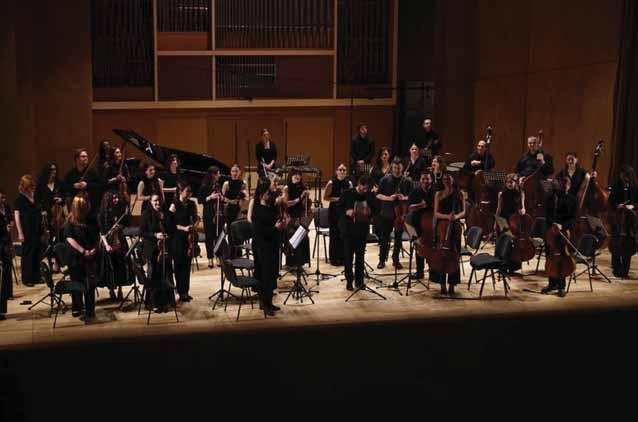
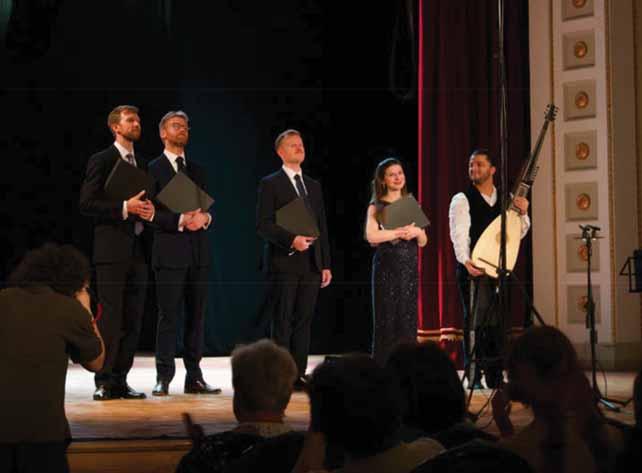
Toradze Festival 2026: Building a Musical Dialogue in Tbilisi
Georgian Karate Fighters Win 16 Medals at Bohemia Cup in Czech Republic
SPORTS PAGE 11 CULTURE PAGE 10
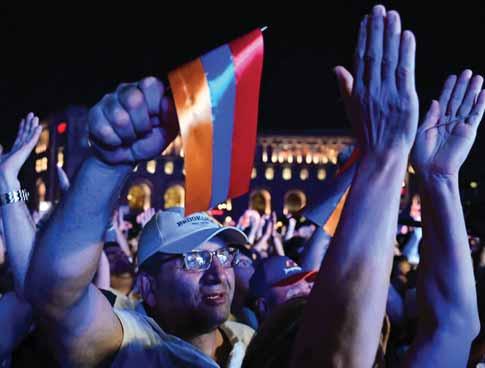
Supporters of Armenian PM Pashinyan's Civil Contract party rally in Yerevan, June 5. Photo by Karen Minasyan for AFP via Getty Images
Gakharia’s Party Claims Russia has Launched a New Phase of Annexation in Occupied Tskhinvali Region
BY TEAM GT
Georgia’s opposition party
and legal assessment of what it described as Russia’s annexation efforts and to mobilize international partners against the process.
14 More Demonstrators Released under Plea Agreements in ‘October 4 Case’
‘For Georgia’ has accused Russia of launching a new phase of annexation in the occupied Tskhinvali region, citing the implementation of a recently signed agreement between Moscow and the de facto authorities.
In a statement, the party said that the so-called “Treaty on Deepening Allied Cooperation,” signed between Russia and the Tskhinvali regime in May, has entered into force and is now being implemented in practice. The party says Russia’s policy in the occupied region is evidence of this process.
The statement points to the appointment of Russian official Marat Kambolov to a senior role in occupied Tskhinvali.
The party claims that Kambolov was first appointed as an adviser to the de facto president and is now reportedly being considered for the position of “prime minister” of the occupation regime.
‘For Georgia’ argues that the agreement aims to fully integrate the occupied region’s socio-economic, transport, energy and military sectors with the Russian Federation, describing the process as another step toward the de facto annexation of Georgian territory and a direct threat to Georgia’s sovereignty and territorial integrity.
The party called on the Georgian Dream government to provide a clear political
Based on the statement, the party had previously urged the authorities to take legislative action and support international efforts aimed at countering annexation. However, it claims that the government failed to respond and did not support a parliamentary resolution proposed by the opposition condemning annexation.
“Against the backdrop of the Georgian Dream government’s complete inaction, Russia is now appointing its own public official to a leading position within the Tskhinvali regime, which amounts to the establishment of direct rule by Moscow over Georgia’s occupied territory,” the statement said.
The party also criticized the ruling government for what it described as weakening relations with Georgia’s strategic partners and remaining silent on developments in the occupied territories.
In addition, ‘For Georgia’ called on the government to clarify its position regarding claims made by the occupation regime over the village of Chorchana and to explain whether it plans to dismantle the Georgian police checkpoint located there.
The party urged both parliament and the government to take a firmer stance against what it called Russia’s ongoing annexation of Georgian territories, warning that silence and inaction effectively aid the occupying power.
International Calligraphy and Entrepreneurship Festival “Gulani” to Return to Tbilisi
BY LANA KOKAIA
The International Calligraphy and Entrepreneurship Festival “Gulani” will be held for the second time on June 13, 2026, bringing together calligraphy, visual arts, literature and entrepreneurship in Tbilisi.
The festival will feature the presentation of “Gulani”, the second authorial book by Thika Svanidze-Venko, alongside an exhibition and sale of contemporary Georgian calligraphic works. The program also includes Georgian
and Japanese calligraphy workshops, cultural and calligraphic performances, and a book fair showcasing publishing houses and independent authors.
A dedicated space will be allocated to women entrepreneurs and social enterprises, where participants will present and sell products including handmade crafts, jewelry, tea, wine and other artisanal goods.
Organizers say the festival will also include interactive activities, games, prize draws and visitor gifts, aiming to create a shared space where culture and entrepreneurship meet.
The event will run from 10:00 to 19:00 on June 13.
ourteen additional demonstrators detained in connection with the so-called October 4 “peaceful overthrow” case have been released from custody after reaching plea agreements with prosecutors.
The hearings were held in two groups before Judges Nino Tarashvili and Dimitri Jinjolia.
The first group included Aleksandre Khabeishvili, Beka Kelekhsashvili, Giorgi Muladze, Mamuka Labuchidze, Guriel Kardava, Temur Kurtsikidze, Vakhtang Pitskhelauri and Avtandil Surmanidze.
The second group consisted of Sergo Megrelishvili, Giorgi Rurua, Giorgi Korkia, Lasha Ivanadze, Levan Jikia and Khvicha Gogokhia.
As of June 10, a total of 22 defendants in the case have been released under plea agreements. Under the terms of the agreements, the defendants admitted guilt and received three-year suspended sentences.
On June 9, eight other defendants were released under similar agreements: Aleksandre Gogoladze, Gocha Katashvili, Sulkhan Ambalava, Ramaz Jorbenadze, Janri Tirkia, Genadi Kekhilashvili, Davit Ghurtskaya and Eva Shashviashvili.
Under Georgian law, a plea agreement may be initiated by either the defendant or the prosecutor.
The October 4 case is being heard by five different judges. Prosecutors describe the case as an attempt to overthrow the constitutional order, while the defendants maintain that they were participating in an effort to bring about a “peaceful revolution.”
A total of 65 individuals have been charged in the case. Prosecutors divided
the defendants into five groups, each consisting of between 10 and 15 people.
The defendants face charges including attempting to seize and block strategic and specially protected facilities, as well as participating in group violence. The offenses carry a maximum sentence of up to six years in prison.
The criminal proceedings stem from events that unfolded during a protest rally held in Tbilisi’s Liberty Square on October 4. On that day, much of the opposition and its supporters boycotted local elections and gathered in the capital, calling for the “peaceful overthrow” of the government.
The case centers on clashes that erupted after a group of demonstrators attempted to “take possession of the keys to the presidential palace,” breaching security barriers around the presidential residence on Atoneli Street and confronting special police forces.
Parliament Backs Amendments Expanding Teacher Hiring Rules in Schools
BY LANA KOKAIA
The Parliament of Georgia has supported, in its first reading under an expedited procedure, amendments to the Law on General Education aimed at widening employment opportunities in schools, with 75 votes in favor.
Deputy Minister of Education, Science and Youth, Tamar Makharashvili, said the changes introduce new definitions, including teacher candidate, substitute special teacher, program teacher and program special teacher.
Under the draft law, vocational education graduates in Information and Communication Technologies will also be eligible to work in schools, expanding the current recruitment base.
Makharashvili explained that while the existing law requires a bachelor’s degree in a subject or subject group under the National Curriculum, it does not clearly state that the degree must match the subject to be taught. The amendment clarifies and tightens this requirement.
Under the changes, any person with at least a bachelor’s degree will be able to enter the teacher candidate program, but those whose qualification does not match the intended subject will need to prove subject competency first. The amendments also allow the replacement of temporarily absent special teachers and introduce the possibility for individuals with recognized subjectteacher status and a passed special teacher exam to work as special teachers.
Kobakhidze: Georgia
“Should the amendment be adopted, the law will introduce new teaching positions, such as program teacher and program special teacher,” said Deputy Minister Makharashvili. “These positions will be established on the basis of specific targeted programs for a defined period of time, and, where necessary, holders of these positions may be transferred to another school,” Makharashvili added.
to Receive 500 million m³ of Gas under 20-year Deal
BY LANA KOKAIA
Georgia has extended its long-term gas supply agreement with Azerbaijan for another 20 years, securing annual deliveries of 500 million cubic meters of gas, the Prime Minister of Georgia Irakli Kobakhidze said. Kobakhidze made the remarks in response to questions from BMG about
the terms of the renewed contract, stating that the overall volume of gas supply under the agreement remains unchanged.
He said the deal continues on the same basis as the previous 20-year contract, which expired this year, adding that Georgia will still receive 500 million cubic meters of gas annually under “social” pricing conditions.
“The main essence is that the 20-year contract has been extended for another 20 years. The volume has not changed, and the same 500 million cubic meters
of gas will enter Georgia under this agreement,” Kobakhidze said.
The prime minister also referred to multiple gas supply arrangements between the two countries, including Shah Deniz and the South Caucasus Pipeline, saying Georgia benefits from “good terms” across all major agreements.
He added that overall guaranteed gas volumes for Georgia have increased, describing the country’s position in energy cooperation with Azerbaijan as strengthened.
The Gulani Festival. Source: First Int'l Association of Georgian Calligraphy
BY TEAM GT F
De facto leader Alan Gagloev meets Vladimir Putin in Moscow. Source: cominf.org
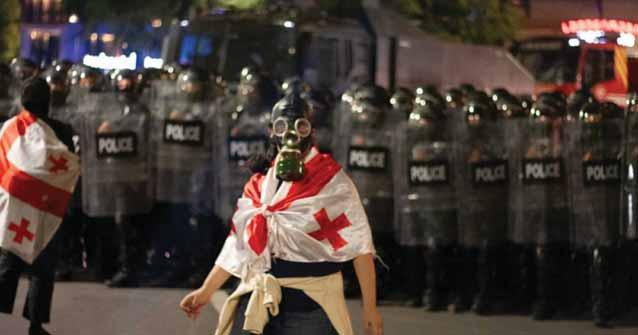
Protesters in Tbilisi. Source: Tabula
Ukraine Latest: Russia Advances Slowly in the East as Ukraine Escalates Strategic Strikes behind the Front
COMPILED BY ANA DUMBADZE
As the war in Ukraine entered another week of intense fighting, the situation on the ground continued to be shaped by two parallel dynamics: Russia’s ongoing attempts to push forward along key sectors of the eastern and northeastern front, and Ukraine’s expanding campaign against military logistics, fuel infrastructure, and strategic sites deep inside Russian territory. While Moscow kept up pressure along several axes, Ukrainian commanders say Russian momentum has slowed compared to earlier months, with Kyiv reporting localized gains and growing disruption of Russian supply lines.
The heaviest fighting remained concentrated in the Donetsk region, particularly around Pokrovsk and nearby sectors, where Russian forces continued efforts to improve their tactical positions. Clashes also intensified in parts of Zaporizhzhia and southern Ukraine, while Russian troops remained active in the Sumy region near the border, where they are trying to establish what Moscow describes as a “buffer zone” inside Ukrainian territory. Ukrainian Commander-inChief Oleksandr Syrskyi said this week that Ukrainian forces have recaptured more than 600 square kilometers since the start of 2026 and, notably, took more ground in May than Russia managed to seize over the same period. Independent assessments suggest Russian advances have slowed markedly since the beginning of the spring-summer campaign, with Ukrainian defensive operations and strikes on rear logistics increasingly affecting Russia’s ability to sustain offensives.
A defining feature of the week was Ukraine’s continued expansion of longrange drone and missile strikes against targets far beyond the frontline. Ukrainian forces struck military-industrial sites, oil depots, fuel facilities, ports, and transport infrastructure across Russia and occupied territories. President Volodymyr Zelensky pointed to hits on a military electronics plant in Cheboksary, a refinery in Samara region, and other energy infrastructure in Vladimir Oblast. Ukrainian officials say these strikes are intended to raise the cost of the war for Moscow and gradually erode Russia’s ability to maintain frontline operations.
Particularly important were efforts to disrupt Russian logistics routes linking southern Russia, occupied territories, and Crimea. Ukrainian strikes hit bridges, rail links, ports, and fuel depots supporting Russian forces. Analysts note that attacks on the so-called “Novorossiya corridor,” the supply route running from Rostov-on-Don through occupied territory toward Crimea, have increasingly complicated Russian logistics and forced a redistribution of air defense and repair resources.
Crimea has felt these effects directly. Russian-installed authorities in Sevastopol reported fuel delivery disruptions and temporary restrictions following strikes on supply infrastructure. Ukrainian attacks also targeted the occupied port of Mariupol and transport links between occupied Kherson and Crimea, adding to broader logistical strain across southern occupied areas. Ukrainian officials describe this as part of a wider effort to isolate Crimea and weaken Russia’s resupply capacity there.
One of the most notable developments inside Russia was the reported killing of Damir Davydov, head of the Russian
Defense Ministry’s missile and artillery ammunition directorate. Russian media said he died in a car explosion in Balashikha, near Moscow. A second explosive device was later found and safely detonated in another vehicle in southwestern Moscow. No official link has been confirmed, but the incident resembles previous attacks on senior Russian military and security officials since the start of the war. The Kremlin confirmed the explosion but gave no further details, citing an ongoing investigation. Ukraine’s strikes on Russian energy infrastructure also began to show wider economic effects. In Krasnodar Krai, authorities reported fuel shortages and panic buying after a fire at an oil depot in Ust-Labinsk. Additional strikes hit fuel storage sites in Rostov region, while drone activity near Novokuibyshevsk in Samara Oblast disrupted operations around a major refining hub. In Dagestan, reports of explosions and fires at gas facilities further highlighted the vulnerability of Russia’s energy network to sustained long-range attacks. Russia continued its own large-scale aerial campaign against Ukraine. Missile and drone strikes hit several regions, including Kharkiv, Odesa, and Zapor-
izhzhia. Ukrainian officials reported civilian casualties and injuries throughout the week, while air defense systems remained under heavy strain. In one of the larger recent waves, Russian officials said they intercepted hundreds of Ukrainian drones across multiple regions, including Saint Petersburg, Crimea, and southern Russia, while Ukraine reported sustained Russian drone launches in return.
The week also highlighted how central drone warfare has become to both sides. Zelensky formally designated June 11 as Ukraine’s annual Day of the Unmanned Systems Forces, underlining the role of drones in Ukrainian operations. Officials say drone systems now account for the majority of strikes against Russian military targets and infrastructure. The development continues to reshape the battlefield, extending reach far beyond traditional front lines and accelerating the pace of adaptation on both sides.
Diplomatic efforts, meanwhile, showed little progress. The Kremlin said no phone call is planned between President Vladimir Putin and U.S. President Donald Trump, while spokesman Dmitry Peskov dismissed the idea that the European Union could act as a mediator,
arguing that meaningful talks cannot begin under current conditions. Despite periodic discussion of negotiations, fundamental positions in Moscow and Kyiv remain unchanged.
International support for Ukraine continued. The European Commission proposed a 21st sanctions package targeting Russian banks, cryptocurrency firms, oil traders, and vessels involved in transporting Russian oil. It also suggested tightening the oil price cap and introducing restrictions on Russian fish imports. European Commission President Ursula von der Leyen said Ukraine and Moldova are expected to move forward in EU accession talks, calling Ukraine’s reform progress “extraordinary.”
Zelensky also visited Estonia during the week for meetings with Nordic and Baltic leaders focused on regional security, military cooperation, and countering drone threats. He emphasized Ukraine’s intention to share its experience in developing low-cost air defense systems. Western discussions on further military aid continued, as Kyiv seeks additional air-defense systems and interceptor missiles to counter ongoing Russian strikes.
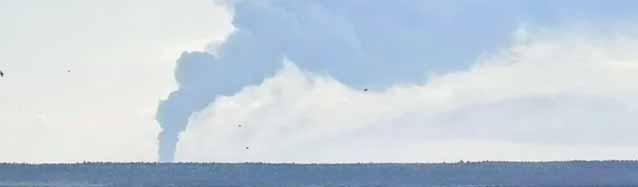
Two Transneft oil pumping stations ablaze in Russia's Vladimir Oblast, June 10. Source: Exilenova+
The South Caucasus and the Flames of the Middle East
ANALYSIS BY EMIL AVDALIANI
After the killing of Iran’s leader Ali Khamenei by Israel and the subsequent selection of his son Mojtaba as the new supreme leader, the leaderships of the three South Caucasus countries, Armenia, Azerbaijan and Georgia, sent congratulatory messages to Tehran. In a message released by the Azerbaijani side, the country’s president said: “I hope that together we will make further efforts to develop interstate relations in a spirit of mutual respect and trust, in accordance with the interests of our peoples.”
The statement was particularly interesting given that it followed an escalation which took place on March 5 when drone strikes were allegedly carried out by the Iranian side against Azerbaijan’s Nakhchivan exclave. According to Azerbaijani sources, one of the drones struck the terminal area of Nakhchivan International Airport, another exploded near a nearby village and injured several residents, while a third unmanned aerial vehicle was intercepted and destroyed by Azerbaijani air defense systems.
In the aftermath of the incident, the Azerbaijani government adopted a number of precautionary measures. Authorities temporarily closed segments of the country’s airspace and imposed restrictions on cargo truck crossings along the Iranian border. At the same time, President Ilham Aliyev ordered the armed forces to prepare defensive and retaliatory options, while publicly emphasizing that Azerbaijan had not taken part in the broader regional military operations directed against Iran.
The escalation was particularly unexpected given the improvement in Azerbaijani-Iranian relations. Only shortly before the attacks, the Azerbaijani leadership had made a visit to the Iranian embassy in Baku to personally express condolences following the assassination of Iran’s Supreme Leader, Ali Khamenei. Tensions did not end there. Two days later, on March 7, a group associated with Iran’s Islamic Revolutionary Guard Corps (IRGC) issued a warning to Azerbaijan, stating that Baku could face further attacks unless it severed its strategic ties with Israel.
Though surprising, there is a certain logic behind Iran’s strikes on Nakhchivan. Tensions surrounding regional connectivity projects in the South Caucasus remain a persistent source of friction
between Baku and Tehran. From the Iranian perspective, emerging transit initiatives along its northern frontier threaten to undermine Iran’s geopolitical and economic position in the South Caucasus. In this context, the location of the drone strikes is notable. The attacks targeted infrastructure near a site expected to play a key logistical role in the proposed Trump Route for International Peace and Prosperity (TRIPP).
Promoted by former US President Donald Trump, TRIPP is envisioned as a transport corridor linking Azerbaijan to its Nakhchivan exclave, which lies beyond Armenia’s Syunik region. From there, the route would extend westward into Turkey. The corridor is intended to be an addition to an already existing web of trans-Eurasian connectivity routes connecting Central Asia with Europe.
More importantly, however, the project would bypass both Russia and Iran, and the latter has long argued that such a development poses significant strategic concerns. Iran has aspired to play a key transit role between Azerbaijan proper and Nakhchivan and is against Turkey’s effort to build an uninterrupted corridor dominated by Turkic-speaking countries. Against this backdrop, the drone attacks can also be interpreted as a signal of Iran’s willingness to challenge US efforts to wedge itself into the South Caucasus and, more specifically, the projects that Tehran perceives as threatening to its regional influence.
The northern frontier is of critical importance to Iran since this is where the country has sea and land links to Russia. The International North-South Transport Corridor (INSTC) allows the Islamic Republic to connect to the Russian economy. Since the INSTC’s western branch runs via Azerbaijan, Iran is expected to maintain stable ties with Baku.
Iran’s military action in the South Caucasus would also cause a significant realignment in the region. Though Azerbaijan and Turkey have been strategic allies, especially since 2021 when the Shusha Declaration was signed, Baku has always been careful to heed Tehran’s interests as well. Should Azerbaijan come under military pressure, it would likely activate the mutual defense clause with Turkey.
Azerbaijan can also push for greater security ties with Israel should pressure from Iran rise. This could play out in tighter security and military cooperation. Another potential shift could be Baku’s greater emphasis on expanded security ties with the United States,
especially given the already extensive nature of cooperation. This includes the TRIPP and the personal rapport between the presidents of the United States and Azerbaijan. Tensions with Iran will also push Baku to seek normalization of ties with Russia. Simultaneous coolness in ties with the two big countries, Russia and Iran, would put Azerbaijan in a tenuous position.
Yet Azerbaijan will choose a pragmatic approach, a policy rooted in the country’s ties with Iran and, indeed, another big neighbor, Russia. Since the second Nagorno-Karabakh war of 2020, when the balance of power irreversibly shifted in Azerbaijan’s favor, the country has gone through a series of political crises with Iran. Each time, diplomatic escalation has been followed by compromises and eventual normalization of bilateral relations.
The pattern is likely to repeat this time as well, given that Azerbaijan strives to avoid being pulled into the Middle East conflict. The balancing game is indeed difficult to maintain. Azerbaijan is simultaneously a strategic partner to the United States, an ally to Turkey, and it maintains close relations with Israel.
Nevertheless, Baku and Tehran have chosen close communication over escalation and since March 5 have held sev-
eral phone calls between the presidents and foreign ministers. Wider strategic interests remain strong. Over the past year, the two countries have taken visible steps to stabilize ties, which had deteriorated sharply after the deadly assault on the Azerbaijani embassy in Tehran in early 2023. Since then, both sides have gradually resumed political dialogue and economic cooperation. In 2025, their bilateral trade has expanded to approximately $650 million, and the countries are working on expanding infrastructure projects.
Nor will Iran gain from tensions with Armenia. Just before the war began, Yerevan announced that relations with Iran would soon be elevated to a strategic level upon the signing of a relevant document. The two countries have been close since the end of the Soviet Union, with ties boosted as a result of the first Nagorno-Karabakh war. With its borders on the west (Turkey) and east (Azerbaijan) closed, Armenia’s narrow link to Iran has served as a lifeline for the country’s economy. Moreover, Iran has also strived to support its northern neighbor as a hedge against the alliance of the Turkic countries. Should Iran target Armenia’s southernmost territory, where the TRIPP is supposed to pass, this will
impact relations with Yerevan and could go against the very notion the Islamic Republic was actively defending, maintaining the corridor to the South Caucasus through Armenia’s narrow Syunik province.
For Iran, the South Caucasus has never been a central foreign policy arena. The Middle East and even Pakistan and Afghanistan have largely consumed the Islamic Republic’s diplomatic and economic resources. Yet amid the war with the United States and Israel, deterioration of relations between Tehran and the Arab countries, the northern border, the South Caucasus, has grown in importance as a frontier which links Iran to its principal partner, Russia. Should the South Caucasus see a major military escalation similar to what the Arab states are going through, Iran’s isolation will grow, further complicating its economic situation. Pragmatism therefore dictates that Iran will likely abstain from complicating ties with Armenia and Azerbaijan.
Emil Avdaliani is a professor of international relations at the European University in Tbilisi, Georgia, and a scholar of Silk Roads. He can be reached on Twitter/X at @emilavdaliani.
Escalation Fears Persist: Iran, Israel and US Exchange Strikes as Truce Efforts Remain Fragile
BY TEAM GT
Tensions between Iran, Israel, and the United States escalated sharply this week, with direct exchanges of missile fire, airstrikes across multiple fronts, and brief, fragile pauses in fighting that quickly began to unravel.
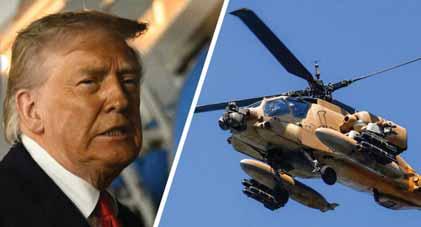
The crisis intensified when a US Apache helicopter went down during a patrol near the strategic waterway after being hit by enemy fire. President Donald Trump later confirmed the loss of the aircraft and said the US “must respond,” authorizing retaliatory strikes shortly afterwards.
US forces carried out a series of airstrikes on Iranian military infrastructure,
region, including bases in Kuwait, Bahrain, and Jordan. Most of the incoming projectiles were intercepted, and officials reported no major casualties, but several countries briefly raised alert levels.
The Strait of Hormuz quickly became the central flashpoint. Iran initially claimed it was closing the waterway and threatened to block all shipping traffic, raising concerns about global energy supplies. However, US Central Command later stated that commercial shipping continued to move through the strait, directly contradicting Iranian claims, even as the area remained heavily militarized and tense.
In reaction to the escalation, UN Secretary-General António Guterres warned that the situation was spiraling dangerously, saying: “The Middle East is being pulled deeper into crisis and the conse-
quences reach far beyond the region… We should not minimize the risks of lesser fire becoming full fire. All parties must work towards a diplomatic settlement. No more attacks. No more excuses.” In Washington on Wednesday, President Donald Trump linked the latest wave of US strikes to stalled negotiations with Iran, saying, “We’re going to be attacking them, attacking them very hard.” He also stated, “We hit them hard yesterday, and we’re going to hit them again hard today,” while warning that Iran would “pay the price” if it continued to delay a diplomatic agreement. Israeli Prime Minister Benjamin Netanyahu maintained that ongoing strikes were necessary responses to Iranian actions and regional proxy activity, keeping Israel closely aligned with US coordination efforts.
Marco Rubio and Ararat Mirzoyan sign an agreement on TRIPP development. Source: US embassy Armenia
“Russia perceives us as temporarily lost territory” – Interview with Armenian Political Scientist Ruben Merabyan
Continued from page 1
The fact is that Russia does not consider us a fullfledged state and perceives us as a temporarily lost territory. They saw these elections as a good opportunity to try and regain this "temporary loss."
In fact, the citizens of Armenia, through their own position and electoral institutions, defended the country's independence, sovereignty, and democracy.
DESPITE THE VICTORY, PM PASHINYAN'S PARTY WILL BE REDUCED TO 64 SEATS IN PARLIAMENT, FROM 71 OUT OF 105 PREVIOUSLY. IT WILL NOT HAVE THE CONSTITUTIONAL MAJORITY THAT PASHINYAN WAS AIMING FOR. WHAT DOES THIS MEAN FOR PASHINYAN HIMSELF, HIS PARTY, AND THE GOVERNMENT?
Pashinyan can still form a government singlehandedly and make a number of important decisions. For example, this number of votes is enough to appoint key officials such as the Prosecutor General and other high-ranking officials.
However, a constitutional majority, or, if you like, a supermajority of two-thirds, is necessary for the constitutional draft prepared by the government to be put to a referendum. And this is where we may encounter real problems. But at the same time, we must understand that what we are watching now is not a still frame: the situation is constantly changing. Where this process will go is already a matter of political struggle.
At the same time, we clearly see from the statements of Maria Zakharova and Dmitry Peskov that Russia is not going to give in to Armenia. It will continue to spin a new spiral of war against Armenia and systematically sabotage the state apparatus through proxy forces and agencies.
BILLIONAIRE SAMVEL KARAPETYAN IS OFTEN CALLED THE “ARMENIAN IVANISHVILI.” HOW FAIR IS SUCH A COMPARISON?
I do not consider this comparison correct from either a political or factual point of view.
Karapetyan has never had a particular love for politics. He is motivated by only one thing: what is happening in Russia.
In Russia, a process of property redistribution is currently underway. The Chekists are redistributing assets and real estate, and Karapetyan could lose all the property and assets he currently has in Russia with one stroke of the pen. We know that this is exactly the kind of trick they “played” on another Armenian oligarch, Ruben Vardanyan, who was left “penniless” in Russia.
This explains why Samvel Karapetyan openly defends Russia's interests in Armenia. And he does not hide it at all.
He simply repeats the narratives that Maria Zakharova, Kremlin propagandists, and other similar figures voice: he simply translates them into Armenian, and in bad, awkward Armenian. In essence, we hear nothing new from him; this is the Kremlin's narrative.
THE ARMENIAN APOSTOLIC CHURCH IS IN OPEN CONFLICT WITH THE GOVERNMENT. WHAT AWAITS IT?
There are high-ranking hierarchs in the Armenian Apostolic Church who cannot hide their sympathies for Russia and the oligarchic system that has ruled Armenia for twenty years.
The Armenian state must protect itself from Russia's harmful external influence, including in cases where Moscow uses individual church hierarchs for this purpose.
When specific stories become public, it becomes clear that many of them have simply been caught with compromising material and are being forced to serve the Kremlin's interests.
The Catholicos for decades has been depriving anyone who disobeys his will or expresses a contrary opinion of the priesthood. During his reign, dozens of clergymen were expelled from the church simply because of personal conflicts. This is an abuse of his own authority.
I would like to emphasize: all this is being done to the detriment of the interests of the Church itself and to the benefit of the enemies of Armenia. Because Russia is waging war against us, and the enemies are waging war.
HAS THE CATHOLICOS HIMSELF BEEN CAUGHT WITH COMPROMISING MATERIAL?
Of course. His brother has been a KGB officer for decades; there is even a so-called dossier confirming this. When his personal card was "leaked" to the public, the Church came out and said that it was made by artificial intelligence. I think they
themselves have problems with intelligence, but not with natural intelligence.
YOU MENTIONED THAT THE GOVERNMENT WILL HAVE TO FIGHT OVER CONSTITUTIONAL REFORM. TO WHAT EXTENT WILL THIS HINDER THE PEACE PROCESS WITH BAKU?
The peace process will continue. If one option does not work, another way will be found. The main thing is that both in Yerevan and Baku there is political will for this process to continue. Public statements have been made about this repeatedly.
Of course, after the signing of the peace agreement, everything will go much easier.
But even if the signing of the already initialed agreement is postponed, this is not a critical problem. In any case, we are moving in the direction of opening communications, developing trade, and further normalizing relations.
BEFORE THE ELECTIONS, EUROPE AND THE UNITED STATES OPENLY EXPRESSED SUPPORT FOR PASHINYAN. PRESIDENT MACRON AND PRESIDENT TRUMP WERE ESPECIALLY ACTIVE. HOW IMPORTANT A ROLE DID THIS PLAY IN THE FINAL OUTCOME OF THE ELECTIONS?
I don't think that this was the decisive factor on the basis of which voters would change their political choice: "I wasn't going to vote for Pashinyan before, but now that Macron has praised him, I'll vote for him too." There was no such dynamic. It was perceived more as support for statehood. There was no talk of supporting any party here. It was perceived as supporting the Armenian state in the conditions of the hybrid war that Russia is waging against us.
SINCE WE MENTIONED PRESIDENT TRUMP, I ALSO WANT TO ASK YOU ABOUT THE TRIPP CORRIDOR. WHAT DOES THE FUTURE HOLD FOR IT?
The processes are moving forward steadily. The corporation has already been created. Its practical implementation will begin on the spot in the near future.
IN MAY, PUTIN MADE A RATHER OMINOUS STATEMENT WHEN ASKED TO ASSESS THE ONGOING PROCESSES IN ARMENIA: "WE ALL SEE WHAT IS HAPPENING IN UKRAINE NOW. WHAT STARTED ALL THIS? WITH UKRAINE'S ATTEMPT TO JOIN THE EUROPEAN UNION." WHAT DO YOU EXPECT FROM MOSCOW? WHAT CAN RUSSIA DO TO "PUNISH" ARMENIA FOR MOVING TOWARDS THE WEST?
I think we need to distinguish between intentions, desires, and real capabilities. If we are talking about intentions, there are no restrictions for Russia; there is no extent that Moscow would not be ready to go to.
The extent to which these intentions can be implemented is another matter.
After the unprecedented resistance of Ukraine, Russia's military potential has been significantly weakened. Russia still has a base in Gyumri and a small air base near Yerevan. But, as they say, there are two ensigns and three dogs left there. So the maximum they can do is to mix with each other. However, it is clear that Russia can organize subversive and terrorist acts. We do not exclude this possibility. Our law enforcement agencies and special services today have sufficient capabilities to prevent such attempts. In the last two years alone, at least three such networks have been identified, and, of course, this has been followed by an appropriate response. We have also seen how people living in Russia were brought to Armenia with the money of Armenian businessmen in order to vote for pro-Russian candidates.
In addition, it can block gas or raise prices, but Yerevan is no longer as critically tied to the Russian market as before. Therefore, I will repeat once again: if we are talking about intentions, there is no evil that Russia would not turn to. The point is to what extent it is able to implement these plans.
ARMENIA'S ENERGY SECTOR IS STILL HEAVILY DEPENDENT ON RUSSIA, AND ALMOST HALF OF ARMENIAN EXPORTS STILL GO TO THE RUSSIAN MARKET. THAT IS, MOSCOW STILL HAS A NUMBER OF LEVERS OF INFLUENCE. WHICH OF THESE LEVERS CAN ARMENIA WITHSTAND IF THE KREMLIN DECIDES TO USE THEM TO THEIR FULL POTENTIAL?
Russia has actually already imposed an embargo on Armenian products, so now we will switch to other markets: Ukraine, Kazakhstan, Iran, the European Union, Canada, Great Britain. Negotiations
are also underway with the United States.
As for energy, there is a widespread perception that Armenia is critically dependent on Russia for nuclear energy. In reality, this is not the case.
We know that Ukraine has completely stopped cooperation with Rosatom in the nuclear field and signed an agreement with the American company Westinghouse Electric.
Armenia is also free to reach an agreement with Westinghouse Electric. A delegation from this corporation has already been to Armenia. A memorandum has been signed, joint statements have been made. Negotiations with the United States on an agreement on cooperation in the peaceful industrial sphere of nuclear energy have been completed.
Therefore, this is no longer an area where Russia can blackmail us.
The second issue is gas. If this problem needs to be urgently resolved, we should remember that Azerbaijan supplies gas to the European Union. We can reach an agreement with the European Union to purchase part of the gas on the Azerbaijani-Georgian border and redirect it to Armenia within the framework of European quotas.
The gas we will reach an agreement on today will only arrive after some time. However, technically it can be delivered to Armenia through the same Georgian gas pipeline through which Russian gas flows today.
BUT WOULDN'T THE PART OF ARMENIAN SOCIETY THAT IS SKEPTICAL ABOUT BREAKING OFF RELATIONS WITH RUSSIA SAY THAT PASHINYAN IS SIMPLY REPLACING ONE ATTITUDE WITH ANOTHER? MOREOVER, THAT HE IS REPLACING RUSSIAN INFLUENCE WITH THE INFLUENCE OF AN "IMMEDIATE ENEMY"?
They are already saying all this. They are also saying worse things. For example, they are saying that Pashinyan wants to settle 300 thousand Azerbaijanis in Armenia and other similar nonsense. They always said it, they still say it, and they will say it in the future. We have to approach this philosophically.
The fact remains: if Russia decides to use economic leverage, we must understand that it can only be used once. Once used, this leverage breaks.
FORMER GEORGIAN PRESIDENT MIKHEIL SAAKASHVILI IMAGINES THAT THE KREMLIN WILL DECIDE TO PUNISH ARMENIA, AND THAT RUSSIA WILL USE GEORGIAN TERRITORY TO MOVE ITS FORCES. HE SAYS THE GEORGIAN GOVERNMENT WILL AGREE TO THIS. HOW REALISTIC DO YOU THINK SUCH A SCENARIO IS?
This scenario seems completely unrealistic to me. I really have nothing more to say about it.
IN YOUR OPINION, TO WHAT EXTENT ARE THE FATES OF ARMENIA AND GEORGIA INTERTWINED, DESPITE THE CONTRASTING FOREIGN POLICY COURSES OF THESE TWO GOVERNMENTS?
From the very first page of any history textbook, Georgia and Armenia are neighbors. And from the same first page, our destinies are intertwined. It was like that yesterday, it is like that today, and it will be like that tomorrow.
Armenia and Georgia are not just neighbors. These countries are united by common values. We should greatly appreciate this circumstance and build our relations and common plans based on it.
TO WHAT EXTENT IS THIS POSSIBLE WHEN ONE SIDE IS GOING IN ONE DIRECTION AND THE OTHER IN A COMPLETELY DIFFERENT DIRECTION?
So what? A few years ago the situation was exactly the opposite. That's how it happens. But the history and culture of our two countries are essentially European and pro-European.
When we talk about the European integration of Armenia and Georgia, we are actually only talking about the legal formalization of this reality. Therefore, regardless of what course a particular government takes in a particular year, this is still our common agenda.
Translated from Georgian
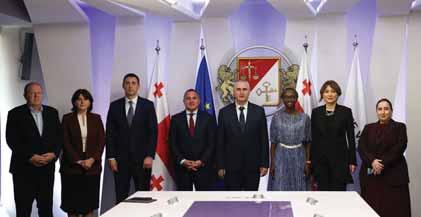
at the signing ceremony for the $372 million World Bank loan agreement.
Source: Ministry of Finance
Georgia, World Bank Sign $372 mln Loan for Railway and Road Projects
BY LANA KOKAIA
Georgia has signed a $372 million loan agreement with the International Bank for Reconstruction and Development (IBRD) to support transport infrastructure upgrades under the Trans-Caspian Transport Corridor – Georgia Accessibility and Transport Improvement Project.
The agreement was signed by Finance Minister Lasha Khutsishvili and World Bank Regional Director for the South Caucasus Roland Price.
The funding forms part of a wider project worth approximately $751 million. In addition to the World Bank’s $372 million contribution, Georgia is seeking $175 million from the Asian Development Bank (ADB) and $182 million from the Asian Infrastructure Investment Bank (AIIB).
The project includes the purchase of
electric locomotives for Georgian Railways, construction of electrical substations, and institutional strengthening of the railway operator. It also envisages the construction of road sections connecting Badiauri and Chalaubani, Chalaubani and Bakurtsikhe, and Gurjaani and Telavi, along with transport interchanges, overpasses, bridges, road safety measures, and improvements in the road sector.
The project will be implemented by Georgian Railways and the Roads Department.
A separate project agreement between Georgian Railways and the IBRD was also signed by Georgian Railways Director General Lasha Abashidze and Roland Price.
Officials say the investments in railway and road infrastructure will help increase the efficiency of the Middle Corridor by improving the speed and safety of cargo transportation, strengthening supply chains, and supporting Georgia’s longterm economic growth.
BP to Hand Baku-Supsa Pipeline Operations to Azerbaijan, Georgia
BY LANA KOKAIA
British Petroleum (BP) will transfer the operation of the Baku-Supsa oil pipeline to Azerbaijan and Georgia, while remaining involved as part of contractual obligations, the company says.
The announcement was made by BP’s Executive Vice President for Production and Operations Gordon Birrell in comments to journalists, as reported by Azerbaijani agency Report.
Birrell said the transfer does not amount to BP exiting the asset, stressing that the company is fulfilling obligations agreed under a contract signed around a decade ago.
“This is simply the fulfillment of a contractual obligation undertaken by BP when the pipeline agreement was signed ten years ago,” Birrell said, adding that the move should not be seen as a volun-
Kobakhidze Cites China as a Model of Strategic Partnership despite US Concerns over Beijing’s Influence in Georgia
BY TEAM GT
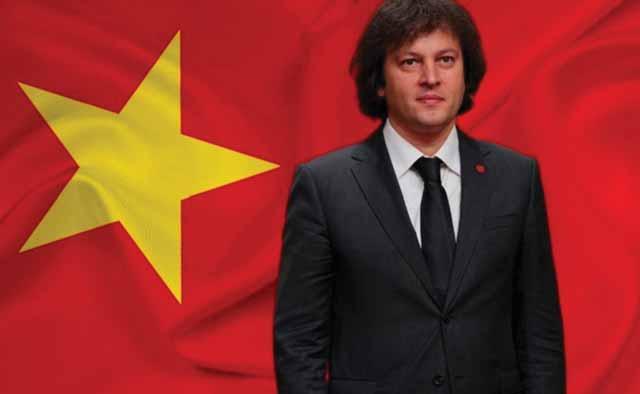
Georgian Prime Minister Irakli Kobakhidze has described Georgia’s relationship with China as “an exemplary strategic partnership,” highlighting the recently announced upgrade in bilateral ties to a Comprehensive Strategic Partnership.
Speaking at a briefing held at the Government Administration on June 10, Kobakhidze said the partnership between the two countries goes beyond formal declarations and delivers tangible benefits for both sides.
“It is absolutely clear that this is not a strategic partnership that exists only on paper. It is reflected in concrete benefits for both countries,” the Prime Minister said.
“Such a partnership should serve as a model of strategic cooperation between two states; one based on mutual respect, fairness and dignity, and focused on mutual benefit.”
Kobakhidze also praised China’s approach toward Georgia, stating that the Chinese leadership treats the country “as an equal partner,” which he described as particularly noteworthy and worthy of appreciation.
To illustrate the growing relationship, the Prime Minister pointed to increased trade turnover and rising tourism figures between the two countries. He noted that over the past six months alone,
Georgia’s Prime Minister, Parliament Speaker and five cabinet ministers had visited China, with each trip focused on achieving specific outcomes.
Kobakhidze expressed special gratitude to Chinese President Xi Jinping, China’s prime minister, Chinese government officials and the Chinese ambassador to Georgia for their contribution to strengthening bilateral ties.
During a question-and-answer session with journalists, the Prime Minister reiterated his view that China is the world’s only peaceful superpower.
The remarks came a day after Georgia and China announced the elevation of their relations to a Comprehensive Strategic Partnership, marking the third anniversary of the establishment of a strategic partnership framework between the two countries.
The decision was revealed through congratulatory messages exchanged on June 9 between Chinese President Xi Jinping and Georgian President Mikheil Kavelashvili on the occasion of the 34th anniversary of diplomatic relations between Georgia and China.
The two leaders stated that both countries had agreed to deepen cooperation further and move bilateral relations to a new stage through the Comprehensive Strategic Partnership framework.
Kobakhidze’s comments came alongside renewed debate over Georgia’s growing ties with China.
On June 8, the US House of Representatives approved bipartisan legislation requiring the US administration to
conduct a detailed assessment of Russian and Chinese intelligence activities in Georgia. The bill, H.R. 7668, reflects concerns in Washington that the current Georgian government is moving closer to the political orbit of the United States’ principal strategic rivals.
Responding to the initiative, Chinese Ambassador to Georgia Zhou Qian said on June 9 that Beijing was not interested in comments made by “certain American congressmen” regarding China-Georgia relations.
Asked about the issue on June 10, Kobakhidze argued that criticism from the United States over Georgia’s deepening ties with China would be illogical.
“We see that the United States itself, its administration and the State Department, are doing their utmost to deepen US-China relations. Under such circumstances, the American authorities cannot have any objective criticism of Georgia’s efforts to deepen relations with China as well,” he said.
The Prime Minister also dismissed criticism from Republican Congressman Joe Wilson, one of the bill’s authors, calling him “an absolutely unserious person.”
“When US President Donald Trump visits China and refers to the Chinese president as a friend, it is entirely unserious for Joe Wilson to claim that China has a negative influence in the South Caucasus region,” Kobakhidze said. He added that he hoped the US administration would take Georgia’s approach to strategic cooperation with China as an example.
Georgia to Set up State Road Maintenance Company,
Shift Away from Private Contractors
tary decision by the company.
“These are the terms of the contracts. As the previous operator of the oil pipeline, we have contractual obligations. By fulfilling these obligations, we are returning it to its owners. This is not our choice, this is a contractual obligation,” he said.
Birrell also said the transfer process for the Western Route Export Pipeline (WREP), also known as Baku-Supsa, is expected to be completed in June.
“The Baku–Supsa contract is a separate one. Under that agreement, operatorship is transferred in each country to the government, as the owner, and the government then determines the operator,” Birrell said.
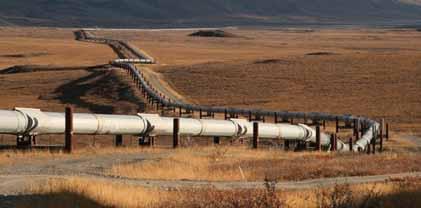
The Baku-Supsa pipeline, which runs from Azerbaijan’s Chirag field to the Supsa terminal in Georgia, is 830 km long, with 375 km passing through Georgian territory. It was launched in 1999 and is considered a key export route for Caspian oil to European markets, bypassing Russia.
BY LANA KOKAIA
The Ministry of Infrastructure has prepared a package of legislative changes envisaging the creation of a legal entity under private law that will carry out the maintenance of highways.
The draft law, registered on June 3, 2026, is set to be considered in an expedited manner..
Under the proposal, the Ministry will transfer responsibility for the maintenance of highways and sections of international and domestic importance to the new entity, either fully or partially.
The initial capital investment is estimated at around 63 million GEL, excluding VAT, while the company is expected to employ 163 people. At a briefing on June 9, the Prime Min-
ister of Georgia Irakli Kobakhidze said the initiative aims to create a “stable resource” and improve service quality.
“We want to create a stable resource that will also be a guarantee of quality,” Kobakhidze said.
He said the initiative serves a “double effect,” including ensuring stable resources for road maintenance and providing specialised equipment to respond to natural events.
Kobakhidze also said that in his assessment, previous private contractors had not delivered satisfactory quality, adding that the new state-run model could perform better.
The explanatory note says that the initial capital expenditure amounts to approximately 63 million GEL and will be used to establish the technical base, infrastructure, and technological systems.
The investment includes around 30.9 million GEL for 65 units of winter maintenance equipment, 16.4 million GEL for
54 units for summer maintenance, and 15.6 million GEL for infrastructure, IT systems, and initial supplies.
Annual operating costs are estimated at around 30 million GEL, including salaries for 163 employees (around 7 million GEL), fuel and materials, equipment maintenance, depreciation, and administrative expenses.
The government says the costs will be covered through the state budget via optimisation and redistribution of resources.
The legislative package also tightens rules under the Law on Motorways, aiming to prevent unauthorised construction and improve protection of road infrastructure.
The Ministry says violations such as non-compliant construction in roadside zones and breaches of technical conditions remain common despite existing legal restrictions, creating risks for road safety and infrastructure.
Officials
The pipeline. Source: News.Az
PM Kobakhidze in front of a China flag. Source: batumelebi.netgazeti
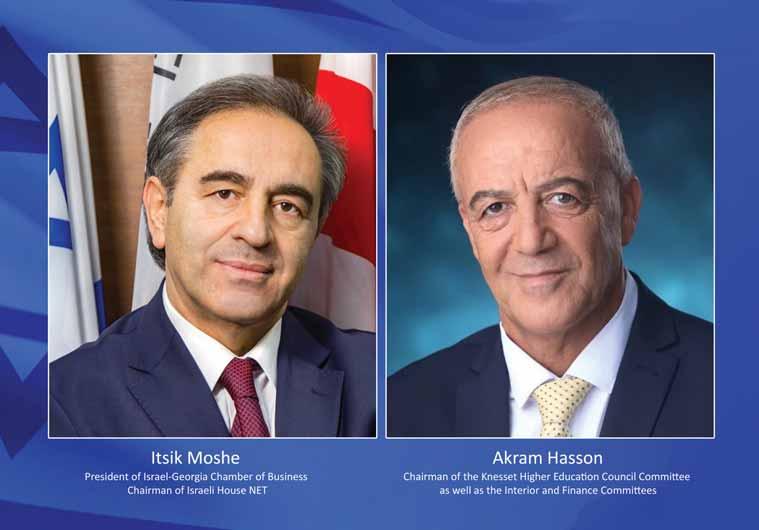
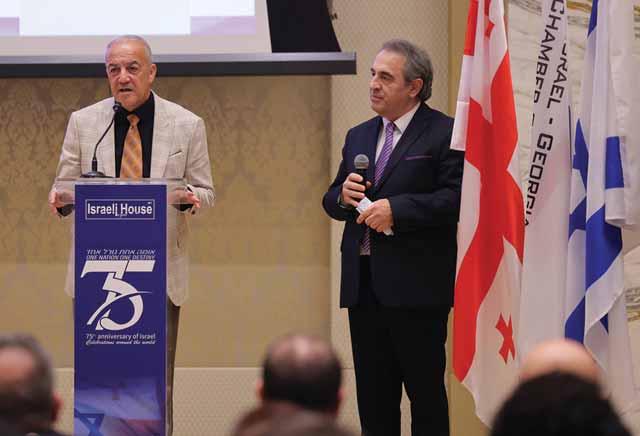
A New Chapter Begins in Jerusalem: Marking 30 Years of the Israel-Georgia Chamber of Business
BY TEAM GT
Throughout the month of June, preparations are actively underway for the Israel-Georgia Business Forum, which will be held in Jerusalem as part of the 30th anniversary of the Israel-Georgia Chamber of Business.
As part of the events surrounding the forum, Dr. Akram Hasson, an influential member of the Knesset and of the IsraelGeorgia Parliamentary Friendship Group, will visit Georgia. During his visit, he will meet with representatives of the Georgian business community, learn more about the activities of Israeli businesses operating in Georgia, and hold meetings with leaders of various institutions and organizations, and, most importantly, members of the younger generation in support of future bilateral ties. A meeting is also planned at the S. Akhmeteli Theatre, where numerous productions on Jewish themes have been staged over the years.
Itsik Moshe, President of the IsraelGeorgia Chamber of Business and head of the Israeli House NET, has been actively working in Georgia and Eastern Europe for the past 35 years. In his view, the world and the region have faced a series of major challenges over the last seven years, including the pandemic, political crises, and regional wars. At the same time, growing global antisemitism remains a serious concern. For this reason, he believes the business community today is in particular need of support and new opportunities for development. By the end of the month, Georgia is also expected to host a visit from Wyndham leadership. The company’s investments, together with the introduction of international standards and quality practices, have made a significant contribution to the development of Georgia’s real estate and tourism sectors. Projects carried out under the Wyndham brand have increased international investor and visitor interest in Georgia, making the country even more attractive both to Israeli investors and to investors from around the world. This stands as a successful example of how international business can contribute to economic growth, tourism development, and the creation of new investment opportunities.
Dr. Akram Hasson is a well-known and highly respected figure within the highest circles of the Georgian government.
In the Knesset, he serves as head of the Education Committee and is an active member of committees dealing with matters related to the Ministries of Finance and Internal Affairs. He has long supported the strengthening of relations between Israel and Georgia and has consistently backed the development of economic, political, and public ties between the two countries. He is also a board member of the Israeli House and an active supporter of the organization’s international expansion.
This process has received strong backing from representatives of Israel’s political and economic establishment.
Former Israeli Minister of Economy
Amir Peretz, who visited Tbilisi several years ago and attended the 25th anniversary event at the Israeli House, stated that the Israel-Georgia Chamber of Business had created an important economic bridge between the two countries, that the organization works for the benefit of both nations, and that its activities are without parallel.
According to Eli Cohen, currently serving as Israel’s Minister of Infrastructure and formerly Minister of Foreign Affairs, the activities and work of Itsik Moshe and the Israeli House remind him of Shimon Peres.
It is also noteworthy that during a Knesset session, Akram Hasson appealed to the President of Israel to grant the Israeli House the State of Israel’s highest recognition for its achievements, representation, and international connections.
Under the leadership of the IsraelGeorgia Chamber of Business, more than 30 business forums have been held to date in Jerusalem and Tbilisi, contributing nearly 5 billion in overall value to Georgia.
This year’s business forum in Jerusalem is expected to host approximately 300 guests, including representatives of government, parliament, economic institutions, business circles, and public organizations. The main message of the forum will be that Georgia remains at the center of economic activity. The forum’s primary focus will be support mechanisms for Israeli businesses and preparations for a new wave of investment in Georgia.
The second part of the forum will focus on a new platform for cooperation between cities, led by the Israeli House. Joint projects and partnership initiatives prepared by Georgian companies will also be presented, all aimed at further strengthening economic relations between Israel and Georgia.
WHEN ASKED WHAT CHALLENGES HE SEES TODAY AFTER 30 YEARS OF ACTIVITY BY THE CHAMBER OF BUSINESS, ITSIK MOSHE RESPONDED:
“First of all, I would like to emphasize that we are a non-governmental organization and are not involved in political relations between countries, which is the role of embassies.
It is noteworthy that, over the past decades, most visits by Israeli ministers and members of parliament have been conducted within the framework of public diplomacy. This format is particularly flexible, and it is through this mechanism that important connections and a solid foundation for cooperation have been established. The parliamentary friendship groups on both sides deserve significant credit for this achievement.
Second, as for business relations, through joint efforts we must address the shortcomings of the past that became evident during periods of crisis. It is necessary to support companies and strengthen business ties between countries.
It is also important to strengthen the institution of the business ombudsman. It should become the primary point of contact for businesses in order to ensure rapid response. This is especially impor-
tant at a time when the potential of many regions has been damaged.
Third, the banking system, whose strength is built on business itself, must face reality and recognize the difficulties businesses have faced during the crises of the past seven years as force majeure circumstances. It should seek business support funds from international institutions and, at the very least, carry out loan restructurings.
The government should strengthen cooperation with bilateral chambers of commerce so that at least two global forums are held each year, one in Georgia and the other in the country represented by the chamber. The role of international business organizations is also important, including the leading ICC, which within a short period of time could integrate Georgia into a global network spanning 170 countries.
Fourth, we should activate the program developed by the Israel-Georgia Chamber of Business involving 100 honorary consuls who, together with ambassadors, would be tasked with attracting investment. This could generate at least 2 billion in investment annually.
We should complete work from both sides on the free trade agreement between Israel and Georgia, which we began together with Dr. Akram Hasson. The
agreement should also include investment protection provisions, which are first and foremost in Georgia’s interest. At the previous business forum held in Tbilisi, attended by 100 delegates from Israel together with the mayors of three cities, we spoke about a 5 billion contribution over the past 35 years and the potential for an additional 1 billion contribution by 2030. This can be achieved through coordinated and joint efforts. It is also important to note that tourism from Israel will reach 500,000 visitors, representing a contribution of 600 million dollars. Decades ago, when we first began promoting Georgia’s tourism potential, almost no one believed that the number would grow from 5,000 tourists to half a million.
After the war, Israel will become a country with which even more states will seek deeper cooperation and stronger ties across multiple sectors. Public diplomacy will form the second part of the forum, and the Israeli House, headquartered in Jerusalem with 30 representative offices worldwide, will contribute its modest role to this process. By the end of the year, new representative offices will also be opened in Armenia, Morocco, and Spain.
Let us begin preparing together in July for a major new stage of cooperation”.
IMF Raises Georgia’s 2026 Economic Growth Forecast to 6.5%
BY TEAM GT
The Executive Board of the International Monetary Fund has concluded its 2026 Article IV consultation with Georgia, raising the country’s economic growth forecast to 6.5%.
In a report published following the consultation, the IMF noted that Georgia’s economy remains resilient despite heightened global uncertainty, including risks stemming from the ongoing conflict in the Middle East.
“Despite elevated global uncertainty, including from the war in the Middle East, Georgia’s economy remains resilient, supported by sound macroeconomic management and strong policy buffers,” the report states.
The IMF says economic growth is expected to remain robust, although it is projected to moder-
ate over time. The institution also forecasts that inflation will remain above the target level until mid-2027, while the current account deficit is expected to widen temporarily.
The report notes that Georgia’s public debt is projected to remain at prudent levels, while the country’s international reserve coverage is expected to strengthen further.
The IMF highlighted several key policy priorities for the Georgian authorities, including returning inflation to target levels, continuing to build foreign exchange reserve buffers, strengthening governance at the central bank and state-owned enterprises, and advancing structural reforms aimed at boosting competitiveness and creating jobs. The Article IV consultation is the IMF’s regular assessment of a member country’s economic and financial policies, during which the institution evaluates economic developments, risks and policy priorities.
The Heritage of German Colonists in Georgia. Part 2
BY TATJANA MONTIK
Did you know that Georgia once had its very own Luxemburg? Before receiving its Soviet-era name in 1921, this prosperous settlement was known as Katharinenfeld. It was founded in 1818 by Swabian colonists, and from 1941 onward, the location became known as Bolnisi. In total, there were 23 German settlements across the South Caucasus.
SECRETS OF THE SWABIAN MASTERS
Our interlocutor, Bolnisi native Natela Grigolia, never ceases to marvel at how the Germans built their timber-framed houses, which have effortlessly withstood two centuries and remain beautifully preserved. The technologies utilized by the colonists were far ahead of their time. Abundant oak forests grew around Katharinenfeld back then, providing the massive timber beams needed for the framing.
“They mixed oats, hay, clay, and calcite, deposits of which are found right near Bolnisi,” Natela explains. “When we tore down an old partition wall in a room, we saw it with our own eyes. The wall thickness in these houses can reach up to one meter!”
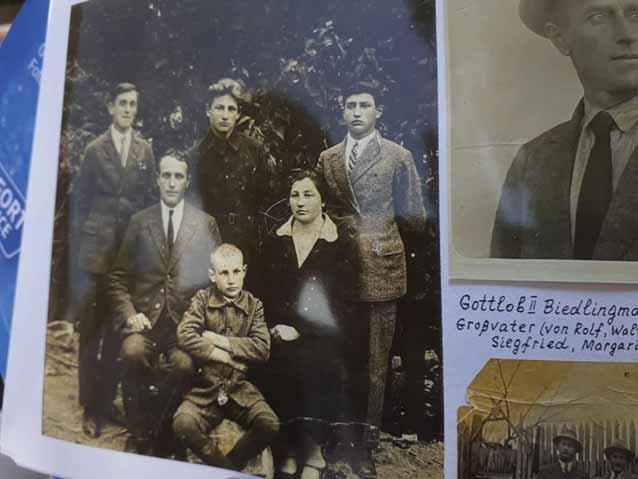
Natela carefully brings out vintage family photographs that capture both festive holidays and everyday labor in Luxemburg, alongside trips her mother took around Georgia with her classmates. In these snapshots, her mother and uncle are the only Georgians in a large company of Germans. One photo features handsome young men: one in a traditional papakha fur hat, another in a peaked cap, and a third in a brimmed hat.
“That is my grandfather Elizbar and his brothers,” Natela explains.
Her grandfather’s family hailed from Kakheti. Their lineage, the Princes Vakhvakhishvili, owned ancestral lands in Telavi. An ancient family coat of arms dating back to the reign of the last Georgian king, Erekle II, has been preserved in Natela's archive: a scroll surmounted by a crown, flanked by two heraldic lions.
Following the arrival of the Bolsheviks, five of her grandfather's brothers were executed, while he himself, a graduate of Kharkiv University, was dispatched to work as an economist in Georgia’s Luxemburg. Thus, Elizbar and his wife, Alexandra Zurabashvili, not only escaped political repression, but seamlessly integrated into the life of the German community, which until then had been quite insulated from outsiders.
SPRING WATER THAT TURNED THE REGION INTO PARADISE
From her mother, Natela inherited a boundless respect for the German people: “It is a very resilient and incredibly industrious nation! Every single one of them is like that, without exception. Even in exile, out in the harsh Kazakh steppes, they managed to pick themselves up and stand on their feet once more.”
Prior to the arrival of the Swabians, water was an immense problem in these parts, leaving fertile lands barren and
dry. According to Natela’s accounts, it was the German settlers who piped water from a spring in a nearby mountain directly into the settlement. They dug small aryks (irrigation ditches) to carry utility water through every single courtyard. It was used for watering vegetable gardens and scrubbing floors.
“Yet the water in these channels was so clean that you could even wash clothes in it! I remember perfectly how we, as children, would play and splash around in those streams.”
The injustice committed against the German residents of Georgia’s Luxemburg still echoes with pain in the elderly woman's heart: “To deport these people because of Hitler was a massive sin. After all, it was the Germans who turned this arid region into a blossoming paradise!”
Recalling her mother's stories, Natela speaks with bitterness about what transpired in the village immediately following the deportation: “When they were taken away, people from neighboring villages came to plunder the deserted homes. My mother just walked the streets and wept, because the houses of all her friends fell silent in a single instant.”
Shortly thereafter, new residents were resettled in Katharinenfeld. They were predominantly impoverished, land-poor peasants brought from Western Georgia: Samegrelo, Imereti, Racha, and Svaneti.
“It was incredibly difficult for them: it was a fierce winter, and because they did not know how to operate the local heating systems, they lit bonfires right on the floor in the middle of the rooms. They, too, were destitute, exhausted people. Look, in my house, the floors are still scorched in several places,” Natela sighs.
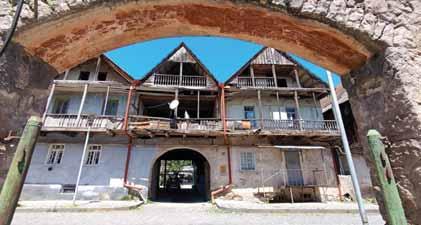
Over time, the new owners remodeled or expanded the homes to suit their own needs, making it difficult today to discern the original German Fachwerk features in many of Bolnisi's buildings.
ASURETI: A RACHAN VILLAGE ON A GERMAN FOUNDATION
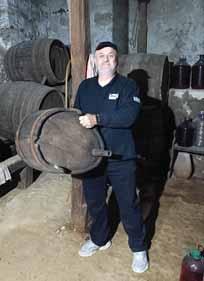
In the former German settlement of Elisabetthal, now renamed Asureti, we meet Tamaz Petriashvili. He is a descendant of settlers from Western Georgia who, along with their fellow villagers, arrived in this emptied village from the high-mountain region of Racha in the autumn of 1941, immediately following the deportation of the local Germans to Kazakhstan. Other highlanders from the Mtiuleti region were also resettled in Asureti.
“My grandfather and his fellow villagers arrived here when the Germans had already been evacuated to Central Asia,” Tamaz says. “A once-developed and welltended land was left abandoned. Some-
one had to feed the cattle, the horses, the dogs, and look after the deserted farms.”
Tamaz recalls his grandfather's stories about inheriting a fully functioning, advanced infrastructure. The village even possessed horse-breeding farms, a rarity in Georgia at the time. Pig farming was also highly developed, and the wheat fields were staggering in their scale and yield.
“Wheat is our Georgian pride: out of 27 global varieties, nearly half are of Georgian origin,” Tamaz explains. “However, the Germans managed to expand and modernize all of it.”
GERMAN ORDER AND THE "CULTURE OF THE PROMENADE"
Unlike Bolnisi, where the vacated homes fell victim to spontaneous looting by residents of neighboring villages immediately after the Swabians' expulsion, the fate of Elisabetthal unfolded differently. To preserve the unique infrastructure of this model settlement, the Soviet authorities temporarily deployed troops to Asureti. Soldiers strictly guarded the perimeter, houses, and farms against plundering, maintaining order right up until the organized arrival of the new inhabitants, the land-poor peasants from Racha. Thanks to this, Asureti was handed over to the settlers practically intact.
The village possesses a strict, geometric, well-thought-out layout, with the houses situated quite close to one another. Meanwhile, the space for orchards and vegetable gardens was shifted to a separate zone containing systematically irrigated fields.
“The Germans had everything arranged in absolute harmony,” Tamaz emphasizes. We walk through cozy Asureti, greeting Tamaz's neighbors and acquaintances. Our guide proudly shares that the habit of taking an evening stroll through the village after work and on weekends (following church service) was also introduced here by the Germans.
“After a long day of labor, they would return home, spruce themselves up, and solemnly go for a walk along the beautiful cobblestone streets. In what other Georgian village could you see anything like that back then?”
Inside the recently restored Lutheran church, Tamaz shows us an exhibition of archival photographs depicting the peaceful life and daily routines of the colonists.
From Württemberg, they brought the latest innovations to the Caucasus: not only cutting-edge winemaking methods, but also brewing, as well as the production of hemp oil: two powerful oil presses operated in the village.
Judging by the photographs, the Swabians knew not only how to work hard,
they traditionally use qvevri, clay amphorae buried in the ground, for aging. The Germans, however, adhered to their own European tradition: they crafted and stored wine in oak barrels. There were magnificent coopers among the colonists.”
Between the cellar and the residential balcony, the architects incorporated a buffer zone; an air pocket that shields the wine from sudden temperature fluctuations.
“Look, here is the inscription above the entrance in old Gothic script: Adam Johann Böpple,” Tamaz points out. “He is the one who built this house and this cellar.”
Inside, century-old wine barrels, a massive iron grape crusher, and a gigantic funnel used for transferring wine have been carefully preserved.
The crown jewel of Asureti is its famous wine made from the endemic grape variety Asuretuli Shavi (Asuretian Black), also known as Schalla. The variety received its second name from the surname of a German settler named Schall, who discovered a wild vine in a local forest and cultivated it, as Hilarius Pütz, a winemaking expert from Germany, later explained to me. This grape grew exclusively here, and German winemakers successfully marketed the wine made from it across the entire Russian Empire.
but also how to enjoy high-quality leisure: Elisabetthal possessed its own brass band and several sports clubs.
THE LEGACY OF THE BÖPPLE FAMILY
Tamaz’s house is located in the very heart of the village, right next to the church. It once belonged to the family of Adam Johann Böpple. Tamaz discovered this from the initials carved above the entrance to the wine cellar, as well as from surviving church registers where the entire history of the congregation was meticulously recorded.
Descendants of the original owners have traveled from Germany to Asureti on multiple occasions; they maintain a warm relationship with the family living in their ancestral home, and even sent a large photo album as a gift.
“This house is nearly 200 years old; it was one of the very first in the village,” the host explains.
Because the soil in these parts is unstable and prone to shifting, the Germans began erecting the building's load-bearing walls directly from deep within the cellar. The walls, a meter thick, provide flawless thermal insulation: the rooms remain cool in the summer and warm in the winter. A stable temperature of 12 to 14 degrees Celsius is naturally maintained inside year-round.
“But when we disrupted this centuriesold harmony and began building modern extensions onto the houses, cracks started appearing in the new structures,” Tamaz laments. “And this is despite the fact that the Rachan settlers themselves have always been regarded as first-rate carpenters and builders.”
SECRETS OF THE WINE CELLAR AND THE LEGENDARY "SHALLA"
The special pride of the house is its marani (wine cellar).
“Welcome to our cellar!” Tamaz invites us in. “Georgia possesses the world's oldest winemaking culture, but in Kakheti,
The Schall grape has a unique biological characteristic: it is a functionally female variety, and for pollination, it strictly requires the proximity of a vine of a different, "male" variety. Consequently, they are always planted in pairs across the vineyards, explained Pütz, who is currently reviving the historical vineyards in Asureti.
Tamaz pours us some wine to taste: it is dense, deep ruby in color, with a complex, rich aroma. “Let’s drink to our wonderful Georgia and its people!” the hospitable host proclaims, raising a toast.
ASURETI TODAY
In recent years, the flow of tourists to Asureti has been growing rapidly. The interest shown by international visitors, predominantly from Germany, in the Swabian heritage has catalyzed the development of local infrastructure.
Over the past decade, about ten guesthouses of various scales have opened in the village, and an atmospheric restaurant has begun operating inside the building of the former station. Yes, indeed, Elisabetthal had its very own station! It was planned as a terminus from which a horse-drawn car, the tramway of that era, would depart along tracks, linking the colony with the winery and the vineyards.
Regrettably, this project was never fully realized. Today, the winery building remains abandoned, even though it was purchased by private investors.
Back in the nineteenth century, everything in Asureti was built according to the absolute latest word in technology, and today, centuries later, the village's current residents continue to safeguard and utilize these unique European traditions.
To be continued…
Tatjana Montik, journalist, author, and passionate admirer of Georgia, has spent the past 15 years living in and reporting on this captivating South Caucasus country. See more of her experiences in her new travel diary and cultural guide, Georgia: A Tapestry of Time and Space.
Natela’s family. Photo by the author
Tamaz Petriashvili. Photo by the author
German houses in Bolnisi. Photo by Anna Ankudinova
Late Gardeners
BLOG BY TONY HANMER
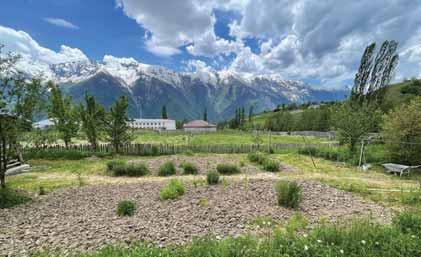
This year, my wife’s return to our mountain home in Svaneti was at least several weeks later than usual. I had come up several times without her, to host and show around various special-interest groups, mostly self-catering. Snow met us in late April (20 cm and -7 degrees C!) And again in late May (more of a long set of flurries, quickly melting, but still). The cold and wet prevented me from even starting on digging up the garden, weed-whacking the lengthening grass on the property, or other typical spring activities.
Then suddenly it dried up and warmed up dramatically, a week after we had come up together for the summer. Now, at last, was the time to get to work outside, before the somewhat clayey ground hardened from drying out as it usually does. Both the garden-digging and any
fence-post resetting must be done now, while things are still soft enough for spade and hole-spike. Fortunately, some old and new friends helped us with the spade work, while I also got onto the weed-whacking of the already over-long grass.
Many other chores as we re-open for the summer tourist season, although bookings are down. Fears from seeing Georgia sandwiched between RussiaUkraine and USA/Israel-Middle East?
Likely. Anyway: reconnect the water fully, motor and all. Lights outside. Foozeball table outside. Check and clean all rooms and bathrooms. Write all bookings in the calendar.
Already, in early June, the rest of our property is ripe for its first hay-scything, now more commonly done by a gasolinepowered machine than by an actual scythe. I haven’t got the first, and am rubbish on the second, so I get neighbor men to do this, and to take the hay for their bovines at a discount too (we don’t have livestock anymore).
Clear the grass from around our newest seedling, a tiny walnut just barely getting through the winters alive at the moment. Now it needs some sun and less competition from the voracious hay and weeds around it.
Check all the fences for solidity… bovines and porcines will “test to destruction” all parts of it, and we haven’t yet had a year with zero break-ins, despite best efforts! But the miscreants always give themselves away with a moo or grunt, and we chase them out immediately. I am not at all averse, in my anger, to using a stick on their backs to try to enforce the idea that entry here will be painful, although rarely does a blow land, I must admit. They can move at speed when chased. Their entry and subsequent omni-vegetarian eating are a mess, and they won’t be allowed to visit a second longer than we can give them.
Dogs can’t be kept out, entering either simply by jumping the fence at various points or by nosing open the main gate, a skill that thankfully the ruminants can’t
seem to learn. Canines I handle with more care, always with a stick, though not to attack with, just to threaten as I demand in a menacing voice, “Shishtaaa!”
Which they seem to understand, as all local people know it. We don’t have a dog ourselves, deeming it more a nuisance than a necessity: last year’s quickly solved shop break-in demonstrated to one and all that our eight house-encircling video cameras do, indeed, work perfectly. Know it and be warned.
Thus we prepare for those who book in advance and, yes, even those who
show up with no advance notice at all to try their luck. Ready, with a smile, for all.
Tony Hanmer has lived in Georgia since 1999, in Svaneti since 2007, and been a weekly writer and photographer for GT since early 2011. He runs the “Svaneti Renaissance” Facebook group, now with over 2000 members, at www.facebook.com/groups/ SvanetiRenaissance/ He and his wife also run their own guest house in Etseri: www.facebook.com/hanmer.house.svaneti
A Big Man from Little Gori
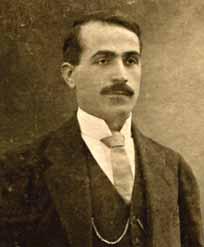
For those who do not know where the town of Gori is on the map of Georgia, and what it actually represents, we might elucidate that it is located right in the heartland of Sakartvelo, 86 kilometers west of Tbilisi, and happens to be not only the birthplace of Joseph Stalin, but also of many other prominent Georgians, among them Davit Oniashvili (1883-1937).
According to the English-language
Wikipedia, he was a Georgian politician active in the Democratic Republic of Georgia, a member of the Georgian Parliament, and Minister of Agriculture of the country’s first independent republic. Prior to that, he played a role in the process that led to the declaration of independence of the Transcaucasian Democratic Federative Republic on 22 April 1918, and was one of the signatories of Georgia’s 1919 Act of Confirmation of Independence. During the Great Soviet Purge, on 14 April 1937, he was arrested on charges of membership in the Menshevik Counter-Revolutionary Center and was subsequently shot.
The Wikipedia article about this great Georgian man is only a stub, and before we send the missing significant information to that famously voluminous international electronic reference work, we would like to reveal here some even more interesting facts about his life.
Davit Oniashvili was the translator of William Shakespeare’s Julius Caesar and Johann Wolfgang von Goethe’s Faust into his native Georgian tongue, as well as the author of the first monograph in the Georgian language about the great Lord Byron, titled Byronism and World Sorrow. These three significant literary achievements matter to us, the lovers of Georgian culture and literature, above all.
Last Saturday, a conference dedicated
to the memory of Davit Oniashvili was held at Gori State University, whose spacious assembly hall was packed with representatives of Gori’s intellectual, educational, and cultural elite, as well as the wonderful youth of the town. Incidentally, Gori has always been known for its distinguished intelligentsia and rich cultural-intellectual life.
The event was opened with an introductory speech by the Vice-Rector of the university, Professor Zurab Zurabish-
vili. Academician Innes Merabishvili, the eminent Byron scholar and translator of world renown, took the floor immediately after the introductory speech to speak about the significance of the conference and the place of Davit Oniashvili in the literary and cultural life of Georgia.
By the way, Innes, the indisputable darling of Gori, was born and raised in that lovely city. She fondly recalls learning the English language there and receiving an outstanding education in her hometown, within a deeply traditional family rooted in our indigenous culture.
In fact, Professor Innes Merabishvili, founder of the Byron School of Tbilisi and member of the Board of Directors of the International Byron Society, has personally given a new life to the memory of Davit Oniashvili, whose name has been somewhat obscured by time and the nonchalance of our currently overstrained and socially exhausted society, preoccupied with everyday survival. Notwithstanding myriad obstacles along the way, Innes managed to bring to fruition a conference that will not be forgotten by its participants. Why is she doing all this, while being so occupied with academic obligations and translation work, not to mention family care and responsibilities? A playful answer might be that both Davit and Innes belong to the same warm and nourishing soil of Gori, and that is why. But jokes aside, the answer is straightforward: Professor Merabishvili knows the value of her outstanding compatriots and their role in safeguarding Georgia’s elevated cultural and literary heritage, and she dedicates her time and energy to this cause without any ulterior motive.
Innes has even traced the family roots of her great fellow Georgian and restored them into the wider cultural memory, helping to preserve the image of our unforgettable Davit Oniashvili.
After Innes, the floor was given to Academician Mindia Ugrekhelidze, whose warm and fact-rich speech made all of us feel that we were truly in the right place at the right time. Doctor of Philology Tinatin Sikharulidze was next, her presentation offering the most substantial biographical insights, masterfully delivered. Tinatin has authored a 180page, large-format book dedicated to Oniashvili’s life and work, a thorough monograph that secures his place among those who define the value of Georgian intellectual culture.
Next was Maia Bolashvili, a pedagogue at Gori University, with an enthusiastic presentation of her research on the subject. Finally, the emotionally engaged participants in the conference had the privilege of listening to Maia Mtvaradze, Davit Oniashvili’s granddaughter, and Nugzar Machavariani, the grandson of Davit’s first publisher, Davit Machavariani. Nothing could have been more meaningful than hearing these educated and thoughtful Georgians at the podium. The newly published books by Davit Oniashvili were also on display. Academician Merabishvili was accompanied by a solid delegation of professors from Tbilisi, which added further weight and significance to the event. In a word, the conference was a great success. Frankly speaking, this nation badly needs such events to take place more often in our social, cultural, and spiritual life, so that we may tell the world who we are and where we come from.
Etseri, Svaneti. Photo by the author
Conference on Davit Oniashvili. Source FB
BLOG BY NUGZAR B. RUHADZE
Davit Oniashvili. Source: archive.ge
Conference at Gori University. Source: FB
Toradze Festival 2026: Building a Musical Dialogue in Tbilisi
Photo by the author
BY IVAN NECHAEV
From Machavariani’s symphonic monument to a rare encounter with the Jewish-Italian Baroque tradition, the opening week of the Toradze International Music Festival 2026 revealed a festival increasingly interested in dialogue: between generations, styles, histories, and musical identities.
The concert on 5 June in the Grand Hall of the Tbilisi State Conservatoire established its ambitions. The evening brought together pianist David Khrikuli, the Gia Kancheli Tbilisi Youth Orchestra, and conductor Mirian Khukhunaishvili in a concert dedicated to the memory of Vakhtang Machavariani. The dedication carried particular symbolic weight. Vakhtang Machavariani occupied a unique place in Georgian musical culture as conductor, educator, and advocate for Georgian symphonic music. Opening the festival with Aleksi Machavariani's Fourth Symphony therefore created an emotional and historical frame through which the entire concert could be understood.
Aleksi Machavariani remains one of the towering figures of twentieth-century
Georgian music. His Fourth Symphony, subtitled Youth, occupies a fascinating position within his oeuvre. Composed during the late Soviet period, it reflects the composer's lifelong ability to reconcile monumental symphonic thinking with an unmistakably Georgian melodic imagination.
The title Youth can be deceptive. Rather than depicting youthful innocence, the symphony explores youth as a force of energy, aspiration, and collective movement. The work unfolds through largescale symphonic architecture, combining rhythmic propulsion with broad lyrical spans that recall Machavariani's gift for dramatic musical storytelling.
Mirian Khukhunaishvili approached the score with an evident understanding of its architectural demands. Machavariani's symphonic language requires a conductor capable of balancing large structural trajectories against moments of local detail. The work's effectiveness depends upon maintaining momentum while allowing thematic material sufficient space to breathe. The result was a performance that emphasized the sym-
phony's forward-driving character. Its kinetic energy resonated strongly within the festival's opening-night atmosphere, creating a sense of artistic momentum that extended beyond the individual work.
Following the interval, the evening shifted dramatically in scale and emotional perspective with Frédéric Chopin's Piano Concerto No. 2 in F minor. The juxtaposition was revealing. If Machavariani's symphony spoke in collective terms, Chopin's concerto inhabits a deeply personal emotional landscape. The transition from symphonic monumentality to romantic introspection highlighted the remarkable elasticity of the classical tradition itself.
David Khrikuli approached the concerto as a narrative rather than a display vehicle. Chopin's concertos are frequently misunderstood through the lens of virtuosity alone. Their true strength lies in their capacity for lyrical expression, psychological nuance, and vocal-style phrasing. The first movement presents an intricate dialogue between soloist and orchestra, balancing dramatic ten-
Where the Georgian composer explored collective vitality, Chopin examined the interior life of the individual
sion with poetic reflection. The central Larghetto remains among the most intimate pages in nineteenth-century music. Chopin himself described it as inspired by youthful love, and its atmosphere continues to evoke a world of private emotions suspended in time.
Within the context of the evening, the concerto served almost as a response to Machavariani's symphonic vision. Where the Georgian composer explored collective vitality, Chopin examined the interior life of the individual. Together the works created a compelling portrait of music's dual capacity to articulate both communal and personal experience. The presence of the Gia Kancheli Tbilisi Youth Orchestra throughout the evening reinforced another significant theme: the relationship between generations.
Young musicians engaged simultaneously with Georgian twentieth-century repertoire and canonical European Romanticism, embodying the cultural synthesis that increasingly defines contemporary Georgian musical life.
Two days later, on 7 June, the festival took an entirely different direction. The National Youth Palace hosted an evening devoted to Baroque music performed by the Vache Baroque Ensemble. If the previous concert explored the symphonic tradition, the second event ventured into the world of early modern Europe, where sacred devotion, secular poetry, and intercultural exchange intersected in fascinating ways.
The program's intellectual ambition
became apparent immediately. The ensemble constructed a carefully organized journey centered on the music of Salamone Rossi and his contemporaries. This choice alone distinguished the concert from many early music presentations. Rossi occupies a unique position in music history. Active in Mantua during the late Renaissance and early Baroque periods, he stands as one of the first composers to integrate Hebrew liturgical texts into the emerging stylistic language of European art music. His work represents a remarkable meeting point between Jewish religious tradition and Italian musical innovation. The concert opened with Rossi's Barechu et Adonai, establishing a spiritual frame that would recur throughout the evening. What followed was among the most intellectually engaging programming concepts presented in Georgia in recent years. Psalms appeared in paired settings by different composers, creating direct musical conversations across linguistic, confessional, and cultural boundaries. Psalm 137, By the Rivers of Babylon, appeared in settings by Thomas Campion and Salamone Rossi. Psalm 80 paired Orlando Gibbons with Rossi. Psalm 146 juxtaposed John Farmer and Rossi. Psalm 67 brought Heinrich Schütz into dialogue with the Mantuan master.
These pairings revealed how shared biblical texts generated strikingly different musical responses. English, German, and Italian traditions emerged simultaneously as distinct and interconnected. The program effectively transformed the concert hall into a laboratory of comparative listening. Such programming possesses particular relevance within contemporary Georgia. The country's cultural identity has long been shaped by encounters between civilizations, religions, and artistic traditions. Hearing these historical dialogues unfold through music resonated strongly within a society accustomed to negotiating multiple cultural inheritances.
Composed during the late Soviet period, 'Youth' reflects the composer's ability to reconcile monumental symphonic thinking with an unmistakably Georgian melodic imagination
Alessandro Piccinini's Aria di saravanda in varie partite introduced audiences to the intimate world of early instrumental variation. Here virtuosity appeared in miniature form: refined, elegant, and deeply connected to dance traditions. The monodies by Alessandro Grandi and Claudio Monteverdi represented another revolutionary moment in music history. These works emerged during a period when composers began privileging individual expression over the polyphonic complexity of the Renaissance. Monteverdi's Nigra sum remains one of the defining achievements of early Baroque vocal writing. Drawing upon the sensual imagery of the Song of Songs, it combines spiritual and earthly dimensions with extraordinary expressive directness.
The madrigal section revealed yet another facet of the era's creativity. Clément Janequin's Le chant des oiseaux transformed nature into musical theater. William Byrd's This sweet and merry month of May evoked pastoral celebration. Rossi's O Mirtillo, Mirtillo demonstrated his mastery beyond sacred repertoire, while Monteverdi's Al lume de le stelle showcased the dramatic possibilities that would eventually lead toward opera. The evening concluded with Rossi's Keter, returning audiences to the spiritual sphere from which the concert had begun.
The remaining festival program promises further exploration of these ideas. Upcoming events, including the solo recital by the young piano phenomenon Aristo Sham and the festival's closing concert featuring pianist Edisher Savitski, the Gia Kancheli Tbilisi Youth Orchestra, and conductor Gianandrea Noseda, suggest an ongoing dialogue between emerging talent and established artistic authority.
Photo by the author
The Theater of Absence: Kepler-452’s 'Gone' and the Geography of a Vanishing Generation
BY IVAN NECHAEV
The Georgian premiere of Gone (
), created by the Italian theater collective Kepler-452 and presented within the framework of the GIFT Festival, arrived in Tbilisi carrying a subject that has become almost unbearably familiar across contemporary Europe. Migration. Departure. The silent erosion of communities. The gradual transformation of absence into a social condition.
Yet what makes Gone remarkable is that it refuses every conventional theatrical strategy available to such material. No sentimental nostalgia. No patriotic lament. No sociological lecture disguised as art. No easy villains. Instead, the performance constructs something far more unsettling: a stage inhabited by people who remain physically present while emotionally and socially orbiting around those who have already left.
Georgia understands departure perhaps better than most European societies. For more than three decades, leaving has become one of the defining narratives of national life. Entire villages have emptied. Provincial towns have shrunk. Fam-
ily photographs increasingly resemble maps of migration routes. Italy. Germany. Greece. France. Britain. America. The modern Georgian family frequently exists across multiple time zones. The phenomenon has become so familiar that public discourse often reduces it to statistics. Thousands leave. Thousands return. Thousands remain abroad. Numbers accumulate. The human experience disappears. Gone is fundamentally a rebellion against statistics. The production restores faces, voices and bodies to a process
Georgian Karate Fighters Win 16 Medals at Bohemia Cup in Czech Republic
BY LANA KOKAIA
Georgian karate fighters have won 16 medals at the international sports karate tournament Bohemia Cup held in the Czech Republic. The team secured seven gold, four silver and five bronze medals in total.
Among the top performers, Nikoloz Gigauri won two gold and one bronze medal, while Nika Tolordava claimed one gold and two bronze.
Data Davituri earned one gold and one bronze, Nodar Supatashvili took one gold and one bronze, and Lika Pirtskhalava won two gold and one silver.
Daniel Chanturidze secured two silver medals, while Maka Kulukhashvili added one silver to Georgia’s tally.
COMMERCIAL DEPARTMENT
Commercial Director: Iva Merabishvili
Marketing Manager: Natalia Chikvaidze
EDITORIAL DEPARTMENT:
normally described through demographics. The title itself functions almost like a wound. Gone. Not dead. Not forgotten. Simply absent. A deceptively simple distinction. Absence possesses its own dramaturgy. Its own politics. Its own emotional economy.
Kepler-452 belongs to a generation of European theater-makers who emerged after the great era of documentary theater had already become institutionalized. The challenge facing such artists is obvious. How does one create socially engaged theater after audiences have learned every convention of socially engaged theater? The answer offered by directors Enrico Baraldi and Nicola Borghesi is unexpectedly elegant. Rather than representing migration, they stage its traces. Rather than explaining social reality, they expose the mechanisms through which reality becomes narrative. The result frequently feels closer to ethnography than traditional drama.
At moments, one senses echoes of Rimini Protokoll. Elsewhere, the influence of postdramatic theater emerges. Yet Kepler-452 avoids becoming trapped inside recognizable aesthetic formulas. Their theater remains stubbornly human. The performance is built around stories, testimonies, memories and fragments of lived experience. Yet these materials never harden into ideological arguments. They remain unstable. Open. Contradictory. Precisely because human lives are
contradictory.
The ensemble deserves particular attention. Nino Burduli, Temo Natroshvili, Nika Tserediani, Luka Chibukhaia, Kato Kalatozishvili, Paata Inauri, Keta Shatirishvili, Liza Nikvashvili and Giorgi Chachanidze function less as traditional characters than as witnesses. Contemporary theater increasingly privileges performance over presence. Actors are often expected to demonstrate technical virtuosity, psychological complexity or emotional intensity. Gone operates according to different principles. Presence becomes the central artistic material. The performers occupy the stage with remarkable precision. They create an atmosphere in which listening becomes as important as speaking. Their work resists theatrical excess. The result is a production that accumulates emotional force gradually. Almost imperceptibly. Like memory itself.
The scenography and costume design by Simon Machabeli contribute significantly to the production's conceptual coherence. The stage becomes a zone of transition. Neither departure nor arrival. A liminal territory where identities remain temporarily suspended. Such spaces increasingly define contemporary existence. Airports, train stations, digital platforms, video calls.
What ultimately makes Gone so compelling is that it is not actually about leaving. It is about staying. About those
who remain. Contemporary political discourse often focuses on migrants themselves. The people who leave become protagonists. The people who stay behind become the background. Gone reverses this perspective. Its real subject is the social architecture of absence. Parents who wait. Friends who lose touch. Communities that gradually transform. Cities that develop strange demographic ghosts. Every departure produces a corresponding vacancy. The performance investigates those vacancies with unusual sensitivity.
There is another reason why Gone feels particularly timely. Across Europe, demographic anxiety increasingly shapes political life. Population decline. Brain drain. Regional depopulation. Economic migration. The themes explored by Kepler-452 resonate far beyond Georgia. Yet the production refuses the language of crisis. It remains focused on individuals rather than abstractions. This decision gives the work its moral force. theater cannot solve migration. It cannot reverse demographic trends. It cannot produce economic opportunities. What it can do is preserve complexity. And complexity has become a surprisingly scarce resource. The performance offered no catharsis. No definitive conclusion. No ideological reassurance. Instead, it left behind a lingering awareness of how many contemporary lives are structured around absence. In this sense, Gone belongs to a broader European artistic conversation about mobility, memory and belonging. Yet its presentation in Tbilisi gave it a particular resonance.
Georgia remains a country perpetually negotiating between departure and return, memory and aspiration, rootedness and movement. Few productions have captured that tension with such quiet intelligence. The most memorable theater often reveals something audiences already know but have never fully articulated. Gone achieves precisely that. It transforms a familiar social reality into a space for reflection. Not through spectacle. Not through narrative. Through attention. And in an age increasingly defined by distraction, attention may be the most political gesture theater can still make.
Journalists: Ana Dumbadze
Tony Hanmer
Nugzar B. Ruhadze
Ivan Nechaev
Lana Kokaia
Layout: Misha Mchedlishvili
Reproducing material, photos and advertisements without prior editorial permission is strictly forbidden. The author is responsible for all material. Rights of authors are preserved. The newspaper is registered in Mtatsminda district court. Reg. # 06/4-309 SPORTS
Editor-In-Chief: Katie Ruth Davies
Photographer: Aleksei Serov
International Relations & Communications
Sofia Bochoidze E: sbochoidze@georgiatoday.ge
Website Editor: Katie Ruth Davies
Webmaster: Sergey Gevenov
Circulation Managers: David Kerdikashvili David Djandjgava