Parents End 45-Day Protest After Agreement on Duchenne Treatment Talks
Ukraine Latest: Russia Escalates Aerial Campaign as Ukraine Strikes Deep into Russian Territory
The New Eurasian Axis: Why Kazakhstan and Georgia Matter More than Ever
Georgia Strengthens Middle Corridor Role with $372 mln World Bank-backed Transport Project
Kvaratskhelia Named Champions League Player of the Season
BY TEAM GT
The Heritage of German Colonists in Georgia. Part 1
Songs Without Borders: Maiklang Festival Turns Tbilisi into a Laboratory of Contemporary Sound
CULTURE PAGE 10
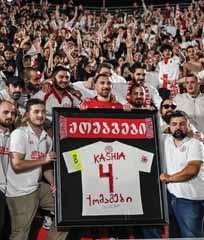
Guram Kashia Plays Final Match for Georgia
PAGE 11
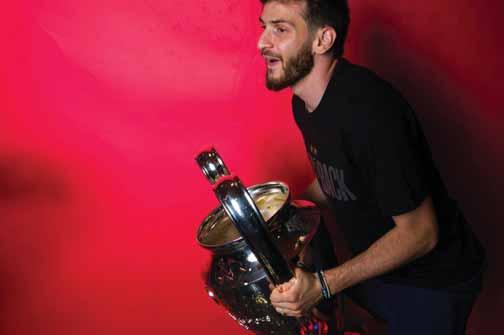
Khvicha Kvaratskhelia. Source:
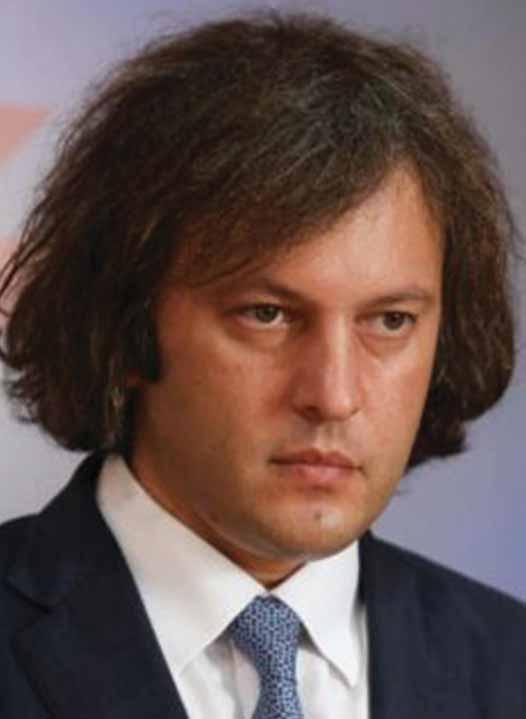
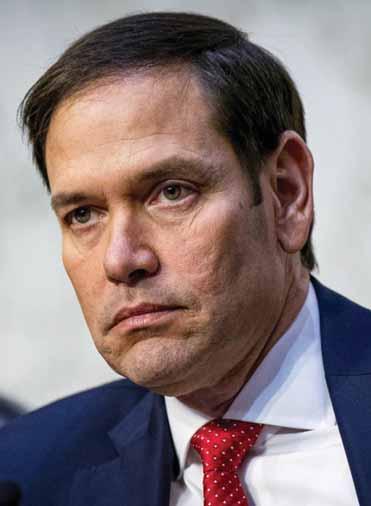
PM Kobakhidze and Marco Rubio. Sources:
and NBC news
Parents End 45-Day Protest After Agreement on Duchenne Treatment Talks
BY TEAM GT
Parents of children with Duchenne muscular dystrophy have ended their 45-day protest outside Georgia’s Government Administration after reaching an agreement with the government to establish a formal working process on access to treatment.
The decision follows a second meeting between Prime Minister Irakli Kobakhidze and parents, during which both sides agreed to create a permanent working group involving the Ministry of Health and parents to advance discussions on the procurement of medicines for children with the disease.
One of the parents, Zakro Gvishiani, said the outcome marked a breakthrough after weeks of protest: “Victory has been achieved in this worthy and great struggle. I congratulate all the parents, all the patients, and our supporters who stood with us in this great and worthy struggle,” he said.
According to Gvishiani, the working group will focus on two medicines out of the four requested by parents, with negotiations continuing with pharmaceutical companies. He said a final decision is expected within about two months and will depend on the best possible conditions for patients. He did not name the medicines under discussion, saying disclosure could affect the process.
PM Kobakhidze confirmed the agreement, stating that work on procurement will now begin through the new mechanism: “We agreed to create a working
group with the participation of representatives of the Ministry of Health and parents,” he said, adding that the final decision would consider multiple factors, including proposals from pharmaceutical companies.
Health Minister Mikheil Sarjveladze said the working group format would ensure that the needs of children and patients are fully taken into account: “This is critically important and necessary so that not only in the direction of medicines, but in all other directions, there is an opportunity to maximally satisfy and protect the best interests of children and patients,” he said.
He added that parents and patients would be informed first, followed by full public communication.
Following the agreement, parents said they are ending daily protests and shifting to a “working mode.” However, a previously planned Sunday march will still take place as a “march of gratitude.”
The protest lasted 45 consecutive nights outside the Government Administration, with parents demanding access to four medicines used in Duchenne treatment: Elevidys, a gene therapy for eligible patients; exon-skipping therapies targeting dystrophin gene mutations; Givinostat, which aims to slow disease progression; and Vamorolone, a steroid alternative with fewer side effects.
During the campaign, the Ilia Student Movement also raised 2 million GEL to support children with Duchenne.
Parents say they will now continue working with the government through the new mechanism while awaiting a final decision on funding and procurement.
Kvaratskhelia Named Champions League Player of the Season
Continued from page 1
The triumph marked PSG’s second consecutive Champions League title. A year earlier, the Paris club won the trophy for the first time in its history with a dominant 5-0 victory over Inter Milan in the 2025 final, where Kvaratskhelia also scored.
Alongside Kvaratskhelia’s Player of the Season recognition, UEFA also named several other award winners. Real
Rubio Hopes for a Change in Georgia’s Trajectory and Behavior as It Moves to Improve US Ties
BY TEAM GT
US Secretary of State Marco Rubio has expressed hope for a positive shift in Georgia’s political trajectory and its relations with the United States, saying Washington has outlined the steps needed for improved bilateral ties and received encouraging responses from Tbilisi.
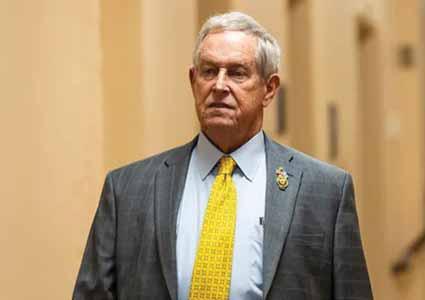
Speaking during a hearing in the US House of Representatives, Rubio responded to a question from Republican Congressman Joe Wilson, who criticized the ruling Georgian Dream party and raised concerns about Georgia’s political direction and foreign policy orientation.
Wilson alleged that the Georgian Dream government was threatening US interests, claimed elections in Georgia had been rigged, and accused the authorities of facilitating sanctions evasion by Iran’s Islamic Revolutionary Guard Corps.
In response, Rubio said the issues raised by Wilson reflected Washington’s existing concerns regarding Georgia.
“You’re right. All of the things you’ve mentioned are our current concerns,” Rubio stated. “They’ve taken some steps that indicate that they want to improve their relationship with the United States. We’ve outlined to them what it would take. We’ve received
some positive responses.”
The US Secretary of State said Washington hopes to see meaningful changes in Georgia’s current course.
“Our hope is that we’ll see a change in the trajectory that we have in Georgia today,” Rubio said. “They asked us what it would take to improve relations with the United States. We’ve responded, and hopefully, we will build on that basis and maybe change not only the trajectory of our relationship with Georgia, but also their behavior.”
Rubio did not specify which measures Washington had requested from the Georgian authorities, but his comments come during strained relations between the two countries and ongoing criticism from US officials over democratic backsliding and governance issues in Georgia.
The remarks suggest that the US administration remains open to improving relations with Tbilisi if it sees concrete changes addressing its concerns.
See more on page 4
Kaladze Reveals Plans for New Mtskheta-Digomi Road
BY LANA KOKAIA
Tbilisi Mayor Kakha Kaladze says studies are underway on a potential new road connection between Mtskheta and Didi Digomi, aimed at easing traffic congestion in the capital.
Speaking during a debate on Rustavi 2, Kaladze said discussions have already
taken place with the Ministry of Infrastructure and research is being carried out to determine the feasibility of the project.
“I have not said this yet and I will say it for the first time on your programme: we have had several meetings with the Ministry of Infrastructure and research work is underway regarding new road infrastructure,” the Tbilisi mayor said.
Kaladze noted that the study will determine what type of project could be implemented to create an alternative entrance from Mtskheta to Didi Digomi.
He also highlighted another possible infrastructure project, involving the construction of a high-speed highway linking Avchala-Zahesi and Lilo without entering the city center.
“If a high-speed highway is built in the direction of Lilo via Avchala-Zahesi without entering the city, this is also a very important project,” Kaladze said. The mayor did not provide a timeline for either project, saying the results of the ongoing studies are expected in the near future.
Parki Ar Minda Announces Campa Bottle Return Halt
BY LANA KOKAIA
Environmental organization
‘Parki Ar Minda’ says Campa has discontinued its glass bottle return program after encountering difficulties with the bottle-cleaning process.
Madrid’s Arda Güler was chosen as Revelation of the Season, while Federico Valverde won Goal of the Season. PSG midfielder Vitinha was named Player of the Match in the final.
Kvaratskhelia was also included in the Champions League Team of the Season, together with four PSG teammates: Ousmane Dembélé, Marquinhos, Nuno Mendes and Vitinha. Arsenal players David Raya, Gabriel and Declan Rice were also selected in the team.
“Campa has shut down its bottle return program as they couldn’t get the cleaning process to work reliably,” the organization said in a statement.
As a result, Campa bottles should now be sorted with regular glass waste and sent for recycling.
Parki Ar Minda noted that it occasionally collects separate batches of bottles for ‘Kokoshela’, a small producer that reuses them for plant-based milk and other beverages. The organization says
collection dates will be announced through its social media channels and volunteers.
The group added that it is currently collecting large Campa bottles for Koko-
with their lids attached.
Protest in support of children with DMD. Source: MOSE
shela. These bottles must be returned
Parki Ar Minda said its waste-sorting guidelines have been updated to reflect the changes.
Parki ar minda: Photo: Parki ar minda.
A road. Source: The Roads Department of Georgia
Republican Congressman Joe Wilson criticized the ruling Georgian Dream party. Source: TheHill
Ukraine Latest: Russia Escalates Aerial Campaign as Ukraine Strikes Deep into Russian Territory
COMPILED BY ANA DUMBADZE
The war in Ukraine entered another intense week marked by some of the largest aerial attacks of the conflict, continued fighting along key eastern frontlines, and growing international concern over both the humanitarian toll of the war and the fate of thousands of Ukrainian children transferred to Russia. While ground operations remained largely characterized by attritional warfare and limited territorial changes, both sides significantly expanded long-range strikes against military, energy and industrial targets far behind the front line.
Russia’s military maintained pressure across much of the eastern front, particularly in the Donetsk region, where fighting remained concentrated around Pokrovsk, Kostiantynivka, Toretsk and the broader Kramatorsk axis. Russian forces continued attempting to exploit local breakthroughs achieved during previous months, but Ukrainian defenses largely prevented any major operational advances. Based on the battlefield assessments published during the week, Moscow’s spring-summer offensive has so far failed to produce a decisive breakthrough despite sustained pressure and heavy expenditure of personnel and equipment. Ukrainian forces continue to hold most key defensive positions, while Russia’s territorial gains remain limited and measured in small villages and incremental advances rather than significant strategic victories.
The most dramatic developments occurred in the air. In what Ukrainian
officials described as one of the largest Russian aerial assaults since the start of the full-scale invasion, Russia launched a massive overnight barrage involving more than 650 drones and over 70 missiles against targets across Ukraine. Kyiv, Dnipro, Zaporizhzhia, Kharkiv, Poltava and several other regions came under attack. Ukrainian authorities reported that at least 22 people were killed and more than 100 injured, while residential neighborhoods, critical infrastructure facilities and civilian buildings suffered extensive damage. Several children were among the victims. Russian forces employed a combination of Shahed-type drones, ballistic missiles and hypersonic weapons, apparently seeking to overwhelm Ukraine’s increasingly strained airdefense network.
The attacks underscored one of Kyiv’s growing concerns: the shortage of advanced air-defense interceptors. Ukrainian officials warned that Russia is increasingly relying on ballistic and hypersonic missiles, which are more difficult to intercept and require Patriot systems or equivalent capabilities. Reports indicate that several advanced Zircon and Iskander missiles successfully penetrated Ukrainian defenses during this week’s strikes, highlighting Ukraine’s urgent calls for additional Western air-defense assistance.
Russian attacks also continued to target Ukraine’s energy infrastructure, although not on the scale seen during previous winters. Energy facilities and power distribution networks in several regions suffered damage, contributing to localized outages and placing additional strain on the country’s electricity system. The renewed pressure on energy infrastructure suggests Moscow continues to view attacks on civilian
utilities as a key component of its broader strategy to weaken Ukraine’s resilience and economy.
Ukraine, meanwhile, intensified its own long-range strike campaign against targets deep inside Russia. In one of the most notable operations of the week, Ukrainian drones struck energy and military facilities in St. Petersburg, including an oil terminal and infrastructure associated with the Kronstadt naval base. The attacks occurred shortly before the opening of Russia’s flagship St. Petersburg International Economic Forum and appeared designed to demonstrate Kyiv’s growing ability to reach strategic targets far from the battlefield. Russian authorities reported injuries and infrastructure damage, while fires were observed at several facilities. The strike formed part of a broader Ukrainian campaign against Russia’s energy sector. Throughout recent months, Ukrainian drones have repeatedly targeted oil refineries, fuel storage depots, export terminals and other energy-related infrastructure across Russia. Analysts say these attacks aim to reduce fuel supplies available to the Russian military while simultaneously imposing economic costs on Moscow. Several major refineries and export facilities have suffered disruptions, fires or temporary shutdowns as a result of the campaign.
Cross-border attacks also continued to affect Russian regions near Ukraine. Drone strikes and shelling incidents were reported in Belgorod, Kursk and other border areas, while Russian officials claimed additional civilian casualties from Ukrainian attacks. Ukraine has generally framed such operations as legitimate strikes against military infrastructure supporting Russia’s invasion, while Moscow has continued to
characterize them as attacks on civilian territory.
Beyond the battlefield, one of the most significant humanitarian issues to receive renewed international attention this week concerned the fate of Ukrainian children taken from occupied territories. In an interview with CBS News, President Volodymyr Zelensky accused Russia of systematically abducting Ukrainian children, erasing their national identity through ideological indoctrination and, in some cases, preparing them for future military service against their own country. Zelensky claimed that Ukrainian authorities have gathered evidence indicating that some children transferred from occupied territories are being taught to reject their Ukrainian heritage and embrace loyalty to Russia.
The allegations build upon years of documentation by international organizations, human-rights groups and investigators. Ukrainian officials say they have identified more than 19,000 children who were transferred to Russia or Russian-controlled territories, though they believe the real number may be substantially higher. International concern over the issue led the International Criminal Court in 2023 to issue arrest warrants for Russian President Vladimir Putin and Russia’s Commissioner for Children’s Rights, Maria Lvova-Belova, over alleged unlawful deportations and transfers of children. Moscow continues to deny wrongdoing, insisting that children were evacuated from conflict zones for their safety. Zelensky nevertheless described the return of the children as one of Ukraine’s highest humanitarian priorities and called for greater international efforts to secure their return.
The issue is increasingly viewed by
Kyiv as one of the defining human-rights dimensions of the war.
Diplomatic activity also intensified during the week. NATO Secretary General Mark Rutte arrived in Kyiv on an unannounced visit shortly after the latest large-scale Russian missile attacks. During meetings with President Zelensky and senior Ukrainian officials, Rutte reiterated NATO’s support for Ukraine and discussed ways to strengthen defense cooperation, particularly in the area of air defense. The visit carried significant symbolic weight, coming at a time when Ukraine is facing growing missile pressure and seeking additional military assistance from allies. Rutte described the visit as an expression of solidarity and emphasized that support for Ukraine remains a central priority for the Alliance.
Ukraine’s leadership continued urging Western partners to provide additional Patriot missile batteries and interceptor missiles. Zelensky warned that Russia is attempting to exploit shortages in Ukraine’s air-defense arsenal and argued that strengthening air defenses remains the fastest way to save civilian lives. Discussions regarding future military assistance featured prominently in contacts between Kyiv and Western governments throughout the week.
NATO officials indicated that allied countries remain committed to supporting Ukraine, and recent ministerial meetings produced new pledges of assistance from member states. Although no major new weapons package matching the scale of earlier US aid programs was announced this week, European partners continued preparations for additional deliveries of ammunition, air-defense assets and military equipment.
The New Eurasian Axis: Why Kazakhstan and Georgia Matter More than Ever
OP-ED BY ABDULMELIK ALKAN, ADJUNCT PROFESSOR, WEBSTER UNIVERSITY
For years, discussions about Eurasian geopolitics revolved around the great powers. Russia, China, the United States and the European Union dominated the conversation, while smaller states were often treated as spaces through which powerful external actors competed. Yet the geopolitical map of Eurasia is changing and shaping in ways that challenge this old assumption. Increasingly, countries once considered peripheral are becoming strategically indispensable. Among the clearest examples of this transformation are Kazakhstan and Georgia.
At first glance, the two countries appear very different. Kazakhstan is a vast Central Asian state rich in oil, uranium, and critical minerals, while Georgia is a small South Caucasus country located on the Black Sea. But geography has tied their futures together. As global trade routes shift and the international system become more fragmented, both states are finding themselves at the center of a new geopolitical reality shaped by connectivity, transport corridors, and energy security. The Russia–Ukraine war accelerated this shift dramatically. For decades, much of Eurasian trade and energy transit depended heavily on Russian-controlled infrastructure. Railways, pipelines, and logistics networks built during the Soviet period continued to define regional commerce long after the Soviet Union collapsed. The war disrupted that system. Western sanctions on Russia, rising political risk, and growing uncertainty surrounding Russian transit routes forced governments and businesses to search for alternatives. That search has elevated the strategic importance of the so-called Middle Corridor, the trade route linking China and Central Asia to Europe through the Caspian Sea, the South Caucasus, and Turkey.
This is where Kazakhstan and Georgia increasingly intersect. Kazakhstan has emerged as the economic engine of Central Asia. The country accounts for roughly 60 percent of the region’s com-
bined GDP, and possesses enormous reserves of oil, uranium, copper, zinc, and rare earth minerals. In recent years, Astana has invested heavily in rail modernization, Caspian port infrastructure, and logistics development to reduce dependence on Russian transit routes and diversify access to international markets.
But Kazakhstan cannot complete this strategy alone. Its westward connectivity depends on the South Caucasus, and especially on Georgia. Once goods cross the Caspian Sea through Azerbaijan, Georgia becomes the main gateway connecting Central Asia to Black Sea ports and European markets. Georgian railways, highways, ports, and digital infrastructure therefore occupy a strategic position in the emerging Eurasian trade system.
This has transformed Georgia’s geopolitical significance. For years, Georgia was viewed primarily through a security lens; a post-Soviet state caught between Russia and the West. Today, economics and connectivity are becoming equally
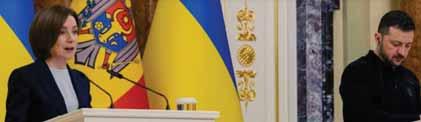
Politico: Ukraine and Moldova to Begin EU accession Talks this Month
BY TEAM GT
Ukraine and Moldova are expected to formally begin accession negotiations with the European Union later this month, reports Politico.
The EU member states are said to be preparing to launch the next stage of the accession process for both countries, marking a significant step forward in their bids to join the bloc.
The move comes nearly two years after the European Union granted candidate status to Ukraine and Moldova and follows months of discussions over reforms, governance standards and the enlargement process.
Politico reports that the opening of formal negotiations is expected to receive political backing from EU member states during June, despite ongoing debates within the bloc over enlargement and concerns raised by some governments.
The start of accession talks does not guarantee membership but represents a key milestone on the path toward joining the European Union. The process is typically lengthy and requires candidate countries to align their legislation, institutions and policies with EU standards across a wide range of sectors.
Ukraine has made EU membership one of its strategic priorities throughout Russia’s ongoing invasion, while Moldova has accelerated reforms aimed at bringing the country closer to the bloc.
Both countries submitted their applications for EU membership in 2022 and were granted candidate status later that year. The European Council formally approved the opening of accession negotiations with Ukraine and Moldova in December 2023.
If confirmed, the launch of formal negotiations in June would mark the beginning of detailed talks covering dozens of policy chapters that candidate countries must complete before becoming eligible for membership.
important. As global supply chains become more politicized and fragmented, transit geography matters again. Countries capable of linking regions together gain strategic value beyond their military or economic size. Georgia now occupies exactly such a position.
The Baku–Tbilisi–Ceyhan pipeline, the Southern Gas Corridor, the Baku–Tbilisi–Kars railway, and the Trans-Caspian transport route are gradually creating a new Eurasian axis stretching from Central Asia to Europe. What makes this moment particularly important is that these projects are no longer viewed only as economic initiatives. They are increasingly understood as instruments of geopolitical resilience. This is especially true for Europe. European governments seeking to reduce dependence on Russian energy and Russian-controlled transport routes increasingly view the South Caucasus and Central Asia as strategically important regions. Kazakhstan offers energy resources and critical minerals necessary for the green transition, while Georgia
offers physical access to European markets through the Black Sea corridor. At the same time, China also sees growing value in this route. Beijing’s Belt and Road Initiative was designed to expand continental connectivity across Eurasia, and Kazakhstan occupies a central role in that vision. Yet instability in Russian transit routes after 2022 increased the attractiveness of alternatives running through the Caspian basin and the South Caucasus. As a result, Georgia’s importance within China’s broader Eurasian calculations has also increased.
What makes the Kazakhstan–Georgia relationship particularly significant is that it reflects a larger structural transformation in world politics. The international system is becoming less centralized and more corridors driven.
Infrastructure, ports, logistics hubs, energy routes, and digital networks increasingly shape geopolitical influence.
Countries that can connect regions together gain leverage because they reduce dependency, diversify trade options, and provide strategic flexibility
to larger powers.
This is precisely what Kazakhstan and Georgia now offer. Kazakhstan’s foreign policy has been built around strategic balancing. Since independence, Astana has pursued relations simultaneously with Russia, China, the West, Turkey, and regional actors without fully aligning with any single bloc. Georgia’s geopolitical trajectory has been different, particularly because of its Euro-Atlantic orientation and security tensions with Russia, yet both countries increasingly share a similar strategic interest: avoiding isolation by embedding themselves within broader connectivity networks. That shared logic explains why cooperation between Central Asia and the South Caucasus is deepening. The relationship is no longer based only on diplomacy or regional goodwill. It is increasingly becoming an integral in economic necessity and geopolitical calculation. Kazakhstan needs stable access to the Black Sea and European markets. Georgia needs larger transit flows, infrastructure investment, and strategic relevance within Eurasian trade networks. Both countries benefit from reducing excessive dependence on Russian-controlled routes while simultaneously positioning themselves within emerging global supply chains.
This transformation also changes how smaller states exercise influence. Traditional geopolitical thinking often assumed that power belonged mainly to large military actors. But today, infrastructure and geography can generate influence in different ways. A country that controls a strategic transit corridor, energy route, or logistics network can become geopolitically important even without massive military power. Kazakhstan and Georgia illustrate this shift clearly. Neither country can dominate Eurasia militarily. Yet both increasingly shape how Eurasia functions economically. Their railways, ports, pipelines, and corridors influence the movement of energy, trade, technology, and investment across continents. In a fragmented international system, that role matters enormously.
The future of Eurasia may still be debated in Moscow, Beijing, Washington, and Brussels. But increasingly, it will also depend on what happens in Astana and Tbilisi.
US Embassy Releases Details of State Department Meetings in Tbilisi
BY TEAM GT
The United States Embassy in Georgia has released details of meetings held by a US State Department delegation with representatives of the Georgian government and opposition parties during a visit to Tbilisi from May 25–28.
Embassy says the delegation conveyed the Trump administration’s readiness to build a “constructive, forward-looking relationship” with Georgia and expressed interest in launching a new chapter in bilateral relations based on mutual respect, shared interests, and open dialogue.
The delegation met with Georgian Prime Minister Irakli Kobakhidze, Vice Prime Ministers Maka Bochorishvili and Mamuka Mdinaradze, as well as other government officials.
Based on the statement, discussions focused on areas where the United States and Georgia share common interests, including national sovereignty, economic development, resilience to external influence, and fundamental democratic values.
The US delegation also highlighted its interest in expanding commercial cooperation, increasing access for American goods and investment, and strengthening cooperation in the fields of security and energy.
“A sustainable strategic partnership will require continued progress by ensuring the conditions that make Georgia a reliable partner, including a favorable business environment for American businesses and a stable domestic political climate that is conducive to opposition engagement,” the statement said.
The embassy noted that the United States looks forward to working with the Georgian government on a partnership that delivers tangible benefits to both countries and fully realizes the potential of bilateral relations.
The delegation also held separate meetings with representatives of Georgia’s major opposition parties, including the United National Movement, Coalition for Change, Strong Georgia, and For Georgia.
Embassy says opposition representatives raised concerns regarding the treatment of opposition parties since October 2024, including ongoing proceedings in the Constitutional Court and the broader political environment.
The US delegation emphasized the importance of opposition participation in democratic institutions, stating that a functioning democracy requires an opposition capable of representing the interests of its voters through engagement with state institutions.
“Political stability and effective opposition representation are among the factors that make Georgia a reliable partner for American investment, security cooperation, and long-term strategic partnerships,” the statement said.
The delegation added that the United States remains committed to constructive engagement with all political actors interested in Georgia’s stability, sovereignty, and prosperity.
The visit came amid ongoing tensions between the Georgian government and opposition parties following the disputed October 2024 parliamentary elections.
Relations between Tbilisi and Washington have also faced challenges in recent years, with disagreements over democratic governance, political polarization, and Georgia’s foreign policy direction.
The US delegation’s visit was viewed as an effort to assess the political situation and explore opportunities for improving bilateral relations under the current US administration.
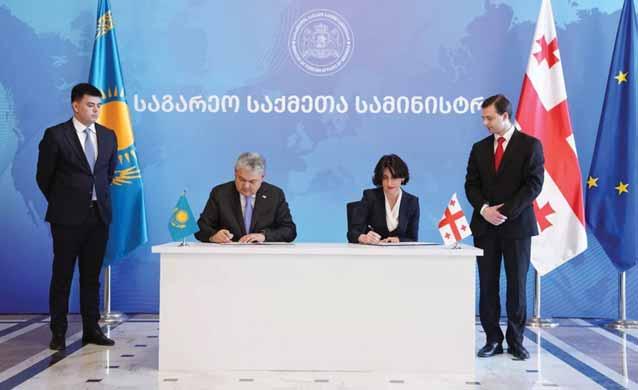
Georgian Foreign Minister Maka Botchorishvili and her Kazakh counterpart Yermek Kosherbayev sign a new cooperation program for 2026-2027. Source: caspianpost
War & Peace
OP-ED BY NUGZAR B. RUHADZE
No, this is not about Leo Tolstoy’s famous masterpiece, nor is it about other extraordinary opuses on social commotions and the brutality of war, such as Doctor Zhivago by Pasternak, Les Misérables by Victor Hugo, or Gone with the Wind by Margaret Mitchell. This is about one of the most important questions we might ask ourselves: Why can't humanity do without wars?
Especially in our glorious time of unprecedented elevation of human reason and mindfulness, unbelievable modern technological advancement, and the present uncanny smallness of the world, violence and feuds seem irrelevant. Thinking in earnest that war is not inevitable, we could certainly do without killing each other if some influential and commanding forces did not push societies toward struggle, competing for natural resources and power, motivated politically, trying to acquire something more valuable than they already have, obsessed with fear and insecurity, blinded by ideology, steeped in religious belief, seeking identity, moved by emotions like anger, revenge, and pride, and suffering from misunderstandings and miscalculations.
What are international institutions like the United Nations doing? Why is the sense of economic interdependence no longer working? Are education and diplomacy no longer functional among the peoples of the world? What makes conflict stronger and more relevant than cooperation? Could it be assumed that,
for us humans, war is a biological necessity? Hardly! We are far more likely to need food, water, shelter, social connection, and cooperation to survive than war.
Maybe this is exactly the thought and attitude that currently dominate in Sakartvelo, with people tending to spend most of their time at restaurants, entertainment venues, shopping centers, and fashion shows, cruising around in luxury cars and riding their high-tech bikes, noiselessly taking for granted the skyrocketing prices and enjoying frequent flights to various pleasant destinations around the globe. On the other hand, peaceful life is appreciated only until the moment fighter jets hover over our heads and drone-carried explosives destroy our homes. It is definitely easier to listen to bothersome political polemics and foreign-made reprimands concerning our deviations from the Western course than to scurry fearfully to bomb shelters and heartbreakingly send our kids to terrifying front lines, never to see them again.
Nobody says that human societies can completely eliminate war, but nothing should stand in our way of minimizing its risk and likelihood. Meanwhile, the contrary is happening: one war has not ended before another breaks out, and often not even for a good reason one can think of. What’s wrong with us, folks? Why can’t we coexist peacefully and enjoy life as kindly and reasonably as it is granted to us by the Creator?
Some scholars say that conflict is deeply rooted in human nature, whereas others argue that it has nothing to do with what human character represents in general.
The crux of the matter is that we have
not yet been able to create political systems, economic conditions, social institutions, and leaders whose decisions ensure that disputes among nations do not become violent.
It is an egregious modern paradox that we wage ruthless wars while at the same time creating peaceful and cooperative alliances, carrying out charitable works for the benefit of those who need help,
and forging social, economic, and political structures based on internationally accepted rules and regulations designed to make life balanced and pleasurable on Earth.
So, where is the logic?
Answering this painful question, here is where we probably stand at this point in time: we humans could absolutely live without war and, in principle, the entire
human civilization could do without it, today’s Georgia being a vivid example of this concept, but we have not yet learned how to eliminate the potential for war on this planet once and for all. Shall we ever learn?
The realists say no, and the dreamers say yes. Personally, I am not sure which group I belong to. How about you?
United in peace. Source: United Nations
Georgia Strengthens Middle Corridor Role with $372 mln World Bank-backed Transport Project
BY TEAM GT
Georgia is set to strengthen its position as a key transit link between Europe and Asia after the World Bank Group approved a $372 million project aimed at upgrading critical rail and road infrastructure along the Trans-Caspian International Transport Route, commonly known as the Middle Corridor.
The World Bank Group's Board of Executive Directors this week approved the Trans-Caspian Transport Corridor – Georgia Accessibility and Transport Enhancement (TC-GATE) Project, a major investment package designed to improve the efficiency, resilience, and capacity of Georgia's segment of the rapidly expanding trade route connecting Central Asia, the South Caucasus, and Europe.
The project comes amid growing international interest in the Middle Corridor, whose strategic importance has increased significantly in recent years as governments and businesses have sought alternative trade routes linking Europe and Asia. Georgia occupies a pivotal position along the corridor, serving as a gateway between the Caspian and Black Seas through its rail network and Black Sea ports.
According to the World Bank, the TCGATE Project will finance upgrades to rail freight capacity, modernization of key road segments, and institutional reforms aimed at improving the management of Georgia's transport infrastructure. By enhancing transport connectivity, simplifying market access, and
reducing logistics costs for businesses, farmers, and communities, the project is expected to directly benefit more than 900,000 people and help generate jobs across logistics, transport, agribusiness, and related services.
"These investments will help Georgia realize its full potential as a critical regional transit hub bridging Europe and Asia, while responding to growing demand along the Trans-Caspian Transport Corridor, reflecting evolving global trade flows and the need for diversified supply chains," said Rolande Pryce, World Bank Regional Director for the South Caucasus.
"By supporting modernization of the key rail and road links and reforms aimed at strengthening the institutions that manage them, the World Bank Group, jointly with development partners, is helping Georgia and other countries along the corridor create tangible benefits for citizens through better connectivity, safer and more resilient transport, more jobs, and stronger economic opportunities," she added.
The total cost of the project exceeds $750 million. The World Bank Group will provide $372 million, while the remainder will be co-financed by the Asian Infrastructure Investment Bank (AIIB) and the Asian Development Bank (ADB), underscoring broad international support for Georgia's connectivity ambitions and for the development of the Middle Corridor as a whole.
Georgia's government has long promoted the country as a regional logistics and transport hub, highlighting its strategic location at the crossroads of Europe and Asia. Officials argue that improving transport infrastructure is essential both for economic growth
Jobs.ge Vacancies
Fall 8.1% in April, Logistics Sees Largest
Monthly
Drop
BY LANA KOKAIA
In April 2026, 6,234 vacancies were published on jobs.ge, marking an 8.1% decrease compared to March 2026 and a 5.2% decline compared to April 2025, according to PMCG Research Center’s “Employment Tracker”.
The report says the largest monthly decline was recorded in the Logistics, Transport and Distribution category, down 12.1%, while the smallest drop among major sectors was in Information Technology and Programming, down 6.4%. On an annual basis, the IT and Pro-
and for strengthening Georgia's role in increasingly diversified global supply chains.
"Through the new project, Georgia is strengthening its role as a reliable and competitive gateway between Europe and Asia, and together with our international partners we are committed to building a modern transport network that will serve the region for decades to come," said Finance Minister Lasha Khutsishvili.
"These investments are not only important for our country's economic development and for creating new opportunities for our citizens, but also for supporting growing international trade flows and more diversified, secure sup-
ply chains, as the upgrades to Georgia's railway and road links will improve Middle Corridor efficiency and strengthen regional connectivity resilience," he said.
A major component of the project focuses on modernizing Georgia's rail freight services. Funding will be used to purchase new energy-efficient electric locomotives to replace an aging fleet and to support reforms aimed at improving the operational efficiency, financial sustainability, and governance of JSC Georgian Railway.
According to project estimates, the upgrades will increase locomotive availability to 95 percent, improve service reliability for freight customers, support a 20 percent increase in revenues, and
reduce net emissions by more than 2.3 million tons.
The project will also finance the construction of two four-lane road sections in Kakheti, one of Georgia's most important agricultural regions. Planned works include the Badiauri–Chalaubani–Bakurtsikhe sections, as well as a new road linking Gurjaani and Telavi. Officials estimate the improvements will reduce travel times between Telavi and the Black Sea port of Poti by approximately 43 minutes, improve road safety, and provide more reliable access to markets. Built to climate-resilient standards, the roads will incorporate measures designed to reduce disruptions caused by floods and landslides, helping ensure year-round connectivity for people and goods.
In addition, the project will support the digitization of road asset management, the establishment of a National Highway Control Center, the deployment of Intelligent Transport Systems, and measures aimed at strengthening the long-term fiscal sustainability of Georgia's road sector.
The initiative also includes support for women entrepreneurs in Kakheti and analytical work exploring opportunities for greater private-sector participation in road management.
For Georgia, the project represents another step in a broader effort to capitalize on the growing importance of the Middle Corridor. As cargo volumes along the route continue to increase, Georgian officials hope that investments in rail and road infrastructure will allow the country to handle greater transit flows, strengthen regional connectivity, and further consolidate its role as a bridge between Europe and Asia.
$300 mln Swissôtel Resort Project Launched in Kobuleti
BY TEAM GT
A$300 million Swissôtel Kobuleti Beach Resort project has been officially presented on Georgia's Black Sea coast, with government officials and investors describing the development as a major investment in the country's tourism, hospitality, and real estate sectors.
gramming category saw the sharpest decline, down 17.0%, while the only major category to post growth was Sales and Procurement, up 5.7%.
PMCG said a total of 19,403 vacancies were published on jobs.ge between February and April 2026, up 5.8% compared to the same period in 2025. It added that the sales and procurement category made the largest contribution to this increase. From February to April 2026, 5,017 vacancies were published in sales and procurement, up 12.8% year-on-year. In the same period, 4,194 vacancies were posted in finance and statistics, up 11.7%, while 4,443 were published in administration and management, up 5.6%, the report said.
The project, developed by Archi, Georgia's largest real estate developer, and NEXT, the company's international development division, in partnership with the global hospitality brand Swissôtel, was unveiled at a ceremony in Kobuleti attended by Prime Minister Irakli Kobakhidze, Minister of Economy and Sustainable Development Mariam Kvrivishvili, Chairman of the Government of Adjara Zurab Pataradze, Accor Vice President of Operations for Georgia and the CIS region Aron Libinson, and Jan Dijkema, Director of Chapman Taylor's Madrid studio.
The event concluded with a symbolic capsule-laying ceremony marking the start of construction.
Located just minutes from Batumi, Swissôtel Kobuleti Beach Resort will combine hotel, residential, and investment apartments within a large-scale multifunctional complex. The development will consist of three landmark buildings and feature indoor and outdoor swimming pools, conference facilities, a lobby and lounge, six restaurants operating under different brands, a casino, a 3,000-square-meter spa and fitness area, a wellness center, and a children's entertainment zone.
Officials said the project will help
strengthen Kobuleti's position as an emerging premium resort destination while further integrating the town into the region's growing tourism ecosystem.
Speaking at the presentation, Economy
Minister Mariam Kvrivishvili said the investment demonstrates international confidence in Georgia's business environment and supports the government's strategy of transforming Adjara into a four-season tourist destination.
"Today is symbolic and important, as it clearly demonstrates that the predictable, reliable and investor-friendly environment created in our country provides an incentive for investors to make such a large investment," Kvrivishvili said. She added that the project would contribute to improving tourism services in the region and create new economic opportunities during both the construction and operational phases. According to the minister, up to 500 local residents are expected to be employed through the project.
Kvrivishvili noted that tourism remains
one of the main drivers of Georgia's economy, accounting for 9.5% of the country's economic output. She said international tourism revenues reached a record $4.7 billion in 2025, while the number of international travelers exceeded 7.8 million.
Project developers said the resort will introduce international standards in hospitality and real estate development while creating long-term investment opportunities on Georgia's coastline. The launch of the project comes as Georgia continues to attract growing interest from international investors and hotel brands amid expanding tourism flows and increasing demand for highend hospitality and residential developments along the Black Sea coast.
The minister also announced that the government will continue investing in tourism and aviation infrastructure, including the planned expansion of Batumi International Airport, details of which are expected to be presented in the near future.
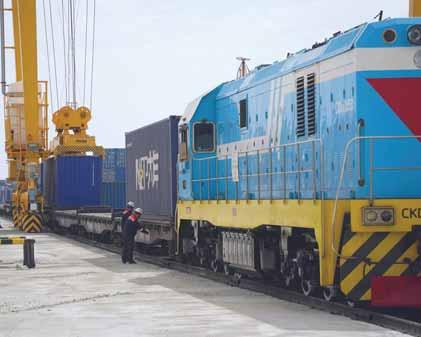
Part of the Trans-Caspian Corridor. Source: oecd
Swissôtel Kobuleti Beach Resort construction ceremony. Source: Gov't of Georgia
Office desk with a laptop, a printed bar chart, and a black mesh pen holder. Photo: AI
The Heritage of German Colonists in Georgia. Part 1
BY TATJANA MONTIK
Did you know that Georgia once had its very own Luxemburg? Before receiving its Soviet-era name in 1921, this prosperous settlement was known as Katharinenfeld. It was founded in 1818 by Swabian colonists, and from 1941 onward, the location became known as Bolnisi. In total, there were 23 German settlements across the South Caucasus.
A BRIEF HISTORY OF THE GERMAN SETTLERS
The settlers from the Kingdom of Württemberg were, for the most part, devout Pietists, explains Oliver Reisner, a professor at Tbilisi State University. For several years, he has been teaching a course to Georgian students on the history of German colonists in Georgia. Back home in Germany, they had practically broken away from the official church, establishing Bible study circles and electing their own spiritual mentors. When famine struck Württemberg, triggered by the eruption of Mount Tambora and the aftermath of the Napoleonic Wars, they chose a different path from many others: instead of migrating to America, they headed east. The Swabians answered the call of the Russian Tsar, who sought to fortify Christianity in the Caucasus, a region surrounded by Muslim lands. The imperial authorities recalled their positive experience with the Volga Germans and attempted to replicate it in the South Caucasus.
THE SOUTH CAUCASUS: A NINETEENTH-CENTURY HOTSPOT OF THE RUSSIAN EMPIRE
For the Russian Tsar, the Germans arrived at the most opportune moment. Until the late 1820s, the South Caucasus remained an arena of fierce geopolitical struggle among the Ottoman, Persian (Iranian), and Russian empires. Local peasants could not produce enough agricultural yields to sustain the growing needs of the imperial army, whereas the Germans were regarded as model farmers upon whom high expectations were placed.
However, a fundamental misunderstanding arose between the authorities and the German settlers. According to Johann Bengel, one of the primary preach-
ers of Pietism, Jesus Christ was prophesied to return to Earth for the Last Judgment in the year 1836. Believers felt compelled to be physically present at the designated "place of judgment"— Jerusalem. Consequently, the Pietists were in no hurry to establish permanent roots in the South Caucasus; their ultimate destination was the Holy Land. Obsessed with the Second Coming, they did only the bare minimum required for immediate survival, fully intending to move onward at the first opportunity. Yet, the Tsarist Cossacks barred their way. This is vividly documented in a fascinating exchange of correspondence among Russian officials compiled in the Acts of the Caucasian Archeographic Commission, preserved today in the National Library of Georgia.
Gradually, the religious fervor of the German settlers waned as their material prosperity grew. A popular saying eventually emerged regarding these migrants: "The first generation finds death, the second finds need, the third finds bread."
This meant that economic stabilization only arrived after three generations.
Counting from the initial migration wave in 1817 and measuring three 15-year intervals, the beginning of their economic boom aligns precisely with the year 1845.
This socio-economic evolution can be traced directly through their architecture: while the earliest residential dwellings were rudimentary, the Germans later began erecting sturdy, two-story timber-framed (Fachwerk) houses complete with private courtyards and deep cellars, some of which descended several stories underground.
THE COLONISTS' WORK ETHIC
Tsar Alexander I’s calculations proved entirely correct: the South Caucasus witnessed the vivid manifestation of the classic Swabian character trait, encapsulated by the motto: "Schaffe, schaffe, Häusle baue" ("Work, work, build a little house"). While their Georgian neighbors excelled like no other in celebrating and enjoying the pleasures of life, everything within the Swabian colonies was subordinated to a rigorous work ethic.
In the Swabian colonies of the South Caucasus, such as Katharinenfeld (Bolnisi), Rosenfeld (Sartichala), and Elisabetthal (Asureti), German pragmatism and diligence yielded spectacular results. By applying advanced European agrotechnologies to the region's rich native soils, the colonists gathered record harvests year after year. The true triumph
of the Swabians, however, was their winemaking. By blending the European tradition of aging wine in oak barrels with local viniculturee, they established the industrial production of high-grade wines that were supplied directly to the imperial court and shipped abroad for export. Furthermore, the colonies were renowned for their breweries and the impeccable quality of their meat and dairy goods. German dry-cured sausages, smoked hams, and bacon were crafted according to traditional recipes and valued like gold throughout the entire region. Following the establishment of Soviet rule in Georgia, the German settlements were converted into highly successful collective farms. The transition was seamless because, long before Soviet collectivization, the Germans had already organized themselves into tight-knit communes: a foundational structure that had governed their entire way of life for over a century. A documentary film from the late 1920s survives, showcasing the former village of Elisabetthal (by then renamed Asureti) as a model Soviet village.
Following Hitler’s invasion of the Soviet Union, all ethnic Germans were abruptly categorized as "enemies of the people." The authorities initiated a hasty, sweeping deportation. The dragnet reached the South Caucasus on October 18, 1941. It was an absolute tragedy that left a deep, multi-generational trauma: families were forced to pack their lives into a single night, forbidden from taking almost any of their belongings.
In K. Bochorishvili’s book Voluntary Settlers, a dedicated chapter recounts the cruelty and injustice that shattered the peaceful lives of the residents of Luxemburg (present-day Bolnisi). The author highlights the recollections of an eyewitness to the events, an NKVD operative identified as O.M.:
"We did not think back then about whether it was fair or not. There was an order, and it had to be executed. Emotions were pushed to the background, even though many of us, myself included, were married to German women and had to participate in the expulsion of our own relatives. On the very first evening, we went to notify the families and brief them on the organizational matters: how much time was allowed for packing and what they could bring along. People were in absolute shock. A single question was on everyone's lips: What for? Restrained by nature, they managed without hysterics or tears this time as well, but witnessing it was all the more difficult.
“And yet, there were those who could not withstand the psychological toll: Karl Heiter, the manager of the haberdashery store, a man described by those who knew him as possessing a crystal-pure soul, upon learning of the deportation, smashed his head against a wall, crying: 'I was born here, I grew up here, I don't want to leave! I have no one abroad, and I can betray no one! Why am I being driven out?!' His sole guilt was his nationality. Those abandoning their ancestral homes were certain they were heading to death. And indeed, very few of them managed to survive and endure the grueling trials of exile and the labor army (Trudarmiya).”
Here is another eyewitness account from the same book, describing the scene in the former Katharinenfeld:
“The NKVD men scurried from courtyard to courtyard. They shouted, threatened, struck people, hurried them along, and struck even more terror into the
trembling souls of the frightened elderly. Many were well over 80 years old, and to die in their homeland was their final wish. Groans and weeping echoed all around. At the designated assembly point, not only did columns of trucks laden with people and their meager belongings line up, but a multitude of dogs came running as well. ... They ran for a long time with their tongues out, breathing heavily, their eyes locked onto their masters. ... They had never had to endure anything like this before. Their masters had never had to endure anything like this either. For several days following the evacuation of the Germans, the NKVD men shot the remaining dogs and cats. A dead silence descended upon the town.”
NATELA: LIVING TESTIMONIES
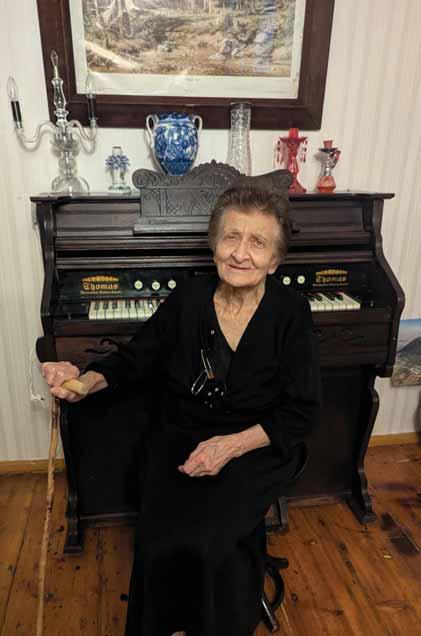
“When they were being loaded into the trucks, they screamed. They all screamed with one voice: 'Farewell, homeland!'— with tears in her eyes,” recounts 83-yearold Natela. “They had lived here for so many years! Was that not a tragedy?”
A native of Bolnisi, Natela Grigolia knows about the German settlers firsthand. Although the vast majority of the German population was deported to Kazakhstan in 1941, and Natela was born two years later, she grew up enveloped by German traditions and songs. As a young girl, she was surrounded by the love of her mother’s close friends, those German women who managed to escape exile by virtue of being married to Georgians, Armenians, or representatives of other local nationalities.
Despite her advanced age, Natela remembers all of these "German aunties" and their family members by name: Hanna Kurt, Alisa Walker, Lida Schnorr, Aunt Erna Speiser, Lisa Mayer. For the holidays, Natela recalls, people in Bolnisi continued to bake traditional German pies and cakes, Nusskuchen and Ribiselkuchen (redcurrant cake), and for the New Year, Lebkuchen, spiced Christmas cookies. Even pork was slaughtered and prepared according to German methods, with the meat entirely processed into sausages, smoked hams, and cold cuts. Smoked ham made according to German recipes was prepared by everyone in the area: both Armenians and Georgians alike.
Natela recalls that until the death of Stalin, the German women were terrified to speak German, let alone teach the language to their children. Only
within a tight, trusted circle of friends did they allow themselves to softly sing songs in their native tongue.
"LITTLE
EUROPE" IN KATHARINENFELD
Natela’s mother, Anna, was a scholar of German studies. Born in 1915, she grew up in Katharinenfeld and graduated from the local German school, the only one in the settlement. Anna possessed an impeccable command of both standard literary German and the local Swabian dialect.
Her mother's stories of a blissful childhood spent among the German colonists became permanently etched in Natela's memory. “Whoever came here in the old days never wanted to leave,” she says with admiration. “We had a Little Europe right here! All the streets were paved with cobblestones. The Germans engaged in a wide variety of crafts: they built carriages, opened tailoring workshops, and ran antique shops. And they took their famous wine to Tbilisi to sell.”
“Our street was one of the very first in Katharinenfeld and was called Gartenstraße (Garden Street, or Bagis kucha in Georgian),” Natela notes. “The Walkers, the Allmendingers, and the Mayers lived here. My parents settled in with the Blinkenmayers.”
Natela receives guests in her old German house, a spacious, bright, and solidly built home that once belonged to Lydia Buchrer. The expansive living room features antique furniture, while the walls are adorned with paintings, reproductions, and an old tapestry. Resting against one wall is a harmonium. In the past, this musical instrument, a domestic reed organ, was found in almost every German home for weekly practices of sacred music.
“Unfortunately, the unique stove that heated several rooms simultaneously in our house, as in many others, was dismantled over time,” Natela laments. “Only in those families where the German housewives remained were the stoves left untouched: the women used to hide their homemade ham inside them.”
Tatjana Montik, journalist, author, and passionate admirer of Georgia, has spent the past 15 years living in and reporting on this captivating South Caucasus country. See more of her experiences in her new travel diary and cultural guide, Georgia: A Tapestry of Time and Space. To Be Continued...
Natela Grigolia. Photo by the author
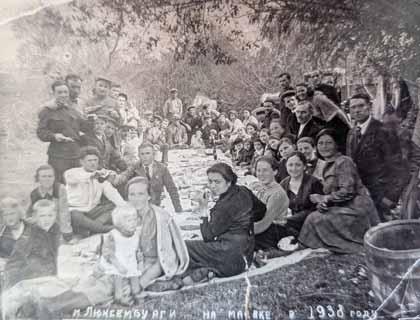
Picnicking German settlers, with Natela's mother, Anna, in front. Photo by the author
The Courage of Imperfection: When the City Sings to Itself
BY IVAN NECHAEV
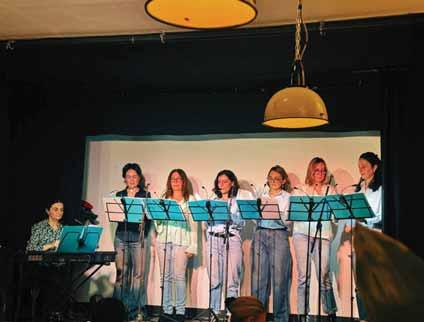
In a cultural landscape often dominated by virtuosity, competition, and institutional prestige, the concert of the community choir Opus 117 offered something increasingly rare: music as a civic practice.
Held at the warmly intimate Bistrot76, the evening gathered a group of amateur singers whose professions range from accountant and programmer to lawyer, doctor, and artist. The ensemble, Tamar Akhvlediani, Ketevan Kharatishvili, Nana Gvazava, Marina Ortolashvili, Mano Japaridze, and Nino Turabelidze, appeared before the audience first as musicians and only later as citizens. At the end of the concert, listeners learned exactly
who had been performing: “an economist,” “an accountant,” “a programmer.”
The announcement landed almost like the final scene of a contemporary theater piece. The revelation shifted attention away from the stage and back toward the city itself.
Each participant briefly spoke about a composer who held personal significance for them, turning Beethoven, Schubert, Chopin, and Bach into figures of lived
Towards the Ideal Shot
BY TONY HANMER
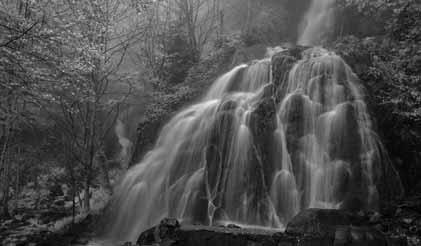
There is a small roadside waterfall on your way up from Jvari towards Mestia, Upper Svaneti, which I always notice as I go by. I
first photographed it in about 2000, in autumn, and find it the most beautiful waterfall in all of Georgia, in my subjective opinion of course. It’s a bit before or below the popular food stop village of Barjashi.
In winter, the flow will be minimal, but late in the season snow will have fallen and transformed the scene, possibly with
icicles if it gets cold enough this lowdown in altitude. In spring, which is when my last couple of photographic attempts are from, there will be a much greater run of water (it might well even be raining, plus there’s snow melt from above). Mist, too, might feature.
I set my camera’s ISO (light sensitivity) to 100, the lowest it allows, and take
experience rather than distant monuments of classical culture. The repertoire felt thoughtfully curated and pedagogical in the best sense of the word: ambitious enough to challenge, modest enough to remain honest.
The musical results were naturally uneven. This was not professional choral singing, and technical imperfections were never hidden. Yet the performance possessed qualities often absent from
more polished productions: genuine attentiveness, careful listening, respect for the score, and a visible willingness to learn. Even the dynamic shaping of phrases revealed patient work and musical curiosity.
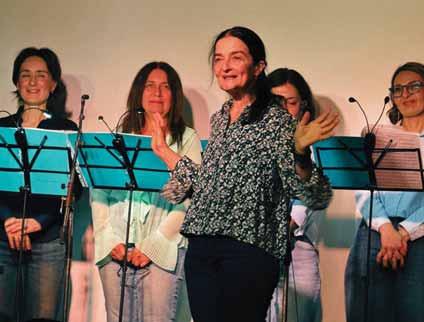
This is where Nino Janjgava's work as artistic director became particularly evident. Conducting an amateur ensemble requires a skill set distinct from directing professionals. Technical instruction is only one component. Equally important is the ability to create an environment where participants feel empowered to engage seriously with difficult material without becoming paralyzed by comparison. Throughout the concert, Janjgava's influence could be heard in the choir's attention to phrasing and dynamic contrast. The singers demonstrated a collective awareness of musical shape that exceeded their technical limitations. Crescendos arrived with purpose. Textures expanded and contracted. Musical lines possessed direction. These are signs of listening: perhaps the most important skill any ensemble can develop.
The event ultimately resembled a contemporary citizens’ theatre: residents looking at residents, discovering one another through art. In an era obsessed with excellence, Opus 117 quietly reminded its audience that participation remains one of culture’s most valuable forms.
the aperture (which lets in light) to its largest number, which paradoxically means smallest hole. This forces the shutter speed to be as slow as possible, about 1/2 second hand-held. Any slower would require a tripod to eliminate camera shake, and would also need a neutral density filter on the lens to uniformly block a portion of light, allowing a shutter speed of from, say, 1 to 30 seconds or even longer. But 1/2 second is enough to blur the falling water into gently curved lines, something the eye can’t see directly.
Magic begins.
A few weeks ago, I included a foreground rock and used my 18-55mm “kit” lens. The gently mist was a nice atmospheric element, but the foreground rock wasn’t ideal. My last attempt, from just a few days ago, didn’t have the mist. But I stood even closer to the waterfall, and used my widest lens, 10-18mm. This shot was taken in light rain, and a couple of raindrops on the lens I later removed in post-processing. I prefer the position of this shot to the previous one. Both I converted to black and white, lightening the green foliage to nearly white.
I think the next thing I want to try is to get higher than I can from the ground, say, on a small ladder. I also want to make the shot even slower than 1/2 second, which will necessitate the filter and tripod. A bit of bother, but likely to be worth it.
This is all to say that, with a subject only slightly changing, such as a waterfall, you can keep going back, trying different approaches both in making the shot and
in processing it afterwards. Another thing I might try is a night shot, lit by moonlight or starlight instead of a sunlit one, which would also naturally lengthen the shooting time. (I might also light these night versions with artificial light, from an unusual angle.) Still or windy weather (keeping the leaves relatively still or blowing them into blurs) are other variations; as is the necessary cold, snowy, icy winter version. Also, different lenses, and thus different distances from the subject. LOTS of variations.
Considering all these possibilities, and trying them as time allows, lets me make small steps towards what will be one or more “ideal” versions of the scene. Not yet satisfied, but moving in the right direction. I’ll likely convert every attempt to black and white, so that color won’t distract.
What waterfall is YOUR favorite one in Georgia? Is it easily accessible, or not? Busy or not? (This one can have many people stopped at it, simply because of being visible right from the road, with no hike necessary to reach it.) Enjoy.
Tony Hanmer has lived in Georgia since 1999, in Svaneti since 2007, and been a weekly writer and photographer for GT since early 2011. He runs the “Svaneti Renaissance” Facebook group, now with over 2000 members, at www.facebook.com/groups/ SvanetiRenaissance/
He and his wife also run their own guest house in Etseri: www.facebook.com/hanmer.house.svaneti
In the contemporary classical music landscape, orchestral tours often function as cultural diplomacy disguised as concert programming. Every appearance abroad becomes a statement about identity, artistic priorities, institutional confidence, and the ways nations choose to represent themselves through sound. This perspective makes the arrival of the Polish Baltic Frédéric Chopin Philharmonic Orchestra in Tbilisi an event of unusual importance.
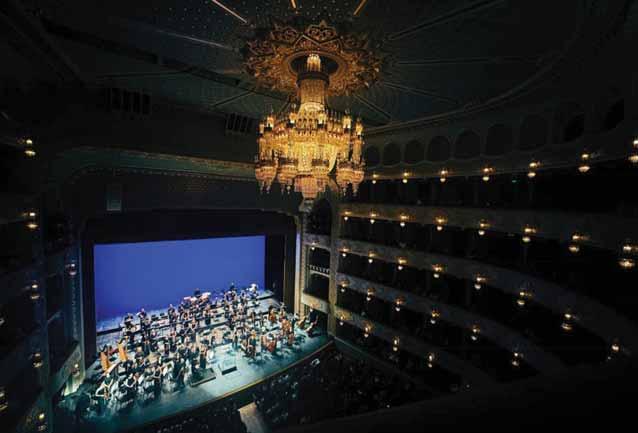
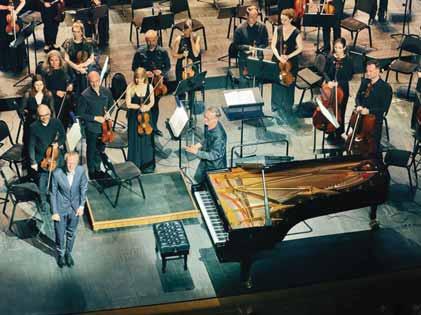
For the first time, one of Poland's leading symphonic institutions appears before Georgian audiences, bringing a carefully curated repertoire that spans the late Romantic tradition, twentieth-century modernism, and the central canon of European orchestral music. The two evenings at the Tbilisi Opera and Ballet Theater, under the direction of conductor Gogi Chichinadze, reveal a dialogue between two cultural regions situated on opposite shores of Europe’s historical imagination: the Baltic and the Caucasus.
The Polish Baltic Frédéric Chopin Philharmonic Orchestra occupies a unique position within Poland’s cultural ecosystem. Based in Gdansk, a city whose history embodies centuries of exchanges between Central Europe, Scandinavia, Germany, and the Baltic world, the orchestra carries within its institutional identity a complex geography of memory. Gdansk has long been a crossroads where political histories, commercial routes, and cultural influences intersect. The same city that witnessed the birth of the Solidarity movement also nurtures one of Poland's most internationally active musical institutions.
The orchestra's association with Frédéric Chopin provides an additional symbolic layer. While Chopin remains perhaps the most universally recognized figure in Polish culture, the Baltic Philharmonic has consistently avoided treating his legacy as a museum artifact. Instead, it has embraced a broader mission: presenting Polish musical traditions within an expansive European framework. This philosophy becomes visible in the Tbilisi repertoire. Interestingly, the orchestra does not arrive carrying a program devoted exclusively to Polish music. Instead, it presents itself through a broader European narrative, positioning Polish musical culture
as an active participant in the larger history of continental art music. Such a decision demonstrates artistic confidence. Institutions secure in their identity rarely feel compelled to define themselves narrowly.
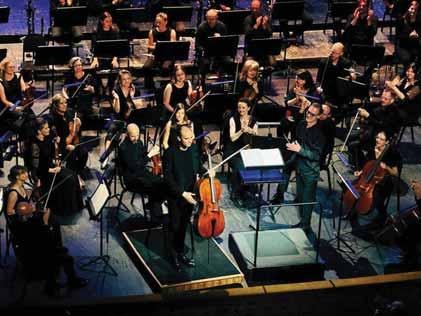
The first evening places Antonín Dvorák’s Cello Concerto in B minor alongside Tchaikovsky’s Sixth Symphony, the Pathétique. At first glance, these works belong comfortably within the standard symphonic repertoire. Yet their pairing reveals a profound emotional architecture. Dvorák’s Cello Concerto occupies a unique place in nineteenthcentury music. Written in New York during the composer's American period, it emerged from a creative moment in which questions of national identity and universal expression became inseparable.
The concerto is frequently celebrated for its lyrical beauty and technical brilliance. Such praise, while justified, often overlooks its structural sophistication. Unlike many Romantic concertos, Dvorák avoids treating the soloist as a heroic protagonist battling against orchestral forces. Instead, the cello becomes a participant in a larger symphonic conversation. The work resembles a symphony with obbligato cello more than a traditional virtuoso vehicle.
For soloist Maciej Kułakowski, this presents a demanding artistic challenge. The performer must sustain a narrative that balances intimacy with grandeur, lyricism with architectural clarity. The concerto's emotional center lies in its
final movement, where personal memory enters the musical discourse. Dvorák incorporated references associated with his dying sister-in-law Josefina, transforming what might have been a triumphant conclusion into a meditation on loss and remembrance.
The result is music that continually oscillates between public and private expression—a characteristic that resonates strongly with contemporary audiences living amid similar tensions between collective history and individual experience.
If Dvorák's concerto explores memory, Tchaikovsky's Sixth Symphony confronts mortality itself. Few works in orchestral literature have generated as much interpretive debate as the Pathétique. Premiered only days before the composer's death, the symphony has often been treated as a prophetic farewell. While such readings can become overly romanticized, they nevertheless acknowledge the work's extraordinary emotional singularity.
What remains genuinely radical about the Sixth Symphony is its formal design. The nineteenth-century symphonic tradition typically culminated in victory. Beethoven established the model. Brahms refined it. Bruckner monumentalized it. Tchaikovsky dismantled it. Instead of ending with a triumphant finale, he concludes with an Adagio lamentoso that gradually dissolves into silence. The symphony appears to move backward through emotional states: exuberance, grotesque irony, restless motion, and
finally resignation.
This reversal transformed the possibilities of the symphonic form. The famous third movement, often mistaken by audiences for the finale because of its overwhelming energy, becomes a trap. Applause frequently erupts before listeners realize that the true ending still awaits them. The final movement remains one of the most devastating passages ever written for orchestra. Rather than offering resolution, it leaves audiences suspended between acceptance and despair.
For Georgian listeners, this work carries an additional resonance. Few cultures understand the coexistence of beauty and melancholy as deeply as those shaped by centuries of political upheaval, cultural resilience, and historical memory. Tchaikovsky's final symphony speaks directly to such sensibilities.
The second evening moves in an entirely different direction. Mozart, Lutosławski, and Richard Strauss form a sequence spanning nearly two centuries of musical evolution. The result resembles a compressed history of European orchestral thought.
Mozart's Piano Concerto No. 25 in C major occupies a special place within his mature output. This is Mozart at his most public, ceremonial, and architecturally ambitious. The concerto emerged during a period in which the composer was transforming the genre from elegant entertainment into something approaching symphonic drama. The piano and orchestra engage as intellectual equals. Every phrase participates in a dynamic exchange of ideas.
For soloist Luis Fernando Perez, the work offers opportunities beyond virtuosity. Mozart demands clarity, balance, timing, and rhetorical intelligence. The challenge lies in making complexity appear effortless. The concerto's opening movement possesses a distinctly theatrical quality. One senses the influence of Mozart's operatic imagination everywhere.
Themes behave like characters. Contrasts unfold like dramatic scenes.
Such music reminds listeners that the Enlightenment was not merely a philosophical project. It was also an aesthetic one, grounded in the belief that reason, beauty, and communication could coexist harmoniously.
The inclusion of Witold Lutosławski's Small Suite may be the most significant programming choice of the tour. Among twentieth-century Polish composers, Lutosławski occupies a position comparable to that of Bartók in Hungary or Sibelius in Finland. His music redefined national traditions without surrendering to nationalism.
Composed in 1950, Small Suite draws on folk melodies from southeastern Poland. Yet its importance extends beyond ethnographic inspiration. Lutosławski transforms folk material through sophis-
ticated orchestral thinking. Rhythms become engines of structural development. Instrumental colors acquire narrative functions. Simplicity coexists with modern complexity.
For Georgian audiences, this work may feel surprisingly familiar. Georgia possesses one of the world's richest folk music traditions. Throughout the twentieth century, Georgian composers similarly grappled with the challenge of integrating traditional materials into contemporary artistic language. The parallels between Polish and Georgian musical modernities deserve closer scholarly attention than they typically receive. In this sense, Small Suite functions as a bridge between cultural histories.
The evening concludes with music from Richard Strauss's Der Rosenkavalier. By the time Strauss composed this opera, the Austro-German musical tradition had reached an extraordinary level of refinement. Harmony, orchestration, dramatic structure, and instrumental color had evolved into astonishingly sophisticated forms. The suite extracted from the opera condenses much of this brilliance.
Strauss understood the orchestra as few composers ever have. Every instrumental combination carries dramatic significance. Every texture possesses psychological weight. The famous waltz episodes reveal another dimension of Strauss's genius. They celebrate Vienna while simultaneously exposing its nostalgia, elegance, and fragility. Beneath the glittering surfaces lies a deeper meditation on time itself.
The opera's central theme concerns aging, memory, and the impossibility of preserving the past. These concerns resonate powerfully in the twenty-first century, when cultural institutions increasingly find themselves negotiating relationships between heritage and innovation.
The arrival of the Polish Baltic Frédéric Chopin Philharmonic Orchestra in Tbilisi represents a meeting between two musical cultures that have long understood art as a form of historical memory. The repertoire chosen for these performances reflects that understanding. Dvorák transforms personal grief into universal expression. Tchaikovsky confronts mortality. Mozart imagines rational beauty. Lutosławski reinvents tradition. Strauss meditates on the passage of time. Together, these works form a portrait of European culture at its most ambitious: diverse, self-critical, emotionally expansive, and historically conscious. For two evenings, Tbilisi becomes part of that conversation. And in a century increasingly characterized by noise, speed, and distraction, the opportunity to participate in such a conversation remains one of culture's most valuable gifts.
Photo by the author
Photo by the author
Photo by the author
Songs Without Borders: Maiklang Festival Turns Tbilisi into a Laboratory of Contemporary Sound
REVIEW BY IVAN NECHAEV
In recent years, the South Caucasus has increasingly become visible on Europe's cultural map. Yet visibility alone rarely produces meaningful artistic exchange. Festivals often celebrate diversity as a slogan while reproducing the same hierarchies of cultural circulation: artists travel, perform, disappear, and leave behind little more than a poster and a social media archive. The Maiklang Festival, presented by Goethe-Institut Georgia in Tbilisi between 28 and 31 May, proposed a different model. Emerging from the collaborative framework of Sonic Crossings, a program developed through the Berlinbased Pop-Kultur Festival, Maiklang functioned less as a showcase than as a temporary ecosystem for listening.
Its central theme, songwriting, may initially sound modest in an era dominated by discussions of artificial intelligence, immersive media, algorithmic recommendation systems, and experimental sound art. Yet this apparent simplicity reveals the festival's intellectual strength. Songwriting today occupies a unique position within contemporary music culture. It remains one of the few artistic practices where personal narrative, social reality, linguistic identity, and sonic experimentation can coexist within a highly accessible form.
The festival's curatorial premise recognized a crucial cultural fact: throughout the South Caucasus and beyond, independent songwriting has become one of the most important spaces for articulating contemporary experience.
In societies undergoing rapid political, economic, and technological transformation, the song has re-emerged as a flexible cultural instrument capable of carrying intimacy, dissent, memory, and collective imagination simultaneously.
What distinguished Maiklang from many international music events was its refusal to concentrate activity within a single venue. Instead, performances unfolded across a network of radically different urban spaces.
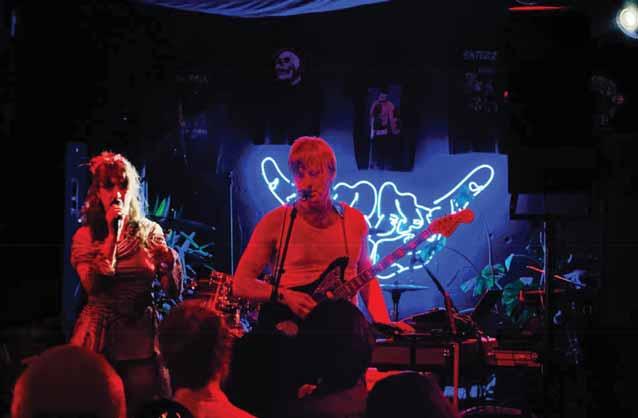
The industrial atmosphere of Fabrika
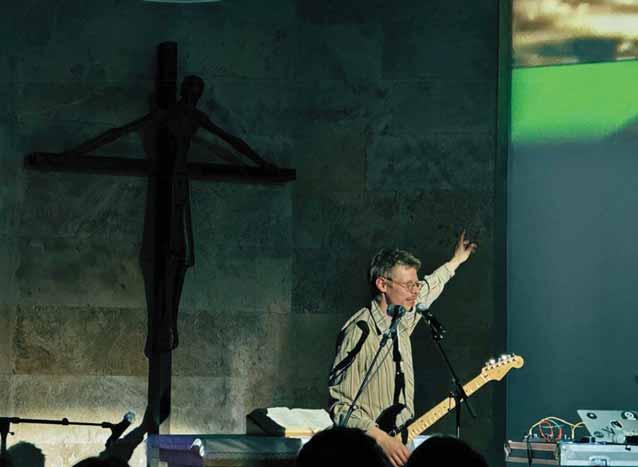
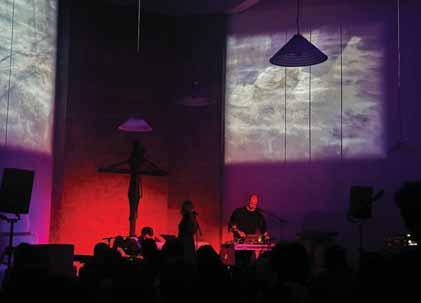
and its House of Camora stage framed the opening night. The second day moved between the sacred acoustics of the Evangelical Lutheran Church in Tbilisi and the nocturnal intimacy of Thelema Bar. The third evening unfolded in the open environment of Mushtaidi Garden, while the closing program returned audiences to the premises of the Goethe-Institut itself.
This geographical dispersal transformed listening into a form of urban exploration. Audiences were invited to move through different social environments, acoustic conditions, and symbolic contexts. The city itself became part of the curatorial framework.
Such an approach reflects broader tendencies within contemporary European festival culture, where location increasingly functions as an active component of artistic meaning. Sound is never independent from space. A song performed in a church acquires different resonances than the same song presented in a club
or public park. Maiklang demonstrated an acute awareness of this relationship between music and environment.
The most significant aspect of Maiklang may have been its insistence on songwriting as a cultural technology rather than a commercial genre. For decades, discussions of songwriting were largely dominated by Anglo-American traditions. Today, however, independent songwriting scenes have become important laboratories for local identity across Europe, the Caucasus, and the Global South. Artists increasingly work between languages, between folk traditions and electronic production, between intimate confession and social commentary.
The lineup reflected precisely this multiplicity. German artists such as Jesper Munk and Das Beat arrived from a musical culture shaped by decades of experimentation between indie, electronic music, and contemporary songwriting traditions. Armenian performers
including Symptom Error brought perspectives emerging from one of the region's most dynamic independent scenes, where electronic textures increasingly intersect with local cultural memory. The participation of Azerbaijani artist Inherroom expanded the festival's dialogue further, creating rare opportunities for cultural encounters that often remain difficult within the political realities of the South Caucasus.
Georgian artists formed the festival's largest contingent. Projects such as Araushavs, Komma, Vaqo, Louie, Tape Visitors, and Izmir illustrated the remarkable stylistic diversity that has emerged within Georgia's independent music scene over the past decade. Taken together, these artists revealed songwriting as a highly adaptable framework capable of absorbing influences from folk music, ambient electronics, indie rock, dream pop, experimental composition, and club culture.
One of the most interesting developments in contemporary cultural policy involves the growing shift away from traditional center-periphery models. Historically, cultural exchange programs often operated according to a one-directional logic: artists from smaller cultural markets sought visibility in European capitals. Berlin, London, Paris, and Amsterdam functioned as gateways through which recognition could be obtained.
The Sonic Crossings initiative, and consequently Maiklang, suggests a more horizontal approach. Berlin remains important as a meeting point, yet the ultimate objective appears different. The emphasis is increasingly placed on building long-term networks between artists themselves. The movement from Berlin to Tbilisi is therefore symbolically significant. Instead of treating the South Caucasus merely as a source of cultural material to be presented elsewhere, the project relocates attention back to the region.
This shift reflects broader changes occurring across contemporary arts ecosystems. Sustainable cultural development depends less on isolated moments of international exposure and more on the creation of durable relationships, shared infrastructures, and recurring encounters. Maiklang represented precisely such an encounter.
The festival's greatest achievement may ultimately lie in its understanding of listening itself. Contemporary digital culture encourages acceleration. Music circulates through playlists, short-form video platforms, recommendation algorithms, and endless streams of content. Discovery has become automated. Attention has become fragmented. Against this backdrop, the act of gathering in a room to hear songs written and performed by living musicians acquires renewed significance.
The Maiklang Festival proposed listening as a social practice rather than an act of consumption. Its modest scale became an advantage. Without the spectacle of mega-festival branding, audiences encountered artists at close range, within spaces where musical communication remained direct and human. That intimacy is increasingly rare.
Artists from Georgia, Armenia, Azerbaijan, and Germany were brought together through a framework that privileges dialogue over visibility and process over spectacle. The festival's value therefore extends beyond the concerts themselves. Its real legacy may emerge through future collaborations, recordings, tours, and artistic partnerships that develop from these encounters.
At a moment when cultural institutions across Europe are rethinking their social function, the Goethe-Institut's work in Tbilisi offers a compelling example of how international cultural policy can operate as infrastructure rather than branding. The most meaningful outcomes of such initiatives are often invisible at first. They appear later, in the form of artistic communities that become stronger, more connected, and more capable of imagining new cultural geographies.
Photo by the author
Photo by the author
Photo by the author
TBC Concept Presents the 19th Black Sea Jazz Festival in Partnership with Miro
BY TEAM GT
TBC Concept, a longstanding supporter of culture and one of the country’s leading patrons of the arts, proudly presents the 19th Black Sea Jazz Festival, taking place in Batumi from July 10–12, 2026.
For over a decade, TBC Concept has served as the traditional presenting partner of Georgia’s premier jazz festivals, contributing significantly to the development of contemporary music and the strengthening of international cultural exchange.
This year’s Black Sea Jazz Festival is dedicated to the 100th anniversary of the birth of jazz legend Miles Davis. The festival will open with a special tribute performance by Vince Wilburn Jr., Miles Davis’ nephew, acclaimed producer and drummer, together with M.E.B. (Miles Electric Band). The project reimagines Davis’ musical legacy through a contemporary lens, creating a unique bridge between the past and the present.
SPORTS
As tradition dictates, the festival will take place at the Batumi Tennis Courts, welcoming both internationally acclaimed artists and jazz enthusiasts from across the region.
FESTIVAL LINE-UP
July 10
The Miles Davis Centennial Celebration with the Miles Electric Band (M.E.B.)
July 11
American R&B star Eric Benét
July 12
Ghost-Note, one of the most celebrated contemporary funk and jazz-funk bands
The festival’s club venue, Take 5, will host after-parties on all three evenings, led by 11-time Grammy Award-winning musician Philip Lassiter and his band.
The Black Sea Jazz Festival is organized by Eastern Promotions, presented by TBC Concept, and sponsored by Mastercard.
EXCLUSIVE OFFER FOR TBC CONCEPT MASTERCARD CARDHOLDERS
Holders of TBC Concept Mastercard World Elite cards can purchase festival
tickets on tkt.ge with a 20% discount. To redeem the offer, simply select the discounted ticket option available on the platform.
A LONGSTANDING COMMITMENT TO JAZZ AND CULTURE
Since 2011, TBC Concept has systematically supported Georgia’s leading jazz festivals, playing a key role in the growth of the country’s contemporary music scene and its integration into international cultural processes.
With TBC Concept’s support, some of the region’s most significant musical events have been established and expanded, including the Black Sea Jazz Festival, the Tbilisi Jazz Festival, Jazz & Wine Kakheti, and the Winter Jazz Festival. Launched in Gudauri in 2024, the Winter Jazz Festival moved to Bakuriani this year, continuing its successful growth and attracting new audiences.
Through its ongoing investment in culture, TBC Concept remains committed to creating meaningful experiences and supporting world-class artistic initiatives across Georgia.
Guram Kashia Plays Final Match for Georgia
BY LANA KOKAIA
The captain of the Georgian national football team, Guram Kashia, has ended his international career following Georgia’s friendly
match against Romania. The match marked Kashia’s final appearance for the national team, bringing to a close an 18-year international career. The defender made 129 appearances for Georgia and captained the side during its participation in the 2024 UEFA European Championship.
Earlier this year, Kashia announced his
COMMERCIAL DEPARTMENT
Commercial Director: Iva Merabishvili
Marketing Manager: Natalia Chikvaidze
EDITORIAL DEPARTMENT:
Editor-In-Chief: Katie Ruth Davies
decision to retire from international football and said he would bid farewell to supporters during the friendly against Romania.
He was substituted in the 64th minute and left the field through a guard of honor formed by his teammates, receiving applause from fans and players alike.
Kashia is widely regarded as one of the most influential figures in the history of Georgian football and leaves the national team as one of its most capped players.
Journalists: Ana Dumbadze
Tony Hanmer
Nugzar B. Ruhadze
Ivan Nechaev
Lana Kokaia
Layout: Misha Mchedlishvili
Photographer: Aleksei Serov
French cinema festival. Photo: French Institute of Georgia
French Cinema Festival Returns to Tbilisi
BY LANA KOKAIA
The French Institute of Georgia is bringing back its open-air cinema festival
‘Cinema Under the Stars’ for a third edition this summer, with screenings scheduled from June 4 to July 30 in Tbilisi.
The festival will take place every Thurs-
day at the grounds of the French Embassy in Georgia, located at 4 Khazina Street, offering free film screenings in an outdoor setting.
Organizers say the event aims to celebrate the diversity of French cinema and make it more accessible to local audiences through a selection of contemporary and classic films.
The programme includes animation, dramas and comedies for different ages and tastes.
Natela Grigalashvili Opens Fereydani Georgians Exhibition in Tbilisi
BY LANA KOKAIA
Photographer Natela Grigalashvili will present a new solo exhibition titled Whither Are You Flying, O Cloud? The Fereydani Trace: Four Centuries
Later at TBC Concept Gallery, running from 6 June to 15 September, 2026.
The project is inspired by a symbolic conversation recorded during Grigalashvili’s travels in Fereydani, where a local resident recalled her mother’s words while looking at clouds in the sky.
“Whither are you flying, O cloud? Who knows, maybe you will fly over the mountains of Georgia?” the mother is quoted as saying, expressing a lifelong longing for a homeland she had never seen.
The exhibition explores the history of Fereydani Georgians, who were forcibly deported in the early 17th century under Shah Abbas and have lived for four centuries in Iran’s Isfahan province while preserving their Georgian identity and language.
Grigalashvili’s work is also informed by the 1894 writings of Lado Aghniashvili, who was the first Georgian researcher to travel to Iran in search of the “lost” Georgian communities.
The photographer’s series reflects on cultural memory, isolation, and the emotional ties between past and present generations of Fereydani Georgians. Grigalashvili, who has worked in documentary photography for more than 30 years, is known for long-term projects focused on regional communities, identity, and social transformation.
BY LANA KOKAIA
ita Jamagidze has won a gold medal for Georgia at the European Junior Championships, marking the country’s first-ever title in rhythmic gymnastics at the event since independence. Jamagidze claimed gold in the clubs exercise, scoring 26,900 points in the final to secure the European title.
The 42nd European Championships were held in Varna, Bulgaria.
International Relations & Communications
Sofia Bochoidze E: sbochoidze@georgiatoday.ge
Website Editor: Katie Ruth Davies
Webmaster: Sergey Gevenov
Circulation Managers: David Kerdikashvili David Djandjgava
Reproducing material, photos and advertisements without prior editorial permission is strictly forbidden. The author is responsible for all material. Rights of authors are preserved. The newspaper is registered in Mtatsminda district court.