In this week’s issue...
Georgia to Mark 1700 Years of Christianity with GEL 5.3 mln Statefunded Events
Ukraine Latest: Kyiv Faces Massive Strikes as it Intensifies Pressure on Russia’s Oil Infrastructure

In this week’s issue...
Georgia to Mark 1700 Years of Christianity with GEL 5.3 mln Statefunded Events
Ukraine Latest: Kyiv Faces Massive Strikes as it Intensifies Pressure on Russia’s Oil Infrastructure
BY TEAM GT
n

Doing Georgia First in Foreign Policy: On Specific Practical Issues
The Indus Waters Treaty Debate: India’s Response
Revisiting the Indus Waters Treaty: An Indian Perspective
Into the Forest of Performed Truth: David Doiashvili’s A Midsummer Night’s Dream and the Theater of Political Derealization
The Year’s Art Event
11


Speaking to supporters, she framed Independence Day as a symbol of continuity in Georgia’s statehood and stressed unity, arguing the country’s independence should be understood beyond the Soviet period.
“Our independence is not 35 years old: it is 85 years old, because the occupation period does not count,” she said. “The people gathered here today stand for unity, because independence cannot exist without unity. Defending and restoring independence also depends on the unity and determination of these people. We feel this energy that has brought people together.”
As the opposition march continued toward Rustaveli Avenue and the Parliament building, it merged with already assembled crowds for speeches and further demonstrations focused on Georgia’s political direction and European integration.
At the same time, Tbilisi hosted official Independence Day celebrations organized by the state, including ceremonial flag-raising, military oath ceremonies for new recruits, and cultural performances in central public spaces.
Alongside both the official events and the protest, the city also hosted familyand child-focused public festivities in pedestrian and recreational areas such as Orbeliani Square and Alexander Garden. These zones featured children’s entertainment spaces, interactive games, arts and crafts activities, small exhibitions, sports and movement activities, and live music performances, creating a more relaxed, festival-like atmosphere for families.
The day ultimately unfolded across central Tbilisi as a mix of state ceremonies, large-scale political protest, and family-oriented public festivities, with different parts of the city reflecting sharply contrasting moods and messages on Independence Day. Continued from page 1

BY LANA KOKAIA
Russia has threatened to suspend its gas agreement with Armenia if Yerevan continues its European Union accession process.
Russian Foreign Ministry spokesperson Maria Zakharova said Moscow could suspend or unilaterally terminate the 2013 agreement on cooperation in the supply of natural gas, petroleum products, and rough diamonds to Armenia.
Zakharova stated that on May 27, the Russian Embassy in Armenia officially handed over a letter from Russian Energy Minister Sergey Tsivilev to Armenia’s Ministry of Territorial Administration and Infrastructure.
“The Russian side will suspend or unilaterally denounce the agreement” if Armenia continues its EU accession process, Zakharova said on Telegram.
The agreement signed in December 2013 allows duty-free supplies of Russian gas and petroleum products to Armenia for domestic consumption, without the right to re-export them to third countries.
Armenia says it has not yet received
US
any written requests from Moscow regarding the issue.
On May 22, Armenian Prime Minister Nikol Pashinyan ruled out an increase in the price of Russian gas linked to the agreement, saying the current prices were agreed within the framework of “strategic agreements.”
Armenia remains heavily dependent on Russian gas supplies. In 2025, Gazprom supplied Armenia with around 2.7 billion cubic meters of gas, while an additional 476 million cubic meters came from Iran under a “gas for electricity” arrangement.
The current price of Russian gas for Armenia is $177.5 per 1,000 cubic meters.
Earlier in April, Armenian Parliament Speaker Alen Simonyan said Yerevan could begin withdrawing from the CSTO and the Eurasian Economic Union if Russia raises gas prices.
Pashinyan has previously stated that Armenia respects Russia’s role as a major power, while also insisting that Yerevan will prioritize Armenian national interests.
Russian President Vladimir Putin has meanwhile warned that Armenia cannot simultaneously be part of both the European Union and the Eurasian Economic Union.
BY TEAM GT
Armenia and the United States have signed a comprehensive Strategic Partnership Charter. The document was signed by Armenian Foreign Minister Ararat Mirzoyan and US Secretary of State Marco Rubio. Armenian media reports that the sides also signed a framework agreement on cooperation within the TRIPP (Trump Route for International Peace and Prosperity) project, as well as a framework memorandum on mineral extraction and processing.
The signing ceremony took place at Zvartnots International Airport in Yerevan.

BY LANA KOKAIA
The Georgian government is to allocate 5.3 million GEL for celebrations marking the 1700th anniversary of the declaration of Christianity as the state religion. The funding will come from the govern-
ment reserve fund, according to a decree.
The government administration says anniversary events will run from June 1 until October 14, with activities starting in a wider format from May 26.
The program will include cultural and educational events, scientific conferences and student expeditions, as well as religious commemorations such as the feast of Svetitskhoveli. A symposium titled “God, Homeland, Human” is also planned
for October 14.
The co-chairs of the organizing commission are the Prime Minister of Georgia Irakli Kobakhidze and the CatholicosPatriarch of All Georgia, Archbishop of Mtskheta-Tbilisi and Metropolitan of Bichvinta and Tskhum-Abkhazia Shio III.
The government says the events will be carried out in coordination with the Government of Georgia and the Patriarchate.


BY LANA KOKAIA
eputy Health Minister Irina Tsakadze says around half of socially vulnerable families checked so far have lost their subsistence
allowance following a re-evaluation of the state database, IPN reports.
“To date, we have verified approximately 32,000 families, and all parameters show that a certain number of these families has, fortunately, overcome poverty. As such, just under half of the verified families have had their subsistence allowances terminated,” Tsakadze said.
She noted that when the verification process began in February, the database included around 158,000 families receiving subsistence assistance, covering more than 700,000 people. Tsakadze said some families no longer meet the criteria under which they were originally registered as socially vulnerable.
Yerevan

BY LANA KOKAIA
Rpassenger rail traf
c on the Baku–Tbilisi–Baku route resumed on May 26, restoring direct train travel between the two capitals after a long suspension during the COVID19 pandemic, when Azerbaijan’s
at
the following day. The return Tbilisi–Baku service left at 21:00 and arrived in Baku at 06:24. Azerbaijan Railways says demand
added

travelling Baku–Tbilisi.
51 manats.
train
and
COMPILED BY ANA DUMBADZE
The Russia–Ukraine war entered another tense week marked by heavy Russian missile and drone attacks on Ukrainian cities, continued fighting along the eastern front, and a widening Ukrainian campaign against Russia’s energy and logistics infrastructure. While Moscow continued to rely on mass aerial strikes and pressure along several frontline sectors, Kyiv sought to demonstrate that Russia’s ability to advance on the battlefield is slowing, while Ukraine’s growing long-range strike capacity is increasingly bringing the war deeper into Russian territory.
The most serious attack of the week came overnight on May 24, when Russia launched one of its largest recent combined missile and drone barrages against Kyiv and the surrounding region. Ukrainian officials said the attack involved hundreds of aerial targets, including ballistic and cruise missiles, as well as attack drones. Kyiv was the main target. The strike killed at least four people and wounded around 100, said Ukrainian officials, while damage was reported across all districts of the capital. Residential buildings, schools, civilian infrastructure and cultural sites were among the locations affected. Ukrainian President Volodymyr Zelensky condemned the attack as another attempt to terrorize civilians, while Russia claimed it had targeted military-related facilities.
The attack also carried broader military and political significance because Russia reportedly used an Oreshnik intermediate-range ballistic missile,
underlining Moscow’s continued reliance on high-intensity missile strikes to overwhelm Ukrainian air defenses.
The barrage renewed Kyiv’s calls for additional Western air defense systems, particularly Patriot interceptors, which remain critical against ballistic missiles.
Zelensky urged the United States and Congress to provide more air defense support, arguing that Russia’s ballistic missile capability remains one of Moscow’s main advantages. Ukrainian officials said Kyiv has achieved high interception rates against drones, but that ballistic missiles continue to pose a more difficult challenge.
Beyond Kyiv, Russian strikes continued across Ukrainian regions throughout the week. In the Kharkiv region, a Russian attack killed two people, while other strikes hit civilian and infrastructure targets in frontline and rear areas.
Russia also threatened what it called systematic strikes on defense-related sites in Kyiv and urged foreign nationals to leave, a warning that Ukraine and its allies described as intimidation and blackmail. The threat came after the heavy attack on the capital and amid Moscow’s claims that it was responding to Ukrainian strikes inside Russia.
On the battlefield, the overall picture remained one of intense but limited movements. The Institute for the Study of War assessed that Ukrainian forces have been increasingly able to hinder Russian advances and regain the tactical initiative in some sectors. Russian forces continued offensive operations in eastern and northeastern Ukraine, particularly around Donetsk, Kharkiv and Sumy directions, but analysts noted that Russia’s pace of advance has slowed compared with earlier phases of the war. Ukrainian forces have also conducted
frontline strikes that appear to be disrupting Russian infiltration missions and complicating Moscow’s ability to concentrate forces for larger breakthroughs.
The Donetsk region remained the central focus of fighting. Russian troops continued to press near key defensive lines, while Ukraine sought to hold fortified positions and prevent Russian forces from turning local advances into operational gains. Ukrainian commanders have presented the coming months as a potentially decisive period. Brigadier General Andriy Biletsky, whose forces are active in the Kharkiv sector, said Ukraine may have a six-month window to seize the initiative, arguing that Russian troops are exhausted and suffering from manpower and logistical strain. He said Ukraine’s aim is to reclaim strategically important areas, especially in Donetsk, and improve its position before any future negotiations.
At the same time, Ukraine continues to face its own serious challenges, including manpower shortages, ammunition demands and the constant need for air defense coverage. Still, Kyiv’s increasingly sophisticated use of drones, unmanned ground systems and longrange strike capabilities has become one of the defining features of this stage of the war. Ukrainian forces have used these systems not only at the front but also against targets deep inside Russia, especially energy facilities that support Moscow’s war economy.
This week, Ukrainian strikes on Russian oil infrastructure remained a major development. Zelensky confirmed that Ukrainian forces had struck a refinery in Yaroslavl, roughly 700 kilometers from Ukraine. Ukrainian officials said this was part of a wider campaign against Russian oil facilities, with several refin-
eries targeted during May. Ukraine also struck the Syzran oil refinery in Russia’s Samara region on May 21, and Reuters reported that the facility had halted operations after the attack. The Syzran strike followed other attacks on Russian refining capacity and added to evidence that Ukraine is trying to weaken Russia’s fuel production, military logistics and export revenue.
Russian energy and industrial sites also came under attack in other areas.
Falling drone debris caused a fire at an oil terminal in Novorossiysk, while authorities in Russia’s Belgorod region said missile and drone strikes damaged energy infrastructure, disrupted electricity and water supplies, and killed one person while injuring another. Ukrainian attacks on Belgorod and other border regions have become more frequent, and Russia has increasingly accused Kyiv of targeting civilian infrastructure. Ukraine, for its part, argues that strikes on Russian energy and military-linked infrastructure are a justified response to Russia’s own repeated attacks on Ukrainian cities and power networks.
The impact of Ukraine’s long-range campaign appears to be forcing Moscow to adapt. Russia has moved to strengthen drone defenses around strategic and economic facilities, and new measures reportedly allow major financial institutions, including Russia’s central bank and Sberbank, to deploy defensive systems and train personnel to counter drones. The move reflects growing concern inside Russia about the vulnerability of infrastructure far from the front line, particularly as Ukrainian drones have reached facilities hundreds of kilometers from Ukraine’s border. Diplomatically, the week brought no
visible breakthrough toward peace. Russia and Ukraine remain far apart on the terms of any settlement, while Moscow continues to insist on political and territorial demands that Kyiv rejects. The Kremlin has repeatedly pushed for recognition of Russian control over occupied territories, while Ukraine insists that any peace process must respect its sovereignty and territorial integrity. The latest Russian strikes on Kyiv further hardened the atmosphere and strengthened Ukraine’s argument that Moscow is not preparing for genuine de-escalation.
Internationally, Ukraine continued to press for more military assistance, especially air defense and funding for weapons production. Kyiv expects the upcoming NATO summit to address long-term support and financing, although securing unified backing remains difficult amid political divisions among allies. The issue of air defense has become especially urgent after the latest missile attacks, with Ukrainian officials warning that existing supplies are not enough to protect cities and infrastructure from repeated large-scale barrages.
European support also remained central. Ukraine’s partners continued to discuss ways to sustain military aid, expand defense production and increase pressure on Russia through sanctions and restrictions on energy revenues. The European-financed mechanism for purchasing air defense and other weapons has become increasingly important as Ukraine seeks to cover gaps in its defenses. At the same time, debates in the United States and Europe over defense spending, NATO commitments and future security guarantees continue to shape the wider strategic environment.

OP-ED BY GEORGE KATCHARAVA
The complex geopolitical landscape of the South Caucasus is currently best observed through the lens of Armenia's agricultural trade. On May 22, Russia’s federal veterinary and phytosanitary agency implemented a strict suspension on all floral imports originating from Armenian greenhouses. While inspectors cited the detection of invasive western pests within the shipments as the formal justification, the underlying driver is undeniably geopolitical. Moscow is employing targeted economic sanctions to penalize the administration of Prime Minister Nikol Pashinyan, whose government has actively pursued stronger diplomatic and security integration with Washington and Brussels.
The timing of this trade disruption is highly calculated, arriving a mere fortnight before the country’s crucial parliamentary elections on June 7. Having lost its primary security leverage over Armenia following its non-intervention during the 2023 conflict in NagornoKarabakh, the Kremlin has turned to financial pressure. This strategy seeks to induce widespread economic anxiety among the Armenian electorate, undercutting the position of the ruling Civil Contract party while boosting the prospects of opposition factions that favor closer alignment with Russia.
However, this confrontation exposes a profound economic contradiction. Even as Moscow attempts to project dominance by threatening Armenia's export sectors, the ongoing conflict in Ukraine has made Armenia a vital channel for the sanctioned Russian economy. Consequently, Yerevan is managing an intricate balancing act: trying to detach itself from Moscow's political orbit while simultaneously generating substantial domestic wealth from the very transit trade that sustains Russian markets.
THE DYNAMICS OF COMMERCIAL COERCION
The restriction on floral products represents just the latest phase in an expanding economic conflict. Armenian growers traditionally command a notable portion of the Russian market, providing roughly a tenth of its imported tulips and offering roses at prices that significantly undercut Latin American competitors. In announcing the ban, Russian authorities stated they identified over one hundred safety infractions among tens of millions of imported stems, claiming this represented a massive spike compared to the entire previous year's figures. The financial fallout is unlikely to remain contained to the flower industry. Leadership at the Russian regulatory agency has already indicated that inspections are intensifying, with similar quality issues allegedly emerging in shipments

of Armenian fruits and vegetables. This pattern mirrors previous pressure campaigns where Russian authorities restricted Armenian dairy goods, bottled mineral waters, and traditional brandy under the umbrella of public safety enforcement. For local farmers who view Russia as their primary consumer base, a comprehensive agrarian blockade would be catastrophic.
THE KREMLIN'S WELLWORN TRADE PLAYBOOK
This strategy of phytosanitary warfare is a hallmark of Russian foreign policy across the post-Soviet space, serving as a well-worn playbook used to punish disobedience and enforce regional alignment. Over the past two decades, whenever a neighboring state has drifted toward Euro-Atlantic integration, Moscow has routinely discovered harmful impurities, pests, or health hazards in that nation's primary exports.
The historical parallels are striking and comprehensive. In 2006, as President Mikheil Saakashvili pushed Georgia toward NATO and EU integration, Moscow instituted a total embargo on Georgian wine, agricultural goods, and famous mineral waters like Borjomi. That same year, and again in 2013, Russia slapped sudden bans on Moldovan wine, meat, and fruit, deliberately timing the restrictions to sabotage Chis inau just ahead of its signing of an EU Association Agreement.
Ukraine experienced extensive trade warfare with Kyiv long before the hot wars of 2014 and 2022, facing the infamous 2005 chocolate wars against its confectionery exports, subsequent dairy blockades, and a devastating 2006 win-

ter gas shutoff designed to derail the pro-Western momentum of the Orange Revolution. Beyond these principal frontlines, Russia has utilized similar economic coercion against Belarus during periodic energy and milk disputes, and applied sudden customs blockades on Lithuanian dairy and logistics companies in 2013 to protest Vilnius hosting an EU Eastern Partnership summit.
Historically, the long-term effectiveness of these weaponized trade bans has been remarkably poor for Moscow, frequently yielding the exact opposite of its intended results. In the short term, these embargoes inflict genuine pain, forcing immediate structural adaptations, causing localized bankruptcies, and temporarily depressing GDP. However, as a tool for permanent political subjugation, the policy consistently fails.
Instead of forcing capitulation, Russia's trade blockades have acted as a powerful catalyst for economic decoupling and structural modernization.
Denied access to the unstable Russian market, countries like Georgia and Moldova were forced to radically upgrade their production standards to meet stringent European Union regulations. Today, Georgia exports its premium wines to diverse, higher-value global markets across Europe, Asia, and North America, leaving it far less vulnerable to Kremlin blackmail.
Politically, rather than scaring electorates into voting for pro-Russian factions, these heavy-handed interventions have historically solidified public resentment toward Moscow. They demonstrate to
voters that the Kremlin is an unreliable, predatory partner, ultimately accelerating the very Western integration Russia seeks to prevent.
ELECTORAL MANIPULATION
Despite this history of diminishing returns, the Kremlin continues to leverage these commercial anxieties to influence Armenia's highly unpredictable domestic political climate. Independent data indicates that the upcoming parliamentary vote represents the most severe electoral challenge of the Prime Minister's career. Domestic polling suggests that support for the incumbent Civil Contract party has receded to just over a quarter of the electorate.
This vulnerability is compounded by international studies showing that nearly a third of voters remain entirely undecided, leaving the final outcome highly volatile. Furthermore, prominent business figures with deep ties to the Russian Federation are running competitively, with some matching the Prime Minister's personal approval ratings in direct matchups. By jeopardizing the financial stability of rural communities just before polling day, Moscow aims to steer unaligned voters toward political factions that favor a return to the status quo.
Crucially, Moscow's punitive approach overlooks a reciprocal dependence: The Russian marketplace relies heavily on Armenian cooperation. Following the implementation of global sanctions in 2022, Armenia’s integration within the Eurasian Economic Union allowed the country to operate as a vital transit node. Advanced technology, consumer elec-
tronics, and industrial machinery prohibited from direct delivery to Russia are frequently routed through Armenian trade networks before crossing into Russian territory.
This intermediation has caused bilateral commercial volume to skyrocket. Regional economic records indicate that total trade between the two nations surged from a pre-war baseline of three billion dollars to an unprecedented peak of twelve billion dollars. The re-exportation of Western hardware and automotive components generated massive capital flows, while substantial precious metal transit allowed local financial entities to capture lucrative processing and logistical premiums.
While these shadow trade networks have rapidly accelerated Armenia's economic growth and fortified its banking sector, they also provide Yerevan with significant leverage. Because Russia depends on its regional partners to bypass international trade restrictions, any deliberate enforcement measures by Armenian authorities to restrict reexports or disrupt associated financial transactions would create severe bottlenecks for the Russian domestic economy.
Despite possessing these economic countermeasures, the Armenian executive branch has responded to the trade restrictions with notable moderation. Rather than initiating reciprocal sanctions or hindering transit routes toward the north, Yerevan has prioritized collaborative technical assessments to address the stated agricultural concerns. This diplomatic caution is entirely intentional. With the elections fast approaching, the administration recognizes that provoking an all-out trade dispute could invite severe asymmetric retaliation from Moscow, such as sudden price hikes on subsidized natural gas or restrictions on grain shipments, which satisfy nearly the entirety of domestic demand. To mitigate the risk of destabilization before citizens cast their ballots, the government is deliberately choosing de-escalation. Ultimately, this friction underscores the structural constraints facing Armenia's Western integration. Despite strong political messaging, new partnerships with European entities, and joint defense exercises with the United States, the country cannot instantly detach itself from its historical economic framework. Russia retains critical ownership over Armenia's energy networks, transport infrastructure, and external borders. For the foreseeable future, Yerevan remains bound to Moscow through a highly profitable yet deeply volatile arrangement of mutual reliance: one that cannot be easily dismantled by trade bans or electoral shifts.
Author’s bio: George Katcharava is the founder of eurasiaanalyst.com, a geopolitical risk and advisory firm.
BY LANA KOKAIA
Gulbaat Rtskhiladze, Head of the Eurasia Institute. Screengrab from Sputnik Georgia video.
A “Russophobia Monitoring Council” has been established in Georgia at the initiative of pro-Russian NGOs, aiming to track and analyze what its members describe as “antiRussian rhetoric” and discrimination
in the public space.
The initiative was reported by Russian state media platform Sputnik Georgia, which said the council will collect cases it defines as “Russophobia”, including alleged misinformation about Russia, distortion of historical events, and discrimination based on language or ethnicity.
Organizers say the monitoring will focus on public statements, publications and actions, with a legal group planned to assess cases and prepare possible complaints where necessary.
They added that findings will be published every three months, with particular attention to developments since February 2022. The group claims that anti-Russian rhetoric and public rallies have increased in Georgia in recent years. One of the initiative’s authors, Gulbaat Rtskhiladze, said the council could also review legislation and propose changes if any norms are considered to contain what they call “Russophobic content.” He added that the project is linked to the “Eurasia Institute” he founded alongside partner groups.
BY TEAM GT
The Prosecutor’s Office of Georgia has opened a criminal investigation into alleged abuse of authority involving violence by police officers in Gori, after video footage circulated online showing law enforcement officers physically assaulting a detainee during an arrest in the Kombinati district.
The footage, published by local outlet Kartlis Ambebi on Wednesday May 27, shows several police officers allegedly assaulting a man, later identified as Papuna Lotsulashvili, who is lying on the ground and covering his head with his hands while being restrained. In the video, one officer is seen punching the detainee in the head as others hold him down. The man appears to be attempting to shield himself while officers continue the arrest.
According to Kartlis Ambebi, the head of the Shida Kartli Police Department, Sergi Bzishvili, was also present in the Kombinati settlement at the time of the incident. The outlet also cited unverified claims that one of the detainees may have been in possession of a cold weapon, although this has not been officially confirmed.
The case was launched under Article 333, Part 3, Subparagraph “b” of the Criminal Code of Georgia, which concerns abuse of official authority committed with violence and carries a prison sentence of five to eight years. The Prosecutor’s Office said that urgent investigative and procedural actions are underway and pledged to inform the public about the results once available.
Public reaction followed quickly after the footage spread online. Bishop Zenon, Archbishop of Dmanisi and Agarak-Tashir, strongly condemned the alleged conduct, saying such acts go beyond physical violence and amount to deep psychological and social trauma. He warned that when those tasked with protecting citizens become sources of fear, it damages trust and the moral fabric of society. He also stressed that incidents involving mul-

tiple officers acting against one person can leave a particularly severe impression on the public, reinforcing perceptions of unchecked power and impunity.
Further criticism came from Lotsulashvili’s lawyer, Lasha Tkesheladze, who confirmed that his client had been transferred to a detention isolator

BY TEAM GT
Former Georgian President Mikheil Saakashvili has addressed Armenian voters in a Facebook post, urging them not to “repeat Georgia’s mistake” and to avoid voting for the party of Russian-backed oligarch Samvel Karapetyan in Armenia’s June 7 parliamentary elections.
In his statement, Saakashvili expressed support for Armenian Prime Minister Nikol Pashinyan and drew parallels between Karapetyan and Georgia’s ruling figure Bidzina Ivanishvili.
“Samvel Karapetyan is Armenia’s Ivanishvili. I think Armenians know what Ivanishvili brought to Georgia — corruption based on dictatorship, crime, the plundering of national wealth, mass political repression, restrictions on freedom of
expression on social media, international isolation, and dependence on Moscow,” Saakashvili wrote.
Addressing Armenians directly, the former Georgian president warned against choosing a political course similar to Georgia’s.
“Dear Armenian neighbors, is this really the kind of country you want? Do not repeat Georgia’s mistake, no matter how critical you may be of the current government. Georgia was also left without Russian gas, yet managed to buy it much cheaper from other neighbors. Armenia can do the same. Now that both Europe and the United States support you, do not lose this opportunity and do not cut yourselves off from the rest of the world,” he stated.
Saakashvili further argued that supporting an oligarch and opposing Pashinyan would be “virtually equal to suicide,” adding that he trusts “the wisdom of the great Armenian nation” not to make such a choice.
“Long live Armenia!” Saakashvili concluded.
Tkesheladze also said that multiple officers were involved in the incident, describing it as coordinated violence rather than an isolated act. He called for the investigation to be escalated, arguing that the case should be reclassified under provisions relating to torture. According to him, the video evidence clearly shows sustained violence and raises serious questions about accountability within the police response.
In a development, the Prosecutor’s Office on Thursday confirmed that six individuals, including police officers, were arrested over allegations that they had exceeded their official authority through violence during the detention. Authorities said the investigation found that substantial harm was allegedly caused to the victim’s rights and health. The suspects were detained on May 28 based on evidence collected shortly after the incident.
Yet Tkesheladze claimed that more police officers were involved in the violent assault against Lotsulashvili than the six officers currently detained, arguing again that the charges should be reclassified under torture-related provisions rather than abuse of authority. According to Tkesheladze, Lotsulashvili was “beaten and tortured in three separate episodes” and suffered serious injuries, including a broken rib.
“Punishing six people is not enough. Not only is the legal qualification incorrect, but not all responsible individuals have been held accountable,” the lawyer said, claiming that up to 10 officers participated in the violence.
The Prosecutor’s Office said the defendants are expected to be formally charged under Article 333, Part 3, Subparagraph “b”, and reiterated that it will continue to update the public due to high public interest.
shortly after the incident. Speaking to Kartlis Ambebi, he said it was particularly concerning that the same officers allegedly involved in the assault were also responsible for transporting the detainee. He argued that this created a situation in which a victim of alleged violence remained under the control of the individuals accused of harming him.
Prosecutors have also launched a separate investigation against Lotsulashvili under Article 353, which concerns violence against a police officer. The investigation remains ongoing, with officials stating that further procedural actions are underway as authorities assess the full circumstances surrounding the arrest and the conduct of the officers involved.

BY VICTOR KIPIANI, GEOCASE/ GEORGIA FIRST
Various comments and assessments regarding the so-called "multi-vectorism" in previous publications on the country's foreign policy have prompted numerous questions. This makes it necessary to provide a few additional and essential clarifications.
For instance, we have repeatedly stated that the modern world can no longer be divided simply into "natural" democracies and non-democracies. It is equally evident that a narrowly defined, openly declared dominance of national interests shapes the foreign policy lines of many countries. Among other circumstances, this leads to a similarly declared expansion of their range of partners.
It is also noteworthy that alongside the egoistic nationalization of foreign policy, we have witnessed global and regional actors subjecting both domestic and foreign decisions to the so-called "security test." In other words, processes are now filtered through the lens of national security, not just in the spheres of defense and security, but also in:
• Economic and investment sectors
• Infrastructure and logistics
• Cultural and educational fields, among others.
We can clearly conclude that along with the reimagining of state policy, we are witnessing the "securitization" of political thought: its militarization and security-focused shift, so to speak. This disconnects the decision-making process from ideological constraints and liberates it from various "-isms."
GLOBAL TRENDS AND THE "GEORGIA FIRST" PRINCIPLE
Globally, this trend will persist into the foreseeable future. The gap between "black" and "white," "acceptable" and "unacceptable," and "moralism" and "necessity" will narrow even further. By this, I do not mean that the line between these categories will be completely erased. However, it is a fact that based on and driven by the principle of "the end justifies the means," our country’s immediate and wider surroundings will become even more egoistic. For this, we in Georgia must begin preparing and adapting our mindset to this reality on a nationwide scale starting today.
The title of our initiative, "Georgia First," has naturally transitioned into our declared foreign policy line. Unlike the ruling party's principle of "Only Georgia," which equates to closing inward and shutting the country off from others, the "Georgia First" principle means

openness to everyone, including partnership with partners, provided there is a maximum and principled defense of Georgia's interests. Naturally, this applies wherever and to the extent that it is possible.
Therefore, infusing the country's foreign policy with the substance of "Georgia First" is deemed an equally honest relationship with both our own citizens and the outside world. The consistent implementation of this principle also means consistency in building our own nation-state, as well as distinguishing between friend and foe, and maintaining a consistent attitude toward them.
HEDGING: THE HIGH ART OF POLITICS (BEGINNING)
The modern world has significantly altered our perception of "order," as well as our understanding of international relations. In the current situation, and from a Georgian perspective, mastering the art of hedging acquires immense practical value.
The reality is that from the perspective of foreign policy management techniques, hedging (insuring) one's interests with external actors pursues several highly specific objectives, namely:
1. Avoiding exclusive dependence on an unreliable country or countries;
2. Conducting relations with countries that have diverse political regimes or governance systems, while simultaneously promoting one's own national choices within these relationships to varying degrees;
zation, among others, must be:
• At a minimum: Reducing dangerous and manipulative dependence on unreliable countries and vulnerable nodes in the supply chain;
• At a maximum: Neutralizing this dependence entirely.
It is no accident that the state policy of various nations is directly aimed at shifting from excessive dependence on others to a rational dependence. This changes the previous picture of global interconnectedness, which was once viewed through "rose-colored glasses."
This rationalization, or diversification, if you will, manifests across several key areas, particularly in the economy. More specifically, these are:
1. Trade with major global poles: Equally and without selectivity.
2. Greater economic security: Which, in extreme cases in some places, may even morph into economic autarky.
3. Localization of technologies: Meaning their local creation, implementation, and development.
4. Food self-sufficiency.
5. Implementation of diverse payment/ tax systems.
6. National industrial policy.
7. Subsidizing local production: To ensure its competitiveness in foreign markets.
8. Creation of strategic reserves.
HEDGING : THE HIGH ART OF POLITICS (CONTINUATION)
Along with a multitude of choices, medium and especially small/compact countries find themselves facing the dilemma of making a rational choice to achieve optimal results amid this abundance. Crucially, in the modern world, this choice is no longer limited to global geopolitical poles; the role of regional poles must also be taken into account. However, it is worth noting that a significant dilemma is also faced by the two main sponsors of this new "systemless" system of international relations: the United States of America and the People's Republic of China. Alongside material resources, global sponsors face an equal demand for a commitment to stability and predictability, as well as consistency in their foreign policy lines. The current picture, however, leaves us with a sense of acute deficit in this regard.
Here is the English translation of the text, continuing with the clean, structured, and highly scannable formatting style:
HEDGING FOR US: IS IT PERMISSIBLE OR POSSIBLE?
The answer regarding the permissibility of hedging for Georgia is unequivocal and clear: hedging is not only permissible, it is absolutely necessary.
The high art of hedging demands an resourcefulintellectually diplomacy
politically, Georgians will not settle for just a homeland, but will demand Georgia's transformation into a state and work practically toward that goal. In addition, it will be achievable if the Georgian state establishes itself as a self-respecting, resilient, competitive, modernized, and systemic nation-state.
Only Georgia as a nation-state will be capable of declaring and continuously managing the two paramount tasks of navigating complex external webs: Maximizing National Security and Maximizing Economic Prosperity
With the aforementioned conditions in mind, hedging in our foreign policy is achievable by first (a) correctly analyzing conflicting or diverse interests, and subsequently (b) finding windows of opportunity for Georgian interests based on that analysis to advance Georgia's own agenda.
During this analysis, the following contemporary trends must be taken into account:
(1) The critical role of economic security within the overall national security system, and the growing participation of the state in this process.
(2) The "securitization" of other functional areas alongside the economy, subjecting relevant processes and decisions to a strict security test.
(3) The application of the principle of "compartmentalization" in foreign relations. In other words: (a) Cooperating on issues where cooperation is possible; (b) Making decisions when the solution has matured; (c) Engaging in dialogue where and when dialogue makes sense; (d) Postponing issues for future resolution if discussing or settling them is currently impossible.
(4) Minimal ideology in geopolitics and maximum focus on results-oriented actions. In modern terms, this approach is called "transactionalism."
It is no accident that the state policy of various nations is directly aimed at shifting from excessive dependence on others to a rational dependence
3. Maintaining the country’s acceptability to small, medium, or large nations in trade, technology, energy, and other sectors, which in turn serves national security.
The way things are heading, hedging is not so much a conscious choice you make, but rather a consequence of the international system's "systemlessness"— a new order defined by "lack of order" and, as a result, instability and unpredictability. It appears, at first glance, to be an action counter to globalization, though this is merely a surface-level impression.
In reality, in international relations, especially in the medium and long term, hedging is the rejection of the previously held panacea of globalization and a movement toward a new, rational globalization. Therefore, rather than speaking of "de-globalization," it would be far more accurate to talk about "re-globalization."
One of the main effects of re-globali-
An organic prerequisite for economic hedging is hedging for security purposes. The present day creates an even more "creatively fertile" ground for this. It is enough to mention how relations are unfolding between Trump’s USA and NATO, the realignments in the Persian Gulf (for instance, the partnerships emerging between Israel and the UAE, or between Ukraine and several Persian Gulf nations), or even the fresh reassessment of the importance of regional blocks and alliances within the broader security system.
When discussing security, hedging in energy policy follows naturally. Without looking too far, right before our eyes, the Strait of Hormuz crisis serves as a catalyst for shifting toward renewable energy sources, as well as for Europe's pursuit of new suppliers of Liquefied Natural Gas (LNG).
The high art of hedging also drives the establishment of new standards in diplomacy, and, consequently, demands an intellectually resourceful diplomacy.
It is practically essential due to: The "orderless order" and overlapping/converging system-shaping political styles discussed in the first text; the significant weakening of international law and institutions, the fragmentation of interests across global and regional formats, and the proliferation and influence of quasistate and non-state actors; this new world of egoistic, often veiled bargaining and overt mercantilism: a world where "my" interest supersedes "our" interest, and bargaining for "my" benefit frequently comes at "our" expense; one critical condition: Remaining an organic part of Western civilization and establishing Georgia as a full-fledged member of the political West, and; the need to build Georgia not simply as a homeland, country, or state, but as a viable and competitive nation-state.
WHAT MAKES IT POSSIBLE?
As for the possibility, this becomes achievable if every citizen of Georgia, through civic rather than ethnic nationalism, infuses the word "Georgian" with political rather than ethnic meaning. As a result, every Georgian becomes a factual, rather than just a legal, citizen and stakeholder of the country. Further, if,
(5) Bold, unapologetic conversations about our own national interests during foreign contacts, which must be strictly grounded in competence and information.
(6) Maintaining a clear, realistic understanding of the feasibility and available resources when defining any agenda objective.
If we define the specific, realistic, and pressing near-to-medium-term agenda of the Georgian foreign policy line, including through the use of hedging techniques, it encompasses:
1. Securing the policy of non-recognition of Georgia's Russian-occupied territories.
2. Contributing to the establishment of Georgia as a nation-state, which, among other things, means highlighting the country's functional utility and increasing its practical participation in regional and trans-regional geo-configurations.
3. "Measuring in numbers" the performance of Georgian diplomacy, expressed through targeted involvement in attracting foreign direct investment (FDI) into the country.
Response to the Article titled "India and Pakistan still cannot agree to restore the Indus Waters Treatybut re-engagement could help bring
lasting peace" (published
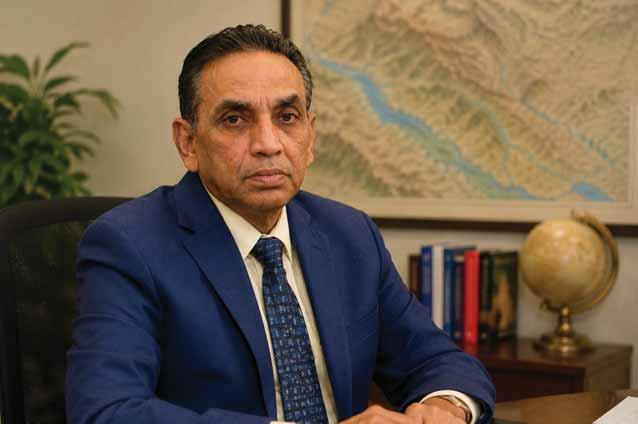
A FORMER INDIAN COMMISSIONER FOR INDUS WATERS
The article is from Chatham House, which claims to be an independent policy institute and a trusted forum for debate and dialogue and aims to help governments and societies to build a secure, sustainable, prosperous and just world. The Article presents a perspective that is heavily tilted towards preserving the status quo of a Treaty that has functioned at India's expense for over six decades.
The Article proceeds from a fundamentally flawed perspective projecting Indus Waters Treaty as an instrument of cooperation. In reality, it functioned more as an instrument of division, one that imposed a number of obligations on India, without imposing a comparable burden on Pakistan.
The durability of any water-sharing Treaty depends, mostly, on the conduct of the upper riparian. If this Treaty has endured six decades despite recurring conflicts, the credit belongs entirely to India, which, as a responsible and principled nation, continued to honor its obligations even through the most turbulent periods without any reciprocity.
This, while Pakistan continued to wield it as a political instrument to obstruct and retard development in Jammu and Kashmir.
INDIA'S SOVEREIGN RIGHT TO SUSPEND AN INEQUITABLE TREATY
The Article frames India's suspension of the Indus Waters Treaty following the Pahalgam attack as an escalatory or destabilizing act. This framing is both misleading and morally inverted. India is a victim state that suffered continued devastating terrorist attacks on its soil for decades, attributed to actors operating from or with the support of Pakistani territory. The Pahalgam attack was only
the proverbial last straw on the camel’s back. The proposition that India must continue fulfilling Treaty obligations towards a state that sponsors terrorism against India defies elementary principles of international law, including the doctrine of rebus sic stantibus, which permits suspension of Treaty obligations when the foundational circumstances have materially changed. A Treaty designed to foster cooperation cannot be expected to survive as a one-way obligation when the other party continues to undermine the bilateral relationship through proxy violence.
THE TREATY'S STRUCTURAL INEQUITY HAS BEEN IGNORED FOR TOO LONG
The Article propagates the IWT as a "stabilizing force" and a model of durability, but conspicuously ignores what India conceded under in the name of cooperation. As the upper riparian state, it was allocated only the three eastern rivers - Ravi, Beas, and Sutlej - comprising less than 20 percent of the basin's
by Chatham House on 17 April 2026).
total flow that included already in use waters. Even for this small share, India was made to pay £62 million (approximately $2.45 billion in present value) as compensation for replacement works in Pakistan-occupied Kashmir. This extraordinary concession might have been made in 1960 under geopolitical pressures at a time when India's developmental needs and the basin's hydrology were poorly understood. Six decades later, with India's population and water demand having grown enormously, and with J&K remaining chronically underdeveloped because of Treaty restrictions on water use, the arrangement has become structurally untenable. The Article contends that "should India's reservoir storage capacities improve amid surging water scarcity, there are risks of an escalating crisis", a proposition that amounts to an argument that India ought to abandon its legitimate developmental aspirations altogether.
PAKISTAN HAS WEAPONIZED THE TREATY'S DISPUTE RESOLUTION MECHANISMS
The Article speaks warmly of the Permanent Indus Commission and thirdparty processes as enabling "data sharing" and dispute management. What it omits is Pakistan's serial abuse of these mechanisms to obstruct perfectly legitimate Indian run-of-river hydropower projects on the western rivers, some with capacities of less than 5 MW causing no material harm to Pakistan's water availability. Pakistan has raised objections to the Kishanganga, Baglihar, Ratle, and several other projects, dragging India into arbitration proceedings of questionable jurisdiction and using Treaty forums as instruments of diplomatic harassment rather than genuine dispute resolution. The Article even acknowledges that technical disputes have become "more frequent and increasingly politicized" but fails to assign any responsibility to Pakistan for this deterioration.
MODERNIZATION ARGUMENTS
CUT BOTH WAYS
The IWT, as the Article itself concedes, "predates modern climate science and rests on outdated hydrological assumptions." If the Treaty is so ill-suited to present realities, the logical conclusion
is that it must be fundamentally renegotiated on terms that reflect current hydrological conditions, equitable water allocation, technological advancements and India's legitimate development imperatives. Not merely "restored" to preserve arrangements that were skewed against India from the outset.
The Article draws parallels with the Aral Sea basin, the Mekong River Commission, and the Senegal River Basin to argue for cooperative governance. These examples involve states that are broadly aligned in their developmental interests and have not engaged in sustained cross-border terrorism against one another. The IndiaPakistan relationship has no such foundation. Cooperation frameworks function where there is baseline good faith. Pakistan's continued support for terrorist infrastructure targeting India makes the comparison with the Mekong Commission or the Jordan-Israel water arrangements imperfect and fundamentally misleading.
The Article concludes by urging international actors to support "water diplomacy" and calls for "patience" in rebuilding trust. India's position is unambiguous: It maintains a strict policy that all dealings with Pakistan are bilateral, rejecting third-party mediation. Further, trust can only be rebuilt through verifiable, sustained action by Pakistan to dismantle terrorist infrastructure and honor its international commitments. To ask India to treat the IWT as sacrosanct while Pakistan continues to act with impunity is not a prescription for peace. It is a prescription for the continued exploitation of India's restraint.
In sum, this skewed Chatham House Article expects India to subordinate its sovereign interests, security concerns, and development needs to maintain an outdated and biased institutional arrangement brokered by a third party. India's measured response to Pakistani aggression, including the abeyance of the Treaty is not a threat to regional stability. It is a long-overdue signal that the terms of engagement must change.
BY TEAM GT
The steel manufacturer GeoSteel has marked a year and a half since successfully completing the second tranche of its Sustainability-Linked Bond (SLB) program.
The company issued the second tranche with the support of Galt & Taggart and repaid it within the predetermined timeframe.
Under the program, the company issued and placed a total of $20 million in bonds, of which the second tranche accounted for $5 million. This program represents the first SLB program in Georgia, and remains the only offering from the heavy industry sector in the country.
The
first tranche, issued in April 2023 for $15 million, was the company’s firstever corporate bond issuance, carrying a 9% interest rate. The second tranche was placed at an improved rate of 8.50%, made possible by oversubscription, which reached 150% of the offered volume.
Across both tranches, the company attracted 75 investors, with a maturity period of two years.
A STRATEGIC DECISION — WHY SLB?
“Unlike traditional borrowing instruments, SLBs gave us the opportunity to demonstrate tangible progress in workplace safety and emissions reduction,” representatives of GeoSteel explained.
“At the same time, this step helped us attract a more diversified investor base and secure better financing conditions. It also showed stakeholders that sustainable development is a central part of our growth strategy and risk management.”
The company’s management noted that issuing Sustainability-Linked Bonds (SLBs) was a strategic choice aimed at embedding accountability into the company’s financing structure.
ESG RESULTS — WHAT CHANGED?
Within a year and a half after issuing the bonds, GeoSteel achieved significant progress:
• LTIFR (Lost Time Injury Frequency Rate): workplace safety indicators improved.
• CO2 emissions: emissions reduction targets were achieved ahead of schedule.
• Corporate governance: higher trans-
parency standards strengthened investor confidence.
• Early repayment of obligations: fulfillment of KPI targets enabled early repayment.
“The key performance indicators encouraged targeted operational changes, resulting in measurable improvements in both safety and emissions reduction,” GeoSteel stated.
The full cycle of GeoSteel’s SLB program represents an important precedent for Georgia’s corporate bond market. The company established:
* A model for documentation standardization
* A catalyst for increased investor confidence
* Greater accessibility of ESG-linked bonds for other Georgian companies
* The country’s first ESG-linked financing model in heavy industry
This experience is considered a successful example of implementing the International Capital Market Association Sustainability-Linked Bond Principles in the local market.

OP-ED BY PRADEEP KUMAR SAXENA, A FORMER INDIAN COMMISSIONER FOR INDUS WATERS
Brig (retd) Dr Raashid Wali Janjua's letter suffers from the very same selective amnesia he accuses India of. An unbiased examination of the facts reveals that several of his contentions are historically incomplete and legally imprecise.
The author invokes the closure of the Central Bari Doab and Depalpur canals in 1948 as evidence of India's predatory intent. He omits the essential context: these canals drew water from headworks that lay entirely within Indian Territory after Partition, and the supplies were interrupted during an extraordinarily complex process of partition of India. The matter was swiftly resolved through the Inter-Dominion Agreement of May 4, 1948, in which Pakistan itself acknowledged India's sovereign rights over the headworks and agreed to pay seigniorage charges for continued water use. Far from being an act of malice, this is evidence of India’s intent to resolve every issue amicably.
The author asserts that IWT has served Pakistan's water interests well, yet simultaneously and paradoxically accuses India of "continual attempts at filching" Pakistan's water. The fact is that the Indus Waters Treaty of 1960, signed after nearly a decade of negotiations, is one of the most generous trans boundary water treaties in the world from the lower riparian's perspective. India not only relinquished its rights to approximately 80 per cent of the total Indus system waters but also paid an amount of approx-
SOCIETY

imately £62 million (approximately ₹227.5 billion in present value) as compensation for replacement works in Pakistan-
occupied Kashmir to secure use of waters which were already hers. No comparable concession by an upper riparian exists in modern water treaty history.
Janjua correctly notes that India is permitted cumulative storage of only 3.6 MAF on the Western Rivers, and that run-of-river hydroelectric projects must not alter the downstream flow regime. This is precisely India's position as well. The dispute fundamentally revolves around Pakistan's interpretation of "alteration of the downstream flow regime". Pakistan has been deploying this as an objection against every hydroelectric project India has sought to construct on the Western Rivers, regardless of project size or design. The pattern is revealing. Uri II, a project with zero pondage, was objected to. Lower Kalnai attracted objections despite the difference between India's designed pondage and Pakistan's computed figure being a matter of decimal fractions. In both cases, the factual basis for objection was negligible to the point of being technical pretext rather than substantive concern.
Pakistan has further raised objections to the Kishanganga and Ratle hydroelectric projects, both legitimate run-of-river projects fully consistent with the Treaty's provisions, by asking the World Bank to appoint a Court of Arbitration, thereby bypassing the Neutral Expert mechanism provided under the Treaty. India's objection to the Court proceedings is not an attempt to escape accountability; it is a principled position that Treaty-mandated dispute resolution mechanisms must be fully exhausted before resorting to arbitration, as expressly required under Article IX of the IWT itself. Pakistan's unilateral invocation of the Court of
Arbitration, bypassing the sequential dispute resolution ladder, is itself a breach of Treaty obligations.
India issued a notice in January 2023 seeking modification of the IWT under Article XII(3), citing Pakistan's persistent obstruction of Treaty mechanisms and unilateral resort to external arbitration as conduct incompatible with the spirit of the Treaty. This is not a unilateral abrogation but a legally available remedy. The Treaty requires renegotiation to reflect six decades of changed circumstances, including technical advancements, India's own developmental needs on the Western Rivers, and Pakistan's bad-faith use of dispute resolution provisions. India is exercising a Treaty right, not violating one.
The Egypt-Ethiopia and Syria-Iraq comparisons actually undercut Janjua's argument rather than supporting it. In those cases, there are no legally binding bilateral treaties at all, which is precisely why those lower riparians are vulnerable. Pakistan, by contrast, had a detailed, legally binding Treaty with India, which was grossly used as a political tool and not for development.
Responsible commentary on a Treaty of this complexity must rise above the narrative of predators and prey. The Indus Waters Treaty had endured for over six decades because of the generous attitude of India. India's concerns reflect a legitimate recognition of changed circumstances, and that the Treaty cannot indefinitely be wielded as a political instrument to obstruct India's lawful utilisation of its own river waters. Such inflammatory rhetoric by Pakistan clearly bring out its intent and justifies India’s stance.
OP-ED BY NUGZAR B. RUHADZE
The most glowing example is this: historically, the Georgian nation has invested much time, money, and energy into learning the Russian language and literature, associating itself with Russian culture and the Russian way of life, building close friendships, officiating interethnic marriages, and cooperating with the Russian people in various walks of life for quite a while. About thirty years ago, all this had fallen out of fashion, so to speak: the usage of the once very common Russian tongue has been obviated, human-level interaction has gone to a nadir, and Russian poetry and literature no longer appear in Georgian translation, although mutual business is still breathing and trade is still beating an occasional merry tune with the accompaniment of sporadic enthusiasts and governmental effortmakers.
Can we conclude that it was a sheer waste of time, money, and energy? Was it a historical mistake? What if the Georgian people are now making the same kind of mistake, having embarked on an almost identical investment into the English language and Western civilization? Many might ask: how rational are these kinds of investments in general?
Previously, for centuries, the necessity to do so was associated with Mongolian, Arabic, Persian, and Turkish presence. What if, in fifty or so years, we find ourselves compelled to delve into the Chinese linguistic and cultural realm for the sake of handling our survival exigencies?
I understand that these are purely historical and civilizational questions, as profound as they might sound, but they
arise naturally because we have always been forced into spending ourselves on things that seem stricken with flagrant temporariness. After all, the entire nation becomes involved in efforts that may later appear fleeting and vain when time passes and new necessities emerge.
So, what are we to do if we want to be smart and rational while keeping pace with life around the Globe, especially now that the world has become a truly small place to live in? This question may naturally arise in many a Georgian mind, but the answer to it may not be readily available. One could still say something in justification of the nation’s investments, though only in very general terms. Georgia had no way of avoiding the external political domination that has come and gone throughout history. The imposed political powers were usually accompanied by unavoidable cultural and linguistic authority, cultural exchange, to put it mildly, and by the practical necessity of adapting to these phenomena for the sake of survival and development. For Sakartvelo, the relationship with Russia was hard and oppressive in many ways, yet also culturally influential and historically unavoidable because of Russia’s geographic proximity to Georgia.
So, was learning Russian on such a massive scale an error? Most probably, such a blunt statement would bring us to an erroneous conclusion, but it was certainly not free of cost. Governmental administration was unimaginable without the Russian language; so were higher education, access to scientific literature, military affairs, and mobility within the Russian Empire initially, and later within the USSR, for more than two centuries. Many of us received education, built careers, learned literature, engineering, science, music, cinematography, and gained worldwide cognizance through

Learning languages. Source: TNW
the Russian language, while still managing to remain deeply Georgian. Dependency on Russia was heartbreaking for most Georgians, weakening confidence in native institutions, placing pressure on Georgian identity and the Church, and nurturing the subconscious belief that genuine civilization was coming from the external world. All these wounds were real, and the feeling has never entirely disappeared, even now, when all those good things still seem to be coming from outside.
Even if all this is true, no wise analyst would forgive the harsh statement that everything was wasted. After all, at that time we pursued survival using the mate-
rial and ideological tools that were available to us. Yes, nothing else was at hand. It might even be fairer to say that we, as rational human beings, strengthened ourselves through learning those foreign languages and exchanging cultural values.
The only thing that bothers me is that with every new invading force, we have had to adapt ourselves to newly born circumstances, including all those immanent and imminent variables that relentless times imposed upon us so severely, the worst part being that we had no chance to do otherwise.
Shall we say that the real historical danger lies not in embracing another civilization, but in ignoring one’s own
and forgetting who one truly is? Moreover, Georgia secured its survival by imbibing positive foreign influences without dissolving into them. History teaches us that Persia influenced court culture, the Byzantine Empire influenced religion and art, Russia influenced education and administration, and now the West influences technology, economics, and media. It is often said that small nations survive not through isolation, but through careful and discerning adaptation.
The dilemma, then, is how to learn and utilize all that we need without losing the identity we have always cherished and struggled to maintain.
BY IVAN NECHAEV
This year’s edition of Tbilisi Art Fair 2026 at Expo Georgia unfolded with a peculiar duality. On one level, it retained the recognizable structure of a regional contemporary art fair: galleries, independent platforms, emerging artists, public programs, installations, conversations, circulation. On another, the event increasingly resembled something less commercial and more diagnostic: a large-scale cultural scan of how the post-Soviet and adjacent artistic sphere currently imagines itself after three decades of political fragmentation, market transition, symbolic exhaustion, and accelerated global integration.
What distinguished this edition was neither scale nor spectacle. The fair’s significance emerged from texture. More specifically: from the way many projects demonstrated an unusual sensitivity toward materiality, historical sediment, and forms of memory embedded in objects, surfaces, architectures, and vernacular visual systems. The strongest works this year rarely operated through declarative political rhetoric. Instead, they approached history obliquely, through residue, structure, archival mutation, ritual forms, damaged aesthetics, and unstable symbolic languages.
For years, artistic production from the Caucasus and wider post-Soviet geography has remained trapped inside external expectations demanding easily exportable narratives: conflict, transition, trauma, authoritarianism, identity. Those themes remain present, inevitably. Yet the most intellectually serious practices visible at TAF increasingly move elsewhere: toward epistemology, anthropology, metaphysics, ecological temporality, or the archaeology of everyday life. In that sense, the fair revealed a region gradually escaping ethnographic readability.
EXPO GEORGIA AS AN ACCIDENTAL HISTORICAL MEDIUM
The location itself played a decisive role. Expo Georgia remains one of the most psychologically charged exhibition complexes in Tbilisi precisely because its architecture preserves the fossilized ambitions of Soviet exhibition culture. Like many exhibition grounds built throughout the USSR during the postwar decades, it functioned historically as a theatrical machine for staging industrial optimism and technological futurity. Even today, the pavilions retain a peculiar semi-utopian emptiness: large modular interiors suspended somewhere between decayed monumentality and infrastructural neutrality.
Within the context of contemporary art, this architecture acquires a second life. Works shown there inevitably enter dialogue with the spatial unconscious of late Soviet modernity. One constantly senses overlapping temporalities: socialist exhibition design, post-independence economic improvisation, neoliberal event culture, and contemporary artistic discourse occupying the same physical shell.
TAF’s curatorial ecosystem this year seemed unusually aware of this condition. Rather than concealing the spatial memory of the site through excessive scenography, many exhibitions allowed the architecture to remain partially exposed; producing a productive friction between contemporary works and inherited ideological space.
LEVAN MINDIASHVILI AND THE PROBLEM OF CULTURAL TOTALITY
Among the most conceptually rigorous projects was Levan Mindiashvili’s The


synthetic cultural model from heterogeneous Georgian symbolic systems. Mindiashvili mobilizes vernacular
architecture, polyphonic logic, liturgical spatiality, design, sound activation, and performative gathering structures as components within a broader inquiry into how collective identity is materially organized.
The key term here is “platform.” The installation does not operate autonomously as a closed sculptural object. It functions infrastructurally. Events, discussions, screenings, and sound interventions continually reactivate the work, preventing it from stabilizing into pure form. This procedural openness aligns the project with relational traditions in contemporary art, yet Mindiashvili avoids the familiar emptiness of participatory aesthetics by grounding the work in specifically Georgian epistemic structures.
Polyphony becomes especially significant in this context. Outside Georgia, polyphony is frequently aestheticized as folklore heritage. Mindiashvili instead approaches it structurally — as a model for organizing multiplicity without centralization. The work implicitly asks whether Georgian culture historically developed mechanisms for sustaining heterogeneity without dissolving communal coherence. This question extends beyond music. It touches architecture, supra traditions, liturgical choreography, oral storytelling, and social negotiation itself.
Importantly, The Mother Pillar avoids romantic nationalism. The installation’s visual language remains unstable, fragmented, partially provisional. One senses a culture attempting to assemble itself from discontinuous historical layers rather than return to imagined origins.
INDUSTRIAL GRAPHICS AND THE SOVIET VERNACULAR IMAGE
If Mindiashvili’s project examined symbolic totality, All That Material Culture in Pavilion 6 focused on the opposite scale: the microscopic politics of everyday design. Curated by Vija Skangale, the exhibition analyzed Soviet Georgian industrial graphics between 1950 and 1990 through works by Severian Ketskhoveli, Anri Samashvili, and Tsotne Moniava.
What made the exhibition compelling was its refusal to treat graphic design merely as commercial ephemera. Instead, the curatorial framework approached packaging, typography, labeling systems, and industrial imagery as ideological surfaces where Soviet standardization encountered local cultural persistence. Wine labels became particularly revealing. Within Soviet visual culture, wine branding occupied a peculiar zone between industrial bureaucracy and regional mythology. Georgian designers repeatedly inserted ornamental motifs, calligraphic rhythms, chromatic palettes, and symbolic references carrying distinctly local resonances while formally operating inside centralized production systems.
The result was neither resistance nor compliance in simplistic terms. Rather, one observed continuous negotiation. This nuance distinguished the exhibition from many contemporary attempts to revisit Soviet material culture through nostalgia or retrospective irony. The project treated design historically; as a medium through which competing symbolic orders became materially entangled.
Equally important was the exhibition’s attention to process: sketches, archival fragments, production traces, and unfinished variants revealed industrial design as a site of intellectual labor rather than decorative output.
Common Places, also in Pavilion 6, offered a quieter but theoretically sophisticated counterpoint. Featuring artists including Pentti Sammallahti and Masao Yamamoto, the exhibition investigated ordinary environments through photographic minimalism and reduced narrative intensity.
The strongest works here shared an attentiveness to peripheral perception. Doorways. Minor weather shifts. Residual shadows. Temporary arrangements
of objects. Architectural intervals. The exhibition’s curatorial intelligence lay in resisting spectacularity. Photography today often oscillates between hyperconceptual staging and endless documentary excess. Commonplaces instead returned to phenomenological observation: the slow registration of how space acquires emotional density through repeated habitation.
This approach resonated unexpectedly well within Tbilisi itself, a city where urban transformation increasingly produces discontinuous perceptual experiences: Soviet infrastructures adjacent to speculative developments, decaying courtyards beside aggressively curated hospitality spaces, informal economies intersecting with global lifestyle aesthetics. The exhibition indirectly mirrored these urban conditions through attention to unnoticed spatial atmospheres.
The TAF Hive section perhaps revealed the fair’s most important long-term direction. Unlike traditional gallery presentations, Hive foregrounded individual practices still developing their conceptual vocabularies. This produced inevitable unevenness, though also genuine moments of experimentation. Artists from Tbilisi, Baku, Yerevan, Berlin, Paris, Milan, and elsewhere formed a loose cartography of what might be called the regional studio condition: artistic production shaped simultaneously by local instability and transnational circulation. What united many younger practices was a noticeable shift away from grand ideological narration toward materially intimate investigation. Ceramics appeared repeatedly. Textiles. Found materials. Minor gestures. Archival manipulation. Private symbolic systems. Body fragments.
This tendency reflects broader transformations within post-Soviet contemporary art. Earlier generations often worked through explicit confrontation with state violence, nationalism, memory politics, or historical trauma. Younger artists increasingly approach these same realities through indirect sensory languages: less declarative, more atmospheric, sometimes deliberately opaque. Opacity here functions productively. It protects complexity from immediate consumption.
TAF’s broader importance increasingly lies in its ability to complicate visibility itself. For many years, artistic ecosystems from the Caucasus and Central Asia were discussed internationally through the language of emergence: “emerging scenes,” “new voices,” “undiscovered regions.” Such terminology carried implicit hierarchies positioning Western institutions as the primary sites of validation.
This framework now feels insufficient. The most compelling projects at TAF no longer seek discovery. They operate from the assumption that regional artistic production already possesses theoretical, historical, and formal sophistication requiring more nuanced critical engagement. What remains unresolved is infrastructural continuity.
The fair exposed both the vitality and fragility of the ecosystem surrounding it: ambitious independent initiatives existing alongside unstable funding structures, international attention intersecting with local precarity, institutional aspiration developing inside politically volatile conditions.
By the final day, TAF 2026 felt less like a marketplace than a temporary intellectual climate — one where questions about material memory, symbolic inheritance, vernacular modernities, and postimperial subjectivity could briefly circulate across disciplines, languages, and geographies without collapsing into simplified narratives.

REVIEW BY IVAN NECHAEV
There are productions that reinterpret Shakespeare through contemporary imagery, and there are productions that use Shakespeare to expose the hidden mechanics of the present. David Doiashvili’s A Midsummer Night’s Dream at Royal District Theater unmistakably belongs to the second category.
What initially appears to be another stylized Shakespeare adaptation gradually reveals itself as something much more structurally unsettling: a theatrical investigation into political hallucination, managed perception, and the unstable relationship between performance and reality in contemporary Georgia. And this becomes inseparable from the production’s historical context.
Because the “New Georgian Theater” announced alongside the premiere is not an abstract symbolic gesture. It emerges directly from institutional rupture and political conflict inside Georgian cultural life. The troupe associated with the New Georgian Theater effectively lost its theatrical home after public tensions and protest actions connected to broader political processes in the country; actors openly participated in civic protest movements, and the collective itself entered a prolonged state of confrontation with institutional structures. One actor and activist connected to the broader protest context was imprisoned, becoming a traumatic symbolic figure for large parts of the artistic community. This history fundamentally alters how the production operates. The performance is not “about” political crisis in any simplistic illustrative sense. Rather, political derealization becomes embedded into the production’s dramaturgical architecture itself.
SHAKESPEARE AFTER THE COLLAPSE OF SHARED REALITY
Most modern stagings of A Midsummer Night’s Dream focus on erotic confusion, carnivalesque liberation, fluid identity, or dream logic. Doiashvili’s interpretation appears interested in something colder and more contemporary: the institutional production of illusion. The production repeatedly returns to one central question: Where is truth spoken? Importantly, the question is
spatial rather than moral. Truth does not disappear entirely. It becomes displaced between competing theatrical systems.
Inside the world of rulers, elites, and manipulated spectacle, theater becomes an instrument of controlled fantasy. Power manufactures perception. Emotional experience becomes choreographed. Desire becomes politically aestheticized. The “dream” ceases to function as poetic liberation and begins operating as ideological atmosphere.
This is where Doiashvili’s production becomes genuinely sophisticated. Rather than simply modernizing Shakespeare politically, he appears to divide the play into competing ontological regimes. On one side: the dream-machine of authority. On the other: the crude, fragile, materially real theater of the mechanicals; the peasants, workers, amateur performers traditionally treated in Shakespeare as comic relief. And here the production makes its most radical intervention.
THE PEASANTS AS THE LAST CUSTODIANS OF REALITY
Historically, the mechanicals in A Midsummer Night’s Dream embody theater in its most primitive and transparent form. Their performances fail technically, their illusions collapse visibly, their acting is awkward, literal, and emotionally naïve. Precisely because of this, they often become the play’s most human figures. Doiashvili appears to recognize the enormous contemporary potential hidden inside this structure.
In his production, the world of official illusion increasingly resembles contemporary political media reality itself: emotionally manipulative, visually excessive, unstable, dreamlike, and ideologically managed. Meanwhile, the peasants’ theater repeatedly interrupts this hallucination through direct traces of actuality. Video footage from protests enters the stage space. Documentary fragments rupture theatrical continuity. Most devastatingly, the performance incorporates the final voice messages of an imprisoned colleague. This changes the entire philosophical structure of the production. Reality no longer exists outside theater. Reality survives only as interruption inside theater.
The peasants, traditionally positioned at the bottom of Shakespeare’s social hierarchy, become the only figures capable of reintroducing material truth into a system dominated by performed illusion. This inversion is extraordinarily
intelligent because it preserves Shakespeare’s original theatrical mechanics while radically recontextualizing them.
The “bad actors” become ethically legible precisely because their theatricality remains incomplete. Their bodies resist seamless illusion. Their speech carries friction. Their presence preserves vulnerability. In a culture saturated with professionalized spectacle, imperfection suddenly becomes truthful.
POLITICAL HALLUCINATION AND THE GEORGIAN PRESENT
The production’s real subject therefore is not fantasy, but derealization. Contemporary Georgian society increasingly exists inside overlapping aesthetic regimes: state spectacle, media dramaturgy, protest imagery, European symbolic aspiration, national mythologies, digital emotional performance, institutional instability. Public life itself has become hyper-
theatricalized. Under such conditions, Shakespeare’s forest acquires new meaning. It no longer functions merely as unconscious territory or erotic labyrinth. It becomes a perceptual zone where competing realities struggle for legitimacy. Doiashvili pushes this logic to its limit.
The dream-world of the production is not magical in a romantic sense. It resembles contemporary ideological atmosphere itself: seductive, unstable, emotionally overwhelming, visually immersive, and politically anesthetic.
One no longer knows whether characters are dreaming reality or performing it. This is precisely why the documentary intrusions matter so profoundly. Protest footage and prison voice messages do not merely “reference politics.” They puncture the ontological membrane of the production. For brief moments, theater loses control over illusion. And those moments become the production’s emotional center.
The work of scenographer Keti Nadibaidze becomes crucial within this framework. Doiashvili’s productions have long treated scenography less as visual environment than as psychological infrastructure. Space operates oppressively. Bodies become trapped inside visual systems larger than themselves. Excessive theatricality produces not liberation, but claustrophobia.
In A Midsummer Night’s Dream, this strategy acquires political dimensions. The forest appears less natural than algorithmic: an unstable immersive environment where emotional orientation continuously collapses. Characters move through sensory overload rather than pastoral mystery. Visual density itself becomes ideological. This aligns closely with the contemporary condition the production diagnoses: a society overwhelmed by competing performances of reality. The forest becomes informational space.
THE RETURN OF THEATER AS RISK
Perhaps the production’s greatest achievement lies in recovering theater’s dangerous function. Much contemporary political theater merely illustrates political
positions already familiar to its audience. Doiashvili avoids this trap almost entirely. He does not transform Shakespeare into direct protest theater. Instead, he interrogates the mechanisms through which reality itself becomes staged.
This is far more unsettling. Because the production ultimately suggests that modern political systems no longer function primarily through censorship or direct repression alone. They function through perceptual management. Through emotional choreography. Through immersive illusion. Through narrative saturation. Theater therefore becomes politically significant not when it delivers correct messages, but when it disrupts perceptual stability itself. The inserted documentary fragments accomplish exactly this. They refuse smooth symbolic absorption. The imprisoned colleague’s voice cannot fully become theater. It remains stubbornly real. And precisely because of this, it destabilizes the entire performance machine surrounding it.
Most productions of A Midsummer Night’s Dream conclude by restoring harmony. Couples reconcile, hierarchies stabilize, performances conclude, dreams dissolve. Doiashvili’s conceptual framework seems to resist such closure entirely. Because contemporary derealization has no final awakening.
The production understands something fundamental about the present historical moment: people increasingly experience reality itself through layers of mediation so dense that direct experience becomes almost inaccessible. Politics becomes spectacle. Trauma becomes content. Protest becomes image circulation. Identity becomes performative maintenance.
Under these conditions, Shakespeare’s comedy mutates into something closer to ontological horror. Who controls the dream? Who authors perception? Which performances become socially recognized as reality? And what remains of truth after theatricality colonizes everyday life itself?
Inside Royal District Theater, Doiashvili appears to answer with devastating precision: truth survives only in the moments when illusion fails.


TAF (Tbilisi Art Fair) has come and gone as I write this. My wife and I saw it coming and were in Tbilisi, not yet having relocated to Svaneti for the summer, so we went to the Tbilisi Exhibition grounds of Tsereteli Avenue on the first full day. Tickets were 25 GEL/day, or 70 for the whole event, to buy online or on location. We had missed the Tbilisi Book Fair last month by being out of the city, but this time everything came together just before our departure to the mountains.
I have been to TAF at least once before, but this was definitely a much larger deal. There were individual artists’ shows, most of these each on a side of fourwalled spaces, on one hall. A much larger hall featured galleries’ selections of various other artists; and there were special installations and films and talks being presented as well.

One thing which impressed me was the sheer range of the work: from photography using varied processes, serigraphy (screen printing), lithography and ceramic sculpture to collage, label design, painting in all genres and large enamel works in 2D and 3D. Also, the international representation was large, from as nearby as Armenia and Azerbaijan and as far as various European countries and Japan. It took some hours, and two complete tours through it all, to make sure that we hadn’t missed anything in the dazzling array.
One highlight for me was the large array, under glass, of ORIGINAL label drawings and paintings for Georgian products from many decades ago. One rarely gets the chance to see such precious things in real life, and there they were. Nice, too, that someone has undertaken to reproduce these classic designs on modern materials for the nostalgic consumer to buy and remember those past tastes. It felt a little like if one had seen the original painting for the CocaCola logo before one’s own eyes… A

COMMERCIAL DEPARTMENT
Commercial Director: Iva Merabishvili
Marketing Manager: Natalia Chikvaidze
EDITORIAL DEPARTMENT:
Editor-In-Chief: Katie Ruth Davies

fascinating glimpse into Soviet Georgian esthetics, still fondly thought of by older generations or coming back into vogue for younger ones.
“Just remember how many pictures you’ve not yet framed or hung at home…” my wife reminded me, in an effort at restraint on my buying. “No promises…” I replied, because who knows what will call out to you like a siren?
Prices were a limiting factor, though, from $25 into the tens of thousands. Pieces from tiny to huge, simple to the most elaborate, involving what must have been hundreds of hours of detailed work.
Some friends of mine were exhibiting paintings, including Guram Khetsuriani and Nika Kabelashvili. I was able to reunite with the former and congratulate him on his growing success, wishing him all the best. The latter hadn’t appeared, but seems to be doing well too.
Some personal collage works by Parajani had “Price on Request” signs; I didn’t request, knowing they would be far out of my range. Almost everything was for

sale, though, with very few exceptions. A clever mashup of Pirosmani’s fisherman and Warhol’s Marilyn could only be named one thing which I might have originated: “Piros-Marilyn.”

Journalists: Ana Dumbadze
Tony Hanmer
Nugzar B. Ruhadze
Ivan Nechaev
Lana Kokaia
Layout: Misha Mchedlishvili
Photographer: Aleksei Serov
Website
Webmaster: Sergey Gevenov
Circulation Managers: David Kerdikashvili David Djandjgava
The Venice Biennial is a bit far to get to from here, although regarded as one of the best art shows in the world (not without its politics). TAF is right here, growing, improving, putting Georgian art on the world map and bringing foreign artists and buyers here to boot. This is annual, so if you missed it this year or not, next spring it will be back. Dive in and be amazed.
Tony Hanmer has lived in Georgia since 1999, in Svaneti since 2007, and been a weekly writer and photographer for GT since early 2011. He runs the “Svaneti Renaissance” Facebook group, now with over 2000 members, at www.facebook.com/groups/ SvanetiRenaissance/ He and his wife also run their own guest house in Etseri: www.facebook.com/hanmer.house.svaneti

ADDRESS 22 Janashia Str. Tbilisi, 0179, Georgia
Tel.: +995 32 229 59 19 E: info@georgiatoday.ge F: GeorgiaToday
ADVERTISING