STRATEGY

BY TEAM GT
Trump Tower Tbilisi: 70-story Skyscraper Design Published
Ukraine Latest: Russia Intensifies Frontline Assaults as Ceasefire Efforts Collapse ahead of Victory Day
Europe, from the Atlantic to the Caspian, Gathers in Yerevan
Lasha Tughushi on his Book Stalin’s Gambit
Georgia’s Got Talent: Volcanic Talent!
The House Where Georgian Opera Learned to Breathe: Inside the Zakaria Paliashvili HouseMuseum in Kutaisi
Five People against Time: Eliso Virsaladze and the Oistrakh Quartet in Tbilisi
11


BY LANA KOKAIA
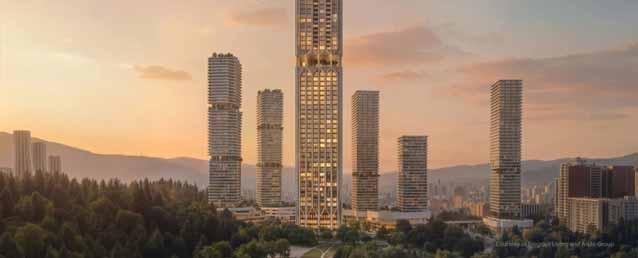
The first rendering of the Trump Tower planned for Tbilisi has been published, with Newsweek reporting that the total cost of the development in central Tbilisi is $2 billion. The image shows a 70-story skyscraper featuring the word “Trump” in gold lettering at the top.
The publication notes that the project is the latest addition to the global expansion of the Trump Organization. The Trump Tower is expected to become the tallest building in Tbilisi at 70 floors (259 meters) and will include premium residential spaces, retail zones and hotel infrastructure. The project is being developed in partnership with Georgian companies ‘Archi’ and ‘Biograpi Living.’
Trump Organization Vice President Eric Trump said the Tbilisi skyscraper will reflect the company’s highest quality standards.
BY TEAM GT
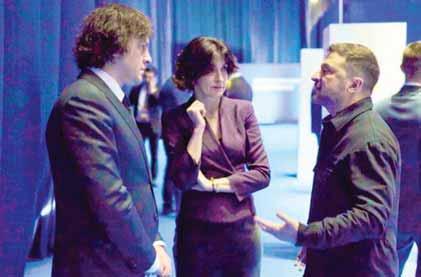
Georgian Parliament Speaker Shalva Papuashvili has criticized Ukraine’s policy toward Georgia, following a meeting between Prime Minister Irakli Kobakhidze and Ukrainian President Volodymyr Zelensky at the 8th Summit of the European Political Community in Yerevan.
Papuashvili claimed that Zelensky’s decision to engage in talks with Kobakhidze demonstrates that what he described as “unjust policies” are ineffective.
“Zelensky’s initiative to speak to the Georgian Prime Minister indicates that any policy which is unjust from the beginning is doomed to failure,” Papuashvili said.
He pointed out that despite Kobakhidze reportedly remaining on a Ukrainian sanctions list, the Ukrainian president still held talks with him, which, the Speaker claimed, reflects inconsistency
in Kyiv’s approach.
“Zelensky keeps Irakli Kobakhidze on the sanctions list. However, he had to go and talk to him himself. This shows how incorrect the Ukrainian government’s policy has been toward the Georgian people,” Papuashvili stated.
The Speaker added that Georgia maintains what he described as a policy of “unilateral friendship,” including toward countries whose policies Tbilisi considers unfair.
“We have always said that we remain in the format of unilateral friendship, not only with Ukraine, but also with all governments that have an unjust policy against Georgia. Whoever took the wrong step regarding Georgia will realize their mistake. We are ready to review all these relations,” he said.
Prime Minister Kobakhidze met President Zelensky on May 4 on the sidelines of the EPC summit in Yerevan. The Georgian government announced that the meeting was initiated by the Ukrainian side and focused on bilateral relations.

BY LANA KOKAIA
Ursula von der Leyen says Armenia has the potential to become a hub for new trade routes, highlighting closer ties between Yerevan and the European Union.
Speaking at the first Armenia-EU summit in Yerevan, von der Leyen said the shortest route connecting Europe to Central Asia and the Caspian Sea passes through Armenia, though it has been disrupted by conflict.
“Now you are changing this, thanks to a courageous choice in favor of peace and greater integration into European
networks. As a result, Armenia can become a regional hub for new trade routes,” she said, Armenpress reports.
Von der Leyen added that the EU is ready to deepen cooperation with Armenia in energy and digital transformation, stressing that relations between the two sides are now closer than ever.
She also pointed to progress in visa liberalization talks and noted that €2.5 billion has already been allocated for investments in Armenia under the EU’s Global Gateway strategy.
Highlighting ongoing conflicts across the wider region, von der Leyen said the South Caucasus presents an opportunity to demonstrate how peace and economic cooperation can bring stability and growth.

BY TEAM GT
Kmade UEFA Champions League history after helping Paris Saint-Germain (PSG) secure a place in their second consecutive Champions League final with a 1-1 draw against FC Bayern Munich in Munich.
PSG advanced to the final following a strong two-legged semi-final performance, with Kvaratskhelia playing a decisive role throughout the tie. The Georgian winger scored twice in the first leg and provided the assist for PSG’s only goal in the return match in Germany.
The 25-year-old’s performances have drawn widespread praise from international football media, broadcasters and analysts, with several outlets highlighting his historic Champions League run this season.
Football journalist Fabrizio Romano wrote on social media that “only one player in the history of the Champions
League has managed to score or assist in seven consecutive play-off games in one season — and that’s Khvicha Kvaratskhelia.”
The official Ligue 1 website described the Georgian international as “Mr. Champions League,” joking that he “was created by artificial intelligence.”
Sports platform GoalsXtra reacted to his latest display by writing: “Kvaratskhelia, are you crazy?” while broadcaster DAZN stated that the winger had become “the first player ever to score or assist in seven consecutive Champions League play-off matches in a single season.”
Meanwhile, TNT Sports noted that only three PSG players have scored 15 or more goals in Champions League play-offs: Ousmane Dembele, Kylian Mbappe and Kvaratskhelia.

Kvaratskhelia, widely regarded as one of Georgia’s greatest modern footballers, joined PSG after rising to international prominence with Italian side SSC Napoli, where he helped the club win the Serie A title during the 2022–23 season. His performances for

Khvicha Kvaratskhelia
both club and country have made him one of the most recognizable Georgian athletes on the international stage.
BY TEAM GT
Georgia’s Health Ministry has expanded state-funded medical services for children with Duchenne Muscular Dystrophy and other rare neuromuscular diseases, following months of protests by parents demanding government funding for expensive medications.
The initiative was fi rst announced by Health Minister Mikheil Sarjveladze on April 21, when he publicly responded for the fi rst time to a six-month protest campaign led by families of children with Duchenne syndrome. At the time, Sarjveladze said the government would not finance the requested drugs, citing concerns over their effectiveness and safety, but promised to expand access to outpatient, inpatient and diagnostic services for patients with rare diseases.
The Ministry says the updated state program will provide patients with consultations from neurologists, cardiologists, pulmonologists, endocrinologists, orthopedists and nutrition specialists, as well as a broad range of laboratory and instrumental examinations. These include electrocardiograms, echocardiography, 24-hour Holter monitoring, spirometry, X-rays, blood and urine analyses, liver and kidney function tests and other diagnostic procedures.
The expanded services will also be available to patients with Spinal Muscular Atrophy and Becker Muscular Dystrophy.
On May 7, Sarjveladze visited the Iashvili Central Children’s Hospital, where hospital representatives presented the clinic’s infrastructure and technical capabilities for treating patients with neuromuscular diseases. Ministry says the hospital expressed readiness to provide the newly expanded services.
The health minister said monitoring disease progression was one of the key
components in the treatment of Duchenne, Becker muscular dystrophy and spinal muscular atrophy, adding that the updated program would allow beneficiaries to access a wider range of medical support and improve long-term management of their conditions.
Duchenne muscular dystrophy is a rare genetic disease that causes progressive muscle degeneration. Patients gradually lose the ability to walk and later experience severe complications affecting the heart, lungs and other organs. The average life expectancy for patients is estimated at 25 to 30 years.
Parents of children with Duchenne syndrome have spent nearly two years demanding state funding for internationally approved medications. Since late 2025, families have held regular demonstrations outside the Health Ministry and later near the government administration building, calling for a meeting with Prime Minister Irakli Kobakhidze and greater state support for treatment access.
BY LANA KOKAIA
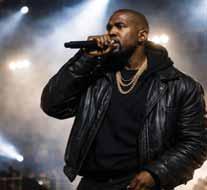
Kanye West, also known as Ye, is set to perform at Dinamo Arena in Tbilisi on June 12 as part of the government-backed “Starring Georgia” project. The Ministry of Culture says the initiative aims to position Georgia as a major destination for international music events. “In 2026, Georgia will be at the forefront of the musical orbit,”
the ministry states. Several of West’s concerts in the UK, Poland, and Switzerland were canceled in May 2026, while a planned show in France was postponed indefinitely following criticism over his past statements.
In recent years, West has made remarks praising Adolf Hitler and questioning the Holocaust, and has faced backlash for social media posts and merchandise linked to Nazi symbolism. In January 2026, he said he was neither anti-Semitic nor a Nazi, attributing previous statements to bipolar disorder.
COMPILED BY ANA DUMBADZE
Russia’s war against Ukraine entered another volatile week marked by intensified fighting along the eastern front, escalating long-range strikes by both sides, renewed attacks on Ukrainian energy infrastructure and the collapse of competing ceasefire initiatives proposed by Kyiv and Moscow ahead of Russia’s Victory Day celebrations. While Russian forces continued to pressure Ukrainian defenses in the Donetsk region, Ukraine reported limited gains in some sectors and stepped up strikes deep behind Russian lines, as diplomatic efforts again failed to produce any meaningful breakthrough toward halting the war.
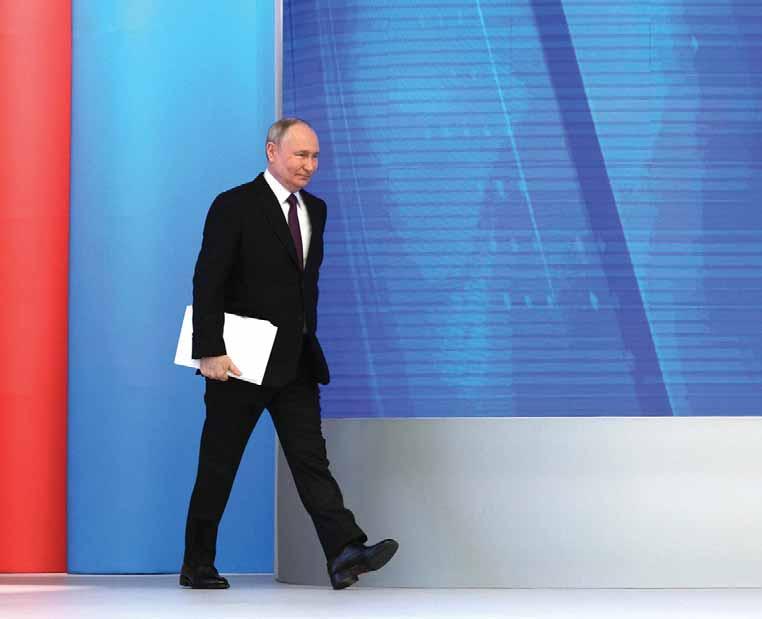
One of the dominant developments of the week was the rapid deterioration of ceasefire proposals surrounding Russia’s May 9 Victory Day commemorations. Russian President Vladimir Putin had announced a temporary truce for May 8–9 linked to the annual celebrations marking the Soviet victory over Nazi Germany in World War II. However, Ukrainian President Volodymyr Zelensky accused Moscow of rejecting broader efforts to halt fighting and described Russia’s actions as proof that it was not genuinely interested in peace.
“Russia’s choice is an obvious spurning of a ceasefire and of saving lives,” Zelensky wrote on social media following another wave of large-scale Russian drone attacks across Ukraine. Kyiv had earlier proposed its own ceasefire beginning at midnight on May 6 and pledged to “act in kind” regarding Russia’s proposal for the Victory Day period. Zelensky argued that it was impossible to speak seriously
about public celebrations while the war continued to kill civilians daily.
“It is obvious to any reasonable person that a full-scale war and the daily murdering of people are a bad time for public celebrations,” the Ukrainian president stated.
The remarks fueled speculation over potential Ukrainian strikes targeting Moscow during one of the Kremlin’s most symbolically important political events. Russian authorities reportedly increased security measures ahead of the parade, reduced displays of military hardware, and introduced intermittent internet shutdowns across the capital in line with growing concerns over potential Ukrainian drone attacks. Zelensky mocked the measures, saying Russian authorities “fear drones may buzz over Red Square.”
Kyiv said Russian forces launched more than 100 drones overnight against eastern and southern Ukraine just one day after Russian strikes reportedly killed nearly 30 civilians. Ukrainian officials insisted that Moscow continued combat operations despite Kyiv’s proposed ceasefire, while Russia never formally accepted Ukraine’s broader truce initiative. On the front line, Ukrainian soldiers described the situation as unchanged despite the diplomatic rhetoric. One Ukrainian officer told AFP that Russian forces “continued to carry out infantry raids and attempts to storm our positions,” adding that Ukrainian troops were responding “in kind.” Another commander summarized the situation with the phrase: “An eye for an eye, a tooth for a tooth.”
The heaviest fighting remained concentrated in the Donetsk region, where Russian forces continued assaults aimed at advancing toward Kostiantynivka, one of Ukraine’s key fortified strongholds in the east. Ukraine’s commander-in-chief, Oleksandr Syrskyi, said Russian troops
were attempting to infiltrate the outskirts of the city using sabotage and reconnaissance groups, while Ukrainian units conducted counter-operations to prevent Russian breakthroughs. Battlefield mapping indicated that Russian troops had moved to within roughly one kilometer of the city’s southern outskirts, although Ukrainian defenses continued to hold. Russia also claimed the capture of several settlements during the week, including Novodmytrivka near Kostiantynivka, while Ukraine disputed some of Moscow’s territorial claims. Despite Russia’s continued offensive operations, battlefield analyses suggested that Moscow’s territorial momentum remained limited. Based on a data analyzed by Russia Matters using Institute for the Study of War mapping, Russian forces recorded a net territorial loss of approximately 21 square miles between April 28 and May 5. Over the past month, Russia reportedly lost a net 46 square miles after previously making modest gains earlier in the spring campaign. Analysts noted, however, that Russian troops continued offensive operations in multiple sectors simultaneously, maintaining constant pressure on Ukrainian defensive positions.
Ukraine also intensified its own longrange strike campaign during the week. President Zelensky said Ukrainian strikes at ranges exceeding 20 kilometers had doubled compared to March and quadrupled compared to February. Ukrainian officials described the operations as part of a systematic effort to degrade Russian logistics, command infrastructure, ammunition depots and drone control centers supporting frontline operations. Kyiv claimed more than 160 medium-range strikes during April alone.
Some of those strikes reached deep inside Russian territory. Russian officials said a Ukrainian drone attack on the city
of Cheboksary, located hundreds of miles from the Ukrainian border, killed two people. Russia’s Defense Ministry later announced that it had intercepted 53 Ukrainian drones overnight, though it did not specify whether the interceptions occurred before or after Kyiv’s proposed ceasefire was due to begin. Authorities installed by Moscow in occupied Crimea also reported that Ukrainian drone attacks killed five people late Tuesday. At the same time, Russia continued its own campaign of long-range missile and drone strikes targeting Ukrainian cities and energy infrastructure. One of the most significant attacks of the week struck Naftogaz gas production facilities in Poltava and Kharkiv regions. Ukrainian officials said the strikes killed five people, including Naftogaz employees and emergency responders, while at least 37 others were injured. The attacks caused substantial damage to gas infrastructure and disrupted energy supplies in several areas.
Russian attacks elsewhere in Ukraine caused additional civilian casualties throughout the week. Ukrainian authorities said at least one person was killed in overnight drone strikes, while a Russian attack on a kindergarten in Sumy region reportedly killed a security guard. Zaporizhzhia endured one of the deadliest bombardments of the week after Russian aerial bombs and drones struck residential areas, reportedly killing at least 12 people and injuring dozens more.
Kramatorsk also came under heavy attack, with aerial bombs killing several civilians and damaging residential infrastructure. Dnipro, Kharkiv and other major urban centers continued to face repeated missile and drone strikes as Russia maintained pressure on Ukrainian rear areas far from the immediate front line. The broader strategic picture increas-
ingly reflected a war of attrition and deep strikes rather than rapid territorial breakthroughs. Ukraine’s growing use of drones and long-range precision systems has allowed Kyiv to target Russian oil facilities, logistics hubs and military infrastructure far behind the front, while Russia has continued to exploit its larger missile stockpiles and drone production capacity to sustain near-nightly bombardments of Ukrainian cities and critical infrastructure.
Meanwhile, Western military and financial support for Ukraine continued despite growing international attention shifting toward tensions in the Middle East and the escalating crisis involving Iran. The United States approved a potential $373.6 million sale of Joint Direct Attack Munitions-Extended Range systems and related equipment for Ukraine. The package is intended to improve Ukraine’s precisionstrike capabilities against Russian military targets and strengthen its ability to conduct longer-range operations. European support also remained active. Britain entered discussions on joining the European Union’s major Ukraine loan and support initiative aimed at covering Kyiv’s financial and defense needs over the next two years. European leaders reiterated support for Ukraine during meetings with Zelensky this week, while London additionally imposed new sanctions targeting individuals and entities linked to Russia’s military recruitment and drone production efforts. Still, diplomatic efforts to end the war showed little tangible progress. Moscow continues to insist that Ukraine withdraw from four regions Russia claims to have annexed, conditions Kyiv has repeatedly rejected as unacceptable. Ukraine, meanwhile, maintains that any settlement must preserve its sovereignty and territorial integrity.

BY GEORGE KATCHARAVA
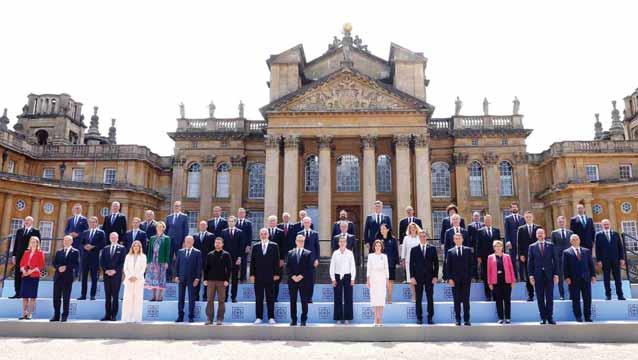
The gathering held in the first week of May in Yerevan, was surprisingly not devoted to International Labor day, but rather something that might cause a shift in the geopolitical map of Eurasia. For decades, the South Caucasus existed in the collective Western imagination as a volatile "near abroad;" a rim-land where Moscow’s shadow loomed large above the region which bridges Europe and Asia. But as nearly fifty heads of state descended upon the Armenian capital for the 8th European Political Community (EPC)
Summit, the message was unmistakable: the frontier of the European project has moved decisively eastward, anchored by a new "axis of peace" that stretches from the Atlantic to the Caspian. The most striking new development in Yerevan was the presence of a guest who arrived from across the ocean. Canada’s historic debut as the first nonEuropean participant signaled the EPC’s evolution from a regional talk-shop into a global democratic guild. Prime Minister Mark Carney framed Ottawa’s arrival not as an intrusion, but as a homecoming of values, describing a "triple alignment" of history, trust, and shared security. By joining the Security Action for Europe initiative, Canada has signaled that the defense of a rules-based inter-
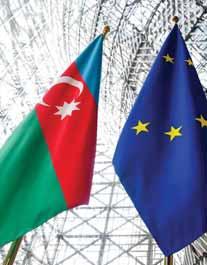
The Azerbaijan and EU flags.
Source: euneighbourseast
BY TEAM GT
Azerbaijan’s parliament, the Milli Majlis, has voted to suspend cooperation with the European Parliament and begin the process of withdrawing from the Euronest Parliamentary Assembly, Azerbaijani media reports. In a formal statement, lawmakers accused the European Parliament of adopting what they described as a “destructive” and consistently antiAzerbaijani stance, arguing that this has
undermined dialogue and hindered bilateral and multilateral parliamentary cooperation.
The decision includes suspending all forms of engagement with the European Parliament, ending participation in the EU–Azerbaijan Parliamentary Cooperation Committee, and initiating procedures to terminate Azerbaijan’s membership in Euronest. During the withdrawal process, the Azerbaijani delegation will not take part in Euronest activities.
The statement also reiterates longstanding grievances related to the Nagorno-Karabakh conflict, accusing European institutions of bias and of ignoring Azerbaijan’s position. It further claims that criticism from the European Parliament intensified following the 2020 war and subsequent developments in the region.
Tensions between Baku and the European Parliament have been ongoing for years, with the legislature repeatedly adopting resolutions critical of Azerbaijan over human rights, governance, and regional issues. Azerbaijan previously froze ties with the European Parliament in 2015 before partially restoring engagement later.
While the reported decision aligns with this pattern of strained relations, formal confirmation from official Azerbaijani government or parliamentary sources and independent international coverage should be monitored for full verification of implementation steps, particularly regarding Euronest withdrawal procedures.
national order is no longer a matter of geography, but of shared destiny. This transatlantic bridge might create the necessary conditions to provide Armenia with a vital security canopy at a moment when it seems set on systematically dismantling its decades-long reliance on Russian protection. At the heart of this realignment is the ambitious "Connectivity Partnership," a blueprint designed to help Armenia integrate into the Middle Corridor and other regional transit arrangements. This is more than a matter of paving new roads or stringing fiber-optic cables; it is an initiative that should assist in a structural divorce from the Kremlin. By weaving Armenia into the EU’s "Global Gateway," Brussels is wagering significant funds to
ensure that the nation’s energy grids and digital infrastructure speak a European language. The aim is to create an "irreversible pivot," making the cost of returning to its former path prohibitively high by fostering deep, institutionalized ties with Western markets and standards.
Yet, the summit was haunted by the ongoing fires of the war in Ukraine.
President Volodymyr Zelensky, making his country’s first highest level visit to Yerevan in over twenty years, transformed the proceedings into a wartime council. His presence served as a visceral reminder that the sovereignty of the Caucasus is intrinsically linked to the trenches of the Donbas. We also witnessed a brief, highstakes encounter between Zelensky and Georgian Prime Minister Irakli Kobakhidze. Although the relationship between Kyiv and Tbilisi has been frayed by Georgia's cautious "pragmatic" approaches, the meeting was a necessary piece of political theater. For Kobakhidze, it was a gesture to appease a restive, pro-
European populace; for Zelensky, it was a strategic move to ensure Georgia remains within the democratic fold. Ultimately, the Yerevan summit suggests that the "European vision" is gaining a new kind of strategic depth. While Azerbaijan continues to play a more transactional role, positioning itself as an indispensable energy broker while maintaining its own sovereign distance, the overarching narrative is one of a continent closing ranks. In the thin air of the Caucasus, the EPC has begun to forge a new identity defined not by the narrow rules of Brussels, but by a collective resistance to imperial fragmentation. The future of European stability, it seems, will no longer be dictated in the comfortable salons of Paris, Madrid or Berlin, but in the resilient and transformative corridors of the East.
Author’s bio: George Katcharava is the founder of eurasiaanalyst.com, a geopolitical risk and advisory firm.
Georgian Foreign Ministry Criticizes European Parliament Report as “Detached from Reality”
BY TEAM GT
Georgia’s Ministry of Foreign Affairs has sharply criticized a report adopted by the European Parliament Committee on Foreign Affairs, describing the document as “entirely detached from reality” and accusing EU institutions of fueling polarization and undermining relations
between Georgia and the European Union.
The statement came after the committee voted on a draft report concerning the European Commission’s 2025 report on Georgia, prepared by Lithuanian MEP Rasa Jukneviciene.
Georgian Foreign Ministry says the report contains “deliberate distortion of facts, absurd allegations and information manipulation,” which it says amounts to disinformation and damages both the reputation of the European Parliament
and public trust in the EU within Georgia.
“It is concerning that EU institutions are being used to carry out targeted attacks against the Georgian state, its democratic institutions, society and values, including the Georgian Orthodox Church,” the ministry said.
The statement further argues that the report represents “yet another attempt to foster polarization within Georgian society, to alienate the democratically elected government from the people, and to encourage anti-democratic processes and radical attitudes.”
The ministry also criticized what it described as “blackmail and intimidation” directed at Georgian society, calling it interference in the country’s internal affairs and unacceptable for any sovereign state.
Tbilisi additionally accused some EU actors of “weaponizing” the European integration process and linking EU membership conditions to issues that, ministry says, could undermine Georgia’s national security and increase regional risks.
“Such an unfair approach by EU institutions undermines relations between Georgia and the European Union and harms our shared interests,” the statement said.
Despite the criticism, the Georgian Foreign Ministry reiterated that Georgia remains committed to cooperation with the EU based on “respect, trust and shared values,” and expressed hope for what it described as a more constructive and fair approach from European institutions.
INTERVIEW BY VAZHA TAVBERIDZE
Political scientist Ivan U. Kłyszcz has spent years studying how Russia sees its place in the world and why, despite the collapse of the Soviet Union, Moscow continued to pursue an ambitious global foreign policy. In his new book, Russian Multipolarity in the Globalized Age, published by Cambridge University Press, he argues that modern Russian foreign policy has been shaped by a grand strategy of “multipolarity”the belief that the world should be divided among major powers with their own spheres of influence.
Speaking to Radio Free Europe/Radio Liberty’s Georgian Service, Kłyszcz discusses how this worldview developed after the mid-1990s, how the Kremlin understands power and sovereignty, and why Russia sees institutions, military force, culture, and even religion as tools for maintaining influence. He also reflects on what this means for the South Caucasus and the wider international order.
WHAT ARE THE OVERARCHING PRINCIPLES OF RUSSIA’S GRAND STRATEGY THAT PERSEVERED OVER THE DECADES, OR PERHAPS EVEN CENTURIES?
Ever since the Romanov Empire, the Soviet Union, and the Russia of today, one principle that has been ever-present has been the ambition of being seen as a great power, equal or co-equal with the hegemon of the day, be it the United Kingdom or the United States. This has been one principle that has consistently defined Russian strategic thought. It has been articulated in different ways and pursued through different tactics and plans, but generally that has been a core maxim of Russian grand strategy: how to become a major power, what constitutes a major power, and how Russia can articulate its position as a major power on the world stage and convince its peers of its status as one.
LET’S TALK ABOUT THE MEANS OF ACHIEVING THAT COVETED GOAL. HOW HAS RUSSIA GONE ABOUT IT?
In the book, I look into the principles that defined the grand strategy of the Russian Federation of today and the Gorbachev period of the Soviet Union, because there is shifting ground between the two, as some other principles became more important during the second half of the Yeltsin era and from that era on to this day.
And that grand strategy, the one that has been relevant since the mid-1990s, I call the multipolarity grand strategy. It's a term that Yevgeny Primakov gave a lot of currency to in his time, and it roughly articulates several principles. This is a vision of the world as being, in a way, divided among major powers, each one being a powerhouse in its respective region. So this leads to a foreign policy articulated around spheres of influence.
In the Russian vision, Russia is entitled to a sphere of influence today over the countries it used to dominate as the Soviet Union. The United States would have its own sphere of influence over the Americas, and so on and so forth. Another feature of this grand principle is the absolutist view with which the Kremlin looks at the world. One implication of is that there can be no universal global framework that is not an imposition from one power onto another. This is a very deep skepticism toward the idea of human rights and international organizations: from Russia’s cynical and skeptical view, these only exist for the benefit of, and to be used as leverage by, the powers behind them, not the world itself. This has been neatly articulated in Rus-
sian laws and foreign policy, with the presumption that each major power has a sovereign right to define the values and norms of its respective region within its sphere of influence, including the interpretation of democracy.
It's not only that they get a right over the foreign policy of the countries inside their sphere of influence, but they also get to define the norms that shape the lives of people inside those regions. The skepticism toward human rights is, I think, the most illustrative example of that.
One other, more recent change that has happened, especially in the last 10 years, is that this whole vision of multipolarity has acquired a more civilizational, culturalist rhetoric.
And a lot of that is articulated in terms of religion, and so, in that sense, the Russian Orthodox Church is an integral part of this vision of multipolarity, in this case as the church of the Russian world, of the Russian sphere of influence.
HOW MUCH DO RUSSIA’S WEAKNESSES DETERMINE HOW IT SEES WHERE ITS INFLUENCE BEGINS AND ENDS, WHAT IT IS CONTENT WITH, AND WHERE IT CRAVES MORE?
It is a blurry boundary, of course, and the way this boundary has been thought of and conceived has changed. Originally, I think in the late 1990s, it was thought of quite strictly in terms of the so-called former Soviet space, but then very presumptive moves were made in southwestern Europe, in the Balkans. So it's uncertain where the boundaries really lie in Russia's claims to its so-called sphere of influence. And then this evolves into an idea that has a more national bent to it, that the sphere of influence goes as far as Russian culture goes.
OR AS FAR AS THE BOOT OF A RUSSIAN SOLDIER, AS MR PUTIN HELPFULLY ARTICULATED.
Indeed, there's that. As far as Russian blood has been spilled for one piece of land or another, essentially. There's a famous phrase, whether it's true or not I couldn’t say, but quite a few historians seem to believe it is: after the Second World War, Stalin was asked why he was demanding so much from the Allies. He was told something along the lines of: you already have so much land, so much authority, and you have gone all the way to Berlin, surely that is more than enough? And Stalin apparently responded: yes, of course, but you know, Alexander, I did get all the way to Paris.
WHAT IS RUSSIA’S TOOLBOX TO ENSURE THIS VISION COMES TO PASS? I SUSPECT THE ABOVE-MENTIONED BOOT OF A RUSSIAN SOLDIER MUST RANK SOMEWHERE HIGH UP.
Indeed, in the book I highlight the continued relevance of military force, and particularly nuclear power, nuclear weapons. Having a nuclear arsenal and a massive army is tightly associated in Russian strategic culture with major power status. So the use of military force has been a key element here.
One thing that distinguishes Russia's grand strategy from other countries in the post-Cold War era is that Russia, despite some sputtering attempts, never really committed to economic performance or to seeing it as key to major power status. Russian economic statecraft envisages using the economy as a tool of external influence, and that has been a key element in Russian grand strategy for the past few decades. The defense sector is one exception: it is seen as an indelible part of major power status. And then there is energy: under Putin, this becomes an incredibly significant sector, as it is seen as a means of achieving major power status, and indeed, at one point Russia was famously
called an energy superpower. One arena that is essential for Russia's grand strategy of multipolarity is the United Nations. Earlier, I mentioned that there's this entrenched skepticism toward universal rights and notions of universal values in Russia. That's where it manifests quite dramatically, in the United Nations, as this is the stage Russia feels comfortable on. It doesn’t view the UN as a coalition of countries that creates norms meant to establish some sort of global governance, with everybody following those norms and rules. It's more a vision of Yalta, of the major powers gathering and deciding the fate of smaller powers. So, in that sense, the United Nations is a key focus of Russia's major power status and one of the key instruments it uses in its grand strategy today.
HOW WELL IS THAT GRAND STRATEGY BEING IMPLEMENTED? HOW WELL IS RUSSIA COPING WITH THE MULTIPOLAR WORLD IT SO WANTED?
Prior to the Ukraine invasion, if you had asked the average Russian, they would probably have told you that things were looking up, that the world was going where Russians wanted it to go. Obviously, that isn’t true today: The Russian economy is in a shambles, the average Russian is worse off than before. They committed the supreme war crime of invading a peaceful neighbor. It's a moral and practical disaster across the board. But as far as this multipolarity grand strategy is concerned, one could say that the world is indeed going their way, because it is becoming more multipolar. And across the globe, we are thinking about the world in those terms. The thing here is that I am not sure all of that is Russia’s doing, or that Russia achieved it, although it certainly has contributed. There are greater forces at play, like, of course, the rise of the Chinese economy and China's own vision of multipolarity, and especially the fact that the United States apparently no longer wants to be the leader of the international system in the way it once was. These are greater forces that Russia doesn't really have influence over, but they definitely take us closer to what the Kremlin envisioned.
WHAT ARE RUSSIA’S POWERS OF COERCION LIKE WHEN WE LOOK PAST MILITARY THREATS OR ECONOMIC PRESSURE? DOES IT HAVE A SALES PITCH?
Indeed, it does: just look at Africa and the Global South. It's this idea, this Russian interpretation of sovereignty, that
resonates with some established notions of sovereignty in Africa and elsewhere, even if it's overly simplistic and ultimately meant to be confrontational. They are selling the narrative of multipolarity and the place Africa would play within it if it were to emerge as a regional power vis-à-vis the “exploiting West.” They appeal to history, to the very established notion of neocolonialism, as if all of this proves that Africa needs to be a power pole of its own, and that Russia is there to be a partner in that.
Another element of this grand strategy is the notion that the US has become this overwhelming hegemon and is attempting to impose its hegemony all over the world through its soft power, its hard power, and its norms; changing cultures and affecting the cultures of other civilizations. They often point to LGBT rights and the promotion of LGBT rights as evidence of this.
So, in this context, the Russian grand strategy of multipolarity, in a way, compels Russia to seek partnerships with other power poles. So, in Primakov's original vision, it was a partnership with China and India, with the idea of these powers coalescing to restrain the United States from abusing its leadership role in the international system. And that notion of coalescing with other power poles has remained across Russian strategic thought since the mid-1990s.
That's what they're trying to do with Africa, persuading countries there that the West is bad, essentially, and that they shouldn't partner with Europe and the US for a number of reasons. And the same applies to Iran: that by positioning its foreign policy against US foreign policy, it becomes part of this coalition of powers resisting Western or US hegemony.
LET’S TAKE A LOOK AT THE CAUCASUS. WHAT DOES RUSSIA'S GRAND STRATEGY SPELL FOR THE REGION?
The core Russian intention, over the centuries, has been to maintain this region under its influence.
With the North Caucasus, the Russian invasion of Chechnya was almost a turning point. It finally did away with the Gorbachev-era grand strategy of cooperation with the United States. Instead, it moved toward renewed confrontation because of the paranoid vision in the Kremlin that the US was somehow responsible for, or would somehow exploit, Chechen independence for its own advantage.
For the decades since, Russian analysts and Kremlin officials have talked about the Chechen wars in those terms, that
it would have been another Kosovo and would have led to Russia falling apart. So, within this multipolarity framework, the North Caucasus was a key test, so to speak, an inflection point.
For the wider Caucasus, for the South Caucasus, it is also seen as part of this Russian sphere of influence, with the full toolkit of multipolarity being deployed. You see the use of military force, covert operations, disinformation, economic statecraft, particularly through weaponized corruption and ties like that.
AND HOW MUCH ROOM DO THE SOUTH CAUCASUS COUNTRIES HAVE TO COUNTER THIS?
Everything depends on the choices the governments of those three countries make, whether to, in a way, accommodate Russian ambitions and the terms under which Russia wants to integrate this influence, or to resist it altogether. It's a very difficult choice.
In Tbilisi, there is right now a very polarized political situation, in my understanding, with the risk of outright state capture by the government and, let's say, stakeholders who see accommodation as a necessity for Georgia. It's on a trajectory of accommodation, despite the decades-long occupation of parts of the country.
In Armenia, it's a blend of resistance and accommodation because, on the one hand, Russia has a very strong economic presence in the country, in the financial sector, and still has military and security assets there that Armenia hasn't really been able to dislodge, or even had a strong enough consensus to close, due to its precarious security situation and the wars it has experienced in recent years. So, in that sense, they have to accommodate, but there is also resistance prompted by the feeling of abandonment from the Karabakh wars. I think this was very much on display in one of the more recent Pashinyan-Putin meetings, that kind of defiance from Yerevan. And in the case of Azerbaijan, on the one hand, Baku accommodates because it is geographically located in a corridor that connects Russia, and there is this whole idea of a corridor that would, from Russia's perspective, be a very crucial instrument for potentially circumventing sanctions. So, in that sense, there is some going along with Russia's vision, or let's say Russia's influence, but there is also definitely resistance, as the relationship has grown ever more tense since Azerbaijan closed the Russian House organization on its territory, under allegations that it was facilitating espionage.
INTERVIEW BY TATJANA MONTIK
Lasha Tughushi’s novel Stalin’s Gambit was first published in Georgian in 2024 and has recently appeared in English. The book captures the quintessence of Georgian politics over the past thirty years.
The private lives of its characters serve as a pars pro toto for the country’s key social and political dynamics. On every page, the author demonstrates sharp insight and intellectual depth: it takes a master to weave personal stories so seamlessly into national upheavals.
In Stalin’s Gambit, Tughushi blurs the line between fiction and reality, constructing a scenario that, as he himself notes, “has either already happened or is on the verge of happening.”
At the center of the narrative is a sinister plan by the Kremlin: to destabilize Georgia and prevent its accession to the European Union, the reburial of Joseph Stalin’s remains in Georgia is set in motion. This highly symbolic act threatens to disrupt the country’s already fragile social balance and provoke internal conflict.
In this “anti-novel,” each character stands for something larger than themselves, reflecting both past and present political currents in Georgia. It is a story of a gambit: a risky sacrifice in a global power struggle that starkly highlights Georgia’s dependence on its powerful neighbor, Russia.
That Tughushi addresses themes of power and autocracy at this moment is widely seen in Georgia as an artistic response to current political tensions. His professional background lends particular weight to the work: as a Fulbright scholar, professor, and former editor-inchief of prominent media outlets such as Rezonansi, he is regarded as one of the most experienced observers of Georgia’s media landscape and a strong advocate for press freedom.
The novel is available at bookstores such as Biblusi.
YOU ARE KNOWN AS ONE OF THE LEADING ADVOCATES FOR FREEDOM OF SPEECH. WHAT PUSHED YOU TO CHANGE YOUR FIELD AND TURN TO WRITING LITERATURE?
At some point, I realized that, through storytelling, I had developed a desire to express myself differently, in another form, and in doing so to be in a process that allows me to be myself and to be free.
WHAT WAS THE STARTING POINT FOR WRITING STALIN’S GAMBIT? THE NOVEL IS RELATIVELY SHORT, YET IT IS EXTREMELY DENSE IN INFORMATION. HOW DID YOU ACHIEVE SUCH MASTERY?
The stories, images, and both internal and external conflicts that I describe in the book themselves pushed me toward this kind of dynamic and kaleidoscopic development that is visible in the novel. In other words, the content itself dictated the conditions. And when I was writing, the process stemmed from the meaning I wanted to express.
YOUR NOVEL GIVES THE IMPRESSION OF BEING BASED ON DEEP KNOWLEDGE OF DOMESTIC AND INTERNATIONAL POLITICAL PROCESSES. HOW LONG DID YOUR “INVESTIGATION” TAKE, AND HOW LONG DID YOU SPEND DEVELOPING THE IDEA?
It is difficult to call this book documentary prose, even though it contains widely known facts. It also includes specific facts that perhaps fewer people are aware of. For a long time, I served as editor-inchief of a weekly newspaper, and I had to learn about many things that, for various reasons, could not be published, usually because they could not be proven. In addition, the book includes fictional


stories, many allusions, and even futurological elements. So the entire process ultimately led to the creation of the book.
As for the idea and the stories themselves, they had been accumulating inside me for a long time. At some point, it simply became necessary to write them down. In terms of the actual writing process, the final stage, when I actively began working on the book, took about three to four months. That is how long it took to write it.
YOU ARE KNOWN TO HAVE FIRST-HAND KNOWLEDGE OF RUSSIAN INFLUENCE IN GEORGIA. DID YOUR RESEARCH ON THIS TOPIC INFORM THE NOVEL?
Russian influence in Georgia has different foundations, both material and symbolic. These include fear, religion, finance, and issues of power distribution. One could even say that at its core lies a basic instinct: the pursuit of power. Cultural factors and geopolitics also play a role.
As editor-in-chief, I constantly engaged with these issues, both in media practice and in an academic sense. This influence has always been a central focus of my research. As for whether I relied on research when writing the book, my answer is necessarily subjective, since it is a novel.
Of course, I included real facts and real stories. But alongside them are authorial interpretations and representations. It may sound unscientific, but I would say that the reality created in the book is sometimes more real for the author than the reality described in historical or academic works.
And I would add that the questions that arise while reading the book are, for me, as the author, sometimes even more significant than those that emerge within a strictly academic framework.
DO YOUR CHARACTERS HAVE REAL PROTOTYPES, OR ARE THEY COMPOSITE FIGURES?
The book presents different characters: some are based on real prototypes, others are collective images, and others are synthesized figures.
They exist in narratives that can be divided into reality and what could be called post-reality. And they act within these different layers of reality.
IN THE NOVEL, PART OF THE GEORGIAN GOVERNMENT ENTERS INTO A DEAL WITH THE KREMLIN TO REVERSE THE COUNTRY’S EUROPEAN PATH. HOW RELEVANT IS THIS FOR GEORGIA TODAY? AND WHEN WILL IT END?
This plot twist reflects real risks for modern Georgia. We see it not only in the book but also in real life.
As for when this confrontation might end, in my view, as long as the Russian Empire exists in its current form, this confrontation will continue. It is unlikely
Their work does influence decisionmaking processes in one way or another. Even if this influence is not always directly visible, the critical thinking they generate inevitably affects political and social processes.
I believe that much of the ongoing struggle in the country today relies on such people; on such journalists.
WHAT DOES STALIN MEAN FOR GEORGIA TODAY, AND IS HIS MEANING DIFFERENT IN GEORGIA AND RUSSIA?
This is a complex question, because Stalin is difficult to discuss. He has existed in Georgia in different forms; during the Soviet period and after its collapse.
He was not merely a museum figure. I remember Soviet times, especially in regions like Kartli, where he was born.
His portraits were often placed in buses as an image of a leader or important figure. These were not isolated cases.
NATIONALIST GROUPS. IN YOUR VIEW, HOW SHOULD CIVIL SOCIETY RESIST THESE FORCES IN REALITY TO ENSURE THEY DO NOT BECOME A DEFINING FACTOR IN THE COUNTRY'S FUTURE?
Georgian ultra-nationalism intersects with Russian imperialism, and at certain points they converge. There are strong connecting impulses between them, and imperial Russia tends to view this process favorably and support it to some extent.
that we can speak of a clear endpoint. The book shows that even a government that is not aggressive, not strongly pro-Western, but rather constructive, is still unacceptable to Russia. This is because, according to the logic of the book, it is an existential issue for them: that liberal democracies should not exist around Russia, on the territory of the former Soviet Union. This is directly connected to the processes described in the book: conspiracies, infiltrations, operations, coups. All of this corresponds to imperial thinking and imperial policy. Naturally, the book is permeated by these dynamics. And, of course, the figure of Stalin, his ideas, also plays a role. These processes are interconnected. What is happening in Russia today is also, in a sense, linked to Stalin.
ONE CHARACTER TURNS TOWARD A PRO-RUSSIAN ORIENTATION SIMPLY BECAUSE THEY “DO NOT UNDERSTAND THE WEST.” WHY DO SUCH FORCES STILL EXIST IN GEORGIA AFTER YEARS OF DEMOCRATIC DEVELOPMENT?
There are different dichotomies based on different systems of understanding. In a broader sense, they can be seen as cultural mismatches, not in a simplistic propagandistic sense.
In this context, we can speak of two Georgias: a Western and an anti-Western one. I emphasize: Western, not simply pro-Western. This distinction is important.
If a person is truly a bearer of European identity, they cannot be pro-Russian. In the book, there are characters who criticize both themselves and the West, but that does not make them anti-Western. Of course, not everyone in Georgia has a Western identity. Here, the idea of Stalinism plays an important role. It forms a basis where imperial Russian views and anti-Western sentiments intersect within Georgia itself. Sometimes, these views appear ultranationalist, appealing to the idea of a “special Georgia,” but in the end they converge into a single point. The main divide between the Western and the anti-Western lies in the recognition of human rights and the freedom of choice. For the so-called anti-Western side, a lack of freedom, what could be described as the Russian model of governance, is closer to them.
THE BOOK FEATURES INVESTIGATIVE JOURNALISTS ENGAGED IN DANGEROUS REPORTING. HOW RELEVANT IS INVESTIGATIVE JOURNALISM IN GEORGIA TODAY?
In Georgia, there are still investigative journalists. They produce very serious and important work. Of course, this is difficult work, but fortunately such journalists exist, and we regularly see their output on various media platforms.
I also remember the events of 1956 in Tbilisi, when large demonstrations took place against Khrushchev’s de-Stalinization campaign, which many Georgians perceived as anti-Georgian. For some, Stalin symbolized the leader of a great state.
Of course, he also had opponents, especially among those repressed under his rule. But even some families of victims sometimes had a complex, ambivalent attitude toward him.
The image of Stalin persisted in culture as well, for example, in Soviet films where he was portrayed as Georgian, with a Georgian accent. People in some sense identified with him as part of their own historical identity.
Before the collapse of the Soviet Union, this perception had not fully disappeared, although it was changing. National movements strengthened, and a new Georgian patriotism emerged.
After independence, many turned away from the cult of Stalin, sometimes in a very sharp and even aggressive way. He was increasingly seen as a figure associated with imperial restoration under Soviet Russia.
However, political myths are always changing. Today, Stalin’s image is once again being transformed. Some portray him as a “demonic figure,” while others suggest he was a supporter of Christianity or even a “crypto-Christian,” and that, without him, the Church would have suffered.
There are also narratives portraying him as a protector of Georgian culture and literature, someone who supported poets and writers and helped integrate them into educational programs.
Such myths emerge particularly in times of social tension. In Georgia, this is not a dominant mainstream position, unlike in Russia, where Stalin is often associated with state power and strength.
Most of Georgian society is oriented toward European values. Nevertheless, Stalinism as an idea, as a symbol of a “strong leader,” still exists and can become a political trigger in the future.
THE STORY OF MEDEA AND GOGITA IS TRAGIC: THEIR BREAKUP OCCURS BECAUSE OF POLITICS. WHY DOES THE FIGURE OF STALIN STILL POSSESS SUCH DESTRUCTIVE POWER, CAPABLE OF DIVIDING PEOPLE ON A PERSONAL, INTIMATE LEVEL?
The characters are different. Medea and Gogita are mutually attracted, as in ordinary relationships, but they are drawn into a vortex of ideas. Medea is an allusive character.
As you know, in Greek mythology, as well as in Georgian tradition, Medea is a mythological figure who sacrificed principles for love, abandoning her father, brother, and home.
In my novel, however, the modern Medea acts differently: she rejects love for the sake of principles. For her, principles are more important than love, unlike the mythological Medea.
YOU DESCRIBE THE TERRIFYING INFLUENCE OF ULTRA-
In Georgia today, mainstream political ideas are increasingly close to nationalist and populist rhetoric, which I believe poses serious risks to both political stability and democratic development. Ultimately, this is a question of choice: what do the citizens of Georgia want, a democratic, European path, or ultranationalist models? The problem of ultra-nationalism is a problem of society as a whole. All social groups must be more united, and concrete steps must be taken.
THE NOVEL IS VERY CINEMATIC; EVENTS SHIFT WITH BREAKNECK SPEED. IS THIS YOUR AUTHORIAL TECHNIQUE, OR A REFLECTION OF THE PACE AT WHICH THE CONTEMPORARY HISTORY OF GEORGIA IS BEING WRITTEN TODAY?
It is precisely in this rhythm that I saw the development of the story in the book. And it strongly resembles the development of modern Georgian history, which is extremely dynamic and rapidly changing.
This dynamism appears in both struggle and transformation: movement goes in different directions at different times. Today, we can see serious deviations from democratic processes, which inevitably affect Georgia’s historical choices. Two realities may indeed coincide here: one described in the book and the other taking place in real life.
THE BOOK'S ENDING IS DEEPLY SYMBOLIC. HOW REALISTIC DOES THE FINAL END OF THE "CULT OF THE LEADER" IN GEORGIA SEEM TO YOU? WHAT MUST HAPPEN IN THE NATIONAL CONSCIOUSNESS FOR THIS FIGURE TO CEASE BEING AN OBJECT OF GLORIFICATION?
If we talk about the real situation in Georgia and the issue of the mythologization of Stalin’s figure, I find it quite difficult to approach. It is hard to imagine such a radical and complete shift in attitudes toward him.
I believe that in the foreseeable future there will always be people in Georgia who see him as a great Georgian. But the key question is to what extent this myth, existing within a certain part of society, will remain relevant and influential. And this is where the main, and in my view very serious, problem lies. To be honest, I do not have simple answers to this question. One can only say that the majority of Georgian citizens today do not view Stalin’s figure in a positive light.
However, political myths constantly change their form and content. As long as society remains divided into categories of “black and white,” “good and evil,” figures such as Stalin, these demonic figures, will inevitably continue to influence people’s thinking and behavior. At least in the foreseeable future, this factor will remain present. It exists today. We can see that society remains divided in this regard: even those who criticize Stalin sometimes retain a certain reverence or elements of admiration for him.
HAVE YOU DEFINITIVELY DECIDED TO ABANDON YOUR PUBLIC ACTIVITY AND DEDICATE YOURSELF TO WRITING? IS THIS A NEW KIND OF STRUGGLE?
You know, I would not say that this is a particular kind of struggle. I simply wanted to write, and I wrote. And now I want to write, and I write. That’s all.
BY TEAM GT
TBC Capital has revised upward its 2026 economic growth forecast for Georgia, increasing it from 6.1% to 7.4%, citing strongerthan-expected export dynamics that are offsetting tourism losses and higher oil import costs.
According to preliminary data from Geostat, Georgia’s economy expanded by 9.1% year-on-year in the first quarter of 2026, including a robust 10.7% growth in March. Similar to February, the March estimate exceeded expectations.
Two months after the escalation of the Middle East conflict, TBC Capital notes that while the negative impact on the hospitality sector remains signi fi cant, its overall macroeconomic effect has been relatively contained. In contrast, exports, particularly of commodities, have accelerated, supported in part by rising global prices. Unlike previous years, exports are now emerging as the primary driver of economic growth, as recent non-cash spending indicators show no substantial acceleration in domestic consumption.
TBC Capital had already highlighted the improving export outlook in its March publication, though actual inflows have surpassed expectations. Georgia’s economy continues to demonstrate a degree of structural resilience. While the country remains sensitive to external shocks, offsetting factors help
balance risks across many, though not all, scenarios. For example, despite being a net importer of oil products, Georgia benefits from relatively strong foreign currency inflows from oil-producing countries, which partially mitigates external vulnerabilities.
In addition, oil re-exports have increased significantly since November of last year, accounting for 16.5% of total exports as of March, although this is likely a temporary trend.
Historically stable export-import price dynamics have also played a role.
In March, export prices rose by 3% month-on-month, driven by global price increases in key commodities such as oil, gold, copper, ferroalloys, and fertilizers. This fully offset a 2.9% rise in import prices linked to higher oil costs.
At the same time, stable terms of trade still imply a deterioration in the trade balance in U.S. dollar terms, as import volumes significantly exceed exports. However, export volumes have also increased, leading to a reduction in the trade deficit-to-GDP ratio in the first quarter compared to previous years.
Overall, TBC Capital estimates that tourism losses in March, relative to a no-conflict scenario, amounted to approximately $75 million. In contrast, export growth accelerated by around $90 million compared to February. A similar trend is expected to continue in April, with data to be released later.
While price normalization remains the base-case scenario, likely leading to a moderation in export revenues— this is expected to be accompanied by a recovery in tourism.
Three key factors continue to shape the outlook: the reduced likelihood of a near-term end to the war in Ukraine, the ongoing impact of the Middle East conflict, and stronger-than-expected economic growth data from Geostat. The combined effect of these factors has intensified.
TBC Capital has also revised its inflation forecast upward, from 5.6% to 6.0% by year-end. This adjustment reflects slightly higher-than-expected April inflation (5.9%) and renewed increases in oil prices following a brief period of moderation in mid-April.
Seasonally adjusted annualized inflation surged to 21% in April, the highest level since 2022, primarily driven by increases in electricity tariffs and fuel prices (gasoline and diesel). Together, these factors contributed 1.4 percentage points to annual inflation. Conversely, as base effects fade, the contribution of bread prices has declined to 0.5 percentage points in April, down from 0.9 percentage points in February.
Looking ahead, TBC Capital expects the National Bank of Georgia to maintain its monetary policy rate at 8% throughout the year.
Regarding the Georgian lari (GEL), the company notes that rising inflationary pressures, even under a scenario of relatively rapid conflict resolution, may support short-term currency appreciation. However, a slight deterioration in the external balance is expected on an annual basis. As a result, under the baseline scenario, the lari is projected to remain broadly stable around current levels.
BY LANA KOKAIA
The construction cost index increased by 2% year-onyear in March, mainly driven by higher salaries in the sector and rising fuel and electricity prices, Geostat said.
The data shows the increase was largely due to a 2.7% rise in the average monthly nominal wages of employees in construction, contributing 1.35 percentage points to the index, and a 4.3% rise in transport, fuel and electricity costs, which added 0.62 percentage points.
Compared to February 2026, the construction cost index rose by 1.9% in March, mainly due to a 7.7% increase in transport, fuel and electricity costs, contributing 0.94 percentage points. By segment, in March, the residential
BY LANA KOKAIA
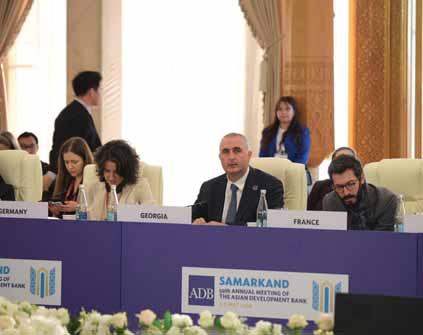
Georgia plans to sign financing agreements worth $1 billion with the Asian Development Bank this year, covering road and railway infrastructure projects, Finance Minister Lasha Khutsishvili has said.
Khutsishvili said the financing will be implemented under an existing action plan with the ADB and fully executed by the bank.
Speaking after meetings with ADB President and senior officials, the minister said discussions focused on Geor-
gia’s economic performance, high growth rates, and ongoing investment projects. He noted that the ADB has invested up to $6 billion in Georgia so far, with current active projects exceeding $2 billion.
Khutsishvili said the ADB President highlighted Georgia’s role in the development of the Middle Corridor and confirmed continued support for infrastructure investment aimed at strengthening the country’s regional connectivity. A report published in April 2026 shows the ADB approved $1 billion in loans for Georgia’s public and private sectors, including $707 million for the public sector and the remainder for private investment.

non-residential segment increased by 2.1% and 3.2% respectively. The civil construction segment grew by 3.2%
compared to the previous month and by 3.3% compared to the same month last year. Overall, the construction cost index is 26% higher compared to February 2022.
Court Fines Two Ships ₾100,000 Each for Black Sea Pollution
BY LANA KOKAIA
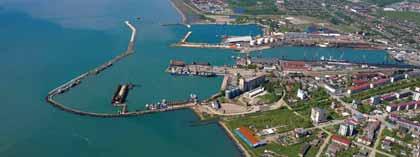
The Poti City Court fined two ships sailing under the flags of Portugal and Palau ₾100,000 each for polluting the Black Sea, the Environ-
mental Supervision Department reports.
The agency says employees of the Department’s Conventional Division for the Protection of the Black Sea, together with the Border Police, identified two cases of sea pollution.
The Environmental Supervision Department notes that the vessels polluted the Black Sea with industrial wastewater.
The ships were allowed to leave Georgia’s territorial waters after paying the fines and compensating for environmental damage.
“The protection of the Black Sea is a priority for the Department of Environmental Supervision,” the agency stated.
The Department says its Conventional Division continuously monitors the Black Sea to minimize water pollution and prevent illegal fishing.
Since the beginning of the year, the division has inspected 81 ships and identified 15 violations, including six cases involving sea pollution.
The agency says the number of oil pollution cases caused by ships has significantly decreased in recent years due to stricter monitoring and increased fines, which it says have had a deterrent effect.
BY LANA KOKAIA
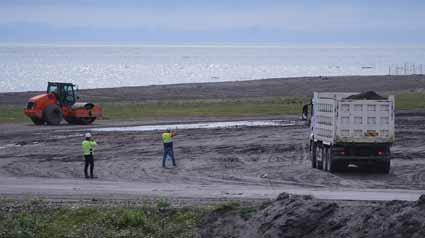
The construction of the Anaklia Deepwater Port has begun and has already entered an active phase, Economy and Sustainable Development Minister Mariam Kvrivishvili said during a visit to the project site.
The minister, together with Vice Prime Minister and Defence Minister Irakli Chikovani, visited the construction area of the strategically important port project for the first time.
Kvrivishvili said negotiations with the contractor company led to optimization of the initial contract, reducing project costs by $52 million.
“The Anaklia Deepwater Port is a project of strategic importance for the economy of our country,” Kvrivishvili said. “It will be a complex facility that includes the port, adjacent infrastructure,
and a free industrial zone.”
She added that the project also includes an access road and a railway line, which are expected to support port operations.
The minister said construction of a connecting road and an 18-km railway line will begin in the near future.
She noted that the government’s 10-year Georgian Railway development plan positions the railway as part of an integrated transport and logistics system, adding that increased cargo flows require a strong maritime gateway.
Kvrivishvili said the Anaklia project is a “logical continuation” of this process, noting that rail and port development together would strengthen Georgia’s role as a regional transport hub.
She also said international companies and experts are involved in the construction process, while emphasis is placed on employing local residents.
The marine infrastructure works are being carried out by Belgian company Jan De Nul N.V., part of Europe’s so-called “Big Four” construction groups.
BLOG BY NUGZAR B. RUHADZE
Ihave never in my life seen her live, only on television. I wonder if she knows enough English to read this sincere and spontaneous piece. I simply wanted to let both the West and the East know that Georgia’s got talent that deserves attention.
I will use this particular actress’s artistic image and stage work to take a broader view of Sakartvelo’s talent in general. This nation has truly been endowed abundantly with brilliant thinkers and powerful creators. Another question, though, is whether we are capable of making the very best of these advantages.
Her name is Ciako Pipia, thespian, comedian and scenarist. Happily married, her shimmering talent continues to flourish across various television shows. The available information about this abundantly gifted performer tells us that she was only seventeen when her mother left Georgia to emigrate to the United States. A fact that may seem ordinary in today’s Georgia nevertheless became deeply consequential in the young girl’s life, profoundly shaping her personality and life journey.
Later, Ciako had to take care of her baby siblings and grandparents. Difficult as it was, she faced life with determination and resilience, certainly with the support of her loving mother from abroad.
Ciako’s overwhelming inner artistic authority makes it impossible to look away from her emotionally brilliant per-
BLOG BY TONY HANMER
The snow which hit Svaneti about two weeks ago was a most unpleasant surprise for most people in the region, who had been looking forward to getting their herds of cows out of the barn and into grazing fields soon. Alas, that would have to wait. For those running low on hay, it meant buying some from trucks passing through from the lowlands of Georgia and taking advantage of the dearth. Two Brazilian families who had been spending a week in our Svaneti house with me were delighted, though, as they had never seen that much snow in their lives. Their boys had a field day making snowmen, fortresses and more. Our flowering daffodils, to my surprise, all survived the 20 cm or snow burial and -7 temperature, bouncing back just fine. Talking of fortresses… After this white layer mostly disappeared, I had more guests to show around Svaneti, this time a father and his adult son from the USA. They wanted to see it all, or as much as
possible, so were happy to pay me to drive them around despite quite a rainy week’s forecast. Aside from Mestia’s main museum and its Mikheil Khergiani house/tower museum, we spent a night at my old haunt of 19 years ago in Ushguli.
There, I decided to try to take them up to Queen Tamar’s summer fortress, having seen on the way in that at least parts of the way up to it were snow-free. Not the steep usual front way up: that was still under fairly deep white. But the back way, which I usually reserve for the descent. That looked doable, given our clothing, footwear and trekking experience (of which theirs includes Nepal). Up we went.
The snowy patches were actually quite soft, as daytime temperatures were above freezing. But we were all OK with the idea that getting snow into one’s hiking boots is not deadly, just a bit uncomfortable. Most of this is in the mind.
The grass on the relatively steep hillside, long but mostly still flattened by the winter’s snow, was quite dry, and thus not slippery. The trickiest parts, we soon learned, were where the snow was thinnest on the grass, here being the
slipperiest. We zig-zagged our way upwards due to the steepness, resting as necessary to catch our breath as we ascended above 2200 m.
At the top… the fortress was still mostly full of up to a meter of snow, but we could still get onto its walls and see Ushguli spread out far below us. True, Mt. Shkhara, Georgia’s highest, had its long wall’s top part hidden under cloud. But the view was still breathtaking.
I had made this trip up the first time in snow in about 2009, solo, and that had been much harder, earlier in winter, struggling through crotch-deep white. Down, though, had consisted of 3-m steps the steep way, cushioned by snow the whole descent, which was glorious and very fast. This time, we had to be careful going down in much less snow, but managed it. My guests were getting the whole deal.
This fortress is called the summer one simply because that’s when people usually attempt it… but another group had been up before us on our day, so we weren’t the only unseasonable ones. I am told that there are firm plans to remake the fortress in all its glory, which will be quite an undertaking, given its

formances even for a split second. Watching her, one wants to catch every nuance of movement, every facial expression, every flicker of a glance and sparkle of an eye. Everything feels meaningful and perfectly placed, as it would with any great figure in the history of comedy.
This lady is truly a jeweler of her craft, hammering out waves of all-consuming imagery upon the stage. She impresses, influences, captivates and persuades no less effectively than Lucille Ball and Betty White did in their own time and place.
I dare say, perhaps even more brilliantly and hilariously, without an iota of exaggeration.
Ciako Pipia’s presence on stage creates genuine fireworks. Everything around her burns brightly with her dazzling smile and contagious laughter, drawing viewers into her own unique world.
Whether she plays a hero or a villain, the creative energy emanating from her unconventional personality is always positively charged, shaping every role with mastery and subtlety.
When Ciako performs one of her countless comic roles, she remains in nonstop service to her delighted audience. She changes from image to image in an instant, storming the spectator’s imagination with piercing artistic confidence and unstoppable stage energy.
Hers is a boisterously churning volcanic talent that deserves a place on the international stage of any significance and magnitude. Alas, she can only fully express herself in the Georgian language, just as our poetic genius Galaktion Tabidze could only write in his native tongue.
It is a great pity that talent born in Georgia often remains unknown to the wider world simply because the Georgian language is spoken by only a few million people. One can easily imagine that somewhere out there exists a hidden demand for Ciako Pipia’s wildly exuberant talent, but such large-scale international recognition may remain unrealistic.
She will stay here, in Sakartvelo, delighting her native viewers and admirers for as long as she is given the opportunity. And thank God for that.
Ciako is acting, singing, dancing and, above all, nurturing her beautiful family. She remains constantly present on screen with immense artistic caliber and energy, together with her wonderful colleagues, who may perhaps feel a little jealous that I chose to write about her and not them. Yet one cannot deny that there is something mysteriously irresistible in her sincere interpretation of every role and in her ability to create so many distinct and socially meaningful characters that this culture and society truly need.
Ciako Pipia is still very young, and there is undoubtedly much more ahead for her extraordinary talent and manner of acting. Let her continue to shine for our pleasure and delight.
And finally, one modest concluding thought: will she ever step beyond comedy and try herself in dramatic roles? Who knows, but I certainly hope so. I cannot help but wonder whether she would make drama just as attractive, impressive and outstanding as her current stage performances.
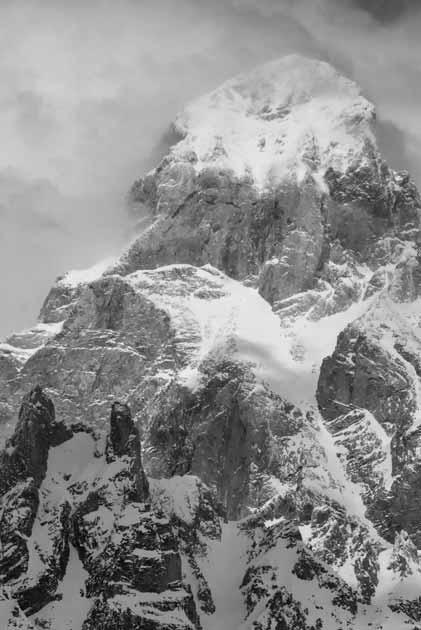
altitude and steep setting. On the way home, above Becho, we even had a half-hour or so look at Mt. Ushba, which I had not expected at all, given the cloudy weather and forecast. But there he appeared, and we stopped for the off-chance, ready to take photos and marvel in his severe beauty. I took my guests right through Becho, and he stayed visible for all of that before vanishing behind clouds once more. He appeared again today, from the roughly 4000-year-old fortress ruin in Etseri, so, a double dose of surprise. I know people who have spent a couple of weeks in Svaneti and not seen Ushba once, so we
do not take this for granted. Soon, the passes will clear of snow and our summer hiking tours will resume, a few already booked. We, and Ushba, will be ready.
Tony Hanmer has lived in Georgia since 1999, in Svaneti since 2007, and been a weekly writer and photographer for GT since early 2011. He runs the “Svaneti Renaissance” Facebook group, now with over 2000 members, at www.facebook.com/groups/ SvanetiRenaissance/ He and his wife also run their own guest house in Etseri: www.facebook.com/hanmer.house.svaneti
BY IVAN NECHAEV
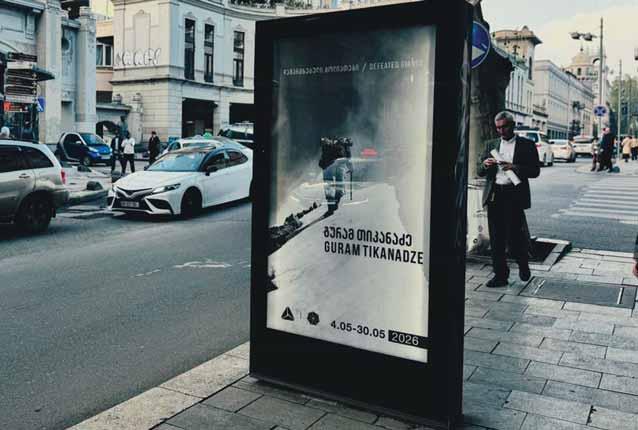
Mountainsoccupyasacred place in Georgian culture. Poetry transformed them into symbols of freedom. Painting monumentalized them into landscape mythology. Cinema used them as scenery for masculine endurance and national character. Generations of mountaineers carried into the Caucasus the romantic fantasy of conquest, purification, transcendence through altitude. Guram Tikanadze understood mountains differently. His photography contains none of the triumphant rhetoric usually attached to mountaineering imagery. No victorious heroism. No theatrical domination over nature. No monumental self-glorification before the sublime. Tikanadze photographed the mountain as an autonomous force: alive, unstable, indifferent, physically intelligent. Human presence inside his images feels temporary, exposed, fragile. This perception forms the emotional center of Defeated Giants, the exhibition presented at TBC Concept Gallery within the framework of Kolga
Tbilisi Photo 2026.
The title already establishes the exhibition’s philosophical pressure. “Defeated Giants” refers neither to conquered peaks nor to fallen titans. The phrase carries geological and existential resonance simultaneously. Inside Tikanadze’s visual universe, defeat acquires another meaning entirely: the erosion of human certainty in the face of elemental scale.
The exhibition unfolds through mountain photographs created during expeditions across the Caucasus and Pamirs: images born from physical immersion inside dangerous terrain. Tikanadze himself was not an external observer documenting alpine spectacle from a safe distance. He belonged to the mountain completely: photographer, climber, geographer, participant. His body moved through the same snow, exhaustion, wind, frost, and vertical instability visible within the photographs themselves. This physical involvement gives the images their extraordinary density.
One senses immediately that these works were made under conditions where perception sharpens into survival instinct. Every frame contains heightened attentiveness to texture, rhythm, atmospheric pressure, human balance inside hostile space. Tikanadze’s camera does not aes-
theticize danger from afar; it inhabits danger internally. The mountain in these works breathes. Fog moves through the image like unfinished thought. Snow absorbs sound. Rock surfaces acquire almost anatomical presence. Climbers appear suspended between disappearance and emergence, their silhouettes swallowed by geological scale. Space itself becomes the protagonist. And perhaps this explains why Tikanadze’s photography still feels startlingly contemporary. Today’s visual culture remains saturated with conquest imagery. Tourism, sports branding, social media spectacle, survival aesthetics: all continuously reproduce the fantasy of the individual mastering extreme nature through performance and visibility. Tikanadze proposes another ethics entirely: attentiveness instead of domination. His photographs carry humility.
Born in 1932 in Kviriketi, Tikanadze studied geography and geology at Tbilisi State University and later worked at the Institute of Geography of the Georgian Academy of Sciences. Alongside his scientific and journalistic career, he became one of the major figures of Georgian photography during the late 1950s and early 1960s. In 1959 he received a silver medal at the International Festival of
Youth and Students in Vienna for his photograph Ole, Ole, Lonely Tree, the first international award in the history of Georgian photography.
Soviet Georgian photography during this period was gradually discovering visual autonomy beyond ideological illustration. Tikanadze belonged to a generation searching for freer visual language inside a rigid political system. His photographs absorbed documentary immediacy while preserving psychological openness and formal experimentation. One sees in his work the emergence of a photographic consciousness deeply aware of atmosphere, temporality, bodily vulnerability.
In 1963, descending from Shkhara, Guram Tikanadze died tragically in the mountains at the age of thirty-one. This fact transforms the exhibition into something more complicated than retrospective presentation. Every photograph suddenly acquires a prophetic undertone. The mountain images begin vibrating with knowledge of mortality already contained inside the terrain itself. Tikanadze photographed the Caucasus as someone who understood the mountain’s absolute indifference to human ambition.
The exhibition avoids sentimentalizing this tragedy. Its emotional power comes from another source entirely: clarity. Tikanadze’s images understand that nature possesses neither cruelty nor mercy. The mountain simply exists within another scale of time and force. Human beings entering this environment undergo psychological recalibration. Ego weakens. Perception sharpens. Movement becomes ethical discipline. Inside con-
temporary urban culture, this perspective feels almost radical.
Modern life increasingly separates human beings from material reality. Climate-controlled interiors, algorithmic environments, digital mediation, permanent distraction; all produce sensory insulation from elemental experience. Tikanadze’s photography restores physical exposure to consciousness. His images remind viewers that perception once depended upon weather, balance, terrain, bodily endurance.
Curated by Mariam Tsikaridze with assistant curator Mari Makharoblishvili, Defeated Giants functions simultaneously as archival recovery and philosophical statement. Within the context of Kolga Tbilisi Photo’s 25th anniversary, the exhibition acquires additional historical significance: it reconnects contemporary Georgian photography with one of the foundational figures who expanded its visual language beyond reportage toward existential observation.
Tikanadze’s work continues speaking because it preserves a rare quality: seriousness toward reality itself. His photographs contain risk, silence, gravity, weather, exhaustion, concentration. They restore scale to human existence. They remind us that mountains do not exist for metaphor alone. Mountains alter consciousness physically. The Caucasus inside these images feels ancient, dangerous, and awake. And somewhere within the snow and stone, one still senses the photographer climbing upward through fog, carrying a camera toward conditions where vision itself becomes a form of survival.
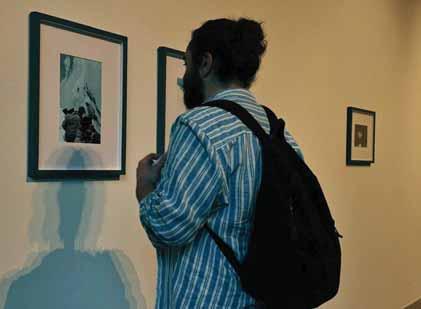
BY TEAM GT
The Soso Lagidze International Arts Festival, Tbilisi Rhythm, is launching an outstanding program for music and arts lovers this season.
World-renowned pianist and composer Shahin Novrasli will perform with a French trio, presenting his celebrated albums Emanation and From Baku to New York City on Monday, May 11, at the Tbilisi State Conservatoire Grand Hall. He will follow this with a second performance on Tuesday, May 12, at one of Georgia’s leading jazz venues, Tatuza Jazz Club. For the first time in its history, the festival will also include theater in its program. After the Rehearsal, based on Ingrid Bergman’s play, will be staged at the Sandro Mrevlishvili Municipal
Theater. The production stars Akaki Khidasheli and Marina Kakhiani and is directed by Mikheil Mrevlishvili.
The program continues on Thursday, May 28, with a performance by Vincent Peirani: Living Being IV: Time Reflection, part of his world tour, at the Tbilisi State Conservatoire.
ABOUT SHAHIN NOVRASLI
“He is one of the greatest pianists I have ever heard.” – Ahmad Jamal Modal at heart, improvisational in soul, academic in spirit, and Azeri by roots, Shahin Novrasli’s cultural background flows through every performance. His style is a fusion of jazz, classical music, and mugham, a traditional Azeri folk art form passed down through generations. This jazz-mugham synthesis reflects the essence of his “Land of Fire” homeland. It is a meeting point of East and West, echoing Azerbaijan’s heritage and its famous Buta symbol, often associated with renewal and evolution.

spiritual pursuit. By the age of 11, he
performing in
More recently, he has studied mugham singing, one of the most com-
plex art forms in Azeri musical tradition. His lifelong dedication is evident in the intensity of his performances.
Best experienced live, Novrasli performs with a focused, almost trance-like intensity. His repertoire draws equally on Joni Mitchell, Bach, and Vagif Mustafazadeh, reflecting his deep commitment to musical fusion, which has become a defining feature of his jazz-mugham style.
This approach also drew the attention of jazz legend Ahmad Jamal, who called him one of the greatest pianists he had ever heard. Since their meeting in 2014, Jamal has produced two of Novrasli’s most exploratory albums: Emanation (winner of the UK Vibe Best Jazz Album 2017 award) and From Baku to New York City. Tickets are available at tkt.ge/tbilisirhythm Prices range from 25 GEL to 95 GEL Tbilisi Rhythm Festival is organized by
BY IVAN NECHAEV
Kutaisi remembers through sound. Through the creak of wooden staircases after rain. Through church bells dissolving into the humid air above the Rioni. Through voices drifting from courtyards at dusk. Through the peculiar acoustics of western Georgian cities, where conversation always carried traces of theater, ritual, lamentation, and song.
The Zakaria Paliashvili House-Museum belongs to this sonic geography. Hidden within Kutaisi’s old historic fabric, in the district once associated with the city’s Catholic and European communities, the house preserves the atmosphere from which Georgian professional music emerged long before it became academic doctrine, institutional prestige, or patriotic monument.
Everything here begins with intimacy.
The future composer of Abesalom and Eteri was born in this house in 1871, inside a city that at the end of the nineteenth century functioned as one of the most culturally layered urban spaces in the Caucasus. Kutaisi absorbed merchants, priests, craftsmen, intellectuals, multilingual communities, wandering musicians, provincial aristocrats, Catholic families, revolutionary ideas, and church traditions into a single restless organism.
The city possessed its own rhythm : emotionally porous, theatrical, impulsive, deeply musical.
The museum today preserves manuscripts, family objects, photographs, editions of scores, archival materials, instruments, and domestic interiors associated with Paliashvili’s childhood and artistic life. Among its most evocative objects remain the composer’s cradle, his physharmonica, church-related artifacts connected to his upbringing, and the Becker piano linked to his musical practice.
Yet the museum’s emotional center resides elsewhere: inside the strange sensation that Georgian music still lingers within these rooms as unfinished vibration. Paliashvili’s music carried within itself the acoustics of Kutaisi long
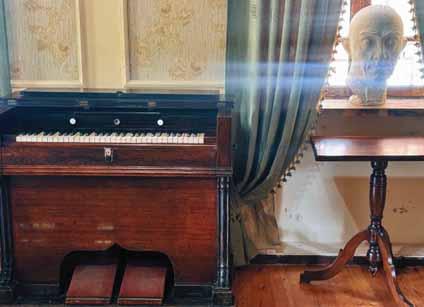
before Georgian opera acquired its canonical form. His works emerged from church polyphony, folk intonation, supra songs, liturgical rhythm, urban melancholy, and the density of collective singing that shaped Georgian auditory memory for centuries. Opera in his hands became a space where oral culture entered historical duration.
This transformation remains one of the decisive moments in Georgian cultural history. European musical forms had already penetrated the Caucasus through imperial institutions, military orchestras, salons, conservatories, and aristocratic taste. Yet Paliashvili achieved something far more unstable and profound: he translated Georgian polyphonic thinking into operatic dramaturgy without dissolving its internal tension. One still hears in his harmonic language the weight of traditional multipart singing: its rough verticality, its modal friction, its almost physical density.
His operas breathe collectively. The chorus in Daisi or Abesalom and Eteri carries emotional authority equal to individual protagonists. Human voices move through these works like social memory itself. Love, betrayal, mourning, destiny; all unfold through communal sound.
Continued from page 1
This season’s program takes place once again at Factory Tbilisi, the former industrial complex that has become closely tied to the identity of the event itself. Its raw industrial spaces and underground atmosphere have helped shape the distinctive character that sets Tbilisi’s fashion scene apart internationally.
Among the designers presenting collections this season are some of the most recognized names in Georgian fashion, alongside younger creatives bringing fresh energy to the runway. Tamuna Ingorokva’s label Ingorokva returns with its signature sharp tailoring and clean silhouettes, while Lado Bokuchava continues to build on the contemporary aesthetic that has earned international attention for its experimental cuts and modern materials. Aleksandre Akhalkatsishvili, known for his monochrome minimalism and architectural approach to tailoring, is also among the headline designers this season.
The program also highlights emerging voices shaping the next chapter of Georgian fashion. Brands such as Reckless and God Era reflect the more experimental and gender-fluid direction increasingly associated with Tbilisi’s creative scene. Designers Tiko Paksa and Gio
Levan are also presenting collections influenced by conceptual design, historical references and material experimentation.
One of the notable collaborations this year is Materiel x Gudu, bringing together the established Georgian fashion house Materiel with designer Lasha Mdinaradze of Gudu. The collaboration combines Materiel’s longstanding presence in Georgian fashion with a younger contemporary perspective.
Alongside the runway shows, the fourday program includes exhibitions, special cultural events and gatherings designed to connect different creative fields. International media representatives, fashion critics, buyers, influencers and industry professionals are expected to attend throughout the week.
In recent years, international publications including Vogue and Architectural Digest have highlighted Tbilisi’s fashion scene for its experimental energy, independent spirit and emerging design talent. Designers connected to the platform, including Situationist, Mach & Mach and Anouki, have gone on to achieve growing international recognition, helping position Tbilisi as one of the most closely watched emerging fashion capitals in Eastern Europe.
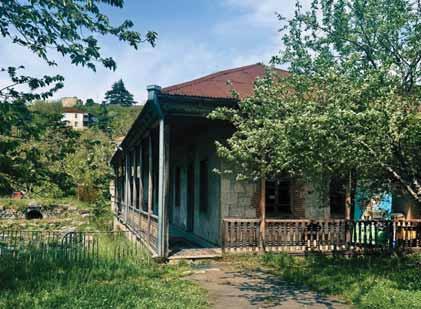
Inside the Kutaisi house, this connection suddenly becomes spatially understandable. The modest scale of the museum matters. Georgian musical modernity emerged from domestic interiors, from amateur choirs, from church practice, from overheard melodies crossing courtyards and narrow streets. One senses how fragile the infrastructure of culture once was. A piano in a provincial room. A manuscript under weak light. A child listening to singing during religious feast days. The future of Georgian opera assembled itself from these seemingly incidental moments. Kutaisi shaped this sensitivity. The city occupied a peculiar position within Georgian history: emotionally extravagant, culturally heterogeneous, historically unstable. Tbilisi cultivated administration and diplomacy; Kutaisi cultivated atmosphere. Even today the city produces a specific emotional tempo — slower, humid, theatrical, slightly melancholic, permanently haunted by memory. The Paliashvili house absorbs this atmosphere completely.
Its wooden balconies and intimate rooms preserve the texture of nineteenthcentury urban life in western Georgia, where European influence, local folklore, Catholic traditions, and Georgian musical practices circulated simultaneously.
Paliashvili’s own Catholic background forms part of this historical mosaic. Georgian cultural identity inside the museum appears layered, multilingual, porous, formed through intersections rather than isolation.
This complexity often disappears beneath monumental narratives about “national culture.” The twentieth century transformed Paliashvili into an official symbol of Georgian artistic achievement.
Soviet cultural policy elevated him into the position of foundational composer, guardian of national musical heritage, architect of operatic canon. Institutions carried his name. His operas entered state repertoire. His image acquired ceremonial weight.
The museum in Kutaisi quietly restores human scale to this mythology. One encounters uncertainty here. Provincial life. Religious hybridity. Cultural improvisation. The nervous energy of a society attempting to invent modern artistic language from fragmented historical material. Georgian professional music emerges within the museum as a living process filled with risk, experimentation, and emotional vulnerability.
This vulnerability gives the house its extraordinary contemporary relevance.
Modern cultural politics often demands simplified identities, polished narratives,
heritage. The Paliashvili museum preserves another truth entirely: culture grows through contradiction, coexistence, adaptation, migration, accident, and unfinished conversation. Georgian music absorbed influences continuously while maintaining its own sonic gravity. The museum allows this process to remain visible. Even the silence inside the house feels acoustically charged. Visitors often speak about concerts and musical evenings still organized there today. This continuation of performance matters profoundly. Music inside the museum continues circulating through bodies and voices rather than surviving exclusively as archival memory. And perhaps this explains the peculiar emotional effect of the space. Many composer museums preserve greatness. The Kutaisi house preserves emergence. One walks through these rooms with the sensation of standing inside the unfinished draft of Georgian modernity itself — before canonization, before institutional grandeur, before patriotic rhetoric hardened into monument. Georgian opera still exists here as breath, resonance, vibration moving through domestic space. The house remembers the moment when Georgian sound first recognized its historical future.
BY LANA KOKAIA
Alarge mural inspired by Georgian mythology, history and Svan culture will be created in Mestia as part of the international street art festival ‘Gamo-Khate Mestia 2026.’
The project will transform a concrete wall near the Nesgumi Bridge in the village of Lenjeri into an open-air artwork featuring scenes and characters connected to Georgian traditions, legends and historical events.
The festival will bring together 24 artists, including six foreign and 18 local
participants, who will collaboratively create a single mural based on pre-agreed sketches and themes.
Organizers say the mural will feature the legend of Amiran, Medea and the Argonauts, the Golden Fleece, and traditional gold mining methods. Mythological fi gures such as Ochopintre, Rashi, Kursha and Barbale will also be depicted.
Elements of Svaneti’s history and traditions, including Mestia horse racing, the zoomorphic flag ‘Lemi,’ the history of the Fustel Knights and the Khalde Uprising, are also expected to appear in the artwork. The project will additionally highlight Georgian national clothing, the Georgian alphabet, wine traditions
and architecture.
The mural is scheduled to be painted in June.
Beyond the artistic component, the festival will also include public lectures, seminars and workshops led by foreign artists. Organizers say the educational activities will focus on the role of street art in urban design and community transformation.
“The permanent exhibition created as a result of the project in the form of an ‘open-air gallery’ will become a new tourist attraction,” the organizers stated.
The festival is organized by the Georgian Street Art Federation with the support of the Ministry of Culture of Georgia and LEPL ‘Creative Georgia.’
REVIEW BY IVAN NECHAEV
The problem with a large part of contemporary chamber music lies in its excessive comfort. Too many concerts sound as though they have already been approved in advance: balanced, elegant, emotionally regulated, carefully protected from unpredictability. Listeners leave satisfied, musicians remain impeccable, and the music evaporates almost immediately afterward. The concert by Eliso Virsaladze and the David Oistrakh Quartet at the Tbilisi State Conservatoire unfolded according to another logic entirely.
From the first minutes, the evening carried a strange internal instability. The quartet, Andrey Baranov, Daniel Austrich, Fedor Belugin, Alexey Zhilin, approached the score without smoothing over its tensions. Their playing preserved resistance inside the texture: sharp corners between voices, sudden darkening of timbre, phrases that seemed to pull against one another rather than settle comfortably into ensemble unity. The result felt intensely physical.
One could hear bodies listening to each other in real time: adjusting, provoking, reacting. Chamber music here functioned less as polished architecture and more
as live negotiation. The Conservatoire hall, with all its Soviet acoustic memory and pedagogical severity, amplified this feeling even further.
And in the center of it all sat Eliso Virsaladze.
Her playing continues to possess a quality that has become almost endangered: complete indifference toward effect. Many great pianists today perform with visible awareness of image, gesture, emotional readability. Virsaladze seems interested only in the internal pressure of the music itself. She plays from inside the structure outward. That creates an unusual sensation for the listener. Nothing is underlined. Nothing is sold emotionally. The music unfolds with immense confidence in its own material.
Her sound has weight without heaviness. Even large climaxes retain transparency. Harmonic movement remains visible beneath the surface at all times, which gives the performance extraordinary momentum. Virsaladze never allows phrases to become static objects of beauty. Everything continues moving forward internally. And perhaps this is why the ensemble sounded so convincing around her.
The piano never functioned as a dominating center of gravity. Instead, the musicians built a shared acoustic field where details circulated freely between strings and keyboard. Small gestures

elasticity of tempo. By the end of the evening, the most memorable element was not vir-
tuosity, prestige, or historical symbolism. It was the sensation of hearing musicians think together in real time.
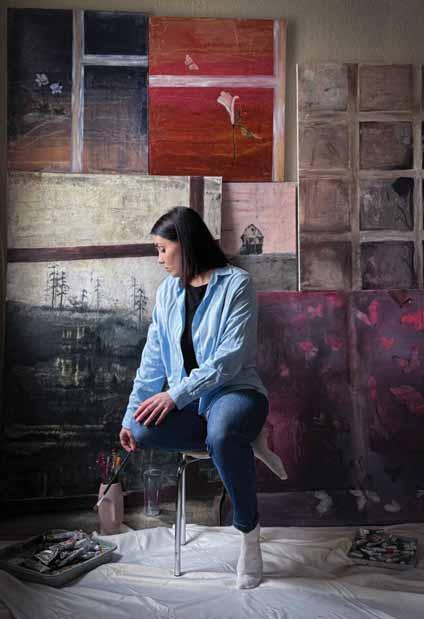
COMMERCIAL DEPARTMENT
Commercial Director: Iva Merabishvili
Marketing Manager: Natalia Chikvaidze
EDITORIAL DEPARTMENT:
Editor-In-Chief: Katie Ruth Davies
BY TEAM GT
BI Auction is proud to introduce one of the winners of the BI Auction Competition for Young Artists: Georgian artist and mother, Ani Gamgebeli.
Ani’s paintings feel deeply personal. There is a quiet emotional honesty in her work: the kind that draws viewers in slowly and stays with them long after. Inspired by memories, everyday moments, and the emotional world she carries within her, she creates paintings that balance softness, reflection, and imagination.
Much of her work is shaped by the idea of looking through a window, both literally and emotionally. For Ani, windows are not simply part of a room or landscape; they are places of observation, memory, and escape. Through this perspective, she transforms ordinary scenes into intimate visual stories filled with feeling and atmosphere.
“You can feel her sensitivity and perception of life in her artworks. Ani skillfully reflects the world she sees through the window of her inner world onto the canvas, combining it with her remarkable talent,” says Bengu Akcardak Kucuk, Co-Founder of BI Auction.
WHAT POSITIVE CHANGES HAVE TAKEN PLACE IN YOUR ARTISTIC JOURNEY SINCE WINNING THE BI AUCTION COMPETITION?
Winning the BI Auction competition in 2024 became a very important moment in my artistic journey. Before winning, I had participated in the auction four times, and each experience helped me grow both personally and professionally.
Journalists: Ana Dumbadze
Vazha Tavberidze
Tony Hanmer
Nugzar B. Ruhadze
Ivan Nechaev
Lana Kokaia
Layout: Misha Mchedlishvili
Photographer: Aleksei Serov
I think BI Auction is especially valuable for young artists because it gives them the chance to share their work with a wider audience and build meaningful connections within the art world.
HAVE ANY NEW OPPORTUNITIES EMERGED IN GEORGIA OR INTERNATIONALLY?
The competition opened many new doors for me. It helped me connect with new people, made my work more visible, and allowed my paintings to continue their life beyond the exhibition space: to become part of someone’s home and daily life. For me, that is one of the most beautiful continuations of art.
HOW DO YOU EVALUATE THE CURRENT SITUATION FOR ART AND ARTISTS TODAY?
Today, the art scene in Georgia still faces challenges, and opportunities can sometimes feel limited, especially for young artists. But I see this as a period of transition rather than stagnation. There has always been strong artistic talent in Georgia, and I believe that creative energy will continue to grow and find new paths forward.
Although we still need more exhibition spaces and support platforms, independent initiatives are becoming more active, and international interest in Georgian art is increasing. At the same time, modern digital platforms give artists the ability to share their voices and work far beyond the country’s borders.
For me personally, the most important thing is to keep working, experimenting, and searching for new forms of expression. I believe that every artist who continues creating with honesty and consistency contributes to the larger cultural
International Relations & Communications
Sofia Bochoidze E: sbochoidze@georgiatoday.ge
Website Editor: Katie Ruth Davies
Webmaster: Sergey Gevenov
Circulation Managers: David Kerdikashvili
David Djandjgava
movement shaping the future of Georgian art.
WHAT IS YOUR UPCOMING PROJECT IN THE NEAR FUTURE?
Right now, I am working on a solo exhibition that brings together memories from different stages of my life, from childhood to the present day. I see the project as a kind of visual diary, made up of fragments, emotions, and images that have stayed with me over the years and are now taking a clearer form through painting. The main motif of the exhibition is the world seen through a window. Since childhood, windows have held a special emotional meaning for me. They never felt like simple physical boundaries, but rather spaces between reality and imagination. In some moments, they offered a kind of escape; in others, they became a way of quietly observing and understanding the world around me.
This upcoming exhibition brings together those memories, emotions, and reflections, creating an ongoing dialogue between the inner world and the outside world.

ADDRESS
22 Janashia Str. Tbilisi, 0179, Georgia
Tel.: +995 32 229 59 19
E: info@georgiatoday.ge F: GeorgiaToday
ADVERTISING & SUBSCRIPTION
+995 577 72 52 61
E-mail: marketing@georgiatoday.ge
Reproducing material, photos and advertisements without prior editorial permission is strictly forbidden. The author is responsible for all material. Rights of authors are preserved. The newspaper is registered in Mtatsminda district court.