Issue no: 1543
• MARCH 13 - 19, 2026 • PUBLISHED WEEKLY
PRICE: GEL 2.50
In this week’s issue... Hudson Institute President Raises Concern over Georgia Investigation into Iran Influence Report NEWS PAGE 2
Ukraine Latest: War Enters another Week of Attrition as Europe Seeks Ways to Sustain Kyiv NEWS PAGE 3
Georgia – United States: Practical Considerations of the Current Stage
FOCUS
POLITICS PAGE 4
Georgia to Introduce State Authorization for New Commercial Vineyards
ON IRAN
"The US will settle for an Iran that is in America's orbit," says Col. (ret) Myles B. Caggins III
A billboard depicting Iran’s late Supreme Leader Ayatollah Ali Khamenei handing the country’s flag to his son and successor Ayatollah Mojtaba Khamenei. Source: AP Photo/Vahid Salemi
PAGE 5
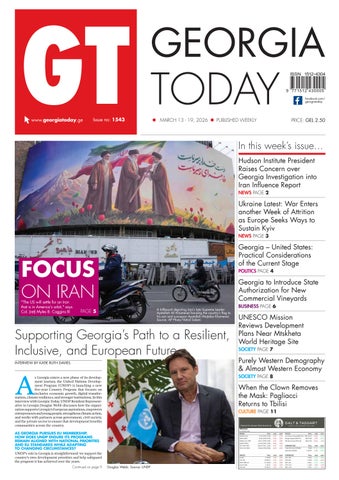
Supporting Georgia’s Path to a Resilient, Inclusive, and European Future INTERVIEW BY KATIE RUTH DAVIES
A
BUSINESS PAGE 6
UNESCO Mission Reviews Development Plans Near Mtskheta World Heritage Site SOCIETY PAGE 7
Purely Western Demography & Almost Western Economy SOCIETY PAGE 8
s Georgia enters a new phase of its development journey, the United Nations Development Program (UNDP) is launching a new five-year Country Program that focuses on inclusive economic growth, digital transformation, climate resilience, and stronger institutions. In this interview with Georgia Today, UNDP Resident Representative in Georgia Douglas Webb discusses how the organization supports Georgia’s European aspirations, empowers entrepreneurs and young people, strengthens climate action, and works with partners across government, civil society, and the private sector to ensure that development benefits communities across the country.
When the Clown Removes the Mask: Pagliacci Returns to Tbilisi CULTURE PAGE 11 Prepared for Georgia Today Business by
DĂƌŬĞƚƐ Ɛ ŽĨ ϬϵͲDĂƌͲϮϬϮϲ
AS GEORGIA PURSUES EU MEMBERSHIP, HOW DOES UNDP ENSURE ITS PROGRAMS REMAIN ALIGNED WITH NATIONAL PRIORITIES AND EU STANDARDS WHILE ADAPTING TO CHANGING CIRCUMSTANCES?
KE ^
ǁͬǁ
ϵϳ͘ϵϱ ;zdD ϱ͘ϲϭйͿ
ͲϬ͕ϳй
ͲϬ͕ϳй
>ŝŽŶ &ŝŶĂŶĐĞ 'ƌŽƵƉ ; ' K >EͿ ' W ϭϬϮ͘ϮϬ
Ͳϭϭ͕ϴй
нϭ͕ϳй
ϵϱ͘ϲϲ ;zdD ϲ͘ϬϳйͿ
ͲϬ͕ϱй
ͲϬ͕ϯй
'ĞŽƌŐŝĂ ĂƉŝƚĂů ; ' K >EͿ
' W ϯϱ͘ϲϬ
Ͳϯ͕ϵй
нϰ͕ϭй
d ĂŶŬ 'ƌŽƵƉ ;d ' >EͿ
' W ϰϮ͘Ϭϱ
ͲϭϬ͕ϭй
ͲϮ͕ϳй
WƌŝĐĞ
ǁͬǁ
ŵͬŵ
ϵϴ͕ϵϲ нϮϳ͕ϯй
нϰϯ͕ϯй
' '' ϵ ϭͬϮ W ZW
WƌŝĐĞ
ǁͬǁ
ŵͬŵ
^dK <^
ϭϬϱ͘ϭϯ ;zdD ϴ͘ϳϬйͿ
ͲϬ͕ϱй
ͲϬ͕ϲй
^><Z , ϬϵͬϯϬ
ϭϬϭ͘ϴϭ ;zdD ϳ͘ϬϮйͿ
ͲϬ͕ϲй
ͲϬ͕ϲй
d ϴ͘ϴϵϰ W ZW
ϭϬϬ͘ϲϲ ;zdD ϭϭ͘ϭϬйͿ
ͲϬ͕ϯй
ͲϬ͕ϭй
KDDK /d/ ^
d ϭϬ ϭͬϰ W ZW
ϭϬϲ͘ϲϱ ;zdD ϴ͘ϵϵйͿ
ͲϬ͕ϰй
ͲϬ͕ϳй
ƌƵĚĞ Kŝů͕ ƌĞŶƚ ;h^ΨͬďďůͿ 'ŽůĚ ^ƉŽƚ ;h^ΨͬK Ϳ
UNDP’s role in Georgia is straightforward: we support the country’s own development priorities and help safeguard the progress it has achieved over the years. Continued on page 9
WƌŝĐĞ
' KZ' Ϭϭͬϯϭ 'Z /> ϬϲͬϮϴ
/E / ^
Ͳϯ͕ϰй
нϭ͕ϲй
WƌŝĐĞ
ǁͬǁ
ŵͬŵ
hZZ E / ^
WƌŝĐĞ
ǁͬǁ
ŵͬŵ
^W ϱϬϬ
ϲ ϳϵϱ͕ϵϵ
Ͳϭ͕Ϯй
ͲϮ͕ϰй
h^ ͬ ' >
Ϯ͕ϳϰϮϬ
нϭ͕ϯй
нϮ͕Ϭй
&d^ ϮϱϬ
ϮϮ Ϭϵϴ͕ϭϮ
Ͳϱ͕ϳй
Ͳϱ͕ϯй
hZ ͬ ' >
ϯ͕ϭϵϬϱ
нϬ͕ϴй
ͲϬ͕ϰй
нϭ͕ϳй
нϬ͕ϰй
Kt :KE ^ ϯϬ
Douglas Webb. Source: UNDP
ϱ ϭϯϴ͕ϱϯ
ŵͬŵ
ϰϳ ϳϰϬ͕ϴϬ
ͲϮ͕ϰй
Ͳϰ͕ϴй
' W ͬ ' >
ϯ͕ϲϵϭϭ
ZƵƐƐĞůů ϮϬϬϬ
Ϯ ϱϱϯ͕ϲϳ
Ͳϯ͕ϵй
Ͳϱ͕Ϭй
hZ ͬ h^
ϭ͕ϭϲϯϲ
ͲϬ͕ϰй
ͲϮ͕ϯй
&d^ ϭϬϬ
ϭϬ Ϯϰϵ͕ϱϮ
Ͳϰ͕ϵй
Ͳϭ͕ϯй
' W ͬ h^
ϭ͕ϯϰϯϳ
нϬ͕Ϯй
Ͳϭ͕ϵй
2
NEWS
GEORGIA TODAY
MARCH 13 - 19, 2026
Hudson Institute President Raises Concern over Georgia Investigation into Iran Influence Report
Tbilisi garages. Source: Tbilisi Architecture Biennial
Kaladze Urges Residents to Support Removal of Illegal Garages in Courtyards BY MARIAM RAZMADZE
T
bilisi Mayor Kakha Kaladze has called on residents to actively support the removal of outdated garages and illegal structures in residential courtyards, promising that all demolition costs will be fully covered by Tbilisi City Hall. Speaking at a municipal government meeting, Kaladze said the initiative aims to free up space between residential buildings and transform it into green recreational areas for residents. The first stage of the initiative has already begun in Varketili’s 2nd microdistrict, where around 15 garages and illegal extensions have been dismantled with residents’ consent. The mayor stated that the cleared area will soon be redeveloped into a recreational space, including landscaping and community facilities. “It is important that we green the spaces between residential buildings as much as possible. With residents’ participation, we can design projects that every-
one approves of: parks, seating areas, sports fields and other public amenities,” Kaladze said. He emphasized that citizen involvement is essential for shaping the redevelopment projects, encouraging residents to actively engage in planning the future of their neighborhoods. Kaladze assured residents that they will not bear any financial burden for removing the structures. “You won’t spend a single tetri on removing these unsightly garages or illegal fences: the municipality will take care of everything,” he said. At the same time, landscaping works are also underway in Varketili’s 4th micro-district, where a 3,200-squaremeter area is being transformed into a new green zone. The project will include: • seating and relaxation areas • a pavilion • a children’s playground • outdoor lighting • irrigation systems • security cameras • modern urban equipment
John P. Walters. Source: Jessica Latos Photography
BY TEAM GT
T
he president of the Washington-based Hudson Institute, John P. Walters, has expressed “serious concern” over an investigation launched by Georgia’s State Security Service following the publication of a report examining Iran’s growing influence in the country. The report was co-authored by Luke Coffey and Georgian analyst and politician Giorgi Kandelaki, and focuses on the expanding political, economic, and security footprint of the Iran in Georgia. In a statement, Walters defended the report and its authors, stressing that the
publication followed the think tank’s research standards and relied entirely on open sources. “This is a publication produced by the Hudson Institute in accordance with the institute’s research standards. The report is based on verified information that is publicly available, as noted throughout the report’s endnote citations, and the Hudson Institute stands firmly behind its findings,” Walters said. He described the report as an important warning about regional security trends. “This report should serve as a wake-up call, especially at a time when Iran serves as a destabilizing force in the region.” Walters also criticized the decision by Georgian authorities to open an investigation in connection with the report,
arguing that the focus should instead be on addressing the issues raised in the research. “Rather than launching an investigation against the authors of the report, the authorities should be concerned about the findings, which overwhelmingly rely on publicly accessible information that the authorities should already be aware of,” he said. Walters claimed that the report presents a systematic picture of Tehran’s expanding influence in Georgia. “The report outlines a clear and systematic picture of the expanding influence of the Islamic Republic of Iran in Georgia. These developments run counter to the interests of both Georgia and the United States, and warrant serious attention.” The report by Coffey and Kandelaki examines several areas where Iranian influence has reportedly increased in Georgia, including economic activity, cultural outreach, and potential networks connected to Tehran. The issue has drawn attention amid heightened regional tensions involving Iran and its allies, as well as growing scrutiny in Western policy circles over Tehran’s activities in countries located along key geopolitical corridors. The Hudson Institute, a prominent US policy think tank focused on security and foreign policy, frequently publishes research on geopolitical risks and international security challenges. The investigation by Georgia’s State Security Service has sparked debate among analysts and political observers about freedom of research and the government’s response to critical policy reports.
Georgian PM Kobakhidze Congratulates Mojtaba Khamenei on Election as Iran’s Supreme Leader
gia, I congratulate you on your election Middle East and ongoing military conArmenian PM: Frozen EU–Georgia BY TEAM GT as Supreme Leader of the Islamic Repub- frontations involving Iran and several lic of Iran. Georgia attaches great impor- regional actors. The leadership change Political Dialogue Biggest Obstacle eorgian Prime Minister tance to the partnership relations between followed the killing of Ayatollah Ali Irakli Kobakhidze has sent our two countries and peoples, based Khamenei in recent strikes that draan official congratulatory on mutual respect. I wish the Iranian matically escalated the regional crisis. to Armenia’s EU Integration Georgia maintains diplomatic relations message to Mojtaba people peace and prosperity,” the mes-
G
Khamenei following his election as the new Supreme Leader of the Islamic Republic of Iran, according to a statement published on the website of the Government Administration of Georgia. In the message, Kobakhidze expressed congratulations on behalf of the Georgian government and highlighted the importance of bilateral relations between the two countries.
Armenian Prime Minister Nikol Pashinyan
BY TEAM GT
A
rmenian Prime Minister Nikol Pashinyan said that the current freeze in political dialogue between the European Union and Georgia represents the most significant challenge for Armenia’s path toward European integration. Speaking at the European Parliament, Pashinyan stated that Georgia plays a key role in Armenia’s European aspirations and serves as an important bridge on the country’s route toward the EU. “To be frank, the biggest problem on Armenia’s path toward integration with the European Union today is the frozen state of political dialogue between the EU and Georgia,” Pashinyan said. The Armenian prime minister claimed that Armenia adopted legislation to launch the process of joining the EU after Georgia received official candidate status for EU membership. “We adopted the law on launching the
process of Armenia’s accession to the European Union after Georgia received EU candidate status,” Pashinyan said. “This made the prospect of Armenia’s EU membership more tangible.” He added that Armenia expects and hopes to see constructive dialogue restored between the EU and Georgia, stressing that developments in this relationship are equally important for Yerevan. “Our expectation and request is that the constructive process between the European Union and Georgia develops further,” Pashinyan said. “This is just as important for Armenia as it is for Georgia.” Armenia has increasingly signaled interest in closer political and economic ties with the European Union in recent years, while maintaining complex regional relations with neighboring countries and traditional security partners. Pashinyan’s remarks come amid ongoing tensions between Brussels and the Georgian government over democratic standards and political reforms, which have affected the pace of Georgia’s EU integration process.
“On behalf of the Government of Geor-
comes amid heightened tensions in the
sage reads. Mojtaba Khamenei, the son of the late Supreme Leader Ayatollah Ali Khamenei, was recently elected to Iran’s highest political and religious position following a turbulent period in the country’s leadership. The Supreme Leader holds ultimate authority over Iran’s political system, including control of the armed forces, the judiciary, and key state institutions. The transition of power in Tehran
with Iran and has historically sought to balance pragmatic economic and political engagement with Tehran while preserving its strategic partnerships with Western allies. The two countries cooperate in areas such as trade, transportation, and regional connectivity. Kobakhidze’s message places Georgia among the foreign leaders who have formally acknowledged the leadership transition in Iran.
Tbilisi and Batumi Top List of Georgia’s Most Visited Tourist Destinations BY MARIAM RAZMADZE
T
he Georgian National Tourism Administration reported that Georgia’s most popular travel destinations for international visitors in 2025 were Tbilisi, Batumi and Kutaisi. The survey allowed respondents to select multiple locations they visited, offering a broader view of how foreign tourists travel across the country and which destinations attract the most attention. Tbilisi continues to dominate Georgia’s tourism landscape, welcoming 3.76 million foreign visitors in 2025. This represents an 11% increase year-on-year, with the capital accounting for 33% of the country’s total tourist flow. The coastal city of Batumi ranked second, attracting 2.6 million international visitors, equivalent to 23% of overall tourist arrivals. Visitor numbers to Batumi
Batumi. Source: cntravellerme
increased 5% compared to 2024. In the wider Adjara region, several sites proved especially popular, including Batumi Botanical Garden, Gonio Fortress, and the seaside resort of Kvariati. Kutaisi ranked third with 631,000 foreign visitors which is a 15% annual increase. Tourists visiting the city fre-
quently explored nearby landmarks such as Gelati Monastery, Bagrati Cathedral and the caves around Tskaltubo. Mountain destination Kazbegi placed fourth with 592,000 visitors, reflecting a 16% rise compared to the previous year. Meanwhile, the historic town of Mtskheta ranked fifth, drawing 542,000 visitors.
NEWS
GEORGIA TODAY MARCH 13 - 19, 2026
3
Ukraine Latest: War Enters another Week of Attrition as Europe Seeks Ways to Sustain Kyiv COMPILED BY ANA DUMBADZE
T
he war between Russia and Ukraine continued this week with intense fighting along several sections of the frontline, persistent missile and drone attacks on infrastructure, and renewed diplomatic efforts among Western allies to secure longterm financial support for Kyiv. While neither side achieved a decisive breakthrough on the battlefield, Russian forces continued applying pressure along eastern Ukraine while Ukrainian troops sought to stabilize defensive lines and conduct long-range strikes against Russian military and logistical targets. The most intense fighting remained concentrated in eastern Ukraine, particularly in the Donetsk region, where Russian forces continued efforts to push Ukrainian defenses westward following earlier territorial gains. Russian troops supported by artillery, drones and glide bombs launched repeated assaults against Ukrainian positions near several settlements, seeking gradual advances toward logistical routes that sustain Ukrainian forces deeper in the region. Ukrainian military officials reported that their troops repelled numerous Russian assaults during the week, although heavy shelling and drone reconnaissance continued to place significant pressure on defensive positions. The battlefield dynamic remained largely characterized by attritional warfare, with Russian forces attempting to advance through sustained artillery barrages and infantry assaults while Ukrainian defenders relied on fortified positions and precision strikes to slow the offensive.
One of the most heavily contested areas remained the broader Avdiivka sector, where Russian troops have attempted to consolidate earlier gains and push further toward Ukrainian supply hubs. Ukrainian commanders reported repeated mechanized assaults and intense bombardments aimed at weakening defensive positions. Despite the pressure, Ukrainian forces said most attacks were contained and that Russian advances in the area remained limited. Further north, fighting also continued along the Kupiansk direction in northeastern Ukraine. Russian forces have attempted to push Ukrainian troops away from defensive positions along the Oskil River, using artillery and reconnaissance drones to strike Ukrainian fortifications and supply routes. Ukrainian officials said their forces managed to stabilize the situation in the area, though the front remained tense and subject to constant shelling. In southern Ukraine, the frontline in the Zaporizhzhia region remained largely static but volatile. Ukrainian forces conducted several localized counterattacks in an effort to improve tactical positions, including operations reported near the Hulyaipole direction. While these actions did not result in major territorial gains, they demonstrated that Ukrainian troops continue attempting to contest Russian defensive lines and regain advantageous positions along the southern front. Russian forces in the region have relied heavily on fortified defensive belts, minefields and drone surveillance to prevent large Ukrainian advances. As a result, the southern front has largely remained a stalemate characterized by artillery exchanges and drone warfare rather than large maneuver operations. Military analysts say Russia may also be preparing the battlefield for a poten-
Ukrainian soldiers on the eastern frontline. Source: REUTERS
tial larger offensive later in the year. Increased artillery bombardments and reconnaissance activity have been reported along several defensive lines in eastern Ukraine, suggesting that Moscow could be attempting to weaken Ukrainian fortifications ahead of possible spring or summer operations. At the same time, Ukraine continued its campaign of long-range strikes against Russian military infrastructure. Ukrainian drones reportedly targeted several ammunition depots, command facilities and logistical hubs in occupied territories and in regions inside Russia itself. These strikes form part of Kyiv’s strategy to disrupt Russian supply networks and reduce the logistical capacity supporting Moscow’s military operations. Russia meanwhile continued launching large waves of missile and drone attacks against Ukrainian cities and infrastructure. Ukrainian air defense systems intercepted many incoming projectiles, but several strikes still caused damage to civilian buildings and energy facilities
across multiple regions. One of the most significant attacks of the week occurred in Kharkiv, where a Russian missile strike hit a residential building, killing at least ten people, including two children, and injuring many others. The strike formed part of a wider wave of missile and drone attacks targeting several regions of Ukraine, damaging energy infrastructure and forcing temporary power outages in some areas. Energy infrastructure continued to be one of the primary targets of Russian attacks. Strikes damaged electrical substations and power facilities in multiple regions, requiring emergency repair work by Ukrainian energy crews. Ukrainian officials have repeatedly warned that Moscow is attempting to weaken the country’s energy system and disrupt civilian life through sustained aerial bombardments. Civilian casualties were reported in several regions following missile and drone attacks during the week. Ukrain-
ian authorities said strikes damaged residential buildings, industrial sites and public infrastructure, leaving multiple people dead and dozens injured. Emergency crews were dispatched to extinguish fires and rescue residents from damaged buildings. Ukraine also continued conducting strikes inside Russian territory, targeting energy and logistical facilities believed to support the war effort. Drone attacks reportedly struck oil depots and military infrastructure in several Russian regions bordering Ukraine. While Russian officials rarely disclose the full scale of damage, local reports indicated that some facilities experienced temporary disruptions following the attacks. The war continues to impose heavy casualties on both sides as the conflict grinds through its third year. Ukrainian officials reported significant Russian losses during repeated assaults along the eastern front, while Russia’s Defense Ministry claimed that Ukrainian forces suffered heavy casualties while defending their positions. Independent verification of battlefield casualty figures remains difficult, but Western intelligence assessments suggest that attrition remains high for both armies. Alongside the fighting, Ukraine continued receiving military assistance from Western partners seeking to strengthen its defensive capabilities. Several countries announced new support packages including artillery ammunition, air defense equipment and training programs for Ukrainian soldiers. Diplomatic activity surrounding the war also intensified this week, particularly within the European Union as governments debated long-term financial support for Kyiv. Continued on page 4
4
POLITICS
GEORGIA TODAY
MARCH 13 - 19, 2026
Georgia – United States: Practical Considerations of the Current Stage ANALYSIS BY VICTOR KIPIANI, GEORGIA FIRST / GEOCASE
T
he shift of Georgian-American relations into a realistic plane is driven by the primary demand of the modern world: finding practical interests between the parties, “processing” them appropriately, and realizing them in everyday politics without sentimentality or ideology.
WHAT TIME HAS BROUGHT US: In such times, the main defining principle is correctly selected reciprocity: what we give and what we receive in return. Speaking with empathy and ideological clichés is truly useless here, because in a world saturated with “consumer” culture, the most important thing is to understand exactly: • What is expected of you; • What you are willing to give in response to the partner country’s expectations; and • What resources you have to bargain for your own interests. The use of the word “bargaining” does not cause me personal discomfort, and I urge the reader to feel the same: do not shrink away from the introduction of new conversational and negotiation techniques and diplomatic culture from the Georgian side in this newly formed, unsystematic system of relations. I believe that only through dry rationalism, within the context of Georgia’s realistic capabilities, will we be able to: • Make them understand what we want; • Understand what they want; and • Find the right middle ground. This is exactly the approach offered by the current administration of the
US, Georgia flags. Source: EurAsian Times
United States. It only remains for us not to become confused, to perceive it adequately, to adapt to the proposed signature style, and by mastering it, move toward a new framework for GeorgianAmerican relations by prioritizing Georgia. Regarding this, I will highlight several considerations as basic material for further discussion. However, before detailing them, I also consider it necessary to state two very fundamental conditions...
SPECIFICALLY, THAT: (1) the views voiced in this annotation require a broad socio-political consensus within the Georgian space. The point is that the practical implementation of these ideas between Georgia and the U.S. will result not only in a completely new character of bilateral relations, but also in a qualitatively different content for the Georgian state’s foreign policy and security lines. As a
result of such transformation, Georgia’s positioning, both in its immediate neighborhood and in the surrounding region, will change significantly. (2) only a Georgia of a new politicalsocial formation can serve as the initiator for achieving and operationalizing the aforementioned consensus. The reason for such statements is that the passing years and the status quo make the current governing circles, as well as the current form of governance, absolutely inappropriate for solving the challenges facing the country and for adapting to the demands of modern times.
REGARDING SPECIFICS: 1. For the purpose of our country’s real security and defense, the new sociopolitical formation, prioritizing Georgia first, must deliberately develop and bring forward the following key topics for consideration:
(1) Defense Spending: The national budget must allocate defense expenditures that are sufficient to support both the national defense system and the necessary cooperation between Georgia and the US in this field. This approach will create the prerequisites for overcoming the lag of the Georgian Armed Forces compared to regional countries and for their modernization, as well as for a real, actionbased bilateral security format between Georgia and the US. (2) Military-Industrial Cooperation: Establishing an appropriate format for military-industrial cooperation between the two countries, including the design and joint production of defense systems. Beyond direct security goals, this will promote the development of Georgian scientific potential and access to modern technologies, not to mention the positive effect on the Georgian labor market. (3) Infrastructure Access: Offering the American side access to Georgian infrastructure for the projection of US interests in the region. Note: This is a “double-edged sword” concept. While it provides a concrete security mechanism for Georgia, its implementation involves specific risks; most notably, turning our country into a potential target for US adversaries. However, this proposal must be evaluated through a “SWOT” analysis (Strengths, Weaknesses, Opportunities, Threats) of assets and liabilities. We must agree that in the modern world: • Absolute security does not exist; promising it is a fiction. • Caring for national security requires a reciprocal contribution (“only cheese in a mousetrap is free”). • Effective relations regarding real security are impossible without reciprocity between the parties.
2. For the purpose of economic sustainability and development, the new formation, prioritizing Georgia first, should open negotiations with the American side to sign a Trade and Economic Agreement (an expanded version of a Free Trade Agreement). Such an agreement would: (1) help Georgian and American economic actors gain preferential access to their respective markets and attract capital and technology. (2) provide for an investment screening mechanism in Georgia to eliminate or minimize investments made for noneconomic purposes or hidden geopolitical motives. (3) address the reduction and/or management of dependence on a single source of energy supply. 3. To synchronize the policies of the two countries in the Wider Black Sea region and strengthen regional supply lines, the Georgian and American sides should consider practical means for: (1) establishing joint ventures in our country. (2) entering into long-term procurement contracts with regional suppliers. (3) creating appropriate joint logistics for necessary stockpiles.
CONCLUSION: A framework relationship built on the political will of both sides, proper competence, and reasonably arranged reciprocal obligations will give cooperation between the two countries a systematic framework, solidity, modern content, and necessary clarity. Through such cooperation, our country will gain additional opportunities to reduce and manage the risks of undesirable pressure on its foreign course, hybrid interference in internal affairs, or external aggression.
Ukraine Latest: War Enters another Week of Attrition as Europe Seeks Ways to Sustain Kyiv Continued from page 3
Shalva Papuashvili. Source: FB
Papuashvili: Armenia-EU Relations are Separate Issue; Brussels Itself Disrupted Ties with Georgia BY TEAM GT
S
peaker of the Georgian Parliament Shalva Papuashvili said that statements by Armenian Prime Minister Nikol Pashinyan regarding Georgia concern Armenia’s relations with the European Union and do not reflect Georgia’s position. Papuashvili made the remarks during a briefing while commenting on Pashinyan’s speech in the European Parliament. “Mr. Pashinyan is the Prime Minister of Armenia. He was speaking from the perspective of Armenia’s interests as a representative of his country’s government. We speak about the interests of our own country,” Papuashvili said. He claimed that the issue raised by the Armenian prime minister relates specifically to relations between Armenia and the European Union. “This concerns Armenia–EU relations. We have our own relations with the European Union,” he stated.
Papuashvili also claimed that it was the EU that disrupted relations with Georgia. “The European Union itself, unilaterally and without provocation, hindered Georgia–EU relations. We cannot fix what they have broken,” he said. The Parliament Speaker added that Pashinyan’s message should be viewed in the context of Armenia’s European integration ambitions and its dialogue with Brussels. He also noted that the Georgian government has already communicated to Brussels what steps it believes are necessary to restore proper relations between Georgia and the European Union. “We have already told Brussels what they need to do in order to restore proper relations with Georgia,” Papuashvili said. The comments came after Armenian Prime Minister Nikol Pashinyan, speaking in the European Parliament a day earlier, stated that one of the biggest obstacles on Armenia’s path toward European integration is the currently frozen dialogue between the European Union and Georgia.
Ukraine could continue receiving financial support from European Union countries even if Hungary and Slovakia block a planned €90 billion loan package, according to a report by Politico citing two EU diplomats on Wednesday. EU leaders are expected to meet in Brussels next week in an attempt to persuade Hungarian Prime Minister Viktor Orbán and Slovak Prime Minister Robert Fico to approve the loan, which is designed to cover roughly two-thirds of Ukraine’s financial needs for continuing its defensive war against Russia through the end of 2027. However, diplomats say that if both governments refuse to support the proposal, several EU countries, particularly from the Baltic and Nordic regions, are prepared to provide Ukraine with alternative bilateral financing. According to the report, these countries could mobilize up to €30 billion to ensure that Ukraine remains financially stable during the first half of 2026. Because the funds would be provided through bilateral loans rather than through EU-wide mechanisms, they would not require unanimous approval from all member states. The Netherlands also reaffirmed its long-term support for Ukraine. Dutch Finance Minister Eelco Heinen informed EU counterparts that the Netherlands has allocated €3.5 billion annually in bilateral assistance to Ukraine through 2029. Ukraine remains heavily dependent on Western financial support to sustain both its economy and its military operations. Under current EU procedures, any member state can block the proposed €90 billion loan package despite having previously agreed to the concept in Decem-
Ukrainian prisoners of war released by Russia after a swap. Source: Reuters
ber, because one of the legislative steps required for its approval requires unanimous backing from all EU countries. Ukraine’s immediate financial situation has been partially stabilized after the International Monetary Fund approved an $8.1 billion loan package at the end of February, including an immediate $1.5 billion disbursement. Officials familiar with the discussions say Ukraine currently has funding secured only until May, although international assistance could extend Kyiv’s financial stability further into the year. Political tensions surrounding the loan proposal increased after a Russian drone strike damaged the Druzhba oil pipeline, which transports Russian crude oil to several European countries. Hungarian Prime Minister Viktor Orbán accused Ukraine of delaying repairs to the pipeline and violating earlier commitments. Ukrainian President Volodymyr Zelensky rejected the accusations, stating that the pipeline could be operational again within a month or a month and a half. European officials are also closely
watching Hungary’s upcoming elections scheduled for April 12. Some EU diplomats believe that if opposition leader Péter Magyar wins the vote, Budapest could adopt a more supportive position toward financial assistance for Ukraine. Slovakia’s Prime Minister Robert Fico, initially seen as another potential obstacle to the loan package, appeared to soften his stance following a meeting with European Commission President Ursula von der Leyen at a nuclear energy summit in Paris. After the meeting, Fico said they discussed restoring Russian oil transit through Ukraine to Slovakia and expressed satisfaction that the European Commission shares his view on the issue. As the war continues without a decisive breakthrough on the battlefield, both sides appear prepared for a prolonged conflict. Russia continues relying on artillery superiority, drone warfare and incremental advances along the front, while Ukraine seeks to offset Moscow’s advantages through defensive fortifications, long-range strikes and sustained international support.
POLITICS
GEORGIA TODAY MARCH 13 - 19, 2026
5
“The US will settle for an Iran that is in America's orbit” – Col. (ret) Myles B. Caggins III INTERVIEW BY VAZHA TAVBERIDZE
A
s the United States and Israel entered the second week of their military campaign against Iran, questions began mounting about the war’s possible endgame, the limits of air power, and whether Washington ultimately seeks regime change, or simply compliance. In an interview with RFE/RL’s Georgian Service, retired US Army colonel and former Pentagon spokesperson Myles B. Caggins III says air supremacy gives Washington a decisive operational advantage, but does not guarantee a quick resolution. He argues that a ground invasion would be extraordinarily difficult, while predicting that the United States will ultimately push Iran toward negotiations and the emergence of a leadership willing to align with American security and economic priorities. The US, he says, will ultimately settle for “an Iran that is in America’s orbit.”
WE ARE ENTERING THE SECOND WEEK OF THIS JOINT MILITARY OPERATION. THE US AND ISRAEL HAVE AIR SUPREMACY OVER IRAN. HOW DECISIVE IS THAT ADVANTAGE, AND HOW MUCH WILL IT SHAPE THE FINAL OUTCOME? The air supremacy is evident by the ability of the two nations to suppress the Iranians' air defenses, as well as bombing Iranian fighter aircraft on the ground before those planes could ever take off. This has been essential for the air campaign against Iran, which has been waged by multi-rolled fighters, including F-15 Eagles, F-35s, F-22s, F-16s, as well as long range bombers, B-2s, B-52s, B-1s. The entire US Air Force and US Navy have been involved in the air campaign against Iran. The air supremacy is essential to the final outcome for the US, which is the defeat of the Iranian military, as well as the prevention of Iran's ability to enrich uranium and create a nuclear weapon.
IRAN'S STRATEGY SEEMS TO BE TO WIDEN CONFLICT AND BASICALLY WAIT IT OUT. HOW EFFECTIVE HAS THAT BEEN, DO YOU THINK? Iran has shown more of a will to fight and more of a capability to fight than many experts anticipated. They have also shown a willingness to engage neighboring nations, not only on military targets, but also diplomatic targets and commercial assets, including oil production facilities and hotels, and they do not seem to discriminate against who they will potentially hit. The only nation that has not been directly targeted by Iran seems to be Turkey. But this strategy will likely draw in more state action against them. The Gulf nations have highly capable military forces equipped and trained by the United States. And at some point, it is likely that they will be added to the air sorties.
LOOKING AT THIS WAR, HOW IMPRESSED IS THE REST OF THE WORLD WITH US MILITARY PROWESS? HOW MUCH IS THIS BUILDING UP US MILITARY DETERRENCE? President Trump's philosophy is peace through strength. And this war is another example of the strength of the US military. And when I mentioned all services being involved, there are operations happening from the Space Force and operations happening on the ground with Special Operations Forces, so it is the full range of US military muscle involved in this, as well as the significant ability of America to project power. The world is understanding this, though the world has always been aware of American military power. One thing that we're not talking about
Iran has shown more of a will to fight and more of a capability to fight than many experts anticipated observers and advisors in Tehran.
WHAT HAPPENS IF THE AERIAL AND NAVAL BOMBARDMENT IS NOT ENOUGH TO ACHIEVE THAT KIND OF SCENARIO? WILL THE US PUT BOOTS ON THE GROUND EN MASSE?
Myles B. Caggins III. Source: kurdistan24
as much is the impact of America's war on Iran over its economic competitors. China is the biggest purchaser of Iran's oil. Russia and India are also involved in getting oil and other resources from Iran. And now that has all been cut off. So there will be rebalances of power and permissions that have to be granted. And the US will be the primary party that is unleashing or reconnecting Iran's resources with the world. So now with the closure of the straits of Hormuz and the likely takeover of Iran's oil industry by the United States, China will have to make purchases through some US entity that gives the US an advantage over them for this area.
HOW LONG CAN THE HORMUZ REMAIN CLOSED WITHOUT THE WORLD ECONOMY ACTUALLY STARTING TO RECOIL? The Strait of Hormuz can remain closed or mostly closed as long as the ship owners and operators do not think they’ve safe passage. Iran has capability to have attack ships inside of the Arabian Gulf, but it has not waged a lot of direct war on the oil tankers, LNG tankers, and other commercial ships that go through the Strait of Hormuz. What we will have to see in the next few days, as the war progresses, is some sort of safety guarantee, and perhaps as this war winds down, the Iranian regime will say that they will stop attacking commercial targets, just as the President has said he does not intend to attack regional nations.
IF THE OPPOSITE HAPPENS AND THEY CONTINUE TO ATTACK COMMERCIAL TARGETS, WILL THAT FORCE THE US TO GIVE OUT MORE CONCESSIONS? I don't anticipate the US making any concessions. I think President Trump has primed Americans by explaining that there will be some short-term pain at the gas pumps with higher prices, but that's the price of freedom. And he has a good 35% of Americans who are very loyal followers to him who will accept paying the higher gas prices in order to eliminate the Iranian regime.
of the United States does not want to have this war go on for weeks, as it is becoming unpopular in the US. And as a result, it is likely that the US and Israel will intensify the campaign.
DO YOU HAVE ANYONE IN MIND FROM THE CURRENT LEADERSHIP OR ELITE? IS THERE A TURBAN-WEARING DELCY RODRIGUEZ OUT THERE SOMEWHERE?
OF THE TWO SCENARIOS, WHICH SEEMS MORE LIKELY?
In my opinion, and I share the opinion of President Trump, the new leader should probably be somebody who's currently inside Iran. The idea that there can be outsiders who've not been in Iran for decades who can just parachute in or waltz in and declare themselves as being in charge is not going to be acceptable for the vast majority of people inside of Iran. I think what will happen is that President Trump and his close associates will choose an acceptable person who rises up out of the negotiations.
I believe that Iran will come to the negotiating table, surrender, and then there will quickly be terms with an acceptable new leader in Iran to take power. And, likely, there will be some sort of American diplomatic oversight or implementation and verification of what's happening on the ground.
WHAT ARE THE STEPS FROM TODAY TO THE ENDGAME THAT THE US WANTS? We in the West often think of the last successful war, the last successful operation. So in this case, a few weeks ago, the US took over the leadership of Venezuela by installing an acceptable vice president there and then keeping a thumb on them, on President Delcy Rodriguez, who's in charge now. President Trump has mentioned this several times in interviews. But Iran is a much more complex place culturally, geographically. The history is vastly different, and there are various groups who have been opposed to the regime: from the Baloch in southeastern Iran to Kurds in northwestern Iran. The new leader will have to be someone who is able to keep the sovereignty of Iran intact, keep the social, cultural, religious fabric of the Iranian people intact. That means that the new leader will have to quickly make statements about fairness, equality, protection of rights of minorities, and that the central government in Tehran will continue to provide services and protection for all people.
NO MATTER HOW IT ENDS, THERE'LL BE RESENTMENT FROM THE SIDE THAT IS OUSTED. SO WHAT WILL THE ARRANGEMENT BE? WHAT KIND OF IRAN WOULD THE US SETTLE FOR? The US will settle for an Iran that is in America's orbit, an Iran that guarantees the US priorities of not having a military or proxy forces that threaten the US and its partners and allies in the region or around the world. And the new leader must be one who cuts deals that benefit America's economic goals. Note, I did not say anything about human rights.
YOU DID NOT EVEN SAY ANYTHING ABOUT THEOCRACY. And I did not say anything about democracy or theocracy.
IS THAT THE MINIMUM THE US WILL SETTLE FOR OR IS THERE A POINT IN-BETWEEN WHERE IRAN AND THE US CAN MEET EACH OTHER? The US will be very clear that the new leader in Iran must accede to what the US wants, which is safety and economic guarantees.
SO WHAT THE US IS LOOKING FOR IS NOT REGIME CHANGE PER SE, BUT REGIME COMPLIANCE?
A ground invasion in Iran would not likely have any rapid success for any reason. The geography, as you mentioned, the population, 90 million people, it's very difficult to control that amount of people. And there can be cultural fault lines between different groups. There has certainly been a lot of blowback to the idea that Kurdish Peshmerga would go into Iran, even into their own predominantly Kurdish provinces along the west of Iran. There has been strong vocal pushback against that idea by the Iranian diaspora in the United States and some people in Iran. It seems to be stronger voices against the idea of Kurdish Peshmerga going into Iran than actually the resistance to the Iranian regime.
SO YOU DON'T BUY INTO THIS MUCH-SPECULATED IDEA OF KURDS OPENING A SECOND FRONT? The Kurds have had a long-term relationship with the United States and with Israel's Mossad, going back decades, far before the war against ISIS. But President Trump clearly looked at the idea and considered it and yesterday poured water on that idea when he was doing a press briefing on Air Force One. He does not want to see Iran devolve into a civil war. I know some of the leaders of the Kurdish groups and it never would be their desire to go to Tehran or take over the entire nation. They would simply want to protect their own people in their own regions.
WOULD YOU GO AS FAR AS RULING OUT THEIR INVOLVEMENT ALTOGETHER? No. It's quite possible that Kurdish groups, they've now formed a six political party coalition, would choose to go into the western provinces of Iran from across the border with Iraq. Iran and the Iranianbacked militias inside of Iraq see this as a threat. In the past five days, all of these political groups in Iraqi Kurdistan have had their military positions hammered with drones and rockets. They were hit last night, both their political headquarters as well as military camps.
IF THEY DO GO IN, THEY WON'T GO IN WITHOUT US SUPPORT, RIGHT?
President Trump Israelis in the United States have poured water on Yes, regime compliance. A strong leader The been softening that region and have blasted LET'S TAKE A STEP BACK, is a submitting subordinate client to just about every Iranian military, IRGC the idea of Kurds who LOOK AT THE BIGGER headquarters, police headquarters: all the the United States. PICTURE AND SEE HOW WE security forces, command and control opening a second GET THERE. IT’S THE SECOND WITH THE US WILLING TO PROP structures along the western provinces WEEK ALREADY. IS THE END THEM UP WITH A MILITARY have been blown to smithereens. OF THIS WAR ANYWHERE front. He does not PRESENCE IF NEEDED? This makes it plausible that a small IN SIGHT RIGHT NOW? President Trump has said he's willing amount of Peshmerga troops could go War ends for two reasons. One, one side want to see Iran to put some troops on the ground. I into those regions. But all-out invasion is is totally defeated and unable to wage anticipate that there would be a desire unlikely. It is not the desire of the Kurdwar against its opponent. Or two, the devolve into a to have maybe regional partners if there ish Peshmerga to extend their boundaries sides come to an agreement to stop the are any military forces on the ground, into the predominantly Persian, Azeri, or fight. And I anticipate that the President civil war or a small amount of Americans as Nuristan areas.
6
BUSINESS
GEORGIA TODAY
MARCH 13 - 19, 2026
Georgia’s Central Bank: Four Georgian Banks Interested in Joining China’s CIPS Payment System Natia Turnava. Source: Cartu
A Georgian vineyard. Source: US Embassy in Tbilisi
Georgia to Introduce State Authorization for New Commercial Vineyards BY MARIAM RAZMADZE
G
eorgia will require state approval before establishing new commercial vineyards under amendments to the Law on Vine and Wine approved by the Parliament of Georgia. The legislative changes were adopted at the third reading by the Parliament’s Agriculture Committee and will come into force on May 1, 2026. The new regulation will apply only to vineyards planted for commercial purposes after that date while existing vineyards will remain unaffected. Under the new rules, the National Wine Agency of Georgia will be responsible for granting formal authorization to individuals or companies seeking to plant commercial vineyards. The government
is expected to adopt detailed regulations by May. Levan Mekhuzla stated that the regulation is intended to maintain vineyard quality and ensure the long-term sustainability of Georgia’s wine sector. Mekhuzla noted that factors such as soil conditions, location and varietal purity play a crucial role in wine production and emphasized that similar regulatory systems already exist in several major European wine-producing countries. The new rules will apply only to commercial growers. Farmers who establish vineyards without receiving prior authorization will not be permitted to sell grapes or wine produced from those vineyards. However, individuals planting vines for personal use will not be required to obtain state approval, meaning the regulation will not affect small household vineyards intended for non-commercial purposes.
Georgia Attracted $1.69 Billion in Foreign Direct Investment in 2025
BY TEAM GT
F
our Georgian commercial banks, including Cartu Bank, have expressed interest in becoming direct members of China’s Cross-Border Interbank Payment System (CIPS), said the Governor of the National Bank of Georgia, Natia Turnava. Speaking on the Cartu podcast, Turnava said the initiative follows growing cooperation between the National Bank of Georgia and the People’s Bank of China.
She claimed that the central bank is encouraging Georgian financial institutions to strengthen payment connections with China’s financial system amid increasing trade, tourism, and direct flights between the two countries. “We should use this opportunity and support our banking system so that it develops closer payment ties with China’s financial system,” Turnava said. “Trade is growing, tourism is growing, and we see that the number of direct flights is also increasing.” Turnava stressed that CIPS should not be seen as an alternative to the global SWIFT messaging system, but rather as a complementary platform used primar-
ily for transactions in Chinese yuan. “SWIFT is mainly used for payments in dollars and euros, while CIPS serves transactions in yuan,” she said. “Many of the world’s leading banks participate in both systems simultaneously.” The governor noted that four Georgian banks have already expressed interest in direct membership in the Chinese payment system, and the number may increase in the future. She added that representatives of the CIPS system have visited Georgia several times and are supporting the process of potential integration. CIPS, launched in 2015 with the support of the People’s Bank of China, provides clearing and settlement services for cross-border payments in Chinese yuan and is part of Beijing’s strategy to expand the international use of its currency. Based on the available data, CIPS participants are located in 121 countries and regions, with the network serving more than 4,900 banking institutions across 189 countries. Earlier, the National Bank of Georgia also announced that it had secured access to the China Interbank Bond Market (CIBM), expanding opportunities for Georgian financial institutions to operate in Chinese financial markets.
Georgia Remains 35th in 2026 Economic Freedom Index BY MARIAM RAZMADZE
G
eorgia ranked 35th globally in the 2026 Economic Freedom Index, published by the The Heritage Foundation. The country’s overall score rose slightly to 69.6, an increase of 0.6 points compared to the previous year but the improvement was not enough to change its position in the global ranking. The index evaluates countries across several indicators, including property rights, government effectiveness, fiscal policy, and business, financial and trade freedom, to measure the degree of economic freedom. Georgia’s economy is classified as ‘moderately free.’ Despite the modest improvement in 2026, Georgia’s score remains well below
its 2021 level of 76 points when the country ranked 12th worldwide. The decline in recent years has been linked to weaker institutional indicators, including property rights, judicial effectiveness, governance quality and reduced business and financial freedom. From 2012 to 2022, Georgia consistently maintained scores above 70 points but the index has remained below that level since 2023. The latest report shows mixed performance across the index’s components. • Property rights: 53 (down from 62.3) • Government effectiveness: 9 (+1) • Judicial effectiveness: 8 (-1.5) • Tax burden: 8 (-1.3) • Business freedom: 6 (-1.5) • Labor freedom: 64 (+0.5) • Monetary freedom: 2 (+4.9) • Trade freedom: 8 (+0.6) • Investment freedom: 60 (unchanged) • Financial freedom: 60 (unchanged)
One of the most notable improvements was in fiscal health which increased significantly from 75.9 to 89.1, reflecting a reduction in the country’s debt-to-GDP ratio. Within the region, Georgia remains ahead of several neighboring countries. • Armenia scored 1, ranking 52nd • Azerbaijan scored 3, ranking 67th • Turkey scored 55, ranking 117th • Russia scored 3, ranking 145th Globally, the top positions in the index are held by Singapore with 84.4 points, followed by Switzerland (83.7) and Ireland (83.3). At the bottom of the ranking are North Korea (3.1), Cuba (25.2) and Venezuela (27.3). Overall, the report suggests that while Georgia continues to outperform regional peers, institutional weaknesses and governance challenges remain key factors affecting its economic freedom score.
Georgia Extends Deadline for €13.55 Million ADB Loan under Urban Development Program BY MARIAM RAZMADZE FDI Illustration. Source: 5paisa
BY MARIAM RAZMADZE
T
he National Statistics Office of Georgia reported that foreign direct investment (FDI) in Georgia reached $1.688 billion in 2025, a 7.6% increase compared to the adjusted figures for 2024. The growth was primarily driven by higher equity investments and increased reinvestment of earnings, the statistics office said. In terms of investment components, equity capital totaled $601.8 million, representing a 15.3% increase compared to the previous year’s adjusted figures. Meanwhile, reinvested earnings accounted for the largest share of investment, reaching $1.397 billion which is
3.8% higher than in 2024. The three largest investor countries accounted for 40.8% of total foreign direct investment in Georgia in 2025. The United Kingdom was the largest source of investment, contributing 19.8% of total FDI. It was followed by Turkey which accounted for 10.7% and Malta, with 10.3%. Foreign investment remained concentrated in several sectors of the economy. The three largest sectors accounted for 56.8% of total FDI in 2025. The financial and insurance activities sector attracted the highest amount of investment, totaling $607 million, or 35.9% of the total. The real estate sector ranked second with $185.7 million, accounting for 11%, while the transport sector followed with $166.1 million, representing 9.8% of total foreign direct investment.
T
he Economic Policy Committee of the Parliament of Georgia has approved a request to extend the disbursement period for a €13.55 million loan provided by the Asian Development Bank under the Liveable Cities Investment Program. The new deadline for utilizing the funds will be May 31, 2028, replacing the previous deadline of August 2025. This marks the second extension granted for the program. Nino Enukidze stated that several factors contributed to the delay in fully utilizing the loan funds. Among the main challenges were cancelled tenders caused by low competition or unsuccessful bidding outcomes, as well as changes in technical specifications that required revisions to project documentation. In addition, procurement
Exterior of ADB. Source: 1TV
procedures using the Quality- and CostBased Selection (QCBS) method took longer than expected due to administrative processes. As a result, a number of projects financed under the program exceeded their original implementation timelines. The loan agreement, signed in 2019, supports preparatory work for urban development projects. This includes feasibility studies, social and environmental impact assessments and the preparation of project and tender documentation. The 15-year loan carries a variable
interest rate linked to the six-month EURIBOR which stood at approximately 2.65% in February 2026. Several institutions are responsible for implementing the program, including the Ministry of Infrastructure of Georgiathrough the Municipal Development Fund of Georgia and the United Water Supply Company of Georgia. Additional participating entities include Tbilisi City Hall via the Tbilisi Development Fund, as well as the Spatial and Urban Development Agency operating under the Ministry of Economy and Sustainable Development of Georgia.
SOCIETY
GEORGIA TODAY MARCH 13 - 19, 2026
7
Tbilisi to Build New Neighborhood Park in Zahesi
Landslide. Source: Caucasus Watch
Plan for the New Neighborhood Park in Zahesi. Source: 1TV
BY MARIAM RAZMADZE
T
bilisi will gain another neighborhood green space as city authorities plan to construct a new park in the Zahesi area, Mayor Kakha Kaladze announced during a meeting of the municipal government. The project will be implemented by the administration of the Gldani District and will cover an area of around 2,500 square meters near Freedom Street No. 12 in Zahesi. City Hall stated that the park will include several recreational and infrastructure elements designed to serve
local residents, including: • children’s playgrounds • an outdoor fitness area • landscaping and tree planting • roll-out turf grass • outdoor lighting systems • irrigation infrastructure • additional urban amenities required for public spaces The total cost of the project is estimated at approximately GEL 600,000. Kaladze emphasized that developing green spaces between residential buildings is a priority for the city. While large parks of citywide importance remain essential, the mayor noted that smaller parks at the neighborhood level are equally important for improving urban
living conditions. He added that the municipality’s goal is transforming underused courtyard spaces into green public areas, often through the removal of illegal fences and outdated garages. The mayor stated that all costs associated with dismantling illegal structures and unsightly garages will be covered by the municipality, allowing residents to participate in redevelopment projects without financial burden. Kaladze also encouraged residents to take an active role in shaping the design of new community spaces, stressing that public participation is key to ensuring that projects reflect the needs of local neighborhoods.
Landslide Destroys Homes in Tkibuli Village as Dozens of Families Evacuated BY MARIAM RAZMADZE
A
landslide in the village of Kursebi in western Georgia has destroyed five residential houses and forced the evacuation of 38 families, local authorities said. Tkibuli Mayor Davit Kublashvili stated that the landslide occurred in the Erodzeebi and Gogolashvilebi neighborhoods of the village. “A landslide developed in the village of Kursebi, in the Erodzeebi and Gogo-
lashvilebi areas. Five houses were destroyed, and we evacuated 38 families. Fortunately, no one was injured,” the mayor told the Georgian Public Broadcaster. Authorities in Tkibuli Municipality say they are providing temporary accommodation for affected residents, including hotel stays and other housing options. Emergency teams from the Emergency Management Service of Georgia and other relevant services are currently working at the scene, while geologists are assessing the area to determine the causes of the landslide.
UNESCO Mission Reviews Development Plans Near Mtskheta World Heritage Site BY TEAM GT
R
epresentatives of the UNESCO World Heritage Center and its advisory bodies, the International Council on Monuments and Sites (ICOMOS) and the International Center for the Study of the Preservation and Restoration of Cultural Property (ICCROM), held a working meeting with Georgian officials this week to review the architectural concept for a planned riverside recreational park in the historic city of Mtskheta. The meeting took place at the Ministry of Infrastructure of Georgia and was attended by Infrastructure Minister Revaz Sokhadze, deputy ministers, representatives of the Municipal Development Fund of Georgia, and architects from the design company Artstudio Project. Participants reviewed the concept for a large recreational park planned on the right bank of the Aragvi River near the Teatron area of Mtskheta. The proposal is based on the winning design from an architectural competition organized by the Municipal Development Fund. Because the proposed development site lies within the buffer zone of the Historical Monuments of Mtskheta, the project requires additional consultation with cultural heritage authorities and international experts. The next stages of development will involve coordina-
tion with the municipality, the Ministry of Culture of Georgia, and the National Agency for Cultural Heritage Preservation of Georgia, as well as further consideration of recommendations from UNESCO and its advisory bodies. During the meeting, Sokhadze thanked the UNESCO representatives for their continued cooperation in protecting Georgia’s cultural heritage, and emphasized that preservation remains a government priority. He stressed that development in historically sensitive areas must fully safeguard the authenticity and historical value of heritage sites while allowing for sustainable urban development. Architects from Artstudio Project presented the project’s main concept and spatial planning solutions. The presentation addressed the urban morphology of the surrounding area, transport and pedestrian connectivity, the existing landscape and environmental characteristics, natural resource management, and the historical and social context of the site. The project envisions the creation of a 70-hectare riverside recreational park featuring landscaped green spaces, pedestrian and cycling paths, the rehabilitation of the Teatron structure, and multiple public-use zones and recreational areas. Once completed, the park is expected to serve residents and visitors of Mtskheta as well as nearby Tbilisi, providing a major public green space along the river. At the conclusion of the meeting, the
UNESCO representatives meet to discuss Mtskheta plans. Source: 1TV
parties agreed that UNESCO would conduct further review of the project details before issuing final recommendations. The discussions took place during a monitoring mission by the UNESCO World Heritage Center and its advisory organizations to assess the conservation status of the historic monuments of Mtskheta. The monuments were inscribed on the UNESCO World Heritage List in 1994 and include key sites such as Jvari Monastery, Svetitskhoveli Cathedral, and Samtavro Monastery, major examples of medieval ecclesiastical architecture in the Caucasus and central landmarks of Georgia’s religious and cultural heritage. Mtskheta, located at the confluence of the Aragvi and Mtkvari rivers about 20 kilometers northwest of Tbilisi, is one of the oldest cities in the region and
served as the capital of the ancient Georgian kingdom of Kartli, also known as Iberia, from the third century BC to the fifth century AD. It is traditionally associated with the adoption of Christianity as the state religion of Georgia in 337 and remains an important spiritual center for the country today. As part of the mission, a broader working meeting was also held under the auspices of the Ministry of Regional Development of Georgia to discuss the condition of the historic monuments and the challenges facing the city’s spatial development. The meeting was led by Regional Development Minister Kakhaber Guledani and Deputy Culture Minister Giorgi Mirtkhulava. Participants included the State Representative of the MtskhetaMtianeti region Aleksandre Zagashvili,
Mtskheta Mayor Gogi Abuashvili, and Chairman of the Mtskheta Municipal Council Giorgi Eloshvili. Other attendees included First Deputy Economy Minister Nino Enukidze, Member of Parliament for Mtskheta Dimitri Khundadze, as well as representatives of the National Agency for Cultural Heritage Preservation and the Spatial and Urban Development Agency of Georgia. The international monitoring mission includes ICOMOS expert Alkiviadis Prepis, ICCROM expert Stefan Balici, and UNESCO World Heritage Centre program specialist Irena Kake. According to the Ministry of Culture, the visit forms part of ongoing international efforts to ensure that the historic monuments of Mtskheta are preserved and managed in accordance with UNESCO World Heritage standards.
8
SOCIETY
GEORGIA TODAY
MARCH 13 - 19, 2026
Purely Western Demography & Almost Western Economy
The population. Source: spckpublishing
OP-ED BY NUGZAR B. RUHADZE
T
his weird dichotomy, unfolding the in-depth reality of our contemporary Sakartvelo, sounds a little bizarre, but seems to be accurate enough to believe in. This way or that way, a thorough deliberation on the subject will not hurt. Why? Because, humanreproduction-wise, we are unquestionably emulating Europe, and in terms of economic endeavor, we are probably floating somewhere between East and West. Let’s prove it, but without declaring whether this is good or bad, because I would rather stay safe than sorry. Oftentimes, comparisons do not make a lot of sense to execute, but they sometimes help in determining the trends that affect the nation’s life. Speaking about its demographic structure, Georgia is fairly comparable with
Western trends, accentuating an aging population and low birth rates, which is quite similar to the tendencies characterizing Europe, especially Southern and Eastern Europe. Meanwhile, speaking about the economy, although Georgia is functioning more as a developing market with high-growth services, accelerated liberalization, and strong integration with European markets, the impression is that it fits more accurately into Eastern economic trends than not, exactly like most of the developing post-Soviet states. Looking at the demographic picture of the nation, it is very difficult not to notice that Georgia’s population has been declining since the 1990s, with a negative natural increase in the first half of 2024, mirroring European aging rather than the younger demographic profile found in Central Asia. Concerning the nonstop movement of people out of the country, or the desire of a disturbing number of citizens to leave and find work and abode somewhere else, the nation may very well
qualify as a country of emigration, with a considerable proportion of working-age people leaving for Europe and the United States, provided they get a chance. Even more painfully, like many Western nations, Georgia is compelled to deal with fertility challenges, although the country is literally strewn with a good number of specialized clinics, probably working more with the foreign population than the indigenous one. On top of all that, it is said that Georgia has a skewed sex ratio at birth, which is evidently among the highest in the world, referring to the significant, persistent, and unnatural imbalance of more baby boys being born compared to girls. This tendency is also comparable with the Western one, although the numbers there are lower than in Georgia. Let’s now turn to the economic comparisons. Georgia suggests deserving-ofattention economic growth, often showing somewhat better results than the EU (European Union) candidate countries and certainly the CIS (Commonwealth
of Independent States) members, but some of the social scenes based on economic issues still remind us of the East, like those numerous street markets under open skies all over the place. The good news is that here people (both locals and foreigners) enjoy a most business-friendly environment for the comfort of doing business, which is not characteristic of many developing Eastern nations, although it is also true that the style of doing business in this country sometimes has an oriental veneer. The Georgian economy is heavily dependent on tourism, remittances, agriculture, and its role as a transport corridor between Asia and Europe, which is good, but this might also be reckoned as not exactly a very Western thing. One of the most bothering issues is that, in spite of the evident growth, our economic environment faces structural challenges like low productivity, limited high-quality job creation, and a reliance on imports. To conclude, while the comparison with
West and East is often used to describe our structural trends (a Western-like, shrinking, aging population) and economic position (developing, high-growth, postSoviet, yet rapidly liberalizing), Georgia is better described as a unique, rapidly developing, and highly liberalized, small, open economy with a European trajectory, sometimes reminding one of what the world calls Asia and, at times, being distinct from that selfsame Eastern world and, of course, its neighboring CIS partners. Why do we have to know all this? How much does it matter to be aware whether we are like the East and West or distinct from them? A rational comparison with what surrounds us so tightly and influences us so severely might matter only because it should be useful to know where we stand in the rapidly changing world, and to have sensitive feelers out for detecting what kind of useful turns and curves we might have to make at the right moment and in the right place. Nothing else!
especially in the east. Of course, the mountains’ altitude keeps them cold for longer, their spring driving much later. But their distance from the train mostly obscures this gradation of seasonal differences. At least I know that the slower speed of rail travel, compared to flying, won’t leave my soul stranded somewhere to have to catch up later. I arrive in Tbilisi with all faculties together and intact, rested and calm. It’s the only way (where
the steel road allows) to travel.
Romance of Rail BLOG BY TONY HANMER
W
riting this while on a Batumi-Tbilisi train, one of several journeys possible within this country. Iran will, no doubt, give me much more dark inspiration to write in coming days and weeks; but that later. In the UK, rail travel was, for me, usually too expensive; but buses did the job fairly well too. Plus, rail there is plagued with failures of timing and schedule, given the density and complexity of the system. In Georgia (as in the other eastern European countries where in the 1990s rail was my choice of movement), it continues to function like clockwork. A sign proudly announces its start as having been in 1872. There is the one-two-three-FOUR; one-two-three-FOUR clack of the wheels from rail to rail, a slight gap left for expansion and contraction as temperatures change. The whistle of the train. The changing speeds. These latter have a beautiful side effect when you’re filming the neighboring rails going by. The combination of certain speeds, the perfect regularity of the railway ties, and the frame rate of the camera, causes the ties to appear to be moving at quite their own speed, backwards like everything else, perversely forwards, or even, at perfect lineup, standing still. Strange and marvelous.
Our journey gives a glimpse into the backyards of countless houses, as we whizz or glide past them. Just enough to take in something or someone before we move on. The landscape, in any season, offers new vistas every second. Almost always there are Georgia’s ever-present mountains in the background, hardly moving by at all due to their distance from the movie screen of my window. Closer, and thus moving ever faster the closer they get, are ponds, puddles, streams and rivers, fields, cars keeping up or doubling their speed in the opposite direction, people going about their daily lives, livestock. The first flowering fruit trees (in this season) put on brilliant displays of pink or white. I hope a frost won’t come late and spoil the future crops. And grimace at the creepers which too often are growing over trees and strangling the life out of them, cowards, too weak to rise on their own, parasites. We only stop at Kobuleti, Ureki and Kutaisi airport; so this is a fairly fast train, the total trip five hours. Nice modern carriages, with two stories, good bathrooms, plugs for charging at every seat, even some rudimentary Wi-Fi. Buses or minivans don’t give this amount of calm and comfort. Driving oneself forces you to concentrate on the road and doesn’t allow the freedom to notice the passing vistas. After the 60-km Rikoti Pass between west and east Georgia, we see the difference between these two halves. West
Photo by the author
is warm and moist; east, warm and dry. I film a lot with my phone, trying to capture some of the love I feel for this mode of transport. Spring is about erupt from the little death of winter; buds are coming on the slower trees. Soon this will all blush green, then briefly be dominated by all shades and hues of this color, for which eye and heart have thirsted all winter long, before browns and yellows of mid- to late summer dry things up,
Tony Hanmer has lived in Georgia since 1999, in Svaneti since 2007, and been a weekly writer and photographer for GT since early 2011. He runs the “Svaneti Renaissance” Facebook group, now with over 2000 members, at www.facebook.com/groups/ SvanetiRenaissance/ He and his wife also run their own guest house in Etseri: www.facebook.com/hanmer.house.svaneti
SOCIETY
GEORGIA TODAY MARCH 13 - 19, 2026
9
Supporting Georgia’s Path to a Resilient, Inclusive, and European Future Continued from page 1 At the same time, we work to strengthen resilience so Georgia can respond confidently to new political, social, economic, and climate challenges. European Union integration is an aspiration enshrined in Georgia’s Constitution, and that is also closely aligned with the Sustainable Development Goals. As we begin a new five-year cycle of our work, contributing to the new UN Sustainable Development Cooperation Framework, this direction will continue to shape our programs, which are agreed with the government and developed together with our donors, partners, and stakeholders. In practice, this means working side by side with public institutions, businesses, civil society, communities and development partners to assess challenges and co-create solutions. Some respond to immediate needs; others lay the groundwork for long-term reforms. Our focus is always the same: to help Georgia move forward in a way that is sustainable, inclusive, resilient and aims to advance human rights.
ENTREPRENEURSHIP, DIGITALIZATION, AND WOMEN’S EMPOWERMENT ARE KEY PRIORITIES OF YOUR NEW FIVE-YEAR COUNTRY PROGRAM. HOW ARE YOU HELPING RURAL COMMUNITIES AND WOMENLED BUSINESSES ACCESS FINANCE, DIGITAL TOOLS, AND BUSINESS SUPPORT? We place people and communities at the centre of everything we do. When people have access to knowledge, finance, technology, and enabling institutions, they can shape their own future and contribute to shared prosperity. Promoting digital transformation and sustainable entrepreneurship are important areas of our work, particularly for those who often lack opportunities, such as internally displaced persons, refugees, rural women, minority groups, and people living in remote regions. Let me share a few concrete examples: Together with Sweden and the Bank of Georgia, we supported more than 200 women-led startups and growing businesses across the country through our Women Entrepreneurs Development Program. Beyond financing, these entrepreneurs gained access to mentoring, networks, and practical business skills that help them compete and grow. With funding from the German Government and in partnership with CARE Caucasus, we support refugee entrepreneurs, most of them from Ukraine, to launch and expand their businesses in Georgia. The results are striking. Participating businesses achieved a 50 percent profit margin and a 552 percent return on investment, demonstrating how targeted support can unlock strong economic potential while helping with social and economic integration. With the European Union, we help Georgian small and medium-sized enterprises expand into European markets, strengthen competitiveness, and open new trade opportunities. Over the past decade, our partnership with the European Union under the ENPARD program has empowered hundreds of rural entrepreneurs. We help improve rural development governance in line with the EU’s Common Agricultural Policy, creating a more transparent and future-ready framework that supports farmers and rural communities. With Norway’s support, our Diversity Venture initiative champions equality in business by supporting entrepreneurs from minority groups. Since 2023, more than 65 entrepreneurs have received tailored training, mentoring, and grant assistance to build or expand their ventures. With the support of the Green Climate Fund and technical expertise from Seoul
National University, we helped establish GECSA (Georgian Climate Services for Agriculture), a digital platform that provides farmers with climate data and advice to make informed, climate-smart decisions. This initiative brings together national institutions and farmers’ organizations to strengthen resilience in agriculture. Each of these initiatives addresses a different barrier, such as access to finance, markets, skills or information. But together they contribute to a broader goal: inclusive growth and prosperity for all.
CLIMATE CHANGE, BIODIVERSITY LOSS, AND DISASTERS ARE URGENT ISSUES. HOW DOES UNDP ENSURE THAT YOUR ENVIRONMENTAL INITIATIVES BENEFIT EVERYONE, ESPECIALLY WOMEN AND MARGINALIZED GROUPS WHO OFTEN FACE THE GREATEST RISKS? Climate solutions are not abstract policies discussed in conference rooms. They are practical, visible actions and changes in institutional behaviours that protect lives today and create conditions for people to live and thrive tomorrow. Reducing emissions, reshaping our economies, and accelerating the shift to renewable energy are not merely tickboxes on an ambitious wish list. These are part of a clear and necessary strategy to safeguard our future. Georgia is increasingly exposed to climate risks. Floods, landslides, droughts and other hazards have intensified over the past decade, affecting every region and sector of the economy. At the same time, timely climate action and low-carbon growth can reduce these risks and strengthen the economy. A recent Country Climate and Development Report by the World Bank shows that climate adaptation could raise Georgia’s GDP by 3-4 percent, while wellfinanced net-zero action could deliver up to 0.5 percent GDP gains by 2050. Labour mobility and upskilling policies could reduce national poverty by 0.6 percentage points by 2030; without them, poverty may rise in regions such as Imereti and Mtskheta-Mtianeti. Achieving net zero could also increase jobs in agriculture and energy by 21 percent, although some low-skilled workers may face income losses. This makes skills development essential for a fair transition. Greater energy efficiency and reduced fossil fuel imports can also support low-carbon growth without raising energy costs or poverty. Addressing these challenges requires joint action by government, businesses, civil society, and citizens. Our role is to provide expertise and resources, help test practical solutions, and support nationally led climate action that benefits everyone. For example: With support from the Green Climate Fund, Sweden, and Switzerland, we are helping Georgia establish a comprehensive national early warning system covering 11 river basins and seven major climate hazards, including floods, flash floods, droughts, avalanches, landslides, mudflows, and strong wind. The goal is clear: timely information and coordinated response to save lives and protect communities. Since 2019, we have implemented 32 adaptation measures that directly protect more than 55,000 people in 16 communities from floods and other hazards. Working with the Ministry of Infrastructure, we helped translate engineering plans into durable protection works, including riverbank reinforcements, drainage systems, and resilient crossings. Local residents, including women, older people and vulnerable groups, actively participated in mapping risks and planning solutions. In Kobuleti, for instance, consultations with older residents helped shape landslide maps that now guide safer land use.
Together with the EU, the World Health Organization, and the United Nations Economic Commission for Europe, we support Georgia in strengthening air quality monitoring systems to better protect public health. In partnership with the EU, we promote circular economy solutions. Georgia generates up to 1.1 million tons of waste each year, yet only 1.48 percent is recycled, well below the EU average. While policies are in place, implementation remains a challenge. Over the next few years, we will focus on practical solutions that improve waste management, encourage responsible production and consumption, and embed and normalize circular practices into daily life. With Denmark, we support Georgia’s green and just transition, ensuring that climate action benefits people and local economies. In Khobi and Poti, communitybased projects range from youth environmental education to innovative e-waste collection systems. Climate action must also be fair. Together with Germany, we are strengthening environmental justice by building legal expertise and public awareness. In 2025, in partnership with the Georgian Bar Association, we trained more than 400 lawyers, mediators and minority representatives to advocate for environmental rights. All these efforts will continue throughout the new cycle of our country program in Georgia. As before, one principle will guide our work: climate solutions must protect those most exposed to risk and ensure that the transition to a greener future is inclusive, equitable, and nationally owned.
SOME REGIONS IN GEORGIA ARE STILL AFFECTED BY CONFLICT AND SOCIAL DIVISIONS. WHAT APPROACHES WILL UNDP TAKE TO BRING COMMUNITIES TOGETHER, STRENGTHEN SOCIAL COHESION, AND AT THE SAME TIME CREATE RESILIENT LIVELIHOODS AND ENVIRONMENTAL SOLUTIONS? UNDP stands alongside people everywhere whose lives have been disrupted by conflict and war. We are focusing on what matters most: safety, dignity, opportunity, and hope. In conflict-affected and divided communities, we work to keep essential services running while creating economic and social opportunities for people. We support local initiatives, from education and healthcare to livelihoods and small business development. We address urgent needs, encourage community leadership, and create safe spaces for dialogue and cooperation. Our partnership with the European Union, Denmark, Germany, Norway, local authorities, and civil society organizations helps us reach communities most affected by conflict. I’ve referred to our assistance to refugees, primarily from Ukraine, in rebuilding their lives and contributing to Georgia’s social and economic fabric. Our approach is to connect social cohesion, economic opportunity, and environmental action. Trust grows when people work together on shared priorities, whether responding to climate challenges, developing green businesses, or preserving historic heritage. And with trust comes reciprocity and resilience.
DIGITAL TOOLS AND DATADRIVEN POLICIES CAN MAKE GOVERNANCE MORE EFFICIENT. HOW WILL UNDP MAKE SURE THAT THESE INNOVATIONS ACTUALLY IMPROVE TRANSPARENCY, ACCOUNTABILITY, AND ACCESS TO PUBLIC SERVICES FOR BOTH URBAN AND RURAL COMMUNITIES? Georgia has a strong track record of reforms
that made public services more accessible and institutions more transparent. Digital transformation is now pushing this effort to the next level. Technology is no longer just a technical upgrade; it is a powerful enabler of smarter decisions, faster services, and greater public trust. At UNDP, we focus on practical, peoplecentred innovation. The goal is not digitalization for its own sake, but solutions that make everyday life easier, strengthen accountability, and ensure that progress works for everyone, whether in a large city or a remote village. With support from the European Union, Switzerland, Denmark, the Green Climate Fund, and other partners, we help design accessible digital tools that allow decisionmakers to act earlier, target support more precisely, and base policies on solid evidence. Here are a few examples: A Digital Needs Assessment Portal now enables municipalities to collect and analyse data on children’s needs, helping local governments allocate resources more fairly and transparently. Advanced air quality modelling tools are strengthening environmental monitoring and providing reliable data for public information and policymaking. A mobile application delivers real-time climate data and practical advice to farmers, helping them protect their crops and livelihoods. A blockchain-based platform and an interactive digital game engage communities in sustainable e-waste management, increasing transparency and participation. Nine new e-learning modules, covering topics from soil management to pest control, support blended learning for students and agricultural extension officers. More than 25,000 users have accessed these tools, expanding the reach of knowledge and training. Across all these initiatives, our priority remains clear: to ensure that digital innovation strengthens public trust, improves service delivery, and brings tangible benefits to communities across Georgia.
MANY YOUNG PEOPLE IN GEORGIA ARE NOT IN SCHOOL OR WORK. WHAT PRACTICAL STEPS WILL UNDP TAKE TO EQUIP THEM WITH SKILLS, ENTREPRENEURIAL OPPORTUNITIES, AND SUSTAINABLE JOBS, ESPECIALLY IN AREAS OUTSIDE AGRICULTURE? UNDP invests in young people as leaders, innovators, and partners in shaping Georgia’s future. Our role is to open doors, amplify voices, and turn challenges into opportunities. Every time I meet young Georgians, I am inspired by their vision, energy, and determination to build a better future for themselves and their country. From climate activists and scholars to youth with disabilities advocating for their rights, they have the power to drive positive change. All they need is an environment that helps them thrive. Speaking of practical steps, vocational education and training remain at the heart of our efforts, providing young people with practical skills and pathways to employment. Switzerland is our main partner in this work, with strong support from the European Union and Denmark. We strengthen systemic partnerships between government, education institutions, and the private sector to ensure lasting impact. Some recent highlights include: Six public agricultural vocational colleges and 25 municipal extension centers were modernized with digital tools and blended learning approaches. Over 16,000 rural residents gained access to up-to-date agricultural skills, with women representing around 40 percent of participants. More than 400 graduates of agricultural vocational training entered employment,
and over 9,000 farmers adopted improved practices. Georgia’s first online rural development course was launched, strengthening evidence-based policymaking and public engagement. New accredited programs in solar energy and energy efficiency expanded pathways to green jobs. In Poti, we partnered with local vocational colleges to equip people with the skills needed specifically by local companies to advance a more sustainable port economy. This work will continue throughout the new five-year program cycle. Young people from rural areas and disadvantaged communities will remain our priority. Equal future, equal opportunities.
HOW WILL UNDP MEASURE SUCCESS IN AREAS LIKE ENTREPRENEURSHIP, DIGITALIZATION, AND CLIMATE ACTION? ARE THERE SPECIFIC TARGETS OR INDICATORS YOU’LL BE WATCHING CLOSELY? Measuring results is central to how we work. Our new Country Program Document includes a strong monitoring framework that tracks both immediate outputs and long-term development outcomes. We look at a broad set of 55 indicators, from poverty and employment trends to the capacity of public institutions, the share of women in decision-making, reductions in greenhouse gas emissions, and the effective implementation of green policies. These indicators help us understand not only what we deliver, but how it improves people’s lives. We also use tools such as UNDP’s Human Development Index to monitor broader development trends, including inequalities and climate vulnerabilities. Ultimately, our success is measured by Georgia’s progress. If the country continues moving towards a greener, more inclusive, and more sustainable future, with stronger institutions and more opportunities for its people, then we know our work is making a real difference.
GEORGIA’S SOCIAL, POLITICAL, AND ENVIRONMENTAL SITUATION CAN CHANGE QUICKLY. HOW DOES UNDP PLAN FOR UNEXPECTED CHALLENGES, AND WHAT MAKES YOUR PROGRAMS FLEXIBLE ENOUGH TO ADAPT WHEN NEEDED? For us, flexibility is not an afterthought. It is built into every stage of our work. We continuously review risks, monitor data, and consult with local and international development partners, allowing us to adjust activities, redirect resources, or scale up support where it is most needed. Georgia indeed operates in a dynamic environment, where political shifts, economic pressures, climate risks, and regional tensions can quickly change priorities. But this is the essence of development: understanding evolving needs, assessing challenges, and designing solutions that remain relevant, effective, and responsive.
YOU’RE SUPPORTING LOCAL AUTHORITIES, CIVIL SOCIETY, AND THE PRIVATE SECTOR. HOW DO YOU MAKE SURE THESE PARTNERSHIPS AND LOCAL CAPACITIES REMAIN STRONG EVEN AFTER THE 2026–2030 PROGRAM ENDS? UNDP prioritizes national ownership. Our projects are designed and delivered together with Georgian partners, aligned with national strategies, and integrated into existing systems. When solutions are locally led, institutionally embedded, and financially viable, they do not end when a program cycle ends. Our ultimate goal is not to create dependency, but to help build strong institutions, confident communities, and lasting partnerships that will drive Georgia’s development.
10
CULTURE
GEORGIA TODAY
MARCH 13 - 19, 2026
Three People, Two Centuries, One Hall: A Chamber Music Night at the Tbilisi Conservatoire REVIEW BY IVAN NECHAEV
O
n a quiet Tuesday evening in early March, the Grand Concert Hall of the Tbilisi State Conservatoire gathered a small but attentive audience for an art form that has always existed somewhere between conversation and architecture: the piano trio. The program, Piano Trio No. 39 by Joseph Haydn and Piano Trio No. 1, Op. 8 by Johannes Brahms, promised a journey from the poised geometry of the Classical era to the turbulent emotional topography of early Romanticism. Yet the deeper significance of the evening lay elsewhere: in the particular cultural ecosystem of Tbilisi, where chamber music continues to function as a kind of intellectual refuge: an intimate republic of listening in a city whose artistic life often oscillates between exuberant spectacle and fragile institutional survival. At the center of the program stood the trio itself: violinist Elvin Hoxha Ganiyev, cellist Lizi Ramishvili, and pianist Irma Gigani. The constellation of nationalities—Azerbaijani, Albanian, Turkish, and Georgian—felt emblematic of the musical geography of the contemporary Caucasus, a region where artistic identities frequently spill across borders more fluidly than political ones. Chamber music, by its very nature, rewards this kind of cultural hybridity. Unlike orchestral performance, which imposes hierarchy through the figure of the conductor, the piano trio operates as a miniature democracy. Every gesture must be negotiated. Every phrase becomes an argument, a compromise, a shared intuition. Haydn’s Piano Trio No. 39, one of the luminous late works written in London in the 1790s, unfolds with a kind of refined conversational wit that feels almost architectural. The music builds structures rather than emotional storms.
Photo by the author
Its opening Allegro bursts forward with crisp rhythmic articulation, the piano carrying much of the thematic material while the violin and cello weave commentary around it like elegantly dressed interlocutors at an Enlightenment salon. In performance, these classical balances demand extraordinary restraint. The temptation to romanticize Haydn, to inflate his elegance into drama, hovers constantly over modern interpretations. The trio resisted that temptation with admirable discipline. Gigani’s piano playing maintained a crystalline clarity, shaping phrases with an almost Mozartian lightness. Ramishvili’s cello provided the warm structural underpinning that Haydn’s writing quietly depends upon. Ganiyev, whose violin tone carries a youthful brightness, traced melodic lines with precision rather than theatrical flourish. The Andante unfolded like a slow philosophical conversation, its lyrical phrases suspended in time. Here chamber music reveals its most essential quality: listening as a form of creation. One
musician breathes; another answers. The silence between notes becomes part of the score. Haydn’s final movement, a playful Allegro, delights in subtle rhythmic surprises, tiny musical jokes scattered across the texture. In the Conservatoire hall these gestures produced a sense of quiet delight, as though the eighteenth century itself had briefly entered the room with a polite smile. If Haydn builds musical architecture, Brahms constructs emotional landscapes. The First Piano Trio in B major, Op. 8 occupies a fascinating place in Brahms’s biography. Written when the composer was barely twenty and later radically revised decades afterward, the work contains within it two temporal selves: the passionate young composer intoxicated by Romantic ideals and the mature master who returned to the piece with ruthless editorial discipline. The opening Allegro con brio emerges from the piano as a broad, lyrical horizon before expanding into sweeping thematic arcs. Brahms treats the trio almost symphonically, allowing dense harmonic
textures to surge through the ensemble. Gigani approached these passages with an expansive sound that filled the hall without overwhelming her colleagues: a delicate balancing act in Brahms, where the piano part often threatens to dominate. Ramishvili’s cello voice became the emotional axis of the ensemble, drawing long melodic lines with a dark, almost vocal warmth. Brahms adored the cello’s ability to speak in the register closest to the human voice, and in this performance the instrument indeed seemed to sing. Ganiyev’s violin entered with flashes of brilliance, particularly in the scherzolike passages where Brahms’s restless rhythmic energy erupts into sudden surges of motion. The trio’s collective phrasing allowed these dramatic contrasts to unfold organically rather than through exaggerated gestures. The slow movement, perhaps the work’s emotional heart, hovered in a suspended atmosphere of introspection. Here Brahms writes music that seems to remember something it cannot fully articulate: a melody searching through
harmonic shadows, fragments of memory circling each other like thoughts at the edge of consciousness. By the time the finale arrived, the music had accumulated a sense of narrative inevitability. Brahms rarely writes triumphant endings. His finales often feel like philosophical resolutions: moments where tension transforms into something quieter, deeper, and more ambiguous. In a time when much of the global music industry gravitates toward spectacle, the piano trio represents a radically different artistic model. Three musicians. No conductor. No technological amplification. The entire expressive universe distilled into the fragile chemistry of shared attention. The concert offered exactly that: a reminder that chamber music remains one of the most sophisticated forms of human conversation ever invented. For ninety minutes in a hall on Griboedov street, Haydn’s Enlightenment elegance and Brahms’s Romantic introspection met in the hands of three musicians who transformed centuries of musical thought into living sound.
Celebrating Women Artists: Nino Gogolidze BY TEAM GT
T
o celebrate International Women’s Day, we are proud to introduce another winner of the BI Auction Competition: a talented woman artist from Georgia. “We don’t have a policy about it,” says Bengü Akçardak Küçük, Co-Founder of BI Auction, “but if you look at our winners, you’ll notice that many of them are women artists. Young women tend to apply more often, submit more works for evaluation, and show an incredible dedication to building their careers. Perhaps it’s the same determination we see in women succeeding in many other fields.” She also acknowledges the challenges many women artists face. “Marriage and motherhood can make it difficult for women to find the time and space to create. Sometimes there is a pause. But very often they return to their work with even deeper wisdom and stronger emotional insight.” With that spirit in mind, BI Auction is excited to introduce another of its competition winners: Nino Gogolidze. Energetic and expressive, Gogolidze reflects her personality in her artworks through vibrant, sharp, and captivating colors. Her paintings often depict everyday scenes infused with epic or symbolic figures, creating a unique visual narrative. “It makes us incredibly happy,” says Akçardak Küçük, “to see that BI Auction,
Artist Nino Gogolidze. Source: BI Auction
even in a small way, can have a positive impact on the careers of young artists, especially during challenging times.” Now the organization is preparing its 6th BI Auction Competition, hoping to support even more emerging artists in what they hope will be a better and more peaceful world. GEORGIA TODAY spoke to Nino Gogolidze to find out more about her
artistic journey. “The BI Auction Competition marked an important milestone in my career. It coincided with my first professional steps in the art world and my early collaborations with galleries. It was also the first auction I ever participated in,” she tells us. “After the competition, my visibility increased significantly, opening new professional opportunities both
in Georgia and internationally.”
and mosaic into my practice.
COULD YOU TELL US ABOUT SOME OF YOUR RECENT EXHIBITIONS AND RESIDENCIES?
HOW DO YOU SEE THE CONTEMPORARY ART WORLD TODAY?
In recent years, I’ve had the opportunity to participate in several exciting exhibitions and international events. In 2025, I presented my solo exhibition If I Only Wished at Gallery Red Square in Tbilisi, and took part in an artist residency at AiR 351 / CAC in Torres Vedras, Portugal. In 2024, I participated in Art Athina in Athens, the group exhibition Fama Piktura: Romanticism of the Present in Dresden, and Tbilisi Art Fair in Tbilisi. Earlier, in 2023, I had a solo exhibition at Vernissage Gallery in Tbilisi and also participated in the Palais Sommer Festival in Dresden. These experiences, especially connecting with collectors and international networks, are incredibly valuable for me as a Georgian artist. They help support my career development while strengthening my independence and creative freedom.
Today’s art world is very open and dynamic. Digital platforms have made it possible for artists to reach global audiences much more easily than before, although the level of competition is also very high. For artists today, it’s essential not only to create strong work but also to cultivate a distinctive identity, maintain a strategic vision for their career, and remain authentic in their artistic voice.
HOW HAS YOUR ARTISTIC LANGUAGE DEVELOPED OVER TIME? Since around 2020, my artistic practice has become more defined and intentional. My earlier works were driven more by intuition and emotional impulses. Over time, however, my work has developed a clearer artistic identity. I’ve also become more interested in interdisciplinary approaches, expanding beyond painting to incorporate ceramics
WHAT PROJECTS ARE YOU CURRENTLY WORKING ON? In the near future, I’m preparing a solo exhibition in Athens and will also participate in a group exhibition in China. At the same time, I’m developing a new series that combines multiple mediums and reflects a broader artistic direction for 2026. The works are poetic and rich in symbolism, often incorporating folkloric elements and celebrating Georgian cultural heritage. Through this series, I explore my identity as a woman, reconnect with my roots, and weave personal and cultural narratives into visual form.
CULTURE
GEORGIA TODAY MARCH 13 - 19, 2026
11
When the Clown Removes the Mask: Pagliacci Returns to Tbilisi
Photo by the author
REVIEW BY IVAN NECHAEV
O
pera houses possess long memories. Their walls absorb voices, scandals, revolutions, and applause with equal patience. Every so often a work returns to the repertoire that feels like a reopening of an old wound. Such was the atmosphere surrounding the new production of Pagliacci at the Tbilisi Opera and Ballet Theater, presented in a premiere run between February 26 and March 8. Ruggero Leoncavallo’s compact verismo tragedy, first performed in Milan in 1892, arrived in Tbilisi almost immediately afterward. Georgia encountered the opera astonishingly early: the first local performance occurred in October 1893. Few operas embed themselves so quickly into a city’s musical bloodstream. Over the decades Pagliacci has remained an oddly persistent guest in the Georgian repertoire: a work whose brutal theatricality mirrors something essential about the country’s relationship with performance itself. This new staging, directed by the Italian theater director Federico Grazzini and imported from the Teatro Regio di Parma, arrives at a moment when the Tbilisi opera scene is quietly recalibrating its aesthetic language. Large-scale Italian productions—precisely engineered, visually clean, psychologically legible—stand in productive tension with Georgia’s historically expressive, almost volcanic vocal culture. The result feels like an encounter between two theatrical temperaments: Parma’s architectural discipline and Tbilisi’s emotional excess. At first glance Pagliacci appears disarmingly simple. A troupe of traveling performers arrives in a village. Jealousy erupts. A stage play dissolves into real
violence. Curtain. Yet Leoncavallo’s score, one of the founding documents of operatic verismo, operates with the ruthless precision of a psychological trap. The famous prologue delivered by Tonio dismantles the theatrical illusion before the story even begins. Theater, the opera announces, will not protect anyone. Real people bleed under these costumes. Grazzini’s staging accepts this premise almost literally. Andrea Belli’s set constructs a theatrical environment that feels deliberately artificial: an arena within an arena. Performers enter through exposed backstage corridors. Lighting designer Stefano Gorreri sharpens this self-conscious theatricality with stark illumination that makes every gesture appear observed, documented, perhaps judged. The effect resembles a public autopsy of performance itself. Opera becomes a spectacle about spectatorship. The central dramatic axis inevitably rests on Canio, sung in this premiere series by the Georgian tenor Konstantine Kipiani. Canio represents one of the most dangerous roles in the Italian repertoire: a singer must balance vocal steel with psychological vulnerability, fury with humiliation. Kipiani approached the role with a kind of wounded gravity. His Vesti la giubba, that terrifying aria where a betrayed clown prepares to perform comedy, unfolded less as a showpiece than as a slow emotional implosion. Georgian singers possess a characteristic timbral brightness that can cut through orchestral textures like glass. In Kipiani’s hands the sound retained that clarity while acquiring a rasp of exhaustion, the voice of a man who understands too late that the stage has already devoured him. Opposite him, soprano Irina Taboridze shaped Nedda with an appealing mixture of lyric lightness and restless independence. Her opening aria carried a sense of air and flight: precisely the musical metaphor Leoncavallo writes into the
COMMERCIAL DEPARTMENT
Commercial Director: Iva Merabishvili Marketing Manager: Natalia Chikvaidze EDITORIAL DEPARTMENT:
GEORGIA TODAY
Editor-In-Chief: Katie Ruth Davies
score with those birdlike orchestral figures. Nedda dreams of escape. In verismo opera, such dreams tend to be fatal. Tonio, the disfigured observer who manipulates the drama from its margins, emerged in the dark baritone of Sulkhan Gvelesiani. The role demands a paradoxical combination of theatrical bravado and psychological bitterness. Gvelesiani leaned into the character’s resentful intelligence, making the Prologue feel less like a formal introduction than a declaration of revenge against the entire apparatus of theater. In verismo opera the orchestra behaves almost like a nervous system reacting to emotional shocks. Under the Italian conductor Filippo Conti the orchestra of the Tbilisi Opera and Ballet Theater Orchestra emphasized the score’s cinematic momentum. Leoncavallo writes with an almost proto-filmic sense of timing: short motifs flash like emotional signals, while sudden orchestral surges trigger dramatic turns with brutal efficiency. Conti maintained a taut tempo structure that prevented the opera’s melodrama from becoming sentimental. Instead the music moved forward with a sense of inevitability, like a mechanism winding toward catastrophe. The chorus, prepared by Avtandil Chkhenkeli, played a particularly important role in shaping the opera’s atmosphere. In Pagliacci the crowd becomes an active participant in tragedy. Villagers observe the spectacle with cheerful curiosity, unaware that the theatrical game is about to transform into real violence. The chorus therefore functions as a mirror of the audience itself. Watching them, one senses an uncomfortable implication: opera audiences historically enjoy emotional catastrophe as entertainment. The final moment of the opera famously ends with the line: La commedia è finita! The comedy is finished. In Grazzini’s staging the phrase
lands less as a triumphant theatrical punchline than as a bleak observation about spectatorship. The characters stop performing. The audience remains seated. Why does Pagliacci continue to resonate in Tbilisi more than a century after its first appearance here? Partly because Georgian opera culture remains deeply vocal and emotionally direct. Verismo thrives in such an environment. The genre values immediacy over philosophical abstraction, visceral expression over symbolic distance. Geor-
gian singers historically excel in precisely this expressive terrain. Another explanation lies in the opera’s central metaphor: the artist trapped inside the role he must perform. In societies where public life often requires carefully managed masks, political, social, cultural, the tragedy of Canio acquires an unsettling familiarity. The clown laughs. The clown performs. The clown understands the joke. Then the mask slips. And the audience finally sees the human face underneath.
Journalists: Ana Dumbadze Vazha Tavberidze Tony Hanmer Nugzar B. Ruhadze Ivan Nechaev Mariam Razmadze
ADDRESS International Relations & Communications 22 Janashia Str. Sofia Bochoidze Tbilisi, 0179, Georgia E: sbochoidze@georgiatoday.ge Tel.: +995 32 229 59 19 Website Editor: E: info@georgiatoday.ge Katie Ruth Davies F: GeorgiaToday
Layout: Misha Mchedlishvili
Webmaster: Sergey Gevenov
Photographer: Aleksei Serov
Circulation Managers: David Kerdikashvili David Djandjgava
ADVERTISING & SUBSCRIPTION
+995 577 72 52 61 E-mail: marketing@georgiatoday.ge
Reproducing material, photos and advertisements without prior editorial permission is strictly forbidden. The author is responsible for all material. Rights of authors are preserved. The newspaper is registered in Mtatsminda district court. Reg. # 06/4-309