Issue no: 1580
• NOVEMBER 27 - DECEMBER 3, 2026 • PUBLISHED WEEKLY
FOCUS ON GEORGIA'S NGOS Georgian Dream is to abolish the State Grant Agency as pressure on NGOs continues
PAGE 5
PRICE: GEL 2.50
In this week’s issue... Seven Killed in Ponichala Building Collapse, ThreeYear-Old Girl Survives NEWS PAGE 2
Ukraine Latest: Ukrainian Counteroffensive Retakes 14 Settlements in Kharkiv Region NEWS PAGE 3
Op-Ed: Neutral Sakartvelo? POLITICS PAGE 4
Tbilisi to Introduce New Traffic System on Rustaveli Avenue as Renovation Nears Completion BUSINESS PAGE 6
Stolen Ukrainian Children: Thousands of Families Still Waiting for Their Children SOCIETY PAGE 8
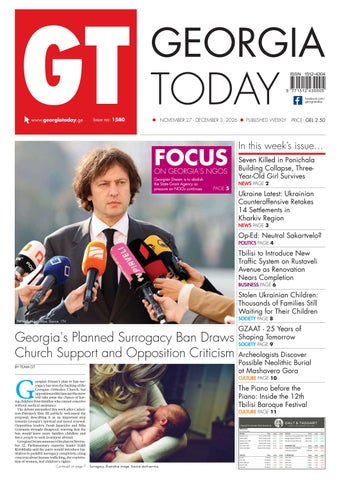
PM Irakli Kobakhidze. Source: 1TV
GZAAT - 25 Years of Shaping Tomorrow
Georgia's Planned Surrogacy Ban Draws Church Support and Opposition Criticism Archeologists Discover SOCIETY PAGE 9
Possible Neolithic Burial at Mashavera Gora
BY TEAM GT
CULTURE PAGE 10
G
eorgian Dream's plan to ban surrogacy has won the backing of the Georgian Orthodox Church, but opposition politicians say the move will take away the chance of having children from families who cannot conceive without medical assistance. The debate intensified this week after Catholicos-Patriarch Shio III publicly welcomed the proposal, describing it as an important step towards Georgia's spiritual and moral renewal. Opposition leaders Zurab Japaridze and Nika Gvaramia strongly disagreed, warning that the ban would leave more families childless and force people to seek treatment abroad. Georgian Dream announced its plan on November 22. Parliamentary majority leader Irakli Kirtskhalia said the party would introduce legislation to prohibit surrogacy completely, citing concerns about human trafficking, the exploitation of women, and children's rights. Continued on page 7
The Piano before the Piano: Inside the 12th Tbilisi Baroque Festival CULTURE PAGE 11 Prepared for Georgia Today Business by
DĂƌŬĞƚƐ Ɛ ŽĨ ϭϲͲEŽǀͲϮϬϮϲ
ŵͬŵ
^dK <^
WƌŝĐĞ
ǁͬǁ
' KZ' Ϭϭͬϯϭ
ϵϱ͘ϱϭ ;zdD ϲ͘ϯϲйͿ
ͲϬ͕ϱй
ͲϬ͕ϭй
>ŝŽŶ &ŝŶĂŶĐĞ 'ƌŽƵƉ ; ' K >EͿ ' W ϭϯϱ͘ϲϬ
нϮ͕ϭй
нϳ͕ϴй
'Z /> ϬϲͬϮϴ
KE ^
ϵϲ͘ϯϳ ;zdD ϲ͘ϰϱйͿ
нϬ͕Ϭй
нϬ͕ϭй
'ĞŽƌŐŝĂ ĂƉŝƚĂů ; ' K >EͿ
' W ϰϴ͘ϬϬ
нϬ͕Ϯй
нϭϮ͕ϴй
d ĂŶŬ 'ƌŽƵƉ ;d ' >EͿ
' W ϱϰ͘Ϭϱ
нϭ͕ϯй
нϲ͕ϰй
WƌŝĐĞ
ǁͬǁ
ŵͬŵ
ϵϮ͕ϰϰ
ͲϬ͕ϭй
Ͳϭϱ͕ϵй
ϯ ϴϱϲ͕ϰϲ
Ͳϲ͕ϴй
Ͳϳ͕ϰй
' '' ϵ ϭͬϮ W ZW
WƌŝĐĞ
ǁͬǁ
ϭϬϰ͘ϭϴ ;zdD ϵ͘ϲϵйͿ
ͲϬ͕ϭй
ͲϬ͕ϯй
^><Z , ϬϵͬϯϬ
ϵϴ͘ϵϬ ;zdD ϳ͘ϴϯйͿ
нϬ͕ϭй
нϬ͕ϭй
d ϴ͘ϴϵϰ W ZW
ϭϬϬ͘Ϯϵ ;zdD ϭϮ͘ϰϵйͿ
ͲϬ͕Ϭй
ͲϬ͕ϭй
KDDK /d/ ^
d ϭϬ ϭͬϰ W ZW
ϭϬϰ͘ϯϬ ;zdD ϭϬ͘ϬϱйͿ
ͲϬ͕ϭй
ͲϬ͕ϴй
ƌƵĚĞ Kŝů͕ ƌĞŶƚ ;h^ΨͬďďůͿ 'ŽůĚ ^ƉŽƚ ;h^ΨͬK Ϳ
/E / ^
WƌŝĐĞ
ǁͬǁ
ŵͬŵ
hZZ E / ^
WƌŝĐĞ
ǁͬǁ
ŵͬŵ
^W ϱϬϬ
ϳ ϰϭϲ͕ϱϵ
Ͳϭ͕ϴй
Ͳϯ͕Ϯй
h^ ͬ ' >
Ϯ͕ϱϵϯϬ
ͲϬ͕Ϭй
ͲϬ͕Ϯй
&d^ ϮϱϬ
Ϯϰ ϳϬϬ͕Ϭϲ
ͲϬ͕Ϭй
нϬ͕ϳй
hZ ͬ ' >
Ϯ͕ϴϱϭϳ
ͲϮ͕Ϭй
ͲϮ͕ϯй
Kt :KE ^ ϯϬ
Surrogacy, illustrative image. Source stork-service
ŵͬŵ
Ͳϭ͕ϱй
ͲϬ͕ϴй
' W ͬ ' >
ϯ͕ϰϭϳϯ
Ͳϭ͕ϴй
Ͳϭ͕ϭй
ZƵƐƐĞůů ϮϬϬϬ
Ϯ ϳϰϮ͕ϵϰ
Ͳϯ͕ϰй
нϬ͕ϴй
hZ ͬ h^
ϭ͕Ϭϵϵϳ
ͲϮ͕Ϭй
ͲϮ͕Ϯй
&d^ ϭϬϬ
ϭϬ ϴϴϭ͕ϱϱ
ϱϭ ϲϬϴ͕ϭϳ
нϬ͕ϵй
ͲϬ͕Ϭй
' W ͬ h^
ϭ͕ϯϭϴϲ
Ͳϭ͕ϵй
Ͳϭ͕ϭй
2
NEWS
GEORGIA TODAY
NOVEMBER 27 - DECEMBER 3, 2026
Seven Killed in Ponichala Building Collapse, Three-Year-Old Girl Survives
The IWA Winter Fair 2025. Source: FB
IWA Winter Fair to Return to Tbilisi at New Location on November 29 BY TEAM GT
T
he International Women’s Association of Georgia (IWA) will hold its annual Winter Fair in Tbilisi on Sunday, November 29, bringing together international food, handmade gifts and local craftspeople for a day of seasonal shopping and fundraising. The event will take place from 10:00 to 18:00 at Expo Georgia, in Pavilions 4, 5 and 6, at 118 Akaki Tsereteli Avenue. This year’s fair will feature 27 foreign embassies and diplomatic tables offering international specialties and gifts, alongside more than 100 Georgian artists and
craftspeople presenting handmade products. Visitors can also enjoy Christmas carols performed by a choir, a raffle and tombola, food stalls, activities for children and a dedicated puppy corner. Founded in 1996, IWA supports newcomers to Georgia and runs charitable projects across the country. Its Winter Fair has become the association’s largest annual fundraising event, with proceeds directed towards people and communities in need, including women, children, older people and other vulnerable groups. The fair offers an opportunity to discover products and traditions from different countries while supporting local artists, small businesses and charitable initiatives. Further information is available through the association’s website at iwa.ge.
The damaged building in Ponichala. Source: IPN
BY TEAM GT
S
even people, including two children, were killed when a suspected natural gas explosion caused part of a fivestorey residential building to collapse in Tbilisi's Lower Ponichala district on November 19. Five others were injured, while a three-year-old girl was pulled alive from the rubble after several hours of rescue work. The explosion occurred at around 9 a.m. in a building on Rustavi Highway. Preliminary information indicated that gas had accumulated in an apartment on the fifth floor, possibly following a malfunction involving a gas heater. The blast destroyed an entire section of the building, trapping residents beneath concrete and debris. The circumstances are under investigation. Among those killed were 38-year-old
Nino Chelidze, a mother of five, and her seven-year-old daughter, Nutsa Pkhaladze. Nino had been at home with her two youngest children when the explosion occurred. Her three-year-old daughter, Taia, was found alive by rescuers after approximately eight hours and taken to Ingorokva Clinic. The other victims included 33-yearold Veronika Vanishvili and her young daughter, Ariana; 55-year-old Lali (Lamara) Shishmanashvili, a philologist who worked as a private tutor; and 28-year-old Jaba Sakevarashvili, who worked as a courier for Georgian Post. Shishmanashvili's twin daughters managed to escape the building, but were unable to reach their mother after debris blocked the entrance to her room. Five people were taken to hospital with injuries. Among them was 31-yearold Ilia Isaev, who suffered burns to approximately 87% of his body and serious respiratory injuries and passed
away on Wednesday. Two children, including Taia and an 11-year-old boy, were treated at Ingorokva Clinic. Doctors later described both children's conditions as satisfactory. The disaster left 28 families, comprising 143 people, temporarily without homes. Tbilisi Mayor Kakha Kaladze said they had been accommodated in hotels and that the municipality would arrange rented apartments for them. "A horrific tragedy has occurred. I want to offer my condolences to the victims' families, their loved ones and all of Georgia. This is deeply painful for everyone," Kaladze said. He added that the damaged building would have to be demolished and replaced with a new development. Residents of the other sections would also be offered the opportunity to join a housing replacement project. November 22 was declared a national day of mourning, with state flags flown at half-mast across Georgia.
and truly saw us,” Tavadze said. The film is based on the poetry of Elene Dariani and explores the idea of unrequited and impossible love. Its central theme is a love that never became reality but lives on through poetry. Tavadze said making the film involved bringing together different artistic disciplines and the ideas of people from different creative backgrounds. “Puppet animation is neither simply animation nor merely cinema. It brings together every form of art, where countless people find solace through the work of their own hands,” she said. She also spoke about the challenges of production, describing two years of hard work, sleepless nights and creative experimentation. “Despite all the challenges, we managed to convey the essence of Elene Dariani to audiences through determination, perseverance, loyalty to our idea and to one another, and immense love,” she added. The film’s visual style takes inspiration from early 20th-century Georgian
architecture and fashion, recreating the look and atmosphere of the period. Music from the same era also plays an important role, helping bring the poems and their themes of longing and unrequited love to the screen. The award is an important achievement for Phantasmagoria and brings further international attention to Georgian puppet animation. Elene Dariani remains one of the mysteries of Georgian literary history. The name is associated with a cycle of 14 personal and emotionally charged poems published in the early 20th century under the name Dariani by Georgian poet Paolo Iashvili. The poems explore love, longing, passion and female desire, themes that were considered unusually bold at the time. For decades, researchers have debated who was behind the name. Some believe the poems were written by Elene Bakradze, a Georgian poet thought to have inspired or contributed to the cycle, while others attribute them to Iashvili himself. The question of authorship remains unresolved.
Foreign Currency Loans below GEL 1.5 mln to Be Restricted Georgian Animated Film ‘Elene Dariani’ Wins Top for Borrowers Earning in GEL Prize at International Art Competition in Venice BY ANA DUMBADZE
G National Bank of Georgia. Source: FB
BY NANUKA MAGLAKELIDZE
T
he National Bank of Georgia (NBG) has restricted individuals and legal entities with an annual income of less than GEL 1.5 million from taking out foreign currency loans. The decision was made by the NBG’s Financial Stability Committee on November 24 and will take effect on February 1, 2027. The minimum threshold for foreign currency lending to unhedged borrowers had previously been set at GEL 1 million from July 1, 2026. Before that, it stood at GEL 750,000 between August 2025 and July 2026, and GEL 500,000 between January and August 2025. In 2024, the threshold was raised from GEL 200,000 to GEL 400,000. The latest decision increases the thresh-
old by a further GEL 500,000, continuing the central bank’s policy of reducing financial dollarization and limiting foreign currency risks. The NBG said the measure was necessary to prevent the accumulation of excessive foreign currency risks in the country. “To reduce structural risks arising from the high level of financial dollarization, the National Bank continues to actively pursue its efforts. As a result of the consistent policies implemented by the NBG, the level of financial dollarization has declined significantly. Despite this progress, structural risks associated with dollarization remain one of the key challenges facing the financial sector,” the central bank said. The NBG added that it would continue implementing its long-term de-dollarization plan in coordination with the financial sector, taking into account the existing macroeconomic environment and associated risks.
eorgian animation studio Phantasmagoria has won the top prize at the 20th Arte Laguna Prize, an international contemporary art competition held at the Venice Arsenale in Italy. The award marks the end of a two-year international festival run for the studio’s film Elene Dariani. The film was chosen as the overall winner from around 240 finalists representing countries around the world. The prize includes €10,000, which the Phantasmagoria team plans to use to produce a new animated work. Elene Tavadze, one of the studio’s co-founders, said the award was especially meaningful because the jury had understood the message behind the film. “We concluded Elene Dariani’s twoyear festival journey with the greatest award. They understood what we wanted to say without interpretations
A still from the film Elene Dariani. Source: FB
NEWS
GEORGIA TODAY
NOVEMBER 27 - DECEMBER 3, 2026
3
Ukraine Latest: Ukrainian Counteroffensive Retakes 14 Settlements in Kharkiv Region COMPILED BY ANA DUMBADZE
R
ussia and Ukraine have intensified their military campaigns over the past week, with renewed fighting along the eastern and northeastern frontlines, Ukrainian counterattacks in Kharkiv Oblast and increasingly destructive aerial strikes against strategic infrastructure on both sides. Diplomatic efforts have gained momentum, although disagreements over territorial concessions and security guarantees continue to stand in the way of a settlement.
FIGHTING CONTINUES ACROSS DONETSK AND KHARKIV Donetsk Oblast remains a major focus of Russian offensive operations. Moscow is continuing its efforts to break through Ukraine's defensive network around Slovyansk, Kramatorsk, Druzhkivka and Kostyantynivka. The four cities form an important defensive belt and remain a major obstacle to Russia's goal of taking full control of the region. Despite sustained pressure, Russian forces have made only limited territorial gains, while Ukrainian troops have continued counterattacking in several areas. The Institute for the Study of War (ISW) reported localized Russian advances near Dobropillia, where fighting intensified towards the end of the week. Russian forces renewed mechanized assaults, but Ukrainian units continued to resist attempts to break through their positions. Fighting also continued around Pokrovsk, where Russian forces have been
trying to disrupt Ukrainian supply routes and weaken defensive positions. Further north, Russian operations around Lyman brought no significant territorial changes. Ukrainian troops counterattacked near Zarichne, while Russian attempts to advance towards Slovyansk met sustained resistance. There was also no confirmed Russian breakthrough around Kostyantynivka. One of the most significant developments came in northeastern Ukraine, where Ukrainian forces continued to consolidate gains made during an operation known as Bear Trap. By November 20, Ukrainian troops had reportedly liberated around 204 square kilometers and at least 14 settlements north and northeast of Velykyi Burluk in Kharkiv Oblast. Clearing operations continued, although Russian sources disputed Ukraine's claims of control over the area. The situation around Kupyansk remained less clear. Russian troops made localized advances southeast of the city, while Ukrainian forces retained positions in several western areas. Both sides claimed control of Kupyansk-Vuzlovyi, an important railway settlement, but independent analysts could not confirm who controlled the entire locality. Ukrainian gains were also reported in the wider Borova sector. In northern Sumy Oblast, reports about the status of several settlements near the Russian border remained contradictory. Ukrainian counterattacks challenged Russian positions, but further territorial gains could not be independently confirmed. Ukraine's military also rejected unverified reports that its forces had launched new cross-border ground operations into Russia's Kursk Oblast. In Dnipropetrovsk Oblast, Ukrainian
Workers repair an electrical substation damaged by Russian missile and drone strikes in Ukraine’s Odesa region. Source: REUTERS/ Nina Liashonok
troops regained ground near Dachne, southeast of Novopavlivka, while Russian forces continued trying to infiltrate Ukrainian-controlled territory. Further south, Russian attacks around Huliaipole and western Zaporizhzhia Oblast produced no confirmed major advances. Ukrainian forces also continued targeting Russian military assets in occupied southern Ukraine.
RUSSIAN ATTACKS CAUSE FURTHER DAMAGE TO UKRAINIAN INFRASTRUCTURE The aerial campaign escalated sharply on November 20, when Russia launched one of its largest combined attacks against Ukraine since the start of the full-scale invasion. The bombardment involved more than 400 drones and 110 missiles, targeting transportation networks, electricity infrastructure and other facilities. "The strike tactics were particularly vicious this time: several groups of missiles were launched, with pauses of 20-30 minutes between them, to make it harder to put out fires, clear rubble, and carry out repairs," President Volodymyr Zelen-
sky said. Eight people were killed, including six in Kyiv and two at Sknyliv railway station in Lviv. Injuries were also reported in Kharkiv and Dnipropetrovsk regions. Damage to infrastructure disrupted electricity and water supplies and affected railway services in several areas. In Kyiv, residents took shelter in underground metro stations as explosions shook the capital. The attack also raised concerns among Ukraine's Western neighbors. Polish authorities reported suspected violations of the country's airspace during the bombardment, highlighting the risk of the conflict extending beyond Ukraine's borders. Russian strikes continued over the following days. On November 21, an attack on Kryvyi Rih killed two people, including a child, and injured 58 others, among them six children, according to Ukrainian authorities. Further attacks damaged energy facilities across the country, leaving households facing renewed electricity restrictions as temperatures fell. By November 25, power outages had
been reported in Odesa, Kharkiv, Donetsk, Dnipropetrovsk and Zaporizhzhia oblasts. Further civilian casualties and injuries were reported as emergency crews and energy workers worked to deal with the damage caused by successive attacks. Nuclear safety also remained a concern. Ukrainian First Deputy Energy Minister Artem Nekrasov said the Russian-occupied Zaporizhzhia Nuclear Power Plant had again lost its external electricity supply following shelling and was forced to rely on emergency generators. It was the 17th such incident reported since the beginning of 2026, underlining the continuing risks around Europe's largest nuclear power station.
UKRAINE TARGETS RUSSIAN OIL AND MILITARY FACILITIES Ukrainian authorities reported strikes on the Novoshakhtinsk oil refinery in Rostov Oblast, the Kaleikino oil pumping station in Tatarstan and a major refinery in Perm. Fires were reported at the affected facilities, while Russian regional authorities acknowledged damage to oil storage infrastructure. The attacks are part of Kyiv's effort to disrupt Russian fuel supplies and weaken the economic resources supporting Moscow's war. Reuters reported that renewed Ukrainian strikes had reduced Russian oilrefining volumes by around 45% since late October. On November 25, Ukraine's military also announced a strike on the Savasleyka airbase in Russia's Nizhny Novgorod region, claiming that five Russian military aircraft had been damaged. Moscow had not immediately confirmed the reported losses. Continued on page 4
4
POLITICS
GEORGIA TODAY
NOVEMBER 27 - DECEMBER 3, 2026
Op-Ed: Neutral Sakartvelo? OP-ED BY NUGZAR B. RUHADZE
A
mong the permanently neutral states of the world, the following are currently mentioned: Switzerland, Austria, Turkmenistan, Vatican City, Costa Rica, Malta and Moldova. Non-aligned countries include Ireland, Serbia, Liechtenstein, Andorra and San Marino. Sweden and Finland also claimed neutral status not very long ago, but having joined NATO, they lost that standing. Some might imagine that Monaco is a typical militarily neutral microstate, but it maintains close defense ties with France, which deprives it of non-aligned status. There has also been a long and shadowy discussion about Ukraine's neutrality, but aren't the ways of God inscrutable? How about Sakartvelo? Is internationally recognized neutrality legally and politically possible for Georgia? Will Georgia gain or lose if this actually happens? Not easy to answer, but not impossible either. The questions posed in this way concern Georgia's future place among the states of the world, its security, sovereignty, territorial integrity and, finally, its undisturbed international position. We could, of course, declare neutrality without any possible reasoning against the idea, but declaring is one thing, and maintaining the claimed non-aligned position is quite another. Georgia can proclaim itself neutral in its constitution, but real, functioning and sustainable neutrality requires, as a minimum, international recognition, reliable security guarantees, trustworthy domestic political compromise and, most importantly, the willingness of neighboring powers to respect it. From this particular viewpoint, the situation of Sakartvelo is more than simply precarious, and here is why: its geographical location, pending resolution of territorial conflicts, Russia's military presence in runaway territories like Abkhazia and the so-called South Osse-
Being neutral. Illustrative image. Source: rappler
tia, and its still-existing ties with NATO, the EU, the USA and Turkey. This is how Georgia's more or less conceivable neutral or non-aligned international status could be pictured at this moment in time. But neutrality is not merely a declaration that a nation loathes going to war against another nation. Neutrality happens to be a complicated package of assets as well as liabilities that is not exactly a piece of cake to observe and maintain. Believe it or not, there is a considerable bunch of optimistically poised Georgian politicians who have demonstrated enough nerve and audacity to found a political party called UNITED NEUTRAL GEORGIA. Against all odds! The party started functioning on December 1, 2025, and its founders are executive political figure and public leader Vato Shakarishvili; members of the political council Levan Nikoleishvili and Bidzina
Giorgobiani; international relations adviser Konstantin Zghenti; and political analyst Petre Mamradze. The party's program treats neutrality as a lasting structural foundation for Georgia, aiming to alter the current constitutional proposition concerning EuroAtlantic integration. The political stance of UNITED NEUTRAL GEORGIA is firmly grounded in the idea of perpetual military neutrality, which means refusing to join alliances, abolishing foreign military bases on the country's territory, developing Georgia's own national defense capabilities, maintaining diplomatic relations with all countries rather than aligning with a particular geopolitical bloc, pursuing economic development without unnecessary dependence on foreign states, seeking peaceful rapprochement with Abkhazia and the Tskhinvali Region, promoting national reconciliation, and encouraging coop-
eration in the South Caucasus. All is as crystal clear as daylight, and not just that. The Party has recently become very international. In early November of this year, an outstanding event was hosted at the Sheraton Grand Tbilisi Metechi Palace: The Tbilisi Forum on Neutrality, under the theme "Georgia, Platform for Peace and Cooperation." Attendance was free with advance registration. This international research conference was organized by UNITED NEUTRAL GEORGIA and NEUTRALITY STUDIES, bringing together scholars of neutrality and geopolitical analysts to discuss the prospects, risks and opportunities of neutrality in the South Caucasus. The Forum was organized around four panels: 1) Historical Experience, Current Realities and Future Prospects, moderated by Nino Khelaia, assistant professor at GIPA; 2) Neutrality in the South Caucasus, moderated by Zviad Avaliani, anchor at POSTV; 3) Defense, Security Architecture and Economic Development, moderated by Giorgi Gvimradze, head of the analytical service of Public Television; and 4) Peacebuilding, Diplomacy and Reconciliation, moderated by Leo Sikharulidze, journalist at IMEDI-TV. Among the speakers were prominent international figures such as Pascal Lottaz, founder of Neutrality Studies and associate professor at Kyoto University; Larry Johnson, former CIA intelligence analyst and US State Department counterterrorism official; James W. Carden, former adviser to the US-Russia Bilateral Presidential Commission; Heinz Gärtner, political scientist at the University of Vienna and chair of the Advisory Board of the International Institute of Peace; Pietro Shakarian, researcher of Russian and Caucasian history at the American University of Armenia; Mohammad Marandi, professor at the University of Tehran, who frequently comments on Iran-US relations; Konstantin Zghenti, former ambassador of Georgia to Austria, Hungary and Kuwait; Lasha Kasradze, political analyst and international relations specialist; Petre Mamradze,
former head of the Georgian State Chancellery and former member of Parliament; Sakari Linden, specialist in European politics and former political adviser to the European Parliament; Rein Müllerson, international law scholar and former First Deputy Foreign Minister of Estonia; Ristian Atriandi Supriyanto, researcher at the Australian National University and lecturer in international relations; Steve Jermy, specialist in geopolitics, maritime strategy and energy security; and Levan Nikoleishvili, former Chief of the General Staff and Deputy Defense Minister of Georgia. That said, the most devastating question now arises, one that is almost impossible to answer: how can Sakartvelo acquire and maintain neutrality if a strong foreign military force continues to maintain its presence on its internationally recognized territory for decades? But posing a tricky question does not mean sitting back and twiddling our thumbs. Action, action is necessary! And that is exactly what UNITED NEUTRAL GEORGIA endeavors to do, firmly believing that the nation would face much less exposure to military confrontation, achieve improved relations with neighboring countries, gain additional economic opportunities, enjoy greater diplomatic flexibility and have more power to contribute to regional reconciliation. This is all good news, but bad news is also part of the picture: the possibility of loosening or losing ties with NATO and Western partners, the risk of undermining Georgia's European integration prospects, the prospect of provoking hostility from Russia, and the likelihood of reducing the country's economic and investment potential. Who will guarantee Georgia's neutrality? What about an exasperated Russia? Would it accept a neutral Georgia? What about Georgia's role as a transport corridor? Would it be affected? And finally, would neutrality help restore Georgia's territorial integrity? Yes, this is our complicated geopolitical gamble, but we might have some trump cards to play, mightn’t we?
Ukraine Latest: Ukrainian Kavelashvili Pardons 232, Including Counteroffensive Retakes 14 Protest-Related Prisoners, as Others Settlements in Kharkiv Region Continued from page 3 Russian President Vladimir Putin threatened retaliation for the attacks on oil facilities. He claimed Ukraine had continued striking Russian refineries despite requests from US President Donald Trump to stop. Kyiv, meanwhile, said it would consider suspending attacks on Russian energy infrastructure only if Moscow did the same. The damage caused by earlier Ukrainian strikes on the Kerch Strait Bridge, which connects Russia with occupied Crimea, also remained an issue. Russian authorities acknowledged structural damage but said railway traffic had been restored. Ukrainian officials gave a less optimistic assessment, saying full repairs could take several months or longer. The bridge remains an important supply route for Russian forces occupying southern Ukraine.
BERLIN TALKS FOCUS ON SECURITY GUARANTEES FOR UKRAINE In Berlin, representatives of nearly 40 countries met on November 19 for a gathering of the Coalition of the Willing. Participants included Ukrainian President Volodymyr Zelensky, European leaders and US envoys Jared Kushner and Steve Witkoff. The discussions focused on possible postwar security arrangements for Ukraine, continued military assistance and Europe's role in future negotiations. Kushner indicated that Washington was open to considering security guarantees
based on NATO's collective defense principle. Russian officials subsequently rejected such an arrangement. Moscow also continued to insist that Ukraine make territorial concessions as a condition for negotiations. European leaders reiterated that internationally recognized borders must not be changed by force and that Ukraine must retain the right to decide its own security arrangements. They also proposed a winter ceasefire covering energy infrastructure, alongside separate measures to protect food exports through the Black Sea. Military and financial assistance remained central to the talks. Ukraine's allies reaffirmed their commitment to providing €70 billion in military equipment, assistance and training during 2026, with comparable support planned for 2027. The European Union's €90 billion support loan was also reiterated, alongside European Commission proposals for up to €45 billion in additional financing. These commitments followed the latest Ramstein-format meeting, held shortly before the reporting period. Denmark, Britain, Norway, Germany, the Netherlands and other partners announced or confirmed substantial military assistance. Air defense systems, interception capabilities, aviation support and ammunition remained key priorities. However, delays in deliveries of Western-funded Patriot interceptor missiles continue to complicate Ukraine's efforts to protect its cities and infrastructure.
Secure Release through Plea Deals BY TEAM GT
P
resident Mikheil Kavelashvili used his constitutional power of pardon to mark St. George’s Day on November 23rd, granting clemency to 232 people. The Presidential Administration said the decision was based on humanitarian principles and the interests of the state. Of those pardoned, 216 were serving prison sentences and 16 had received non-custodial sentences. Some of the beneficiaries were convicted in connection with anti-government protests in 2024 and demonstrations against the foreign influence law. They include Giorgi Mindadze, who was sentenced to five years for assaulting a police officer during the NovemberDecember 2024 protests, and Anri Kvaratskhelia, sentenced to four years and six months after being accused of throwing a Molotov cocktail at a Special Tasks Department officer. Another, Giorgi Okmelashvili, was sentenced to five years for assaulting a police officer during demonstrations against the draft Law on Transparency of Foreign Influence. Separately, a number of people convicted over the October 4, 2025 unrest have already left prison following plea agreements with prosecutors. The deals required defendants to plead guilty and
Nikoloz Javakhishvili leaving prison this week. Source: IPN
resulted in substantial reductions to their sentences. Among those released were opposition figures Murtaz Zodelava and Lasha Beridze, whose original seven-year sentences were reduced to one year and one month in prison, followed by two years suspended. Nana Sander and several other protesters also secured early release through similar agreements. Nikoloz Javakhishvili, who was arrested during the November-December 2024 protests, gave a statement after leaving the penitentiary facility following a
presidential pardon. “I would tell those who remain inside that we need everyone out here; we need all of my fellow fighters out of prison. They should use this opportunity and get out, because our country needs us!” According to Civil Georgia, around 50 of the more than 65 people charged in connection with the October 4 events had been released or had their sentences significantly reduced through plea deals, presidential pardons or fines by November 24.
POLITICS
GEORGIA TODAY
NOVEMBER 27 - DECEMBER 3, 2026
5
Georgia to Abolish State Grant Agency as Pressure on NGOs Continues BY TEAM GT
G
eorgia's State Grant Management Agency, established by the Georgian Dream government in 2025 to distribute state funding to non-governmental organizations (NGOs), is to be abolished from January 1, 2027. The decision comes as independent civil society groups face growing restrictions on foreign funding and increasing pressure over their work. Prime Minister Irakli Kobakhidze signed the decree ordering the agency's liquidation on November 24. A five-member commission, chaired by Zviad Barkaya, deputy head of the Government Administration, has been appointed to oversee the process. The commission must complete an inventory of the agency's property, outstanding obligations and documentation by January 1. It will also decide which government bodies should take over its assets and responsibilities, including monitoring whether organizations that received state grants have fulfilled their contractual obligations. The agency must also repeal the rules governing the distribution and monitoring of state grants by the end of the year. The decision was not entirely unexpected. Kobakhidze announced on September 17 that the agency was operating in what he called a "wind-down mode" and would close by the end of 2026. At the time, he described NGOs as an "artificial phenomenon," arguing that they had been created as instruments of foreign political intervention. "Accordingly, for us to create NGOs ourselves and fund such things would be wrong. Therefore, we made this decision," he said. The closure raises questions about why the government is abandoning an agency it established only last year, particularly when it has simultaneously made it increasingly difficult for NGOs to receive funding from foreign donors.
FROM STATE FUNDING TO TIGHTER CONTROLS The State Grant Management Agency was established by government decree on April 15, 2025, following legislation adopted by Parliament in February. Its purpose was to distribute money from the state budget to NGOs. However, its creation came alongside major changes to the Law on Grants. Under amendments adopted in April 2025, foreign donors were required to obtain government approval before providing grants to Georgian organizations. Accepting funding without authorization carried a fine equal to twice the value of the grant. Further amendments expanded the definition of a grant to include technical assistance and the sharing of knowledge and expertise. Subsequent changes in 2026 tightened the restrictions further, introducing criminal penalties for certain violations. The government presented the changes as a way to regulate foreign funding and prevent outside interference in Georgia's domestic affairs. Critics argued that they gave the authorities control over which organizations could receive funding and what kind of work they could carry out. The State Grant Management Agency’s first grant competition offered up to GEL 100,000 per project and covered areas including democratic governance, human rights, education, healthcare, regional development, agriculture and environmental protection. In its first competition, up to 400 applications were submitted, of which 247 passed the formal requirements and went forward for evaluation. In November 2025, the agency announced that 17 organizations had been selected: The Georgian Red Cross Society (awarded GEL 100,000), Agency for Development
NGOs, illustrative image. Source: Georgian Red Cross Society/FB
of Democracy (awarded GEL 99,980), National Network of Women with Disabilities (awarded GEL 99,997), Peace Research Center (awarded GEL 97,950), Environmental Ecological Association DEA (awarded GEL 99,366), Georgian Center for Demographic and Health Research (awarded GEL 97,900), Merani Chess Club (awarded GEL 100,000), Avlip Zurabashvili Georgian Psychiatric Society (awarded GEL 93,480), Enagram (awarded GEL 100,000), Center for Participation and Engagement (CIPIS) (awarded GEL 99,920), Public Defender (awarded GEL 99,688), Autism Research and Support Foundation (awarded GEL 99,535), Georgian Center for Culture, Education and Sports of the Union of the Blind (awarded GEL 99,910), National Institute of Debate and Education (awarded GEL 100,000), Art Hall+ Foundation for the Rehabilitation of Adolescents with Disabilities and Diabetes (awarded GEL 99,825), Abkhazia Union of the Blind and Deaf “Hera” (awarded GEL 70,495), and New Georgian Hub (awarded GEL 99,729). The total awarded was GEL 1,657,775. These organizations work in a range of fields, from disability support and healthcare to education, environmental protection and regional development. Their winning projects included developing home-care services in Kutaisi, setting up an inclusive chess club for autistic children, supporting blind and visually impaired students, researching declining birth rates, protecting migratory bird habitats in western Georgia, research into the needs of ethnic minority women, positive parenting programs, and youth initiatives in the regions. From the start, the State Grant Management Agency was presented as an alternative source of funding. But its closure now removes that option, while the restrictions on foreign grants remain in place. The European Commission's 2026 report on Georgia says the cumulative effect of the country's foreign influence and grant legislation has severely affected the financial stability of civil society organizations. It warns that the laws subject independent groups to excessive state scrutiny and create conditions that threaten democratic pluralism.
NGOS WARN OF THE DAMAGE The impact of the funding restrictions has already been felt across the sector. Human rights organizations, election monitors, independent media groups and organizations providing social services have all faced difficulties securing financial support. Tengiz Shergelashvili, founder of the Georgia Development Platform and a former First Deputy Minister of Regional
Development and Infrastructure, has criticized both the restrictions and the decision to close the agency. Speaking to BMG in September, he said the laws restricting foreign grants had caused significant damage to the NGO sector, while it remained unclear what benefits they had brought in return. His own organization, he said, had lost much of its previous capacity for analytical work and was now relying largely on its own efforts and occasional crowdfunding. Shergelashvili also questioned the government's decision to abolish the grant agency, noting that its leadership had been discussing ambitious plans only a year earlier. He pointed out that NGOs continued to provide social, healthcare and other services, sometimes in cooperation with public institutions. Many Georgian NGOs provide services that the state does not always have the capacity or resources to deliver. They also monitor elections, investigate corruption, provide legal assistance, support vulnerable groups and scrutinize government decisions. Tamar Oniani, chair of the Georgian Young Lawyers’ Association (GYLA), also questioned the government's reasons for closing the agency. In a commentary published by JAMnews on September 18, she said the decision had exposed how superficial the government's original promises were when it established the agency in 2025. At the time, officials said state grants would support democratic institutions, anticorruption efforts, people with disabilities, environmental protection and minority rights. Oniani also challenged Kobakhidze's claim that “NGOs did not exist 100 years ago.” She pointed out that the modern international human rights system did not exist then either, and argued that human rights organizations now play an important role in ensuring that international protections are upheld. She also cited Georgia's own history, pointing to the Society for the Spreading of Literacy among Georgians, founded by Ilia Chavchavadze in the nineteenth century, as an early example of a civil society organization. Oniani said the government's argument was not simply about the history of NGOs, but about the ability of people to organize and demand that their rights be respected. She described independent human rights organizations as institutions with the capacity to challenge those in power. Human Rights Watch has been particularly critical of the government's approach. In a July 2026 report, it said the authorities' use of increasingly restrictive laws and politically motivated inves-
tigations was decimating independent civil society and silencing critical voices. The organization reported that some groups had been forced to reduce their activities, lose staff, or stop operating altogether. It also documented cases in which foreign grants had been rejected by the authorities, including funding for election monitoring and healthcare services for marginalized communities. The Venice Commission, the Council of Europe's advisory body on constitutional and legal matters, has also raised serious concerns. It has said that the restrictions on foreign grants lack sufficient justification and safeguards, and recommended that the relevant legislation be reconsidered or repealed.
IS GEORGIA FOLLOWING THE RUSSIAN MODEL? The comparison with Russia has become increasingly relevant as Georgia's legislation has expanded beyond financial transparency to impose greater restrictions on the activities of organizations receiving foreign support. Russia introduced its foreign agents law in 2012. Initially aimed at NGOs receiving foreign funding and engaging in broadly defined political activity, it was expanded over the years to cover media outlets, journalists, activists and individuals. The designation brought onerous reporting and labeling requirements, financial penalties and, in some cases, criminal prosecution. A separate law on "undesirable organizations" has also been used to force foreign and international groups to stop operating in Russia. Cooperation with organizations designated as undesirable can itself carry criminal consequences. The results have been severe. Human Rights Watch has documented the forced closure of prominent organizations, including Memorial, one of Russia's bestknown human rights groups. Other organizations have closed voluntarily because the legal and financial risks made continued operation impossible. There are differences between the Georgian and Russian legal systems, and Georgia has not adopted an identical framework. However, the direction of travel has raised concern among international observers. Georgia's foreign influence legislation, grant approval requirements and expanding criminal penalties have created a system in which independent organizations face growing obstacles to receiving funding and carrying out their work. In its 2026 report, the European Commission warned that the combined effect of the legislation was coercive and stigmatizing, and threatened democratic pluralism. Human Rights Watch has similarly described the government's
measures as an effort to dismantle independent civil society.
WHAT IF NGOS ARE ULTIMATELY BANNED? The abolition of the State Grant Management Agency does not mean that NGOs are being banned, and the government has not announced any plans to prohibit them altogether. But if further restrictions make it impossible for independent organizations to continue working, the effects will be felt across the country. NGOs provide services that many people cannot get elsewhere. They offer free legal advice, help victims of domestic violence, support people with disabilities and work with vulnerable children and communities. They also monitor elections, investigate alleged abuses of power and carry out research used by local authorities and public institutions. If these organizations have to close, people who depend on their services could be left without support. Free legal assistance, specialist care and social programs would become harder to access, particularly for those who cannot afford private services or live outside Tbilisi. The loss would also affect the ability to hold public officials to account. NGOs have documented human rights violations, reported corruption and raised questions about election procedures and government decisions. Without independent organizations doing this work, there would be fewer people able to investigate problems and bring them to public attention. There would be an economic cost too. NGOs employ staff, commission research and bring international funding into projects across Georgia. Many work in smaller towns and rural areas, where public services and resources are often limited. Closing them would mean losing jobs, funding and experience built up over many years. Russia offers an example of how this process can develop. Restrictions on foreign funding and the work of independent groups have forced many organizations to close, while others have moved their activities abroad or continued on a much smaller scale. Independent civil society has become increasingly difficult to sustain. In Georgia, the immediate question is what will happen to the organizations that relied on the State Grant Management Agency and whether another state body will take over its responsibilities. But there is a bigger issue. With foreign grants increasingly subject to government approval and the agency now being abolished, where will independent organizations find the money to continue their work?
6
BUSINESS
GEORGIA TODAY
NOVEMBER 27 - DECEMBER 3, 2026
Tbilisi to Introduce New Traffic System on Rustaveli Avenue as Renovation Nears Completion
Rustaveli Avenue. Source: GT
BY TEAM GT
T
bilisi Mayor Kakha Kaladze has announced plans to introduce a new traffic management system around Rustaveli Avenue, as the
main thoroughfare's rehabilitation nears completion. The municipality also plans to renovate Republic Square, Freedom Square and buildings along Rustaveli Avenue in 2027. Speaking at a municipal government meeting on November 25, Kaladze said the new traffic arrangements would become fully operational after the New
Year and were intended to reduce congestion and improve connections between the Mtatsminda district and the Mtkvari River embankment. Under the revised scheme, new traffic light-controlled intersections will allow drivers to turn left onto streets crossing Rustaveli Avenue, reducing the need to make lengthy detours along the capital's
Rustaveli Avenue. Source: GT
Zurabashvili: Russia Plans Restrictions on Two More Georgian Wine Companies BY NANUKA MAGLAKELIDZE
G
eorgia’s special representative for relations with Russia, Giorgi Zurabashvili, has spoken for the first time about his November 19 meeting with Russian Deputy Foreign Minister Mikhail Galuzin in Minsk, during which Russia outlined reasons for restrictions imposed on Georgian companies. Zurabashvili said Galuzin claimed that some Georgian companies were allegedly financing Ukraine’s war effort. “It was said that these companies allegedly finance the war in Ukraine, meaning the war in favor of Ukrainians,” Zurabashvili said on Imedi Live. He said Galuzin also cited two other reasons: the quality of Georgian wine and the companies’ “anti-Russian narrative.” Zurabashvili said the Georgian side’s main concern was the return of Georgian wine to the Russian market. He had expected restrictions imposed in October to be lifted, but Galuzashvili told him that Russia was planning to impose restrictions on two more Georgian wine companies. “Of course, I was surprised and stunned by this news, because nothing of the sort is happening. He was unable to provide me with a single fact, either regarding the quality or in relation to the allegations of financing the war in Ukraine or anti-Russian propaganda. So, these are political issues that have no basis whatsoever.” He said he explained to Galuzin that the quality of Georgian wine is confirmed by international certificates. Zurabashvili also rejected allegations that the com-
main thoroughfare. Drivers will be able to travel directly between the river embankment and the upper streets of Mtatsminda in both directions. Motorists heading down from Mtatsminda towards Kostava Street will also no longer have to drive as far as Freedom Square. The changes will include a direct connection between Dzmebi Kakabadzeebi Street and Mikheil Javakhishvili Street, formerly known as Elbakidze Rise. Drivers travelling from Freedom Square towards the Philharmonic Hall will also be able to turn left onto Dzmebi Kakabadzeebi Street. Kaladze said municipal data showed that around 30% of vehicles using Rustaveli Avenue were travelling through it rather than stopping in the area. The new connections are expected to reduce the number of vehicles using the avenue as a transit route. New traffic lights and road markings will be introduced after the festive period because of planned traffic restrictions around Republic Square.
RUSTAVELI AVENUE REHABILITATION NEARING COMPLETION Kaladze said the rehabilitation of Rustaveli Avenue was almost complete and that the municipality wanted to make the avenue safer and more accessible to all road users. "Rustaveli Avenue is not just a street or a transport corridor. It is the heart of our capital, an inseparable part of our history, culture, and national memory," he said. He added that the project involved more than upgrading infrastructure. One of its main aims was to ensure that pedestrians, drivers and people with disabilities could use the avenue safely. A key part of the work has been the con-
struction of ground-level pedestrian crossings, allowing people to cross without using the existing underground passages. "Until now, parents with strollers could not cross from one side of the road to the other, and, just like wheelchair users, they had to take long detours. This problem will be fully resolved. Accessibility in the city is not a privilege, it is the right of every person," Kaladze said. He said a modern capital should be accessible to children, older people, parents and people with disabilities, adding that Rustaveli Avenue should belong equally to everyone.
FURTHER RENOVATION PLANNED FOR 2027 Once work on Rustaveli Avenue is completed, City Hall plans to begin the full renovation of Republic Square. Freedom Square and the buildings along Rustaveli Avenue are also included in the municipality's plans for 2027. Kaladze said the buildings along the avenue would be renovated, upgraded and restored, with work potentially starting next year. The announcement comes as the Rustaveli Avenue rehabilitation project has faced repeated delays and penalties for the contractor. Tbilisi City Hall has fined Smart Solutions 20 times over violations connected with the works, which began on July 23. The latest fine, GEL 1,334, followed a November 16 inspection that found construction was not being carried out around the clock as required by the contract. The total penalties have now exceeded GEL 27,000. The municipality says the new traffic arrangements, together with the planned renovations, are part of its wider effort to improve movement around central Tbilisi and make the area safer and more accessible for motorists, pedestrians and public transport users.
TI: GEL 1.3 Billion in Non-Competitive Tenders Cost Georgia GEL 150 million Extra in 2026 BY NANUKA MAGLAKELIDZE
Georgia’s First Deputy Foreign Minister and Prime Minister’s Special Representative for Relations with Russia, Giorgi Zurabashvili. Source: IPN
panies were financing Ukraine or promoting an “anti-Russian narrative,” saying Galuzin had provided no evidence to support the claims. Zurabashvili, who also serves as Georgia’s first deputy foreign minister, said the main disagreement between the two countries concerns Georgia’s sovereignty, internationally recognized borders and de-occupation. He noted that 20% of Georgia’s territory is occupied by Russia and said dialogue was necessary to address these issues. Zurabashvili did not comment on the possibility of continuing negotiations in Moscow and Tbilisi. The issue was raised on November 25 by Belarusian Foreign Minister Maxim Ryzhenkov. In October, Russia restricted imports of products from seven Georgian manufacturers. Four of them are wine producers: Teliani Valley, Tbilvino, Wineman and Askaneli Brothers. In the case of Askaneli Brothers, the ban also applies to cognac. The list also includes beer produced by the Georgian Beer Company, CocaCola manufactured in Georgia, and Nabeglavi mineral water. Russia’s sanitary service cited noncompliance with quality and safety requirements as the reason for the restrictions.
P
ublic procurement contracts worth GEL 1.3 billion ($480 million) were awarded without competition in Georgia in 2026, Transparency International Georgia said in a study. The organization found that nearly half (45%) of the 16,222 public tenders held between January and October 2026 attracted only one bidder. “Due to the lack of competition, contracts cost the state budget approximately GEL 150 million more than they would have under genuinely competitive conditions. Moreover, in 2,883 tenders worth GEL 572 million, the initial price was not reduced at all, meaning the state failed to save even a single tetri,” the report said. The Penitentiary Service was the largest public procurer awarding contracts without competition, with a total value of GEL 203.7 million. Following a controversy over the quality of food served in prisons, the agency awarded a GEL 152.4 million contract for inmate catering to Giorgi 2020, an inexperienced company, without a competitive tender. On April 3, the very day the tender was announced, a 33% stake in the company was transferred free of charge to Irakli Letodiani, a former employee of the State Security Service. Transparency International Georgia wrote that 43% of tenders conducted by municipalities, including city halls and organizations established by them, were
US dollar banknotes. Source: TI
non-competitive. The figure was 48% for central government and other state agencies. Municipalities spent GEL 625 million through non-competitive tenders. Tbilisi accounted for the largest share, at GEL 277 million, followed by Batumi with GEL 63 million. In terms of the proportion of non-competitive tenders, Ambrolauri ranked first at 61%, followed by Terjola at 59% and Khulo at 55%. The report also identifies requirements tailored to specific companies as a frequent factor undermining competition. Examples include a Batumi City Hall requirement that bidders own an asphalt
plant within a 30-kilometer radius and a Georgian Railway requirement for 20 years of experience, which was won by a company owned by a former head of the Tbilisi Police Department. The construction sector received the largest amount through non-competitive tenders, totaling GEL 517.9 million. Transparency International Georgia also criticized the State Procurement Agency, noting that although its reports refer to an increase in competition, none of its annual reports since 2019 has highlighted what the organization considers a key issue: nearly half of all tenders attract only one bidder.
SOCIETY
GEORGIA TODAY
NOVEMBER 27 - DECEMBER 3, 2026
7
Georgia's Planned Surrogacy Ban Draws Church Support and Opposition Criticism Continued from page 1 Prime Minister Irakli Kobakhidze called the move a "principled decision." He argued that exploitation was an inherent part of surrogacy and could not be prevented through regulation. "Surrogacy is a very serious phenomenon, first and foremost in terms of the exploitation of women. No matter how you regulate it, exploitation remains exploitation. The exploitation of women is an essential element of surrogacy. Therefore, regulation does not solve the fundamental problem of surrogacy," Kobakhidze said. He acknowledged that the industry contributed to the economy but said ethical concerns had taken priority. Kobakhidze also confirmed that the government had consulted the Georgian Orthodox Church before announcing the plan. He said the Patriarchate had supported a ban. "We are in constant communication with the Patriarchate, and there is no problem in this regard. Of course, we also held consultations on surrogacy. Their position was that it would be better for surrogacy to be banned," he said. The following day, November 23, Patriarch Shio III voiced his support during a sermon at St. Nino's Monastery in Bodbe. "I would like to express my great satisfaction with the new initiative that we all heard about yesterday. It concerns the prohibition of surrogacy in Georgia. Dear brothers and sisters, this is a very important decision," he said. The Patriarch described surrogacy as a practice associated with serious sins and said banning it would contribute to the country's spiritual and moral renewal. He also confirmed that the Church and government had discussed the issue before the announcement. "I am very pleased that this decision of yours stems from your Christian worldview and reflects your concern for our Church and for strengthening and promoting Christian and traditional values in our country," Shio III said. Prime Minister Kobakhidze, Parliament Speaker Shalva Papuashvili, President Mikheil Kavelashvili and other government officials attended the service at Bodbe.
The Church has opposed surrogacy for years. In his 2014 Christmas Epistle, the late Patriarch Ilia II questioned whether a family raising a child born through surrogacy could truly be happy. Shio III's latest comments, however, are among the clearest public expressions of Church support for a government move to prohibit the practice.
OPPOSITION WARNS OF CONSEQUENCES FOR FAMILIES Opposition politicians say a complete ban would punish people who already face serious difficulties having children. Nika Gvaramia, a leader of the Coalition for Change, called the proposal "shameful and cruel." He accused Georgian Dream of depriving thousands of women of the chance to become mothers because of health conditions that prevent them from giving birth. "A shameful and cruel decision! For the sake of 'making peace' with the Patriarchate, they are depriving thousands of women of the opportunity to become mothers! Women who are not unwilling to give birth, but are unable to do so because of health conditions!" Gvaramia wrote on social media. He also questioned the impact on families and Georgia's already difficult demographic situation, asking how many children would never be born as a result. Girchi - More Freedom leader Zurab Japaridze also criticized the plan. He argued that banning surrogacy would not remove demand but would push people to seek arrangements in other countries. "The consequences of banning surrogacy will be more families left childless, more Georgians forced to move abroad, and more tragedies," he wrote. He went on to question the religious justification for the decision, saying, "How can you take away a newly established family's opportunity to have a child and believe that this is what God wants?" he asked. Japaridze also questioned why the government considered surrogacy unacceptable while allowing the gambling industry to operate. Kobakhidze was asked about the comparison and argued that the two sectors were fundamentally different. He pointed out that casinos had been operating in
Georgia for years and formed part of the country's tourism industry. He said imposing abrupt restrictions on gambling would cause serious economic problems.
A GROWING FERTILITY INDUSTRY The proposed ban would affect an industry that has attracted international clients for years. Georgia became a more prominent destination after Russia's full-scale invasion of Ukraine in 2022 disrupted the Ukrainian surrogacy market, previously one of the main choices for foreign clients. A Deutsche Welle report published in October 2026 estimated that around 19 clinics in Georgia offer surrogacy services. Arrangements through agencies in Tbilisi and Batumi cost approximately €45,000 to €55,000, while surrogate mothers interviewed for the report said they typically received between €18,000 and €28,000. Research on the sector recorded 4,674 children born through surrogacy in Georgia between 2019 and 2024. Kirtskhalia has claimed that foreign nationals account for 98% of those using the services, although he did not provide supporting data. The industry has also faced criticism over the treatment of surrogate mothers and a lack of effective state oversight. In its 2025 report on Georgia, the Council of Europe's Group of Experts on Action against Trafficking in Human Beings (GRETA) noted that commercial surrogacy was legal but that no specific law or bylaw ensured state regulation of the practice. It said recruitment standards were largely left to individual clinics and urged the authorities to address the risk of trafficking. The report also referred to a February 2025 investigation into a possible trafficking case involving Thai women brought to Georgia as surrogate mothers. Investigators suspected that the women had been forced to undergo egg harvesting. Three were taken to a shelter for trafficking victims, while four foreign nationals were questioned. The investigation was ongoing at the time of the report. Other foreign surrogate mothers have reported poor living conditions, unpaid compensation and health problems after
A surrogate and future parents. Source: americansurrogacy
childbirth. In 2025, investigators recognized dozens of women as victims in cases involving suspected exploitation. These cases have raised questions about how the industry should be regulated and how women can be better protected. The government argues that a ban is the only way to address the exploitation, while critics say stronger oversight would be a better response than ending the practice altogether.
WHAT HAPPENS NEXT? The proposed ban would apply to surrogacy arrangements involving both Georgian citizens and foreign nationals. Kirtskhalia has clarified that in vitro fertilization (IVF) would remain legal and regulated. This is not the first attempt to restrict the industry. In 2023, the government submitted a bill that would have banned
surrogacy services for foreign nationals and moved the sector towards an altruistic model. The bill did not advance, and the existing legal framework remained in place. The latest proposal has not yet been formally submitted to Parliament. No draft legislation or timetable has been announced. It is therefore still unclear what would happen to existing contracts, ongoing pregnancies, embryos and families already receiving treatment if the ban goes ahead. For now, surrogacy remains legal in Georgia. Much will depend on the wording of the proposed legislation and how the government plans to put it into effect. A complete ban would bring a major change to an industry that has developed over many years and become an established part of the country's international fertility-treatment market.
Abandoned After Adoption: Cammy's Story Highlights the Responsibility of Owning a Dog
Cammy after her return to the shelter on Sunday. Source: FB
BY KATIE RUTH DAVIES
C
ammy had been given a second chance after being rescued from the streets and adopted into what should have been a loving
forever home. Instead, she was left alone in an empty Airbnb in Tbilisi, abandoned by the very people who had promised to care for her. Dog Organization Georgia (D.O.G.) shared Cammy's story on social media, describing a call the organization received at 11 a.m. last Sunday from her adopters. The expat couple were already on a train
out of Tbilisi and wanted the shelter to collect Cammy from their rented apartment before noon. When volunteers arrived, they found the dog alone, frightened and confused. The couple had apparently left two days earlier, although D.O.G. said it could not confirm exactly when they had gone. Cammy has since been returned to D.O.G.'s shelter near Lisi Lake, adding to the pressure on a rescue team already stretched to its limits. With space and resources running short, the organization is appealing for foster homes and donations to help care for her and the other dogs who depend on it. The organization is also asking people to think carefully before adopting. A dog is not a short-term commitment, and changes in travel plans, accommodation or personal circumstances do not make that responsibility disappear. The problem extends far beyond one shelter. Georgia has a large population of free-roaming dogs, many of them abandoned or born on the streets. A 2026 report by the World Organization for Animal Health estimates the number at between 150,000 and 200,000 nationwide, while the Georgian government has previously put the figure at 300,000 to 350,000. In Tbilisi alone, an official census recorded 30,150 stray dogs in 2023.
Rescue groups are working to care for as many animals as they can, but there are far more dogs needing help than there are available homes. D.O.G.'s shelter near Lisi Lake houses around 30 to 35 dogs, while its community dog program provides food, veterinary care and other support to animals living outside the shelter. For anyone considering adoption, D.O.G. recommends taking an honest look at their circumstances first. A dog may be part of the family for 10 to 15 years, so prospective owners need to consider whether their housing, finances and future plans can accommodate that commitment. Everyone in the household should be involved in the decision, and people renting their homes must first obtain their landlord's permission. D.O.G.'s adoption process includes discussions with potential owners and, in most cases, a home visit to make sure the animal is going to a suitable environment. The aim is to find dogs permanent homes, not simply to move them from one temporary situation to another. Not everyone is in a position to adopt, but there are other ways to help. Fostering, volunteering and donations all make a difference to organizations caring for animals that have nowhere else to go. And there are several ways you can
help beyond donations and fostering. Brown's Bar hosts a weekly pub quiz every Wednesday at 8 p.m. Entry costs GEL 10, and half of the proceeds go to D.O.G. and its work caring for, treating and vaccinating Georgia’s street dogs and cats. So far, around 30,000 GEL has been raised this way. It’s a chance to enjoy an evening out while contributing to the care of rescued animals. People can also meet some of the dogs looking for homes at the International Women's Association of Georgia's (IWA) Winter Fair on November 29. Puppies from D.O.G. will be there, giving visitors the chance to meet them and find out about adoption. The fair will be held at Expo Georgia, Pavilions 4, 5 and 6, from 10 a.m. to 6 p.m. Donations to support the organization's work will also be welcome. For more information about Cammy, other dogs looking for homes, adoption or donations, visit the Dog Organization Georgia (D.O.G.) Facebook page or its website. Cammy was fortunate to be found and brought back to safety. Many other dogs are still waiting for a home. Her story is a reminder that adopting an animal means accepting responsibility for its whole life, including the difficult moments, not just the happy beginning.
8
SOCIETY
GEORGIA TODAY
NOVEMBER 27 - DECEMBER 3, 2026
Stolen Ukrainian Children: Thousands of Families Still Waiting for Their Children BY KATIE RUTH DAVIES
A
holiday at a summer camp was supposed to give Ukrainian children a few weeks away from the war. Their parents hoped they would be safe, get some rest and return home after a short break from the sound of air raid sirens and the danger of daily life under Russian attacks. Some never came back. Instead, they were taken further into Russia, separated from their families and, in some cases, placed with Russian foster families or offered for adoption. This was one of the most disturbing stories told in Stolen Ukrainian Children, the 2023 ARTE documentary screened in Tbilisi on November 20 to mark World Children's Day. The event was organized by the Delegation of the European Union to Georgia and the Embassy of Ukraine. Diplomats, members of the Ukrainian community and international partners attended, along with the film's authors, French journalists Manon Bachelot and Poline Tchoubar, who spoke about their investigation. The scale of what has happened is difficult to establish. Ukrainian authorities have verified more than 20,000 cases of children being deported to Russia or forcibly moved from their homes to Russian-occupied parts of Ukraine since the full-scale invasion began in February 2022. According to the Ukrainian government's Bring Kids Back UA initiative, 2,863 children had been returned by September 2026. Thousands of families are still searching for their sons and daughters. The figures only tell part of the story. Some children have been found and brought home. Others have disappeared from official records, been given new names, or placed with Russian families. Their parents may not even know where to begin looking. Bachelot and Tchoubar set out to find out what had happened to these children and to examine what Russian authorities described as “temporary evacuations.” Their investigation showed how some of these journeys became much longer, with children ending up in institutions and private homes hundreds or even thousands of kilometers from Ukraine. The journalists could not travel freely around Russia to investigate the cases. Instead, they worked with material available online, including Telegram videos, social media posts, news reports and statements from Russian officials. They compared photographs and used facialrecognition software to identify children and follow their movements between different locations. Their findings pointed to a network of camps and institutions where Ukrainian children were taken. Some were later given Russian citizenship and placed with Russian families. Others were transferred between institutions, making it increasingly difficult for rel-
Orphans from Donetsk and Luhansk (Ukraine) at a camp in Russia. Source: BBC
atives to find them. One of the cases in the documentary is that of Bogdan, a teenager taken to Russia and placed with a Russian family. He tried to return to Ukraine through Belarus but was caught at the border and sent back. He eventually managed to escape on a later attempt and returned to Ukraine. The filmmakers reported that he has since said he wants to take part in the fight against the Russian occupation. Not every case had such an outcome. The journalists were able to identify some children and trace their movements, but attempts to contact them often failed. In some cases, the children simply disappeared from the records available to the investigators. The experiences of children who have returned give a better idea of what some of them went through. Anastasiia, an 18-year-old from Kherson, was separated from her family after traveling to the Russian-controlled side of the region to escape shelling. Russian soldiers searched her phone at a checkpoint and found photographs of Russian military positions. They accused her of passing information to the Ukrainian military. She was eventually placed with a Russian foster family. According to her account, she was beaten and told that her mother did not want her. She was also pressured to attend Russian propaganda events and faced threats because she continued to identify as Ukrainian. After managing to contact her mother, she was eventually brought back to Ukraine in 2025. Her story was published by the Ukrainian government's Bring Kids Back UA initiative. Another case involved Denys, a 12-yearold whose mother had died. He was placed in a Russian orphanage and faced the prospect of being adopted by a Russian family. He had, however, managed to keep in contact with his father, who was living in Kharkiv. With help from
Toys in front of the European Commission highlight Russia’s abduction of Ukrainian children. Photo by Olivier Matthys/AP
Qatar and Ukrainian officials, Denys was eventually reunited with him. Bring Kids Back UA reported his return in November 2024. Dmytro, a 13-year-old from Mariupol, ended up in Russia after leaving his family in Finland. He had struggled to settle into life there and was persuaded by people he met through online gaming to travel to Russia. He crossed the border in January 2025 but was detained and taken to a children's home in St. Petersburg. In an interview with Reuters, Dmytro said Russian officials questioned him about why he did not want to live in Russia and tried to persuade him to stay. His mother spent months trying to find a way to bring him home. After more than eight months apart, they were reunited in Kyiv in October 2025. Reuters reported his story as part of its coverage of the children's return. The circumstances differ from one case to another. Some children were taken from institutions, others were separated from their parents during evacuations, while some were unable to leave occupied territory. In many cases, parents have spent months contacting officials, charities and international organizations in the hope of finding someone who can help. For parents who agreed to send their children to Russian summer camps, the experience has been particularly painful. They believed they were making a sensible decision at a time when their homes were under attack and there were few safe places for their children. Some were told the children would return after a few weeks. When that did not happen, they found themselves struggling to get answers from authorities who controlled the children's whereabouts. The separation is only part of the problem. Children placed in Russian institu-
tions may be taught using the Russian school curriculum, encouraged to adopt Russian views of the war, and pressured to abandon their Ukrainian identity. Some have been given Russian citizenship. Others have been exposed to military training and patriotic programs. A report published in July 2026 under the Organization for Security and Cooperation in Europe's Moscow Mechanism examined the treatment of Ukrainian children in occupied territories and Russia. It described the use of schools, youth organizations and citizenship policies to draw children into Russian society. The report raised serious concerns about the long-term consequences for children who are growing up away from their families and communities. A separate investigation by the United Nations Independent International Commission of Inquiry on Ukraine, published in March 2026, examined more than 1,200 cases of children transferred from five Ukrainian regions. The Commission found that Russian authorities had committed crimes against humanity through deportation, forcible transfer and the enforced disappearance of children. The issue is not entirely distant from Georgia. In the summer of 2024, the Georgian government hosted 88 Ukrainian children and 12 accompanying adults at a two-week summer camp in Kakheti. The group included schoolchildren from Kharkiv and children of Ukrainian National Guard servicemen from Kyiv. The program offered cultural activities and visits to Tbilisi, Sighnaghi and Bodbe. For these children, the trip offered a chance to spend time away from the war and enjoy a normal summer holiday. Their visit was an organized program in which they were hosted in Georgia, with arrangements for their care and return.
It was very different from the cases described in the documentary, where parents lost contact with children sent away for what they had been told would be a temporary stay. Opening the November 20 film screening, Zane Rungule, Deputy Head of the EU Delegation to Georgia, said that every child has the right to protection, wherever they live. She described the deportations as a deliberate attempt to separate children from their families and erase their Ukrainian identity. “Russia's forcible transfer and deportation of Ukrainian children is one of the most heinous violations of its war of aggression against Ukraine,” Rungule said. “It is an attempt to erase their identity and deprive them of their future.” She said that bringing the children home remained a priority for the European Union and that those responsible must be held accountable. In March 2023, the International Criminal Court issued arrest warrants for Russian President Vladimir Putin and Maria Lvova-Belova, Russia's Commissioner for Children's Rights. Both are accused of responsibility for the war crimes of unlawful deportation and transfer of Ukrainian children. Russia rejects the Court's jurisdiction and denies any wrongdoing. The issue remains high on the European agenda. On November 12, 2026, the European Parliament adopted a resolution condemning the deportation and forced transfer of Ukrainian children, as well as their adoption, Russification and exposure to military training. The resolution passed with 569 votes in favor, two against and 16 abstentions. It called for the safe return of all Ukrainian children. The Convention on the Rights of the Child gives every child the right to preserve their identity, including their name, nationality and family relations. For the families featured in the documentary, these rights are not just words in an international agreement. They are about knowing where their children are, being able to speak to them and, above all, bringing them home. Following the screening, Bachelot and Tchoubar answered questions about their investigation and the difficulties of tracing children in Russia. The discussion was moderated by Patrick Schmelzer of the EU Delegation's Communication Team. The Embassy of Ukraine also organized a photo exhibition showing the faces of some of the children affected by the deportations. When the screening ended, the audience was left with stories that are far from over. Some children have made it home, but thousands of families are still waiting. For them, the question is not how many children have been returned, but when they will see their own again.
The filmmakers, EU Delegation and NATO representatives, Ukraine's Charge d'Affaires, and Ukrainian community representatives at the film screening
SOCIETY
GEORGIA TODAY
NOVEMBER 27 - DECEMBER 3, 2026
9
GZAAT - 25 Years of Shaping Tomorrow
GZAAT director, Joseph Campana
INTERVIEW BY ANA DUMBADZE
T
wenty-five years ago, the G. Zaldastanishvili American Academy in Tbilisi, better known as the American Academy (GZAAT), opened with a clear goal: to give students in Georgia an excellent education and prepare them for university studies anywhere in the world. The Harkness method of teaching was central to the founders' vision, and it remains an important part of the school's approach today. Its new Director, Joseph Campana, who joined the Academy this school year, talks to GEORGIA TODAY about the standards set by its founders, his first impressions of Tbilisi and the school, and what he sees as the qualities that make the Academy special, above all its teachers and students.
LOOKING BACK AT GZAAT'S 25-YEAR JOURNEY, WHAT MOMENTS OR ACHIEVEMENTS STAND OUT TO YOU MOST? WHAT MAKES YOU ESPECIALLY PROUD OF THE SCHOOL AND THE LEGACY IT HAS BUILT? I think the school's greatest achievement goes all the way back to the beginning. It was the clarity of vision that the entire founding team had, especially Guivy Zaldastanishvili and Don Thomas. They knew exactly what kind of school they wanted to build, and they were ambitious. They wanted to serve their own students well, but they also wanted to lay the foundation for a good secondary education system throughout the country. They had very clear goals, and I think that, in itself, was an accomplishment. They then took the proper steps to achieve them. A well-known part of the school's history is that all the founding teachers went to Exeter Academy for training in Harkness teaching. They subsequently attended graduate school in the Boston area, many of them at Harvard and Simmons College. They received excellent training, and they didn't start the project until the teachers, the people who would work directly with students on a daily basis, were ready and properly prepared. Taking those steps, being meticulous and not rushing the process, was an achievement in itself. It best explains why the school has reached where it is today. I would also highlight the school's commitment to the Harkness method.
GZAAT IS KNOWN FOR ITS USE OF THE HARKNESS METHOD. WHAT MAKES THIS APPROACH SO VALUABLE, AND HOW DOES IT HELP STUDENTS GROW ACADEMICALLY AND PERSONALLY? The Harkness method has a lot going for it. There are 12 students in a class, together with a teacher. They sit in a circle or oval around a table, with the teacher taking one of the places. The table connects everyone. The teacher guides the discussion and remains an authority figure in the room, but the discussion is handed over to the students. They are invited to lead it. It is not a matter of students raising their hands and waiting for the teacher to call on them. They learn to hold a
conversation naturally. They learn how to disagree, follow up on someone else's point and change the direction of a discussion. It is as close as you can get in a classroom to wholesome, unsupervised play, except that the students are studying subjects that can be quite challenging. One of the great things about this method is that it is fun. We learn and grow a lot when we are having fun. At the same time, it requires students to come prepared and challenges them intellectually. Being challenged by a fellow student is different from being challenged by a teacher. There is something more natural about it. Students learn to think more deeply, reconsider their views and defend their arguments. All of this has lasting benefits. Students develop a sense that they have some control over the world they inhabit. School is not simply something imposed on them. They are part of the process and help give it direction.
OVER THE PAST 25 YEARS, GZAAT HAS BECOME PART OF MANY STUDENTS' AND FAMILIES' LIVES. HOW DO YOU THINK THE ACADEMY HAS SHAPED ITS GRADUATES, AND WHAT IMPACT HAS IT HAD ON THE WIDER GEORGIAN COMMUNITY? When students come here, they find themselves in a place where they have many teachers who genuinely care about them. The teacher-student relationships are very strong. Students receive a great deal of attention and support at an important stage in their lives. This has a very positive impact. They make close friends, and the Harkness method itself teaches them to treat one another well and respect one another. Those values extend beyond the classroom and into the hallways, the cafeteria and other parts of school life. The result is that students become confident and develop a strong understanding of themselves. Our courses, particularly the philosophy courses they take as they get older, emphasize the importance of self-awareness. When they graduate, they go to college knowing who they are and what they want. They have a sense of direction and a sound moral and ethical framework. They know how to treat other people well. I think that is the most important part of our impact. More broadly, part of the school's mission is to educate students so that they can go on to college, whether in London, Boston, California or Germany. But the hope is that they will return to Georgia, build their families here, take on important roles and become leaders in their communities. That has happened. We have many alumni living in Tbilisi and contributing to the development of both the city and the country.
HOW DO SPORTS, THE ARTS, CLUBS AND OTHER EXTRACURRICULAR ACTIVITIES SHAPE THE STUDENT EXPERIENCE AT GZAAT? HOW DO THEY HELP BRING THE SCHOOL COMMUNITY TOGETHER? Our sports program has been part of the Academy for all 25 years, and we try to offer something for everyone. Football, basketball, volleyball, swimming, rugby, padel, ice skating, tennis, rock climbing, Georgian dance, Pilates and aerobics are among the activities available. We also introduce new ones in response to students' interests. We've had some great results recently: our basketball team won its first match, while our football team won twice to open a big tournament and our volleyball team also wins consistently. Winning, of course, is not the main purpose, but, generally speaking, success builds confidence and brings teams together. Our coaches build a strong sense of connection among our athletes, and the teams compete well, stand by each other, and practice good
The GZAAT campus
sportsmanship. Sports, whether you’re referring to organized competition or activities in a PE class, bring students together, teach them to trust one another and give them the chance to take on challenges, both individually, as well as on teams and in groups. The arts play a similar role. We have a strong visual arts program. I think the most beautiful feature of the inside of the school may be the wall outside the art room. We have stunning paintings hanging there, and the display includes work from students from across the years. We also have a wonderful rock band, which recently had the whole school on its feet with a performance of Hey Jude at an assembly. Our Drama Club, led by two Academy alumni, has staged spectacular performances over the past three years, bringing great enjoyment to our school community. Our pianists and singers also have opportunities to share their talents. Along with clubs and community service, these activities help students build relationships beyond the classroom. Adults provide guidance, but students take ownership, which is an important part of the experience.
YOU JOINED GZAAT AS DIRECTOR THIS ACADEMIC YEAR. COULD YOU TELL US ABOUT YOUR BACKGROUND AND WHAT BROUGHT YOU HERE? WHAT WERE YOUR FIRST IMPRESSIONS OF THE SCHOOL, ITS STUDENTS AND TEACHERS? HAS ANYTHING SURPRISED YOU SINCE YOU ARRIVED? Before coming here, I spent nine years at a school in Beirut, where I was the high school principal. I had a very positive experience there, and I think that is where I received most of my preparation for this role. When I saw the vacancy at GZAAT and learned that the school used Harkness, I thought the fates, or destiny, may actually be working in my favor. This position felt like the perfect opportunity for me. My previous employer had recently sent me to Exeter for exactly the same training that GZAAT's founding teachers had received. That school in Beirut had also introduced me to the Harkness method. So the experience had prepared me, given me a good start at least, to understand this community and appreciate the value of its approach. I studied English at university, and I feel as though I grew up around a seminar table. The idea of a school that embraced this particular teaching philosophy across every subject was very exciting to me. When I saw the books students were reading in their English classes, learned that they studied philosophy and after I attended some history lessons, I was struck by the academic standard. These are subjects close to my own background, and the courses were being taught at a
very high level. I began to wonder whether the whole thing was too good to be true. The best part of joining the school was discovering that it wasn't. It was every bit as good as it had been presented. If anything, I have found that the teachers are even more supportive of the students than I expected, and the students treat one another exceptionally well. You don't always see that among young people of this age. It has been a pleasure to join the community and discover even more about it. I got a taste of the school during the interview, but it's wonderful to be here and experience it fully.
NOW THAT YOU HAVE EXPERIENCED GZAAT FROM THE INSIDE, WHAT DO YOU THINK MAKES IT DIFFERENT FROM OTHER SCHOOLS IN GEORGIA AND BEYOND? WHAT IS THE ONE THING YOU WOULD WANT FAMILIES CONSIDERING THE ACADEMY TO KNOW? As a parent, you want to know that your child will have the opportunity to thrive and develop. You know your child's talents, but you also know their vulnerabilities. You want to find a place where you can trust that your child is in a school that will recognize and develop their abilities, help them reach their potential and protect them, particularly in the areas where they may be most vulnerable. I think our school does a very good job at all of these things. Students are safe in one another's company, and they have a lot of fun together. I would tell families that they will find excellent teachers here, adults who are very good at making children feel welcome and who serve as positive role models. There's a saying: "Students need models more than they need critics." Our faculty and the wider school community provide excellent examples for students. We show students what they can aspire to. All these positives are an outgrowth of the environment that’s been developed here over the course of 25 years. It is a place where students can feel safe and happy and receive excellent guidance from teachers who genuinely care about them. They have the opportunity to discover the best in themselves, make good friends and learn a great deal, while also having fun. They will make wonderful memories and have experiences that they will look back on with great appreciation.
WHAT WOULD YOU LIKE TO SEE THE ACADEMY ACHIEVE OVER THE NEXT 25 YEARS? ARE THERE ANY NEW IDEAS OR AREAS OF DEVELOPMENT IN THE WORKS? I think the most important thing is to keep the very best things about the school alive and well.
The school is thriving, and we have wonderful students. We have a very good project, and it has achieved a lot over the past 25 years. The first priority is to understand how the school reached this point and to recognize the things that have brought us here, so that we can continue doing them well. As for development, growth and change, I think the most important thing is to have a sound process that includes everyone in the school. We must remain open to new ideas, but we can't chase trends. Whenever we consider changing direction or growing in some way, everyone in the school should be included, and we should ensure that any new step we take is aligned with our mission. Our growth and development needs to stay connected to our roots and everything we do has to place the students first. And we need to make sure we’re growing together and staying united as a team. People need to feel that they are part of the process.
WHEN STUDENTS LEAVE GZAAT AND MOVE ON TO THE NEXT STAGE OF THEIR LIVES, WHAT DO YOU HOPE THEY TAKE WITH THEM BEYOND THEIR ACADEMIC KNOWLEDGE? WHAT WOULD YOU LIKE THE ACADEMY TO BE REMEMBERED FOR BY ITS GRADUATES AND BY GEORGIA AS A WHOLE? I hope students take good memories with them to college, along with a strong moral and ethical framework. I also want them to know that they will always have a place to return to. We will always welcome them back and be very happy to see them. They should feel that they belong to a large, welcoming community. No matter how far away they find themselves, they remain part of it and are always welcome to walk through the door, to say hello and stay for a while. In Georgia, I would like the school to maintain the excellent reputation it has earned through a lot of hard work. A reputation is simply an idea that people have about you. I would like to hear someone say, "I had heard a lot of good things about that school, and then I went there, and it was better than I expected. It was even better than people had said." I want us to live up to the standards we've set, every single day. We must make sure that we are who we say we are. Everyone who has been part of the school over the past 25 years has done a wonderful job of achieving that. When people hear the name of the school, we want them to say, "Yes, that's an excellent school." I would just like to add that I feel honored to be part of this community. We've been at the school for two months now, and it has been a wonderful two months. I hope there will be many, many, many more months ahead.
10
CULTURE
GEORGIA TODAY
NOVEMBER 27 - DECEMBER 3, 2026
tRUST Issues The Neolithic burial at Mashavera Gora
Archeologists Discover Possible Neolithic Burial at Mashavera Gora BY NANUKA MAGLAKELIDZE
A
rchaeologists have reportedly discovered a possible Neolithic burial containing the bones of a young child during excavations at Mashavera Gora, an archaeological site in Bolnisi Municipality. The discovery is of particular scientific significance, as no burial from this period had previously been documented at archaeological sites in Georgia. The recovered materials require further scientific study to determine the exact significance of the find. The excavation site was visited by Tea Oniani, Deputy Director General of the National Agency for Cultural Heritage Preservation; David Lordkipanidze, Director General of the Georgian National Museum; his deputy, Mikheil Tsereteli; Bolnisi Mayor Zamur Chita-
nava; and Deputy Mayor Aleksandre Zabakhidze. Expedition leader Joni Abuladze presented information on the possible dating and significance of the discovery. The archaeological work is being carried out by an expedition of the Georgian National Museum, funded by the National Agency for Cultural Heritage Preservation. Mashavera Gora is a prominent site of the Shulaveri-Shomutepe archaeological culture, dating to the sixth millennium BC. In addition to Neolithic remains, the site contains cultural layers from the Middle Ages, indicating a long history of human settlement in the area. Excavations have uncovered mud-brick residential and agricultural structures with circular and oval layouts, characteristic of the sixth millennium BC. The artifacts recovered from the site provide insight into the lifestyle and development of one of the region’s earliest farming communities.
Bitadze: Cultural life in Georgia’s Regions Should Become More Active, Theaters Need Greater Support
Photo by the author
BLOG BY TONY HANMER
B
ut how much can one WRITE about rust, even if visually the subject is infinite? Plenty. I returned recently to the biggest steelyard in Georgia, located in Tbilisi’s Eliava industrial and building supplies district. Most importantly for me, it’s unroofed, open to the sky, at the mercy of the weather. That means: for photos, don’t go when it’s raining/snowing or soon after this. Let the top layers of everything dry, and rust a bit more as a result of that oxygen (meaning “generates oxidation,” just like it does in Georgian) reacting with steel. A day or two after the precipitation might be enough, especially in warm weather. My visit was actually on November 23rd, also known in Georgia as St. George’s Day. The gate was locked on this holiday, as I had know it might be. A Georgian man had just driven up when I arrived on foot, and the guard let him enter. When I approached, and said that I was there to take pictures as always, he recognized me and gave me the usual carte blanche, mercifully. It had been a year since my last visit. Plenty of time for buyers to take the top layer of many categories of product away, revealing new surfaces everywhere for me to peruse. Now, the new-blue sheets of steel are
Georgia's Culture Minister Maia Bitadze visits the Akaki Khorava State Drama Theater in Senaki. Source: Ministry of Culture of Georgia.
BY NANUKA MAGLAKELIDZE
G
eorgia’s Culture Minister Maia Bitadze visited the renovated Senaki State Theater to review its infrastructure and learn about its activities from theater director Vakhtang Nikolava. Founded in 1881, the theater is housed in a building listed as a cultural heritage monument. The Cartu Foundation fully renovated the historic building, and the theater has operated in its renewed facilities since 2021. The building includes large and small performance halls, rehearsal spaces, and a museum, as well as modern stage lighting and sound systems. The National Agency for Cultural Heritage Preservation is currently working to address the
theater’s remaining infrastructure needs. The theater’s repertoire currently includes 16 productions. It also runs a free drama school and studio with 40 students, who take part in performances alongside professional actors. Since 2024, the theater has hosted a school theater olympiad, attracting between 200 and 250 young participants. The building also houses the Senaki Choral School of the State Folklore Center, where 25 students receive free instruction in Georgian folk songs and church hymns, funded entirely by the state. Bitadze said regional cultural life should become more active and that theaters should receive support to develop their potential. She highlighted the theater’s role not only as a performance venue but also as a space for young people’s creative development, theater education, and the preservation of Georgian cultural traditions.
Photo by the author
both the largest item on offer here (in terms of flat surface area) and often the most intriguing subjects for me to browse. Their delicacy of recent red and yellow rust makes the most intricate patterns I find here. But all the flat stuff has offerings for me: much smaller and somewhat thicker steel tiles of up to a foot square; huge I-beams; rectangular hollow bars. I do occasionally look over the circularsection pipes too. But these only offer a narrow area of sharp focus in their curvature. I’m mostly looking for flat surfaces, which give me everything in sharp focus. I stick almost entirely to one lens: the kit optic which came with my Canon EOS digital SLR, and 18-55mm zoom. Wider angles are too wide; there’s no need for a longer lens, and little call for a macro lens either. I want to shoot everything while standing up or kneeling down. I can crawl all over everything, with no chance of damaging it; more risk of hurting myself on the uncompromisingly hard and sharp material. So I’m careful to move, even though the joy of discovery gets my adrenalin running. A couple of hours of shooting usually suffices. Cloudy weather is best; I don’t need the harsh shadows and possible glare of strong sunlight. Then it’s back home to load my RAW files into my laptop and begins post-processing, or simply post, as it’s nicknamed. For all still subjects, I shoot each image
four times, hand-held if possible. Then I load them into a stack; have the program align them perfectly with each other; combine them into one image; and enlarge to two times height and width, or four times original surface area. Crop out the edges where overlap wasn’t perfect; do some color strengthening; done, often with a nearly 100 megapixel image from four that were 25 each. Sharp too, It’s a technique Calle pixel-shifting, and it also removes much graininess when combining the images. Save the new large file; then also flatten and shrink to to a screen-size jpeg for quick reference when searching for particular images. This gets the same name as the original, which includes my system of location and exact date and frame number so I know where and when I shot everything. Done. That’s how it goes, from a few hours’ expedition to a day or two of final output. Bask in the glory of new discoveries. That’s all there is to it. Tony Hanmer has lived in Georgia since 1999, in Svaneti since 2007, and been a weekly writer and photographer for GT since early 2011. He runs the “Svaneti Renaissance” Facebook group, now with over 2000 members, at www.facebook.com/groups/ SvanetiRenaissance/ He and his wife also run their own guest house in Etseri: www.facebook.com/hanmer.house.svaneti
CULTURE
GEORGIA TODAY
NOVEMBER 27 - DECEMBER 3, 2026
11
The Piano before the Piano: Inside the 12th Tbilisi Baroque Festival
Photo by the author
REVIEW BY IVAN NECHAEV
T
he history of European music can be read through the history of its instruments. Changes in the construction of a keyboard, the response of a string, or the balance between a soloist and an ensemble often reveal more about an era’s aesthetic priorities than a conventional chronology of composers. The 12th Tbilisi Baroque Festival, running from October 31 to December 9, has made this relationship its most compelling subject. Organized around the Georgian Sinfonietta, Georgia’s principal ensemble specializing in historically informed performance, the festival brings together international musicians, historical instruments, and a repertoire extending from the seventeenth century into the early nineteenth. Its 2026 edition comprises eight concerts, with the opening at the Tbilisi State Conservatoire and the remaining performances at the Small Stage of the Rustaveli National Theater. The appearance of the Johann Andreas Stein fortepiano, presented to Georgian audiences for the first time, gives this year’s program particular historical significance. The festival opened on October 31 with Sopranista Fireworks, featuring countertenor Maayan Licht, soprano Tamar Tsirekidze, the Georgian Sinfonietta, and theorbo player Diego Cantalupi. Vivaldi, Monteverdi, Purcell, Handel, and Riccardo Broschi formed a program centered on the extraordinary vocal culture of the seventeenth and eighteenth centuries. The countertenor tradition, with its complex history of vocal technique, operatic virtuosity, and changing gender
conventions on the European stage, remains one of the most fascinating aspects of Baroque performance. The November 6 concert, Georgian and European Old Music, introduced another important dimension. Dedicated to the 1,700th anniversary of Christianity’s declaration as the state religion of Georgia, it brought together music by Antonio Vivaldi and Jan Dismas Zelenka, Georgian traditional songs and chants, the State Capella of Abkhazia, and the Folk Centre Choir. The juxtaposition places Georgian polyphonic traditions within a wider history of European sacred music. Vivaldi’s Magnificat and Laudate Pueri, alongside Zelenka’s Nisi Dominus, offered a particularly interesting point of contact between different liturgical and musical cultures. The November keyboard concerts developed the festival’s historical argument through the evolution of the piano. On November 17, Divertimento for Two Pianofortes, performed by Mariam Chincharauli and Olga Pashchenko, brought together works by Domenico Scarlatti, Carl Philipp Emanuel Bach, Joseph Haydn, Mozart, Beethoven, Schubert, and Hélène de Montgeroult. The program’s central attraction was the presentation of two historically informed keyboard instruments: a Johann Andreas Stein fortepiano and an exact historical copy of an Anton Walter fortepiano. These instruments belong to a decisive period in the history of keyboard construction. Stein, an Augsburg-based instrument maker, developed an influential Viennese fortepiano action, admired for its responsiveness and clarity. Anton Walter’s instruments, meanwhile, became closely associated with the Viennese musical world of Mozart. Their lighter construction, distinct attack, and more immediate decay produce a
COMMERCIAL DEPARTMENT
Commercial Director: Iva Merabishvili Marketing Manager: Natalia Chikvaidze EDITORIAL DEPARTMENT:
GEORGIA TODAY
Editor-In-Chief: Katie Ruth Davies
very different relationship between sound and silence from that of the modern concert grand. The repertoire made this distinction especially meaningful. Scarlatti’s sonatas, with their sudden harmonic shifts and rhythmic vitality, emerged from a keyboard culture still deeply connected to the harpsichord. C. P. E. Bach’s expressive language belongs to the Empfindsamer Stil, or sensitive style, which cultivated abrupt emotional changes, unexpected pauses, and highly articulated gestures. Haydn and Mozart developed the possibilities of the emerging fortepiano within increasingly sophisticated formal structures. Beethoven and Schubert subsequently expanded its expressive and architectural potential. The inclusion of Hélène de Montgeroult, whose F-minor Sonata, Op. 5 No. 2, received its Georgian premiere, also draws attention to a composer and pedagogue whose contribution to early Romantic pianism deserves considerably wider recognition. On November 19, Pashchenko returned with the Georgian Sinfonietta for Harpsichord & Pianoforte. The program placed Mozart’s Symphony in G major, K. 45a, alongside Carl Philipp Emanuel Bach’s Harpsichord Concerto in D minor, Wq. 23, Mozart’s C-minor Fantasia, and his Piano Concerto No. 14 in E-flat major, K. 449. The relationship between the two keyboard instruments is central to this concert. The harpsichord produces sound through quills plucking strings, with its expressive vocabulary shaped by articulation, ornamentation, registration, and rhythmic inflection. The fortepiano uses hammers, allowing performers to shape dynamics directly through touch. This mechanical distinction altered the composer’s possibilities and the listener’s
expectations. C. P. E. Bach’s concerto, with its dramatic contrasts and restless rhetorical character, belongs to a generation exploring the expressive freedom of the keyboard. Mozart’s K. 449, written in 1784, demonstrates a mature understanding of the piano concerto as a sophisticated exchange between soloist and orchestra. The orchestra’s historical keyboard collection, acquired with the support of the Ministry of Culture, gives this exploration a lasting institutional foundation. The November 24 concert, The Purcell Brothers, introduced the Belgian ensemble Musica Gloria to Georgia. Founded by Nele Vertommen and Beniamino Paganini, the group specializes in historically informed performance and brings together Pieter De Praetere, countertenor; Vertommen, oboe and recorder; Paganini, harpsichord and recorder; Stan Geudens, theorbo; and Barbara Hünninger, viola da gamba. The program explored the musical world surrounding Henry Purcell, Daniel Purcell, and Tobias Hume. Henry’s theatrical writing for The Fairy Queen, Oedipus, and Come, Ye Sons of Art reveals the close relationship between Restoration theatre, dance, and vocal music. Music for a While and Oh Solitude demonstrate his remarkable sensitivity to the expressive weight of individual words. Daniel P urcell’s compositions provide a less frequently heard perspective on the family’s musical environment, while Hume’s viol pieces introduce the intimate, experimental culture of English consort music. The next festival event, on November 27, brings Musica Gloria together with the Georgian Sinfonietta. The program moves through the international Baroque repertoire, with works by Jan Dismas Zelenka, Handel, Telemann, Bach, Vivaldi, Carl Friedrich Abel, and Rameau. Among its highlights are Handel’s Oboe Concerto No. 3 in G minor, Telemann’s Concerto in E minor for Recorder and Flute,
Bach’s cantata aria Ich habe genug, and Vivaldi’s Sol da te, mio dolce amore from Orlando furioso. The combination of countertenor, oboe, recorder, traverso, viola da gamba, and orchestra creates a rich spectrum of Baroque instrumental and vocal colors. The closing concert on December 9, Concertante, takes the historical journey into the Classical and early Romantic periods. Its program includes Carl Stamitz’s Sinfonia concertante in D major, Michael Haydn’s Concerto for Pianoforte, Bassoon and Orchestra, Rossini’s sinfonia from Demetrio e Polibio, Paganini’s Pezzo concertante for horn and bassoon, and Boccherini’s Sinfonia a grande orchestra. Several of these works will receive their first performances in Tbilisi. The international soloist lineup includes bassoonist Sergio Azzolini, oboist Giorgi Gvantseladze, pianist Ana Kurdovanidze, horn player Nikolaus Walch, and guitarist Diego Cantalupi. The Boccherini finale, with its unusually extensive combination of obbligato instruments, offers a particularly revealing example of the late eighteenth-century fascination with instrumental color and concertante dialogue. Across its 2026 edition, the Tbilisi Baroque Festival has assembled a history of European music through the changing relationship between composition, instrument-making, and performance. The appearance of the Stein fortepiano, the exploration of Georgian sacred and folk traditions alongside European repertoire, and the presence of internationally established early-music specialists all contribute to a broader cultural development: the gradual formation of a sustained historical-performance culture in Georgia. The festival’s most interesting proposition is that every instrument carries within its construction a particular idea of music, and every historically informed performance offers an opportunity to hear that idea again.
Photo by the author
Journalists: Ana Dumbadze Tony Hanmer Nugzar B. Ruhadze Ivan Nechaev Nanuka Maglakelidze Emil Avdaliani
ADDRESS International Relations & Communications 22 Janashia Str. Sofia Bochoidze Tbilisi, 0179, Georgia E: sbochoidze@georgiatoday.ge Tel.: +995 32 229 59 19 Website Editor: E: info@georgiatoday.ge Katie Ruth Davies F: GeorgiaToday
Layout: Misha Mchedlishvili
Webmaster: Sergey Gevenov
Photographer: Aleksei Serov
Circulation Managers: David Kerdikashvili David Djandjgava
ADVERTISING & SUBSCRIPTION
+995 577 72 52 61 E-mail: marketing@georgiatoday.ge
Reproducing material, photos and advertisements without prior editorial permission is strictly forbidden. The author is responsible for all material. Rights of authors are preserved. The newspaper is registered in Mtatsminda district court. Reg. # 06/4-309