Issue no: 1579
• NOVEMBER 20 - 26, 2026 • PUBLISHED WEEKLY
In this week’s issue...
FOCUS
Lasha Natsvlishvili Fined GEL 2,500 for Insulting Metropolitan Job on Facebook
ON THE ART OF AGREEMENT
UN Secretary General candidate Lana Nusseibeh on the future of global diplomacy
PRICE: GEL 2.50
NEWS PAGE 2
Ukraine Latest: Ukraine Faces Intensifying Russian Attacks as Winter Approaches
PAGE 5
NEWS PAGE 3
Georgian and Russian Envoys Hold First Meeting in Minsk POLITICS PAGE 4
Papuashvili: The “Batumi Process” Has Become Georgia’s Own “Nuremberg Trials” POLITICS PAGE 4
Georgia Engages Central Asia BUSINESS PAGE 6
Lana Nusseibeh
Rustaveli or Rustveli? Businesses Take Action for Children as Georgia SOCIETY PAGE 8 Joins Global “Ring the Bell for Children” Campaign Galaktion Tabidze at 135:
The Music of a Nation, the Solitude of a Poet
BY TEAM GT
CULTURE PAGE 10
G
eorgia joined the global “Ring the Bell for Children” campaign in Tbilisi on November 20, bringing together representatives of the financial sector, business associations, investors, and development partners to highlight the role of business in protecting and advancing children’s rights. Organized by UNICEF, the Georgian Stock Exchange, the UN Global Compact Network Georgia, and Sheraton Metechi Palace, the event saw participants symbolically ring the bell for children, echoing the traditional opening-bell ceremony of stock exchanges. The initiative aims to encourage companies and investors to consider the effects of their decisions on children, both directly and throughout their supply chains. The campaign is linked to the forthcoming launch of the UN Sustainable Stock Exchange and UNICEF Model Guidance on Applying a Child Lens to Business and Investor Practices. The guidance is intended to help stock exchanges, companies, and investors identify, manage, and disclose child-related impacts, risks, and opportunities across their governance, strategies, operations, and value chains. Continued on page 6
The Shape of Memory: DOCA Film Club’s Forms 2026 Looks at Cinema as an Archive of the Present CULTURE PAGE 11 Prepared for Georgia Today Business by
DĂƌŬĞƚƐ Ɛ ŽĨ ϭϲͲEŽǀͲϮϬϮϲ
ŵͬŵ
^dK <^
WƌŝĐĞ
ǁͬǁ
' KZ' Ϭϭͬϯϭ
ϵϱ͘ϱϭ ;zdD ϲ͘ϯϲйͿ
ͲϬ͕ϱй
ͲϬ͕ϭй
>ŝŽŶ &ŝŶĂŶĐĞ 'ƌŽƵƉ ; ' K >EͿ ' W ϭϯϱ͘ϲϬ
нϮ͕ϭй
нϳ͕ϴй
'Z /> ϬϲͬϮϴ
KE ^
ϵϲ͘ϯϳ ;zdD ϲ͘ϰϱйͿ
нϬ͕Ϭй
нϬ͕ϭй
'ĞŽƌŐŝĂ ĂƉŝƚĂů ; ' K >EͿ
' W ϰϴ͘ϬϬ
нϬ͕Ϯй
нϭϮ͕ϴй
d ĂŶŬ 'ƌŽƵƉ ;d ' >EͿ
' W ϱϰ͘Ϭϱ
нϭ͕ϯй
нϲ͕ϰй
WƌŝĐĞ
ǁͬǁ
ŵͬŵ
ϵϮ͕ϰϰ
ͲϬ͕ϭй
Ͳϭϱ͕ϵй
ϯ ϴϱϲ͕ϰϲ
Ͳϲ͕ϴй
Ͳϳ͕ϰй
' '' ϵ ϭͬϮ W ZW
WƌŝĐĞ
ǁͬǁ
ϭϬϰ͘ϭϴ ;zdD ϵ͘ϲϵйͿ
ͲϬ͕ϭй
ͲϬ͕ϯй
^><Z , ϬϵͬϯϬ
ϵϴ͘ϵϬ ;zdD ϳ͘ϴϯйͿ
нϬ͕ϭй
нϬ͕ϭй
d ϴ͘ϴϵϰ W ZW
ϭϬϬ͘Ϯϵ ;zdD ϭϮ͘ϰϵйͿ
ͲϬ͕Ϭй
ͲϬ͕ϭй
KDDK /d/ ^
d ϭϬ ϭͬϰ W ZW
ϭϬϰ͘ϯϬ ;zdD ϭϬ͘ϬϱйͿ
ͲϬ͕ϭй
ͲϬ͕ϴй
ƌƵĚĞ Kŝů͕ ƌĞŶƚ ;h^ΨͬďďůͿ 'ŽůĚ ^ƉŽƚ ;h^ΨͬK Ϳ
/E / ^
WƌŝĐĞ
ǁͬǁ
ŵͬŵ
hZZ E / ^
WƌŝĐĞ
ǁͬǁ
ŵͬŵ
^W ϱϬϬ
ϳ ϰϭϲ͕ϱϵ
Ͳϭ͕ϴй
Ͳϯ͕Ϯй
h^ ͬ ' >
Ϯ͕ϱϵϯϬ
ͲϬ͕Ϭй
ͲϬ͕Ϯй
&d^ ϮϱϬ
Ϯϰ ϳϬϬ͕Ϭϲ
ͲϬ͕Ϭй
нϬ͕ϳй
hZ ͬ ' >
Ϯ͕ϴϱϭϳ
ͲϮ͕Ϭй
ͲϮ͕ϯй
Kt :KE ^ ϯϬ
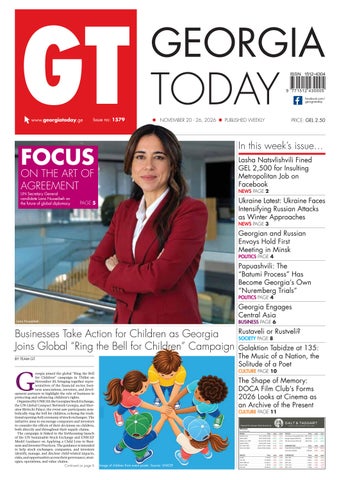
Image of children from event poster. Source: UNICEF
ŵͬŵ
Ͳϭ͕ϱй
ͲϬ͕ϴй
' W ͬ ' >
ϯ͕ϰϭϳϯ
Ͳϭ͕ϴй
Ͳϭ͕ϭй
ZƵƐƐĞůů ϮϬϬϬ
Ϯ ϳϰϮ͕ϵϰ
Ͳϯ͕ϰй
нϬ͕ϴй
hZ ͬ h^
ϭ͕Ϭϵϵϳ
ͲϮ͕Ϭй
ͲϮ͕Ϯй
&d^ ϭϬϬ
ϭϬ ϴϴϭ͕ϱϱ
ϱϭ ϲϬϴ͕ϭϳ
нϬ͕ϵй
ͲϬ͕Ϭй
' W ͬ h^
ϭ͕ϯϭϴϲ
Ͳϭ͕ϵй
Ͳϭ͕ϭй
2
NEWS
GEORGIA TODAY
NOVEMBER 20 - 26, 2026
Lasha Natsvlishvili Fined GEL 2,500 for Insulting Metropolitan Job on Facebook Poster for Mamuka Tkeshelashvili’s puppet-animated film When the Sea Was Calm.
Georgian Films Win Awards at International Film Festivals BY NANUKA MAGLAKELIDZE
G
eorgian cinema has earned further international recognition, with films by two Georgian directors receiving major awards at international film festivals in different countries. Director Mamuka Tkeshelashvili’s puppet animated film When the Sea Was Calm won the Best Animated Short Film award at the Manchester Animation
Festival in the United Kingdom. The film, which explores the theme of Sokhumi, received the festival’s top recognition in its category. Meanwhile, at Bulgaria’s Cinelibri International Film Festival, director Revaz Nasidze’s A Tragedy Without Heroes received the festival’s main award for Best Short Literary Adaptation. The film is based on a miniature of the same title by renowned Georgian writer Niko Lortkipanidze. Both films were produced with the support of the Georgian National Film Center.
Two Riot Police Officers Sentenced to Five Years in Prison for Physically Assaulting Activist Zviad Maisashvili
Lasha Natsvlishvili, a politician, Georgian Dream supporter and longtime PR consultant for the ruling party.
BY NANUKA MAGLAKELIDZE
L
asha Natsvlishvili, a politician, Georgian Dream supporter and longtime PR consultant for the ruling party, has been fined GEL 2,500 for insulting Metropolitan Job of Ruisi and Urbnisi in a Facebook post. The administrative offense case was heard on November 16 by Judge Manuchar Tsatsua at the Tbilisi City Court, in courtroom No. 41. The complaint was filed by the Ministry of Internal Affairs’ Department for Combating Hate Speech. Natsvlishvili is a supporter of the ruling Georgian Dream party and served as its PR consultant for several years. Natsvlishvili did not attend the court hearing and was not represented by a lawyer. On November 11, 2026, Natsvlishvili
published a Facebook post containing the phrase “Иоб тваю маць ра… (the Russian keyboard layout was not working), he wrote. The administrative offense report was drawn up two days later, on November 13. On November 11, 2026, Natsvlishvili published an insulting message directed at Metropolitan Job (Akiashvili) of Ruisi and Urbnisi. The post came a day after the bishop delivered a sermon criticizing the ruling Georgian Dream party. The administrative offense report was drawn up on November 13. During his November 10 sermon, the influential metropolitan accused Georgian Dream of pursuing policies that were damaging the Church, saying the authorities had “exhausted all their possibilities” and that a change of government was necessary. Georgian Dream representatives responded to the bishop’s criticism with criticism of their own. Several other members of the clergy
expressed support for Metropolitan Job, either in sermons or through social media posts. Bishop Giorgi Jamdeliani of Marneuli and Hujabi publicly called on Natsvlishvili to apologize to Metropolitan Job and ask for his forgiveness. Archpriest Andria Jaghmaidze, head of the Georgian Patriarchate’s Public Relations Department, also responded to Natsvlishvili’s post on social media. “Following Metropolitan Job’s sermon, we saw certain remarks directed at him that went far beyond Christian morality and language. Moreover, referring to a hierarch in such terms demonstrates disrespect not only toward the individual but toward the Church as a whole,” Jaghmaidze wrote. “Addressing anyone with insulting language is unacceptable for a Christian, regardless of who the person is. “Expressing an opinion, including criticism, can be done respectfully and with arguments, without resorting to insults.”
Geostat: Georgia’s Unemployment Rate Falls to 12.6% in Third Quarter of 2026 BY NANUKA MAGLAKELIDZE Activist Zviad Maisashvili. Source: RFE/RL
BY NANUKA MAGLAKELIDZE
O
n November 12, 2026, the Tbilisi City Court sentenced two riot police officers to five years in prison each for assaulting demonstrator Zviad Maisashvili during the 2024 pro-European protests. The court also banned both defendants from holding certain positions or engaging in professional activities for three years. Three Special Tasks Department (STD) officers have been arrested in connection with the assaults on Maisashvili and journalist Guram Rogava. All three are charged with abuse of official authority involving violence. One of them faces an additional charge of unlawfully obstructing a journalist’s professional activities through violence. The Prosecutor’s Office arrested five people in connection with the assaults on protesters Zviad Maisashvili, politician Levan Khabeishvili, and journalist Guram Rogava during the 2024 protests. Those arrested included three former and one serving riot police officers, as
well as a serving employee of the Interior Ministry’s Security Police Department. Two of the five detainees are already in custody in connection with separate criminal investigations. All five have been charged under Article 333, Part 3(b) of Georgia’s Criminal Code, which covers abuse of official authority involving violence. The officer charged in connection with the assault on Rogava also faces an additional charge under Article 154, Part 2, concerning the violent and unlawful obstruction of a journalist’s professional activities. The charges carry prison sentences of five to eight years. The case involving Levan Khabeishvili has been separated into independent proceedings. Shortly before this, it was reported that Guram (Goga) Kirkitadze, a riot police officer arrested on charges of assaulting former Formula TV journalist Guram Rogava, had also been sentenced to five years in prison. The verdict was delivered by the Tbilisi City Court. On November 12, 2026, case prosecutor Lasha Gamkrelidze informed the journalist, who has been recognized as a victim in the case, of the ruling.
G
eorgia’s unemployment rate fell by 0.7 percentage points year-over-year to 12.6% in the third quarter of 2026, according to the National Statistics Office of Georgia (Geostat). Geostat reported that the labor force participation rate decreased by 0.1 percentage points to 54.5%, while the employment rate increased by 0.3 percentage points to 47.6% compared to the same period in 2025.
The labor force participation rate rose by 0.4 percentage points in urban areas but declined by 0.6 percentage points in rural areas. The employment rate increased by 1.1 percentage points in urban settlements to 49.0%, while falling by 0.7 percentage points in rural areas to 45.8%. The share of salaried employees in total employment decreased by 0.2 percentage points year-over-year to 69.8%. Unemployment declined by 1.3 percentage points in urban areas, while increasing by 0.2 percentage points in rural areas compared to the third quarter of 2025. Geostat noted that unemployment traditionally remains higher among men
than women. In the third quarter of 2026, the unemployment rate among women fell by 0.6 percentage points to 10.8%, while the rate among men decreased by 0.8 percentage points to 14.0%. The labor force participation rate also remained higher among men, standing at 66.5%, compared to 44.1% among women. Year-over-year, the rate increased by 0.1 percentage points for women and declined by 0.3 percentage points for men. Meanwhile, the employment rate increased by 0.3 percentage points among women and 0.2 percentage points among men compared to the same period last year.
Permissible Vehicle Noise Limit Rises from 80 to 100 Decibels BY NANUKA MAGLAKELIDZE
G
eorgia has increased the permissible noise limit for vehicles from 80 to 100 decibels under amendments to the Code of Administrative Offenses, the Ministry of Internal Affairs said. Under the new regulation, noise generated by moving vehicles in populated areas between 11 p.m. and 8 a.m. must not exceed 100 decibels. The Ministry of Internal Affairs’ author-
ized units are responsible for monitoring noise levels. During inspections, law enforcement officers use portable measuring devices compliant with the international ISO 5130:2019 standard. Drivers who exceed the legally permitted noise limit of 100 decibels will face a GEL 100 fine and the deduction of 10 points from their driving license. Repeat violations will result in a GEL 200 fine and the deduction of 20 license points. A third and each subsequent violation will carry a GEL 300 fine and the deduction of 30 points. The Ministry said its officers would continue actively enforcing traffic reg-
Traffic on a highway.
ulations and taking appropriate legal action to maintain public order.
NEWS
GEORGIA TODAY NOVEMBER 20 - 26, 2026
3
Ukraine Latest: Ukraine Faces Intensifying Russian Attacks as Winter Approaches COMPILED BY ANA DUMBADZE
R
ussian forces continued to press their offensive in eastern Ukraine this week, concentrating attacks around Pokrovsk, Dobropillia and Kostiantynivka in Donetsk Oblast, while Ukrainian forces stepped up long-range strikes against Russian energy infrastructure and military supply routes. The fighting has been accompanied by mounting civilian casualties, disruptions to electricity and heating, and renewed international efforts to strengthen Ukraine's defenses and revive negotiations. The heaviest ground fighting remained concentrated around Kostiantynivka, Dobropillia and the wider Pokrovsk sector, where Russian forces are attempting to penetrate Ukrainian defensive positions and threaten the network of fortified towns protecting the remaining Ukrainian-held areas of Donetsk Oblast. Moscow's wider objective remains the seizure of the entire region, while Kyiv is seeking to prevent breakthroughs that could expose additional urban centers and important supply routes. According to Ukraine's General Staff, 205 combat engagements were recorded across the front on November 18. Russian forces also conducted 55 airstrikes involving 181 guided bombs, deployed nearly 3,000 attack drones and carried out more than 1,500 artillery and other strikes against Ukrainian positions and settlements. The Pokrovsk and Kostiantynivka directions remained among the most active. Russian troops attempted to advance around several settlements near Dobropillia and along the approaches to Kostiantynivka, where Ukrainian defenders reported repelling repeated assaults. The
Russian military has increasingly relied on small infantry groups, infiltration attempts, drones and guided aerial bombs rather than exclusively on large mechanized attacks. "Our positions are strong at the front," Ukrainian President Volodymyr Zelensky said on November 18 in his evening address. "And although the Russians are making very intensive attempts to advance toward Dobropillia and Kostiantynivka, we are destroying the occupiers." Territorial developments during the week were mixed, and some claims remained difficult to verify independently. The Institute for the Study of War (ISW) identified evidence of Russian infiltration missions near Shylivka, southwest of Dobropillia, and Rubizhne, northeast of the city. However, the presence of Russian personnel in contested settlements does not necessarily indicate consolidated territorial control. Ukrainian forces, meanwhile, recorded localized progress south of Novopavlivka, with evidence suggesting advances toward Dachne. Further north, Russian troops maintained pressure along the Kupiansk, Lyman and Sloviansk directions, seeking to disrupt Ukrainian defensive communications and improve their positions around important river crossings and transport corridors. ISW reported Russian infiltration activity west of KupianskVuzlovyi, while Ukrainian forces continued resisting assaults around Lyman and neighboring settlements. On the southern front, Russian attacks continued around Huliaipole and Orikhiv in Zaporizhzhia Oblast. ISW's November 18 assessment found no confirmed territorial advances by either side that day, despite continued attacks and counterattacks. Ukrainian forces were reported to be counterattacking near Kupiansk and in parts of Zaporizhzhia Oblast, while Russian claims of further gains near Dobropillia remained
unverified. The lack of substantial territorial movement has not translated into a reduction in fighting, with both armies continuing to commit significant resources to relatively small sections of the front. Beyond the battlefield, Russia intensified its attacks on Ukrainian cities, transport infrastructure and energy facilities as colder weather increased the importance of reliable electricity and heating. On November 16, Russian strikes hit two bridges across the Dnipro River in Kyiv, disrupting transport and contributing to electricity and water outages. Parts of Chernivtsi in western Ukraine also lost electricity following a Russian attack on November 17, temporarily interrupting public transport. The civilian toll was particularly severe in southern Ukraine. Russian strikes on Zaporizhzhia and Odesa on November 13 killed three people and injured more than 55, according to local officials. In Zaporizhzhia, a five-story apartment building sustained extensive damage, and a rescue worker died when a concrete slab collapsed during recovery operations. More than 50 people were injured, including six children. In Odesa, two people were killed when a residential property was struck, while five others were wounded. Odesa came under renewed attack on November 18, when Russian forces struck the city center in three waves, killing four people and injuring at least seven, according to regional authorities. Residential buildings, shops, cafes and an educational institution were damaged, and vehicles were destroyed or hit. Across Ukraine, attacks that day killed at least five people. Ukraine has continued its own campaign against Russian energy infrastructure and military logistics. On November 17 and overnight into November 18, Ukrainian forces struck the Ilsky and
Afipsky oil refineries in Russia's Krasnodar region. Ukraine's General Staff said the attacks damaged oil storage tanks and refining equipment at facilities involved in supplying fuel to Russian forces. Ukrainian strikes also targeted a bridge over the Siverskyi Donets River in occupied Luhansk Oblast, aiming to disrupt the movement of ammunition, fuel and military equipment. One of the week's most significant operations targeted the Kerch Strait Bridge, which connects Russia with occupied Crimea. A Ukrainian strike on November 17 reportedly killed two people and caused part of the structure to collapse. The operation formed part of Kyiv's wider effort to weaken Russian transport routes supporting military operations in southern Ukraine. The extent and duration of the disruption remained uncertain. The attacks on Russian oil infrastructure have also had economic consequences. Reuters reported on November 18, citing industry sources, that Russian daily crude refining had fallen by approximately 45% from late-October levels following sustained Ukrainian drone attacks. Operations at 15 of Russia's 35 major refineries had reportedly been disrupted or suspended. The figures indicate an immediate reduction in processing rather than a permanent loss of refining capacity, but suggest that Ukrainian strikes are increasingly affecting Russia's fuel production and potentially its ability to sustain military logistics and energy exports. Diplomatic efforts continued alongside the fighting. During the week, American envoys Steve Witkoff and Jared Kushner met Russian President Vladimir Putin in Moscow and subsequently held discussions with Zelensky in Dublin, seeking to revive negotiations that have so far failed to produce a comprehensive settlement. Fundamental disagreements
remain over occupied Ukrainian territory, security guarantees and the possible deployment of European forces following a ceasefire. Moscow continues to oppose NATO involvement on Ukrainian territory, while Kyiv insists that any agreement must protect the country's sovereignty and long-term security. International military assistance received a significant boost at the November 17 meeting of the Ukraine Defense Contact Group, known as the Ramstein format, in Brussels. Germany reaffirmed an approximately €1 billion air-defense package and announced an additional $300 million contribution to the NATOcoordinated initiative for purchasing American weapons. Britain pledged £240 million for air defense, while Norway announced approximately $800 million in assistance covering air-defense systems, drones and other military requirements. Denmark, the Netherlands, Spain and several other European partners also committed additional support. The meeting also produced commitments to strengthen Ukraine's combat aviation. Belgium announced plans to deliver 10 F-16 fighter jets before the end of 2026, while France pledged two additional Mirage 2000-5F aircraft and an advanced anti-ballistic radar. The announcements reflect the continuing importance of air-defense and interception capabilities in protecting Ukrainian cities and maintaining the country's ability to sustain military operations through winter. On November 18, Zelensky welcomed progress on military assistance and said the European Commission had prepared a path toward providing Ukraine with an additional €45 billion in 2027. He also announced preparations for further discussions with European leaders and American representatives, emphasizing that decisions concerning Ukraine's future must involve Kyiv directly.
4
POLITICS
GEORGIA TODAY
NOVEMBER 20 - 26, 2026
Georgian and Russian Envoys Hold First Meeting in Minsk changing, this will remain. There is no talk [of restoring diplomatic relations]."
THE PRAGUE DIALOGUE AND ITS LIMITS
Mikhail Galuzin and Giorgi Zurabashvili. Source: FB
BY TEAM GT
G
eorgia’s Prime Minister’s Special Representative for Relations with Russia and First Deputy Foreign Minister Giorgi Zurabashvili met Russian Deputy Foreign Minister Mikhail Galuzin in Minsk on November 19, marking the first meeting between the two officials since Zurabashvili’s appointment last month. The meeting took place as Tbilisi and Moscow seek to resume direct contacts through their special representatives, a channel that has been largely inactive since the previous round of talks in December 2025. Prime Minister Irakli Kobakhidze appointed Zurabashvili to the post on October 21, while retaining his position as First Deputy Foreign Minister. His Russian counterpart, Mikhail Galuzin,
is responsible for Russia’s policy toward the South Caucasus. The Russian Foreign Ministry has described the renewed contacts as a continuation of the dialogue initiated in 2012. According to the ministry, discussions focused on practical areas of bilateral cooperation, including trade, tourism, transport links and cultural exchanges. In comments reported on November 16, the Russian Foreign Ministry said that work was already underway in some areas. In particular, representatives of the agricultural authorities of the two countries were working to facilitate mutual supplies of agricultural products. “Russia has consistently advocated building pragmatic and mutually beneficial relations with Georgia,” the ministry said, according to reports citing its response to the Russian newspaper Izvestia. Kobakhidze has said that the new channel will remain active but does not signal
a change in Georgia’s position on restoring diplomatic relations with Moscow. "Restoring these relations has its own natural barrier. This is the occupation of our country's territories and the recognition of two occupied regions as socalled states. Accordingly, our decision here will not be revised, cannot be revised," he told journalists on November 16. He added that contacts between the two special representatives would continue actively and that all issues covered by the format would be discussed. Zurabashvili has also sought to distinguish the bilateral dialogue from the Geneva International Discussions, the established multilateral format for addressing the consequences of the 2008 Russia-Georgia war. Asked on November 16 whether the new channel would replace the Geneva format, he replied: "No, it will not be replaced. The Geneva format will remain as it is, it will stay that way. This is not
The direct dialogue between Georgian and Russian representatives dates back to December 2012, when Zurab Abashidze, then the Georgian Prime Minister's Special Representative for Relations with Russia, held his first meeting with Russian Deputy Foreign Minister Grigory Karasin. The initiative followed the August 2008 war, which led to the severing of diplomatic relations between the two countries. The new channel was intended to address areas in which practical progress remained possible despite the unresolved political and security disputes. Most subsequent meetings between Abashidze and Karasin took place in Prague and focused primarily on trade, economic cooperation, humanitarian issues and cultural contacts. Security matters and the status of Georgia's occupied territories were not formally part of the Prague format's main agenda, as these were addressed through the Geneva discussions. The format provided a direct channel of communication between Tbilisi and Moscow without restoring diplomatic relations. It also enabled discussions on trade restrictions, transport and other practical matters. The appointment of Zurabashvili represents an effort to reactivate this channel under a new Georgian representative, with Galuzin taking over the Russian side.
DISAGREEMENT OVER THE GENEVA FORMAT The choice of Minsk for the first meeting comes against the background of Russia's repeated calls to relocate the Geneva International Discussions from Switzerland. Established following the August 2008 war, the Geneva format remains the principal international forum addressing the security and humanitarian conse-
quences of the conflict. It brings together representatives of Georgia, Russia and the United States, as well as participants from the occupied regions of Abkhazia and the Tskhinvali region, under the cochairmanship of the European Union, the United Nations and the Organization for Security and Co-operation in Europe (OSCE). The discussions operate through two working groups, one addressing security and the other humanitarian issues, including freedom of movement, displaced persons and refugees, documentation and missing persons. Moscow has been advocating a change of venue since 2022, arguing that Switzerland has lost its neutrality because of its participation in Western sanctions against Russia. Russian Deputy Foreign Minister Galuzin reiterated the position in July 2026, saying Moscow would continue to press for the discussions to be moved. Minsk has been among the locations proposed by Russia. The de facto authorities in Sukhumi and Tskhinvali have also supported relocating the talks, suggesting Minsk or Nairobi as alternatives. The proposal has not resulted in a change of venue. The 67th round of the Geneva International Discussions took place in Geneva on June 30 and July 1, 2026, with the co-chairs confirming that the next round was also scheduled to take place there in November. The EU, UN and OSCE continue to support the existing Geneva framework. Its continuation is particularly significant given that it remains the established multilateral mechanism for discussing the consequences of the 2008 conflict. The renewed bilateral contacts between Tbilisi and Moscow therefore represent a separate diplomatic channel rather than a replacement for the Geneva process. While the two sides may seek progress on trade, transport and other practical issues, their fundamental disagreements over Georgia's territorial integrity and Russia's recognition of Abkhazia and the Tskhinvali region remain unresolved.
Papuashvili: The “Batumi Process” Has Become Georgia’s Own “Nuremberg Trials” BY NANUKA MAGLAKELIDZE
G
PMs Nikol Pashinyan and Irakli Kobakhidze
Georgian and Armenian Prime Ministers Discuss Regional Peace and Bilateral Cooperation at EPC Summit BY ANA DUMBADZE
G
eorgian Prime Minister Irakli Kobakhidze met with his Armenian counterpart, Nikol Pashinyan, on the sidelines of the 9th European Political Community (EPC) Summit. The meeting focused on the regional situation, with both leaders emphasizing the importance of maintaining peace and stability in the region.
Kobakhidze and Pashinyan also reviewed cooperation between Georgia and Armenia across various sectors, highlighting the progress achieved in bilateral relations. The two prime ministers discussed cooperation within multilateral frameworks, underscoring the importance of continued dialogue and partnership between the neighboring countries. The meeting provided an opportunity for the leaders to exchange views on regional developments and reaffirm the importance of cooperation in promoting stability and strengthening bilateral ties.
eorgian Parliament Speaker Shalva Papuashvili has compared the ongoing “Batumi trial” to the Nuremberg trials, accusing opposition party Lelo of attempting to deny its previous calls for sanctions against Russia and other measures following the fullscale invasion of Ukraine in 2022. In a social media post, Papuashvili referred to a statement made by a Lelo representative during the court proceedings, in which the party’s position on sanctions was discussed. “There are three entities imposing sanctions: the United States, the United Kingdom and the European Union. We said that we should strictly join the sanctions imposed by these three entities [against Russia]. We never called for additional measures,” the Lelo representative said. Papuashvili also shared a video of Lelo leader Mamuka Khazaradze speaking about the need to introduce stricter visa requirements for Russian citizens and stating that “no Russian will be able to buy our land.” In his post, Papuashvili recalled a meeting with Lelo’s parliamentary representatives in 2022, shortly after Russia launched its full-scale invasion of Ukraine. He claimed that the opposition lawmakers had urged him to send volunteers to fight in Ukraine and impose sanctions on Russia.
Shalva Papuashvili, Speaker of the Parliament of Georgia.
Papuashvili further alleged that their demands coincided with pressure from foreign envoys and argued that, had the current opposition group been in power instead of Georgian Dream in 2022, Georgia would have been drawn into a war. “President Trump often repeats that if he had been president in 2022, there would have been no war in Ukraine. Our experience also confirms these words to some extent. Had this group, which serves foreign forces, been in power in Georgia instead of Georgian Dream in 2022, there would definitely have been a war in Georgia,” Papuashvili wrote. He concluded by describing the Batumi proceedings as a Georgian equivalent of the Nuremberg trials, saying the public
was witnessing what he called the desperate attempts of those guilty of crimes against their homeland to justify themselves. Papuashvili said the footage should serve as a lesson about the consequences of becoming a “puppet” and a “useful idiot” of foreign powers. The video was recorded during a hearing at Georgia’s Constitutional Court in Batumi, where a lawsuit seeking to ban five opposition parties is being examined. The case, filed by 88 Georgian Dream MPs, seeks to declare the parties unconstitutional and ban their activities. The parties are: United National Movement (UNM), Coalition for Change, Strong Georgia – Lelo, Federalists, Gakharia for Georgia.
POLITICS
GEORGIA TODAY NOVEMBER 20 - 26, 2026
5
The Art of Agreement - Lana Nusseibeh and the Future of Global Diplomacy reforms requires cooperation from its member states. The relationship between ambition and institutional capacity will be a defining issue for whoever assumes the leadership of the United Nations in 2027.
DEVELOPMENT BEYOND TRADITIONAL ASSISTANCE
Lana Nusseibeh at the UN General Assembly.
BY SOFIA BOCHOIDZE
I
n diplomacy, success is often measured by what the world sees: a resolution adopted, an agreement reached, a crisis brought to the negotiating table. Yet some of its most consequential work happens long before those moments, behind closed doors, where competing interests, difficult conversations and the willingness to compromise can determine whether progress is possible at all. Lana Nusseibeh has spent much of her diplomatic career navigating that delicate space. Now, as the United Arab Emirates’ candidate for Secretary-General of the United Nations, she is bringing her experience into a much larger conversation about the future of multilateralism. Having officially announced her candidacy on October 21, 2026, Nusseibeh enters the race to succeed António Guterres at a time when international institutions face mounting financial pressures, geopolitical divisions and increasingly complex global challenges. At the heart of her published vision lies a particularly thought-provoking belief: “The UN was never meant to agree with the world. It was built to help the world agree.” It is a distinction that invites a broader discussion about what diplomacy should accomplish in the twenty-first century.
FROM ABU DHABI TO THE UNITED NATIONS Nusseibeh’s professional journey has developed alongside the UAE’s growing engagement in international affairs. Her early career included work with UNESCO in Paris, followed by service within the UAE government, where she established the Ministry of Foreign Affairs’ Policy Planning Department. Her responsibilities also extended to Afghanistan
“The UN was never meant to agree with the world. It was built to help the world agree.” — Lana Nusseibeh
and Pakistan, international economic diplomacy through the G20, and the UAE’s successful bid to host the International Renewable Energy Agency (IRENA). In 2013, she became the first woman appointed as the UAE’s Permanent Representative to the United Nations, a position she held until 2024. Her eleven years in New York included several prominent leadership positions. In 2017, she served as President of the Executive Board of UN Women and as a Vice-President of the UN General Assembly. She was also involved in negotiations concerning Security Council reform. During the UAE’s 2022–2023 membership of the Security Council, Nusseibeh twice assumed its rotating presidency. Her diplomatic portfolio included humanitarian access to Gaza, the rights of Afghan women and girls, and conflict prevention. Appointed UAE Minister of State in September 2025, she has since taken a leave of absence from her government responsibilities to concentrate on her candidacy.
THE PRICE OF COMPROMISE One of the central arguments in Nusseibeh’s vision concerns the relationship between compromise and trust. For governments operating under domestic political and economic pressures, the immediate costs of an international agreement can appear more significant than its eventual benefits. The problem becomes even more pronounced when previous commitments have failed to produce their intended outcomes. It is a dilemma that extends beyond Lana Nusseibeh, the United Arab Emirates’ candidate for Secretary-General of the United Nations.
diplomacy. Business leaders, policymakers and international institutions regularly face similar choices between immediate demands and long-term objectives. Nusseibeh’s proposed approach to conflict resolution places particular emphasis on achievable early steps. A humanitarian corridor, a prisoner exchange or a local ceasefire may not resolve a conflict, but each creates an opportunity to establish the trust necessary for more comprehensive negotiations. Her programme also recognizes the importance of regional organizations and local actors in mediation, rather than assuming that every diplomatic process must be led by the United Nations itself. The practical challenge, of course, lies in turning such proposals into action when the interests of major international powers diverge.
CAN THE UNITED NATIONS BECOME MORE RESULTS-ORIENTED? While peace and security remain central to her programme, Nusseibeh also approaches the future of the United Nations from an institutional management perspective. Her proposals include assessing major programmes against their financial costs, reducing overlapping responsibilities and strengthening accountability. These are questions increasingly familiar to leaders across both the public and private sectors: how to allocate limited resources, measure performance and maintain institutional trust. For an organization with a global mandate and a complex administrative structure, however, implementing such
The development component of Nusseibeh’s programme offers another perspective particularly relevant to emerging economies. Her proposals recognize that countries have different needs. Some require continued humanitarian and development assistance, while others are seeking greater access to capital, technological expertise and international investment. She identifies employment, privatesector partnerships and fairer approaches to sovereign debt among her development priorities. For countries such as Georgia, this raises an important question about the evolving role of international organizations in economic development. Beyond providing assistance, how can multilateral institutions help countries attract investment, strengthen their competitiveness and pursue their own long-term economic priorities? Georgia’s geographical position, its role in regional connectivity and its ambitions for closer integration into international markets make these issues particularly relevant. Similarly, for smaller nations, the effectiveness of multilateral institutions is inseparable from respect for sovereignty, territorial integrity and the consistent application of international law.
WOMEN AND THE FUTURE OF GLOBAL LEADERSHIP Since the establishment of the United Nations, all nine individuals who have served as Secretary-General have been men. The 2026 selection process, which includes several female candidates, has therefore renewed the international discussion about representation at the highest levels of global governance. Nusseibeh’s professional experience includes working within institutions where questions of peace, security and political authority are negotiated at the highest level, as well as promoting women’s participation in international decision-making. For younger generations of women considering careers in diplomacy, public service or international business, the visibility of women in such positions carries significance beyond any individual candidacy. At the same time, the responsibilities of the Secretary-General extend beyond representation. Independence, impartiality and the ability to work with gov-
ernments whose interests frequently conflict remain fundamental requirements of the office. In announcing her candidacy, Nusseibeh addressed this responsibility directly, describing her intended approach as: “Speaking frankly with every government and answering to none.”
PREPARING FOR A WORLD THAT IS ALREADY CHANGING Artificial intelligence, biotechnology and climate change are reshaping the international landscape, introducing challenges that extend beyond conventional diplomacy. Nusseibeh’s programme identifies technological access and international cooperation as important elements of the UN’s future work. The economic opportunities created by emerging technologies are considerable, but their benefits are unlikely to be distributed equally without meaningful international engagement. For smaller economies, participation in these conversations is particularly important. Decisions concerning technological standards, access to innovation and digital governance will influence their competitiveness for decades to come. The question facing the United Nations is how to accommodate these emerging priorities while continuing to fulfil its existing responsibilities.
THE WORLD WE LEAVE BEHIND Among the policy proposals and institutional considerations in Nusseibeh’s published vision, there is also a distinctly personal reflection. A mother of two sons, she draws a parallel between the responsibilities of parenthood and those of international leadership: responding to the immediate needs of today while protecting the interests of generations to come. It is a familiar dilemma for parents everywhere, regardless of nationality, profession or political outlook. And perhaps it is one of the most universal questions underlying international cooperation itself. The decisions made within the United Nations today will shape a world inherited by people who have yet to enter its negotiating rooms. As the international community considers who should lead the organization into its next chapter, the discussion extends beyond the qualifications of individual candidates. It is also about what governments expect from the United Nations, what responsibilities they are willing to share, and whether international cooperation can deliver when it is needed most. Eighty years after the organization was founded, the art of agreement remains as relevant as ever.
6
BUSINESS
GEORGIA TODAY
NOVEMBER 20 - 26, 2026
Georgia Engages Central Asia ANALYSIS BY EMIL AVDALIANI
O
n October 23, 2026, Georgia hosted the foreign ministers of all five Central Asian countries, Kazakhstan, Uzbekistan, Turkmenistan, Kyrgyzstan and Tajikistan, in Batumi. Organized at the initiative of the Georgian side, it was the first meeting of its kind with the agenda revolving around political cooperation, trade, transport connections and the growing importance of the Middle Corridor, which links Central Asia to Europe through the South Caucasus. The meeting reflected the ongoing shift in relations between Georgia and Central Asia. Although the countries have maintained diplomatic and economic ties since the break up of the Soviet Union, their cooperation has mostly developed through bilateral agreements. The Batumi gathering suggested an interest in building a more regular regional dialogue involving the six countries. More importantly, the meeting took place at a time when Eurasian transport routes and political relationships are changing rapidly. Russia’s invasion of Ukraine has increased interest in transport routes that bypass Russian territory. More recent instability involving Iran has added to concerns about southern routes. For Central Asian governments, relying on a single transit country creates economic and political risks. Developing alternative connections gives them greater freedom to trade with different partners. The Middle Corridor has therefore become an important part of Central Asian countries’ foreign policies. Georgia, for its part, wants to strengthen its position as a link between the European Union and Asia. Tbilisi and Central Asian capitals see closer cooperation as a way to increase their economic oppor-
Central Asian representatives in Georgia with Prime Minister Kobakhidze. Source: FB
tunities and reduce dependence on larger powers. For Georgia, the meeting was also part of a wider diplomatic effort: in the span of a few months in 2026, Georgian Prime Minister Irakli Kobakhidze visited Kyrgyzstan, Tajikistan and Kazakhstan. In July, the presidents of Uzbekistan and Turkmenistan visited Georgia. These exchanges indicate that Tbilisi is now engaging with Central Asia as a region and has its own specific approach. The choice of Batumi was particularly important. Following their discussions, the ministers visited the city’s port, which is operated by a Kazakh-controlled company. They examined its facilities and received information about Georgia’s transport infrastructure, including the planned Anaklia deep-sea port. The visit was intended to demonstrate that Geor-
gia possesses infrastructure that Central Asian countries can use to reach international markets. The discussions also went beyond the movement of goods. Kazakhstan emphasized modernizing transport infrastructure, introducing digital freight systems and simplifying transit procedures. Uzbekistan raised opportunities for cooperation in agriculture, textiles, chemicals, energy and industrial production. Turkmenistan proposed closer coordination with international transport organizations and highlighted plans for telecommunications infrastructure, including a fiberoptic connection along the Caspian-Black Sea corridor. Tourism and direct business contacts were also discussed. These priorities show that the countries are interested in building a wider
economic relationship, rather than simply transporting Chinese goods toward Europe. More efficient connections could allow Central Asian manufacturers to export through Georgian ports, while Georgian companies could gain better access to growing Central Asian markets. There are already signs of progress, with the Middle Corridor cargo passing through Georgia doubling between 2018 and 2025, reaching 4.6 million tons. In June, the World Bank approved $372 million in financing to improve Georgia’s railway and road infrastructure. Nevertheless, the corridor still faces problems involving costs, port capacity, customs procedures and coordination among participating countries. The Batumi gathering also came just four days after US Secretary of State
Marco Rubio met Central Asian foreign ministers in Samarkand on October 19. Washington’s renewed engagement demonstrates the growing international attention toward Central Asia, which has critical minerals and a burgeoning population. In this geopolitical context, Georgia is positioning itself as an important geographical partner for countries seeking access to the region. Strengthening ties with Central Asia therefore gives the Georgian government additional diplomatic opportunities and economic partners. The Batumi meeting also matters in the context of the proposed transport connection through the southernmost part of Armenia, known as the Trump Route for International Peace and Prosperity (TRIPP). The project’s development could create another connection between Central Asia and Europe. Georgia has an interest in making its existing infrastructure more competitive. Ultimately, the Batumi meeting’s main achievement was bringing Georgia and all five Central Asian states together in a new political format. If the countries establish regular meetings and translate their discussions into infrastructure investment, simpler border procedures and stronger commercial ties, Batumi could mark the beginning of a more substantial regional partnership. For Georgia, the opportunity is to turn its geographical position into long-term economic and diplomatic influence. For Central Asia, the benefit is greater access to international markets and more freedom to choose its external partners. The meeting underscored that both sides increasingly recognize how closely their geopolitical interests are linked. Emil Avdaliani is a professor of international relations at the European University in Tbilisi, Georgia, and a scholar of Silk Roads. He can be reached on Twitter/X at @emilavdaliani.
Businesses Take Action for Children as Georgia Joins Global “Ring the Bell for Children” Campaign Continued from page 1 A Georgian-language publication, Integrating Children’s Rights in Corporate Sustainability Reporting, was also introduced at the event. It is designed to help companies incorporate the Children’s Rights and Business Principles into their environmental, social, and governance (ESG) policies and reporting. “Ensuring that every child has the opportunity to reach their full potential is a shared responsibility,” said Alexandru Nartea, Deputy Representative of UNICEF Georgia. “Businesses have an important role, as their decisions and practices directly and indirectly affect children’s lives and future. Ring the Bell for Children is an opportunity to strengthen our partnership with Georgia’s private sector and put children’s rights at the heart of responsible and sustainable business.” Giorgi Amzashvili, CEO of the Georgian Stock Exchange, said capital markets could help direct attention and investment toward long-term sustainable value. He added that children’s rights and wellbeing should be considered when companies assess risks, report their impacts, and make business decisions. “For businesses, considering children as stakeholders makes ESG more concrete and more accountable,” said Salome Zurabishvili, Executive Director of the UN Global Compact Network Georgia. She said the Georgian-language guidance would help companies translate commitments into practical measures across corporate policies, operations, value chains, and sustainability reporting. At the conclusion of the event, participating organizations signed the Chil-
dren’s Rights in Business Pledge, The Future We Invest In, recognizing children as a business priority and committing to integrate their rights into responsible and sustainable business practices. Signatories included the Business Association of Georgia, the ICT Association, the Banking Association of Georgia, TBC Bank, Bank of Georgia, Microbank Crystal, the Georgian AI Association, ExpatPro, and EPAM, as well as representatives of Georgian wooden toy companies Kokito, Dadari, and Gogora.
Stock Exchange bell. Source: CNBC
WORLD CHILDREN’S DAY Observed annually on November 20, World Children’s Day promotes international solidarity, awareness of children’s rights, and action to improve children’s lives. The date marks two important milestones in the history of international child protection. On November 20, 1959, the UN General Assembly adopted the Declaration of the Rights of the Child. Thirty years later, on the same date in 1989, it adopted the Convention on the Rights of the Child, an international treaty establishing the civil, political, economic, social, and cultural rights of every child. The Convention recognizes children's rights to education, health care, family life, and protection from violence and discrimination. It also establishes their right to express their views and have those views taken into account in matters affecting them. Georgia ratified the Convention in 1994. In 2019, the country adopted its Code on the Rights of the Child, establishing a national legislative framework for protecting and promoting children's rights.
CHILDREN IN GEORGIA Georgia has made progress in addressing child poverty and strengthening the legal framework for children's protection, although significant challenges remain. According to UNICEF's Situation Analysis of Children's Rights and WellBeing in Georgia 2025, absolute child poverty fell from 29.9% in 2013 to 12.1% in 2024. However, children remain the poorest demographic group in the country, and 37.8% experience material and social deprivation. The report identifies children in rural areas, children with disabilities, and children from ethnic minority communities as facing heightened risks.
Social protection programs have expanded, with cash transfers covering 32.1% of children under the age of 16, according to the same analysis. The report also recognizes the adoption of the Code on the Rights of the Child as a significant legislative achievement, while noting that its full implementation requires stronger institutional capacity, coordination between agencies, and sustainable funding. These challenges underline the importance of involving not only government institutions and international organizations but also the private sector in efforts to improve children's lives. The Children’s Rights and Business
Principles provide a framework for understanding and addressing the impact of business activities on children in the workplace, marketplace, community, and environment. They cover issues ranging from working conditions and the marketing of products to the safety of goods and services, environmental impacts, and the protection of children in communities affected by business operations. The “Ring the Bell for Children” campaign seeks to bring these considerations into financial and corporate decisionmaking, recognizing that investment and business practices can have consequences for children well beyond the immediate workplace.
BUSINESS
GEORGIA TODAY NOVEMBER 20 - 26, 2026
7
Energy Sector Lending in Georgia EPRC: Russian E-commerce Giant Wildberries Expands Operations in Georgia Increases by 23% year-on-year, Minister Says Despite EU Sanctions Against its Owner BY NANUKA MAGLAKELIDZE
L
A Wildberries-branded warehouse in Georgia, with the Georgian national flag flying nearby.
BY NANUKA MAGLAKELIDZE
D
espite EU sanctions against its owner, Russian e-commerce giant Wildberries is expanding its operations in Georgia, including plans for a large logistics facility near Rustavi, a warehouse in the village of Gamarjveba, and the launch of a taxi service in Tbilisi, according to a study by the Economic Policy Research Center (EPRC). The company has purchased more than 19 hectares of state-owned land near Rustavi and leased warehouse space in Gamarjveba. It is also preparing to launch its taxi service, WB Taxi, in the Georgian capital. Wildberries’ Georgian operator, Transcom Group, was initially owned by Lasha Megrelidze, a member of the supervisory board of Cartu Bank. Since 2024, the company’s director and sole shareholder has been Sergi Tvalchrelidze, a donor to the ruling Georgian Dream party and a business partner of Georgian Dream MP Giorgi Barvenashvili, the EPRC study says.
WILDBERRIES EXPANDS ITS OPERATIONS IN GEORGIA According to the EPRC study, Transcom Group LLC was registered in Georgia on July 26, 2022, and subsequently became Wildberries’ local operator. The platform began sales in Georgia on October 22, 2024, under a franchise model. Initially, customers were offered approximately eight million product listings, with orders collected at a single pickup point on Paliashvili Street in Tbilisi. The pickup network later expanded beyond the capital, while Georgian entrepreneurs were also given the opportunity to sell their products through the platform. Pickup points hand over prepared parcels to customers, while warehouses receive goods from sellers, store inventory and distribute orders. The terms published for sellers on the Georgian portal also cover goods reception, storage, sorting and delivery. Registration records collected for the study show that in January 2026, Transcom Group acquired four plots of land directly from the state through privatization. All four plots are located in the same area, near the 17th kilometer of the TbilisiRed Bridge international highway. “The concentration of the four plots in one area, combined with the operator’s already documented warehousing activities, provides grounds to assume that the land is intended for a warehouse or logistics complex. The project’s purpose, the size of the buildings and construction timelines cannot yet be established from publicly available materials,” the study says. On October 28, 2026, Transcom Group announced a tender to improve mobile network coverage at a warehouse facility. The technical specifications identify the village of Gamarjveba and a warehouse facility covering approximately
13,000 square meters. Transcom Group also signed a second lease agreement for property in Gardabani. The agreement was concluded on May 16, 2025, for a two-year term. “If a logistics center is established near Rustavi, in addition to these facilities, the group will have significantly greater capacity outside Russia to receive, store and distribute goods. Whether it will be able to take over some of the functions of warehouses affected in Russia will depend on the complex’s capacity, the markets it serves and the directions of cargo movement,” the study says.
WB TAXI PREPARES TO LAUNCH IN TBILISI In October, Transcom Group announced two tenders related to branding vehicles for WB Taxi. The EPRC says publicly available records do not establish whether contracts were signed, how many vehicles would be branded, whether passenger transportation has started or which company will directly provide the service. As of early November, the service was operating in Belarus, Kyrgyzstan and Uzbekistan. Early access was launched in Yerevan on September 22. In Russia, the group acquired Citymobil, Taxovichkof and Gruzovichkof in April. However, the available information does not confirm that a service operating directly under the WB Taxi brand has been launched in Russia. “Taxi transportation using passenger cars in Tbilisi requires a municipal permit. The identity of the permit holders and responsibility for passenger transportation will depend on whether the Georgian operator provides the service itself or distributes orders among partner carriers,” the study says. The EPRC notes that Yandex Go, which already operates in Georgia, describes itself as an information service and states that transportation is provided by carriers. A taxi application processes addresses, trip duration and account-related information. Repeated routes can reveal a person’s home and workplace or daily travel patterns. “This makes it important to establish who operates the Georgian service, where trip histories are stored and on what grounds they may be transferred to another country. If launched, the service would add another platform connected to a Russian group alongside Yandex Go,” the study says.
POLITICAL CONNECTIONS OF WILDBERRIES’ GEORGIAN OPERATOR The EPRC study also highlights the political connections of Wildberries’ Georgian operator. Shortly after Wildberries began operating in Georgia, Lasha Megrelidze was listed as a partner in Transcom Group in a November 2024 entry in the National Statistics Office of Georgia’s business registry. Cartu Bank’s financial statements show
that Megrelidze was appointed deputy chairman and an independent member of the bank’s supervisory board in 2023. According to the bank’s audited 2025 financial statements, the bank’s direct owner is the Cartu Foundation, while Uta Ivanishvili holds a 35% stake in the ownership structure. Since 2024, Sergi Tvalchrelidze has served as Transcom Group’s director and sole shareholder. His name also appears in contracts with the Ministry of Justice related to the privatization of state-owned land. The political donation database of Transparency International Georgia shows that Tvalchrelidze personally donated GEL 30,000 to Georgian Dream in 2025. According to a March 31, 2025, registry extract for Nama Consulting, Tvalchrelidze served as the company’s director and held a 33% stake. Giorgi Barvenashvili, now a Georgian Dream MP, held a 34% stake in the same company. The study also notes that Nama Consulting and Transcom Group share the same registered legal address: an apartment owned by Tvalchrelidze. “Accordingly, open sources confirm that Wildberries’ entry into Georgia, its operations and expansion are being carried out by individuals with close ties to Cartu and Georgian Dream,” the EPRC writes.
ending to Georgia’s energy sector increased by 23% yearon-year as of September, indicating growing confidence among domestic and international investors, Economy Minister Mariam Kvrivishvili said. Speaking at a meeting with business representatives, Kvrivishvili said investment activity in the energy sector had shown significant positive momentum, with growing demand for the construction of hydropower, solar and wind power plants. The minister acknowledged that the sector faces several challenges but stressed the importance of cooperation between the government and the private sector in addressing them. Kvrivishvili also announced that an additional 300 megawatts of power gen-
eration capacity is expected to enter operation by the end of 2026, increasing domestic electricity generation and reducing the country’s potential need for electricity imports. She said the government had developed a 10-year economic development plan and highlighted the establishment of the Georgian Economic Development Corporation, which will consolidate existing state programs, expand financing instruments and support the implementation of strategic investment projects. The minister also said the Economy Ministry had begun working with the private sector on a new auction model to further support hydropower development. The proposed mechanism will include capacity and tariff auctions. Kvrivishvili emphasized that continued cooperation with private investors would be essential to turning the current positive momentum in the energy sector into long-term economic growth.
Kobakhidze: Lari Exchange Rate is Stable and Strong, Foreign Exchange Reserves Exceed $8 billion BY NANUKA MAGLAKELIDZE
G
eorgia’s foreign exchange reserves have surpassed $8 billion, while the national currency remains stable, Prime Minister Irakli Kob-
akhidze said. Speaking at the Georgian Business Association’s conference, “Business Environment in Georgia: Dialogue Between the Government and Business,” Kobakhidze commended the National Bank of Georgia and its president for their monetary policy and efforts to control inflation.
He said Georgia had managed to maintain economic stability despite significant global challenges, adding that the lari remained strong and foreign exchange reserves continued to grow. “I would like to express my gratitude to the President of the National Bank for the effective monetary policy and sound management of inflation. Despite major global challenges, we have succeeded in maintaining stability. The lari exchange rate remains stable and strong, and the National Bank has been performing successfully across all areas. Our foreign exchange reserves have now exceeded $8 billion, reflecting the work of the National Bank and its president,” Kobakhidze said.
EU SANCTIONS AGAINST WILDBERRIES’ OWNER On November 16, the European Union sanctioned Wildberries owner Tatiana Kim. The sanctions freeze her assets in the EU and prohibit her from entering or transiting through the bloc. Individuals and entities operating under EU jurisdiction are also prohibited from making funds or economic resources available to her. The EPRC argues that the sanctions against Kim should not be viewed solely as personal restrictions, as they could have significant implications for the company’s operations. Under EU sanctions rules, restrictions generally also apply to companies owned or controlled by a sanctioned individual who holds more than 50% of the company or exercises control over it. Kim owns 100% of Wildberries and holds an indirect 65% stake in the combined company RWB (Wildberries & Russ). “As a result, Wildberries could face significant financial and operational risks, including delays or blocks on international bank transfers, refusals of services by financial institutions, suspension or termination of contracts with international partners, and disruptions to supply chains. Banks and business partners may also refuse to cooperate with the company to avoid the risk of sanctions circumvention,” the study says. Wildberries, however, has stated that the group has no assets or operations in the European Union and that the sanctions against Kim will not affect its operations.
Tbilisi International Airport.
Georgia’s Airports Serve 3 million Passengers in Third Quarter, up 6.1% BY NANUKA MAGLAKELIDZE
G
eorgia’s airports served 3 million passengers in the third quarter of 2026, a 6.1% increase compared to the same period last year, the National Statistics Office of Georgia (Geostat) reported. Of the total, 1.5 million passengers departed from Georgian airports, up 6.0% year-on-year, while another 1.5 million arrived, marking a 6.2% increase. Scheduled flights accounted for 94.0% of total passenger traffic during the reporting period. The number of passenger flights oper-
ated at Georgian airports reached 11,600 in the third quarter, up 7.6% compared to the same period in 2025. Meanwhile, cargo and mail traffic at Georgian airports totaled 12,300 tons. Received cargo and mail accounted for 88.2% of the total, while 11.8% was dispatched. Georgian airports handled 800 cargo flights during the quarter, a 9.2% decrease year over year. Separately, air transport services in Georgia carried 211,500 passengers and transported 25,900 tons of cargo during the reporting period. The number of passengers carried by air transport decreased by 14.4% compared to the third quarter of 2025, while cargo volumes fell by 26.0%.
8
SOCIETY
GEORGIA TODAY
NOVEMBER 20 - 26, 2026
Fitful Decline BLOG BY TONY HANMER
M
y wife’s street in Leliani, Kakheti used to be crawling with children in her childhood. It’s a couple of kilometers long, so, not short. Now it’s falling silent, with hardly a school-goer to be found anywhere. My comings and goings here for the last 20-odd years have given me a fairly good handle on what has happened, on this street and even in Lali’s own house. Georgia went from the highest per capita Soviet republic to about the poorest, vying with Tajikistan for this dubious honor, as the USSR broke up. Civil wars, breakdown of infrastructure, hyperinflation of new currencies post-ruble, vast refugee populations… and so on. That’s number one. Nature abhorring a vacuum as it does, the power vacuum in chaotic post-Soviet
Georgia was filled by opportunists looking to make a fast buck and gain power. When I arrived here in late 1999, Tbilisi was a dark, dangerous city where you didn’t want the police’s “help” if you got into the kind of trouble that would normally make you call 911 (112). Muggings and subsequent robberies of foreigners were being reported in the city at least once a week; I was one. Kutaisi was getting ONE HOUR of electricity a day, which made my four hours in Vake look pretty good. Kerosene heaters were stinkingly taking the place of good old Soviet central heating’s radiators. Marshrutkas were similarly replacing the suddenly, terrifyingly blackout-ridden Tbilisi Metro. Phone landlines? Stolen and sold for their valuable copper! If anyone had a chance to seek their fortune abroad, even to work illegally and take their chances on a tourist visa, they took that chance. So many people left for this reason, to Germany, Italy, Greece, the USA; even my adopted village in Svaneti, had several women that
Lali with her mother in Kakheti. Photo by the author
we knew take this route to send money back home to their families. Lali’s street lost many of its inhabitants of her and the younger generation by such routes. That meant that their children would be abroad too, and houses were abandoned all over the neighborhood. Few have returned. Some have, reaching their goal and being satisfied; but not many. One house on the street saw an upswing in its fortunes when one of its sons got married and took his wife home. Before then, he had done considerable renovation to make the downstairs nicer. Upstairs, where they lived, got quite some improvement too. But they ended up not staying in the house, going back to Tbilisi. Now, its last occupant is reaching end of life. There is no one to come in and keep the place going, including its parcel of land, vineyard, and more. This is an example of the up-and-down
Kakheti grape vines. Photo by the author
nature of the street’s decline. You think and hope that things will improve; they do, with hard work. Then something doesn’t work out, and one step forward starts looking like two back. Frustrating, sad, because the thing looked so positive a few years ago. Of such setbacks is the extinction of a tree, then most of a village, made. It’s so slow that no one can point to THIS or THAT single catastrophic event which caused the whole thing. A bomb didn’t kill the whole population suddenly; not even the recent pandemic did that, though it did have a large effect worldwide. Every time I return to this street, someone else has died of old age; moved at least to Tbilisi, if not to New York; married out. More houses stand empty. If one is lucky, one can sell the house and at least have that money to start again elsewhere. If not (because there aren’t
that many buyers), sorry. The street itself has been asphalted, a huge improvement from its pothole-ridden previous decades. Most local streets are in the same great shape, with only one or two late stragglers full of that “former river” vibe that jars you almost to a full stop as you try to drive them. Sad, sad, sad. I don’t know what else to say. Except: it might yet surprise me and bounce back into bounty. Please. Tony Hanmer has lived in Georgia since 1999, in Svaneti since 2007, and been a weekly writer and photographer for GT since early 2011. He runs the “Svaneti Renaissance” Facebook group, now with over 2000 members, at www.facebook.com/groups/ SvanetiRenaissance/ He and his wife also run their own guest house in Etseri: www.facebook.com/hanmer.house.svaneti
Rustaveli or Rustveli? BLOG BY NUGZAR B. RUHADZE
W
e Georgians, all of us, scholars and rank-and-file alike, have a challenging responsibility toward The Knight in the Panther's Skin, the medieval Georgian epic poem by Shota Rustaveli (or Rustveli, for that matter), one of the greatest works of Georgian and world literature, deeply embedded in our national consciousness. One of the freshest and brightest demonstrations of this responsibility was the presentation of a book by Academician Innes Merabishvili at Tbilisi State University on November 11, titled Shota Rustaveli or Rustveli? The book is a compilation of her latest scholarly articles, addressing substantial but contentious issues in Rustvelology, a specialized field of Kartvelian studies dedicated to the life and work of the poet Shota Rustaveli (Rustveli). The intellectually significant event was gracefully moderated by Professor Darejan Tvaltvadze, Dean of the TSU Faculty of Humanities. Academician Jaba Samushia, Rector of TSU, spoke about the scientific significance of the publication, masterfully highlighting its valuable contributions and the author's long-standing work on Georgian and English poetry. The author herself then introduced the principal subjects of her long and arduous research. The book and its presentation to a wide audience of high-ranking scholars, academics, professors, intellectuals, linguists, translators, teachers, students, and other interested members of the public were dedicated to the 85th anniversary of the Georgian National Academy of Sciences. The Patriarchate Television broadcast the event.
Notably, the main question is not one of spelling or historical familiarity with the name, but whether we are ready to establish the authentic appellation of the great Georgian poet and his famous masterpiece, or whether we are inclined to retain the name established through centuries of usage. In an interview with Forbes Woman Georgia, Innes Merabishvili discussed the origins and rationale behind her extensive scientific research into Rustaveli (Rustveli). The professor, whose research has been marked by persistent and painstaking exploration, argues that the author refers to himself four times in the primary literary source as Rustveli, not Rustaveli. She deliberately focuses on the celebrated inscription at the Monastery of the Cross in Jerusalem, emphasizing that the names Shota and Rustveli appear separately and that nothing establishes Shota as the poet's first name. According to Merabishvili's interpretation, the only certain thing is that the poet identifies himself as Rustveli. Amazingly, the name most clearly attested in the sources is Rustveli, whereas its alternative form, Rustaveli, has historically become more popular. This is precisely where a national-level controversy might become difficult and intricate, but Merabishvili is more than prepared to defend her position firmly and challenge the opposing view relentlessly. One of the main pillars of the debate might be the argument that the shorter form, Rustveli, is found in older written sources, whereas Rustaveli became predominant in later Georgian usage. This could lead to the conclusion that there is no compelling reason to change the established official spelling, Rustaveli. Yet it might also be argued that a historical name should not automatically be altered to accommodate the phonetic preferences of a later period, and that
professional historical research should not be easily and mechanically subordinated to convention, no matter how firmly established that convention may seem to our contemporaries. The question is whether the traditional spelling should remain undisputed simply because it has become familiar. Professor Merabishvili argues that the historically documented designation of the poet is Rustveli and that contemporary Georgian literary usage should therefore officially replace Rustaveli with Rustveli. Sounds fair and wise, doesn't it? At first glance, the subject of this dispute might seem like a minor philological discussion about the correct spelling of the name of Sakartvelo's greatest medieval poet. In reality, however, the subject reaches substantially beyond philological triviality, raising questions about the weight of historical evidence and the authority of established tradition. This is where Professor Merabishvili's profound and scientifically sound argumentation comes into play, providing a compelling reason for bringing together the impressive audience that attended the presentation. Why can't our concerned researchers, such as Academician Innes Merabishvili, feel confident enough to examine our cultural heritage critically, rather than rendering it immune to scholarly investigation? Nothing could be more valuable to this nation than the freedom, courage, and sound judgment to question what is clearly questionable. The undeniable impression left by the presentation of Merabishvili's book was that the academic atmosphere, the level of intellectual engagement, and, most importantly, the conduct of the entire audience would validate and support the argument Innes was determined to put across. Suffice it to mention how aptly the
The 'Shota Rustaveli or Rustveli?' book cover. Source: FB
renowned Georgian lexicologist, Professor Tinatin Margalitadze, spoke about Merabishvili's translation of Rustveli's quatrains into English. The impression was as if Rustveli himself were sitting beside Innes, prompting her with the meaning of every word and stanza of his unsurpassed creation. Yes, the closest possible adherence to
Shota's verse, an appreciation of the ingenuity of his content, and the magic of Innes's interpretation: all of it was there, and all of it was at work! I have all that I am writing about right in my bones, because I was there with all my mind, ears, and eyes. And not only that: I was among the speakers, too!
SOCIETY
GEORGIA TODAY NOVEMBER 20 - 26, 2026
9
In Vino Veritas. A Column Dedicated to Vibrant, Passionate Winemakers in Georgia. Gia Chubinidze, Imereti culture underwent profound changes. Because of this widespread devastation and fungal disease, the traditional Western Georgian method of training vines high up on fruit trees had to be abandoned in favor of low-trained bush systems, which were much easier to care for and treat. We walked over to several small fruit trees entwined with grapevines: Ojaleshi (meaning “growing on a tree” in Mingrelian), Adanasuri, Kvelouri, and Klardzhuli. “Before that terrible epidemic, vines in Western Georgia typically grew up fruit trees,” my companion explained. “However, the grapevine doesn't get along with every tree. For example, it doesn't do well with an apple tree. But vines thrive on cherry trees, most likely because cherry trees cast very little shade.” The winemaker noted that grapes harvested from these tree-grown vines are used exclusively for research and observation.
BLOG BY TATJANA MONTIK
O
n a scorching July day, I visited the Nanua Winery in Terjola, hoping to discover and taste the standout wines of Imereti. Wines from this Argveti terroir are truly unique because the soil in the Qvirila River basin and its foothill slopes has a high concentration of active lime and carbonates. This imparts an exquisitely mineral, light, and fresh profile to the wine. For winemaking, such soils are considered a genuine treasure, comparable to the famous regions of Champagne, Chablis, or parts of Bordeaux in France. Upon arriving at the Nanua Winery, I stepped into an innovative experimental estate cultivating 116 different grape varieties, including both Georgian endemics and European classics! Thus, my tour became a journey into the past, the present, and, to some extent, the future of Georgian winemaking. From winemaker Gia Chubinidze (50), I learned how grapes were cultivated in Georgia before the vineyard epidemics of the 19th century, which varieties were most common in Imereti during the Soviet era, and how our understanding of and demand for wine have evolved over time. Open and welcoming, Gia met me at his home and immediately invited me to walk among the vines along the socalled Avenue of Friendship. Here, every new vine serves as a living reminder of the person who once planted it in this garden. “For instance, this is Pinot Gris, the ‘child’ of a Czech friend of mine who lives in Georgia and works in tourism,” Gia explains. “He is also deeply knowledgeable about our history and literature and translates Georgian books.” Another vine of the rare Gurian variety, Sakmiela, was planted by a female friend from America who lived in Georgia for a long time and used to run a wine bar. Walking among the magnificent vines, heavy with juicy clusters, I marveled at how different they were from one another in size, leaf color, and cluster shape. “Vines are very much like us humans: each has its own character and its own needs,” my guide and winemaker explains.
A RARE COLLECTION OF LIVING VINES IN PRIVATE OWNERSHIP The Chubinidze family vineyards are located in the villages of Alisubani and Sazano, covering a total area of 2.5 hectares. Meanwhile, the garden right next to the house is a true miniature research institute. “I grow five different types of Kapistoni,” he tells me with quiet pride. “Tetri Kapistoni was planted by my friend Natalia Sorokina from Russia. She knows Georgian wines inside out and recently wrote a whole book about them.” Along the way, I discovered wondrous grape varieties, many of which I was hearing about for the first time: Kundza, Mingrelian Cheshi and Eguzguri, Shavi and Tetri Kamuri, Mgaloblishvili, Adjarian Mekrenchhi, and Gurian Jani. This Imeretian winemaker even managed to secure a very rare Abkhazian variety, Avasikhva, which produces a remarkably fine, high-quality wine. He first propagated two vines obtained with great difficulty from the legendary Magarach research center in Crimea, and then planted them in his village. This year, he expects his first, albeit modest, harvest and his first wine from this variety. These rare and nearly forgotten vines are kept right by the house and under
WINE TASTING
Gia Chubinidze. Nanua Winery. Photo by the author
constant observation, Gia explains. This makes it easier to gather essential data: sugar levels, acidity, ripening times, and the unique character and needs of each variety. “As we know, Georgia has over five hundred endemic grape varieties, but we still lack sufficient information about many of them,” the winemaker explains. “For the most part, we only know the varieties that were cultivated during the Soviet period. Even our official ampelography describes them very briefly. Besides, that book was published back in the 1940s and 1950s, and a great deal has changed since then: both the climate and people's tastes.” We must carefully preserve the legacy handed down by our ancestors over the centuries, my host believes, while continually expanding our knowledge of wines and grape varieties. Gia Chubinidze’s experimental garden also features vines from Europe and Asia, such as Muscat Hamburg, Pinot Gris, Pinot Noir, Merlot, and Shiraz. He holds a special fondness for Shiraz, comparing the wine to a “well-groomed French woman.” Yet most of the European varieties grown here are used strictly for observation. While European grapes grow successfully in Georgia, yield well, and are actively used by some winemakers to produce Chardonnay, Shiraz, Gewürztraminer, and Cabernet Sauvignon, Gia Chubinidze firmly believes that Georgian winemaking should rely entirely on the potential of local indigenous varieties. There is an abundance of European grapes worldwide, but Georgian wine possesses its own unique soul, distinct character, and inimitable flavor profile. This uniqueness must be protected and cherished. A trained economist by profession, Gia Chubinidze devoted himself entirely to wine when he felt it was his true calling. He does not consider himself a professional winemaker in the academic sense, noting that his expertise is rooted in practical experience rather than formal education. “I learn by doing, by listening intently, and by reading widely.” Gia admits that he is driven first and foremost by passion. It is never about
chasing profit; rather, it follows the timeless principle of his ancestors, for whom the primary purpose of making wine was welcoming guests. When one honors this tradition, the result is not merely an alcoholic beverage, but something that Georgians proudly call ghvino. “Wine should never be made purely for money. There is no greater reward than meeting interesting people. Through wine, you can accomplish great things and change the world for the better, because wine is a drink that unites,” Gia believes, adding: “I do not make wine; I craft the keys to human souls.” The name of his winery, Nanua, comes from the nickname of his great-greatgrandfather, who headed the wine cellar, serving as the head winemaker, or memarne, to the last Imeretian King, Solomon II. “In our parts, everyone is involved in winemaking; we are all memarne here, just as everyone in Pshavi used to be a Vazha-Pshavela,” Gia smiles. We approached the vines of arguably the most popular grape variety in Imereti and all of Western Georgia: Tsolikauri. My host explains that Tsolikauri, alongside Tsitska, has long been and remains a favorite in Georgia. Unpretentious and highly adaptable, this reliable variety yields a stable, quality harvest across diverse soils and climates, unlike more capricious autochthons. Furthermore, Tsolikauri features long internodes, generous spacing between buds, which prevents leaves and clusters from bunching together, allowing them to hang freely. Gia picked up a cluster to demonstrate: “Look: Tsolikauri clusters are quite loose. Air circulates freely inside the vine bush and between the berries, so moisture dries quickly. This provides natural resistance to fungal diseases, even during heavy rainfall.” During our educational tour, I also learned that in the past, the most popular red grape in Imereti was Adanasuri, which yields a light red wine. However, when the second half of the 19th century brought the devastating wave of European vineyard epidemics, including phylloxera, oidium, and downy mildew, imported from America, Georgian viti-
Following our walk through the vineyard, we came to the main ritual of any hospitable marani: the tasting. We stepped into the gazebo, where Gia’s daughter, Anastasia, had set a table with snacks, fresh bread, and delicious Imeretian cheese, while Gia poured the wine into glasses with a special, almost sacred reverence. The white Tsolikauri from the 2024 vintage was astonishing! Thanks to an exceptionally sunny year, the grapes had accumulated a record amount of sugar, creating something truly unique. This wine had fermented on the pomace (with about 10% skin contact, following the classic Imeretian method) in a qvevri for over two months. The result had surprised even the winemaker himself: the fermentation had not been halted by cold temperatures or sulfites, yielding a natural off-dry wine with a staggering alcohol content of nearly 15% (laboratory analysis showed 14.7%). Because the native yeasts had continued working inside the bottle, the wine had acquired a delicate, lively effervescence without any added carbon dioxide. No preservatives, no tricks, just the pure energy of the terroir in a glass. The 2025 dry red Mamukas Sapere was a delightful surprise: well-balanced, light, and intensely aromatic, featuring subtle berry notes and hints of chocolate. I am certain it will become my new favorite
The author at the winery
wine for the upcoming winter season.
VINTAGE 2026 Following that remarkable tour and tasting of exceptional wines, I kept in touch with Gia Chubinidze to follow the season's developments, specifically how the harvest had turned out and how promising the new vintage would be. “It was a challenging year with heavy rainfall, a cold spring, and a rainy summer. Fortunately, the risk of fungal disease remained low because the summer wasn't excessively hot; the cool, humid weather prevented rapid fungal outbreaks. Overall, we had a good wine harvest, but because August and October saw less sunshine than usual, some grape varieties didn't accumulate enough sugar. What saved me was my ability to blend, thanks to my wide variety of grapes. This year’s wine will be lighter than usual.” Which wine styles hold the future? “We have many indigenous varieties that produce wonderful light red wines,” the winemaker explains. “And the demand for them is growing rapidly. Wine lovers are gradually moving away from heavy, robust wines like Saperavi, Otskhanuri Sapere, or Ojaleshi. Light reds, such as Adanasuri, Kvelouri, and Aladasturi, are coming to the fore. I am certain they represent the future, and this trend is here to stay.” Indeed, the Imeretian soil ensures that red varieties do not become overly heavy or jammy, instead offering elegant structures and fresh tannins. How does he envision the future of Georgian winemaking? What are the pitfalls? “The main challenge is our heavy reliance on the Russian market,” the winemaker believes, noting that the Russian market is often less demanding regarding quality and primarily seeks massproduced goods. “We must never lower our standards! The global trend is moving decisively toward natural wines from small home-style wineries! Demand for mass-produced industrial wines is falling worldwide.” In this sense, Georgia possesses colossal potential. There are few countries with comparable opportunities. Georgia’s greatest wealth lies in its extraordinary diversity of grape varieties and soils. Planted in different corners of the country, the exact same variety expresses itself in entirely new ways. This unique potential is something we must harness to the fullest.
10
CULTURE
GEORGIA TODAY
NOVEMBER 20 - 26, 2026
Galaktion Tabidze at 135: The Music of a Nation, the Solitude of a Poet A young Galaktion Tabidze
BY IVAN NECHAEV
O
n November 17, 2026, Georgia marked the 135th anniversary of the birth of Galaktion Tabidze (1891– 1959), known throughout the country simply as Galaktion and often called the King of Georgian Poets. His position in Georgian literature is exceptional: his verses are memorized at school, quoted across generations, and have become part of the country’s cultural vocabulary. Yet his significance goes beyond national reverence. At the beginning of the twentieth century, Tabidze fundamentally changed the possibilities of Georgian poetry, introducing a new musical and psychological complexity while transforming the relationship between national literary tradition and European modernism. Born in the village of Chqvishi in western Georgia, Tabidze emerged from a literary culture shaped by centuries of poetry, from Shota Rustaveli to the nineteenth-century Romantics Nikoloz Baratashvili, Ilia Chavchavadze, and Akaki Tsereteli. His first collection appeared in 1914. The publication of Crâne aux fleurs artistiques (Skull with Artistic Flowers) in 1919, published by Petre (Tutku) Gvaramia, established his reputation as one of the most original voices of his generation. The title already suggests the tensions that would define his poetry: beauty and mortality, artistic creation and decay, the desire for transcendence and the impossibility of escaping human limitations. Tabidze was deeply familiar with European Symbolism, particularly Baudelaire, Verlaine, Rimbaud, and the Russian Symbolists Alexander Blok and Valery Bryusov. But he was not simply transferring European aesthetic ideas into Georgian. He transformed them through the phonetic and rhythmic possibilities of his native language. For Tabidze, sound was not an ornament added to meaning. It was a fundamental part of poetic thought. Repetition, alliteration, internal rhythm, and unexpected combinations of images created emotional structures that could not always be explained rationally. His poetry frequently moves like music, with recurring motifs and variations rather than a straightforward narrative.
THE WIND, THE ABSENCE, THE BELOVED One of the clearest examples is The Wind Blows, written in 1920. The poem begins with a repeated phrase whose rhythm almost imitates the movement of the wind: Whirls the wind, whirls the wind, whirls the wind And the leaves whirl from wind still to wind Rows of trees, lines of trees bend in arch,
Where art thou, where art thou, why so far? How it rains, how it snows, how it snows, Where to find, where to find… Never know! Translated by Innes Merabishvili. The repetition gradually becomes an expression of absence. The speaker searches for someone who is no longer present, while the natural world seems to repeat the question on his behalf. The poem’s emotional power comes from the tension between its almost hypnotic musicality and its underlying loneliness. This ability to turn a simple natural image into a psychological landscape is characteristic of Tabidze. His landscapes are rarely merely descriptive. They are states of consciousness, places where memory, desire, and the awareness of loss become inseparable.
MTATSMINDA: A LANDSCAPE OF MEMORY In The Moon over Mtatsminda, Tabidze turns the mountain overlooking Tbilisi into a meeting place between the living and the dead. Mtatsminda is not simply a geographical landmark: its pantheon contains the graves of many of Georgia’s most significant writers and public figures. The poem opens with an image in which the moonlight becomes almost audible: Skies have never seen the moon tranquil, as is this! A magic lyre seems serene in the dusk of bliss, Calling forth on flight blue ghosts, binding them with trees… I have never seen the skies tender, as are these! Translated by Inessa Merabishvili. The poem eventually invokes Nikoloz Baratashvili, the nineteenth-century Romantic poet whose presence on Mtatsminda connects Tabidze to an earlier generation of Georgian literature. The moonlit city becomes a space of literary continuity, but also of solitude and mortality. It is an especially revealing example of how Tabidze could take a recognizably Georgian landscape and give it a wider philosophical dimension. His poetry is rooted in a particular place, yet its concerns—time, memory, beauty, and death—are not geographically confined.
BLUE HORSES AND THE MODERNIST RUPTURE Perhaps no poem better demonstrates the originality of Tabidze’s modernism than Blue Horses (Lurja Tskhenebi), published in 1915. Its imagery is deliberately elusive: horses race through an apocalyptic landscape of mist, silence, and eternity. The traditional lyrical hero, with a stable identity and clearly articulated emotions, seems to dissolve into the world of the poem. No promise in sight, nothing to look at,
Only the quiet — nomadic and numb. Only the quiet: the cold, rampant storm Of eternity’s realm holding nothing but grief. Translated by Christopher Michel. The poem has generated markedly different interpretations in Georgian literary criticism. It has been read as an allegory of the immortality of poetry, as a religious and metaphysical vision, and as an expression of existential disintegration. Konstantine Bregadze, in his analysis, emphasizes the imagery of death and the disappearance of the individual. Particularly interesting is Tabidze’s own commentary, written in 1947, more than thirty years after the poem’s publication. He described Blue Horses as an innovative work with a realistic basis, an unusual musical form, and a scientific theme concerning eternity and the lifeless space surrounding the universe. This retrospective explanation does not settle the poem’s meaning. Rather, it reveals how consciously Tabidze approached the relationship between poetic form, scientific ideas, and metaphysical uncertainty.
AMIRANI: THE NATIONAL MYTH AND ITS MODERN MEANING Tabidze’s engagement with Georgian cultural inheritance is particularly evident in Amirani Chained. Amirani is a legendary Georgian hero, often compared with Prometheus, who defies the gods and is punished by being chained beneath a mountain. The myth has a particular resonance in the Caucasus, where different peoples preserve their own versions of the rebellious hero. Tabidze’s treatment of the myth is not simply folkloric. Amirani becomes a figure through whom questions of freedom, suffering, resistance, and historical destiny can be explored. In another poem, Indigenous Ephemera, the poet returns to the legend through a conversation with the landscape: “Is it Amiran?” I call to the breeze, And the forest responds: it is Amiran… His groaning, grown sharp, poisons my days. Once again his heart and my heart are one. Translated by Christopher Michel. The myth becomes part of the natural environment, almost a living memory embedded in the Georgian landscape. The figure of Amirani also acquires a political resonance: the chained hero can be read as an image of a people struggling against forces beyond its control. This interpretation should not be treated as the only meaning of the poem, but it helps explain why the myth remained so powerful within Georgian literature.
THE POET AND THE SOVIET CENTURY Tabidze’s life coincided with the collapse of the Russian Empire, the short-lived independence of the Democratic Republic of Georgia (1918–1921), and the establishment of Soviet rule. In 1918–1919, he worked as a clerk in the Chancellery of the Georgian government, a fact documented in the National Archives of Georgia. His early revolutionary poetry reflected an initial enthusiasm for the political transformation of the period. Yet the experience of Soviet rule, particularly its increasingly repressive cultural policies, complicated this position. His later writing reveals the tension between official literary expectations and the independence of his artistic imagination. The fate of his immediate literary circle was devastating. His publisher Petre Gvaramia was executed during the 1924 repression. Titsian Tabidze, one of the leading Georgian Symbolists and Galaktion’s contemporary, was arrested and executed in 1937. Paolo Iashvili died by suicide that same year amid the persecution of Georgia’s intellectual community.
Galaktion Tabidze
The tragedy also entered Tabidze’s private life. His wife, Olga Okujava, was arrested in 1929 and exiled. Arrested again in 1936, she was sentenced and eventually executed in 1941. The archival record of their marriage and her subsequent fate offers a particularly stark illustration of the extent to which Soviet political repression penetrated the lives of Georgian writers. Galaktion himself survived Stalin’s purges, continued publishing, and received official recognition. Nevertheless, his relationship with the Soviet literary establishment cannot be adequately described as uncomplicated loyalty. His work contains both writing produced within the official cultural environment and poetry whose artistic concerns resist ideological reduction. He died by suicide in Tbilisi on March 17, 1959. His death remains one of the most painful episodes in Georgian literary history, but his artistic legacy had already been established through decades of extraordinary poetic work.
READING GALAKTION TODAY The Soviet period helped consolidate Tabidze’s reputation as a national classic. His collected works were published in a twelve-volume academic edition between 1966 and 1975. Yet the editorial conditions of the time, including ideological constraints, left questions about the completeness and interpretation of his literary legacy. The continuing examination of his manuscripts, notebooks, and alternative versions of poems has made his work a subject of renewed scholarly interest. Rather than simply confirming an established image of the poet, this research reveals the complexity of his creative process and the changes in his artistic thinking over time. His international reception remains more limited than his standing in Georgia would suggest. Translation is a considerable challenge: the musicality of Georgian, the density of his imagery, and
the relationship between rhythm and meaning are difficult to reproduce in English. Rebecca Gould’s translations of Blue Horses, Amirani Chained, and Exile, published in Metamorphoses, offer an important introduction to his work. Innes Merabishvili’s translations, including The Wind Blows, and Inessa Merabishvili’s version of The Moon over Mtatsminda provide further access to his poetry. Christopher Michel’s translations of Blue Horses and Indigenous Ephemera offer another perspective on Tabidze’s poetic world. The differences between these translations also illustrate the difficulty of carrying Tabidze’s voice into another language. What must be preserved: the image, the rhythm, the musicality, or the emotional intensity? In his case, these elements are inseparable. At 135, Galaktion Tabidze remains more than a figure of literary commemoration. He transformed Georgian poetry by bringing European modernism into dialogue with its own historical and linguistic inheritance. He made the Georgian landscape a space of psychological and philosophical exploration, and gave new artistic form to myths that had long belonged to the country’s cultural memory. His title, the King of Georgian Poets, may suggest an unquestioned place in the national canon. But his work is more interesting than any monument. It is full of contradictions: the pursuit of beauty alongside an awareness of death, the intimacy of national memory alongside the disorientation of modern existence, and the freedom of artistic imagination under the pressure of political history. Perhaps the most appropriate way to approach Galaktion is not to regard him as a finished national symbol, but to return to the poems themselves. Their music, their uncertainty, and their capacity to make familiar landscapes strange remain as compelling as they were a century ago.
CULTURE
GEORGIA TODAY NOVEMBER 20 - 26, 2026
11
The Shape of Memory: DOCA Film Club’s Forms 2026 Looks at Cinema as an Archive of the Present BY IVAN NECHAEV
T
here is something unusual about a film program that refuses to explain itself through a single theme. Most curated selections begin with a proposition: a national cinema, a historical period, a political question, an aesthetic movement. The films are then assembled to illustrate or complicate that idea. DOCA Film Club’s Forms 2026: A Selection of the Latest Films, running from November 2 through December 30 at Amirani Cinema in Tbilisi, takes a different route. Its nine films were selected not according to a predetermined conceptual framework, but because they remained with their curators long after their initial encounters at festivals, cinemas, and on personal screens. The resulting program is less a thematic survey than a record of cinematic discoveries. Yet its apparent eclecticism reveals a surprisingly coherent intellectual structure. Across Argentina, Lebanon, Ukraine, Iran, Palestine, Poland, France, and Georgia, the films return to a common question: what happens to the past when its original witnesses disappear, its records become fragmented, or its official versions can no longer be trusted? The archive, personal, political, cinematic, or institutional, becomes the program’s underlying organizing principle. This is also an appropriate context in which to understand DOCA Georgia, the Documentary Association founded in November 2022. The organization works to strengthen the professional community of documentary filmmakers in Georgia, develop audiences, improve the conditions of the local film industry, and promote freedom of expression. Its film club extends that mission beyond the professional community, bringing international documentary and auteur cinema into a regular public setting. Previous programs have explored Georgian documentary filmmaking of the 1990s and 2000s, contemporary auteur cinema, and the relationship between historical memory and visual representation. Forms 2026 continues this interest while widening its geographical and aesthetic scope. The opening screening, Lucrecia Martel’s LANDMARKS (2025), took place on November 2. The Argentine filmmaker approaches the 2009 murder of Indigenous community leader Javier Chocobar as an entry point into the continuing history of colonial land dispossession in Latin America. The subject is ostensibly a territorial conflict, but the film’s larger concern is the political architecture that makes such conflicts possible. Ownership is never simply a question of documents or legal boundaries: it is a question of who possesses the authority to define property, whose testimony is recognized, and whose rights the state chooses to defend. Martel’s choice of subject is particularly significant in a world where land has become an increasingly contested resource, caught between local communities, national institutions, and global capital. The film moves beyond the framework of an Argentine historical injustice to expose a recurring structure of power. Its Venice premiere placed this subject within an international cinematic
conversation, but its implications are hardly confined to Latin America. If Martel examines the struggle over physical territory, Lana Daher’s Do You Love Me (2025), screened on November 9, turns to the equally contested territory of collective memory. Constructed from approximately seventy years of archival material, the Lebanese filmmaker’s experimental documentary attempts to reconstruct Beirut’s cultural and historical identity through associative, non-linear editing. Lebanon’s lack of a centralized national audiovisual archive and a universally shared account of its history makes this undertaking especially consequential. Rather than imposing a conventional chronology, Daher allows images from different periods and contexts to enter into unexpected relationships. The result is not a straightforward historical record but something closer to a cinematic consciousness: fragmented, contradictory, emotionally charged, and continually negotiating its own past. The film raises an important question about documentary practice: can a national history be reconstructed through images when the institutional structures responsible for preserving that history are absent or inadequate? Daher’s answer is to treat montage itself as an archival method. Meaning emerges not from the individual document alone, but from the connections established between documents. On November 16, the program presented Pieter-Jan De Pue’s Mariinka (2025), a work about young people living in the frontline town of Mariinka in eastern Ukraine. Almost ten years in the making and shot on 16mm film on both sides of the front line, the documentary approaches war through the lives of those whose futures have been shaped by its proximity. The choice of 16mm is more than a technical detail. In an era when images of conflict circulate continuously through smartphones, news broadcasts, and social
COMMERCIAL DEPARTMENT
Commercial Director: Iva Merabishvili Marketing Manager: Natalia Chikvaidze EDITORIAL DEPARTMENT:
GEORGIA TODAY
Editor-In-Chief: Katie Ruth Davies
media, analog film introduces a different relationship with the recorded event. Its material texture and deliberate photographic process establish a distance from the instantaneous consumption of war imagery. The nearly decade-long production also gives the film an unusual temporal dimension: the war is not captured as a single dramatic episode, but encountered through a prolonged process of observation. Following its world premiere in the main competition of CPH:DOX in 2026, Mariinka stands out as one of the program’s most ambitious engagements with the documentary image as historical evidence. The next screening, Firouzeh Khosrovani and Morteza Ahmadvand’s Past Future Continuous (2025), scheduled for November 23, approaches displacement from an intimate and technologically mediated perspective. Maryam, who left Iran after the 1979 Revolution, watches her parents and their home from the United States through digital cameras. The premise initially suggests that technology might overcome geographical separation. Instead, the cameras make absence more visible. The house becomes a remote environment that can be observed but never inhabited; the parents remain accessible as images but physically unreachable. The film turns the familiar language of digital connectivity into a study of exile, demonstrating that surveillance and communication can produce an especially painful illusion of proximity. Recognized at IDFA 2025, the film offers one of the program’s most precise reflections on the emotional consequences of technological modernity. On November 30, attention shifts from political and personal history to the history of cinema itself. Eric Rohmer, The Spirit of Childhood (2025), directed by Pascal Bonitzer and Noëlle Hervé, investigates the creative imagination of one of French cinema’s defining auteurs through his childhood environment in
DOCA Facebook
Corrèze. Rare interviews, archival footage, and previously unseen screen tests provide the material for a portrait that deliberately avoids conventional biography. The more interesting question is how Rohmer developed his distinctive relationship with chance, observation, and apparently insignificant human encounters. His cinema often depends on the unpredictable movement of conversation and the subtle transformation of everyday situations. By returning to the director’s childhood, the documentary searches for the origins of this sensibility without reducing artistic creation to a simple psychological explanation. It is an invitation to reconsider Rohmer’s films not as polished constructions of intellectual elegance, but as works sustained by curiosity and a willingness to let life interrupt the script. The December selection becomes increasingly concerned with the political afterlife of images. Mohanad Yaqubi’s Revolutionaries Never Die (2026), scheduled for December 7, begins with an unfinished collaboration. In 2018, Lebanese filmmaker Jocelyne Saab proposed working with Yaqubi shortly before her death. The project never materialized, but the Palestinian director has transformed that interruption into the film’s central principle. Working with sixteen films made by Saab over several decades, Yaqubi constructs a dialogue across time around Arab revolutionary movements and the Palestinian question. This is not simply an exercise in film preservation. It is an attempt to recover the political urgency of images that risk being detached from the historical circumstances that produced them. The work, which premiered in Locarno’s main competition in 2026, considers the archive not as a closed repository but as an unfinished conversation between filmmakers, movements, and generations. Maciej J. Drygas’s Trains (2024), arriving on December 14, pursues a related investigation through an entirely different formal strategy. Assembled from footage collected from nearly forty-five archives worldwide, the film contains neither dialogue nor explanatory commentary. Its central image — the train — becomes a vehicle for traversing twentieth-century European history, from technological transformation to war and mass deportation. The absence of narration is crucial. Rather than telling viewers what historical images mean, Drygas allows their juxtaposition to produce meaning. The train is simultaneously a symbol of industrial progress, mobility, modernity, and organized violence. Its apparent neutrality conceals a disturbing historical ambiguity: the same infrastructure that connects cities and facilitates economic development can also serve systems of displacement and destruction. Ten years of archival research and editing resulted in a film that received both Best Film and Best Editing at IDFA in 2024. Here, montage becomes a form of historical argument. The program then turns homeward. On December 21, Georgian filmmaker Salome Jashi presents An Incomplete Day in the History of Georgia 10.06.93 (2026), constructed from footage of a single parliamentary session in 1993. The deputies and government officials are debating whether Georgia should abandon the Russian ruble and retain the
coupon as its sole currency. The premise is deceptively modest: one day, one institutional space, one damaged and incomplete recording. Yet the historical implications are enormous. The repeated appearance of the word “catastrophe” in the parliamentary discussion gives the archival fragment an almost unbearable contemporary resonance. The film does not need to reconstruct the entire political turmoil of early post-Soviet Georgia. Instead, it allows a small surviving piece of political speech to expose the uncertainty, improvisation, and institutional fragility of the period. There is a particular significance to this work within the program. While several international films investigate the absence of national archives or the fragmentation of collective memory, Jashi discovers historical meaning in an imperfect document that has survived. The incomplete recording becomes a metaphor for the incomplete nature of historical knowledge itself. The final screening, on December 30, brings the program to its most unexpected conclusion: Fritz Lang’s Metropolis (1927). Almost a century after its creation, this landmark of German Expressionist cinema remains one of the most influential visualizations of the modern city as a system of social division. Its futuristic metropolis is organized around a stark opposition between the ruling minds inhabiting skyscrapers and the working hands laboring underground. The choice is more than an anniversary gesture. Lang’s fictional future is set in 2026 — the very year of the program. A dystopian scenario imagined nearly a hundred years ago has therefore reached its fictional present. The film’s vision of technological advancement, concentrated power, and the separation between those who control production and those who sustain it acquires a renewed relevance. The screening will be accompanied by live music by Vazha Mar, giving the silent classic an additional dimension of contemporary performance. Together, these nine films suggest that the archive is never simply a collection of things that happened. It is a process of selection, preservation, interpretation, and, inevitably, omission. Some histories survive in damaged parliamentary recordings; others must be reconstructed from private cameras, forgotten footage, or the unfinished work of filmmakers who are no longer alive. That is what makes Forms 2026 more compelling than a conventional selection of recent festival titles. Its films do not merely represent different countries or cinematic traditions. They demonstrate different ways of producing historical knowledge through cinema. And although the program was assembled through individual discoveries rather than a predetermined thesis, its films ultimately converge on a remarkably consistent proposition: the past is not behind us. It is present in the images we inherit, the images we lose, and the images we choose to look at again. All screenings take place at Amirani Cinema and are accompanied by English subtitles, making the program accessible to Tbilisi’s international audience. In a city whose own recent history remains a subject of unfinished interpretation, this is a particularly worthwhile invitation: not simply to watch nine films, but to reconsider what cinema can preserve when history itself remains incomplete.
Journalists: Ana Dumbadze Tony Hanmer Nugzar B. Ruhadze Ivan Nechaev Nanuka Maglakelidze Emil Avdaliani
ADDRESS International Relations & Communications 22 Janashia Str. Sofia Bochoidze Tbilisi, 0179, Georgia E: sbochoidze@georgiatoday.ge Tel.: +995 32 229 59 19 Website Editor: E: info@georgiatoday.ge Katie Ruth Davies F: GeorgiaToday
Layout: Misha Mchedlishvili
Webmaster: Sergey Gevenov
Photographer: Aleksei Serov
Circulation Managers: David Kerdikashvili David Djandjgava
ADVERTISING & SUBSCRIPTION
+995 577 72 52 61 E-mail: marketing@georgiatoday.ge
Reproducing material, photos and advertisements without prior editorial permission is strictly forbidden. The author is responsible for all material. Rights of authors are preserved. The newspaper is registered in Mtatsminda district court. Reg. # 06/4-309