Issue no: 1577
• NOVEMBER 6 - 12, 2026 • PUBLISHED WEEKLY
FOCUS ON A BRIDGE BETWEEN CHINA AND GEORGIA Experience a musical dialogue between two ancient cultures through the voice of David Kenchiashvili
PRICE: GEL 2.50
In this week’s issue... Two Arrested for Trafficking a Minor and Forcing the Child to Beg in Georgia NEWS PAGE 2
PAGE 9
Ukraine Latest: Fighting Intensifies in Donetsk as Russian Strikes Hit Energy Facilities and Civilians NEWS PAGE 3
Tbilisi Dog Burial Scandal Sparks Protests and Calls for Independent Investigation POLITICS PAGE 5
“Kvareli Lake” Named Best Resort of the Year BUSINESS PAGE 6
David Kenchiashvili
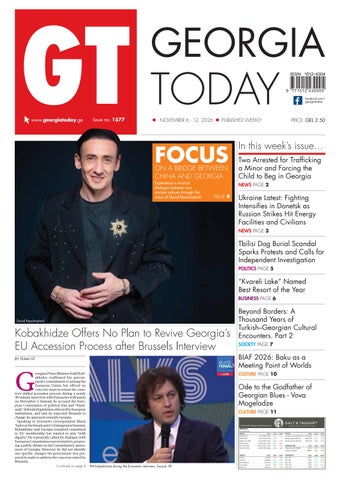
Kobakhidze Offers No Plan to Revive Georgia’s EU Accession Process after Brussels Interview
SOCIETY PAGE 7
BIAF 2026: Baku as a Meeting Point of Worlds
BY TEAM GT
G
eorgian Prime Minister Irakli Kobakhidze reaffirmed his government’s commitment to joining the European Union, but offered no concrete steps to restart the country’s stalled accession process during a nearly 40-minute interview with Euronews in Brussels on November 3. Instead, he accused the European Commission of political bias and “blackmail,” defended legislation criticized by European institutions, and said he expected Brussels to change its approach towards Georgia. Speaking to Euronews correspondent Maria Tadeo at the broadcaster’s Enlargement Summit, Kobakhidze said Georgia remained committed to EU membership but wanted to join “with dignity.” He repeatedly called for dialogue with European Commission representatives, proposing a public debate on the Commission’s assessment of Georgia. However, he did not identify any specific changes his government was prepared to make to address the concerns raised by Brussels. Continued on page 4
Beyond Borders: A Thousand Years of Turkish–Georgian Cultural Encounters. Part 2
CULTURE PAGE 10
Ode to the Godfather of Georgian Blues - Vova Mogeladze CULTURE PAGE 11 Prepared for Georgia Today Business by
DĂƌŬĞƚƐ Ɛ ŽĨ ϬϰͲEŽǀͲϮϬϮϲ
ǁͬǁ
ŵͬŵ
' KZ' Ϭϭͬϯϭ
ϵϱ͘ϳϭ ;zdD ϲ͘ϮϵйͿ
нϬ͕Ϯй
нϭ͕Ϭй
>ŝŽŶ &ŝŶĂŶĐĞ 'ƌŽƵƉ ; ' K >EͿ ' W ϭϮϴ͘ϵϬ
нϯ͕ϭй
ͲϮ͕ϴй
'Z /> ϬϲͬϮϴ
KE ^
ϵϲ͘ϯϯ ;zdD ϲ͘ϰϯйͿ
нϬ͕ϭй
Ͳ
'ĞŽƌŐŝĂ ĂƉŝƚĂů ; ' K >EͿ
' W ϰϲ͘ϴϬ
нϲ͕ϱй
нϱ͕ϵй
ͲϬ͕ϭй
d ĂŶŬ 'ƌŽƵƉ ;d ' >EͿ
' W ϰϵ͘Ϭϲ
ͲϬ͕ϵй
Ͳϯ͕ϯй
WƌŝĐĞ
ǁͬǁ
ϭϬϬ͕ϳϮ
ͲϭϮ͕ϳй
Ͳϭ͕ϱй
ϰ Ϭϰϴ͕Ϭϱ
ͲϬ͕ϱй
ͲϮ͕Ϯй
' '' ϵ ϭͬϮ W ZW
WƌŝĐĞ
ϭϬϰ͘ϯϴ ;zdD ϵ͘ϱϭйͿ
ͲϬ͕Ϭй
^dK <^
^><Z , ϬϵͬϯϬ
ϵϴ͘ϲϲ ;zdD ϳ͘ϵϭйͿ
нϬ͕Ϭй
ͲϬ͕ϰй
d ϴ͘ϴϵϰ W ZW
ϭϬϬ͘ϯϯ ;zdD ϭϮ͘ϮϵйͿ
нϬ͕Ϭй
ͲϬ͕ϭй
KDDK /d/ ^
d ϭϬ ϭͬϰ W ZW
ϭϬϰ͘ϱϱ ;zdD ϵ͘ϵϬйͿ
ͲϬ͕ϰй
Ͳϭ͕ϰй
ƌƵĚĞ Kŝů͕ ƌĞŶƚ ;h^ΨͬďďůͿ 'ŽůĚ ^ƉŽƚ ;h^ΨͬK Ϳ
/E / ^
ǁͬǁ
ŵͬŵ
ǁͬǁ
ǁͬǁ
ŵͬŵ
ŵͬŵ
hZZ E / ^
WƌŝĐĞ
^W ϱϬϬ
ϳ ϱϲϴ͕ϵϮ
ͲϮ͕ϯй
ͲϮ͕Ϭй
h^ ͬ ' >
Ϯ͕ϱϵϳϳ
нϬ͕ϭй
ͲϬ͕ϭй
&d^ ϮϱϬ
Ϯϰ ϴϴϴ͕ϵϯ
нϭ͕Ϭй
нϮ͕ϵй
hZ ͬ ' >
Ϯ͕ϵϮϰϳ
нϭ͕ϭй
ͲϬ͕ϭй
ϱϮ ϵϭϭ͕ϵϵ
нϬ͕ϴй
Kt :KE ^ ϯϬ
PM Kobakhidze during the Euronews interview. Source: FB
WƌŝĐĞ
WƌŝĐĞ
нϭ͕ϱй
ŵͬŵ
нϯ͕ϰй
' W ͬ ' >
ϯ͕ϱϬϮϭ
ZƵƐƐĞůů ϮϬϬϬ
Ϯ ϴϭϮ͕ϰϱ
ͲϬ͕ϲй
ͲϬ͕ϳй
hZ ͬ h^
ϭ͕ϭϮϱϵ
нϬ͕ϵй
нϬ͕Ϭй
&d^ ϭϬϬ
ϭϬ ϴϯϰ͕ϯϵ
нϭ͕ϯй
нϯ͕ϲй
' W ͬ h^
ϭ͕ϯϰϴϭ
нϭ͕Ϯй
нϭ͕ϴй
нϭ͕ϳй
2
NEWS
GEORGIA TODAY
NOVEMBER 6 - 12, 2026
Two Arrested for Trafficking a Minor and Forcing the Child to Beg in Georgia BY NANUKA MAGLAKELIDZE EU High Representative for Foreign Affairs and Security Policy Kaja Kallas.
Kaja Kallas: The Georgian Government Is Currently on a Collision Course with the European Union BY NANUKA MAGLAKELIDZE
E
U High Representative for Foreign Affairs and Security Policy Kaja Kallas says the EU will hold further discussions on Georgia in January to determine how best to support the Georgian people and send a clear message to the government that Brussels does not support its policies. “We need to delve deeper into the issue concerning Georgia in January. For us, the most important thing is how we respond: to clearly demonstrate that we support the Georgian people and their aspirations, and that we are not turning our backs on them, while simultaneously sending a clear message to the government that we do not support this type
of policy,” Kallas said. She noted that the Georgian government’s actions have put it on a collision course with the European Union. “The process is suspended, as we have already noted. We support the Georgian people and their choice. In January, we will hold a more in-depth discussion with foreign ministers on Georgia, specifically on how we can best support the people and their aspirations to join the European Union,” Kallas said. She added that the Georgian government’s democratic backsliding was a clear indication that the country was not moving in the right direction. Asked whether the EU was considering any response at this stage, Kallas said it was too early to comment, as the issue would be discussed further in January. She noted that EU member states held differing views on the matter.
Georgian Foreign Ministry Criticizes European Commission’s 2026 Enlargement Report, Cites Factual Inaccuracies
The Ministry of Foreign Affairs of Georgia building.
BY NANUKA MAGLAKELIDZE
G
eorgia’s Foreign Ministry has criticized the European Commission’s 2026 enlargement report, accusing it of containing factual inaccuracies and biased assessments that reinforce anti-Georgian narratives and undermine prospects for constructive dialogue between Tbilisi and Brussels. In a statement released on November 4, the ministry said the Georgian government would study the report in detail and submit substantiated comments to the European Commission. The statement said the European Commission’s report assesses progress made by candidate and potential candidate countries, including Georgia, toward EU membership. It added that the assessment is based on information provided by the countries themselves and work conducted through dialogue mechanisms established under the EU-Georgia Association Agreement. The ministry criticized the EU for failing to hold any meetings with Georgia under the Association Agreement during the reporting period, citing the suspension of political dialogue following the European Council conclusions of June 27, 2024. It argued that the absence of
such meetings significantly limits the European Commission’s ability to objectively assess the country’s progress. The ministry also rejected the report’s characterization of the Georgian government’s actions as “state capture,” arguing that an administration elected with a significant public mandate is fulfilling its obligations to the state and its voters. It further accused the report of relying on selective analysis to politicize legal matters and interfere in Georgia’s internal affairs, saying this undermines the principle of the rule of law. The statement also criticized the report’s description of Georgian politicians’ responses to actions taken against the country by various actors as “hostile rhetoric.” The ministry said such characterizations undermine freedom of expression, erode trust, and damage the foundations of the partnership between Georgia and the European Union. While acknowledging that the report on Georgia was being used to advance what it described as biased assessments and political speculation, the ministry said the Georgian side would submit detailed comments to the European Commission. The Foreign Ministry reaffirmed the Georgian government’s readiness to engage in open and constructive dialogue with the European Union based on mutual respect.
T
wo people have been arrested in Georgia on charges of trafficking a minor for labor exploitation, the Ministry of Internal Affairs (MIA) said. The arrests were made by officers of the Central Criminal Police Department in coordination with the Prosecutor General’s Office, following operational and investigative measures and under a court order. Investigators found that the suspects had devised a human trafficking scheme for financial gain and involved the minor child of one of the accused in carrying it out. Investigators say the suspects used
A screenshot from footage released by Georgia’s Ministry of Internal Affairs (MIA)
physical violence, psychological pressure, and threats of violence to force the minor to beg and collect GEL 100 per day. They allegedly kept all the money for themselves and physically assaulted the child whenever the daily target was not met. Law enforcement officers obtained multiple pieces of evidence confirming the alleged criminal activities through covert investigative measures conducted under a court order, the ministry said. The minor is currently staying at a service center operated by the State Care and Assistance Agency for the (Statutory) Victims of Human Trafficking. The child’s health is not in danger. The investigation is underway under Article 143², Parts 2 and 3 of Georgia’s Criminal Code, which carries a prison sentence of up to 17 years.
12th Tbilisi Baroque Festival Opens at State Conservatoire BY NANUKA MAGLAKELIDZE
T
he 12th Tbilisi Baroque Festival has opened at the Tbilisi State Conservatoire with a concert featuring virtuoso countertenor Maayan Licht, who received an enthusiastic response from Georgian audiences during his visit last year. The opening concert, held on October 31 in the Conservatoire’s Grand Hall, featured Licht alongside the Georgian Sinfonietta and theorbo player Diego Cantalupi. Georgian soprano Tamar Tsirekidze also joined Licht for a special duet. The evening’s program included works by renowned composers Antonio Vivaldi, Claudio Monteverdi, Henry Purcell and George Frideric Handel. One of the highlights was Licht’s performance of Antonio Vivaldi’s Gelido in ogni vena from the opera Il Farnace (RV 711), an excerpt from which was also performed during the encore. The concert concluded with standing ovations, marking the beginning of the
12th Tbilisi Baroque Festival banner. Source: Tbilisi State Conservatoire
festival’s 12th edition. The festival’s concert program is traditionally diverse, but this year is especially remarkable as the repertoire goes beyond the Baroque era – the audience
will also enjoy Classical and Early Romantic masterpieces performed on authentic historical instruments. The 12th “Tbilisi Baroque Festival” will run from October 31 to December 9.
Tbilisi to Host 2028 European Trampoline Gymnastics Championships BY ANA DUMBADZE
T
bilisi has been selected to host the 2028 European Championships in Trampoline, Double Mini-Trampoline and Tumbling, marking the first time Georgia will host the prestigious continental competition. The announcement was made by European Gymnastics, which confirmed that the championships will take place in the Georgian capital from April 5 to 9, 2028. “We’re heading to Georgia for the first time ever!” European Gymnastics announced on its official social media page. The championships will bring together leading European athletes competing across three gymnastics disciplines: trampoline, double mini-trampoline and tumbling.
A US gymnast. Source: USA Gymnastics
The decision marks a significant milestone for Georgian gymnastics and represents an opportunity for the country to strengthen its position as a host of major international sporting events.
Further details regarding the competition venue, participating countries and event schedule are expected to be announced closer to the championships.
NEWS
GEORGIA TODAY NOVEMBER 6 - 12, 2026
3
Ukraine Latest: Fighting Intensifies in Donetsk as Russian Strikes Hit Energy Facilities and Civilians COMPILED BY ANA DUMBADZE
A
nother week of war brought fierce fighting across eastern Ukraine, fresh attacks on the country’s energy infrastructure and more civilian deaths. Russian forces made limited progress around Kostiantynivka in Donetsk region, while Ukrainian troops pushed back in parts of the north. Moscow continued to target power plants and other energy facilities, while Ukraine stepped up attacks on Russian oil infrastructure. One of the deadliest incidents occurred in Zaporizhzhia region, where Russian bombs struck a humanitarian aid center, killing at least 40 people. The attacks came just days before another round of US-mediated peace talks, scheduled for November 10–11 in Abu Dhabi. Donetsk remained the main focus of the fighting. Russian troops continued their attempts to break through Ukrainian defenses around Kostiantynivka, Druzhkivka, Dobropillia and Pokrovsk, seeking to capture the remaining Ukrainian-held parts of the region and move closer to Sloviansk and Kramatorsk. Instead of large-scale advances, they sent small groups of infantry forward, supported by artillery, drones and guided bombs. The Institute for the Study of War (ISW) reported that Russian forces had likely established positions in northwestern Kostiantynivka by November 4. Ukrainian strikes against Russian positions inside the city suggested that Russian troops had entered parts of it, although they had not taken control of Kostiantynivka as a whole. Ukrainian military reports recorded 24 Russian assaults in the area over November 3–4. On November 4, Ukraine’s
General Staff reported 179 clashes along the frontline, as well as extensive Russian air and drone attacks. These figures could not all be independently verified. Further north, fighting continued around Kupiansk, Lyman and the approaches to Sloviansk, but Russia made no confirmed territorial gains in these areas on November 3–4. Ukrainian troops counterattacked northeast of Borova and along the southern bank of the Siverskyi Donets River. Near Lyman, Russian claims to have captured Zarichne remained disputed, with some Russian sources still describing the settlement as contested. Ukrainian forces also made progress in Sumy region. Footage published on November 1 indicated that they had regained or held positions southwest of Andriivka, where Russian sources had previously claimed control. Russian troops continued operations along the border, but no further advances were confirmed by November 4. In northeastern Kharkiv region, Russian attempts to advance around Velykyi Burluk also failed to produce verified gains. In the south, fighting continued around Huliaipole and in western Zaporizhzhia region, while Ukrainian forces counterattacked south of Orikhiv. Neither side made significant confirmed gains. Ukraine also continued striking Russian air-defense systems in occupied Crimea. Millions of Ukrainians faced another threat as Russia intensified its attacks on the country's energy system. During the night of November 2–3, Russian forces launched 289 drones, 17 ballistic missiles and 59 cruise missiles, according to President Volodymyr Zelensky. Power plants and substations were hit across several regions, including Odesa, Kharkiv, Zhytomyr, Vinnytsia, Dnipropetrovsk and Rivne. Ukraine’s largest private energy producer, DTEK, said three of its five thermal power plants had been put out
Ukrainian serviceman in Kostiantynivka, Donetsk region. Source: V-Variant
of operation. More than 180,000 people lost electricity in Zhytomyr region alone, while outages also affected Kyiv and other areas. Railway facilities, including locomotives, passenger carriages and a station, were damaged. The attacks continued on November 4, when Russia launched another 310 drones. Ukraine said it had intercepted or suppressed 272. Further damage to energy facilities in Kyiv and several central and western regions disrupted electricity and water supplies. With winter approaching, repeated strikes are making it harder for repair crews to restore services and raising concerns about how well the country will cope with the cold. Moscow says it targets facilities supporting Ukraine’s military and defense industry. The strikes also killed and injured civilians. In Kharkiv, a Russian attack damaged a clinical hospital, including its cardiology department, injuring at least 73 people, according to Ukrainian officials. Residential buildings and other civilian facilities were hit in several regions. Drone attacks killed one person in Izium on November 2 and injured others in Kharkiv and Odesa regions. Ukrainian authorities also reported six people killed and 50 injured across the country in the 24 hours preceding November 4.
The deadliest attack took place on November 2 in Komyshuvakha, Zaporizhzhia region. Russian guided bombs struck a former school being used as an underground shelter and a center where people gathered to receive humanitarian aid. By November 4, at least 40 people had been confirmed dead, with dozens more missing. Emergency responders and police officers were among the victims. Ukrainian authorities said civilians were at the center to collect assistance when the bombs struck, and that further attacks made rescue work more difficult. Russia claimed it had targeted Ukrainian military personnel in the area. The UN Humanitarian Coordinator for Ukraine, Matthias Schmale, condemned the attack. “Civilians seeking support and first responders coming to the rescue must never be a target,” he said. The UN Human Rights Monitoring Mission also raised concerns about possible violations of international humanitarian law. Ukraine also stepped up attacks on Russian oil infrastructure. On October 30, Russian Deputy Prime Minister Alexander Novak acknowledged strikes on three refineries and a gas-chemical complex. A fire broke out at the Novokuybyshevsk refinery in Samara region, where satellite imagery showed extensive damage. Rus-
sian officials reported two deaths during operations following the attack. On November 3, Ukrainian drones struck a refinery in Yaroslavl, starting another fire and injuring two employees, according to regional authorities. A drone attack on an Ozon logistics facility in Adygea on November 4 also caused a fire. Kyiv appears to be trying to disrupt Russia's oil-processing capacity and raise the economic cost of the war, although the full impact of the attacks remains unclear. Diplomatic efforts continued despite the fighting. Washington announced that Ukraine, Russia and the United States would meet again in Abu Dhabi on November 10–11. The talks are expected to cover de-escalation, security arrangements, humanitarian issues and a possible settlement. A temporary local ceasefire around Russian-occupied Oleshky in Kherson region had already allowed civilians to be evacuated, showing that limited agreements remain possible. But the latest attacks on energy facilities show how far the sides remain from agreeing to a ceasefire. Ukraine's allies also discussed further military support. During a November 3 meeting in Berlin, Zelensky and German Chancellor Friedrich Merz discussed additional missiles for Patriot and IRIS-T air-defense systems, support for Ukraine’s F-16 fleet and protection of energy facilities through the winter. Britain and Germany reaffirmed their commitment to coordinating military assistance through the Ukraine Defense Contact Group. Representatives of the United States, European governments, NATO and international institutions also met in Brussels to discuss reconstruction and long-term security guarantees. Ukraine continues to need more air-defense ammunition and support for its troops as the fighting goes on.
4
POLITICS
GEORGIA TODAY
NOVEMBER 6 - 12, 2026
Kobakhidze Offers No Plan to Revive Georgia’s EU Accession Process after Brussels Interview Continued from page 1
“We are completely confident that everything that is in this report is not in line with reality. We are fully confident in that. But let’s have a debate. Let’s have a public debate on this together with European Commission representatives,” he said, referring to the EU’s assessment of Georgia. Kobakhidze blamed the European Commission for the deterioration in relations, arguing that Georgia had been treated unfairly from the start of its application process. He criticized the decision in 2022 to grant Ukraine and Moldova candidate status while giving Georgia only a European perspective, claiming that Georgia had performed better than the two countries in the Commission’s assessments. “It was a great mistake,” he said, describing the decision as unfair and politically motivated. Georgia was eventually granted EU candidate status in December 2023, subject to implementing nine reform priorities set by the European Commission. Relations deteriorated further in 2024 following the adoption of the Law on Transparency of Foreign Influence and other disputed measures. In June 2024, the European Council concluded that the Georgian government’s actions had effectively halted the accession process. On November 28, 2024, Kobakhidze announced that the government would not put the opening of EU accession negotiations on its agenda until the end of 2028. Asked why his government had taken that decision despite strong public support for EU membership, he again placed responsibility on Brussels. “If the European Commission decides to open the accession talks for Georgia, we would immediately join. It was not us. But of course, the European Commission, which decided to suspend the political dialogue with Georgia,” he said.
He also argued that European representatives were unwilling to engage with Tbilisi. “When somebody wants to change anything in Georgia, they should talk with us. But now the problem is that they don’t talk with us. They are not ready to talk with us,” he said. Pressed on what his government would do to restore the accession process, Kobakhidze offered to discuss the disputed issues but did not set out a timetable or a list of reforms. He said that any dialogue should respect Georgia’s sovereignty, dignity, democracy and the rule of law. The Prime Minister also ruled out repealing the Law on Transparency of Foreign Influence and legislation establishing a national register of organizations receiving foreign funding. Both have been criticized by European institutions and the Council of Europe’s Venice Commission, which raised concerns about the laws’ provisions, including unclear definitions and disproportionate penalties. Kobakhidze dismissed the Venice Commission’s assessment as political rather than legal. “The Venice Commission’s report is entirely political. It has nothing to do with law, legal standards, or legal principles,” he said, maintaining that the legislation complied with international standards. He argued that demands to repeal the laws amounted to interference in Georgia’s sovereignty and compared Brussels’ approach to the country’s experience under Soviet rule. “Again, we want to join with dignity. Georgia was part of the Soviet Union for around 70 years, and we remember those times,” he said. Asked why Georgia continued to seek EU membership despite his criticism of European institutions, he replied: “Because we are optimistic that they will change.” Kobakhidze also defended Georgian Dream’s case before the Constitutional
Court seeking to ban five opposition parties. He described the proceedings as a legal matter rather than a political initiative. “We applied to the Constitutional Court to examine the constitutionality of certain political parties, five opposition parties, and this is a legal case,” he said. He accused European officials of interfering in Georgia’s judicial independence by commenting on the case without, in his view, providing legal arguments. He maintained that the judiciary was independent and rejected concerns that banning opposition parties would undermine political pluralism. The interview took place a day before the European Commission published its 2026 Enlargement Package, which delivered a further negative assessment of Georgia’s progress towards EU membership. The Commission said Georgia’s accession process remained de facto halted and that its assessment of the country as a candidate “in name only” remained valid. The report said the ruling party had continued to undermine democratic principles, the rule of law, fundamental rights and civic space. It also pointed to the consolidation of state power and the failure to address key reforms required for progress towards membership. “Unless Georgian authorities change course and recommit to the fundamental principles underpinning EU accession, Georgia will continue to miss out on the benefits of candidate status and the pre-accession process,” the Commission said. EU Ambassador to Georgia Paweł Herczynski echoed the Commission’s assessment following the report’s publication, saying that the government’s declared ambition to join the EU was incompatible with its actions. He pointed to what he described as the ruling Georgian Dream party’s continued attacks on
democratic principles, the rule of law and fundamental values, as well as restrictions on civic space. “The authorities’ declared aspiration to join the EU continued to be fundamentally contradicted by their systematic engagement in hostile anti-EU rhetoric, manipulative narratives and conspiracy theories, the undermining of EU values and failure to address key EU-related reforms,” Herczynski said. He also warned that the government’s attempt to ban five opposition parties through the Constitutional Court threatened the foundations of Georgia’s democracy. Referring to comments by EU High Representative for Foreign Affairs and Security Policy Kaja Kallas, he said: “Georgian authorities are on a collision course with the EU.” Herczynski placed Georgia’s situation in the context of progress elsewhere in the enlargement process. He said some candidate countries were making substantial advances towards membership, while others were moving slowly or experiencing setbacks. “The enlargement package concerns the future of the European Union, as well as Georgia’s place within that future. The continued backsliding on fundamental values that we have witnessed here over the past year confirms that Georgia, regrettably, remains an EU candidate in name only. It continues to forgo the benefits offered by candidate status and the pre-accession negotiation phase,” he said. The ambassador added that progress towards membership depended on objective criteria and the political will of each candidate country. He described the 2026 Enlargement Package as an important milestone, noting that the process had delivered more results this year than at any point in the past 25 years. Presenting the enlargement package, European Commissioner for Enlarge-
ment Marta Kos said Georgia’s European path remained open if the authorities changed course. She also raised concerns about the ruling party’s efforts to ban opposition parties. The interview prompted sharply contrasting reactions from Georgian officials and opposition figures. Parliament Speaker Shalva Papuashvili accused Euronews journalist Maria Tadeo of refusing to listen to the Prime Minister and turning the exchange into a series of accusations. “You saw a Prime Minister who consistently spoke about dialogue and tried to explain our position, and a host who was not listening to anyone but herself,” Papuashvili said on November 4. He argued that the interview illustrated what he described as Brussels’ preference for “confrontation over dialogue.” Giorgi Gakharia, leader of the For Georgia party, took a different view of the Prime Minister’s performance. In a social media post on November 4, he accused Kobakhidze of incompetence and said the government had no realistic plan to restore relations with the EU. “Yesterday in Brussels, Irakli Kobakhidze publicly demonstrated what everyone in Georgia has known for a long time – and now Europe has seen it too: sheer incompetence and total detachment from reality,” Gakharia wrote. He argued that the government had spent years blaming Brussels for the breakdown in relations but was now admitting that it had no plan and was unwilling to change its conduct. The Brussels summit also included Armenian Prime Minister Nikol Pashinyan, who reiterated that Georgia’s eventual EU membership would be important for Armenia’s own European aspirations. He said Georgia’s progress towards EU membership was significant for the Armenian public’s perception of its own European prospects.
POLITICS
GEORGIA TODAY NOVEMBER 6 - 12, 2026
5
Tbilisi Dog Burial Scandal Sparks Protests and Calls for Independent Investigation BY TEAM GT
A
nimal rights activists and concerned residents have called for an independent investigation into the deaths and burial of stray dogs in Tbilisi after television footage appeared to show animal remains being transported at night to burial pits at Veli Cemetery. The Interior Ministry has opened a criminal investigation, but Tbilisi City Hall denies allegations of deliberate mass killing, and the controversy has since escalated into a dispute over Mayor Kakha Kaladze’s remarks about protesters. The case came to public attention after TV Pirveli’s investigative program Nodar Meladze’s Saturday aired footage on October 31 showing what appeared to be a minibus carrying dead dogs from the municipal animal shelter on Tvalchrelidze Street to a burial site at Veli Cemetery. The report showed animal remains being placed in specially dug pits at night. The footage also included a comment that one of the dogs’ bodies was still warm, raising questions about when and how the animals had died. Animal rights advocates said the images raised concerns that healthy stray dogs might have been euthanized without legal grounds and buried at the site. They also pointed to reports from residents and volunteers that dogs they had been feeding, caring for or searching for had disappeared from their usual locations. On November 1, activists and citizens gathered outside the Government Administration in Tbilisi, demanding answers and accountability. “We demand answers. Punish the officials responsible,” protesters said. They called for an end to animal cruelty, the identification of the animals buried at the site and a nationwide rabies vaccination campaign. The Ministry of Internal Affairs confirmed on the same day that it had opened an investigation under Article 259 of Georgia’s Criminal Code, which covers animal torture, cruel treatment and other forms of violence against animals. Activists have called for forensic examinations of the remains to establish the causes of death and determine whether euthanasia or sedation was used. A petition launched after the broadcast urged the Prosecutor’s Office to investigate the case and compare the findings with reports of missing dogs. Its authors
also questioned whether the procedures used to euthanize animals, where applicable, complied with legal and veterinary standards. Tbilisi City Hall has rejected allegations of deliberate mass killing, saying the footage showed a lawful procedure for disposing of dogs that had died from different causes, including illness, road accidents and natural causes. The Animal Monitoring Agency described claims that live dogs were being buried after being deliberately put to sleep as “a complete lie and disinformation.” The agency said the burial site was designated for animal remains and warned that unauthorized excavation could spread biological contamination, endangering public health and the environment. It also said it had contacted law enforcement authorities over the excavation of burial sites. Mayor Kakha Kaladze defended the agency at a municipal government meeting on November 2, accusing TV Pirveli of spreading false information and saying the allegations were intended to discredit City Hall. He said that, during the previous year, the agency had recorded 145 cases of euthanasia and 2,050 cases of natural death, in addition to animals killed in road accidents. “Euthanasia is also common in cases where an animal’s condition is incompatible with life,” Kaladze said. He added that animal remains were buried at a designated site and that animals found or brought in during the day were buried at night. The mayor also criticized people who had attempted to examine or excavate the burial sites, saying their actions risked biological contamination. He described the campaign against the agency as defamatory and accused some of its critics of political motives. His remarks caused a further dispute. On November 3, Kaladze said that five or six animal rights activists involved in the protests should be “taken away and euthanized,” using a phrase normally associated with putting animals to sleep. He also referred to some animal rights advocates as people with “unhealthy minds.” Activist Lasha Chkhartishvili filed a complaint with the Prosecutor’s Office over the mayor’s remarks, arguing that they could be understood as a threat to protesters. However, the Prosecutor’s Office told the media on November 4 that it would not open an investigation against Kaladze, saying there were no indications of a criminal offense. Prime
mass graves raised questions that could not be answered simply by official statements. It argued that authorities should publish records showing how many animal bodies were collected, where they were found or who reported them, and whether they were buried or cremated. The organization said the same transparency should apply to euthanasia, with each case supported by veterinary records, documented reasons and details of the procedures used. “This should not be a matter of asking the authorities to explain themselves every time a scandal emerges,” the organization said. “The relevant agencies should simply be able to direct citizens to an openly accessible, searchable database where all this information is already available.” “Transparency should not be an extraordinary demand. It should be the absolute minimum,” it added.
The controversy comes as Georgia is implementing a national program to manage the population of stray dogs and prevent rabies. Launched this year, the program includes identification and registration, vaccination against rabies, sterilization and castration. The National Food Agency said the measures were intended to improve animal traceability and protect public health. The program also provides for cooperation between central government bodies and municipalities, although Tbilisi and the Autonomous Republic of Adjara are excluded from some of the National Food Agency’s measures for stray animals. The issue of stray animal management has been a longstanding concern. In its 2024 report, Georgia’s Public Defender said the country had failed for years to take adequate steps to address the problem. According to figures supplied by Tbilisi’s Animal Monitoring Agency, 10,998 dogs were taken into shelters in 2024. Of these, 6,824 were returned to their previous environment. The agency recorded 1,759 natural deaths and 217 cases of euthanasia that year. The Public Defender called for a long-term approach and clearer legal regulations governing animal welfare and the responsibilities of relevant authorities. The dispute has also revived concerns about conditions in municipal shelters outside the capital. In October, animal rights activists questioned conditions at a shelter in Gori after footage circulated showing what appeared to be overcrowded and unsanitary facilities. Activists alleged that around 300 puppies were being kept without adequate food or water and that dead animals were also present. The Shida Kartli Stray Animal Management Agency rejected the allegations, saying the footage had been taken out of context. Volunteers subsequently helped remove dogs from the facility and arrange their care. For animal rights advocates, the central issue in the Tbilisi case is not only whether the burials were lawful, but whether the authorities can provide verifiable information about the animals taken into their care and what happened to them. The Interior Ministry’s investigation has yet to establish the circumstances surrounding the deaths shown in the footage. Activists say that until the remains are identified, the causes of death are independently examined and the relevant records are made public, official denials will not resolve the questions raised by the case.
Program Manager. “Climate-smart agriculture, integrated pest management and efficient water use are no longer niche subjects, they are the basis of a com-
petitive, efficient and sustainable farm, the development of which will increasingly be ensured by a new generation of agriculture professionals.”
Citizens protest over dog burial scandal. Photo by Rusudan Jakeli
Minister Irakli Kobakhidze defended the mayor, saying he had spoken figuratively. Chkhartishvili, who also spoke at the November 1 rally, said he had no confidence in the investigation into the dogs’ deaths and demanded the arrest of the head of the Animal Monitoring Agency. He told InterpressNews that another protest would be held on November 8 if the authorities failed to respond. Animal rights organizations have called for more than official assurances. Zero Strays Georgia has demanded a transparent investigation, independent examinations to establish the causes of death, and full records of animals taken into municipal care, including medical reports and details of drugs administered. The group has also questioned why biothermal burial pits were not used to prevent the spread of disease. Dog Organization Georgia said the discovery of unidentified remains in
BUSINESS
Georgian Students Gain Hands-On Agronomy Skills through EU- and Sweden-Supported FAO Course SOURCE: FAO
S
tudents from three Georgian universities have completed a specialized certificate course focused on priority agricultural topics. The Food and Agriculture Organisation of the United Nations (FAO) delivered the training under the EU- and Sweden-funded European Neighborhood Program for Agriculture and Rural Development (ENPARD IV). FAO Georgia’s agronomy and extension specialists designed and delivered the course across the Agricultural University of Georgia, Georgian Technical University, and Caucasus International University. The course comprised three on-campus theoretical modules and a full-day field exercise at a project demonstration plot in Maradisi, Marneuli, managed by a farmer supported by the FAO, the European Union, and Sweden.
Designed to address the real-world challenges facing Georgian farmers, the theoretical sessions covered: • climate-smart agriculture • integrated pest management (IPM) and the safe use of pesticides • sustainable water use, soil management and fertilisation In the final week, students visited an FAO demonstration plot, where they carried out soil analyses, worked with soil moisture sensors and weather stations, saw how drip irrigation systems are assembled and operated, and learned how pheromone and sticky traps help in controlling pests. Students who attended all four sessions will receive a certificate during the closing ceremony of the European Union and Sweden-funded ENPARD IV project, implemented by FAO and CzDA. The course builds on earlier training opportunities for students at partner institutions, which drew strong interest and positive feedback. The activity represents FAO’s wider
work with young people under ENPARD IV. To date, FAO has provided 915 veterinary and agronomy students with specialized training to support Georgia’s agricultural development. An awarenessraising campaign on food safety and healthy nutrition for children and adolescents has reached 3 400 school students. “Georgian agriculture needs young specialists able to take what they learn in the lecture hall to the field,” said Denis Reiss, Programme Officer for Sustainable Food Systems at the Delegation of the European Union to Georgia. “By supporting them in applying theoretical knowledge into hands-on action, through ENPARD, the European Union and Sweden are investing in people who will shape the future of the sector, and these students are part of that future.” “Through this course, we want students to experience first-hand the use of tools in the field as well as see the practices that Georgian farmers are currently adopting,” said Guido Agostinucci, FAO
6
BUSINESS
GEORGIA TODAY
NOVEMBER 6 - 12, 2026
Rustaveli Avenue: A Summer of Survival for Local Businesses BLOG BY TAMAR MEGRELISHVILI, EXECUTIVE DIRECTOR, PROSPERO'S BOOKS
I
t is mid-July on Rustaveli Avenue, and Tbilisi is alive with the energy of peak tourist season. For those of us running local businesses here, this is our main event. Rustaveli is the absolute center of tourist activity in the city. We have spent the last few months frantically stocking up on books, supplies, and everything needed to welcome visitors to our doorstep. Summer isn't just our favorite season. It's our financial lifeline. The momentum and revenue we build over these months are what carry us through the quiet winter days that inevitably arrive after November. We were completely ready for a spectacular, recovery-driven summer. Then my phone buzzed. It was a notification in the chat group from the head of the Restaurant Association, and the message hit like a shock: "They're starting renovations on Rustaveli Avenue this month. I asked them to start after November, but they said nothing." It is a question that leaves every local business owner in absolute disbelief: Who starts a major road renovation in the very middle of peak tourist season? For anyone working in Georgia's tourism and hospitality sectors, it is common knowledge that summer is our lifeline. This is the window when we make enough revenue to sustain ourselves, pay our bills, and, critically, pay our taxes for the rest of the year. What makes this situation so frustrating is that we tried to prepare. Years ago, when rumors of the Rustaveli Avenue renovation first surfaced, we opened pop-up stores in non-tourist areas as a fallback plan. But as the project faced endless delays, those alternative locations became unsustainable, forcing us to close them and consolidate all our resources back into our main store. And then, out of nowhere, right in the middle of July, the renovation began. In all my years of running a business,
Digging up the sidewalk outside Prospero's on Rustaveli Avenue. Source: FB
I have never experienced anything like this. Prospero's is no stranger to hardship; we are built on resilience. We survived the dark and lawless 1990s, an era when we had to operate entirely on generators, most of which had been stolen before they were even switched on. 😊 We survived countless demonstrations that shut down Rustaveli Avenue for months, including the entire period last year. We survived the catastrophic COVID-19 pandemic, a time when international suppliers watched in disbelief as Georgia imposed some of the longest shutdowns, even banning online sales of non-food products entirely in March 2020. For local businesses, that wasn't about
strategy; it was literal, raw survival. It has taken us nearly five long years of suffocating bank loans and relentless effort to finally climb out of the financial crater left by the pandemic. We were finally standing on solid ground, ready to breathe and finally revisit the Frankfurt Book Fair. And suddenly, just as prosperity felt within reach, on what should have been the most peaceful of days, some careless hand reached out to drag us right back into the dark. As small business owners, we are already dealing with government decisions, rising taxes, a steadily shrinking local population, and the challenges of maintaining healthy tourism. We face systemic issues you won't find in any Western
business textbook: massive local migration; strict regulations on hiring expats when there are no extra hands available in the country; and genuine tourism being replaced by copycat businesses created by "tourists" themselves. Worst of all, while copyright agencies penalize restaurants for playing background music, they completely ignore the open sale of pirated books smuggled in from neighboring countries. In the face of this chaos, local businesses have found their silver lining: absolute unity. A group of neighborhood organizations have banded together, sharing their troubles and describing how they have been left without any help. Some neighboring restaurants have suffered severe flooding because of the construction, while the basements of others have been damaged. We submitted official letters to City Hall, but its formal response was simply that it couldn't interfere in the problems of private businesses. Ironically, this total lack of bureaucratic support has only made our local network more self-reliant. Right now, navigating Rustaveli Avenue is an unforgettable adventure. The street is a landscape of massive earthworks, huge mounds of dirt, and exposed holes. On rainy days, the avenue dissolves into thick sludge, where construction workers, adventurous tourists, local pedestrians, nearby business staff, and delivery scooters all navigate the mud together. Finding a clear path is a daily puzzle, but it has revealed something beautiful about the Rustaveli Avenue community. Looking at these scenes, I imagine everyone wondering what Rustaveli must have looked like in the 18th and 19th centuries, when people wore long dresses and there was no proper street paving. Besides all this, what truly complicates our business operations is the complete breakdown of our supply chain. Local couriers and drivers now flatly refuse to deliver to the avenue. By turning their backs on our location, they are effectively sabotaging essential B2B operations. Because most delivery couriers won't come near the construction site or the surrounding streets, we are left completely on our own. We have to carry all
our heavy supplies ourselves, dragging them through the thick mud while doing our best not to trip and fall into the open holes. A simple delivery has turned into a dangerous daily struggle just to keep our store stocked. We are choosing to meet every challenge with a smile. When the utility grid acts up and a visitor jokingly asks if we forgot to pay the bills, we laugh it off and find a way to keep the flashlights on. And while a few online reviewers still leave low ratings because of the mud outside, clearly forgetting that none of us arrived here by helicopter, the vast majority of our guests are cheering us on. We are keeping our standards high, keeping our floors as clean as humanly possible, and still decorating our tables with flowers. We are proving that while the city might be digging up our streets, it cannot shake the welcoming spirit of Rustaveli's business community. Ultimately, we refused to let the chaos stand between our readers and their books. To give our customers the experience they deserve, we took a bold step and opened a brand-new pop-up store right next to the historic Sioni Church. It means taking on additional rental expenses, but our readers can now browse in peace. It proves that no matter what obstacles are thrown our way, the love of books in Tbilisi will always find a home.
Prospero's Cafe as works continue beyond the courtyard. Source: FB
“Kvareli Lake” Named Best Resort of the Year when choosing a hotel. What matters more and more is the setting, the quality of service, the variety of leisure options and the impression a guest takes away from the visit. Kvareli Lake Hotel responds to these expectations in several ways, offering guests quiet relaxation, wellness experiences, active leisure, gastronomic discoveries and the opportunity to host business events. The hotel’s location plays a special role in its overall concept. Kakheti’s natural landscape and the views of the lake and mountains create a setting that allows guests to spend their time differently. Closeness to nature and modern comfort complement each other, which makes the hotel appealing to visitors with different goals. Here, one can plan a private or family holiday, unwind with friends, or organize business meetings. The gastronomic experience is another important part. Kakheti is one of Georgia’s most distinctive regions, known for its culinary traditions and wine culture. A visit to this area is often associated
Photo by Zura Kartvelishvili
SOURCE: OK! MAGAZINE GEORGIA
K
vareli Lake Hotel won the title of Best Resort of the Year at the National Tourism Awards. The winners were announced on October 28 at the 11th ceremony, held at the Tbilisi Opera and Ballet Theater. The 2026 National Tourism Awards are one of the key events in the hospitality sector. Each year they bring industry representatives together and highlight their achievements. This year, 190 nominees from the tourism and hospitality
sector took part, and winners were named in 35 categories. Kvareli Lake received the Best Resort of the Year title. The award carries particular weight at a time when, as the tourism sector develops, demand is also growing for quality of service, professionalism and the experience offered to guests. This is precisely what the National Tourism Awards aim to support: to single out the sector’s standout representatives, encourage better service, and establish professional standards. This year’s evaluation followed an updated methodology and involved Grant Thornton, an international audit and business consulting firm. The revision of the assessment process is meant
to strengthen the transparency and professional standards of the competition. Against this background, the award takes on added significance for the winner: it is recognition that demonstrates a result achieved in a competitive environment. The Kvareli Lake resort is located in Kakheti, surrounded by a lake and mountains. Its main advantage is that natural surroundings, modern architecture and Georgian hospitality come together in a single space. It is a place where guests can break from their daily routine, be close to nature and enjoy a different kind of experience. For today’s traveler, accommodation conditions alone are no longer decisive
with discovering local flavors. For this reason, gastronomy is one of the key elements of the region’s appeal to tourists and further enriches the guest’s overall impression. The award received by Kvareli Lake does not mean victory in a single category alone. It is also recognition of the work and professional responsibility of the team that looks after the guest experience every day. In hospitality, quality is made up of many details: the precision of service, attentiveness, the setting and the attitude a guest senses at every stage. The Best Resort of the Year title is an important professional recognition for the Kvareli Lake team and fresh motivation for further development. Behind this success stand the daily work of the staff, the trust of guests and the support of partners. The award also brings an added responsibility: to maintain the quality achieved and to continue meeting guests’ expectations in the future. Here, every visit is a truly distinctive experience for the guest.
BUSINESS
GEORGIA TODAY NOVEMBER 6 - 12, 2026
7
The Middle Corridor: From a Transport Corridor to an Ecosystem ANALYSIS BY EMIL AVDALIANI
S
ince the 1990s, overland trade links between China and Europe have relied mostly on northern transport routes passing through the territories of Russia and Kazakhstan. At the same times, maritime shipping has maintained a dominant position in international trade, thanks to relatively lower transport costs, welldeveloped logistics infrastructure, and a high degree of security and predictability. In recent years, however, the ongoing war in Ukraine, military tensions surrounding Iran, and the unfolding crisis around Yemen have further highlighted the vulnerability of major commercial routes. This has underscored the importance of developing alternative transport corridors capable of shielding global trade flows from geopolitical risks. It is against this backdrop that the Middle Corridor, also known as the Trans-Caspian International Transport Route, has growen in prominence. It connects Central Asia to European markets through railway infrastructure, trans-Caspian shipping, the
South Caucasus transport network, Georgia’s Black Sea ports, and Turkey’s sprawling railway system. The Middle Corridor’s primary purpose is not to replace existing global commercial routes, but rather to diversify connectivity, enhance its resilience. For the countries of Central Asia and the South Caucasus, the Middle Corridor offers an opportunity to mitigate constraints stemming from their geographical location, improve access to international markets, and increase their participation in global economic processes. For Georgia and Azerbaijan, the development of this corridor presents an opportunity to boost transit revenues, attract international investment, and expand economic functions. As for Armenia, should regional transport links be restored, the corridor could serve as a way for its gradual integration into the South Caucasus’ developing transport network. Therefiore, the development of the Middle Corridor has a strong geopolitical dimension: it strengthens the region’s international significance and provides the south Caucasus states of with an opportunity to diversify their foreign economic partnerships.
One of the most critical aspects of developing the Middle Corridor is expanding its economic function. For the Middle Corridor to evolve into a major, continentscale trade route, it cannot depend exclusively on the transit of cargo from China. Instead, it must gradually transform into an antire ecosystem that, along with facilitatiion of transit, fosters the establishment of new production facilities, drives industrial development, and boosts employment. In other words, the participating countries themselves will become actively involved in the production and processing of various goods, as well as their supply to international markets. Georgia holds a special place in the development of the Middle Corridor. Its geographical location facilitates the connection of the Caspian Sea basin and the South Caucasus with the transport networks of the Black Sea region and Turkey. However, transforming this advantage into economic benefit requires more extensive infrastructure and an efficient logistics system. In this context, the current state of Georgia’s Black Sea ports is of particular importance. The Port of Poti remains the
country’s primary container hub. In 2025, it handled 636,466 TEUs (twenty-foot equivalent units), representing 98 percent of its annual capacity of approximately 650,000 TEUs. In effect, Poti has already reached the limit of its capacity. During the same year, the Port of Batumi handled 109,579 TEUs, which corresponds to 55 percent of its design capacity of approximately 200,000 TEUs. These data indicate that Batumi possesses some capacity to handle additional cargo; however, its role in container shipping remains limited compared to Poti. Against this backdrop, both further expansion of the Port of Poti and the construction of the Anaklia Deep-Water Port gains particular significance. According to current plans, the first phase of the Anaklia Deep-Water Port is scheduled to become operational by 2029, with subsequent development to follow in stages. A modern deep-water port would be capable of accommodating larger vessels, increasing Georgia’s maritime throughput capacity, and strengthening the country’s connections with other ports in the Black Sea basin. However, the construction of the Anaklia Port does not automatically guarantee
an increase in the volume of cargo transported through Georgia. The port’s success will also depend on the interest of international shipping lines, its integration with rail and road infrastructure passing Georgia, and its ability to compete with other Black Sea ports. It is particularly important to complete the East-West Highway and improve customs procedures. Otherwise, there is a risk that the new port infrastructure will fail to fully realize its potential. For Georgia, the strategic objective should be the development of ports, railways, roads, and logistics terminals into an integrated system. The alternative to this is that the country may remain primarily a transit territory, capturing only a small fraction of the value added generated through Eurasian trade. Additionally, given the crises that boosted Georgia’s transit potential could in the near future be, if not resolved, then frozen or stabilized, the favorable geopolitical situation for the Middle Corridor can change. Emil Avdaliani is a professor of international relations at the European University in Tbilisi, Georgia, and a scholar of Silk Roads. He can be reached on Twitter/X at @emilavdaliani.
SOCIETY
Beyond Borders: A Thousand Years of Turkish– Georgian Cultural Encounters. Part 2 BY DR. MURAT KAAN YILDIZ
A
n exiled king in Trabzon, a Georgian princess in medieval Konya, wooden mosques in Adjara, and family traditions preserved across generations. The history of Turkey and Georgia can be read not only in chronicles and treaties, but also in the lives of people who crossed their borders. In the mountains of Adjara, some village mosques contain a remarkable surprise. Their modest wooden exteriors reveal little of the richly decorated interiors within. Step inside, and one encounters carved columns, painted ceilings, floral designs, and geometric patterns created by generations of regional craftsmen. These buildings tell a story that cannot be understood simply by identifying them as Ottoman mosques. The spread of Islam in southwestern Georgia unfolded over several centuries. Political influence, local aristocratic interests, religious institutions, and social relationships all contributed to this transformation. For many communities in Adjara, becoming Muslim did not mean ceasing to be Georgian. The Georgian language survived, as did local customs and traditions of woodworking. Religious change brought new architectural requirements, but these were often met through established regional building practices. The Ghorjomi Mosque, near Khulo, provides a striking example. Its prayer hall contains five richly decorated wooden domes, and its construction is associated with two Laz craftsmen, Omer Usta and Usta bin Ahmed. The participation of these craftsmen illustrates the circulation of artistic knowledge across the eastern Black Sea. Local building traditions were adapted to produce a distinctive form of Muslim Georgian religious architecture. Comparable timber techniques appear in parts of northeastern Anatolia, particularly around Artvin. However, these buildings are not merely provincial copies of monumental Ottoman architecture. They are products of regional craftsmanship, shaped by the people and environments in which they were built. The architectural heritage of this borderland is older and more diverse still. In present-day Artvin, medieval Geor-
gian churches and monasteries such as Oshki, Ishkhani, and Tbeti preserve the memory of a region that once occupied an important place in Georgian political and religious life. These monuments belonged to the cultural world of medieval Tao-Klarjeti, where Georgian rulers and religious institutions supported major centres of learning, architecture, and manuscript culture. Placed alongside the wooden mosques of Adjara, they reveal how the region's architectural landscape changed across centuries. One tradition developed within medieval Georgian Christianity; another took shape among Muslim Georgian communities in later periods. They should not be treated as identical, but both form part of the region's layered cultural history. Their conservation also presents an opportunity for cooperation between Georgian and Turkish specialists, particularly where historic monuments require documentation, restoration, and continued protection.
GEORGIAN PASHAS AND THEIR ARCHITECTURAL LEGACY In the old centre of Kayseri, a mosque once bore the name of a man remembered as Gürcü Osman Pasha: “Osman Pasha the Georgian.” The building has since disappeared, but its name survives in historical records, along with references to a bathhouse associated with its endowment. The mosque is recorded among the works attributed to the celebrated Ottoman architect Mimar Sinan. Yet the identity of its patron remains uncertain. Historian Mehmet Çayırdag has suggested that Osman Pasha may have been the sixteenth-century Ottoman official described in different sources as Circassian or Georgian. The identification, however, is not conclusive. The surviving records establish the historical associations of the mosque and its patron's name more securely than they establish his precise ethnic background. The uncertainty itself is revealing. Ottoman officials moved through a political world in which geographical origins, courtly identities, and ethnic descriptions did not always correspond to modern national categories. Farther east, the relationship between Georgian aristocratic traditions and Ottoman architectural patronage becomes clearer. In Akhaltsikhe, Ahıska in Ottoman
records, the Jaqeli dynasty had governed the historical Georgian principality of Samtskhe before members of the ruling family entered the Ottoman administrative system. Their political position changed, but the region remained an important centre of provincial government. Under Ottoman rule, Akhaltsikhe developed a distinctive architectural landscape in which public institutions, religious buildings, and commercial facilities served the surrounding population. During the eighteenth century, Governor Hacı Ahmed Pasha sponsored the Ahmediye Mosque and madrasa within the Rabati fortress complex. Built during his governorship, the complex became an important part of the town's religious and educational life. Another provincial governor, Yusuf Pasha, is associated with the construction of a double bathhouse in Akhaltsikhe during the period between 1732 and 1744. Ottoman archival records examined by architectural historian Osman Aytekin provide evidence for this attribution. Such buildings reveal a dimension of Ottoman provincial government often overshadowed by military history. Mosques, schools, baths, and charitable foundations contributed to the everyday functioning of urban society. They offered opportunities for local craftsmen and formed part of the economic and social landscape of frontier towns. Akhaltsikhe is especially significant because its architectural heritage cannot be separated from the region's Georgian past or its centuries under Ottoman administration. The surviving monuments reflect successive political and cultural environments rather than the exclusive achievement of any single national tradition. Between 2010 and 2012, restoration of the Rabati fortress complex included work on the Ahmediye Mosque and madrasa, with Turkish–Georgian cultural cooperation contributing to the process. Their preservation offers a reminder that buildings created under imperial governments can later become part of the cultural heritage of independent nations. The historical significance of these structures lies not only in the identities of their patrons but also in the communities whose lives unfolded around them.
THE GEORGIANS WHO REMAINED IN ANATOLIA The built environment tells one part of
the story. Migration and family memory tell another. In towns and villages across Turkey, descendants of Georgian families have preserved elements of their ancestral culture through language, oral histories, personal names, marriage customs, and religious traditions. Field research among Georgiandescended communities in Düzce has documented the transmission of these traditions across generations. Yet this heritage is not simply a collection of memories preserved from the past. Centuries of coexistence, intermarriage, and everyday contact have also produced a cultural environment enriched by both Georgian and Anatolian traditions. Family celebrations, hospitality, neighbourhood relationships, and inherited customs offer examples of how cultural practices can meet, adapt, and acquire new meanings over time. This accumulated heritage belongs to the social history of both countries. Its value lies not in determining which tradition belongs exclusively to which people, but in recognising how the experiences of neighbouring societies have contributed to one another's cultural richness. In Ordu, the village of Kabakdagı near Fatsa provides another example of the enduring importance of migration memory. Research among descendants of Georgian migrants has documented the role of family stories, religious practices, settlement patterns, and inherited customs in preserving connections with the communities their ancestors left behind. These settlements belong to the social history of Turkey, but their histories also form part of Georgia's wider cultural memory. The same can be said of historical burial places. Solomon II's remains returned to Georgia in 1990, but many other traces of Georgian lives remain within modern Turkish borders. At Tbeti Monastery, near SavSat, the burial place of Ashot Kukhi, a member of the Georgian Bagratid dynasty, is associated with the medieval monastery he founded. Elsewhere in the region, churches, monasteries, and historical cemeteries preserve evidence of Georgian communities that lived there long before the modern frontier existed. The possible royal tomb discovered at
Artanuji in 2025 has brought renewed attention to this heritage. Whether or not the burial chamber eventually proves to belong to Ashot I, the discovery demonstrates how much of the region's medieval past remains open to archaeological investigation. The graves of Georgian migrants and their descendants across Anatolia add another dimension to this landscape. Unlike royal tombs, many of these burial places commemorate ordinary families whose names rarely appear in major political histories. They preserve a different kind of memory: the experience of migration, settlement, and belonging to more than one cultural world.
THE HISTORY THAT BORDERS COULD NOT ERASE In 1990, when Solomon II's remains were finally taken from Trabzon to Gelati, an unusual chapter of Georgian history came to an end. But the broader history connecting Georgia and Turkey had never depended upon the fate of a single monarch. It survives in the story of a Georgian princess who helped establish a caravanserai in Seljuk Anatolia; in the commercial routes that connected the Caucasus with the Black Sea; in the painted wooden mosques of Adjara; in the architectural foundations of Georgian-connected Ottoman governors; and in the traditions of families whose ancestors settled in Turkey generations ago. These connections did not emerge from an uninterrupted history of peace. Wars, imperial ambitions, religious change, and forced displacement repeatedly shaped the lives of people on both sides of the frontier. The modern border marks the territories of two independent countries. Yet many of the places and communities through which their histories can be understood belong to a much older cultural geography. Perhaps that is why the most revealing records of Turkish–Georgian encounters are not always found in diplomatic archives or accounts of military campaigns. Sometimes they are found in the carved ceiling of a mountain mosque, an old family story in an Anatolian village, a road that once carried merchants towards the Black Sea, a bathhouse endowed by a frontier governor, or a medieval grave uncovered beneath the ruins of a Georgian church. These are the places where a thousand years of history becomes a human story...
8
SOCIETY
GEORGIA TODAY
NOVEMBER 6 - 12, 2026
Here, Too, Home BLOG BY TONY HANMER
T
his autumn, life has thrown us a curve ball. I packed up the Svaneti house and moved our things back to Tbilisi for the first time without Lali. She has been in Kakheti, looking after her mother, who had a stroke, in the house my wife grew up in. After a week in the hospital the lady is out of immediate danger. She can walk with the aid of a walker, talk (though she is a bit deaf), and recognize us. That’s all good. She is weak, though, and not to be left alone. Lali is now away for a week on a scheduled study week in Austria, the ticket bought some time ago. But I am at her old house with two of her sisters, so things here are fine, especially given the mild weather. We manage together. What
the immediate future will bring will slowly come into view. I have finally had time to process all of my Switzerland photos from October, a trip we will never forget. And must soon add the last ones from before I left Svaneti, and edit those as well. The vineyard still has its leaves on, gradually turning yellow and red, grapes gone to wine-making and simple eating. Ice on puddles, for the magic of which I long and pine, is still a long way off in deep winter, or whatever we get here and in the city. But there is still plenty right here and now to photograph and enjoy, as the autumn hues come in; no need to long for what will come later. Persimmon leaves seem to be the best for colors, I have noticed. I brought back a cheap but good scanner from Canada this summer, and may use it to start scanning fall leaves as well as all the photos I have as unique prints. My ongoing problem of having far too
much to display makes me think of several large digital screens, on which to display photos one after another. Not a cheap solution at high quality, but certainly economical in terms of space needed. I have spent enough time in this house, on this street, to feel comfortable here, as well as to know how to make the best of it. There’s no Wi-Fi: get unlimited internet on the phone, and use that as a hotspot for the laptop! Electricity can be fickle here, so I also have a power battery charged and ready. No shops within close walking distance, so, think ahead, drive, and stock up. I think that if I were here for the long term, it would have to be made somewhat more comfortable, but for a few days, a week, which is usually all it ever is? Doable. Someone has replaced the outhouse door recently, and put a latch on the inside. There is a well and pump for water, and gas piped in to heat it with
Autumn in Georgia. Photo by the author
and run the stove. Fridge/freezer, washing machine. Cutlery, crockery. And that famous list I made long ago of about 85 things which, over years, have been grown or raised or produced here. Such exotics (for me) as guinea fowl, tobacco, mulberries for silk worms, long cornelian cherries. Plus all the usual. And so much more. So one can have what’s needed to survive, with the effort and reasonably kindly seasons (not a given!). Even bustling Tbilisi with all its culture is that much closer, a couple of
hours’ drive instead of eight. So this, too, will do, thank you much. Tony Hanmer has lived in Georgia since 1999, in Svaneti since 2007, and been a weekly writer and photographer for GT since early 2011. He runs the “Svaneti Renaissance” Facebook group, now with over 2000 members, at www.facebook.com/groups/ SvanetiRenaissance/ He and his wife also run their own guest house in Etseri: www.facebook.com/hanmer.house.svaneti
CULTURE
The Warmth of Tradition – From Fresco to Felt BY NUGZAR B. RUHADZE
B
oth astonishingly and regrettably, an event of national importance and international significance might very well take place next door, yet most of us wouldn’t even know what it was all about. A couple of weeks ago, an amazing project titled ‘Interpretation of Georgian Monumental Painting in the Art of Felt’ was launched. Its closing presentation took place under the aegis of the Georgian government. The project was financially supported by Creative Georgia, a Legal Entity of Public Law (LEPL), as a reflection of scientific research and art-historical studies. The venue for the event was Tuta Gallery, an art space on Rustaveli Avenue in Tbilisi that features and sells works by classic and modern Georgian painters. Creative Georgia is dedicated to fostering, supporting and developing the country’s creative industries through special programs, projects and grant initiatives. The event introduced a collection of traditional felt craftsmanship in the form of felt artworks inspired by murals, frescoes, ornamental themes and paintings in Georgian Orthodox churches dating back to the Golden Age, an encyclopedic term for the High Medieval period of the Kingdom of Georgia’s greatest political, military and cultural power, lasting from the late eleventh to the early thirteenth century. The project was dedicated to the 1,700th anniversary of the introduction of Chris-
Felt on display. Source: Creative Georgia
tianity as the state religion in Sakartvelo. It showcased a collection of magnificent felt artworks, bringing together centuriesold artistic heritage and traditional textile craftsmanship, and contributing to the preservation of national identity and the revitalization of historical memory. To wit, in medieval Georgian art, geometric, botanical and cross motifs extend far beyond their decorative function: they embody the Christian worldview and carry profound spiritual significance. The concept of the exhibition is based on introducing the sacred symbols of national art into modern interior spaces, reflecting their Christian spiritual connotations and reinterpreting them through the art of felt. The execution of the project demanded
long and strenuous research into historical and iconographic annals, careful selection of ornamental patterns, the creation of artistic sketches, processing of raw materials and production of final compositions. It made use of traditional technological knowledge, involving wool and silk, as well as local felt-making techniques. Particular attention was paid to dyes extracted from natural materials such as plant leaves, bulbs and fruits, which contributed to the aesthetic character of the collection. This helps preserve and promote the traditional knowledge and techniques associated with Georgian textile craftsmanship. In consequence, splendid decorative felt panels and artistic works were designed for contemporary environments.
One of the defining prerequisites that made this wonderful project indispensable and possible is the fact that a certain number of Georgian monumental paintings are damaged and, even worse, some are resting in dire peace beyond the country’s present-day borders. Remarkably, the rehabilitated interpretation of priceless fragments of these artworks in present-day textiles creates an opportunity for interested spectators to discover, enjoy and engage with the country’s cultural heritage in the form of transportable cultural items, presenting its historical artistic essence so openly and widely. It is also very important to know exactly where this evocative exhibition draws its inspiration from. Here go the names of outstanding monuments of Georgian
ecclesiastical art, including the botanical ornamentation of Ateni Sioni Church, the Monastery of St. John the Baptist at David Gareja, the geometric patterns of Akhtala Monastery, the Cross of Victory in the refectory of Bertubani Monastery, and fragments of wall paintings from Gelati, Svetitskhoveli, Betania and other significant ecclesiastical monuments. The project was brought in to preserve and develop traditional Georgian textiles and integrate them into contemporary art and design, skillfully bringing together academic research, traditional craftsmanship and contemporary design. It was conceived and artistically directed by art historian and founder of the Georgian Felt Company Ketevan Gagnidze, under the scientific guidance of her academic consultant, Ekaterine Gedevanishvili, while Natia Popkhadze served as strategic development coordinator. The project also brought together Georgian textile specialists whose expertise contributed to the realization of the collection. The exhibits might very well find a place in international cultural and art publications, gallery and museum websites, exhibition catalogues and accompanying texts, cultural heritage and contemporary craft project presentations, and international institutional and funding reports. There truly are things that Sakartvelo possesses and can be proud of. What remains to be done is to give this kind of national treasure a quicker and wider means of presentation to the rest of the world. Couldn’t this even have some geopolitical weight for us? Most certainly, yes!
CULTURE
GEORGIA TODAY NOVEMBER 6 - 12, 2026
9
China and Georgia: Two Ancient Cultures Finding a Common Language through Music, with David Kenchiashvili China Central Television (CCTV), opening new opportunities to introduce Georgian music and culture to an international audience.
CCTV'S FIRST VISIT TO GEORGIA: GEORGIAN CULTURE THROUGH THE LENS OF CHINESE TELEVISION During a two-day visit to Tbilisi, a production crew from China Central Television documented David's artistic life, his music studio, and his work with the younger generation. The Chinese producers and journalists were interested not only in his musical career but also in the broader cultural environment that shapes and inspires his work. One of the Chinese producers Annie Jiguyizhuo, offered a particularly moving assessment of the Georgian singer: "I knew that he was known as 'Georgia's Golden Voice,' both in his homeland and
Initiated by the presidents of China and Kazakhstan, the project brings together representatives from 12 countries, promoting cultural understanding and international cooperation through the universal language of music. David was invited by the Kazakh organizers to serve as an honorary jury member during the competition's inaugural season, reflecting the considerable popularity of his music across Central Asia. His impartiality, charisma, and insightful professional assessments quickly established him as one of the show's standout personalities. His successful collaboration with the organizers continued into the second season, this time hosted in China, where he once again joined the international jury by special invitation. David spent a month and a half in China as part of the project, gaining firsthand experience of the country's musical culture and building relationships with fel-
take on an entirely different musical dimension, creating a sound that is both fresh and deeply rooted in tradition. Yet the composition retains its distinctly Georgian character and folkloric foundation. This collaboration goes beyond simply combining musical instruments from two countries within a single composition. Its true significance lies in the harmonious coexistence of two distinct cultures, creating an original musical expression while preserving the identity and authenticity of Georgian music. For David, it is essential that Georgian folklore should not remain merely a historical legacy. His artistic philosophy centers on reinterpreting tradition and making it accessible and relevant to contemporary audiences. His collaboration with Chinese musicians offers a compelling example of how this vision can be realized on an
low artists. One particularly noteworthy distinction was the decision by the Chinese organizers to invite him to perform on the competition stage. He was the only jury member to receive a special invitation to appear in the capacity of a performing artist.
international scale. The global reach of David's music is reflected in more than one billion accumulated views and streams worldwide. Particularly meaningful is the fact that his music resonates with audiences who may not understand a single word of Georgian yet can fully connect with the emotions conveyed through his performances. "China's ancient culture leaves an indelible impression, but the sound and harmony of traditional Chinese instruments touched my soul in a particularly profound way," says David His recent projects in China have already generated new invitations and opportunities for festival appearances, as well as potential joint musical initiatives. Several areas of cooperation remain under active development. Through projects such as these, cultural relations between Georgia and China are acquiring new depth and meaning. Two ancient cultures, two distinct musical traditions, and one shared language: music. Davit Kenchiashvili's artistic journey shows that sharing a country's cultural heritage means more than introducing its traditions to international audiences. It also means engaging with other cultures, exploring new musical possibilities, and connecting with people through music.
David Kenchiashvili with composer Mr. Hong Bing.
BY TEAM GT
C
hina, with its centuries-old cultural heritage and rich musical traditions, is playing an increasingly significant role in the artistic journey of Georgian singer David Kenchiashvili.
Growing interest in his music among Chinese audiences, his participation in an international television music competition, and his collaborations with Chinese musicians have laid the foundation for a cultural exchange that now extends far beyond Georgia's borders. One significant milestone in this developing relationship was the first official visit to Georgia by a delegation from
beyond its borders. And that is indeed true. I would go even further and say that he is the voice of Georgia's history, the Voice of History." The delegation visited David's own music studio, Taoba, where he teaches traditional Georgian singing to children. He emphasizes that one of his primary goals is to preserve Georgia's unique tradition of polyphonic singing and pass down the country's centuries-old musical heritage to future generations. The visit also offered the Chinese guests an opportunity to explore Georgia's historical and cultural heritage, experience its traditions and renowned hospitality, and sample Georgian wine. Official discussions and interviews conducted during the visit focused on David's artistic journey and the prospects for future cultural cooperation between Georgia and China. CCTV's visit represents an important opportunity to introduce Chinese viewers to Georgia not only as a country with an ancient history and distinctive cultural heritage, but also as a vibrant center of contemporary artistic expression.
SILK WAY STAR: BRINGING GEORGIAN TRADITIONAL MUSIC TO THE INTERNATIONAL STAGE
Chinese producer Annie Jiguyizhuo.
The international music competition Silk Way Star has played a particularly important role in strengthening David's artistic ties with China.
A MEETING OF TWO ANCIENT MUSICAL CULTURES: DAVIT KENCHIASHVILI'S FIRST GEORGIAN-CHINESE COLLABORATION One of the most significant outcomes of David's growing artistic relationship with China has been the fusion of Georgian and Chinese musical traditions. The singer conceived the idea for a Georgian-Chinese musical collaboration that would bring together traditional Georgian vocals, Chinese national instruments, and the artistry of local musicians. The initiative was brought to life with the support of the project's musical director, composer Hong Bing, who played an important role in helping David realize his vision and collaborate with Chinese musicians. At the heart of this collaboration is the composition Ioro, which has acquired a new and distinctive musical interpretation. Accompanied by traditional Chinese instruments, David's Georgian vocals
10
CULTURE
GEORGIA TODAY
NOVEMBER 6 - 12, 2026
BIAF 2026: Baku as a Meeting Point of Worlds REVIEW BY IVAN NECHAEV
A
festival becomes culturally significant not simply by assembling an impressive list of international names, but by creating relationships between artists, audiences and the city itself. The second edition of the Baku International Arts Festival (BIAF), taking place from October 28 to November 8, 2026, has made this proposition its central ambition. Over eleven days, Baku has welcomed musicians, conductors, choreographers, theater directors and visual artists from across the world, transforming the Azerbaijani capital into a meeting point for different artistic languages and cultural histories. The program brings together figures as diverse as violinist and conductor Dmitry Sitkovetsky, pianist Lukas Geniušas, visual artist William Kentridge, choreographer Akram Khan, theater director Dmitry Krymov, choreographer Sharon Eyal and violinist David Garrett. It also includes performances by the English National Ballet and the Rezo Gabriadze Theater from Tbilisi. Yet the festival's most interesting achievement lies beyond the prestige of its participants. Its programming repeatedly returns to questions of artistic inheritance, cultural identity and the relationship between historical memory and contemporary experience. For Baku, a city shaped by centuries of exchanges between Europe and Asia, these questions have particular resonance. The festival's geographical and architectural setting is not merely a backdrop. It becomes part of the artistic conversation. The festival opened on October 28 at the Azerbaijan State Philharmonic Hall with a concert dedicated to Dmitri Shostakovich, whose 120th anniversary falls in 2026. The choice was particularly meaningful for Baku. Shostakovich performed his First Piano Concerto in the city in 1934, shortly after its composition, and returned several times during the following decades. His relationship with Azerbaijan also extended into the country's musical education: composers Gara Garayev and Jovdat Hajiyev studied with him at the Moscow Conservatory in the 1940s, establishing a relationship that developed into a lifelong friendship. The opening concert, conducted by Dmitry Sitkovetsky, was constructed around this historical connection. Born in Baku in 1954, Sitkovetsky brought his own biography into the program. The son of violinist Julian Sitkovetsky and pianist Bella Davidovich, he belongs to a musical family whose history is closely connected to the Soviet classical tradition. His return to Baku as both conductor and performer gave the evening an additional dimension. The centerpiece was Shostakovich's Piano Concerto No. 1 in C minor, Op. 35, performed by pianist Lukas Geniušas and trumpeter Tine Thing Helseth. Composed in 1933, the work is an extraordinary combination of virtuosity, irony, theatricality and unexpected lyricism. The piano and trumpet function almost as two contrasting characters, alternately confronting and complementing one another. There are elements of circus music, silent-film comedy and grotesque humor, but beneath the playful surface lies the unmistakable psychological complexity of Shostakovich. Geniušas gave the concerto a particularly compelling interpretation. His playing combined technical precision with a strong sense of dramatic architecture, avoiding the temptation to turn its virtuosity into an exhibition. Instead, he emphasized the work's constantly shifting character, its abrupt transitions and the tension between irony and emotional vulnerability. Helseth was an equally engaging partner, her trumpet providing a distinctive theatrical presence. The second part of the evening offered another perspective on musical inheritance. Sitkovetsky presented arrangements of Shostakovich's Five Pieces for Two Violins and Strings, receiving their world
Gabriadze's Theater at BIAF 2026. Press Photo
premiere, and Sarasate's Navarra Fantasy, Op. 33, arranged for six violins and strings. Here, Sitkovetsky moved from the conductor's podium into the ensemble itself, performing alongside a younger generation of violinists. This was an especially interesting moment. Rather than maintaining the traditional distance between the internationally established soloist and the younger musicians, Sitkovetsky placed himself within the ensemble, making musical collaboration the subject of the performance. The six-violin arrangement also transformed Sarasate's virtuoso showpiece into a collective exercise in coordination, color and dialogue. The idea of inheritance became even more explicit on November 2, at the Baku Music Academy, in a concert titled The Teacher and the Students. Its historical premise was remarkably clear: Gara Garayev studied with Shostakovich, while Arif Melikov subsequently studied with Garayev. Three generations of composers were thus connected through an actual pedagogical relationship rather than merely through stylistic resemblance. The program included Garayev's Second String Quartet, Melikov's Six Romances on Poems by Nazim Hikmet for voice and piano, and Shostakovich's Piano Trio No. 2 in E minor, Op. 67. The performers included Sitkovetsky, pianist Farhad Badalbeyli, cellist Boris Baraz and soprano Nigar Jafarova, alongside the quartet musicians. The personal dimension was essential. Badalbeyli had known both Garayev and Melikov, while Sitkovetsky's family history was closely connected to Shostakovich's music. The result invited a broader reconsideration of Azerbaijani musical modernity. Its development cannot be understood in isolation from the Soviet and European musical worlds. Rather, it emerged through a continuous negotiation between international influences and a distinctly Azerbaijani cultural identity. On October 30, the Nizami Cinema Center hosted one of the festival's most ambitious interdisciplinary projects: William Kentridge's Oh To Believe in Another World, presented alongside a live performance of Shostakovich's Symphony No. 10 in E minor, conducted
Thikra. Photo by Camilla Greenwell
by Sitkovetsky. Kentridge, one of the most internationally recognized contemporary artists, is particularly known for his charcoal animations, in which drawings are repeatedly altered, erased and reconstructed. In Oh To Believe in Another World, he responds to Shostakovich's Tenth Symphony through a visual narrative populated by historical and political figures, including the composer, Vladimir Mayakovsky, Lilya Brik and Stalin. The work draws on the atmosphere of revolutionary idealism, political repression and disillusionment that shaped the twentieth century. The choice of Shostakovich's Tenth is particularly appropriate. Completed in 1953, following Stalin's death, the symphony is often understood as a response to the psychological and political pressures of the preceding years. Its monumental scale, emotional volatility and famous scherzo have generated numerous interpretations concerning the relationship between artistic freedom and state power. Kentridge's film, with its cardboard figures, shadow theater and deliberately constructed animation, creates a parallel visual universe. Yet the encounter is not entirely seamless. At times, the accumulation of symbols and theatrical effects becomes almost excessively illustrative. The visual language occasionally approaches kitsch, particularly when its imagery seems to insist on meanings that Shostakovich's music communicates with greater ambiguity and complexity. The second half of the evening introduced another important historical connection. Pianist Farhad Badalbeyli performed Fikret Amirov and Elmira Nazirova's Concerto on Arabian Themes for Piano and Orchestra, conducted by Fuad Ibrahimov. Nazirova, who studied composition with Shostakovich and corresponded with him during the period of the Tenth Symphony's creation, became the bridge between the two halves of the program. Dmitry Krymov’s Bloody Mary, presented by Israel’s Gesher Theater on November 1 and 2, was one of BIAF2026’s most provocative theatrical contributions. Inspired by Schiller’s Mary Stuart, the production moves beyond historical adaptation to create an inde-
pendent theatrical world in which two actresses preparing to perform the play find themselves in an emergency room populated by people from different generations and realities. Through grotesque characters, clowning, absurdity and moments of emotional intensity, Krymov blurs the boundaries between theatrical performance and contemporary life. The result is an uncompromising examination of power, violence, jealousy and the normalization of cruelty, in which historical conflict becomes a lens through which to view the mechanisms of domination and exclusion in modern society. The production gained additional resonance in Baku, where BIAF brought together artists and audiences carrying different political experiences, cultural assumptions and historical memories. Gesher Theater itself reflects a history of cultural displacement and transformation. Founded in Jaffa in 1991 by theater professionals who had emigrated from Moscow, the company combines the Russian theatrical tradition with Israeli cultural life. Its presence at the festival therefore reinforced BIAF’s wider exploration of artistic inheritance, cultural identity and the encounters between different worlds. Another major event was Thikra: Night of Remembering, the latest touring production by Akram Khan Company, presented on October 31 and November 1 at the Azerbaijan State Academic National Drama Theater. Created in collaboration with Saudi visual artist Manal AlDowayan, the work draws inspiration from the ancient landscapes, mythology and cultural heritage of AlUla. Performed by an all-female ensemble, it brings together elements of Bharatanatyam, the classical Indian dance tradition in which Khan trained, and contemporary choreography. The central idea, that there can be no future without a past, is expressed through a choreography of collective memory, ritual and physical transformation. The production is also significant because it is Akram Khan Company's final touring work. Its appearance in Baku therefore represents an important moment in the history of a company that has played a major role in redefining contemporary dance through its dialogue with non-Western movement traditions. One of the most interesting events in the festival's collateral program was Inside the Studio, an encounter with Israeli choreographer Sharon Eyal at the Heydar Aliyev Center on November 1. Eyal, who founded her company S-E-D with collaborator Gai Behar in 2013, has developed one of the most recognizable choreographic languages in contemporary dance. Her work is defined by extraordinary physical precision, repetitive movement structures, intense rhythmic patterns and a distinctive relationship between bodies and electronic music. Rather than presenting a finished production, Eyal invited the audience into her creative process. The program included a documentary film, followed by a live presentation featuring four dancers: Héloïse Jocqueviel, Darren Devaney, Johnny McMillan and Juan Gil. The excerpts included Christina, a duet inspired by Into the Hairy, and a fragment from Delay the Sadness, followed by an open conversation with the choreographer and performers. Eyal’s choreography often places the body between mechanical repetition and emotional vulnerability. Movements accumulate, gestures become increasingly intense, and the dancers seem caught between extraordinary physical control and the possibility of losing it. The open format allowed the audience to see how such a language develops through repetition, adjustment and collaboration. On November 4, violinist David Garrett brought his Millennium Symphony crossover program to the Heydar Aliyev Center. Trained at the Juilliard School under Itzhak Perlman, Garrett has built an international career by combining classical virtuosity with the energy and accessibility of popular music.
His program moved between Beethoven and contemporary artists including Nirvana, Beyoncé, Rammstein, Michael Jackson, Taylor Swift and The Weeknd. Accompanied by the Orchestra of the Sofia Gubaidulina Center for Contemporary Music, the performance represented a very different approach to musical dialogue from the historical explorations of the Shostakovich concerts. Crossover projects inevitably raise questions about the relationship between artistic complexity and mass accessibility. At their most successful, they can create new entry points into orchestral music without treating popular culture as something inferior. Garrett's appearance broadened the festival's musical geography, demonstrating that its ambition was not restricted to the classical canon.
A GEORGIAN THEATER INSIDE ZAHA HADID'S ARCHITECTURE One of the most significant moments of BIAF 2026 was the appearance of the Rezo Gabriadze Theater from Tbilisi, which presented Alfred and Violetta at the Heydar Aliyev Center on November 3 and 4. Inspired by Alexandre Dumas fils' The Lady of the Camellias and Verdi's La Traviata, the production is a tender, gently ironic love story set in Tbilisi during the 1990s. The play was one of the works that established the identity of Gabriadze's celebrated marionette theater. Rezo Gabriadze subsequently reworked the production during the final period of his life, with his son Leo Gabriadze completing the new stage version. The theater's appearance in Baku was particularly meaningful as an example of cultural exchange between Georgia and Azerbaijan. The production brought the intimate world of Georgian marionette theater into one of the region's most recognizable architectural landmarks, designed by Zaha Hadid. The contrast was fascinating. Gabriadze's miniature theatrical universe, built on craftsmanship, visual poetry and subtle emotional expression, encountered Hadid's monumental, fluid architecture. Inside this vast space, the small figures of Alfred and Violetta created a theater of extraordinary intimacy. Gabriadze's puppets have always possessed a remarkable capacity for psychological expression. Their gestures are minimal, yet they communicate entire emotional worlds. In a production inspired by two major European works about love, sacrifice and social convention, the puppets' apparent fragility becomes a particularly powerful theatrical instrument. For Georgia, the performances represented more than the participation of a national theater in an international festival. They demonstrated how a distinctly Georgian artistic language can enter a broader cultural conversation without losing its identity.
BEYOND THE FESTIVAL CIRCUIT BIAF's wider program also included Romeo Castellucci and Scott Gibbons' To Carthage Then I Came, and performances by Shahar Binyamini, English National Ballet and Les Ballets de MonteCarlo. The diversity of these projects suggests an ambition to build a festival that moves beyond conventional divisions between classical music, theater, contemporary dance and visual art. Ultimately, BIAF 2026 is an attempt to position Baku as something more than a stop on the international touring circuit. Whether the festival can sustain this ambition and develop a lasting international identity will depend on future editions. But its second season has already established a compelling proposition. Baku can become a place where different cultural histories are not merely displayed side by side, but brought into conversation: sometimes harmonious, sometimes uncomfortable, and occasionally contradictory. For a city whose identity has always been shaped by encounters between worlds, this may be the most meaningful achievement of all.
CULTURE
GEORGIA TODAY NOVEMBER 6 - 12, 2026
11
Ode to the Godfather of Georgian Blues - Vova Mogeladze BLOG BY PAUL RIMPLE
I
n 2002, The Beatles Club was the most likely place in Tbilisi to get hit on the head by a flying chair and a winged beer bottle on the same night. There was the occasional gunshot that sent everybody to floor hoping the bullet ricocheting off the brick walls would hit the guy that pulled the trigger, not you, and when you got up you could bet someone had lifted the wallet out of your pocket in the chaos. And yet we went there, just the same. My first time was at the invitation of bass player Dato Gurashvili and drummer David Manijashvili, two impressive musicians I had just jammed with at the Nali Pub shortly after moving to Tbilisi in 2002. In addition to their steady Nali gig, they were the backbone of Vova Mogeladze’s power trio, Blues Mobile, and performed every Friday and Saturday night at the Beatles Club, from midnight to 2 AM. The setting couldn’t be more perfect for such a band. When I lived in Chicago, I had the honor and fortune of performing with some of the greatest blues guitarists that ever lived; Louis Myers, Jimmy Rogers and Hubert Sumlin to name a few. I know my guitarists and wasn’t expecting much when Dato and David invited me down into the dungeon bar to meet Vova. After Chicago, I had spent nearly a decade in Poland, which has a healthy blues scene in Katowice, but, with few exceptions, I found the guitarists to be rather generic and heavy handed. I didn’t expect Georgia to be much different. Vova’s first chord had a ferocity that challenged the rusty straight razor vibe of the club. By the second song, it was clear he wasn’t merely no slouch, but a real pro with a style all his own. His voice
was direct and a brilliant match to the force of his clean, aggressive finger work. Meanwhile, Vova’s rhythm section stayed in the pocket, making it possible for the guitarist to truly reveal himself, song after blazing song. I was blown away. In August 1952, when Vova Mogeladze was born, the top R&B Billboard hits were Juke by Little Walter, Hound Dog by Big Mama Thorton and Lawdy Miss Clawdy by Lloyd Price. Rock and roll would become a mainstream genre by the time all of Vova’s baby teeth grew in and Bill Haley, Elvis and Chuck Berry hit the charts. Vova, like all good Soviet era youths, discovered this rebel music through the criminal act of dialing into the Voice of America and BBC radio. The rest follows a universal pattern: infection, obsession, band. Vova’s first group, Kontrast, was 15 year-old classmates playing “Can’t Buy Me Love” and songs by the Animals. What’s different is that most of us who learned to play by ear did so by lifting the needle off and on our records and hitting the rewind and play button of our tape players. Vova listened with his ear to the radio and a Leningrad acoustic guitar in his hands. There was no rewind. “Our only info came through the radio, I was listening, trying to play many times but I couldn’t figure it out. It was so hard, no one could explain how to play this on a professional level, you know, what chords and all that. We couldn’t record the radio,” Vova recalled. The blues sunk its teeth into Vova after he heard guitarist Alvin Lee of Ten Years After, which is not unusual as so many of us found our paths to the blues through the white British bands of the 1960s, most notably John Mayall, Eric Clapton and The Rolling Stones who started out by covering Chicago blues numbers. “I heard more compositions from other bands and was captivated, the sounds
took me to another planet,” Vova continued. “As I understood the music more, I moved from rock and roll to the blues.” Vova picked up on Alvin Lee’s rockinfused style and used it as a foundation for his own brand of blues, a genre virtually unknown in Georgia until 1979 when B.B. King made his famous appearance in Tbilisi, the first major American blues artist to tour the USSR. “I didn’t know who he was. The next day everyone was talking about him, so I sought him out,” Vova said. One might think that B.B. King would have opened the doors to blues appreciation in Tbilisi, but there was no live music scene here. The only bars in the city were the ones they put you behind for listening to VOA. Gigging in the traditional western sense was not a thing. In 1986, Vova changed the name of the group to the Blues Mobile Band and was playing a Gibson SG copy made in Kharkiv, Ukraine. He plugged this into a Peavy amp that he got from the director of Tbilisi’s Big Band, who stole it from an exhibition of international musical instruments. “During the Soviet times, equipment was worth more than gold,” Vova recounted. For years, the authorities prohibited Blues Mobile Band from playing publicly. The group practiced at the Officer’s House on Rustaveli Avenue, where the state academic dance ensemble, Erisoni, rehearsed, thanks to a band member’s mother who worked there. Between rehearsal and occasional gigs the band got tighter and performed in 1987 at the Filharmonia, their first breakthrough, as it lead to annual tours in the Baltics the following year. In 1993, a time of social and political upheaval in the country, the band somehow managed to release their first CD, New Day Yesterday, with Dato Shushania on bass and Gia Salagishvili on drums.
The CD ended up in the hands of Danish promoter Flemming Christensen, who introduced the band to the Scandinavian festival circuit. Here, they shared the stage with likes of Johnny Winter, Magic Slim and Mick Taylor. In 1995, the Dutch produced CD, Out in the Blue, saw Kote Tskitishvili replacing Shushania on bass and Zaur Shavgulidze on keyboard. Vova’s 2008 "Music Without Borders” was produced in the US with bassist Tim Bogert and drummer Carmine Appice, a legendary rhythm section known for their work in Vanilla Fudge, Beck, and Rod Stewart, to name a few. The band from the obscure little country with that big sound made waves wherever they performed, whether tearing the floor up at the Cavern Club in Liverpool or blowing the walls down in Memphis at the International Blues Challenge Festival. They killed it so well they were invited back the next year to do it again. Ironically, like their American counterparts, their popularity abroad exceeded their admiration at home. I remember how the great Louis Myers would return from a tour in Europe or Japan with a roll of hundreds only to play a fifty buck gig in a Southside Chicago tavern. Nevertheless, Blues Mobile drew crowds at festivals in Batumi and Tbilisi and developed a strong if somewhat underground following. “In Georgia the blues has always struggled against the jazz mafia, estrada and Soviet and post-Soviet definitions,” says guitarist Dato Rakviashvili. “But Vova baptized many into the genre.” Rakviashvili is a case in point, being a convert after witnessing a show at the Beatles Club in 2000. A classical guitarist by training, Dato moved to blues through Vova, helped manage the band, switched to bass, and played in the Blues Mobile band for several years. Today
Vova Mogeladze. Source: anarekly
he’s back on guitar and fronts his own band, Freeride Experience. Sadly, Vova Mogeladze succumbed to heart related issues and left this world on October 8. His massive influence on local musicians is undeniable. I haven’t met a blues player in Tbilisi who doesn’t owe him at least a ton of gratitude, myself included, although it should be stressed he inspired jazz and rock musicians and listeners, too. Vova is a Georgian musical legend, a treasure. Like blues gave birth to rock and roll, he parented a live music scene in Georgia and went on to be a musical ambassador that brought Georgia to the west through an adopted genre of music he crafted as his own. Vova’s legacy lives through his grandson, Vazha (Kutso) Chakhunashvili, who plays bass in Freeride, through everyone he taught, and through the fire he lit in Tbilisi the first time he played Hootchie Coochie Man. More people dig the blues now in Georgia than ever, I see it every week with my own band. Meanwhile, Vova Mogeladze is up there in blues heaven jamming with the greats, and in between sets he looks down at us with a grin as big as the world.
Winners of Litera 2026 Literary Awards Announced Winner: Tako Tsulaia for Nothing Happens to Us, published by Palitra L. Other nominees: • Tinatin Khuturidze – Tell the Winds, Kalmsoni Publishing • Giorgi Sharashenidze – Iron Slag, Intelekti Publishing
• Nini Eliashvili – A Child Will Stand Wherever They Want, Kalmsoni Publishing • Beka Akhalaia – Homo-Magnet, The Magic House Publishing • Tamar Zhghenti – The Fox’s Tail, Intelekti Publishing • Giorgi Kharaishvili – Mechanical Tragedies, Intelekti Publishing • Aleko Tskitishvili – Heads, Intelekti Publishing
BEST POETRY COLLECTION OF THE YEAR
BEST PROSE COLLECTION OF THE YEAR
Winner: Mindia Arabuli for Eternal Darkness, published by Mataraebeli Comics. Nato Ingorokva also received a special Litera award for civic activism, initiated by UN Women, for her collection Momento Memorias, published by Intelekti. “I am grateful to poetry because, without it, the words I have kept behind my lips would probably have suffocated me. I am grateful that they saved me,” Ingorokva said. Other nominees: • Gaga Nakhutsrishvili – A Hut in the Mountains, Kalmsoni Publishing
Winner: Davit Kartvelishvili for Wax Figures, published by Palitra L. Other nominees: • Lasha Imedashvili – Back to the Future, Sulakauri Publishing • Aleko Shughladze – The Woman on the Bell Tower, Intelekti Publishing • Tsotne Avsajanishvili – Mists Rise over the Valleys of Kartli, Intelekti Publishing
nated in the Best Documentary Prose category.
BEST DEBUT OF THE YEAR
BY NANUKA MAGLAKELIDZE
T
he winners of the Litera 2026 Literary Awards have been announced. The award ceremony was held on October 2. During the ceremony, participants expressed solidarity with poet Zviad Ratiani, who is serving a two-year prison sentence for slapping a police officer. Ratiani received a special award last year. This year, the same award was presented to Mikheil Charkviani for his book How to Survive a Dictatorship, published by Open Space – Center for Visual and Performing Arts. The book is dedicated to Ratiani and was nomi-
COMMERCIAL DEPARTMENT
Commercial Director: Iva Merabishvili Marketing Manager: Natalia Chikvaidze EDITORIAL DEPARTMENT:
GEORGIA TODAY
Editor-In-Chief: Katie Ruth Davies
BEST DOCUMENTARY PROSE OF THE YEAR Winner: Giorgi Kakabadze for The Nature of Causes, published by Intelekti.
“I am particularly proud of this award because we all know that Litera is an award born out of struggle. And that is very important. It is an answer to those who want democratic institutions to come to an end in Georgia and a dictatorship to be established,” the winner said. Other nominees: • Shota Iatashvili – Murderous Writers, Diogene Publishing • Beka Kurkhuli – Ukrainian Days 3, Intelekti Publishing • Giorgi Kekelidze – Abolishing Death, Palitra L. • Archil Kikodze – Peru Diary, Sulakauri Publishing • Mikheil Charkviani – How to Survive a Dictatorship, Open Space – Center for Visual and Performing Arts
BEST NOVEL OF THE YEAR Winner: Goga Kobalia for Death in the Scorching Sun, published by Intelekti. “Thank you very much. The greatest victory for me and everyone here will be when we remove the Russian force from this country, which has led it into darkness… I wish freedom to the prisoners of the regime. I want to thank
those who fight every day,” Kobalia said. Other nominees: • Archil Kikodze – War, Sulakauri Publishing • Iva Pezuashvili – To the Edelweisses, Intelekti Publishing • Lekso Paikidze – Guate, Bendes Publishing
TWO SPECIAL AWARDS Two additional special awards were presented: • Writer and teacher Datia Badalashvili was honored for his dedicated and tireless work in education and promoting literacy. • Writer and translator Irakli Lomouri received an award for courage demonstrated through his creative work and civic stance, and for reminding society of the enduring importance of fighting for the truth. “Thank God that you exist, that literature and society are alive, and that no people obsessed with money can do anything to us, no matter what horrors may lie ahead,” Lomouri said. Since 2022, the Georgian PEN Center has organized and presented the Litera awards.
Journalists: Ana Dumbadze Tony Hanmer Nugzar B. Ruhadze Ivan Nechaev Nanuka Maglakelidze Emil Avdaliani
ADDRESS International Relations & Communications 22 Janashia Str. Sofia Bochoidze Tbilisi, 0179, Georgia E: sbochoidze@georgiatoday.ge Tel.: +995 32 229 59 19 Website Editor: E: info@georgiatoday.ge Katie Ruth Davies F: GeorgiaToday
Layout: Misha Mchedlishvili
Webmaster: Sergey Gevenov
Photographer: Aleksei Serov
Circulation Managers: David Kerdikashvili David Djandjgava
ADVERTISING & SUBSCRIPTION
+995 577 72 52 61 E-mail: marketing@georgiatoday.ge
Reproducing material, photos and advertisements without prior editorial permission is strictly forbidden. The author is responsible for all material. Rights of authors are preserved. The newspaper is registered in Mtatsminda district court. Reg. # 06/4-309