Issue no: 1575
• OCTOBER 23 - 29, 2026 • PUBLISHED WEEKLY
PRICE: GEL 2.50
In this week’s issue... Freedom House Downgrades Georgia’s Internet Freedom Status NEWS PAGE 2
Tbilisi Gala Brings Georgian and Ukrainian Communities Together to Support Demining NEWS PAGE 2
Kobakhidze to Attend Hungarian Revolution Anniversary Events in Budapest POLITICS PAGE 4
Armenia Approves TRIPP Agreement as Work Begins on Route Planning
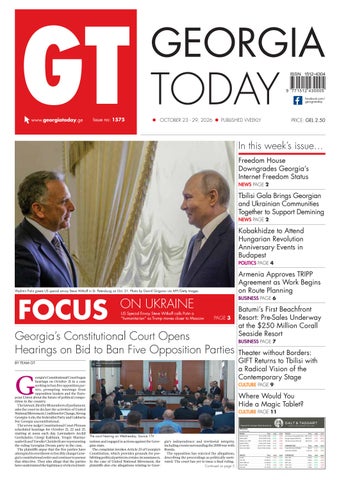
Vladimir Putin greets US special envoy Steve Witkoff in St. Petersburg on Oct. 21. Photo by Gavriil Grigorov via AFP/Getty Images
FOCUS
BUSINESS PAGE 6
ON UKRAINE
US Special Envoy Steve Witkoff calls Putin a “humanitarian” as Trump moves closer to Moscow
PAGE 3
Batumi’s First Beachfront Resort: Pre-Sales Underway at the $250 Million Corall Seaside Resort
Georgia’s Constitutional Court Opens BUSINESS PAGE 7 Hearings on Bid to Ban Five Opposition Parties Theater without Borders:
GIFT Returns to Tbilisi with a Radical Vision of the Contemporary Stage
BY TEAM GT
G
eorgia’s Constitutional Court began hearings on October 21 in a case seeking to ban five opposition parties, prompting warnings from opposition leaders and the European Union about the future of political competition in the country. The lawsuit, filed by 88 members of parliament, asks the court to declare the activities of United National Movement, Coalition for Change, Strong Georgia–Lelo, the Federalist Party and Gakharia For Georgia unconstitutional. The seven-judge Constitutional Court Plenum scheduled hearings for October 21, 22 and 23, starting at noon each day. Lawmakers Archil Gorduladze, Giorgi Kakhiani, Tengiz Sharmanashvili and Tornike Cheishvili are representing the ruling Georgian Dream party in the case. The plaintiffs argue that the five parties have attempted to overthrow or forcibly change Georgia’s constitutional order and continue to pursue that objective. They also allege that the parties have undermined the legitimacy of elected insti-
CULTURE PAGE 9
Where Would You Hide a Magic Tablet? CULTURE PAGE 11 Prepared for Georgia Today Business by
DĂƌŬĞƚƐ Ɛ ŽĨ ϮϬͲKĐƚͲϮϬϮϲ
KE ^
The court hearing on Wednesday. Source 1TV
tutions and engaged in actions against the Georgian state. The complaint invokes Article 23 of Georgia’s Constitution, which provides grounds for prohibiting political parties in certain circumstances. In the case of United National Movement, the plaintiffs also cite allegations relating to Geor-
gia’s independence and territorial integrity, including events surrounding the 2008 war with Russia. The opposition has rejected the allegations, describing the proceedings as politically motivated. The court has yet to issue a final ruling. Continued on page 5
WƌŝĐĞ
ǁͬǁ
ŵͬŵ
^dK <^
WƌŝĐĞ
ǁͬǁ
ŵͬŵ
' KZ' Ϭϭͬϯϭ
ϵϱ͘ϱϭ ;zdD ϲ͘ϯϰйͿ
нϬ͕ϲй
ͲϬ͕ϱй
>ŝŽŶ &ŝŶĂŶĐĞ 'ƌŽƵƉ ; ' K >EͿ ' W ϭϮϯ͘ϮϬ
ͲϮ͕ϱй
ͲϭϬ͕ϭй
'Z /> ϬϲͬϮϴ
ϵϲ͘Ϯϲ ;zdD ϲ͘ϰϮйͿ
нϬ͕Ϭй
ͲϬ͕ϭй
'ĞŽƌŐŝĂ ĂƉŝƚĂů ; ' K >EͿ
' W ϰϮ͘Ϯϱ
Ͳϰ͕ϱй
Ͳϭϱ͕ϴй
ͲϬ͕ϰй
d ĂŶŬ 'ƌŽƵƉ ;d ' >EͿ
' W ϰϵ͘Ϯϲ
Ͳϭ͕ϰй
Ͳϰ͕ϱй
WƌŝĐĞ
ǁͬǁ
ŵͬŵ
ϭϬϴ͕ϳϵ
нϮ͕ϵй
нϰ͕ϳй
ϰ ϭϮϱ͕ϮϬ
ͲϬ͕ϵй
Ͳϱ͕ϴй
' '' ϵ ϭͬϮ W ZW
ϭϬϰ͘ϰϭ ;zdD ϵ͘ϲϰйͿ
ͲϬ͕Ϭй
^><Z , ϬϵͬϯϬ
ϵϴ͘ϲϲ ;zdD ϳ͘ϵϬйͿ
ͲϬ͕Ϯй
Ͳϭ͕ϭй
d ϴ͘ϴϵϰ W ZW
ϭϬϬ͘ϯϵ ;zdD ϭϮ͘ϰϲйͿ
нϬ͕Ϭй
ͲϬ͕Ϯй
KDDK /d/ ^
d ϭϬ ϭͬϰ W ZW
ϭϬϰ͘ϳϲ ;zdD ϭϬ͘ϬϮйͿ
ͲϬ͕ϲй
ͲϮ͕ϯй
ƌƵĚĞ Kŝů͕ ƌĞŶƚ ;h^ΨͬďďůͿ 'ŽůĚ ^ƉŽƚ ;h^ΨͬK Ϳ
ǁͬǁ
ŵͬŵ
hZZ E / ^
WƌŝĐĞ
^W ϱϬϬ
ϳ ϳϭϮ͕ϱϳ
Ͳϭ͕Ϯй
нϬ͕ϴй
h^ ͬ ' >
Ϯ͕ϱϵϳϬ
нϬ͕Ϭй
ͲϬ͕ϯй
&d^ ϮϱϬ
/E / ^
Ϯϰ ϯϲϰ͕ϳϲ
нϬ͕ϭй
нϬ͕ϳй
hZ ͬ ' >
Ϯ͕ϵϭϴϯ
нϬ͕ϰй
ͲϮ͕ϰй
Kt :KE ^ ϯϬ
WƌŝĐĞ
ϱϮ ϰϵϱ͕ϴϴ
нϭ͕ϲй
нϭ͕ϲй
ǁͬǁ
нϬ͕ϵй
ŵͬŵ
' W ͬ ' >
ϯ͕ϰϳϭϳ
ZƵƐƐĞůů ϮϬϬϬ
Ϯ ϳϳϯ͕ϰϮ
ͲϬ͕ϰй
Ͳϯ͕Ϭй
hZ ͬ h^
ϭ͕ϭϮϯϳ
нϬ͕ϯй
ͲϮ͕Ϯй
&d^ ϭϬϬ
ϭϬ ϳϯϯ͕ϬϬ
нϬ͕ϴй
нϬ͕ϳй
' W ͬ h^
ϭ͕ϯϯϴϬ
нϬ͕ϵй
ͲϬ͕ϭй
ͲϬ͕ϱй
2
NEWS
GEORGIA TODAY
OCTOBER 23 - 29, 2026
Tbilisi Gala Brings Georgian and Ukrainian Communities Together to Support Demining Illustrative photo. Source AI
Freedom House Downgrades Georgia’s Internet Freedom Status BY NANUKA MAGLAKELIDZE
G
eorgiahasbeendowngraded from “Free” to “Partly Free” in Freedom House’s 2026 Freedom on the Net report, titled Seismic Shifts on the Global Internet. The US-based organization cited restrictions on online activism and expression critical of the ruling party as the two reasons for the downgrade. Freedom House has given Georgia a score of 68 out of 100 for internet freedom, placing the country in the “Partly Free” category. In its previous assess-
ment, Georgia was classified as “Free.” “Georgia’s status declined from Free to Partly Free as the government continued to restrict online activism and expression perceived as critical of the ruling Georgian Dream party,” the organization said in the introduction to its report, which highlights the most significant changes in internet freedom worldwide. The report, Freedom on the Net 2026: Seismic Shifts on the Global Internet, covers the period from June 1, 2025, through May 31, 2026. Georgia was first included in Freedom House’s Freedom on the Net report in 2009. The country received “Free” status for the first time in 2012 and retained it through 2025.
Kvaratskhelia Vows to Return Stronger After Knee Injury Khvicha Kvaratskhelia. Source: FB
BY ANA DUMBADZE
G
eorgia captain and PSG star Khvicha Kvaratskhelia pledged to return stronger after suffering a serious knee injury during Paris Saint-Germain’s Champions League match against Barcelona. The Georgia captain shared an emotional message about the setback after PSG announced that he had torn cruciate ligaments and would undergo surgery in the coming days, Interpressnews reported.
Kvaratskhelia said he had prepared exceptionally well for the match but was unprepared for the injury. He described questioning why it had happened to him and reflected on his faith, explaining that his prayers before matches were for his health rather than victory. Looking ahead to rehabilitation, he said he was ready to endure months of hard work and pain, and thanked supporters for standing by him. “I know I must come back stronger for my people, who are always by my side,” he wrote. He promised to devote himself fully to recovery. The report did not specify a return date.
The artist's paintings. Photo courtesy of the organizers
BY KATIE RUTH DAVIES
A
n evening of art, music and Georgian hospitality brought together supporters of Ukraine at Kiketi Farm near Tbilisi on 18 October, raising funds for the GRACE Foundation’s humanitarian demining work. The gala, Pirosmani: Once Again!, centered on an exhibition and charity auction by London-based Ukrainian artist Sima Toropov-Vassilieva. Guests from London, Kyiv, Dubai, Baku and elsewhere gathered at the Bridge event hall to support a cause that will remain urgent long after the fighting ends. The event also celebrated the cultural ties between Georgia and Ukraine, with Vassilieva’s paintings paying tribute to Georgia’s celebrated artist Niko Pirosmani. Reflecting on the evening, Vassilieva said it had exceeded her expectations. “But most important of all was the spirit of the gathering, which expressed such strong solidarity with and support for Ukraine and the Ukrainian people,” she said. For Vassilieva, the project was about more than an exhibition. Born in Kramatorsk, in eastern Ukraine, she has family connections across the country, from her grandmother’s birthplace in MohylivPodilskyi to her mother’s home city of Kharkiv and her grandfather’s literary career in Kyiv. Her own experiences of Russia’s fullscale invasion in 2022 led her to volunteer at the Polish-Ukrainian border, helping refugees escape the war. Those experiences continue to inform her art, including My Childhood in Kramatorsk, a work created this year in memory of the city where she grew up. Her Pirosmani: Once Again! series, completed in 2020, brings her Ukrainian perspective to the imagery of the Georgian painter, whose work remains an important part of the country’s cultural identity. When Mako Abashidze, Founding Director of The British Georgian Chamber of Commerce, invited her to contribute to the Tbilisi project, Vassilieva said she accepted without hesitation. “My heart is with Ukraine. I share its
pain and suffering, but also its hope,” she said.
HELPING MAKE UKRAINE SAFE AGAIN The evening’s central purpose was to raise funds for the GRACE Foundation, which supports humanitarian demining in Ukraine. Mines and unexploded ammunition pose a continuing threat to civilians, prevent agricultural land from being used safely, and make it difficult for displaced families to return home. The dangers can persist for decades after fighting ends. The foundation is also working with the Institute of Ecology of Ukraine on approaches to restoring contaminated soil and damaged land, alongside public education and the sharing of international expertise. For Vassilieva, the importance of the work is clear from her own childhood memories of unexploded ordnance left behind after the Second World War. “The consequences of war were still turning into tragedy decades later,” she said. She hopes the auction will help prevent similar tragedies for future generations. “Every penny counts,” she said, acknowledging that the funds raised may be small compared with the scale of Ukraine’s needs.
GEORGIAN FOOD, WINE AND MUSIC The gala reflected Georgia’s tradition of hospitality, with food prepared by chef Tamta Kikaleishvili, named Best Female Chef of the Year and featured in Netflix’s Somebody Feed Phil. Rtvelisi winery generously provided specially selected Georgian wines, while jazz performers Medea Mirianashvili and Dini Virsaladze entertained guests. The Tbilisi Opera Ensemble “Suliko” also performed. The ensemble is due to appear in London on 7 December. The event received support from the Embassies of Ukraine and the United Kingdom in Georgia, representatives of the GRACE Foundation, the Georgian representation of the Ukrainian Entrepreneurs’ Union, and numerous sponsors and private donors. British Ambassador to Georgia Gareth Ward welcomed the initiative, highlighting the importance of cooperation between the two countries.
“The UK stands alongside Ukraine as it fights for a just and lasting peace. Working together to clear away mines and make Ukraine safe again is an essential task. I am sure British and Georgians will help in the charitable work of the Grace Foundation,” the ambassador said. Vassilieva also welcomed the opportunity to meet the Ukrainian ambassador to Georgia and discuss the situation in Ukraine and her hopes for a just and lasting peace.
AUCTION CONTINUES UNTIL 18 NOVEMBER The online silent charity auction of Vassilieva’s paintings has been extended until 18 November, giving supporters more time to bid on her work and contribute to the GRACE Foundation. The artist confirmed that two paintings had already found new homes. She thanked Mako Abashidze, the embassies, the foundation’s representative Valerie Levin and her friends, Rtvelisi winery, Kikaleishvili, the musicians and everyone who attended or donated. The gala demonstrated how cultural events can provide practical support for humanitarian causes, bringing people together around a shared commitment to Ukraine’s future. For Vassilieva, the ultimate goal is simple: to help people return to their homes and live without fear of what may lie beneath their feet. The auction remains open until 18 November, and further bids and donations are welcome.
NEWS
GEORGIA TODAY OCTOBER 23 - 29, 2026
3
Ukraine Latest: Witkoff Calls Putin a “Humanitarian” as Trump Moves Closer to Moscow COMPILED BY ANA DUMBADZE
U
S President Donald Trump’s push to improve relations with Vladimir Putin has drawn fresh criticism after his envoy, Steve Witkoff, described the Russian president as a “humanitarian” while Russian attacks continued to kill civilians across Ukraine, including children. Among the victims this week were a mother and her baby, killed in a drone strike in a park in Kharkiv region. Images of the child, who was in her stroller, spread rapidly across social media, prompting an outpouring of grief and anger as reports of civilian deaths continued to emerge from across the country. The deaths have sharpened an already heated debate over Washington’s approach to the war. Republican Senator Thom Tillis accused Putin of manipulating Trump, while US Secretary of State Marco Rubio stressed that Ukraine might not have survived as an independent country without American support. Their remarks reflect the dilemma facing the Trump administration: it wants to negotiate an end to the war, but its efforts to build a relationship with the Kremlin are raising questions about what Washington is prepared to ask of Moscow, and what it may demand from Kyiv. The latest controversy followed a Russian drone strike in Nova Vodolaha, in Kharkiv region, on October 19. One-yearold Angelina Mariukhna was killed in her stroller, and her mother, Inna, a 28-year-old primary school teacher, later died in hospital. Ukrainian authorities reported six people killed, including three children, and at least 15 injured. President Volodymyr Zelensky condemned the attack as an “absolute atrocity” and renewed his calls for stronger air defenses and continued international pressure on Russia. Two days later, Witkoff met Putin in St Petersburg as Washington sought to revive negotiations with Moscow. “You talk so much about my president, President Trump, being a humanitarian,” Witkoff told the Russian leader. “You are a humanitarian also, sir, and I salute that, I commend you, and I thank you again.” The comments provoked a sharp response from Tillis, who has criticized the administration’s handling of relations with Russia. “Russians are lying. Putin is lying. Putin is playing President Trump like a fiddle, and history is not going to look good on an America that failed to rise up and defend the Western world if Putin actually gets his way,” he said in an interview with CNN. His warning reflects concerns among some American lawmakers that Trump’s determination to reach a deal could leave Ukraine under pressure to make concessions while Russia continues its military campaign.
RUBIO: UKRAINE WOULD NOT EXIST AS A SOVEREIGN STATE WITHOUT US SUPPORT Rubio offered a reminder of America’s role in Ukraine’s defense during a visit to India, telling reporters that the country might not have survived as an independent state without US assistance. “If it were not for the assistance of the United States, including under the Trump administration, there would be no Ukraine right now. Ukraine as a sovereign state would not exist,” he said. The remarks stand in contrast to Trump’s increasingly critical tone towards Zelensky and his calls for Ukraine to reach a settlement with Russia. Since Moscow launched its full-scale invasion in February 2022, American assistance has helped Ukraine resist Russian advances. Support has included air-defense systems, ammunition, armored vehicles, intelligence sharing
and financial aid. Rubio’s comments also put the debate over future US assistance into perspective. Washington is trying to bring Putin to the negotiating table while acknowledging that Ukraine’s ability to defend itself has depended heavily on American backing. Trump has repeatedly argued that Kyiv must be prepared to compromise to end the war. He has questioned Zelensky’s approach to negotiations and criticized Ukrainian strikes on Russian oil facilities, saying they risk complicating diplomatic efforts. In Kyiv, those remarks have fueled fears that the push for a quick settlement could leave Ukraine accepting territorial losses or security arrangements that fail to prevent another Russian attack.
RUSSIAN DIESEL TANKER ADDS TO CONTROVERSY The diplomatic rapprochement also has an economic dimension, with US President Donald Trump announcing an agreement with Moscow to increase Russian diesel supplies to the United States and global markets, as Washington moves to ease restrictions on Russian fuel exports. The agreement has drawn criticism from Ukraine, US lawmakers from both parties and European leaders, who have warned that easing restrictions on Russian fuel exports could bolster Moscow’s finances while its war against Ukraine continues. During his meeting with Witkoff in St Petersburg, Putin said the first tanker carrying Russian diesel under an agreement with the White House would sail within two to three days. He had previously said the vessel would depart on Thursday. According to Russia’s state news agency TASS, the tanker will carry 40,000 metric tons of diesel. The announcement comes as Russia continues its war against Ukraine and Western governments debate how to limit the resources available to Moscow. The agreement has raised questions about whether commercial engagement can help advance negotiations or risks offering Russia economic benefits without securing meaningful concessions in return. Trump has defended his willingness to deal with Putin as necessary to keep negotiations alive. Critics, including Tillis, argue that Moscow has repeatedly used diplomatic contacts without abandoning its military objectives. The timing is particularly striking. As Putin discusses diesel shipments with Washington, Russian forces are continuing to attack Ukraine’s energy infrastructure, while Ukrainian drones are targeting Russian oil facilities. For Kyiv, the concern is not simply whether a deal can be reached, but whether it will bring a lasting end to the fighting on terms that protect Ukraine’s independence.
PEACE TALKS OFFER A POSSIBLE OPENING Witkoff’s visit to St Petersburg followed talks in Oslo on October 20, where he met Zelensky alongside European representatives. After the meeting, Zelensky said US intelligence sharing had resumed, particularly early warnings of Russian ballistic missile attacks. Questions remained, however, over restrictions affecting Starlink and Starshield satellite services used by Ukrainian forces. Following Witkoff’s meeting with Putin, the Kremlin said Russia was prepared in principle to resume US-mediated negotiations with Ukraine, potentially in November. Zelensky has indicated that Ukraine would consider a ceasefire freezing the conflict along existing front lines, provided that any agreement includes credible security guarantees. Such a ceasefire would not necessarily mean Kyiv formally recognizing Russian sovereignty over occupied Ukrainian
Strollers in Ukraine, each representing a child killed in Russia's war. Source: Reuters
territory. But the central issues remain unresolved: where the borders would be drawn, what would happen to occupied regions, and how Ukraine could be protected against renewed aggression. Moscow continues to press its territorial demands, while Kyiv insists that a settlement must not simply give Russia time to regroup before another offensive. European governments are considering further military and financial assistance, including possible arrangements involving frozen Russian assets, as concerns grow over Ukraine’s long-term funding needs. For Trump, the challenge is to persuade Putin to accept meaningful compromises rather than leave Ukraine carrying most of the burden of a deal.
FIGHTING CONTINUES AROUND POKROVSK AND KOSTIANTYNIVKA On the battlefield, there has been little sign that diplomatic efforts are slowing the fighting. The heaviest ground combat remains concentrated in Donetsk region, particularly around Pokrovsk, Dobropillia and Kostiantynivka, where Russian forces are trying to break through Ukrainian defensive positions and advance towards Sloviansk and Kramatorsk. Ukraine’s General Staff reported 30 Russian assaults in the Pokrovsk sector on October 16, targeting positions near Dobropillia, Serhiivka, Molodetske and nearby settlements. Across the front, Ukrainian officials recorded 238 combat engagements that day, alongside 71 Russian airstrikes involving 261 guided bombs. By October 18, Ukrainian forces were reporting another 173 combat engagements, including 22 Russian assaults around Pokrovsk and 16 near Kostiantynivka. The fighting around Kostiantynivka is particularly important because the city forms part of Ukraine’s wider defensive network in Donetsk. A Russian advance could threaten supply routes serving Ukrainian positions further north, although no decisive breakthrough has been independently confirmed. Russia’s Chief of the General Staff, Valery Gerasimov, claimed that Russian forces had captured 92 settlements and more than 1,800 square kilometers of Ukrainian territory since September 1. Moscow also said Dobropillia had fallen and that its troops were advancing towards Sloviansk and Kramatorsk. Ukraine disputed those claims. General Staff spokesman Andriy Kovaliov said Dobropillia remained under Ukrainian control and argued that Ukrainian forces had liberated more territory since early autumn than Russia had captured. The competing claims could not be independently verified. Russian forces also continued to pressure Ukrainian positions around Kupiansk and Lyman in the north, while fighting persisted along the Sumy border. In the south, attacks continued around Huliaipole and Orikhiv in Zaporizhzhia region. An October 21 assessment by Russia Matters, based on DeepState mapping through October 19, estimated that Rus-
sia had suffered a net territorial loss of about 52 square kilometers between October 13 and 19. Despite the sustained offensive, Russia continues to occupy approximately 19 percent of Ukrainian territory, including Crimea and areas seized before the fullscale invasion.
ENERGY ATTACKS LEAVE MILLIONS VULNERABLE AS WINTER APPROACHES Russia has also stepped up attacks on Ukraine’s energy infrastructure, raising fears of widespread power shortages as the country prepares for winter. Russian strikes on October 16 killed at least eight people and injured around 60 nationwide, according to Ukrainian reports. Damage to electricity facilities temporarily left more than one million people without power. In Kharkiv, two civilians were killed and at least 12 injured. Further deaths were reported in Kramatorsk and Dnipropetrovsk region. In Volyn, a drone strike on a food-processing facility killed one person and injured eight, while about 370,000 residents initially lost electricity. Commercial facilities in Sumy and Rivne were also damaged. On October 18, Zelensky said Russia had carried out at least 76 attacks on Ukrainian energy and oil-and-gas facilities during the preceding week. He said Russian forces had launched approximately 2,700 attack drones, 1,700 aerial bombs and 66 missiles. Substations in several regions, including Odesa, were targeted, leaving tens of thousands of households without electricity. Further attacks on October 19 and 20 killed civilians in Kyiv and Kharkiv region and damaged energy facilities, residential buildings and other civilian infrastructure. In Chortkiv, Ternopil region, a strike injured a woman and three children. Moscow said its strikes targeted military logistics, drone storage facilities and electricity infrastructure serving Ukraine’s defense industries. Ukrainian officials have warned that the attacks are damaging essential civilian infrastructure and threatening basic services. The consequences reach far beyond the immediate death toll. Prolonged power cuts can disrupt heating, water supplies, hospitals and industrial production. With winter approaching, every damaged substation and power facility adds to the pressure on a country already struggling to sustain a prolonged war.
UKRAINE STRIKES BACK AT RUSSIAN OIL FACILITIES Ukraine has continued its own longrange drone campaign against Russian energy and military targets, aiming to disrupt the supply networks and revenue that help sustain Moscow’s war effort. On October 18, Ukrainian drones targeted St Petersburg and other Russian regions. Russian authorities said they had intercepted more than 1,000 drones nationwide, including 146 over St Petersburg. Reports indicated fires at a major oil terminal and electricity disruptions.
Russian sources reported one person killed and nine injured. Ukrainian forces also reportedly struck command positions, logistics facilities and energy infrastructure in Russianoccupied Luhansk, Donetsk and Crimea. Oil facilities are an important target because they contribute to Russia’s domestic fuel supply and export earnings. By striking them, Kyiv hopes to impose a greater economic and logistical cost on Moscow’s military campaign. But the attacks have become another point of friction with Washington. Trump has criticized Ukrainian strikes on Russian oil infrastructure, arguing that they could complicate negotiations, while Kyiv sees long-range operations as a way to weaken Russia’s ability to continue the invasion. The disagreement adds to the strain between Trump and Zelensky at a time when Ukraine remains heavily reliant on Western military and financial support.
WASHINGTON FACES A DIFFICULT CHOICE The week’s developments have laid bare the competing priorities shaping US policy. Rubio has acknowledged that American assistance was essential to Ukraine’s survival as a sovereign state. At the same time, Trump is seeking closer relations with the leader whose invasion threatened that sovereignty. Tillis has warned that Putin is exploiting the American president’s desire for a deal. The administration argues that direct engagement is necessary to end the war and that negotiations offer a way out of a conflict that has devastated Ukraine. The diesel agreement adds another complication, raising questions about the balance between diplomatic engagement, commercial interests and pressure on Moscow to change course. For Ukraine, a ceasefire could spare lives and give communities a chance to rebuild. But without credible security guarantees, Kyiv fears that a pause in fighting could allow Russia to regroup and attack again. European governments face their own decisions over how much military and financial support they can sustain if the war continues. For now, there is no agreement on territory, security guarantees or the future of Western military assistance. Russian attacks continue, Ukraine is striking targets deep inside Russia, and the diplomatic push has yet to produce a clear path towards peace. The deaths of civilians, including children, have brought the cost of the war into sharp focus once again. Against that backdrop, Witkoff’s praise for Putin, Tillis’s warning about the Russian president’s intentions and Rubio’s defense of US support for Ukraine illustrate the difficult choices facing Washington. Trump’s renewed engagement with Putin may open the door to further talks. Whether those talks can deliver a settlement that ends the fighting without leaving Ukraine exposed to another invasion remains the central question.
4
POLITICS
GEORGIA TODAY
OCTOBER 23 - 29, 2026
Russian Foreign Ministry Says Restrictions on Georgian Drinks Are Not Political BY NANUKA MAGLAKELIDZE
R
EU Ambassador Paweł Herczynski on Europe Day in Kakheti. Source: EUDEL
estrictions imposed on imports of certain beverages from Georgia are targeted and have no political basis, Russian Foreign Ministry spokesperson Maria Zakharova said. Zakharova was responding to a question about Russia’s ban on the import of certain Georgian beverages. She said the matter falls under the authority of the Federal Service for the Oversight of Consumer Protection and Welfare, known as Rospotrebnadzor. “The restrictions imposed are targeted. We see attempts to turn a completely routine procedure into a political issue and use it for speculation. There is no need to look for anything here. There is no political basis. Certain requirements have been communicated to those importing these products. “Dozens of Georgian companies export their products to Russia. Violations were
EU to Allocate €38 Mln for New Projects Supporting Georgians in 2026, No Money for Georgian Gov’t, Delegation Says Kobakhidze to Attend Hungarian BY TEAM GT
T
he European Union plans to allocate €38 million for new projects supporting Georgian citizens and communities in 2026, despite suspending funding to the Georgian authorities over concerns about democratic backsliding. EU Ambassador to Georgia Pawel Herczynski announced the funding during a Europe Day event in Telavi, Kakheti, on October 10. In a statement on October 16, the EU Delegation to Georgia reaffirmed the commitment, saying the projects would deliver practical support to families and communities across the country. “Due to Georgia’s democratic backsliding, the EU no longer provides funding to the Georgian authorities. But we continue to deliver assistance to the people of Georgia. We reaffirm that commitment,” the delegation said. The projects will focus on creating economic opportunities in small towns, developing skills to meet changing labor market needs and supporting rural development, particularly initiatives involving women. Other priorities include helping family farms, improving access to markets and food quality, and supporting young people and vulnerable groups. The funding will also support efforts to combat violence against women and
girls, promote safe and orderly migration, improve climate change adaptation and disaster preparedness, and assist communities in Abkhazia. Herczynski said he hoped agreements for the new projects would be signed by the end of 2025, allowing the initiatives to move forward. The EU said it has invested more than €2 billion in Georgia since 1992, supporting agriculture, small businesses in rural areas, air quality improvements and modernization of the East-West Highway, among other projects. The announcement comes amid strained relations between Brussels and Tbilisi. Georgia’s EU accession process was effectively halted in 2024 following concerns over democratic backsliding, and the bloc reduced high-level engagement with the Georgian Dream government. EU officials have since described Georgia as a candidate country “in name only.” Relations have also been affected by legislation tightening restrictions on foreign funding for civil society organizations and independent media. Two German political foundations, the Friedrich Naumann Foundation for Freedom and the Konrad Adenauer Foundation, recently announced plans to leave Georgia after their funding applications were rejected under stricter grant rules. Despite the political tensions, the EU says it will continue directing assistance toward projects that benefit Georgian citizens rather than the country's authorities.
Young Georgians celebrating Europe Day in Kakheti. Source X
Maria Zakharova, spokesperson for Russia’s Foreign Ministry. Source: Russian Foreign Ministry.
identified at only a few enterprises. All the others continue operating in our market without any problems, a market that is a priority for Georgia,” Zakharova said. Russia has announced a ban on imports of products from several Georgian companies. Rospotrebnadzor said a tempo-
rary sanitary measure to suspend the import and circulation of food products in Russia took effect on October 9. The restrictions affect the following companies: Teliani Valley, Tbilvino, Askaneli Brothers, Wineman, Georgian Beer Company, Coca-Cola, and Nabeghlavi.
Revolution Anniversary Events in Budapest BY ANA DUMBADZE
G
eorgian Prime Minister Irakli Kobakhidze will visit Budapest at the invitation of Hungarian Prime Minister Péter Magyar to attend events marking the 70th anniversary of the 1956 Hungarian Revolution, Georgia’s Government Administration said. The main commemoration will take place in a central square in Budapest on October 23, with Magyar scheduled to address the gathering.
Irakli Kobakhidze. Source: FB
In his invitation to Kobakhidze, the Hungarian prime minister linked the anniversary to Central Europe’s eventual recovery of freedom in 1989. “The freedom that Central Europe
finally regained in 1989 did not begin in 1989. Part of its history was written 33 years earlier, in the streets of Budapest,” Magyar wrote, according to the Georgian Government Administration. He invited Kobakhidze to join the commemoration honoring those whose courage, he said, continues to inspire Europe’s shared future. “It will be a great honor for us to have your attendance at the event where we will honor the people whose courage still inspires our common European future today and whose legacy continues to respond to the challenges of our time,” the invitation reads.
Georgia Appoints Special Representative for Relations with Russia BY TEAM GT
G
eorgian Prime Minister Irakli Kobakhidze has appointed Giorgi Zurabashvili as his special representative for relations with Russia, saying the move is intended to strengthen existing channels of communication on conflict resolution, trade and humanitarian issues rather than signal a new phase in bilateral relations. Announcing the decision at a briefing at the Government Administration, Kobakhidze said the new role would complement the Geneva International Discussions and Georgia’s interests section at the Swiss Embassy in Moscow, which serves as a channel for communication in the absence of diplomatic relations between the two countries. He said the appointment was necessary to support efforts to resolve the conflict peacefully, maintain and develop trade and economic ties, and sustain dialogue on humanitarian matters. Kobakhidze rejected suggestions that restrictions affecting products from individual Georgian companies had prompted the decision, although he described traderelated issues as one of the new representative’s priorities. Asked about the possibility of restoring diplomatic relations with Moscow, the prime minister said the main obstacle remained unchanged and that Georgia’s position had not shifted.
He also addressed Russia’s demands for non-use-of-force guarantees, saying Georgia could not recognize Abkhazia and South Ossetia as independent states, even indirectly, and therefore could not sign treaties with them. Zurabashvili will retain his position as first deputy foreign minister while taking on the additional responsibilities. He previously headed several departments at the Foreign Ministry and served as an ambassador. He became deputy foreign minister in 2024 and was appointed first deputy foreign minister on July 1, 2025. Kobakhidze described Zurabashvili as an experienced diplomat and said he was confident that the official’s professional background and expertise would enable him to carry out the role effectively.
BACKGROUND: RELATIONS BETWEEN GEORGIA AND RUSSIA Relations between Georgia and Russia have been strained for decades, particularly over the status of Abkhazia and South Ossetia, two breakaway regions internationally recognized as part of Georgia. Tensions escalated into a five-day war in August 2008, after which Russia recognized both regions as independent states. Georgia regards them as occupied territories, while Moscow maintains military forces and political influence in both. Georgia and Russia severed diplomatic relations following the war, and Switzerland has since played a role in maintaining limited official communica-
tion between the two governments. The Geneva International Discussions, established after the 2008 conflict and co-chaired by the European Union, the United Nations and the Organization for Security and Co-operation in Europe, remain the principal international forum for addressing the consequences of the war. The talks bring together representatives of Georgia, Russia and the United States, alongside participants from Abkhazia and South Ossetia. Discussions have focused on security, humanitarian concerns, displaced people and arrangements to prevent renewed hostilities, but fundamental disagreements over the regions’ status have persisted. Despite the absence of diplomatic relations, Georgia and Russia have maintained economic and trade links. Russia remains an important market for Georgian goods, including wine and agricultural products, as well as a source of tourism revenue. These ties have periodically become a source of political tension, with trade restrictions and broader disagreements over security and sovereignty complicating bilateral relations. Kobakhidze’s announcement suggests that Tbilisi intends to maintain pragmatic engagement with Moscow on practical matters while preserving its position on Georgia’s territorial integrity. By establishing an additional channel of communication, the government aims to address issues that can be discussed without changing its stance on Abkhazia and South Ossetia or resolving the broader political dispute with Russia.
POLITICS
GEORGIA TODAY OCTOBER 23 - 29, 2026
5
Georgia’s Constitutional Court Opens Hearings on Bid to Ban Five Opposition Parties Khabeishvili as witnesses. Judge Eva Gotsiridze said the court’s task was to assess the activities of each political party as a whole, rather than determine the individual responsibility of specific politicians. Gakharia For Georgia had argued that its case should be considered independently, saying the party had participated in elections and parliamentary processes, and that the lawsuit failed to establish specific grounds for banning it. The Federalist Party, meanwhile, said it would not participate in the courtroom proceedings, arguing that doing so could lend legitimacy to the case. Representatives of the other four parties attended the hearings.
Continued from page 1
EU WARNS OF THREATS TO DEMOCRATIC COMPETITION The European Union said on October 19 that it was closely monitoring the case, warning that the proceedings and wider political developments in Georgia raised concerns about the independence of the judiciary and the country’s democratic future. European Commission spokesperson Christian Wigand said recent developments, including legislative changes and earlier statements about banning opposition parties, pointed to what he described as the growing use of the judiciary for political purposes. “These developments, together with recent legislative changes and earlier statements about banning opposition parties, point to a worrying instrumentalization of the judiciary,” Wigand said in response to a question from Euroscope. “This threatens fundamental freedoms, democratic pluralism and fair political competition.” Wigand said the EU would follow the proceedings closely. He also reiterated the bloc’s criticism of the Georgian authorities’ treatment of political opponents, journalists and activists following the 30-day administrative detention sentence imposed on journalist Vakho Sanaia. “We have been very vocal about Georgian Dream’s actions aimed at suppressing the political opposition, journalists and activists. Unfortunately, they continue to restrict the civic space,” he said. “The Georgian authorities must immediately release unjustly detained politicians, journalists and activists and repeal repressive legislation.” Sanaia was sentenced to 30 days in administrative detention by Judge Tornike Kochkiani after the Interior Ministry accused him of insulting political officials in three social media posts. The journalist was subsequently arrested outside his home. Georgian Dream has defended its actions as lawful, while opposition parties and critics have accused the authorities of using legal measures to silence dissent.
EUROPEAN PARTNERS FOLLOW PROCEEDINGS
The court hearing on Wednesday. Source 1TV
OPPOSITION CHALLENGES THE CASE Opposition leaders have described the lawsuit as an attempt to weaken political competition and restrict voters’ choices. Nika Gvaramia, a leader of Coalition for Change, called the complaint a “historical document showing how to betray one’s homeland.” He warned that banning the parties could have consequences far beyond the fate of individual politicians, potentially leaving the country in a political deadlock. “This will not simply result in Gvaramia, Melia, Khoshtaria, Saakashvili, Japaridze or someone else being sent to prison. We will get out of that prison, but the country may never escape the dead-end that granting this lawsuit would lead it into,” he said. United National Movement member Ana Tsitlidze also condemned the proceedings, accusing Georgian Dream of pursuing a politically motivated case. “This is a political lawsuit, written not in Geor-
Polish MEP Criticizes Euronews for Inviting Kobakhidze to EU Summit
Polish Member of the European Parliament Krzysztof Brejza
BY NANUKA MAGLAKELIDZE
P
olish Member of the European Parliament Krzysztof Brejza has criticized Euronews for inviting Georgian Prime Minister Irakli Kobakhidze to its EU Enlargement Summit, saying the move risks legitimizing democratic backsliding in Georgia. “Unacceptable that Euronews has invited Irakli Kobakhidze to its EU Enlargement Summit alongside European Council President António Costa and other distinguished European leaders,” Brejza wrote on X.
He said the European Parliament had rejected the legitimacy of Georgia’s Georgian Dream authorities and argued that “Russian-style repression, democratic backsliding and growing Kremlin influence” should not be legitimized on a European stage. “We stand with Georgian people!” Brejza added. The Euronews-organized EU Enlargement Summit will take place in Brussels on November 3. Georgian Prime Minister Irakli Kobakhidze is listed among the speakers, alongside European Council President António Costa, Albanian Prime Minister Edi Rama, Armenian Prime Minister Nikol Pashinyan, Moldovan Prime Minister Vasile To fan, Croatian Prime Minister Andrej Plenkovic, and other leaders, according to the summit program.
gian Dream’s office, but in the Kremlin,” she said before the hearings. “Will they ban us? We will continue the fight anyway.” Tsitlidze said her party had submitted material concerning alleged wrongdoing by Georgian Dream since 2012 and intended to ask the court to consider it. She also argued that the case risked rewriting the history of the 2008 war with Russia. These claims reflect the opposition’s position; the court has not ruled on the allegations.
COURT REJECTS OPPOSITION MOTIONS During the first day of hearings in Batumi, the court rejected several requests from opposition representatives, including motions to recuse judges and a request from Gakharia For Georgia to have its case examined separately. The court also rejected the United National Movement’s request to summon former President Mikheil Saakashvili and party chairman Levan
The case has also drawn international attention. On October 20, leaders from several opposition parties met with the British, German and French ambassadors in Tbilisi to discuss the planned bans. Those attending included Badri Japaridze of Strong Georgia–Lelo, Irakli Pavlenishvili of the United National Movement, Federalist leader Giga Bokeria and Nika Gvaramia of Coalition for Change. Georgian Dream has defended the legal action as a constitutional process. Parliament Speaker Shalva Papuashvili argued that lawmakers have a constitutional right to challenge the legality of political parties, and criticized foreign officials for commenting on the proceedings. The case comes amid wider tensions over Georgia’s democratic direction and its relations with Western partners. The European Union has criticized democratic backsliding in the country, while opposition parties and civil society groups warn that banning major political forces could sharply restrict voters’ choices. The hearings are scheduled to continue through October 23. The court’s decision could have farreaching consequences for Georgia’s political landscape, potentially reshaping the opposition ahead of future elections and intensifying the country’s already strained relations with the EU.
6
BUSINESS
GEORGIA TODAY
OCTOBER 23 - 29, 2026
Armenia Approves TRIPP Agreement as Work Begins on Route Planning BY NANUKA MAGLAKELIDZE
The TRIPP project structural works. Source: AAY
A Cars ready for export. Source: exportscarsgeorgia
Georgia’s Exports Rise 19.6% to $6.15 Billion in First Nine Months of 2026 BY TEAM GT
G
eorgia’s exports of goods reached $6.15 billion in January–September 2026, up 19.6% year-on-year, excluding undeclared exports, according to the National Statistics Office of Georgia (GeoStat). Domestic exports, excluding re-exports, rose 60.3% to $3.76 billion, accounting for 61% of total exports. China was the largest destination for domestic exports, valued at $566.8 million, followed by Russia at $523.2 million and Türkiye at $323.1 million. Petroleum and petroleum products led domestic exports at $762.6 million, representing 20.3% of the total, followed by precious metal ores and concentrates at $464 million and ferro-alloys at $239 million. Including re-exports, Kyrgyzstan was Georgia’s largest export partner, with exports worth $650.2 million. China
ranked second at $583.1 million, followed by Azerbaijan at $566.7 million. The 10 largest export partner countries accounted for 67.8% of total exports. Passenger cars were Georgia’s leading export commodity, generating $1.53 billion, or 24.9% of total exports. Petroleum and petroleum products ranked second at $811.8 million, followed by precious metal ores and concentrates at $464 million. Türkiye was Georgia’s largest import partner during the reporting period, with imports reaching $2.19 billion. China followed at $1.75 billion and the United States at $1.72 billion. Passenger cars also topped the import list, worth $2.65 billion, accounting for 18.4% of total imports. Petroleum and petroleum products ranked second at $1.41 billion, while packaged medicinal products came third at $526.8 million. The 10 largest destination countries accounted for 62.8% of domestic exports, while the 10 largest import partners represented 69.2% of total imports, GeoStat reported.
rmenia’s parliamentary committee on foreign relations has approved the ratification of the strategic partnership framework agreement for the Trump Route for International Peace and Prosperity (TRIPP), paving the way for the agreement to be submitted to parliament for consideration at its next session, Vesti Kavkaza reported. The committee approved the agreement with four votes in favor, one against, and one abstention. On October 21, Armenian Deputy Prime Minister Mher Grigoryan and other government officials visited the Syunik region to discuss preparations for launching the project. The Armenian government said officials discussed organizational issues related to the start of infrastructure design work and the next steps for implementing TRIPP. Armenian Prime Minister Nikol Pashinyan has described TRIPP as a key component of his “Crossroads of Peace” initiative and called its implementation a significant development in regional transport connectivity. He has said the project could help integrate Armenia into the international railway network and establish a rail connection between the Persian Gulf and the Black Sea. In early October, Armenia’s ambassador to the United States, Narek Mkrtchyan, said a study of the Armenian section of TRIPP was underway and expected to be completed within one or two months. He said tangible progress could follow in early 2027.
The study is being conducted by US engineering and consulting firm AECOM. The company’s representatives began surveying the proposed route in Armenia in May on behalf of the US State Department’s Partnership for Global Infrastructure and Investment. Once the assessment is complete, practical work is expected to begin. The route’s Armenian section will stretch for 42 kilometers, connecting mainland Azerbaijan with its Nakhchivan exclave. The Azerbaijani section is planned to cover 194 kilometers. Azerbaijani President Ilham Aliyev said in August that work on the Zangezur Corridor was progressing rapidly, with the Azerbaijani section expected to be completed in 2027. Baku plans to establish an international consortium involving countries and companies interested in investing in the project and securing transport flows along the route.
Türkiye is also building its railway section of the corridor around the clock. The planned 224-kilometer line will run from Kars through Digor, Tuzluca, Igdir, and Aralik to the Dilucu border crossing with Azerbaijan. Construction began in August 2025, with tunnels, viaducts, bridges, and other railway infrastructure under development. Trains on the line are expected to reach speeds of up to 160 kilometers per hour. In August 2025, Armenian Prime Minister Nikol Pashinyan, US President Donald Trump, and Azerbaijani President Ilham Aliyev signed a declaration stating that Armenia would work with Washington and third parties to develop a framework agreement for TRIPP. The project envisages road and railway links, as well as oil and gas infrastructure, connecting mainland Azerbaijan with Nakhchivan through a 42-kilometer route across Armenia, and providing onward connectivity to Türkiye.
Georgian Wine Presented EU to Investigate Booking.com over at International Gastronomy Holiday Scams and Paid Search Rankings Festival in the Netherlands BY TEAM GT
T
he European Commission has opened a formal investigation into Booking.com over concerns that the travel platform may not be doing enough to protect users from fraudulent accommodation listings and phishing scams. The investigation will examine whether the company has met its obligations under the European Union’s Digital Services Act (DSA), which requires major online platforms to assess and address risks to users. The Commission will also assess whether Booking.com has clearly identified listings that pay for higher positions in search results, allowing customers to distinguish advertisements from organic search results. “Europeans should be able to book their holidays without fear of being scammed,” said Henna Virkkunen, the Commission’s executive vice-president for tech sovereignty, security and democracy. “The Digital Services Act sets clear responsibilities on platforms to address these risks, and we must ensure that the leading booking platform in Europe takes those responsibilities seriously,” she added. The proceedings will allow the Commission to investigate the concerns further and determine whether the platform has breached EU rules. The announcement comes as online booking scams and fraudulent accommodation listings remain a concern for travelers, particularly those searching for holiday rentals and making payments online. Under the DSA, platforms must take
appropriate steps to assess and reduce certain risks associated with their services. Clear advertising labels are also intended to help users understand when commercial payments influence what they see online. For Georgia, the case is also relevant to the tourism industry. Many travelers use online platforms to book hotels and guesthouses in Tbilisi, Batumi and other parts of the country, while local businesses depend on these sites to attract international visitors. Fake listings and unclear advertising can put travelers at risk and make it harder for smaller businesses to compete. Although the EU investigation does not automatically apply to bookings made in Georgia, it raises questions about how booking platforms protect customers and ensure search results are transparent. The Commission has not announced a conclusion on whether Booking.com breached the law. The formal proceedings will establish whether further action is necessary.
Georgian wine. Source: National Wine Agency of Georgia
BY NANUKA MAGLAKELIDZE
The EU announcement regarding Booking.com. Source: FB
G
eorgian wine was presented at the international gastronomy festival Folie Culinaire in Maastricht, the Netherlands, with financial
support from the National Wine Agency and organisation by its contracted company, Wijnimport Bleeker. The three-day event offered thousands of visitors, including journalists, bloggers, wine consumers, importers and hospitality industry representatives, the opportunity to taste around 50 wines from nearly 20 Georgian producers,
including both conventional and qvevrimade wines. Held since 2013, the festival traditionally attracts more than 5,000 visitors. The National Wine Agency said promoting Georgian wine internationally and increasing its recognition in foreign markets remained among its key priorities.
BUSINESS
GEORGIA TODAY OCTOBER 23 - 29, 2026
7
Batumi’s First Beachfront Resort: Pre-Sales Underway at the $250 Million Corall Seaside Resort
SOURCE: CORALL SEASIDE RESORT
ing residential ownership with the project’s wider hospitality and recreational facilities.
B
A RESORT DESTINATION FOR RESIDENTS, FAMILIES AND VISITORS
atumi has long attracted property buyers with its coastal location, tourism industry and growing real estate market. Corall Seaside Resort aims to offer a different approach to coastal living by combining residential apartments with a hotel and a range of leisure facilities. With a planned investment of $250 million, the development is set to bring together private residences, a five-star hotel, a yacht club, direct access to a private beach and other amenities in one location. Developed in partnership by Ibercompany Holding, Grande Group and Mziuri Development, Corall Seaside Resort is a new addition to Batumi’s residential and hospitality sector. Pre-sales are underway, allowing prospective buyers to explore the project’s apartment options and investment opportunities.
A PRIME BEACHFRONT LOCATION ON BATUMI’S BLACK SEA COAST Situated at 1 Tamar Mepe Avenue, Corall Seaside Resort occupies approximately 11,300 square meters along Batumi’s Black Sea coastline. The location provides access to Batumi Boulevard, the Botanical Garden, Piazza Square and the historic Old Town, connecting the development with the city’s main leisure and tourism destinations. The project comprises two towers rising 55 and 53 floors. They are designed to accommodate residential, hospitality, commercial and recreational facilities. Unlike conventional seafront apartment developments, where proximity to the beach is often the main attraction, Corall’s concept places beach access and shared leisure facilities at the center of the development. Direct access to a planned private beach is a key part of this approach, connect-
Corall Seaside Resort is designed to combine private residential apartments with the amenities and services of a resort. Its planned facilities include a five-star hotel with approximately 100 suites, a private yacht club with individual piers, panoramic swimming pools, spa and wellness facilities, fitness and sports areas, restaurants, cafés, a casino, business and commercial spaces, and entertainment venues. The facilities are intended to offer residents and visitors a range of options for dining, recreation, wellness and entertainment. For residents, the development will provide access to shared facilities beyond their individual apartments. Visitors will be able to stay at the hotel and use the planned leisure and hospitality facilities. The hotel will form a separate part of the project, complementing the residential component with short-term accommodation and hospitality services. Together, the planned facilities are intended to distinguish Corall Seaside Resort from conventional residential developments along Batumi’s coastline.
BATUMI’S PROPERTY MARKET AND THE INVESTMENT PERSPECTIVE The launch of Corall Seaside Resort comes amid continued activity in Batumi’s property market. Tourism, international buyer interest and new residential developments have contributed to the city’s growth as a real estate destination. According to Colliers Georgia figures reported by Georgia Today, Batumi recorded 17,052 apartment transactions in 2025, an increase of 17% compared with the previous year. The total value of the residential market exceeded $1 billion, representing growth of approx-
imately 34%. These figures provide context for the local property market, although marketwide growth does not guarantee returns for individual developments. Corall Seaside Resort will offer studios starting at approximately 27 square meters, alongside one-bedroom apartments and other layouts. The apartments are planned to be delivered in turnkey condition, allowing buyers to use them personally or consider them for potential rental purposes. The development is also offering inhouse installment arrangements of up to 60 months, giving prospective buyers different payment options during the pre-sale phase. The project combines a beachfront location with planned hospitality and recreational facilities. For buyers considering property in Batumi, this offers an alternative to conventional standalone apartments. Future rental income, occupancy levels and property appreciation will depend on market demand, management arrangements, operating costs and the project's eventual delivery.
THREE GEORGIAN BUSINESS GROUPS BEHIND THE PROJECT Corall Seaside Resort is being developed through a partnership between Ibercompany Holding, Grande Group and Mziuri Development, bringing together experience across several business sectors. Ibercompany Holding has a diversified portfolio spanning real estate, energy, agriculture, winemaking, oil trading and tourism. Grande Group brings experience in construction and hospitality, while Mziuri Development has international real estate experience and has worked with hotel brands including
Crowne Plaza and Hotel Indigo. The three companies are combining their respective expertise to support the development of Corall Seaside Resort.
ENGINEERING AND LONGTERM BUILDING QUALITY Developing two high-rise towers along the Black Sea coastline requires careful consideration of coastal weather conditions, structural requirements and local ground characteristics. These factors are central to the project’s architectural and engineering planning. The development team has identified structural safety, durable construction materials, energy efficiency and reliable building systems as key priorities. The project aims to apply engineering solutions suited to its coastal location while supporting long-term building performance. The team also plans to focus on property management and maintenance to support the ongoing operation of the residential and resort facilities. The effectiveness of these measures will depend on their implementation during construction and throughout the property's operational life.
WHAT CORALL SEASIDE RESORT MEANS FOR BATUMI As Batumi continues to develop as a Black Sea tourism and real estate destination, Corall Seaside Resort is planned as another addition to the city’s coastal landscape. The $250 million project will combine residential apartments, hotel accommodation and resort facilities in one development. If completed as planned, it would add another large-scale hospitality and residential complex to Batumi’s coastline.
Its long-term impact will depend on the completion of the planned facilities, the quality of management and demand from residents and visitors. The development reflects growing interest in projects that combine residential ownership with hotel services and shared leisure facilities. Its performance will ultimately depend on how well these elements work together once the complex is operational.
PRE-SALES UNDERWAY AS THE PROJECT ADVANCES Corall Seaside Resort is currently in its pre-sales and development preparation phase, with architectural and engineering work continuing ahead of the next stages. Prospective buyers can review available apartment layouts, current pricing and purchasing conditions through the project’s sales team. The planned development will bring together a five-star hotel, residential and investment apartments, a private beach, a yacht club, swimming pools, wellness facilities and recreational spaces along Batumi’s Black Sea coast. The immediate priority is to complete the architectural, engineering and preparatory work required before active physical construction begins. For prospective buyers, the pre-sale phase provides an opportunity to review apartment options and purchase terms while the project remains in development. The planned facilities, contractual commitments and delivery schedule should all be considered before making a purchase. Further information about available apartments and current pre-sale opportunities can be found at www.corallbatumi.com.
8
SOCIETY
GEORGIA TODAY
OCTOBER 23 - 29, 2026
Pathway from Georgian Chidaoba to Indian Akhara
Vladimir Mestvirishvili. Source: FB
BLOG BY NUGZAR B. RUHADZE
V
ladimir, alias Lado Mestvirishvili, was a Georgian Master of Sport who helped India conquer the world of wrestling. Having devoted around twenty years of his life to Indian sport, he developed some of the country’s finest wrestling champions, including Olympic medallists. He changed the way an entire generation wrestled and left behind a remarkable legacy that transcends borders. Indian athletes loved him dearly, both as a coach and as a father figure. Following his death at the age of 81 in 2025, the sporting maestro’s con-
tribution to international sport received posthumous recognition when he was awarded the Padma Shri in 2026, the Republic of India’s fourth-highest civilian honour. The freestyle wrestling coach came from Sakartvelo armed with decades of wrestling knowledge, a lifetime of experience, and an unwavering belief in the power of discipline. It is no surprise that the world is familiar with sporting legends whose significance is measured by the titles they win. Yet the same world also knows heroes of the sporting arena whose worth is measured by the champions they produce. Mestvirishvili unquestionably belonged to the latter group. His influence became evident whenever Indian wrestlers mounted the
podium to the sound of their national anthem at the world’s biggest sporting events, demonstrating that the athletes trained by their beloved coach, Lado, were more than ready to compete at the highest level of international freestyle wrestling. The story of this remarkable man is a genuine tale of sporting excellence, cultural adaptation, personal sacrifice, and the extraordinary relationship between a master from Georgia and the Indian wrestling community. Vladimir Mestvirishvili grew up in a country with a deep and distinctive wrestling culture, one that has produced generations of strong, accomplished, courageous, and technically gifted athletes with outstanding competitive instincts and tactical acumen. He entered the world of sport and refined his understanding of wrestling through years of competing at different levels and in various venues, gradually turning towards the art of coaching. This was the transition that would ultimately define his life. Before entering the elite international arena, he drew extensively on his knowledge and experience of Georgian freestyle wrestling. He devoted considerable thought to how athletes’ mistakes could be corrected and, above all, to the considerable gap between a technically accomplished wrestler and a true world champion. In doing so, he developed a sophisticated coaching philosophy, always keeping even the smallest details of a bout in mind. Mestvirishvili inherited the formidable wrestling tradition of the USSR, one of the most influential forces in international sporting competition. This tradition encompassed technical preparation, physical conditioning, tactical awareness, and the systematic development of ath-
letes’ bodies and skills. He developed his coaching expertise in an exceptionally demanding Soviet sporting environment, which provided the foundation for his confidence, knowledge, and ability to develop athletes at different stages of their careers. After all, a coach cannot be a true mentor without fairly and professionally evaluating athletes, identifying their strengths and weaknesses, planning training cycles wisely, preparing them for different opponents, and creating a favourable environment in which talent can be transformed into individual and collective success. Coaching a national team is a demanding responsibility. It requires far more than demonstrating techniques or supervising training sessions. Lado Mestvirishvili also coached the Macedonian national wrestling team, further demonstrating his expertise and the international reach of his coaching abilities. The team he coached achieved noteworthy success, yet one of the most brilliant chapters of his international career was still to come. In 2003, he arrived in India to work with the country’s national wrestling programme, a decision that would become one of the defining moments of his professional life. India possessed a remarkable wrestling heritage: traditional kushti, practised in mud-wrestling arenas known as akharas, had produced generations of physically powerful wrestlers, instilling discipline, strength, a strong sense of community, and a demanding daily routine. However, success in traditional wrestling did not automatically translate into success in international freestyle wrestling. This was precisely where the Georgian coach brought decades of experience to bear on the Indian challenge. With genuine respect for the local tra-
dition, he did not dismiss or discard India’s wrestling culture. Instead, he sought to build upon it. Mestvirishvili was appointed to work with India’s national team, its junior squad, and its women’s wrestling team, becoming one of the most influential foreign coaches in the country’s modern wrestling history. Interestingly, his concerns extended beyond medals to the condition of training facilities. This aspect of his work in India reveals one of the most admirable sides of his character and his intentions. He was not merely another coach; he was a man prepared to work alongside his hosts rather than simply supervise them. The Indian sporting saga of the Georgian coach is a long and fascinating story. To put it briefly, however, his years in India were remarkable for the depth of his integration into the country’s wrestling culture. He became part of an Indian family, a bond founded on mutual trust that offered lessons extending far beyond wrestling. After all, this is one of the most practical ways of building peace among nations. And finally, despite his invaluable contribution, Vladimir Mestvirishvili did not receive the recognition he deserved during his lifetime. Sadly, that was the case. More recently, however, the Georgian National Olympic Committee held a memorial event in honour of this unforgettable man. His celebrated pupil Leri Khabelov, president of the GNOC, highlighted the extraordinary professionalism of the coach who had helped shape his own distinguished sporting career. Incidentally, one of the many things we Georgians need to learn is how to honour and appreciate more fully the talents who help build this nation’s image.
Tough CHoice BLOG BY TONY HANMER
W
e are still in Switzerland (abbreviated CH), wrapping up our fabulous autumn holiday here, being looked after royally by local friends. Chocolate and cheese aside, Switzerland is a wonderland of landscapes. One great difference between it and Svaneti, though, is the strict laws about what can and cannot be built in its UN Heritageprotected parts. Here, bureaucracy intervenes hugely. All the houses are lovely old-style wooden ones; at least on the outside. Interiors can be changed pretty much as one wants: better insulation, more modern heating, and so on. The roofs, another interesting comparison with Svaneti, feature BARRIERS to snow falling off them and potentially hurting or killing anyone on whom it might land…
The weather in our temporary home village of Kiental was clear skies for almost all of our visit. Our host drove us to huge high waterfalls and longdistance Alpine vistas, while I worked to photograph what I could, in blue skies and high contrast from the sunlight. Cows, each indeed wearing a traditional bell and looking very large and healthy, stayed inside their electric fences. We even had privileged localvehicle-only access to special places. Our friend took us up a mountaintop (Niesen, over 3000m) by a steep funicular railway, up to 68 degrees’ angle, and there too the skies were clear all the way to France on the horizon, with 360-degree panoramas spread out for us. Interlaken, Lake Thun, the Swiss Big Three mountains together (Eiger, Mönch and Jungfrau). Dazzling. All-day rail passes, another generous gift! We used them to take the gorgeous Panoramic route to Montreux, on Lake Geneva, to visit a cousin whom I had
never met who lives with her family in France, nearby. I saw the statue of Freddie Mercury on the boulevard, as well as beauty from lake and mountains together everywhere. Lots of good public sculpture. Cormorants sunned themselves on buoys. A few hours there then, a bit footsore but amazed by the loveliness everywhere, we returned by the same route to our hosts’ parents’ house. The weather gave us some clouds on the afternoon of our departure back to Langenthal, where our hosts actually live. But the clouds only added drama to the scene as they raced in. Switzerland is such a peaceful, tidy, orderly place. Citizens who feel strongly about anything can try to get signatures on a petition about it; enough names, and laws require a vote to be taken. So there is powerful local democracy here. (Presumably one could not change the law requiring a vote from a petition so easily, however). Much satisfaction… great expense, meaning that proportion-
In Switzerland. Photo by the author
In Switzerland. Photo by the author
ally very few people own their houses or apartments… and also a high suicide rate. It seems that amidst all this plenty and ease, the dark side is a lack of purpose in many peoples’ lives. With all the knocking on Europe’s door that Georgia has done since it became independent in the breakup of the USSR in 1991, I suspect that the tightness of laws such as is found in Switzerland would be choking for most Georgians. In Georgia, one can distill one’s own moonshine, tread and age one’s own wine; sell and buy whole milk and its products; make a fire and barbecue in many places; camp far and wide; build (up to a certain area) in villages with no permission needed. So it’s give and take. My wife, too, has marveled at the coherent beauty of the countryside in Swit-
zerland, and also moaned at the shopping prices. But we have still stocked up on local cheese and Lindt chocolate of varieties not found in Georgia. We will never forget the generosity of our hosting friends, or the wonderful country we have been blessed to see. But then one goes home, to Georgia, and settles back in. Home. Tony Hanmer has lived in Georgia since 1999, in Svaneti since 2007, and been a weekly writer and photographer for GT since early 2011. He runs the “Svaneti Renaissance” Facebook group, now with over 2000 members, at www.facebook.com/groups/ SvanetiRenaissance/ He and his wife also run their own guest house in Etseri: www.facebook.com/hanmer.house.svaneti
CULTURE
GEORGIA TODAY OCTOBER 23 - 29, 2026
9
Theater without Borders: GIFT Returns to Tbilisi with a Radical Vision of the Contemporary Stage REVIEW BY IVAN NECHAEV
T
heater is often described as a mirror held up to society. Yet some of the most compelling contemporary performances do not reflect the world so much as dismantle its familiar arrangements. They turn the body into an instrument of thought, unsettle the distinction between human and animal, and return to ancient myths to discover what remains disturbing about them. Rather than offering recognizable images of reality, such theater questions the frameworks through which we understand it. The 29th edition of the Georgian International Festival of Arts in Tbilisi, known as GIFT, opened on October 16 at the Mikhail Tumanishvili Film Actors theater with The Rite of Spring, performed by the Italian company Dewey Dell. Running until November 14, this year’s festival brings international theater and dance to Tbilisi alongside Georgian productions and a professional platform designed to strengthen the country’s connections with the international performing-arts community. The opening production established a compelling starting point for a program concerned with ritual, the body, memory, and the instability of inherited narratives. It also raised a question that has accompanied the festival since its foundation: how can international artistic exchange become a lasting part of Georgia’s cultural infrastructure rather than a succession of visiting performances?
NEARLY THREE DECADES OF CULTURAL EXCHANGE Founded in 1997 and closely associated with Georgian director Keti Dolidze and the Tumanishvili Film Actors theater, GIFT emerged during a period when Georgia was rebuilding its cultural institutions and redefining its relationship with the international arts community. Bringing international artists to Tbilisi was more than a programming strategy. It offered Georgian audiences access to theatrical movements and artistic practices that were often difficult to encounter locally, while creating opportunities for artists to establish relationships beyond the country’s borders. Tbilisi’s cultural identity has long developed through encounters between different languages, traditions, and artistic influences. GIFT builds on this history, placing Georgian theater within a wider conversation about contemporary performance. Over almost three decades, the festival has sought to make the city a destination for international artists and a meeting point for practitioners working across theater, dance, music, and visual art. The challenge for any international festival is to move beyond the prestige of its guest list. Its contribution depends on whether performances generate new perspectives, professional relationships, and opportunities for local artists. GIFT’s 2026 edition addresses this ambition through both its artistic program and the return of a substantial professional component.
REVISITING THE RITE OF SPRING Few works have transformed modern performance as decisively as Igor Stravinsky’s The Rite of Spring. Premiered in Paris in May 1913, with choreography by Vaslav Nijinsky and presented by Sergei Diaghilev’s Ballets Russes, the ballet challenged established ideas of musical and physical beauty. Its irregular rhythms, abrasive harmonies, and angular choreography departed sharply from the conventions of classical ballet. The work’s imagined pagan ritual culminates in the sacrifice of a young woman, whose death is intended to secure the renewal of spring. Beneath its mythology lies a persistent conflict between the individual and the collective: the
body becomes subject to forces that exceed personal will. More than a century later, this tension continues to attract choreographers. The question is no longer simply how to reconstruct the original work, but how to make its concerns speak to contemporary audiences. Founded in 2006 by Agata Castellucci, Teodora Castellucci, Vito Matera, and musician Demetrio Castellucci, Dewey Dell approaches performance through the intersection of choreography, sound, visual composition, and animal imagery. Its production of The Rite of Spring, createdin2023,receivedtheDanza&Danza award for Best Dance Production that year and was nominated for costume design at the 2024 UBU Awards. The Tbilisi performances featured choreography by Teodora Castellucci, a conceptual and directorial framework developed by Agata Castellucci, Teodora Castellucci, and Vito Matera, and sound by Demetrio Castellucci. Stravinsky’s score was heard in a recording performed by musicAeterna under Teodor Currentzis. Rather than treating the ballet as a monument to modernism, Dewey Dell approaches it as an investigation of ritual and the body. The human figure appears alongside animalistic forms, while movement becomes a means of exploring instinct, collective behavior, and the relationship between individual agency and larger systems. The production belongs to a broader movement in contemporary performance that challenges the separation between dance, theater, music, and visual art. Choreography functions as dramaturgy; costumes, light, sound, and spatial composition contribute to the work’s meaning. The result is not a conventional retelling of Stravinsky’s ballet but a new arrangement of its underlying tensions.
GIFT PRO: BUILDING AN INTERNATIONAL NETWORK Alongside its performances, GIFT is developing its role as a professional meeting point for the international performing-arts community. Scheduled for November 3–7, GIFT PRO 2026 brings together artistic directors, festival programmers, curators, producers, and representatives of cultural institutions. The platform’s significance rests on the experience of its participants and their positions within international theater networks. These are professionals involved in programming, commissioning, producing, and circulating performances—the processes that determine whether an artistic project reaches audiences beyond its original context. GIFT PRO will be led by William Burdett-Coutts OBE, founder, artistic director, and CEO of Assembly Festival, one of the major producing organizations at the Edinburgh Festival Fringe. He also served as artistic director and chief executive of London’s Riverside Studios from 1993 to 2020. His relationship with GIFT reaches back to the festival’s early years, when he helped establish international connections for the developing initiative. Michail Marmarinos, artistic director of the Athens Epidaurus Festival and international director of GIFT, brings experience in the dialogue between classical drama and contemporary performance. His productions at the Tumanishvili Film Actors theater, including Medeamaterial, National Anthem, and Romeo + Juliet: The Third Memory, have contributed to his longstanding relationship with Georgian theater. Gianni Forte, playwright, director, curator, and former director of the Venice Biennale theater from 2021 to 2024, is currently artistic director of Teatri di Bari / Kismet, the National theater of Puglia. Michael De Cock, who led Brussels’s KVS – Royal Flemish theater from 2017 to 2026, became general and artistic director of theater de Liège in 2026. The participants also include Florian Borchmeyer, whose experience spans
Photo by Zurab Oboladze. Source: GIFT - Georgian International Festival of Arts in Tbilisi (facebook)
Photo by Zurab Oboladze. Source: GIFT - Georgian International Festival of Arts in Tbilisi (facebook)
Photo by Zurab Oboladze. Source: GIFT - Georgian International Festival of Arts in Tbilisi (facebook)
Photo by Zurab Oboladze. Source: GIFT - Georgian International Festival of Arts in Tbilisi (facebook)
dramaturgy and international programming at Berlin’s Schaubühne, Filmfest München, and Theaterformen; Leman Yılmaz, former artistic director of the Istanbul theater Festival; and Norka Chiapuso, director of dFERIA, the San
Sebastián International Performing Arts Fair and Festival. Lorenzo Pappagallo, artistic director of ESCENA PATRIMONIO and an international theater and dance curator, previously curated and coordinated The
Other Iberia, the Spanish focus presented during GIFT’s 22nd edition. Michele Panella, an international director of GIFT with more than three decades of experience in contemporary performing arts, has worked extensively in international dramaturgy, literary translation, and European theatrical exchange. Together, these backgrounds connect the festival with institutions and professional platforms across Britain, Greece, Italy, Belgium, Germany, Spain, and Turkey. The aim is not simply to assemble prominent names in Tbilisi, but to create conditions for longer-term cooperation between Georgian practitioners and international partners. Such connections can influence which artists receive commissions, which projects enter co-production arrangements, and which productions travel abroad. For emerging artists, access to these networks can be as consequential as the opportunity to perform at an international festival. GIFT has also announced a new season of its GIFT Biennale College initiative for artists under 40, with a prize of 20,000 lari. The initiative is intended to support younger practitioners and expand their opportunities for professional development. The festival’s return to full membership in the European Festivals Association further reconnects it with a network of institutions engaged in international collaboration and exchange. For Georgia’s performing-arts sector, these efforts address a longstanding challenge: how to sustain a distinct local artistic culture while giving its practitioners access to international opportunities. External partnerships cannot substitute for a strong domestic cultural infrastructure, but they can help artists develop projects, reach new audiences, and establish relationships that endure beyond a single festival edition.
AN OPENING THAT LOOKS FORWARD Dewey Dell’s The Rite of Spring was a fitting opening for GIFT 2026. The production avoided competing with the mythology of the ballet’s 1913 premiere, instead approaching Stravinsky’s work through a contemporary language of movement, image, and physical transformation. Its visual intensity placed the audience inside a world where the human body is neither entirely autonomous nor separate from the forces surrounding it. Ritual appeared less as an archaeological remnant than as a structure through which communities negotiate belonging, violence, and renewal. Dewey Dell presented the ballet as an open theatrical problem rather than a settled masterpiece. The choice was consistent with GIFT’s broader direction. The festival’s remaining program includes Wim Vandekeybus’s Infamous Offspring on October 24 at the Griboedov theater; the professional platform GIFT PRO from November 3–7; Sharon Eyal and Gai Behar’s Delay the Sadness on November 6–7 at the Tbilisi Opera and Ballet theater; Margherita Saltamacchia’s Frankenstein, autoritratto d’autrice – Nuova Creatura on November 9 at Wine Factory N1; and Teresa Ludovico’s Anfitrione on November 10 at the Tumanishvili theater. Together, these works extend the festival’s engagement with mythology, identity, memory, and the boundaries between theatrical forms. GIFT’s contribution to Tbilisi will ultimately depend on what remains after the performances end. Its international program brings new artistic languages into the city; GIFT PRO seeks to turn those encounters into professional relationships and future opportunities. Approaching its third decade, the festival is attempting to connect these two functions: presenting ambitious contemporary work to Georgian audiences while strengthening the networks through which Georgian artists can participate in international cultural life.
10
CULTURE
GEORGIA TODAY
OCTOBER 23 - 29, 2026
Catherine Gordeladze: The Art of Musical Rediscovery BY LILY FÜRSTENOW
B
orn in Georgia and now based in Germany, pianist Catherine Gordeladze combines brilliant technique with a vivid imagination and a remarkable sense of musical color. Her performances reveal a pianist who understands virtuosity not as an end in itself, but as a means of bringing music to life. Her playing is vibrant and luminous, at times almost ephemeral, yet grounded in the clarity, elegance and expressive discipline of the classical tradition. At her Berlin recital in the Philharmonie’s Chamber Music Hall on 4 October, Gordeladze captivated the audience with a program spanning different eras and styles. Her performance demonstrated how familiar masterpieces and lesser-known works can enter into a lively dialogue when approached with curiosity, precision and interpretative freedom. The audience responded with enthusiastic applause, celebrating a musician whose technical command is matched by a genuine joy in performance. Yet Gordeladze’s artistic interests extend beyond virtuosity and the established canon. In a recent interview, she spoke about her research into women
Catherine Gordeladze. Photo by the author
composers whose achievements have been overlooked by music history. Her forthcoming project will be dedicated to Georgian and European women composers, with the names and repertoire to be announced soon. Her recent performances already offer a glimpse of this
commitment: in Berlin, she presented a sonata by Marianna Martines, the eighteenth-century composer and contemporary of Haydn, whose music deserves far greater recognition. Rediscovering such works means not only expanding the concert repertoire, but also question-
ing the historical narratives through which musical significance has been defined. Gordeladze is equally interested in bringing neglected composers back into the musical conversation. Her engagement with Moritz Moszkowski, for example, reflects her broader interest in pianistic repertoire that has gradually slipped from the mainstream. Moszkowski was persecuted by the Nazi regime in Germany and was prevented from performing his works; he was later largely forgotten. Such rediscoveries remind us that musical history is never entirely settled: works can disappear from concert programs and return through the commitment of performers willing to explore beyond the familiar. This spirit of discovery also informs her latest CD, Alt-Wien, released by Hänssler Classic in 2025. The recording offers a personal musical journey through the Viennese tradition, from Classical elegance to Romantic virtuosity and the playful brilliance of salon music. Mozart’s variations reveal the ingenuity involved in transforming a simple theme; Carl Czerny’s Fantasie brillante turns motifs from The Marriage of Figaro into a dazzling pianistic spectacle. Marianna Martines’s G-major sonata brings a welcome female voice into this historical panorama, while Beethoven’s variations demonstrate the creative possibilities of
operatic themes. A transcription from Richard Strauss’s Der Rosenkavalier, Alfred Grünfeld’s sparkling Soirée de Vienne, Brahms’s Hungarian Dances in virtuoso arrangements, and Friedrich Gulda’s contrasting piano miniatures complete a program rich in character and stylistic variety. Together, these pieces reveal Vienna not as a single historical sound, but as a meeting place of tradition, theatricality and individual invention. For Gordeladze, the concert hall itself is part of this experience. She has praised the exceptional acoustics of the Berlin Philharmonie, whose clarity and resonance allow the finest nuances of piano sound to emerge. In her hands, this acoustic space becomes a setting for music that feels both historically informed and immediate. Catherine Gordeladze’s artistry lies in this balance: between brilliance and delicacy, tradition and discovery, established masterpieces and forgotten voices. Her playing revives the centuries-long traditions of piano performance without turning them into museum pieces. Instead, she makes them vivid, accessible and deeply appealing to contemporary audiences. Her forthcoming exploration of Georgian and European women composers promises to extend this artistic vision further, opening new perspectives on the musical history we thought we knew.
and create. Alongside these discussions, educational sessions covering digital marketing, social media, communication, and content creation are intended to provide practical knowledge for professionals working across media and the creative industries. The historic Tbilisi City Assembly, at 2 Freedom Square, will serve as the setting for the forum. Its planned spaces include a main presentation hall, discussion areas, a sponsors’ exhibition zone, private meeting rooms, and dedicated networking and hospitality areas. NEXT Group is the forum’s general partner, with a dedicated VIP lounge reflecting its “Live Wide Open” concept. International brands and partner organizations will also have opportunities to present their work and connect with participants. Attendance will be available through official invitations and a limited number of tickets via TKT.GE, according to the organizers. The event will also conclude
with a gala dinner for international speakers, Georgian experts, partners, and invited guests. The first Welcome Tbilisi International Forum aims to establish an annual platform where international perspectives and Georgian expertise can meet around the city’s development and global profile. By bringing together tourism, investment, architecture, film, gastronomy, art, and business, the event offers a broader view of what shapes a contemporary capital. At its heart, Welcome Tbilisi is about connecting the city’s rich history with its evolving ambitions. Its three-day program will create space for new conversations, professional relationships, and ideas about how Tbilisi can develop while retaining the character that makes it distinctive.
Welcome Tbilisi International Forum 2026: A Timeless City, a Modern Vision BY TEAM GT
F
rom October 23 to 25, Tbilisi will host the first Welcome Tbilisi International Forum at the historic Tbilisi City Assembly, bringing together international and Georgian professionals to explore the capital’s future through tourism, investment, architecture, film, gastronomy, art, and the creative industries. Under the theme ‘A Timeless City. A Modern Vision,’ the three-day event aims to present Tbilisi to an international audience while creating new opportunities for professional exchange, business partnerships, and cultural collaboration. Rather than focusing on a single industry, Welcome Tbilisi connects the many sectors that shape how a city develops, attracts visitors, creates business opportunities, and builds its international identity. The forum’s program is organized around three themes: Modern Tbilisi: The Next Chapter, Tbilisi: Designed for the Future, and Tbilisi: Tourism, Gastronomy & Creative Lifestyle. The opening day, October 23, will examine Tbilisi’s contemporary identity and international potential. Discussions will explore what makes the city unique, how film can introduce it to global audiences, and how its cultural and creative communities are shaping its next chapter. An exclusive session curated by NEXT will also invite participants to consider what Tbilisi should become. On October 24, attention will turn to architecture, urban development, and the relationship between the city’s heritage and its future. Sessions including “Architecture as a Destination: Can Design
Change How the World Sees Tbilisi?” and “Heritage vs. Future: How Should Tbilisi Develop?” will bring together perspectives from architecture, real estate, tourism, and film. The day will conclude with “Designing the Next Tbilisi: What Should the City Look Like in 2035?”, featuring STIPFOLD’s vision of the capital’s future. The final day, October 25, will focus on tourism, hospitality, gastronomy, nightlife, and contemporary creative culture. Discussions such as “Beyond Tourism: Selling an Experience” and “From Local to Global: Can Tbilisi Become a Creative Lifestyle Destination?” will examine how the city can distinguish itself through its food, cultural spaces, hospitality, and urban experiences. Private culinary masterclasses curated by Marriott will add a practical dimension to the program. International participation is central to the forum’s concept. The organizers’ materials list more than 30 international speakers and over 70 Georgian speakers, representing a broad range of professional backgrounds and markets. The announced participants include film producers, Hollywood location managers, hospitality executives, architects, investors, chefs, curators, and creative professionals. Among them are Becky Brake and Lori Balton in location management, Patrick Mignano in film and location management, Harry Johnson of Tierra Hospitality Partners, and representatives of Georgian businesses and creative organizations. Their participation will create opportunities to exchange international experience and local knowledge through panel discussions, presentations, question-andanswer sessions, and professional meetings. The forum’s business program will
also include B2B sessions, investment presentations, private meetings, workshops, and networking opportunities designed to encourage new partnerships and potential joint projects. One of the forum’s distinctive features is its emphasis on film as a means of introducing Tbilisi to the world. International location managers, producers, and other industry professionals will consider the capital from a production perspective, exploring how its historic streets, architecture, interiors, and contemporary developments might appeal to filmmakers. The program connects this perspective with tourism and urban development. A location featured in a film can become familiar to audiences worldwide, while architecture and distinctive urban environments can help establish a city’s identity beyond traditional tourism campaigns. These discussions sit alongside sessions on investment and architecture, including questions about iconic developments, the future of the built environment, and the balance between preserving Tbilisi’s heritage and accommodating contemporary growth. Welcome Tbilisi also places Georgian cuisine and hospitality within a wider international conversation about city branding. The program explores how food, wine, restaurants, nightlife, galleries, cultural venues, and creative businesses contribute to the experience of a destination. Sessions on Georgian cuisine’s global potential and gastronomy as a city brand will connect local traditions with international audiences. Discussions of nightlife, contemporary art, fashion, and the creative economy will further explore how Tbilisi’s cultural life contributes to its appeal as a place to visit, work, invest,
Welcome Tbilisi International Forum 2026 October 23–25, 2026 Tbilisi City Assembly, 2 Freedom Square, Tbilisi, Georgia Discover Tbilisi, discover more.
CULTURE
GEORGIA TODAY OCTOBER 23 - 29, 2026
11
Where Would You Hide a Magic Tablet? BLOG BY AMERICAN RESEARCHER NEHEMIAH COOK
I
magine possessing a tablet explaining how language was first formed. Where would you hide it? Beneath a city, inside a royal tomb, or somewhere no one would think to search? What if it lay beside an ordinary lake in the Georgian countryside? In 2021, a remarkable stone tablet was discovered near Lake Bashplemi in the Dmanisi region of Georgia. Carved into its dark basalt surface are sixty signs, including thirty-nine distinct characters, which researchers have not been able to match conclusively with any known writing system. A team of Georgian scholars published their findings in 2024, opening a fascinating question about the history of writing in the Caucasus. Although the tablet's precise age and meaning remain uncertain, its unusual inscription deserves careful examination. When I began studying the Bashplemi tablet, I asked whether its marks might depict relationships rather than merely represent sounds. Could their arrangement teach readers how complex ideas form? A line can mean more when another mark gives it direction or position. Consider something familiar to every person on earth: the separation of day from night. We recognize light because we have experienced darkness, and we understand morning because night comes before it. These are not difficult ideas, even for a young child who has never learned to read. If a writing system could represent these relationships geometrically, perhaps its earliest symbols would communicate meaning before requiring pronunciation. This possibility led me to examine the tablet's individual strokes rather than immediately assigning words to its signs. A vertical line, a horizontal line, a diagonal, a circle, and a dot can each be drawn independently. When these simple forms are joined, separated, mirrored, or rotated, however, they create new constructions. The question is whether those changes follow consistent rules or whether we are merely recognizing familiar shapes. To explore that question, I began comparing signs across the tablet instead of treating every occurrence as an unrelated character. In my proposed reading, certain forms represent light, darkness, water, earth, and relationships between them. Other constructions appear to develop from simpler ones through attachment, orientation, or repetition. This interpretation remains experimental, but it provides something useful: a set of rules that can be tested against the inscription itself.
Here is a small example of the kind of reasoning involved. Imagine drawing a horizontal line to represent a boundary, then placing a mark above it and another below it. Without knowing either mark's pronunciation, you can already describe a relationship between two positions. If that same construction repeatedly appears in contexts where separation or opposition is proposed, the pattern becomes worth investigating. If it appears everywhere without a consistent function, the interpretation becomes weaker. Remarkably, this approach brought me to a familiar account: the opening chapters of Genesis. The biblical narrative begins with the heavens and earth, darkness and light, waters and their separation, followed by vegetation, heavenly lights, living creatures, and humanity. These ideas are presented in an ordered sequence, with relationships developing as creation unfolds. I began testing whether the geometric forms on the Bashplemi tablet could be arranged into a comparable sequence. My working hypothesis is that the tablet may preserve a pictorial teaching system organized around the creation account. In this model, the forms are not simply illustrations of objects; they are building blocks for expressing relationships. A repeated sign may indicate plurality, a rotated sign may change its role, and an attached sign may produce a compound meaning. The proposal is ambitious, and a resemblance to Genesis is not enough to prove that the ancient inscription was intended to tell that story. For me, the most interesting possibility concerns the relationship between thought and writing. Before a person can name a river, he can recognize flowing water. Before he learns a word for the sun, he can distinguish daylight from darkness. Could a writing system have been designed to preserve these relationships in visible form? And could such a system eventually have provided the shapes from which later alphabets developed? Georgia has an intellectual tradition that makes this question particularly interesting. The medieval Georgian philosopher Ioane Petritsi, associated with Gelati Academy, studied and explained philosophical ideas concerning unity, multiplicity, and the relationships underlying existence. His work does not establish the meaning of Bashplemi, nor does it demonstrate a historical connection with the tablet. Nevertheless, his interest in the ordered structure of reality offers Georgian readers a familiar philosophical doorway into this investigation. Now consider an ordinary writing exercise. In English, the sentence “The quick brown fox jumps over the lazy dog” contains every letter of the alpha-
The tablet. Source: The author
bet. Such a sentence is called a pangram, and it demonstrates how a limited collection of letters can construct many different words. What if a much older teaching system accomplished something similar, not through a sentence designed to contain every letter, but through a story that introduced the relationships necessary to construct them? This is why I have begun exploring Genesis as a possible pictorial pangram. In the model I am developing, the creation sequence gradually introduces geometric constructions that may correspond to later written characters. The goal is not merely to find shapes that look alike, since simple strokes naturally recur in unrelated scripts. Instead, I want to determine whether the same construction rules can generate multiple characters consistently, without inventing a new explanation for every resemblance. One of the most surprising comparisons has been with Hangeul, the Korean writing system introduced under King
Sejong in the fifteenth century. Korean letters are built from relatively simple, recognizable graphic elements, making them especially useful for studying how complex characters can arise from elementary forms. In my Bashplemi reconstruction, I have proposed geometric constructions corresponding to Korean consonants and vowels, including combinations that may be generated through rotation, repetition, and attachment. My more specific hypothesis is that the creation sequence represented in my proposed reading contains the graphic constructions needed for the Korean alphabet by the fifth day. That is a claim about a proposed model, not a demonstrated historical origin of Hangeul. The documented history of Hangeul's creation remains important, and any suggested relationship to Bashplemi must be tested against that history, the original tablet, and the possibility of coincidental geometric similarity. The Caucasus offers another valuable
comparison. Georgian, Armenian, and Caucasian Albanian writing traditions contain forms that can be examined alongside the Bashplemi signs. In my preliminary comparisons, I have identified several graphic similarities, although I have not established a complete set of shared construction rules. What interests me is not simply whether two characters look alike, but whether one system preserves a repeatable method of constructing the other. There is also a question of how language may have changed over time. In Genesis 11, the account of Babel describes the confusion of human language and the scattering of people. If one approaches that narrative as a possible framework for investigating ancient writing, a question naturally follows: Could related graphic forms have survived among different populations even after their spoken languages diverged? The biblical account suggests a question worth exploring, but it cannot substitute for archaeological, linguistic, and chronological evidence. As an American studying a Georgian artifact, I am particularly grateful for the scholars who first brought this remarkable tablet to public attention. Without their work, there would be no inscription available for researchers like me to examine. My hope is not to replace their research with a dramatic story, but to contribute a different method of analysis that others can inspect, challenge, and improve. I would especially welcome the participation of Georgian historians, linguists, mathematicians, and readers who enjoy solving puzzles. The most useful question is not whether an individual sign resembles a familiar letter, but whether a proposed rule explains several signs and predicts another construction correctly. A successful interpretation should survive comparison with the complete inscription, including signs that initially seem inconvenient. That is how an attractive idea begins to become a testable explanation. The tablet may record an inventory, a religious offering, or an unknown writing tradition. Whatever its purpose, this Georgian stone reminds us how much remains to discover. So where would you hide a magic tablet? We cannot yet say Bashplemi preserves humanity’s first language or the creation story. But Georgians can help test this remarkable possibility. Visit Bashplemi.com to read the open-source Bashplemi Letter and examine the proposed constructions. If you recognize a sign, have relevant evidence, or wish to collaborate, please reach out using the contact information available on the website. A discovery often begins with a better question.
Tbilisi Hosts International Dance Festival for the Second Time SOURCE: INTERNATIONAL FESTIVAL FOR PROFESSIONAL AND AMATEUR DANCERS
I
n October 2026, Tbilisi hosted the International Festival for Professional and Amateur Dancers for the second time. The event took place at the ballroom of the Sheraton Grand Tbilisi Metechi Palace, where local and international dance couples competed for the Lizi
Mor Dance Queen Trophy. The festival welcomed internationally acclaimed dance stars, whose participation added prestige and artistic distinction to the event. The festival’s guest of honor was Joanna Leunis, a nine-time Latin American dance champion. The gala evening also featured a special showcase performance by world-renowned dancers, including Victor da Silva, Ekaterina Krysanova, Eldar Dzhafarov, and Anna Sazhina. The international jury brought
COMMERCIAL DEPARTMENT
Commercial Director: Iva Merabishvili Marketing Manager: Natalia Chikvaidze EDITORIAL DEPARTMENT:
GEORGIA TODAY
Editor-In-Chief: Katie Ruth Davies
Photo from the dance festival. Courtesy of the organizers
together leading professionals from the world of dance. Among its distinguished members was Joanna Leunis, who also attended the festival as a special guest. She was joined by internationally recognized dance experts Jerry Abrate, Dirk Bastert, and Slavik Ajiderski. The festival was held with the support of Tbilisi City Hall, the Ministry of Culture of Georgia, Creative Georgia, the Embassy of Israel, the Embassy of Italy, and private-sector partners. According to the organizers, the fes-
tival was a success, attracting a large audience and receiving an enthusiastic response from spectators. Lectures, seminars, and masterclasses formed an important part of the festival program, offering local dancers valuable opportunities to enhance their skills, broaden their professional knowledge, and advance their careers. The festival’s long-term vision is to expand its international reach and further strengthen Tbilisi’s position as an important meeting point for the global dance community.
Journalists: Ana Dumbadze Tony Hanmer Nugzar B. Ruhadze Ivan Nechaev Nanuka Maglakelidze Emil Avdaliani
ADDRESS International Relations & Communications 22 Janashia Str. Sofia Bochoidze Tbilisi, 0179, Georgia E: sbochoidze@georgiatoday.ge Tel.: +995 32 229 59 19 Website Editor: E: info@georgiatoday.ge Katie Ruth Davies F: GeorgiaToday
Layout: Misha Mchedlishvili
Webmaster: Sergey Gevenov
Photographer: Aleksei Serov
Circulation Managers: David Kerdikashvili David Djandjgava
ADVERTISING & SUBSCRIPTION
+995 577 72 52 61 E-mail: marketing@georgiatoday.ge
Reproducing material, photos and advertisements without prior editorial permission is strictly forbidden. The author is responsible for all material. Rights of authors are preserved. The newspaper is registered in Mtatsminda district court. Reg. # 06/4-309