Issue no: 1574
• OCTOBER 16 - 22, 2026 • PUBLISHED WEEKLY
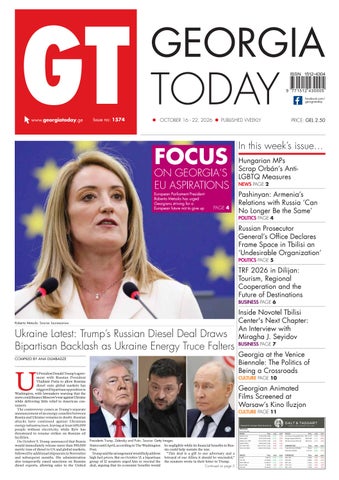
FOCUS
ON GEORGIA'S EU ASPIRATIONS
European Parliament President Roberta Metsola has urged Georgians striving for a European future not to give up
PAGE 4
PRICE: GEL 2.50
In this week’s issue... Hungarian MPs Scrap Orbán’s AntiLGBTQ Measures NEWS PAGE 2
Pashinyan: Armenia’s Relations with Russia ‘Can No Longer Be the Same’ POLITICS PAGE 4
Russian Prosecutor General’s Office Declares Frame Space in Tbilisi an ‘Undesirable Organization’ POLITICS PAGE 5
TRF 2026 in Dilijan: Tourism, Regional Cooperation and the Future of Destinations BUSINESS PAGE 6
Inside Novotel Tbilisi Center's Next Chapter: An Interview with Miragha J. Seyidov
Roberta Metsola. Source: businessnow
Ukraine Latest: Trump’s Russian Diesel Deal Draws Bipartisan Backlash as Ukraine Energy Truce Falters BUSINESS PAGE 7
Georgia at the Venice Biennale: The Politics of Being a Crossroads
COMPILED BY ANA DUMBADZE
U
S President Donald Trump’s agreement with Russian President Vladimir Putin to allow Russian diesel onto global markets has triggered bipartisan opposition in Washington, with lawmakers warning that the move could finance Moscow’s war against Ukraine while delivering little relief to American consumers. The controversy comes as Trump’s separate announcement of an energy ceasefire between Russia and Ukraine remains in doubt. Russian attacks have continued against Ukrainian energy infrastructure, leaving at least 600,000 people without electricity, while Kyiv has threatened to resume strikes on Russian oil facilities. On October 9, Trump announced that Russia would immediately release more than 300,000 metric tons of diesel to US and global markets, followed by additional shipments in November and subsequent months. His administration also temporarily eased sanctions on Russian diesel exports, allowing sales to the United
CULTURE PAGE 10
Georgian Animated Films Screened at Warsaw’s Kino Iluzjon CULTURE PAGE 11 Prepared for Georgia Today Business by
DĂƌŬĞƚƐ Ɛ ŽĨ ϭϮͲKĐƚͲϮϬϮϲ
KE ^
Presidents Trump, Zelensky and Putin. Source: Getty Images
States until April, according to The Washington Post. Trump said the arrangement would help address high fuel prices. But on October 13, a bipartisan group of 12 senators urged him to rescind the deal, arguing that its economic benefits would
be negligible while its financial benefits to Russia could help sustain the war. “This deal is a gift to our adversary and a betrayal of our Allies; it should be rescinded,” the senators wrote in their letter to Trump. Continued on page 3
WƌŝĐĞ
ǁͬǁ
ŵͬŵ
^dK <^
' KZ' Ϭϭͬϯϭ
ϵϱ͘ϬϬ ;zdD ϲ͘ϰϴйͿ
нϬ͕Ϯй
Ͳϭ͕ϱй
>ŝŽŶ &ŝŶĂŶĐĞ 'ƌŽƵƉ ; ' K >EͿ ' W ϭϮϳ͘ϮϬ
Ͳϰ͕Ϯй
Ͳϲ͕ϵй
'Z /> ϬϲͬϮϴ
ϵϲ͘ϭϵ ;zdD ϲ͘ϰϰйͿ
нϬ͕ϭй
ͲϬ͕Ϯй
'ĞŽƌŐŝĂ ĂƉŝƚĂů ; ' K >EͿ
' W ϰϰ͘ϴϬ
нϭ͕ϭй
ͲϬ͕ϴй
d ĂŶŬ 'ƌŽƵƉ ;d ' >EͿ
' W ϰϵ͘Ϯϰ
Ͳϯ͕ϭй
Ͳϱ͕Ϭй
WƌŝĐĞ
ǁͬǁ
ŵͬŵ
ϭϬϲ͕ϲϱ
нϲ͕ϯй
нϮ͕Ϭй
ϰ ϭϳϮ͕Ϯϯ
нϬ͕ϴй
Ͳϰ͕ϭй
' '' ϵ ϭͬϮ W ZW
ϭϬϰ͘ϯϯ ;zdD ϵ͘ϳϰйͿ
ͲϬ͕Ϭй
ͲϬ͕ϲй
^><Z , ϬϵͬϯϬ
ϵϴ͘ϴϵ ;zdD ϳ͘ϴϯйͿ
ͲϬ͕Ϯй
Ͳϭ͕Ϯй
d ϴ͘ϴϵϰ W ZW
ϭϬϬ͘ϯϲ ;zdD ϭϮ͘ϱϯйͿ
ͲϬ͕Ϭй
ͲϬ͕Ϯй
KDDK /d/ ^
d ϭϬ ϭͬϰ W ZW
ϭϬϲ͘ϬϮ ;zdD ϵ͘ϵϱйͿ
ͲϬ͕ϲй
Ͳϭ͕ϳй
ƌƵĚĞ Kŝů͕ ƌĞŶƚ ;h^ΨͬďďůͿ 'ŽůĚ ^ƉŽƚ ;h^ΨͬK Ϳ
/E / ^
WƌŝĐĞ
ǁͬǁ
ŵͬŵ
WƌŝĐĞ
ǁͬǁ
ŵͬŵ
hZZ E / ^
WƌŝĐĞ
ǁͬǁ
ŵͬŵ
^W ϱϬϬ
ϳ ϴϬϳ͕Ϯϰ
нϬ͕ϰй
нϮ͕Ϭй
h^ ͬ ' >
Ϯ͕ϱϵϲϱ
ͲϬ͕Ϯй
ͲϬ͕ϰй
&d^ ϮϱϬ
Ϯϰ ϯϮϴ͕Ϭϲ
нϬ͕ϴй
нϭ͕ϱй
hZ ͬ ' >
Ϯ͕ϴϵϲϲ
ͲϬ͕ϴй
Ͳϰ͕Ϯй
ϱϭ ϴϱϬ͕ϱϱ
нϭ͕ϭй
Kt :KE ^ ϯϬ
Ͳϭ͕ϰй
' W ͬ ' >
ϯ͕ϰϯϬϯ
ͲϬ͕Ϯй
ͲϮ͕ϳй
ZƵƐƐĞůů ϮϬϬϬ
Ϯ ϳϵϰ͕ϰϴ
Ͳϭ͕ϴй
Ͳϯ͕ϴй
hZ ͬ h^
ϭ͕ϭϭϱϱ
ͲϬ͕ϲй
Ͳϯ͕ϴй
&d^ ϭϬϬ
ϭϬ ϲϱϲ͕Ϯϴ
нϭ͕ϱй
нϬ͕ϭй
' W ͬ h^
ϭ͕ϯϮϬϴ
ͲϬ͕ϭй
ͲϮ͕ϯй
2
NEWS
GEORGIA TODAY
OCTOBER 16 - 22, 2026
Photo from the opening ceremony of the 13th International Animation Film Festival in Nikozi. Source: Ministry of Culture.
Georgian Director Levan Koguashvili to Receive Golden Globes’ Trailblazer Award
13th International Animation Film Festival Opens in Nikozi BY NANUKA MAGLAKELIDZE
T
he 13th International Animation Film Festival has opened in the village of Nikozi, featuring 85 animated films from 24 countries. This year’s festival is dedicated to the 1,700th anniversary of the proclamation of Christianity as the state religion in Georgia. The opening ceremony was attended by First Deputy Culture Minister Mikheil Kiknadze, State Minister for Reconciliation and Civic Equality Tea Akhvlediani, Metropolitan Isaiah of Nikozi and Tskhinvali, National Film Center Director Mamuka Bliadze, Japanese Ambassador to Georgia Hideki Ishizuka and local municipal representatives. Kiknadze said cultural events hold
particular importance in Nikozi, a village located near the occupation line, and reaffirmed the Culture Ministry’s and the National Film Center’s continued support for the festival. Established in 2011 at the initiative of Metropolitan Isaiah, the festival aims to showcase international animation, bring together artists from different countries, encourage the exchange of experience and promote intercultural dialogue. Alongside film screenings, the programme includes children’s activities, exhibitions, seminars, masterclasses, meetings with artists, and musical and choreographic events. This year’s guests include visitors from Germany, Poland, India, Ukraine, Belarus and Lithuania, as well as professors from Babelsberg Film University and students from film institutions in several countries and Georgia.
Tbilisi Women’s Choir to Perform at Barcelona’s Sagrada Família BY NANUKA MAGLAKELIDZE
T
bilisi Women’s Choir will perform at the Sagrada Família in Barcelona, Spain, on October 24, marking the first time Georgian music will be performed at the iconic basilica, Georgia’s Ministry of Culture has announced. The concert will take place as part of Spain’s third international choral competition, Sing for Gold – the World Cho-
ral Cup, with support from the Georgian Ministry of Culture. The choir will also become the first Georgian ensemble to perform in the basilica’s crypt, where Catalan architect Antoni Gaudí is buried. The competition will be held in Barcelona and Calella, bringing together 37 choirs from 24 countries. It serves as an international platform for cultural exchange and the development of choral music. The event is organized by INTERKULTUR, an international organization specializing in choral competitions and festivals.
Georgian filmmaker Levan Koguashvili. Source: Golden Globes
BY NANUKA MAGLAKELIDZE
G
eorgian filmmaker Levan Koguashvili will receive the Trailblazer Award at the Golden Globes’ inaugural Silk Road Tribute Gala, scheduled to take place in Tashkent, Uzbekistan, on October 23-24. The two-day event will recognize outstanding achievements in film and television across countries along the historic Silk Road, highlighting the region’s cultural heritage and creative exchange between Central Asia and
the Caucasus. According to the Golden Globes, honorees from Uzbekistan, Kazakhstan, Azerbaijan, Georgia and Armenia will be recognized in three categories: the Meridian Award, the Trailblazer Award and the Beacon Award. Koguashvili, a Georgian director, screenwriter and producer, has received international recognition for fi lms including Brighton 4th, Street Days, Blind Dates and Gogita’s New Life. His film Brighton 4th won the Best International Narrative Feature award at the Tribeca Film Festival. His latest film, Guria, premiered at the Venice International Film Festival and has
been selected as Georgia’s official submission for the Academy Awards. The other honorees announced by the Golden Globes are Gulchehra Jamilova, Ali Khamraev, Tahmina Rafaella, Shugila Eshen and Samvel Tadevosian. “We are honored to recognize this distinguished group of artists whose work reflects the depth, creativity and unique storytelling traditions of Central Asia and the Caucasus,” Golden Globes President Helen Hoehne said. She added that the honorees had helped bring stories and creative voices from the region to local and international audiences through their contributions to film, television and the arts.
Georgia to Raise Pensions Hungarian MPs Scrap Orbán’s for People under 70 to GEL Anti-LGBTQ Measures 415 from January 1 BY NANUKA MAGLAKELIDZE
H Illustrative photo
BY NANUKA MAGLAKELIDZE
G
eorgia will increase pensions for people under the age of 70 to GEL 415 from January 1, Prime Minister Irakli Kobakhidze has
announced. Speaking at a briefing at the Government Administration, Kobakhidze said
the government had decided to increase pensions for this age group by GEL 45, instead of the GEL 20 increase provided for under the indexation system. “We have decided to increase pensions for people under the age of 70 by GEL 45, instead of the GEL 20 increase provided for under the indexation system. Accordingly, from January 1, the pension for people under the age of 70, excluding pensioners living in high-mountain settlements, will be GEL 415,” Kobakhidze said.
ungary’s parliament has voted to repeal legal provisions that restricted the portrayal of LGBTQ people in schools and the media, marking a shift away from legislation introduced under former Prime Minister Viktor Orbán. LGBTQ and human rights activists have welcomed the move but say further reforms are needed to ensure equal rights. The amendments repeal measures introduced under Hungary’s 2021 Child Protection Law, adopted by Orbán’s Fidesz government, which prohibited the “portrayal or promotion of homosexuality or transgenderism” to minors. The legislation affected a broader range of areas, including education and the right to assembly. The changes were passed by the parliament under Prime Minister Péter
Prime Minister Péter Magyar and Minister of Foreign Affairs Anita Orbán cast their votes during the plenary session of Parliament on October 13, 2026. Source: MTI
Magyar, whose Tisza party secured the same two-thirds majority previously held by Fidesz. The government has been working to dismantle parts of the previous administration’s legislative legacy. “We are very happy that this got adopted,” Tamás Dombos of the civil rights group Háttér Society said, describing the vote as a significant development after five years of campaigning against the law. Dombos said the amendments represented an improvement on the previous
government’s approach, although activists continue to seek further changes. These include legal recognition of samesex marriage, equal adoption rights for same-sex couples and restoring transgender people’s right to change their names in official documents. Fidesz and its ally, the Christian Democrats, voted against the amendments. The Christian Democrats said there was “no place for the promotion of LGBTQ content in schools or the media.”
NEWS
GEORGIA TODAY OCTOBER 16 - 22, 2026
3
Ukraine Latest: Trump’s Russian Diesel Deal Draws Bipartisan Backlash as Ukraine Energy Truce Falters Continued from page 1 The signatories included six Republicans, among them Mitch McConnell, Susan Collins, Lisa Murkowski and Thom Tillis, alongside six Democrats. They argued that allowing Russian diesel exports would undermine US security interests and contradict sanctions intended to pressure Moscow over its invasion of Ukraine. Reuters reported that the initial 300,000ton shipment would amount to less than a day's supply for the US transportation sector, which consumes approximately 2.94 million barrels of diesel daily. Energy analysts have questioned whether the additional supply could materially reduce prices. The senators also urged Trump to implement further sanctions authorized by legislation he signed in September. The administration faces an October 18 deadline to impose the measures or waive them on national-interest grounds, Reuters reported. The dispute has raised questions among US allies about Washington's commitment to economic pressure on Russia at a time when Ukraine remains dependent on Western military assistance.
ENERGY CEASEFIRE IN DOUBT The diesel agreement is unfolding alongside Trump's announcement on October 11 that Russia and Ukraine had agreed to an immediate halt to attacks on energy infrastructure. Neither side confirmed a binding agreement with detailed terms, and Ukrainian officials reported further Russian strikes after the announcement. In an interview with the Financial Times published October 15, Ukrainian President Volodymyr Zelensky said Kyiv
The advance could ease pressure on Ukrainian positions near KupianskVuzlovyi and disrupt Russian efforts to approach the fortified urban area around Sloviansk and Kramatorsk. However, the wider front remains contested, and the reported gains do not establish a decisive breakthrough. Ukraine has also targeted Russian logistics, ammunition supplies, fuel depots and drone operators, seeking to weaken Russian formations before advancing on the ground, according to ISW's October 14 assessment.
had paused attacks on Russian refineries for three days in response to Washington's wishes, despite continued Russian attacks on Ukrainian energy facilities. “The block [on attacking refineries] is out. We're done,” Zelensky said, signaling that Ukraine was prepared to resume its campaign against Russian energy infrastructure. Zelensky has said Ukraine would consider another halt to energy strikes if Russia reciprocated. He has also sought additional US-made Patriot missile interceptors as part of efforts to protect Ukrainian cities and infrastructure.
BRITAIN PLEDGES FURTHER SUPPORT
RUSSIAN STRIKES DAMAGE POWER FACILITIES The uncertainty surrounding the ceasefire coincided with a major Russian missile and drone assault overnight on October 13–14. Ukrainian officials said Russia launched 39 missiles and 128 drones. Ukraine reported intercepting four missiles and 119 drones, but strikes still damaged energy installations and railway infrastructure in several regions. Zelensky said approximately 30 energy facilities had been damaged and at least 600,000 people had lost electricity. Reuters reported that three people were killed in Kyiv. Russia's Defense Ministry said its forces had struck four power plants in and around Kyiv and two in Kharkiv, Reuters reported. The attacks have intensified concerns about electricity and heating supplies as winter approaches. Damage to power generation and distribution networks threatens households, hospitals, transportation and other essential services, while placing additional pressure on repair crews and air defenses.
Emergency workers inspect a damaged residential block in Kyiv following a Russian strike. Photo by Genya Savilov/AFP
The dispute over energy strikes therefore extends beyond diplomacy: both countries are attempting to weaken the other's capacity to sustain the war, while civilians face the consequences of damage to critical infrastructure.
UKRAINE REPORTS GAINS NEAR LYMAN Despite the pressure on its energy system, Ukraine reported new territorial gains in eastern Donetsk Oblast. On October 14, Ukraine's Third Army Corps said its forces had recaptured another 101 square kilometers during the
fourth phase of Operation Vivaldi near Lyman. Commander Brigadier General Andrii Biletskyi put the operation's cumulative gains at 277 square kilometers across 16 settlements, including Zelena Dolyna, Lypove and Kolodiazi. These figures are Ukrainian military claims. The Institute for the Study of War (ISW), which tracks battlefield developments, assessed that Ukrainian counterattacks had complicated Russian plans around Lyman and prompted elements of Russia's First Guards Tank Army to redeploy from the Kupiansk direction.
Zelensky's October 14 visit to London brought renewed assurances of British support. Prime Minister Andy Burnham announced additional air-defense assistance, including Lightweight Multirole Missiles, according to The Guardian. For Kyiv, the priorities are increasingly interconnected: defending cities and energy infrastructure, sustaining battlefield operations and securing continued Western military assistance. The Russian diesel deal has added another complication. While Trump presents the arrangement as an effort to ease fuel prices, senators from both parties argue that the likely economic benefit to Americans is limited and that the proceeds could help Moscow sustain its war. With the proposed energy ceasefire still uncertain and winter approaching, Ukraine faces mounting pressure on its infrastructure and military resources. The dispute over Russian fuel now places Washington's approach to energy prices, sanctions and support for Ukraine at the center of the wider debate over how to end the war.
4
POLITICS
GEORGIA TODAY
OCTOBER 16 - 22, 2026
EU Warns Georgia over Democratic Backsliding as Opposition Ban Moves Closer nations,” she said. The statements show the distinction European officials are making between Georgia’s population and the policies of its government. While support for the country’s European future remains, concerns about democratic standards continue to complicate relations with Tbilisi.
EU POSTPONES FURTHER DISCUSSIONS UNTIL JANUARY
Demonstrators holding the EU and Georgian flags. Photo by Ilia Samurganidi for RFERL
BY TEAM GT
G
eorgia’s European integration faced renewed uncertainty over the past week as European Union officials criticized the government’s democratic record, the Venice Commission warned that recent legislation undermines political pluralism, and the Constitutional Court prepared to hear a case seeking to ban opposition parties. The developments followed last week’s European Parliament resolution on Georgia and came as the European Commission’s published program for the EU Enlargement Forum, scheduled for November 15–16, listed no representatives of the Georgian government among its confirmed speakers. At the same time, European leaders sought to distinguish their criticism of the authorities from their support for Georgia’s European aspirations, repeatedly emphasizing that the country’s citizens should not lose hope of joining the EU.
GEORGIA ABSENT FROM EU ENLARGEMENT FORUM LINEUP The European Commission’s program for the forum, titled “Wider Europe – Stronger Europe,” includes senior EU officials and leaders from several candidate countries, but no Georgian government representatives. Confirmed speakers include European Commission President Ursula von der Leyen, European Council President António Costa, EU foreign policy chief Kaja Kallas, and European Commissioner for Enlargement Marta Kos. The program also lists Moldovan President Maia Sandu, Ukrainian Prime Minister Serhii Koretskyi, Albanian Prime Minister Edi Rama, Montenegrin Prime Minister Milojko Spajic, and North Macedonian Prime Minister Hristijan Mickoski. Georgia will be represented in the program by Nino Lomjaria, founder of European Orbit Georgia, who is scheduled
to participate in a discussion on civil society and local authorities’ perspectives on enlargement. Euroscope previously reported, citing a source, that the Georgian government had not been invited to the forum. The published program confirms that no government officials are currently listed as speakers, although the absence of names from the program does not, by itself, establish the full circumstances surrounding invitations. The lineup adds to questions about Georgia’s position in the EU enlargement process, particularly as other candidate countries continue to participate in highlevel discussions about their European prospects.
EUROPEAN LEADERS TELL GEORGIANS NOT TO GIVE UP Estonian Prime Minister Kristen Michal urged the Georgian government to listen to citizens who want their country to join the European Union. “The Georgian government must listen to the people who want to move towards Europe,” Michal told journalists ahead of a European Council meeting. He also called for the EU to open all accession negotiation clusters with Ukraine and Moldova, arguing that the process should advance for both countries. European Parliament President Roberta Metsola delivered a similar message of support directly to Georgians who continue to campaign for European integration. Asked by Euroscope what she would say to those who remain committed to Georgia’s European future, Metsola replied: “Do not give up. The European Union will always be open to those who look toward it with hope: this is precisely what we tell every country.” She also called for faster progress on accession, emphasizing that each candidate should advance according to its own merits. “We also look forward to accelerated movement on accession, merit by merit per country; that is precisely why we continue our dialogue with all these
At the EU Foreign Affairs Council meeting on October 13, foreign ministers discussed Georgia but did not reach a new decision. Kallas said the issue would return to the agenda in January. “Democratic backsliding in Georgia is deepening. More opposition parties face the threat of being banned, while the foreign agents law is stifling civil society. The Georgian people want a European future, but Georgian Dream is systematically taking it away from them,” she said. “Our current approach is not creating sufficient pressure for change, nor does it allow us to fully advance Europe’s strategic interests. We will return to this issue in January,” Kallas added. European Commissioner for Enlargement Marta Kos also delivered a direct warning, saying the EU would not cooperate with the Georgian government until it took steps toward European values. Speaking to journalists in Luxembourg ahead of the meeting, she said the bloc wanted to resume active cooperation with the authorities, but that progress depended on government policy. “As long as they are not moving forward and are instead regressing through the laws they have adopted, as long as there is no progress and they do not take steps towards European values, we will not cooperate with them,” Kos said. She stressed that the EU’s position toward the government would not affect its support for Georgian citizens and civil society. “However, we have a very important message for the people of Georgia: although we are not cooperating with the government, we are working with civil society and supporting the people,” she said, adding that assistance would continue in numerous areas. Kos also questioned whether Georgia’s EU candidate status had translated into meaningful progress toward membership. “It would be good if Georgia’s status as a candidate country existed not only on paper, but progress requires the involvement of both sides,” she said. Latvian Foreign Minister Baiba Braže likewise emphasized the difference between the aspirations of the Georgian public and the government’s approach to European integration. “The people of Georgia want to be part of Europe. Unfortunately, the government has not taken the appropriate steps,” Braže told journalists in Luxembourg.
Asked about dialogue with the Georgian authorities, she said communication remained possible through diplomatic channels. “We have the embassy in Georgia. Georgians just accredited the new ambassador in Riga, so there is a dialogue,” she said. Braže added that Georgia had not been excluded from international affairs, but that its citizens wanted a different approach to the country’s EU path than the government was pursuing. “Georgia is not excluded from international processes. However, as regards the steps that need to be taken on the path towards the European Union, which is what the Georgian people want, the people want something different from what the government wants,” she said. Ministers also discussed the security implications of EU enlargement and closer cooperation with candidate countries. Kallas emphasized that enlargement represents a strategic investment in Europe’s security, highlighting Ukraine’s role in defending against Russian aggression and the contributions of Moldova and Western Balkan partners to European security initiatives. For Georgia, however, the immediate question remains how to address the concerns that have repeatedly surfaced in discussions with European institutions.
VENICE COMMISSION CRITICIZES RESTRICTIVE LEGISLATION A newly published opinion from the Venice Commission, the Council of Europe’s advisory body on constitutional law, has added to international criticism of Georgia’s legislative direction. The commission examined amendments adopted on March 4, 2026, affecting the Law on Grants, the Organic Law on Political Associations of Citizens, the Criminal Code, and related legislation. It concluded that the amendments impose disproportionate restrictions on fundamental rights, including freedom of expression and association, and undermine political pluralism. The commission also questioned whether the measures achieve their stated objective of protecting Georgia’s sovereignty from foreign interference. “Instead of protecting Georgia’s sovereignty, constitutional order and political parties from foreign influence and external interference, the legislation under review risks fundamentally undermining them,” the opinion stated. The commission warned that broad and imprecise legal definitions could leave civil society organizations, political groups, and individuals uncertain about which activities might trigger government scrutiny or criminal liability. It recommended reconsidering criminal penalties for breaches of grant-related
procedures, tightening vague legal definitions, and ensuring that any remaining criminal sanctions are necessary and proportionate. The opinion also called for a more inclusive legislative process and criticized the use of fast-track procedures. The commission expressed regret that Georgian authorities had declined to cooperate in preparing the assessment, while reiterating its willingness to engage in further dialogue.
OPPOSITION BAN CASE MOVES TOWARD HEARINGS Domestic political tensions intensified as the Constitutional Court scheduled hearings for October 21–23 in a case concerning the possible prohibition of opposition parties. Opposition politicians said they had received calls from the court confirming the dates. Irakli Kupradze, a leader of the Lelo–Strong Georgia coalition, described the scheduling as rushed. Berdia Sichinava of For Georgia also confirmed that he had been summoned. The proceedings follow Georgian Dream’s initiative, first announced in October 2025, to seek bans on the United National Movement, Coalition for Change, and Strong Georgia–Lelo. The lawsuit was subsequently expanded to include additional parties, including For Georgia in September 2026. The ruling party has accused the opposition groups of threatening the constitutional order. Opposition figures and European partners, however, have warned that banning political parties would undermine pluralism and democratic competition. Georgia’s fifth president, Salome Zurabishvili, criticized the initiative, arguing that it would further isolate the country from Europe and serve Russia’s interests. “This is a direct course of action in line with Russia’s interests,” she said during a Facebook Live broadcast. Zurabishvili also questioned the independence of the Constitutional Court, arguing that it had failed to protect constitutional order and human rights. Her remarks reflect the broader dispute over the independence of state institutions and the future of political competition in Georgia. Giorgi Gakharia, leader of For Georgia, separately accused the authorities of accelerating the proceedings out of fear of losing control over the judiciary. In a statement on X, he described the case as an attempt to eliminate political pluralism. These are opposition allegations, rather than established findings about the court’s motives. For Georgians who continue to support European integration, the message from European leaders has been consistent: the country’s European future remains possible, but concerns about democratic governance and political pluralism cannot be set aside.
Pashinyan: Armenia’s Relations with Russia ‘Can No Longer Be the Same’ BY NANUKA MAGLAKELIDZE
A
rmenian Prime Minister Nikol Pashinyan says Armenia intends to deepen ties with the European Union while maintaining relations with Russia, pursuing a foreign policy focused on greater independence and diversification. “Whatever the circumstances and whoever the political leaders may be, our relations with Russia can no longer be the same as they were before,” Pashinyan told RFI in an interview in Yerevan. He said Armenia did not want to replace dependence on one country with dependence on another, but instead aimed to expand its political and economic options.
EU MEMBERSHIP
RELATIONS WITH RUSSIA
Pashinyan said Armenia’s cooperation with the European Union had intensified since 2020. In 2025, the Armenian parliament passed legislation launching a process toward possible EU membership. “One of the options is for the Republic of Armenia to become a member of the European Union,” he said, adding that the decision would ultimately depend on both the EU and the Armenian people. He said Armenia would continue reforms to bring the country closer to EU standards, even if it did not eventually join the bloc. Pashinyan ruled out an imminent referendum on EU membership, saying Armenia would first need to submit a formal application and carry out further reforms. He confirmed that applying remained one of the country’s objectives.
Armenia’s closer ties with Brussels have raised questions about its future in the Russian-led Eurasian Economic Union. Pashinyan acknowledged the challenge of balancing relations with the EU and Russia, but said his government wanted to develop ties with Moscow rather than sever them. “We do not want to be dependent on anyone,” he said, describing diversification as a way to give Armenia and its businesses more alternatives. He also rejected warnings from Russian political figures that Armenia could become a “second Ukraine,” saying he was convinced such a scenario would not happen. Armenian Prime Minister Nikol Pashinyan, during an interview with RFI Armenian in Yerevan on 6 October 2026. Source: RFI
PEACE WITH AZERBAIJAN Pashinyan also expressed confidence in
the peace process with Azerbaijan, saying relations between the two countries had improved despite the absence of a formally signed peace treaty. He pointed to the peace declaration adopted in Washington on August 8, 2025, and said there had been no deaths or injuries from exchanges of fire along the border for more than two years. Asked about Armenian prisoners held in Azerbaijan, missing persons and border incidents, Pashinyan said these issues did not undermine the broader peace process. He also dismissed a recent incident in which an Azerbaijani soldier crossed into Armenia’s Syunik region and injured a civilian, saying it did not call the peace process into question. Source: RFI, based on an interview conducted by RFI’s Armenian service in Yerevan.
POLITICS
GEORGIA TODAY OCTOBER 16 - 22, 2026
5
My 1,000th Article
Nugzar B. Ruhadze. Source: GT
BLOG BY NUGZAR B. RUHADZE
T
oday, I am asking our wonderful readership to allow me to share a momentous milestone in my long and varied journalistic life: the 1,000th article I have written for the English-language press in this country. I confess that I find this number rather difficult to comprehend. I don’t really
know whether I can allow myself to feel proud of the achievement, but writing for an English-language newspaper over many years, particularly when English is not your native tongue, surely represents a sustained commitment to journalism in general and to Georgia Today in particular. Let’s forget for a second the possible achievement of one of this newspaper’s regular contributors in communicating Georgia’s story to the outside world, and turn our minds instead to what it means
to serve a newspaper, its readers, and the nation over a substantial part of one’s life. Georgia Today is a firmly established English-language weekly newspaper that first appeared in print, unless my memory is failing me, in March 2000. Its mission, I would say, is to inform Englishspeaking readers about Sakartvelo: its politics, economy, culture, and society. Through both its print and online editions, it serves the interests of local and international audiences alike. The truth is that not every statesman, diplomat, public figure, businessperson, visitor, or interested reader can read Georgian. Hence, the English-language press helps these readers keep abreast of matters concerning our society and the issues that matter most to our people. In the English-speaking world in which we live today, this must be an extremely valuable service to the international community. Every article about Georgia, including those that make up this celebrated total of 1,000, reaches readers across our globalized world who might otherwise know very little, if anything at all, about this nation. What matters most is that the contributors to Georgia Today have the power to inform, challenge misconceptions about Sakartvelo, interpret current developments in the country, and introduce unfamiliar aspects of its culture. This is exactly what the Georgian people need more than anything else: to keep the world informed about the country's spiritual and material values, so that the world may recognize our worth. Otherwise, we will always remain unnoticed in the shadow of other nations that might not, let us say, be any more deserving than we are of being known to the rest of the world. These 1,000 articles represent a thou-
sand occasions on which I had something to say, having never, literally, never, missed a week or repeated an article topic. Most of those articles were modest in their execution, but I hope they were always meaningful. I readily admit that they could not change the world, but at least they tried to help foreign residents understand Georgian society a little better. We writers do not always receive the kind of feedback we would like, because the impact of an article is not always immediately visible. Yet, in our heart of hearts and at the back of our patient minds, we know that our influence is there, quietly at work, doing enough to make us proud of our perpetually selfdoubting selves. We console ourselves with the thought that journalism is a service, not a personal monument. I would be the stupidest man in the world if I claimed that my thousandarticle package had transformed Georgia or influenced international policy. No! But I also know that a worthwhile journalistic service has been performed, encouraging me to pursue further good deeds even at my ruminative octogenarian age. It is also worth mentioning that I have developed my English to the point where I have become a regular contributor to an English-language publication, with the firm confidence that my opinions and observations are worth sharing with my fellow contemporaries. Acquiring that ability was not effortless. I had to learn, practice, and persevere. Finally, there is something very important to mention: journalism is not only about words on a page; it is also about a relationship of trust, cooperation, and understanding between a writer and an editor. This is one of the most appealing
elements of my 1,000-article story. It is no secret that a contributor like myself needs an editor who is willing to consider ideas, assess arguments, and make room for a distinctive voice. Conversely, an editor needs contributors who are thoughtful, patient, tolerant of editorial comments, and wholeheartedly and whole-mindedly engaged with the subjects they happen to write about. When this kind of writer-editor relationship lasts for years, it becomes an organic part of a contributor’s rewarding journalistic experience. In my case, that is precisely what has happened! And let us not forget that when an editor is a native speaker of English, with the relevant education and skills, a contributor whose native language is not English feels as safe as houses, with a well-functioning security gate through which to pass in and out with professional confidence. Reaching my 1,000th article naturally invites a question: how much longer should I continue? As I approach my eighty-fifth birthday, I am becoming ever more aware that the relentlessly passing years cannot be taken for granted. The moment will, of course, arrive when I tell my stubborn self that enough is enough, or when I come to believe that this wonderful chapter of my life has drawn to a close. Well, that is not the sweetest thought in a life as extensively lived as mine. At the same time, I see no reason why reaching a particular age should bring an end to my beloved work. Perhaps the choice should depend not on the number of candles on my birthday cake, but rather on how much I still have to say, how ready I am to say it, and how strong my desire remains to make the effort. Let’s live and see!
Russian Prosecutor General’s Office Declares Frame Space in Tbilisi an ‘Undesirable Organization’ BY NANUKA MAGLAKELIDZE
R
Georgian Parliament Speaker Shalva Papuashvili and EU Ambassador to Georgia Paweł Herczynski (archive photo) Source: FB.
Georgian Parliament Speaker: ‘I Congratulate’ EU Ambassador on Turning Europe Days into Days of Hatred towards Europe BY NANUKA MAGLAKELIDZE
G
eorgian Parliament Speaker Shalva Papuashvili commented on the Europe Day celebrations held in Kakheti, where footage circulated showing EU Ambassador to Georgia Paweł Herczynski dancing to a song by the Georgian band “Gamouvali Mdgomareoba.” “We saw the EU ambassador dancing, and it is very good that the EU ambassador has the opportunity to dance in Georgia. I hope that the ambassador would at least realize the next day that if we had listened to his leadership, no one in Georgia would have anything to dance about today. May God bless him with dancing and merrymaking. We are not asking for gratitude, we simply want him to understand that if we had listened to him, the EU ambassador probably would not even be in Georgia, but would have been evacuated,” Papuashvili said. He added that the EU Delegation had turned Europe Days into “days of hatred towards Europe,” and identified itself as a political actor. “What we are seeing with the so-called
Europe Days series is an ordinary political rally. We see that the EU Delegation is organizing these days without the involvement of the Georgian authorities. It does not even invite the government, as if it were operating in some kind of vacuum here, in a territory without a government. We see that this has effectively turned into days of hatred towards Europe.” Papuashvili claimed. “On the first occasion, you will remember that journalists were attacked when the event was held in Tbilisi in May 2024. The next time, on May 9, Europe Day was celebrated without even mentioning the contribution of Georgians to the victory over fascism, and the EU ambassador did not even congratulate the Georgian people on May 9. Then we saw that Kordzaia, who insults the Georgian people, was invited as a speaker, and now we have seen that people who insult the Georgian people and are part of Saakashvili’s following were invited as musical performers. “All this shows how far the EU Delegation has taken these events, turning Europe Days into days of hatred towards Europe, with each occasion becoming a day for expressing hatred. The EU ambassador’s speeches, including his latest remarks, are ordinary political rallies
directed against the government, aimed at turning public opinion against the authorities. On top of that, there is the added bonus of the hatred being spread through these events. “So, I ‘congratulate’ the EU ambassador on turning Europe Days into days of hatred towards Europe. I do not know whether he plans to continue organizing these days of hatred towards Europe, but he is behaving so stubbornly that I am sure he will come up with something similar. He is shamelessly trying to put people who insult Georgians and spread hatred right in front of the Georgian public. “This demonstrates the unfortunate situation we are facing: we are dealing with a political actor rather than a diplomatic mission. This is a violation of the Vienna Convention committed by Herczynski. He has been summoned to the Ministry of Foreign Affairs several times over these violations, so he is simply repeating the same conduct. It is a recurring violation of the Vienna Convention, and this latest event was another example, with a political rally held to incite hatred. “The EU Delegation has already identified itself as a political actor rather than a diplomatic mission,” Papuashvili said.
ussia’s Prosecutor General’s Office has designated Frame, an educational space in Tbilisi, as an “undesirable organization”, independent Russian outlet Mediazona reported, citing a registry published on the Russian Ministry of Justice’s website. Frame was opened in March 2022, shortly after Russia launched its fullscale invasion of Ukraine, by members of the team behind a St Petersburg-based project of the same name focused on informal education who had relocated to Tbilisi. The space regularly hosted lectures, board game evenings and other events for civil society activists and other Russian emigrants. Its activities included an investigative journalism school and a summer tent camp called “Territory of Freedom.” In February 2026, Russia’s Ministry of Justice designated both Frame’s Tbilisibased project and its coordinator, Maxim Ivantsov, as “foreign agents.” Following the Russian authorities’ decision, Frame announced on social media
on October 14 that it had decided to dissolve the organization after consulting with lawyers. “From October 15, 2026, we ask you not to leave comments under our posts, repost our content, or tag or mention us in your social media posts and on websites,” the organization said. In addition to Frame, Russia’s Prosecutor General’s Office also designated two Western research organizations as “undesirable”: the Moldova-Institut Leipzig, affiliated with Leipzig University in Germany, and RAAM (Raam op Rusland, or “Window on Russia”), a foundation focused on Russia, Ukraine, and Belarus that cooperates with Leiden University in the Netherlands. Under Russian law, sharing materials published by an “undesirable organization” on social media or participating in its events, including those held abroad, may result in administrative penalties. Repeat violations can lead to criminal prosecution and a prison sentence of one to four years. Organizing the activities of an “undesirable organization” may carry a prison sentence of two to six years. Criminal proceedings against an organization’s leaders can also be initiated without prior administrative penalties.
Frame educational space in Tbilisi. Source: Yandex Maps
6
BUSINESS
GEORGIA TODAY
OCTOBER 16 - 22, 2026
TRF 2026 in Dilijan: Tourism, Regional Cooperation and the Future of Destinations ongoing transformation. Green Rock’s multifunctional complex includes plans for a Music Hall intended to host international music and cultural events. The venue is envisioned as a future platform for cultural exchange, with the potential to contribute to cultural tourism and strengthen Dilijan’s international profile.
BY TEAM GT
A
round 250 participants gathered in Dilijan for the second Tourism Regional Forum, organized by Green Rock, to explore how destinations can create long-term value through investment, culture, wellbeing, and hospitality. From October 9 to 11, 2026, Dilijan, Armenia, hosted Tourism Regional Forum (TRF) 2026, bringing together around 250 industry leaders and professionals to discuss the future of tourism and hospitality. Organized by Green Rock for the second time following the initiative’s launch in 2024, the forum focused on the theme “Destinations Built to Last.” The event took place against the backdrop of strong tourism connections between Armenia and Georgia, two neighboring countries with significant potential for further regional cooperation. According to Armenia’s Statistical Committee, 288,578 tourists from Georgia visited Armenia in 2025, an increase of 8.5% compared with 2024. Georgian statistics also show that Armenian citizens made approximately 950,000 visits to Georgia in 2025, placing Armenia among Georgia’s leading source markets. These figures use different statistical indicators and are not directly comparable, but they highlight the importance of cross-border travel between the two countries. For destinations such as Dilijan, this regional context creates opportunities to strengthen tourism offerings, attract new audiences, and develop experiences that combine nature, culture, hospitality, and year-round activities.
THE CITY AS A LIVING ECONOMY The main forum day took place on October 10 at Monte Melkonian School. The event opened with remarks by Tigran Gasparyan, Deputy Minister of Economy of the Republic of Armenia. Katerina Danekina, CEO of Green Rock Management Group, delivered a keynote address titled “Destinations Built to Last.” The presentation explored how cities function as interconnected systems in
LONGEVITY AND WELLBEING: EMERGING TOURISM OPPORTUNITIES
Katerina Danekina and Tigran Gasparyan
which investment, infrastructure, businesses, culture, and community life contribute to long-term development. “Creating destinations with long-term value requires more than investment and infrastructure. It takes a shared vision, strong partnerships, and responsible leadership. TRF 2026 brings together the people shaping the future of tourism and hospitality, giving them an opportunity to exchange experiences and perspectives and explore how destinations can evolve while preserving their identity and creating lasting value for their communities,” said Katerina Danekina.
FREE ECONOMIC ZONES AND REGIONAL DEVELOPMENT One of the forum’s discussions examined the potential of free economic zones as instruments for attracting investment and supporting regional development. Participants explored the conditions needed to establish such zones and their role in creating new economic opportunities. The panel brought together Tigran Gasparyan, Deputy Minister of Economy of Armenia; Rafael Gevorgyan, Deputy Chairman of Armenia’s State Revenue Committee; Vazgen Gevorkyan, Strategic Development Advisor at Green Rock
Management Group; and Tigran Harutyunyan, founder of Myler Mountain Resort. The discussion was moderated by Vahagn Lalayan, Director of Myler Free Economic Zone. The conversation placed free economic zones within a broader discussion of the investment environment, public-private cooperation, and the long-term economic potential of regional destinations.
CULTURE AS A DRIVER OF DESTINATION IDENTITY Culture was another central theme of TRF 2026. International speakers discussed how cultural initiatives can contribute to a city’s identity, strengthen its international profile, and complement its tourism offering. The discussion featured Davinia Galea, Founder and CEO of Malta-based ARC Research & Consultancy; Marie-Automne Peyrène, member of the Nice City Council and the Nice Côte d’Azur Metropolitan Council; and Linus Roth, German violinist and founder and Artistic Director of Festival Ibiza Conciertos. The conversation explored culture not simply as an attraction for visitors, but as an integral part of a destination’s identity and long-term development. This approach is reflected in Dilijan’s
Longevity and wellbeing were among the forum’s key themes, reflecting their growing importance in tourism and hospitality. During a conversation titled “Longevity as an Opportunity for Tourism Destinations,” Katerina Danekina and Christina Michelle, founder of the St. Moritz Longevity Forum, discussed how growing interest in health, wellbeing, and longevity is reshaping travel preferences and creating new opportunities for destinations. For tourism markets across the region, these evolving interests offer opportunities to diversify traditional travel experiences and develop new offerings centered on wellbeing and quality of life.
NEW PARTNERSHIPS AND INTERNATIONAL COOPERATION TRF 2026 also served as a platform for strengthening international professional relationships. During the forum, Green Rock Management Group signed memoranda of cooperation with Orion Worldwide Innovations, the Belgian Armenian Chamber of Commerce, and the Armenian British Business Chamber. The memoranda establish a basis for expanding international cooperation and developing new partnerships.
INTERNATIONAL GASTRONOMY EXPERTISE AT APICIUS ARMENIA The day after the forum, Reto Mathis, gastronomy expert, culinary consultant, and co-founder of the St. Moritz Gourmet Festival, visited Apicius Armenia, an international hospitality school in Dilijan. He conducted a masterclass for students, offering them an opportunity to engage directly with an international expert and gain insights into professional practices in gastronomy and hospitality.
The visit highlighted the importance of hospitality education and international professional exchange in developing the next generation of industry specialists.
GREEN ROCK’S ROLE IN DILIJAN’S DEVELOPMENT Green Rock’s multifunctional complex plays an important role in Dilijan’s ongoing development. It brings together several complementary projects: the upcoming Hyatt Regency Dilijan, PPLS Rooms Co-living, Villa3 Community Hub, Apicius Armenia international hospitality school, the future Art Park, and the planned Music Hall. Together, these projects are intended to create a connected environment for visitors, residents, businesses, and the creative community, combining accommodation, education, culture, and community life. For Dilijan, the development of this ecosystem is part of a broader effort to strengthen its appeal as a destination with opportunities extending beyond a single season. Its natural surroundings, cultural initiatives, hospitality infrastructure, and growing professional community offer a foundation for attracting different visitor segments and supporting local economic activity.
DILIJAN AS A PLATFORM FOR INTERNATIONAL DIALOGUE TRF 2026 brought together professionals from tourism, hospitality, investment, culture, and urban development to explore how destinations can preserve their identity, strengthen local economies, and create long-term value. For Armenia and its neighbors, including Georgia, discussions about sustainable destination development are particularly relevant as regional tourism markets continue to evolve. Stronger professional connections, diversified tourism offerings, and investment in hospitality and cultural infrastructure can create new opportunities for destinations across the region. By bringing these themes together, TRF 2026 positioned Dilijan as a platform for international professional dialog and cooperation, connecting economic development with culture, wellbeing, and hospitality education.
IMF’s van Rij Praises Georgia’s Economic Performance BY ANA DUMBADZE
I
MF Alternate Executive Director Marnix van Rij has praised Georgia’s economic performance, highlighting robust growth, rising international reserves, a tightly controlled fiscal deficit and strong foreign direct investment. Speaking during a meeting with the Georgian delegation on the sidelines of the International Monetary Fund (IMF) and World Bank Annual Meetings in Thailand, van Rij said Georgia continued to develop successfully despite a challenging global economic and geopolitical environment. He pointed to the uncertainty facing the global economy, including geopolitical tensions, the war in the Middle East, high energy prices, inflationary pressures and the wider economic consequences of Russia’s war against Ukraine. Against this backdrop, he highlighted Georgia’s economic resilience and its ability to maintain key macroeconomic indicators. Van Rij said the IMF remained ready to support Georgia’s development through technical assistance, particularly in areas that could strengthen institutional capacity and improve the effectiveness of economic policymaking. “The world is facing significant geo-
political shifts. We will support Georgia’s aspiration to receive technical assistance. At this stage, the country does not require an IMF program; however, technical assistance remains important for capacity building and strengthening institutional capabilities,” van Rij said. His remarks indicate that, in the IMF official’s assessment, Georgia does not currently require a formal IMF-supported economic program, while cooperation on technical matters remains valuable for strengthening the country’s institutions. Technical assistance can help countries develop expertise, improve policy implementation and reinforce institutional frameworks. In Georgia’s case, continued cooperation with the IMF provides an opportunity to build on existing economic performance while addressing challenges arising from an uncertain international environment. The annual meetings also provided an opportunity for Georgian officials to engage with senior representatives of the IMF on economic policy and international cooperation. Van Rij noted that National Bank of Georgia Governor Natia Turnava would participate in a discussion involving central bank governors, highlighting the role of monetary authorities in addressing economic challenges and maintaining financial stability.
Marnix van Rij. Source: IMF
During the meetings, Turnava and Georgian Finance Minister Lasha Khutsishvili also held discussions with IMF Deputy Managing Director Bo Li and Jihad Azour, director of the IMF’s Middle East and Central Asia Department.
The meetings took place as governments and financial institutions assess the implications of geopolitical instability, energy-market pressures and inflation for economic growth and financial stability.
For Georgia, maintaining macroeconomic stability, attracting investment and strengthening public institutions remain important elements of its economic policy as the country navigates these external risks.
BUSINESS
GEORGIA TODAY OCTOBER 16 - 22, 2026
7
Inside Novotel Tbilisi Center's Next Chapter: An Interview with Miragha J. Seyidov BY KESARIA KATCHARAVA
W
ith more than 20 years of experience in the hospitality industry, Miragha J. Seyidov has built his career across different countries and international hotel brands, including Marriott, Rixos, and Accor. Now serving as General Manager of Novotel Tbilisi Center, he is leading the hotel through its reopening, with a focus on strengthening its market position, developing its business, and creating a guest experience that reflects both the Novotel brand and the character of Georgia. His experience spans hotel operations, commercial strategy, revenue management, business development, and team leadership. Over the years, he has also been involved in hotel openings, rebranding projects, operational transformations, and the development of new hospitality concepts. His career has included contributions to projects that received international recognition, including a hotel that recently received a MICHELIN Key. Seyidov's approach to leadership centers on three principles: people, performance, and guest experience. He believes that a successful hotel depends on empowering its team, maintaining high standards, understanding the market, and consistently meeting guest expectations. Now, at Novotel Tbilisi Center, he sees an opportunity to apply that experience while helping the hotel strengthen its position in Tbilisi's competitive hospitality market.
LEADING THE HOTEL THROUGH ITS REOPENING For Seyidov, becoming General Manager of Novotel Tbilisi Center marks an important step in his career and an opportunity to contribute to the continued development of Georgia's hospitality industry. “One of the key aspects of this role is leading the hotel's reopening and establishing a strong foundation for its future growth,” he says. “Our ambition is to further strengthen Novotel Tbilisi Center’s position as a leading five-star hospitality destination, combining international brand standards with the distinctive character and culture of Tbilisi.” An important development is the hotel's new Grand Ballroom, which can accommodate up to 650 guests. The facility expands the hotel's capacity to host conferences, corporate gatherings, social celebrations, and international events. Seyidov also sees opportunities to attract and host more MICE events, covering meetings, incentives, conferences, and exhibitions. He believes this can help bring more international business travelers and event organizers to Tbilisi. For him, however, reopening the hotel and introducing new facilities are only part of the broader objective.
“Personally, I find the opportunity to build, develop, and transform hospitality businesses particularly rewarding. For me, success is not simply about reopening a hotel or introducing new facilities; it is about building a strong team, creating a clear market identity, and establishing a business that delivers sustainable results.” His goal is to make Novotel Tbilisi Center a preferred destination for both leisure and business travelers while contributing to Tbilisi's growing reputation as a destination for international meetings, conferences, and events.
UNDERSTANDING THE BUSINESS AND IMPROVING OPERATIONS When Seyidov took over management, his first priority was to understand the hotel from several perspectives, including the guest experience, the team's capabilities, operational processes, commercial performance, and brand standards. “As a General Manager, I believe it is important to look beyond reports and numbers. You need to understand what guests experience throughout their stay, how colleagues perform under pressure, and whether the hotel's daily operations consistently meet expectations.” He focused on opportunities to strengthen service delivery, improve consistency across departments, review the breakfast experience, and reinforce compliance with Novotel's standards. Team accountability and communication were also priorities, as he believes operational excellence requires departments to work together. “My philosophy is straightforward: before introducing significant changes, you must understand the business, identify the priorities, and establish clear expectations. Improvement should be measurable, sustainable, and visible to the guests.” Since the new management team came on board, the focus has remained on service consistency, operational discipline, guest satisfaction, team engagement, and commercial performance. Seyidov believes that meaningful improvements do not always require major renovations or new facilities. Better communication between departments, clearer responsibilities, more effective follow-up, and greater attention to detail can also influence the guest experience. The team is working to deliver consistent service throughout the guest journey, from arrival and breakfast to housekeeping and departure. The hotel is also reviewing how it responds to guest feedback and uses that information to identify areas for improvement. “I see this as an ongoing process rather than a one-time transformation. Our objective is to establish a culture in which every colleague understands their contribution to the hotel's success and every improvement is ultimately reflected in a better guest experience.”
DEVELOPING NEW EXPERIENCES FOR GUESTS Alongside its operational priorities,
Novotel Tbilisi Center is working to make its guest offering more distinctive by combining international hospitality standards with Georgian culture and traditions. Food and beverage is an important part of this approach. Through its restaurant, Daisi, the hotel aims to showcase Georgian cuisine and introduce guests to the country's culinary heritage. “One of our key focuses is offering a wide variety of vegetarian dishes, reflecting the diversity of Georgian cuisine and ensuring that guests with different dietary preferences can enjoy authentic local flavors,” Seyidov says. He sees gastronomy as an important way for visitors to experience a destination. By presenting Georgian dishes alongside a welcoming atmosphere and quality service, the restaurant aims to appeal to international hotel guests and local residents alike. “We believe that gastronomy is one of the best ways to experience a destination. By presenting Georgian dishes alongside a welcoming atmosphere and quality service, we want to create an experience that appeals not only to international hotel guests but also to local residents.” The hotel's other facilities include a rooftop swimming pool, panoramic views of the Holy Trinity Cathedral, and fitness amenities. Together with its accommodations and event spaces, these features give the property options for leisure travelers, business guests, and event participants. “Our objective is to ensure that guests do not simply stay at Novotel Tbilisi Center, but also discover something memorable about Tbilisi and Georgia through their experience with us.”
FIVE PRIORITIES FOR THE COMING MONTHS Seyidov has identified five priorities for Novotel Tbilisi Center: guest satisfaction, people, commercial performance, brand standards and operational excellence, and stronger connections with the local market. Guest satisfaction comes first. The hotel aims to listen carefully to feedback, address recurring concerns, and ensure that service quality meets the expectations associated with an international hotel brand. The second priority is the team. Training, leadership development, employee engagement, and clear accountability are central to building a workforce capable of delivering consistent service. Commercial performance is another focus. The hotel aims to strengthen its market position, optimize room revenue, develop its food and beverage business, and grow its corporate and group segments while maintaining a disciplined approach to costs and profitability. The fourth priority is maintaining Novotel's brand standards and operational excellence. Consistency is essential to guest trust, and the hotel must ensure that its procedures, facilities, and service culture meet the expectations associated with the brand. Finally, Seyidov wants to strengthen relationships with local businesses, event organizers, tourism partners, and the wider community. “These priorities are interconnected. A satisfied guest is more likely to return and recommend the hotel; a strong team delivers a better guest experience; and a well-positioned hotel is better equipped to achieve sustainable financial results.”
FINDING A DISTINCTIVE POSITION IN TBILISI
A conference room at Novotel Tbilisi Center
Tbilisi's hotel market is competitive, and Seyidov believes Novotel Tbilisi Center can distinguish itself by serving both business and leisure travelers. The hotel welcomes corporate travel-
Miragha J. Seyidov, General Manager of Novotel Tbilisi Center
ers and event participants while also catering to families seeking comfort, convenience, and quality experiences when visiting the city. According to the hotel's current statistics, families choose Novotel Tbilisi Center more frequently than competing properties. Seyidov sees this as an indication of the hotel's existing strength in the family segment and an opportunity to develop that positioning further. “Our aim is to create an environment where families feel comfortable and well accommodated, while maintaining the professional standards and facilities expected by business travelers.” The hotel's location, contemporary accommodations, rooftop swimming pool, restaurant, and proximity to Tbilisi's cultural attractions make it suitable for guests traveling for different purposes. Its meeting and event facilities, including the new Grand Ballroom, also strengthen its appeal to corporate clients and the MICE segment. “I believe differentiation comes from understanding your guests rather than trying to be everything to everyone. We want Novotel Tbilisi Center to be recognized as a hotel that successfully combines business and leisure, with a particularly strong identity as a family-oriented property.” Seyidov hopes to turn this positioning into a sustainable competitive advantage through consistent service, thoughtful experiences, and a clear understanding of what guests value most.
OPPORTUNITIES IN GEORGIA'S HOSPITALITY MARKET Beyond the hotel's immediate development, Seyidov sees opportunities across Georgia's hospitality market. The country's cultural heritage, distinctive cuisine, growing international visibility, and appeal to leisure and business travelers provide opportunities to develop different areas of the hotel's business. For Novotel Tbilisi Center, these include international leisure travelers, corporate guests, small and large groups, conference and event participants, and visitors traveling for extended stays or special occasions. The MICE segment is particularly important. With its event facilities, the hotel aims to serve as a convenient base for business events and group travel, including gatherings of up to 650 people. Seyidov also sees potential in the domestic market. The hotel's restaurant, social gatherings, business meetings, and special events can attract local residents who may not be staying overnight. Developing these relationships could help establish the property as a more active part of Tbilisi's hospitality landscape. The hotel also intends to pay attention to changing expectations among international travelers, including differences in cultural preferences, dining habits, and service requirements. “Our objective is to diversify our guest base, strengthen demand throughout the year, and build a balanced business that does not depend excessively on any single market segment.”
PARTNERSHIPS WITH LOCAL
BUSINESSES AND TOURISM ORGANIZATIONS Building strong partnerships is another part of Seyidov's approach. He believes a hotel's success is closely connected to its destination, the local business community, and the quality of experiences available to visitors. Novotel Tbilisi Center sees opportunities to work with tourism companies, destination management organizations, event planners, corporate clients, and local businesses to create more value for its guests. There is also potential to collaborate with local food producers, cultural organizations, and experience providers. Georgia's culinary identity and cultural heritage are important elements of the visitor experience, and the hotel hopes to help showcase them through these partnerships. For corporate clients and event organizers, the priority is to build long-term relationships based on reliability, flexibility, and an understanding of their business needs. “Our approach is to develop partnerships that offer mutual benefits. We want our partners to see Novotel Tbilisi Center as a dependable hotel and event venue, while our guests benefit from a more authentic and rewarding experience of Tbilisi.”
SUSTAINABILITY AND THE HOTEL'S LONG-TERM VISION Sustainability is another pillar of Seyidov's vision for Novotel Tbilisi Center. As part of Accor, the hotel recognizes its responsibility to operate more sustainably and protect the natural environment. Its approach includes reducing unnecessary plastic use, encouraging more sustainable choices, and raising awareness of environmental responsibility across its operations. “I believe that modern hospitality must deliver comfort and quality while also respecting the environment in which we operate.” Seyidov's wider vision is to establish Novotel Tbilisi Center as a leading upscale hospitality destination in Tbilisi, combining international standards, personalized service, and a strong sense of local identity. One of his key objectives is to strengthen the hotel's market position while continually improving the guest experience. This means paying attention to every stage of the guest journey, developing the team, and ensuring that the hotel's facilities, service delivery, and overall standards reflect the expectations associated with the Novotel brand. Ultimately, Seyidov wants guests to experience more than accommodation. He hopes they will feel welcome, enjoy attentive service, discover Georgian culture, and see that quality hospitality and environmental responsibility can go hand in hand. His ambition is to build a hotel that guests choose with confidence, colleagues are proud to represent, and partners recognize as a reliable contributor to Tbilisi's development as an international hospitality destination.
8
SOCIETY
GEORGIA TODAY
OCTOBER 16 - 22, 2026
Pearson and British Embassy Mark Recognition of Pearson Edexcel Programs in Georgia BY KESARIA KATCHARAVA
O
n October 8, the British Ambassador’s Residence in Tbilisi hosted a reception organized by Pearson and the British Embassy to mark the recognition of Pearson Edexcel educational programs in Georgia. Representatives of the Ministry of Education, the National Center for Educational Quality Enhancement (EQE), Pearson Education, and private schools attended the event, which focused on international qualifications and cooperation between Georgian and British education communities. The reception followed the cooperation agreement signed between Pearson Education and EQE on February 24, 2026. The agreement provides for the recognition of Pearson’s English-language general education programs in Georgia, including Pearson Edexcel iProgress. According to EQE, the education document issued upon completion of a recognized program is equivalent to Georgia’s certificate of full general education. The October gathering brought together people involved in different parts of the process, from program development and recognition to school leadership and classroom teaching. It also provided an opportunity to discuss how international programs can operate within Georgia’s education system and what they may offer students and schools.
WHAT PEARSON EDEXCEL PROGRAMS OFFER STUDENTS Pearson is an international education company, and Pearson Edexcel is its qualifications and educational programs brand. Its iProgress pathway covers several stages of schooling, from primary education to advanced secondary study. The programs include iPrimary, iLowerSecondary, International GCSEs, and International A levels. iPrimary and iLowerSecondary provide structured curricula for younger learners, while International GCSEs are generally taken during the later years of secondary education. Pearson Edexcel International A levels offer advanced subject-based study and are widely used for university progression. The programs have different assessment arrangements, depending on the qualification and subject. These may include externally assessed examinations and other forms of assessment specified
Effie Stathopoulou and Duncan Hamshere at the British Embassy
by the program. For schools, introducing an international program requires more than changing textbooks or adding subjects. Institutions need appropriate teaching resources, trained staff, suitable facilities, and administrative procedures to meet the relevant requirements. They must also understand how the program relates to Georgia’s national education framework. For students, recognized international qualifications can provide an additional route toward higher education. Pearson’s published recognition information states that holders of International Advanced Level qualifications who have completed at least three subjects are suitable for entry to Georgian universities. Admission to individual universities and courses remains subject to the relevant requirements. The recognition of Pearson Edexcel iProgress therefore has practical significance for schools considering inter-
IB Mthiebi founder Nino Chikvaidze welcomed the Pearson Edexcel representatives
national programs and for students looking at different routes through secondary education and beyond.
EFFIE STATHOPOULOU: EDUCATION AS A CONNECTION BETWEEN COUNTRIES Addressing the guests, Effie Stathopoulou, Pearson’s representative for international schools in Georgia and several other countries, spoke about the role of international education and the shared responsibilities of educators working across national borders. Drawing on her experience with schools in the Balkans, Italy, Georgia, Armenia, and Moldova, she emphasized that education is about more than examinations and certificates. She began by thanking the British Embassy for hosting the reception and acknowledging the people working to strengthen education and international cooperation in Georgia. Reflecting on her Greek background and her experience of working with educators in different countries, Stathopoulou highlighted the ambitions shared by teachers and school leaders, regardless of where they work. “Whether we are in Athens, Tbilisi, London, or Rome, teachers and school leaders share the same ambition. They want young people to be confident, curious, resilient, and prepared for a rapidly changing world.” She spoke about the value of exposing students to different perspectives and helping them learn to work with people from other cultures. In her view, international education can help young people develop academically while also broadening their understanding of the world around them. “When students learn from different perspectives, work with people from different cultures, and develop a global mindset, they become more than successful learners. They become active
citizens capable of building bridges between countries and communities.” Stathopoulou also outlined Pearson’s wider educational mission, which focuses on helping people realize the lives they imagine through learning. She argued that educational progress should be measured in more than qualifications, pointing to critical thinking, inclusion, and global citizenship as important parts of preparing young people for the future. “However, education today is about much more than examinations and certificates. “It is about developing critical thinking. It is about fostering inclusion. It is about encouraging global citizenship. And perhaps most importantly, it is about helping young people believe that their future can be bigger than their circumstances.” Turning to Georgia, she praised the commitment she had encountered among local educators and school leaders. She described their ambition, openness to new ideas, and pride in Georgian identity as important foundations for educational development. For Stathopoulou, cooperation between educational institutions is built not only through formal agreements, but also through the everyday work of teachers, school leaders, and organizations. She concluded by thanking the British Embassy, Georgian partners, and her Pearson colleague Duncan Hamshere, acknowledging his work on the agreement.
DUNCAN HAMSHERE ON THE VALUE OF EDUCATIONAL EXCHANGE Duncan Hamshere, Pearson Edexcel’s International Progression and Recognition Manager, also spoke about the importance of educational cooperation and the opportunities created when schools and students learn from one another. His remarks focused on the reciprocal nature of international education. Georgian students and teachers can benefit from experience and expertise in the United Kingdom, he explained, while British educators and institutions also have much to learn from their Georgian counterparts. “At a time when there is so much happening in the world, the power of education to bring people together is particularly important. There is something genuinely heartwarming about the way shared learning experiences open up new opportunities, broaden perspectives and enable teachers and students to learn from one another across borders.” Hamshere described the introduction of Pearson Edexcel programs in Georgia as an opportunity to bring together the strengths of two educational systems, rather than simply transferring one country's model into another. “What makes bringing this approach to Georgia so exciting is the opportunity to combine the strengths of both education systems. Ultimately, it is about giving every student the best possible educational experience, helping them fulfill their potential while also exposing them to new ideas, cultures and ways of thinking.” He also spoke about the relationships that can develop through international education, as students, teachers, and schools establish connections that may lead to further collaboration. “As more teachers and students embark
on this journey, the benefits go both ways. We in the United Kingdom have much to learn from coming to Georgia, just as Georgian students and educators can learn from the experience and expertise of the UK. It is a genuine exchange, in which both sides grow and benefit.” Hamshere welcomed the progress being made in Georgia and expressed his pleasure at being involved in the initiative. “It is an absolute pleasure to be part of this initiative and to see these opportunities developing in Georgia.”
INTERNATIONAL PROGRAMS WITHIN GEORGIA’S EDUCATION SYSTEM The participation of representatives from Georgia’s education authorities, EQE, Pearson, and private schools reflected the range of institutions involved in implementing international education programs. Recognition and program delivery are separate matters. The recognition arrangement establishes the status of a program within the relevant framework, while individual schools must have the appropriate authorization to implement it. Schools also need to understand the requirements for teaching, assessment, and the use of the qualifications by students seeking further education. Pearson Edexcel iProgress is authorized for implementation at five schools in Georgia: IB Mthiebi, UG School, St George’s Georgian-British School, Buckswood International School Tbilisi, and Robert Schuman European School. For these institutions, the arrangement provides a formal basis for offering the recognized program in Georgia. For students and families, it makes it important to understand which programs a school is authorized to offer, what qualifications students will receive, and how those qualifications relate to future study. The reception on October 8 brought together the organizations and educators involved in these questions. Alongside the formal recognition arrangements, the discussions highlighted the work required from schools and education providers to make international programs part of students’ everyday educational experience.
Effie Stathopoulou
SOCIETY
GEORGIA TODAY OCTOBER 16 - 22, 2026
9
SwitCHing Mountains BLOG BY TONY HANMER
Y
es, as promised last week, we are now in Switzerland (abbreviated CH), on a much-needed holiday, being put up by friends who have a guest house here in the mountains near Thun. Before we arrived there, we had a few excursions elsewhere, which mostly might be collectively described as Tony and Lali Eat their Way through Switzerland. These trips included visits to the company which first put the milk in solid milk chocolate in 1875. It thus evolved from the bitter Aztec drink to a sugaradded Spanish one to a crumbly solid to the current melt-if-you-look-at-it delight. Much science went into this development, and the craze went worldwide, although the Swiss still consume more chocolate per capita than anyone else. The company? Cailler, incorporated in 1819, first chocolate company in Switzerland, bought by Nestlé in 1929. We were given a tour and history of Cailler, including tastings of course, and thus introduced properly to the subject. Next up was the cheese factory at Gruyère, where the production of this marvelous food was laid out before us. A mature Gruyère, 2 years old, is full of magnificent flavors. Over 7000 large wheels of it are dealt with at a time, in an enormous room with carefully controlled climate of temperature and humidity, and with meticulous testing and
tasting at various stages to ensure that the final products meet company standards before being sold. Interestingly, when I polled my wife, our host, his wife and myself, we all agreed that if we had to give up one or the other forever, chocolate or cheese, we would give up chocolate. Although that would still be very sad. A venerable cookie or biscuit company was our next stop (not on the same day, I might add!). This was Kambly, founded in 1910 by Oscar Kambly and flourishing ever since. Here, too, there was a history and free tasting of everything: the Swiss really know how to market their product and entice you into the bargain! For Lali and me, the counter to all this deliciousness was a visit, also in Gruyère, to the HR Giger museum, housed in a castle which the artist bought specially for this purpose in 1998. He lived from 1940-2014, quickly earning a reputation for himself with large, nearly monochromatic airbrushed paintings mixing the human and the mechanical, often in quite discomforting ways, to say the least. I am not a huge fan of Giger’s, but I suppose I needed to work this out of my system. To her credit, Lali didn’t run out screaming. Giger’s main claim to fame is the Oscar for Best Achievement in Visual Effects which he and a special effects team won in 1980 for the film Alien (1979). Yes, the xenomorph and many other parts of the Alien franchise were designed by this man. I suppose it has his signature look all over it. He also designed and produced a full-size set of Harkonnen family din-
ing room table and chairs for Alejandro Jodorowsky’s failed 1970s Dune film, that legendary effort which was to star Salvador Dalí (at $100k/minute), Orson Welles and Mick Jagger, among others. It died in development hell, but the Harkonnens’ furniture in all its huge macabre glossy black glory lives on in the museum. All I can say is, Giger comes across as one disturbed dude; though he does have a large, devoted worldwide following. His technique was flawless, even if his subjects are, well, who and what they are. Was Giger a reaction to the calm, peaceful, rich, gorgeous country of his birth and life? You Have Been Warned. Excursions over, our friend then drove us to his parent’s guest house in the mountains near Thun. Here, we really can compare the Alps and our Caucasus mountains. One thing which really strikes me is that the local architecture is preserved; there is nothing allowed to be built here which would change the look of the area, and I wish it were so in Svaneti too. At least Tusheti and Khevsureti have almost perfectly retained their building styles. The local mountains, though are as stunning as anything we have seen anywhere, snowed on top as autumn gets underway, their deciduous trees goldening in perfect timing for us under blue skies. More on these splendors next week. Tony Hanmer has lived in Georgia since 1999, in Svaneti since 2007, and been a weekly writer and photographer for GT since early 2011. He runs the “Svaneti Renais-
sance” Facebook group, now with over 2000 members, at www.facebook.com/groups/ SvanetiRenaissance/
He and his wife also run their own guest house in Etseri: www.facebook.com/hanmer.house.svaneti
Council of Europe Urges Comprehensive Sexuality Education to Protect Children from Violence the United Nations Population Fund (UNFPA) in January 2026 found that the country had no comprehensive sexuality education program or standalone subject in its school curriculum, although some related topics had been incorporated into existing subjects. The review reported that a “Doctor’s Hour” initiative, launched with UNFPA support, had expanded from six pilot schools in 2021 to 28 schools by 2025, providing ageappropriate information to younger pupils. The findings highlight the challenge of extending education on personal safety, consent and healthy relationships across the school system.
BY TEAM GT
T
he Council of Europe has urged its 46 member states to provide comprehensive, age-appropriate sexuality education, saying lessons on consent, personal boundaries and power dynamics in relationships can help protect children from sexual abuse and other forms of violence. In a recommendation adopted by its Committee of Ministers, the organization called on governments to establish legal or policy frameworks for sexuality education and provide the financial, material and staffing resources needed to deliver it in public and private educational settings, including formal and non-formal learning environments. The recommendation emphasizes that education should be inclusive, based on scientific evidence and adapted to children’s ages and stages of development. It should cover not only physical development and sexuality, but also relationships, emotions, consent, bodily integrity, personal autonomy and the recognition of abusive behavior. The Council of Europe said children should learn to identify and respond to different forms of violence, including sexual abuse and technology-facilitated violence committed both online and offline. They should also know how to report abuse and access support services. The Committee of Ministers expressed concern that rapid technological change has increased children’s vulnerability to violence, particularly through earlier exposure to pornography and child sexual abuse material. Such content can become a source of information about sexuality, potentially fostering distorted perceptions of bodies and relationships, the recommendation states. The recommendation draws on consultations with 245 children and young people aged 9 to 22 from 12 countries. Their responses indicated that existing sexuality education is often limited,
RECOMMENDATION BUILDS ON EXISTING EUROPEAN CONVENTION
On September 23, the Council of Europe’s ENF-VAE committee held a special hearing on preventing sexual violence and harmful sexual behavior among children. Source: CoE
optional, focused primarily on biology and insufficiently adapted to children’s ages. Participants said subjects such as consent, personal boundaries, violence prevention, diversity and online risks did not receive enough attention. The young respondents called for education to begin early and develop as children grow older. They also emphasized the importance of reliable, sciencebased information, safe and nonjudgmental learning environments, and opportunities for children to help shape course content. The recommendation calls for educators to address relationships and emotions alongside sexual health, while helping children recognize inappropriate behavior and understand where to seek assistance. The guidance also calls for children to receive information about consent and the legal age for sexual activity. It stresses that some sexual acts remain unlawful regardless of a child's age or
claims of consent. One example is sexual activity involving a child and an adult in a recognized position of trust or authority. Curricula should also take account of sociocultural norms and gender stereotypes, according to the recommendation. Governments may choose different names for sexuality education to reflect local cultural contexts and the age groups being taught, provided the content remains appropriate to children's development. The Council of Europe says exemptions from comprehensive sexuality education, whether established in law or occurring in practice, undermine efforts to protect children from violence. The recommendation recognizes parents’ primary responsibility for their children’s upbringing, development and protection from violence. It calls for parents and other holders of parental responsibility to be informed about the content and objectives of
sexuality education, the people or organizations delivering it, and the educational resources available to answer children's questions in an age-appropriate way. That information should be provided both before and after the introduction of sexuality education into curricula. Parents should also receive guidance on recognizing signs of violence against children and finding appropriate help. The recommendation further calls for educators to be trained to recognize evolving forms of abuse, including violence facilitated by digital technologies. It encourages meaningful participation by children, support for civil society organizations, and effective monitoring, evaluation and data collection.
GEORGIA FACES GAPS IN SCHOOL-BASED EDUCATION The Council of Europe’s recommendation is also relevant to Georgia, where comprehensive sexuality education remains limited. A review published by
The Committee of Ministers' recommendation is grounded in the Council of Europe's Convention on the Protection of Children against Sexual Exploitation and Sexual Abuse, commonly known as the Lanzarote Convention. All 46 Council of Europe member states are parties to the convention. Article 6 requires states to ensure that children receive information about the risks of sexual exploitation and sexual abuse, as well as ways to protect themselves. The new recommendation follows a 2024 feasibility study on sexuality education, a study on sexual violence and harmful sexual behavior displayed by children, and guidance on protecting children from the risks associated with accessing online pornographic content. The Council of Europe said comprehensive sexuality education should form part of a wider approach to safeguarding children, combining education with trained professionals, parental information, accessible support services and effective protection measures. The recommendation places responsibility on governments to ensure that children receive the knowledge and practical guidance needed to recognize unsafe situations, understand their rights and seek help when necessary.
10
CULTURE
GEORGIA TODAY
OCTOBER 16 - 22, 2026
Georgia at the Venice Biennale: The Politics of Being a Crossroads environment inevitably affects how an international audience interprets a presentation of Georgian identity. The pavilion’s emphasis on movement and exchange may therefore be read against a reality in which movement is shaped by unequal power. The crossroads is not simply where cultures meet; it is also where routes can be blocked, borders imposed, and political choices contested. This tension does not invalidate the exhibition’s framework. It makes the distinction between cultural identity and political representation more important. A national pavilion inevitably presents a country to the world, but no exhibition can encompass the full diversity of its society or settle the question of who speaks on its behalf.
BY IVAN NECHAEV
G
eorgia’s pavilion at the 2026 Venice Biennale, Modern Argonauts – Georgian Crossroads, occupies Palazzo Querini in Dorsoduro. Its title invokes the myth of Jason and the Argonauts, whose voyage to Colchis in search of the Golden Fleece placed the territory of present-day western Georgia at the center of one of antiquity’s most enduring stories of travel, desire, and possession. The myth offers an effective point of departure, but it also raises a question relevant to contemporary cultural politics: who owns a story once it crosses borders? Colchis existed in Greek imagination as both a distant destination and a place of extraordinary wealth. The Argonauts’ journey can therefore be read not simply as an encounter between cultures, but as a narrative about the desire to acquire what belongs to another. The pavilion’s concept of the crossroads extends this ambiguity. Georgia has long occupied a position between Europe and Asia, connecting Black Sea routes with wider networks of trade, migration, and cultural exchange. But a crossroads is not automatically a place of openness. It can also be a site of competition, transit, and competing claims over territory and identity.
WRITING, MEMORY, AND MOVEMENT One of the project’s central references is Georgia’s writing tradition, represented by the three historical scripts: Asomtavruli, Nuskhuri, and Mkhedruli. These alphabets are more than visual symbols of national identity. They embody the transmission of language and memory across different historical periods. Placed within a contemporary exhibition, writing becomes a way of thinking about cultural survival. A script can preserve a language, but it can also be transformed into an image, pattern, or code, detached from its original context and made available to new interpretations. The pavilion’s use of projections, fragmented surfaces, and soundscapes reinforces this movement between legibility and obscurity. The exhibition’s spatial language suggests a museum in motion rather than a stable collection. Its fragmented walls, screens, and sonic elements evoke the vessel, the caravanserai, and the temporary meeting place. These references are particularly appropriate for a country whose history has been shaped by migration and shifting political boundaries. Yet the exhibition’s plurality also presents a curatorial challenge: how can a group of different artistic practices form a coherent proposition without reducing them to illustrations of a national theme? The works are most persuasive when they resist easy classification. Their materials and methods suggest different ways of approaching memory, perception, technology, and the natural world. Rather than assuming that every work expresses a single Georgian identity, the exhibition invites visitors to consider how such an identity is constructed through multiple, sometimes incompatible perspectives.
THE WORKS: FROM INTIMATE MEMORY TO NEURAL SYSTEMS Jean-Dominique Ferrucci’s The Myth of Jason and Intimate Memory (2026), combining multimedia photography, crystal, and other materials, places the ancient narrative alongside the personal. The title connects collective mythology with individual recollection, suggesting that inherited stories survive not as fixed historical records but through acts of remembrance and reinterpretation.
Guela Patiachvili’s Typewriters II (2025). Photo by the author
Konstantin Mindadze’s Black Water, a photographic installation, introduces a more restrained visual register. Its blackand-white photographic paper emphasizes the image as a material object, while the title suggests a landscape in which visibility and depth remain uncertain. The work can be read as an encounter with what resists immediate comprehension, although its precise meaning should not be reduced to the symbolism of darkness alone. Manuchar Okrostsvaridze’s Roots examines the relationship between visible forms and underlying structures. The title points toward a tension central to the exhibition: the relationship between what can be seen and the structures that shape it. Silvano Rubino’s Parallel Journeys, described as a series of 3D-modeling photographs, brings digital construction into the discussion of movement and perception. Its title evokes trajectories that coexist without necessarily meeting. In the context of the pavilion, digital modeling offers another way to understand space—not as a neutral container, but as something produced through representation. Karim Borjas’s Cartographies or the Passage of Time (2026), a photographic work on canvas measuring 100 × 100 cm, brings mapping and temporality together. A map usually promises orientation, yet it also selects what matters and what disappears. Read in relation to Georgia’s geographical position, the work raises questions about the relationship between territory, representation, and historical change. Pedro Morales’s Neural Coevolution (2026), presented as a video projection, shifts the focus toward systems of interaction. Its title invokes the reciprocal development of interconnected forms of intelligence or life. This introduces a technological vocabulary that complicates the exhibition’s historical references: the contemporary crossroads may be as much informational as geographical. In Guela Patiachvili’s Typewriters II (2025) the typewriter becomes a particularly resonant object within a project concerned with writing and cultural memory. A machine associated with the mechanical production of text also recalls the material conditions through which ideas circulate. The painting’s placement within this larger framework encourages reflection on writing as both a cultural practice and a technology. Eizo Sakata’s Cypress Triptych (2024), made using seawater drawings, introduces an unstable material process. Water is not simply a subject but part of the work’s making, bringing environmental conditions into the image. The triptych format, historically associated with religious and ceremonial art, also provides a structure through which landscape and material transformation can be considered. Aliska Lahusen’s Mutuum I & II (2026)
combines pastel, gold leaf, aluminum powder, and pigment print on canvas. The mixture of traditional and industrial materials brings different visual economies into contact: gold leaf carries longstanding associations with preciousness and sacred art, while aluminum powder and photographic printing belong to more modern material processes. The title, derived from a term associated with reciprocal lending, may suggest exchange, obligation, or transfer, although this remains an interpretive possibility rather than a confirmed statement of the artist’s intention. Together, these works offer no single visual definition of Georgia. Instead, they move between photography, painting, digital modeling, video, and material experimentation. Their common ground lies less in a uniform national style than in questions of memory, representation, and the structures—historical, technological, or environmental—that connect individual experience to a larger world.
NATIONAL REPRESENTATION IN A POLITICALLY UNCERTAIN MOMENT The pavilion’s language of exchange acquires a sharper political dimension in contemporary Georgia. In November 2024, the Georgian government announced that it would not pursue the opening of European Union accession negotiations until the end of 2028. The announcement triggered sustained protests and intensified disputes over the country’s political direction and European future. This context should not be mistaken for proof that the pavilion was conceived as a direct political statement. National exhibitions are not necessarily transparent expressions of government policy, and artistic projects may operate through different institutional and personal commitments. Nevertheless, the political
VENICE’S COMPETING IDEAS OF NATIONAL IDENTITY The Georgian project becomes clearer when considered alongside other national presentations at the Biennale. These comparisons reveal that the pavilion’s questions are not uniquely Georgian: across Venice, artists are examining the relationship between national narratives, institutions, technology, ecology, and political authority. Germany’s Ruin, curated by Kathleen Reinhardt and featuring Henrike Naumann and Sung Tieu, approaches the afterlives of political and social structures. Its title makes destruction a starting point for considering what remains when systems lose their apparent stability. Where the Georgian pavilion looks toward movement and cultural layering, the German project foregrounds the consequences of historical rupture. France’s Comme Saturne, by Yto Barrada and curated by Myriam Ben Salah, brings another perspective to the relationship between images, material culture, and systems of representation. Finland’s Aeolian Suite, by Jenna Sutela and curated by Stefanie Hessler, places sound and environmental processes at the center of its inquiry. Its attention to forces that exceed human control offers a useful comparison with the Georgian pavilion’s combination of sound, writing, and cultural geography. Austria’s Seaworld Venice, by Florentina Holzinger and curated by NoraSwantje Almes, brings the body, water, technology, and ecological concerns into a more performative framework. The body becomes a site where environmental and technological systems meet, rather than a stable instrument of individual expression. These projects differ in form and argument, but they share a refusal to treat national identity as a settled image. They also demonstrate that a national pavilion need not simply celebrate heritage. It
Karim Borjas’s Cartographies or the Passage of Time (2026). Photo by the author
can use the national framework to question the structures through which heritage is selected, displayed, and interpreted.
BELARUS: WHO GETS TO REPRESENT A COUNTRY? The distinction between national identity and official representation becomes especially visible in the collateral event Official. Unofficial. Belarus, organized by Belarus Free Theatre and presented at the Church of San Giovanni Evangelista in San Polo. Curated by Daniella Kaliada and Natalia Kaliada, the project includes works by Sergey Grinevich, Nicolai Khalezin, Vladimir Tsesler, and Rasmus Munk, with a soundscape by Olga Podgayskaya. It is not the official state pavilion of Belarus. That distinction is fundamental: the project presents an alternative cultural voice rather than a representation authorized by the Belarusian government. Its immersive environment addresses surveillance and repression through the organization of space, sound, and sensory experience. Rather than treating political coercion as an abstract theme, it makes the visitor confront the mechanisms through which public and private life can be controlled. The church setting intensifies the encounter between cultural memory and contemporary political experience. The Belarusian example clarifies an issue that also shadows Georgia’s participation: a country is not identical to the institution that officially represents it. Artists, independent organizations, governments, and citizens may offer radically different accounts of the same national experience. In a biennale organized around national participation, the distinction between an official platform and an independent cultural intervention is not merely administrative. It determines which voices can be heard and under what conditions. The comparison should not erase the differences between Georgia’s political circumstances and Belarus’s. Its significance lies instead in showing that national representation is never neutral. The pavilion, the collateral event, and the independent cultural initiative all occupy different positions within the same international arena.
BEYOND THE GOLDEN FLEECE The 2026 Biennale’s central exhibition, In Minor Keys, was conceived by Koyo Kouoh, who died in May 2025 before its opening. The exhibition was subsequently realized by her team with the support of her family. Georgia’s national pavilion is a separate presentation, but the broader Biennale provides a context in which questions of memory, attention, and alternative forms of cultural expression can be considered. Modern Argonauts – Georgian Crossroads is strongest when it treats Georgia’s cultural identity not as a sealed inheritance, but as something formed through contact, adaptation, and disagreement. Its references to mythology and writing establish a recognizable historical framework; its varied media prevent that framework from becoming entirely fixed. The concept of the crossroads, however, needs to be understood as more than a reassuring metaphor for openness. Encounters can produce exchange, but they can also involve appropriation, unequal power, and exclusion. Cultural identity is not simply preserved by being displayed internationally. It is continually negotiated through the institutions, narratives, and political circumstances that make such display possible. The Golden Fleece may bring visitors to the pavilion. The more consequential question is what happens after the voyage: what survives the encounter, what changes, who gets to tell the story, and who is allowed to continue traveling.
CULTURE
GEORGIA TODAY OCTOBER 16 - 22, 2026
11
Bakhmaro: Guria’s Unforgettable Jewel. Part 2 us to climb Pikris-Gora, the "mountain of contemplations," crowned with a cross. Looking from there toward the gorge in the direction of the "mountain where they bid farewell to the sun," Papara (2,700 m) is visible on the left. It is a favorite destination for hikers, as its slopes are noticeably gentler than most neighboring peaks. Adjarian settlements begin along the road to Papara. Bakhmaro is located on the slopes of the Adjara-Imereti Range. These lands have long been shared between the Gurians and the Adjarians, and the border between the two communities historically ran not so much through the mountains as through faith: The Gurians are Christian, while the Adjarians are Muslim. Today, however, the neighborhood is entirely peaceful and practical: The Adjarians traditionally supply vacationers in Bakhmaro with produce from their household farms. Climbing Pikris-Gora is quite simple, but the impressions you get are truly grandiose. It offers a breathtaking view far to the west, looking over the deep, forest-covered gorge of the Bzhuzha River and the endless waves of mountain ranges stretching far into the distance toward the Black Sea itself. Moreover, true revelations can be experienced up top. "When I stand on this hill or climb the neighboring mountains, all my problems and worries suddenly seem so small that I simply stop thinking about them and completely let them go," Elene says with inspiration. Who knows, perhaps that is precisely why mountains exist? We looked at our clocks: we still had time to climb the coveted peak, the nightly destination of most vacationers in Bakhmaro.
A sunset at Bakmaro. Photo by Ezz Gaber
BY TATJANA MONTIK*
N
ear the church, we met Elene, a twenty-oneyear-old student from Ozurgeti. An energetic and charming Gurian
girl, she was genuinely eager to share all her love for these places with us. Elene has spent every summer in Bakhmaro since childhood and considers it her second and most beloved home. After visiting the church, where the altar was still adorned with a vase of fruit blessed on the Feast of the Assumption of the Virgin Mary, Elene invited
SUNSET MOUNTAIN Bakhmaro seems created for shedding the hustle and bustle and dissolving into the beauty of existence. Near the resort are two iconic points: a mountain for bidding farewell to the setting sun and a peak for welcoming the dawn. In either place, one could easily feel at one with the whole world, were it not for the pil-
grimage of tourists that invariably disrupts this solitary silence. We were fortunate to climb "Sunset Mountain" and have an unforgettable experience of dusk falling upon it. As it turned out, this peak possesses such an attractive force that on clear days, sending off the sun turns into a true culmination of the summer evening for vacationers. Until recently, climbing this mountain was only possible on foot. The walk requires solid physical stamina, especially if you are in a hurry: the slope is extremely steep, and the climb is quite long, taking up to an hour depending on your strength. A motor road following a different route was laid here only recently, and now anyone for whom a steep hike is too much or who is simply too lazy to walk can admire the sunset from the summit, though a high-clearance vehicle is still required. We climbed the mountain twenty minutes before dusk, and the top was already packed with cars. The height offers a panorama in two directions at once: to the west, toward the Black Sea, and to the northeast, where the majestic ridge of the Greater Caucasus Range looms. From here, you can make out Kutaisi, the legendary Mount Khvamli, and the expanses of Georgia stretching far beyond the horizon. That evening, the sky gradually tinted in red-orange tones, while down below to the west, where we expected to see the Black Sea, a vast blanket of clouds unfolded. This seemed surprising to us, as the sky had remained completely clear and cloudless all the way to Bakhmaro. Local residents explained that these are not ordinary clouds, but humid vapors rising above the sea. At night, they rise to the level of Bakhmaro, and the sea air mixes with the mountain air, infused with the aromas of pine forests, resin, and alpine meadows. It is believed that this exact unique fusion creates the very healing microclimate for which people flock here every summer. Right before our eyes, the "predatory" sea clouds sought to swallow the mountain sun, which had been so bright and hot just moments before. Every single
moment of this precious "golden hour" had to be preserved in memory: the mountain is a favourite spot for photo shoots! "We got really lucky today," shared Tamara, the owner of our hotel, who had come up the mountain with her whole family. "The last two weeks have been overcast with frequent rain. But today is a real gift: such a sunset over the sea and such clouds that you can't take your eyes off them. It's a rare sight!" "In all the time I've spent on this mountain, I've never seen two identical sunsets!" shared Tornike, a Gurian in love with Bakhmaro who has spent his whole life in Tbilisi. "Every time you experience a new miracle here, and it's an amazing feeling!" At thirty-five years old, Tornike has spent thirty summer seasons in Bakhmaro. And only three times has he been fortunate enough to catch that rarest moment when both the sea and the snowy peaks of the Greater Caucasus are simultaneously visible from the mountain, spread out like the palm of a hand. "Strangely enough, newcomers are more thrilled by the panorama when the sun dips into the clouds over the Black Sea," he recounts. "Probably because it instantly gives you the feeling of looking at the sky from an airplane, even though you're actually standing on solid ground. But we locals prefer those rare evenings when you can see the sea, the Caucasus mountains, the rivers of Eastern Georgia, and the cities all at once." What kind of local residents are there in a village where no one lives yearround? Tornike immediately corrects me: "All of us, the people of Guria, consider Bakhmaro our home. It has long been a legendary vacation spot for every Gurian." * Tatjana Montik, journalist, author, and passionate admirer of Georgia, has spent the past 15 years living in and reporting on this captivating South Caucasus country. See more of her experiences in her new travel diary and cultural guide, Georgia: A Tapestry of Time and Space, which now has a Georgian edition, available in Auditoria bookstore and Rainer`s Hotel.
Georgian Animated Films Screened at Warsaw’s Kino Iluzjon Snail (1986), directed by Vakhtang Bakhtadze; and A Cherished Dream (1989), directed by Konstantine Matsaberidze. The films were digitized and restored by the National Archives of Georgia from original 35 mm film reels. They were screened in Georgian with Polish subtitles. During the event, Giorgi Kakabadze, director of the Central Archive of Audiovisual Documents at the National Archives of Georgia, met with FINA representatives Joanna Pogorzelska and Michal Mroz to discuss potential future cooperation. The National Archives of Georgia also said that its digitally restored documentary Ten Minutes in the Morning will be screened at Kino Iluzjon during FINA’s silent film festival on November 4-8, 2026.
BY NANUKA MAGLAKELIDZE
F
ive Georgian animated films preserved by the National Archives of Georgia were screened at the 3rd International Animation Festival organized by Poland’s National Audiovisual Institute (FINA) in Warsaw. The special section, titled “Georgian Animated Films for Children,” was held at Kino Iluzjon as part of an event marking the 60th anniversary of the Kraków Animation Film Studio. The program featured Three Neighbors (1966), directed by Vakhtang Bakhtadze; Poachers in Trouble (1974), directed by Gogi Kasradze; Kursha Gets Cocky (1984), directed by Gabriel Lavrelashvili; The
Georgian Animated Films Screened at Warsaw’s Kino Iluzjon
COMMERCIAL DEPARTMENT
Commercial Director: Iva Merabishvili Marketing Manager: Natalia Chikvaidze EDITORIAL DEPARTMENT:
GEORGIA TODAY
Editor-In-Chief: Katie Ruth Davies
Journalists: Ana Dumbadze Tony Hanmer Nugzar B. Ruhadze Ivan Nechaev Nanuka Maglakelidze Emil Avdaliani
ADDRESS International Relations & Communications 22 Janashia Str. Sofia Bochoidze Tbilisi, 0179, Georgia E: sbochoidze@georgiatoday.ge Tel.: +995 32 229 59 19 Website Editor: E: info@georgiatoday.ge Katie Ruth Davies F: GeorgiaToday
Layout: Misha Mchedlishvili
Webmaster: Sergey Gevenov
Photographer: Aleksei Serov
Circulation Managers: David Kerdikashvili David Djandjgava
ADVERTISING & SUBSCRIPTION
+995 577 72 52 61 E-mail: marketing@georgiatoday.ge
Reproducing material, photos and advertisements without prior editorial permission is strictly forbidden. The author is responsible for all material. Rights of authors are preserved. The newspaper is registered in Mtatsminda district court. Reg. # 06/4-309