Issue no: 1573
• OCTOBER 9 - 15, 2026 • PUBLISHED WEEKLY
PRICE: GEL 2.50
In this week’s issue... WHO Seeks Clarity Over Russian Laboratory Worker’s Death NEWS PAGE 2
Ukraine Latest: Russia Escalates Winter Strikes, Ukraine Hits Back NEWS PAGE 3
FOCUS ON THE EU RESOLUTION The European Parliament has delivered its strongest political rebuke yet to Georgia’s government, overwhelmingly backing sanctions and condemning what it described as a widening assault on political pluralism, rule of law and the country’s European path.
The Things We Agree Are Valuable: What 9,000 Years of Money Can Tell Us About Society BUSINESS PAGE 5
The 17:30 Stop that Kept Breaking BUSINESS PAGE 7 PAGE 9
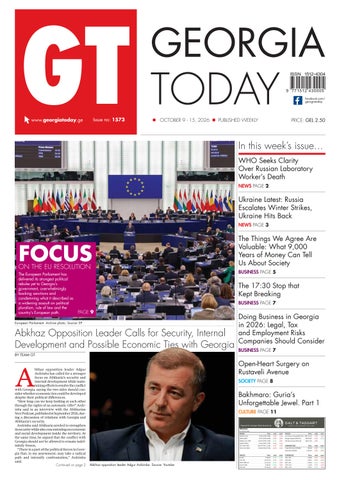
European Parliament. Archive photo. Source: EP
Doing Business in Georgia in 2026: Legal, Tax and Employment Risks Companies Should Consider
Abkhaz Opposition Leader Calls for Security, Internal Development and Possible Economic Ties with Georgia BUSINESS PAGE 7 BY TEAM GT
Open-Heart Surgery on Rustaveli Avenue
A
bkhaz opposition leader Adgur Ardzinba has called for a stronger focus on Abkhazia’s security and internal development while maintaining efforts to resolve the conflict with Georgia, saying the two sides should consider whether economic ties could be developed despite their political differences. “How long can we keep looking at each other through the sights of an automatic rifle?” Ardzinba said in an interview with the Abkhazian Srez Podcast, published in September 2026, during a discussion of relations with Georgia and Abkhazia’s security. Ardzinba said Abkhazia needed to strengthen its security while also concentrating on economic and social development inside the territory. At the same time, he argued that the conflict with Georgia should not be allowed to remain indefinitely frozen. “There is a part of the political forces in Georgia that, in my assessment, may take a radical path and intensify confrontation,” Ardzinba said. Continued on page 2
SOCIETY PAGE 8
Bakhmaro: Guria’s Unforgettable Jewel. Part 1 CULTURE PAGE 11 Prepared for Georgia Today Business by
DĂƌŬĞƚƐ Ɛ ŽĨ ϬϲͲKĐƚͲϮϬϮϲ
WƌŝĐĞ
ǁͬǁ
ŵͬŵ
^dK <^
WƌŝĐĞ
ǁͬǁ
' KZ' Ϭϭͬϯϭ
ϵϰ͘ϵϲ ;zdD ϲ͘ϰϴйͿ
ͲϬ͕Ϯй
ͲϮ͕ϭй
>ŝŽŶ &ŝŶĂŶĐĞ 'ƌŽƵƉ ; ' K >EͿ ' W ϭϯϯ͘ϮϬ
Ͳϳ͕ϰй
ͲϮ͕Ϯй
'Z /> ϬϲͬϮϴ
KE ^
ϵϲ͘Ϯϭ ;zdD ϲ͘ϰϬйͿ
ͲϬ͕Ϯй
ͲϬ͕ϰй
'ĞŽƌŐŝĂ ĂƉŝƚĂů ; ' K >EͿ
' W ϰϰ͘ϰϬ
Ͳϱ͕ϵй
нϬ͕ϱй
d ĂŶŬ 'ƌŽƵƉ ;d ' >EͿ
' W ϱϭ͘ϬϬ
Ͳϱ͕ϴй
Ͳ
WƌŝĐĞ
ǁͬǁ
ŵͬŵ
' '' ϵ ϭͬϮ W ZW
ϭϬϰ͘ϱϵ ;zdD ϵ͘ϳϬйͿ
нϬ͕ϭй
ͲϬ͕ϱй
^><Z , ϬϵͬϯϬ
ϵϵ͘Ϭϰ ;zdD ϳ͘ϳϵйͿ
ͲϬ͕ϯй
Ͳϭ͕ϭй
d ϴ͘ϴϵϰ W ZW
ϭϬϬ͘ϰϬ ;zdD ϭϮ͘ϱϯйͿ
ͲϬ͕ϭй
ͲϬ͕Ϯй
KDDK /d/ ^
d ϭϬ ϭͬϰ W ZW
ϭϬϱ͘ϴϵ ;zdD ϵ͘ϵϳйͿ
ͲϬ͕Ϯй
Ͳϭ͕ϯй
ƌƵĚĞ Kŝů͕ ƌĞŶƚ ;h^ΨͬďďůͿ 'ŽůĚ ^ƉŽƚ ;h^ΨͬK Ϳ
/E / ^
Abkhaz opposition leader Adgur Ardzinba. Source: Youtube
ŵͬŵ
ϭϬϬ͕ϱϴ
ͲϮ͕Ϭй
нϰ͕ϱй
ϰ ϭϲϰ͕ϭϴ
ͲϬ͕ϰй
Ͳϲ͕Ϭй
WƌŝĐĞ
ǁͬǁ
ŵͬŵ
hZZ E / ^
WƌŝĐĞ
ǁͬǁ
ŵͬŵ
^W ϱϬϬ
ϳ ϴϭϴ͕ϵϯ
нϭ͕ϵй
нϭ͕ϯй
h^ ͬ ' >
Ϯ͕ϲϬϬϬ
ͲϬ͕ϭй
ͲϬ͕ϱй
&d^ ϮϱϬ
Ϯϰ Ϯϭϱ͕ϯϯ
ͲϬ͕ϳй
Ͳϭ͕ϱй
hZ ͬ ' >
Ϯ͕ϵϮϳϱ
ͲϬ͕ϵй
Ͳϯ͕ϱй
ϱϭ ϱϮϭ͕Ϯϴ
нϬ͕ϯй
Ͳϯ͕ϱй
' W ͬ ' >
ϯ͕ϰϱϮϬ
ZƵƐƐĞůů ϮϬϬϬ
Ϯ ϴϯϬ͕ϯϬ
нϬ͕ϴй
Ͳϰ͕ϵй
hZ ͬ h^
ϭ͕ϭϮϱϵ
ͲϬ͕ϳй
Ͳϯ͕ϭй
&d^ ϭϬϬ
Kt :KE ^ ϯϬ
ϭϬ ϱϰϭ͕ϲϵ
ͲϬ͕ϵй
ͲϮ͕ϳй
' W ͬ h^
ϭ͕ϯϮϳϲ
нϬ͕ϯй
нϬ͕ϭй
Ͳϭ͕ϴй
ͲϮ͕ϯй
2
NEWS
GEORGIA TODAY
OCTOBER 9 - 15, 2026
Georgia’s 7% Growth Forecast 2.6 Times Above EU Candidate Average – Kobakhidze BY NANUKA MAGLAKELIDZE
T Daria Shipilova, deceased employee of the Irkutsk Antiplague Research Institute. Source: FB
he World Bank has raised its forecast for Georgia’s economic growth to 7%, Georgian Prime Minister Irakli Kobakhidze said at a government meeting. Kobakhidze said the updated forecast reflects positive trends observed in Georgia’s economy throughout the year. “Previously, in June, a forecast of 5% was published; this has now been raised by 2 percentage points – from 5% to 7% – reflecting the positive trends observed in Georgia’s economy throughout the year. This forecast is 2.6 times higher than the average for other EU candidate countries. “It is also worth noting that, based on World Bank projections, Georgia will record the highest economic growth among all European countries over the
PM Irakli Kobakhidze Source: FB
next three years – 2026, 2027 and 2028. Maintaining this trend is one of our top priorities,” the Prime Minister said. The World Bank has raised its forecast for Georgia’s economic growth in 2026
to 7%, the bank said in its latest economic update. Compared with the World Bank’s previous forecast published in June, Georgia’s economic growth forecast has been raised by 2 percentage points.
WHO Seeks Clarity Over Russian Laboratory New Penitentiary Facility to Open in Rustavi Worker’s Death BY NANUKA MAGLAKELIDZE
BY TEAM GT
T
he World Health Organization is seeking further information from Russian authorities after the death of a laboratory worker in Irkutsk region sparked reports of a possible pneumonic plague infection. Daria Shipilova, 28, an employee of the Irkutsk Antiplague Research Institute, died on October 2 after being hospitalized with severe pneumonia. Russian media and Telegram channels reported that she may have been exposed to plague bacteria in an alleged laboratory accident, but the claim has not been independently confirmed. Russian health authorities have denied that plague was involved. Rospotrebnadzor said Shipilova died from pneumonia of “undetermined etiology” and that no microorganisms linked to her work were detected in her biological samples. The agency also said no laboratory accident involving pathogenic microorganisms had occurred. The WHO said Russian authorities reported that no plague cases had recently been registered in Irkutsk region. An epidemiological investigation was conducted, contacts were tested and monitored, and no high-threat pathogens were detected among them. WHO Director-General Tedros Adha-
nom Ghebreyesus said the organization had requested further information to clarify the cause of Shipilova’s illness and conflicting reports about another employee with pneumonia. “Timely, complete and transparent information sharing” is essential to assess potential public health risks, Tedros said. Reports of precautionary measures have emerged in Irkutsk region, including restrictions at some hospitals and isolation of employees at the antiplague institute. Rospotrebnadzor said a subsequent investigation found no accident at the facility. Georgia is monitoring the situation but says no measures are currently necessary. Health Minister Mikheil Sarjveladze said Georgian health authorities were in contact with the WHO and saw “absolutely no indication” for restrictions or other action. Kazakhstan has taken a more precautionary approach, saying it was monitoring the situation in Irkutsk and introducing additional quarantine controls at border checkpoints. The Health Ministry urged travelers returning from the area to seek medical attention if they develop symptoms. There is currently no confirmed evidence that Shipilova died from plague or that a laboratory accident caused her illness. The WHO said it would remain in contact with Russian authorities as it seeks to establish the facts.
A
new penitentiary facility will open in Rustavi and is expected to start receiving inmates in early 2027. The new facility will have a capacity of 150 inmates. “A new penitentiary facility will open in Rustavi in the coming months, with construction practically completed. As the new facility requires appropriate staffing resources, the relevant staffing positions will be included in next year’s budget. Accordingly, the new facility will be ready to receive inmates at the beginning of 2027,” the Ministry of Justice said.
Photo of a prison. Source: IPN
Georgia Extends Assistance for Ukrainians Until January 2027 BY ANA DUMBADZE
G
eorgia has extended medical services and financial assistance for people displaced from Ukraine by the war until January 1, 2027, according to the government administration. The extension maintains monthly financial assistance of GEL 300 per family for accommodation and GEL 45 per person for Ukrainian citizens and people with permanent residency rights in Ukraine who entered Georgia because
of the war. Medical services will continue to be available to Ukrainian citizens who arrived in Georgia because of the hostilities and have remained in the country continuously. Travel abroad for up to three days will not interrupt their continuous-stay status. The government administration said Prime Minister Irakli Kobakhidze is signing the relevant decrees. The Health Ministry will provide medical care through state healthcare programs, including immunization; treatment and medication for tuberculosis and HIV/AIDS; maternal and child healthcare, including antenatal care and
newborn screening; mental healthcare; diabetes treatment and medication; dialysis; and care for people with rare diseases or those requiring ongoing replacement therapy. Emergency medical services, including childbirth and emergency immunization, will also be covered through the state referral program. The Social Service Agency will administer the financial assistance. The GEL 45 payment will end from the month following a recipient’s departure from Georgia. The GEL 300 accommodation allowance will similarly stop from the following month if all members of a recipient family leave the country.
Abkhaz Opposition Leader Calls for Security, Internal Development and Possible Economic Ties with Georgia Continued from page 1 He added, however, that there were also many “reasonable people” in Georgia. “Ultimately, who wants war? In the end, Georgians must also understand – how long can we keep looking at each other through the sights of an automatic rifle?” he said. Discussing relations with Tbilisi, Ardzinba said the sides needed to acknowledge the political reality that had emerged since the 1992–93 war and work toward resolving the conflict. He argued that the current generation of leaders in Georgia and Abkhazia had a responsibility to prevent the dispute from being inherited by future generations.
“If we cannot reach an agreement ourselves, we will simply remain instruments in the confrontation between major powers,” Ardzinba said. His comments come against the backdrop of the unresolved status of Abkhazia, a breakaway region on Georgia’s Black Sea coast. Abkhazia declared independence following the war of the early 1990s, but its independence is recognized by only a small number of countries. Georgia and most of the international community regard the territory as part of Georgia. Russia has maintained a substantial military and political presence in Abkhazia since the 1990s and formally recognized the territory as an independent state following the 2008 Russia-Georgia
war. Moscow has since deepened its political, economic and security ties with the region. Tbilisi and Sokhumi have no formal diplomatic relations, and the unresolved conflict remains one of Georgia’s principal security challenges. International efforts to address the dispute have continued through the Geneva International Discussions, although a comprehensive political settlement has remained elusive. Against this background, Ardzinba also raised the possibility of expanding economic links with Georgia. He said economic transit and trade could potentially be developed, but argued that any such cooperation would have to be based on an equal and trans-
parent partnership. The remarks suggest that, alongside the longstanding political and security dispute, Ardzinba sees scope for limited practical cooperation that could benefit both sides. At the same time, he stressed that economic engagement should not be interpreted as a rejection of Abkhazia’s political position. “No one in Abkhazia intends to abandon the idea of the existence of an independent state,” Ardzinba said. Ardzinba, who has emerged as one of the prominent figures in Abkhaz opposition politics, has previously criticized aspects of the region’s political and economic dependence on Russia while calling for greater attention to domes-
tic development. His latest comments combine calls for maintaining Abkhazia’s security and political status with an argument for reducing the risk of renewed confrontation and exploring limited economic contacts with Georgia. The remarks do not represent a change in the formal positions of either Tbilisi or Sokhumi, nor do they signal the resumption of direct political negotiations. But they highlight an argument increasingly present in discussions surrounding the conflict: that maintaining opposing positions on the status of Abkhazia does not necessarily preclude practical cooperation or efforts to prevent the dispute from becoming a permanent source of confrontation.
NEWS
GEORGIA TODAY OCTOBER 9 - 15, 2026
3
Ukraine Latest: Russia Escalates Winter Strikes, Ukraine Hits Back COMPILED BY ANA DUMBADZE
R
ussia intensified its campaign against Ukraine this week, combining continued pressure along the eastern front with a growing wave of missile and drone attacks on energy, transport and civilian infrastructure. Ukraine, meanwhile, mounted localized counterattacks and expanded its campaign against Russia’s oil and gas industry. The result was another week in which the war extended far beyond the front line. While fighting remained concentrated in Donetsk region, the most dramatic developments came from longrange attacks against infrastructure in both countries. The heaviest ground fighting remained around Pokrovsk and Kostiantynivka in Donetsk region, where Russian forces are seeking to improve their positions and threaten Ukraine’s remaining defensive belt. Ukrainian military reports recorded more than 170 combat engagements on several days. Russia launched repeated attacks around both cities, but independent battlefield assessments found no major breakthrough during the week. The area around Dobropillia also remained contested. Russian forces continued attacks west of Pokrovsk, although the Institute for the Study of War found no confirmed territorial gains there early in the reporting period. Ukraine, meanwhile, increased its counterattacks around Kostiantynivka, including reported operations toward Rusyn Yar. Farther north, Ukraine reported more significant gains around Lyman. President Volodymyr Zelensky said Ukrain-
ian forces had retaken 176 square kilometers during their counteroffensive, aimed at pushing Russian forces away from approaches to Sloviansk and Kramatorsk. Recent Ukrainian gains north and northeast of Lyman have also begun to affect Russian operations toward Borova. Elsewhere, Russia maintained pressure around Kupiansk and in northern Sumy region without achieving a major breakthrough. Ukrainian forces also reported gains near Vovchansk in Kharkiv region and maintained positions east of Orikhiv in Zaporizhzhia. Overall, the ground war produced localized changes rather than a decisive shift. Russia retained the initiative around Pokrovsk and Kostiantynivka, but Ukrainian counterattacks increasingly complicated Moscow’s efforts to advance elsewhere. The more significant escalation came from the air. Russia appears to be entering another winter campaign against Ukraine’s energy system, reviving a strategy that has repeatedly left the country facing power shortages during the colder months. Recent attacks have also targeted bridges, communications networks, transport infrastructure and urban areas. The reporting period began after one of the heaviest combined attacks on Ukrainian energy infrastructure in months. Power facilities were damaged around Kyiv and across several regions, killing seven people, including a child. Emergency electricity restrictions were introduced as authorities assessed the damage. Kyiv itself came under repeated attack. Russian forces struck the Northern and Southern bridges across the Dnipro seven times between October 1 and 4. A drone
also hit a school, although no casualties were reported. Another strike damaged the Northern Bridge and temporarily halted traffic. The attacks continued elsewhere. A Russian strike on a civilian cargo vessel in Odesa region killed one sailor and wounded three others, while attacks in Kharkiv also caused casualties. On October 5, a Russian guided bomb struck a residential building in Kharkiv, killing five people and injuring 59, according to regional authorities. Russia’s drone campaign remained intense. Zelensky said Moscow had launched more than 1,900 strike drones, along with about 1,700 aerial bombs and 25 missiles during the week ending October 4. The most devastating attack came overnight into October 7. Russia launched 70 missiles, many of them ballistic weapons, alongside dozens of Shahed drones. At least 24 people were killed. Eighteen, including four children, died when a missile destroyed a five-story residential building in Pryluky, in Chernihiv region. Six more people were killed in Kyiv, Oleksandria and Kremenchuk, while 55 people were wounded in Pryluky alone. Industrial, transport and energy facilities were also damaged. The attack again exposed Ukraine’s limited ability to defend against Russia’s ballistic missile arsenal.
UKRAINE TARGETS RUSSIA'S ENERGY SECTOR Ukraine responded by taking its own long-range campaign deeper into Russia, with energy infrastructure increasingly in its sights. Ukrainian strikes hit oil facilities in Samara and Volgograd regions on Octo-
ber 2. Kyiv later said a Samara oil pipeline control station had suffered extensive damage to storage tanks, pipelines and loading infrastructure. A separate October 4 strike damaged processing equipment at the Astrakhan gas-processing plant, which produces technical sulfur used in industrial applications, including explosives and gunpowder production. Ukraine said its attacks had disabled more than half of Russia’s oil-refining capacity. That figure cannot be independently verified, but satellite imagery has confirmed significant damage at several facilities, while disruptions to Russian fuel production and exports have increased. Ukrainian drones also struck energy facilities in Moscow, Perm, Samara and Astrakhan regions. An October 3 attack on the Khanskaya air base in Adygea was assessed to have destroyed two Russian combat aircraft, a Su-34 and a Su-35. The campaign is intended not simply to damage individual facilities but to raise the economic cost of Russia’s war by targeting an energy sector central to Moscow’s finances and military logistics.
WESTERN SUPPORT CONTINUES The escalation was accompanied by further Western assistance. German Chancellor Friedrich Merz visited Kyiv on October 4 and announced €1 billion in additional military assistance and €350 million for repairs to Ukraine’s energy infrastructure. Germany and Ukraine also expanded cooperation on air defense, radar systems and drone interceptors. On October 7, the European Commission disbursed €1.24 billion under the defense component of the EU’s €90 bil-
lion Ukraine support loan. The money will help finance Ukrainian-produced drones, interceptor drones, ammunition and missiles. The EU and Ukraine also said they had identified sufficient resources to cover Ukraine’s budgetary and defense needs for 2026, although longer-term financing remains partly tied to reform commitments. Diplomatic activity remained limited compared with the pace of military escalation. Kyiv agreed to a US proposal for trilateral technical talks involving Ukraine, Russia and the United States in the United Arab Emirates. Zelensky said Ukraine was prepared to participate, but there was little indication that the initiative was close to producing a ceasefire or wider settlement. Germany likewise concluded after recent contacts with Moscow that Russia showed little willingness to negotiate seriously. Britain imposed 31 new sanctions targeting Russian energy revenues, disinformation networks and individuals accused of abuses against Ukrainian civilians and children. For now, the war remains defined more by escalation than diplomacy. Russia is seeking to wear down Ukraine through pressure on the front and attacks on critical infrastructure, while Ukraine is increasingly taking the fight deep into Russia in an effort to disrupt the energy revenues and military infrastructure sustaining Moscow’s war effort. Neither side achieved a decisive breakthrough this week. But the widening reach of the conflict, from Ukraine’s power grid to Russia’s refineries and Black Sea shipping, shows a war whose consequences are increasingly being felt far beyond the front line.
4
POLITICS
GEORGIA TODAY
OCTOBER 9 - 15, 2026
European Parliament Escalates Pressure on Georgia with Sanctions Call BY TEAM GT
T
he European Parliament has delivered its strongest political rebuke yet to Georgia’s government, overwhelmingly backing sanctions and condemning what it described as a widening assault on political pluralism, rule of law and the country’s European path. MEPs on Thursday adopted a resolution condemning Georgian Dream’s efforts to ban opposition parties and calling on the European Union and its member states to impose targeted sanctions and visa bans on senior Georgian officials. The resolution passed by 445 votes to 37, with 97 abstentions. The text demands the immediate withdrawal of the constitutional lawsuit seeking to outlaw opposition parties and warns that Georgia’s democratic situation is continuing to deteriorate, citing setbacks in democracy, media freedom, human rights and the rule of law. It specifically calls for sanctions against Georgian Dream honorary chairman Bidzina Ivanishvili, Prime Minister Irakli Kobakhidze, Parliament Speaker Shalva Papuashvili and Tbilisi Mayor Kakha Kaladze. The Parliament said Georgian Dream’s actions were increasingly incompatible with Georgia’s international obligations, including the Copenhagen criteria governing EU membership. It described the proceedings against opposition parties as part of a broader attempt to eliminate political pluralism and establish a one-party system, drawing comparisons with Russia and Belarus. According to the resolution, such a development would serve the Kremlin’s objective of keeping Georgia outside the European and Euro-Atlantic space. The Georgian Dream-controlled parliament filed the constitutional lawsuit in November 2025 seeking to ban the United National Movement, Coalition for Change and Strong Georgia–Lelo. The Federalists were subsequently added to the case, followed in September 2026 by For Georgia, the only opposition party still represented in parliament. MEPs said a functioning political opposition was an indispensable element of democracy and argued that eliminating legitimate political opponents through the courts was incompatible with democratic governance. They also said the inclusion of For Georgia undermined the authorities’ earlier argument that the proceedings concerned only parties that had boycotted parliament.
European Parliament building. Source: institudelors
The resolution also raised concerns about the independence of Constitutional Court judges appointed in September 2026. It called for the immediate and unconditional release of people it identified as political prisoners, including Elene Khoshtaria, Mzia Amaghlobeli, Mikheil Saakashvili, Giorgi Baramidze and Nika Melia, as well as people detained for peaceful protest. It also called for politically motivated “sabotage” charges to be dropped. The Parliament condemned what it described as the misuse of legislation and state institutions to silence political opponents and urged the repeal of provisions allowing disproportionate restrictions on parties and individuals associated with banned political organizations. The resolution also criticized pressure on European political foundations operating in Georgia. It noted that the Konrad Adenauer Foundation and the Friedrich Naumann Foundation were forced to close their Tbilisi offices in September after authorities rejected their project funding applications under the Law on Grants. The Parliament criticized what it described as the failure of the EU and most member states to impose tangible consequences for Georgia’s deteriorat-
ing situation and reiterated calls for measures against those responsible for democratic backsliding, violent repression and political persecution.
CALLS FOR STRONGER EUROPEAN ACTION The vote followed a sharply critical debate in the Parliament, during which European lawmakers and Commission officials urged a tougher response from Brussels. David McAllister, chair of the European Parliament’s Foreign Affairs Committee, said the attempt to ban major opposition parties represented another drastic step toward authoritarianism. He cited the European Commission’s assessment that Georgia was an EU candidate country “in name only” and said the latest actions reinforced that judgment. McAllister also criticized the closure of the two German political foundations in Tbilisi, saying new regulations had given the state extensive control over international funding and could expose organizations to criminal prosecution. European Commissioner Jessika Roswall described the situation in Georgia as a “systematic attack” on state institutions, fundamental rights, political pluralism and the rule of law. She said the constitutional case against
opposition parties was part of a wider pattern of democratic deterioration and warned that such actions undermined Georgia’s EU accession prospects. Roswall said the scale of democratic backsliding was unprecedented for an EU candidate country. She accused the government of weakening the rule of law and shrinking civic space rather than implementing reforms, while also criticizing what she described as anti-EU rhetoric and disinformation. The EU has already downgraded political contacts with the Georgian government, suspended meetings under the Association Agreement and halted some forms of support that directly benefit the authorities. It has also suspended visa-free travel for holders of Georgian diplomatic, service and official passports. At the same time, Roswall said the EU remained committed to supporting Georgian civil society and the Georgian people. She called on the government to repeal what she described as anti-democratic legislation, release unlawfully detained opposition members and engage in genuine dialogue with political opponents. Lithuanian MEP Dainius Žalimas said Europe’s response to the consolidation of authoritarianism in Georgia had so far been inadequate compared with measures taken by the United States, Britain and individual EU member states. He called for targeted sanctions and visa bans against those responsible for repression, including judges involved in politically motivated prosecutions. He also urged the EU to make engagement with the Georgian government conditional on concrete steps to restore judicial independence and political pluralism. Žalimas called for restrictions on the transfer of police equipment that could be used for repression and greater direct European support for independent media, political parties and civil society. Polish MEP Małgorzata Gosiewska accused Ivanishvili of seeking to establish an oligarchic system and called for sanctions against him and others involved in what she described as political repression. She also demanded the immediate and unconditional release of Saakashvili and others she described as political prisoners. German MEP Tobias Cremer said Georgian Dream was attempting to establish a Soviet-style one-party state, citing the prosecution of opposition figures, detention of journalists and the use of force against protesters. He called for sanctions against Ivanishvili and continued European support for Georgians seeking closer ties with the EU.
A DISSENTING VOICE Not all MEPs supported the Parliament’s approach. German MEP Tomas Frohnmaier of the Alternative for Germany party accused European governments of applying “selective morality” to Georgia and argued that the country should be viewed as a strategic partner and bridge to Asia. Frohnmaier cited Georgia’s economic growth and international rule-of-law rankings and argued that European criticism was partly driven by disagreements over Georgia’s social policies, its Christian identity and its refusal to become directly involved in the RussiaUkraine war. He said Georgia’s position between Russia, Iran and Turkey meant that Europe needed to take its geopolitical circumstances into account.
GEORGIA'S EUROPEAN PATH UNDER SCRUTINY The resolution comes as the European Commission prepares its latest assessment of Georgia’s progress toward EU membership. EU Commissioner for Enlargement Marta Kos said Georgia was currently an EU candidate country only “on paper” and that developments in the country, including the attempted opposition bans, would be reflected in the Commission’s enlargement report expected at the end of October. Kos said Georgia’s record would be assessed alongside its broader progress on democratic reforms and its stalled accession process. She noted that Montenegro, Albania, Moldova and Ukraine currently represented the leading group of EU candidate countries. The Commission’s latest communication on preparing for a wider European Union, published on October 6, did not mention Georgia. The European Parliament’s vote now puts the issue of consequences at the centre of the dispute. While the resolution is not itself a binding sanctions decision, it sends a strong political signal to EU member states to consider targeted measures against senior Georgian officials. The vote also deepens the divide between Tbilisi and Brussels at a time when Georgia’s declared ambition of joining the European Union is increasingly at odds with the policies of its government. For the EU, the next question is whether member states will translate Parliament’s demands into concrete measures. For Georgia, the dispute is likely to further test whether its European aspirations can be reconciled with the political course pursued by Georgian Dream.
Jioev – South Ossetia Sees Pashinyan Calls Armenia ‘Promised Land’ as Government Weighs Church Taxes No Prospect for Bilateral Talks with Georgia BY ANA DUMBADZE
BY NANUKA MAGLAKELIDZE
A
S
outh Ossetia sees no prospect for bilateral negotiations with Georgia in the near future, Akhsar Jioev, the acting “foreign minister” of the occupied Tskhinvali region, told Russian media. “We do not currently see any prerequisites for launching bilateral negotiations on equal terms between South Ossetia and Georgia in the near future on Georgia’s part,” Jioev said. He added that Tbilisi’s rhetoric “echoes the slogans of the GamsakhurdiaSaakashvili era” and said Georgia was “not yet ready to engage with us on the
Akhsar Jioev. Source: FB
basis of equality.” Jioev said there were grounds for optimism about a potential compromise as long as regular meetings continue, adding that the process requires “firm political will and a readiness for constructive dialogue from all participating parties.”
rmenian Prime Minister Nikol Pashinyan described Armenia within its internationally recognized borders as a God-given “promised land” at the country’s second Prayer Breakfast on October 3, as his government considers changes to the Armenian Apostolic Church’s tax arrangements. Addressing officials, diplomats, business leaders and religious representatives in Yerevan, Pashinyan linked his “Real Armenia” concept to the country’s Christian heritage. “Today’s Republic of Armenia is our Promised Land,” he said, according to a transcript published by his office.
He pointed to religious and cultural landmarks within Armenia’s borders, including the burial place of Mesrop Mashtots in Oshakan, Khor Virap monastery and the church’s spiritual center in Etchmiadzin. Pashinyan also described the gathering as a space for people of different faiths to discuss their beliefs and find common ground. Separately, Finance Minister Vahe Hovhannisyan said the government was discussing a proposal to collect taxes from the church and return the money to support its programs and activities. “The church should pay taxes like everyone else,” he told BOON TV in an interview reported by CivilNet. Hovhannisyan said the purpose was not to increase state revenue. He added that funding could exceed the church’s tax payments if it undertook projects considered strategically important to
the state and society. The details remain under discussion with lawmakers, and no implementation date has been announced. The church currently benefits from specific tax exemptions, including those covering certain religious services and items used in religious rites, rather than a blanket exemption from taxation. The proposals come during a prolonged dispute between Pashinyan’s government and the church leadership. The prime minister has repeatedly called for Catholicos Karekin II to step down. Church representatives have accused the authorities of obstructing their activities. Following a September meeting, the Supreme Spiritual Council said restrictions affecting pastoral, educational and charitable programs were damaging the church’s work and national interests.
BUSINESS
GEORGIA TODAY OCTOBER 9 - 15, 2026
5
The Things We Agree Are Valuable: What 9,000 Years of Money Can Tell Us About Society BY IVAN NECHAEV
W
e tend to think of money as one of the most stable things in human life. A banknote, a coin, a number in a bank account: whatever its form, money appears to belong to the realm of calculation. It is supposed to make value measurable, transferable, and, above all, impersonal. But money was not born abstract. Long before coins and banknotes, people paid with things that could be held, worn, broken, weighed, displayed, hidden, inherited, or fought over. Shells, rings, salt, metal objects and countless other materials could become instruments of exchange. Their monetary function was inseparable from their physical properties and from the societies that recognized those properties as valuable. The Alex Schütz Collection approaches this forgotten history through 2,210 pre-monetary payment objects from 40 countries, spanning roughly 9,000 years of monetary history. The collection is the subject of ASC | Object. Power. Culture., a publication by Sonja Schromm and Alex Schütz that considers these objects not simply as curiosities from an economic past, but as evidence of how human societies have constructed value. This distinction matters. The history of money is usually told as a story of progress: barter gives way to money, coins give way to paper, paper gives way to electronic transactions, and eventually money becomes almost invisible. The narrative is convenient because it makes the present look inevitable. Material culture tells a more complicated story. There was never one universal definition of what money should be. A shell could carry value. So could a ring. Salt could become a means of payment. The object did not possess an intrinsic monetary quality that somehow announced itself to human beings. It became money because a community developed a system of recognition around it. The material mattered, but so did agreement, scarcity, memory, social status, ritual and power. An economic transaction was therefore often also a social act. What appears from a modern perspective to be a simple exchange could be connected to marriage, status, obligation, political authority or religious practice. The object moving between two people could carry several meanings at once. Modern money has spent centuries separating these meanings. The more sophisticated a monetary system becomes, the less it tells us about the person using it. A €100 note does not reveal whether it was earned, inherited, borrowed, gifted or paid as part of an obligation. Its great advantage is precisely its neutrality. Earlier forms of value were rarely so neutral. This makes the objects in the Alex Schütz Collection particularly interesting as cultural artifacts. Their materiality was part of their meaning. A shell was a shell; a metal ring was a ring; a salt bar was salt. Their physical form could communicate scarcity, labor, origin, durability, beauty or social significance. To possess the object could mean possessing something immediately legible to other people. Economic life was therefore also a visual and material culture. This is one reason the boundary between money and art is historically unstable. Objects that functioned as payment could also be beautiful. Objects of prestige could circulate economically. Jewelry could store wealth. Ornament could communicate rank. A valuable material could simultaneously be an aesthetic object and an economic instrument. The modern museum tends to separate these categories, placing decorative arts, economic history, religious objects and ethnographic material into different institutional compartments. The people who originally made and used such things did not necessarily experience those distinctions. The deeper question raised by the collection is therefore not simply what was used as money, but why people agreed that it was money. Economics traditionally approaches money through its functions: medium of exchange, unit of account, store of value. Anthropology asks a prior question: what
Alex Schütz. Source: DiePresse
kinds of social relationships make exchange possible in the first place? A monetary object works because other people recognize it. That recognition may come from scarcity, beauty, ritual authority, political power or tradition. It may depend simply on the fact that everyone in a particular community knows that everyone else will accept the same object tomorrow. In this sense, money is one of the oldest technologies of collective trust. This makes the distance between a shell used in an early exchange system and a modern digital balance less absolute than it first appears. The technologies are radically different, but both depend upon a social agreement that something with a particular form—or increasingly, no physical form at all—can stand for value. The shell and the bank balance occupy opposite ends of monetary history, but they share a fundamental problem: recognition. There is also a political dimension to this history. Money is often presented as neutral infrastructure, the plumbing through which economic life flows, but every monetary system distributes power. Someone decides what counts as valuable, what can be exchanged, who may participate, and under what conditions. A currency can create access while also reinforcing hierarchy. It can facilitate exchange while turning a social relationship into a measurable obligation. It can make wealth portable and therefore make power portable. Studying pre-monetary objects is consequently not merely antiquarian. It can illuminate questions that remain contemporary: who defines value, who benefits when one form of value replaces another, and what happens when a community’s system of exchange encounters an external currency? These questions are especially relevant as contemporary money becomes increasingly dematerialized. Cash is declining in many economies, payments are increasingly digital, and assets can exist almost entirely as entries in databases. The further money moves from physical objects, the easier it becomes to forget that money has always been a cultural invention. A collection of 2,210 objects from 40 countries makes that history visible again, not as a single evolutionary path toward modern finance but as a series of different solutions to the same human problem: how to establish, communicate and transfer value. This is where the title Object. Power. Culture. becomes useful. A collection of this kind could easily become a cabinet of curiosities, an accumulation of unusual objects whose exotic appearance becomes the main attraction. The more productive
approach is to treat each object as evidence of a particular social system. The object is only the starting point; its real subject is the society around it. There is a paradox here for contemporary culture. The more efficient money becomes, the less we perceive it as a cultural object. A digital transaction is faster than exchanging a shell, weighing metal or handing over a physical token. Modern finance has eliminated enormous amounts of friction, and that is precisely what makes it powerful. But physical objects have qualities that digital money cannot reproduce in quite the same way. They have weight and material history. They can be damaged, displayed, inherited, associated with a particular place or person. They can become evidence of relationships that existed before us. The history represented by the Alex Schütz Collection therefore raises a question that extends well beyond the history of currency: what happens to our understanding of value when value itself becomes increasingly invisible? We have become extremely sophisticated at measuring price, but price and value have never been synonymous. The objects collected by Alex Schütz belong to societies that answered the problem differently. They remind us that value can be material, social, political, religious and aesthetic at the same time, and that money is one of the systems through which those different forms of value become transferable. Before money became a number on a screen, it was something people could hold in their hands. That physical history is not simply a prelude to modern finance. It is part of the history of how societies decide what matters.
6
BUSINESS
GEORGIA TODAY
OCTOBER 9 - 15, 2026
The 17:30 Stop that Kept Breaking BLOG BY DAN KABAKOV
T
his summer I gave myself one work rule. My workday ends at 17:30, five days a week. It broke three weeks in a row. I run Online Labs from Tbilisi. It’s a small Google Ads consultancy for e-commerce brands in the US and Europe. Five years ago, I handled 40 accounts on 12to 14-hour days. Focusing on fewer accounts worked better. These days, I cap myself at six clients I manage personally. I expected a clean stop at 17:30 to be the easy part.
WHAT ACTUALLY BROKE IT I assumed the problem would be me. One more email, one more report. Some of it was. The work itself has also grown. I track my time per client. Managing the same account takes almost twice as long as it did three years ago. Ad platforms now change things on their own, and someone has to check every change. My fees didn’t double. Still, evening calls did most of the damage. When a client is eight or more hours
work never does.
behind, their morning is my evening. A 19:00 call in Tbilisi is a morning meeting in New York. Their working day starts right as mine is supposed to end. Nobody on the other side is doing anything wrong. The worst part was the half hour before the call. I’d see a small gap and fit in one more task. That task would run long. I’d go straight from it into the call. By the time I closed the laptop, 17:30 was hours behind me. I also looked hard at one week of my own days. Past about six and a half hours of task work, my output got worse. One 10-hour day cost me most of the next one.
THEIR TIME ZONE, NOT MINE One small habit changed how those evening calls feel. I give every meeting time in the client’s time zone. I don’t convert it, and I don’t explain the gap. A line like “I’m 11 hours ahead of you” sounds considerate. To the client, it reads like an apology for being far away. They only need a time that fits their own calendar.
WHERE IT STANDS I still don’t keep it perfectly. On a normal day, I close somewhere between 17:00 and 18:00. That’s later than the rule says. What the rewrite gave me is a clear line between two kinds of late. A planned call on one of my two evenings is part of the job. An extra task at 17:40 is the old habit coming back. If you work from Tbilisi for clients further west, look at your evenings first. That’s where the time difference lands. Decide how many evenings you’ll give away each week. Write that number down before a client asks for one.
WHAT I CHANGED In August, I rewrote the rule instead of dropping it. Task work still ends at 17:30. Client calls are the one exception, and they’re capped at two evenings a week. They go in the calendar ahead of time. Nothing gets stacked in front of an evening call. When the call ends, the laptop shuts. I also cap planned task work at about six and a half hours a day. On a day with an evening call, the ceiling is five. Fridays became light days. One or two hours of work at most, then I stop. Whatever is left moves to the following week. When a week is still too full, my own marketing gets cut first. Client
Dan Kabakov is a Google Ads specialist and Google Partner based in Tbilisi. He runs Online Labs. He also wrote Fix Then Scale - Google Ads guide for e-commerce.
Dan Kabakov. Photo by the author
Europe and Central Asia: Slower Growth with Global Headwinds SOURCE: WORLD BANK
W Georgian Exporters Discuss Plan to Expand EU Agri-food Exports BY ANA DUMBADZE
E
xporters, producers, farmers and public officials met on October 6 to discuss a plan to develop Georgian agri-food exports to the European Union
market. The Export Dialogue Platform meeting brought together industry and business associations, state agencies and international partners to review the plan, prepared with support from international experts at the UN Food and Agriculture Organization (FAO).
Participants discussed challenges facing the private sector and possible solutions. Public and private sector representatives also considered how to maintain regular dialogue after the ENPARD IV program ends. The meeting concluded a series of training sessions held in September and October to help participants navigate EU market requirements. Sessions covered the use of the EU’s TRACES system on September 22–24, market entry strategies on September 28–29, and EU trade and food safety requirements on October 1–2. The platform and training sessions are supported by the European Union and Sweden under ENPARD IV.
ith higher energy prices, heightened uncertainty, and weaker economic expansion in trading partners, growth in Europe and Central Asia is likely to slow to 2.2% in 2026 from 2.6% in 2025, according to the World Bank’s latest Europe and Central Asia Economic Update: Making AI Work: Jobs, Firms, and Productivity, released today. The slowdown is broad-based, reflecting weakness in most countries in the region. Excluding Russia, which accounts for about 40% of the region’s output, growth is expected to moderate to 3% in 2026 from 3.7% in 2025. Global commodity-market disruptions have had a more limited impact than initially expected. “Developing economies in the region continue to show resilience due to reduced energy intensity, stepped-up government policies, and robust domestic demand,” said Antonella Bassani, World Bank Vice President for Europe and Central Asia. “To increase productivity and help offset a shrinking working-age population, countries can harness the potential of artificial intelligence by strengthening foundational educational and managerial skills, while preparing labor market and social protection institutions for this disruptive change.” Favorable labor-market conditions, rising real wages, remittances, tourist arrivals, and public investment have helped support economic growth. Temporary government relief measures have partly contained the impact of higher energy costs on households and firms, although in some countries they have added to fiscal pressures. Central Asia remains the fastest-growing subregion, and is estimated to expand by 5.8% in 2026, with growth projected at 9.6% in the Kyrgyz Republic and 7.9% in Uzbekistan. Growth in the Western Balkans is likely to strengthen to 3.1% in 2026 from 2.6% in 2025, while Poland stands out in Central Europe with growth holding at 3.6%. Ukraine’s growth is expected to slow to 1.2% amid intensified damage to critical infrastructure and disruptions to exports.
Higher energy prices have kept inflation elevated, while sluggish growth in the European Union and rising competition from other countries are weighing on exports and industrial activity, particularly in the region’s automotive supply chains. Further disruptions to trade and continued hostilities in Ukraine, additional increases in energy, transport and fertilizer costs, tighter global financing conditions, weaker growth in key trading partners and extreme weather events remain key downside risks. In a special focus on artificial intelligence, the report finds that AI is arriving faster than the region can currently absorb it. About one in five workers – predominantly well-educated and young – hold jobs meaningfully exposed to AI. Fewer than one in 10 firms currently use AI, mostly for basic tasks. The region has many prerequisites for AI, including nearly universal mobile coverage, favorable energy costs, and strong technical talent. However, the report notes that adoption is hindered
Source: World Bank
by a lack of foundational educational and managerial skills, integrated and interoperable data, and computing capacity. “While the private sector needs to be the principal engine of adoption, adaptation, and innovation, readying the workforce for AI gives policymakers a real chance to tackle the jobs challenge and generate growth,” said Ivailo Izvorski, World Bank Chief Economist for Europe and Central Asia. “The main risk over the next decade is likely to be too little adoption and adaptation of AI across the region, not too much.” Beyond making existing industries more efficient, AI could enable new products, services, occupations, and sectors. The two key ingredients to making this a reality are improved skills and much larger inflows of private capital. Governments could help catalyze such inflows by expanding affordable access to computing, thereby creating opportunities for computing-capacity exports provided demand exists.
BUSINESS
GEORGIA TODAY OCTOBER 9 - 15, 2026
7
Doing Business in Georgia in 2026: Legal, Tax and Employment Risks Companies Should Consider agricultural land is subject to a separate statutory ownership regime. The key question before an investment is therefore not simply "Who owns the property?" It is "Can the investor acquire, develop and use this asset in the way the business plan assumes?"
5. THE BIGGEST RISKS USUALLY SIT BETWEEN LEGAL DISCIPLINES
Marina Phiduashvili
Giorgi Zhuzhunashvili
BY TEAM GT
G
eorgia is still relatively easy to enter as a foreign investor. A company can be incorporated quickly, foreign investors generally enjoy the same legal guarantees as Georgian investors, and the tax system remains comparatively straightforward. But in 2026, easy entry should not be confused with low compliance. For a foreign company entering Georgia today, incorporation is usually the simplest part of the project. The more important questions come immediately afterward: How should ownership and management be structured? Where will taxes arise? Can foreign managers and employees legally work in Georgia? What should be checked before acquiring property? And how should all these decisions fit together? We asked specialists from JUST Advisors to identify the issues foreign businesses most often need to address before they become problems.
1. COMPANY REGISTRATION IS NOT THE SAME AS BUSINESS STRUCTURING Corporate perspective: Marina Piduashvili, Partner, Director and Head of Corporate Law at JUST Advisors Georgian corporate law gives investors considerable flexibility. An LLC or jointstock company may have a single shareholder, and shareholders may be natural or legal persons. Foreign investors are generally entitled to legal protection no less favorable than that available to Georgian individuals and companies, subject to statutory exceptions. This flexibility makes it tempting to treat incorporation as a technical exercise: register an LLC, appoint a director, open a bank account and start operating. For a serious business, that approach is often too narrow. Before registration, investors should decide who will own the company, who will control day-to-day management, which decisions require shareholder approval, how additional financing will be provided, what happens if partners disagree, and how a shareholder may enter or exit the project. The standard incorporation documents
The key question is "Can the investor acquire, develop and use this asset in the way the business plan assumes?" may be sufficient to create a company. They are not necessarily sufficient to regulate a complex relationship between investors. The business model also needs to be checked for sector-specific restrictions, licenses and permits. A particularly important example is agricultural land. Georgian law imposes special restrictions where agricultural land is acquired by a foreigner or by a Georgian company whose dominant shareholder is foreign. In certain cases, acquisition by such a company is possible only on the basis of an investment plan and a Government decision. The practical rule is simple: first design the business, then register the legal entity that fits it.
2. THE GEORGIAN TAX SYSTEM IS SIMPLE ONLY UNTIL THE FIRST CROSSBORDER TRANSACTION Tax perspective: Giorgi Zhuzhunashvili, Partner, Attorney and Tax Law Specialist at JUST Advisors The headline Georgian tax rates are easy to remember. For most companies, corporate profit tax is 15 percent. Under the Georgian model, taxation is generally linked to the distribution of profit and certain payments treated as distributions, rather than simply to accounting profit earned during the year. Dividends paid by a Georgian resident company to an individual or a nonresident enterprise are generally subject to 5 percent withholding tax. The standard personal income tax rate is 20 percent.
Sopho Khizanishvili
Shalva Giorgadze
VAT is 18 percent. Mandatory VAT registration generally arises when taxable supplies exceed GEL 100,000 during any continuous 12-calendar-month period. These numbers, however, do not answer the questions that usually create tax risk for an international business. What happens when the Georgian company purchases management, IT, advertising or consulting services from its foreign parent or another nonresident? Does reverse-charge VAT arise? Is a payment to a foreign contractor subject to withholding tax? Is the service deemed supplied in Georgia? Does a double tax treaty apply? Is the Georgian company really paying for services, or is part of the transaction economically a distribution of profit? A Georgian company therefore needs its own tax analysis and accounting process. Simply reproducing the accounting model used by the headquarters abroad is not enough. This is particularly important for groups that operate through intercompany agreements, foreign contractors, management fees or shared-service arrangements. The tax risk rarely lies in the 15 or 18 percent rate itself. It lies in incorrectly classifying the transaction to which that rate should, or should not, apply.
another planning layer. If an employer intends to employ more than five foreign citizens during a calendar year, or foreign employees exceed the prescribed 5 percent workforce threshold, the employer must, in relevant cases, coordinate an annual quota before filing individual work-right applications. The rules also link the process to minimum turnover criteria, generally GEL 50,000 per foreign applicant, with a lower GEL 35,000 threshold for educational and medical institutions. Companies with foreign employees who had active registration status on March 1, 2026, should also review the transitional regime. Those employees must obtain the required right to work and corresponding residence status by January 1, 2027. Noncompliance is no longer merely an HR paperwork issue. Employment without the required right to work can result in a GEL 2,000 fine for the employer for each foreign employee and a separate GEL 2,000 fine for the employee. Repeat violations carry increased penalties. For employers, the lesson is to include immigration compliance in workforce planning before a foreign employee starts work, not after payroll has already begun.
3. HIRING A FOREIGN EMPLOYEE BECAME A SEPARATE COMPLIANCE PROJECT IN 2026 Labor migration perspective: Sofo Khizanishvili, Head of Migration at JUST Advisors This is one of the most important changes for foreign businesses in Georgia. Since March 1, 2026, most foreign nationals working for a Georgian employer are subject to a permit-based labor migration regime. As a general rule, lawful employment requires a written employment contract, the foreign national's right to perform labor activity, and the relevant residence status or D1 immigration visa, unless a statutory exception applies. The right to work is issued for employment with a specific local employer. The employer applies after the employment contract has been concluded. The general statutory review period is up to 30 calendar days. The July 2026 amendments added
Consider a typical foreign investment project. An international group establishes a Georgian LLC, appoints foreign managers, hires several foreign specialists, leases an office, purchases a warehouse, receives services from its parent company and starts invoicing Georgian and international clients. That is not one legal task. The corporate structure affects taxation. Employment decisions affect migration status and payroll. The number of foreign employees can affect the workpermit process. The property selected for operations may create title, land-use or permitting issues. Payments to a foreign group company may create Georgian VAT or withholding consequences. This is why the safest approach is to review the project as one system. Corporate, tax, accounting, employment, migration and property specialists should be working from the same business model and the same set of facts. Otherwise, a solution that works perfectly in one area can create a problem in another. For companies entering Georgia in 2026, this is perhaps the most important practical conclusion: the real advantage is not registering quickly. It is structuring correctly before the first contract, employee, tax return or investment makes the structure expensive to change.
ABOUT THE EXPERTS JUST Advisors is a Georgia-based legal and accounting firm working with Georgian and foreign-owned businesses and cross-border projects. Its practice combines corporate, tax, accounting, employment, migration, real estate and disputeresolution expertise. For the third consecutive year, JUST Advisors has been recognized as a leader in Georgia's legal and accounting services market by the Swiss Rating Association and the Union of National Business Ratings. The firm has also received the “Permanent Leader” distinction, awarded to companies that maintain leading positions in business rankings for three consecutive years.
4. INVESTMENT DUE DILIGENCE SHOULD LOOK BEYOND THE PUBLIC REGISTRY EXTRACT Property and investment perspective: Shalva Giorgadze, Partner and Head of the Property Relations and Construction Law Department at JUST Advisors A Public Registry extract is essential, but it is not a complete investment due diligence report. Before purchasing real estate or investing in a development project, a buyer should review not only registered ownership and encumbrances, but also the seller's authority, cadastral information, land designation, construction documentation, contractual restrictions and the legal conditions under which the asset can actually be used. JUST Advisors' published guidance on real estate transactions also emphasizes reviewing the contract itself, including payment mechanics, termination rights, seller liability and mechanisms protecting the buyer if the project does not develop as expected. For foreign investors, the category of land deserves particular attention because
For employers, the lesson is to include immigration compliance in workforce planning before a foreign employee starts work, not after payroll has already begun
8
SOCIETY
GEORGIA TODAY
OCTOBER 9 - 15, 2026
Open-Heart Surgery on Rustaveli Avenue BLOG BY NUGZAR B. RUHADZE
R
ustaveli Avenue, the heart of Tbilisi, and Georgia’s most famous and vital, even iconic, thoroughfare, is currently undergoing major excavation work and is completely torn up, and the sincere hope of our citizenry is that the city government keeps its word to finalize the heavy restoration works by the end of November. Blessed are the believers! Above ground, Rustaveli is one of Georgia’s national symbols: theaters, museums, parliament, hotels, malls, sophisticated banks, modern telecommunications, demonstrations, and political history; below ground, however, one finds decades of accumulated municipal infrastructure problems. Therefore, the ongoing subterranean job of this magnitude is a substantial engineering, financial and administrative undertaking, but the full avenue project should be much broader. Yes, this is much more than a plain re-emergence of the celebrated street. The project covers roughly two kilometers, and its works include the replacement of the ancient, dilapidated drinkingwater network; replacement of rusty and broken sewer piping; construction of a brand-new drainage system; changes to the gas network; installation of overhead communication cables into underground tubes; building of underground waste containers; reconstruction of the road foundation, pavement, curbs and asphalt;
Rustaveli Avenue, Tbilisi. Source: GT
installation of modern street lighting; construction of safe street crossings; improvement of accessibility for physically challenged persons; renovation of underground pedestrian passages; and landscaping of public spaces. This is all a truly broad-scale urban-engineering operation underneath a historic central avenue, surrounded by old buildings and utilities. The Tbilisi municipality is reportedly putting the overall price at no less than 50 million Lari, including all the various components thereof. Now, how well is the city handling the whole thing? The feeling is that the city authorities have got all their ducks in a row. It looks like they are completely aware of the fact
that if one wants to reconstruct a major avenue, one should fix the infrastructure underneath it first; plus, they seem to have organized the current works perfectly well, which demonstrates their capability to handle everything properly, including engineering, utilities and makeshift traffic management comfortably coexisting with public spaces. Some curious things have happened in today’s dug-inside-out Rustaveli Avenue: serious archaeological material has emerged here and there, and the discoveries include medieval ceramics believed to date back to the period around the 10th to 12th centuries. Not very astonishing, though – this kind of coexistence between archaeology and city infrastruc-
ture works is often seen. Let’s now turn to some management shortcomings that, fortunately, were not grave enough to have damaged the project seriously. Still, the project was delayed substantially due to several earlier tender failures, for which some of the contractors have been fined. It was just good luck, or maybe good will, that we heard from the authorities that the project was going to be completed by the end of November. If it isn’t, the frustrated Tbilisian dwellers will just have to continue living with the redirected bus routes, endless traffic jams, and walking through sludge and dust. Well, a capable state means one that can recognize a problem and does its
best to correct it. The unfailing sensation is that this is the governing paradigm that is honored and followed by the current Tbilisi city government. Let’s now, for a second, proceed from management to technology: seeing modern excavators, trenching equipment, pumps, lifting devices, surveying equipment, modern pipes and sophisticated construction operations looks like a show that passersby are eager to watch, but at the same time, this is clear evidence that Sakartvelo can organize and install effective contemporary technology. UNDP places Sakartvelo in the very high human development category, ranking it 57th of 193 countries, emphasizing that it is a nation with substantial technical and institutional capabilities, but it is not yet a fully developed high-income country. Not a fully developed highincome country! Could this fact be in the way of successful operational reality? Who knows! Tbilisi city government is trying hard to pursue a cherished goal of turning Tbilisi into an exemplary modern metropolis, with the reconstruction of Rustaveli Avenue being a huge part of that elevated intention. What to expect in a cool existential reality? I would say “let’s finish it as quickly and safely as possible,” rather than “we have to finish it by the end of November.” Wouldn’t it be more winsome and rational to start thinking about our beloved Rustaveli Avenue not only in terms of just another trivial city project, but in terms of its maintenance and keeping it in good shape for the future? Just a little heads-up from me!
Going out with a BangSong BLOG BY TONY HANMER
W
e have now had our last set of booked guests for the summer season at Hanmer Guest House in Svaneti. And a unique group they turned out to be, with several firsts. All male, for one: we’ve never had a trekking group of just men. All from Spain, but even more specifically, all from the island of Mallorca, in the Mediterranean Sea. A hugely popular tourist destination itself, with planes arriving many, many times a day, our guests say. Their guide, from Hungary. But he lives in Bulgaria, the same country supplying the tour company bring him and these guests to us. So, in addition to his native Hungarian (a non-Indo-European language), he also speaks English, Span-
ish and Bulgarian, from three different branches of the large Indo-European family: Germanic, Romance and Slavic. Then, Lali and I. She’s Georgian, rooted in Racha, but born and raised in Kakheti, near the border with Azerbaijan. One of her grandmothers was Russian. I have Welsh roots from my father, English ones from my mother; I was born in England but raised in Rhodesia and Canada. Vive l’Internationale! Supper was the first time Lali got a standing ovation from guests. They clapped again after breakfast, adding a song for her, and another one when they were heading off up the road to Mazeri (the top of Becho village). That was yesterday as I write this. Today, the clouds and rain have lifted. New snow on the mountaintops around us; blue skies for the group’s long, 25-km hike up and over the Guli Pass to Mestia. This will be their longest day of this trek to Ushguli, and possibly the biggest combination of ascent and descent too.
They will be seeing magnificent Mt. Ushba for most of the day, from nice and close, his two peaks at a threequarter view to them. We now have a two-week holiday in Switzerland coming up. Friends there have invited us to stay in their guest house for free, near Zürich, and we are delighted to take them up on this offer. I’ve been to that country twice, to Berne in 1997 to photograph a friend’s wedding and then again in 2008. Lali hasn’t been before. We’ll be comparing the Alps to our Svanetian Caucasus, and sampling as much fondue, raclette, chocolate and cheese as we can handle! Then it’s back to Svaneti, as I’ve written recently, to winterize the house according to a long checklist; pack up the car; and drive down and east to Tbilisi for the winter. Lali’s mum and sisters live in Kakheti; and we have many friends in Tbilisi to catch up with after the busy, full summer. The potatoes, apples, plums and pears and more harvest food will
Lali and guests. Photo by the author
Tony, Lali and guests. Photo by the author
join us. Other items, such as herbs and spices, we will leave hung up to dry. I expect to return to Svaneti, alone, to meet some friends in late November, coming in from Europe to tour for a week with me as guide. And again for Lamproba sometime in February, the Svan festival of burning torches which I love and try to never miss. Then Lali will come up with me for summer 2027, sometime in about late April, and we’ll start the whole thing over again, recharged with Tbilisi culture and ready to host guests from all over the world once again.
This is our double-location life at the moment, with its pluses and minuses, and we will make the most of it! Tony Hanmer has lived in Georgia since 1999, in Svaneti since 2007, and been a weekly writer and photographer for GT since early 2011. He runs the “Svaneti Renaissance” Facebook group, now with over 2000 members, at www.facebook. com/groups/SvanetiRenaissance/ He and his wife also run their own guest house in Etseri: www.facebook.com/hanmer.house.svaneti
CULTURE
GEORGIA TODAY OCTOBER 9 - 15, 2026
9
Art, Memory and Demining: Ukrainian Artist to Bring Pirosmani-Inspired Project to Georgia BY TEAM GT
A
charity gala in Georgia this October will bring together Georgian culture, Ukrainian wartime experience and an international effort to clear landmines from Ukraine. The event, ‘Pirosmani: Once Again!’, will take place on October 18 at Kiketi Farm near Tbilisi, featuring an exhibition and charity auction of works by London-based Ukrainian artist Sima Vassilieva. Proceeds will support the GRACE Foundation and its humanitarian demining work in Ukraine. Georgia was chosen deliberately as the setting. Vassilieva’s work draws heavily on the imagery and characters of legendary Georgian artist Niko Pirosmani, reimagining his world through a distinctive naïve and dreamlike visual language. The exhibition therefore brings together two countries with very different but deeply connected experiences of war, displacement and survival. For Vassilieva, the connection to Ukraine is intensely personal. Born and raised in Kramatorsk, in the Donbas, she grew up surrounded by reminders of an earlier war. Long after the Second World War had ended, unexploded shells, mines, trenches and fragments of metal remained scattered across the landscape. “As a child, and later when I was in secondary school, I would repeatedly hear reports of boys, most often they were boys, finding an unexploded grenade, mine or shell while playing in a wooded area, forest or field,” she recalls. “The consequences of war were still turning into tragedy 10, 20 and even 25 years later. “The destruction caused by the current war is even greater,” she says. “Many towns and villages have literally been
wiped from the face of the earth, and the land itself is filled with mines. For life to return, death must be cleared away meter by meter, inch by inch.” When Russia launched its full-scale invasion of Ukraine in February 2022, Vassilieva says the news triggered memories of her family’s experience during the Second World War. She remembered her grandmother and mother fleeing Kharkiv under bombardment, and her father, who as a young boy had made his way from the Bryansk region to Sloviansk under fire before being evacuated with relatives. As Russian forces attacked cities that were part of her own family history, she felt unable to remain a distant observer. She saw a call for volunteers at the Polish-Ukrainian border seeking interpreters and drivers, and traveled there to spend 10 days helping refugees. “Behind every person, every family I helped, there was a tragedy,” she recalls. “They carried with them what they had survived: terror, loss, exhaustion, and the fear of what might come next.” The emotional impact became apparent only after she returned to London. “I was running on adrenaline. There was no time to stop and feel anything. But when I returned to London, the emotional weight of all those lives and stories finally caught up with me.” Her time at the border coincided with the evacuation of Donbas, bringing her own hometown back into the center of her experience. One day, she drove two women and their teenage children from Kramatorsk to a reception center. She told them that she had been born in the city. Later, she learned that a Russian missile had struck Kramatorsk railway station, where thousands of civilians had gathered to escape the fighting. Some of the people she had encountered in the evacuation effort were supposed to have been at the station that day but had left
earlier or later. “When I returned to the guesthouse, I turned on the news,” she recalls. “And then it was me who began to cry.” Her recent work “My Childhood in Kramatorsk” reflects that personal history. Her Volunteer’s Diary was also published in The Ruined House, a collection of essays about the war.
FROM CLEARING MINES TO RESTORING LAND The GRACE Foundation, which will benefit from the October gala, was initially established around humanitarian demining but says its work has expanded into broader questions of land restoration, environmental recovery and technological preparedness. The foundation says the scale of mine contamination in Ukraine has made demining not simply a humanitarian task but a long-term challenge affecting agriculture, local economies, infrastructure and the return of displaced populations. It is working with the Institute of Ecology of Ukraine on technologies for restoring contaminated and damaged soil, with the stated aim of eventually adapting the experience gained in Ukraine to other countries affected by war and environmental destruction. The foundation also focuses on transferring international expertise into Ukraine's humanitarian demining system and developing public-awareness programs around explosive hazards. For Vassilieva, the humanitarian work gives the exhibition a significance beyond the art itself. The October event will bring together guests traveling to Georgia from London, Kyiv, Dubai, Baku and elsewhere. Alongside the exhibition and auction, the evening will feature Georgian music, dance, food and hospitality. It is intended as both a celebration of Georgian-Ukrainian and UK friendship,
Poster for the event
and a fundraiser for the difficult work of making Ukraine’s land safe again. The ‘Pirosmani: Once Again!’ works are already available through an online silent charity auction, while tickets for the October 18 gala are also on sale. For an artist whose childhood was
shaped by a landscape where the dangers of war remained hidden for decades, the message is particularly direct: peace is not only the absence of fighting. It is also the painstaking process of making the land safe enough for people to return, rebuild and live again.
Two Musical Nations, One Stage BY IVAN NECHAEV
T
here was something unusually coherent about the Armenian National Philharmonic Orchestra’s concert at Tbilisi’s Zakaria Paliashvili Opera and Ballet State Theater on October 7. Presented as part of the Armenian Cultural Days in Georgia, the evening brought together three composers who, at first glance, belong to very different musical worlds: Georgia’s Zakaria Paliashvili, the Czech Antonín Dvorák, and Armenia’s Aram Khachaturian. With Eduard Topchjan, Artistic Director and Principal Conductor of the Armenian National Philharmonic Theater, on the podium and the Armenian cellist Narek Hakhnazaryan as soloist, the program could have been read simply as a diplomatic gesture—a visiting Armenian orchestra performing in Georgia. In practice, its musical geography was more interesting than that. The program opened with music by Paliashvili, including material from his opera Abesalom and Eteri and the ballet numbers Kartuli and Mirzaia from Act II. It was an important choice of opening: the Armenian orchestra entered a Georgian national cultural space by beginning with one of the composers most closely associated with the formation of Georgian professional musical identity. The venue itself, named after Paliashvili, made the gesture almost architectural. Georgian music was not being presented as an external object; it was the musical language of the house in which the evening was taking place. Paliashvili’s position in Georgian culture
is more complicated than the familiar description of him as a “national composer” suggests. His importance lies partly in the way he transformed Georgian musical material into large-scale European forms. Abesalom and Eteri is an opera, not a folk performance; its existence belongs to the long nineteenth- and early twentieth-century process through which composers across Europe were asking how local musical traditions could enter internationally recognizable genres without losing their identity. The same historical problem appears in very different forms in the music of Dvorák, Bartók, Janácek and many others. That makes the transition to Dvorák’s Cello Concerto particularly apt. Dvorák’s music is often described through its Czech identity, but his significance also lies in the fact that his national musical language became part of an international concert tradition. The concerto therefore functioned as the evening’s geographical and stylistic middle ground: neither Armenian nor Georgian, but representing a European musical language through which both national traditions could be placed in a broader historical context. Narek Hakhnazaryan’s appearance as soloist strengthened that connection. The Armenian cellist, First Prize winner and Gold Medalist of the XIV International Tchaikovsky Competition, performed one of the central works of the cello repertoire with the Armenian National Philharmonic Orchestra. The choice of Dvorák also avoided one of the traps of national cultural programming: the assumption that a national orchestra must constantly demonstrate its national identity through national repertoire. Here, an Armenian orchestra could claim a place within the international canon without having to
suspend its own identity. The real transformation came with the final work, Khachaturian’s Symphony No. 2. If Paliashvili represented the formation of Georgian national opera and Dvorák the successful passage of national musical identity into the European canon, Khachaturian brought the evening into the very different political and historical landscape of the twentieth century. Khachaturian’s Second Symphony, written in 1943 during the Second World War, is commonly known as the “Bell Symphony.” Its musical world is monumental, dramatic and intensely physical, and its Armenian identity exists within the much larger institutional and political framework of Soviet musical culture. This makes the work difficult to reduce to a single category. It is Armenian, but it is also Soviet; it is rooted in a particular cultural memory, but written in the language of the symphony, one of the most international forms in Western art music. Placed after Paliashvili and Dvorák, the symphony consequently acquired an almost historical function. The three composers offered three different solutions to the same fundamental problem: how can a musical culture articulate its particular identity through forms that have themselves become international? Paliashvili answered through opera. Dvorák demonstrated how national musical language could become part of the international concert repertoire. Khachaturian confronted the problem under radicallydifferenttwentieth-centuryconditions, combining Armenian musical memory with the enormous scale and institutional language of Soviet symphonic culture. This is why the concert worked particularly well as an example of cultural exchange. It did not attempt to construct
an artificial musical harmony between Armenia and Georgia. Instead, it allowed difference to remain audible. The Georgian opening was followed by a Czech concerto performed by an Armenian soloist, and the evening concluded with one of the defining symphonic statements of Armenian twentieth-century music. The sequence itself became an argument. There was also something significant in the presence of the Armenian National Philharmonic Orchestra in Tbilisi. An orchestra is not simply a group of musicians traveling from one city to another. It carries an institutional tradition: a repertoire, a school of performance, a particular relationship with its national musical history. Under Eduard Topchjan, who has served as the orchestra’s Artistic Director and Principal Conductor, the ensemble has become one of the principal institutional representatives of Armenian orchestral culture. Its appearance at the Tbilisi Opera therefore had a meaning beyond the individual concert. The context of the Armenian Cultural Days in Georgia reinforced this dimension. Cultural diplomacy is often most convincing when it stops behaving like diplomacy. A concert does not need to announce that two cultures are connected; the connection can be demonstrated simply by putting their music in the same room and allowing one tradition to become part of another’s listening environment. The Tbilisi performance offered precisely that kind of encounter. Paliashvili’s music sounded in the theater that bears his name, performed by an Armenian orchestra. Dvorák’s concerto placed an Armenian soloist within one of the central works of the European cello repertoire. Khachaturian then brought the evening back to Armenian musical mem-
ory, but in the enormous symphonic language of the twentieth century. The result was more revealing than a program consisting exclusively of Armenian music would have been. A national tradition becomes clearer when it is placed next to another tradition, and clearer still when both are allowed to exist within an international repertoire. Identity in music is rarely a sealed container. It is produced through comparison, exchange, appropriation, resistance and memory. This is particularly true in the Caucasus, where geographical proximity has never meant cultural uniformity. Armenia and Georgia have distinct languages, histories and musical traditions, yet their cultural histories have developed in constant contact. A concert such as this does not erase those differences. Its value lies in making them part of the same artistic space. The program’s final movement, from Paliashvili to Dvorák to Khachaturian, could therefore be heard as a compressed history of musical modernity itself: the transformation of local traditions into professional art music, the emergence of national composers within an international canon, and the complicated twentieth-century relationship between cultural identity and political institutions. That is what made the evening more than a formal concert within the Armenian Cultural Days in Georgia. It was a demonstration of how culture actually travels: not as a finished national product, but through composers, performers, institutions and repertoire moving across borders. And perhaps that is the most productive role for cultural diplomacy: not to explain one culture to another, but to create the conditions in which they can listen to one another.
10
CULTURE
GEORGIA TODAY
OCTOBER 9 - 15, 2026
The Concert after the Concert: A Georgian Musical Voice in New York BY IVAN NECHAEV
T
he classical concert is one of those cultural forms whose rules have become so familiar that we tend to mistake them for something natural. Musicians perform, audiences listen; the stage is separated from the seats; silence is expected; a program is divided into works, with applause marking the spaces between them. Yet the concert hall, like the museum or the theater, is a social invention. Its architecture teaches us how to pay attention. That architecture is now being quietly reconsidered. In an age when virtually any canonical work can be heard at home, on headphones, through streaming services or recordings of extraordinary technical quality, the live concert has to justify itself in another way. Its value lies increasingly not in access to music, but in the particular circumstances of listening: the presence of performers and audience, the irreversibility of time, and the possibility that music might become part of a larger experience. This is the territory in which Light & Bloom, the concert platform founded and artistically directed by Georgian violinist Sendi Vartanovi, is operating in the United States. As the platform enters its second season, its work offers an interesting case study in the changing relationship between classical music, visual culture and audience participation—and in the ways Georgian artists can enter an international cultural conversation without being reduced to representatives of national folklore. On October 17, Light & Bloom will present TIME at Tenri Cultural Institute in New York City. The project brings together photography, documentary film, live classical performance and audiencecreated visual art. At its center is the work of Eliso Babuadze, a Georgian musician and photographer based in Finland. The musical performance brings together Georgian music, including works by Sulkhan Tsintsadze and Vaja Azarashvili, with international classical and contemporary repertoire. Vartanovi will perform with cellist Sandro Sidamonidze and pianist Aleksandr Bolotin. The evening will culminate in Canvas of Sound, in which audience members are invited to translate their experience of the music into visual art. The combination may sound familiar in an era obsessed with “immersive” culture, but the interesting question is not whether a concert contains several art forms. It is whether those forms change the way we perceive one another. Photography and music have almost opposite relationships with time. A photograph arrests a moment; music exists
Georgian violinist Sendi Vartanovi in New York. Source: FB
only through duration. One preserves something that has already happened, while the other disappears as it is being experienced. Documentary film occupies another position, recording and reconstructing time. Audience-created visual art introduces yet another layer: the private memory of an experience becomes a physical object. Seen this way, TIME is less a multimedia concert than an experiment in memory. Its subject is not simply time as an abstract concept, but the different ways human beings preserve, lose and reconstruct experience. This is where the Georgian component becomes particularly interesting. Georgian music is still too often introduced internationally through a limited vocabulary: polyphony, folk tradition, national identity, the Soviet past. None of these associations is irrelevant, but they can become restrictive when they precede the music itself. The more interesting possibility is to place Georgian composers inside an international musical conversation, where they are heard not as cultural exhibits but as composers among other composers. The inclusion of Sulkhan Tsintsadze and Vaja Azarashvili alongside international repertoire creates precisely that possibility. Tsintsadze’s position in Georgian musical culture raises questions that extend far beyond Georgia: how does a composer transform inherited cultural material into contemporary artistic language? How can musical memory survive without becoming a museum piece? These were not uniquely Georgian questions. Throughout the
twentieth century, composers repeatedly negotiated the relationship between national musical traditions and modern composition. What matters in an international context is therefore not simply that Georgian music is present. It is how it is contextualized. Light & Bloom’s approach is to put Georgian repertoire into the same artistic space as music from elsewhere rather than constructing a separate national showcase. That is a subtle but important distinction. Cultural exchange becomes more convincing when an audience is allowed to encounter a work before being asked to interpret it as a statement about where it came from. Vartanovi’s own position gives the project another dimension. She describes Light & Bloom as a continuation of the musical foundation she received in Georgia and as a way of creating opportunities for Georgian music and artists to reach wider audiences in the United States. She began her musical education in Tbilisi, later continued her studies and professional career in the United States, and won First Prize at the VII Georgian National Competition. The platform she has founded therefore emerges from a distinctly contemporary form of cultural mobility: an artist carries one musical culture into another professional environment and begins building connections between them. This is increasingly important for smaller cultural ecosystems. International cultural exchange used to be dominated by institutions—ministries, embassies, festivals, orchestras and cultural centers. Today, some of the most
interesting connections are made by individuals who move between countries and understand the artistic languages of both. A musician becomes a curator; a performer becomes a producer; a diaspora artist becomes a cultural intermediary. Light & Bloom is built around that model. Its mission is not limited to presenting classical repertoire. The platform currently works across three formats: curated classical programs, cinematic concerts featuring music from iconic films, and interdisciplinary projects connecting live music with other forms of art. The second New York event, on November 8 at Opera America’s Scorca Hall, extends this philosophy into the cinematic realm. Music that audiences normally encounter as part of a film will instead be presented through live instrumental and vocal performance. That shift changes the hierarchy between image and sound. In cinema, music usually serves a narrative constructed by editing, dialogue, acting and image. In the concert setting, the music becomes the narrative’s primary object. Again, the point is not simply novelty. It is recontextualization. Classical music has always depended on context. The same composition can sound different in a cathedral, a nineteenth-century concert hall, a small chamber space or an outdoor festival. The contemporary question is whether the context can become part of the artistic argument without overwhelming the music itself. This is where Canvas of Sound becomes particularly revealing. The traditional concert establishes a strict division between performer and audience. The musician interprets; the audience receives. Participation is usually limited to the highly codified act of applause. Inviting listeners to create visual responses introduces another idea: that listening itself produces something. Every person carries an individual history into a concert. A melody may trigger a memory, an image, a place, a person, or simply a physical sensation. Most of that response disappears. Canvas of Sound attempts to give it a form. There is an interesting parallel here with contemporary museum practice, which increasingly treats visitors not simply as consumers of information but as participants in the production of meaning. The artwork remains the artwork; the audience does not replace the artist. But the institution acknowledges that reception is itself part of cultural experience. For a concert platform, this is a significant proposition. It suggests that the end of the final piece does not necessarily have to mean the end of the artistic event. That idea may be particularly relevant in New York, where independent artis-
tic platforms have long operated between established disciplines and institutions. Light & Bloom is not attempting to reproduce the scale or function of a major orchestra or opera company. Its potential lies elsewhere: in the freedom to construct smaller, more focused encounters between artists and audiences. The challenge, of course, is that interdisciplinary programming has become fashionable enough to generate its own clichés. Photography, film, projections, audience participation and unusual spaces do not automatically make an artistic experience deeper. The additional elements matter only when they reveal something that the individual disciplines could not communicate as effectively on their own. TIME has the potential to do that because its different components share a genuine conceptual problem: what happens to an experience once it has passed? Photography preserves it. Film reconstructs it. Music lets it disappear. Memory carries it forward. The audience’s visual response gives it another material form. And Georgian music enters this structure not as decoration, but as part of the larger question of how cultural memory travels. This may ultimately be the most interesting aspect of Light & Bloom’s project. Georgian culture does not have to arrive in New York as a finished package labeled “Georgian.” It can arrive through artists, relationships and individual works; through a violinist who studied in Tbilisi and built a career in the United States; through a Georgian photographer working in Finland; through Tsintsadze and Azarashvili appearing alongside an international repertoire. The culture travels through people rather than through slogans. For Georgia, that is potentially a more durable model of international cultural presence. It moves away from the familiar logic of the national showcase and toward participation in a broader artistic ecosystem. And for classical music, the question is equally fundamental. When music itself is available everywhere, the concert must offer something that cannot be streamed: not spectacle for its own sake, but a shared experience of time. That is ultimately what Light & Bloom is testing. Can a concert become more than the sequence of works printed on a program? Can photography alter the way we hear? Can music change the way we look? Can an audience leave something behind? The answer will depend on the experience itself. But the questions are already more interesting than the conventional question of how to “attract new audiences.” Perhaps the future of the classical concert lies not in making people listen to music differently by changing the music, but by changing the conditions in which listening takes place.
Georgian Musician Shota Georgian Specialists Adamashvili Wins 2026 Performance May Join Restoration of of the Year award in US
Georgian Church in Russia
BY NANUKA MAGLAKELIDZE
BY NANUKA MAGLAKELIDZE
G
eorgian musician Shota Adamashvili has won the 2026 Performance of the Year nomination at the Texas Sounds International Country Music Awards Festival in the United States. “This year, I was lucky and won the ‘Best Performance of the Year’ award. Thank you from the bottom of my heart,” Adamashvili wrote on Instagram. He also won an award at the competition last year, winning in two categories: Best Original Song of 2025 and Best Per-
Georgian musician Shota Adamashvili with his award. Source: Instagram
formance of the Year by Texas Spirit. The 37-year-old Georgian artist performs, sings and writes songs in the country music genre.
G
eorgian specialists may be involved in the restoration of one of the Georgian churches located in Russia, the Georgian Patriarchate’s Public Relations Service said. Archpriest Andria Jaghmaidze, head of the Patriarchate’s Public Relations Service, said dialogue between the parties on the restoration of the church has already begun. Georgian scholars are
also expected to travel to Russia as part of the process. “The details are not yet clear. The church is not in Moscow, although it is in Russia. I cannot tell you anything else for now. When the time comes and we start working, we will say so, and we will not hide information about the group’s departure,” Jaghmaidze told Interpressnews. “I am not involved in this group. This is all still at an early stage. It is important that the scientific component is involved in the rehabilitation process,” he said.
Georgian Patriarchate building in Tbilisi, Georgia.
CULTURE
GEORGIA TODAY OCTOBER 9 - 15, 2026
11
Bakhmaro: Guria’s Unforgettable Jewel. Part 1 a hollow between the mountains, once composed entirely of identical wooden cabins. You can rarely see anything like this anywhere else in Georgia! Nowadays, of course, a lot has been built up there, but new constructions are mostly found in the new part of the village, and they do not stand out too harshly from the overall panorama. Because of this, the general appearance of the village has remained fairly cohesive, even though locals claim that "Bakhmaro is hopelessly ruined by new construction." According to old-timers' stories, back in Soviet times, summer cottages in Bakhmaro were distributed to residents of Guria according to a specific principle: for instance, summer residents from Ozurgeti would be placed on one street, those from Chokhatauri on another, and so on. There were no fences between the houses. They say that equality and brotherhood always reigned here, everyone visited one another, and there were no barriers between people for socializing and spending time together. Now that is what you call grassroots mountain democracy! Rising in the middle of the village, the wood-clad church looks like a toy! As it turned out, this temple was built in the 1990s, but it looks at least a hundred years old. The church fits perfectly into the local aesthetic of green, bald
mountains framed by spruce and fir forests, which are submerged in morning mists. Near the church, we met nuns walking abstractedly toward a wooden house that looked more like a barracks. As it turned out, a women's monastery operates here in the summer, and the nuns live right next to the central square, which is unmonastically noisy and crowded: right there is an amusement park where children romp about. A little lower down by the river is another children's entertainment park with carousels and real horses. There, local residents offer horseback riding for children and adults alike. Bakhmaro has long been a family resort. According to data cited in Ilia Tsintsadze's 1982 book Bakhmaro, during the Soviet era, up to 50,000 people could vacation here during the summer season, with only 4 to 5 thousand of them on organized itineraries. Tatjana Montik, journalist, author, and passionate admirer of Georgia, has spent the past 15 years living in and reporting on this captivating South Caucasus country. See more of her experiences in her new travel diary and cultural guide, Georgia: A Tapestry of Time and Space, which now has a Georgian edition, available in Auditoria bookstore and Rainer`s Hotel.
A wooden church in Bakhmaro. Photo by the author
ON THE WAY TO THE COVETED HEIGHTS
BY TATJANA MONTIK
H
ardly anyone in Georgia has not heard of Bakhmaro. This resort high in the Guria mountains is a household name. Yet, very few have actually had the fortune to visit it. And even fewer are the lucky ones who managed to recuperate there every summer, religiously, for three weeks straight. What makes Bakhmaro different from other high-mountain resorts? What is this twenty-one-day rule all about? Is it true that a course of treatment in Bakhmaro completely renews your blood? What are the famous Guria horsemen known for, and how did their fame reach all the way to America? Do extreme skiers really come to Bakhmaro in winter? Setting off on a reconnaissance trip to Bakhmaro, we were burning with anticipation to find all the answers. To jump ahead, I will say this: after this trip, I realized that Bakhmaro is far more than just a land of healing air and pastoral landscapes. It is rich in both mineral springs and countless fascinating stories guarded by these mountains. Stories from friends and acquaintances had pieced together a picture of these wondrous places in my mind: fragrant pine forests and scattered wooden cabins drowned in morning mists, even in summer when people in the valleys languish from the heat. And now, here was a chance to experience Bakhmaro firsthand! Agree with me—arriving in places about which you already have a clear and vivid picture is always a huge intrigue. My experience confirmed the old wisdom: it is better to see something once than to hear about it a hundred times!
From Tbilisi to Bakhmaro is only 330 kilometers. However, until very recently, this journey took nearly a whole day because the road from the district center of Chokhatauri to Bakhmaro was rugged, difficult, and required a serious off-road vehicle. Fortunately, a couple of years ago everything changed: the road was repaired, and now the journey takes an hour at most. Guria is one of the greenest regions in Georgia. Not for nothing did the great Galaktion immortalize its majestic emerald mountains in his verse! These mountains are a source of endless exhaustionfree inspiration. Lush grass, a riot of greenery, and romantic landscapes at every turn accompanied us the entire way up to the coveted heights. After Chokhatauri, the road led steeply upward. Oh, how we wanted to step on the gas, but leisurely cows kept forcing us to brake. All the way to Nabeghlavi, we drove along the gorge of the Bzhuzha River, spanned here and there by bridges— from small and inconspicuous structures to solid iron constructions.
PEOPLE'S AVENGERS We made a stop at the monument of a warlike Guriant in a burka and with a saber. This was Bughara Mamaladze—a valiant outlaw, or pirali, the local Robin Hood. According to legends, he saved people from being abducted and sold into Turkish slavery. These people's avengers, the pirali, selflessly fought for justice against the arbitrariness of tsarist officials and local feudal lords. The Gurian forests and hard-to-reach mountains served as their serious protection in this endeavor. Later in Bakhmaro, we heard more stories about them. The most famous pirali
COMMERCIAL DEPARTMENT
Commercial Director: Iva Merabishvili Marketing Manager: Natalia Chikvaidze EDITORIAL DEPARTMENT:
GEORGIA TODAY
Editor-In-Chief: Katie Ruth Davies
were Nestor Kalandadze and Mate Kvaratskhelia. They lived in the local forests, enjoyed the immense love of the common people, but robbed only wealthy merchants, officials, and the tsarist treasury, while helping the poor, defending the weak, and punishing cruel tax collectors or local oppressors. The pirali had their own strict code of honor: they never attacked women, children, or the poor, and they highly valued personal bravery, keeping their word, and friendship.
NABEGHLAVI Lost in our thoughts about the people's avengers, we almost missed the barely noticeable Nabeghlavi, nestled cozily in the dense greenery of the mountain forest! We had to turn back and cross the bridge, because not gathering water from the mineral spring would have been a huge omission. In Soviet times, a sanatorium operated in Nabeghlavi; people have known the healing power of this place for a long time. When we drove up, there were plenty of people wishing to stock up on the healing water. Such a chance should not be missed: the price of mineral water has skyrocketed lately! Just like Borjomi, Nabeghlavi water has a distinct metallic aftertaste. I am almost afraid to say it, but bottled Nabeghlavi is, in my opinion, much tastier! From Nabeghlavi to Bakhmaro is only twenty kilometers! At the mountain pass, which opened up a view of our destination, we stopped for a break: we walked among serene families of cows with melodious bells around their necks, watched tourists enjoying a romantic picnic overlooking Bakhmaro, and began our final descent into the legendary settlement.
GAMARJOBA, BAKHMARO! Bakhmaro is a large village spread across
Firewood and cottages in Bakhmaro. Photo by the author
Journalists: Ana Dumbadze Tony Hanmer Nugzar B. Ruhadze Ivan Nechaev Nanuka Maglakelidze Emil Avdaliani
ADDRESS International Relations & Communications 22 Janashia Str. Sofia Bochoidze Tbilisi, 0179, Georgia E: sbochoidze@georgiatoday.ge Tel.: +995 32 229 59 19 Website Editor: E: info@georgiatoday.ge Katie Ruth Davies F: GeorgiaToday
Layout: Misha Mchedlishvili
Webmaster: Sergey Gevenov
Photographer: Aleksei Serov
Circulation Managers: David Kerdikashvili David Djandjgava
ADVERTISING & SUBSCRIPTION
+995 577 72 52 61 E-mail: marketing@georgiatoday.ge
Reproducing material, photos and advertisements without prior editorial permission is strictly forbidden. The author is responsible for all material. Rights of authors are preserved. The newspaper is registered in Mtatsminda district court. Reg. # 06/4-309