Issue no: 1572
• OCTOBER 2 - 8, 2026 • PUBLISHED WEEKLY
In this week’s issue...
FOCUS
Tbilisi Metro to Receive 111 New Cars after 34-Year Gap, Kaladze Says
ON TBILISOBA 2026 Tbilisoba 2026 will bring two days of concerts, cultural events, food and family activities to venues across Tbilisi on October 3-4
PRICE: GEL 2.50
NEWS PAGE 2 PAGE 2
Ukraine Latest: Ukraine Regains Ground as Russia Opens New Winter Energy Offensive NEWS PAGE 3
GYLA: Gakharia Case Raises Risk of Criminalizing a Political Decision POLITICS PAGE 5
China and Central Asia Aim at Deeper Industrial Integration BUSINESS PAGE 7 Tbilisoba 2025. Photo by Ezz Gaber
EBRD Raises Georgia’s 2026 Economic Growth Forecast to 6.5%
Caucasus Crossroads: EU's Tariff Cut Won't Shield Armenia from Russia's Squeeze, but Rewards Exporters Already ahead of the Game BUSINESS PAGE 8 BY JIM STENMAN FOR CAUCASUS CROSSROADS*
‘I am Georgian, therefore I am European’
R
ussia began closing its market to Armenian food and beverage this spring, days before Yerevan’s June 7 general election. Its agricultural watchdog, Rosselkhoznadzor, imposed what it called “temporary restrictions” on imports of Armenian tomatoes, cucumbers, peppers, herbs and strawberries from May 30, citing “181 cases of contaminated Armenian produce,” and added grapes and stone fruit three days later, a ban in all but name. Mineral water and flowers had gone in April and May, per Hetq, an independent Armenian outlet. The Moscow Times, which Russia has outlawed as “undesirable,” called the move “likely political in nature,” timed to Prime Minister Nikol Pashinyan’s re-election on a pro-European platform. The damage shows up in the numbers too: Armenian fruit exports were $4.8 million in the first half of 2026, a fifth of the year before, and agricultural output fell 15.3% in the second quarter, on Statistical Committee figures reported by Hetq. Armenia’s overall exports were down 7.9% in the first seven months, and since Russia has long been the biggest single market, much of that fall originates there.
SOCIETY PAGE 9
Leah Returns: Nina Ananiashvili Reconstructs a Ballet Made for Her CULTURE PAGE 11 Prepared for Georgia Today Business by
DĂƌŬĞƚƐ Ɛ ŽĨ ϮϵͲ^ĞƉͲϮϬϮϲ
WƌŝĐĞ
ǁͬǁ
ŵͬŵ
^dK <^
WƌŝĐĞ
ǁͬǁ
ŵͬŵ
' KZ' Ϭϭͬϯϭ
ϵϱ͘ϭϲ ;zdD ϲ͘ϰϮйͿ
Ͳϭ͕ϭй
ͲϮ͕ϭй
>ŝŽŶ &ŝŶĂŶĐĞ 'ƌŽƵƉ ; ' K >EͿ ' W ϭϰϯ͘ϴϬ
нϯ͕ϭй
нϳ͕Ϯй
'Z /> ϬϲͬϮϴ
KE ^
ϵϲ͘ϯϵ ;zdD ϲ͘ϮϲйͿ
ͲϬ͕Ϭй
ͲϬ͕ϭй
'ĞŽƌŐŝĂ ĂƉŝƚĂů ; ' K >EͿ
' W ϰϳ͘ϮϬ
нϰ͕ϭй
нϳ͕ϯй
d ĂŶŬ 'ƌŽƵƉ ;d ' >EͿ
' W ϱϰ͘ϭϱ
нϯ͕ϱй
нϳ͕Ϯй
WƌŝĐĞ
ǁͬǁ
ŵͬŵ
ϭϬϮ͕ϱϵ
нϯ͕ϰй
нϭϰ͕ϵй
ϰ ϭϴϮ͕ϯϭ
Ͳϰ͕ϭй
Ͳϲ͕ϭй
ϭϬϰ͘ϰϱ ;zdD ϵ͘ϳϲйͿ
ͲϬ͕ϯй
ͲϬ͕ϳй
^><Z , ϬϵͬϯϬ
ϵϵ͘ϯϮ ;zdD ϳ͘ϳϬйͿ
ͲϬ͕ϲй
ͲϬ͕ϴй
d ϴ͘ϴϵϰ W ZW
' '' ϵ ϭͬϮ W ZW
ϭϬϬ͘ϰϵ ;zdD ϭϮ͘ϱϯйͿ
ͲϬ͕ϭй
ͲϬ͕Ϯй
KDDK /d/ ^
d ϭϬ ϭͬϰ W ZW
ϭϬϲ͘Ϭϱ ;zdD ϵ͘ϵϴйͿ
Ͳϭ͕Ϭй
Ͳϭ͕Ϯй
ƌƵĚĞ Kŝů͕ ƌĞŶƚ ;h^ΨͬďďůͿ 'ŽůĚ ^ƉŽƚ ;h^ΨͬK Ϳ
/E / ^
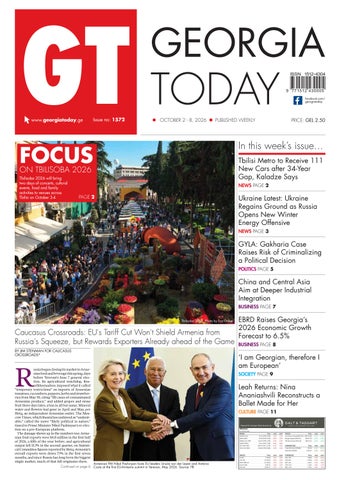
Armenian PM Nikol Pashinyan hosts EU leaders Ursula von der Leyen and António
Continued on page 6 Costa at the first EU-Armenia summit in Yerevan, May 2026. Source: FB
WƌŝĐĞ
ǁͬǁ
ŵͬŵ
hZZ E / ^
WƌŝĐĞ
ǁͬǁ
ŵͬŵ
^W ϱϬϬ
ϳ ϲϳϬ͕ϴϰ
Ͳϭ͕Ϯй
ͲϬ͕ϱй
h^ ͬ ' >
Ϯ͕ϲϬϯϴ
ͲϬ͕Ϯй
ͲϬ͕ϰй
&d^ ϮϱϬ
Ϯϰ ϯϳϰ͕ϴϭ
ͲϬ͕ϲй
ͲϮ͕ϯй
hZ ͬ ' >
Ϯ͕ϵϱϮϴ
Ͳϭ͕Ϯй
ͲϮ͕ϱй
Kt :KE ^ ϯϬ
ϱϭ ϯϰϵ͕ϵϮ
Ͳϭ͕Ϭй
Ͳϰ͕ϭй
' W ͬ ' >
ϯ͕ϰϰϳϯ
Ͳϭ͕Ϭй
Ͳϯ͕Ϭй
ZƵƐƐĞůů ϮϬϬϬ
Ϯ ϴϬϳ͕ϵϮ
ͲϮ͕ϴй
Ͳϱ͕ϱй
hZ ͬ h^
ϭ͕ϭϯϰϮ
ͲϬ͕ϵй
ͲϮ͕ϭй
&d^ ϭϬϬ
ϭϬ ϲϯϲ͕ϳϭ
ͲϬ͕ϳй
Ͳϭ͕ϳй
' W ͬ h^
ϭ͕ϯϮϯϮ
ͲϬ͕ϵй
ͲϮ͕ϯй
2
NEWS
GEORGIA TODAY
OCTOBER 2 - 8, 2026
Tbilisi Metro to Receive 111 New Cars after 34Year Gap, Kaladze Says Martvili Canyon. Source: Georgia’s national parks
Around 900,000 Visitors Explore Georgia’s National Parks in First Eight Months of 2026 BY NANUKA MAGLAKELIDZE
A
round 900,000 visitors visited Georgia’s protected areas during the first eight months of 2026, with international visitors accounting for the majority, data from the Agency of Protected Areas show. Georgian citizens made up 41% of the total number of visitors, while international visitors represented the larger share. Tamara Khakhishvili, Deputy Head of
the Agency of Protected Areas, presented the figures while discussing the agency’s 2026 activity report. Alongside biodiversity protection, conservation and patrolling activities, the agency is developing ecotourism services and promoting ecotourism in Georgia’s regions, Khakhishvili said. Prometheus Cave, Martvili Canyon and Mtirala National Park remain among the most popular destinations for visitors. The agency’s own revenues were 48% higher than the figure recorded during the same period last year, Khakhishvili said.
Tbilisoba 2026 to Bring Two Days of Concerts, Food and Cultural Events across Tbilisi
Georgian Dream Secretary General and Tbilisi Mayor Kakha Kaladze. Source: 1TV
BY NANUKA MAGLAKELIDZE
T
he Tbilisi Metro will be renewed with 111 new cars, marking the first addition of new metro cars to the system in 34 years, Tbilisi Mayor Kakha Kaladze said during a visit to China this week. Kaladze attended a ceremony at CRRC, one of the world’s largest metro car manufacturers, where the first train produced specifically for the Tbilisi Metro was unveiled. “The renewal of the Tbilisi Metro with 111 new cars is truly a historic event for our city, as the last new cars were added to the Tbilisi Metro 34 years ago,” Kaladze said.
He said the project would give the metro “new life” and help it meet the needs of modern Tbilisi. “The metro is not merely a means of transportation for Tbilisi. It is part of the city’s everyday life. It is a mode of transport used by hundreds of thousands of people every day. Therefore, renewing the metro does not simply mean upgrading transport; it is a step toward creating an even more comfortable, safe and modern environment,” Kaladze said. A total of 25 trains will be added to the Tbilisi Metro under the project, including 14 four-car trains and 11 five-car trains. Kaladze said the first fully modern fourcar train had already been completed and was expected to arrive in Tbilisi by the end of the year. The mayor said the project was sup-
ported by the Georgian government and the Asian Infrastructure Investment Bank (AIIB), and highlighted cooperation between Georgian company GT Group and CRRC. CRRC Vice President Li Dingnan said the project would contribute to deepening economic and trade relations between China and Georgia and strengthening their historic friendship. “The Tbilisi Metro project is one of CRRC’s symbolic projects for the highquality development of the Belt and Road Initiative and is the result of mutually beneficial cooperation between China and Georgia,” Li said. He added that once operational, the new metro cars would improve Tbilisi’s transport network, raise the level of public services and make travel more convenient for citizens.
Georgian-Israeli Doctor Treats Wounded Captain after Flydubai Cockpit Attack Tbilisoba 2023. Photo by Ezz Gaber
BY TEAM GT
T
bilisi will celebrate its annual city festival, Tbilisoba, on October 3 and 4, with events planned across the historic center and several major public spaces. This year's celebrations will be held at Rike Park, Orbeliani Square, Gudiashvili Square, Leghvtakhevi, Europe Square and the area around Metekhi Bridge, expanding the festival beyond its traditional central venues. Visitors can expect cultural, entertainment, educational and family-oriented activities throughout the two days. The festival areas will feature decorations and installations, photo zones, relaxation spaces and an open-air cinema. Gastronomic and entrepreneurial zones will offer Georgian and international cuisine, culinary demonstrations and masterclasses, as well as traditional sweets, honey and wine for exhibition, sale and tasting. Children's concerts, entertainment and sports activities will take place during the day, while the programs at the different locations will conclude with musical evenings and theatrical performances. The ceremony honoring Tbilisi's honorary citizens is scheduled for October 4 at 8pm, and will be broadcast live. City Hall has said the full program will
Dr. Shota Musaev and a Flydubai aircraft. Source: FB
be available through its official website.
HOW MUCH WILL TBILISOBA 2026 COST? The Georgian Government has authorized Tbilisi City Hall to carry out simplified procurements worth up to GEL 3,114,727.28 for goods and services required for the Tbilisoba 2026 events. The government decree was published on September 28, although it is dated September 18. The expenditure will come from the 2026 budget of the Tbilisi municipality. The GEL 3.11 million figure represents the maximum value of simplified procurements authorized for the celebrations, rather than necessarily the final amount that will be spent.
A FESTIVAL DATING BACK TO 1979 Tbilisoba was first held on October 28, 1979, and became an annual celebration of Tbilisi's history, culture and diverse traditions. The festival traditionally combines concerts and theatrical performances with food, agricultural products, crafts and other cultural activities. The festival was suspended during the difficult period of the early 1990s before returning in the mid-1990s. It has since become one of Tbilisi's major annual public celebrations, traditionally taking place in October and incorporating the presentation of honorary citizenship awards.
BY ANA DUMBADZE
A
Georgian-Israeli dentist helped restrain an alleged attacker and treated a seriously wounded captain aboard a Flydubai flight to Tel Aviv on Wednesday, September 30, before the aircraft made an emergency landing in Saudi Arabia. Dr. Shota Musaev was among the 174 passengers aboard flight FZ1073 from Dubai when the co-pilot allegedly stabbed Captain Smit Machchhar, an Indian national. Musaev said he rushed toward the cockpit after hearing screams and joined other passengers who intervened. “When I heard screaming, after 10 seconds I ran: I didn’t wait,” Musaev told
The Times of Israel after returning to Israel. He described finding the captain bleeding heavily, particularly from his head. Musaev, who said he was the only doctor on board, provided emergency treatment, stopping the bleeding and stabilizing the captain’s blood pressure. He also helped secure the suspected attacker to prevent him from breaking free. Israeli officials say the co-pilot, reportedly an Omani national, attacked Machchhar and attempted to crash the aircraft. The motive has not been established, and the circumstances remain under investigation. The aircraft entered a steep descent during the struggle. Reuters reported that it plunged nearly 14,000 feet in less than 30 seconds before passengers and crew brought the situation under control.
Despite his injuries, Machchhar managed to release the cockpit door, allowing others to enter, a spokesperson for Israeli Prime Minister Benjamin Netanyahu said. Passengers and crew subdued the co-pilot, while two other Flydubai pilots traveling aboard the flight helped take control and land the aircraft safely in Tabuk, northwestern Saudi Arabia. Among those who intervened was Israeli passenger Yaniv Hayoun, who described pulling the alleged attacker away from the controls. Other passengers recounted working together to restrain him as the aircraft lost altitude. The injured captain and co-pilot were taken to hospital after landing. All 174 passengers were subsequently flown to Israel aboard a replacement aircraft, arriving at Ben Gurion Airport later on Wednesday.
NEWS
GEORGIA TODAY OCTOBER 2 - 8, 2026
3
Ukraine Latest: Ukraine Regains Ground as Russia Opens New Winter Energy Offensive COMPILED BY ANA DUMBADZE
U
kraine has entered October under pressure on two fronts: Russian forces continue to attack along the eastern front, while Moscow has sharply increased strikes on Ukraine's energy infrastructure ahead of winter. The escalation in the air has been accompanied by limited movement on the ground. Russian forces continue offensive operations around several parts of Donetsk region, including Lyman, Kostyantynivka and Dobropillya, but recent battlefield assessments indicate that their gains have remained limited. At the same time, Ukrainian forces have continued a counteroffensive around Lyman that Kyiv says has retaken significant territory and disrupted Russia's efforts to move toward the Donetsk cities of Sloviansk and Kramatorsk. The fighting around Lyman has become one of the more notable developments on the front in recent weeks. Ukraine's 3rd Army Corps says its Operation Vivaldi has retaken about 176 square kilometers in three phases, including several settlements north of Lyman. President Volodymyr Zelensky repeated the figure during a September 30 visit to a military command post near the frontline. Ukrainian forces have used drones, strikes on Russian supply routes and ground robotic systems as part of the operation. The gains remain contested and figures provided by Ukrainian authorities are not independently verifiable in full. Nevertheless, independent battlefield assessments have also recorded Ukrainian advances around Lyman, while Russian
forces have continued attacks in the area without making significant progress in recent days. Territorial estimates point to a mixed picture over the broader front. According to DeepState data cited by Russia Matters, Russian forces suffered a net loss of about 6 square miles (16 square kilometers) of Ukrainian territory between September 22 and 29. However, over the full period from September 1 to 29, Russia recorded a net gain of about 14 square miles (36 square kilometers). Across the wider front, the pace of territorial change remains slow. Russian forces are continuing efforts to advance toward what Ukraine calls its defensive "fortress belt" in Donetsk, including the cities of Sloviansk, Kramatorsk, Druzhkivka and Kostyantynivka. Fighting has also continued around Kupyansk and in parts of Zaporizhzhia region. While the front line has moved only gradually, Russia's aerial campaign has become increasingly intense. On September 25, Russian strikes on Kyiv killed seven people, including a 14-year-old boy, according to Ukrainian officials. Days later, Russian jet-powered drones struck Kyiv during daylight hours, damaging the National Academy of Sciences and other buildings. The attacks have highlighted the growing use of faster drones that are more difficult for Ukrainian air defenses to intercept. The most significant attack came on September 30, when Russia launched a large-scale missile and drone assault that focused heavily on Ukraine's energy infrastructure. Ukrainian officials said seven people were killed, including a child, and 24 were injured. Power facilities in and around Kyiv and several other regions were hit, prompting emergency electricity cuts in the capital and sur-
A Russian drone hit Kyiv's science academy. Source: AP Photo/Dan Bashakov
rounding areas. Public transport was disrupted and water supplies were affected in parts of Kyiv. Ukraine's Air Force said Russia launched 285 drones during the daytime phase of the September 30 attack, including 174 jet-powered drones, and that Ukrainian air defenses destroyed or suppressed 254 of them. The attack has raised fears that Russia is beginning another sustained campaign against Ukraine's power and heating systems as temperatures fall. Ukrainian Prime Minister Serhii Koretskyi described it as the first attack of this scale since the previous heating season. President Zelensky said the main targets were energy facilities and called for greater international support for Ukrainian air defenses. "And the closer we get to winter, the more of this protection we need," Zelensky said after the attack. The possibility of another winter campaign has been a central concern for Kyiv for weeks. Zelensky has proposed an energy ceasefire covering electricity,
heating and water infrastructure, while warning that Ukraine would respond to Russian attacks on its energy system. In September, he said Kyiv was prepared to stop strikes on Russian energy facilities if Moscow did the same. The September 30 strikes also had consequences beyond Ukraine. Moldova reported Russian drones crossing its airspace, while Romania and Poland scrambled military aircraft amid the wider wave of attacks. Ukraine has continued striking targets inside Russia, particularly oil and military infrastructure. Ukrainian forces have targeted oil depots and refineries in Krasnodar Krai and other regions, as well as Russian military facilities and drone infrastructure. The attacks have contributed to pressure on Russia's refining sector, while Moscow has responded with restrictions on fuel exports. On September 28, Russian President Vladimir Putin also signed a decree restricting the publication of information about the country's oil and gas industry. The measures cover areas including export
prices, buyers and sellers, transportation, storage and refinery production. Analysts cited by the Institute for the Study of War said the restrictions could make it more difficult to assess the impact of Ukrainian attacks and Western sanctions on Russia's energy sector. The war's manpower requirements are also continuing to grow. Zelensky said on September 28, citing Ukrainian military intelligence, that Russia was expanding recruitment and seeking additional foreign personnel. He also said more than 8,000 North Korean troops were currently in Russia, with another 10,000 being prepared for deployment. These figures are Ukrainian assessments and have not been independently verified. International support for Kyiv continued during the week. EU member states agreed on September 25 to release €6.6 billion in previously blocked European Peace Facility funds connected to military assistance for Ukraine. The package includes money for the EU's military assistance mission, joint procurement and reimbursement to member states for equipment already supplied. The EU also imposed sanctions on 10 individuals and 17 entities over the alleged unlawful deportation and forced transfer of Ukrainian children to Russia and Russian-occupied territory. The European Council estimates that nearly 20,500 Ukrainian children have been unlawfully deported or forcibly transferred since Russia launched its full-scale invasion. Diplomatic efforts remain focused on finding a way toward a ceasefire, but major disagreements over territory, security guarantees and the conditions for ending the fighting remain unresolved. The proposed energy truce has yet to materialize, while attacks on energy infrastructure and oil facilities continue on both sides.
4
POLITICS
GEORGIA TODAY
OCTOBER 2 - 8, 2026
Georgia Summons Iranian Ambassador over Social Media Statements on Queen Ketevan Mojani described the image of Ketevan on the embassy building as more than a commemoration of a historical figure, saying it represented historical memory around which “many different narratives” continue to exist. He said his planned research would draw on documents and historical sources preserved in both Georgia and Iran. He stressed that it would not represent an official Iranian version of events or claim to provide a definitive account of Ketevan’s history. Instead, Mojani described the material as his personal perspective as a historian at the current stage of his research, adding that it could later be supplemented, critically reassessed, or revised on the basis of additional sources and joint research by Georgian and Iranian scholars. “Perhaps re-examining such stories, rather than simply returning to the past, can serve as a means of understanding one another better and more deeply today,” Mojani wrote.
The Iranian Ambassador’s post photo. Source: FB
BY TEAM GT
G
eorgia’s Foreign Ministry summoned Iranian Ambassador Seyed Ali Mojani on September 30 over statements he published on social media concerning the history of Queen Ketevan the Martyr. According to the Foreign Ministry, Deputy Foreign Minister Aleksandre Khvtisiashvili told Mojani that the statements “go beyond the scope of diplomatic activity” and have had a negative impact on public sentiment. “The Deputy Minister stated that such
statements have a negative impact on public sentiment. He expressed hope that the Iranian side would take appropriate measures and that similar cases would not be repeated, so that it would not become necessary to take additional measures on the Georgian side,” the ministry said. The ministry did not specify what additional measures could be taken. Khvtisiashvili also told the ambassador that diplomatic representatives accredited in Georgia should operate within their diplomatic mandate and competence, observe established norms of diplomatic relations, and refrain from interpreting the history and domestic affairs of the host country.
WHAT MOJANI WROTE The summons followed a September 25 post by Mojani on Facebook, accompanied by a photograph of the ambassador standing outside the Iranian Embassy in Tbilisi. The embassy building was displaying an image of Queen Ketevan alongside a screenshot of Mojani’s post. “Soon, I will share with the readers of this page the results of my initial research concerning both Queen Ketevan and the documents and historical sources preserved in Iran and Georgia,” Mojani wrote. “Perhaps, rethinking such stories could be more than a return to the past; it could be a way for us to get to know each other better and more deeply today,” he added.
POLITICAL CRITICISM The ambassador’s remarks prompted criticism from members of Georgia’s ruling Georgian Dream party. Nikoloz Samkharadze, chairman of Parliament’s Foreign Relations Committee, referred to the difficult historical relationship between Georgia and Persia and described the subject as particularly sensitive for Georgians. “I would advise him to remain within the framework of diplomatic protocol and refrain from historical digressions, because this is not his responsibility,” Samkharadze said. He added that if the ambassador wished to preserve normal relations between the two countries, he
should refrain from similar statements. Georgian Dream MP Irakli Kadagishvili also criticized Mojani’s remarks, saying the ambassador’s historical interpretations were “absolutely irrelevant” to relations between the two countries and fell outside the scope of an ambassador’s and embassy’s activities. Another ruling party MP, Aluda Ghudushauri, said Georgia respects and venerates its saints and expressed confidence that the public would see a response from the Foreign Ministry. The Embassy of Iran had not made further comment at the time of going to press.
WHO WAS QUEEN KETEVAN? Queen Ketevan the Martyr, who lived from approximately 1560 to 1624, occupies a prominent place in Georgian history and religious tradition. She was the wife of King David I of Kakheti and the mother of King Teimuraz I. Ketevan was taken hostage to Iran during Shah Abbas I’s campaigns against Georgia in the early 17th century. Historical accounts state that she refused demands to renounce Christianity and convert to Islam. In 1624, she was tortured and killed in Shiraz on the orders of Shah Abbas. Accounts of her martyrdom are preserved in Georgian and foreign historical sources, including records left by European Catholic missionaries who were in Iran at the time. Queen Ketevan was canonized by the Georgian Orthodox Church and remains a symbol of faith, fortitude, and sacrifice in Georgian cultural and religious memory. The Georgian Orthodox Church commemorates Ketevan the Martyr on September 26.
Karachay–Cherkessia Group Accused of Sham Marriages with Russian Soldiers to Claim War Payments
Government meeting (archive photo). Source: FB
Government Plans to Take ₾2 Billion in New External Debt in 2027 BY NANUKA MAGLAKELIDZE
G
eorgia’s Finance Ministry has submitted the initial draft of the 2027 state budget to Parliament. BM.GE reports. The document says the government plans to take GEL 4.67 billion in new loans next year. Of this amount, GEL 2.6 billion will come from domestic borrowing, while GEL 2.07 billion will be new external loans. The planned external borrowing is GEL 1.2 billion lower than in 2026, when the Georgian government issued a $500 million Eurobond. Domestic borrowing, meanwhile, is planned to increase by GEL 800 million next year.
Funding from international financial and donor organisations is expected to be distributed as follows: Asian Development Bank (ADB), GEL 460.67 million; World Bank (WB), GEL 381.10 million; European Investment Bank (EIB), GEL 287.42 million; KfW, GEL 227.07 million; Asian Infrastructure Investment Bank (AIIB), GEL 183.33 million; EBRD, GEL 139.73 million; French Development Agency (AFD), GEL 71.34 million; EU/EU-NIF, GEL 60.10 million; EPTATF, GEL 40.50 million; E5P, GEL 15.50 million; and SIDA, GEL 10.75 million. Among individual projects, the largest allocation, GEL 250 million, will be used to purchase 45 new locomotives and 10 new passenger trains. The project will be co-financed through loans from the World Bank, ADB and AIIB.
Graves of Russian soldiers. Source: CNN
BY ANA DUMBADZE
R
ussian authorities have sent to court a criminal case against a group from K a r a c h ay – C h e r k e s s i a accused of arranging sham marriages with men preparing to fight in Russia’s war against Ukraine in order to obtain state compensation if the servicemen were wounded or killed. The Interior Ministry of Russia’s Karachay–Cherkessia Republic said the alleged criminal group was formed in late 2024 by a woman from the region and an accomplice. Investigators say members of the group sought out men planning to sign contracts with the Russian Defense Ministry and arranged fictitious marriages with them. If a serviceman was subsequently
wounded or killed, the defendants allegedly claimed state compensation and other payments to which they became entitled as spouses. Investigators say the group obtained approximately 35 million rubles between January and October 2025 and attempted to secure another 25 million rubles. Prosecutors have identified 18 completed episodes and seven attempted fraud cases. In one case, authorities reportedly discovered that a marriage had been registered just one day before the man signed his military contract. His relatives later said they had never seen the purported wife and that the couple had never lived together. The case was transferred to the Central District Court in Volgograd, as most of the alleged offenses and victims were connected to the Volgograd region. The defendants face charges including organizing or participating in a criminal
organization, large-scale fraud and attempted fraud. The case comes as Russian regions continue to offer substantial financial incentives to attract recruits for the war in Ukraine. According to the Karachay– Cherkessia Ministry of Labor and Social Development, the republic currently provides a one-off payment of 3.1 million rubles to eligible recruits signing military contracts, in addition to a federal payment of 400,000 rubles. The regional payment was increased from 2.4 million rubles in July 2026. Families of servicemen who were permanently resident in Karachay–Cherkessia and are killed while participating in the war are also eligible for a regional one-off payment of 1 million rubles, distributed among eligible family members. This is separate from other federal compensation and benefits available to Russian servicemen and their families.
POLITICS
GEORGIA TODAY OCTOBER 2 - 8, 2026
5
GYLA: Gakharia Case Raises Risk of Criminalizing a Political Decision BY NANUKA MAGLAKELIDZE
T
he Georgian Young Lawyers’ Association (GYLA) has raised questions over the criminal prosecution of former Prime Minister and Interior Minister Giorgi Gakharia in connection with the construction of a police checkpoint near the village of Chorchana in 2019. GYLA said the case should not be assessed solely through the alleged abuse of official powers, arguing that it concerns Georgia’s sovereignty and territorial integrity, the security of residents near the occupation line and the state’s obligations in the context of the ongoing “borderization” process. The organization said there were signs of illegal borderization in the Chorchana and Tskhinvali areas before the checkpoint was established, including markings on trees, the construction of paths and movements by de facto forces. It said the checkpoint was located on territory controlled by Georgia and could therefore not automatically be regarded as a provocation against the occupying forces. GYLA also questioned the prosecution’s claim that Gakharia acted without
Salome Zurabishvili. Georgia's fifth president. Source: RFE/RL
Salome Zurabishvili: Georgia Needs More Energetic, Less Constrained Diplomats BY NANUKA MAGLAKELIDZE
Giorgi Gakharia, former Georgian Prime Minister. Source: FB
coordination with relevant state institutions, saying available materials indicated that developments in the area had been discussed with state bodies and international partners. The organization further raised concerns over the timing and alleged selective nature of the prosecution, as well
as the parliamentary investigation that preceded it and restrictions on the defense’s access to potentially relevant evidence. GYLA said these circumstances raise questions over whether the case concerns criminal liability or the criminalization of a political decision.
G
eorgia’s fifth president, Salome Zurabishvili, has called on the country’s diplomatic corps to adopt more active and clearly defined positions. Zurabishvili made the remarks after meeting with representatives of the diplomatic community in Paris, France,
and sharing information about the meeting on social media. “There is no doubt that we need more energetic and less constrained diplomats. New arrivals see how the authorities treat those who have voiced their protest, so they try to adapt to the situation and act carefully. Diplomats are the very people the public sees and hears. The population needs to see a firm, European voice making itself heard in the country,” Zurabishvili wrote.
OP-ED: On a New "Geopolitical Race" in the Region and Georgian Ultra-Realistic Capabilities. Part 3 OP-ED BY VICTOR KIPIANI, GEORGIA FIRST
B
ecause the foreign policy to be conducted within this "disorderly order," although designated by various conceptual terms, ultimately prioritizes something else: defining the right priorities, selecting adequate resources, and realizing the desired outcome.
ON TERMS AND BEYOND In Georgia’s case, the execution of a policy of "flexible realism" - or, by our classification, "ultra-realism" - is conditioned by the altered West itself. Here too, the handwriting belongs to the principal, represented by the current White House administration, which at first glance is seeking not a "protégé," but a "partner" with whom it can share commitments (including expenditures) to achieve a common goal. Building your own national interests (or rather, expectations) into the American strategy during the process of containing unwanted geopolitical rivals has become an endless headache for US allies and partners, while Washington's declared line of flexible realism has, in practice, assumed the character of strategic ambiguity for Georgia and other countries. I mentioned the terminological aspect of the issue, and here too, maintaining consistency is becoming increasingly difficult. The concept of "transactionalism" itself, under President Trump and his informal diplomacy and self-appointed diplomats, has in reality turned into "unbounded transactionalism." This no longer has anything in common even with "flexible realism," as it erases every boundary or border according to the needs of a given context. Through a Georgian prism, this highly unusual approach by the US, as the leader of the Western geopolitical world, creates additional discomfort for official Tbilisi, because: a) The other side demands significantly more contributions from you, including in the form of material resources; b) The scope of Western military assistance is narrowing, and such aid will no
Tbilisi. Source: GT
longer be unconditional; c) Full consideration of our national interests from the Georgian side is possible only if we place these interests into a larger geopolitical equation.
THE REGION BY US AND FOR US The ongoing processes in the South Caucasus bring two seemingly contradictory, significant developments into a single parallel: (1) The growing influence of actors from outside the region on the region itself; and (2) The gradual restoration of regional ownership by the South Caucasian countries themselves - Georgia, Armenia, and Azerbaijan. I have discussed both of these issues repeatedly in previous publications, so I will not elaborate further on them now. One way or another, regional co-ownership by the region's countries is directly linked to, and practically expressed in, the following: (a) Increasing their own contribution to regional security; (b) Expanding transport communications; (c) Defining a decisive state role in transit projects related to the region.
In such an equation - the intersection of extra-regional and intra-regional factors - Georgia can fulfill a complementary function within the regional geopolitical and geo-economic system. I envision this substantive role in the South Caucasus through Georgia’s function as the "Western Five-Cross Bastion." Furthermore, pursuing Western interests and establishing ourselves as a "key link" at the West-East transport-logisticstrade crossroads requires extending Western interests through our country into Central Asia. I believe we are currently at another stage of the dissolution of the Soviet Union. Yes, the dissolution of the USSR formally ended long ago, but the geopolitical "aftershocks" of this formal act are still occurring in various forms and contexts. Today, the collapse of the former Soviet realm plays out in the redistribution and regrouping of so-called spheres of influence - a new "geopolitical race" - which is characterized by the following main aspects: (1) Russia is weakening, though it remains unclear who will ultimately benefit from this weakening; (2) The ongoing war in Ukraine serves
as a watershed moment for the new balance of power in the region; (3) Hard power alone is insufficient to project influence over the region: it is essential to offer an attractive, exemplary political and economic model; (4) Countries in the region are increasingly diversifying their foreign policy lines; (5) In international relations, a noticeable transformation of regional countries from objects to subjects is occurring: the region is gaining "its own voice"; (6) Intra-regional cooperation around specific needs is growing, which also contributes to their "strategic autonomy." By the way, in previous letters, I did not mention "variable geometry" regarding security and foreign policy by accident. Today, alliance, partnership, and general cooperative ties depend on many variables - so much so that these variables manifest simultaneously and contradictorily. Nevertheless, the main vector - for us, the vector of vectors - will remain decisive in the foreseeable future (hence the reference to "Georgia as a Western bastion in the region"). It is also undeniable that when talking about the main vector, honesty is required - both with ourselves and with our
Western partners. I consider proper positioning in relations between the US and China to be one of the key issues in this conversation. Yes, China today is far more formidable globally, and relations with it hold practical value for Georgia, whether through existing bilateral agreements or unwritten rules. At the same time, it is a fact that despite the US becoming a rather difficult partner, it can still offer means (including in security and defense) that no other state can provide at this stage. I would also add that beyond "hard infrastructure," the Americans' "soft infrastructure" is no less important, serving to restore sound institutional governance and normalize the political process in our country through the application of soft power. Under these conditions, and taking into account all of the above, it is essential that the main emphasis from the Georgian side be placed not simply on geography, but on a proactive, innovative, and ultra-realistic policy based on reputation. Otherwise, we will remain mere spectators of ongoing processes or, at best, witnesses. We will discuss these and other related issues in the fourth and final article.
6
BUSINESS
GEORGIA TODAY
OCTOBER 2 - 8, 2026
Armenia Exports Aluminum Foil to Azerbaijan in First Post-Peace Trade Shipment BY NANUKA MAGLAKELIDZE
A
rmenia has exported aluminum foil to Azerbaijan for the first time since the two countries began expanding economic ties alongside their efforts to reach a peace agreement. Armenian Economy Minister Gevorg Papoyan confirmed the shipment on September 24, although he did not provide its volume. Asked whether other Armenian products would also be exported to Azerbaijan, Papoyan replied, “We’ll see.” The shipment marks the emergence of bilateral trade after months in which commercial flows between the two countries were overwhelmingly in Azerbaijan’s favor. Armenian officials had indicated in August that Azerbaijani companies were preparing to purchase goods from Armenian businesses. “In the coming days, you will learn that Azerbaijani companies have purchased products from Armenian companies. Armenia will sell products to Azerbaijan. This will now be bilateral trade,” Foreign Minister Ararat Mirzoyan
Armenian aluminum foil. Source: International Trade Insights
said in an August 31 interview with Armenia’s Public Television. Aluminum foil was among the prod-
ucts previously identified by Armenian officials as potential exports to Azerbaijan. Other goods under discussion
included ferromolybdenum, livestock, raw materials for brandy production, tobacco, textiles, roses, and other greenhouse products. The first commercial trade between the two countries in decades began with Azerbaijani fuel deliveries to Armenia in December 2025. On December 18, Azerbaijan sent 1,220 tons of AI-95 gasoline to Armenia. A subsequent shipment in January included gasoline and diesel. The Armenian government described the December delivery as another result of the peace process and an important step in strengthening mutual trust. Azerbaijan’s exports to Armenia have since grown considerably. According to Azerbaijan’s State Customs Committee, goods worth $17.6 million were exported to Armenia between January and August 2026. By contrast, Azerbaijan’s recorded imports from Armenia remained extremely small during the first seven months of the year, at $960. Armenian officials and other reports have previously noted that the figure was linked to indirect imports and was not representative of substantial commercial exports from Armenia. The development follows the August
8, 2025, Washington summit involving Armenian Prime Minister Nikol Pashinyan, Azerbaijani President Ilham Aliyev, and US President Donald Trump. The two sides signed a joint declaration committing to efforts to establish unimpeded connectivity between Azerbaijan and its Nakhchivan exclave through Armenian territory. The declaration also provided for work on the “Trump Route for International Peace and Prosperity,” or TRIPP. The peace treaty initialed by Armenia and Azerbaijan at the Washington summit has not yet been signed. However, economic and transport links have progressively expanded as part of the broader normalization process. In January 2026, Armenia and the United States published an implementation framework for TRIPP, describing it as a planned multimodal transit connection across Armenian territory. The aluminum foil shipment is therefore a small but notable development in the evolution of economic relations between the two countries. It represents the first publicly confirmed Armenian export to Azerbaijan following the start of the new phase of bilateral trade, potentially opening the way for additional Armenian products to enter the Azerbaijani market.
Caucasus Crossroads: EU's Tariff Cut Won't Shield Armenia from Russia's Squeeze, but Rewards Exporters Already ahead of the Game Continued from page 1 The owner of a peach-processing company in Armavir, who sent 90% of his output to Russia before the ban, told the same outlet that Europeans do not know Armenian products the way Russians do, that no supermarket will list a product without demand, and that what he needs now is European buyers and distributors. Brussels’ answer came on September 24, when EU member states adopted a measure that suspends import duties on around 80% of what Armenia sells to Europe for two years. The product list was written to match what Armenia had been exporting to Russia: almost 99% of the fruit, vegetables and plants Armenia shipped there, more than 91% of the beverages and spirits. In practice, that means fresh and dried fruit, greenhouse vegetables, wine, brandy and spirits, and mineral water, with quotas kept on some sensitive farm goods. It’s expected to take effect in mid-October. But can preferential access to Europe replace the Russian market, and who in Armenia can use the window before it closes?
BRUSSELS DEPLOYS THE UKRAINE AND MOLDOVA PLAYBOOK, MINUS THE RENEWAL A European Commission spokesperson told me the limitations are deliberate. “There is no renewal mechanism in the regulation, and the measure will expire at the end of the two-year period. Any extension would have to go through the normal legislative process.” Asked whether the same tool could go to other partners under Russian pressure, the spokesperson gave one sentence: “This is an exceptional measure taken in an exceptional circumstance.” That language may be a stretch. Brussels introduced the same autonomous trade measures for Ukraine and Moldova in 2022 and renewed both in each of the two years that followed. In Armenia’s case, an extension would require a new law voted through Parliament and the member states. The financial benefit to Europe is small. In 2025, the EU sold Armenia €1.95 billion ($2.2 billion) of goods and bought €469 million ($530 million) in return, and the Commission expects the effect
on Europe to “remain limited.” The point is political: backing an EU-friendly government in a trade fight with Moscow. The Commission polices the conditions: Armenia must comply with rules of origin, cooperate with EU customs, impose no new restrictions on EU imports and uphold the democracy clauses of its partnership treaty with the EU. If Yerevan slips, Brussels can switch the whole thing off: “the EU may suspend in whole or partially the trade liberalization measure,” the spokesperson said. The emphasis on origin checks has an obvious target: goods from Armenia’s customs-union partners entering Europe duty-free under an Armenian label. That is why Thomas de Waal, senior fellow at Carnegie Europe, does not see this as real trade integration with Europe. “Armenia is still a member of the Eurasian Economic Union, with Russia, Kazakhstan, Belarus, and that precludes it doing any proper economic integration with other trading blocs like the EU,” he told me. “So this is more just a kind of favorable trading status that they’ve been given.” Its real function, he said, is a signal from the EU to Moscow “that we’re not going to abandon Armenia.”
THE REAL WINNERS ARE ALREADY TRADING WITH EUROPE Fabrizio Zarcone, the World Bank Group’s country manager for Armenia, calls the country’s readiness to use its new preferential access “uneven.” The bank lends to Armenia and runs trade programs there. Armenia has “a core of competitive, export-tested firms, especially in beverages, greenhouse vegetables, dried fruit and processed foods, mostly large firms, some of which already hold Global G.A.P. and other certifications that European buyers recognize,” he told me. Exports to the EU “have roughly doubled since the start of the year,” albeit from a small base. In plain terms, firms that already export can export more, while the rest have more paperwork to deal with first. His caution is about how much of that translates into actual shipments. Countries granted preferential access typically use far less of it in the first year than the rules allow, he said, and “building a compliant supply chain from farm to shelf
typically takes several seasons.” The EU “is a demanding, well-supplied market with entry-price rules and tariff-rate quotas still in place for some products, and competing on volume alone will be difficult.” Geography is the other constraint: “Armenia is landlocked, and perishables must transit through Georgia, so coldchain capacity, consolidation hubs and predictable border times remain essential.” The wine sector reads its own readiness more confidently. Zaruhi Muradyan, executive director of the Vine and Wine Foundation of Armenia, the industry’s promotion body, told me “we do not see production capacity as a limiting factor for the Armenian wine industry at this stage.” Armenian wines “are already present in several EU markets,” she said, so the measure is a chance “to expand and strengthen an existing presence.” Logistics, she says, is one of the main obstacles. Neighboring Georgia markets itself as the birthplace of wine, but Armenia’s best-known bottle is Ararat brandy, named for the mountain on Armenia’s coat of arms, visible from Yerevan and on the Turkish side of the border since 1921. The brand has been owned by France’s Pernod Ricard since 1998 and has had European distribution for decades. De Waal doubts that goods made for Russian buyers can simply be redirected to European ones. Products geared to that market take time to find alternative buyers, he said, “whether that be things that Russians traditionally consume like Armenian fruit or cognac,” which he said have no obvious buyers there. Wine already has European importers. Peaches, by the Armavir processor’s own account, do not. Russia ran the same play against Georgian and Moldovan wine, and “in the long term, it was counterproductive for Russia, as the Georgians and Moldovans began to find alternative buyers,” de Waal said. Yerevan is not waiting to find out: the government is “rolling out direct financial compensation, export volume subsidies, and logistical cost-reimbursement programs to help local producers redirect goods to European markets,” Zarcone said. His own view is that “the duty suspension itself is the support,” because
producers “respond to price signals faster than any program could be designed.” The subsidies suggest the government is less sure. The measure does not touch tech. The sector largely runs on its diaspora, and Ashot Arzumanyan, co-founder and partner at SmartGateVC, a venture fund invested in Armenian-linked companies, says the industry “is very US centric,” an “extension of California in this part of the world.” Whatever is happening “in the other sectors of economy have nothing to do with the world of tech,” he told me. He points instead to Firebird, the Nvidiabacked AI data center outside Yerevan, cleared by Washington in February to import a further 41,000 Nvidia chips and valued by the company at $4 billion. Nvidia’s head of physical AI, he says, visits Armenia almost as often as he does. Closer research ties with Europe could follow over time, he added.
runs the other way, from Russia into Armenia: gas. “I think the main danger and the main threat to Armenia is about gas,” he said, pointing at the risk that Russia cuts supply this winter or doubles a price Armenia gets at a preferential rate. Iran, the other supplier, is “also problematic.” Pressure of this kind, he said, is “a very blunt tool.” Russia “can certainly punish Armenia, but it’s not going to win friends in Armenia by doing that.” Azerbaijan could become another supplier, but likely only with deeper normalization. Since the 2020 war and Baku’s 2023 takeover of Nagorno-Karabakh, relations have moved quickly: The Trump Route for International Peace and Prosperity, the corridor deal Washington brokered last year, has produced a working peace and construction on the ground. The treaty itself is still unsigned, and de Waal says the two sides are “still a long way” from “a full peace agreement.”
THE LEVER MOSCOW STILL HOLDS IS GAS
BRUSSELS HAS BOUGHT YEREVAN TIME, NOT A MARKET
De Waal draws a line between Armenia’s economic security, which Russia is squeezing, and its physical one. He does not think Moscow threatens the latter. “Armenia is obviously being economically squeezed by Russia at the moment, and Russia has many tools it can use.” Even so, from his own conversations, he said, the export halt has hurt less than Moscow expected. The wine trade shows how uneven the squeeze is. Muradyan picks her words with care: “There are currently no official restrictions from Russia that we would characterise as a blanket prohibition on Armenian wine exports.” That is not the same as saying the trade is untouched. Official restrictions and what actually reaches Russian shelves are two different things, and the numbers cut both ways. Two-way trade between Armenia and Russia fell to about $2.2 billion in January through May from nearly $2.8 billion a year earlier, on Statistical Committee figures reported by OC Media, an independent regional outlet, which tied much of the drop to a collapse in re-exports of precious metals rather than to the food and beverage bans. For farmers whose whole market was Russia, the fall is closer to total. The pressure point de Waal watches
While gas may be Moscow’s card, the trade measure is Brussels’, and it’s a modest one: a list of products, two years, and the right to withdraw if the conditions aren’t met. What Armenia makes of the window is up to Armenia. Russia’s ban on Armenian produce, official or not, is doing real damage on the ground, whatever the aggregate numbers say, and the EU measure buys Yerevan time rather than a replacement market. Brussels’ intentions are good, but its food rules are among the strictest anywhere, and meeting them is not a walk in the park for a farm that has only ever sold to Russia. The producers who will use the window first are already certified and already selling in Europe: mostly large, mostly beverages. Growers built for Russia will spend much of the two years looking for distributors, which is what Yerevan’s subsidies are for. Georgia benefits either way, since every truck crosses its border. For now, the open questions are when in mid-October the measure takes effect and how much of it Armenia’s exporters can actually use. Then there is winter, and whether Moscow gifts Yerevan a cold one. * Caucasus Crossroads is part of the Global Power Shifts network.
BUSINESS
GEORGIA TODAY OCTOBER 2 - 8, 2026
7
China and Central Asia Aim at Deeper Industrial Integration ANALYSIS BY EMIL AVDALIANI
F
or much of the past two decades, China’s economic relationship with Central Asia has been described through a fairly simple formula: Central Asia supplies hydrocarbons, metals, and other raw materials; China provides infrastructure, capital, and a large export market. Pipelines from Turkmenistan and Kazakhstan, highways across Kyrgyzstan and Tajikistan, and railway links through Kazakhstan became the physical symbols of this sprawling model. The underlying assumption was that Central Asia remained what it had long been – a supplier of commodities for a much larger industrial economy. That description might no longer be accurate. New Chinese investments are increasingly focused on mineral processing, metallurgy, battery production, industrial manufacturing, recycling, and technology-intensive sectors. This is most evident in Kazakhstan, where in June the government disclosed talks with CATL, the world’s largest battery producer, covering not simply battery assembly but deep mineral processing, battery manufacturing, energy-storage systems, and recycling. The two sides essentially discussed what the Kazakh government described as a full production cycle stretching from the processing of raw materials to modern battery systems and used-battery recycling. Indeed, a domestic chain involving mineral processing, cathode or anode materials, cells, battery packs, engineering, and recycling creates multiple layers of industrial activity and encourages the development of suppliers, engineers, laboratories, and specialized services.
Kazakhstan is already trying to build some of those layers. The government has ordered ministries to accelerate the Sarytogan Graphite project, which is expected to produce spherical graphite, a key battery input, while also treating the potential CATL investment as part of a broader effort to integrate Kazakhstan into the global EV-battery value chain. The mineral-processing story goes further. A new copper smelter being developed in the Abai region with Chinese industrial participation is designed for annual output of about 300,000 tons of cathode copper. Chinese investment in Kazakhstan’s critical-minerals sector increasingly spans research cooperation, extraction, and processing, including copper and tungsten. And those are just a few examples. For years, the central economic weakness of resource-rich Central Asian states has been the inability to capture enough of the value created after mineral extraction. Kazakhstan produced uranium, copper, zinc, chromium, and other materials, yet much of the high-value chemical processing, component production, and manufacturing occurred elsewhere. Processing capacity across Central Asia remains insufficient, and several important minerals continue to leave Kazakhstan without advanced domestic refining. Chinese investment may now be helping close that gap, evident in the recent decision to establish a specialized investment fund to finance new projects in the Central Asian country. The same logic applies to Uzbekistan. Tashkent has an ambitious 2026-2030 program involving 120 critical-mineral projects worth around $4.2 billion. The goal is to develop full chains from raw material through processing to final products, particularly in tungsten and
molybdenum, including metal powders, alloys, rods, wires, and industrial components. Chinese companies are positioning themselves inside this process. China National Gold Group has discussed exploration and development of strategic and precious-metal deposits in Uzbekistan, while the broader China-Central Asia framework now prioritizes green mining, industrial investment, technology, and advanced manufacturing. The change is not confined to Central Asia’s two biggest countries. Tajikistan, traditionally one of the region’s least industrialized economies, is developing processing capacity in antimony – a strategically important mineral whose global supply chain is heavily concentrated in China. Tajik and Chinese researchers are working on advanced technologies for processing difficult gold-antimony ores, while cooperation involving TALCO Gold includes both industrial processing and engineering education. New antimony-processing facilities have also entered operation or development, indicating a broader attempt to move from ore extraction toward metal production inside Tajikistan itself. There is a legitimate concern that China could simply build a vertically integrated supply system in which Central Asian mines and processing plants become extensions of Chinese industry. But industrial upgrading does not require complete technological independence. Very few developing economies have industrialized that way. Countries have often entered global value chains through foreign investment, imported machinery, and external markets before gradually expanding domestic capabilities. The relevant question, therefore, is not whether Chinese capital creates dependency. Nearly all foreign industrial invest-
A welcome ceremony for President Xi Jinping in Astana. June 2025. Source: X via @aqorda_press
ment creates some form of dependency. The better question is whether it leaves behind capabilities that did not previously exist. The emerging Chinese investments into a copper smelter, tungstenrefining facility, and battery-material plant all do, as does training metallurgical engineers. Even infrastructure that was once criticized as serving primarily Chinese transit interests may now acquire a different function. The China-KyrgyzstanUzbekistan railway, two new developing China-Kazakhstan railway links, and expansion of the Trans-Caspian corridor are increasingly useful for moving intermediate and manufactured goods. At the 2025 China-Central Asia summit, Chinese leadership explicitly grouped connectivity together with industrial investment, green mining, digital infrastructure, and technological cooperation. Since the end of the Soviet Union, Cen-
tral Asia has tried to escape the limitations of commodity dependence. For the first time, the global struggle over critical minerals, batteries, and clean-energy technology gives the region something more valuable than simply high commodity prices: bargaining power over where processing and manufacturing take place. China’s expanding industrial footprint could certainly bind Central Asia more tightly to Chinese supply chains. Yet being integrated into a supply chain is not the same as being trapped at the bottom of it if Kazakhstan, Uzbekistan, and their neighbours expand local processing, skills, supplier development, and technology transfer. Emil Avdaliani is a professor of international relations at the European University in Tbilisi, Georgia, and a scholar of Silk Roads. He can be reached on Twitter/X at @emilavdaliani.
Trans-Caspian Transport Corridor Investments Could Spur Growth and Create Millions of Jobs across Europe and Central Asia SOURCE: WORLD BANK
C
ountries in Europe and Central Asia could unlock faster growth, more jobs, and stronger private investment by upgrading and better integrating a critical trade route linking East Asia, Central Asia, the South Caucasus, Türkiye, and the rest of Europe, according to a new World Bank Group report. The report, titled Integration: WorldClass Trade Logistics Along the TransCaspian Transport Corridor, finds that strategic investments in the emerging Trans-Caspian Transport Corridor (TCTC), also known as the Middle Corridor, could more than triple trade volumes along the route, halve travel times, boost GDP by 3.3%, and create 2 million more jobs by 2040. The report further finds that if countries pair infrastructure investments with reforms that improve trade and transport efficiency, corridor volumes could quadruple and travel times could fall by two-thirds by 2040. According to the report, these gains would come from easing transport bottlenecks, improving supply chain reliability, and widening market access in the nine countries along the corridor: Armenia, Azerbaijan, Georgia, Kazakhstan, the Kyrgyz Republic, Tajikistan, Türkiye, Turkmenistan, and Uzbekistan. For the nearly 200 million people living in these countries, that also means better access to markets and other opportunities.
Supply chain disruptions, and risks related to floods, droughts, and other weather shocks are increasing the value of faster, more reliable trade routes. For TCTC countries, many of which are major producers of energy, critical minerals, raw materials, and food products, the corridor offers a chance to reduce vulnerability to external shocks while turning transit demand into domestic investment, business growth, and jobs. The recent surge in regional trade, especially among developing economies, is an added impetus for TCTC countries to develop this strategic transport artery. The report shows how trade corridors can lower logistics costs, attract investment, raise productivity, and support
job creation. It assesses the TCTC’s economic potential, identifies the barriers holding back performance, and offers practical recommendations to turn the corridor into a stronger engine of regional growth. “The Trans-Caspian Transport Corridor can become a powerful driver for faster growth, economic diversification, poverty reduction, and expanded private investment for the countries along the corridor,” said Antonella Bassani, World Bank Vice President for Europe and Central Asia. “It has the potential to transform from a transport corridor that simply moves goods and people to a regional platform that actively generates business, jobs, and local industrial growth along it. This will require investment in physical infrastructure as well as complementary enabling investments in service delivery and new approaches to trade facilitation, transport operations, and cross-border collaboration to build a more seamless regional market.” The report estimates that more than $25 billion in physical infrastructure investments will be needed through 2040, particularly on rail networks, maritime ports, and feeder roads. Many of the most critical investments are already underway or in advanced stages of preparation across the corridor countries. However, sustained gains in competitiveness, freight volumes, and economic impact will also require stronger corridor performance, more efficient services, and institutional reforms across countries. In addition, an estimated $30 billion
will be needed for ‘enabling’ investments, such as connecting road and rail links that tie the corridor into local economies, logistics hubs and inland terminals that help goods move faster, and logistics equipment, including rolling stock, such as locomotives and railcars, cargo-handling gear, and digital systems that allow the entire network to function smoothly. The corridor’s success will ultimately depend on how well countries and operators work together to reduce border delays, simplify documentation, coordinate hubs, and deliver reliable services. Stronger partnerships among governments, transport operators, and the private sector can improve reliability, attract investment, and help turn the route into a wider platform for growth. The report highlights four priority actions to improve how the corridor is governed and operated: adopt a single digital corridor system to replace fragmented paperwork with one entry point for transport, transit, and trade data; empower or create an integrated, market-oriented, joint-venture rail freight and trans-Caspian shipping operator to connect containerized rail and maritime services end to end; strengthen corridorwide coordination to monitor performance, resolve bottlenecks, and support joint decisions; and modernize corridor operators by improving governance, financial sustainability, and regulation so that state-owned rail, port, and shipping companies can operate more commercially.
“Realizing the corridor’s full potential will depend on practical improvements that make freight movement faster, more predictable, and easier to manage across borders. Better-connected railways, ports, logistics hubs, and digital systems—combined with stronger coordination among countries and operators— can help turn the Trans-Caspian Transport Corridor into a more competitive route for businesses and a stronger platform for regional development,” said Charles Cormier, World Bank Regional Director of Infrastructure, Europe and Central Asia.
ABOUT THE TRANS-CASPIAN TRANSPORT CORRIDOR The Trans-Caspian Transport Corridor (TCTC), also known as the Middle Corridor, is rapidly emerging as a critical multimodal trade route between Asia and Europe through Central Asia, the South Caucasus, and Türkiye. In addition to linking these countries with global markets and with each other via rail, Caspian Sea, and Black Sea shortsea shipping, and road connections, the TCTC links East Asia with Europe because of their location at the eastern and western ends of the corridor. The report defines TCTC countries as Armenia, Azerbaijan, Georgia, Kazakhstan, the Kyrgyz Republic, Tajikistan, Türkiye, Turkmenistan, and Uzbekistan. Although Armenia is not yet a TCTC host country, it is expected to establish direct physical links in the 2030s. As this report’s analytical horizon covers 20232040, Armenia is included.
8
BUSINESS
GEORGIA TODAY
OCTOBER 2 - 8, 2026
EFES Georgia Unveils Refreshed Packaging for Georgian Premium Craft Beer Taati: The Same Distinctive Taste, a New Visual Identity
EBRD HQ, London. Source: Reuters
EBRD Raises Georgia’s 2026 Economic Growth Forecast to 6.5% BY NANUKA MAGLAKELIDZE
T
he European Bank for Reconstruction and Development (EBRD) has increased its forecast for Georgia’s economic growth in 2026 to 6.5 percent. According to the EBRD’s updated forecast, Georgia’s real GDP is expected to grow by 6.5 percent in 2026 and 5.5 per-
cent in 2027. “Growth in the first half of the year was broad-based, with information and communications services, manufacturing, transport and storage, and financial and insurance activities among the principal contributors, while income from tourism declined by 2.0 percent year on year. “Over the same period, merchandise export growth stood at an estimated 20 percent year-on-year, outpacing import growth of 2.3 percent,” the report said.
Georgia to Tighten Lending Rules from February 2027
SOURCE: EFES GEORGIA
E
FES Georgia unveiled the refreshed packaging of Georgian premium craft beer Taati at Askaneli Falestra. The event was attended by the company’s partners, as well as representatives of the HoReCa sector and media. During the event, guests had the opportunity to be among the first to discover Taati’s new visual identity and refreshed packaging, highlighting a major step forward in the brand’s development. They also enjoyed two beers from the Taati portfolio - New Zealand Pils (NZP) and New England India Pale Ale (NEIPA), distinguished by a balanced aroma of tropical fruit, citrus, and floral notes. As stated by EFES Georgia, the packaging refresh is an important step in Taati’s development and further emphasizes the company’s commitment to strengthening the brand’s identity and its position in the premium craft beer category. The main feature of the refreshed visual identity is a new 0.33-liter bottle and a refined label, which more clearly express the brand’s modern, premium, and distinctive character. Importantly, only the visual identity and packaging have changed, while Taati’s distinctive taste remains unchanged. “The 0.33-liter glass bottle and the more refined label emphasize the product’s premium look,” says Nikoloz Khundzakishvili, Corporate Affairs Director of EFES Georgia. “However, its premium character is not based solely on its visual
appearance. Above all, it is reflected in what’s inside. The product is made from the highest-quality ingredients: four types of malt and three types of hops are used, including hops from New Zealand and Australia. It is these high-quality raw materials that create the product’s distinctive flavor profile. In addition, we use special technologies in the production process, including the so-called separation method, which further ensures the product’s quality and distinctive characteristics.” Taati was created in 2023. The idea behind the brand was driven by growing interest in craft beers and trends in the development of the category. The company’s goal was to create a beer that would meet consumers’ needs and expectations through its distinctive taste, aroma, and quality. Today, the Taati portfolio includes two varieties - New Zealand Pils (NZP) and New England India Pale Ale (NEIPA).
NZP (New Zealand Pils) is brewed with three types of malt and three distinctive aromatic hops. A special brewing method gives the beer its distinctive taste. Its aroma harmoniously combines herbal and floral notes, while tropical fruit notes derived from New Zealand and Australian hop varieties can be detected when tasting. NEIPA (New England India Pale Ale) is distinguished by its intense aroma and moderate bitterness. It is brewed with four types of malt and three types of hops. Its aroma features prominent notes of tropical fruit and citrus. Taati is a Georgian word meaning “to move at a slow, unhurried pace.” That is why Taati beer is also recommended to be enjoyed slowly, allowing consumers to fully experience the harmonious combination of its distinctive ingredients. This is also the inspiration behind the brand’s key communication message: Drink Slow.
Turkish Deputy Trade Minister: Easier Transit Between Azerbaijan, Georgia and Türkiye to Create New Investment Opportunities Accounting. Representative image. Source: FB
BY ANA DUMBADZE
G
eorgia will tighten lending rules for individuals from February 2027, extending a requirement that limits loan repayments to 25% of income to a wider group of borrowers. Under a decision by the National Bank of Georgia’s Financial Stability Committee, the income threshold for the 25% payment-to-income (PTI) limit will rise in two stages. Currently applicable to borrowers earning less than GEL 1,500 a month, the requirement will cover those earning less than GEL 2,000 from February 1, 2027, and less than GEL 2,500 from September 1, 2027. The 25% repayment limit itself will remain unchanged. The adjustment raises the income threshold below which the stricter requirement applies, potentially reducing the amount affected borrowers
can obtain in new loans. The central bank said the revision reflects strong economic growth and rising wages in recent years, which have made the existing fixed thresholds less representative of borrowers’ income distribution and debt burdens. The bank says the original PTI thresholds were based on 2017 statistical data and were updated in 2022 to reflect increases in nominal economic indicators. A further adjustment is now needed to keep the framework aligned with current conditions. Without the revision, the bank said, borrowers could move into a higher income category primarily because of nominal wage increases, rather than a substantial improvement in their actual repayment capacity or risk profile. The committee said the phased rollout would spread the impact over time and avoid an abrupt adjustment. The changes are intended to reduce the risk of excessive household debt and support the resilience of the financial system.
BY NANUKA MAGLAKELIDZE
T
urkish Deputy Minister of Trade Sezai Uçarmak said simplifying transit procedures between Türkiye, Georgia and Azerbaijan, reducing waiting times at border crossing points and improving infrastructure are among the main priorities of the three countries. Uçarmak made the remarks while speaking to journalists at the fifth meeting of the Trilateral Committee on Customs Affairs between Azerbaijan, Georgia and Türkiye this week. He said the three countries play an important role in international transit, regional trade and the East-West route, adding that customs administrations regularly discuss measures to facilitate the movement of goods. “One of our main goals is to simplify transit procedures, reduce waiting times at border crossing points, and create
Turkish Deputy Minister of Trade Sezai Uçarmak. Source: euronewsport.
infrastructure that facilitates trade and transit processes by introducing international standards in these countries,” Uçarmak said. The Turkish official noted that significant investments are being made in road, railway and maritime infrastructure in all three countries. He said develop-
ing infrastructure, simplifying procedures and harmonizing processes could help increase transit flows along the Middle Corridor. Uçarmak also said improved infrastructure and trade facilitation could contribute to attracting new investment, arguing that processing goods and creating additional value could provide greater economic benefits than transportation alone. He highlighted Azerbaijan’s role as a “bridge” in the East-West corridor and stressed the importance of facilitating cargo movement across the Caspian Sea, particularly in connection with Kazakhstan and Turkmenistan. According to Uçarmak, improving the investment environment and implementing new projects are important for attracting investors, while customs and other procedures should support large-scale projects that benefit all countries involved. “We are closely monitoring developments in these countries – Georgia, Azerbaijan and Iran,” the Turkish deputy trade minister said.
SOCIETY
GEORGIA TODAY OCTOBER 2 - 8, 2026
9
Fall In BLOG BY TONY HANMER
Y
es, autumn has officially arrived as you read this, as of September 23. Given a rare sunny day this year since May (much wetter than usual in Svaneti), I decided to put my 90mm macro lens on the camera, set the aperture to 2.8 (very narrow depth of field, or plane of focus) and see what I could shoot in the garden. This occasional habit of limiting oneself to a particular fixed focal length lens, and fixed aperture, I find a useful way of challenging myself in the pursuit of new images. I could add further limitations, such as a fixed focus or shutter speed, too. But what I describe above was enough for the day. Narrow depth of field, specifically to let unnecessary details blur and zero in on the important elements of the frame. This is very much my style in macro, or very close-up, shooting. The other extreme is a whole series of images at slightly different focal points, with the camera on a tripod and the subject quite still. You then get what’s called a focus stack, which your camera or computer can then assemble, keeping only the in-focus parts of each frame, and give you something with much more in focus through this branch of “computational photography”. This is an impor-
tant technique, for example, with insects, where you want the whole thing to be sharp on a blurred background. It takes practice to achieve well. I’m not lazy to try it, but my style still leans towards hand-held, tiny sharp focus and lots of blur around it. More abstract. Much easier, too. Early on a tiny detail in a reddening, drying grape leaf caught my eye. It was even too small to fill the camera’s frame, mere millimeters. But my way of seeing concrete shapes in abstract places, called pareidolia, showed me a wonderful face in profile, hooked nose, eye in the right place, fat cheek, mouth wide open in a yell: “Autumn!” It was about perfect, my favorite find of the day; but it also needed someone to recognize, greet and record it. Thank you very much. A knot knocked out of the edge of a plank of wood yielded a heart, which I processed in both monochrome and split-tone, pink and blue versions. A tableau of oxidized sheet steel led me to the caption, “My smile is a bit rusty, but I’ll work on it.” A wasp on a late raspberry (that one’s not abstract at all). The images just tumbled across my vision, and I found myself caught up in the flow. Nothing serious, just recording whatever appeared. A spider-web, as it caught the sun, had out of focus strands refracting the sun into multicolored bands perpendicular to their length. This is something I first noted years ago, when I was still shoot-
Photo by the author
ing onto 35mm film. It’s one of the wonders of the very small world which maybe few people notice. The spider was there too, with one or two little flies to snack on, but the web was the main feature. Just as well I did my shooting when the weather was halfway decent: since then the hard rain has returned. I checked after that, the tiny shouting leaf-face is gone now, shriveled into a new form, then knocked off by the raindrops. I am so glad to have been in time. Lost, maybe, but also immortalized. It really pays to look not just at the grand landscapes, but also at the smallest things your eye can see. Tony Hanmer has lived in Georgia since 1999, in Svaneti since 2007, and been a weekly writer and photographer for GT since early 2011. He runs the “Svaneti Renaissance” Facebook group, now with over 2000 members, at www.facebook.com/groups/ SvanetiRenaissance/ He and his wife also run their own guest house in Etseri: www.facebook.com/hanmer.house.svaneti
Photo by the author
‘I am Georgian, therefore I am European’ BLOG BY NUGZAR B. RUHADZE
H
ow fair and true would a straightforward statement like this one sound in our doubting-almost-everything time, and in the current socio-political environment of uncertainty and ambiguity? Wouldn't it be more precise to say that a loud statement of this sort needs some solid corroboration, like national habits, attitudes, behavior, style, and manner? Wouldn't it be fairer to sooner believe in the adage: European is as European does? Should our cultural past, including the recent one, so self-assuredly insist that Georgians have every right to feel as a part of Europe? Let’s together put a finger on an important distinction: being European geographically, historically, culturally, politically, and behaviorally suggests a bunch of related propositions, which do not render European the parts of the world other than Europe. A declaration like “I am Georgian, therefore I am European” is impressively commanding, but as a piece of cognitive reasoning, it seems to be somewhat loud, claiming that Georgian nationality automatically proves European identity. Becoming European is a complicated process of cultural, economic, political, spiritual, behavioral, and intellectual metamorphosis, even if Sakartvelo has strong historical and civilizational reasons to regard itself as European enough. Let us try and move this discussion away from slogans toward conduct so that a legitimate, but rather provocative, formulation like “European is that European does” gets well heard and followed. I suggest we don’t take Europe merely as a continent or a document for crossing a border. It is a multifaceted tradition, including things like respect for individual dignity and freedom of will, tolerance towards difference, the rule of law, rejection of arbitrary power, academic inquisitiveness, a dose of skepticism, institutional responsibility, mastery of
The Georgian and EU flags. Source: emerging-europe
compromise, aversion to personal confrontations, logical reasoning, hysteriafree human interaction, respect for another person’s rights even if that person is dislikable, internal readiness to translate education into wellbeing, scientific savvy, independence of art, and self-determining, balanced public argument. Let’s at the same time recognize that not every European nation is reputed for behaving Europeanly. Europe itself has produced wars, dictatorships, colonialism, fascism, communism, religious persecution, and extraordinary political brutality, so nobody qualifies for perfect behavior. From this standpoint, Sakartvelo might have a curiously strong case: we can be European even if we behave imperfectly, just as any purely European nation. Sakartvelo’s claim to be a part of Europe does not have to be invented in the cur-
rent century for certain political convenience. Georgia's history contains a very deep interaction with the European world. Georgia was historically part of the Christian world that developed in a profound relationship with Byzantium and Europe; Georgian intellectual, religious, and artistic traditions developed through continuous encounters with the broader Christian and Mediterranean civilizations. Georgian culture participated in the intellectual, religious, artistic, and diplomatic currents of the medieval Christian world. And later, particularly from the eighteenth and nineteenth centuries onward, Georgian intellectuals consciously engaged with European modernity. For instance, the famous Georgian father-figure Ilia Chavchavadze not only defended an ancient Georgian identity but was trying to construct a modern
Georgian nation in conversation with Europe. The extraordinary experiment of the Democratic Republic of Georgia is another piece of the argument. The republic adopted a constitution and developed parliamentary political institutions at a time when Georgia was attempting to establish itself as a modern European-style democratic state. It is so interesting that Georgia can simultaneously be Georgian, Caucasian, Orthodox, Black Sea, post-Soviet, Eurasian in some historical respects, and European in its cultural and political orientation, but if we want to be reasonably pragmatic, like most of Europe is, we should never forget that there is a difference between European identity and European aspiration, and the feasible fusion of these two singularities might bring Georgia closer to what we call Europe.
A Georgian may sincerely feel European while simultaneously recognizing that Georgian society still has considerable distance to travel in matters of institutions, political culture, public behavior, tolerance, civic responsibility, and the rule of law, which does not invalidate our European identity. Let’s say so: Europe is not merely a place to which Georgia claims membership; it is also a standard by which Georgia can judge itself. To cut it short, the aphorism of my invention, “European is as European does,” probably means that Europeanness is not only where you come from; it is how you think, how you treat other people, how you exercise freedom, and how you accept the limits that freedom imposes on yourself. And if this is true, we’d better stick to it firmly if we still want to be a part of the dream land.
10
CULTURE
GEORGIA TODAY
OCTOBER 2 - 8, 2026
The Festival as a School of Listening: Eliso Virsaladze’s Telavi in 2026
which an international star arrives, gives a concert and leaves, while the local musicians remain largely invisible. Here the Georgian orchestra was an active participant in both major events. That matters particularly in the case of Virsaladze, because the orchestra was performing with the musician whose name is inseparable from the festival itself. Virsaladze founded the Telavi International Music Festival in 1984, and the educational component has remained one of its defining features. The presence of the youth orchestra in the closing concert made that history tangible without requiring any ceremonial explanation. The founder was on stage with musicians belonging to a generation that did not exist when the festival began. It is difficult to imagine a more direct demonstration of artistic continuity.
BY IVAN NECHAEV
T
he 2026 Telavi International Music Festival, held from September 19 to 26, brought together several generations of Georgian and international musicians in the Kakheti-region city, with Eliso Virsaladze once again at the center of the festival she founded. The program included concerts, masterclasses and “Talks on Music,” while this year also introduced a new “Music+” section devoted to other Georgian art forms, including visual art, cinema and theater. Among the festival’s events were an exhibition by Ana Kalatozishvili, screenings of films by Merab Kokochashvili and Lana Gogoberidze, a performance by the Nodar Dumbadze Professional State Youth Theater, and a meeting with filmmaker Leo Gabriadze. The two concerts on September 24 and 26, however, provided the strongest musical arc of the festival: the first brought together Veriko Tchumburidze, David Khrikuli and the Giya Kancheli Tbilisi Youth Orchestra under Ariel Zuckermann; the second, the festival’s closing concert, featured Eliso Virsaladze herself with the same orchestra and conductor. What connected these events was not a single theme imposed from above, but a rather more concrete feature of the festival: established artists repeatedly found themselves working alongside a younger generation of Georgian musicians, while the new “Music+” program extended the festival’s interest in artistic traditions into cinema, theater and visual art.
WIENIAWSKI, BRAHMS AND A YOUNG GEORGIAN ORCHESTRA The September 24 concert at the Telavi Vazha-Pshavela State Professional Drama Theatre began with Henryk Wieniawski’s Violin Concerto No. 1 in F-sharp minor, performed by Veriko Tchumburidze, and continued with Johannes Brahms’s Piano Concerto No. 2 in B-flat major, with David Khrikuli as soloist. The Giya Kancheli Tbilisi Youth Orchestra was conducted by Ariel Zuckermann. The pairing of Wieniawski and Brahms was particularly revealing because the two concertos represent very different approaches to nineteenth-century instrumental virtuosity. Wieniawski’s concerto belongs unmistakably to the great European tradition of the virtuoso violinist. The solo part is technically demanding and highly expressive, with the violin constantly placed in the foreground. Wieniawski himself was one of the great violin virtuosos of the nineteenth century, and the concerto reflects an era in which a work could function simultaneously as a musical composition and as a demonstration of the performer’s command of the instrument. Tchumburidze is particularly well suited to this repertoire. Her international career was established at a very young age, most notably with her victory at the 2016 International Jean Sibelius Violin Competition. Yet her performance in Telavi was not presented as a display of technical achievement for its own sake. The concerto’s virtuoso writing repeatedly gave way to lyrical passages in which the violin had to sustain long melodic lines and maintain a sense of continuity beyond the individual technical episodes. The contrast with Brahms was immediate. The Second Piano Concerto is a much more symphonic conception of the genre. The piano is certainly the dominant individual instrument, but Brahms refuses to make the orchestra a merely supporting force. The unusual four-movement structure already suggests the work’s ambition, while the opening horn solo, followed by the piano’s entrance, estab-
The 2026 Telavi International Music Festival. Photo by the author
lishes a dialogue that is quite different from the theatrical arrival of the virtuoso typical of earlier concertos. David Khrikuli approached the work within that larger architecture. The piano part is demanding not only because of its technical difficulty, but because Brahms constantly asks the soloist to balance individual expression against the weight of the orchestral texture. The most interesting passages are often those in which the piano ceases to sound like an independent protagonist and becomes part of the larger musical argument. For the Giya Kancheli Tbilisi Youth Orchestra, the program was equally substantial. Wieniawski requires the orchestra to respond flexibly to the solo violin, while Brahms demands a much denser understanding of structure, balance and long-range development. Under Zuckermann, the orchestra was therefore required to move between two very different models of concerto playing within a single evening. That is precisely the kind of experience that gives a festival such as Telavi an educational dimension beyond its master classes. The young musicians are not separated from the major performers and placed into a special “student” category. They participate in the principal concerts and work directly with international soloists and a professional conductor. This has been part of the Telavi festival’s identity since its origins. Founded by Eliso Virsaladze in 1984, the festival combined concerts with educational work and brought established musicians into contact with younger performers. After a long interruption, it was revived in 2010 and has retained this relationship between performance and education. The 2026 edition made that structure visible again.
LEO GABRIADZE AND ANOTHER KIND OF INHERITANCE The festival’s new “Music+” section expanded its program beyond music. Among the events was a September 24 meeting with Leo Gabriadze at the Telavi Historical Museum, followed by a
screening of his film Rezo. The presence of Gabriadze was not an attempt to turn a classical music festival into a general arts festival. The connection was much more specific. The film is built around the memory and artistic legacy of Gabriadze’s father, the celebrated Georgian theater and film artist Rezo Gabriadze, and transforms his stories and drawings into an animated cinematic form. That makes the film especially interesting in the context of Telavi. Rezo Gabriadze’s artistic world is inseparable from memory: childhood, family, Kutaisi, everyday life and the experience of twentieth-century Georgia. Leo Gabriadze takes material that originated in his father’s personal recollections and visual language and constructs a new work from it. The process is different from simply adapting a literary text or reproducing an existing artwork. The father’s drawings become the visual basis of a film created by the son, while the stories themselves move from personal memory into cinema. The result is therefore both an independent film and a form of artistic dialogue between two generations. That idea of transmission was already present in the festival’s musical programming. The Giya Kancheli Tbilisi Youth Orchestra brought young musicians into direct contact with established performers; Gabriadze’s film approached the same question from the perspective of family and artistic memory. The meeting itself was valuable because Gabriadze could discuss the process behind the film rather than leaving the audience with only the finished cinematic object. For a festival audience accustomed to hearing performers discuss interpretation, this provided a parallel view of how an artistic work is constructed and how personal material becomes public art. It also fitted naturally into the broader Georgian focus of this year’s festival. The “Music+” program deliberately emphasized Georgian artists and Georgian cultural memory, bringing together Kalatozishvili’s visual art, films by Lana
Gogoberidze and Merab Kokochashvili, Gabriadze’s cinema and the work of the Nodar Dumbadze Youth Theatre. The festival’s musical program remained its core, but the addition of these events gave the week a wider cultural context without requiring the individual disciplines to be artificially combined.
ELISO VIRSALADZE CLOSES THE FESTIVAL Two days later, on September 26, the festival returned entirely to music for its closing concert. Eliso Virsaladze appeared as soloist with the Giya Kancheli Tbilisi Youth Orchestra under Ariel Zuckermann. The program paired Beethoven’s Symphony No. 2 in D major with Chopin’s Piano Concerto No. 2 in F minor. If the September 24 concert represented the festival’s younger generation, the closing concert brought its founder directly into that same environment. The choice of repertoire was also revealing. Beethoven’s Second Symphony belongs to the transitional period in which the Classical style was beginning to acquire the scale, rhythmic energy and formal ambition associated with the nineteenth century. It still carries the unmistakable inheritance of Haydn and Mozart, but Beethoven is already stretching that inheritance in directions that would redefine the symphonic tradition. Chopin’s Second Piano Concerto presents a very different relationship between the individual and the orchestra. Here the piano becomes the center of an intensely lyrical musical world, with orchestral writing providing both contrast and support. The concerto is less concerned with the symphonic transformation of the genre than with the expressive personality of the pianist. That made the program particularly appropriate for Virsaladze, whose career has been deeply connected with the central repertoire of the nineteenthcentury piano tradition. Her approach to Chopin is based not simply on virtuoso brilliance but on a highly developed sense of musical proportion and style. The concerto’s technical demands are considerable, but its success depends equally on the pianist’s ability to sustain long melodic structures and to distinguish between different layers of the score.
THE FESTIVAL’S GENERATIONAL STRUCTURE
Eliso Virsaladze. Photo by the author
The most distinctive feature of the two concerts was therefore not simply the quality or reputation of their soloists, but the way the same young orchestra connected them. On September 24, the Giya Kancheli Tbilisi Youth Orchestra worked with Veriko Tchumburidze and David Khrikuli. On September 26, the musicians accompanied Eliso Virsaladze. The conductor remained Ariel Zuckermann, creating an additional continuity between the two evenings. The programming consequently avoided the common festival model in
A FESTIVAL BUILT AROUND TRANSMISSION The 2026 Telavi International Music Festival was broader than the four events at its center, but those events make its character particularly clear. The September 24 concert demonstrated the festival’s commitment to young musicians through a demanding program of Wieniawski and Brahms. The meeting with Levan Gabriadze and screening of Rezo expanded the idea of artistic education into cinema and family memory. The September 26 closing concert brought Eliso Virsaladze together with the same youth orchestra for Beethoven and Chopin. The connection between these events is not that they all express one abstract theme. It is more concrete: they all involve the movement of artistic knowledge from one generation to another. A young violinist performs a nineteenth-century concerto; a young pianist confronts Brahms; a youth orchestra works with experienced soloists; a filmmaker transforms his father’s artistic material into a new work; and the founder of a festival performs with musicians from a much younger generation. That is a more precise way to understand what makes Telavi distinctive. The festival is not only presenting established repertoire or importing international performers. It is creating situations in which different stages of an artistic life can meet. This is particularly important in classical music, where the repertoire is necessarily historical. Beethoven, Brahms, Chopin and Wieniawski all belong to the past, but they remain contemporary whenever a musician decides how to play them. Their scores do not dictate a single interpretation. Every performance is a new negotiation between inherited material and present-day musicians. The same principle applies to Gabriadze’s film. Rezo Gabriadze’s memories belong to another generation, but Levan Gabriadze does not simply preserve them. He transforms them. Telavi’s 2026 program was at its strongest when it allowed precisely these kinds of transformations to become visible. The festival began and ended with music, but in between, cinema, theater and visual art widened the frame. The central musical events remained firmly rooted in the European classical canon, yet they were performed by musicians whose own careers belong to the present and future of Georgian culture. That balance — between repertoire and renewal, international experience and local artistic life, established masters and younger musicians — remains the most compelling characteristic of Telavi. And after the final notes of Beethoven and Chopin, it was perhaps the image of the youth orchestra that best summarized the week: musicians still at the beginning of their professional lives, playing major works alongside artists whose careers have already become part of musical history. For a festival founded more than forty years ago, there is no more practical measure of continuity than that.
CULTURE
GEORGIA TODAY OCTOBER 2 - 8, 2026
11
Leah Returns: Nina Ananiashvili Reconstructs a Ballet Made for Her
The cast of Leah on the Tbilisi stage. Photo by the author
BY IVAN NECHAEV
W
hen Leah, Alexei Ratmansky’s ballet to Leonard Bernstein’s Dybbuk, returned to the stage of the State Ballet of Georgia in September, it was more than a revival of a work from the early years of one of the most important choreographers of his generation. The ballet has a particularly unusual history: it was created in 2001 specifically for Nina Ananiashvili, and twenty-five years later she became one of the artists responsible for reconstructing it. Leah was presented in Tbilisi on September 25 and 26 at 7 p.m., and September 27 at 3 p.m., as the second part of a program that opened with Alexander Glazunov’s Raymonda. The three performances marked the return of a work with a direct connection to Ananiashvili’s own artistic history and to her long-term effort to expand the repertory of the State Ballet of Georgia beyond the conventional classical canon. The ballet was reconstructed in July 2026 by Ananiashvili, Alexey Fadeechev and Giuseppe Picone, with ballet coachesrepetiteurs Svetlana Gochiashvili, Lana Mghebrishvili and David Ananeli. That process was particularly significant because choreography is an art that cannot be preserved like a painting or manuscript. Its primary archive is the dancer’s body, and much of what makes a work recognizable depends on memory, demonstration and transmission. In the case of Leah, one of those memories belongs to the dancer for whom the choreography was originally created.
A BALLET MADE FOR ANANIASHVILI The world premiere of Leah took place in Moscow in November 2001, with Ananiashvili in the title role. Ratmansky was then still a young choreographer, while Ananiashvili had already established
herself as one of the leading ballerinas of her generation. Their collaboration was part of Ananiashvili’s broader interest in expanding her repertory through new choreography. She worked with Ratmansky on several ballets, including Charms of Mannerism, Dreams About Japan and Leah. The collaboration was important for both artists: for Ratmansky, it provided an opportunity to create substantial work for one of the most technically accomplished ballerinas of the period; for Ananiashvili, it allowed her to move beyond the familiar nineteenth-century roles with which her international reputation was associated. Leah was particularly ambitious because its musical and dramatic sources were themselves already layered with history. The story came from S. An-sky’s The Dybbuk, one of the defining works of Jewish theater. An-sky, the pseudonym of Solomon Rappoport, was a writer and ethnographer who collected Jewish folklore across the Russian Empire. His play transformed this material into a drama about love, social obligation, death and possession. Leah is promised to Hanan, but her father eventually chooses a wealthier fiancé for her. Hanan, unable to accept the loss of his beloved, turns to forbidden Kabbalistic practices. After his death, his spirit returns as a dybbuk and enters Leah’s body on her wedding day. The supernatural element is central, but the story is not simply a ghost tale. The dybbuk represents something unresolved that refuses to disappear: a broken promise, a forbidden relationship and an individual desire suppressed by social convention. For ballet, this creates an especially rich dramatic problem because possession has to be represented without language, through the body itself.
BERNSTEIN, ROBBINS AND RATMANSKY Leonard Bernstein had already approached An-sky’s story in his 1974 ballet Dybbuk, created for Jerome Robbins and the New York City Ballet. Bern-
COMMERCIAL DEPARTMENT
Commercial Director: Iva Merabishvili Marketing Manager: Natalia Chikvaidze EDITORIAL DEPARTMENT:
GEORGIA TODAY
Editor-In-Chief: Katie Ruth Davies
stein’s score is among his most complex works, drawing on Jewish musical and mystical ideas while incorporating modernist techniques. Ratmansky used Bernstein’s music for a completely different choreographic interpretation. Leah was not a reconstruction of Robbins’s Dybbuk; it was Ratmansky’s own response to the same story and score. By 2001, Bernstein’s Dybbuk already carried a history of its own, connecting Jewish folklore and Kabbalistic symbolism with American modern dance. Ratmansky took that material into another cultural environment and built a ballet around Ananiashvili. The result was a work in which the supernatural remained closely connected to ordinary human relationships. The central question was not simply how to show a ghost, but how to make the audience feel that one identity had entered another body. That is where the physical language of ballet became unusually powerful. A dancer could remain visibly Leah while moving in a way that suggested Hanan’s presence. The body remained the same, but its identity became unstable. The original production could exploit this tension through Ananiashvili’s own stage personality. Ratmansky was choreographing for a particular dancer rather than an abstract ideal of a ballerina. Her technique, musicality and theatrical presence were part of the work’s original identity. The 2026 reconstruction could not reproduce that exact circumstance. Nor should it have attempted to.
WHAT DOES IT MEAN TO RECONSTRUCT LEAH? A ballet is not a fixed object. A score can be preserved on paper, but choreography exists through people. It is learned, demonstrated, corrected and remembered. Even a video recording cannot fully preserve the knowledge that passes between choreographer and dancer in rehearsal: why a gesture is made in a particular way, where the weight of the body should fall, how a movement changes the character’s psychological state.
Ananiashvili occupied an unusual position in this process because she had been present at the ballet’s creation. She knew the choreography not only as a sequence of movements but as a role developed specifically for her. The reconstruction team therefore had access to a form of artistic memory that could not be recovered from archival material alone. At the same time, the work now had to function through dancers who belonged to another generation and possessed different physical and theatrical identities. This is where reconstruction becomes interpretation. Too literal an approach risks turning the ballet into a museum piece; too much intervention would produce a new work rather than a reconstruction. The task was to recover the logic of the original choreography while allowing contemporary dancers to make it physically and emotionally convincing. That problem was especially interesting in the case of Ratmansky, whose later career would make him one of the central figures in contemporary ballet. Leah allowed audiences to encounter an earlier stage of his development, when he was already exploring narrative, character and the possibilities of working between classical technique and modern theatrical language.
A WORK ABOUT INHERITANCE The reconstruction also said something about Ananiashvili’s work as Artistic Director of the State Ballet of Georgia. Her programming has repeatedly placed the company’s classical tradition in dialogue with international choreography. Bringing Leah back continued that approach, but with an important difference: this time the new repertory was also part of her own artistic history. In 2001, Ananiashvili was the dancer for whom a young choreographer created a new ballet. In 2026, she was helping younger dancers inherit that choreography. That change of position is more than a biographical detail. It illustrates how repertory is actually transmitted. A
dancer who once embodied a work becomes the person who teaches it; personal memory becomes part of an institution’s archive. The ballet’s subject made the situation particularly apt. The Dybbuk is a story about the past refusing to disappear, about something unfinished returning to the living. The reconstruction of Leah was not literally the same phenomenon, of course, but there was a clear artistic parallel: a work created twenty-five years ago was brought back into the present by someone who had been there when it first existed. The return of Leah also revealed something about the nature of ballet itself. Every repertory company depends on inheritance. Dancers receive choreography created before they entered the profession, learn movements developed for other bodies and absorb traditions that have been shaped by generations of performers. Yet preservation in dance is never completely passive. A dancer can only preserve a movement by performing it anew. The choreography survives precisely because it is interpreted by a body that did not exist when the original work was created. That tension was particularly visible in Leah. The work had been created around Ananiashvili, but its new life depended on dancers who could not reproduce her physical identity and did not need to. Their task was to discover what the choreography could mean through their own bodies while remaining faithful to its structure. This is what makes a reconstruction different from a museum display. The aim is not to make the past look untouched, but to establish whether the work still functions as theatre. In Leah, that question is unusually appropriate because the ballet itself deals with the persistence of something from the past. Hanan’s spirit returns because an unresolved story refuses to disappear. Ratmansky’s ballet has now undergone a much less supernatural but equally interesting form of return: it has moved from one generation of dancers to another.
Journalists: Ana Dumbadze Tony Hanmer Nugzar B. Ruhadze Ivan Nechaev Nanuka Maglakelidze Emil Avdaliani
ADDRESS International Relations & Communications 22 Janashia Str. Sofia Bochoidze Tbilisi, 0179, Georgia E: sbochoidze@georgiatoday.ge Tel.: +995 32 229 59 19 Website Editor: E: info@georgiatoday.ge Katie Ruth Davies F: GeorgiaToday
Layout: Misha Mchedlishvili
Webmaster: Sergey Gevenov
Photographer: Aleksei Serov
Circulation Managers: David Kerdikashvili David Djandjgava
ADVERTISING & SUBSCRIPTION
+995 577 72 52 61 E-mail: marketing@georgiatoday.ge
Reproducing material, photos and advertisements without prior editorial permission is strictly forbidden. The author is responsible for all material. Rights of authors are preserved. The newspaper is registered in Mtatsminda district court. Reg. # 06/4-309