Issue no: 1567
• AUGUST 28 - SEPTEMBER 3, 2026 • PUBLISHED WEEKLY
PRICE: GEL 2.50
In this week’s issue... 34,150 Applicants Admitted to Higher and Vocational Education Institutions NEWS PAGE 2
Ukraine Latest: Relentless Fighting, Deep Strikes and a Renewed Show of Western Support NEWS PAGE 3
"The war could last for decades" - Nadezhdin's Lost Hope
FOCUS
POLITICS PAGE 4
A New Chapter in GeorgiaChina Relations
ON HOSPITALITY
"Hotels are built with bricks and mortar, but great hotels are built by people” - interview with Deborah Sivertsen, Sheraton Grand Tbilisi Metechi Palace GM. PAGE 7
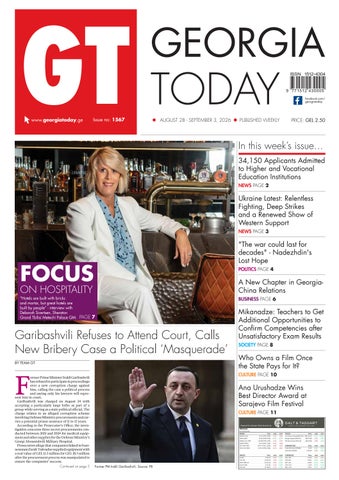
Garibashvili Refuses to Attend Court, Calls New Bribery Case a Political ‘Masquerade’ BY TEAM GT
Mikanadze: Teachers to Get Additional Opportunities to Confirm Competencies after Unsatisfactory Exam Results SOCIETY PAGE 8
Who Owns a Film Once the State Pays for It? CULTURE PAGE 10
F
ormer Prime Minister Irakli Garibashvili has refused to participate in proceedings over a new corruption charge against him, calling the case a political process and saying only his lawyers will represent him in court. Garibashvili was charged on August 24 with accepting a particularly large bribe as part of a group while serving as a state political official. The charge relates to an alleged corruption scheme involving Defense Ministry procurements and carries a potential prison sentence of 11 to 15 years. According to the Prosecutor’s Office, the investigation concerns three secret procurements conducted between 2021 and 2024 for medical equipment and other supplies for the Defense Ministry’s Giorgi Abramishvili Military Hospital. Prosecutors allege that companies linked to businessman Zurab Tukvadze supplied equipment with a real value of GEL 11.5 million for GEL 18.5 million after the procurement process was manipulated to ensure the companies’ success. Continued on page 5
BUSINESS PAGE 6
Ana Urushadze Wins Best Director Award at Sarajevo Film Festival CULTURE PAGE 11 Prepared for Georgia Today Business by
DĂƌŬĞƚƐ Ɛ ŽĨ ϭϴͲ ƵŐͲϮϬϮϲ
ŵͬŵ
^dK <^
WƌŝĐĞ
ǁͬǁ
ŵͬŵ
' KZ' Ϭϭͬϯϭ
ϵϳ͘ϭϵ ;zdD ϱ͘ϴϱйͿ
ͲϬ͕ϭй
ͲϬ͕Ϭй
>ŝŽŶ &ŝŶĂŶĐĞ 'ƌŽƵƉ ; ' K >EͿ ' W ϭϮϵ͘ϭϬ
нϮ͕Ϯй
нϭϯ͕ϴй
'Z /> ϬϲͬϮϴ
KE ^
ϵϲ͘ϱϲ ;zdD ϲ͘ϬϮйͿ
нϬ͕ϭй
нϬ͕Ϯй
'ĞŽƌŐŝĂ ĂƉŝƚĂů ; ' K >EͿ
' W ϰϯ͘ϬϬ
ͲϮ͕ϱй
нϳ͕ϰй
d ĂŶŬ 'ƌŽƵƉ ;d ' >EͿ
' W ϰϴ͘Ϭϴ
ͲϬ͕ϴй
нϭ͕ϱй
WƌŝĐĞ
ǁͬǁ
ϵϭ͕ϬϮ
нϮ͕ϰй
нϯ͕ϯй
ϰ ϯϯϰ͕ϱϬ
ͲϬ͕ϴй
нϳ͕ϵй
' '' ϵ ϭͬϮ W ZW
WƌŝĐĞ
ǁͬǁ
ϭϬϱ͘Ϭϴ ;zdD ϵ͘ϮϬйͿ
ͲϬ͕ϯй
ͲϬ͕ϳй
^><Z , ϬϵͬϯϬ
ϵϵ͘ϳϵ ;zdD ϳ͘ϱϲйͿ
ͲϬ͕ϯй
ͲϬ͕ϵй
d ϴ͘ϴϵϰ W ZW
ϭϬϬ͘ϳϱ ;zdD ϭϭ͘ϴϮйͿ
ͲϬ͕Ϭй
ͲϬ͕ϯй
KDDK /d/ ^
d ϭϬ ϭͬϰ W ZW
ϭϬϳ͘ϭϲ ;zdD ϵ͘ϯϵйͿ
ͲϬ͕ϭй
ͲϬ͕ϱй
ƌƵĚĞ Kŝů͕ ƌĞŶƚ ;h^ΨͬďďůͿ 'ŽůĚ ^ƉŽƚ ;h^ΨͬK Ϳ
/E / ^
WƌŝĐĞ
ǁͬǁ
ŵͬŵ
hZZ E / ^
WƌŝĐĞ
^W ϱϬϬ
ϳ ϲϵϭ͕ϳϲ
ͲϬ͕ϱй
нϯ͕ϭй
h^ ͬ ' >
Ϯ͕ϲϭϯϱ
ͲϬ͕Ϯй
ͲϬ͕ϲй
&d^ ϮϱϬ
Ϯϰ ϱϲϭ͕ϰϯ
Ͳϭ͕Ϭй
нϰ͕ϭй
hZ ͬ ' >
ϯ͕ϬϮϱϭ
нϬ͕ϭй
нϬ͕ϲй
Kt :KE ^ ϯϬ
Former PM Irakli Garibashvili. Source: FB
ϱϯ ϯϰϯ͕ϰϬ
ǁͬǁ
ŵͬŵ
нϬ͕ϭй
ŵͬŵ
ͲϬ͕ϴй
нϮ͕ϯй
' W ͬ ' >
ϯ͕ϱϯϵϯ
ZƵƐƐĞůů ϮϬϬϬ
ϯ Ϭϭϳ͕ϴϵ
ͲϬ͕ϯй
нϭ͕ϵй
hZ ͬ h^
ϭ͕ϭϱϳϲ
нϬ͕ϯй
нϭ͕Ϯй
&d^ ϭϬϬ
ϭϬ ϳϮϴ͕Ϭϰ
Ͳϭ͕ϭй
нϭ͕Ϯй
' W ͬ h^
ϭ͕ϯϱϯϮ
нϬ͕Ϯй
нϬ͕ϲй
нϬ͕Ϭй
2
NEWS
GEORGIA TODAY
AUGUST 28 - SEPTEMBER 3, 2026
34,150 Applicants Admitted to Higher and Vocational Education Institutions
The 12th-century coin. Source: Rustavi Archaeological Expedition
Unique 12th-century Georgian Coin Discovered in Rustavi Medieval Palace BY NANUKA MAGLAKELIDZE
A
unique 12th-century Georgian coin from the reign of King George III, the father of Queen Tamar, has been discovered by an archaeological expedition from the Rustavi Historical Museum at a medieval palace in Rustavi. The coin is a unique example of 12thcentury Georgian numismatics. The obverse depicts a king with a falcon perched on his hand, while the field bears the name of King George in the Georgian Mkhedruli script and an Asomtavruli inscription reading “Chronicon 394.” The reverse features an Arabic inscription reading: “King of Kings George, son
of Demetre, the sword of the Messiah.” The coin is considered particularly significant as it is the first Georgian coin discovered to date bearing a Mkhedruli inscription and a date in the Georgian chronicle system. The expedition has fully examined the palace’s first, third, fourth and fifth rooms this summer. Excavations are currently underway in the fifth room, where archaeologists have found a wellpreserved wooden floor, large quantities of millet and grain, and a clay vessel filled with millet. Significant artifacts were also discovered in the third room, including uniquely decorated pottery, locally produced glass vessels, glazed and unglazed bowls, cooking vessels, and coins dating to the 12th-13th centuries. Artifacts from the lower layers of the palace date back to the ancient period.
2026 Unified National Examinations. Source: IPN
BY NANUKA MAGLAKELIDZE
A
total of 34,150 applicants have secured the right to study at higher and vocational education institutions based on the results of Georgia’s 2026 Unified National Examinations. The information on student admissions was released by the National Assessment and Examinations Center (NAEC). Of those admitted, 17,862 applicants will study at state-founded higher edu-
cation institutions. NAEC says 29,481 applicants were admitted to bachelor’s degree programmes. Of these, 17,862 were admitted to statefounded higher education institutions, while 11,619 will study at private institutions. A further 3,141 applicants secured places in vocational education programmes – 1,322 at state vocational institutions and 1,819 at private institutions. Meanwhile, 1,528 applicants were admitted to Georgian language preparation programmes, including 1,495 at statefounded higher education institutions and 33 at private institutions.
The NAEC urged admitted applicants to contact the higher education institution where they secured a place to complete the enrollment agreement. Applicants can check whether they have been admitted to their chosen programme by visiting online.naec.ge and entering their personal number and password. As part of the higher education reform, applicants were able this year to select vocational education programmes alongside any number of higher education programmes. The state will fully fund applicants who secured places at state-founded higher and vocational education institutions.
Mamuka Mdinardze EU Enlargement Commissioner Outlines Reform Resigns, Leaves Politics Vision, Again Makes No Mention of Georgia BY ANA DUMBADZE
E BY ANA DUMBADZE
G
eorgian Regional Development Minister Mamuka Mdinaradze has announced that he is stepping down from his post and leaving
politics. Mdinaradze announced his decision during a briefing at the Government Administration. “I have made the decision to leave my position, and, in principle, politics as well. For me, these 10 years in politics have been 10 years of hard work, loyalty to my homeland, and working together with friends for the good of the country,” Mdinaradze said. He expressed gratitude to the Georgian Dream party and its members and leadership, describing his time with the ruling party as a privilege. “It has been a great happiness to serve alongside the Georgian Dream team. I would like to express my deepest grati-
tude to every soldier, every member and every leader of Georgian Dream, from Mr. Bidzina Ivanishvili to the rank-andfile members, as we call them in our large family,” he said. Mdinaradze, a lawyer, entered politics in 2016, when he was elected to Parliament for Georgian Dream. He went on to become one of the party’s most prominent parliamentary figures, serving as faction chairman, parliamentary majority leader and deputy speaker. In September 2025, he left Parliament after being unanimously elected head of the State Security Service, a position he held until resigning in April 2026. He subsequently returned to government as Deputy Prime Minister and State Minister for Law Enforcement Coordination and, most recently, temporarily took over as Regional Development Minister as part of a planned government restructuring. Mdinaradze added that his decision to leave politics was not sudden, and that he had been thinking about withdrawing from politics for “the past several weeks.”
U Commissioner for Enlargement Marta Kos has presented the main principles of a proposed reform of the European Union’s enlargement policy, which is expected to be discussed by the European Council in October. Kos said the European Commission’s vision for preparing the EU for future enlargement rests on four main pillars: transitional measures, internal reforms, safeguards and gradual integration. On transitional measures, Kos said the EU must assess the potential impact of new members and protect existing member states where risks arise. “We need to understand what impact newcomers could have. Where there is a risk that this impact could be harmful to member states, we need to act to protect their interests,” Kos said, noting that the EU has extensive experience in using transitional measures to ensure the smooth integration of new members. She added that the bloc must also ensure its budget remains capable of financing its priorities. The second pillar concerns internal reforms designed to ensure that a larger EU remains capable of taking effective decisions and responding rapidly to crises. Kos said the existing treaties already provide significant room to improve decision-making and the functioning of EU institutions. Commissioner said this could involve reducing the number of areas in which a single member state can block decisions supported by all others, as well as potentially reducing the size of EU institutions. Where all members are not ready to move forward together, smaller groups of countries could take the lead, as has previously happened with the Schengen Area and the euro. Kos also stressed the need for stronger safeguards to protect the EU’s fundamental principles and values. “We must make sure that we do not let
in ‘Trojan horses’ — not today and not in 10 or 20 years,” she said. “Recent experience has shown that we may need stronger safeguards to prevent and, where necessary, remedy violations of our Union’s fundamental principles and values.” The fourth pillar is gradual integration. Kos argued that the enlargement process must move away from an “all or nothing” approach, allowing candidate countries to benefit from closer integration in strategic sectors even before they become full members. “Preparing for membership takes time. But time is exactly what our adversaries are no longer giving our candidates,” she said, calling for a more structured and ambitious approach to gradual integration. Speaking at a diplomatic conference in Zagreb, Kos described preparations for the next enlargement as a “Helsinki moment” for the current generation, referring to the 1999 meeting at which European leaders discussed how to prepare the EU for what would become the largest enlargement in its history. “EU enlargement is about much more than simply increasing the size of our Union,” Kos said. “Leaving ‘grey zones’ on our continent leaves all of us vulnerable and increases uncertainty.” She argued that enlargement was necessary to build a Europe capable of defending its interests amid growing competition among global powers. “We can only succeed if we stabilize our continent and bring into the EU those candidate countries that deliver on their commitments. Because no European country can act alone,” she said. Kos predicted that 2026 would be a record year for progress on EU enlargement. She identified Montenegro and Albania as frontrunners, noting that Montenegro has begun work on its accession treaty, while Albania has started closing negotiating chapters. She also highlighted Ukraine and Moldova, saying the two countries had made significant technical progress over the past two years in aligning themselves
with the EU acquis and that “now is the time to formally open the remaining cluster.” Kos also referred to Iceland, which is due to vote later this week on whether to resume accession negotiations. As a member of the European single market, she said, Iceland could potentially complete accession talks within one or two years. Georgia, however, was not mentioned among the countries whose progress Kos highlighted. “I also want other candidate countries to join this group of frontrunners,” Kos said. “And they can do so if they show the same determination to deliver on their commitments and build trust with our member states.” She stressed that such trust now depends on more than adopting EU legislation and increasingly involves candidates’ strategic choices in areas including energy, transport, trade, defense and security. “Candidate countries really have to choose Europe. Our common security. Our common values,” Kos said. Since Russia launched its full-scale invasion of Ukraine in February 2022, the EU has increasingly described enlargement as a strategic necessity. The EU’s candidate countries are Albania, Bosnia and Herzegovina, Georgia, Moldova, Montenegro, North Macedonia, Serbia, Türkiye and Ukraine, while Kosovo is considered a potential candidate. Accession negotiations with Türkiye have effectively been frozen since 2018. Georgia has not opened accession negotiations. Although the country was granted candidate status in December 2023, EU officials have repeatedly said that Georgia’s accession process has effectively come to a halt following democratic backsliding and actions by the Georgian authorities that Brussels says run counter to the country’s European integration commitments. A strategic discussion on enlargement and reforms is expected to take place at the European Council summit in October 2026.
NEWS
GEORGIA TODAY
AUGUST 28 - SEPTEMBER 3, 2026
3
Ukraine Latest: Relentless Fighting, Deep Strikes and a Renewed Show of Western Support COMPILED BY ANA DUMBADZE
T
he Russia-Ukraine war entered another punishing week, with fierce fighting continuing across eastern Ukraine as both sides sought to gain an advantage. Russia kept up pressure along several parts of the front, while Ukraine increasingly used long-range drones and missiles to strike oil infrastructure, logistics hubs and other targets deep inside Russia. Between August 20 and 26, neither side made a decisive territorial breakthrough, but the fighting remained intense, particularly around Pokrovsk and Kostiantynivka in Donetsk region. Russian missile and drone strikes also caused heavy civilian casualties, while Ukraine's campaign against Russian refineries and other infrastructure continued to cause disruption far from the battlefield. The eastern front remained the main focus of the fighting. Ukrainian military reports recorded more than 200 combat engagements on several days, with Russian forces putting particular pressure on the Kostiantynivka and Pokrovsk areas. On August 22 alone, Ukraine's General Staff reported 254 clashes, alongside heavy Russian use of guided bombs, attack drones and first-person-view drones against Ukrainian positions and settlements. By August 26, Pokrovsk had again seen the largest number of reported Russian ground attacks. Ukrainian forces said they had repelled 36 assaults around Bilytske, Serhiivka, Molodetske and Udachne. Another 24 attacks were reported around Kostiantynivka, while fighting continued
around Lyman, northern Kharkiv region and Kupiansk. Russian attacks were also reported farther south, toward Oleksandrivka, Huliaipole and Orikhiv. Ukraine says its forces carried out successful counterattacks along the Oleksandrivka axis across parts of Donetsk, Dnipropetrovsk and Zaporizhzhia regions. Ukrainian officials said earlier this month that 26 settlements and around 745 square kilometers had been retaken there since January. Most of those gains predate the past week, but they show that Ukraine remains capable of regaining ground through local counterattacks.
CIVILIAN TOLL MOUNTS On August 20, Russia launched a major overnight barrage against Kyiv and the surrounding region, involving 168 drones as well as ballistic, cruise and hypersonic missiles. Ukrainian officials said at least 17 people were killed and more than 40 wounded. A nine-story apartment building in Kyiv's Solomianskyi district was badly damaged. President Volodymyr Zelensky again pointed to shortages of Patriot interceptors as a major weakness in Ukraine's ability to defend against ballistic missiles. The following day brought another devastating attack in Kryvyi Rih. Several Russian drones struck a shopping center in the central Ukrainian city, killing at least 16 people and injuring more than 130, including children, according to Ukrainian authorities. The UN human rights monitoring mission later confirmed that 16 people were killed and 128 injured. Zelensky described the attack as a "double-tap," in which a second strike followed the initial impact. Russian attacks remained deadly in the days that followed. Ukrainian authorities reported at least four people killed and
95 wounded across the country on August 25 and 26. In Kramatorsk, a Russian FPV drone reportedly struck an armored ambulance carrying emergency workers responding to an earlier attack on a residential building, underlining the growing danger faced by rescuers and civilians close to the front.
UKRAINE TAKES THE WAR DEEP INTO RUSSIA Kyiv's military confirmed attacks on the TANECO oil refinery in Tatarstan and the Tamanneftegaz oil terminal in Krasnodar region, with fires reported at both sites. On August 26, Ukraine also struck the NORSI refinery in Nizhny Novgorod region, one of Russia's major oil-processing facilities. A fire was reported at the site, although the full extent of the damage was still being assessed. The effects of the campaign are becoming increasingly visible. Russia was preparing to extend its diesel export ban through September as domestic fuel shortages persisted. Refinery maintenance, market conditions and domestic demand also affect supplies, but repeated Ukrainian drone attacks have added to the pressure on Russia's energy infrastructure. Ukraine also widened its attacks on logistics facilities. On the night of August 26, Ukrainian drones struck a Wildberries logistics center in Kotovsk, Tambov region. Regional Governor Yevgeny Pervyshov said the facility was completely destroyed by fire, with about 100,000 square meters affected. At least one worker was injured, with Russian authorities later reporting a second injury. Employees were evacuated. Wildberries facilities in several Russian regions have been targeted since mid-July. Ukraine has accused the retailer of having a role
in Russia's military supply chain, a claim rejected by the company and Russian authorities. Russian authorities also reported civilian casualties from Ukrainian strikes, saying three people were killed in attacks across Russia on August 26, including a 14-year-old in the Lipetsk region. In Russian-occupied Luhansk region, Moscowinstalled authorities said a Ukrainian drone strike on a passenger bus killed nine people. These reports could not be independently verified.
DIPLOMACY REMAINS STALLED Zelensky said Russia was not prepared to accept a Ukrainian proposal for a reciprocal halt to attacks on civilian grain shipping in the Black Sea unless Kyiv also stopped striking Russian refineries and energy facilities. Ukraine has insisted that any such arrangement would have to include Russian guarantees against renewed attacks on its own energy network. Russia said it was prepared to consider new peace proposals, but only if they reflected what Moscow calls the "realities on the ground," a phrase generally understood as referring to its territorial claims over occupied Ukrainian regions. Kyiv rejects any settlement requiring it to surrender additional territory.
WESTERN SUPPORT CONTINUES Ukraine's Independence Day on August 24 brought a strong show of support from its European allies. British Prime Minister Andy Burnham, making his first foreign visit as prime minister, said Britain would remain firmly behind Ukraine and announced that British defense company MBDA would share classified technical information to help Ukraine develop its own long-range missiles based on the
Storm Shadow system. He also called for tougher sanctions against Russia. French President Emmanuel Macron called for faster deliveries of air-defense interceptors, particularly Patriot missiles, as Ukraine faces increasingly heavy Russian missile attacks. European leaders also discussed longer-term security guarantees and ways to strengthen Ukraine's ability to defend itself, while the Coalition of the Willing met in Kyiv to coordinate further support. The European Union marked Ukraine's 35th Independence Day by approving €6.1 billion in new defense procurement. The funding is intended for air and missile defense systems, missiles, ammunition and radar equipment, with the European Commission saying the measures were urgently needed as Russia intensifies its attacks. The new funding forms part of the EU's €90 billion Ukraine Support Loan for 2026 and 2027. The EU also said its overall support for Ukraine since Russia's full-scale invasion had reached €220.2 billion, covering humanitarian, financial and military assistance. It reaffirmed its commitment to Ukraine's sovereignty and territorial integrity and to the country's eventual membership in the European Union. At the United Nations, more than 50 countries marked Ukraine's Independence Day by reaffirming their support for its sovereignty and calling on Russia to accept an immediate and unconditional ceasefire. Air defense remains one of Ukraine's most urgent needs. A limited number of additional U.S.-made Patriot interceptors arrived during the week, although Zelensky said Ukraine still receives only a fraction of the interceptors it needs. France has also confirmed future deliveries of its Crotale air-defense system.
4
POLITICS
GEORGIA TODAY
AUGUST 28 - SEPTEMBER 3, 2026
"The war could last for decades" - Nadezhdin's Lost Hope Boris Nadezhdin. Source: RFERL
When we met with Putin, he presented himself as if he wanted to make Russia a European country, that he wanted the crisis of the 1990s to never happen again
INTERVIEW BY VAZHA TAVBERIDZE FOR RFERL
B
oris Nadezhdin was the only anti-war presidential candidate in Russia in 2024, but he was removed from the election due to invalid signatures. In June 2026, he said he intended to participate in the Duma elections scheduled for September. On July 10, the Russian Ministry of Justice declared him a "foreign agent," and on July 17, the court fined him for displaying "extremist symbols" and banned him from voting in elections for at least a year. He was also excluded from participating in the September elections. At the court session, Nadezhdin, citing his health, asked the judge not to make a decision to arrest him. "It was hot in Moscow. I have heart problems, and I became unwell due to stress. I always carry medication with me, but still it was necessary to call an ambulance. It's nothing, I'll cope, especially since such things happen in Putin's Russia, what else is there?" Nadezhdin
told Radio Liberty’s Georgian Service. We spoke with the Russian politician at the end of July. At that time, he said that he was banned from leaving the country. On August 3, Nadezhdin posted a video on his Telegram channel with the Eiffel Tower in the background. We contacted him with additional questions, assuming that the "liberated" man would speak more freely and at length; however, given that he had left his family and parents in Russia, the Russian politician refrained from making additional comments. Below is his July interview.
DO YOU EXPECT TO BE SENTENCED TO PRISON? Yes. We live in such a country and at such a time that this is completely expected. I have been criticizing Putin and the war for so long that no one is going to forgive me for it. The first steps have already been taken: I have been banned from leaving Russia. I would already be in prison, but the story generated a huge response in the West, so they simply postponed my arrest and issued me only a symbolic fine. Being in a Russian prison is hell and a disaster. I would not wish it on anyone. My large family is under enormous stress. I have a wife and four children, two of whom are minors, aged 14 and 12, as well as elderly parents.
HAVE YOU THOUGHT ABOUT LEAVING THE COUNTRY?
MUCH CAN WE HOPE FOR THE RUSSIAN OPPOSITION? Today, it’s not just me who is under pressure; many other people are facing the same thing. Putin’s regime is trying to punish everyone who opposes him, while portraying it as though we are fighting against the country itself, rather than against its destructive policies. On the one hand, we know that authoritarian regimes can remain in power for a very long time, and in Russia we are dealing with an authoritarian, even totalitarian, regime. You probably remember what happened after Stalin, when the government changed. On the other hand, such regimes can collapse within a matter of days, as happened in 1991. I remember the events of that time very well because I was a deputy in the Soviet Union. Everything seemed very stable. Ninety percent of the population voted for the Communist Party, but then everything fell apart as people ran out of patience, lost faith in the government and began taking to the streets. I don't want the same scenario to happen again now. I hope that the government, or at least part of it, will realize the dangers, release political prisoners, somehow turn away from the path of war, and lift these stupid restrictions that Putin is imposing. After all, this is his decision. That is why they are trying to expel me from Russian politics: I was banned from leaving Russia for criticizing its policies and calling for common sense, and a few days later, I was declared an agent of a foreign state and accused of supporting extremism. Despite this, a very large number of people support me.
developed country. When we met with Putin, he presented himself as if he wanted to make Russia a European country, that he wanted the crisis of the 1990s to never happen again.
there should be peace in the country, we should live as a free and peaceful nation. Even talking about it today sounds ridiculous, but we should have the Internet, we should live the way we want, we should vote for whomever we want in the elections, and when we go out on the streets, Ukrainian drones should not be flying over our heads. Our people have the right to that.
DO YOU CONSIDER PUTIN A LEGITIMATE RULER?
DO YOU WANT UKRAINE TO WIN THIS WAR?
Let’s start with the fact that, initially, everything was going well for Putin, and many people were satisfied with his presidency. In the political bloc that included Boris Nemtsov and Sergei Kiriyenko, we represented the opposition. But when we met with Putin, he presented himself as someone who wanted to make Russia a European country and ensure that the crisis of the 1990s would never happen again. However, in recent years, he has made a series of fatal mistakes, including starting a war with Ukraine. This is nothing less than leading the country towards totalitarianism. As for his legitimacy, this is an interesting question. Yes, formally, he is legitimate because the majority of Russians voted for him. But the fact is that free and fair elections were not held. Therefore, in our country in recent years, everything has become formal and illusory – including Putin’s legitimacy and Russian democracy. The Public Opinion Foundation published a survey a few days ago showing an unprecedented drop in trust in Putin since the start of the war. However, even the 66% figure is still higher than his actual level of support. No leader in any European country enjoys such a level of trust. But he is an authoritarian ruler of an authoritarian country, and his approval ratings are therefore always expected to be high. A few months before the collapse of the Soviet Union, the Communist Party had an approval rating of 99%. Putin’s Russia is formally a democracy, and elections are formally held. His approval ratings have been falling since February, but they are still formally high. All this is happening against the backdrop of Moscow, the capital of such a vast country, being attacked by Ukrainian drones day and night, while oil terminals require constant protection. In short, the situation is getting worse, and it is becoming increasingly obvious that this will not stop. That is why I say that this regime has no future.
Of course not. Why would I want it to?! The scary thing is that neither Ukraine nor Russia will win. The armies of Ukraine and Russia will not be able to defeat each other. The Ukrainian leadership hopes that the Russian government will fall. Russia, on the contrary, hopes that the days of Zelensky's government are numbered. This situation could go on for years, causing unprecedented casualties on both sides. War can last for decades, as it did in the Middle Ages.
EVEN AFTER PUTIN? I understand what you mean. When I am asked what will happen after Putin, I answer that Putin may repeat the path of the Russian Emperor Nicholas I, who was an authoritarian ruler of Russia in the 19th century. It was Nicholas I who launched the Crimean War, which he ultimately lost. The armies of the Allied powers, Great Britain, France and the Ottoman Empire, did not enter St Petersburg, but despite this, Nicholas found himself in a desperate situation and died soon afterwards. His successor, Alexander II, was forced to accept the terms of the Treaty of Paris. In addition, he carried out reforms that today would undoubtedly be described as liberal-democratic: he reformed the judicial system and the Civil Code. So today, Putin finds himself in a position similar to that of Nicholas I. He also started well, and then everything developed as we see it today. Whoever becomes his political successor, I believe the same scenario will unfold as it did under Alexander II, because a senseless war has never brought good results for any country.
The main question I was asked in We should have Yes. court was whether I intended to leave the country. I answered that, of course, the internet, we I did not want to leave, but my family was suffering greatly, and I felt I was should live the being forced to leave the country in order save myself. way we want, we toAfter that, I was banned from leaving Russia. The decision was made by the DO YOU BELIEVE THAT should vote for state authorities, no more and no less RUSSIA WILL EVER CHANGE than at two o’clock in the morning. But FOR THE BETTER? whomever we by now, nothing about this surprises Russia will definitely change, but when anyone. and how is difficult to predict. My supwant in the porters are young. At meetings, I tell them: “Raise your hand, those who were IN YOUR OPINION, WHERE IS elections, and we TODAY'S RUSSIA HEADING? born when Putin was already president.” What Putin is doing, especially in recent And almost every third person raises WHAT WOULD YOU shouldn't have SAY TO THE UKRAINIAN years, is pushing Russia towards chaos. their hand. This means that most of them PEOPLE AS A RUSSIAN Signs of chaos are already visible in the are 25 years old or younger. Since they Ukrainian drones country, and if nothing changes, we may come to my meetings, it means that they OPPOSITION POLITICIAN? face a catastrophe. What happened in no longer want to live under this regime. I am sincerely sorry that people are flying over our Of course, this does not mean that the the 90s should not be repeated. Nobody dying, and I am sorry that I cannot do wants revolution and civil war. I really regime will collapse and be replaced more to stop this war. The regime is tryheads when we don't want my people to face problems very soon and peacefully. We will have ing to intimidate me in every way. As with water, electricity, gas, and security to fight for a long time, but from a stra- WHAT WOULD YOU SAY time goes by, I have to worry more and go out on the tegic point of view, this regime really TO THE RUSSIAN PEOPLE again. more about my own safety and that of has no future. The younger generation IN THIS SITUATION? my family. I am sorry that the sides have streets wants to live in a peaceful, free and What I have been saying for a long time: been allowed to kill each other. IN THIS SITUATION, HOW
POLITICS
GEORGIA TODAY
AUGUST 28 - SEPTEMBER 3, 2026
5
OP-ED: How the Recent Parliamentary Investigative Commission Report Exposes the Falsehoods of Liberal Internationalism OP-ED BY LASHA KASRADZE FOR THE INSTITUTE FOR PEACE & DIPLOMACY
George W. Bush and Mikhail Saakashvili. Freedom Square, Tbilisi. 2005. Source: White House
I
n recent decades, a substantial body of scholarship has examined the post-Soviet South Caucasus through the lens of geopolitical competition between Western liberal-democratic integration and Russian revanchism. Considerable analysis has also been devoted to the formal institutional architecture of Georgia’s post-2003 Rose Revolution state: constitutional amendments, judiciary reforms, and the restructuring of the security services. Yet, almost no sustained attention has been paid to what might be called the domestic architecture of the performative state, the techniques through which a government that constructed its legitimacy on a claim to a European and liberal-democratic identity, simultaneously orchestrated a system of deliberate violence against its own population. This gap exposes a fundamental flaw in liberal internationalism: treating democratic procedures and superficialities, rubber-stamped by Western allies, as equivalent to genuine democracy. A normative offspring to liberal internationalism, liberal institutionalism relied on rules, courts, and monitoring bodies to standardize state behavior to preserve and internationalize the post-1945 U.S.led order. It was this exact framework that Mikheil Saakashvili’s government (UNM) was meant to embody. This is the terrain that the Parliamentary Investigative Commission of Georgia has sought to map. The document draws on the European Court of Human Rights rulings, European Committee for the Prevention of Torture (CPT) reports, Amnesty International and Human Rights Watch assessments, and the testimony of 139 individuals. Yet it must equally be read as a political artifact. Abuses under the UNM were not isolated, rogue acts, but a deliberate policy engineered to satisfy the metrics used in the liberal paradigm to certify democratic progress. The Commission was established at the initiative of the Georgian Dream Party. Its composition was overwhelmingly drawn from that party as the opposition declined to fill its allocated seats.
This does not discount the Investigative Commission report’s evidentiary content, much of which was corroborated by independent international sources predating the current political process. It does, however, condition how the report must be approached: a document that deploys legal and historical materials for purposes that are both retrospective and prospective. A document that delegitimizes a principal opposition force while consolidating a narrative of national salvation for the current ruling party. The report is better read as a testament to liberal internationalist/ institutionalist failures, even if the authors do not frame it that way. Internationalism set the strategic goal; institutionalism supplied the evaluative infrastructure for Western-backed governments like the UNM: ratifying conventions, accepting monitoring visits, opening prosecutions. The entire enterprise treated institutionalized compliance as reliable evidence of a state’s ethos. While many of the report’s individual findings were already established by the European Court of Human Rights, its broader revelation is far more crucial. It definitively proves that abuses under the UNM were not isolated, rogue acts, but a deliberate policy engineered to satisfy the metrics used in the liberal paradigm to certify democratic progress. The gap between the state’s public face and its operational reality was intentional by a government that regarded liberal institutionalist evaluation as a genre to be authored, not a standard to be met. Torture, extrajudicial execution, media capture, and judicial subordination were
the evidence; the rhetoric of European standards was the cover that practitioners of these liberal theories were structurally inclined to accept. Put simply, the performative state is the offspring of liberal ideology’s contradictions: authoritarianism wrapped in democratic language. What is most striking is that this gap was not merely tolerated by Georgia’s Western partners but actively sustained by them. Bush’s characterization of Saakashvili’s Georgia as a “beacon of liberty” in May 2005, at the very moment international monitors were documenting systematic torture and near-total impunity, is significant. The performance of democratic identity was rewarded rather than scrutinized, regardless of actual actions undertaken by the state. The institutionalist premise offered no framework for distinguishing sincere transformation from mimicry. Furthermore, by treating “the rule of law” and “democratic consolidation” as culturally neutral endpoints, democratic developmentalists discounted the postSoviet reality: patronage networks, securitized statehood, a security establishment inherited nearly intact from the Soviet period, that determined how imported institutional forms would actually function. Regional and national particularities were not an obstacle on the path to convergence either. Liberal universalism’s refusal to reckon with particularity as such was not a peripheral failure but a constitutive one. This dynamic is plainest to see in the domains of information and judiciary. Under Eduard Shevardnadze, the media
was considerably freer than under the Western-supported Saakashvili. From the earliest months of UNM rule, progressive capture followed, including an armed raid on TV Imedi under a fabricated pretext, cancellation of political programming, co-optation of ownership structures, and self-censorship of journalists. The legal system became merely a façade to maintain the appearance of accountability, ensuring lawfare while denying due process. The regime filed charges and suspended sentences arbitrarily such as “for deception of victims.” The law was selectively and opportunistically applied such as when the state attempted to use plea bargaining to conceal police violence. The central weakness of the post-Cold War liberal order: the tendency to reward the appearance of democratic governance while overlooking its internal erosion. To be sure, the document’s political character is not beyond scrutiny. The Georgian Dream government that produced it is not immune to claims that it reproduces features of the very performative state that it condemns. The Commission’s reach into oppositionaligned individuals and foreign-funded civil society suggests its ambitions extend beyond historical reckoning. It is, simultaneously, a forward-looking instrument shaping the terms of current Georgian public debate. The report’s ultimate significance then is perhaps best understood through the lens of liberal internationalism’s victims. Similar to investigations of the Pinochet regime in Chile and the Fujimori government in Peru, it documents patterns of state-sponsored abuse that flourished under governments strongly backed by the West. Although the document is unlikely to influence international law as the Chilean and Peruvian cases did, the Commission’s principal value lies in documenting abuse, assigning responsibility, and preserving the historical record against revisionism. More fundamentally, the report exposes a central weakness of the post-Cold War liberal order: the tendency to reward the appearance of democratic governance while overlooking its internal erosion. The case of the Saakashvili government thus illustrates a broader crisis in the universalist assumptions of the post-Cold
War liberal order. In its most recent disastrous application, liberal internationalism has proved unable to accommodate the enduring security concerns and civilizational particularities of states such as Russia and Iran, treating them as obstacles to be transformed rather than political realities to be managed or accommodated. The Georgian case thus illustrates a broader crisis in the universalist assumptions of the post-Cold War liberal order. The then-in-vogue democratic peace thesis, and its expression in post-Cold War NATO expansion, could hardly avoid triggering major security dilemmas under the garb of democratic transition. This situation was exploited by governments skilled that violated their own citizens’ rights but were skilled at democratic theater. Far from modifying state behavior, such democratism systematically provokes the core security concerns of great powers or states with legitimate interests in their near abroad. In fact, it is fundamentally designed to undermine those states whose self-organization defies a liberal universalism that treats geopolitical and cultural identity as obstacles to convergence rather than persistent political facts. The cost has been high: measured in the tragedy of Ukraine, in Russia’s 2008 invasion of Georgia and the occupied territories that followed, and in the bodies of Georgians tortured by their government, with the endorsement of Western partners who continued to present Georgia as a beacon of liberty and the rule-of-law. A reckoning with the fallout is not a counsel of despair. It is the precondition for a more honest, disciplined engagement with the genuinely difficult problems of international politics, one that abides the logic of great-power competition without sacrificing state sovereignty and cultural particularity, and which recognizes the difference between the performance and the substance of democratic life. *** The views expressed in this article are those of the author alone and do not reflect the views or positions of Georgia Today. Lasha Kasradze is an international relations analyst specializing in the post-Soviet space, with a focus on the South Caucasus, the Black Sea region, and great-power politics.
Garibashvili Refuses to Attend Court, Calls New Bribery Case a Political ‘Masquerade’ Continued from page 1 The businessman allegedly paid around 10% of the contract value, GEL 1.9 million, in cash to Vasili Mkheidze, a relative of former Defense Minister Juansher Burchuladze. Mkheidze allegedly kept GEL 400,000 and passed the remaining GEL 1.5 million to Burchuladze. According to the prosecution, Burchuladze kept GEL 750,000 and handed the remaining GEL 750,000 to Garibashvili in cash in several installments. The alleged scheme caused the state GEL 6.99 million in financial damage, prosecutors say. The case was opened after Mkheidze approached prosecutors on August 12 and offered to cooperate with the investigation. Burchuladze, who has already been convicted and sentenced to 10 years in prison in connection with the case, also cooperated with investigators, according to the Prosecutor’s Office.
Garibashvili denies the charge. His lawyer Lili Gelashvili said he refused to sign the document formally presenting the charge and intends to fight the case through legal channels. Another of his lawyers, Natia Tamazashvili, has described him as a “political prisoner,” calling the case politically motivated and the charge “non-existent.” Garibashvili did not attend the August 25 court hearing. The judge said the court had received a statement from the penitentiary confirming that he had refused to participate, and the proceedings therefore went ahead in his absence. The court subsequently scheduled the preliminary hearing for October 19. In his first Facebook post following the new charge, Garibashvili explained his decision to stay away from court: “Yesterday, the authorities themselves confirmed the authenticity of the letter I published last week. I want to tell the public once again that I tried everything and did my
utmost to avoid this process,” he wrote. “But I was faced with a harsh reality. This is a ruthless political struggle, injustice and evil directed against me. I no longer intend to participate in this shameful political masquerade that is insulting to our country. Therefore, I will not participate in the court proceedings either. Only my lawyers will represent and defend my interests.” Garibashvili said his decision was not intended as disrespect towards prosecutors or judges, but argued that there was no point in attending what he described as a politically controlled process. “I will no longer participate in your show,” he wrote, adding that he was also not interested in what authorities might allegedly pressure other prisoners or detainees into saying about him, or what further charges might be brought against him. “What was going to happen has already happened, so my only path and weapon in this struggle is the truth,” Garibashvili
wrote. “I intend to speak publicly to society and tell them my truth. Let the people judge.” The new charge follows a series of increasingly confrontational statements Garibashvili made from prison in August, in which he accused his former political allies of attempting to destroy him and his family. In posts published on August 17, 18 and 20, the former prime minister claimed that he had received a letter through an intermediary from Georgian Dream parliamentary leader Mamuka Mdinaradze demanding that he admit involvement in a new corruption case. Garibashvili said he rejected the demand and decided instead to “fight.” He also alleged that members of his former political team feared his possible return to politics and were trying to eliminate that possibility. He said he had remained silent during his first eight months in prison because of his loyalty
to Ivanishvili, Georgian Dream and the political team with which he had worked for two decades. The authorities have denied his allegations. Georgia’s fifth president, Salome Zurabishvili, said Garibashvili had only begun criticizing the judiciary after its problems directly affected him. “We all know very well what condition the judiciary is in,” she said, adding that she could not understand how a former prime minister had “discovered it only now.” Opposition politician Giorgi Sharashidze described Garibashvili’s statements as evidence of an internal struggle within Georgian Dream, while Tbilisi Mayor Kakha Kaladze said Garibashvili’s rights and safety were protected. Garibashvili is already serving a fiveyear sentence in a separate criminal case. The new charge could add another 11 to 15 years if he is convicted.
6
BUSINESS
GEORGIA TODAY
AUGUST 28 - SEPTEMBER 3, 2026
A New Chapter in Georgia-China Relations ANALYSIS BY EMIL AVDALIANI
O
ver the past months Georgia-China relations have ben elevated to a partnership that supersedes the 2023 agreement that laid foundation for strategic ties between the two actors. Reasons are rooted in the changing strategic situation across much of the Eurasian continent reshaped by Russia’s war against Ukraine, the fragmentation of global supply chains, intensifying US-China strategic competition, and the growing importance of alternative transport corridors. These developments have elevated the South Caucasus from a peripheral transit region to a critical intersection of European, Asian, and Middle Eastern economic interests. For China, Georgia is not a primary economic partner because of its market size or military capabilities. Rather, Beijing views Georgia through the lens of connectivity. China’s current approach reflects a broader evolution of the Belt and Road Initiative (BRI). Whereas the initiative’s first decade emphasized largescale infrastructure lending, Beijing is now prioritizing commercially effcient logistics corridors, supply-chain resilience, digital connectivity, and targeted investments in strategic infrastructure. Georgia fits neatly within this recalibrated strategy. At the same time, Beijing has carefully avoided becoming directly involved in the geopolitical conflict in the South Caucasus. Unlike Russia, which has traditionally exercised influence through military deployments and conflict mediation, or the United States and the European Union, which have invested political capital in the development of the democratic governance and conflict resolution, China seeks stability without assuming political or security responsibilities. This model allows Beijing to
Georgia-China relations. Source: civicidea
expand its economic influence while minimizing geopolitical costs. For Tbilisi, the elevated strategic partnership with China reflects a calculated effort to diversify foreign economic relations at a time of increasing geopolitical uncertainty. The official Tbilisi recognizes that European integration remains a long-term strategic objective, but it also knows well that accession is to remain a lengthy and politically demanding process. Simultaneously, political disagreements with Brussels and Washington have created incentives for the country to seek alternative economic partnerships capable of attracting investment and supporting economic growth. At the same time Georgia’s economy remains integrated with European markets and Western financial institutions continue to play a dominant role in financial sector. It is unlikely that China replaces these relationships in the foreseeable future. Instead, Beijing represents an additional economic pillar within Georgia’s broader attempt to build multivector foreign policy. Relatedly, Western
governments now evaluate Chinese investment through geopolitical lens. Investments in ports, telecommunications, artificial intelligence, cloud infrastructure, and critical logistics networks are often viewed as components of strategic rivalry. The South Caucasus itself is entering a new phase of geopolitical competition. For much of the post-Soviet period, Russia was the dominant external actor, while the European Union and the United States primarily focused on governance, energy security, and conflict management. Today, a more complex multipolar environment is emerging. China is expanding its economic footprint, Turkey has consolidated its position as a leading regional power following the Second Karabakh War, Gulf states are increasing investment in logistics and renewable energy, and the European Union is pursuing its Global Gateway strategy to strengthen transport links with Central Asia. Rather than replacing one another, these actors are increasingly competing to shape the region’s
connectivity architecture. Within this emerging order, Georgia occupies an important position: it is one of the few countries capable of maintaining productive relations with all major stakeholders simultaneously. It enjoys strategic partnerships with Turkey and Azerbaijan, maintains economic engagement with China, continues to pursue European integration, cooperates closely with the United States on security matters, and preserves pragmatic economic relations with regional actors despite unresolved conflicts with Russia. This diplomatic flexibility constitutes one of Georgia’s greatest strategic assets but also one of its most difficult foreign policy challenges. The success of Georgia’s China approach will also depend on the implementation of infrastructure projects capable of transforming the Middle Corridor into a competitive Eurasian transport route. The Anaklia Deep Sea Port is especially significant in this regard. If completed according to schedule and integrated with upgraded railway and logistics
infrastructure, the project could substantially increase Georgia’s cargo handling capacity and strengthen its role as the Black Sea gateway for Central Asian trade. Another important variable is the future of Armenia-Azerbaijan relations. A comprehensive peace agreement would reshape regional connectivity by opening additional transport links across the South Caucasus. Such an outcome would benefit China by creating greater flexibility within Eurasian logistics networks while reducing political risks for investors. Conversely, renewed instability would reinforce existing bottlenecks and diminish the attractiveness of the Middle Corridor. China’s expanding engagement also carries implications for Russia. Although Moscow and Beijing remain strategic partners globally, their interests in Eurasian connectivity are not identical. Russia benefits from maintaining the Northern Corridor as the principal overland trade route between Asia and Europe, whereas China’s emphasis on diversification inevitably strengthens alternative corridors that bypass Russian territory. This divergence is unlikely to generate open disagreement, but it illustrates that even close strategic partners may pursue different long-term economic interests in Eurasia. Looking ahead, the strategic partnership between China and Georgia is likely to deepen gradually through growing trade, potentially investment in logistics and transport infrastructure, and cooperation in digital trade and customs modernization. At the same time, Beijing is expected to remain cautious about assuming political responsibilities in the region or becoming involved in its conflicts. Emil Avdaliani is a professor of international relations at the European University in Tbilisi, Georgia, and a scholar of Silk Roads. He can be reached on Twitter/X at @emilavdaliani.
Russian Ruble Deposits in Georgian Banks Exceed ₾98.6 million – National Bank Data BY NANUKA MAGLAKELIDZE
M
The Mtkvarze Nightclub building. Source: FB
Landmark Tbilisi Building Housing Mtkvarze Nightclub Put up for Sale BY ANA DUMBADZE
A
well-known Tbilisi building originally constructed as the Mtkvari restaurant has been put up for sale for $1.25 million. Built in 1960 according to a design by architect Chachanidze, the property includes 570 square meters of land along with the building situated on it. The property is being sold by Mtkvari LLC. Based on an extract from Georgia’s
Public Registry, the building has seven owners. In recent years, it has been home to Mtkvarze, one of Tbilisi’s well-known nightclubs. Information about the sale was published on a real estate listing platform. Featuring monumental columns, arched stained-glass windows, a classical façade and decorative relief ornaments, the building appeared on Tbilisi’s architectural landscape in the 1960s. For many years, the former Mtkvari restaurant was regarded as one of the city’s notable examples of Soviet-era architecture.
ore than 3 billion Russian rubles are held in commercial banks operating in Georgia, with ruble-denominated deposits totaling ₾98.605 million as of July 2026, BPN reported citing National Bank of Georgia statistics. At the current exchange rate, the amount is equivalent to around 3.1 billion rubles. The figure represents a significant increase both compared with the same period last year and with June 2026. Ruble-denominated deposits in Georgian banks began rising in July 2022, when they increased by 177% in a single month. National Bank statistics show that ruble deposits totaled ₾17.908 million in June 2022, before rising to ₾49.591 million in July. Ruble deposits subsequently followed a downward trend in the following months, but began increasing again in July 2023. The highest level was recorded in March 2025, when Georgian banks held ₾121.021 million in ruble-denominated deposits. The volume of ruble deposits declined in the following months, but rose by
almost 33% in July 2026 compared with the previous month and by 48% compared with July 2025. More specifically, ruble deposits stood at ₾66.452 million in July 2025, ₾74.201 million in June 2026 and ₾98.605 million in July 2026. Although ruble-denominated deposits account for just 0.13% of total deposits, the data show that their volume is increasing. Overall, National Bank data show that deposits in Georgia’s banking sector,
Russian rubles. Source: Commersant.ge
Georgia’s Hotel Numbers Rise 4.5% in 2025 – Geostat BY NANUKA MAGLAKELIDZE
A
total of 2,731 economic entities engaged in hotel services operated in Georgia in 2025, owning 2,783 hotels and hotel-type establishments, BPN reported citing data from the National
Statistics Office of Georgia (Geostat). The number of hotels in the country increased by 4.5% last year compared with 2024. Geostat data show that the largest shares of hotels and hotel-type establishments were located in Adjara (21.3%) and Tbilisi (20.9%). Individual entrepreneurs were the most
common legal form among entities engaged in hotel services. In 2025, individual entrepreneurs accounted for 65.5% of all operating hotels and hotel-type establishments. Geostat data show that 99.8% of hotels and hotel-type establishments were privatelyowned,while0.2%werestate-owned. The total area of operating hotels and
excluding interbank deposits, totaled ₾73.93 billion at the end of July 2026. This was ₾410.97 million, or 0.56%, higher than at the end of the previous month, while the increase excluding the exchange-rate effect stood at 0.80%. Annual deposit growth, excluding the exchange-rate effect, reached 20.90%. The same data show that the US dollar accounted for 77.16% of foreign-currency deposits, while the euro accounted for 20.30%.
Hotels in Georgia. Source: bm.ge
hotel-type establishments in Georgia reached 3,964.6 thousand square meters in 2025, up 9.8% from 2024. The residential area of hotel rooms
stood at 1,761.0 thousand square meters, an 8.9% increase year-on-year. The total number of beds in hotels and hotel-type establishments reached 120,200 in 2025, up 6.0% compared with 2024. The number of rooms increased by 6.1% to 54,300. Geostat data also show that 29,101 people were employed in Georgia’s hotels and hotel-type establishments in 2025. Women accounted for the majority of employees, at 54.5%.
BUSINESS
GEORGIA TODAY
AUGUST 28 - SEPTEMBER 3, 2026
7
“Hotels are built with bricks and mortar, but great hotels are built by people” - Deborah Sivertsen on Her Leadership Philosophy INTERVIEW BY NANUKA MAGLAKELIDZE
O
RIGINAL: Deborah Siversten has nearly three decades in hospitality (since 1997) and has led hotels across South Africa, Namibia, Nigeria, Ghana, Russia and now Georgia. Unlike many hotel GMs, who primarily talk about RevPAR and occupancy, her public communication consistently focuses on people: employee appreciation, talent development, children's events for associates' families, safety culture and leadership development. She was appointed Chair of the European Business Association Hospitality Committee in Georgia, suggesting she is interested in shaping the country's hospitality industry beyond her own hotel. Sheraton Grand Tbilisi Metechi Palace itself occupies a unique place in Georgia's modern history as one of the first international luxury hotels after the Soviet era, making it a proud leader of Marriott property in Georgia.
YOU HAVE BUILT YOUR CAREER ACROSS SEVERAL CONTINENTS AND VERY DIFFERENT HOSPITALITY MARKETS. LOOKING BACK AT YOUR JOURNEY, WHAT BROUGHT YOU TO GEORGIA AND WHAT MADE THIS CHAPTER AT SHERATON GRAND TBILISI METECHI PALACE SPECIAL FOR YOU? My journey has taken me across several countries and very different hospitality markets, and each experience has taught me something valuable. Coming back to Georgia felt like a very natural decision. My son had already moved back here while I was still working in Ghana, so there was a personal reason to return. But beyond that, I had worked in Georgia previously, and I had developed a genuine affection for the country. Georgia has so much to offer: the incredible wine culture, the fantastic food, and the richness of its history and traditions. More importantly, though, it's the people who make it special. There is a warmth, generosity, and sense of hospitality here that really resonates with me, both personally and professionally. Joining Sheraton Grand Tbilisi Metechi Palace made this chapter even more meaningful. It gave me the opportunity to return to a country I genuinely enjoy while working with a passionate team at an iconic property. Being able to contribute to the hotel's continued success while reconnecting with a place that already felt like home has made this one of the most rewarding chapters of my career.
YOU HAVE LED HOSPITALITY TEAMS IN MANY COUNTRIES. HOW DO YOU CREATE A SERVICE CULTURE WHERE GENUINE CARE FOR GUESTS BECOMES PART OF THE TEAM'S DNA? IS THERE A UNIVERSAL LEADERSHIP FORMULA, OR DOES EVERY COUNTRY REQUIRE A DIFFERENT APPROACH? It always starts with understanding the culture of the country and, more importantly, the people. Every destination has its own values, traditions, and ways of connecting with others, so it's essential to respect and embrace those differences rather than applying a one-size-fits-all approach. That said, I do believe there are some universal leadership principles. For me, the most important is leading from the front. If your team sees that you genuinely care about them, support them, and treat them with respect, they are far more likely to extend that same level of care to your guests. I also believe that actions speak louder than words. When your team sees you interacting with guests, solving problems, and being present on the floor, it
sets the standard. Service excellence isn't created through manuals alone, it's built through example, consistency, and trust. When people feel valued, empowered, and inspired, delivering genuine hospitality becomes part of the team's DNA. They don't just do their jobs, they want to make a difference, and that's when exceptional guest experiences happen.
when hospitality is genuine, it isn't something you can script or measure on a spreadsheet. Occupancy, guest satisfaction scores, and profitability are all important outcomes, but they are exactly those outcomes. They are the result of having a healthy culture and a team that genuinely cares. For me, if the heart of the hotel is strong, the numbers will follow.
YOU SPEND YOUR LIFE OBSERVING GUESTS, EMPLOYEES, OWNERS AND PARTNERS. DO YOU BELIEVE LEADERSHIP IS MORE ABOUT READING PEOPLE THAN MANAGING PROCESSES? CAN YOU RECALL A MOMENT WHEN UNDERSTANDING SOMEONE'S EMOTIONS CHANGED THE OUTCOME OF A DIFFICULT SITUATION?
AI IS CHANGING ALMOST EVERY SERVICE INDUSTRY. LOOKING AHEAD TEN YEARS, WHAT PART OF LUXURY HOSPITALITY SHOULD NEVER BE REPLACED BY TECHNOLOGY, REGARDLESS OF HOW ADVANCED AI BECOMES?
Understanding and reading a guest's emotions is one of the most important parts of leadership in hospitality. It always helps to calm the situation because people want to feel heard, and they understand before a solution is offered, so they need to feel that. Showing empathy and a human side will always build trust and helps to create a positive outcome. I have found that if you take the time to understand firstly how someone is really feeling rather than just simply focusing on the process, you are much more likely to resolve the situation successfully and leave the guest feeling valued.
YOU'VE WORKED IN AN INDUSTRY WHERE WOMEN HAVE INCREASINGLY TAKEN SENIOR LEADERSHIP POSITIONS, BUT THE JOURNEY HASN'T ALWAYS BEEN EASY. HOW DIFFICULT WAS YOUR OWN JOURNEY TO THE TOP, AND WHAT LESSONS DID IT TEACH YOU? My journey certainly wasn't without its challenges. Hospitality has traditionally been a male-dominated industry, and early in my career there were times when I felt I had to prove myself simply because I was a woman. Looking back, one of the biggest lessons I learned is that you don't need to prove a point because of your gender, you need to be true to yourself. Success comes from your capabilities, your values, and the way you lead people. Your results and your reputation will always speak louder than trying to fit into someone else's idea of what a leader should look like. It wasn’t an easy journey. There have been mistakes, setbacks, frustrations, and yes, even tears along the way. But every challenge taught me something and helped shape the leader I am today. I learned that authenticity is a strength, not a weakness. You don't have to fit into a mold that others expect; you need to lead in a way that is genuine to who you are. My advice to other women is to believe in your abilities, work hard, stay resilient, and let your integrity, your performance, and the way you treat people define your career. Those are the things that ultimately open doors and earn lasting respect.
HOTELS MEASURE ALMOST EVERYTHING: OCCUPANCY, KPI’S, GUEST SATISFACTION, PROFITABILITY. BUT WHAT IS THE ONE METRIC THAT NEVER APPEARS ON A DASHBOARD, TELLS YOU WHETHER A HOTEL IS TRULY HEALTHY? The one metric you'll never find on a dashboard is the heart of the hotel. Just like the human heart, it's what keeps everything alive, yet you can't measure it with a KPI. The heart of any hotel is its people. Are they happy? Do they feel respected? Do they enjoy coming to work? Do they feel valued and know that they make a difference? Those are the things that truly determine whether a hotel is healthy. When you have a team that feels engaged and cared for, that energy is reflected in every guest interaction. Guests can sense
AI will undoubtedly transform many aspects of hospitality. It will make operations more efficient, personalize experiences, and take over many repetitive tasks. But one thing it should never replace is people. Luxury hospitality has always been about human connection. While AI can anticipate preferences and streamline processes, it can't genuinely empathize, build relationships, or create the emotional moments that guests remember long after they've checked out. There will always be travelers who value authentic human interaction, warm welcome, a thoughtful conversation, or a team member who recognizes them and makes them feel truly at home. Those moments can't be replicated by technology. I see AI as a tool that supports our people, not replaces them. If it frees our teams from administrative tasks, it gives them more time to do what they do best: connect with guests, anticipate their needs, and create memorable experiences. In luxury hospitality, the human touch will always be our greatest luxury.
SHERATON METECHI PALACE IS MUCH MORE THAN A LUXURY HOTEL. IT WITNESSED GEORGIA'S EMERGENCE AS AN INDEPENDENT NATION AND WELCOMED GENERATIONS OF DIPLOMATS, INVESTORS AND WORLD LEADERS. AS SOMEONE ARRIVING FROM ABROAD, WHAT DID WORKING IN SUCH A HISTORICALLY SIGNIFICANT HOTEL TEACH YOU ABOUT GEORGIA ITSELF? Being appointed General Manager of such an iconic hotel was incredibly humbling. Sheraton Grand Tbilisi Metechi Palace is much more than a luxury hotel; it's part of Georgia's history. One of the most rewarding aspects of my time here has been listening to the stories people share. I've met guests, colleagues, and residents who remember the hotel during some of Georgia's most challenging years. They talk about a time when the hotel stood as a beacon of hope, offering warmth, light, and even hot water when much of the city was without them. Those stories gave me a much deeper understanding of Georgia than I could ever have gained from a history book. They taught me about the resilience, determination, and unwavering spirit of the Georgian people. Even through difficult times, there was a sense of hope and an incredible commitment to moving forward. It's a privilege to lead a hotel with such a rich legacy. Every day, I'm reminded that we're not just looking after a beautiful property, we're the custodians of a place that has played a meaningful role in the lives of so many people. That history inspires us to honor the past while continuing to create memorable experiences for future generations.
WHAT IS ONE MOMENT AT SHERATON GRAND TBILISI METECHI PALACE SINCE BECOMING GENERAL MANAGER THAT MADE YOU ESPECIALLY PROUD— SOMETHING THAT REMINDED YOU WHY YOU CHOSE
Deborah Sivertsen
HOSPITALITY AS A CAREER?
One moment that stood out for me was our Christmas Lighting event last December. It was much more than a hotel event, it was a celebration that brought together our guests, the local community, our associates, and their families to mark a very special time of the year. What made it truly meaningful was that it wasn't just about celebration; it was also about giving back. The event supported those who were less fortunate, reflecting the spirit of hospitality in its truest sense, caring for people and creating a positive impact beyond the walls of the hotel. I was incredibly proud of how every department came together. From planning and operations to the culinary team, housekeeping, engineering, and guest services, everyone worked as “one team.” We delivered exceptional food, warm service, and an atmosphere that people genuinely enjoyed. Standing there and seeing families, guests, associates, and members of the community celebrating together reminded me exactly why I chose hospitality as a career. Hospitality is about bringing people together, creating moments they'll remember, and making people feel welcome and cared for. That evening perfectly embodied those values, and it remains one of my proudest moments as General Manager of Sheraton Grand Tbilisi Metechi Palace.
MANY MANAGERS ARE REMEMBERED FOR RENOVATING BUILDINGS OR IMPROVING FINANCIAL PERFORMANCE. YEARS FROM NOW, WHEN YOUR TEAM TALKS ABOUT DEBORAH SIVERTSEN, WHAT DO YOU HOPE THEY'LL SAY? I hope they don't remember me for the numbers or the business results. I hope they remember me as someone who genuinely cared about people. I would like them to say that it didn't matter what position they held, what title they had, what their religious beliefs were, where they came from, or the color of their skin; I treated everyone with the same respect, dignity, and kindness. I've always believed that people should be valued simply for who they are. I hope they remember that I always took the time to stop, ask how they were, listen to their concerns, and take a genuine interest in their lives and their families. If, years from now, someone says, 'She made me feel seen, valued, and believed in me,' then I will feel I've achieved something far more important than any business target. Hotels are built with bricks and mortar, but great hotels are built by people. If I've made a positive difference in the lives of the people I've worked with, that will be
the legacy I'm most proud of.
EVERY GREAT HOTEL HAS ITS OWN PERSONALITY. IF SHERATON GRAND TBILISI METECHI PALACE WERE A PERSON, HOW WOULD YOU DESCRIBE ITS CHARACTER? If Sheraton Grand Tbilisi Metechi Palace were a person, I would describe her as a grand, iconic lady, elegant, timeless, and full of grace. She has witnessed history, welcomed leaders, travelers, and generations of guests, yet she remains warm, welcoming, and deeply authentic. Beneath that grandeur is a passionate heart. She genuinely cares for everyone who walks through her doors, making people feel safe, valued, and at home. There is strength in her character, resilience born from the history she has lived through, and a quiet confidence that comes from knowing who she is. To me, that's what makes Sheraton Grand Tbilisi Metechi Palace so special. It's not just an iconic building; it's a place with soul, a place with heart, and a place that continues to welcome every guest with genuine warmth and hospitality.
IF A YOUNG WOMAN JOINED SHERATON TOMORROW AND QUIETLY TOLD YOU, "ONE DAY I WANT YOUR JOB," WHAT ADVICE WOULD YOU GIVE HER THAT ISN'T WRITTEN IN ANY LEADERSHIP BOOK? I would tell her: stay true to yourself and write your own story. Don't try to copy someone else's leadership style or career path. The best leaders are authentic, they lead in a way that reflects who they are, not who they think they should be. Don't be afraid to step away from the mold that people think you need to fit into. Leadership isn't about conforming to expectations; it's about having the courage to lead with your own values and your own voice. Don't fear making mistakes. You will make them. Own them, learn from them, and move forward. Some of my greatest lessons came from my biggest challenges. Mistakes don't define you; how you respond to them does. They make you stronger, wiser, and more resilient. Stay humble and never forget where you came from or the people who helped you along the way. No leader succeeds alone. Your team will always be your greatest strength, and without your people, you cannot truly be a leader. Above all, never compromise who you are. Stay true to your beliefs, your ethics, and your values. Titles will come and go, but your character and your integrity are what people will remember. Build your career on those, and you'll never lose your way.
8
SOCIETY
GEORGIA TODAY
AUGUST 28 - SEPTEMBER 3, 2026
Mikanadze: Teachers to Get Additional Opportunities to Confirm Competencies after Unsatisfactory Exam Results BY NANUKA MAGLAKELIDZE
E
ducation, Science and Youth Minister Givi Mikanadze said some teachers had achieved unsatisfactory results in competency exams, prompting the government to postpone the deadline for confirming their competencies in order to ensure continuity of the teaching and learning process. “In the case of some teachers, we did not have satisfactory results, which is why we decided to postpone the exam, first and foremost based on the principle of continuity of the teaching and learning process. For me, it is a challenge if even one person needs to further improve their competence. The reform we have launched is primarily focused on improving quality. “We are not talking about specific areas; rather, we are talking about supporting all teachers as much as possible, giving them the opportunity to undergo appropriate retraining and prepare to demonstrate their knowledge and skills in the exams. “Every teacher is important, whether they teach mathematics, Georgian, English or any other subject. An analysis of all this is currently underway, and based
Education, Science and Youth Minister Givi Mikanadze. Source: IPN
on this analysis, the National Center for Teacher Professional Development will plan and implement the relevant activities,” Mikanadze said. The minister said teachers would have several additional opportunities to take the competency exams.
“We are already planning to provide them with a number of retraining programs in the coming months. Based on the postponement, they will have an opportunity to take the exam again in December. Subsequently, there will be a retraining process in the spring, and
they will have another opportunity in June. “We have a clear policy in this regard: to support teachers as much as possible. At the same time, it is our policy that the teaching and learning process should continue uninterrupted and that there
should be no shortage of teachers anywhere. “It is precisely based on these principles that we decided to postpone the requirement once. We are confident that through joint efforts, each of these teachers will be able to pass the exams following the relevant training,” Mikanadze said. The minister was asked whether the decision to postpone the competency exams had been prompted by teachers’ exam results. He responded that this had been the case “to a certain extent.” The Education Ministry previously announced that, in order to support teachers and ensure continuity of the educational process in schools, acting teachers would be given additional time to confirm their competencies. The deadline for passing the relevant subject exam has been postponed by one year, and teachers will have to meet the requirement by the start of the 2027–2028 academic year. The ministry also said that, starting from the 2026–2027 academic year, teachers would need to have confirmed competency in the subject and level they teach in order to receive increased hourly remuneration. The requirement is aimed at ensuring that teachers’ qualifications correspond to their subject workload.
Former Pussy Riot Member Armenia Says it Won’t Says FSB Recruited her to Spy on Artists and Activists Block Russians Fleeing
Possible New Mobilization
Rita Flores (Margarita Konovalova), a former member of the punk group Pussy Riot. Source: Youtube
BY NANUKA MAGLAKELIDZE
F
ormer Pussy Riot member Rita Flores says Russia’s Federal Security Service (FSB) recruited her more than three years ago and tasked her with collecting information on artists and political activists. Flores, whose real name is Margarita Konovalova, says that in 2025, FSB officers instructed her to assist in planning the abduction and killing of Pyotr Verzilov, a former publisher of Mediazona, Pussy Riot member, and Ukrainian Armed Forces serviceman. Flores disclosed the information to lawyer Dmitry Zakhvatov in an interview on the YouTube channel. The Insider published a detailed account of the interview. Flores says Zakhvatov helped her leave Russia several days ago, allowing her to speak publicly about her experience. Zakhvatov told The Insider that preparations for her departure had been underway for about a year. According to Flores, FSB officers forced her to cooperate in February 2023 by threatening criminal prosecution and attacks against her and her relatives. Her disappearance was reported in February 2023 after her Moscow apartment was searched. Flores later re-established contact and says she spent several
hours that day with two FSB officers, who pressured her into cooperation and made her sign documents. She says officers threatened to prosecute her under Russia’s law criminalizing the dissemination of so-called “fake” information about the army and also threatened physical violence against her and her mother. Flores says the FSB gave her the codename “Harley,” assigned her a handler, and paid her between 30,000 and 50,000 rubles a month. She was tasked with gathering information about people in her circle. Flores says she tried to sabotage the work and protect her acquaintances from persecution whenever possible. Among those she was asked to investigate were street artist Filipp Kozlov and protest artist Pavel Krisevich, both of whom later left Russia. Flores says that in the summer of 2025, FSB officers offered her a role in the abduction and killing of Verzilov, with whom she had previously been in a relationship. She was allegedly expected to meet Verzilov in Serbia and help lead those carrying out the operation to him. Flores says she decided to flee Russia after receiving the assignment. She has not disclosed how she managed to leave the country. Flores says she decided to speak publicly about her cooperation with the FSB in hopes of helping others who may find themselves in similar situations.
Armenian Security Council Secretary Alen Simonyan. Source: OC Media
BY NANUKA MAGLAKELIDZE
A
rmenian Security Council Secretary Alen Simonyan said Armenian authorities will not prevent Russian citizens fleeing possible mobilization for the war in Ukraine from entering the country. Simonyan, a former speaker of Armenia’s parliament who was appointed to his new position on August 13, made the remarks in an interview with the
independent Russian TV channel Dozhd (TV Rain) on August 25. “No one will ask anyone at the border why they came here. As you know, people arriving from Russia can enter Armenia without a foreign passport,” Alen Simonyan said. Asked by TV host Ekaterina Kotrikadze whether Russian citizens would be welcomed despite concerns that their arrival had contributed to rising property prices in Armenia, Alen Simonyan replied: “There is only one thing I can tell Russians: ‘Welcome to Armenia.’ We love
and respect everyone here.” Simonyan said. “They will find everything they were looking for when coming to Armenia. And they will return to Russia when it is appropriate for them.” Radio Free Europe/Radio Liberty reports that Russia announced mobilization in September 2022. More than 500,000 Russians entered Armenia on tourist visas during the first six months of 2023. The number declined each year, reaching around 340,000 in 2025. However, it rose again this year, with around 417,000 Russian visitors arriving between January and June.
SOCIETY
GEORGIA TODAY
AUGUST 28 - SEPTEMBER 3, 2026
9
In Short, a Puppy BLOG BY TONY HANMER
V
ERY short. She started crying outside our house in Svaneti sometime in the deep night after we and our guests were all asleep, but in the fog of half-waking in the dark, I couldn’t identify her location or distance, even her species. Next morning, though, there she was, too small to clamber up the steps to the house or café, but still begging for attention. A puppy, cute as anything. Now, I have nothing against dogs, despite having been bitten four times in Svaneti since moving here. But my wife does have a problem with them: she was bitten as a child and has had a thus far insurmountable phobia of them ever since; unable to recognize when a dog is simply coming over to sniff one out and satisfy its curiosity. Such nonthreatening behavior is terrifying to Lali, sorry to say. This reality, plus other things like our occasional travel and the lack of need to have a guard dog at all, means that we were never going to keep this sorry but adorable little one. I put a video advertisement on our Facebook page:
first come to take her, first served. Local responses were pretty unanimous that her appearance was fate, that we were supposed to keep and raise her. No one in this camp, though, was willing to take her themselves. I wasn’t going to take and dump her anywhere, because that was likely how she had ended up on our land in the first place, I suspect; besides, it’s just wrong. Cruel. I asked all our guests not to feed her in the interim, hoping that someone would see the ad and take her on soon. Indeed, this did happen; a local adoption, and it’s been a whole week now, so I am confident that she’s found a good home. Relieved, too. Male puppies are preferred here, perhaps both as future guard dogs and as future fighters; never mind that the latter is illegal. But females are needed occasionally, too, else who’s going to birth new litters? We did have several dogs in succession when I was growing up, as well as cats, but I have never had to become the adult, solely responsible carer for and rearer of a puppy. I’m more of a cat person, anyway; aware that dogs need a lot more attention, and house training, and walking, and so on. Sound selfish? More just unsure, and well aware of our lifestyle. There’s the noise of a barking dog at
night, and the bother it might become to shop customers and house guests too in the daytime, any of which people might have the same fear of gods as my wife does. What would I do, keep it tied up? That’s no life. So it was with considerable relief that I heard from my wife, while I was shopping in Mestia, that the ad had worked. Now we hope that things go well for the new addition to the adopting family. A puppy is a whole different animal from an adult, but at least one has the opportunity to be kind to it and train it to be an exemplary example of that category called “man’s best friend.” Raising a puppy is also a great learning experience for children, with grown-ups’ supervision, and this seems to be the kind of family which has acquired her. We’ll check in after a while and see how things are going. Tony Hanmer has lived in Georgia since 1999, in Svaneti since 2007, and been a weekly writer and photographer for GT since early 2011. He runs the “Svaneti Renaissance” Facebook group, now with over 2000 members, at www.facebook.com/groups/ SvanetiRenaissance/ He and his wife also run their own guest house in Etseri: www.facebook.com/hanmer.house.svaneti
A Fresh Village Trend omies and daily responsibilities remain completely different. The Internet is probably one of the most powerful social forces driving this change. For a previous generation, the village teenager’s cultural world consisted of family, school, village, neighboring settlements, television, church, community and the occasional trip into town. For today’s teenager, it can be: village, smartphone, TikTok, Instagram, YouTube, influencers, Western popular culture, online friends, global fashion and music. A teenager in Usakhelo, a teenager in Tbilisi, a teenager in Timbuktu and a teenager in a small American town may all know the same songs, memes, fash-
BLOG BY NUGZAR B. RUHADZE
I
thought I wouldn’t have my habitual summer story this time, but luckily, the contrary happened. I spent a chunk of my holiday in the village of Usakhelo in Georgia’s Chiatura region, known to the world for its manganese deposits, but I didn’t have anything to do with mineral resources, having found myself involved in local human interaction and its contemporary shades. My host and guide, Nika Papidze, an expert on the local landscape who grew up and lives in the area, would not let me embellish a single detail of the story. When we got tired of sightseeing, mushroom-chasing and off-roading in his allterrain Neva SUV, Nika took me to the center of the village to have another sort of fun. It was a little after midnight. The village kids, both boys and girls, including their friends and relatives from Tbilisi, about a hundred of them, were hanging out to socialize, play cards, chat, and enjoy some soft drinks. The young men were neatly dressed, while the girls wore revealing attire, some in miniskirts and others in jeans hanging low on their hips, with tattoos and cleavage on display. All of them were very free and uninhibited, yet well-behaved and equipped with good manners. In a word, there was not an iota of difference between city and village youngsters, unlike the situation just a couple of decades ago. Nika told me their parents didn’t mind them staying out until late. All this sounded unreal to me, because I had thought that modesty and shyness among young people still persisted in rural areas. Not anymore! They say many other villages in Georgia are the same way. Could this be a new trend among village young people, clearly erasing the difference between rural and urban life? Are we witnessing a new social process in Sakartvelo, which might very well change the spiritual and physical life here? No doubt, the country is becoming more urbanized demographically, with
A teenager in Usakhelo, a teen in Tbilisi, a teen in Timbuktu and a teen in a small American town may all know the same songs, memes, fashions, modern urban culture penetrating vil- young men and women imagine them- celebrities and lages deeper and deeper. The fact is, and selves to be, and what do they regard as social-media Nika Papidze and I are two grown-up normal and acceptable? If a 17-year-old girl or boy in a remote witnesses to this, that young people gathering late at night in front of the vil- Imeretian village follows the same influ- conventions. But lage convenience store, boys and girls encers, listens to the same music, watches together, contemporary clothes, cards, the same TikTok videos, uses the same at the same time, conversation, mobile phones and little Instagram vocabulary, buys similar adult supervision, is probably no longer clothes online or in Kutaisi, and has the our adolescents same aspirations as a teenager in Tbilisi, surprising in today’s Sakartvelo. I also recognize that clothing is not then the cultural distance between vil- remain profoundly enough evidence of social change. The lage and city has unquestionably narmore important question is: who do these rowed, even if their homes, family econ- Georgian
Georgian teens. Source: FB
ions, celebrities and social-media conventions. But at the same time, our adolescents remain profoundly Georgian. Interestingly, the Georgian village is becoming globally connected while remaining culturally Georgian. They may dress in global fashion and still speak Georgian, live with parents or grandparents, participate in Georgian hospitality, celebrate Georgian holidays, maintain village networks, eat Georgian food, have strong attachments to their extended families, marry according to tradition, maintain relationships with people who have emigrated, and participate in village rituals. Naturally, I looked for a chance to talk to the locals. Teenager Berdia Mosiashvili told me that they liked being together, nurturing their friendships and making new acquaintances, exchanging information and sharing love and experience with each other. Parents Koba Samkharadze and Nazi Tsertsvadze completely supported the regular late-night youth get-togethers, being quite relaxed about curfews, while still keeping a watchful eye on the kids’ behavior. Indeed, young people have almost limitless access to information, girls have greater freedom of self-expression, and rural teenagers are less isolated from the outside world. Digital connectivity allows people to work without leaving their villages. But there are some risks too. A teenager who sees big-city life every day on a phone may become painfully conscious of what her own village lacks. They may have TikTok, but no good local jobs. They might be fashionable, but their parents might lack adequate healthcare. They might love their village, but ultimately decide to leave. In principle, the picture is thoughtprovoking and revolutionary, but nobody knows whether it is a potential source of economic opportunity and general wellbeing for villagers or not. And still, the cultural difference between city and village is shrinking, and smartphones are one of the great instruments of that transformation. Now it is in our deep-seated national interest to make the best of it all. And we will!
10
CULTURE
GEORGIA TODAY
AUGUST 28 - SEPTEMBER 3, 2026
Who Owns a Film Once the State Pays for It?
A shot from the film Tear Gas. Source: Locarno Film Festival
BY IVAN NECHAEV
T
here is something almost too perfectly cinematic about the dispute surrounding Uta Beria’s Tear Gas. A film about a sixteen-yearold girl drawn into a street protest has itself become caught in a confrontation between an artist and the institution that helped finance his work. The film traveled to Locarno, premiered internationally, and won the First Prize of the Junior Jury in the Cineasti del Presente competition. At home, however, its public circulation has become the subject of an institutional dispute. The Georgian National Film Center says that the production company, 1991 Productions, received 279,625 GEL from the state budget, but failed to submit the completed version of the film to the Center. According to the Center, this made it impossible to grant approval for a public screening under the applicable procedures. It says the company was informed of this on July 24, and that Locarno was subsequently notified of the situation. Beria gives a fundamentally different account. He says the Center failed to provide half of the funding awarded to the project in 2022, that the filmmakers nevertheless completed the film by reducing the budget and using personal resources and going into debt, and that the Center warned the filmmakers of a possible financial penalty if the film were publicly screened. He also says the festival itself received a warning shortly before the premiere. The public record currently establishes an institutional dispute over funding, delivery of the final film, and authorization for public exhibition; it does not independently establish every allegation made by either side. But the larger question is harder to avoid: what exactly does a state institution acquire when it funds a work of art? Does public money give the institution a legitimate interest in how and when the resulting film enters the public sphere? Certainly. A public funder has to protect public money, enforce contracts, and verify that funded projects have fulfilled their obligations. But does funding also create a right to determine whether a completed artistic work may be seen? That is a different question. And it becomes particularly uncomfortable when the film concerns the same society from which the funding institution derives its legitimacy. The irony of Tear Gas is that its story was already about a young person encountering the state as a physical presence. The film follows sixteen-year-old Elene and her war-scarred family as they become involved in a mass protest in Tbilisi. The film was shot in the environment of real demonstrations and developed as a Geor-
gian-French-German co-production. At Locarno, it received a prize from a jury composed of young people. The prize was not the festival’s top award (an important distinction) but it was nevertheless a meaningful recognition from an explicitly youth-oriented jury. This creates an almost uncomfortable generational triangle. There is the sixteen-year-old girl inside the film. There is twenty-one-year-old Mate Devidze, to whom Beria dedicated his Locarno prize after describing him as Georgia’s youngest political prisoner. Devidze was arrested during the 2024 Tbilisi protests and sentenced to four and a half years in prison, according to Beria and Georgian media reports. And then there is the institutional world of adults: contracts, budgets, letters, approvals, deadlines and legal procedures. The contrast illustrates a recurring feature of political culture: young people often experience institutions existentially, while institutions experience young people administratively. For a teenager standing in a demonstration, the state can mean police, fear, family, bodily vulnerability and the sudden disappearance of ordinary life. For an institution, the same event may become a question of documentation, authorization and procedural compliance. Neither perspective is inherently illegitimate. But they are radically different ways of understanding reality. And cinema has always been one of the places where those two realities collide. Every country with a serious film culture has had to solve some version of this problem. Public money inevitably enters cinema because the market alone does not reliably finance culturally important, politically difficult or formally adventurous films. Britain’s BFI explicitly describes public funding as a way of supporting creative risk and filmmakers whose projects the commercial sector cannot fully finance. Germany’s Federal Film Board similarly supports films not only at the production stage, but through development, distribution, sales, cinema support and preservation. In other words, public film policy is conceived as an ecosystem: money should help a film come into existence and subsequently reach society. That distinction is crucial. A film is not a building. A state can commission a public building and retain substantial control over its design, safety and operation. A film, by contrast, is a cultural object whose very purpose is circulation: it is made to be seen, discussed, interpreted, rejected, loved, misunderstood and remembered. The public value of cinema therefore does not end when production is completed. In many ways, that is when it begins. This raises a question that extends well beyond Georgia: if taxpayers finance the creation of a film, whose interests should ultimately determine whether the pub-
lic gets to see it? The institution’s? The producer’s? The filmmaker’s? Or the public’s? The most troubling aspect of the Tear Gas dispute is therefore not necessarily whether one particular document was submitted on time. That can be resolved. The deeper issue is what happens when an institution that exists to develop national cinema becomes the gatekeeper of the national cinema it has helped create. This is an old problem in cultural policy. A state wants artists to produce internationally competitive work. It wants festivals to select national films. It wants public money to generate visible cultural results. But the moment the artist produces something politically uncomfortable, the relationship can change. The artist is no longer simply a beneficiary of public support. He becomes a person whose work the institution must manage. That is where the language of administration becomes politically interesting. “Compliance.” “Procedure.” “Approval.” “Documentation.” “Legal basis.” None of these words are inherently sinister. Functioning cultural institutions require all of them. But bureaucracy has a peculiar ability to become politically charged when applied to art. A legal procedure can be entirely legitimate and still produce a culturally illiberal effect. Conversely, an artist can sincerely experience institutional resistance as censorship while an institution may genuinely believe it is simply enforcing its contractual obligations. Locarno adds another dimension. The film was selected for Cineasti del Pre-
sente, a section dedicated to emerging and contemporary cinematic voices. It was not merely screened as a piece of Georgian cultural diplomacy; it entered an international artistic conversation on its own terms. And then something remarkable happened. A film whose domestic circulation became contested was judged abroad by people who had no institutional stake in Georgia’s internal cultural bureaucracy. The young Locarno jury gave it its section’s first prize. That does not prove that Beria is right about every aspect of his dispute with the Film Center. A festival prize is not a legal verdict. But it does create an important asymmetry. The international cultural system has already said, in effect: this work is ready to enter a public conversation. The domestic institution says: there remains a procedural obstacle to its public exhibition. National cinema exists in two worlds simultaneously. It is a domestic cultural product, supported by national institutions and taxpayers. But it is also an ambassador that can travel without passports, entering festivals, museums, cinemas and intellectual debates far beyond its country of origin. A country that wants its cinema to succeed internationally therefore faces an unavoidable paradox: the more internationally confident its filmmakers become, the less completely the state can control the meaning of what they produce. There is another detail here that should not be overlooked. The film is about a sixteen-year-old. Its Locarno prize came from a youth jury. Its director dedicated the award to a twenty-one-year-old imprisoned after political protests. This is, in a very literal sense, a story about the political imagination of a younger generation. Younger generations tend to have a different relationship with institutions than the generations that built them. They are less impressed by institutional prestige and more likely to ask whether an institution is actually doing what it claims to exist for. The question facing the Georgian National Film Center is therefore larger than whether one filmmaker complied with one procedural requirement. It is also a question of institutional legitimacy. What does a national film center exist to protect? Its budget? Its procedures? Its legal authority? Or the possibility that Georgian filmmakers can make difficult films and show them to Georgian audiences? A mature cultural institution should, of course, protect the first three. But ultimately they exist to serve the fourth. There is an old philosophical idea that public life begins when something enters a shared space. Hannah Arendt described the political sphere as a space in which people become visible to one another; where private experience becomes something that can be seen, discussed and
The team behind Tear Gas (Uta Beria center). Source: IG
contested in public. Cinema performs a similar function. A film does not finish its political life when the director exports a DCP to a festival. It finishes neither when a ministry approves it nor when a producer delivers the final master. Its real life begins when strangers sit in the dark together and watch. That is why the most important word in this entire dispute may be neither “funding” nor “censorship,” It may be “audience.” The audience is the reason the filmmaker makes the film. It is also the reason public institutions fund cinema in the first place. If the public institution’s role eventually becomes controlling which publicly supported films can reach that public, the relationship between patronage and culture begins to reverse itself. The patron becomes a gatekeeper. The artist becomes a supplicant. And the audience, the supposed beneficiary of public cultural policy, disappears from the equation. The dispute over Tear Gas will presumably be resolved through documents, contracts and legal procedures. That is as it should be. But Georgia should resist treating this as merely a quarrel between one filmmaker and one institution. The country is trying to build a cultural industry capable of competing internationally. Its filmmakers increasingly work through European co-productions, international laboratories and major festivals. Tear Gas itself is a Georgian-FrenchGerman production, and its path to Locarno illustrates precisely the kind of international cultural network that national film policy should be helping Georgian cinema enter. The question is therefore not whether the state should have rules. It absolutely should. The question is whether those rules are ultimately designed to make Georgian cinema possible or to make Georgian cinema administratively manageable. Those are very different ambitions. A healthy film institution should be capable of funding a filmmaker whose political conclusions it does not share. It should be capable of enforcing contracts without turning contractual enforcement into a substitute for cultural judgment. And it should be confident enough in the strength of its own society to allow difficult films to meet their audience. Because public culture is not measured by how comfortably it reflects the views of the institutions that finance it. It is measured by how much disagreement those institutions are capable of allowing into the room. Tear Gas began as a film about young people encountering a country in crisis. After Locarno, it has become something else as well: a test of whether the country’s cultural institutions can tolerate the consequences of having helped an artist tell that story. And that is a test worth watching.
CULTURE
GEORGIA TODAY
AUGUST 28 - SEPTEMBER 3, 2026
11
When Short Films Take Over a Rooftop REVIEW BY IVAN NECHAEV
F
or five nights in August, a rooftop above Bazaari Orbeliani became an unlikely meeting point for filmmakers and audiences from across the world. From August 22 to 27, FOMO Open-Air Cinema hosted the first Tbilisi edition of ‘shnit worldwide shortsfestival,’ an international short-film festival that has spent more than two decades building a transnational network across five continents. More than 30,000 filmmakers and film lovers participate in shnit events worldwide, with the festival presenting more than 100 short films each year across fiction, documentary, animation, experimental cinema, comedy and other forms. The Tbilisi edition was deliberately compact. Five nights, more than 30 films and a different program every evening: the opening program, LOVE shnit, HOT GREY | MIX, the WORLDWIDE COMPETITION and a comedy-focused closing night. Screenings began after sunset, with the FOMO rooftop bar and the city itself becoming part of the experience. The format mattered. Rather than trying to reproduce the architecture of a conventional festival, large venues, multiple theaters, industry compounds and an exhausting calendar, shnit arrived in Tbilisi as something closer to a cinematic gathering. That approach also suited FOMO. The independent cinema describes itself as a deliberately selective space: 22 seats behind a hidden bookshelf, an open-air screen on the rooftop, original-language films with English subtitles, and a program built around cult classics, independent cinema, overlooked masterpieces and unusual discoveries. The partnership therefore made cultural sense. shnit brought an international short-film network; FOMO provided the kind of intimate, informal setting in which short films can feel less like entries in a competition and more like discoveries made together. For a long time, the short film occupied
At the FOMO shnit worldwide shortsfestival. Source: FOMO Instagram
At the FOMO shnit worldwide shortsfestival. Source: FOMO Instagram
an awkward position in popular cinema. It was treated as a calling card for young directors, a festival requirement, a preliminary exercise before making a feature. The assumption was that the “real” achievement began somewhere around the 90-minute mark. The contemporary short-film festival increasingly rejects that hierarchy. shnit explicitly presents short filmmaking as
an independent cinematic form rather than a smaller version of the feature film. Its international programs put films from different countries and genres into direct conversation, with some lasting only a few minutes and others using 20 or 30 minutes to construct remarkably complete cinematic worlds. Audiences are becoming accustomed to compressed forms of storytelling, but
compression does not necessarily mean superficiality. A short film can operate more like a poem, a photograph or a piece of contemporary art: it can establish a world quickly, leave crucial elements unresolved and trust the audience to complete the meaning. The best short films do not feel like abbreviated features. They feel like forms that could only exist at their particular length. The Tbilisi program made that diversity visible. The WORLDWIDE COMPETITION, presented on August 26, brought together films from Cambodia, Egypt, Ghana, Argentina, Russia, the United States, Australia and Belgium. The subjects ranged from labor and migration to digital culture, historical memory, isolation, survival and social satire. The opening night similarly moved between radically different cinematic languages: animation, online culture, historical drama, beauty standards, artistic failure, and childhood imagination. One of the films, Oriana Ng’s threeminute Subway Crush, was made on an estimated budget of just $20, an extreme example of how contemporary digital production has lowered the economic barrier to auteur filmmaking. This is perhaps where the festival becomes particularly relevant to Tbilisi. A city does not need a huge film industry to become part of an international cinematic conversation. It needs an audience, a screen, and curators willing to make connections. A rooftop cinema can therefore function as a surprisingly effective cultural infrastructure. It does not compete with Cannes or Berlin in scale. It does something else: it creates proximity. There is also a useful cultural lesson in the collaboration between shnit and FOMO. Contemporary cultural life is increasingly built not only by national institutions but by small, independent spaces that can move faster than large organizations. They can take risks, build niche audiences and bring international programs into neighborhoods without requiring enormous budgets. FOMO’s identity is particularly suited to this role. Its own description, “small
cinema, big taste,” is less a slogan than a programming philosophy. The cinema does not attempt to show everything. It attempts to show films that someone believes are worth leaving the house for. In an age when virtually every film is technically available somewhere online, the cultural value of a cinema increasingly lies in selection. The problem is no longer access to images; there are too many images. The scarce resource is attention. The most significant aspect of the event may therefore have been its international structure. shnit was founded in Switzerland and has evolved into a multi-city festival operating across five continents. Its model is fundamentally different from the traditional national festival: rather than concentrating the world of short cinema in one location, it distributes that world across a network of cities. Tbilisi’s arrival in that network gives the city another small but meaningful connection to the international film ecosystem. It also reverses the usual direction of cultural exchange. Georgian audiences did not have to travel to an established European festival to encounter this selection; the selection came to them. That may sound modest, but cultural cities are built precisely through these accumulations of modest events. One festival, one independent cinema, one international collaboration rarely changes a city's cultural identity by itself. Together, however, they create a habit of looking outward. And perhaps that is the most interesting legacy of shnit’s first Tbilisi edition. It demonstrated that international cinema does not necessarily need an imposing institution, a red carpet or a monumental theater to make an impression. Sometimes it needs five evenings, a rooftop, a carefully chosen program, and an audience willing to discover something it did not already know it wanted to see. For a city with an increasingly active independent cultural scene, that is a useful model: bring the world in, keep the room small, and let the films do the talking.
Ana Urushadze Wins Best Director Award at Sarajevo Film Festival BY NANUKA MAGLAKELIDZE
G
eorgian filmmaker Ana Urushadze has won the Best Director award at the Sarajevo Film Festival for her film Supporting Role. She will also receive a €10,000 award for her next project. “We were fascinated by the combination of the banal and the dreamlike, and by her relentless curiosity about the essence of life and cinema,” said director Athina Rachel Tsangari while presenting the award. “We eagerly await her next cinematic adventure. The 2026 Best Director award is unanimously presented to Ana Urushadze.”
Supporting Role has also received awards at the Rotterdam and Beijing international film festivals. Variety reported that Urushadze’s next project is Fear of Butterflies, a genre blend of detective, mystery and horror. The film is expected to seek international funding amid a boycott of the Georgian National Film Center by Georgian filmmakers. “I have a new idea and I am working on it. I am trying to write the script, and it is unfortunate that the next project may not be a Georgian production. I don’t know exactly. For a film to be considered Georgian, the majority of its funding has to come from Georgia, but I don’t want to stop doing what I love,” Urushadze told The Hollywood Reporter. Ana Urushadze. Photo: Sarajevo Film Festival. Source: Instagram
COMMERCIAL DEPARTMENT
Commercial Director: Iva Merabishvili Marketing Manager: Natalia Chikvaidze EDITORIAL DEPARTMENT:
GEORGIA TODAY
Editor-In-Chief: Katie Ruth Davies
Journalists: Ana Dumbadze Tony Hanmer Nugzar B. Ruhadze Ivan Nechaev Nanuka Maglakelidze
ADDRESS International Relations & Communications 22 Janashia Str. Sofia Bochoidze Tbilisi, 0179, Georgia E: sbochoidze@georgiatoday.ge Tel.: +995 32 229 59 19 Website Editor: E: info@georgiatoday.ge Katie Ruth Davies F: GeorgiaToday
Layout: Misha Mchedlishvili
Webmaster: Sergey Gevenov
Photographer: Aleksei Serov
Circulation Managers: David Kerdikashvili David Djandjgava
ADVERTISING & SUBSCRIPTION
+995 577 72 52 61 E-mail: marketing@georgiatoday.ge
Reproducing material, photos and advertisements without prior editorial permission is strictly forbidden. The author is responsible for all material. Rights of authors are preserved. The newspaper is registered in Mtatsminda district court. Reg. # 06/4-309