Issue no: 1566
• AUGUST 21 - 27, 2026 • PUBLISHED WEEKLY
PRICE: GEL 2.50
In this week’s issue... Georgia Denies Claim that 20,000 Russians Entered through Lars in 24 Hours NEWS PAGE 2
Ukraine Latest: Frontline Remains Contested as Long-Range Strikes Intensify NEWS PAGE 3
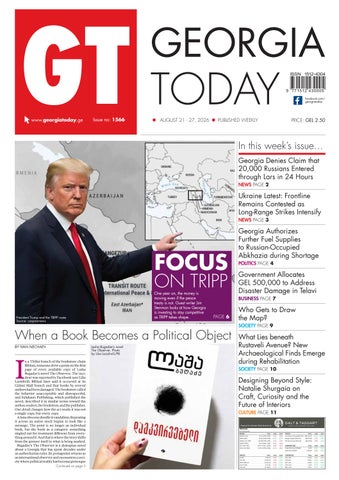
FOCUS ON TRIPP
One year on, the money is moving even if the peace treaty is not. Guest writer Jim Stenman looks at how Georgia is investing to stay competitive as TRIPP takes shape.
President Trump and the TRIPP route. Source: caspiannews
Georgia Authorizes Further Fuel Supplies to Russian-Occupied Abkhazia during Shortage POLITICS PAGE 4
Government Allocates GEL 500,000 to Address Disaster Damage in Telavi BUSINESS PAGE 7
PAGE 6
Who Gets to Draw the Map? SOCIETY PAGE 9
When a Book Becomes a Political Object What Lies beneath BY IVAN NECHAEV
I
n a Tbilisi branch of the bookstore chain Biblusi, someone drew a penis on the first page of every available copy of Lasha Bugadze’s novel The Observer. The incident was reported by Facebook user Lika Lazishvili. Biblusi later said it occurred at its Gldani Mall branch and that books by several authors had been damaged. The bookstore called the behavior unacceptable and disrespectful, and Sulakauri Publishing, which published the novel, described it in similar terms toward the author, readers, the bookstore, and the publisher. One detail changes how the act reads: it was not a single copy, but every copy. A lone obscene doodle is vandalism. Repeating it across an entire stock begins to look like a message. The point is no longer an individual book, but the book as a category: something singled out for treatment different from everything around it. And that is where the story shifts from the gesture itself to what is being marked. Bugadze’s The Observer is a dystopian novel about a Georgia that has spent decades under an authoritarian ruler. Its protagonist returns as an international observer and encounters a society where political reality has become grotesque Continued on page 5
Lasha Bugadze’s novel The Observer. Photo by Lika Lazishvili/FB
Rustaveli Avenue? New Archaeological Finds Emerge during Rehabilitation SOCIETY PAGE 10
Designing Beyond Style: Natalie Shurgaia on Craft, Curiosity and the Future of Interiors CULTURE PAGE 11 Prepared for Georgia Today Business by
DĂƌŬĞƚƐ Ɛ ŽĨ ϭϴͲ ƵŐͲϮϬϮϲ
ŵͬŵ
^dK <^
WƌŝĐĞ
ǁͬǁ
ŵͬŵ
' KZ' Ϭϭͬϯϭ
ϵϳ͘ϭϵ ;zdD ϱ͘ϴϱйͿ
ͲϬ͕ϭй
ͲϬ͕Ϭй
>ŝŽŶ &ŝŶĂŶĐĞ 'ƌŽƵƉ ; ' K >EͿ ' W ϭϮϵ͘ϭϬ
нϮ͕Ϯй
нϭϯ͕ϴй
'Z /> ϬϲͬϮϴ
KE ^
ϵϲ͘ϱϲ ;zdD ϲ͘ϬϮйͿ
нϬ͕ϭй
нϬ͕Ϯй
'ĞŽƌŐŝĂ ĂƉŝƚĂů ; ' K >EͿ
' W ϰϯ͘ϬϬ
ͲϮ͕ϱй
нϳ͕ϰй
d ĂŶŬ 'ƌŽƵƉ ;d ' >EͿ
' W ϰϴ͘Ϭϴ
ͲϬ͕ϴй
нϭ͕ϱй
WƌŝĐĞ
ǁͬǁ
ϵϭ͕ϬϮ
нϮ͕ϰй
нϯ͕ϯй
ϰ ϯϯϰ͕ϱϬ
ͲϬ͕ϴй
нϳ͕ϵй
' '' ϵ ϭͬϮ W ZW
WƌŝĐĞ
ǁͬǁ
ϭϬϱ͘Ϭϴ ;zdD ϵ͘ϮϬйͿ
ͲϬ͕ϯй
ͲϬ͕ϳй
^><Z , ϬϵͬϯϬ
ϵϵ͘ϳϵ ;zdD ϳ͘ϱϲйͿ
ͲϬ͕ϯй
ͲϬ͕ϵй
d ϴ͘ϴϵϰ W ZW
ϭϬϬ͘ϳϱ ;zdD ϭϭ͘ϴϮйͿ
ͲϬ͕Ϭй
ͲϬ͕ϯй
KDDK /d/ ^
d ϭϬ ϭͬϰ W ZW
ϭϬϳ͘ϭϲ ;zdD ϵ͘ϯϵйͿ
ͲϬ͕ϭй
ͲϬ͕ϱй
ƌƵĚĞ Kŝů͕ ƌĞŶƚ ;h^ΨͬďďůͿ 'ŽůĚ ^ƉŽƚ ;h^ΨͬK Ϳ
/E / ^
WƌŝĐĞ
ǁͬǁ
ŵͬŵ
hZZ E / ^
WƌŝĐĞ
^W ϱϬϬ
ϳ ϲϵϭ͕ϳϲ
ͲϬ͕ϱй
нϯ͕ϭй
h^ ͬ ' >
Ϯ͕ϲϭϯϱ
ͲϬ͕Ϯй
ͲϬ͕ϲй
&d^ ϮϱϬ
Ϯϰ ϱϲϭ͕ϰϯ
Ͳϭ͕Ϭй
нϰ͕ϭй
hZ ͬ ' >
ϯ͕ϬϮϱϭ
нϬ͕ϭй
нϬ͕ϲй
Kt :KE ^ ϯϬ
ϱϯ ϯϰϯ͕ϰϬ
ǁͬǁ
ŵͬŵ
нϬ͕ϭй
ŵͬŵ
ͲϬ͕ϴй
нϮ͕ϯй
' W ͬ ' >
ϯ͕ϱϯϵϯ
ZƵƐƐĞůů ϮϬϬϬ
ϯ Ϭϭϳ͕ϴϵ
ͲϬ͕ϯй
нϭ͕ϵй
hZ ͬ h^
ϭ͕ϭϱϳϲ
нϬ͕ϯй
нϭ͕Ϯй
&d^ ϭϬϬ
ϭϬ ϳϮϴ͕Ϭϰ
Ͳϭ͕ϭй
нϭ͕Ϯй
' W ͬ h^
ϭ͕ϯϱϯϮ
нϬ͕Ϯй
нϬ͕ϲй
нϬ͕Ϭй
2
NEWS
GEORGIA TODAY
AUGUST 21 - 27, 2026
Georgia Denies Claim that 20,000 Russians Entered through Lars in 24 Hours The exhibition. Source: report.az
Azerbaijani, Georgian and Iranian Artists’ Exhibition Opened in Tbilisi BY NANUKA MAGLAKELIDZE
A
n international exhibition featuring works by Azerbaijani and Georgian artists opened at the Tbilisi History Museum on
August 17. Supported by the Embassy of Azerbaijan in Georgia, the exhibition is held under the motto “Art Unites the World - Colors That Know No Boundaries” and aims to strengthen cultural ties between Azerbaijan and Georgia. The opening was attended by representatives of the Azerbaijani Embassy,
local and foreign public figures, artists, and cultural figures. Exhibition curator Elminaz Gahramonova said that works by more than 70 artists are on display, including 37 Azerbaijani, 35 Georgian, and Iranian artists. The exhibition features works by Azerbaijani artists including Elminaz Gahramonova, Ehtiram Karimov, Esmira Khalilova, Fidan Mehman, Gulnara Guliyeva, Safura Ibrahimova, Sakina Jafarli, Sevinj Ismayilzada, Hasan Huseynov, Honored Artist Hamza Abdullayev, and Yusra Arslan. Participating Georgian artists include Alika Tsurtsumia, Beno Sichinava, Besarion Kupatadze, and others.
The Upper Lars checkpoint. Source: Caliber
BY TEAM GT
G
eorgia’s Ministry of Internal Affairs has rejected reports claiming that 20,000 Russian citizens entered the country through the Lars border crossing in a single 24-hour period, calling the figure false and describing its circulation as deliberate disinformation. According to the ministry, a total of 7,880 citizens of various countries entered Georgia through the Lars checkpoint between August 18 and 19. During the same period, 8,406 people left Georgia through the crossing. The figures therefore cover all nationalities, rather than Russian citizens alone. “Various media outlets and social media platforms are circulating information claiming that 20,000 Russian citizens crossed the Georgian border through the Lars customs checkpoint over those 24 hours,” the Interior Ministry said. “For the purpose of informing the public, we would like to clarify that this information is not true and serves to
deliberately spread disinformation by certain interested parties.” The ministry urged the public and media to avoid circulating unverified figures or presenting official statistics in a misleading way. The Lars crossing, officially the Kazbegi–Zemo Larsi border checkpoint, is Georgia’s principal land crossing with Russia. It lies on the Georgian Military Highway near Stepantsminda and is the only currently functioning land border crossing between Georgia and Russia. The route is strategically important not only for passenger traffic, but also for freight moving between Russia and Georgia and onward through the South Caucasus. Traffic can increase sharply during periods of holidays, adverse weather, or disruption elsewhere on the region’s transport routes. The latest figures released by the Interior Ministry also illustrate why raw traffic numbers at Lars can be misleading. The 7,880 people who entered Georgia were not all Russian citizens, while the 8,406 who crossed in the opposite direction likewise represented people of various nationalities. The discrepancy between arrivals and
departure, 526 more people leaving than entering during the 24-hour period, also provides no basis for concluding that 20,000 Russian citizens entered Georgia. The Lars crossing has become particularly sensitive in discussions about migration and Russian citizens in Georgia since Russia's full-scale invasion of Ukraine in February 2022. Large numbers of Russian citizens entered Georgia in the months following the invasion and again after Russia announced a “partial mobilization” in September 2022, when long queues formed at the RussianGeorgian border. Those episodes have continued to make traffic through Lars a politically charged subject, with individual daily figures sometimes circulating online without sufficient context about the nationality of travelers or whether the numbers represent entries, exits, vehicles, or total border crossings. The ministry said it would continue to provide information through official channels and called on “all interested parties” to refrain from disseminating unverified information or distorting official data.
Georgian Wines Presented at International Berliner Wine Trophy Competition BY NANUKA MAGLAKELIDZE
Dogs being cared for in the regions. Source: FB
Free Microchipping, Vaccination for Owned Dogs Begins across Georgia BY NANUKA MAGLAKELIDZE
F
ree microchipping, rabies vaccination and sterilization of owned dogs has begun across Georgia’s regions, the National Food Agency (NFA) said. NFA veterinarians are visiting households to identify and register dogs by microchipping and provide free rabies vaccinations. Sterilization is also available free of charge. Information meetings
with residents are being held alongside the veterinary procedures. The program covers all regions and aims to prevent dogs from being abandoned and reduce the spread of animal diseases. Veterinary services are provided at stationary and mobile clinics as well as in the field by private veterinary facilities selected through a tender, while NFA veterinarians monitor the process. The schedule of veterinary activities is published in advance on Facebook. Dog owners can also contact their local municipalities for information.
A
presentation and tasting of Georgian wines was held in Berlin as part of the international wine competition Berliner Wine Tro-
phy. The event brought together wine journalists invited to the competition, representatives of the HoReCa sector and academia, as well as wine professionals. Guests had the opportunity to taste wines from different regions of Georgia. The National Wine Agency said the event was followed by a reception for 130 members of the Berliner Wine Trophy international jury at a Georgian restaurant in Berlin. The events were led by Ana Godabrelidze, Chair of the National Wine Agency’s State Tasting Commission, and Irakli Cholobargia, the Agency’s Events Organization Manager. The National Wine Agency said the events aimed to showcase Georgia’s centuries-old winemaking culture, unique winemaking traditions and diversity of indigenous grape varieties to a profes-
Presenting Georgian wines. Source: NWA
sional audience. Berliner Wine Trophy is one of the world’s most prestigious international wine competitions, bringing together
wine producers, experts and tasters from around the world. Its international jury comprises oenologists, sommeliers, wine specialists and industry experts.
NEWS
GEORGIA TODAY AUGUST 21 - 27, 2026
3
Ukraine Latest: Frontline Remains Contested as Long-Range Strikes Intensify COMPILED BY ANA DUMBADZE
T
he Russia-Ukraine war is showing few signs of a decisive breakthrough on the ground, even as the conflict increasingly reaches far beyond the front line. Russian forces continue to push in parts of Donetsk and Kharkiv regions, while Ukrainian troops are mounting counterattacks and recovering some positions. At the same time, both sides are expanding long-range strikes against energy, industrial and logistics infrastructure. The battlefield picture remains complicated. Analysis using DeepState mapping indicated a small net Russian territorial loss between August 11 and 18, while calculations based on Institute for the Study of War data showed a modest Russian gain. The difference reflects the fluid nature of the fighting, where small groups can infiltrate settlements without establishing lasting control. Over the four weeks to August 18, both datasets showed little or no significant Russian progress compared with the pace of earlier offensives. In Donetsk Oblast, some of the fiercest fighting remains around Kostyantynivka and the approaches to Dobropillya. Russian troops have increased their presence in parts of Kostyantynivka, relying heavily on small infiltration groups rather than large mechanized assaults. Ukrainian troops have also cleared some Russian infiltrators from their positions. Moscow has claimed the capture of settlements farther west, including
areas around Andriivka, but several of these claims have not been independently supported. The Institute for the Study of War also assessed that footage purportedly showing Russian control of Novomykolaivka may have been altered. Russia is nevertheless concentrating infantry around Dobropillya and appears to be seeking positions from which it could threaten the town and the Rodynske-Kryvorizhzhia road network. Further north, fighting around Lyman and Slovyansk has continued without a major Russian breakthrough. Ukrainian forces appear to have pushed Russian infiltrators out of northern and central Lyman, while Russian attacks on the town's flanks continue. Ukrainian troops have also made a localized advance in the Borova direction. The pressure is greater around Kupyansk, where Russian units have reportedly consolidated positions around Kivsharivka. Russia has also claimed advances north and northwest of the city, although some claims remain unverified. Ukrainian forces, meanwhile, have made gains near Bilyi Kolodyaz in northern Kharkiv Oblast. In Sumy Oblast, Russia has continued trying to maintain pressure along Ukraine's northern border, but there were no confirmed Russian advances during the latter part of the week. In the south, fighting around Hulyaipole and Orikhiv has remained similarly attritional. Ukrainian forces continue to target Russian drone-control stations, vehicles and supply routes in occupied Zaporizhzhia. Small Russian groups have also remained active around Dnipropetrovsk Oblast, although Ukrainian forces have
prevented several from consolidating deeper positions. Authorities have nevertheless ordered mandatory evacuations from 16 settlements in Synelnykivsky district as fighting approaches populated areas.
THE WAR BEYOND THE FRONT LINE Russia has stepped up attacks on Ukraine's energy system, with potentially serious consequences as winter approaches. State-owned Naftogaz said its facilities were attacked 13 times in a single week, damaging equipment and reducing production capacity. DTEK reported that a Russian strike caused a fire at one of its coal mines and killed a 52-year-old worker. Russian strikes have also targeted railway and port infrastructure around Izmail and Odesa. There are growing signs that Moscow is preparing for another campaign against Ukraine's power and heating systems before winter. Russia is also expanding long-range drone-launching infrastructure near Ukraine and Belarus, potentially allowing it to send larger waves of drones against targets deep inside Ukraine. The human cost remains severe. On August 18, a Russian strike hit central Pechenihy in Kharkiv Oblast, killing 10 people and injuring at least 18. Across six Ukrainian regions, at least 19 people were reported killed and 53 injured that day. The previous day, Russian strikes killed at least nine people and wounded more than 40 in several regions. A jetpowered drone struck a shopping centre near Odesa, injuring seven people, including an eight-year-old boy. Earlier in the week, a Russian drone killed a 29-year-old woman and her nine-year-
old son in Sumy Oblast. The week ended with another major attack on Kyiv. Russian ballistic missiles and drones struck the capital, damaging residential buildings, warehouses and a children's hospital and causing power outages. The death toll subsequently rose to at least 12, with more than 30 people injured. According to the UN, at least 437 civilians were killed and 2,610 injured in Ukraine in July; the highest monthly civilian toll recorded since the early months of the full-scale invasion. Ukrainian forces launched hundreds of drones into Russia during the week, including one attack described by the Associated Press as involving nearly 800 drones. Targets included warehouses and logistics hubs in the Moscow region, the Ust-Luga oil export hub near the Baltic Sea, and facilities in Rostov and Samara regions. Ukraine said a strike on August 14-15 hit the Progress Rocket and Space Center in Samara, including a workshop involved in assembling Soyuz rocket engines. Satellite imagery indicated additional damage at a facility reportedly involved in work on Tu-95 strategic bombers. Ukraine's General Staff said another strike on the Kamensky industrial plant in Rostov Oblast destroyed two explosives-production workshops and damaged four others. The effects are increasingly being felt inside Russia. Repeated Ukrainian attacks have forced several refineries and export facilities to reduce or suspend operations. The Orsk refinery is expected to remain closed for months following an earlier strike, while disruptions have also affected the Black Sea port of Novorossiysk.
Russian western-port oil exports reportedly fell around 15% below planned levels during the first half of August. Meanwhile, gasoline shortages have spread across at least 10 regions, prompting restrictions at filling stations, an export ban and increased fuel imports. Russia has turned to supplies from Belarus and Kazakhstan, while gasoline from India has also reached the country.
DIPLOMACY REMAINS STUCK Ukrainian President Volodymyr Zelensky said Kyiv had given US representatives Steve Witkoff and Jared Kushner proposals for ending the war. He argued that stronger air defenses and greater pressure on Moscow could help create the conditions for negotiations. Russia has said it remains willing to discuss a settlement, but continues to reject an unconditional ceasefire. Moscow also dismissed Kyiv's proposal for a limited Black Sea ceasefire covering civilian shipping. Russian Foreign Minister Sergey Lavrov instead warned that Russia intended to intensify strikes against infrastructure linked to Western military support for Ukraine. There was, however, one concrete development: on August 19, Russia and Ukraine carried out a prisoner exchange, with each side returning 103 servicemen. Western military support remains crucial to Ukraine's ability to keep fighting. Britain reaffirmed its backing this week and plans to supply Ukraine with 150,000 drones by the end of 2026 under an aid program worth £752 million. Ukraine is also working with European partners on new anti-ballistic defense systems while seeking additional Patriot interceptors from the United States.
4
POLITICS
GEORGIA TODAY
AUGUST 21 - 27, 2026
Georgia Authorizes Further Fuel Supplies to Russian-Occupied Abkhazia during Shortage
At a fuel pump. Source: sovanews
BY TEAM GT
G
eorgian Prime Minister Irakli Kobakhidze has confirmed that fuel deliveries to Russian-occupied Abkhazia were carried out with the Georgian government’s approval, saying businesses had approached the authorities because of the politically sensitive nature of trade with the occupied territory. Speaking on August 18, Kobakhidze said the government had authorized the
deliveries and saw potential benefits, including an opportunity to rebuild trust with the population of Abkhazia. He said the initiative had come from the occupied territory during an acute fuel shortage, although he could not say whether the request had originated with local businesses or another party. Kobakhidze said about 680 tons of fuel had already been delivered and that further supplies would follow. He described the amount as relatively small, but sufficient to address the immediate humanitarian situation, adding that he believed the population of Abkhazia was satisfied with Tbilisi’s decision.
The prime minister’s latest comments mark a shift from his earlier characterization of the deliveries as a private business initiative. On August 12, he confirmed that fuel had entered Abkhazia from Georgian-controlled territory but stressed that it had been supplied by business rather than the Georgian government. He said the deliveries were lawful and could help ease conditions for the local population. The shipments were made by Georgianregistered company Solidus. Its owner, Giorgi Arveladze, told Radio Free Europe/ Radio Liberty that the company had delivered about 300 tons of fuel to its
“Abkhaz partners” via the Enguri Bridge, mainly for the population of Gali and local filling stations. The Georgian government did not issue a special decree specifically authorizing the fuel deliveries. The government administration told Radio Liberty that no such act was necessary, because Solidus holds special status allowing it to conduct economic activity in Georgia’s occupied territories. On August 11, the government extended Solidus’s authorization for another three months. The fuel supplied by Solidus was purchased from Georgia-based petroleum company Repsol. Repsol confirmed on August 17 that Solidus had purchased fuel that was subsequently delivered to Russian-occupied Abkhazia, but said it had no role in determining where the products were ultimately sold. “This year, Solidus LLC purchased gasoline-type fuel from the company, paid for the product, and has been gradually taking delivery of it,” Repsol said. “Where Solidus LLC subsequently sells the purchased petroleum products is not agreed with us and falls outside the scope of our responsibility.” The company later clarified that the supply had been made under an existing contractual obligation, and that it did not plan any further deliveries to Solidus. Repsol said it operates in compliance with Georgian legislation and international regulations. The deliveries come as Abkhazia faces a severe fuel shortage during the peak tourist season. Filling stations have imposed purchase limits, with some reportedly running out of gasoline alto-
gether. Rosneft stations have introduced a 20-liter limit, while local reports put the price of 92-octane gasoline at about 73 rubles ($0.90) per liter. The shortage has been linked to disruptions in Russia’s fuel supply, including Ukrainian drone attacks on oil-refining infrastructure. Abkhazia relies heavily on Russia for petroleum products. The de facto authorities in Sukhumi have said that, because of “external factors,” alternative sources were sought, and participants in the local fuel market found a way to obtain gasoline from Georgian-controlled territory. The de facto authorities have also indicated that Georgia did not obstruct the deliveries. They have sought to justify the arrangement by pointing to fuel supplies Abkhazia provided to Georgia during the post-war period of the 1990s. The move drew criticism in Georgia. Nika Gvaramia, leader of the Coalition for Change, said the arrangement may well have been created by Russia to circumvent sanctions and facilitate the purchase of strategic goods. The opposition party Gakharia for Georgia called on Kobakhidze to clarify whether the deliveries had government authorization and to disclose information about the companies involved, the quantities supplied, the routes used and the legal basis for the shipments. Kobakhidze’s latest statement appears to confirm that the Georgian government was not merely aware of the deliveries, but actively authorized them, while maintaining that the fuel was supplied through private business rather than directly by the state.
Garibashvili Says He Is Being Pressured to Stay Out of Politics BY TEAM GT
F
ormer Georgian Dream leader and ex-prime minister Irakli Garibashvili, who is serving a five-year prison sentence for money laundering, says he was offered a deal: admit to another, unspecified corruption offense, receive no additional time in prison, and agree not to return to politics after his release. Garibashvili made the claim in a letter published on August 18, one day after he released a photograph of a printed, unsigned letter that he says was sent to him “on the instructions of” Georgian Dream founder and honorary chairman Bidzina Ivanishvili. He identified former colleague Mamuka Mdinaradze, now minister of regional development, as the person who sent it. The letter published by Garibashvili describes what it calls “several cases” in which corruption charges were allegedly
being prepared against him. It says that the cases followed what the author described as serious suspicions surrounding the activities of conservative figures, including Irma Inashvili and Dito Chubinidze, and campaigns organized on social media. “Very intensive work is underway on several cases, whose likely results will be corruption charges,” the letter says. It then presents Garibashvili with two options. The first is to contest the allegations in court. The second is described as a “compromise solution”: he would “confess” or “take blame” in one of the cases and receive another five-year sentence under a new plea agreement. According to the letter, the new sentence would be absorbed into the fiveyear sentence Garibashvili is already serving, meaning that he would not spend additional time in prison. In return, the letter said, he would have to stay away from politics after his release. The confession would effectively serve as a guarantee that he would
Irakli Garibashvili and Mamuka Mdinaradze (archive). Source: RFERL
not return to political life. A fragment of the letter also says: “After his release, he should not get involved in politics.” Another passage states that the arrangement would be carried out by agreement, including the confession and the signing of the accusation by witnesses. Garibashvili says he rejected the proposal. He says he had already made clear that he did not intend to return to politics, and had even offered his own proposal for eliminating what he describes as the remaining political “risk.” In his August 18 letter, published as a follow-up to the previous day’s statement, Garibashvili said he was nevertheless told that there was still a “1% risk” that he would return to politics and that, to eliminate that possibility, it was necessary to bring a corruption charge against him and have him admit to it.
Garibashvili described the demand to admit to a new corruption offense as his “red line,” and said it had forced him to abandon his previous silence. “Therefore, since I have no other choice, I am forced to start fighting,” he wrote. Garibashvili has also sought to explain why he accepted his original conviction without a public legal fight. He says he deliberately avoided confrontation with his former political allies and accepted what he describes as a “devastating” process in order not to harm the interests of the state and the Georgian Dream team. He now says that this silence was met with a “staged, dirty provocation” and a campaign aimed at destroying him and his family. In his August 17 statement, he said that from that point onward, Ivanishvili and the Georgian government bore “full responsibility” for his and his family’s safety.
The claims have been rejected by Mdinaradze’s office, which described what Garibashvili published as “complete absurdity” and said it had been contradicted by the contents of the letter circulated the previous day. The office did not provide further details. Prime Minister Irakli Kobakhidze has also distanced himself from the allegations, saying he had no idea what letter Garibashvili was referring to, and had not discussed it with Bidzina Ivanishvili. He said Garibashvili had received a specific court verdict and that anything beyond that was a matter for law-enforcement authorities. Garibashvili, who served as prime minister twice and left Georgian Dream and politics in April 2025, was sentenced to five years in prison in January 2026 under a plea agreement. He was fined 1 million GEL, while money seized from his home was confiscated.
POLITICS
GEORGIA TODAY AUGUST 21 - 27, 2026
5
When a Book Becomes a Political Object Continued from page 1 and the future feels suspended. Recently, the same book was refused entry to Rustavi Women’s Prison No. 5 when activists tried to deliver it to imprisoned activist Nana Sander. According to Radio Tavisupleba, the delivery was halted after staff cited a security-service decision that the book contained “political content.” These are very different events: one inside a prison, the other inside a bookstore; one an institutional decision, the other an anonymous act of damage. It would be irresponsible to treat them as a coordinated campaign without evidence. Still, they converge on a shared pattern: the novel is no longer treated simply as literature, but as a politically charged object whose circulation must be managed, restricted, or symbolically degraded. Fiction can become politically charged without slogans or instructions. It can construct a world close enough to reality that readers begin making comparisons on their own, or exaggerate familiar political habits until they become visible. This is one of the oldest functions of satire, which does not merely argue against power, but makes it appear absurd. A political speech asks for agreement; satire often produces an image that lingers beyond agreement. Bugadze’s work has long operated in this register, using comedy, grotesque situations, and uncomfortable characters to explore Georgian social and political life. Earlier commentary on his writing, including a review of The Golden Age in Hot Chocolate, emphasized this blend of black humor and distorted social observation rather than conventional realism. In that context, the response to the book becomes more than simple contempt. Defacing a text does not argue with it; it reclassifies it. Political cultures often rely on such gestures, tearing posters, burning books, marking images, not to refute meaning, but to change the object’s status in public perception. The obscene mark works especially well because it collapses seriousness into ridicule. Its placement on the first page is crucial. It functions like an unauthorized preface: before the author speaks, another voice has already intervened. The reader encounters not only the novel, but an imposed framing of it. This is an old logic of control. Books have always
A political book can be criticized, debated, or ignored. These responses keep it within the realm of literature. Defacement does something different: it attempts to change the category been marked, banned, confiscated, or destroyed, handle, distribute, or even possess. You can publish the book, but it may be damaged. itself because control over a text is not only about its content, but about the conditions of its encounter. You can sell it, but it may be contested. You can read Book banning, representative image. Source: The Walrus
A banned book is inaccessible; a confiscated one is absent; a damaged book remains readable, but the reading is altered. In this last case, censorship does not remove the text: it contaminates it, inserting an external voice into the act of reading. The bookstore context matters because such spaces usually suspend ideological hierarchy. Political novels sit next to cookbooks, romances, and children’s books under a commercial logic of availability. Once certain titles are singled out for marking, that neutrality begins to erode, and the bookstore itself becomes a site where cultural objects carry political risk. Biblusi has condemned the damage and said multiple authors were affected, but the incident still shows how easily a commercial space can be drawn into political tension. There is also an economic dimension: the aim is not necessarily to prevent sale, but to reduce value. A damaged book is harder to sell; a damaged stock becomes a statement in itself. This resembles a more diffuse form of censorship: not classical suppression through bans or confiscation, but an environment in which certain works become risky to
Treaty of Georgievsk Kobakhidze: Erekle II’s Decision to Sign Treaty of Georgievsk Saved Georgia and Preserved its European Perspective
PM kobakhidze and the Treaty of Georgievsk. Source: FB/imperialhouse
BY NANUKA MAGLAKELIDZE
T
he head of the Georgian Dream government, Irakli Kobakhidze, says that King Erekle II’s decision in 1783 to conclude the Treaty of Georgievsk saved Georgia and, at the same time, preserved its European perspective. Prime Minister Irakli Kobakhidze says that, given the specific historical circumstances, relations with the Russian Empire were not only a matter of survival for Georgia, but also the only way to preserve its political and cultural ties with the Christian West. “Considering the historical period and the extremely difficult situation in which Georgia found itself, criticizing the steps taken by Erekle II from today’s perspective is completely unjustified,” said Prime Minister Irakli Kobakhidze. “Especially since Erekle II acted and made decisions with the sole motivation of saving the country, its statehood, and its future. Taking into account the final outcomes, his decision, as well as a number of other political steps, can be assessed as a reasonable and, moreover, brilliant state decision. “We should not overlook one important circum-
stance here: the most active critics of Erekle II today present themselves as pro-European citizens and the main Europeans, and they often speak in such a way that they almost consider not only Georgia’s aspiration toward Europe, but even the existence of Europe itself, to be their own achievement. “In reality, if we take the historical context into account, it was precisely the step taken by Erekle II that preserved Georgia’s opportunity to pave the way toward the European space. In that specific, unfortunate historical situation, relations with the Russian Empire were not only a matter of survival for Georgia, but the only way to preserve political and cultural ties with the Christian West. “Therefore, it is particularly paradoxical when people who today present themselves as defenders of the European choice, but are in fact pseudo-liberals, criticize Erekle II precisely for the decision that preserved Georgia’s historical existence and the possibility of its subsequent state development, including the possibility of integration into the European space.” The Treaty of Georgievsk was signed in 1783 between Russia and the Kingdom of Kartli-Kakheti. Under the treaty, the kingdom came under Russian protection. Russia later violated the treaty and abolished the Kingdom of Kartli-Kakheti in 1801.
it, but it may be deemed too political to enter a prison. Individually, none of these actions necessarily constitutes formal censorship. Together, they shape the conditions in which cultural production circulates. This is why concerns about such behavior encouraging censorship are not easily dismissed, even if no organized campaign is proven. Censorship often begins not with law, but with anticipation: the calculation that certain material will create trouble. That calculation is familiar to publishers, curators, and booksellers, and it gradually defines what is considered safe to circulate. The prison case is more direct, because an institutional decision explicitly excluded the book on the grounds of political content, with security services cited as the authority behind the refusal. This is a clearer form of exclusion than anything occurring in a bookstore, but the juxtaposition remains telling. In one case, an institution defines the book as politically sensitive. In the other, an anonymous actor marks it as something to be degraded. Neither engages with the novel as literature. And that
may be the central point. A political book can be criticized, debated, or ignored. These responses keep it within the realm of literature. Defacement does something different: it attempts to change the category itself, turning the book from a text into an object of hostility. Once that shift occurs, engagement with what is actually written becomes secondary. Bugadze himself suggested the bookstore incident might have been carried out on orders from authorities, and compared it to Putin’s Russia, though there is no evidence for that claim, and it should remain speculative. What can be said more securely is that The Observer has already acquired a political life beyond the literary one: it has been blocked from a prison for being “political,” and physically marked in a bookstore. That alone is enough to make the episode notable. Because the strange thing about political fiction is that its life does not end when the manuscript is finished. Sometimes the most revealing response to a book is not what is written about it, it is what is done to it on the shelf.
6
BUSINESS
GEORGIA TODAY
AUGUST 21 - 27, 2026
One Year On, Trump's ArmeniaAzerbaijan Corridor Takes Shape, and Georgia Spends to Stay ahead of It
Donald Trump and the TRIPP route. Source: Modern.az
BY JIM STENMAN FOR CAUCASUS CROSSROADS*
O
ne year after Donald Trump hosted Armenian Prime Minister Nikol Pashinyan and Azerbaijani President Ilham Aliyev at the White House, where they signed a joint declaration and their foreign ministers initialed a peace agreement meant to end nearly four decades of conflict, both governments marked the anniversary with a joint statement touting the Nobel Peace Prize nomination they submitted together for the US president days after the summit. The conflict they credit him with ending ran through three rounds of war over Nagorno-Karabakh, an ethnic Armenian enclave internationally recognized as Azerbaijani territory. The last round was Azerbaijan's September 2023 offensive, which retook the territory, dissolved the self-proclaimed Republic of Artsakh and prompted the exodus of some 100,000 ethnic Armenians to Armenia. "I was in disbelief, in a positive sense," Matthew Bryza, the former US ambassador to Azerbaijan, told me. "The main thing was that the US president got so heavily involved, which had not happened since George W. Bush hosted the then leaders of Azerbaijan and Armenia in April of 2001." The route at the center of the deal carries his name: The Trump Route for International Peace and Prosperity, or TRIPP, a planned rail and road link through southern Armenia connecting mainland Azerbaijan to its Nakhchivan exclave, cut off since Soviet border-drawing in the early 1920s left a strip of Armenia in between. For decades, reaching it overland meant crossing Iran. A year on, the peace treaty initialed in Washington remains unsigned, and the constitutional referendum Azerbaijan wants from Armenia before signing has no date. What is moving, though, is the money.
ment awarded the grant at $201 million in late January, then amended it on July 16 to double the commitment to $402 million, a change reported by the Armenian investigative outlet Hetq. The announcement described the smaller figure as paid-in capital and did not mention the larger one, and the gap measures how far Washington intends to go. The corporate architecture is further along still: the TRIPP Development Company, a joint venture approved by the board of the US International Development Finance Corporation in July, will hold exclusive rights to develop and operate the corridor for an initial term of 49 years, extendable by another 50. Washington owns 74% of it and Armenia holds 26%, a stake that rises to 49% only if the arrangement is extended. Azerbaijan holds no equity: the links on its side of the border are its own state projects, and its rail line to the Armenian frontier is nearing completion. Engineering surveys are underway on Armenian ground. The political track needs a referendum Pashinyan cannot yet call: amending the constitution, to drop preamble language Baku reads as a claim on its territory, requires two-thirds of parliament to open the process, and his party, for all its June election win, does not have two-thirds. On the commercial track sit a capitalized fund, a chartered company, a survey crew and a half-built railway. The infrastructure is being built first, on the bet that the peace will catch up with it. The prize goes past cargo: a functioning TRIPP would anchor Armenia's normalization with Azerbaijan and could unlock the reopening of its Turkish bor-
Reopening the Turkish-Armenia border would leave the South THE MONEY IS AHEAD OF THE TREATY Caucasus more On the anniversary, the State Department announced the Trans-Caspian Enterprise connected than at Fund, Washington's vehicle to spur private investment along the route, is oper- any point since ational, with an elected board and $201 million in US government capital. Federal the Soviet spending records tell a bigger story: USAspending.gov shows the State Depart- collapse
der, shut since 1993 in solidarity with Baku. Bryza considers that reopening all but inevitable on the current course, and it would leave the South Caucasus more connected than at any point since the Soviet collapse.
WHY THE FREIGHT BUSINESS ISN'T CONVINCED Bryza has watched this corridor from more seats than most: White House staffer, ambassador in Baku, co-chair of the mediation that spent years failing to settle it, and now an Istanbul-based risk advisor who says he hopes to take part in corridor-linked investments, an interest worth noting. His verdict, delivered on my podcast, Global Power Shifts, is that the peace is real even if the paperwork is not. "The deal's not really done," he told me, and yet Aliyev keeps declaring the two countries in a de facto state of peace, wheat and fuel are moving, and the infrastructure spending is, in his words, "laying the foundation for economic growth and for economic cooperation, and hopefully therefore for a long-term peace." The corridor itself he calls "promising, nascent, not yet in existence." Trump's commitment he vouches for firsthand. "I was in Washington last week. I had meetings all over, including in the West Wing," he said when we spoke in mid-August. "I heard unanimously that President Trump is extremely supportive of this corridor going forward, not only because the middle portion is named after him, but that doesn't hurt." His strategic ledger is just as blunt: the deal is "a gigantic strategic setback" for Russia, which policed this region for two centuries: "Russia is definitely not the main player. The US under President Trump is the main player now." The same road gets a different price from Lasha Amashukeli, a veteran Georgian logistics executive and former deputy CEO of freight operator Royal Express, recruited to become vice president of Lydeoil, an Omani oil products producer and trader, and now splits his time between Muscat and Georgia. Much of his cargo still moves through the Black Sea ports TRIPP would bypass, an interest that cuts against the route, and also why his read matters: he has spent decades moving freight through the corridor the new road proposes to compete with. His advice to any shipper weighing routing plans around TRIPP: "too early, too uncertain." "I guess sooner or later it will start working," he told me. "I would not give it a very international role. More
I would give it the role of trading between Azerbaijan and Turkey." His case is an operator's arithmetic: international cargo needs a sea port, from the new route the nearest is Trabzon, and by his reckoning that path runs roughly 400 kilometers longer than the existing Baku-to-Poti or Batumi runs, across mountain serpentines rather than flat ground, a penalty that lands directly on cost. "Sorry for my neighbors, but I'm not looking on this route very seriously." On one point, the diplomat and the operator converge, and the documents back both. Armenia has kept sovereignty over border control and customs under TRIPP, which Amashukeli calls the only real progress on paper, and also the route's structural handicap. "If Armenia is not giving up its sovereignty on customs, then cargo from Azerbaijan to Turkey needs to pass the border and customs two times," he said. "One entering and one on exit." Bryza laid out the same standoff from both capitals' mouths: "The Azerbaijanis say, ‘well, if we're moving cargo from one part of Azerbaijan to another across Armenia, why should we be subject to Armenia's customs checks’? Whereas the Armenians say, ‘wait a second, your cargo is transiting our territory. Of course we have a sovereign right to check on it.’" The implementation framework published in January confirms the Armenian position. Until that knot is cut, both men suggest, the corridor's tonnage stays symbolic.
GEORGIA IS STILL THE MAIN ROUTE For Georgia, this trade's land bridge for three decades, the question is whether TRIPP is a threat. Amashukeli's answer is close to dismissive: "no one is thinking about it in Georgia" as a competitor. The numbers are his own: Georgian ports handled around 700,000 twenty-foot container units last year against roughly 90,000 through Baku, a gap that makes the existing route's dominance look structural rather than incidental. Published figures back him: APM Terminals Poti alone reported more than 480,000 TEU in the first nine months of 2025, up 16%. Tbilisi is hedging anyway, in capital. "We don't think that this new route will be our competitor, but, cautiously, we are investing heavily, to be ready for any kind of competition," Amashukeli said. The World Bank approved $372 million in June to upgrade Georgian rail and roads along the corridor, and the long-delayed Anaklia deep-sea port, as he puts it, "will change our ecosystem dramatically" if built, letting in vessel classes Georgia's shallower ports turn away. Rail is where his enthusiasm sits, and his diagnosis of its weakness is blunt: the network is fully state-owned, with no private operators allowed. "When the state has full ownership, sometimes it gets lazy," he said. The government is now committing heavily to new locomotives and rolling stock just as the network needs them: since January, he says, commodities led by fertilizers have shifted onto the corridor in volumes only rail can carry. "Without good railway and good volume on railway, you can't grow." Asked why Georgia holds the region's logistics crown, he starts with geography and ends somewhere sturdier: "All governments, all political parties come and go, come and go, but all of them are investing in Georgian infrastructure." The politics reads harsher from outside, where Bryza argues Tbilisi has "played itself out of the European game," citing the cancelled US-backed Anaklia port concession, though even he adds that "if and when there's a new government that does reflect the desire of over 80% of Georgia's electorate to integrate with Europe, then I think we'll see things move
We don't think that this new route will be our competitor, but, cautiously, we are investing heavily, to be ready for any kind of competition Lasha Amashukeli very quickly." Emil Avdaliani, a professor of international relations at European University in Tbilisi and director of Middle East studies at the Geocase think tank, offers the view from inside. Georgia's drift toward Moscow, as the West usually describes it, is in his reading "better understood as a strategic hedge" than a settled bet; part of Tbilisi restructuring a foreign policy that had been aimed almost entirely at Western integration. On Russia, he expects retrenchment: "Russia's most likely response will be to try to preserve the existing status quo, because, for the moment, it does not have the political or military capacity to reconstruct the regional order it dominated before 2022." In Armenia, he expects Moscow to work its remaining economic and information levers with one objective, "to make Armenia's disengagement from Moscow highly expensive for Yerevan," just as Yerevan moves closer to Brussels. Nor does he see the vacancy filled from elsewhere: "Neither China nor Iran is positioned or interested in replacing Russia as the South Caucasus' key player."
MY READ Follow the sequence rather than the ceremony: a treaty usually comes first, then ratification, then financing, then construction. This peace is being built in reverse, the fund capitalized and the surveyors deployed while the legal settlement everything nominally rests on waits for a referendum that cannot yet be called. That order is not an accident, because money in the ground makes the arrangement expensive for anyone to unwind, Armenian voters included, before they are asked. Whether that reads as stabilizing or as a bet placed over the heads of the people who still get a vote depends on where you sit, and both readings are live in Yerevan. Asked how Washington should make the route succeed, Amashukeli waved off the politics: "Investing and investing. The only chance it will be alive is if you invest and you make it attractive for any kind of cargo." Watch for: whether TRIPP construction breaks ground on Armenian territory before year-end, and any movement on the two-thirds the Armenian parliamentary arithmetic needs for the referendum. The customs regime is the sharper tell: once Baku and Yerevan settle the doubleclearance question, the road stops being symbolic. *Caucasus Crossroads, part of the Global Power Shifts network, tracks Capital, Corridors & Control across the South Caucasus.
BUSINESS
GEORGIA TODAY AUGUST 21 - 27, 2026
7
Government Allocates GEL 500,000 to Address Disaster Damage in Telavi The Polish flag. Source: FB
Poland Tightens Entry Rules for Workers from Georgia, Colombia and Venezuela BY TEAM GT
Disaster in Telavi. Source: 1TV
BY NANUKA MAGLAKELIDZE
T
he government has allocated GEL 500,000 to address the aftermath of the July 12 flooding in Telavi Municipality. The government said Prime Minister Irakli Kobakhidze signed the relevant decree, with the funds to be provided from the Finance Ministry’s reserve fund. The government has not specified how the funds will be distributed. In the early hours of July 12, heavy
rainfall caused the Telavi River to overflow its banks, with a mudflow flooding several streets in the city. The disaster caused significant damage. The National Environment Agency said rainfall at the Telavi meteorological station reached 57.3 mm, equivalent to 85% of the monthly norm for Telavi. At the Ikalto station, rainfall reached 40.1 mm. The mudflow, carrying rocks and debris, completely destroyed a bridge connecting two streets. The Kavkasioni and Alazani avenues were seriously damaged. There were no casualties. The first floors of residential buildings, commercial spaces, pharmacies, a clinic
and shops were flooded, with property destroyed. Power lines and vehicles were also damaged, while thousands of subscribers lost access to natural gas and electricity. In August, Telavi Mayor Vazha Maghradze said that all buildings within a 10-meter radius of the city’s river base would be demolished. He said an assessment by the Levan Samkharauli National Forensics Bureau confirmed that the disaster had “undermined the foundations” of the buildings. He added that the owners of all the affected buildings would be offered alternative premises or compensation.
P
oland has tightened entry rules for citizens of Georgia, Colombia and Venezuela seeking to enter the country for employment. Based on media reports, the regulation, signed by Polish Foreign Minister Radosław Sikorski on August 10, came into force on Saturday and specifically applies to people entering Poland for work. Citizens of the three countries will still be able to travel to Poland visa-free for
tourism and other permitted short-term stays. Those who entered Poland for employment before August 15 will remain subject to the previous rules. Polish government officials said citizens of Georgia, Colombia and Venezuela had been systematically using visa-free travel to take up employment without meeting the relevant legal requirements. Officials cited illegal employment and overstaying, the growth of the shadow economy, worker exploitation and human trafficking among the reasons for introducing the new regulations. They also said the three countries are considered to pose a high migration risk.
Georgia’s FDI Rose State Property, Former NATO and 19.3% to $1.9 EU Information Center Office Sold Billion in 2025 for GEL 34.8 Million
The state-owned property near Freedom Square. Source: Civil.ge
BY NANUKA MAGLAKELIDZE
A
state-owned property on Freedom Square in central Tbilisi has been sold at auction for GEL 34.81 million, more than double its
initial price of GEL 14.08 million, BPN reports. The National Agency of State Property said the property was put up for auction on July 30, 2025, and the auction closed on August 13, 2026. The bidding step was set at GEL 10,000. The property is located at 2 Shalva Dadiani Street / 1 Kote Abkhazi Street,
and includes a 478-square-meter nonagricultural land plot and a building on the site. The building has protected cultural heritage monument status. The office of the Information Center on NATO and the EU was located in the building until June 2025. At the time, both information centers were reorganized and placed under the Georgian Foreign Ministry. Under the privatization terms, the buyer must, within a maximum of four years from signing the sale agreement, launch a commercial or business operation at the property, either directly or through a third party. The site may be used for office space, a hotel operated by an international company or its branch network, or a retail or food service facility. Retail outlets selling everyday essential goods are excluded. The buyer must also invest at least GEL 5 million, excluding VAT, to fulfill these obligations. In addition, within one month of signing the sale agreement, the new owner must sign a monument maintenance and preservation agreement with the National Agency for Cultural Heritage Preservation of Georgia and/or Tbilisi City Hall.
Georgia’s foreign direct investment rises 19.3% to $1.9 billion in 2025. Source: GT
BY NANUKA MAGLAKELIDZE
G
eostat reports that the volume of foreign direct investment (FDI) in Georgia amounted to $1.9 billion in 2025, 19.3% higher than the corresponding figure for 2024 and 12.5% above the preliminary 2025 figure. The data published by Geostat show that the level of reinvestment remained high. Of the $1.9 billion in FDI recorded in 2025, $1.5675 billion was reinvestment,
while new investment [equity] amounted to only $686 million. This means reinvestment accounted for 82.5% of total FDI last year. Geostat reports that the largest amounts of investment came from the United Kingdom ($426.6 million), Azerbaijan ($214.4 million) and Türkiye ($202.4 million). The largest share of FDI went to the financial and insurance activities sector, which received $633 million, accounting for 33.3% of total FDI. Real estate ranked second with $254.7 million (13.4%), followed by the trade sector with $191 million (10%).
EuroNews: Russians Pull Billions from Banks Fearing Kremlin Will Seize Savings for War BY NANUKA MAGLAKELIDZE
R
ussians have withdrawn around €24.4 billion from the country’s banking system in the first seven months of 2026, as fears grow that the Kremlin could freeze or seize private savings to help finance the war in Ukraine, EuroNews reports, citing The Washington Post. Demand for cash began rising in March and has continued to grow, with around 300 billion rubles (€3.05 billion) leaving
bank accounts each month. Five of Russia’s seven largest banks have recorded net outflows of individual deposits. Gazprombank has been hit hardest, losing 299.5 billion rubles (€3.04 billion), or 10.8% of its deposits, over four months. Rosselkhozbank lost 270.5 billion rubles (€2.75 billion), while Alfa-Bank saw 179.4 billion rubles (€1.82 billion) withdrawn. Sberbank also recorded significant outflows, with 211.6 billion rubles (€2.15 billion) leaving deposits in June and another 31.8 billion rubles (€323 million) in July. T-Bank was the exception, recording a 193 billion-ruble (€1.96 billion)
A person holds cash withdrawn from an ATM machine. Photo by Anton Novoderezhkin/TASS/Getty Images
increase in deposits. The Bank of Russia reported that cash in circulation increased by 643.4 billion rubles (€6.53 billion) in July alone, the largest monthly rise since the beginning of the year. A further 300 billion rubles was withdrawn during the first half of August. The withdrawals are being driven by concerns over the impact of Ukrainian drone strikes on Russia’s economy and fears that the government could freeze or nationalize private deposits to cover rising war-related costs. The concerns have been reinforced by recent asset seizures. Russian prosecu-
tors transferred about $51.5 billion (€44.3 billion) in private assets to state control in 2025, while authorities seized around $7.6 billion (€6.5 billion) in assets linked to billionaire Vadim Moshkovich in June. Russia’s economic outlook has also weakened. GDP grew by 0.3% in the first half of 2026, compared with 1.2% during the same period last year, based on Russian government data that cannot be independently verified. The current withdrawals echo the rush to withdraw cash that followed Russia’s full-scale invasion of Ukraine in 2022, although the present trend is reportedly larger and more prolonged.
8
SOCIETY
GEORGIA TODAY
AUGUST 21 - 27, 2026
Chaotic Times BLOG BY TONY HANMER
T
hese are chaotic times in a variety of different ways. For example: Weather is a chaotic system, mathematically. So, even if the global trend for the last x decades is warming (which… IS being debated with some additional heat), that doesn’t translate to even warming everywhere. Some parts of the globe can still be unseasonably cold, in the midst of that average uptick in overall warming. Case in point: Svaneti, where my wife and I have lived since 2012 and only summered for the last five years. So we have a bit of a handle on what to expect from May through October. July and August are supposed to be mostly rain-free. Instead, this summer is wetter than we’ve ever seen. The mountain trekking pass took much longer to become snow-free.
The huge, more than 20 km-long Enguri hydroelectric dam-lake, the bottom of which I was seeing when I came up in February for the Lamproba festival, is now full PAST its high-water mark, representing I don’t know how many millions or billions of tons of water. Yes, summers its volume always increases as the melt flows in from countless sources and the electrical load decreases from people turning off their heaters. But I never expected such abundance in six months. Trekkers are having a much rougher time than usual in the wet weather. I wouldn’t want to be spending a week walking from village to village now, even knowing that a warm guest house waited every night where I could dry off and eat well. It’s just no fun; AND the views are much more obscured by clouds than usual, lessening the pleasure even further. This morning, our group of 16 Poles, having come in three hours late last night due to van trouble and eaten supper at 10 pm, had opted for a 1.5-hour delay for
Photo by the author
breakfast, thank God, followed by asking me to find them another van to take them to Mazeri instead of trekking there. The weather was just that bad. So, Svaneti is one of those places where it’s both cooler and wetter than usual, by a long shot. Edmonton, Canada, where I was recently, has been having floods; whereas BC to the west and Ontario to the east have struggled with a terrible forest fire season. Ditto for parts of Europe, experiencing heat waves and historic fires as well. Tusheti, in eastern Georgia, is also struggling, with roads worsening in the rain. Tbilisi, and Telavi? They’ve both had bad floods recently too. Another bit of chaos in our lives, though, is entirely caused by us. We’ve been adding two small single bedrooms to our guest house, using otherwise dead interior spaces, one on each floor. This time we’re using a pair of local guys, who live minutes’ walk away. They seem to be doing great work, and we’re asking ourselves where were they all this time! So, there’s extra noise and dust and so on, but those guests who really want a room alone instead of sharing or paying for a double can now be satisfied. Win-win. Oh, if I were more my father’s son… I’d be doing all the carpentry, welding, plumbing, electrical, cement, stone work and more here. But I’m not. I simply don’t have either the interest or the manual patience, or the skill for that matter, to do all these useful things. So I hire others. It must be said that another notable increase in chaos is in international relations in various locations. Russia-Ukraine shows no signs of stopping, even as its war evolves before the world’s eyes. USA/Israel-Iran? Plenty of confusion there, not to mention despair. Sudan? Israel-Gaza/Lebanon? The world’s very messy right now. Maybe that’s nothing new. I do wonder about people who have
Photo by the author
to live with growing anxiety as a background. And I seek peace along with everyone, mostly in my faith that God will sort things out eventually. It may get a lot worse before then, yes. But I cling, because I must, and don’t regret it. Tony Hanmer has lived in Georgia since
1999, in Svaneti since 2007, and been a weekly writer and photographer for GT since early 2011. He runs the “Svaneti Renaissance” Facebook group, now with over 2000 members, at www.facebook.com/groups/ SvanetiRenaissance/ He and his wife also run their own guest house in Etseri: www.facebook.com/hanmer.house.svaneti
An Old Researcher Makes New Waves BLOG BY NUGZAR B. RUHADZE
B
lessedly, there is no shortage of newsy stories in Sakartvelo: Grigol (Grisha) Oniani, the well-known Georgian public figure and longstanding hardcore Stalinist, at the honorable age of 90, completed a doctoral dissertation, impressively titled Realpolitik as the Basis of the 20th-Century World Order, having dedicated the work to his nonagenarian jubilee. The event took place on July 25 at the Georgian State Technical University, in the presence of about 200 invited attendees. The official supervisor of the thesis was Professor Tamar Kiknadze, and the opponents of the dissertation were Professors Edisher Gvenetdze and Vakhtang Guruli. As a result, Oniani was awarded a doctoral degree. The whole process lasted about three hours, covering a heated discussion of the burning issues raised in the thesis, as well as challenging questions posed by members of the Dissertation Council and the audience. Opinions differed sharply. The discussion was truly public, and this is not surprising, because it was the first publicly heard positive word about Joseph Stalin in the period since his denunciation by Nikita Khrushchev at the 20th Congress of the Soviet Communist Party. The determined elderly gentleman spoke resolutely, in an extremely balanced and academic style, using a clearly stoic and persuasive manner, patiently and confidently answering every question, in most cases intentionally harsh and tricky. Frankly speaking, it is a delight to recognize that a 90-year-old man next door is capable of such a deed. A monumen-
A sketch of Grigol Oniani. By Zaal Sulakauri
tal deed! But an extraordinary thing is not just his age, but the outstanding continuity of his intellectual and politi-
cal presence on the polemical stage of the country. Oniani, like many of us, is a pure prod-
uct of the Soviet educational and labor system, having endured every single phase of that peculiar regime without ever changing his political stance, especially in the face of varied interpretations of Stalin’s controversial figure across generations. An agriculturist by profession, Oniani took to practicing political science while at the same time holding several managerial positions during the Soviet era, acquiring a clear identity as a staunch and convinced Stalinist with an extraordinarily active public cause. He founded and has incessantly chaired a nongovernmental organization called Stalineli. Being extremely active in public life, he wrote articles for newspapers and magazines, gave interviews, campaigned for the dictator’s monuments, appeared on various radio and television shows, got into heated arguments with journalists, and took part in political demonstrations. Believe it or not, Grisha Oniani keeps a large statue of his beloved Soviet ruler on his own property in Svaneti, northwestern Georgia, which is often visited by tourists interested in seeing it. Isn’t it truly incredible that somewhere in the Georgian mountains, a 90-yearold man sits beside a statue of Stalin, erected in his own yard, and has just defended a doctoral dissertation about the famous Soviet dictator, as controversial as he is today all over the world? Notably, he has been perseveringly trying to return the monument to where it came from: the center of the city of Gori, Stalin’s birthplace, where there is a large and rich museum of Stalin, the only functioning one in the entire world. Mr. Grigol thinks that Stalin should not be ignored and forgotten, and he comes up with tons of arguments to corroborate his opinion. In his much-spokenabout thesis, he is trying to put forward
arguments that make Stalin a genuine practitioner of realpolitik. A certain number of elderly people nostalgically remember the Soviet period because of its almost universal employment, social security, cheap housing, education, stability, and what not. Oniani is more than that: he is not just an old man who likes Stalin; he is more serious about the issue, being an active Stalinist debater and defender. He would never make a trivial statement like, “Life was better under Soviet rule.” His main argument is that Stalin was a great statesman and that Stalinism contains lessons for contemporary politics. That said, it must also be clearly noted that Stalinism, so much praised and kept up by Grigol Oniani, does not fit comfortably into the system of modern Western political categories, and this is the contradiction that stands against our good old man Grisha. Probably, we cannot and should not take Stalinism that easily. As I understand it, it is not simply the ideology of the former Soviet Communist regime which could be used in our complicated times, when almost everything could be subjected to doubt and controversy. Stalinism has intermingled with post-Soviet Georgian nationalism and traditionalist politics, and that is a considerable pain in the neck, which the younger generation finds difficult to put up with. So, what to do? The discussion on the topic could go on and on and on, and there is no genius who can solve it overnight. But it is good to be living in a country and in an epoch when a certain researcher, whether old or young, is free enough to raise issues of such content and magnitude, and drive his or her opinion home without any fear of being cut short or brought down. I love it!
SOCIETY
GEORGIA TODAY AUGUST 21 - 27, 2026
9
Who Gets to Draw the Map?
Racha. Source: TheGeorgianGuide
BY IVAN NECHAEV
F
or a week and a half this summer, 10 people were doing something most of us would never notice. They were drawing buildings. The Georgian OpenStreetMap community was working online with 2025 aerial imagery from the National Agency of Public Registry, tracing buildings, checking roads and adding addresses in Ambrolauri and the surrounding area. The territory was divided into sections so that the volunteers would not overwrite one another’s work. When someone finished a section, they released it for the next person. It is a strangely modest description of a fairly substantial amount of work. The project resulted in around 18,000 buildings being refined and about 10,000 addresses being added, according to the Georgian OSM community. The attraction of OpenStreetMap is precisely that its map is not produced in the usual way. OpenStreetMap is a global database of geographic information maintained by contributors rather than a conventional commercial map product. Its data is openly licensed and can be used by other services and applications. That sounds technical until you
NAPR supplies the imagery and geographic layers; volunteers interpret, verify and add information; OpenStreetMap makes the resulting data available under an open license
consider what a map actually does. When we look at Google Maps or Apple Maps, we tend to think of the map as an image of a place. In practice, it is a large database of decisions. This is a road; this is a building; this is an address; this path exists; this one does not. A building has a particular footprint. A street has a particular name. A road is classified in one way rather than another. Someone has to make all those decisions. In the Racha project, the starting point was unusually good public data. NAPR had released 2025 orthophotos covering Ambrolauri. An orthophoto is not simply an aerial photograph: it has been geometrically corrected so that objects visible in the image can be positioned and measured more accurately. The OSM project documentation lists NAPR’s orthophoto, cadastral parcels, building footprints, and house-number and streetname layers among the principal sources used by the volunteers. The volunteers then turned that imagery into map data. And this is where the story becomes more interesting than the technology itself. There is a widespread assumption that detailed geographic information is something that governments and large technology companies naturally produce for us. They have the satellites, aircraft, servers, engineers and enormous amounts of money. The ordinary person is supposed to be the consumer. OpenStreetMap reverses that relationship. The basic idea behind the project is almost disarmingly simple: if you know something about a place, you can add it to a map that other people can use. The result is not a single authoritative representation produced behind closed doors. It is a constantly edited database. The Georgian project in Ambrolauri is a particularly clear example because the volunteers were not starting with a blank screen. They were working between several sources of information: aerial imagery, cadastral data, existing OSM information, GPS traces and, where available, street-level imagery. The project documentation is unusually strict about this. It warns contributors not to assume that even high-resolution aerial imagery is perfectly aligned and recommends checking several independent sources before changing the position of existing objects. That detail says something important about what this kind of volunteer work actually is. It is not simply drawing what you see. It is comparing sources. It is checking whether a line on an aerial photograph corresponds to a road. It is deciding whether a building outline is
sufficiently clear to trace. It is refusing to guess an address when the available information is ambiguous. The instructions explicitly tell contributors not to invent an address simply to make the database more complete. There is a certain intellectual discipline in this kind of work that is easy to miss because the result looks so ordinary. A good digital map hides uncertainty. The screen shows a clean line. The user sees a road, not the question of how confidently that road was identified. This is one reason the OpenStreetMap model is worth looking at beyond the world of mapping enthusiasts. It belongs to the same family of projects as Wikipedia, open-source software and citizen science, but it has a peculiarity that makes it especially revealing: its subject is the physical world. A Wikipedia contributor changes a sentence about a historical event. A programmer corrects a piece of code. An OSM contributor changes something that corresponds to an actual place. That makes the map a peculiar meeting point between digital culture and geography. It also changes the old question of who has the authority to describe a territory. For most of the history of modern cartography, maps were closely connected to states. Governments needed maps for taxation, property registration, infrastructure, administration and military purposes. The cadastral map is perhaps the clearest example: land is divided, identified and assigned information that can have legal and economic consequences. The Racha project uses some of this state-produced information, but puts it into a different system. NAPR supplies
the imagery and geographic layers; volunteers interpret, verify and add information; OpenStreetMap makes the resulting data available under an open license. It is not a replacement for the public registry. It is something else built partly from the same geographic reality. A government database and a community map can describe the same building while serving completely different purposes. One may be concerned with property and legal registration. The other may need to know whether there is a usable road next to it, what that road is called, or how a particular path connects to another one. The map becomes useful precisely because different kinds of information can coexist. This is especially relevant in places where the information people need is not necessarily the information a commercial mapping company has the strongest incentive to maintain. The Georgian OSM community points out one practical advantage of its data: trails and unpaved roads can be represented even when they are absent from mainstream mapping services. OSM data is used by applications including Organic Maps, CoMaps, OsmAnd, Maps.me, Mapy.com, Wikiloc and Komoot. The data is also used in other contexts in Georgia, including Apple Maps and parts of the country’s public transport information infrastructure. For someone hiking or driving outside a major city, the difference between a road and a road that actually exists in the database is not philosophical. It is the difference between having information and not having it. There is another interesting feature of the Racha project: its organization. Ten people did not simply open the map and start editing wherever they liked. The territory was divided into pieces using a Mapping Party Tracker. A contributor claimed a section, worked on it, and released it when finished. This is a small example of a much larger phenomenon in contemporary knowledge production: collaboration increasingly depends on systems that allow strangers to coordinate without having to know one another. The participants do not need an office. They do not need a manager standing behind them. They need a shared database, rules, a way to divide the work and a way to check it. The technology is almost secondary. What matters is the social arrangement. And perhaps this is why the most interesting part of the Racha project is not the number of buildings. Eighteen thousand is impressive, but the number itself tells us relatively little. The more significant fact is that a group of people decided that an existing public resource could be turned into a more detailed and more useful representation of a place, and then spent their own time doing it. There is no obvious economic transaction at the center of this. Nobody is buying the 18,000 buildings. Nobody is paying 10 people for each address. The contribution enters a common database and may later be used by someone the contributor will never meet. That is an old idea, but the internet has made it
Producing a reliable map still involves human judgment unusually scalable. Public libraries work on a similar principle. So do parks, archives and scientific datasets. Their value does not depend on knowing exactly who will use them next. OpenStreetMap takes this logic into a particularly contemporary territory: the common resource is geographic data. And because the data can be reused, a small act of editing can have a life beyond the original project. The person tracing a building in Ambrolauri does not need to know which application will eventually display it. The map may appear on a phone, inside a hiking application or in another service that uses OSM data. The contributor’s name disappears. The information remains. There is also a useful corrective here to the popular idea that new technology automatically means less human work. Much of the technology surrounding maps is extremely automated. Satellites and aircraft produce imagery; software processes enormous datasets; algorithms recognize objects; GPS devices generate tracks. Yet producing a reliable map still involves human judgment. The OSM documentation for the Racha project is almost a manual for where automation stops being trustworthy. Check the imagery. Compare sources. Do not assume the cadastral boundary is exact. Do not treat one GPS track as absolute truth. Do not guess an address. In other words, the more sophisticated the tools become, the more valuable careful verification can become. Perhaps that is the most interesting thing happening in Ambrolauri this summer. Not that 10 volunteers have produced a more detailed digital map, but that the production of geographic knowledge is becoming less centralized. Aerial imagery comes from a state agency. Mapping software is open. The volunteers are independent contributors. The final database can be used by companies, developers, public institutions and ordinary travelers. No single participant owns the whole picture. The map is assembled from many different kinds of knowledge, and its accuracy depends on how carefully those pieces are put together. That is a very different model from the old image of the cartographer sitting above the landscape and drawing it from a position of authority. Today, sometimes, the cartographer is simply someone sitting at a computer, looking at an aerial photograph of Ambrolauri and deciding whether that line is actually a road. And then someone else checks it.
10
SOCIETY
GEORGIA TODAY
AUGUST 21 - 27, 2026
What Lies beneath Rustaveli Avenue? New Archaeological Finds Emerge during Rehabilitation BY TEAM GT
A
routine infrastructure project in the heart of Tbilisi has opened a small window onto the city’s buried past. Brick structures and ceramic vessels have been uncovered on the section of Rustaveli Avenue between Liberty Square metro station and the Georgian National Museum during ongoing rehabilitation works. The precise date and function of the newly discovered remains have not yet been established, but the finds have been reported to the National Agency for Cultural Heritage Preservation of Georgia, whose specialists have inspected the site. Tbilisi City Hall says work on the section will continue in accordance with the recommendations issued by the agency. “During infrastructure projects carried out or currently underway in the capital, whenever archaeological layers and artifacts are discovered, Tbilisi City Hall closely cooperates with the National Agency for Cultural Heritage Preserva-
tion and makes subsequent decisions based on its recommendations,” the municipality said. According to City Hall, information about the finds on Rustaveli Avenue was provided to the heritage agency immediately. Specialists then visited the site, examined the discoveries, and issued recommendations for the continuation of the works. The discovery is particularly intriguing because the area around Liberty Square has undergone extraordinary transformations over the past two centuries. Today, Liberty Square is regarded as the very center of Tbilisi. But until the early 19th century, much of the area lay outside the walls of the old city and was known as Garetubani, or “the outer district.” Historical sources describe gardens and vineyards in the area belonging to members of the Georgian royal family. The landscape changed dramatically after the Russian annexation of Georgia. The square began to take shape in the early 19th century, with major government and military buildings appearing around it. By the 1840s, the area was being transformed into part of the city's new
administrative and cultural center, while the road that became Rustaveli Avenue developed into one of Tbilisi's principal thoroughfares. There was also water running through what is now one of the busiest parts of central Tbilisi. The Avanaantkhevi, a ravine or stream associated with the Sololaki area, crossed the vicinity of the present-day square. In the 19th century, it was enclosed and covered, and the ravine was subsequently filled as the area was levelled and developed. The square itself was also once a very different place. In the mid-19th century, it contained a theater and caravanserai, while Sunday markets were held there. The theater was destroyed by fire in 1874, and the caravanserai survived until the major Soviet-era redevelopment of the square in the 1930s. That long history of construction, demolition, filling and redevelopment means that the ground beneath the modern avenue may contain traces of several different periods of Tbilisi's urban development. The present-day Georgian National Museum, meanwhile, stands in a part of the city that has long been associated
Freedom Square in the 20th century. Source: tbilisiarchitecture.net
with the preservation of archaeological material from across Georgia; its collections span the country's material culture from the Bronze Age through the early 20th century. The latest discovery therefore raises an obvious question: what exactly lies beneath one of Tbilisi's most familiar streets? For now, the answer remains open. The brick structures and ceramic vessels have been identified and inspected, but their age, purpose and relationship to earlier
layers of the city have not yet been publicly established. What is already clear is that the modern surface of Rustaveli Avenue conceals a landscape that has changed repeatedly: from gardens and vineyards on the outskirts of old Tbilisi, to a ravine and open ground, and eventually to the grand urban avenue that became the center of the modern city. The excavation may yet reveal another piece of that transformation.
CULTURE
Nana Ekvtimishvili: Women in Georgia Are Yearning for Justice and Democracy PERFORMANCES FROM YOUR ACTORS, SUCH AS IN THE CASE OF IA SHUGLIASHVILI IN "MY HAPPY FAMILY" AND THE YOUNG ACTRESSES IN "IN BLOOM." WHAT IS YOUR APPROACH TO CASTING, AND HOW DO YOU HELP YOUR ACTORS BRING THEIR CHARACTERS TO LIFE?
EXCLUSIVE INTERVIEW BY GUEST WRITER SHIVA AKHAVAN RAD
G
eorgian filmmaker and writer Nana Ekvtimishvili explores the quiet struggles behind women’s search for independence, the weight of patriarchal expectations, and the social realities shaping contemporary Georgia. In this conversation, she reflects on ‘My Happy Family’ and ‘In Bloom,’ her collaborative filmmaking practice, the influence of Georgian literature and cinema, and the challenges facing women and younger generations today. She also discusses Iranian cinema, the writers and filmmakers who have shaped her worldview, and the themes of women’s empowerment and social change that inform her forthcoming work. “I was born in Tbilisi, then part of Soviet Georgia,” Ekvtimishvili tells us. “I grew up in the capital with my mother and sister and began writing in early childhood. In Tbilisi, I graduated from a school focused on journalism and initially began studying philosophy. Soon after, I moved to Germany, where I studied screenwriting and dramaturgy at a film school.” The character of Manana (My Happy Family) is often met with confusion and criticism from her family because she does not articulate a clear reason for leaving, which challenges the societal expectation that women must have a justifiable reason for seeking independence. We began our interview by asking how she had approached this aspect of the narrative to underscore the societal pressures on women and the lack of understanding for their desire for independence. “There are two sides to this,” Ekvtimishvili says. “One is what society expects of a woman, explanations, reasons, or even proof to justify her right to seek independence. The other side is the woman herself, her access to her own inner voice. It is not always easy to speak up after enduring normalized oppression or to act independently. Many factors come into play. I was interested in a character who carries a desire for liberation within herself and follows it, not necessarily in a woman's visible success, which is understandably celebrated in society, but in the silent fighters as well.”
HOW DO THE CULTURAL AND RELIGIOUS INFLUENCES, PARTICULARLY THOSE EXERTED BY THE PATRIARCH OF THE GEORGIAN ORTHODOX CHURCH, SHAPE THE LIVES OF WOMEN IN GEORGIA, ESPECIALLY IN TERMS OF THE EXPECTATIONS THAT WOMEN
Casting is an essential part of the process. During casting, our goal is to understand everything important for the work on set. It’s not even necessary to know the entire script or to have rehearsed every scene, but rather to know each other. Casting is about the director and actors discovering the possibilities within their own work and understanding the range in which they’ll be operating. This is also a key step in achieving authentic performances.
THE CINEMATOGRAPHY IN "MY HAPPY FAMILY" IS NOTABLE FOR ITS USE OF LONG TAKES AND NATURALISTIC SETTINGS. HOW DID YOU AND YOUR CO-DIRECTOR, SIMON GROSS, DECIDE ON THIS VISUAL APPROACH, AND WHAT INFLUENCES DID YOU DRAW FROM OTHER CINEMATIC TRADITIONS, SUCH AS ROMANIAN CINEMA, WHICH HAS BEEN MENTIONED IN REVIEWS?
Nana Ekvtimishvili. Source: volkskrant
SHOULD SACRIFICE THEIR OWN HAPPINESS FOR THE FAMILY?
Christian culture often portrays suffering as a legitimate path. In our culture, many figures are celebrated for sacrificing themselves for a cause. Georgian culture, in particular, has placed this expectation of self-sacrifice on women: the mother must ensure the children’s well-being, and the woman must endure everything for the sake of the family. The Soviet era did not diminish these cultural traits; on the contrary, it brought Georgia to a standstill. During this time, women were encouraged to work, and the Soviet state opened numerous kindergartens to support this. However, this was not about women’s rights, the Soviets simply aimed to increase the workforce. In this stagnant environment, the issue of women’s rights remained unspoken for decades.
YOU HAVE COLLABORATED CLOSELY WITH YOUR
HUSBAND, SIMON GROSS, ON SEVERAL PROJECTS. WHAT IS THE DYNAMIC LIKE WHEN CO-DIRECTING, AND HOW DO YOU DIVIDE RESPONSIBILITIES AND CREATIVE DECISIONS IN YOUR FILMMAKING PROCESS? This is a process that’s difficult to go through with just anyone. You do it because your life is deeply connected to this person. Your partner, family member, sibling, or perhaps a very close friend could handle this kind of collaboration. We did everything together, from preparation and casting to filming. During filming, we were always on the same page. We shot long takes, and at the end of each one, before reshooting, we almost always had the same approach. A shared perception, taste in films, and values made this collaboration possible.
YOU HAVE MENTIONED THE IMPORTANCE OF FINDING NATURAL AND AUTHENTIC
The camera’s closeness to the character was an essential part of our concept. Rather than observing from a distance, the camera was meant to be right in the middle of things. The story naturally called for this approach. Long shots also enhance the actors’ presence and authenticity. While shot-reverse-shot techniques interrupt actors and disrupt the flow of performance, the moving camera and long takes allow the actors to exist on their own. Other dynamics come into play, which, I believe, can be felt on screen. The actors, and thus the characters, begin to breathe. In this sense, the directors don’t interfere. We also asked ourselves: What kind of world did we want to portray cinematically? Long takes allow for a subtle, indepth exploration of the social backdrop and the post-Soviet world, which remains unfamiliar to much of the outside world, and even to us, who know it well but not through cinema. This unfamiliarity impacts the characters, making it crucial to portray the background as well.
HOW IS THE YOUNGER GENERATION IN GEORGIA WORKING TO CHALLENGE GENDER STEREOTYPES? ARE THEY MIGRATING FREQUENTLY? Right now, regardless of age, we are fighting against a pro-Russian government
and completely rigged elections, struggling for the survival of our state as a young democracy. Women, in particular, are yearning for justice and democracy. The old patriarchal image is often reinforced by the Church, as well as by rightwing and pro-Russian politicians. Cases of femicide are frequent, and minorities face discrimination. Not long ago, one of Georgia's most successful transgender women, Kesaria Abramidze, was killed by her partner, just one day after the state passed a so-called anti-LGBTQ propaganda law. In these circumstances, more and more people want to leave the country.
WHAT IS THE BEST BOOK OR MOVIE THAT HAS CHANGED YOUR PERSPECTIVE ON LIFE? I was a teenager when I read Kafka's The Trial, and it changed me. After reading it, I realized that I could write about anything, any feelings, any confusions. Even without much life experience, I felt I had enough to say. Shota Rustaveli’s The Knight in the Panther’s Skin, the most important poem in Georgian literature, was something I studied in school, and it probably influenced me. But as I go through life, I continue to discover how the poem’s philosophy is crucial to my identity and has shaped my consciousness. Vazha Pshavela, another Georgian poet and great humanist of the 19th century, also influenced me. Georgian poetry has certainly shaped me. In film, Italian neorealism and the French New Wave were highly influential. I saw Fellini’s La Strada as a teenager, and it made a strong impact on me, as did Truffaut’s 400 Blows. Discovering Yasujiro Ozu’s films was absolutely liberating. My favorite Georgian director is Lana Gogoberidze, who continues to make movies and write books at the age of 96. My favorite movie is Some Interviews on Personal Matters (1978).
HOW FAMILIAR ARE YOU WITH IRANIAN CINEMA? WHAT ARE SOME OF YOUR FAVORITE FILMS? Fortunately, we continue to see the great contributions of Iranian cinema at major film festivals, with directors like Asghar Farhadi, Jafar Panahi, and Mohammad Rasoulof. I love films like A Separation and Offside. I love Abbas Kiarostami’s films, especially Taste of Cherry.
ARE THERE ANY UPCOMING PROJECTS OR THEMES YOU'RE WORKING ON THAT FURTHER EXPLORE THE NARRATIVE OF WOMEN'S EMPOWERMENT AND SOCIAL CHANGE? I am currently writing my second novel, which also explores this topic, and my next film is entirely dedicated to it.
CULTURE
GEORGIA TODAY AUGUST 21 - 27, 2026
11
Designing Beyond Style: Natalie Shurgaia on Craft, Curiosity and the Future of Interiors INTERVIEW BY KATIE RUTH DAVIES
A
t just 25, Georgian-born designer Natalie Shurgaia is already working across interiors, furniture and collectible design, with projects spanning Europe and the US. Her approach is eclectic but carefully considered, shaped by a love of materials, craftsmanship, art and the details that make a space feel lived-in. Her time at Peter Mikic Studio has given her experience on major international projects, while growing up in Georgia and the influence of her grandfather have kept her connected to traditional craftsmanship and a strong attention to detail. We spoke to Shurgaia about finding a personal language in design, working with artisans, the influence of AI, and why she would rather be known for the way she thinks than for one particular style.
YOU TALK ABOUT CREATING SPACES THAT FEEL PERSONAL RATHER THAN BELONGING TO A PARTICULAR STYLE. HOW DO YOU DISCOVER WHAT MAKES A SPACE GENUINELY PERSONAL TO THE PERSON WHO LIVES IN IT? It's really understanding how someone lives and what they are naturally drawn to. I also look closely at what they already own. Furniture, art, books and objects can tell you a lot. Adding to and developing those collections creates a layered interior that can really tell a story. Those details make a home feel like the person living there. Even when two projects might share certain influences, the result should feel completely different.
YOU’RE INTERESTED IN BRINGING TRADITIONAL CRAFTSMANSHIP INTO CONTEMPORARY INTERIORS WITHOUT BECOMING NOSTALGIC. WHERE DO YOU THINK THE LINE IS BETWEEN DRAWING ON TRADITION AND SIMPLY REPRODUCING THE PAST? If a house has beautiful original features, I would much rather restore them and allow them to remain part of the story
than replace them with something new. Those imperfections are often what give a space its character. I love working with artisans who use traditional methods because there is a level of quality and irregularity that you can't replicate industrially. I'm often more interested in how things were made in the past than in reproducing how they looked. I might take a traditional technique in metalwork or stone and use it to create something very contemporary. You keep the craftsmanship and history behind it, but give it a completely different expression.
YOUR GRANDFATHER’S WORK HAD A STRONG INFLUENCE ON YOUR ATTENTION TO DETAIL. ARE THERE PARTICULAR THINGS YOU REMEMBER SEEING IN HIS WORK OR IN THE WAY HE WORKED THAT YOU STILL FIND YOURSELF APPLYING TO YOUR OWN DESIGN TODAY? My grandfather was very eclectic, and I remember his studio being filled with unusual objects, artwork and things that he had collected over time, for example old cigarette boxes with unique typography that he designed, his bronze sculptures, or other artworks. There was always something unexpected to discover. I think that definitely influenced my instinct to layer interiors rather than make everything feel too considered or perfect. Something I took from him was the idea that a room should reveal itself slowly. I like interiors where you notice something on the second or third visit that you hadn't seen before. It might be an unusual object, a piece of art, a material or a small detail in the joinery.
YOU’VE SAID THAT WHEN AI CAN PRODUCE A BEAUTIFUL IMAGE IN SECONDS, HAVING A GENUINE POINT OF VIEW BECOMES EVEN MORE IMPORTANT. WHAT DO YOU THINK GIVES A DESIGNER A DISTINCTIVE POINT OF VIEW TODAY? I think a point of view comes from being exposed to a broad range of influences and then finding your own thread through them. It isn't necessarily about having one recognizable style. For me, the consistency comes more through material, atmosphere and the way different refer-
Natalie Shurgaia
ences are brought together. I'm particularly interested in materials that change with time and have unique finishes. bronze with hand-applied patinas, lava stone, brass, marble, and onyx for example. I like combining materials that have very different qualities and allowing them to create a kind of material conversation.
YOU’VE WORKED ON PROJECTS IN EUROPE AND THE US, WHERE YOU ENCOUNTER VERY DIFFERENT CULTURAL CONTEXTS. HOW DO YOU ADAPT YOUR DESIGN APPROACH TO DIFFERENT PLACES WHILE STILL MAINTAINING YOUR OWN CREATIVE IDENTITY? The environment is always one of the
first things I look at. The architecture, landscape, natural light, local materials and even the way people use a space should influence the design. I don't think you can transplant the same interior from one place to another and expect it to feel right. At the same time, I think your creative identity comes through in the way you interpret those things. A project might be much more contemporary or much more traditional depending on its location, but I tend to bring together different periods and references rather than working within one aesthetic. That eclecticism becomes part of the thread running through the work.
YOU DESCRIBE YOURSELF AS SOMEONE WHO WANTS TO REMAIN CURIOUS RATHER
THAN DEFINE YOURSELF BY A PARTICULAR STYLE. AT 25, HOW DO YOU BALANCE DEVELOPING A RECOGNIZABLE IDENTITY WITH ALLOWING YOUR STYLE TO KEEP CHANGING? I'm constantly being exposed to new ideas and my taste changes as a result. Working with artists, artisans and makers is a big part of that because you're constantly discovering different ways of making things. I might see a particular technique or material and think about it completely differently in the context of an interior. I actually think it's important to allow your opinions to change. Design can become quite predictable when you become too attached to your own aesthetic. I'd rather have a recognizable way of thinking than a recognizable look.
Vera Named the Brooklyn of Tbilisi BY TEAM GT
B A courtyard in Vera. Photo by Levan Giorgadze
COMMERCIAL DEPARTMENT
Commercial Director: Iva Merabishvili Marketing Manager: Natalia Chikvaidze EDITORIAL DEPARTMENT:
GEORGIA TODAY
Editor-In-Chief: Katie Ruth Davies
rooklyn Of (brooklynof.com), a travel publication that names the coolest neighborhood in more than 150 cities worldwide, has named Vera the “Brooklyn of Tbilisi.” The “Brooklyn of” a city is a metaphor, of course: shorthand for the coolest neighborhood in town, the one where
independent culture, serious coffee, and creative energy define the character. Not the old town, not where the hop-on-hopoff bus goes. Every big enough city has one, and the site names exactly one per city. In many cities the pick is close to consensus, the name locals would give without hesitating. In others it picks a side. Tbilisi’s verdict went to Vera ahead of Sololaki, Marjanishvili and Vake, which take the runner-up positions. “We named Vera the Brooklyn of Tbilisi. Leafy streets, Soviet-era blocks turned
over to natural wine and design work, and a laid-back energy that does not feel the need to announce itself – this is where the city’s creative life actually happens. Locals are welcome to tell us we are wrong,” says Per, creator of Brooklyn Of. The verdict comes with a guide to Vera’s independent hotels, cafes, restaurants, bars and shops: no big chains, nothing sponsored, and placements are not for sale. Selections draw on research and local tastemakers in each city, and readers who disagree are invited to make their case.
Journalists: Ana Dumbadze Tony Hanmer Nugzar B. Ruhadze Ivan Nechaev Nanuka Maglakelidze
ADDRESS International Relations & Communications 22 Janashia Str. Sofia Bochoidze Tbilisi, 0179, Georgia E: sbochoidze@georgiatoday.ge Tel.: +995 32 229 59 19 Website Editor: E: info@georgiatoday.ge Katie Ruth Davies F: GeorgiaToday
Layout: Misha Mchedlishvili
Webmaster: Sergey Gevenov
Photographer: Aleksei Serov
Circulation Managers: David Kerdikashvili David Djandjgava
ADVERTISING & SUBSCRIPTION
+995 577 72 52 61 E-mail: marketing@georgiatoday.ge
Reproducing material, photos and advertisements without prior editorial permission is strictly forbidden. The author is responsible for all material. Rights of authors are preserved. The newspaper is registered in Mtatsminda district court. Reg. # 06/4-309