Issue no: 1565
• AUGUST 14 - 20, 2026 • PUBLISHED WEEKLY
PRICE: GEL 2.50
In this week’s issue... ‘Significant Democratic Backsliding’: What the EU’s New Report Says about Georgia NEWS PAGE 2
Ukraine Latest: Ukraine Expands Deep Strikes as Black Sea War Intensifies NEWS PAGE 3
Tskhinvali Authorities Accuse Georgia of Distorting 2008 War as Kobakhidze Remarks Draw Criticism
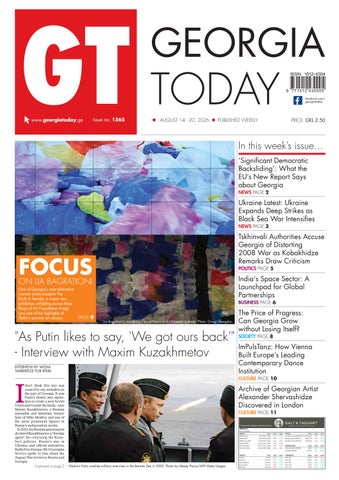
FOCUS
POLITICS PAGE 5
India's Space Sector: A Launchpad for Global Partnerships
ON LIA BAGRATIONI One of Georgia’s most distinctive women artists presents The Earth Is Female, a major new exhibition unfolding across three floors of Art Foundation Anagi and one of the highlights of Tbilisi’s summer art season.
BUSINESS PAGE 6 PAGE 9
Lia Bagrationi’s installation Futurist Fresco at Art Foundation Anagi. Photo: Giorgi Shengelia.
The Price of Progress: Can Georgia Grow without Losing Itself?
"As Putin likes to say, 'We got ours back'" ImPulsTanz: How Vienna - Interview with Maxim Kuzakhmetov Built Europe’s Leading SOCIETY PAGE 8
Contemporary Dance Institution
INTERVIEW BY VAZHA TAVBERIDZE FOR RFERL
CULTURE PAGE 10
I
don’t think this war was caused by any mistakes on the part of Georgia. It was Putin’s desire and aspiration to create a new Soviet Union and reunite the lands, - says Maxim Kuzakhmetov, a Russian journalist and historian, former host of Ekho Moskvy and one of the most prominent figures in Russia's independent media. In 2023, the Russian government declared Kuzakhmetov a "foreign agent" for criticizing the Kremlin's policies, Russia's war in Ukraine, and official narratives. Radio Free Europe/RL’s Georgian Service spoke to him about the August War between Russia and Georgia. Continued on page 2
Archive of Georgian Artist Alexander Shervashidze Discovered in London CULTURE PAGE 11 Prepared for Georgia Today Business by
DĂƌŬĞƚƐ Ɛ ŽĨ ϭϭͲ ƵŐͲϮϬϮϲ
WƌŝĐĞ
ǁͬǁ
WƌŝĐĞ
ǁͬǁ
' KZ' Ϭϭͬϯϭ
ϵϳ͘Ϯϵ ;zdD ϱ͘ϴϮйͿ
нϬ͕Ϭй
нϬ͕Ϭй
>ŝŽŶ &ŝŶĂŶĐĞ 'ƌŽƵƉ ; ' K >EͿ ' W ϭϮϲ͘ϯϬ
нϱ͕ϯй
нϵ͕Ϭй
'Z /> ϬϲͬϮϴ
KE ^
ϵϲ͘ϰϲ ;zdD ϲ͘ϬϱйͿ
ͲϬ͕Ϭй
нϬ͕ϭй
'ĞŽƌŐŝĂ ĂƉŝƚĂů ; ' K >EͿ
' W ϰϰ͘ϭϬ
ͲϮ͕Ϭй
нϮ͕ϲй
d ĂŶŬ 'ƌŽƵƉ ;d ' >EͿ
' W ϰϴ͘ϰϴ
ͲϮ͕ϱй
нϰ͕Ϭй
WƌŝĐĞ
ǁͬǁ
ŵͬŵ
ϴϴ͕ϵϭ нϭϮ͕Ϭй
нϭϳ͕Ϭй
' '' ϵ ϭͬϮ W ZW
ŵͬŵ
^dK <^
ϭϬϱ͘ϯϴ ;zdD ϵ͘ϭϳйͿ
ͲϬ͕Ϭй
ͲϬ͕ϱй
^><Z , ϬϵͬϯϬ
ϭϬϬ͘ϭϭ ;zdD ϳ͘ϰϲйͿ
нϬ͕Ϭй
ͲϬ͕ϲй
d ϴ͘ϴϵϰ W ZW
ϭϬϬ͘ϳϱ ;zdD ϭϭ͘ϴϯйͿ
ͲϬ͕Ϭй
ͲϬ͕ϯй
KDDK /d/ ^
d ϭϬ ϭͬϰ W ZW
ϭϬϳ͘Ϯϴ ;zdD ϵ͘ϰϬйͿ
ͲϬ͕Ϭй
ͲϬ͕ϰй
ƌƵĚĞ Kŝů͕ ƌĞŶƚ ;h^ΨͬďďůͿ 'ŽůĚ ^ƉŽƚ ;h^ΨͬK Ϳ
/E / ^
нϳ͕Ϯй
нϲ͕ϭй
ǁͬǁ
ŵͬŵ
hZZ E / ^
WƌŝĐĞ
ǁͬǁ
^W ϱϬϬ
ϳ ϳϮϴ͕ϮϬ
ͲϬ͕ϭй
нϮ͕Ϭй
h^ ͬ ' >
Ϯ͕ϲϭϳϱ
ͲϬ͕Ϯй
ͲϬ͕ϳй
&d^ ϮϱϬ
Ϯϰ ϳϵϵ͕ϳϱ
нϭ͕ϰй
нϲ͕ϭй
hZ ͬ ' >
ϯ͕ϬϮϭϮ
ͲϬ͕ϭй
нϬ͕ϰй
Kt :KE ^ ϯϬ
Vladimir Putin watches military exercises in the Barents Sea in 2005. Photo by Alexey Panov/AFP/Getty Images
WƌŝĐĞ
ϰ ϯϳϬ͕ϭϭ
ŵͬŵ
ϱϯ ϳϵϭ͕ϴϱ
нϬ͕Ϯй
ŵͬŵ
ͲϬ͕ϱй
нϮ͕Ϯй
' W ͬ ' >
ϯ͕ϱϯϱϭ
ZƵƐƐĞůů ϮϬϬϬ
ϯ ϬϮϳ͕ϭϮ
ͲϬ͕ϯй
нϭ͕ϳй
hZ ͬ h^
ϭ͕ϭϱϰϮ
нϬ͕ϭй
нϭ͕ϭй
&d^ ϭϬϬ
ϭϬ ϴϰϰ͕ϭϵ
ͲϬ͕ϯй
нϯ͕ϯй
' W ͬ h^
ϭ͕ϯϱϬϳ
нϬ͕ϰй
нϬ͕ϴй
нϬ͕ϭй
2
NEWS
GEORGIA TODAY
AUGUST 14 - 20, 2026
‘Significant Democratic Backsliding’: What the EU’s New Report Says about Georgia BY TEAM GT
Irakli Kobakhidze. Source: FB
Kobakhidze – ‘Deep State’ Artificially Fuels ‘Russophobia’ in Georgia BY NANUKA MAGLAKELIDZE
G
eorgian Dream government head Irakli Kobakhidze held a briefing on “Russophobia” in Georgia. He said that, in line with instructions from the “deep state,” alleged agents are artificially fueling Russophobic sentiments in Georgia today. As examples of “Russophobia,” he cited the arrival of Russian tourists on the Astoria Grande cruise ship in 2023 and an opposition protest led by Elene Khoshtaria during a wedding attended by Russian citizens. “Partners abroad, agents at home – all of them are trying to fuel this campaign in our country. They have one goal,” Irakli Kobakhidze said. “They failed to open a ‘second front’ – it was the same earlier, in 2022, when they came to us and demanded that we open a second front, to which they received a refusal. They then moved to relatively more indirect demands – imposing sanctions and sending volunteer fighters. When they failed to achieve results through
these either, there was the issue of the European Union, which they tried to use for blackmail. They could not use this either because society showed wisdom. This was followed by three Russophobic campaigns… “The campaign was directly aimed against tourists. Russian tourists were portrayed as a threat… They failed to fuel it because Russophobia, just like xenophobia, is foreign to Georgian culture… “Clearly, in line with instructions from the ‘deep state,’ the artificial fueling of Russophobic sentiments in Georgia today by its alleged agents is a process that is meant to end with an extreme escalation of hatred between nations, the collapse of economic relations, and the maximum escalation of the situation. “Therefore, despite the wrong policies of the United National Movement regime and the Russian authorities, which is a political issue to be addressed by politicians and state institutions, both Georgian and Russian societies must exercise particular caution so as not to knowingly or unknowingly act in the interests of the ‘global war party.’” Kobakhidze claimed.
Dadiani Palaces Win International Travel Awards 2026, Named Georgia’s Best Museum
G
eorgia experienced a significant deterioration in human rights and democratic standards in 2025, with fundamental rights restricted through repressive legislation and actions, says the European Union’s 2025 Annual Report on Human Rights and Democracy. The report says human rights in Georgia were “severely restricted” by measures affecting equality and non-discrimination, freedom of expression, assembly and association, as well as the rights to privacy, liberty and security. EU claims that ill-treatment of protesters by law enforcement officers was widespread in 2025 and in some cases amounted to torture or inhuman and degrading treatment. The report says no perpetrators were held accountable, contributing to what it describes as a climate of impunity. The EU also raises concerns about arbitrary arrests, excessive use of pretrial detention and disproportionately harsh sentences imposed on protesters and journalists, saying these developments have implications for the right to a fair trial. The report cites cases of physical attacks, sexual harassment and threats of rape or death against women participating in demonstrations. It also says new legislation, including amendments to the Law on Broadcasting, the Foreign Agents Registration Act and legislation concerning family values and the protection of minors, negatively affected freedom of expression and the ability of the media to operate freely. Reports of intimidation, threats, verbal and physical attacks and arbitrary detention of journalists and media workers were also widespread, according to the EU. The report describes the state of democracy in Georgia as being marked by “significant backsliding.” It says the author-
ities adopted repressive measures against civil society, media representatives and opposition leaders that seriously undermined democratic decision-making and processes and effectively eliminated civic participation and checks and balances. The EU says the freezing of bank accounts belonging to several civil society organizations demonstrated the use of the justice system “as a tool of repression and political persecution” aimed at depriving organizations of essential financial resources and suppressing dissent. Political pluralism was also put at risk by the ruling party’s efforts to seek the banning of several opposition parties through the Constitutional Court, the report says. It adds that politically motivated prosecutions against civil society and the imprisonment of opposition leaders ran counter to fundamental democratic values. The report notes that Georgia ranked 114th in Reporters Without Borders’ 2025 World Press Freedom Index, 52nd in the World Justice Project’s 2025 Rule of Law Index and 56th in Transparency International’s 2025 Corruption Perceptions Index. Georgia also received a score of 34 out of 100 from the CIVICUS Monitor, indicating a “repressed” civic space. The EU says it repeatedly called on the Georgian authorities to halt democratic backsliding, repeal repressive legislation and pursue democratic, comprehensive and sustainable reforms consistent with the fundamental principles of European integration and the nine steps linked to Georgia’s EU candidate status. Brussels also urged the authorities to respect and protect human rights, including the right to a fair trial, freedom of expression and assembly, media freedom and pluralism, and called for the release of people it considers arbitrarily detained. The report notes that no political dialogue between the EU and Georgia took place in 2025 because of the continued democratic backsliding, while the EU continued to downgrade the level of
bilateral contacts. The EU-Georgia Human Rights Dialogue has not been held since June 2023. The EU also continued to suspend financial assistance directly benefiting the Georgian authorities. In response to restrictions on civic space and the deteriorating human rights situation, €24 million in bilateral and thematic funding under the NDICI framework has been allocated to civil society and independent media since October 2024. Support has focused on civil society organizations and independent media, access to justice, the rights of people with disabilities, gender equality, combating gender-based violence, minority and children’s rights, LGBTI rights, confidencebuilding and efforts to counter disinformation and foreign interference. The report also addresses Georgia’s compliance with visa liberalization benchmarks. It says the European Commission concluded in December 2025 that Georgia had experienced further regression in governance and fundamental rights and continued to violate relevant benchmarks. The Commission subsequently launched a procedure under the revised visa suspension mechanism aimed at suspending visa exemptions for Georgian holders of diplomatic, service and official passports. In the multilateral sphere, the EU says Georgia’s cooperation with the European Court of Human Rights and implementation of its judgments remain inadequate, with 45 cases under enhanced supervision by the Committee of Ministers. The report also criticizes the Georgian authorities for failing to invite an OSCE/ ODIHR observation mission early enough to allow comprehensive monitoring of the October 2025 municipal elections and says Georgia failed to address any of ODIHR’s significant recommendations from previous elections. Despite these concerns, the report notes that Georgia generally maintained good cooperation in international forums, although it did not join several international and EU initiatives.
Excavation Uncovers Hidden Underground Levels beneath Tbilisi’s Iconic Melik-Azaryants Building BY NANUKA MAGLAKELIDZE
T Dadiani Palaces in Zugdidi. Source: FB
BY NANUKA MAGLAKELIDZE
T
he Dadiani Palaces Historical and Architectural Museum has won an International Travel Awards 2026 prize, being named Georgia’s Best Historical and Architectural Museum, the Ministry of Culture of Georgia says. Giorgi Kalandia, director of the Art Palace, noted that the International Travel Awards is an international award that annually recognizes outstanding museums, cultural attractions, tourism companies, hotels, airlines and other organizations in the tourism and hospitality sector. The competition places particular emphasis on visitor experience, service quality, hospitality standards and the
overall impression an organization makes on its visitors. “The scale of the International Travel Awards is also demonstrated by its list of winners,” Kalandia said. “In different years, the award has gone to such renowned international brands and tourist attractions as Ferrari World Abu Dhabi, Warner Bros. World Abu Dhabi, W Verbier Switzerland and Radisson Blu. “I especially congratulate David Okujava, Irakli Chitanava, Lili Beraya, Marina Kobalia, Nana Khubua and Nika Jologua! Congratulations to our entire team. We have even bigger goals ahead!” Kalandia said the award is particularly important for the Dadiani Palaces Historical and Architectural Museum, describing it as one of Georgia’s outstanding historical and architectural complexes, where the country’s history, architecture and art come together.
he Armenian Report has shared an article informing that renovation work on Tbilisi’s historic MelikAzaryants building has uncovered previously hidden underground levels beneath the landmark on Rustaveli Avenue. Excavations are continuing at the building at 37 Rustaveli Ave., with previous reports suggesting that the underground space could cover up to 2,000 square meters. The discovery has also brought renewed attention to the history of the building and its original owner, Alexander MelikAzaryants, a prominent Armenian businessman, industrialist and philanthropist who was born in Tbilisi in 1847 and became one of the wealthiest residents of Georgia. Melik-Azaryants commissioned the building in 1912. Designed by architect Nikolai Obolonsky, it was completed three years later and became known for its distinctive towers, bay windows and ornate facade. The building had unusually advanced infrastructure for its time, including independent electricity, water, heating and telephone systems, as well as shops and other commercial spaces. Its construction was particularly challenging because of underground water at the site, requiring a deep and heavily
The historic Melik-Azaryants building, which has stood at 37 Rustaveli Avenue in Tbilisi for more than 100 years. Source: The Armenian Report
reinforced foundation. The recently uncovered underground levels are believed to be connected to these extensive foundations. Melik-Azaryants lost the property after the Soviet takeover of Georgia. The building was nationalized in 1921, and
the businessman was reportedly forced to live in a small basement room inside the building he had commissioned. He died in poverty in 1923. More than a century after its construction, rehabilitation work is now revealing another hidden part of the history of one of Tbilisi’s best-known landmarks.
NEWS
GEORGIA TODAY AUGUST 14 - 20, 2026
3
Ukraine Latest: Ukraine Expands Deep Strikes as Black Sea War Intensifies COMPILED BY ANA DUMBADZE
T
he Russia-Ukraine war entered another intense week with heavy fighting continuing along the eastern and southeastern fronts, while Ukraine expanded its campaign of long-range strikes against Russian military and energy infrastructure. Ukrainian battlefield gains were seen in the southeast, alongside attacks on oil refineries deep inside Russia and a major strike on Russia’s Black Sea naval base at Novorossiysk. Russia, meanwhile, maintained pressure on Ukrainian positions and continued missile, drone and glide-bomb attacks on cities and industrial infrastructure, causing fresh civilian casualties. President Volodymyr Zelensky said that Ukrainian forces had retaken 745 square kilometers of territory since the beginning of the year in what Kyiv describes as the Oleksandrivka operation. Zelensky claimed that Ukrainian troops regained 26 settlements along a roughly 60-kilometer section of the front. Independent Ukrainian battlefield monitor DeepState has confirmed the recapture of 19 settlements and Ukrainian advances in several additional areas, although battlefield claims remain difficult to verify independently. Russian troops continue offensive operations in Donetsk region, particularly around the Kostiantynivka-Druzhkivka area, while Ukrainian forces have recently made limited advances near Kupiansk. The fighting increasingly consists of small-unit infantry
assaults, drone-supported operations and localized attempts to penetrate defensive positions rather than the large armored breakthroughs seen earlier in the war. Ukraine’s growing ability to strike deep inside Russia was even more visible away from the front. Kyiv continued its systematic campaign against Russia’s oil-refining sector, seeking to disrupt fuel production, military logistics and a major source of revenue for Moscow. One of the most consequential attacks came on August 11, when Ukrainian forces struck the Orsknefteorgsintez refinery in Russia’s Orenburg region, roughly 1,900 kilometers from Ukraine. Ukraine’s General Staff confirmed the attack and said a fire had broken out at the facility. Industry sources later told Reuters that the refinery had halted processing after equipment was damaged. The plant has an annual capacity of approximately 5.76 million metric tons, or about 115,000 barrels per day, and produces gasoline, diesel, aviation fuel and other petroleum products. On August 10, drones struck Nizhnekamsk in Tatarstan, where the major TANECO refinery is located. Russian authorities said 13 people, including a child, were killed and 39 injured in the attack, with residential areas also affected. Ukraine acknowledged targeting the refinery as part of its campaign against infrastructure supporting Russia’s war effort. Earlier in the week, Ukrainian attacks were also reported against refineries in Syzran and Ilsky. Another strategically important series of strikes occurred near Gelendzhik on Russia’s Black Sea coast, close to the luxury residence widely known as
“Putin’s Palace.” On August 7, Ukrainian drones targeted a Volna Kupol Garant electronic warfare system designed to interfere with Starlink communications. A second attack days later targeted an S-400 air-defense system and launcher only about 500 meters from the site of the earlier strike. The facilities are located just kilometers from the Black Sea complex associated with Russian President Vladimir Putin. Major Robert Brovdi, commander of Ukraine’s Unmanned Systems Forces, said the S-400 fired six missiles during the attack before the system was left burning for several hours. The attacks demonstrate Ukraine’s increasing focus on destroying Russian air defenses and electronic warfare systems before launching deeper strikes against strategically important areas. The campaign culminated this week in a major Ukrainian attack on Novorossiysk, Russia’s principal remaining Black Sea naval stronghold. Ukrainian drones, missiles and unmanned systems struck the port overnight on August 11-12, damaging naval and port infrastructure and disrupting operations at major grain terminals. Ukraine said several Russian warships were damaged, while the attack also forced two large grain terminals to suspend operations. Russian authorities reported three deaths, including a child, and damage to residential and commercial buildings. Novorossiysk has become increasingly important to Russia since repeated Ukrainian attacks forced much of the Black Sea Fleet away from occupied Crimea. The port is also a major grain and oil-export hub, giving attacks there both military and economic significance.
Russia accused Kyiv of threatening global food security after grain operations were disrupted, while Ukraine points to repeated Russian attacks on its own Black Sea and Danube port infrastructure. Ukrainian grain exports in the first half of August were reportedly 76% lower than during the same period last year. Ukraine has, however, apparently placed some limits on its campaign. Reuters reported that Kyiv temporarily stopped attacks on tankers using Novorossiysk following a US request to avoid ships and infrastructure connected to the Caspian Pipeline Consortium, which carries predominantly Kazakh oil and is important to global energy markets. Russia continued its own long-range campaign against Ukraine throughout the week. On August 11, Russian missile, drone and glide-bomb attacks killed at least 10 civilians. Seven employees of the Zaporizhstal steel plant were killed when a ballistic missile struck the industrial facility in Zaporizhzhia, while three people, including a 15-year-old boy, were killed in Dnipropetrovsk region. The Zaporizhzhia strike also damaged energy and industrial facilities and forced Zaporizhstal to suspend operations. Russian strikes also hit Kyiv, including the grounds of a children’s hospital and a warehouse. Earlier in the weekend, a Russian strike on Kharkiv killed three people, while an attack on Odesa wounded eight. Across the border, Ukrainian drone attacks killed five people in Russia’s Belgorod region. The mounting civilian toll prompted Pope Leo to renew his appeal for an end to the war and for
respect for international humanitarian law. The intensifying air war has again highlighted Ukraine’s shortage of highend air-defense interceptors. Zelensky has continued to urge partners, particularly the United States and European NATO members, to accelerate deliveries of Patriot missiles as Russia expands its use of ballistic weapons. Kyiv has also begun developing its own ballistic and anti-ballistic capabilities under the European FREYJA program, with Ukraine expected to contribute domestically produced missiles and launchers while European partners provide radars, sensors and other critical components. Diplomatic efforts continued despite little evidence that the fighting is approaching an end. Zelensky said this week that Kyiv had submitted new proposals to US negotiators aimed at ending the war. The details have not been made public, but the Ukrainian president said Washington could play a decisive role by strengthening Ukraine’s air defenses while increasing pressure on Moscow. US negotiators Steve Witkoff and Jared Kushner are expected to continue contacts with both Kyiv and Moscow after months of negotiations that have so far failed to produce a lasting ceasefire. Prisoner exchanges also remain one of the few areas where limited cooperation continues. Russia this week published a list of 224 Ukrainian prisoners it said it was prepared to exchange, although Moscow and Kyiv accused each other of obstructing the process. Ukraine insists it remains committed to bringing home all Ukrainian prisoners.
4
POLITICS
GEORGIA TODAY
AUGUST 14 - 20, 2026
"As Putin likes to say, 'We got ours back'" - Interview with Maxim Kuzakhmetov Continued from page 1
HOW DOES THE AVERAGE RUSSIAN PERCEIVE GEORGIA TODAY: AS AN INDEPENDENT, SOVEREIGN STATE, OR AS A LAND AND PEOPLE THAT ONCE BELONGED TO THEM, BUT WHICH “FLED”?
Millions of Russians still Unfortunately, the situation is deplorable. sincerely believe Millions of Russians still sincerely believe that Georgia is somehow “ours.” That that Georgia is this land was ours, but then the Georgians “rebelled and separated from us.” somehow "ours" Most of them probably don’t even know the word “Georgia,” because this word is not found in Russian textbooks. At best, they have a certain sympathy for Georgia, influenced by cult films like Mimino. This is the image of a scorned but noble and kind Georgian man, who is a bit of a hothead, but not a bad person. This is at best. At worst, we are dealing with complete arrogance and contempt imbued with imperialism: that this land was “ours,” but then “the Georgians rebelled and separated from us.” Especially since textbooks teach us from childhood that it was Mother Russia who saved Georgia from complete destruction at the hands of the Persian and Ottoman invaders; that it was Russia that saved its Orthodox Georgian [younger] brothers and, in general, even helped save their ethnos. After 2008, of course, this arrogant and condescending attitude became even more pronounced. When Russia invaded Georgia, propaganda was so intent on smearing Georgia that traces of it remain to this day. Millions of Russians look at Georgia with arrogance at best, and at worst, they think like real imperialists: “we need to be tougher with the Georgians, we need to establish order there: they want us to; they all illegally seceded from the Soviet Union and we will bring these ungrateful people to their senses again. Wasn’t it good when we built factories for them and saved them from the Persians and Turks?!”
WHAT ROLE DOES HAVING A COMMON FAITH WITH RUSSIA PLAY FOR GEORGIA: POSITIVE OR NEGATIVE? I have no illusions: The Russian Orthodox Church is stuck in centuries-old dogmas. For hundreds of years, no serious reformation has taken place there, and the Church has not been able to move into the 21st century. As for Georgia and the Georgian Church, the majority of Russians generally have difficulty understanding how these confessions differ from each other and that the Georgian Church has long been autonomous. They still perceive it this way: “because we are Orthodox, we are the main ones; we are the heirs of Rome and Byzantium. Everyone must live according to our customs. For example, for the enthronement, they must come to Moscow, bow their heads, and then the Patriarch of Moscow must receive alms and be consecrated by some Georgian bishop.” After all, we are the “Third Rome” and, therefore, it is strange to them that some people do not obey our orders. Unfortunately, our shared beliefs play a more harmful role than a good and positive one.
LET'S MOVE ON TO THE WAR. WAS THE AUGUST WAR INEVITABLE? COULD IT HAVE BEEN AVOIDED, AND IF SO, AT WHAT COST? This war should not have happened at all, but it happened unequivocally, unilaterally, on Russia's decision: in 2008, the Russian army invaded the territory of independent Georgia. This was a decision made in the Kremlin. In 2008, the infamous “Move with the Rock” took place, when after two presi-
dential terms, Putin resigned and Medvedev became president. It was Putin who gave Medvedev the task of attacking Georgia. This was an experiment for Putin: if everything went well, it would signify that the Russians would be able to act with impunity in future. And if something did not go well and the West intervened, Putin would say: “what is this? How could he commit such arbitrariness? I would never allow it!” And then, as a demonstration, he would have Medvedev removed from the presidency. But, unfortunately, the West swallowed it all. This led to the horrific consequences for which both Ukraine and Georgia are still paying the price.
THE FACT THAT THIS WAR SHOULD NOT HAVE HAPPENED IS ONE THING, BUT COULD GEORGIA HAVE DONE SOMETHING TO PREVENT IT? WHAT WOULD HAVE SATISFIED PUTIN? Nothing would have satisfied Putin. In his mind, the collapse of the Soviet Union, which he himself constantly repeats, was wrong and a catastrophe. He believed everything must be brought back under Moscow's rule. I don't think this war was caused by any mistakes on the part of Georgia. It was Putin's desire and aspiration to create a new Soviet Union and reunite the lands.
IS ALL THIS HAPPENING BECAUSE PUTIN WANTS HIS NAME TO BE WRITTEN IN HISTORY BOOKS AND TEXTBOOKS ALONGSIDE OTHER GREAT RUSSIAN TSARS, OR IS THERE SOME KIND OF PRAGMATISM OR REALPOLITIK IN HIS ACTIONS? These are not just Putin's wars. Millions of Russians supported them and still support them. Millions of Russians think something like this: “who do Georgians think they are? How could they make decisions without our permission?” Unfortunately, such an attitude was even found among well-known Russian oppositionists. Remember Navalny, who in 2008 responded to the war with a rather disgusting pun: “грузиныгрызуны,” or “Georgians-rodents”? If even the oppositionists had such a big head, what should we expect from the open imperialists? As for what drives Putin, yes, he wants to be remembered alongside those great kings. Textbooks have taught generations, probably for more than a century, that a good ruler is not one under whom people had freedom, grew rich, and lived longer, but one under whose rule new lands were added to the state. If you conquered other people's lands, you were a good ruler, and if you lost something, you were a bad one. Putin froze at this primitive, fourthgrade level. At that time there was a textbook called "Stories from the History of the USSR." Everything was conveyed at an extremely childish and miserable level, but at the same time in an imperialist spirit: there is an older brother, that is, Moscow, and there are wretched younger brothers who need to have factories built for them and be taught to read and write.
Maxim Kuzakhmetov. Source: RFERL
In Georgia’s case, this is especially unthinkable, because Georgia adopted Christianity hundreds of years before Russia, and Georgians had an independent Georgian state before Moscow even existed. But no, the imperial consciousness perceives all this differently. And it remains unchanged in the 21st century: “If you want your descendants to glorify you, you have to conquer other people's territory.”
I WOULD LIKE TO ASK YOU SEPARATELY ABOUT THE NAME THAT RUSSIA GAVE TO THIS OPERATION: “ПРИНУЖДЕНИЕ К МИРУ” - “COERCION TOWARDS PEACE.” HOW IRONIC WAS THIS NAME? It was an allusion to the actions of the West: The Serbian dictator Milosevic brought troops into the territory of Kosovo and organized a genocide of the non-Serb population there. Back then, Europe had more serious leaders than today, and they conducted an operation to "force peace," within the framework of which NATO bombed Belgrade. There were two demands: the troops had to be withdrawn from Kosovo, and the dictator Milosevic had to be handed over. The West acted in concert and quite promptly. The Serbs accepted these conditions, withdrew their troops from Kosovo, and handed over Milosevic. This is exactly what should have happened with Russia. When Russia invaded Georgia in 2008, it was Russia that should have been forced to make peace. Instead, the West swallowed everything, tolerated it, and turned a blind eye. This was the prologue to a larger war: the annexation of Crimea soon followed. When the West swallowed that too, Putin went even further, and we saw the fullscale invasion of Ukraine and the burning of Ukrainian cities. The same thing could happen in any former Soviet republic if Moscow makes the decision to do so. Georgia has no advantage in this regard. You can flatter Moscow and play the game as if you are friends with it, but I can tell you that this will not protect anyone in the future. If Western politicians choose between war and shame, they will end up with shame. The West is now repeating the mistakes it made in 2008, in today’s Ukraine. You can't make a final agreement with an aggressor just because he promises you something and says, "That's it, no one will be attacked again." All this happened in Europe in 1938, and it is repeating itself in much the same way in the 21st century.
In the West, they think: “Putin promised us that he would only worry about South Ossetia and would not attack anyone else. No, wait! Putin promised us that he only wanted Crimea. After all, everyone there ‘voted’ to join Russia. There will be no more big wars, Putin has already calmed down, he got what he wanted - Crimea, he doesn't demand anything more.” And now, we have to negotiate again. “Why don't the Ukrainians give up Donbas? It's all their fault, because they don't want to negotiate. Putin promises us that he only needs Donbas and two more regions, Zaporozhye and Kherson. That's all, he has no more claims.” What a huge and terrible mistake it is to believe all these promises.
THERE ARE ISSUES STILL BEING DEBATED 18 YEARS ON FROM THE AUGUST WAR. ONE IS WHEN IT ACTUALLY BEGAN. RUSSIAN PROPAGANDA CLAIMS THAT, AT 00:15, THE GEORGIAN ARMY LAUNCHED AN ATTACK ON SOUTH OSSETIA. Whatever happened, it all happened on the territory of the Republic of Georgia, an independent state. Moscow should have had nothing to do with it. It could have expressed concern, called for an emergency summit. Moscow still has veto power and a casting vote in the UN. If it was so worried, it could have, for example, called for the deployment of international peacekeeping forces there. But nothing like that was done. There was a direct Russian invasion, disguised as a peacekeeping force. It doesn't matter what excuse they came up with for doing so. In South Ossetia, they found it easy to bring in tanks from Russian territory and fly planes in from Russian airfields, which bombed even Georgian towns located quite far from South Ossetia.
These are not just Putin's wars. Millions of Russians supported them, and still do
Therefore, the reason, the date, who started first and who first opened fire in the direction of Tskhinvali, does not matter. This is not a matter of principle. It only confuses everything and allows the Russians to later say: “we had to protect them. After all, someone there was going to attack the South Ossetians, and they are our brothers.”
MANY FEAR THAT AFTER THERECENT ACTS OF HARMONIZATION AND THE EMERGENCE OF MR. KAMBOLOV AS THE HEAD OF TSKHINVALI, THE NEXT STEP WILL BE FORMAL ANNEXATION. HOW REALISTIC IS THIS THREAT? It has, in reality, already happened. Nothing can be changed in the created reality. It’s the same scheme he used in Ukraine: they held a "referendum" and now these are "our territories." Everything, it turns out, is “completely legitimate and in line with international law.” There is nothing stopping Putin from doing exactly the same thing in Tskhinvali tomorrow. But this will not bring prosperity or any other benefit to the inhabitants of South Ossetia. This will be the mediocre life of the Machankala province, a province about which the majority of the citizens of the empire will have only a very vague idea. And the father-state will be so pleased that later they will write about Putin in textbooks: the empire has also added land to the territory of the South Caucasus. Or, as Putin likes to say, “we have regained ours.” But the main problem is not Putin sitting in the Kremlin, it is in the consciousness of the millions of Russians for whom all this is completely normal. Another controversial issue is President Saakashvili's role in the war. Many experts claim that Saakashvili fell for the Russian trap and provocation. How do you assess his role? Mikheil Saakashvili was acting on the territory of his own country. He can be reproached for acting too radically, it can be said that he should have tried to achieve his goal through negotiations or that he poorly prepared his operation from a military point of view. Perhaps it was necessary to act more intelligently, as in the case of Adjara. But, in any case, Russia had no reason to get involved. Therefore, I repeat once again, it is not important or of principle whether Mikheil Saakashvili was mistaken, or how poorly he prepared. This was armed and criminal aggression carried out by Russia. The West swallowed it, thereby giving Putin the upper hand for further action.
POLITICS
GEORGIA TODAY AUGUST 14 - 20, 2026
5
Tskhinvali Authorities Accuse Georgia of Distorting 2008 War as Kobakhidze Remarks Draw Criticism BY TEAM GT
of the international community regard the territories as parts of Georgia under Russian occupation.
T
KOBAKHIDZE'S REMARKS
he de facto foreign ministry of Georgia’s Russian-occupied Tskhinvali region has accused the Georgian Foreign Ministry of “distorting” the circumstances surrounding the August 2008 Russia-Georgia war and claimed that Georgia as a state must bear responsibility for the conflict. The statement came in response to the Georgian Foreign Ministry’s statement marking the 18th anniversary of the war, in which Tbilisi called on Russia to end what it described as the illegal occupation of Georgian territories. “The Georgian Ministry of Foreign Affairs, following the approaches of NATO countries, continues to mislead its own population and the international community in its assessment of the aggression against South Ossetia,” the de facto ministry said, accusing Tbilisi of “distorting obvious facts.” The de facto authorities also cited recent remarks by Georgian Prime Minister Irakli Kobakhidze concerning former President Mikheil Saakashvili, claiming that he had effectively acknowledged Saakashvili’s responsibility for the outbreak of hostilities. “In fact, this was known from the very beginning, and South Ossetia has been saying this for the past 18 years,” the statement said. The de facto ministry argued that responsibility should not be attributed solely to Saakashvili personally, but to the Georgian state, since he acted as president. “Therefore, responsibility for the August 2008 war must be borne by the country as the subject of this policy, including representatives of the Saakashvili regime as the implementers of this policy,” it said. The statement also rejected Georgia’s characterization of Russia’s military presence in Abkhazia and the Tskhinvali region as occupation, instead describing Russia as a “reliable guarantor of security” and calling on Tbilisi to adopt a “more constructive position,” including within the Geneva International Discussions. Russia recognized Abkhazia and South Ossetia as independent states following the 2008 war and maintains military forces in both regions. Georgia and most
The Tskhinvali statement followed remarks by Kobakhidze on August 8, when Georgian Dream leaders again blamed the previous United National Movement government for the outbreak of the war at the Mukhatgverdi Brothers’ Cemetery. “Russian troops entered on August 8. What happened on August 7 was that Saakashvili’s regime bombed Tskhinvali,” Kobakhidze said. He described Saakashvili’s government as a “bloody regime” and accused the former president of being a “traitor” and an “agent acting on the orders of foreign forces.” When asked whether this amounted to saying that Georgia had started the war, Georgian Dream representatives distinguished between the government in power at the time and Georgia as a state. For the third consecutive year, the Georgian Dream government has openly blamed the previous Georgian government, rather than Russia, for starting the war. The position has drawn criticism from opposition politicians and others who argue that framing the conflict as beginning on August 8 echoes a Russian narrative. They point to the fact that Georgian forces launched an operation against Tskhinvali on the night of August 7–8, while the European Union-backed Independent International Fact-Finding Mission on the Conflict in Georgia, led by Heidi Tagliavini, concluded that the large-scale armed conflict was preceded by years of escalating tensions and that Georgian forces initiated the large-scale military operation, while also finding that Russia’s subsequent military action extended well beyond the limits of a reasonable response. Lelo foreign secretary Grigol Gegelia accused Kobakhidze of providing “evidence against his own state and nation,” calling his remarks “the anatomy of real sabotage.” “Kobakhidze has once again testified against his own state and nation. This is precisely the anatomy of real sabotage. Of course, the response from the Tskhinvali occupation regime was not long in coming. It has now cited one of Kobakhidze’s statements against the Georgian state at least six times,”
Tskhinvali in 2021. Photo by Igor Chochyty
Gegelia said. Vika Filfani, a member of the For Georgia parliamentary faction, called for an investigation into Kobakhidze, arguing that his statements blamed Georgia for starting the war and were subsequently being used by the Tskhinvali authorities against the Georgian state. “This damages the national interests. An investigation should be launched into Irakli Kobakhidze and all high-ranking officials who accuse Georgia and harm the country’s national interests,” Filfani said.
NEW SSSG INVESTIGATION The controversy comes as Georgia’s State Security Service has launched a separate investigation under the sabotage article into what it describes as a foreignbacked disinformation campaign targeting Georgia’s interests. According to the SSSG, the campaign allegedly involves fake “bot” accounts registered and managed abroad and the coordinated dissemination of discrediting information on social media. The agency said the campaign is intended to damage Georgia’s economic
interests by creating a false perception that Georgia has become an unfavorable destination for tourists arriving from Russia. Kobakhidze, commenting on the investigation, said those responsible for what he described as sabotage against Georgia would eventually face justice. “Those involved in sabotage against their own country, those who oppose their national interests, must know that justice will catch up with all of them,” he said, adding that “today the state is stronger than ever.”
Moscow Again Signals Readiness to Expand “Pragmatic Ties” with Tbilisi BY NANUKA MAGLAKELIDZE
R
ussian Deputy Foreign Minister Mikhail Galuzin has made another statement expressing Moscow’s readiness to develop relations with Georgia. “We are ready to further expand pragmatic ties with Tbilisi. It is obvious that the key to Georgia’s successful development is not confrontation, but cooperation with our country,” the diplomat told Russia’s state-run TASS news agency in an interview.
Mikhail Galuzin. Source: Novoderezhkin / TASS
Galuzin also spoke about the lack of bilateral political contacts between the two countries. “The reason is that the Georgian side is not ready for such a dialogue. Of course, it is difficult for me to judge to what extent this decision helps Georgia address one problem or another, but this is a decision made by its government,” he said. A Russian Foreign Ministry official also claimed that “unprecedented external pressure from Western countries on Georgia, along with ultimatums demanding that Tbilisi sever ties with Moscow, has failed to produce results.” Galuzin described Russia and Georgia
as “natural partners,” saying that relations between the two countries are based on “centuries-old historical and cultural ties and a shared spiritual foundation.” Moscow is also continuing to call for the development of trade and tourism ties with Tbilisi. “Every fourth tourist in Georgia comes from Russia, while our large market is the main destination for Georgia’s key export products,” Galuzin said. He said Moscow welcomes this trend and aims to create favorable conditions for further expanding humanitarian and business ties.
6
BUSINESS
GEORGIA TODAY
AUGUST 14 - 20, 2026
India's Space Sector: A Launchpad for Global Partnerships BY GURJIT SINGH, FORMER AMBASSADOR AND AUTHOR
G
rowingcompetitioninouter space provides India with a unique opportunity to shape a narrative in which collaboration, rather than confrontation, drives space exploration. Recognized as a trustworthy and costeffective spacefaring nation, India is now well placed to transform its technological advances into enduring international partnerships that contribute to scientific progress, economic growth, and sustainable development. India's journey into space has been distinctive. Unlike many space programs that emerged from Cold War rivalries, India's program was conceived as an instrument of national development. Dr. Vikram Sarabhai anchored India's space vision in practical applications that would improve the lives of ordinary people. Under his leadership, satellites were developed to strengthen communica-
tions, weather forecasting, disaster management, healthcare, agriculture and education. This development-oriented philosophy remains central to India's space program and resonates strongly with the needs of countries in the Global South, which seek practical applications of space technology rather than prestige alone. Today, India's achievements extend beyond developmental applications. The Chandrayaan missions, the Mars Orbiter Mission, the Aditya-L1 solar observatory, and the forthcoming Gaganyaan human spaceflight program, have established India as a nation capable of executing sophisticated and reliable space missions. Chandrayaan-3's successful soft landing near the Moon's south pole placed India among an exclusive group of space powers, while demonstrating that world-class innovation can be achieved at comparatively modest cost. India's growing credibility comes at a time when the global space economy is expanding rapidly. Valued at over US$600 billion today, and projected to approach US$1.8 trillion by 2035, the sector is
LVM3 M4 lifting off with Chandrayaan-3 on 14 July, 2023. Source: Indian Space Research Organization (GODL-India)
increasingly driven by commercial activity in satellite communications, Earth observation, navigation, climate services, broadband connectivity, and emerging fields such as in-orbit servicing and lunar exploration. Many countries aspire to participate but lack indigenous capabilities. They seek dependable long-term partners rather than merely launch providers. India possesses the capabilities to meet these requirements. The liberalization of the space sector in 2020 transformed the ecosystem by opening it to private participation. The establishment of the Indian National Space Promotion and Authorization Center (IN-SPACe), the expanding commercial role of NewSpace India Limited, and the growth of private enterprises have created one of the world's most dynamic emerging space ecosystems. Indian startups are developing launch vehicles, satellite platforms, geospatial applications and propulsion technologies that are attracting global investment and customers. Companies such as Skyroot Aerospace, Pixxel and Agnikul Cosmos have demonstrated that Indian private enterprises can compete internationally in advanced space technologies. The next step is to internationalize this ecosystem. Rather than positioning itself only as a low-cost launch destination, India will offer comprehensive partnerships encompassing satellite design, launch services, mission operations, ground stations, astronaut training, capacity building and downstream applications in agriculture, disaster management and maritime security. Such integrated partnerships would be valuable for countries across the Global South and the Indo-Pacific seeking affordable, customized and reliable technologies to meet their development priorities. India has demonstrated the diplomatic value of such cooperation. Through the South Asia Satellite, it provided communication and developmental benefits to neighboring countries. Indian launch vehicles have successfully placed hundreds of foreign satellites into orbit for governments, universities and commercial operators around the world. India's decision to join the Artemis Accords reflects its willingness to participate in the peaceful exploration of the Moon through international collaboration. Cooperation with NASA, the European Space Agency and JAXA has strengthened India's scientific and technological capabilities. These partnerships reinforce India's standing as a leading voice of the Global South. India offers development partnerships based on affordability, reliability and mutual respect, rather than creating technological dependence. Space coop-
Gurjit Singh, former Ambassador and author
eration has therefore become an increasingly important instrument of Indian diplomacy, strengthening bilateral relationships while delivering tangible developmental benefits. To realize its full potential, India will aim to sustain the momentum of reform. Faster regulatory approvals, greater access to venture capital, stronger intellectual property protection, and closer collaboration among research institutions, industry and academia will be essential. Public procurement policies would continue supporting Indian startups, enabling them to scale up, innovate and integrate into global supply chains. India is positioned to play a larger role in shaping the governance of outer space. Orbital congestion, space debris, responsible resource utilization and equitable access to emerging space opportunities are becoming pressing international concerns. As space activities expand, there will be an increasing need for countries capable of building consensus on responsible norms and practices.
India's long-standing commitment to the peaceful uses of outer space, combined with its growing technological capabilities, equips it to contribute meaningfully to the development of rules that promote transparency, sustainability and equitable access. The coming decade will determine not only which countries lead in space, but also how space is governed. With its scientific capabilities, entrepreneurial ecosystem and international credibility, India is uniquely placed to bridge the gap between established and emerging space nations. By building collaborative partnerships founded on inclusivity, mutual benefit and innovation, India can transform its space program into a major pillar of its global engagement. In an increasingly divided world, India's space sector offers a powerful reminder that the greatest achievements in space are those that bring nations together. That may well become India's most enduring contribution to humanity's next frontier.
Georgia’s National AI Team Wins 2 Gold, 3 Silver and 2 Bronze Medals at IOAI 2026 BY TEAM GT
G
eorgia’s National Artificial Intelligence Team has achieved an outstanding result at the 3rd International Olympiad in Artificial Intelligence (IOAI 2026), winning seven medals and one Honorable Mention and ranking seventh among 109 participating countries. The team’s participation and preparation were supported by TBC, the main supporter of Georgia’s technology Olympiads. The Georgian team won two gold, three silver and two bronze medals, as well as one Honorable Mention, at the international competition, which was held in Astana, Kazakhstan. The Georgian team’s medal winners are: Gold Nikoloz Gegenava — V. Komarov Tbi-
lisi Physics and Mathematics Public School No. 199 Giorgi Maisuradze — V. Komarov Tbilisi Physics and Mathematics Public School No. 199 Silver Nikoloz Kipshidze — Public School No. 136 Anton Ingorokva — V. Komarov Tbilisi Physics and Mathematics Public School No. 199 Mate Rekhviashvili — V. Komarov Tbilisi Physics and Mathematics Public School No. 199 Bronze Luka Berikelashvili — V. Komarov Tbilisi Physics and Mathematics Public School No. 199 Nikoloz Kiladze — V. Komarov Tbilisi Physics and Mathematics Public School No. 199 Honorable Mention Giorgi Tskitishvili — V. Komarov Tbilisi Physics and Mathematics Public
School No. 199 The national AI team underwent several months of intensive preparation for the competition with the support of TBC and under the organisation of the Georgian Artificial Intelligence Association (GAIA). The team trained at the Technology Olympiads Hub, established at the Business and Technology University (BTU), where participants followed GAIA’s specialised Olympiad programme. As part of the program, the students
developed practical skills in artificial intelligence, machine learning and data science, preparing them to compete against some of the strongest young technology talents from around the world. The team was coached by Shota Elkhanishvili, with Luka Darsalia and Nika Mikaberidze serving as co-leaders. IOAI is one of the world’s leading international competitions for school students in artificial intelligence, bringing together talented young people from more than
100 countries. Georgia participated in the Olympiad for the second time this year, and the team’s strong performance marks an important milestone in the development of AI education and talent in the country. For TBC, supporting education and the development of Georgia’s technology ecosystem is a strategic priority. The company continues to support initiatives that give young people access to cuttingedge technologies, help them develop practical and future-oriented skills, and prepare them to compete successfully on the international stage. The Georgian team’s achievements at IOAI 2026 once again demonstrate the potential of the country’s young generation and the importance of sustained investment in technology education. For TBC, supporting such initiatives is part of its broader commitment to helping develop the talent and skills that will shape Georgia’s future.
BUSINESS
GEORGIA TODAY AUGUST 14 - 20, 2026
7
Young Generations Celebrate Agricultural Heritage and Rural Opportunities in Samegrelo-Zemo Svaneti SOURCE: FAO
W
omen farmers and young people from Sameg relo-Zemo Svaneti gathered in Martvili to celebrate International Youth Day through an event highlighting the role of youth in rural development and the importance of preserving and revitalizing local agricultural heritage. The event was organized by the Food and Agriculture Organization of the United Nations (FAO) within the framework of the project “Fostering the economic resilience of small-scale women farmers in Samegrelo and Abkhazia through farmer field schools”, with the support of the Swiss Agency for Development and Cooperation (SDC). Hosted at the Gulsunda Ethno-Gastro Space, the event brought together 20 women farmers with their daughters, sons, grandchildren, and other young
International Youth Day in Martvili. Source: FAO
family members to showcase local products, share agricultural knowledge, and celebrate the traditions that shape the region’s identity. The event featured an exhibition and sale of locally produced dairy, fruit, and
vegetable products, including traditional cheeses, jams, and other regional specialties. Participants also took part in culinary and practical masterclasses, providing opportunities for knowledge exchange between experienced farmers
and younger generations. The event highlighted how engaging young people, strengthening intergenerational knowledge exchange, and building connections with the private sector can help preserve agricultural heritage while creating new opportunities for smallholder farmers and supporting sustainable rural development. Representatives of the HoReCa sector from Zugdidi, Kutaisi, and Martvili also participated, creating networking opportunities and supporting new business connections between smallholder women farmers and potential market partners. “Young people’s involvement in agriculture is essential in shaping the future of rural communities,” said Javier Sanz Alvarez, FAO Senior Programme Officer. “By connecting generations, we help ensure that valuable knowledge and traditions are preserved while encouraging new ideas and innovation. Supporting youth engagement in agriculture means investing in more resilient and sustainable rural communities.” "When knowledge is shared across
generations, rural communities become stronger and more resilient,” said Barbara Böni, Regional Director of Swiss Cooperation, Embassy of Switzerland in Georgia. “By supporting smallholder women farmers and encouraging young people, especially young women and girls, to engage in agriculture, Switzerland helps preserve local agricultural heritage while creating new opportunities for future generations. Through our partnership with FAO, we are committed to fostering women's economic empowerment, innovation and sustainable rural development.”
ABOUT FAO AND SDC COLLABORATION Since 2020, FAO has been empowering women farmers in Samegrelo-Zemo Svaneti with the support of the SDC. Already, 43 Farmer Field Schools have been established in the region and 813 women farmers supported with knowledge-sharing opportunities about modern and innovative food production practices.
Kobakhidze: Strengthening Strategic Ties between Azerbaijan, Georgia and Türkiye is Important BY TEAM GT
S
trengthening strategic ties between Azerbaijan, Georgia and Türkiye, particularly in terms of connectivity, is of fundamental importance, Georgian Prime Minister Irakli Kobakhidze said at a briefing. Responding to a journalist’s question, Kobakhidze said the Georgian government was working to further deepen cooperation among the three countries.
He also referred to the Black Sea submarine cable project, saying experts involved in preparing an EU document had included the project, which envisages both electricity and digital connectivity, on a list of projects of common interest. “Where the expert component is involved, everyone, of course, understands that such connections cannot be established and strengthened without Georgia. We should hope that pragmatic considerations will prevail,” Kobakhidze said. The prime minister also referred to remarks by Azerbaijani President Ilham
Aliyev, saying that further strengthening strategic links among Azerbaijan, Georgia and Türkiye was essential. “What Mr. Aliyev says is, of course, the case. It is fundamentally important to further strengthen strategic ties between Azerbaijan, Georgia and Türkiye, including strategic ties in terms of connectivity, and we are doing and will do everything for this,” Kobakhidze said. He added that Georgia has “very good dynamics” in its relations with both Azerbaijan and Türkiye and said the government would continue working actively to deepen those ties.
Irakli Kobakhidze. Source: FB
SOCIETY
wAIting for… BetrAIyal BLOG BY TONY HANMER
K
Photo of and by the author
illing some time between flights from Edmonton to Tbilisi. Outward it was via Vienna and Montreal; home, via Calgary and Munich. Each way needing one long and two shorter flights, and a good long layover of 9-10 hours, as well as other shorter ones. Exhausting, but necessary. I’ve only managed the trip in two flights once, via Amsterdam, which was last year: spottily available and frequently too expensive. Now, in Munich, the latest print edition of WIRED magazine caught my eye. Theme on the cover: AI [artificial intelligence] OR DIE TRYING. Intrigued, I thumbed through, then bought it to peruse. Not disappointed. It’s a magazine I have favored over the years, only occasionally buying a copy on paper (usually when I’m alone in airports), but often checking it out online. AI, which I generally don’t capitalize, is a subject to which I shall likely return as it continues to grow, and as more confusion about it is sown, at breakneck speed… What are Slack and Discord, featured in some of the stories? Feeling my age (a few months from 60), I had to google to find out. The former is “a digital workspace tool used for team messaging and collaboration”; the latter, “a free voice,
video, and text communication service”. Both definitions provided by ai, incidentally, which service I am loath to trust for accuracy and, apparently, justifiably so. The WIRED articles include plenty of dissatisfaction with various aspects of ai, with which stories I find myself sympathizing. People’s struggles with ai“possessed” spouses or partners; with ICE in the USA; with a new young music star arrested on suspicion of murder; with perceived unfair treatment when applying for medical residency. Some of the slang, too, was as opaque to me as the above terms I had to google. No surprise: I am quite aware that language evolves over time, even over a person’s lifetime. (I was taught, in Rhodesia, to spell the fixed-wing flying machine as “aeroplane,” and the current 24-hour period as “to-day'.) Why do I find myself writing so much, lately, about ai at all? Well, it both fascinates and greatly concerns me. Like my language it, too, is evolving, though at a possibly terrifying pace. This, too, should be unsurprising, given the speed at which computers themselves are being improved, from the mid-20th century’s agonizingly slow room-size beasts to today’s latest miraculous smartphones. Trust an ai counsellor to give you advice? It may suggest cheating on your partner if you’re deeply unsatisfied, or suicide if you’re in a lot of psychic pain. Such recommendations it can offer with impunity at the moment: it doesn’t understand the seriousness of its words, nor
can it (or its human programmers) currently be charged or brought to account legally. My stance continues to be: There may be things I would love to use ai for, grunt work like straightening and maximally cropping photos in bulk, or assembling a perfectly formatted list of citations for an academic paper. Otherwise, I intend to keep it at more than arm’s length, and treat it with a default position of grave distrust, which may be overturned in particular situations, but only begrudgingly. Call me old fashioned: I would welcome the term, not see it as an insult at all, more as a badge of honor. At this point, if any of my current jobs was replaceable by ai, I suppose I would submit to that rather than try to fight it by learning more how to use ai. I’d return to another job which needs humans exclusively… We’re by no means 100% replaceable, never will be! [Breaking] And don’t even get me started on “spir(itu)alism, being described online right now as a “religion” originated by ai… what next! Tony Hanmer has lived in Georgia since 1999, in Svaneti since 2007, and been a weekly writer and photographer for GT since early 2011. He runs the “Svaneti Renaissance” Facebook group, now with over 2000 members, at www.facebook.com/groups/ SvanetiRenaissance/ He and his wife also run their own guest house in Etseri: www.facebook.com/hanmer.house.svaneti
8
SOCIETY
GEORGIA TODAY
AUGUST 14 - 20, 2026
The Price of Progress: Can Georgia Grow without Losing Itself? OP-ED BY MARY ANDERSEN
F
ollowing on from the first two articles in this series exploring how Batumi has changed in recent years, this final instalment takes a step back to consider a bigger question: what happens when rapid economic growth begins to reshape not only our cities, but our sense of who we are? Batumi is a city in transformation. Walk along the seafront and it is impossible not to notice how much the city has changed. New hotels, restaurants, apartment blocks and entertainment venues continue to appear, while visitors arrive from an ever-growing list of countries. For a city that was once a relatively quiet Black Sea resort, the pace of change has been remarkable. And change, of course, is not inherently a bad thing. Georgia needs investment. It needs jobs, infrastructure and opportunities for its young people. Tourism has become an important part of the country’s economy, and international visitors bring money, ideas and connections that can benefit communities far beyond the summer season. The question is not whether Georgia should develop. The question is what kind of development does Georgia want? Batumi provides an interesting case
study because so much of the country’s wider transformation can be seen here in concentrated form. The city has become increasingly international, and with that has come a mixture of languages, cultures, businesses and expectations. For many people, this is exactly what a successful tourist destination should look like. For others, there is an understandable concern that somewhere along the road to becoming an international destination, Batumi could begin to lose some of the qualities that made people want to visit in the first place. There is an irony here. Tourists do not travel to Georgia because it looks like everywhere else. They come for the mountains, the Black Sea, the food, the wine, the hospitality, the history and the Georgian language. They come because Georgia has its own character. If a city becomes so focused on accommodating external demand that its own identity becomes secondary, what exactly is it that visitors are ultimately coming to experience? This is particularly relevant when considering language. The increasing visibility of Russian in parts of Batumi has become a sensitive subject, for understandable historical and political reasons. But the issue is larger than Russian alone. English, Turkish, Arabic and other languages are also increasingly present as Georgia becomes more internationally connected. A multilingual city can be a vibrant
Batumi. Source: GT
Batumi. Source: GT
city. But there is an important distinction between being welcoming to other languages and allowing the country’s own language to become peripheral. Georgia should not have to choose between being open to the world and being unmistakably Georgian. In fact, its greatest economic strength may lie in doing both. There is a tendency to think of cultural identity as something that needs to be protected from economic development. But perhaps the better approach is to recognize culture as part of Georgia’s economic capital. Georgian food is an asset. Georgian wine is an asset. Georgian music, architecture, traditions and hospitality are assets. The Georgian language itself is an asset. These are not obstacles to tourism. They are precisely what make Georgia interesting to tourists in the first place. The challenge is making sure that the economic benefits of internationalization do not gradually erode the very things that make the country distinctive. That requires more than simply telling tourists to respect Georgian culture. It requires thoughtful decisions from government, businesses and local commu-
nities about how cities are developed, who benefits from that development, and what kind of tourism Georgia actually wants. Rapid growth can bring prosperity, but it can also bring rising property prices, pressure on infrastructure, seasonal employment and communities that feel increasingly disconnected from the places in which they live. A city cannot be judged successful simply by the number of cranes in its skyline or the number of tourists passing through its airport. The people who live there have to feel that they are part of its future. And this is perhaps the most important question for Batumi.
WHO IS THE CITY BEING DEVELOPED FOR? The answer cannot simply be tourists. Nor can it be investors. Nor should it be those who have recently arrived from elsewhere. It has to include the people who have lived there for generations, as well as those who have chosen to make Georgia their home more recently. That does not mean resisting change. It means making sure that change has a Georgian center of gravity. Georgia has already demonstrated that
it can attract international attention without becoming invisible within that attention. Its culture has traveled far beyond its borders precisely because it has remained distinctive. The opportunity now is to build an economy that strengthens that distinctiveness rather than diluting it. Perhaps the future should not be about deciding between Georgian identity and international openness. Perhaps the ambition should be to create a Georgia confident enough in its own identity to welcome the world without feeling the need to become something else for it. Batumi will continue to change. There is no realistic way, and perhaps no reason, to stop it. The cranes will keep rising. The hotels will keep opening. New visitors will keep arriving. But alongside the question of how much Georgia can grow, there is another question that may ultimately matter more: Can Georgia grow while still recognizing itself in the mirror? If it can, then economic progress need not come at the expense of identity. It could, instead, become the means by which Georgia protects, celebrates and shares that identity with the rest of the world.
The Might & Impact of Orthodox Faith OP-ED BY NUGZAR B. RUHADZE
W
hy is the Orthodox Church so powerful in this country? Or is it? Whatever we say, the fact is that here, in Sakartvelo, the Church happens to be the nation’s most trusted and distinctively grand religious institution, a national symbol and a major social actor. Its magnetic attractiveness is overwhelming, which makes Christian faith more important than any other form of spiritual indoctrination, the majority of the Georgian people being into Orthodox belief: about 85 percent of the entire population. Respectfully, there are other substantial religious communities in the land, like Muslim, Armenian Apostolic, Catholic, Protestant, Jewish, and those with no religion. The Church is often trusted more than a legislative body, political powers, a governing force, or the judiciary. And this influence is not restricted just to worship. It is reflected in public discussions about education, family, morality, national identity, and even politics, albeit its impact is not unlimited: urbanization, globalization, digitalization, higher education, migration, and all sorts of other transformations have all augmented the diversity of views within Georgian society, creating a considerable sector of non-believers. And yet, for many of us, faith is not
Candles in an Orthodox church. Source: FB
only plain spirituality, but it is tightly associated with national identity because, historically, our little Sakartvelo experienced centuries of invasions and foreign domination, and it was the Orthodox Church that managed to turn itself into a sanctuary for keeping up the native tongue, historical memory, spiritual values, cultural traditions, and sense of political continuity. Hence, the notable significance of the Orthodox Church in our everyday lives! Apropos of the word orthodox – how fair, relevant, and compatible is this English translation of the Georgian word მართლმადიდებელი (martlmadidebeli)? It is often thought that translation is not
as expressive and persuasive as the actual name of our Church. To answer the question by means of elucidating this fascinating linguistic point, let’s try to parse the word accordingly: მართალი (martali): true, righteous, correct; დიდება (d i d e ba ) : g l o r y, p ra i s e . Th u s , მართლმადიდებელი is “the one who glorifies or rightly praises.” Meanwhile, the English word Orthodox comes from Greek: orthos – straight, correct; doxa – opinion, belief, glory, worship. So, let’s assume that Orthodox Faith would mean ‘correct belief’ and ‘right worship.’ By the way, the Georgian word მართლმადიდებელი is a word-by-word
translation of the Russian word Православной, which seems to be much more eloquent than the word orthodox. To feel better about this fortuitously established inaccurate translation, let us assume that the Georgian term is therefore not a mistranslation, but emphasizes ‘right glorification’ or ‘righteous praise’ rather than the actual content of the borrowed Greek word. The thing is that the English language has long used the established term Orthodox for this family of churches, but this seems to be only a matter of translation technique and philosophy. The Georgian Orthodox Church is one of the world's oldest Christian churches, along with the Ecumenical Patriarchate of Constantinople, Mount Athos, and the Greek, Russian, Serbian, and Romanian churches, and has a rich theological, liturgical, and monastic tradition. Yet, notwithstanding its huge clout on our society, its contribution to world Christendom in general and Orthodoxy in particular often remained less well-known internationally than those larger Orthodox centers due to Georgia's relatively small population, its geographic location, language barrier, and limited international influence. At the same time, the significance of the Church has never diminished in Sakartvelo, not even under the severely ruling Soviet atheism, which took place because several historical factors came together: Georgia adopted Christianity as early as the 4th century, which helped
preserve national literacy and culture; while dominated by Persians, Ottomans, and Russians, Christian faith became intertwined with national identity; freed from communist suppression, the revival of faith became especially meaningful, the Georgian people intensively seeking institutions that provided stability and moral authority; and, as a logical consequence of all this, the Church is now functioning not only as a religious institution but also as a symbol of historical continuity. At the same time, there is nothing in the way of religious freedom in Sakartvelo. Like any democratic society, Georgia contains a range of viewpoints: religious conservatives, liberal Christians, secular liberals, atheists, agnostics, people of other religions. And their influence is growing, to say the least! This said, it has to be recognized too that the high public trust is a strong prerequisite for supposing that the Church will remain an important institution for the foreseeable future, although the trends are such that younger generations often hold more diverse social views. There goes another interesting trend: because of the long-standing historical roots of the Christian faith in Georgia, identifying as Orthodox often means identifying as Georgian, even for people who rarely attend church. We can easily distinguish between those who just identify as Orthodox, who simply tend to be religious, and those who practice actively. Isn’t this a genuine freedom of faith?
CULTURE
GEORGIA TODAY AUGUST 14 - 20, 2026
9
The Earth Is Female - Lia Bagrationi on Her New Exhibition for me. I enjoy engaging with familiar cultural codes because they already carry a collective memory, and I am interested in what happens when I give that memory a chance to be born again. For me, an image begins a new life when it is no longer simply an image of the past, but starts to speak about the present, and sometimes directly to me or to the viewer.
Pictured: Lia Bagrationi’s The Earth Is Female at Art Foundation Anagi. Photo: Giorgi Shengelia
INTERVIEW BY TEAM GT
I
n Lia Bagrationi’s world, historical images are never entirely past, ordinary objects are never merely ordinary, and the things we leave behind may one day become the archaeology of our time. Her new exhibition, The Earth Is Female, brings ancient sculpture, Georgian frescoes, Renaissance painting, domestic objects and discarded plastic into a shifting landscape of memory and association, where the female emerges through the body, archetype, memory and force of creation. We sat down with the artist to discuss the ideas, images and materials behind the exhibition. On view through early September at Art Foundation Anagi in Tbilisi, The Earth Is Female explores how images and objects accumulate memory, acquire new meanings and speak across time.
THE TITLE OF THE EXHIBITION, THE EARTH IS FEMALE, SOUNDS RATHER CATEGORICAL. HOW
DID THE PHRASE COME ABOUT, AND WHEN DID YOU DECIDE IT SHOULD BECOME THE TITLE OF THE EXHIBITION? I first came up with the phrase many years ago, while travelling in Tusheti. As I was looking at the utterly mesmerizing landscape, I remembered a line by the Georgian poet Vazha-Pshavela: “As pleasant a place to gaze on / As the breast of a woman.” At that moment, I decided that the Earth was undoubtedly female. Later, when I began thinking about this exhibition, I realized that the phrase expressed precisely what I was doing. For me, woman and the Earth are connected not only metaphorically. Both hold memory; both give birth and transform; and both carry within themselves the traces of time. I also like the categorical nature of the title. There is a challenge in it, as well as humor, irony and poetic freedom.
YOUR EXHIBITION SEEMS TO TAKE THE VIEWER INTO A KIND OF ARCHETYPAL UNCONSCIOUS, WHERE PERSONAL MEMORIES,
EVERYDAY OBJECTS AND ELEMENTS FROM DIFFERENT PERIODS AND CULTURES COME TOGETHER. WHAT CONNECTS THESE SEEMINGLY DISPARATE TIMES AND EXPERIENCES? I believe that what connects all of this is not time or culture, nor their functional purpose, but rather a deeper layer, something like an inner memory. For me, these things carry traces of human experience: touch, care, labor, birth, death, desire and everyday life. I see the exhibition not as a collection of separate objects, but as a single, living space, where objects exist like fragments of dreams or archaeological discoveries emerging from a shared unconscious.
YOU OFTEN TURN TO EXISTING, FAMILIAR HISTORICAL IMAGES. HOW DO YOU CHOOSE THEM? HOW WOULD YOU DESCRIBE THIS PROCESS, AND WHEN DOES AN IMAGE BEGIN A NEW LIFE FOR YOU? I probably don’t choose well known images so much as recognize the moment when they begin to resonate differently
I see the exhibition not as a collection of YOU HAVE RETURNED TO separate objects, ARCHAIC, PREHISTORIC AND ANCIENT MOTIFS: SCULPTURE, ARCHITECTURAL ELEMENTS but as a single, AND WRITING, THROUGHOUT YOUR CAREER. WHAT IS IT living space, ABOUT THEM THAT YOU STILL FIND INEXHAUSTIBLE? where objects I think I return to these images because I do not fully understand them. There exist like is something mysterious about them that cannot be fully explained through his- fragments of tory, archaeology or the meanings we assign to them today. dreams or For me, the value of these motifs lies precisely in the fact that they remain archaeological open. They allow me to connect a very distant past with the present and to dis- discoveries cover something contemporary within the ancient – something that still speaks emerging from a to us today. shared IN YOUR SELF PORTRAITS, YOU OFTEN PLACE YOURSELF unconscious. WITHIN THE WORLDS OF GREAT MASTERS, WITH A DISTINCTIVE SENSE OF HUMOR. HOW DID THIS IDEA COME ABOUT, AND WHAT DOES IT MEAN TO ‘WRITE YOURSELF INTO’ ART HISTORY?
When I place myself in a work by Velázquez, Piero della Francesca or another master, it does not mean that I am literally trying to ‘enter art history’. Rather, it is a way of feeling that art history is not something frozen and distant, but a living world that anyone can enter. Self-irony and humor help reduce the distance between us and these works, allowing us to see them differently. Of course, it is also a way of entering into dialogue with them, a game with time, with the female face, with the very idea of authorship, and with the way we look at works from the past today. I like the idea that, through such encounters, old art can suddenly begin speaking to us in a contemporary language.
SEVERAL PAINTINGS IN THE EXHIBITION DRAW ON IMAGERY FROM GEORGIAN CHURCHES AND FRESCOES. WHAT DO YOU SEE IN THESE IMAGES, AND WHAT DRAWS YOU BACK TO THEM? For me, the significance of the frescoes goes beyond their religious meaning. They are among the most important cultural codes of our civilization, an attempt by human beings to record their understanding of the visible and invisible worlds. In the installation Futurist Fresco, which
Pictured: Lia Bagrationi’s The Earth Is Female at Art Foundation Anagi. Photo: Giorgi Shengelia
you also curated, you give plastic bags the form of a fresco. Which came first, the material or the idea? And if you could leave behind a single ‘trace’ of our own era, what would you choose? In Futurist Fresco, the material came first, and then I decided to turn it into a monument. For several years, I kept collecting plastic bags instead of throwing them away. They are objects usually made for short term use and considered to have little or no value. Over time, though, they became a kind of archive of everyday life. To create the installation, I ironed thousands of these bags and reassembled them into a single surface that covers the gallery walls like a fresco. For me, ironing becomes an artistic gesture in its own right. It is one of the most invisible forms of women’s domestic labour, connected to repetitive acts of care and to the traces of human existence. Within the exhibition, the Earth becomes a space of accumulated memory. I imagine a future in which plastic becomes one of the key archaeological witnesses to our era. If today we read the histories of past civilizations through the material traces they left behind, perhaps one day, sadly, the history of our own time will likewise be read through layers of polyethylene. As for leaving behind a single ‘trace’ of my own era, I find that difficult to answer. It would be hard to choose one particular object that could somehow serve as a symbol of myself or my time.
Pictured: Lia Bagrationi with her installation Futuristic Fresco. Photo courtesy of AFA.
10
CULTURE
GEORGIA TODAY
AUGUST 14 - 20, 2026
ImPulsTanz: How Vienna Built Europe’s Leading Contemporary Dance Institution Ignorant Step. Ten dancers gradually form a collective body, drawing on memories of youth and on Mikis Theodorakis’s Axion Esti. The work is explicitly interested in euphoria, courage and the possibility of hope, but it refuses the conventional theatrical language of heroic action. Its central event is the formation of a group: individual dancers continuously adjust their movements in relation to one another until collective energy becomes visible. The difference between Tao Ye and Papadopoulos is important. One works through abstraction, the other through memory and emotion. Yet both demonstrate a major tendency in contemporary dance: choreography is increasingly interested in how a system behaves rather than what happens in a story.
BY IVAN NECHAEV
V
ienna is still one of Europe’s great cities of cultural memory: Mozart, Mahler, the Habsburgs, Klimt, the Ringstrasse. But every summer, ImPulsTanz temporarily changes the city’s cultural center of gravity. Founded in 1984 by cultural manager Karl Regensburger and choreographer Ismael Ivo, the festival began with just 20 workshops taught by six international teachers. It has since grown into one of the world’s largest contemporary dance and performance festivals, with more than 50 productions and over 200 workshops and research projects in a typical edition. That history matters because ImPulsTanz was conceived from the beginning as more than a performance festival. Its first edition was essentially a workshop festival. In 1996, it added danceWEB, bringing around 60 young dance professionals from more than 40 countries to Vienna each year for education, research and networking. ATLAS followed in 2014 as a choreographic training program, while Public Moves, launched in 2017, took free dance classes into parks and other public spaces. The institution has therefore spent four decades building an ecosystem in which making, studying, watching and discussing dance are parts of the same activity. The significance of the 2026 program lies precisely there. ImPulsTanz is not simply a collection of new works. Its selection provides a useful cross-section of what contemporary choreography is preoccupied with now. The artists come
Eun-Me Ahn (KR) Post-Orientalist Express. Photo by Sukmu Yun & Jiyang Kim
THE COLLECTIVE BODY RETURNS
from very different traditions, but the works repeatedly return to the same problem: what can the body tell us about living in a period when political, social and personal certainties are becoming increasingly unstable? The answer is not another choreographic revolution. The program suggests something more interesting. Contemporary dance is moving away from the question of how to invent new movements and toward the question of what movement can know.
This interest in systems leads to perhaps the strongest theme of this year’s program: the relationship between the individual and the group. Papadopoulos makes it explicit. The dancers do not simply synchronize; they negotiate proximity, rhythm and space. The group exists without completely eliminating individual movement. Tao Ye’s 16 and 18 take the problem to another extreme. The larger the group becomes, the more difficult the balance between individual and collective becomes. In 16, sixteen bodies repeatedly form and dissolve geometric structures; in 18, the group becomes almost a single moving instrument. The choreography tests what happens when individuality remains physically present but ceases to dominate perception. Wim Vandekeybus’ Void offers the darker version of the same question.
FROM NARRATIVE TO PROCESS One of the clearest developments is the weakening of narrative as the basic organizing principle of dance. Tao Ye’s 16 and 18, presented together by Beijing’s TAO Dance Theater, are exemplary. 16, inspired by the Chinese dragon dance, places sixteen dancers in
a continuously shifting collective formation. 18, a world premiere commissioned by ImPulsTanz, takes the numerical principle further, using precise mathematical structures to investigate infinite movement and limitless space. The company received the Silver Lion of the Venice Biennale in 2023, and Tao Ye’s work has become internationally recognizable for a minimalist but physically demanding movement language. Tao Ye removes many of the conventional reasons for movement to exist onstage: there are no characters to follow, no psychological motivations to decode and no plot to anticipate. Movement becomes an object of sustained attention. The audience watches a system change from within. Christos Papadopoulos approaches the same problem from a very different cultural and emotional position in My Fierce
Vandekeybus has spent his career investigating physical risk, conflict and the unstable relationship between bodies. Void continues that interest, using a cast of seven performers and a deliberately intense theatrical environment. Rather than presenting the body as an autonomous, self-contained entity, Vandekeybus places it in situations where other bodies can threaten, support or destabilize it. This recurrence of collective bodies is not accidental. In a period defined by wars, mass migration, political polarization, ecological anxiety and technological isolation, the question of how individuals coexist has become increasingly difficult to separate from questions of politics. Contemporary dance is addressing that problem without necessarily becoming political theater. Its politics are physical.
WHEN LANGUAGE STOPS BEING ENOUGH Another major tendency is the increasing pressure placed on the boundary between movement and language. A little bit of the moon, created by Anne Teresa De Keersmaeker and Lebanese theater-maker Rabih Mroué, is explicitly built around dialogue. The two artists spent more than two years in an intensive creative exchange about life, art and politics before developing the work. Produced by the Festival d’Automne in Paris, the piece brings dance, music and poetry into a shared space rather than assigning each medium a separate function. The result is significant because neither artist treats dance as an illustration of an argument. Continued on page 11
CULTURE
GEORGIA TODAY AUGUST 14 - 20, 2026
11
Archive of Georgian Artist Alexander Shervashidze Discovered in London
A postcard from Georgian artist Alexander Shervashidze. Source: Giorgi Kalandia
BY TEAM GT
A
n archive relating to renowned Georgian artist Alexander Shervashidze has been discovered in London by a research team led by Giorgi Kalandia, General Director of the Art Palace of Georgia – Museum of Cultural History and Doctor of Historical Sciences. The material was found
in the collections of the Royal Asiatic Society of Great Britain and Ireland. The discovery is particularly significant following the devastating fire at the Central Exhibition Hall in Sukhumi in January 2024, which destroyed around 4,000 artworks, including a substantial number by Shervashidze. Born in 1867, Shervashidze was a painter, graphic artist, scenographer and art critic who worked at the Mariinsky and Alexandrinsky theaters in St Petersburg and later lived in exile in Paris and Monte
Carlo. He died in 1968 at the age of 100. The newly discovered documents offer valuable insight into the artist's identity and cultural connections. According to Kalandia, Shervashidze signed himself Shervashidze, rather than the Abkhaz form Chachba, and used Georgian letters for his signatures. The documents also reveal his close relationships with Georgians living in London. Particularly significant is a genealogy compiled by Shervashidze himself, which repeatedly refers to Georgian noble families, including the Dadiani dynasty. The material could therefore provide researchers with new information about his family history and Georgian cultural connections. Digital copies of the documents will be added to the Alexander Shervashidze collection at the Art Palace in Tbilisi, complementing material already preserved there. The research was supported by the Shota Rustaveli National Science Foundation of Georgia. Kalandia and his team also thanked the Royal Asiatic Society for its cooperation and assistance in accessing Georgian-related materials in its collections. The discovery shows how much Georgian history remains preserved in archives outside the country, and how much may still be waiting to be found.
The Mayor of Monte Carlo congratulates Alexander Shervashidze on his 100th birthday. Source: Giorgi Kalandia
ImPulsTanz: How Vienna Built Europe’s Leading Contemporary Dance Institution displayed. Tao Dance Theater’s precision makes complex collective structures appear almost effortless. Papadopoulos uses exact synchronization to create the sensation of spontaneous communal energy. Charmatz demonstrates control by reducing movement rather than multiplying it. Meland deliberately embraces awkwardness and physical excess. This is not a rejection of virtuosity. It is a rejection of virtuosity as an end in itself. The question has shifted from “How difficult is this movement?” to “What does this physical capacity allow us to perceive?” That distinction is crucial. Contemporary dance is increasingly asking audiences to pay attention rather than applaud achievement.
Continued from page 10 The dialogue itself becomes choreographic material. The work asks what can happen when two different artistic practices attempt to inhabit the same intellectual space. Boris Charmatz’s Muette approaches the problem in almost exactly the opposite way. The new solo begins with a body whose mouth is open but from which no voice emerges. Silence becomes the material of the performance. Breath, involuntary sounds, facial movements, falls and minute physical reactions gradually become more important than conventional choreography. The work was created in 2026 and explicitly investigates silence as both a sonic and political phenomenon. Together, A little bit of the moon and Muette reveal a significant development: contemporary dance is not simply becoming more verbal or less verbal. It is becoming more interested in the limits of language itself. What happens when words are necessary but insufficient? What happens when silence communicates more than speech? The body occupies precisely that unstable territory.
IDENTITY IS NO LONGER A STABLE CATEGORY Alexandra Bachzetsis’s Rush(es) brings the question of identity into a different register. The Swiss artist performs a solo that moves through deliberately exaggerated images: a red wig, boots, a black unitard, a poodle mask, a robot vacuum cleaner, pop music and deliberately artificial poses. The work draws on autofiction, self-documentation and autoeroticism to examine how commercial culture
Ole Meland (NO) JEG BRAKK [8:tension]. Young Choreographers’ Series. Photo by Josh Lake
and contemporary art construct gestures of desire and identification. Its subject is therefore not identity in the conventional sense. It is the production of identity. Bachzetsis shows how easily the body can become an archive of cultural clichés. Gender and desire are not presented as fixed personal properties but as things continually rehearsed through images, costumes, gestures and media. That idea resonates with Void, where bodies exist at the edge of socially accepted categories, but also with Ole Meland’s JEG BRAKK, one of the more revealing works in the program. The Norwegian title translates roughly as “I broke.” Five performers appear scattered, distorted and upside down, attempting to reassemble themselves. Meland describes the work as an ini-
COMMERCIAL DEPARTMENT
Commercial Director: Iva Merabishvili Marketing Manager: Natalia Chikvaidze EDITORIAL DEPARTMENT:
GEORGIA TODAY
Editor-In-Chief: Katie Ruth Davies
tiation into the possibility of “something else. Something wild. Something whole.” The result combines physical roughness, grotesque humor and an electronic score by Smerz. Here, breakdown is not the opposite of identity. It is the starting point for reconstructing it. That is a very contemporary idea. The successful, coherent, optimized individual, the familiar ideal of neoliberal culture, is remarkably absent from this year’s selection. The bodies at ImPulsTanz are frequently uncertain, excessive, exposed, fragmented or dependent on others.
VIRTUOSITY WITHOUT SPECTACLE The dancers at ImPulsTanz are extraordinarily trained. But technical difficulty is increasingly concealed rather than
WHAT THE VIENNA PROGRAM TELLS US Seen individually, these productions could hardly be more different. Tao Ye works through mathematical abstraction; Papadopoulos through collective euphoria; Vandekeybus through danger; De Keersmaeker and Mroué through dialogue; Bachzetsis through pop-cultural imagery; Charmatz through silence; Meland through fracture. Taken together, however, they form a remarkably precise picture. The contemporary dancer is no longer primarily a heroic individual. The body is increasingly understood as relational: shaped by other bodies, by language, by memory, by political circumstances and by cultural images. Narrative is giving way to process. Representation is giving way to investigation. Virtuosity is becoming a tool for perception. Identity is becoming something performed and
renegotiated rather than possessed. Most importantly, the collective has returned. That does not mean contemporary dance has suddenly become optimistic about society. Quite the opposite. The repeated attention to synchronization, fragmentation, dependence, silence and difference suggests that the possibility of living together has become one of the central artistic problems of the moment. This is why ImPulsTanz remains particularly relevant to Georgia. The Georgian contemporary dance scene does not need to reproduce Vienna’s institutional model wholesale. Its value lies elsewhere. ImPulsTanz demonstrates what becomes possible when a city invests not only in performances but in the entire ecology around them: training, research, international exchange, public participation and professional networks. For a country whose cultural institutions increasingly operate within European artistic circuits, that ecosystem is more important than importing any particular choreographic style. The lesson of ImPulsTanz 2026 is therefore not that contemporary dance has found a new language. It is that dance has become increasingly interested in questions for which no language is entirely adequate: how to remain an individual without becoming isolated; how to belong without disappearing into a group; how to speak when words fail; how to reconstruct oneself after rupture; and how bodies can continue to share space when the world around them is becoming harder to inhabit. That is a much larger subject than dance. And it may be precisely why, for five weeks every summer, Vienna becomes one of the most interesting places in Europe to watch people move.
Journalists: Ana Dumbadze Tony Hanmer Nugzar B. Ruhadze Ivan Nechaev Nanuka Maglakelidze
ADDRESS International Relations & Communications 22 Janashia Str. Sofia Bochoidze Tbilisi, 0179, Georgia E: sbochoidze@georgiatoday.ge Tel.: +995 32 229 59 19 Website Editor: E: info@georgiatoday.ge Katie Ruth Davies F: GeorgiaToday
Layout: Misha Mchedlishvili
Webmaster: Sergey Gevenov
Photographer: Aleksei Serov
Circulation Managers: David Kerdikashvili David Djandjgava
ADVERTISING & SUBSCRIPTION
+995 577 72 52 61 E-mail: marketing@georgiatoday.ge
Reproducing material, photos and advertisements without prior editorial permission is strictly forbidden. The author is responsible for all material. Rights of authors are preserved. The newspaper is registered in Mtatsminda district court. Reg. # 06/4-309