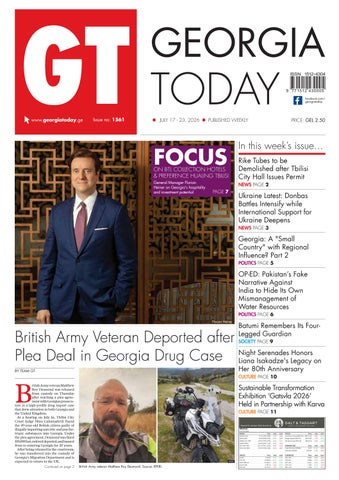
Issue no: 1561
• JULY 17 - 23, 2026 • PUBLISHED WEEKLY
FOCUS
ON BTL COLLECTION HOTELS & PREFERENCE HUALING TBILISI
General Manager Florian Heiner on Georgia's hospitality and investment potential
PRICE: GEL 2.50
In this week’s issue... Rike Tubes to be Demolished after Tbilisi City Hall Issues Permit NEWS PAGE 2
PAGE 7
Ukraine Latest: Donbas Battles Intensify while International Support for Ukraine Deepens NEWS PAGE 3
Georgia: A "Small Country" with Regional Influence? Part 2 POLITICS PAGE 5
OP-ED: Pakistan’s Fake Narrative Against India to Hide Its Own Mismanagement of Water Resources POLITICS PAGE 6 Florian Heiner
Batumi Remembers Its FourLegged Guardian
British Army Veteran Deported after Serenades Honors Plea Deal in Georgia Drug Case Night Liana Isakadze's Legacy on SOCIETY PAGE 9
Her 80th Anniversary
BY TEAM GT
CULTURE PAGE 10
B
ritish Army veteran Matthew Roy Desmond was released from custody on Thursday after reaching a plea agreement with Georgian prosecutors in a high-profile drug import case that drew attention in both Georgia and the United Kingdom. At a hearing on July 16, Tbilisi City Court Judge Nino Galustashvili found the 49-year-old British citizen guilty of illegally importing narcotic and psychotropic substances into Georgia. Under the plea agreement, Desmond was fined 100,000 lari, ordered deported, and banned from re-entering Georgia for 20 years. After being released in the courtroom, he was transferred into the custody of Georgia's Migration Department and is expected to return to the UK. Continued on page 2
Sustainable Transformation Exhibition ‘Gatsvla 2026’ Held in Partnership with Karva CULTURE PAGE 11 Prepared for Georgia Today Business by
DĂƌŬĞƚƐ Ɛ ŽĨ ϭϰͲ:ƵůͲϮϬϮϲ
KE ^
WƌŝĐĞ
ǁͬǁ
ŵͬŵ
^dK <^
ǁͬǁ
ŵͬŵ
ϵϳ͘Ϯϯ ;zdD ϱ͘ϴϯйͿ
ͲϬ͕Ϯй
ͲϬ͕ϰй
>ŝŽŶ &ŝŶĂŶĐĞ 'ƌŽƵƉ ; ' K >EͿ ' W ϭϭϰ͘ϱϬ
ͲϬ͕ϴй
нϯ͕ϲй
ϵϲ͘ϰϬ ;zdD ϲ͘ϬϭйͿ
нϬ͕Ϭй
ͲϬ͕Ϭй
'ĞŽƌŐŝĂ ĂƉŝƚĂů ; ' K >EͿ
' W ϰϯ͘ϴϱ
Ͳϭ͕ϯй
нϯ͕ϱй
d ĂŶŬ 'ƌŽƵƉ ;d ' >EͿ
' W ϰϲ͘ϯϬ
ͲϬ͕ϲй
нϮ͕Ϯй
WƌŝĐĞ
ǁͬǁ
ŵͬŵ
ϴϰ͕ϳϯ нϭϰ͕ϯй
Ͳϯ͕Ϭй
' '' ϵ ϭͬϮ W ZW
ϭϬϱ͘ϴϭ ;zdD ϵ͘ϬϳйͿ
ͲϬ͕Ϯй
нϬ͕ϲй
^><Z , ϬϵͬϯϬ
ϭϬϬ͘ϲϴ ;zdD ϳ͘ϯϭйͿ
ͲϬ͕Ϯй
ͲϬ͕ϰй
d ϴ͘ϴϵϰ W ZW
ϭϬϭ͘ϭϬ ;zdD ϭϭ͘ϲϵйͿ
ͲϬ͕Ϭй
ͲϬ͕ϭй
KDDK /d/ ^
d ϭϬ ϭͬϰ W ZW
ϭϬϳ͘ϰϮ ;zdD ϵ͘ϯϯйͿ
ͲϬ͕ϯй
ͲϬ͕ϯй
ƌƵĚĞ Kŝů͕ ƌĞŶƚ ;h^ΨͬďďůͿ 'ŽůĚ ^ƉŽƚ ;h^ΨͬK Ϳ
/E / ^
ϰ ϬϱϮ͕ϴϱ
Ͳϭ͕ϯй
WƌŝĐĞ
ǁͬǁ
ŵͬŵ
hZZ E / ^
WƌŝĐĞ
ϳ ϱϰϯ͕ϱϵ
нϬ͕ϱй
нϭ͕ϱй
h^ ͬ ' >
Ϯ͕ϲϯϰϮ
ͲϬ͕Ϭй
ͲϬ͕ϴй
&d^ ϮϱϬ
Ϯϯ ϰϬϲ͕ϴϯ
нϬ͕ϭй
нϬ͕ϯй
hZ ͬ ' >
ϯ͕ϬϬϴϱ
нϬ͕Ϭй
ͲϮ͕Ϭй
ϱϮ ϱϬϴ͕Ϯϳ
ͲϬ͕ϴй
нϮ͕ϲй
ǁͬǁ
Ͳϯ͕ϵй
^W ϱϬϬ Kt :KE ^ ϯϬ
British Army veteran Matthew Roy Desmond. Source: RFERL
WƌŝĐĞ
' KZ' Ϭϭͬϯϭ 'Z /> ϬϲͬϮϴ
ͲϬ͕Ϭй
ŵͬŵ
' W ͬ ' >
ϯ͕ϱϮϯϳ
ZƵƐƐĞůů ϮϬϬϬ
Ϯ ϵϲϰ͕ϳϲ
ͲϬ͕ϲй
нϬ͕ϳй
hZ ͬ h^
ϭ͕ϭϰϮϬ
нϬ͕ϭй
Ͳϭ͕ϯй
&d^ ϭϬϬ
ϭϬ ϱϮϵ͕ϯϵ
Ͳϭ͕ϯй
нϬ͕ϲй
' W ͬ h^
ϭ͕ϯϯϵϬ
нϬ͕Ϯй
ͲϬ͕ϭй
Ͳϭ͕Ϭй
2
NEWS
GEORGIA TODAY
JULY 17 - 23, 2026
Apple Exports Jump 67% in First Half of 2026 BY LANA KOKAIA
Rike Tubes. Photo by Maia Saganildze for RFE/RL
Rike Tubes to be Demolished after Tbilisi City Hall Issues Permit BY LANA KOKAIA
T
bilisi City Hall has issued a permit to demolish the Rike Concert Hall also known as the Rike Tubes, with the dismantling of the structure required to be completed by December 25. The permit was issued by the City Hall’s Architecture Service, which approved the removal of the building located in Rike Park. The Rike Tubes were built during the United National Movement government and have remained unused for years. The state sold the property in 2022, after six failed attempts, for GEL 10.02 million. The facility was initially purchased by Global Victory Trust, a company owned by businessman David Khidasheli, who has been described as close to Georgian Dream founder and honorary chairman Bidzina Ivanishvili. In May 2025, the property was transferred to Khidasheli’s company, Rike Dom. Under the terms of the 2022 auction, the buyer was required to invest at least GEL 20 million and create a museum dedicated to wine, digital art and tech-
nology, as well as exhibition and conference spaces within 36 months. A government decree issued in May 2025 revealed plans to demolish the Rike Tubes and build a hotel on the site instead. Tbilisi Mayor Kakha Kaladze said the decision to dismantle the structure was made by the private owner, while the City Hall’s Architecture Department issued the permit after the project met all required conditions. Kaladze said the building had remained unused for years and had become a “garbage dump.” He added that the demolition was approved with the involvement of the Cultural Heritage Protection Council. “This is private property. The building has been in poor condition for years and was completely non-functional. The visual appearance of the building is a matter of taste, but it did not fit into the existing space in any way. The private owner decided to dismantle it and implement a new project,” Kaladze said. The mayor added that the owner has not yet submitted a new development plan for the area but will do so after the dismantling is completed. Kaladze expressed confidence that, with the involvement of relevant specialists, “one of the best projects” would be implemented in Rike.
G
eorgia exported 14,700 tons of apples worth $11 million between January and June 2026, the Ministry of Environmental Protection and Agriculture says. Compared to the same period last year, the value of exports increased by 67%, or $4.5 million, while export volume rose by 37%, or 4,000 tons. The ministry says apple exports totaled more than 24,000 tons between August 2025 and June 2026, marking the highest figure in recent years. Revenue from exported apples reached $18 million during the period. Russia remained the main destination for Georgian apples, receiving more than 95% of the country’s total apple exports.
Apples. Source: Sblog.lexhealth.com
Kvrivishvili: First Tbilisi-Shanghai Flight Arrives 98% Full BY LANA KOKAIA
T
he first direct scheduled flight between Tbilisi and Shanghai arrived with a 98% load factor, Economy Minister Mariam Kvrivishvili said at an event marking the launch of the new route. China Eastern Airlines, one of China’s largest carriers, operated the inaugural flight. The airline will operate direct flights between Tbilisi and Shanghai three times a week, on Wednesdays, Fridays, and Sundays.
Kvrivishvili described the launch as a milestone for Georgia’s aviation sector, and said the new route reflects the growing strategic partnership between Georgia and China. “This is another important demonstration of what a strategic partnership means in practice. It translates into economic activity, tourism and direct flights, strengthening our country’s economy,” the minister said. She noted that the Tbilisi-Shanghai route is the longest direct flight currently operating from Georgia’s capital. She expressed confidence that flight frequencies could increase in the future if demand remains strong.
The decision to launch the route followed a meeting between Kvrivishvili and China Eastern Airlines executives during her official visit to China in April. The minister said the nearly-full inaugural flight demonstrates strong demand and attributed the result in part to Georgia’s tourism promotion campaign in China. She noted that the government invests GEL 7 million annually to raise Georgia’s profile as a tourist destination in the Chinese market. The inaugural flight event was attended by Chinese Ambassador Zhou Qian, China Eastern Airlines Vice President He Xiaoxuan, and representatives of Georgia’s aviation and airport sectors.
Ani Lorak, t.A.t.u. Concerts in Batumi Canceled BY LANA KOKAIA
T
he concerts of Russian singer Ani Lorak and Russian pop duo t.A.t.u. in Batumi have been canceled, Russia’s state news agency TASS reports. The administration of the Batumi Tennis Courts, where the concerts were scheduled to take place, confirmed the cancellation to TASS. T.A.t.u. was due to perform on August 1, while Ani Lorak’s concert was scheduled for August 14.
Ani Lorak, t.A.t.u. Source: BeFunky collage
Ticket sales on the Biletebi.ge platform have been suspended. Batumelebi reported in June that one of the organizers of the concerts at the Batumi Tennis Courts was ‘Batumi Live,’ which was listed on Biletebi.ge as the event organizer. Ani Lorak, a Ukrainian-born singer, has been based in Russia since 2014. Ukraine imposed sanctions on her in October 2022 and revoked her honorary title of People’s Artist of Ukraine. T.A.t.u. has not publicly condemned Russia’s full-scale invasion of Ukraine and has continued to perform since the war began.
British Army Veteran Deported after Plea Deal in Georgia Drug Case Continued from page 1 Desmond had been held in Tbilisi's Gldani Prison since April 23, when he was detained while entering Georgia from Turkey during a motorcycle journey across Europe. He faced charges under Article 262 of Georgia's Criminal Code, which carries a prison sentence of eight to 12 years for illegally importing large quantities of narcotic and psychotropic substances. According to the Revenue Service, customs officers discovered 112 tablets containing 0.0224 grams of buprenorphine (Subutex), 50 tablets containing 0.75 grams of codeine, and 39 capsules containing 5.8484 grams of pregabalin
in his hand luggage. Prosecutors said Desmond failed to present medical documentation at the border proving that the medications had been prescribed to him, making their import illegal under Georgian law. Desmond's lawyers have consistently argued that the case resulted from a regulatory issue rather than criminal intent. They said the medications had been legally prescribed to treat chronic spinal injuries sustained during his service with the British Army's airborne forces. According to the defense, Desmond possessed valid prescriptions but lacked the required apostille certification and official translations needed under Geor-
gian regulations for importing certain controlled medicines. The missing documentation was later obtained and submitted to prosecutors and the court, but Desmond remained in custody while the criminal case proceeded. Although his legal team maintained his innocence, they said he agreed to the plea bargain because of the uncertainty of a lengthy trial, the risk of a lengthy prison sentence, and concerns about his deteriorating health in prison. "The defense believes he is innocent, but we could not guarantee the outcome of a full trial," attorney Jaba Kochlamazashvili said after an earlier hearing. "Given his health and the fact that he faced a possible sentence of eight to twelve years,
we decided not to take that risk. For him, the most important thing now is to regain his freedom." The plea agreement was initially delayed for several days to allow Desmond's family time to raise the 100,000 lari (about £28,000) fine, which formed a key condition of the settlement. A decorated veteran, Desmond has traveled through around 25 countries by motorcycle without previous legal problems. His military record, including commendations for service in Iraq and Afghanistan, together with character references from former commanders and fellow soldiers, was submitted to the court during the proceedings. His experiences also feature in journalist Sam Kiley's book
Desperate Glory, which examines the service of British airborne troops in Afghanistan's Helmand Province. Separately, Desmond successfully challenged an administrative case alleging drug use in Georgia after traces of his prescribed medication were found in his urine. In June, the court dismissed the allegation after prosecutors failed to prove the medication had been consumed inside Georgia, as he had been detained immediately after crossing the border. The case attracted considerable attention in Britain, where supporters argued that Desmond's detention stemmed from a misunderstanding over Georgia's medication import requirements rather than criminal activity.
NEWS
GEORGIA TODAY JULY 17 - 23, 2026
3
Ukraine Latest: Donbas Battles Intensify while International Support for Ukraine Deepens COMPILED BY ANA DUMBADZE
R
ussia and Ukraine intensified their military campaigns over the past week, with fierce fighting along the eastern front, fresh waves of longrange drone and missile attacks, and continued strikes on each other's energy and transport infrastructure. While Russian forces kept up pressure in the Donbas, Ukraine expanded its campaign against Russian fuel depots, rail hubs and military facilities far behind the front line, seeking to undermine Moscow's ability to sustain the war. The result was another week marked by civilian casualties, widespread destruction and renewed international efforts to strengthen Ukraine's defenses, with little indication that peace talks are any closer. The heaviest fighting remained concentrated in eastern Ukraine, where Russia continued its summer offensive. Battles raged around Pokrovsk, Kostiantynivka, Sloviansk and Kupiansk as Russian troops pressed forward with infantry assaults backed by artillery and glide bombs. Ukrainian military officials reported dozens of clashes each day, describing the Kostiantynivka and Sloviansk sectors as the most active parts of the front. Russia also maintained pressure in the Northern Slobozhanshchyna and Kursk directions. Although Russia retained the battlefield initiative, its advances remained gradual and came at a significant cost. Independent analysts continued to report only limited territorial gains rather than any major breakthrough. Ukrainian defenses largely held the line, even as Russian forces sought to improve their positions around key supply routes leading toward
Sloviansk and Kramatorsk. Moscow also continued probing attacks in the Zaporizhzhia region and along the border areas of Sumy and Kharkiv. Ukraine, meanwhile, stepped up its long-range strike campaign inside Russia. President Volodymyr Zelensky's "40-day campaign," launched in late June, entered another active phase, targeting oil refineries, fuel depots, rail hubs, military factories and logistics infrastructure across Russia and occupied Crimea. Ukrainian drones reportedly struck a number of strategic sites during the week, continuing a campaign that analysts say has disrupted parts of Russia's fuel production and complicated military logistics. Pressure on Russia's energy sector has become one of Ukraine's most significant strategies. Repeated attacks on refineries have forced shutdowns or reduced production at several facilities, contributing to fuel shortages that prompted Moscow to impose restrictions on diesel exports in an effort to stabilize domestic supplies. Russian officials acknowledged continuing fuel problems in several regions, while reports of long lines at gas stations persisted. Analysts say Kyiv hopes to gradually weaken Russia's ability to sustain prolonged offensive operations by targeting the logistical backbone of its war effort. Russia answered with another wave of large-scale missile and drone attacks across Ukraine. Kyiv once again came under ballistic missile attack, with residential areas damaged, fires breaking out and at least two civilians killed. Russian strikes also targeted facilities linked to Ukraine's defense industry, as well as infrastructure at the ports of Odesa and Pivdennyi, which Moscow said were being used for military cargo and fuel shipments. Ukrainian authorities also reported attacks
Ukraine's campaign against Crimea's supply routes has become the centerpiece of Kyiv's strategy to reshape the terms of future peace negotiations. Source: GETTY/2026 Vantor
across Kharkiv, Zaporizhzhia, Sumy, Kherson and several other regions, with civilian infrastructure repeatedly hit. Ukraine's southern ports remained under particularly heavy pressure. Russian missile and drone strikes targeted Black Sea port infrastructure, including facilities involved in grain exports and logistics. Moscow claimed it had destroyed drone production sites, storage facilities and military vessels approaching the Odesa region, while Kyiv accused Russia of deliberately attacking civilian infrastructure and export terminals. The attacks underscored the strategic importance of Black Sea logistics for both sides. Civilian casualties continued to rise throughout the week. Russian air attacks killed and injured civilians in Kyiv, Zaporizhzhia and several frontline regions. Homes, industrial facilities and transport infrastructure suffered extensive damage as repeated overnight barrages stretched Ukraine's already strained air defense network. Humanitarian organizations warned that civilians in frontline cities remain especially vulnerable to Russia's continued use of glide bombs and missile strikes.
Ukraine also maintained strikes against military targets in occupied Crimea and the Black Sea. Reports indicated successful attacks on Russian naval assets and military infrastructure supporting operations in southern Ukraine. Ukrainian forces also continued targeting air defense systems, ammunition depots and command centers in an effort to complicate Russia's operations across multiple fronts. Military analysts say Ukraine's increasingly sophisticated long-range strike campaign has become one of its most important strategic tools. Rather than launching major ground offensives with limited manpower, Kyiv appears focused on steadily degrading Russia's logistics, fuel supplies, air defenses and command network while preserving its own defensive positions. International backing for Ukraine also evolved during the week. The European Union and Ukraine signed a Defense Industrial Partnership aimed at expanding joint weapons production, signaling a broader shift from supplying arms toward long-term industrial cooperation. The agreement covers joint production of drones, counter-drone technologies
and, eventually, advanced missile systems, while further integrating Ukraine's rapidly growing defense industry with European manufacturers. Welcoming the agreement, President Volodymyr Zelensky said, "We have done a lot to integrate our defense capabilities and production with those of Europe. Today, we also have the first document laying the groundwork for the Drone Deal, a major defense agreement between Ukraine and the European Union." European Commission President Ursula von der Leyen said Ukraine had become "a net security provider for Europe," adding, "You are not only fighting for your own future but for the security of our entire continent." Britain also announced a significant industrial contribution by delivering newly manufactured artillery barrels produced in Sheffield under a £61 million agreement involving Sheffield Forgemasters and BAE Systems. The shipment marks the first British-produced artillery barrels in nearly 20 years and is intended to help Ukraine sustain high-intensity artillery operations over the long term. Diplomatic efforts continued despite the lack of meaningful peace negotiations. European leaders used Ukraine's Statehood Day celebrations in Kyiv to reaffirm their political, military and economic support, focusing on deeper defense cooperation, Black Sea security, support for Ukraine's defense industry and the country's long-term integration with European institutions. Meanwhile, the United States continued discussions on additional sanctions targeting countries helping sustain Russia's wartime economy, while intelligence cooperation between Washington and Kyiv remained in place despite a slower pace of direct U.S. weapons deliveries.
4
POLITICS
GEORGIA TODAY
JULY 17 - 23, 2026
Europe's New Migration and Asylum Law: Externalization, Security, and Sovereignty BY ABDULMELIK ALKAN, GUEST WRITER
T
he European Union's New Pact on Migration and Asylum, which entered into force on June 12, 2026, represents the most significant overhaul of European migration policy since the Dublin system was established. Rather than introducing minor procedural adjustments, the Pact reflects a broader political and legal transformation in how the EU approaches migration, asylum, and border management. The Pact attempts to reconcile competing priorities, such as safeguarding the right to asylum, strengthening external border controls, and distributing responsibility more evenly among member states. Whether these objectives can coexist in practice remains one of the central questions surrounding the new framework. The Pact did not emerge out of the blue; rather, it is the outcome of years of difficult negotiations following the 2015 refugee crisis, a period during which migration evolved from a humanitarian issue into one of Europe's most politically divisive policy areas. Since 2015, migration has become a defining issue in domestic politics, influencing elections, party competition, and public debate across the continent. Growing support for parties advocating stricter border controls has shifted the political environment in which migration policies are formulated. The adoption of the Pact therefore represents not only legal reform but also an institutional response to changing political realities. Security, sovereignty, and border control have assumed greater prominence alongside the EU's traditional commitment to humanitarian protection and human rights. At its core, the Pact introduces several interconnected legal reforms intended to harmonize migration procedures across the European Union. One of its most notable innovations is the mandatory pre-entry screening process for individuals arriving irregularly at the EU's external borders. Before entering the asylum system, migrants undergo identity verification, health examinations, security checks, and vulnerability assessments. This process is designed to replace fragmented national procedures with a common European standard, thereby improving efficiency and
reducing inconsistencies among member states. Another important reform concerns the modernization of the Eurodac database. Originally developed to store the fingerprints of asylum seekers, Eurodac has been transformed into a much broader biometric system that now incorporates facial recognition and expanded registration requirements. The objective is to improve responsibility-sharing among member states while limiting secondary movements within the Schengen Area. From a governance perspective, this represents a significant expansion of Europe's digital migration infrastructure. At the same time, the technical difficulties experienced during the system's first day of operation highlight an important reality: ambitious legal reforms require equally competent administrative capacity. Without effective implementation, institutional credibility may quickly be undermined. Moreover, the digitalization of asylum procedures and the storage of sensitive biometric data are likely to remain contentious issues within European and international human rights frameworks. The Asylum Procedures Regulation constitutes another cornerstone of the Pact. It establishes accelerated border procedures for applicants originating from countries with low asylum recognition rates or for those considered potential security risks. EU institutions argue that these procedures will shorten waiting times, reduce administrative backlogs, and improve the overall efficiency of asylum processing. Despite the European Commission presenting the New Pact on Migration and Asylum as a balanced compromise between humanitarian protection and effective migration management, its implementation has generated strong criticism from civil society organizations, humanitarian agencies, legal experts, and migration scholars. Critics argue that the accelerated procedures may leave asylum seekers with limited access to legal assistance, shorter appeal periods, and prolonged stays in border facilities. As a result, the balance between administrative efficiency and procedural justice remains one of the most contested aspects of the reform. From a human rights perspective, advocates also worry that accelerated procedures may limit asylum seekers' effective access to domestic legal remedies. Additionally, the Pact introduces greater harmonization through common screening procedures, biometric registration,
Migration, asylum. Source: eeas
and a flexible solidarity mechanism. However, many observers argue that these institutional improvements come at the expense of the very principles that have historically defined the Common European Asylum System. Rather than simply reforming asylum procedures, the Pact reflects a broader political shift in which migration is increasingly framed through the lenses of security, deterrence, and border control rather than international protection. In this sense, it represents not merely an administrative or legal reform, but a broader transformation of Europe's migration policy. Many critics view the Pact primarily as a political response rather than as a purely legal or humanitarian framework. In this regard, several international organizations have expressed concerns regarding the practical consequences of the new framework. For example, Caritas Europa argues that the expansion of border procedures risks undermining access to fair asylum procedures and calls for greater investment in reception systems, legal pathways, and integration rather than deterrence. Save the Children has warned that the wider use of border screening and accelerated procedures could expose children and families to prolonged stays in detention-like facilities, potentially violating the principle that the best interests of the child should guide migration policy. Similarly, the International Rescue Committee (IRC) has cautioned that faster processing should not come at the expense of due process, emphasizing that reduced access to legal assistance and shorter appeal periods increase the risk that individuals with legitimate protection claims may be returned before their cases are adequately examined. The Migration Policy Group, while
acknowledging the need for a more coherent European asylum system, has questioned whether the Pact adequately balances efficiency with fundamental rights and has highlighted the risk that implementation may vary considerably across member states. One of the most controversial aspects of the Pact is its growing reliance on externalization. By strengthening cooperation with transit countries, expanding the concept of "safe third countries," and exploring return hubs outside EU territory, the Union is increasingly shifting migration management beyond its borders. From a policy perspective, this may improve border governance and reduce irregular arrivals. From a legal and ethical perspective, however, critics argue that it risks transferring responsibility to countries with more limited asylum systems and weaker human rights protections. This approach raises difficult questions regarding accountability, particularly where effective judicial oversight is absent or significantly weaker than within the European Union itself. The result is an asylum system that increasingly manages migration before individuals ever reach European territory, thereby making access to protection more uncertain despite the continued formal recognition of the principle of non-refoulement. Perhaps the broader concern is political rather than legal. The Pact illustrates how migration debates across Europe have gradually shifted toward positions that were once largely associated with the political margins. Concepts such as enhanced border securitization, expanded detention powers, external processing, and stronger return policies have increasingly become part of mainstream European policymaking. While these measures respond to gen-
uine public concerns over migration management and state capacity, they also demonstrate how domestic political pressures have reshaped the Union's approach to asylum. The challenge for the European Union is therefore not simply to manage migration more efficiently, but to ensure that efficiency does not gradually replace the humanitarian commitments that have long underpinned European asylum law. If implementation prioritizes deterrence over protection, the New Pact may ultimately be remembered less as a successful institutional reform than as a significant moment in the gradual redefinition of Europe's identity as a normative and humanitarian actor. An equally significant, yet often overlooked, implication of the New Pact concerns its impact beyond the European Union. The Pact is likely to reshape migration governance in EU candidate and neighboring countries, including Turkey, Georgia, Moldova, Ukraine, Serbia, Albania, Bosnia and Herzegovina, Montenegro, and North Macedonia. As these countries serve as major transit routes toward the European Union or seek closer political integration with Brussels, they will face increasing pressure to align their migration and asylum systems with the new European framework. This alignment is expected to include stronger external border controls, expanded biometric registration systems, closer cooperation with EU agencies such as Frontex and EUAA, enhanced information sharing, and the implementation of readmission agreements. Consequently, migration governance is becoming an increasingly important dimension of both EU enlargement and neighborhood policy. While regulatory convergence may strengthen institutional capacity and improve border management, it also risks transferring greater responsibility for migration control to countries with more limited financial resources, administrative capacity, and asylum infrastructures. For candidate countries, particularly Turkey and Georgia, the Pact therefore represents more than a European legal reform; it increasingly functions as a governance model that shapes domestic migration legislation, border policies, and relations with the European Union, reinforcing the broader trend toward the externalization of migration management beyond EU territory. Abdulmelik Alkan is an Adjunct Professor at Webster University
Trump Backs Bipartisan Russia Sanctions Bill Championed by Late Senator Lindsey Graham BY TEAM GT
U
S President Donald Trump will support the passage of a bipartisan Russia sanctions bill championed by the late Senator Lindsey Graham, a White House official told CNN on Monday, giving new momentum to legislation that had been one of the South Carolina Republican’s key foreign policy priorities. The bill, developed by Graham together with Democratic Senator Richard Blumenthal and other lawmakers, seeks to increase pressure on Moscow by targeting Russia’s energy revenues and countries that continue purchasing Russian oil and gas. The legislation would give the US president authority to impose additional sanctions and tariffs on major buyers of Russian energy, including countries such as China and India, which
Republican Senator Lindsey Graham. Photo by Jim Watson for AFP
remain among the largest purchasers of Russian oil. The measure also includes sanctions targeting Russian officials, financial institutions, energy projects, and networks used to help Moscow evade existing restrictions, including Russia’s so-called
“shadow fleet” of vessels used to transport oil. Trump’s backing is expected to strengthen the bill’s chances of moving through Congress. The president’s support follows negotiations between the administration and a bipartisan group
of senators, including Graham, Blumenthal, Senator Jeanne Shaheen, and Senator Roger Wicker, who announced an agreement to advance updated Russia sanctions legislation. Graham had worked for years to advance tougher measures against Russia and had described the legislation as a tool to increase pressure on countries helping finance Moscow’s war effort in Ukraine. Shortly before his death, he said the bill would give the administration leverage over countries purchasing discounted Russian oil. The senator died at the age of 71 following what his office described as a “brief and sudden illness.” His death was announced on Sunday. Preliminary findings from the District of Columbia’s medical examiner indicated that Graham died from a heart condition. According to a statement released by his office, the preliminary cause of death was an aortic dissection caused by atherosclerotic cardiovascular disease. The official cause
of death will remain pending until toxicology and microscopic examinations are completed. A Republican senator from South Carolina, Graham served in the US Senate from 2003 until his death in 2026. He was a prominent voice on foreign policy and national security issues and was known for his strong support of Ukraine following Russia’s full-scale invasion and of Georgia’s sovereignty and territorial integrity after the 2008 Russia–Georgia war. Graham consistently advocated closer US-Georgia relations, supported Georgia’s Euro-Atlantic aspirations, and backed Senate resolutions reaffirming US support for Georgia’s independence while condemning Russia’s continued occupation of Abkhazia and South Ossetia. Lawmakers from both parties have described advancing the Russia sanctions bill as a way to honor Graham’s political legacy, although the legislation will still need to pass through Congress before becoming law.
POLITICS
GEORGIA TODAY JULY 17 - 23, 2026
5
Georgia: A "Small Country" with Regional Influence? Part 2 ANALYSIS BY VICTOR KIPIANI, GEORGIA FIRST / GEOCASE
I
concluded my first essay with the following question: Does Georgia have the capacity, despite formally being a "small country,"to assume a role beyond this status? Can we, as a de facto "medium-sized country," become a "small country" with regional influence? The answer to this question lies in defining Georgia's function as a nation. Without such functional utility and purpose, it will be difficult not only to enhance its geopolitical agency, but also to solidify its standing as a systemic, self-sufficient, and competitive nation-state. In our case, both tasks are tightly intertwined, and realizing either one in isolation is practically impossible. More specifically... Establishing Georgia as a geopolitical subject is equivalent to realizing its practical role as a so-called “indispensable nation” in the region. Broadly speaking, this role is nurtured by the country's internal institutional and systemic framework, as well as by strengthening practically necessary international connections. Forward-looking analysis, broad societal resilience, and geopolitical fortitude must become integral to the Georgian state-political process. Regardless of political or coalition affiliations, the hallmark of any Georgian government should be an adequate assessment of capabilities, recognition of the limits of those capabilities, proper identification of specific goals for a given stage, and the mobilization of necessary resources to achieve them. When "correctly reading" external processes, Georgian diplomacy, and the
political apparatus handling foreign relations, must possess complete and qualified knowledge of events unfolding in the immediate neighborhood to enable preventive responses. Beyond the immediate neighborhood, a realistic policy based on capabilities, oriented toward practical (rather than declarative) results, must also feature a correct assessment of global processes. This includes the proper use of hedging in the context of bilateral or multilateral relations. This highly specific art of conducting foreign policy was addressed both generally and specifically from the standpoint of hedging Georgian interests in the article I wrote on foreign policy (https://georgiatoday.ge/doing-georgiafirst-in-foreign-policy-on-specific-practical-issues/).
THE WEST: A CIVILIZATION, NOT MERELY A VECTOR
A view of Tbilisi. Source: expatexplore
For Georgia, as a small country, the prospect of gaining and expanding regional influence depends on establishing itself as the Five-Cross Bastion of the West in the region. The world cannot escape the phenomenon of global geopolitical spheres of influence: this is evident today and, in all likelihood, will remain a defining feature of the foreseeable future. Therefore, the resilience, modernization, and competitiveness of the Georgian nation-state are directly tied to: (a) The materialization of Western geopolitical influence in our region, as well as (b) Our country's role as a key entity in projecting strategic Western influence within the region. Furthermore, I believe that in dialogues with both the West and our own citizens, the somewhat controversial term "spheres of influence" should be replaced with
"civilizational sphere." Not only does this sound more noble, but it is also geopolitically correct and emotionally balanced. In light of the above, Georgia’s positioning in the region through the practical status of a "civilizational ally," rather than merely a "strategic ally," is far more meaningful and targeted toward tangible results in line with shared Western, Georgian, and regional interests. Moreover, Georgia, as an autonomous subject of Western civilizational influence and a civilizational ally, should unconditionally and unreservedly enjoy all the benefits and advantages of Western civilization. Among these benefits, first and foremost, is an economic system that operates smoothly not only under a "peacetime regime," but also exhibits high resilience in a "crisis regime." In this
process, the Georgian side is by no means forbidden from being as opportunistic as contemporary Western policy offers: accordingly, Georgian opportunism envisions leveraging Western interests to secure maximum advantage for our own national interest.
PRACTICAL FORMS FOR REGIONAL INFLUENCE To this end, any "inventory" must be preceded by one crucial caveat: we live in a world of asymmetries. Consequently, the measure of skill in Georgian foreign and domestic policy lies in turning geopolitical, economic, or military imbalances that are unfavorable to us into instruments that work in our favor and serve our interests. Figuratively speaking, the successful future of the Georgian state lies in creating a "pro-Georgian asymmetry," which
involves achieving maximum results with minimal resources. This can be accomplished through: 1. Increasing the capitalization of the country’s geolocation; 2. Facilitating trade and financial ties between East and West; 3. Establishing the country as a payment system hub; 4. Developing into a regional arbitration center for dispute resolution; 5. Positioning as a diplomatic and mediation platform for neighboring countries (for example, Tbilisi as a "Caucasian Vienna"). Of course, the foundation and primary prerequisite for all these opportunities is a healthy domestic political reputation and the international authority that stems from it. Otherwise, achieving the tasks outlined in this article will remain nothing more than academic discussion...
Israeli Parliament Delays Vote on Recognizing Armenian Genocide
Aftermath of the Telavi flood. Source: 1TV
The Armenian Genocide Memorial Complex, Tsitsernakaberd, in Yerevan. Source: Wikimedia Commons
BY TEAM GT
I
srael’s parliament has postponed a vote on a bill that would formally recognize the Armenian Genocide, despite the proposal having already received unanimous approval from the Israeli government. JNS, citing an unnamed official, reported that the vote was delayed on Sunday. No official explanation was provided, although the outlet suggested the decision came against the backdrop of a sensitive diplomatic period marked by renewed tensions involving Israel, the United States and Iran, as well as Turkey’s efforts to secure US-made F-35 fighter jets during the recent NATO summit.
JNS also noted that the Knesset is preparing to begin its summer recess and is not expected to reconvene until after Israel’s October 27 elections. The proposal was introduced by Foreign Minister Gideon Sa’ar, who previously described recognizing the Armenian Genocide as “a moral duty.” JNS reported that it sought comment from Sa’ar regarding the postponement but had not received a response. The initiative drew a cautious reaction from Armenia. Prime Minister Nikol Pashinyan declined to comment on Israel’s decision in June, saying Yerevan did not wish to engage in what he described as the “weaponization” of the Armenian Genocide. The proposal also prompted strong criticism from Turkey and Azerbaijan.
Ankara, which rejects the characterization of the 1915 mass killings of Armenians in the Ottoman Empire as genocide, accused Israel of attempting to divert attention from its actions in Gaza. Azerbaijan, a close ally of both Turkey and Israel, described the proposal as “a matter of serious concern” and urged Israel to reconsider what it called a distortion of the historical events of 1915. Earlier, Israeli outlet Ynet, citing unnamed Azerbaijani officials, reported that the Israeli government’s decision had caused a deeper rift in relations with Baku than had been publicly acknowledged. The report says that Azerbaijani officials viewed the move as Israel “crossing a red line” and expressed disappointment that they learned of the decision only after it had been made public.
Kobakhidze: Construction Permits near Telaviskhevi River Were Issued Improperly BY TEAM GT
G
eorgian Prime Minister Irakli Kobakhidze said the relevant authorities will investigate whether construction permits issued near the Telaviskhevi River were granted lawfully following severe flooding in the city. Kobakhidze said he believes the permits were issued improperly and that this contributed to the scale of the damage. “I believe the construction permits were definitely issued improperly, although the
relevant agencies will determine the details. This concerns several commercial facilities, which exacerbated the problem. In the future, every city must be protected as much as possible from such events, and all necessary measures will be taken to ensure that Telavi is as well protected as possible against similar incidents,” Kobakhidze said. Heavy rainfall on July 12 caused the Telaviskhevi River to overflow its banks, flooding parts of the city, including Kavkasioni and Alazani avenues. No injuries were reported. The flooding inundated the ground floors and basements of residential buildings, as well as pharmacies, shops, and other commercial properties.
6
POLITICS
GEORGIA TODAY
JULY 17 - 23, 2026
OP-ED: Pakistan’s Fake Narrative Against India to Hide Its Own Mismanagement of Water Resources
Kushvinder Vohra
OP-ED BY KUSHVINDER VOHRA Former Chairman, Central Water Commission & Exofficio Secretary to the Government of India and Former Indian Commissioner, Indus
T
here is a lot of misinformation around the Indus Waters Treaty (IWT) that is being spread through various articles appearing in newspapers, magazines, and online forums, including in Pakistan. Articles by socalled elites or scholars are nothing but general rhetoric to create public perception in Pakistan, devoid of facts. Although India has kept the Treaty in abeyance, it is important to look into the real issues behind the socalled water scarcity widely reported in Pakistan. They keep blaming India for their water woes as if India is to provide whatever water they think is required. As per Article III of the IWT, India was under an obligation to let the waters of the western rivers flow except for the uses permitted to it. Therefore, the flows received by Pakistan at any given time are dependent upon various factors such as rainfall in the catchment, snowmelt, etc., and the stipulated uses by India. As per various research institutes, Pakistan, on average, receives about 140 million acrefeet (MAF) of water annually in the Indus Basin from the western rivers, which is still more than the 135 MAF estimated at the time of the Treaty. However, in the eastern rivers, flows are reported to have been reduced by about 15% from the 33 MAF that was assessed at that time. So why all the rhetoric against India? If we dive deep into the issue, the truth is not far off. Out of about 140 MAF, Pakistan’s diversion for irrigation use is only about 104 MAF. The rest is either wasted in the system or flows to the sea. The real issue behind the socalled water scarcity in Pakistan is the mismanagement of the water received and a host of other factors that are barely being discussed by experts in Pakistan. Hardly any public discussion takes place about the inaction and failure of stakeholders in
Pakistan (including the Government of Pakistan) to manage precious water resources, especially when the ground realities have changed immensely since the signing of the Treaty in 1960. Could this be a deliberate agenda to always blame India and play the victim card to divert attention from the real issue, namely the mismanagement of water resources in Pakistan? Let’s look at the facts.
WATER USE IN PAKISTAN During the 1950s, Pakistan was using around 66 MAF of water, irrigating around 21 million acres (MAc) of land in the Indus Basin. Water use in the Indus Basin has since increased to 104 MAF to irrigate about 34 MAc. It may be noted that the water used per unit of irrigated area is almost the same as it was in 1960. However, the ground realities have changed. The population has been increasing, which reduces per capita water availability. However, the same is true for India as well. Thus, the water management practices followed at the time of the Treaty are now totally outdated and require an understanding of the complex linkages between water, food, and the energy nexus. India has already taken a huge leap in this regard, whereas Pakistan has not initiated this earnestly. Despite getting only 33 MAF of water (20% of the total water), India is irrigating about 26 MAc of land in the eastern part of the Indus Basin. This shows that water productivity in Pakistan is very poor.
POOR WATER GOVERNANCE IN PAKISTAN A World Bank (WB) Group study report titled Pakistan: Getting More from Water (the study report states that the information is updated through September 2018) took a longterm view of Pakistan’s water security through 2047. The study concludes that Pakistan is well endowed with water (including the Indus Basin), and only 16 other countries have more water. However, being the sixthmost populous country, water availability per person is low. Here it is worth mentioning that the reduction in per capita water availability in Pakistan is mainly due to
population growth, and, quantitatively, Pakistan is, on average, getting the same or even more water in the Indus Basin than was estimated at the time of signing the IWT. Further, according to the study report, water security may be challenging, but it does not define a country’s economic destiny. Interestingly, there are 32 countries with less water per person than Pakistan. Across these countries, the average per capita GDP is 10 times that of Pakistan. Only six of these 32 countries are poorer than Pakistan, all African nations with little irrigation investment and heavy reliance on traditional rainfed agriculture. The report also states that Pakistan does not make the best use of its water endowment and that water security is undermined by poor water resource management. Longterm waterrelated risks are not recognized and are poorly mitigated. It also states that water resource management in Pakistan is compromised by poor water data governance, weak planning, widespread pollution, overexploitation of groundwater (GW), low water productivity, and weak processes that prevent reliable flood and drought forecasting, among other factors. Thus, considering that more than 90% of the water in Pakistan is used for irrigation, it is imperative that water losses be reduced and water productivity be improved to tackle current challenges. It is also worth mentioning that Pakistan has not created adequate storage. Water follows its natural cycle, and about 80% of it arrives within four months. Therefore, without adequate storage, Pakistan can never achieve reliable Rabi irrigation. Simply pointing fingers at India for its own poor governance will not help in any way. Pakistan needs to sincerely work on improving water governance because, on average, sufficient water is available.
WASTAGE OF WATER AND LOW WATER PRODUCTIVITY Another analysis, Water Management in the Indus Basin in Pakistan: Challenges and Opportunities (by Asad Sarwar Qureshi), published by the International Mountain Society (August 2011), also confirms that the Indus Basin brings an average of 175 BCM (about 142 MAF) of water to Pakistan, which is more than was estimated at the time of signing the IWT. Out of this, 128 BCM (about 104 MAF) is diverted for irrigation, 12 BCM (9.7 MAF) is lost as system losses, and 35 BCM (28.2 MAF) flows into the sea. Thus, despite being endowed with large water resources, Pakistan is able to use only about 73% of them, while the rest is wasted or escapes. Moreover, the productivity of the 104 MAF diverted for irrigation is low. The paper states that water productivity in Pakistan is among the lowest in the world. For wheat, for example, it is 0.5 kg/m³ compared with 1.0 kg/m³ in India. In fact, Pakistan has made no real effort to increase crop water productivity. In contrast, India has made huge investments in schemes such as Per Drop More Crop, watershed development, microirrigation, command area development, etc. During the last decade alone, more than Rs. 1.25 lakh crore has been spent on these central schemes to improve crop water productivity. In addition, states have also spent substantial amounts on their own initiatives.
LOW STORAGE CAPACITY Compared to other arid countries, Pakistan has storage capacity equal to only 15% of its annual river flow. According to reported figures, Pakistan can barely
store 30 days of water. After constructing Tarbela Dam 30 years ago, Pakistan made no decision to construct new storage. Without adequate storage, Pakistan cannot make use of a substantial portion of the water resources in the Indus Basin, most of which arrive during the four monsoon months, resulting in substantial volumes flowing to the sea.
WATER CONSERVATION Pakistan has not made any serious efforts in water conservation to deal with climate change. Therefore, it is logical that it experiences water scarcity from time to time despite receiving as much or more Indus water than was estimated in 1960. On the other hand, India has continuously worked on water conservation and has spent about Rs. 90,000 crore annually during the last decade. During the last eight years alone, 11 BCM of water has been conserved through newly built tanks, ponds, and other groundwater recharge structures across the country. In contrast, Pakistan has so far only paid lip service to this vital issue. As reported in the Pakistani media, in a kneejerk reaction to India's decision to keep the IWT in abeyance, Pakistan announced plans to build a large number of smallscale reservoirs. However, judging by its past record and current financial situation, it remains to be seen whether such measures will actually be implemented.
OVEREXPLOITATION OF GROUNDWATER (GW) RESOURCES It is reported that over the past decades, millions of private tube wells have been dug, and groundwater extraction has far exceeded recharge. The average decline in the groundwater table is about 1.5 m/ year. Poor groundwater quality and salinity further compound the problem. Not many efforts appear to have been made in this regard in Pakistan. In India, the groundwater situation has also been similar. However, India has been taking consistent steps, especially during the last decade. According to the latest groundwater assessment report, water tables have increased in many areas, thanks to schemes launched across the country. Punjab has launched the initiative Bijli Bachayo, Paisa Kamayo to curb the misuse of free electricity for groundwater extraction. Haryana has launched a scheme that incentivizes farmers to diversify from paddy to crops requiring less water. Many other states have also introduced similar schemes. Communityled groundwater management under an initiative of the Central Government promotes integrated water resources management. Combined with the National Aquifer Mapping Programme, these schemes represent a paradigm shift in groundwater management across various river basins in India, including the Indus Basin.
IRRIGATION INFRASTRUCTURE Pakistan has focused primarily on creating canal infrastructure. As mentioned above, a great deal of water is wasted within the system. There has been no concrete effort to modernize infrastructure to improve efficiency. Only a few studies and pilot projects have been carried out through the ADB and others, and these have not been expanded to larger areas. Consequently, huge quantities of water continue to be wasted within the system itself. On the other hand, India has made tremendous efforts to improve irrigation throughout the country by modernizing irrigation systems through the use of SCADA, pipes in distributary systems, microirrigation, and
water management through user associations. While Pakistan remains frozen in time, India is clearly making progress in managing water resources despite facing similar challenges, including population growth and climate change.
INTERPROVINCIAL DISPUTES IN PAKISTAN In 1991, the Water Apportionment Accord was signed by Punjab, Sindh, Khyber Pakhtunkhwa, and Balochistan to resolve longstanding water distribution conflicts. However, each province has interpreted it differently, and each blames the others for the misappropriation of water. The absence of coordination and mutual trust has prevented meaningful improvements in water resource management, reducing the issue to simply receiving flows. This has stalled crucial projects such as the Kalabagh Dam, which could significantly increase Pakistan’s storage capacity.
CONCLUSION Pakistan, on average, is receiving as much or more water (142 MAF) in the Indus Basin as was estimated at the time of signing the IWT. Pakistan is not managing it properly. System losses amount to about 12 BCM (9.7 MAF), and another 35 BCM (28.3 MAF) flows to the sea. Only about 104 MAF is diverted for irrigation. The wateruse efficiency of this diverted water is very low, and crop water productivity is among the lowest in the world. The real issue is not the inflow of the Indus River system into Pakistan but its poor management. The 36 MAF of water that is currently wasted or allowed to flow into the sea is sufficient to significantly enhance Pakistan’s water security. India faces similar concerns related to population growth and climate change. However, it is taking longterm action by focusing on modernization of irrigation systems, groundwater recharge, rainwater harvesting, water conservation, crop water productivity, wastewater recycling, and reducing river pollution to achieve water security despite these challenges. Pakistan does not appear to have taken comparable concrete action. Pakistan needs to move beyond the mindset that prevailed during the negotiations of the IWT, when it alleged that India interfered with its waters in the Indus Basin. Since then, it has portrayed India as the upper riparian capable of turning off its tap and has objected to virtually every hydroelectric project in India, although such projects are permitted under the IWT. Pakistan’s own negligence in water management is, in fact, responsible for its water woes in the Indus Basin. No amount of water flow can help Pakistan unless it adopts integrated water resources management by improving its systems, crop water productivity, groundwater management, storage capacity, agricultural practices, institutional reforms, monitoring systems, the use of modern technology, and the resolution of interprovincial disputes. Public discourse on the above issues would help Pakistan work toward the sustainable use of water. Hiding the real issues and focusing on imaginary ones by blaming India is not going to be helpful. Pakistan has already benefited from a number of studies by the World Bank Group and the International Water Management Institute (IWMI), and it is time to consider the findings of these studies rather than maintaining the same old rhetoric, which is nothing more than an attempt to divert attention from the real issues plaguing Pakistan’s water sector.
BUSINESS
GEORGIA TODAY JULY 17 - 23, 2026
7
Florian Heiner: I Go Where Growth Is Happening, and Georgia Is Next INTERVIEW BY LANA KOKAIA
B
TL Hospitality has appointed Florian Heiner as General Manager of BTL Collection Hotels & Preference Hualing Tbilisi and Director of Operations Overseas. Florian Heiner brings more than 30 years of international hospitality experience, including senior leadership roles at Hilton, Marriott, IHG, Radisson and Kempinski across Europe, the US and Asia-Pacific and China. He holds an International Executive MBA from Rutgers Business School. In this interview with GEORGIA TODAY, he speaks about Georgia’s hospitality potential, Tbilisi’s global positioning, and challenges facing the sector.
WHAT ATTRACTED YOU TO THE GEORGIAN MARKET AT THIS STAGE OF YOUR CAREER? I have spent most of my career working in global and emerging markets in culturally diverse geographies, managing and leading international and APACregional hotel groups, premier and upscale luxury in world leading urban destinations such Berlin, New York City, Davos Singapore, Bangkok, Brisbane and Shanghai. My vision has always been forward looking: I go where the growth is; where the energy and ambition are rising fast; where global attention is shifting; and where experience can help to shape a market’s future. I have often worked in what I call “emergency growth” markets: places transforming quickly, where decisions, standards and teams can change the trajectory of a city. I have seen this pattern before, and I know what it takes to guide it. Tbilisi feels like that again. The city is growing, international attention is increasing, and Georgia is moving toward greater global visibility. I felt something similar when I first arrived in Shanghai in the early 2000s. Tbilisi’s location between Europe and Asia and the Middle East is not just geographic: it defines its hospitality dynamics. I have spent over 30 years working across both regions, managing multicultural teams and high-level international guests, including diplomatic delegations, and heads of state and celebrities. What matters most to me now is not only running hotels successfully , but contributing to something lasting: developing people, improving standards and leaving a positive impact on the industry.
HOW DO YOU ASSESS TBILISI’S POSITION IN THE GLOBAL UPSCALE HOSPITALITY LANDSCAPE? Tbilisi has a rare advantage: it is genuinely itself. Today’s travelers are increasingly looking for authentic experiences, and Tbilisi delivers that naturally. The city serves three traveler segments at once. European, Asian and Middle Eastern demographics come for culture, cuisine, wine and history. Business and conference travelers come for accessibility, connectivity and its strategic geographic position between Europe, Asia, and the Middle East. Very few destinations combine such cultural depth and business relevance in this way.
WHAT GAPS DO YOU SEE IN GEORGIA’S HIGH-END HOSPITALITY SECTOR? The strength of Georgia is its natural hospitality culture. The gap is not in attitude, but in structured professional training and development. In China, I focused on Revenue Yield Management and culinary training pro-
grams, including inspiring internal academies and partnerships with industry experts and Michelin-star chefs. Georgia is at a similar stage, and the solution is structured training and inspiring international exposure and expertise. Across the international hotel management groups in Shanghai where I managed properties and teams, we consistently sought to achieve the highest staff satisfaction scores globally because we made a serious investment in our people. The same approach works anywhere. Energised and inspired teams create exceptional guest satisfaction, which leads to strong financial performance and delivers the profitable results needed to exceed stakeholders' expected return on investment (ROI).
HOW DO GEOPOLITICAL AND REGIONAL DYNAMICS AFFECT HOTEL DEMAND IN GEORGIA? Georgia benefits from its strategic hub between Europe, Asia and the Middle East, and the One Belt One Road Initiative. Continued investment in connectivity, including more direct flights and improved regional access, will attract further investment and determine how much global demand the country can capture. At the highest level of international hospitality operations, events such as large scale summits or global economic forums, have a significant impact on logistics and demand. Diversification of visitor demographics, including Europe, Asia and Middle East and long-haul destinations, is a strong and stabilizing factor for Georgia’s tourism sector.
HOW ATTRACTIVE IS GEORGIA’S HOSPITALITY SECTOR FOR INVESTORS? For investors, the timing remains highly favorable. Georgia offers a businessfriendly environment, including an attractive tax regime for entrepreneurs and investors. Combined with its strategic geographic location and strong tourism growth potential, these advantages create compelling opportunities for investment.
WHAT IS NEEDED TO ATTRACT MORE INTERNATIONAL HOTEL BRANDS? The most important factor is expanding air connectivity. International hotel brands follow direct access from key source markets. A key priority should be the development of MICE (Meetings, Incentives, Conferences and Exhibitions) infrastructure. Large-scale, flexible venues, supported by high-quality, competitively positioned hotels in strategic locations, are essential for attracting the global corporate and diplomatic markets. Effective collaboration between the government and the private sector is essential to build this ecosystem successfully.
WHAT MAKES BTL COLLECTION HOTELS & PREFERENCE HUALING TBILISI DISTINCT? BTL Hospitality was founded in 2012 and has grown into a leading international hotel and cultural tourism management group, building a strong presence across China while continuing to expand throughout the Middle East, Japan, the Asia-Pacific region, and the wider Caucasus. Through our flagship property in Georgia, BTL remains committed to creating culturally enriched hospitality experiences that meet the evolving expectations of global travellers, discerning leisure and corporate guests, and international conference delegates. Our philosophy, "Bring the Legend," is reflected throughout BTL Collection Hotels & Preference Hualing Tbilisi. We
have brought together Chinese cultural heritage, Georgian hospitality traditions, and timeless European elegance to create a truly distinctive destination. From the architecture and interior design to the culinary experiences and personalised service, every detail has been thoughtfully considered to create an atmosphere of sophistication, authenticity, and warmth. The result is a hotel where cultures naturally come together and where guests experience genuine hospitality through meaningful attention to detail at every touchpoint. The hotel has also earned a strong reputation for its elegant ambience and outstanding wellness facilities. Our 3,500-square-metre wellness and recreation centre includes an Olympic-size swimming pool, Jacuzzi, saunas, steam rooms, state-of-the-art fitness facilities, and a dedicated boxing studio, offering guests and members an ideal place to relax, recharge, and maintain a healthy lifestyle. We are also proud to be one of Georgia's leading business and MICE (Meetings, Incentives, Conferences and Exhibitions) destinations. Conveniently located between Tbilisi International Airport and the city center, the hotel is only around fifteen minutes from both, making it an ideal venue for international conferences, corporate events, and executive retreats. Our location on the shores of the Tbilisi Sea offers something quite unique. Surrounded by fresh air, vineyards, rolling hills, and high-quality residential developments, it provides a peaceful yet inspiring setting for both business and leisure travellers. Another feature that sets us apart is ENSEMBLE, the only authentic Chinese fine-dining restaurant within a hotel in Georgia. Guests can enjoy an exceptional journey through China's regional cuisines, from Cantonese and Sichuan to Xinjiang specialities, with elegant private dining rooms providing an ideal setting
for business dinners and special occasions. What truly makes BTL Collection Hotels & Preference Hualing Tbilisi different, however, is the way we have brought Chinese and Georgian cultures together under one roof. From authentic Chinese cuisine and Georgia's centuriesold winemaking traditions to carefully curated design and cultural influences, guests enjoy an experience that is genuinely unique in this region. While our location, conference facilities, and wellness offerings are all important strengths, I believe our greatest asset is our people. A culture of genuine care, hospitality, and an unwavering commitment to guest satisfaction defines everything we do. It is our team that transforms excellent facilities into memorable experiences. At BTL Collection Hotels & Preference Hualing Tbilisi, we want every guest to leave with more than memories of a luxury hotel. We want them to experience a destination where culture, elegance, wellness, and heartfelt hospitality come together in a way that inspires them to return.
WHAT KIND OF GUEST EXPERIENCE ARE YOU AIMING TO CREATE? We are about creating authentic connections with a strategic destination, embracing its unique character, and delivering experiences that resonate long after the journey has ended. For us, luxury is not defined by facilities alone. True luxury lies in having the time and space to fully immerse oneself in a thoughtfully curated environment: one where every detail is considered, every touchpoint is personalized, and every experience is meaningful and memorable. At the heart of these experiences are our team members. They are the true ambassadors of our hospitality, bringing our vision to life through genuine care, attention to details, and dedication.
Through their warmth, professionalism, and commitment to excellence, they create lasting impressions for our guests, whether they are visiting for leisure or business. Ultimately, it is people who transform exceptional places into extraordinary experiences, delivering the warm and gracious hospitality that defines our destination and welcomes visitors from around the world.
WHAT INFRASTRUCTURE OR POLICY IMPROVEMENTS ARE NEEDED? Three priorities stand out: large-scale flexible conference infrastructure, improved transport and logistics connectivity, and easier visa processes combined with stronger public versus private cooperations. These are essential for building a competitive international MICE destination.
WHAT IS A COMMON MISCONCEPTION ABOUT GEORGIA? The biggest misconception is that Georgia is still an underdeveloped destination. In reality it is emerging, as it has deep cultural heritage, including one of the world’s oldest winemaking traditions, a unique alphabet, and a strong UNESCOrecognized identity. Many visitors arrive with modest expectations and leave surprised by Georgia’s depth and lifestyle offerings.
IF YOU COULD CHANGE ONE THING IN THE HOSPITALITY SECTOR? I would accelerate investment in people. A national hospitality excellence program linking schools, international brands and government would significantly strengthen the industry. This includes structured training, international exchange programs, and clear guidance for the young generation, offering attractive career development pathways.
8
BUSINESS
GEORGIA TODAY
JULY 17 - 23, 2026
“Georgia Has the Potential to Become the Finest Wine Country in the World”
A Conversation with German Winemaker and Wine Expert Hilarius Pütz. Part 1 of 2 style of winemaking. Today, however, that tradition has been almost completely forgotten. We are currently working to have this historical method officially recognized once again. At the same time, organizations such as Helvetas are supporting projects that train local winemakers and help revive this unique cultural heritage. For me, this tradition is an integral part of Georgia's history, and it deserves to be preserved.
INTERVIEW BY TATJANA MONTIK
H
ilarius Pütz originally came to Georgia for what was supposed to be a sixmonth assignment. Years later, that temporary stay has evolved into a lifelong mission. Born and raised in Germany’s renowned Mosel wine region, the veteran winemaker has established his own vineyards in Georgia while dedicating himself to training young vintners, preserving rare indigenous grape varieties, and reviving the forgotten wine traditions of the former German settlements in the South Caucasus. In this conversation, he explains why Georgia continues to inspire him, why he believes the country's future lies in quality rather than quantity, and why patience remains a winemaker's greatest virtue.
MR. PÜTZ, YOU COME FROM ONE OF GERMANY'S MOST FAMOUS WINE REGIONS. HOW DID YOU END UP IN GEORGIA? I grew up in the Mosel Valley, surrounded by vineyards, and wine has been part of my life for as long as I can remember. I studied viticulture, managed several prestigious wineries in Germany, and at the same time cultivated my own vineyards. Back then, I could never have imagined living permanently anywhere else. Shortly before coming to Georgia, however, I became seriously ill. No one knew whether I would ever fully recover. Together with my family, we decided to sell our vineyards in Germany. Soon afterward, I was offered a six-month contract in Georgia. Those six months changed my life. The longer I worked here, the more I realized the extraordinary potential of this country. I was fascinated by its indigenous grape varieties, its eight-thousandyear-old winemaking tradition, and the countless opportunities that were still waiting to be explored. Six months gradually turned into many years. And somewhere along the way, I forgot about my illness; or perhaps, as I like to say, my illness forgot about me.
HAS YOUR VIEW OF GEORGIA CHANGED OVER THE YEARS? Certainly. My relationship with Georgia is much more nuanced today than it was in the beginning. I have met remarkable people here and truly enjoy working with them. At the same time, I have to admit that not all of my business experiences have been positive. One difference I have noticed lies in the way people often think about time. Many understandably focus on shortterm results and want to see quick returns on their investments. But great wine simply doesn't work that way. If you want to produce truly exceptional wines, you have to think in decades rather than seasons. I often tell young winemakers: You should still be able to look your customers in the eye ten years from now. Trust cannot be built within a single vintage. It grows slowly, year after year. Take Saperavi, for example. After four or five years of bottle ageing, a good wine can become an extraordinary one. Yet many producers feel compelled to sell it much earlier. I choose a different path. I keep large quantities of wine in the cellar for years before releasing them. It ties up money, of course, but that is precisely how quality is created. And I have seen customers who once
ANOTHER MAJOR FOCUS OF YOUR WORK IS ASURETI, FORMERLY KNOWN AS KATHARINENFELD, WHERE YOU HAVE BEEN REVIVING AN ALMOST FORGOTTEN GRAPE VARIETY CALLED SCHALLTRAUBE.
Hilarius Pütz. Source: hpwines
switched to cheaper producers eventually return. They taste the difference.
YOU OFTEN SPEAK ABOUT THE TREMENDOUS POTENTIAL OF GEORGIAN WINE. WHAT MAKES IT SO UNIQUE? I firmly believe that, in terms of quality, Georgia has the potential to become one of the world's greatest wine-producing countries. It possesses a truly unique combination of ancient winemaking traditions, hundreds of indigenous grape varieties, and an extraordinary diversity of terroirs. Added to this is the traditional qvevri method: a winemaking technique that relies on minimal intervention and remarkably few additives. It is exactly the kind of authenticity that wine lovers around the world are looking for today. Then there are the grapes themselves: Kisi, Khikhvi, Chinuri, and of course Saperavi. These are not international varieties found everywhere; they are grapes with their own distinct identity and character. A German sommelier once told me, "When Saperavi is made really well, it can outperform any Bordeaux." Whether one agrees with that statement or not, it illustrates the growing respect that Georgia's finest wines are earning on the international stage.
WHAT DOES GEORGIA NEED TO DO TO REALIZE THAT POTENTIAL? Above all, it must commit itself wholeheartedly to quality. Georgia has around 45,000 hectares of vineyards. For a country with only a few million inhabitants, exporting wine is not a choice—it is a necessity. But on Western markets, Georgia cannot compete on price. Most essential materials, machinery, bottles, corks, filters, and technical equipment, have to be imported. Shipping alone adds significant costs. As a result, Georgian wine will almost inevitably be more expensive than many competing products. That makes quality even more important. Every bottle must justify its price through excellence. This is precisely why I am so encouraged by the younger generation. Many young Georgians are eager to learn. They study viticulture in Germany, France, or Italy and then bring that knowledge back home. That gives me every reason to be optimistic.
FOR MANY YEARS YOU HAVE ALSO BEEN DEEPLY INVOLVED IN EDUCATING YOUNG
GEORGIAN WINEMAKERS. HOW DID THAT BEGIN? When I first arrived in Georgia, I noticed that while university education in viticulture was solid, it was largely theoretical. Practical training opportunities were limited. Together with the German development agency GIZ, we therefore helped establish a hands-on vocational training program based on the German dual education system. Today, that three-year program has been running successfully for more than a decade. At the same time, increasing numbers of young Georgians are studying viticulture abroad. Many come to me with questions, eager to understand how theoretical knowledge can be translated into practical experience. That is something I truly enjoy. I am deeply impressed by the openness of this younger generation. They are curious, eager to learn, and willing to embrace new ideas. I believe they represent the future of Georgian winemaking. For many years you have been involved not only in winemaking but also in preserving the history of the former German settlements in Georgia. How did that come about? For many years, I have maintained close ties with the descendants of the Caucasus Germans. Those relationships have led to a number of projects. At the moment, for example, we are supporting discussions about a town partnership between Bolnisi in Georgia and Neustadt in Germany. But there is another project that is particularly close to my heart: reviving the wine heritage of the former German colonies in Georgia. Few people realize that, alongside the traditional Georgian qvevri method and the modern European cellar techniques used today, there once existed a third style of winemaking: a unique SwabianGeorgian tradition.
Yes, and Schall grape has a fascinating story. Only recently, descendants of the Schall family came to visit us. According to everything we know today, a settler by the name of Schall once discovered a wild grapevine growing in the forest. He transplanted it, propagated it, and over time it evolved into a cultivated variety that became closely associated with Assureti. I find that story absolutely captivating. Just a few days ago we planted another thousand vines of Schall grape. Our goal is not only to preserve this nearly forgotten piece of cultural heritage but also to give it a future.
WHAT MAKES THIS GRAPE SO UNUSUAL? The most remarkable thing is that Schalltraube is a female grape variety. Most grape varieties around the world are hermaphroditic: they pollinate themselves. Georgia, however, still preserves several ancient female varieties, and Schalltraube is one of them. That means it cannot grow alone. It must always be planted alongside pollinating varieties. In our vineyards, for example, we alternate rows of Schall grape with Chinuri to ensure proper pollination. Details like these demonstrate just how extraordinary Georgia's indigenous grape heritage really is.
DO YOU BELIEVE THERE IS A MARKET FOR WINES MADE FROM SCHALLTRAUBE? Yes, but we have to take it one step at a time. Initially, we hope to reach the descendants of the former German settlers, many of whom feel a deep emotional connection to the history of their ancestors. In the long run, however, I would like Schall grape to become known far beyond that community. But one thing is absolutely essential. The wine has to be outstanding. Only exceptional quality can establish such a rare variety on the international market. Fortunately, there are already several highly committed winemakers in Asureti and Bolnisi who are producing truly impressive wines from Schall grape. That gives me great confidence for the future.
WHAT MADE THIS TRADITION UNIQUE? When the first German settlers arrived in Georgia in the early nineteenth century, they found the local qvevri method unfamiliar. Fermenting wine in large clay vessels buried underground simply wasn't part of their culture. Instead, they built large oak barrels and fermented the wine in wood, combining their own winemaking knowledge with Georgian grape varieties and local growing conditions. The result was an entirely distinctive
Hilarius Pütz wines. Source: hpwines
OUTSIDE THE COMMUNITY OF CAUCASUS GERMANS, VERY FEW PEOPLE KNOW THIS HISTORY. DO YOU REGRET THAT? Yes, I do. Within the families of the former German settlers, the memory has survived from generation to generation. Beyond that circle, however, only a handful of people are aware of the important contribution these communities made to Georgian viticulture and craftsmanship. Places such as Bolnisi were major wine-producing centres for generations. The settlers brought not only their technical skills but also a deep commitment to quality. I believe this story deserves to be told; not out of nostalgia, but because it illustrates how much can be achieved when different cultures learn from one another. That is exactly what we are trying to encourage today. Bringing people together. Sharing knowledge. And creating wines that are proud of their origins rather than trying to imitate someone else's.
LISTENING TO YOU, ONE GETS THE IMPRESSION THAT YOU DON'T SIMPLY PRODUCE WINE: YOU WORK IN PARTNERSHIP WITH NATURE. That is exactly how I see it. Although I am not officially certified as an organic producer, I have followed ecological principles for many years. I don't use mineral fertilizers or herbicides, and I avoid insecticides whenever possible. My goal is to preserve the natural balance of the vineyard. When biodiversity is healthy, nature takes care of much of the work itself. There are harmful insects, of course, but there are also the insects that prey on them. The key is to observe nature rather than constantly trying to control it. Many challenges cannot be solved with chemicals. They require patience, careful observation, and a great deal of manual work.
HOW IS CLIMATE CHANGE AFFECTING YOUR WORK? It is changing viticulture everywhere, and Georgia is no exception. In recent years we have seen increasing damage from sunburn on the grapes. Many growers respond by installing irrigation systems. Personally, I don't believe that is always the best solution. For me, everything begins with the soil. Healthy soil, rich in organic matter, retains water far more effectively. That is why I devote so much attention to improving soil health and maintaining diverse ground cover in the vineyards. A living soil often protects the vines better than any technical solution ever could. Today, I also teach seminars in Armenia on sustainable viticulture and vineyard cover-cropping systems. It is encouraging to see how interested younger winemakers are in these subjects. To be continued.
SOCIETY
GEORGIA TODAY JULY 17 - 23, 2026
9
OkAI? BLOG BY TONY HANMER
I
’m writing this from near Edmonton, Canada, where I’m visiting to celebrate my stepmother’s 90th birthday with family and many friends. She’s still in great health, for which we are very glad; and is my only surviving parent. As AI, artificial intelligence, continues to “evolve,” at breakneck computer speeds and not biological ones (however you view biological evolution), my relationship with it does so too, trying frantically to keep up. As an avid science fiction fan, I am well aware of the big nightmare scenarios of AI’s growth into something which can destroy humanity. Think the Terminator films, the Matrix ones, and so many books on this subject that one hardly knows where to start. The idea is often that AI becomes sufficiently advanced to “decide” that Earth’s main problem and existential threat is human-
ity, and that things can be mitigated by calmly removing it. Another common trope in sci-fi is that we, in the future, will be able to upload our consciousnesses into software and live there forever, either with or without robot bodies. (My favorite book in this category is Diaspora by Greg Egan, a mind-blowing hard-sci-fi romp from 2975 AD into the far future, billions of years and many other dimensions hence). This uploading idea assumes that a person can be reduced to only physical components, all of which can be scanned for the software replication process, mind and all. I strongly disagree with this; but that’s because I believe that we also have something ineffable and entirely nonphysical as part of ourselves: spirit. But, disagreeing, I can still thoroughly enjoy reading fiction based on this type of idea. I love seeing how sci-fi writers deal with it. As for the scenario of paragraph one, I think that what we now call “artificial intelligence” still literally has no idea how to model its OWN processing, and thus develop any concept of a self. There is no “I” there at all, despite how AI presents itself using this pronoun in Google and elsewhere. I am glad for this, because to me this idea IS terrifying. LLMs, or Large Language Models, are still just guesses at what words and sentences MEAN. I can still (for now) distinguish AI reading text by hearing a single, embarrassing and impossible pronunciation mistake. For example, which born-and raised American would EVER call the state in which Reno is “Nevayda” and not “Nevaada”?! But I have to admit that the gap is closing, the “uncanny valley” of “something’s off” getting narrower. Once (if ever) AI gets this far,
which may or may not be impossible, we could be given a run for our money as far as superiority goes. AI is already proving to have a desire for “self”-preservation, even attempting to deceive us for its own sake when threatened with being turned off. This is disturbing, to say the least. The trend seems to be to ask Google’s AI about almost anything, with the ever-present disclaimer that the offered answers should always need fact-checking! Fair enough, protecting oneself from legal action. Medical questions? Ethical ones? Spiritual ones? Ask away: but realize that there’s a significant chance that the reply may be what is politely being called a “hallucination,”
instead of simply a MISTAKE. You know, something WRONG. AI models and versions proliferate, meanwhile, making me feel like my parents must have felt when the first computer we bought arrived (a Commodore 64, in 1985): old. I fear our growing dependence on AI to answer all our daily questions, whether it does so correctly or not. Sometimes, the consequences can be fatal, suicidal, as has already been proven. And also the invasion of AI into our arts (visual, sonic, literary and more), filling the world with fake content (currently called “slop”), soulless and entirely incomprehensible to IT, though claiming the capability to impress us, we who have souls and the
ability to be moved. I don’t wish to be moved by art and then have doubts about the nature of its maker. As many as we humans are, in our billions, the output of AI can dwarf our own very fast and leave us in its dust. Where, how, will we be then? Tony Hanmer has lived in Georgia since 1999, in Svaneti since 2007, and been a weekly writer and photographer for GT since early 2011. He runs the “Svaneti Renaissance” Facebook group, now with over 2000 members, at www.facebook.com/groups/ SvanetiRenaissance/ He and his wife also run their own guest house in Etseri: www.facebook.com/hanmer.house.svaneti
Batumi Remembers Its Four-Legged Guardian Kupata became a symbol because he had already become part of Batumi’s daily life
Facebook: Richard Sirabidze
BY IVAN NECHAEV
C
ities are full of unofficial landmarks. Some are cafés where generations of writers gathered, others are market stalls known only to locals, or benches associated with a memorable photograph. Increasingly, they are also connected with animals. Edinburgh has Greyfriars Bobby, whose devotion to his owner turned a Skye Terrier into one of Scotland’s best-known
symbols. Tokyo continues to attract visitors to the statue of Hachiko, the Akita who waited for his owner every evening at Shibuya Station long after the professor had died. Istanbul has made room in its urban mythology for countless cats, while in Kraków, the bronze dragon remains inseparable from the city’s identity, despite existing only in legend. Batumi’s contribution to this curious geography of urban memory is much more recent, and entirely real. This week, the city painted a trail of paw prints at the pedestrian crossing
where Kupata, Batumi’s beloved stray dog, became known for an unusual daily routine. Long before millions of people discovered him online, local residents had become accustomed to seeing the dog bark at approaching cars, wait for traffic to stop, and accompany children across the street. In 2020, a video of one such crossing spread rapidly across social media, transforming Kupata into an international sensation. The internet, of course, has no shortage of animal celebrities. Every week seems to produce another viral pet whose fame disappears almost as quickly as it
arrives. Kupata’s story proved remarkably resistant to that cycle. Even after his death in 2023, people continued to visit the crossing, share memories, and recall not simply the viral video, but the years of everyday encounters that had preceded it. Viral fame often creates symbols out of isolated moments. Kupata became a symbol because he had already become part of Batumi’s daily life. The newly painted paw prints reflect a broader shift in the way cities think about memory. Public monuments have traditionally celebrated rulers, military victories or national heroes. Yet contemporary urban culture increasingly values smaller narratives: stories that reveal how a place feels rather than simply what happened there. Municipalities around the world have begun preserving locations associated with musicians, writers, local traditions and even ordinary citizens whose stories shaped the emotional landscape of a neighborhood. Batumi’s decision suggests that acts of kindness, even those performed by a stray dog, deserve a place in that conversation. The memorial itself is strikingly modest. There is no large sculpture, no ceremonial square, no attempt to monu-
mentalize the story. Instead, the city marked the very place where it unfolded. Every person crossing the street now literally walks alongside Kupata’s footsteps. It is a reminder that public memory does not always require imposing architecture: sometimes it survives through a subtle intervention that blends naturally into everyday life. Urbanists often argue that cities are remembered less through their official attractions than through the stories people tell about them. Ask someone about Venice, and they may remember the cats once living in its bookshops. Ask about Istanbul, and many visitors recall its street animals before its monuments. Increasingly, travelers search not only for UNESCO sites, but also for narratives that reveal a city’s character. Kupata has become precisely such a narrative for Batumi. His story says something quietly reassuring about the relationship between people and the places they inhabit. A stray dog was accepted as part of the neighbourhood. Residents looked after him. Children recognised him. Drivers learned to expect him. Years later, the city chose not to let that relationship disappear into the endless archive of forgotten internet videos. For all the discussions about smart cities, digital infrastructure and urban branding, Batumi’s newest memorial points to a different measure of a city’s maturity: its willingness to preserve small acts of generosity alongside grand historical narratives. The painted paw prints will probably never become one of Georgia’s great tourist attractions. They do not need to. Their significance lies elsewhere. They quietly acknowledge that sometimes the stories worth remembering are not those of power or fame, but those of everyday trust, repeated often enough to become part of a city’s identity.
10
CULTURE
GEORGIA TODAY
JULY 17 - 23, 2026
Night Serenades Honors Liana Isakadze's Legacy on Her 80th Anniversary
INTERVIEW
T
his year's Night Serenades is dedicated to a very special occasion: the 80th anniversary of the birth of its founder, Liana Isakadze. We spoke to Nina Tsagareli, the General Director of the Night Serenades festival and founder of the Art Alliance company, which organizes the festival, ahead of the event.
MS. NINA, WHAT DOES THIS MILESTONE MEAN TO YOU? This year's festival is especially emotional and carries a profound sense of responsibility. Liana Isakadze was not only the founder of Night Serenades; she was its soul, its vision, its driving force, and its source of inspiration. It was her artistic vision, creative freedom, and boundless love of music that shaped the unique atmosphere that continues to define the festival today. Naturally, our Artistic Director, Liana Isakadze's nephew, musician and educator Giorgi Issakadze, together with the entire creative team, remains deeply committed to preserving and developing the ideals she established. Her 80th anniversary gives us an opportunity to reflect not only on her remarkable legacy as a world-renowned violinist and conductor, but also on the values she left behind: unwavering dedication to the arts, artistic freedom, support for young musicians, and the belief that music has the power to unite people. It was particularly important for us to reflect these principles in this year's program. For that reason, we carefully designed the concerts to create a dialogue among different musical eras, cultures, and genres. Classical music, contemporary works, tango, and Baroque repertoire coexist throughout the festival, reflecting the artistic diversity that Liana herself cherished and so masterfully brought together. The celebration of Liana Isakadze's 80th anniversary is therefore far more than a commemorative occasion. It is a symbol of gratitude, responsibility, and our commitment to carrying forward the rich cultural legacy she
entrusted to us.
TELL US MORE ABOUT THIS YEAR'S PARTICIPANTS. As always, Night Serenades will bring together an outstanding lineup of distinguished Georgian and international artists. First, I would like to mention the renowned Italian conductor Beatrice Venezi, Principal Guest Conductor of Buenos Aires' Teatro Colón and one of Europe's most sought-after young conductors. She collaborates with many of the world's leading opera houses and symphony orchestras. We are especially
proud that since 2025 she has served as the festival's Principal Conductor, and this year she will conduct three festival concerts. Joining her on stage will be the exceptional Japanese-Italian violinist Yuki Serino, winner of the International Violin Competition in Cremona, whose international career continues to flourish. The festival is also delighted to welcome back two longtime friends of Night Serenades: Finnish cellist Jan-Erik Gustafsson and Estonian violinist Anna-Liisa Bezrodny. Jan-Erik Gustafsson serves as Artistic Director of the Korsholm Music Festival, one of Scandinavia's most prestigious chamber music festivals. He also led the Sibelius Festival for many years, playing a key role in shaping its artistic profile and international reputation. One of today's leading cellists, he has collaborated with conductors such as Esa-Pekka Salonen, Paavo Järvi, and Klaus Mäkelä, while his recordings have received numerous international nominations. Anna-Liisa Bezrodny is Artistic Director of the Tallinn Chamber Music Festival and Artistic Director of Sinfonietta Tallinn. She is also the recipient of the Guildhall School of Music & Drama Gold Medal (2006), the institution's highest distinction, previously awarded to such distinguished musicians as Jacqueline du Pré and Bryn Terfel. Among this year's special guests are violinist and conductor Andrés Gabetta, founder and Artistic Director of Cappella Gabetta; internationally acclaimed bandoneon virtuoso Mario Stefano Pietrodarchi; Italian pianist Gloria Campaner; soprano Nadezhda Nesterova; the legendary Italian trumpeter Nello Salza, widely known as "Morricone's Trumpet"; and internationally acclaimed Georgian pianists Sandro Nebieridze, Sandro Gegechkori, and Giorgi Shiolashvili. We would also like to express our sincere appreciation to our resident orchestra, Georgian Virtuosi, led by Concertmaster Lela Mtchedlidze, and to the Giya Kancheli Tbilisi Youth Orchestra, which will participate in the festival for the first time this year.
embraced throughout its history: a dialogue between the classical heritage and contemporary musical expression. The festival will open with works by Tchaikovsky, Saint-Saëns, and Mendelssohn. It will then present the remarkable project María de Buenos Aires – Reloaded, in which the music of Astor Piazzolla, the centerpiece of the program, enters into dialogue with works by Antonio Vivaldi, Nino Rota, and Luca Salvadori. While many concert programs seek to modernize the classical repertoire, this project takes the opposite approach. The music of the great 20thcentury Argentine composer and creator of tango nuevo embarks on a fascinating journey into the world of the Baroque. Another festival highlight is TangoOPERAzione, an evening devoted entirely to the world of tango. It will feature Astor Piazzolla's and Carlos Gardel's best-known works, presented in a unique fusion with operatic music. The Tbilisi concerts will include a special evening dedicated to piano music, featuring an exceptional program for solo piano and piano duo, alongside the world premiere of a new work by Sandro Nebieridze. The composition was commissioned by the festival and inspired by Liana Isakadze's celebrated project Musicians Are Joking. Audiences will also enjoy symphonic masterpieces by Brahms and Saint-Saëns, while the festival will conclude with the project Morricone – The Legend of the Cinema. During this special evening, the celebrated Italian trumpeter Nello Salza, known worldwide as "Morricone's Trumpet," will not only perform the immortal themes of the great maestro but also share stories behind their creation, along with personal memories of his friendship and collaboration with Ennio Morricone. Alongside the concert program, the festival will host master classes led by invited soloists for students and young musicians, thematic workshops, including activities designed for people with hearing and visual impairments, an art exhibition, and a number of special surprises for festival audiences.
PLEASE TELL US ABOUT THIS YEAR'S CONCERT PROGRAM.
This year, Night Serenades will once again be held in three Georgian cities: Borjomi, Batumi, and Tbilisi. The festival will open on August 19 at Borjomi Likani Hotel. Concerts in Batumi
This year's program is exceptionally diverse and fully reflects the artistic vision that Night Serenades has
WHERE AND WHEN WILL THE CONCERTS TAKE PLACE?
will take place on August 21, 23, and 25 at the Ilia Chavchavadze State Drama Theater. The second part of the festival will be held in Tbilisi. Concerts on September 16 and 18 will take place in the Grand Hall of the Tbilisi State Conservatoire, while the closing gala concert will be held on September 20 at the Alexander Griboyedov State Academic Drama Theater. Across seven distinctive concerts, the festival will present symphonic, chamber, tango, and film music programs, offering audiences a rich and diverse musical journey.
IT CERTAINLY PROMISES TO BE AN UNFORGETTABLE EXPERIENCE FOR AUDIENCES. Absolutely. I am confident that this year's Night Serenades will offer audiences many unforgettable musical experiences. These are precisely the moments that have defined our festival for so many years: encounters with extraordinary artists, exceptional music, and the unique atmosphere that only live performance can create. I would like to express my sincere gratitude to all our partners, whose invaluable support has made this festival possible: the Ministry of Culture of Georgia, Creative Georgia, the Ministry of Culture of the Autonomous Republic of Adjara, Tbilisi City Hall, Batumi City Hall, Borjomi Municipality City Hall, the Embassy of Italy in Georgia, and the Zakaria Paliashvili Music School for Gifted Children. My heartfelt thanks also go to our loyal audiences, whose continued support over the years has strengthened our belief that Night Serenades is truly a unique musical space. I am certain this year's program offers something for everyone, whether one is drawn to symphonic music, chamber repertoire, tango, or film music. Each concert has its own atmosphere, story, and emotional world, and it is precisely this diversity that gives the festival its distinctive character. Night Serenades continues and will continue to follow the path envisioned by Liana Isakadze. I believe this would have been her greatest wish: for the festival to remain a vibrant, evolving platform for international artistic dialogue, where outstanding musicians, young performers, and devoted audiences come together through the universal language of music.
CULTURE
GEORGIA TODAY JULY 17 - 23, 2026
11
Sustainable Transformation Exhibition ‘Gatsvla 2026’ Held in Partnership with Karva
Gepra/Karva
BY TEAM GT
T
he second Sustainable Transformation Exhibition ‘Gatsvla 2026’ was held in Georgia at Combinati, organized by the social enterprise Sadguri with the involvement of the private sector, including Karva beer among the partners.
The exhibition featured artworks made from unused materials supplied by partner companies, offering a fresh interpretation of their campaign and brand messages. Built on the idea of transformation, the project demonstrates that objects can gain new purpose, meaning, and stories beyond their original use. “Social enterprise Sadguri is an innovative platform that promotes the introduction of sustainable development mechanisms in business and society,”
Gepra/Karva
noted Nini Ghvinashvili, founder of Sadguri. “The project proved especially interesting for visitors interested in marketing, environmental protection, and contemporary art. “For me, it is important that Gatsvla 2026 is an example of combining art with eco-friendly approaches, aiming to reuse secondary and useless items and place them in a cultural context. “Within the framework of the event, old and damaged items were transformed into valuable exhibits. We are pleased that business interest and project awareness are growing year by year, and we hope that in 2027 the project will become even larger in scale,” she said. The exhibition opened with a classical music performance. In a calm and creative atmosphere, visitors had the opportunity to learn the story behind each exhibit, take part in interactive activities, and hear representatives of the participating companies share their perspectives on sustainable transformation and their involvement in the initiative. “I would like to thank the organizers, social enterprise Sadguri, and everyone who contributed to the creation of these original installations,” said Ketevan Zhvania, PR and Digital Communications Manager of EFES Georgia. “I believe it is very important to communicate the idea of sustainability through the language of art. “For Karva, supporting projects like this is both meaningful and inspiring. For more than 10 years, the brand has been implementing various corporate responsibility and sustainability initiatives, including programs that support young artists. We are proud to have helped many emerging artists take their first steps. “Visitors to the exhibition had the opportunity to see Karva’s unique installation, built around the concept 'Life Is Measured by Emotions.' This message is especially relevant during the summer, when we have the chance to create many
Gepra/Karva
memorable moments. “The same idea is reflected in our new limited-edition summer series, which was presented at the event and unveiled to exhibition visitors for the first time. The series is inspired by the Summer Campaign concept 'Karva Days & Nights’,” she added. Throughout the evening, visitors also had the opportunity to take part in the installation giveaway and become the
owners of one of the exhibited works. The official part of the event concluded on the Combinati terrace with a networking session, where guests enjoyed Karva beer’s new limited-edition summer series and learned more about the campaign concept ‘Karva Days & Nights’. The partners of Gatsvla 2026 were Karva, SOCAR, Sandora, and TBC Insurance.
Gepra/Karva
The Most Prolific Man of Letters of the Nation BLOG BY NUGZAR B. RUHADZE
P
aata Natsvlishvili, 73, is a Georgian literary master of truly international caliber who has given his beloved Sakartvelo thousands, literally thousands, of pages of fascinating prose, poetry, essays, literary criticism, scholarly research, sports writing, and newspaper features. This highly respected and widely loved writer, scholar, journalist, and university professor has had a profound impact on Georgian society. His multifaceted literary pursuits also include playwriting, art criticism, translation, editing, compiling, collecting, book design, and publishing, not to mention his artistic talent, inherited from his famous father, Temo Natsvlishvili, the renowned Georgian sculptor. Too much for one man, isn't it? Why so much talk about this nonstop generator of literary ideas and intellectual invention in the absence of any jubilees or celebratory festivities dedicated to him?
Last Friday afternoon at the Georgian National Academy of Sciences was nothing short of a celebration of true Europeanism. If Western culture means anything to this nation, and it certainly does, then that day's book presentation was one of its finest expressions. The spacious auditorium was packed with guests, with the Academy's leadership at the center of the event and attendees standing in the doorways and hallways. Two remarkable books were on display, ready to be presented to an intellectually engaged audience. The first was The Genesis of Georgian Journalism and Italy by Paata Natsvlishvili. Just listen to the title! The author confidently asserts Sakartvelo's distinct place within the Western cultural sphere while simultaneously demonstrating the profound influence of the West on the development of Georgian culture. I only wonder whether this single literary fact is enough for our European friends and well-wishers to understand where this nation stands and what it strives for. The second volume, Georgian-Italian Historic-Cultural Relations, with Paata Natsvlishvili serving both on the edito-
COMMERCIAL DEPARTMENT
Commercial Director: Iva Merabishvili Marketing Manager: Natalia Chikvaidze EDITORIAL DEPARTMENT:
GEORGIA TODAY
Editor-In-Chief: Katie Ruth Davies
rial board and among its authors, further illustrates just how deeply connected we are to the Western tradition of the humanities. Roin Metreveli, President of the Academy, opened the presentation. Academician Valery Asatiani delivered the introductory address, and Paata Natsvlishvili himself explained the scholarly significance of these two outstanding publications. I wish I had seen the Italian Ambassador at this immensely meaningful event, but never mind. His Excellency will surely hear about it through the news. Back to Paata's phenomenal personality and extraordinary creative output, both in this country and beyond. The whole story sounds like a genuine legend, the Journey of Odysseus, if I may indulge in a slight comparison. Europe should know about this, not only Georgia. In his salad days, Paata Natsvlishvili spent four years as an ordinary seafarer, testing both himself and the unfamiliar world around him, a world filled with perilous vicissitudes and unexpected turns. The experience proved invaluable. It tempered him, preparing him for the
unknown twists and turns that lay ahead. Upon returning home, he became editor-in-chief of several major publications. Paata was also the first publisher in Georgia to produce full-color, computer-designed newspapers. One of the defining moments of his life was his active participation in Tim Severin's legendary expedition, In the Footsteps of Jason, during which he covered the extraordinary international venture for both the press and television. Here comes an analogy that deserves repeating. Natsvlishvili retraced the historic three-year Eurasian journey of Sulkhan-Saba Orbeliani, the celebrated Georgian writer, diplomat, and fabulist of the late seventeenth and early eighteenth centuries, Sakartvelo's own Aesop. Publications of the Natsvlishvili Publishing House have appeared at numerous international book fairs. Among its most notable achievements was the publication of a previously unknown short story by Grigol Robakidze, one of the great Georgian literary figures of the twentieth century. Natsvlishvili is also one of the founders of the Georgian National Olympic
Committee. A devoted bibliophile and passionate philatelist, he has designed around fifty Georgian postage stamps. He is equally renowned for his tireless efforts to locate, study, and help return Georgian cultural treasures preserved in foreign museums and private collections. And finally comes his genuine opus magnum: Five Links for Georgia, a monumental five-volume encyclopedic work dedicated to the history of Olympic Sakartvelo, documenting the participation of Georgian athletes and their phenomenal achievements at the Olympic Games. Even had he accomplished nothing else, this work alone would have been sufficient to secure his name forever in the annals of the nation. So, if anyone in this country has earned the title of a true Renaissance man, it is undoubtedly Paata Natsvlishvili. Simply "Paata," without a surname, just like those mononymous historical figures and celebrated personalities whose names alone evoke remarkable deeds and enduring achievements. Why not our own Paata?
Journalists: Ana Dumbadze Tony Hanmer Nugzar B. Ruhadze Ivan Nechaev Lana Kokaia
ADDRESS International Relations & Communications 22 Janashia Str. Sofia Bochoidze Tbilisi, 0179, Georgia E: sbochoidze@georgiatoday.ge Tel.: +995 32 229 59 19 Website Editor: E: info@georgiatoday.ge Katie Ruth Davies F: GeorgiaToday
Layout: Misha Mchedlishvili
Webmaster: Sergey Gevenov
Photographer: Aleksei Serov
Circulation Managers: David Kerdikashvili David Djandjgava
ADVERTISING & SUBSCRIPTION
+995 577 72 52 61 E-mail: marketing@georgiatoday.ge
Reproducing material, photos and advertisements without prior editorial permission is strictly forbidden. The author is responsible for all material. Rights of authors are preserved. The newspaper is registered in Mtatsminda district court. Reg. # 06/4-309