Berlin Fashion Week Spring/Summer 27: Fashion Trends and Tastes
REVIEW BY DR. LILY FÜRSTENOW
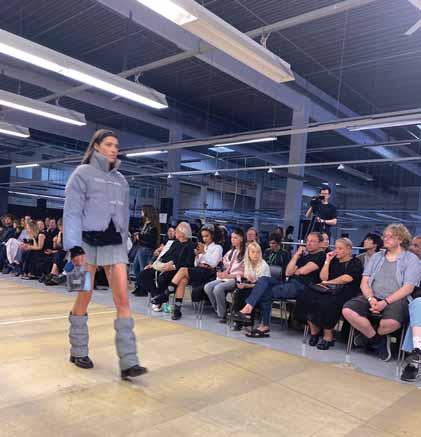
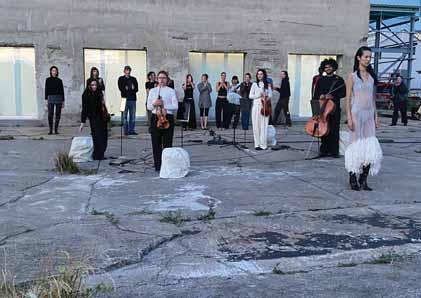
Berlin Fashion Week would not be half as enticing were it not for the locations the labels choose for their runway shows. They are not only revelatory of each brand's identity but also an invitation to discover Berlin behind its façades, opening doors to spaces one would rarely expect to exist. This was the case from the very beginning with Netzwerk, which staged its runway show at San Gimignano Lichtenberg. Once a former DDR factory left to decay after the fall of the Berlin Wall, the site was later restructured and repurposed by the architects at bplus.xyz / Brandlhuber+ into a safe space for a variety of workshops. In Berlin, where architecture has historically reflected the political regimes that have come and gone, this factory stands as a remarkable exception. Its towers were rescued and sustainably repurposed, preserving their concrete structure and simple forms. Likewise, sustainability is essential to the creative process of the Netzwerk designers, who work with Beglarian's deadstock haute couture fabrics, offering exclusive selections from more than
5,000 deadstock textiles. Driven by a commitment to sustainability, transparency, and community, the company strives to transform the textile industry into a responsible circular economy. Much like the location itself, saturated with the severe urban poetry of concrete, stone, and thin grass, the collection felt singular. Gender-neutral outfits and a delicate use of fabrics accentuated the human silhouette. Sheer textiles for womenswear created poetic looks, while unusual yet tasteful combinations of bluish tones, black and grey, and red and crimson settled into flowing lines that gave the collection a bold signature charm. It appealed equally to those seeking unconventional color combinations and fluid forms in casual wear, as well as glamorous evening looks. Ecology and environmental consciousness were equally central to SELVA HUYGENS, a label that consciously incorporates discarded automotive parts into its high-end glamorous creations. Here too, Beglarian fabrics added considerably to the polished finish of the garments. Dresses in lustrous blues, whites, and browns offered a new definition of sexy: sharp, witty, and executed with cutting precision. These were outfits that celebrated female power while embracing coquette aesthetics through
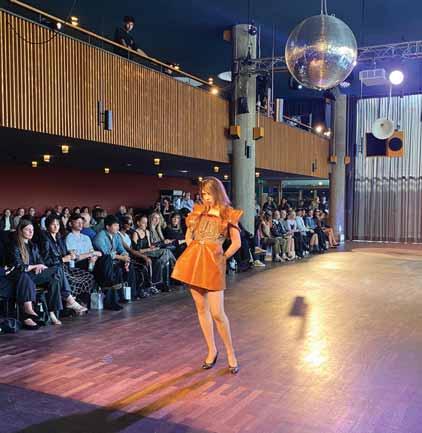
exaggerated sculptural details in shoes, headpieces, shoulders, and hips. The dramatic silhouettes echoed the architecture of the HKW (Haus der Kulturen der Welt), where the show took place, an iconic building affectionately nicknamed the "Pregnant Oyster" by Berliners because of its distinctive bulging suspension roof floating above a reflective pool.
Speaking of architecture serving as fashion's stage, one cannot ignore West Berlin's most controversial landmark, the ICC International Congress Center. Widely acclaimed as an exemplary example of futuristic Brutalist architecture, the 1979 building has stood largely empty for almost a decade. Sombre, dark, and reminiscent of a dysfunctional, deserted spaceship, it provided the perfect contrast for Orange Culture's Spring/Summer 27 runway.
Designer Adebayo Oke-Lawal presented fluid textures enriched with elements of African ornamentation, fringed dresses, carefully layered lightweight fabrics, and intricate detailing across both menswear and womenswear. Irregular cuts made every look dreamlike and emotionally charged, creating a singular atmosphere throughout the collection.
Marie-Louise Müller transported guests into her Escapist Garden, presented in a truly hidden oasis on the rooftop terrace of the Lobe Block in the heart of Berlin-Wedding. Surrounded by concrete architecture yet overflowing with greenery in the garden below, the location perfectly complemented a collection filled with floral motifs, pastel colors, and soft hues. Celebrating craftsmanship and elaborate tailoring, the designer paired meticulous construction with witty accessories, including watering cans transformed into handbags and carefully matched footwear.
For those drawn to romantic summer dressing, the collection was a dream come true, resembling Babylonian gardens in Brutalist form, as the architects themselves describe the site, complete with breathtaking views over Berlin. Straw hats, woven bags, crocheted dresses, and flowing fringes became symbols of innocence, joy, and effortless lightness.
Laura Gerte's Spring/Summer 27 collection embraced sensuality through cut-out silhouettes, long white dresses, and garments that revealed more than they concealed. Presented inside the late nineteenth-century Berliner Ensemble theatre, the historical setting added further intensity to the collection. Made entirely from upcycled materials, Lost to Virtue explored a feminist interpretation of femininity. Transparent fabrics, cords, and sheer layers contributed to a constant dialogue between revealing and concealing, resulting in a sensual yet thoughtful aesthetic.
Designer Jana Heinemann of Impari concluded her runway presentation with a live rap performance by Darell Marley, transforming the show into an authentic encounter between fashion, music, and spoken word. Presented under the glass roof of MOA Berlin, the collection Anima featured richly textured unisex garments combining draping, exceptional craftsmanship, and carefully constructed details across tops and trousers. Flowing sleeves and softly sculpted silhouettes gave the body freedom of movement, almost resembling shamanic garments that allow the skin to breathe. The venue itself, lined with exotic plants and trees, reinforced the designer's vision of reconnecting nature, culture, and the soul. Last but certainly not least, Neo.Fashion once again provided an important platform for Germany's newest generation of designers, showcasing graduate collections from national and international fashion universities. The Best Graduate Award was judged by renowned experts, including representatives of the iconic Villa Noailles museum in Hyères, France. Among the graduates, several collec-
tions stood out as true highlights. Vivien Vetterkind redefined tailoring as a layered expression of identity and disruption through deliberately raw and rebellious streetwear. Punk references, patchwork details, combinations of raw and flowing fabrics, and heavy embroidery merged into a disruptive aesthetic full of daring new visions of style.
Lilian Brade's collection revolved around monsters, witches, and bitches, an exploration of aggressive femininity that was biting, provocative, and unapologetically on edge. The garments challenged conventional ideas of beauty, while jewelry became an equally important narrative device. Protruding metal mouthpieces, exaggerated claw-like accessories, and towering platform heels evoked the atmosphere of travesty drag performance, combining wit with grotesque theatricality.
Samet Akkus, meanwhile, explored identity through traditional costume elements. Turban-like hats, some with fringes concealing the face, striped gender-neutral garments, and immediately recognizable folkloric references, including oversized beads replacing handbags, created a deeply personal narrative. Beautifully tailored white shirts cinched at the waist with broad belts, combined with traditional music, made the presentation feel authentic, nostalgic, and deeply moving. It portrayed the experience of negotiating one's identity through cultural heritage and collective memory. Clothing is skin deep, our second skin. It is therefore no wonder that Georgian designer Lado Bokuchava, whose eponymous label was presented during Berlin Fashion Week at RAUM Berlin, chose
black leather as the defining material of his collection. It served as a spectacular medium to accentuate the sensuality of the body while conveying an aesthetic of opulence, confidence, and immediacy. His experimental creations fuse traditional elements with contemporary aesthetics. Lado Bokuchava's work is distinguished by profound artistic expression and a bold willingness to challenge the conventional boundaries of the fashion industry. Established in 2017, the brand embodies an underground style infused with a contemporary twist. Each collection seamlessly blends classic and urban influences with futuristic details, creating a harmonious convergence of different stylistic directions. The designer's meticulous attention to pattern-cutting is evident in the complexity of the looks, featuring detachable details that enhance versatility and comfort for various body types and occasions. The use of refined, minimal materials is a hallmark of the brand.
Across Berlin Fashion Week Spring/ Summer 27, several major themes emerged repeatedly: sustainability, not merely as a production method but as a creative philosophy; gender-neutral dressing; flowing silhouettes; sculptural tailoring; transparency and layering; experimental color combinations; craftsmanship rooted in tradition yet directed toward the future; and, above all, an intimate dialogue between architecture and fashion. Ultimately, we are, to a great extent, what we wear. Through clothing we express our longings and belongings, whether we choose to reveal them openly or quietly disguise them beneath carefully constructed layers.
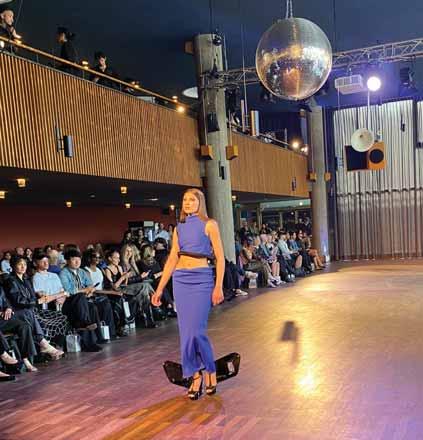
The Runway Show New Collection SS27 by Selva Huygens
The Runway Show New Collection SS27 by Netzwerk
Football: A Universal Obsession
Why does football stupefy the world so extensively and overwhelmingly? Why are we so terribly emotional about a simple ball rolling on the field? People are going crazy watching it. They are literally dying for their teams. Could this be about trivial national pride? If yes, then globalization does not make any sense. People love only their national identity, not common world ideals. Could this be true?
The following is my humble attempt at an affordable psychological, social, economic, and political analysis of this universal sporting phenomenon. Let us try together to understand why contemporary humans spend so much time, energy, nerve, and money on football (soccer). Maybe this is the reason why thousands of soccer moms are so keen on making their kids the stars of this unusually popular sport.
The world is simply running amok, rooting for it. Why does soccer have so much weight in our local, national, and international life? It sounds as though the whole thing is about human nature.
Right before writing this piece, I asked numerous questions and got answers from experts, fans, and those who do not really care. What I heard is basically what I had always thought but never spoke about.
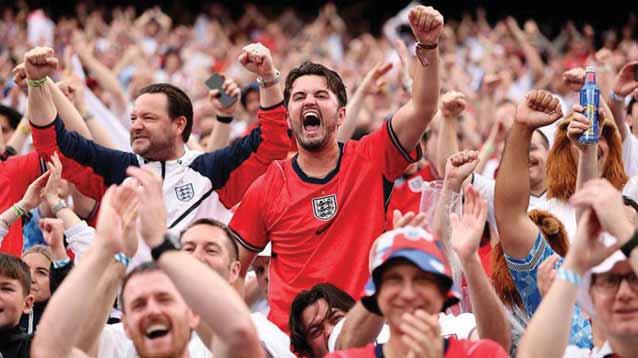
Avidly watching the 2026 Mundial, at this time on every TV screen in the world 24/7, I am coming to believe that, in the last couple of decades, football has turned into a huge ceremonial event that the peoples of the world are willing to share with each other. About five billion people follow it to a certain degree. No large-scale religious or political event is comparable to it.
Is this because the game is inherently and fundamentally more attractive than other sports? Probably not! It may simply be an accident that football has acquired the image of a source of the deepest human emotionalism, needed for self-expression and physiological satisfaction. It has just developed that way!
Psychologically speaking, football triggers a clear sense of belonging. There is us and there is them. Watching the game, my team turns into my true family. Is it not amazing that the victory of my team might feel very personal even if I have contributed nothing to it?
One of the most salient features of our
time is that it is weakening many traditional identities, such as religion, family, and community, considering them outdated, whereas football exudes enough power to strengthen those perpetual identities. I am Georgia. I am England. I am Brazil. This kind of identity stays with us for good, creating certainty within us. How about the perennially dwindling meaning of life? Our everyday routine is so noxious that it renders us terribly nauseous of it: bills, commuting, repetitive work, a stupid boss, and the necessity of putting up with him or her. Against this obnoxious background, football invigorates us, filling our bodies with additional pep and our minds with new stories, giving us new heroes and new triumphs. Villains and defeats too, but that is fairly tolerable. We are, at least, escaping the boring routine that is slowly but surely killing us.
For instance, when my team scores, I feel the simultaneous assault of dopamine, adrenaline, an increased heart rate, cortisol, endorphins, and what not. It feels perfectly all right in terms of my neurology.
I am trying not to miss a more or less important game of the ongoing World Championship, and what impresses me most is the number of tears shed in the
Georgia Beats Spain 91–89
BY TEAM GT
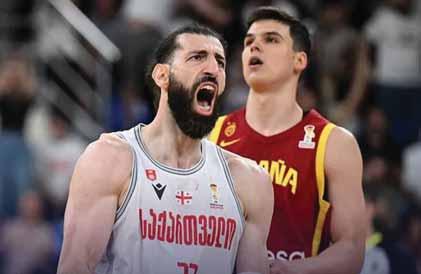
Georgia’s national basketball team claimed a dramatic 91–89 overtime victory over Spain in a 2027 FIBA World Cup qualifying game played on home court. Head coach Aleksandar Džikic started the game with Luka Ochkhikidze, Marcquise Reed, Duda Sanadze, Tornike Shengelia and Goga Bitadze.
Spain dominated the opening quarter, building an early advantage and taking a commanding 32–14 lead after the first 10 minutes. Georgia responded in the second period by improving defensively and cutting the deficit through the efforts of Shengelia and Reed, trailing
52–38 at halftime.
After the break, Spain extended its lead to 71–57 heading into the final quarter. Georgia then mounted a comeback, with Shengelia and Reed leading the charge. Reed tied the game with a three-pointer before Shengelia put the hosts in front. Spain equalized late, and Shengelia missed a potential gamewinning shot in regulation, sending the contest into overtime at 83–83.
Spain opened the extra period with a five-point run, but Georgia fought back to regain the lead. Reed scored the decisive basket with 19 seconds remaining, while Spain was unable to convert its final possession, sealing a memorable 91–89 victory for the hosts.
Shengelia finished as the game’s leading scorer with 37 points and 10 rebounds, while Reed added 32 points
COMMERCIAL DEPARTMENT
Commercial Director: Iva Merabishvili
Marketing Manager: Natalia Chikvaidze
EDITORIAL DEPARTMENT:
Editor-In-Chief: Katie Ruth Davies
in FIBA
stadiums, whether from the chagrin of defeat or the joy of victory. Yes, both the athletes and their fans are weeping sincere tears. Why are they crying? Because the goal is not simply a scored goal. In every single case, it is the culmination of years of patience, expectation, preparation, and investment. That is why!
Socially, football produces unusually strong feelings of unity. During those two strained hours of the match, we, the crowd of fans, are together with people we had never met before and will never see again, hugging and kissing them like our closest friends and family.
From the religious point of view, a comparison between faith and football might sound quite relevant. Instead of holy places and pilgrimages, there are stadiums and away matches. In place of ritual clothing and sacred songs, there are jerseys and chants. Club legends replace martyrs, club stories replace religious sagas, historic victories replace traditional triumphs, and never missing a home match resembles the devotion of never missing a Sunday at church. Would not all this be as true as the gospel?
Not to forget, football matches have a proclivity to create national unity, at least temporarily, which may become a huge help to politically divided countries. All of us watch together. All of us celebrate or mourn together. A big deal!
I was told the universal football obsession does not contradict the process of globalization, but I would still insist that it might appear as a divider between nations. I noticed this clearly while
watching the game between Brazil and Japan. One of the Japanese fans was ready to eliminate any symbol of the Brazilian flag. I can swear upon my remaining life that there is not even a vestige of whimsical witticism in this painful observation!
Finally, economics! The global football economy is worth hundreds of billions of dollars annually. Businesses invest enormous sums because billions of people watch the game, and there are television rights, advertising, merchandise, betting, tourism, hospitality, stadium tickets, video games, youth academies, and sports media. Wow!
By the way, why do parents invest so much? The expectation of extraordinary success, equal to a chance to go from rags to riches. Is that not a good enough reason for the mentioned parental infatuation? Yes, it is. Football has the biggest audience of all entertainment events. Politics? Oh, yes. Leaders frequently associate themselves with successful teams. Football sometimes stops wars, but it also fuels conflict.
Football, being such a big deal, is also very simple: a ball and a field. That simplicity has helped it spread worldwide. The impression is that the world is running berserk, practicing or following football, but this is only an impression. In fact, football makes the world a much, much better and safer place to live. This good thought stands firmly on the human need and desire to belong, to compete, and to celebrate together.
Could there be anything more positive and exciting?
World Cup Qualifier
Journalists: Ana Dumbadze
Tony Hanmer
Nugzar B. Ruhadze
Ivan Nechaev Lana Kokaia
Layout: Misha Mchedlishvili
Photographer: Aleksei Serov
International Relations & Communications
Sofia Bochoidze E: sbochoidze@georgiatoday.ge
Website Editor: Katie Ruth Davies
Webmaster: Sergey Gevenov
Circulation Managers: David Kerdikashvili David Djandjgava
ADDRESS
22 Janashia Str. Tbilisi, 0179, Georgia
and seven assists. Giorgi Jinjaradze contributed six points, Sanadze scored five, Bitadze and Turdziladze added four each, Merkviladze finished with three, and Ochkhikidze scored one point.
For Spain, Willy Hernangómez led the team with 19 points. Cárdenas added 14, while Saint-Supery finished with 13. The win gives Georgia a valuable boost in its 2027 FIBA World Cup qualifying campaign and will be remembered as one of the team’s most impressive performances in recent years. Beating a basketball powerhouse like Spain in such a dramatic fashion, especially on home court, was not only an important result but also a moment of pride for Georgian fans and a reminder of the team’s growing confidence on the international stage.
Tel.: +995 32 229 59 19
E: info@georgiatoday.ge F: GeorgiaToday
ADVERTISING & SUBSCRIPTION
+995 577 72 52 61
E-mail: marketing@georgiatoday.ge
Reproducing material, photos and advertisements without prior editorial permission is strictly forbidden. The author is responsible for all material. Rights of authors are preserved. The newspaper is registered in Mtatsminda district court. Reg. # 06/4-309