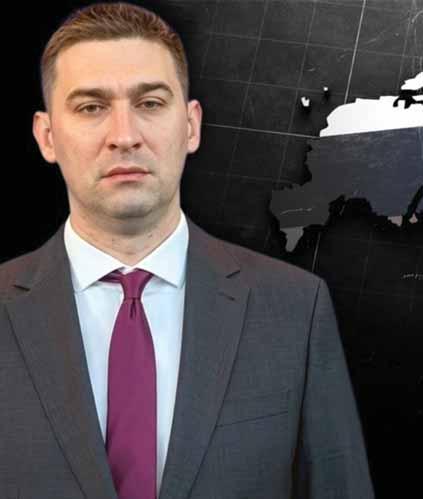
“The Russian Federation is a doomed project” - Vyacheslav Bodrov
this week’s issue...
Georgia Plans Nationwide Facial Recognition Network and New Anti-Drone Defenses
2
Ukraine Latest: Russia Presses Donbas Front as Long-Range Strikes Escalate on Both Sides
Outgoing German Ambassador Bids Farewell as PM Blames Him for Damaged Bilateral Relations
Georgia-Uzbekistan Business Forum Held in Tbilisi
Education Minister: New Textbooks to Emphasize National Values
Listening against the Noise: ‘The Other Gaze’ at the Tbilisi International Festival of Theater
Footballer Giorgi Chubinidze Signs Professional Contract with Premier League Club
PAGE 11 SOCIETY PAGE 9
Georgia Postpones Plastic Bottle Ban in Food Service Sector to 2031
BY LANA KOKAIA
Georgia has postponed the ban on serving drinks in plastic bottles in food service establishments until February 1, 2031, extending the timeline for implementation of the regulation by almost four years.
The change was introduced through Government Resolution No. 106 of March 12, 2026, which regulates the production, import and placing on the market of certain plastic products intended for food contact.
Under the original decision, the restriction was due to take effect from
July 1, 2026.
However, with the updated decision, the deadline has now been extended following additional consultations with the private sector, business associations and other stakeholders, with officials saying the move is intended to give businesses more time to adapt to the new standards.
The regulation is part of a broader set of restrictions on plastic bottles, under which the production of drinks in plastic bottles (except for export), as well as their import and placement on the market, is due to be banned from February 1, 2027.
In April, the ban on the sale of drinks in plastic bottles was also postponed by four years, to 2031.
Archaeologists Discover Rare Queen Tamar-era Coin at Armenia’s Amberd Fortress
Georgia Plans Nationwide Facial Recognition Network and New Anti-Drone Defenses
The Georgian government plans to expand the use of facial recognition cameras across the country and purchase an advanced antiunmanned aerial vehicle (UAV) system as part of what it says are major upgrades to the country's security infrastructure.
Speaking at a July 1 briefing, the Minister of State for Coordination of Law Enforcement Bodies, Mamuka Mdinaradze, said the government intends to install facial recognition cameras nationwide as part of crime prevention and public security measures.
no surveillance technology had been purchased from Russia since he assumed his current position. However, AlgorithmWatch reported that Georgia first procured the facial recognition technology from Russia in 2013.
The investigation has prompted criticism from the Georgian Young Lawyers' Association (GYLA/SAIA), which warned that the use of facial recognition technology during protests raises serious human rights concerns.
infrastructure with a high-encryption module.
"The measures carried out and planned in the State Protection Special Service, including the purchase of an ultra-modern system against unmanned aerial vehicles, which means the detection and neutralization of several dozen aerial vehicles at the same time within a radius of 5-6 kilometers, allow us to say that the State Protection Special Service has never been at the level of development it is today and it is distinguished by its capabilities not only in our region," Mdinaradze said.
BY TEAM GT
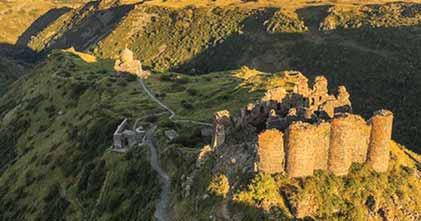
Archaeologists carrying out restoration and excavation works at Armenia’s medieval Amberd Fortress have uncovered several significant historical artifacts, including a rare coin minted during the reign of Georgia’s Queen Tamar, Armenian media reported, citing the Armenian Ministry of Education, Science, Culture and Sports.
Among the discoveries are the rare coin, a nearly complete human skeleton, and gaming pieces from the medieval board game “Tama,” believed to resemble modern-day chess or checkers.
Armenia’s Cultural Heritage Protection Service says the human skeleton was found outside the inner wall of the fortress, about one meter east of its central section. Around 90% of the bones were preserved in situ, with only the finger bones missing.
Based on the condition of the teeth, specialists believe the remains belonged to a young individual. Analysis of the leg bones suggests the person stood approximately 180 centimeters tall, which
would have been considered unusually tall for the period.
The Cultural Heritage Protection Service described the Queen Tamar-era coin as the most significant find of the excavation. Historians consider it an exceptionally rare artifact that provides valuable evidence of the historical links between medieval Georgia and the region.
Amberd Fortress, located on the southern slopes of Mount Aragats at an elevation of approximately 2,300 meters above sea level, is one of Armenia’s best-preserved medieval fortresses.
Historical sources indicate that during the 12th and 13th centuries, under the reign of Queen Tamar, the fortress was controlled by the Zakarid dynasty, an Armenian noble family that governed much of northern and central Armenia under the protection of the Kingdom of Georgia. During that period, Amberd served as one of the region’s principal military and strategic strongholds.
Archaeological excavations and restoration work at the fortress are ongoing, and specialists believe further research could reveal additional discoveries shedding light on the history of the site and the people who once lived there.
"We will try to install facial recognition cameras not only on Rustaveli Avenue and in central districts, but throughout the country, based on security measures, including crime prevention," Mdinaradze said.
He made the remarks in response to questions about a recent investigation by AlgorithmWatch, which alleged that the ruling Georgian Dream party has used a Russian facial recognition system to identify citizens.
Mdinaradze dismissed claims that Russia's security services could gain access to Georgian citizens' personal data through the system, describing the allegations as "ridiculous." He also said that
The organization said the ruling party has increasingly relied on such surveillance technologies during anti-government demonstrations since late 2024. It argued that, without sufficient transparency regarding the systems' capabilities and adequate legal safeguards, their use against peaceful protesters could have a chilling effect on the exercise of the right to freedom of assembly.
SAIA added that AlgorithmWatch's June 27 investigation deepens concerns over the deployment of facial recognition technology and raises further questions about the protection of citizens' rights and personal data.
Alongside the expansion of surveillance technology, Mdinaradze announced plans to strengthen the capabilities of the State Protection Special Service by purchasing an ultra-modern anti-UAV system.
According to the minister, the service has already upgraded its secure communications system and peripheral
Responding to a question about whether the anti-drone system would be used to protect senior government officials, Mdinaradze said the specific purpose was not important, arguing that such technology is standard equipment for modern state security services.
"Whatever version you say, whether it is so or not, it doesn't matter. Any special service in the world, if it has the material ability and will to do so, is trying to acquire such ultra-modern systems in order to be armed, whether a forum is held, whether a diplomatic mission is coming, or there are measures to protect diplomatic missions operating in the country, or any other measures to protect these facilities. With ultra-modern equipment, this is an elementary and simple solution when you can afford such a system," he said.
Matsuri Festival to Showcase Japanese Pop Culture in Tbilisi
BY LANA KOKAIA
The Matsuri pop-culture festival will return to Tbilisi on July 18, promoting modern Japanese and East Asian subcultures, including anime, manga, cosplay, contemporary Japanese fashion, K-pop, and esports, alongside elements of traditional Japanese culture.
The festival, supported by the Japanese Language and Culture Center, has been held since 2015.
Organizers say visitors will be able to take part in activities such as Japanese calligraphy (shodo), origami and omikuji fortune drawing, while also exploring traditional and modern Japanese cultural spaces.
A food zone will offer Japanese dishes prepared by Japanese chefs, while mar-
ket stalls will sell items including manga, anime figures, posters, traditional sweets and other Japan-related merchandise. The program also includes cosplay and K-pop dance competitions.
A facial recognition camera. Source: informationweek
BY TEAM GT
Doors will open at 18:00.
Matsuri festival.Source: Japanese Language & Culture Center
Plastic bottles. Source: FB
The coin and Amberd Fortress. Source: FB
Ukraine Latest: Russia Presses Donbas Front as Long-Range Strikes Escalate on Both Sides
COMPILED BY ANA DUMBADZE
Russia and Ukraine spent another week locked in a costly war of attrition, with fierce fighting continuing across the eastern and southern front lines while both sides intensified long-range strikes far from the battlefield. As Russian forces pressed for incremental territorial gains in Donetsk and Zaporizhzhia regions, Ukraine expanded its campaign against Russian energy facilities, military industries, logistics hubs, and air-defense systems deep inside Russia and occupied Crimea. Meanwhile, Russian missile and drone attacks on Ukrainian cities continued to inflict heavy civilian casualties and renewed calls from Kyiv for additional Western air-defense support. Although neither side achieved a decisive operational breakthrough, the week's developments underscored the increasingly long-range nature of the conflict, with both armies seeking to weaken the other's ability to sustain the war as much as to seize territory.
The fiercest fighting of the week remained in eastern Ukraine, where Russian forces kept up relentless pressure across several key sectors. According to the Ukrainian military, Pokrovsk, Sloviansk, Kostiantynivka, Lyman, and Huliaipole saw the most intense combat, with more than 250 clashes recorded during a single 24-hour period at the beginning of July.
Pokrovsk remained at the center of Russia's offensive. Russian troops launched repeated assaults near Hryshyne, Novooleksandrivka, Shevchenko, Udachne, and Kotlyne, while also pushing toward Serhiivka and Bilytske. Beyond its symbolic importance after months of fighting, Pokrovsk is strategically significant because further Russian advances to its west and northwest could put Ukraine's broader defensive network in Donetsk region under greater strain.
Farther north, Russian forces continued
probing attacks around Lyman and Sloviansk, repeatedly attempting to push toward Lyman, Borova, Yampil, Ozerne, and nearby settlements. Fighting also persisted near Kryva Luka, Rai-Oleksandrivka, and Kalenyky. Military analysts believe these assaults are intended to stretch Ukrainian defenses by forcing Kyiv to commit reserves across multiple threatened sectors at once.
The situation around Kostiantynivka also remained difficult. Russian units continued attacking positions near Kostiantynivka, Ivanopillia, Illinivka, Stepanivka, and Sofiivka. Reuters reported that Moscow has intensified pressure on the city, part of Ukraine's so-called "fortress belt," with small Russian assault groups trying to infiltrate its outskirts and surrounding approaches.
Activity also increased on the southern front. Ukrainian forces reported more than 20 Russian attacks in a single day in the Huliaipole sector, with fighting near Kosivtseve, Dobropillia, Hirke, Vozdvyzhivka, Staroukrainka, Tsvitkove, and Charivne. The area has grown in strategic importance in recent months, as Russian advances toward Huliaipole could threaten Ukrainian defensive positions in Zaporizhzhia region and complicate efforts to hold territory farther south. By contrast, the Orikhiv and Dnipro sectors remained relatively quiet during the reporting period, with Ukrainian officials saying Russia launched no major offensive operations there on July 1.
Despite the intensity of the fighting, the front line continued to move only slowly.
The week's battlefield developments reinforced a familiar pattern: fierce combat producing modest territorial gains rather than major breakthroughs. According to Russia Matters, citing DeepState and the Institute for the Study of War (ISW), Russian forces gained a net eight square miles of Ukrainian territory between June 23 and June 30, according to DeepState's assessment, while ISW estimated gains of about 17 square miles. Looking at the entire month, DeepState calculated Russian advances at 31 square
miles between June 2 and June 30, while ISW estimated 11 square miles. Although Russia continues to make gradual progress in some sectors, the pace remains slow and costly, with no sign of a rapid collapse in Ukraine's defenses.
Away from the front line, Ukraine continued to expand its campaign of longrange strikes against Russian military and energy infrastructure. President Volodymyr Zelensky said Ukrainian forces struck the Ufa oil refinery for the second time in a week, targeting a facility more than 1,000 kilometers from Ukraine that plays an important role in Russia's fuel and lubricant production. Ukraine also reported striking a missile component factory in Penza. "Every such strike reduces Russia's ability to wage war," Zelensky said, describing the campaign as an effort to undermine the infrastructure supporting Moscow's invasion.
Occupied Crimea also came under sustained pressure. Russian-installed authorities declared a state of emergency amid fuel shortages and power disruptions following repeated Ukrainian attacks on logistics and energy facilities. Crimea remains one of Russia's key military hubs for operations in southern Ukraine, making its supply network a critical target.
The disruption reflects a broader fuel crisis now affecting parts of Russia. Ukrainian drone strikes on oil refineries and fuel depots have disrupted refining capacity, leading to fuel rationing, long queues at filling stations, and sharp price increases in several regions. In Sevastopol alone, official Russian statistics showed gasoline prices rising by around 30 percent in a single week, prompting authorities to limit fuel sales and shorten public transport operating hours.
President Vladimir Putin acknowledged that Ukrainian strikes had created fuel shortages, although he insisted the situation was "not critical." He said Russia needed to "rapidly and significantly increase production of air defense systems" while speeding up repairs at damaged refineries. To ease shortages, Moscow has begun importing gasoline from
India, is negotiating additional supplies from neighboring countries, and is considering a temporary ban on diesel exports to keep more fuel on the domestic market.
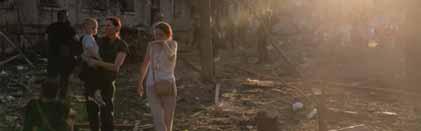
Russia responded by stepping up its own aerial campaign against Ukrainian cities. Kyiv endured one of the deadliest attacks of the week as Russian missiles and drones struck residential neighborhoods and civilian infrastructure. Ukrainian authorities said at least 18 people were killed and more than 90 injured after an 11-hour bombardment involving hundreds of drones and dozens of missiles.
Fires broke out across several districts of the capital, damaging apartment buildings and other civilian sites. Following the attack, Zelensky renewed his appeal for additional Western air defenses, warning that "every delay in decisions, every delay in support means lost lives."
Elsewhere, Russian attacks continued to hit civilian areas across southeastern and northeastern Ukraine. Strikes in Dnipropetrovsk, Sumy, and Kharkiv regions killed civilians, while guided bombs, drones, and artillery repeatedly targeted frontline communities. Kharkiv remained under constant pressure from drones, glide bombs, and cross-border attacks, while shelling and evacuation concerns persisted in the border areas of Sumy region.
The human cost of the war continued to mount. In addition to the week's civilian casualties, a new assessment by the Center for Strategic and International Studies estimated that Russia's full-scale invasion has resulted in more than two million military casualties on both sides
since February 2022. The report estimated Russian military casualties at roughly 1.4 million, including between 400,000 and 450,000 killed. Ukrainian military casualties were estimated at between 525,000 and 625,000, including 125,000 to 150,000 killed. While the figures cannot be independently verified, they underscore the staggering cost of a conflict increasingly defined by attrition, drones, artillery, and enormous losses for relatively limited territorial gains.
On the diplomatic front, attention turned to preparations for the NATO summit in Ankara on July 7-8, where Ukraine is expected to remain high on the agenda. NATO says allies will continue providing military assistance while working to make long-term support more sustainable. As of June 2026, member states had committed more than $6 billion for U.S.-supplied military equipment through the Prioritized Ukraine Requirements List (PURL), with additional announcements on Ukraine's urgent defense needs expected during the summit.
Meanwhile, Kyiv continued pressing its Western partners for more air-defense systems, long-range weapons, and a reliable supply of ammunition. Ukrainian leaders argue that defending the country's cities and holding the front increasingly depends on a combination of Western air defenses, expanding domestic drone production, and sustained international financial support. Moscow, meanwhile, continued to reject Ukrainian and Western conditions for a negotiated peace while pursuing gradual battlefield advances and retaliatory strikes.
Residents at the site of a residential building damaged by a Russian air attack, Kyiv.
Photo by Roman Pilipey/AFP/GETTY IMAGES
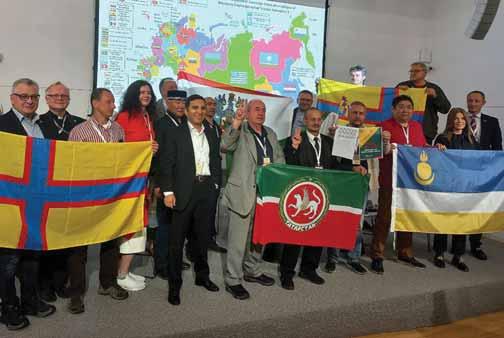
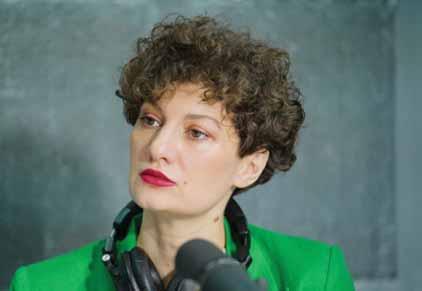
“The Russian Federation is a doomed project” - Vyacheslav Bodrov
Continued from page 1
We began our conversation with Vyacheslav Bodrov by asking about cooperation with the Russian liberal opposition.
“We do not cooperate with the Russian opposition,” he said. “We simply cross paths in the Parliamentary Assembly of the Council of Europe. We discuss many issues, but we also disagree on many of them.”
ON WHAT TOPICS DO YOU FIND COMMON GROUND AND WHERE DO YOU DISAGREE?
We, together with other movements, including the United Force, which is fighting for the independence of Chechnya, pose the issue this way: our principled position is that the indigenous peoples of Russia should have the right to self-determination. Not just on paper, but in reality.
The Russian opposition does not agree with this approach, or at least does not like it. If for ethnic groups and peoples, self-determination means real freedom and the ability to determine their own
fate, then for the Russian opposition, this is already unacceptable. They say: we will give you more rights: dance, sing your traditional songs, but as for the right to self-determination, let's talk about it later. Self-determination does not mean dancing and playing. To see the issue in this way is an insult to those suffering, repressed peoples who live on Russian territory today, but do not consider themselves Russian. The right to self-determination should be inviolable, and not a subject of dispute or a topic for discussion and bargaining.
WHOSE SUPPORT ARE YOU COUNTING ON WITHIN RUSSIA ITSELF?
It is difficult to count on anyone's support within the Russian Federation today, in conditions of total repression, but on the other hand, such discussions taking place in Europe show the people who still live on the territory of the Russian Federation that they are not abandoned; that they are being thought of, and that their issue is being discussed at the international level.
The problem is that there are still certain oligarchic groups in PACE that are embedded in the Russian opposition
The problem is that European society and European politicians still have a poor understanding of what the Russian Federation actually is. That is why this, let's call it educational work, is vitally important: because the thinking of politicians is gradually changing.
For years, the Kremlin has portrayed the Chechen people as simply savages, and has created a stereotype of the entire Caucasian population as savages; people with whom dialog and agreement are supposedly impossible. Moreover, this narrative is repeated by the Russian opposition.
Today, thanks to the United Force, the Group of Free Nations, and the fact that we have been attending sessions of the Parliamentary Assembly of the Council of Europe for more than a year and working systematically with European politicians, this false perception is gradually disappearing. European politicians are increasingly changing their attitude.
And it is this change that will have a positive impact on European support for people living in the Russian Federation in the future.
SOME YEARS AGO, THIS TOPIC WAS ALMOST TABOO IN EUROPE, AS THE COLLAPSE OF RUSSIA WOULD BRING EVEN GREATER MISFORTUNE, CHAOS THAT IS WORSE THAN DICTATORSHIP. IS THIS ATTITUDE CHANGING? HOW OFTEN DO YOU HEAR SUCH ARGUMENTS TODAY?
Yes, that's right. We’re still far from fully understanding it, as I have already said, but it is also a fact that European politicians are slowly opening their eyes and this topic is no longer taboo. There are frequent cases when Russian opposition-
ists try to maintain this taboo over and over again, as if we were talking about some single, indivisible Russian nationstate. Everyone knows that this is not so: other peoples have lived on the current territory of Russia for centuries, this is their historical land, and now some people are trying to explain to them what moral and legal norms they should live by, instead of giving them the right to choose how, with whom and in what form they want to live.
They are not given the right to selfdetermination, and all this is justified by the inviolability of the future “democratic” Russian Federation. But this is the wrong approach. Give the peoples the right to self-determination. After that, they will decide for themselves whether they want to live with the Russians or not, and if they want to, it will happen in completely different, more friendly and equal conditions. And if they don’t want to, that’s their right too.
In other words, the term "dissolution of the Russian Federation" is a deliberate distortion of concepts. We are not talking about dissolution: we are talking about the implementation of international law and its principles in practice.
HOW FAR AWAY, AND HOW UTOPIAN, IS THAT FUTURE WHERE THE KREMLIN WILL HEAR YOUR VOICE AND SAY, ‘YES, THERE IS COMMON SENSE IN THIS, AND THAT'S HOW IT SHOULD BE’?
The government that will replace the current Kremlin regime will definitely have to "settle things" with the European space, the European Union, and European politicians. This is where we need to show that if these peoples do not have a truly functioning mechanism for the right to self-determination, not only on paper, but also in practice, then there should be no negotiations with the new Kremlin leadership.
Moreover, in our opinion, sanctions should not be lifted until the mechanism for the right of indigenous peoples to self-determination is fully implemented.
HOW REALISTIC IS IT THAT EUROPE WILL TAKE SUCH A PRINCIPLED POSITION AND NOT SAY: ‘THE MAIN THING IS THAT THE WAR IN UKRAINE ENDS, THE REST WILL BE TAKEN CARE OF SOMEHOW, THIS IS A MATTER FOR THE FUTURE, NOT SOMETHING TO BE DECIDED NOW?’
If the Parliamentary Assembly of the Council of Europe and other interna-
President’s Administration Con
tional organizations do not include representatives of indigenous, colonized, and repressed peoples, and fail to provide Europeans with the real picture as these peoples themselves see it, and not as the Russians, even the same "liberal opposition,” see it, then we should have little hope for a fair process.
The problem is that there are still certain oligarchic groups in PACE that are embedded in the Russian opposition, and sometimes even finance it themselves.
Naturally, the main task for them is to remove sanctions from their own capital. If only the voices of the oligarchs reach Europe, then it is clear how things will go. Already today we hear calls for sanctions to be lifted, if not on Russia, then at least on individual oligarchs; the "good oligarchs". What does this mean for us, representatives of ethnic groups, national liberation movements and regional organizations?
That nothing will change for ordinary people and international law will still not be enforced.
YOU ARE THE VOICE OF THESE PEOPLES, YET THE RUSSIAN OPPOSITION IS ACTIVELY LOBBYING FOR ITS OWN AGENDA. DO YOU THINK EUROPE, NOT ONLY PACE, BUT EUROPE AS A WHOLE, IS READY TO LISTEN TO YOU?
Over the past thirty years, certain business circles and business structures have formed in Europe that are directly tied to the resources located on the territory of the Russian Federation. Such processes cannot be completed quickly. It is impossible to change in five years what has been built and shaped over thirty years.
But today in Europe they already understand that something must change. If the government in the Kremlin does not change, if the course of the Russian Federation does not change, and if the peoples are not given the right to self-determination, this will end in a new war, one with even more victims. And this will happen sooner rather than later. No matter how much they try to artificially preserve this space known as the Russian Federation, no matter how much the Kremlin tries to impose its own worldview through various institutions and propaganda, this project is doomed. That's why Europeans have to listen to us. They have to look for a solution and think about this problem. And the result of this process is that today there are already certain attitudes and a certain acceptance of this idea.
Will Attend Ali Khamenei’s Funeral in Iran
BY TEAM GT
Georgia’s President Mikheil Kavelashvili will attend the funeral ceremony of Iran’s Supreme Leader, Ayatollah Ali Khamenei, the President’s Administration has confirmed.
“President of Georgia Mikheil Kavelashvili, together with the leaders of regional countries, including Turkey, Azerbaijan, Armenia and others, will attend the funeral ceremony of Ayatollah Ali Khamenei in Iran,” the admin-
istration said.
Iran’s WANA News agency reported that the late leader’s body will be transferred to four cities in Iraq following ceremonies in Tehran and Qom. It will then be returned to Iran and buried in Mashhad.
Under the official schedule, a public farewell ceremony will begin at 6:00 a.m. on July 4 at Tehran’s Imam Khomeini Mosalla and continue until 8:00 p.m. on July 5. Funeral prayers are scheduled for the morning of July 5. Following ceremonies in Tehran, Qom and Iraq, Khamenei will be
Thursday, July 9.
Vyacheslav Bodrov. Source: RFERL
laid to rest in the city of Mashhad on
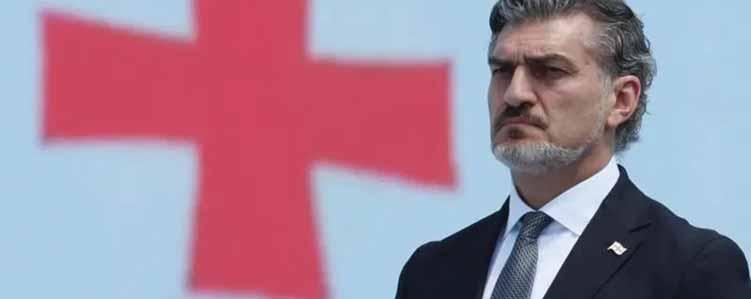
President Mikheil Kavelashvili. Source: FB
Outgoing German Ambassador Bids Farewell as PM Blames Him for Damaged Bilateral Relations
BY TEAM GT
Germany's ambassador to Georgia, Peter Fischer, has announced the end of his diplomatic mission, prompting a sharp response from Prime Minister Irakli Kobakhidze, who accused the envoy of damaging relations between the two countries.
Fischer, who has served as Germany's ambassador to Georgia since 2022, announced his departure in a farewell message posted in Georgian on X.
"Our term of office in Georgia has ended. Thank you, be happy, and 'Auf
Wiedersehen'," he wrote.
The ambassador accompanied the post with a photograph taken at the April 9 Memorial on Tbilisi's Rustaveli Avenue.
The message also featured the song Won't Stand Down by English musician Peter Gabriel.
During his tenure, Fischer became one of the most outspoken European diplomats in Georgia, frequently commenting on issues related to democracy, human rights, and the country's European integration.
Responding to the ambassador's departure, Prime Minister Irakli Kobakhidze claimed Fischer had done more harm than good to Georgian-German relations, describing him as "the only ambassador"
to have damaged ties between the two countries.
"Traditionally, there have been special relations between Georgia and Germany. Germany played a major role, especially in the early 1990s, in the development of our country. It was a very difficult period at that time, and Germany stood by our country. This is how relations continued for many years," Kobakhidze said.
"Peter Fischer was the only ambassador who not only did nothing for the development of these relations, but on the contrary, did everything to damage relations between Georgia and the Federal Republic of Germany. We hope that all this will turn around. This is very important for our country."
The prime minister emphasized that Georgia remains grateful for Germany's longstanding support and expressed hope that relations would improve following Fischer's departure.
"We have a very strong desire to restore the friendly relations we were accustomed to before. Unfortunately, Mr. Fischer caused great damage to these relations. We hope that all this will change," Kobakhidze said.
Germany has been one of Georgia's key European partners for decades, supporting the country's democratic development, economic reforms, and EuroAtlantic aspirations. Relations, however, have become increasingly strained in recent years amid criticism from several Western governments and diplomats over the Georgian government's democratic backsliding and its handling of anti-government protests.
Russia Calls on Tbilisi to Sign Non-Use of Force Agreement
BY TEAM GT
Russia has once again called on Georgia to sign a legally binding agreement on the non-use of force with the occupied regions of Abkhazia and South Ossetia, based on a statement released by the Russian side following the 67th round of the International Discussions on Security and Stability in the South Caucasus, held in Geneva.
The latest round of the Geneva International Discussions took place on June 30–July 1, bringing together official representatives from Georgia, the de facto authorities of Abkhazia and South Ossetia, Russia, and the United States. The talks were co-chaired by the United Nations, the Organization for Security
and Co-operation in Europe (OSCE), and the European Union.
Based on the Russian statement, Moscow urged participants, particularly the Georgian side, to take practical steps within the framework of the discussions to provide what it described as “firm security guarantees” for Abkhazia and South Ossetia. Russia reiterated its longstanding demand for the preparation and signing of a legally binding agreement on the non-use of force between Georgia and the two occupied regions.
Moscow argued that such an agreement has become increasingly important amid the deepening cooperation between Georgia and NATO, including the holding of NATO military exercises and other training activities in Georgia.
The statement also said the security situation on the ground remains relatively stable, which Russia attributed to the mechanisms established within
Israel Approves Recognition of Armenian Genocide, Drawing Sharp Reactions from Türkiye and Azerbaijan
BY TEAM GT
Israel's government has unanimously approved a resolution to formally recognize the Armenian Genocide, marking a historic shift in the country's long-standing policy and triggering strong criticism from both Türkiye and Azerbaijan.
The resolution, initiated by Israeli Foreign Minister Gideon Sa'ar, was approved by the Cabinet this week and will now be submitted to the Knesset for debate and a vote before becoming official state policy.
Following the decision, Sa'ar thanked Prime Minister Benjamin Netanyahu for supporting the initiative and praised government ministers for their unanimous backing.
"It's never too late to do the right thing.
I thank Israeli Prime Minister Netanyahu for his support, and the government ministers for their unanimous approval of the resolution I initiated for Israel's recognition of the Armenian Genocide," Sa'ar wrote on X.
the war in Gaza.
In a statement, the Turkish Foreign Ministry said the resolution was a "malicious attempt" that ignored legal and historical facts and reflected pressure on Prime Minister Benjamin Netanyahu and other Israeli officials facing arrest warrants issued by the International Criminal Court.
The ministry added that Türkiye would continue working to end what it described as Israel's expansionist and destabilizing policies in the region while seeking accountability for alleged crimes committed against civilians, particularly Palestinians.
President Recep Tayyip Erdogan also rejected Israel's decision, responding after a Cabinet meeting.
"We do not give the slightest heed to the slanders about our country from the murder network that has the blood of 73,000 innocent Gazans, most of them children and women, on its hands," Erdogan said. "In our history there is no genocide, no massacre, no oppression, and no colonialism."
Azerbaijan likewise criticized the Israeli government's decision, describing it as "a cause for serious concern."
the Geneva Discussions, including the Incident Prevention and Response Mechanism (IPRM) in Ergneti and the 24-hour hotline. It also stressed the need to resume the operation of a similar mechanism in Gali and called for the launch of a process to delimit what it referred to as the “state borders” between Georgia, Abkhazia, and South Ossetia.
In addition, the Russian side accused Tbilisi of politicizing humanitarian issues, arguing that this hinders constructive dialogue. In this context, Moscow referred to the annual resolution adopted by the UN General Assembly concerning internally displaced persons and refugees.
The 68th round of the Geneva International Discussions is scheduled to take place in November. Ahead of the meeting, the national delegations will hold consultations with the co-chairs in the capitals of the participating countries.
He said Israel had joined dozens of other countries in officially recognizing the Armenian Genocide, describing the move as the fulfillment of a "moral duty" and a rejection of efforts to deny the historical events.
For decades, successive Israeli governments avoided formally recognizing the Armenian Genocide, largely out of concern for preserving relations with Türkiye. However, relations between the two countries have deteriorated significantly in recent years, particularly amid the war in Gaza, paving the way for the policy change.
Historians estimate that up to 1.5 million Armenians were killed by the Ottoman Empire during and after World War I, in what is widely regarded by scholars as the first genocide of the twentieth century. Türkiye rejects the term "genocide," maintaining that the deaths occurred amid war and civil unrest, and disputes both the death toll and claims of systematic extermination.
Türkiye condemned Israel's decision, accusing it of being politically motivated and intended to divert attention from
In a statement, Azerbaijan's Ministry of Foreign Affairs said it was unacceptable to distort the historical facts surrounding the events of 1915 and to reduce what it called a complex historical issue to a political decision "without a solid legal or scientific basis."
"Such actions do not contribute to reconciliation and mutual understanding. On the contrary, they undermine efforts to achieve lasting peace and stability in the region," the ministry said.
Baku called on the Israeli government to reconsider its decision and stressed that Azerbaijan "remains firmly committed to protecting historical truth, respecting the principles of international law, and promoting lasting peace and stability in the region."
The recognition represents one of the most significant changes in Israeli foreign policy toward the issue. Once approved by the Knesset, Israel will formally join more than thirty countries, including the United States, Canada, France, Greece, the Netherlands, and Russia, that officially recognize the Armenian Genocide.
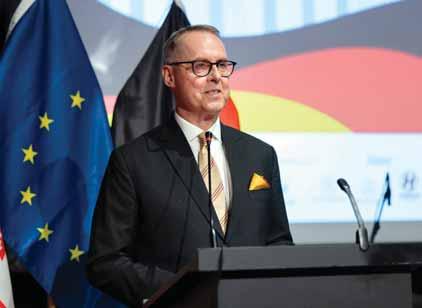
Peter Fischer. Source: Civil Georgia
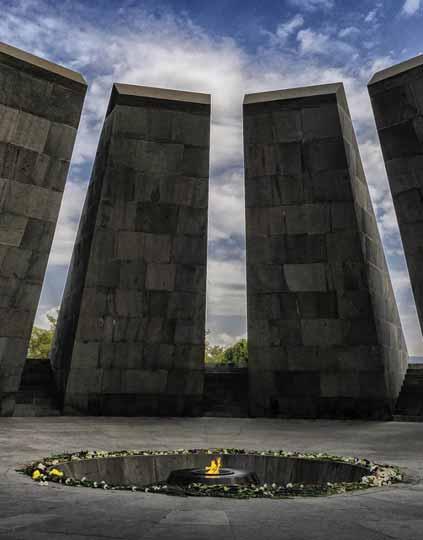
Memorial to lost Armenians. Source: embraceme.org
Georgian and Russian flags. Source: Azer News
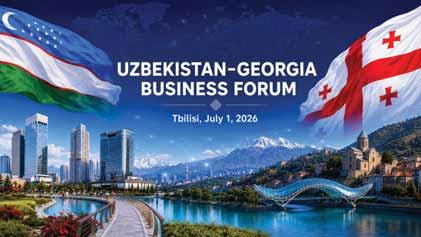
Georgia-Uzbekistan Business Forum
Held in Tbilisi
BY TEAM GT
The Georgia-Uzbekistan Business Forum was held in Tbilisi on July 1, bringing together government officials and business representatives from both countries. The event was opened by Georgia’s Minister of Economy and Sustainable Development, Mariam Kvrivishvili, and Uzbekistan’s Minister of Investments, Industry and Trade, Laziz Kudratov.
Around 70 Uzbek companies participated in the forum, representing sectors including construction, logistics, agriculture, healthcare and pharmaceuticals, textiles, and other key industries. Approximately 250 Georgian companies are also taking part.
The forum featured presentations on investment opportunities in Georgia and Uzbekistan, while the concluding session will include B2B meetings between participating businesses.
The event was organized by the Georgian Chamber of Commerce and Industry and the Investment Promotion Agency of Uzbekistan.
Tbilisi Launches Tender for City Railway Study
BY LANA KOKAIA
Tbilisi City Hall has announced an international tender for a technical and economic feasibility study of a planned city railway corridor, Mayor Kakha Kaladze announced at a meeting of the capital’s government.
The project is being implemented on the initiative of Tbilisi City Hall in cooperation with ‘Georgian Railway’. The tender is being conducted under the procurement rules of the Asian Development Bank (ADB), with applications open until July 13.
Kaladze said the project is based on Tbilisi’s Sustainable Urban Mobility Plan, which envisions using the existing railway infrastructure to connect the capital with Mtskheta, Rustavi, Tbilisi International Airport, and the country’s eastern regions.
“The project mainly involves the use of the existing railway infrastructure. However, if necessary, the construction
SOCAR Takes Over BTC Operatorship from BP
BY LANA KOKAIA
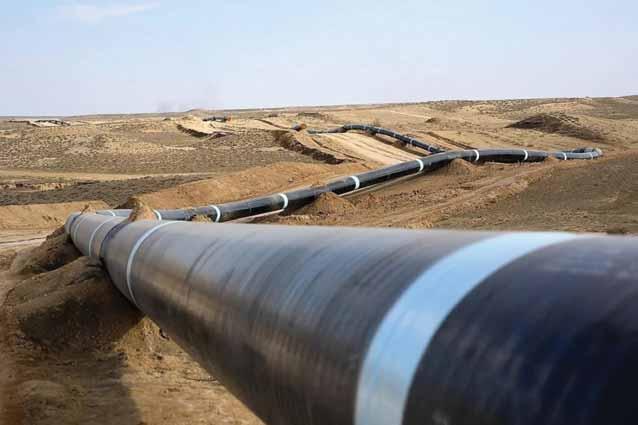
SOCAR has taken over operatorship of the Baku-TbilisiCeyhan (BTC) oil pipeline from BP, effective 1 July 2026, Azerbaijani news agency APA reports. The change is being implemented through SOCAR Midstream Operations (SMO), a subsidiary of SOCAR, and covers all three sections of the BTC pipeline in Azerbaijan, Georgia and Türkiye.
The transfer also includes management of joint BTC and South Caucasus Pipeline (SCP) operations previously handled by BP.
The Sangachal terminal remains under
BP operatorship, while all other BTCrelated operational responsibilities have been handed over to SOCAR. The pipeline’s shareholding structure remains unchanged.
The companies said the transition is in line with existing project agreements and followed a final readiness decision by BTC Co., aimed at ensuring a safe and orderly handover of operations.
“Today’s announcement marks an important milestone for the BTC project,” said Gio Cristofoli, BP’s regional president for the Caspian, Central Asia and Türkiye. “We are confident that SOCAR will uphold the same high standards of safety, reliability and operational excellence.”
SOCAR President Rovshan Najaf said the takeover reflects the company’s grow-
ing experience in managing major energy infrastructure and reaffirmed BTC’s role as a key regional and global energy corridor.
BP will remain a shareholder in BTC and SCP and continues to operate major upstream projects in the Caspian, including Azeri-Chirag-Gunashli and Shah Deniz.
Earlier, under related agreements, Western Route Export Pipeline (WREP) facilities in Azerbaijan and Georgia were transferred in June 2026 to entities acting on behalf of the governments of Azerbaijan and Georgia.
The 1,768-kilometer BTC pipeline, which has a capacity of around 1 million barrels per day, has transported more than 4.7 billion barrels of crude oil since it began operations in 2006.
Georgia, Kazakhstan Sign Tourism, IT Cooperation Deals, Upgrade Ties to Strategic Partnership
of new railway sections or bypass lines may also be considered,” the mayor stated.
He explained that the selected consulting company will carry out a detailed technical and economic feasibility study to identify the best options for developing the railway corridor across the Tbilisi metropolitan area.
The study will also assess the project’s environmental, social, and financial aspects.
The Transport and Urban Development Agency of Tbilisi City Hall will oversee the research process, technical supervision, and coordination.
Kaladze noted that the winning bidder will be selected following the tender process, after which the feasibility study will begin.
“Once the study is completed, we will have a comprehensive picture of how the project should be implemented and what steps should be taken,” he added.
The mayor said the railway corridor project forms part of Tbilisi’s transport development plan and is being financed with the support of the Asian Development Bank.
BY LANA KOKAIA
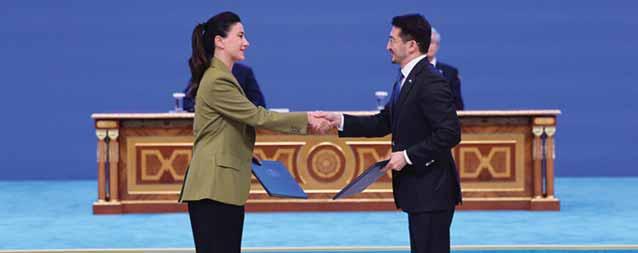
Mariam Kvrivishvili, Minister of Economy and Sustainable Development, has signed memorandums of understanding on cooperation in tourism and information technology with Kazakhstan, following expandedformat talks between government delegations.
The Memorandum of Understanding on tourism cooperation aims to deepen bilateral collaboration, develop joint initiatives, and share tourism products and professional expertise, with the goal of strengthening tourism potential and increasing tourist flows between the two countries.
The Memorandum of Understanding on information technology cooperation covers the development of the digital economy, public digital services, and digital learning between Georgia and Kazakhstan. It also supports net-
working between Georgian and Kazakh startups and IT companies.
On behalf of Kazakhstan, Erbol Myrzabosynov, Minister of Tourism and Sports, and Jaslan Madiyev, Minister of Digital Development, Innovations and Aerospace Industry, signed the documents.
The visit also saw Georgia and Kazakhstan elevate their relations to a strategic partnership level, with the joint declaration signed by Prime Minister Irakli Kobakhidze and Kazakh President Kassym-Jomart Tokayev.
Train. Source: Georgian Railway
Pipeline.
Source: Report.az
Mariam Kvrivishvili signs Memorandums of Understanding to deepen Georgia-Kazakhstan cooperation. Source: Ministry of Economy
ARCHI and NEXT Announce a $300 mln Landmark Development on the Black Sea Coast
BY TEAM GT
In an unprecedented move for Georgia's real estate and tourism sectors, the country’s leading property giants have joined forces to launch a landmark project that will permanently reshape the Black Sea coastline. ARCHI, Georgia's leading development company, and NEXT, the country's pioneer of international development, have announced a strategic partnership to deliver the Kobuleti Beach Resort.
Representing a $300 million investment property in Georgia, this landmark firstline development is set to redefine Kobuleti's premium real estate landscape.
Combining the expertise of Georgia's two leading development companies, the project establishes a new benchmark for quality, innovation, and sustainable regional growth.
As part of the development, Swissôtel will operate a full-service hotel within one section of the complex, bringing internationally recognized hospitality standards to the destination while creating significant opportunities for investors and contributing to the city's longterm economic development.
A STAR-STUDDED LAUNCH EVENT
To celebrate the official commencement of this historic project, a high-profile presentation and groundbreaking ceremony took place directly at the beachfront site in Kobuleti on June 3, 2026. The gathering brought together leading figures from Georgia’s[a] political and economic sectors, reflecting the immense national and regional significance of the development.
The event was attended and addressed by the Prime Minister of Georgia, Irakli Kobakhidze; the Minister of Economy and Sustainable Development, Mariam Kvrivishvili; and the Chairman of the Government of the Autonomous Republic of Adjara, Zurab Pataradze. They were joined by Aron Libinson, Vice President of Operations at Accor for Georgia and the CIS region; Jan Dijkema, Director of Chapman Taylor’s Madrid studio; Ilia Tsulaia, Founder and Chairman of ARCHI; and Kakha Devadze, Founder of NEXT.
The highlight of the evening concluded with a symbolic capsule drop into the foundations, officially breaking ground on a development that will reshape the rules of regional tourism.
WHEN INDUSTRY GIANTS ALIGN
What makes this project truly unique is the alignment of its founders. Never before have two of Georgia's largest, most influential developers combined forces on this scale.
ARCHI brings its unmatched local market dominance, holding a substantial share of the domestic market and strong community trust. NEXT contributes its extensive international footprint and unique multi-continental resort experience, spanning high-end developments across Georgia, Dubai, Spain, and Kenya.
“As a market leader, it is important for ARCHI that every new initiative establishes a new standard in the country, creates additional jobs, and significantly contributes to economic development,” stated ARCHI Chairman Ilia Tsulaia.
Kakha Devadze, founder of NEXT, echoed this vision, adding, "We believe this project will completely transform Kobuleti’s investment climate and establish it as a new point of attraction in the region."
TRANSFORMING ADJARA’S TOURISM LANDSCAPE
For decades, Kobuleti has been cherished as a traditional, seasonal summer town. The arrival of world-class mega-brands like ARCHI and Next serves as a major catalyst for change. It signals to the global market that Kobuleti is stepping onto the international stage as a sophisticated, "Four-Season Ecosystem" capable of attracting top-tier global travelers yearround.
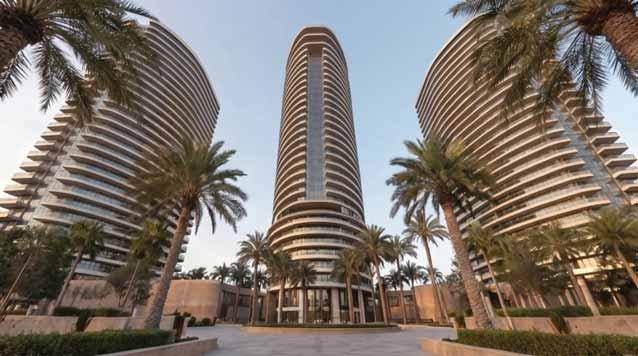
The architectural identity of the complex is shaped by the legendary international architecture firm Chapman Taylor. Inspired by the fluid motion of the coast, the design introduces the "Three Sails" - three monumental towers rising directly from the first shoreline. This sharp silhouette gives the project its unmistakable identity while securing wide, uninterrupted ocean views from every single apartment.
DRIVING ECONOMIC GROWTH
Located just minutes away from Batumi, the development will further integrate Kobuleti into the region's largest tourism ecosystem while contributing to the balanced development of Adjara's coastal regions. The project is poised to become a major engine for the local economy, creating substantial employment opportunities during both the construction and operational phases.
With pre-sales for the residential and investment apartments now officially open, the ultimate investment window has arrived. As the "Three Sails" begin to rise on the shoreline, the Kobuleti Beach Resort stands out not just as a premium property opportunity, but as the dawn of a sophisticated new era for Georgian tourism.
‘Sapari’ Seeks to Join Investigation into Azerbaijani Woman’s Murder in Georgia
BY LANA KOKAIA
The non-governmental organization ‘Sapari’ is looking to join the investigation into the murder of an Azerbaijani woman in Georgia in order to represent the victim’s family.
The organization’s chair, Baia Pataraia, shared details of the case on social media, claiming the woman was found dead in an apartment in Tbilisi’s Varketili district and suggesting the killing was a case of suspected femicide.
Pataraia alleged that the victim’s relatives have blamed the woman for her own death, and justified the alleged killer’s actions as an attempt to restore the family’s “honor.”
‘Sapari’ has asked the Prosecutor’s Office to allow the organization to represent the victim’s sister, who lives in Azerbaijan, so it can access the case materials.
In her post, Pataraia claimed the victim, an orphan from Azerbaijan, had traveled to Georgia with her boyfriend after he promised they would live and work together. She alleged the woman was later assaulted, abandoned, and left
without money before being taken in by an Armenian woman living in Georgia.
Pataraia further claimed that a male relative later took the woman to an apartment in Varketili, saying he would help her return to Azerbaijan after the situation had calmed down.
The woman was later reported missing by her younger sister. Pataraia alleged that when the Armenian woman went to check on her, she learned neighbors had reported hearing a violent argument the previous night. Police forced entry into the apartment and found the woman dead, she wrote.
Pataraia claimed the suspected killer fled to Turkey and that a search has been launched.
She said ‘Sapari’ had formally applied to the Prosecutor’s Office to be involved in the case, adding that the organization is waiting for a decision on whether it will be allowed to represent the victim’s family.
Pataraia also alleged that the case has been described by some relatives in Azerbaijan as an “honor crime,” arguing that this increases the importance of ensuring the investigation is conducted transparently and the suspect is held accountable.
Three Arrested over Trafficking of Minors in Batumi
Ministry said.
BY LANA KOKAIA
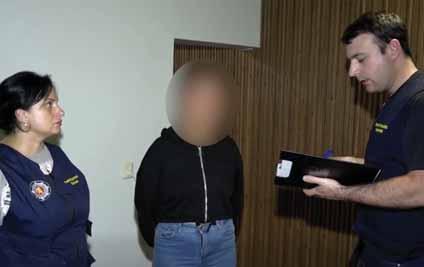
Three individuals have been arrested on charges of trafficking minors, the Ministry of Internal Affairs says.
The Ministry states that evidence gathered during the investigation suggests the defendants developed a trafficking plan aimed at obtaining material benefit.
“They recruited their materially dependent minor children, who were forced to beg for alms and sell flowers in Batumi, tourist locations, and other areas,” the
Education Minister: New Textbooks to Emphasize National Values
BY LANA KOKAIA
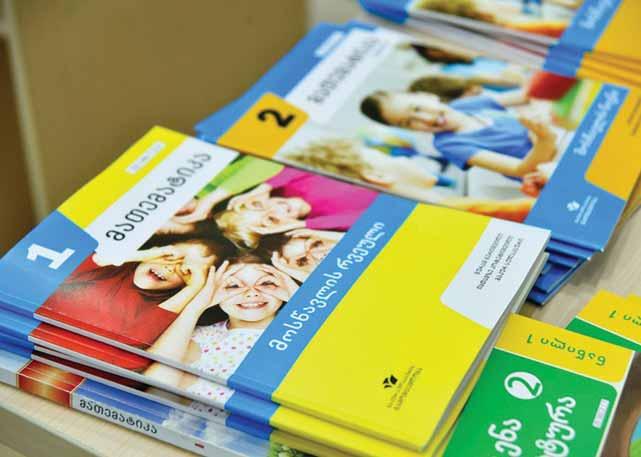
The Minister of Education of Georgia, Givi Mikanadze, says new school textbooks will place greater emphasis on national values, with covers featuring Georgian cultural and scientific achievements and the same textbooks being used in both public and private schools.
Speaking to the Georgian Public Broadcaster on June 30, Mikanadze said the redesigned textbooks will include examples of Georgia’s cultural heritage across different subjects.
“The chemistry textbook will feature Georgian winemaking, which is linked to a chemical process. The back cover explains how this 8,000-year-old tradition is recognized by UNESCO,” he said.
The physics textbook will highlight Georgian engineer Elguja Medzmariashvili’s satellite-related achievement, while the biology textbook will feature Geor-
gian grain varieties. The Georgian language and literature textbook will include references to medieval writer Ioane Zosime and The Knight in the Panther’s Skin.
Mikanadze also announced that Grade 10 students will study the history of Georgia as a separate subject, with a dedicated textbook, while world history will be taught independently.
The minister said the new textbooks will contain more than 500 illustrations of Georgian architectural monuments, museum exhibits, and other cultural treasures.
He added that the books will also include quotations from the late Catholicos-Patriarch of All Georgia, Ilia II, alongside references to writer Ilia Chavchavadze. Mikanadze described the inclusion of these materials as part of the government’s goal of integrating national values into the education system.
“The main starting point in the updated national goals of general education is the maximum integration of national
values into the educational process,” he said.
Mikanadze stated that all humanities and STEM textbooks will be replaced with new editions by September 15, 2028. He also announced that students at the same grade level will use identical textbooks in both public and private schools.
“Private schools will have to purchase these textbooks, while public schools will continue to receive them free of charge,” the minister said.
The first new textbooks will be introduced on September 15, 2026, for first, seventh, and tenth grade students.
Mikanadze said parents had expressed dissatisfaction with the current system, arguing that students who transfer between schools often face different textbooks and teaching methods for the same subject.
“This causes confusion for children and significantly reduces the effectiveness of learning. That is why we have made specific decisions regarding textbooks, and I believe we will see the results very soon,” Mikanadze added.
Guria Hosts Film Screenings on Children’s Rights as Part of EU-supported Initiative
BY LANA KOKAIA
TThe agency added that the money collected by the children was allegedly controlled by the defendants.
“In the course of the investigation, evidence obtained as a result of covert investigative activities conducted on the basis of a court ruling confirms the fact of the crime committed by the perpetrators,” the Ministry said.
Police said the minors have been transferred to state care centers, where their lives and health are no longer at risk.
The investigation is ongoing under parts 2 and 3 of Article 143 of the Criminal Code, which carries a penalty of up to 17 years in prison.
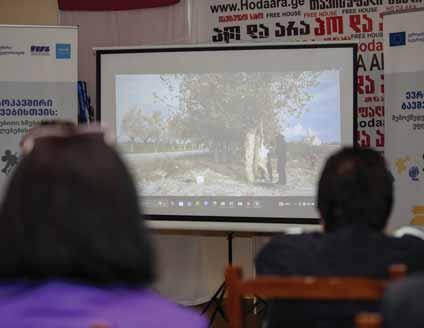
he Creative Voices for Children’s Rights initiative has continued in Guria with two new community events focused on raising awareness of children’s rights through documentary film. Viewers in Melekeduri village and Lanchkhuti town attended screenings of Elene Mikaberidze’s Blueberry Dreams and Maka Gogaladze’s As Far Back as I Can Remember, which were followed by open discussions on children’s rights, family environments, and children’s well-being.
Organizers say the program brings together literature, film and dialogue to encourage public engagement on issues affecting children. The initiative is supported by the European Union.
Baia Pataraia. Source: Radio Tavisupleba
Three arrested over trafficking of minors. Source: MIA
School textbooks. Source: Ministry of Education
Strange Season
BY TONY HANMER
Iread a Facebook post yesterday from a trekking guide based on Tusheti. He says that one of the important passes there for trekkers will be snow-closed until about August 10, if left to itself to melt; or it can be cleared in about 10 days by a determined crew, with shovels. He says the latter will be made to happen, not to worry!
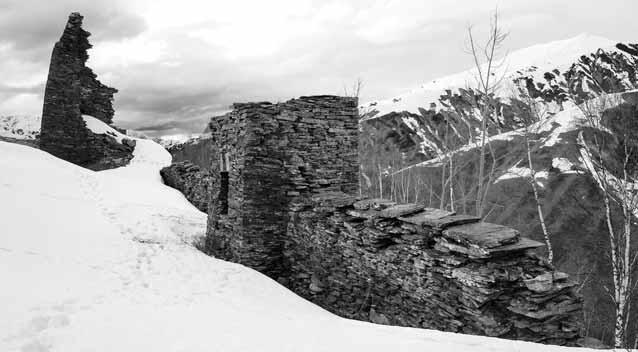
Things have been late here in Svaneti too, with several passes still bearing snow and trekkers anxiously asking about conditions on a daily basis. SOME of the passes, like from us in Etseri up and down to Mazeri (top of Becho) are open. Others, like the long and high Guli Pass
from there towards Mestia, apparently are not yet as I write this. There can be considerable slipperiness on hard-frosted morning snow, so conditions are not something to shrug off. Mountains can kill a person without noticing it, and safety on them is a thing to take seriously. “Down” can be a long, hard, fatal way away.
(Young people know they will live forever… but as I knock on 60, I feel different.)
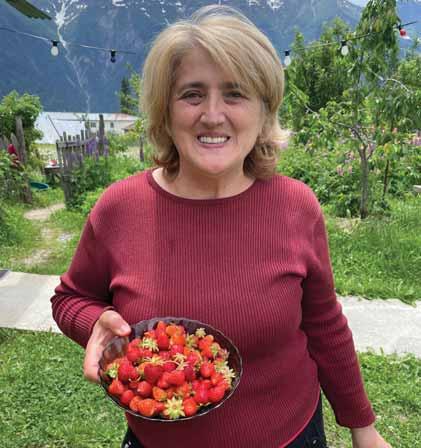
Our cherries are coming in nicely. Not so the apples or plums, which seem not to have survived late frosts on their flowers nearly so well. The pears we are hoping for, and some have appeared: I think this fruit the best of everything we grow. Although our list of useful things grown, raised or otherwise produced here on our Svanti land might be far shorter than
the 85-odd things on my in-laws’ land in Kakheti, it’s nonetheless amazing to me. (Deep breath:) Mentioned above: apples, plums, cherries, pears. Add: strawberries, raspberries, walnuts, onions, garlic, cabbages, lettuce, beans, potatoes, parsley, mint, anise, dill, mountain marjoram, pumpkins, carrots, corn, tomatoes, cucumbers, beetroot, nettles (naturally occurring) dandelions (ditto), roses, cows, chickens, a pig once, hay, and we’re at 32 things if my count is correct. Most simultaneously; a few one-off (the pig), rare (pumpkins) or gone, like all the remaining livestock. One consistent failure was hazelnuts, which we tried to import as seedlings from Zugdidi, but maybe our winters were too harsh for the type. I leave them off the numbered list for this reason. I also leave out the flowers, of which there are many, as they
CULTURE
are mostly decorative, stunning though they are.
All these things will have fortunes waxing and waning according to the weather and climate. It might be a wonder that there is time for anything to spring up here, given the short growing season. Hail can kill much of it, as we once experienced; early snow or late frost can do similar.
Then there’s our crop of tourists. Not just late because of the late-melting snow, but advance bookings down too. Maybe because Georgia is sandwiched between Russia-Ukraine and US/Israel-Iran? Not that it’s getting us down: some days in previous years have been VERY hard work, what with cooking so many dishes, setting the tables, serving, washing up and laundry. Rinse, repeat, with occasional back-to-back groups of 15-18 people. Water problems? Who, us? At least
the 1000L water tank, pump and its backup allow some peace of mind. We didn’t get many tourists from Israel, though other places did, and these numbers are definitely down over recent years.
But on July 1 (Happy Canada Day!) it IS early to say how the remainder of the tourist season will play out, in Svaneti and all over Georgia. Well, we hope, for us all all involved.
Tony Hanmer has lived in Georgia since 1999, in Svaneti since 2007, and been a weekly writer and photographer for GT since early 2011. He runs the “Svaneti Renaissance” Facebook group, now with over 2000 members, at www.facebook.com/groups/ SvanetiRenaissance/ He and his wife also run their own guest house in Etseri: www.facebook.com/hanmer.house.svaneti
Listening against the Noise: ‘The Other Gaze’ at the Tbilisi International Festival of Theater
BY IVAN NECHAEV
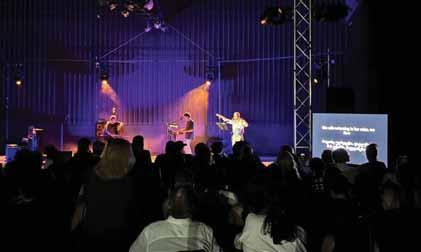
There is a growing tendency in European performing arts to dismantle the borders that once separated theater, concert and installation. Rather than asking whether a work belongs to one discipline or another, contemporary artists increasingly treat performance as a single space where sound, image and text negotiate equal rights. Greek production The Other Gaze, presented at the Tbilisi International Festival of Theater, belongs to this conversation. It is not a play accompanied by music, nor a concert supplemented with theatrical elements. It asks a different question altogether: what happens when music itself becomes dramaturgy?
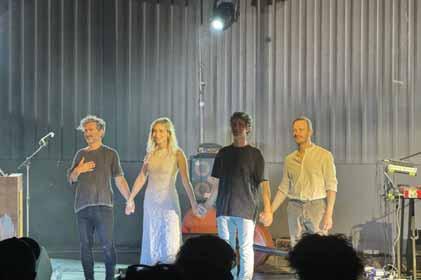
Created by the Greek duo Seeds, brothers Mihalis and Christos Kalkanis, and directed by Amalia Bennett, the 70-minute work premiered last year at the Athens Epidaurus Festival before arriving in Tbilisi. Its point of departure is deceptively simple: two brothers returning to their roots and confronting the distance between urban life and the landscapes that shaped them. Yet biography is only the surface. What unfolds is an essay on memory: how it survives, how it transforms, and how sound often preserves what language can no longer articulate. The performance resists narrative urgency. Nothing is explained too quickly, and nothing is resolved. Instead, meaning accumulates through repetition,
Photo by the author
rhythm and silence. Clarinet, double bass, piano, electronics and voice do not accompany the action; they generate it.
Musical phrases return like fragments of recollection rather than thematic motifs, allowing the audience to navigate the work emotionally before they understand it intellectually.
This inversion of theatrical priorities is perhaps the production’s strongest quality. Contemporary theater often places increasing pressure on visual invention, but The Other Gaze proceeds in the opposite direction. It trusts listening. Images remain restrained, almost deliberately secondary, while the sonic landscape assumes responsibility for movement, tension and release. The spectator is invited not so much to follow events as to inhabit an acoustic environment.
Traditional Greek song appears throughout the performance, but never as folklore presented for its own sake. Detached from ethnographic framing, these melodies enter into dialog with electronics and contemporary composition, becoming part of a living musical language rather than historical quotation. The result avoids both nostalgia and exoticism: an achievement that is rarer than it should be.
There is also something quietly political in this choice. At a time when cultural identities are frequently reduced to recognizable symbols, The Other Gaze suggests that tradition survives less through preservation than through transformation. Heritage becomes meaningful only when it remains capable of pro-
ducing new artistic forms.
The performers embody this principle with remarkable precision. The musicians never perform for the audience; they perform within the dramatic structure. The narrator’s voice is treated as another instrument, while the vocal lines move naturally between speech and song without insisting on either category. These transitions feel organic rather than demonstrative, making the boundaries between concert and theatre increasingly irrelevant as the evening unfolds. What ultimately lingers is not the story itself, but its atmosphere. The performance leaves behind a sense of having traveled through someone else’s memories without ever claiming to possess them. It is an unusually generous piece of theater, allowing spectators to complete its meanings from within their own experiences rather than directing every emotional response.
For the Tbilisi International Festival of Theater, which has increasingly embraced interdisciplinary work over the past decade, The Other Gaze feels like a natural addition rather than an exception. It reflects a broader shift in contemporary performance away from literary theater and toward forms where composition, sound and spatial perception carry as much expressive weight as text.
In the end, The Other Gaze is less interested in telling a story than in changing the way we attend to one. It reminds us that theater does not begin with dialog, or even with action. Sometimes it begins with the act of listening.
Photo by the author
Photo by the author
A New Address for Sound: Gabriadze Wonders Station Opens in Tbilisi
BY IVAN NECHAEV
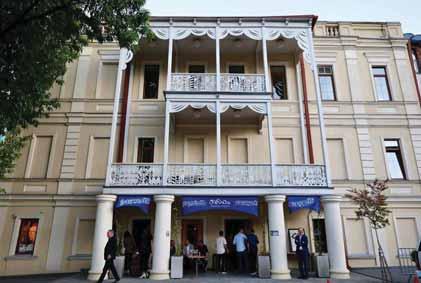
On 29 June, the day that would have marked Rezo Gabriadze’s 90th birthday, Tbilisi gained more than another concert venue. It gained a new cultural address, one that seems less interested in competing for attention than in cultivating attention itself.
Hidden within the lobby of Gabriadze’s first theater, Gabriadze Wonders Station opened with the inaugural program Music in the Theater, introducing a chamber space where concerts, conversations, archival recordings, broadcasts
and artistic encounters are expected to coexist under one roof. The project extends the poetic universe of Gabriadze beyond puppetry and visual art into a permanent home for listening.
The symbolism of the opening could hardly have been stronger. Rather than commemorating Rezo Gabriadze with a memorial ceremony, the theater chose to celebrate his birthday by creating a living institution. It is an approach consistent with Gabriadze’s own artistic philosophy: culture survives not through monuments, but through continuous creation.
The inaugural evening, aptly titled Music in the Theater, reflected this idea. Instead of treating theater music as historical material, the program allowed it to breathe again through live perfor-
hurriyetdailynews.com
BY LANA KOKAIA
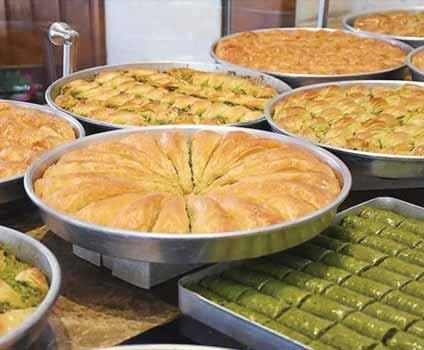
Turkey and Azerbaijan have submitted a joint application to UNESCO seeking recognition of baklava as an Intangible Cultural Heritage item, presenting the dessert as part of their shared culinary traditions. The application reportedly lists the sweet under both “baklava” and
“pakhlava,” framing it as a common cultural element between the two countries. A final decision is expected at a UNESCO committee session scheduled for November 30 to December 5 in Xiamen, China. If approved, baklava would be formally recognized as part of the shared cultural heritage of Turkey and Azerbaijan. The move comes alongside long-running international debates over the dessert’s origins. Greece also claims baklava as part of its culinary heritage, alongside Turkey and Azerbaijan.
mance, bringing together music written for Gabriadze productions alongside memorable pages from other Georgian theatrical scores. The evening suggested that music continues telling theatrical stories long after the curtain has fallen.
An additional layer of historical resonance came from the instrument itself.
At the center of the new venue stands the personal cabinet grand piano of the celebrated Georgian composer Otar Taktakishvili, restored to concert life as both a musical instrument and a witness to Georgian cultural memory. Rather than becoming a museum object, the piano returns to its original purpose: making music.
The performers represented several generations of Georgian musicians, reinforcing the venue’s mission as a meeting point rather than a monument. The opening concert featured Marika Kukhianidze, Alexey Gvamichava-Solonovich, Mariam Miminoshvili, Giorgi Hataliov, and Nika Barateli, with a special appearance by Nana Avalishvili. Together they transformed the intimate room into precisely the kind of space its founders envision: one where chamber music regains its original meaning: not simply music performed in a small room, but music experienced without distance.
According to the concept presented for the project, Gabriadze Wonders Station will host chamber concerts, creative evenings, recordings, archival projects and cultural dialogs, becoming a permanent platform for both established artists and emerging voices. In an era increasingly dominated by large festivals and spectacle, the decision to invest in inti-
macy feels quietly radical.
Tbilisi has never lacked concert halls. What it has often lacked are spaces built around listening itself: rooms where artistic exchange can occur without amplification by scale. Gabriadze Wonders Station seems designed precisely for this purpose. It recalls an older European tradition of salons and intimate musical societies, while remaining deeply rooted in the singular imaginative world of Rezo Gabriadze.
The location itself carries symbolic weight. Long before modern Tbilisi took shape, this corner of the city served as a tram stop: a place of arrivals, departures and unexpected meetings. The creators of the project deliberately invoke that history, imagining the new venue
as another station: not for transportation, but for ideas, music and encounters. For a city whose cultural identity has always been built as much through intimate conversations as through grand institutions, the opening of Gabriadze Wonders Station may prove significant beyond its modest physical dimensions. It introduces not simply another venue, but another way of thinking about cultural infrastructure: one where preservation and innovation, memory and performance, archive and live creation coexist naturally.
Perhaps that is the most fitting tribute to Rezo Gabriadze at ninety: not nostalgia for what has been lost, but the opening of a place where new stories, and new sounds, are invited to begin.
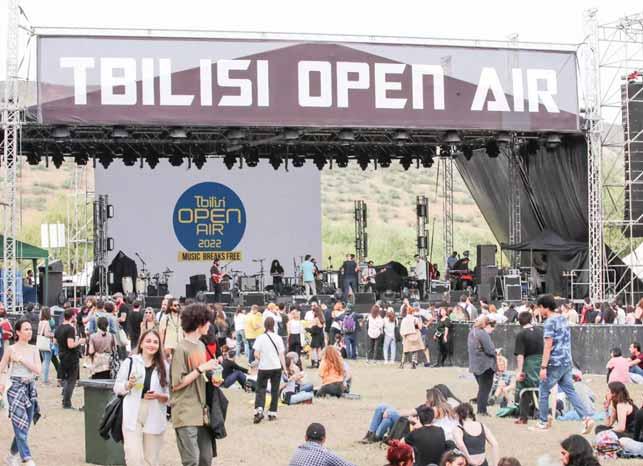
Tbilisi Open Air 2026 to Open 15th Anniversary Edition on July 4
BY LANA KOKAIA
Tbilisi Open Air 2026, marking its 15th anniversary, will open its doors on July 4 at 14:00. The festival organizers say this year’s music program will be split across several stages, including Zion Garden, which is celebrating its 10th
anniversary, and the new Mzesumzira Stage, set to become a new hub for electronic music fans. The Main Stage will feature international acts including Slowdive, Hooverphonic and Molchat Doma, alongside Georgian artists. The band OCD!, winner of the Tbilisi Newcomers project, will open the program on July 4.
Organizers say the festival has evolved into a wider cultural space over the past 15 years, offering more than music.
A dedicated football zone will screen World Cup round of 16 matches, while a Supernatural Natural Wine Festival will showcase Georgian wineries. The program will also include the Freedom Village area with educational and entertainment activities, as well as camping, food courts, a market and other leisure spaces. Tickets are available online, while onsite sales will also be offered during the festival. Night-only tickets will also be available.
The opening. Source: FB
Inside the venue. Source: FB
Tbilisi Open Air. Source: Georgia Travel
Longevity Plus...
You cannot surprise a regular Georgian with what we call longevity. This has always been a country of the Dghegrdzeli, the longlivers, meaning those who are eighty and over. Most of them dwell in the mountainous regions of Georgia, but not exclusively; the lowlands are not devoid of human endurance and durability either. Long physical life is only one side of the story. The other, and most important, part is living a meaningful, creative life.
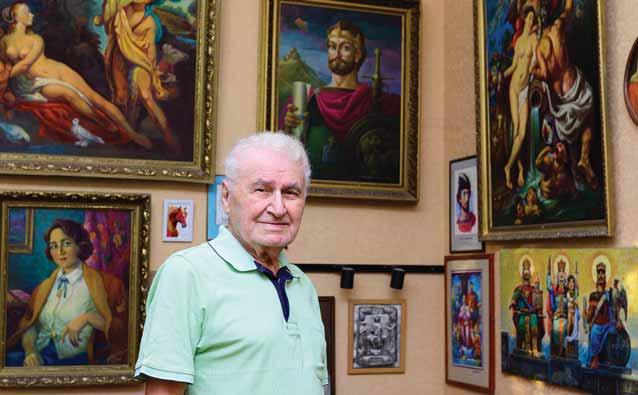
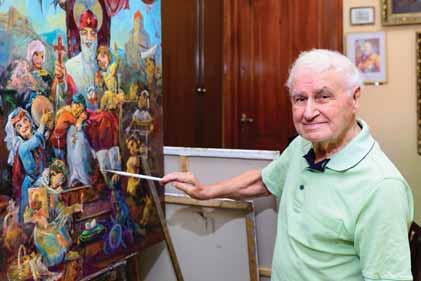
I have a story at hand about a Georgian nonagenarian, ninety-six years old, a painter, Honored Worker of Art, and winner of the Iakob Gogebashvili Prize. His beloved Sakartvelo is proud of Alexandre (Shura) Tsikhelashvili, the famous illustrator of myriad children's books, whose works have been exhibited in every Soviet republic and in numerous foreign capitals. This young old man is, into the bargain, a born musician, masterfully playing the pipe and singing with amazing vocal brilliance. Incidentally, he even attended the Tbilisi State Conservatoire to perfect his vocal abilities. His father was endowed with musical talent, and his mother was a wonderful
embroiderer, so the boy had an excellent example to follow at home. The young painter's artistic gift was always accompanied and strengthened by a thorough knowledge of Georgian, Greek, and Roman mythology, which he later drew upon in his creative life when he embarked on the demanding profession of a book illustrator.
Shura has long been interested in sports and continues to travel extensively as we speak, remaining a keen globetrotter. Alexandre Tsikhelashvili was born in the village of Savanisubani in Georgia's Khashuri District. There were seven children in the family, the dream of today's Georgia! Growing up among car-
Footballer Giorgi Chubinidze Signs Professional Contract with Premier League Club
COMMERCIAL DEPARTMENT
Commercial Director: Iva Merabishvili
Marketing Manager: Natalia Chikvaidze
EDITORIAL DEPARTMENT:
Editor-In-Chief: Katie Ruth Davies
BY LANA KOKAIA
Georgian midfielder Giorgi Chubinidze, 18, has signed his first professional contract with English Premier League club Bournemouth.
Under the deal, Chubinidze will train with the club’s second team and may be included in the first-team matchday squad at the head coach’s discretion.
“We are delighted to announce that Giorgi Chubinidze has signed his first professional contract,” Bournemouth said in a statement on Instagram.
Chubinidze joined the club’s academy in 2020 at the age of 12. He has also featured for Georgia’s U17 and U19 national youth teams.
Journalists: Ana Dumbadze
Tony Hanmer
Nugzar B. Ruhadze
Ivan Nechaev
Lana Kokaia
Layout: Misha Mchedlishvili
Photographer: Aleksei Serov
ing parents and loving siblings, the boy's artistic talent revealed itself at a very early age. Sometimes, lacking a pencil, he would use a piece of coal to draw on stones and walls.
One of the most distinguished graduates of the Tbilisi State Academy of Arts, Alexandre Tsikhelashvili has works preserved in private collections throughout Georgia and across the world. He painted two gigantic murals in the port of Salonika, Greece, depicting Alexander the Great of Macedonia triumphantly entering the city. On top of that, the famous Georgian artist contributed to the decoration of the 1980 Summer Olympic Games in Moscow.
He created an entire gallery of portraits of Georgian writers, poets, and public figures. He illustrated the works of Ilia Chavchavadze, Otia Ioseliani, masterpieces of Georgian classical literature, as well as the folk tales of many nations beyond Georgia.
The untiring artist is currently engaged in illustrating the famous Georgian epic The Knight in the Tiger's Skin by Shota Rustaveli. His life's work already includes thousands of paintings and graphic works, and he is now planning to create a monumental canvas depicting the heroic life of Ketevan Tsamebuli, Queen Ketevan the Martyr. He is undertaking this ambitious project at the request and by the official commission of the Queen Ket-
evan Society.
Carried away by yoga, Shura says he feels fit only because of this lifelong practice, which he will never abandon. He insists that he has never taken medicine or even visited a doctor. Even at his considerable age, he is both able and willing to plunge into icy water and emerge without any harm to his precious health.
Clearly optimistic and full of vigor, Tsikhelashvili adds another ingredient to the secret of his remarkable health. Exercise alone, he says, will never produce the desired results without a proper diet and a good night's sleep. Quipping that "illness is not a wolf that suddenly rushes into our lives," he believes that one simply needs to take good care of oneself in a timely and sensible manner. This is what he firmly believes, and he may well be right.
Yes, Shura's is not merely longevity. It is longevity plus, filled with vigor, talent, passion, wisdom, and an endless love for life. Aren't we fortunate to have such an example to follow?
Looking for the meaning of life? Here goes the answer. Delving into the depths of Alexandre Tsikhelashvili's existence, with all his artistic achievements and his inexhaustible human thirsts, hungers, and longings, one cannot help but believe that life truly does make sense. Yes, it certainly does.
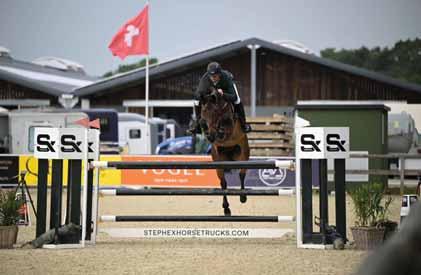
Equestrian tournament in Belgium. Source: Stephexhorsetrucks.com
Shalva Gachechiladze Wins Gold at Belgian Equestrian Tournament
BY LANA KOKAIA
Georgian rider Shalva Gachechiladze won the opening day’s competition at the CSI3 Jumping Wuustwezel international equestrian tournament in Belgium, riding his horse Lambada.
The tournament is taking place in the Belgian city of Wuustwezel and has brought together 237 horse-and-rider combinations from 37 countries.
The competition began on June 24 and will conclude on June 28.
International Relations & Communications
Sofia Bochoidze E: sbochoidze@georgiatoday.ge
Website Editor: Katie Ruth Davies
Webmaster: Sergey Gevenov
Circulation Managers: David Kerdikashvili David Djandjgava
Reproducing material, photos and advertisements without prior editorial permission is strictly forbidden. The author is responsible for all material. Rights of authors are preserved. The newspaper is registered in Mtatsminda district court. Reg. # 06/4-309
Giorgi Chubinidze. Source: AFC Bournemouth
Alexandre (Shura) Tsikhelashvili. Source: The Tsikhelashvili family BY NUGZAR B. RUHADZE