Ombudsman: Criminal Penalties for Repeat Protest Offenses Violate Constitution
"This may be Russia’s fight to the death..." – A Ukrainian soldier on the war, Russia, and Georgian fighters
PAGE 4
Parliament to Consider New Gambling Permits Targeting Foreign Players
PAGE 2 BUSINESS PAGE 6
When Ideas Become Branding: How ZEG Festival 2026 Lost the Plot
BUSINESS PAGE 7 BUSINESS PAGE 8
The Future of Helicopter Aviation and Pilot Training in Georgia
The Heritage of German Colonists in Georgia. Part 3
PAGE 9
A Window into Contemporary Georgia: New Georgian Films 2026 at DOCA Film Club
PAGE 11
Tamar Lomadze of Piel Naturals
US Publication Highlights
Georgia as ‘The Cradle of
Wine
with a Vision for the Future’
BY TEAM GT
American wine and travel publication Grape Collective has published a feature on Georgia titled “Georgia:
The Cradle of Wine with a Vision for the Future,” showcasing the country’s ancient winemaking traditions alongside its modern wine industry.
The article was produced with the involvement of the Georgian National Wine Agency’s US marketing contractor, Glodow Nead Communications.
Its author, American journalist Lisa Denning, visited Georgia in May as part of a wine tour organized with the support of the National Wine Agency. During the visit, Denning and other US media representatives attended events marking National Wine Day on May 8 and toured wineries in the regions of Kakheti and Kartli, where they explored both Georgia’s centuries-old winemaking heritage and contemporary production methods.
“In many ways, Georgia’s wine story is still being written. The world’s oldest
wine culture can best be understood not only by looking to the past, but also by considering what Georgian winemakers are doing today,” Denning writes in the article.
The feature places particular emphasis on Georgia’s traditional qvevri winemaking method, the country’s rich diversity of indigenous grape varieties, amber wines, Georgian gastronomy, and the growing international presence of Georgian wine. It also notes that UNESCO inscribed the traditional Georgian qvevri winemaking method on its Representative List of the Intangible Cultural Heritage of Humanity in 2013.
Founded in 2013, Grape Collective specializes in wine, gastronomy, and travel, with a focus on wine culture, winemakers’ stories, wine regions, and organic, biodynamic, and family-owned wineries.
The National Wine Agency announced that the publication is part of its broader efforts to promote Georgian wine internationally, increase global awareness, and support the development of wine tourism. The agency also cooperates with leading international media outlets, including CNN, CBS, Netflix, The New York Times, and Wine Enthusiast.
Russian Citizen to Lead de facto South Ossetia Following Gagloev’s
BY TEAM GT
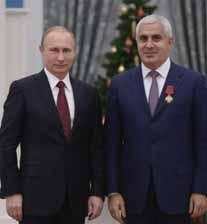
Following the resignation of de facto South Ossetian leader Alan Gagloev, the Russianoccupied region will be temporarily headed by Russian citizen Marat Kambolov, who was appointed prime minister just over a week ago.
Before taking up his post in the occupied region, Kambolov worked in the Russian government. He was nominated for the position of prime minister by Gagloev on June 8. On June 16, his candidacy was approved by the de facto parliament, and he was formally appointed head of government.
Kambolov served as prime minister for only one week before assuming the duties of the de facto president. Under the region’s de facto legislation, the prime minister automatically takes over presidential responsibilities in the event of a resignation until early elections are held.
The political reshuffle in Tskhinvali follows the signing of an agreement on the “deepening of allied cooperation” between Moscow and the de facto authorities on May 9. The agreement allows Russian citizens
Georgian Airways Launches TbilisiBatumi Flights Four Times a Week
BY LANA KOKAIA
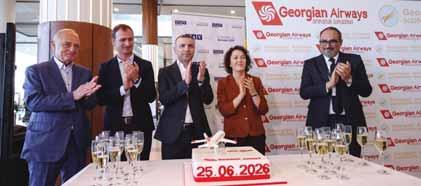
Georgian Airways has launched regular flights between Tbilisi and Batumi International Airports for summer 2026.
The airline will offer flights between Tbilisi and Batumi four times a week during the summer navigation season. Services are scheduled for Tuesdays, Thursdays, Saturdays, and Sundays.
A symbolic event marking the launch of the route was held at Tbilisi International Airport ahead of the inaugural flight.
Ombudsman: Criminal Penalties for Repeat Protest Offenses Violate Constitution
BY LANA KOKAIA
The Public Defender of Georgia, Levan Ioseliani, defended his constitutional challenge against a series of protest-related laws adopted by the ruling Georgian Dream party during his annual report to Parliament.
Responding to a question from a Georgian Dream MP, Ioseliani argued that imposing criminal liability for repeat administrative offenses, such as block-
ing a road during a protest, is disproportionate and unconstitutional.
“Why is it restrictive? An administrative offense, which in its essence is not of a criminal nature, becomes a criminal offense if repeated,” said the Ombudsman. “It’s the same as if you run a traffic light once, receive a fine and pay it, and then face criminal liability for doing it a second time. That’s why I appealed to the Constitutional Court.”
Ioseliani said he had personally reviewed cases involving fines imposed under the new regulations and had seen instances where individuals were punished despite not violating the law.
“I saw with my own eyes that a person who was simply standing on the sidewalk and not violating anything was imposed this fine,” he said.
The Ombudsman also criticized the size of the administrative penalties introduced under the legislation.
“Within the framework of a peaceful protest, I believe that such regulations are excessively strict, including the 5,000 GEL fine,” he said. “Given the average income of a citizen of Georgia, 5,000 GEL is quite high.”
Over the past two years, Georgian Dream has adopted a number of laws that critics say restrict freedom of expression, protest rights, and the activities of independent media and civil society organizations. Ioseliani believes some of these measures contradict the Constitution and has challenged them before the Constitutional Court.
Recent amendments adopted by the ruling party include a ban on wearing masks and using lasers at protests. Violations can result in administrative detention of up to 15 days, while repeat offenses may lead to criminal prosecution and a prison sentence of up to one year.
The legislation also introduced the same penalties for obstructing traffic on roads and sidewalks during demonstrations.
12 More Defendants in ‘Peaceful Overthrow’ Case Accept Plea Deals,
to Serve One Year in Prison
Resignation
to hold political positions in the occupied region, marking a further step in the integration of South Ossetia with Russia. Critics say the arrangement deepens Moscow’s influence over the region and further undermines its already limited autonomy.
South Ossetia remains internationally recognized as part of Georgia, despite being under Russian occupation since the 2008 Russia–Georgia war. Most countries and international organizations continue to recognize Georgia’s territorial integrity within its internationally recognized borders.
BY TEAM GT
Twelve more defendants charged in Georgia’s socalled “peaceful overthrow” case linked to the October 4 protests have accepted plea agreements, under which they will serve one year in prison followed by three years of probation.
The deal differs from agreements previously reached with 22 other convicted individuals in the same case, who were released under different terms.
During a court hearing, Judge Tamar Makharoblidze asked each of the 12 defendants individually whether they admitted guilt and wished to enter into plea agreements. All answered in the affirmative.
One defendant, Manuchar Mikeladze, had initially been expected to join the plea deal but withdrew his consent before the hearing began. Following his decision, another defendant, Giorgi Kirvalidze, also attempted to withdraw from the agreement and shouted an insult directed at Bidzina Ivanishvili in the courtroom.
Kirvalidze was removed from the courtroom. However, the plea agreement remained valid because his remarks came after the judge had already approved the deal. Mikeladze, who rejected the agreement, was sentenced to five years in prison.
“I am not guilty. The guilty one is the person who is depriving this country of its future. I will pay my debt to my country, and those who serve this system and act as its cogs should be ashamed. He is destroying your careers too and will sacrifice everyone, just as those arrested on corruption charges were sacrificed.
Think about it,” Mikeladze told prosecutors before the verdict was announced.
Among the 12 defendants who accepted plea agreements, only Saba Kordzaia will spend more time in prison. Prosecutors say he had previously been sentenced in a separate case, meaning that part of his earlier sentence was added to the new one. As a result, Kordzaia will serve a total of one year and six months behind bars.
The other defendants who accepted plea deals are Simon Makharadze, Kakhaber Kvachantiradze, Gia Toloraia, Mikheil Toloraia, Avtandil Topchishvili, Yuri Lomidze, Davit Giunashvili, Giorgi Talakhadze, Beka Machavariani, Giorgi Kirvalidze and Koba Epitashvili.
Kirvalidze’s lawyer, Boris Chele kurua, described the plea agreements as a political move by the prosecution and questioned the basis on which the terms were offered.
“Anyone who still hopes to receive a fair decision from this court, may God help them. No one but God can help; a lawyer is powerless here. If someone thinks being in prison is worthwhile, they can easily end up there themselves in this country: committing a crime is
not even necessary,” he said.
The lawyer also criticized the evidence presented by the prosecution, arguing that witness testimony and video footage failed to conclusively identify his client.
The criminal proceedings stem from events that unfolded during a large opposition protest in Tbilisi on October 4.
On that day, a significant portion of opposition parties and their supporters boycotted local elections and gathered at Liberty Square, calling for what they described as the “peaceful overthrow” of the government.
Following the mass rally, a group of demonstrators attempted to symbolically “take possession of the keys to the presidential palace.” The protest escalated when participants breached barriers near the presidential residence on Atoneli Street and clashed with riot police.
The Georgian authorities subsequently launched a large-scale criminal investigation, accusing participants of involvement in organized violence and actions aimed at overthrowing the constitutional order. Critics of the prosecution, including opposition figures and human rights advocates, have argued that the case is politically motivated and represents an attempt to suppress anti-government protests.
A total of 64 people were charged in connection with the October 4 events, making it one of the largest criminal cases arising from Georgia’s recent wave of political demonstrations.
Levan Ioseliani. Photo: Parliament of Georgia.
Georgian Airways launches Tbilisi-Batumi flights. Source: TAV Georgia
The new service is expected to improve domestic connectivity and provide travelers with an additional transportation option between Georgia’s capital and the Black Sea coastal city during the busy summer season.
Putin with by Marat Kambolov
Ukraine Latest: Russian Citizens Are Feeling the Fuel Squeeze
COMPILED BY ANA DUMBADZE
The war in Ukraine entered another week shaped less by dramatic breakthroughs and more by a widening struggle to wear the opponent down. Russia continued to push forward in limited areas along the front, while Ukraine intensified its campaign against Russian logistics, energy facilities, and military infrastructure far beyond the battlefield.
While the main battle remains in eastern Ukraine, both sides are increasingly focused on weakening each other's ability to sustain the war through strikes on fuel supplies, railways, power networks, drone production facilities, and command infrastructure.
On the battlefield, Russian forces maintained offensive operations along several axes, particularly in Donetsk Oblast. The heaviest pressure remained around the Pokrovsk, Kostyantynivka, Toretsk, and Lyman directions. Monitoring groups reported that Russia achieved limited territorial gains during the week, although at a much slower pace than Moscow's claims of growing operational momentum might suggest.
According to Russia Matters, citing battlefield mapping data, Russian forces captured approximately 10 square miles of Ukrainian territory during the week of June 16–23, following gains of seven square miles the previous week. At the same time, Ukrainian forces were assessed to have recaptured small areas, while Ukraine's foothold inside Russia's Kursk and Belgorod regions remained largely unchanged.
The Pokrovsk sector continued to be one of the most important areas of the war. Russian troops launched further attacks there on June 23 and 24, but battlefield assessments found no confirmed advances on those days. The sector remains strategically significant because
of its road and rail connections and because Russian pressure there is linked to Moscow's broader objective of capturing the remainder of Donetsk Oblast and pushing deeper into Ukrainian defensive positions.
Further north and east, Russian forces continued offensive operations near Lyman and Toretsk while also pressing attacks in parts of the Sumy and Kharkiv regions. Russian attacks also caused power outages across Donetsk, Kherson, Sumy, Kharkiv, Mykolaiv, Chernihiv, and Zaporizhzhia oblasts.
These attacks reflect a familiar Russian pattern: applying pressure along the front through infantry assaults and glide-bomb strikes while simultaneously targeting civilian and energy infrastructure to strain Ukraine's air defenses and emergency services.
Civilian casualties once again marked the week.
On June 23, a Russian missile strike on Kryvyi Rih killed three people and injured 25 others, according to Ukrainian officials. The attack reportedly involved a ballistic missile fitted with a clustermunition warhead and struck a civilian area, leading local authorities to declare a day of mourning.
In Sumy region, a Russian drone strike on a family home killed three people, including a 13-year-old boy, and injured others. Additional attacks in the Sumy, Kherson, and Poltava regions also killed and wounded civilians, including children.
Ukraine, meanwhile, significantly expanded its long-range strike campaign against Russian energy and militarysupport infrastructure. Ukrainian forces struck the Orenburg Gas Processing Plant, one of Russia's largest gas-processing facilities and home to the country's only helium plant, reportedly setting parts of the complex on fire.
Kyiv also reported strikes against satellite communications facilities, including the Dubna Space Communications Center near Moscow and another installation in
the Vladimir region. These operations formed part of Ukraine's broader effort to degrade Russia's war-making capacity by targeting infrastructure used for command, communications, fuel distribution, and military production.
President Volodymyr Zelensky told reporters on June 24 that communications equipment which Ukraine said had been supporting Russian drone strikes from Belarusian territory had ceased operating. The development came days after Zelensky issued an ultimatum to Belarusian ruler Alexander Lukashenko, warning that Belarus had one week to remove the equipment or face unspecified action from Ukraine.
The campaign against Russian fuel infrastructure continued to produce increasingly visible effects. Industry sources told Reuters that Moscow's oil refinery, the largest fuel supplier to the Moscow region, is expected to remain offline for at least six months after suffering extensive damage in Ukrainian drone attacks. The refinery, located on the southern outskirts of the Russian capital, was struck twice this month, forcing it to halt operations.
The wider impact is now being felt across Russia's domestic fuel market. Bloomberg reported that "Russia has recorded its largest weekly increase in gasoline prices in 20 years. The surge, along with fuel shortages and panic on the market, was triggered by successful Ukrainian drone strikes on oil refineries." According to Russia's Federal Statistics Service, average gasoline prices rose by 3 percent in just one week, from June 16 to June 22, reaching 71.20 rubles ($0.95) per liter. This marked the largest weekly increase in domestic fuel prices since at least 2006, while diesel prices rose by 2.7 percent.
The fuel squeeze has become serious enough that Russia is reportedly in talks with Kazakhstan to import approximately 50,000 metric tons of AI-92 gasoline to ease domestic shortages caused by refinery outages and unscheduled repairs.
Reuters reported that shutdowns at several large refineries in central Russia following Ukrainian drone attacks have reduced gasoline output by roughly 25 percent year-on-year as of late June.
Crimea became another major focus of Ukrainian operations this week. Ukrainian strikes targeted power infrastructure in Sevastopol and disrupted electricity supplies in parts of the occupied peninsula. Kyiv also attacked transportation and logistics links, including a railway bridge used to move military supplies. Russian-installed authorities reportedly suspended civilian gasoline sales and cancelled some public events and summer activities as pressure on the peninsula intensified.
Russia responded with continued largescale drone and missile attacks across Ukraine.
Recent waves targeted civilian areas, energy facilities, railway infrastructure, and industrial sites. Ukrainian officials reported damage to electrical systems and power outages in multiple regions, while railway workers and emergency responders were among those killed or injured.
Russia's air campaign has become one of the defining features of the war in 2026. Moscow increasingly relies on drones, missiles, and glide bombs to compensate for the slow pace of ground advances. Ukrainian air defenses remain under significant strain, particularly as Russia launches mixed attacks designed to overwhelm interception systems through sheer volume and complexity.
On the diplomatic front, there were no visible signs of a breakthrough.
Ukrainian President Volodymyr Zelensky continued to argue that Russia would only negotiate seriously if the costs of continuing the war increased. He also stated that Ukraine would carry out preemptive strikes against facilities supporting Russia's military operations.
Moscow, meanwhile, continued to reject ceasefire proposals that fall short of its maximalist demands. The result remains
a familiar but increasingly dangerous stalemate, with diplomatic discussions continuing while military activity intensifies.
Deputy Chairman of Russia's Security Council Dmitry Medvedev, during the St. Petersburg International Legal Forum, argued that "Western countries used Georgia against Russia in 2008, but they did not satisfy their bloodlust, and they learned from their mistakes." He added that "whether Western countries like Russia, Iran, or any other country does not matter to us. However, the threat of a global war as a result of such provocative actions increases dramatically. It is important to curb the destructive ambitions of Western opponents and restore the balance of power in the world."
The remarks echoed Moscow's longstanding narrative that the conflict forms part of a wider confrontation with the West rather than a purely bilateral war between Russia and Ukraine.
International support for Ukraine remained active this week, particularly from Europe. European Commission
President Ursula von der Leyen announced that "Ukraine has received €3.2 billion as the first disbursement under the EU's €90 billion support loan." According to von der Leyen, the funds will help cover Kyiv's budgetary shortfalls and ensure financial stability as the war continues.
A second disbursement, worth approximately €6 billion and dedicated to expanding Ukraine's drone-production capabilities, is expected to be unveiled in the coming days. The EU has also continued urging member states to maintain bilateral support and help close Ukraine's remaining financing gaps. NATO continues to coordinate military assistance from allies and partners, including air-defense systems, ammunition, and other critical support. Air defense remains Kyiv's most urgent requirement after another week of sustained Russian missile and drone attacks against Ukrainian cities.
"This may be Russia’s fight to the death..." – A Ukrainian soldier
on the war, Russia, and Georgian fighters
BY VAZHA TAVBERIDZE FOR RFERL
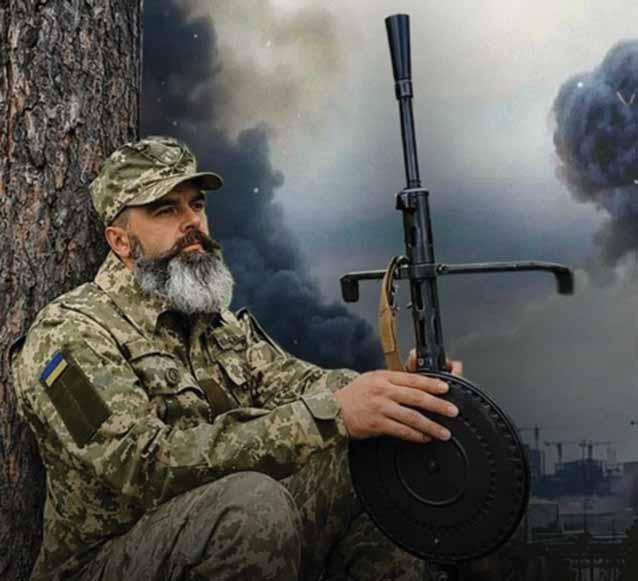
As a soldier who’s been fighting against Russian aggression for years, I was not at all surprised by their bombing of the Kyiv Lavra. I knew it was only a matter of time, - 38-year-old Ukraiinian soldier, battalion chief ser geant Alexander Monchak, tells Radio Free Europe's Georgian Service.
“Let’s look at history: in 1941, during World War II, when Nazi Germany occupied Kyiv, the Soviet government blew up the Assumption Cathedral, which had been mined in advance by the Soviet security service (NKVD), on November 3. The explosion leveled the building to the ground. The Soviet regime blamed the Nazi forces for the incident in order to cover up the damage, although the real facts confirm that the explosion was planned by the Soviets. But the Soviet Union was still godless, and the Russians, if you believe it, are the first Christians... For the Ukrainian military, Putin is nothing more than a wretched, evil and complexed ruler who dreams of the return of the Soviet Union.”
Sergeant Monchak, who is also responsible for the combat training of soldiers in his unit and taking care of the morale of the personnel asks: “How can Putin and the Patriarch of Russia say they believe in God when children are dying every day because of them?! For them, for the Russian world, the only true religion is what is said and written in Moscow. Everything else that is not written in Russian, be it prayers, faith, the Gospel or icons, is dangerous for them. They are behaving like the Islamic State, which, unable to assimilate a culture with a thousand-year history, destroyed it...” Radio Liberty, wanting to hear the opinions of a soldier directly involved
Georgians are very brave and very proud fighters. They defend their positions with their teeth
in the fighting about the Russia-Ukraine war, went on to discuss with him the current situation in the Kharkiv and Donbas areas, the importance of Western military assistance, modern warfare transformed by drones, long-range strikes against Russia, and Georgian volunteers fighting on the side of Ukraine.
WHAT’S YOUR TYPICAL DAY LIKE AT THE FRONT?
If you manage to open your eyes in the morning, the day has already begun. From that moment, it's time to carry out whatever tasks have been assigned: delivering ammunition, maneuvering if you've been sent on a mission, or defending positions if you haven't.
Coffee is incredibly valuable. I don't smoke myself, but for many soldiers, a new day truly begins with a cup of coffee and a cigarette. If you've had your coffee, it means you're alive, healthy, and strong enough to keep moving forward and defending your country. The day might start at two in the morning, but it still starts with coffee.
Honestly, I'm surprised that no major coffee brand has thought of making a commercial with Ukrainian soldiers. Where could you find better publicity than this? These people are living through real hell, yet coffee helps them endure, keep going, and overcome the obstacles in front of them.
HOW WOULD YOU DESCRIBE THE CURRENT SITUATION ON THE FRONT?
If you mean our section, the Kharkov direction, the situation is difficult, but controllable. If we talk about the entire front, I’d also characterize it as difficult, but stable and controllable.
IN WHICH AREAS IS THE PRESSURE THE STRONGEST NOW?
On the Donbas. As I understand it, this is related to Putin's order to seize the Donetsk region as quickly as possible, because that's what he promised Trump. It’s the Donetsk direction that remains the most difficult for us.
DO YOU THINK THEY’LL BE ABLE TO TAKE IT?
The deadlines that Putin set for his troops to achieve this goal have long passed. Now everything is a matter of time and endurance. Western assistance will also be crucial. Any delay in the supply of weapons gives the Russians the opportunity to advance. Although we already produce many things ourselves, domestically, we are still critically dependent on Western assistance. Now Europe has taken on the main burden. However, there are still problems with certain types of weapons that are extremely necessary for us.
We are facing a serious shortage of artillery shells. There is also a major problem with the supply of HIMARS missiles, and we lack ammunition for
We're glad that the time for revenge has finally come, that we're paying back the debt we owe to the Russians
mortars as well. I’d like to see the range of missile weapons available to our aviation expanded because, frankly, Ukrainian aircraft are only present on our section of the front to a very limited extent. I’d like our planes to fly more often and drop more interesting things on the Russians. Because they are dropping bombs (guided aerial bombs) on us almost every day. At least in this direction, we want to achieve some parity.
WHAT PREVENTS THE WEST FROM DOING MORE FOR UKRAINE?
The fact that some of our Western allies still haven't understood how big a threat Russia is. Many in the West still hope that Russia will "solve" Ukraine, that everything will be over, and then it’ll be possible to trade with the Russians again and make mutually beneficial deals.
But I don't understand Europe, the Europe that went through two huge wars with Russia's participation and after both saw its true face. Russia is greedy, aggressive, it doesn't perceive the West as an equal. It puts itself above them and constantly tries to dominate.
There was a time when we were fighting the Mongol-Tatars. Europe didn't help us then. They passed us by, and then the Mongols went to Europe.
Today's Russia is the Mongolian horde of the 21st century. May the real Mongols forgive me. But the logic is the same: they believe they are always right, that they have the right to everything, they are convinced that they are doing everything right.
TODAY'S WAR IS OFTEN CALLED THE DRONE WAR. HOW HAS THE ADVENT OF UNMANNED AERIAL VEHICLES AFFECTED THE DAILY REALITY ON THE FRONT LINES?
Drones have transformed both the front and the nature of war itself. Drones have forced both sides to retreat into the trenches, to rethink logistics, to make decisions and act more quickly.
If we compare 2022-2023, drones have radically changed the configuration of the front. The so-called "gray zone" has significantly expanded, where neither we nor the enemy "can raise their heads above the ground."
This zone stretched about twenty kilometers from the front line. This seriously complicated logistics for both sides.
Many units have become much more autonomous. We have to do a lot of our supply at night, choosing specific time windows when it's relatively safe.
Now we’re betting on robotic complexes that can automatically deliver ammunition and water, as well as evacuate the wounded.
I think all these trends indicate that we’ll go deeper underground, build underground positions, increase the number of robotic systems, and strengthen long-range strikes and reconnaissance capabilities.
Unfortunately, I think the war will continue. It won't end this year, maybe not even next year. The stakes are too high for that.
But many military men have the feeling that Russia is already approaching the limits of its capabilities. That we’re now witnessing a kind of death agony. We’re expecting strong, painful blows. We understand that this may be their fight to the death.
HOW DO THE MILITARY ASSESS THE INCREASINGLY FREQUENT LONG-RANGE STRIKES ON RUSSIAN TERRITORY? HAS MORALE IMPROVED?
Of course, we’re glad that the time for revenge has finally come, that we’re paying back the debt to the Russians. We endured these blows throughout 2022, 2023, and a good part of 2024, with virtually nothing to respond to. Now we’ve returned the war to where it came from.
Russian cities have already felt the effects of the war. Russians have seen that Ukrainians are not the kind of guys you can tax and be submissive to. We’ve shown that we can respond. It’s good that we’ve learned to deal serious blows to Russia's military and energy infrastructure.
It would be good if the Russians also spent the winter without light, water, and heating. Let them see what it's like and realize: we are not to blame for this. We’re only returning what they’ve been doing to us all these years: four years of full-scale war and twelve years of aggression.
Many of our guys are ready to eat less, receive less pay, but Russia will suffer greater damage and become even weaker.
HOW WOULD YOU ASSESS THE GEORGIAN VOLUNTEERS WHO ARE FIGHTING ON THE SIDE OF UKRAINE?
They’re very good fighters. Previously, several Georgian units fought directly next to us, but then they were transferred to another direction.
They are very brave and very proud fighters. They defend their positions with their teeth.
But if they see any kind of neglect, or anything they perceive as underestimation, they take it badly. For example, they take up a position, and then you go and tell them: friends, you need to move from here, another unit will be stationed here. They immediately think they’re being moved because you thought they couldn’t cope with the task. The famous Caucasian pride immediately awakens: “What, we couldn’t do it ourselves?”
Then you have to explain that that’s not the case at all, that they are doing their job perfectly, it's just that the command has other plans.
Georgians perceive such things very emotionally. They think that someone is taking away their share of the future victory, and of course, that's not the case. They are helping Ukraine a lot and we are infinitely grateful for that. I’d like to thank all our friends from Georgia, from the entire Caucasus, everyone who is fighting for Ukraine. You’re doing a lot for us. You’re not allowing us Ukrainians to give up. When we see that you’re standing by our side in the war with Russia, we understand that we have no right to retreat, to give up, to say that we are tired.
Alexander Monchak. Source: RFERL
Truths & Lies about Wars
OP-ED BY NUGZAR B. RUHADZE
Should brothers in blood and faith, like Russians and Ukrainians, have eliminated each other so unwisely and relentlessly?
Couldn’t they have done otherwise, in some civilized fashion, without mutually annihilating so many happy and healthy young lives?
Conceivably, yes, but they couldn’t help succumbing to ever-raging geopolitical and psychological warfare, which upset human minds and eventually affected their subsequent decisions.
We will, imaginably, never know what kind of malicious layers of negative emotions, historical anger, political rancor, and acrimonious propaganda are buried at the bottom of the decisions made by seemingly regular humans.
Isn’t it obvious that the war in Ukraine is not just a plain military conflict?
It is also an unremitting information war, and this is where our journalistic input might have some weight to throw in: governments, media systems, intelligence agencies, influencers, Telegram channels, bots, and AI-generated content; all of these contend to shape public opinion and the prevailing perception of reality in general.
And we, the ladies and gentlemen of the press, as well as political scientists, are part of it.
Why are all of us lying so flagrantly?
Now, would it be wise to ask the question: is anybody at all telling the truth?
I’d rather say no, because if we don’t know exactly which facts are subject to independent verification, then the entire effort to be fair and objective goes down the tubes.
To put it another way, we need to know where those different sources of information agree and where they disagree.
Where can we find the key to open those firmly locked doors of fact-finding and fact-checking?
Nothing, nothing in the world is clear about this senseless war.
It is so heartbreaking to be a frustrated journalist, feeling miserable because you are footballed from one contradictory comment to another, having no idea what facts they are relying on.
Some things sound very likely true, but it is almost dreadful to put your morally pristine signature beneath them.
Here is what the universally recognized and widely corroborated facts are saying:
Russia launched a full-scale invasion of Ukraine in February 2022, a credible fact without any reason to doubt; hundreds of thousands have been killed or wounded on both sides, very true; both Russia and Ukraine use propaganda and selective reporting, which goes without saying; Western media also frame the conflict through geopolitical interests and emotional narratives, hard not to agree; Russian state media systematically justify the war and control internal narratives, really?
Ukraine withholds or shapes information for morale and wartime strategy, of course; AI-generated fake videos, manipulated clips, staged narratives, and coordinated online campaigns are becoming widespread, there you go!
That’s all, no more, no less!
All the rest, the current situation, especially on the front line, needs to be checked and rechecked sixty-five times.
Who can do that? Not me!
One important truth, though, is that any war destroys the precision of information and the lucidity of the situation,
and we all have to put up with this irritating yet unavoidable reality.
I just wonder whether there are any truthful people operating inside this foolishly irrational war who are genuinely aware of reality.
It is not rocket science to guess that governments and their allies tend to conceal information for many serious reasons, such as safeguarding military operations, keeping up morale among soldiers, holding alliances in place, preventing panic, influencing negotiations for a possible peaceful finale, and whatnot.
There is one funny side to this entire
Papuashvili Says European Parliament, PACE Resolutions Are ‘an Attack on the Idea of Georgian Statehood’
BY TEAM GT
Georgian Parliament Speaker Shalva Papuashvili has strongly criticized the latest resolutions adopted by the European Parliament and the Parliamentary Assembly of the Council of Europe, describing them as an attack on Georgia’s sovereignty and statehood.
Speaking at a briefing in parliament on June 25, Papuashvili said the two documents had “crossed the red lines established by the Georgian people” and “grossly violated the principles of Georgia’s sovereignty and national independence.”
The parliament speaker said that the European Parliament had “effectively equated itself with Russia’s occupation policy.”
“While Russia denies Georgia’s sovereignty over one-fifth of its territory, the European Parliament refuses to recognize Georgia’s sovereignty over its entire territory. It has disregarded the independence and sovereignty won by the Georgian people through struggle and sacrifice and has insulted the very idea of Georgian statehood,” Papuashvili said. He also objected to references in the European Parliament’s report linking the Georgian Orthodox Church to Russian religious networks and influence operations.
Papuashvili said this constituted the first open attack by an official European institution on the Georgian Church and insulted the religious feelings of millions of believers.
“The European Parliament’s resolution does not only oppose Georgia’s democratic institutions; it also represents the first open attack on the Georgian Church. A simultaneous attack on Georgia’s state sovereignty and the Georgian Church is, in essence, an attack on the idea of Georgian statehood,” he said.
He called on the European Commission to distance itself from what he described as the European Parliament’s “gross attack” on the Georgian Church. Papuashvili further argued that the latest Euro-
pean Parliament resolution demonstrates that “EU bureaucracy must take effective steps to restore dialogue with Georgia.” He claimed that this requires ending what he described as hostile rhetoric toward the Georgian people and the Georgian Orthodox Church, stopping “disinformation” against Georgia’s democratically elected government, fully recognizing Georgia’s state sovereignty, and strictly adhering to the fundamental principles of international law.
The comments came in response to two recent critical assessments of Georgia by European institutions.
On June 24, PACE adopted a resolution on the functioning of democratic institutions in Georgia by 83 votes to five. The resolution expressed concern over continued democratic backsliding, pressure on civil society, political opposition and independent voices, and warned that efforts to ban opposition parties and prosecute their leaders could place Georgia on the path toward one-party rule. The Assembly also questioned the authorities’ commitment to fulfilling Georgia’s obligations as a member of the Council of Europe while reaffirming its willingness to maintain dialogue with the Georgian government.
Earlier, on June 17, the European Parliament adopted its annual report on Georgia by 436 votes to 145. The report assessed the state of democracy, the rule of law and Georgia’s EU integration process, placing particular emphasis on recent political developments, restrictive legislation and the actions of the ruling authorities. It also expressed concern over democratic regression and called for measures to restore democratic standards and respect for fundamental rights.
Georgia’s delegation has had its voting rights in PACE restricted for the second consecutive year. Following that decision, the ruling Georgian Dream party suspended its participation in the Assembly. The restriction was imposed over concerns regarding the fairness and legitimacy of the October 26, 2024 parliamentary elections, reported human rights violations and the government’s decision to halt Georgia’s EU accession process.
silly war: different layers of worldwide audiences receive different versions of the truth.
Russians hear that their army and leadership are defending themselves against NATO expansionism and possible aggression; Ukrainians hear a story of national survival and an existential threat from Russia; the Western audience hears a democracy-versus-authoritarianism narrative; non-Western countries are fed information about a proxy struggle between major powers.
Against this horrible background, the wisest bottom line would probably be not to believe in the existence of abso-
lutely uncorrupted information and to somehow distinguish facts from interpretations.
So, we, the rank and file, are faced with the severe reality that we may never get a chance to possess the unadulterated truth about this monstrous war while it is still raging.
The only good news is that we can get somewhat close to what seems to be the current reality and learn how to live with it.
Well, at this point in time, that sounds tolerable enough.
I hate this conciliatory acknowledgment, though.
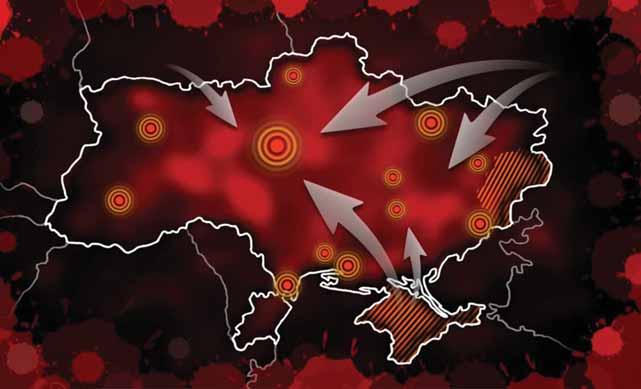
Ukraine. Source: Defense Horizon Journal
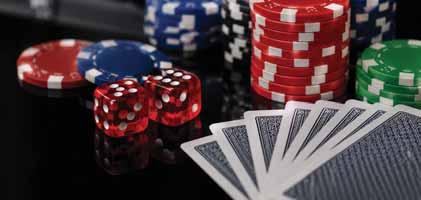
Casino games. Source: AI
Parliament to Consider New Gambling Permits Targeting Foreign Players
BY LANA KOKAIA
The Georgian government is proposing a new licensing framework that would allow foreign gambling operators to enter the Georgian market while restricting access to their websites for Georgian citizens.
The amendments, submitted to Parliament for expedited consideration, would introduce new categories of permits under the Law on the Organization of Lotteries, Gambling and Prize Games.
Under the proposed rules, only foreign citizens and stateless persons would be allowed to participate in games offered by operators holding the new international licenses.
The draft legislation would also introduce a lower tax rate for online gambling platforms targeting foreign customers.
Operators licensed under the new framework would pay a 5% gross gaming revenue (GGR) tax, compared to the 20% rate currently applied to standard online casinos accessible to Georgian citizens.
The explanatory note says the changes are intended to attract international
gambling companies to Georgia while protecting local consumers from additional gambling-related risks.
Lawmakers argue the initiative could boost foreign direct investment, create jobs in sectors such as information technology, marketing and cybersecurity, and generate additional revenue for the state budget.
The bill would establish three new permit categories covering online casino games, slot machine games and sports betting services aimed at international customers.
Each permit would be issued for five years and carry an annual fee of GEL 100,000. Licensed operators would also pay a monthly tax equal to 5% of the difference between bets received and winnings paid out.
Violations of permit conditions or fee payment deadlines would be punishable by a GEL 20,000 fine.
The draft also proposes reducing the number of internet domains allowed under a single permit from two to one.
Existing permit holders would be subject to a transitional period.
The bill was initiated by MPs Shota Berekashvili, Giorgi Barvenashvili, Tornike Berekashvili, Anton Obolashvili and Mariam Lashkhi.
Public Defender Raises Concerns over Dismissal of Civil Servants
BY LANA KOKAIA
The Public Defender of Georgia, Levan Ioseliani, says the dismissal of civil servants allegedly linked to their publicly expressed political and civic views was one of the most acute human rights issues of 2025.
Presenting his annual Human Rights Report to Parliament on June 23, Ioseliani stressed that dismissing public employees because of their opinions or civic positions is both inadmissible and illegal.
“Given the importance of the principle of equality, it is inadmissible and illegal to dismiss civil servants due to their openly expressed civic positions or opinions, or to give them any instructions
regarding leaving the position they hold of their own free will,” Ioseliani said. The Ombudsman noted that freedom of expression applies in the workplace and that any personnel decision must comply with constitutional guarantees protecting this right.
Since late 2024, dozens of civil servants have reported being dismissed after publicly criticizing government policies or supporting pro-European protests.
Tokayev: Kazakhstan, Georgia, Azerbaijan Develop Unified Middle Corridor Tariff Model
BY LANA KOKAIA
Kazakhstan is working with Georgia and Azerbaijan on developing common tariffs within the “Middle Corridor” (Trans-Caspian International Transport Route – TITR), the press service of the President of Kazakhstan said.
The statement was made by President Kassym-Jomart Tokayev during a meeting in Brussels with Mediterranean Shipping Company (MSC) Senior Vice President Eduard Sigrist as part of his visit to Belgium.
“Kassym-Jomart Tokayev informed Eduard Sigrist about practical measures to strengthen the potential of the TITR. In particular, together with Azerbaijan and Georgia, a unified long-term tariff model is being developed, along with key infrastructure initiatives, including the expansion of the cargo fleet in the
In 2022, the foreign and transport min-
isters of Kazakhstan, Azerbaijan, Georgia and Turkey signed a roadmap for the development of the “Middle Corridor” for 2022-2027, aimed at increasing cargo throughput in the Caspian-Black Sea region.
Georgian SMEs Expand to Global Markets with European Union and UNDP Support
BY UNDP
From bustling cities to conflictaffected villages, small and medium-sized enterprises (SMEs) are creating jobs, opening new opportunities, and driving Georgia’s economy.
Representing nearly 90 percent of all active businesses in Georgia, SMEs play a vital role in the country’s economic development. Many are investing in innovation, green technologies, and sustainable business models while seeking to expand beyond domestic markets.
Although around 13 percent of Georgian SMEs already export their products and services, many more are looking to access international markets, particularly in the European Union.
Through the Inclusive Access to Markets project, the European Union and the United Nations Development Programme (UNDP) are helping Georgian entrepreneurs turn this ambition into reality.
Since 2023, 306 small and medium-sized enterprises across Georgia (73 percent of them women-led) have strengthened their competitiveness and export readiness through tailored training, consultancy, technical assistance, and business development support. The results are already tangible: 960 new jobs created, 25 businesses entering EU markets for the first time, and participating enterprises reporting an average five percent growth in export revenues.
Ahead of Micro-, Small and Mediumsized Enterprises Day on 27 June, Nicholas Cendrowicz, Head of Cooperation at the European Union Delegation to Georgia, and Douglas Webb, UNDP Resident Representative in Georgia, vis-
ited several Georgian businesses benefiting from this assistance: Cosmo LLC (Tbilisi) – a fast-growing producer of bags and accessories employing 80 people, almost 90 percent of whom are women. The company exports its products to the Netherlands, Denmark, France, Italy, and the United States.
Georgian Packaging LLC (Tbilisi) – a manufacturer of environmentally friendly paper cups, takeaway boxes, bags, wrapping paper, and self-adhesive products. The company has upgraded its production and logistics infrastructure to comply with European environmental protection and food safety standards and increase export readiness.
OX-GEN LLC (Mtskheta) – a biotechnology company harnessing EU support in its first exports of molecular biology reagents and diagnostic kits to Germany and Hungary.
Champy LLC (Ditsi, Gori Municipality) – an innovative producer of healthy apple chips located in a conflict-affected village, where it creates employment
and economic opportunity for the local community. The company employs 13 people, including 12 women, exports to the United States and Canada, and is preparing to enter the German market.
With support from the European Union and UNDP, these enterprises are upgrading production processes, improving logistics, strengthening value chains, and working towards compliance with EU standards. As production grows and exports expand, they are creating employment and opportunity for stronger communities and a more resilient economy.
“What we see through these businesses is what the European Union is really about: helping small and medium-sized enterprises in Georgia turn ambition into success. We are enabling businesses to innovate, meet European standards, access new markets, and become more competitive. The tangible benefits of this support are evident in stronger local economies, new employment opportunities, and businesses contributing to
Georgia’s sustainable and prosperous future. The success stories we have helped create over the past 30 years demonstrate the real impact of the EU–Georgia partnership and the vital role SMEs play in shaping the country’s economic development,” said Nicholas Cendrowicz, Head of Cooperation at the European Union Delegation to Georgia.
“Small and medium-sized enterprises are central to Georgia’s economic future. They account for nearly 90 percent of active businesses, generate more than 32 percent of total business sector turnover, and provide 60 percent of privatesector jobs. These businesses have the ambition to grow, innovate, and compete internationally. Often, they need support to access certification, modern technologies, and new markets. This is where our partnership can make a tangible difference,” said Douglas Webb, UNDP Resident Representative in Georgia.
Over the next two years, the European Union and UNDP will continue expanding support for Georgian SMEs, helping them unlock export opportunities, strengthen competitiveness, and build a more inclusive and sustainable economy.
FROM LOCAL SUCCESS TO GLOBAL REACH
SMEs are the backbone of Georgia’s economy and a key driver of its future growth. Women lead more than onethird (33.9 percent) of these businesses, up from 29 percent in 2024. Today, SMEs represent nearly 90 percent of all registered businesses in Georgia. They generate 32.3 percent of total business sector turnover, employ 60 percent of the private-sector workforce, and account for 60 percent of the country’s exports to the European Union.
[Source: GEOSTAT]
According to EU and UNDP research, beverages, fashion, and IT services offer promising opportunities for Georgian businesses seeking to expand into EU markets.
At the same time, further growth will depend on improving compliance with EU standards, strengthening logistics networks, and increasing the international visibility of Georgian brands.
MICRO-, SMALL AND MEDIUM-SIZED ENTERPRISES (MSMES) DAY
MSMEs Day, celebrated worldwide on 27 June, highlights the vital role of micro-, small and medium-sized businesses in creating employment, driving innovation, and fostering sustainable growth. About the European Union
For more than 30 years, the European Union has built a close partnership with Georgia, supporting its development through knowledge, experience sharing, expertise, innovation, and financial aid. The relationship between the EU and the people of Georgia is based on shared values of peace, freedom, democracy, human rights, and inclusive economic growth. More about the EU’s support for Georgia: https://eu4georgia.eu/theeuropean-union-in-georgia
INCLUSIVE ACCESS TO MARKETS
With funding from the European Union and in partnership with the Estonian Centre for International Development (ESTDEV), UNDP is implementing the Inclusive Access to Markets initiative, empowering Georgian SMEs to build their capabilities, enhance value chains, and secure access to the EU and European markets. The four-year project (2023-2027) is funded by the European Union (EUR 5,000,000) and co-funded by UNDP (EUR 162,000).
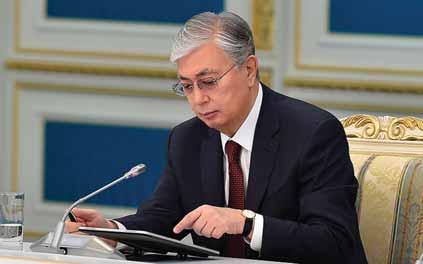
Kassym-Jomart Tokayev. Source: akorda.kz
Caspian Sea, dredging works in cooperation with Azerbaijan, and the modernization of the Kuryk port,” the Akorda press service said.
Tamar Lomadze’s Vision: Building a Global Beauty Brand from Georgia
BY TEAM GT
In today's highly competitive beauty industry, success requires more than great products: it demands a clear vision, innovation, and the ability to adapt to global trends.
For Tamar Lomadze, founder of Piel Naturals, the goal has always been clear: to build a modern cosmetics company that proudly represents Georgia on the international stage.
Founded on over a century of family formulation heritage, Piel Naturals combines traditional knowledge with advanced cosmetic science. Under Tamar Lomadze’s leadership, the company has evolved into a fast-growing cosmetics manufacturer, developing products that meet international quality standards while showcasing the unique natural resources of Georgia.
"Our ambition has never been limited to the local market," says Lomadze. "From the beginning, we wanted to create a brand that could compete globally while remaining authentic to its roots."
Today, Piel Naturals manufactures its products in a GMP (ISO 22716) and ISO 9001:2015 certified facility, producing both its own collections and private label cosmetics for business partners. The company focuses on clean formulations, modern ingredients, and scalable manufacturing solutions designed for distributors, retailers, pharmacies, and hospitality partners.
A key part of Tamar Lomadze’s strategy is maintaining a strong international presence. Piel Naturals regularly participates in major international beauty exhibitions and trade fairs, where the company presents its latest innovations, explores new market opportunities, and builds relationships with distributors and business partners from around the world.
By actively attending global industry events, the company stays connected to emerging trends, consumer expectations, and technological developments shaping the future of beauty.
For Lomadze, these exhibitions are more than networking opportunities— they are a platform to showcase Georgia’s manufacturing capabilities and introduce international audiences to products inspired by the country’s rich natural heritage.
Looking ahead, Tamar Lomadze sees significant opportunities for growth through export expansion, strategic partnerships, and private label manufacturing. Her vision is to position Piel Naturals as a trusted international cosmetics partner while continuing to develop innovative products that combine effectiveness, quality, and authenticity.
As the company expands into new markets, one principle remains unchanged: building long-term value through innovation, reliability, and a commitment to excellence.
Piel Naturals is not simply creating cosmetics: it is building a global beauty business with Georgian roots and inter-
national ambitions.
This year, Piel Naturals proudly celebrates its 9th anniversary. While the company was officially established in 2017, its roots trace back more than a century, drawing inspiration from a rich heritage of natural care and time-honored traditions.
Over the past nine years, Piel Naturals has grown from a local success story into a rapidly expanding brand with a strong presence both in Georgia and beyond. The company continues to open new stores across the country and internationally, bringing its products to an ever-growing community of customers.
A major milestone in this journey was the recent opening of a branded Piel Naturals store in one of Kuwait’s leading shopping malls, marking another important step in the company’s international expansion. And this is only the beginning — many exciting developments and new projects lie ahead.
Today, more than 2 million satisfied customers trust Piel Naturals products. Their loyalty and enthusiasm are perhaps the strongest proof that the company truly lives up to its slogan: “Love at First Touch.”
As Piel Naturals celebrates this special anniversary, it looks to the future with confidence, continuing its mission to deliver high-quality natural products while expanding its reach to new markets around the world.
To celebrate its 9th anniversary, Piel Naturals is offering many gifts and special surprises to its customers.
When Ideas Become Branding: How ZEG Festival 2026 Lost the Plot
OP-ED BY IVAN NECHAEV
The final evening of ZEG Festival 2026 in Tbilisi could hardly have offered a more fitting metaphor for the event as a whole. It ended with a performance by illusionist Brad Barton, whose tricks, simple card manipulations, predictable audience interactions, and familiar theatrical deceptions seemed less like an exploration of perception and reality than a nostalgic return to the vocabulary of children’s birthday entertainment. The promise of philosophical inquiry into illusion, technology, and human consciousness dissolved into something closer to a low-budget variety show.
Shortly before him appeared Serife Wong, presenting a dark meditation on artificial intelligence, mythology, and the future of humanity. The subject itself is undoubtedly urgent. Questions surrounding AI, authorship, and the transformation of culture are among the most significant intellectual debates of our era. Yet the presentation relied heavily on apocalyptic imagery, broad statements about technological danger, and an atmosphere of self-importance that was not matched by intellectual rigor. Complex questions were reduced to familiar fears, and the audience was offered anxiety instead of analysis.
This unfortunate contrast between ambition and execution became a recurring theme of ZEG itself. The festival gathered a remarkable list of artists, thinkers, activists, and public figures, presenting itself as a space where art, technology, politics, and philosophy would collide. The language of the program promised dialogue, radical imagination, and new ways of thinking about the world. Yet the reality was often surprisingly shallow.
Many workshops followed an almost identical pattern. For the first fifteen or twenty minutes, speakers introduced their own practice to an audience that
had often already chosen the session precisely because they were familiar with their work. This was followed by predictable questions about creativity and success: “How do you manage to be so talented?,” answered with equally predictable remarks about hard work, passion, and persistence. The difficult questions were rarely asked, and when they appeared, they were often left unexplored.
The most striking irony was that a festival dedicated to intellectual curiosity seemed to have little appetite for genuine disagreement. It celebrated complexity while frequently avoiding it.
At several moments, the organizers themselves appeared on stage to praise the success of the festival, reminding audiences how extraordinary the gathering was and how fortunate everyone was to be part of it. These moments revealed an unexpected insecurity: a truly transformative cultural event rarely needs to constantly announce its own significance.
The festival’s political programming reached its most curious form in discussions surrounding Palestine. Even among speakers broadly sharing the same position, the differences in intellectual substance were striking. Pulitzer Prizewinning novelist Viet Thanh Nguyen, for instance, often seemed less interested in Palestine itself than in using it as yet another stage upon which to continue his long-running argument with America. Every question eventually circled back to the familiar themes of empire,
citizenship, displacement, belonging, and the uneasy relationship between his Vietnamese origins and American identity. Palestine appeared almost as a narrative device in a much older personal and intellectual drama: one more chapter in an ongoing attempt to reconcile a colonized history with a citizen’s passport. There was another irony that seemed largely lost on the festival. Nguyen’s critique of American power, however differently motivated, unfolded in a Georgian context where anti-American rhetoric has acquired a very different political resonance. Over the past several years, Georgia has witnessed the growing circulation of narratives portraying the United States as a manipulative imperial actor: narratives frequently associated with pro-Russian political forces and media ecosystems. The overlap was not ideological but rhetorical: arguments intended as a critique of American foreign policy occasionally echoed formulations that, within the local context, carry very different historical and political associations. What made this especially revealing was the festival’s repeated emphasis on situated knowledge, local realities, and contextual sensitivity. Yet here was a case where speakers seemed largely unconcerned with how their words might resonate within the specific political landscape in which they were being delivered. The contradiction suggested a broader weakness of the festival itself. For all its language of community, listen-
ing, and engagement, ZEG often appeared more interested in importing ready-made global conversations than in examining how those conversations interact with the realities of the place where they are being staged.
Michael Barenboim offered something different, and in many ways more disappointing. If Nguyen risked turning Palestine into a metaphor, Barenboim reduced it to a slogan. The son of the legendary Daniel Barenboim arrived armed with moral certainty but remarkably little analytical depth. His lecture on music, democracy, and political responsibility consisted largely of broad declarations, whose simplicity became increasingly difficult to sustain once audience members began asking direct questions. Faced with complexity, contradiction, or requests for specificity, the argument repeatedly stalled. Nuance disappeared behind platitudes; difficult realities dissolved into abstractions.
At a certain point, perhaps recognizing that words were no longer helping, Barenboim suggested that music itself could make the case more effectively than argument. It was a revealing moment. Throughout the festival, politics often appeared to function as performance rather than inquiry, as a marker of virtue rather than a subject of serious investigation. The hope seemed to be that symbolic gestures might compensate for intellectual shortcomings. They did not. What emerged instead was a strangely theatrical form of activism, emotionally emphatic, rhetorically confident, yet surprisingly fragile whenever confronted with genuine complexity.
This was the paradox of ZEG 2026. It was a festival full of important names, urgent themes, and noble intentions. It spoke constantly about transformation, empathy, democracy, technology, and the future. Yet too often these ideas remained at the level of branding: cultural keywords assembled into an impressive catalogue rather than developed through difficult conversations.
The problem was not that ZEG lacked intelligence, talent, or good intentions
among its participants. The problem was that it confused the appearance of depth with depth itself. It mistook the gathering of famous people for the creation of meaningful dialogue, and the repetition of fashionable political and technological anxieties for genuine critical inquiry. In a time when the world desperately needs spaces where artists, scientists, philosophers, and activists can genuinely challenge one another, such a failure feels especially disappointing. ZEG did not fail because it aimed too high. It failed because, despite all its ambition, it rarely dared to go deep enough. Perhaps the most revealing contradiction of ZEG 2026 was its relationship with storytelling itself. Throughout the festival, participants repeatedly spoke about the necessity of authentic voices, personal narratives, and the irreplaceable human experience behind every meaningful story. Storytelling was presented almost as a sacred act: something that connects people beyond technology, markets, and political divisions.
Yet the festival’s own communication often appeared to be generated by artificial intelligence: announcements, editorial materials, and even publications carried the unmistakable tone of AIproduced language, a polished but strangely empty vocabulary of inspiration, transformation, and collective awakening.
The irony was impossible to ignore. A festival devoted to the defense of human stories seemed unable to tell its own story without outsourcing it to a machine. It spoke passionately about authenticity while producing a public voice that felt algorithmically assembled.
This contradiction would perhaps be less troubling if the festival had acknowledged it as a deliberate artistic or philosophical experiment. After all, the relationship between AI and human creativity is one of the defining questions of our time. But no such reflection was offered. Instead, the technology became an invisible ghost inside a festival that was supposedly examining the future of human expression.
Photo by the author
Tamar Lomadze of Piel Naturals
The Future of Helicopter Aviation and Pilot Training in Georgia
helicopters provide a fast and efficient way to deliver rescue teams and medical personnel to the scene of an accident or disaster.
Today, the global aviation industry is facing a significant shortage of helicopter pilots. Many pilots who began their careers decades ago are approaching retirement age, while younger generations have often chosen different career paths. Another contributing factor is the high cost of helicopter training, which has limited the number of new professionals entering the industry.
As a result, many countries are experiencing a growing shortage of helicopter pilots while demand for helicopter services continues to increase.
GROWING DEMAND FOR AIR AMBULANCE PILOTS
One of the key drivers behind the increasing demand for helicopter pilots is the rapid development of Helicopter Emergency Medical Services (HEMS). Aviation authorities and industry professionals are increasingly recognizing the need to expand the number of pilots qualified to operate within medical flight operations.
The HEMS market continues to grow steadily worldwide. According to industry estimates, the global air ambulance sector is valued at several billion US dollars and continues to expand each year. Consequently, the demand for highly trained helicopter pilots is rising as well. For Georgia, this issue is particularly important. The country’s mountainous terrain and remote communities create a clear need for an effective air medical transport system. For many regions, a helicopter is often the only means of rapidly transporting a patient to a specialized medical facility and ensuring timely medical assistance.
SEARCH AND RESCUE OPERATIONS
Another critical area of helicopter operations is search and rescue.
Helicopters are widely used to locate missing persons, rescue injured individuals in mountainous regions, and provide support during floods, earthquakes, and other natural disasters. In remote areas far from major population centers, helicopters often become the only transportation method capable of reaching those in need quickly.
One of the greatest advantages of helicopters is their ability to land in unprepared locations. Even in urban environments, where traffic congestion can significantly delay emergency services,
Their versatility and reliability make helicopters indispensable assets for emergency response missions worldwide.
HELICOPTERS IN THE OIL AND GAS INDUSTRY
Helicopters also play a vital role in the oil and gas sector.
Today, offshore oil and gas operations would be virtually impossible without helicopter support. Helicopters transport personnel, equipment, and essential supplies to remote offshore platforms and industrial facilities.
The growth of oil and gas production in many regions has led to increased demand for helicopter transportation services, creating additional demand for qualified helicopter pilots.
Modern offshore operations rely heavily on helicopter transport, making pilot training a critical component of the industry’s long-term sustainability.
FOREST PROTECTION AND FIREFIGHTING
In recent years, wildfires have become an increasingly serious challenge across many parts of the world.
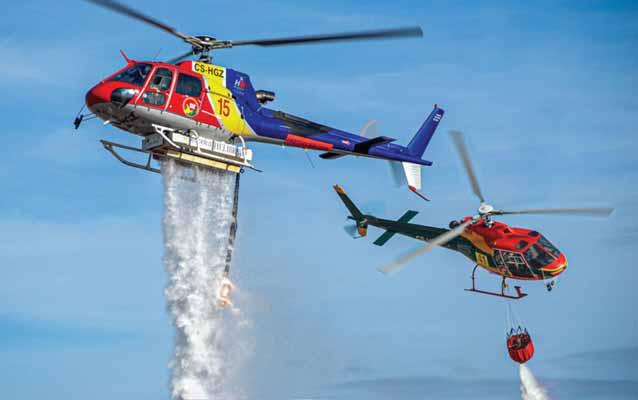
Experience has shown that helicopters remain one of the most effective tools for combating large-scale fires, particularly in remote and difficult-to-access areas. Equipped with specialized firefighting systems and water buckets, helicopters can rapidly deliver water
directly to fire zones and perform precise aerial firefighting operations.
Wildfires cause significant damage to the environment, economies, and local communities. As a result, governments and specialized organizations require well-trained helicopter crews capable of supporting firefighting operations whenever needed.
TRAINING NEW PILOTS AS A KEY FACTOR IN INDUSTRY DEVELOPMENT
The long-term development of the aviation industry depends heavily on training the next generation of pilots.
For Georgia, this issue is particularly important. The country continues to develop its tourism sector, transportation infrastructure, and aviation services. As these industries expand, so does the demand for qualified aviation professionals.
For this reason, establishing a strong domestic pilot training system is essential. In recent years, Georgia has begun developing modern aviation training programs based on European Union Aviation Safety Agency (EASA) standards. These programs support the training of both airplane and helicopter pilots according to internationally recognized requirements.
Modern training programs provide students with high-quality theoretical education combined with practical flight training under the supervision of experienced instructors.
An important next step will be the expansion of helicopter training opportunities through the use of modern training aircraft. This will enable future pilots to pursue careers not only within Georgia but also in international aviation companies, air ambulance services, and search-and-rescue organizations.
The development of pilot training in Georgia is therefore not merely an educational initiative: it is a strategic investment in the future of the country’s aviation industry, safety, and international competitiveness.
GEORGIA’S OPPORTUNITY TO BECOME A REGIONAL HELICOPTER TRAINING HUB
In my view, Georgia possesses a unique opportunity to become a regional center for helicopter pilot training based on European Union Aviation Safety Agency (EASA) standards.
The country offers several strategic advantages, including favorable flying weather for much of the year, diverse terrain suitable for pilot training, competitive operating costs, and geographic proximity to the Caucasus, Central Asia,
and the Middle East.
Through my work in aviation education and pilot training projects involving students and aviation organizations from Georgia, Azerbaijan, Europe, and other regions, I have observed a growing demand for high-quality helicopter training that meets international standards. At the same time, the availability of such training remains limited in many neighboring countries.
As regional demand for helicopter pilots continues to increase, Georgia has the potential to play an important role in preparing future aviation professionals not only for the domestic market but also for international operators.
THE FUTURE OF AIR AMBULANCE SERVICES AND HELICOPTER TRAINING IN GEORGIA
Over the coming years, we expect significant growth in air ambulance operations throughout Georgia.
The aviation community, medical professionals, and government institutions are increasingly reaching the conclusion that dedicated medical helicopters represent one of the most effective solutions for providing emergency assistance in areas with challenging terrain and limited response times.
Medical helicopters can rapidly transport doctors to accident sites, evacuate patients from remote locations, and ensure quick transfers to specialized medical centers. In many situations, response time becomes the deciding factor between life and death.
However, the development of an effective air ambulance system is impossible without highly qualified pilots. It is therefore essential to begin building a strong pool of professionals capable of operating in demanding environments and working alongside medical crews.
We see tremendous potential for estab-
lishing a comprehensive helicopter pilot training system in Georgia based on EASA standards. Such programs would prepare specialists not only for commercial aviation but also for future air ambulance services, search-and-rescue organizations, and other specialized aviation operators.
The first steps in this direction are already being taken. Helicopter pilot training programs based on European standards are being developed in Georgia, with particular emphasis placed on building the skills required for air ambulance missions, search-and-rescue operations, and other specialized aviation activities.
As part of this effort, our school is launching helicopter training programs using the Guimbal Cabri G2, one of the most modern training helicopters currently used by aviation training organizations throughout Europe.
Training will be conducted in accordance with EASA standards, providing graduates with the knowledge and practical skills required by today’s international aviation industry.
INDUSTRY PERSPECTIVE
Based on my experience working in aviation training and developing EASAcompliant educational programs, I believe that one of the most significant challenges facing the helicopter industry today is the shortage of pilots prepared for specialized operations.
While commercial helicopter flying remains an important career path, future demand is increasingly concentrated in sectors such as Helicopter Emergency Medical Services (HEMS), search-andrescue operations, offshore transportation, and aerial firefighting.
These missions require not only strong flying skills but also advanced decisionmaking abilities, risk management competencies, and specialized operational training. As a result, pilot education must continue evolving to meet the growing expectations of modern aviation operators.
LOOKING AHEAD
The development of helicopter aviation in Georgia is still in its early stages, but the opportunities are substantial.
As the country continues to modernize its aviation sector, strengthen emergency response capabilities, and expand international cooperation, the demand for highly qualified helicopter pilots will continue to grow.
By investing in modern training programs today, Georgia can establish the foundation for a sustainable helicopter industry capable of supporting future air ambulance services, search-andrescue operations, tourism, infrastructure development, and other critical sectors of the national economy.
We firmly believe that the development of helicopter training represents an important step toward creating a modern air ambulance system in Georgia and preparing a new generation of highly qualified aviation professionals.
BLOG BY ARTEM KUZMENKO, GENERAL MANAGER, BLUE SKY ACADEMY
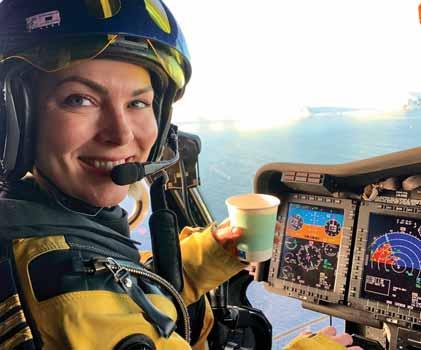
Bristow's Maria Johannessen, helicopter pilot. Source: Bristow
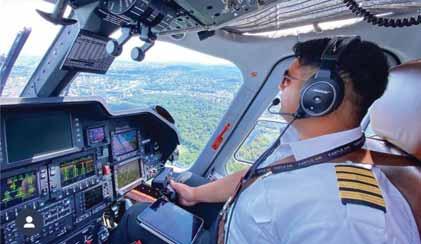
Helicopter charter pilot. Source: FB
The Heritage of German Colonists in Georgia. Part 3
Did you know that Georgia once had its very own Luxemburg? Before receiving its Soviet-era name in 1921, this prosperous settlement was known as Katharinenfeld. It was founded in 1818 by Swabian colonists, and from 1941 onward, the location became known as Bolnisi. In total, there were 23 German settlements across the South Caucasus.
KATHARINENFELD ONCE MORE: NEW LIFE FOR AN OLD HOUSE
Lia Bubuteishvili, an employee at the Bolnisi Cultural Center, has been passionate about the German history of her town all her life. She knows about the first settlers of Katharinenfeld from the stories of her grandparents, who lived side-by-side with the Germans until the latter were deported: “They shared a single courtyard and lived in great harmony. We, the Georgians, learned a lot from them: both German diligence and proper cultivation of the land. But, most importantly, they brought with them a high work ethic, which they generously shared with the local residents.”
We walk through Bolnisi with its geometric streets, uncovering more and more about the lives of the German colonists.
“The central street was once called Tiflisskaya, in honor of the capital,” Lia explains. “Later, the Soviet authorities renamed it Luxemburg Street. There were also Blumenstrasse (Flower Street), Gartenstrasse (Garden Street), and others here.”
One after another, Lia shows us the settlers' homes. She stops near a beautiful timber-framed (Fachwerk) building with carved wooden balconies: “This house belonged to the Allmendinger family. Notice how some details, for instance, the balcony itself, are typically Georgian elements. It is wonderful to see such an organic fusion of two cultures in architecture.”
Sometimes, on her way to work, Lia encounters German tourists who take a keen interest in Bolnisi's heritage. Many of them are descendants of those very Swabians who were forcibly expelled from their homes in 1941. Often, these
chance encounters turn into impromptu guided tours for Lia.
“Not long ago, a young couple from Germany was traveling here,” she smiles.
“When they saw one of the houses and read on the plaque that the Walkers lived there, they looked at each other. As it turned out, they have a close friend in Germany named Georg Walker, named in honor of his grandfather. They immediately called him via video link and shouted excitedly into the phone: 'Georg, we are standing right outside your grandfather's house!'”
Next, Lia leads us to another imposing building with an incredibly intricate carved balcony. The current owner is Artash, an Armenian.
“My father was born here in 1925, grew up among the Germans, and spoke German perfectly,” Artash says.
Artash bought this old German house back in 1995, but could not begin its restoration for a long time: the country's harsh economic situation forced him to leave for Greece to seek employment. He returned to his hometown only in 2017, and immediately set to work restoring the building. His gamble paid off.
“I have so many guests coming to visit now from Greece and Cyprus! Sometimes so many tourists arrive that we simply get overwhelmed and don't know where to accommodate everyone. Just the other day there was a massive influx,” the host shares.
Leading us up a creaking wooden staircase, Artash takes us to the second floor, where renovations are currently in full swing. He proudly displays the surviving antique furniture left behind by the previous owners: a massive wardrobe, beds, and even a German harmonium. Restoring and expanding the original wooden balcony is a delicate and expensive task, much like the restoration of the entire building.
“It would have been easier and cheaper to tear it all down and build a new house,” Artash says. “But old is old. For God's sake, who could build such massive, centuries-old walls today?!”
The wine cellar, however, had to be cleared by the owner from an incredible accumulation of debris.
“It's a constant 10 degrees here, both summer and winter,” Artash says with admiration. “The cellar holds the exact same temperature all year round. If I had the funds, I would set up a beautiful tasting bar down here. The old German wooden barrels have also survived, but their time has passed: they are far too decayed. So for now, I make wine in small, modern containers.”
Artash maintains a warm relationship with the descendants of the home's former owners, the Biedlingmayer family. Not long ago, they came to visit him and brought family relics: faded photographs that their ancestors had managed to take with them into exile in the autumn of 1941.
One of the pictures captures three young children sitting on the railings of that very balcony, gently supported from behind by women. Standing right in the center of the group is the head of the family at the time, Gottlob Biedlingmayer.
“This was their last photo, taken in the courtyard right before they left. Everyone gathered together: both the young and the old,” the house's new owner says with deep emotion as he looks at the image.
Gazing at these faces, one cannot help but wonder: who among them was spared by the gears of a ruthless history? And what would they warn us about today if time could be turned back?
Tbilisi Shopping Festival to Open at Tbilisi Outlet Village on June 27
Continued from page 1
The festival program will also include a public talk on June 27 featuring Dato Turashvili, Guga Kotetishvili and Nino Daraseli. The discussion will focus on Tbilisi’s cultural identity, architecture, design and the city’s distinctive character shaped by different cultures and historic trade routes.
On June 28, festival guests will be able to enjoy a live performance by Tamada.
As part of the event, Tbilisi Shopping Festival will feature pop-up spaces by Georgian designers and brands, including IERI Store, Lalo Cardigans, Salle de Mode and others.
Visitors can also look forward to live music, diverse food and beverage concepts, and a children’s entertainment area, which will be open daily from 11:00 to 19:00.
Tbilisi Shopping Festival will welcome guests from June 27 at Tbilisi Outlet Village.
Pictures of German houses in Bolnisi. Photo by Anna Ankudinova
Artash. Photo by the author
BY TATJANA MONTIK
Down by the High Way
BY TONY HANMER
There actually are two roads up into Svaneti. Via Zugdidi, the road is always open (barring rockfalls or avalanches, usually cleared up asap). And north from Kutaisi via Lentekhi, capital of Lower Svaneti. This way is open usually from late May through late October. Outside of this, due to its pass height of about 2800m, it is closed by deep snow.
I can count on two hands the number
of times I have been on this second road, over the years from 2004 to now. A couple of times driving my own cars, a few times being driven by others, and once nearly the whole thing on foot, as part of a prayer pilgrimage in July 2020. My last trip there was just a few days ago. Late snow in early spring had delayed the clearing of the road by a plow. Friends who took it about 10 days before me sent me a photo from the Zagaro Pass, with the cleared snow wall several times higher than a person. My drive had the same section still higher than me, despite constant temperatures above freezing, letting it melt all that time.
I was going to Gori, and the time and distance are about the same, so why not? It’s a rare opportunity compared with my hundreds of trips via Zugdidi. The views are completely different, and at least as spectacular as the “normal” way, if not more so. Mounts Ushba and Tetnuldi show themselves (if you’re lucky) from Becho onwards. Then you see Shkhara, Georgia’s highest mountain, above Ushguli, and for a long way past it too. And the vistas are huge. (There must be a halfway point at which the travel times on either road to Tbilisi are the same, giving a choice. I don’t know where it is, likely somewhere below
CULTURE
us in Etseri. If Zugdidi’s shopping is not one’s aim, the other way beckons).
My maximum average speed to Mestia reached 50 km/h. This then slowed to 29, as I stopped before Ushguli and many times after it for photos and video clips, but kept the car running.
The road to Ushguli is now entirely cemented, except for a single section of one or two km near it. This good road continues down the other side, soon becoming tarred, even. But there are many more breaks in this, giving way to bumpy dirt or gravel sections ranging from about 10m to a few km in length. Nonetheless, any car with reasonable clearance will do fine. Because the cement and asphalt are newer than on our road up from Zugdidi, they are also in better condition. My hat off to the government and road workers!
In the heights, there was still a lot of snow melting on the mountains and hills, taking on fantastic textures in the process. Numerous waterfalls, some temporary, a few permanent, graced the slopes with added beauty. Down from Zagaro Pass, the snows gave way to more
and more green and wildflowers, except on the mountaintops, which stay snowed always. There was little traffic, but it’s starting to increase as the warm-weather tourism and trekking seasons get under way. For Ushguli, this summer road is a boon, giving much faster access to Kutaisi and all points east, right to Tbilisi, than the Zugdidi way.
I don’t know if it would even be possible to keep this road open during winter. It would need regular snow-clearing to prevent buildup, and I don’t think it’s ever been done, even in Soviet times. But for all the alternative beauty and added speed it offers during the summer, I highly recommend it.
Tony Hanmer has lived in Georgia since 1999, in Svaneti since 2007, and been a weekly writer and photographer for GT since early 2011. He runs the “Svaneti Renaissance” Facebook group, now with over 2000 members, at www.facebook.com/groups/ SvanetiRenaissance/ He and his wife also run their own guest house in Etseri: www.facebook.com/hanmer.house.svaneti
Rendezvous to Bring Chaplin FamilyInspired Performance to Tbilisi Festival
BY LANA KOKAIA
The performance “Rendezvous” will be staged in Tbilisi on July 11–12 as part of the Tbilisi International Theater Festival.
The production brings together director and designer James Thierrée, along with Victoria Thierrée-Chaplin, Aurélia Thierrée, and Jean-Baptiste Thierrée, forming a family-led artistic project rooted in theater, circus, and music hall traditions.
The performance is described as a journey through fragments of memory and past creations, where the artists revisit earlier works through a symbolic photo album and an imaginative narrative. Charlie Chaplin’s granddaughter, Aurélia Thierrée, spoke about the upcom-
ing family performance in the spring issue of the magazine Omnia a few weeks ago.
“We are rehearsing a new family production, my brother, my parents, and I. It has been many years since we last worked together like this. Wish us luck!” she said. She also reflected on her background in traditional circus performance, describing it as a discipline-based art form shaped by constant rehearsal and collaboration.
“My parents initially worked in traditional circus, although I was still very young when we stopped performing in that context. However, we often visited different circuses. The circus demands discipline: everyone rehearses under the main tent, and you can learn something from each performer. The circle, both physical and metaphorical, defines the circus,” she said.
Performance “Rendez-vous”. Photo: Omnia
BLOG
CULTURE
A Window into Contemporary Georgia: New Georgian Films 2026 at DOCA Film Club
BY IVAN NECHAEV
There is no shortage of films about Georgia. There are, however, surprisingly few opportunities to follow what Georgian filmmakers are making right now. This is what makes the New Georgian Films 2026 program at Amirani Cinema particularly valuable. Organized by DOCA Film Club, the series offers something increasingly rare: a sustained look at contemporary Georgian moving-image culture as it is being created, debated, and reimagined in real time.
Rather than focusing on premieres alone, the program brings together documentaries, hybrid works, animation, and video art, creating a broader picture of how filmmakers and artists are responding to the social, political, and cultural realities surrounding them. Seen as a whole, the season feels less like a col-
lection of screenings and more like an ongoing conversation about contemporary Georgia.
The curatorial approach is notable for its breadth. Films already presented in the program have ranged from Ketevan Vashagashvili's 9 Month Contract, an intimate exploration of surrogacy and maternal sacrifice, to Kote Kalandadze's Nobody in Sight, a portrait of addiction, loneliness, and social marginalisation.
Rusudan Gaprindashvili's How to Talk with Lidya shifted the focus beyond Georgia itself, examining the algorithmic realities of migrant labor in contemporary Europe, while Alexandre Koridze's Comfort Limit addressed one of the most sensitive and politically charged developments in recent Georgian history: the arrival of Russian migrants following the full-scale invasion of Ukraine.
What unites these works is not a common subject matter but a shared commitment to observing lives that often remain outside official narratives. The films resist easy conclusions. They favor complexity
Tbilisi Ballet Festival to Return in July under Ananiashvili’s Direction
BY LANA KOKAIA
The Tbilisi Ballet Festival will return this summer, with performances scheduled from July 5 to July 19 under the artistic direction of former principal dancer and choreographer Nina Ananiashvili.
The festival will feature a series of classical and contemporary productions staged at the Opera and Ballet Theatre in Tbilisi, bringing together international guest artists and leading ballet companies.
The opening performance on July 5 will present Swan Lake, performed by Mariam Lomjaria and Davi Ramos from the Australian Ballet.
On July 7–8, The Sleeping Beauty will be staged, featuring Emma Hawes and Aitor Arrieta from the English National Ballet on July 7, and Mariam Eloshvili and Masaaki Goto on July 8.
On July 10, Laurencia will be performed by Nino Samadashvili and Giorgi Potskhishvili from the Dutch National Ballet.
A Ballet Gala is scheduled for July 12, featuring soloists of the State Ballet of Georgia and guest performers Maia Makhateli, Salome Leverashvili, Giorgi Potskhishvili, Andro Potskhishvili from Slovak National Theater Ballet, and Bakhtiyar Adamzhan from Astana Opera.
The festival will close on July 17–19 with Masurca Fogo, performed by the Tanztheater Wuppertal Pina Bausch, continuing the legacy of the late choreographer Pina Bausch.
COMMERCIAL DEPARTMENT
Commercial Director: Iva Merabishvili
Marketing Manager: Natalia Chikvaidze
EDITORIAL DEPARTMENT:
Editor-In-Chief: Katie Ruth Davies
over certainty, paying close attention to individual experiences while remaining alert to larger social transformations.
The second half of the program continues this expansive approach. Upcoming screenings move between archival memory, displacement, regional identity, animation, and experimental imagemaking. Maka Gogaladze's I Was Thinking of You revisits the turbulent 1990s through archival footage from Kutaisi. The Kartli Kingdom explores life inside a decaying former sanatorium that has become home to families displaced by the conflicts of the 1990s. Marlene Edoyan's A Fire There offers an intimate portrait of young people coming of age in an Armenian village in southern Georgia. The season will conclude with programs dedicated to contemporary Georgian animation and video art, highlighting forms of storytelling that are often overlooked by mainstream film culture.
Perhaps the most important aspect of the initiative is its accessibility. Every screening is presented with English subtitles, making the programme available not only to Georgian audiences but also to the city's international residents, visiting researchers, journalists, diplomats, artists, and anyone interested in understanding the country beyond headlines and political analysis.
At a time when discussions about Georgia are often dominated by geopolitics, elections, and protests, New Georgian Films 2026 offers another perspective. It invites viewers to encounter the country through the stories its filmmakers choose to tell: stories of work, migration, memory, family, identity, uncertainty, and resilience.
In that sense, the program functions as more than a film series. It is one of the most compelling introductions to contemporary Georgia currently available on a cinema screen.
Exhibition on Tbilisi Courtyards Opens at History Museum
BY LANA KOKAIA
The exhibition 'Ezologia, Porous Body of Tbilisi' opened at the Tbilisi History Museum on June 26, presenting the first phase of an interdisciplinary research project exploring the architectural, social, and cultural significance of Tbilisian courtyards.
Initiated by NWDS and Ubani — Tbilisi Cityscape Research Center, the project brings together researchers, architects, sociologists, historians, and urban analysts to examine the role of the traditional courtyard in shaping Tbilisi's urban identity and development.
The exhibition features analytical maps, architectural and graphic studies, archi-
val documents, and video materials that investigate how courtyard typology has influenced the city's urban fabric over time. Visitors will also be able to view photo essays created specifically for the exhibition by photographers Berika Beridze, Nanka Dolidze, and Gio Sumbadze in spring 2026.
Materials from the collections of the Tbilisi History Museum are included in the exhibition, alongside video works produced by students under the guidance of O’Brien Van der Steen Architecture Studio in 2018.
The exhibition is hosted by the Tbilisi History Museum and the Georgian National Museum, with support from Tbilisi City Hall and Château Mukhrani.
The exhibition will run through September 25. The museum is open daily, except Mondays, from 10:00 to 18:00. Regular museum admission fees apply.
Reproducing material, photos and advertisements without prior editorial permission is strictly forbidden. The author is responsible for all material. Rights of authors are preserved. The newspaper is registered in Mtatsminda district court.