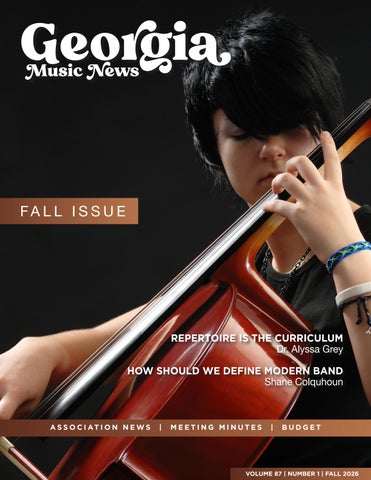
FA L L I S S U E
REPERTOIRE IS THE CURRICULUM Dr. Alyssa Grey HOW SHOULD WE DEFINE MODERN BAND Shane Colquhoun
A S S O C I AT I O N N E W S
|
MEETING MINUTES
|
BUDGET
VOLUME 87 | NUMBER 1 | FALL 2026
WHAT IF YOUR NEXT TRIP BECAME A
MUSIC VIDEO?
INTRODUCING
SOUNDTREKS RECORD · TRAVEL · FILM · SHARE
Give today’s students an experience they’ll never forget and tomorrow’s students a program they’ll want to join. SOUNDTREKS combines professional recording, unforgettable student travel, and cinematic filmmaking to create an extraordinary experience for your students and powerful digital content to help recruit, promote, and grow your program. Presented by
SOUNDTREKS.COM
In This Issue
GMEA BOARD OF DIRECTORS District Chairs 1 - Will Alford 2 - Will Smith 3 - Kenneth Boykin 4 - John Williams 5 - Jennie Fabianski 6 - Ladell Fortune 7 - Dr. Scott Smith 8 - Zach Williams 9 - Eddie Anthony 10 - Olivia Ladun 11 - Aaron-James Young 12 - Adam Gresham 13 - Lee Newman 14 - Dion Muldrow
President Andy Esserwein President Elect Dr. Sara Womack Vice-President for Performance Evaluation Events Kevin Brown Vice-President for All-State Events Marla Baldwin
Repertoire Is The Curriculum Dr. Alyssa Grey
Past Presidents’ Council Representative Dr. Richard Bell
24
Editor, Georgia Music News Vacant
Executive Director D. Alan Fowler
For the complete list of Board Members please visit:
Band Division Chair Sean McBride Choral Division Chair Velma Jenkins
GMEA Staff Dr. Bernadette Scruggs Laura Webb Megan Williams Aleta Womack
College Division Chair Dr. Charles Jackson
THE PRESIDENT SPEAKS
Elementary Division Chair Erika Brown Orchestra Division Chair Kevin Anderson
2 2026 Board Meeting Minutes
6
Advertising/Exhibitors Cindy Reed
ADVERTISER INDEX ORANGE SKY INSIDE COVER
ATLANTA SYMPHONY ORCHESTRA PAGE 9
HOW SHOULD WE DEFINE MODERN BAND? Shane Colquhoun
22
UNIVERSITY OF TENNESSEE CHATTANOOGA PAGE 5
TO ADVERTISE
APPLY TODAY WWW.GMEA.ORG/ADVERTISE
© Copyright 2026 by the Georgia Music Educators Association All pieces reproduced in this issue are under prior copyright of the creators and publisher by the contractual arrangements. Nothing shown may be reproduced in any form without obtaining the permission of the publisher and any other person or company who may have copyright ownership.
FA L L 2026 | G E O R G I A M U S I C N E W S
1
Association News The
President Speaks
Andy Esserwein Welcome back to a brand-new school year! Whether you are stepping onto campus for your first year in the classroom or beginning your thirtieth (or more!) year in education, there is an unmistakable energy that fills the first few weeks of school. Amid the rush of handbooks, syllabi, equipment checkout, music distribution, roster adjustments, and lesson plans, the start of an academic year brings many challenges. Yet, it also gives us a genuine opportunity for renewal. It is a time to restart, reevaluate, and reinvigorate. It invites us to look at our rooms and rehearsal halls with fresh eyes, to reimagine our routines, to discover new literature, and to refine the ways we build connections with our students. There is an old truth often passed down among directors and musicians: in music, the work is never done. At first glance, that idea can sound exhausting, especially in the opening weeks of a new school year. But to an educator, it carries a deeply comforting and inspiring meaning. It reminds us that our craft is not a checklist to complete or an end point to reach, but an ongoing journey of discovery. The beauty of what we do does not exist solely in the polished performance on stage, but lives in the day-to-day process of our rehearsals and time with our students. When I reflect on my own career in the classroom, the memories that remain closest to my heart are rarely the final chords of a concert. Instead, they are the everyday moments of the work itself, like watching a student's face light up when they finally conquer that difficult passage of music, witnessing the daily 2
G E O R G I A M U S I C N E W S | FA L L 2026
improvement of an ensemble as it builds toward the concert performance, or realizing a student has found a second home and a voice within your program. The dedication, patience, and heart you bring through your door each morning are the true engine of our organization. Thank you to each of you for pouring your energy into this ongoing, noble work. What you build each day matters profoundly, and it shapes lives long after the music ends. Just as you are establishing momentum in your local programs, GMEA is actively working behind the scenes to support and strengthen our shared mission. As we settle into this new year, I would like to offer a few thoughts and reminders. • Fall District Meetings Thank you to everyone who took the time out of an exceptionally busy start to the year to attend and participate in our Fall District Meetings. This time together is essential to the work happening in our districts and local communities, offering a great space to connect with colleagues, share best practices, plan important events, and welcome new teachers into our professional family. To that point, if you have a beginning or early-career colleague in your school, county, or district, please continue to reach out and support them. Our collective strength has always been built on community and connection, and ensuring our new teachers are being supported is vital to that mission.
• Collegiate Tour Initiative We are proud to continue our college tours for the fourth consecutive year. GMEA leadership will visit at least 15 colleges and universities across the state this year to connect directly with music education majors. Engaging with these future educators helps build a meaningful bridge to our professional community and strengthens the long-term future of our organization. • OPUS Modernization and Strategic Planning Behind the scenes, two major foundational projects are moving forward. Over the summer, work began on modernizing our OPUS platform, focusing on upgraded infrastructure to ensure long-term stability, data safety, and security, paving the way for enhanced functionality and an improved user experience. Concurrently, GMEA is launching a comprehensive, long-range strategic planning initiative this fall. We will be actively seeking your input and perspectives in the months ahead as we evaluate where our association stands and thoughtfully map out where we are going together.
• Monthly Newsletter In addition to the website, please be on the lookout for our monthly email newsletter. It will arrive in your inbox most months on the final Thursday, providing a concise roundup of timely deadlines, district highlights, and vital reminders right when you need them. Finally, as the semester reaches full speed, please remember to take care of yourself. The emotional and physical energy you invest in your students is immense, but it is just as essential to protect time for your own well-being and your families. Remember that our work is a marathon rather than a sprint, and giving your best to your students starts with making sure you are sustained as well. If I can assist you in any way, please don't hesitate to reach out. Thank you for your tireless commitment to our students and for your belief in the transformative impact of the arts. I wish you an inspiring, rewarding fall, and I look forward to hearing the wonderful music your students produce this year.
• 2027 In-Service Conference Registration Registration for our 2027 In-Service Conference is officially open! We are looking forward to three days filled with inspiring concerts, enriching clinics, and meaningful professional collaboration with colleagues from across the state. Please visit the GMEA website and get registered early to be part of this incredible event. • Handbook and Website Reminders The fall semester always moves fast, and key dates arrive before we know it. Please make it a priority to visit the GMEA website regularly and consult the handbook for division updates and event procedures. Key deadlines for event registrations, auditions, and conference submissions arrive early in the term, and keeping those resources close at hand will ensure smooth planning for you and your students.
FA L L 2026 | G E O R G I A M U S I C N E W S
3
From The
Executive Director D. Alan Fowler
The Power of Beginning Again As another school year settles into its rhythm, I am reminded fall is a season of beginnings. While January is renowned for ringing in the New Year, educators know better. Our year begins when students walk through the doors, instruments come out of cases, choirs sing their first notes together, and teachers begin the important work of building relationships that will shape the months ahead. Across Georgia, music educators have spent the first weeks of school creating welcoming classrooms, establishing expectations, and helping students discover what they are capable of achieving. Whether teaching a beginning recorder class, preparing an advanced ensemble, managing and presenting a marching band show, or leading a collegiate rehearsal, our members are engaged in work that changes lives every day. One of the greatest privileges of serving as Executive Director of GMEA is witnessing the impact of music education in communities throughout our state. Time and again, I hear stories of students finding confidence, connection, purpose, and belonging through music. While we celebrate outstanding performances and remarkable achievements, the true success of music education extends far beyond the concert stage. We are helping students develop discipline, collaboration, creativity, and resilience. We are preparing them not only to be musicians but also to be productive citizens, engaged community members, and lifelong learners. This fall and the year ahead also bring exciting opportunities for professional growth. District meetings, honor ensemble events, conferences, and workshops provide valuable opportunities to learn from colleagues and strengthen our profession. I encourage each of you to take advantage of these experiences. One of GMEA's greatest strengths is the willingness of music educators to share ideas, mentor one another, and work together for the benefit of students, schools, and communities. When we invest in one another, we strengthen music education across Georgia. As we look ahead, advocacy remains as important as ever. The value of music education is evident in our classrooms every day, but we must continue telling our story. Parents, administrators, school board members, community leaders, and legislators need to hear how music education contributes to student achievement and school success. Every concert, every performance, every positive interaction is an opportunity to demonstrate the important role music plays in a complete education. 4
G E O R G I A M U S I C N E W S | FA L L 2026
This year also marks an exciting chapter for GMEA as we undertake the OPUS modernization project. For many years, OPUS has served as the backbone of our association's event management, registration, and communication efforts. While the platform has supported our work well, technology and the needs of our members continue to evolve. The modernization process represents an important investment in the future of GMEA and our ability to serve music educators across Georgia more effectively. Throughout the planning process, our goal has remained clear: to create a more efficient, user-friendly, and sustainable experience for the members, volunteers, and students who rely on OPUS every year. This project is not simply about updating technology; it is about positioning GMEA to better support music education for years to come. As I write this, we are approximately halfway through the initial phase of the modernization effort. As detailed in communications from President Andy Esserwein this summer and discussed during our fall meetings, this work will position us to make additional improvements in the years ahead. Thank you for your patience, support, and understanding throughout this process. I am genuinely optimistic about where this work is headed and excited about the opportunities it will create for our members and the students we serve. I am grateful for the countless volunteers who give their time and expertise to support GMEA. From district leaders and division officers to adjudicators, event coordinators, collegiate members, and classroom teachers, your dedication allows our association to serve music educators across the state. GMEA's success has always been built on the commitment of members who are willing to contribute their talents in service to others. As the busy fall season unfolds, I encourage you to take a moment to appreciate what you accomplish each day. The rehearsals, lesson plans, performances, meetings, and countless hours of preparation matter. More importantly, the students in your classrooms matter. The encouragement you provide, the standards you set, and the opportunities you create will influence young people long after they leave your program. Thank you for all you do for Georgia's students and for the profession we share. I wish you a successful and rewarding year, and I look forward to celebrating the many accomplishments of our members throughout the year. As another school year begins, we have the opportunity to begin again alongside our students: to inspire, to learn, to grow, and to make a difference. Together, we continue to demonstrate that music education matters, not only because it creates great musicians, but because it helps create great citizens.
June 14-17, 2027 Jessica Nápoles Professor of Choral Music Education University of North Texas
June 7-11, 2027 Dr. Caroline Beatty Director of Bands Texas State University
June 14-17, 2027 Diane Koutsulis Director of Bands, Retired Green Valley High School
Undergraduate Audition Days: December 3, 2026 Honor Band Participants Only
January 23, 2027 February 20, 2027 utc.edu/music @utchattanoogamusic
PEDAGOGY & CONDUCTING
June 7-11, 2027 William Weinert Professor Emeritus Eastman School of Music
INSTITUTE
ETUTITSNI
Music
The UTC Summer Pedagogy and Conducting Institute is designed for designed for music music educators educators and and choral choral directors directors who who want want to to improve improve their their conducting, conducting, rehearsal rehearsal techniques, techniques, and and teaching teaching strategies. strategies.
The UTC Summer Pedagogy and Conducting Institute is
Hosted Hosted at at the the University University of of Tennessee Tennessee at at Chattanooga, Chattanooga, the the institute institute provides provides a a focused focused and and supportive supportive environment to environment to learn learn from from nationally nationally and and internationally recognized internationally recognized clinicians. clinicians. Participants engage in a combination of lectures, hands-on practice, and practice, and ensemble ensemble rehearsals rehearsals throughout throughout the the week. week.
Participants engage in a combination of lectures, hands-on
FA L L 2026 | G E O R G I A M U S I C N E W S
5
Association News GEORGIA MUSIC EDUCATORS ASSOCIATION
BOARD MEETING MINUTES Marriott Courtyard Hotel - McDonough, GA May 16, 2026 1. The meeting was called to order by President Andy Esserwein at 10:01 AM. 2. The following members were present: Andy Esserwein, President, Kevin Brown, Vice President for Performance Evaluations, Marla Baldwin, Vice President for All-State Events, Neil Ruby, Immediate Past President, Alan Fowler, Executive Director, Sean McBride, Band Division Chair, Velma Page Jenkins, Choral Division Chair, Dr. Chuck Jackson, College Division Chair, Erika Brown, Elementary Division Chair, Kevin Anderson, Orchestra Division Chair, Hank Carter, District One Chair, Dominique Lane, District Two Chair, Brian Walker, District Three Chair, Monica Fogg, District Four Chair, Vanessa Edwards, District Five Chair, Michael Wright, District Six Orchestra Chair-Elect, Kylie Hamilton-Lord, District Seven Chair, Zach Williams, District Eight Chair, Nicholas Gattis, District Nine Chair, Tayler Norwood, District Ten Chair, Leah Williams, District Eleven Chair, Adam Gresham, District Twelve Vice-Chair, David Metrio, District Thirteen Chair, Dion Muldrow, District Fourteen Chair, Dr. David Langley, CNAfME Chair, Adam Brooks, Member-at-Large, Dr. David F. Lewis, Georgia School Superintendents Association. 3. A quorum having been established, President Ruby reviewed the voting procedure before introducing guests present for the meeting. 4. The following guests were present: Matt Koperniak, Historian, Caryn Volk, Guitar Chair, Dr. Rebecca Atkins, Research Chair, Dr. Scott Smith, and GMEA staff members: Laura Webb, Bernadette Scruggs, and Aleta Womack. 5. ACTION ITEMS - New handbook wording in blue New handbook wording in blue The following proposal was brought by Sean McBride on behalf of the Band Division. • Create Percussion and Jazz Standing Committees in the Band Division to eventually be included in the Constitution. Per Article VII. D. 31. e. in the Constitution, the Board has the authority to create Standing Committees. Approval of the proposed committees will require a vote of the membership in order to be added to the Constitution. 6
G E O R G I A M U S I C N E W S | FA L L 2026
The motion was adopted by a vote of 24-0. The question addressing the addition of these standing committees will be put before the membership concurrent with next January’s Division Chair elections. The following proposals were brought by Velma Page Jenkins on behalf of the Choral Division. •Choral Proposal #1 Update the handbook to add the following bullet point to Component 1, Scales on p. 70. A zero should be given for intonation if the student does not sing the scale in tune. The motion was adopted by a vote of 24-0. •Choral Proposal #2 Update the handbook to correct incorrect ranges on p. 72. The 7/8 Tenor range reads "Perfect 5th lower from Alto" and it should be a Perfect 4th lower. (This is correct in the actual ranges that are listed.) Additionally, the 7/8 Bass range currently is shown as C2 to C3 and it should be C3 to C4. The motion was adopted by a vote of 24-0. •Choral Proposal #3 Add the following bullet to the AllState Chorus Appendix, Component 2, Sight Reading on p. 71. Humming and whistling cannot be scored for credit and will be given a 0 for each half-measure it occurs. Neutral Syllables may be used. The motion was adopted by a vote of 24-0. •Choral Proposal #4 Add the following bullet to the AllState Chorus Appendix, Component 2, Sight Reading on p. 71. Students should keep their paper face down until they hear the prompt say “Please turn the paper over and look at Example 1.” The motion was adopted by a vote of 24-0.
• Choral Proposal #5 - Motion Tabled for further study. • Choral Proposal #6 Revise the number of All-State Tenor/Bass Choir participants from 150 to 180 on p. 73. The motion was adopted by a vote of 24-0. •Choral Proposal #7 - Following discussion, the proposal was withdrawn. •Choral Proposal #8 In the Teacher section of the All-State Chorus Appendix on p. 76, add a bullet and change the wording of the tenth bullet on the page as follows: Current bullet: Teachers will have three days following the Region Audition to notify the Region Chair of discrepancies in student’s scores. •Individual score sheet discrepancies must be addressed on the day of the audition. The director should bring this to the attention of the Region/District Audition organizer before leaving the audition site. •Teachers will have three days following the audition score release in Opus to notify the Region/District Audition Organizer of discrepancies in published student scores. The motion was adopted by a vote of 24-0. •Choral Proposal #9 Revise p. 28 of the Handbook by removing the statement: “Humming, talking, and whistling are not allowed.” from How does sight-reading practice time work? Current wording, with edit shown in RED: Choirs have five minutes to practice sight-reading. The director may not demonstrate or rehearse pitch, intervals, or rhythm. Students are allowed to practice individually, but not in small groups. The choir may use the sight-reading study method of their choice during this assessment. Humming, talking, and whistling are not allowed. The motion was adopted by a vote of 24-0. •Choral Proposal #10 Revise p. 91 of the Handbook by removing the statement: “Humming, talking, and whistling are not allowed. Current wording, with edit shown in RED: The choir may use the sight-reading study method of their choice during this assessment. Humming, talking and whistling are not allowed. At the end of the 5-minute study period the starting pitch for each voice part will be given and the sight-reading example will be performed. The group may perform on syllables, numbers or neutral sounds but humming is not recommended.
•Choral Proposal #11 Update wording of the ninth bullet on p. 91 of the Handbook to include an additional sentence for clarity: Proposed change: Rests must be performed silently. Silence does not prohibit maintaining a steady beat through tapping, clapping, or snapping; however, no vocal sound is permitted. The motion was adopted by a vote of 24-0. •Choral Proposal #12 Update directions regarding Sight-Reading Booklets on p. 91 of the Handbook to include an additional sentence for clarity: Current language: “All sight-reading booklets will be collected per the instructions of the judge.” Additional sentence: “Adjudicators are not required to collect sight-reading booklets after each performing group. After discussion, the proposal was amended (24-0) to add the new sentence, rather than remove the original statement. The motion was adopted by a vote of 24-0. •Choral Proposal #13 Update directions regarding Sight-Reading Booklets on p. 91 of the Handbook to replace the current language for clarity: Proposed change: “While each test booklet is being distributed, the director may review the assigned sight-reading example before the timed portion of the test has begun. The director may review the assigned sight-reading example prior to the beginning of the timed portion of the test while the adjudicator is addressing the students. The motion was adopted by a vote of 24-0. •Choral Proposal #14 - After explanation by President Esserwein, the motion was withdrawn •Choral Proposal #15 The adjudication committee would like to add links to a document outlining the requirements/process on p. 93 under Adjudicator Application Process: Choral Division Adjudicator Application Requirements Choral Division Head Adjudicator Application Requirements The motion was adopted by a vote of 24-0.
The motion was adopted by a vote of 24-0. FA L L 2026 | G E O R G I A M U S I C N E W S
7
The following proposals were brought by Vice President Kevin Brown. •Proposal #1 Add an additional bullet, under to p. 100 of the Handbook, under the “During the Event” section, restricting access to the adjudicators during LGPE events. Proposed addition: Ensure that only assigned adjudicators and authorized personnel enter the adjudicator zone. Following discussion, the proposal was amended (240) to the following: Ensure that only assigned adjudicators and authorized personnel as designated by the organizer enter the adjudicator zone. The motion was adopted by a vote of 24-0. •Proposal #2 As the proposal to revise the refreshment reimbursement formula for LGPE events is financial in nature, the Executive Committee has asked Executive Director Alan Fowler and Operation Manager Laura Webb to study the impact and feasibility. This item will be included in the Executive Committee’s summer meeting agenda. •Proposal #3 Add an additional bullet, under Adjudicator Expectations, on p. 93 of the Handbook addressing adjudicator eligibility. Proposed language: Adjudicators who do not complete the mandatory policy review for the current academic year shall be ineligible to serve in that capacity until the review is completed. Discussion drew attention to the first bullet on p. 93: Adjudicators who fail to complete policy review training every 3 years will not have their names renewed on the GMEA Adjudicators List. Following further discussion, the proposal was amended (24-0) to replace the first bullet on p. 93 with the following language: Adjudicators who do not complete the mandatory policy review for the current academic year shall be ineligible to serve in that capacity until the review is completed. Deadline to be set by VP for Performance Evaluations. The motion was adopted by a vote of 24-0. 6. President Esserwein introduced the proposed 20262027 GMEA Statewide Calendar The calendar was adopted by a vote of 24-0. 7. INFORMATION ITEMS •Executive Director Alan Fowler presented a financial report. Mr. Fowler spoke about the figures and information on the GMEA Spring Budget Financial Update, and then he directed those in attendance to the five additional reports included – The Budget vs. Actuals Report for FY’25, the All-State Balance Sheet, the LGPE Balance Sheet, the Office Expenses breakdown, and the Profit and Loss as 8
G E O R G I A M U S I C N E W S | FA L L 2026
a % of Total Income Report. He addressed GMEA having rebuilt the operational reserves to a healthy level and thanked the members, volunteers, officers, and staff for their efforts to make this possible. •President Esserwein shared updates from the Executive Committee and focussed attention toward five specific items: •GMEA’s partnership with Peachtree Government Relations • The successful passing and signing of Senate Bill 556 which will now allow AP, IB, and Cambridge Fine Arts courses to be included as rigor credits in the HOPE Scholarship GPA calculation. • GMEA is undertaking a Strategic Planning initiative. This effort is expected to take 16-18 months and will be benefited by the members completing an upcoming survey. • The OPUS Modernization Project has been approved. The initial phase will take 18-20 weeks, and it is expected, following this first step, additional improvements will be forthcoming. • GMEA is undertaking a Modern Band Initiative. Expect more information. 8. Reports, either written or spoken, were presented. 9. There was no new business. 10. President Esserwein thanked the Board and GMEA members across the state, sharing his thoughts and feelings about the great work we are doing, echoing his mantra: “The Power of WE.” He then presented certificates to District Chairs, many of whom will be leaving the Board at the end of June, and then he made heart-felt recognition of Immediate Past President Neil Ruby, his many years of dedication and service to GMEA. 11. The meeting was adjourned at 1:26 p.m. Respectfully submitted, D. Alan Fowler, Executive Director
Book Your Field Trip Today! INSPIRE your students with unforgettable live music experiences that spark imagination and learning. STUDENTS AT THE SYMPHONY Experience the full Orchestra program designed to meet learning standards
MUSIC DISCOVERY SERIES Up-close performances with musicians + behind-the-scenes insights
MUSIC FOR THE VERY YOUNG CONCERTS Kid-sized concerts with storytelling, actors + musicians
UPTEMPO TEEN NIGHTS + ASO CONCERT Pre-concert session designed for teens before a symphony concert
BOOK NOW AT
ASO.ORG/ FIELDTRIPS tickets
$15 STUDENTS | FREE CHAPERONES | TITLE 1 DISCOUNTS AVAILABLE
FA L L 2026 | G E O R G I A M U S I C N E W S
9
Georgia Music Edu
Fiscal Year '26 Budget vs. Actuals: FY26
July 2025 -
Georgia Music Educators Association
Fiscal Year '26 Budget vs. Actuals: FY26 P&L and the FY '27 Approved Budget
For additional about the budget, please re July 2025 information - June 2026
For additional information about the budget, please refer to the Fall Updates, which were emailed out on ... REVENUE
REVENUE
FY26 Actual
Membership Dues
Membership Dues Interest revenue Voided Outstanding Checks
Interest revenue
Budget
96.98%
15,918.51
15,000.00
918.51
106.12%
4,000.00
-4,000.00
0.00%
15,918.51 0.00 5,000.00
81,997.75 Non GMEA event Registrations
Georgia Music News revenue Miscellaneous non-program revenue
3,038.78
Royalties
Development Revenue
6,000.00
-750
87.50%
17,395.00
196.64%
2,000.00
73,500.00
8,497.75
111.56%
80,000.00 5,250.00
4,500.00
-1,461.22
67.53%
245,759.40
$
225,000.00
$
20,759.40
105.39% $
15,000.00
$
4,253.25
128.36% $
Georgia Music News revenue 320,390.00 revenue 300,000.00 Miscellaneous non-program
T-shirts (previously recorded differently) All State Revenue All-State Band ASB program ads All-State Jazz Ensemble All-State Chorus ASC program ads
3,740.00
Total Non-program Revenue 12,035.00 202,669.30
Development Revenue 2,140.00
$ 20,390.00
106.80%
2,500.00
1,240.00
149.60%
12,000.00
35
185,000.00
17,669.30
3,000.00
-860
LGPE Band revenue LGPE Choral revenue LGPE Orchestra revenue Total LGPE Revenue S&E Band Revenue
19,253.25 $ 2750.00
71.33%
13000.00
All State Revenue
20000.00
21,640.00
20,000.00
1,640.00
108.20%
21000.00
66,890.00
62,000.00
4,890.00
107.89%
3,590.00
2,500.00
1,090.00
143.60%
All-State Band ASB program ads $
9,400.00
677,824.30
10,000.00
-600
65000.00
3300.00 320,390.00 10000.00
94.00%
$
628,250.00
$
49,574.30
107.89% $
$ 424,770.00 $ All-State Jazz Ensemble 243,270.24
406,000.00
$
13,595.00
103.35% $
All-State Chorus
$ ASC program ads
231,000.00
12,270.24
105.31%
189,135.00
176,000.00
13,135.00
107.46%
83,165.50
80,500.00
2,665.50
103.31%
515,570.74
$
41,448.00
487,500.00
$ Statewide 6th GHC
All-State Orch
$
28,070.74 -552.00
98.69%
2,210.00
155.25%
12,000.00
-1,203.00
89.98%
324.00
116.20%
418,500.00
12,035.00 240,000.00 80,000.00
505,000.00 2,140.00
40,000.00
13,495.00 6,000.00 10,500.00
21,835.00 2,200.00
60,779.00
$
60,000.00
$
779.00
101.30% $
1,943,956.69
$
1,821,750.00
$
122,206.69
106.71% $
ASO program ads All-State Booth Sales
3,740.00 670,350.00
185,000.00 202,669.30
100.74% $
4,000.00
Statewide Elementary 2,324.00 Honor Chorus 2,000.00
10,797.00
$
42,000.00
S&E Strings Revenue S&E Vocal Revenue
10
200000.00
109.55%
119.96%
All-State Sight Reading6,210.00 Chorus
Total S&E Revenue
3300.00
245,759.40 12000.00 $
109.18%
S&E Jazz Revenue
Total Income
320000.00 3,305.36
1,835.00
Statewide 6th GHC
Total ISC Revenue
30,000.00
3,038.78
2,245.00
21,835.00
Total All-State Revenue
$
100.29%
217,500.00
81,997.75 15,000.00
20,000.00
Statewide Elementary Honor Chorus
ASO program ads All-State Booth Sales
$
4,000.00 35,395.00
13,495.00 11,250.00 T-shirts (previously recorded differently)
All-State Sight Reading Chorus
All-State Orch
3,500.00
$
3,305.36
Plaque and Medal revenue $ 19,253.25 $
19,000.00
18,000.00
3,305.36
$
100,854.00 104,000.00
-3,146.00
35,395.00
Total Non-program Revenue
FY27 Budget
104,000.00
5,250.00 Voided Outstanding Checks
Plaque and Medal revenue
% of Budget
100,854.00
Non GMEA event Registrations Royalties
FY26 Actual
Over Budget
58,700.00 21,640.00
1,915,050.00
66,890.00 3,590.00
1
9,400.00
Total All-State Revenue
$
677,824.30
$
Total ISC Revenue
$
424,770.00
$
LGPE Band revenue
G E O R G I A M U S I C N E W S | FA L L 2026
243,270.24
ucators Association
6 P&L and the FY '27 Approved Budget
- June 2026
efer to the Fall Updates, which were emailed out on ... Gross Profit
$
Budget
Over Budget
EXPENSES
Payroll Expenses 104,000.00
1,943,956.69
FY26 Actual
$
1,821,750.00
$
% of Budget Budget
122,206.69
FY27 Budget
over Budget
% of Budget
$ -3,146.00
248,368.27
$
261,740.00 96.98%$
$
918.51 $
1,632.46
$
4,500.00
116,895.79
$
-4,000.00 $
18,422.50
$
23,000.00
Uncategorized Expense
$
-750
1,640.00
$
20,000.00
$
3,901.68
$
87.50%$
(19,860.00)
Sales Tax
5,000.00
$
(1,098.32)
Scholarships 18,000.00
$ 17,395.00
5,000.00
$
73,500.00 T-shirt Expense
8,497.75 $
$
10,000.00 196.64%$
(5,000.00)
5,329.40 19,047.11
111.56%$
19,047.11
3,500.00 $ 67.53%$ 19,100.00
(836.18) (11,303.04)
Awards Expense
15,000.00 Business Expense SBA Loan Payments
Advocacy
4,000.00 6,000.00
Development Expense
$
Executive Director Travel $ 4,500.00 -1,461.22 Board/Executive Committee/Division Council expense $ summary National Assembly Travel $ Plaque and Medal Expense
3,305.36 $
225,000.00
$
$ 20,759.40
15,000.00
$
4,253.25
GMN Expense Summary
Archives/Historian Miscelaneous All-State Expense (Clinician Plaques and Deposits) All-State Band
$
2,663.82 7,796.96
$ $ $
7,000.00
$
$
58,000.00
$
8,845.00
$
200.00
$
4,630.00
85.87% 217,500.00
(1,455.00) (200.00)
-870.00
200.00
15,000.00 0.84
5,500.00
0.92
13,500.00
20,390.00
106.80%
2,174.31
1.09
28,500.00
1,240.00
24,550.00
1.11
82,366.53
80,000.00 149.60%
2,678.94 2,366.53
28,500.00 85,330.00
$
35
$
2,245.00 1,835.00 1,640.00 $ 4,890.00
NET OPERATING INCOME 2,500.00
$ 1,090.00
10,000.00
-600
27,228.94
447,208.52
$
364,500.97
$
$ $
$
100.29%$ 385,900.00
$
1,577.92
97.92% $
112,000.00
-4,890.20
65,000.00 71.33%
-1,303.33
375,000.00
$
21,000.00 119.96%
4,794.20
4,000.00
(5,905.89)
1,000.00
-410.50
31,000.00
384.48
1,724,134.61
$
219,822.08
$
11,000.00
$
108.20%$ 107.89%
1,702,400.00
$
21,734.61
120,000.00
$
(109,000.00)
119,350.00 143.60%$
94.00%
202,000.00 112,000.00 66,000.00
98.43% $
380,000.00
97.99% 2750.00
106.91%
589.50
100,472.08
5,000.00
21000.00 101.24% $ 58.95%
65000.00
6,500.00 1,000.00 32,500.00
$
31,665.00
101.28% $
1,903,600.00
184.18% $ 3300.00 9.17% $ 10000.00
49,574.30
107.89% $
670,350.00
406,000.00
$
13,595.00
103.35% $
418,500.00
105.31%
20,000.00
20000.00 123.13%
$
12,270.24
385,900.00
95.63%
200000.00
276.50 1,156.50
493,635.00
100.15%
13000.00 94.50%
109.18% 5,000.00 $
12000.00 0.94 $
-1,155.72
6,156.50
31,384.48
3300.001.03
(9,501.48) 287.64
19,844.28
8,400.00
320000.00
(21,399.03) $
198,000.00
109.55%
107,109.80
369,094.11
456,710.00
$
628,250.00 231,000.00
10,300.00
0.00%
-1,076.44
62,000.00
***OPUS Modernization Project***
9,000.00
24,550.00
63,696.67
TOTAL EXPENSES
64,000.00
13,380.00
-860
Funds to Reserves
113.18%
26,724.31
3,000.00
20,000.00
(241.32) 7,644.86
12,303.56
17,669.30
Total S&E LGPE Expenses
3,500.00 18,500.00
3,500.00 96.55% 4,000.00
186,775.00
185,000.00
20,000.00 S&E Strings expense summary S&E Vocal expense summary
20,000.00
76.11% 40.82%
0.92
198,287.64
S&E Jazz Ensemble expense summary
10,000.00
80,000.00
-14,766.22
$
S&E Band 11,250.00 expense summary
10,000.00
44.41%
173,750.00
All-State Reading Chorus
LGPE Expenses
50.00% 2,000.00
137,130.00
158,983.78
LGPE Choral expense summary LGPE Orch expense summary
0.00 5,000.00
78.03%
1.01
All-State Chorus
LGPE Band expense summary
0.00
30,000.00 0.81
8,180.00
12,000.00 ISC Expense Summary
25,000.00
-1,586.52
126,800.00
All-State Expense Summary
0.00 80.10% 0.70% 5,000.00
(6,670.60)
128.36% $ 5,500.00
6,593.48
6th Grade Statewide HC All-State Orchestra 2,500.00
130,000.00
-
10,300.00 $ $ 105.39%
4,500.00
19,000.00 90.06%
(4,577.50)
$
269,900.00
36.28%
(12,904.21)
$
6,758.68
$
(2,867.54)
$
65,644.86
128,377.92
All-State Jazz Ensemble
Statewide Elementary HC 300,000.00
$
0.00%$
12,000.00
FY27 Budget
0.95 104,000.00
(13,371.73) $
106.12%$ 129,800.00 -
107%
11,450.00 109,000.00
FA L L 2026 | G E O R G I A M U S I C N E W S 240,000.00
11
Division & Area News Band
Sean McBride Fall is always an exciting time of new beginnings and new challenges. There is something special about watching a new group of students, parents, and directors come together to form a band family. This year, my program welcomed nearly 90 new students to our marching band. We are excited about this growth and the energy that comes with it, but growth also brings its own set of challenges. While there is certainly room for us to continue developing over the next few years, these students are already coming together as a strong band. Despite their youth and losing three weeks of outdoor rehearsal time to lightning and wet-bulb restrictions, they continue to grow, improve, and excel. I am sure many of you are seeing similar things in your own band rooms across the state, finding those rewarding moments in both the big accomplishments and the small victories along the way. I challenge my students to focus on making small gains each day while embracing the learning opportunities that come through the process itself. I encourage them to learn by doing, because both success and failure are valuable parts of growth. We, as directors, have the same opportunity. Challenge yourself to improve on the instrument that has always been difficult for you. Challenge yourself to observe and learn from both musical and non-musical colleagues, and discover new ways to connect with students and help them grow. And perhaps most importantly, challenge yourself to make time to recharge, spend time with the people you love, and do something that brings you rest and joy. Prioritizing your own well-being will help ensure that you can continue to give your best to your students, families, and communities. I encourage you to make plans to join us for the GMEA In-Service Conference in Athens, January 28–30. The ISC provides an outstanding opportunity for professional learning, networking, and reconnecting with colleagues from across Georgia. This year's conference will feature outstanding clinic sessions, exhibitors, and performances by exceptional ensembles from Georgia and beyond. Now is a great time to speak with your administration and secure professional leave to attend. I hope you will join us! The beginning of the school year is also a good time to make sure your NAfME and GMEA memberships are current and that your contact information in OPUS is up to date. Fall is also the season for All-State and Large 12
G E O R G I A M U S I C N E W S | FA L L 2026
Group Performance Evaluation registrations, so take care of these tasks early and avoid the stress of approaching deadlines. If you know a new band director or someone new to Georgia who may be unfamiliar with GMEA, take a moment to reach out and make sure they are receiving GMEA communications and are aware of upcoming opportunities and deadlines. A simple conversation or email can make a tremendous difference for someone new to our profession or to our organization. Please also take some time to familiarize yourself with the GMEA Handbook. The newly redesigned handbook is easier to navigate and use. In particular, take a look at the information specific to the Band Division. A good understanding of our policies and procedures will help you navigate your membership and participation in GMEA throughout the year. One of the many benefits, and responsibilities, of being a GMEA member is the opportunity to give back and serve our organization. District and statewide events depend on members who are willing to share their time, energy, and expertise. I encourage each of you to find a way to become involved throughout the year. Find a way to say "yes," whether that means volunteering to assist with auditions, helping organize or set up an event such as Solo and Ensemble or LGPE, adjudicating, or taking on a leadership role as an organizer or officer within your district. Our organization is stronger because of the members who are willing to serve. One of the most rewarding opportunities we provide for our students is the GMEA All-State experience. Each year, outstanding young musicians from across Georgia come together to rehearse, perform, and learn from accomplished conductors and educators. While the music-making is at the heart of the experience, All-State extends far beyond the concert stage. Students connect with peers from across the state, form lasting friendships, challenge themselves musically, and become part of a larger community that shares their passion for music. I am especially excited about our All-State Jazz Band at ISC and the All-State Band event March 5–7 in Athens. We are fortunate to welcome an outstanding group of guest conductors and clinicians: All-State Jazz Band Erik Morales, Composer, New Orleans, Louisiana All-State Percussion Ensemble Kevin Bobo, Professor of Percussion, Indiana University All-State Middle School Bands Roland Ventura, Director of Bands, Pinckneyville Middle School, Peachtree Corners John Palmer - Director of Bands, Walton High School, Marietta
All-State Concert Bands Rudy Gilbert, Director of Junior High Band & Jazz Band, The Paideia School, Atlanta Dr. Janet Kim, Director of Bands, University of Connecticut All-State Symphonic Bands Dr. Kenneth Ozzello, Director of Bands, University of Alabama Col. Don Schofield, Commander, United States Air Force Band, Washington, D.C. Later this semester, nominations will open for Band Chair-Elect. The individual elected will ultimately serve as Band Chair for the 2029-2031 term following Christine Kraemer's service. A nominating committee will be formed to develop the ballot, which will be distributed to the membership in early January. If you are interested in serving GMEA in this capacity, I encourage you to contact your district band chair to express your interest and be considered for nomination. Best wishes for an outstanding year with your students. I hope the year ahead brings you opportunities to grow, moments to celebrate, and plenty of reminders of why we chose this profession. Thank you for all you do for your students, programs, communities, and for your continued support of music education across Georgia.
Music Tech Heath Jones
I am not someone who usually makes New Year's resolutions, but this year I actually made one. Every morning, my iPhone reminds me of that resolution with a simple message: "Embrace Change..." As it turns out, I chose the right year for that reminder. Life has been full of change so far this year. One of the most significant changes for me has been my return to teaching high school after spending the last 15 years working with middle school students. The move has been exciting, challenging, rewarding, humbling, and exhausting, often all at the same time. In the world of music technology, change is a constant. New tools, platforms, and workflows emerge every year. With the rapid development of artificial intelligence, the pace of change continues to accelerate. This creates both opportunities and challenges for music technology educators, often compounded by educational systems that can be slow to adapt to emerging trends and current industry practices.
The music technology and production educators of GMEA continue to foster communication and collaboration among colleagues as we navigate these challenges together. There is no better place to recharge, learn, and strengthen those professional relationships than the annual GMEA In-Service Conference. The 2027 conference promises to be another outstanding event. Tech Town will return for its fourth year as a hands-on space where attendees can explore and experiment with technology that supports teaching and learning. Visitors will have the opportunity to experience music technology workstations equipped with Apple iMacs, explore the latest software and MIDI tools, and visit a podcasting station where live podcasts will be recorded from the exhibit hall throughout the conference. We are also excited to welcome Focusrite as a new Tech Town partner. Focusrite is one of the leading manufacturers and innovators of professional audio production equipment, and we look forward to the expertise and resources they will bring to this year's conference. Tech Town will also feature outstanding students from Campbell High School who will demonstrate live audio production and podcasting techniques that can be adapted for classroom use. Throughout the conference, knowledgeable staff and volunteers will be available to answer questions and share ideas about integrating technology into music classrooms and programs. The GMEA Music Technology Student Showcase will return for its eighth year in 2027. The event will take place on Friday, January 29, at 7:00 p.m. The technical skill, creativity, and artistic achievement displayed by our students continue to impress audiences and have earned this event recognition as one of the premier student showcases of its kind in the country. You will not want to miss it. Finally, thanks to our outstanding partners at Music Educators Group and AEG Presents, we are planning a Music Technology Mixer at the iconic Georgia Theatre in Athens. Be sure to stop by Tech Town on the first day of the conference for additional details and an invitation to attend. As you begin another school year, I wish you great success with your students and programs. Change is inevitable, especially in the world of technology. Rather than resisting it, let's embrace it, learn from it, and use it to create even more opportunities for our students. Best wishes for a successful school year, and remember: when change comes along, give it a hug!
FA L L 2026 | G E O R G I A M U S I C N E W S
13
Division & Area News Elementary Erika Brown
I hope your school year is off to a wonderful start! As we settle into another busy and exciting year of making music with our students, I want to take a moment to welcome everyone back and wish you a successful and rewarding year. The beginning of the school year always brings its share of excitement, challenges, rehearsals, performances, and countless details, but I hope you are also finding time to celebrate the joy that music brings to our elementary students each and every day. I am especially excited about our 2027 Statewide Elementary Honor Chorus. It is my pleasure to welcome Dr. Aman Eady and Tiffany English as this year's guest conductors. I look forward to the musical experience they will create for our students and to the opportunity for elementary singers from across Georgia to come together, learn, perform, and share their love of music. The Statewide Elementary Honor Chorus will take place January 8-9, 2027, and registration is now open. I encourage you to consider this wonderful opportunity for your students. Events like this allow young musicians to experience music-making on a larger scale, meet peers from across the state, work with outstanding educators, and create memories they will carry with them for years to come. I can't wait to see everyone there! As I enter my final year as Elementary Division Chair, I find myself reflecting on how fortunate I have been to serve alongside so many dedicated elementary music educators throughout Georgia. Elementary music teachers do incredibly important work every day. You lay the foundation for a lifelong love and appreciation of music while helping students develop confidence, creativity, collaboration, and a sense of belonging. The impact you have on your students extends far beyond the music classroom. During this final year, I am excited to continue building on the work we have started together. One of my goals is to move forward with our Elementary Music Festival initiative and continue creating opportunities that highlight and celebrate the incredible work taking place in elementary music programs across our state. I also remain committed to finding new ways to support, connect, and advocate for elementary music teachers throughout Georgia. I hope this year provides opportunities for us to learn from one another, celebrate our successes, share ideas, and continue strengthening elementary music education across the state. Thank you for the passion, creativity, and dedication you bring 14
G E O R G I A M U S I C N E W S | FA L L 2026
to your classrooms every day. Your work matters, and I am honored to be part of this remarkable community of educators. Here's to a fantastic school year filled with music, growth, collaboration, and wonderful memories! I look forward to seeing many of you throughout the year, and especially at the Statewide Elementary Honor Chorus on January 8-9, 2027. Wishing you all a successful and joyful school year!
Orchestra Kevin Anderson Greetings, GMEA Orchestra Colleagues! Wow! It is amazing how time flies. It is hard to believe that I am already beginning my second year as Chair of the GMEA Orchestra Division, with my term concluding next summer. I hope your school year is off to a great start! As you navigate the beginning of the semester, please continue to focus on sound instructional strategies that help students develop strong technique and musical literacy. I firmly believe that students gain a deeper appreciation for their instrument when they build a solid foundation and consistently engage in skill-building exercises that improve their proficiency. As music educators, our responsibility is to provide high-quality instruction while fostering a lifelong love of music that students can carry with them and share with future generations. Please be attentive to the following beginning-of-the-schoolyear tasks and student opportunities: • Encourage students to register for All-State and Fall Solo & Ensemble events. These opportunities allow students to meet fellow musicians from across the state and showcase their developing skills. • Review all GMEA event deadlines and submit mailed check payments well in advance to avoid late fees. Information about dates and deadlines can be found in OPUS. • Consider registering students for district-level GMEA events. The more performance opportunities students have, the more they grow as musicians. • Make plans now to attend the 2027 GMEA In-Service Conference in Athens. We are looking forward to the 2027 GMEA In-Service Conference, which will be held January 28-30, 2027, at the Athens Classic Center. We have an outstanding lineup of performances and professional development sessions that will interest orchestra directors at every level. Congratulations to all
performing ensembles and session presenters. I encourage you to make plans to attend. We are also excited about our annual GMEA All-State Orchestra event, which will once again be held at the Athens Classic Center. This year's conductors are: • 11/12 Full Orchestra: Dr. Joel Schut • 11/12 String Orchestra: Dr. Gene Moon • 9/10 Full Orchestra: Dr. Jacob Sustaita • 9/10 String Orchestra: Chris Kim • Middle School String Orchestra #1: Catherine Burke • Middle School String Orchestra #2: Sara Given In closing, please review and refresh your understanding of the GMEA Handbook, paying particular attention to the policies and procedures specific to the Orchestra Division. Take time to familiarize yourself with the handbook's updated format and the resources available to support your work throughout the year. Please do not hesitate to reach out if I can be of assistance. I wish you a successful school year filled with growth, achievement, and meaningful musical experiences for you and your students.
Choral
Velma Jenkins There is something special about the beginning of a new school year. Yes, there is certainly a part of us that misses the slower pace of summer, but there is also an excitement that comes with starting again. New students walk through our doors, familiar faces return a little older, and we begin imagining all that can happen in the months ahead. As you settle into the new school year, I hope you find moments to reconnect with what you love about this work. Our days can become incredibly busy, and it is easy to get caught up in rehearsals, paperwork, performances, deadlines, and the countless responsibilities that come with running a choral program. But in the middle of all that are students who will sing something they never thought they could, discover a place where they belong, or simply become a little more confident because they were part of your classroom. Please be diligent about placing registration and event deadlines on your calendar as we move into another busy GMEA season. A little planning now can save you extra fees and, perhaps more importantly, a few unnecessary headaches later. There is also much to look forward to this year, including another outstanding All-State experience. Be sure to visit the GMEA website to learn more about this year's All-State Chorus and Statewide conductors. I also hope we continue to take care of one another. To our first-year and early-career teachers, please know that you do not have to figure everything out on your own. Ask questions.
Reach out. There are people throughout our choral community who are more than willing to help. To our veteran teachers, let's continue to check on one another as well. Experience does not mean we stop needing support, encouragement, or simply someone who understands. I wish each of you a tremendous school year filled with great music, meaningful growth, and plenty of moments that remind you why this work continues to matter. It is truly an honor to serve you and our choral community across the state. Please never hesitate to reach out if I can be of assistance. Here's to a wonderful year ahead!
Guitar Caryn Volk
Welcome back, colleagues! It is a joy to have our days filled with the sounds of musical pursuit: the right note, a steady rhythm, and a balanced blend creating a unified sound. As we advance boldly into the new school year, I am reminded that the most important harmony we create in our classrooms has very little to do with pitch and beat and everything to do with connection. It is the elusive and satisfying feeling of belonging. For many of our students, the music room is a unique sanctuary. It is the place where they are not judged by a test score or athletic prowess. Here, they are part of a collective effort where every single member, no matter how timid they may feel, is required to make the group whole. Students who walk through our doors should not feel as though they are entering just another classroom; it should feel like they are coming home. Fostering this sense of belonging requires intentionality. It happens in the small moments: greeting a student by name, choosing repertoire that reflects our communities' diverse backgrounds, and creating a culture where mistakes are celebrated as steps in the creative process rather than failures. When students feel safe making mistakes in front of their peers, deeper learning and authentic expression can flourish. When students feel they belong in our programs, their musical world expands. Taking bigger risks, performing with greater confidence, and supporting their peers through action and empathy are the natural outcomes of true membership. Let us recommit to ensuring every student in our classes knows that their presence matters. When the music belongs to you, you find where you belong. It is my honor to serve our new and established guitar programs in all their glorious variations. I look forward to seeing each of you at our annual In-Service Conference in January, the Giocoso Guitar and Piano Festival in March, and anytime you would like to reach out. Have a wonderful school year, and welcome to a place where you belong in GMEA! FA L L 2026 | G E O R G I A M U S I C N E W S
15
Division & Area News College
Dr. Charles R. Jackson The
GMEA College Division continues to provide an important connection between Georgia's collegiate music educators and the broader music education community. As college and university faculty, we have a unique responsibility to prepare the next generation of music educators while remaining connected to the teachers, students, and programs we ultimately serve. The College Division creates opportunities for collegiate educators to share ideas, address current issues in music education, and strengthen the relationship between higher education and schools throughout Georgia. Each college and university faculty member plays a vital role in the overall health and strength of our state organization. Planning is well underway for the 2027 GMEA In-Service Conference, and the College Division is working to expand both the variety and relevance of its offerings. In addition to sessions addressing broader topics in collegiate music education, we are making a concerted effort to include presentations led by university faculty with expertise in private instruction, instrumental pedagogy, and other areas that are relevant to both collegiate instructors and practicing music educators. We hope these sessions will provide practical ideas and resources that can be applied directly in the studio, rehearsal hall, classroom, and school music program. One of the goals of the College Division is to encourage greater participation by Georgia's colleges and universities in GMEA. Historically, some collegiate music educators have viewed the In-Service Conference as primarily focused on the needs of K-12 educators. While serving Georgia's school music teachers will always remain central to GMEA's mission, there is tremendous value in bringing collegiate and school educators together. The exchange of ideas among these groups strengthens professional relationships, promotes collaboration, and ultimately benefits the students and future music educators we collectively serve. I encourage college and university faculty, as well as collegiate music students, to become active participants in GMEA and the College Division. Your expertise, experiences, and perspectives enrich our profession, and your involvement helps ensure that the College Division continues to grow in meaningful ways. I look forward to seeing many of you at the 2027 GMEA In-Service Conference and to continuing our work together to strengthen music education across Georgia. 16
G E O R G I A M U S I C N E W S | FA L L 2026
CNAfME
Dr. Victoria Richter I am honored to begin serving the Georgia Music Educators Association as the GMEA Collegiate NAfME Advisor. As a music education professor at Columbus State University, I have the privilege of working with future music educators every day, and I am excited about the opportunity to connect Georgia's collegiate music education students with the larger professional community. I would first like to thank Dr. David Langley for his service to CNAfME and GMEA. I am grateful for the work he has done to support collegiate music education in Georgia, and I look forward to building upon the strong foundation he has established. CNAfME serves as an important bridge between being a music education student and becoming a professional music educator. Our collegiate members are developing the knowledge, skills, relationships, and professional identities that will help shape music education in Georgia for years to come. As Georgia’s CNAfME Advisor, one of my goals is to strengthen connections among collegiate members, local chapters and advisors, GMEA leadership, and music educators across the state. I want CNAfME to be a place where students can find professional connections, leadership opportunities, mentorship, advocacy experiences, and a strong sense of community. One of the best opportunities to build those connections will be at the 2027 GMEA In-Service Conference, January 28-30 in Athens. I hope to see CNAfME members from across the state in attendance, especially for the many sessions designed specifically for collegiate students. I am particularly excited about our CNAfME Reception on Thursday evening, which will provide an opportunity for collegiate members from across Georgia to meet one another, connect with GMEA leaders, and spend time building relationships with future colleagues. Whether you are attending the conference for the first time or are already a regular participant, I hope you will join us. GMEA also continues to support future music educators through opportunities such as the CNAfME Scholarship Program, which provides four $2,500 scholarships to Georgia CNAfME members. You can access the scholarship application HERE. Note: The application is due November 10th. I look forward to continuing to promote opportunities like these while finding new ways to support and recognize collegiate music education students throughout our state. Most importantly, I want CNAfME members to know that
there is a place for you within GMEA right now. You do not have to wait until you accept your first teaching position to become part of the profession. Your ideas, experiences, and perspectives matter today. In the coming months, I hope to connect with CNAfME chapter leaders from across Georgia to share ideas, learn about the great work happening on your campuses, and discuss ways we can continue strengthening CNAfME. Information about these opportunities will be shared through chapter advisors, so I encourage students to stay connected, get involved, and take advantage of the many opportunities available through GMEA and CNAfME. I look forward to meeting many of you in Athens this January and working together to build an even stronger community for Georgia's future music educators. See you at GMEA!
Research Rebecca Atkins
Happy Fall! Once again, Georgia will be well represented at the 2026 Biennial NAfME Music Research and Teacher Education Conference in Long Beach, California, September 30th through October 3rd. Music educators, music teacher educators, administrators, and community and corporate partners, passionate about the critical role of music education for all will share current research, policy discourse, and dialogue concerning the human experience in music teaching and learning. I am also excited to share that we already received several research submissions for our conference in January. Remember to submit your poster and/or presentation by October 1st! See the website for details https://www.gmea.org/research. Abstracts are blind peer-reviewed and first authors will be notified in early November. If you have any questions, email Rebecca L. Atkins at rlatkins@uga.edu. Also on the website is information about submitting short research papers for publication in the Georgia Music News. Could yours be the first? Do you have a survey that would benefit from reaching GMEA members? GMEA provides an opportunity for researchers to post approved survey requests. Currently, members are invited to participate in a study titled Music Teachers’ Voices on Professional Development Experiences and Satisfaction Across Diverse Student Demographic Profiles. Please consider supporting this research by completing the survey. Visit https://www.gmea.org/research for more information. We look forward to seeing you at the research sessions on Friday, January 30, 2027, at GMEA. Have a super semester! See you in Athens!
Retired Jay Wucher
In last Spring’s edition of the Georgia Music News my contribution honored the life and legacy of Virginia Oliver Lentz. It is a joy to follow that in a significant way we can continue to applaud and celebrate Ginny’s life. Ginny’s beloved husband, Elmer Lentz, approached her lifelong friend and colleague Herb Cox about creating a scholarship in memory of Ginny. For those who may not know Herb, he is a former GMEA president who spent most of his career in the Fulton County Schools, as the band director at North Springs High School and later as the system-level department chair for all middle and high school band directors. Herb has been a friend colleague, mentor, and role model to countless students and fellow music educators across Georgia, including me. Herb and Elmer approached me with the idea of an annual $1,000.00 scholarship to be awarded to a female high school senior who plans to pursue a career in music education. The scholarship is especially fitting because Ginny opened doors and set an example for generations of women who now teach throughout Georgia and beyond. I then approached GMEA President Andy Esserwein and Executive Director Alan Fowler with the proposal. Their support and approval were immediate, and subsequently the scholarship was endorsed by the Executive Committee. As a result, GMEA received a generous $10,000 gift from Elmer in honor of Ginny Oliver Lentz. This endowment will allow the scholarship to be awarded annually each spring for at least the next ten years. Below you will find a link to access the scholarship application. In a show of respect in recognizing Ginny and her legacy of determination, leadership, and excellence, I ask that you share the link with high school music educators and students with whom you remain connected. What better way to ensure that Ginny's legacy continues to inspire future generations of music educators? The Ginny Oliver Lentz Scholarship Application
FA L L 2026 | G E O R G I A M U S I C N E W S
17
Division & Area News Advocacy
Catherine Keyser
Prior to Hill Day, Botsoe and Brown joined more than 100 collegiate members for leadership development, advocacy training, and networking. Nichole shared:
United Through Music: NAfME Hill Day This summer, GMEA and CNAfME members joined colleagues from Music Educator Associations across the nation at the NAfME National Leadership Assembly, Collegiate Leadership Advocacy Summit (CLAS) and Hill Day in Washington, D.C. Our delegation included collegiate representatives Nichole Botsoe, University of Georgia, and Jayson Brown from Georgia Southern University. Together, our delegation met with eight congressional offices, representing communities throughout Georgia, to advocate for legislation that supports music education for all students.
"My key takeaway from this event is that everyone has a story to share; by taking just a few minutes out of your day to talk with someone, you can truly begin to understand who they are. This became apparent during a CLAS session titled “Storytelling Exercise: Craft, Refine, Share.” In this session, we conversed with our peers and practiced the best methods for sharing our experiences. At the end of the session, several students volunteered to share their story of what led them to major in music education. Hearing their journeys not only inspired me to connect with them further but also helped me rediscover my own "why" for pursuing music education. The summit reinforced the importance of ensuring that every child's story is heard. Drawing on her experiences in rural Georgia schools and with students with diverse learning needs, Nichole explained to legislators how music education creates environments where students feel valued, included, and empowered. Having had a similar experience, Jayson reflected on the impact of the Summit:
18
G E O R G I A M U S I C N E W S | FA L L 2026
One of the most inspiring aspects of this year's Hill Day was witnessing our collegiate members confidently step into leadership roles. As we walked the halls of Congress, met with congressional staff, shared personal stories, and discussed the impact of legislation on music education programs, Nichole and Jayson demonstrated that the future of our profession is in excellent hands. You can learn more about Nichole and Jayson’s experience this summer by listening to or watching the recent episode of Georgia Music Matters.
My time in Washington, D.C. was transformative for my music education journey. Previously, I had always focused on edifying my craft as a teacher and even a performer, but not as an advocate. The Collegiate Leadership Advocacy Summit and NAfME Hill Day changed that for me. Learning to craft a meaningful and personal story, saying yes to every beneficial opportunity, fighting for what I am passionate about, and walking the halls alongside legislators all contributed to this amazing experience. It affirmed that I have a voice that matters and can make a meaningful impact on the profession. I also learned to advocate for yourself in rooms full of networking opportunities. The connections that you make will serve you tremendously. I encourage everyone to start advocating today, whether big or small. You never know the change you can make in your circle and beyond. NAfME and GMEA remain committed to advocacy, and we encourage every member to share their story. Together, we are United Through Music!
FA L L 2026 | G E O R G I A M U S I C N E W S
19
Division & Area News Historian Matt Koperniak
In this column, I would like to recognize the contributions of Victoria (Tori) Enloe, who has served as Georgia Music News Editor for the past twelve years. The Georgia Music News serves as the historical record for our Association, while providing important updates and articles to our membership throughout the year. The magazine also provides valuable historical perspectives on major events that impact music education. During Tori's tenure as Editor, no event was more significant than the COVID-19 pandemic. The Spring 2020 issue was devoted to documenting that unprecedented time through updates from state leaders and reflections from music educators across Georgia. Articles explored topics such as online learning for choral programs, virtual recruitment and retention efforts, and the many challenges educators faced as they adapted to rapidly changing circumstances. Today, there may be little desire or need to revisit those topics. However, 25 or 50 years from now, that issue will serve as an invaluable historical resource. It captures how students continued learning, how educators adapted their teaching, and how schools addressed challenges related to access, equity, and opportunity during one of the most difficult periods in modern education. As we thank Tori for her dedicated service as Georgia Music News Editor, the magazine will continue its important role in documenting the milestones, challenges, and achievements that have shaped music education in Georgia since 1938. Thank you to all authors, past, present, and future, whose contributions help preserve the history of our profession and our Association. If you have never contributed to the Georgia Music News, consider writing an article or submitting a highlight from your school or district. Future generations of educators will benefit from the historical record we all help to create and preserve.
GMEA In-Service Conference 2027
January 28-30 INFORMATION REGISTRATION HOTEL
20
G E O R G I A M U S I C N E W S | FA L L 2026
Georgia Music Educators on the Move! GMEA proudly celebrates our members who are stepping into new teaching roles to share their musical expertise and enthusiasm with students across the state. We wish them every success in their new positions! We also welcome our first-year music educators as they embark on their journey to inspire and shape the future of music education in Georgia. *Denotes First Year Teacher District 2
District 11
Shiloh Castro Doerun Elementary, Music Teacher
Benjamin Geiger Heard Elementary School, Music Teacher Dr. Zandra Bell-McRoy Georgia College and State University, Assistant Professor (Music) and Director of Bands Lauren McGuire Hillcrest Elementary School, General Music Teacher Michael Bloom Peach County High School, Assistant Band Director Benjamin Geiger Dr. John H. Heard Elementary School, Music Teacher and Choir Director
District 4 Jamie Smith Henderson Middle School (Dekalb County), Director of Bands Skylar Smith Indian Creek Middle School, Director of Bands District 6 Dr. Thomas Cremer Clayton State University, Low Brass Instructor District 7
District 12 Cat White Bullard Elementary, Elementary Music Specialist
District 13 Emily Graffius Temple Middle School, Chorus Director Heath Jones Alyssa Rivers Mount Zion & Bowdon Middle and High Schools, Chorus Director Archer High School, Music Technology Teacher Lillian Sims District 9 Duluth Middle School, Choral Director Kiko Tomei Riverwatch Middle School, Associate Director of Bands District 14 District 10 Molly Furse* Stallings Island Middle School, Choral Director Max Libardi* Washington County High School, Band Director Sarah Ann Mallard* Columbia Middle School, Choir Director and General Music Teacher
Jon Cotton Jefferson Middle School, Jefferson High School, Band Director Emily Boswell Russell Middle School, Chorus Teacher Christine Kraemer Oconee County Middle School, Band Director Moved Out of State Dr. Kirk Weller Priest River Lamanna Jr/Sr HS Priest River, ID, Director of Bands & Choirs
FA L L 2026 | G E O R G I A M U S I C N E W S
21
Reaching the Other 80%: Why Music Education Needs the Modern Band Approach While successful band, chorus, and orchestra programs serve roughly 20% of high school students, the vast majority engage with music outside the classroom in personally meaningful ways. By expanding our definition of school music and embracing a broader range of musical experiences, we can reach more students and move from being ensemble directors to true music educators who inspire lifelong music-making. The modern band approach offers a student-centered, inclusive pathway for engaging those learners while fostering creativity, collaboration, and authentic musical expression. In the article that follows, Dr. Shane Colquhoun challenges Alabama State University students to rethink the rapidly growing modern band movement. He argues that modern band should be defined not by a new ensemble model, but by student agency, creativity, and ownership of the musical process. Through examples from his popular music program, he demonstrates how student choice and authentic collaboration can open new possibilities for meaningful musical engagement both inside and beyond the classroom.
22
G E O R G I A M U S I C N E W S | FA L L 2026
How Should We Define “Modern Band”?
By Shane Colquhoun, NAfME Council for Innovations Chair Reprinted with permission from National Association for Music Education (NAfME). The full article published on August 6, 2026 can be found here.
In recent years, modern band has gained considerable momentum as music educators seek to broaden participation in school music and engage a wider range of students. By centering student choice, contemporary music, and collaborative music-making, modern band has emerged as one of the fastest-growing approaches for engaging students whose musical interests may not always be reflected in traditional ensembles. While momentum is growing, so has a misconception: that modern band has a fixed, distinct instrumentation and that its canon is centered primarily on rock and pop music. The Trojan Horse Founded by David Wish, Music Will, formerly Little Kids Rock, was not created to prescribe a particular ensemble, instrumentation, or repertoire. It was designed to create authentic musical experiences rooted in students’ interests and the music they engage with outside of school. Wish once described modern band to me as a “Trojan horse.” The term opens the door for schools to embrace the music of the students, but once inside, it should not be confined to guitars, drums, keyboards, and vocals. It should evolve into whatever best serves the students in that program. Modern band is the entry point, not the destination. This idea has shaped my Pop Ensemble, Versatile, at Alabama State University. Student-Driven Projects When I arrived at Alabama State University four years ago, I was asked to start a Pop Ensemble. Over time, however, I intentionally moved beyond thinking about the course as simply another performing ensemble. Instead, it has become a popular music ecosystem where students develop as performers, songwriters, producers, engineers, educators, and creative professionals. That philosophy was reflected in this semester’s final projects.
FA L L 2026 | G E O R G I A M U S I C N E W S
23
Repertoire Is the Curriculum: A Practical Guide to Choosing Music for Your Ensemble By Dr. Alyssa Grey, Berry College Choosing music for a middle or high school band, choir, or orchestra is one of the most important things an ensemble director does. It can also be one of the most challenging.We are often trying to find music that students can reasonably perform, that teaches worthwhile skills, that fits the available instrumentation or voicing, and that will keep students and audiences interested. Add a concert deadline, a limited budget, and an ensemble with a few missing parts, and repertoire selection can quickly become overwhelming. In his 2000 article “Repertoire Is the Curriculum,” H. Robert Reynolds explained that the music we select has a major impact on what students will and will not learn. In other words, repertoire is not simply material for the next concert. It is the main vehicle through which ensemble students learn how to become insightful, competent musicians. Before ordering music, ask a simple question: What will my students learn from this piece? If the answer is unclear, the piece may not be the best use of limited rehearsal time. 1. Know Student Backgrounds Before choosing music, take an honest look at the students who are actually sitting in front of you. What have they played or sung before? Which skills are solid, and which ones are inconsistent? Do students read independently, or do they rely heavily on recordings and teacher modeling? Are there large differences in experience among sections? Does the ensemble have balanced instrumentation or voicing? These practical details should guide repertoire decisions from the beginning. A piece may be labeled “Grade 3,” but that label does not tell the whole story. One Grade 3 piece might be rhythmically easy but require strong soloists. Another might have comfortable ranges but place significant demands on independence, intonation, or endurance. A choral work may appear accessible until you notice an extended section in which the tenors divide. An orchestral selection may have playable violin parts but require shifting or bow strokes that the lower strings have not learned. A band piece may seem perfect until you discover that an exposed bassoon part carries the melody and you do not have a bassoonist. It is also helpful to know what kinds of music your students have experienced outside school. What do they hear at home, at community events, on social media, in movies, or while playing video games? What languages, cultures, and musical traditions are represented in your school? You do 24
G E O R G I A M U S I C N E W S | FA L L 2026
not have to program only music students already know. Ensemble classes should open doors to unfamiliar music. However, knowing students’ backgrounds helps you make connections between new repertoire and experiences they already understand. Consider asking students about their previous repertoire at the beginning of the year. A short survey can reveal pieces they enjoyed, pieces they found frustrating, styles they would like to explore, and musical traditions that are meaningful to them. Student suggestions do not have to determine the program, but they can help you understand what motivates the ensemble. You remain responsible for deciding whether a selection is musically strong, educationally useful, culturally appropriate, and realistic for your group. 2. Identifying Student Learning Needs Once you understand your students’ backgrounds, identify what they need to learn next. Try to be specific. “They need to play better” is too broad to guide repertoire selection. Instead, you might decide that students need to improve breath support, tone consistency, bow control, diction, subdivision, intonation, dynamic contrast, sightreading, or confidence on independent parts. A practical way to begin is to make three short lists: 1. Skills students currently perform well 2. Skills students are starting to develop 3. Skills students have not yet encountered Look for repertoire that strengthens skills from all three categories. Students need chances to apply things they already know, develop skills that are still emerging, and encounter a manageable amount of new material. If every piece introduces multiple difficult concepts at once, rehearsals may become a daily exercise in damage control. If every piece is comfortably within the students’ current ability, they may perform accurately without growing very much. The best repertoire often teaches several things at the same time.A chorale can address tone, balance, intonation, breath support, phrase direction, and ensemble listening. A march can teach articulation, style, pulse, form, balance, and countermelody. A contrapuntal choral work can strengthen independence while helping students understand texture and form. A jazz selection can develop subdivision, articulation, listening, improvisation,
and stylistic awareness. An experimental work may introduce unfamiliar sounds, notation, and techniques while encouraging students to think differently about what music can be. Consider whether the difficulty in a piece supports the learning goal. A challenging selection is not automatically a good teaching selection. If most of the rehearsal process will be spent surviving ranges, notes, rhythms, or awkward transitions, there may be little time left for musical decisions. Look for pieces that stretch the ensemble in a few important areas without creating problems everywhere.
Your repertoire list does not need to be complicated. Include the following information: • Title • Composer or arranger • Publisher • Grade or difficulty level • Length • Instrumentation or voicing concerns • Important technical demands
3. Backwards Design
• Musical concepts the piece could teach
Backwards design sounds technical, but the idea is simple: Start with where you want students to end up and work backward from there. Think about what you want students to be able to do by the final concert of the year. Then decide what they should be able to do by the spring, by winter break, after the first concert, and during the opening weeks of school. Work backwards to day one.
• Cultural or historical background
Suppose you want students to perform independently and expressively by the end of the year. The first concert might focus on characteristic tone, steady pulse, accurate entrances, and basic ensemble listening. The winter concert might add more independent parts, contrasting articulations, and wider dynamic ranges. The early spring program might introduce more complex forms, unfamiliar styles, or greater rhythmic independence. By the final concert, students should be ready to combine those skills in music that requires more personal and collective decision-making. This process becomes even more useful when expanded beyond one school year. A simple spreadsheet can make this process manageable. List the major skills and concepts you want students to experience, and mark where each concert selection addresses them. Over time, the spreadsheet will show whether your program is balanced or whether some areas are receiving too much or too little attention. 4. Repertoire Resources Finding good repertoire is easier when you treat it as a year-round process. Waiting until three weeks before music must be distributed creates unnecessary pressure and often leads teachers back to the same familiar pieces. Keep a running list of music you hear at concerts, conferences, festivals, adjudications, and online. When a piece catches your attention, write it down immediately, even if it is not right for your current ensemble.
• Where you heard or found it • Whether your school owns it • Which ensemble might be able to perform it The Teaching Music Through Performance series is a helpful starting point for band, jazz band, orchestra, and choir teachers. The series includes resources for middle school and high school ensembles, and its website provides a searchable database. Although lists can help teachers begin searching, they should never replace looking at the score and deciding whether a work fits a particular group of students. Choir directors can use the Choral Public Domain Library to locate public-domain scores. Teachers looking to broaden representation in their programs can explore ColorFULL Music, Music by Black Composers, the Juilliard diversity resource guide, and Jodie Blackshaw’s female composers page. The Wind Band Repertory and Murphy Music Press are especially useful for wind literature. Bravo Music offers access to many selections by Japanese composers and arrangers, while the Band Music PDF Library provides downloadable historical band music in the public domain. The United States Marine Band website also provides free editions of marches by John Philip Sousa. Commercial sources can be useful as well. J.W. Pepper offers recordings, score previews, publisher information, and links to state music lists near the bottom of its main page. State lists, including the Georgia LGPE list, can help teachers identify works commonly used for assessment. Publisher YouTube channels, including Alfred and Hal Leonard, make it easy to hear recent publications with a score that tracks along with the recording. Check every part in a score for range, rhythm, tempi, texture, divisi, FA L L 2026 | G E O R G I A M U S I C N E W S
25
solos, exposed entrances, and unusual instrumentation or scoring. Professional organizations and live performances remain some of the best sources for repertoire. Consider concert programs from the Georgia Music Educators Association, the Midwest Clinic, the National Band Association, the American Choral Directors Association, and the American String Teachers Association. Listen to honor ensembles, military bands, conference performances, state festivals, and other school groups. Read program notes. Keep programs or take pictures of repertoire lists so that you can research the music later. Colleagues are also valuable resources. Ask friends what has worked well with their students, especially friends whose musical tastes differ from yours. If all your recommendations come from people who program like you, your list may not grow very much. A colleague may know the perfect piece for an unusual instrumentation problem, a developing ensemble, or a specific teaching goal. As you search, look for diversity across the full year and the full three- or four-year cycle. Review what composers you have performed, which countries and traditions have been represented, which historical periods students have encountered, and whether they have experienced a meaningful range of languages, forms, and styles. When selecting music from a culture or tradition outside your own experience, do some homework before teaching it. Useful questions include: • Who wrote or created the music? Why? • Are the melodies original, borrowed, collected, or arranged? • What form or structure does it use? • What is the music expressing? • How is the music traditionally taught or passed from one person to another? • Are there recordings by musicians who belong to or have studied deeply within the tradition? World Music Pedagogy offers a practical five-step approach. Students begin with attentive listening by identifying what they hear. During enactive listening, they participate physically or musically while a recording continues. During engaged listening, they perform the material without the recording. In creating world music, they use principles from the music to improvise, arrange, or compose. Finally, through integrating world music, they connect the musical experience to its cultural purpose and context. This approach helps students move beyond simply playing the notes.
26
G E O R G I A M U S I C N E W S | FA L L 2026
5. Building a Cyclic Curriculum Joseph Labuta’s work offers a useful way to think about long-term ensemble instruction. Instead of teaching a musical concept once and assuming students have mastered it forever, a cyclic curriculum brings important concepts back regularly. Each time students return to a concept, the repertoire can guide them to understand or perform it at a higher level. Make a list of concepts that are crucial for students to understand. Examples might include performance practice, balance and blend, articulation, dynamics, or form. Students can work to master a concept such as characteristic tone at a more advanced level each year. A curriculum map makes gaps easy to spot. Perhaps students have performed a march every year, but have never studied a fugue. Maybe they have played several transcriptions, but no works by living composers. Perhaps every selection uses standard scoring, so students have little experience with unusual timbres. You may discover that students have performed music from several countries, but learned very little about the people or traditions connected to those works. Lessons Learned and Parting Advice When I began teaching full-time, I was excited to perform great repertoire from my high school and college ensembles. I gave my students pieces I loved, knew well, and could rehearse with some confidence. It was an enlightening and eye-opening experience. The music was beyond my students’ abilities. It didn’t fit who they were, how they needed to grow, and having performed it years prior did not mean I was ready to rehearse the music. I realized that I had picked literature I valued, but not what my students needed at the time. Repertoire challenges students in one of three domains: technical, emotional, and intellectual. Select a work that will help your students grow in one or two categories at a time. A piece may have technical demands and soli sections while being intellectually stimulating such as Mark Camphouse’s A Movement for Rosa. Another work may have deep emotional significance, such as Only in Sleep by Ēriks Ešenvalds. Dvorak’s Three Slavonic Dances (arr. Isaac) for orchestra pushes students to develop strong technical skills through learning dance forms from different countries. Asking students to perform a piece that simultaneously challenges them technically, emotionally, and intellectually can be too much. What pieces hold significance to you – are they emotional, technical, intellectual, or a combination? Think about music you are considering programming this year. Which domains does it include? Often we are lured by the technical in our desire to improve students’ performance
skills. I encourage you to consider the value of students performing pieces with intellectual and emotional merit. Each domain is of equal value to students’ development. Distribute your pedagogical goals across a concert, season, or even year so students can build experiences across all three domains. Last year I programmed Into the Silent Land by Steve Danyew. It is a work about the Sandy Hook elementary school shooting and blends elements of a funeral march and lament with a narrated poem. I selected it for a mental health-themed concert and because it provided opportunities to work on phrasing, musicality, texture, and style. Little did I know the profound impact the rehearsal process had on the performers. For me, it was a moving piece about an important event. I hadn’t realized when programming the work that my students were in elementary school at the time. When they heard about the school shooting from the news and their families, they feared it could happen to them. The technical demands of the piece diminished in importance as I strove to help students reconcile their childhood emotions and experiences. Choosing repertoire is a combination of research, problem-solving, and knowing your students. It requires directors to delve into available music, discern what fits their ensembles, demystify unfamiliar styles, devise longterm plans, and deepen students’ musical understanding. It also requires some flexibility. The perfect piece on paper may not work once you see the roster, while an unexpected selection may become one of the most valuable experiences of the year. Reynolds’s statement that “repertoire is the curriculum” is a reminder that every selection matters. When teachers choose music with care, the concert becomes more than a performance date. It becomes the center of a thoughtful, connected, and student-centered curriculum. Students may not remember every warm-up, fingering exercise, or rehearsal correction, but they often remember the music they performed. Those pieces shape what students believe ensemble music can sound like, whose music belongs on the concert stage, and what they are capable of accomplishing together. Thoughtfully selected repertoire can transform students’ lives by helping them discover their voices, connect with others, and recognize what they are capable of accomplishing through music.
FA L L 2026 | G E O R G I A M U S I C N E W S
27
"Music is a higher revelation than all wisdom and philosophy." - Ludwig van Beethoven