Q3 –July 2026
ADVOCACY. SERVICE. INNOVATION.
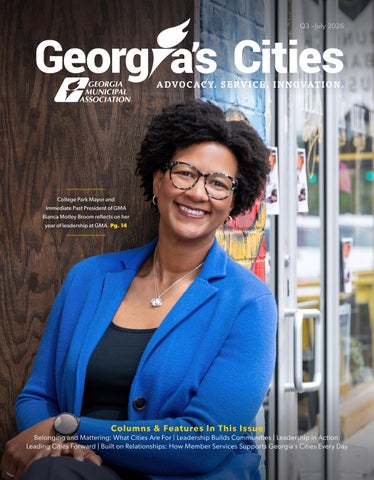
College Park Mayor and Immediate Past President of GMA Bianca Motley Broom reflects on her year of leadership at GMA. Pg. 14
Columns & Features In This Issue Belonging and Mattering: What Cities Are For | Leadership Builds Communities | Leadership in Action: Leading Cities Forward | Built on Relationships: How Member Services Supports Georgia’s Cities Every Day
YOUR INFRASTRUCTURE
STARTS WITH CPS. FOR MORE THAN 65 YEARS, WE’VE BEEN SUPPLYING THE SYSTEMS AND EXPERTISE CITIES DEPEND ON.
Helping cities across Georgia modernize and maintain their infrastructure—water, sewer and natural gas pipe, advanced metering technology, control valves, custom fabrication and more. ACWORTH
ALBANY
(678) 574-7480
(229) 878-0239
LAWRENCEVILLE (770) 822-9664
CONTACT US TODAY.
MADISON
(678) 342-7666
BYRON
COLUMBUS
(478) 956-4777
(706) 569-9114
SAVANNAH
WAYCROSS
(912) 964-4333
c o n s o l i d at e d p i p e . c o m
(912) 283-1114
Turn Surplus Into Success
Q3 – July 2026 Volume 2 • No. 40 Editorial and Advertising Offices: 201 Pryor Street, SW Atlanta, GA 30303
Transform asset disposal with streamlined online auctions
Phone: 404.688.0472
Generate revenue with "as is, where is" sales
Fax: 678.686.6289
Boost bids, clear space, and fund new initiatives
E-mail: gacities@gacities.com
Join 1K+ GA Agencies & Start Selling Today!
CEO AND EXECUTIVE DIRECTOR Larry Hanson DIRECTOR OF COMMUNICATIONS Latisha Gray, APR MANAGING EDITOR Ashley Bailey GRAPHIC ARTIST Lindsay Podrid
Jason Robinson | 334-300-9591 jrobinson@govdeals.com
ADVERTISING SALES Lynne Norton EDITORIAL BOARD Aileen Harris Arica Ratcliff Brian Wallace Chris Higdon Chris Obenschain Dana Goodall Jules Banks Katrina Cochran Lisa Nguyen Noah Roenitz Rusi Patel Pete Pyrzenski Ryan Bowersox
Newnan Fire Training Facility
Milton Public Safety Complex
GMA OFFICERS President: Young Harris Mayor Andrea Gibby First Vice President: Suwanee Mayor James M. Burnette Second Vice President: Jackson Mayor Carlos Duffey Third Vice President: Douglasville Mayor Rochelle Robinson
Fayetteville City Hall
GMA Headquarters
ISSUE COVER Devon McKenna / Photo Synthesis Studio Reflecting on a year of leadership with Immediate Past GMA President and College Park Mayor Bianca Motley Broom Subscription $36.00 per year. Single copies $4.00. Advertising rates upon request. Approximately 7,000 copies of this issue printed. Our policy is to distribute Georgia’s Cities to Mayors, City Councils, City Managers and other key City Officials. Georgia’s Cities reserves the right to decline advertising it deems unsuitable for its audience or market.
newsouthconstruction.com
404.443.4000
Table of Contents FEATURES BUILT ON RELATIONSHIPS: HOW MEMBER SERVICES SUPPORTS GEORGIA’S CITIES EVERY DAY............................................................................................... 5 LEADERSHIP IN ACTION: LEADING CITIES FORWARD......................................... 14 INVESTING IN CREATIVITY: PERRY PARTNERS WITH GEORGIA TECH TO STRENGTHEN LOCAL ARTS ORGANIZATIONS.................................................... 50 CITYSCAPES....................................................................................................... 8 + GMA President: Belonging and Mattering: What Cities Are For + GMA CEO & Executive Director: Leadership Builds Communities + Leadership in Action: Building the Future of Secure, Smart Cities from Ground Up CITY DESK.........................................................................................................12 + Georgia Local Leaders Recognized as Government Champions Through Local Gov 250 + City Spotlight: Thunderbolt GOVERNMENTAL RELATIONS........................................................................... 18 + Federal Leadership in Action: How Georgia City Leaders Drive Advocacy on the National Stage + Celebrating Leadership Across Georgia’s Cities + Speaker Pro Tempore Jan Jones: A Legacy of Leadership INSIDE GMA..................................................................................................... 24 + Love Your City: Georgia Cities Week Celebrates Record Participation, Official Recognition, and Community Pride Across the State + What’s New from RMEBS: Benefits That Work for You! + Get to Know Your RMEBS Workers’ Compensation Field Representative: Jan Hoard + Get to Know Your RMEBS Field Representatives: Loss Prevention and Retirement Planning + Holtz Offers Post GMA Convention Training Opportunities + Empowered to Lead: The Fourth Cohort of the Municipal Leader Community and Workplace Culture Certificate Program Graduates + Developing Leaders, Strengthening Cities: City Leaders Complete GMA’s Spring HRAC Program ADDITIONAL................................................................................................... 40 + GMA LeadershipNext’s Statewide Youth Council Officially Launches + Georgia Reads Day 2026 Celebrates Communities Making Literacy a Priority + Social Media and Public Officials + People Choose Places First: Rethinking Economic Development in Georgia + News from the Georgia Downtown Association CITYLITES......................................................................................................... 54 + Georgia Gems: Dorchester Academy and Museum FOLLOW GMA ON SOCIAL MEDIA: Facebook & LinkedIn: Georgia Municipal Association | X: @GaCities
4
Built on Relationships:
How Member Services Supports Georgia’s Cities Every Day ASHLEY BAILEY, SENIOR COMMUNICATIONS ASSOCIATE, GMA
Behind every call, question, training and connection is a team dedicated to helping cities succeed. WHEN CITY OFFICIALS ACROSS GEORGIA HAVE questions, need guidance, or are searching for resources, they often turn to the Georgia Municipal Association (GMA). What’s less visible, however, is the coordination, relationship-building and behind-the-scenes work that ensures every city receives the support it needs—work powered by GMA’s Member Services team.
At the center of those efforts is a team focused on strengthening relationships with member cities, connecting leaders to resources, and ensuring local officials have access to the tools and support needed to navigate the ever-changing landscape of municipal government. “We strive to be a trusted partner that cities can rely on whenever questions or challenges arise,” said
Q3 – July 2026 | gacities.com 5
Artiffany Stanley, member services consultant for GMA’s districts 6 and 9. “We’re here for anything—from dayto-day issues to more complex situations—and we work to anticipate needs by offering training, resources and guidance that help elected officials and staff succeed in their roles.”
A Connection Point for Cities Across the State
is a source of pride. But meeting the incredible people who sacrifice their time serving others is equally rewarding.” “I hope members feel supported, informed and connected through their relationship with GMA and the Member Services team,” said Sherri Bailey, member services consultant for districts 5 & 7. “My goal is for city officials to know they are not facing challenges alone and that GMA is a reliable partner invested in their success.”
Each member of the Member Services team works closely with cities throughout GMA’s desWhat Happens Behind the ignated districts, allowing them to build strong relaScenes tionships and better understand the unique needs of Many members see Member Services staff the cities they serve. at conferences, training sessions and district meetings, City officials frequently reach out with questions but much of the work happens beyond those events. about training opportunities, leadership development The team regularly coordinates outreach to citprograms, networking opportunities and resources for ies, supports leadership development initiatives, colmunicipal support. While Member Services may not laborates across GMA’s departments and connects always provide every answer city officials to programs and directly, the team helps ensure services that strengthen local "Our team is the superpower city leaders connect with the government. team; we each have experience right resources and experts. Member Services also in local government on various “There are often times serves as an important conneclevels, and it's even more where I can have a team memtor when cities have questions powerful to come together and ber in another district that may related to advocacy or legislameet the needs of the cities we have previous experience with tion. While GMA’s Governmenserve," said Freddie Broome, an issue that can help solve a tal Relations team leads legisladirector of member services. challenge for a city within my tive strategy and policy efforts, districts,” said Dr. Niles Ford, Member Services helps ensure who serves districts 4 and 8. “Our team is eclectic as a members connect with the right resources and policy whole, and we bring so many different areas of experexperts. tise to our members.” “A lot of cities don’t realize that members of our Many members of the team have served in city team have had careers in local government,” said Pete leadership and elected official roles, bringing expePyrzenski, member services consultant for districts 1 rience as city managers, city clerks, fire chiefs, public and 2. “The word ‘consultant’ can have many connoworks directors, economic development directors, tations, but for us, we’re the kind of consultants that and main street directors and more. are alongside cities as they work through challenges, “Helping cities establish best practices across the helping resolve issues and pointing them in the right breadth of operations and processes makes them an direction.” example to other cities to follow and ultimately fosters The recent legislative session served as a reminder a greater quality of life for everyone,” said Michael that supporting Georgia’s cities requires collaboration McPherson, member services consultant for district across teams, departments, and cities as local leaders 3. “Knowing my work makes a difference for my cities navigate increasingly complex issues together. 6
“Georgia is indeed a group project,” said Rashida Cloud, member services consultant and managing director of the DeKalb Municipal Association (DMA). “It takes everyone’s expertise to ensure the success of our state.”
Relationships That Strengthen Communities Strong relationships remain at the center of Member Services’ work. Whether serving large metropolitan cities or smaller rural communities, team members spend time learning the priorities, challenges, and opportunities unique to the areas they serve. “I enjoy networking with elected officials and city staff and have developed so many lifelong friendships within my district’s members and officials,” said Pam Helton, senior member services consultant for GMA’s district 12. “Nothing gives me greater pleasure than helping cities and finding solutions to whatever they may be facing.”
Making the Most of Your Membership At its core, the Member Services team wants cities to see GMA as more than an organization they interact with during conferences, training or annual events. The team encourages city leaders to ask questions, build relationships early, and take advantage of the many resources available through membership with GMA. “Our team is the superpower team; we each have experience in local government on various levels, and it’s even more powerful to come together and meet the needs of the cities we serve,” said Freddie Broome, director of member services. Whether helping a newly elected official navigate their first months in office, connecting a city with peer communities facing similar challenges, or serving as a sounding board during difficult situations, the Member Services team works every day to strengthen Georgia’s cities—one relationship at a time.
FREDDIE BROOME
PAM HELTON
PETE PYRZENSKI
MICHAEL MCPHERSON
NILES FORD
Director of Member Services
Senior Member Services Consultant, District 12
Member Services Consultant, Districts 1 & 2
Member Services Consultant, District 3
Member Services Consultant, Districts 4 & 8
SHERRI BAILEY
ARTIFFANY STANLEY
EMILY DAVENPORT
RASHIDA CLOUD
RANDY MEACHAM
Member Services Consultant, Districts 5 & 7
Member Services Consultant, Districts 6 & 9
Member Services Consultant, Districts 10 & 11
Member Services Consultant and Managing Director of the DeKalb Municipal Association (DMA)
Member Services Consultant and Managing Director of the Gwinnett Municipal Association (GwMA)
Q3 – July 2026 | gacities.com 7
CITYSCAPES
Belonging and Mattering: What Cities Are For ANDREA GIBBY, GMA PRESIDENT AND MAYOR OF YOUNG HARRIS
I recently read a book called Mattering, and the author makes a point that sounds obvious until you actually think about it: you can belong to a group and still feel like you don’t matter. You can be in the room and still feel invisible. THAT IDEA HAS STAYED WITH ME because the gap between belonging and mattering is exactly where city government lives. And it is our job, every day, to close it. Benjamin Franklin understood this. He didn't just theorize about democracy, he built it, block by block, in Philadelphia. The lending library. The first fire company. Paved roads, public lighting, and a public hospital. He believed strong communities are built by people close enough to their neighbors to know what they actually need. He wasn't talking about Washington. He was talking about people who live alongside the people they serve. He was describing us. We know when the streetlight on a particular block isn’t working. We know which neighborhoods have been waiting longest for sidewalks. We know the families who are one rent increase or one medical emergency away from losing everything they’ve built. We know because we are there, at the same community events, the same schools, the same places of worship. Being there is not incidental. It is the foundation of everything we do. And what we know in one city isn’t what we know in the next because no two Georgia cities are the same. The challenges facing a fast-growing suburb look nothing like those facing a small town working to hold its downtown together. Decisions that actually work for the people they affect come from people who understand
8
those differences. And the people who understand them best are the ones who live with them every day. That case needs to be made. Clearly, consistently, and by the people best positioned to make it: you. The argument for local governance doesn’t make itself. When decisions about our communities get made at a distance, by people who don’t know what we know, something essential is lost. We lose the connection between the governed and those who govern them. We lose the ability to make people feel they matter. That is home rule, and it is worth defending not just in principle, but in practice, in your relationships with your legislators, your neighbors, and anyone else who needs to understand why it matters who makes decisions about your city. Two hundred and fifty years ago, the American experiment began with a radical idea: that people could govern themselves. Not from a distance, but close to the ground, close to the people. Cities were where that idea was tested first. And cities are where it is being tested again today. Our convention theme this year was “Georgia Cities Shine Bright.” Cities shine bright because of the steady, unglamorous, daily work of serving people well, work that no one else can do the way we can. That is what I am asking of you this year. Show up. Make the case. Your city is the argument.
Leadership Builds Communities LARRY HANSON, CEO AND EXECUTIVE DIRECTOR
Leadership is one of those words we use often, yet it can mean many different things to different people. Some associate leadership with titles or authority. OTHERS THINK OF INFLUENCE, vision, or decision-making. In local government, I have found that leadership is about something much more personal. It is about service and stewardship. And perhaps most importantly, it is about people. At the Georgia Municipal Association, we have the privilege of working alongside city officials from all 536 Georgia cities and have witnessed this type of leadership taking place all across our state. What inspires me most is the commitment these leaders bring to their communities. Whether they are serving a city of 500 residents or 500,000, our local leaders are working every day to make life better for the people they serve. Based on Gallup’s most recent Governance Survey, most people place their highest trust in local government leaders, with 67 percent expressing confidence that local leaders can handle local problems. That is a testament to local leaders being closest to the people they serve, and the care, concern, and compassion they demonstrate with their service. One reason our Georgia leaders shine is because they never stop learning. The challenges facing cities today are more complex than ever before. Addressing these challenges requires leaders who are willing to learn, adapt, and embrace new ideas. And doing so with a servant’s heart and vision that is expected to see things before others are able to do so. We see this commitment reflected in the eager participation of municipal leaders in the Harold F. Holtz Municipal Training Institute, a partnership between GMA and the Carl Vinson Institute of Government. Our
city leaders embrace the numerous programs offered and the opportunities to learn from each other and to grow in their ability to serve. Leadership development is another important investment any organization can make. Early in my own professional journey, it was council leaders who encouraged me, challenged me, mentored me, and trusted me with opportunities to grow. Those experiences shaped my understanding of leadership and reinforced one of the greatest responsibilities of leadership: developing future leaders. Across Georgia, city leaders are helping prepare the next generation through youth councils, leadership programs, civic engagement initiatives, literacy efforts, and mentorship opportunities. GeorgiaForward, GMA’s nonprofit organization, operates the Young Gamechangers program, which convenes Georgia’s brightest young professionals under the age of 40 each year to tackle significant community challenges. In the process, participants strengthen their leadership skills, build relationships, and gain skills that will build thriving communities. Strong communities do not happen by accident. They are built intentionally, one person at a time and one generation at a time. As Georgia continues to grow and evolve, the need for strong local leadership has never been greater. Their continued success will depend on leaders who are willing to serve, willing to learn, and willing to invest in others. That’s the leadership that will keep Georgia’s cities shining bright. I know you are one of those leaders and I thank you for your service.
Q3 – July 2026 | gacities.com 9
LEADERSHIP IN ACTION:
BUILDING THE FUTURE OF SECURE, SMART CITIES FROM GROUND UP BY MICHAEL OWENS, MAYOR, MABLETON WHEN MABLETON OFFICIALLY BECAME A CITY, WE WERE HANDED A RARE RESPONSIBILITY IN MODERN AMERICAN GOVERNMENT: THE OPPORTUNITY TO BUILD A MUNICIPALITY FROM THE GROUND UP DURING ONE OF THE FASTEST PERIODS OF TECHNOLOGICAL, ECONOMIC AND GEOPOLITICAL CHANGE IN MODERN HISTORY. MOST CITIES INHERIT DECADES—OR CENTURIES— of systems, policies, infrastructure and institutional culture. Mableton began with: possibility. That possibility came with pressure. Residents expected innovation. Businesses expected responsiveness. Communities expected transparency. And all of this had to happen while local governments across America faced increasingly cybersecurity threats, aging infrastructure, workforce shortages and rising public trust. As both a mayor and a cybersecurity executive, I quickly recognized: that modern city leadership is 10
no longer just about roads, zoning and budgets. It is about being responsive while remaining resilient. It is about being transparent while protecting data security and preparing for rapid change. Increasingly, it is also about national security. That reality became clearer during my recent participation in the AFCEA Atlanta National Security Cybersecurity and Critical Infrastructure Conference, where leaders from government, military, academia and private industry gathered to discuss evolving threats. One of the strongest themes was: that local governments are now on the front lines of national security.
Cyberattacks no longer target only federal agencies or Fortune 500 companies. Cities, counties, school districts, utilities, hospitals and transportation systems are primary targets because they often operate with limited resources while managing highly sensitive infrastructure and data. A ransomware attack on a city government can disrupt emergency response, public safety, courts, utilities and public trust itself. In Mableton, we understood early that building a modern city required thinking differently. Rather than recreating legacy systems, we focused on designing a government that is leaner, smarter, and technologically resilient. A newly formed city, Mableton became one of the only municipalities in the region operating fully in the cloud from inception. We also launched one of the region’s first fully electric municipal fleets. We are exploring how smart city technologies—including AI-assisted systems, advanced camera technology, and integrated emergency management tools—can improve public safety—and operational efficiency. However, technology without strategy creates vulnerability. Cybersecurity is leadership governance and operational continuity. Every mayor, city manager, councilmember and department head should understand that digital safety is as essential as financial stewardship.
For municipal leaders navigating this environment, several principles are critical: • Build security before a crisis occurs. Cities should prioritize continuity planning, cybersecurity readiness, cross-agency coordination, and emergency response integration as core governance functions. • Leverage Partnerships. Collaboration between local government, federal agencies, the private sector, universities and nonprofit organizations is essential. • Invest in talent and workforce development. The future of municipal governance depends on attracting professionals who understand infrastructure protection and data analytics. Finally, leadership today requires vision beyond immediate political cycles. The decisions cities make now about technology, infrastructure, housing, mobility, sustainability and digital security will shape communities for generations. America’s cities are no longer just places where people live. They are now critical components of our nation’s economic security, technological resilience, and democratic stability. That means the future of national security does not depend only on the White House or the Pentagon. It depends on leadership at city hall as well. Q3 – July 2026 | gacities.com 11
CITY DESK
Georgia Local Leaders Recognized as Government Champions Through Local Gov 250 Georgia’s local government leaders continue to demonstrate the impact of public service close to home, and several municipal professionals and public servants are now receiving national recognition for that work through the Local Gov 250 Government Champions initiative. THE RECOGNITION PROGRAM CELEBRATES individuals across all levels of government who embody “democracy at the doorstep” through leadership, innovation and dedication to serving their communities. As part of the nationwide America 250 celebration, the initiative honors public servants whose work strengthens communities and improves residents’ quality of life. Government Champions were selected from across the country to represent the many professions and roles that make local governments function every day—from city management and planning to public safety, libraries, human resources and administration.
Georgia honorees include: • • • • •
12
Amy Martin, Senior Planner, City of Valdosta Angela Bowers, Director of Disability Access and ADA Compliance, City of Atlanta Mayor’s Office Bill Bruton, Jr., City Manager, City of Marietta Cheryl R. Small, EdD, Central Library Administrator, Fulton County Library System Dr. Joe Pennino, Deputy City Administrator, City of Roswell
• •
• •
John Amos Ward III, County Manager, Walton County Lisa Y. Benjamin, partner at Lexicon Strategies and former Chief Operating Officer for the City of Atlanta Monica Callahan, Planning and Development Director, City of Madison Sarah Huffman, Assistant Director of Human Resources and Risk Management, City of Rome
The diversity of this year’s honorees reflects the broad reach of local government service and the many professionals working behind the scenes to keep communities moving forward. Whether shaping long-term development plans, leading city operations or improving accessibility and resident services, these individuals represent the innovation and commitment found across Georgia communities. Their recognition serves as a reminder that local government is often where residents experience public safety most directly—and where dedicated leaders continue making lasting impacts every day.
Before you dig, make the smart call. Planning a project? Don’t risk hitting buried utility lines.
Contact Georgia 811 at least 3 business days before you dig. We’ll notify utility companies for you, and trained locators will mark underground lines at your site, so you can dig safely and confidently.
Georgia 811 - Connecting the dots for safe digging.
City Spotlight
Thunderbolt
Located just outside of Savannah along the scenic bends of the Wilmington River, the town of Thunderbolt offers a rich blend of maritime heritage and small-town character. Officially incorporated in 1938, Thunderbolt’s history stretches back much further, with roots tied to Native American settlements and early colonial trade routes along Georgia’s coast.
POPULATION:
2,556 MAYOR:
Dana Williams GMA DISTRICT:
12
The town’s unique name is believed to have originated from a local legend-either a lightning strike that split a tree along the riverbank or the echoing boom of cannon fire during early coastal conflicts. Over time, Thunderbolt became a hub for boating and fishing, a reputation it still proudly holds today. Its waterfront has long been lined with shrimp boats, marinas and seafood markets, contributing to the area’s economic and cultural identity. Today, Thunderbolt is known for its close-knit community, scenic river views, and access to coastal recreation. With its proximity to Savannah and enduring ties to the water, Thunderbolt continues to honor its past while embracing a vibrant future rooted in tradition and resilience.
LEADERSHIP IN ACTION:
LEADING CITIES FORWARD BY ASHLEY BAILEY, SENIOR COMMUNICATIONS ASSOCIATE, GMA
Service, Vision and a Lasting Impact on Georgia’s Cities
14
L
eadership often reveals itself in moments of action—when leaders step forward to solve problems, bring people together and create opportunities for others to succeed. Throughout her term as president of the Georgia Municipal Association (GMA), College Park Mayor Bianca Motley Broom has embraced that responsibility, helping shape conversations around the future of Georgia’s cities while championing collaboration, innovation and local leadership. As her presidency concluded during the 2026 Annual Convention, Mayor Broom left behind more than a year of service and a legacy of connection—one built through advocacy, partnership and a steadfast commitment to cities across Georgia. Throughout her tenure, Mayor Broom traveled across the state meeting with local leaders, hearing firsthand about the challenges cities are facing, and celebrating local successes. Those experiences reinforced a simple truth: Cities are strongest when leaders work together. Her leadership came during a time when cities are evolving rapidly—embracing redevelopment, investing in infrastructure, supporting economic growth and finding creative ways to serve residents. Through it all, she encouraged local officials to remain focused on impact and reminded leaders that meaningful progress happens through action. For Mayor Broom, leadership has never been about titles. It has always been about service.
IN HER OWN WORDS: A CONVERSATION WITH MAYOR BROOM GC: Reflecting on your time as GMA president, what are you most proud of accomplishing? BMB: I’m most proud of the way we came together in the face of significant challenges during the 2026 Legislative Session. There were a number of proposals that could have negatively impacted cities, but through the hard work of our Governmental Relations team and our members, we were able to navigate one of the most challenging sessions in recent memory and work for the benefit of all 536 cities in the state. GC: What are one or two key lessons you’ve learned during your presidency that will stay with you moving forward? BMB: I’ve been constantly amazed at the sheer resilience of the leaders of our member cities. They have faced challenges from many different directions, from natural disasters to a rapidly changing economy and more, in a space in which it’s harder than ever to serve your community because public service is not always appreciated. Regardless, our
members get up every single day committed to making their cities better than the day before. It’s truly inspiring. GC: How have you seen Georgia’s cities evolve or make an impact during your time in this role? BMB: Georgia’s cities have been shining bright in so many ways. We've all had to address the advent of AI, and not just in our day-to-day operations. Some of our cities have had to deal head on with data centers in their communities, and what that means to future growth and resource allocation. Those conversations were not at the forefront of what cities were discussing five years ago. GC: What does “leadership in action” mean to you, especially in the context of serving cities across Georgia? BMB: “Leadership in action” to me means being nimble. What you think may be the right approach at one point may prove to be something different when you learn more information or circumstances change. Our world is very different now than it was at the turn of the millennium. Georgia’s cities are embracing this reality and providing practical solutions for their residents and stakeholders. We’re not doing things the same way because our moment demands new, innovative approaches. GC: Can you share an example of a moment during your presidency where you felt leadership truly makes a difference? BMB: It’s really hard to pick just one moment from all the amazing examples from across the state. But one situation that sticks out is the relentless advocacy of city leaders and GMA's staff to get the reimbursement from the federal government for expenditures due to Hurricane Helene. The delay in those reimbursements was going to force some cities to get loans and take other drastic measures to fill the holes in their budgets. If not for the work of everyone involved to put this issue on the front burner of the White House, FEMA and our federal representatives, the outcome may have been very different. I’m extremely proud of the way we worked together to achieve that important goal.
BUILDING MOMENTUM AT HOME
While serving statewide, Mayor Broom has remained deeply connected to the work happening in College Park. The city continues to experience growth and momentum through initiatives focused on community development, economic investment and creating opportunities for residents and businesses alike.
Q3 – July 2026 | gacities.com 15
GC: What is one initiative or project in College Park that you feel best represents the city’s momentum and impact right now? BMB: I’m excited about the steps we’re taking to develop Six West, about 300 acres west of Hartsfield-Jackson Atlanta International Airport. This mixed-use project will work to give our residents more access to retail and other amenities and help chart the course for our region for decades to come. It’s an amazing opportunity for College Park.
A LEGACY THAT CONTINUES
As Mayor Broom passes the torch at the conclusion of her presidency, her message to future leaders remained clear: leadership is about relationships, action and staying connected to the people you serve.
GC: What advice would you offer to current and future leaders who want to lead with impact in their communities? GC: Looking ahead, what excites you most about the future of College BMB: It’s all about relationships. One of the best things about being Park and its continued growth? in elected office is the ability to be a convener. You have the benefit BMB: I’ve lived in this community for nearly of meeting a lot of incredibly talented people 20 years. The people make College Park the who have skills but may lack the network to "LEADERSHIP IN ACTION" TO ME amazing place it is. We’re rooted in an identity make great things happen. Do your best to MEANS BEING NIMBLE. WHAT YOU that keeps our neighborhoods places where bring those people to the table to unlock the THINK MAY BE THE RIGHT APPROACH people want to settle while having access to full potential of your community. AT ONE POINT MAY PROVE TO BE the world. There’s no other place like it. I’m SOMETHING DIFFERENT... excited about the challenge of maintaining While her presidency is ending, the imthat core identity and strengthening it while pact of her leadership will continue through we pour into our small businesses, continue to develop world-class amethe cities she’s influenced, the partnerships she strengthened and the nities, diversify our housing stock and more. We are building the comleaders she’s inspired along the way. munity we deserve in College Park on a daily basis, and it is an amazing Because leadership in action is not defined by a single term in privilege to be a part of it. office—it is defined by the legacy left behind.
16
THANKS TO OUR CONVENTION SPONSORS — PRESENTING —
—DIAMOND —
— PLATINUM —
— GOLD —
— SILVER —
—COPPER —
—BRONZE —
GOVERNMENTAL RELATIONS
Federal Leadership in Action: How Georgia City Leaders Drive Advocacy on the National Stage MOLLY MCLOUGHLIN, FEDERAL RELATIONS MANAGER
Georgia’s cities have long been recognized for strong local leadership, but they are also making an unmistakable mark on national policies that impact day-to-day city operations. THROUGH STRATEGIC ENGAGEMENT, RELATIONship building, and a unique federal advocacy structure, Georgia has become one of the most visible and influential states in federal municipal affairs. Today, Georgia officials are shaping conversations in Washington to ensure local needs remain a federal priority.
Georgia Cities’ Influence Continues to Grow One of the clearest examples of Georgia’s national presence is its deep involvement in the National League of Cities (NLC). Georgia continues to have more local officials participating in NLC committees, councils and leadership roles than any other state. This year, Mayor Van Johnson of Savannah will step into the role of the NLC’s incoming president, following in the footsteps of Union City Mayor Vince Williams, a
18
past NLC president and GMA president who remains an influential national voice. Their leadership places Georgia at the forefront of critical conversations on infrastructure, broadband, public safety, federal funding and local decision-making authority. Georgia also consistently sends one of the largest delegations to NLC’s Congressional City Conference each March, where hundreds of local leaders convene to discuss shared challenges and meet directly with lawmakers and federal agencies. This strong participation signals Georgia’s commitment to shaping national policy that impacts every community back home.
Leveraging Georgia’s Congressional Influence Georgia’s impact extends beyond national organizations and into the halls of Congress. With
Georgia members serving on influential committees— most notably the House Rules Committee—local leaders have a unique opportunity to shape legislation. Many mayors have built strong, lasting relationships with their members of Congress and these relationships matter. When federal leaders understand local challenges directly from the people managing them every day, their decisions are more grounded and impactful. Whether discussing transportation funding, federal grants, disaster recovery, or housing needs, Georgia’s local leaders hold meaningful influence because they invest in these relationships consistently over time. The relationship-driven advocacy remains central to GMA’s approach. Policy expertise is important, but trust, communication and ongoing engagement are what turn advocacy into action. Georgia city officials understand that collaboration with federal partners strengthens not only individual communities but the entire state.
A Unique Federal Advocacy Structure Supporting all of these efforts is GMA’s federal advocacy staff and broader governmental relations team, which tracks federal legislation and coordinates with federal agencies. What truly sets GMA apart nationally is its Federal Policy Council (FPC). Currently chaired by Mayor Jimmy Burnette of Suwanee, this group of city officials sets GMA’s federal priorities and guides the strategic
direction of all federal advocacy work. The FPC brings together leaders from cities large and small, urban and rural, ensuring that GMA’s federal agenda reflects the full diversity of the state. This structure is unique among state municipal leagues. While many rely on staff-driven advocacy, city officials lead GMA’s charge. This locally-driven approach ensures that federal advocacy remains grounded in real-world challenges and opportunities, and it strengthens Georgia’s influence with national partners who value direct input from community leaders.
Driving National Policy Through Local Leadership Georgia’s growing role in national municipal advocacy is no accident. It results from intentional strategy, committed leadership, and a belief that cities are strongest when they speak with a unified voice. Through active participation in national organizations, strategic engagement with Congress, and a uniquely structured advocacy process, Georgia city leaders are shaping federal policy in a meaningful way. As federal priorities continue to evolve—from infrastructure investment to economic development, housing, broadband and beyond—Georgia’s cities are well positioned to remain at the forefront of the national conversation. By showing up, sharing our stories and working together, they are demonstrating how local leadership can drive national change.
Q3 – July 2026 | gacities.com 19
Celebrating Leadership Across Georgia’s Cities NOAH ROENITZ, STATE RELATIONS MANAGER
EVERY CITY IN GEORGIA TELLS A DIFFERENT STORY. SOME ARE GROWING FASTER THAN THEY CAN BUILD ROADS, PARKS AND WATER LINES. OTHERS ARE WORKING HARD TO REVITALIZE DOWNTOWNS AND ATTRACT INVESTMENT, ALL WHILE KEEPING LONGTERM RESIDENTS ROOTED IN THE COMMUNITIES THEY LOVE. SOME ARE NAVIGATING THE QUIET, UNGLAMOROUS WORK OF This spring, GMA took that commitment a step further through simply keeping the lights on, and ensuring services run for the people our Spring Listening Sessions, held across the state in every region of who depend on them. Georgia. These weren’t events where GMA came to deliver information, What unites all of these stories, from the mountains of North they were conversations where we came to listen. Georgia to the coast, is the leadership behind them. Mayors, council What are the pressures your community is feeling right now? members, managers, clerks and finance officers who show up every What policy changes would make the biggest difference? Where do day, without fanfare, to make decisions that shape the quality of life you need GMA to show up more effectively on your behalf? The feedfor their communities. back gathered from those sessions is already shaping how we approach For GMA’s Governmental Relations team, celebrating that leaderour work, and it will continue to inform our priorities heading into the ship isn’t just a sentiment, it’s the mission statement. Our work exists rest of the year. because yours does. This kind of direct engagement reflects something we believe The 2026 Georgia General Assembly session brought consequential deeply: that strong advocacy starts with strong relationships. And redebates that will define the fiscal and operational landscape for cities lationships are built by showing up, listening, and following through. for years to come. Chief among them was There’s a particular kind of courage debate over local government finances, required to lead at the local level. You’re WHEN A LEGISLATOR HEARS FROM namely property tax. Almost annually not insulated from the people you serve— GMA, THEY'RE HEARING FROM THE now the association is engaging in debates you see them at the grocery store, at FriMAYORS AND COUNCIL MEMBERS around tax reform legislation, all of which day night football games, at church. The WHO ARE ACTUALLY GOVERNING, bear significant implications for how cities accountability is immediate and personal. AND THAT MATTERS ENORMOUSLY. fund essential services. Throughout this And yet, Georgia’s city officials continue session, GMA’s Governmental Relations to step forward, serve with integrity, and team worked to ensure that the voices of city officials, your voices, were tackle problems that don’t have easy answers. present in every conversation that mattered. GMA’s Governmental Relations team is honored to stand alongThat meant testifying before committees, meeting one-on-one with side you in that work. As we look ahead, we remain committed to being legislators and their staff, and making sure the real-world impact of proyour strongest advocates, at the Gold Dome, in Washington, and in posed policy is understood before votes are cast. None of that advocaevery conversation where the future of Georgia’s cities is being shaped. cy carries weight without the credibility that comes from you. When a Thank you for the leadership you bring to your communities evlegislator hears from GMA, they’re hearing from the mayors and council ery single day. It is worth celebrating. members who are actually governing, and that matters enormously.
20
Q3 – July 2026 | gacities.com 21
Speaker Pro Tempore Jan Jones: A Legacy of Leadership KATRINA COCHRAN, GOVERNMENTAL OUTREACH SPECIALIST
Speaker Pro Tempore Jan Jones is no stranger to groundbreaking achievements. FIRST TAKING STATE OFFICE IN 2003, JONES WAS elected to the Georgia State House of Representatives and served as the majority whip before being elected by her peers to serve as speaker pro tempore. This made Jones the first woman to serve in the role, and the highest-ranking woman in Georgia’s legislative history. As her retirement in 2026 nears, Jones noted that when she ran for her seats, she campaigned on the merits of her work rather than her gender. At the same time, she expressed her hope that more women strive for running for political office at a younger age, and that seeing women in government leadership would encourage others to pursue elected positions.
22
Reflecting on her time as majority whip, Jones emphasized the importance of evaluating legislation on the floor and explaining what bills do in plain language to the House members. Once her role evolved into speaker pro tempore, new challenges and priorities emerged. Jones described the need to consider the state as a whole, not just her own district. “Although much of legislation will have more particular impact in certain regions in the state, others will affect every county, city, school board, and individual,” said Jones, adding that this perspective helped her to better evaluate the overall impacts of legislation on Georgians.
The 2026 legislative session brought affordability to the forefront, an issue Jones knew well. Jones was first elected speaker pro tempore during the Great Recession, when the state was making “cuts on top of cuts” to its budget. She recalled a remark by then Governor Sonny Perdue that “unlike businesses, the demand for services for governments goes up during hard times.” The perspective helped inform her decisions on how to prioritize state services during times of tight budgets. Keeping an eye on the long view informed her approach to the 2026 session, where she prioritized the goal to “provide those services, but yet offering income tax rebates as well.” “It’s competing priorities, making state government more affordable, but…continuing at the same time the services that Georgians expect and need from state government, particularly when times are hard,” she said. Jones pointed to increased literacy funding in the 2026 state budget as a personal priority, due to dropping literacy rates in Georgia elementary schools. At the local level, Jones was involved in the creation on 15 new cities in Georgia, producing new cityhoods for the first time in almost 50 years. The experience showed her how local government can make communities more vibrant, interesting and responsive. “It results in happier citizens, because they feel that there is someone they can call on their city council that they might know from church or from their children’s school…as opposed to a county commissioner they’ve never met,” said Jones. Jones championed the creation of the city of Milton, where she resides. In a county with over a million
residents, she believed decisions surrounding zoning, parks and land use should be made by a government closer to the people it serves. Jones held several public meetings and town halls, and defended the creation of the city, arguing that it “was not more government, but government that is closer to the people.” When asked about her advice for new lawmakers entering the General Assembly for the 2027 session, her advice was simple: “stay in their lane.” She encouraged members to focus on the state government and the services it provides, to support local elected officials and constituents, and resist the urge to manage local governments. Jones also recommended that legislators learn to become both generalists and specialists, developing broad knowledge across issues while building deep expertise in one. She chose education as her area of focus. Throughout her career, Jones worked hard to stay true to her values. She advised to “not let perfect be the enemy of good,” pointing out that everyday Georgians want decisions that make life easier, not dramatic change. “They just want to go about their lives, raise their families, focus on their careers and retirement, and don’t want to have to remain aware of what the state legislature is doing, and that is why we should strive to make things better for the long term,” said Jones. GMA wants to express our deep gratitude to Speaker Pro Tempore Jones for her service and her partnership with Georgia’s cities during her time in the General Assembly, and we wish her and her family well as she retires from her seat at the end of 2026.
Q3 – July 2026 | gacities.com 23
INSIDE GMA
LOVE YOUR CITY: GEORGIA CITIES WEEK CELEBRATES RECORD PARTICIPATION, OFFICIAL RECOGNITION, AND COMMUNITY PRIDE ACROSS THE STATE ASHLEY BAILEY, SENIOR COMMUNICATIONS ASSOCIATE, GMA
Across Georgia, communities once again came together to celebrate Georgia Cities Week—a statewide tradition that invites residents to experience, appreciate, and engage with their local governments that serve them every day.
24
THIS YEAR’S THEME, “LOVE YOUR CITY,” WAS reflected in every corner of the state as cities showcased not only the services they provide, but also the heart, creativity and people behind them. “Participating in Georgia Cities Week provided an opportunity to increase public awareness, foster connections, and strengthen community pride between residents, employees, and city leadership. Through outreach activities we were able to highlight the value of municipal services and reinforce our commitment to serving the public,” said Cordele Interim City Manager David Wade. This year also marked an important moment of statewide recognition, as Georgia Cities Week was officially recognized through a proclamation honoring the annual tradition and its continued impact on communities across the state. The recognition underscored the importance of local government engagement and celebrated the role cities play in shaping Georgia’s future. With a record of 225 cities participating this year, the celebration reached new heights, demonstrating the growing enthusiasm among local governments to connect with their communities in meaningful and memorable ways. “Receiving an official proclamation recognizing Georgia Cities Week is a powerful affirmation of the work cities do every day across our state. It elevates this week from a celebration to a statewide acknowledgement of the essential role local governments play in strengthening communities. More importantly, it
reinforces the importance of engagement—when residents, elected officials, and city staff come together, we build stronger connections and a deeper understanding of how cities truly operate. This recognition reflects not only the value of the week itself, but the ongoing commitment of Georgia’s cities to serve, innovate and engage at every level,” said Larry Hanson, CEO and executive director of the Georgia Municipal Association. From open houses and behind-the-scenes tours to community festivals, youth engagement activities, and digital storytelling campaigns, cities across Georgia embraced the opportunity to highlight what makes their communities unique. The week served as both a celebration and a reminder: loving your city means understanding how it works, appreciating the people who keep it running, and investing in its future.
CITIES ACROSS GEORGIA BROUGHT CREATIVITY TO LIFE This year’s Georgia Cities Week celebrations highlighted the creativity and innovation happening in communities of every size. Cities found unique ways to engage residents, encourage civic pride, and create memorable experiences that connected people to local government. “It has truly been a pleasure partnering with GMA and engaging our residents in celebrating everything that makes our small town so special during Georgia Cities Week,” said Bogart Mayor Janet Jones.
BLUE RIDGE
BOGART
AMERICUS
ASHBURN
College Park hosted its annual “Touch-a-Truck” experience giving families and youth an up-close look at public safety vehicles, helping residents better understand the essential services operating behind the scenes every day. Dalton transformed its downtown into a celebration space featuring live music and food vendors, designed to bring residents together and support local businesses. Several communities opened the doors of city hall for guided tours and “meet your city officials” events, allowing residents to connect directly with elected officials and city staff. Other cities hosted youth activities and introduced students to local government and civic engagement opportunities. Leesburg also debuted the first-ever Georgia Caroline Puppet Show, an initiative tied to GeorgiaForward’s Mayor’s Reading Club efforts. The program combined storytelling, literacy, and civic engagement in a creative new format designed to connect with younger audiences and encourage a lifelong love of reading. “This concept was built with the intention of making reading feel alive and accessible for children, and seeing it debut during Georgia Cities Week showed how powerful creative engagement can be when
cities invest in their youngest residents,” said Chan Weeks, senior program manager for GeorgiaForward. “This initiative reflects what happens when innovation and partnership come together—cities become classrooms, storytelling becomes connection, and literacy becomes something kids can experience rather than just be taught,” said Sadie Krawczyk, managing director of GeorgiaForward. Across the state, social media campaigns, community spotlights, scavenger hunts, and resident appreciation events further amplified the “Love Your City” theme and encouraged residents to celebrate the places they call home.
A RECORD YEAR OF VISIBILITY AND RECOGNITION This year’s celebration also saw significant growth in visibility and media engagement. Cities across the state generated increased coverage through local and regional outlets, highlighting everything from innovative programming to community impact stories. “Georgia Cities Week reminded us that Dalton isn’t just a place—it is a community built by people
CENTERVILLE
BOWMAN
CAVE SPRINGS
HAPEVILLE
LEESBURG
26
NEWNAN
TEMPLE
who care, contribute, and show up for one another,” said Candace Eaton, special events and community engagement coordinator for Dalton. This year’s Georgia Cities Week campaign generated significant visibility and engagement across the state, helping amplify the “Love Your City” message far beyond individual communities. The celebration resulted in approximately 5 television media segments, more than 58,000 impressions across digital platforms, and 32, 952 social media engagements as residents, organizations and local leaders shared their experiences during the week. In addition, the campaign generated an estimated 4.5 million hashtag uses, reflecting the widespread excitement, participation, and community pride sparked by Georgia Cities Week celebrations statewide.
STRENGTHENING CONNECTION BETWEEN CITIES AND RESIDENTS Beyond the events and celebrations, one of the most powerful outcomes of Georgia Cities Week was the continued strengthening of relationships between
cities and their residents. Many communities hosted listening sessions, informal gatherings, and interactive forums designed to better understand local priorities and concerns. These conversations reinforced a simple but powerful idea: strong cities are built on trust, communication, and collaboration. At its core, Georgia Cities Week continues to demonstrate that civic engagement does not have to be formal to be meaningful. When cities connect with residents in creative, authentic ways, they build lasting relationships and stronger communities. Looking Ahead to Georgia Cities Week 2027 As another successful Georgia Cities Week comes to a close, the momentum it created continues to carry forward. The ideas sparked conversations started and connections strengthened during the week will influence city engagement strategies long after the celebration ends.
MARK YOUR CALENDARS FOR GEORGIA CITIES WEEK 2027: APRIL 20-24, 2027.
FAIRBURN
CORDELE
COLLEGE PARK
DALTON VALDOSTA
TIFTON
UNION CITY
Q3 – July 2026 | gacities.com 27
2024 GeorgiaForward Power Summit:
MANAGED SERVICES
What Electrical Demand Means for Our Economic Future in ensuring a stable energy future. The event also offers ample netTHE 2024 GEORGIAFORWARD POWER SUMMIT WILL TAKE PLACE working opportunities, allowing participants to connect with Young on November 14 in Atlanta. It will bring together leaders from across Gamechangers Alumni, peers, share insights and develop ways to the state to tackle one of Georgia’s most pressing issues: the intersupport their communities. section of electrical demand and economic growth. This year’s theme, “What Electrical Demand Means for Our Economic Future,” will focus on how the state’s energy needs shape its economic landscape. As Georgia continues to experience rapid growth, the demand The GeorgiaForward Power Summit is a must-attend for for reliable and sustainable energy has never been higher. The sumanyone invested in learning more about the state’s mit will feature speakers, expert that panels, and collaborative Need ankeynote IT support provider understands municipalities? future. For more information, please visit sessions how Georgia get can out meetofitsthe growing electricaland back Weaddressing help municipalities IT trenches to working on what matters. www.georgiaforward.org needs VC3, whilethe fostering economic development. Georgia Municipal Association’s endorsed IT service provider since 2012, has been making IT Attendees explore infrastructure investment, personal, will making IT easy, and getting IT right forrenewable more than 30 years. Serving over 1,100 municipalities of sizes, VC3’s engineers are supported energyallintegration, andGeorgia-based the role of public and private partnershipsby a deep bench of national talent.
Georgia Municipal Association’s Cybersecurity & Technology Services
READY TO TACKLE YOUR CYBERSECURITY & TECHNOLOGY ISSUES? Contact us today at vc3.com/get-started
100% FINANCING FOR YOUR CITY’S REAL ESTATE PROJECT AND EQUIPMENT WITH GMA Bricks & Mortar Program: Real estate projects including City Halls, Police/Fire Stations and Public Parks, Theaters and Greenspaces
Direct Lease Program: Eligible essential equipment including police and fire vehicles, heavy equipment, computer servers and other asset classes. Program benefits include: • Flexible finance terms • Attractive interest rates and competitive terms • No upfront fees or prepayment penalties* • Real estate project compliance with Section 36-60-13 of the Official Code of Georgia Annotated Contact: Philip Potter ppotter@gacities.com to learn more *terms determined during RFP process, other restrictions may apply
VC3.COM 800-787-1160
we’re built to be better
Construction Engineering & Inspection
Your Program & Project Management Partner in Land Acquisition Community Development Surveying & SUE Services Transportation & Civil Design
SINCE 1984 Environmental Solutions
Geotechnical Dam Inspections Materials Testing A national contract service provider dedicated to assisting public agencies with exceptional and cost-effective Bridges/Structures inspections, plan reviews, and comprehensive building department services. Charles Abbott Associates, Inc.
3,600+
100+
professional CAA.INC office staff 530-4980 info@caa.inc locations (866)
60+
accredited labs
20 Pointe North Drive, Suite 107 Cartersville, GA 30120
www.oneatlas.com | (770) 263-5945
What’s New from RMEBS: Benefits That Work for You! The Risk Management and Employee Benefits Services (RMEBS) team is thrilled to introduce a suite of new member benefits for 2026. These additions reflect our ongoing commitment to supporting our members and making it easier than ever to access the services that matter most.
EMPLOYEE ASSISTANCE PROGRAM (EAP) The Employee Assistance Program (EAP), a Life & Health member benefit administered by ComPsych(R) GuidanceResources(R), provides free, confidential support for employees, volunteer first responders, and their eligible family members. Available 24/7, services include counseling, crisis intervention, legal and financial consultations, work-life resources, and digital wellness tools. Cities can add the EAP whenever they're ready, with no paperwork required and no need to wait for open enrollment. To learn more, email lifeandhealthadministration@gacities. com or call 678-651-1039.
PARTNERS IN SAFETY GRANT Formerly known as the Safety and Liability Management Grant, the revamped Partners in Safety Grant opened its 2026 application in April. The program funds safety investments, including training, equipment, and services, for members enrolled in GIRMA and/or the Workers’ Compensation Self-Insurance Fund. It’s a powerful resource for cities looking to build safer workplaces and stronger communities. The application period is open now through September 30. To apply, visit partnersinsafetygrant.gacities. com or email riskcontrol@gacities.com.
To learn more about these benefits or to find out how your city can get involved, visit gacities.com.
Q3 – July 2026 | gacities.com 29
Get to Know Your RMEBS Workers’ Compensation Field Representative: Jan Hoard Supporting Georgia’s cities through guidance, communication, and proactive support When workplace injuries occur, cities need trusted guidance and reliable support to help employees recover while keeping operations moving forward. Supporting cities through these moments is the RMEBS Workers’ Compensation Field Representative, who works directly with local governments across Georgia to provide guidance, answer questions, and help navigate the workers’ compensation process. From assisting with reporting procedures to providing ongoing resources and support, the role focuses on helping cities feel prepared and informed every step of the way. While workplace incidents can be challenging, having a knowledgeable partner helps ensure cities can respond effectively while continuing to prioritize employee well-being and workplace safety. In this issue, we’re highlighting our Workers’ Compensation Field Representative and the important role this position plays in supporting Georgia’s cities every day.
30
Meet Your Workers’ Compensation Field Representative Field Representative Jan Hoard, Workers’ Compensation Claims Manager and Service Coordinator
Q: What is your role with RMEBS, and how do you support cities? I am the workers’ compensation claims manager and service coordinator for GMA. I oversee the workers’ compensation program to ensure the claims are handled timely and appropriately by our third-party administrator (TPA). I travel the state and meet with many members to discuss their claims. I also offer training for the staff.
and supervisors to focus on making the workplace safer for everyone.
Q: What is one common question you hear from cities about workers’ compensation? The most common question is how to report a claim. Members can report the claims in the following ways: • Option 1: By phone to CorVel at 1-800-685-4267 • Option 2: Email the WC-1/First Report of Injury to fnol_fax@corvel.com • Option 3: Fax the WC-1/First Report of Injury to 1-866-777-1668.
Supporting Cities Every Step of the Way Workers’ compensation is about more than managing claims—it’s about supporting employees, strengthening workplace practices, and helping cities navigate challenges with confidence. Through ongoing communication, guidance, and partnership, the RMEBS Workers’ Compensation Field Representative helps cities across Georgia stay informed, prepared, and supported when it matters most.
Q: How can city leadership support effective claims management? Reporting the claims quickly to CorVel is helpful. The CorVel adjusters are then able to contact the injured worker and assist with medical treatment and benefits. Another way leadership can show support is by promoting a safety culture. This can empower employees
To learn more about RMEBS Workers’ Compensation services or to connect with Jan contact her at jhoard@gacities.com.
Q: What do you enjoy most about working with Georgia’s cities? I enjoy traveling, meeting with members, and explaining the workers’ compensation process. Our roles are service driven, and I like to be there for the members when they have questions or need assistance.
Q3 – July 2026 | gacities.com 31
HOLTZ OFFERS POST GMA CONVENTION
Training Opportunities
GMA members looking to continue their training journey in the Harold F. Holtz Municipal Training Institute will have several opportunities to do so following the GMA Annual Convention. The Harold F. Holtz Municipal Training Institute is operated via a partnership between the Georgia Municipal Association and the UGA Carl Vinson Institute of Government. On Aug. 17, the training institute will offer both the Downtown Development Authority Basic Training class and the Creating a Downtown Renaissance: Advanced DDA Training class prior to the Georgia Downtown Conference in Rome.
THE DOWNTOWN DEVELOPMENT AUTHORITY BASIC TRAINING class is primarily directed at those who serve on Downtown Development Authorities, but it is open to all city officials. Topics include: the management of downtown as a valuable resource; the role of the authority, board members and staff; DDA laws; and the day-to-day operations of a Downtown Development Authority. THE CREATING A DOWNTOWN RENAISSANCE: ADVANCED DDA TRAINING class requires completion of the DDA Basic class as a prerequisite. The advanced class builds on the DDA Basic Training class with an emphasis on applying downtown development tools. The importance of developing a downtown vision and a plan is discussed. Attendees also hear the basics of navigating Business Improvement Districts, Community Improvement Districts, Tax Allocation Districts, Historic Preservation Tax Credits, the Redevelopment Powers Act and Urban Redevelopment Law. Best practice examples of utilizing federal, state and local partnerships, programs, and incentives are shared. Class 32
participants are given an opportunity to immediately apply the tools and programs highlighted in the class through a case study exercise. Both classes begin at 8:30 a.m. See the Georgia Downtown Conference registration information on GMA’s website for more information and to register. Conference registration is not required for the training classes, which require a separate registration fee. On Wednesday, Sept. 23, the HEART AND SOUL DOWNTOWN WORKSHOP will be held in downtown Hartwell. This six-hour class targets municipal officials who are interested in downtown revitalization. Workshop participants are provided opportunities to view actual plans and projects with officials form the city of Hartwell, who will discuss their downtown and neighborhood strategies, their success stories, and their lessons learned. The workshop includes formal presentations and tours of downtown areas. The class utilizes city officials and downtown practitioners who have first-hand experience
with downtown development. Additionally, information on available resources that provide technical assistance and downtown incentives will be shared. Those eligible for Holtz training certificates who have taken previous Heart and Soul Downtown workshops may take this class again and receive six hours of credit toward a training certificate. The class will be held from 8:30 a.m. to 3:30 p.m. Visit GMA’s website for more information and to register. TWO-DAY FALL TRAINING EVENT The two-day Fall Training Event will be held on Oct. 1-2 at Brasstown Valley Resort in Young Harris. The event will feature three six-hour classes on Thursday, Oct. 1 and three six-hour classes on Friday, Oct. 2. Each class is scheduled to begin at 8:30 a.m. and conclude at 3:30 p.m. THE THURSDAY, OCT. 1 CLASSES ARE: • HARMONY IN LEADERSHIP: NURTURING, KINDNESS, CIVILITY, AND TRANSFORMATIONAL INFLUENCE* This class is designed to explore the fundamental principles of kindness, civility, emotional intelligence and moral and ethical leadership behavior. Participants will delve into various aspects of interpersonal relationships, communication strategies, and leadership techniques aimed at fostering a culture of respect, understanding, and compassion in municipal governance. • STEERING THROUGH THE STORM: GUIDING YOUR COMMUNITY THROUGH A DISASTER* During times of natural or human-made disasters and pandemics, cities are often faced with the challenge of steering through the “storm,” continuing city business operations, and communicating effectively to meet the
•
basic needs of their community as well as managing the needs and demands of the ongoing recovery operation. While the initial focus following a major disaster is to respond to the life safety aspects of the emergency, multiple tasks will quickly emerge to face the local leadership team. Is your city prepared for the organizational resiliency necessary to sustain regular services as well as emergency operations during the four distinct phases of a disaster? What is the role of elected leaders in these scenarios? This class will define the various types of disasters, review the four phases of a disaster and the planning and preparedness required for community resilience in responding to disasters, exploring methods for prioritizing crucial essential services, and recognizing the multiple impacts on the local economy, city services and city staff. EVOLVING WITH TECHNOLOGY: KEY INSIGHTS (NEW) Technology is a driving force in modern municipal governance, enabling smarter decision-making, stronger citizen engagement, and improved service delivery. This class is designed to help mayors, councilmembers, and local government leaders understand and navigate the evolving technology landscape. With a focus on emerging tools such as artificial intelligence (AI), cybersecurity strategies, smart city applications, and communication platforms, this class moves beyond a basic overview to provide meaningful discussion, practical examples, and hands-on exercises. Participants will have expanded time for dialogue, policy exploration, and small group activities. Emphasis will be placed on the leadership role of elected officials in setting strategic direction, supporting staff, and ensuring ethical, transparent, and secure adoption of technology in their communities.
Q3 – July 2026 | gacities.com 33
THE FRIDAY, OCT. 2, CLASSES ARE: • BUILDING COLLABORATIVE RELATIONSHIPS TO SOLVE COMMUNITY CHALLENGES This class examines the importance of valuing, building, and nurturing key relationships for Georgia’s cities with counties, school systems, public health agencies, healthcare systems, and relevant nonprofit organizations. Municipalities are increasingly playing the role of conveners or partners for thorny community problems. Beyond the technical aspects that support collaborative relationships, optimal efforts require key community leadership competencies in order to effectively develop and maintain the relationships. Building community-based collaborative relationships is more intentional than regional relationships. The legal requirements that mandate, encourage, or limit some of these relationships will be explained and the differences identified. The various instruments and vehicles that offer or require opportunities for cooperation will be outlined, and the importance of building collaborative relationships will be fully explored. The class also includes an overview of best practices for leadership and steps leading to good community partner relations, as well as barriers to good relations. Resources that are available to improve these relationships will also be presented. • ADVANCING GEORGIA’S RESPONSE TO HUMAN TRAFFICKING (NEW) Human trafficking is a crime that affects every community, and it is happening in Georgia. The role of local governments is crucial in being able to effectively recognize, respond, and prevent this multifaceted issue and protect local communities. By covering the complete range of awareness to action, this class will allow participants to dive deep into the intricacies of human trafficking in all its forms, describe key elements of victimology, understand trafficking recruitment strategies, and recognize vulnerabilities in any community. Additionally, participants will understand Georgia’s anti-trafficking network and resources and how to get involved, as well as be empowered to advocate for innovative projects and solutions to combat this crime in their own communities. • MUNICIPAL LAW* This class provides an overview of the major sources of municipal authority and the limitations of that authority, including constitutional and statutory law. Municipal charters and ordinances are discussed, and participants are encouraged to read their city’s charter before attending this class. How to enter into legal contracts is reviewed. This class also provides a
34
foundation for understanding the liability and immunity of cities, elected officials and municipal employees. If time permits, this class may also address working with the city attorney. *This class is on the required list for the Municipal Training Institute Certificate Program. FUTURE OPPORTUNITIES INCLUDE: On Oct. 20-21, the Holtz Institute will host the DOWNTOWN DEVELOPMENT AUTHORITY BASIC TRAINING class again, but as a live online class over two days. The class will be held from 8:30 a.m. to 1 p.m. each day. Registration information is available on GMA’s website. On Thursday, Nov. 5, the Holtz Institute will hold the advanced leadership class HOW SHALL WE LIVE? PRACTICAL ETHICS FOR PUBLIC LIFE at the GMA headquarters in downtown Atlanta. The class will be held from 8:30 a.m. to 3:30 p.m. Class description: Ethics is often seen as something that is lacking in public officials, and therefore must be imposed on them through laws and training. Ethics training may promote awareness and compliance, but it does not promote ethical excellence. In this class, participants explore the advantages and limitations of codified ethics; how values, morality, virtue, character and obligations play out in everyday decision-making; why ethical dilemmas arise and how we resolve them; virtues and temptations of leadership; and how public service constitutes a moral and ethical enterprise for public leaders. Visit GMA’s website for more information and to register. NEWLY ELECTED OFFICIALS INSTITUTE SET FOR 2027 In 2026, the Holtz Institute hosted two Newly Elected Officials Institute events in Athens and Tifton. More than 500 city officials attended the training, which covered essential information newly elected leaders need to effectively serve their communities. Topics included legal foundations, charters and policies, ethics, public safety, parks and recreation, revenue sources, meeting management, planning and zoning, public works, and more. Looking ahead, this state-mandated training will be offered once in 2027, scheduled for Feb. 24-26 at the University of Georgia’s Center for Continuing Education and Hotel in Athens. Registration will open in late October 2026 on the GMA website.
Focus SPONSOR
ORGANIZATION
GEORGIA POWER FEATURED REPRESENTATIVE
Cleve Fann,
Senior Vice President of Region External Affairs
WHAT IS GEORGIA POWER’S GUIDING PHILOSOPHY? We are guided by our longstanding commitment to being a Citizen Wherever We Serve. For more than 140 years, we've been committed to delivering clean, safe, reliable and affordable energy while helping Georgia's cities and towns prosper. That commitment shows up in our industry-leading reliability and long-standing focus on affordability, even as we support new energy demand driven by Georgia's continued growth. We believe that progress and partnership go hand in hand; that by working with local leaders, we can power not only homes and businesses, but also opportunity, innovation, and a stronger quality of life for everyone across the state.
WHY DOES GEORGIA POWER SUPPORT CITIES? Cities are the heartbeat of Georgia’s economy and the foundation of its future. Their success directly shapes the strength and vitality of the entire state, and that makes their success our success. Georgia Power partners with municipalities through infrastructure investment, workforce programs, and economic development initiatives that help attract new industries and create jobs. In fact, our Economic Development team has helped bring more than 200,000 jobs to Georgia over the past decade by supporting business recruitment and expansion.
We’re proud to stand alongside city leaders to plan for progress, prepare for change, and ensure every community—large or small— has the reliable energy and resources to flourish.
WHAT’S NEXT FOR GEORGIA POWER? Georgia Power is shaping the future of energy in Georgia by combining innovation with responsibility. As technology rapidly transforms how electricity is generated and delivered, we're investing in smarter systems that make power more efficient, reliable, affordable, and cleaner, while keeping safety at the core of everything we do. Artificial intelligence and advanced analytics are helping us anticipate energy demand, optimize grid performance, and detect potential issues before they occur, improving reliability for customers statewide. We're also exploring emerging trends in generation, from expanding renewable resources and battery storage to evaluating next generation natural gas and hydrogen blending. Our goal is to build an energy ecosystem that's adaptive and resilient--one that meets Georgia's needs today while preparing for the demands of tomorrow. By integrating innovation, data, and community partnership, Georgia Power is powering a brighter, smarter, and more sustainable future for all Georgians.
Empowered to Lead:
The Fourth Cohort of the Municipal Leader Community and Workplace Culture Certificate Program Graduates In May 2026, the fourth cohort of the Georgia Municipal Association’s Municipal Leader Community and Workplace Culture Certificate Program crossed the finish line, completing an eighth-month journey that began in October 2025 and culminated in a powerful showcase of leadership, growth, and community vision. THIS COHORT BROUGHT TOGETHER 22 LEADERS REPRESENTING municipal elected officials, county leaders, department directors and GMA staff, a diverse cross-section of public servants united by a shared commitment to building stronger cities and thriving organizations. Over eight months, participants engaged in modules covering collective leadership, emotional intelligence, public safety, community well-being,
36
and stakeholder engagement. “This program is so valuable because it creates a space for municipal and county leaders to come together and focus on what’s most important, creating thriving communities where people want to live, work, and play,” said GMA Member Services Director Freddie D. Broome, the program’s lead facilitator.
Through panel discussions, mentorship, and peer collaboration, participants explored how to build stronger cities and thriving organizations that enhance the quality of life for Georgia’s residents. “When people show up fully, with their experiences, their doubts, and their dreams, something powerful happens,” Broome said. “Leadership becomes less about authority and more about influence, connection, and shared purpose.” A highlight of the program was each participant’s capstone project, which challenged them to tackle real-world issues using the skills gained throughout the course. Projects ranged from AI integration in municipal government to youth civic engagement, fire safety education, workplace resilience, and environmental sustainability. For Samaria McCoy of the City of Forest Park, the process was deeply personal. During the program, she discovered a name for the internal barriers that had been holding her back. “Instead of ignoring them, I built a way to face them,” McCoy said, a breakthrough she channeled directly into her capstone project. This cohort was the first in the program to feature cross-jurisdictional capstone collaborations. Ray Long from the City of Lawrenceville and Linda Becquer-Pritchett from the City of South Fulton partnered on a joint recycling and sustainability initiative, while Dr. Tavari Turner of GMA and Alecia Washington of the City of Stonecrest teamed up on a youth citizens academy, demonstrating what becomes possible when municipal leaders and organizations look beyond their own borders. Portia Tadese of GMA said the collaborative spirit was evident throughout the final presentations. “It’s been great to see all of the things that we learned throughout the modules throughout the year, and how they’ve been implemented in everyone’s plans,” she said. For Phyllis Calloway of the City of Powder Springs, the program’s impact extended well beyond her capstone. “This whole program has just been so amazing and resourceful for me,” Calloway said. “I’m probably going to utilize these skills forever. Even though I’m close to retirement, it just motivates me to continue on.” Broome said moments like Calloway’s reflect exactly what the program is designed to produce. “Growth doesn’t happen in comfort zones,” he said. “This program asks leaders to look inward so they can lead outward, and that takes real courage.” Congratulations to all the graduates, who now join a growing network of program alumni returning to their cities and organizations with new ideas, strong professional connections, and renewed energy to make lasting impacts. “Every cohort teaches me something new,” Broome said. “This group reminded me that when people are given the space to be honest and vulnerable, they grow in ways that benefit not
just themselves, but every resident they serve and every colleague they work with.” Registration for the next cohort is now open. For more information, visit gacities.com/events or contact Freddie D. Broome at fbroome@ gacities.com or 470-249-6423.
Spring 2026 Cohort Graduates and Capstone Projects • • •
•
• • • •
• • • •
• •
•
Louise Brown, Riceboro – Lighting the Way Through Our City Phyllis Calloway, Powder Springs – Resilient Foundations: A Workplace Resilience Program Rashida Cloud, Emily Davenport, Dr. Niles Ford and Pete Pyrzenski, GMA – The MSC Elevator Pitch: Defining Who We Are as GMA Member Services Consultants Sandra Davis and Anthony Gallman, Forest Park – Community Risk Reduction: Building a Safer Forest Park Through the Junior Fire Marshal Program and Fire Safety Simulator Ryan Diaz, Hogansville – Standard Operating Procedures for Natural Gas Meter Sets in Hogansville Latisha Gray, GMA –One GMA: Strengthening Organizational Culture Through Collaboration and Engagement Keisha Jeffcoat, Mableton – Community and Stakeholder Engagement Ray Long, Lawrenceville and Linda Becquer-Pritchett, South Fulton – Recycling and Sustainability: The Role of Cities in Building a Circular Economy Samaria McCoy, Forest Park –Breaking Out Beyond the Plan: A Journey from Going to Growing Evelyn Pinto, Athens-Clarke County Consolidated Government— Providing Free Feminine Hygiene Products in Public Facilities Randi Rainey, Fairburn—The Digital Gavel: AI Integration in the Municipal Clerk’s Office Stephanie Rose and Portia Tadese, GMA—Bridging the Divide: Improving Interdepartmental Collaboration Through the Interdepartmental Understanding Toolkit Holly Stevens, Building a Stronger HR Team Dr. Tavari Turner, GMA and Alecia Washington, Stonecrest—Youth Citizens Academy: Building the Next Generation of Civic Leaders in Stonecrest DJ Waller, GMA—GMA Municipal 5K
Q3 – July 2026 | gacities.com 37
Developing Leaders, Strengthening Cities: City Leaders Complete GMA’s Spring HRAC Program
38
Local government human resources professionals from across the state recently completed the latest cohort of the Human Resources Administration Certificate (HRAC) program, concluding the class in late April after several months of collaborative learning and professional development.
THE HRAC PROGRAM PROVIDES PARTICIPANTS WITH A STRONG foundation in the principles of local government human resources management. Throughout the course, attendees explored key topics including retirement and retention, employee relations, compensation and benefits, workplace policies, leadership development, and employment law. The program is designed to help local government professionals strengthen their knowledge and build practical skills they can immediately apply within their organizations. This year’s graduates represented cities from across the state and brought a wide range of experiences and perspectives to the classroom. Through interactive discussions, case studies, and peer collaboration, participants gained valuable insights while also building connections with fellow local government professionals facing many of the same workplace challenges and opportunities. The completion of the program marks an important professional milestone for each graduate and reflects their commitment to continued learning and excellence in public service. As local governments continue to navigate evolving workforce needs, programs like HRAC help equip professionals with the tools and resources needed to support employees and strengthen organizational culture within their cities.
Graduates of the Spring 2026 HRAC class include: • • • • • • •
Alan Jones, Fayetteville Andre Henry, Forest Park Chief Belinda Penamon, Barnesville Assistant Police Chief Bradwick Sherrod, Port Wentworth Carmen Scott, Fayetteville Courtney Flowers, Doraville Diana Wheeler, Eastman
• • • • • • • • • • • • • • • • • • •
Dr. Anna Clifton, Carrollton Erin Bryant, Locust Grove Furdge Turner, Jonesboro Gloria Waller, Sandersville Hiba Pothiawala, Doraville Lieutenant Kay Crider, Peachtree City Latasha Akers, Lilburn Lorey Sophr, Brooks Lynette Cook-Osborne, Midway Malinda McIver, Riceboro Maria Wetherington, Jonesboro Michael McPhaul, Port Wentworth Michelle Ward, Peachtree City Nichole Parks, Canton Assistant Police Chief Rennie Walters, Port Wentworth Shavala Ames, Stone Mountain Sherrie Crisp, Fayetteville Tenisha Dixon, Forest Park Councilwoman Vanessa Thomas, Stockbridge
The next HRAC class will be offered in the fall starting Sept. 23 in Waycross. Local government professionals interested in participating are encouraged to register early, as space is limited.
For additional information, visit gacities.com/events/detail/hracfall26.
Q3 – July 2026 | gacities.com 39
GMA LeadershipNext’s Statewide Youth Council Officially Launches The statewide youth council launched in early April and gathered during the GMA Annual Convention alongside GeorgiaForward staff to plan for the year. A RECENT STUDY FOUND THAT ONLY 16% OF understanding of civic leadership. These experiences young people regularly engage with their community not only empower youth to make a positive impact in meaningful ways. GeorgiaForward recently in their communities, but also help prepare them for launched a new, bold initiative to ensure that this college, careers and future leadership roles. statistic does not remain the norm for young people This statewide youth council will serve as a platform in Georgia. The new statewide Youth Council is GMA for young leaders across Georgia to collaborate, learn, and GeorgiaForward’s latest step in elevating youth and make a positive impact in their communities. voices and providing additional avenues for leadership Council members participate in community service development. The council includes 12 representatives initiatives, statewide meetings, and educational from across the state, representing various GMA programs designed to strengthen their leadership districts. and civic engagement skills. The council will discuss Participation in the statewide youth council important issues affecting youth, share ideas with peers provides youth with valuable from different communities, leadership development and work alongside local and The statewide youth council will opportunities that prepare state leaders. create a meaningful impact on them for success. Through In this inaugural year, the communities by empowering young collaborative projects, public council is developing a project speaking experiences, people to become active leaders and based on a particular focus leadership workshops, and area impacting youth across advocates for positive change. community engagement the state. The council recently initiatives, council members gathered during GMA’s Annual strengthen important skills such as communication, Convention for a planning retreat. teamwork, problem-solving, and decision-making. This inaugural council is made up of a diverse Students also gain hands-on experience working with group of youth who represent the very best of our peers and community leaders from across Georgia, next generation in leadership across Georgia and the helping them build confidence and expand their nation.
40
Members of the council include: • Alexis C. (Suwanee) • Ashley R. (LaGrange) • Ashrit G. (Columbus) • Cornell W. (Lovejoy) • Elijah C. (Columbus) • Eve S. (Perry) • Lucie Marie H. (LaGrange) • Marigrace G. (Jesup) • Nicole S. (Richmond Hill) • Peyton F. (Alpharetta) • Pranavi S. (Cumming) • Seeyoung L. (Suwanee)
The statewide youth council will create a meaningful impact on communities by empowering young people to become active leaders and advocates for positive change. Through service projects, outreach efforts, and collaboration with local leaders, council members address issues that affect youth and their communities while promoting civic engagement and community pride. The council also helps strengthen connections between communities across Georgia by encouraging students to share ideas, learn from one another, and work together toward common goals. By giving youth a platform to lead and serve, the program not only benefits participating students, but also inspires stronger, more engaged communities statewide.
Q3 – July 2026 | gacities.com 41
Georgia Reads Day 2026 Celebrates Communities Making Literacy a Priority CHAN WEEKS, SENIOR PROGRAM MANAGER, GEORGIAFORWARD
On March 3, 2026, state and local leaders gathered at the Georgia State Capitol to celebrate Georgia Reads Day and recognize communities that are proving what is possible when literacy becomes a shared priority.
GOVERNOR BRIAN P. KEMP PROCLAIMED MARCH 3 AS GEORGIA Reads Day, calling attention to literacy as a critical driver of Georgia’s economic growth, workforce readiness and overall quality of life. The proclamation also underscored the urgency of the issue: in 2024, 63% of Georgia’s rising fourth graders were not reading proficiently. Research continues to show that students who read proficiently by the end of third grade are far more likely to graduate form high school, making early literacy one of the most important investments a community can make. That is why Georgia Reads Day matters. It makes literacy visible as a community responsibility, not only a classroom goal. The Georgia Municipal Association and GeorgiaForward are proud partners in the Georgia Reads initiative, supporting the statewide effort to improve literacy by helping connect state goals with local leadership. For cities, literacy is directly tied to the strength of the community. Strong readers become stronger students, workers, residents and civic leaders. When children have the skills and confidence to read, they are better prepared to succeed in school, participate in the workforce and contribute to the civic and economic life of their hometowns. At the Capitol, the Georgia Council on Literacy honored the 2026 Georgia Reads Community Award winners—ten local partnerships with at least three years of collaboration and measurable literacy gains. Each honoree received $20,000 to strengthen its local literacy work,
42
and each may select a school for a “Read with Malcolm” event with Georgia Reads Coach Malcolm Mitchell. The 2026 Georgia Reads Community Award recipients are: • Books for Keeps (Athens-Clarke County) • For the Love of Reading, Inc. (Thomaston-Upson County) • Harris Literacy Center at Augusta University • Jackson County Schools • Lumpkin County Schools • Mayor’s Impact Team (Monroe-Walton County) • Meriwether County School System • Portal of Commencement Midpoint Shelter, Inc. (Fulton County) • Reach Out and Read Georgia (Fulton County) • United Way of Hall County These communities are seeing improvement in students because they are not treating literacy as the responsibility of one classroom, one school or one program. They are building partnerships that connect education, families, local government, nonprofits, libraries, health providers, businesses and civic organizations around a common goal. Their progress reflects the power of local leadership and the importance of aligning community resources around children from birth through school age and beyond.
One example is the Mayor’s Impact Team in Monroe-Walton County. Its recognition highlights how municipal leadership can help bring visibility, coordination and momentum to literacy efforts. Monroe Mayor John Howard is also part of GeorgiaForward’s Mayor’s Reading Club, demonstrating how mayors can use their role to encourage reading and bring partners together around student success. For cities looking for a place to begin, the Mayor’s Reading Club offers a practical way to start or strengthen a local literacy effort. The program encourages mayors to use their leadership platform to promote reading, convene partners and signal that literacy is a community priority. It also creates an accessible entry point for cities that want to connect local government with schools, libraries, families and community organizations in a meaningful and visible way. Georgia Reads Day reminds every city that literacy work does not have to start with a large program or a complicated plan. It can begin
with a mayor reading to a classroom, a city partnering with its library, a business supporting book access, or a group of local leaders asking schools and families what support is needed most. What matters is that communities make literacy intentional, consistent and collaborative. The Georgia Reads Community Award winners are proof that progress is possible. Their work shows that when communities organize around reading, students benefit. For Georgia’s cities, this is an opportunity to lead. Make literacy a priority in your community. Join GeorgiaForward’s Mayor’s Reading Club, begin building a local literacy collaboration and reach out to GeorgiaForward for assistance. By working together, Georgia cities can help more children become strong readers—and help build stronger communities for generations to come. To learn more about Georgia Reads Community Award Winners and GeorgiaReads visit, georgiareads.org.
Q3 – July 2026 | gacities.com 43
Social Media and Public Officials RUSI PATEL, GENERAL COUNSEL, GMA
For city officials across Georgia, social media has become an everyday tool for communicating with residents. Whether sharing updates, highlighting community events, or responding to concerns, these platforms offer an immediate way to engage with the public. BUT RECENT COURT DECISIONS MAKE CLEAR between, and in those cases, courts will closely examine that this convenience comes with legal risk. What the content and purpose of specific posts. may feel like a personal account can, under certain A recent order from the Northern District of circumstances, be treated as an official government Georgia shows how this plays out when a city itself forum subject to First Amendment protections. operates the account. In Booterbaugh v. City of In 2024, the U.S. Supreme Court addressed Morrow, a resident alleged he was blocked from the this issue in Lindke v. Freed. The case involved a city city’s Facebook page after posting criticism of city manager who used a Facebook leadership. The court found the page to share both personal page functioned as a limited By understanding when speech is content and information about public forum, meaning it was considered official and by managing city business. After he deleted open for discussion but also public-facing accounts thoughtfully, comments and blocked a potentially subject to certain city leaders can continue to engage critical resident, the question rules. with their communities while became whether he acted as a As a result, the court ruled respecting the constitutional private citizen or a government that the city’s social media boundaries that govern that official. policy was an unconstitutional interaction. The Court recognized restriction of free speech. that public officials retain their Regarding blocking the private speech rights, even when discussing their resident, the court found enough in the facts to allow jobs. But it also made clear that officials cannot avoid for a First Amendment retaliation claim to proceed to constitutional limits when acting in an official capacity. trial. The Court established that social media activity counts While cities potentially may remove inappropriate as government action only when the official has of off-topic content, they cannot silence speech based authority to speak for the government and is exercising on viewpoint. Criticism of government officials is that authority in the posts at issue. protected, and blocking users or hiding comments If an official is speaking privately, they may control because of that criticism can violate the First their page like any other user. But when they use social Amendment. media to communicate in their official role, constitutional The case also highlights practical concerns. protections apply. Many accounts fall somewhere in Multiple officials had access to the page, and there
44
were questions raised as to whether officials had consistent training or oversight. This alleged lack of structure may have made it more difficult for the city to defend its actions and increased the risk of liability. These decisions offer several clear lessons: • The more an account is used for official purposes, the more likely it is to be treated as a government forum. • Official pages should be managed carefully, with policies applied consistently and without regard to viewpoint. And when multiple people manage a page, clear guidance and oversight are essential. • Criticism of government officials, even when harsh or uncomfortable, is protected speech. Removing it simply because it is unfavorable can create significant legal risk.
Both Lindke and Booterbaugh highlight a secondary issue of which cities should be aware: Each of these cases ultimately turns on specific fact questions, which means that it is often a court that will decide the legality of any such pattern, practice or policy. Without carefully thinking through such patterns, practices and policies, cities leave themselves open to potentially costly litigation, which is not good for the city or its taxpayers. Social media remains a valuable tool for engaging with residents, but it requires thoughtful use. By understanding when speech is considered official and by managing public-facing accounts thoughtfully, city leaders can continue to engage with their communities while respecting the constitutional boundaries that govern that interaction.
Q3 – July 2026 | gacities.com 45
People Choose Places First:
Rethinking Economic Development in Georgia TARA BRADSHAW, MANAGER, ECONOMIC DEVELOPMENT AND PLACEMAKING
Placemaking in Georgia isn’t just evolving—it’s challenging how local leaders think about economic development. FOR YEARS, THE PLAYBOOK WAS FAMILIAR: RECRUIT THE NEXT employer, extend infrastructure, compete for growth. Those tools still matter, but they’re no longer enough. Across Georgia, communities are recognizing that people choose places before businesses do. And increasingly, placemaking is the strategy that shapes those choices. At its core, placemaking often gets labeled as design—benches, lighting, streetscapes, murals. But that’s a narrow view. In practice, it’s a strategy, the connective thread tying together planning, community development, infrastructure and economic strategy into something that actually works. The real challenge isn’t a lack of plans. It’s a lack of alignment, which doesn’t happen without leadership. Rather than operating in silos, these disciplines must be brought together through a shared focus on creating places where people want to gather, live and invest. You can see it happening across Georgia— through the continued momentum in downtown development. For example, cities like Thomaston and Pembroke are taking a harder look at suburban, high-production housing. They’re asking the right questions: How do we grow without losing who we are? How do we ensure new development includes walkability, access to green space, and a sense of place that actually fits the community? That shift matters, because the return on investment is real. Communities that prioritize people-first design—walkable downtowns, activated public spaces, thoughtful streetscape—are seeing measurable results. More foot traffic. Stronger retail activity. In-
46
creased property values. Private investment following public improvements. In many cases, small, intentional investments are producing dollar-for-dollar returns—or better. But the bigger shift isn’t just financial—it’s how communities think and leaders make decisions. Placemaking forces better questions. Not “What project do we need?” but “What experience are we creating?” Not “What can we build?” but “Why would someone stay?” Those are leadership questions—and how they’re answered, shapes the future of a community. That momentum is what drives the Georgia Economic Placemaking Collaborative, a growing initiative founded by the Georgia Cities Foundation in 2018 designed to equip local leaders with the tools, training, and a network needed to implement placemaking strategies effectively. Now in its ninth year, the collaborative continues to grow in size and impact. The 2026 cohort welcomed Blairsville and Rome, joining Chattahoochee Hills and West Point. These diverse places share a commitment from local leadership to use placemaking as a real tool for economic development. At the spring retreat in Atlanta, placemaking teams were pushed to think differently through hands-on exercises—including redesigning a fictional space. Partner organizations led facilitated work sessions that helped turn those ideas into something usable back home.
It was practical. It was direct. And it reflected the reality local leaders are navigating right now. That work continues this fall in Perry, where the focus shifts even more toward real-world application. Behind the scenes, the collaborative is getting sharper as well. In February, partners mapped out the next phase: building a strategic vision and work plan focused on delivering more targeted, handson support for current participants, as well as alumni communities. That growing support for placemaking shows up in real dollars. This year, $15,000 in grant funding has already been leveraged into more than $65,000 in small-scale placemaking projects. These aren’t large capital builds. They’re targeted efforts—testing ideas, activating spaces, trying something new. And more often than not, those small moves are what unlock bigger investment down the line. The collaborative is also investing in future leaders. Through its partnership with GeorgiaForward, Youth Councils around the state are receiving grant funds to support local placemaking projects. It’s a straightforward idea: if you want communities to succeed long-term, you have to give the next generation a role in shaping them now. Looking ahead, the next opportunity is already in motion. Applications for the 2027 cohort will open in September, with selections announced in December. As interest continues to grow, more leaders are coming to the same conclusion: Placemaking isn’t a trend. It’s a leadership choice—a shift away from chasing growth—and toward building places that create it. In Georgia, that shift is underway. The communities that recognize it—and act on it—are the ones that will be positioned to compete.
Placemakers come from across local government--economic development, tourism, housing, and grants--and that's the point. Placemaking doesn't fit in one department. It requires cities to break silos, work together, and rethink how they approach economic development.
Georgia Economic Placemaking Collaborative Statewide Partners: Georgia Department of Community Affairs Georgia Council of the Arts University of Georgia Carl Vinson Institute of Government Georgia Tech Center for Economic Development Research Georgia Conservancy Georgia Power Electric Cities of Georgia GeorgiaForward
Recent GEPC graduate, the City of Clarkston celebrates a creative placemaking project installation in the heart of their community.
Placemakers from across the state gather at the annual GEPC retreat to learn from the City of Thomasville's placemaking team, exploring creative strategies to activate vacant downtown spaces.
Q3 – July 2026 | gacities.com 47
News from the Georgia Downtown Association Across Georgia, downtowns serve as the heartbeat of their communities— centers of commerce, culture and connection. As these spaces continue to evolve, so too must the leaders guiding their growth. AS THE GEORGIA DOWNTOWN ASSOCIATION (GDA) continues to invest in the vitality of these spaces, its regional meetups and the upcoming Georgia Downtown Conference offer timely opportunities to connect, learn and plan for the future.
Regional Meetups: Leadership at the Local Level GDA’s regional meetups are where leadership moves from concept to practice. These gatherings bring together downtown professionals, city officials and community partners in a setting that encourages open dialogue, shared learning, and peer-to-peer networking. What distinguishes these meetups is their emphasis on timely and responsive engagement. Participants are not just discussing ideas—they are 48
actively navigating challenges and identifying solutions together. Whether addressing vacancy rates, supporting small businesses, or reimagining public spaces, attendees are demonstrating leadership in action by engaging directly with the issues shaping their downtowns. The regional format reinforces this hands-on approach. By connecting communities with similar characteristics and challenges, conversations become more relevant and actionable. Leaders can exchange innovative strategies that are realistic within their local context. Just as important are the relationships formed during these sessions. Leadership does not happen in isolation, and the meetups create a network of peers who can lean on one another for insight and support. These connections strengthen confidence, spark
collaboration, and empower participants to take informed action when they return to their communities. The Spring Regional Meetups visited Dublin, Hahira and Hogansville and fall meeting locations will be announced soon.
Georgia Downtown Conference: Elevating Leadership Statewide
examples that demonstrate how effective leadership drives meaningful change. The conference also offers a unique opportunity to see leadership in action across diverse communities. By bringing together professionals from cities and towns of all sizes, it creates an environment where ideas can be exchanged, adapted and scaled. What works in one downtown may inspire action in another, reinforcing the idea that leadership is both shared and adaptable.
While regional meetups highlight leadership at the loFrom Conversation to Action cal level, the Georgia Downtown Conference expands Together, GDA’s regional meetups and the Georgia that perspective to a statewide stage. This year’s conDowntown Conference form a continuum of engageference will be held in Rome, on Aug. 17-20, 2026 and ment—one that moves from local conversations to will build on the momentum of the meetups, offering statewide collaboration. At eva comprehensive program cenery level, the emphasis remains tered on equipping attendees In a time when downtowns the same: leadership is not statto lead with purpose, adaptface both opportunities and ic. It is active, responsive and ability and impact. uncertainties, leadership rooted in a willingness to learn The conference will exin action is more than and adapt. plore how downtown leaders a theme—it is a call to In a time when downtowns can move beyond planning engage, collaborate and face both opportunities and into implementation. Attendlead with intention. uncertainties, leadership in acees can expect sessions that tion is more than a theme—it address pressing topics such as is a call to engage, collaborate economic resilience, redevelopment strategies, housand lead with intention. Through these gatherings, ing solutions, and innovative placemaking—all through GDA continues to cultivate a network of leaders who the lens of decisive, forward-thinking leadership. are not only shaping their downtowns but strengthenKeynote speakers and breakout sessions will chaling the future of communities across Georgia. lenge participants to think critically about their roles as catalysts for community transformation. The focus will be on practical tools, proven strategies, and real-world Q3 – July 2026 | gacities.com 49
Investing in Creativity:
Perry Partners with Georgia Tech to Strengthen Local Arts Organizations ASHLEY BAILEY, SENIOR COMMUNICATIONS ASSOCIATE, GMA
Across Georgia, cities are increasingly recognizing that arts and culture are not simply amenities— they are essential infrastructure. From activating downtown spaces to attracting visitors and supporting small businesses, creative initiatives play a central role in community vitality. IN PERRY, CITY LEADERS ARE PUTTING THOSE ideas into action through a strategic partnership with Georgia Tech as part of the newly launched Georgia Arts Innovation Network (GAIN), a pilot program designed to strengthen rural arts organizations and creative small business. Supported by a National Endowment for the Arts Our Town grant, initiative brings together municipal leadership, academic expertise, and local arts practitioners to build long-term sustainability within the
50
creative sector while strengthening the role arts organizations play in community and economic development. Perry’s involvement in the program grew out of its participation in the Georgia Economic Placemaking Collaborative (GEPC), offered by the Georgia Cities Foundation. The two-year, place based economic development initiative helps cities reimagine and reinvest in their public spaces through strategic placemaking efforts.
During the collaborative, the City of Perry team was paired with Betsy McGriff, project manager at Georgia Tech’s Enterprise Innovation Institute (EI2) Center for Economic Research, to advance the community’s downtown and economic development goals. McGriff served as a mentor during the program and was impressed with Perry’s downtown placemaking plan, identifying the city as an ideal partner for the GAIN pilot. “Our connection with Georgia Tech started serendipitously through the Placemaking Collaborative two years ago,” said Alicia Hartley, who served as Perry’s downtown manager at the time. “That relationship continued to grow as we completed the program and began exploring new ways to support our local arts community.”
A Strategic Investment in Creative Infrastructure City leaders recognized that while local arts organizations contribute significantly to community identity and quality of life, many face common challenges, including limited funding, staffing constraints, and capacity gaps in strategic planning, marketing, and long-term sustainability.
Rather than addressing those challenges in isolation, the city sought a collaborative solution. Through its partnership with Georgia Tech, the GAIN pilot provides participating organizations with structured support, cohort-based learning, and access to university-led research and expertise. The program begins with a listening and assessment phase that identifies specific needs within the local arts ecosystem. From there, tailored workshops and collaborative sessions address topics such as: • Organizational sustainability • Business planning and operational efficiency • Marketing and audience development • Digital tools and innovation • Arts-driven placemaking strategies “We’ve been working on this concept for a couple of years,” said Caley Landau, program manager for GAIN and a marketing strategist at EI2. “Our team at Georgia Tech has been looking for ways to bring arts organizations more directly into the economic development conversation. They’re such an important part of what makes a city vibrant and a great place to live.”
Q3 – July 2026 | gacities.com 51
Arts as a Catalyst for Downtown Vitality The partnership aligns closely with Perry’s broader downtown and placemaking goals. Arts and cultural programming are proven tools for activating public spaces, increasing foot traffic, and strengthening a community’s sense of place. By investing in arts organizations’ operational strength, Perry is strengthening the very institutions that bring performances, exhibits, festivals, and public art installations to life. “Just knowing that a couple of arts organizations located here in Perry, like our local community theatre, are fully volunteer-run, we’re excited to help them with additional capacity-building resources,” said Hartley. “We also have other organizations and businesses in Perry that are arts-based that we think will benefit from the program and the support it provides.” These experiences not only enrich residents’ lives but also contribute to economic activity by drawing visitors and supporting local businesses. Program leaders emphasize that strong arts ecosystems create ripple effects—fostering civic pride, encouraging collaboration, and helping communities tell their stories in authentic and engaging ways.
52
Building a Collaborative Arts Ecosystem One of the most significant outcomes of the GAIN pilot is the opportunity for arts organizations to learn from one another. The cohort model encourages collaboration rather than competition, allowing participants to share challenges, exchange ideas, and explore joint programming opportunities. By connecting municipal leadership with university resources and local creatives, the initiative creates a three-way partnership that strengthens the broader arts ecosystem. “Perry has been fantastic for agreeing to be a host, but this is for all of Middle Georgia,” said Landau. “We’re hoping for a regional effect by bringing these cities and organizations together so we can strengthen the entire ecosystem.” Early feedback from participating organizations indicates strong enthusiasm for the program’s structured support and peer learning opportunities. For many groups, access to academic expertise and strategic guidance offers a new pathway to long-term sustainability.
A Model for Other Georgia Cities
Looking Ahead
Beyond its local impact, the partnership offers a replicable model for communities across the state. By leveraging higher education partnerships and external grant funding, cities can create innovative, resource-efficient strategies to support arts-driven development. The collaboration demonstrates how municipalities can align cultural investment with broader economic and community goals, reinforcing the idea that the arts are not separate from development strategy but are integral to it. “We’ve seen that cities want to have more arts integration with their placemaking efforts, but they’re not always connected with arts leaders,” said Landau. “We’re excited to help build those connections and bring additional resources to the arts community.”
While the pilot is still in its early stages, Perry leaders and partners are already looking toward long-term outcomes. The lessons learned through this initiative may inform future expansions of the Georgia Arts Innovation Network and inspire additional communities to explore arts-centered growth strategies. For Perry, the message is clear: investing in creativity is investing in community. “Perry wants to be a model city for other communities across the state,” said Hartley. As cities across Georgia continue seeking innovative ways to strengthen downtown districts, attract residents, and foster inclusive growth, this partnership stands as a powerful example of how collaboration, research, and creativity can build stronger communities.
Q3 – July 2026 | gacities.com 53
GEORGIA GEMS DORCHESTER ACADEMY AND MUSEUM MIDWAY’S PIECE OF CIVIL RIGHTS HISTORY JEANELY RODRIGUEZ, GMA COMMUNICATIONS INTERN
ABOUT 265 MILES SOUTHEAST OF ATLANTA LIES A PLACE important to the foundation of United States history. A place that encapsulates a piece of African American history. The Dorchester Academy and Museum was founded in 1871 by the American Missionary Association to serve as a school for freed slaves after the Civil War. Located in Midway, Ga., the museum offers visitors a meaningful look into history. In 1866, the Golden’s School for African Americans, established by formerly enslaved William Golden, was at risk of closure. It was then that Rev. Floyd Snelson asked the American Missionary Association for funds to save the school and build a larger facility. By 1871, Dorchester was founded. The school became the first to graduate a 12th-grade class in Georgia, and the graduating class was later accepted into college, a feat that seemed almost impossible for African Americans at the time. Although the academic program ended in the 1940s, the Dorchester Academy and Museum has become an important historical landmark and one of 11 stops on the Civil Rights Trail in Georgia. After support for the AMA was withdrawn, the Dorchester Improvement Association worked tirelessly to ensure that the history and legacy of Dorchester lived on. Today, the DIA continues its mission in ensuring the preservation of this landmark. The academy reflects the power of education to fuel change in society and strengthen communities that have long suffered oppression. DORCHESTER’S PLACE IN THE CIVIL RIGHTS MOVEMENT Dorchester stands as a testament to the hard work and resilience of the African American community after the Civil War. In the 1960s, Dorchester became a hub for civil rights leaders. Martin Luther King Jr. held planning meetings at Dorchester in preparation for the 1963 Birmingham Campaign. Considered one of the first big victories during the civil rights movement. Martin Luther King Jr. was a frequent visitor to Dorchester. He would go there to relax, play baseball and work on his speeches, including “I Have a Dream.” The room in the Boys Dormitory where he slept during his visits is preserved to this day.
54
Another notable civil rights leader involved with Dorchester was Septima Poinsette Clark. In the 1960s, the Southern Christian Leadership Conference (SCLC) held education workshops and trained around 2,000 educators and leaders. Clark was a former educator and taught adults to read, write, do math, and understand questions that would appear during voter registration. In the 1950s, over 3.5 million African-Americans in the South were unable to vote. The obstacle in voting was the literacy tests enforced for the sole purpose of keeping African Americans from voting, as many were not provided with an education. Clark stepped in to help about 50,000 new voters register. Dorchester became a training ground for advocates. People were trained in techniques of peaceful protest and non-violent direct action. Those trained would then return to their communities and share these ideas with others. WHAT’S AT DORCHESTER Even though teaching has ceased at Dorchester, there is still plenty of learning going on. One notable event is the “Walk to Dorchester,” which symbolizes the walk students had to make to reach the academy and receive an education—many walking miles each way. The Dorchester Academy and Museum are free and open to visitors. Exhibits highlight the academy’s educational history and its role in the fight for equal rights. Historic photographs, murals, and preserved artifacts allow visitors to walk through the story of the leaders and students who are connected to Dorchester. PLAN YOUR VISIT Whether you are a history enthusiast or a traveler looking for a deeper understanding of the past, Dorchester invites you to join them in honoring the voices that helped build this nation. Plan your visit today and discover the enduring legacy of the Dorchester Academy and Museum in Midway. More information regarding tours, exhibits and event planning can be found through Explore Georgia or the Liberty County website.
Focus SPONSOR
ORGANIZATION
AT&T
FEATURED REPRESENTATIVE
Stan Shepherd,
Regional Director of External Affairs, AT&T Georgia
WHAT IS AT&T’S PHILOSOPHY?
GUIDING
At AT&T, our mission is simple: to connect people to greater possibilities. For 150 years, AT&T has helped power how people communicate, work and live, and that mission continues today across Georgia. We believe strong connections help build strong communities and are proud to deliver the connectivity they need to grow and thrive.
WHY DOES AT&T SUPPORT CITIES? We know that when our communities thrive, so does our state. Vibrant cities help drive job creation, economic growth and new opportunities for residents, businesses and local institutions. That is why AT&T continues to invest in the modern communications networks that keep people connected and help communities compete in today’s economy. From 2021 to 2025, AT&T invested more than $18.2 billion in its Georgia network infrastructure. These investments have expanded AT&T Fiber to more than two million homes and small businesses in more than 155 Georgia communities and AT&T 5G coverage to 95% of Georgians.
WHAT’S NEXT FOR AT&T? Looking ahead, AT&T remains focused on advancing the connectivity that supports everyday life today and the
long-term success of our Georgia communities. That includes continued investment in the networks that power economic activity, expand access to digital resources and help keep people safe. At AT&T, we are committed to delivering the connectivity first responders rely on every day and in every emergency. With FirstNet®, Built with AT&T, we are proud to build, operate and maintain the only nationwide wireless communications platform built with and for America’s first responders. It provides first responders with truly dedicated coverage and capacity when and where they need it. In November, Georgia voters will consider a proposed constitutional amendment to create a dedicated state fund to support the modernization of emergency communications systems across Georgia. The measure would not create a new 911 fee; instead, it would direct existing 911 fee revenue into the proposed statewide Georgia 911 Fund to provide a longterm structure to support Georgia’s transition to Next Generation 911 and the operation of the 911 system. Next Generation 911 is critical to public safety, improving the reliability and resiliency of 911 systems by reducing call-routing delays, enabling rerouting when a 911 center is impaired, and giving people more ways to reach emergency assistance including text, photos and video. No call is more important than one that can save a life. At AT&T, we are proud to support the first responders and the work they do every day to keep Georgia communities safe.
201 Pryor Street, SW Atlanta, Georgia 30303
PRSRT STD U.S. POSTAGE PAID ATLANTA, GA PERMIT NO. 1959
THE 7TH ANNUAL GEORGIA BROADBAND SUMMIT IS COMING TO DUBLIN ON WEDNESDAY, SEPTEMBER 16!
FOR MORE INFORMATION, CONTACT SHERRI BAILEY, MEMBER SERVICES CONSULTANT, AT SBAILEY@GACITIES.COM.