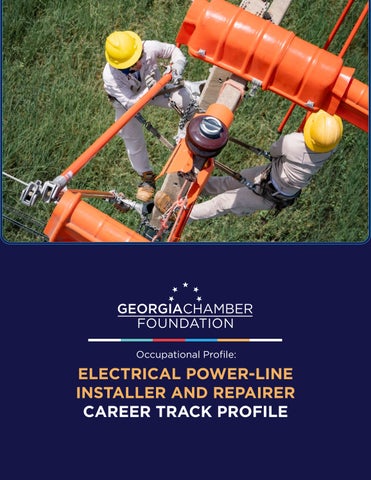
Occupational Profile:
ELECTRICAL POWER-LINE INSTALLER AND REPAIRER CAREER TRACK PROFILE GeorgiaLAUNCH
2026
01
Electrical Power-Line Installer & Repairer Career Track Profile
01 01
GeorgiaLAUNCH
2026
GeorgiaLAUNCH
2026
Occupation: Electrical Power-Line Installers and Repairers (49-9051)
Description of Job Duties: Install or repair cables or wires used in electrical power or distribution systems. Workers may erect poles and light or heavy-duty transmission towers.
Examples of Education Available: • • •
CTAE pathways (Energy Cluster and Electrical Pathway) TCSG programs, including the Electrical Lineworker TCC at several campuses CDL Class A training; apprenticeships with local utility companies
GeorgiaLAUNCH
2026
02
Licensing and Credential Examples: NCCER Power Line Worker Certification, Class A Commercial Driver’s License (CDL), OSHA 10/30 Hour and Electrical Safety Training
Why It Matters: The Electrical Power-Line Installer and Repairer occupation (SOC 49‑9051) is essential to Georgia’s infrastructure and energy sector, offering high demand, strong wages, and clear advancement opportunities. These professionals build, maintain, and repair the electrical transmission and distribution systems that power homes, businesses, and industries statewide. Georgia’s rapid population growth and expanding industrial base create an ongoing need for skilled lineworkers to ensure reliable energy delivery. Entry into this field can begin through technical college programs or employersponsored apprenticeships, often requiring only a high school diploma and specialized training. With experience and additional credentials, individuals can advance to roles such as Electrical Supervisor (SOC 49‑1011) or Power Plant Operator (SOC 51‑8013), and those pursuing further education can transition into engineering positions like Electrical Engineer (SOC 17‑2071). Whether starting through a short-term lineworker certificate or a registered apprenticeship, this occupation provides multiple pathways and strong career mobility within Georgia’s growing energy and utility sector.
03
GeorgiaLAUNCH
2026
GeorgiaLAUNCH
2026
04
Career Mobility Ladder
Career mobility is a powerful concept that illustrates how individuals can climb a structured ladder to transform an entry-level role into a high-paying professional career. This progression begins at the “Start” phase, where workers enter roles requiring minimal prior experience to build a vital technical foundation. Leveraging high skill similarity, individuals then “Advance” into more complex positions that offer significant wage growth and increased technical responsibility. Ultimately, by choosing to “Specialize” through advanced training and experience, workers reach professional-level occupations that maximize their earning potential. This pathway highlights the value of lifelong learning and skill development, allowing workers to expand their opportunities over time without the immediate necessity of a four-year degree at the outset.
Career mobility in Georgia’s energy and infrastructure sector offers a robust pathway from heavy equipment operation to high-voltage electrical work. This journey often begins as a Crane and Tower Operator (53-7021), a role critical for large-scale construction and utility projects, with a median annual salary of $67,230. As individuals gain experience in high-stakes environments and build a foundation in technical coordination, they can leverage medium skill similarity to advance into the role of Electrical Power-Line Installer and Repairer (49-9051). In this advanced position, median earnings increase to $78,880, while top performers in the 90th percentile can reach an impressive $116,940 as they manage the state’s vital power distribution networks. For those who choose to refine their technical expertise even further, the path leads to specializing as an Electrical and Electronics Repairer for Powerhouses, Substations, and Relays (49-2095). This professional-level role commands a median salary of $104,950, with a 90th percentile earning potential of $128,350 in Georgia. With nearly 6,000 combined positions projected in the state by 2032 across these three tiers, this progression demonstrates how transitioning from machine operation to specialized grid maintenance can result in a high-demand, six-figure career through targeted skill development and field experience.
05
GeorgiaLAUNCH
2026
Example Pathway:
Specialize: Electrical and Electronics Repairers, Powerhouse, Substation, and Relay (49-2095) • Medium Skill Similarity
Advance: Electrical Power-Line Installers and Repairers (49-9051) • 2024 GA Median Hourly Wage: $37.92 • 2024 GA 90th Percentile Hourly Wage:
Start: Crane and Tower Operators (53-7021) • No Bachelor’s degree • Medium Skill Similarity • 2024 GA Median Hourly Wage: $32.32 • 2024 GA 90th Percentile Hourly Wage: $38.10
$56.22 • 2024 GA Median Annual Earnings: $78,880 • 2024 GA 90th Percentile Annual
• 2024 GA Median Hourly Wage: $50.46 • 2024 GA 90th Percentile Hourly Wage: $61.71 • 2024 GA Median Annual Earnings: $104,950 • 2024 GA 90th Percentile Annual Earnings: $128,350 • 2032 Projected GA Employment: 880 • 2032 Projected US Employment: 24,700
Earnings: $116,940 • 2032 Projected GA Employment: 3,890 • 2032 Projected US Employment: 135,800
• 2024 GA Median Annual Earnings: $67,230 • 2024 GA 90th Percentile Annual Earnings: $79,240 • 2032 Projected GA Employment: 1,010 • 2032 Projected US Employment: 43,500
Source: Occupational Mobility Explorer, O*Net/Bureau of Labor Statistics
GeorgiaLAUNCH
2026
06
High Demand Occupations: Skills Overlap
There are numerous opportunities for upward mobility specific to the Lineworker track. However, insights from GeorgiaLAUNCH research demonstrate there are numerous transferrable skills with other High-Demand Careers. In terms of knowledge, there is a 42% overlap with Aircraft mechanics. There is a more than 30% knowledge overlap with Industrial engineers, Electrical engineers, and Electricians.
Knowledge Overlap Analysis Industrial Engineers Industrial Engineers
Electrical Engineers
Machinists
Aircraft Mechanics
Lineworkers
Electricians
77%
31%
64%
33%
36%
40%
67%
31%
33%
27%
10%
43%
42%
23%
Electrical Engineers
77%
Machinists
31%
40%
Aircraft Mechanics
64%
67%
27%
Lineworkers
33%
31%
10%
42%
Electricians
36%
33%
43%
23%
30% 30%
As it pertains to skills, there is 67% overlap and higher in required skills for Aircraft mechanics and Electricians. There is a 40% overlap and higher with Machinists, Industrial Engineers, and Electrical Engineers.
Skills Overlap Analysis Industrial Engineers Industrial Engineers
07
Machinists
Aircraft Mechanics
Lineworkers
Electricians
76%
35%
43%
48%
52%
33%
41%
44%
53%
40%
45%
44%
67%
62%
Electrical Engineers
76%
Machinists
35%
33%
Aircraft Mechanics
43%
41%
40%
Lineworkers
48%
44%
45%
67%
Electricians
52%
53%
44%
62%
GeorgiaLAUNCH
2026
Electrical Engineers
72% 72%
Key Takeaway:
With lower education requirements to enter this career path, and numerous opportunities within Georgia’s educational system to upskill, Lineworkers have substantial career mobility. Additionally, Lineworkers have significant skills overlap with all of the other high demand careers explored.
GeorgiaLAUNCH
2026
08
www.gachamber.com/foundation
01
GeorgiaLAUNCH
2026