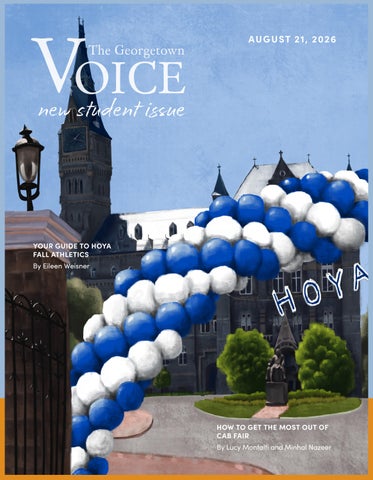
UP ADAT U G UEST P U2B 1 , DAT 2026 E
new student issue
YOUR GUIDE TO HOYA FALL ATHLETICS By Eileen Weisner
HOW TO GET THE MOST OUT OF CAB FAIR By Lucy Montalti and Minhal Nazeer
Contents
August 21, 2026 Volume 59 | Issue 1
4
editorials
Editor-In-Chief — Sydney Carroll Managing Editor of Content — Sophia Jacome Managing Editor of Operations — Chih-Rong Kuo
Dear New Hoyas, EDITORIAL BOARD
5
internal resources Executive Manager for Staff — Imani Liburd Executive Editor for Resources, Diversity, and Inclusion — Kamran Darnall-Hirani Assistant Editor for Resources, Diversity and Inclusion — Bridgette Jeonarine Editor for Sexual Violence Advocacy and Coverage — Olivia Fanders Service Chair — Ryan Goodwin Social Chairs — Alex Lalli, Sehr Khosla
leisure
How to get the most out of CAB fair LUCY MONTALTI AND MINHAL NAZEER
6
news Executive Editor — Justin Higgins Features Editor — Bridgette Jeonarine News Editor — Sehr Khosla Assistant News Editors — Basia Panko, Minhal Nazeer, Bennett Gilhuly Assistant Features Editor — Evan Schleck
news
Your guide to navigating Georgetown and D.C transit like a local BENNETT GILHULY
7
halftime leisure
Five underrated D.C. museums to explore this fall JOAQUIN MARTINEZ
10
opinion Executive Editor — Alex Lalli Voices Editor — Colby Kelly Assistant Voices Editors — Aaron Pollock, Maddy Sweet Editorial Board Chair — Darin Eberhardt Editorial Board — Imani Liburd, Kamran Darnall-Hirani, Paige Benish, Phoebe Nash
8
features
From elective to essential: Inside the College’s move to mandate FirstYear Seminars BRIDGETTE JEONARINE AND JACOB GARDNER
on the cover
voices
12
news commentary
“Authentic community”: GSP’s ‘Mastering the Hidden Curriculum’ centers FGLI experiences
It's okay to not like it here ALEX LALLI
11
leisure
So you want to get involved in the arts?
JUSTIN HIGGINS
14 news
LUCY MONTALTI AND CHIH-RONG KUO
Your .edu email is the best coupon code you have BASIA PANKO
15
sports
“Blueberries and Mozzarella” MAGGIE ZHANG
contact us
editor@georgetownvoice.com Leavey 424 Box 571066 Georgetown University 3700 O St. NW Washington, DC 20057
2
Your guide to Hoya fall athletics EILEEN WEISNER
The opinions expressed in The Georgetown Voice do not necessarily represent the views of the administration, faculty, or students of Georgetown University, unless specifically stated. Columns, advertisements, cartoons, and opinion pieces do not necessarily reflect the views of the Editorial Board or the General Board of The Georgetown Voice. The university subscribes to the principle of responsible freedom of expression of its student editors. All materials copyright The Georgetown Voice, unless otherwise indicated.
THE GEORGETOWN VOICE
leisure Executive Editor — Alex Hwang Leisure Editor — Quinn Ross Assistant Editors — Ryan Goodwin, Karcin Hagi Halftime Editor — Joaquin Martinez Assistant Halftime Editors — Elizabeth Adler, Alexandra Risi sports Executive Editor — Stella Linn Sports Editor — Eileen Weisner Assistant Editors — Vince Gude, Aubrey Butterfield, Julia Maurer Halftime Editor — Lila Gizzie Assistant Halftime Editors — Megan Geiger, Gabriella Matute, Anna Cordova design Design Editor — Shabad Singh Cover Editor — Maggie Zhang Assistant Design Editors — Michelle Wang copy Copy Chiefs — Isabella Baldwin, Madison Weis Assistant Copy Editors — Lila Wesner, Sonia Pensa, Avi Qin multimedia Multimedia Executive — Olivia Fanders Podcast Executive Producer — Katie Reddy Podcast Editor — Stefani Mucianio online Online Executive — Maysam Ider Social Media Editor — Lucy Montalti business General Manager — Amber Bai Assistant Manager of Alumni and Outreach — Elyse van Houten support Contributing Editors — Paige Benish, Phoebe Nash, Michelle Lee, Elaine Clarke, Pia Cruz, Katie Doran
maggie zhang
Chih's Crossword
crossword by chih-rong kuo; layout by maggie zhang and michelle wang
ACROSS DOWN 1 Term of endearment, 1 First-year hall that for short former President and 5 Chowder ingredient alum Bill Clinton lived 9 Rm. coolers in. 10 Georgetown residential 2 One of five of these on hall that overlooks the Earth potomac river. 3 "Bye, Bye, Bye” group 11 First-year dorm in the 4 Important antioxidant SWQ, in short 5 What the Cawley 12 Ooze Career Center could 13 Plaster help you work on 17 One of Georgetown’s 6 HBO miniseries Big schools; offers a Little __ master’s in journalism 7 Actor Baldwin 18 ___ freshman 8 SFS first-year core 20 Acronym for the course, colloquially first-year dorm that 14 Spoil, with "on” shares a building with 15 Radner of SNL the HFSC. 16 Backs, say 24-Across 21 Actress Swinton 19 Teri of Tootsie 22 Georgetown’s city 22 Temple of Apollo site 24 Candidate with 23 Disease associated backing, say with gluten intolerance 26 One of the Corp’s 25 Direction when you're locations, located in the facing the Potomac ICC 26 Acronym for 29 Last name shared by Georgetown’s masters Georgetown’s founder program in international and the Voice’s affairs editor-in-chief 27 Course division 30 Hunger Games 28 First-place medal President 31 Director Anderson 32 News org. 33 Manicurist’s tool 34 Fourth Arabic letter 35 Norms, in short. 36 Gulpy sound
Dear Voice readers,
joyful, chaotic, occasionally flawed, recruitment. And, if we still didn’t answer one of and diverse community. your questions, or you just want to say hi, please reach out to me at editor@georgetownvoice.com, I am beyond excited to welcome you to or just stand by the Leo’s soft serve machines for a Georgetown, and, if you’re reading this, the pages If you like what you see in these pages, I’d be of The Georgetown Voice! In case you’re not familiar remiss if I didn’t let you know that your very own while—I’ll probably be there. name could be on one in our next issue! We’re an with us, we’re the hilltop’s biweekly campus open access club, because the best stories are told Hoya Saxa, newsmagazine—we also publish daily online at by those from a wide variety of backgrounds, and georgetownvoice.com, and on our Instagram, because journalism is hard enough without filling @georgetownvoice. out an application to do it. If you want to join us at the Voice (or are even slightly curious), please As a gift, we present the New Student Issue, a collection of tips on being a Georgetown student, come visit us at CAB fair or come to our own Mini CAB Fair on Aug. 30 from 1:30 - 3 p.m. in the Leavey explainers on everything you need to know, and Program Room. Everything you need to know Sydney Carroll reflections on our own time on the Hilltop. We hope that this guide can serve you as you join our about joining the Voice is at georgetownvoice.com/ Editor-in-Chief, Fall 2026
50% OFF EXPERT INSTALLATION
• • • •
FREE no-obligation design consultation Custom-built to fit existing spaces Fast, professional installation Lifetime Warranty* for peace of mind
• FREE no-obligation design consultation • CUSTOM-BUILT to fit existing spaces • FAST, professional installation • LIFETIME WARRANTY* for peace of mind
SCHEDULE NOW: 1-844-240-9537
AS SEEN IN
©2026 ShelfGenie SPC LLC. All rights reserved. Locally owned and operated franchise. Offer valid at participating locations only. Limit one offer per household. *Applies to Classic and Designer line. EXP 12/31/26.
EDITORIALS The editorial board is the official opinion of The Georgetown Voice. The editorial board operates independently of the Voice’s newsroom and the General Board. The board’s editorials reflect the majority opinion of the board’s members, who are listed on the masthead. GRAPHICS BY LUCY MONTALTI; LAYOUT BY SYDNEY CARROLL
Dear New Hoyas,
W
elcome to Georgetown. However you ended up here, you’re at a place of great opportunity and privilege now—that is, unless you want to be an engineer. You’ve probably had the same journey many of us did—perfecting your application, celebrating your acceptance, receiving congratulations, and now, being excited to start your next chapter. You’ve probably heard the adjectives “elite,” “competitive,” and “prestigious” used to describe your new school. Some have probably falsely heard us called an Ivy— it’s okay if you decided not to correct them. Most of those adjectives are true, and you should be proud to be here. It’s a great privilege to be a Georgetown student. That privilege, however, comes with responsibility. For all of the talk about churning out ethical leaders, Georgetown is something of a “target school” for your run-of-the-mill douchebag, American Psycho (2000) jobs. If private equity and investment banking aren’t sending us careening into a full-blown climate catastrophe or concentrating wealth with the 1%, then they are at least wasting students’ talents. If business is not your speed, Georgetown also has a history of producing a stunning number of revolving-door lobbyists—the most in the nation. Or, if you’re interested in helping the U.S. massproduce bombs of freedom and liberty, Vice named Georgetown the country’s 10th-most-militarized school. Yes, we have a proven track record of churning out war hawks. The Bush administration was chock-full of them: Donald Rumsfeld—one of, if not the architect of the U.S.’s invasion of Iraq and the ‘War on Terror’; Rumsfeld protégé Douglas Feith (LAW ’78)—a Georgetown alumnus confoundingly invited back to teach after disseminating faulty evidence linking Iraq with al-Qaeda; and “advanced interrogation” mastermind George Tenet (SFS ’76), to name a few. We digress. Let us assuage your fears
4
THE GEORGETOWN VOICE
that Georgetown is D.C.’s very own Prager University. You are entering a school that is just as moral—or amoral—as every other institution like it. It has produced its fair share of—for lack of a better term— bastards (white supremacist Steve Bannon (MSFS ’83) comes to mind), but it has also produced people who have gone on to use their degree for good. You may know that Georgetown graduated the founder of March for Life—a prominent pro-life organization and annual demonstration here in D.C. (a real must-see!). But did you know it also graduated a co-founder of gun control organization March for Our Lives? Other Hoyas have gone on to secure gay marriage rights in the United States, found Best Buddies—an organization supporting individuals with intellectual and developmental disabilities—and fight for consumer rights and public interest. We could continue to list the many places in our world where justice is being perverted, but odds are high that if you made it this far, you already know all of that. Our world is full of injustice, often emanating from the halls of power just a few miles from campus. The easy response to that is to ignore it, and maybe many of your peers will do just that. You are also, though, at one of the best institutions in the world to prepare you to make a real difference. Our ethical choices matter— as much or more than anything else. Centuries of humans have sought to answer why that’s so. You can take your pick of ideological, religious, or philosophical dogma; with near-universal
consistency, they demand that we treat each other with respect and care. People are people no matter where you go. Chance and placement do not— cannot—determine the value of a life. In our profoundly arbitrary world, any one of us could just as well have been “born into hell” amid the genocide in Gaza. However each of us got to Georgetown, we cannot now forget our humanity, nor the humanity of all others. Whether you use it for helping or hurting others, your Georgetown education will have a significant impact on your life and likely the lives of others too, and will open new doors for you in whatever you might want to do. Although it might like to claim that it does, Georgetown does not necessarily instill a conventionally moral, humanistic temperament in all of its students, but you can use your education here to develop one. It is easy to just go through the motions here at Georgetown: attend your classes, keep your grades up, spend the weekends partying and clubbing, and so on. It is college, after all, and you should get the whole college experience if that’s what you want. But we also want to challenge you to do more. So we’re calling on you, our soonto-be friends and classmates, to pursue discomfort because that is where the most learning can happen. Join protests or a justice-driven club, meet people different from you, be challenged, disagree, and act on your convictions. Don’t doubt the power that students have. People like us are leading change from Bangladesh to Red Square. We really can have a significant impact even now if we are willing to challenge the foundations of power and force elites and administrators to listen to the demands of the people. That cause ought to be our cause. That is the Georgetown spirit that you can help cultivate. Make us proud, Hoyas. "
LEISURE
How to get the most out of CAB fair BY LUCY MONTALTI AND MINHAL NAZEER DESIGN BY SHABAD SINGH
A
s a school with a limited Greek life presence, clubs are the pillar of Georgetown’s social scene. Maybe you’ll make friends for life in your clubs. Maybe you’ll dramatically quit one. Perhaps you’ll rise through the ranks and eventually lead one. No matter how it turns out, you’ll almost certainly join a few of them over the next four years. For many, these clubs easily become their whole lives—the people you meet end up being not only coworkers but also roommates, toxic lovers, best friends, and even enemies. For others, being in a club is a full-time job with zero compensation and even worse funding. Some may be such casual members of a club they forget they’re even in it. Your first step on this wild ride is the Council of Advisory Boards (CAB) Fair, Georgetown’s club fair. On Aug. 29, you’ll be surrounded by tables of upperclassmen, laptops in hand, waving free stickers at you to get your attention, ready to take down your NetID and bombard you with emails for the next four years of your life. It can be overwhelming, so here are some tips to help you get the most out of CAB Fair. Keep an open mind! Clubs exist for more than padding your resume—take a chance and try something fresh and exciting! Don’t worry about experience; you’d be surprised at how many clubs are full of beginners. The tables at CAB Fair are organized by category: academic, interest, faith-based, service, media, cultural, sports, and arts. Try to check out at least one table in each section. The best combinations are a balance of competitive professional opportunities and the utterly unserious. Whether you’re pairing Hilltop Consultants with the anime club or student government with Survivor Georgetown, dedicate yourself to having fun, building community, and trying new things. Building community can also start in affinity groups like the Muslim Students Association, GU Ukrainian Society, Georgetown’s Queer People of Color, and more. Be generous with your sign-ups When it comes to putting your name down at CAB Fair, more is more. Keeping track of meetings, social events, and application deadlines can quickly become
complicated, and some really cool opportunities can easily slip through the cracks. When you put down your name and email address at a club’s table, that club’s communications will go straight to your inbox so you don’t miss out! Or, if flooding your inbox is too stressful, drop a follow on Instagram or join the GroupMe for any and all clubs that seem interesting to you. That way, you can keep track of who else is involved, get reminders for big events, and see what kind of work they do. Don’t be afraid to DM an account if you forgot to get on their email list or misplaced a flyer—showing initiative goes a long way. Maximize your free swag You might have heard that the college experience is about falling in love with academia, making friends to last a lifetime, or preparing for your real adult job. We’re here to tell you that it is none of the above. That’s because college is about getting free stuff. Over the next four years at Georgetown, you’ll run into countless opportunities to score free stickers, free boba, free everything. Capitalize on them, dear freshman. CAB Fair will likely be your first step into this world of gratuitous offerings, and our advice to you is to dive right in. For starters? Bring a bag—you’re going to need somewhere to store your loot. Follow our advice above, smile encouragingly while a club leader enthusiastically delivers their pitch for the 78th time, get your name on that newsletter, and you’ll have earned the right to get that free T-shirt that you’ve been eyeing. Follow through If you are even remotely interested in a club, you should immediately add their first interest meeting to your calendar. It might be five minutes after your Econ recitation, and you might have no idea where the meeting room is, but it’s worth showing up. Actually attending a club meeting is the best way to meet new people, get some face time with the leadership, and get a real sense of the club’s social environment. Another thing to note: you probably spent a good portion of last year writing essays and answering the question, “Why
us?” and we regret to inform you that your time spent filling out applications did not end with your college acceptance. Certain Georgetown clubs, especially preprofessional ones and those that come with a paid position, can be competitive. Application season will begin directly after CAB Fair, so be sure to note when deadlines are. Try to apply to as many clubs as you’re interested in and can write essays for—until you can’t take it anymore. Finally, immediately following— and even worse than application season—is rejection season. Be prepared for bad news, but don’t let it stop you from reapplying or heading in a new direction. That being said, there are also plenty of clubs that are open access (including a certain campus news magazine that may or may not be sitting in your hands). Once you’re done making your rounds around the fair, dump out your tote bag. If what you have in front of you is a decent selection of flyers and QR codes— alongside a plentiful haul of candy, laptop stickers, and a variety of campus swag you’ll never wear—you can be officially ordained as having conquered CAB Fair. Congratulations!#
AUGUST 21, 2026
5
NEWS
Your guide to navigating Georgetown and D.C. transit like a local BY BENNETT GILHULY DESIGN BY ELYSE VAN HOUTEN
A
fter settling into Georgetown, it’s easy to find yourself stuck in the Georgetown bubble—walking to Leo’s, heading to class, and occasionally venturing down to M Street. But whether you’re heading to a museum, commuting to a job, or exploring a new neighborhood, getting around District of Columbia means learning to navigate its transportation options. From Georgetown University Transportation Shuttle (GUTS) buses to the Metrorail, here’s your guide for navigating the city beyond the front gates. GUTS The GUTS bus is Georgetown’s free shuttle service for students, faculty, and staff. It connects the Hilltop Campus with Dupont Circle, the Rosslyn Metro stop, 55 H Street, Wisconsin Avenue near Trader Joe's and Safeway, Union Station, Arlington, and the Capitol Campus. Each bus is Americans with Disabilities Act (ADA) accessible, equipped with wheelchair lifts. The Hilltop Campus has two pickup points: the McDonough bus turnaround by McDonough Arena, and Lombardi Circle, near the Leavey Hotel entrance. Be sure to check the GUTS schedule for pickup locations. The most-used routes include the Dupont Circle and Rosslyn Shuttles, which students can take to access the Metro, with buses arriving every 15 to 20 minutes on weekdays. Washington Metropolitan Area Transit Authority (WMATA) Once you’re off the Hilltop, WMATA makes it easy to get where you need to go. It offers Metrorail and bus services throughout D.C., Maryland, and Virginia. If your destination is on or near a station, take the Metrorail—you can depend on it for speed and accuracy. Metrobuses are useful for destinations not served by GUTS or Metrorail. You can find schedules on Apple or Google Maps, or the WMATA website. The university is expanding the Hoya Transit Program this semester, offering eligible students new ways to save on and access transportation. Up to 5,000 eligible students can receive a $50 monthly credit 6
THE GEORGETOWN VOICE
in WMATA SmartBenefits, and through the U-Pass pilot program, eligible Capitol Campus students can receive unlimited Metrobus and rail rides. Although the fall deadline for SmartBenefits has passed, be on the lookout for an email from the Office of Transportation Management ahead of the spring semester. Capitol Campus students will get more information on their benefits at orientation. Metrorail Heading across D.C.? Skip the traffic and let the Metro do the work. After taking a GUTS bus to Dupont Circle, the Red Line connects you to places like Gallery Place-Chinatown for Georgetown men’s basketball games, Union Market, and Union Station, where you can catch Amtrak, Maryland Area Regional Commuter, and Virginia Railway Express trains, as well as various intercity coach buses. From Rosslyn, the Blue Line runs to Ronald Reagan Washington National Airport (DCA), the Silver Line extends towards Dulles International Airport (IAD), and the Orange Line to Vienna, Virginia. All three Rosslyn lines also provide easy access to downtown D.C., including Foggy Bottom, the National Mall, and many Smithsonian museums. You can also transfer to the Yellow or Green lines at L’Enfant Plaza from the Blue, Orange, and Silver lines, or at Gallery Place from the Red line. Metrobus The closest Metrobus stops to campus are near the front gates, at 35th and Q Street, 38th Street and Reservoir Road, and along Wisconsin Avenue. From Georgetown, routes C91, D94, and D80 connect riders to central D.C., including Dupont Circle, Gallery Place, and Union Station. The D96 and D82 service Bethesda, Friendship Heights, Foggy Bottom, and Potomac Park, while the A58 connects the neighborhood with Farragut Square and Seven Corners. Bus fares are a flat $2.25 per trip, with a two-hour window for free bus-to-bus and Metrorail-to-bus transfers, and a $2.25 credit towards your fare when transferring from Metrobus-to-rail. Always verify arrival times with the WMATA busETA tool or by searching the bus name and “route” into Google, since times fluctuate with traffic. Metro Access WMATA’s Metro Access program is a
door-to-door, shared-ride paratransit service for people with disabilities who cannot use Metrobus or rail across the Washington region. To receive a Metro Access ID, individuals must complete an application certified by a healthcare provider, schedule an in-person interview and functional assessment at the Transit Accessibility Center, and be found eligible under the ADA. Capital Bikeshare + Scooters Bike and scooter rentals provide a way to reach Metro stops on weekends when GUTS service is limited. Capital Bikeshare lets you pick up a bike at one station and return it at any other in D.C. or Virginia, with docks right by Georgetown’s front gates and at 38th Street & Reservoir Road. Georgetown students get a discounted $25 annual membership, which includes benefits such as unlimited 45-minute classic bike rides. If you are far from a docking station, you can lock an e-bike anywhere you want for a $2 docking fee. E-bikes and scooters from other companies like Lime and Veo are parked along nearby sidewalks. You can check their respective apps for nearby vehicles and availability. Uber Overnight For travel between campuses, the University has introduced Uber Overnight. This service provides free GU-designated point-to-point Uber rides from midnight to 6 a.m. between the Hilltop and Capitol Campus when GUTS is not in service. Additional details will become available at the start of the fall 2026 semester, and registration will be required. SafeRides All students, faculty, and staff may request a free SafeRide—a late-night, pointto-point transportation service—through the LiveSafe app. Service is available from 8 p.m. to 2 a.m. Sunday through Wednesday, with coverage expanded until 3 a.m. from Thursday through Saturday. SafeRide services a perimeter around the Hilltop campus, spanning the Georgetown and Burleith neighborhoods. #
HALFTIME LEISURE
Five underrated D.C. museums to explore this fall BY JOAQUIN MARTINEZ
DESIGN BY RYAN GOODWIN
C
oming to the Hilltop for the first time, I was beyond excited to check out the museums in Washington, D.C. The famous Smithsonian museums on the National Mall hold impressive collections, tell epic stories, and above all, are free! However, after about a month, I had already seen all the greats. The Hope Diamond in the Natural History Museum, Michelle Obama’s portrait in the National Portrait Gallery, and Neil Armstrong's Apollo 11 space suit at the National Air and Space Museum were no doubt impressive, but I found myself longing for a path less traveled. Luckily, D.C. has many other museums that offer a more niche, obscure experience. Drawing on my own experience of museum-hopping in the District, as well as additional input from my dear friends at The Georgetown Voice, I have compiled a list of hidden gems that our lovely city has to offer. 1. Hillwood Estate, Museum & Gardens - $10 Located in the Forest Hills neighborhood of northwest D.C. is Marjorie Merriweather Post’s former mansion, now renovated into a luxurious museum that houses her extensive collection of imperial French and Russian fine art. I came here on a field trip with my Russian class, and I was astounded by how such a beautiful place had flown under the radar in conversations about D.C.’s greatest museums. Plus, it is the only museum in the district with two authentic Fabergé eggs! My favorite part of the museum, however, is the Japanesestyle garden with its beautiful fountains, landscaping, and Japanese red maple trees. The admission fee for students is $10, but if you contact Professor Anna Pechnikova in the Department of Slavic Languages, she may be able to provide you with a ticket free of charge as part of the Russian class field trip to the museum!
2. The DC Alley Museum - Free Tucked into Blagden Alley in Shaw, the DC Alley Museum features vibrant murals sharing the story of D.C. and the people who live here. The murals are painted on garage doors, wooden siding, and brick, mixing materials and colors to tell a variety of stories. Georgetown students should make sure to seek out Billy Colbert’s “Respect: John Thompson” mural featuring the iconic Georgetown basketball coach who broke barriers across the NCAA and the U.S. Voice editor-in-chief Sydney Carroll (CAS ’27) came here on a field trip with her freshman seminar, “Race and Class in D.C.,” and recommends going with a friend—it’s always better to be able to discuss public art with someone else! Like any other museum, no two visits will be the same; while many of the murals are long-term installations, others in the community share art in the alley via stickers placed on water pipes, posters wheatpasted to walls, and graffiti affixed to nearby surfaces. 3. National Museum of Women in the Arts - Free for 21 and under This trailblazing museum was once the Masonic Temple in Downtown D.C.—which, ironically, did not allow women—before becoming the city’s premier collection of women’s art in 1987. The museum features works by influential women artists like Frida Kahlo, Stephanie Tafoya, and Lavinia Fontana. My fellow Leisure editor, Quinn Ross (CAS ’29), frequented this institution during his first semester of college for his studio art class, and he highly recommends this museum to art lovers everywhere. Prospective visitors should check out the works of Remedios Varo, the Spanish surrealist painter whose works like “La llamada” will certainly leave you with a newfound appreciation for the diverse art of immigrant communities in Mexico City who worked alongside the founders of the Latin American Boom. 4. Anacostia Community Museum - Free While it is technically a Smithsonian museum, the mission of the Anacostia
Community Museum since 1967 has been to bring a Smithsonian institution to a local community outside of the busy National Mall. Anacostia has a rich history: its name comes from its original inhabitants, the Nacotchtank people, who stewarded the land and nearby river for thousands of years. Today, the area is home to a vibrant Black community, and notable residents have included abolitionist Frederick Douglass, former D.C. Mayor Marion Barry, and Georgiana Simpson, the first Black woman to graduate with a Ph.D. The museum features artifacts and artworks from D.C.’s Black community, which has played an integral role in defining the city’s culture, despite these contributions being ignored and erased in many discussions of D.C.’s creative history. My favorite exhibition in the museum is the collection of African American quilts, which reflect the resiliency, joy, and strength of D.C.’s Black community in the form of colorful, magnificent masterpieces. 5. National Building Museum - $18.95 I have passed by this museum so many times while in Penn Quarter, discouraged from entering solely because of its name. After all, what exactly constitutes the history of “building?” To be honest, I couldn't imagine the museum being anything more than a boring collection of hammers, measuring tape, and nail guns. One day I finally decided to put my biases aside and check it out, and I was so glad that I did. Upon entering, you are greeted by a large inner courtyard named “The Playroom,” decorated with gargantuan Corinthian-style pillars made of brick, skillfully painted to resemble marble. If this isn’t enough to entice you, the museum also hosts a large collection of architectural models of D.C.’s most famous monuments and buildings; therein lies its namesake! If you are interested in architecture, design, or photography, this museum should definitely be on your radar. " AUGUST 21, 2026
7
FEATURES
BY JACOB GARDNER & BRIDGETTE JEONARINE DESIGN BY MICHELLE WANG
D
uring her first semester at Georgetown University, Sudan Eubanks (CAS ’29) had often walked past the John Main Center, not knowing what was inside. It wasn’t until she was assigned to explore the space for her theology-focused FirstYear Seminar, “Magis: The Real Metaverse” with Professor Paul Heck, that she felt immediately at peace. The John Main Center, a space designated for personal or religiouscentered meditation, became a place she frequented to de-stress. “That place brought me a lot of peace when I felt lost, spiritually or physically, like being so far from home, or when I was having a really difficult time with school, and I felt very stressed,” Eubanks said. Due to the center’s impact on her undergraduate experience, Eubanks will become a student employee at the meditation center for the Fall 2026 semester. Following College of Arts and Sciences (CAS) Dean David Edelstein’s announcement on March 23 that FirstYear Seminars are mandatory starting in the 2026–2027 academic year, the CAS is hoping all incoming freshmen will have a similar experience. As many first-year students navigate an unfamiliar core requirement, the Voice spoke to CAS administrators, faculty, and students to understand why First-Year Seminars are considered integral to each Hoya’s experience. Learning through conversation The College advertises First-Year Seminars spanning five categories: Ways of Knowing, which aims to develop “close reading and careful research habits”; Ignatius, which intends to “cultivate each student’s individual strengths and academic curiosities” through exploring faculty-selected topics; Languages and Cultures, which works to offer students opportunities to “participate in intercultural dialogue as a way of understanding and serving the global community”; Dialogue, which aims to “develop students’ ability to communicate and act with civility, respect difference, address questions of diversity, and engage in difficult dialogues around challenging ideas”; and Big Questions, Great Reads: Cura Personalis, which “involves close readings of transformative literary texts that pose and help us to answer…key questions about being human.” This year, there are over 50 different seminars covering a dozen different subject areas. The summer before they arrive on campus, incoming first-year students must rank five seminars from 8
THE GEORGETOWN VOICE
their most to least preferred, and they will be placed in one depending on availability. First-Year Seminars were introduced to the CAS’s curriculum in 1968 to “introduce students to the intellectual community of the College and model the habits of mind central to a Jesuit education: rigorous inquiry, ethical reflection, and engaged dialogue,” Erin Force, CAS associate dean and director of First-Year Seminars, wrote in a statement to the Voice. To carry out the shift from an elective program to a rite of passage, the college turned directly to students who had already experienced the seminars. CAS administration formed a voluntary FirstYear Seminar advisory board to garner student input on marketing materials, course grouping, and logistics, such as ensuring each seminar satisfies a core requirement so students aren't overburdened by extra coursework. For advisory board member Aakarsh Mamawala (CAS ’29), the new requirement represents a long-overdue institutional investment in defining what makes the college unique. “If the MSB has their own specialties in business, and if the SFS has their own specialties in international affairs, then the College should have its own specialties in the liberal arts,” Mamawala said. “The CAS is, at its core, a liberal arts school. And so I think that’s [what] the first year seminars do really well.” Mamawala emphasized that a draw of these seminars is a liberal arts education through immersive field trips. In his course, “The Humanities in the Medieval and Early Modern Worlds,” learning extended far beyond their classroom in Healy Hall: students visited the Dumbarton Oaks Museum, examined 13th-century printings of Dante’s “Inferno” in Special Collections, and dressed up for Mozart’s “The Marriage of Figaro” at the Kennedy Center. “It doesn't get more amazing than this, being able to attend this performance with our professors, [who] were experts in the subject, with people who are freshmen like me, who are new to the school and [in] our first semester,” Mamawala said. An Unexpected Turning Point Eubanks found a similar experiential push in her seminar with Professor Heck, where her eight-person class embarked on unorthodox field trips, most notably a phone-free trek through Rock Creek Park. “We walked two hours through it. And he told us to grapple with the question, ‘What orients your soul?’” Eubanks said. “We’re all basically freshly 18, dealing with such an existential question, and just really feeling clueless as to what a right
answer would be.” Despite the surprise of being pushed into deep personal reflections at 8 a.m., Eubanks said that she found this experience to be “enriching.” “I got to learn so much more about myself and so much more about others,” Eubanks said. “It was truly, I think, a spiritual
experience, which is very unorthodox for a class.” Though Eubanks’ mother is an ordained minister, h e r household was “non-denominational Christian,” and she was exposed to countless religious ideologies. After her professor tasked students to visit a local
religious institution, Eubanks spoke with a community organizer at a local Catholic church and explored a faith tradition she had never experienced before. Eubanks cited this moment in cementing the realization that her intended major of Government was not her true calling, drawing her instead to Justice and Peace Studies, concentrating on Religion, Politics, and the Common Good. The course reshaped Eubanks’ approach to college. The following semester, she dropped a large lecture course because she missed the
seminar’s o p e n dialogue, enrolling instead in Heck’s upperlevel theology course on atheism. “I do prefer that type of form when it comes to something so philosophical or theological,” Eubanks said. “I saw that I gravitated towards that with ‘Atheism,’ as Professor Heck repeated the same type of method. But also in some of my other classes that kind of had a smaller feel, and kind of wanted to incorporate that type of, like, group circle, group huddle, discussion, rather than just simply lecturing at us.”
Strength in small numbers Professor Erin Cline, one of the program’s longest-serving professors, teaches the annual seminar “Human Flourishing,” which explores what it means to live a good life through the work of various philosophers. She attributes the program’s success to its small class numbers. “I believe in the model and the way that it impacts students to be in a small, personalized seminar where they get to have some choice in the topic,” Cline said. Her belief was reinforced when students in her inaugural cohort proposed reuniting during their senior year to revisit the course material with new perspectives. “I was delighted that they had thought that they knew that when they’re in college, their views of things are going to change, and they’re going to grow as people,” Cline said. Because many of Cline’s students now enroll in her first-year seminar after hearing about it through word-of-mouth from past participants, she tends to attract students eager to explore theology and already looking forward to their senioryear reunion. “I think they see themselves as more of a cohesive group when they know that might be a possibility,” Cline said. “It’s like, ‘Oh, wow, okay, we’re going to come full circle if we want to.’” This continued enthusiasm has made leading her Ignatius seminar one of the most fulfilling parts of her teaching career, Cline said. For Cline, a successful seminar has little to do with grades; rather, success is determined by whether professors can create a safe environment for open communication and healthy discourse among the group. Indeed, Cline hopes that students will focus less on achieving the highest marks and approach these seminars as a way to widen their worldview and broaden their social network, valuing lasting connection and knowledge over numbers. “Everybody’s coming from a different place and this is one of the great opportunities that we have,” Cline said. “At a university like Georgetown, we have students from all over the world. There is a lot of opportunity really, to open up and to get to know people that you otherwise would never cross paths with.” Finding a place at Georgetown While professors like Cline see how these seminars build community from the podium, for students, that tight-knit environment can alter the course of their collegiate experience entirely.
Lola Avery (SFS ’29) enrolled in “Randomness, Chance, and Probability” to fulfill her Quantitative Reasoning and Data Literacy core requirement. As a Public Policy major, Avery was apprehensive about taking a mathematics-based course, which she ranked at the bottom of her seminar preferences. She said Professor Erblin Mehmetaj’s easygoing nature and the classroom community made the more technical aspects of the course “less stringent.” Over the course of the semester, exposure to new perspectives sparked a growing interest in international relations, leading Avery to consider transferring to the Walsh School of Foreign Service (SFS). However, without the traditional courses students take to transfer to the SFS, selfdoubt quickly set in. “I think it’s very normal to have ups and downs, and I think especially at a school like Georgetown, where it seems like everyone knows what they’re doing all the time, it can feel vulnerable to, for the first time, admit, ‘I don’t know what I want to do right now or my interests have changed,’” Avery said. Unsure of her next step, Avery went to Mehmetaj’s office hours, where he spent 30 minutes talking through her fears and unpacking her hesitation. “I feel like he was one of the most influential people in that decision just because he gave me the push that I needed and that vote of confidence from a professor—from an adult—that I feel like I’d been missing just because I felt like a lot of the professors didn't know me that well,” Avery said. As CAS rolls out the First-Year Seminar mandate officially, Avery sees immense value in the policy, provided that the university maintains the intimate class sizes that allow for building relationships. For her, the program’s success hinges on keeping the experience personally transformative rather than turning it into another box to check off for an eventual degree. “[First-Year Seminars are] a unique opportunity to meet people that you wouldn't necessarily meet,” Avery said. “I would not have met any of my best friends from that course because we didn't live in the same dorms, weren’t all the same majors, were [in] different schools.” This kinship, Avery said, is not something first-years should overlook, even if placed in a seminar that may not seem academically appealing. “Go into it with the understanding that it’s not just about what you're learning on paper,” Avery said. “It’s about the overall classroom experience.” # AUGUST 21, 2026
9
VOICES
It’s okay not to like it here BY ALEX LALLI DESIGN BY KATIE REDDY
F
or anyone wondering, no: the questions don’t stop. “How did you know Georgetown was the one?” “Is it just the perfect fit?” “Are you so happy?” The first time I ever answered that question honestly was the fall of my junior year. That November evening, I was crouched outside on one of the Vil-A benches, heaving from my third panic attack that day (something I hadn’t experienced before college), on the phone with my dad. “You don’t…seem happy,” he carefully said. Ask anyone in my Georgetown orbit, and they wouldn’t tell you I was miserable. A little on edge, sure, but overall, solid. I was part of an a cappella group that allowed me to sing and came with a “built-in” family. I was heading the Voices section, building out my passion for journalism. I did well in class, found a major I loved to rant about, and got into the D.C. running community. But every semester, I would come home to my best friend Frances and swear, “This next one is gonna be it.” Still, something was always off. I liked the drive of Georgetown on paper, but found the ladder-climbing, coded corporate speak rendered me “soft” as someone often described as “too earnest.” I began to speak less about the things I cared about. My friends from back home leaned in, believing the hard stuff made us closer. I struggled to find that support at Georgetown. I met mean people, people who mangled my perception of trust, and settled for friends I didn’t even believe liked me, just for the stability. I felt painstakingly aware of my personality to the point where I began to dissociate from myself, at the very time I was supposed to be discovering it. This is not an effort to scare you away from Georgetown as you arrive. The symptoms were partially circumstantial, but that doesn’t make Georgetown the only diagnosis. I was also reeling from some deep-set mental health and family issues that had been taking root for quite some time. Regardless of the reason, sometimes the place you wind up in just doesn’t mesh well with all of you. The discomfort may only start after a long while, or persist your entire time here. Sometimes, it never truly clicks. And that is okay. 10
THE GEORGETOWN VOICE
Georgetown just hasn’t quite meshed with all of me. And it feels really great to say that. I went abroad to Scotland this past spring, following one of my toughest semesters. However, despite early-on tribulations, the semester ended with me feeling the most “stable” I had been at this school. So, uprooting my entire life for a semester was naturally nerve-wracking. On my first day there, I met two girls, Kayla and Caroline, from the University of Pennsylvania, and we frantically made a group chat to secure some sense of friendship for the semester.
These girls are now two of my closest friends, and it wasn’t just because we were basically living a whole-semester bender (although that was great). It was the fact that I could whole-belly laugh with them, share inside jokes that felt years in the making, support each other in ugly moments, and most of all, be honest. In the sticky corners of Budapest ruin bars or the cold rocks on the St. Andrews West Sands, we sought to know each other better than we knew ourselves—our inner worlds flourished. When we talked about our respective schools, it was difficult to dance around our true feelings. We were all somewhat unsatisfied, ultimately reporting a
general lack of connection. But through our conversations, we slowly gained the confidence to not settle, but instead, embrace the lack and want more. If I’ve learned, it’s that if you feel like it should be better or at least different, it certainly can. Some of that just means waiting: college isn’t forever, and your world will only continue to expand. But another, more valuable part of it is not being afraid to seek out something better, even if it means creating discomfort for yourself. I wasn’t sure how I would transition back into Georgetown. I remember Kayla and I worrying that our happiness was just a product of being able to jet off to a new city at any moment. But what we really gained was an openness to spontaneity. Because our time was so temporary, we had the freedom to seek out new experiences without worrying about how they would fit into the bigger picture. When I got back for the summer, I decided to invite the unexpected. I reconnected with the friend crushes I always wished I saw more often, but never actually made the effort to. Those could be my close friends, I realized, even if they didn’t make up a perfect group in my head. I also wasn’t afraid to branch out of Georgetown, whether that meant working at Pacer’s Running with the best coworkers ever, or reconnecting with graduated friends. And after years of searching for someone just like her, I realized that Frances really just was one of a kind. After all, college is really just the beginning of your adult self, someone who is constantly shifting, morphing, unraveling, and coming together; it’s only natural that the world around you does the same. Things don’t have to feel perfect. I’m giving this advice as much for you as I am for myself. I’m not sure how it’s going to go, but in some ways, I’m happy that even in my last year here, I don’t have it fully figured out yet. That means there’s only more love, joy, and connection out there to discover. !
LEISURE
So you want to get involved in the arts? LUCY MONTALTI AND CHIH-RONG KUO DESIGN BY ELLE MARINELLO
G
eorgetown may be best known for its Jesuit identity, international relations programs, and “preppy” reputation. However, after spending a little time on the Hilltop, you’ll soon discover another defining aspect of Georgetown: its arts scene. On campus, you’ll have the chance to attend and participate in comedy shows, benefit concerts, magazine launch parties, and more, courtesy of Georgetown’s tight-knit network of arts organizations. To help incoming students navigate Georgetown’s creative side, the Voice spoke to six Hoyas about how students can get involved in the arts. COMEDY For those looking to follow in the footsteps of famed funny Hoyas John Mulaney (CAS ’04), Mike Birbiglia (CAS ’00), and more, look no further than Georgetown Improv Association, Sketch Comedy, Guerilla Improv, and the Heckler, Georgetown’s student version of The Onion. “The Heckler is better for people that are a fan of writing and aren’t necessarily drawn towards performing as much,” Max Dubin (CAS ’27), a member of Sketch Comedy and The Heckler, explained. “And then Improv is for performers, and then Sketch is kind of a healthy mix.” While each club has its own audition o r application process, they all welcome any level of comedy experience. DANCE Whether you’re a seasoned dancer who’s been on the top of Abby Lee Miller’s pyramid or someone whose best dance move is the frat flick, there’s a place for you on campus. Georgetown offers two pre-professional dance programs, Black Movements Dance Theatre (BMDT) and Georgetown University Dance Company (GUDC). There are also several fully student-run dance clubs on campus, such as hip-hop team Groove Theory, Latin group Ritmo y Sabor, Mexican dance and culture ensemble Ballet Folklórico de México, and breakdancing group Hoya Break Squad. Aarju Karki (CAS ’28), came across Rangila, Georgetown’s philanthropic South Asian dance showcase, during her college search.
Karki, who has served as a Rangila choreographer and creative director, said the community and joy are what keeps her coming back. “I’m personally not a big fan of the preprofessional culture at Georgetown, and I think Rangila is such a good escape from that just because everyone’s there for just the sole purpose of learning how to dance and having a really great time,” Karki said. While Rangila occurs every fall, Jawani, Georgetown’s Bhangra dance team, and Guzaarish, a competitive Bollywood fusion dance team, have performances year round. MUSIC For those looking to recreate a Pitch Perfect (2012) riff-off, Georgetown has a variety of a cappella clubs to choose from. Join the historic all-male group the Chimes, the Gracenotes, for women and gender minorities, Phantoms, an all-gender group, Superfood, Georgetown’s competitive a cappella team, Saxatones, a community service-oriented group, or the Capitol G’s, an all-gender low-range group. Budding musicians don’t need to look too far to record music or perform live. Georgetown University Radio, or WGTB, regularly hosts concerts featuring on-campus bands. The student-run Prospect Records also signs student musicians. Isabel Liu (CAS ’27) took advantage of a little-known Georgetown class, the Guild of Bands, to kickstart her four-person rock group That Girl Band. Those in the onecredit class get access to practice rooms, drum kits, and songwriting support. “I definitely recommend it to any student that’s interested in building their songwriting skills,” Liu said. THEATRE Aidan Munroe (CAS ’27) knew he would be involved in theatre from the moment he stepped foot on the hilltop. Luckily, opportunities were abundant. Georgetown proudly houses the nation’s oldest continuously-running student theatre troupe, Mask and Bauble, alongside Nomadic Theatre, a group for socially engaged theatre, (No) Pressure Creatives, Georgetown’s Asian American theatre group, and Black Theatre Ensemble, which produces work celebrating Black heritage. For Munroe, the theatre community has helped him cultivate a rich
Georgetown experience beyond just the academics. “I can’t see a version of my life now, after graduation, that doesn’t involve theatre in some sort of way,” Munroe said. “By doing theatre, I’ve learned more about myself.” VISUAL DESIGN AND MEDIA Chloe Pascoe (CAS ’28) was first drawn to Bossier, Georgetown’s intersectional feminist literary magazine, when she attended GAAP weekend. Two years later, she’s fully immersed in Bossier’s social and artistic community, most recently having served as the publication’s creative director. Pascoe’s path of joining a student publication allows students the chance to engage with art on a structured basis. Also check out Added to the File, Georgetown’s student fashion publication, The Georgetown Independent’s beautifully drawn covers, and The Georgetown Voice (nudge nudge, wink wink). “As a freshman, you’re trying to look for people who you think you're going to click with when you’re trying to pick, [...] ‘Who’s going to be my community?’” Pascoe said. “The people really make that.” WRITING Shania Murdock (CAS ’27) writes for the Indy, Georgetown’s arts and culture magazine; serves as an editor and resident creator for Bossier; and leads the Blaxa, a student media organization centered on the Black experience, as incoming co-president. Murdock recalled feeling struck by the sheer amount of options for pursuing writing in her freshman year. “I mean, there’s the Hoya, there's [the] Georgetown Voice, there’s the Indy, Bossier, Blaxa—there's so many different types. Honestly, I was just trying everything until I found what I really liked.” Whether you’re a budding artist or just want to add a splash of creativity to your Georgetown life, Georgetown’s art community is flush with opportunities for exploration. “It’s so easy to lose yourself at Georgetown in terms of just constantly seeing what other people are doing professionally or academically,” Liu said. “Immersing yourself in the arts community, you’re bound to make a lot of mistakes, but it’s good mistakes because they help you learn more about who [you are].” " AUGUST 21, 2026
11
NEWS COMMENTARY
“Authentic community:” GSP’s ‘Mastering the Hidden Curriculum’ centers FGLI experiences BY JUSTIN HIGGINS DESIGN BY MICHELLE WANG
T
owards the end of my college search, as I narrowed down my options and focused on fit, my mom raised some concerns about Georgetown. She did not attend a traditional four-year college, and we certainly didn’t come from money. She said that Georgetown was too “preppy.” Two years in, I’ll concede she might have had a point there. Every year, Georgetown receives a higher number of applications than the year before for its first-year class, and every year, roughly 1,600 students enroll. For the Class of 2028, my admissions cycle, about 12% of students were first-generation college students, and approximately 15% were eligible for a federal Pell Grant, a government financial aid award given to students who display exceptional financial need. On the other hand, around half of Georgetown’s student body receives no financial aid, and around two-thirds receive no institutional aid. Still, I countered my mom’s concern, contending that I’d gone to private school since kindergarten. I also knew that many of the schools on my list, including Georgetown, promoted support networks f o r students. 12
THE GEORGETOWN VOICE
“There will be resources available if I need them,” I told her. As it turned out, I was right. Since fall 2018, the Georgetown Scholars Program (GSP) has offered “Mastering the Hidden Curriculum” (MHC), a course primarily aimed at (but not limited to) firstgeneration students and those from lowincome backgrounds. Offered to first-year and transfer students, MHC aims to equip students with the skills and institutional knowledge to navigate the university, with each section co-taught by two firstgeneration faculty members. The 3-credit course is traditionally taught in the fall, but has been offered in the spring in recent years, and counts toward the university's Pathways to Social Justice requirement. Registration priority is given to students in GSP, but other firstyears can request registration permission from GSP directly. GSP’s mission is “to work towards a more equitable college experience for firstgeneration and low-income (FGLI) college students” through community building, mentorship, and financial assistance. I experienced that mission firsthand when I took MHC during my freshman year. Not every lesson was new to me, but nonetheless, I found value in sharing a space to reflect on my experience starting out at Georgetown while learning about resources I might have otherwise overlooked. In education, the “hidden curriculum” refers to systems of unarticulated expectations students are expected to already know how to navigate, such as office hours, fellowships, research opportunities, and other academic advantages. The accessibility and comprehension of these unwritten rules are often shaped by class and, on another level, race. A 2016 Harvard doctoral dissertation revealed that surveyed first-generation Georgetown (and Harvard) sophomores were more than twice as likely as their peers to report feeling less prepared. “The goal of the course is
to cultivate a vibrant academic community where students can explore what it means to be a first-generation or limited-income student at Georgetown alongside
peers and professors who also share these identities,” Missy Foy (CAS ’03), GSP’s executive director, said. According to Foy, the course curriculum was designed in collaboration with GSP students, first-generation faculty, and Georgetown’s Red House, the university’s hub for educational research and design. Over the years, other colleges and universities have requested the course syllabus from Georgetown to adapt. Professor Benjamin Cheng, an adjunct professor at Georgetown University Law Center and a first-generation college graduate, has taught a section of MHC since 2019, partially because he lacked a similar resource during his undergraduate years. “I could have been better equipped to navigate my first year had I had the tools that MHC gives these students,” Cheng said. “That’s why I keep teaching it. I don’t think there’s going to be a shortage of FGLIidentifying students that are coming in, and it’s really my privilege to be able to walk with the new cohort of students every year.” One way MHC seeks to bridge the preparedness gap—whether real or internally perceived—between first-years is by making students aware of available tools and resources for their success. “A lot of times students just look to each other; but the administration, the services, the professors, we’re at the university for a reason: because we care about students,” Cheng said. “The sooner they realize that we’re there for them, and they can lean on us and go to us with questions, with issues, the better. And if we don’t have the answer, the quicker we can connect them to good resources that could really help them out.” When I took MHC, my peers and I heard from Academic Resource Center (ARC) staff and received a one-pager from the teaching team outlining campus resources. Among them were the Center for Multicultural Equity and Access (CMEA) Book Co-Op Library, which lends books to students free of charge, the Hoya Hub, a free food and toiletry pantry located in Leavey 418, and the Writing Center, which offers peer writing assistance and tutoring. I’ve gotten lucky more than once after checking the CMEA’s library for a textbook and finding exactly what I needed. “The resources at Georgetown are vast and
usually untapped—don’t underestimate what the school can provide,” Cheng insisted. Some class sessions focused on selfadvocacy; in others, we discussed effective communication, faculty expectations, how to ask for help when struggling academically, and what exactly office hours are. In my experience, some sessions were more helpful than others. Having attended private school all of my life, I benefited from small class sizes and close relationships with teachers; I already felt comfortable interacting with them in the classroom or during office hours. It made sense that parts of the curriculum weren’t groundbreaking for me—some of it was never “hidden” for me to begin with. In class, I learned that my situation was not unique. Just as I began to wonder if some of this material was applicable to me, our professors assigned an article by Dr. Anthony Jack. It discussed how some students, regardless of class, arrive on campus already familiar with the unwritten rules of higher education because of their prior educational experiences. Other students enter college with neither economic privilege nor prior exposure to those institutional norms. Looking back, that experience was a testament to how thoughtfully the
curriculum was designed—I remember appreciating how the MHC curriculum paired resource visibility with the theory behind our identities. “It’s not just telling you what resources are on campus, but also understanding sociological theory,” Cheng said. “Putting words to feelings that you didn’t know how to express.” Georgetown a l u m n u s Aidan Ng (SFS ’25) was in Professor C h e n g ’ s section in his first year at Georgetown. More than four years later, he still remembers lessons on non-financial social assets, taught through scholarly articles and class discussions. “I think the thing I took away the most was probably the lesson on cultural capital,” Ng said. “I remember a big focus of the class was emphasizing not what you lacked, but what you had as an advantage, given one's background growing up as lower income, for example.” Cultural capital refers to the knowledge,
skills, and cultural experiences individuals acquire from their family and community. Scholars argue that the dominant form of cultural capital in colleges often reflects middle-class norms and behavior, which can leave working-class youth at a distinct disadvantage. Ng, however, recalls how he and his classmates were encouraged by their professors to focus on the strengths and cultural capital they had gained through their lived experiences, rather than compare themselves to their peers. “That mindset shift was really important because there were a lot of things that I could draw from—there is that level of resilience that you get from growing up in a lower-income background,” Ng said. “I think that emphasizing that as a positive instead of as a negative is super useful.” For Ng, the individuals teaching these points were just as powerful. Beyond the actual lessons, the community atmosphere allowed him to get comfortable interacting with his professors on a personal level, helping him realize that “professors are people too.” Foy seconded t h i s belief, saying the shared identity between students and professors makes the MHC environment unique. “That connection provides the foundation for students to explore and unpack the hidden norms and expectations of the academy through inquiry, dialogue, and storytelling,” Foy said. Ray Shiu, one of my MHC professors, said he enjoys teaching the course because of the “community of support” he is able to help build with students. In office hours, I opened up to Shiu and Dean Kendra Billingslea, my section’s second professor, about adjusting to dorm life, how my classes were going, and family back home. It felt refreshing, as I didn’t expect to have the same informal conversations with professors as I might have had with teachers in high school. Cheng also emphasized togetherness, stating that a student’s first year of college is “all about building community and making bonds,” an objective MHC helps facilitate. “That’s exactly what I think this class is about,” Cheng said. “Without community, the class wouldn’t be what it is.” A year after graduating, Ng continues to reflect on his days as an MHC student: the community atmosphere, support, and mentorship of his professors, Cheng and Dr. Judith Pérez-Caro. That experience is part of why he decided to give back to the
course that helped shape his first year at Georgetown, returning as a mentor. In my freshman fall, when I took MHC, Ng was one of two Class Assistants (CAs) for my section, helping foster the sense of authentic community that defined the course. As it happens, “Authentic Community” was also the name of every Tuesday session, when the CAs led class and created space for topical conversations in our professors’ absence. Once a week, for an hour or so, we had a set time to talk, or simply listen, to our community. Some discussions provided tangible advice, like tips for reading dense scholarly articles or which classes to take the next semester. Other conversations centered on homesickness and responsibilities left at home. I remember reflecting on Georgetown’s pre-professional culture, the flashy displays of wealth around campus, and how we navigated them. In one key session, we confronted imposter syndrome: the feeling that one’s successes are a result of luck rather than ability, a phenomenon that can lead to serious self-doubt. I should note that imposter syndrome is not restricted to first-generation or lowincome students, and neither is MHC. I’ve met students who do not identify as firstgeneration or low-income, but took the class and still found value in it. “I think students have their eyes opened when they realize that they have [imposter syndrome], but then they’re able to talk about it and share their stories,” Cheng said. At its core, MHC provides first-year students with a space to learn about available resources and begin building a network of on-campus support that includes people who have navigated many of the same challenges. In doing so, it breaks the cycle of expecting students to figure out how to navigate college entirely on their own after they arrive. It’s normal for a Georgetown student to think they know everything. It’s also normal for any new college student to be scared and overwhelmed that they don’t. MHC bridges that gap, equipping students with the skills and network necessary to help navigate their first year. !
AUGUST 21, 2026
13
NEWS
Your .edu email is the best coupon code you have BY BASIA PANKO
DESIGN BY SHABAD SINGH
I
f you love a good deal, you’re not alone. Businesses cater to college students heavily—not just because they buy new furniture every August and make questionable impulse purchases, but because they’re potential loyal customers for decades to come. Georgetown students hold a particularly strong discount code: their .edu email, which can help them unlock free software, discounts on devices, free fitness classes, news subscriptions, and more. Here are some of the most useful perks worth claiming: Software and Tech Georgetown IT: Georgetown covers Windows and Office 365 subscriptions through the GU Software Webstore, plus select Adobe titles like Acrobat Pro for free or at a reduced cost. Adobe also offers students a full Creative Cloud Pro subscription for $19.99/month, down from the regular $69.99. Apple: Back-to-school season means student (and educator) discounts on Apple products, so be sure to check before buying your new device. You can save up to 10% off AppleCare for MacBooks and iPads, and get $150 or $100 gift cards with any qualifying Mac or iPad purchase. Samsung & Lenovo: If your laptop has started making an ominous fan noise, it might be time for an upgrade. Students can save up to 30% on certain Samsung and Lenovo electronics. Sports and Exercise Yates Field House: Group fitness classes are free for students; just sign up and check in before a class via sportsYou. BEAT, a strength and cardio class, and spinning are my favorites, but there are plenty of options that might earn a regular slot in your GCal. Yates also offers Leisure and Recreation Education (LRED) classes in dance, tennis, golf, strength training, and swimming if you want to learn a new skill. Georgetown Men’s Basketball: Georgetown Athletics just announced that all tickets to home men’s basketball games this season will be free! Most home games take place at Capital One Arena, which is accessible via free busses parked outside of Leo’s. Stay tuned for more details to cash in your tickets! Georgetown Women’s Basketball: Most home games are on campus at McDonough Arena and are free for students; just show your Georgetown ID. Plus, there’s a good chance you’ll walk out with free Hoya merch! 14
THE GEORGETOWN VOICE
Shopping and Food Georgetown REUSE: Get dorm essentials or secondhand clothing from REUSE online or at the GU Farmers’ Market, held on Wednesdays from 11 a.m. to 4 p.m. on Red Square. Beyond being a great way to shop sustainably on a student budget, REUSE also runs ReStitch, a free mending service with biweekly Open Stitch Sessions for Hoyas to learn sewing basics. Amazon Prime Student: Get six months free, then 50% off a regular Prime account at $7.49/month. With the Amazon pickup hub handily located on campus in the Leavey Center and smaller pickup lockers in the Healey Family Student Center and Kennedy Hall, ordering on Prime is especially convenient. GOCard Debit Dollars & Grubhub: Georgetown’s partnership with Grubhub lets you order ahead at on-campus spots and off-campus participants like Insomnia Cookies, Wisemiller’s, and Spot of Tea. Meal plan Debit Dollars linked to Grubhub are also accepted at Corp locations, Chick-fil-A, Starbucks, and various restaurants in the Georgetown neighborhood and beyond—worth checking before you pull out your wallet. Transportation and Travel Amtrak Discount: Planning to visit home for the long weekend? Save 15% on tickets when purchasing one day in advance with a valid student ID or discount code “V814.” Zipcar: If you need a rental car for errands or an escape from campus, use your Georgetown email for a discounted $35/year membership. Books and News Georgetown Library: Beyond roughly three million books and access to the Washington Research Library Consortium, Georgetown’s main library, Lauinger, and its science library, Blommer, have computers with software that normally requires subscriptions. You can also borrow gear like cameras, calculators, and even video game consoles for free at Lau’s equipment desk. Bloomberg terminals: Avid investors can use Bloomberg terminals, a subscription that normally costs thousands of dollars a year, for free. The terminals in the Hariri Building are reserved for MSB students, but the ones in Lau are open to everyone.
The New York Times (NYT) & Washington Post: Through Georgetown’s Library, every Hoya gets free access to both papers online. The NYT Academic Pass covers current stories, plus five archive articles a day, while the Post access includes all current news and the last 15 years of archives. The Lean Library browser extension is the easiest way to access the Post, and it’ll also help you unlock other Georgetown Library subscriptions as you browse. Arts and Entertainment Regal Cinemas and AMC: With movie ticket prices skyrocketing, take advantage of student discounts of up to 35% off at select locations. Students can also snag discounted tickets at AMC by purchasing in person. Shakespeare Theatre Company: Shakespeare lovers can catch world-class performances with $35 Under (35 years old) tickets. Studio Theatre: In the mood for a contemporary play off campus? Students can get tickets for just $20. Spotify and Apple Music: If you love a good playlist and catching up on your favorite shows, use the student plan and pay $6.99/month for Spotify Premium bundled with Hulu. Apple Music offers a similar deal of $6.99/month for Apple Music + Apple TV. To track even more of these deals before the semester’s necessary (or impulsive) purchases, sign up for UNiDAYS or Student Beans to get access to discounts across hundreds of brands. All that to say: your .edu email might be the best coupon code you’ll get, so use it before it expires! #
SPORTS are lined up against Virginia Tech on Aug. 30 at 1 p.m., the University of Virginia on Sept. 6 at 1 p.m., and George Washington University (GW) on Sept. 16 at 7:30 p.m. Men’s soccer is coming off back-to-back seasons as BIG EAST Champions, and a run at the end of the 2025 season that brought them to the NCAA quarterfinals.
Your guide to Hoya fall athletics BY EILEEN WEISNER
DESIGN BY LUCY MONTALTI
W
elcome to Georgetown! While you’ll have to wait until November to attend a storied Hoya basketball game, Georgetown University Athletics has plenty to offer all fall beyond the multitudes of rowers in your classes donning their crew gear. As a member of the BIG EAST conference and the Patriot League, among others, Georgetown faces off against other universities from across the country, regional rivals, and out-of-conference powerhouses. Here’s everything you need to know ahead of your first semester as a Hoya faithful. Soccer While Georgetown’s campus does not allow all sports teams a dedicated home field on the Hilltop, those that do enjoy heightened attendance and visibility. Among those are our soccer teams. Home games at Shaw Field, next to Kehoe Field on top of Yates Field House, are free to attend with a student GOCard. The Georgetown soccer teams have a dedicated fanbase, including Hoya Blue, a student fan group that camps out behind the opponent’s goal to distract their goalie. The nationally ranked women’s soccer team (No. 10) fell to third-seeded Florida State University in the third round of the NCAA Tournament last year. This fall, the Hoyas will look to earn their fifteenth consecutive spot in the NCAA Tournament. BIG EAST matchups begin on Saturday, Sept. 26, at home on Shaw Field against Xavier University. Before that, three exciting home matches
Their first game after all students return to campus will be on Aug. 27 against the University of Delaware at 7:30 p.m. on Shaw Field. Also at home, on Sept. 11, the Hoyas will face off against High Point University, whom they beat in the second round of the NCAA tournament last fall. BIG EAST matchups will begin the following Friday, Sept. 18, when they play Marquette University at home. Football Georgetown football also opens its season on Aug. 27, at 7 p.m. at Cooper Field against Lafayette College, and admission is free with your GOCard. Homecoming, Georgetown’s largest fall tradition, falls on a Saturday. This year, the game will be against Cornell University on Oct. 3, and festivities include tailgating outside Cooper Field and Jack the Bulldog-themed decor. While Georgetown may not be known for its football, the ease of attending games makes it a must for your freshman fall. Volleyball Another on-campus team is Hoya volleyball, which plays in McDonough Arena and has two home games on Aug. 29 and 30 against George Mason University and Northeastern University. This high-energy team returns to McDonough to face off against Loyola University Maryland on Sept. 12, followed by a match against GW on Sept. 18. BIG EAST play begins in October, with free attendance with a GOCard. Field hockey Last season brought Hoya field hockey back to the hilltop from off-campus fields,
and they will continue their on-campus presence this season. While Hoya field hockey has only a handful of home games on their schedule thus far, their home opener is a Sept. 25 match against BIG EAST rival Providence College on Kehoe Field at 1 p.m. Off-campus teams The Hoya squash season starts up in early November against St. Lawrence University on the 5th, but their “home” games are played at a secondary facility, Squash on Fire, in Foggy Bottom. Cross country will compete at the University of Richmond and at Princeton University in September before traveling to Wisconsin’s Nuttycombe Invitational in October. Swim & Dive hosts events in Yates, as they will on Sept. 26 against The College of William & Mary. Rowing and Sailing, who have not yet released their fall 2026 schedules, typically have one or two scenic fall regattas on the Potomac. For particularly dedicated rowing fans, plan an early morning trip down to the Potomac near the Francis Scott Key Bridge to view a practice. Basketball Hoyas men’s and women’s basketball, the apple of Hoya athletics’ eye, start up in earnest in November. While Hoya men’s basketball traipses to Capital One Arena—a quick trip to make on the Red Line or via buses that pick up outside the Southwest Quad—the women’s team has a convenient home at McDonough Arena. Women’s games are free to attend with a GOCard, band this season, men’s basketball tickets will be free as well. More information should hopefully be released soon about how to claim your tickets. You can get to men’s games at Capital One Arena via shuttles that pick up outside of Leo’s on game days. A look ahead While the women’s basketball schedule has not yet been released, the men’s is set through December. Their BIG EAST matchups will begin in the spring semester, as will seasons for softball, baseball, tennis, and lacrosse. But until then, don your best blue and gray gear, and show up for your fellow Hoyas. "
AUGUST 21, 2026
15
Join the CALL A Signature Semester for Every Hoya
A semester-long program on Georgetown’s Capitol Campus that builds confidence and clarity for your future through internship opportunities, experiential curriculum, and engagement with the city around you.