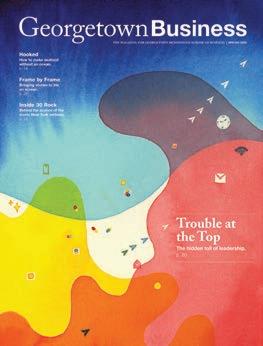
Children’s author draws young readers toward confidence, resilience, and the power of “yet.”
p. 12
Overlooked Investors
Who really pays for — and benefits from — global medical innovation?
p. 06
Mission-Driven Margins
One alumna traded the classroom for a consulting career built on purpose. p. 14
True to Character
One of the greatest privileges of producing Georgetown Business is the opportunity to meet the remarkable members of our alumni community. With every issue, my colleagues and I are welcomed into conversations with graduates whose careers, ideas, and ambitions are shaping industries, communities, and lives around the world.
What strikes me is the range of challenges our alumni choose to tackle. Some are working on questions of immense scale: how cities will accommodate billions more residents, how infrastructure will be financed, or how global investment fuels innovation. Others are focused on deeply personal challenges: helping children build confidence through storytelling, guiding organizations through purposeful change, or solving everyday problems through entrepreneurship. While the scope of their work may differ, they share a common commitment to creating meaningful impact.
As we continue to tell these stories, we’re also exploring new ways to share them with you. In this issue, we experimented with a more concise print edition complemented by an expanded digital experience. While you’ll find the same thoughtful insights and alumni perspectives in these pages, some stories continue online, where you can access additional interviews, analysis, and content. We see this issue as an opportunity to test new approaches while remaining committed to the stories that define Georgetown Business.
We’d love to hear what you think. Please take a moment to complete the survey featured on the back cover and share your feedback. Your input will help shape future editions of Georgetown Business.
Thank you, as always, for reading and for being part of this community. We hope the stories in these pages inspire you as much as they inspired us.
—MARTHA BARRETTE HOLLAND, EDITOR
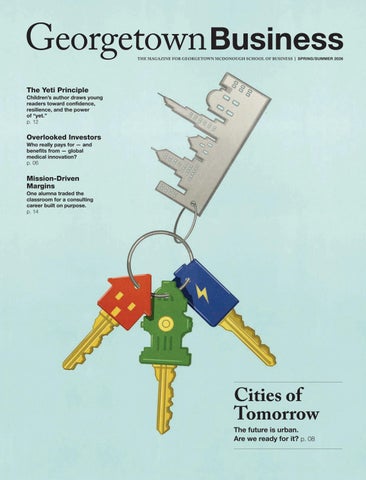
“O ur values can serve as a beacon that cuts through the haze and shines light on the way forward.”
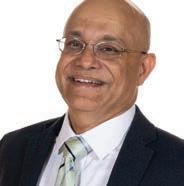
—PAUL ALMEIDA, DEAN AND WILLIAM R. BERKLEY CHAIR READ HIS FULL COLUMN ONLINE.
Georgetown Business
Dean, William R. Berkley Chair
Paul Almeida
Associate Dean, Chief Marketing and Communications Officer
Teresa Mannix
Senior Director of Communications and Marketing
Samantha Krause
Editor
Martha Barrette Holland
Assistant Dean for Alumni Relations and Corporate Partnerships
Sara Solin Martinez
Creative Direction
2communiqué
Editorial Direction
Laura J. Cole and Dog Ear Creative
Staff Writers
Jessica Marr
Guadalupe Ramirez
Georgetown Business welcomes inquiries, opinions, and comments from its readers. Please send an email to GeorgetownBusiness@ georgetown.edu.
Send alumni address changes to addup@georgetown.edu or contact alumni records at (202) 687-1994.
Join us on LinkedIn
Georgetown University McDonough School of Business Alumni
Follow us on Instagram
@georgetownmcdonough
Like us on Facebook
Georgetown McDonough School of Business
Follow us on X @msbgu @MSBalumni
SPRING/SUMMER 2026
“All my characters have a little piece of me.”
COVER STORY | 08
Cities of Tomorrow
The next generation of global competitiveness will be won — or lost — in the design, financing, and stewardship of the world’s cities.
PATHS | 04
Landing the Interview: First in the Credits Career Up: Play Well with Others Six Degrees: From Bedtime to Bestseller
INNOVATIONS | 06
Buying / Selling: Under the Scanner Pitch Deck: Game-changing Detergent The Edge: The Recommendation Funnel
CONNECTIONS | 14
Pivot: Growth Practice
“ Did you always want to be an executive leader? ”
INTERVIER: JOEY TRIGIANI (B’26)
“ From an early age, I think I felt the desire to be a leader, but I didn’t have people in my life who were executives, so that wasn’t really in my consciousness at the time. ”
INTERVIEWEE: ANN SARNOFF (B’83), FORMER CHAIR AND CEO AT WARNER BROS. ENTERTAINMENT
Play Well with Others
we are entering an era where skill requirements are being redefined or often replaced by AI at an unprecedented pace. While many industry-specific competencies remain relevant, the modern professional’s value has shifted from what they know to how they adapt.
Upskilling or reskilling demands more than just technical literacy; it requires a mastery of distinctly human capabilities. Fast learning, complex problem-solving, and emotional intelligence are the new career anchors and are skills well worth honing. In a world of automated solutions, your ability to collaborate with diverse teams and lead with empathy is what will make you irreplaceable. Technical tools provide the output, but your human insight provides the impact.
— PREM MALDE, ASSOCIATE DIRECTOR, MCDONOUGH CAREER CENTER
My father played Hoya football and competed in the Sun Bowl.
At Georgetown, I met my future wife
Joe Pallotta (C’51)
Formatively, my uncle set me on a Jesuit path.
Arthur “Sonny” Pallotta (C’50, M’53, PhD’56)
Eric Pallotta (B’07)
global senior vice president of brand marketing and social media at Warner Bros’ Streaming Division, Max
Linda Owens Pallotta (C’77)
Years later, her simple suggestion — that I read nightly to our children — sparked my career.
I sharpened my analytical thinking in the classroom with
Othmar Winkler statistics professor emeritus
It proved invaluable when navigating publishing contracts and royalties; skills that set me apart in the business of writing.
My playful college antics in the new Lauinger Library brought me into contact with
Joseph E. Jeffs (C’49) university librarian from 1960-1990
That relationship continued; and after publishing my first book, I sent Jeffs a signed copy, beginning a lifelong exchange of letters. Two of our four children would later become Hoyas.
Jill Pallotta Robinson (N’09) a nurse anesthetist at Massachusetts General Hospital in Boston
FROM BEDTIME TO BESTSELLER
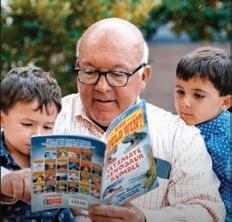
Jerry Pallotta’s (B’75) path from the Hilltop to becoming one of America’s most prolific children’s authors is rooted in family, faith, and a few formative connections. Inspired by reading to his four children each night, Pallota wrote his first book in 1986. It set the groundwork for his popular Who Would Win? series that pits killer whales against great white sharks, falcons against hawks, and more. With more than 120 books, 40 million copies sold, and thousands of school visits, Pallotta reflects a distinctly Georgetown journey built on curiosity, community, and purpose.
Today, the Georgetown connection continues through my children, including my daughter, who was mentored by classmate and family friend
Eileen Brennan Ferrell (N’75, G’83) retired senior vice president and chief nursing officer for MedStar Georgetown University Hospital
SIX DEGREES
BUYING / SELLING
Under the Scanner
New research challenges who really funds biopharma breakthroughs, and what’s at stake for Americans.
Policy debates often assume the United States finances the world’s medical breakthroughs. But that view focuses on the final stages of innovation, after drugs and technologies reach the market. In reality, early-stage research depends on venture capital that fuels startups long before they generate revenue. Research by Yunan Ji, assistant professor of strategy, shows that this funding is deeply international. While the United States remains a leading hub for innovation, it relies on global capital to drive medical breakthroughs.
BUYING: Global Capital as the Engine of Innovation. The common narrative suggests the United States funds the world’s pharmaceutical innovation. Venture capital data actually shows the United States is a net importer of global health care investment. From 2020 to 2024, foreign investors directed roughly $256 billion into U.S.-based health care startups, compared with $237 billion invested abroad by U.S. firms.
Medical innovation is increasingly global. Discovery, clinical trials, and commercialization often occur across multiple countries, each contributing specialized
expertise. This collaboration helps accelerate breakthroughs and can give U.S. patients faster access to new treatments.
SELLING: Restrictive Cross-Border Investment Policies. Because the U.S. innovation ecosystem depends on global capital, policies limiting international investment could slow the development of new health technologies. As countries such as China expand their biotechnology capabilities, maintaining America’s leadership will require balancing national interests with continued openness to global investment. CONTINUED ONLINE
Game-changing Detergent
adrian abrams (c’18) turned the entrepreneurial mindset he developed on the Hilltop — where he earned a minor in entrepreneurship — into a business focused on solving an everyday problem. Abrams founded Washletics to address a common frustration: activewear that still smells like sweat after washing.
The idea grew from a simple insight. Many consumers rely on scent beads, sanitizers, and other products to clean their workout clothes. Abrams saw an opportunity to build a detergent specifically for sweat-heavy clothes and performance fabrics. Washletics is a clean-ingredient, fragrance-free detergent designed to remove odors without additional products.
Since launching, Washletics has generated early sales, gathered customer insights, and earned industry recognition.
For Abrams, Washletics reflects a belief that the best businesses come from innovating around “boring” problems that millions of people quietly experience.
—MARTHA BARRETTE HOLLAND
The Recommendation Funnel
Before making a purchase, people increasingly turn to online platforms and communities to seek out recommendations, opinions, and lived experiences from others. But behind what users see on the surface lies a quieter set of choices — recommendation algorithms that shape how information is surfaced, shared, and ultimately consumed. Ziwei Cong, assistant professor of marketing, discusses new research on how different approaches to algorithmic curation can reshape user behavior, platform dynamics, and the way people connect with information online.
Your research investigates how recommendation algorithms influence users’ social and topical interests. What are the main takeaways?
We used a large-scale quasi-experiment on Zhihu — the largest online knowledge sharing platform in China — to analyze its shift from content-based filtering to social filtering. We found that while this transition strengthened the social fabric of the platform, it simultaneously altered how users engage with specific topics. Switching from topic-based recommendation algorithms, where content is suggested based on the topics to which a user has subscribed, to social filtering, where content is recommended based on what users’ connections engage with, increases social tie formation by about 15% but reduces question subscriptions by roughly 20%. Compared to content-based filtering, social filtering also exposes general users more to content consumed by their followers, who tend to have stronger niche interests.
Why consider this influence when deciding what algorithms to use?
In organizations, this is relevant for people who develop or manage a presence on public or proprietary platforms (e.g., Reddit, Weibo, Facebook, LinkedIn, and Yelp), including but not limited to developers, designers, and social media managers. It helps ensure users contribute high-quality content and people asking questions receive useful, relevant answers. Ultimately, it supports the goal of providing knowledge and meaningful responses that improve the overall user experience.
It is also important for policymakers, as online social bubbles have become a significant issue. Social media platforms increasingly place users in filtered environments where conversations and debates are shaped by algorithms that prioritize what we already like or agree with. As a result, people are often surrounded by content and viewpoints similar to their own, reinforcing existing beliefs rather than exposing them to diverse perspectives and communities.
The next generation of global competitiveness will be won — or lost — in the design, financing, and stewardship of the world’s cities. Georgetown alumni discuss what that means for infrastructure, investment strategies, and emerging technologies.
CITIES
OF TOMORROW
BY LAURA J. COLE ILLUSTRATION BY SHOUT
THE MOST AMBITIOUS transformations in human history are happening right now in cities around the globe.
“It’s a pretty remarkable period when you think about the totality of all of the great cities of the world,” says Roger Weber (MSF’18), urban planning expert and founder of New Cities Atlas, which chronicles the creation of the world’s new cities since 1950. “In the span of about three professional generations, we’re building basically 10 times what [previous generations] did in terms of total volume of new urban development.”
That expansion isn’t happening only in rapidly growing regions such as Africa, which is projected to surpass Asia by 2070 as the most populous place globally. It’s happening in established urban environments, which have also seen population surges. For example, the metro regions of cities like Greenville, South Carolina, and Knoxville, Tennessee, are as big as London was only two centuries ago, raising questions about how to maintain aging infrastructures and pay for new ones.
The challenge is not simply building more cities. It’s building systems that work.
Recognizing this shift, Georgetown McDonough’s Steers Center for Global Real Assets has broadened its focus from commercial real estate to global real assets, an integrated view that brings together the built environment, the infrastructure that supports it, and the energy systems that power it.
“We believe the integration of these three things is the future,” says Matthew Cypher, Atara Kaufman Professor of the Practice and director of the Steers Center. “It’s what you’re seeing right now in the data center world, where you have traditional real estate in terms of a structure, energy which is the limiting factor, and infrastructure in the way of the servers.”
To explore how these systems are reshaping cities — from how they’re designed to how they’re financed, powered, and reimagined — Georgetown Business convened a conversation led by Cypher with alumni working across the real asset landscape: Paula Bejarano (MBA’18), senior vice president of business development and sales at Benteler Mobility, who is helping deploy autonomous electric mobility systems designed for shared urban transportation; Katherine McElroy (B’04), managing director of infrastructure debt investments at the Paris-based firm Infranity; and Weber, who has overseen the planning and design of cities around the world.
Together, they offer insights into one of the defining questions of this century: How to rethink cities and sustain ecosystems at a scale the world has never attempted before.
Matthew Cypher: Roger, can you get us started with framing the growth of our global urban population from 1950 to 2050?
Roger Weber: We quite literally are right in the thick of what is the most remarkable century in the history of the world when it comes to the development of cities. In 1950, the population of all the world’s cities was about 700 million. By the year 2050, the population of the world’s cities is going to be somewhere in the order of about 7 billion.
We’re talking about economies of scale that we’ve never seen before. Cities within recent memory that had only a few million people are projected to be in the order of 100 million people by the end of the century, which is three times as large as Tokyo. And so, the question that we’re all trying to answer, from our different professional perspectives is: How do you even create that ecosystem?
On the one hand, it’s tremendously capital-intensive, but also completely unprecedented and extremely speculative in the midst of tremendous technological change. There’s a lot to tackle.
MC: Thank you for framing us like that. Katie, how do you think about what Roger said relative to your business when you think about the money that’s already been invested, the growth that will occur, and the capital that will be required?
Katherine McElroy: Roger’s numbers are quite fascinating and his comment that “there is a lot to tackle” is consistent with what we observe in North America and Europe in terms of the need for additional infrastructure investment. He framed it with the lens of growth, but the need to replace or update aging infrastructure compounds what is required. All estimates of what all of this will cost are staggering. I have yet to see a report that convincingly bridges the funding gap, which drives much of the conversation toward defining the right model or models.
MC: Where has the capital for infrastructure come from thus far?
KM: Historically, infrastructure was primarily financed through government-backed or sovereign bond issuances. Leading up to the early 2000s, governments remained primary funders of large infrastructure through tax revenues, state-owned utilities, and public debt. Private capital was present but limited, with infrastructure regarded as a public good and not yet a distinct institutional asset class.
While funding models still differ by asset type and region, the picture has changed in the last 25 years due to a tremendous amount of private capital flowing into infrastructure. This comes from institutional investors like pension funds, insurance companies, and sovereign wealth funds. From a geographic perspective, Canadian and Australian investors were early and influential adopters of infrastructure, with large public pensions allocating meaningfully to the asset class. This interest has since spread globally. The Steers Center’s shift from real estate to real assets reflects the scale of the opportunity. The investment universe is large, and capital is increasingly flowing in to fill clear market gaps.
MC: In the United States, that would include water and wastewater, highways, and airports?
KM: Yes, in the United States many of those assets rely on bonds and municipal funding, which are efficient sources of capital but have limits. There is scope to accelerate capital flows by thinking a little more broadly and learning from models around the globe that have embraced the flow of private capital, for both asset ownership and asset management.
MC: Roger, where do you see capital coming from?
RW: It’s a really big question, particularly with changing technologies.
If you think back 10 or 15 years, and you were to ask to project the impacts on our infrastructure of things like autonomous
vehicles, EVs, ride sharing, or even things like short-term rentals and Amazon, you probably would have been pretty inaccurate. You have to acknowledge that the certainty around predicting the specifics of new technologies and their impacts is really, really hard more than about three to five years out.
The good news is that a lot of the underlying infrastructures we build cities around can be very consistent. That’s something where you really can build for 50 to 75 years out, and those are the kinds of things where the public sector continues to be at the forefront. For more speculative and innovative pilot studies, there has been a shift toward the private sector. Certainly, the notion of privately developed cities — or at least private mechanisms established by governments to develop
speculative cities — has been very interesting internationally. You start almost thinking about the city like a corporation, and that’s applied to transportation as well.
MC: Paula, how does your firm think about autonomous transportation in an environment that is speculative and changes frequently? How do you build a business around that level of uncertainty?
Paula Bejarano: I definitely thrive in ambiguity. That’s just the nature of our business in terms of technology development, regulation, and public opinion. This is to be expected when introducing innovation in traditional sectors that are heavily regulated, such as transportation.
Today, we work with transit agencies, urban planners, and infrastructure partners to help
cities transition to the next generation of public transportation. This is how we collaborate, for instance, with the Jacksonville Transportation Authority in Florida. It’s not about knowing what the city is going to look like 50 years from now — there are problems now: congestion, emissions, land use. It’s rather focusing on identifying the technology, in this case shared mobility, that will help mitigate such issues. For the first couple years, our focus would be to deploy an autonomous pilot within a geofenced, controlled area. If that is successful, then you would start scaling upward. That’s also how we de-risk the fleet operation with regards to capital investment, technology maturation, and infrastructure buildout.
MC: What are cities like Jacksonville asking of you?
PB: Our transportation stakeholders in Jacksonville are asking us to deliver autonomous vehicle technology that is safe, reliable, and resilient. It is also important for them that we cooperate closely with regulatory bodies in Washington, D.C., to ensure compliance and alignment. In partnership with JTA, one of our main customers, this effort goes beyond simply providing the technology — it requires planning with regards to workforce training and development, service operations, as well as community engagement. Fleet operators are also looking for flexibility and openness in testing a variety of use cases and deployment models, emphasizing accessibility and inclusiveness for different rider groups. GB
This Q&A was edited for length and clarity from a webinar held February 27 for members of the Steers Center community. Scan the QR code to watch the full video and read more about the future of transportation, who’s investing in speculative technologies, and what resilience looks like in terms of infrastructure, investing, and technology.
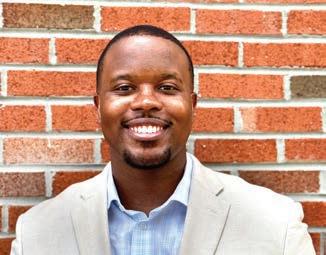
Greek author and illustrator Marina Gioti creates children’s books that paint pathways to confidence, resilience, and the power of “yet” — for an increasingly global audience.
BY DAN MORRELL PORTRAIT COURTESY OF MARINA GIOTI
WHEN MARINA GIOTI (B’97) was a little child, she fell in love with children’s books. She admired the authors, and especially, the illustrators. Early on, it was Aesop’s Fables and The Little Prince. Later, as she read Harry Potter, she realized a deep admiration for storytellers.
“Sometimes,” says Gioti, “what you admire shows you a way to the future.”
Today, Gioti is the celebrated author and illustrator of 18 children’s books that regularly appear on the bestseller lists in her native Greece and have been translated into several languages. It wasn’t a direct path, but the passion was unwavering. She double majored in marketing and fine arts at Georgetown and later studied visual communication and illustration at Pratt Institute in New York. During her 15 years as creative director at a marketing firm she founded, she would practice creating short stories that captured the essence of an idea in just a few lines.
“Everything I learned while studying at Georgetown and during my career in marketing has helped me do what I do now, better,” says Gioti.
Today, Gioti’s bestsellers have developed a vibrant life beyond the pages as classroom lessons and board games. GB
Continue reading this article online for a Q&A with Gioti about how her family has influenced her art, the dual audience of picture books, and the impact she hopes to make with her work.
Connections
Growth Practice
A former teacher turned consultant expanded her impact by staying true to her values.
kelly bies (mba’18) didn’t set out to work in consulting. When she began her career, she was standing at the front of a middle school classroom in Chicago, teaching writing as a Teach For America Corps member. But even then, the seeds of her future were already taking root.
Bies’ path into education was deeply personal. As a public policy undergraduate focused on education, she believed any future impact she could make required firsthand experience. That conviction was reinforced by her upbringing — where service and education were core family values — and by a defining
childhood moment when her family home was destroyed in a fire. Teachers, she recalls, created a sense of stability and care during a frightening time. “They showed me how systems and people can change a student’s trajectory,” she says.
In the classroom, Bies quickly discovered strengths that would later define her career: navigating competing stakeholders, building trust, and guiding change.
“You’re balancing students, parents, administrators,” she explains. “It taught me that to make meaningful change, you have to understand the whole ecosystem.”
Still, after several years, she began to
feel a pull toward broader impact. While she valued teaching, she also recognized limits in the scale of influence she could have. That realization led her to pursue an MBA at Georgetown.
Bies describes herself as risk-averse, yet data-driven. She asked herself a series of questions and let the answers guide her next steps. “What aligns with my values? What energized me? Is my work meaningful to the communities I care about? Do I get to grow and be challenged?”
“Some of that clarity helped me see that it wasn’t a risk. It was just an alignment with my path,” she says.
Graduate school became a turning point. Consulting offered what she was seeking: scale. Instead of impacting a single classroom, she could influence organizations, communities, and how they operate. She joined Deloitte after graduation, where much of her work focused on the public sector, aligning closely with her mission-driven roots. But over time, she noticed a pattern.
“I was most energized when I was working at the intersection of systems, people, and purpose,” she says.
That insight led her to her current role, where she is a manager for strategic services at the firm’s Growth & Purpose practice — helping organizations translate values into action. She finds the most fulfillment in driving impact for her clients in a way that benefits communities.
“In many ways, it’s the same work as teaching,” she reflects. “I’m still meeting people where they are, building trust, and leading change — just with different stakeholders.” Today, Bies sees her journey not as a departure from education, but as an evolution of it.
—TERESA MANNIX
PIVOT
As a manager in growth and purpose at Deloitte, Kelly Bies helps organizations transform values into action.
What is operational flexibility?
“Electricity is unlike most products because it cannot be stored easily. When someone flips a switch, a generator needs to respond instantaneously. This requires operational flexibility — the ability to increase or decrease supply and demand to keep them in balance. Operational flexibility keeps the lights on and enables further investment in variable renewable sources like solar and wind.”
—ŞAFAK YÜCEL
ASSOCIATE PROFESSOR OF OPERATIONS AND ANALYTICS
ASSOCIATE DIRECTOR OF THE BUSINESS OF SUSTAINABILITY INITIATIVE
Georgetown University
McDonough School of Business
Office of Marketing and Communications
211 Rafik B. Hariri Building
37th and O Streets, NW
Washington, DC 20057
Share Your Feedback
We value your perspective in helping to shape Georgetown Business magazine. Your feedback will inform how we continue to share stories and insights that resonate with our community. Scan the QR code to complete the survey. The survey will take approximately 5–7 minutes.