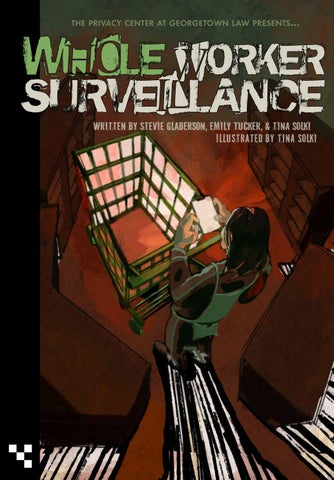
the privacy center at georgetown law presents...
WHOLE WORKER SURVEILLANCE written by stevie glaberson, Emily Tucker, & tina solki illustrated by tina solki
WHOLE
WORKER WO RKERSURVE SUR VEILLA LANCE NCE Stevie Glaberson Co-Author Emily Tucker Co-Author Tina Solki Illustrator, Co-Author
Whole Worker Surveillance © 2026 by the Privacy Center is licensed under CC BY-NC-SA 4.0. To view a copy of this license, visit creativecommons.org/licenses/by-nc-sa/4.0 This is a work of creative nonfiction. The stories and recollections contained here are real, based on accounts from workers collected by the Privacy Center between 2024 and 2026. The accompanying illustrations, artwork, and visual designs are creative interpretations. They are intended for artistic and illustrative purposes only. Any direct resemblance to actual persons, living or dead is purely coincidental.
I
t’s easy to feel small in today’s world.
Where the rich keep getting richer, and everyone else seems to be getting... ...crushed.
In the halls of power, they talk about “saving democracy.” But democracy doesn’t live or die in the halls of power.
Democracy lives or dies in communities. 3
And communities depend on spaces where people can gather...
...not only to organize and protest...
...but also to live the mundane parts of life in one another’s company.
To work, play, travel, shop, learn, heal, and worship together. To see ourselves in strangers, in places we wouldn’t expect.
4
But these spaces are disappearing. The everyday spaces where we might find community and connection...
…are being turned into sites of surveillance and data extraction.
Taking data from us and everything we do is a way for tech giants—and the billionaires that own them—to get richer.
It’s also a way for them to discipline us so we don’t fight back.
5
If we want to take those spaces back, we need to see them as spaces that could be full of meaning for the people who spend time there. For example, the grocery store.
It’s a place where we work, shop, and nourish ourselves and our families.
It’s also a place where we see our neighbors – the ones we know, and the ones we don’t know yet.
A grocery store can be more like a community hub, or more like… a warehouse.
When we think of warehouses, one company in particular comes to mind:
Amazon. 6
In 2017, Amazon bought Whole Foods for $13.7 billion. Amazon has applied its warehouse logistics model to everything it touches, prioritizing profit and speed above all else. Whole Foods was no exception.
The acquisition didn’t just change the products on the shelves; It changed the structure of the workplace.
Overnight, a niche natural foods chain that once marketed itself as a “company with a conscience” joined a growing list of properties in one of the world’s largest tech-retail empires.
After the acquisition, decisions that once belonged to individual stores, managers, or staff began to flow through a megacorporation known for tightly controlling its operations through data-fueled surveillance.
7
The federal government, or even states, could have blocked the acquisition, protecting workers, consumers, and the public from Amazon consolidating even more monopolistic power.
But they didn’t.
So, how has the expansion of Amazon’s monopoly changed the experience of Whole Foods workers on the ground?
8
Between 2024 and 2026, we conducted surveys and interviews of Whole Foods workers nationwide. We asked them to shed light on their experiences living through the Amazonification of their workplace. They told us about the ways that surveillance tech impacts them, from their daily routines, to their sense of autonomy, to their relationships with their coworkers and customers alike. In the pages that follow, you’ll hear directly from workers about how the introduction of surveillance technologies has changed their working lives and ability to find and forge community at work.
9
Workers told us about dozens of technologies that have been added to their working lives in recent years. “There’s Grocery Central for purchase orders and shrink.” “We use SLAW, which is how we make signs.” “We use SODA, which is how the company tells us what signs to produce.” “A program called “PROJECT SRIRACHA” schedules Team Members based on [their] expected productivity [at that] time of day.” “We used to use IRMA, but that’s dead. They killed off IRMA.” “In 2019 they released Innerview, which has ballooned into the primary app for team members.” ”I look on Innerview for... our [policies], schedules, resources, benefits, compensation.” “One of the many apps and websites is Daily Note. It’s where they’ll put, like, upcoming projects and tasks.”
”It’s been a very—I wouldn’t say night and day—but a very, very big difference with how the company is run.”
”I would say the emphasis on technology is the biggest change for me… it feels very different.” “We could spend the rest of [this zine] telling you about the different programs that we have... because it doesn’t really end.” 10
These technologies are usually billed as making things more efficient...
“Once upon a time, four different full-time roles did all of the things that I do now.”
“We used to have a marketing team leader who [coordinated] events with local community partners.“
”And then a full time sign-maker that hand-drew signs with chalk…”
”...both of those jobs got eliminated.“
”...and now I’m in charge of printing tags and printing PDFs off of a portal and, you know, hanging those up.”
...but they often tend to make things worse. 11
These technologies affect everything from what’s on store shelves... “Months ago, they deleted one of our chocolates. They were changing the order number... but they didn’t add the data correctly. [W]e weren’t able to order that chocolate for two months.”
...to who gets a chance to compete for these jobs. “Now we hire through an AI, Paradox.”
“Based on your answers it’ll rate all your traits and… based on how you do, it’ll funnel you into different role[s].”
“Her name is Sage.” ”She’s… terrible.”
“My friend applied to Whole Foods... and he, like, got this survey.” “He was like, what’s up with this survey?”
“It’s asking me if I’m empathetic and it’s showing me a tree and a hot dog.”
“Like, what?” 12
But most of all, workers’ experiences on the job have gotten worse, in a number of concrete ways.
Workers feel constantly watched.
“There are cameras everywhere and they’re used to monitor us, not customers.”
“It makes me feel like we work in the Panopticon.” “We all know we are being monitored; moral[e] at my store is always down.” “They make it so obvious they’re watching us.”
“...it’s accepted knowledge that leadership may be watching us at any time.”
13
That surveillance allows Amazon to break down employees’ every move into metrics for later exploitation. “They track everything.” “How fast people scan items, how fast people type in PLUs, whether you scan a product, search it, or type it.”
In other words, it seeks to turn people into data points. “Cashiers are... judged on a metric of how many items they scan per hour, which is tracked through the POS software.” “My job is to get evaluated for data.”
“Amazon’s business model is built off of big data and logistics, why would they not try to capture biometric and consumer purchasing data about their own employees?”
14
Tech that’s introduced for other reasons ends up being used to surveil and punish workers.
“A lot of the systems that we use... they’ll be implemented for one reason and they’ll be used for another.” “The REX tool is a good example.”
“We [were] told it’s going to digitize production... It’s going to make food safety, you know, a lot more streamlined.” “What it’s being used for more consistently is monitoring team member performance.”
“Once a week, we have to hit a certain number of scans... [T]hey changed the number of scans without communicating it.”
”I ended up on a list because I was 75 short of a new target they didn’t tell me about.”
15
“E-commerce shoppers’ Units Per Hour metric is tracked... and even gamified to get them to work harder and rush faster to complete orders.”
“Top UPH performers get recognized, bottom performers get disciplined.”
Some e-commerce workers “feel like they can’t even go take a pee because it’s going to bring their average down.”
Technology-enabled surveillance intensifies work. It also makes workers feel less safe doing their jobs.
“At some point it’s just getting a little, like, unrealistic to be working this fast.” “They’re not saying, hey, rush to do your job, so you get injured, but the pressure is there.” 16
“And team members definitely feel it, and we definitely see a rise in injuries due to that.”
“It’s slowly kind of turning into Amazon. We’re trying to get everything out as like fast as possible.”
It affects customer experiences too, when workers are too busy meeting productivity quotas to help.
“They DON’T have a system for how many customers you help.”
“You can get in trouble for not [meeting quotas] if you have many customer interactions that interrupt productivity.” 17
Algorithmic control fundamentally alters the character of the store, for workers and customers alike.
“A big part of Whole Foods was small, local companies, with things native to your area.” ”Amazon really wants the same offerings in every store... to have a consistent experience for the customer...”
“...but that withdraws from the locality of Whole Foods.”
“Whole Foods... had more of [a] creative artsy vibe back in the day.” We had, like, in-store decorators that would make all the signage and stuff by hand.”
“All of that... went away when Amazon took over.
It’s all been streamlined top-down.” 18
But management’s turn to algorithmic control threatens the joy and creativity—the humanity—of the workplace in new ways.
Workers have long fought to maintain sources of dignity in extractive and unjust workplaces.
“We could create our own recipes, things like that.” “In the Prepared Foods Department, we used to have a restaurant in the store where we would use stuff that was going out of date... to try to repurpose it into meals.”
“Had a lot of creative license [with] what was going on.”
“We did some really nice food there.”
”Now it’s all standardized top-down.” 19
Then they changed my whole job.
“I used to like the kitchen.
Made it about completing a LIST.”
“My kitchen experience was worthless and unappreciated. It was reduced to finishing a list.” I left and went to customer service. Up front.“ “Do more do more do someone else’s list too
”Took the core values of the company and shit on them. Nothing about customer service and making them happy.”
go to another department do another venue lists lists
lists.”
“Not working on a team or collaboration--
“Just the list.”
“They tried to say the job didn’t change and I just had a bad attitude. It was actually my fault. My bad, guys.” 20
--just do a fucking list, slave.” “So yeah. I left.”
Workers’ feelings of being watched drives down morale and interferes with workers’ ability to form relationships with one another.
“It makes me feel like I don’t have agency and can’t connect to anyone without a ‘work excuse’ to talk to them.”
“The idea of [approaching] an e-commerce team member to talk to them about their experience and about unionizing is just laughable...” “[We] don’t have time to stand still for 30 seconds, let alone get into any sort of conversation like that.”
Constant surveillance discourages the small human interactions that build trust and community in a workplace. Without that trust, we’ve found that workers struggle to imagine organizing. 21
Whole Foods workers told us
“Workplace surveillance stops me from... Workers who participated in our survey told us that their belief that their employer surveils their in-person or digital interactions made them less likely to, or completely stopped them from, talking about many important topics with their coworkers.
...discussing politics, current events & activism. ...generally socializing with my coworkers.
Socializing and connecting with my coworkers.
...discussing my personal life. ...sharing general work complaints. ...raising workplace discrimination issues.
What did workers have to say about organizing?
...raising workplace wage & hour issues.
“A lot of people are very pro-union but feel that they can’t express that.”
...reporting workplace sexual harassment.
“Unions are considered a very negative thing at Whole Foods... ...when I speak of them, I lower my voice because I can’t be sure if there are listening devices.” 22
Addressing my workplace’s quality of life.
...raising workplace health & safety issues
...discussing unionization.
Organizing with my coworkers.
...getting involved in worker organizing.
% of workers affected among those who reported believing Whole Foods surveills their...
legend:
Surveillance completely stops me from doing this.
Surveillance makes me less likely to do this.
in-person interactions (N=31) digital interactions (N=37)
How can workers organize if they can’t even talk to each other?
Collective action is the best strategy we have for resisting corporate consolidation and control.
But the harder it is for workers to form relationships with one another, the harder it is for them to organize.
When workers are unable to form relationships with one another, they are deprived of the “meaningful ‘[o]pportunity to organize’” that the National Labor Relations Act is meant to guarantee.
This is on purpose.
The disruption of workers’ relationships isn’t just a side effect. It’s a big part of the draw of these tech-enabled corporate tactics. 24
Companies like Amazon use surveillance tech to find out when organizing is happening so that they can put a stop to it.
Whole Foods has reportedly used employee data to develop a “heat mapping” system which assigned a unionization “risk score” to each store. Despite Amazon’s anti-union tactics, in 2025, workers at a Whole Foods Market in Philadelphia voted to become the first in the chain to unionize, joining the United Food and Commercial Workers International Union (UFCW) Local 1776.
They know that when we work together, we can take power back.
25
The people who run megacorporations like Amazon want us to believe that there is nothing we can do to fight them anymore.
That the best we can hope for is to get a little something for ourselves by helping them build their empire.
But we don’t have to accept that.
26
We may not have billions of dollars, but we do have something they don’t.
We can see the possibility of making meaning, where they can only see the possibility of making a profit.
Making the spaces we share meaningful is how we make them ours, and seeing them as meaningful is the first step to taking them back. ■
YOUR RIGHTS when talking about unionizing at work 1. You have the right to form, join or assist a union. 2. You have the right to organize a union to negotiate with your employer over your terms and conditions of employment. This includes your right to distribute union literature, wear union buttons t-shirts, or other insignia (except in unusual “special circumstances”), solicit coworkers to sign union authorization cards, and discuss the union with coworkers.
3. Supervisors cannot spy on you, coercively question you, threaten you or bribe you regarding your union activity or the union activities of your co-workers. 4. You can’t be fired, disciplined, demoted, or penalized in any way for engaging in these activities. 5. Your employer cannot prohibit you from talking about or soliciting for a union during non-work time. This includes discussions before or after work or during break times, as well as the distribution of union literature during non-work time, in non-work areas, such as parking lots or break rooms.
6. Your employer’s restrictions on your efforts to communicate with co-workers cannot be discriminatory. For example, your employer cannot prohibit you from talking about the union during working time if it permits you to talk about other non-work-related matters during working time. However, working time is for work, so your employer may maintain and enforce non-discriminatory rules limiting solicitation and distribution during work time.
How to file a charge for unfair labor practices with the NLRB: 1. Visit www.nlrb. gov/how-we-work/ fillable-forms. 2. Download the form labelled “NLRB501 - Charge Against Employer” 3. Find your nearest NLRB Regional Office. www.nlrb.gov/aboutnlrb/who-we-are/ regional-offices 4. File your Form 501 with your local Regional Office within six (6) months of the occurrence. 5. Don’t be afraid to ask for help! Call your Regional Office or reach out to a local union for help drafting and filing your Form 501 complaint.
additional resources If you are a Whole Foods or Amazon worker and want to get involved with organizing efforts, you’re not alone! Below are some organizations doing this work:
■ Athena Coalition
athenaforall.org
A “coalition of local and national organizations representing working people, small business people, people of color, immigrants, and neighbors, along with activists, advocates, policy experts, and academics” that is “joining together to stop Amazon’s growing, powerful grip over our society and economy.”
■ United4Respect
united4respect.org
A “multiracial movement of working people advancing a vision of an economy where our work is respected and our humanity recognized.” United for Respect organizes people from across the United States who work at Amazon to fight back against conditions that hurt workers.
■ UFCW International
ufcw.org
The labor union working to organize Whole Foods workers. Read about their Whole Foods campaign at www.ufcw.org/actions/campaign/whole-foods-union/
For more, visit georgetownprivacy.org.
acknowledgements The research behind this project was conceived by Cynthia Khoo during her tenure as Senior Associate at the Privacy Center. Following extensive background research, coalition-building, and consultationwithalliesintheworkers’rights and surveillance studies communities, including the Athena Coalition and its member organizations, Cynthia led the Privacy Center in designing a research protocol and associated instruments to investigate the impacts of workplace surveillance on workers’ subjective experiences, perspectives, and behaviors related to their freedom of assembly and association at work. This protocol was granted Institutional Review Board approval in early 2024. Guided by Cynthia’s vision and the research protocol, from 2024-2026, Privacy Center staff conducted an internet-based survey and zoom-based interviews with Whole Foods workers across the United States. This zine reflects those workers’ stories and experiences.
This work would not have been possible without the organizing and narrative change work already being done by folks suchastheAthenaCoalition,PowerSwitch Action, and United for Respect. As always, we are indebted to our entire staff for their assistance, feedback, and support. Brandon McClain provided vital project management, research, and analysis. Additional research assistance was supplied by Tom Latkowski, Brandon Lee, Ian Lynch, and Mateo Garcia Silva. For consultation on and review of the survey instrument used in this study, we thank Beth Gutelius, Emily Satterthwaite, Sara Burriesci, and Angelo Diaz Reyes. For their prior work and scholarship – to which this publication owes its existence – and their guidance early in the process of this project, we thank Maya Garfinkel, Ryan Gerety, Beth Gutelius, Gabrielle Rejouis, Katie Wells, and Aiha Nguyen. The Privacy Center is currently supported by grants from the Ford Foundation, the MacArthur Foundation, individual donations, and cy pres awards.
about the privacy center The Privacy Center at Georgetown Law is a research center dedicated to exposing and opposing government and corporate surveillance. We focus on understanding the impact of mass surveillance on historically marginalized people. While we are housed at Georgetown Law, the university does not fund our programmatic work. Visit us at georgetownprivacy.org.
about the illustrator Tina Solki is an artist and researcher focused on how technology and surveillance reshapes human interconnection. A 2026–27 Fulbright grantee to Tajikistan, she studied business, technology, and public affairs at Georgetown University, where she also worked as a research assistant at the Privacy Center. She plans to pursue a J.D. with a focus on constitutional law and privacy. She can be reached at ts1354@georgetown.edu.
WHOLE WORKER
SURVEILLANCE
WHOLE WORKER
SURVEILLANCE
WHOLE WORKER
SURVEILLANCE
WHOLE WORKER
SURVEILLANCE
WHOLE WORKER
SURVEILLANCE
WHOLE WORKER
WHOLE WORKER
SURVEILLANCE WHOLE WORKER
SURVEILLANCE WHOLE WORKER
SURVEILLANCE WHOLE WORKER
SURVEILLANCE WHOLE WORKER
SURVEILLANCE WHOLE WORKER