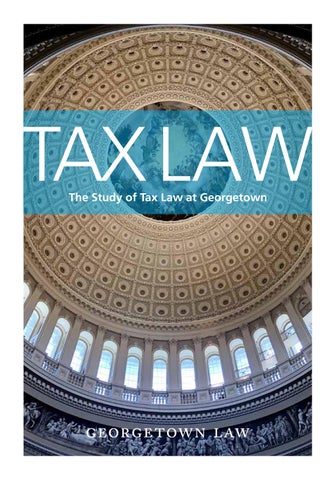

The Study of Tax Law at Georgetown

Professor Lilian Faulhaber (pictured) teaches federal income tax and international tax law, focusing on cross-border transactions and global tax policy
The Study of Tax Law at Georgetown
The study of tax law at Georgetown combines a distinguished full-time and adjunct faculty with the most comprehensive tax curriculum in the country, along with the unique advantage of studying in Washington, D.C., where federal tax laws are created, interpreted, and enforced.
The Law Center is situated at the base of Capitol Hill, just two blocks from the U.S. Tax Court and within easy walking distance of the Supreme Court, the Internal Revenue Service, the Department of the Treasury, and the Department of Justice. Georgetown leverages this exceptional proximity to federal institutions to enhance the academic and professional experience of its students.
Students at Georgetown may pursue either a J.D. degree or a specialized LL.M. in Taxation, offered on a full-time or part-time basis, in person or online. J.D. students also have the option to complete both the J.D. and Tax LL.M. degrees in three and a half years.
A Rich Academic Life
Georgetown offers an extensive tax curriculum, providing students with more than 50 graduate-level courses covering the full breadth of tax law. These include foundational subjects such as corporate, partnership, and international taxation, as well as a wide range of advanced and specialized topics.
The Law Center frequently hosts conferences on domestic and international tax issues, along with panel discussions featuring leading tax scholars and government officials. During the fall and spring semesters, students may participate in externships—valuable experiences that also enhance post-graduate employment prospects. These opportunities are available with government agencies and nonprofit organizations, and for Tax LL.M. students, also with private-sector employers such as law and accounting firms.
Students may further expand their academic experience by taking elective courses at the McDonough School of Business or other graduate programs on Georgetown’s main campus. In addition, there are numerous opportunities for independent research and scholarly writing through seminars and faculty-supervised Graduate Independent Research, which can lead to publication opportunities.
World-Class Faculty
Georgetown’s tax program is supported by a large and diverse faculty—more than 100 full-time and adjunct professors in total—which allows the Law Center to offer an exceptionally broad and specialized selection of tax courses. These courses are taught by faculty who draw on extensive experience across government, private practice, academia, and the nonprofit sector, bringing a wide range of practical and scholarly perspectives into the classroom.
Our full-time faculty includes scholars and teachers who are regularly consulted by the business community, the U.S. government, and international organizations such as the International Monetary Fund, the OECD, and the World Bank. They bring deep expertise not only in the technical aspects of taxation, but also in the broader intersections of tax law with public finance, international trade, fiscal policy, behavioral economics, and civil rights. Many are also widely published authors and frequent speakers in their fields.
Georgetown’s adjunct faculty is composed of leading practitioners from major law and accounting firms, nonprofit organizations, and policy think tanks, as well as senior government officials from the Internal Revenue Service, the Department of the Treasury, the Department of Justice, and judges of the U.S. Tax Court. At Georgetown, students learn not only from world-renowned scholars and experienced practitioners, but also from individuals actively engaged in shaping, enforcing, and interpreting U.S. tax policy.
Full-Time Faculty

Professor Dorothy Brown
B.S., Fordham University; J.D., Georgetown University Law Center; LL.M. (Taxation), New York University School of Law
Professor Dorothy A. Brown is the Martin D. Ginsburg Chair in Taxation at Georgetown Law. She is widely recognized for her scholarship across a range of areas, including the impact of tax policy on race, class, and gender, as well as workplace equity and inclusion and law school reform. She is the author of The Whiteness of Wealth: How the Tax System Impoverishes Black Americans— and How We Can Fix It (2021), and co-author of Critical Race Theory: Cases, Materials, and Problems (2014), as well as Problems and Federal Income Taxation: Cases, Problems, and Materials (West Academic Publishing, 6th and 7th editions). She is also a frequent commentator in national media, having appeared
on CNN, MSNBC, and Bloomberg, and has published numerous op-eds in outlets such as the New York Times, The Atlantic, CNN Opinion, the Washington Post, and Forbes. She currently teaches Federal Income Taxation, Partnership Tax, and Critical Race Theory. She has received teaching awards at every law school where she has taught, including Georgetown, where she was the recipient of the Frank F. Flegal Excellence in Teaching Award in 2026.

Professor Lilian Faulhaber
A.B., Harvard College; M.Phil., Cambridge University; J.D., Harvard Law School
Lilian V. Faulhaber is the Ralph H. Dwan Chair in Taxation at Georgetown Law. She teaches federal income taxation, EU tax law, international taxation, tax policy, and international business law. Her scholarship focuses on tax competition, tax avoidance, international taxation, charitable giving, and European Union law, and she has published widely in leading general and specialty law reviews. Before joining Georgetown, she served as an Advisor to the OECD Base Erosion and Profit Shifting (BEPS) Project and was an Associate Professor at Boston University School of Law. Earlier in her career, she clerked for Judge William G. Young and Senior Judge Robert E. Keeton of the U.S. District Court for the District of Massachusetts and practiced at Cleary Gottlieb Steen & Hamilton LLP. She has received multiple teaching honors, including Boston University’s Michael W. Melton Memorial Award for Teaching Excellence (2013), and Georgetown Law’s Frank F. Flegal Excellence in Teaching Award and Faculty Member of the Year Award (2018). From 2021 to 2025, she held senior administrative roles at Georgetown Law, including Associate Dean for Research and Academic Programs and later Vice Dean, overseeing faculty hiring, academic operations, and strategic academic administration.

Professor Itai Grinberg
B.A., Amherst College; J.D., Yale Law School
Itai Grinberg is the Carmack Waterhouse Professor of International Economic Law at Georgetown University. His work focuses on fundamental tax reform and international tax policy, including the intersections of tax law with trade, investment, financial regulation, and climate policy. From January 2021 to early 2023, he served as Deputy Assistant Secretary (Multilateral Negotiations) in the U.S. Department of the Treasury’s Office of Tax Policy. In that role, he led U.S. efforts to design and negotiate the global corporate minimum tax endorsed by the G20 at its 2021 Rome Summit and served as the principal U.S. representative on international tax matters across multilateral institutions, working closely with Treasury leadership on negotiations with G7 and G20 counterparts. Prior to government service, he practiced at Skadden, Arps, Slate, Meagher & Flom LLP in New York, focusing on international tax controversy and planning, and earlier served as counsel to the President’s Advisory Panel on Federal Tax Reform, advising on major proposals to restructure the U.S. tax code.

Professor Victoria Perry
B.A., Yale University; J.D., Harvard Law School
Victoria Perry joined the Georgetown University Law Center faculty in 2023 as a professor in the Graduate Tax Program. Prior to Georgetown, she spent 28 years at the International Monetary Fund, retiring in 2021 as Deputy Director of the Fiscal Affairs Department. In 2022, she was a Visiting Professor of Taxation at the University of Oxford, affiliated with the Centre for Business Taxation. At the IMF, her work centered on tax policy and she provided technical assistance on tax policy and revenue administration to more than 50 countries worldwide, focusing on the intersection of tax law and public finance. She is a coauthor of The Modern VAT and coeditor of Corporate Income Taxes Under Pressure, in addition to numerous scholarly articles and papers. Her teaching and research focus on tax systems in developing countries, international corporate taxation, and value-added taxation. Earlier in her career, she served as Deputy Director of the Harvard University International Tax Program, clerked for Judge James Holden of the U.S. District Court for the District of Vermont, and practiced tax law at WilmerHale in Boston. She has held leadership roles in major professional organizations, including president of the National Tax Association, president of the American Tax Policy Institute, and Chair of the ABA Section of Taxation’s Value Added Tax Committee, and she currently serves as Vice President of the International Institute of Public Finance.

Professor Emily Satterthwaite
B.A., Yale College; J.D., Stanford Law School; M.A., University of Toronto; LL.M., University of Toronto Faculty of Law
Emily Satterthwaite focuses her research on tax law and the equity implications of taxpayer behavior and compliance, including gender-related impacts. She uses qualitative, quantitative, and experimental methods to examine how tax statutes and enforcement policies affect individuals “on the ground,” with particular attention to entry-level entrepreneurs and low-income self-employed taxpayers. Her recent work explores topics such as the tax decisions of paid domestic workers, VAT registration thresholds for micro-entrepreneurs, the relationship between legal and tax status choices and business survival, and how audit communications influence post-audit compliance behavior. Her research has been supported by grants from Canada’s Social Sciences and Humanities Research Council and the Foundation for Legal Research, among others. She joined Georgetown Law in 2021 from the University of Toronto Faculty of Law, where she was a full-time faculty member for seven years. Earlier, she served as Assistant Director of the Institute for Justice Clinic on Entrepreneurship at the University of Chicago Law School, supervising students representing low-income entrepreneurs, and practiced tax law as an associate at Skadden, Arps, Slate, Meagher & Flom LLP in New York and Chicago.

Director Ellis Duncan
B.S., Tulane University; J.D., Tulane University Law School; M.S. (Accounting), The George Washington University; LL.M. (Taxation), Georgetown University Law Center
Ellis Duncan is the Director of the Graduate Tax Program and an Adjunct Professor of Law at Georgetown University Law Center. He oversees all aspects of the program, including academic advising for approximately 250 Tax LL.M. students each year, curriculum development across more than 50 graduate-level tax courses, recruitment and evaluation of adjunct faculty, and review of admissions and scholarship applications. He teaches courses, seminars, and external programs in federal income taxation, corporate taxation, tax research, and tax procedure. Before joining Georgetown, he practiced tax law for nearly a decade at Dewey & LeBoeuf LLP in New York, Ropes & Gray LLP in Boston and Washington, D.C., and in the Mergers & Acquisitions tax practice at EY in New York. His practice focused on the taxation of domestic and international mergers and acquisitions, joint ventures, corporate and partnership restructurings, financing transactions, financial products, and derivatives.

Professor Dorothy Brown (pictured) explores how U.S. tax law intersects with race, wealth inequality, and economic mobility, with a focus on reforming inequities embedded in the U.S. tax system
Adjunct Faculty
Amie J. Ahanchian Principal, KPMG LLP
Sahel A. Assar
Attorney, Buchanan Ingersoll & Rooney PC
John D. Barlow Partner, Baker McKenzie LLP
Rafic H. Barrage Partner, Baker McKenzie LLP
John Bates Principal, Deloitte LLP
Edward J. Beckwith Partner, BakerHostetler LLP
Elizabeth A. Bell Policy Director and Tax Counsel, U.S. Senate Committee on Small Business and Entrepreneurship
Jennifer C. Bernardini Managing Director, PwC
Christa H. Bierma Principal, EY LLP
Andrew S. Braden
Senior Counsel, IRS Office of Chief Counsel
Leslie Bradenham Principal and Fiduciary Counsel, Bessemer Trust
Sarah L. Brodie Principal, EY LLP
Patrick J. Browne, Jr. Senior Vice President, Marsh
Michael J. Caballero Partner, Covington & Burling LLP
Colin D. Campbell, Jr. Associate Tax Legislative Counsel, U.S. Department of the Treasury, Office of Tax Policy
Brandon Cash Carlton Principal, EY LLP
Vivek Anand
Chandrasekhar Partner, Perkins Coie LLP
Douglas W. Charnas Senior Counsel, Fox Rothschild LLP
Caroline D. Ciraolo Partner, Kostelanetz & Fink, LLP
Adam B. Cohen Partner, Eversheds Sutherland (US) LLP
Christopher S. Davidson Partner, Venable LLP
Bruce Decker
Managing Director, PwC
Lloyd De Vos
Senior Partner, De Vos & Co. PLLC
John DiLorio
Managing Director, EY LLP
Jared Dunkin
Vice President and Senior Tax Counsel, FTI Consulting, Inc.
Marianne Evans
Senior Manager, KPMG LLP
Nicole Field
Managing Director, Deloitte Tax LLP
Jennifer B. Goode
Senior National Director, Bernstein Private Wealth Management
Justin R. Grill
Senior Counsel, IRS Office of Chief Counsel
John W. Gunn Retired Partner, EY LLP
Hannah B. Hawkins Principal, Deloitte LLP
Jared Hermann Attorney-Advisor, U.S. Department of the Treasury, Office of Tax Policy
Carter Hood Partner, Ivins, Phillips & Barker, Chartered
Jasper A. Howard Partner, Hogan Lovells US LLP
Victor Jaramillo Partner, Caplin & Drysdale, Chartered
Kandyce Jayasinghe Special Counsel, Covington & Burling LLP
Steven P. Johnson Partner, Morgan, Lewis & Bockius LLP
Aaron Junge Partner, PwC
David Kahan Counsel, Wachtell, Lipton, Rosen & Katz
Eric R. Keller Partner, Paul Hastings LLP
Robert S. Keller Principal, KPMG LLP
Eugene Kim Manager, PwC
Cara M. Koss Partner, Arnold & Porter Kaye Scholer LLP
Jeffrey M. Kroh Principal, Groom Law Group, Chartered
Stephen LaGarde Principal, EY LLP
Todd Lard Partner, Eversheds Sutherland (US) LLP
Norman Lencz Partner, Venable LLP
Scott Levine Partner, Baker McKenzie LLP
Alan C. Levine Chief Counsel, District of Columbia Office of Tax and Revenue
The Hon. Diana L. Leyden Special Trial Judge, United States Tax Court
Stephanie A. LipinskiGalland Principal, Miles & Stockbridge P.C.
Brian Loss Managing Director, KPMG LLP
Elena Madaj Principal, KPMG LLP
Christopher K. MayerDempsey Senior Manager, EY LLP
Daniel Mayo Partner, WithumSmith+Brown, PC
Brian C. McManus Partner, Latham & Watkins LLP
Saul Mezei Partner, Gibson, Dunn & Crutcher LLP
Anna K. Moody
Senior Vice President, BNP Paribas Wealth Management
Jake Moore Manager, EY LLP
Rayth T. Myers Managing Director, Alvarez & Marsal
Michelle Ng
Senior Technical Reviewer, IRS Office of Chief Counsel
Brian O’Connor Partner, Venable LLP
Carlo Osi Employment Tax Director, Warner Bros. Discovery
Maximilian Pakaluk Managing Director, Andersen
The Hon. Peter J. Panuthos
Chief Special Trial Judge, United States Tax Court
Amanda Pedvin Varma Partner, Steptoe LLP
Peter Richman Managing Director, PwC
Bryan Rimmke Senior Manager, EY LLP
Aliya S. Robinson
Senior Vice President, The ERISA Industry Committee
Alexander Rust Professor, Vienna University of Economics and Business
Michael I. Sanders Counsel, Nelson Mullins Riley & Scarborough LLP
Alexander Schmidt
Senior Technical Reviewer, IRS Office of Chief Counsel
Steven R. Schneider Partner, Baker McKenzie LLP
Vanessa Scott Partner, Ice Miller LLP
Susan E. Seabrook Partner, Winston & Strawn LLP
Douglas L. Siegler Partner, Venable LLP
Jay Michael Singer Partner, Hogan Lovells US LLP
100 TAX FACULTY

Adjunct Professor Caroline Ciraolo, former Acting Assistant Attorney General of the U.S. Department of Justice’s Tax Division, is a partner with Kostelanetz & Fink LLP and founder of its Washington, D.C. office. She teaches two courses at Georgetown: Criminal Tax Law & Procedure during the fall semester, and International Tax Controversy in the spring semester.
Douglas Skorny Partner, PwC
Eric Solomon Partner, Ivins, Phillips & Barker, Chartered
Robin Solomon Managing Vice President and Assistant General Counsel, Marriott International
Sanford W. Stark Partner, Gibson, Dunn & Crutcher LLP
Philippe Stephanny Principal, KPMG LLP
Daniel Stern Partner, Baker McKenzie LLP
Stephen B. Tackney Managing Director, KPMG LLP
Jonathan Talisman Managing Partner, Capitol Tax Partners
Philip Tatarowicz Of Counsel, Blank Rome LLP
Dinh Tran Director, Baker Tilly US, LLP
Terrell Ussing Partner, Gibson, Dunn & Crutcher LLP
James Wang International Tax Counsel, U.S. Department of the Treasury
Melissa Wiley Partner, Kostelanetz & Fink, LLP
Jennifer M. Wolff Senior Director, Uber Technologies, Inc.
Thomas E. Zehnle Attorney, Law Office of Thomas E. Zehnle
Joshua Zimmerman Senior Manager, RSM US LLP
The Curriculum
Georgetown offers one of the most comprehensive tax curricula in the United States, drawing on its location in Washington, D.C. and a faculty of leading scholars and practitioners. With more than 50 courses offered each year, students can build a strong foundation in core tax principles while pursuing advanced, specialized study across every major area of tax law.
GENERAL TAX PRACTICE
Ethics in Tax Law
Federal Income Taxation
Financial Statement Accounting for Tax Consequences
Income Tax Accounting
Tax Research and Writing
Taxation of Digital Assets
Taxation of Financial Instruments
Taxation of Property Transactions
CORPORATE TAXATION
Business Planning Seminar
Consolidated Returns
Corporate Income Tax Law I
Corporate Income Tax Law II
Corporate Taxation
Taxation of Bankruptcies and Workouts
Taxation of Energy Markets
Taxation of Financial Institutions
Taxation of Mergers and Acquisitions
INTERNATIONAL TAXATION
Advanced International Taxation
Comparative Tax Law (Wintercourse)
Digital Taxation Seminar
EU Tax Law
Global Indirect Tax: The VAT
International Business Planning Workshop
International Tax
Tax Treaties
Tax and Development Seminar
Transfer Pricing
U.S. Inbound International Taxation
U.S. Outbound International Taxation
PASSTHROUGH ENTITIES
Advanced Partnership Taxation
Drafting Partnership and LLC Agreements
Private Equity and Hedge Funds: Taxation and Transactions
S-Corporations and LLCs: Tax and Business Issues
Taxation of Partnerships
TAX CONTROVERSY AND PROCEDURE
Criminal Tax Law & Procedure
International Tax Controversy
Tax Court Advocacy Workshop
Tax Practice and Procedure (Administrative Practice)
Tax Practice and Procedure (Litigation)
EMPLOYEE BENEFITS
Executive Compensation
Health & Welfare Plans
Qualified Retirement Plans
Employee Benefits Practicum
Survey of Employee Benefits Law
U.S. Employment Taxes
ESTATE AND SUCCESSION PLANNING
Advanced Individual Income Tax and Personal Financial Planning
Advanced Private Wealth Planning Seminar
Estate & Gift Tax
Income Taxation of Trusts, Estates, and Beneficiaries
Special Topics in Transfer Tax
TAX-EXEMPT ORGANIZATIONS
Nonprofit Organizations
Special Topics in Exempt Organizations
Tax Treatment of Charities and Other Nonprofit Organizations
STATE AND LOCAL TAXATION
Special Topics in State & Local Taxation
State and Local Taxation
TAX POLICY
Current Issues in Tax Policy
Tax Law and Public Finance Workshop
Tax Policy and Gender Seminar
Tax Policy Seminar
EMPLOYMENT
Employment for U.S.-Trained Tax LL.M. graduates average 2023-2025
Graduates
Tax LL.M. Program
Georgetown Law’s Graduate Tax Program is consistently ranked among the top tax programs in the United States, combining world-class faculty, an unmatched breadth of course offerings, and a unique location in Washington, D.C., where federal tax law is created, interpreted, and enforced. The program is designed to prepare students for leadership roles in tax practice, government, and policy.
Master of Laws (LL.M.) in Taxation
The LL.M. in Taxation is open to both U.S.-trained lawyers holding a J.D. degree and internationally trained attorneys who earned their first law degree outside the United States. This inclusive structure allows students from a wide range of legal systems and professional backgrounds to study together in a rigorous academic environment.
Students may pursue the degree on campus or online, and may enroll on a full-time or part-time basis. Full-time students typically complete the program in two semesters, while part-time students generally finish in three years, with extensions available on a case-by-case basis. All students receive the same LL.M. in Taxation degree regardless of format.
Georgetown’s online LL.M. in Taxation delivers the same curriculum, faculty, and academic rigor as the residential program, with added flexibility for working professionals around the world. Students attend classes and complete coursework remotely while maintaining full access to Georgetown’s academic resources and faculty expertise. The program is highly flexible, with minimal formal requirements beyond completion of credit hours and a foundational federal income tax requirement. This allows students to tailor their studies to individual academic interests and professional goals while receiving structured academic advising and career support.
At the core of the curriculum is Federal Income Taxation, which serves as the foundation for all advanced coursework. Students who have not previously completed this requirement may satisfy it through an introductory online course, Foundations of Federal Income Taxation, prior to matriculation or by enrolling in the course during their first semester, depending on their background. Foreign-trained LL.M. students are required to take Federal Income Taxation in their first semester of study, and may enroll concurrently in any other graduate-level courses for which it serves as a prerequisite.
Beyond the core requirement, students may choose from more than 50 graduate-level tax courses spanning virtually every area of tax law. These include corporate taxation, international taxation, partnerships and passthrough entities, tax controversy and procedure, employee benefits, estate and wealth transfer, tax-exempt organizations, state and local tax, and tax policy.
Students may further enhance their studies by pursuing one of several specialized certificates of study, including programs in International Taxation, Estate Planning, and Employee Benefits Law. These certificates allow students to deepen expertise in a focused area while completing their LL.M. coursework and are designed to complement the broader tax curriculum. Students are encouraged to develop a broadbased foundation while also pursuing specialization in areas aligned with their career goals. Georgetown provides individualized academic advising, allowing students to design coherent programs of study and, where appropriate, complete certificates of specialization or targeted course concentrations.

STUDENTS 250
Admissions
Admission to Georgetown Law’s Tax LL.M. program is highly competitive, and the program evaluates applicants through a holistic review rather than numerical cutoffs. While there are no GPA or class rank thresholds, the Admissions Committee seeks candidates who demonstrate strong academic ability and the capacity to succeed in a rigorous graduate-level legal program.
A key consideration in the review process is a demonstrated interest in tax law. Successful applicants typically show this through prior coursework, professional experience in tax-related roles, internships, clinics, or a well-articulated commitment to pursuing a career in taxation. While professional experience is not required for admission, applicants are encouraged to use their personal statement to convey their interest in tax law, their reasons for pursuing the LL.M., and what they hope to gain from the program.
The program is offered in multiple formats, including full-time on-campus study, part-time study, and an online option. While all formats share the same academic foundation, the online program is generally intended for working professionals who are already employed full-time and unable to relocate, and is not designed as an entry point for students new to tax law. Full-time students are expected to complete their studies on campus.

50+ TAX COURSES
Scholarships and Fellowships
All applicants to the LL.M. in Taxation are automatically considered for partial merit-based awards as part of the admissions process. In addition, Georgetown Law offers several competitive scholarships and fellowships for exceptional students, each with distinct focus areas and selection criteria.
Graduate Tax Scholars
A small number of full-time LL.M. students are selected annually as Graduate Tax Scholars based on academic excellence and demonstrated interest in tax policy. Scholars receive full or partial tuition support and participate in an enrichment program with leading practitioners and government officials. They complete a substantial tax research paper through a seminar or independent study and are generally expected not to hold outside paid employment during the academic year. Selection is based on the LL.M. application plus a supplemental 500-word essay, with decisions made on a rolling basis beginning in early spring.


Rafaela Jacoby (pictured), a Tax LL.M. student from Brazil, focused her coursework on international tax, which built the foundation for her current work advising on cross-border structuring, treaty interpretation, and multinational tax planning
Careers
The Graduate Tax Program maintains a full-time career and professional development team dedicated exclusively to tax students. This team provides individualized career counseling, resume and cover letter review, mock interviews, employer outreach guidance, and a weekly Newsletter containing job postings. It also organizes panels featuring alumni and practitioners across specialized tax practice areas, helping students navigate both private and public sector career paths.
Employment Outcomes
Employment outcomes for graduates of Georgetown’s Tax LL.M. program are consistently exceptional. For the past 10 years, more than 90% of our U.S.-trained graduates have started full-time positions by October of their graduating year. These outcomes reflect the program’s national reputation among employers, its deep connections to the tax policy and practice community in Washington, D.C. and beyond, and the dedicated support of Georgetown’s academic and career advising professionals.
Externships
Georgetown’s location in the nation’s capital provides unmatched access to experiential learning. Students may pursue more than 50 externship opportunities each year with leading government agencies, international organizations, major law firms, accounting firms, and policy institutions. Recent placements include the Internal Revenue Service, the U.S. Department of the Treasury, the U.S. Tax Court, the Senate Finance Committee, the House Ways and Means Committee, and the Joint Committee on Taxation, as well as major law firms and Big Four accounting firms. These externships provide academic credit, practical experience, and frequently serve as a direct pathway to post-graduate employment.
Taxation Interview Program (TIP)
Georgetown’s flagship recruiting event is the Taxation Interview Program (TIP), co-hosted with New York University. Widely regarded as the premier recruiting program for Tax LL.M. students in the United States, TIP brings together leading national and regional law firms, major accounting firms, corporations, and government agencies for structured interviews early in the spring semester. Participation by leading employers is consistently strong, reflecting the longstanding reputation of Georgetown as one of the most established and highly regarded Tax LL.M. programs in the country.

Mary Beth Muslow (pictured) completed an externship at the United States Tax Court and now clerks there, drafting judicial opinions and learning how judges evaluate complex tax controversies
Additional Recruiting Opportunities
In addition to TIP, employers engage with Georgetown students through on-campus receptions, targeted recruiting events, and postings on the Law Center’s dedicated jobs platform. The Internal Revenue Service and other federal agencies regularly participate in both the spring TIP program and Georgetown’s fall Government Interview Program, further strengthening access to public-sector tax careers.
Clerkships
Tax Court clerkships are among the most prestigious early-career opportunities available to tax lawyers, and Georgetown students regularly secure these positions with the United States Tax Court, located directly across from the Law Center. Many Tax Court judges are Georgetown Tax LL.M. alumni or adjunct faculty members, further strengthening the program’s institutional ties. Students interested in clerkships are encouraged to apply early, often before matriculation, with interviews typically conducted in September.
For more information, to request an admissions brochure and application materials, or to apply online, please visit the Law Center’s website at www.law.georgetown.edu/admissions.
For questions about the Tax LL.M. degree, please contact Ellis Duncan, the Director of the Graduate Tax Program, at 202-662-4056 or ellis.duncan@georgetown.edu.
For specific questions about the admissions process, you may contact the Graduate Admissions Office at 202-662-9020 or lawllmadmis@georgetown.edu.
Produced by The Georgetown Law Graduate Tax program, Ellis Duncan Design Brent Futrell; Photography Brent Futrell, Sam Hollenshead, iStock
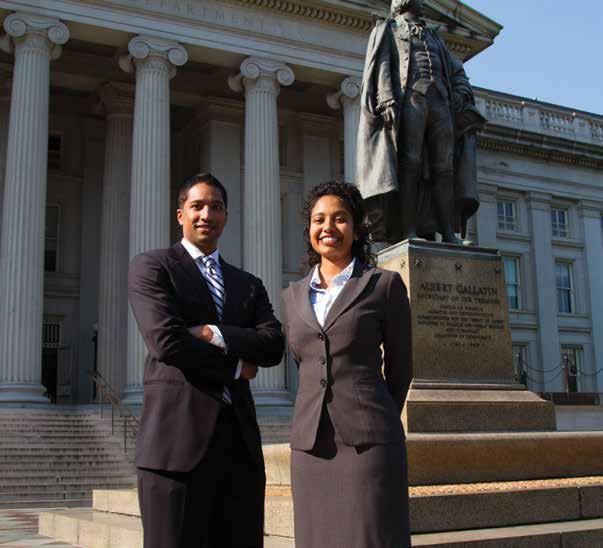
Philip Mammen (left) and Deborah Tarwasokono (right) both completed externships at the U.S. Department of Treasury while attending Georgetown’s Tax LL.M. program.