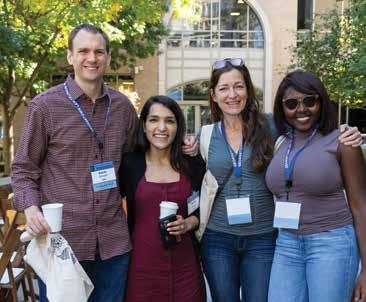
Sarah Adler, Jaclyn Diaz, Rosemary Lane, Ben Purse, Jade Spurlock.
PHOTOGRAPHY
Brent Futrell, Ines Hilde, Sam Hollenshead, Georgetown University Communications, Tim Larsen, Sam Levitan, Melissa Ryan.
MATTHEW F. CALISE
Assistant Vice President of Alumni Engagement
GENE FINN
Assistant Dean of Development and Alumni Affairs
JUNE SHIH
Associate Vice President for Communications
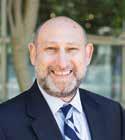
JOSHUA C. TEITELBAUM
Interim Dean of the Law Center and Interim Executive Vice President of Georgetown University, David Belding Professor of Law, Professor of Economics (by courtesy)
CONTACT: Magazine Editor Georgetown Law
600 New Jersey Avenue, N.W. Washington, D.C. 20001 editor@law.georgetown.edu
Address changes/additions/deletions: 202-687-1994 or email addup@georgetown.edu
Georgetown Law magazine is on the Law Center’s website at www.law.georgetown.edu
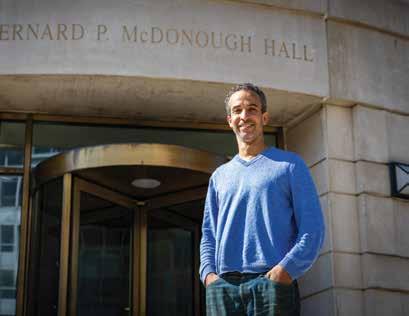
My year as Georgetown Law’s interim dean is nearing its end. On August 1, 2026, M. Elizabeth Magill will become the 17th dean of the Law Center and I will return to the faculty. It has been a pleasure and an honor to serve as interim dean. I’ve been on the faculty since 2009, so I already knew the school pretty well — but as it turns out, there was still a lot to learn!
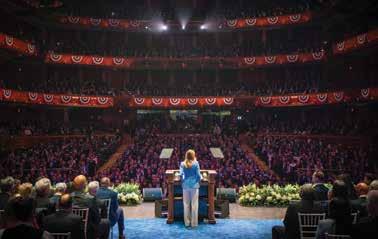
Welcoming new students during orientation; speaking at the reunion gala; interacting with student leaders; working with the president’s office, my fellow executive vice presidents and the deans at Georgetown’s other schools; meeting with the university board of directors and the law alumni boards; hosting one of my favorite academic conferences (the Conference on Empirical Legal Studies); traveling to half a dozen countries to visit alumni; greeting admitted students; reviewing countless budget spreadsheets.... Not only has the year flown by, but I’ve gained a deeper appreciation for my brilliant faculty colleagues, the dedicated Law Center staff and our amazing students. I wish each of us had the opportunity to glimpse this panoramic view of the Georgetown Law community.
So as I write this, while I am glad to be returning to the classroom and my research projects (and my season tickets at Camden Yards), I’m already feeling a bit nostalgic about my time as interim dean — and incredibly grateful for all who helped me navigate this year. I am also grateful to be handing the reins to Liz Magill, who will be a terrific next dean for this community. We will also have a tremendous ally in Eduardo Peñalver, our incoming Georgetown president — how fortunate we are to have a great legal academic taking the helm of the university. I look forward to working with both of them in the years ahead.
As I say my thanks and farewells, I must also say how much I’ve enjoyed meeting so many of you, our distinguished alumni. Please know how much your former professors love hearing from you and seeing where life has taken you.
Best,
Joshua C. Teitelbaum Interim Dean
NEWS
NEW HOYA LEADERS
Georgetown Names New President and Law Dean
Georgetown University has selected new leaders — both of them distinguished legal academics and experienced campus administrators — for the university and the Law Center. On July 1, Eduardo M. Peñalver, the current president of Seattle University and former dean of Cornell Law School, becomes the 49th president of Georgetown University. On August 1, M. Elizabeth “Liz” Magill, former dean of Stanford Law School, provost of the University of Virginia and president of the University of Pennsylvania, becomes executive vice president and dean of Georgetown Law.
EDUARDO M. PEÑALVER
President of Georgetown University
"Jesuit universities share an aspiration to do more than teach a skill or impart knowledge, but to get students to grapple with the deeper questions, to pursue more ambitious goals like wisdom and understanding and meaning."
Eduardo M. Peñalver is looking forward to returning to Washington, D.C., where he and his wife, Sital Kalantry, began their legal careers. “This is an exciting moment in Georgetown’s history – with the expansion of the Capitol Campus, the creation of new, interdisciplinary programs, a renewed focus on access and affordability and a commitment to finding innovative solutions to society’s most pressing issues,” he said.
Peñalver, whose father immigrated from Cuba, will become the first Latino president of the university. He holds a bachelor’s degree from Cornell University and a law degree from Yale Law School, and studied at Oxford University as a Rhodes Scholar. He clerked for Judge Guido Calabresi of the United States Court of Appeals for the Second Circuit and for Supreme Court Justice John Paul Stevens. A leading property law scholar, he taught at Fordham Law School, the University of Chicago Law School and Cornell Law School, becoming the dean of the latter in 2014. In 2021, he returned to his home state, Washington, as president of Seattle University, a Jesuit institution.
M. ELIZABETH MAGILL
Executive Vice President and Dean of Georgetown Law
"Georgetown Law has an unmatched combination of great attributes: its size, impact and location. The impact it has always had and will have in the future is unlimited."
An award-winning scholar of administrative and constitutional law, M. Elizabeth “Liz” Magill has called law schools her “professional and academic home” ever since she attended the University of Virginia School of Law. After clerking for Judge J. Harvie Wilkinson III on the United States Court of Appeals and for Supreme Court Justice Ruth Bader Ginsburg, she joined the faculty of her law alma mater. In 2012 she was named dean of Stanford Law School, then in 2019 she returned to Charlottesville as UVA’s first woman provost. In 2022-23 she served as president of the University of Pennsylvania.
Magill grew up in North Dakota, one of five children who grew up revering their father’s alma mater, Georgetown. A graduate of the School of Foreign Service and the Law Center, Frank Magill, F’51, L’55, became a judge of the U.S. Court of Appeals for the Eighth Circuit. Now that Magill is following in the Hoya footsteps of not only her father but of several other family members, she says that she no longer feels like the “black sheep” of her family.
CLINIC LOGS TWO BIG CIVIL RIGHTS WINS IN APPEALS COURT
IN BACK-TO-BACK WINS LAST SUMMER, GEORGETOWN LAW’S APPELLATE COURTS IMMERSION CLINIC (ACIC) SECURED TWO MAJOR CIVIL RIGHTS VICTORIES IN FEDERAL APPEALS COURTS.
On July 23, the U.S. Court of Appeals for the Fourth Circuit ruled for ACIC’s client in Hammock v. Watt, who alleged that officials at the Baltimore County Detention Center knowingly served him rotten and mouse-bitten food and blocked him from participating in group religious prayer. The court reversed an earlier dismissal of his case and affirmed the client’s rights to freedom of religion and protection against cruel and unusual punishment.
The next day, July 24, the U.S. Court of Appeals for the Third Circuit held that ACIC’s client in Gentles v. Borough of Pottstown (Pa.) had presented enough evidence to take his Fourth Amendment claims to a jury after police officers wrongfully stopped, cuffed and detained him based on an unreliable tip — a violation of his right to freedom from unreasonable searches and seizures. The court also held that he could go to trial on his claim of malicious prosecution.
“The decision was a significant victory for Mr. Gentles, who has been fighting for his rights for over six years,” said Clinic Fellow Becca Steinberg
“The outcomes in these cases are a reminder of the real-world impact of public-interest appeals,” said Clinic Director Professor Brian Wolfman. “These victories would not have been possible without the work of clinic students and fellows to advance and safeguard civil rights.”
“I am incredibly grateful to have gotten this experience so early in my career. I am thrilled about the outcome and grateful that I was able to play a small part.”
Shreya Sarin, L’25, who argued before the court of appeals in Hammock v. Watt as a student attorney
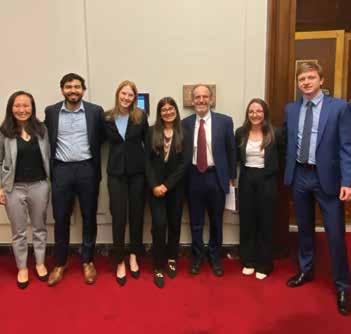
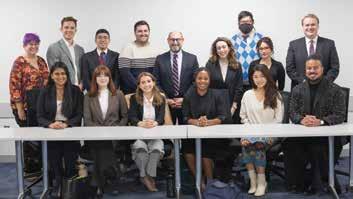
Professor Brian Wolfman, third from right, with his clinic team.
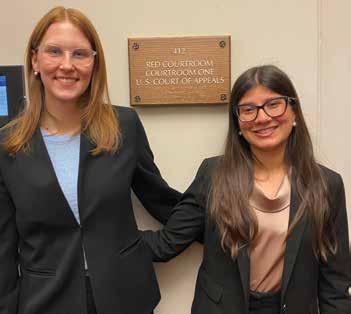
Clinic students Beth Brownstein, L'25, and Shreya Sarin, L'25.
LL.M. TUITION DISCOUNT FOR FORMER FEDERAL ATTORNEYS EXTENDED FOR ‘26-’27
Georgetown Law will offer a 30% reduction in LL.M. tuition in the coming academic year to U.S.-educated attorneys whose U.S. government jobs were affected by recent federal workforce reductions and reorganizations. The Law Center made similar discounts available last spring and some 25 former federal attorneys are benefiting in the current academic year. We spoke with one, Lindsy Miles-Hare, L’26, who is now earning an LL.M. in Taxation.
Q: What was the job you held in the federal government?
A: I served for three years in the Office of the General Counsel at the U.S. Department of Education. In short, I helped use congressional appropriations legally and effectively, ensuring grants reached the communities they were designed to serve. Before joining the Department, I worked for more than a decade in nonprofit legal services.
I grew up in a low-income family and moved through every stage of my education with government support. The little girl who once counted on breakfast in her Head Start classroom grew up to meet with the Secretary of Education and give advice on how to expand opportunities for other
children. That is the power of public investment in education.
Q: What has it been like going back to school?
A: Not unlike starting a new job, both invigorating and a little intimidating. The best part has been the professors. They love what they do and genuinely want us to succeed.
Q: Any advice for fellow former Feds considering whether to apply to an LL.M. program?
A: If someone is considering applying, they probably should. The program lasts only one year, which is nothing in the span of a career, and there’s no way to replicate the depth and breadth of what you learn.
Applications must be completed by July 1 at the latest to be considered for a Fall 2026 start (before June 1 is recommended). The LL.M. tuition discount is one of several resources and opportunities Georgetown University is offering to affected federal workers.
FIRST MOSES PUBLIC INTEREST SCHOLARS
AND FELLOWS NAMED
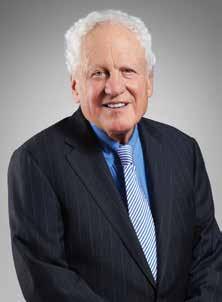
Five Georgetown Law 2Ls and three recent graduates who have demonstrated a strong commitment to pursuing careers in public service are the first to receive awards from the historic $10 million public interest fund established last spring by alumnus Alfred Moses, L’56, H’13. He is a longtime partner at Covington & Burling whose public service positions include having served as U.S. Ambassador to Romania from 1994 to 1997 and as a special advisor and special counsel to President Jimmy Carter.
The five current students who have received scholarships that will significantly reduce the cost of attendance for their second and third years of law school are:
• Susan Aboeid, L’27, a Global Law Scholar and Fritz Fellow at the Center on Privacy and Technology;
• Claire Ellis, L’27, a staff editor of The Georgetown Journal of Gender and the Law and student attorney in the Civil Justice Clinic;
• Molly Izer, L’27, a staff editor of The Georgetown Journal of Gender and the Law and research assistant at Lawyers Defending American Democracy;
• Mikaylah Ladue, L’27, a staff editor of the Georgetown Journal of National Security Law & Policy and summer intern with the Center for Reproductive Rights; and
• Ashley Nies, L’27, a staff editor of The Georgetown Journal of Gender and the Law and past intern at the O’Neill Institute’s Center for Community Health Innovation.
Three recent alumni launched their public interest careers this year in fellowships made possible by the Moses grants:
• Ian Lynch, L’25, a legal fellow with the U.S. Senate Committee on Health, Education, Labor and Pensions;
• Jemison Tipler, L’25, an International Crimes and Accountability Team fellow at the European Center for Constitutional and Human Rights in Berlin, Germany; and
• Leah Zinker, L’25, a fellow at the Clooney Foundation for Justice’s TrialWatch Initiative.
“Congratulations on an outstanding group of future contributors to civil society and the betterment of humanity,” said Moses. “The students and graduates in this cohort are impressive changemakers,” said Morgan Lynn-Alesker, L’07, Assistant Dean for Public Interest Programs, adding, “We hope that as this new fund grows, we can support even more Georgetown Law students dedicated to making a difference.”
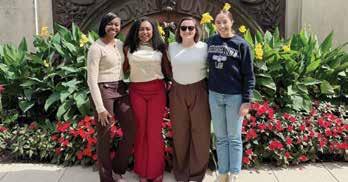
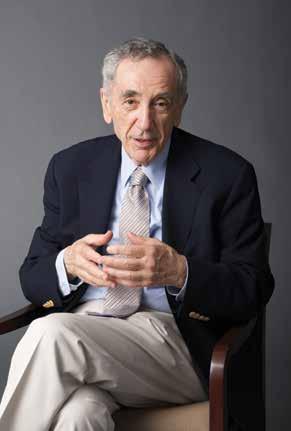
Left: Five current Georgetown Law students, Susan Aboeid, L'27, Ashley Nies, L'27, Claire Ellis, L'27, Molly Izer, L'27, and Mikaylah Ladue, L'27, are the first to receive scholarships for the fund established by Amb. Alfred Moses, L'56, H'13, to support students and recent graduates pursuing careers in public interest law. Right: Ambassador Alfred Moses, L’56 (Photo courtesy of Covington & Burling LLP)
GEORGETOWN CENTER FOR THE CONSTITUTION HOSTS
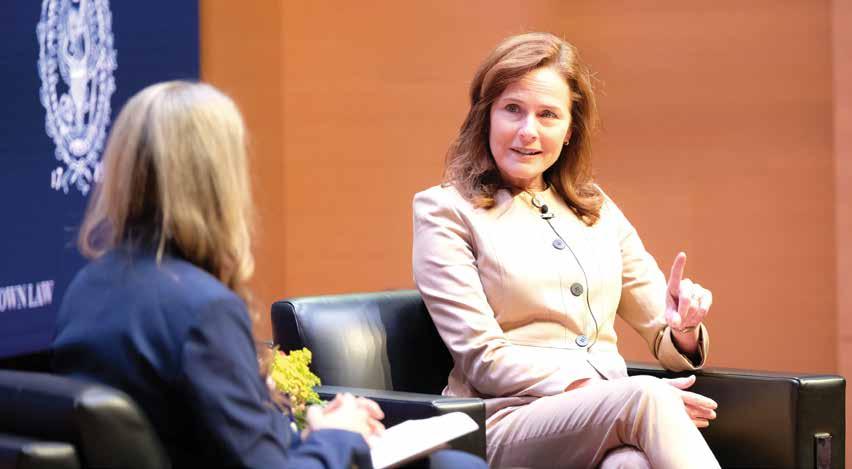
SUPREME COURT JUSTICE AMY CONEY BARRETT
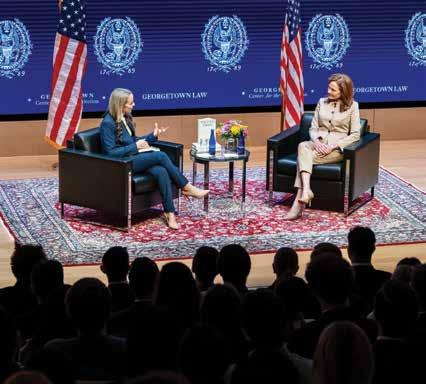
Court Justice Amy Coney Barrett (right) with Professor Stephanie Barclay (left), faculty co-director of the Georgetown Center for the Constitution.
In October, U.S. Supreme Court Justice Amy Coney Barrett joined Professor Stephanie Barclay, faculty co-director of the Georgetown Center for the Constitution, for a wide-ranging conversation on topics from constitutional interpretation to collegiality among the Justices to Barrett’s recent published book, Listening to the Law: Reflections on the Court and Constitution.
“Originalism can tell you what the meaning of the text is, but not how it should apply in a given case,” the Justice said in reflecting on jurisprudence in recent cases such as Vidal v. Elster, which involved trademark law — an area that did not exist at the time of the nation’s founding.
“In my concurrence in that case, I was just trying to separate out this idea that history and tradition is the same as originalism, or that it somehow forms the content of the law, so that it’s binding in the same way as the original meaning,” she said.
She also reflected on the relationships between colleagues on the nation’s highest court. “Collegiality is an act of the will,” she said. “At the Court, we build in many mechanisms for trying to cultivate collegiality.”
Among those traditions are handshakes among the justices before taking the bench and brown-bag lunches together after oral arguments.
“We’re kind of locked into marriages, arranged marriages, with no prospect of divorce,” she said. “This is a long-lasting relationship, and it doesn’t behoove anyone to make it a sour one.”
“If you don’t know people who hold different views, it’s quite easy to vilify them. Spending time and having respect for and assuming the best of those who disagree with you helps you realize that we’re engaged in a common enterprise.” — Justice Amy Coney Barrett
GEORGETOWN LAW & PARTNERS LAUNCH INNOVATIVE TOOL
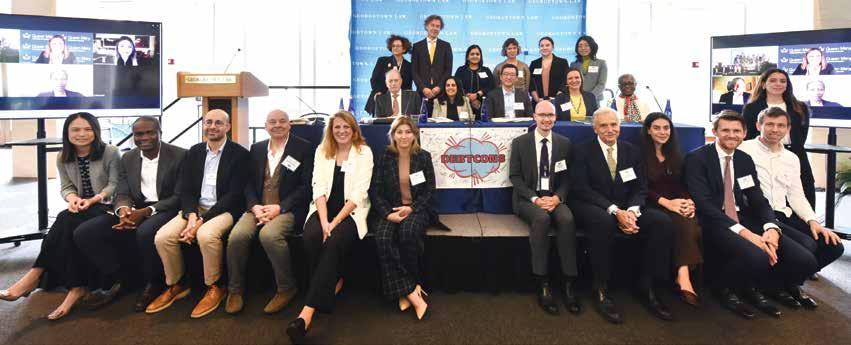
There is now a new tool policymakers, researchers and the general public can use to access information about public debt worldwide: the #PublicDebtIsPublic platform, developed by the Sovereign Debt Forum (SDF) at the Georgetown Law Institute of International Economic Law (IIEL) and Queen Mary University London, together with the Georgetown McCourt School of Public Policy’s Massive Data Institute (MDI) and other partners. A prototype of the platform made its debut in October on the Law Center campus, during the Eighth Interdisciplinary Sovereign Debt Research and Management Conference (better known as DebtCon8).
#PublicDebtIsPublic is not designed to meet the needs of a specific researcher, NGO, government or creditor; instead, it is intended to serve the broadest possible range of users. “While everyone likes the idea of a public good, it’s not anyone’s job to produce it. So we joined forces with like-minded partners – students, researchers, practitioners — to create the missing information platform,” said Professor Anna Gelpern, SDF co-director. “It’s been very gratifying to hear people say since the launch that they can’t believe this didn’t exist before.”
Visit publicdebtispublic.mdi.georgetown.edu to use the platform.
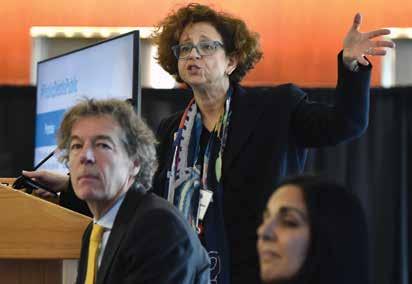
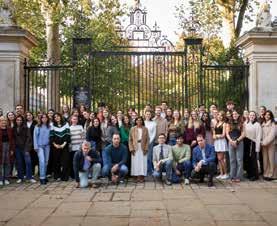
Top: Professor Anna Gelpern speaking at the #PublicDebtIsPublic launch event above: DebtCon8 attendees who had contributed to developing the platform prototype — including virtual participants — gathered for a group photo.
CLASS INCLUDES RECORD-BREAKING NUMBER OF MILITARY STUDENTS
For Belle Minter Noralez, L’28, military service and legal advocacy share a common aim: serving others. “It’s not like your service stops, it just changes,” said Noralez of her pivot from the U.S. Army to law school. “It fills me up that I can still serve people in a different profession.”
Noralez is one of 39 military service members and veterans in Georgetown Law’s Fall 2025 entering J.D. class — nearly double the previous year’s total and the largest group to enroll since at least 2018. A 2019 graduate of the U.S. Military Academy at West Point, Noralez is also one of 18 military academy graduates in her class.
On campus, organizations such as the student-run Military Law Society and the Center on National Security provide academic and career support and programs of interest for students – and help foster a tight-knit military community. “The Military Law Society has been so crucial to getting us set up with connections and resources,” said Simon Hernandez, L’28, who served in the National Guard before applying to law school. Hernandez and classmate Cornelia
Dixon, L’28, a military spouse and former Teach for America corps member, were both named Tillman Scholars last summer, receiving financial and networking support from the foundation established in memory of Pat Tillman, who left a professional football career to join the Army after the September 11 terrorist attacks and was killed while serving in Afghanistan.
Beyond campus resources, students have unparalleled access to military institutions and a robust network of service members and veterans in the nation’s capital. “Being here in D.C. gives a relevancy to a lot of what Georgetown does,” said Casey Doss, L’28, a two-time Bronze Star Medal recipient whose 21-year military career included multiple post-9/11 deployments and teaching history at West Point.
“These students have served our country in ways that many of us can’t possibly imagine. Their dedication, discipline, leadership, collaboration and teamwork are all things that law firms — and law schools — are looking for,” said Georgetown Law Dean of Admissions Andy Cornblatt
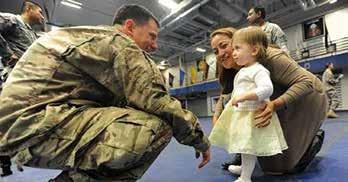
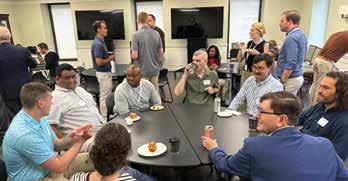
Clockwise from top left: Four West Point women graduates in this year's 1L class (Belle Minter Noralez, L’28, Niara O’Connor, L’28, Grace Brooks, L’28, and Monica Burciaga, L’28); an orientation breakfast for military-connected students and faculty; Military Law Society members on a 9/11 memorial run on the National Mall; Casey Doss, L'28.
SeenonCampus
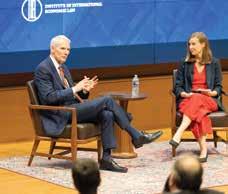
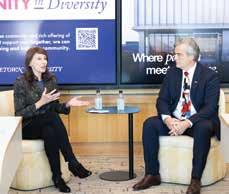
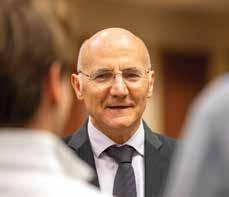
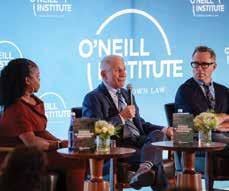
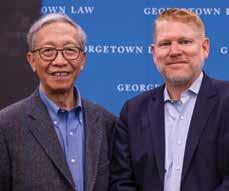
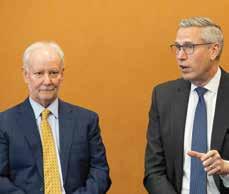
1. The Institute of International Economic Law (IIEL) hosted former U.S. Senator (R-Ohio) and former U.S. Trade Representative Rob Portman (left) and New York Times reporter Ana Swanson (right) in September for the Greenwald Lecture. 2. In October, IIEL held a panel event that included the Hon. Aksel V. Johannesen, Prime Minister of the Faroe Islands (right) and former WTO Deputy Director-General Angela Ellard (left). 3. In November, Christophe Soulard, France’s First President of the Cour de Cassation, the nation’s highest court of civil and criminal justice, spoke on campus. 4. The O’Neill Institute for National and Global Health Law organized “Memory, Medicine, and Law,” a September symposium marking the 20th anniversary of Hurricane Katrina. Speakers included Dr. Anthony Fauci (center),
former director of the National Institute of Allergy and Infectious Diseases and current Distinguished University Professor in the Georgetown School of Medicine and McCourt School of Public Policy. 5. In October, Chenggang Xu (left), visiting fellow at the Hoover Institution at Stanford University, discussed his book Institutional Genes: Origins of China's Institutions and Totalitarianism with Center for Asian Law executive director Thomas Kellogg (right). 6. In November, the Denny Center for Democratic Capitalism convened a panel of four state treasurers from around the U.S. to discuss the topic “Representing Small Investors in the Corporate Boardroom.” Pictured, L-R: Colorado State Treasurer Dave Young and Illinois State Treasurer Mike Frerichs.
111 MASSACHUSETTS AVE. BUILDING OPENS
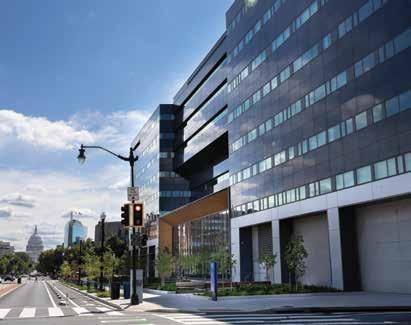
Remember the “Darth Vader” building – the massive black granite edifice across Massachusetts Avenue from the Edward Bennett Williams Law Library? 111 Massachusetts Ave. NW is now part of the “Capitol Campus,” the University’s downtown expansion anchored by the Law Center. At an October ribbon-cutting ceremony, Interim President Robert M. Groves said, “The Capitol Campus is becoming an ecosystem. It’s laying the foundation for the university to have what we hope is a greater impact on this city, our nation and our world.”
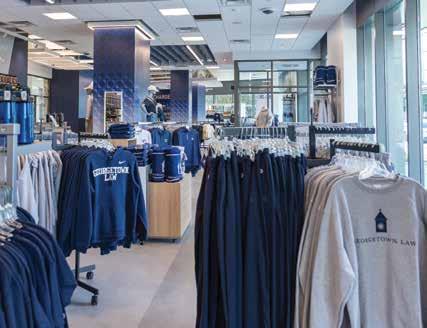
The interdisciplinary building houses a variety of programs, including the School of Continuing Studies and the Earth Commons Institute. The Law Center’s campus store has also moved there and sells both Georgetown Law and University gear!
PRIVACY CENTER UNCOVERS DHS CAPTURE OF U.S. CITIZEN DNA
In September, The Privacy Center at Georgetown Law published an update to its 2024 report, Raiding the Genome: How the United States Government Is Abusing Its Immigration Powers to Amass DNA for Future Policing, sharing that further analysis of Customs and Border Protection (CBP) data reveals that between 2020 and 2024, the Department of Homeland Security (DHS) had collected the DNA of approximately 2,000 U.S. citizens and added it to its database of genetic data from noncitizens detained by the agency. “The revelation that DHS regularly and knowingly takes DNA from U.S. citizens suggests new layers of potential illegality to a program that was already a flagrant abuse of power. Nothing in federal law gives DHS the power to take DNA from U.S. citizens who have not been arrested for, charged with or convicted of a crime,” wrote the report’s authors, Stevie Glaberson, Emerald Tse and Emily Tucker. The original report and update can both be found at www.raidingthegenome.org.
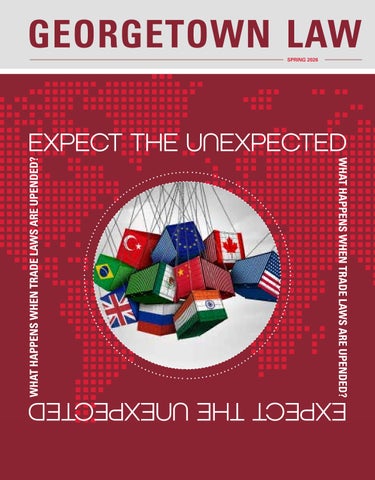
WHAT HAPPENS WHEN TRADE LAWS ARE UPENDED?
EXPECT THE UNEXPECTED EXPECT THE UNEXPECTED WHAT HAPPENS WHEN TRADE LAWS ARE UPENDED?
Since the second Trump administration took office in early 2025, trade law has been on a wild ride. Decades-old norms and agreements have been cast aside, the administration has imposed tariffs left and right (stretching boundaries so far that the Supreme Court responded), while journalists and policymakers alike parse social media posts to decipher the administration’s next move.
Imagine what this must be like for a law professor whose carefully crafted syllabus explaining how the World Trade Organization (WTO) operates becomes obsolete overnight. Or for a trade lawyer fielding anxious calls from a client wanting to know whether to move ahead with plans with an overseas manufacturing partner. What about for an LL.M. student wondering what the job market will look like after graduation?
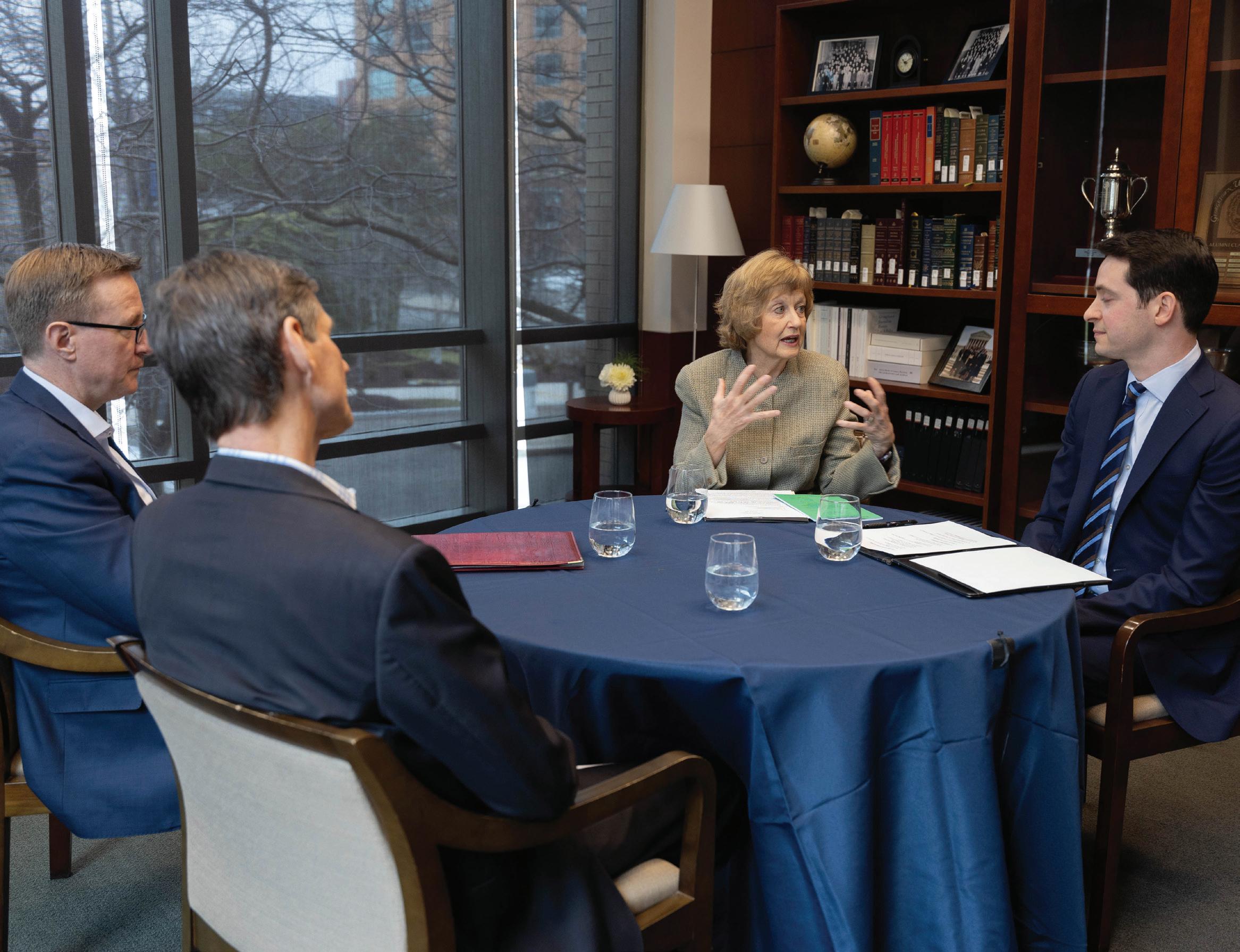
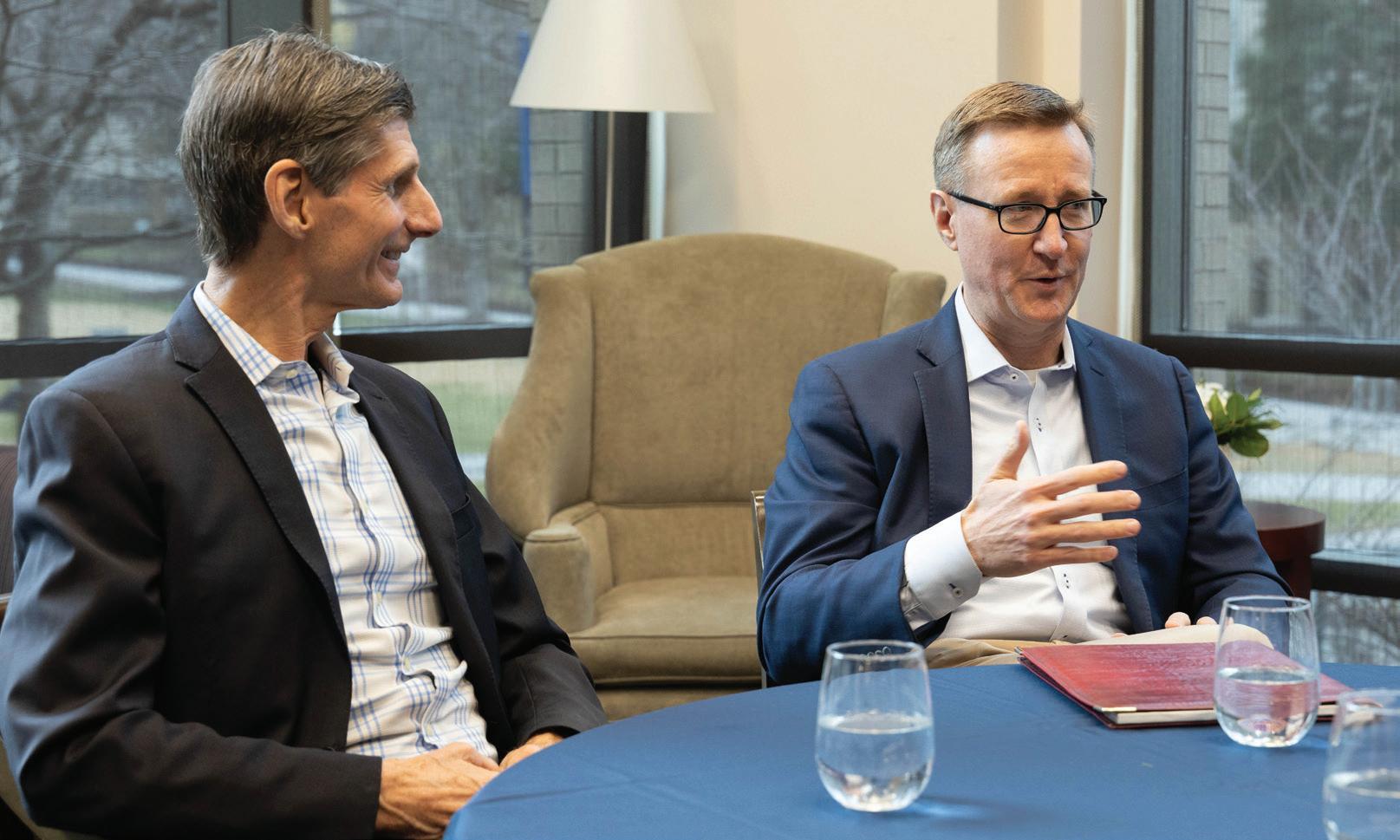
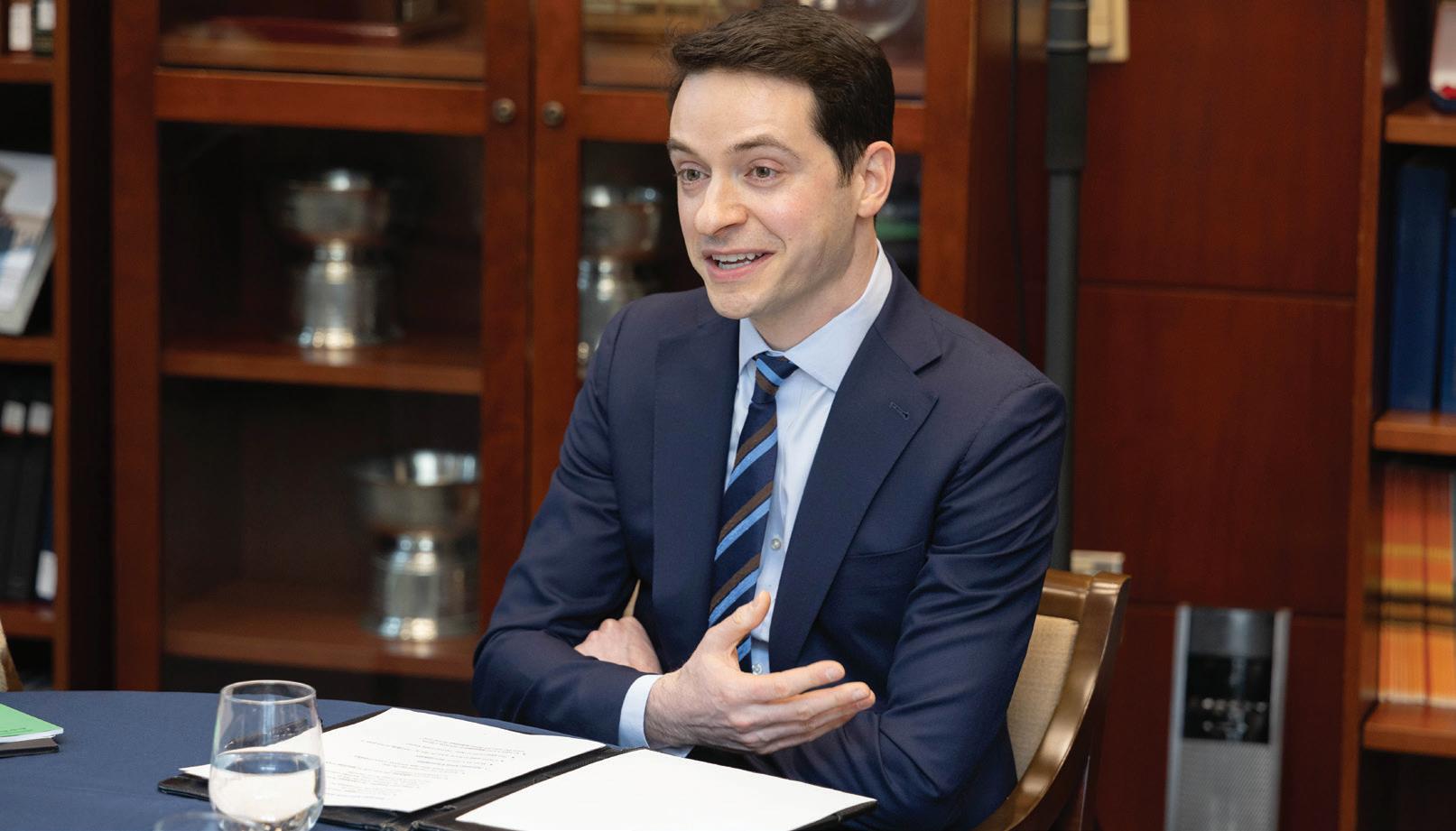
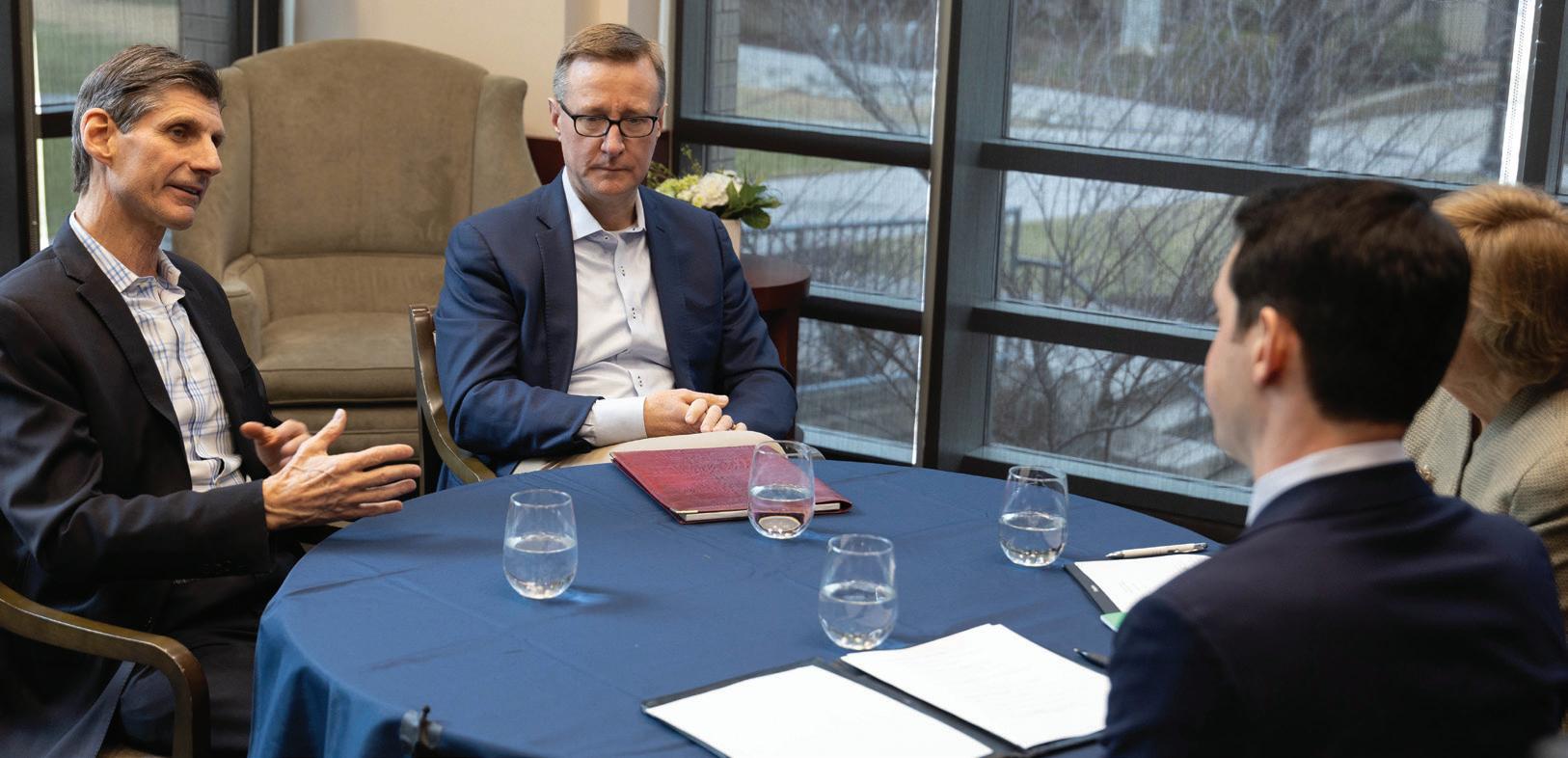
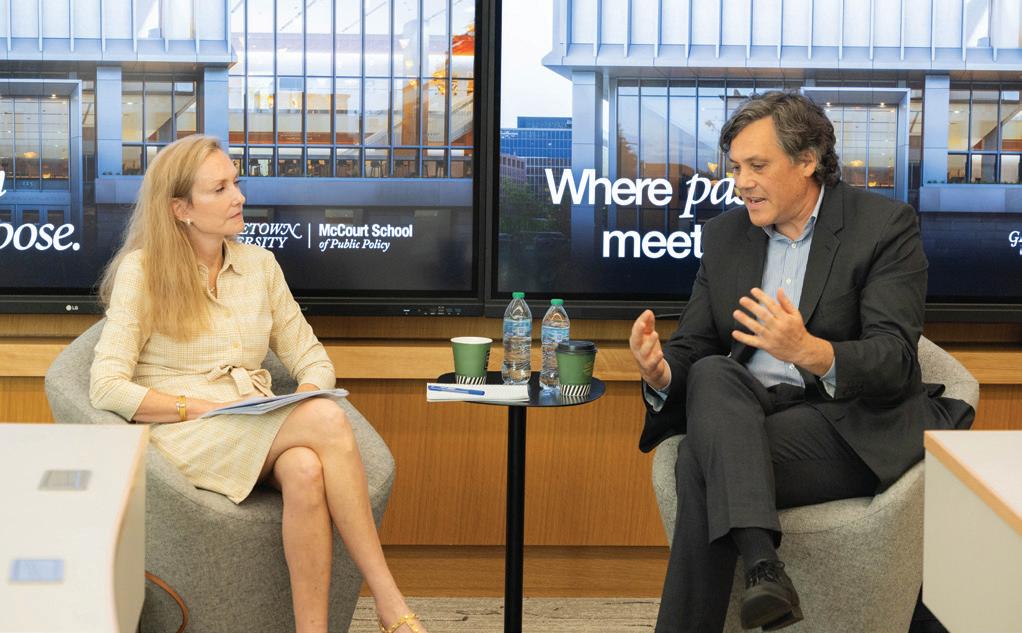
One of the best places to shed light on this tricky situation is right here at Georgetown Law: the Institute of International Economic Law (IIEL), which was founded in 1999 by Professor John H. Jackson, a giant in the field of international trade. IIEL continues to be a leading convenor in the space, and in March, a Law Center alumnus who is a prominent trade lawyer in Washington, D.C. joined two of IIEL’s three faculty co-directors and its executive director for a conversation about how they have experienced the volatility in trade law over the past year.
JENNIFER HILLMAN
Professor from Practice
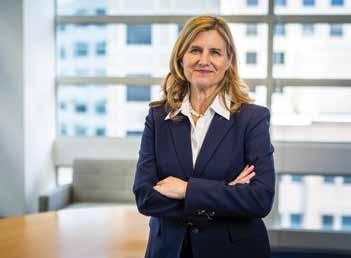
Jennifer A. Hillman, co-director of IIEL’s Center for Inclusive Trade and Development and the 2025-6 academic co-director of the Center for Transnational Legal Studies (CTLS) in London. Hillman has served as a member of the World Trade Organization’s Appellate Body, a commissioner at the United States International Trade Commission, and general counsel at the Office of the United States Trade Representative.
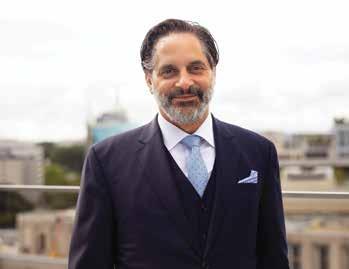
Stephen J. Orava, L’93, a partner at King & Spalding LLP, where he is chair of the firm’s International Trade practice and managing partner of its Brussels office.
Scott K. Ginsburg Professor of International Law
Gregory Shaffer, who joined the Georgetown Law faculty in 2023 after teaching law at the University of California, Irvine, the University of Minnesota, Loyola University Chicago and the University of Wisconsin. Shaffer is a past president of the American Society of International Law and the author of several books, most recently Rule of Law under Pressure: A Transnational Challenge
DANIEL SCHUKER Moderator
IIEL Executive Director Daniel Schuker, who has held senior roles at the White House, the Department of the Treasury and the Senate Judiciary Committee.
STEPHEN ORAVA
GREGORY SHAFFER
THE PANEL
QUESTIONS ANSWERS
SCHUKER:
Steve, what is your approach to advising clients now, when the rules are being rewritten in real time? I imagine they don't want to hear, “No one really knows.”
Orava:
Initially I was playing the role of a psychiatrist more than a trade lawyer. The changes were so significant that a lot of the discussion we were having with boards and senior executives was: Let's take this step by step.
We still do trade remedy, compliance, sanctions and export controls, but it is in hyperdrive in terms of the additional measures and statutes that are being used and this additional level of uncertainty. We did have a first Trump administration, so we could anticipate how some of this would play out, but day to day, there’s much more counseling work, discussing how to deal with the uncertainty, trying to help companies understand their priorities and the language that needs to be used to talk to this administration. And that is at a pace that we just haven't seen before. It's also incredibly intellectually challenging. It is a fun time to be a trade lawyer, but it's exhausting.
SCHUKER:
The challenge lately seems to be defining what the law is on Monday morning versus what it is on Monday afternoon. Jennifer and Greg, how are you adapting the way that you are teaching?
Hillman:
We've had to change our teaching materials. We kind of threw our casebook out and went to an online e-book, in part because it can be updated quite regularly to bring in very different perspectives about why we trade.
Shaffer:
We're all trying to figure out where we are and where we're going. I bring in current events every day to address using core analytics, for a grounding in how we think about these issues from a law and policy perspective.
SCHUKER:
What do you think about the Supreme Court’s ruling in Learning Resources, Inc. v. Trump, the case regarding the president’s use of the International Economic Emergency Powers Act (IEEPA) to impose tariffs?
Hillman:
Very early on last year, I heard that the administration might invoke IEEPA to impose tariffs. I had two international LL.M. students as research assistants who helped me write a piece for the IIEL website, basically saying, "No, IEEPA is not a tariff statute.” When the Supreme Court ultimately ruled that IEEPA can’t be used for tariffs, their opinion was almost exactly what we had argued in that piece that I’d debated with my students a year before.
One of the things that flowed out of that IEEPA piece was working with House and Senate members on a series of amicus briefs as this issue made its way through the courts, ultimately culminating in an amicus brief filed by 207 members of the House and Senate before the United States Supreme Court. Which is a testament to Georgetown Law, that members of Congress reached out to me and our colleague [IIEL Visiting Scholar] Peter Harrell to shape the intellectual underpinning behind these arguments. It was very fulfilling to see how much of the line of argument in this brief was in the Supreme Court's opinion.
Orava:
I have clients who welcomed the Supreme Court’s decision, because they’ll get some of their tariff revenue back. I have clients who are facing overcapacity in China or other issues, and the tariffs were keeping them in business, keeping their employees working. I've got folks who wanted to make significant investments, and now there is a significant lack of predictability as to whether the
economics make sense. So while the Supreme Court provided some clarity on IEEPA, the president is going to pivot to other tools on his desk. It could generate a much more patchwork type of tariff regime, but tariffs are not going to go away.
Shaffer:
What concerns me is the extent to which the administration can use other statutes to try to replicate what they did under IEEPA, which was ruled unlawful. What does that say about the rule of law, if the president can do whatever he wants with respect to tariff policy?
SCHUKER:
How has scholarly work changed in the last decade, and where do you think the focus is heading?
Shaffer:
When the WTO was thriving, there was a highly judicialized system putting forth lots of fascinating case law. And a lot of the scholarship addressed interpretive nuances in that case law. What you didn't see was any scholarship, really, on national security. You see a lot more today regarding the U.S. and China, and about the whole world of e-commerce and data exchange. How do we think about that from a national security, human rights, privacy or development perspective? And because there's so much going on domestically, U.S. scholarship has turned a little bit more internal. There are also fundamental concerns about how we think of the system going forward. How much discretion do we provide countries? Can we even have an international legal system, or is everything up for grabs?
Hillman:
All of us taught for a long time from the perspective of the WTO, but it's really clear now that so much of the focus is no longer on the WTO. A lot of the scholarship has had to focus on all of the action that's occurring under regional trade agreements. That's even where a lot of the dispute settlement is moving. You're seeing a lot of the WTO focus shift to the clash between the United States and China, with the world saying, "What is happening to the WTO if the world's two largest trading economies are fundamentally having a trade dispute outside of the WTO? Where does that leave us?” And you are seeing scholarship around what the WTO continues to do well, because there's no question that the WTO is absolutely successful in a lot of things, particularly its transparency.
SCHUKER
Steve, how have the developments at the WTO affected your practice?
Orava:
The bottom line is that clients come to us and ask, “How can you help us?” – whether that's help us make more money or help us mitigate risk. And the toolkit has just changed. We turned ourselves into a bilateral and transactional world; whether that's good or bad. It used to be that the WTO was effective –you could use it for leverage, you could use disputes tactically, strategically. That's just not the case anymore. And now what our lawyers do every day is put together both the legal and factual case for the administration to do something or not, and the accompanying political strategy. The WTO is simply not part of that calculus at the moment.
SCHUKER:
We’ve talked about uncertainty today. Steve, as you provide actionable guidance to clients, how have you handled the wave of policy announcements that have often come over social media instead of the traditional government channels?
Orava:
We look at the social media posts as signaling. You cannot give advice based on social media posts. You cannot give any definitive direction about the scope of a measure without seeing it be implemented. You can't give any advice about how tariffs will stack or not stack with other measures that are already in place. So all of this advice waits on actual implementation, and that includes proclamations, executive orders, Federal Register notices, customs guidance and everything in between, as well as a lot of phone calls to try to get some clarity.
We make clients aware of the posts – because what happens is, it gets reported in the press, a CEO reads the paper or sees it on their feed, and they immediately start asking questions. So we need to make them aware of that signaling, as well as give them confidence that we're going to follow up with what the actual implementation looks like.
SCHUKER:
What are you hearing from audiences outside the U.S. about how they’re thinking about trade, the WTO and the rules-based order?
Hillman:
People overseas really just want to understand the objective of the administration's trade policy. Is this all about raising revenue? Is this all about creating a huge tariff wall so that everything has to be built in the United States? Is this all about national security? I would say most of the rest of the world still believes in the WTO. So they're trying to understand how they hold dear to what they believe in and at the same time, respond to a United States that no longer adheres to any of that, without being naively taken advantage of or undermining their own long-term interests.
Shaffer:
I had a student ask, "Is globalization over?" No, globalization is thriving, particularly in Asia. There's a lot of trade. People’s careers are invested in that, so that's not going away. If you're based in Singapore, Thailand, Taiwan, you're focused on trade. If you're based in the Netherlands, trade is still a central part of your economy. And so they're navigating this world, trying to understand what the developments are in the United States, but trade remains quite central to their interests and economies.
Orava:
I'm the managing partner of our Brussels office, so I spend a lot of time with the Europeans. And I think while there is, at least on the policy basis, still a belief in the WTO, industries in Europe are experiencing the same pressures, like Chinese overcapacity. There are challenges across the EU industrial base, and the EU is starting to pivot to saying, "Well, maybe we also need to do something that might not perfectly align with our WTO obligations.” Whether it's made-in-Europe provisions or preferences in government procurement or trying to figure out a way to incentivize clean technologies or critical minerals – they are starting to move in a different direction because they're seeing the erosion of their industrial base.
Shaffer:
It puts Europe in an interesting challenge, because part of its DNA is that it's a multilateral organization itself – its original purpose was to create a single market. So there's a lot of pressure given its history, but also then the pressure within the member states who are then putting pressure on the European Commission to formulate policy going forward. It’s a fascinating time for Europe.
SCHUKER:
What has surprised you most about the developments of the past year?
Hillman:
I assumed that a core focus of our trade policy was going to be disputes with China. But what surprised me the most is that so far the winner by far of this trade war has been China.
Shaffer:
I hadn't thought through the amount of uncertainty that would come from using tariffs as the weapon of choice with respect to everything. I also thought that Europe would stand up to the administration, as it did in the first one. I think the core difference was the war in Ukraine. Europe prioritized that, and basically accepted higher tariffs applied by the United States in violation of WTO rules without retaliating, and made other commitments.
SCHUKER:
If a student or a junior associate told you today, "I want to be the next great trade lawyer," what skills and areas of knowledge should they focus on?
This article was adapted from a roundtable discussion. To go deeper, find a video of the entire conversation at youtube. com/georgetownlaw.
Shaffer:
Law changes every day, right? And so if you're just trying to understand what the newest thing of the day is, that's not going to help you in terms of your core analytics, in terms of being able to deal with facts and make the best arguments that you can.
Hillman:
You need to be very aware, when a problem is presented to you, of thinking through whether this is a problem that you litigate, mediate in some other way or lobby about, thinking about all of the tools in your toolkit.
There are arguably more tools now, in the sense that you're not as bound, at least in the United States, by international obligations as we used to believe. And you do need to have a basic understanding of the economics of trade. I would not recommend anybody go into trade remedies if they're really mathphobic or statisticsphobic. So you do need to understand the interplay between the policy, the politics, the economics and the law — and that I don't think has really changed — but obviously, you need to be able to use all of the modern tools, from AI on down.
Orava:
First and foremost, they need to be a good lawyer and they need to write well. The rest can be taught or learned through experience. Unfortunately, we don't get to write briefs to the Supreme Court most of the time. What we do is collect facts and data and put them into an advocacy piece. So having the ability to understand economics and politics, be able to manipulate data and build it all into an analytical piece to effectively advocate for positions. That's what we want.
GEORGETOWN
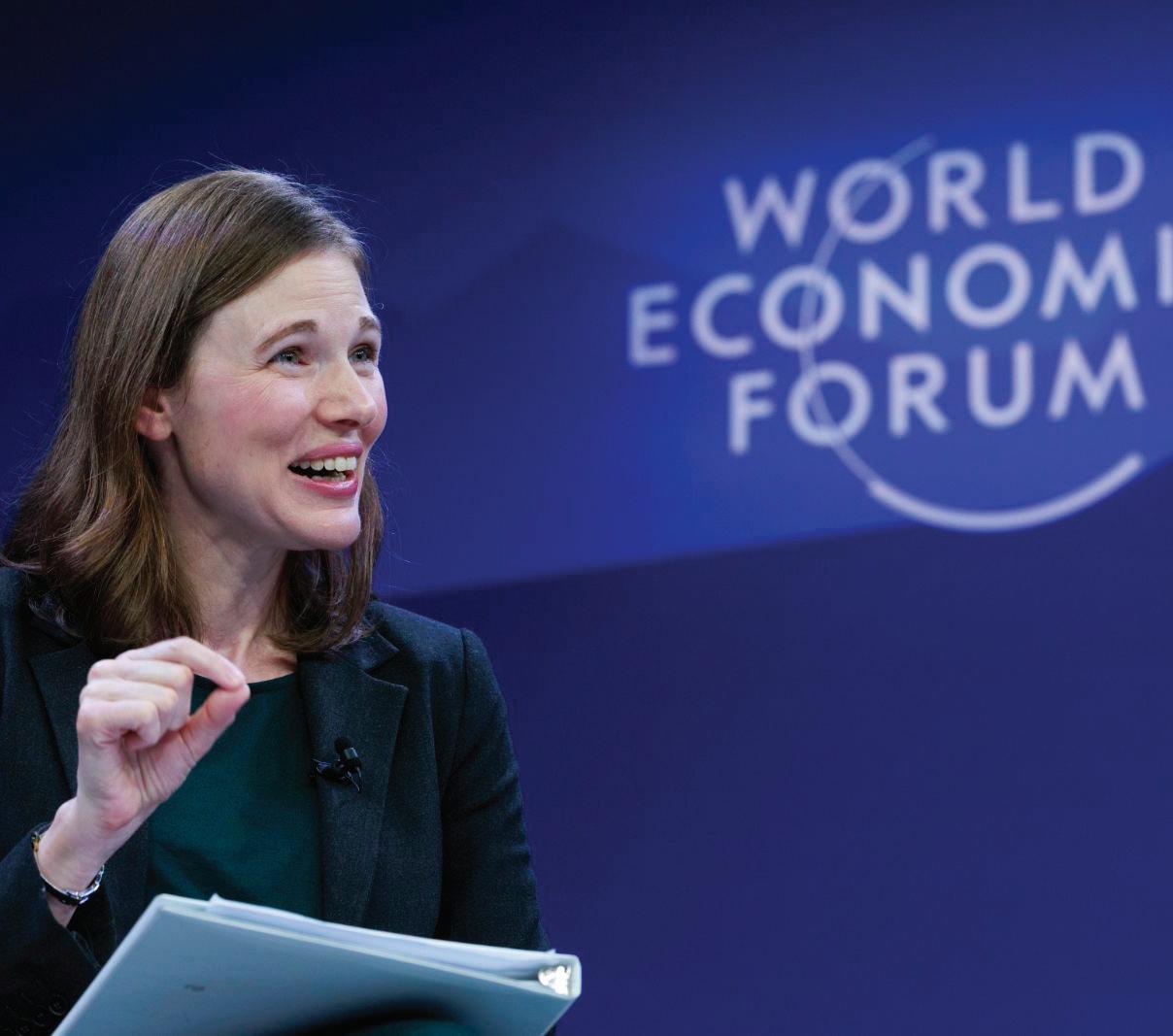
Professor Kathleen Claussen, IIEL’s third co-faculty director, has also stayed busy over the past year-plus, speaking, writing and teaching about the changing landscape of international trade. In January, she was a panelist at the World Economic Forum in Davos, Switzerland, discussing “Governments as Economic Super Actors.” She is a coauthor on two forthcoming legal journal articles, “The 'America First Trade Policy' in Practice” in American Journal of International Law and “The Foreign Commerce Power” in California Law Review. In addition, she has written a series of “What Just Happened” columns for the website Just Security explaining various tariff advances and setbacks. Earlier in her career, she served as legal counsel at the Permanent Court of Arbitration in The Hague and as an associate general counsel in the Office of the U.S. Trade Representative.
LAW TRADE EXPERTS AT HOME AND ABROAD
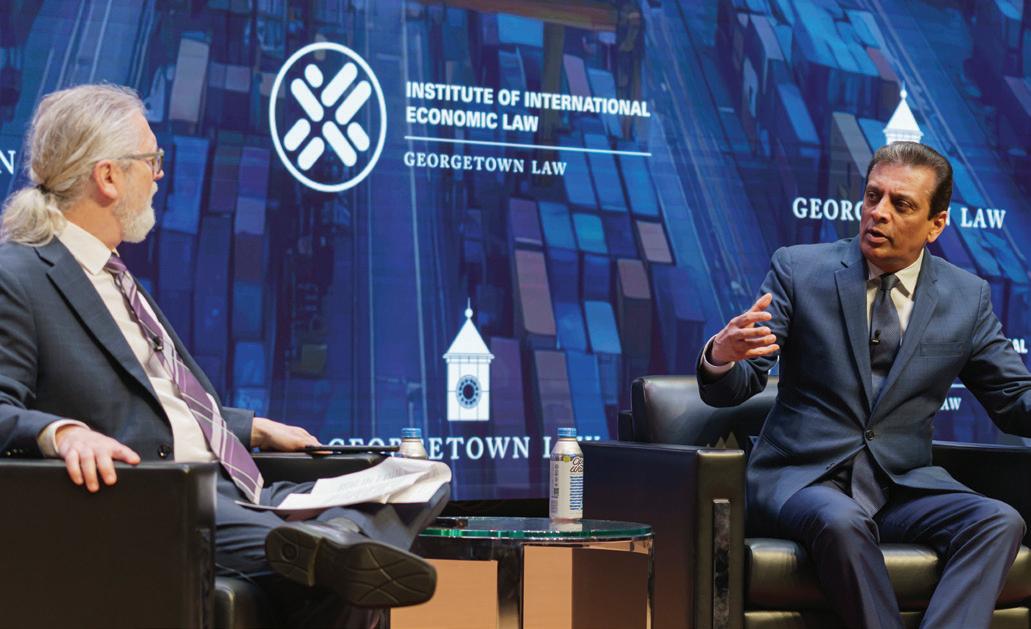
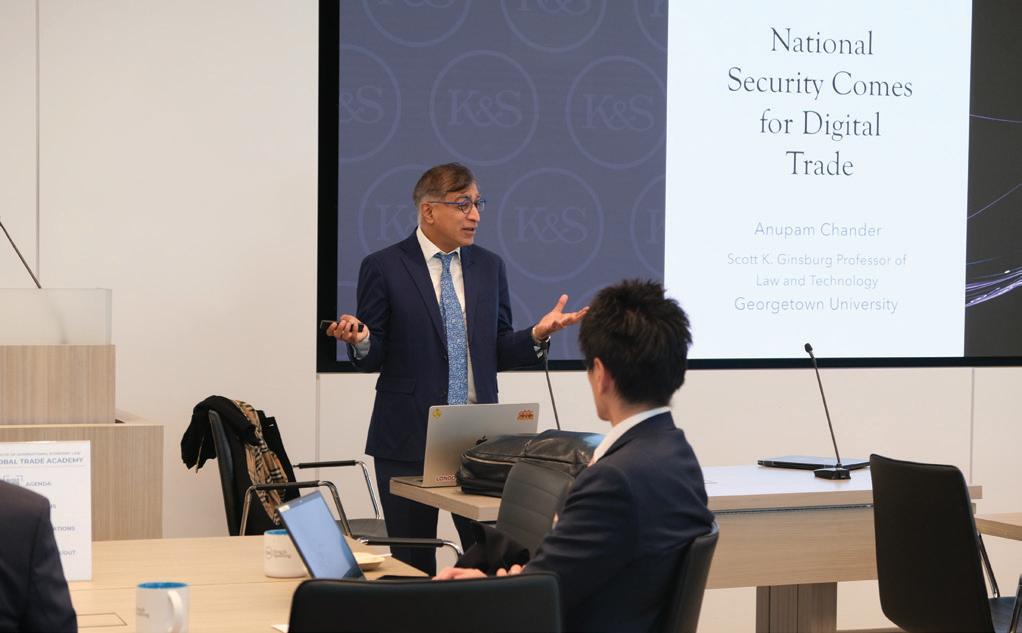
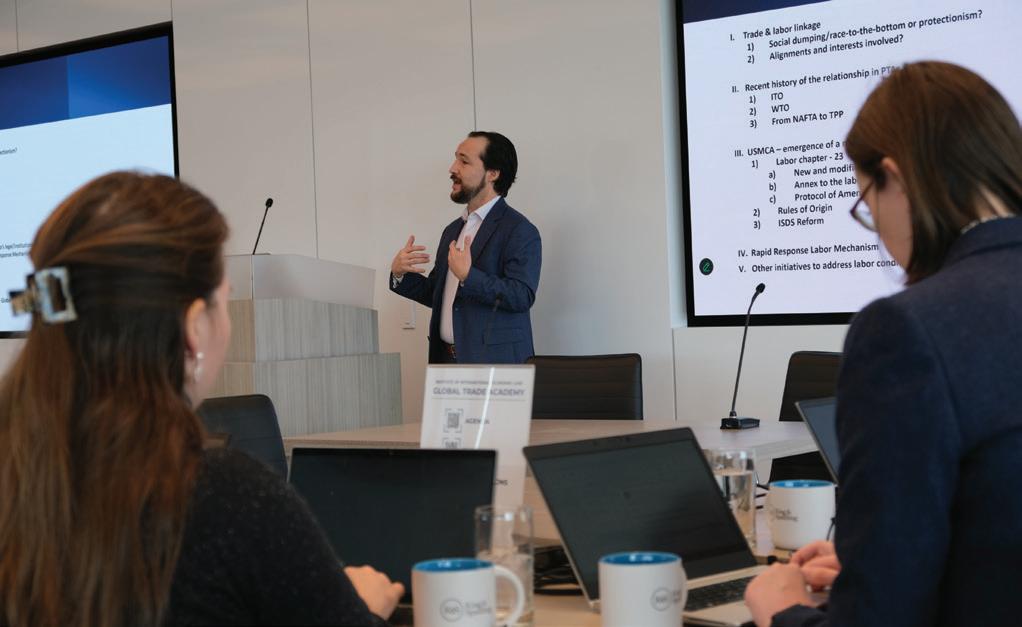
1. In March, at IIEL's 47th Annual International Trade Update, the Greenwald Lecture was presented as a keynote conversation between Raj Subramaniam, President and CEO of FedEx and Doug Palmer, Senior Trade Reporter for POLITICO. 2. In April, IIEL hosted WTO Deputy Director-General DJ Nordquist for a fireside chat with Visiting Scholar Peter Harrell. 3. & 4. Among the presenters at IIEL's November 2025 Global Trade Academy, its signature executive education event, were Georgetown Law professors Anupam Chander (left) and Alvaro Santos (right).
Three DOJ Veterans Join Legal Practice Program
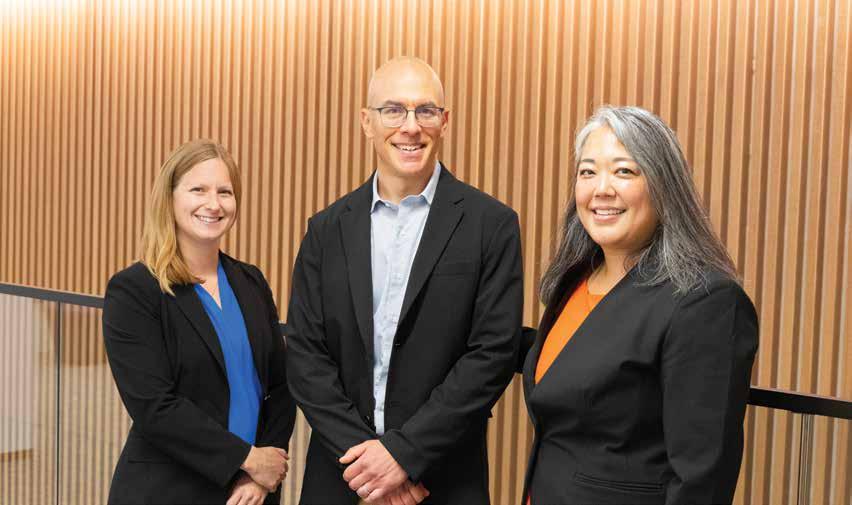
This fall, the Georgetown Law Legal Practice program gained three new instructors, all of them former U.S. Department of Justice employees: Associate Professor Ben Eisman and Visiting Professors Bethany Lipman, L’14, and Frances Walters.
Eisman, previously an attorney advisor in the DOJ’s Criminal Division and assistant U.S. attorney in the District of Columbia, is also an award-winning fiction writer who has published short stories in several literary journals.
“Being a law student today is no easy thing. Becoming a lawyer has new weight and importance attached to it,” he said. “I’m excited by how smart and motivated these students are.”
For Walters, who worked as an attorney advisor in the DOJ’s Office of the Pardon Attorney and has taught a
Law Center course on wrongful convictions as an adjunct professor, teaching students how to communicate with non-lawyers such as clients and policymakers was top of mind. “Being able to give a strong foundation that students can deviate from depending on who they’re working with is really important,” she said.
Lipman, a former trial attorney in the DOJ’s Criminal and Antitrust Divisions, said that returning to her alma mater has been a sweet experience. “I loved law school. I felt that my classmates, my professors — everybody, actually, was seeking to do the right thing for the right reasons. And my friends from Georgetown Law are still some of my best friends. It’s a special place,” she said.
L-R: Professors Lipman, Eisman and Walters
Orientation 2025
Some 670 J.D. students and 400 LL.M. and graduate students began their Georgetown Law journeys in August with welcome activities, classroom introductions and local excursions.
This year’s admissions cycle was historically competitive, with new J.D. students selected from a pool of nearly 14,000 applicants — the second-largest ever. The Evening Program welcomed 80 new students, the highest number in 15 years, and the LL.M. class included individuals from at least 50 different countries.
When Infrastructure Reinforces Inequality: ACLU and NYU Law’s Deborah N. Archer Delivers 2025 Hart Lecture
“We built our way into this crisis. We have to build our way out of this crisis. And as we rebuild, we have a choice whether to exacerbate the harms of the past by continuing to build in the same fashion and targeting the same people, or we can choose a new path that is going to help connect communities to each other and to opportunity.”
On October 22, Deborah N. Archer, president of the American Civil Liberties Union (ACLU) and Margaret B. Hoppin Professor of Law and Associate Dean for Experiential Education & Clinical Programs at NYU Law, presented the annual Philip A. Hart Memorial Lecture.
In a speech titled “Dividing Lines and the Infrastructure of Inequality,” Archer shared her research findings on how the design of highways, roads and public transportation networks can exacerbate racial segregation and inequality.
“Transportation systems shape who is allowed to feel like they belong. [They help] determine who has access to opportunity,” Archer said. She noted that even as civil rights victories in the 1950s and 60s struck down “Jim Crow” laws, new infrastructure projects continued to restrict Black communities’ and
individuals’ mobility. Among the examples she cited were one-way streets in Atlanta that complicate traffic entering white neighborhoods from Black neighborhoods, and bus lines from Dayton, Ohio that didn’t stop in upscale suburbs. Archer called for transportation policymakers to replace aging infrastructure in ways that reverse this legacy of exclusion. “We built our way into this crisis. We have to build our way out of this crisis,” she said.
The lecture was established in memory of Philip Aloysius Hart, who received his undergraduate degree from Georgetown University in 1934 and went on to serve in the U.S. Senate, where he earned the nickname “The Conscience of the Senate” for championing legislation like the 1964 Civil Rights Act and the 1965 Voting Rights Act.
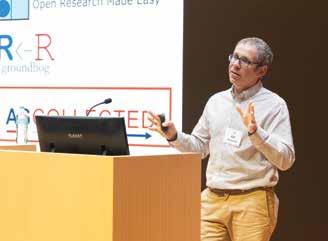
Prof. Uri Simonsohn, of ESADE Business School and the blog Data Colada, presented the keynote address.
Law Meets Data: Georgetown Law Hosts 19th Annual Conference on Empirical Legal Studies
Leading scholars in law, economics, political science and other fields gathered in October for the 19th annual Conference on Empirical Legal Studies, featuring more than 40 sessions on timely topics ranging from policing and public safety to election disputes and artificial intelligence.
Georgetown Law has a deep history in this area, since the establishment of the Law and Economics Program and Workshop more than 25 years ago. Interim Dean Joshua C. Teitelbaum, who holds a Ph.D. in economics in addition to his law degree, organized the conference with Professor David Hyman and University of Michigan Law School Dean (and former Georgetown Law professor) Neel Sukhatme. “When I was in law school in the 1990s, this field of study was just emerging, so it’s been fascinating to see how increasing numbers of scholars are using empirical methods,” said Teitelbaum.
Associate Professor Filippo Lancieri, who presented a recent paper he co-authored, “The Conflict-of-Interest Discount in the Marketplace of Ideas,” said that the event highlighted the value of engagement between people with divergent research interests.
“What is interesting about empirical legal studies is that it is ultimately committed to methods more than questions,” he said. “It’s not about which questions you’re asking. It’s about how you answer the questions that you want to ask.”
GLJ Hosts Symposium on Labor Rights and Civil Rights Challenges
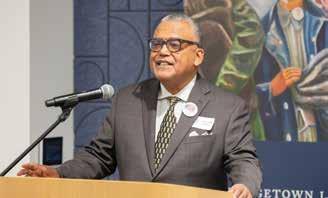
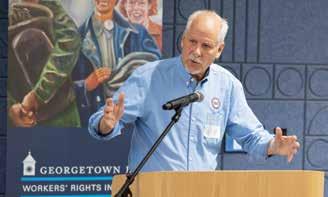
On October 24, The Georgetown Law Journal hosted 165 scholars, advocates, policymakers and students around the theme “The Labor Movement and Civil Rights in the Modern Era.” Speakers and panelists included Mark Gaston Pearce, former NLRB Chair and former director of the Georgetown Law Workers’ Rights Institute, Richard Bensinger, founder of the Organizing Institute and the first organizing director of the AFL-CIO, César F. Rosado Marzán, Professor of Law at Iowa Law, and Anibha Singh, L’24, a law fellow at SEIU.
“At a program primarily attended by aspiring lawyers, I hope attendees consider not just what they can do as advocates within the confines of the law, but are starting to recognize the ways that their legal education and power can be used to address the needs of the public even when the law fails to operate and protect,” said Freedom Gobel, L’26, the journal’s senior symposium editor.
Symposium speakers Pearce (top) and Bensinger (above)
'Lawyering in a Fractured World': Agnieszka Fryszman, L’96, Delivers Drinan Lecture
“Even though it’s never been perfect or fair, that promise of the rule of law, of justice in our courts, is worth fighting for.”
Agnieszka Fryszman, L’96, founder of the Human Rights practice at Cohen Milstein, returned to campus this academic year as the 2025-2026 Robert F. Drinan, S.J., Chair in Human Rights. On November 13, she delivered the Human Rights Institute’s annual Drinan Lecture, under the title “Against the Headwinds: Human Rights Lawyering in a Fractured World.”
Fryszman reflected on her work on behalf of victims of trafficking, torture, forced and slave labor and other grave human rights abuses, including winning the first successful U.S. judgment for men enslaved aboard fishing vessels and securing a landmark settlement from ExxonMobil for Indonesian villagers who alleged that soldiers retained by the company had tortured and killed local residents. She also noted the importance of avenues beyond legal advocacy, including electoral politics and public policy, in helping uphold human dignity and the rule of law.
“Even though it’s never been perfect or fair, that promise of the rule of law, of justice in our courts, is worth fighting for,” she said. “With a little bit of legal creativity, a little bit of luck and a lot of tenaciousness, I think it’s possible to hold on to and expand that promise.”
Fryszman also reminisced about the chairship’s namesake, who was a Jesuit priest and former member of Congress – and who she had as a professor herself. “He was a legend in the Congress, he was a legend in human rights law and he was a legend here at Georgetown,” Fryszman said of her former mentor. “But most importantly, he was a fighter, and that’s what we need now… because it’s easy to feel discouraged about everything that’s happening in the world today.”
Around Campus
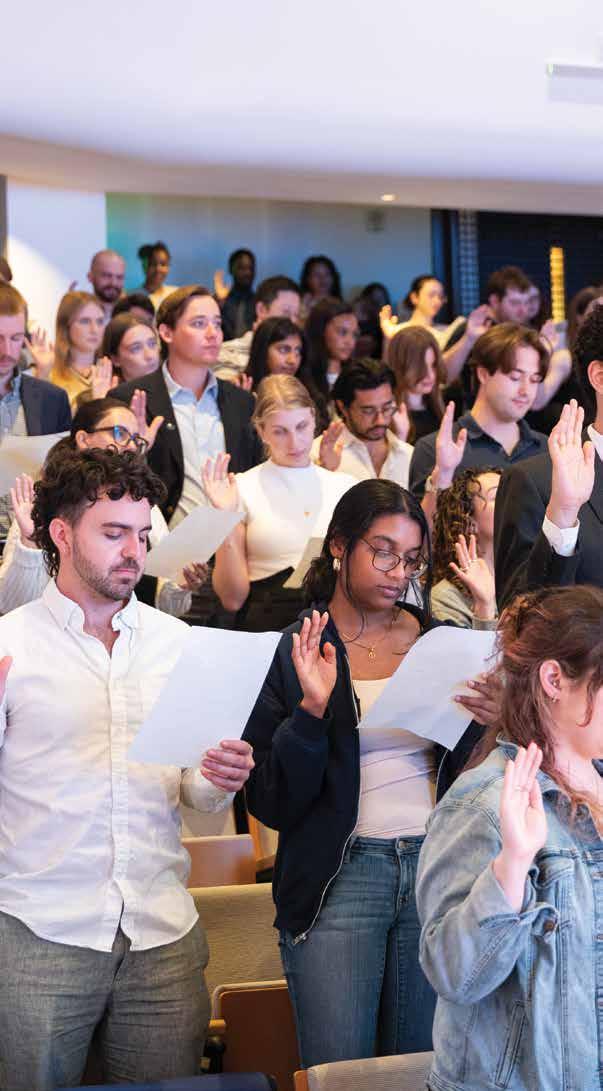
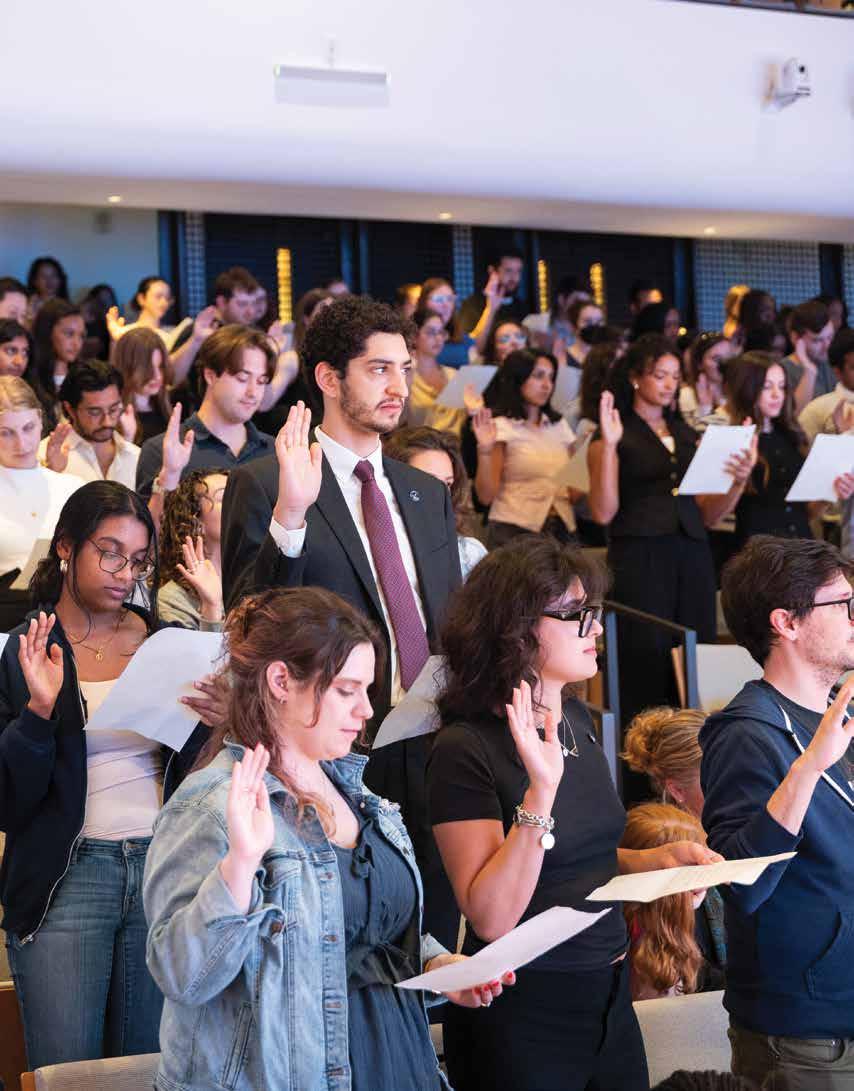
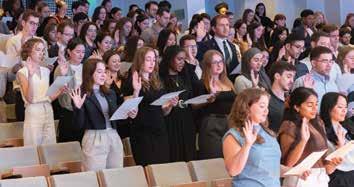
1. In October, members of the Mexican Law Students Organization built an ofrenda in McDonough Hall to celebrate Día de los Muertos. 2. Interim Dean Joshua C. Teitelbaum, at center, had lunch with student journal editors in November. 3. Students enrolled in clinics started the school year with an oath ceremony, a newer Law Center tradition that marks their new role as student attorneys. 1 3 2
A Busy Year in London with CTLS
During the last academic year, 130 law students from around the world each spent a semester at the Center for Transnational Legal Studies (CTLS) in London, an innovative consortium co-founded by Georgetown Law that includes 21 partner law schools.
Highlights of the student experience included a simulated litigation exercise that had them making arguments about ownership of artworks looted by the Nazis during World War II, legal tourism opportunities such as a visit to the historic barristers’ society Gray’s Inn, and lectures and panels featuring visiting authors and experts.
At one event, Professor Anupam Chander interviewed his former professor, Yale Law School’s Harold Koh. At another, Professor from Practice Sean Hagan, former general counsel of the IMF, convened a unique gathering of current and former general counsels of 13 different international organizations, including the World Bank, NATO and the Organization for Security and Co-operation in Europe.
“Leading scholars see CTLS as a place that hosts important conversations on the frontiers of transnational law,” said Professor Madhavi Sunder, the center’s co-director.
Professor Emeritus Joseph A. Page, who joined the Georgetown Law faculty in 1968, died October 13. He was 91 years old. A Boston native, he held three degrees from Harvard University: a B.A., an LL.B. and an LL.M.
A professor and scholar of tort law, Page was a longtime friend and associate of Ralph Nader, a law school classmate who became one of the nation’s most prominent consumer advocates. “Ralph would lean on Joe to untangle tough legal questions. Joe was a brilliant thinker; a wonderful teacher and lawyer,” said Professor David Vladeck.
Page entered academia as an assistant professor at University of Denver College of Law after a stint with the National Association of Claimants’ Compensation Attorneys, the predecessor to the Association of Trial Lawyers of America. In 2003, his book Torts: Proximate Cause was published
In Memoriam: Professor Emeritus Joseph A. Page
by Foundation Press. He also was a regular commentator in the news media on issues related to tort law; his faculty page on the Georgetown Law website includes quotes from him on such topics as restaurants’ liability in states with open-carry firearms laws and a Florida resort’s liability in the case of a toddler killed by an alligator while wading in a lagoon.
Page also had a keen interest in Latin America, having traveled extensively in the region after law school. In 1983 he published a well-regarded biography of the controversial Argentinian president Juan Perón; he also wrote two books on Brazilian history and culture, and at the Law Center served as director of the Center for the Advancement of the Rule of Law in the Americas (CAROLA) from 2003 to 2017.
Professor Emeritus Charles Gustafson, a longtime friend of Page’s, remembers him as both an engaged
scholar and teacher at the Law Center and a lover of many forms of culture, from novels to movies to Boston sports. Page arranged several exchange opportunities between Georgetown Law professors and Argentine academics, and when it was Gustafson’s turn to visit Argentina, he was delighted to learn how well-known his colleague was there, thanks to his best-selling Perón biography.
Gustafson also recalls Page celebrating his final day in the classroom in 2015 by arriving dressed in a tuxedo, bearing champagne to share with his students. “He did things right,” said Gustafson. “He lived a good and interesting life.”
Dean Emeritus Treanor Honored by The American Lawyer Magazine
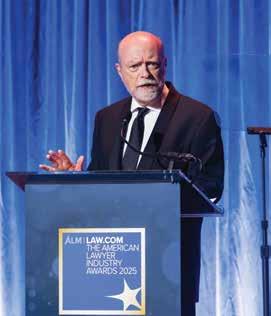
Professor William M. Treanor, Dean Emeritus of Georgetown Law, received a Lifetime Achievement Award from The American Lawyer Magazine at a ceremony in New York City on November 13.
In his acceptance remarks, Treanor said he was “humbled and honored” to receive the award, and reflected on his longstanding commitment to the principle that public servants must uphold the nation’s laws.
“I tell our students and our graduates that their work is a vocation as well as a career. Working to define legal rules and to apply them is central to our democracy,” he said.
Treanor, a Constitutional historian, is currently on sabbatical leave, completing work on his forthcoming book, Fathers of the Constitution: Triumph, Tragedy, and the Creation of the American Republic, to be published by W.W. Norton.
Behind the Scenes with Clinic Manager Niko Perazich
Niko Perazich grew up in Washington, DC, steeped in law as the son of an attorney and a judge. His own path in the legal profession began as a busy paralegal, but in 2010, seeking a change of pace, he took a job with Georgetown Law’s clinical programs. He now manages five of the law center’s 17 clinics, keeping day-to-day operations going while professors and fellows introduce students to the art of lawyering. Recently, he spoke with the online series “Georgetown Faces” about why he’s stayed long enough to become the longest-serving staff member on the clinic team.
“Not every law firm is the same, but some of the expectations are pretty crazy. I had a month where I billed almost 300 hours. I love the fact that if I need to go pick up my kid from school because they’re sick, that’s not going to make a big wave. The university talks about Jesuit values a lot, and I think that it 100% influences the way people act and their attitude towards the job and towards each other.”
“The students have so much passion and energy. I’ve been here long enough that we’ve had students come through who are now professors or are on their way to becoming professors. It always makes me feel good to see people progressing onward.”
“One of the best feelings I had was seven or eight years ago. Someone called and they were being discriminated against at work. I took his information and passed it on to the professor. Eventually, we ended up taking and winning the case. He called me back and thanked me, saying, ‘I remember when I called and you listened to me. You took the time. A lot of people pushed me aside.’ He just wanted to thank me, and that made me feel good.”
ALUMNI
From Wall Street to Homelessness to Serving Those in Need: Dennis Dee, C’86,
L’89
In the fall of 1982, Dennis Dee, C’86, L’89, arrived on the Hilltop to start college. Three decades later, after earning two Georgetown degrees and building a career as an investment banker, Dee found himself knocking on the door of a shelter near the Law Center campus. He was homeless and unemployed, and he needed help. The Father McKenna Center would become a safe haven for Dee – and eventually, a nonprofit that he would lead.
“All the jobs I had when I graduated college were the jobs you think you’re supposed to want – high-pressure, high-paying. I held it together from the outside… but I was decaying on the inside,” he says.
After years of struggling with alcoholism and mental illness, in 2012 everything came to a head for Dee. He lost his job, his wife filed for divorce and he lost his home. He was homeless for two years before seeking aid at the McKenna Center, a nonprofit named after Fr. Horace McKenna, S.J., who in his lifetime helped start many organizations serving the poor in the nation’s capital.
At the center, Dee found his fresh start. He worked with a case manager, focused on his recovery and got a job waiting tables. The
McKenna Center team was so impressed by his dedication that they hired him as a staff member. Eventually, he moved to Chicago for a job as an addiction counselor, where he stayed until 2023, when the McKenna Center’s board chair contacted him about a staff opening – as executive director.
Once back in Washington, Dee established a partnership with Georgetown’s Center for Social Justice Research, Teaching & Service, through which students, including law students, volunteer regularly in the McKenna Center’s food pantry. Dee is from a family with many Hoya ties: his parents, several siblings and two of his children also went to the university.
“For me, Georgetown equals family,” he says. “I treat every student volunteer as I would a family member upon their arrival at the Father McKenna Center. In fact, it would not be unusual for me to say, ‘If you attend Georgetown, you are family to me.’”
He is grateful to be entrusted to lead the organization that was so pivotal in turning his life around. “The center’s environment allows a man whose spirit is all but extinguished to be rekindled,” he says.
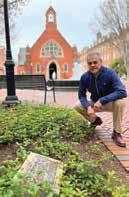
Dee with a plaque in Dahlgren Quad honoring his parents, who both graduated from Georgetown.
Dee, right, working with student volunteers and McKenna Center clients at the organization's food pantry.
REUNION 2025
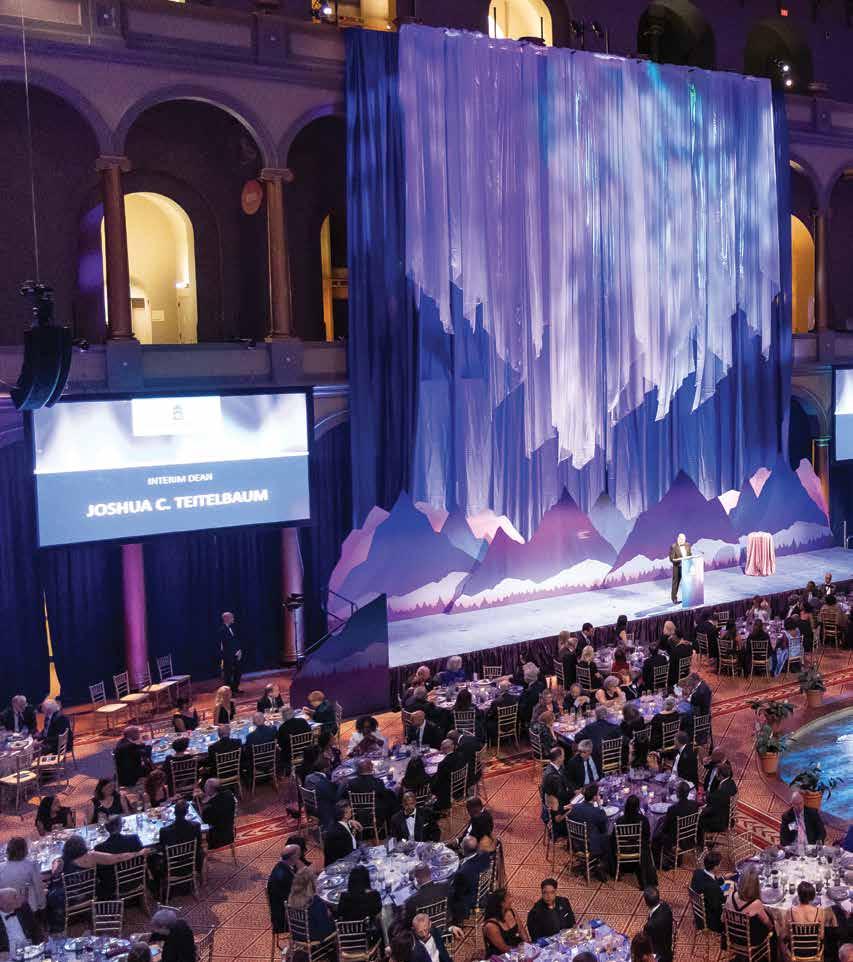
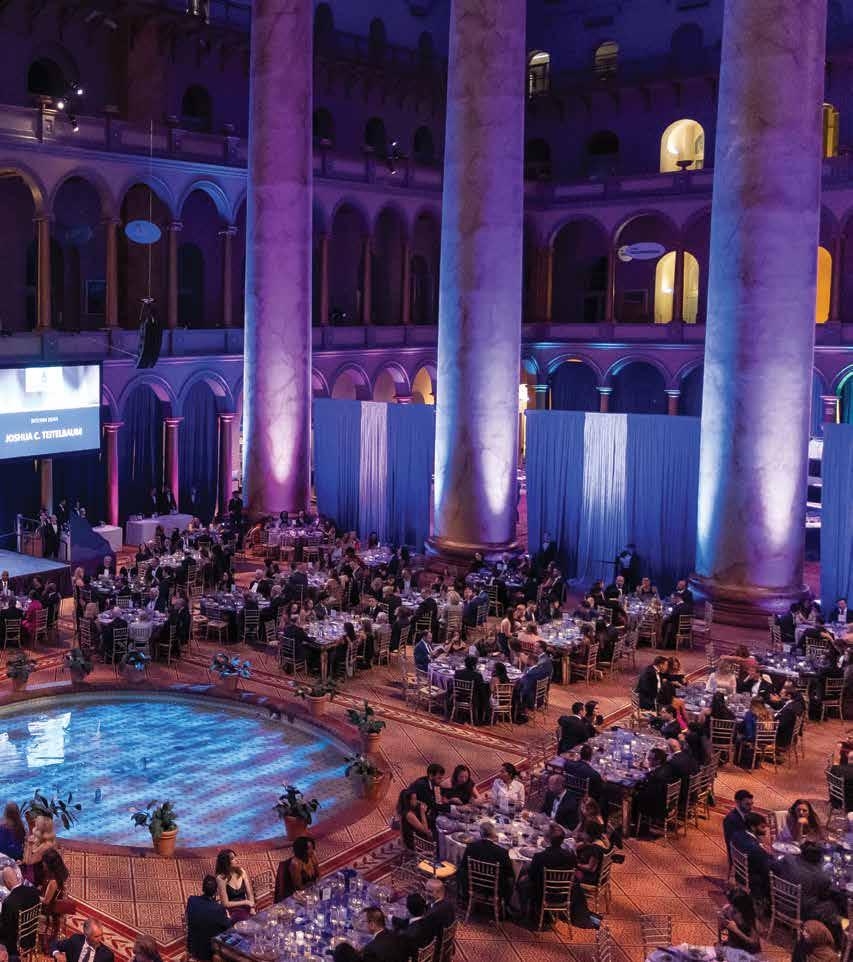
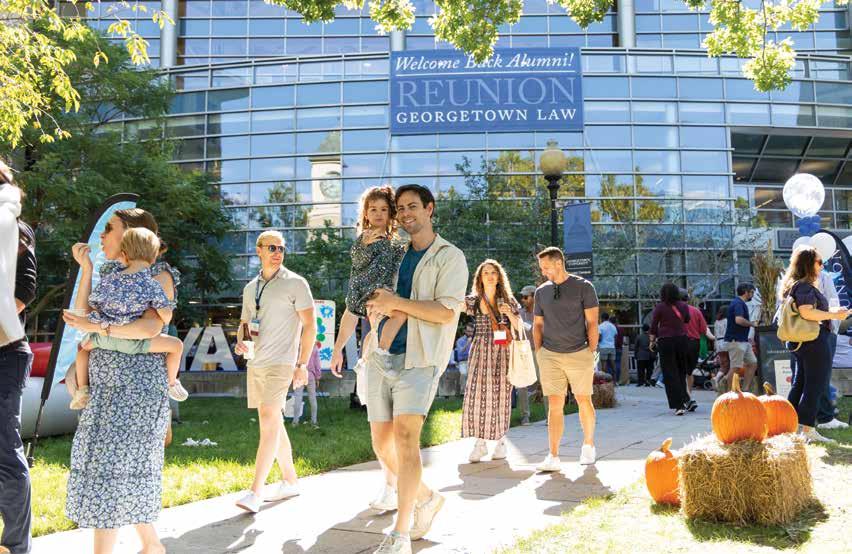
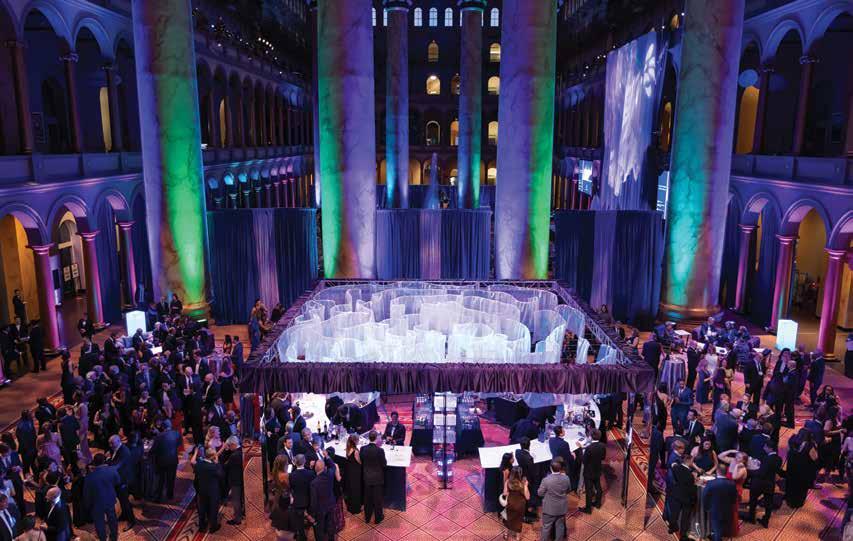
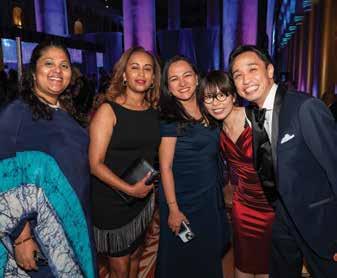
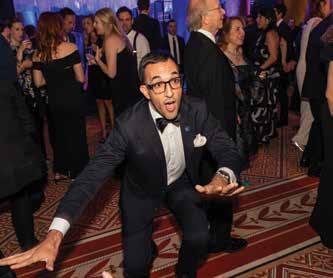
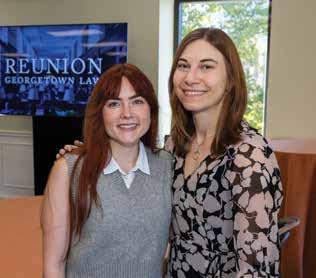
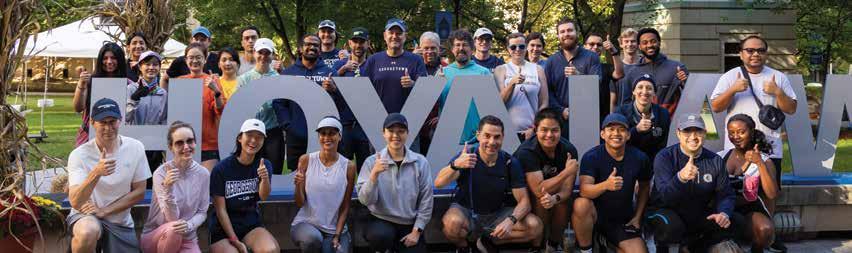
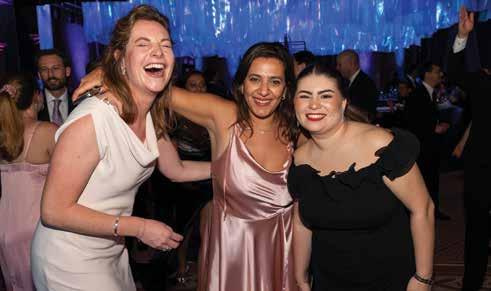
In October, more than 1,600 Georgetown Law alumni and guests enjoyed reunion events ranging from a picnic on the green to a “Family Feud”-style faceoff between the classes of 1990 and 1995 to an elegant aurora borealis-themed reception at the National Building Museum.
Class of 2020 graduates, whose commencement happened virtually during the COVID-19 pandemic, found it meaningful to reconnect. Charlie Thau, L’20, and Jessie Gerson, L’20, now married, especially enjoyed revisiting the place where their family began. “It’s a little surreal because we didn’t really graduate in that traditional way. We actually graduated in Jessie’s parents’ backyard. It’s great to be back here and have that kind of moment,” said Thau.
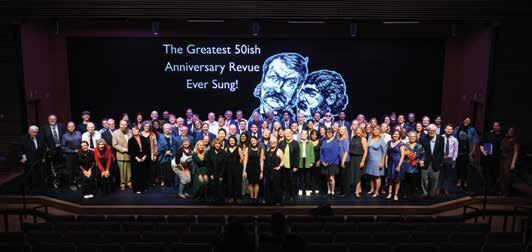
At the annual Founders’ Circle luncheon, alumni who graduated 50 or more years ago reminisced about the early days of such Law Center institutions as Barristers’ Council, founded in 1964, and the Georgetown Gilbert and Sullivan Society, which had just celebrated its “50ish” anniversary.
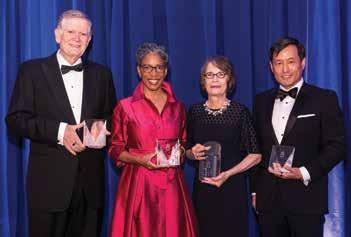
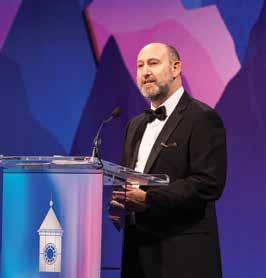
At the Saturday night gala, Interim Dean Joshua C. Teitelbaum presented awards to four distinguished alumni. The Robert F. Drinan, S.J. Public Service Award, given to one Law Center graduate whose career has enhanced human dignity, advanced justice and contributed to improving the legal profession, went to Mary E. McClymont, L’75 (above third from left). A senior fellow at the Georgetown Justice Lab, she has led several nonprofits, including the Public Welfare Foundation, Global Rights and InterAction.
Three alumni received Paul R. Dean Alumni Awards:
• Monique Y. Fortenberry, L’95, (above second from left) emerita member of the Law Alumni Board and past deputy general counsel at the Small Business Administration and deputy chief operating officer of the Federal Trade Commission.
• John F. Hartigan, L’75, (above left) emeritus member of the Board of Visitors, longtime partner at Morgan Lewis in Los Angeles and past assistant director of the Securities and Exchange Commission’s Division of Enforcement.
• Allen M. Lo, L’95, (above right) member of the Board of Visitors and a senior executive at Meta whose tech law career has spanned government, private practice and leading companies.
The Class of 1975 won all four Reunion Cups for giving: Participation (highest percentage who made a gift of any size); Loyalty (Loyalty Society members); Legacy (including Georgetown Law in estate plans); and Generosity, ($1.46 million raised). The Class of 2015 won the Attendance Cup, with 122 classmates returning.
Save the date! Reunion weekend for graduates with class years ending in 1 and 6 is October 2-4, 2026.
Mikie Sherrill, L’07, Inaugurated as New Jersey Governor
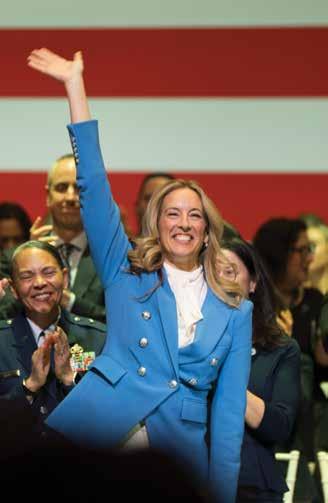
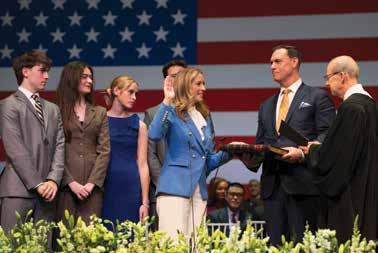
On January 20, Mikie Sherrill, L’07, was sworn in as Governor of New Jersey. A U.S. Naval Academy graduate and former U.S. Navy helicopter pilot, Sherrill became an Assistant U.S. Attorney after earning her law degree. She was then elected to Congress in 2018 and was re-elected three times, serving until November 2025, when she won her gubernatorial race and became New Jersey’s second-ever female governor. There are now two Georgetown Law graduates serving as state governors – the other is Josh Shapiro, L’02, who has been Governor of Pennsylvania since 2017.
In her inaugural address, Sherrill spoke of the importance of public service in her own life, in the United States and in the state she now presides over. Public service, she said,
is “a noble calling, and it is a privilege. We have a shared responsibility and opportunity to make people’s lives better.”
She also took inspiration from the state’s motto, adopted during the Revolutionary War, saying, “[New Jerseyans] narrowed in on those two things that they felt their countrymen had fought and died for: Liberty and Prosperity. Today, I take up their work once again. Protecting liberty, ensuring that power is not placed in the hands of a few, but rather that the universal rights of all New Jerseyans are protected. And prosperity, through opening the door to opportunity.”
Finding Advocacy in Art: Robert Gant, L’93, on the Journey from Lawyer to Actor
Before actor Robert Gant, L’93, had roles in TV series such as Queer as Folk, 13 Reasons Why and The Fosters, he was a Georgetown Law student who spent time outside the classroom performing in Gilbert and Sullivan Society productions and participating in the 1993 March on Washington for Lesbian, Gay, and Bi Equal Rights and Liberation.
Gant returned to the Washington region recently to appear in The Inheritance, a play about the generational ripple effects of the AIDS crisis that was produced last fall at Round House Theatre in Bethesda, Md. While he was in town, we asked him about his law school memories and how his legal training has influenced his acting work.
After graduating, you worked at Baker McKenzie in Los Angeles. What made you pursue acting full time?
I had some idea that I was going to assuage my desire [to act] through entertainment law. I realized quickly that I would be working on behalf of people who were doing what they loved and watching that from afar. That thought was a little excruciating. A month after I got there, they let me know they were closing the L.A. office. I decided to make the leap and go for the thing that had been my passion all my life.
How does your legal background influence your approach to acting?
I have found having a law degree to be universally applicable and helpful. The training of thought, the ability to argue any point – it just applies to everything. [In The Inheritance], I’m playing a character who is a very conservative billionaire, so I definitely needed to draw on the ability to argue on behalf of this character. I had to really stand in the shoes of this man and love this character on some level to be able to argue on behalf of his way of seeing the world.
Do you have a favorite memory from Georgetown Law?
Taking a class with Chai Feldblum, who taught the first course on sexual orientation in the law and wrote the first textbook on the subject. In class we were working from galleys of what would become that textbook. I’m so grateful that I got to have that experience. It was a foundational time for rooting the legal framework on which the LGBTQ community would build our rights and freedoms.
Have you ever played a lawyer?
It actually took many years for me to play a lawyer, which was maddening, because I felt like: I have my law degree. How have I not played a lawyer? [In 2013] I got to play my first attorney on The Young and the Restless — which was kind of hilarious.
HOYA LAWYA FACULTY: Professor from Practice Vicki Arroyo, L’94
Alumna Vicki Arroyo, L’94, returned in 2008 to launch the Georgetown Climate Center. She stepped down from leading the center in 2021 to serve as Associate Administrator for Policy at the Environmental Protection Agency. She’s now back teaching, and last September, was elected to the American Law Institute.
One of the biggest changes she’s seen since her student days is the growth of the Capitol Campus. “Our new neighbors at the McCourt Policy School and 111 Mass Ave – including Earth Commons and the Urban and Regional Planning program – make for a richer experience,” she says. Of her time at the EPA, she says, “The experience enriched my teaching – not just on substantive issues, but also on skills that are valuable to our students. I’ve developed a policy advocacy simulation that allows students to practice briefing policymakers, preparing and delivering testimony at Congressional hearings, crafting persuasive comments on regulations, developing successful policy campaigns and more. Both law students and policy graduate students participated, which was meaningful and fun for all.”
CLASS NOTES
1967
Richard N. Friedman (LL.M.), a mediator and arbitrator who goes by the moniker “The Singing Attorney” for his recording and performing work, released a new original single last fall, titled “Goodnight My Love.”
1969
Frank Gorman (F’63) has published a book, Confronting Bad History: How a Lost Cause and Fraudulent Book Caused The John Wilkes Booth Exhumation Trial. He writes about a persistent conspiracy theory that the assassin of President Abraham Lincoln had escaped justice, and the role he himself played in a recent chapter of the story, when conspiracy theorists sued a Maryland cemetery in 1995, seeking to have Booth’s remains exhumed. Gorman represented the cemetery at trial.
1975
Raymond Natter has retired after “50 years of professional service” in the public and private sectors, most recently as a partner at Sivon, Natter & Wechsler, P.C. and counsel to Squire Patton Boggs. He says his post-retirement plans include “doing as much bike riding as possible, both in the D.C. area and in other parts of the country that still have open spaces and less traffic. In addition, I will continue to do some legal writing on issues that interest me.”
1979
Retired federal attorney Charles J. Sheehan published an article in the Spring 2025 issue of Journal of the Southwest. “Only the Moon to Shed Light on What Occurred: Charles Fahy and Frontier Justice in New Mexico" examines an early case in the legal career of Charles Fahy, a 1914 Georgetown Law graduate who served as U.S. Solicitor General and as a federal judge – and was also Sheehan’s grandfather.
In October, Tom Stroup (right, with Sen. Mark Warner (D-Va.)), current president of the Satellite Industry Association, was inducted into the Wireless History Foundation Hall of Fame. His career in the wireless tech industry began over four decades ago when he represented paging companies as a law firm associate.
1980
Linda Mullenix, the Morris and Rita Atlas Chair in Advocacy at the University of Texas at Austin School of Law, gave a talk during her reunion weekend last October on her latest book, Outgunned No More: The New Era of Firearms Accountability. She describes the book as “a groundbreaking exploration of how legal strategies — building on lessons from tobacco litigation, current mass tort litigation, and regulatory innovation — can hold the firearms industry accountable for the epidemic of gun violence in America.”
1982
Bill Ried published his fifth novel, Wrong Hand Right, which he describes as “a literary thriller set in New York City in the 1980s, where I coincidentally began my legal career after graduating from Georgetown.” The plot concerns a trademark lawyer who finds himself plunged into investigating a deadly crime and suspicious cover-up.
1983
Marshall Silverberg (LL.M.’87, MA’89) reports that he has retired after more than 40 years of “working for Uncle Sam.” This included stints as a staff assistant to a U.S. Congressman, a program analyst with NOAA, a law clerk to a federal judge, Assistant General Counsel for the CIA and, for the past 36 years, as an Assistant U.S. Attorney for the District of Hawaii. He says that through his work prosecuting criminals in Hawaii, he hopes and believes that he “helped make paradise a safer place to live and visit.”
1984 1985
In May, New England Law | Boston presented an honorary Doctor of Laws degree to Joseph D. Early Jr. (left, with trustee Peter Flaherty), the District Attorney for Worcester County, Mass. since 2007, “in recognition of his outstanding career, his commitment to his constituents and his innovative strategies for prosecuting and preventing crimes,” which have included reinvesting funds seized through drug crime prosecutions into programs for youth and founding the Central Massachusetts Prevention and Support Network to address the substance use crisis in his region.
Shirley Ann Higuchi received a commendation from Shigeo Yamada, the Japanese ambassador to the United States, in recognition of her leadership in the Washington, D.C. legal community and her “outstanding contributions to the preservation of Japanese American history.” President of the Bar Association of the District of Columbia and a past president of the DC Bar, she is also chair of the board of the Heart Mountain Wyoming Foundation, dedicated to preserving the site of one of the World War II-era internment facilities in which Japanese Americans –including her own parents – were incarcerated.
Timothy B. Taylor retired from the San Diego Superior Court after more than 20 years of service. He is now an adjunct professor at the University of San Diego School of Law and a mediator, arbitrator, referee and special master at the alternative dispute resolution firm Judicate West.
Ilise Feitshans (LL.M.’25) discussed her 2018 book, Global Health Impacts of Nanotechnology Law: A Tool for Stakeholder Engagement, with an international audience that included groups of students in several African countries, in a November event via the Barnard Authors’ Shelf series, a virtual program offered by her college alma mater.
1987
In a departure from his professional life as founder of the Boston-area firm McGuire and Associates, where he consults with a wide range of entities on compliance with federal and state disability-related laws, Kevin G. McGuire has written a romance novel, Chestnut Lane He describes it as “a contemporary story that explores themes of second chances, the American Dream and the enduring power of love.”
1988
Ferlanda Fox Nixon, President and CEO of the Newark, N.J. Regional Business Partnership, has joined the board of directors of the Association of Chamber of Commerce Executives.
Debra Wolf, an environmental lawyer with her own Philadelphia firm, Conservation Matters, LLC, has found a new creative outlet as a children’s author. Her debut book, A Family for Zoya: the True Story of an Endangered Cub, is about a rare Amur tiger cub that needed to be moved from the Philadelphia zoo soon after her birth. Proceeds from the book benefit the Association of Zoos and Aquariums’ Tiger Conservation Campaign.
Recognition
J. Peerce
L’83, (center, with
left, and NYCDL board member Justine Harris, right), managing partner of Ballard Spahr’s New York office, received the New York Council of Defense Lawyers’ (NYCDL) Norman S. Ostrow Award in September, in recognition of her “outstanding contribution to the defense of liberty and the preservation of individual rights.” Peerce is a past president of the NYCDL and has chaired its Rules and Sentencing Guidelines committees. She has also held leadership roles in the National Association of Criminal Defense Lawyers, the Criminal Justice Act Panel for the Eastern District of New York and the New York City Bar Association.
1989
Ilene Baxt Boorman retired last year after a 36-year career in commercial real estate tax practice with Wilkes Artis, Chartered’s Virginia office. She is happily adventuring with her husband Bob and reports that “retirement life is great!”
Agnes Bundy Scanlan was elected to the board of directors of the National Association of Corporate Directors New England Chapter. She is CEO of the strategy and risk management advisory firm The Cambridge Group and serves on the boards of AppFolio, Inc, iCapital and Truist Financial Corporation.
1990
C. Edward (Eddie) Watson II was inducted as board president of State Law Resources for the 2025-2026 year. Based in Wichita, Kansas, he is a partner at Foulston Siefkin LLP, where he leads the government affairs and public policy team. He frequently works with faith-based organizations as outside general counsel.
Marjorie
,
presenter Isabelle Kirshner,
Civic Engagement
Lynn Rosenstock, L’06, became Director of Mission Delivery Operations for Girl Scouts of Eastern Pennsylvania, the fifth largest Council in the United States. A Girl Scout for four years as a child, she returned to the organization as an adult volunteer troop leader, finding fulfillment in advancing its mission.
1991
Ananda Kiamsha Madelyn Leeke (LL.M.) collaborated with her father, Dr. John F. Leeke, on his memoir, American Change Agent: A Life & Legacy of Seeking Diversity, Equality, and Inclusion. Their work included research into ancestors who escaped from slavery in Hagerstown, Md., and reflections on “Dr. John’s” career as an educator, community organizer and nonprofit staffer.
1992
Hillary Behrman’s debut short story collection, Lake Effect, was selected by novelist Lauren Groff as the winner of the Mary McCarthy Prize in Short Fiction. Reflecting on the relationship between her fiction and her work as a public defender and children’s civil rights lawyer in Seattle, she writes, “It’s impossible to separate my decades as a social justice lawyer from the stories I write. In a perfect
world, our legal systems would be respectful of each individual’s life and circumstances, but at their worst they are dehumanizing and silencing. Fiction risks these same reductions. I hope that the characters in Lake Effect, no matter how marginalized, become someone the reader knows and cares about.”
Jennifer A. Manner (LL.M.) has published her latest book: Spectrum Wars: A New Hope for Connectivity. She is Senior Vice President of Regulatory Affairs and International Strategy at AST & Science, LLC.
1997
1998
Los Angeles-based entertainment and antitrust lawyer James "Bo" Pearl joined Weil, Gotshal & Manges LLP as a partner in the Complex Commercial Litigation practice.
1999
Nathan Oleson, a shareholder at Littler, was elected a fellow of the College of Labor & Employment Lawyers. He focuses on complex employment litigation and is based in the firm’s Washington, D.C. office.
2000
Timothy Lydon was named by New Jersey Governor Mikie Sherrill, L’07, to serve as chief counsel in her administration. Lydon, who was policy director and general counsel in Sherrill’s gubernatorial campaign, is a former New Jersey Superior Court judge.
2001
Rachel K. Marcoccia has joined Harris Beach Murtha as senior counsel. She is based in the firm’s New York City office and is a member of the Business Litigation and Government Compliance and Investigations practice groups. She also practices as a Special Assistant Corporation Counsel, on a pro bono basis, with the New York City Law Department.
Eunice Choi joined Pillsbury Winthrop Shaw Pittman as a partner in the San Francisco and Silicon Valley offices. She leads the firm’s Private Capital Sponsor Practice.
Courtney Ozer founded Liba Advisory Group, a new venture providing fractional and transitional executive leadership in legal, human resources, corporate governance, investor relations and related functions to start-ups, early-stage companies, family-owned businesses, carve-outs and organizations in transition.
2008
David L. Fogel (F’93, MBA’97) was confirmed by the U.S. Senate to serve as Assistant Secretary of Commerce and Director General of the United States and Foreign Commercial Service Global Markets. He is a former adjunct professor at Georgetown Law and served on the Advisory Board of the McCourt School of Public Policy at Georgetown. 2003
Mark G. Eskenazi is now Counsel in the Washington, D.C. office of Fox Rothschild. He is with the firm’s Labor & Employment Department, following a 15-year federal government career focused on U.S. labor policy, including roles at the White House and the National Labor Relations Board.
Jared Joyce-Schleimer (MPP'08) has joined Bracewell’s New York City office as a partner. He advises borrowers, sponsors, lenders and investors in financing major energy and infrastructure projects.
2009
Joe Fiorill has joined Parker Poe as a partner in the firm's Washington, D.C., office. His practice focuses on construction projects, commercial leases, development ventures and other disputes in the commercial real estate industry.
Nilofar Khonsari published a book, The Future Is Collective: Effective Workplace Strategies for Building a Culture of Care, described as “a guide for people in nonprofits, movements, businesses and foundations… grounded in my experience co-founding and co-directing the immigrant justice organization Pangea Legal Services and shaped by interviews with values-aligned leaders across sectors.” Khonsari is currently founder and executive director of the consulting and coaching practice Bala Rising.
Katie E. Wendel was elected to the partnership at Thompson Coburn. Based in Washington, D.C., her practice centers on regulatory and transactional matters for the nonprofit and for-profit higher education sector.
2011
Jocelyn (Josie) Eskow Skinner co-founded Sligo Law Group, PLLC, a Washington, D.C.-based federal education law firm led by former U.S. Department of Education attorneys.
2012
Meghan Anderson (LL.M.) has joined Greenbaum, Rowe, Smith & Davis LLP as an Associate in the firm’s Tax, Trusts & Estates practice. She is based in Iselin, N.J.
2013
Wade Askew recently left his role as policy director at Georgia Justice Project to join colleagues at a new Atlanta political strategy and government relations firm, Gold Dome Partners, where he serves as Director of Policy and Advocacy.
Derek Kraft was promoted to partner at Gibson, Dunn & Crutcher LLP. He is with the firm’s Litigation department in Washington, D.C., practicing complex civil litigation with a focus on class actions and civil litigation with a governmental nexus.
2014
Sarah Harmon is now a partner at Winston & Strawn LLP. Based in New York City, she focuses on product liability matters, mass tort cases and other complex commercial disputes.
2015
Cari Heicklen Brunkow has launched a solo practice, Lotus Legal PLLC in Minneapolis, focusing on criminal defense and prisoner and civil rights advocacy.
Ricardo Canela (LL.M.), a life coach and business consultant based in Miami, has delivered a series of talks to law students at several leading universities in the Dominican Republic, under the theme “Building Your Path from Law Student to Unbreakable Attorney.”
Cross Class Engagement 1996/2011
Gary DiBianco, L’96, who retired from Skadden, Arps, Slate, Meagher & Flom LLP in 2023, and Sterling Howard, L’11, senior vice president for development and engagement at the nonprofit Lawyers for Good Government (L4GG), collaborated last year to launch a new L4GG initiative, Pro Bono Litigation Corps, which provides retired and solo attorneys with resources and collaborative partnerships to take on high-impact strategic litigation in areas including environmental law and whistleblower protection. “When institutions and communities are under attack, it’s our job as lawyers to stand in the gap,” said DiBianco.
Winston & Strawn LLP promoted Lisa Coutu to partner. Based in the firm's New York office, Coutu is a trial lawyer who focuses her practice primarily on complex litigation, defamation, class action and antitrust litigation matters.
Bruce Friedrich, founder and president of the Good Food Institute, has published a book on the current state and potential of plant-based and cultivated alternative meats, MEAT: How the Next Agricultural Revolution Will Transform Humanity’s Favorite Food – and Our Future He writes, “Instead of trying to change the human love of meat (or shame people into eating less of it), we can change the way meat is produced, to slash the environmental harm and
eliminate meat's contribution to antimicrobial resistance and pandemic risk.”
Utsav Gupta, founder and CEO of the Silicon Valley tech firm Filarion, is a member of the Georgetown Law Board of Visitors and its AI working group. He reports that he and other committee members have met with campus administrators to discuss the Law Center’s approach to integrating artificial intelligence into coursework, and have looked into peer law schools’ AI policies. “Georgetown seems to be a leader in this space, both in breadth and depth,” he says. Gupta was named to the Silicon Valley Business Journal’s 2025 “40 Under 40” list.
Howard, left, and DiBianco, right, with colleague Laura Klein at center.
Catch up with old friends and revisit your student days! Reunion weekend includes a family picnic, talks by distinguished faculty and alumni, an elegant Saturday night gala and more.
For more information, please visit: www.law.georgetown.edu/reunion/
Sam Obenhaus was elected a partner of Wilson Sonsini Goodrich & Rosati. He works in New York, advising technology and emerging growth companies on corporate and securities matters.
2016
Nisha Nariya has been promoted to partner at Perkins Coie. Based in Seattle, she is a member of the firm’s Private Client Services practice. She also serves on the board for Seattle Arts & Lectures.
Breanne Palmer joined Legal Aid DC as Director of Policy Advocacy. She is also the founder and principal of AJA Advocacy Solutions, a consultancy specializing in policy and advocacy services.
2017
R. Michael Hozik joined the Charlotte office of Robinson Bradshaw, where he practices in the areas of investment management, fund formation and general corporate law.
Paige S. Newman was elevated to partner at Akerman LLP, where she is with the firm’s Labor and Employment Practice Group in West Palm Beach, Fla.
John Secaras, based in Chicago, was promoted to partner at Winston & Strawn LLP. He concentrates his practice on corporate transactions, with a particular focus on mergers and acquisitions and private equity matters.
2018
Julianna D. Coppage joined the Raleigh office of Williams Mullen as a senior associate in its Litigation Section. At her previous firm, Venable LLP, she received a Benjamin Civiletti Pro Bono Lawyer of the Year award last summer in recognition of her advocacy on behalf of a former inmate who was beaten while in custody at a Maryland correctional facility.
Joe Laurel was elected a partner at Willkie Farr & Gallagher LLP. He is based in the firm’s Houston office and his practice focuses on corporate and financial services.
2019
Sam Greco (F'15) has joined GrayRobinson’s Litigation Section as of counsel in the firm’s Jacksonville office. He is also a U.S. Navy Judge Advocate General Corps Reserve lieutenant and member of the Florida House of Representatives.
2020
Matthew R. Barnes was elevated to partner at Pietragallo Gordon Alfano Bosick & Raspanti, LLP. He practices commercial litigation in Pittsburgh, Pa.
Antoine Smith (LL.M.’21) joined Schwabe’s Seattle office as an associate in the firm’s Healthcare and Life Sciences industry group.
2023
Avery Blank (LL.M.) joined Qualcomm's AI legal team as Senior Legal Counsel. She is based in Washington, D.C.
Oluwatoyin (Toyin) Edogun has joined Bass, Berry & Sims as an associate. Based in Nashville, she counsels clients on corporate and securities issues.
2024
Alan Wayne will serve as a 20262027 Bristow Fellow in the U.S. Department of Justice’s Office of the Solicitor General, where he previously was a summer Phillips Fellow after graduating from law school. He is currently a clerk for Judge Timothy Kelly, L’97, of the U.S. District Court for the District of Columbia and has completed a clerkship with Judge Julius
Richardson of the U.S. Court of Appeals for the Fourth Circuit. Wayne says his experiences at Georgetown Law, from the writing program to courses on the Supreme Court to witnessing Supreme Court Institute moots provided “the perfect foundation” for serving as a Bristow Fellow.
2025
Conor Bowers (LL.M.), a corporate, taxation and estate planning attorney, joined Butzel as an associate in the firm’s Troy, Mich. office.
Rhema Brodie-Mends joined the Oklahoma City, OK, office of McAfee & Taft as an associate. Her practice focuses on complex business and transactional matters and banking law.
Tyler Compston is now an associate in the Pittsburgh office Blank Rome LLP. He is part of the firm’s Corporate, M&A and Securities group.
Recognition
Gershon Sng, L‘25, received the 2025 Jan Jancin Award, presented annually to a law student who has “exemplified excellence in intellectual property academic studies” by the IP Law Foundation, the American Intellectual Property Law Association and the IP Law Section of the American Bar Association. Sng, who during law school participated in the Intellectual and Property and Information Policy Clinic and published a note on copyright law in the Georgetown Law and Technology Review, is currently clerking for the Hon. Jacqueline H. Nguyen of the U.S. Court of Appeals for the Ninth Circuit.
Georgetown Gilbert & Sullivan Society Reunion: In September, “America’s Only Theater Company With Its Own Law School” celebrated “50ish” years since its founding in 1973. Over the course of a jam-packed weekend, alumni and friends performed in a revue, reminisced at a panel discussion, sang showtunes at a piano brunch and much more. Visit ggss50th.org to watch videos and view photo galleries!
In Memoriam
David Belding, L'71, died in October at age 79. A successful Nevada businessman, his career spanned the resort and casino, financial services and petroleum sectors. He was active in civic affairs, serving on the boards of several organizations, including the University of Nevada, Las Vegas. He was also a generous donor to Georgetown Law, contributing toward the renovation of Hart Auditorium, faculty scholarship (Interim Dean Joshua C. Teitelbaum is the current David Belding Professor of Law) and other initiatives. His grandson, Brinley Belding, C’27, is a current Georgetown undergraduate.
Otto G. Obermaier, L'60, a former United States Attorney and a prominent trial lawyer in New York, died in September at the age of 89. In the mid-1960s, he spent four years as an Assistant U.S. Attorney in the Southern District of New York, then two years as Chief Trial Counsel at the Securities and Exchange Commission. In 1970, he co-founded the whitecollar defense firm Martin & Obermaier, then in 1989 returned to SDNY as the U.S. Attorney. The remainder of his career was spent in private practice.
The Hon. Michael N. Castle, L'64, a veteran Delaware politician, died in August at the age of 86. Born in Wilmington, he served as the state’s governor and for nine terms in the U.S. House of Representatives (and before that as lieutenant governor and in the Delaware General Assembly).
A centrist Republican, he was a strong advocate for fiscal responsibility and for public education. Castle was honored at the 2014 Georgetown Law reunion with the Paul R. Dean Award.
Elizabeth Paukstis, L’16, died in February at age 52. A civil rights attorney, at the time of her death she worked for the Capital Area Private Defender Service’s Wrongful Conviction Project, based in Austin, Texas, and was struck by a delivery vehicle while in Palestine, Texas to meet with clients at a prison facility nearby. At her Georgetown Law graduation, she was recognized for Exceptional Pro Bono Service, and she remained connected to the Law Center as a mentor for students exploring public interest careers.
Maris Baltins, L'78
Michael F. Barrett Jr., L'64
Kenneth D. Baugh, L'77
Charles W. Bidwill Jr., C'50, L'53
The Hon. John D. Boland, L'77
Arn Bortz, L'74
Robert L. Bosser, L'77
Edward A. Caine, L'68
Leslie Cheek III, L'72
Ruth Mary Wimer, B'76, L'83
Alexander B. Cook, L'64
Dennis A. Coryell, L'77
The Hon. Mildred Edwards, L'72
Dr. Tibor E. Frekko, C'55, M'59, L'63
Adrienne R. George, L'88
Michael J. Giefer, L'70
Harold A. Gold, L'56
Max Gutierrez Jr., L'60
William M. Harvey, L'73
Donald L. Herskovitz, L'65
H. Wendell Hodgkins, L'62
The Hon. Michael R. Hogan, L'71
Jay W. Hoover, L'91
William Allyn Horin, L'79
Walter E. Huizenga, L'76
Paul J. Kingston, L'64
Arnold H. Koonin, L'69
Peter M. Kravitz, L'76
Robert P. Lowell, L'75
William T. Lyons, L'72
The Hon. William D. Maddux, L'59
Lawrence A. Marzetti, L'70
Donald D. McFadden, L'63
Brian J. McManus, C'64, L'68
David J. Muchow, F'66, L'71
Charles J. Raubicheck, C'68, L'71
Richard T. Robb, L'79
Tim D. Ronan, L'84
Jonathan E. Rubens, L'85
Peter G. Seward, L'59
Mark Jay Silverman, B'72, L'75
William E. Thomson Jr., L'63
Carmelita S. Villarosa, L'90
Philip R. Voluck Jr., L'79
Harold C. Wegner, L'69
William C. Wilka, L'75
TREASURES FROM THE LIBRARY
17TH
C. WORKS OF HUGO GROTIUS, PIONEER OF
INTERNATIONAL LAW
In honor of our cover story on the current state of international trade law, this issue’s library treasures take us back to the beginning through rare volumes of the works of Hugo Grotius, the 17th century Dutch diplomat, lawyer and thinker who is widely regarded as the “father of international law.” In 1609, Grotius published Mare Liberum (“The Free Seas”), in which he was among the first to assert that the seas should be international territory — and that all nations should have access to them for trade.
Grotius began his best-known work, De jure belli ac pacis (“On the Law of War and Peace”), while a political prisoner in the Netherlands, and published it in 1625 after hiding in a large chest of books and making a dramatic escape to France. Living in a Europe con-
stantly at war, Grotius advanced the idea of a natural law binding on all people and nations, named three “just causes” for war: self-defense, reparation of injury and punishment, and articulated binding rules to govern the conduct of war.
The Georgetown Law Library Special Collections holds six early editions of Grotius’ work: four of De iure belli ac pacis (three in Latin, dated 1626, 1651 and 1712, and one English translation from 1682), one of De mari libero (dated 1633 and published in “duodecimo” format, an extra-portable size of 11.5 cm by 6 cm made up of pages created by folding a sheet of paper into 12 leaves), and one of both books bound together (dated 1689).
Left: title page of the Georgetown Law Library’s 1712 edition of On the Law of War and Peace by Hugo Grotius. Right: page from the Georgetown Law Library’s 1633 “duodecimo” edition of The Free Seas by Hugo Grotius.