FA L L
2 0 2 6
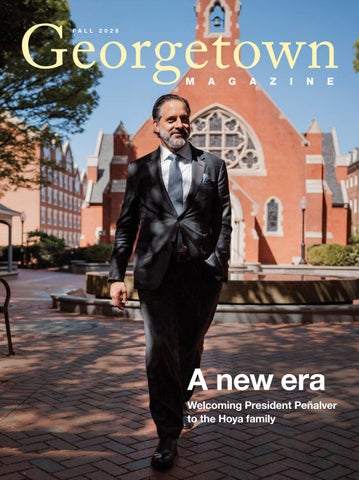
A new era
Welcoming President Peñalver to the Hoya family
A moment to reflect On October 9, Georgetown held its formal inauguration of Eduardo M. Peñalver as the 49th president of the university. The ceremony was held at McDonough Arena, with livestreams available to alumni around the globe. Following the ceremony, Peñalver and other dignitaries enjoyed a quiet gathering in Dahlgren Chapel, the spiritual heart of the Georgetown community. Photo: Elman Studio
Photos: Georgetown University Archives
Scan the QR code to see more concert memorabilia through the years.
From the archives Beginning in the 1960s, a number of well-known musicians played at student-organized concerts in McDonough Arena, including Ray Charles (1963), Peter, Paul and Mary (1964), the Kingston Trio (1965), Johnny Mathis (1966), Dionne Warwick (1967), the Four Tops (1968), The Who (1969), and the Grateful Dead (1970). The tradition continues to this day.
FA L L
2 0 2 6
FEATURES 14 Contemplating a new chapter Georgetown’s new president joins a long tradition of formation through Ignatian retreat.
20 Global crossroads
New Asia Pacific campus in Jakarta opens doors to learning in the Global South.
28 Drawing insights
20 “Our content travels well globally because everyone can relate to it. Because animation is one half-step removed from reality, you can do things that are more emotionally difficult, or funnier.”
Six alumni working in cartooning and animation reflect on the power of creative expression.
DEPARTMENTS 4
Around Campus
12 Ask a Professor 36 GUAA Corner 40 News & Notes 42 Alumni Profiles 46 Lives Well Lived 48 Last Word
—MICHAEL OUWELEEN (C’89), PRESIDENT OF CARTOON NETWORK, ADULT SWIM, AND BOOMERANG
28 VISIT magazine.georgetown.edu
Cover Photo: Elman Studio
3
AROUND CAMPUS
Called to Be: The Campaign for Georgetown supported several dozen new and renovated spaces, including Byrnes Hall, pictured here.
Photo: Elman Studio
Called to Be grateful: Celebrating a historic campaign Georgetown concluded its Called to Be campaign on June 30, 2026, exceeding the university’s $3 billion goal. With more than 580,000 gifts from alumni and friends, the campaign raised a record $3.15 billion, further strengthening the foundation that allows Georgetown to answer its calling and realize new ambitions. “Georgetown—and Georgetown alumni—are always asking how we can serve our world,” says President Emeritus John J. DeGioia, who served as Georgetown’s 48th president from 2001–24 and shaped the Called to Be campaign. “This campaign has enabled us to imagine what is next for Georgetown and to realize the university we are called to be. For this, we are deeply grateful.”
4
Uniting Hoyas from near and far Members of Georgetown’s global community coalesced around the vision for Called to Be, which launched publicly in Spring 2023. Donor participation spanned 55 U.S. states and territories, as well as more than 115 countries. Of the more than 160,000 supporters who made a gift to Called to Be, more than 86,300 were first-time donors. In the last two years alone, more than 108,000 individuals stepped forward to engage with Georgetown in meaningful ways, whether through philanthropy, events, volunteering, or joining an alumni community. Adding excitement to the home stretch, Georgetown’s Class of 2026 set a new benchmark for senior class giving, achieving an 85.6% participation rate—the highest of any undergraduate senior class.
G EORG E TOW N M AG A Z I N E FA LL 20 26
“The Called to Be campaign demonstrated the immense pride that the Georgetown community has for this university and the shared values that will carry us into the future.” —PRESIDENT EDUARDO M. PEÑALVER
“Through campaigns, we communicate priorities, galvanize support, and energize our community around new ideas,” says Robert M. Groves, who served as interim president during the campaign’s final years and is now senior advisor to President Eduardo M. Peñalver. “We could not be more thrilled with the success of the Called to Be campaign nor could we be more grateful for the generosity of our community.” Investing in strategic opportunities and an enduring mission The Called to Be campaign was a testament to the critical role philanthropy plays in advancing Georgetown’s longstanding priorities and addressing emerging opportunities. Donors’ exceptional generosity enabled new investments in student mental health and wellness, faculty chairs in every school, roughly 40 new and renovated spaces across the Hilltop and Capitol campuses, research into the most vexing medical conditions, scholarships for nearly 700 students, and so much more. “It has been a beautiful thing to be a part of,” says Vice President for Advancement R. Bartley Moore (SFS’87). In addition to its most visible accomplishments—for instance, the 1.4 million square feet added to Georgetown since 2018 via the Capitol Campus—the campaign built capacity and fueled progress across four core commitments: Nurturing a thriving student community • $403 million raised for undergraduate scholarships • More than $24 million raised for mental health and well-being • More than $6.5 million raised for the establishment and improvement of Georgetown’s sacred spaces • Georgetown Scholars Program operations and Necessity Fund endowed Shaping the future of learning and discovery • More than $1.1 billion raised for research • More than $673 million raised for faculty support, including chairs and professorships
VISIT magazine.georgetown.edu
• More than 45 centers and institutes newly named or created • More than $81 million raised for educational innovation and transformation Strengthening health and our environment • More than $451 million raised for Georgetown University Medical Center (GUMC) • More than $215 million raised for GUMC research and leadership initiatives • More than $179 million raised for global health • More than $51 million raised for environment and sustainability Building a stronger, more ethical society • $100 million landmark investment in McCourt School initiatives • More than $36 million raised for business and global affairs, including Georgetown’s first undergraduate joint degree • More than $257 million raised for technology and society Building the next chapter of excellence “The Called to Be campaign demonstrated the immense pride that the Georgetown community has for this university and the shared values that will carry us into the future,” says Peñalver, who began his tenure as Georgetown University’s 49th president on July 1. Peñalver emphasizes the important role Georgetown’s solid foundation and distinctive strengths will play at a moment of great challenge for colleges and universities. Writing in an introductory message to the university community, he said, “Our excellence in teaching and research, our location in the nation’s capital—enhanced by the recent expansion of the Capitol Campus—and, above all, our values give us an opportunity to lead the way for the rest of higher education as we accompany our students towards a hope-filled future.” •
5
Photo: Phil Humnicky
The new Capitol Campus Production Studio, located on the lower level of 111 Massachusetts Ave., offers creative resources for students, faculty, and staff across all Capitol Campus programs.
New creative resource at Capitol Campus Since last fall, the Capitol Campus Production Studio has become a valuable creative resource center for the students, faculty, and staff at Georgetown’s Capitol Campus. Located on the lower level of 111 Massachusetts Ave., the studio features three professional recording environments, upgraded lighting and camera systems, mobile on-location capabilities, and a streamlined reservation process.
Anytime I have direct contact with students it feels like an awesome day.” Originally from DC, Hanle earned his MFA in Film and TV Production from University of Southern California and returned to the area with a goal of incorporating public service in his career. He brings experience working for companies like Disney, Nickelodeon, CBS, and NBC, and he’s happy to be able to apply it for educational purposes.
“We mostly used the old studio for internal communications messaging,” says John Hanle, studio director and adjunct lecturer in the Master of Professional Studies in Journalism program at the School of Continuing Studies. “It’s been a goal of mine to turn this new studio into a resource hub for students when we’re not using the space.”
After discovering the studio, Kerrie Carfagno, associate teaching professor and program director of the Master of Science in Environment and Sustainability Management program, modified her syllabus to incorporate a video component for capstone projects.
The studio space includes a broadcast news-style set with large display screens that integrate various forms of live feeds, a green screen and white backdrop set, an interview-style podcast set, and equipment for on-location filming outside the studio.
“What John’s done with the studio is incredible,” says Carfagno. “Students have the ability to set things up the way they want: a podcast style, something formal, or something that looks like the news. They look forward to using the resources in the studio.”
The Digital Media Center also offers equipment loans for creative projects. While some items are reserved for assigned courses, DSLR cameras, audio recorders, microphones, and video cameras are available for general loan.
“When we talk about our program, which is half business and half science, one of the great bridges is communication,” continues Carfagno. “That studio helps them build those communication skills. Students are getting a unique experience in a professional setting and learning how to use each tool so that complex detailed work is accessible for their audience.” •
“My favorite part of my job is seeing the smiles on students’ faces when they come out of the studio. The polished, finished projects bring them so much joy,” says Hanle. “I teach lighting and camera workshops, and help with media training. 6
—Nowshin Chowdhury
G EORG E TOW N M AG A Z I N E FA LL 20 26
Building memories at Georgetown with new university librarian Alexia Hudson-Ward began her role as the new university librarian and dean of the library in August 2025. Georgetown Magazine spoke with Hudson-Ward about being a steward of the university’s past as she helps usher in Georgetown’s future. What was your career path to Georgetown? I always wanted to become a librarian. When I learned about entry-level librarians’ salaries, however, I made the decision to pursue alternate roles. I was a newspaper entertainment journalist and editor, a public radio promotions coordinator, and a customer marketing manager with The Coca-Cola Company. Yet, it was the tragedy of September 11 that prompted me to reevaluate my professional life and led me back to librarianship. After earning my Master of Library and Information Science degree from the University of Pittsburgh, I completed library fellowships before joining Penn State University Libraries, where I earned promotion and tenure as a librarian. I was then appointed the Azariah Smith Root Director of Libraries at Oberlin College and Conservatory before joining the MIT Libraries. From there, I was recruited to Georgetown University as University Librarian and Dean of the Library. You’re a member of the American Antiquarian Society. How did you earn that honor? Election to the American Antiquarian Society is one of the greatest honors of my professional career. I was elected in recognition of my scholarship preserving and interpreting African American history during the Early Republic and Civil War era.
What programs are you looking forward to developing or continuing at Georgetown? I am excited about an upcoming partnership with the Office of the Provost to further support faculty interdisciplinary partnerships across the university. I am also honored to be at Georgetown as we prepare to commemorate the tenth anniversary of our Slavery, Memory, and Reconciliation Initiative. As part of our Library’s 230th anniversary celebration this fall, we brought back Club Lau, the beloved evening dance party held in Lau from 2007 to 2017. We hosted this tradition in the beautifully restored Pierce Reading Room. Looking ahead, we will continue moving forward with the multi-phase Reimagining Lauinger project. Following the successful completion of the Pierce Reading Room renovation last year, we also reopened the 37th Street entrance and completed our elevators restoration. Together, these investments are creating a more welcoming, accessible, and inspiring experience for generations to come. • —Racquel Nassor
One especially meaningful project involved digitizing and promoting the handwritten pocket diaries of Emilie Davis, a young free Black woman living in Philadelphia during the Civil War. A wedding dress seamstress by trade, Emilie carefully documented her life. Through her words, we gain an intimate view of Philadelphia’s free Black community and the life of a young working woman during a pivotal period in American history.
Alexia Hudson-Ward shares her love of literature with Jack the Bulldog as they read a good book together in Lauinger Library. Photo: Georgetown University
VISIT magazine.georgetown.edu
7
Photo: Georgetown University
Co-founder of The Society for the Neuroscience of Creativity, Adam Green is editor-in-chief of Creativity Research Journal and in 2024, won a $2.5 million National Science Foundation grant to study the outcome of creativity on STEM professionals. He was named Innovator of the Year at Georgetown’s 2026 Innovator and Entrepreneurship Awards.
Neuroscience professor Adam Green on creativity and AI Adam Green, the Provost’s Distinguished Associate Professor in the Department of Psychology and Interdisciplinary Program in Neuroscience, leads Georgetown’s Lab for Relational Cognition. He spoke with Georgetown Magazine about the impact of AI on creativity.
What we’re seeing initially is pretty complex. When people use AI, they feel less anxious about doing something creative, because essentially AI is doing it for them. However, those who rely on AI become even less confident when AI isn’t available.
How can people keep their creativity flowing when AI is increasingly used as a resource for everyday tasks? It’s really important to understand that how you use AI is up to you. My best advice is to start with your own ideas. Don’t be afraid of the blank page.
Think about both adults and kids. Adults now have developed the ability to think and write for themselves; when we use AI tools, that may lead to some atrophy. Kids are growing up in a context where there’s an alternative to thinking for yourself and writing on your own. For kids that dependency is the absence of a developed capability, much more dramatic than just atrophy or laziness.
Creativity is very healthy. There’s research going back decades that creative expression through art, music, and poetry has tremendous health benefits: social connection, overcoming trauma, healthy aging, even the development of flexible cognitive and social capabilities in children. Those benefits come from the process of creativity, not the products of creativity. To me, that’s a critical distinction, because AI asks us to trade process for product. If someone retires and takes up oil painting, that’s not because they expect that that painting will be displayed in The Met, right? It’s more about the process of learning, what we call desirable difficulty. It’s supposed to be hard. If we ask AI to do our work, we’ll have this quick product, but we’ll have received none of the benefits of making it. Do you think AI use is increasing creativity anxiety? Our lab has studied creativity anxiety. I had a terrific graduate student, Rich Daker (G’22), who developed a scale now translated into multiple languages. 8
How are you collaborating with others in this field? I developed the Society for the Neuroscience of Creativity (SFNC) to bring together those researching creativity across different areas: neuroscientists, clinicians, educators, and artists. Many of them are researchers studying computational creativity related to AI. Since we founded it in 2015, SFNC is now a global organization and is the basis of what we call the Creativity Ontology Project—that project’s team includes 200 of the world’s leading creativity researchers. The idea is to really define creativity, how it relates to other constructs (innovation, imagination, problem-solving), and break down creativity into different distinct meanings. • —Gabrielle Barone
G EORG E TOW N M AG A Z I N E FA LL 20 26
Preparing for the future with AI Artificial intelligence is reshaping the economy and society, affecting the skills students need to thrive in their careers. Georgetown is preparing students for this evolving job market through new programs, coursework, and comprehensive resources to support them for career success. Students explore all aspects of AI, from the technical side to the societal and ethical questions about how AI will impact the future. “We want to make sure we’re preparing our students to use available tools in the best possible way,” says Eddie Maloney, executive director of the Center for New Designs in Learning and Scholarship (CNDLS). “We talk a lot about caring for the whole person, but it’s also about educating the whole person.” Students are guided by a set of ethics and values that place people first. These values mirror those principles recently outlined by the Catholic Church and Pope Leo, who just published his first papal encyclical, Magnifica Humanitas, which warns against the possible pitfalls of artificial intelligence.
“We want to make sure we’re preparing our students to use available tools in the best possible way. We talk a lot about caring for the whole person, but it’s also about educating the whole person.” —EDDIE MALONEY
The College of Arts & Sciences just launched a new undergraduate program: The Certificate in Artificial Intelligence. Grounded in the liberal arts, the nine-credit certificate requires students to take one class from three areas: The Problem of AI, The Science of AI, and The Applications of AI. The certificate follows the 2025 launch of the Master’s in Artificial Intelligence Management offered by the School of Continuing Studies. Georgetown also offers free resources to the university community to better understand and use AI, including a new micro-credential in AI, developed by CNDLS for faculty, staff, and students. The free, self-paced course teaches users how to craft smart generative AI prompts while also critically
evaluating AI outputs and understanding ethical, security, and privacy concerns. Participants take the one-credit AI course online or in-person.
Photo: iStock
Through the Academic Innovation Network, CNDLS and the Red House are also developing a university-wide initiative that will explore the interaction of AI, teaching, and learning in higher education. The initiative will include public events, research, community, and thought leadership on how to best integrate AI in the classroom. • —Cliff Djajapranata
MILESTONE FOR CCAS
The Center for Contemporary Arab Studies, founded 50 years ago in the School of Foreign Service, is the oldest academic center in the United States focusing exclusively on the Arab world.
VISIT magazine.georgetown.edu
9
Disability Cultural Center hosts inaugural McCourt Global Amputee Soccer Invitational Shaw Field became the destination for a celebration of adaptive sport earlier this year at the inaugural McCourt Global Amputee Soccer Invitational. The event was sponsored by McCourt Global, a diversified enterprise that builds across real estate and infrastructure, sports, technology, and media. The invitational was co-hosted by Georgetown University’s Disability Cultural Center and endorsed by the American Amputee Soccer Association (AASA). The event was held in partnership with Treizième Homme, the foundation of the French professional club Olympique de Marseille (OM). OM was the first Ligue 1 club to establish an amputee soccer team in 2025—an important milestone in advancing both inclusion and the development of the sport in France, Europe, and around the world.
“Witnessing the Georgetown and Olympique de Marseille communities come together was a moment of immense pride. I am deeply grateful to Georgetown’s Disability Cultural Center for their warm and generous welcome of these courageous athletes,” says Frank McCourt (C’75, Parent’05), chairman and CEO of McCourt Global, and OM owner. “The extraordinary talent and heart demonstrated by the athletes perfectly embodied the fundamental values upon which both Georgetown and Treizième Homme are established: that the opportunity to compete and find community should extend to everyone.” The event’s 40-minute exhibition game featured OM against select players from the AASA’s U.S. Men’s National Amputee Soccer Team, followed by three additional 30-minute matches with Arena Football Club from Delaware and Colorado Rapids Amputee Soccer. “The Disability Cultural Center was thrilled to get to co-host the inaugural McCourt Global Amputee Soccer Invitational because it gave us the opportunity to invite the Georgetown community to cheer on elite disabled athletes and learn more about adaptive sport,” says Amy Kenny, director of Disability Cultural Center at Georgetown. “We are grateful this event brought together students, faculty, and staff to expand awareness of amputee soccer and adaptive sports more broadly. We hope that we can continue to bring disability excellence through adaptive sport to our campus community.” Georgetown’s Disability Cultural Center was established in 2023 and celebrates disability as an intersectional identity through the transformative power of the arts, sciences, and community.
On April 19, the inaugural McCourt Global Amputee Soccer Invitational, a free public exhibition event bringing elite amputee soccer to Washington, DC, was hosted at Shaw Field.
Photo: Rafael Suanes
“The Disability Cultural Center is here to build community, celebrate disability culture, and provide resources and programming for Georgetown students, faculty, and staff to learn more about disability,” says Kenny. “We do that through cultural events, workshops, programming, and dialogue. We hope that everyone can think about disability as part of the human experience.” • —Nowshin Chowdhury
HIGH-EARNING HOYAS
Georgetown early-career alumni are among the highest-paid college
graduates in the nation, according to the U.S. Department of Education, which measured the earnings of students who received federal aid.
10
G EORG E TOW N M AG A Z I N E FA LL 20 26
Goodall’s legacy: Finding reasons for hope at Georgetown Georgetown seniors are practicing hope in The Jane Goodall Rules: Activating Our Reasons for Hope course by examining how Goodall cultivated hope, sustained action, and maintained an unwavering commitment to responsibility around the world. “My job is to create an immersive, reflective experience for students, refining their emerging values, sense of purpose, and responsibility as a human being as they prepare to leave Georgetown,” says John Trybus, assistant professor and academic director at the Center for Social Impact Communication and former member of Jane Goodall’s Global Office of the Founder team, that had supported Goodall’s annual 300-day global tours.
Photo: The Jane Goodall Institute/Fernando Turmo
Jane Goodall with the chimp La Vieille at the at the Tchimpounga Chimpanzee Rehabilitation Center in the Republic of the Congo.
“When the Red House had an open call for innovative class ideas, I proposed a way to continue spreading Jane’s message at Georgetown. I thought it was the perfect place to teach about Jane,” says Trybus. The Red House (established in 2013 as the Designing the Future(s) Initiative) prototypes new curricular models, working with professors and staff to reimagine the future of education at the university. Since 2017, The Red House has offered The Bridge Courses— one credit, pass/fail seminars, designed to help seniors transition to life after Georgetown.
In conversation with Goodall until her death on Oct. 1, 2025, Trybus created a course that explores her moral leadership. The course assignments include partaking in guided forest bathing; attending a virtual field trip to the world’s largest chimpanzee sanctuary, Chimp Haven; visiting the Jane Goodall Institute’s U.S. headquarters; and developing their own Four Reasons for Hope presented in end-of-semester Hopecasts.
“We learned what it means to believe in people, to remain hopeful in times of despair, and how to lead in whatever field “Supporting The Jane Goodall Rules proposal was an easy yes,” we choose. It’s the type of course that makes Georgetown so says Duncan Peacock, senior program developer at The Red special,” says Alaena Hunt (C’26), a recent graduate who is House. “By treating hope, discernment, and interdisciplinary pursuing a journalism career following her experience with thinking as applied skills, the course centers students’ human- Street Sense Media. ity in the face of complex challenges. This kind of pedagogy is “I want students to know The Jane Goodall Rules is really a the backbone of the senior Bridge Courses and what makes a course about themselves. Together, we create a space for slowGeorgetown education feel anchored in the real-world.” ing down, for listening, not just to others, but to ourselves,” says Trybus. “In our world, which seems increasingly fraught with hate and partisanship, Jane taught us that we must speak to each other’s hearts, and not each other’s minds,” says Hunt. “As I move through the world after graduating, I constantly think about how Jane treated people, and try to emulate her sincerity and kindness.” • —Racquel Nassor
Photo: Phil Humnicky
VISIT magazine.georgetown.edu
Goodall speaks about her book, Hope for Animals and Their World: How Endangered Species Are Being Rescued from the Brink, on September 9, 2009, in Gaston Hall.
11
How to bring back birds Georgetown’s “Ask a Professor” series invites faculty to break down complex issues and contribute to trending conversations. Peter P. Marra, Laudato Si’ Professor of Biology and the Environment, is dean of Georgetown’s Earth Commons Institute. He helped found the Road to Recovery, an initiative that identifies interventions for over 100 bird species nearing endangered status. Marra says the right mix of policy and individual action can bring back birds. What role do birds play in ecosystems, and how do they impact humans? What is the purpose of humans in our ecosystem? Think about that. We always take a very biased, anthropogenic perspective. I prefer not to think about our Earth as a place just for humans. Our Earth is a place for all living things. They deserve to exist just as much as humans do. Birds matter because they are living things and add enormous diversity and beauty to the environment. They also fulfill lots of important ecosystem roles like seed dispersal, pollination, predation, and classic sorts of roles humans have defined that keep ecosystems intact. Because birds are vocal, easy to see, easy to count, they are indicative of the health of an ecosystem. If birds aren’t doing well, chances are we’re not doing well.
12
How would you characterize the current trend in declining bird populations? Over the last 40 to 50 years, we’ve seen a major decline in most birds. For some species, this decline has accelerated in the last 10 to 15 years. We’ve lost about 3 billion birds [in North America], about a third of the bird populations in the U.S. and Canada. This pattern is similar across the entire world. There are a lot of cases of extinctions where bird species that we once considered quite common are now completely off the face of the Earth, which is pretty depressing. Unfortunately, our recent research shows that more than half of the world’s migratory bird species are in decline. But the most important message of that research is actually hopeful. So much remains to be learned, but at the same time, advances in conservation science—like satellite tracking, AI, genomics, and global citizen
G EORG E TOW N M AG A Z I N E FA LL 20 26
Photo: Tim Romano / Smithsonian Institution
ASK A PROFESSOR
science—have transformed our ability to identify the factors driving species declines. We have better tools than ever, and the most evidence in history of what has actually worked.
“I prefer not to think about our Earth as a place just for humans. Our Earth is a place for all living things. They deserve to exist just as much as humans do.”
How does climate change impact bird populations? We’re definitely seeing impacts of climate change, but —PETER MARRA most extinctions or major declines that have happened don’t appear to have been due to climate change. They’ve used for hay. If farmers don’t cut their fields until July, been a result of habitat loss, invasive species, contamithose bobolinks can reproduce successfully. If they cut nants, and overharvesting by humans. their fields in May or June, they’re bulldozing their Birds are definitely being impacted by climate change. nests. There are modifications that can be made that are Whether they’re adapting to it or not is unclear. We’re beneficial for the birds and farmers. seeing body size differences evolving over time, but we In California, there are rice fields that are flooded at can’t assume just because a bird changes its behavior certain times of the year for the growing of rice, but they relative to increasing temperatures or decreasing precipican also be flooded at other times of the year to provide tation that it’s an adaptation. It might be a response, but important wetland habitats for migratory birds on their it could be a negative response. way south. What policy solutions might help stem the loss One federal program called the Conservation Reserve of bird populations? Program provides incentives for farmers to leave a Part of the issue is figuring out the details of a particular certain amount of buffer of natural habitat around their situation. For example, if farming is an issue, maybe fields to provide for animals a safe place to persist. It’s there are changes to agricultural practices we can these sorts of compromises and programs that will be recommend such as farmers not cutting their fields at necessary if we want to find some happy medium for certain times. Bobolinks, for example, are a cool species people and nature to both thrive. of blackbird that breed in complex grass fields that are What can everyday people do to help protect birds? There are many things people can do to make a difference. For example, outdoor cats are a tremendous problem. Cats kill in the U.S. anywhere between 1.2 and 4 billion birds a year. Keep cats indoors. Everyone needs to treat their own yard like a national park and plant native species to encourage insect growth. Don’t use pesticides. It’s not good for you, the insects, or the birds. You can also buy food grown in bird-friendly ways—coffee and chocolate are examples.
Photo: Rafael Suanes
VISIT magazine.georgetown.edu
Go outside and watch birds because it’s a fascinating hobby. Put your phone down, or actually pick your phone up and use Merlin, an app that can identify bird songs. It makes bird watching easy and accessible. •
13
Beginning with reflection How Ignatian spirituality guides Georgetown’s new president by rosemary lane | design by shikha savdas
I
n the weeks before Eduardo Peñalver became the 49th president of Georgetown University, before his cross-country move to Washington, DC, he stepped away from his desk. And into silence. In April, Peñalver went on an eight-day silent retreat along the rocky shores of the Atlantic Ocean. He traveled to a Jesuit retreat center in Gloucester, Massachusetts, and stillness was a mode he welcomed.
“I’m a naturally introverted person; I love the excuse to be silent. It’s like a luxury,” he said. “I find it helpful in deepening my own understanding of the work, but also, it’s refreshing. It’s restful.” During this retreat, Peñalver’s focus wasn’t just on respite.
As he ran along the coast, prayed and read Scripture, and met with a spiritual director at the Gonzaga Eastern Point Retreat House, he contemplated his next transition: In what ways could he lead Georgetown, a 237-year-old institution, the first Catholic and Jesuit university in the U.S., into its next chapter?
14
G EORG E TOW N M AG A Z I N E FA LL 20 26
Peñalver, pictured here at Georgetown’s Calcagnini Contemplative Center, embraces the Ignatian spiritual practice of retreat as a way to deepen leadership and listening. Photo: Georgetown University
“Georgetown is this precious thing—for the Jesuits, for the global Catholic community, and for the country,” Peñalver said. “It’s doing something no one else is doing. What are the things I need to be doing to prepare myself to do well, not for myself, but to help this institution continue to thrive?” Peñalver was in the right place for those questions. His retreat was informed by Ignatian spirituality and the Spiritual Exercises, a handbook of sorts that St. Ignatius, a 16th-century saint and founder of the Jesuits, created to help participants draw closer to God and find inner freedom to make important decisions. The Washington state native had attended eight-day Ignatian retreats in the past: before he became president of Seattle University and during his Seattle presidency. The experiences proved formative, he said.
VISIT magazine.georgetown.edu
“The [Exercises] tie my decision-making and my thinking about leadership into a deeper significance and an extended tradition of reflection,” Peñalver said. “I’ve found them very centering and a productive form of spiritual practice.” Silent retreats and leadership Jesuits and laypeople alike attend silent retreats at Jesuit retreat centers across the U.S. every year. The element of silence is critical, explains William Campbell, S.J., rector of the Georgetown Jesuit community and Peñalver’s former spiritual director during one of his retreats. “On a retreat, if we strip away all that external noise with silence, it allows us to hear the internal noise,” he said. “What’s it saying to me? What’s it inviting me to do? Unless I’ve stripped away the distractions, I’m less likely to be attentive to what’s happening within me.”
15
Engaging with students is a priority for Peñalver, shown here in the historic Healy Hall classroom and helping on move-in day. Photo: Elman Studio
“What are the things I need to be doing to prepare myself to do well, not for myself, but to help this institution continue to thrive?” —ED UARD O M. P EÑALVER
For Jesuits, this deep listening leads to discernment, which begins with noticing your emotions, thoughts, and desires in the presence of God and seeing where you’re being drawn to. This practice is particularly powerful and practical for a leader, said Fr. Gregory Schenden, S.J., director of Georgetown’s Campus Ministry. “Reflection is empowering,” he said. “When we react, it’s almost like triage. It’s responding to something external rather than allowing, in freedom, my actions to come out of who and whose I am. [Discernment] is an incredibly important quality for a leader who’s guiding a community like Georgetown: to be grounded in something that is transcendent.”
16
Setting aside time for retreats is indicative of Peñalver’s commitment to his prayer life and Ignatian spirituality, Campbell said. “I feel he’s making the retreats because that is by definition who he is in a relationship with God, and I hope that would bring comfort to the Georgetown community to know that their chief executive officer is also their chief executive prayer, both in his own life and for the life of the institution,” he said. Jesuit retreats and values at Georgetown Like Peñalver, students can also step away from the busyness of campus life and into the quiet at Georgetown’s Calcagnini Contemplative Center in the Blue Ridge Mountains.
G EORG E TOW N M AG A Z I N E FA LL 20 26
The value of alumni stories Before Eduardo Peñalver moved to DC from Seattle, his neighbor held a goodbye party for him. This neighbor happened to be a Georgetown graduate and leader in the local alumni club, and the gathering became a kind of unofficial Hoya summer sendoff for the new president. It was a warm introduction to the Georgetown community. “The alumni are incredibly loyal and enthusiastic about their relationship to Georgetown,” says Peñalver. “They could be decades apart in terms of when they were here, but they share something because of that connection.”
Photo: Rafael Suanes
Campus Ministry offers more than 50 retreats there, ranging from silent Ignatian retreats to retreats for students from Catholic, Orthodox Christian, Protestant, Jewish, Muslim, and Dharmic religious traditions. And it offers a six-week Ignatian retreat that’s integrated into the daily lives of students on campus, as well as a nine-month program of the Spiritual Exercises for faculty and staff. Ignatian values are woven into the university’s academics as well, from Georgetown’s core curriculum to Ignatian seminars for first-year students, said Fr. Mark Bosco, S.J., vice president for Mission & Ministry at Georgetown. These values—discernment, contemplation in action, or marrying reflection with action—can be particularly foundational for leadership, he said. “Georgetown encourages students to reflect these values through our core curriculum, those humanistic courses in theology, philosophy, history, and literature. Having this broad sense of the humanities positions Georgetown students to understand the magis, the deeper and most meaningful way to know yourself and to help others live meaningful and just lives,” he said. “Students see these values lived out and it impacts their choices, fostering leaders who act with the wisdom and purpose formed during their time here on campus.”
VISIT magazine.georgetown.edu
Alumni involvement is critical to the success of an institution like Georgetown, notes Peñalver. “None of this works without the support of alumni in many different ways, not just philanthropically. They bring all their experiences: the things that went well, the things they wish had been better, and the things they want to help us build.” Listening to alumni stories is invaluable to him as a leader. “Every time I meet with people, I’m learning about Georgetown’s history and traditions,” he says. “It’s important for me to get a deep understanding of the community, so that the way that I’m leading is authentic to Georgetown’s past, and its future is one that everyone can embrace.” He’s grateful to be building on such a strong foundation. “All universities are in a constant state of evolution and development, and so we’re never done. But Georgetown, approaching 250 years of history and tradition, is well-positioned for the future.”
17
Photo: Georgetown University
“Georgetown has its own way of being Jesuit, and my hope is that whatever I’m doing, I’m faithful to that.” —ED UARD O M. P EÑALVER
In the McDonough School of Business, Fr. Quentin Dupont, S.J., teaches undergraduates and graduate students about ethical leadership in business. Helping students cultivate Ignatian practices, including being a person for others, can make them impactful, humble, and purpose-driven leaders, he said.
18
“When we’re able to effectively help our students understand [Ignatian values], I think that makes them qualitatively better prepared for leadership and therefore better leaders,” he said. “While they’re in the hubbub of the day, they’re still aware of this deeper calling to make the world a better place.”
G EORG E TOW N M AG A Z I N E FA LL 20 26
In August, Peñalver visited the Calcagnini Contemplative Center’s Chapel of St. Ignatius, and spoke at New Student Convocation, where he encouraged students to leave room for reflection and rest while fueling their intellects. Photo: Rafael Suanes
A new chapter at Georgetown As Peñalver closed out his retreat in Gloucester, deeper insights emerged. He wouldn’t be alone in his new role: he’d be working in a collaborative environment grounded in a 500-year-old tradition. And he spent time contemplating Georgetown’s role and mission—and how it could be responsive to the world now, grounded in this Jesuit tradition. “There are other great research universities, but none that bring to those questions the Jesuit and Catholic character that Georgetown does,” he said. “The human values that come out of that tradition are responsive to the challenges that we’re facing as a democracy, as a society, and as a global community. Georgetown speaks directly to that.”
VISIT magazine.georgetown.edu
The retreat is part of a regular set of spiritual practices that Peñalver attends to, he said. And as he begins his role as the 49th president of Georgetown, he carries with him these Jesuit values that he shares with the community. “What I hope will guide me is an authentic understanding of Georgetown and its values and its aspirations, and that’s part of my learning,” he said. “Whatever I do in this job, I want it to be true to this community,” he said. “There’s a set of shared values that all Jesuit institutions participate in, but each one has its own way of living that out. Georgetown has its own way of being Jesuit, and my hope is that whatever I’m doing, I’m faithful to that.” •
19
Georgetown’s new presence in Jakarta, Indonesia—the world’s largest metropolitan area— offers exceptional opportunities to study the political, economic, environmental, and social issues confronting the Global South.
Photo: iStock
20
G EORG E TOW N M AG A Z I N E FA LL 20 26
by sara piccini design by ethan jeon
ne day last fall, Conor McWeeney (G’26) woke up at 4 a.m. to go fishing. A former navigator with the U.S. Military Sealift Command and a certified Naval rescue swimmer, McWeeney had spent a lot of time on the water. But this fishing trip was an entirely new experience. Loading his backpack with gummy bears and other gifts to share, he joined a small group of Javanese fishermen on a run to catch blue swimming crabs, known locally as rajungan.
VISIT magazine.georgetown.edu
McWeeney had first met his fishing companions a few days earlier while participating in a novel immersive learning experience—a policy lab on ocean management offered by Georgetown School of Foreign Service Asia Pacific (GSAP). Launched in January 2025 and headquartered in Jakarta, Indonesia, GSAP extends Georgetown’s global reach to a critical strategic and economic region of the world. Georgetown is the first American university with a physical campus in Indonesia.
21
While out crabbing, McWeeney used Google Translate to engage in further conversation with the men about the economics of fishing in Indonesia, which he subsequently wrote about in depth on Substack. “They’re just scraping by, paying local bosses for ice, fuel, boiling facilities, boats, and even access to fishing sites,” he says. “If they lack money to pay, middlemen— who also set the price for their catch—will give them a loan. This can lead to a dangerous spiral of debt.” These economic realities can lead fishermen to skirt environmental regulations, McWeeney explains, such as catching juvenile crabs and using banned nets that are more efficient than legally available equipment. One of the first students to participate in GSAP’s semester abroad for SFS graduate students, McWeeney found tremendous value in the program. “I told one of my classmates when I got back to DC, ‘You have to do this,’” he says. “The point of going to Georgetown is to experience these opportunities, to get your hands in. I learned that in making policy, you need to talk to the people it’s intended for.”
Along with the semester abroad program, the centerpiece of GSAP’s inaugural offerings is the Master in Diplomacy and International Affairs (MDIA) program, designed for midcareer professionals. Complementing the focus on immersive, hands-on experience offered in policy labs, the MDIA program provides opportunities for students to learn the intricacies of policymaking from seasoned practitioners. Students spend the fall semester in Jakarta, followed by a weeklong module at Georgetown’s Qatar campus, and then spend the spring semester in Washington, DC. “For our class on policymaking and international institutions in DC, we were able to visit the World Bank and Department of State and talk to a lot of real-life experts who are involved in policymaking,” says Rachmadea Aisyah (G’26), who graduated from the MDIA program and now works in Indonesia’s Ministry of Foreign Affairs. Students also have access to impressive guest lecturers, Aisyah says, such as Kurt Campbell,
In GSAP’s sustainable fisheries policy lab, Conor McWeeney (G’26) witnessed first-hand the economic and environmental challenges facing Indonesia’s fishers—integral to the nation’s identity—90% of whom operate at a small-scale.
Photo: Courtesy of Conor McWeeney
22
G EORG E TOW N M AG A Z I N E FA LL 20 26
a former deputy secretary of state who also served as National Security Council coordinator for the IndoPacific from 2021 to 2024.
the Jakarta Provincial Government to strengthen collaboration on policy research and innovation in urban governance.
“The program opened so many doors for me that I otherwise wouldn’t have had access to in any other circumstances,” Aisyah says.
Launching 20 years after the opening of Georgetown’s campus in Doha, Qatar, GSAP further enriches opportunities for innovation. “Our location in the Global South opened up a whole range of possibilities,” says Professor Yuhki Tajima, who led the initiative to establish GSAP while director of the SFS Asian Studies Program.
Indonesia, the fourth most populous nation in the world, is an ideal setting for students of international policy to study the political, economic, environmental, and social issues confronting the Global South, and more broadly, the developing role of the Asia Pacific region in a multipolar global order. A crossroads of trade for more than a millennium— Marco Polo marveled at the vast amount of shipping he witnessed in Java—the Indonesian archipelago endured 350 years of Dutch colonial rule and economic exploitation beginning in the 17th century. Securing independence after World War II, Indonesia experienced extensive Cold War–era political violence before emerging as a democracy over the last several decades. As planning began in 2021 for a new international Georgetown location, SFS Dean Joel Hellman recognized the exceptional learning opportunities that Indonesia offered.
“We made it a priority to incorporate immersive field learning,” says Tajima, who now serves as GSAP’s inaugural rector. He cites as an example GSAP’s critical minerals policy lab, which brings students to Indonesian nickel, tin, gold, and other mineral mines to directly observe mining operations and employment conditions. “You can’t replicate this kind of experience through secondary learning or using AI.” Another innovative program is the Georgetown Asia Pacific Peace Academy (GAPPA), which brings together peacebuilding professionals from Asia’s
Professor Yuhki Tajima, inaugural rector of GSAP, spearheaded the program’s creation while serving as director of Asian Studies at the School of Foreign Service. He has extensive experience working in the region.
“It’s an exciting region to engage with. Indonesia is a multi-ethnic, multi-religious state that is rich in resources,” he says. Hellman also notes that ASEAN, the Association of Southeast Asian Nations, has its headquarters in Jakarta. “Jakarta is the world’s largest metropolitan area, providing an opportunity to study the challenges of urbanization first-hand,” he adds. To that end, GSAP recently entered into a partnership with
Photo: Avicenna
VISIT magazine.georgetown.edu
23
conflict and post-conflict zones to enhance capacity in negotiations, mediation, and governance. GAPPA draws on the expertise of Tajima and his colleague Scott Guggenheim, director of the policy lab program, and their work in post-conflict zones such as Aceh in Indonesia, Timor-Leste, and Afghanistan, giving practitioners an up-close perspective on the challenges of building sustainable peace and stability.
As GSAP continues to grow, the program will be introducing several new initiatives, including an accelerated undergraduate-tomaster’s program for Indonesian students and a semester abroad for Georgetown undergraduates.
program for Indonesian students this fall in partnership with several Indonesian universities. Students will earn an undergraduate degree from their home universities and a master’s degree from SFS, with a transitional year in Jakarta followed by a year at Georgetown’s Hilltop Campus.
“We want to bring more voices from the region into our classrooms, and learn from them about what they are creating for their own future,” Hellman says. “It’s already exceeded our Both Hellman and Tajima had worked in Indo- expectations.” nesia previously through their association with In the planning stages for GSAP, Hellman and the World Bank. They were able to form a fruitTajima also received instrumental support from ful partnership with the Indonesian governHoyas in the Asia Pacific region. ment in establishing GSAP, facilitating the “We’d started a WhatsApp group of Jakartarecruitment of Indonesian students and access based alumni,” says Ratna Kartadjoemena to scholarships. (B’03), an Indonesian entrepreneur and Hellman stresses the importance of Indoneenvironmental activist. “Yuhki reached out to sian students’ enrollment in GSAP’s programs, me and we were able to assemble a really good adding that the MDIA program hopes to exteam to help with challenges like licensing and pand its future cohorts to include students from legal issues,” she says. In addition, local alumni other countries in the region, such as Malaysia. led efforts to scout the site for GSAP’s physical space, centrally located in Jakarta. Additionally, Hellman notes, GSAP is introducing an accelerated undergraduate-to-master’s
Photo: Avicenna
24
G EORG E TOW N M AG A Z I N E FA LL 20 26
Kartadjoemena has continued her involvement with GSAP, currently serving on its Management Board. In April, she joined other Indonesian leaders in welcoming a delegation from Georgetown’s Institute for Women, Peace and Security, and convened a panel to discuss advancing women’s entrepreneurship in ways that also benefit the environment. Hellman views the Asia Pacific program as a direct outgrowth of the university’s Jesuit roots. Kartadjoemena agrees wholeheartedly. “Georgetown’s mission cites the principle that ‘discourse among people of different faiths, cultures, and beliefs promotes intellectual, ethical, and spiritual understanding,’” she says. “That’s spot on.” As a member of the second cohort of MDIA students, Aisyah welcomed the opportunity for cultural exchange with her counterparts on the Hilltop, who helped her navigate life in the U.S. as a first-time visitor. Aisyah and her fellow Indonesian students were able to reciprocate in orienting SFS students to their country. “The first thing we did was introduce them to our food, which combines culinary traditions from all over the region into a signature of our own that is uniquely Indonesian,” she says. Over lunches of satay and milk tea, Aisyah and other MDIA students answered questions
Photo: Courtesy of Rachmadea Aisyah
about the Indonesian people, the government, and the do’s and don’ts of their country. “It was a really fun and enriching experience,” she says. “We learned as much from them as they learned from us.” Another highlight of the program for Aisyah was the opportunity to expand her knowledge in critical areas such as climate and energy policy, human rights, and international law in classes led by practitioners in Jakarta, Doha, and Washington. A particular honor was having Professor Josh Cartin, who served in the National Security Council’s East Asia directorate under two different presidential administrations, serve as a lecturer for her capstone project on disaster management among ASEAN nations.
A centerpiece of GSAP’s offerings is the Master in Diplomacy and International Affairs (MDIA) program for mid-career professionals, which includes studies in Jakarta, Doha, and Washington, DC.
Photo: Avicenna
VISIT magazine.georgetown.edu
25
Linda Uzoamaka Christopher (G’26) wrote of her experience at a mine in Papua: “As Georgetown prepares global leaders, trips like this are not addons, they are the curriculum.”
For Aisyah, being in Qatar at the Doha campus provided a promising vision for the future of GSAP. “It was amazing to see for myself how Georgetown has managed to build so much in such a short time.”
Freeport-McMoRan gold and copper mine in Indonesia’s Papua province provides an entirely different kind of classroom for students participating in GSAP’s policy lab focused on critical minerals and mining.
Now back in her job in the Indonesian foreign affairs ministry, where she focuses on cultural, health, and labor issues, Aisyah looks forward to applying newly gained knowledge and skills to her work.
The mine is normally off-limits to visitors, says Tajima, who explains that Georgetown’s regional connections enabled GSAP to gain access to the site. “Students directly observe the social and environmental impact of mining and downstream processing, and how industrial and governmental policies intersect.”
“This program has built an intellectual edifice on the foundation of my experiences,” she says. “In my negotiating class, for example, I was able to navigate through the simulations smoothly because I’ve been in that situation in real life. At the same time, the simulation also showed me how many things I had been missing, because I hadn’t ever learned about negotiation in practice.” Far from the downtown Jakarta office tower where GSAP holds many of its classes, the
GSAP currently offers four other policy labs, focusing on geopolitics, poverty reduction, urbanization, and ocean management. During her semester in Jakarta in the Master of Global Human Development program, Linda Uzoamaka Christopher (G’26) participated in the minerals policy lab, and was able to travel to Papua. In an online reflection about her experience there, Christopher said, “The policy lab succeeds because it brings students into spaces where power flows unevenly. It teaches us to listen with humility, question our assumptions and engage ethically, not just analytically. In a time when policy solutions are often exported from capitals, immersive learning helps reverse the gaze. We were there to learn, not fix. That alone shifts the narrative.” Christopher’s fellow SFS graduate student Conor McWeeney gained a similar perspective through his semester in Jakarta. He had been inspired to attend Georgetown after spending time in the Asia Pacific region on the U.S. Navy hospital ship Mercy and participating in construction projects in Vietnam with the Navy Seabees. “It really hammered
Photo: Courtesy of Linda Christopher
26
G EORG E TOW N M AG A Z I N E FA LL 20 26
Photo: Courtesy of Linda Christopher
home the importance of being a force for good in the world,” McWeeney says. Both in the classroom component of the ocean management policy lab, taught by fisheries management experts including Professor Elle Wibisono, and in the field education experience, McWeeney learned the challenges of implementing seemingly positive policy changes that can have negative impacts downstream. “I thought I knew fisheries, but this really opened my eyes,” he says. He mentions that green mussels, a highly important food source in Indonesia, have been increasingly contaminated by microplastics and heavy metals. Pollution problems only increase economic pressures for people trying to earn a living on the water. “There’s a deep frustration among ordinary fishing people. They feel very underrepresented in decision-making.” Despite their economic circumstances, the Indonesian people McWeeney met in small fishing villages and off-the-beaten-path neighborhoods in Jakarta greeted him with a level of warmth and generosity that he’d never before experienced. “I couldn’t be more grateful,” he says.
VISIT magazine.georgetown.edu
The next major step forward for GSAP will be the introduction of a study abroad program for Georgetown undergraduates in Fall 2027. “The majority of our students go to Europe and other parts of the developed world,” says Hellman. “The experience in Jakarta is going to be entirely different.” As an undergraduate alumna, Kartadjoemena is especially excited about the new vistas that will open up to undergraduates visiting Indonesia and the Asia Pacific region for the first time. She still vividly remembers attending a study abroad program in Ecuador. Although she had lived in the U.S. and visited Europe, she says, “I felt completely out of my comfort zone being in a South American country for the first time. I appreciated being in a place that was so different culturally and politically.”
GSAP’s mining, minerals, and management policy lab takes students to remote mines throughout the Indonesian archipelago, giving them a 360-degree look at the issues surrounding mining, especially critical minerals.
Through her continued involvement with GSAP, Kartadjoemena has gained new perspectives herself in interactions with students, especially Indonesian professionals enrolled in the MDIA program. “I feel so blessed to be learning from them.” •
27
28
G EORG E TOW N M AG A Z I N E FA LL 20 26
BY JANE VARNER MALHOTRA | DESIGN BY SOFIA VELASQUEZ
W
atching the opening scene of Criatura, a short animated film directed by Nitya Ramlogan (SFS’13), is like slipping into a moving painting.
Watery images float across the screen like translucent memories. The sound of gentle splashing is heard as the voice of a young woman shares memories of childhood days swimming with her family in a river in Mexico. Wavy aquamarine lines fall around the face of a girl, and then around an emerging sea creature, hair and seaweed entangled. Frame by frame, the story has been lovingly animated by Ramlogan and her team using handmade cutout puppets from layers of painted acetate cels. The images and sounds come together in a film exploring questions around migration, coming of age, and belonging. The animator is part of a long line of Georgetown alumni artists who put pencil to paper as a way to deepen human understanding, expand the common good, and sometimes (gasp!) just enjoy life. What connects animation and cartooning with Georgetown? The emphasis on liberal arts provides fertile ground for a creative response to challenges facing our purpose-driven students and alumni. Even if they aren’t art majors, their interests in linguistics, economics, theology, or policy feed the visual story-making process.
VISIT magazine.georgetown.edu
Animation Professor Elyse Kelly sees Georgetown students bringing a wealth of ideas to the drafting table. “Our students have so much to say. It ties to their other classes and experiences, their hopes and anxieties about growing up. Even for the ones who don’t end up pursuing a creative field, creative problem solving and thinking will positively impact how they approach whatever they do.” Student work reflects a values-centered approach that forms the cornerstone of a Georgetown education, says Kelly. Their projects consistently look at the “why” in a situation, exploring topics like mental health, the opioid crisis, or navigating dementia as a family. Visual storytelling allows artists—and audiences— to approach an issue or idea in a different way. On days when the world feels heavy, a creative response can open a door to new understandings, bridging divides, and building connections. Art can bring hope. “Not a lot of people initially choose Georgetown to study art,” she says. “But with its perfect balance between the broader mission of the university and finding your voice through creative expression, maybe they should.”
29
ERIC SMITH (C’67, L’72)
“Political cartooning was kind of an unusual career path for Georgetown,” says Smith, who has spent more than five decades working for his beloved local paper.
Hometown cartoonist
Mostly-retired political cartoonist Eric Smith (C’67, L’72) looks back on his career with love and gratitude. Growing up in Garden City, New York, he enjoyed drawing in childhood and became the cartoonist for his high school paper. At Georgetown he was art editor for several publications and started a comic strip for The Hoya. “At some point it dawned on me that if I wanted to make a living as an artist, political cartooning was the way to do it,” Smith says. “You get paid, you draw every day, you do what you want, and you get benefits like a health plan. I had that in the back of my mind all the way through my education.” After serving in Vietnam, he returned to Georgetown for law school. His wife Jan encouraged him to keep drawing. He did cartoons for the law school paper and sold political cartoons to the Fairfax Globe. “There’s a pattern here and I’ve seen it in the other cartoonists that I know: One way or the other, we find ways to get published.” As law school came to a close, he realized his heart was in cartooning. “We’re coming up on graduation and guys are shaving their hippie beards and putting on threepiece suits for interviews. Not me,” he laughs. He got
30
hired to draw a weekly political cartoon for the Capital Gazette in Annapolis, Maryland, eventually joining the staff full-time. He dropped out of his bar review class, graduated from law school, and never looked back. His Georgetown years instilled a sense of the importance of justice, which undergirds his work. “When something’s not fair, you get to do something about that as a cartoonist. You’re dealing with powerful people, making fun of them, calling out their mistakes, speaking truth.” He dedicated his career to the Capital Gazette, transitioning to freelance in 2007. Annapolis readers appreciate having local coverage, Smith says, something that’s becoming harder to find. “Even if people here don’t like my position or my art, at least they like that the newspaper is commenting on their politics and their politicians.” Today Smith continues drawing two cartoons per month for the Capital Gazette, although they don’t pay much. “I owe my entire life, my whole career, the best job anybody ever had, to that newspaper. I want them to have that local cartoon.” G EORG E TOW N M AG A Z I N E FA LL 20 26
ALEXANDRA BOWMAN (C’22, G’23)
A leading voice in political cartooning today, Alexandra Bowman (C’22, G’23) cares deeply about this work and the responsibility to elevate political discourse.
She publishes political cartoons on her Substack called State of the Arts, or on Instagram @AlexandraBowmanArt. She is proud to be the first American woman in Cagle Cartoons, the country’s largest editorial cartoon syndicate. Political cartoonists are struggling to make a living and market themselves, she says, but humanity needs this kind of communication more than ever.
She grew up drawing, especially expressive animals. “At “There should be more opportunities for the combination Georgetown I cornered that ‘bulldogs in suits’ market,” of arts and politics, because people need to speak in she laughs. “My big thing I’ve loved is cartooning. By college I wanted to find a way to use it to say something.” creative terms about the current state of things.” The English major went on to complete the five-year Masters in English, and along the way developed her interests in politics, media criticism, and sketch comedy. During the run-up to the 2020 election, she worked as the official cartoonist for The Lincoln Project. The field offers possibilities for expanding the common good, she says, sometimes offering simple, humorous images to highlight important and complex issues— although she believes that can be dangerous, too. “Many jokes in political cartoons are so pointed that they lower the discourse. I want to believe that cartoons are useful tools for changing people’s minds, but most well-known cartoonists make sensationalized or oversimplified work, which hurts the field as a whole. I try to be very confident in what I am saying and what I’m comparing before I simplify things.”
Side work in educational consulting helps pay her bills in New York City. “I don’t think there’s any world where a Gen Z graduate can financially survive and be a political cartoonist only. These days it’s a challenge to pay rent in any city. But cartooning is where I’m investing my soul and time for personal fulfillment.” Bowman is committed to shining a spotlight on the power of cartooning, and elevating the work. “Political cartoonists are constantly fighting the centuriesold idea that ‘popular art’ and ‘illustrated work’ are less worthwhile than other kinds of art or commentary. We need to avoid damaging our own image as we insist on our relevance.” Cartoon created in May 2025. Bowman also designs award-winning Cats costumes commissioned for theatrical productions around the country. “So I have yarn all over my apartment,” she laughs.
Social insight through political cartooning
The field of political cartooning has experienced a major overhaul in recent years. With many newspapers shuttering, editorial illustrators have to be creative about reaching their audience.
31
SALLY BROWNE-BOERAS (SLL’79)
“We hope someday the next generation of Brownes will continue my father’s legacy,” says Sally, pictured here with her brother Chance and father Dik Browne.
A family endeavor
When Sally Browne-Boeras (SLL’79) was 16, her cartoonist father Dik Browne launched “Hägar the Horrible,” a comic strip loosely based on their family antics. The project involved the whole family, often sitting around the table at their Wilton, Connecticut, home to workshop different jokes. Sally, who inspired the character Honi, Hägar’s independent-minded daughter, also helped her mother Joan with financial administration, and was in charge of fan mail, which came from all over the world. Her two older brothers Chris and Chance helped with drawing and writing. “My dad always wanted a family business,” BrowneBoeras recalls. “He made Hägar this Viking family guy, a working man, relatable. He wanted gags that would appeal to everyone.” At Georgetown, Browne-Boeras concentrated on studying languages. “I was adopted from an orphanage in Hong Kong. I took Chinese and Asian studies to explore my background. Wilton was a wonderful but Wonder Bread kind of town—99.9% white,” she says, laughing. Fluent in Mandarin Chinese, French, and German, she began traveling to cartoon festivals in Europe to help with sales. She also helped her dad write humorous mistranslations for the character of Lucky Eddie, Hägar’s sidekick and aspiring linguist.
32
After her father passed away in 1989, her brothers took over the creative side and she and her sister-in-law Debra Browne managed the business. In recent years, both brothers have died, and today she and Debra run the strip, managing licensing projects, marketing, and hiring artists and writers. With major changes in media, the cartoon industry is facing challenges, Browne-Boeras notes. “It’s a very difficult field. You have to be creative with how you get your content out. Syndication will take 50% of your profits.” In 2025 Browne-Boeras and her sister-in-law published Hägar the Horrible: The First 50 Years, a collection of over 1,300 cartoon strips spanning the decades of “the world’s mildest marauder” and his family. The daily Hägar strip is found in digital formats such as Comics Kingdom, a subscription service run by King Features Syndicate, with fandom on Facebook and Instagram. Browne-Boeras sees comics as an essential artform reflecting people’s lives and values. “When you do cartooning, you’re expressing who you are and what you believe in. A lot of it is just observing people’s behavior. My dad always said, ‘People are funny. People are really funny. You just have to find the humor in them.’ We have to be able to laugh at ourselves, because there’s always going to be tragedy. Humor can save us.” G EORG E TOW N M AG A Z I N E FA LL 20 26
NITYA RAMLOGAN (SFS’13) “Visual forms of storytelling can be very impactful, even in tiny ways,” she says. “They shape in a more emotional way how people view things and understand each other.“ She grew up in Maryland and came to Georgetown to study government, policy, and service. She took drawing courses but primarily focused on social and economic development in Asia and Latin America, interning with a refugee organization and studying in Brazil. After graduating, Ramlogan worked for a cooperative of indigenous artisans in Oaxaca, Mexico, on fair trade policies, tourism, and the craft industry. But the pull to do her own hands-on creative work remained. “Little by little I inched my way towards working in the arts,” she says. “It was something I was always drawn to. I felt torn between direct service-oriented work and something more creative.” She returned to DC to work for the Mexican Cultural Institute in youth education and public programming, and volunteered in theater costume and set design. Her combined love of drawing and theater design led her to apply to art schools for animation.
Ramlogan studied handmade stop-motion animation in Prague, then earned her master’s degree at U.K. National Film and Television School. As part of the program, she taught animation to immigrant youth in afterschool classes around London. “My mother is from Mexico so I grew up speaking Spanish in the U.S. I was surprised to realize that in the school where I was working in Southeast London, the vast majority of English language learners were Spanish-speaking.” She grew close to the students, and for her final project, collaborated with them to create an animated documentary film about a girl who befriends a magical sea creature. The format allowed young people to share personal thoughts without having to be in front of the camera, bringing their feelings to life in an imaginative way. “I was interested in exploring coming of age, but also identity and belonging,” says Ramlogan, whose father is from Trinidad. “Moving to a completely new place during adolescence, learning a new language, what it means to adapt or not adapt. What draws me to animation is the way you can tell intimate, nuanced stories.”
Animating across borders
For Nitya Ramlogan (SFS’13), the art of animation holds great potential to serve the common good.
In addition to her own independent filmmaking, she works on motion graphics for educational videos. She is also part of Women in Animation, an association that helps address gender imbalance in the traditionally maledominated field. Ramlogan’s animated short Criatura has traveled for film festival screenings around the world including Mexico, South Korea, Slovenia, Brazil, and the U.K.
VISIT magazine.georgetown.edu
33
OLIVIA LI (C’26)
Li’s work can be found on Instagram @birbostar_animation. The images are from two of her animated films: Respite (2024) and Asexual Awakening (2026).
What makes us human
she goes and follows an artist-friend’s advice: “Draw everything!”
When she came to Georgetown, artist Olivia Li (C’26) planned to major in economics. Born in New Jersey, at age seven she and her family moved back to China, where she grew up drawing and taking watercolor and Chinese painting classes. She discovered animation on her own.
She values animation as a labor of love and an expression of people’s unique creative vision. “With infinite things to scroll through, with slop upon slop on social media, the fact that people are willing to devote so much to make something move and come alive is beautiful. It’s what makes us human.” Before graduating, Li participated in Georgetown Entertainment & Media Alliance’s program connecting seniors with alumni in the industry. The experience has her pondering economics, and the importance of financial support for artistic storytelling.
“I started animating before I knew what the word meant,” she says. “One day I got design software and figured out “With layoffs and mergers in the entertainment industry, how to make frames move.” creatives are often the ones getting cut. Many decisions The summer after her first year at Georgetown, she are made by the C-suite or executive producers—people watched Spider-man: Into the Spider-verse and left the who have the money. It’s important to have someone in theater awestruck. “So many people poured so many the room to advocate for the arts who also has experience hours into that art. I realized something was missing for as an artist.” me. With Georgetown’s holistic, liberal arts curriculum, Like all graduates, she’s wondering about the road ahead. it was time to explore.” She took oil painting and then animation courses with Professor Elyse Kelly, interning at her studio. “I was blown away by Elyse’s work with animation as a pathway for social justice and change,” Li says. Li’s animated films explore themes of food and family, identity and belonging, incorporating hand-drawn images and painting. She keeps sketchbooks handy wherever
34
“I’d love to have my own studio one day. As creative director you choose the projects, the stories you tell, who you work with.” “In this age of AI, it’s so important to feel hopeful and still create,” Li says. “Even if art or animation isn’t my day job, I know I’ll still be making it in my free time. The art and story will be with me no matter what.” G EORG E TOW N M AG A Z I N E FA LL 20 26
MICHAEL OUWELEEN (C’89)
An English major, he notes that literature courses inform his work today. “I took a drawing class, and a painting class that I was quite bad at,” he laughs. “But what helps me every day in animation are those Georgetown-y things like learning with legendary Professor [ Joan] Holmer that the fool is the vehicle for truth in all of Shakespeare. I’ve been walking around with that in my head since then, and that applies to a show like Rick and Morty, which can approach very dark or existential thoughts, because it’s funny as hell.” At Georgetown he encountered a cast of “hilarious people with strong points of view,” which he sees as essential to good animation. He is co-creator of the series Harvey Birdman, Attorney at Law, where legendary cartoon characters like Fred Flintstone and Scooby-Doo interact with the retired superhero lawyer. The show exemplifies Ouweleen’s love for cross-referencing culture, something he explored in a class on T.S. Eliot back in the 1980s. “The Waste Land is this giant mixtape,” Ouweleen says. “Dr. [Wayne] Knoll made us read the source material of everything Eliot was referencing. When animation
people switch genres or call back or do pop culture sampling, it’s that same literary tradition.” Animation appeals to today’s world in important ways, says Ouweleen, who describes the network’s fanbase as borderless. “Our content travels well globally because everyone can relate to it. Because animation is one halfstep removed from reality, you can do things that are more emotionally difficult, or funnier.” Despite advances in technology, Ouweleen is committed to animation as a human-driven, non-automated endeavor. One half-hour episode takes about 18 months to create, from outline to final. “People now draw on digital tablets, but they’re drawing. They’re painting a background or puppeting a character digitally, but it’s all still animators animating.” Mergers and acquisitions continue to alter the business side of the cartoon media landscape, but the art of visual storytelling will endure, and evolve, he says. “In animation, we have a core set of values: creator first, creator driven, open to fans, transparency with fans. We’ve got to meet humanity where we are at that moment in history, but we’ll always hold on to our principles.” • Ouweleen recommends the new award-winning series Common Side Effects as an example of how animation can uniquely express and elevate a story. “It’s for people who don’t think they’re interested in animation. It’s prestige television.”
Animation as a global mixtape
“What got me into animation was being a human boy in the early 1970s and seeing Bugs Bunny on Saturday mornings,” says Michael Ouweleen (C’89), president of Cartoon Network, Adult Swim, and Boomerang. “Immediately I knew that that’s what I was put on Earth to do.”
35
Photo: Phil Humnicky
New GUAA President Gail Gillis-Louis (C’75) has a rich Georgetown history. She completed two terms on the Board of Governors, served as a member of the Alumni Senate, and received the John Carroll Award in 2017.
‘A sense of belonging’ GUAA Executive Director Julia Farr (C’88, Parent’19, ’21, ’24, ’29) catches up with new GUAA President Gail Gillis-Louis (C’75) Earlier this year, Gail Gillis-Louis began her term as president of the Georgetown University Alumni Association. Her previous leadership roles range from serving as a founding member of the Board of Advisors of the College of Arts & Sciences; participating on the board of Hoyas Unlimited and in the Alumni Admissions Program; and pioneering the establishment of vehicles for the engagement of Black alumni through the Patrick Healy Dinner, the African American Advisory Board, and the Black Alumni Council.
36
I recently sat down with her to reflect on Georgetown memories and relationships in light of her new role at the helm of our alumni association. Tell me about one of your favorite Georgetown moments. Georgetown has been part of every chapter of my adult life. I have more memories than I could ever fully capture. In fact, they might exceed the number of Georgetown T-shirts that I have!
G EORG E TOW N M AG A Z I N E FA LL 20 26
When I think about the moments that have meant the most to me, one stands above the rest: being married [to Conan Louis (SLL’73, G’78, L’86)] in Dahlgren Chapel. Father Royden B. Davis S.J.—my dean, mentor, spiritual guide, and friend— officiated the ceremony. I first met Father Davis during firstyear orientation, when he welcomed us to Georgetown and introduced a student leader, Conan, to share words about the student life experience. At the time, I had no idea that I had just met a fellow Hoya who would have such a profound and lasting impact on my life. Years later it became a true full-circle moment when Father Davis stood before family and friends and introduced us as husband and wife. Who or what inspires you at Georgetown? My Georgetown inspiration is rooted in the Jesuit values that guide all we do—values I strive to honor every day. Whether engaging students, faculty, staff, or fellow alumni, I am continually reminded of the commitment, generosity, and sense of purpose that define this community. I am really inspired by Georgetown’s global alumni network. Their dedication, service, and unwavering belief in Georgetown’s mission are powerful reminders of what makes this place so special—people who show up and do the work, giving of their time, talent or, as they are able, their treasure. Sometimes, all it takes is an early-morning walk across campus, as I recently had the occasion to enjoy after I arrived early for Senior Convocation. The beauty of the buildings, chapel bells, and the sense of history serve as a reminder that Georgetown is indeed more than a university, or a place. What makes her special is the people united by shared values and a commitment to making a difference in this world. What will be some of your priorities as GUAA president? My priorities will include strengthening alumni engagement through various life stages, expanding opportunities for connection and service, and ensuring that every Hoya feels a sense of belonging within the Georgetown community, regardless of where they live or when they graduated. I also hope to deepen connections between students and alumni so that future generations can benefit from the same mentorship, guidance, and support that have meant so much to me and to my fellow alumni throughout our respective Georgetown journeys.
“Whether engaging students, faculty,
staff, or fellow alumni, I am continually
reminded of the commitment, generos-
ity, and sense of purpose that define
this community.”
Photo: Courtesy of Gail Gillis-Louis
Gillis-Louis served as cheerleading captain during her time as a student. Today she leads the alumni association’s efforts to connect alumni of all ages from all corners of the globe.
My focus on board optimization includes strengthening our board structure, engagement, and effectiveness to ensure that we are ready for the future and able to meet the moment. What is your hope for Georgetown? My hope for Georgetown is that it continues to challenge each new generation of Hoyas to pursue the Jesuit idea of magis—to seek not simply success, but a deeper purpose, greater impact, and a commitment to serving others. I hope that students find what I found at Georgetown: mentors who believe in them, friendships that last a lifetime, values that guide them, and a community that supports them and remains part of their lives long after graduation. Georgetown has shaped every chapter of my adult life, from my first days on campus to being married in Dahlgren and now serving the alumni community as its president. My hope is that future Hoyas feel the same sense of belonging and lifelong connection, while continuing to push Georgetown—and themselves—to be ever more in service to the global community. •
—GAIL GILLIS-LOUIS (C’75)
VISIT magazine.georgetown.edu
37
JCW 2026 in Puerto Rico In April, over 1,100 Hoyas gathered in Puerto Rico for John Carroll Weekend 2026. Attendees took part in cultural tours, rainforest hikes, intellectual programming, dance lessons, and social events.
JCW always includes a banquet honoring the John Carroll and Patrick Healy awardees for the year. In Puerto Rico, attendees also enjoyed an after-party at DISTRITO T-Mobile.
“John Carroll Weekend is a reminder that Georgetown’s story has always been written by its people—alumni who show up, who lead, who welcome, who build community wherever they are,” said GUAA President Gail Gillis-Louis (C’75) at the signature banquet.
Photos: Phil Humnicky
Save the date for the next JCW in San Diego Join the fun at the first-ever JCW in San Diego! Alumni, university leaders, renowned faculty, and friends will spend four days together exploring a city rich in history, innovation, culture, and adventure, all while enjoying Southern California’s coastal ambiance and spectacular scenery.
Photo: iStock
38
G EORG E TOW N M AG A Z I N E FA LL 20 26
JOIN THE 2026 SUMMIT! Georgetown’s biennial Black Alumni Summit takes place in DC from October 29–November 1. Scan the QR code below to register, or follow along on social media as we celebrate Georgetown’s Black alumni community.
Register today for the Black Alumni Summit at The Conrad in Washington, DC.
5 things to do in Seattle Georgetown Alumni Club of Seattle connects alumni, faculty, and friends to the Hoya family in Seattle and surrounding Western Washington areas. Members of the club participate in a variety of club events, networking, and social activities yearround. They recently joined together to create an endowed scholarship fund for current Georgetown students from the Western Washington area who demonstrate financial need. PLANNING A VISIT TO THE SEATTLE AREA? CLUB MEMBERS RECOMMEND THESE MUST-DO ACTIVITIES:
Seattle Space Needle—Visit Seattle’s iconic landmark tower! A trip to the top will give you a 360-degree view of the city through the rotating glass floor. Museum of Pop Culture—Explore interactive exhibits dedicated to contemporary popular culture and learn how these forms of art and media shape our lives. Check out the vast displays of artifacts and memorabilia from your favorite movies, singers, and more! Pike Place Market—Don’t miss this public farmers market offering farm-fresh produce, specialty food stores, and artisan crafts located on the Seattle waterfront. Enjoy some of the best eateries while exploring a vibrant community of small, independent businesses.
Photo: Phil Humnicky
Share your memories! We are collecting ideas for our next magazine. Send an email to magazine@georgetown.edu with your favorite late-night dining spot. Stories and photos are welcome!
VISIT magazine.georgetown.edu
Ferry to Bainbridge Island—Take a break from walking the city and get on a short 35-minute ferry ride to Bainbridge Island for a new view of Seattle. Venture to the top deck to get amazing sights of Puget Sound and maybe even spot an orca. Discovery Park—Head to the city’s largest public park, spanning 534 acres, to explore wildlife, walking trails, meadows, and protected tidal beaches. Be sure to make your way to the historic West Point Lighthouse for some beautiful water views.
Photos: iStock
39
NEWS & NOTES
Speaker series honors GU professor Last February, the LGBTQ Resource Center hosted its inaugural Ricardo L. Ortiz LGBTQ Speaker Series, named to honor the beloved late Georgetown professor. The event included a creative writing workshop plus a poetry reading, book signing, and reception with Cameron Awkward-Rich, the author of three collections of poetry.
Photo: Courtesy of Lionell Daggs III
A CLOSET FOR EVERYONE In Fall 2025, the LGBTQ Resource Center launched the Gender Affirming Clothing Closet to offer apparel to transgender, non-binary, and gender non-conforming students who want to shop in a non-judgmental and accessible space. Usage options range from online inventory requests to in-person browsing to anonymous pickup. ck to iS : o t Pho
40
G EORG E TOW N M AG A Z I N E FA LL 20 26
Class Notes
Photo: Courtesy of Gabriella Aldeman
Photo: Courtesy of Ebony Walden
Gabriella Aldeman (C’05) wrote Squawk of Spanish, a picture book about connecting across language barriers. It’s her second picture book; her third is scheduled to be published in 2027.
Ebony Walden (B’02) created a travel docuseries called Black Beyond Borders. Season one, available on YouTube, explores Dakar, Senegal, while future seasons highlight Colombia and Ghana.
Photo: CBS
Photo: Courtesy of Mark Vlasic
Ashley Hollis (L’24) won Season 27 of reality show Big Brother and took home the $750k cash prize. While at Georgetown, she was president of Georgetown Entertainment & Media Alliance (GEMA).
Mark Vlasic (B’96, L’00), first knighted by the Vatican under the Pontificate of Pope Francis, was recently invested by the Vatican as “Knight Commander with Star” under the Pontificate of Pope Leo.
Read more Class Notes online, and consider submitting your own! The archive is searchable by name, school, year, and subject. VISIT magazine.georgetown.edu
41
ALUMNI PROFILES
As dean of admissions, Charles Deacon (C’64, G’69) was committed to equity and access. “I think my focus on CSP, GSP, and the meet-full-need financial aid programs were my greatest contribution to Georgetown,” he shares.
Photo: Rafael Suanes
Welcoming Hoyas to the Hilltop for more than 50 years For 54 years, Charles Deacon (C’64, G’69) has been known by generations of Hoyas as the dean of admissions at the Office of Undergraduate Admissions, but his journey at Georgetown began long before that.
coach in 1972. Thompson, Georgetown’s first Black head coach, was known for leading his teams to value academics and achieve a 97% graduation rate; he led the Hoyas to the 1984 NCAA Championship.
Born at Georgetown University Hospital, Deacon found his way back to pursue his bachelor’s degree in 1960 and began working in the admissions office in 1965.
Deacon’s achievements were monumental as well. Over the years he has admitted nearly 170,000 students to the university and played a leading role in advancing Georgetown’s policy of meeting the full financial need of all eligible undergraduate students.
“When I joined the admissions office through a work-study program, there was a Jesuit priest [Father Joseph Sweeney] in charge of admissions, and only three others working for him,” says Deacon, who transitioned from Dean of Admissions to Dean Emeritus earlier this year. “It was a time of transition in higher education. Post World War II, the GI Bill was encouraging people to go to school, there was a baby boom leading to growing enrollment, and affirmative action was a new policy introduced by President John F. Kennedy Jr.” Deacon began as assistant dean of admissions, and became the dean of admissions in 1972, three years after earning his master’s degree. In coordination with other Jesuit university admissions teams, he traveled around the country to recruit students. “We believed we could recruit beyond the Catholic high schools,” says Deacon. “We were guided by John Carroll’s statement that Georgetown was founded for the new nation. I knew that, situated in Washington, DC, Georgetown could become an influential national and global institution.” Deacon also played a key role in bringing on the late John R. Thompson Jr., another DC local, as the head men’s basketball 42
To broaden and diversify Georgetown’s student recruitment, Deacon helped to found the Community Scholars Program in 1968 and founded the Georgetown Scholars Program in 2004. He also started the Alumni Admissions Program to engage alumni around the world in the admissions process. As much as Deacon has helped shape today’s Georgetown, Georgetown has had an immeasurable impact on him. “Without a doubt, I can say my best friends in life are people I met through Georgetown,” he says. Deacon continues his service to Georgetown through a twoyear term as the dean of admissions emeritus and senior advisor to the interim provost. • —Nowshin Chowdhury Write to magazine@georgetown.edu to share your reflections on Dean Deacon’s years of service.
G EORG E TOW N M AG A Z I N E FA LL 20 26
Alumna and family create biography of Disney animator Disney employee Kelsey McCullough (C’12, G’13) is helping chronicle the life of her grandfather, a Disney legend. She co-authored Xavier “X” Atencio: The Legacy of an Artist, Imagineer, and Disney Legend with her cousin, Bobbie Lucas, and mother, Tori McCullough.
Through her own career, Kelsey is continuing X’s now three-generation family legacy. After three Imagineering internships, she first worked at Disney post-graduation in analytics. She later moved into technology roles, including the interactive experience in Star Wars: Galaxy’s Edge.
Francis Xavier Atencio, known as “X,” began at Disney as an assistant animator in 1938 and retired in 1984 as an Imagineer, working as a writer, concept designer, producer, and recording supervisor. At Walt Disney Imagineering, X wrote the song lyrics “Yo Ho Ho (A Pirate’s Life for Me)” for the Pirates of the Caribbean attraction and “Grim Grinning Ghosts” for the Haunted Mansion.
Kelsey currently works on the same campus where X worked in the 1940s, now for the Disney Studios, where she works on finding new technology solutions for filmmaking and production. (Similarly, X once helped lead Disney Studios’ integration of cutting-edge stop motion.) “Now as a family, we’ve come full circle,” Kelsey says. “Studio to parks, back to the studio.” •
During his career, X also worked on Pinocchio and Fantasia, —Gabrielle Barone helped bring to life legendary characters like Goofy and Figment, and created stop-motion for The Parent Trap (1961) and the nursery scene in Mary Poppins. His first screen credit was on the Academy Award-winning short Toot, Whistle, Plunk and Boom. The idea of writing a book about the Disney legend began during COVID, when the Walt Disney Family Museum asked Tori and Kelsey to prepare a virtual presentation about X’s career. As they gathered material, the idea of a book was born—and published in November 2025. Kelsey, who works in technology innovation at Disney Studios, and Tori, the former director of interior design at Walt Disney Imagineering, led the research and fact-finding since they had the most knowledge about X and the material. Using their outline and story elements, Bobbie, a professor and writer, then wrote the manuscript. “Everyone really had their part and we worked together really well,” Kelsey says. “Frankly, it was much more fun doing it as a group than a solo project.” At Georgetown, Kelsey majored in math, with a studio art minor, as an undergraduate and then earned a master’s in Applied Math and Statistics.
Photos, from bottom: X in a Georgetown sweatshirt; X and Kelsey at Ruby’s Diner, and authors (above, left to right) Tori, Kelsey, and Bobbie with the book. Tori is also a coauthor of Women in Walt Disney Imagineering: 12 Women Reflect on Their Trailblazing Theme Park Careers. Photos: Courtesy of Kelsey McCullough
VISIT magazine.georgetown.edu
43
One Hoya’s Hollywood story Even before completing his business degree, Rasheed Newson (B’01) began to hone his craft as a historical fiction author and television writer, producer, and showrunner by working as movie reviewer for The Hoya and writing creatively on the side. “The Hoya was my first experience working with an editor. Before, teachers corrected my papers, but it was fun to have someone ask me questions to improve my writing. It was the start of my writing education,” says Newson.
bring something alive together. Working on Shooter for three seasons was heaven. Every day, everybody on that show was on the same page,” he says. Newson hasn’t limited himself to a single writing format. He’s also written historical fiction stylized after popular genres like the coming-of-age story. Modeled after Hollywood noir, his recent novel, There’s Only One Sin in Hollywood, follows the rise and fall of a Black gay closeted movie star in the 1950s and ’60s. Xavier C. Barlow goes from being a rival to Sidney Poitier to being a star too politically vocal for the town to accept.
After graduation, he found a job in DC writing for the Coalition for Juvenile Justice, but after a few years in communications, Newson decided to go to L.A. to attempt a screenwriting career. “I love history and I had noticed that there is an absence of Black queer people in nonfiction,” says Newson. “Nonfiction “There were six years where it wasn’t clear where my career requires letters, diaries, and first-person accounts. Of course, was going before I got hired on my first show as a staff writer. you’re not going to find an abundance of material for people You come out to L.A. hoping that you’re going to get your big whose sexuality was made illegal. That’s evidence to have break, but you just don’t know when or if it’s going to happen,” been used against them. I think it’s a bit shameful that nonsays Newson. fiction history hasn’t figured out a way to bring these voices into the fold, so I do it through historical fiction. There have Having worked as a writer, producer, and showrunner on shows like Bel-Air, The Chi, Narcos, and The 100, he appreciates always been Black queer people around. I’ve just made it my duty to find and tell their stories.” • the collaborative world of TV. “I say that we play make believe with millions of dollars, and when you have the right team, it’s absolutely thrilling. You can
—Racquel Nassor
Newson’s debut, My Government Means to Kill Me, was selected as a Lambda Literary finalist for Gay Fiction. His sophomore novel, There’s Only One Sin in Hollywood, is now a national bestseller.
Photo: Christopher Marrs
44
G EORG E TOW N M AG A Z I N E FA LL 20 26
Alumnus shares advice for young journalists in a crazy world Daniel Henninger (SFS’68) recently retired after 46 years with The Wall Street Journal, a career he describes as “the honor of a lifetime, like being on the 1927 New York Yankees with Babe Ruth and Lou Gehrig.” He is perhaps best known for his “Wonder Land” column, which reflected on world events each week. Henninger says he is often asked whether the column’s title refers to Alice’s destination in Through the Looking Glass. “We live in a crazy world and my job was to try to make sense of it for people. Over the years that I wrote the column, the world became more complicated. With the introduction of social media, people started getting a torrent of information. As a result, politics now are extraordinarily intense. We are aware of it all the time, especially in the business of journalism. “It’s a privilege to be in a position where we get access, but young journalists need to make sense of what’s going on, from left to right, and try to understand the details with an open mind. Our writing is a lot better when we come at it clear-eyed rather than going in from an unvarying political point of view. You’ll miss something if you do that.”
“We live in a crazy world and my job was to try to make sense of it for people. Over the years that I wrote the column, the world became more complicated.” —DANIEL HENNINGER (SFS’68) Henninger saw many world changes during his years in journalism. “I never got over the miracle of a daily newspaper. You’re creating a new product every single day,” he says. “When the editor asked me to start writing opinion editorials, the Cold War was going on. Dissidents of Russia and Eastern European countries would come see us and I wrote in support of them. Ultimately, the Berlin Wall fell, which opened up all those countries and their movement toward democracy. It informs my opinion today of Ukraine, which I think deserves our support.”
f sy o ourte Photo: C
er ing nn e H iel Dan
Daniel Henninger (SFS’68) served as deputy director of The Wall Street Journal’s opinion page for 24 years. He shared the Journal’s Pulitzer Prize for its coverage of 9/11 and he was Pulitzer Prize-finalist for his editorials on medical and ethical issues, which helped inspire changes in FDA drug approval procedures.
Scan the QR code to read more about his Georgetown years and early career.
Another memorable career moment happened in 2001 when he was asked to write a weekly political column. “I was supposed to start the column in October or November of 2001. Then 9/11 happened, and I saw the towers come down on my way to work. I found my way to a colleague’s apartment and wrote an essay called ‘I Saw It All. Then I Saw Nothing,’” he shares. “I gave it to my editors the next day and started my column that week. For almost a year I wrote about 9/11. You cannot overstate the impact that event had on everyone’s consciousness.” • —Camille Scarborough VISIT magazine.georgetown.edu
45
LIVES WELL LIVED Lives Well Lived honors alumni, faculty, and staff who have recently passed away. We share with you these portraits of people who have made an indelible impact living day to day as people for others. Memories collected by Patti North and Camille Scarborough. You can find a more complete list at alumni.georgetown.edu/in-memoriam.
Alex Harvey (G’18), M.S., Ph.D.
Alex Harvey, 31, passed away on May 29, 2026, after sustaining a traumatic brain injury while playing polocrosse. Born on October 20, 1994, he earned a B.S. in Chemistry from Davidson College in 2017 and M.S. in Biochemistry and Molecular Biology from Georgetown in 2018. Alex was an accomplished equestrian who participated in dressage, show jumping, eventing, and tetrathlon at regional and national levels, and was selected to play international polocrosse in New Zealand and Australia. He dedicated his life to studying traumatic brain injury, working first in the laboratory of Georgetown’s Integrative Neuroscience Program, recently completing his Ph.D. in Molecular Biology and Genetics at the Danish Research Institute of Translational Neuroscience. He published many peer-reviewed journal articles and was developing a medication to treat stroke and traumatic brain injury at the time of his death. Georgetown Medical Center faculty members Bevan Main and Mark Burns recalled, “Alex was deeply intelligent,
James H. Sullivan
James H. “Wedge” Sullivan passed away peacefully from Parkinson’s disease on November 28, 2025, in New Oxford, Pennsylvania.
Born on July 10, 1955, in Birmingham, Alabama, Wedge started working for Georgetown in 1980. He dedicated 41 years to Georgetown University’s varsity athletics and intramurals program, retiring in 2021. During his tenure, he impacted generations of Georgetown families, employing the children of alumni who also cycled through the department. His daughter Annie shares, “Growing up, Georgetown was never just where my dad worked—it was part of our family. Some of my favorite memories are of being on campus with him and seeing firsthand the joy he found in connecting with people. Whether you were a first-year student, a faculty member, a longtime colleague, or an alum returning years later, he had a remarkable gift for remembering your name, celebrating your accomplishments, and making you feel seen and valued.
46
relentlessly hardworking, and genuinely engaged with his research and the work of everyone around him. His time as a student and researcher at Georgetown produced amazing science, all while his joyful spirit made the lab a better place to be.” He is survived by his fiancée Sarah Hofmann, his parents Drs. Brian and Elisa Harvey, brother Duncan Harvey and sister-in-law Adrianna Brannon, aunt Dr. Christina Devorshak, and many other loving family members. Scan for information on The Dr. Alex Harvey Neuroscience Research Fund at Georgetown University which supports research at the very lab where he found his passion.
“He may have been 70, but he never lost the heart of a kid. I think that’s why generations of students felt so comfortable around him. He believed in students before they believed in themselves, encouraged them to grow as leaders, and helped build friendships that lasted long after graduation. Georgetown wasn’t just where he worked—it was his second home, and being a Hoya was one of his greatest joys. “While our family misses him every day, there is so much comfort in knowing that he will be remembered not only for what he did, but for the way he made people feel.” He is survived by his beloved wife, Diana, and his daughters, Annie and Maggie. Memorial gifts may be made in his name to the Michael J. Fox Foundation.
G EORG E TOW N M AG A Z I N E FA LL 20 26
William “Bill” Berkley (Parent’95, ’96)
William R. Berkley, 80, passed away this spring. A brilliant business leader who built the W. R. Berkley Corporation from humble beginnings into a global insurance powerhouse, Bill’s success was matched by his generosity as a philanthropist. Georgetown is among the many beneficiaries of his vision and steadfast support. Just last year, the Berkley family made a transformative gift to create the Berkley School of Nursing at Georgetown University. Bill’s foundational support for the Berkley Center for Religion, Peace, and World Affairs goes back two decades. Following the September 11 attacks, Georgetown’s thenpresident, John J. DeGioia, perceived a need for universities to grapple more deeply with the new salience of religion in world affairs. Bill, a member of Georgetown’s Board of Directors at the time, was convinced that Georgetown, a global Jesuit institution in the nation’s capital, was uniquely positioned to take the lead. Since the center’s founding in 2006, the Berkley Center has worked with partners inside and outside the
Jane Leslie Tyler (C’74, M’78, Parent’15)
university to promote dialogue and cooperation around issues of religion and world affairs. Thomas Banchoff, founder and current director of the Berkley Center, said, “Bill prized Georgetown’s Jesuit values and openness to dialogue with other traditions and the wider world. Those commitments will remain at the heart of the Berkley Center. We remember Bill with deep fondness and gratitude and will carry on our work in honor of his memory.” He is survived by his wife, Marjorie; his son, William “Rob” Berkley Jr. (B’95); his daughter, Lauren Berkley (C’96); his grandchildren; and extended family, loved ones, and friends.
Jane Leslie Tyler, 73, passed away on December 12, 2025, following a three-year battle against esophageal cancer, which she faced with characteristic determination, courage, and grace.
Positron Emission Tomography (PET) scanning and research in cerebral blood flow and metabolism.
Born in Baltimore, Jane grew up in Fairfield, Connecticut. In 1970, she was among the 50 women in the second class admitted to the College of Arts & Sciences. After earning a B.S. in Biology, Jane enrolled in Georgetown School of Medicine, one of just 24 women in a class of 191 students.
Jane returned to Charleston to practice medicine and raise a family, which she regarded as her most important work. She was extensively involved in the local community. After her first bout of esophageal cancer in the late 2000s, Jane became involved with Dragon Boat Charleston, a cancer survivorship organization. She loved the water, the discipline and precision of racing, and the camaraderie and support she gave and received. Jane exited her funeral mass through a paddle arch, a final tribute from her beloved community.
At Georgetown Jane developed deep friendships with several members of the Jesuit community, including Fr. Gerald Yates. She completed an Internal Medicine residency at the Medical University of South Carolina, then accepted a fellowship in Nuclear Medicine, spending a year at Vanderbilt University and a second at McGill University. She became an assistant professor at McGill and a staff physician at Montreal Neurological Institute and Hospital, with special interest and expertise in the clinical use of
VISIT magazine.georgetown.edu
She is survived by her children—Suzanne, Cecelia, Aidan, and Ian Worthington (SFS’15, G’20)—and two brothers, Christopher and Richard (C’78, L’81).
47
LAST WORD
Erin Cline, the Paul J. and
Chandler M. Tagliabue Distinguished Professor in Interfaith Studies & Dialogue, on teaching
The Problem of God
Photo: Lisa Helfert
When asked his advice on living a good life, Nobel Laureate and Holocaust survivor Elie Wiesel replied: “Think higher. Live deeper.” For several years, I have taught The Problem of God in two formats: the traditional class, and a small, first-year Ignatius Seminar called Human Flourishing, East & West, which includes many of the same texts. Taking the world’s religious traditions as our guide, we explore what it means to live deeper—to lead lives that are genuinely fulfilling and meaningful—and to think higher—about the infinite, about God. From the Christian and Jewish traditions to the Buddhist, Confucian, Daoist, and Hindu traditions, we travel the world through some of the greatest texts ever written in search of what human flourishing and faith meant throughout history, and what they mean for us today. The first year I taught it, the first-year students in my seminar asked, “What if we took this same class again as seniors? We will read these texts differently!” Nearly every spring since then, I’ve taught a “reunion” senior seminar. And they were right: Their insights are different. They are deeper. And higher. For their final paper, I ask the graduating seniors to offer their best advice to the new first-year students who will take my seminar in the fall. Last year, one of my Jewish students wrote about the statue of Jan Karski on the front lawn: “Jan Karski was a professor at Georgetown for many years, but before that, he was a Polish soldier and diplomat. During World War II he 48
We travel the world through some of the greatest texts ever written in search of what human flourishing and faith meant throughout history. attempted to warn the world about the Holocaust and save the Jewish people, unsuccessfully. At a Catholic university, I find it incredibly meaningful not only that Jan Karski was made a professor here, but also that there is a statue dedicated to him, allowing him to sit on the lawn in nature, eternally playing chess. If you pass the statue, you might join the Georgetown tradition of giving him a fist bump. It honors an exceptional man who keeps watch over one of the most beautiful places on campus.” One thing I hope students take away from my classes— and from any section of The Problem of God—is the importance of feeling, and showing, genuine respect for people of different faiths. I want them to see for themselves that people of many backgrounds have good reasons for holding their religious beliefs, and that those beliefs animate their lives in moving and powerful ways. In my latest book, The Problem of God: The Challenges of Faith, Religion, and Spirituality Today, I invite readers along on the journey I take with my students each year. • G EORG E TOW N M AG A Z I N E FA LL 20 26
Office of Advancement R. Bartley Moore (SFS’87) Vice President for Advancement Amy Levin Associate Vice President for Communications Erin Greene Assistant Vice President of Creative Georgetown Magazine Staff Camille Scarborough, Editorial Team Lead Jane Varner Malhotra (G’21), Features Editor Elisa Morsch (G’20), Senior Director, Creative Editorial Team Heidi Atlas, Gabrielle Barone, Nowshin Chowdhury, Kimberly Clarke (C’07, G’09), Lynn Conway, Cliff Djajapranata, Emily Hancock (G’27), Rosemary Lane (SCS’29), Racquel Nassor (G’23), Patti North, Sara Piccini
Design Team Ethan Jeon, Shikha Savdas, Sofia Velasquez Project Managers Chloë Holman, Hilary Koss University Photographer Phil Humnicky Georgetown Magazine 2115 Wisconsin Ave., NW, Suite 400 Washington, DC 20007-1253 Email: magazine@georgetown.edu Address changes: 202-687-1994 or email alumnirecords@georgetown.edu Fall 2026, Volume 57, Number 2 Georgetown Magazine (ISSN 1074-8784) Georgetown Magazine is distributed free of charge to alumni, parents, faculty, and staff. The diverse views in the magazine
do not necessarily reflect the opinions of the editors or official policies of the university. Georgetown University provides equal opportunity in
employment for all persons and prohibits discrimination and harassment in all aspects of employment because of age, color, disability, family responsibilities, gender identity or expression, genetic information, marital status, matriculation, national origin, personal appearance, political affiliation, race, religion,
sex, sexual orientation, veteran status, or any other factor prohibited by law. Additionally, the university will use good-faith
efforts to achieve ethnic and gender diversity throughout the workforce. The university emphasizes recruitment of women, minority members, disabled individuals, and veterans. Inquiries regarding Georgetown University’s nondiscrimination policy may be addressed to the Director of Affirmative Action Programs,
Institutional Diversity, Equity & Affirmative Action, 37th and O Sts. NW, Suite M36, Darnall Hall, Georgetown University, Washington, DC 20057, or call 202-687-4798.
©Georgetown University
Pop quiz Do you recognize this statue from a
peaceful corner of the Hilltop campus? If you need a clue, read Last Word on
the adjacent page. To see if you got it right, visit magazine.georgetown.edu for the answer!
Photo: Phil Humnicky
GEORGETOWN MAGAZINE
2115 Wisconsin Avenue NW, Suite 400 Washington, DC 20007
NONPROFIT ORG U.S.POSTAGE PAID PERMIT #3901 WASHINGTON, DC 20007
Thanks to the generosity of alumni and friends, Georgetown created nearly 700 new scholarships, including more than 320 undergraduate scholarships, during Called to Be: The Campaign for Georgetown. This accomplishment enables more students to say “yes” to Georgetown, and reinforces the university’s enduring commitment to access and affordability.
Photo: Leslie Kossoff