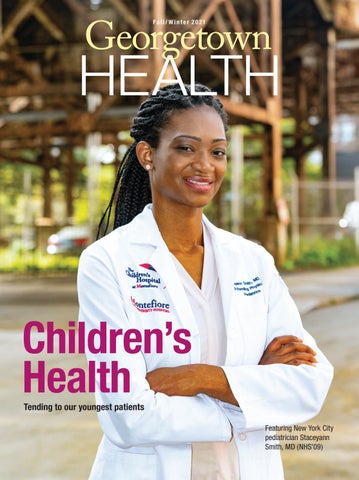
Fall / Winter 2021
Children’s Health Tending to our youngest patients
Featuring New York City pediatrician Staceyann Smith, MD (NHS’09)
FALL/WINTER 2021
Children’s Health
8
The Impact of COVID-19 on the Young
14
Illuminating the Power of Reading on the Human Brain
2
G e o r g e t o w n H e al th
16 24
Children’s Health Equity Through Community Care Pediatric Cancer: Pathway to Hope
14
16
24
Photo: Georgetown University Special Collections
2 3 30 37 40
Editor’s Letter Check Up
News & Research
On Campus Alumni Connections Reflections on Health Emily E.B. Pagan, MD (M’97, R’00, Parent’25)
From the Archives In the summer of 1947, patients were moved via ambulance from the old Georgetown Hospital at 35th and N Streets NW to the new facility on Reservoir Road, as young neighbors look on. The former hospital, dating back to 1898, has served as an undergraduate dormitory since the 1960s.
A publication for alumni and friends of the schools and programs of Georgetown University Medical Center
Editor’s Letter
Co-Editors
As a mother of four, I have lots of memories of visits to the pediatrician. We moved seven times in the first 15 years of our marriage, so I had the privilege of getting to know a lot of different practices. We had excellent but varying care in every place, including a year in Berlin, Germany with a pediatrician who made house calls. At each birth, including one C-section, I had a midwife at my side. In every case, we had a different pediatrician welcoming the new arrival. They represented a range of generations and cultures, but our German one was legendary. My Berlin baby was born at a geburtshaus, a birthing center more like a cozy private home than a hospital. Four hours later, I was in a taxi with my newborn and my husband on our In 2005 in Washington, D.C., Helen, Albert, Jane, Mabel, and Zoe Malhotra way home to recuperate. A midwife stopped by that evening to check on us, and the pediatrician came the next day. He was gregarious and kind, even when I refused to let him take a blood sample from her temple. In fact, I nearly fainted at the idea of it. Yikes! He pricked her finger instead, a compromise that began our mutual intercultural partnership in caring for the health of the baby. The best pediatricians, pediatric nurse practitioners, and family medicine doctors know how to work with both the children and the parents to nurture families holistically, offering expertise but also listening to the patients and their caregivers. Georgetown-trained health care providers, steeped in cura personalis, make this a priority. Children’s health is complicated business, and Georgetown is involved at multiple intersections within the field. From racial and socioeconomic health disparities to advocating for children’s health coverage, from neuroscience research on language development to pediatric oncology, the university offers a range of expertise and insight. In September, a new university-wide Collaborative on Global Children’s Issues was launched, designed to foster cross-disciplinary research and dialogue on critical and emerging global children’s issues. This magazine dips into the ocean of work underway, as we take a look at some of these areas including adolescent behavioral health in the time of COVID-19. To all the folks who work in child health, we thank you. You are nurturing the precious future generation who we hope will care for us someday!
2
G e o r g e t o w n H e al th
Contributors Karen Doss Bowman, Bill Cessato (C’98, G’16), Lisa Clough, Kate Colwell (G’20), Michael Miller, Patti North, Kathleen O’Neil, Sara Piccini, Karen Teber, Lauren Wolkoff (G’13), Kat Zambon
Design Director Elisa Morsch (G’20)
Design Team Shikha Savdas
Project Manager Hilary Koss
University Photographer Phil Humnicky
Executive Vice President for Health Sciences and Executive Dean Edward B. Healton, MD, MPH
Dean for Medical Education Georgetown University School of Medicine Lee Jones, MD
Interim Dean School of Nursing & Health Studies John T. Monahan, JD (C’83, L’87)
Senior Dean Biomedical Graduate Education Anna T. Riegel, PhD
Georgetown Health is published by the Georgetown University Office of Advancement Communications. Visit online at alumni.georgetown.edu/health-magazine. The magazine welcomes inquiries, opinions, and comments from its readers. Address correspondence to healthmagazine@georgetown.edu or: Jane Varner Malhotra, Editor Georgetown Health Office of Advancement P.O. Box 571253 Washington, DC 20057-1253 For address changes contact alumni records addup@georgetown.edu or 202-687-1994. Photo: Amit Malhotra
Jane Varner Malhotra Co-editor, Georgetown Health
Jane Varner Malhotra (G’21) Camille Scarborough
For information on Georgetown events and alumni news on campus and around the world, visit alumni.georgetown.edu. © 2021 Georgetown University On the cover: Pediatrician Staceyann Smith, MD (NHS’09) cares for young patients and their families in the Bronx.
C HECK UP
Coming Soon
Philanthropy brings state-of-the-art technology to new Medical/Surgical Pavilion By Camille Scarborough and Lisa Clough
Image: Shalom Baranes Associates
The new Medical/Surgical Pavilion will feature technology like this new iMRI suite. Construction is scheduled for completion in 2023. n n If you drive up Reservoir Road, you may hear the construction before it comes into view. Work is now in progress on one of the largest health care projects in the region: the new Medical/Surgical Pavilion at MedStar Georgetown University Hospital. Comprising 477,213 square feet, the pavilion will feature 156 private patient rooms, a rooftop helipad with direct access to 31 stateof-the-art operating rooms, and 32 exam rooms in a modernized emergency department. In December 2020, MedStar Georgetown University Hospital received $10 million from Shelley and Allan Holt, its largest gift ever, to establish one of the first intraoperative MRI (iMRI) surgical suites in the region. “I am indebted to the Holts for their visionary investment to support the iMRI suite in the new pavilion,” said Christopher Kalhorn, MD, professor of clinical neurosurgery at Georgetown’s School of Medicine, co-director of the Movement Disorders Program, director of epilepsy, pediatric, and functional Neurosurgery Program at MedStar Georgetown, and MedStar Health board member. “Intraoperative MRI allows for real-time brain imaging while the patient is in the operating room, which improves accuracy and shortens surgical time. This technology will greatly benefit our patients with Parkinson’s disease, brain tumors, epilepsy, and more.”
The Holts reside in Georgetown and are devoted philanthropists to causes that focus on innovation, education, and advancing the community in which they live. They gave to the COVID-19 Response Fund and Shelley Holt serves on the hospital’s Board of Directors. “Our commitment holds great significance for me because I started my career at Georgetown University Hospital and am honored now to serve on the MedStar Georgetown Board of Directors,” said Shelley Holt. “Allan and I have been impressed by their perpetual drive to advance the future of medicine, scholarly achievement, and access to care for all. We hope our gift for the new pavilion will encourage others to support it as they can.” Another leadership gift came in summer 2021 from Claire and Tom Joyce. Their $5 million will bolster the pavilion campaign as well as the Georgetown Scholars Program (GSP) Necessity Fund, a fund that provides a robust, permanent source of microgrants for undergraduates with the greatest financial need—enabling them to focus on academic achievement and the college experience. Tom Joyce has served on the MedStar Health Board of Directors since 2018 and Claire has been a member of Georgetown University’s Board of Regents since 2017. She previously served as the founding director of the GSP Alumni Mentor Program. n
FALL/WINTER 2021
3
CHECK UP
Teen Tobacco Trends
A recent study points to a decline in cigarette and chewing tobacco use Despite the increase in use of e-cigarettes among adolescents, cigarette and smokeless (chewing) tobacco prevalence declined more rapidly between 2012 and 2019 than in previous periods, according to a recent study. The analysis, published in JAMA Network Open by Georgetown University and the University of Michigan shows that past 30-day and daily use of both cigarettes and smokeless tobacco fell more rapidly since 2012, even as e-cigarette use began to increase— leading to historical low levels of both cigarette use and smokeless tobacco among teens in the United States. “While the increases in e-cigarettes are indeed concerning and is something we need to address and reverse, the decreases in other tobacco products, in particular, cigarettes—the most concerning form of tobacco use—are accelerating,” said lead researcher Rafael Meza, associate professor of epidemiology and global health at Michigan’s School of Public Health. “This acceleration in the decrease occurs across grades, across races, across sexes.” The study’s senior author was David Levy, PhD, professor of oncology and a member of Georgetown Lombardi Comprehensive Cancer Center. n n
The researchers looked at long-term and recent trends in cigarette smoking and smokeless tobacco product use among adolescents by grade (8th, 10th, 12th), gender, and race. With national data from 1991-2019, they examined the use prevalence of tobacco products in the last 30 days among key socio-demographic groups, identifying change of trend years for secondary and high schools. They found that daily smoking prevalence among 12th grade boys increased 4.9% annually, 1991 to 1998, but saw annual declines of 8% between 1998 and 2006 and 1.6% from 2006 to 2012. However, from 2012 to 2019, prevalence declined at a 17% annual rate. Overall, daily smoking prevalence among 12th graders fell to about 2% by 2019. “This is an astoundingly low rate, and our goal from a public health perspective should be to keep smoking at this rate or lower,” said Georgetown’s Levy. “So I think the good news is that the rapid increase in e-cigarette use has not yet resulted in a reversal of the decreasing trends of cigarette smoking and smokeless tobacco use, and if anything, those trends have accelerated,” added Meza. n
Lost the keys again?
“It’s particularly egregious because they are trying to convince people with either normal memories or normal age-related decline that they are ill and they need a drug.”
Photo:s Unsplash
— Adriane Fugh-Berman, MD (M’88), in Kaiser Health News, speaking on an advertising campaign for a controversial new Alzheimer’s drug called Aduhelm. In July FughBerman, a Georgetown professor of pharmacology and founder of PharmedOut, co-authored an op-ed in the Baltimore Sun titled “Do we all have Alzheimer’s?”
4
G e o r g e t o w n H e al th
Supermapping the Pandemic
Two Georgetown centers find synergy in exploring COVID-19’s impact in Latin America A cross-campus collaboration between Georgetown University Medical Center and the Edmund A. Walsh School of Foreign Service is applying a holistic new lens to COVID-19 in Latin America. Drawing on each center’s unique expertise, students from the Center for Global Health Science and Security (GHSS) and the Center for Latin American Studies (CLAS) teamed up to jointly author a series of country-oriented research briefs, offering policymakers in Latin America informative new facets of the pandemic. The idea originated in 2020 with Alexandra Reichert, a research assistant for GHSS, a center led by professor and pandemic response expert Rebecca Katz, PhD, MPH. Reichert began populating the COVID Analysis and Mapping of Policies (COVID AMP), an online tool that provides user-friendly data to address the pandemic. This resource, which GHSS co-leads along with several institutions, seeks to support decision-makers in assessing how their policies and plans compare to other places, while taking into account their current COVID-19 caseloads. When Reichert began collecting Latin American data, she stumbled upon the Latin American COVID-19 Map (LACCOM), a CLAS project designed and led by Georgetown students studying international development. Supported by SFS and aligned with the mission of the newly established Georgetown Americas Institute, LACCOM is an interactive map that documents the impact of the pandemic on countries in Latin America and the Caribbean based on three rubrics: governance and the rule of law; growth and innovation; and social and cultural inclusion. Reichert saw that LACCOM represented a treasure trove of qualitative information and analysis that could complement COVID AMP and add to the global dialogue around the pandemic. “We were each telling a different side to the same story, so I thought, how can we come together to tell the whole story?” Katz supported her idea from the start. “In global health security, we are only as successful as our ability to bring in different disciplines and expertise—this is the whole purpose of what we do and why we do it at Georgetown,” Katz said. The CLAS leaders agree. “When we looked at the COVID AMP work, we thought, ‘This is a perfect match,’” said Angelo Rivero Santos, PhD,
Photo: iStock
n n
CLAS’s director of academic affairs who oversees the project. “Their map is global, which gives us the opportunity to draw comparisons across regions, but it is also specific enough to allow us to explore and understand various policies in detail.” CLAS Director Fr. Matthew Carnes, S.J., says the partnership enables LACCOM to build on its mission of asking critical questions about COVID-19’s long-term impact on Latin America, including how the pandemic will shape democratic norms, health equity, and social inclusion for years to come. n
View the interactive Latin America COVID-19 map at https://laccom.georgetown.domains/
FALL/WINTER 2021
5
CHECK UP
n n A clinical trial exploring a new treatment for breast cancer found that women with a hard-to-treat form of the disease lived longer without the disease coming back following treatment. The trial was conducted at sites around the world, including Georgetown Lombardi Comprehensive Cancer Center. “This finding represents a significant step forward and changes how we treat women with this type of cancer,” says Claudine Isaacs, MD, professor of medicine and oncology and leader of the Clinical Breast Cancer Program at Georgetown Lombardi. The results of the trial, reported online June 3 in the New England Journal of Medicine, included women with triple-negative breast cancer—an aggressive type that tests negative for three common features: estrogen receptors, progesterone receptors, and an excess of a protein called HER2. Women in the study also had inherited a mutation in their BRCA1 or BRCA2 genes, genes known to increase the risk of cancers. According to the American Cancer Society, triple-negative breast cancer accounts for Farmer, pictured with daughter Sofie, took part in the clinical trial for a triple-negative breast about 10– 15% of all breast cancers and tends cancer treatment. to be more common in women younger than age 40, who are African-American, or who “I lost the pregnancy. That was the hardest thing for me… have a BRCA1 mutation. Cancers in which any of the three to navigate two such enormous challenges at the same time,” features are present can be targeted by existing therapies. Farmer says, acknowledging the desire to share her story to Fewer treatment options exist for triple-negative breast cancer. help other women going through the same experience. The drug studied is a pill called Lynparza made by After chemotherapy and surgery, she volunteered for the AstraZeneca and Merck & Co. It was given to a group of clinical trial, but still doesn’t know if she got Lynparza or the women (about half of those in the study) after they received placebo. Farmer, now a new mom to 14-month-old Sofie, has standard surgery and chemotherapy to treat their cancer. The no signs of cancer and hit her five-year mark being cancer free other half of women in the study were given a placebo. in August 2021. In comparing the two groups, findings were so positive Her motivation to participate in the clinical trial arose from that the outcome of the study was reported earlier than a desire to contribute to the greater good of curing cancer. “I planned—more women who received the active drug lived benefited from those who volunteered for clinical trials before longer without the disease. me,” she says. “I wanted to pay that forward by participating in Brandi Durkac Farmer, 42, participated in the study. A this trial and supporting clinical research.” n Georgetown staff member, she was pregnant when she was diagnosed with triple-negative breast cancer in 2016.
6
G e o r g e t o w n H e al th
Photo: Joe Farmer
Positive News for Triple-Negative Breast Cancer Treatment
Tumor Analysis Turning Point n n Just a small number of cells found in tumors can enable and recruit other types of cells nearby, allowing the cancer to spread to other parts of the body, report Georgetown Lombardi Comprehensive Cancer Center scientists. Findings show that “enabler cells” make up about 20 percent or less of the cells in an aggressive tumor. Their small numbers may account for why they are often missed when bulk tissue analyses are used to inform therapeutic decisions. “Our novel finding goes beyond the common understanding of cancer progression as one modeled on Darwinian selection where ‘survival of the fittest’ means the predominant type of cell in a tumor dictates its outcome,” noted Anna Riegel, PhD, professor of oncology and pharmacology at Georgetown Lombardi and the corresponding author of the study. “This could have major implications for our understanding of how best to diagnose and treat certain cancers, as blocking key cancer-promoting subpopulations of cells might be a way to defeat the cancer.” The advent of advanced gene sequencing technology, coupled with the use of gene-editing CRISPR, made this finding possible. The study used alternative splicing, or cutting, of genes whereby a single gene can be spliced to code for multiple proteins. The collaborative effort included researchers at Ohio State University and Hackensack University Medical Center’s John Theurer Cancer Center, a part of Georgetown Lombardi Comprehensive Cancer Center. The researchers’ work using CRISPR in both zebrafish and mice zeroed in on cell subpopulations responsible for enabling metastasis. This led researchers to the discovery of a single RNA splicing event in the AIB1 (amplified in breast cancer 1) gene. One splice variant of the gene produced the
AIB1-Delta4 protein, which was found to be responsible for promoting communication and recruitment of surrounding cells, eventually leading to metastasis. “We propose that the detection of these enabler cells in early-stage breast cancers could predict which tumors are more aggressive and destined to metastasize,” said Ghada M. Sharif, PhD, research assistant professor at Georgetown Lombardi and first author of this finding. “Therapeutic targeting of vulnerabilities uncovered in the enabler cells, such as the splice variants, could represent a new approach to preventing malignant progression of breast cancer.” The researchers’ next step will be to conduct various single cell analyses in human tissue samples. “We are at a turning point in how we analyze tumor samples,” said Riegel. “It was unthinkable and impractical just a few years ago to look at every single cell in a tissue sample. But technology is racing ahead, and we believe that in the next few years, looking at each cell will allow us to determine which cells, even if they are small in number, are truly driving cancer progression. n
Image: Annie Cavanagh / Wellcome Collection
Predicting pandemic wildfire
“Unvaccinated individuals are efficient fuel like dry wood for the fire of future outbreaks. Vaccinated individuals are like soaked wood—while it can’t easily catch fire, if it’s surrounded by dry wood, the chances are much higher. And mobility between locations fans the outbreak like wind would a wildfire.” — Shweta Bansal, associate professor in the Department of Biology and leader of Bansal Lab, where a team of researchers have developed a county-by-county COVID-19 vaccination tracking system. VaxTrax reveals outbreak risk regions where population is high but vaccination rates are low, using data compiled by states and the Centers for Disease Control and Prevention (CDC).
FALL/WINTER 2021
7
Image: The University of Liverpool
CHILDREN’S HEALTH
The Impact of COVID-19 on the Young By Sara Piccini
I
n recent months, pediatrician Elizabeth Chawla (M’09), MD, FAAP, has treated two children for a disorder she had not encountered previously—a phobia of vomiting, resulting in a refusal to eat. “Although it’s fairly common, I’d never seen it in 10 years of practicing,” says Chawla, a primary care physician at MedStar Georgetown University Hospital’s outpatient pediatrics clinic and associate professor of clinical pediatrics at the School of Medicine. For Chawla, this phenomenon is just one piece of evidence suggesting the profound impact of the COVID-19 pandemic on children’s mental health. “We’re seeing so many anxiety symptoms in children manifesting in all different ways,” she says. She initiated a research study to verify what she has witnessed anecdotally, conducting chart reviews of clinic patients under 5 to determine if there has been a statistically significant increase in symptoms of stress during the pandemic. “It’s a very uncertain time, and even little children are picking up on that. So even if they can’t articulate that they feel worried or scared—or that the world seems chaotic— they’re showing us with these increased signs of distress.”
Photos: iStock
Laying the Groundwork Evidence suggests that the pandemic has exacerbated a disturbing trend: over the past several decades, the United States has seen a steady increase in the incidence of mental health issues among children. “More and more children are in mental health crisis at younger and younger ages,” says Matthew Biel, MD, MSc, chief of the division of child and adolescent psychiatry at MedStar Georgetown University Hospital and associate professor of clinical psychiatry and pediatrics at the
School of Medicine. He notes that the problem has been compounded by a severe shortage of mental health providers for children. In response, Biel pioneered the creation of the Integrated Mental Health Clinic within the outpatient pediatrics clinic several years ago, adding a child and adolescent psychiatrist to the roster of practitioners. He invited Chawla, who now serves as co-director, to help develop the program. Based on her own experience and reports from medical doctors nationwide, she felt it was essential to include a training component within the clinic, teaching pediatric residents how to recognize signs of mental distress and how to have an appropriate conversation with children and parents, as well as teaching intervention strategies. “The amount of engagement in the curriculum has skyrocketed during COVID—the residents have heightened appreciation of the need for knowing these skills,” she says. “I think it’s a real strength of the MedStar Georgetown University Hospital residency program. I’ve presented nationally about our model, and people really see the long-term value.” The clinic is only one of many innovative programs that Biel and other experts at Georgetown University Medical Center have developed to address pediatric mental health issues in the Washington, D.C., region and nationwide, making Georgetown especially well-positioned to help children navigate the pandemic’s unprecedented challenges. In September 2020 for example, the U.S. Department of Health and Human Services tapped Georgetown’s Center for Child and Human Development (CCHD) to co-lead a new initiative—the National Center on Health, Behavioral Health, and Safety—focused on COVID-19 recovery for children enrolled in Head Start and Early Head Start.
FALL/WINTER 2021
9
CHILDREN’S HEALTH
“We know the issues from a systems level, but also from a frontline level—from folks who have worked in Head Start for a very long time,” says Neal Horen, PhD, director of CCHD’s early childhood division. “So when the opportunity came up, people looked to us. I do think people see our center as the place that knows more about early childhood mental health as it relates to Head Start than most everybody else.”
Lives Upended When the country locked down in March 2020 at the start of the pandemic, the impact on children was mixed. “Things were all over the map in the first few months,” Biel says. “Some kids really, really struggled to navigate the disruption. Other kids actually experienced some relief, because they were having a lot of stress related to school.”
10
G e o r g e t o w n H e al th
As pandemic conditions continued to worsen, children’s lives were completely upended. In addition to coping with the extended loss of familiar routines and activities—no chatting with friends on the playground, no hugs from grandparents— they increasingly had to worry about a parent losing their job or falling ill with COVID-19. “There was a real crisis for lots of kids in lots of populations all across the country,” Biel says. For example, the Centers for Disease Control and Prevention found that from April to October 2020, U.S. hospitals reported a 24 percent increase in the proportion of mental health emergency visits for children ages 5 to 11, and a 31 percent increase for children ages 12 to 17. “Emergency rooms across the county have been full of kids requiring acute psychiatric care and oftentimes there are no services available,” Biel says. “It’s very common to hear about kids spending days or According to the National weeks waiting for a bed to Institute of Health, more than become available to treat their 140,000 U.S. children lost a psychiatric crisis.” primary or secondary caregiver due to the COVID-19 pandemic Perhaps most concerning is the trend for pre-adolescents. “Over the last 10 years, we’ve seen a general trend of increases in suicidal thoughts and even suicide attempts and completed suicides in kids younger than puberty, those who are 9, 10, 11 years old,” Biel says. “And that has been noticeably true during the pandemic as well, particularly for kids of color.” He notes that rates of suicidal behaviors have traditionally been lower among African American, Native American, and Hispanic children, but these populations are now seeing the most rapid increases. Biel, who works with school and community programs in D.C., has seen first-hand the impact of
COVID-19 on underserved communities. “There was a lot of fear and uncertainty about the ways the virus was particularly affecting communities of color, who already suffer from a lack of access to health care. There’s also been a lot of financial insecurity—parents feel that, so the kids feel that too. These factors have been a huge strain on the most vulnerable and most stressed communities in the city.”
Photos: iStock
Missed Opportunities Even for children who have managed comparatively well during the pandemic, longer-term effects are already coming into play. A recent analysis by McKinsey, for example, showed that the impact of the pandemic on K– 12 student learning was significant, leaving students on average five months behind in mathematics and four months behind in reading by the end of the 2020-21 school year. “For very young children, lots of parents have been coming into the clinic worried about developmental delay,” says Chawla. “So another study we’re doing right now is looking at that group of 5 and under to see if there are any differences between this year and last. Just looking at the preliminary data, it seems that the biggest difference is language delay. “It makes sense if you think about it,” she continues. “We have noticed that children have had an exponentially increased amount of screen time during the pandemic, especially young children. And there are already some fairly good studies showing that excessive amounts of screen time, as well as the decrease in the amount of individual interaction with adults and peers, can lead to language delay.” Biel notes that colleagues nationwide are concerned about these missed opportunities for stimulation outside the home. “I think we’ll only know over time whether it has a meaningful impact on a population level, for that cohort of kids who’ve experienced prolonged social isolation and quarantine during early developmental stages,” he says. “We know those stages are really, really important for key social and emotional skills, but we also know that kids are very pliant and resilient. There may be a great catch-up that happens if that age group is
Advice for Parents and Caregivers As the COVID-19 pandemic continues, caregivers may sometimes be at a loss in helping children cope with ongoing uncertainty in their lives. Elizabeth Chawla, MD, FAAP (M’09), a primary care physician at MedStar Georgetown University Hospital’s outpatient pediatrics clinic and associate professor of clinical pediatrics at the School of Medicine, offers three pieces of advice: 1. Be emotionally present for your children. “When kids express worries or sadness, our first instinct as caregivers is to offer some sort of reassurance—‘Oh, don’t worry everything’s going to be fine.’ But sometimes that comes across to the child like we’re dismissing or invalidating their feelings,” Chawla says. “So it’s really important to first let children know it’s a safe place to express their feelings and then offer some reassurance. That might sound more like, ‘I know you’re a little worried about Grandma. It can be scary to hear on the news that older people are likely to get more sick from COVID. But we’re going to do our best to protect her and keep her safe. That’s why we’re going to get the vaccine and only going to talk to her on FaceTime instead of going to visit her right now.’” 2. Maintain some degree of routine. “Any part of the day you can make feel normal for kids can help them feel more secure, even when the outside world feels very chaotic,” Chawla says. “That could be a particular family routine, like dad is always the one who puts the kids to bed, or we always get doughnuts for breakfast on Saturdays. Some families actually created new little rituals during the pandemic.” 3. Take care of yourself. “It’s been a really stressful year and a half for all of us. We need to make sure that we’re taking care of our own health and our own stress level, so that we can be emotionally available to our children.”
FALL/WINTER 2021
11
CHILDREN’S HEALTH
Pediatrician Elizabeth Chawla, MD, FAAP (M’09) instructs a young patient on a belly breathing technique for reducing stress.
. . . . .
. . . . .
. . . . .
. . . . . . . . . . . . . . . . . . . . . . . . . . . . . . . . . . . . . . . . . . . . . . . . . . . . . . . . . . . . . . . . . . . . . . . . . . . . . . . . . . . . . “What we’ve emphasized as a national center is you can’t talk
. . . . .
. . . . .
. . . . .
. . . . .
about health and safety without talking about mental health.”
reintroduced to more stimulating environments. That’s why this fall is so important. We’re all on pins and needles hoping that schools will be able to stay open.”
Caring for the Caregivers Children, of course, are dependent on adults. If an adult— whether a parent, caregiver, teacher, or health care provider— is not doing well themselves, they very often do not have the emotional resources necessary to meet a child’s needs. Georgetown has built an extensive infrastructure of programs to support professionals in the field, both on the regional and national level, which have gone into high gear during the pandemic. “We’ve done a great deal of work on disaster recovery over the years, so it’s very much akin to that in terms of being an emergency response,” says Neal Horen of the new Head Start national center that CCHD is co-leading. The center is conducting ongoing professional development training for the 12 Head Start regions in the country, which include the Tribal and Migrant and
12
G e o r g e t o w n H e al th
Seasonal Head Start programs. It is also developing a host of educational materials on how to address the mental health aspects of the pandemic. “Our partner on this, the Educational Development Center, is the health and safety side of our national center, and we’re the mental health side,” he says. “What we’ve done as a center is to say, it’s all connected. We did a lot of work after Hurricanes Maria and Irma in Puerto Rico and the Virgin Islands, and one of the things we’ve learned is that oftentimes people neglect to address mental health, particularly for the staff in Head Start. “Every single time we asked a staff member how they were doing, they would say, ‘I’m doing awful, I haven’t been able to address my own wellness,’” Horen says. “Similarly with this pandemic, what we’ve emphasized as a national center is you can’t talk about health and safety without talking about mental health. In our training, for example, we discuss how to address vaccine confidence, which is really a mental health issue,” he says.
Photo: Kirsten Hawkins, MD, MPH
. . . . .
In the Washington, D.C., region, the WISE Center (Center for Wellbeing in School Environments), a multidisciplinary mental health team at MedStar Georgetown, has provided invaluable support not only to students, but also to parents and teachers, throughout the pandemic. Both Biel and Horen are part of the WISE team. “We provide services in over 50 public schools in D.C., and we maintained those services all throughout COVID,” Biel says. The WISE Center had already developed programs focused on adult well-being, and continued that emphasis during the pandemic, addressing issues such as teacher burnout. “Teaching and parenting are very difficult jobs—it requires all of you. It can be rewarding, but it can also be very draining,” Biel says. “One of the key findings with stress and adversity is that your kids are going to do better when you take better care of yourself. It’s an extension of the view that you put on your own oxygen mask before you put it on your child when you’re on an airplane.” He adds that when navigating adversity it’s important to “establish a narrative about that adversity: who is my community, what are we going through, what are our sources of support and help during times of trouble? Applying that to COVID, it’s been really helpful as well,” he says. “Here are healthy ways to cope with the stuff that life is throwing at you, here are people you can rely on, here are things that I know help me personally navigate my own stress, whether it’s exercise or listening to music.” Providing access to and reducing stigma around therapy is also critical, he notes. “We’re doing therapy for teachers in schools, and therapy for parents in our child psychiatry clinic—helping them recognize that part of getting my kid help is getting myself help.”
Photo: Leslie E. Kossoff
Addressing Inequity The pandemic has brought much-needed attention to the nation’s lack of resources for children’s mental health and health equity issues more broadly. “We as a center have an opportunity to really contribute to a much larger body of work that lots of folks at Georgetown have been attempting to address around health equity, within the District and on a national level,” says Horen. “It’s an opportunity to really dig in and work on these issues.” “This topic is on the minds of policymakers and families all over the country,” says Biel. “The winds are blowing— between COVID-19 and the long overdue attention on the impact of race on health—to make this an unavoidable topic. We have to do a better job of solving this as a society. We need to take better care of our kids.” n
Pediatrics Team Optimizes Collaboration Across University By Karen Teber
In an academic setting—especially at a university like Georgetown with its deep and broad disciplines in law, public policy, health care, nursing, medicine, and business—it’s easy to become hyper focused or even siloed, unaware of the common thread weaving among colleagues working within a few neighborhood blocks. That’s exactly the experience for many researchers at Georgetown who recognize that addressing the most difficult challenges facing children today requires a multipronged, multidisciplinary approach to finding solutions.
Pediatrics chair Michael Donnelly, MD, speaks at the Georgetown Pediatrics Gala in April 2019
With the goal of leveraging the many pockets of work involving the betterment of children across the university, Michael Donnelly, MD, chair of pediatrics, has set out to create a repository—a complete and robust catalogue of the Georgetown projects and programs involving work around children. This new initiative will be chaired by pediatrics professor Phyllis Magrab, PhD, director of the Georgetown University Center for Child and Human Development. Under Magrab’s leadership, the steering group met in October to name it the Georgetown Collaborative for Research and Education to Advance Children’s Health, or GC-REACH. “By putting people together who work on similar issues, we create a synergy that allows us to apply for grants and start projects that we never would have attempted before,” says Donnelly. “I’m looking forward to us coming together in a more multidisciplinary way to focus on the important work of advancing children’s health.”
FALL/WINTER 2021
13
CHILDREN’S HEALTH
Illuminating the Power of Reading on the Human Brain By Kate Colwell and Kathleen O’Neil
I
up words. They are currently analyzing data that compare neural activity in children with dyslexia before and after they receive tutoring to improve their reading ability. The regions of the brain that “are activated in children who read well are found not to be activated as much in children who have dyslexia,” Eden says. In a prior study of adults with dyslexia, Eden and her team found that after a reading intervention, multiple areas of the brain became more active. “It’s similar to what is reported in stroke patients, where a region takes over the job of its neighbor,” Eden says. Eden and her team continue to parse the results for insights about brain plasticity, and to visualize which areas of the brain activate during reading in adults and children with and without dyslexia. “You can literally see how the educational experience changes our brains to be better attuned to words,” she says. n Photos: Alex Alvarado, courtesy of The DoSeum
n the DoSeum, a children’s museum in San Antonio, Texas, kids danced under the lights of a human brain. As they danced, 36 acrylic orbs hanging from the ceiling in two hemispheres became more intense shades of blue, orange, and pink that flashed faster to match the movement below. This interactive sculpture in the exhibit “Beautiful Minds: Dyslexia and the Creative Advantage” illustrated how, as people learn to read, their neural activity increases. Photojournalist and artist Sarah Sudhoff created the sculpture using data from Guinevere Eden, PhD, a Georgetown University professor of pediatrics and the director of the Center for the Study of Learning. Eden and postdoctoral fellow Anna Matejko, PhD, study the effects of reading on brain plasticity by using an fMRI to measure brain activity during two four-minute scans while the children viewed real and made-
14
G e o r g e t o w n H e al th
An interactive art exhibit entitled “Beautiful Minds: Dyslexia and the Creative Advantage” illustrates how, as people learn to read, their neural activity increases.
FALL/WINTER 2021
15
Children’s Health Equity Through Community Care Answering the call to serve families in need
By Jane Varner Malhotra
CHILDREN’S HEALTH
W
Photo: Shutterstock
hen Staceyann Smith, MD, MPH (NHS’09), began practicing pediatrics in the Bronx, New York City’s northernmost borough, she knew she was choosing a challenging path. As a daughter of immigrants, she wanted to serve a community with great need. The families she works with face daily hardships that can make even getting to a routine doctor visit difficult. “We see only a snapshot of how much some families deal with,” she says. “We have to try and support them as best we can.” Many of her patients come from single-parent households, many are struggling immigrant families, and many are living in poverty. They face racial bias on a daily basis, Smith adds, compounding socioeconomic adversity with discrimination that can lead to significant impact on parents’ and children’s physical health.
FALL/WINTER 2021
17
A New York City native, Smith knew she wanted to practice pediatrics in her home community.
“My heart has always been here, and the more I do this work, the more I realize why.”
18
G e o r g e t o w n H e al th
In the United States, three times as many Black infants die before their first birthday as compared to white babies. Startling statistics like high infant and maternal mortality among persons of color are marked in a box and collected as data, reflecting trends both in care and in the social determinants of health for children. But behind every number is a human story, one of people struggling to survive, let alone thrive.
Addressing Systemic Inequities During her undergraduate years at Georgetown, Smith already knew she wanted to do pediatric medicine. She earned her medical degree and public health degrees at the University of Connecticut, with a focus on urban service. In medical school, she was also exposed to rural
Photo: Phil Humnicky
“We have lots of room to grow in reducing children’s health disparities,” says Smith, pointing to the high rate of COVID-19 in her community during the early months of the pandemic last year. “Look at the people who were dying here during the pandemic—it was minorities. They couldn’t leave the city. They were left with no other options. They had to pay the rent, go into work, and when one person got sick, everyone got sick. So many lost multiple people in their families.” Many of her families depend on public transit, so coming in for regular appointments is difficult. Not all parents can take a few hours off work to take their kids to the doctor’s office, and not all offices are open during hours when parents are flexible such as after work or on weekends.
CHILDREN’S HEALTH
health issues through a student-run clinic they held for migrant farm workers. But she grew up in the city, and wanted to help the children there. Today her work at the Montefiore Family Care Center enables her to provide care in an underserved urban neighborhood with a large immigrant population. “We offer a lot of resources for families,” she notes. Her clinic has an integrated behavioral health team, offering short-term mental health support. They have a nutritionist on staff, as well as a health educator, who serves as a lactation consultant, along with a community health worker and social worker. She also highlights their partnership with a legal aid office. “That’s been really important, in addition to our school health program throughout the Bronx. We offer health education, counseling, sick visits in schools—it’s a partnership to take care of kids through the school system because kids spend so much time there already.” Their clinic is connected to a community health center, with food pantries, day care, and after school programs. This support for parents and families is all part of a more holistic approach to child wellness, to help address the systemic inequities that people living in poverty face. Influenced by her childhood in the city, Smith was determined to give back and advocate for children who need the help. “I also wanted children who look like me to see a doctor who looks like them,” says Smith, who is Black. “My heart has always been here, and the more I do this work, the more I realize why.” Key to her success as a pediatrician working to eliminate health disparities for children is partnering with the community. At Georgetown, Community Pediatrics follows a similar emphasis. “For nearly three decades, MedStar Georgetown University Hospital Division of Community Pediatrics has provided place-based integrated primary care services to children and families in D.C.’s Wards 4, 5, 6, 7 and 8,” says Janine Rethy, MD, MPH, chief of community pediatrics and assistant professor of pediatrics at Georgetown University School of Medicine. The division currently operates two school-based health centers and a mobile medical clinic that parks at public housing communities chosen based on residents’ expressed interest and need. The clinics offer
A Stark Difference The School of Nursing & Health Studies has researched and compiled data on how Washington, D.C. residents are faring healthwise. The story looks rosy or bleak, depending on race, which part of the city one lives in, and other demographic classifications. Health Systems Administration Professor and Department Chair Christopher King, PhD, investigates health disparities in the nation’s capital, and in 2020 his team released Health Disparities in the Black Community: An Imperative for Racial Equity. The report reveals alarming differences in the health of District residents depending on race and ward. For children, the socioeconomic disparity is literally black and white. “In the District of Columbia, 37.5% of Black children are living at or below the federal poverty limit, compared to 1.4% of white children,” says King. “These children are living in conditions that are likely to have a harmful impact on short- and long-term health status.” Examples include unsafe housing, limited access to healthy and affordable food, and increased exposure to violence. “Poverty has a ripple effect.” “We’re all in this together,” says King, noting that despite division by race and ward, the city’s problems do not exist in isolation. Children’s health can be improved when we uplift the conditions all people are living in, through policy and leadership decisions like expanding affordable housing, says King. He’s watching with interest how the new administration’s child tax credit might help those living on the margins. “Five million kids are projected to be lifted out of poverty as a result of this tax credit” he notes. “That gives me hope.”
FALL/WINTER 2021
19
CHILDREN’S HEALTH
comprehensive primary care services with integrated mental health, nutrition, legal, and social work services. “The clinics are designed to minimize barriers to care at every touchpoint—such as financial, transportation, communication access, connection to community partners—and to foster long-term trust,” Rethy explains. Wraparound support services include partnering with D.C.based nonprofits No Kid Hungry and Power of 10 to address food insecurity by delivering meals and groceries weekly to families. Partnering with the School of Medicine’s Department of Family Medicine and Division of Child and Adolescent Psychiatry, as well as MedStar Health Research Institute and many community, nonprofit and government partners, Community Pediatrics is helping lead MedStar’s Safe Babies/Safe Moms Program. It’s a five-year $30 million initiative funded by the A. James and Alice B. Clark Foundation’s Parent Child Health Initiative to decrease maternal and infant health disparities in the District through cross-sectional health systems transformation, with a strong emphasis on addressing social determinants of health and structural racism.
Partnering for Success In addition to Community Pediatrics, Georgetown has a number of centers looking at child health, all emphasizing health equity as part of their work. The Center for Child and Human Development (CCHD) was founded over 50 years ago to improve the quality of life for all children and youth and their families, focusing on those with special needs. Today, driven by Georgetown’s values of social and health justice, the center partners with grassroots efforts in D.C. to transform health systems and support health equity for children in the District. Children’s health begins before birth, of course, and Black maternal and child health disparities reveal persistent inequities. For example, in D.C., Black women give birth to a preterm or low birth weight baby at nearly twice the rate as their white peers. To help address the gap, CCHD supports maternal health work with local grassroots partners like Mamatoto Village, says Professor Deborah Perry, director of research and evaluation.
20
G e o r g e t o w n H e al th
“We help elevate their home visiting program called Mothers Rising, which seeks to reduce disparities around breastfeeding and low birth weight. The program is run by Black women doing really innovative care with perinatal health workers, who are a cross between community health workers and doulas.” Another longtime community partner of CCHD is Mary’s Center, founded by Georgetown alum Maria Gomez (NHS’77). They offer a program called Centering Pregnancy focusing on prenatal care as a bridge to parenthood. And Community of Hope is a CCHD partner implementing community-based doulas in areas east of the Anacostia River. The center helps these local efforts innovate and thrive by supporting their research and evaluation, supported by the D.C. Department of Health. Within Georgetown, CCHD supports the Health Justice Alliance (HJA), which is a partnership between the Law and Medical Centers. One cornerstone of this work is the HJA Law Clinic in which a group of 12-14 law students each semester partner with Community Pediatrics and fourth year medical students to help address health inequities through a medical-legal partnership. The HJA has achieved successful outcomes in confronting unsafe housing, environments, and landlord violations that lead to asthma and other health complications. Rethy has seen the impact firsthand. “In our clinic, almost 25% of our children have asthma, a rate three-fold higher than the national average. Why? These outcomes are the result of decades and decades of structural injustices in all sectors of public life.” She recalls a 12-year-old patient who has had asthma since he was a toddler. Over the last few years, his symptoms grew worse and required several trips to the emergency room, despite increased medication. “Then we started doing universal screening for social determinants of health and found out the family had significant mold and rodents in their apartment, and the landlord was not responding to their requests to clean it up,” says Rethy. Community Pediatrics and the Health Justice Alliance partnered with a local organization,
Breathe DC, who did a home visit with the family’s permission, and was able to document the environment, provide short-term remediation, and worked with the landlord and D.C. Government to permanently fix the issues. His asthma improved to the point that he no longer needs inhaled steroids to control his asthma and needs only occasional albuterol treatment. His experience made a big impact on Rethy. “This story inspires and humbles me, because it highlights that our medical training is just one small part of what it takes for child health,” she notes. “We need to create sustainable community-centered models that can see and address root causes. Day to day our team takes this approach one family at a time until the child and family have their needs met.” Phyllis Magrab, PhD, pediatrics professor and director of CCHD, and Lucile Adams-Campbell, PhD, co-chair the University-Wide Initiative to Reduce Health Disparities, which was launched in 2012 to amplify research, service,
and outreach related to health disparities through the development of a campus-wide network and the creation of new opportunities for collaboration and community engagement. Today over 100 faculty are active members of the effort. Magrab says she’s heartened that public awareness around health disparities has grown over the past decade, with more data being collected and innovative solutions being implemented. Her colleague Perry cites a challenge academics have faced known as the “17-year gap”—the long time that it takes from research to impact, for knowledge about effective interventions generated from randomized controlled trials to be reflected in the care that people get in communities. “Many of us have gotten impatient with that gap,” says Perry. “We have sought to partner with local organizations to bring interventions more quickly to scale in communities, providing training and technical assistance too.”
“When you partner with the community, people are more likely to come to you for help.”
Rethy helps train the next generation of physicians at a recent mobile clinic in the District.
FALL/WINTER 2021
21
CHILDREN’S HEALTH
A Family Affair “It’s important to not just look at child health in isolation,” says Perry. “We need to think about it in the context of the family and in the context of community.” For those working in the field of children’s health, Smith recommends a close relationship with the patients’ community in order to have a positive impact on families. “When you partner with the community, people are more likely to come to you for help,” she says. “In this last year after George Floyd’s death, you saw people at our hospital standing with each other and supporting each other. We have so much violence going on in the Bronx. When tragedies happen, speaking up and making your voice known in the community can have a positive impact.”
The job of a pediatrician is more than just seeing patients. “As doctors in communities, we’re not just coming to work and going home,” Smith says. “Through mentoring, providing resources, donating diapers, starting a food pantry—it doesn’t have to be a large gesture, but when things happen that impact your community, speak up, do what you can to support the community. Fundraise, donate, present at the school or community center, or offer programs within the parks or places where people gather. Partner with programs that already exist like the Boys and Girls Club or a health program, mentor in health, or collect funds for the pantry.” For many health care workers, adding more to the to-do list can be overwhelming. For herself, Smith says what is essential is remembering why she went into medicine in the first place.
“The clinics are designed to minimize barriers to care at every touchpoint—such as financial, transportation, communication access, connection to community partners—and to foster long-term trust.”
For nearly 30 years, the Kids Mobile Medical Clinic has provided holistic, integrated primary care at designated sites four days a week in Washington, D.C. neighborhoods.
22
G e o r g e t o w n H e al th
“We want to help people and solve their problems, but sometimes we can’t in these overwhelming situations,” Smith says. “Listen to your patients. Families just want to be heard. Listen, be compassionate and gracious, and try not to make assumptions or judgments, because you never know the whole story. Especially in pediatrics. Parents always want to do the best for their children, even though they may not be able to in that moment.” Rethy’s idea of how to be a pediatrician has changed dramatically in the last two decades. “If you asked me 20 years ago what my pediatric practice would look like, I couldn’t have dreamed this up,” Rethy says. “We are absolutely committed to the principle that every child deserves the chance to be healthy and thrive
and we feel privileged to have the trust of our families. So our model of care has evolved, and we will do what it takes to partner with our families and our community colleagues to that end.” Smith finds hope in the resilience of the children she sees, and in the growing national conversation about social determinants of health, and building health equity. “A lot of what we see is not new. As we continue to push a little and challenge the biases and health care disparities that we see, I think the resilience in these families will help them. There’s new national awareness about it. It’s being talked about more in the media. COVID-19 highlighted where we still need work, and I have hope we’ll make progress.” n
Insuring Kids Health Georgetown’s Center for Children and Families studies health coverage in the U.S.
On the surface, the last 10 years of data show a promising reduction in rates of uninsured children in the United States, down from 9.7% in 2008 to 5.7% in 2019. But the broad figures mask some setbacks in recent years and a closer look is needed to truly understand child health coverage trends, says Kelly Whitener, associate professor with Georgetown’s Center for Children and Families at the McCourt School of Public Policy’s Health Policy Institute.
available, causing a drop in enrollment, says Whitener. Then some states and the Trump administration added bureaucratic hurdles and rule changes that led to a chilling effect for immigrant families that compounded the problem.
Medicaid and CHIP together are the largest and most important sources of health coverage for children—covering more than 38 million kids. Whitener says it’s critical that state and federal policymakers focus on connecting more children with the health Whitener notes that “coverage rates depend on state residency— coverage they need to support their healthy development. Health care providers have an opportunity to advocate for their Medicaid some do a better job covering kids than others.” For example in and CHIP patients by supporting streamlined eligibility and 2019, just 1.5% of children in Massachusetts were uninsured, enrollment processes to make sure children get and stay covered. while in Wyoming the number was 10.6%. There are major inequities by race and ethnicity, as well, with the biggest gaps for “Research shows that having health coverage as a child has lifelong, positive impacts such as improved health, improved educational American Indian and Hispanic/Latinx children. Although 5.7% of outcomes, and higher paying jobs in adulthood,” she says. all children were uninsured in 2019, 13.8% of American Indian and 9.2% of Latinx children were without coverage, she says. Other strategies to help cover more children include filling eligibility gaps related to immigration status and for families “American Indian coverage is complicated by the role of the with moderate incomes who can’t afford policies offered by Indian Health Service, which is really important for Indigenous their employer; streamlining policies to make it easier for those American health,” Whitener notes. “It is valued by the tribes who are currently eligible to enroll and stay covered; expanding I’ve worked with, for many reasons including clinics which are outreach and education campaigns; and covering more parents culturally appropriate. But they are inadequately funded.” and caretakers. Meanwhile, Congressional debate in 2017 about the future of the Affordable Care Act led many to believe that Medicaid and For more information, check out ccf.georgetown.edu the Children’s Health Insurance Program (CHIP) were no longer
FALL/WINTER 2021
23
Pathway to Hope Georgetown Lombardi Comprehensive Cancer Center’s youngest patients receive research-guided, holistic care throughout the cancer journey
By Karen Doss Bowman
CHILDREN’S HEALTH
J
effrey Toretsky, MD, hasn’t forgotten one of the first young cancer patients he encountered. As an undergraduate at the University of Wisconsin in the early 1980s, Toretsky volunteered in a pediatric oncology clinic, where he met a young patient—just a freshman in college—with Ewing sarcoma, a rare type of cancer that forms in the bones and surrounding soft tissue. The patient died a few months later, on the day after Christmas. Years later, as a fellow in pediatric oncology, Toretsky worked with more patients who had Ewing sarcoma. Eventually, many succumbed to the disease, he recalls. “My experiences witnessing these patients with Ewing sarcoma dying left me with a very strong sense that we needed to do better for this disease,” says Toretsky, division chief of Pediatric, Adolescent, and Young Adult Hematology and Oncology, and professor of Oncology and Pediatrics at Georgetown Lombardi Comprehensive Cancer Center. “People wonder how I can be a cancer doctor. How can I get up every day and face some of these challenges? One of the reasons is because as a researcher, I’m directly involved in thinking about, and creating, the next generation of drugs that will provide hope for those patients.”
Image: Elisa Morsch
Cura Personalis for the Childhood Cancer Journey
Thanks to promising advances in pediatric cancer treatments in recent years, there is reason for optimism: The overall 5-year survival rate for children with cancer is around 84 percent, according to the American Cancer Society. In comparison, only 58 percent of children survived for five years or more after a cancer diagnosis during the mid-1970s. Of course, outcomes depend on many factors, including the type of malignancy. Childhood cancers are rare. Even so, cancer is the number one cause of death from disease among children and adolescents in the United States. At Georgetown Lombardi, the concept of cura personalis, or “care of the whole person,” is central to the patient experience— for both children and adults. While the goal of treatment is physical healing, each child’s need for emotional and spiritual comfort also is paramount throughout the cancer journey.
FALL/WINTER 2021
25
CHILDREN’S HEALTH
“One of my goals is to figure out who is not responding to the therapy and why—and that’s really the challenge with any drug development.” The National Cancer Institute (NCI) identifies three critical areas of focus for childhood cancer scholarship: basic research, clinical research, and survivorship. In addition, the NCI recognizes that about 89,000 young people (ages 15 to 39) are diagnosed with cancer each year in the United States, and these adolescent and young adult (AYA) patients require improved outcomes as well as psychosocial support. To address this, MedStar Georgetown University Hospital’s Division of Pediatric, Adolescent, and Young Adult Hematology/Oncology, where Toretsky sees patients, is home to a passionate and diverse team of researchers and clinicians dedicated to the discovery of new therapies and approaches to care.
The Search for Answers Basic research is focused on understanding how cancer develops, grows, and spreads in the body.
26
G e o r g e t o w n H e al th
For some of Georgetown’s tiniest patients, the cancer journey begins in the womb. For example, neuroblastoma—a type of cancer that forms in developing nerve cells—is sometimes detected during routine fetal ultrasounds. The disease is usually diagnosed before age 5. Joanna Kitlinska, PhD, has studied the mechanisms of neuroblastoma and Ewing sarcoma over the past two decades. Much of her work is focused on the role of the protein neuropeptide Y (NPY )—a normal sympathetic neurotransmitter involved in numerous physiological processes, including stress—in the growth and progression of these malignancies. Through clinical studies, Kitlinska and her colleagues found that elevated NPY levels in tissue donated from patients with neuroblastoma correlated with metastatic disease, future relapse, and
poor survival rates. These results were published in 2016, and similar results in patients with Ewing sarcoma were published a year earlier. “No NPY-based therapies have been tested in these patients, but we hope that our studies will lead to such clinical studies,” says Kitlinska, associate professor, Department of Biochemistry and Molecular and Cellular Biology, and a Georgetown Lombardi researcher. “Our data indicate that in both neuroblastoma and Ewing sarcoma, NPY facilitates disease progression to the metastatic and therapy-resistant phenotype. We propose that NPY receptor antagonists could prevent these processes. One of [these drugs] is already FDA-approved for non-oncological disorders.” The discovery of NPY’s involvement in tumor growth sparked Kitlinska’s interest in the connection between parental stress and neuroblastoma development. While the role of maternal lifestyle factors in fetal development is well-established through research, Kitlinska and her Georgetown Lombardi colleague, Sonia de Assis, PhD, assistant professor of oncology, are looking at the paternal factors. Mouse studies have revealed that paternal age, weight, diet, and psychological stress may trigger genetic changes that may be passed down from one generation of mice to the next. Her lab currently is examining the impact of maternal stress during pregnancy and paternal anxiety before conception on cancer development in their offspring. “If our research on the effect of the parental lifestyle changes on the risk and malignancy of neuroblastoma brings
Lifestyle Medicine Improving quality of life for adolescent and young adult cancer patients and survivors
some promising results, working with families with increased risk of this disease—such as carriers of the genetic mutations predisposing to neuroblastoma— may become an important element of our future work,” Kitlinska says.
Quest for a Cure For more than 20 years, Toretsky and his colleagues have tried to solve a complicated jigsaw puzzle. Their Clinical research tests new drugs method seems for effectiveness and safety. strange: Instead of letting the pieces fit together to build a complete picture (a cancer), they’ve invented a “dummy piece”—one that would interlock with a specific puzzle piece that leads to cancer and blocks it from other pieces. That’s how Toretsky describes his lab’s work that led to the development of a molecule to attack a genetic target in Ewing sarcoma cells. “In order for the cancer to grow, the correct puzzle pieces must find each other,” Toretsky says. “We basically created a puzzle piece that would block the real ones from attaching correctly to one another.” The genetic mutation EWS-FLI1 gives rise to Ewing sarcoma. In 2006, Toretsky and his team discovered that the abnormal protein binds to another protein (the puzzle piece), RNA helicase A (RHA), facilitating cancer progression. Toretsky and his Georgetown Lombardi colleague Aykut Üren, PhD, professor in the Oncology and Biochemistry and Molecular & Cellular Biology departments, created YK-4-279, a chemical that blocks EWS-FLI1 (the cancer-driving puzzle piece) in the lab. Their work on YK-4-279 led to the development of TK216, a first-in-class small molecule that is now being tested in phase 2 clinical trials at eight medical centers around the country.* *Note: Georgetown has licensed the technology directed to EWS-FLI blockers to a company. Toretsky and Üren are listed as inventors on several Georgetown-owned patents directed to the technology and both hold equity shares in the company. Toretsky is also a paid scientific advisor to the company.
As director of the Adolescent & Young Adult Integrative Oncology Initiative, M. Miles Braun, MD, MPH, brings a research-based, holistic approach to improving health and quality of life for adolescent and young adult (AYA) cancer patients, survivors, and caregivers. Integrative oncology, which Braun describes as largely “lifestyle medicine,” uses evidence-informed mind-body modalities such as acupuncture, therapeutic massage, yoga, meditation, and Tai Chi to help patients and caregivers cope with the anxiety, fear, trauma, and physical discomfort associated with cancer diagnosis and treatment. The approach encourages healthy habits such as good nutrition, sleep, exercise, reduction of stress, and forming social connections. “We’re not curing cancer, but we’re helping patients and survivors manage pain, sleep better, reduce anxiety, and manage nutrition,” says Braun, an adjunct professor in the Department of Oncology. Braun is collaborating with Tracy Councill, Georgetown Lombardi art therapist and founder of Tracy’s Kids, to explore the effects of art therapy on cancer patients. The project was set to begin last year but put on hold due to COVID-19. Research has shown that art therapy offers benefits such as self-expression, confidence-building, processing emotions, and understanding one’s health. Braun has published over 100 scientific articles in the areas of vaccine and drug safety, causes of cancer and tuberculosis, and HIV infection. At Georgetown, he is now focused on directly helping patients and building the integrative oncology program—a passion driven in part by practicing and benefitting from yoga for more than 25 years. “This approach is very personalized,” says Braun, a former scientist with the Centers for Disease Control and U.S. Food and Drug Administration, who has been a registered yoga instructor. “The cancer journey is such a challenging road, and we can help people have healthy bodies and minds as they go through it.”
FALL/WINTER 2021
27
CHILDREN’S HEALTH
“We provided the basis on which the first targeted therapy was created and is now being studied for this rare cancer,” Toretsky says. “One of my goals is to figure out who is not responding to the therapy and why—and that’s really the challenge with any drug development.”
From Surviving to Thriving
Survivorship research focuses on reducing the long-term adverse effects of cancer and cancer therapies.
“Cancer care is a journey—not an event,” says Nina S. Kadan-Lottick, MD, MSPH, director of the Survivorship Research Initiative at Georgetown Lombardi and professor of oncology and pediatrics. Even after a patient finishes cancer treatments, they need long-term support to manage adverse effects of therapies, psychological needs, return to school or work, and financial concerns. Patients are taught that good nutrition and physical activity can improve the effects of cancer therapy. These services may include screening for post-traumatic stress syndrome, anxiety, or depression. Female patients at risk for early menopause are counseled on issues regarding future childbearing. This area of care, known as survivorship, focuses on physical, emotional, and spiritual wellness. “The whole goal of being treated for cancer is to live the best life possible—that’s why patients go through cancer treatment,” says Kadan-Lottick, a nationally recognized scholar of issues facing cancer survivors. “There’s more to cancer care than being cancer free. It also has to do with recovering one’s body and one’s mental spirit, and then going forward and to have lifestyle behaviors that optimize your health.” Much of Kadan-Lottick’s work is focused on a subgroup within pediatrics: adolescents and
young adults (AYA). This population, which includes patients from age 15 to 39, often has the same types of pediatric tumors that affect younger children. Though they may have the cognitive ability to understand their cancer experiences, these young people have unique needs based on their stage of development. “These young people may need support to learn self-management of medications, how to self-advocate, and how to communicate their needs to doctors and nurses,” says Kadan-Lottick, adding that AYAs are poorly represented in clinical research. “We need to help them in very practical ways with life skills as they are facing cancer just as they are becoming adults.” Kadan-Lottick is the principal investigator of a national study to improve physical activity in AYAs. The participants, aged 15 to 21, wear a Fitbit and receive individual coaching texts each week with recommendations for improving their physical activity. They also join a closed social media group with peers who are also on the survivorship journey. The study, which aims to enroll 384 patients, is open at 80 centers across the country. “We are really inspired by the messages posted by the patients on the private Instagram account,” says Kadan-Lottick, who received a National Cancer Institute Moonshot grant for the research. “They express hope and resiliency and a determination to live their best lives.” Her team is applying for a grant to adapt the study to Spanish-speaking AYA cancer survivors, a group that has not been well-represented in past studies.
“There’s more to cancer care than being cancer free. It also has to do with recovering one’s body and one’s mental spirit, and then going forward and to have lifestyle behaviors that optimize your health.” 28
G e o r g e t o w n H e al th
Only 20 percent of young cancer survivors get the recommended monitoring for late effects throughout their lives—far too few, says Kadan-Lottick. She has a project underway to engage primary care doctors in this effort. Her team will present a telehealth education session with patients and families to talk about the importance of screening for late effects. This study involves patients aged 2 to 22 years at four centers around the country that were chosen because of their high proportions of Black, Latinx, and rural patients, KadanLottick explains. These populations are underrepresented in AYA research.
Survivorship is not a destination, but a lifelong journey for patients of all ages. Kadan-Lottick envisions enhanced coordination for long-term survivor support throughout Georgetown Lombardi. “My goal is to have survivorship issues integrated in all cancer diagnoses and across the age spectrum so that providers understand that with every cancer, [it matters] what we do when the treatment ends. The choices we make on how best to care for patients can optimize quality of health and wellbeing,” Kadan-Lottick says. “We need to help each person where they are on the cancer journey.” n
Driving Research Forward on Rare Pediatric Cancers By Patti North
A member of the Georgetown Lombardi Comprehensive Cancer Center Board of Visitors, Kevin Reilly (B’91, Parent’24) is committed to increasing awareness of the lifesaving research being undertaken at Georgetown Lombardi, and raising much needed funds for pediatric cancer research. The owner and president of Alexandria (VA) Hyundai, Reilly has long been active in Hyundai Hope On Wheels. The charity, funded by Hyundai and its dealers, has given more than $172 million to pediatric cancer research and funded more than 800 research projects. As chair of the Washington Area New Automobile Dealers Association Board of Directors, owner and producer of the Washington Auto Show—the largest indoor public event in Washington, D.C.—Reilly convinced local Hyundai dealers to change up the auto show’s longstanding “Hands On” competition to feature Georgetown Lombardi and Children’s National Hospital staffers as the contestants, and make a substantial contribution to pediatric cancer research. At the conclusion of the two-day “Hands on Hope” contest, the staffers who maintain contact with the car receive keys. The lucky staffer whose key starts the car wins it. The winner’s institution gets 60 percent of a $100,000 pot to fund its research, with the runner-up getting the rest. Georgetown Lombardi has come in first for the last two years, though Reilly, while a loyal Hoya to the end, makes clear that he has no idea which key will start the car. Reilly looks to integrate his support for Georgetown Lombardi and its work into all aspects of his professional life. As president of the
Georgetown alumnus and parent Kevin Reilly runs “Hands on Hope” to support Georgetown Lombardi programs.
Washington Area Hyundai Dealer Ad Association, he helped create a holiday program called “Stuff a Santa Fe” that provides toys to children undergoing pediatric cancer treatment at Georgetown Lombardi. In the face of COVID-19, the holiday program pivoted to a virtual format, raising $20,000 for Georgetown Lombardi to provide for the needs of children and their families during the holidays. “My Georgetown experience was unique on many levels, and my gratitude for that experience grows with every passing year,” he says. “‘Women and men for others’ is part of our DNA fabric and we are challenged to bring cura personalis to life every day. That Jesuit philosophy just stays with you and becomes a passion.” FALL/WINTER 2021
29
ON CAMPUS
Q&A with New Dean for Medical Education Lee Jones, MD By Jane Varner Malhotra
This summer Dean Jones joined Georgetown from the University of California, San Francisco School of Medicine, where he served as health sciences clinical professor of psychiatry and associate dean for students. He is a nationally recognized leader in areas of inclusivity, learning environments, and academic medicine. He earned his medical degree at Columbia and his undergraduate at Dartmouth College. I sat down with him in early August to see how things were going.
How has your first week been? We welcomed two classes so far. The first-year students arrived last week, and I didn’t know my way around campus so I just followed them to LA6. I thought I’d do the same thing yesterday for the second-year class but then I realized they hadn’t been to campus since they interviewed. This class was entirely virtual until the start of their second year. Incredible. Coming from California, I was surprised I didn’t see any flip flops in the crowd. I was glad I wore a tie for orientation!
What would you want Georgetown alumni in health care to know about you?
Will you be seeing patients in this new role? I’ve been advised to settle in before I start seeing patients. I will probably take six months to see how things fall into place. I’m one of those people who gets up at 4:30 every morning to exercise and be with the dogs, and then I come in to work. I’ll do some teaching, and get to know the different teams here.
Do you have a vision for what the student experience could become at Georgetown? My work nationally at the Association of American Medical Colleges has been focused on the learning environment and the student experience around inclusion, equity, and diversity. I hope to increase the sharing and dispersal of what Georgetown does so well. Our first-year class is the most diverse in medical school history. As the classes get more diverse, we need supports. People tend to think of diversity
30
G e o r g e t o w n H e al th
Jones and his husband Bill Flynn, MD, along with Angus, Emma, and Toby, enjoy a sunny afternoon on campus.
in terms of race and ethnicity and that’s very important, but there’s also geography, ability, economic standing. This year we had almost 18,000 applications, out of around 60,000 across the whole country. Almost 1 of 3 applied to Georgetown! We have the responsibility to make sure the people who come here can handle the rigors, but also be the people that they are. How do we create a learning environment that’s welcoming, inclusive, and ultimately supportive, that holds onto the part of them who we want taking care of someone we love? We need to keep moving forward with Georgetown programs like the Racial Justice Committee for Change.
What would surprise our readers about you? I’m a major extrovert, but I’m also a major homebody. My mother lives with my husband and me. If you came to my house you’d meet our English Mastiff and two Saint Bernards. I love sitting on the couch with my dogs and a cup of tea listening to music. That’s over 400 pounds of dogs, by the way. n
Photo: Phil Humnicky
I’m a firm believer in interprofessional education, team building, and collaborative care. In consultation liaison psychiatry, we take care of people in hospitals in cancer treatment, surgery, or with a preexisting psychiatric condition. I couldn’t do my job without the entire team— nursing, physical therapy, occupational therapy—because that’s how I get the total picture of what’s going on.
Health Equity Expert Named RJI Co-Director By Bill Cessato with Camille Scarborough
Derek M. Griffith, PhD, joined Georgetown University School of Nursing & Health Studies in July 2021 and will serve as founding co-director of the university’s new Racial Justice Initiative (RJI). A university-wide effort across the law, main, and medical campuses, RJI is a leading-edge, multidisciplinary research and outreach organization. Griffith will use his expertise in the fields of psychology and public health to promote health equity through the lens of ethnicity, gender, and race. Within RJI, he also will carry the title of founder and director of the Center for Research on Men’s Health Equity. Griffith says Georgetown’s strong institutional commitment is what attracted him to the directorship role. “If you look across the country and, frankly, across the globe, there are very few university-level entities that explicitly focus on race and justice, and that are seeking to intervene at the intersection of the two,” says Griffith. “I’m very interested in the factors that contribute to health inequities as well as how we actually achieve health equity,” he notes. “We’re trying to intervene to improve lives, not just study why it is bad and how bad it is.”
Griffith has focused his work—particularly in cancer and heart disease—on analyzing poor health outcomes among men, describing variations based upon race and ethnicity, and proposing multilevel intervention strategies. “There’s a very strong focus on women’s health and breast cancer, particularly community-based approaches to Black women’s health, within the cancer center,” he says. “What I hopefully will be able to bring is a complementary focus on men’s health, particularly Black men’s health.” Griffith says that he is looking forward to helping students form a strong knowledge base in psychology and public health, as well as working with RJI colleagues to create conversation and change regarding racism and justice. “If we think about racism as a system that is consistently disadvantageous to some groups and advantageous to others, we need to look at culture, policy, and law and how they intersect with health and well-being,” says Griffith. “You have to set your sights high,” he adds. “We are aspiring for this to be a global model for research, policy, and interventions to promote racial justice and racial equity.” n
Racial Justice Initiative In February 2021, Georgetown launched the Racial Justice Initiative as part of a commitment, made in 2016, to use research and scholarship to transform the systems and institutions that perpetuate inequities in health, wealth, and opportunity.
Photo: Phil Humnicky
It will serve as a place to seed and inspire the next generation of scholars and leaders addressing the vestiges of enslavement and well-being of Black, Indigenous, and people of color.
In addition to his administrative appointment at the institute, Griffith will have a primary appointment as a professor with tenure in the NHS Department of Health Systems Administration. He will have a secondary appointment in the Department of Oncology at Georgetown Lombardi Comprehensive Cancer Center.
Health and society scholar Derek Griffith will be joined by legal scholar Robin Lenhardt and performing arts scholar Anita Gonzalez as institute leaders. They will soon add a fourth faculty member from the McCourt School of Public Policy.
FALL/WINTER 2021
31
ON CAMPUS
‘Bravery and Imagination’
Convinced that a multidisciplinary approach could lead to better outcomes, John F. Potter, MD (1925–2021) established Georgetown Lombardi Comprehensive Cancer Center and directed it for almost 20 years.
On June 28, 2021, John F. Potter, MD (M’49, R’57), founder of the Georgetown Lombardi Comprehensive Cancer Center, passed away at the age of 95. His last moments were spent at MedStar Georgetown University Hospital, the site of his distinguished career as a surgeon and cancer researcher. Born on July 26, 1925, he grew up in New York and attended the College of the Holy Cross in Worcester, Massachusetts. He served as a Navy corpsman during World War II before enrolling in Georgetown School of Medicine. After his graduation in 1949, he was recalled to active duty in the Navy during the Korean War.
32
G e o r g e t o w n H e al th
Following his military service Potter spent much of the 1950s as a resident at Georgetown and a surgical oncology researcher at the National Cancer Institute (NCI). In 1960, he became a full-time professor at Georgetown University School of Medicine while continuing to work as a surgeon and researcher. When he moved into the role of Chief of Surgical Oncology at Georgetown, he decided to make a change that would resonate through the years. “In my day, cancer was treated in a multi-factoral way,” explained Potter in 2018. “I wanted to get a center established that would meld all of these disciplines into one united whole.” His vision led to a planning grant in 1968 and the formal establishment of the cancer center in 1970. That same year, Vince Lombardi—coach of the Washington football team from 1969 to 1970—came in for treatment of colorectal cancer. Potter was named the center’s inaugural director, and in 1974, NCI designated it as a Comprehensive Cancer Center. It also began carrying the name of Coach Lombardi to memorialize his fighting spirit. During his 20 years as director, Potter was a proponent of providing psychological support for cancer patients and in the 1970s helped develop a facility with a homelike atmosphere where patients could have favorite meals and visits from relatives. Georgetown Lombardi also initiated one of the country’s first “life counseling” programs for children with cancer. He was author of more than 60 studies in medical journals and in 1988 published a book for the general public, How to Improve Your Odds Against Cancer, outlining ways to protect against and cope with cancer. Potter taught at Georgetown well into the 1990s and had an advisory role with the medical school until 2015. Never forgetting his veteran community, he also helped launch the U.S. Military Cancer Institute, which was later merged into the John P. Murtha Cancer Center at Walter Reed National Military Medical Center. “Dr. Potter transformed the care of patients in the Washington, D.C., area through an act of bravery and imagination,” said Louis M. Weiner, MD, the current director of Georgetown Lombardi. n
Photo: Georgetown Lombardi Cancer Center
Remembering John F. Potter, MD | By Camille Scarborough
New Minor Unites Medicine and the Humanities Fresh Dimensions for Cura Personalis | By Patti North
Photo: Phil Humnicky
The Georgetown Medical Humanities Initiative, launched in 2019, extends classical humanities studies into the realm of disease and the art of healing. Courses are taught by faculty from the main and medical campuses, and are housed in a variety of departments including history, art and art history, anthropology, African American studies, performing arts, and women’s and gender studies. The initiative is designed to engage both undergraduate and medical students—two groups of students that typically do not have much structured interaction on campus, and the initiative also offers an event series, research mentorship, and fellowship program. The success of the initiative led to the creation of a new interdisciplinary minor called Medical Humanities, Culture, and Society. Offered for the first time in fall of 2021, the
Krishnan leads the new Medical Humanities Initiative at Georgetown, now offering an interdisciplinary minor.
minor requires three core courses and three electives, and provides students with a solid foundation in the field. Founding Director Lakshmi Krishnan, MD, PhD, is assistant professor of medicine and affiliate joint faculty member in the English department. Krishnan is also an internist, medical historian, and a medical humanities scholar who has taught classes and published papers on pandemics and health disparities. “Georgetown’s commitment to cura personalis makes it fertile terrain for medical humanities,” she says. “Health practitioners cannot treat ‘the whole patient’ without recognizing and valuing their humanity in its many facets.” The objective is to give students broad exposure to interdisciplinary humanities and a kind of toolkit they can draw upon as professionals. Those who have an affinity for art, for example, may develop the ability to more closely observe and detect nuance from a patient. Students with a closer connection to literature may be more adept at critical analysis, forming a more comprehensive patient narrative to support diagnosis. Krishnan’s aspirations for the program include not only developing better health care professionals, but helping students envision careers outside the realm of traditional practitioner—public health, for example. “Broadening the study of the human condition to dimensions beyond STEM subjects is long overdue,” says Krishnan. “We’re now in the middle of a sea change, especially in medicine. We’ve realized, at our peril, that we’ve often overlooked how culture and society affect the implementation of various medical practices.” n
“Health practitioners cannot treat ‘the whole patient’ without recognizing and valuing their humanity in its many facets.”
FALL/WINTER 2021
33
Waldman tries to bring smiles and peace-of-mind to Georgetown caregivers through virtual yoga classes.
Self-Care for Caregivers at Georgetown By Camille Scarborough with Bill Cessato
The COVID-19 pandemic has been especially difficult on people working in health care, many of whom have been working extra shifts while dealing with ongoing uncertainty. In times of great strain, it’s important to carve out moments for self-care and quiet reflection. Two recent Georgetown programs have given health care professionals the opportunity to recharge together in the spirit of cura personalis. These small moments have a large ripple effect as they return to the front lines—providing patient care, conducting scientific research, promoting public health, and managing hospital resources.
“It’s an honor to work onsite with patients, caregivers, and staff members through movement and mindfulness,” shares Waldman. “Each interaction feels like a gift, like something sacred. If I’ve given just one person a sliver of relief, creative spirit, or agency, I can end the day with a smile in my heart.”
Finding peace in restorative yoga classes For years, Alison Waldman has been working at MedStar Georgetown University Hospital as a Movement Artistin-Residence through the Lombardi Arts and Humanities Program, with her roles including yoga teacher, wellness break leader, and mindfulness guide for staff and patients alike. Through stretch breaks, accessible dance classes for multiple sclerosis (MS) patients, and even a joy-filled Day of Dance in the hospital halls, Waldman tries to bring “selfcare, kindness, and joy in the hospital experience.” On-site yoga classes before the pandemic offered a respite during busy shifts.
34
G e o r g e t o w n H e al th
ON CAMPUS
Like so many people, Waldman transitioned to telehealth during the pandemic, starting with her weekly yoga classes. Her classes were the first virtual program offered by the Georgetown Lombardi Arts and Humanities Program in spring 2020, early in the pandemic. At first they were offered only to healthcare professionals, but since fall 2020 she has invited all members of the Georgetown community. During one restorative yoga class early in the pandemic, she noticed that a pediatric physician had fallen asleep halfway through, and stayed asleep until she closed the Zoom. “He was clearly exhausted,” she says. “It showed me first-hand the stress our health care workers are under. Seeing him respond so deeply reminded me of why I do this.” Waldman sometimes worries that people have unrealistic expectations about self-care so they don’t know where to start. “It doesn’t have to be one hour and it definitely doesn’t have to be on a yoga mat,” she explains. “Self care begins with being gentle with yourself as you find the right tactic for your lifestyle. There are lots of tools out there to help you start small, like breath reminders on free apps. Try setting aside just minutes a week until the activity feels easy, and only then add on until it feels the right balance. The hardest part is showing up for yourself.” Another key component is setting a habit. Part of that process is advocating for what you need. “Tell your colleagues, your family, your peers if and how you are struggling with self-care and how they can help,” she adds. “You are probably not alone. Connect with each other and create a safe space to talk about it. The sharing can be healing on its own, and can open up a bevy of resources and accountability from each other.” Waldman will begin online workshops specifically for oncology nurses this fall and hopes to bring the MedStar Georgetown University Hospital Day of Dance back next year when it is safe to do so.
Photos: Phil Humnicky / Morgan Kulesza
“Lifting each other up” at an Ignatian retreat In spring 2021, Father Mark Bosco, S.J., vice president of the Office of Mission & Ministry, and Father Jerry Hayes, S.J., director of Ignatian programs, co-led a virtual event entitled “Caring for the Caregivers” that was attended by 150 dental, medical, and nursing alumni. Hayes says that medical and nursing graduates “have stepped into some deep waters this past year, and we cannot support them enough with our love and prayers.” “Our time together was an act of compassion toward one another. We blessed each other with our online smiles and waves,” Hayes adds. “May we continue to lift each other up as a community in prayerful support and embrace the divine we see in one another.”
“We use dance to transform a sterile space that’s devoid of personality to one pulsing with possibility,” said Movement-Artist-in-Residence Alice Waldman, who organized an annual Day of Dance prior to the pandemic. Lauren Baker Pappas (NHS’09) expresses gratitude for the presentation by the Jesuit priests, saying, “After a stressful year for everyone involved in health care, it was refreshing to connect to my spiritual self.” She adds, “St. Ignatius’ teachings and prayer give us a lot to rely on during this time, especially the prayer for generosity, ‘To give and not to count the cost, to fight and not to heed the wounds.’ I will continue to serve the Lord during this time.” n
FALL/WINTER 2021
35
ON CAMPUS
Alumnus Gift Supports Medical Research In an effort to support promising, earlystage biomedical research, for which there are limited federal dollars designated, the newly launched Georgetown University Medical Center Gap Fund will provide annual support to research that has demonstrated proof of concept and has potential to benefit society. The inaugural cohort of Medical Center Gap Fund awardees includes scientists leading projects in cancer treatment. The fund—made possible by a $1M gift from Georgetown family Bill Baker (C’54, Parent’80, ’84, ’88) and Ruth Baker (Parent’80, ’84, ’88)—will invest $50,000 to $100,000 per project to advance technologies to their next critical development milestone. Bill Baker, a longtime leader in the Georgetown community, is committed to strengthening Georgetown’s entrepreneurial ecosystem of advisors, Alumnus Baker hopes that the fund he and his wife established will act “as a catalyst for the university’s collaborators, and funders for medical growing entrepreneurial culture.” research. “It is my hope that this fund Glazer and Levi’s research involves understanding a tumor’s acts as a catalyst for the university’s microenvironment, specifically fibrosis—the development of growing entrepreneurial culture,” Baker says. “I believe it will excess extracellular matrix proteins that can contribute to a increase investments and partnerships within the university weakened immune tolerance and resistance to cancer therapy. community to create common good.” They aim to repurpose DMHCA, a drug used to treat diabetic The inaugural awardees are Jill P. Smith, MD, professor of retinopathy and kidney disease, to reduce fibrosis with the goal medicine at Georgetown, and the team of Robert Glazer, PhD, of strengthening immune response and treatment effectiveness. professor of pharmacology and oncology at the Georgetown “Fostering novel ideas at their nascent stage is the lifeblood Lombardi Comprehensive Cancer Center; and Moshe Levi, of biomedical research,” says Edward B. Healton, MD, MPH, MD, professor of biochemistry and molecular & cellular executive vice president for health sciences at the Medical Center. biology and interim dean for research at Georgetown University “For most researchers, their lifelong goal is to contribute to the Medical Center. Smith’s research is directed to biodegradable and non-toxic improvement of human health. It can be difficult to secure funds in support of fresh and promising ideas. For Gap Fund recipients, nanoparticles designed to detect and treat early stages of panthis could be a pivotal moment in very important research and creatic cancer that have a specific cellular characteristic called we are very grateful for the Bakers’ impactful gift.” n the CCK-B receptor. The targeted nanoparticle can detect pre-cancerous lesions, penetrate dense tissue around cancer that chemotherapy cannot reach, and deliver a message to shut down cancer growth and metastasis. With CCK-B receptors View this story on the web at https://giving.georgetown.edu/ being selectively overexpressed in colorectal and gastric cancer, gap-fund-gift/ for patent disclosures. To support the GUMC the nanoparticles have potential to be studied for the treatGap Fund, contact Mark Antonucci at Mark.Antonucci@ ment of these cancers as well. georgetown.edu.
36
G e o r g e t o w n H e al th
Photo: Courtesy Bill Baker
By Kate Colwell
ALUMNI CONNECTIONS
Photos: Phil Humnicky / Raphael Suanes / Errol Anderson / USATF
Memorable Moments from 2021
APRIL 2021
MAY 2021
JULY 2021
AUGUST 2021
FALL/WINTER 2021
37
ALUMNI CONNE CTIONS
Georgetown Alumnae Lead at MedStar Health The chief concern of any CNO is maintaining the health and safety of personnel. The pandemic created burnout, anxiety, and post-traumatic stress disorder among care providers. Nurses also face violence from patients and families who do not believe that the COVID-19 virus is real. “Our workforce has been under an enormous strain for a year and half now,” Eckert says. “In my forecasting, that is not going to stop for at least the next 12 to 24 months.” The MedStar Health CNOs have built a strong wellbeing infrastructure to support nursing staff with resilience coaches, specialized psychologists, and easy access to the employee assistance program. Eckert hired a director of nurse wellness for nurses in the system’s 10 hospitals and numerous clinics to organize services such as peer support and wellness breaks. Hoya alumnae leaders pictured left to right: Claire Piccirillo, Susan Kiley Eckert, Eileen Brennan Ferrell Telemedicine has also been a vital tool to reduce the transmission of Throughout the pandemic, three Georgetown University COVID-19 in hospitals and clinics. “Telehealth helped us to graduates have worked together as leaders in the MedStar keep our team strong and sturdy by limiting the number of Health system to address challenges facing the nursing potential COVID-19 patients walking in our door,” Ferrell says. workforce. Susan Kiley Eckert (NHS’78) is senior vice At MedStar Montgomery, Piccirillo has seen telemedicine president and chief nursing executive of MedStar Health, increase rapidly and have substantial impact. Eileen Brennan Ferrell (NHS’75, G’83) is chief nursing officer “Even physicians who were a little bit opposed to it were (CNO) of MedStar Georgetown University Hospital, and surprised by how well they could assess and give good care Claire Piccirillo (G’00) is CNO of MedStar Montgomery over a monitor,” Piccirillo says. Medical Center in Olney, Maryland. Looking ahead, Eckert is working with the CNOs to These alumnae meet daily to find strategic solutions to the manage labor shortages and create healthier workforce pipelines challenges of COVID-19 care. Due to the pandemic, nurses from academic institutions like Georgetown as demand for new have additional responsibilities, such as managing patients nurses increases. There are many Georgetown-trained nurses who need to transfer between hospitals. Piccirillo created a at MedStar Health who helped the community through the dedicated transportation role for internal transfers to help pandemic, she notes. ensure nurses are freed to practice at the top of their license. “Georgetown drilled into all of us that we were to be leaders “One of my biggest roles here is to continue to remove as nurses, no matter what our practice was going to be,” Eckert barriers that nurses confront as they try to give great patient says. “I think that’s why you see Georgetown nurses across the care, so that they’re able to really focus on the patient,” country being very successful in leadership positions.” n Piccirillo says.
38
G e o r g e t o w n H e al th
Photo: Phil Humnicky
By Kate Colwell
2
1
3
4
5
6
What’s in my white coat? Interview by Lauren Wolkoff
Derek “Ricky” Altema, MD (NHS’15), who received his bachelor’s degree in human science at Georgetown and his medical degree from Howard University College of Medicine, is a second-year emergency medicine resident in the University of Chicago Emergency Medicine program. I don’t actually wear a white coat, so it’s more about what’s in my fleece or backpack. A lot of my colleagues in emergency medicine do the same, and usually just wear scrubs.
Photos: Courtesy Ricky Altema
1. I pull out the same two bottles every day: a bottle of water,
which I never manage to finish because it’s so busy, and a caffeine source. In a bustling emergency department and trauma center, you’ve got to keep the tank full. A typical shift is 8 to 12 hours, and can be very draining. Of course a Tuesday afternoon is not going to be the same as a Saturday night, and that’s especially true in my hospital with a sick patient population and a good deal of penetrating trauma. 2. I’ve generally got something in my bag for a mid-shift snack, like an Uncrustable or some gummy bears. 3. I keep my pink highlighter, along with a book such as Tintinalli’s Emergency Medicine Manual. There’s tons of foundational knowledge in there. If I have any down time on a shift, I’ll try to reference it as a way of reviewing and learning from my patients.
4. In addition to my glasses, I always have my iPhone
nearby, especially the Notes app where I jot down quick learning points and UpToDate (a collection of medical and patient information). 5. If I feel like it might be a lighter day, sometimes I’ll bring my laptop to knock out some scheduling and emails. I’ve also been getting involved in other initiatives, including a research project working with our orthopedics department to enhance our familiarity with managing musculoskeletal issues. I’ve also been doing some community service with an attending physician from the South Side of Chicago through the MedCEEP (Medical Careers Exposure and Emergency Preparedness) program, which helps expose local high school students to careers in medicine. 6. I always have my AirPods. I try to walk in with a little playlist going to get me in the zone. The emergency department is a hectic and noisy place, so I like to play music on-shift to help keep me grounded. n
FALL/WINTER 2021
39
Reflections on Health
Emily E. B. Pagan, MD (M’97, R’00, Parent’25)
I was born in Brooklyn, New York, but raised on Long Island. Growing up, I was inquisitive about medical issues— I always had questions for my doctors—and wanted to help people who were hurt or sick. My mom encouraged me to become a physician. During my childhood, she recognized my potential to become a caring doctor. She and my father were self-driven and successful minority business development entrepreneurs. He passed away in an accident when I was young. My mother courageously persevered running their business and raising my brother and I with the help of my grandmother. Their determination and motivation remained within me and inspired me to become a pediatrician—the first physician in my Puerto Rican and Cuban family. I first visited Georgetown University as a high school student attending a national youth leadership development conference on campus. It felt like a home away from home. I started medical school in the Georgetown Experimental Medical Studies Program (GEMS). I met my husband, Fernando Pagan, MD (M’96, R’00, Parent’25), in medical school in 1992. He is a professor and vice chairman for the Department of Neurology at MedStar Georgetown University Hospital. We have three wonderful sons—one just started his freshman year at Georgetown. As a pediatric resident, I was working in the neonatal intensive care unit when a premature infant born in the parking lot was brought in. I worked with the team trying
40
G e o r g e t o w n H e al th
to save this child, who weighed approximately 1,000 grams. Sadly, the baby did not survive, but the experience was lifechanging for me. It gave me a deeper appreciation for the value of life, a better understanding of how physicians and other medical professionals work as a team to preserve life, the importance of technology and innovation, and the impact of compassionate care for families. In 2017, I moved to my current practice, joining Marijana Ducic, MD, FAAP, a Georgetown pediatric residency graduate who was my mentor. Medicine is about teamwork, collaborating with colleagues, and providing all-around, compassionate care for our patients. Throughout the span of my career, I’ve seen
incredible advancements in vaccinations. When I started practicing medicine, for example, the pneumococcal and meningococcal vaccines were not available. I try to educate families in my practice about how successful vaccines have been at saving lives from preventable diseases.
I was diagnosed with breast cancer in December 2020, after discovering a lump in my breast in between annual mammograms and checkups. I was diagnosed early, which saved my life. After numerous surgeries earlier this year, I’m happy to be cancer free. Since returning to work in May, I am thrilled to share my story with my patients and parents. As a pediatrician, I advocate for preventive care assessments and encourage my patients to know their bodies and trust their instincts. If
something doesn’t feel right, be proactive—talk to your doctor. That step could be lifesaving. n —Karen Doss Bowman
Photos: Phil Humnicky / iStock
Board-certified pediatrician, fellow of the American Academy of Pediatrics, and pediatrician at Virginia Pediatric and Adolescent Medicine, PLC, an Arlington, Virginia-based practice that provides care for infants, children, adolescents, and young adults
Find articles from previous issues of Georgetown Health magazine online at https://today.advancement. georgetown.edu/georgetownhealth-magazine/ Look for stories on faith and healing, health disparities, aging and transformation, mental health, and much more.
Georgetown University Office of Advancement Communications University Box 571253 Washington, DC 20057-1253 USA
The new Medical/Surgical Pavilion takes shape under sparkling blue skies, as seen from the Leavey Center. See story, page 3. For more details on the project visit https://giving.georgetown.edu/pavilion/