from the office of pl anned giv ing
Creating A Georgetown Legacy g e o rg e t o w n u n i v e r s i t y | fa l l 2 0 26 giving.georgetown.edu/planned-giving This academic year began with the
successful conclusion of the Called to Be campaign, surpassing its $3 billion goal. This milestone reflects our collective commitment to the students, faculty, and programs that define Georgetown’s Jesuit tradition of service. Your generosity is already making an impact across our campuses. Thank you for making this possible.
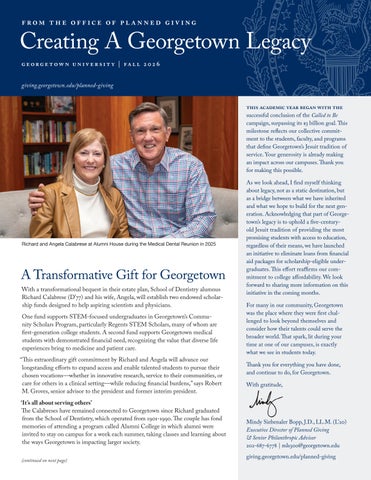
Richard and Angela Calabrese at Alumni House during the Medical Dental Reunion in 2025
A Transformative Gift for Georgetown With a transformational bequest in their estate plan, School of Dentistry alumnus Richard Calabrese (D’77) and his wife, Angela, will establish two endowed scholarship funds designed to help aspiring scientists and physicians. One fund supports STEM-focused undergraduates in Georgetown’s Community Scholars Program, particularly Regents STEM Scholars, many of whom are first-generation college students. A second fund supports Georgetown medical students with demonstrated financial need, recognizing the value that diverse life experiences bring to medicine and patient care. “This extraordinary gift commitment by Richard and Angela will advance our longstanding efforts to expand access and enable talented students to pursue their chosen vocations—whether in innovative research, service to their communities, or care for others in a clinical setting—while reducing financial burdens,” says Robert M. Groves, senior advisor to the president and former interim president. ‘It’s all about serving others’ The Calabreses have remained connected to Georgetown since Richard graduated from the School of Dentistry, which operated from 1901-1990. The couple has fond memories of attending a program called Alumni College in which alumni were invited to stay on campus for a week each summer, taking classes and learning about the ways Georgetown is impacting larger society. (continued on next page)
As we look ahead, I find myself thinking about legacy, not as a static destination, but as a bridge between what we have inherited and what we hope to build for the next generation. Acknowledging that part of Georgetown’s legacy is to uphold a five-centuryold Jesuit tradition of providing the most promising students with access to education, regardless of their means, we have launched an initiative to eliminate loans from financial aid packages for scholarship-eligible undergraduates. This effort reaffirms our commitment to college affordability. We look forward to sharing more information on this initiative in the coming months. For many in our community, Georgetown was the place where they were first challenged to look beyond themselves and consider how their talents could serve the broader world. That spark, lit during your time at one of our campuses, is exactly what we see in students today. Thank you for everything you have done, and continue to do, for Georgetown. With gratitude,
Mindy Siebenaler Bopp, J.D., LL.M. (L’20) Executive Director of Planned Giving & Senior Philanthropic Advisor 202-687-6778 | mls300@georgetown.edu giving.georgetown.edu/planned-giving
Angela and Richard Calabrese (D’77)—(continued from page 1)
“Reflecting on my journey through life, Georgetown helped me evolve into a more humanistic person,” says Richard. “When I think about the people that I met there—including summers at Alumni College—I believe in the university and the overall direction it has taken.” The couple recalls how meaningful financial assistance was to them during their undergraduate and graduate years. “A scholarship at Fordham enabled me to graduate college without a lot of debt. I also received a scholarship from Georgetown during my final year at the dental school,” shares Richard. “I was newly married and those funds made a big difference.” “We’ve been blessed,” he adds. “My hope is that we can ease the burden for young people going into a noble profession. We want them to be less stressed by the economic realities of life.”
ences of persistence and academic excellence and this gift will enable them to flourish without undue financial burdens.” Resources and hope for aspiring physicians Scholarship investment from alumni and the community is vital to ensuring passion—not debt—shapes the paths of Georgetown future physicians. Medical student debt can limit a young physician’s ability to follow their true calling in primary care, research, or service to the underserved and forcing many to choose more lucrative specialties. The gift will also create the Richard and Angela Calabrese Endowed Scholarship Fund, which will help support School of Medicine medical students with demonstrated financial need.
“This gift exemplifies a vote of confidence in the promise and potential of the next generation of healers,” says Norman J. Beauchamp Jr., M.D., MHS, executive vice president for Health Prior to this gift, the Calabreses established the Frieda and Joseph Sciences and executive dean of the School of Medicine. “Our Calabrese Memorial Endowed Scholarship Fund in memory of students often share that receiving a scholarship is not just about Richard’s parents, neither of whom were able to attend college, access to an education; it is the moment they feel seen, believed but deeply valued the importance of an education for their son. in, and called to something larger than themselves. Scholarships Richard’s mother inspired his career, and for 42 years, he ran a offer not only resources, but hope.” successful dental practice in Coral Springs, Florida. “It’s a noble profession, all about serving others,” he says.
‘Commitment to the STEM academic community’ The gift will help STEM-focused students who participate in Georgetown’s Community Scholars Program. Established in 1968, the program is a nationally recognized model for supporting the academic success of first-generation and limited-income college students. Its hallmark is a rigorous five-week summer pre-orientation on Georgetown’s campus before the first year, laying a strong foundation for their undergraduate experience. A subset of Community Scholars are designated Regents STEM Scholars, a program created to increase the number of underserved and first-generation students earning STEM degrees. Regents STEM Scholars participate in a summer research program and have access to ongoing mentorship support that prepare students for the rigor of upper-level science courses. “For over 50 years the Community Scholars Program has anchored and enriched the academic experiences of first generation college students,” says Senior Associate Dean of Students Charlene Brown-McKenzie, executive director of access and success in Georgetown’s Division of Student Affairs. “The Calabrese gift deepens our commitment to the STEM academic community for our Regents Science Scholars. Each year we admit and support tremendously talented students who demonstrate lived experi-
ge orge t ow n u n i v e r si t y Planned Giving | Fall 2026
Dates to Remember
October 9, 2026 | Georgetown Presidential Inauguration November 6–8, 2026 | Georgetown Medical & Dental Reunion April 1–4, 2027 | John Carroll Weekend, San Diego June 4–6, 2027 | Undergraduate Reunion
Preparing Medical Leaders to Forge Healthier Futures
This fall, 200 incoming Georgetown medical students gathered “Your coat is far more than a garment,” said Norman Beauchamp, for the annual White Coat Ceremony, marking the beginning of M.D., MHS, executive vice president for Health Sciences and their journey as physicians. But as the Class of 2030 received their executive dean of the School of Medicine. “It is a visible pledge white coats, the ceremony offered more than a symbolic welcome to your patients, your colleagues, and yourselves. It tells the world into the profession. It was a reminder of what Georgetown asks that you are joining a profession in which science and compassion of its physicians: To embrace cura personalis—care of the whole must walk hand in hand.” person—and approach medicine with compassion, humility, and a That spirit came to life as each student crossed the stage and commitment to service. received a handwritten note from a School of Medicine (SOM) graduate tucked inside their white coat. Through the expanded Pockets of Hoya Letters initiative, alumni shared wisdom for navigating the years ahead, reminding students that caring for themselves is essential to caring for others. Since its founding in 1851, SOM has grounded medical education in the Jesuit tradition of cura personalis. Today, that legacy continues through an education that prepares students to look beyond a diagnosis, collaborate across disciplines, and understand the people and communities they will serve. Investing in the School of Medicine means preparing compassionate, collaborative health care leaders who will shape a healthier future.
Introducing the Med/Dent Legacy Challenge
Investing in First-Generation Student Excellence
The Med/Dent Legacy Challenge invites School of Medicine and School of Dentistry alumni to include Georgetown in their estate plans and share their existing or new gifts with the university. To amplify the impact of these commitments, the challenge is anchored by a $100,000 matching gift that will provide immediate scholarship resources for the School of Medicine.
Today, more than 300 undergraduates from across the country participate in the program, making Community Scholars one of the most visible ways Georgetown lives out its Jesuit values of community in diversity, academic excellence, and cura personalis.
For generations, Georgetown University School of Medicine and School of Dentistry alumni have carried the Jesuit tradition of cura personalis—care of the whole person—into their classrooms, clinics, and communities. Now, alumni have an opportunity to help ensure that tradition continues for generations to come.
Alumni who have already included Georgetown in their estate plans can also share their gift details and have their commitment count toward the challenge, helping unlock the matching gift. Participation in the Med/Dent Legacy Challenge honors the lifelong value of a Georgetown education while helping ensure future students can experience the same transformative education grounded in service, compassion, and cura personalis. Learn more by contacting the Office of Planned Giving at plannedgiving@georgetown.edu or 800-347-8067.
Georgetown’s Community Scholars Program was established more than 50 years ago to expand access to a transformative education. What began as a local effort has evolved into one of the nation’s oldest academic initiatives for first-generation college students and a nationally recognized model for helping students from diverse backgrounds thrive.
Community Scholars graduate at a rate of 93%, nearly three times higher than their peers at universities around the country. This outcome demonstrates what is possible when talented students receive not only an opportunity to attend Georgetown, but also the resources and community to thrive. For more than 60 years, Community Scholars has demonstrated what can happen when opportunity is paired with intentional support. With your partnership, its next chapter can be even more transformative: Ensuring that talented first-generation students have not only a place at Georgetown, but every opportunity to thrive.
v isi t giving.georgetown.edu/planned-giving
Planned Gifts that Make an Impact Bequests and Beneficiary Designations:
Including a gift to Georgetown not only creates a legacy, but also helps continue the tradition of educating young people to act in the service of others. Below are two impactful ways to support Georgetown that may also have significant tax benefits. Creating a Bequest in a Will or Trust Including a bequest in your will or trust helps to ensure the future of the university while also providing flexibility in case your circumstances change in the future. Bequests can be designated to a school or program at Georgetown you feel passionately about, or can be left unrestricted and put to use where needed most.
Naming Georgetown as a Beneficiary on a Retirement Account Another easy way to leave a legacy is naming Georgetown as the beneficiary of a retirement account, life insurance policy, or brokerage account. Leaving a retirement account to a loved one other than a spouse may decrease the intended gift by as much as 70% after deducting federal and state taxes. Due to Georgetown’s nonprofit status, we realize the full value of gifts from retirement accounts while avoiding income tax, which allows you to maximize other assets for loved ones and make an impact on a school or program that is important to you.
Maximize Your IRA With a Gift for Georgetown If you are 701/2 and older, you can direct up to $111,000 (the 2026 limit) to Georgetown from an IRA using a Qualified Charitable Distribution (QCD). This option can avoid income tax and count toward any Required Minimum Distribution (if you are over 73) with the added benefit of supporting a Georgetown school or program. Learn how to make your IRA QCD gift at https://g.town/ira-qcd. Use an IRA QCD to Create Reliable Income Individuals who are 701/2 and older also have the one-time option to use $55,000 from an IRA to create a new charitable gift annuity (CGA). CGAs pay you (and/or a spouse) income for life while also leaving a gift for Georgetown in the future. Still higher interest rates make CGAs even more attractive, resulting in increased payout rates (based on the age of the beneficiary). The current rate at age 70 is 6.3%, and 8.1% at age 80. CGAs and charitable trusts can also be created outside the IRA option using cash or appreciated securities, which may provide added tax benefits like avoiding capital gains tax. If you are interested in learning more about how a CGA or
charitable trust can provide an income stream for you and loved ones and also support Georgetown, please contact the Office of Planned Giving at 800-347-8067 or plannedgiving@ georgetown.edu. Fund a Testamentary Trust With A Retirement Account Another way to maximize your retirement account(s) is to use them to create a Charitable Remainder Trust (CRT) for your children. The elimination of the stretch IRA means that non-spousal beneficiaries must take the funds in full within 10 years, which often results in substantial tax liabilities that can reduce the amount received by your heirs by up to 70%. Alternatively, a CRT funded with retirement assets can make distributions over your children’s lifetimes and avoid state and federal income taxes while supporting Georgetown. Using an IRA to establish a CRT for loved ones is a powerful estate planning strategy that can provide your loved ones with a tax-efficient income stream, support Georgetown, and ensure your legacy endures for generations to come.
Creating Your Legacy is a helpful resource as you begin the estate planning process. Scan the QR code, return the response card, or visit giving.georgetown.edu/planned-giving to request a copy.
Office of Planned Giving | 2115 Wisconsin Ave. NW, Suite 500 | Washington, DC 20007 800-347-8067 | plannedgiving@georgetown.edu | giving.georgetown.edu/planned-giving