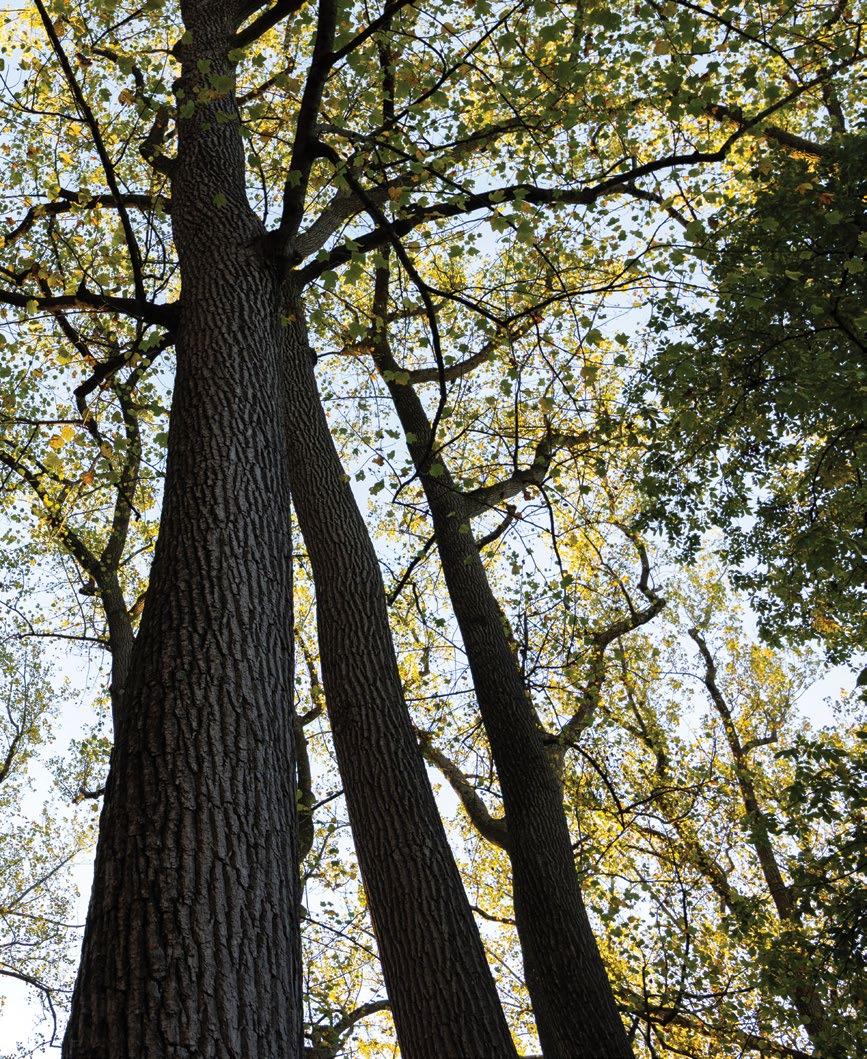
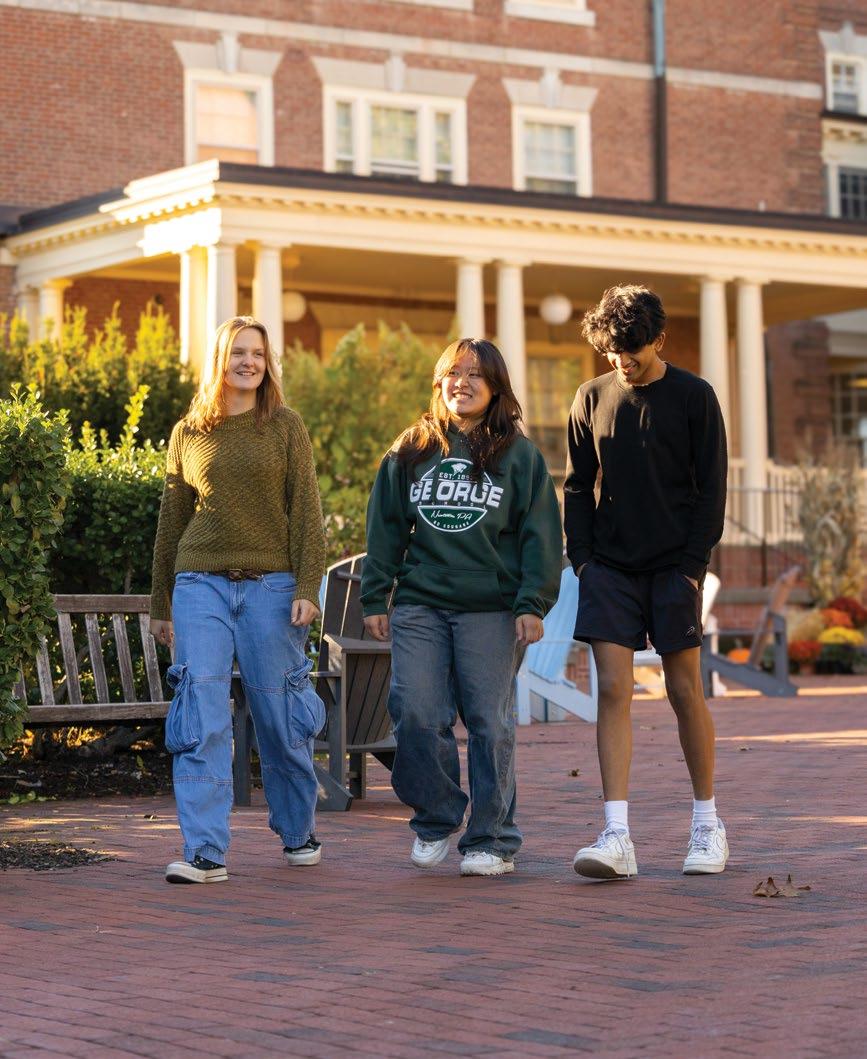
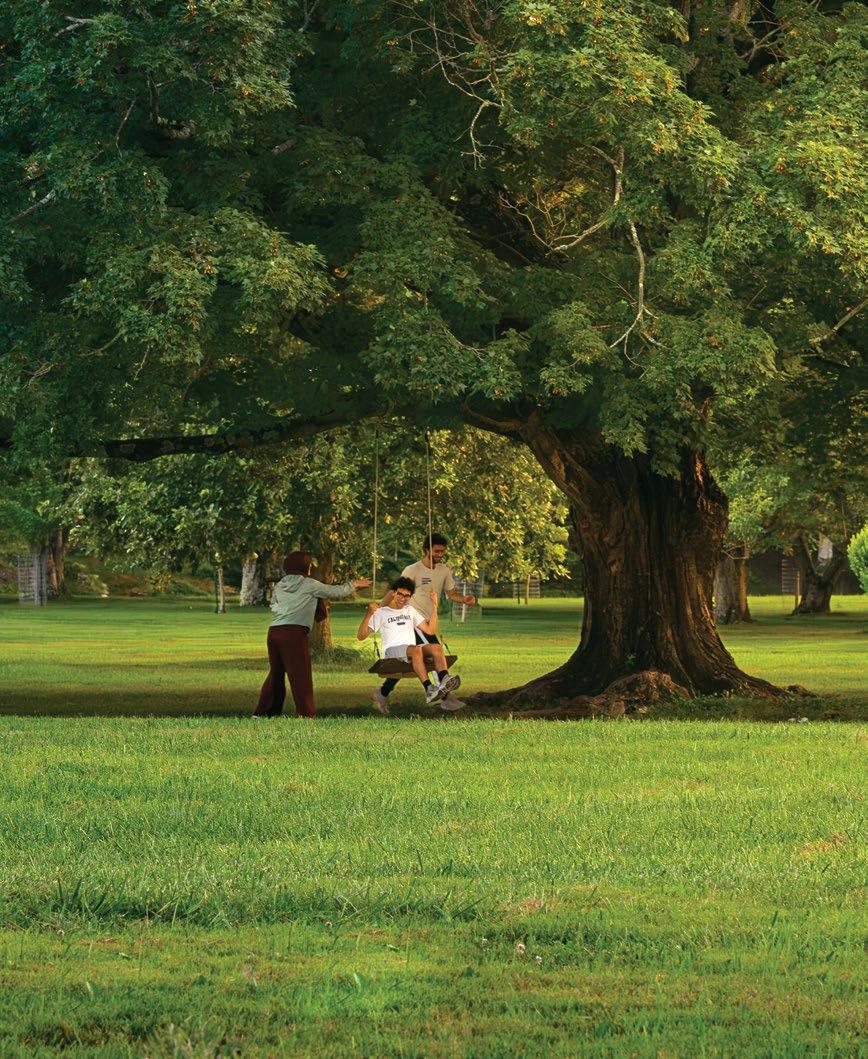
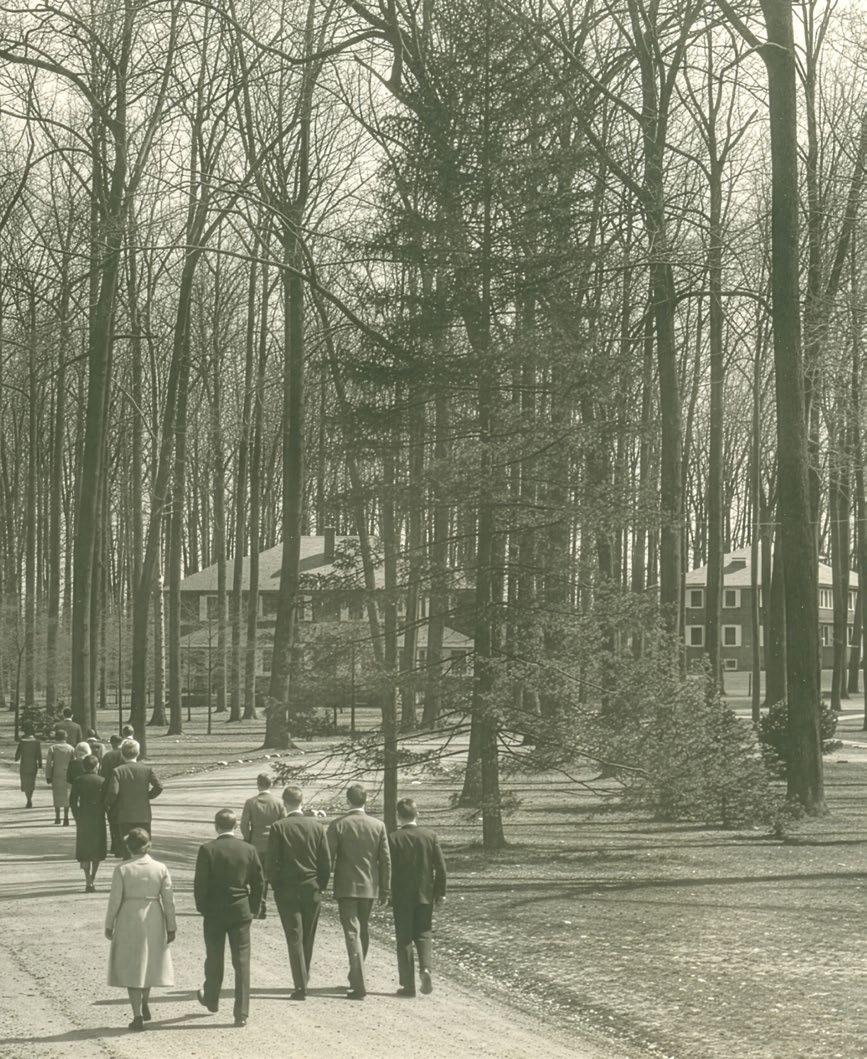
Towering trees adorned with fall foliage surround the Eyre Line path to the walking bridge.
Walk This Way Step by step, wander through a timeline that examines the history behind George School’s Quaker Walk, along with the man who turned his idea into a reality.
EIFC welcomes ninth-graders to George’s School’s Quaker community.
AMONG FRIENDS
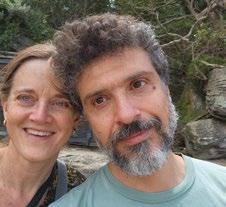
Valerie Greaud and Scott Spence share how Quaker values inform their work with students.
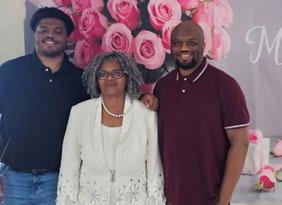
With gratitude and excitement, the Abu Tahoun triplets reflect on their four years at George School ... and look to the future.
and field team
HONORING OUR ROOTS, REFRESHING OUR STORYTELLING
At George School, we believe we are called to grow and change while remaining true to the roots of our mission and values. With this in mind, we are excited to share a redesigned version of the Georgian, with a renewed emphasis on visual and written storytelling. With this initiative, we hope the Georgian will continue to evolve — just like George School — shaped by your insights and ideas. Please share your thoughts with us at georgian@georgeschool.org
Thank you!
Georgian Staff
Editor
Patricia M. O’Neill
Director of Strategic Marketing & Communications
Managing Editor
Marisa Procopio
Contributors
Chelsea Colatriano
Christine Davidyock
Marisa Procopio
Caroline Sipio
Katharine Sipio
Sydney Sobkowiak
Haley Uliasz
Photographs
Michael Branscom
Chelsea Colatriano
Karla Donohue
Laura Pedrick
Katharine Sipio
Strategy + Design
DiGiovine Design digiodesign.com
The Georgian is published twice yearly.
Please send address corrections and new phone numbers to: Alumni Office, George School 1690 Newtown Langhorne Road PMB 4438
Newtown, PA 18940 (215) 579-6565 alumni@georgeschool.org
Making and sustaining meaningful connections with others contributes to our emotional, physical and mental wellbeing.
Minding the Light
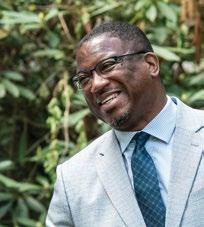
DEAR FRIENDS,
In today’s fast-paced world, where technology — and our reliance on it — continues to develop at breakneck speed, the critical value of human connection is increasingly clear. Making and sustaining meaningful connections with others contributes to our emotional, physical and mental well-being. Being a part of a community gives us a sense of belonging and purpose.
At George School, our commitment to Minding the Light in ourselves and one another provides the scaffolding to build a community rooted in genuine care for one another. This year, we welcomed 500 students representing 20 states and 51 countries on six continents. We recognize and appreciate the value of diversity in all forms in enriching the learning experience for our students and expanding our perspectives as a community.
This value is rooted in individual connections. As a first-name school, we are reminded of our shared humanity in every interaction. From the outset, our students understand that they matter. That their lived experience is important to us. And that their contributions are essential to building and strengthening the George School community.
As I continue to travel to and from campus to meet with George School alumni and families, I am struck by how the relationships formed on this campus often become lifelong connections across decades and geography. Just reading through the Class Notes section of this magazine illustrates how these relationships are stepping stones on the path to fulfilling life journeys. They inspire me to reflect on the human connections in my own life, both on this campus and across the globe. I hope they inspire you, too.
In friendship,
Justin
UP FRONT LETTER
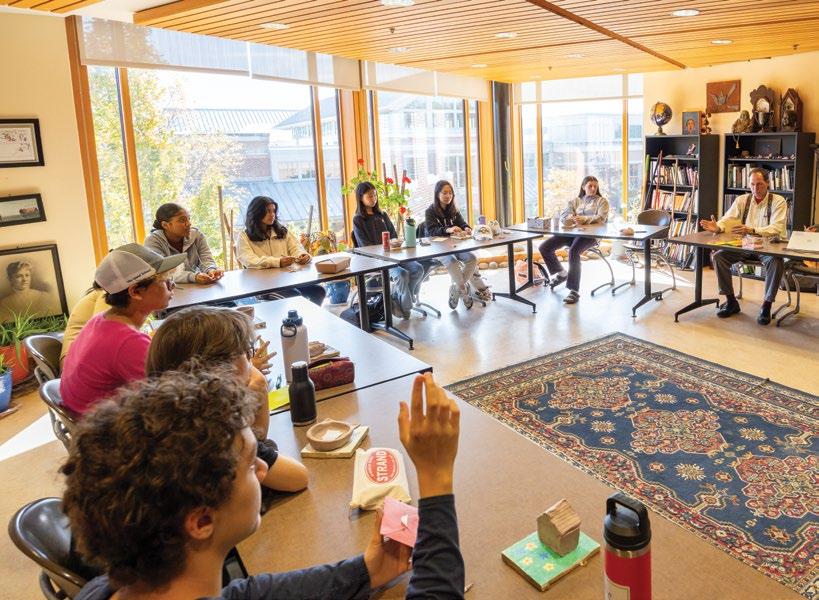
What is your favorite elective at George School and why?
NOAH ZILS ’27
“My favorite elective has been Physical Computing and Robotics. It’s a class taught by teacher Brian Patton that uses programming in a direct physical application. This means we get tasked with assignments in which our robot has to successfully follow certain instructions. This could mean following a simple maze or having our robots engage in small sumo-style fights. To make this work, we have to program the robots themselves. I enjoy the class because of its high degree of personal freedom in how we apply our knowledge and solve problems, and because of the enjoyable class environment.”
MOLLY BLORE ’26
“My favorite elective was Human Anatomy and Physiology. It is unlike any other classes I have taken before, and I loved that it dove deeper into the what and the why of how humans work. This class felt like a break during my school day that I could enjoy and engage in; we didn’t just sit and listen, but ‘got our hands dirty’ and formed new friendships while working together in labs. Along with the class, Becky Hutchins was patient, kind and loved to teach the subject, which made the class meaningful and that much more enjoyable. This elective also helped finalize my decision in choosing to major in physical therapy!”
ZOE COOK ’29
“I’ve liked most of my classes so far and I appreciate how the schedule changes. Painting & Drawing is a favorite because it includes fun and engaging ways to push myself as an artist. I also enjoyed the first mod of English 9, because we read a variety of short stories and poetry and put together a portfolio of our own creative writing. These classes are helping me grow in confidence and as a storyteller.”
TEKLA JAPARIDZE ’27
“My favorite elective at George School was Ceramics, which I took in the first term. I loved making new art pieces with my friends while listening to music. I think the entire environment was very comfortable to be in and the process of learning how to sculpt things out of clay was so satisfying. Plus my teacher, Amedeo Salamoni, is such a cool dude to be around.”
ANAMITRA ABI ’28
“While it’s difficult to pick a favorite course, my favorite class right now has to be AP Lang! Not only do we learn how to write more effectively, and read in a more engaged manner, we also get to explore the deeper meaning behind the words through context and analysis. It’s a difficult course, but it’s rewarding and that’s why I love it!”
HAMILTON WREAKS ’28
“Women’s History is an amazing course, and I strongly recommend it to everyone, regardless of gender. I was blown away by how much history is not taught in many classrooms. I gained perspective from so many situations and have been able to give my own. I have been able to hear so much knowledge and wisdom for the first time that I have never heard from anywhere else.”
SAVINA VISHALPURA ’26
“My favorite GS course is Economic Dynamics in Panama. This course was so incredibly memorable and engaging, especially with our teachers Arianna and Heather. Within the classroom, and also exploring in Panama, my learning was expansive across so many disciplines, whether it be personal to myself, cultural exposure or studying the depths of entrepreneurship. Without this course, I would not be able to have such an indescribable experience that built such memorable relationships and guided me to my passions.”
FRANK LIANG ’28
CHASE COSTO ’29
“My favorite course at GS is Photography. It was really fun to learn how to take pictures and use the darkroom throughout my terms. It’s a great way to express how you see the world.”
“My favorite GS class is Advanced Analysis, taught by Travis Ortogero. The class challenges our boundaries in math, and we’re exposed to different mathematical concepts (which I find especially interesting and helpful). We frequently participate in discussions and analyze patterns in mathematics, which pushes me to think more deeply and critically.”
PRIYA TELI ’26
“Dance class is a space where I am challenged physically and creatively. Whether it is playing ‘Just Dance’ as a warm-up or spending evenings at rehearsals, I have not only grown as a dancer, but alongside people who make every practice something to look forward to.”
A Framework for Living
NAME OF CLASS
ESSENTIALS OF AN INTERCULTURAL FRIENDS COMMUNITY (EIFC)
TEACHERS
Deirdre Best, Tom Hoopes ’83, Robert Mooney, Arden Rossi ’03, Cori Seraydarian ’91, Scott Spence and Ginny Waller
DESCRIPTION
EIFC is an introductory course for all ninth-grade students. It provides academic and executivefunctioning coaching, as well as orientation to the social and philosophical expectations of their new community. EIFC offers an introduction for students to life at George School and to the application of Quaker practices and principles as a framework for living. It emphasizes selfawareness, motivation, goal setting, organization, communication and the establishment of a growth mindset through research-based practices.
NOTE
With emphasis on personal growth, EIFC requires the establishment of trust and a safe place for sharing. Students quoted here, therefore, are intentionally cited anonymously.
“Understanding life has to be one of the most important, yet hardest, things I think a person could ever do. Especially being a teenager, with so much more life to live, realizing that my life doesn’t just have to be a classroom or tests and sports, realizing there is so much more is such a blessing. I am so incredibly grateful that EIFC is required because I truly believe that anyone and everyone can benefit from it.”
— EIFC STUDENT ’29
“EIFC is graded Pass/Fail, with a very light homework expectation, creating a great deal of safety for students who are brand new to high school (and for many of them, brand new to the U.S. and/or a college-preparatory environment). It allows space for them to feel safe to make ‘mistakes,’ which is an essential pre-condition for ‘learning.’”
— TOM HOOPES ’83, RELIGIONS DEPARTMENT HEAD
“Director of Learning Center Services Chris King and I developed New Student Seminar (NSS) to provide help with executive functioning, strategies for effective learning and structured time to do homework and collaborate with fellow students. In our first year, we saw so much overlap between the work we were doing in NSS and EIFC curriculum. In the fall of 2025, we infused EIFC with the NSS curriculum and have been happy with the results.”
— BECKY HUTCHINS, SCIENCE TEACHER AND LEARNING CENTER ASSOCIATE
“I think that this term of EIFC has taught me more about who I am and how I like to do different things, like studying, learning and even which ways to eat food. Also, through this unit, I have developed meaningful relationships with my peers and adults by opening up in responses to different prompts, and just opening up in general. I also think that in this class I learned a lot about the culture of Quakerism and George School history.”
— EIFC STUDENT ’29
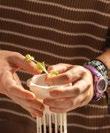
IN EIFC CLASS, students are given a pound of clay at the start of the course and invited to create a “gratitude container.” It can be a cup, bowl, box, lotus flower, hand, head, ship, garden … whatever their imagination and skill produces! Their containers stay in the classroom and harden in the open air. Then, over the course of the term, students are regularly invited to write a personal affirmation or expression of gratitude on a little slip of paper to place in their container. Writing these repeatedly helps to develop the habit of gratitude, which has been shown
to correlate with a sense of personal well-being. At the end of the course, students are invited to go back and re-read all of their affirmations from the term, to remind themselves of their journey. Then, as a final act, they are encouraged to destroy their clay containers, as a reminder of the impermanence of life and the importance of embracing the present moment. The broken bits of clay are returned to the Ceramics studio, where they get re-absorbed into the stream of clay there, to be used for the creation of student work going forward.
A Career in Conservation
Abby Byrtus ’20 talks about her experience working with spotted hyenas in Malawi.
IN A full circle moment, science teacher Bob Fest welcomed Abby Byrtus ’20 to his IB Environmental Systems & Societies classroom to talk with students about her experience working with spotted hyenas in Malawi.
Abby shared with students her inspiring journey to her current role as a research assistant for the nongovernmental organization Carnivore Research Malawi (CRM).
It all began while at George School. Abby joined a service trip to Uganda with Bob Fest and former faculty member Polly Lodge. The trip focused on conservation and the interaction of humans and wildlife. Abby was hooked, and went on to earn her bachelor of science in wildlife biology with a minor in zoology from the University of Vermont.
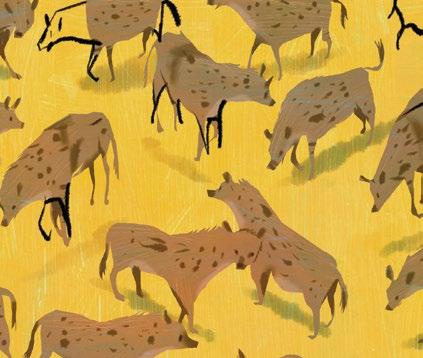
Today, Abby is a key part of the “Urban Hyena Project” with CRM, focusing on the principle of Human-Wildlife Coexistence to protect the local spotted hyena population. The project works to understand the drivers of conflict between people and the spotted hyena in urban areas in Malawi. According to CRM, high population density in Malawi has resulted in high levels of human-hyena conflict outside protected areas.
“It is incredibly rewarding to see how that experience in Uganda, followed by her studies in Botswana, paved the way for her professional success,” shared Bob.
LUCY AND ELEANOR
Earlier this school year, Head of School Justin Brandon met with Lucy, a 91-year-old George School alumna who lives in North Carolina. Lucy has spent the last 74 years talking twice a month with her best friend Eleanor, who lives in New York City. They met at George School as members of the Class of 1951. While the friends have never lived in close proximity to one another, they have been able to maintain their connection via the telephone.
“Lucy and Eleanor developed a friendship on this campus that has been strong enough to sustain them over the decades, simply through regular phone calls,” reflected Justin. “It’s amazing to think about how many meaningful connections made here on this campus remain strong over lifetimes.”
If you are a George School alum and would like to contribute to the Continuing Revelation section, please contact georgian@georgeschool.org.
George School welcomed over 30 alumni from the classes of 2021–2025 back to campus for the school’s fourth annual Young Alumni Gathering on January 9, 2026. “The Young Alumni Gathering is one of my favorite events,” said Kelliann Carroll, director of engagement and the George School Fund. “It is a great first indicator of what life as an alum should feel like: The door is always open, and there is always someone waiting to welcome you home.”
FRIENDS IN FOCUS
168 titles
THE NUMBER OF BOOKS IN MDA LIBRARY AUTHORED BY ALUMNI
Have you authored a book you’d like to share with MDA Library? Email mdalibrary@ georgeschool.org
“Doing art at any level gives people more appreciation for diversity of thought. It gives people the other side of themselves.”
— DEBORAH (CADWALLADER) TAYLOR ’84 FROM AN ESSAY WITHIN THE REPORT OF GIFTS 2024–2025 ABOUT HER FAMILY’S LEGACY AND HER TIME AT GEORGE SCHOOL
BOOKSHELF
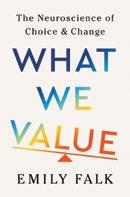
“What We Value: The Neuroscience of Choice and Change”
Emily Falk, Ph.D. W. W. Norton & Company, 2025
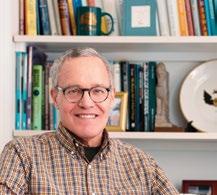
Emily Falk ’99, a pioneering scholar and neuroscientist, offers a compelling look at the hidden mental processes behind everyday decisions. Drawing on her award-winning research, she explains how the brain’s value calculation shapes our ability to change and connect with others. “What We Value” is a practical guide to reaching our goals, leading effectively and building more meaningful lives through the decisions we make.
Emily Falk ’99 is a professor of communication, psychology, marketing and operations, informatics and decisions (OID) at the University of Pennsylvania. She is also the vice dean of the Annenberg School for Communication, where she directs the Communication Neuroscience Lab and the Climate Communication Division of the Annenberg Public Policy Center.
Defining My Expectations
Excerpted from the speech of Betty Ann Rogers ’02 upon her induction to the Hall of Athletic Honor on January 9, 2026.
I WAS one of five children born to Sierra Leonean immigrants, and the only one to leave home for boarding school. My life at home was full — of love, of culture and of responsibility. The idea of coming to a school like George School felt like a dream come true.
Like soccer, my first sport and first love, George School was something I chose and cultivated for myself. It was an experience I sought out to further opportunities I wanted for my own life, outside the depth of responsibility that would have come with staying home.
As a student-athlete at George School, I worked hard and learned to both lead and
be part of a team. But more than that, I was surrounded by teachers, coaches and mentors who at the most important times saw more in me than what I could see for myself as a teen. They didn’t limit me to their expectations; they left room for growth and possibility and helped me define and refine my own.
Because of them, I began to treat my limits according to my own standards. That mindset carried me well beyond this campus. I went on to play NCAA Division I Women’s Soccer at Wagner College, and I ended my time there as one of few to hold the distinction as a four-year All NEC award recipient. The summer after my junior year, I tried out for a semi-professional women’s team, the Philadelphia Pirates, and was named a First Team Women’s Premier Soccer League PSL all-star for the eastern division.
This place, with all its complexity, helped shape the educator I am now. In my current role as a high school principal and director of Teaching & Learning and in all of my previous roles, all of that and more is tied to what I lived and learned here. I see it in the way I advocate for students, think about care and responsibility, work with other educators to create spaces where young people can be both strong and vulnerable, and coach and mentor students.
To the current students and athletes: Your time here will not be perfect. No place is. But it will be real, and it will matter. The way you sweat on these fields, lift each other up in the locker rooms, win with humility and lose with grace — those habits shape who you become. Allow yourself to be fully present here. Celebrate the joy. Pay attention to the hard moments.
Speak up for what is right. Lean on the people who believe in you, and be that person for someone else. You are not just building a record of wins and losses; you are building a way of life.
Above: Faculty member Rachel Williams with Stephanie Hicks Freeman ’02, Betty Ann Rogers ’02, and Rob Waters ’03
WALTER
STEPHENSON
’08
SCALING NEW HEIGHTS
“The thing that keeps me coming back, first, is the students,” Walter shared. “But the opportunity to share a lot of different interests and sides of myself — that I’m not just teaching science — is what keeps me inspired to keep teaching here.”
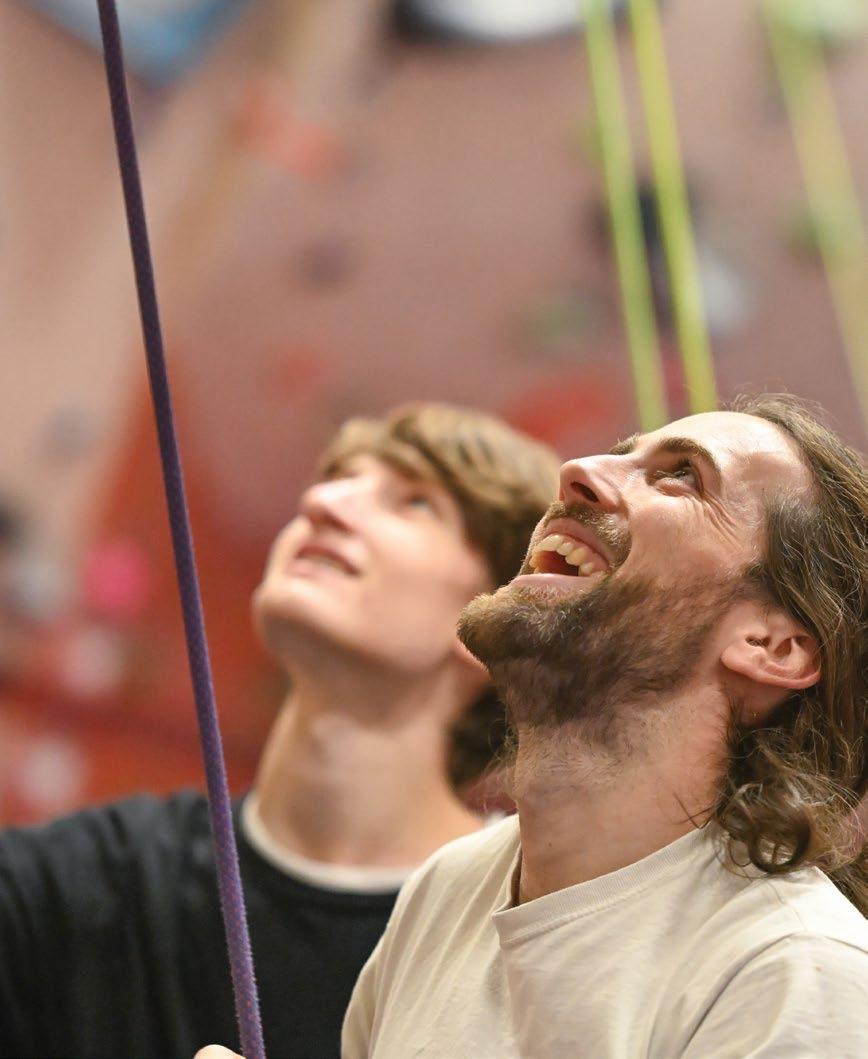
Walter Stephenson ’08 followed in the footsteps of his mom, Molly Stephenson, who taught Spanish for 23 years at George School before retiring in 2020. Returning as an alumnus, Walter teaches IB physics and chemistry. He is also faculty sponsor of the Climate Action Club, an environmental sustainability club on campus, regularly plays with the GS stage band on the saxophone and has coached various sports. He lived as a dorm parent for five years, and now lives on campus with his partner Karlee. Together, they coach the newly founded George School Varsity Rock Climbing team, which has multiplied in size and enthusiasm in their second formal season.
The living and learning experience of George School, according to Walter, plays a role in the community at large and trickles down to the students. “When I talk about students here, I tell everyone how curious they are, how they enjoy learning and also how respectful they are,” he continued. This excitement is mirrored in Walter’s teaching style. “There are days where we get to make methane bubbles explode in the chemistry lab and all the students leave buzzing and talking about it. That definitely makes me happy and gives me energy.”
Living the mission as a lifelong learner, Walter not only finds joy in generating that excitement in his students, but exercising the challenge in his own work. “I get a lot of energy in teaching things that are new for me as well. On one hand, teaching a new course or skill can be exhausting, but when you get to deliver something that’s new that gets even one student engaged, it’s all worth it.”
The Power of Choice
George School Electives
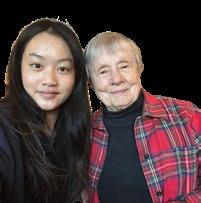
Though they’re more than seven decades apart in age, Celine Ge ’26 and Kathy Hoff, a 90-year-old resident at Pennswood Village, have much more in common than being campus neighbors. They meet twice a month, sharing stories of their lives, celebrating holidays together and discussing their passions for writing and photography. Kathy has served as an invaluable mentor to Celine, cheering her on at her theater performances and supporting her during the hectic college admissions process. Generations and upbringings aside, Celine and Kathy are connected by shared values and a genuine interest in each other’s company.
How did they meet? As partners in Courtney Bejgrowicz’s elective writing course, “Explorations of a Memoir.”
BY THE NUMBERS
95
NEW COURSES
SINCE 2022
INCLUDING 25+
INTERDISCIPLINARY COURSES
240+
TOTAL COURSES
THE GEORGE SCHOOL ACADEMIC PROGRAM SPARKS OPPORTUNITY
Now in its fourth year, The George School Academic Program has proven prescient in that it is made for this moment. An innovative curriculum with a unique seven-term calendar, its flexibility and dynamic offerings match today’s educational and career landscape.
The Program allows for implementation of short-term, niche elective courses like “Explorations of a Memoir.” These have become both a source of creative inspiration for faculty and an opportunity for students to broadly explore throughout their academic journey.
“The Program is designed to enable students to customize their schedule in ways that allow them to engage in community both on and off campus and really let their lives speak,” shared Associate Head of School Scott Spence.
Admittedly unconventional, the Academic Program works as a modified block schedule, allowing more in-depth study in just a few subjects at a time. Each term spans five weeks, with students taking only two-to-four courses each term. Core courses, such as English, history and math, are usually three terms long, while elective courses can be as short as one or sometimes two terms in length.
“In many ways, we’ve bent time with this schedule. We’ve cracked it open so that students can take more courses that they want to,” Scott continued. “Ideally, it provides students with more flexibility, more agency to chart their own path of courses and the opportunity to really go deeper in topics that they find that they really love, all while having more time to breathe and prepare during the day.”
In response, faculty met the moment, reconfiguring course planning and teaching
styles to align with the longer class periods. The transition has energized many faculty to dream up and design a host of possibilities to offer their students. George School has adopted a whopping 95 new courses since the 2022–23 school year, including over 25 interdisciplinary courses. When paired with a rigorous core curriculum — including a broad scope of IB, AP and honors courses — these elective courses enrich the student experience. At the same time, they support and inspire teachers to create coursework that both advances them professionally and allows them to pursue academic areas they are passionate about.
FACULTY CHART THEIR OWN PATH
“Being hired typically requires faculty members to cover the basic requirements of their department (biology, chemistry and physics as science faculty, for example), leaving limited room in a traditional academic schedule or contract structure to really dive deeper beyond those basics,” Scott explained.
“Now, there’s room in a student’s schedule to take more specialized courses, and there’s room in a teacher’s schedule to teach them,” he continued. While teachers may be in the classroom more, they are, to an extent, creating their own courseload. This model mirrors what George School encourages students to achieve: excellence in academics that inspires a strong sense of self and personalized achievement.
The faculty are the soul of the George School Academic Program. A group of over 100 dedicated educators, they bring expertise to George School from all channels of the world and across disciplines. In many ways, the course catalog is shaped by their passion,
The transition has energized many faculty to dream up and design a host of possibilities to offer their students.
research and extracurricular pursuits.
In keeping with George School ethos, the development of elective courses is both individualized and collaborative in spirit. New courses are first submitted to academic departments for approval, and then brought to the department heads committee, which Scott oversees.
refugee crisis in Athens and develop skills in media-making and journalism — ultimately equipping them with the tools to tell their own stories as a catalyst for social change.
page:
Elective courses are today’s illustration of the value George School places on interdisciplinary learning and collaboration. It was one course — “Storytelling for Social Justice” — that redefined the scope of what these courses could look like. Created by film teacher Prescott Seraydarian ’90 and history teacher Meredith Baldi ’01, the course began shortly before the schedule transition, and was based on the idea of combining media literacy and content creation with the query: How can I use my voice through media to improve the world in which I live? It has since evolved into an immersive service-learning experience in Greece, where students explore the history of storytelling and its influence on human belief and relationships, examine the current
“To combine a history social science class with an arts course with two different teachers was new, and I was so excited to support their vision,” recalled Scott. “The success of the course changed the way we approached coteaching and interdisciplinary instruction.”
INTERDISCIPLINARY COURSES THAT SPAN THE WORLD: PAGE TO STAGE
Since the creation of that first course, faculty and staff have enthusiastically teamed up to envision interdisciplinary courses that pair their fields of expertise. Most recently, Assistant Head of School for Student Life and English teacher Mb Duckett Ireland teamed up with performing arts teacher Kevin Davis ’77 to debut a new course: “Page to Stage: Textual Analysis, Interpretation and Application for the Actor.” In five weeks, the immersive travel course blended script study and acting techniques with an exploration of
Opening spread:
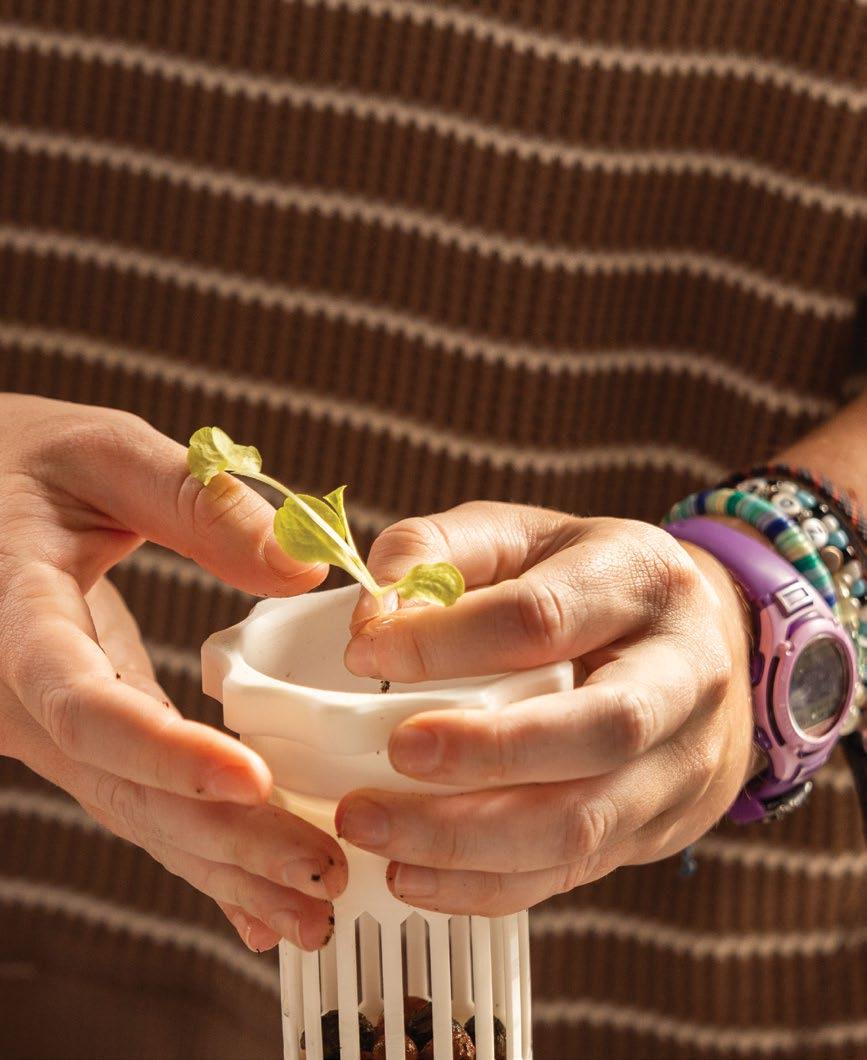
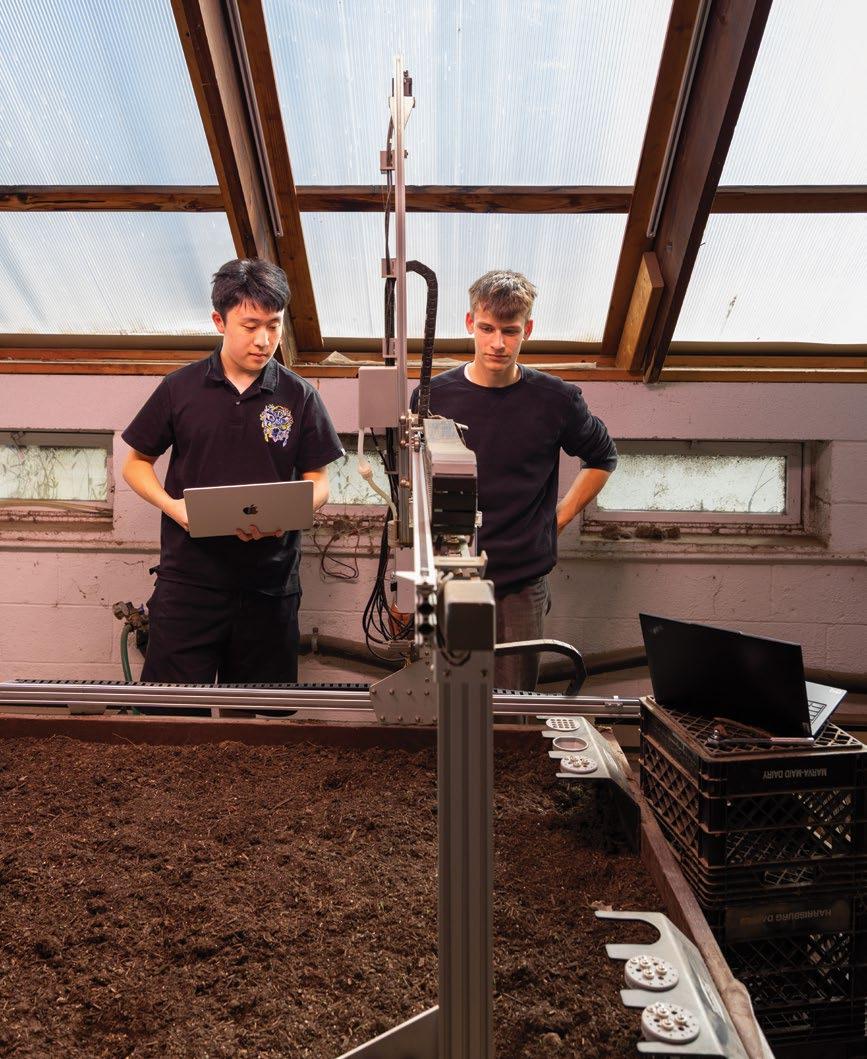
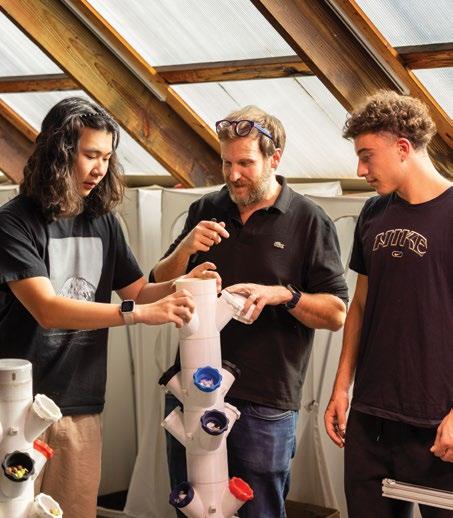
Mark Zhou ’26 and Moritz Kolbinger ’27 work with a FarmBot in their “Applied Technologies in Botany” class.
Opposite
Celine ’26 and her friend Kathy Hoff from Pennswood Village
Above:
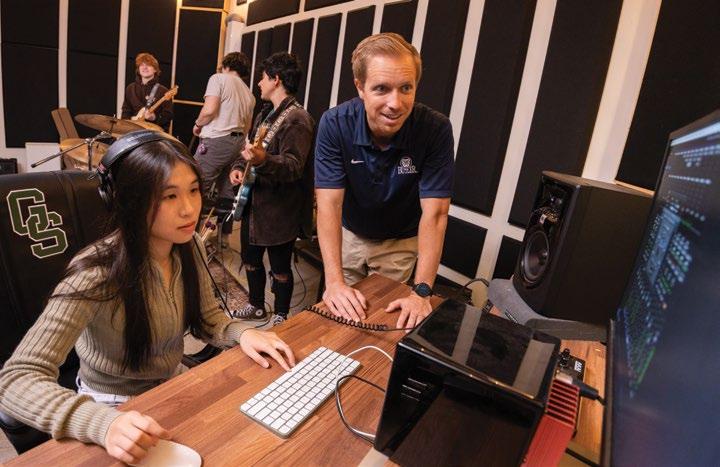
Students work with music teacher
Dave Nolan in the recording studio, where the professionalgrade equipment allows limitless possibilities to create.
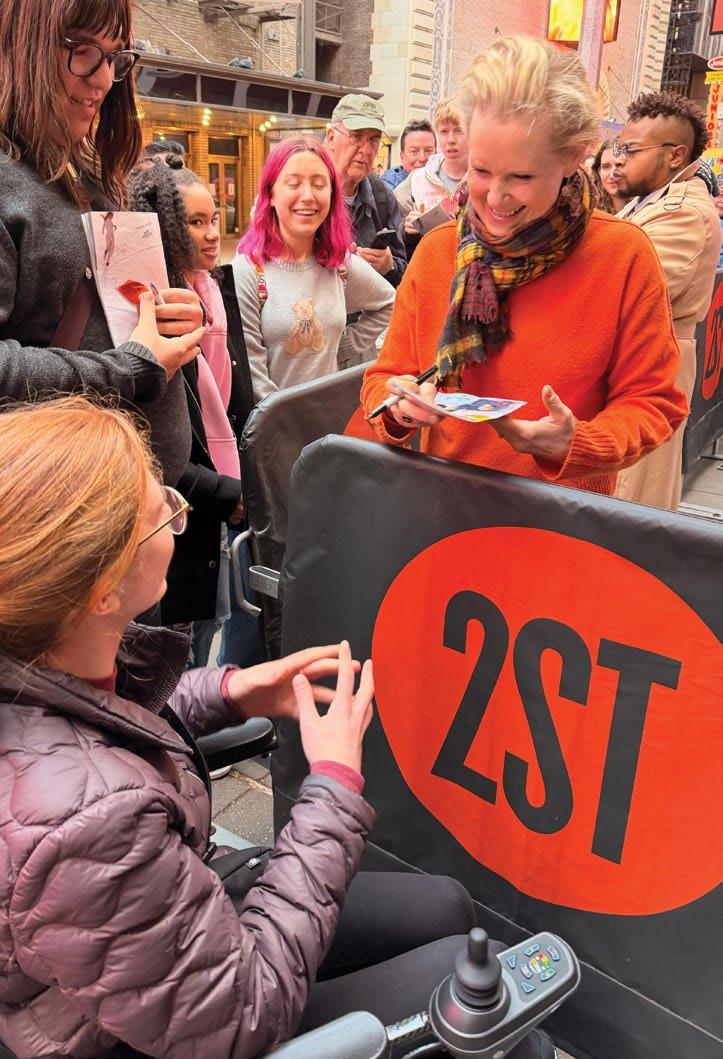
Students in the “Page to Stage” course talk with actor Cynthia Nixon following her performance in “Marjorie Prime.”
“I started my career as an English teacher and have had a lifelong passion for theater and travel.”
—ASSISTANT HEAD OF SCHOOL FOR STUDENT LIFE MB DUCKETT IRELAND
theater history, performance and criticism. First grounding students in core texts and close readings, the course then broadened their understanding of theater through handson experiences ranging from Princeton’s McCarter Theater to Broadway and all the way to the historic Globe Theater and West End in London. Students met and talked with famous actors and playwrights, including Ian McKellen, Cynthia Nixon and Steven Sater (the latter wrote “Spring Awakening,” coincidentally, last year’s spring musical at George School). While in England, they also participated in acting workshops at The Royal Theater Company and the Globe.
“There was something truly magical about being fully immersed in the world of theater as we walked through the house in which Shakespeare grew up, and were exposed to a wide diversity of plays,” said Ava Mullin ’26.
As an Assistant Head of School, Mb’s schedule would not have had space for teaching in a more traditional schedule. Creating and co-teaching a one-term course, however, proved both professionally fulfilling and deeply energizing. The demands of developing a curriculum, teaching and then supervising a group of students abroad are significant, but they also fueled a veteran educator like Mb.
“I started my career as an English teacher and have had a lifelong passion for theater and travel,” said Mb, who has even acted alongside students in George School productions. “Partnering with Kevin to design and run this course was a wonderful way to step back into the classroom, but having the opportunity to interact with students through travel and
theater experiences really recharged me in my role as an administrator.”
Scott has also used this schedule to his own advantage, returning to the classroom to teach “A Framework for Living” (p .8). “Getting back into the classroom takes me back to the roots of the career path I’ve chosen,” said Scott. “In my current role, I don’t get to know students in the same way I did as a full-time teacher. Working with ninth-graders in a curriculum that is a cornerstone of George School gives me a fresh sense of student perspectives.”
CREATIVE COLLABORATION
Developing elective courses has spurred high levels of faculty collaboration to create truly interdisciplinary coursework. Five-week terms make this kind of innovation and course design more feasible. Language and history, visual art and mathematics, statistics and biology — the possibilities seem almost limitless, with new pairings being introduced each year.
“It’s a lot more work to create new courses and co-teach the curriculum with a partner, and I am so impressed that many people are doing it.” Scott said.
For Head of the Science Department Pascal Lanciano, that extra work does not even cross his mind.
“Teaching a class together with robotics teacher Brian Patton, we get into natural discussions, which fuels interactions with students, as they can jump in and participate in the conversation,” said Pascal. “The experience is invaluable, and we all shape the class based on our conversations.”
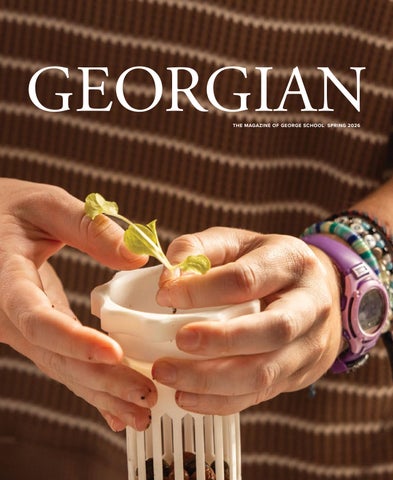
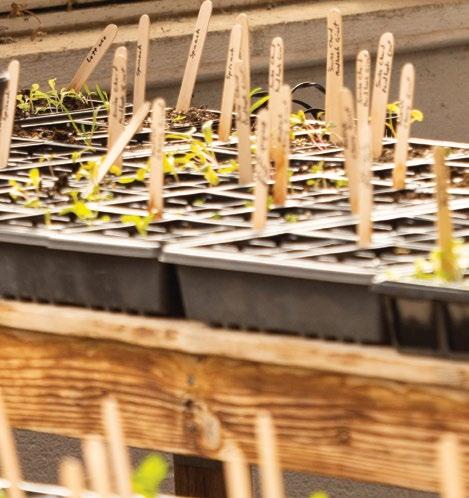
Pascal and Brian have worked together for years to bring plant biology to the Alternative Energy Center. Pascal was determined to revitalize the space for interdisciplinary learning in 2022 in light of the transition to the new schedule. Brian, an avid farmer with a passion for sustainability and technology, worked with Pascal to launch a one-mod experimental class in hydroponics, a method of growing plants without soil that adds a nutrient-rich, water-based solution directly into plant roots. It has been met with enthusiasm by students.
For Pascal, the joy of the classes is the constant evolution. No two classes are ever the same, as they are fueled by student-led independent research, often continuing beyond the course. Moritz Kolbinger ’27’s modular hydroponics system has taken up residence in the space, producing leafy greens like basil, parsley and spinach. Brian and Pascal have worked with him to continuously improve his design and output.
The flexibility of the schedule has allowed the science department to present a slew of one-mod offerings, including “Applied Technologies in Botany,” “Fuels of Civilization,” “Protein Engineering” and “Molecular Protein Engineering and Analysis.” Students can take just one course to explore the subject area, or they can take multiple electives; all courses build on each other. They introduce students to subject areas often not included in the core science curriculum, going from macro (exploring the facets of energy sources like windpower, steam and electric engines and their environmental impact) to micro (CRISPR and developing plasmid proteins from fish). These are subjects our faculty are excited to teach, and topics students are excited to learn.
“Science was never really my thing,” said Harry Degnan ’26. “Throughout my life, I consistently struggled to find the STEM courses I was taking interesting and never
truly invested myself in them. But when I came to George School, for the first time in my life, I understood the excitement of STEM and the scientific method.”
LIVING THE MISSION
In the same way science has thrived as an elective, English teacher Courtney Bejgrowicz has used her one-mod English elective credit “Explorations of Memoir” to cultivate intergenerational relationships and develop lifelong storytelling skills.
Courtney recalled feeling motivated when Service Learning and Travel Planning Coordinator Meredith Baldi ’01 challenged teachers to think about how service might play a role in their classes in the new Program. “Service is a core value of mine, so being able to create a class that combines that with my love for storytelling was exciting,” she said.“I thought it through, proposed it and ran it with two students as an extracurricular at first.
Then it became an elective.”
Since then, dozens of pairings — like Celine and Kathy — have formed, each one committed to honoring and sharing the life stories of senior citizens. The class is built around elevating authentic voices and learning to tell stories with care and intention. Students first explore memoir through reading other’s stories, including actor America Ferrera’s anthology “American Like Me” before turning inward to write their own memoir.
After thoughtful preparation, students meet with their senior partners, listening closely to the stories shared with them and crafting a memoir that reflects those experiences. The course culminates in a reflective celebration where students share the memoir they’ve written with their partners and to their peers — a moment that affirms the power of storytelling in connecting generations.
“It can be challenging to be vulnerable with anyone, let alone someone who is of a different generation and a stranger at your first meeting, but the nerves over that quickly go away,” shared Courtney. With the foundation of thoughtful listening and respect ingrained in the George School methodology, students are naturals in connection and empathy in this task.
This school year, the class partnered with the African American Museum of Bucks County to contribute memoirs to a growing collection of the museum. Paired with African American senior citizens with ties to Bucks County, students had a special goal: to preserve and raise up marginalized voices of local African American families. Hearing
Pascal works with students Justin Huang ’26 and Frankie Pondaco ’27 on a hydroponic garden.
about their life experiences highlighted the harsh realities of the 1950s and ’60s, and also their joy and resilience.
Ryan Chan ’27 was paired with David Manning, a retired store clerk from Bristol, Pennsylvania. “As a kid growing up in East Asia, I never imagined hearing from a local American like Dave, who has so many stories,” Ryan said. “No matter how harsh his environment was sometimes, he never gave up. It was an honor to craft his memoir with him.” While he gained writing, communication and interviewing skills throughout the course, what was most valuable was what he describes as a “life-inspiring” experience in gaining a window into the past.
“Talking to Dave was one of the best opportunities in my life,” said Ryan. “Not only did I learn from him about the importance of hard work, but he also taught me that everybody is somebody. Everyone deserves respect, and we should let results speak for themselves.”
“I can never describe George School’s Academic Program without describing the way Quaker values are embedded in the curriculum. There is a quality to the George School classroom that honors student voice in what’s happening, and focuses on opportunities for reflection, building community,” shared Scott. “All of our courses are truth-seeking, trying to connect to the greater world around us. And we really see that on display in this blossoming of elective courses. There’s more interdisciplinarity to George School now than there ever was.”
No two classes are ever the same, as they are fueled by studentled independent research, often continuing beyond the course.
SPACE TO SHINE
The Academic Program grants students the flexibility to try out classes they always wanted to try, or maybe never expected to have the chance to — and that opportunity can reap limitless rewards. Here are some examples.
PRODUCE LIKE THE PROS. Music Director Dave Nolan recalls a student who took his “Audio Recording and Music Production” elective on a whim, and is now majoring in sound design in college. “I tell students with the equipment we have, the only difference between Taylor Swift and them is the voice; we’re using the same microphone, the same preamp, same interface. It’s limitless, the opportunities of what they can create in there. The only thing that’s missing is the artist and the creativity, which they’re able to provide.”
BENEFITS OF BIO-SWALES. Those who thrive in the course “Social Science of Climate Change” often convert their knowledge for community good. Many go on to be a part of the Green Initiative Contest, securing up to a $10,000 grant to implement a project that supports sustainability efforts in the community. 2024 contest winner Reed Beck ’24, with the help of his friends, planted 936 native plants on campus to create a bio-swale. With the support of the physical plant staff, the bio-swale will continue to bloom, providing food and shelter for wildlife, restoring the native plant community and enhancing campus beauty.
FIGHTING THE GOOD FIGHT. “Stage Combat and Movement” benefits student performers in theater productions. This course introduces young actors to the basic mechanics of physical conflict when performing and instills important safety practices. Exercise work examines the elements that make a fight scene safe, truthful and interesting. The actor’s individual approach to interpreting fight scenes and their use of body, movement and style is developed and evaluated.
LEVELING THE ACADEMIC PLAYING FIELD. Increased choice and flexibility make space for students to deepen their studies. It also creates opportunity for students who enter with lower levels — particularly in subjects like language and math — to take multiple courses within a single academic year. This allows them to build skills more quickly, catch up and, if they choose, advance to higher levels. This supports both national and international students, ensuring they are well prepared for their future studies and goals.
WALK THIS WAY
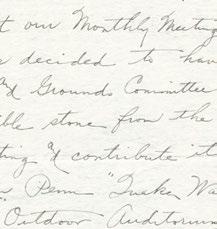
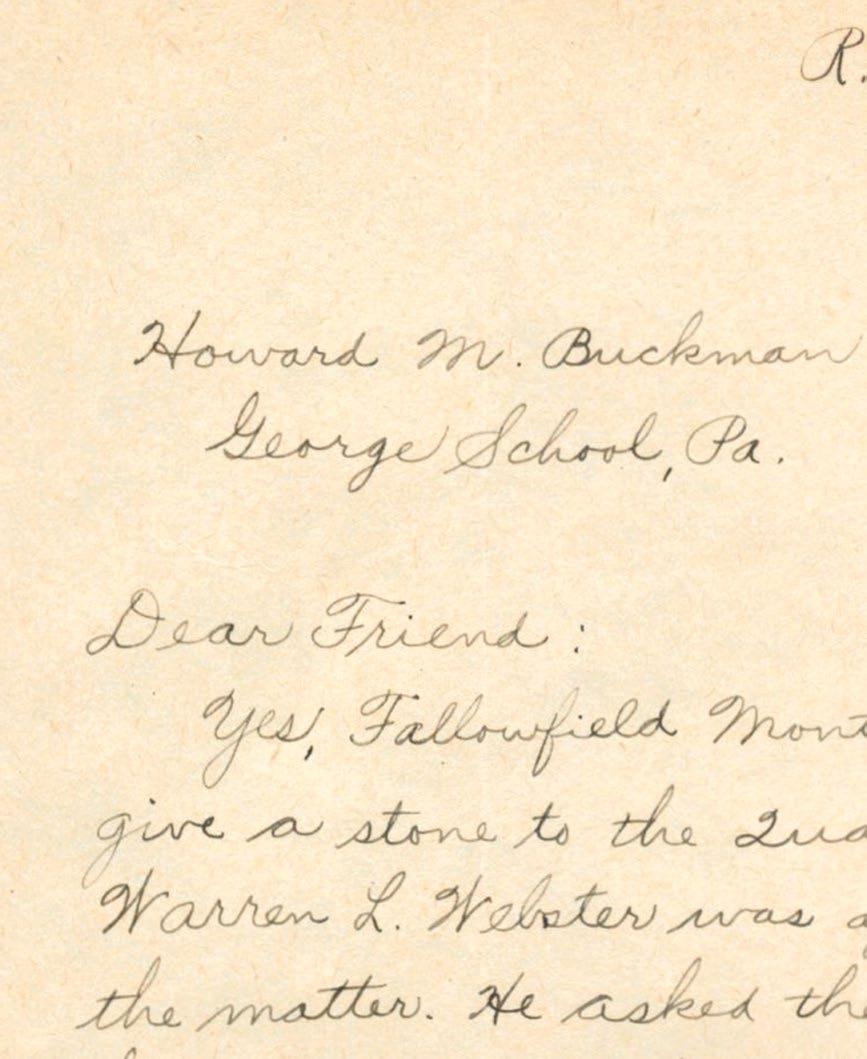
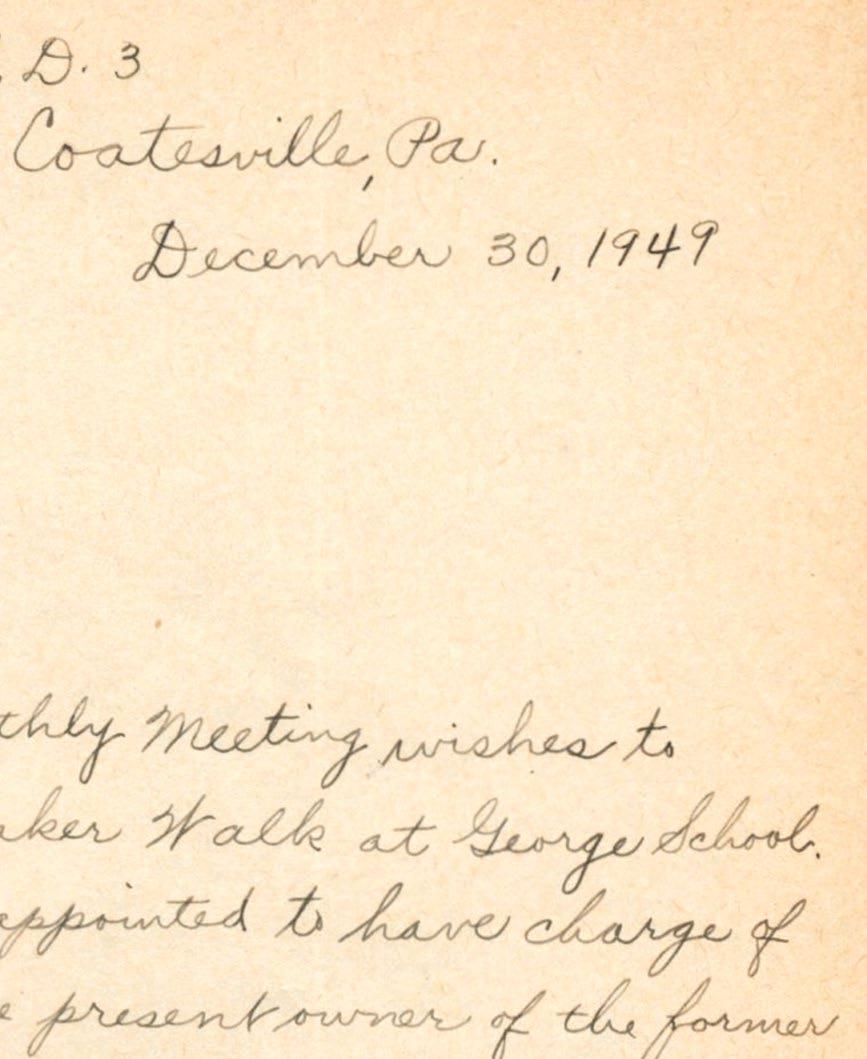
AOpening spread: Detail of a letter from Fallowfield Monthly Meeting
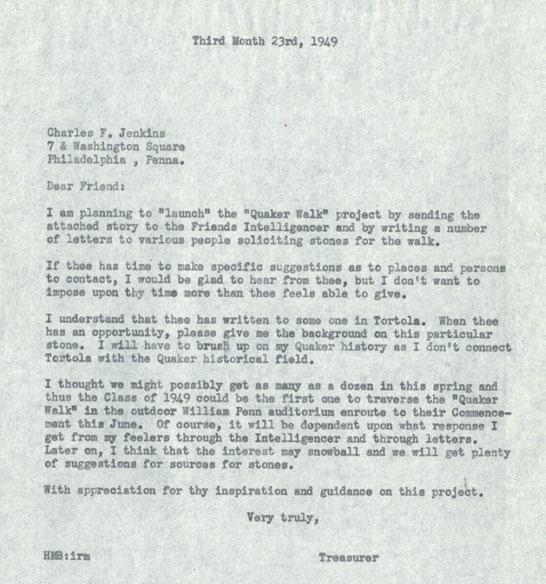
Opposite page, top: Letter from Howard Buckman to his friend, Charles F. Jenkins
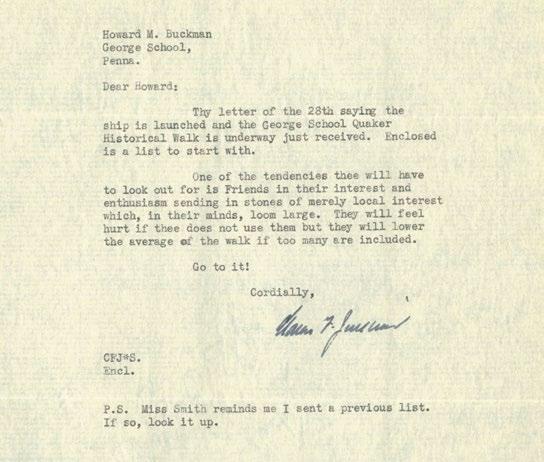
Opposite page, bottom: Letter from Charles F. Jenkins to Howard Buckman
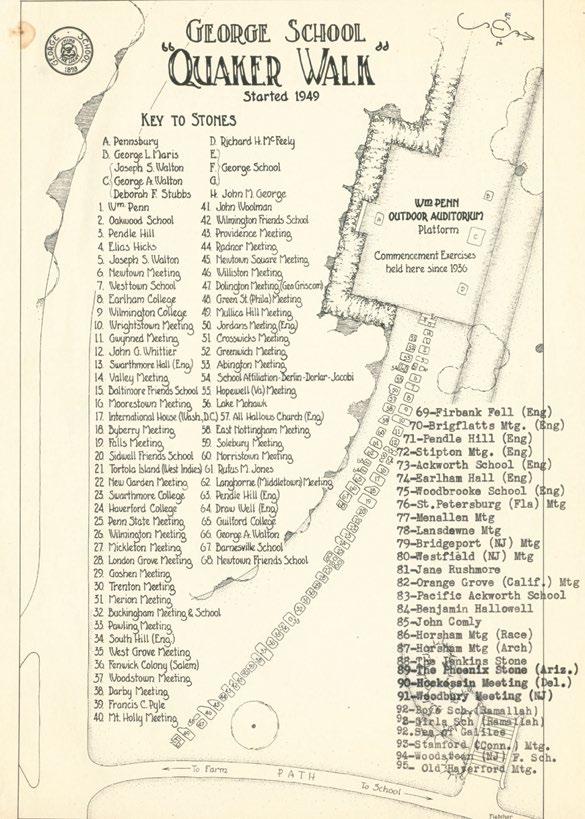
At the southern edge of campus, on the winding path that seniors take to commencement at the William Penn Outdoor Auditorium, lie 108 unassuming stones.
The Quaker Walk was the 1948 brainchild of Howard M. Buckman, George School treasurer and Friends Social Union secretary. Inspired by the Signers Walk — created by his dear friend and Germantown, Pennsylvania, resident Charles F. Jenkins, which is lined with stones from places connected with the Declaration of Independence signers — Howard embarked on a mission to represent Quakerism’s legacy at George School.
Each stone in the Walk is a gift from Quaker institutions, both in the United States and abroad, and each tells a story of history, generosity and fellowship.
Stroll through the Quaker Walk timeline and images on these pages, and immerse yourself in the Quaker story — one that continues here at George School, every day.
“We are trying to secure stones about 18 x 24˝, but sizes slightly larger or smaller or even irregular in shape are entirely acceptable.”
— HOWARD M. BUCKMAN, IN A LETTER TO GILBERT F. WHITE, HAVERFORD COLLEGE, 1949
MARCH 1949
In a letter to Charles F. Jenkins, Howard Buckman gives an update on the Quaker Walk project and thanks him for his counsel. Howard is optimistic that the project will elicit enthusiasm from Quakers near and far, and hopes they will want to contribute to it.
SPRING 1949
“Stones about 18 x 24”, but sizes slightly larger or smaller or even irregular in shape are entirely acceptable,” says Howard in his letter to Haverford College (Haverford, Pennsylvania). The college offers one to two stones from the entrance of its old gymnasium, one of its original buildings, and Howard gratefully accepts the smaller of the two.
GEORGE SCHOOL RECEIVES INAUGURAL STONE
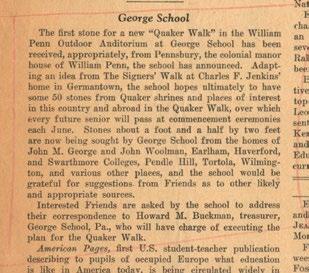
An article dated April 1949 announces that Pennsbury (Morrisville, Pennsylvania), the colonial manor home of William Penn, has donated the Walk’s first stone.
SWARTHMORE COLLEGE DONATES STONE FROM ITS ORIGINAL 1869 BUILDING
“(Head gardener) Harry Wood has made a suggestion that we send you a stone from the wall of Parrish Hall after we make some repairs this summer in widening the pump house door. I am reporting this just so you will not think we have forgotten.” Chas. G. Thatcher, business manager (Swarthmore, Pennsylvania, April 1949)
APRIL 1949
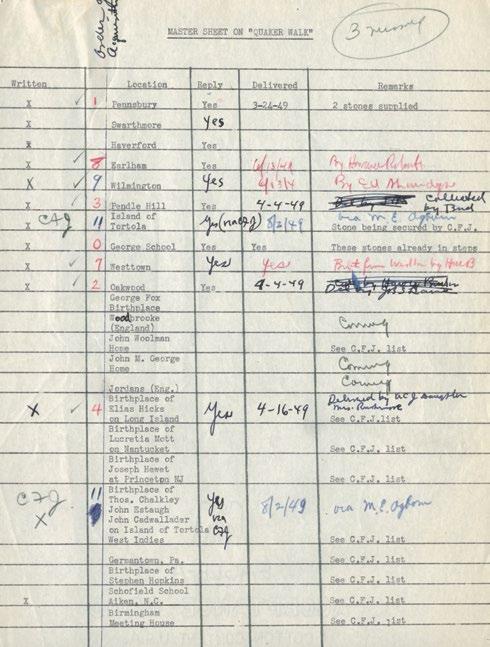
Howard asks colleagues for their recommendations on other locations that might wish to donate stones for the Walk. He has now procured three — along with the one from Pennsbury, Oakwood Friends School and Pendle Hill (England) each sent a stone.
This page, top: Detail from an article in Friends Intelligencer.
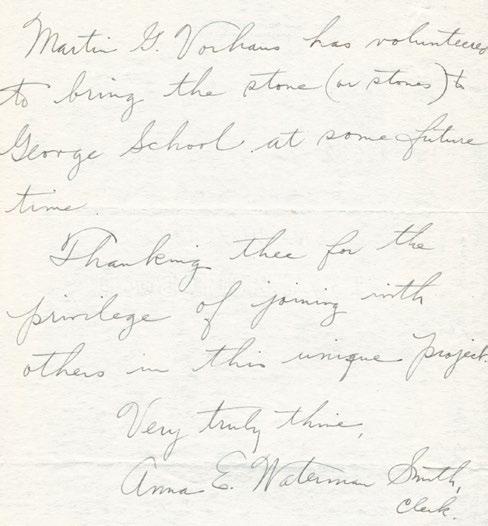
This page, bottom: Letter from Anna Waterman, Clerk, Buckingham Friends Meeting.
Opposite page: Master sheet created by Howard Buckman as he tracked correspondence and receipt of stones.
WESTTOWN DONATES STONE FROM 1799 SCHOOL HOUSE
“After some search, I have found what I feel sure is a window sill from the original Main Building. It is quite weathered and irregular, as a result of disuse since 1887. However, we would be glad to make it available to you.” — Robert K. Tomlinson, Westtown School business manager to Howard Buckman (West Chester, Pennsylvania, April 1949)
APRIL 1949
In a letter to Newtown Monthly Meeting (Newtown, Pennsylvania), Howard recalls a visit to their meeting the previous Sunday. While taking the path behind the Meeting House, it occurred to him that one of the stones within it might be “suitable” to donate to George School’s growing Walk, and he makes the request.
BUCKINGHAM FRIENDS SCHOOL CONTRIBUTES 1794 STONE
“Thanking thee for the privilege of joining others in this unique project.” — Anna E. Waterman, clerk (New Hope, Pennsylvania, September 1949)
SEPTEMBER 1949
Solebury Monthly Meeting of Friends (Solebury, Pennsylvania) donates a stone that, according to clerk Marian E. Ely, once “capped the grand yard wall.”
WRIGHTSTOWN CONTRIBUTES STONE
Charles Ingerman, clerk of Wrightstown Meeting (Newtown, Pennsylvania), sent a stone and asked that it be labeled as “Wrightstown Meeting.” He acknowledged that the stone had been located “near the end of William Penn’s walk,” which was also the location of the beginning of the infamous Walking Purchase. (September 1949)
LATE 1940 s
The 21st stone arrives from Tortola; Charles F. Jenkins made the arrangements. Tortola is the largest island in the British Virgin Islands and was settled by several early Quakers, including Thomas Chalkley, John Estaugh and John Cadwallader, all of whom are buried there.
MAY 1950
Howard’s letter to Head of School George Walton tallies the provenance of the stones he has thus far collected: “9 stones which might be said to commemorate people; 12 which commemorate schools and colleges; 8 which commemorate miscellaneous places such as (poet John Greenleaf) Whittier’s birthplace and 20 which commemorate Friends Meetings” — 49 total.
MAY 1950
In a letter to Frederick Tolles, director of Friends Historical Library at Swarthmore College, Howard writes that he is receiving stones about weekly. He asks for further help in drafting one of the stone descriptions: “I share thy question as to whether the first effective move against slavery was made in Pawling Meeting House (Pawling, New York). I think it would be sufficient to say that in this Meeting, the Quakers early had taken steps to remonstrate against the evil of slavery, or something like that.”
“Several generations of George School students have walked over that stone, as well as many generations of members of the Meeting.”
— ELIZABETH W. SCUDDER, CHESTERFIELD MEETING, TRENTON, N.J., IN A LETTER TO HOWARD M. BUCKMAN, MAY 1950
MAY 1950
Howard receives a letter from George School alumna Elizabeth W. Scudder, Class of 1924. She believes the stone that Friends’ Meeting House (Trenton, New Jersey) contributed to the Walk came from a path between the meetinghouse and the burial grounds. “Several generations of George School students have walked over that stone,” she says.
SPRING 1950
Howard sets a date to dedicate the Quaker Walk — June 12, 1950 — at the Friends Social Union Picnic Meeting. At the time of the dedication, more than 50 stones make up the Walk.
JULY – SEPTEMBER 1950
Howard secures stones from Abington Monthly Meeting of Friends (Jenkintown, Pennsylvania), Green Street Monthly Meeting (Philadelphia, Pennsylvania) and Makefield Monthly Meeting (Dolington and Yardley, Pennsylvania).
EARLY 1950S
Six stones arrive from England — the birthplace of Quakerism — thanks to Jane T. Brey of Germantown Meeting. They are the latest addition to the English stones she procured earlier. The stones commemorate Firbank Fell, Brigflatts Meeting, Pendle Hill, Skipton Meeting, Ackworth School and Earlham Hall.
JUNE 1953
George A. Walton donates a stone from Rural Glade Farm (near Cochranville, Pennsylvania).
GEORGE SCHOOL RECEIVES COMLY STONE
Hannah Comly Walton, greatgranddaughter of Quaker educator John Comly, contributes a stone from his house. In his thank-you letter to Hannah, Howard says the stone will be Number 85 in the Walk (August 1954).
“As you can see we have passed the 100 mark. We started in 1949. I thought we would do well to get perhaps 50 stones.”
—
MAY 1956
In a letter to Swarthmore’s Frederick Tolles, Howard shares a list of the stones he has collected for the Walk and announces that “we have passed the 100 mark.” He marvels that the project has far surpassed his expectations of procuring about 50 stones, and that though he has not done any outreach for some time, donated stones continue to arrive at George School.
OCTOBER 1992
By the 1990s, the Walk had become overgrown, obscuring many of the stones. Science teacher Mark Wiley encouraged the graduating seniors, the Class of 1993, to restore it. George School archivist and historian Kingdon Swayne suggests with a bit of urgency that Mark puts “his students to work before the grass starts to grow.”
JUNE 1993
After realizing that the shape of the stones was not taken into account when drawing up a new layout for the Walk, Kingdon Swayne revises the layout and asks groundskeepers Vince Cappellone and Morgan Hankins to follow it when laying down the stones.
COMMENCEMENT 1993
In honor of George School’s 100th anniversary and in time for the graduating class to traverse it, the final 10 stones were laid in the Walk.
Left:
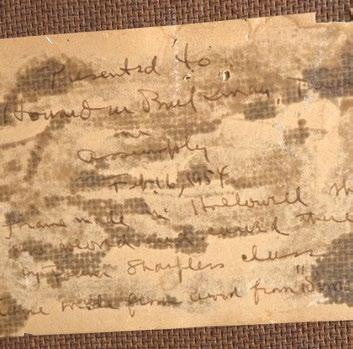
Dedication note to Howard Buckman, “Presented to Howard M. Buckman, Treasurer, in Assembly on February 16, 1954”
Opposite page: Diagram of the Quaker Walk, listing the origin of each stone
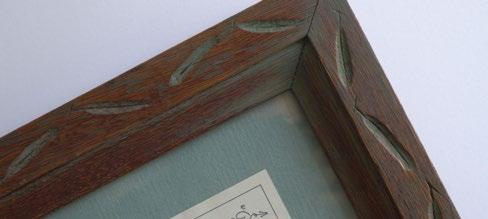
Above: Detail of the wooden frame holding the Quaker Walk diagram, made from the George School Sunset Oak tree and handcrafted by woodshop teacher Palmer Sharpless
HOWARD M. BUCKMAN, IN A LETTER TO FREDERICK TOLLES, SWARTHMORE, PENNSYLVANIA, MAY 1956
Making LearningIncred(IB)le
Celebrating 40 years of the IB experience at George School
Here, students don’t just study the International Baccalaureate — they live it every day. It’s a way of thinking, exploring and engaging with the world.
SSINCE 1985, the International Baccalaureate Diploma Program (IBDP) has been an integral part of George School’s academic culture, shaping generations of “inquiring, knowledgeable, confident and caring young people (ibo.org).”
Launched in the United States in 1975, the program first came under consideration at George School in 1984. Adopting it meant exploring how this academic model might shape the school’s future. Students would be measured not only by George School’s standards, but also by an internationally benchmarked curriculum — one that is collaboratively revised every seven years.
At the time, Head of School David Bournes was in his fourth year in the role, and Assistant Head of School Fran Bradley led the charge to assess George School’s reputation and future.
In the winter 2018 edition of the Georgian, Fran discussed the rationale for introducing the IBDP at the school, saying it “would strengthen our overall academic program by attracting students with a strong academic expectation for their experience here. The IB program seemed to be consistent with our Quaker ideals and with George School’s strong history of internationalism.”
The adoption of the IB marked a shift toward a more global sense of scholarship, and it signaled the confidence the school had in its ability to grow alongside the world.
Forty years later, this commitment endures, and has created a vibrant community where intellectual challenge and personal growth thrive through a truly lived education.
The program has been directed and guided by just three IB coordinators. Former math teacher and lacrosse coach Lin (Pappy) R. Parker P’88, ’89 served as the inaugural director until 1995, laying the foundation for the program’s early success. Upon Lin’s retirement, former English teacher Ralph Lelii led the program for the next 23 years.
In 2018, English teacher Kim McGlynn was appointed, and has continued to uplift, elevate and expand it.
“Students who pursue the IB diploma seek great challenges and accomplish amazing feats worthy of recognition,” shared Kim. “They are committed to excellence and have an intellectual curiosity to learn — not for the sake of a grade, but because they embrace the very idea of learning.”
Every student who pursues an IB track is a risk-taker, as simply enrolling does not guarantee the diploma. But Kim coaches her students to use that to drive their commitment. “They are motivated by knowing the reward is so much greater when you push yourself beyond comfort zones,” Kim said.
IB IN ACTION
At the heart of the IB program, the IB Core encourages students to engage meaningfully with the world around them by guiding them to think critically and reflect deeply. It is where inquiry meets purposeful learning. Along with academic rigor, the IB curriculum ensures students also develop balance, empathy and real-world perspective.
CREATIVITY, ACTIVITY AND SERVICE (CAS) CAS often becomes a bridge between academics and authentic community engagement, with students spending about 3–4 hours a week taking on meaningful challenges in all three strands — creativity, activity and service — and reflecting regularly on what they learn. They are also required to complete a month-long collaborative CAS Project and demonstrate achievement of seven defined learning outcomes through their CAS Portfolio.
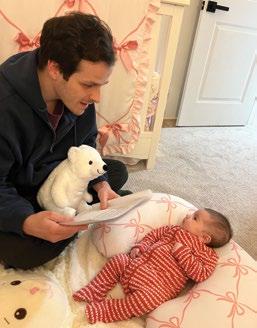
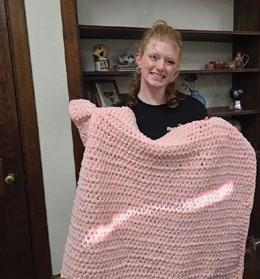
This spirit of thoughtful contribution came alive through the creativity-focused CAS experiences of Majd Abu Tahoun ’26 and Mia Woodruff ’26. To welcome College Counselor Michael Qualiano’s newborn daughter, Majd wrote a book of poetry and nursery rhymes, while Mia crocheted a handmade blanket. Expecting a routine check-in after winter
Opening spread:
Lin Parker (top center), the first IB program director, laid the foundation for the program’s success.
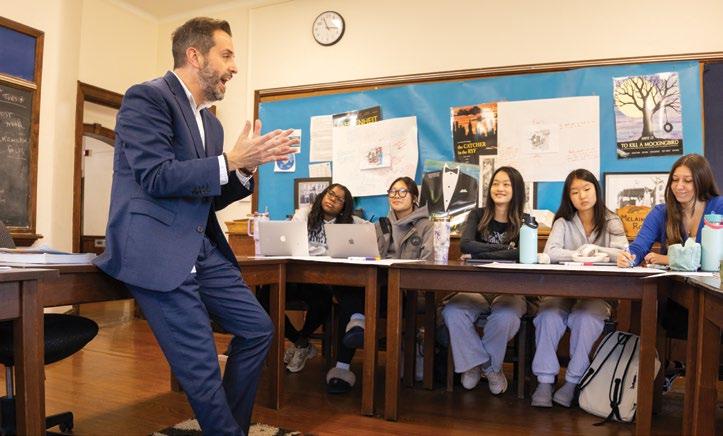
Opposite page, left: Current director Kim McGlynn believes her students “have faith in a better world.”
Opposite page, right:
Former English teacher Ralph Lelii led the IB program for 23 years.
break, Michael was instead met with heartfelt gifts, crafted during one of the students’ busiest seasons.
“I’ve never written an organized book of any sort before, but I decided to try anyway,” said Majd. “Michael has supported me immensely with the college application process, so it only felt right to gift him a tiny poem book that he could one day read to his daughter.” After revising the collection, Majd completed nine poems — four featuring Michael’s daughter as the main character. Each explored values like honesty and empathy, and the process taught him patience in return. “Gifting someone something handmade feels more personal. The IB program has encouraged me to do exciting things I wouldn’t have expected to do,” he said.
Mia Woodruff ’26 built her project around a memory she treasures: her grandmother’s love of crocheting. “She made scores of scarves, hats, ornaments and pillows. But her favorite was always the baby afghan,” Mia recalled. “No matter how distant the connection — family or friend — she poured immense care into every blanket she made.” Before her
grandmother passed, Mia learned to crochet so she could carry that legacy forward.
Michael had been a trusted mentor throughout Mia’s college application process. When she learned his wife was expecting, Mia stitched a crocheted blanket over the span of three months — a period that also brought her acceptance to her dream school, a milestone she credits in part to Michael’s support.
“Mia’s hours of threading and Majd’s hours of sentence crafting are straight from the heart,” Michael shared. “Time is a non-renewable resource, and it’s the time they put into these projects that means the world to me.”
For Michael, the experience reflects the deeper aims of the IB program. “Outside the classroom, students are building community bonds through action and service,” he said. “The IB asks students to understand the ‘why’ behind their ‘what.’ It invites students to consider how their creative, intellectual and spiritual contributions can bestow kindness onto someone else. IB prepares students to become aware, compassionate and empathetic global citizens.”
“
It invites students to consider how their creative, intellectual and spiritual contributions can bestow kindness onto someone else.
IB prepares students to become aware, compassionate and empathetic global citizens.”
— COLLEGE COUNSELOR
MICHAEL QUALIANO
INSIDE THE IB
While IB coursework is available to all George School students, completing the requirements for the IB diploma requires self-discipline, attention to detail and almost unfettered intellectual curiosity. Here are the defining elements and essentials behind every IB student’s journey:
George School offers the IBDP for students aged 16–19 who complete the course of study during junior and senior year.
IB diploma candidates must satisfy distribution requirements in the six IB subject groups: Studies in Language and Literature, Language Acquisition, Individuals and Societies, Experimental Sciences, Mathematics and the Arts. Assessment emphasizes skill-based, process-focused work, moderated internally and externally.
Students who successfully complete the IBDP earn both a George School and an IB Diploma. Students who choose not to pursue the full program may take individual IB classes or pursue certificates as IB Course Candidates.
The IB Diploma is internationally transferable, and many U.S. universities grant credit for strong IB exam results. Policies vary, but strong Higher Level (HL) scores are often accepted for college credit and completion of the full diploma can sometimes yield up to a year of college credit.
George School offers an “open access” IB program, rooted in equity and inclusion. Instead of limiting enrollment, the school empowers any student to pursue the IB and provides each with a dedicated, collaborative team of faculty and staff for support.
With more than 35 IB courses offered, George School offers students the flexibility to pursue strengths and interests. This has helped the school maintain a diploma pass rate in the mid-90s for the past decade, well above the global average.
Unique among U.S. schools that offer the IB diploma, GS offers a “lived IB experience” as a global boarding school.
BUILDING BRIDGES BETWEEN GENERATIONS THROUGH CAS PROJECTS
George School IB students also strengthen intergenerational connections through CAS projects with residents of Pennswood Village, a retirement community near campus.
In 2024, Cecilia Li ’25 and Peter Tang ’25 hosted “Welcoming the Year of the Dragon: An Intergenerational Lunar New Year Celebration” with the Pennswood community. Their program included a presentation with a Q&A on Chinese history and traditions, followed by a student-prepared dumpling tasting for nearly 70 residents. Cecilia and Peter worked closely with Pennswood staff to tailor the presentation and menu.
“I was amazed by how passionate the Pennswood community was about learning Chinese culture, which made me incredibly proud of our work,” Cecilia reflected. For Peter, the project exemplified IB’s mission: “The IB supports holistic growth and encourages learning beyond the classroom,” he said. “Joining IB was one of the best decisions I made at George School.”
Arthur Dao ’26, Kyle Okraku ’26 and Jagat Singh ’26 also connected with Pennswood residents with workshops that included performances, composing and sharing original music, teaching instruments, choir singing and exploring music theory and history. “‘Melodies for Memories’ was inspired by a shared love of music and a desire to use it as a way to connect with others,” said Arthur. “We saw music as a powerful tool to spark conversation, joy and memory and build meaningful intergenerational relationships.”
Jagat noted how the project reflects IB academics. “The existence of CAS has made it possible to turn something extracurricular into a coordinated project. The interdisciplinary focus of IB allows you to take what you learn in class and apply it in real-world contexts.”
“What I learned from it was humility,” Kyle continued. “Performing is the easy part, but interacting with residents requires more presence. You have to meet people where they are and create magic in conversations
alongside them. The IB teaches you how to take risks and harness your skills so you’re making an impact.”
EXTENDED ESSAY (EE): TURNING INTEREST INTO INQUIRY AND INSIGHT
Another integral element of the IB Core is the EE, a 4,000-word independent research project that prepares students for undergraduate-level work. By developing research questions and crafting evidence-driven arguments, students build the analytical and evaluative skills central to IB learning.
“When students enter the IB program in their junior year, they tend to be nervous about the EE,” said EE Coordinator and English teacher Carly Wassel. “Most have never written a research paper of this magnitude. There is growth in simply deciding to take the risk and join the program, knowing the EE is one of their first major tasks.” Students working on their EE receive support through consultations with their EE Supervisor; research and information-literacy instruction from school librarians; and guidance from the Learning Center and Writing Center, where they can talk through their ideas and process with peer mentors and faculty.
“The EE process is unique for every student,” Carly continued. “They learn that asking for help is a sign of strength, and are so proud of themselves when they submit that final draft. For me, it is rewarding to see each student’s journey, help them through their struggles and celebrate their success.”
THEORY OF KNOWLEDGE (TOK)
TOK, a critical thinking course, often marks students’ first encounter with philosophical reasoning. In Kyle Abbott’s classroom, TOK comes alive through rigorous theory and pop-culture references that make big questions feel accessible. Students draw on their own experiences to examine ideas on both personal and global scales and challenge assumptions. This allows them to take apart tightly held
beliefs, evaluate them critically and rebuild their thinking with new insights.
Epistemology — how we come to know and believe things — anchors his approach. Kyle pushes students to consider not just “what” they believe but “why,” emphasizing that real understanding requires intellectual humility. He invites students to consider what it means to be a good person within a community. When asked what he hopes students carry with them from TOK, his answer is simple: “I hope they have a better understanding of what it means to be a human being.”
Each year, George School hosts a TOK Exhibition Celebration to showcase IB students’ work and the intellectual journeys behind it. For their Internal Assessment (IA), students choose one of 35 “knowledge questions,” select three related objects and create an exhibition showing how TOK ideas appear in the real world.
FROM IB TO IMPACT
The IB experience transcends traditional classroom learning, empowering students to shape their future. This experience fuels ambition and opens doors for alumni long after graduation.
“Alumni come back and tell me they are so grateful to have done the IB program,” Kim McGlynn said. “They feel confident in navigating academic, social and professional challenges in life because IB taught them to keep moving forward with purpose to help create a more peaceful world.”
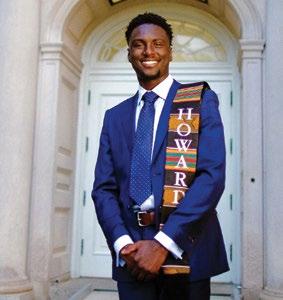
Michael Clark ’20 shared that the program encouraged him to take ownership of his academics and broadened his understanding of global issues. “IB enabled me to become a citizen of the world,” he said. “And it taught me that learning isn’t just about having the right answer, but about sharing unique perspectives and questions that stimulate progressive discussion.”
Above, top: Michael reads Majd’s book of poetry to his daughter.
Above, bottom: Mia learned to crochet from her grandmother and made this blanket for Michael’s daughter.
Left: Carly Wassel, Extended Essay coordinator for the IB Diploma Program
“
When asked what he hopes students carry with them from TOK, his answer is simple: “I hope they have a better understanding of what it means to be a human being.”
— THEORY OF KNOWLEDGE TEACHER KYLE ABBOTT
After graduating from George School, Michael studied economics at Howard University, inspired by his IB history courses with Ben Croucher and Lyman Castle. “Going to a Historically Black College and University (HBCU), I realized that the Black experience is not a monolith; experiences can make all the difference in the lens through which someone
perceives the world and interacts with their community,” he said. “IB and George School helped me authentically connect with people of varying walks of life across the African diaspora.” His advice for current and future IB students is to be proactive in researching colleges that recognize IB coursework. “I was able to graduate a semester early because IB
courses from George School served as general education requirements,” said Michael.
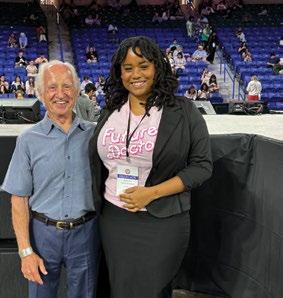
Halaylah Lewis-McGlothan ’25 made the most of her time at George School as both a student and a community leader. She, Alexa Nygren ’24 and Bimby Olaleye ’25 teamed up to host dance workshops at Pennswood Village for their CAS project. One summer, Halaylah was also a delegate to the Congress of Future Medical Leaders. Her nomination was signed by Dr. Mario Capecchi ’56, P’02, winner of the Nobel Prize in Medicine and the science director of the National Academy of Future Physicians and Medical Scientists.
This past fall, she returned as the featured alumni speaker for the “Students of Color Speaker Series: Focus on IB.” In it, she shared her experiences as a young woman of color and how IB prepared her for Princeton University, where she is majoring in psychology and pre-med. “IB taught me a lot about introspection and figuring out who you are, what you want and what you enjoy,” she continued. “You have a lot of commitments in IB, but I wouldn’t have chosen another path. IB sets you up; it will stick with you. Is it hard? Absolutely. But is it worth it? Absolutely.”
For some families, IB is a tradition. Head of the English Department and Dodd Teaching Chair Melaina Young ’93, P’24 earned her IB diploma at George School and still fondly remembers her classes. Her son, Drew Mirarchi ’24, became an IB candidate as well. Like his mother, he was a standout varsity athlete in soccer and lacrosse, and his passion for sports shaped his IB experience. He wrote his EE on the impact of WWII on baseball and completed his CAS Project by creating a lacrosse clinic for young athletes at Newtown Friends School. He’s carried this forward as a student at the University of Miami, where he’s spending some of his free time coaching lacrosse at a local middle school.
“As both an IB diploma graduate and an IB teacher for over 20 years, I’ve seen how the program connects George School to a global academic community while shaping students
into confident, analytical thinkers,” shared Melaina. “Through meaningful research and external review of their work by educators around the world, students develop skills that prepare them exceptionally well for college and careers beyond.”
CULTIVATING THINKERS, LEADERS AND CITIZENS OF THE WORLD
IB is a global family that spans classrooms and continents, embracing diverse perspectives and uniting around a shared purpose. Its mission inspires curiosity, global-mindedness and meaningful connection. Its spirit shapes the George School experience — guiding not only how students learn, but who they become.
“George School’s mission statement ends with a reminder to let our students’ lives speak; the IB mission statement ends by reminding us that other people with their differences can also be right,” explained Kim. “Our IB students have faith in a better world. And I see them working toward it every day. Through their curiosity, the knowledge they exchange and the daily care they show one another, our students themselves are reason enough for me to believe in that better world, too.”
“IB sets you up; it will stick with you. Is it hard? Absolutely. But is it worth it? Absolutely.”
— HALAYLAH LEWIS‑MCGLOTHAN ’25
Above, top:
IB Diploma recipient Michael Clark ’20 went on to receive his degree in economics from Howard University.
Above, bottom:
IB diploma recipient Halaylah LewisMcGlothan ’25 with Nobel Prize-winner Mario Capecchi ’56 at the Congress of Future Medical Leaders
Opposite page:
Kyle Abbott teaches “Theory of Knowledge,” one of the most popular IB courses offered at George School.
ESSAY SPOTLIGHT
Looking Ahead
When students travel halfway across the planet to attend boarding school in a new country, with a different culture, there’s a chance they might walk away from some family values.
But after four years at George School, it’s safe to say there’s no concern about Mira, Laith and Majd Abu Tahoun ’26 walking on any other path than the one their parents gave them.
The triplets arrived ready to take big bites out of every opportunity they encountered. And this they did: All three are IB students, and Mira is co-class president. What’s more, their experiences sparked and shaped goals for their futures. Yet, the fundamentals they learned at home in Saudi Arabia from a very young age — compassion, generosity, service — stayed intact, and continue to fortify them.
Here, the senior siblings tell us what they gained from George School, and what’s next.
MIRA
Plans to study: Architecture
IB has really changed my approach to studying and has given me a whole new perspective on what knowledge can be. My life was shifted. It has taught me so many things that I would never have experienced on the other side of the world. I’m more aware and present in everything I do. And EE (Extended Essay) introduced me to architecture.
Staying on campus during the summer of 2025 was better than if we went back home because I was able to work on an architecture project with teachers who were staying on campus. And my brothers and I volunteered at Springtime School. It was just amazing, the kindness that was shown to us.
MAJD
Plans to study: Mechanical engineering
My life goal is to build wealth in order to give a lot to charity and help a lot of people. I want to learn how to produce stuff and build; I love building things with my hands.
In 2024, my friend and I began our business, “Carved Connections,” making laser-engraved, customizable cutting boards with campus-sourced windfall. We’re continuing it independently and trying to expand it to Etsy. After college, I’m going to work on becoming an entrepreneur and building businesses.
My brother and I also took part in a RoboCup competition where we built a robot that could kind of play soccer. We’re also building a bionic arm.
LAITH
Plans to study: Biomedical engineering
The IB writing process at George School was really reflective. It’s not just about getting through the work; you have to think about what you’re doing and why. For a month and a half or two months, you have to look at what you’ve been doing — service-related, activity-related, creativity-related — and reflect on your time. It is very therapeutic. It prepares you for what you’re going to have to do in college.
I started on the pressure-sensor bionic arm in January 2025. It’s for a classmate who only partially has their thumb. We’ve been working alongside them to try to help them out and get it to match the human body. After college, I might get into the healthcare field.
Tallying George School Values
A statistician teaches real-world skills and guides with empathy.
WERE IT NOT for statistics, Valerie Greaud doesn’t know if she would have found her way to George School. A statistician at heart with a penchant for working with students, a career pivot and class observation at George School in 2003 happened to coincide at a time when the math department was looking to establish a statistics program. Bill Enos, the math department head at the time, hired her … and she’s glad he did. Her background in statistics, psychometrics and psychology has been invaluable during her time at George School. Before teaching here, she earned her PhD from Johns Hopkins University in quantitative psychology, worked as a statistician for Educational Testing Services (ETS) and served as an assistant professor in the psychology department and School of Education at Syracuse University. But she knew she wanted to teach high school students and show them that math extends beyond the classroom.
“The thing I like about teaching statistics,” Valerie shared, is that “it’s an applied math subject: We use principles of statistical mathematics and apply them to real-world situations.”
Math did not always come easily to Valerie, and she keeps this in mind when teaching her students. “I know what it’s like to have math be hard,” she said. “That gives me an extra dimension as a teacher to know there’s a path for all students to find success.”
This empathy extends to Valerie’s other work at George School. In addition to her role as a math teacher, she has also worked in Orton Dormitory as a dorm head and parent, led weekly local service trips, served as a leader on service trips to New Orleans (2012) and Mississippi (2018) — which she led with her daughter Emma ’09 — been the co-op supervisor on campus and provides academic and study skills support for students in the Learning Center.
Each of these roles have connected Valerie with students and the community in meaningful ways that support Quaker values.
“No one thing gets done alone,” she said. Specifically with coop, Valerie shares the importance of uplifting work that is not always visible but is essential in the George School community. Whether helping in the dining hall or cleaning classrooms, co-op is a learning experience for students that extends beyond work ethic and focuses on the Quaker philosophy of community. It fosters equity and an appreciation of the way each member contributes to sustaining the community of George School, in both noticeable and quiet ways.
When asked about her work in the Learning Center, Valerie lights up. She values the one-on-one attention students receive in the space, the small-group work and the connections with students that are different from a traditional classroom setting. The fulfillment Valerie feels from her time in the Learning Center is evident. There, students “come to see us as somebody on their side to partner with them, to help them walk their journey of success and to find out what they’re capable of doing.”
Valerie added that the support students receive in the Learning Center coalesces well with George School’s holistic approach to cultivating an appreciation of lifelong learning.
“Students can seek support, they can seek help, they can ask questions, they can say ‘this is hard,’ and somebody will be there to support them,” she said.
For Valerie, teaching and modeling for students the importance of using their voices, advocating for themselves and working together leads to growth.
“What brings me the most joy,” Valerie shared, “is the opportunity to build relationships with students and help guide them during a pivotal point in their lives. They learn that they can do things they might not have thought they could do.”
SCOTT SPENCE FIVE QUESTIONS
Scott Spence P’10, ’14, ’20 reflects on teaching a mod of “Essentials of an Intercultural Friends Committee” this fall, living out the Academic Program he worked so closely to develop and implement as associate head of school.
Why this course?
“I’d never taught in the religions department, but as a longtime George School employee and a Quaker myself, the course felt resonant to me. I had a longstanding interest in teaching it.”
What challenges did you face?
“Having not been in the classroom for a dozen years, it took time getting into the rhythm of it — and using the learning management system Canvas … that was new to me.”
Greatest takeaway?
“I was struck by how open-minded and kind our students were. That’s been true a long time — decades before I even arrived. One of the reasons I’ve stayed at George School for so long is because I love seeing the way the students take care of each other, and I hadn’t experienced it to that extent in the classroom before.”
What’s next?
“The big question for me is, I found a way to get back in the classroom. Can I find a way to get back out on the athletic field?”
Setting Records
DRIVEN by a mindset that prioritizes personal growth alongside competition, the George School track and field team has turned individual progress into collective success. With a philosophy centered on the belief that every personal record represents a victory, the student-athletes have logged 141 PRs and 32 all-time top-10 performances.
This dedication has translated into elite performance ahead of the Pennsylvania Independent Schools Athletic Association State Championships. The boys team has shattered 11 school records, while the girls team set a new standard in the sprint medley relay. The season’s success is capped by multiple bids to the Nike Indoor Nationals, including the boys sprint medley relay team and individual qualifiers across sprints, hurdles, jumps and throws.
“We are incredibly proud of the work our student-athletes continue to put in each day,” said Head Coach Mike Bailey. “Their commitment to improvement, team culture and competitive excellence truly reflects what George School track and field is all about.”
COLLEGIATE COMMITMENTS
Maggie O’Dunne
DI UNIVERSITY OF KANSAS, Rowing
Harry Degnan
DIII WESLEYAN UNIVERSITY, Rowing
Ziva Salan
DIII HAMILTON UNIVERSITY, Rowing
Mikko Kuittinen
DIII BOWDOIN UNIVERSITY, Swimming
Michael Mascari
DIII SWARTHMORE COLLEGE, Cross Country
Jackson Ellis
DIII EMORY UNIVERSITY, Track and Field
This list is ongoing.
FENCING TAKES OFF
“I’m really excited to meet the pent-up demand that was here and give it expression. I’m happy to keep building confidence with our team, especially since we are already in a strong position. It’s wonderful for our students to come together, walk in and walk out with a win.”
— ERIC WOLARSKY, REFLECTING
From the Archives 1928
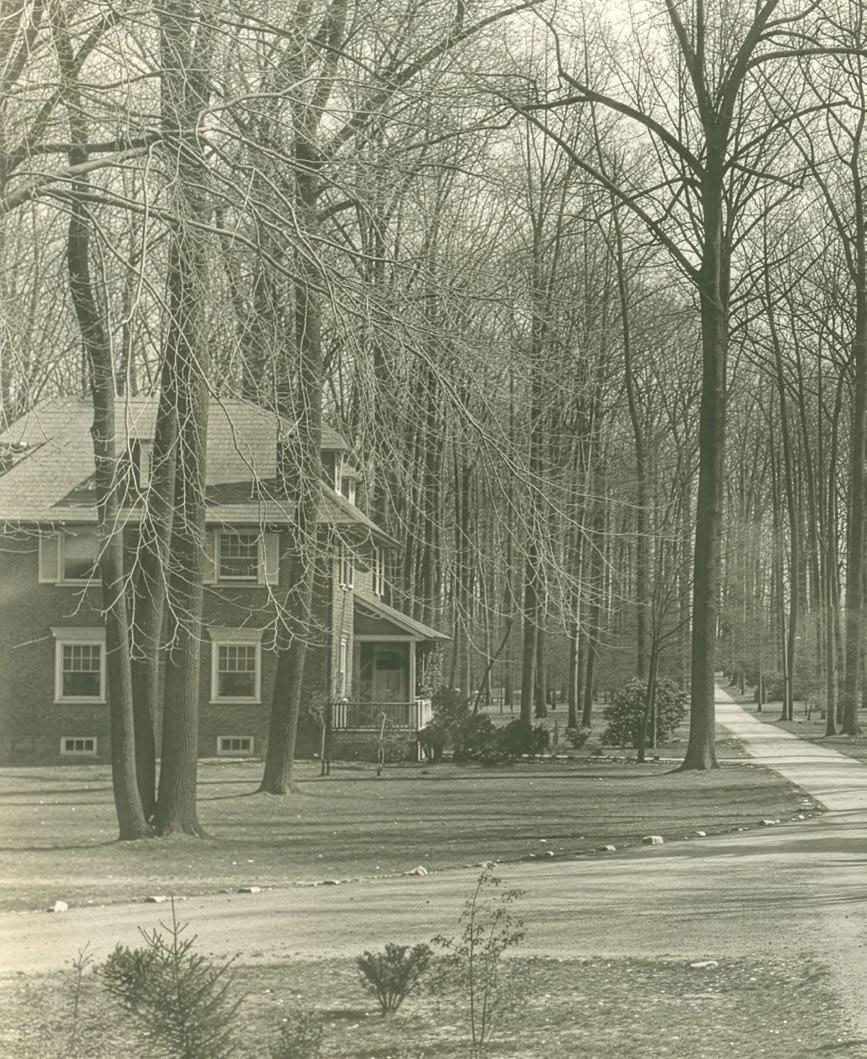
Science teacher (1895–1899) Dr. Jesse Holmes built Eyre Line House in 1895 as his private home. George School acquired it a few years later. For many years, the house sheltered not only a faculty family, but also three or four students, who occupied a suite on the third floor.
PHOTO: MOLLIE DODD ANDERSON LIBRARY ARCHIVES
1939
George School mourns the passing of Donald (Don) M. Solenberger on February 9, 2026, at the age of 103. Don was a life insurance and investment independent agent, active University of Pennsylvania alumnus, author and a WWII Army veteran. While at Penn, he was president of his class of 1946, president of the Sphinx Society, president of the Christian Society and president of the Kite and Key Society. During WWII, the Army awarded him the American Theater Ribbon, the Asiatic-Pacific Theater Ribbon with two battle stars and the WWII Victory Medal. He was a member of the Union League of Philadelphia for over 70 years, a life member of the Mayflower Society and the Sons of the American Revolution. Don loved American history and spent years researching a historical fiction novel about General George Custer. In partnership with Judith Gotwald, “STILL STANDING: Surviving Custer’s Last Battle,” was published in 2012. Don was very interested in white water canoeing, having participated in several river stunts in different parts of the U.S. and Canada. In later years, he became
a Pennsylvania Dutch stand-up comic, performing at Rose Valley Folk Theater and several retirement homes.
1943
George School mourns the passing of Nancy Smith Hayden, mother of Joan Hayden Taylor ’67, on August 6, 2025. Nancy passed away peacefully at the age of 100 at White Horse Village in Newtown Square, Pennsylvania. The daughter of Claude C. and Mary Roberts Smith, Nancy was born on February 16, 1925, in Philadelphia. She grew up in Swarthmore, Pennsylvania, the youngest of four children. Her family spent many summers together in Buck Hill Falls, Pennsylvania. Nancy received her bachelor’s degree in economics from Swarthmore College in 1946. While attending Swarthmore, she met her future husband, Robert (Bob) G. Hayden. They were married in July 1946 under the care of Swarthmore Friends Meeting. Nancy celebrated her 100th birthday surrounded by her loving family. She was an active member of Swarthmore Friends Meeting, teaching first day
school, serving on numerous committees and chairing the annual Jumble Sale. She belonged to PEO, a philanthropic organization, and was an avid golfer, having developed a love of the game during her summers at Buck Hill Falls. She won numerous tournaments, had seven holes-in-one and shot her age of 95 while playing at Buck Hill! Nancy was an active member of the Providence Garden Club for 50 years. She volunteered as a reader to kindergarten children in the Chester School District and supported the Chester Children’s Chorus. She enjoyed reading and playing bridge, but her favorite activity was spending time with her family.
George School mourns the passing of Henry C. Pickering, Jr., father of Wendy Pickering Adams ’70, on February 5, 2025, four months shy of his 100th birthday. Hank was born and raised on a small farm in Bucks County, Pennsylvania, the son of Henry and Esther Pickering. He served in the US Navy during World War II. After the war, he pursued his education through
the GI Bill, earning a degree in mechanical engineering from Syracuse University. In 1950, Hank married Patricia Gordon, and together they settled in Sparta, New Jersey. Married 68 years, Patricia passed in 2018. Hank’s professional career began at Reaction Motors. As project engineer, he played a role in developing rocket engines for groundbreaking aerospace projects, including the North American X-15 experimental aircraft which, on October 3, 1967, set a record as the fastest manned aircraft ever, flown at 4,520 mph. His contributions also extended to the Surveyor and Apollo Moon landing programs. Outside of work, Hank enjoyed skiing with his family and spending summers at their home on Long Beach Island, New Jersey. There, he maintained a classic 1933 wooden boat, The Water Wagon, which was both a source of pride and a testament to his engineering ingenuity in keeping it seaworthy.
1946
George School mourns the passing of Marjorie (Peggy) Claassen Craven, sister of Helen Claassen MacMath ’49, on May 28, 2025, at the age of 95. Born in Trenton, New Jersey, to the late Carl F. Claassen 1924 and Marjorie Claassen, Marjorie dedicated her life to education, teaching, music and God. She will always be remembered as an amazing mother, grandmother and great-grandmother.
1947
Gerret (Gerry) B. Conover turned 96th on March 1. Attending George School was a highlight of his life. He represented the school at a work project in Germany after WWII.
Gerret (Gerry) B. Conover ’47 turned 96 on March 1, 2026.
Donald (Don) R. Walton ’50 celebrates his 90th birthday with goddaughter Katharina (Kate) M. Griese ’16.
Justine Vaughen Fry writes, “I am grateful to have recently celebrated my 95th birthday in my own home with family and friends. Retired from my medical practice at 92, now practicing “telemedicine” with my grandchildren and enjoying hobby photography in beautiful Florida.”
George School mourns the passing of Margaret (Peggy) Weimar Lambert, sister of Russell (Russ) M. Weimar ’48 and Kathryn Weimar ’49, on Monday, September 30, 2024, in New Oxford, Pennsylvania. Peg was born on December 29, 1929, to Dr. Russell Conwell and Margaret Funk Weimar in Philadelphia. Peg graduated from the University of Pennsylvania with a bachelor’s/RN degree in 1952. She worked at various hospitals, including Purdue Valley Hospital in Fort Collins, Colorado; Holy Cross in Silver Spring, Maryland and the Brethren Home in New Oxford. She also worked as a traveling nurse for migrant workers of central Pennsylvania. She was a member of the Great Conewago Presbyterian Church in Gettysburg, Pennsylvania.
1948
George School mourns the passing of Katharine (Kate) Leggett Downham on May 4, 2025, at the age of 94, in Wilmington, Delaware. She was the beloved wife of the late John Finney Downham and the daughter of the late Dr. Lindley Leggett and Katharine (Pearsall) Leggett of Westfield, New Jersey. Kate grew up in Westfield with her older brothers Lindley H. Leggett ’40 and Edgar (Ed) P. Leggett ’44 and received a Bachelor of Science degree in education from the University of Delaware, where
she met her future husband. Kate lived in Texas, Alaska, Massachusetts and Allentown, Pennsylvania, before she and Jack settled in Graylyn Crest Wilmington, Delaware, where they raised their two sons. Kate was very involved in her community and church, a member of the “Graylyn Crest Swim Club” Pool Girls, a supporter of the Wilmington Arts Community and a devout parishioner of Aldersgate Methodist Church, where she was a longtime member of the women’s circle. Her contributions to their cookie walk bake sales were legendary. After her husband’s death in 2008, Kate moved into the Methodist Country House (now ACTS Community), where she had been a volunteer since 1973.
1950
George School mourns the passing of Allan P. Palmer on January 14, 2026, at the Complete Care nursing home in Macungie, Pennsylvania. He was born in Elizabeth, New Jersey, on August 24, 1932, the son of the late Lewis Lyndon Palmer, Sr., and Frances Yeatman (Pierson) Palmer. He was 93. At George School, he played on the soccer team. He was a member of the Delta Theta Sigma agricultural fraternity at Pennsylvania State University and earned a bachelor of Science degree in agricultural economics in 1954. He joined the U.S. Army after graduation, achieving the rank of corporal and serving in the Panama Canal Zone. He was married June 29, 1957, to Janet Ruth Heess at London Grove Friends Meeting. Allan spent most of his career working as a district manager for sales, first for the International Harvester Company (IH) and later for
Woods Equipment Company. During his career, he lived in London Grove; Clearbrook, Virginia; briefly in Florence, Mississippi; and Schnecksville, Pennsylvania. Allan enjoyed genealogy, playing games and watching Penn State football and the Philadelphia Phillies. He also loved annual trips to Cape May, New Jersey. In his retirement, he became an avid collector, specializing in cast-iron toy tractors, trucks and cars. He was a lifelong member of the Hockessin Friends Meeting in Hockessin.
George School mourns the passing of Donald (Don) R. Walton on November 23, 2025, at the age of 93. Don, affectionately known to many as “Dovetail,” was a lifelong Quaker who remained deeply immersed in the Quaker community throughout his life, consistently upholding the values of integrity, simplicity, creativity and service that shaped both his character and his work. During his years at George School, Don spent countless hours in the woodshop, where he discovered a passion that would define his life’s work. After graduating, Don continued his studies at the Rochester Institute of Technology’s School for American Craftsmen, studying woodworking and furniture design. He later served two years in the U.S. Army before attending the Philadelphia Museum College of Art, where he studied threedimensional design. These experiences further refined his technical skill and artistic vision. In the late 1950s, Don relocated to southern California, where he founded The Walton Company, designing and building custom wood furniture and yacht interiors. He collaborated closely with manufacturing innovators such as
Hobie Cat and Scott USA, helping to design, build and establish their manufacturing processes. Don’s most enduring commercial contribution, ProtectoMat, filled an important gap in the interior plantscape industry before expanding into broader markets. Following ProtectoMat came GrafixMat, a unique line of laserengraved coasters, artistic and functional for everyday use. These products can still be found in retail stores today — a testament to his ability to blend practical problem-solving with thoughtful design. In 2013, Don married the love of his life, Laveta Walton. He was also the beloved godfather of George School alumna Katharina (Kate) M. Griese ’16 and her brother Alex Griese. Don will be remembered not only for his remarkable ingenuity, but for his generosity, kindness and quiet passion for helping others create something lasting. His legacy lives on in the people he inspired and the community he cherished.
1951
George School mourns the passing of Heath Dillard, sister of David B. Dillard ’53, on March 26, 2024. Heath was a distinguished historian and beloved wife, mother, grandmother and great-grandmother. Born on October 11, 1933, in Cleveland, Heath was raised in Ohio and Charlottesville, Virginia. She graduated from Vassar College, where she was awarded the Brownell Prize in History and was Phi Beta Kappa. After raising four children, Heath pursued advanced studies at the University of Virginia, earning both a master’s degree and a PhD. Her dissertation was later published by Cambridge University Press as “Daughters of the Reconquest: Women in Castilian Town Society,
CONNECTIONS CLASS NOTES
1100–1300.” In 1979, she moved to New York City with her beloved husband Michael Perna, where she continued her research and writing while embracing city life. Heath’s passion for medieval history led to a remarkable career as an independent research historian. She was recognized for her groundbreaking work on medieval Spanish women with grants from the Tinker Foundation, the Council for International Exchange of Scholars and the National Endowment for the Humanities, among others. Beyond her academic pursuits, Heath enjoyed reading, knitting sweaters for her family, shopping at Bergdorf Goodman and cheering on her beloved Yankees.
Jack G. Schafer writes, “I have not contributed before, but think that after 75 years, I should say something! My wife and I sold our house of 58 years and moved into The San Francisco Towers,
a retired community. It was a wonderful change and ensures our future at such a late age. My work career: 21 years at The Emporium department store; four years as the Peace Corps country director in Senegal; six years as CEO of the largest store chain in Singapore; and 10 years consulting for Japanese department stores. We have three marvelous daughters, all with marvelous husbands and eight grandchildren — seven boys and one girl. They are all in their twenties and doing myriad things. As for politics, I am appalled at the current administration and its very unQuaker attitude toward anyone not white and Christian. We are very lucky to have lived this long in San Francisco with no continuing medical issues.” 1952
Robert I. Adler writes, “Not quite 2 1/2 years ago, my wife Sigrid and I moved from our 47-year home
in Port Washington, Long Island, to a senior-citizens community in Silver Spring, Maryland, where our daughter (the youngest of three kids) has lived for decades and, in turn, raised her three kids. Our other two are widely scattered: Our son lives with his wife and their two adult sons in Lisbon, Portugal; our daughter lives with her husband in a coastal community north of San Francisco. We have seven grandchildren and one greatgrandson.”
George School mourns the passing of Richard H. Burdsall, husband of 63 years of Priscilla Rogers Burdsall ’52, on March 27, 2025. Richard’s life was defined by his love for his family, his deep roots in the community and his enduring commitment to those he held dear. He will be remembered for his generosity, warmth and the impact he made on the lives of all who knew him.
George School mourns the passing of Joseph (Baum) B. Harris on January 14, 2026. A devoted father and the founder and Chairman Emeritus of UI Medical, LLC, Baum was a generous supporter of George School, particularly in relation to the school’s commitment to financial aid.
Mary Jane Mikuriya writes, “A few years ago, someone stated on Potrero Nextdoor, “I see a Black man walking down the street. Be careful.” As a mother of an African American child, I was shocked and put a notice on the Nextdoor website that anyone who also felt offended by this statement should join me for a pop-up potluck at my house on such-and-such a date. Seven people showed up, and since then, we are having monthly pop-up potluck gatherings in
a neighbor’s home so we can better know our neighbors and speak up as against such comments. Currently, there are 70 households participating in Potrero Hill monthly events. We need more such neighbor gatherings in America these days … don’t you think?”
William (Bill) M. Quigg writes, “After 32 years in Phoenix, I moved to Louisville, Kentucky, last October. Near 12 family members in Louisville and Nashville, Tennessee, and four in Montana. Hoping to see everyone next year at our 75th. Slowly adjusting to cold weather.”
George School mourns the passing of J. Lawrence (Larry) Shane on January 29, 2025. He was surrounded by his family, having just celebrated his 90th birthday. Born on January 27, 1935, he lived life to its fullest in terms of accomplishments, relationships and the profound impact he had on so many, but overriding it all was his love and devotion to his extensive family. Larry was born to Theresa Cooper Shane 1921 and Joseph B. Shane and, along with his older sibling John B. Shane ’46, lived his early years at both George and Oakwood Schools, where his father was a teacher. Larry attended Swarthmore College, where he majored in mechanical engineering. There, he said, “I probably majored too much in athletics, since I played varsity soccer, basketball and tennis … but in the end, they actually awarded me a degree!” Humble to a fault, he left out that he was an All-American soccer player and co-captain of the college team. It was at Swarthmore that Larry met Marty, the love of his life, and they married the year after her graduation. They continued to reside in
William (Bill) M. Quigg ’52, on a visit to Yellowstone
Swarthmore, where they raised their daughters. Following college, Larry was employed by the Scott Paper Company. He began taking night classes at Wharton, earning an MBA in finance, and rose through the ranks of Scott Paper until he reached the apex of his career as vice chairman and director of this international company. Over the years, professional colleagues lauded Larry’s common sense, integrity and his straightforward and diplomatic approach while working with people at every level as the keys to his success. Following his retirement from Scott Paper, Larry served on the boards of CoreStates Bank, the Philadelphia Orchestra, Crozer Keystone Hospital System and the 1838 Debenture Bond Fund. He served on the Swarthmore College Board of Managers for almost 40 years as a member, treasurer, vice chairman and chairman from 1997–2003. Larry remained active in his community, supporting and participating in Swarthmore Presbyterian Church. Despite a challenging career, Larry put his heart into being an involved father, always available to help with homework, teaching his daughters to ski (with good results) and to throw (not-so-good results). He went to tailgates at each of his daughter’s colleges, helped them launch their own careers and was an advisor and supporter to each of them whenever life challenges arose. Even as the girls married and began raising their own families, Larry and Marty had the whole “gang” over once to twice a month, where fun, laughter and love abounded. Larry and Marty traveled extensively and visited all seven continents during their lifetimes. Zermatt, Switzerland was a favorite destination. In college, Larry climbed the Matterhorn, though he humbly stated that it
was his guide who should get the credit for his getting to the top! Larry played golf, tennis and squash, and loved downhill skiing. At the age of 75, Larry and Marty moved to White Horse Village. Larry headed up the finance committee, while they both sang in the choir and enjoyed living closely with so many old and new friends. A good friend said, “He made an indelible impact on everyone he met.”
George School mourns the passing of Gabrielle Stocker on June 23, 2025. Gabrielle was born in 1935 to Mary Anne and Frederick Stocker in Lucerne, Switzerland, along with Maya Stocker Powell ’49 and Evelyn, her elder and younger sisters, all of whom loved music. They immigrated to the U.S. in 1941 and settled in Durham, North Carolina. Gabrielle earned a Bachelor of Science in biochemical sciences from Radcliffe College and married fellow Harvard graduate, George Bouchard. They moved to Seattle, where Gabrielle was a medical research technician at University of Washington and discovered the joy of hiking and mountaineering, summiting numerous glaciated peaks, including Mount Rainier and Mount St. Helens, when it was still whole! She also began playing Renaissance music in a recorder consort. In 1959, they moved to Albuquerque, New Mexico, where their daughter Carol was born; then to Ithaca, New York, in 1962, where George continued his graduate studies at Cornell University, and their son Andrew was born. In 1968, the family moved to San Jose, California, where Gabrielle earned her secondary teaching credential in mathematics from SJSU and became immersed in playing Renaissance and baroque music
as well as coaching ensembles. After Gabrielle and George divorced in 1973, Gabrielle moved to Santa Cruz, California, in 1976. She knew immediately she wanted to spend the rest of her life in this beautiful seaside town with its rich cultural environment. Besides substitute teaching, Gabrielle began teaching recorder ensembles privately and at local community colleges. She delighted in performing on recorders, crumhorns and viola da gamba with the Antiquarian Funks. Fulfilling a long-held dream, Gabrielle earned a bachelor of arts degree in music at UCSC in 1982. As a UCSC music student, Gabrielle discovered the joys of singing, and gradually her musical focus shifted from instrumental to vocal music. She sang in the UCSC Chorus, Cabrillo Concert Choir, Choral Project, Santa Cruz Renaissance Singers and finally the Santa Cruz Chorale. In Santa Cruz, Gabrielle resumed her earlier interest in hiking, backpacking and studying natural history, serving as an enthusiastic volunteer docent at Natural Bridges State Beach.
1953
George School mourns the passing of David (Dave) P. Bruton on July 25, 2025, at the age of 88. David, who served as clerk of the George School Committee (GSC) for 11 years, “embodied a lot of what the school stands for,” shared head of school Nancy Starmer, when he was appointed as the ninth clerk in the fall of 2001. A member of the George School Class of 1953, David went on to graduate from Princeton University and Harvard Law School. He embarked on a legal career at the Philadelphiabased firm Drinker Biddle and Reath, where he served as managing partner and chairman of the litigation department.
Several cases he was involved in went to the Supreme Court, and he presented the oral argument in one that concerned the separation of church and state in education. “One of the things my George School education did was to give me a sense of confidence and a desire to be independent and to think for myself,” David once reflected. Though he sent his daughter, Kathryn (Kate) A. Bruton ’84, to George School, he wasn’t very involved with the school until former head David Bourns invited him to join the GSC in 1998. He then served on the Finance, Investment, Physical Plant, Membership and Advancement Committees, as well as the ad hoc committees of Strategic Planning Oversight Committee, Library Design and Campaign, Fitness and Athletics Center Campaign, North Coast Property and Capital Projects. David served as GSC clerk from 2001–2011. His professional experience, coupled with his involvement in educational issues over the course of his lifetime, made him a particularly effective clerk. “What made David our unanimous choice for clerk is his seemingly effortless ability to provide leadership and his talent for dealing with tough issues with enormous, good sense,” said committee member Jackie Bowers at the time of his appointment. David found the inclusive Quaker process of seeking insight energizing and enriching. “Listening, and being open to another’s point of view, is crucial to reaching understanding and clarity,” he once said. As clerk, David was involved in a broad range of activities, but the most significant was his work helping to shepherd Barbara Dodd Anderson’s transformative $128.5 million gift to the school. Long-range planning for this gift, along with a rigorous curriculum
review process, a commitment to leadership in environmental sustainability and the building of the Mollie Dodd Anderson Library and learning commons helped to both ensure the long-term stability of the school and provide it with opportunities for continued change. He was also tremendously supportive of faculty, working to improve faculty housing and compensation. David was honored with the Alumni Award in 2008, which recognizes alumni who have used their talents, expertise and personal commitment to make a positive impact on those around them. “David is extraordinary at seeing the big picture,” said Nancy in describing his leadership. “He understands what the school is all about and is able to capture the essence of what the group is feeling.”
George School mourns the passing of Sheridan (Dan) W. Johns III on May 1, 2025. Dan was a distinguished political scientist renowned for his extensive scholarship on South Africa, focusing on liberation movements, communism and resistance during the apartheid era. Born in Milwaukee, he graduated from Amherst College and completed his PhD at Harvard University. Dan taught political science at Duke University from 1970–2000. He was also a visiting lecturer at the Institute of Social Studies in The Hague, the University of Zimbabwe, Yale University, University of Cape Town and the University of the Western Cape in South Africa. Dan was a loving and caring educator, husband, father and grandfather. He was an avid Duke basketball fan and passionate traveler. His most recent trip was to Mongolia. Dan
and his wife Christa met in 1952 at an international student work camp in southern France and would have celebrated their 60th wedding anniversary this June.
George School mourns the passing of Marjorie (Peggy) Ayars Laidman, sister of William (Bill) Ayars ’51, on October 13, 2025. She was 90 years old. Peggy was born in Cambridge, Massachusetts, but grew up in Syracuse, New York, while spending summers at her beloved Sailing Hi on Skaneateles Lake, New York. She attended Salem Hyde School before graduating from George School. Peggy then obtained her bachelor’s degree from Mount Holyoke College in South Hadley, Massachusetts, and her master’s degree in special education from Syracuse University. Peggy’s father owned Lightning #1, the first of the Lightning sailboats designed and built in Skaneateles. She met her husband Hume Laidman thanks to her love of sailing, as they were introduced by a mutual sailing friend and were married a few short months later. Peggy and Hume later kept Lightning #1 on Cazenovia Lake, New York, before selling it to a collector. The sailboat is currently owned by Mystic Seaport Museum and is on loan to the Skaneateles Creamery. Peggy had a deep love of skiing, having learned to ski at a young age. She taught Hume, her Florida-raised husband, to ski, thereby creating what her children would come to know as a die-hard skiing family. Peggy and Hume were both members of the National Ski Patrol and taught many others to become ski patrollers. Her children were all raised as ski racers and went on to become involved in ski coaching. Her love of skiing was
passed on to her grandchildren. After riding along with the part-time ambulance/funeral service. Peggy saw a need for a dedicated ambulance service in the area. She went on to be a founding member of CAVAC and spent many years in service to the organization, earning the honorary title of Lifetime Member. Peggy always had a love for nursing, and at the ripe old age of 44, she returned to school at SUNY Morrisville, where she earned her associate degree and an RN in nursing. She worked for many years as a nurse before retiring to follow Hume to England for his career. Upon their return to Cazenovia, Peggy got involved with Hospice of CNY, serving on the board of directors from 1994–2002 and creating the Family Room in Cazenovia.
1954 George School mourns the passing of Alison (Ali) Rhoads Schechter on November 26, 2025, at the age of 89. Alison, a prominent figure in Wellesley real estate for many years, was raised by her parents, Alton and Kathryn Rhoads, on Ponus Ridge in New Canaan, Connecticut. Alison attended Mount Holyoke College and earned a master’s degree in history from New York University. She met her future husband Alan Schechter while in college, and they married in 1958. Alison and Alan moved to Wellesley, Massachusetts, in 1962, when Alan joined the faculty of Wellesley College; they lived there for the next 61 years. Alison taught in the Newton school system, Rivers School and Pine Manor College, and was associate director of admissions at Wellesley College before deciding to go into residential real estate sales in the mid-’70s. Within
a few years, she became a major figure in her field, founding Suburban Property Center and subsequently, Prudential Landmark Property, which she ran for over 20 years. In addition to being an accomplished businesswoman, Alison was an award-winning horseback riding enthusiast. Alison also loved dogs, especially Topsy, a small mixed terrier, and Buddy, her beagle. She was gifted at languages, spoke French and Italian fluently and loved camping and traveling. After retiring, Alison and Alan lived with Italian friends in Rome for several months nearly every fall. Alison was extremely gregarious, had a sharp quick wit, laughed often and was always ready with a snappy comment. Alison was deeply loved and will be missed by all who were lucky enough to know her.
George School mourns the passing of Philip (Flip) W. Shoemaker, son of William H. Shoemaker 1920 and brother of Edward (Ted) C. Shoemaker II ’52, on April 8, 2024. Born in Princeton, New Jersey, in 1936 to Bill and Kate Shoemaker, he grew up in Lawrence, Kansas. Flip attended Kansas University, where he played freshman basketball and was an active member of the Sigma Chi fraternity. After graduating in 1958, he joined the Navy, becoming a naval flight officer, flying off aircraft carriers in the North Atlantic during the Cold War. He married Cicely Conger in 1959. They raised three children over their 64-year marriage. He attended the University of Illinois school of dentistry and re-joined the U.S. Navy as a dental officer. He completed his oral surgery residency at the University of Alabama. After many duty stations and international travel courtesy
of the U.S. Navy, he retired as a captain, with 27 years served. Flip began a second career as a private practice oral surgeon in Raleigh, North Carolina, in the areas of exodontia, orthognathic surgery and facial trauma and reconstruction. He was known for his meticulous surgical skills, collegial nature and kind, empathetic patient care. Flip retired from practice in 2002 and was able to enjoy 20+ years of travel, golf and beach time with family and friends.
1955
Marjorie (Marj) McFeely Burton writes, “Despite efforts to attract classmates back to campus, our attendance was zero. Even those of us nearby were sidelined on that day. However, George School helped us enjoy a meaningful Zoom session on May 31 (and promises us more in the future!). In attendance were the following: Martha (Marty) McKean Bass, Marcia Perera Van Dyck, Alison Smith Claus, Rosalie Rothman Weiss, Lamartine (Lam) F. Hood, Peter H. Gum ’54, Alix McClaryJackson, Richard I. Grausman, M. Ellen Chadeayne O’Grady, David (Dave) W. Atkinson, Susan (Sue) Murray Seifried, Peggy Harris and Marjorie (Marj) McFeely Burton. A number of us live in retirement communities and most of us are still active and involved in them. Dave Atkinson has recently returned to his guitar and another instrument and plays with a band. Rick Grausman’s culinary program is still going strong and has expanded to high schoollevel. Many of us addressed what our George School experience has meant to us over the years, and friendships headed the list, which also included the quality of the education received with special teachers [Dr. Mohr (ffac),
Miss Hoyle (ffac), Pete Hess (ffac) and others mentioned.] Sports involvement mattered to some and the arts programs to others. Lam and Marj still regard it as “home” in their hearts. It was a great opportunity to see old friends and enjoy hearing about their lives. We agreed we wanted to Zoom more often. Stay tuned.”
George School mourns the passing of Nan Druet Burchette Cameron on September 28, 2025 with her adoring husband Gary and devoted daughter Druet Cameron Klugh ’73 at her side. She loved her time at GS, serving as a class officer and making lifelong friends. Nan kept up relationships with many friends and enjoyed attending the Class of 1955 reunions. Nan loved her friends, her community, her family and most of all, her husband Gary (aka LeRoy). Known for her style, Nan’s flair extended to decorating (black-and-white themes were a favorite), entertaining (she and Gary loved hosting cocktail and dinner parties in the wonderful home they created together), promotions and fundraising (many a poster was hand drawn and many a statue around Fairfield exits in part because of her efforts), personal presentation (bangs and bobbed hair, heavy black glasses, scarlet red fingernails) and a delicious joie de vivre. Born in Ottumwa, Iowa, on November 15, 1936, Nan was the daughter of Josephine Steckel Burchette and Edward Burchette. Prior to graduation from George School, she married her hometown high school sweetheart Gary L. Cameron — they eloped during Christmas vacation! Together, they embarked upon the adventure of going to law school at the University of Iowa, he taking
classes and exams and she raising their three children. Together, in 1958, they chose the town of Fairfield as a place where a young attorney could make a difference and they could raise their family in a thriving community. Early on, she was involved with the Alpha Xi Delta sorority at Parsons College. She also served as president of the college’s Panhellenic Council. She participated enthusiastically in Parsons’ plays. In later years, she helped design, build and decorate the sets for Fairfield Area Community Theatre plays. She served on the FACT board and as treasurer for 40 years. Nan was a founding member of the Bonnifield Chapter of Questers, the MB Chapter of P.E.O., Fairfield Friendship Force, the Fairfield Area Community Theater (FACT) and the Fairfield Art Association, serving as president of each organization over the years. The family spent many happy hours at the Fairfield Golf & Country Club; Nan was proud to have been the first female president of this oldest club west of the Mississippi. In the mid-’60s, the Camerons moved to Des Moines when Gary was elected Secretary of State. Nan felt strongly that everyone should exercise their right to vote and worked as a poll worker for 50 years. In addition to political events, her favorite activity was volunteering and taking classes at the Des Moines Art Center. For over 50 years, her handmade Christmas cards sported her signature angel theme. Travel was a favorite activity: She went to 50 countries, on every continent but Antarctica. Nan had a playful side that engaged children. What fun she had hiding pennies around the house for her grandchildren and great-grandchildren to find! Creativity and the domestic arts were notable characteristics of
Nan’s endeavors: She worked at The Town Crier, where her column “Nanny’s Pantry” covered subjects from recipes to how to shine silver, and much trivia. A lifetime reader, Nan served on the Fairfield Public Library Board of Trustees and the Community Concert Board. She was selected for the Outstanding Citizen Community Service Award (also known as “Citizen of the Year”) in 1997. She served as president of the Foundation for the Arts in Iowa and on the board of the governor’s mansion Terrace Hill. She also served as president of the Brady Foundation and traveled to its museum in Cuernavaca, Mexico. Nan loved to read, playing bridge and hosting bridge club through the decades. She and Gary played a 50+ year daily game of cribbage, in which he often let her win.
Richard “Clem” Clement has been honored with the inaugural Richard “Clem” Clement Lifetime Achievement Award — a prestigious recognition named in his honor by the Eastern Division of the Train Collectors Association. This award celebrates Clem’s decades of dedication, leadership and enthusiasm for the toy train hobby, the Eastern Division and
Nan Burchette Cameron ’55: 1936–2025
CONNECTIONS
the overarching TCA community. Moving forward, the award will be presented annually to individuals who embody the same spirit Clem has shown throughout his remarkable decade-long journey within the Eastern Division and overarching Association. The award was presented to Clem by Eastern Division representatives Michael S. Oher and Ryan Newman during a private train show held within the community where Clem resides with his wife Sandy — a fitting and heartfelt tribute among friends and fellow enthusiasts.
Richard I. Grausman writes, “Still staying active with the Culinary Careers Program (C-CAP). Raising money for the program, staying in touch with our alumni and excited about our new one-year apprenticeship program for both the back of the house and the front of the house. We now have the potential to help thousands of high school graduates start careers in the industry each year. If you are looking for an inspirational book, get ‘No Lucks Given’ by Brother Luck, one of our alumni. It is also available on Audible. I recently spent two weeks in Japan with my daughter
Deborah and had a great time. When weather permits, I try to walk 4–6 miles a day to keep everything moving.”
Suzanne (Sue) Parry Lamborn “is a widow living on a wooded section of my farm in a five-room house I designed. I am active in the local historical society, which grew from the Robert Fulton birthplace. Frick from Bucks County should be remembered for this, but he didn’t get rich. Fulton married into the wealthy Livingston family. How many of us are still alive?”
1956
Thomas (Tom) C. Maddux writes, “I am looking forward to attending the upcoming May reunion. I hope that many of my classmates will be there. My wife and I continue to live in beautiful New Castle, Delaware. I am busy with gardening, reading and hiking. I think of my wonderful George School experiences a lot. I loved my veterinary practice that GS made possible. One of my GS roommates, R. Marshall Phillips, and his wife plan to drive to the reunion with us.”
Nancy Crowell Reinbold writes, “Class of 1956, 70th Reunion
in May? Hard to believe, isn’t it? My two favorite words to describe my life are ‘eclectic’ and ‘serendipitous.’ Many decades of teaching Spanish and remedial reading in Pennsylvania. In 1977, I made the smartest, happiest choice of my life: Barry and I were married. As he had accepted an offer for a position at Polaroid in Waltham, Massachusetts, we moved briefly to Waltham, then on to New Hampshire. By 1981, I was back in the classroom teaching Spanish, retiring in June of 2000. During this time, I became a Dale Carnegie instructor and English teacher to adult immigrants and refugees. After retiring from public school teaching, I spent 11 years at the Nashua Adult Learning Center. My last class there consisted of 24 students from 16 different countries. All the major religions. Since then, I have helped some of them become U.S. citizens. Barry and I travel as much as possible. Now it is mainly on the Pearl Seas ship, the Pearl Mist. The fourth time will be next October. American Cruise Lines sees us at least once a year — eight cruises so far. And more to come. We now belong to two senior centers, three libraries and four art museums, and stay involved in three international sculpture symposiums. We still go to Planet Fitness. No moss growing here, except in our front yard. We hope to be living in Nashua, New Hampshire, by this time next year. Small apartment, no steps. Cleaning out 38 years of clutter here is interesting and challenging. Barry and I remain best friends and will celebrate our 48th anniversary in December. We celebrate in Kennebunkport, Maine. Best wishes. Be safe. Take care. Hope to see you in May.”
1957Ellen N. Chase writes, “I never expected to circle back to Keene, New Hampshire, my birthplace, but here I am. My husband and I moved into Covenant Living, a CCRC, about 15 months ago, leaving the house we built in Alstead, New Hampshire, 20 years ago. Our adjustment ranges from reluctant (him) to joy (me), though he is coming around to the idea of no maintenance, no woodsplitting, interesting people, good food. I go to Quaker meeting here most Sundays, co-facilitate a group that reads and dissects poetry, teach a drawing class and cope with my husband’s growing dementia. My son is VP of engineering at a solar company, my daughter is retired and teaches classes in anything that involves the creative use of paper. My grandson has just become general manager of a record (rock music) company in Oakland, California. The step-grands who grew up in Tunisia, graduates of UMass, are, respectively: researcher at Goldman Sachs and Japan specialist at a travel agency. In addition to their accomplishments, they are all terrific people — way better than I could ever have asked for!”
Joseph (Joe) W. Johnson writes, “Sad to report that my brother, David (Dave) S. Johnson ’59, passed away in October 2025.”
Leonard (Len) E. Majzlin writes, “Am spending quality time in Palm Springs, California, and New York City. In Palm Springs, I am on the board of a nonprofit theater, The Bent, whose mission is to produce LGBTQ+ plays and readings. It is now in its third season. I also support CVVIM, the Coachella Valley
Ellen N. Chase ’57
Leonard (Len) E. Majzlin ’57
Volunteers in Medicine — the only completely free medical clinic in the valley. In New York, I am involved with a number of arts-related organizations such as the Dramatists Guild Foundation, which supports playwrights, composers and lyricists; Prospect Musicals, which creates showcase productions of new musicals; and I am on the Advisory Council of Flight Path, a nonprofit dance conservatory program which offers a four-year, 100% tuition-free opportunity to high-school age students seeking to explore dance as a career. I support the New York State Preservation League and the New York Preservation Conservancy, which encourage and sanction landmark buildings and districts, the Carl Schurz Park Conservancy and the Central Park Conservancy, which maintain gorgeous city green space. I participate in some progressive political action committees such as J Street. I’m co-writing a book about NYC landmarks, which underwent vigorous battles to avoid being demolished, a book about how people learn in museums and a long-awaited Carol Hall songbook as a website (carolhallmusic.com) that gives digital access to the body of work of my late wife, who passed away seven years ago. I am also committed to growing a program at George School: ‘Engaged Citizenship.’”
George School mourns the passing of Jennifer Abraham Page, sister of Jo Ann Abraham Reiss ’54, on February 26, 2025. A Belmont, Massachusetts resident of 43 years, Jennifer was known for her warm smile, quick wit and passion for justice. She was a professional educator, serving as a public-school
teacher, a demonstration teacher and a curriculum developer at the Arithmetic Project. Jennifer was also a faculty member and vice president at Lesley College (now Lesley University), and held various roles with the Urban Initiatives, the Institute for Response Education and Wheelock College. After retiring, she devoted herself to local politics and government. In 1966, Jennifer had a daughter, Andrea, with her first husband David Page; they divorced in 1970. In 1977, Jennifer and Andrea moved to Belmont, where Jennifer co-chaired the Belmont Committee for a nuclear weapons freeze and co-founded Grants for Peace, awarding scholarships to Belmont High School seniors for promoting peace and justice. At Freeze Committee meetings, she met her beloved husband Joe Mayer and his son Daniel, also of Belmont. They were married in Belmont’s All Saints Church in 1996. With deep listening and engagement, Jennifer drew in neighbors and business leaders alike to find common ground. A Belmont town meeting representative for decades, Jennifer helped craft a vision statement for Belmont that was adopted unanimously by the town meeting in 2001, and she served for years on the Belmont Vision 21 Implementation Committee to achieve this vision. Jennifer co-organized the first Meet Belmont, a community resource fair for new Belmont residents. She regularly served the town as an election-day poll worker. Jennifer loved bringing people together in community work, reunions with friends and her annual Fourth of July backyard picnic. She deeply loved her grandchildren and saw them regularly. In 2021, after the
death of her husband, Jennifer joined her daughter Andrea in Nashville, Tennessee.
George School mourns the passing of Philip S. Ross of Wevertown, New York, who passed away peacefully on February 2, 2026.
1958
Marjorie Pusey Hall writes, “My husband passed away in February 2025, after a period of declining health, during which I became a caregiver. Life is surely different now, but I continue to live in our house on Cayuga Lake in the beautiful Finger Lakes of New York for the present. I know I’ll have to move in the not-toodistant future to a place where I’m not responsible for upkeep. I was sorry to have missed our last every-five-years reunion. Being in touch with classmates from Brown House through all this has been wonderful.”
Katharine (Kitty) C. Pierce writes, “Living on the Canadian border in Western New York. Grateful to be actively connected, intellectually and socially. Run a used book shop for the local library, prepare/ serve meals and work with related community projects to address the suffering of our poorest. Existentially sustaining friendships helps counterbalance the recent loss of my husband and other close loved ones.”
George School mourns the passing of John F. Steinfirst, brother of Richard (Dick) E. Steinfirst ’51, on September 24, 2025, after a brief but valiant fight against cancer. John celebrated his 85th birthday on August 22 with family and friends. John was married to Sharon Collins for 33 years
and had a joy for life that was infectious. He delighted in sharing his love of art, music, travel, food and good company with his numerous and dear friends. John and Sharon were supporters of many cultural institutions around the Bay Area. He was a good friend and mentor to many. John earned a master’s in social work from New York University, a master’s in business from Columbia University and a bachelor of arts from Duke University. His career in social work and social program advocacy included many leadership roles, culminating in his term as CEO of The Fred Finch Center, Oakland, California, from 1998–2008. He went on to serve as interim CEO for several Bay Area nonprofit agencies and acted as an expert witness. John was active and effective in policy making and legislative changes in California and New York in support of children’s, youth and family services.
George School mourns the passing of E. Carl Uehlein, Jr. on May 20, 2025. He was born in 1941 in Newton, Massachusetts, and grew up there with his sister Margaret and brother Frederick. He graduated from George School, where he met his wife Judith Taylor Uehlein ’57. He attended Swarthmore College, graduating with a bachelor of arts in 1962, and went on to Boston College Law School where he received a Bachelor of Laws degree in 1965. The couple was married in 1962. After law school, he joined the National Labor Relations Board in Atlanta before moving to Virginia and starting at Morgan Lewis & Bockius. He served at the Department of Labor as executive assistant to the U.S.
At George School, we’re brighter together!
From the classroom to the playing field, and from the arts studio to the research lab, your gift to the George School Fund paves the way for a vibrant and inclusive educational experience.
Visit georgeschool.org/donate to support George School today. Gifts received by June 30 will be counted in this fiscal year’s George School Fund and included in the 2025–2026 annual Report of Gifts.
Secretary of Labor. He then rejoined Morgan Lewis & Bockius as a partner until his retirement. Carl was an avid golfer and Red Sox fan. He enjoyed organizing many golf trips around the world with family and friends. After seeing nearly every corner of the globe, Dornoch, Scotland, and Margaret River, Western Australia, were the real favorites.
1959 George School mourns the passing of David (Dave) S. Johnson on October 28, 2025. Dave, age 84, of Woburn, Massachusetts, was born on April 15, 1941, the son of the late Arthur G. Johnson 1922 and Jean (Semple) Johnson. Raised in Point Pleasant Beach, New Jersey, Dave attended Duke University, where he earned his bachelor’s degree in sociology. Dave’s ROTC Naval enlistment took him on his tour of duty in 1963, serving overseas as a junior officer before returning home to his family. He later served in the naval reserves for 25 years, attaining the rank of commander. While at Duke, Dave met the love of his life, Clara Jones. Their relationship endured the miles between them during his Navy years, and they married in 1965. Together, they built a beautiful life and raised two children, Dave and Becky, in New Jersey. Dave worked for 15 years at the family’s businesses, Johnson’s Hardware and Johnson’s Furniture Mart. He then commuted to Manhattan, New York City, where he worked for Shearson Lehman Brothers on Wall Street for over a decade, and later worked for Smith Barney in Sea Girt, New Jersey, as a financial advisor. He was known for his intelligence, dedication and the care he showed his clients, many of whom became lifelong friends. Beyond his
professional life, Dave was a devoted husband, father and grandfather. His son Dave fondly recalls, “I rebelled against many of his understandings of the world, and all of the gray hairs on his head were due to my rebelliousness, but there was a deep sense of love throughout our lives. He taught me to value the written word and its intrinsic power on the mind. He and I could talk about music and movies for hours, and we always had a common thread in our love for my mother and sister.” A voracious reader and lover of knowledge, Dave devoured books and periodicals daily. His mind was an encyclopedia of facts and stories, and he had a sharp wit to match. His humor was quick, his jokes endless — sometimes silly, always clever. Those who spent time with him came to appreciate how his love of learning and laughter were deeply intertwined. Dave also gave selflessly of his time toward community services. He was a large part of the Point Pleasant Beach Chamber of Commerce, the Point Pleasant Parking Authority and the Point Pleasant Hospital Board. Dave will be remembered as a man of words, wisdom and warmth. He will be deeply missed and forever remembered for his humor, intelligence and the steadfast love he gave to all who knew him.
George School mourns the passing of Susan Erskine Lewis, sister of David J. Erskine ’64, on February 5, 2023. Susan was the daughter of Andrew and Betty McLean Erskine ’30. Born in Pennsylvania, Susan earned a bachelor’s degree in biology (Byrn Mawr College), followed by a master’s degree in biology (Graduate School of Arts and
Sciences, New York University) and PhD in genetics (Albert Einstein College of Medicine). Susan was an author or co-author of more than 50 peer-reviewed publications, primarily during her 20-year tenure at the Research Triangle Institute in Raleigh, North Carolina. During her career, she collaborated with fellow scientists across the country, gave invited presentations at national and international conferences and served on several peer review groups. Although Susan’s intellectual passion was science, her greatest sources of joy and pride were her children and grandchildren. She always spoke glowingly of them and their accomplishments. In her later years, Susan resided at Springmoor Life Care Retirement Community. There she indulged her lifelong love of reading (especially books on British history and the royal family), volunteered as a patient escort and bingo caller, kept her mind active with daily crossword puzzles and participated in many activities. Susan was well known for having the answers to trivia and history questions, and she always voted. Susan’s family encourages friends to honor her by reading a book, enjoying nature, learning something new or petting an animal.
1960
George School mourns the passing of Katherine (Kay) Kelton Bozarth, mother of Katherine H. Fabian ’84, William W. Fabian II ’86 and Anna C. Fabian ’89, on April 27, 2025. Born April 8, 1942, in Philadelphia, Katherine was the eldest of three children of Stanton C. Kelton, Jr., and Sue Hudson Kelton. Raised in Churchville, Pennsylvania, she
graduated from Vassar College and later Arcadia University. She began her career in elementary education before moving into institutional fundraising, helping build programs for schools, community colleges and hospital foundations. A longtime Bucks County, Pennsylvania, resident, she lived in an 18th-century home with her former husband Frank Fabian, where they raised their three children. Katherine was a tour guide at the Philadelphia Museum of Art and an active member of the Newtown Historic Association. She had a lifelong love of antiques and historic preservation. In 2002, Katherine moved to Philadelphia and joined Christ Church, where she met Bryant Bozarth. They married in 2005 and later settled in Pinehurst, North Carolina. Embracing retirement, Katherine volunteered with many organizations, including Penick Village and the Sandhills Coalition for Human Care. She was an avid reader and letter writer, known for her thoughtful correspondence.
Jane Hurbanis Ensminger writes, “60+ years ago when I graduated, I don’t think I seriously considered being an active octogenarian. I am still alive and kicking. 2025 has taken its toll on my energy, I confess. My husband Keith had surgery to relieve pain issues in his legs. Alas, while successful other issues arose and he is still recuperating back to his pre-surgery activity. We have good support from our family and our ‘framily.’ We now have three great-grandchildren — their mothers are two of our three granddaughters. Christmas is always the time for our family gathering. Wishing all continued health and well being. Grace and peace.”
George School mourns the passing of Elizabeth (Betsy) Wood Lukshides, sister of Anne Wood Kinnamon ’62 and Susan (Suzie) Wood Siegel ’66, on October 15, 2025. Born to William and Edith Williams Wood 1928, Betsy earned a degree at Virginia Intermont College in 1962. She worked for a time at Richardson Vicks, in Hatboro, Pennsylvania
where she met her love, the late William Lukshides. They married in 1965 and had two daughters. Betsy was known for her radiant smile, kind spirit and love of God. She was a lifelong member of The Gardeners of Crooked Billet and volunteered her time in every stage of her life, including, most recently, chairwoman at Dock Terrace. She was happiest when surrounded by family and friends, especially Sunday dinners.
Rebecca Masland writes, “I am a working fine-art photographer. In 2025, I produced an exhibit of portraits and two photo books of nature photography. For fun, I take road trips around the east coast and river cruises in different parts of the U.S. My most memorable travel was a safari on foot in Zambia, combined with a road trip around South Africa. I am divorced with no children, but I have a very close family that I see regularly. In retirement with few obligations, I feel free to let my creativity loose. I feel that George School set me up perfectly for a long and interesting life of the mind.”
Rebecca Masland ’60
Karen Johnson ’61
CONNECTIONS CLASS NOTES
1961 Karen Johnson writes, “Christmas morning with five grandchildren who live less than three miles away, which is why I moved from my home of 53 years to Boxborough, Massachusetts! Love to have visits from any close alumni.”
James C. Michener writes, “Between Thanksgiving and Christmas Eve, I (and 6,000 others, worldwide) earned recognition from Concept2, the inventors of the stationary rowing machine that is the virtual standard for indoor exercise among collegiate and Olympic rowers. I accumulated 200,196 meters (124+ miles) of rowing on one of their machines. During my 21 visits to the gym in that period, I averaged 53 minutes of rowing each visit.”
1962
James (Jay) C. Baldwin writes, “Losing a classmate is never easy. W. A. Stewart (Sandy) Wright, Jr., and I knew of Charles (Charlie) L. Marshall’s health concerns from his wonderful wife, Becky. She kept us updated on Charlie’s progress as he was moved from hospital to rehab and then to his home in Mifflin, Pennsylvania, where he passed away several days after we had visited. Charlie was a great classmate and athlete. I look back on the times being in his company at the Marshall home, driving his father’s Jeep through the fields, getting stuck, and his father expressing how he was going to need the help of neighbors to pull it out. We survived and went on to other adventures. Charlie will always be thought of as we go along life’s road and the times at George School.”
George School mourns the passing of Kay Shaw Browne, sister of Jane Shaw Kolkhorst ’40 and Susan Shaw Keffer ’37, on June 14, 2025. Kay was intelligent, empathetic and fiercely independent. Born on June 13, 1945, in Jersey City, New Jersey, she attended Mount Holyoke College and Harvard Medical School (where she was one of only a few women in her graduating class). She retired after a fulfilling career as a doctor, most of which was spent as a behavioral pediatrician for the State of California, while also raising two boys on her own. Kay was a dedicated advocate for mental health support and awareness, serving as an educator for and board member of NAMI-Marin. In addition to her children and grandchildren, Kay loved the theater, supporting ACT, Berkeley Rep and MTC; animals, most notably her Ocicats, Golden Retrievers and Irish Wolfhounds; and the outdoors in her adoptive home of California, passing her love of skiing, hiking, swimming and scuba diving on to her children.
George School mourns the passing of Charles (Charlie) L. Marshall, son of Marjorie Rowe Marshall ’31 and brother of Don F. Marshall ’64, on January 31, 2025. Charlie was born and raised in Newtown, Pennsylvania, and attended Wilmington College. His appreciation for agriculture and the outdoors was fostered at a young age on his family’s farm and continued after graduation, as he worked for the U.S. Department of Agriculture for his entire 40-year career. He loved tending his gardens, appreciating the wildlife that visited the farm, searching out antiques and following all things relating to
Penn State athletics. Serving his community and leaving the world a little bit of a better place were also important to Charlie. He spent much of his retirement as an active member of the Kiwanis Club of Juniata County and also the Juniata County Historical Society. He was grateful for all who touched his life and the many blessings he received.
1963
George School mourns the passing of William (Bill) L. Serrill on August 14, 2025. He was a kind, earnest, supportive, trusting and loving man with a keen wit and a dry sense of humor throughout his life until the very end. Bill was born in Washington, D.C., on November 18, 1945, to Joseph Serrill ’36 and Barbara Levering Serrill ’36, and was raised with his younger brother Ed in Wyncote, Pennsylvania. He graduated from Lafayette College in 1969 with a bachelor’s degree in economics. He was a member of the Delta Upsilon Fraternity at Lafayette and was also in the Reserve Officers’ Training Corps (ROTC) for the U.S. Army. While briefly attending York College, prior to Lafayette, he serendipitously met Martha Ann Hannum, who became the love of his life. Bill and Martie Serrill were married on April 26, 1969. Shortly after, they relocated to Fort Hood, Texas, to enter into the U.S. Army. During their time in the Army, Bill was promoted to first lieutenant and was appointed to Aide-deCamp for Major General Desobry. Martie also had the unique opportunity to assist the general’s wife in her numerous and fanciful social events and obligations. After two years, Bill was honorably discharged in 1971. Following the Army, he earned a master’s degree in finance at St. Joseph’s University while working for Mobil
Oil. He transitioned to his second and final career as a financial advisor for Wells Fargo Advisors, which he enjoyed immensely for over 30 years. Along with his integrity and commitment to his clients, he was a devoted husband, father, grandfather and friend. Bill was an avid traveler, enjoyed collecting antiques, woodworking, playing billiards and most of all loved sailing. From a very young age, he developed a love for sailing and boating that he pursued his entire life. He had the delight of finding his dream boat, Manitou, that he, Martie and their family sailed for over 17 years throughout the Chesapeake Bay, nearly every weekend of each summer. He cherished the many dear friendships with fellow Chesapeake sailors they developed during their time on the water. He will be deeply missed by all who knew him.
1964
George School mourns the passing of Nancy Lange on September 21, 2025. Nancy was born in Neptune, New Jersey, on September 14, 1946. Throughout her life, she touched the hearts of many with her kindness, generosity and unwavering spirit. She was a devoted daughter, mother, grandmother and a cherished friend to many. She was an active member of the city of Cambridge, Massachusetts, where she lived for 26 years, and of Wellfleet, Massachusetts, where she spent 30 wonderful summers at her home. Nancy will be remembered as an outstanding, dedicated, innovative early childhood educator. She was a member of the Follow Through Magnet Program in the Cambridge Public Schools for 30 years. Her students
in kindergarten loved the joy, caring and skills that she brought to them each day. Nancy had so many interests. As an avid reader, she started a reading group which flourishes today after 20 years. She loved singing in the Mystic Chorale with her daughterin-law Tisha and also sang with the Cambridge Community Chorus. She enjoyed all kinds of music, concerts at Tanglewood, folk songs, gospel and jazz. Nancy studied hard to become a gallery Instructor at the Museum of Fine Arts in Boston. She shared her knowledge of art there and in the Boston Public Schools. She was a body surfer and swimmer. She created community wherever she went, making friends and keeping close to them. She was a Friend of Bill for 33 years.
Kathryn McCreary writes, “Dear Classmates, I know many (most?) of you are as horrified as I am by the course of events unfolding around us. I am fortunate to live in a beautiful place, amongst people who for the most part care about humanity and the natural environment, but I am intensely aware of the danger so many people face and the destruction our government is engaged in. I sign petitions, write letters, attend vigils, vote and send money, but I battle a sense of hopelessness. One of my sons lives in Portland, Oregon, and the other is a Canadian citizen, so I keep informed about life and politics in those areas from their personal viewpoints. I find comfort in writing, mostly poetry, these days. This year, I have begun to send out my work to publishers and finally have two who are going to publish some of what I have written. I have many other submissions under consideration, and I confess I’m a little excited.
I also find comfort in gardening, and next month I’ll plant peas in my small, fenced space (beware the ever-hungry deer!). I am also very lucky to have a loving partner who understands me and supports me. I guess it’s a balancing act to keep oneself mentally healthy while staying informed and resisting forces of chaos and violence. I hope you are finding your personal comforts and your own ways for self-expression. I wish I could say something positive about the future, but …”
Margo Vitarelli writes, “Aloha, classmates and all! Life on the Big Island of Hawaii is peaceful and far from the chaos on the mainland, although we do don our hats, sunglasses and signs to march with Indivisible to stand against injustice. And in the background, Kilauea Volcano keeps sputtering and putting on a show for us all. Teaching art workshops (even at this age) and tending fruit trees make up our days. And driving to the other side of the island to visit classmate Kathryn (Kathy) M. Suter is a fun diversion. Please come visit us.”
1965
William (Bill) G. Barton has become good friends with Lindley (Lin) R. (ffac) and Anne Parker (fstaff) through their attending the Eggemoggin Monthly Meeting in Sargentville, Maine. Bill was co-captain of the Cougars’ very first lacrosse team under coach George Waugh. After his Hamilton College playing days, Bill had four great years for Cal Berkeley and was inducted into their Lacrosse Hall of Fame in March of 2023. Lin was a standout player, an outstanding GS math teacher and coached Cougar
Margo Vitarelli ’64
William (Bill) G. Barton ’65 and Lindley (Lin) R. Parker (ffac) “check sticks” at the beautiful Penobscot, Maine, house Lin and Anne (fstaff) Parker’s built themselves.
Lindley (Lin) R. Parker’s (ffac) great license plate
CONNECTIONS CLASS NOTES
lacrosse from 1971 to 1996. A piece of trivia most don’t know: In the spring of 1965, the editor of the GS News, Michael Thorburn, asked the sports editor, Peter (Pete) L. Joslin, to hold a school contest and vote to replace the dull nickname of “Buff and Brown” with an energetic, catchy mascot. Bill submitted Cougar, Joslin counted the ballots and the rest was history!”
George School mourns the passing of Steven T. Wrightson on September 28, 2025. A lifelong Eastern Shoreman, Steve was born on May 17, 1947, in Easton, Maryland. He was the son of Geraldine Davis and Tylor Wrightson. Steve attended The Country School for his early education, followed by George School, where he had many fond memories. He went on to earn both a bachelor’s and a master’s degree in psychology from Washington College. Steve devoted his career to Talbot County Public Schools, serving as a school psychologist for 43 years. He loved working with children and families, finding joy in supporting them through challenges. The only part of the job he disliked was the summer necktie, which he turned into a running joke by wearing it around his head. At Washington College, Steve met the love of his life, Melinda (Bergner) Wrightson, and together they built a life full of adventure, laughter and love over 55 years of marriage. They raised four daughters: Kathryn (Chris) Abbott, Caroline, Diane and Emily Wrightson. Steve was a devoted husband, father and grandfather, cherishing time with his grandchildren Natalie and Laurel Abbott and Remington Wrightson. Steve was athletic, excelling in both baseball and
soccer in his youth and playing through college — even traveling abroad to compete. He also loved the outdoors and everything that came with it: time on the water, hunting, fishing, shooting, golf, gardening and life on the farm. He enjoyed cooking elaborate meals, listening to music, setting off fireworks and gathering with friends. A gifted storyteller and constant jokester, he had a way of making those around him smile, even in the most difficult moments. In the last two decades of his life, Steve faced significant health challenges with remarkable strength and resilience. His humor, kindness and love for his family never wavered.
1966
George School mourns the passing of Thomas (Tom) S. Cadwallader III, brother of Leonard (Len) K. Cadwallader ’60, Elizabeth (Betsy) P. Cadwallader ’68 and Carolyn Cadwallader Bannerman ’58 and son of T. Sidney (Sid) Cadwallader II ’32, on September 15, 2025. Tom was born on Election Day, November 2, 1948. This perhaps explains Tom’s lifelong interest in civic affairs. He graduated from Earlham College and Dickinson Law School. He practiced law in Yardley, Pennsylvania, for 50 years, in a firm started by his father. At Earlham College, he met his first wife, Judy Sordean, and they married in 1973. Together, they raised three children: Michele L. Cadwallader ’93, Jason T. Cadwallader ’96 and Sarah Cadwallader Swanson-Hysell ’01. Later, Tom married Katherine Poles, who pre-deceased him. Tom cared deeply for the spiritual dimension of his life and was an active participant in several faith communities: Yardley Friends
Meeting, St. Andrew’s Episcopal Church and St. Ignatius Church. A lifelong resident of Yardley, Tom gave generously of his time and legal expertise to ensure its continued vibrancy, serving on the Yardley Borough Sewer Authority Board and helping to create and grow the Harvest Day celebration. An avid and wide reader, Tom enthusiastically shared insights gained from tomes ranging from Quaker spiritual practices to Janet Evanovich’s books set in Trenton, New Jersey. He discussed his latest reads weekly on phone calls with his children. His favorite T-shirt read, “So many books, so little time.” Tom delighted in time at the family’s farm in Wallingford, Vermont, and the family’s rustic cabin in Eustis, Maine. Over his lifetime, he took trips with his family around the U.S., Europe and Central America. He enjoyed annual trips to the Jersey Shore when his children were young, and more recently, the Grand Canyon with all his children and grandchildren.
Janice Powell Crausaz writes, “Still living in a small fishing village on the south coast of Ireland after 20 years. I have retired from university teaching and now keep busy with charity and community volunteering, a weekly poker game and meeting up with friends and former colleagues. My feelings of being European (Swiss and Irish) strengthen as those from being born an American lessen with the changing political landscape.”
Richard (Rick) L. Danley writes, “The Marauders! Who could forget? J. Peter (Pete) Geerlofs ’65, lead guitar; Steve Sober, guitar; William (Bill) S. Stickney ’65, sax; Donald (Don) S. Miller
’65, drum (only one drum?); James L. Pearle ’65, piano. A true George School Golden-Oldie vinyl LP. Please advise: Should I take it on ‘Antiques Roadshow’?”
George School mourns the passing of Douglas (Doug) C. Ewbank, brother of Diane Ewbank Krauss ’68 and Barbara Ewbank Smith ’69, on July 22, 2025. Doug’s roots were in Illinois, though he resided in Bucks County and, later, Philadelphia. He was a gentle giant who stood at six feet eight inches. Professionally, he was a demographer. His longest held position was with the Population Studies Center of the University of Pennsylvania, where he obtained his research professorship, later becoming emeritus before his retirement. The greater part of his work centered on public health programs in Africa. Later, he explored the aging issues of Alzheimer’s and Parkinson’s diseases. Douglas was a thoughtful and willful man who understood the responsibilities that came with his academic status. His unique approach to problem solving was admired by many, not the least of which were his students who carry on his legacy here and abroad. While Douglas treated his work in the most serious and disciplined means, it stood in contrast to the man who appreciated being moved and inspired by great art, music, literature and interesting and passionate people. Douglas’ extensive social history of Powelton Village became a passion with a purpose.
George School mourns the passing of Robert (Bob) S. Klein on May 8, 2024. Bob was a man of good will who brought enthusiasm and curiosity to
everything he did. He had wide knowledge of the law and the world and often shared it with an impish grin. Bob practiced law in Seattle for over 44 years. He came to Ogden, Murphy & Wallace in 2018, along with other lawyers from the Short Cressman firm. He practiced business law and was an authority on mergers and acquisitions. Bob will be missed by his wife Cheryl, his three children and all who knew him.
Barbara Rudolph Merle-Smith writes, “I moved from my home in the Adirondacks to RiverWoods, in Exeter, New Hampshire, three years ago. It is a fabulous Continuing Care Community, and I am fully immersed in activities with new friends and enjoying life. It’s a bit like living at GS! Imagine my surprise when I went to the Quaker Meeting nearest me and discovered Timothy (Tim) W. Barash to be an active member there in Amesbury, Massachusetts! I continue to knit day and night, but have also been traveling a lot, to Ireland, Slovenia, Honduras, Jordan and Egypt. I am unable to come to our 60th reunion because of another trip, but this occasion has prompted me to get out my photographs and remember so many of you and the good times we had.”
George School mourns the passing of Bryant M. Musser on July 12, 2025. He was the son of the late John L. Musser ’37 and Marguerite (Minor) Musser. He married the love of his life, JoAnn B. “Jody” Sparks. He enlisted with the Pennsylvania Army National Guard, then earned his bachelor’s degree in hotel and restaurant management from Penn State University. In the late ’70s/early ’80s, Bryant opened King’s Head Antiques in downtown State
College. As he was dealing antiques, he saw a big want for brass chandeliers and started Victorian Lighting Works. There he created reproduction Victorian age chandeliers for homes, TV series and movies. Bryant was a member of the American Legion Post 779 in Centre Hall. He was a huge supporter of Penn State wrestling and football and never missed an opportunity to talk about them. He was of the Quaker faith, and they say, “Let your life speak,” which he embodied to the fullest.
Anne Comfort Morrell Robinson writes, “It’s hard to believe that this year will be our 60th reunion! I’m still doing my textile art and meeting people from all over the world in my gallery. I even get visitors with George School connections at times. I still enjoy working in our organic garden, biking and cross-country skiing in our beautiful Cape Breton, Nova Scotia, environment.”
George School mourns the passing of Suzanne V. Sauter on March 28, 2025. Born on July 21, 1948, in Newark, New Jersey, Suzanne’s life was marked by a deep commitment
to knowledge, service and compassion. Her academic journey began at Wellesley College, where she earned her bachelor’s in economics in 1970. Driven by an insatiable curiosity and a desire to serve others through medicine, she went on to receive her M.D. from the University of North Carolina in 1974. Suzanne completed her internship in the Department of Medicine at the University of Florida Teaching Hospital from 1974 to 1975. She returned to North Carolina for her residency at UNC Hospitals (1975–1976) and continued as a Fellow in the Division of Immunology within the Department of Medicine at UNC from 1976 to 1978. Her dedication to both clinical practice and academic medicine led her to serve as a consultation physician from 1978 to 1993 and as clinical professor of medicine in the Division of Immunology and Rheumatology from 1992 to 1994. From 1981 to 1993, Suzanne served as director of the Rehabilitation Program Office at the UNC School of Medicine. Her leadership and vision helped shape programs that supported countless patients and medical professionals alike.
Never one to stop learning or growing professionally, she earned a Master of Legal Studies from Duke University School of Law in 1996. Outside of her professional life, Suzanne found joy and inspiration in many pursuits. She had a special affection for pugs and cats, whose companionship brought her great comfort over the years. A passionate genealogist and researcher at heart, she spent years delving into family histories with meticulous care. Her love for churches, especially their stained-glass windows, reflected both her aesthetic sensibility and spiritual depth. Suzanne was a devoted member of Chapel of the Cross Episcopal Church in Chapel Hill, where she served faithfully as vestry member, a liturgical and pastoral care volunteer and member of the Christian Formation program and Altar Guild. Gardening and design were also among Suzanne’s cherished hobbies; she approached each with creativity and thoughtfulness that mirrored how she lived every aspect of her life: with intention and grace. Those who knew Suzanne remember her as friendly and curious, a teacher not only by profession but by nature. She
Barbara Rudolph Merle-Smith ’66: Taken while visiting friends in Honduras last spring
Anne Comfort Robinson ’66 enjoying winter with her husband Joel and son Amish C. Morrell ’92
CONNECTIONS CLASS NOTES
had an extraordinary ability to immerse herself deeply into subjects that fascinated her, often researching them for years with unwavering focus. She modeled lifelong learning for the young and not-so-young women who she held dear. Suzanne had a large network of friends whom she considered her family. May her memory continue to inspire them, and all who were fortunate enough to know her.
1970
Francis A. Fullam writes, “This photo of the cross-country team (fall 1969) popped up after many years. I reached out to Allen W. Smith to recall who was with us that day. Coach Renfrew (ffac), Glen Ayres, David (Dave) E. Bassert, William (Bill) E. Wise, Richard (Rich) G. Fisher, Tod J. Kaufman ’71, Pieter Crow, Robert (Bob) W. Edgar, Jr. (Captain). I am only missing one teammate! Help refresh our memory. Glen’s brother Ed had been the coach and got many of us interested in running marathons. My father drove a station wagon of us to Boston in April 1970 for the Patriot’s Day Marathon. This was when other schools were hardly thinking of encouraging students to that kind of endeavor. I think we were all sore by the end, but it was a great experience and a number of us went on to other marathons.”
Roger L. Kay writes, “In an otherwise rough year, both personally and in the broader landscape, there were a few dots of color. One of them was a trip out to Colorado, where a niece was getting married in the mountains. It was a rare moment when we were all together. Our son Addison’s book on dialectical behavioral therapy will be out
this spring. Our daughter Melissa has been working with the Native American Rights Fund in Boulder, which made getting all of us together simpler.”
George School mourns the passing of Emily Burton Sippel, daughter of Anthony (Tony) Burton ‘31, sister of Craig Burton ’67 and cousin of John J. S. Burton ’58, on May 24, 2025. Emily was a bright light that shined on everyone who loved her and whom she loved. She was a graduate of Earlham College, a liberal arts college established by the Religious Society of Friends, Richmond, Indiana. Following college, Emily was employed as an administrative assistant at The Quaker School at Horsham. She was affiliated with the Wrightstown Friends Meeting. Emily had a true spirit of generosity, a gentlewoman who put the concerns of others above her own needs. She lived the values of her faith: generosity, integrity, humility and a genuine concern for social justice. Emily generously volunteered her time and talent to several Bucks County area organizations. She had a special fondness for museums, theater and cultural places. She served on the Board of Directors of the Friends of the Bucks County Historical Society and in a leadership position as board president. Emily was an enthusiastic volunteer on the Hospitality Team with Town & Country Players Theater, Buckingham, Pennsylvania, and as an usher for opening night performances. She was a longtime member and loyal supporter of the Historical Fallsington, Inc. Emily always looked forward to her favorite excursions: annual trips to the Kutztown Folk Festival, Longwood
Francis A. Fullam ’70 shares a photo of the fall 1969 cross country team.
Roger L. Kay ’70 and wife Beth (C), son Addison and his partner (L) and daughter Melissa and her partner (R)
Donna Caulkins Parsons ’71
Gardens, Pennsylvania Farm Show and the Baseball Hall of Fame, Cooperstown, New York. Emily is the beloved daughter of her late parents, and Ruth Burton. Emily sought to do all things with great love.
1971
Nancy Henry Hale writes, “Time has flown. I have grandchildren who are driving! Yikes! I was in no hurry to get my license since I was at GS. My class was there at such a unique time; Robert Kennedy and MLK were killed, pot came onto the scene and we had a sit-in when the first student was going to be expelled for having it. We were in the midst of the war in Viet Nam, the draft and the Civil Rights Movement. George School was a wonderfully safe place where we could speak our minds openly. Thank you. Peace.”
George School mourns the passing of Peter J. Heverin, brother of T. Brian Heverin ’60 and Michael D. Heverin, Jr., ’66, on October 14, 2025. He grew up on the lovely grounds of George School, due to his father’s employment at the school. Peter was employed by The University of Pennsylvania for almost 20 years. He was the IT director for MAGPI Regional Optical Network (RON), a speed networking collaboration connection point, providing lnternet2 access for Penn and some regional universities and hospitals. Peter’s influence can be seen in virtually every aspect of technology in T/E, from the wired and wireless network infrastructure to the phone system. Peter was a valued member of the Headley Community in Newtown. He was a vital resource for the history of the community, including its infrastructure and landscaping.
Donna Caulkins Parsons writes, “Who is going to the reunion in May, and where can I stay if I come? I’ve never been back for a reunion, but I’d love to see anyone from the classes of 1969 through 1973! Would love a shared place to stay as well.”
1972
Barbara L. Gregson writes, “Hello, all GS alumni, I will be moving back to Philadelphia from the country. I have been living in New York (in the Southern Tier since 2009) since my husband died in June 2025. I am ready to move back to Philly. Does anyone have or know of an apartment or studio for rent, or are interested in a housesharing opportunity, starting in June or July 2026? If so, please call me. And thank you!”
Amy Ann Jarrett writes, “My 98-year-old mom and I moved into Pine Run/PSL near Doylestown, Pennsylvania. What a fun time that was, getting rid of a lot of stuff, including my mom’s major doll collection and a lot of furniture. Next year is a big reunion — year 55! Hope we can get a good turnout. Not sure I will be doing a quilted wall hanging.”
1973
Jennifer (Sam) Macalaster
Cummings writes, “Last September, Thomas (Tom) C. Rogers and Kathy Hart Rogers ’75 visited me on the coast of Maine. We had a wonderful whirlwind tour of the area and lots of deck time!”
Susan Ferris Rights writes, “Turning 70 and happily rooted in Bedford, New York — land of forests, trees and reservoirs. Life is full with three grandchildren (ages 6, 4 and 2), whom I’m lucky enough to see almost every day. Much of this past summer
MAXIMIZE YOUR IMPACT
MINIMIZE YOUR TAXES
AT GEORGE SCHOOL, WE ARE COMMITTED TO INCREASING ACCESS TO A FRIENDS EDUCATION FOR MORE FAMILIES.
Each year, through the Educational Improvement and Opportunity Scholarship Tax Credit programs, your gift will help provide students this transformative educational experience — while you receive a 90% credit for your Pennsylvania state tax liability.
MAKE 10 X THE IMPACT!
FOR EVERY DOLLAR YOU DONATE TO GEORGE SCHOOL, 90% COMES BACK TO YOU AS A PENNSYLVANIA TAX CREDIT.
For example, a $10,000 gift earns a $9,000 tax credit. Your $1,000 net contribution can help provide $10,000 worth of educational access for George School students.
To learn more about using your Pennsylvania tax dollars to help make a difference for George School students, please contact Adrienne Hessert in the Advancement Office at (215) 579-6573 or at ahessert@georgeschool.org.
was spent walking with my 6-year-old grandson, learning to identify birds together. I’ve finally returned to making graphic design–based art, showing mail-art collage pieces in several exhibitions, including international shows. I’m also a docent at the Katonah Museum of Art, known for its immersive, single-artist exhibitions that allow for deep study of each artist’s work. If you’re nearby, stop by — I’ll happily give you a tour.”
Barbara Hillegass Robles writes, “I’ve been living in Washington State since moving here in 1974 to attend The Evergreen State College in Olympia. After 40 years of living in Seattle, where I raised my two children, I returned to Olympia in 2018. Olympia is beautiful, and quieter than Seattle. I am happily remarried for the past five years after the passing of my late husband. I so enjoy spending time daily with my husband, sharing our home, meals, reading and taking occasional trips. This is my third marriage, each a rich chapter of my life. I am deeply grateful for love in my life. Having completed the “professional massage therapist and teacher” chapter of my life, I practice and share movement arts, primarily tai chi and dancing hula. I have been teaching tai chi and qigong online for the past five years as a community service. You are all invited to join these online classes.”
Jeffrey S. Schwartz writes, “Turned 70 this past December. Playing ice hockey and working out. Weight down, muscle mass up, BMI finally ‘normal.’ Now all I need to do is stay alive, enjoy my kids AND our first grandchild! I was a lost soul until I stumbled
onto George School. From getting an “F” in science in the sixth grade to college, medical school and subsequently an Ivy League school graduate degree, George School, I couldn’t have gotten here without you. Thanks for investing in my life.”
1974
Elizabeth Parkhurst Medrano writes,
“Since 1972, when John T. Sears (ffac) introduced me to art, I have not stopped making drawings, paintings, sculptures, mini books and more! I am very grateful for what George School and my teachers shared with me. While my exhibition record is pretty slow, I did get Floating Roots accepted to The de Young Museum invitational! Many San Francisco artists’ studios are open to the public every fall, so stop in if you’re in town!”
1975
Marie L. Hughes writes, “In the fall of 2023, I was part of a mass layoff at the startup I was working at. I looked for another tech job for a while, but realized I didn’t want to do that anymore, especially so close to retirement. So, I started my own company to put on multisport races such as triathlons. This year, I started a nonprofit to promote multisport where I live. It’s been a lot of work and sometimes I wonder what I was thinking, but putting on events, especially the youth events, is very rewarding.”
George School mourns the passing of Gilbert (Rusty) R. Key II, brother of Jonathan Key ’77 and David Key ’82, on May 11, 2025. Rusty was born in Sanford, North Carolina, to the late Bobby Joe Key and Adelaide Daniels Key ’53. He graduated from UNC Chapel Hill, North Carolina, with
Jeffrey S. Schwartz ’73 living the good life, thanks to an investment made 55 years ago
Jennifer (Sam) Macalaster Cummings ’73, Thomas (Tom) C. Rogers ’73 and Kathy Hart Rogers ’75 in Maine
Elizabeth Parkhurst Medrano ’74: Floating Roots, 50 x 40 acrylic on wood panel
Marie L. Hughes ’75 at the finish line of her first event, an evening race to celebrate Diwali
a Bachelor of Arts in 1979. He attended Campbell University School of Law, Buies Creek, North Carolina, and graduated with a Juris Doctor in 1983. Rusty was a member of the North Carolina Bar Association since 1984 and a member of First Presbyterian Church of Franklin. In his spare time, he enjoyed golfing, hiking, camping, kayaking, fishing and playing guitar. He was a prominent attorney in Macon County for many years.
Elizabeth Waddington Saciolo writes, “I find that the only thing that I miss about being hacked on Facebook is being able to keep up to date with my GS community. I’m hoping to retire in the next year or so, turning our family business over to our son and daughter. That has been paused for the last couple of years because of my daughter’s MS diagnosis, my son shattering his ankle in a snow-boarding accident and a few issues with my grandson, but looks like it is on track to happen in the not-toodistant future! My mother, Alice Way Waddington ’45, turns 98 on February 1 and I’ve been traveling every other weekend to spend time with her. She still drives (although only locally now) and lives, volunteers and thrives at Friends Village in Woodstown.”
1976
Julie Fleuchaus Frank writes, “Are we going to have a 50th Reunion next year?”
Robert L. Orr writes, “Looking forward to a 50th (whaaaa?) reunion in May. Still haven’t kicked the teaching habit — I offer two classes/month at local retirement communities and am 30 unique lessons in at this point. Hope to
see many alums from ’81, ’86, ’91 and ’96 along with my own ’76-ers. Having great contact with Susan J. Crane, Margot A. Biggin, Nancy C. Leson, Elizabeth (Beth) Davison Hyde and other organizers. All the best to classmates and former students!”
Carter J. Sio writes, “Our son Dylan Armand Sundell Sio ’09 married Cathy Peace Pagan on July 14, on the rocks in front of the family home in Downeast Maine. They are making their home in Philadelphia.”
Mavis Mathis Smith writes, “I have two grandchildren. I am active in church, my sorority AKA and an afterschool program. There have been many deaths of family and friends these past few years, but still I rise. Looking forward to seeing the Class of ’76! I enjoy connecting online.”
Evelyn Hoopes Wright writes, “‘ … that every person could have direct access to God.’ This quote, from “George School: The History of a Quaker Community” (Kingdon W. Swayne ’37), so inspired me as I did research for my own recently published book, “A Quaker Descendant’s Supernatural Journey.” I’m honored that it has been catalogued in both George School’s archives (thank you, Archivist David B. Long (staff), who aided me in my research) and Friends Historical Library, Swarthmore College. Contemplating my GS years during this writing journey has truly given me a much deeper understanding and respect for my Quaker heritage and experience. I also learned more Friendly history while participating in a GS-sponsored service project at Historic Fair Hill Burial Ground. Great getting to know others in the GS community!”
Dylan Armand Sundell Sio ’09 married Cathy Peace Pagan on July 14.
Mavis Mathis Smith ’76 with her sons; her daughter has the grandchildren
Eric S. Hellman has been appointed executive director of Project Gutenberg, the 53-year-old nonprofit organization that first put eBooks on the internet.
Lucinda O’Neill writes, “Class of 1977! Everyone needs to come to our 50th reunion next year. Why would you miss a once-in-a-time event? As for me, I’m still living in Cambridge, Massachusetts. I still am doing freelance design work — but not enough to mess with my old lady’s tennis groups. The highlight of my year is spending a month on Squam Lake, New Hampshire, in the summer. Good times. Hope everyone is well!”
M. Elizabeth Hawkins Winningham writes, “A few years into retirement, and I’m just as busy as I was when I worked as a school librarian. Now, I work part-time for the Children’s Dyslexic Center here in Indiana four afternoons a week. I work with elementary, middle and high school students with dyslexia. I’m a Orton Gillingham trained tutor and mentor and look forward to becoming a trained tutor trainer for our program next year. My husband of 44 years just retired this fall from 40+ years in the environmental consulting business and is figuring out what is next. We are the proud grandparents of four grandkids who move around the U.S. every three years due to parental military duties. So, we travel, enjoy the children and grandchildren and are beginning the process of downsizing and looking for our forever location to retire to.”
1978
Judith (Judy) Lavori Keiser writes, “What do you do next, after you’ve gone 6,000 nautical miles in your boat
around the eastern half of North America on the Great American Loop? If you’re Judy and Jeff Keiser, you do it again! In 2024, the Keisers did the entire Loop in eight months, and in 2025, we started over, more slowly. In 2025, we took six months to travel from our “dirt home” in Florida up the East Coast, reaching the St. Lawrence Seaway and the Thousand Islands via the Champlain Canal, north of the Hudson River. One of the highlights was a wonderful dinner with Jonathan R. Snipes ’78 and his wife Melanie Douty-Snipes onboard the historic ship Moshulu in Philadelphia. We put Affection in winter storage in Alexandria Bay, New York, in the Thousand Islands until spring. Our plan for the 2026 boating season (April–October) is to do the Great Lakes, starting on Lake Ontario and finishing on Lake Michigan. Have a home (or a dock) on the Lakes? We love connecting with old and new friends on the water! And we’d be happy to talk about the Loop with any boaters interested in it — it’s an incredible adventure!”
1979
Jane Lindley writes,
“My husband Pete and I lived on Bainbridge Island, Washington, for almost 30 years. I worked as a commercial photographer, graphic designer and web developer as well as a volunteer for environmental organizations, most notably, the Seattle Chapter of the Sierra Club, where I worked with hundreds of volunteers to pass the Washington Clean Energy Transformation Act that will transition the state to 100% clean and renewable energy by 2045. Three years ago, we moved back to Pennsylvania to be closer to my mom, who will be 96 this year. As a bonus, I get to see my brother, Matthew (Matt)
M. Elizabeth Hawkins Winningham ’77 enjoying Rock Creek Park, while visiting her old stomping grounds of Bethesda, Maryland
Judith (Judy) Lavori Keiser ’78 shares a photo of MV Affection, a 44-ft. Tollycraft with the Statue of Liberty, one of the Loop’s “must-take” record photos
Jane Lindley ’79
Lindley ’81, who lives in Massachusetts, more often. Other than restoring our old stone house, my husband and I are learning to be gardeners and beekeepers. We’re glad to be back on the East Coast.”
1980 Philip (Phil) A. Hayden writes, “I was devastated to miss the class reunion last May (sudden vertigo; go figure ...) but have immensely enjoyed looking over the class photo, where I see nothing but familiar faces smiling back! Let’s try again in 2030 (eek!).”
Jill C. Wilkens writes, “Warmest wishes to all from Maryland, where my husband and I have been in private practice radiology since 1999. I am a women’s and pediatric imaging specialist and my husband is a neuroradiologist. We are so proud of our twins, who recently graduated Emory University and are headed to medical school this fall 2026! Our daughter is also a GS graduate, class of 2021! Hope you are all well and enjoying life!”
1981
As of the end of 2025, David Aronson has retired, though he intends to keep speaking at software development conferences all over the world. If all goes to plan, he and his wife will move to Porto, Portugal in July.
John (Fell) F. Cadwallader Jr writes, “Hi there, from Norfolk, Connecticut, where we (Blair and I) are the innkeepers at The Manor House, an eight-room Victorian on a five-acre playground. Here is where we mind The Light. Last I checked in, we were in Saugatuck, Michigan, preceded by Sperryville, Virginia. We are crafting our artistry in both hospitality and garden
to table culinary arts. Planting the garlic and amending new beds after I wrap up my note. I truly invite anyone still tending the curiosity we shared almost 45 years ago (!) to connect. Our door is always open. (Rule #1 of hospitality) Much Light, Fell”
Beth Anne Bigelow Lucero writes, “I live in St. Charles, Missouri. I lost my husband three years ago to cancer. I have two daughters. The oldest is married and has three sons. My grandsons are amazing! I work part-time for Edward Jones to have money to travel. Looking forward to trips to Savannah, Georgia; New England and Disney World this year.”
1982
N. West Moss writes, “My classmate, Shay Craig, has just been elected the 12th Episcopal Bishop of North Dakota. This is a big deal.” Excerpted from the Episcopal News Service Press release: ‘Craig earned a bachelor’s degree in English from the University of Illinois Urbana-Champaign. After earning a Master of Theological Studies in Hebrew Bible from Garrett-Evangelical Theological Seminary in Evanston, Craig worked as the Diocese of
Chicago’s development officer until she was ordained a priest in 2018. Soon after, she moved to Kansas. In addition to dean, Craig has served as the Diocese of Western Kansas’s canon for congregational development and vitality and as standing committee chair. Craig has focused much of her ordained career on rural ministry and serving small churches in remote areas with limited resources. As bishop, Craig will lead 18 congregations across North Dakota and Clay County, Minnesota.’”
1984
Harold M. Buck writes, “Classmates may remember my interest in dance, and in particular breaking, during senior year. I have been back into dancing for about eight years now and have started an Instagram under “youngbuckdancer,” which is enjoying modest success. I’m still in Minnesota during the school year, but can be found dancing in the clubs on Long Beach Island, New Jersey, all summer. I would love to meet up with GS friends, either in Minnesota or New Jersey. FWIW, I am still officiating lacrosse (29 years), but retired from ocean lifeguarding after 42 years.”
George School mourns the passing of E. Bradlee (Brad) Youtz, grandson of Richard P. Youtz 1927, son of Edwin (Ed) M. Youtz ’57 (ffac) and brother of Eric P. Youtz ’87, on October 10, 2025. George School helped kick off Brad’s love for soccer. He studied telecommunications at Penn State University from 1991 to 1996. Brad had worked at Harmelin Media for his more than 25-year career, ending as a director of the Broadcast Buying team. Throughout his life, Brad was known for his kindness, humor and love for sports. He was a member of the Claymont Lions Club, where he volunteered and contributed to the community. He was also a proud member of the Sons of Ben, where he supported one of his favorite soccer teams, the Philadelphia Union. Brad was able to see the bright side of any situation, no matter the obstacles. He cared deeply about everyone around him and would give them his time. Brad had a deep passion for sports; he loved supporting his favorite teams, The Penn State Nittany Lions, the Philadelphia Eagles and the Union. Brad was also a fan of photography.
Jill C. Wilkens ’80: Proud Mama! And G-mama
Beth Anne Bigelow Lucero ’81 visiting the zoo with her grandsons
1986
Christopher (Chris) G. Dixon writes, “Julie and I live in Southeastern Virginia, with our four horses Oliver, Zahra, Piccolina and Indy and dog Tilly. I retired from the Marine Corps and now work for the government, and Julie is a health and wellness director. Our life is horses and our horse property. I like horses like 12-year-old girls like horses. Our kids are Marines and a Navy fighter pilot.”
Kirby W. Rosenbluth writes, “I have just completed my 26th year with the State Department and my first year serving at the U.S. Embassy in Paris. Definitely a change of pace from the more recent assignments. Having had the chance to catch up with one former Class of ’86 (Hi Laura!) alumna, I hope some others might pass through at some point in the future. All the best!”
1989
Charles (Chip) K. Miller writes, “I am excited to share that I have published my first photo book, “Empty Places Empty Spaces, NYC During the 2020 Lockdown.” It is my photographic experience documenting the sheer emptiness of the streets in the city that I love and call home from the vantage point of my motorcycle during the COVID-19 lockdown. It was a scary and unsure time, and this book is years in the making. It was not easy from start to finish, but I finally have it in print! I had a book release party in Brooklyn and was happy to celebrate with fellow George School classmates Susan Shin Andersen, Rachael A. Levine and Hollie M. Harper.”
Robert (Rad) L. Stafford writes, “Been busy with life: Beat
cancer. Currently selling Icon Studios ATL after 18 years! Got my massage therapy license. Invested in a shopping center in Roswell, Georgia, and Morningbirds Restaurant. Renewing vows in October after 30 years (we didn’t have a formal wedding)! I keep in touch most often with Robert (Rob) E. Hardy ’91; Leslie Campbell was an early supporter of my new massage venture; Sara Weisser Lukens ’90, we talk often, about football season, almost every day — lol; and Erika Osborne ’90, who makes beautifully unique jewelry and candles. And most recently, Miranda Rich Tollman ’88.”
1990
Melissa (Lissa) M. Merritt writes, “I’ve been very happily living in Sydney since 2009. My husband Markos and I are academics — we both teach philosophy at University of New South Wales — and this was how we solved the ‘two-body problem’! Our daughter Eirene is entering Year 11 (i.e., 11th grade) next week, and I have often wished that I could have sent her to George School. I remember so fondly all of the wonderful teachers I had, the friends I made, and the absolutely gorgeous campus. I still remember what it was like to take math from Paul A. Machemer ’65 (ffac), English from John R. Gleeson III ’65 (ffac), French from Kristin A. Seymour (ffac) and more. George School made such a hugely positive difference in my life. But I am lucky to count a fellow Georgian among my friends Down Under — Margaret (Peggy) V. Storch ’87 was living around the corner from me for a few years, before returning to Bega, New South Wales.”
Christopher (Chris) G. Dixon ’86
Robert (Rad) L. Stafford ’89 with Erika Osborne ’90 and daughter at Morningbirds with Robert (Rob) E. Hardy ’91 on his podcast, hanging with Leslie Campbell ’89 at his studio office
Lissa Merritt ’90 and Markos Valaris on a recent bushwalk
1991
Winter N. Miller writes, “When Eve F. Gigliotti ’93 isn’t singing onstage at New York City’s Metropolitan Opera or raising a family, she’s producing and singing in Winter Miller’s ’91 opera “No One Is Forgotten.” In 2019, Eve went to check out Winter’s play (same title) and was struck by this compelling, brutal, tender and funny story about intimacy, surrender and the will to live for someone else. Eve promptly commissioned Winter and two composers, Paola Prestini and Sxip Shirey, to create an opera. The first version was recorded with 3D Radio sound and is downloadable from Dallas Opera’s website or music platforms (iTunes, Spotify). From your very own sofa, you can grab your headphones and hear the radio opera. And now, a stage version of the opera is in the works with an eye on fall 2026. Recently, Winter, Eve and the cast spent a week at Princeton University, culminating with a public presentation of the staged opera, including its inventive Foley score. If you’re reading this and wondering why it’s written in third person, the author was feeling reserved. If you made it this far and you are tantalized and eager to support the coming fall 2026 production, your taxdeductible contributions are quite welcome. It takes a village to put on an opera, after all.”
1993
Jessica Galbreath Berndt lives in Providence, Rhode Island, where she happily works for a small progressive family foundation. And discovered recently that she shares office space with another GS alum, J. Courtney Bourns ’89!
Tobias (Toby) Sheppard Bloch writes, “10 years back, my then 7-year-old roommate got off the bus from day camp sobbing; the older kids told her the world would end in 2030 because of climate. I couldn’t unsee that moment and wound down my residential general contracting business to take up purpose-driven work that meets the urgency of the climate crisis. Spent about five years leading a social enterprise in the South Bronx that provided employment opportunities for reentering citizens and opportunity youth mitigating the urban heat island effect. Learned there was 520 miles of coastline in New York City and had another watershed realization: Spending billions on concrete and steel to hold back the ocean wasn’t just folly, it made nature the enemy instead of a resource. Spent the last five years building real things for real people, establishing foundations for a regenerative kelp farming industry in the U.S. Set up a commercial scale seed bank that produces timely and highquality seedlings. Now working on commercializing an agricultural input that mitigates abiotic stress (heat and drought) while reducing the need for fertilizer inputs. Would be lovely to connect with folks working in the agriculture space or looking at creative approaches to blended capital stacks that bring philanthropy and impact investment as non-dilutive investors in social enterprise.”
Ina Willers recently relocated to Woodland Hills area in Los Angeles, with her husband Bruce Schachne and their 11-year-old daughter Isabella, after spending 12 wonderful years in Summit, New Jersey. She’s excited to connect with the GS community in L.A.!
Tobias (Toby) Sheppard Bloch ’93 headed out to the farm to check kelp growth.
Jan K. Zeman ’94 and Adi J. Blum ’96, catching up in London
Winter N. Miller ’91: Poster from Princeton University February 2026
Photo credit: Paula Court
CONNECTIONS CLASS NOTES
1996
Adi J. Blum writes, “Great to see Jan K. Zeman ’94 in London! He lives in San Francisco and I live in New York, and we had a fortuitous catch-up in London. Just like old times.”
Natalie Cohen Kopacz lives in Scotts Valley, California, where she works as a jewelry artist. She has two sons: Ian, age 15, and Tobin, age 11. She enjoys vending at Renaissance Faires and spends her free time kayaking, paddleboarding and bicycling. She was recently engaged to her partner Jon, and is planning a summer 2027 wedding. facebook.com/ NataliesJewels
Emily Walters LeBaron writes, “I’m a special education teacher living in Las Vegas with my husband and our two teenagers. I haven’t been back to a reunion since our 10th, so was thrilled to find out that we were in Oahu, Hawaii, at the same time as my roomie and co-prefect Pamela (Pam) Wolski Mutschler and her family. We met up for a few hours of catching up and it was just like old times back in the dorms!”
1997
K. Nura AbdulKarim AbdurRahman writes, “I write with the sad news of my husband Salih’s sudden and unexpected passing on October 29, 2025. During my family’s darkest hours, our hearts were filled by an avalanche of love and support extended to us by my dear friends in the GS community at large. I am forever grateful for Delilah De La Rosa, Ama K. Karikari ’98 and so many others who continue to hold our family in the light.”
2001
Elizabeth (Lizzie) Dunlap Gahagan writes, “Hi from Los Angeles! My husband, daughters (Rosie, 10, and Ellie, 8), dogs and I moved out here this summer for work. We’re adjusting to the warmer weather, but miss the east coast. (Fingers crossed on making it to the reunion!) Sending big hugs to everyone from afar.”
2002
Kevin H. Martinez writes, “I wanted to share a quick life update with the George School community. After a fulfilling career, I recently retired from the New York Police Department in December 2025. It’s been an incredible chapter, and now I’m taking some well-deserved time off to focus on myself and my kids. We’re looking forward to traveling together and making the most of this slower pace. By the fall, I plan to transition back into the workforce, this time with a corporate security company. I’m excited about the next phase and grateful for the foundation George School helped build — values like integrity, community and resilience that carried me through my years in law enforcement. Life has been good, and I often think back fondly to my time on campus. Thank you for all the school continues to do for current students and alumni alike.”
2003
George School mourns the passing of Courtney Kressler Daly, sister of Katharine (Kate) F. Kressler Pape ’06 and Erin Kressler MacDonald ’08, on August 30, 2025. She was born on May 28, 1985, in Philadelphia. Choosing Joy was more than just a saying; it was the way Courtney lived her life. She faced each day with a smile, laughter and a heart
Natalie Cohen Kopacz ’96 and sons Tobin and Ian in December 2025 at Longwood Gardens
Emily Walters LeBaron ’96 and Pamela (Pam) Wolski Mutschler ’96 met up in Oahu for a way-too-short visit!
K. Nura Abdul-Karim Abdur-Rahman ’97
open to others. Whether with family, friends or strangers, she had a way of reminding us that joy is not something we wait for, but it is something we choose, again and again. Courtney earned her Bachelor of Science in biology from West Chester University in 2008 and her Master of Education from the University of Massachusetts in 2012. Most recently, she earned her software engineering certificate from Springboard in 2025. She shared her love of learning as a math and science teacher in Massachusetts, California and Florida, teaching at IMG Academy in Bradenton, Chico High School in Chico, California and Cardinal Mooney High School in Sarasota, Florida. For the past 11 years, she also dedicated herself to coaching alongside her husband Chris, with the Tsunami Swim Team in Sarasota. A true Philadelphia Eagles fan, Courtney never missed a chance to cheer on her team, especially from her and Chris’ favorite spot at Slim’s Place on Anna Maria Island. She found joy in sports throughout her life, playing field hockey, lacrosse and golf, and inspiring countless young swimmers through her coaching. Courtney’s greatest joy was her family.
Ross A. Hollister writes, “I was overjoyed to attend the wedding of Andrew (Andy) W. Carten ’04 to Kate Graves this past fall. It doubled as a mini-George School reunion and it was great to see Ian T. Rhodewalt, Juliana (Julie) D. Carten ’00, Matthew (Matt) G. Smith and many other ’04 grads. I moved from Haiti to Singapore in 2025 and will be in Asia through mid-2027. Come visit!”
2004Avery M. Blank transitioned from the U.S. Senate to join Qualcomm’s AI legal team as senior legal counsel, where she will advise on AI legislative and regulatory policy and represent the company before governments and other bodies.
Olivia C. Perez writes, “Alexander (Alex) S. Dettmer ’06 and I recently moved to Miami and have been loving the weather and our beautiful walkable neighborhood — though not every life update has brought sunshine. While I am heartbroken to share that my mother recently passed away, I am also deeply touched by the way our GS family showed up for me. From former teachers to classmates, including my amazing friends Krysten L. Trull Williams, Adaobi (Dobi) S. Kanu and Leonel (Leo) Rodriguez ’06, I was reminded of the lifelong connections the unique George School experience helped foster and am forever grateful for those relationships.”
Daniel (Dan) C. Suchenski writes, “The nonprofit organization we started in 2024, KCX Foundation, is devoted to revitalization and prosperity of the Delaware Valley region. We raised funds to work with Philadelphia’s Mural Arts Program to redo a mural in the Fair Hill neighborhood at 901 W. Indiana Ave. The revitalization project is in conjunction with the Quaker-run Historic Fair Hill organization and arboretum across the street. The foundation is committed to educational partnerships including sustainability, STEM, greening and community engagement events, etc. Additionally, we hosted the 11th running of the Delaware STEM Educator Awards in November 2025 and awarded funds to exceptional educators in the state.”
Kevin H. Martinez ’02 happily retired from the NYPD
Daniel (Dan) C. Suchenski ’04: This mural “Together We Stand, Divided We Fall” by artist John Lewis was re-painted and recommemorated in 2025 after nearly 30 years. It honors the neighborhood’s fight to kick out those engaging in the drug trade and the unfortunate deaths of children that lost their lives at this corner.
Ian T. Rhodewalt ’03, Andrew (Andy) W. Carten ’04, Ross A. Hollister ’03 and Andrew Carten, Sr. P’00, ’04
Eden A. Jones ’20 in the Old Medina of Marrakesh Morocco, with the Kasbah Mosque in the background
2020 Alexander (Alex)
T. Dwornikowski graduated from the University of Delaware in May 2024, where he majored in Asian Studies and Russian Language. He was conferred the honor of Phi Beta Kappa, as well as the David Pong Asian Studies Major Scholar Award and the Eugenia Slavov Prize in Russian for Outstanding Achievement in the Study of Russian Language, Literature and Culture. Following graduation, Alex worked at the University of Delaware’s English Language Institute as a teaching assistant, where he worked with non-native English-speaking international students upon their entry to the university. For the 2025–26 school year, Alex was awarded a Fulbright Fellowship and is currently teaching English at Baitursynov Kostanay Regional University in Kostanay, a city in the northern region of his native country of Kazakhstan.
Eden A. Jones writes, “Hi Cougars! Excited to say that I’ll be finishing graduate school this spring as a certified school psychologist. I had the opportunity of a lifetime to travel to Morocco and learn about the rich history in Northern Africa! GS introduced me to the two loves of my life, psychology and traveling the world to learn, so a huge thank-you to my Cougar family for truly showing me the world is mine to discover.”
2029 George School mourns the passing of Adiberi A. Udom on January 12, 2026. Adi was a kind soul, a cherished member of Westwood dorm, a promising athlete, a dedicated ninth-grade student and a beloved friend to many. She is deeply missed.
George School mourns the passing of Adiberi A. Udom ’29 on January 12, 2026. Adi was a kind soul, a cherished member of Westwood dorm, a promising athlete, a dedicated ninth-grade student and a beloved friend to many. Curious and open to new experiences, Adi arrived on campus this past fall, eager to jump into life at George School. She stepped in front of the camera for a student film and threw herself into field hockey and track. English faculty member Ariadne Costa was honored to serve as Adi’s advisor, and at her funeral, she shared reflections about Adi’s impact on our community.
In Adi’s brief time at George School, “She made the most of every minute and touched so many hearts,” Ariadne shared. “In the days after her passing, as the kids struggled to make sense of such an absurd reality, the Student Council and her friends in the dorm put out posters for friends to leave notes for Adi and her family.”
‘Adi, you were genuinely one of my favorite freshmen. And you were so curious, which I loved. I love you so much, my almost twin.’
‘You are the warmest person I’ve ever met.’
‘I will miss seeing your smile.’
‘Adi, you were such a joy to work with in long jump! You brought a unique energy that no one could ever replace. I know you are with me in every jump now.’
‘Once a Cougar, always a Cougar. We love you.’
‘Thank you for being such a bright light.’
‘You were so kind and honest and caring. You were one of the most beautiful girls ever and I miss you so very much.’
‘You will forever hold a place in my heart.’
‘You always made my day 100% better.’
‘We love you, Adi; fly high, baby girl’
“To Adi’s family, I just want to say thank you. Thank you for raising such a wonderful young woman. Thank you so, so much for sharing her with us. Thank you for letting us love her too.”
Alexander (Alex) T. Dwornikowski ’20
Former Faculty and Staff
George School mourns the passing of Phyllis F. Sexton, mother of Aron D. Sexton ’85 and Andrew L. Sexton ’88. Phyllis devoted many years to teaching chemistry at George School, where she touched the lives of numerous students through her dedication, knowledge and passion for learning. Her impact extended well beyond the classroom, as she founded the girls Doylestown Athletic Association (DAA) field hockey program, leaving a lasting legacy of opportunity, leadership and empowerment for young women. She was also an avid and proud member of the Bucks County Choral Society, serving as former president, and found great joy in singing and participating in every concert. Phyllis will be remembered for her warmth, passion for teaching and music and her deep love for family. She will be greatly missed by all who knew her.
George School mourns the passing of Michael W. Toohey on July 18, 2025, after a struggle with Acute Myeloid Leukemia. Michael was first and foremost a devoted and loving father to Fredrick and Henry ’14, and husband to Shari Rossmann (ffac), his wife of 35 years. He was also the beloved son of Judith Toohey and brother of Joan Wesman and Elizabeth Toohey. The constant stream of friends and colleagues from college and across his career who came to support Michael this past year are testament to the lasting bonds this quiet, principled man forged with those he befriended and worked beside. In 2012, Michael took a role as CFO of George School. He came to view his work there as the culmination
of his career — a place where he could dedicate himself fully to the mission of education while leveraging his financial and strategic planning skills to bring a much needed perspective to the organization. Michael loved the all-encompassing nature of boarding school life. He saw involvement with students as integral to every role at the school and sought every opportunity to support them. These ranged from momentary interactions like cheering at cross country meets to long-term commitments like hosting Kenyan students at his home over summer vacation. With the conviction that a school’s purpose revolved around its students, Michael found creative ways to fund programs while balancing the financial realities of a boarding school. “Michael, your impact is woven into the very fabric of George School,” shared colleague and friend Danette Crockett at the end of year banquet in June. “It lives in the programs that exist because you believed in their potential. It lives in the students who remained here because you found a way to make it work. It lives in the colleagues who stayed because you made them feel seen, valued and that they belonged. While your professional accomplishments are many, your greatest legacy lies not in the goals achieved, but in the way you achieved them. With compassion. With empathy. With humanity. You showed us that it is possible to lead with strength and still prioritize what matters most.” Michael retired in June 2025.
George School mourns the passing of Jack A. Wiseman on Friday, April 4, 2025. Born in St. George’s, Bermuda, Jack entered the U.S. on November 25, 1942,
traveling with his mother and two older sisters, Peggy, Arlene and Barbara. Due to his father’s work on construction dredges, Jack lived in North Carolina, Texas, Mississippi and Louisiana for the next 14 years, finally settling in Metairie, Louisiana, when he was in fifth grade. Jack graduated from East Jefferson High School and joined the U.S. Navy in June 1959. He trained as a guided missile technician and was honorably discharged from active duty as a 3rd class petty officer in September 1962. During his college years, Jack enlisted in the U.S. Navy Reserve and completed his military obligations, receiving an honorable discharge in 1965. Jack’s professional career spanned designing process design systems and supervising the electrical department of a manufacturing facility; design engineering and project management for 35 years in the international oil and gas industry, finishing as vice chairman of the board of a Russian oil venture and board member of an oil venture in Azerbaijan. Jack participated in Hurricane Katrina recovery efforts, assisting in rebuilding efforts in Louisiana and Mississippi. He completed his professional career in compliance management of the North American highvoltage electric generation and transmission grid. During his career, he was a guest lecturer at Georgetown University and MIT. Jack’s personal life in Vermont included serving as an elected Justice of the Peace, Notary Public and communications chairman for the Vermont Republican Party. In Pennsylvania, he was a member of the Environmental Advisory Council and the Planning Commission for Upper Makefield Township,
and a member of the board of his community. Jack loved golf and volunteered for the USGA at the 2008 U.S. Open at Torrey Pines, the 2013 US Open at Merion and the 2016 Ryder Cup at Hazeltine. Jack loved coaching and shared his passion by coaching baseball in Dubai, UAE; basketball in Algiers, Albania; Los Angeles and finally golf at George School.
Class Notes for this issue were received as of March 3, 2026.
The Class Notes and In Memoriam sections of the Georgian are shared online. If you do not want your name to be included in notes from others, contact us at alumni@ georgeschool.org or (215) 579-6570.
The views and opinions expressed in class notes do not necessarily represent those of the school. Notes submitted for publication might be edited due to space limitations and Georgian style guidelines.
To share news and updates for the Class Notes section, email classnotes@georgeschool.org.
CONNECTIONS IN MEMORIAM
Donald (Don) M. Solenberger ’39
February 9, 2026
William (Bill) R. Halliday ’42
September 24, 2024
Nancy Smith Hayden ’43
August 6, 2025
Henry C. Pickering, Jr ’43
February 5, 2025
Agnes (Aggie)
Dewees Stoertz ’43
September 1, 2024
William (Bill) T. Green ’44
August 27, 2024
Susan Williams Miller ’45
June 17, 2024
Marjorie (Peggy)
Claassen Craven ’46
May 28, 2025
Richard (Dick) Heckman ’46
March 17, 2024
Margaret (Peggy) Weimar Lambert ’47
September 30, 2024
Sarah (Sally) McVaugh Swetka ’47
March 16, 2024
Katharine (Kate) Leggett Downham ’48 May 4, 2025
Jonathan (Jon) Lindley ’48
June 4, 2025
Charles (Charlie) E. Smedley ’48
Willard (Will) C. Weaner ’48
September 19, 2022
Alexander Hassilev ’49
April 21, 2024
Catharine Mendenhall Brown ’49
April 25, 2024
Allan P. Palmer ’50
January 14, 2026
Ellen Reece ’50
February 13, 2026
Donald (Don) R. Walton ’50
November 23, 2025
Heath Dillard ’51
March 26, 2024
J. Clark Brick, Jr. ’52
April 22, 2022
Richard H. Burdsall ’52
March 27, 2025
Joseph (Baum) B. Harris ’52
January 14, 2026
J. Lawrence (Larry) Shane ’52
January 29, 2025
Gabrielle (Gabby) Stocker ’52
June 23, 2025
David (Dave) P. Bruton ’53
July 25, 2025
Sheridan (Dan) W. Johns III ’53
May 1, 2025
Marjorie (Peggy) Ayars Laidman ’53
October 13, 2025
M. Jane Middleton ’53
July 29, 2023
Joseph S. Behrman ’54
June 9, 2025
Theodore T. Ghebeles ’54
May 11, 2025
Alison (Ali) Rhoads Schechter ’54
November 26, 2025
Philip (Flip) W. Shoemaker ’54
April 8, 2024
Nan Burchette Cameron ’55
September 28, 2025
John S. May ’55
November 13, 2024
Adams Dodson, Jr. ’57
December 15, 2024
Jennifer Abraham Page ’57
February 26, 2025
Philip S. Ross ’57
February 2, 2026
Christopher (Chris) Fuges ’58
April 6, 2025
John F. Steinfirst ’58
September 24, 2025
E. Carl Uehlein, Jr. ’58
May 20, 2025
David (Dave) S. Johnson ’59
October 28, 2025
Susan Erskine Lewis ’59
February 5, 2023
Katherine (Kay) Kelton Bozarth ’60 April 27, 2025
Elizabeth (Betsy) Wood Lukshides ’59
October 15, 2025
Kay Shaw Browne ’62
June 14, 2025
Charles (Charlie) L. Marshall ’62
January 31, 2025
William (Bill) L. Serrill ’63
August 14, 2025
Nancy Lange ’64
September 21, 2025
Steven T. Wrightson ’65 September 28, 2025
Thomas (Tom) S. Cadwallader III ’66 September 15, 2025
Douglas (Doug) C. Ewbank ’66 July 22, 2025
Robert (Bob) S. Klein ’66 May 8, 2024
Bryant M. Musser ’66 July 12, 2025
Suzanne V. Sauter ’66 March 28, 2025
Robert Portner ’68 November 21, 2024
Roger W. Gerst ’70 April 1, 2025
Emily Burton Sippel ’70 May 24, 2025
Betsy L. Gross ’71 June 24, 2025
Peter J. Heverin ’71 October 14, 2025
Pamela (Pam) J. Holberton ’75 June 2025
Gilbert (Rusty) R. Key II ’75
May 11, 2025
E. Bradlee (Brad) Youtz ’86
October 10, 2025
Masayuki Nishimoto ’01
August 26, 2024
Courtney Kressler Daly ’03
August 30, 2025
Adiberi A. Udom ’29
January 12, 2026
FORMER FACULTY AND STAFF
Anne M. Greene
October 13, 2023
Deborah (Deb) Ramsdell July 14, 2023
Phyllis F. Sexton
January 18, 2026
Michael W. Toohey July 18, 2025
Jack A. Wiseman April 4, 2025
Wilma Zimmerman June 11, 2024
Notifications of deaths were recorded as of March 3, 2026.
We edit and publish information provided by families of deceased alumni, faculty, staff and trustees.
Notes submitted for publication might be edited due to space limitations and Georgian style guidelines.
STAY CONNECTED
Visit georgeschool.org/alumni to stay connected — submit a class note, update your contact information, check out upcoming events and much more.
You can also see what’s happening at George School by visiting georgeschool. org, and following us on Facebook and Instagram @GeorgeSchool and TikTok @george.school.
HOLD THE DATES
Friday–Saturday, May 1–2, 2026 Spring Theater Performance: “Chicago”
Friday–Sunday, May 1–3, 2026 Alumni Weekend
Monday, May 4, 2026 Cougar Classic Golf Tournament
Friday, May 15, 2026 Film Festival
Sunday, May 24, 2026 Commencement
SAVE THE DATE
Alumni Weekend 2027 April 30–May 2
Come back to campus to celebrate your George School roots! Alums from around the world gather to reconnect, reminisce and honor the community and traditions that make George School so meaningful.
Create Your Legacy
When you give to George School through your will, trust, retirement assets, insurance or other planned giving options, your legacy helps ensure the school’s long-term future. A legacy gift allows you to support George School while also ensuring the financial security of your loved ones, and it can even offer you valuable tax advantages. Donors who include George School in their estate plans become members of the John M. George Society, the school’s legacy donor society. If you have included George School in your estate planning or would like information on how we can help you plan a meaningful gift that makes a difference for you and George School, please contact Millie Bond in the Advancement Office at (215) 579-6579 or at mbond@georgeschool.org.
Please note: This is provided for informational purposes only and is not intended as financial, legal or tax advice or recommendations. Be sure to consult your financial or tax advisor before making any decisions.
“Service is a core value of mine, so being able to create a class that combines that with my love for storytelling was exciting.”