Issue 46 Autumn 2026
Your stories… made by you, for you
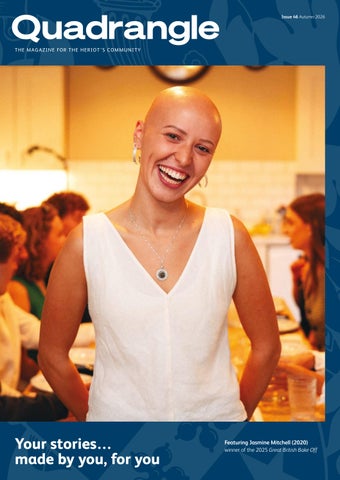
Featuring Jasmine Mitchell (2020) winner of the 2025 Great British Bake Off
george-heriots.com
Welcome to Quadrangle 2026 Issue 46 Cover photograph: Dominic Mould – Domographics
As one of the UK’s leading property consultancy services, our success is built upon how we deliver our service; it is a unique combination of being both professional and personable.
Contents
Our services include: Residential Valuations Commercial Agency Building Surveying Architecture
0131 240 5311 g-s.co.uk
It has been another busy year here at Lauriston Place and this year’s Quadrangle demonstrates this by showcasing the news, events and stories from across the school, our former pupil community and broader Heriot's family. We would like to draw your attention to page 26 and our showstopper former pupil Jasmine Mitchell (2020) winner of the 2025 Great British Bake Off. As well as hearing from Jasmine, our former pupil community has been keeping us updated over the last year with their awards, accolades and stories, please see our former pupil news and former pupil profiles section from pages 16 - 31. It’s also been a joy to welcome so many former pupils and their families back to Heriot’s over the last 12 months. This magazine exists thanks to the memories and stories we receive from former pupils. If you have any news, memories or stories you would like us to consider for Issue 47 of Quadrangle, please share these with the Development Team.
Planning + Development Business Rates Hotel + Leisure Asset Services Lease Consultancy
How you can support George Heriot's George Heriot's Trust Supporters 2025 – 2026 You said we heard 2026 Survey Results Dates for the diary 2026 – 2027 Communicating with the school School News Former Pupil News One year to save Heriot’s A visit to the School Archives Our School Library An Encyclopaedic Win for Heriot’s Memories of Heriot's Sub-Aqua Club Linguist and Theologian – an Australian Herioter Club News 2025 – 26 Events London Herioters USA Heriot's Ambassadors In Memoriam Principal's Last Word Advertising Quadrangle reaches former pupils, parents and friends of the school. To discuss advertising opportunities, please contact the Development Office. Keep in touch T: 0131 221 6716 E: development@george-heriots.com W: www.herioters.george-heriots.com/home Write to us Development, George Heriot’s School Lauriston Place, Edinburgh EH3 9EQ We hope you enjoy hearing from Heriot’s. If at any stage you no longer wish to receive magazines, updates and invitations from Heriot’s, just let us know. Quadrangle is designed by Richy Lamb – richylamb.com and printed by J Thomson. George Heriot’s School is governed by George Heriot’s Trust. Scottish Charity Number: SC011463.
2 4 5 6 8 10 16 36 40 41 42 44 48 50 52 54 56 60 64
Development update The 2025/26 year in the Development Office can be characterised by the themes ‘reflection’ and ‘readiness’. Our team has been restructured to bring us under the leadership of a Chief Commercial Officer who will oversee the growth and diversification of income streams at George Heriot’s School. Julie, Eilidh and Sarah Jane continue to cheerlead for and unite our incredible former pupils from around the world and lead the charge for individual giving and legacies. In terms of fundraising our primary focus remains on supporting our core funds, The Foundation (to support the education of bereaved children) and the Bursary Today Fund (to widen access and secure a diverse school roll). We also have an eye on the horizon and are reviewing roles and project needs in order to deliver ambitions for the school's 400th Anniversary Celebrations in 2028 and upcoming Capital Projects (watch this space!). In response to our recent FP survey, we hope you’ll experience improvements to our communications, digital reach and in-person events over the coming year. Reconnecting with former pupils locally and around the world is our favourite and most humbling part of the job and remains a high priority. Your feedback and willingness to act as ambassadors for our evolving projects will be essential to our success and we encourage you to share your thoughts and ideas with us as we ready ourselves for 2028 and beyond. 1
Quadrangle
george-heriots.com
How you can support George Heriot's
welcome is guaranteed and individuality flourishes. Bursary pupils positively augment the school's culture, and everybody benefits from the diversity enabled by providing varying levels of bursary support. Giving to our Bursary Today Fund supports children from families who need support now and in the near future.
Foundation – Our Historic Promise George Heriot founded the school in 1628 to provide an education for Edinburgh’s "faitherless bairns”. His philanthropic vision of "distributing chearfullie" has enabled generations of children to benefit directly from The Foundation. Almost 400 years on and we continue to deliver our founding purpose and support bereaved young people. In addition to fee remission, Heriot’s also provides specialist pastoral support for children and their families dealing with grief. Currently, the school can support circa 50 Foundation places through school 2
fees, investment income, and legacies with the rest secured through the support of individual donors, illustrating the importance of the wider community in protecting this founding purpose. Choosing to support The Heriot’s Foundation, is choosing to support Heriot’s founding purpose. Bursary Today Fund – Funding Futures Now One of Heriot’s strategic objectives is to widen access to the school through our bursarial support programme. Heriot's is a place where a warm
Campus Upgrades Our heritage is tied to our Founder but also our historic buildings and place in the city. This comes with a responsibility to maintain, restore and improve all aspects of our campus. Amongst the improvements completed over the summer are the construction of a new canopy for the Nursery, enabling greater opportunities for indoor-outdoor learning throughout the year, while at the other end of the education journey we have redesigned and refurbished Physics laboratories, including a new S6 research lab. In our communal spaces the School Hall roof has been stripped back exposing the rare and beautiful hammerbeam roof, and thanks to the Thrift shop and their fundraising, the hall also now has new audio-visual equipment. Preservation of our heritage has extended to repairs to the gatehouse and terracing, and the Staffroom which we plan to use for a variety of community events. Funding has been secured from various sources including unrestricted donations to the school, as well as incredible fundraising efforts from the PA.
Major Projects We are delighted to announce the successful planning application for a new all-weather sports pitch at Goldenacre, “This is an important step for sport at George Heriot’s School and for the wider community. The new pitch will give more children and young people year-round access to sport and create additional capacity for local clubs and community users.” - Gareth Warren, Principal. Leading up to our 400th Anniversary Celebrations in 2028, we are also developing plans to reinvent the old Swimming Pool into a new facility in the Grassmarket campus. Subscribe to receive email updates via the Herioter Hub to be amongst the first to know more about these projects, or please contact the Development Team directly by email or phone if you would like to support the delivery of these projects. We would love to hear from you regarding financial, in-kind or ambassadorial support. i
Ways to support If you are a former pupil and wish to ‘distribute chearfullie’ please visit the Herioter Hub. If you are resident in the US, visit our information page on the Herioter Hub about US Tax Effective Giving - Tax Effective Giving from the USA | Herioter Hub. We accept one-off or regular gifts of any size. Regular donations bolster support for different aspects of the Foundation and Bursaries, including buying books, uniform, bus passes or covering trips and extra curriculars. Request a donation form from the Dev Office to set up standing order or donate by cheque by emailing dev@george-heriots.com or calling 0131 221 6716. Gift Aid You can boost your donation at no extra cost by adding Gift Aid. If you are a UK tax payer, Gift Aid increases
your donation by 25%. £100 becomes £125. Please keep this in mind while considering a donation. Leave a Legacy in Your Will Generations of Herioters have remembered and honoured their love of Heriot’s by ‘giving back’ through a gift in their Will. Leaving a legacy can take many forms, you may choose to support an area of Heriot’s life that particularly inspired you, establish a place for a Foundation or Bursary pupil or leave it to the discretion of the school. We understand the decision to leave a legacy gift is a private matter. However, if you are considering this or have already done so, we would be extremely grateful if you could disclose this confidentially to the Development Office. You do not need to inform us but it can help our financial planning. i
2025/2026 Fundraising We're delighted to share that the total raised in 2025/26 was £960,000 including gift aid - a 71% increase on the previous financial year and a reflection of the extraordinary generosity and loyalty of our supporters. More than 1,500 donations contributed to this total, including two gifts over £100,000, two over £50,000, 12 over £10,000 and 22 over £1,000. Donations were received predominantly in support of The Foundation and Bursary Today Fund through one-off and regular gifts as well as Legacies, with more than 120 Foundation and Bursary places supported. A special campaign ran over Burns Night to support the GHS Pipe Band, and we also received support for Rowing, Rugby, the PE Department and Music. Every single donation makes a difference to the Heriot’s community, and we are grateful to every individual who has gifted financially or in-kind to the school this year. i
"It's a huge loss for any child to lose their father, psychologically it was very tough for me, I was worried about the thought of having to leave Heriot’s. I loved my time at school and made many great friends, a number of whom are still my best friends to this day… Dr Dewar explained I would be offered a Foundation Scholarship to cover my school fees… and to this day the Foundation offers supported educations to children who have lost a parent. "Heriot's gave me a great start in life both academically and in sport… I will always be so thankful to the Foundation for their incredible support" Andy Irvine (1970), Foundationer
"My father lost his battle with non-Hodgkin's lymphoma when I was 10 years old. I moved to George Heriot's the year after and am truly grateful for the education and experiences I was granted when I was there, many of which would not have been possible without the Foundation…I felt supported every day in ways that were so important to a child whose world had been truly turned upside down. The Foundation is a true demonstration of kindness and the pay it forward concept, I am so proud of my status as a former pupil and Foundationer and consider myself extremely fortunate for the start and opportunities that it gave me.” Maddy Counsell (2021), Foundationer
3
Quadrangle
george-heriots.com
George Heriot’s Trust Supporters 2025 – 2026 The Principal and Governors wish to express their warmest thanks to all Herioters, Current and Former Parents, Current and Former Staff and Friends of the School who generously made donations this year. Your gifts are so gratefully received and allow us to maintain Heriot’s excellence for future generations. Class of 1940s Alex Gillies Maurice McIlwrick Class of 1950s Alan G Brown Maxwell Dow Ronald E Dow David Doyle In loving memory of James Douglas Dunsmure Edmund Gordon George Gordon David Henderson Doug Irvine Tom Jessop Stuart Littlejohn John Mackenzie Jim McVicar Eric Robertson Hamish Stears David Syme Bob Todd R J M Wilson Class of 1960s Jack Aitken Douglas Amos James Baxter David Bishop Alec Brown Charles K.Brown Dougie Bruce Gerard Dott William Drummond I Duncanson John R R Fowler Mr Mike & Mrs Win Gilbert Ian Douglas Gillian Duncan Grant Morgan Jamieson Brian Langstaff Norman Leslie Prof. Angus V.P. Mackay OBE Iain Mackintosh
Bill and Janet McDonald Rennie McElroy George McNaught Andrew Milne Brian Milne Graham Noble R V Pringle Frank Ritchie Douglas W Roberts Alastair Smith Malcolm Smith Bruce Warman Gordon Watson David Wilkinson Dr. John Wrench
Richard Hunter Torquil Macleod David Mutch Margaret and Bean Phillips Bursary for Music Susan Strand (Mair) Gillian Woolman
Class of 1970s Greg Alexander Robin Carmichael Charles Clark Gavin Collinson Malcolm Cutt Colonel Martin Docherty MD Andy Irvine Alf and Linda Merriweather Colin Murray Gordon Newlands Alistair Russell Robin Thomas James Thomson Cameron Wyllie
Class of 2000s Laura Carthew Stuart Guy Ian Munro Chris Sibbald Michael Tai
Class of 1980s Rhona and Richie Adams Stuart James Bell Michael Beveridge Robert Brown Colin Burnett Bob Dewar Hugh Dickson Patrick and Anna Edwardson Niall Garvie David Gray Dr Graham J Harkness Ben Helm
Class of 1990s Paul Bateman David Currie Justin D'Agostino Anton Nelson Firas Sa'adedin Mr David Stevens
Friends of Heriot’s and Former/Current Staff Stewart and Lindsay Adams Steve & Helen Batchelor Dr & Mrs Behan Michael and Alison Browne Dr John Clydesdale and Dr Fiona Mulryan Gregor and Carol Dickson Robert and Janice Dickson Mr Rob Dobson and Ms Judith Wilson Lesley Franklin Emma Lawrence (formerly Griffiths) In memory of Douglas Hill William Jackson Tracy Kirke Mr & Mrs Marquis Norman and Maureen Mathison Michael and Angela McFee Marlene Miller
Mr and Mrs R Moonie Alistair Morrison Jocelyn Ogorkiewicz Sandy Paton Jenni and Mark Polson S & P Quinn Maggie Salmond Neil Short Craig Smith Laura Thomas Ian Thompson Gordon and Paddy Turner, New Zealand Andy and Kerry Watt Moira Williams Legacies George Heriot’s is extremely grateful to all those who pledged to leave a legacy to the school in their will. In 2025 – 2026, the Foundation and Bursary Programmes benefitted from the transformative gifts left by legators whose generosity will continue to impact generations of Heriot’s pupils. We would also like to express our warmest thanks to those donors who wish their gifts to remain anonymous.
Our very grateful thanks to all our donors. If you are a donor and would like to be publicly acknowledged, please advise the development team.
You said, we heard: thank you for taking part
A huge thank you to everyone who took part in our former pupil survey. We received over 500 responses from former pupils across a wide range of generations, giving us a rich picture of how people currently connect with Heriot’s and how they would like that relationship to develop. One message came through particularly strongly: the connection between Herioters lasts. We heard clearly that different generations want different things from their ongoing relationship with Heriot's, but loud and clearly that the relationship really matters. There were also some very tangible responses: with requests to visit for a tour, life updates, offers to volunteer expertise and experience, as well as requests for further information on funds and legacy giving. We are following all these up individually. With 2028 approaching and our 400-anniversary year, 190 respondents shared comments and ideas for the school’s celebrations. The survey is a starting point rather than the end of the conversation. We’ll continue listening, including through smaller discussions and conversations where we can explore some of the themes in greater depth. Thank you again to everyone who took the time to tell us what you value, what could work better and how you would like to stay connected with Heriot’s. i
You said: You want more opportunities to reconnect.
We heard: There is no single event programme that will suit everyone. We will use what you told us to develop a more varied programme shaped by life stage, location and interest.
You said: Information about the Foundation, bursaries, fundraising and different ways to support Heriot’s can be confusing. We heard: We need to communicate our charitable purpose, different funds and the impact of support more simply and consistently. That work will form part of a wider review of how we talk about development and philanthropy.
You said: You want different ways to be involved.
We heard: Financial support is one of many ways to be involved in Heriot’s. Former pupils offered time, expertise, networks, stories and practical help, and we want to make these opportunities much more visible.
5
Quadrangle
Join us and bring out your inner Herioter! For all events, please visit the Herioter Hub for details and bookings
2026
2027
Former Pupil Coffee Morning Wednesday 28 October 2026
Former Pupil Coffee Morning Wednesday 24 February 2027
From 10:00 – 12:00 in the Council Room. George Heriot’s School. Please book your ticket.
From 10:00 – 12:00 in the Council Room. George Heriot’s School. Please book your ticket.
Former Pupil London Drinks Thursday 26 November 2026
Former Pupil Coffee Morning Wednesday 27 April 2027
From 18:30 – 21:30, The Library Room, Old Queen Street Café, Westminster, London, SW1H 9HP. Book your ticket. Tickets: free.
From 10:00 – 12:00 in the Council Room. George Heriot’s School. Please book your ticket.
Usher Hall Christmas Drinks & Concert Wednesday 9 December 2026
June Day Monday 7 June 2027
Save the date. An invitation will be sent to donors, partners and 1628 Society Members from the Development Office.
From 13:45 (to be confirmed). Open to former pupils and former staff. Please book your tickets early to avoid disappointment. Tickets: free.
Former Pupil Christmas Coffee Morning Wednesday 16 December 2026
Former Pupil Coffee Morning Wednesday 23 June 2027
From 10:00 – 12:00 in the Council Room. George Heriot’s School. Please book your ticket.
From 10:00 – 12:00 in the Council Room. George Heriot’s School. Please book your ticket.
6
On the Road
Reunion package
The Development Team will be on the road making regional visits to a town or city near you.
Are you and your former classmates organising a school reunion? We are delighted to offer you a self-service package which offers a private tour of the school for your class. For more details, please contact the Development Team on dev@george-heriots.com
Please sign up for e-mail communications via the Herioter Hub to make sure you hear from us. We will be in touch by e-mail in the coming months if we are visiting your area.
7
Quadrangle
george-heriots.com
Communicating with school Stay in touch, we love to hear from you Former Pupil Visits We love welcoming you back to Heriot's. Whether it's the first time you have returned to school since leaving Lauriston Place or you are a regular at one of our former pupil Coffee Mornings, it's always great to welcome you back to hear your stories and memories from your time at school and show you what's changed around campus. Here are some of the former pupils we welcomed back to Heriot's over the course of the 2025-2026 school session. If you would like to arrange a visit back to Heriot's for the 2026-2027 school session, please don't hesitate to get in contact with the Development Team on dev@george-heriots.com or by phoning 0131 221 6716. Don’t be a stranger. Once a Herioter always a Herioter. Ask any member of the Development Team and they’ll all agree that meeting former pupils is the best part of the job. Welcoming Herioters back to school introduces fresh stories to the turrets, initiates opportunities to reconnect with likeminded souls and fosters a great sense of community. If you would like to visit, simply touch base to arrange a tour and a cuppa. With modern safeguarding, all visits need to be arranged in advance. This also gives us the opportunity to research any archive requests and ensure we can personalise to your memories and interests. We appreciate that not everybody stays in Edinburgh, you may be one of our Global Herioters who only pops back for the occasional Christmas or to 8
indulge in the Festivals. There are lots of ways to connect with the school remotely. You’ll see from our Events page that the Development Team will soon be visiting cities across the UK. Be sure to check out pages 54-58 for a deeper dive on how to engage with our ambassadors in London and USA. If the trip into the city centre has become too much these days, we're here for a blether over the phone, or you can connect via e-mail too.
• Call us – 0131 221 6716 • Email us: dev@george-heriots.com • Follow us on LinkedIN at George Heriot's School Join the Herioter Hub and make sure you are subscribed to receive email updates. i
Bridging the years, crossing the generations Gillian Woolman (1982), Herioter President
In my first, of two years, as Herioter President, I’ve had the privilege of meeting wonderful FPs: those that went before and those that followed. As I look at my diary, a food and beverage theme emerges: dining under the elaborate plastered ceiling of the Staff Room meeting those that give generously of their time, talent and financial support; being warmly welcomed by the Classes of ’74 and ’80 as they took over local hostelries, evenings of great camaraderie, recounting tales that certainly had my hair on end; mingling at coffee mornings hosted by the Development Team in the Council Room where occasionally generations of families attended; and Replying on behalf of the Lassies in the new refectory at the 2026 Burns Supper. I have enjoyed renewing my acquaintance with formal aspects of the School Year: June Day, Remembrance Sunday and the Usher Hall concert. As I felt unfamiliar with the school of today, despite being a former parent, I took the opportunity to attend Open Morning in September and enjoyed the exchange with current sixth formers, and saw some completely new parts of the campus. I’ve really welcomed meeting up with representatives of the PA to learn of their key priorities, as they support the school. The Development Team kindly hosted a tour of the school for two gentlemen where an education at Heriot’s was pivotal to their two fathers, and the opportunities it subsequently provided
for their families. They were very moved to walk along the same corridors as their fathers, and experience the exceptional ‘Heriot view’ of the castle. Local FP groups are great for pulling generations together and I enjoyed the Borders FP Club Dinner and the London FP Christmas drinks. In my efforts to contribute to the Heriot's community, I’ve been coopted onto the Finance & Resource Committee. As you can imagine, all independent schools have had to completely recast their business model. Heriot’s has done extraordinarily well in maintaining its level of Foundationer places and bursaries. But this will require input to sustain in future years. We are all probably most loyal to our
own years, and I am hugely enjoying the increasing circle forming from the class of ’82. The two stand out features for me, perhaps because of the more in-depth conversations one has amongst friends, is the resilience demonstrated by peers, and their lifelong commitment to ‘distributing chearfullie’ through acts of kindness, voluntary work over decades, and career choices. My stand out hero is the school chum who has made over 350 platelet donations… Please do not hesitate to contact me via FPpresident@george-heriots.com if you would like to propose ways in which the FP community can contribute to the future of the school. In the meantime, I look forward to catching up with you over a coffee in the Council Room. i 9
Quadrangle
School News New Captains 2026 – 2027
george-heriots.com
Ethics Cup Congratulations to Kiran, Jacob, Sam, Isla, Kirsten, Hannah, Amelie and Milly who were crowned winners of the Ethics Cup at the University of Edinburgh. The Ethics Cup is a national debating competition that challenges pupils to think critically, collaborate effectively, and engage thoughtfully with complex moral questions including lowering the voting age, genetic engineering and the ethics of drug pricing. Teams are judged on the quality of their reasoning, their ability to listen and respond respectfully, and how well they explore different sides of difficult ethical issues. Competing against schools from across Scotland, Heriot's pupils demonstrated exceptional teamwork, insight and integrity, winning all three preliminary rounds, their semi-final, and the final to take the title. A fantastic achievement and a wonderful example of Heriot’s values in action. i
U18 Schools Plate Final Heriot’s is delighted to announce the new School Captains for Session 2026-27. Captains: Tess and Daniel, Vice-Captains: Elizabeth and Jacob. Congratulations and best wishes to all the captains for the coming session. i
Intergenerational Week As part of Global Intergenerational Week, Primary 5 pupils spent a morning in the Quiet Garden with Heriot’s former pupils, taking part in meaningful intergenerational learning while planting summer bulbs together. The activity sparked conversations about school life across the decades, giving pupils a glimpse into Heriot’s history through the memories of those who came before them and offering FPs the joy of seeing today’s young Herioters carrying forward the school’s spirit and traditions. i 10
The Boys’ 1st XV delivered an impressive performance in the U18s Plate Final at the Hive on 17 January, showcasing determination, skill and teamwork in a closely contested match where they only narrowly missed out on the win. Playing on such a stage was a memorable moment for the squad and a testament to their hard work throughout the season. The team were cheered on by the tremendous support from current pupils, parents, staff and former pupils, whose presence in the stands created a fantastic atmosphere and highlighted the strength of the wider Heriot’s community. i
11
Quadrangle: School News
george-heriots.com
Cross-Sector Partnership: Talking Practice Events with Portobello HS In February, the GHS Modern Languages (MFL) Department welcomed teachers and pupils from Portobello High School for two afternoons of Talking practice, showcasing a successful and effective collaboration between independent and state sectors. Being a linguist entails much more than simply knowing another language, and the MFL is committed to fostering effective communicators, confident speakers, attentive listeners and considerate interlocutors. French, Spanish and Italian Higher learners from both schools made their teachers proud as they overcame nerves and natural shyness, and demonstrated sound communication skills, high levels of linguistic knowledge, and a notable willingness to push themselves beyond their comfort zone. The camaraderie they displayed in coming together to prepare for their QS Talking exam, in what is a
Planting with Borders Forest Trust EARTH badges were presented to a committed group of pupils who worked together to plant 260 trees for the Borders Forest Trust, one of Heriot’s chosen charities. Robin, Levi, Naomi, Maddalena, Alice, Connor, Arielle and Eve showed exceptional enthusiasm throughout the project, supported by Adrian from Borders Forest Trust, who helped bring the reafforestation work at Corehead to life for our young conservationists. Their efforts reflect the school’s ongoing commitment to environmental responsibility and the value of learning through meaningful, handson action. i 12
What a season for Heriot’s Rowing!
crucial year of their academic life, was nothing short of admirable. In line with governmental national priorities to strengthen Modern Languages provision across Scotland, Heriot’s continues to seek meaningful partnerships with state schools – a strategy launched over a decade ago with our successful and ongoing Volunteer Language Ambassadors programme.
This collaborative work serves to ensure that language learning remains rigorous, aspirational, and accessible to all; it calls for ambition, confidence and creativity – and so we are determined to give our pupils’ voices pride of place in the planning of future partnership initiatives! If you are a teacher and would like to be involved, please get in touch with MFL via enquiries@george-herots.com i
From the National Schools’ Regatta to Marlow Regatta, Henley Women’s Regatta and the Henley Royal Regatta Qualifiers, our crews have delivered outstanding performances. A special congratulations to our girls’ first quad who qualified for Henley Royal regatta qualifying, winning twice in the head to head racing and reaching the last 8, and to our fastest-ever boys’ quad, who finished an incredible 10th out of 57 crews in the Henley Royal Regatta qualifiers, narrowly missing qualification. The dedication, resilience and hard work shown by all our rowers have been exceptional, with 11 Herioters now progressing to the final Scotland selection process. i
Scullery race report On 22 March, the rowing club sent down three crews to Eton Dorney to race at the Scullery. The Scullery is a national level junior rowing competition held annually that involves hundreds of crews from across the UK competing in time trials. It takes a huge amount of commitment and dedication from the rowers and coaches combined, and that is reflected in the results achieved. The boys’ first quad (Ioan, Daniel, JJ and Ben) finished 7th out of 23 in the J17 4x, building off their result from last year and getting into the top ten. The girls’ second quad (Vilara, Isla, Zoe and Sorcha) finished 10th out of 39 in W Jun 4x-, a brilliant result also in the top ten of their category. Finally, the girls’ first quad (Kate D, Lotta R, Freya M and Rosie H) finished 1st out of 18 in W J17 4x - a phenomenal result showing all the hard work they’ve put in. The club also picked up several new boats at the Scullery, a result of a very kind donation, naming them after former pupils and coaches in their honour. i Ben (Club Captain) 13
Quadrangle
george-heriots.com
A game of chess
Early King George Mandarin set
Chess is believed to have originated over 1,500 years ago, evolving from the ancient Indian game of Chaturanga. Today, it is a universally cherished pursuit, welcoming players of all backgrounds. At its heart, chess demands strategy, tactical awareness, and the ability to visualise the board several moves ahead—anticipating multiple possibilities before they unfold. In 2026, chess has captured our attention from several inspiring perspectives. In March, we were delighted to celebrate S4 student Freddy, who claimed the title of British Rapidplay Chess Champion 2026. Following in the footsteps of renowned grandmasters such as Nigel Short and Michael Adams, 14
Freddy secured his victory in spectacular fashion, defeating leading English Grandmaster Gawain Jones in the final round with what has been described as a “brutal display.” Earlier in June, a former pupil from the Class of 1968 shared another remarkable chess story. Over his lifetime, he has become the very proud owner of one of the largest chess collections in the world. He had spent over 60 years assembling more than 400 unique sets. His passion for the game began here at Heriot’s, when a teacher first introduced him to the game at the age of 10. Some of the images accompanying this article offer a glimpse into his extraordinary
collection. Each set tells its own story, reflecting the culture and craftsmanship of its place of origin. For those eager to explore further, this remarkable collection will soon be available to view in person, as it is set to be rehomed at the Oriental Museum at Durham University. Lastly, a very well done to Alastair White (1966) who travelled to Albania in April to play for the Scotland Seniors at the World Senior Team Chess Championship. In May, he travelled farther to Bad Neuenahr, Germany, to complete in the Chess Classics 2026 where he came third – many congratulations to you. i
One of the earliest Edinburgh Upright sets
Cantonese set of finely pierced counters
Napoleonic prisoner of war Pulpit set
15
Quadrangle
george-heriots.com
Douglas McNeill awarded OBE
Former Pupil News
Former pupil Douglas McNeill (1989) was awarded the OBE by HRH the Princess Royal in November 2025. Douglas has held a portfolio of advisory roles in macroeconomics and related fields. He was No.10 and Treasury special adviser from 2016-2024, latterly as chief economic adviser to the PM, Rishi Sunak. Prior to these roles Douglas spent 20 years in banking and wealth management. The Heriot’s community sends its heartfelt congratulations to Douglas on this prestigious recognition of his public service. i
An Antarctica Adventure Far away from the bustle of life in San Francisco, Antarctica represented a truly extraordinary adventure for Alf Merriweather (1972). Scenery so immense and serene that neither words nor photos come close to capturing it. Wildlife in the form of whales, penguins, seals and more, all so accessible to curious visitors. Strangest of all it is a globally unique instance of an international treaty based governance structure that actually works! i
Gallery Franklin Former Principal, Lesley Franklin, has been more than a little busy since she left Heriot’s in 2021. After retiring, Lesley pursued her passion for art by undertaking an MLitt in Art History at her alma mater, the University of St Andrews. She then spent four months at Sotheby’s Institute in London studying art business. The natural culmination of these two years was to run an art gallery… which is exactly what she is now doing. In May 2024, she took over the former Fraser Gallery in St Andrews and relaunched it as Gallery Franklin. The 16
gallery spans five rooms in a beautiful, ancient townhouse in the heart of St Andrews and has a peaceful gallery in the garden too. Lesley’s aim is to champion contemporary artists from across the UK and further afield and to blend established names with emerging talent. Numerous exhibitions take place throughout the year, and she recently took the gallery to exhibit in London. Just as at Heriot’s, community, ethos and hard work are important. She hopes that the gallery is a welcoming place for all, and she enjoys warm
relationships with clients and artists. Lesley is also forging links with the university by hosting student placements and student exhibitions, speaking at the Debating Society, speaking after dinner at university events and hosting joint events between Gallery Franklin and the Art History society. So, she has not left education behind entirely! Lots of Herioters pop into the gallery and you are all welcome any time. You can contact Lesley on lesley@galleryfranklin.com and why not follow the gallery on Instagram to keep up with all the news. i 17
Quadrangle: Former Pupil News
george-heriots.com
A passion for photography
“In 1960 I left Heriot’s to become a photographer, a passion I had enjoyed since the age of nine. "In 1961 I was awarded the President’s Trophy from the Edinburgh Photographic Society for this pictorial image. "By 1965 I had become founder and Head of the Department of Medical Photography at the Princess Margaret Rose Hospital, recording surgical procedures. such as this nerve repair.
Advisor to the Chancellor David Sturrock (2009) began working as an Economic Adviser to the Chancellor of the Exchequer in October 2025. David works directly with the Chancellor and other members of the Council of Economic Advisers in the development of government economic policy. Prior to this role, David was an Associate Director at the Institute for Fiscal Studies (IFS). While working at the IFS, David completed his PhD in Economics at University College London. i 18
"After a few years I returned to academic study and gained a Doctorate in 1980. Following an academic career I then qualified as a Clinical Neuropsychologist assessing brain function in stroke victims. "Last year I was awarded a Fellowship of the Royal Photographic Society, a distinction shared by only five hundred or so of its 11,500 membership." Allan's photographs from his time at Heriot's, including those of teachers
Rowing in the family…
at Heriot's, will soon appear in a new book entitled Whippersnappers written by Professor Annabella Pollen. The book examines the works of children who took photographs. There will also be a promotional exhibition at the Photographers Gallery in London which uses two of Allan's images; viz those of Mr Gould, History, and Mr Borthwick, Biology, shown above. Allan Dodds (1962) i
In July 2025, Calum Young (2014) won the Britannia Challenge Cup for men's coxed fours with Thames Rowing Club at Henley Royal Regatta, the pinnacle of achievement for world club rowing. In the photo you see Calum on the podium receiving the cup and winner's medal. He is on the right with his Heriot's tie and pipe band socks!
In September 2025, Robert Young (1983) won the Men's 8 (C) class at the World Masters Championships in Banyoles in Spain. In the photo you will see Robert with his world champion medal outside the St Andrew Boat Club, at Meggatland in Edinburgh. Both father and son have been proud to fly the flag for Scottish rowing. i
Annual Borders Club Dinner 2025 The 69th annual Borders Heriot Club Dinner, usually held at Carfraemill near Lauder, was this year held at Goldenacre on Friday 31 October. Forced to find a new venue when the Carfraemill Hotel was closed at short notice, organiser Hugh Henney (1982) worked his magic and, with the help of the Heriot's Rugby Club, saved the day. Hugh is Secretary to the Borders Heriot Club and David Henderson (1957) is President. The toast was proposed by Mel McCallum (1971) who gave a very moving speech about being at Heriot's, an experience 'which gave me a value set and a moral code' as well as instilling ambition. The main speaker was Edinburgh-based financier Gus Kirk who recounted some entertaining episodes involving friendships and celebration, while new Head of Senior School
Alastair Anderson gave the top lines of school performance which were well received by guests. Captain Eleanor (S6) delivered the Selkirk Grace and Captain Glynn gave the Vote of Thanks. i
Ben Macpherson appointment
Minister for Higher & Further Education Ben Macpherson (2002) has been appointed as Minister for Innovation, Technology and Tertiary Education. The First Minister said: “I am delighted to appoint Ben Macpherson as Minister for Higher & Further Education. Ben Macpherson has wide experience across a range of policy areas and brings creative and dynamic leadership to higher and further education that is so fundamental to transforming the lives of individuals across the country, and to supporting this government’s ambitious economic agenda.” Ben Macpherson is the MSP for the Edinburgh Northern & Leith constituency. He grew up in the Scottish capital and was educated at George Heriot’s School, then graduated from the University of York before studying law at University of Edinburgh and becoming a lawyer in the city. Ben Macpherson was elected as the constituency MSP for Edinburgh Northern and Leith in 2016 and 2021, and MSP for Edinburgh North Eastern and Leith in 2026. He resigned his position as the Minister for Innovation, Technology and Tertiary Education in August 2026 for health-related reasons. i 19
Quadrangle: Former Pupil News
george-heriots.com
Herioters at the London Marathon Rory Bentley (2010)
On Sunday 26 April, 1 million people flocked to the streets as the city baked under an unseasonably warm sun to witness history being written. The fastest marathon ever - 1:59:30 by Sabastian Sawe of Kenya. The fastest women-only world record of 2:15:41 by Tigst Assefa of Ethiopia. The most money ever raised for charity in a day - £87.5 million. Thirty-eight world records were broken. Including, technically, one by me. I tied my shoes that morning to run my first marathon, for Friends of The Children of Tanzania - a charity that helps vulnerable children in East Africa. I was a Foundationer at Heriot’s, so I understand the impact charitable action can have on a young person’s life. I was proud to be running for a good cause and buoyed up by having broken my fundraising target thanks to many kind acts of ‘distributing cheerfullie’. But I left the house that day as daunted as I was determined. I had heard that you either run a marathon for “fun”, or a “time”. I was worried I would do neither. I had good advice from friends who have run marathons, and was joined on the day by Herioters Richard Cullen (2010) and Catherine Bell Webb (2010), but I’ve learned that nothing can prepare you like doing it yourself. I have been running 10ks for more than ten years 20
but 42km was uncharted territory. Unfortunately for the Quadrangle, the race was an experience I have struggled to adequately describe since. Was it the best run of my life? Yes. The worst? Also yes. It felt like a hallucination - though perhaps that was the heat. But this is what I will never forget. Managing to spot family and friends after scanning for miles and wrapping them in big sweaty hugs. The human energy from total strangers waking up early to wait, high-five, cheer and clap for other total strangers. That’s what kept me running when I slipped on a bottle and rolled my ankle at 30km. The chaos of the last 10k - seeing athletelooking-types hobbling, or on the floor surrounded by medics. I had realised by then that this was no joke. I just needed to finish. Turtle not hare sort of stuff. And, after 3h 48m, I crossed the line - largely unscathed, only missing one toenail, and with something resembling a smile on my face. And, somehow, I was a world record-holder. I was one of 59,830 runners - the largest number to ever finish a marathon. A record by default. But a record all the same. Would I recommend it, if you have the opportunity? Do it. One hundred percent. i
Herioters at Henley
Our Heroter President, Gillian Woolman (1982) was a guest of Ben Helm (1982) at this year's Henley Royal Regatta. It has been 45 years since Gillian and Ben were Vice Captains together. It was a fantastic day with Gillian joining Ben on the launch to see her University Team, St Andrews compete close up. A special thanks to Ben who even popped his school blazer (with colours) on for the photo. i
Little Griefs Andrew Neilson (1993) has had a stellar career in prison reform in England, working for The Howard League for Penal Reform (founded 1866, the oldest penal reform charity in the world). The Howard League in England has been involved in significant criminal justice reform - the abolition of capital punishment and advocating for the founding of the Probation Service for example, as well as reducing child arrests in England and overturning the ban on sending books to prisoners in 2014. For almost 20 years Andrew has been Director of Campaigns, running policy and media work as their senior spokesperson, appearing regularly on Sky News and the BBC. Last month Andrew gave evidence to the Covid Enquiry Public Hearing on the impact of the pandemic on prisoners. It is fair to say Andrew has had a semi-public profile in prison reform; he wears two hats however, he is also a poet. Andrew was up in Edinburgh in early March for the launch of his first poetry collection: Little Griefs. Andrew’s love of poetry started at Heriot’s because of the way it was taught. Teaching did not focus on thematic or issues-based content, it instead highlighted listening, enjoyment of the poem and the words used, and ultimately understanding what a poem was about. In these early days, Andrew developed a love for Larkin, Heaney and Edwin Morgan. ‘’At Heriot’s, it felt like language came first – we studied so much Shakespeare, I can almost speak in pentameters!’’. Andrew has learned over the years that you can teach poetry and study the works of good poets to inculcate poetic taste. Learning to appreciate the beauty of words is key. ‘English at Heriot’s for me was about inculcating taste. I took this on when I pursued my own bat. This is my first book aged 50! It’s about being a father, with an emphasis on maturity as I get a bit older, the idea of time passing’. As an example of his work, Andrew wrote the following poem to commemorate two classmates who died: Kathleen More passed away in 2021 and
Graham Dall in 2025. ‘Both Kathleen and Graham started in P1 with me – we shared thirteen years together’’. The poem about Kathleen and Graham was inspired by a poem called The Old Masters'by celebrated poet Peter Didsbury, written in 1994. ‘’I took lines from the poem and turned it around to be about fellow pupils rather than teachers, pupils who were luminaries in our year’’ says Andrew. Luminaries i.m. KM and GD There were those who taught and those who were taught. Taken into Sheol, and not yet fifty: She loved the law and the ‘Binsley Poplars’, while he led the line, a back-row forward. Who calls their names? So ahead of themselves, we’re still forming up as they carry the day.
November, as part of the James Merrill writer in residence programme. James Merrill was an American writer of poetry, essays, fiction and plays and the fellowship provides living and working space to a writer to complete a project of literary or academic merit. Andrew will be doing readings and talks, especially about post war American poets who served as GIs in the war. Andrew will have a dedicated month to write and will take one month’s sabbatical from prison reform. The James Merrill House is in Stonington Connecticut. i
First published in During the Late and Continuing Cold: An Eightieth-Birthday Tribute to Peter Didsbury (Broken Sleep Books) This year, Andrew has been awarded an American Fellowship and will be living in Connecticut for one month in 21
Quadrangle: Former Pupil News
george-heriots.com
Congratulations to Dr Derek Beatty
Scotland U21 Hockey
A huge congratulations to Dr Derek Beatty (1969) who has recently been awarded an Honorary Doctorate Award from Hawkins University, Austin, Texas, partnered with Learning Saint. Derek has worked closely with Associate Professor Christina Yap, Physiology, Monash University, Malaysia and received his Honorary Doctorate Award based on his distinguished career spanning more than three decades in Diabetes Research. Derek has passed on his thanks to George Heriot’s School where he initially became interested in learning about Science, Geography, History and English from 1956 – 1969 which has made this possible, along with thanks to Edinburgh University, Slough College, and many other companies and charities who have supported his interest in this life journey. Congratulations Derek! i
Back in July 2024, as an Under 21 squad we travelled to Konya, Turkey to take part in the EuroHockey B Division Women’s championships. We had the aim of gaining promotion back to the top A Division level, which would also make history and see Scotland qualify for its first Junior World Cup ( JWC) in 20 years if we could win the tournament. The tournament saw us play against teams we had never met before: Turkey, Ukraine and Poland, which was a challenge in itself due to having limited scouting and prior knowledge of how these teams would play. We won all our matches, winning 1-0 in a very tense final versus Ukraine, and secured our spot amongst the 24 teams taking part in the JWC in December 2025. Many of our players from Turkey would no longer be Under 21 in 2025 – so they helped us make history but would sadly never get to experience the JWC themselves. The start of 2025 saw us bringing up new players and trying to solidify a new squad who were of age to travel to the JWC in December. We trained rigorously through the summer and had to balance huge training commitments and demands alongside university studies from September through to December. We trained like we never had before, as none of us had ever been to a tournament so big. Fundraising was a challenge, with Scottish Hockey unable to cover any of the tournament and travel costs, which meant we had to try to find personal sponsorship and also fundraise ourselves as a team. We tried to spread awareness of our situation – 18 university students trying to raise a large sum of money to be able to represent their country, most of us working part-time jobs whilst studying and, of course, playing hockey! With the JWC being a once-in-a-lifetime opportunity for every player, possibly the biggest moment of some of our hockey careers, we didn’t want finances to stop us from gaining such an incredible experience. Social media played a huge role in this, with us managing to obtain
Well done Jess and Kirsten! Kirsten Murison, (2023) and Jess Garden (2025) are back home after being selected to play in the Under 21 Women’s Team for Scotland at the Junior Hockey World Cup in Santiago, Chile. Representing Scotland, and of course Heriot’s, the two had a very successful tournament, improving their world ranking and winning the inaugural Challenger Cup! Join us in congratulating their success! Well done Jess and Kirsten! i
22
Scottish Rugby’s support in sharing our message alongside radio interviews. We set up a GoFundMe page and approached local businesses to donate prizes for a raffle, managing to raise over £8000 through the raffle tickets and generous donations. The support of all the donors hugely helped to subsidise the individual costs. The JWC itself was held in Santiago, Chile – a part of the world that the majority of us had never been to before. Holding the tournament in their summertime (and our winter) was another challenge we were to face. In particular, heat training and preparing our bodies for the altitude and temperatures we would be playing in when we got out there was very difficult. We would wrap up warm for training with many layers, but in the cold Scottish winter weather, that would only just about keep us warm! Throughout the tournament we met opposition that we had never had the opportunity to play against before. We finished third in our initial group, after losing two very competitive matches to Spain and Australia and drawing with Canada. This saw us placed in the “Challenger Trophy” pot of teams for the second part of the tournament, effectively playing for a place in the range 17-24. After a comfortable win against Namibia, we went on to beat
New Zealand in a penalty shootout in our semi-final match. We then played our final match against the host country, Chile, which was an extremely surreal environment, with the stand packed full - there was such an incredible atmosphere surrounding the pitch. After yet another penalty shootout, we ended up winning the inaugural Challenger Trophy and finishing in 17th place out of the 24 competing teams! Despite feeling that we could have finished in a higher position, we were delighted to leave with silverware and moved up four places in the world rankings, now sitting at 19th in the world. Our focus going forward is to secure a place at the next JWC in 2027 for the younger players coming up, giving them the chance to experience the once-ina-lifetime opportunity of performing in such a large tournament. By the time Quadrangle is published, we will have travelled to to Valencia in July 2026 to compete at the A-division Under 21 European Championships, needing to finish in the top six teams there to earn a spot at the next JWC. This will be a challenge having just been promoted back into the top division, however coming off a very strong performance in Chile we are confident and very excited to keep making history and hopefully meet our goal. i 23
Quadrangle: Former Pupil News
george-heriots.com
Katharine Rolland (2006) From a very early age I knew I wanted to be a nurse, and George Heriot’s School was incredibly supportive in helping me pursue that ambition. I was given the opportunity to lead first aid within the Combined Cadet Force, volunteer at the Royal Edinburgh Hospital and at an afterschool club for autistic children, and undertake hospital work experience during fifth year. Those experiences gave me an invaluable insight into healthcare long before I started university. It was during my work experience that I discovered the area of nursing that would shape my career. I saw my first complex wound, a large pressure ulcer over the sacrum that extended down to the bone. While many people would have found it shocking, I was completely fascinated. I remember wanting to understand why it had happened, how it could be treated and, most importantly, if and how it could heal. The staff on the ward explained that they were waiting for the Tissue Viability Nurse to review the wound because they weren’t sure how best to manage it. When she arrived, she confidently assessed the wound, even placing her gloved hand into it to fully appreciate its depth and feel the bone. She then removed some of the dead tissue with a scalpel before explaining exactly how the wound should be treated. It was in that moment I knew I wanted to have that knowledge and that I was going to become a Tissue Viability Nurse. When I returned to school, my biology teacher, Mr Stewart, encouraged my interest by giving me additional lessons on the skin, its structure and its functions. Those extra sessions provided the foundations for much of what I would go on to learn throughout my nursing career. After leaving school, I studied Adult Nursing at Queen Margaret University before beginning my career in intensive care. Working in critical care gave me a fantastic foundation in caring for some of the sickest patients, but I never stopped pursuing tissue viability and when the opportunity arose to move into tissue viability, I knew it was where I belonged. 24
Former Pupil Profile Feature
James Thomson OBE DL MI (1976)
I became a Tissue Viability Nurse in 2018 and completed my Master’s degree in 2021. Today I work as a wound specialist, caring for patients with some of the most complex wounds, including pressure ulcers, leg ulcers and wounds that have reopened after surgery. Every wound presents a different challenge, so my job involves a great deal of assessment, investigation and problem solving. I work to identify why a wound is not healing and create an individual treatment plan to support healing. A large part of my role is also education, teaching nurses, doctors, and other healthcare professionals how to prevent wounds from developing in the first place and how to manage them effectively when they do. People are often surprised by some of the treatments we use, one of which is larval therapy. Sterile medical maggots are carefully applied to a wound, where they selectively remove dead tissue
while leaving healthy tissue behind. It might sound unusual, but it is a highly effective treatment that can transform wounds which have failed to heal using conventional methods. We also use a wide range of advanced dressings, negative pressure wound therapy and the latest evidence-based techniques to help wounds heal. What I love most about my career is that no two days are ever the same. Tissue viability combines science, clinical expertise and detective work, and I have the privilege of helping patients recover from wounds that can have a huge impact on their health, independence and quality of life. Looking back, I could never have imagined that one work experience placement would shape the rest of my career, and I am incredibly grateful to George Heriot’s School for supporting me to explore my passions and discover the profession I still love today. i
James Thomson OBE DL MI (1976) is Scotland’s leading hotelier and restaurateur. In September 2025, James was awarded the AA Lifetime Achievement Award, which recognises individuals within the hospitality industry who have dedicated their lives to excellence in their field. James is also a Herioter (1976) and below he has kindly shared some memories for Quadrangle. ‘As a middle child I always had to prove myself and counter a fear of failure. My sister was a PE Teacher and my brother a lawyer. I knew when I was 15 that hospitality would become my anchor. I am like a sponge. Right from my early employment when I first went on the floor to serve diners and wash dishes, I have watched people. Earning more money in the kitchen than through my paper round, I was soon caught up in the world of hospitality and knew this was what I wanted to do. I liked to absorb the stories that went on around me and learn
what I could about service, about catering, about creating a great dining experience. I saved my money carefully (my father was a bank manager and I had learned the value of not buying what I couldn’t afford) and took out three personal loans to fund my first restaurant, The Witchery. It was 1979, I was just 20 years old and in doing so I became Scotland’s youngest Licensee. At school I had particularly loved History, Drama and Art and had enjoyed brass rubbings in the Greyfriars Kirkyard and drawing the Castle. In Drama, I hated being on stage but I loved collating the props around which a great story could be crafted. Even when you are shy like me, Drama gives you the confidence and opportunity to shape something special. In this way, good hospitality is like theatre, every night is a new audience and a new show and within this you can shape spaces for great experiences: people always want to create special memories. When I bought a series of run-down tenement buildings on the Royal Mile to create The Witchery, they were decked out in 1970s-style of Habitat smoked glass interiors and purple fabrics. Using my interest in history, I researched the area and uncovered a deep connection with Edinburgh’s witchcraft. As I couldn’t afford to continue the 1970s styling, I instead cobbled together old furniture and candles to create the right ambiance, and the interiors of The Witchery were born. From here I started the very first UK Murder Mystery tours (which still run today) which took in the Old Town and explored the history of the persecution
of witches in 16th century Scotland. The Witchery in many ways led the revival of the neglected Old Town, putting it back on the map in the 1970s. I fell in love with Prestonfield aged five, when I visited for the very first time with my father who was entertaining American clients for Sunday Lunch. I wore my Heriot’s uniform as it was the smartest and proudest outfit I owned! Part of my legacy has been to actively restore key buildings in Edinburgh, safeguarding these iconic A-listed buildings for future generations. Prestonfield for example was built by Sir William Bruce, architect to the King, as the home to the Lord Provost, on his completion of The Palace of Holyroodhouse and George Heriot’s School. Bruce completed the School after the two previous architects died and is responsible for adding the Clock Tower facing the Castle. I am a great believer in Karma, in doing good and not doing harm. What you give out does comes back round. When Covid hit, the responsibility for the income of so many employees and their families, and suppliers, was hard to maintain. We had to keep strong and take one day at a time. I love craftsmanship and have treasured old furniture which I have collected over the years to preserve it for future generations. I always want to leave the world a better place. In that regard I was influenced by George Heriot, whose family motto of ‘I distribute chearfullie’ speaks to me. Helping others by making the world a better place has been a guiding principle. James’ annual Lunch with an Old Bag charity event has raised more than £9 million for The King’s Trust since 2009, transforming the lives of over 9,000 young people across Scotland. James supports students from Edinburgh College and is founding patron of Springboard UK. i 25
Quadrangle: Former Pupil News
george-heriots.com
Former Pupil Profile Feature
Garden photographer in Surrey Julie Skelton (Fisken, 1987)
Joining Heriot's for P7 in 1982, the Art department was where I felt at home. Our Art teacher, Miss Restall, was always very encouraging in class and with extracurricular opportunities. She gave me details of a city art competition, on a theme of sketching significant Edinburgh buildings, and I won a Kodak camera with my drawing of the cottages at Swanston Village. To my regret, I didn’t continue with Art as a subject when it came to choosing options; for me then, it was a spare-time pursuit. But in class, I liked to doodle; I compiled a little stapled sketch book of cheeky cliched caricatures of various subject teachers. Unfortunately, I lost it – it had fallen into the wrong hands (the teachers, much to their amusement) and, having made its way round the staff room, was handed back to me with a wry smile! 26
That little camera prize was an upgrade from my own Polaroid, but creative work without commercial success seemed self-indulgent and a risky career option. I gained a BEd degree at an Oxford college affiliated to the university, though my teaching career was shortlived; it became clear that the demands of the job had taken a toll on my mental health. With some encouragement from a course leader on a photography holiday, it was recommended to me that I take my photography seriously. I launched my business in 2008, offering family photo sessions and wedding coverage for the sake of income. Again I realised that it was not sitting comfortably with my personality, and I wanted to get back to something more mindful in the outdoors and the natural
world. I think that we’re now well aware of the benefits of spending time outside in green spaces; and so in 2019, as a keen amateur gardener, I took the leap of overhauling my website to only offer garden photography. Collaborations were a great way to get started; I made many useful connections through joining professional bodies for the garden media and garden photographers. I visited places opened through the National Garden Scheme; worked with a local vineyard and historic walled garden to build their website imagery; collaborated with local writers to illustrate their magazine submissions with photography. Bit by bit, I built a portfolio; I began to make my name known amongst the industry, worked with up and coming garden designers, and started seeing my images accepted for publication in print. The pandemic in 2020 meant that my career trajectory stumbled; however, in order to have plants to photograph, I grew a very beautiful and productive garden that year! It also helped me build
my horticultural knowledge – a love of gardening that had come from my parents, bolstered by my being a part of the Gardening Club at Heriot's, where we used to tend the plants for the June Day hanging baskets and planters. The smell of Pelargonium leaves is still enough to transport me straight back to those afternoons in the school greenhouse… It took until midlife to realise my ‘ikigai’, the Japanese concept of elements that meet to define your contented purpose in life. Finding that you have built a skillset where you are relied upon for your expertise, has opened the door to many productive collaborations. I’ve been fortunate to be able to put my physical and mental health first, in a way that helps me process the world in all its details. Regular collaborations include working with the world-renowned gardens of Beth Chatto, in Essex, and with the RHS in their magazine ‘The Garden’, including a cover last year featuring Chris Packham and the nature writer Kate Bradbury. I photograph each year at the RHS shows, with the Chelsea Flower Show being a wonderful highlight every May; this year,
I will be working with Patrick Clarke and The Children’s Society to capture images of their Main Avenue show garden. In February, my first book is being published, a collaboration with garden designer AnnMarie Powell illustrating a year in her Hampshire garden. Working alongside people in horticulture means that I can absorb a little of their knowledge; and in return, in our very visual modern world, I can help gardeners with tips for their own social media garden photos. Some of the organisations, magazine articles, and particularly the show gardens are charity undertakings, and I take seriously the responsibility of communicating their cause through imagery. Themes of health and environment – rewilding, climate change, the importance of trees, community gardens and socially prescribed gardening – have weighed heavily in recent years. It is the greatest privilege to be trusted for my creative input through visual messaging, and to spend time in these beautiful places – often (for purposes of the best light) in complete peace, in the golden hours that bracket each day. i 27
Quadrangle: Former Pupil News
george-heriots.com
Former Pupil Profile Feature Photographs: Dominic Mould – Domographics
In conversation with the 2025 Great British Bake-Off winner Jasmine Mitchell (2020) Back in April, Julie and Eilidh from the Development Team caught up with Former Pupil Jasmine Mitchell (2020) – winner of the 2025 Great British Bake Off (GBBO). Jasmine very kindly took time out of her busy schedule to chat about her whirlwind year since winning the GBBO. Jasmine: I've been in the Highlands for five days which has been so lovely. A long weekend, which has been dreamy and just heading back to Edinburgh now. I've got Easter holidays, so it's been nice to have time off. Dev Team: We have to ask, is there a favourite eatery, cafe or watering hole that you would recommend visiting when in Edinburgh? J: I was thinking about this. I was at an awards ceremony last week where Norah in Newhaven in Edinburgh was selected as one of the UK’s Top New restaurants by @condenasttraveller, Norah just knows how to do good food and do it well. DT: How did you do manage to do Bake Off in the middle of studying medicine? How did you have the brain power and the time for it all? J: I was on placement at the time, so every day after placement, I’d come home, write my recipes and practice my bakes. To be honest, at the start, when I was given all the dates for each episode, I never imagined that I'd make it further than week three or four! My one aim was to make it to week two.
28
I never considered having to do Bake Off alongside my actual exams! At one point, it did get a bit silly. By week seven, I had an exam on the Tuesday and one on the Friday followed by a weekend of filming. Two weeks later I had the same, so I had exam on the Tuesday, an exam on the Thursday, and then was filming the final. The definition of high pressure, isn't it?’ DT: You must be used to that type of pressure in your job, and from being a high achiever at school. Do you think there was anything from your time at Heriot's that prepared you for the intensity of Bake Off, or helped you cope or strategise? J: That's a great question. I actually think when I was at Heriot's I was prone to saying yes to everything because I loved all the extracurricular activities available alongside my schoolwork, which meant that I was always super busy and enjoyed the constant juggle. DT: With a very busy media career as well as your studies, how do you decompress? J: I've now learned that I need a day off every week. A full day off where I don't do any studying, any baking, any media, is definitely something that I need. I can go fast and and achieve lots but actually having the time to stop and switch off, that's super important.
DT: Has your medical background influenced your baking style and choice of ingredients over the years? J: Even though I did Bake Off, I'm naturally more of a cook. I love using food to bring people together around the table and normally I'll cook savoury food. I'm massively privileged to have grown up being taught how to cook from scratch, but I love using fresh ingredients like seasonal produce. Having a kind of understanding of medicine and how our bodies work means I know what you need to make up a healthy plate and make it delicious too. I think everything in moderation is key. You've got to let yourself be a little indulgent every so often and make the most of sweets, chocolate and cream. Keep the balance between healthy eating and treats. DT: You mentioned about having the privilege of growing up in a family household that encourages you to cook and explore different ingredients. What are your first memories of being in the kitchen, who was that with and what were you making? J: I remember being in the Highlands with my extended family all in the kitchen baking bread. My Great Uncle, my Great Aunt and my cousins were all there. I think I must have been really small as I remember standing on a chair and kneading, and then we made it into lots of shapes and decorated the tops.
29
Quadrangle: Former Pupil News
george-heriots.com
someone else brings you breakfast. It was this kind of like alternate universe where we were just existing and baking. DT: In terms of time, how long were you prepping for ahead of every episode? J: Monday to Friday, you basically had as much prep time as you could make around work and everything else. A few weeks before we actually started filming, I was developing all my recipes. Basically, they tell you in the briefing and then you have to figure out how you're going to make it work. So, everyone would practice during the week, and the episode would be filmed at the weekend. But for the Technical Challenge, it was how you saw it on TV, I just couldn't quite believe they genuinely told us that in real time. We'd be standing there listening and think wow, this is really happening. There was no preparation for that.
DT: Do you have a moment from Bake Off that was especially tough or stressful? J: Yes, there were a couple. The biggest one was in week eight of Bake Off. I'd had all my exams that week and I was fine the whole way through, just kind of almost laughing at how silly it all was. But then I got to the Showstopper of the week, episode eight, and that's when I think I just hit a wall and thought I'm absolutely knackered, can I actually do this? Normally whenever Noel and Alison would come over, I'd chat and joke around doing exams, studying and Bake Off. I literally finished the week eight Showstopper like 10 minutes before the end of the challenge because I was just powering through to get it done. When I finished it, I took my apron off, went outside and burst into tears, I think it was just a feeling of relief that I'd made it through that week because I knew I still had more to come exam wise and Bake Off wise: I was just exhausted. The amazing thing about the whole experience was the Bake Off crew- they 30
were just incredible. Everyone gets really close over the ten weeks. They were all there and picked me up and put me back together. And I think it's just like one big family because you spend so much time together. DT: What was your favourite thing about your time on Bake Off ? J: Honestly, I think it was the Bake Off community that built up over the ten weeks. The preparation is intense, but the actual weekends when you are in the tent you don't want to leave. It is genuinely magical. We would arrive on a Friday evening after everyone's had a chaotic week and all the bakers would have dinner together at this little countryside hotel, and you were just catching up and laughing and crying together about how ridiculous everything is. We got looked after so well. It was intense, we got to our benches super early in the morning to start checking through all our ingredients and stuff, then someone brings you a cup of coffee and
DT: You must be able to function on little sleep Jasmine, if you're on placement and having to prep, practice and film. You must be an absolute powerhouse! J: I actually can't function on not enough sleep. Part of me wishes I could function on five or six hours, or less but I genuinely can't. I think I've always been fairly strict with boundaries, as in when I'm done, I'm done. I know that some of the bakers would be up until 1am or 2am still baking or figuring out which was the best type of mango they could use. I remember a week when one of the bakers had said, 'I tried eight different types of mangoes, and I couldn't decide which one'. But I think because I knew I had so little time, I just had to be decisive quickly. And I was trying to figure out what mattered and what didn't and that's it. DT: Do you have any advice, or would you support anyone in their decision to apply for Bake Off ? J: I had no idea quite how competitive it was until I got in, and I was honestly baffled each time I progressed through the application process. One piece of advice I would give is to take the whole application process really lightly. They are trying to find people who love baking and cooking. I definitely wasn't a professional baker and I'm still not. And
that came across in my application. They are looking for ability, but also just your personality. I think being authentically yourself is my piece of advice. DT: The Foundation stone was laid at George Heriot's School back in 1628, and we are close to approaching its 400year anniversary. If you were to make a Showstopper for the 400th celebration, what flavour profile would you use? J: Well, it would have to be something related with blueberries, just because blue is the Heriot's colour. I love blueberry and lemon as a combo, so I feel like it would have to be something with those flavours, and it feels quite classically British. So probably like a lemon drizzle and blueberry sponge – that's where I'd start. DT: Would you make it for us? J: If I've written my book by then, I'll
do it. I'm writing my book proposal at the moment. It's going to be a recipe book. My vision is about bringing people together around the table around food and just showing easy ways of how to host people. Because more and more people are becoming isolated and not doing things with other people in the community, so it would be nice to teach people how to cook and host in a manageable, enjoyable way without it having to be perfect. DT: Are you going to carry on with your studies? J: Yes, as Bake Off was coming out, there was one week where I thought, oh, maybe I'll just give up medicine. I thought I could just do this food media role but actually realised that was just not going to satisfy me. The same way that just being a doctor and only having the medicine focus wouldn't satisfy me either. I love
them both so much and I think they both ironically help each other. Which means I have to be super focussed when I'm doing either of them. I love the variation of it. For example, one evening I could be at some food and award ceremony, and then the next day I'm in scrubs in theatre being completely anonymous. I just love them both, alongside each other. I've got my final exams in about a year. And then I hope to specialise in either anaesthetics, paediatrics or be a GP, but every month my mind seems to change! Good Luck Jasmine and thank you for your time. Jasmine has very kindly provided us with a carrot cake recipe, see below for recipe. Why not have a go at baking it with your family and friends. Please send any photos of your showstopper carrot cake bakes to dev@george-heriots.com i
Carrot cake with cream cheese icing a recipe from Jasmine Mitchell
For the cakes – 250g plain flour – 2 tsp baking powder – 1 tsp bicarbonate of soda – 2 tsp ground cinnamon – 1tsp ground ginger – 1/2 tsp ground nutmeg – ½ tsp salt – 250g light brown soft sugar – 80g granulated sugar – 180ml vegetable oil – 4 large eggs – 125g apple sauce (unsweetened) – 300g grated carrots Cream cheese icing – 330g full-fat cream cheese – 170g salted butter, softened – 350g icing sugar – 2 tsp vanilla bean paste
Method 1. Preheat oven to 170°C fan 2. Grease and line x2 8 inch round tins 3. In a large bowl, combine all of the dry ingredients and mix to combine . 4. Add in the eggs, oil and apple sauce. Mix until just combined. 5. Add the grated carrots and stir in. 6. Divide the mix between the two tins and bake until a skewer comes out clean (about 25-35 mins, oven dependent!) 7. Leave to cool completely. 8. Make the icing- whisk together the butter and icing sugar on a high speed until very light and fluffy. Add in the cream cheese and vanilla, continue to beat until combined and fluffy. 9. Pipe, spoon or spread the icing between and on top of the cakes. 10. Decorate however you desire and ENJOY!
31
Quadrangle: Former Pupil News
george-heriots.com
Former Pupil Profile Feature
Reflections on being a Governor Mike Gilbert (1962)
Mike Gilbert (1962) reflects on his involvement with the school and Trust for close to 70 years. Heriot’s has been part of my life from age 5 when I started as a pupil in Class B leaving 13 years later from Senior 6, thereafter joining the FP Club and the FP Basketball Club. I became a member of the FP Club Committee ultimately being President in its Centenary Year of 1991. I was nominated as a Governor in 1986 becoming Chairman of the Governors in 1996, eventually retiring in 2017 after 21 years in the Chair. In that position I have attended many, many functions, plays, concerts, June Days, Sports Days, dinners and other events and given many speeches. As a result, I have rather a large number of reminiscences and have learned a lot of unusual facts. I outlasted four heads, Keith Pearson, Alastair Hector, the short serving Gareth Doodes and Cameron Wyllie and three Secretary and Treasurers, Craigie Dougan, Fraser Simm and Jennifer Alexander. Heriot’s has had very strong links with the City of Edinburgh since the beginning of the Hospital (as it was then known) with the Lord Provost and Councillors being actively involved with the school and the Trust. The Trust became particularly wealthy in terms of both land and funds. As late as 1872 Heriot’s Hospital - apart from the Crown - was the largest landowner in Edinburgh, subsequently providing land, at a cost, for the New Town and for the Cavalry Barracks at Redford. The Trust 32
continues to own odd pieces of land in the City – for example the wooded park area between London Road and Royal Terrace. On the financial side the Hospital regularly lent money to the City and in 1704 the Town Chamberlain put twopence in old money on a pint of ale to pay off a Heriot Bond! In 1879 the Trust took over the running of the Watt Institute and by 1891/92 the Heriot Watt College had over 3,000 students, much bigger than the school. The Trust ran the college until 1927 when the two were separated, with a parting gift from the Trust of the land and buildings at the Grassmarket. The college thrived, becoming a university and then moving to a new campus at Riccarton. The Grassmarket Campus became part of the Art College and when it vacated the premises the property went on the market and Heriot’s bought back its 1927 gift on a commercial basis. This happened in 2006, to provide the school with land and buildings for the development of facilities required for educational purposes ultimately including, by 2012, a super and much needed Games Hall. One of my very early tasks as Chairman was to welcome the Princess Royal in June 1996 to visit the New Junior School Building where she unveiled a commemorative plaque, signed the visitors book and attended the burial of a time capsule. What I do remember was her interest in the pupils and their work. Her aides were tactfully pointing out the
looming time for her next engagement, but they were politely dismissed as she was more occupied and interested in the pupils and their work! The Trust Orders and Statutes dating back to the founding of the school detailed how the Hospital was to be run. As it was established under English Parliamentary Law, any alteration to the Statutes required Parliamentary approval, clearly a very expensive exercise. Many, many years later any changes could be made through the Court of Session in Edinburgh, still an expensive task and only in recent years could any amendments be made via the approval of the Office of the Scottish Charity Regulator and this would only involve legal costs. Throughout my time in the Chair, appointments to the Governors were made by specific nominating bodies, the City of Edinburgh, the Edinburgh Presbytery, Edinburgh University, Heriot Watt University, Edinburgh Chamber of Commerce, Edinburgh Trades Council, Royal College of Physicians, the Parents’ Association and the Heriot Club. There were around twenty Governors with very little room for co-option of people with such specific skills as might be required by the Board. Additionally, the nominating bodies could have the same person on the Board for any number of three-year terms – I was on the Board for 31 years! Clearly the Trust Orders needed to be updated to reflect a more appropriate approach to the governance of a
charity in the 21st century and this was done through OSCR with the help of the Trust’s lawyers. Among other modernisation changes the number of Governors was reduced to 12, the maximum period of office reduced to 3 terms of 3 years and appointments being made through Board approval so that recruitment would bring in the required skills. On the updated regulations being adopted I immediately retired! Other things that spring to mind include the developments at Goldenacre, the sale of the brownfield site at the north end of the number 1 pitch to raise funds, the installation of the artificial surface for hockey and tennis, the construction of the large storage hut for all the equipment and the new house for the groundsman and the building of the K.J.F. Scotland pavilion, plus at Lauriston Place the discovery of the tunnel up to the Castle, the move of June Day from the Quadrangle to the lawns, the BBC using the lawns for all their broadcasts during the Edinburgh Festivals, the demolition of the old Trust Offices and the eventual removal of the temporary classrooms adjacent to the Senior Hall. i
33
Quadrangle: Former Pupil News
george-heriots.com
series including Criminal Intent and Special Victims Unit. The role brought him to New York and provided the creative space to refine his approach to movement and visual storytelling. Former Pupil Profile Feature
Director of Photography/ Steadicam Operator Marc Ehrenbold (1993) Marc Ehrenbold (1993) left home at 18 to pursue a career in film – a decision that took him first to London, then to the USA, and into an international career across cinema, television, advertising, and music. He has since worked with major broadcasters, streaming platforms, and production companies around the world. How did you get there? An early fascination with physical comedy – particularly the work of Charlie Chaplin, Harold Lloyd, and Laurel & Hardy – sparked an interest in visual storytelling. A bursary led him to the London International Film School, where he graduated in 1997, followed by further training at the National Film and Television School in Beaconsfield. During this period, he benefited from the guidance of mentors including John Ward, Stanley Kubrick’s cameraman, and Gerry Antiss (The Omen, Superman). Most notable moments Ehrenbold began his career at BBC Elstree Studios as a camera assistant and focus puller, working on children’s programming and drama. A film school connection later led him to National Geographic, filming wildlife and nature documentaries in Kenya and Angola – months spent on safari with small crews in challenging conditions. A key turning point came in 2004 with Law & Order. Starting again as a focus puller, he progressed to B-camera operator and ultimately main unit Steadicam operator, working across six 34
No two days alike Learning the craft from the ground up made Ehrenbold a sought-after specialist. His film credits include Spy Game, Broken City, World War Z, and Source Code (directed by fellow LIFS alumnus Duncan Jones). His commercial work spans brands such as Sony, Virgin Atlantic, De Beers, Swatch, and Disney. “One day I’m waiting for the right light on a commercial shoot,” he says. “The next I’m brought in for a specific sequence on a feature, or reviewing footage with a director.” Alongside filming, he also built a parallel business renting high-end camera and lighting equipment – often supplying both expertise and kit. Going freelance Ehrenbold later moved into freelance work, focusing initially on episodic drama shot on film before adapting to the industry’s shift to digital. Based in London, he continues to work across drama, features, and commercials, while also pursuing still photography – specialising in animals, landscapes, and macro imagery. Born in St. Gallen, Switzerland, he returns regularly to visit family and friends, ski in the Alps and enjoy a proper cheese fondue. Travel remains central to both his work and personal life. “Life isn’t a test – it’s an opportunity to learn,” he says. “I’ve learned plenty, often from watching what not to do.” For the moment, Marc Ehrenbold is content – cherishing time with his family in leafy north London and embracing a profession that continues to take him to the most beautiful places in the world. ‘‘I have lots of stamps in my passport - not to mention a fair few passports!’’ “I’ve worked hard for my success,” he reflects, “but life has been good to me. That’s why I start every day with a smile.” What are your memories of Heriot’s? I remember my time at Heriot’s fondly. I won a couple of writing prizes – which briefly put me in the spotlight at
assembly, much to my discomfort – yet despite Cameron Wyllie’s earnest pleas for me to stay on for sixth year I chose to swap pencil for camera. Highlights included my first camping trip to the Lake District and Rosemary Simpson’s famous transient beauty spot. Less fondly remembered was being marched out of the June Day Ceremony for having hair that was apparently too long. A teacher later reassured me that rebels tend to be the more interesting ones. What are your takeaways from your Heriot’s days? Think independently. Question the status quo – it’s often wrong.
Any top tips for current pupils planning their future? Take risks. Go on adventures. Travel and experience other cultures – it changes your perspective. Find something you enjoy or are good at and build a career around it. Treat everyone with respect and dignity, even when it’s not returned. If you manage that, you’re doing well. i Editor’s note: A Steadicam operator is a specialist within the camera department, using a body-mounted stabilisation system to capture smooth, fluid moving shots. The system allows the operator to move freely while maintaining a steady, controlled image. 35
Quadrangle
george-heriots.com
but she appealed successfully to the Court of Session and retained her place. Educationalist Mary Rose Caden’s vote is key to defeating the impending takeover of the Trust by Lothian Region. Councillor Eric Kean (C) condemns the undemocratic actions taken by the Lothian Region’s Education Chairman Councillor George Foulkes and ‘’his henchmen’’. Thankfully, the School can continue on its road to independence and, at the start of the 1979-80 session, also moves to being coeducational.
One year to save Heriot’s
The following thought pieces and extracts paint a picture of a turbulent time for George Heriot’s Trust, when a move to control the board by Lothian Region Education Committee in 1979 almost prevented the School from retaining its independence. The extracts below feature a series of press reports and personal memories from a former pupil and a former member of staff recalling the Hands off Heriot’s campaign. A powerful letter sent by former Headmaster William Dewar in defence of the School’s independence is reproduced intact. The sequence of events Oct. 1974 – Labour government elected threat to Grant Aided schools. Mar. 1975 – Governors agree to move to independence if necessary. Sept.1975 – Governors reject any move to state system. Apr. 1976 – Governors establish a subcommittee to investigate co-education. May. 1976 – Region wins right to appoint councillors to Board. Jul. 1978 – Regional appoints eight Labour Regional Councillors to the Board. Jan. 1979 – All Regional Councillors attend the Board meeting (unexpectedly) and are able to appoint Duncan Milligan as Chairman. Uncertainty begins. May. 1979 – Conservative election victory eases the situation. Nov. 1979 – Lothian Region replaces Mary Rose Caden on the Board to secure its position but she appeals to the Court of Session and reclaims her place. Jan. 1980 – Heriot’s regains control, 36
Educational Institute of Scotland, one from Edinburgh Trades Council, representative from Edinburgh and Heriot Watt Universities, Edinburgh Presbytery, the Royal College of Physicians, the Chamber of Commerce and Former Pupils. A plan is afoot to bring the 1300-pupil school into the state system, with Labour councillors turning up en masse to take control. With eight Regional Council seats held by Labour Councillors, two seats held by EIS and one from the Trades Council, the group could have a majority to bring Heriot’s into the state system. According to Councillor George Foulkes, ‘the plan to make the school comprehensive has been at the back of Labour Councillors minds since the 1975 local government reorganisation’.
Headmaster William Dewar
appointing Dr James Ross as Chairman November 27 1975 The recently established Lothian Regional Council Education Committee nominates board members to the Trust as a result of a Secretary of State for Scotland ruling specifying that the right to nominations rested with the Regional Council. Previously, Edinburgh District Council had nominated board members
from a range of political parties. Under the Local Government Act 1973, the convenor of the Regional Council assumes the right to be Chairman of the Trust (a position previously held by the Lord Provost). June 14 1978 The Trust is run by a 21-member Board, comprising eight Regional Councillors (Labour), two from the
becoming fully independent in 1982, when Grant Aid ends. Simultaneously, Labour councillors are pushing home plans to have the former fee-paying Royal High Primary School in Edinburgh re-named, despite 302 out of 307 parents voting to the contrary.
January 23, 1979 The political split of Trust Governors is apparent, with new Chairman Duncan Milligan (Edinburgh and District Trades Council) speaking of Labour’s aim to bring a closer liaison between the 320year old school and Lothian Region, to prevent the school from becoming ‘elitist’.
February 2, 1979 Three Trust Governors (Colonel William Reid, Mr Lindsay Stewart and Mr James Ross) accuse Councillor George Foulkes of leading a campaign to discredit the Governors, causing ‘dismay’ amongst the Heriot’s community. Lothian Region’s Education Committee seeks an outright voting majority on the Trust (eight of the current 21 Governors are Labour Councillors). Reid, Stewart and Ross state ‘’Let no one think that because Councillor Foulkes and the Education Committee wills it, it shall be so. There is no magic wand here’’. The three Trust Governors claim that the Chairman of the Regional Education Committee is ultimately responsible for the education of over 1,250 children yet was doing his best to close down their school.
February 1, 1979 Formal accusations of a ‘takeover by stealth’ abound as Conservative councillors fail to block proposals which would allow Labour-controlled Lothian Region to have voting control over George Heriot’s School. The Lothian Region aim is to prevent the school
January 1980 At the meeting in January, Heriot’s narrowly regains control of the Board following a critical vote by EIS Representative Mary Rose Caden who chose to support the School. The Regional Council had attempted to remove her as a Governor earlier that year
Parents’ Association perspective by David Henderson (1957) ‘I joined the Committee after my son joined Heriot’s in 1975. GE (Tommy) Thomas was Chairman; David Percy was Vice-Chairman. Lined up to follow him was George Mann; I was invited to take on the role of Treasurer. There was discussion with Governors and in particular Jimmy Ross about rumblings coming from Lothian Regional Council. Defensive action The Hands off Heriot's committee was formed quickly. David Percy was well into his spell but I recall being on the joint committee of Governors, FPs, Teachers and Parents and, among other meetings we met several times with lawyer Kenny Grimston at his office in Dundas Street. Kenny reckoned we would need legal counsel which would be costly. A sub committee was formed, chaired by Jimmy Ross, to raise money. We met several times in the Council Room looking at class lists going back to the 1930s to identify likely donors. In my role as Export Sales Manager at Bruce Peebles I was sent to Hong Kong and decided I could make a direct appeal to Herioters. I was given the name of an FP contact and was taken to Royal Hong Kong Golf Club. A dinner was held after the game and I was asked to tell the company why I was there. The neighbouring table of mostly Watsonians listened with some barracking. I left with promises of support. It should be said that there was regular support given by Watsonians in particular and our Hands off Heriot's stickers were widely displayed 37
Quadrangle
on cars across Edinburgh. David Percy felt we should do direct fundraising and proposed an 'It’s a Knockout' at Goldenacre like the BBC television show. He invited Eddy Waring to compère the event. The appeal of Rugby League Waring to be involved in an event at a Rugby Union school was all it took! The weather was not good however and it raised about £700 instead of the £4k forecast. Legal advice As the matter was reaching a head we learned that James MacKay, soon to be Lord Chancellor, had volunteered to give counsel at no cost. The funds sought were therefore not required and the change of national Government in 1979 along with the voting of Governor Mary Rose Caden secured the best outcome. One of the issues throughout the campaign was the attitude of the Press. Strangely, the Evening News reporter was fairly friendly to Heriot’s position, whereas The Scotsman reporter was not. With Jimmy’s encouragement, we told The Scotsman that we would give them a press release and this was done late enough in the evening for it to be
38
george-heriots.com
hopefully reproduced without change. David, George and I met in The Doric Tavern, handy for The Scotsman and prepared and delivered the release at 9:30pm. The article duly appeared the next day but key words were sadly omitted to substantially change the meaning of what we had written and to align with the views of the reporter. Afterwards The Governing body reorganised themselves to a structure which it was hoped would never allow the School to be taken over in this way. Staff perspective Neil Short, Physics Friday, 12 January 1979, we were booked on the 10 o'clock train from Waverley Station for the journey to Sevenoaks in Kent. I was taking eight senior cross country runners to the annual Knole Run - our second year at the event which featured forty of the top English running schools. I wasn’t a regular Scotsman reader but I bought a copy for the train journey. There on the centre page was the headline ‘Wind of change ruffles Heriot’s: Duncan Milligan, a trade unionist and opponent of
‘elitist’ schools is the new chairman of the Trustees of George Heriot’s Edinburgh’. If I felt unease on reading the article, other priorities took my attention that weekend but on returning to school and in the following months of 1979, I found myself playing a small part in the drama that became the Hands Off Heriot’s campaign. In those days, teaching staff had a General Purposes Committee (GPC) which could raise issues with the Headmaster. I had been invited to become convenor of the committee and had been reassured that the hardest part of the job would be organising the staff Christmas party! What followed put Christmas parties in the shade; I found myself busier than expected. Memories of that time include a correspondence with Councillor George Foulkes, Labour Chairman of Lothian Region Education Committee, who later joined the House of Lords as Baron Foulkes of Cumnock. I still have our correspondence, reminding me of my unsuccessful attempt to get him to meet the staff and answer questions. I did however help to arrange for the new chairman, Duncan Milligan of the Edinburgh Trades Council, to face a fairly hostile staff and respond to questions. I had met earlier in the week with Dr William Dewar, former Headmaster who gave advice on our ‘best line of attack’ for that staff meeting. Mr Milligan arrived early for the meeting and I recall a private chat with him over a coffee in the Council Room before we started. It didn’t do much to allay my anxieties about Heriot’s future. I later joined a coordinating committee which included representatives of the Parents’ Association, the Heriot Club, Former Pupils and Staff, chaired by Sir Alan Hume, a retired senior civil servant and Heriot Governor. I recall that Alan Hume started a meeting smoking his pipe, with a ‘spare’ already filled in readiness on an ashtray. With pipe number one finished, he lit pipe number two and I reckoned we were now halfway through the meeting. Later in my life, when chairing an education committee meeting as a governor of another Edinburgh school,
I did consider the idea of taking up pipe smoking but fortunately our meetings remained smokeless. That coordinating committee certainly played its part in the Hands off Heriot’s campaign. In November of that year, after the arrival of Margaret Thatcher and a new Conservative government, the George Heriot’s Trust (Amendment) Scheme 1980 helped secure the School’s future, with a strengthened governing body, the introduction of parent Governors and the creation of a Staff-Governor Liaison Committee. A decision to dissolve the GPC and set up a newer version (to run alongside the Staff Governor Liaison Committee) led to my final task of working with colleague Hugh MacLennan to write the constitution of a new Teaching Staff Committee.
Letter to The Scotsman former Principal William Mcl. Dewar, February 1979 Sir, Four years ago you permitted me to correct in your columns certain inaccurate and misleading references to the origins and development of George Heriot's endowment made in a Commons speech by the then Secretary of State for Scotland. I crave a like courtesy at this time to correct the same and similar inaccuracies occurring in recent statements by Lothian Region councillors and others on the subject of 'carrying out the intentions of pious
founder, George Heriot,' particularly in respect of 'puire fatherless bairnes.' A typical instance may be found in a statement by the chairman of Lothian Region Education Committee, who according to your report (February 1) told the committee that it was the belief of the Labour group in putting forward their proposals for a region majority on the Trust, had in mind the original intentions of George Heriot's will. 'He intended that education should be provided for those who could not afford it, but since then Heriot's has been moving inexorably towards becoming a private school.' George Heriot's intentions were not and are not in doubt; copies of his Will and his disposition of property - both lengthy documents - lie before me as I write. 1. Heriot's intention was to found not a school but a Hospital, i.e. a home, for boys: 'I intend ... to found ... ane publick pios and charitable worke within the saide Burghe of Edinburgh ... in imitatione of the publict pios and religious work foundat within the Citie of London callit Chrystis Hospitall thair.' 2. Heriot did not leave his fortune for the benefit simpliciter of 'puire fatherless bairnes.' In his Will that reference is followed immediately by the words 'friemens sones of that Towne of Edinburgh'; and elsewhere, in the disposition of his property, this was expanded into 'childrene of decayit Burgesses and freemen of the said Burgh.' In other words, Heriot had in mind the less fortunate members of his own merchant class in Edinburgh, and his purpose was so interpreted by his earliest trustees. 3. In terms again of Heriot's Will, the endowment was from the outset private and independent. Its development, particularly in the extension of its benefits more widely, became marked from 1836 onwards. In that year the Governors, taking account of the shift in enlightened opinion in favour of the spread of elementary schooling, obtained – by promotion of a private Bill - parliamentary sanction to set up free schools in Edinburgh, to which would be admitted, first, burgesses' sons whom the hospital had not been able to accommodate, and then, if places were
still available, 'the destitute children of all classes and of both sexes.' By 1845 the Heriot Schools (their official title, to distinguish them from the hospital) had enrolled 5,444 Edinburgh children. 4. This private initiative, it should be observed, was taken almost 40 years before the national school system was established. Successive Governors have shown this same enlightenment in pursuing progressive policies, while at the same time adhering closely to the spirit and original purposes of the endowment. Thus, when the hospital system was ended in 1886 and the hospital became a day-school, the elaborate provision for 'fatherless bairnes' was continued and given an absolute priority in the endowment. At the same time a full secondary division was created complete with science laboratories and technical workshop; bursaries, both entrance and free-place, were provided on the basis of need, and were extended to include bursaries which could be held at schools other than Heriot's and at the universities and central institutions – all this at a time when authority, national and local, was lagging sadly behind in the field of education. The Governors even found time and the finances - to establish (in 1887) the first East of Scotland College of Technology, the Heriot-Watt, and fully maintained it until 1928. Moreover, they continued for 38 years thereafter to contribute £8,000 annually to the College’s finances. 5. That the Governors have loyally observed the spirit of the founder's intentions is attested in a large variety of ways: one illustration must suffice. Until very recently, in the endowment, i.e. through the foundation and bursaries, one boy in every five at the top of the school was being educated free. If today the school fees are increasingly beyond the means of a growing number of homes, this is in no way due to any change in policy on the part of the Governors. It stems directly – and inexorably – from the action of the Government in 1975 in freezing and phasing out the grant-in-aid. W. Mcl. Dewar February 5, 1979 i 39
Quadrangle
george-heriots.com
A visit to the School Archives with Carolyn, our School Librarian and Archivist
Our School Library A place to read, research and belong
The John Rylands Library
Recently rediscovered in the school, this pair of Scottish silver cups are known as Thistle Cups. The Thistle cup design was only made in Scotland between the 1680s and 1720s and take their name from their thistle shape and lobed decorations at the base of the cup. The Heriot's cups have the initials of GHH (George Heriot’s Hospital) engraved on them; alongside 40
a crown and hammer which were the symbols for the guild of metalworkers. There are some discrepancies regarding the date of the cups with the inscription on the storage box stating, “silver cups of date 1682”. However, the hallmarks show a 1706 date whilst the maker’s mark is that of Andrew Law who was active in Edinburgh between
1694 and 1703. Andrew Law came from a family of goldsmiths in Edinburgh. Unfortunately, Law invested in the disastrous Darien Scheme and was imprisoned for debt in 1698. Whilst The Incorporation of Goldsmiths bailed him out of prison, Law is reported to have died around 1703 (Edinburgh Assay Office, 2026). i
Our school Librarian, Carolyn sat down with the Development Team and was able to provide us with some key facts and statistics about George Heriot’s Senior School Library. The senior school library has around 750-850 pupil and staff visitors each week. Pupils borrow books, print homework, research, study, check school emails and tasks or simply need a quiet place to sit. The library stocks all course textbooks and holds a wide range of fiction and recreational non-fiction to encourage reading for pleasure across the year groups. Some of the perennial favourites
George Peabody Library (top) and Trinity College Library
include Manga ( Japanese comics), A Murder Most Unladylike Mysteries (by Robin Stevens) and One of Us is Lying series (by Karen McManus). • The oldest print book held in the archive was published in 1655 (Historia rerum Britannicarum) • 8/10 of the top pupil readers are female. When asked about her top three libraries in the world (see images) Carolyn said:
1. The John Rylands Library (The University of Manchester) 2. George Peabody Library (Baltimore, USA) 3. Trinity College Library, (Dublin) Within Scotland, our Librarian’s favourite is The Mitchell Library in Glasgow. The largest reference library in Europe. Opened in 1877, the library moved to its current location in 1911 and is a mix of style ranging from Edwardian Baroque to 1960s psychedelic carpets. i 41
Quadrangle
george-heriots.com
An Encyclopaedic Win for Heriot’s Donald Edwards (1978)
In 1973, The Scotsman newspaper and STV ran a schools’ television quiz called Ask About Europe to celebrate the UK joining what was then called the EEC (European Economic Community). From written exams, the top eight schools went forward to the knock-out stages, which were recorded and broadcast on television with George Heriot’s School securing the win. News of the win was recorded in the 1973 Herioter and revealed that the prizes awarded were ‘handsome’. They included a fortnight long cruise to ‘Common Market’ countries, a Ford Transit minibus for the school, a colour tv monitor and supply of cassettes. Two boys were invited to London to enjoy an audience with the Prime Minister. The AV prize brought the school into the age of ‘colour’ and it was not inappropriate that the first colour cassettes added to the library were of the televised final and the programme with the PM. Two years later, having deemed the first quiz a success, a follow-up TV quiz was organised. This time, it was called Ask About Scotland. There were four students per team and I was lucky enough to win the selection process for the third year student and joined David Small, Iain Law and Muir Ferguson in representing Heriot’s. Mr. Nimmo was the teacher in charge and warned us that it would be very difficult to win for a second time. We safely made it through the knock-out stages and went to the STV studios in Cowcaddens to record the programme. In the quarter final, we were 42
Bill Tennant’s scripted introduction to the televised finala
Heriot’s team at Niagara Falls; the people in the photo from left to right are David Small (aged 17), Mr. Robert Nimmo (teacher), Donald Edwards (aged 14), Iain Law (aged 18) and Muir Ferguson (aged 12).
drawn against Stewart's Melville College. All of the questions were about Scotland, but the rounds were mixed up to cover sports, politics, geography, history, media, and many other areas of Scottish life. Some questions were put to the whole team, others to individuals, and there was a buzzer round, where each student was age-matched against a member of the opposing team. I was lucky enough to get two sports questions for my buzzer questions. The first was on the team that played at Palmerston Park (Queen of the South). Buzzing in and getting that correct settled my nerves. I was confident to
secure a second correct answer and buzzed in early on the next question. The presenter, Bill Tennant, started the question “Winnie Wooldridge, the Scottish ….”. I rushed in, thinking that I’d be asked what sport she played, only to hear the words “golfer and tennis player”. I couldn’t say “tennis” as I’d planned, so I said that her maiden name was Shaw. It was under the name Winnie Shaw that she twice reached the quarter finals at Wimbledon in the early 1970s. I was extremely lucky to have guessed the question correctly as it could have been a very different outcome for the team. I remember a team question asking
for two of Prince Charles’ Scottish titles. When I gave Baron of Renfrew and Earl of Carrick as our answer (instead of the more recognised titles of Duke of Rothesay and Lord of the Isles), Bill Tennant had to refer to the man responsible for setting the questions, Bob Crampsey. He allowed our answer, and we won our quarter final comfortably. We were drawn against Royal Academy Tain in the semi-final, then McLaren High School of Callander in the final which we won by 32 points to 18. Our prizes were amazing – a set of Encyclopaedia Britannica books for each member of the team, another set for the school and a trip to Chicago and Toronto as guests of the company. Mr. Nimmo accompanied us on our flight to Chicago in April, 1975. We were looked after
Ask About Scotland team photo April 1975
very well by the staff of Encyclopaedia Britannica and enjoyed visits to various museums, the Planetarium, the aquarium, the theatre, an ice hockey match and tours of the Chicago Tribune newspaper buildings and the First National Bank of Chicago.We went to the top of Sears Tower, the tallest building in the world at that time, and had dinner in the revolving Pinnacle Restaurant. I also remember eating corn-on-the-cob for the first time on the trip, and a really delicious fish meal (I think it was Lake Michigan whitefish) at the Mid-America Club. The Illinois St. Andrew’s Society for expatriate Scots granted us honorary membership of the society during our trip – I think I still have my membership badge somewhere. Encyclopaedia Britannica arranged for the Scottish flag
to be flown in Chicago in our honour and we were interviewed on the Ray Tayner Show for breakfast television (a concept that didn’t exist in the UK in those day!). After our time in Chicago, we flew on to Toronto, where the highlight was a trip to the Niagara Falls. It was an amazing experience for a 14-year old boy, not just appearing on television, but in particular representing the school on the trip to North America. I think it helped me to mature as a person and grow in self-confidence.The following year, The Scotsman newspaper and STV ran the Ask About America TV quiz to celebrate 200 years of American independence. Unfortunately, Heriot’s didn’t make it three wins in a row. i
43
Quadrangle
george-heriots.com
Memories of Heriot's Sub-Aqua Club Ian Maxwell (1973) Between 1959 and 1983 the Heriot's Sub-Aqua Club enabled pupils to explore underwater life in Scotland and further afield. Club members carried out pioneering marine biological surveys in Scotland and the Canary Islands after learning to use scuba diving equipment in the school swimming pool. Ian Maxwell (1973) presents this account of a unique and pioneering Heriot activity.
Why was such an unusual activity carried out at Heriot's? Sub-aqua diving was made possible for amateurs after Cousteau had developed the aqualung and demand valve in the 1940s. Getting changed in December snow showers in the car park at St Abbs didn’t quite match up to the coral reef adventures in Jacques Cousteau’s “Silent World”, but it was still wonderful to swim weightlessly through kelp forests and watch sea anemones and fish in their own habitat. Expeditions went to Gairloch, Skye, Muck, Eilan Nan Ron, Ailsa Craig, Oban, Ullapool and Cornwall as well as regular weekend visits to Dunbar, St Abbs, Eyemouth, Loch Long and other dive sites. The group was started by Cliff Johnston, an FP and marine biologist at Heriot Watt University. Cliff is remembered as an exceptional leader who achieved the difficult balance between fun and safety, harnessing the raw energy of teenagers and channelling it towards positive ends. Dr Dewar took what was described 44
Charles Brown and diver Sandy McGill
Snorkel dive in Loch Long
1960 expedition to Gairloch
as a benign and helpful interest in the group from the outset. The majority of organisation of the Sub-Aqua Club was provided by FPs. One former member commented that “this was a great attraction to me, the lack of teachers involved.” From the outset there was a focus on marine biology. On a 1960 expedition to Gairloch the group shot a colour film showing seals
and dogfish which was shown in school. Some club members bought neoprene wetsuits to make the diving more comfortable, but others took the plunge without wetsuits, very brave in Scottish waters. Wetsuits were purchased in kit form and then glued together. The thin neoprene was not lined, so talcum powder was necessary to pull on the tight suit.
Dr Cliff Johnston and Douglas Heggie examine a specimen
Lead weights were worn to compensate for wetsuit buoyancy. When money was needed to buy an air compressor, lead weights were made and sold to Lillywhites in Princes Street. The origin of the scrap lead used was never publicised, nor that it was melted on school premises. Poor weather and force 9 gales which turned the summer 1964 expedition to Eilan Nan Ron into a survival course. The participants were forced to repair an old cottage with driftwood rafters and a plastic roof. Subsequent expeditions to Oban, Ullapool or Cornwall used youth hostels to avoid some of the more rigorous aspects, although the leader of one Ullapool trip at Easter 1971 economised by including dried egg amongst the provisions, hopefully not from wartime supplies. On that Ullapool trip the party set out across the moors in search of sea. The intrepid band was led across bogs and marshes in which two people sank up to their waists. This long cross-country tramp reinforced our ambition to obtain a club 45
Quadrangle
george-heriots.com
Diving in rough seas off the Island of Muck
The home-made boat on its first outing at Pettico Wick harbour
Preparing for a dive on Lanzarote
Surveying underwater 46
boat to reach diving sites more easily – with somewhat unsatisfactory results. This home-made “boat” lacked any marine expertise in its fibre-glass construction. It finally fell apart on the rocks off Oban during the Easter 1972 expedition. In the early years of the club weekend trips to places like Loch Long were in a hired bus. Divers were often accompanied by Gillespies schoolgirls which made the trips home somewhat boisterous. Eventually the club obtained the use of a small furniture van and crammed people and equipment in the back without anything like seats or seat belts. Divers kept their own log of each dive. A 30-minute lung dive on 18/9/77 at Pettico Wick harbour was recorded as follows: “We went down to 9m on stones and red weed, then further on to 12m. Rock faces and dead men’s fingers on far side of central rock. Both large and small fishes, small starfish, lots of sea urchins. Surface to find bearings and then long snorkel back.”
Expeditions The scientific work of the Sub-Aqua Group was first documented in a 1963 report on “The Marine Fauna and Flora of The Isle of Muck”. In summer 1965 nine school pupils were included in a trip organised by Dr Cliff Johnston to study the flora and fauna of Lanzarote in the Canary Islands. The volcanic island of Lanzarote had not yet become a tourist destination although the sea was perfect for diving with very clear water. Divers could reach 50-60 feet depth using only snorkels. The expedition report covered 12 different areas of the island; 200 seashore communities were examined and specimens collected. Training By 1960 it was feasible for a school club to use aqualungs to spend more time underwater than was possible with breath-holding snorkel diving. Training nights in the school swimming pool were used to practice techniques like duck diving, clearing a flooded mask,
swimming using fins and, eventually, using the aqualung. The training programme also had to cover potential problems, like sharing a demand valve between two divers, signalling underwater and lifesaving rescue tows. Members also had to attend diving theory lectures in order to understand how their equipment worked. They learnt about diving physiology and problems such as decompression sickness and nitrogen narcosis, even though the limits of the available equipment meant that school divers were very unlikely to be diving deep enough or long enough to risk these hazards. The December 1960 Herioter report notes that as well as carrying out training of pupils for underwater swimming activity, the group also covers marine biology, spearfishing and underwater photography. “… The formation of the group has aroused considerable interest outside the school, so much so that the group has had visits from a leading naval diver and university lecturers.”
On an expedition to Gairloch in 1960 the group shot a colour film showing seals and dogfish underwater which was eventually shown in school. As well as mounting longer expeditions further afield, the subaqua group made regular day trips to dive along the Berwickshire coast and sometimes as far as Loch Long on the west coast. Footnote Former pupils who had been members of the Club between 1968 and 1977 started to meet up a few years ago. We agreed that the Sub-Aqua Club was “something special”. Thanks to Doug, Eric, Jim, Derek, Peter and Laurie for these reunions and to the memory of Gary Rose, Andy Mackie, David Grubb and others whose swimming days are sadly over. I also contacted early participants Douglas Heggie and John Buchanan. A longer version is posted at www.portymax.info/sub-aqua-club i
47
george-heriots.com
Quadrangle
Linguist and Theologian – an Australian Herioter We connected with Rosslyn GALBRAITH, the three times Great Grandaughter of Rev. Dr. Robert ROSS (1792 – 1862), to discover an Australian Herioter connection dating back almost 200 years.
State Library Oil Painting
Robert Ross kept a diary, written in quill and ink, of his life travels. An educated, deeply religious upperclass Scottish man of the early 1800s, his background shaped his writing and travelled him to Australia where he became a respected founder of literary and religious institutions. Born on 15 August 1792 in Leith, Edinburgh, Robert was the only son of candle-maker father, Robert ROSS and mother, Johan SCOTT. At the young age of three, Robert’s mother sadly passed 48
away and his diaries contain few memories of his early beginnings growing up by the Shore. At the age of ten, on 19 April 1802, he was admitted to Heriot’s Hospital School and his diary notes that this is where his aptitude for languages began as he had the opportunity to study English and French. In the early 1800s, boys were only admitted as ‘Foundationers’ from age ten if they had lost one or both parents and were the sons of ‘Burgesses’. As a
candlemaker, Robert’s father may have carried an exclusive right to this trade and was therefore granted the status of a Burgess or ‘contributor to the town’ in the eyes of the City of Edinburgh. This status allowed him to access an education at Heriot’s and so began his intellectual maturation. At this time, boys were educated for four years at Heriot’s before the Hospital arranged an apprenticeship to propel them into society. In the early 1800s, Hospital apprentices received £10 per annum to help with food, clothing and living expenses. This was in addition to their apprentice wages. Once they successfully completed their apprenticeship they received £5 cash, books and clothes. From 1806 to 1811, Robert was apprenticed to a law firm and joined the church. After completing his apprenticeship, he worked as a clerk in an accounting firm which led to the commencement of his law studies at the University of Edinburgh from which he graduated in 1815. During this period, he studied medicine and theology, fulfilling his ambition to become a missionary. While graduating in law, theology, and medicine, he also learnt some Latin, Greek, and Hebrew. Not soon after graduation, Robert married Marina HALDON in Saint Cuthberts Church, Edinburgh, Scotland. The church commissioned him to “go callant tar ort (young man, away
with you) the principal object being the translation of Old Testament into the Turkish language and the revising of the translation of the New Testament for a second edition, and it was proposed to set up a printing press in Astrakhan.” The voyage from Leith to Kronstadt took 29 days by sailing ship, followed by a four-hour journey to St Petersburg aboard Russia’s first steamboat, Elizavita. After a month staying with friends in St Petersburg, the couple travelled by horse-drawn cart to Kolpino, where they awaited their canal boats. Robert’s diary reveals that he quickly embraced foreign customs as “for the first time – I saluted in the Russian fashion… actually kissing each other first on one cheek then on the other”. They reached Astrakhan in 1821 with four surviving children in tow and Robert began his mission to translate the Old Testament into Russian and revise the New Testament. During this period he would have learnt Turkic and could be characterised as a true linguist and an early example of a Global Herioter speaking Scots, English, French, Russian, Turkic plus some understanding of Latin, Greek and Hebrew. Diary Excerpt from Moscow June 3, 1825 “…the day before yesterday arrived at Moscow – the largest and most splendid city I ever saw. We have had much rainy weather, and consequently bad roads while travelling. But praise and thanks to our Heavenly Father we have all been preserved in health and protected from danger… We are lodging in the house of one of the agents of a rich Astrakhan merchant who has ordered us to be supplied with everything we need during our stay in Moscow, so that our living here costs us nothing. We shall spend a few days more in it than we would have otherwise would have done. We hope to be in St Petersburg in less than a fortnight, and after staying there for two or three weeks shall set sail for Leith.” Their eighth child, fifth daughter Jane Callender ROSS was born upon their return to Scotland. She survived to old age and died in Australia 6th June 1911. Jane inherited the diary from her father, and it is from this that our kind contributor,
Rosslyn’s Great Aunt Dorothy copied and abridged it. Her foresight was to be applauded by generations to come as not soon after, a house fire destroyed the original copy. In 1827 the family moved to Kidderminster England to take charge of the Congregational Church. During this time Marina, age 33, sadly passed away and a few years later Robert wed again to Sarah Grafto, fathering two more children. Whilst minister of the “The Old Meeting House” Congregational Church, Robert helped to form the Colonial Missionary Society. In 1839 he was invited to Sydney as minister of the Pitt Street Congregational Church and as agent of both the Colonial and the London Missionary Societies. On 29th October 1839, the family left England on the Barque Earl Grey with their six surviving children. They arrived in Sydney and found that there was much dissension and a very dispersed congregation to reunite. The Congregational Hall was a small Chapel in Pitt Street and not fit for purpose and this was where he began his purpose in Australia. Robert gathered a group of influential men including well-known businessmen, politicians, landowners and newspaper men. They proceeded to rebuild the congregation, raising private funds to erect a new chapel, 264 Pitt Street, Sydney which was completed in 1846. It became known as the Pitt Street Congregational Church and the “Mother Church” of Australian Congregationalism. The building has been sold and refurbished a number of times over the decades and it enjoys Heritage site protection as the The Arthouse Hotel. Throughout this time, as well as maintaining the life of his own congregation, he sponsored the establishment of Congregational churches in the suburbs and was prominent in debates about education in the colony while publishing many sermons. Robert’s next community pursuit was with the Australian Subscription Library which was founded as the first library owned by a society of men, in Australia. Members agreed to strict rules governing the purchase, reading, and loaning of books, newspapers and journals. They paid a £5
joining fee plus £2 annually to maintain membership and access to the Reading Room. It was housed in rented premises. Between 1840 to 1854 , Robert was secretary of the Australian Subscription Library. The Society was granted land on the corner of Bent & Macquarie St. Sydney and they financed and built their own Subscription Library. Sadly in 1854, Ross resigned due to ill health after suffering a stroke that let him partially paralyzed. He resigned his pastorate but continued to give his colleagues such assistance as he could. The library was eventually bought by the state and is now known as the State Library of New South Wales. On 2nd November 1862 Robert Ross died age 70 in Double Bay, Sydney, New South Wales the Widower of Marina HALDON, Husband of Sarah GRAFTON and Father of Robert, John, Jane, James, Joseph and Sarah. His Service was held at the Congregational Church Pitt Street and then to the Congregational Burial Ground at the Devonshire Street Cemetery. The site was cleared to make way for the Central Railway Station so Robert and his wife Sarah were re-interred at Rookwood Cemetery. We remember Robert Ross as: • The father of the Congregational Church (now known as the Uniting Church) Australia • A founding father of the State Library of New South Wales. • He has two portraits in the State Library of New South Wales, Sydney, N.S.W. Australia and one in the National Portrait Gallery, Canberra, Australia. i The Development Office would like to thank Rosslyn for reaching out to the school and for generously sharing her ancestor’s story. If you or any school friends are based in Australia we’d be delighted to hear from you. As we develop our existing hubs in London and the USA, we are keen to work with partners on the ground in Australia to ensure the Global Herioter community stays connected. Please contact the team through dev@george-heriots.com with any updates. i
49
Quadrangle
george-heriots.com
George Heriot’s School FP Golf Club A Short History and Invitation
Club News Heriot’s Cricket Club Since 1889, Heriot’s Cricket Club has been proud to be part of the Heriot’s community, with a broad membership of former pupils, and more recently, those from further afield, but with the Heriot’s ethos and traditions very much at the heart of everything it does. Based out of the Old Pavilion at Goldenacre, the Club operates five Senior XIs (four Men’s XIs and a Women’s XI) and a variety of age-grade teams, covering a range of ages, abilities and experience, meaning the Club is in a position to offer the opportunity to play cricket to almost everybody, regardless of whether they are a seasoned campaigner or picking up a bat for the first time. The Club enjoys the benefit of having at its disposal what are widely regarded as two of the best wickets in the country, expertly curated by Simon Theurer and his team, with the main square at Goldenacre having been selected to host ICC events in recent years. The last few years have been a particularly successful period for the Club, and the last decade has seen the Men’s 1st XI win the Eastern Premier League on five occasions, the Scottish Cup on three occasions, the Masterton Trophy on four occasions (including this season), and the National T20 Cup on two occasions. This month sees the Club attempting to add to these successes, with the Men’s 1st XI playing in both the National T20 Finals Day and the Scottish Cup Final. This time period has also seen the Men’s 2nd and 3rd XIs win league titles and secure promotions, and the Club is hopeful that the recently established Men’s 4th XI and Women’s XI will also be able to add to this record of success. This team success has led to 50
international recognition for members of the Club, with Mark Watt and Matthew Cross in particular, representing the Scottish National Team with distinction in recent years, including at World Cups, helping spread the Heriot’s name not only in this country, but also on the world stage. Whilst the Club is proud of its onpark successes, the Club is equally proud of its warm and welcoming atmosphere, to which all are welcome, regardless of background. The historic Old Pavilion, benefitting from a balcony sporting one
of the best views in Edinburgh, and a well-appointed bar and function area, is a busy place throughout season and off-season, with both playing and social members enjoying a busy social calendar in the beautiful surroundings provided by Goldenacre. The Club is always keen to hear from prospective new members, both playing and non-playing, and if you would like to enquire about joining the Club, membership enquiries can be made by emailing heriotscc@gmail.com, with a variety of membership options available. i
For over 130 years, spanning three centuries, George Heriot’s School Former Pupils Golf Club has been a cherished part of Edinburgh’s sporting life. Founded in 1890 during the lateVictorian boom in golf, the club was established by former pupils and staff of George Heriot’s School who wished to maintain both their connection to the school and their enjoyment of the game. Early outings to Archerfield were soon followed by matches on the newly opened Braid Hills course, and the young club’s activities quickly featured in local sports reporting, reflecting the city’s growing enthusiasm for golf. From its earliest days, the club developed a strong sense of identity through competition and fellowship. An annual scratch medal competition, first contested in 1892, helped shape a structured golfing calendar, while regular social gatherings reinforced the importance of camaraderie. By 1907 the club was hosting formal dinners and competing in Edinburgh’s prestigious Dispatch Trophy, marking its emergence as a confident and ambitious member of the city’s golfing community. The two world wars inevitably interrupted play, but on each occasion the club returned with renewed purpose.
Following the First World War, the club regrouped in 1920, forging lasting relationships with fellow clubs such as Caermount and Tantallon, and introducing the Wallace Cup match between former pupils and present pupils of the school. After the Second World War, a period of modernisation followed, with the introduction of a formal Club Championship and new trophies. Success soon followed, including victory in the Dispatch Trophy in 1948. Through the latter part of the twentieth century, Heriot’s FP Golf Club continued to evolve. A formal constitution was adopted in 1981, national competition followed with entry into the Grafton Morrish tournament from 1984, and the club’s centenary was celebrated in 1990 with fitting events and trophies. Today, with nearly 200 members, George Heriot’s School FP Golf Club remains a friendly, active club that values tradition while embracing progress. Former pupils and staff of George Heriot’s School are warmly invited to join the club. Membership details and application forms can be found on the club website: heriotsfpgolfclub.co.uk/about/forms i
Borders Heriot Club 70th Annual Dinner, 2026 Friday 30th of October 2026. 7.00pm for 7.30pm start Location: Heriot's Rugby Clubrooms, Goldenacre, Bangholm Terrace, Edinburgh, EH3 5QN This is the Borders Heriot Club's 70th annual Dinner and your attendance would be most welcome. If you can try and bring a friend or two along with you, it could make the evening even more enjoyable. The ticket price this year will be £38 per person and £290 for a table of 8. It would be brilliant to see a good turnout at the club’s 70th Dinner, building on last year's great attendance. To book tickets, please contact Hugh Henney on hugh.henney1@gmail.com 07818 013 124 i 51
Quadrangle
george-heriots.com
June Day 2026
2025 – 26 Events Burns Supper Due to being cancelled in 2025 by Storm Éowyn, we were delighted that the George Heriot’s School Burns Supper finally went ahead in January 2026! Compèred by Richie Adams (1987) guests enjoyed a wonderful evening of performances from the school Highland Dancers, Pipe Band, pupil singers and drama scholars. From the evening over £7,000 was raised on the night for George Heriot's School's Pipe Band which was wonderful! i
Sir Brian Langstaff Lecture
London Drinks
In late November 2025 the Development Team was delighted to welcome over 85 former pupils to join us at The Old Queen Street Café in Westminster for some early festive cheer. We were thrilled to have former pupils join us from across six decades. It was truly special to see how a shared education can bring together individuals from all walks of life and find common ground. We hope former pupils enjoyed 52
hearing about the work the Herioters in London Group is doing in building a community and to hear school news from across the last year, specifically featuring its stability at a time when independent schools are being hit hard, more so than ever. We do hope that you will join us again at The Old Queen Street Café on Thursday 26 November 2026. Book your free ticket today via the Herioter Hub. i
On a very wet evening in October 2025 George Heriot’s School was honoured to host the first public lecture in relation to the 2024 UK Infected Blood Inquiry Report, led by former pupil and Chair of the Inquiry, Sir Brian Langstaff (1966). It was a sold-out event, and we thank everyone who attended this landmark lecture. Sir Brian brought with him a small glass jar, which he displayed during the lecture. It was designed by Art Lewry and mimics a lab specimen holder, beautifully lit in purple. This jar has accompanied Sir Brian throughout the course of the Inquiry, offering individuals the opportunity to place written messages to loved ones affected by the scandal inside. It is now sealed and serves as a symbolic memorial of the Inquiry now held at Manchester University. i
We were delighted to welcome back 50 former pupils and four former staff members to this year’s June Day celebrations which took place on Monday 1 June. Some former pupils were recent leavers from the Class of 2025, whilst for others it had been a bit longer since their return to school having left Heriot’s in the 1950s. Despite the rain, our Founder, George Heriot, was remembered by a wonderful ceremony on the lawns, followed by a lovely and moving service at Greyfriars Kirk and then refreshments in the Staff Room (Old Refectory). Former pupils recalled memories of their own June Days and other memories including favourite subjects, such as Sport and Drama as well as fond recollections of teachers during their time at school. We hope you can join us for next year's June Day celebrations. Please book via the Herioter Hub. i
Usher Hall The school was delighted to welcome family, friends, donors, former pupils and many others to a spectacular evening of pupil talent at the annual Usher Hall Concert back in December 2025. As always, the event was a sell out and the atmosphere palpable. A big thank you to the many teachers, pupils and volunteers who made the evening such a spectacle. i
FP Coffee Mornings It has been a delight to watch our former pupil coffee mornings grow. In Spring our coffee morning coincided with Global Intergenerational Week. To celebrate, we had some of our lovely Primary 5 pupils join our FPs in the Quiet Garden to plant some summer bulbs. We are pleased to report that the bulbs are growing beautifully. If you are local to Edinburgh or find yourself passing through, please join us for a coffee and a pastry at a future Coffee Morning. Please book your space via the Herioter Hub. i 53
Quadrangle
george-heriots.com
London Former Pupils' Burns Night – 24 January 2026
The sweet lament of the pipes rang out across the King’s Road as George Heriot’s London-based FPs came together chearfullie for their inaugural Burns Night at the Cadogan Arms in Chelsea. More than thirty FPs and partners, representing a wide spread of year groups, gathered to celebrate Scotland’s greatest bard and enjoy a taste of the old country – with whisky, pipes, verse and, of course, the haggis. The evening’s speakers included Robin Baxter, Heriot’s London FP President
(1969) who delivered an informative and entertaining Immortal Memory, enlightening guests on the type of tartan Burns himself would have worn. A theatrical Address to the Haggis followed, delivered impeccably by Phil Read (1984) and accompanied by the rousing piping-in of the haggis by Cairney Martin of the RAF Halton Volunteer Band. This in turn inspired ex-pupil Louise Wild (née Thomson, 1994) to take up the pipes herself and see if she still had it – she very much does.
The Address to the Lassies was served up by retired GP Philippe Boissiere (1969) who entertained the room with his exploration of the intricacies of the female anatomy. The Reply was delivered by his wife Jane, whose sharp and witty observations on men’s shortcomings – viewed through her own medical lens – had the room in stitches. The evening was organised by a team of London FPs, who were pleased to offer discounted tickets to those aged 30 and under as part of an ongoing effort to attract a younger cohort and continue building the London-based FP community. Guests were sent on their way with homemade tablet and a warm sense of familiarity, having spent an enjoyable evening among those who share a common heritage – and feeling justifiably proud of their Scottish roots. It is hoped this will be the first of many Burns Suppers to be hosted in London, and who knows – next time there may even be a Ceilidh. Special thanks go to Robert Brown (1988) for his generous contributions, and to Lucy Hamer-Hodges (née Mancini, 1994) for hosting the evening as Mistress of Ceremonies. i
London Herioters Celebrate Founder's Day Around 30 Herioters attended the London Heriot’s June Day ceremony at St Martin-in-the-Fields on the evening of the 1 June. In addition to the traditional Service to honour the life and work of George Heriot, the organising team also arranged a get together for drinks and nibbles and an entertaining ‘Heriot's quiz' for the attendees after the Service in the ‘Lightwell’. For this it was back to our school houses and this year Lauriston won! Afterwards, there was of course the prize giving then on to the Chandos Pub for more merriment and celebration! Heriot lived on the Strand and was a St Martin’s parishioner once King James’s Court removed to London. His home was within the parish of St Martin's and from then on, we believe he never resided permanently in Scotland. He was buried in St Martin’s Churchyard which was later developed into the Trafalgar Square environs and his grave was lost. This engraved silver Chancel Light
FERNANDES
(the Sanctuary Lamp) and its plaque are the only visible signs of George Heriot’s link with St Martin’s today and they were paid for and installed by London Herioters last century. Below to the right is the engraved plaque which used to be attached to the wall close to the lamp but this was removed during renovation work in St Martin’s. Among the present guardians of the Church & Clergy, George Heriot’s significant benefaction is largely unknown, and the re-institution of the June Day commemoration has done much to maintain his memory in this church. No doubt every Herioter would wish that the plaque be reaffixed to the wall close to the Chancel Lamp as it was previously. The London Herioters community is growing slowly, and we wish to encourage and maintain friendships across the city and of course help support FPs who have recently moved south. Please don’t be shy, you will be warmly welcomed to any
BINNS
upcoming events and or gatherings. The next event is being run by the school on Thursday 26 November at the Old Queen Street Café, Westminster SWIH 9HP, tickets are available for this event via the Herioter Hub. To make contact with the London Herioters group and see when the next local meet up is please email: london@heriots-fps.com i
ARCHITECTS-
London Heriot’s Ambassadors Caroline Evans (nee Easton) (1988) Over the last 2 years, I've enjoyed getting to know FPs in the London area, sharing stories and memories of our school days. It's been great working alongside our London FP Team to help organise a London based Founders Day in June and our first Burns' Night in January this year. I'm based in SW London with my husband and two boys, one at Uni in Leeds, the younger one working towards GCSEs this year. If you are an FP new to London, or have been in town a while, please don't hesitate to get in touch to find out more about our London FP pub meet ups and other events. Email: caz44evans@gmail.com 54
Robin Baxter (1969) I’m a retired lawyer. I’ve worked in private practice Local Government in Scotland and as an international oil and gas lawyer, Commercial director. and Business Development Director working in the USA ,Asia and Europe. I’m married with two sons and a daughter who all live in London. I’m now interested in the environment, growing a forest on my land in Ireland, culture and the arts, meeting people and travel. I remain passionate about Heriot’s future and networking with and supporting former pupils. Email: robin@baxter.io Join the Herioters in London group via the Herioter Hub. i
F E R N A N D ES
B I N N S
A R C H I T E C T S
Award winning architecture practice, specialising in high quality residential design, historic building restoration, and education projects. We bring creativity, friendliness and professionalism to all our work.
52 Montrose Terrace, EH7 5DL info@fb-architects.co.uk www.fb-architects.co.uk
0131 563 4651
Quadrangle
george-heriots.com
USA Heriot's Ambassadors
We are grateful to a cohort of USA based Herioters who have kindly agreed to be key points of contact to bring together former pupils in their home states. The group meet virtually with the Development Team throughout the year and are happy to act as ambassadors for the school and foster opportunities to connect Herioters on the ground through regional hubs and feedback ideas. Our USA Ambassadors are happy to connect with current pupils, former pupils and visiting staff, studying or relocating to the United States, to ease their transition overseas and help them establish meaningful networks with likeminded individuals. As a first step, we encourage all of our USA based Herioters to contact your closest ambassador directly using the email addresses in their bios. In response to the strong contingent identified in NYC, Neil Gillies (2003) has kindly volunteered to lead on a monthly meet up opportunity from Winter 2026 onwards. Similarly, Bob Dewar (1980) visits Chicago, Washington DC and North Carolina regularly, and will share meet up venues in advance to see if there are Herioters nearby on the WhatsApp group who would like to meet in person.
Bill Gardner (1975) Based in Seattle Ambassador for Pacific Northwest
Following six years at George Heriot’s, Bill Gardner went to Napier College to complete a BSc Degree in Industrial Engineering, followed by an MSc in 56
Engineering at Glasgow University; Bill is also a Fellow of the Royal Aeronautical Society. After eight years, in design engineering and Management at Ferranti, Silverknowes, and Marconi Instruments, Bill travelled to Seattle, USA, working for a flight simulation company, leading the installation of three 747-400 full-flight pilot training simulators for the Boeing Customer in Seattle. Boeing assigned Bill to the emerging commercial Chinese Aviation Industry to establish a turnkey Boeing jet flight training centre in Southern China. He later led Customer Services strategy in China and the Asia Pacific markets, opening training centres in nine countries. Bill served out the final six years of his career as Chief Engineer developing a Centre in Bangalore, India. Upon retiring from his 31-year career in 2020, Bill was ordained as Minister of the Baptist church and currently volunteers as Care Pastor of his local Church. Bill is married to Barbara, with daughters Alexandra and Arianna, grand-daughters Rachel and Samantha, and resides within 15 miles of Seattle. Email: scot414@yahoo.com
Alf Merriweather (1972) Based in San Francisco Ambassador for Northern California
Alanna Dible (2004) Based in Los Angeles Ambassador for Southern California
Heriot’s values of kindness, integrity, and inclusion, and is helping to build a vibrant U.S. alumni community— strengthening connections across the West Coast and creating opportunities for mentoring, professional collaboration, and philanthropic engagement. Alanna lives in Los Angeles with her fiancée, Amber, and their three small dogs. Email Alanna.dible@gmail.com Robert Dewar (1980) Based in Virginia Ambassador for Mid Atlantic
After Heriot’s, Alf attended Cambridge University and then spent four years in London with Price Waterhouse. In 1979, he transferred to San Jose, California for ‘18 months’ - 47 years later he is still in the San Francisco Bay Area. He retired in 2019 after a thirty-year career as a Chief Financial Officer in Silicon Valley. Linda and Alf raised their three daughters in the Bay Area, although had brief stints in Switzerland, Boston and Seattle along the way. Alf stays involved with his Scottish heritage through being a ‘Global Scot’, a network of business executives sponsored by the Scottish Development Agency, and through the board of the Saint Andrew’s Society of San Francisco. Email: alfmerri@gmail.com
After graduating from Heriot’s, Alanna pursued a career in accounting that has taken her from Edinburgh to Los Angeles, where she is now an Assurance Partner at a leading California firm. She has more than 15 years’ experience advising founder led, celebrity-backed, and multinational consumer brands across the beauty, skincare, fragrance, and luxury sectors. Alanna is a Chartered Accountant with the Institute of Chartered Accountants of Scotland and a Certified Public Accountant in California, with extensive experience leading audits and advising executive teams and boards on risk management, internal controls, and strategic transactions. She remains strongly connected to
Bob would have been in Heriot’s Class of 80, but following a relocation of his father’s business, he finished secondary school at Perth Academy. Bob completed his Honours degree in law at Edinburgh University in 1984 and qualified as a solicitor in Scotland in 1986. He completed a stage training course with the Commission of the European Communities in Brussels, Belgium, before 57
Quadrangle
moving to the States and completing a Master of Comparative Law degree at George Washington University. He has qualified as a solicitor and practiced law in Scotland, England, and Virginia, where he has resided for the last 25 years. Bob has three grown children and five grandchildren. A keen fan of Scottish rugby and playing Squash. Bob is frequently to be found in Scotland whenever the international team is playing or to attend gigs as an avid music fan. Throughout the last 25 years, he has been a member of the Global Scots network, providing his time and insight to Scottish companies seeking to get established or expand their business in the United States. Email: rdewar@williamsmullen.com David Gray (1981) Based in Washington DC
george-heriots.com
Justin Sharon (1987) Based in New York
Justin Sharon looks back on his seven years (1980-87) at Heriot's with great fondness. By his count, at least three cousins also attended the school; the sense of family and community he found at Lauriston Place will stay with him forever. The Big Apple native is now back residing in his home city of New York, where he works as a freelance writer covering topics including finance, the environment, and sports. Justin looks forward to connecting with any FPs who happen to visit America and is excited to help build a thriving GHS alumni network on this side of the pond. Email: justinsharon@hotmail.com
banking with Macquarie Bank in London in 2006, where he specialized in infrastructure investments and mergers and acquisitions. While in London he was an active member of the London Heriot’s FP Club, including as President 2009-10. He subsequently transferred to New York to specialize in North American energy infrastructure investments, completed an MBA at the University of Cambridge and, in 2025, started a new investment firm, Reinova Partners, as Managing Director, Head of North America. He has lived in Manhattan since 2014, continues to play the bagpipes and is married to a New Yorker, together they have two young children Email: nagillies@gmail.com Martin Docherty (1974) Based in Gulfport Ambassador for the South East
58
Join the Hub today and build connections across the Herioter community, access career opportunities, enjoy events and reunions, upload thought pieces and explore ways of supporting Herioters around the globe. All by creating a simple profile.
How do I sign up? 1 Visit the Herioter Hub at www.herioters.george-heriots.com
Neil Gillies (2003) Based in New York On leaving Heriot's, David studied Geography (1985) and Geographic Information Systems (1986) at the University of Edinburgh (UoE). Over the next decade, David worked as a consultant for UK ODA, carrying out extended assignments in Indonesia, Belize and the Caribbean. He subsequently joined the World Bank in Washington where he worked for 30 years, mainly focused on the environment, water and finance sectors. Retiring in 2025, David serves on the Board of the University of Edinburgh USA Development Trust, manages the UoE Alumni club in the Washinton Region and is a senior advisor to The Washington Tattoo. He is a keen sailor. He lives in Potomac, Maryland and is married with two grown children. Email: david@eduni-dc.org
Making the most of your Herioter Hub, the online Hub for the Heriot’s community
2 Enter your preferred email and create a password (You can sign up via Facebook, LinkedIn, Google, or Apple)
Neil finished at Heriot’s in 2003 after 14 years at the School. On leaving, he studied Mathematics and Economics at the University of Warwick before embarking on a career in investment
Member of the school Pipe Band. B.Sc in Biology from Edinburgh University. Martin emigrated to US 1980. MD from St. Louis University 1989. Joined US Army 1989. Completed training as an Emergency Medicine Physician. Based mainly at Ft. Hood, Texas and Ft. Campbell Kentucky. Deployed sezveral times. Retired from Army in 2022. Currently resides in Gulfport Mississippi and works very part time in the Veteran Administration Hospital in Biloxi Mississippi. Still playing the bagpipes. Email: docherty99@yahoo.com
3 Type in your name, go through the questions and at the end, you will be linked to your school record 4 Upload your photo 5 Tell us all about yourself 6 Consent to contact – email, letter, or telephone – you are in control
59
Quadrangle
george-heriots.com
In Memoriam Lord Mackay of Clashfern KT (1944) Born: 2 July 1927 Died: 7 July 2026
David O S Binnie (1959) Born: 6 June 1941 Died: 17 March 2026
Lord Mackay of Clashfern KT (1944), one of Scotland’s most respected legal figures, has died, leaving behind a remarkable legacy of public service, integrity, and commitment to the law. Born James Peter Hymers Mackay in 1927, he grew up in the Highlands before coming to Edinburgh to attend George Heriot’s School. He was educated at Heriot’s after securing both a scholarship and a bursary, clearly demonstrating his intellect from a very young age. It was here that many of the qualities that defined his life – discipline, curiosity, and a strong sense of responsibility – first took shape. His time at Heriot’s clearly left a lasting impression, and he remained closely connected to the values of education and service throughout his life. After studying law, he was called to the Scottish Bar, where he quickly built a reputation for clear thinking and careful judgement. His career progressed steadily: he became Lord Advocate in 1979, and in 1987 was appointed Lord Chancellor, serving for ten years under two successive Prime Ministers. As Lord Chancellor he played a key part in shaping the modern legal system, always guided by a strong deep-seated belief in fairness and duty. Lord Mackay was widely respected, not just for his achievements, but for the way he carried them. He was known for his personal integrity, his thoughtful manner, and his ability to listen to different points of view. A committed Christian, he held firm beliefs, but was always respectful of others – something that earned him admiration across political and professional boundaries. Education remained important to him throughout his life. He believed schools should do more than teach
David joined Heriot’s at the age of 12 after completing his Primary education at James Gillespie’s School. He was a keen sportsman excelling in rugby and cricket and played in a very successful School 1st XV winning most of their games . At Cricket he was a batsman in a team that was also very successful On leaving school he quickly made has way into FP 1st XV and was a regular member of the team for a number of years until a serious leg injury forced him to retire After a time, he was able to resume playing Cricket and he continued to enjoy a few more seasons playing for the 1st eleven. When his playing days were over, he served the club as a member of the Committee and in 1990 he was elected as President a position he held until 1993. After he left School, he qualified as a Chartered Accountant and he joined Ethicon Ltd in 1967. He enjoyed his work at Ethicon and was promoted to Finance Director in 1978 a position he held until he took early retirement in 1997. David continued to have a busy life spending more time in his garden and on the golf course and he also made a valuable contribution to the Heriot’s Enterprises Committee. A devoted family man he is survived by his wife Jeanette, his children Jacquelyn. Andrew and Kathryn and his 6 grandchildren. He will be missed by all. i
60
Memories of George Hall (1942) Born: 5 February 1925 Died: 22 February 2026 Martin Andrews, a friend of George Hall's got in touch with the Development Team to let us know the very sad news that George Hall died peacefully in his armchair on 22 February 2026.
subjects—they should help shape character and values. Those who met him often spoke of his kindness and humility. Despite holding one of the highest legal offices in the country, he remained approachable and unassuming, leading more by example than by status. In his later years, he stayed active in public and community life, contributing to academic, charitable, and church work. His influence will be felt for many
years to come, both through his work and through the example he set. Lord Mackay of Clashfern will be remembered not only for what he achieved, but for how he achieved it – with integrity, thoughtfulness, and a deep sense of duty. For the Heriot’s community, he remains an inspiring reminder of the values that continue to guide the school today. i
House of Lords / photography by Roger Harris
George was sitting next to his window overlooking the Brighton coast with his white baby grand on one side of him and a table with his cup of tea when he passed away, The Sunday Times and all his photos on the other. Although he was mentally very sharp, he was by then extremely frail and had recently said he was ready to go but 101 and 17 days isn't bad. Just a fortnight before he passed away, a small party was held for George's 101st birthday and he sat at the piano and played and sang Joshua Joshua and Boiled Beef and Carrots – so it was fitting that someone who was so expert and enthused by music hall, should end more than 90 years of music with a couple of
music hall songs. Incredibly, George was still giving weekly zoom lectures about the history of musical theatre to the students at the Royal Academy of Music! So much knowledge and experience have passed with him, but I'm very happy we were able to preserve a few hours of his memories and stories and capture his spirit with the podcast series. George was always very happy talking about his time at George Heriot's School, especially in his podcast, and he loved to tell people about the way his love of music grew there in the 1930s. The badge he was sent with his 100th birthday greeting from Heriot’s sat by his phone next to his chair from the day it arrived. George's ability to constantly be interested and curious about everyone, and to always be looking forward and planning the next project was a great example of how to age. The day George passed away was a very sad day and we'll all miss him enormously – but what a life! Martin Andrews (Friend). i
61
Quadrangle
In Memoriam Former Pupils Anderson, Norman (1954) died 12 December 2026 Bishop, Ian (1969), died 19 September 2025 Binnie, David (1959) died 17 March 2026 Borthwick, James (1961) died 6 January 2026 Buchan, John Russell (1955) died 27 November 2025 Burgess, Dougie (1982) died 5 November 2025 Edgar, Robin (1962) died 15 April 2022 Fraser, Kennedy Martin (1953) died 07 June 2026 Gray, Charles D (1970) died 1 Feb 2025 Hadden, David Murdoch (1936) died 27 July 1986 Hall, George McCallum (1942) died 22 February 2026 Honeyman, James Leslie (Les) (1963) died 19 July 2025 Lauder, Stuart McPherson (1955) died 31 January 2026 Lloyd, Richard Gordon Ogilvy (1963) died 16 December 2023 Lynch, Brendan (1953) died 22 August 2025 Lord Mackay of Clashfern, James Peter Hymers (1944) died 7 July 2026 Mackenzie, Hugh (1973) died 23 December 2025 McCracken, Derek Sinclair (1954) died 17 May 2026
62
Preece, Robert George (1960) died 6 Jan 2025
Apologies from the Editor from Quadrangle Issue 45
Robertson, Alistair (1956) died 11 March 2026
Our sincere apologies to the family and friends of the late James Malloch (1955) died 23 March 2024, for the mis-spelling of his surname. We always endeavour to achieve 100% accuracy, if for any reason an error is noted, please contact dev@george-heriots.com
Simison, Alastair (1967) died 10 Feb 2026 Simpson, Thomas Gavin (1954) died 21 July 2026 Thomas, Derek L. (1952) died 2 December 205 Wallace, Robert Bennett. (1950) died 18 March 2026 Waitt, William (Willie), (1951) died 1.Oct 2025 (also Former Teacher) Wilson, Graeme (1957) died 4 January 2025 Former Staff Bateman, Glenda (Maths Teacher) date of death unkown Drysdale, John ( Jock) (Drums Tutor, 1986-2008) died 25 April 2026 Wort, Judith (taught in the Junior School for many years in the 1980s and 90s. She emigrated to New Zealand in the late 90) died 1 December 2025 Friends of Heriot's Michael Kerr died 24 May 2026
Collated during lockdown and in the long contemplative months which followed, Memories of Heriots contains reflections from 87 former pupils, from 1935 through to 2003, recording stories from an array of characters who attended George Heriot’s School during these years. From war time air raid duties and bombwatching to stories about cracking milk bottles in the playground, and the shocking consequences; from tales of memorable teachers and the notorious riding of a motorcycle into school; from the ‘12:10’ rush for lunch to playing the train times to one’s advantage, it is certainly a varied, unpredictable, and fascinating read. The wonderfully curated opus ultimately paints a familiar and nostalgic picture of the pathway that pupils from Edinburgh, and beyond have walked over many sessions during their formative school years. This 180-page, 245 x 280mm-sized book costs £65 (+ P&P) would make a superb gift for a fellow Herioter or an opportunity to personally purchase your own treasured snapshot in the 400-year history of the school. Memories of Heriots can be purchased on the school website via the shop: www.george-heriots.com
Quadrangle
Principal’s Last Word Gareth Warren
Baking. I must confess I have very little talent nor capability when it comes to baking. But I also must confess to liking a good bun. On holiday, usually France, rising early to search for the local boulangerie or patisserie is my personal quest, and a great pleasure in life. Knowing my culinary limitations, the Great British Bake Off is not necessarily a TV show that I would choose to spend time watching. However, my youngest daughter, now starting Senior 5 at Heriot’s is an avid (and excellent) baker. Through the Autumn of ‘25 she drew me into the feats and delicious treats of Jasmine Mitchell and her journey through the contest ending in her showstopping crowning moment. What struck me was how superbly she conducted herself throughout the pressures of the series whilst balancing medical exams, and the genuine kindness and warmth she emanated. It is no mean feat to be universally loved by the British media and British public, so great credit to her. Jasmine is but one Herioter in the thousands that live the values and learnings of the School across the world. The achievements, whether receiving honours from monarchs, attaining government positions, sporting successes, publishing poetry, all are an incredible indictment of the richness of our community and the talent that lies within. One of the pleasures of my role as Principal is to meet former pupils, some recorded within this edition of Quadrangle, and hear of their exploits, achievements, tales and their ideas behind giving back. 64
Wealth that works.
Wherever you are.
Welcome to W1M: bringing your wealth, investments, and goals into one home. Some, I have also had the privilege of working with on projects to advance the School and make a positive impact upon our community. Thank you to all those who are able to contribute, I and the School are sincerely grateful. Looking ahead into session 2026/27, there is a genuine excitement at the continued development of the School, both across its education provision but also the School’s Estate with some ambitious targets to support and enrich our school with facilities that will be world class. To do this we have reshaped our
Development team to aide that clarity of purpose with many known faces still connecting with you, but also some new ones that I have no doubt you will be impressed by. I and the team hope to see you at the numerous events held across the year but until then, wish you all well as we start the new School year. Right, I’m off to forward Jasmine’s Carrot Cake recipe to my youngest daughter and consume a rather nicelooking éclair that’s just been delivered to my office! Best wishes, Gareth Warren. i
Find out what one home means for you: invest@w1m.com +44 (0) 131 514 2770 w1m.com
The value of your investments and the income from them can fall as well as rise. Capital is at risk. Past performance is not a guide to the future. W1M Wealth Planning LLP is authorised and regulated by the Financial Conduct Authority of 12 Endeavour Square, London E20 1JN, with firm reference number 529061 and is registered in Scotland, Company Number SO302894. Copyright © 2025 W1M Wealth Planning LLP.
HERE FOR YOU
Our role is simple, really. We make the most of what is yours. Legally, tax-efficiently, effectively. Both now and for future generations. If you want more from your advisors, we are here. turcanconnell.com
Turcan Connell is a Partnership of Scottish Solicitors regulated by the Law Society of Scotland.