STAR REVUE


PEOPLE OF RED HOOK
by Lisa Gitlin


by Lisa Gitlin
While many Brooklynites associate Nathan’s Hot Dog Eating Contest or fireworks with the Fourth of July, the holiday is also an opportunity to celebrate Fort Defiance.
The solid land we know as Red Hook was once pretty much a swamp. In the 1630s Dutch settled in the area and began to turn the marshes into farmland. When the Revolutionary War began, the land was still different than it is today.
With fighting already underway in 1776, New York City, specifically Manhattan, was a target for the British, and in response, Washington's trusted advisor, General Nathanael Greene was given the job of buildings forts in Brooklyn in preparation of a Long Island military campaign.
A Tale of Two Kiddies
Ok, full disclosure:
I grew up on a block in Brooklyn during the 1950s. In an age before "playdates," I was let out at the age of five to roam one side of the block between 4th and 5 Avenues. (just for the record I have no issue with parents using playdates in the post-Etan
by Brian Abate
“Fort Greene was at the furthest point to the east,” wrote Suzanne Spellen in a piece for the Brownstoner. “Other forts were planned on down through the Heights, with walls and fortifications built in several places in the Heights and in Cobble Hill. The westernmost fort would be in Red Hook. It was called Fort Defiance.”
Fort Defiance was built on the waterfront with a clear view of New York Harbor. It's exact location has been contested (see accompanying story) but it is remembered locally with in Valentino Pier Park. A plaque there states that the fort included “four heavy cannons and a 1,600-foot-long trench along the harbor’s shoreline.”
“A few days after the Declaration of Independence British ships, the Phoenix and the Rose sailed from Staten Island, heading up to the Hudson Riv-
Patz world). To entertain myself I was given a red rubber ball manufactured by the Spalding company. On the block they were known as “spalldeens”. My friends and I spent hours just bouncing this thing around. With games like punchball, kings, hit the penny, off the point, we spent the hours between school and the call for dinner.
When we were a little older and allowed in the street, stickball took over, played between moving and parked cars. I can’t say how this af-
er,” says redhookwaterfront.com. “The cannon at Fort Defiance opened fire, as did the cannon from Governor’s Island and Fort George. They damaged the ships, which still made their way to Tarrytown, at the Hudson’s widest point, where they attempted to blockade supplies to the city. The ships returned to Staten Island a month later in preparation for what could have been the only large battle of the war.” In August of 1776, more than 30,000 British troops gathered at the entrance of the harbor, including 30 warships and 400 transport ships. After seeing the ships, many New York City residents panicked, and in response, George Washington sent 18,000 soldiers to Manhattan and lands north and east.
(continued on page 17)
fected the brains of kids who grew up in this era, but I know the Surgeon General at the time didn’t come out with a proposal to put warning labels on “Spalldeens”.
That happened last week when Vivek Murthy, the current Surgeon General, came out in favor of warning labels on smartphones used by children. Apparently, studies show hours spent staring into these handheld portals is having a damaging effect on kids. Mostly in terms of so-
(continued on page 10)
481 Van Brunt Street, 11AR
Brooklyn, NY 11231 (917) 652-9128
www.star-revue.com george@pipeline.com
Editor & PublishEr
George Fiala
rEPortErs Nathan Weiser
Brian Abate
Oscar Fock
Katherine Rivard
FEaturEs Kelsey Sobel
inquirEr Lisa Gitlin
CulturE Roderick Thomas
ovErsEas man Dario Muccilli
insights Joe Enright
musiC Kurt Gottschalk
Jazz George Grella
Film Dante A. Ciampaglia
books Michael Quinn
Cartoons Marc Jackson
Sophie Furman
WEbmastEr Tariq Manon
CraFts Marie & Sage Hueston
dEsign George Fiala
Merry Band of Contributors
Howard Graubard
Nino Pantano
R.J. Cirillo


OFOR EDITORIAL, ADVERTISING OR EMPLOYMENT INQUIRIES, email gbrook@pipeline.com
The Red Hook Star-Revue is published every month.
Founded June 2010 by George Fiala and Frank Galeano

n June 5, at 7:30 pm, Carroll Park was filled, as usual, with children playing and parents catching up, but on the eastern side of the park, twinkly lights were strung from the back of the Park House and a stage, painted to look like a pool deck, was surrounded by folding chairs. It was Smith Street Stage’s first preview of Love’s Labor’s Lost, one of Shakespeare’s early plays, in which the King of Navarre (a province in northern Spain) and his three companions swear off women and other temptations for three years in order to focus on study; much like New Year’s resolutions, the oaths face quick deaths upon the arrival of the Princess of France and her three ladies, with whom the men are quickly enamored. Smith Street Stage’s modernized version of the silly play reached new heights when combined with excellent costumes by Nell Simon, and a clever portrayal of the lovers as reality tv show contestants (think Love is
by Katherine Rivard
Blind, but with less alcohol), thanks to director Raquel Chavez.
During the first night of previews, about 40 attendees watched the performance, many of them under the age of ten. (By closing weekend, the crowd had swelled to about 200 attendees each evening.) Shakespeare’s language can be difficult, but even the youngest viewers were enthralled and eager to follow along. One young girl momentarily left her front row seat to let another child in the playground know he needed to quiet down; another young boy pleaded with his mother when she whispered that they could only stay for 20 more minutes. Despite its 400-year run, the play remains relatable and funny—young men swearing off women, only to immediately fall in love? A scene in which the fellows try to trick the girls by dressing as Muscovites (picture tracksuits, fur, and thick accents)? The humor is only cut short by the play’s tragic ending, when the Princess sud-
denly learns that her father has passed away.
The quality of the play’s acting and production will come as no surprise to Smith Street Stage regulars. The company, whose mission is to explore the works of Shakespeare and to render his plays clear and accessible to all audiences, has been providing the neighborhood with Shakespeare in the [Carroll] Park since 2010. Slowly making a name for itself, the company is able to be picky about its performers. This year, two of the main roles—the Prince and the Princess— were played by Amara Jamed Aja and McLean Peterson. Aja grew up in Kensington, Brooklyn, the son of Nigerian immigrants, and works as an arts educator off the stage; Peterson grew up in suburban Chicago, moved to the City at 18 to pursue her training at NYU, and has now lived in Prospect Lefferts Gardens for the past seven years as an artist producing every(continued on page 10)

Lisa Gitlin is a local writer who walked into my office one day wanting to be part of this paper. That was a lucky day for the Star-Revue as her monthly contribution, "People of Red Hook," has turned out to be not only a popular feature, but great journalism as well. Her series of interviews has gone a long way of adding more community to this neighborhood publication. This month she ventured to the back of Food Bazaar and spoke to a cross section of food shoppers and lunch eaters the day after the infamous Biden/Trump debate.
It was not surprising to me that in our neck of the woods, Biden is not progressive enough for some. And it is not surprising after his debate performance, Biden supporters were underwhelmed (myself included).
But it was highly surprising to me the number of people she found behind Food Bazaar who were inclined to support the Republican ex-President. It seems to me that presidential politics took a profound change in the 1990's when a Republican propaganda machine formed that used personal, rather than political, attacks to defeat their opponents. While that did not succeed in taking down Bill Clinton, their venomous attacks, meant originally for their Republican supporters, did not go unheard by the rest of the country. I think that their personal attacks influenced possibly unwittingly, many Democrats as well and led to the elections of George W. Bush and Donald Trump.
In Bush's case, it was Al Gore's reluctance to lean on the genuine popularity of Bill Clinton that probably cost him the few thousands of votes that would have put him in the White House, and for Trump the smears of Hillary made 20 years prior proba-
bly cost her the presidency. My own daughter called her evil. In both cases Republicans lost the popular vote but won due to the electoral college methodology.
So now let's look at some comments from Lisa's interviews.
1 - They opened up the border, migrants are staying in these luxury hotels, getting these free benefits, and us, the hardworking people, what are we getting?
2 - Trump has alliances with Putin and Kim Jong Un. Biden hasn’t made any effort to reach across the globe…Peace is our overall goal right now, it’s better than war, and I think the guy that we need at this point might be Trump. Because he has those international ties.
3 - I was never excited about Biden but he’s turned out to be even worse than I expected him to be… All his backtracking on student loan forgiveness, and walking back all his climate promises…
4 - When Trump is in power he encourages people to be more violent in their speech, but on a policy level, I don’t think there’s much difference between them.
5 - I think it’s a strong run for Trump right now. Because the couple of times he did answer the question, he said exactly what everyone wants to hear. Every time they asked about the migrant situation, or the economy, he said all the things on social media everyone is saying.
6 - I just like the way he talks about the country. I voted for Biden the last time and I just don’t feel he’s doing enough. I think he broke a lot of promises. I don’t think he did enough on housing issues, on jobs…he hasn’t done enough for the middle class.
7 - I’d rather have Trump because the economy was a lot better when Trump was in there. I can understand the need for immigration, but the way Biden opened the borders was way out of control. New York City residents are getting shafted. Immigrants are getting debit cards. They’re getting phones. They’re
getting everything.
8 - Trump might be an asshole, but he’s our asshole.
9 - It’s a disgrace. We have two people, and one of them should be in prison, and I’m talking about Mr. Biden.
10 - I haven’t bought a newspaper in twenty-five years. The mainstream media is disgraceful.
It's hard to know what to say after all this. It's possibly more disconcerting than the debate itself. These are not people from the deep South, and not even necessarily Republicans. These are people who live and shop in Brooklyn, a bastion of the Democratic party, home to Democratic leaders of both the House of Representatives and the Senate, a district with a Democratic Socialist city council member and a community that hosted both a Black Lives Matter march and a bevy of non-profits who proclaim their dedication to social justice.
In fact I am actually so surprised that the best I can say is don't take November for granted, and no matter what the Democratic ticket is, you better work like hell for it in case you are not interested in any more Republican Supreme Court picks.
The word "beloved" has, at least to me, always belonged in obituaries. This is the kind of usage I grew up with: "He was preceded to heaven by his mother and step-dad, aunts and uncles, and his beloved niece Amanda Gray."
But lately I've been noticing that newspaper and magazine writers have taken to using that word to describe places we go to eat and shop. For example, while a distressing number of Americans think that we are throwing money away by supporting the Ukraine, many of those same

people refer to a longtime East Village Ukrainian restaurant as beloved. It's a great place, but really, it's just a restaurant with satisfying food, not something you would kiss or weep for were they gone.
The Brooklyn Paper writes recently: "Beloved Ukranian restaurant Veselka opened its first Brooklyn location in Williamsburg," (the typo is theirs).
Here the NY Post: "Anybody who’s been to brunch at the beloved East Village institution Veselka knows how long the wait can be for an afternoon table to nosh on some of New York’s finest varenyky and borscht."
And from WNYC: A new documentary follows second-generation owner Tom Birchard, as he plans to retire from running the beloved Ukrainian restaurant, an East Village staple."
People also think that an ice cream shop can be worthy of such a word, regardless of their business ethics. This is from a publication called Brooklyn Magazine: "Ample Hills Creamery co-founders Brian Smith and Jackie Cuscuna have reportedly been fired from their own business less than six months after they bought back the beloved ice cream brand."
And here from one of the weakest articles ever published in the NY Times: "It was a sad day in Brooklyn when Ample Hills Creamery closed its doors. Just before last Christmas, the beloved ice cream parlor in Prospect Heights — and all 12 of its remaining scoop shops across the country."
I say lets stop turning businesses into living things and call them what they actually are—organizations that are formed to distribute goods or services, for better or for worse.

BY STAR-REVUE STAFF
Staff change
Brooklyn Org, formerly known as Brooklyn Community Foundation, announced that Michael Gillespie will now serve as co-chair of the board of directors, alongside Nicole Gueron, who has held the co-chair position since 2020. Brooklyn Org’s 27-member Board of Directors oversees the organization’s $100+ million in assets under management, and approves over $5 million in strategic grant investments to nonprofits throughout Brooklyn each year.
Library Breakthrough
Red Hook Interim Library will open Tuesday, July 9 at 362 Van Brunt Street. This will serve as Red Hook’s neighborhood library while the permanent library undergoes a full interior and exterior renovation. Hours are Monday through Friday from 10 am to 5 pm. Materials will be available for all ages and patrons will enjoy computer access, free Wi-Fi, library card signup, and a variety of programming.
Amazon is providing generous support for library services.
The location of Red Hook Interim Library was identified through the collaborative efforts of Council Member Alexa Avilés, the Friends of Red Hook Library, the leadership of Red Hook Houses West, and the Service Com-
mittee of the former Red Hook Civic Association.
IKEA Brooklyn has donated furniture and supplies to ensure a welcoming and comfortable environment for patrons of all ages.
Red Hook track progress
The Parks Department tells us that they anticipate completing construction on the field and track in spring/ summer 2025. The contractor is still in the process of obtaining all relevant permits, but we are optimistic about work resuming later this summer.
The field will be changed from natural turf to synthetic turf; besides that, the field and track will be reconstructed as they were formerly laid out. The field will be a multipurpose field that can be used for soccer, rugby, and football.
Clean canal update
The EPA announced that the dredging and capping of the upper segment of the Gowanus Canal which started in late 2020 will be completed this month.
EPA and NYSDEC are closely coordinating the cleanup of the Gowanus Canal and the surrounding area. Together with the NYS Health Dept. they continue to oversee the work.
More than a dozen contaminants, including polycyclic aromatic hydrocarbons (PAHs), polychlorinated biphenyls (PCBs), and heavy metals, including mercury, lead, and copper, are present at high levels in the Gowanus Canal sediments.

dedicated
Skateboarders, local residents, Brooklyn Parks Commissioner Marty Maher, and politicians including Alexa Aviles, Brad Lander, and Antonio Reynoso gathered on July 2 to celebrate the opening of the BMX bike and skatepark at Harold Ickes Playground on the corner of Van Brunt St. and Hamilton Avenue.
The $4.3 million project was actually completed this winter and the skatepark has already become very popular. It includes the first-ever bike repair station and air pumps installed in a Brooklyn park.
“At the beginning, this was a blacktop playground and people used it for softball but Brooklyn Park's Commissioner Marty Maher had a vision that this would be one of the first great


We are a parish of The Episcopal Church, a part of the Anglican Communion throughout the world, dedicated to the worship of God and to the care of God’s people. Come share in our mission to restore all people to unity with God and each other in Christ.
Mass on Sundays at 11:00 am Starting June 16, Summer Mass on Sundays at 10:00 am

skateparks in Brooklyn," said Lander. Maher thanked Gabriel Cruz, who volunteer to help clean up the skatepark. She learned her skateboarding in her native California.
“I rode BMX all through high school,” she said. “I didn’t have money for a bike so I bought a skateboard."
“Ian Clarke of the NYC Skateboard Coalition is my inspiration for volunteering. I would see what he did at Pier 62 and he would post when they were going to sweep the water or clear out the snow. I took the initiative to come out here and do it. I reached out to him and he’s the one who really pushed forward getting a job box and brooms from Marty. This park and this neighborhood are dear to me.” — Brian Abate


by Oscar Fock
Aconcrete recycling plant opened up along the Columbia Street waterfront earlier this year, raising concerns among some residents in the neighborhood and nearby Cobble Hill.
The plant, located by the intersection of Columbia and Kane Streets, is only there temporarily, however. It was moved there in February to accommodate the city’s plans to develop offshore wind. Just next door to the previous recycling plant is the South Brooklyn Marine Terminal, which will be upgraded and then serve as the primary port for the entire offshore wind project.
Now, community members are worried about the growing pile of crushed concrete sitting uncovered out in the open, where it can be subject to strong winds and rainfall. Concrete contains the chemical compound crystalline silica, one of the most common materials in the earth’s crust. When stable, it’s harmless, but if it’s disturbed, silica dust can be released into the air. Breathing in crystalline silica increases the risk of several diseases, including lung cancer, kidney disease and Chronic Obstructive Pulmonary Disease. It can also cause scar tissue to form in the lungs, making breathing more difficult. This is called Silicosis, which is incurable and can be fatal. Health issues related to silica dust are most common among construction workers and in other professions where rock or other inorganic natural materials are processed.
But fears of exposure to the harmful particles may be overblown. According to the city’s Department of Transportation, water is used to reduce dust during the recycling process. The pile is also sprayed regularly with water to keep the dust settled.
“DOT takes all the necessary steps to mitigate dust and keep the public safe,” a spokesperson said via email.
The DOT’s methods are standard procedure for controlling dust, explained Dr. Matthew Adams, co-director of the Materials and Structures Lab at the New Jersey Institute of Technology, who’s studied concrete extensively.
“The main dust mitigation strategy is to just spray water over the systems when you’re crushing them or moving anything. That’s how it’s done at most aggregate facilities,” he said.
Concrete recycling is a multi-step process: First, it’s broken down into chunks, after which steel and other materials that shouldn’t be there are removed. Then, the concrete is crushed multiple times until it’s re-
duced to pieces that range in size from a grain of sand to about an inch in diameter. This end product, called aggregate, can then be reused for various purposes.
According to Dr. Adams, dust is generally not a concern when the concrete sits in a static pile.
Another common measure is to spray the wheels of the trucks with water. This, said Dominik Slappnig, head of corporate communications and investor relations at Sika, a specialty chemicals company that makes products used in concrete recycling, prevents dust from leaving the facility, and settles on streets in the area.
The Department of Transportation does not do exactly that, but it sprays water on the roadway around the pile to prevent it from being carried away by vehicles. According to the spokesperson, an DOT environmental review showed no negative environmental impacts. However, the agency did not provide the report to the StarRevue for review prior to publication. But concerns about the recycling plant are not limited to dust. There are also worries that its daily operations will lead to increased traffic on Columbia Street, a thoroughfare already experiencing more congestion than usual due to the repair work on the Brooklyn-Queens Expressway.
There was also no communication to the public about the plans to temporarily relocate the recycling plant, noted Ron Barone, who lives in the area.
“They just showed up,” he said. “They didn’t give any notice, they didn’t engage community members. They just moved in their equipment, made their presence known and that was it.”
The agency spokesperson declined to comment on the record why there was no public outreach regarding the recycling plant. DOT also has not posted anything about the temporary relocation online.
“There was no outreach through our assembly person; there was no sign saying, ‘Hey, coming in two weeks, a concrete recycling facility,’” said Barone. “I would say this happened very quickly so that they wouldn’t have any stink made about it.”
According to a letter from DOT to Council Member Shahana Hanif, whose district includes the part of the waterfront where the recycling plant is now located, the agency estimates that the plant will remain there for less than two years. It will be relocated again, the DOT spokesperson wrote in an email to the Red Hook Star-Revue, once a suitable alternative site has been identified.


by Brian Abate
It seems like this is the summer of murals in Red Hook. The newest will border some of our new ballfields. It will feature eight atrisk birds that are native to New York. It was made possible thanks to the work of Marlene Pantin, the founder and executive of Red Hook Conservancy who is also involved with the National Audubon Society.
The Conservancy, founded in 2011, was originally called Friends of the Red Hook Recreation Center. “This work led to a widening of our aims, which now include conserving, protecting, and advocating for 16 parks, open and recreational spaces in Red Hook, Brooklyn,” says Pantin, explaining the name change.
Speaking about the mural, Pantine
explained. "Red Hook Conservancy had the idea to bring attention to both native birds and native plants. We talked to the Parks Department regional manager as well as the National Audubon Society and they were on board with it. Artist George Boorujy is making the mural and I am amazed with his work."
Boorujy lives in Gowanus now but used to live in Red Hook and he still regularly swims in the pool.
He submitted a proposal calling for a mural the length of the concrete border separating the park form the sidewalk. “I decided to go with this idea of migration routes of these birds and each span represents sort of a summation of the routes of the birds that are depicted,” Boorujy said. “The de-
tailed areas are focused right where you walk up to the fields. If you follow where the birds are flying in the mural, they’ll lead you right up to the fields. Before getting to the site I made preliminary paintings and premixed the paint so the process could go as fast as possible. I painted two of the detailed birds per day.”
He hopes to have the plants for the mural completed by the second week of July.


“The most challenging part has weirdly also been the most rewarding part but in different ways,” Boorujy said. “The challenge is everything is low down so I’m right on the sidewalk and its been really hot. The one cool day was super windy so I was getting hit with litter and cigarettes. That has been the challenge. But being right on the sidewalk has allowed me to meet so many people passing by. That was really cool.”
The Conservancy was able raise money to fund the project. Pantin also thanked Parks.
“They were instrumental in making sure this project happened quickly and successfully. We want to make sure everyone knows how important they are both in this neighborhood and make sure they get the funding they deserve.”
In addition to the artistic aspect of the mural, Pantin said that the hope is that the mural will educate people on the importance of native birds and plants. The mural will feature eight types of birds that migrate to New York from the south.
Birds are important in so many ways. For instance, they eat bugs. Pantin contued: “in addition to keeping the insect populations down, birds are also great pollinators. We want to use the mural to bring attention to these at-risk birds and make sure people know how they are important”
Two birds featured on the mural are the yellow-romped warbler and the rose-breasted grosbeak.
“I hope that people who are walking by get a little intrigued by the birds,” Boorujy said. “I hope that maybe they can develop a love of birding. Pretty much all of the birds I’ve painted, I’ve seen not only in New York State but in Brooklyn. I’m hoping it will spur more people to become birders.”

The community advocacy group Voice of Gowanus and Toxics Targeting, an Ithacabased environmental data firm that tracks contaminated sites in New York state, are calling on Governor Kathy Hochul to put a pause on new construction on brownfield sites before all contamination is comprehensively cleaned up. The call comes after Toxics Targeting uncovered that the New York State Department of Environmental Conservation had found elevated levels of trichloroethylene, an industrial chemical linked to cancer and Parkinson’s disease, in the indoor air of several buildings along the canal.
On June 17, Voice of Gowanus and Toxics Targeting called a press conference to announce their latest findings and renew their calls for the state to investigate soil vapor intrusions in all structures within 1,000 feet of a brownfield or inactive hazardous waste site in New York and to remove any toxic waste found.
“I believe this is an unprecedented discovery of how soil vapor intrusion can pose a public health hazard,” said Walter Hang, president and founder of Toxics Targeting, in front of a small group of reporters and community members who had gathered for the press conference. “These are brownfields that have never been comprehensively investigated or remediated.”
A brownfield site is land where contamination due to prior industrial use complicates or prevents full utilization of the land. Brownfields are remediated through the Brownfield Cleanup Program, which is a voluntary program that offers incentives to developers who agree to clean up properties so that they can be built on. Historically, Gowanus was home to a variety of industries, including manufactured gas plants. During the 19th century and the beginning of the 20th, these gas plants produced gas using coal, oil and other raw materials. However, during the production process, several dense nonaqueous phase liquids — liquids that are both heavier than water and don’t dissolve in water — were used, which then leaked into the soil and groundwater beneath the gas plants.
One such liquid is trichloroethylene, a common industrial solvent also known as TCE. TCE is highly volatile, meaning that if it sits in soil or groundwater, “it readily evaporates and gets into the air even at room temperature,” said Dr. Paige Lawrence, professor and chair of the Department of Environmental Medicine at the University of Rochester.
In Gowanus, this means that from the contaminated soil and groundwater, TCE is now evaporating into buildings that sit on or around the neighbor-
by Oscar Fock
"Highly toxic TCE is now evaporating into buildings that sit on or around the neighborhood’s brownfields."
hood’s brownfields.
The adverse health effects of TCE have been known for nearly a century. Exposure to the chemical, which can occur through breathing, has been strongly linked to certain types of cancers — kidney and liver cancer and non-Hodgkin’s Lymphoma — as well as autoimmune disorders, according to Dr. Lawrence.
Further, she said, “There have been, especially in animal models, but also in some human epidemiological studies, some associations between exposure to TCE and neurodegenerative diseases like Parkinson’s disease.”
The connection between TCE exposure and neurodegenerative diseases has been explored since the middle of the 20th century. One study on 99 twin pairs from 2012, for example, showed that the twin that experienced occupational or hobby exposure to TCE saw a 500% increased risk of developing Parkinson’s disease later in life. (The study also noted that it takes between 10 and 40 years after exposure for symptoms to develop.)
However, the extent to which TCE exposure causes Parkinson’s disease is not fully known. A cause-and-effect relationship is difficult to study, as symptoms can show up many years after exposure. Another recent research study showed that breathing in even low amounts of TCE caused significant loss of dopamine-producing neurons in rodents and also affected motor coordination.
“There’s also evidence showing that other types of environmental exposures have also been associated with Parkinson’s disease. I think the complexity there is when we say Parkinson’s disease, we have one name, but many different pathways can lead to the symptoms of Parkinson’s disease,” said Dr. Lawrence. “Consequently, different environmental exposures, in different people, could increase risk of developing Parkinson’s disease.”
The DEC has investigated soil vapor intrusions in Gowanus for years, but the department’s work has grown significantly in the past three years following some alarming discoveries.
In March 2021, trichloroethylene levels 10,000 times the New York State Health Department’s guidelines — two micrograms per cubic meter — were found under the Royal Palms Shuffleboard Club on 514 Union St.
The air inside the club had a concentration 20 times the limit recommend-
ed by the state health department.
Following the investigation and remediation of airborne trichloroethylene at 514 Union St. (tests on May 16, 2024, showed levels below state limits, according to DEC), other buildings in the vicinity have been investigated by the DEC for soil vapor intrusions.
One building, which the DEC cannot name publicly due to privacy policies but is believed to be 543 Union St., was found to have 900 micrograms of trichloroethylene per cubic meter of air in the basement — 450 times the state’s limit — in February 2023. Levels remained significantly above acceptable levels for the first six months of 2023, but no data has been shared indicating the building’s current levels.
The DEC’s findings prompted the agency in September 2023 to launch an expanded investigation into soil vapor intrusion in all of Gowanus. The first phase of the investigation focused on properties near the top and along the west side of the canal, and so far, 100 properties have been sampled.
However, as it is voluntary for property owners to allow the environmental conservation department access to their buildings, it is impossible to say if all buildings within the study area for the vapor intrusion investigation will ever be tested.
This is not good enough for Voice of Gowanus and Toxics Targeting, who want the state to compel the potentially responsible parties — people, businesses, government entities or anyone else responsible for contaminating a site in the first place — to conduct testing of all properties within 1,000 feet of a contaminated site.
“If landlords don’t want their property investigated for trichloroethylene, you have to go get a court order and you’ve got to go in and monitor the air to protect the community,” said Hang.
In an email to the Star-Revue, DEC writes that the study “allows the state to identify and eliminate unacceptable public exposures to contamination, while also identifying where contamination exists, and which parties may be responsible for contamination,” adding, “The state will not wait until those parties are known before taking action to address exposures.”
It varies how the state can address exposure to toxic vapors and the underlying contamination from where the vapors originate. Its remedies, the DEC writes, include removing or treating the contaminants where possible and containing them to keep
them from migrating to other properties. All cleanup efforts aim to restore the site to what it was like before it was contaminated. But that is not always possible, according to DEC.
“Achieving pre-disposal conditions, especially in areas of the state that were subject to centuries of industrial development, is often infeasible. For example, areas where existing homes or businesses are present may prevent achieving pre-disposal conditions unless residents and business owners were willing to be permanently displaced,” the agency writes.
If pre-disposal conditions can’t be achieved but the contamination still poses a health risk, the DEC continues, “DEC and DOH (Department of Health) will require a suite of effective long-term controls to prevent potential exposure to remaining contamination to help ensure building occupants and the public at large are protected.”
However, some are critical of how the DEC views its responsibility to protect public health in areas on and around contaminated sites.
“When you’re building new buildings, you have to think long-term, 100 years from now. What we need to be doing is digging it up and getting it out of the ground so that it doesn’t continue to evaporate into our buildings. And that’s not happening,” said Seth Hillinger, a member of Voice of Gowanus who’s lived in the neighborhood for 20 years. “This isn’t just about today; it’s about tomorrow and into the future.”
As more and more land in Gowanus is being built on, the state has also received criticism for allowing new construction on and near brownfield sites, including a building that will contain 654 apartments — of which 154 units will be affordable — on a brownfield site along Nevins street. The 318 Nevins St. project is in a brownfield cleanup program, meaning that developers “must address contamination in soil, groundwater, and soil vapor based on the future planned affordable housing at the site, and DEC will not deem the cleanup complete until contamination has been addressed,” the agency writes to the Star-Revue. How the contamination will be addressed is yet to be determined, however.
It’s common sense, said Hillinger, to not build on contaminated land, and argued against solutions like putting down a cap to isolate the contaminants and keeping it from migrating — which could be an acceptable solution under New York state law if completely removing the contaminants is not feasible — fearing that rising and falling groundwater will still carry toxic chemicals with it to other properties.
“The state solution is not a comprehensive, effective solution to protect the whole community,” Hillinger said.
by Oscar Fock
The Gowanus Oversight Task Force met for its second quarterly meeting of the year on Thursday evening, June 27. This time around, the public meeting tackled the issues of “community resources” and “streets and safety.”
This task force took life as a condition of the Gowanus rezoning, which allowed for the building of high rise residential buildings in the formerly lowrise, mixed use neighborhood which had been somewhat similar to Red Hook. The group is peopled with local volunteers and led by the former head of the SBIDC, a business group. About 50 community members were in attendance in the auditorium of Public School 133. The city also had many officials there, including representatives from the departments of Youth & Community Development, Design and Construction, City Planning, Parks and Recreation, and Transportation, as well as the Housing Authority, NYCHA.
This meeting focused on upgrades at the local public housing developments, which were promised $200 million of NYC tax money as a condition of allowing private real estate developers to profit from the rezoning.
The Department of Design and Construction announced that the renovations of the Gowanus Community Center, which is part of the Gowanus Houses and has been closed for nearly two decades, are nearing completion. The agency expects it will be open to the public in late summer or early fall, pending an approved fire inspection. The other community center poised for renovations is Wyckoff Gardens Community Center. An additional
1,700 square feet will be added at an estimated cost of around $4.5 million. The renovations are expected to be complete by December 2025.
Presentations on the two centers sparked the most intense discussions of the night. Members of the task force’s housing committee raised concerns about lack of community engagement, and a resident complained about delays in reopening the Gowanus Center and the city’s lack of transparency on the delays.
"A resident complained about delays in reopening the Gowanus Center and the city’s lack of transparency on the delays."
“What I heard is a lot of seniors are really excited about July, and now it seems like it’s going to be all the way to September. Have you made the community aware that there is a delay?” he asked the city representatives. Encouraging news came from the Brooklyn Public Library. In March 2023, it was announced that the Pacific branch, which opened its doors in 1904, would be renovated to, among other things, become fully accessible to comply with the Americans With Disabilities Act. At Thursday’s meeting, the representatives shared that the renovations, which will cost $34 million, survived Mayor Eric Adams’ 2023 budget cuts and are moving forward. No date was provided for when the renovations will be finished.
During the discussion on community

resources, plans were also shared for a renovation of the Old Stone House on Third Street between Fourth Avenue and Fifth Avenue. The plans include an additional structure that will sit where a pavilion used to be.
“We think that it really complements the historic nature of the building,” the Department of Parks and Recreation representative said. She also told the audience that the Parks Department has all its funding for this project despite cuts in the city budget.
Opinions on the meeting varied among attendees, and a recurring sentiment was that the agency representatives delivered a mixed bag.
“I feel like there’s more conversation to be had about these issues so that people can be engaged in our community and understand what’s happening,” said Kellie Marty, a resident of Gowanus Houses.
“It sounds like people are getting some of their basic needs met with these community center projects, but some of the overall function of them as open social space is missing,” said Celeste LeCompte, a member of the task force’s open space and waterfront access committee.
Clearly, many were there primarily for updates on the neighborhood’s com-
munity resources. As the first half of the meeting ended and the task force shifted focus to traffic and safety, some community members left.
A team from the Department of Transportation, including Brooklyn Borough Commissioner Keith Bray, spent their time recapping the agency’s current projects in the area, including its plans for increasing pedestrian and cyclist safety. At the intersection of Smith Street and Ninth Street, the bike lanes along Ninth Street will be raised to sidewalk level.
Bray had no update on the Carroll Street bridge, which has been closed since 2021. However, he highlighted that his agency is looking at truck traffic on Third Avenue as part of a more extensive study of traffic to and from the growing number of last-mile warehouses in Red Hook.
“I’m cautiously optimistic that DOT’s studies on the trucks will be beneficial,” said LeCompte.
“I think that the scope and scale of the development in Gowanus is totally out of whack,” said Arnie Grad, who lives in the area and also sits on the open space and waterfront access committee. “My concern is that it’s changed the neighborhood irreparably.”
by Nathan Weiser
Harbor Middle School / PS 676 had their second annual Pride celebration and talent show on Friday, June 14. The auditorium was packed with parents, staff and the community.
This year’s talent show drew inspiration from Beyonce’s Renaissance Tour which celebrated LGBTQ+ culture, vogue, ballroom and black queer joy. The Beyonce tour also focused on promoting inclusivity and fostering a welcoming environment.
The show honored the contributions of the LGBTQ+ community and honored talents and individuality of the students in the school.
Paraprofessional Michael Hisry was the creative director of last year's show, which was the first. This year’s show was even better with more participation.
Principal Figueroa spoke about the
celebration.
“It gives us the opportunity to ensure that our students can, in a very safe welcoming way, represent who they really are, their individuality, their personalities and their identities,” she said. “They all have the opportunity to exhibit that here.”
Hisry said this is one of his favorite things to do during the year.
“It’s all about acceptance, inclusivity and community,” Hisry said. “The whole reason the show started was because as we know in other states there are students who do not get to be themselves. We wanted last year, this year and every year from now on to let our students know that we support them no matter who they are.”
He added that this show would not have happened without the help of many people. One person he thanked specifically was Ms. Coya, the co-cre-

ative director. She was the choreographer of Da Elite Dance Crew, who performed two times. Everyone gave a round of applause for her dance team when she came to the stage.
The evening beagan with a video that showed different experiences, accomplishments and trips that the Harbor Middle School had throughout the school year.
The first performance was Da Elite Dance Crew. Next was the school band Haute Spaghetti. They sang Black Bird with two students singing and a teacher playing the guitar.
The third performance was a student doing the worm. Next a student and Mr. Volpe performed the song "A Whole New World." This was followed
(continued on page 10)
Library solution found
After months of advocacy, a temporary location for Red Hook Library is on the way.
Funding for our public libraries is under threat in Mayor Eric Adams’ New York. I am outraged at his callous treatment of these vital community centers. Despite years of irrational cuts to critical library services and countless delays in the construction of our community’s library, my office is pleased to share details of the opening of a brick-and-mortar, temporary location in Red Hook.
While I will continue to use the power of my office to push for expedited construction of the new permanent site, I’m thrilled that after months of tireless
advocacy, beginning on July 9 on Mondays through Fridays from 10 am to 5 pm, Red Hook residents will once again have public library access. The temporary location is at 362 Van Brunt Street. The push to get an accessible location back in service was driven by the community and for the community and really took shape in early 2023. After my office convened a community meeting in the neighborhood around that time, it was crystal clear that residents would settle for nothing less than a brick and mortar site.
With this mandate, my office conducted months of site visits and cycled through a series of possible locations before finally securing the Van Brunt site. I’d like to shout out the Red Hook Civic Association, particularly David Lutz and Imre Kovacs, as well as my District Director Rob Aguilar,
who refused to give up and kept fighting to identify a space. They did a tremendous job and this would not have happened without them. We also would not be here without Brooklyn Public Library. Their drive behind this effort made all the difference.
Public libraries are the bedrock of city services. They are the physical manifestation of local government at its best. I’m grateful to have played a role in securing this critical center of learning and community engagement for Red Hook. I am committed to fighting to ensure our permanent site is opened soon and will stand against the Mayor’s harmful cuts to this vital agency funding.
I look forward to seeing you all in the stacks! —Alexa Avilés, Red Hook City Council Member
The jazz they play at the Union Market shop near me is surprisingly good: not WKCR-deep, but not superficial; I concur with George Grella. BTW, The Red Hook Star-Revue is a model for what a neighborhood paper should be: locally focused, and with a broad view. Jerome Harris
Remembering Jay McNight
Well penned John, it’s a shame that many of us who have been in the Red Hook community—especially those of us far removed from The Houses— have never heard of Jay, neither his accomplishments or civic good deeds. I suppose that reflects on Jay’s humility, doing the deeds and shying away from the spotlight. His example and his life was motivational, thanks for sharing. Soured in Red Hook


Red Hook's BASIS Independent Brooklyn seniors gave presentations on their projects last month in the school auditorium. A wide variety of subjects were chosen by the students.
Students worked independently as they finished normal classes in midMarch. The requirement was to work at least 15 hours per week on their projects in the lead-up to their final presentations. In addition to the presentations, they wrote blog posts.
Alexa Lau presented “Marketing Sustainable Fashion.” Her work was supplanted with a social media internship. She spoke of the ever increasing po-
(continued from page 2)
thing from voiceovers to short films. As trained actors, neither Peterson nor Aja was new to Shakespeare, but they agreed on the beauty of and the obstacles to the work that Smith Street pursues. The greatest challenge? The acoustics of an open playground. As Aja noted, “It’s humbling as an actor to realize you can ask yourself, ‘What’s my motivation? What chakra is my character moving from?’ but really, the audience just has to hear you.” Peterson agreed: “They told us that this is what it was going to be like. It feels like a personal attack when the siren comes through during YOUR monologue, but it comes for everyone.”
Ultimately though, Peterson and Aja were effusive in their praise of the people involved in the productions and the joy of the audience far outweighed any challenges. Both were quick to note that beyond the cast, the crew, directors, and production teams were also outstanding collaborators. “It’s a bunch of people who are really invested in working really hard to put on a good show. There’s joy and there’s play, silliness, and looseness; it’s absolutely not a high pressure room, but it’s clear that everyone cares a lot about doing something that we’re proud of, and I hope that people who come to the show can see both the level of effort, and receive the invitation to play and have a good time with us,” Aja noted.
On the future of community theater, both artists again agreed: theater should be accessible to anyone and
pularity of social media and how short-form content has made people more hooked onto platforms.
"Psychologists have found that people love trends because buying into new items feels like a way for people to almost reinvent themselves. In the past advertisements were something that interrupted people’s entertainment on TV, however now, it is concentrated on social media to the point where it is intermixed with people’s social media feeds,” Lau wrote in her Week 8 blog post.
Lau created a survey and which found that the age group of 13-30 were swayed by social media to make purchases, which was not a surprising find. "But something that surprised me was that the group was very split on whether or not they would make clothing purchases based on how sustainably they were made,” she added.
Avi Lockner presented “An Investigation Into Providing a Best Fit Solution for Generalized Anxiety Treatment for the Masses.” He worked at Small Brooklyn Psychology to better understand
"It would be a pity not to see just how fantastic local theater can be."
everyone, it should be in your neighborhood, and it should be supported by the government. There is a keen awareness that their role as actors providing free plays is not widely valued. Aja adroitly noted the divide between values and resources: “I think that it is a tremendous mistake not to give these places, organizations, and people interested in creating entertainment, jobs, education, and contributing to the vibrancy of this place that we all claim to love, the resources they need, especially in a time and a place of such abundance.”
Smith Street Stage’s artistic director, Jonathan Hopkins, who co-founded the company with his wife, has loved Shakespeare since college, and recently deepened his study, completing a MA in Shakespeare during the pandemic. He’s open about his passion: “Even among Shakespeare nerds, I’m probably within a certain percentile of nerdiness.” Beyond his appreciation for Shakespeare’s writing though, he sees the plays as reflections of our own times, conflicts and problems, and therefore, as a source that we can turn to for insight, comfort, or guidance, or even to challenge our assumptions. Hopkins is proud of the company and its incredible talent, but that doesn’t mean he doesn’t see plenty of opportunity for growth. Love’s Labor’s Lost was the first time the company performed on a raised stage. The current funding “wish list” for the company includes
by Brian Abate
Generalized Anxiety Disorder (GAD.) Lockner examined different forms of treatment including talk therapy, cognitive-behavior therapy, mindfulnesscentered home practices, and medications including SSRIs and SNRIs.
He found “medication is hopefully a resource that those who don’t have the means to access a therapist or simply don’t have the support of their peers can use to help control their anxiety.”
Some key points were that medication can help some but is ineffective in treating others. He found that many with GAD are often sensitive to potential threats which lead to avoidance behaviors. Additionally, there is no clear-cut cause and solution for GAD, but using different techniques and strategies can make it manageable.
Samantha Goldfarb presented on “The Economy [Taylor’s Version]The Economic Impact of Taylor Swift’s The Eras Tour.” From March through August of 2023, Swift traveled across 20 cities in the United States and her dedicated fans followed.
“When we’re buying a ticket for The
being able to more regularly perform an indoor show (they currently have one about every other year, if possible, as it provides an opportunity to tell stories in a way that isn’t always possible outside), further improvements to the audience experience (more lights, more of a stage, more seats, etc), and to be able to pay their artists more (both McLean and Peterson both noted how thankful they were to Smith Street Theater for working so hard to pay them fairly, while acknowledging that the entire cast needed multiple jobs to make ends meet).
Looking forward, Smith Street Stage is already beginning to cast for its fall performance. The company will put on Richard II, directed by Katie Willmorth, at The Mark O’Donnell Theater (on Schermerhorn Street between Smith Street and Hoyt Street). Tickets will be about $25 (with additional discounts available). For Shakespeare lovers, it would be a pity to miss one of these excellent shows, and for everyone else, it would be a pity not to see just how fantastic local theater can be.
(continued from page 1)
cial interaction and long-term alienation. I see kids three, four, and five doom-scrolling on their devices. And I have to admit I find my own self watching reels of mountain goats scaling sheer cliffs, street vendors in India selling cobras, cats on pianos, the secrets of the pyramids, anything and everything in 15-second bits. We’re not going back to the “spalldeen”, I know that, but where are we heading? Wait. Gimme a sec. I’ll google that!
Eras Tour, we’re paying to see Taylor Swift perform but there are so many more people who make this possible,” Goldfarb said. “There are people selling merchandise at the show, people scanning tickets, security throughout the venue, people who build the stage and then take it down in every city. Zooming out a little, there are people hired at hotels to prepare for the influx of tourists and ‘Swifties.’ All of these people are profiting off of The Eras Tour experience.”
One of the stats Goldfarb found was that Swift’s two performances in Glendale, Arizona on the Eras Tour actually had a larger economic impact on the city than Super Bowl LVII which was played in February of 2023. Goldfarb also spoke about how other artists have used opening for Swift as a springboard for their own careers. It was clear that all the students put a lot of time and effort into their work. Many of the final presentations took place at the same time in different classrooms but they were recorded so those who are interested can find both the presentations and the blog posts on the BASIS Independent Brooklyn website.
(continued from page 8)
by a student juggling three red balls. There was a YMCA video showing the kids talents and what they had spent time on in after school during the year. After the video, there was a performance with 14 students on stage with songs from Flo Rida, Abba and Whitney Houston.
A halftime show then started with "Empire State of Mind" playing and the principal playing piano and another teacher coming on stage performing "Fight for Your Right to Party" by the Beastie Boys. Another performed on stage while "Old Town Road" by Lil Nas X was playing and then another staff member entertained the audience with the Cher song "Believe" playing.
A student performed a mystifying card trick. Da Elite Dance Crew performed with 11 students for a second time. They were wearing black and white and "Texas Hold ‘Em" by Beyonce was playing.
Judges decided on the winners. The halftime show won first place and the choreographed dance got first place for the students.
The winners went up to the stage and all the performers got a round of applause for their efforts.
There was a special surprise performance at the end from Kimiyah Prescott. Hisry, the show’s organizer, knew her from high school and reached out via Instagram inviting her to perform. Prescott is a dancer who was a contestant and won season three of the HBO Max series Legendary.
While Red Hook Library is under construction, visit 362 Van Brunt Street for books, computers and WiFi, library cards, programs and more!
Toddler Storytime Fridays, 11–11:30 am
Comics Club for Kids Tuesdays, 3-4:30 pm Ages 10 and up
Resume Help
Every other Thursday, 2–3:30 pm
See the full list of upcoming events and bookmobile visits: bklynlib.org/red-hook-events
Hours of Service: Monday–Friday, 10 am – 5 pm Saturday–Sunday, Closed
362 Van Brunt Street Brooklyn, NY 11231 929.969.0166 bklynlib.org/red-hook
Generous support for programming and interim library services in Red Hook provided by mmixxiazon. Opening July 9
by Joe Enright

For the first in an ongoing series, let’s start at the beginning…Before color screens, before video cassettes, before DVDs, before cable, before Wi-Fi, before Smart TVs – and the thousands of viewing options very few older Brooklynites know how to locate – television programming was sparse. Especially in 1948, when WNET (today’s Channel 13) made its debut with only one “show” – consisting of a camera trained on a teletypewriter printing wire service news stories. Every now and then the camera would swivel to show mechanical toys moving around while schmaltzy music played so they could load more paper. It was called “Day Watch,” and I think it would make a great new format for Channel 5, Fox. They could market it as “Retro-News.” The camera would be trained on a machine that continuously printed the New York Post and the Wall Street Journal, but occasionally swivel to show Rupert Murdoch getting bitch-slapped by one of his ex-wives. Anyway, just an idea… Channel 9, meanwhile, was originally owned by the General Tire Company, which purchased the catalogue of RKO Pictures, leading to their Million Dollar Movie gambit: the same
I imagine Zac would have had a lot of fun with the cable fare today…“Ghost Hunting Adventurers Meet the Curse of Skinwalker Ranch Island to find Ancient Bigfoot Alien Dog Star Egyptians”
movie played twice each night for a week. That’s probably why some of us Big Apple Boomers can still recite last lines from RKO classics:
King Kong: “No, it was beauty killed the beast.”
Godzilla: “The menace was gone and so was a great man, so the whole world could wake up and live again.”
(US milquetoast version dubbed by Raymond Burr). The closing Japanese narration which we never got to hear anticipated the 843 sequels and spinoffs, give or take, that would follow: “If nuclear testing continues, then someday, somewhere in the world, another Godzilla may appear.” 100%.
Gunga Din: “You’re a better man than I am, Gunga Din.” Duh.
The Thing: “Keep watching the skies!” Or as Jackson Browne would phrase it in For A Dancer (1974), “Pay attention to the open skies, you never know what will be coming down.”
Citizen Kane: “Throw that junk!” Of course, the first line is infinitely more famous: “Rosebud.”
Channel 11 was owned by the NY

Daily News which called itself “New York’s Picture Newspaper,” so it grabbed the call sign “PIX.” For most of the 1960s, on Saturday night at 7:30pm, Chiller Theatre reigned there (using the British high-brow spelling of re, HaHa!), hosted by “Zacherley, The Cool Ghoul.” John Zacherle (no “Y” in his true name) had a hit novelty record in 1958 called “Dinner With Drac” and built a career around it – as a TV host and later an FM rock radio DJ, doing his Dracula schtick. John, who passed in 2016, obviously inspired the 1990s Comedy Central Mystery Science Theater 3000 format of mocking Grade Z horror and sci-fi flicks. Zacherle was at his best when he inserted himself into those grainy dark black and white movies – Zac’s preferred palette.
By the late 1990s cable had finally penetrated every corner of the City and the Captains of Media suddenly realized they needed a cheap new business model to fill up their schedules. Alas, teletypewriters had been relegated to museums, so they invented “Reality TV” – sorta like Public Access but with way better production and a lotta stock footage: the on-screen amateur talent costs a pittance, little studio time needed since you’re out in the world all the time, and no (UGH!) writers to pay because it’s all staged ad-libs. Plus no licensing fees, so you can create plenty of spinoffs and repeat everything forever.
I imagine Zac would have had a lot of fun with the cable fare today…“Ghost Hunting Adventurers Meet the Curse of Skinwalker Ranch Island to find Ancient Bigfoot Alien Dog Star Egyptians” or “Surviving Brutal Alaska Where It Stopped Snowing Three Seasons Ago Due to Global Warming” and “Alone and Naked in the Woods with Nothing Except the Production Team and a String of Heated Trailers with Fully-Stocked Bars.”
I find these shows oddly comforting, each in their own niche way, depending on the production company. Take for instance “The Secret of Skinwalker Ranch,” “The Curse of Oak Island,” and their two spinoff series, all produced by Prometheus Entertainment for the History Channel.
On “Secret” they drill holes, fire rockets and stare at the skies in very rural Utah, reading their gadgets and calibrating instruments. The five major cast members assemble in a semi-circle whenever a new drilling outfit arrives to explain how the last drilling
outfit broke all their bits trying to penetrate the shell of a spaceship buried inside a mesa (don’t ask). They then all look at each other gravely and say things like, “That last drill just done broke. Must’ve been the UFO.” And the others will nod solemnly and look at each other again. They also assemble in the ranch’s control room and sit around a table looking at film of the day’s mysteries: a misfired rocket, a strange radio signal, mysterious aircraft surveilling their misadventures, and, of course, another broken drill. In “Beyond Skinwalker Ranch” (could there be a more perfect name for a spinoff?), the Skinwalker cast sends an ex-CIA agent and a TV journalist to another western ranch each week that’s only slightly less para-normie than Skinwalker. They then round-up people on the new ranch so they can stand around (or sit at a big table) and stare at each other nodding gravely and proclaiming: “It just doesn’t

make any sense!!” and “In all my years on this planet I have never witnessed a drone [or rocket or bulldozer or drill or screwdriver] malfunction like that!! Must be the UFOs!”
Both shows are highly recommended if you can record and watch later to avoid the 18 minutes of commercials every hour. And be sure to catch the series that inspired it all, “The Curse of Oak Island.” For eight seasons a group of treasure hunters have been digging holes in a Canadian island that’s smaller than Brooklyn Botanic Garden. Every show ends with them sitting around a long table staring at each other and saying with a solemn voice, “Well I thought for sure we were gonna find that pirate gold this time.” Then, “Yup.” And in the next episode they come up with reasons why they were wrong to drill where they did until someone points at a map and exclaims, “Dag-nab-it, let’s drill over there next season!”
Rinse and repeat forever. Frankly, every episode of all these shows is very entertaining. The end is always almost in sight…but then…Just like the G train lately, it all disappears. Wait till next season when they actually dig out that spacecraft somehow embedded in a sandstone mesa. Then you’ll thank me…Unless, of course the spacecraft turns out to be a meteorite. But hey, the “Beyond Skinwalker” team used ground penetrating radar to trace what appears to be a “Manta Ray” spaceship buried on Mount Wilson Ranch in Nevada this season, so the curse of the secret remains!
I didn’t want to ruin a beautiful day at the harbor for people hanging out at Food Bazaar’s outdoor lounge, but it was the day after the Biden – Trump debate and I felt compelled to ask: What are your thoughts about the upcoming election?

Karen Curley – I was saddened (during the debate) by Biden’s inability to express himself without a teleprompter…I think he’s been a good president, I support him…but I was hoping that… he would come across as more coherent, and that he would be able to react quickly to some of the things Trump said, that he would be able to call him out and say, “That is a lie.” And he did a few times, but then he didn’t go on to refute some things it would have been easy to refute. Trump said thanks to the Democrats there are states where we have abortion at eight months, and where actions are taken that result in the death of newborns…and those were statements that Biden could have easily refuted, he could have said that there have always been limits on abortions…that they have always been limited to 24 weeks, that what Trump said was totally false. But he didn’t say that. And there were other things that stood out in my mind, where he couldn’t pull together a response.

Michael Funez – So we watched the debate last night and I think we’re doomed – I think we’re in trouble….They opened up the border, migrants are staying in these luxury hotels, getting these free benefits, and us, the hardworking people, what are we getting? We’re working every single day, and then we come home and we gotta deal with the kids, and when do we have our peace?... Biden’s
been in public office for over 40 years, longer than I’ve been alive. Trump is a businessman turned politician. He knows how businesses work. If they could even tag team and work together, we’d be in better shape. Because they both have good views. But they’re working against each other….
So we need more alliances, to get things done…
Well yes, and speaking of alliances, Trump has alliances with Putin and Kim Jong Un. Biden hasn’t made any effort

Carter – I really lost faith in the political process after the DNC betrayed Bernie…I just think as long as there’s big money in politics it doesn’t matter who’s president. I’ve just gotten very disappointed and jaded over the past four years…
Well he and Bernie were working together at the beginning to put together a decent domestic agenda…
Well yeah, but everything got really watered down. I was never excited about Biden but he’s turned out to be even

Where we talk to anyone. This month we hung out behind Food Bazaar.
to reach across the globe…
So you think that Trump might be better for us in terms of international relations? For international relations, yes.
So maybe we need more people spread across the political spectrum to do the complicated job that has to be done
Yes. I think the United States has room even for two presidents, or the vice president should have the opportunity to do more…So come November we’ll see what happens.
So you don’t feel very optimistic? Or maybe you do…Maybe you feel as though there are solutions that haven’t been thought of yet.
Definitely…I think there are ways we could have peace… Peace is our overall goal right now, it’s better than war, and I think the guy that we need at this point might be Trump. Because he has those international ties.
Mattlen McDaniel – Yesterday’s debate was the worst that I have ever seen. It was an argument. It wasn’t even a debate. They hardly answered any of the questions that were asked…They just argued with each other. But as far as the election goes…I think it’s a strong run for Trump right now. Because the couple of times he did answer the question, he said exactly what everyone wants to hear. Every time they asked about the migrant situation, or the econo-

my, he said all the things on social media everyone is saying. Biden was more or less saying, oh, I did this and I did that, and some of us were saying, ok, cool, but some of what Trump was saying we’re also seeing happen right now. Inflation is high.
How were you reacting to Trump?
I’m gonna be honest. He’s hilarious to me.
Well, you’re a New Yorker, right? He’s another New Yorker. A New York comedian and entertainer.
I was just gonna say that! He’s a true New Yorker. He comes right out and says what he’s gonna do. They need to pay attention to that.
worse than I expected him to be… All his backtracking on student loan forgiveness, and walking back all his climate promises…
So are you discouraged about the immediate future of the country, in terms of politics and political leadership?
In the parties, yeah. I think there are a lot of young people doing good things outside of the political system. There are good things happening in America that the government is not responsible for, like mutual aid, people taking care of each other, forming co-ops… But you don’t anticipate that the federal government will be very helpful to the people of America in the near future. (We both start laughing at the understatement)
Yeah, that’s a good way of putting it. When Trump is in power he encourages people to be more violent in their speech, but on a policy level, I don’t think there’s much difference between them.
Jr, I don’t even know where he’s at. I was hoping maybe he could get into it in some way. Just to have another choice. Because to be honest, nobody’s got much good to say about the two we’ve got right now.

Netty Morales – I do vote, and I am going towards Trump. His views are like my point of views. I just like the way he talks about the country. I voted for Biden the last time and I just don’t feel he’s doing enough. I think he broke a lot of promises. I don’t think he did enough on housing issues, on jobs…he hasn’t done enough for the middle class.
His supporters keep saying, the economy is buzzing along… Well, we don’t see it. I don’t see it. Trump promises us a lot. But we do need a change. Maybe he can do better. Do you have some of the same concerns about Trump that other people have, you know… He’s a little too blunt. But maybe we need that. Maybe we need somebody to tell us how it is. So I think that’s why I’m voting for him this year.
Not that you’re all enamored with his politics but you understand him, in a sense.
Yes. I think it’s the New Yorker in me. How he talks? I can more or less relate and understand him, where with other people, it’s goin’ over their heads. I understand Biden too. He’s cool.. But right now we’re in shambles. I’m gonna give Biden a chance… I know he can’t three-sixty it in a couple of months, but…
Were you concerned about his performance yesterday?
No. I honestly expected it. Biden stuttering and things? He always does that. So that was nothing new. Trump, he’s just confident. But I think Biden did a good job.
Do you support Biden?
I’m just hoping he can turn things around. To be honest, I don’t know who I’m voting for in November. Every four years I usually know exactly who I’m voting for. This is the one time I actually don’t know. I don’t know what I’m gonna do with Biden, I don’t know what I’m gonna do with Trump. And Robert Kennedy

Rommel Ripley - I’d rather have Trump because the economy was a lot better when Trump was in there. I can understand the need for immigration, but the way Biden opened the borders was way out of control. New York City residents are getting shafted. Immigrants are getting debit cards. They’re getting phones. They’re getting everything. But if you’re a United States citizen you have to jump through all kind of hoops just to get any kind of assistance. It’s a colossal mistake…Look what’s happened in California. I would never move to California. It’s a mess out there.
(continued on next page)
(continued from previous page)
Yeah, it’s really sad. San Francisco used to be one of the most beautiful cities in the country. And now it’s a den of homelessness. Drug use is out of control. People are living in cardboard boxes. It makes no sense. I would have wanted Trump the last time, but something happened, whatever happened, I still don’t understand it, but Biden won. People have a lot of problems with Trump…with his personality…
Trump might be an asshole, but he’s our asshole.

Cathy Valenton – I would like for Biden to win, because I’m thinking that he’s taking charge of the community. He’s doing what he’s supposed to do. It would be nice
if we could have more funds, for more programs. Did you have any concerns about his performance in the debate?
Yes, that part of it did worry me a little…This morning I was watching the news, and watching him and Trump (in the debate), and he was stuttering a lot, and I was thinking, he is getting up there.

Alice Johnson – I’m very scared. I’m still traumatized from when Trump was president before. And so the prospect of that happening again is overwhelming. It felt like we had somebody in power who was doing everything he could to hold on to that power, even after a free and fair election. We had someone in the Oval Office who had absolutely no empathy for anyone in any situation whatsoever. It didn’t feel like it was representative of who we are as a country. And until yes-
terday I was feeling pretty optimistic and confident that there was absolutely no chance that he every would be president again. So you saw the debate. Yes. And the optics did not make it seem like we had a strong case for why Biden should actually be president. Were you surprised by his performance?
I was. Because I remember the debate four years ago and Biden doing quite well. Like I know people were still talking about his age, but still. And then I saw the (State of the Union address) and I was thinking, wow, he really nailed that one. And I was like, you know what, even though he is of a certain age, he still proves, barely, but he does prove that he deserves to be president still, and that he’s still a good representative for us.
Well, he was obviously showing his age, but you still feel okay about his policies?
Yes. I think he’s got great environmental policies which I’m really excited about, and the idea of someone coming into office to undo all this work that has been done…it doesn’t matter who it is, even if it isn’t Trump, the thought that anyone could come in and undo it feels very disappointing. We’ve taken twenty steps back, and with Biden coming in as president we’ve
Ataken maybe three steps forward, and we could lose any ground we’ve made so far.

James Kontzamanis – It’s a disgrace. We have two people, and one of them should be in prison, and I’m talking about Mr. Biden. Trump, he’s what he is. He’s a slob, he’s a bore – he is quite a character. He is who he is. You can’t expect more from him than he shows. He got to be president by making the other candidates look so bad. Because they were. Among those fifteen or sixteen people he ran against, he made them all seem like little boys. And then he won.
Well, he spoke to a lot of complaints that a lot of people had. You’ve been around a little bit, like I have. So you have a sense of history. But a lot of people think that our problems started with Trump. And they didn’t.
s President Macron surprisingly called a snap legislative election in the aftermath of his loss to the far right in the June 9th EU elections, France is today close to having its first far-right Prime Minister: Jordan Bardella, the rising star of Marine Le Pen’s Rassemblement National (RN). By the time of this writing, France has already held the first voting round, which gave RN an astonishing 33% of the ballots. Now, on July 7th all the constituencies where no candidate had the absolute majority of the ballots will see a second round. According to French electoral law, the admitted candidates to the second stage are not just the two biggest vote getters, but each candidate who got votes from at least 12.5% . This means that in many constituencies there are three candidates from the three main parties, the RN, Macron’s Ensemble (Together) and the leftist alliance Nouveau Front Populaire (New Popular Front).
The debate today is whether the latter two form an alliance or single agreements to withdraw candidates in constituencies where one of them is more likely to defeat the far-right. The Star Revue spoke to Lucas Moulène, 27,
by Dario Pio Muccilli, Star-Revue EU correspondent
PhD student in history and member of the Isère region Federal Council of the Socialist Party, which is a major stakeholder in the Nouveau Front Populaire alliance.
What is the atmosphere today around these elections for people you know? Fear?
Generally, coming from a republican family, everyone close to me is very afraid of the arrival in power of a party that rejects everything that has made France great in the world, namely the invention of modern democracy, the Enlightenment and Human Rights. Some binationals I know, or foreigners, are afraid of having to leave the country. Personally, given my political and professional commitments, I’m almost physically worried. What is the importance of this second round?
Decisive. It’s a referendum for or against the Republic, which in France means for or against democracy. In the event of a far-right victory, it would potentially spell the end of the EU. Finally, it would be the worst symbol of all for democrats, for whom France, despite its lesser importance in the world today than in the past, remains a model for human rights.
Is it possible for the Nouveau Front Populaire to form an alliance with Macron?
If by alliance we mean a coalition with a common program, I don’t think that’s very likely. Moreover, it wouldn’t be so much with Macron as with what’s left of his majority. Macron is discredited everywhere, including among his own troops, as shown by the differences between the voting instructions in his center-right coalition. As for the withdrawal agreements, the majority seem to be on the right track, even if many on the right refuse to unite against the reactionaries. On the other hand, a left-wing minority government seems possible, though far from likely.
Would you define the RN a threat? Why are they so popular among voters?
The RN threat represents the return, updated for the 21st century, of the worst that France and the world have produced. It’s not the fascism of the 30s and 40s that’s coming back, but its epigones. From the outset, everything about the RN stinks of anti-republicanism, racism and anti-Semitism. Remember that its founders include members of the Vichy movement, a “French” Waffen-SS who defended
Trump was a symptom. I thought at the time, maybe this is a good thing. Maybe people will see that a country that could elect Trump is in big of trouble, and do something about it. And we got Biden.
Well Trump was president during the pandemic and that kind of disrupted everything. That was something else that happened that made me not believe what anyone says anymore. It doesn’t matter who says it or what they say. You can’t trust anything anymore. Including the media?
I haven’t bought a newspaper in twenty-five years. The mainstream media is disgraceful.
Why do you say that?
Because most of them are ignorant…Jake Tapper, Rachel Maddow…. I remember Rachel Maddow when she was on the radio, with Air America. I used to like her. But now she’s awful. She became something else. She just talks the government talking points.
So the establishment media and the government are not separate.
They’re all fused. The corporations are the government.
So what are your thoughts about the…upcoming election? You didn’t happen to see the debate yesterday?
I saw a clips. It was ridiculous. It was pretty sad.
Hitler’s bunker, and members of the OAS (ed, Terrorist movement against decolonization of Algeria in the 50s60s). The original founder Jean-Marie Le Pen and Marine’s father, repeatedly convicted of Holocaust denial and anti-Semitism, is the most paradigmatic example. Journalists even asked Jordan Bardella whether JMLP was anti-Semitic a few weeks ago, and the PM candidate replied that he was not. When you scratch the surface, you see that the RN has not changed. Nearly 50 legislative candidates had already been convicted of all kinds of violence, racism, homophobia and Holocaust denial.
What would you do if they win?
It’s a good question, because I’m a public servant at university, where I have freedom of speech. I will keep teaching my students without expressing my political views, but in all my research and party activities I will do everything to defy them. We are discussing creating local associations where it will be possible to start a new leftist thought, which has suffered in the last decades.
As public servants we are obliged to save the honor and the interests of the Republic, so I will resist.


by Brian Abate
Iattended a tour of the new Lowlands Nursery, located by the Smith and 9th Street subway given last month by the Garden Train, a District 15 volunteer organization that was founded in 2017 and is made up of public school parents, school staff, and community partners
They believe that all students deserve a school garden and advocate for school gardens citywide. They work with together with the Gowanus Conservancy (GCC, which was founded in 2006 with the mission of “caring for ecologically sustainable parks and public spaces in the Gowanus lowlands while empowering a community of stewards.”
“We are always looking to get more people involved,” said Kathy Park Price of Garden Train. “As students graduate so do parents and volunteers, so we’re always looking to get the word out and have events like this one to get more people involved.”
Aurelia Casey, youth programs senior manager for the GCC led the tour.
She started with an explanation of the history of the Gowanus Lowlands including the fact that this is an area which experiences lots of flooding.
“The plants here do well with high precipitation and they are native to North America,” Casey said. “Examples include common, swamp, and butterfly milkweed.”
The Lowlands Nursery used to be located at the Salt Lot on Second Avenue but as part of the Gowanus Superfund clean-up, the lot was slated for a combined sewer overflow retention tank and new bulkheads.
Those changes at the Salt Lot meant the Lowlands Nursery had to move which is how it ended up on 9th St.
During the opening part of the tour, we were sitting under what appeared to be a see-through ceiling which Casey explained was actually a rainharvesting system in which the water would go down the sloped roof of the structure and down the sides and be collected. The GCC is starting a composting system in the Lowlands Nurs-

ery and there was also a green roof in another area of the garden.
“The roof used to have prickly pear cacti on it but they were not thriving because there was too much rain for them,” Casey said. “Now the roof is filled with black-eyed Susans as well as other pollinator plants which are doing better with more precipitation.”
Many native plants are planted in the nursery and all of them are labeled and include pictures of fully grown versions. The labels teach people about the plants and can inspire planpotential gardeners.
“My advice is to make sure you’re growing plants that will thrive in the conditions they’re growing in,” Casey said. “Here we have a lot of precipitation so we’re growing plants that thrive when they get a lot of rain. I also recommend getting the soil tested. A lot of people say they don’t have green thumbs and it may just be the soil that’s the problem. If the soil is good, you have the right type of plants for the climate they’re in, and you take
care of them, they will grow.”
In addition to the smaller plants, there were also mulberry trees and everyone on the tour was encouraged to try some of the ripe berries. A few people were concerned about the soil given the proximity to the Gowanus Canal and pollution from cars and trucks passing by the area, but the soil was already tested and deemed safe.
In addition to seeing the Nursery, the tour also included a short walk to Sixth Street, where there were a series of rain gardens. The rain gardens included native and non-invasive introduced plants that do well with high precipitation. In addition to looking pretty, they help prevent flooding and also collect litter which can then be removed.
The Lowlands Nursery is open Thursday and Saturday from 11 am - 4 pm and it is a great spot to check out this summer. Additionally, those interested in getting involved with Garden Train can reach out by going to the New York City Public School Gardens Network.


Iwent to see J.M. Clifford debut his new album Trains, Thinkin’ And Drinkin’ at the Jalopy Theater in Brooklyn, NY on June 7th, 2023.
I was new to J.M. Clifford’s music, so prior to the show, I spent a few weeks listening to Trains, Thinkin’ And Drinkin’ and his prior album On a Saturday Night, released in 2021.
I found myself immediately liking Clifford’s blend of bluegrass, bluegrass adjacent, folk, country, and singer-songwriter tunes. While Clifford’s emotive voice and bluegrassy guitar playing are uniquely his own, I heard elements of Norman Blake, Damien Rice, Rufus Wainwright and other influences in his compositions. As Clifford later said to me on a call, “I describe my work as singer-songwriter music dressed up in a bluegrass outfit.”
On the newly released album, some of the songs, like the title track “Trains, Thinkin’ And Drinkin’” and “Complicated Man” are knee-slapping bluegrass tunes. There are also instrumentals, like “Billy Goose” and “Old Brown Shoes.” And then there are poetic ballads like “Sunburnt Sky” and “On My Mind.” Adding a little pop color to the album, Clifford does an excellent acoustic cover of Harry Styles’ “As it Was.” Prior to hearing Clifford’s version, I had never noticed its lovely melody. And despite the variety of song styles, there is a unity in the manner of delivery and a superb execution to the collection.
The album is taken to a new level with a stellar array of talent, including guitarist/banjoist/mandolinist Seth Taylor, bass player Jeff Picker, dobroist Jeff Partin, and backing vocals by Robby Hecht. Grammy award-winner Bronwyn Keith-Hynes (and current member of Molly Tuttle & Golden Highway) contributed her fire-powered fiddle playing and back-up vocals on a few tunes. Ron Pope, who produced the album and co-wrote the songs
by Kelsey Sobel
After a decade in the classroom, I’ve accepted my first non teaching job since starting my graduate degree in 2014. Even though the position is for an educational nonprofit, and I’ll be working in a school twice a week, it’s the first fall in many years I won’t be returning to a classroom. There will be no dusting off the syllabus, no ice breaker games, no back to school outfits, no homecoming weekend. No new faces and fresh school supplies. Although I was never the type of teacher who imagined returning to the same school for thirty years, or even teaching for the entirety of my adult career, the change of identity comes with a host of emotions both happy, sad, and bittersweet. The
by Mike Fiorito
with Clifford, also sings back-up and plays harmonica on one song.
Born in Allendale, New Jersey, Clifford originally broke his teeth writing singer-songwriter tunes inspired by the likes of James Taylor, Van Morrison, and Bob Dylan, to name a few. But in 2018, Clifford caught the bluegrass bug, listening to Norman Blake, Bill Monroe, the Stanley Brothers, and others from the canon. This led Clifford to find Michael Daves, a bluegrass guitarist and singer. Clifford’s bluegrass guitar playing vastly improved after signing up for Daves’ workshops, as well as taking private lessons with him. Last year I saw Daves host a Norman Blake tribute show in New York City and can attest to his incredible playing and devotion to the tradition.
Coming to bluegrass a little later, his development has afforded Clifford the opportunity to incorporate the bluegrass sound without being beholden to it.
Before the band played, I was delighted to listen to the music of Kate Prascher, another singer-songwriter. As she played her set, Clifford sat in the front row with his wife, Nicole Cosme. Dressed in jeans, wearing a baseball cap, Clifford was unpresumptuous and low-key. Although this was his debut show, he looked on like a fan, clapping and cheering between each of Prascher’s excellent and delicate tunes. When the group took the stage, Clifford announced that his usual guitar player and back-up singer, Sam Brown, couldn’t make the show. Clifford’s wife Nicole, who I later learned is working on a PhD in musicology from Yale, stepped in for Sam Brown that night.
“You guys were amazing,” I said later. “So tight.”
“She’s a genius,” replied Clifford. “She has perfect pitch. She’s been my harmony singer and has played with me a lot.”
The entire configuration that per-
thought of having a job where the work isn’t so intrinsically tied to the idea of being “good” or “bad” is both alluring and confusing.
Teaching is an outward facing position, one where students and community feel free to label your work in whatever way they see fit. This can be grounding and immensely rewarding, it can also be damaging and exhausting. I’ve usually enjoyed telling people I’m in education: it’s a role I believe contributes enormously to the fabric of society. Both of my maternal grandparents were teachers and most of my family works as social workers, professors or teachers of some variety. Coming from a service oriented background, it’s nearly impossible to untie my identity from the desire to contribute positively to society. The flip side of a profession that is so directly tied to value is that one’s own personal worth and outlook can easily become tied up in the work as well. The line between your identi-
formed at Jalopy Theater that night was different from the band that put down the recording. That didn’t seem to matter. In addition to Nicole, the live band featured Nate Sabat on bass, Jackson Earles on fiddle, and Cesar Antonio Moreno on mandolin. They clearly came to the stage to tear it up. And while the players were terrific, what really dawned on me was that the musicians played more in service of the songs, than in demonstrating their individual virtuosity. As I listened, I thought to myself, these are songs over solos. And great songs, too.
Clifford played the romping “Slow Rolling Train” from On a Saturday Night, sharing harmonies with Nicole. And while Clifford takes a brief guitar solo, the musicians were restrained, playing to the song.
“Raised in the Ashes,” a waltz ballad from Trains, Thinkin’ And Drinkin’ is another song without a step out solo. Heartfelt and sweet, the lyrics are haunting and thoughtful.
We are all dust and wires
That’s all these poor souls
Can afford
We were raised in the ashes oh Lord
Oh was it all just a dream?
Bout a ghost pulling strings
In a busted machine
I am haunted by all of
The hurt that I’ve seen
Everyday
Continuing the theme of song variety, Clifford played “Kick the Drum,” keeping the audience on our toes, after being lulled by the beauty of the previous tune. As I mentioned to Clifford later, this song has a strong Norman Blake feel to it.
Clifford then performed a lively version of “Trains, Thinkin’ And Drinkin’,” delivering the tongue-in-cheek lines, poking fun of the clichéd lyrics of country songs.
One more song about Trains, thinkin’ and drinkin’ Buckets of tears And cold sheets of rain Love gone bad
ty and work identity can become increasingly and unhealthily blurred. I imagine many teachers, as I have, experience these thoughts on a regular basis: “Am I trying hard enough? Are students learning? Are they engaged? What else could I be doing?” These existential concerns, paired with the relatively low salary and slow climb to a higher salary, (along with the pandemic) teaching has increasingly become a less and less popular profession to choose in an expensive modern world. Of my junior class of over 100 students, not a single one was interested in education.
Part of what drew me to teaching and kept me in education for many years was the sense of community. Schools are an incredible ecosystem and especially in rural areas, act as the hub of social life. If I hadn’t worked at a public school when my husband and I moved back to rural New Hampshire from Brooklyn I’d be adrift - not just in terms of friendship but in terms of
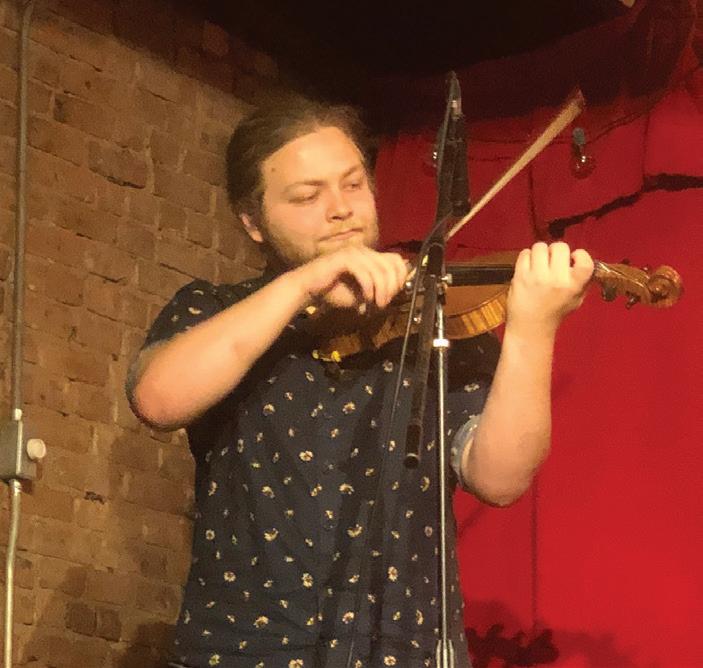
And one more heart that’s sinking Trains, thinkin’ and drinkin’ On my brain
Counting the ways I lose track of the days And the nights run long Spinning around Til I sound
Like a broke down country song
Just like Waylon sang I been busted for thangs
That I didn’t do
When the sun goes down On the town I’ll be howling Right to the moon
When I asked Clifford what’s next, he said that the band would be going on a tour playing gigs and festivals, like the Podunk Bluegrass Festival 2024, around the country.
“I’m also writing songs with Rick Lang, who’s sort of like an elder statesman in the bluegrass world. Also, the more I can do things like that and get my songs placed with other, more successful artists, that’s like another goal of mine.”
I’m looking forward to watching Clifford’s career blossom and grow. He’s a great songwriter and performer and recognizes that working with great talent only makes him better.
Mike Fiorito is a freelance journalist and author. His UFO themed science-fiction novel For All We Know was published in May 2024 (see review this issue)
having a sense of place - a sense of history - who is who - what is what. Schools provide years of histories, both personal and familial. Schools tell the story of a place.
Working at home three days a week I’ll have a noticeably quieter work day. I can work at the kitchen table. I can work on the porch. I can make myself lunch, take a phone call or go for a walk. For many this is the reality of their every day work day and since Covid, remote work has become normalized. Yet for me, leaving a job where I was expected to be stationed in my classroom (with almost zero exceptions) between the hours of 7:15 and 3:15pm, this feels akin to a jailbreak. At the same time, there will be no end of year celebration, no turning a new leaf. No obvious chances to remake, to redo, to try again. No letters from students saying thank you in so many words and ways.
Most of all I’ll miss interacting with (continued on back page)
Editors Note: This article originally appeared in the August 2017 edition of the Star-Revue.
The story of the Revolutionary War redoubt, Fort Defiance has been told in the pages of this newspaper before, so while it isn’t necessarily worth retelling the story of the role it played in the early days of the Revolution, it might be worth visiting its more recent past – that is, the curious tale of it’s debated location.
For many years, historians were remarkably consistent in recording the Fort as having been in the approximate location of the intersection of Van Dyke and Conover Streets. These include men who were writing when the Revolutionary War was still within living memory, or just a generation or so out of it in the 1850s and 60s. Writers like Henry Stiles, Thomas Warren Fields, and Gabriel Furman, whose histories of Brooklyn are still used by academics today all agreed on this location. However, for some reason in the middle of the 20th century, people started recording the location as having been at Dwight and Beard Streets. The change occurred quietly, but it nonetheless occurred, and most books written between 1950 and 2010 are consistent in recording that as the Fort’s location. There is no point in arguing the location of the fort today – it was indeed in the proximity of Van Dyke and Conover – but why the change?
On August 27, 1952, the 176th anniversary of the Battle of Brooklyn, Brooklyn Borough Historian James Kelly placed a bronze plaque on the wall of a red brick building owned by the Todd Shipyards Corporation, at the corner of Dwight and Beard Streets. Kelly had been appointed Borough Historian in 1944 and was passionate about Brooklyn history.
He did much to educate the community about their shared history and encourage a feeling of public ownership of Brooklyn’s rich and storied past. One thing he did to promote historical awareness was to place markers at historically significant locations around the Borough, such as the birthplace of Winston Churchill’s mother and the final resting place of the Marylanders who sacrificed themselves for Washington’s army during the Battle of Brooklyn.
One speaker at the unveiling was Harry G. Hill of the Todd Shipyards Corporation Board of Directors, who praised Kelly’s “happy circumstance” of locating the historic site. What was the “happy circumstance” that led Kelly to locate this historic site? Had he found new evidence that disproved the Conover/Van Dyke location? Whatever this “happy circumstance” was, it would have to have happened sometime between August 1951 and March 1952.
In 1951, to commemorate the 175th anniversary of the Battle of Brooklyn, the Brooklyn Daily Eagle ran a series of stories that “reported” the events
by Connor Gaudet
of the British and Hessian invasion of Long Island and the battle that followed, all in first person present tense. In the August 22 issue, an article discusses some of the American fortifications, including Fort Defiance, describing it as being “on a small Island just off shore (about at the foot of Conover and Van Brunt Streets.).”
On the same page just a column or two over, is an article entitled “James A. Kelly, Boro Historian, Aids in Articles” accompanied by a photo of the man himself.
The article begins, “In the preparation of this series, the Brooklyn Eagle and the author have leaned heavily upon Borough Historian James A. Kelly.” It goes on to praise his knowledge of local history and his extensive collection of historical documents. Less than a year later, in March of 1952, Kelly announced that he would be placing the Fort Defiance plaque at Dwight and Beard Streets.
While the battle at Fort Defiance, undoubtedly took place in Red Hook, the Battle over where the Fort was located began playing out in the pages of the Brooklyn Daily Eagle. A month after the plaque was installed a Letter to the Editor appeared in the Eagle.
George J. Bruhns had read the August 28 story about the plaque and wrote to dispute the accuracy of Kelly’s chosen location. His contentions were based not on academic studies, but on his own personal experience. Bruhns had grown up in Red Hook in the 1880s and knew exactly what the area looked like before the street grid demolished any and all physical evi-
(continued from page 1)
On August 27, 1776, the British responded by launching a surprise attack led by General William Howe after they discovered that the Jamaica Pass (which led to Brooklyn’s waterfront) was undefended. Howe sent the warship, the HMS Roebuck up the East River and sent 20,000 troops along the Jamaica Pass. While the land attack was successful, strong winds helped stop the HMS Roebuck in front of Fort Defiance.
“The Americans bombarded the ship with cannon fire forcing the British to retreat and lose their strategic naval position,” the plaque says. “With the East River undefended 9,000 Americans escaped to Manhattan in small boats under the cover of darkness allowing the Continental Army to regroup and ultimately win independence from British rule.”
Though the HMS Roebuck was stalled, the British were still firing at the American troops from the ship at close range and while the Americans were able to force the ship to retreat, there was also a lot of damage to Fort

dence of the original landscape. Bruhns wrote, “With due respect for James A. Kelly, Borough Historian, I doubt very much that the plaque was placed where it belonged… I cannot conceive of any Army engineers erecting a fort on boggy swampland, especially at a place that would command the entrance of Buttermilk Channel. Heavy gun emplacements require solid ground.”
Specifically Mr. Bruhns describes the location of Mr. Kelly’s plaque as it appeared in the 1880s, recalling, “Salt tidewater covered the land now bounded by Dwight St. to Columbia St. and from Lorraine St. to Elizabeth (Beard St) except a diagonal piece of high ground starting at Dwight and Van Dyke and running diagonal to the entrance of the Long Dock, Edner’s Spar Yard.” This diagonal piece of high ground was very likely what remained of the earth berm that had enclosed Van Dyke’s millpond, separating it from Gowanus Bay. The 1874 Naval coastal survey below closely resembles what Bruhns describes. The future location of the plaque, just offshore, is marked with a red “X”. It didn’t take Kelly long to fire back. Two weeks later, his response appeared in
Defiance. The fort was built back up but was abandoned after the war ended in 1783.
“The earthworks were allowed to settle, and land dredged to form the Atlantic Basin helped even out and fill in the ponds and streams,” Spellen wrote. “By the mid-19th century, Red Hook was beginning its journey to becoming the largest and most important port in New York.”
Now, in recent years there have been some debates about the exact location of Fort Defiance in Red Hook.
“For many years, historians were remarkably consistent in recording the Fort as having been in the approximate location of the intersection of Van Dyke and Conover Streets,” wrote Connor Eugene Gaudet in a 2015 Star-Revue story. “These include men who were writing when the Revolutionary War was still within living memory or just a generation or so out of it in the 1850s and 60s.
“However, for some reason in the middle of the 20th century, people started recording the location as having been at Dwight and Beard Streets. The change occurred quietly, but it nonetheless occurred, and most books written between 1950
the same section of the Eagle, entitled, “Maps Show Fort Defiance Was Built on Solid Upland.” In it, Kelly dismisses Mr. Bruhns’ comments as “hearsay evidence” and defends his position, saying “the maps on file at the office of the County Clerk show this site to be solid upland, especially one made in 1776 from original Government surveys that shows ‘the original high and low grounds, salt marsh and shore lines in the City of Brooklyn.’”
A few things seem strange about this statement, particularly the fact that no City of Brooklyn existed until 1834. Also, if the map were created in 1776, why would it be described as depicting the original high and low grounds, etc? In 1776, there would have been nothing else that those things could be described as “original” in comparison to.
Mr. Kelly’s use of quotation marks proved useful, as a Google search of his verbatim description provided a map on file at the New York Public Library that employs almost identical language, basically differing only in its being made from original government surveys made in 1776, rather than being made in 1776 from original government surveys. The map itself was made in 1876 and is very likely that this is the map Kelly references in his published response.
Oddly enough, the map doesn’t show what Kelly describes at all, and actually much more closely resembles Bruhns’ description. Of course, that didn’t really matter, because Kelly had the map and Bruhns didn’t.
So why would a respected civic official, and no lesser a person than the Borough Historian lie about the Fort’s
(continued on back page)
and 2010 are consistent in recording that as the Fort’s location.”
Historian James Kelly placed a bronze plaque at the Todd Shipyards Corporation, at the corner of Dwight and Beard Streets in 1952. Gaudet questioned whether the motive behind the plaque being placed there had to do with the Todd Shipyards Corporation paying for it, even if it was not where Fort Defiance was actually located.
“The plaque itself disappeared many years ago, but its legacy has remained in the false impression it left about the fort’s location,” wrote Gaudet. “A new plaque was created in 2012 and placed in Valentino Park, much closer to the actual location of the fort it commemorates.”
It is nice to have the plaque in Valentino Pier Park although the plants around it are overgrown and make it tough to spot. Like the plaque, Fort Defiance is easily overlooked but it was pivotal in the Battle of Brooklyn. Fort Defiance may be long gone, but the Fourth of July is the perfect time to celebrate it and acknowledge its importance in the United States breaking free from the British.


by Marie Hueston and Sage Hueston
Looking for a fun and simple game to kick off summer with? Try making these adorable toilet paper roll bowling pins. You can use them in your house or pack them up for a trip to the park or beach!

What you’ll need. For a full set of bowling pins, you will use 10 toilet paper rolls; for a smaller set, use 6. Along with toilet paper rolls you’ll need white paper, red construction paper, scissors, glue, a pencil, a ruler, and your choice of a ball to bowl with.

Make your rolls white. To mimic the look of a bowling pin, measure white paper to the height of the rolls. Draw a line and cut across it to create strips. Make sure your strips are long enough to wrap around the entire roll.

Glue your strips. Once you have cut out all of your strips, carefully roll each strip around a toilet paper roll gluing as you roll. Hold down the end as it drys to secure the strips. Scotch tape also works well.

Cut out red strips. To complete the authentic bowling pin look, cut 1/2 inch strips of your red paper. Wrap the strips around each roll, about an inch down from the top, and tape or glue them in place.

Start bowling! To set up your bowling pins place your first pin at the front. Then line your remaining pins up behind the first one, increasing the number of pins per row by one each time. Find an appropriately sized bowling ball, stand back, and bowl! Have fun!
July Preview: Start saving plastic coffee lids for another fun summer game!

There is nothing the least bit remarkable about Rita, the protagonist of Chronicles of a Wandering Saint. She lives in a desperately rural Argentinian town. Her job, as a cleaning lady in the desperately old church, is, like, her marriage, desperately mundane. As if to prove that cameras do capture souls, her Facebook profile photos are either underlit smears or blown out mugshots.
But it’s through social media that Rita sees a way out: viral fame. She poses herself as a paragon of piety, kneeling in her pew, seemingly deep in prayer, a rosary draped just so over her clasped hands as she’s illuminated by a perfect shard of light beaming through the windows. (That’ll get visitors to take and post her picture!) And after stumbling on an appropriately forgotten and common statue of a nun in the church storeroom, Rita (Mónica Villa) hatches a scheme to repurpose the find — with help from her exceedingly patient husband Norberto (Horacio Marassi) — into the long-lost effigy of the town’s patron saint: fittingly, St. Rita.
This is where Argentinian writer/director Tomás Gómez Bustillo’s debut feature begins, built around the lengths Rita will go to transfigure her dull existence into one others will celebrate. The film is a deeply observed and humanely funny vignette of life in a small-town Catholic hothouse. That is, until Bustillo takes an audacious hard turn, transmuting his film into something more dreamlike and divine. A mist of magical realism descends, and suddenly angels, demons, and light fixtures and moths imbued with lost spirits populate this otherwise ordinary community. It all amplifies the introspection at the core of the film: What does it mean to lead a good life? How will people remember us — and what will we be remembered for?
It’s difficult to get more detailed without spoiling things. And Chronicles of a Wandering Saint, which opened at IFC Center on June 28, is best experienced with as little advanced knowledge as possible. What can be said, though, is that this is cinema of uncommon empathy and faith, the kind of film that shifts how you see your world, your people, yourself. Bustillo draws on his Catholic past; filmmakers Apichatpong Weerasethakul, Jacques Tati, and Carlos Reygadas; poet Dante Alighieri; and the magical realists Gabriel García Márquez, Julio Cortázar, and Jorge Luis Borges. Bustillo spoke about creating the film, coexisting with the fantastical, and why he’s more interested in provoking questions than providing answers. The conversation has been edited for length and clarity.
The film is very emotionally mature. It feels like there’s a lot of life behind it.
by Dante A. Ciampaglia
I wish I could take the credit and say, “Yeah, that’s because I’m super mature and emotionally intelligent,” but I’m not. This movie took me, like, three years to write, and 24 different drafts. It took me so many tries to try to get some complexity and depth in there. Most important is to be able to put myself and a lot of my own problems and issues into these characters in many different ways. So I’m just kind of borrowing from my own anxieties and issues and, you know, changing them so I don’t feel fully naked in front of an audience when showing this film.
As a younger man, was it difficult to write from the perspective of older people?
I think it is difficult because, obviously, I can’t physically step into those shoes and see the world the way they see it. But I will say age is just a dimension, not the only dimension, that gives a person their ideas or thoughts or anxieties. At some point, I had to connect with Rita and say I don’t know what it’s like to be 70-plus. But I do know what it’s like to want to be admired and validated. That I know. And so does she. And that I could connect with and build around. So that’s kind of the link I felt I had with her.
There’s a lot of research that went into this. I spent so much time in this small town where we shot as a young person. When I was in my late teens and early 20s, I used to be Catholic and I used to be a missionary in this town. The only people that we would ever speak with were the older people. They were the ones who came out and spoke with us and let us into their homes. I spent countless months speaking with this particular demographic of elderly women in this small town. So there’s been a lot of observation there. I was able to connect with a lot of them and make actual friendships with these people. So those two things, I think, combined to give me a little bit of a window into what it could be like.
Did any of the people you met, any of the stories you heard, find their way into the film?
There’s certainly a ton of little bits and pieces, but I wouldn’t say that one character has an equivalent in the real world. I don’t think I ever thought about creating characters in that way. But I borrowed from this person, I borrowed from that person. Some were these elderly women from this small town, but some are my own friends and family. Every character is some sort of mix of a lot of different people, then I imagined even more character traits on top of that based off the emotional truth I was trying to bring.
You’ve described the people you met in your missionary work as “living ghosts.” That makes its way into the film, literally, with villagers as angels or demons or the recently deceased. In the US, “ghosts” are usually scary. But
not in your film.
That’s a great observation. I think it has a lot to do with the cultural backdrop of Latin America versus the U.S. In Latin America, we coexist with the fantastical in a way that feels more nonchalant than maybe American culture. I think it has so much to do with the cultural clash that is Latin America and how we have to live in a world where dualities and contradictions coexist side by side. They just have to.
Growing up Catholic in a Catholic household, I had an older brother who passed away before I was born. I distinctly remember being 6 or 7 and feeling like his ghost was in my bedroom. It wasn’t scary. I was just like, “Hey, thanks for coming by. I’ll see you later” — just little things that a 7 or 8 year old would say. So that’s kind of the approach to a ghost story: How do I work with more magical realism than fantasy in this particular sub-genre? You have this idea in the film that if someone misses their ascension to Heaven, they are forever bonded to a physical object nearby or even something ephemeral, like the wind. Is that concept something you heard growing up or experienced culturally?
I don’t think so. Technically, if you were to stick to Catholic dogma — which I don’t, because I’m not Catholic, but this is the cultural background I’m coming from — that wouldn’t be possible. If you die, you either go to Heaven or Hell, or Purgatory if you need to go through your waiting period. People wouldn’t get stuck here on Earth.
I was reading Dante at the time I was writing. So much of getting stuck [in the Inferno], it’s this irony of what you get stuck in or the kind of torture that you get inflicted. It’s specific to who you were in your life. I find that so fun. It’s so imaginative. I thought, “What would be the Third World version of that?” But instead of making it moral, like a punishment or reward, just making it something that was an accident. It’s this accidental poetry where it’s like, this person is stuck in the wind and now they get to experience a lot of things. But they’re also never stuck in one place, so they’re endlessly lost but always discovering. So this kind of Third World, accidental, poetic view on the ordinary was what I tried to capture.
It reminds me of something that a friend told me once, that a butterfly nearby is the spirit of a loved one visiting. There are these ways we have of keeping people around us, regardless of religion or belief.
That’s exactly true. And so many people have them. This is something I’ve experienced a lot in screening the film at different festivals. People will come up to me afterwards and say exactly this story, like, “My grandma is always around when I see a white butterfly,”

or, “Whenever I see a hummingbird, I think of my grandfather and I know that he’s here.” No matter where you are in the world, we all have those little things, even if it’s just a smell. I think that that’s just part of who we are as humans. We have to keep the people that we lost around somehow. I think that’s very, very beautiful, and it’s good to tap into that emotion. I grew up Catholic and have a complicated relationship with Catholicism. I usually frame it around the difference between faith and religion. They overlap, but they’re not necessarily the same. You said you’re no longer Catholic, but the film feels very full of faith. Is that a fair reading? Are you trying to kind of reckon with your own relationship, past or present, with this in any way?
I definitely think there is… Whatever you say is fair because I don’t own the movie anymore. I made it, but at some point it is whatever people make of it. True, but there are filmmakers who don’t like having words put in their mouths — or art!
I would say it’s kind of the difference between spirituality and religion. For me, spirituality is about the questions and religion is about the answers to those questions. I think, ultimately, we’re all asking the same questions. And in this movie, I just wasn’t interested so much in the answers. I drew from a lot of Catholicism as a cultural backdrop — but not as a spiritual backdrop — to explore my own questions and anxieties and worries and even wish fulfillment through the film. I’m not saying that this is what I believe because I still don’t know what I believe. My whole journey has been moving away from the black and white, yes or no, good and bad kind of binary thinking. Just saying, “I don’t know.” There’s so much to explore. I think not knowing is the gift. It’s the most interesting thing that we have, the uncertainty that we’re thrust into. I think we all probably need more questions and less of the answers.
Zak leaves the house to call Susan Kemp from the phone booth. He tells her that he's dropping out of Hunter. After two phone calls he agrees to meet her. The next day he leaves Sunset Park for a trip back to the living organism that is Manhattan. Killing time until he meets her, he ends up in Central Park.
17 – On the Rock
Zak was in the park, again, sitting on an outcrop of black Manhattan schist. Still intending to meet Susan Kemp at Chock full of Nuts, he had two hours to kill. With kids in school and people at work, northern Central Park was quiet.
“Think Zak, think.”
And so began what should have been an inner monologue but was instead an inner dialogue.
“See?”
“See what?”
“See what just happened?”
“Nothing happened.”
“Right, nothing did happen, but something was supposed to happen.”
“I was goin’ back to school.”
“Yeah…”
“But I didn’t, I couldn’t, couldn’t cross the street, couldn’t walk through that door.”
“Do you know why?”
“NO… I DON’T KNOW WHY!”
It was getting loud in his head.
“Just couldn’t cross that street, huh.”
“I wanted to…”
“But you didn’t.”
“OBVIOUSLY! FUCK OFF!”
Zak got up off the giant grooved black rock and started briskly downtown. It helped just to move, if you moved, you didn’t think as much. He was starting to like Central Park with its neatly groomed green lawns and meandering paths. His park in Brooklyn had patchy yellow grass, hurricane fences and shard of broken beer bottles on the concrete. He kept walking down the eastern edge of the park, close to Fifth. At a certain point, through the trees, he saw a large round white structure. A building?
Curious, he found an exit on 89th Street to get a closer look. It was a series of curved forms, larger at the top than the bottom. Like an upside-down pyramid, smooth and cool between the right angles of the neighboring buildings. People were entering it under a white façade on which metallic letters read: SOLOMON E. GUGGENHEIM MUSEUM
Zak had never seen a building like this. He liked it and stood there for a while, looking up at the curves.
18 – More coffee more doughnuts
Zak arrived at the Madison Avenue Chock Full O’Nuts just before noon. Through the glass he could see Susan Kemp already sitting at the counter. She saw him and waved him in with a smile.
“Here are your books.” She handed him the canvas bag he had left at her house.
“...and how about some coffee?”
“Sure.”
“And a doughnut.”
“Sure.”
Susan ordered two coffees and two whole-wheat doughnuts.
“No milk, right!”
“Yeah no milk.”
With a slight eyebrow raise, Zak noticed she looked different. The dress and hat were gone, along with the stockings and heels.
Susan picked up on his mild reaction.
“Yes, I know. I look different, right?”
“Yeah, well…”
“Jeans, no hat or makeup, sneakers.” She pointed to her feet.
“I guess.”
The doughnuts and coffee came. Susan instead on paying.
“You can get the next round,” she said with a chuckle.
Then, after a pause.
“So if you’re wondering about the new look.”
“A little.”
“Well, hmm, you know, the whole thing with the guy Ken I told you about, my parents, all this…” she trailed off.
“Oh yeah, Ken, how’d that work out, did the practice help?”
“We never got that far. It seems his mother, and this might sound strange, didn’t think I was good enough for him. Not me per se, but the Kemps, my family.”
Zak listened; this was new to him.
“Now my family has money, fine, Park Avenue, you would think. The Whitneys, they have more than money.”
“More than money?”
“Sutton Place and a whole social structure. They ride horses, they don’t really work anymore, not the way people work.”
“Ride horses, huh.” Zak laughed.
“My grandfather had a horse, and a cart. He sold fruit on the street.”
Susan laughed, took a bite and a sip.
“But wait, Zak, what happened with the elevator guy?”
“Oh, that prick.”
“Yes, the doorman told me there was a row.”
“He just kept staring at me on the way down. I said ‘what’s the problem?’” Zak paused, shaking his head.
“Yes…”
“He said I was swarthy.”
“Swarthy!”
“Yeah swarthy. What the fuck is swarthy?”
Susan shook her head, holding back a grin.
“It means… like, dark skinned.”
“Like I’m black?”
“No, just not super white.”
“Well fuck it, I forgot about it.”
“Ready for another round?” asked Susan.
“Sure, I got this one.”
They continued talking, mostly Susan, about her new outlook, how she would drop all the family pressures and live her own life. Zak nodded in agreement. Finally, with a few minutes left before Geography, he told her he wasn’t going back to school.
“What?”… Why?”
“Why?”
“Of course, why?”
“Truth is I tried, pretty hard, just couldn’t walk back in through that door.”
“OK, I have to go now, but we’ll talk.”
“Ok,”
“Call me,” and pointing down.
“Don’t forget your books.”
19 – Automat incident
Zak sat finishing his coffee, looking down at the canvas bag of books on the floor and had two thoughts. He could bring them to the Hunter bookstore and sell them back for a little cash, or he could just get up and walk away. He was soon walking downtown on Madison, bookless and a little high from caffeine and sugar.
Having to kill a few more hours before he could go back to 451, Zak wandered toward midtown. He stopped at the zoo in Central Park to see the seals slapping about in their oval pool. Then, hanging for a while with the horses on Central Park South that pulled the touristfilled carriages. This was it, midtown, the beating heart of the beast.
At 57th and Sixth he saw something familiar, an automat, just like the one his parents took him to in Brooklyn. A place where the food was behind little glass windows. A kid with a bunch of nickels could get slices of pie and cake on his own, and for two nickels pull a lever for a glass of cold milk. This Manhattan version was bigger, with a high ceiling and a balcony. The walls with sandwiches and des-
serts behind glass were the same. Zak went to the change booth and cashed in a dollar for twenty nickels. The slice of blueberry pie was 35 cents, and coffee out of a flowery spigot 15. The fork and spoon from the silverware tray was shiny and warm, just out of the dishwasher.
Zak found a table near the tall window and watched the flow of people, taxis and trucks outside. He was lost in thoughts of what his post-college life would be when he heard a voice directed his way.
“My, you seem pensive.”
Looking left, he saw a group of people that had pushed two tables together. The woman addressing him sat at one end, joined by five men sipping coffee.
“Excuse me?”
“You seem pensive, in serious thought.”
“Well, uh… no, maybe.”
The heavy-set woman stood in contrast to the five thin men. They spoke among themselves in low tones and covered laughs.
“Are you new to the city?” she asked.
“Sort of. I live in Brooklyn.”
“Oh, Brooklyn… well, enjoy your pie.”
She went back to her group, which had shrunk by two. Zak turned back to the window, the traffic, and his pensiveness.
Finishing his pie and coffee, he now needed a bathroom. The automat men’s room was down a long flight of marbled stairs. At the bottom, the shiny scrubbed cafeteria was replaced by a grimy, dimly lit doorless room, reeking of urine. Zak thought of turning back, but his multiple coffees wouldn’t allow it.
There were no urinals, only three drab green stalls. The middle one was free. Locking the door behind him, he began to relieve himself. He noticed some kind of activity going on in the stall to his right, and a gaping hole where the toilet paper dispenser would have been. Zak wanted out ASAP. He was almost done when through that gaping hole came a naked erect penis and a guttural voice offering an invitation. Finished or not, Zak was out and up the stairs. Standing on 57th Street, he zipped up his jeans.
Author Bob Racioppo is a founding member of the Shirts, a New York-based American punk band that was one of the seminal CBGB bands. After signing a record deal they toured the US and Europe. In addition to music, Robert is an accomplished fine artist. This is his first novel. He grew up in Sunset Park and now lives in Windsor Terrace. To order a copy of the full book ($15) text 917 652-9128 with your address.

Heirs to the Court of the Crimson King. Pardon my imprudence but I fail to get excited about one or two former members peddling again what a band they were in did 20 or 30 years ago. As crucial to my young listening as Talking Heads and XTC were, the Remain in Light and EXTC revival bands mean little to me. And while Adrian Belew, Steve Vai, Tony Levin and Danny Carey are out touring with their Beat, playing music from the essential ’80s King Crimson records, I’m more interested in the newer bands that follow in the King’s stead.

NYC’s Scarcity takes Crimson’s precision and overlaid riffs and puts them into a solidly black metal setting. (I suppose that makes them prog metal but I’m loathe to use the term.) Launched as a recording project by Brendon Randall-Myers (conductor of the Glenn Branca Ensemble and a member of the new music electric guitar quartet Dither) and vocalist Doug Moore (Pyrrhon, Weeping Sores, Glorious Depravity, Seputus), they became a real, live band with the addition of Tristan Kasten-Krause (Sigur Ros, Steve Reich, LEYA) on bass, Dylan Dilella (Pyrrhon) on guitar and Lev Weinstein (Krallice) on drums. Their second album, The Promise of Rain (CD, LP, cassette and download out from Flenser July 12) sharpens the intricacies, patterns and colors of King Crimson into a gleaming growl. Mid tempo, repeating guitar lines float above relentlessly fast, rolling drums

while the strain in Moore’s scream might give you laryngitis just from listening to him. The new album is a scathing and scintillating set of songs. Another New York outfit, Paragnosis, released their second album last month. The self-titled, self-released, downloadonly collection of six instrumentals clocks in at just under half an hour. The trio’s sound is cleaner than Scarcity’s, with more room given to showboating solos, executed quite skillfully. Robert Fripp’s King Crimson, at least at times, leaned into the metallic, whether or not their fans want to admit it. The band came together in 1968, the same year as Black Sabbath (although the Londoners of Crimson were perhaps a bit more erudite than the Brummies of Sabbath). Fans have often tried to build a wall between the two camps, but such bands as Paragnosis and Scarcity proudly walk both sides of the divide.

Everything old is punk again. I don’t mean to be imprudent and I certainly don’t want to be insouciant. Maybe summertime makes me feel nostaligic, or maybe punk is especially good at reinventing itself with only minor changes. All forms steal from their own histories, but punk burned fast and has continued to smolder for decades. Bob Mould sang of squandered youth 40 years ago on “Celebrated Summer” from New Day Rising, the apogee of Hūsker Dū’s brilliant arc. I found myself singing that song through the minute and 57 seconds of “Escape,” the first song on Hayes Noble’s sophomore
album, As it Was, As We Were (CD, LP and download from Two Two One Press last month). It doesn’t really fit in melody or meter, but it does in mood, and that’s what matters. Noble’s all of 19 years old and recorded the album the summer after his high school graduation with his younger brother on bass and dad on drums. Like the Hūskers (from Minnesota), the northern Illinois native son (since relocated to the Pacific Northwest) plays solidly upper Midwest punk, full of the existentialism and angst of the flatlands and, even at his age, some wistfulness. Noble crafts some strong songs here. Never mind that there’s nothing all that new going on. It’s powerful, impassioned and catchy, and that’s what punk’s supposed to be.

Meanwhile, the Granada, Spain, fivepiece Palmar de Troya put me in mind of Sonic Youth at their yellingest and punkiest. Singer keyboardist Llulaby attacks the five songs on their second album, named simply II (10” vinyl and download from Reptilian Records July 5) with a Kim Gordon take-noprisoners urgency. The album is full of hooks strategically placed within a nest of fuzzed out guitars. The band named itself for the Palmarianos, a 1970s Spanish religious that founded its own monatery and declared its own pope. But I imagine it’s more the rebellion than the religion they found inspiration in. The automated voice in “Cold Snakes” that repeats an admonition against questioning authority isn’t there to offer helpful advice. It’s there for mental target practice.


Review of “For All We Know,” by Mike Fiorito Review by Michael
Quinn
Doyou believe in UFOs? For some, the existence of aliens is a given, based on statistical probability or the (limited) evidence from photos and videos. Others swear they’ve had firsthand encounters, often shrouded in mystery. Years ago, I had a boyfriend who once, with terror in his voice, recounted an eerie childhood alien abduction experience. He never mentioned it again during our five years together, possibly because of my stunned reaction. For believers, the idea of extraterrestrial life can also evoke profound awe, akin to gazing at a magnificent sunset or a starry sky. Brooklyn author Mike Fiorito taps into this wonder in his latest novel, “For All We Know.” This thought-provoking and heartfelt coming-of-(new)age story follows Matteo Tarquini from the 1960s to the present, charting his transformation from a kid in the projects to a philosopher of the people. Matteo is one of three kids born to tough but loving parents who smoke, gamble and struggle to make ends meet. The family lives in a dirty Queens building with graffiti-strewn walls and the stink of the nearby Department of Sanitation. Matteo’s parents dream of a better life for their kids, but Matteo has his own ideas about what that entails—it’s not about money.

One night, a man pulls a gun on teenage Matteo to steal his radio. Matteo bolts, not because the radio is valuable, but because music is sacred to him. Shaken afterward, Matteo and his best friend, Squid, get high and blast rock records to comfort themselves. They sense but can’t yet articulate how music “can transport you. Deliver you. That music is a form of time travel.”
After a possible UFO sighting over the city, Matteo becomes fascinated with the unseen. He starts viewing his Catholic school chapel as a kind of spaceship and appreciating the “science-fiction aspects of Catholicism,” like how the Father, the Son and the Holy Spirit are separate entities but also the same thing. This fascination with far-out things leads Matteo to experiment with mescaline, LSD and mushrooms, initially guided by a hippie guru named Tom Turkey and his sexy girlfriend, who reads Walt Whitman’s poetry with a lisp. These experiences expand Matteo’s consciousness, allowing him to communicate with nature. (The trees urge him to “HAVE JOY.”)
Matteo’s decision to study philosophy at New York University disappoints his family, who question its practicality. However, his true education comes from an alchemist, Pedro, who introduces Matteo to Carl Jung’s work, teaches him to meditate and pushes him beyond his comfort zone. He instructs Matteo to undress and sit naked on his lap, giggling at his hard-on. “There is something of the charlatan about him, but he is also very learned,” Matteo reflects afterward. Matteo, influenced by the men in his life and his tough upbringing, is an astute observer and models himself on the people he admires. “When I hear someone or something that I consider worthy, I listen,” Matteo explains. Yet his interest in the otherworldly feels inborn.
Like many of us, Matteo learns to shoulder adult responsibilities like getting married, raising a kid and caring for elderly parents. And like many of us, he enjoys smoking pot, drinking beer and listening to rock music to escape those responsibilities. What sets him apart is his relentless quest for life’s meaning. He amasses a vast collection of books yet often feels that the more he reads, the less he knows. However, this search for understanding brings extraordinary dimension to his life, from strange coincidences like running into an old nun from his school days while in Lourdes to extended dream conversations with his deceased father.
After a night gambling in Atlantic City, Matteo’s elderly widowed mother, Cookie, is too pooped to move. Matteo has no choice but to carry her up to her room. Old age has diminished Cookie, but her heft strikes him once she’s in his arms: “This woman is like a mountain—stubborn and powerful, with marshy soft parts and deep dark caverns.” Fiorito nails his character portrayals in economic descriptions like this one. Cookie isn’t a shell of who she was but someone fiercely alive. I’ve read and favorably reviewed another of Fiorito’s books for this paper, but “For All We Know” shows how much he’s grown as a writer. It feels more personal and profound, deeply informed by his life experiences. After reading it, I have so many questions I wish I had asked my boyfriend all those years ago. We’d all do well to heed the trees’ advice to Matteo: “Don’t think with your head. Think with your heart.”
by George Grella
Here in New York City, the jazz capital of the world, hot summer nights mean not just jazz but free jazz. The very idea of Ornette Coleman or Albert Ayler playing at Slugs’ Saloon fills me with the image of musicians on the bandstand in a hot, crowded club, the air conditioning failing to compete with the temperature outside, the playing itself fiery, everyone sweating and concentrating and hanging on every note with the special camaraderie of collectively experiencing something historic, unique, and forceful. Of course, that’s a highly personal view, and it comes out of actual experience of hearing, and playing, free jazz in the summer in this city: memorable nights at the original Knitting Factory, The Stone, in East Village parks, even CBGB.
Except for the parks, those places don’t exist as they were. The rent is too damn high—the musicians are still here but the venues have disappeared, and those that pop up rarely last. In Mayor Eric Adams’ “City of Yes,” culture doesn’t exist if it’s not at Zero Bond. They don’t play free jazz there, but they do every year at the Vision Festival, an oasis of jazz life in this city that this year ran from June 18-23 at Brooklyn's Roulette.
With multiple sets each night from the finest musicians around, the festival is always a superb experience, but this year’s seemed even finer, the strongest and richest since its return after the pandemic cancellations. It felt both grounded and expansive, the fabric of this city, the past, and the future coming together.
There was fantastic story telling from Matana Roberts and her COIN COIN music-and-memory project, poetry from Fred Moten and Oliver Lake, dance from Davalois Fearon Dance backed by a sensitive quartet of reed player Mike McGuiness, vocalist Gino Sitson, bassist Lonnie Plaxico, and drummer Adriel VincentBrown. The great duo of tenor saxophonist James Brandon Lewis and drummer Chad Taylor delivered an exciting set. There were two scintillating piano trios—Tarbaby and the Matthew Shipp Trio—and lots of visual art.

Visual accompaniment to a live performance has been an intermittent, at-the-margins element in jazz for quite a while. It’s never seemed fully thoughtthrough or realized (except in a few specific projects like those from Darcy James Argue that have been conceived as multimedia presentations from before
strength and tension that the band held just at bay, a sense that they were offering the audience a chance to fill in the expressive blanks if they had the courage to do so. A mix of grooves, clear phrases, and utter abstraction, Jones was exploring some of the most profound territory in contemporary jazz.
In Mayor Eric Adams’ “City of Yes,” culture doesn’t exist if it’s not at Zero Bond.
This began with bassist William Parker, at the center of the free jazz scene for the last fifty years and recipient of this year’s lifetime achievement award. Opening night was his, and it exemplified the entire festival. There were the older ensembles, like Huey’s Pocket Watch and the fulfilling return of Raining on the Moon, with the wonderful Leena Conquest singing “James Baldwin to the Rescue,” something of a Parker hit. There were also new collaborators and ideas, from Roots & Rituals—fronted by a keening, passionate Mixashawn Rozi—The Ancients, with explosive tenor saxophonist Isaiah Collier, and an extended excerpt from Parker’s opera Trail of Tears. The music of the latter, with vocalists Andrea Wolper, Raina SokolovGonzalez, and AnneMarie Sandy, was expansive, but the accompanying video by Moonlasso had no working connection with the performance, and seemed like it needed more work.
Collier returned Sunday night with his trio The Chosen Few, and that night finished with centenarian Marshall Allen leading the Arkestra. That was new and old royalty in exuberant, energy music— and Collier himself has the sonic energy of the entire Arkestra, he’s an astonishing player.
There was so much more, and everything was nothing less than fine. There was improvised rock from the newish and terrific band Mendoza Hoff Revels, and free roots rock from James Blood Ulmer. Ulmer is shambling and succinct, with songs he plays regularly, like “Jazz is the Teacher,” and things that seem to appear out of midair. It’s classic bar band blues rock, in a way, with the purity of devotion and expression elevated to the highest level. It’s music for people who like to be together, spiked with Ulmer coaxing Vernon Reid out of the audience to replace him for a short stretch.
the first note was written). Projected on a screen, it’s come off as minor set dressing, if not a distraction from the music, as in the Trail of Tears excerpt. Festival sets have through the years been accompanied by artist Jeff Schlanger, who stations himself at the lip of the stage and paints performances in real time. It’s less multimedia than a performance in its own right, Schlanger improvising visual art in parallel to what the musicians are doing. He was not well, and absent this year, but his lovely, vibrant painting that are made with fluid lines that seem like visual counterpoint to each other, were projected behind Parker’s playing, an evocative way to honor the man. (A gorgeous painting of Schlanger’s adorns the cover of a historic new release: WEBO on Black Editions is a 3-LP set from drummer Milford Graves’ private tapes of two-nights of concerts from Graves, Parker, and tenor saxophonist Charles Gayle, one of the seven live performances this trio made together, and one of Gayle’s earliest recordings. Their partnership is one of the seeds that grew into Vision. Schlanger made the painting at one the nights recorded.)
Alto saxophonist Darius Jones’ Quintet had a video playing behind it for their set, and it was one of the things that marked this as one of the most memorable parts of the festival. Made by Laura Sofia Perez, it centered on repeated abstract black and white images of an egg in front of a draped black cloth, a burning birthday candle balanced on a seashell. This shared the same focused, compelling mystery of the music. The quintet had guitarist Nick Sala, cellist Christopher Hoffman, bassist Liani Matteo, and drummer Jason Nazary, and what they played had a haunting, mid-tempo, cool simmer of a surface, lean harmonies—horizontal music, not vertical—and a gripping sense of control. There was tremendous
So was Shipp and his trio with bassist Michael Bisio and drummer Newman Taylor Baker. He started with “Primal Poem,” from his excellent new release, New Concepts in Piano Trio Jazz (ESP-DISK’). That’s a plain title, both accurate and misleading. What Shipp and the trio are doing, what they played at the festival, has no explicit conception except to rethink what improvising means, in the moment, with every single note. Each musical event had the introverted sense of the musicians questioning every decision they were making, but an extroverted feeling of delight at affirming each new idea.
Shipp is a titan, the name in free piano improvisation now that Cecil Taylor is gone, and the speed and agility of his thinking is so great that what comes out of his hands is graceful, light-footed. The past few years, he sounds like he’s recreating his style anew every time he plays, mercurial while also purposeful, with a clear direction. He doesn’t follow gravity or the path of least resistance, he makes his own laws of musical physics as he goes along.
With close and poised listening from Bisio and Baker this was the quietist set of the festival, pulling the listener in. Regular jazz playing means setting up the song form and then improvising over it, the listener knows where the harmonies go and can anticipate what’s coming next. With Shipp, there’s no way to anticipate anything, which may be the great divide for listeners when it comes to free playing—for some it’s unsettling, thrilling for others. But these musicians are so good, and their purpose is so meaningful, that we should trust in the unknown.
June 6, B61 jumped out to a 7-0 lead on MiniBar and cruised to a 17-6 victory. Across the street on Dovey Diamond, Bait & Tackle took an early 4-2 lead but the Record Shop scored seven in a row and won the game 13-5. The Soft Ballers jumped out to a 4-1 lead after 1, before the visiting RecKids’ bats caught fire, as did the hurler firm of McDermott, Fisk and Edan who tossed 5 straight shutout frames. Manny Chevere slugged his second homer in as many games, a 3-run rocket in the 6th to put the victory on ice. Walker Waugh came off injured reserve to go 2 for 2, with two runs scored, and several outstanding put-outs in the field. Reigning League MVP Joel “Tumbleweed” Kern missed hitting for the cycle by a single. Tom Gibbons hit a monster home run late in the contest for Bait, while Barry “The Mechanic” O’Meara - winning pitcher in the RHSL 2023 Championship Game last August - took his 1st loss of the 2024 campaign. In relief, Dallas Owens worked his patented one-step delivery to some fanfare but it was not enough for Bait who dropped to 1-6 while the Record Shop improved to 6-1.
June 10, the Record Shop record-
by Brian Abate
ed the first shutout of the RHSL season with a 22-0 victory over Hometown. Lars Fisk (7 scoreless in his last 3 games, now 3-0), Bobby Cole and Edan Portnoy combined for the rare shutout. They put up eight runs in the second inning and led 10-0 after two. They were also sharp defensively, turning a double play in the first and making a few running catches in the outfield to preserve the shutout.
In total, the Shop pounded six roundtrippers. Michael Gately blasted a pair of them - taking over the League home runs lead with five on the season - then added a 3-run triple for a 6 RBI night. RecKids’ Coach and 2022 League MVP Juice Brault, Manny Chevere, Andreas Kohl and Kevin Murray all went deep in the lopsided affair. Jesse Venture relieved Hometown starter Gwendolyn Groinpull, who suffered her 1st loss of 2024. The RecKids powered up their amps to 7-1, while the Chickens laid a gooseegg, dropping to 4-4 for the season.
June 13, the Wobblies cruised to a 19-4 victory over MiniBar while B61 beat Bait & Tackle 8-6. The win keeps B61 in second place, one game ahead of the Wobblies in the standings. The battle for second place will be key

(continued from page 16)
teenagers at such close proximity. To start I’ll be placed in a middle school in a nearby town with low socioeconomics and a low rate of college graduates. The majority of my role is to interact and engage with the community in an effort to get more students to college and or interested in more diverse career opportunities and pathways. Luckily I’m passionate about this work as I remain passionate about education. I’ll be part of a school community, just not as a traditional classroom teacher. Mostly I’m excited to see where this role takes me. One of my frustrations with teaching has been there isn’t much room for growth within the profession. As with any change, I feel expectant, uncertain and excited. No more grading, no more parent phone calls after an unpleasant incident. Freedom, or perceived freedom can be a double edged sword but I’m ready to take the leap.
Teaching is so unique in the human nature of the job - I started mornings between Monday and Friday for most of my career with twenty something faces looking expectantly at me. The idea of walking into a school building without any direct and immediate responsibility to live students is disorienting yet wildly appealing. I can be ten minutes late? I don’t have to speak if I don’t want to? Who am I, if not a teacher? In the fall I’ll also be coaching cross country, a gig I’ve enjoyed as it allows me to interact with young student athletes in a growth oriented way. Watching athletes achieve their physical goals is rewarding and fulfilling. I’m hopeful that with the subtraction of my classroom, the addition of a more flexible role, and my position coaching, I’ll have miraculously achieved the dream balance between work and home. This is, of course, a ridiculous goal but I do think I’ll have a little more free time to spend with my family. And in the end, I’m not certain I’m done with teaching forever. With anything you truly love the door is never fully closed.
as the top two teams get a bye in the playoffs.
June 20, there were three games scheduled, however Hometown didn’t have enough players and ended up forfeiting their game against Bait & Tackle. The other two games were both thrillers. On Dovey Diamond, the Record Shop and MiniBar were tied at three after six innings. In the top of the seventh, Bobby Cole led off with a triple down the line. He then used aggressive base running to draw a wide throw to third on a grounder to first and then scored the go-ahead run. With two outs and a runner on first, MiniBar got a single to right but an excellent throw cut down the tying run at third to end the game. The Record Shop was tested but came away with a 4-3 victory.
Across the street, B61 and the Wobblies were in a close one with B61 up 2-1 after 6. They added two more in the top of the seventh, including an RBI single by pitcher Shawn Andrew but the Wobblies responded with three in the bottom of the seventh to send it to extras. Each team scored one in the eighth as B61 got out of a jam in the bottom of the inning. B61 scored three runs in the top of the ninth including a home run by Andrew. There was some controversy during the bottom of the ninth as it looked like B61 had cut down a runner at the plate but the runner was called safe. B61 was very frustrated and the Wobblies tied the game but a running catch in right field sent the game to the 10th. The Wobblies loaded the bases with the score tied 8-8 in the bottom of the 10th but a pop-out ended the inning and ended the game in a tie.
(continued from page 17)
location and then try to cover it up? Why not just place the plaque in the right spot? At the time, the corner of Van Dyke and Conover had a few four-story walkups and a local watering hole. They may not have been able to pay for a plaque.
So what could possibly have been the reason Kelly wanted the plaque to be placed at Dwight and Beard? Could it be that Todd Shipyards, who owned the building there and paid for the plaque, had something to do with it?
Todd Shipyards was founded in 1916 and ran some of the largest dry docks in the world. Fitted out for iron shipbuilding and repair, they spent WWI and WWII building and repairing Navy vessels for the US military and developing other technologies for the government.
The Korean conflict brought Todd Shipyards a 5-year uptick in profits. If Todd was the only party willing
(as of June 27)
Record Shop ........ 8-2
B61 Bus Stops .. 7-2-1
Wobblies 6-3-1
Hometown 4-6
Bait & Tackle ....... 3-7
1-9

June 24, B61 took on Hometown. A home run in the first gave Hometown an early lead but B61 responded with three in the bottom of the first. After their 10-inning marathon game against the Wobblies, Shawn Andrew was back on the mound for B61 and he ended up pitching five innings. He also had a bases clearing triple and two RBI singles. B61 built a 15-4 lead and ended up winning 15-7 after a three-run home run for Hometown in the bottom of the seventh. Both teams turned a double play in the game and B61 had a barehanded catch.
June 27, Bait & Tackle handily beat MiniBar 13-5 while the Wobblies ended up in another extra inning thriller and beat the Record Shop 7-6 in eight innings.
to pay for the plaque, and they were only willing to pay if it was placed on one of their properties, perhaps Kelly saw this as a compromise worth making, even if it meant ironically changing the historical record he was trying to preserve.
We become a part of the history we preserve, just by recording it. It is important to remember that is it always worth preserving, and worth preserving correctly, because even if a detail seems insignificant to us at present, it is the very nature of our constantly changing world that the same detail may be crucial to future generations of historians, archaeologists and preservationists, not to mention engineers, geologists, architects, and city planners – or for that matter, the residents of the area themselves.
The plaque itself disappeared many years ago, but it’s legacy has remained in the false impression it left about the fort’s location. A new plaque was created in 2012 and placed in Valentino Park, much closer to the actual location of the fort it commemorates.