• Feature Geography students, faculty, staff, and alumni
• Encourage an engaged community within our program
• Recognize students, faculty, staff, and alumni for their efforts and accomplishments
• Provide ways to explore Geography outside of the classroom
• Help students learn about opportunities such as independent research at JMU, internships, graduate school, and career opportunities available after graduation
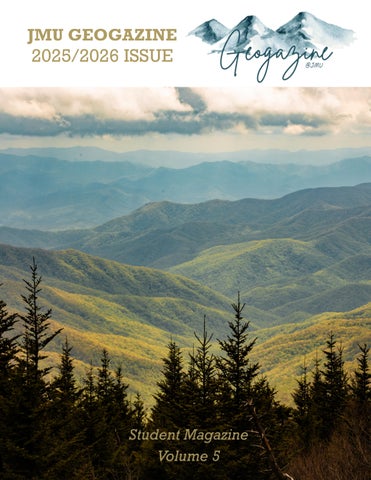
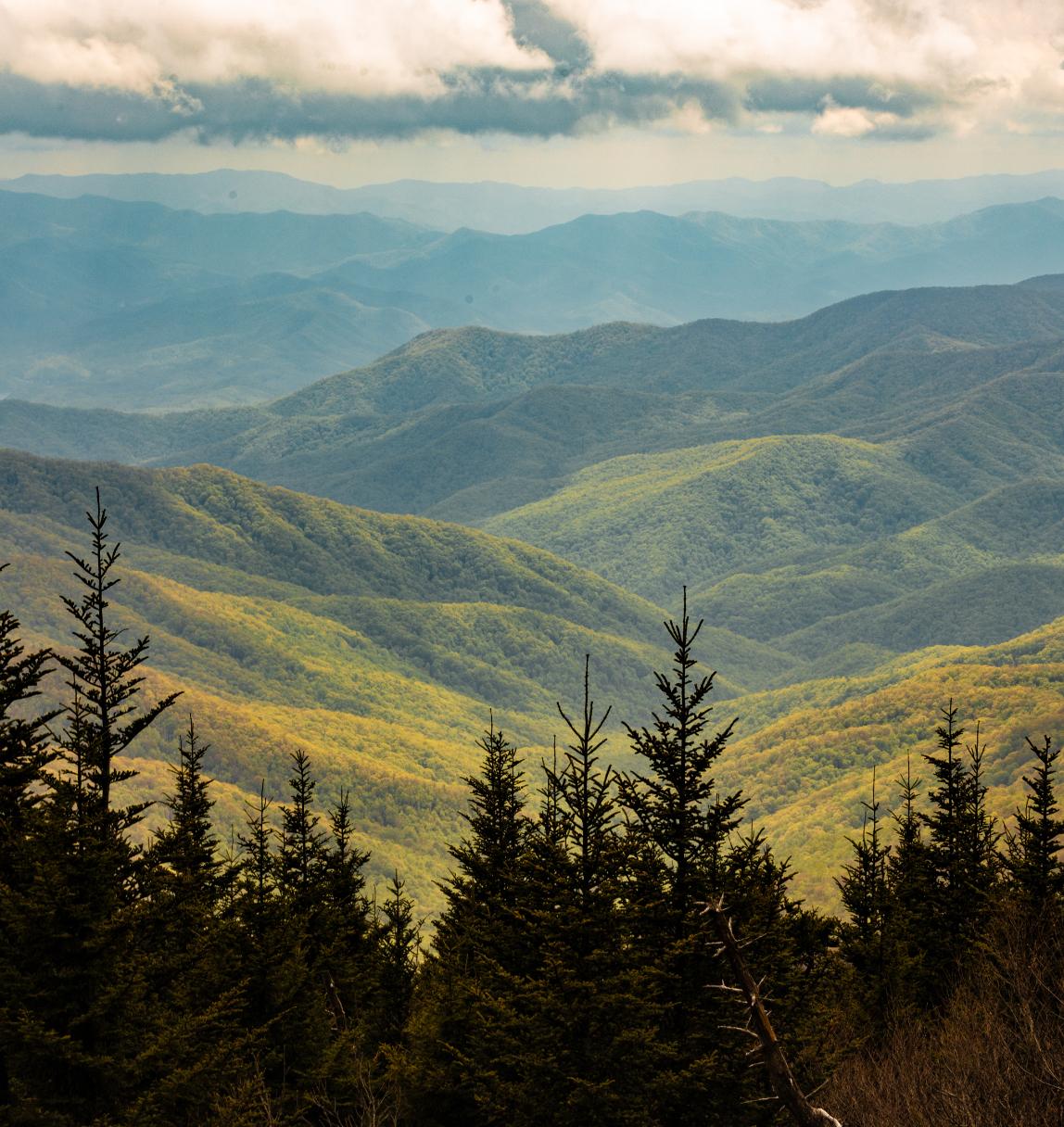
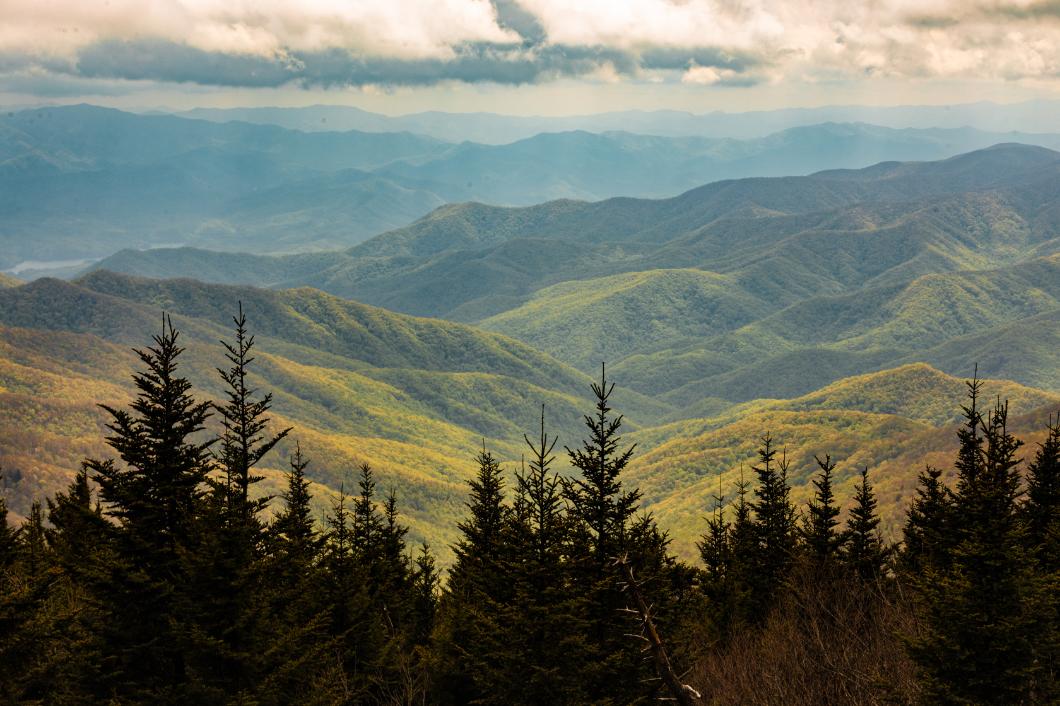
Front cover photo: Skyline Drive by Samantha Smith
TABLE of CONTENTS
4 ~ Editorial Page
5 ~ Meet the Team
6-7 ~ Message from the Department Head
8-9 ~ Faculty Spotlight: Dr. Chen
10-11 ~ Faculty Spotlight: Dr. Varga
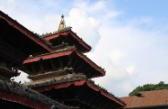
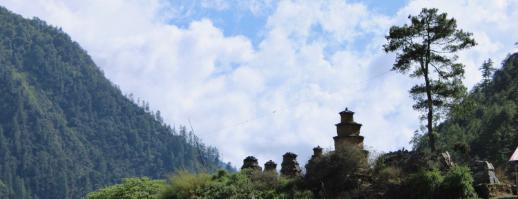
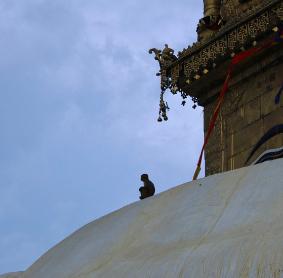
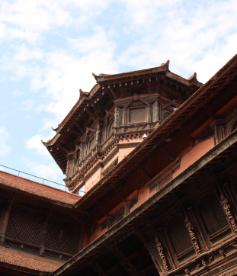
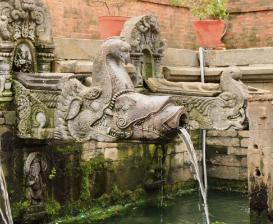
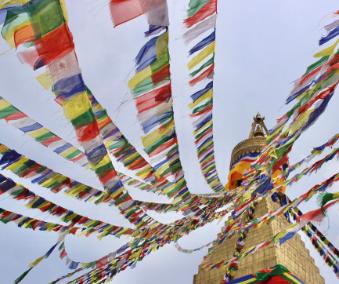
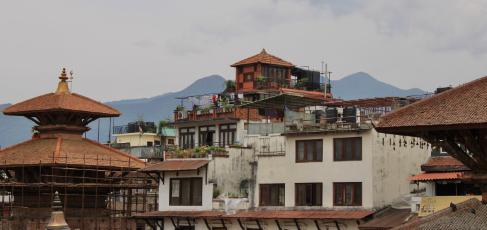
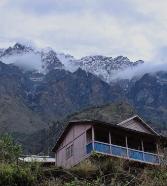
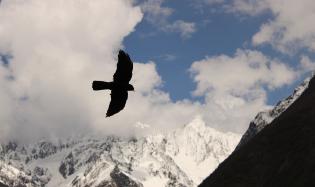
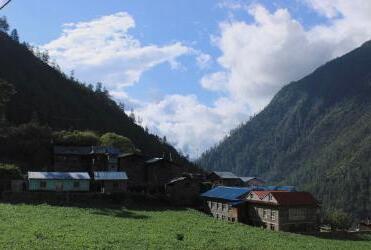
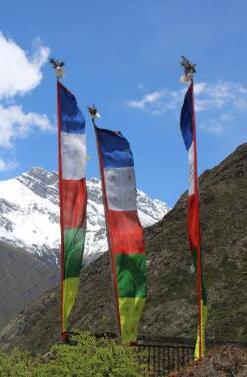
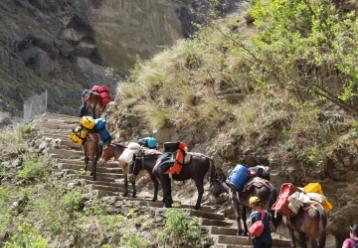
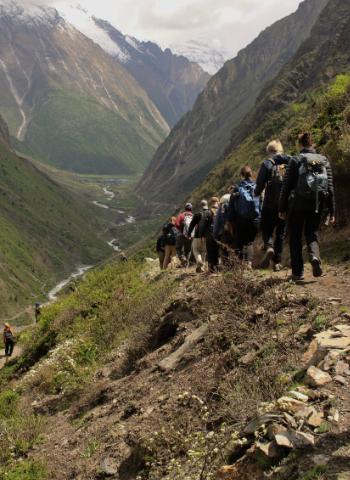
12-15 ~ Photo Essay: Nepal Study Abroad
16-17 ~ Faculty Spotlight: Dr. Palkovitz
18-19 ~ Faculty Spotlight: Dr. Sinacore
20-21 ~ Photo Contest
22-23 ~ Catching Up With Alumni
24-25 ~ Why Geography?
26-27 ~ Appalachia Trip with Dr. Dohrenwend
28-29 ~ Internship Experiences
30-31 ~ An AAG Experience in San Francisco
32-33 ~ Dr. Bortolot Faculty Highlight
34-35 ~ Faculty Spotlight: Dr. Prestby
36-37 ~ Dr. Way AUH Spotlight
38-39 ~ Dr. Yurco’s Semester Abroad
40-41 ~ Faculty Summer Memories
42-43 ~ Faculty Celebration: Dr. Kimsey
44-45 ~ Professor Bradburn Spotlight
46-47 ~ Wildlife at JMU: Butterfly Migration
48-51 ~ The Shenandoah Valley: Home of Art
52-55 ~ Harrisonburg Farmers Market
56-57 ~ Exploring Downtown Harrisonburg
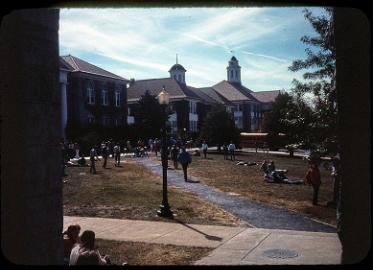
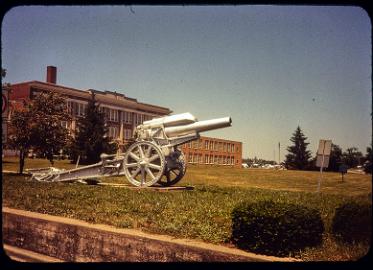
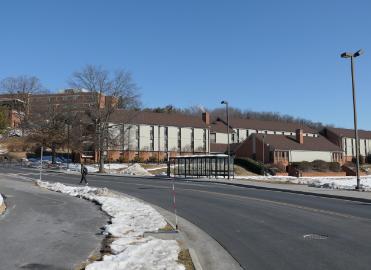
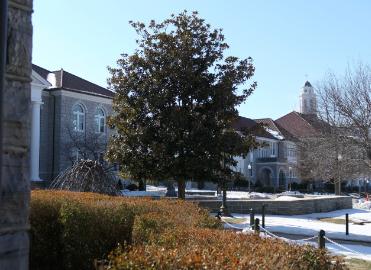
58-59 ~ Harrisonburg Then and Now
60-61 ~ Club Spotlights: TRASHED and Caving Club
62-63 ~ Geography Club/GTU
64-65 ~ Geography in Action
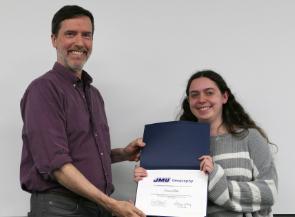
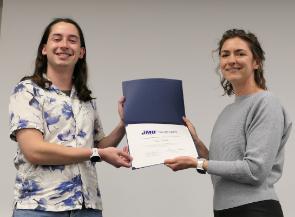
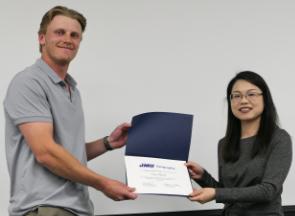
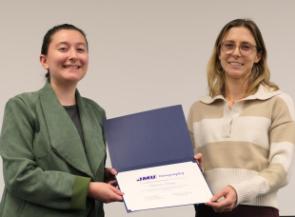
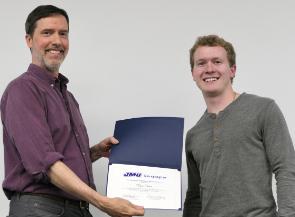
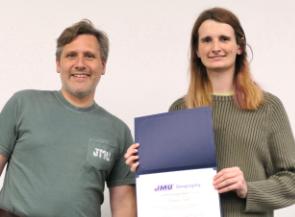
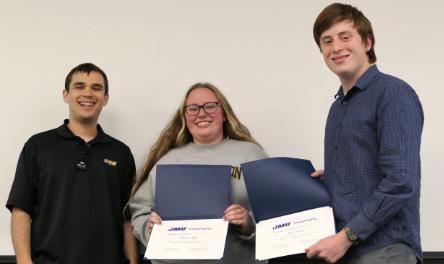
66-67 ~ Geography Awards
68-69 ~ Senior Memories
70-71 ~ Senior Celebrations
72 ~ Back Cover
Greetings from the Geogazine Team
Welcome to Volume five of the JMU Geogazine! We’re excited to put out another packed edition filled with content about JMU Geography students, faculty, and the Shenandoah Valley outside of JMU. Our fifth edition is a bit of a milestone as well, marking several years now of our team staying committed to highlighting important stories.
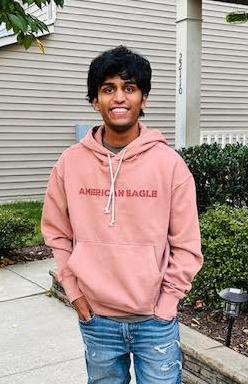
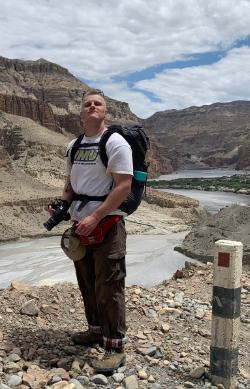
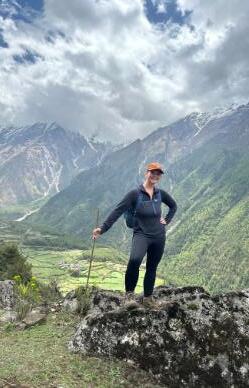
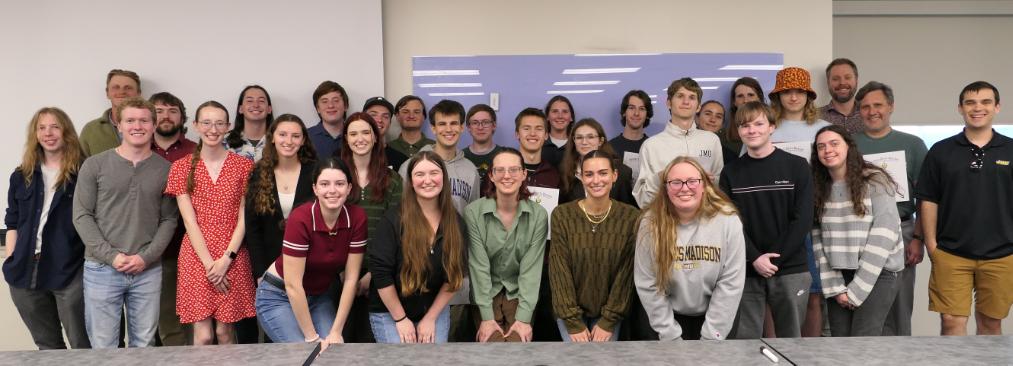
As you can see on our Meet the Team page, there’s been a lot of change at the Geogazine over the years. Though turnover can occasionally present difficulties such as onboarding and skill growth areas, we have greatly benefitted from the influx of new ideas that our members have brought to our meetings and publications. This year, we were delighted to bring on two new team members, Stephi Shraga and Ajay Gowda. They’ve been wonderful additions to our staff, both in the content that they’ve produced and the positive energy they bring to the room. We’ll be sad to say goodbye to Stephi as well as multi-year veteran Audrey Sparrow, as they both graduate this May!
Continuing with the theme of change, a notable focus of this year’s Geogazine was our staple New Faculty articles, as JMU Geography saw five new faculty members join us this year: Drs. Qingqing Chen, Kevin Varga, Rachel Palkovitz, Katherine Sinacore, and Tim Prestby. JMU Geography students and faculty have likely met them all, but even so, you’ll probably learn something new in each of their respective New Faculty articles!
Thank you, and we hope you enjoy reading volume five of the Geogazine.There’s a lot to discover, so pick a topic that looks interesting to you, and dive in!
Sincerely, The Geogazine Team
Drew Shinkle Editor-in-Chief/ Contributing Writer/ Photographer Class of ʻ26
Meet the Team
Isabel Kinney Graphic Artist/Photographer/ Contributing Writer Class of ʻ27
Ty Yu Contributing Writer Class of ʻ28
Manita Khemthong Faculty Advisor
Teddy Umbrell Contributing Writer Class of ʻ28
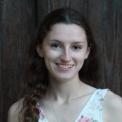
Stephi Shraga Contributing Writer Class of ʻ26
Faculty Advisor
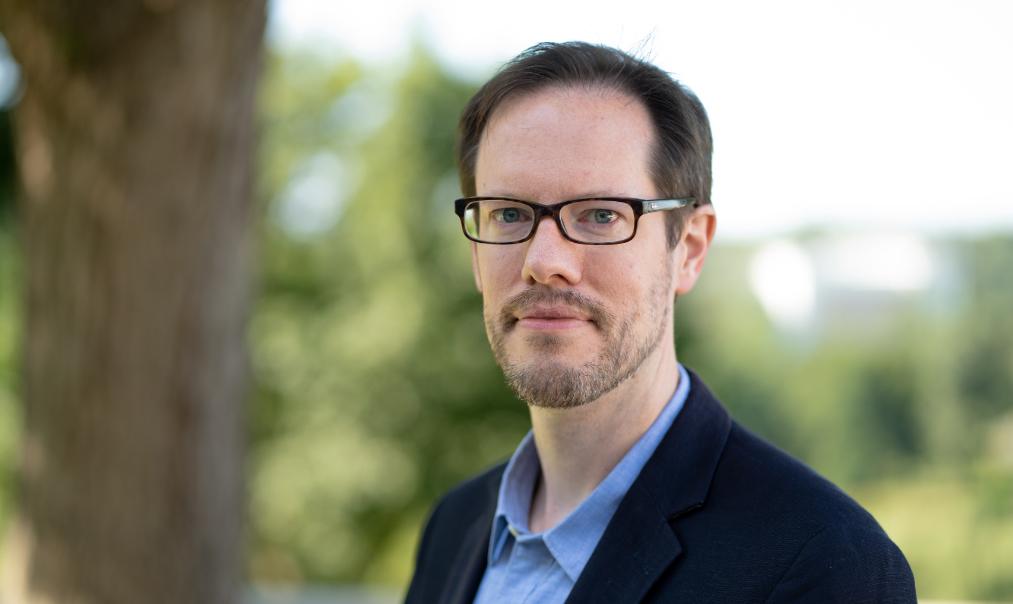
Katherine Sinacore Faculty Advisor
Past Team Members
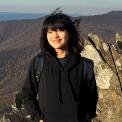
Audrey Sparrow Contributing Writer Class of ʻ26
Ajay Gowda Contributing Writer/ Photographer Class of ʻ27
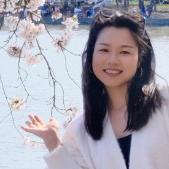
Qingqing Chen Faculty Advisor
Leah Wilczynski Class of ‘23 (Vol. 1-2)
Kayla Yurco
Olivia Offenbacker Class of ‘22 (Vol. 1)
Chris Timothy Class of ‘25 (Vol. 2-4)
Thammaphorn Theerakarn (Mel) Intern (Vol. 4)
Tovah Baer Class of ‘24 (Vol. 1-3)
Devin Nappi Class of ‘27 (Vol. 3)
Lucie Griffith Class of ‘24 (Vol. 1-3)
Message from the Department Head
How best to celebrate a half-decade of Geogazine? With this fantastic issue, you can again see the amazing work and experiences of our students, alumni, and faculty, which are indeed a celebration of our fascinating world!
Welcome to this excellent fifth edition; I am very pleased to be able to share this collection of vivid geography with you. And I hope you can also join me in thanking the wonderful team of student editors, writers, artists, and faculty leads for what they have created. I would like to particularly highlight the energy and creative drive from Manita Khemthong that has delivered Geogazine to such a high standard over all these years!
We are grateful for what you, and your team, have inspired among our students, faculty, and alumni—it is a true fusion of creativity and geography.
In the context of increasing technological deployment in our lives, studies, and careers, I’m glad we can celebrate here the human stories that have made sense of this almost-hybrid world, and the positive impact the combination of human genius, creativity, and advanced tools can have. Geographers have always been the “combinatory” scholars—bringing together different insights and approaches to make sense of the complex ways the world really works. In this, then, they are best placed to truly add value to the ongoing mission to make the world a better place by combining different skills, tools, and knowledge, and finding the opportunities in the “in between” spaces in complicated systems. That, perhaps, is true creativity: combining approaches, expanding scope, and crossing boundaries. And all this creativity is in evidence here in the stories of braided exploration within the covers of this beautiful magazine.
Enjoy this compendium of creative hope for the future!
Sincerely,
Dr. Henry Way
Sense of Smell with Dr. Qingqing Chen
By Isabel Kinney
From Buffalo, New York, and across the Pacific Ocean, JMU Geography welcomes Dr. Qingqing Chen, a newly hired assistant professor.Chen earned her Bachelor of Science in Physics from Minjiang University in China’s Fujian province, and her Master’s in Physics from the National University of Singapore.
In Singapore, she worked as a research associate at the Singapore University of Technology and Design, collaborating with the government on urban projects. Her work used social media data to understand human mobility in cities and inform future housing development. After more than three years, she decided to further explore how cities function, leading her to pursue a Ph.D. in Geography at the University at Buffalo.
Although she never initially planned to pursue a Ph.D., much less in Geography in the United States, Chen was drawn to the American emphasis on discussion-based learning and critical thinking. “In my experience, many educational systems, particularly in parts of Asia, tend to emphasize structured knowledge transfer, while in the U.S., there is often more focus on discussion-based learning and developing critical thinking through interaction,” she said. Her background in physics provided a solid foundation in mathematics and statistics, which supported her transition into geography.
Chen’s doctoral research focused on urban smellscapes, examining how the sense of smell shapes how we experience urban spaces.“Most urban research focuses on visual dimensions— how we see cities,” she noted. “But we use multiple senses to understand the urban environment.” Her interest grew from personal observations while traveling,noting that cities that appear visually appealing can still have unpleasant smells. “That got me thinking: what kind of
space is a successful space for people to live in? How can we improve the vibrancy of cities? What is the pattern, why are they occurring in certain places and not others, and how can we link these patterns to existing urban structures?” A key challenge in this work is the lack of tools to capture smell data. “How can we make the invisible visible?” Chen asks.
Currently, her research is multi-focused. Chen is curious to understand how urban systems function through geocomputational analysis and data informatics. “My research in the broader sense is that I try to understand the city, but from different dimensions (functional, social, and perceptual) in different ways with different data types, like social media and mobile phone data, combined with qualitative data,” she said.
Chen plans to include Harrisonburg as a case study in her smellscape research, alongside projects with collaborators in New Zealand. Looking ahead, she focuses on two aspects of her research: the human-centered place, or the interaction between people and their environment, and sustainability of AI-driven urban analysis systems. One of her goals in her human-centered place studies is to see how sensory perceptions reveal disparities in urban environments and shape sensory politics—how sensory experiences are shaped by power and then influence social and political life. She explains that people who have high incomes often live in environments with better smells, and people with lower incomes cannot afford to live in those environments and subsequently might have higher exposures to bad smells.
Additionally, Chen is studying human mobility and activity-space segregation,or how people’s interactions are tied to a location based on their social status. She explains that an activity space is like a third space: something outside of a residence, like a grocery store or a recreation space.
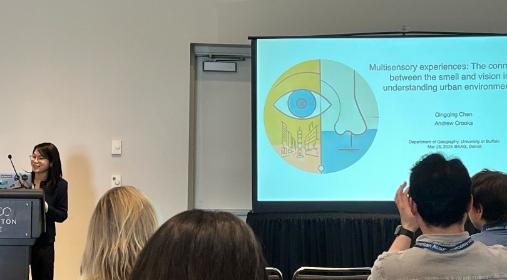
Dr. Chen presenting her research on multi-sensory urban environments at the American Association of Geographers (AAG) annual meeting.
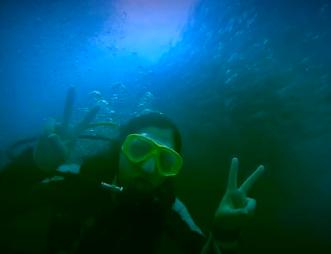
Dr. Chen scuba diving at Balicasag Island in the Philippines.
“How does that smell or sensory experience reflect these social demographic disparities across the space?”
“How does an activity space segregate people? How can we come up with solutions to make the place more equitable for everyone instead of separating people into different groups?” she questions.
Chen’s second focus is on “Green AI” and the sustainability of AI-driven urban analysis systems. AI infrastructure requires substantial resources, including energy and water,and contributes to carbon emissions. She aims to develop more efficient, energy-conscious models and explore how tools like agent-based modeling can simulate “what-if” scenarios and examine how different technologies shape carbon emissions and socio-spatial inequalities. One example is that AI can be used to extract information from images, like attributes of buildings—the height, age, and uses of the building—to support climate modeling.
Chen’s first impression of JMU was that the atmosphere felt very inclusive.
“The people here feel very respectful. It feels like the university is a community,” she said. She also highlighted the university’s technology focus.“I like that JMU has the ability to integrate technologies into teaching—they focus on technologies for a resilient future.That aligns with my stance on urban science and the urban environment.”
Furthermore, she was shocked when she learned about custom concentrations. “I was so surprised the first time I learned students can customize their program. That is something that attracted me because it aligned with my teaching philosophy, that students can incorporate personalizations or passions into their studies,” she said. Ultimately, she chose JMU because of the Geography program, the community environment, and the cooperation between the department and other colleges within JMU.
In the fall, Chen taught two classes: GEOG 215 (Intro to Geographic Information Science and Cartography) and GEOG 367 (Programming for Geographic Information Systems).In her GEOG 367 class,she teaches basic Python programming for GIS. “Students mostly have no background in that kind of programming, so I want to use this course as a starting point,” she said, adding, “we’ll cover basic Python programming language and then transfer that knowledge to solve
geospatial questions, complete basic geospatial analysis (vector and raster data analysis), and create geospatial visualization or interactive maps.”
In the spring, Chen taught GEOG 367 again, in addition to GEOG 469 (Applications in GIS, with specific topics in urban analytics). She wants to integrate more research projects into her classes so students can practice with real-world projects alongside her lectures. She would also like to try teaching programming, geospatial statistics, and geospatial project management.
One of her favorite aspects of teaching is the collaboration between students and professors.
“I can give inspiration to students through stories and give them directions for their projects,” she said.
She also likes to see the growth of her students at the end of the semester, when students can use their knowledge that they gained throughout the course and apply it to mini projects or a fun final project.
Outside of her work, Chen likes to cook.
“Sometimes, I’ll miss the cuisine from my hometown, so I started to cook all different kinds of Chinese food,” she said.
She also likes to do handcrafts, such as paint by numbers, working with clay, and building mini models.
“I think it is a way to calm myself down and try my patience. I can sit there the whole day and no one will bother me,” she said.
“I really like the people in Harrisonburg; they are so nice and friendly. I think Harrisonburg is the only city where I can do activities at night,” she said. Chen notes that she feels safe to walk in downtown Harrisonburg— something that she would never do in Buffalo, NY. “Here, even at night, I feel safe when I walk the streets. I think this place feels like a community, not only at JMU but also in Harrisonburg.”
From urban landscapes to programming, Chen brings a lot of plans and ideas to JMU, and we are excited to see what she can do in the future.
(photos courtesy of Dr. Chen)
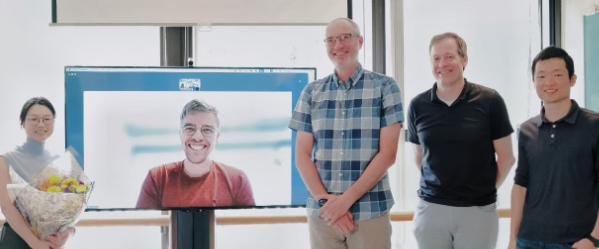
Dr. Chen defending her Ph.D. dissertation—a meaningful step in her academic career.
Dr. Kevin Varga’s pyrogeography background sets up his bright future at JMU
By Teddy Umbrell
Dr. Kevin Varga is one of the newest professors at JMU, and he brings a special set of skills to the Geography program. Varga considers himself a “pyrogeographer,” as his work mainly involves the intersection of fire science and geography. Just like pyrogeography itself, his journey into geography is quite unique.
Varga grew up in Moon, Pennsylvania, just outside of the Pittsburgh area. Shortly after high school, Varga enlisted in the Marines and was active for five years. After serving, he went to Colgate University with the plan to study geology. He enjoyed the major, especially the ability to get outside and do fieldwork, but his plans changed during his sophomore year. After taking a physical geography class, he was hooked. He became a double major, acquiring skills in both geology and geography.
Varga learned key visualization and mapping skills while studying the Earth’s surface in his geography courses, and he focused on subterranean research in his geology courses. He graduated in 2016 with a B.A. in both majors. However, one of Varga’s other
accomplishments was separate from his degree: his volunteer work in firefighting.
Varga worked as a volunteer firefighter while at Colgate, serving Hamilton Volunteer Fire Department and Fountain Fire Company #1. After his positive experience with the profession and the firefighting community, he became a wildland firefighter in Nevada following college. At 27 years old, he was older than most of his coworkers, but he loved the combination of firefighting and hiking, which had always been one of his hobbies. However, Varga had reservations about some of the methods that his team used to fight fires, wishing for more sustainable ways to stop wildfires. He also sought to make a bigger impact on the world but had not yet found an outlet to do so.
While obtaining his Ph.D. at the University of California, Santa Barbara, Varga was beginning to feel a disconnect in the firefighting community, wishing for a bridge between the research and the methods that were practiced. That was when he discovered the Santa Barbara County Fire Safe Council, a group dedicated to increasing wildland fire preparedness, resilience, and education in the area. He volunteered to be treasurer and later served on the executive committee. While working there, he oversaw general organization and finance, helped clear land in local communities, worked with education programs, recommended herbivory and prescribed fires, and much more, which all allowed him to make a difference.
Meanwhile at school, Varga studied connections between wildfires and weather/climate, atmospheric dynamics, vegetation moisture content, and more. He still had some time left over for fieldwork while getting his Ph.D. too, collecting moisture samples and launching weather balloons. After completing his Ph.D. in Geography in 2025, he was hired at JMU and settled in Harrisonburg.
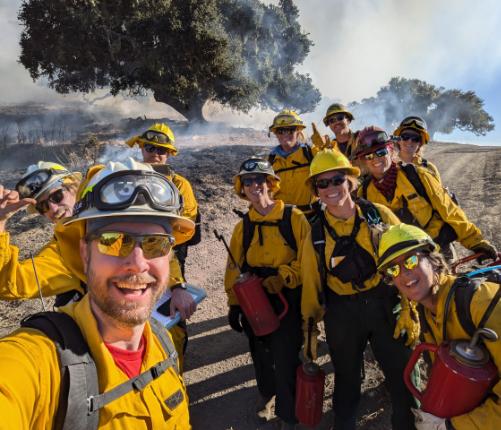
Dr. Varga posing with his prescribed fire crew.
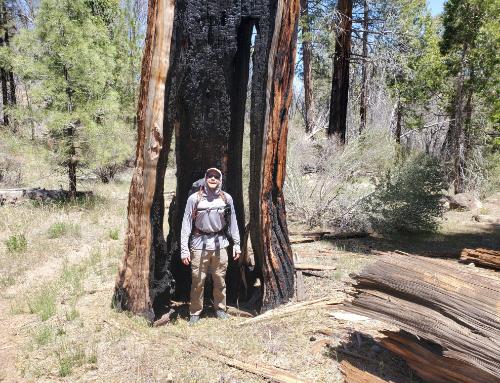
Dr. Varga within a charred tree while backpacking.
After his extensive work in the worlds of fighting fires and researching them, one of Varga’s goals is to bridge them together. Firefighting is not only very physical, but mental—and scientific. While on the job, Varga was trained in fire ecology, weather, fire behavior, and much more. He has learned that field experience in firefighting provides essential information for the fire practitioner,and vice versa; you cannot solve the fire problem without the whole picture.
After accumulating a litany of information and skills on his journey, Varga is finally here at JMU. While still new to the Harrisonburg area, Varga is already enjoying the “strong community feel here amongst the geography program, amongst the School of Integrated Sciences…and amongst the students.” And after staying in California for a while, Varga has appreciated the forests and natural life in Harrisonburg.Being from the Pittsburgh area,it has felt like coming home for him.
Varga has always loved the outdoors and really enjoys biking (which he does to work every day), as well as hiking. He once went on a six-week backpacking trip in New Zealand which helped him find his purpose, and in 2018, he hiked through the entire Appalachian Trail (where he met his now-wife five days in!). He also enjoys skiing and snowboarding and has enjoyed river recreation ever since he was
young. In fact, water resources is a geography topic he hopes to explore more in the future, so that he can combine his love for riparian ecosystems and river dynamics.
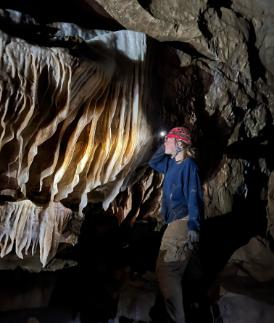
In the fall semester, Varga taught GEOG 210 (Physical Geography),and he enjoyed it quite a bit.It is a lot like the class that got him interested in geography to begin with, and he looks forward to continuing to use his passion to inspire students. He learned about the course from past educators’ experiences, but he wants to make it his own, emphasizing hands-on fieldwork. The labs are a big help with that; as an example, he was able to take the students on a field trip to the Endless Caverns in New Market. In the spring semester, Varga also taught GEOG 327 (Climatology),which is one of his favorite subjects,and he looks forward to expanding into other courses relating to ecology and biogeography. His dream class,however,would be pyrogeography,which would fit perfectly with his fire science background.
In tandem with his current work as a professor, Varga believes that learning from the students is just as important as his teaching. He regularly surveys his students about his teaching methods and builds off of their answers to adapt his own methods. He has learned so much already, from his studies in geology and geography, to his work as a firefighter, to his nonprofit work, to his Ph.D. research and fire science studies. He is looking forward to learning a lot more at JMU.
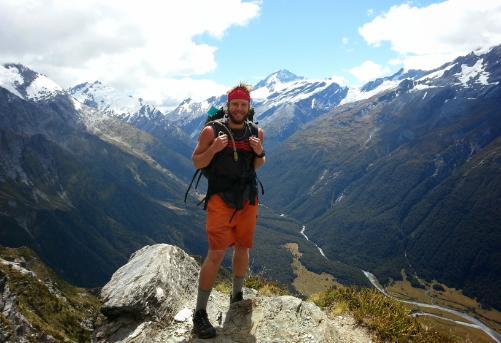
Dr. Varga backpacking at a mountain top in New Zealand.
(photos courtesy of Dr. Varga)
From city to valley: A journey through Nepal
By Audrey Sparrow
Dr.Nadine Plachta and Dr. Galen Murton of JMU Geography created a new study abroad program in Nepal for the summer of 2025. Totaling six credits with GEOG 350 (Topics in Geography: Climate and Society in South Asia) and GEOG 416 (International Studies), the program involved 16 students of various majors halfway across the globe, landing them in a country none of them had ever been to before.
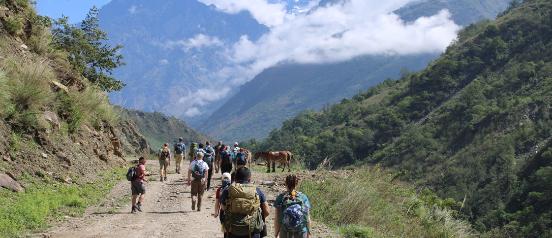
After arriving in the bustling city of Kathmandu, they spent a week learning at Nepali universities and touring monasteries and temples to study the city’s cultural and religious traditions.They then spent the next two weeks traversing the Himalayan Mountains, hiking all the while and staying at guesthouses in small, inviting villages. They traveled over 70 miles and climbed almost 8000 feet in elevation. What was advertised as a month-long study abroad program turned out to be a life-changing learning experience that these students are now carrying with them in their everyday lives.
Plachta spent her graduate career engaged with the Kathmandu academic circle, and her connections with the local universities provided students an authentic and personal look into how Nepalese people live and
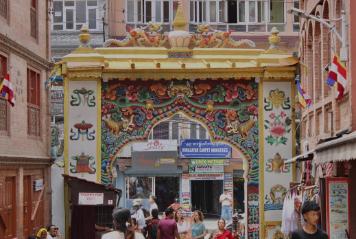
are educated. When not staying at the lovely Hotel Butsugen right down the street from the Boudha Stupa (where a Buddhist temple was the centerpiece of a rich Nepali market), the students went on field trips to learn about Nepal’s history and its modern environmental movements. They traveled to the School for International Training, the South Asian Institute,and the Rangjung Yeshe Institute, all while exploring major districts within Kathmandu,including Patan and Swayambhu.One such outing took the group down what is known as Freak Street, where the streets are bustling so much that it is difficult to keep up with tour guides, and the markets range in smells from warm exotic meals on rooftop patios to raw fish in basement bazaars.
The group visited museums showcasing Nepal’s religious texts and historic buildings that have stood since before the Nepal War in 1814. The lucky students had the rare opportunity to witness the Living Goddess, Kathmandu’s Kumari, with their own eyes, prophesied to give them good fortune. The Kumari is a girl, anywhere from the age of two to six, chosen to embody the Buddhist goddess Taleju. She is honored and praised throughout Kathmandu, even by the Nepalese king himself.
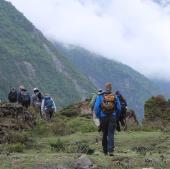
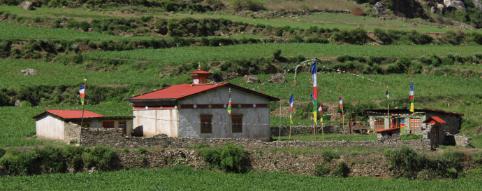
The time spent in Kathmandu was educational and engaging, but the trip had only just begun. After traveling about 12 hours by bus and another two by jeep, the group left their city clothes behind in favor of hiking boots and trekking pants, ready to begin the journey up the Himalayan Mountains. They were going up a route within the Manasulu Conservation Area, traversing through the Tsum Valley, beginning in a village called Jagat. They hiked anywhere from four to eight hours a day, depending on the journey between villages and their collective pace.
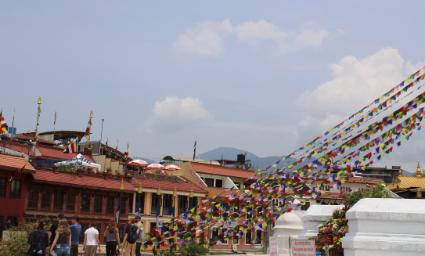
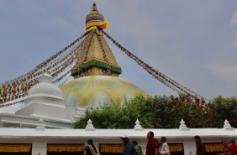
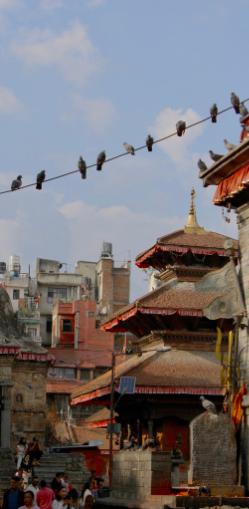
JMU students led by Dr. Galen Murton tour the first level of the Boudha Stupa. (photo by Ajay Gowda)
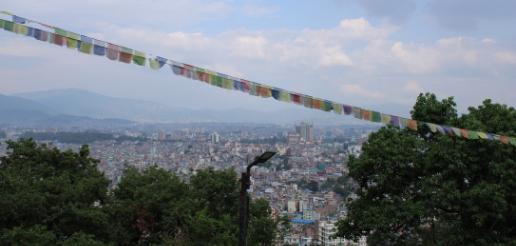
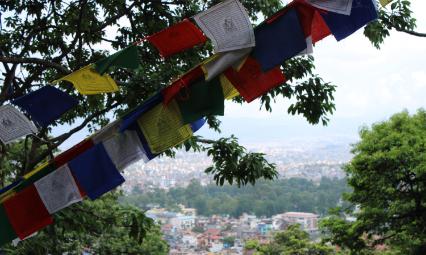
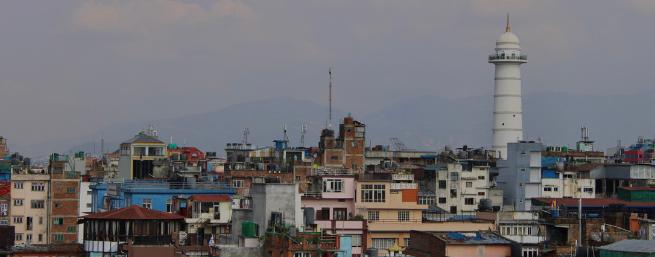
The city of Kathmandu as seen on the way up to the Swayambhu Temple. (photo by Ajay Gowda)
During the hikes, they also developed individual research projects, given the exceptionally rare opportunity to talk directly to local people who have lived their whole lives in the mountains. Students conducted qualitative interviews with the help of a translator and experienced firsthand how the Tsumpa people live. These final projects summarized what they had learned throughout their time in Nepal, and the students gained applicable skills for future study as well as notable experiences for their resumes.
After traveling all the way to the village of Nile, they were given the option to take a final trek upwards to Mu Gompa, nearly summiting the mountain and crossing over into Tibet. However, they stopped at a nunnery at nearly 12,500 feet in altitude, finishing their trek and beginning the descent.
The hike up the mountains and back was among the hardest activities any of these students had ever done, with some needing assistance on mules or motorcycles. Nevertheless, they survived their trek, and some of the students plan to return to the mountains in their own time. The program’s pacing was also intentional, allowing a four-day relaxation period upon their return to Kathmandu until they departed from Nepal for the long ride home to JMU.
The overall journey let students personalize their experiences, as they could try new foods and explore the country in the ways they each wanted. There was enough free time that they never felt rushed and enough immersion that everyone came away with plenty of knowledge. This program was a month-long adventure that changed 16 students’ lives for the better, expanded their horizons, and encouraged personal growth within each of them.
Since its conclusion, Plachta has received the New Horizons Award for Excellence in New Program Development. Additionally, several students presented their research at the Asian Studies Student Conference. During International Week, student Audrey Sparrow won the Center for Global Engagement’s photo contest with a photo she took in the Himalayan Mountains. Participants are still submitting their final research projects to journals and conferences across JMU and the East Coast at large.Nearly a year after the program’s conclusion, the Nepal study abroad still affects the students every day, from the friends they made to the fond memories they treasure.
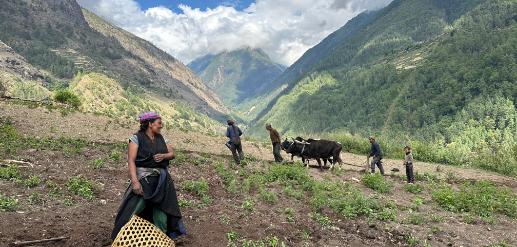
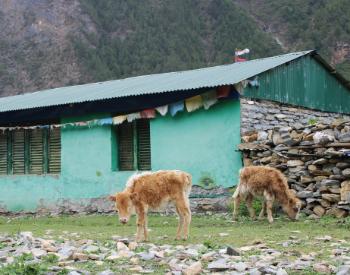
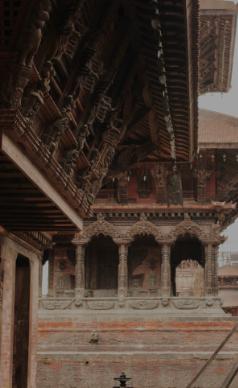
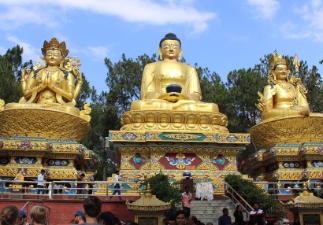
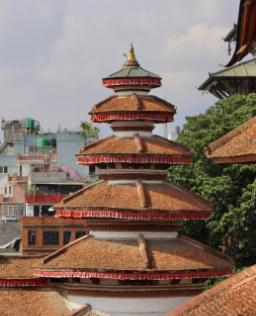
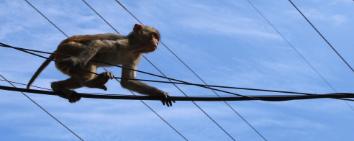
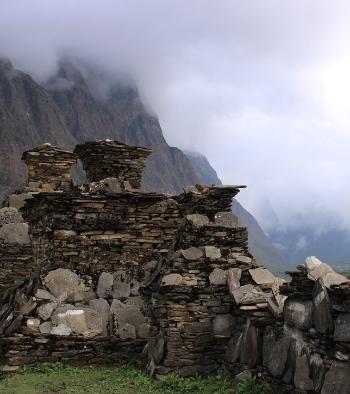
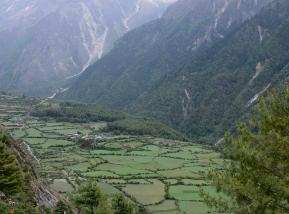
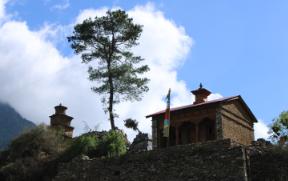
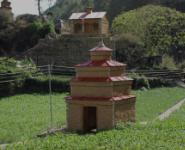
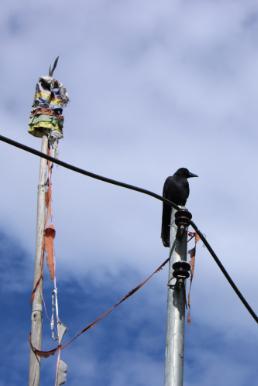
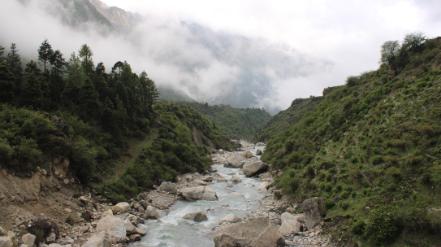
Scenes from Stupa temples, Durbar Square, and the Upper Tsum Valley. (photos by Ajay Gowda)
Winner of 2025 International CGE Week Photo Contest, People Category. Farming with a family in the village of Chumling. (photo by Audrey Sparrow)
From city to valley: A journey through Nepal
By Ajay Gowda
Dr. Rachel Palkovitz returns to the Valley on the other side of the Human-Environment classroom
By Tyler Yu
Dr. Rachel Palkovitz, one of the newest faculty members of the Geography and ISAT programs, is already a proud JMU alum, having completed her undergraduate studies here.She entered as an English major; however, after taking a biological anthropology class and learning about palm oil impacts and primates from her professor, she realized she wanted to add an environmental studies minor.
During her senior year, she applied to a Fulbright program, where students have the opportunity to conduct research in other countries, and with her professors’ support,she spent ten months post-grad in Tanzania.
After her Fulbright, she returned to Harrisonburg and picked up a job at the Joshua Wilton House downtown while applying to graduate schools. Despite never having worked at a restaurant before, she got the job and found it to be an amazing experience. After that, she moved out to the UK and completed her Master’s at Cambridge in Applied Biological Anthropology.
Afterwards, she again returned to Harrisonburg and resumed work at the Joshua Wilton House before
moving over to the Pennsylvania State University to complete her Ph.D. in Anthropology with a focus in biological anthropology. While there, she volunteered at Shaver’s Creek Environmental Center, assisted with wildlife education, and was able to train and take care of animals.
Palkovitz partnered with the University of Dar es Salaam for her Fulbright experience. When she first arrived, her research focused on the connections between livestock herding communities, climate change, and human-wildlife conflict. However, after arriving, she realized that many community members were focused on charcoal. As a result, she ended up shifting gears and began researching charcoal production networks and how they influence the way people interact with local environments. She focused on documenting the stories and perspectives of women who did this work to provide for their families, and Palkovitz was able to present her research to the U.S. Embassy in Dar es Salaam.
While she was at JMU during undergrad, one of her professors asked her class to connect the course material to what they wanted to do in their careers. For the assignment, she wrote about how she wanted to study primates after learning that Dr. Suzanne Baker in Psychology conducted research with a mouse lab, as they use similar techniques.Palkovitz says that moment really stuck with her: the philosophy that you can do global research and live all over the world, but that there are ways to bring all of that home, too.
“Going to Tanzania for the Fulbright, going to grad school in the UK; I always thought about Harrisonburg and this place, and I always wanted to come back,” she said. “It’s kind of like a dream come true that I’m back and living here now.”
Palkovitz’s first exposure to teaching came at JMU when she served as a teaching assistant (TA) for a conservation biology course. The professor she worked with, Dr. Josh Linder, assigned her the
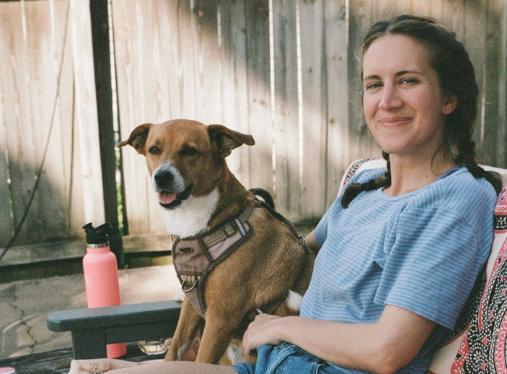
Dr. Palkovitz at home with her dog Fern.
responsibility of brainstorming some projects and evaluating student presentations, and she enjoyed these experiences. She also had some teaching experience with JMU’s East Africa Field school in Tanzania.
At Penn State, she taught mostly lab courses in biological anthropology, and this is when she started to seriously consider a future in teaching.Palkovitz says that the biggest breakthrough was working with the TAs in her own classes. She saw their excitement and their relationships with the students.This helped her to solidify what she wanted to do because she could see the environment not only as one made up of teachers and students, but also as a place where everyone was trying to learn together.
She says that becoming a HIGH Fitness instructor was “the final push that was like, oh, this is amazing,” she said. “I actually love being in this role.”
“My favorite part of teaching is getting to be a part of people forming their own relationships with their community and the work they do,” she said. This year, Palkovitz has taught GEOG 308 (Environment, Nature, and Society), ISAT 112 (Environmental Issues in Science and Technology), and GEOG 340 (Biogeography). GEOG 308 is a human-environment course that is a core requirement for geography majors. ISAT 112 is the introductory ISAT lab course, and it counts for the physical principles general education requirement. She took this class while attending JMU and found it difficult due to a lack of previous experience,so one of her goals is to make the math section less stressful for students. One course she had been really looking forward to teaching is Biogeography.
Palkovitz has a variety of research interests, with one being human influence on other species' evolution. Another is native plants and humans’ impacts on them. One of her current projects focuses on how different populations of American ginseng are related to each other genetically, as well as how growing and harvesting methods are influencing their structure. In the future, she is interested in doing more research on biogeography and applications of GIS. “I think the more interdisciplinary we can be in our research and our teaching, the better,” she said.
Aside from her academic interests, she has many
different passions in her personal life. In her free time, Palkovitz is a certified HIGH Fitness instructor.
“I just really love group fitness and the positive energy of being in a class with people all challenging ourselves in the same way… We all have different experiences that we’re bringing to it, but everyone can do it,” she said. “That’s kind of how I feel about environmental sciences too; that everyone can do it, everyone has things that they can bring to it.”
She also has a dog named Fern who she takes on walks with her husband, and in her free time she likes to write short stories. Her favorite place on campus is the arboretum, saying, “it’s one of the coolest campus arboretums that I’ve seen.” Palkovitz is excited to be back at JMU and in the Harrisonburg community.
“I really love the Harrisonburg community, you know, having gone to school here and then lived here and worked in the Joshua Wilton House and just being part of the downtown community; [it] is something that I feel like has really shaped my way of thinking, just about how I want to live, how I hope that people can work together and have these super positive relationships.”
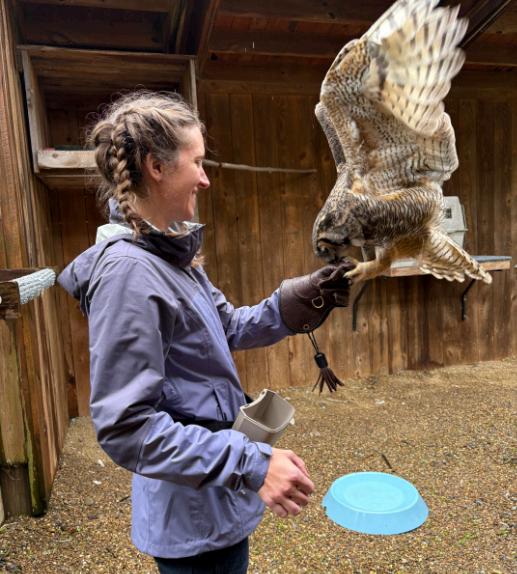
Dr. Palkovitz leading a training session with a great horned owl named Sunny at Shaver’s Creek Environmental Center.
(photos courtesy of Dr. Palkovitz)
From Panama to Harrisonburg, Dr. Katherine Sinacore brings experience in tropical ecology
By Audrey Sparrow
BothISATandGeographystudentshavehad the pleasure of meeting a new friendly face around the Geography suite: Dr. Katherine Sinacore. Sinacore has traveled the world, from England to Panama, to understand the ecological background of native species and interpret her findings through natural systems. In her GEOG 350 class (Topics in Geography: Species on the Move), she teaches GIS techniques through R Studio to JMU students.
Before coming to JMU, Sinacore considered herself a biological ecologist, using her interdisciplinary work to dabble in what would become her doctoral thesis. She has explored East Coast forests, researched in Peruvian and Panamanian forests for years at a time, and is an expert on ecological systems in the tropics. Her projects have led her to work with communities for ongoing research that will continue for the next 20 years. For her postdoc, she worked with indigenous communities in Panama to describe how economics affect the ecological sustainability of local forests.
As a young girl growing up in England and later in Connecticut, Sinacore was encouraged to spend time outdoors by her parents, which fostered her love for forested environments that would later serve as her lab.Driven by her love for running, she went to Wake Forest University in North Carolina for her undergraduate studies. However, it was her passion for ecological studies that led to a degree in biology. It was at Wake Forest where geographical sustainability
opportunities opened up to her with a summer course in Peru on forest ecology. Her time there led to an internship with the Amazon Conservation Association.
Sinacore and a team of fellow undergraduates worked with local Brazil nut harvesters to investigate how they could manage their trees more sustainably. After realizing that she could continue to study ecological issues, she sought out advanced education.
Sinacorestudiedforhermaster’sdegreeatthe University of New Hampshire (UNH) through their Natural Resources program with a concentration in Forestry, where she studied the experimental forests in New Hampshire to gain more applied research experience. In northern New Hampshire, she developed research techniques about the White Mountains and forest “prescriptions,” or the different techniques of maintaining a forest. Through her studies and collaboration with the U.S. Forest Service, Sinacore researched the social, ecological, and economic factors of forest management, leading her to pursue a doctoral degree.
Still with UNH, she earned her Ph.D. through a program called Natural Resources and Earth Systems Sciences (NRESS). Through UNH, she explored how mixing different tree species and planted systems in Panama might increase productivity and improve environmental procedures such as water regulation.
For Sinacore’s postdoc,she continued to study forests in Panama through the social aspects of reforestation,working closely with specific groups to design projects. One of these groups was a semi-autonomous indigenous community in western Panama, the Ngäbe Buglé people, whom she still visits and collaborates with to plant trees in a way that fosters community-led reforestation.
“It’s harder than you would think,” Sinacore said about planting the trees in specific ways designed for their ecology. “Before planting, we thought some [species] are most likely to survive, but in reality, you find out that some aren’t, and some do better than you expect.” She spoke further about her relationship with the Ngäbe
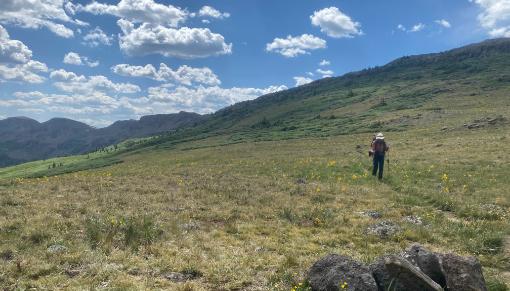
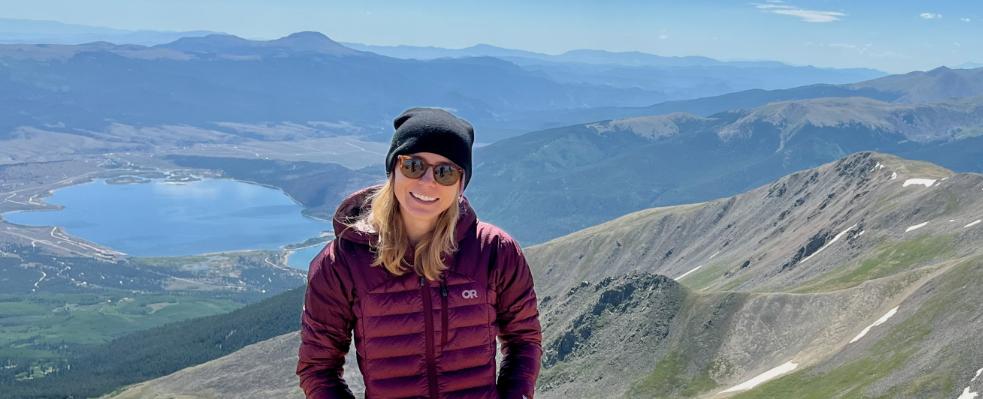
Dr. Sinacore in the field in the Colorado mountains.
Buglé people. “The commitment is for 20 years… They can back out,though,at any time.Right now, [I’m] basically waiting on the data to come in.”
She plans to go back over the next 17 summers to continue documenting forestation progress, hoping eventually to publish her work with other postdocs, as well as potentially involving JMU undergraduate students in her work.
in Science and Technology),which she is teaching again in the spring. In the future, Sinacore would like to co-teach a course with both an economics andapsychologyprofessortoteachstudentshow to unpack the human aspects behind environmental problems.
Aside from her research and teaching life, Sinacore is an avid outdoorswoman, backpacking and hiking whenever she can. “There are endless
While getting her master’s degree, Sinacore discovered not only her love for ecological research, but also her love for teaching. Through teaching assistantships, she grew passionate about the challenges of teaching and conveying ideas to students who may not have scientific backgrounds. Being a professor also gives her motivation to keep growing as a person and educator. She applied to JMU because the opportunity intrigued her.
“It was for Integrated Science and Technology, and I thought ‘that’s so cool,’ because they’re lookingforsomeonewhoisnotsuperspecific,but is kind of a tinkerer,” she said.
Sinacore says starting at JMU was a no-brainer, andthatsheisluckytobeinaplacewhereshecan still do her research and teach students who are bright and open-minded, especially with an East Campus view that she has never seen elsewhere. Most recently,she has taught GEOG 350 as noted earlier, GEOG 429 (Sustainability: An Ecological Perspective), and ISAT 112 (Environmental Issues
hikes in the area,” she said. “I’m excited to learn more about Harrisonburg’s natural areas.”
After a brief move from Colorado,she had also picked up fly fishing and climbing; however, her true love is running. “My dog is really old now, so she doesn’t really run with me anymore,” she said. She found her dog, Canela (which means cinnamon in Spanish), as a stray, and the dog would not leave her side. “She kind of adopted me,” she said. Since then, Canela has been along for the ride, traveling from Panama to Colorado and now to Virginia. She is in the field with Sinacore whenever she can, and on her trips, she adventures through the forests and mountains.
This fall, Sinacore will head onward to an exciting opportunity at Cornell University. JMU has certainly benefited from her dedication to her work,ecological expertise,and studies in Panama, and we know her new students will continue to do so.We wish her well in her future pursuits!
Dr. Sinacore in the field in the Colorado mountains. (photos courtesy of Dr. Sinacore)
Photo Contest
Keegan Polson “Morning Glow”
Samantha Smith “Skyline Drive”
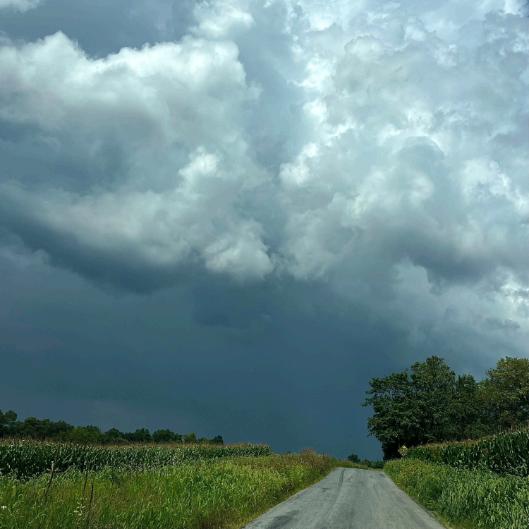
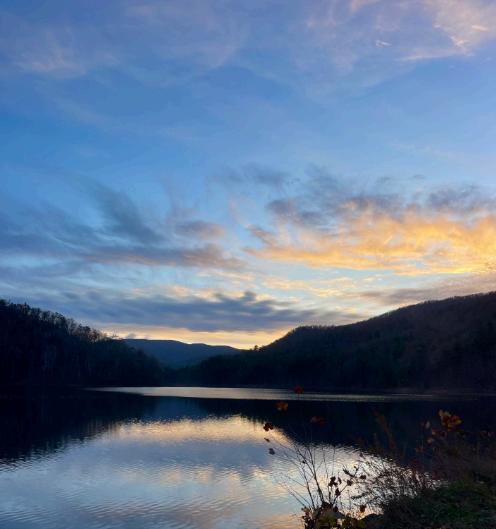
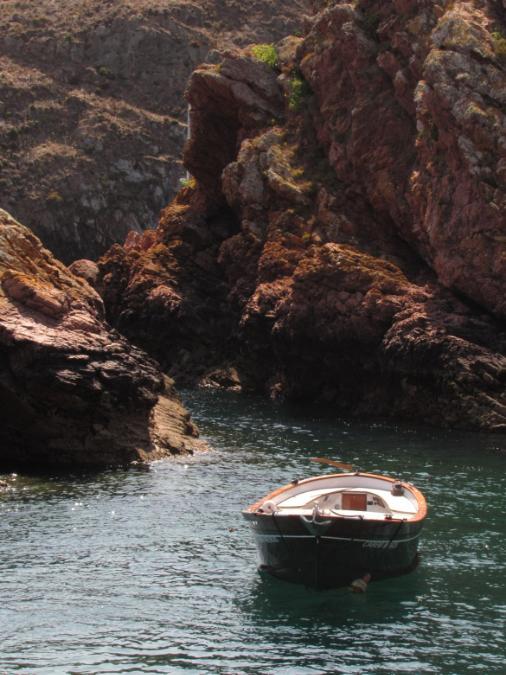
Theme: Landscapes
Perry “Where Ocean Meets Earth”
Aubrey Grove “Serene Lake”
Aubrey Grove “Rural Storms”
Zachary
Catching Up With Alumni
Q/A with JMU Geography Alumni
Becky Schneider (‘17) and Tyler Gingrich (‘20)
Please tell us a little about your current position. Could you tell us how your education and career path led you to your current position?
Becky: I’m currently the Federal Program Manager for Aerial Projects at Surveying and Mapping, LLC (SAM). My career path started with a B.S. in Geographic Science with an Applied GIS concentration from JMU. Right out of school, I began working as a LIDAR technician on federal projects, and over time, I’ve grown into my current role. It’s been a combination of building hands-on experience, learning the technical and operational sides of projects, and becoming engaged in the industry that led me here.
Tyler: I am currently a Geospatial Data Scientist for a renewable energy company named Belltown Power. Prior to this position, I was a GIS Analyst at another renewables company named Orsted. My start in renewables was inspired by a summer study abroad program to Germany through the ISAT program. The study abroad program helped me to understand the renewable energy industry,especially the mechanisms behind how they produce energy and how they are used throughout Europe. That experience combined with my degree in Geographic Science helped me to earn my first GIS internship at Apex Clean Energy the summer before my Master's program at Virginia Tech.
Did you have an internship or do research as an undergrad? If so, what advice can you give to students who are trying to pursue the same?
Becky: I completed both an internship and an undergraduate research project! I interned with a federal contractor supporting GIS work for FEMA disaster response, and I also completed a capstone with Dr. Way examining the political geography of Virginia during the 2016 presidential campaign and election.
For students pursuing a capstone or research project, find a professor you genuinely enjoy working
with and who supports your academic interests. Build that relationship early,because a strong mentor makes the experience far more meaningful and productive.
Tyler: For internships, start your search early and don’t hesitate to leverage your network (professors, classmates, family friends, neighbors, alumni). Opportunities often come from connections, and it’s perfectly acceptable to reach out. In the professional world, it’s not only what you know, but also who you know. Also, don’t limit yourself to only the roles that feel familiar or “perfect”—apply for opportunities outside your comfort zone! You never know what will resonate, what skills you’ll discover, or which experience will ultimately open the door to your career.
As an undergrad, I was a TA for a few classes, I worked on a semester long paid research project that came from my study abroad trip, and I completed the Honors Capstone Thesis in my final three semesters. If you are trying to pursue research, you want to work on a topic you enjoy and with a professor you like. Go to office hours to get to know your professors and their backgrounds a bit better to see if you would be a good fit.Have some ideas in my mind that you can discuss as well.The Honors project was pretty structured and selfdirected by me, but the other opportunity was sort of spawned from a conversation that became a semester long project. You never know how it will work out, so just be open to anything while simultaneously thinking about what you would like to do.
Are there any classes or certifications outside of your undergraduate studies that have helped you with your professional career?
Becky: I work more on the operational side than the technical side, and I recently earned my Project Management Professional (PMP) certification through the Project Management Institute. It’s been valuable, both in what I’ve learned and in the new opportunities it has opened. The GISP is next on my list!
Tyler: I think undergrad prepares you very well for the GIS aspect of careers. You will most likely fit into an industry you don't understand as the GIS person, so you will definitely need to learn about your industry. Ideally that would be on the job or being sent to conferences. There were also some IT-related topics that I had to learn on the fly in my career. GIS is usually closely tied to IT for a variety of reasons, and you are not really exposed to that side of things as students. In your career, the way your data is structured and saved is going to impact your work. Some places use your local drive, a network drive, data lakes/warehouses, etc., and that can impact how you work, so definitely be open to learning on the fly in your career. One aspect of GIS that is very important in the real world is web-based applications. You will see a lot of jobs asking for experience in JavaScript, HTML, and CSS to develop web-based GIS apps. This type of work is a huge gap in my experience to this day.I still am hoping to take additional courses to learn this side of GIS.
Specifically regarding your time as an Geographic Science undergrad, is there any advice you wish you could go back and give yourself?
Becky: If I could go back and give my undergraduate self some advice, I would say to take full advantage of the study abroad opportunities. My biggest regret from my time at JMU is not studying abroad—definitely do this if you can!
I would also say that not being a strong developer doesn't mean that you aren't cut out for GIS work. It is a very valuable skill within the industry, but there are also plenty of opportunities for positions and careers that don't require it!
Tyler: Learn how to code freshman year! I felt really behind the curve in beginning of grad school even though I had done some coding in my final year and in my internship. Overall, I do really feel like I maximized many of my opportunities in my time as a student. It's possible I spread myself a little thin at times, but pushing myself in that way was definitely worth it.
What were some of your favorite memories as a JMU student?
Becky: Some of my favorite memories at JMU come from the communities I was part of. I spent all four years in SafeRides (serving as Executive Director my senior year) which gave me an incredible group of friends and a strong sense of purpose on campus. I was also involved in the School of Music, singing in the Madison Singers.Those rehearsals,performances,and time spent with friends in the group were some of the most fun and memorable experiences I had at JMU.
Tyler: Leading an Alternative Weekend Break at Sky Meadows State Park with Dr. Yurco was a blast! The study abroad program in Germany was eye-opening as well, especially seeing how much it impacted where I am in my career today. Working on my Honors Capstone in the newly refurbished lab area my senior year with Patrick Muradaz was also a lot of fun. Any of the numerous meetings I had with Dr. Bentley. Being a TA and learning how to teach GIS to others for the first time.
(photos courtesy of Schneider and Gingrich)
Becky Schneider
Tyler Gingrich
Why Geography?
We asked JMU’s new geographers…
When we asked JMU geographers about why they chose their major, they had a lot to say. Whether it aligns with their interests, relates to career goals, or just seems cool, geography is a very broad major with endless possibilities.
JMU’sGeographyprogramisone-of-a-kind,soitseemslikean obvious pick, but here, you can check out why these students picked it:
“I took a GIS class through JMU in high school and thought it was really fun.”
- Herbie Hermann, Junior
“Geography caught my eye because of my love of traveling and seeing the world, along with different cultures.”
- Natalie Collins, Junior
“All of my interests into one major!”
- Christian Hutter, Junior
“I have always liked it and it was the most appealing major for me.”
- Andrew Simmons, First-year
“I enjoy figuring out why people migrate the way they do.”
- Colden DeBrun, First-year
“Honestly I had no idea what to choose as my major, and geography seemed like a broad enough category to cover all my interests.”
- Hunter Romero, First-year
“I have always been really interested in maps to the point where I studied the world map enough to recognize the shape, location and capital of almost all the countries in the world. My dad also worked at the NGA for a bit, which inspired me further into majoring in geography.”
- Jeremiah Johnson, First-year
“It’s a good field for jobs.”
- Owen Corcoran, Junior
IGeography of Appalachia field trip
By Dr. Adam Dohrenwend
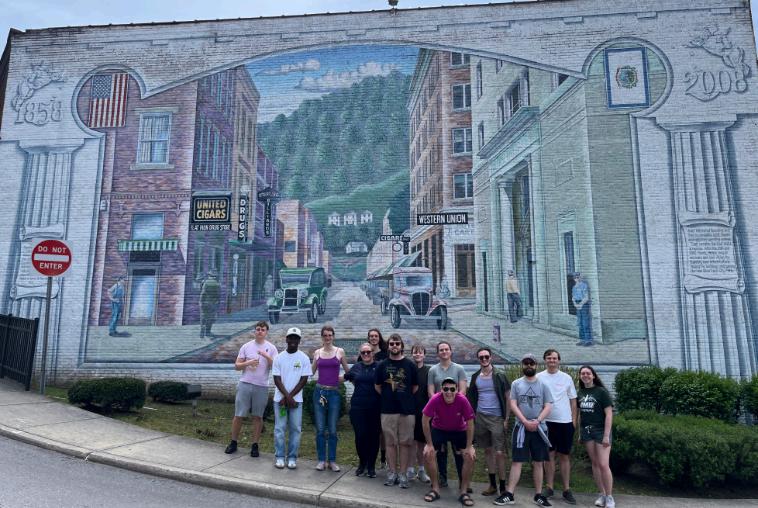
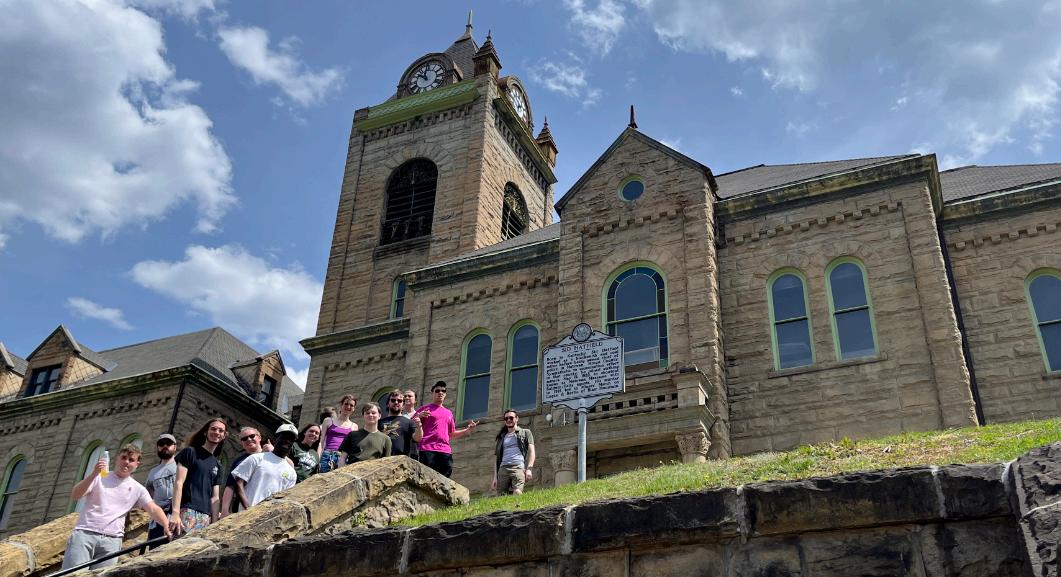
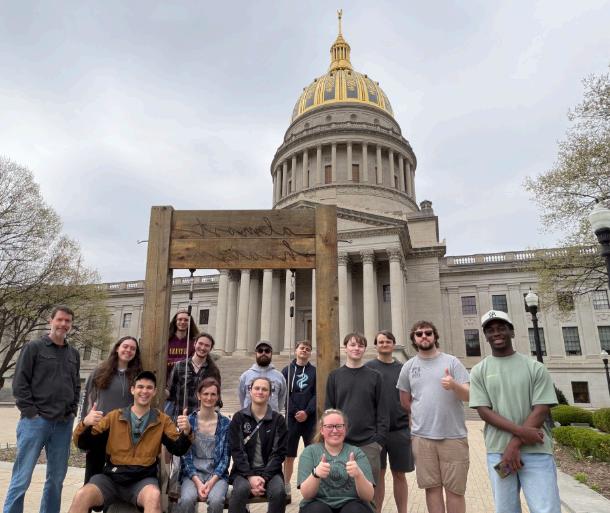
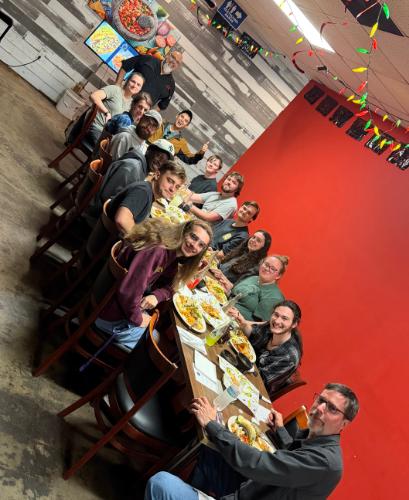
n the Spring of 2026, Dr. Dohrenwend’s Geography of Appalachia (GEOG 470) course took a weekend field trip to “wild and wonderful” West Virginia. Students in the course spent the semester diving deeply into the varied and complex interdisciplinary literature on the region, and have prepared individual research projects on varied topics of regional importance—but to understand a place,to read and truly appreciate the landscape,it is essential for geographers to be “in it.” Departing campus on Friday afternoon and returning late Sunday night, the students (also joined by Dr. Dudley Bonsal) explored communities like Elkins, Charleston, Madison, Welch, and Mullens—interacting with locals, tasting regional delicacies (like ramp burgers!), and examining the multi-scalar geographical processes that have shaped the region’s diverse landscapes.
"This semester, my knowledge of the state and region has grown a lot, but it's clear to me now that what you may gain from class materials is only half of what you need to really begin to understand a place— you need firsthand experiences.”
-James McQuilkin
"I am truly grateful for the opportunity to see places like this and to actually interact with the people. Without truly seeing these areas and actively trying to understand the struggles and hopes of people there, it is impossible to break down boundaries between people and to really connect with a place.”
-Sarah Bell
Stopping at a mural in Welch, WV.
“Going to West Virginia helped bring our readings and class discussions to life—it showed me first-hand how what we learn in the classroom directly connects to the real world.” -Reagan Kitts
(photos courtesy of Dr. Bonsal and Dr. Dohrenwend)
Enjoying a delicious dinner at Latin Appalachian in Welch with Chef “Taco Man” Roberto Diaz. Outside the WV state capitol building.
Paying a visit to the McDowell County Courthouse, where Sid Hatfield, a major figure in the mine wars, was killed.
Student Internships
Whether you are fresh out of high school or looking for your last summer resume booster before your first full-time job, you might be on the prowl for a summer internship that gets you outdoors. Senior Geography major Carly Overend did just that in the summer of 2025.
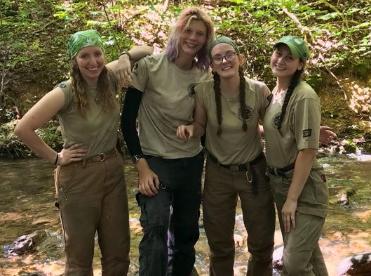
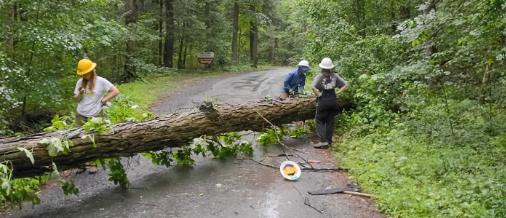
Overend discovered the Appalachian Conservation Corps (ACC) through the CISE Career Fair, hoping to explore forestry through trail work. For ten weeks, she worked in the great outdoors, camping along different trails throughout the George Washington National Forest. Overend and her crew did work reblazing trails, creating checksteps (rock staircases), and even tried their hand at carpentry while renovating tent pads.
The ACC’s work was divided into a training week and five “hitches,” which were nine-day excursions to different trails in the national forest.They set up camp at a trailhead, as far as two and a half hours out from Harrisonburg, and then hiked for hours to renovation sites.The work taught her how to do new things to maintain trails without disrupting the ecosystems around her. She spent her days “making crush,” or breaking boulders into smaller rocks, and digging barrow pits, all to create intricately designed check-steps that will remain for decades. When the team finished all of their tasks on their trail, they packed up, stayed at their headquarters in Mt. Crawford for a night, and then went out to another trail the next morning.
Carly Overend
By Audrey Sparrow
“Before this, I had never pitched a tent by myself,” she said. “As soon as I got the position, I bought all of my equipment and practiced pitching my tent ten times every day. I walked around my neighborhood with my backpack with dumbbells in it because we would have to hike out with all of our stuff.”
Besides the physical qualifications, Overend said she had never been around so many insects in her life. She saw three black widows and encountered insects in her tent and water bottle.
“I got to the point that I could flick spiders off me,” she said. “You get used to it; I got really good with bugs.”
During her time in the woods, there usually was no cell service. Overend demonstrated her geographic skills, cracking open a paper map to guide her crew along roads and follow contour lines in the topography to determine the appropriate gear for their off-roader.
“I felt like such a little geographer…I loved it.It was really fun,” she said.
Besides the hardships that came with being outdoors for several weeks straight, Overend did find the internship worthwhile, saying that this experience highlighted that there was something bigger than herself.
“We’d pass by the most beautiful mountains,or get to a peak and see the most breathtaking, sublime views,” Overend shared. She said that thinking of something that has been there so long, since before she ever existed, that will remain and continue to evolve when she is gone was so meaningful. “I’ve seen mountains before, and I’ve seen creeks. But living in them was just life-changing.”
Overend recommends this opportunity to any student interested, saying the ACC staff are patient and hardworking people, and that they are constantly looking for recruits. Students who are interested in this opportunity can earn up to six credits of GEOG 495 (Internship in Geography) for their work.
Overend and ACC cohorts near Cripple Creek.
ACC crew cleaning up Hone Quarry camp site. (photos courtesy of Carly Overend)
Internships are a great way to gain preprofessional experience and help build your resume for future job applications. For students studying GIS, there are many opportunities out there to do this, and some are right here on campus. Sam Liscomb, a Fall 2025 graduate of the JMU Geography program, did a GIS internship with the JMU Department of Facilities Management Engineering from March to December in 2025, and he is now working with GIS full-time at JMU.
As a GIS intern, Liscomb worked on various mapping projects involving pollinator habitats around campus, construction management, stormwater management, and more. Liscomb said his time as a student at JMU,pursuing a dual concentration in ECSD and AGIS, prepared him well for this position. Intermediate GIS and cartographic design skills were especially helpful for him when he was tasked with integrating data into maps published for the JMU community. Liscomb also gained experience with a variety of tools and software, including web maps, AutoCAD, and MS Mapping.
Liscomb said the internship taught him a great deal, including what he called “the ubiquitousness of GIS” and the wide range of ways it can be used. While GIS is often associated with environmental work, he emphasized the value those skills can offer students in many different fields. During the internship, he saw that firsthand through projects such as mapping irrigation lines, reviewing floor plans, and tracking construction around campus.
Liscomb cites resume workshops as an important resource for students seeking internships and says having a professor’s opinion in a relevant department can be helpful. He praises JMU's holistic geography program as one that has prepared him to move into a professional GIS job, and he feels fortunate to have been supported by his professors and the department staff. He also mentioned the study abroad program in Nepal as one of the unique and transformative experiences the JMU geography program offers. “It made me more curious about what is out there. After traveling to Nepal and experiencing the remoteness, it was just so wonderful and extraordinary… it has me quite interested to just explore in the future,” he said.
Sam Liscomb
By Ajay Gowda
In December 2025, Liscomb was hired full-time at JMU's Department of Facilities Management Engineering as the Geospatial and Damage Prevention Technician. The new position has allowed him more independence and responsibility, and he is eager to continue learning on the job. He is excited about the applications of drones in GIS and is planning on pursuing a drone piloting license in the near future.
Liscomb's experience highlights the wide range of applications of GIS in various fields and how an internship can pave the way to a full-time job. For students seeking pre-professional experience, internships can be an instrumental step to a successful career.
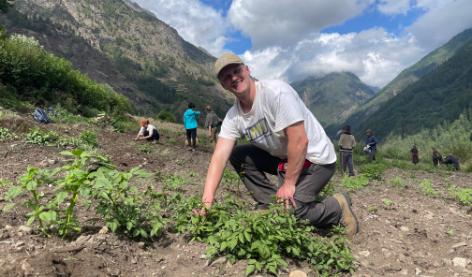
Liscomb participating in local farming practices in Tsum Valley, Nepal. (photos courtesy of Sam Liscomb)
Liscomb collecting elevation data for JMU Facilities Management with a GNSS receiver.
Reading the landscape: Urban inequality in San Francisco
By James Parente
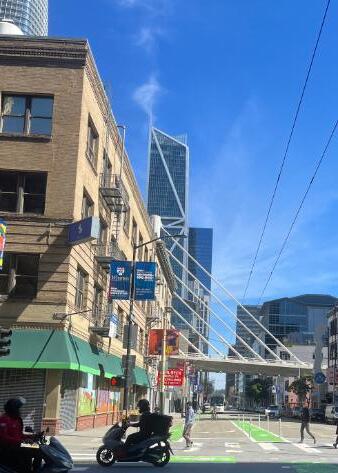
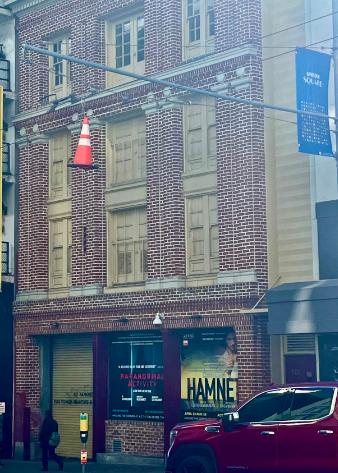
During my time in San Francisco, where I presented research with Dr. Dohrenwend at the American Association of Geographers Annual Meeting this past spring break, I was able to witness fascinating juxtapositions in the landscape. On my first day in San Francisco, I explored the city on foot. I had no particular destinationinmind;Ijustendedupwheremyfeet took me. I started in Union Square, where my hostel was located, and travelled through the SOMA district, the Financial District, the Northern Waterfront, Telegraph Hill, and a few other neighborhoods. The contrasts between each of these neighborhoods, no more than a few blocks apart, were fascinating. While I talked with a local sandwich shop owner in SOMA, she recalled that
Union Square was once a thriving, busy neighborhood while she was growing up.
However, now it is in a largely-derelict state, neglected by the city, with empty storefronts and apartments everywhere. This was made even more apparent by the fact that most people I passed on the street in Union Square were clearly attendees of AAG. SOMA, the Financial District, theNorthernWaterfront,andTelegraphHillareall neighborhoods that surround Union Square, but unlike Union Square, they are very visibly well-off. The Northern Waterfront and SOMA are primarily tourist areas,the Financial District is an area with a lot of business and wealth, and Telegraph Hill is a rather upscale residential neighborhood.
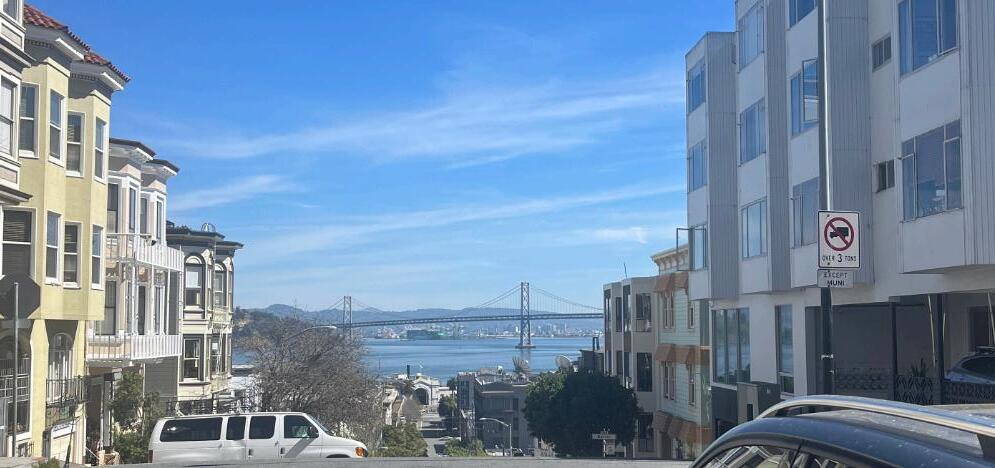
View from halfway up Telegraph Hill.
As I explored, I found myself wondering, what creates these contrasting landscapes? How is it that there are several very wealthy and thriving neighborhoods all next door to neighborhoods experiencing suchstruggle?Inasense,thephysicallandscape,topographically,isametaphor.ThebayattheNorthern Waterfront draws in tourism, and the steep hills of the Telegraph District separate the neighborhood's high-income homeowners from the lower-income struggles downslope. Experiencing all of this prior to attending the conference the next day was especially insightful.While inequality was a theme of many of the posters and presentations I saw,you do not need an academic conference to see it in action—you just need to read the landscape.
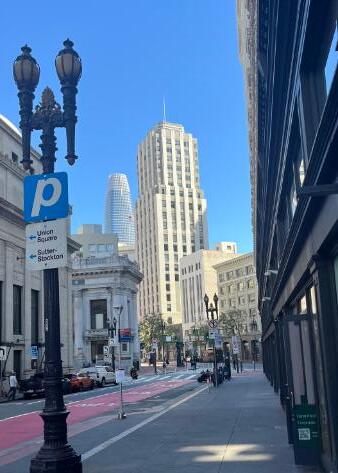
Street view of the Financial District.
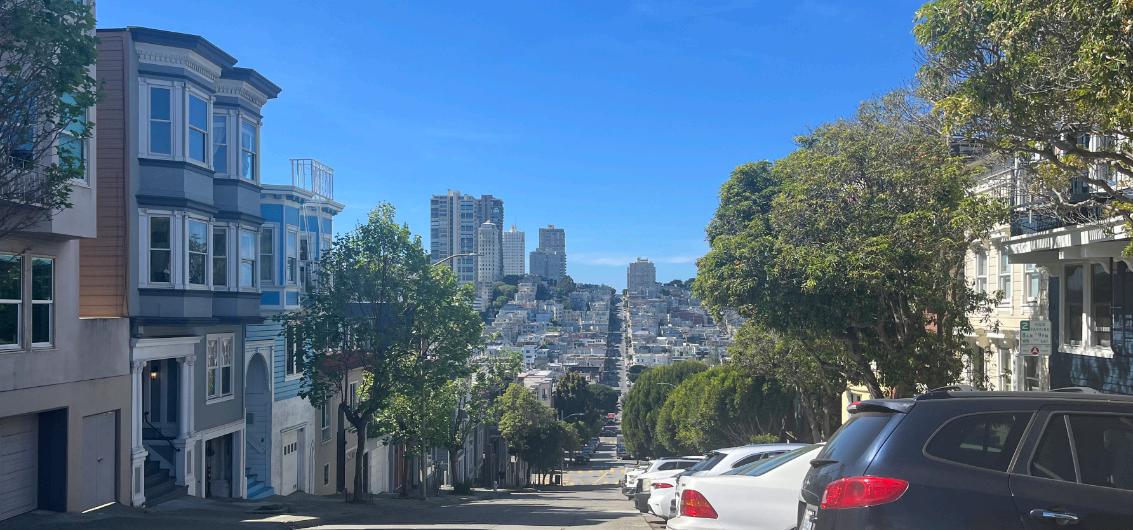
Street view of the SOMA District. Boarded-up apartment windows in Union Square.
Top of Telegraph Hill, overlooking the San Francisco Bay. (photos by James Parente)
Dr. Zachary Bortolot in the spotlight
Highlighting his work, research, and life
By Teddy Umbrell and Stephi Shraga
Over his many years at JMU, Dr. Zachary Bortolot has worked on many projects. He hastaughtavarietyofclasses,startedtobuildanew STEM program, worked on research projects, and muchmore.Lookingathiscareersofar,hehasalot to be proud of,and he still has more to offer.
Bortolot traces his passion for geography back to his childhood in Connecticut. Despite Connecticut’s urban corridors that make up part of the northeastern megalopolis, Bortolot grew up surrounded by swamp and woods, where he explored via the nearby trail systems.
“Spending time outside definitely had a big impact on me,” he said.
Bortolot was also given a shortwave radio as a child, which he used to tune into stations from around the world. These various experiences of growing up around nature, discovering global broadcasts, and studying an atlas as a kid all contributed to igniting his lifelong interest in geography.
However, Bortolot did not study geography in college. After (incorrectly) being told that
geography was a dying discipline, he majored in geology instead, at Brown University. Geography was not even offered at the schools where he applied. However, Bortolot was more interested in learning about physical geography than the rockfocused field of geology.In his junior year,Bortolot took a course on remote sensing, which ignited his interest in the subject.
In graduate school, Bortolot studied forestry withaspecializationinremotesensing,receivinghis Master’s degree from the University of British Columbia in 2000 and his Ph.D. from Virginia Tech in 2004. He champions the flexibility that graduate school offers, saying that it allows students more time to do research, explore their curiosities, and build valuable connections with faculty advisors.
Bortolot’s advisors in both his Master’s and Ph.D. programs were extremely influential to his career development. His master’s advisor, Dr. Peter Murtha, had degrees in soil science and civil engineering and was one of the world’s best photo interpreters. Examining high resolution aerial imageryissurprisinglychallenging,andMurthawas adept at this skill, as Bortolot explained. For Bortolot’s Ph.D., his advisor was Dr. Randy Wynne, who was new to Virginia Tech at the time. Bortolot described him as having “super high energy” with an extraordinary skill for raising funds for his research.
“Peter Murtha and Randy Wynne very much complimented each other,” he said, adding that they equipped him with a broad perspective.
Bortolot recognizes the interconnectedness between the various fields he has encountered during his career. Geology, as well as hydrology, soils, weather, and climate, are all vital factors to consider when studying physical geography. Biogeography and landscape ecology are deeply intertwined with forestry, and remote sensing is frequently used in all of these fields.
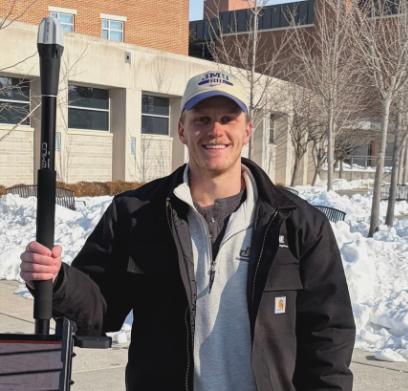
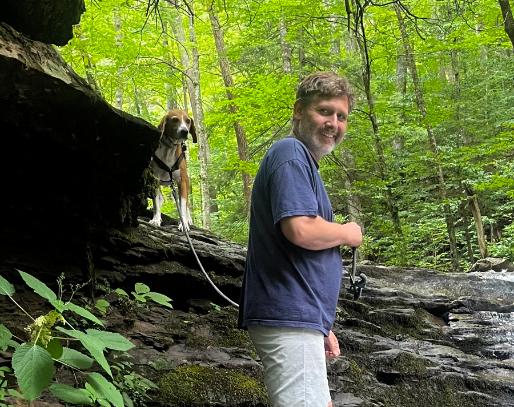
Dr. Bortolot and his hound exploring Mill Creek Falls in Kumbrabow State Forest, Huttonsville, WV.
Morerecently,since2022,Bortolothasbeen working to create Project Luminesce,a program for people on the autism spectrum at JMU. According toBortolot,peopleontheautismspectrumhavean unemployment rate of over 50%, with those who are employed being regularly underemployed.
“Studies have shown that having additional educationcanbereallybeneficial,”hesaid,“butthe way that education has typically been done for people on the autism spectrum [is for them to] take just a standard undergraduate program and add some support onto it.”
Instead, Project Luminesce aims to provide communal housing,peer mentoring,psychological counseling,and other options for support.
Timewise, the proposed Project Luminesce would be an 11-month certificate program, so it does not directly correlate with an undergraduate degreeatJMU.However,Bortolotnotesthatoneof the tracks would specialize in geospatial intelligence throughJMU geography courses.
Another track would focus on the environment, with the intent to combine courses from the geography program, geology program, and the ISAT environment and sustainability concentration.
Looking into the program’s future, Bortolot hopes that students who meet a certain GPA requirement will be able to become full-time JMU students. While the program is not yet fully ready, Bortolot believes that the future is bright.
This year, Bortolot taught GEOG 216 and GEOG 485 in the Fall 2025 semester, and GEOG 216, GEOG 406, and GEOG 501 in Spring 2026. In previous semesters, Bortolot has taught a wide varietyofclasseshereatJMU.“Younameit,I’vekind of taught it,” Bortolot remarked. Bortolot has instructed classes on remote sensing, GIS, cartography, research methods, statistics, physical geography(whichhenotesisoneof hisfavoritesto teach), programming, many project-based classes, and much more.
For his research, Bortolot has collaborated with the National Geospatial Intelligence Agency for a few years. He created an algorithm called the Large Rare Feature Finder (or LaRFF) that uses little training data but can find sizable features (like buildings and infrastructure) with ease when providedwithsatellitedata.Bortolotisalsoworking with JMU Geography’s Dr. Adam Dohrenwend to create a national survey asking citizens about their sentiments on AI. He is also starting to get into political geography as well as how psychology relates to geography.
Bortolot is busy outside of JMU as well. He volunteersattheRockingham-HarrisonburgSociety for the Prevention of Cruelty to Animals (RHSPCA) and even helps train new volunteers there. He also enjoys hiking and camping, especially in Kumbrabow State Forest in West Virginia. He collects 78 RPM records, and he has a particular passion for early blues and jazz music. Bortolot is still into radio as well, using ham (amateur) radio to talk to people from all over the world.
Even though he was told it was dying many years ago, Professor Bortolot has helped geography stay alive.JMU is lucky to have him.
(photos courtesy of Dr. Bortolot)
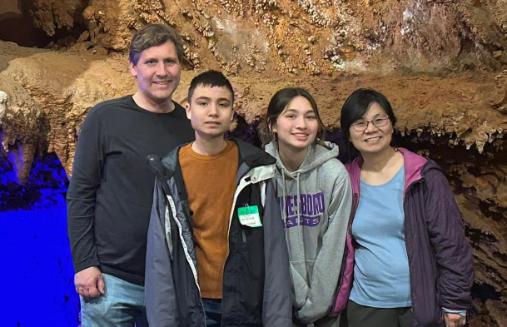
Dr. Bortolot with his family (including former GEOG 216 instructor Naomi Wu) at Shenandoah Caverns.
Dr.Tim Prestby brings cartographic expertise from Madison, WI, to James Madison
By Drew Shinkle
Hailing from nearly a thousand miles away in the rural Wisconsin suburbs, Dr. Tim Prestby has made his way to the Shenandoah Valley as one of the JMU Geography program’s newest additions. This year Prestby taught GEOG 215 (Intro to GIS and Cartography), GEOG 365 (Cartography and Geospatial Visualization), and GEOG 366 (Intermediate GIS). He is also the founder and faculty director of the JMU Map Lab, which aims to bring exposure to geography through real-world mapmaking projects.
However, before arriving in Harrisonburg at JMU, Prestby needed to discover geography, as well as his research interests.
Prestby grew up in Pulaski, Wisconsin, a small town outside of Green Bay with a large Polish population. Given the proximity to Green Bay (a 15-minute drive), Prestby is an avid fan of the National Football League’s Green Bay Packers.
For his undergraduate studies, Prestby went a few hours southwest to the University of Wisconsin–Madison. He entered college interested in agriculture and explored a few related majors—horticulture, agronomy, and food science—before realizing that he wanted a more creative outlet.
“I was curious about a lot of things, and when I was bouncing around majors I really struggled to find something that encapsulated all of my interests,” he said.
Through landscape architecture, he had his first encounter with GIS, which he ultimately chose as his major.
During his time at UW-Madison, Prestby met someone who would shape his geography career: Daniel Huffman, a cartographer-inresidence at the Wisconsin Cartography Lab. Prestby deems Huffman, who uses they/them pronouns, to be “one of the most talented cartographers in the world.” Huffman is a freelance cartographer who provided Prestby
and other Wisconsin cartographers with valuable information, advice, and a perspective independent from academia. As Prestby’s cartographic career has progressed, he has realized that his fluid, minimalist design style mirrors the work of Huffman, illustrating the influence that they had on him.
Another influential undergraduate experience was a 2017 study abroad in the Netherlands during his sophomore year. While abroad as an exchange student, he took physical geography classes, including one that integrated drones and satellite imagery to study crop quality. The Netherlands’ landscape is also unique for geographic research, as the flat terrain is made up of previously inundated areas that were reclaimed. Prestby shared the trip with an academic cohort of 10 peers—a diverse group from global nations including India, South Africa, Türkiye, and New Zealand.
“It was a really cool cultural experience, and I got lucky that the group was really warm, supportive, and wanted to do a lot of things together,” he said, including sharing meals, biking, and exploring the Netherlands.
One of Dr. Prestby's favorite maps that he designed— in this case, through an independent study with Daniel Huffman. (photo courtesy of Dr. Prestby)
Aside from the Netherlands, Prestby has checked ten other countries off his list: Denmark, France, England, Scotland, Austria, Italy, Nicaragua, South Africa, Spain, and Portugal. Spain and Portugal were the most recent, as he vacationed there this past summer.
After graduating from UW-Madison in 2020 with a Bachelor of Science degree in Cartography and GIS, Prestby continued on to Penn State to complete his Master’s and Ph.D. degrees in Geography. Towards the end of his Master’s and the beginning of the Ph.D., Prestby uncovered his primary research angle which focuses on how audiences perceive geographic information. More specifically, he aims to find the most effective ways to design maps, as well as to understand the factors that influence people’s trust in maps. These include individual psychological differences (such as prior beliefs and knowledge) and sociological patterns (group identity, who shared the map, etc.).
“You can design a map perfectly from a textbook definition, but it doesn’t matter if [people] don’t trust it,” Prestby said.
By harnessing maps as an intuitive way to share information, he aims to make a difference and provide maps that meet people’s needs. One such method is designing interactive maps that are made specifically for targeted user demographics. Several of Prestby’s interactive maps have been used to inform environmental management projects, including one about pollinator health in Pennsylvania.
The next project on the horizon is an interactive map for the United States Golf Association that will allow golf course managers to use water more sustainably. Prestby hopes to get the project underway in the summer and fall, later this year.
In “the heat of the summer” before this academic year, Prestby’s late July arrival marked his introduction to the Shenandoah Valley. His time spent in Penn State’s valley setting had him feeling right at home in Harrisonburg, however.
As he has settled in, the JMU Map Lab has been one of Prestby’s first creative endeavors on campus.The product of his experiences in various cartography labs at UW-Madison and Penn State,
he envisions it as a place for connection that can lead to internships, jobs, friendships, and community-building. In the future, Prestby may develop an internship-related class that integrates the Map Lab, but currently he encourages students to reach out to him if they are interested in a project.
Outside of the classroom, Prestby is active, as he commutes around town on his bicycle. He is also teaming up with JMU faculty members, including the Geography program’s own Dr.Kevin Varga, to play intramural volleyball. Some of his other pastimes include cooking,reading sci-fi and fantasy, playing guitar, building LEGO sets, and hiking.
In the classroom and beyond, the JMU Geography community is glad to have Prestby as one of our new faculty members! Be sure to reach out to him at his email yqvc5z@jmu.edu.
Dr. Prestby playing a Wisconsin favorite card game, cribbage, with one of his good friends who took the photo. (photo by Brendan Barnes)
Dr. Henry Way shares more about his role as Academic Unit Head
By Teddy Umbrell
Since 2021, Dr. Henry Way has been an Academic Unit Head (AUH) in the School of Integrated Sciences (SIS). He helps manage over 50 faculty and staff, hundreds of students, a broad assortment of classes, and more. He has supported many updates to the Geography program, and made many himself. As Co-Director of SIS, he is striving to make everyone involved with the program and school the best geographers they can be and to make the program shine.
Growing up in the United Kingdom, Way became interested in maps and cartography from a young age. Bringing this early passion with him to university, he earned an undergraduate degree in Geography at the University of Oxford and a Master’s in Geographical Research at the University of Cambridge.An interest in United States politics, as well as a desire to look outward from Europe, brought him to pursue his Ph.D. in Geography at the University of Kansas. In 2008, Way arrived at JMU as an Assistant Professor.
Way was intrigued by JMU’s focus on undergraduates as well as the interdisciplinary research opportunities available. He also worked with the City of Harrisonburg Planning Commission, making good use of his urban and political geography skills.His teaching skills and passion led him to success as a professor and associate director, and eventually, to become an academic unit head.
“We’ve tried to keep that interconnected, almost multi-disciplinary nature of geography really strong.”
Initially, Way oversaw the entire School of Integrated Sciences; however,he now co-directs it with Dr. Stephanie Stockwell. She oversees the ISAT program, and Way oversees the Geography and Intelligence Analysis programs. This split reflects Way’s team-based approach to leadership and his drive to build an inclusive community of which JMU can be proud.
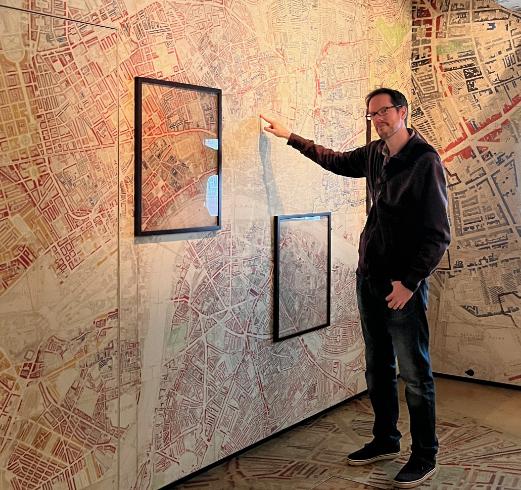
Dr. Way in the map cave at the London Museum.
While he and Stockwell mirror each other in capacity, they both look after their own faculty and students involved with their separate programs.Within the Geography program, Way ensures that faculty and staff thrive and that the students have opportunities to expand their horizons and succeed at JMU. In addition to these duties, he also makes sure students and staff have helpful resources (like the latest technology and the ability to participate in conferences), manages budgets, and teaches classes.
As Co-Director of SIS, Way has a behind-thescenes perspective on the Geography and Intelligence Analysis programs, and it has opened his eyes a lot.
“In this role, you have to focus on everybody else, and that’s been great to see all of the diversity of work that goes on, the genuine care people have for the students,and that the students have for their learning,” he said.
He truly enjoys organizing it all, and it has inspired him to change the way he thinks about his research and the classes he teaches.
Way is still teaching, and he still very much enjoys it. Currently, he co-teaches GEOG 202 (Introduction to Your Geographical Future) with Ms. Kimberly Stewart, which serves as an introduction to the geography program. It helps students connect with the geography faculty and all that geography has to offer at JMU. He also teaches GEOG 476 (Sustainable Cities Seminar), which shows students how to design cities that are better for both people and the environment. He has also co-taught study abroad programs, which help further expand students’ geographical knowledge.
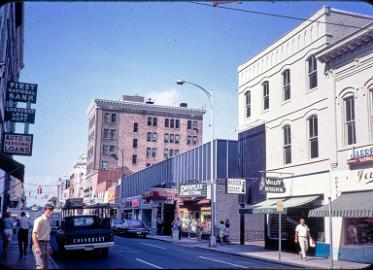
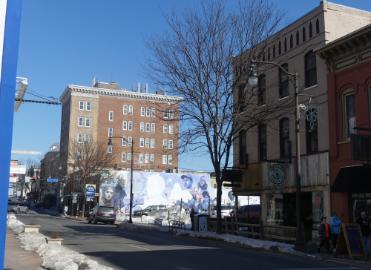
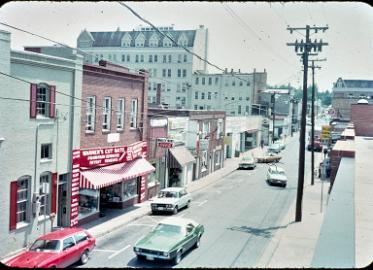
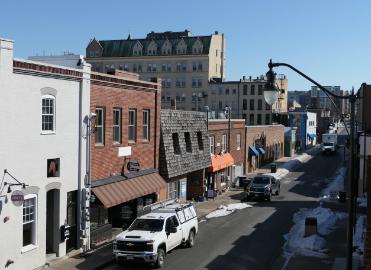
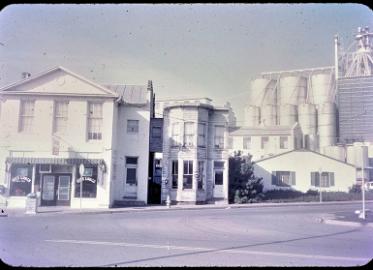
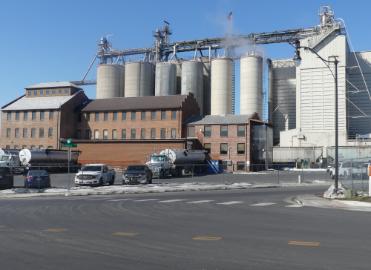
Way has also recently started work with the Massanutten Regional Library. He studies semi-historic photos of Harrisonburg from around 40 to 50 years ago and assesses how the city has changed through a “post-urban renewal period.” Through this, he is aiming to get a more comprehensive visual representation of how Harrisonburg’s urban landscape has changed, which plays into his passion for urban geography.
Moving back to his role as AUH and Co-Director, some of Way’s proudest accomplishments have been hiring many of the impressive faculty members that currently work at JMU, as well as bringing in large numbers of students to the Geography and Intelligence Analysis programs. He also takes pride in the programs’ cutting-edge technology and computer labs, which are hugely beneficial for students and staff.
Looking at the current geography program, Way remarks at how well-kept it is in terms of its depth. Whether it be cartography and geospatial analysis, human-environment interactions, or human and physical geography, JMU’s program balances it all so well.
“I think that some programs focus on one thing over another, or they sort of narrow down a little bit,” Way said. “We haven’t done that. We’ve tried to keep that interconnected,almost multi-disciplinary nature of geography really strong.”
He explains that a strength of having such a broad program is that it leads to all kinds of graduates that can flourish in many different settings.
In the future, Way wants to explore renewing the curriculum. Going forward, he wants courses to reflect geography’s cutting edge, as well as newer faculty members’ strengths and skills. He also hopes to improve undergraduate research opportunities and involve students with more faculty projects. Relatedly, he wants to make sure that the faculty have time to conduct research themselves,as he has high hopes for them.
JMU Geography has a bright future, and we can thank Way’s attentive vision for leading our program forward.
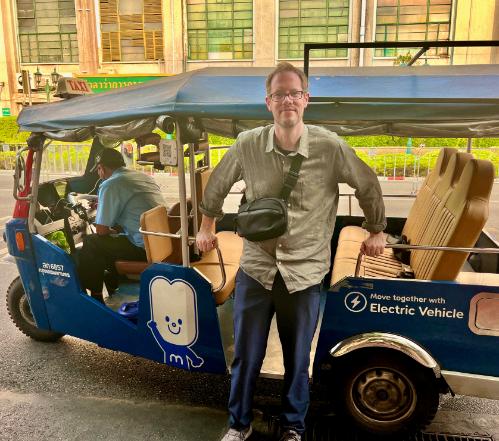
Dr. Way with an EV tuk tuk in front of the Bangkok Metropolitan Administration.
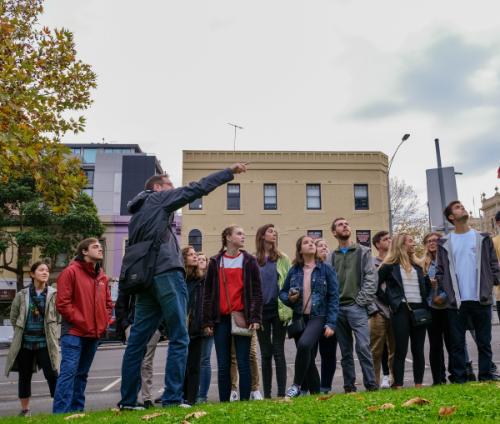
Dr. Way with a sustainable cities study abroad in Melbourne.
(photos courtesy of Dr. Way)
Dr.Yurco Teaching Abroad in Florence
By Tyler Yu
James Madison University’s Semester in Florence study abroad program is one of the longest running ones at the university, having existed for around 40 years. Every semester, JMU has a different Faculty Member in Residence (FMIR) that teaches and lives with the students while they are abroad.This year, JMU Geography’s Dr. Kayla Yurco served as FMIR. A few years ago, she applied for both the Florence and London study abroad, and in 2023, she was excited to hear that she hadbeen acceptedfor the Fall 2025 Florence program.
The students arrived in Italy in early September, and after a week of orientation, they participated in a few scavenger hunts and city tours to become accustomed to the place they would be studying for the next few months. The students took General Education and elective courses, and every three weeks, they embarked to different regions in Italy for academic field trips. As the semester passed by, Florence grew less busy with fewer tourists, and the students settled into their routines. The students flew back home around mid-December after final exams.
Yurco taught one of the University Studies courses(UNST 390) that helped students adjust to and reflect on their experiences as well as prepare for field trips. The other wasFood Geographies (GEOG 350). Italy made for an especially interesting place to host this course, as its culture and society are heavily impacted by food, agriculture, and gathering over meals. Italians also are known to enjoy simple meals with high-quality ingredients, so learning about these traditions while being immersed in the culture was an experience like no other.
One special part of Food Geographies was learning from a guest honey sommelier. A former beekeeper came to the class and taught students about how to taste and experience honey with all of their tactile senses, as well as bee biology, social structure, and honey-making in the process.Experts in cheese and olive oil also visited the group for handson lessons and tastings.
Yurco says she applied to the study abroad program to take advantage of the incredible opportunity to be involved in the JMU community while seeing the world away from Harrisonburg.
“As a faculty member who was once a study abroad student, I knowstudyingabroad changed my life infinitely and really set me on the path for all that I do today,” she said. “Getting to be with students for their first experience studying abroad is such a privilege.”
Overlooking the Arno river toward the Ponte Vecchio, Florence's oldest and most famous bridge.
During the trip, Yurco made sure to utilize her geographical expertise.
“As geographers, our inherent focus is always connecting local to global patterns and processes,” she said. When students study abroad, she notes, they tend to focus on the differences in cultures because everything feels so new. One way Yurco’s background assisted students was starting conversations about how people and places are actually quite similar, as well as how the environment and culture have shaped each other.
During her time in Florence, Yurco frequented a small shop in il Mercato Centrale (central market), where a woman-owned shopfeatured cantucci (a type of cookie), which reminded her of her grandmother’s baking.Even on the other side of the world, the connection she had with them and her family brought back nostalgia.
In Florence, Yurco was very intentional about connecting with community members and finding opportunities for students to realize how cities and regions can serve as classrooms. This has also revitalized her desire to bring similar opportunities to Harrisonburg. She wants to continue being creative and engaging with her region and community, both for teaching and in her life. She also plans to build a garden at home, drawing inspiration from Italiancuisine, and wants to continue learning the language.
The sheer amount of art history and museums (especially pertaining to Renaissance history) was something many on the trip found interesting. Yurco said it interested her as well, especially being in the place where it all started and realizing how little she knew about it.This sparked a desire to learn not just about the Renaissance, but also other big moments in history she does not usually study. It helped to keep her asking questions, which she encouraged students to do as well.
One thing she hopes the students gained was increased intercultural skills. With newfound confidence traveling to different places, she hopes students can navigate new experiences and reflect on their positions in new settings.Even though we all have different histories and day-to-day lives, she hopes they see how we are all connected by similar patterns and processes.
Yurco says that when she is again eligible for the semester abroad opportunity,she would love to return to Florence or travel to London. She says that going anywhere is a great opportunity and finds that people often get more out of it if they go in with an open mind. She loves to help students find their way to and through study abroad programs and encourages anyone to take the opportunity to see the world.
Vineyards visited during an academic field trip to Le Langhe, an important agricultural region in northern Italy known for highquality wine, cheese, truffles, hazelnuts, and more.
Overlooking the city of Florence and the Duomo from Piazzale Michelangelo on the south bank of the Arno river.
(photos courtesy of Dr. Yurco)
Faculty Summer Memories
At the 1984 Winter Olympics bobsled track, heavily damaged during the Yugoslav Wars, in Sarajevo, Bosnia and Herzegovina. (photo courtesy of Dr. Adam Dohrenwend)
At the University Consortium of Geographic Information Science Symposium in Laramie, Wyoming, in June, Dr. Bonsal visited the Vedauwoo campground and hiked among the Sherman granite formations. (photo
KAWS’s iconic cross-eyed character “COMPANION,” seated on the globe and embracing the moon, with a baby “COMPANION” resting on its lap, reflecting “the passing down of knowledge, values, and care from generation to generation, like an enduring thread connecting the past, present, and future,” was displayed at Sanam Luang with a backdrop of the Grand Palace, a historical landmark in the heart of Bangkok, Thailand, during the summer of 2025. (photo by Manita Khemthong)
by Dr. Dudley Bonsal)
Our first summer vacation with Sonny at Deep Creek Lake, Maryland. (photo courtesy of Dr. Kevin Varga)
An encounter with a red-eyed tree frog in Costa Rica’s Arenal Volcano National Park. (photo by Dr. Kayla Yurco)
A red squirrel eating hazelnut in the Schönbrunn garden, Austria. (photo courtesy of Dr. Mace Bentley)
Dr. Chen visiting Frank Lloyd Wright’s Martin House in Buffalo. He is one of the most influential American architects, and this is a key Prairie School work known for its strong horizontal lines and connection to the landscape. (photo courtesy of Dr. Qingqing Chen)
The Stirling Castle gardens in Stirling, Scotland. (photo courtesy of Kimberly Stewart)
How I Became a Geographer Faculty Emeritus Dr.
Mary Kimsey’s Journey
By Dr. Mary Kimsey
Learning Latin is what led me to a career in geography—it’s true. My story begins in Cincinnati, Ohio, where I grew up with my dad, mom, and nine siblings. My dad, always into adventure, piled us every Sunday into the old station wagon. We visited museums, parks, caves, and horse farms. In the summer, we went camping; in the winter, we went ice-skating and sledding.
I attended the Catholic elementary school around the block and the local all-girls high school. Because I was college-bound, Latin was a recommended course, one that introduced me to the intriguing world of language. Latin, Spanish, and world culture courses piqued my interest in the world outside of Cincinnati.
While in high school, our family made a trip to Maine where a friend offered me a job at a Jewish girls’ camp. There, I met a young Guatemalan
woman, an employee of the wealthy camp owners, who talked to me about her home country, one to which she was soon returning. Before camp ended, she gave me her address in Guatemala and encouraged me to visit.
In 1972, I entered the University of Cincinnati (UC). To pay for school, I worked part-time in respiratory therapy in a nearby hospital.After only a couple of months, however, I began to wonder if college was for me. On a whim, I asked my dad if I could visit the friend in Guatemala. My dad, always supportive of adventure, agreed, not knowing the country was embroiled in a civil war.
ByJanuary 1973,I was in Guatemala City,a city of Spanish colonial architecture surrounded by lakes and volcanoes. As it turned out, my friend Maria Rosa lived in one of many shantytowns; it was not safe for me to stay there. Fortunately, another family, whose head of the household was a lawyer in the presidential palace, invited me to live with them. The family provided me with a place to live; I provided them with an opportunity to practice English.
One day I met a soccer team practicing in a park across the street. I learned from them that a CIA-backed coup was behind their civil war. The war, which ended in 1996, resulted in the disappearance of over 35,000 people. Among those desaparecidos was a friend from the soccer team whose body was never found. It was devastating for his family, and for me.
Alarmed and scared after being detained by the Guatemalan military one day while en route to
Top left: Dr. Kimsey at desk in Nan Boukan, Haiti, in 2018.
El Salvador, I decided it was time to go home! Back at UC, I still lacked a major, so I took more language, science, and economics courses and went back to work in respiratory therapy.
By junior year, I was again bored with it all. I arranged to volunteer for a year at a maternity clinic for indigenous women in a town west of Guatemala City. Unfortunately, just weeks after arriving in the country, a magnitude 7.5 earthquake struck. Villages were flattened, and over 22,000 people died. Because of powerful aftershocks, no one was permitted back indoors. Livingonthestreetwasdifficult,andmyCincinnati family was worried. I returned home. But the indigenous culture, poverty, civil war, and earthquake had great impacts on me.
Back at UC, I was ready to focus, and finish! Fortuitously, I enrolled in a Geography of Latin America class with a young professor named Dr. Robert South. The course included climate, geomorphology, and biogeography (physical geography), along with aspects of economics, politics, and population (human geography).
One day, South asked if I wanted to major in geography. Geography was a major? I soon learned that it was the perfect major for me, as I
couldstudyallthethingsIfoundfascinating.More importantly, I felt it would allow me to make a difference in the world. To become an expert in the discipline, though, I needed a graduate degree, so I applied to the University of Georgia.
My graduate work there eventually led to a teaching position at JMU, and to research conducted, primarily, in the Caribbean. I’ve had the opportunity to teach thousands of students about the world, and I use the languages I’ve studied in both my research and the local community. Professor South took time to encourage me. Forty-nine years later, he is still teaching at UC! Meanwhile, I have had an incredible career working with hundreds of young people aspiring to become geographers!
Dr. Kimsey and her water resources class in the JMU arboretum. (photos courtesy of Dr. Kimsey)
Dr. Kimsey in Guatemala in 1973.
(left) With the family of the soccer player Belter (orange shirt), who is among Guatemala's "disappeared." (right) The fire department delivering water to the community.
A Global Point of View
Globetrotting with Prof. Christy Bradburn
By Tyler Yu
Professor Christy Bradburn, a long-time JMU Geography adjunct faculty member, has had many domestic and international travel experiences.In her childhood, she remembers taking family road trips across the United States.She always enjoyed exploring new places and having new experiences. During her undergraduate years here at JMU, she studied Interdisciplinary Liberal Studies with a minor in Education. Around this time, she really got the itch to see new places.
“Being in college and opening your eyes to the world, [you realize] it’s bigger than the one you lived in,“ Bradburn said.
A geography course in her undergraduate career led her to fall in love with the topic. She consulted her advisor who told her that if she felt a passion, she should follow it. This led her to the Rocky Mountain region, where after consulting with professors from
different universities, she ended up at the University of Wyoming, where she earned her Master’s degree in Geography and Recreation. After that, she taught at Teton Science School in Wyoming for a while, then came back to Virginia where she taught high school, then worked at JMU admissions. She then settled into the geography program.
Bradburn’s first international trip was to Canada during her honeymoon, which she said she loved. However, she felt that it was culturally similar to the U.S., so it helped spark her love for other international travel. Her next big international trip she took was to the Galápagos Islands, and from there she kept pushing the boundaries of her comfort level.Bradburn says that every country she visits provides a new learning experience. She weaves her travels into the classroom through storytelling.
“I’ve always enjoyed the classes I took where they [professors] told stories to me that connect knowledge with experience in real life, so I tell a lot of stories,” she
Trekking to base camp of Mount Everest, Nepal.
Making friends with an Icelandic horse in Iceland.
said. Bradburn says that even though she believes in classroom learning, “real” learning happens when you get out and have experiences on your own; they are what truly allow people to open their minds to other perspectives. She frequently teaches courses such as The Global Dimension (GEOG 200), Human Geography (GEOG 280), Environmental Ethics (GEOG 325), and Wilderness Studies (GEOG 341).
As a result of her travels, she has become more cognizant of her own life here. She has connected with many people in many countries,and it makes her more appreciative and aware of her life here. She says she has tried to have more gratitude when it comes to her own life. She has also found how people across the globe have so many different worldviews when it comes to religion, education, and culture. These reflections manifest the environments of different places, yet show us we are all still human.
“We talk about differences between countries, but at the end of the day, I think it’s the opposite,” she said. “We are so similar globally; no matter where you go, people are essentially the same.”
Bradburn also mentioned that being in other countries has increased her understanding of tourist behaviors. She said that it is easy to feel annoyed towards tourists, but being the person in another country that does not know the language or customs has helped her see how many of them are trying to experience a different culture, and they are doing their best to navigate an unfamiliar landscape.
Of the places Bradburn has visited,Nepal has been her favorite. She spent a few weeks there hiking, and she was able to be more immersed than if she had been there for a few days. Bradburn finds herself drawn to cultures that are more different from her own. From the language to the traditions, she wants to experience things she does not normally. She mentioned how, as a geographer, she has trouble seeing and doing everything she wants to: learning
about the landscape, the culture, the people, and the interactions between the people and the environment.
Bradburn encourages anyone willing and able to partake in their own travels. “If you have the opportunity to travel, do it,” she said. “The world is an amazing place.”
“We talk about differences between countries, but at the end of the day, I think it’s the opposite. We are so similar globally; no matter where you go, people are essentially the same.”
Meeting a Galapagos tortoise in Galapagos, Ecuador.
(photos courtesy of Prof. Bradburn)
JMU Geography Student Butterfly Research
By Dr. Amy Goodall
While a professor at JMU, Dr. Amy Goodall (who goes by Dr. Amy) designed a semester-long project for students in GEOG 440 (Advanced Biogeography) to learn about biodiversity through studies of butterflies. Students learned butterfly species identification, survey methods, and methods to report observations. From 2011–2023, a total of 142 students surveyed butterflies from late August to early October each year.
Student observations resulted in a robust amount of information. To manage the large amount of data, Dr. Amy worked with students enrolled in GEOG 490 (Senior Research or Field Practicum) from 2022–2024 to create a database of the observations. The work included close reading of student reports, cleaning and entering data, and conducting preliminary analyses. Below is a summary of some results from surveys at 12 Harrisonburg study sites located within city parks, grade school gardens, JMU’s East Campus, and the Edith J. Carrier Arboretum.
Students documented 56 species and over 6000 individual butterflies! The highest diversity of butterfly species (30 species) was observed in the Edith J. Carrier Arboretum study sites. East Campusmeadowhabitatscameinsecondwith27 species observed. According to student observations, the arboretum and East Campus habitats also contained the highest abundances of butterflies. Less species diversity and lower abundances of butterflies were observed in study sites in city parks that were surrounded by higher densities of non-permeable surfaces.
Resultsof thesurveysallowedstudentstothink about island biogeography theory, which states that large patches of habitat and connectivity of habitats tend to support a higher diversity of species. Student reports commented that JMU’s proximitytothearboretumandtherelativelylarge areas of meadow on the JMU campus are important to consider for butterfly conservation.
The non-native cabbage white (Pieris rapae), Huron sachem (Atalopedes huron), and monarch (Danaus plexippus) were observed at each study site. However, each site surveyed was unique in butterfly community composition (i.e., the list of species present). Students commented that through comparing the community composition of butterflies, they could tell differences in study site habitats. Students discovered that butterflies are good indicators of habitat! Most obvious was that several woodland species were observed only in the forest at Hillandale Park. An additional habitat indicator species was the juniper hairstreak (Callophrys gryneus) which was observed only in the Keister Elementary School garden, nearly adjacent to a woodland with juniper (Juniperus species) trees.
Severn cabbage white butterfly.
The most common butterfly species in Harrisonburg during the earlier years of study was the cabbage white.As the students stated, “They’re everywhere!” The Huron sachem was observed irregularly in the early years of study, increased in abundance over the years of study, and was the most observed butterfly during years 2022 and 2023. More research is needed to understand population patterns of Huron sachem.
It was always exciting for students to spot monarch butterflies.Monarchs were most observed during monarch migration, in late September and early October. Observations showed marked differences in monarch abundance from year to year. Geography student data showed a pattern of year-to-year highs or lows like the pattern detected at the monarch wintering areas in Mexico, suggesting that surveys across Harrisonburg can contribute to monitoring monarch population trends.
As stated in their reports, students consistently supported the planting of native flowering species. Students also suggested that surveys continue so that longer term trends in butterfly diversity and abundances could be better understood. Spatial analyses of the data are ongoing (an emeritus project for Dr.Amy!) in partnership with Dr.Xiaojing Tang, Dr. Leone Brown (from JMU Biology), and JMU Geography graduate Dustin Rodriguez.
Pie charts depict the relative abundance of the eight most common species at two of the study sites
The East Campus hillside consisted of meadows, while the Hillandale study area consisted of meadow and woodland.
Sachem butterflies.
.
(photos and graphics courtesy of Dr. Goodall)
The Shenandoah Valley: Home of Art
By Isabel Kinney
The Shenandoah Valley is a diverse landscape with hundreds of thousands of people calling it home. Covered in beautiful hills and forests, the Valley has been home to many artists who draw inspiration from the landscape and the people. Two such Harrisonburg-area artists have been creating art for decades, and they continue to make art about their surroundings.
Lynda Chandler has been a working artist for fifty years. She attended the University of Florida to study interior design but instead discovered a love for botanical illustration. After taking such a class in 1974, her professor asked her to work for the Department of Horticulture as an illustrator. In 1976, Chandler graduated with a Bachelor of Science degree in Horticulture with an emphasis in Natural Science Illustration.
Her professor recommended she specialize, explaining that a scientific skillset would be more desirable to employers.
“I chose botanicals [because] it doesn’t have blood, and things did not smell like formaldehyde,” Chandler said. Her work in the department consisted of making color illustrations of specimens using watered-down acrylic paints to achieve blending and tight line work.
“Back then, we were looking at pinned specimens. We had to draw from live things, and we dissected everything,” she said.
Later in life, Chandler worked for the U.S. Department of Agriculture (USDA) seed taxonomy lab as the lead illustrator. There, she worked primarily in pen and ink, using rapidograph pens, quill nibs, and dip ink.
In 2014, Chandler and her husband, Craig Chandler, chose to settle in Harrisonburg during Floridian summers because of the youthful community and access to the JMU Arboretum, where Chandler could teach art. For three years, she taught botanical illustration to the JMU and Harrisonburg community. She also made a series of paintings that the arboretum now sells as print cards, with proceeds benefiting its programs.
Chandler remains fascinated with nature but has since expanded to landscapes.
“I never did landscapes before—didn’t need to,” she said. “Everything I got paid to do was floral. I really wanted to paint landscapes when I got [to Harrisonburg]. I just love the mountains and trees.” She taught herself how to use watercolor paints,which were very different compared to the acrylic paints and pen and ink she had been using.
When starting new artwork, she enjoys going into the field and taking notes of specimens to take back to her studio. She does a lot of photography, though she prefers to observe and draw from nature.
“Nature gives me an endless source of inspiration.”
“I feel like there’s a level of understanding that you don’t get from a photograph,” she said. “I love to know how things connect within a plant. For me, every vein in every leaf tells a story to me. It’s a connection. It’s light and dark. I don’t see the vein without light and dark. If we don’t have any light at all, it’s flat. If we have too much light, it’s bright. It’s that play of light and dark that gives us the worlds we see.”
Lynda Chandler and her latest paintings. (photos courtesy of Chandler)
Another artist located in the Shenandoah Valley is JoEtta Deaton. Her passion for art began when she was a child. Growing up in Chadds Ford, Pennsylvania, she spent her childhood exploring the forests around her home and illustrating silly stories she wrote.Her parents were supportive of her artistic interests, especially her dad, who encouraged her and her siblings to paint.
Deaton also drew inspiration from Andrew Wyeth’s artwork, which helped lead her to study art in college. She earned a Bachelor of Arts degree in Art from Lipscomb University in Nashville, Tennessee. Later, she explored her faith more deeply while completing her Master’s in Theology at the Harding School of Theology in Memphis, Tennessee.
Many of Deaton’s works focus on nature; for example, the hardwood forests she grew up around.
“I loved learning the flat plains and prairies and simple trees [in Kansas, when she moved in the 1980s],” she said. “But when I came back, [the forests] fed my spirit in a way that I was really surprised.”
Besides the outdoors, she draws inspiration from many subjects, including the human form and her faith.She mainly creates art with acrylic and oil paint,but she has tried papercutting,collage,three-dimensional creations,and many forms of drawing. She also uses photography to capture images of what she is painting.
“I do a lot of plein air painting (outdoors), but sometimes I want a photo of [the subject] so I can go back to the studio and change things,” she said.
She first exhibited in 2017, when she presented a body of work based around people-watching in Harrisonburg. The exhibition comprised forty paintings about people doing hard labor around Harrisonburg.
“It felt like a chance to honor people’s hard labor,” she explains.
Her most recent exhibit, Sacred Mysteries: An Advent Exploration in Music and Art, was held in December 2025 at Harrisonburg’s Church of the Incarnation. It featured a collaboration between audio and visual arts—something she had never done before.The exhibit featured 63 of Deaton’s paintings alongsideTracy Schimmel Reed on piano and Kaitlyn Townsend as a featured vocalist.
“There are two things you need from [the outside]: professors and teachers that are beyond the state where you are who can give you tools,” she said.“The other thing is submitting yourself to the reality out there.The created world—if you can interact with real things, they test you and push you and challenge you.”
To prepare for exhibits, Deaton plans months in advance.
“I spend maybe twelve months working hard toward a subject, painting everything I can get my hands on,” she said. “The best work doesn’t come until the last two or three months,” she said. During this time, she revisits and elaborates on paintings from her initial brainstorming phase.
Within the last year, Deaton won a grant from the Virginia Mennonite Retirement Community (VMRC), which hosts a highly competitive juried spring show. With the grant money, she was able to attend a one-on-one mentoring workshop with an experienced abstract artist in D.C. As she learns more about a new art style, she is pursuing new interests in abstraction.
To aspiring artists, Deaton recommends looking beyond yourself for inspiration. Artists need to interact with teachers, outside influences, and realworld engagement to grow, she notes, as it is hard to attain growth based on imagination alone.
Nature is a powerful muse to draw inspiration from, and both Chandler and Deaton draw from their surroundings for their work. From depicting nearby mountains to appreciating people living here, these artists are just some of many creative forces living in the Shenandoah Valley.
JoEtta Deaton and her oil paintings. (photos courtesy of Deaton)
L
The Shenandoah Valley Watercolor Society
Celebrating its 40th anniversary in 2027
By Isabel Kinney
ooking to get into watercolor? The Shenandoah Valley Watercolor Society (SVWS) can help with that! SVWS is a group of regional artists that work with water media arts. The group first gathered in 1987 to create watercolor art but has since expanded to acrylics and collage. Currently, there are about 60 members of a wide age range.
Anyone interested can attend meetings as a guest on the first Saturday of each month.Meetings are two hours and include business updates, a 30-minute program, and 30 minutes for critiques. The program changes each month, ranging from tutorial videos about different media (watercolor, acrylic, etc.), mystery bag events (where each member gets different materials to experiment with), guest speakers, and more.
SVWS artist, Media and Website Coordinator, and Educational Program Chairman Lynda Chandler explained that they also invite guest artists to host two-day workshops each summer. These programs focus on skills such as color and perspective.
“A person considering joining SVWS should take into consideration that there’s every level of learning,” Chandler said. “Everyone in this group realizes that we can learn something from each other—it’s a team effort.” Current members help new members find ways to contribute.Alternatively,Chandler offered,“If you want to only learn, that’s perfectly fine.”
Anyone interested can submit an inquiry through the website’s contact page to receive information about upcoming meetings. There is no fee for a onetime visit, then general membership dues are $30 a year. Members can participate in the SVWS annual members’ show for an additional $10,and the society teaches matting and framing for artists learning to show their work for the first time.
Additionally, there are two other types of membership: Signature and Master Signature. These memberships are granted after artists meet requirements set by the society.
The Signature membership process starts with filling out a form and critiques. “Usually, people do that after they are already a proficient painter," Chandler said. During critiques at the monthly meetings, “anyone can bring a recent painting, and a knowledgeable member will critique its design elements, such as perspective, color balance, focal point, and so on. It’s a positive experience meant not only for the artist but also for other members. We try to find at least two positive things and then maybe one or two things to improve upon.”
TheSignaturemembershipprocessinvolvesthree critiques, and the artist must also demonstrate their matting and framing skills to the Signature Member Board. The Signature member status allows artists to submit their work to shows outside of the society with the SVWS membership noted by their name. A Master Signature member is an artist who has been accepted into two or more juried or judged shows. “It’s a step up,” Chandler explained.
(top) 2nd place: Sea and Sky by Peg Sheridan, (middle-left) SVWS 2025 Portrait Workshop with Janet Angelhart, (bottom-right) SVWS arts exhibit at OASIS, downtown Harrisonburg.
(photos courtesy of Chandler and SVWS)
SVWS 2025 Guest Artist Portrait Workshop with Janet Angelhart.
Lynda Chandler and the SVWS members.
The Signature and Master Signature memberships also allow artists to exhibit their work through SVWS memberships with local businesses such as Oasis Fine Art and Craft, a co-op fine art store in downtown Harrisonburg. SVWS also does special exhibits at Rocktown Gift Shop, VMRC, Taste of Thai Restaurant, Heritage House, and Sharp Litigation offices.
Learn more about SVWS on their website: https://www.shenandoahvalleywatercolorsociety.org/.
In remembrance of Anita Walter Cooper, a watercolor artist who passed away in summer of 2025: Anita was a member of the Shenandoah Valley Watercolor Society since 1987 and enjoyed painting with watercolors in different subjects such as plants, nature, landscape, and life.
In Anita, one finds several kinds of courage.With a sharp intellect, she delved into natural and medical sciences. But she could also delight in a child’s drawings. Show a novice how to paint. Or identify wildflowers with you on a hike.
She appeared quiet. But when she disagreed with you, she offered a bold opinion with ease and grace.
She earned her B.F.A. at Berea College, KY, and a Master’s in Art Education at the University of Iowa. In between, she travelled to Morocco via Peace Corps service. She spent decades refining her passion for watercolor painting and teaching art.Attuned to a wide variety of people and ethnicities, she painted in exotic sites. Yet she loved her simple village of Staunton.
At a nature reserve in Peru, she filled a book with field sketches along the Amazon. She joined her husband working at a refugee camp in Trat, Thailand, bringing along her two children. Living for a year in Costa Rica, botanical scientists accompanied her as she hiked through fields of bromeliads, picked precise species, returned to her tent, and painted madly before the plant withered.Avolume was published solely devoted to her stunning botanical illustrations.
Her life and way of painting were deeply influenced by her faith. She consistently prayed for others. Despite a blinding condition in one eye developed overseas, she asked God to enable her to continue seeing and painting. And continue she did! Having faced serious trials herself, she was accessible and compassionate for others who faced difficulties.
Best in show: Natural Bridge by Pam Wilkins.
(top) Anita Walter Cooper. (photo courtesy of JoEtta Deaton) Anita Cooper paintings: (middle) Aechmea Setigera, (bottom) Bamboo Basket and Persimmons. (photos courtesy of www.anitawaltercooper.com)
(Anita Cooper Memorial by JoEtta Deaton)
Harrisonburg Farmers Market
Story by Stephi Shraga and Photos by Drew Shinkle
The Harrisonburg Farmers Market is a community cornerstone where local farmers, vendors, and customers exchange fresh produce and handcrafted goods. The market is open year-round on Tuesdays and Saturdays from 8:00 AM to 1:00 PM (Spring, Summer,Fall) and on Saturdays from 9:00AM to 1:00 PM (Winter).
Low Hill Garden
Low Hill Garden, owned by Tim Cupp (pictured bottom right) and his partner Stephanie Cupp, is a market garden in Rockingham County with a focus on methods that promote biodiversity. After starting the business in January 2025, last year was Low Hill’s first growing season, and they first began selling a variety of produce and flowers in late April. They have been at the Harrisonburg Farmers Market on Tuesdays since June and at the Saturday market since August.
Cupp is originally from Harrisonburg, and his grandmother was a vendor at a previous iteration of the market when it was located in the lower level of the Water Street parking deck. Since he grew up with his family immersed in the farmers market, Cupp said it was “just a natural fit” to sell at the market. His favorite part of the job is enjoying the small-city community. “You see the same faces all the time, and it just feels like you have fifty thousand friends,” he said.
The future of Low Hill Garden includes attending more farmers markets, continuing to build up the community, and hopefully having visitors on the farm.
Jerry’s Gourmet Berries & Ferments
Jerry Fields (pictured right) has been running Jerry’s Gourmet Berries & Ferments for about 12 years. He sold his products at the Harrisonburg Farmers Market for the first three years of the business before venturing to other markets and eventually returning.Fields stocks a variety of fermented products, from sauerkrauts and kimchi to fermented fruits. He also grows berries during the warmer months of the year.
Fields’ favorite part of running his business is that it gives him the opportunity to help people.“Fermented foods are tremendously important for health,” he said, explaining that consuming them strengthens and fortifies the immune system.He first noticed the benefits of fermented food as a world traveler during his career in aerospace research.
“Since I started eating fermented foods, I have had not one cold,” he said.
Hott Apiary
Hott Apiary, owned by Mike Hott and based in New Market, specializes in honey products. He has over 300 beehives on his farm, with a few extra hives located on other farms between Harrisonburg and New Market. Hott’s honey can be found at the Harrisonburg Farmers Market year-round.
Pamela Bennett (pictured left) is a neighbor and friend of the Hott family who has been representing the business at the market for over a year. Bennett’s favorite product is the wildflower honey, which “is darker and a little bit richer; it has a little bit of extra flavor.” In contrast, she says, “clover is a lighter and sweeter honey.”
One of Hott Apiary’s recent additions is a hot honey made in collaboration with Furious Sauces, another market vendor (featured in Geogazine Vol. 3). Occasionally, they have also offered a bourbonflavored honey, which is made by storing clover honey in a wooden bourbon barrel for about two months until it absorbs the bourbon flavor.
Hott Apiary’s honey is 100% raw. “If you want the benefit of honey, you have to buy honey that’s not processed,” Bennett said. She notices that customers often return because “once you taste it, most people will keep coming back to get it.” Although other local vendors sell honey, Hott Apiary is the only vendor at the market that exclusively offers honey products.
Portwood Acres
Portwood Acres is a family-run farm in Port Republic, VA, owned by Evan Showalter.The farm sells a variety of produce,including broccoli,cauliflower, cabbage, and sweet corn during the summer months, and most recently, romanesco.They planted romanesco at the request of a customer, and it has amassed a very positive response from the community. Another popular product from Portwood Acres is their colorful cauliflower,which comes in the typical white as well as purple and yellow. The brightly colored hues are derived through a plant selection process rather than artificial dyes. “We don’t even think it changes the flavor; it’s just the color,” said Nelson Showalter (pictured right), Evan’s father, who ran his own booth at the market before Evan took over the family business. The Showalter family has a history of connection to the market. Evan’s brother Marlon even helped build Turner Pavilion, where the market takes place.
OASIS: Hot Flash Pottery/Meraki Creations
Brenda Fairweather (pictured left) is a multidisciplinary artist who attends the Harrisonburg Farmers Market about once a month, one of four artists who currently rotate representing OASIS Fine Art and Craft. Her businesses include Meraki Creations, Hot Flash Pottery, and d’vine baskets.
Fairweather discovered her passion for pottery in 2006 when she took a class at Eastern Mennonite University, where she worked at the time. However, her interest in the art form started much earlier. Her great-great-great grandfather was a famous potter named John D.Heatwole,and she reminisced that his works “were always present in my house, so I just say it’s in my blood to make pottery. To me it’s a spiritual experience,” she said.
Fairweather’s pottery is functional as well as decorative,ranging from honey dishes and sponge holders to yarn ball holders for fiber artists. She also sells many types of bowls, including rice bowls, berry bowls with drip dishes, and even earring holders. The newest product she added to her stock is a garlic keeper, which keeps garlic fresh through small holes in the sides. Her plan for the future is to keep making pottery as long as her body allows her to participate in the physically demanding crafting process.
Sweet McGee
Sweet McGee, owned by Shara McGee (pictured right), is a gift and catering company that provides gourmet baked goods.She sells sweet and savory croissants,savory focaccia,cookies,pies,and brookies.Croissants are her favorite, because she “can make sweet, savory, filled, all kinds of things. They’re really versatile,” she said.
McGee launched her business six years ago, motivated by a passion for baking,and she has been attending farmers markets in the area for the last three years. “I’ve worked in many different kitchens, and I got to the point where I wanted to just be creative on my own,” she said.
Sweet McGee is relatively new to the Harrisonburg Farmers Market, starting at the Tuesday market in August and the Saturday market in October. “The people are fun; they’re very friendly—the vendors as well as the customers,” she said. “I get to be outside, and the scenery changes pretty often.”
In the future, McGee is planning on moving out of her home bakery and starting a production kitchen which will allow her the space to bake even more.
Exploring Downtown Harrisonburg
Rhythm & Vinyl
By Ajay Gowda
Nestled under the Liberty Street Mercantile, a world of music has recently taken residence. Ryan Faraci’s store Rhythm and Vinyl opened in May 2025 and is already a hot spot for music lovers. He buys and sells records of all genres, ranging from 60s rock to modern pop.
Faraci said the Harrisonburg community inspired him to open the shop. After attending local events and hearing that people wanted a larger and more active music scene, Faraci took matters into his own hands.
“I love sharing music with people,” he said. “It touches my heart.”
In addition to the store itself, Faraci now hosts monthly performances in the Mercantile’s basement, inviting local and regional artists and bands to showcase their music. He describes the atmosphere as “[a] mix between MTV Unplugged and the Friends coffee shop,” with both intimacy and authenticity. He hopes to continue spreading his love for music in the Harrisonburg area. For more information, you can visit the shop’s Instagram, @rhythmandvinylva.
Dart Resale
By Ajay Gowda
Dart Resale and Trade is a cozy secondhand store full of trendy items where old clothes find new owners. Customers can both buy and sell items, helping reduce textile waste and giving used products a chance to shine again.
Gracy Bustillo, a newer Dart employee but a seasoned thrifter, says finding unique and uncommon items is her favorite aspect of thrifting.
“I love the way that people choose to express themselves,” she said. “There's just so much variety in what you can do.” Some clothes may be ready to wear, and some could use a touch-up or alteration; either way, the curation process of building a wardrobe is part of the appeal for members of the thrifting community like Bustillo.
Dart accepts selling appointments from Tuesday to Friday, which can be booked online. For more information, visit their website, dartresaleandtrade.com.
Wuby’s Wings
By Ty Yu
Wuby’s Wings is a Chesapeake, Virginia-based spoon ring business run by artist Ruby Starcher. Starcher sells rings made on the spot from silverware, and she also makes keychains and other home goods. Most of her materials are locally sourced from estate dealers, while a portion of her wares comes from antique dealers all over the world. She said she has always created art, and one day she just started making rings. She wanted to create other goods out of the leftover materials, and so Wuby’s Wings was born. She also has experience painting murals for schools and near Virginia Beach. She brings her business to farmers markets all across Virginia, in towns like Norfolk, Harrisonburg, and Williamsburg.
A record display in Rhythm & Vinyl. (photo by Ajay Gowda)
Clothing racks in Dart Resale. (photo by Audrey Sparrow)
A display at Wuby’s Wings where customers can pick their own spoon.
(photo by Ajay Gowda)
Aristocat Cafe + Tea House
By Ajay Gowda
On North Liberty Street, a small cafe brings together people from all walks of life with at least one common factor: a love of cats. Aristocat Cafe + Tea House offers customers the opportunity to interact with cats while also enjoying a delicious drink from the extensive tea and coffee menu.
Aristocat is partnered with the Humane Society of Shenandoah County, and the space lends a temporary home to rescued cats while also helping them find permanent families. Visitors pay an hourly fee to spend time in ‘the loft,’ where about a dozen cats roam around, ready to play.
The cafe offers a wide variety of teas, with more than 90 different flavors and blends listed on their menu. They also have seasonal menus, coffee, and snacks customers can enjoy, whether or not they choose to hang out in the loft.
Aristocat is always looking for volunteers to help take care of their cats. If you are looking to spend some quality time with felines as a customer or volunteer, you can read more on their website, aristocat.cafe.
Vikkie Gigi Vintage
By Ajay Gowda
Leslie Geer
By Isabel Kinney
Leslie Geer Designs is a botanical arrangement business founded in Staunton, Virginia. Leslie Geer, the store’s owner and artist, creates each design using homegrown and dried plants along with air plants and succulents. Rather uniquely, her arrangements are built inside vintage objects that she finds and collects from traveling.
“My favorite thing is just figuring it out and making it all work while having the plants survive and thrive in these different kinds of containers,” Geer said.
Geer began her career as a graphic designer before switching to gardening; she combines both of these passions into her arrangements, which form her business model. Geer mainly operates out of her garden studio in Staunton but also sells at markets and local shops.
Vikkie Gigi Vintage is a small business focused on vintage clothing made with natural fibers. The founder, Victoria Gorby, emphasizes that secondhand clothing can still be wearable, especially when it is made with natural fibers like hemp, linen, and wool that can withstand more use.
“[The clothing] may have been used and worn a little bit, but you can still wear it,” she said.
The shop is based in Verona, with a storefront located in the Factory Antique Mall. Gorby says she attends markets throughout the year across the Shenandoah Valley, including Staunton and Harrisonburg, to sell her pieces. You can find out more about Vikkie Gigi Vintage on her Instagram, @vikkie.gigi.
A resident cat lounges in the loft.
(photo by Audrey Sparrow)
Victoria Gorby with her display at Sage Bird’s Apple Harvest Festival.
(photo courtesy of Victoria Gorby)
Small plant arrangements for sale by Leslie Geer. (photo by Audrey Sparrow)
Harrisonburg Then & Now
Featuring the Robert J. Sullivan Jr. Papers
Soccer, Madison College v. William and Mary
(Left: 10/1970)
(Left: 06/1969)
Main St. in CBD looking north from Water St.
The Cannon on S. High at Grace (Left: 1978)
JMU view of Wilson Hall, taken from Burruss (Left: 09/1981)
A historic look at familiar sites
Robert J. Sullivan Jr. was a lifetime "unofficial historian" of the city of Harrisonburg through his lens.He served as a city planner from 1965 to 1991. He also taught as an adjunct professor at James Madison University. His collection presented the city of Harrisonburg and the surroundings during the 1950s to the early 1990s.
(Left: 06/1976)
(Left: 02/1972)
“Hicky’s” barbershop on N. Main St.
View of W. Water St. from parking deck
Before (left) images from the Robert James Sullivan Jr. Papers Collections, the JMU Library Special Collections.
Current photos (right) by Isabel Kinney and Drew Shinkle.
Club Spotlights
By Ajay Gowda
JMU TRASHED
Contrary to how the name sounds, JMU TRASHED is all about cleaning up. Founded in Fall 2024, this up-and-coming club is dedicated to making Harrisonburg a better and cleaner place. TRASHED is an acronym—Trash Removal and Supporting Healthy Environmental Decisions—that reflects the group’s mission.
The club was founded by a group of friends led by current president Ryan Dinardo, a junior elementary education major.
“Freshman year, I lived on East Campus,” he said. “I was walking to Walmart, and I noticed that the area was pretty dirty up and down the side. In my head I thought, ‘man, someone should really stop by and clean this.’”
That idea soon turned into action. The club now organizes cleanups around Harrisonburg every other week. They have hosted more than a dozen cleanups since their founding, at locations ranging from our local Purcell Park to the largerscale Shenandoah National Park. They have also adopted a one-mile stretch of Country Club Road through the Harrisonburg Public Works adopt-aroad program.
The club aims to make the community a cleaner place, but they also strive to bring people together. For many of their cleanups, they collaboratewithotherorganizations,rangingfrom the Environmental Management Club and the Asian Student Union to the JMU chapter of Theta Chi. The club offers students an opportunity for service hours while also spreading environmental awareness and contributing to the community.
The club also works in the education and advocacy spheres,holding true to the second half of their name, Supporting Healthy Environmental Decisions. Last semester, they were able to participate in an Earth Day event at Shenandoah National Park, helping spread environmental awareness to the public and expand their influence outside of the JMU community.
JMU TRASHED is always happy to see new faces at cleanups. If you are interested in participating, follow them on Instagram @jmutrashed and join the GroupMe (linked in their bio) for updates on event dates and times.
(photos courtesy of Ryan Dinardo)
TRASHED club members cleaning up Country Club Road, adopted through Harrisonburg Public Works.
TRASHED club members at the inaugural Purcell Park cleanup posing with the fruits of their labor.
JMU Caving Club
The JMU Caving Club, also known as the Madison University Student Grotto (MUSG), has been around since 1979. This wellestablished club provides JMU students with the opportunity to explore natural caves—an often hidden part of the region's landscape. Offering both beginner and advanced caving trips, the club is open to students of all experience levels.
The club is currently led by President Grace Eiden, a senior communications major with a minor in environmental studies. She joined as a first-year with no caving experience and quickly fell in love with it.
“It’s kind of like going on a hike underground.The rocks are kind of like a big jungle gym that you just get to climb around on.”
-Grace Eiden, President of Caving
Club
The club allows members to explore caves in a safe and responsible manner. Caves are fragile ecosystems, filled with formations that take many thousands of years to develop. Something as slight as the oils from human hands can be detrimental to growth. With limited nutrients available to cave-dwelling animals,the food chain is also sensitive to changes. For these reasons, many caves are not widely available to the public. But as a well-established and responsible group, the club is able to access many of the local caves, always being mindful of the fragile environments they are entering.
Equipped with maps, lights, and helmets, members head into the cave to explore. Cave features can include rock formations like stalagmites and stalactites, as well as big pools of water that cavers can swim in. They may even come across some animals like bats and salamanders. As a rule of thumb, cavers always
make sure to wear their oldest clothes; these adventures are both magical and very muddy.
The JMU Caving Club offers new participants one caving trip as a free trial to the club. If you are interested in joining, contact the club at jmucavingclub@gmail.com or follow them on Instagram @jmu_caving.
1. President Grace Eiden explores a water-filled passage in Aqua Cave. 2. A group of new cavers hanging out on a big slab in Kee Cave. 3. A Tricolored bat, native to Virginia, at the entrance of Hamilton Cave. 4. Club member Mia Young admires a flowstone formation deep inside a West Virginia cave. 5. MUSG members explore Low Moor Cave. (photos courtesy of Grace Eiden)
Geography Club/GTU
By Drew Shinkle
Afterafewyearsofpost-pandemicrebuilding, theJMUGeographyClubandGammaTheta Upsilon (GTU), a Geography Honor Society, are succeeding and expanding their reach within the program and in the community. The Fall 2025 GTU induction, held on December 4th, saw 19 new membersjointhesociety.
“That’s the size of a large chapter of GTU,” faculty advisor Dr. Adam Dohrenwend said. “That’s one semester’s class. Next semester, we’re going to get more.”
In December 2024, GTU only had one member, Geogazine co-founder Lucie Griffith. After the Fall 2025 ceremony,the chapter boasted ~50 members, showingtherapidgrowththathastakenplace.
In2025,GeographyClubandGTUmergedunder one executive board in order to increase efficiency and unity. In addition, terms for executive board members were reformatted to the calendar year instead of the academic year so that the board does notneedtostartfromscratchaftersummerbreak.
“You maintain a sense of a tangible kind of institutional knowledge and memory,” Dohrenwend said.
The 2025 executive board was as follows: President Savannah Walker, Vice President Sam Liscomb, Treasurer James Parente, Secretary Emily Herrup,Social Chairs Reagan Kitts and Zaina Olibah, andDohrenwendasthefacultyadvisor.
The 2026 executive board consists of Herrup as president,Kittsasvicepresident,Parenteastreasurer, TylerYuassecretary,DevinNappiassocialchair,and Dohrenwendreturningasfacultyadvisor.
As both organizations have been growing more activeoverthelastcoupleofyears,Dohrenwendsays that they have been benefiting from increased visibility.
“I think having much more visibility is a clear avenue towards having more involvement, and then that higher involvement is a driver of even more visibility,”hesaid.
Fall 2025 GTU initiation for 18 new members that semester, the largest initiate class yet.
GTU members with guest lecturer, John Scrivani, state coordinator of the Virginia Department of Emergency Management.
Walker, a senior Geography major, joined GeographyClubduringherfreshmanyear,butfound herself busy with several other clubs she discovered that year. In her sophomore and junior years, she increasedherinvolvementinGeographyClubtohelp bringJMUgeographerstogether.
“It’s a little too late for me,but with everyone else comingin,maybeIcandosomethingtomakeitmore of acommunity,”shesaid.“Weallhangoutinclasses together; there’s only so many of us. I think I know pretty much every single geography major in our [senior] year at the very least, but there had not previously been that much outside-of-the-class community.”
Walker estimates that Geography Club and GTU havehostedacombined25eventsthisyear,helping to amplify the extracurricular scene. The executive boardmadeanefforttodiversifytheeventtypes,and they ended up hosting everything from volunteer events,movienights,Q/Apanels,studysessions,and geographygameslikeGeoGuessr.
One of the new featured events that began last semesterwasthefirstannualGTUguestlecturegiven by Louisiana State University’s Dr. Kent Mathewson, whotraveledtoJMUfortheevent.
For this year, 2026, GTU and Geography club’s
guest lecturer wasJohn Scrivani,state coordinator of theVirginiaDepartmentofEmergencyManagement.
“An opportunity to bring in folks from the outside and share their geographical knowledge with us is reallyexciting,”Dohrenwendsaid.
Geography Club and GTU have also helped renovate the Geography Lounge (between the student computer lab and the Map Lab). Dohrenwend,withideasandinputfromtheexecutive board, has furnished the space with pillows, lamps, andarug.
“The space should hopefully evolve into a really excitingandwelcomingspace,”hesaid.
In the future, Dohrenwend hopes to continue inviting guest speakers to JMU, and he also plans to begin inducting JMU Geography faculty members intoGTU.
Students wishing to join GTU must meet a set of requirements (the rules of three) set forth by the international GTU organization: three semesters of college coursework, at least three geography courses, a 3.3 cumulative GPA, as well as a 3.3 GPA within geography classes. Please contact Dohrenwend at his email dohrenas@jmu.edu if you have any questions about Geography Club and/or GTU.
Geography Club and GTU students painting “Maps Not Rocks!” on the
(photos
JMU Spirit Rock.
courtesy of Dr. Dohrenwend)
Geography
GEOG 210 students measured multiple variables within monitoring plots in the Arboretum. (photo courtesy of Dr. Varga)
GeoCon 2025 awards presentation with provided lunch. (photo by Audrey Sparrow)
Dr. Varga’s GEOG 210 students toured the JMU Small Wind Turbine Training and Testing Facility. (photo courtesy of Dr. Varga)
Dr. Dohrenwend and James Parente examined Nebraska electoral geography and presented findings at AAG in San Francisco. (photo by Dr. Bonsal)
in Action!
GeoCon 2025 invited speaker Nick Kules discussed the effects of AI and data centers on company cloud storage.
(photo by Audrey Sparrow)
GEOG 210 students helped out at Keister Elementary School community gardens. (photo courtesy of Dr. Varga)
GEOG 210 students on a caverns tour. (photo courtesy of Dr. Varga)
Favorite JMU Memory: Teaching kids about citizen science at Harvest Fest in the Arboretum
Adrienne Pinover
Favorite JMU Memory:
The JMU championship game against Troy. Standing in the student section and ducking from the snowballs and then running onto the field was so much fun!
Sarah Bell
Favorite JMU Memory: Getting to go hiking and enjoy nature around the Harrisonburg area
Ryan Crowe
Favorite JMU Memory: Tailgating with my friends and family before football games
Arya Arun
Favorite JMU Memory: UREC Fest
Stephi Shraga
Senior Memories
Sam Liscomb
Favorite JMU Memory:
Studying and exploring in remote Himalayan villages in Nepal
Audrey Sparrow
Favorite JMU Memory:
Getting the opportunity to go to Scotland and Nepal through JMU’s Study Abroad
Geography class of ’26 with members of GTU and the Geography Club.
Congratulations to our Graduating
Rei Almaraz Carranza
Gugan Anbumani
Arya Skanda Arun
Carter Bennett Jacob Ault
Ethan Patrick Dorn
Savannah Jane Dorey
Elizabeth Anne Dyer
Nathan Bruner Englund
Lily Poulom Baugher Ryder Wayne Finn
Sarah Genevieve Bell Brendan Cormac Fitzsimon
Natalie Amelia Beane
Haakon Lars Berglund
Miles Norman Bland
Sara Ann Ferguson
Jeffrey Talmadge Gale
Haley Elaine Goldin
Ty Joseph Boles Abigail Lucille Gorman
Ryan Michael Boyce Liam Charles Haag
Jake Michael Cardillo Claire Marie Hamilton
Robert Pendleton Deane Clarke
Victor Andrew Hartley
Thomas Jacob Cochrane Tyler Ian Healy
Ryan Nicholas Crowe Seneca Noelle Humphries
Darian Arthur Curtis
Ethan Glenn Jardines
John Tyler Davis Owen Everett Johnson
James Reginald Dick Isaiah Clifton Jones
Geography Majors & Minors
Emily Elizabeth Kay
Ashe Vivienne King
Trent Kiser
Joel Mulamoottil Kurien
Caroline Elizabeth Lancaster
Aiden Clay Lilley
Samuel Rye Liscomb
Abigail N Lobasso
Dylan Archer Malloy
Jason Curtis Marceau
Nicolas Jose Melendez
Colin Gilbert Miller
Noah Alexander Modesitt
Logan Ross Page
Adrienne Louise Pinover
Andrew John Rajnik
Leo John Romano
Andrew Dylan Rorex
Zachary Simon Rosenberg
Emily Noelle Rummel
Maurice Leonard Sawyers
Stephanie Brynn Shraga
Gabriel Miller Sides
David Michael Smith Jr.
Audrey Sybil Sparrow
Oliver Simmons Springer
Ryan Christopher Stevens
Nicholas Sikes Thurston
Chimaera Winters Todd
Lindsay Rae Toothaker
Dylan Edward Traxler
Max Aidan Kahn Turner
Tanner Wilson Van Lear
Savannah Perry Walker
Evan P Watkins
Jacob Wells Whitfield
GO DUKES!
Thank You
A big thanks to the School of Integrated Sciences and the many faculty, staff, alumni, and student contributors.
Faculty Advisors:
Prof. Manita Khemthong and Dr. Kayla Yurco
Dr. Katherine Sinacore and Dr. Qingqing Chen
We would like to hear from you!
And we look forward to featuring other members of our Geography community in future issues.