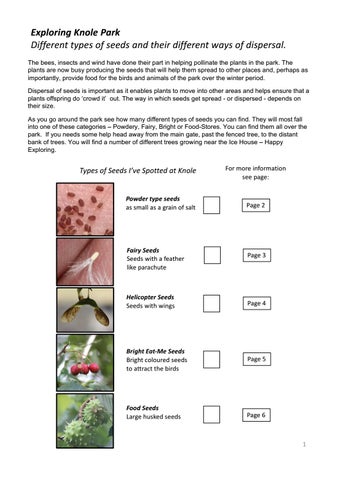
Exploring Knole Park Different types of seeds and their different ways of dispersal. The bees, insects and wind have done their part in helping pollinate the plants in the park. The plants are now busy producing the seeds that will help them spread to other places and, perhaps as importantly, provide food for the birds and animals of the park over the winter period. Dispersal of seeds is important as it enables plants to move into other areas and helps ensure that a plants offspring do ‘crowd it’ out. The way in which seeds get spread - or dispersed - depends on their size. As you go around the park see how many different types of seeds you can find. They will most fall into one of these categories – Powdery, Fairy, Bright or Food-Stores. You can find them all over the park. If you needs some help head away from the main gate, past the fenced tree, to the distant bank of trees. You will find a number of different trees growing near the Ice House – Happy Exploring.
Types of Seeds I’ve Spotted at Knole Powder type seeds as small as a grain of salt
Fairy Seeds Seeds with a feather like parachute
For more information see page:
Page 2
Page 3
Helicopter Seeds Seeds with wings
Page 4
Bright Eat-Me Seeds Bright coloured seeds to attract the birds
Page 5
Food Seeds Large husked seeds
Page 6
1
Powdery Seeds These seeds can be smaller than a grain of salt. The foxglove produces thousands of very tiny seeds. In middle / late August you will find them sitting in the bottom of small brown cups on what was the tall flower spike. These seeds get spread on the wind. They therefore need quite a strong wind if they are to travel far. By sitting in a cup they will only be thrown out when the wind in stronge enough to shake them out of the cup and therefore strong enough to carry them away.
Foxglove flower, seed cup and seeds.
2
Fairy Seeds The seeds of the Ragwort, Dandelions and Thistle are also spread by the wind but are rather heavy so won’t go so far on the breeze. Nature has therefore created a a fluffy type of parachute that helps the seeds float away on the wind.
Ragwort
Thistle Bees at work in July
3
Helicopter Seeds Larger and heaver seeds like found on the Sycamore, Lime and Hornbeam are equipped with wings that make them spin like a helicopter when they fall from the tree. This will slow their fall and keep them in the air longer so the wind can spread them further.
Sycamore
Lime
Hornbeam 4
Bright and Tasty Seeds Bright red berries seem to invite birds to come for a meal. In places in the park you will find late July / August short stumps of bright red berries of the Arum maculatum - sometimes known as the the arum lily or lords-and-ladies, The Hawthorn produces a mass of red berries calls ‘haws’ that ripen during August. These berries are the favourite of many small birds. But being eaten by a bird is not a bad thing as the seeds inside the berry will not be digested in the birds stomach, and will therefore be spread around the park in the bird’s poo.
Haws (berries) of the Hawthorn.
A stem of maturing berries of Arum maculatum – commonly known as the arum lily or ‘lords & ladies.
5
Food-Store Seeds These are large seeds that some animals like the squirrel, and birds such as the Jay, collect and bury in a store that they can go to in the winter. The Horse-Chestnut (conkers), the Oak (acorns), the Beech (nuts / musts) and the Sweet-Chestnut, all produce large seeds that are often buried or hidden. By carrying the ‘nuts’ to different hiding places the foraging animals and birds, help with the dispersal of the seeds. Although many will be eaten others will be forgotten about or missed, and grow into a new tree. Notice how the husks / casing of the Horse-Chestnut, Sweet-Chestnut and Beech are rough or very spiky, and the cup of the acorn protects the growing seed. This is probably to stop foragers having an early meal before the nuts that are inside are ripe.
Horse Chestnut
Sweet Chestnut
Beech Nut
Acorns
Empty Case Case with two seeds
6