YouCount: Engaging youth as citizen social scientists in co-creating sustainable futures
– A Scandinavian approach for a healthy planet
Sara Noémie Plassnig (OsloMet, Norway) & Cathrine M. S. Winther (Aalborg University, Denmark)
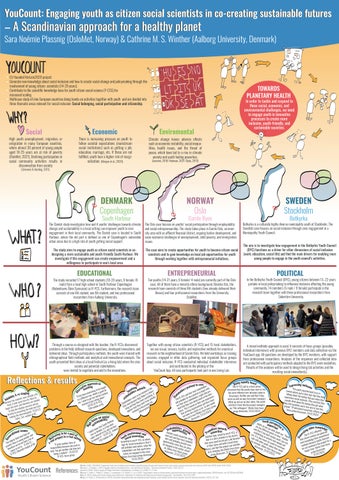
EU-founded Horizon2020 project. Generate new knowledge about social inclusion and how to create social change and policymaking through the involvement of young citizen scientists (14-29 years). Contribute to the scientific knowledge base for youth citizen social science (Y-CSS) for increased scaling. Multicase study of nine European countries doing hands-on activities together with youth and are divided into three thematic areas relevant for social inclusion: Social belonging, social participation and citizenship.
Economic
Social
There is increasing pressure on youth to follow societal expectations (mainstream social institutions) such as getting a job, education, marriage, etc. If these are not fulfilled, youth face a higher risk of marginalization. (Morgan et al., 2020).
High youth unemployment, migration, or emigration in many European countries, where almost 30 percent of young people aged 18-25 years are at risk of poverty (OsloMet, 2021). Declining participation in social community activities results in disconnection from society
TOWARDS PLANETARY HEALTH
In order to tackle and respond to these social, economic, and environmental challenges, we need to engage youth in innovative processes to create more inclusive, youth-friendly, and sustainable societies.
Enviromental
Climate change leaves adverse effects such as economic instability, social inequalities, health issues, and the threat of peace, which have led to a rise in climate anxiety and youth feeling powerless. (Jasmine, 2018; Hickman, 2021; Ojala, 2013)
(Simmons & Harding, 2011).
DENMARK Copenhagen South Harbour
Gamle Byen
The study aims to engage youth as citizen social scientists in codesigning a more sustainable and youth-friendly South Harbour. We investigate if this engagement can create empowerment and a willingness to participate in one's local area.
The case aims to create opportunities for youth to become citizen social scientists and to gain knowledge on local job opportunities for youth through working together with entrepreneurial initiatives.
The aim is to investigate how engagement in the Botkyrka Youth Council (BYC) functions as a driver for other dimensions of social inclusion (work, education, social life) and find the main drivers for enabling more young people to engage in the youth council's activities.
EDUCATIONAL
ENTREPRENEURIAL
POLITICAL
The study recruited 17 high school students (18-20 years, 9 female /8 male) from a local high school in South Harbour Copenhagen (Københavns Åbne Gymnasie) as R-YCS. Furthermore, the research team consists of one MA student, one BA student, and two professional researchers from Aalborg University.
Ten youths (14-21 years, 6 female/ 4 male) are currently part of the Oslo case. All of them have a minority ethnic background. Besides this, the research team consists of three MA students (two already delivered their theses) and four professional researchers from the University OsloMet.
In the Botkyrka Youth Council (BYC), young citizens between 13–22 years partake in local policymaking to influence decisions affecting the young community. 14 members (5 male / 9 female) participate in the research team together with three professional researchers from Södertörn University.
Through a course co-designed with the teacher, the R-YCSs discovered problems in the field, defined research questions, developed innovations, and delivered ideas. Through participatory methods, the youth were trained with ethnographical field methods and analytical and innovational concepts. The youth presented their ideas at a local festival (as a living lab) where the civic society and potential stakeholders were invited to negotiate and add to the innovations.
Together with young citizen scientists (R-YCS) and 15 local stakeholders, we use visual, sensory, tactile, and explorative methods for empirical research in the neighborhood of Gamle Oslo. We held workshops as training sessions, engaged in other data gathering, and organized focus groups about social inclusion. R-YCS conducted individual stakeholder interviews and contributed to the piloting of the YouCount App. All case participants took part in one Living Lab.
A mixed methods approach is used. It consists of focus groups (possibly individual interviews) with previous BYC members and data collection via the YouCount app. All questions are developed by the BYC members, with support from professional researchers. Analyses of the responses and collected data are conducted with participatory methods adapted to the BYC work modalities. Results of the analyses will be used to design living lab activities and the resulting social innovation(s).
ers use t earn s be ac d l o l keh e beca t they ant to s etc. a t S cas tha w sion y e o Osl ng and that th discus on) sti ears ed in rvati app involv (Obse
ocial s n o us ability c ur o o f tain b r Ha n s h t e u u s be w t So
to be a part o g n i vat ect in a real sef i t j ttin Mo al pro g e ar er form of ”It gives anoth ou want to y e s u a c e b y it responsibil than just le o r r e h t o n a help. You get 25.03.22 – ” t n e d u t s a being roup R-YCS, focus g
References:
tha o it ha ee ho t w no ed, s and s uden k t ' idn o divid to try 22, st d I ” as s t 5. G n 0 a . v w rele 03 at K ” r t le i e sup nnect modu o 17th to c
volvement and n i th ial innovation u Yo soc , an advan-
R-YCS According to one on is that it ti a v o n in l ia c o s r tage fo when the r, e tt e b rk o w ly b will proba youth themt a th e e s rs e ld o h stake the issue. in d e g a g n e re a selves cussion, is d p u ro g s u c fo (Notes from 22.03.2022)
d to care ers n e t re old ith, p h e s k er sta egin w et d s l o mo e to b nly pr t h a h id t positiv ight o interke a s e m S y
YC be ver lders h in th rience R One bably stakeho ut yout n expe ave pro some re abo eir ow rms h l l i w hat ca on th and fi would y t e t h bu that t based ations o why roup s s g is tend s. This i organ so far, focus g h view existin ry muc tes from 022) that done ve w?(No 2.03.2 not do it no ssion, 2 they discu
St a
Alt
sti e goo ive r s e i t n h i c i n at h e e r e w c b , y e s a ”It ha fferent w out and b wn” o i t in a d eed to ge t sitting d s n S, me. I tead of ju 22 R-YC ins 03.05. le at KG odu m h t 17
ing ctively the v l o a d in eree v Inv lders l vo is int It n i o eh o be hink it thing. t k m y ta see hey t ome tivel
s
pproach to a e tiv ching ght a u a n t a e b er te ng to d for
keholders pr a t S opportun ov itie ide Anoth er you s t r
h eed an d said researcher ders w disagthat m i o l l s t p ro st oppor tunitie bably prov akeholide mo s sinc dy eng e re t aged i hey ar n e th a on. (N otes f e youths' s lrearom itua discus sion, 2 focus grou tip 2.03.2 022)
g equally heard n i e B
ssing inclus Expre ion
One R-YCS said in a focus group discussion that the youths have more or less the same influence over decisions taken in the project. Another one said that if they come up with an idea, the project managers follow up and act on their ideas. One youth said that it feels like the project managers are “like colleagues”. (Notes from focus group discussion, 22.03.2022)
ices towards d u ej inorities r S, is C Y P m R e n o ised by
pic ra o t r e e district h h t t o n n i A m e l ill a prob t s because s i b t o i j t a a t th e g h do not t u o rejuy p e l a i m c o s a r t ( a s th nd look a e m tribua n n o c r i n e a h t c f t o e projec h t t a h t focus d n m o r f s e t o dices), a g this.(N n i g n a h c .2022) o 3 .0 te t 2 2 , n ussio group disc
OsloMet. (2021). YOUCOUNT: Empowering Youth and correlating social innovation and policymaking through youth-focused citizen social science, proposal submission forms (Horizon 2020 Call: H2020-SwafS-2018-2020). Simmons, L., & Harding, S. (2011). Engaging youth in community practice—An imperative for the future. Journal of Community Practice, 19(3), 229-23 Jasmine B. (2018). Youth as Agents of Change: And Drivers of Development. TerraGreen 11.5 (2018): 12–17. Print. Hickman, C., Marks, E., Pihkala, P., Clayton, S., Lewandowski, E. R., Mayall, E. E., et al. (2021). Young people’s voices on climate anxiety, government betrayal and moral injury: a global phenomenon. SSRN [Preprint]. doi: 10.2139/ssrn.3918955 Ojala, M. (2013). Coping with climate change among adolescents: Implications for subjective well-being and environmental engagement. Sustainability, 5(5), 2191-2209 Morgan, H., Parker, A., & Marturano, N. (2020). Community-based intervention and marginalised youth: Inclusion, social mobility and life-course transition. Journal of Education and Work, 33(5-6), 327-342.
“The yout h reporte conversa d back to tions and us in i n their logs talking ab that they o l experienc ut the feeling the y get whe iked e social in n the clus usually th ink about ion. They said tha y t the feelin they feel g they ge they excluded t when , and it w around.” a s n (Professi ice to tur o n this n a l r e focus gro searcher up discus r sion, 24.0 eflects on 2.2022)
Youth per s Adu lts d impo epct are o no rta ive t t w i said o diff see w nt
eren hat that t if yo esta poin youth u b use. lishin don't ts of v see: “T iew. g an invo he It is l a v a cate e yo ” Anot se lso e ctivi h u w t a for e ith othe sier for y that n th, you er ri o xam y r ple. youth, outh to body wi sk disc (Note about comm ll ussi s on, 2 from f their ne unied 2.03 ocus .202 grou s p 2)
ther knowledge o ng i cted ate e t fl e r ra e R-YCS an gener al
On nce c nvention e i c s izen e than co emselt i c t h tha wledg e youths t t for a o n k more s becaus the projec us c od meth involved in es from fo e ot ves ar r time. (N ussion, longe roup disc 2) g 202 . 3 0 . 22
Ge ne
Ge n
ink g peo lot of h t y un ve a rl o e y d l s a e – The r than u o not h .04.22 G rte e we d . - 21 le at K a m s or act in f odu e r m e o h t e t eventh c a p s Ell , S C R-Y
Botkyrka is a culturally highly diverse municipality south of Stockholm. The Swedish case focuses on social inclusion through civic engagement in a Municipality Youth Council.
s
l issues e a n o ar y ati e r h t nd a t e , a e h l t p
Botkyrka
The Oslo case focuses on youths’ social participation through employability and social entrepreneurship. The study takes place in Gamle Oslo, an innercity area with an affluent financial district, ongoing harbor development, and socio-economic challenges of unemployment, child poverty, and immigration issues.
Hig h s
e s Becau it took som herefore we go tired, ork, and t xercise and tart he w oleplay e t and s n i d l g e r fi be the .22 the 3 p g i 0 k n . i s t 0 n 1 o t prese iewguide o t y l direct the interv odule at KG g makin otes, 3rd m n
SWEDEN Stockholm
The Danish study investigates how and if youths' challenges towards climate change and sustainability in a local setting can empower youth to civic engagement in their local community. The Danish case is located in South Harbour, where the old part is defined as one of Copenhagen's vulnerable urban areas due to a high rate of youth getting social support.
Reflections & results staging y a bit e r lread o ty & a i l e r i e b ts w or them t a n e d d u t d A e the s time f neede
NORWAY Oslo