SPRING/SUMMER 2020
THE BAPTIST FOUNDATION OF OKLAHOMA
Childhood Restored DRIVEN FROM HOME BY ABUSE, INSTABILITY AND NEGLECT, HUNDREDS OF DISPLACED KIDS ARE DISCOVERING THE JOY OF CHRISTCENTERED FAMILY AT OKLAHOMA BAPTIST HOMES FOR CHILDREN. YOUR GIVING MAKES IT POSSIBLE.
2019 ANNUAL IMPACT REPORT
MINISTRY FINANCE: BORROWING WISELY
EMPOWERING MULTI-VOCATIONAL PASTORS
Inside HOPE AND HOMES FOR CHILDREN At-risk kids are reclaiming their childhood and encountering Christ through Gospel-centered parenting at Oklahoma Baptist Homes for Children. Learn why your giving is essential to the state’s largest provider of private, not-for-profit residential childcare. PG. 14
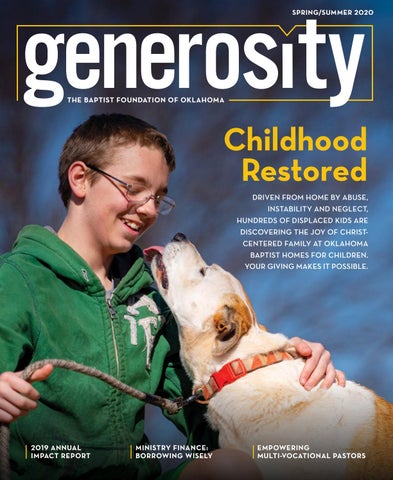
ON THE COVER — Twelve-year-old Minor gets a “kiss” from Ranger, a canine that’s part of Oklahoma Baptist Homes for Children’s Lucky Dog Program, where children learn to care for and train rescue dogs.
2019 ANNUAL IMPACT REPORT
EMPOWERING MINISTRY FINANCE: MULTI-VOCATIONAL PASTORS BORROWING WISELY
From your local church to international missions, giving changes lives. Understand the numbers that provide insight into your generosity’s impact through the Foundation in 2019.
Pastoring a church is hard enough, but with one or more side jobs to make ends meet, being a multi-vocational pastor is downright heroic. Learn how your giving helps Oklahoma Baptists support these go-getting Gospel ministers.
Is your church considering a loan for construction, remodeling, refinancing or purchasing property? Find out what you need to know before you borrow with these six tips from WatersEdge Ministry Services’ church loan expert.
PG. 8
PG. 10
PG. 26
GENEROSIT Y
PRODUCTION
Spring/Summer 2020 Generosity is published biannually by The Baptist Foundation of Oklahoma. To subscribe, request a copy or update mailing information, please call 800.949.9988 or email communications@bfok.org. Copyright 2020. All rights reserved.
Mike Schueler | Editor-in-Chief Anna Dellinger | Managing Editor Marissa Crowson | Visual Editor Jacob Blaze | Design
CONTRIBUTORS
Heather Clark Heather Hamilton Sheryl Hash Shawn Hendricks
Marc Hooks Katie Hurst Corey Smith
bfok.org
1
PHOTO BY MIKE SCHUELER
2
G E N E R O S I T Y Spring/Summer 2019
Take Heart, Christ Has Overcome Uncertainty defines our earthly lives, but not our eternity.
A
s I write this, Southern Baptist churches across Oklahoma are likely still empty. They would normally be filled with individuals and families, worshiping together, studying God’s Word and catching up over coffee and doughnuts. But this Sunday, and possibly for more Sundays to come, places of worship will remain empty. Not because of war or natural disaster or religious persecution, but because of something so small it can be seen only through a microscope.
No one did. At least, no one on earth. As a Christfollower, I take great comfort in knowing that COVID-19 did not catch the creator of the universe off guard. In John 16, Jesus tells believers that we should expect trouble in this world. Some of that trouble will come because of our faith, and some will come because the effects of sin continue to ravage creation. We naturally feel secure when life is going well, but the truth is that uncertainty is our earthly norm. Eventually, COVID-19 will be a distant memory. In the meantime, though, some new calamity will claim our attention. Trouble, hardship, disaster, loss, pain and death will always await us.
I’m talking, of course, about the coronavirus (COVID-19), a word that was completely foreign to me just a few short months ago. In the midst of a crisis, do you ever stop to wonder how you got there? In January of this year, I certainly couldn’t anticipate what would happen as the coronavirus silently infiltrated the United States. The economy was strong as the stock market ascended to record highs and unemployment dipped to lows not seen in 50-plus years. But within a matter of weeks, our country found itself deep in crisis, one we knew was ensnaring others but seemed too distant to affect us.
But the Lord instructs Christians to “take heart” because the day is soon coming when He will end suffering forever. While our earthly travails are haunted by the unknown, believers rest in the truth that our eternity is secured by Jesus’ death and resurrection.
How wrong we were. Who knew the stock market would lose 30 percent of its value, or that millions of Americans would suddenly find themselves out of work? Who knew that common items like toilet paper and breathing masks would be hoarded like treasure, and that schools, cities and entire economies would grind to a near standstill?
Instead, let’s choose to seek first God’s Kingdom and His righteousness. Will you join me?
If our lives are merely “a vapor” as Scripture suggests, then so, too, are these uncertain times. As Jesus tells us in Matthew 6, don’t worr y about tomorrow. Each day brings enough trouble of its own, and the Lord knows our needs more intimately than we do.
Robert K. Kellogg President & CEO
CHURCH IS NOT A BUILDING — Like most churches across Oklahoma, seats were empty inside the worship center at Quail Springs Baptist Church on Easter Sunday due to COVID-19 restrictions. But that didn’t stop the Oklahoma City congregation from celebrating Christ’s resurrection from home, either in private family services or online, thanks to live streaming via Facebook.
bfok.org
3
#BecauseYouGive
4
G E N E R O S I T Y Spring/Summer 2020
PHOTO BY HEATHER HAMILTON
A NIGHT AT THE OPERA Papageno (Chase Davis, right) advises the young prince Tamino (Alex Bolerjack, left) during Oklahoma Baptist University’s (OBU) production of Mozart’s “The Magic Flute.” OBU’s Warren M. Angell College of Fine Arts puts on dozens of events each year, from operas and musicals to concerts and jazz festivals. Many OBU music and theater students depend on scholarships to help cover tuition, and your generosity provides these scholarship dollars. #BecauseYouGive, students receive a nationally ranked education grounded in a Christ-centered worldview. The Foundation’s planned giving professionals can help maximize your gift’s impact. Contact us today at 800.949.9988 or give@bfok.org, or donate online at bfok.org/give.
bfok.org
5
#BecauseYouGive
SINGING WITH THE SAINTS Don Baxter, 86, directs the “Singing Saints Choir,” one of the many service opportunities open to residents at Baptist Village of Oklahoma City. The choir tours Baptist Village Communities’ 12 campuses across the state, putting on performances that brighten residents’ lives. #BecauseYouGive, Baptist Village Communities (BVC) is Oklahoma’s largest nonprofit provider of Christ-focused senior housing services, caring for more than 2,300 individuals each day. The Foundation can help you multiply your gifts to support BVC’s ministry; contact our planned giving professionals at 800.949.9988 or give@bfok.org, or donate online at bfok.org/give. *This photo was taken prior to the COVID-19 pandemic.
6
G E N E R O S I T Y Spring/Summer 2020
PHOTO BY MIKE SCHUELER
bfok.org
7
2019 ANNUAL IMPACT REPORT Endowment Distribution The Foundation serves donors by inspiring generosity and multiplying gifts that strengthen ministry. Our vision is to distribute $25 million to ministry annually by the year 2025. We call it “25x25” (25 by 25). In 2019, the Foundation distributed a total of $29.9 million, exceeding our $19.7 million benchmark. Of this $29.9 million, $13.1 million was directed to more than 300 charitable beneficiaries through the Foundation’s Endowment Distribution.
Total: $13.1 Million
Caring for At-Risk Mothers and Children $3.1M
Churches and Associations $1.3M
Other Ministries $829K
Missions and Seminaries $655K Christian Higher Education $5.5M 8
G E N E R O S I T Y Spring/Summer 2020
Evangelism and Church Planting $1.2M
Senior Adults $476K
Planned Gifts
Estate Planning
Planned giving allows generous individuals like you to impact the ministries you care about, grow God’s Kingdom and provide practical help to those in need. In 2019, your planned gifts impacted thousands of lives.
Online tools, legal fee reimbursement and personal guidance make the Foundation’s estate planning experience unique. Each year, we help hundreds of individuals and families protect loved ones, safeguard their assets and leave legacy gifts that support Kingdom causes.
TOTAL
$17.2 MILLION
Endowments: $11.3M Donor Advised Funds: $5.4M
PLEDGED
$29.7
Charitable Gift Annuities: $233K Charitable Remainder Trusts: $219K
MILLION
341 FAMILIES
WatersEdge Ministry Services is the Foundation’s brand for ministry-focused loan, investment and accounting services.
Ministry Investments
Church Loans
WatersEdge manages more than 272 Demand & Term Investment accounts totaling $59 million. These short- and long-term investment options are designed to multiply ministry resources and maximize Kingdom impact.
In 2019, WatersEdge made 44 loans ranging from $5,000 to $6.3 million to Southern Baptist organizations across the country. WatersEdge collected $4.8 million in interest from these loans. The vast majority of this interest was returned to ministries throughout Oklahoma and across the nation.
Dollars Invested Loan Interest Returned to Ministry
$59,041,038
$60M
2019 $40M
$4,774,220
2018
$4,098,285
2017 $20M 0 2014
2015
2016
2017
2018
2019
$4,013,315
2016
$4,074,866
2015
$4,138,259
2014
$4,032,091
Ministry Accounting Launched in mid-2019, WatersEdge provides churches with affordable bookkeeping, payroll and contribution tracking services that are designed to relieve the burden of managing ministry finances, allowing pastors and church staff to devote more time, energy and resources to advancing the Gospel.
Bookkeeping
Payroll
Contribution Tracking bfok.org
9
10
G E N E R O S I T Y Spring/Summer 2020
A PASTOR DIVIDED Multi-vocational pastors are the bedrock of Southern Baptist life. But splitting time between the needs of their church and a second (or third!) job that helps pay the bills is a herculean feat. Find out how your giving is strengthening Oklahoma Baptist MVPs. BY SHAWN HENDRICKS
L
eading a church isn’t easy. Pastors often wear multiple hats, especially at smaller churches with few or no staff. Juggling responsibilities that range from preacher to janitor and everything in between, they’re often left feeling like Bilbo Baggins in Tolkien’s “Lord of the Rings” saga: pulled in too many directions, stretched thin, like “butter scraped over too much bread.” This feeling is doubly true for multi-vocational pastors (MVP). Also known as bi-vocational pastors, MVPs typically lead congregations that — though they may be vibrant, healthy and Gospel-centered — are simply too small to pay a living wage. Instead, MVPs serve like the apostle Paul, who received some financial support from churches but also worked as a tentmaker to meet the remainder of his needs.
bfok.org
11
Bruce Kirby knows firsthand the challenges that come with this kind of sacred-secular divide. He’s pastored Southwest Baptist Church in Ardmore, Oklahoma, for the past six years but also works a second job in the funeral home business. The difficulty of holding down multiple jobs has given him a special appreciation for other MVPs and the importance of a network of support around them.
is a strong advocate for Oklahoma’s MVPs. “Multi-vocational pastors are vital partners in our work to spread the Gospel, especially among smallerin-attendance churches,” Ligon says. “Without them, many of these churches would struggle or cease to exist. God is using MVPs powerfully for His Kingdom, and countless souls
One way Oklahoma Baptists are strengthening multi-vocational pastors is by building a “MVP network” that they can lean on for encouragement, accountability and training.
“I think MVPs need to be encouraged,” says Kirby, noting that many of them often feel as if “they are all out there by their lonesome.” More than 50 percent of Oklahoma Baptist pastors are multi-vocational, and about 80 percent of these pastors serve churches with 125 or fewer in attendance each Sunday. Some Oklahoma Baptist associations may have only one church whose pastor isn’t multi-vocational. Joe Ligon, Oklahoma Baptists’ senior associate executive director,
12
G E N E R O S I T Y Spring/Summer 2020
will spend eternity with Jesus thanks to their hard work and sacrifice.” Philip Jones has served as Oklahoma Baptists’ MVP consultant since 2016. A former pastor with more than 30 years of experience, he believes MVPs need to know state Baptist leadership cares about their ministry. “We need to give these guys the respect that is due them,” Jones says. “If we’re going to reach our state, we’ve got to have more of these pastors go into these rural areas where the Gospel is desperately needed.”
One way Oklahoma Baptists are strengthening multi-vocational pastors is by building a “MVP network” that they can lean on for encouragement, accountability and training. Oklahoma Baptists also offer the Haskins School of Christian Ministry, which provides theological education to pastors who lack the opportunity to get the training they need, says Mark McClellan, the school’s dean and Oklahoma Baptists’ ethnic evangelism specialist. “We felt like there was a large group of pastors, local church leaders, ethnic congregations and small churches that were simply not being prepared by institutional programs,” McClellan says. “We’re combining excellent practical training, using online technologies with local mentoring so that we can access the very best instructors to give spiritual formation to our students.” Another way Oklahoma Baptists are strengthening these pastors is through the annual Multi-Vocational Pastors and Wives Retreat, which drew about 180 people at the Falls Creek Baptist Conference Center, Feb. 28-March 1. The third annual event was held for MVPs of churches with fewer than 125 in attendance each week. Bob Cherry and his wife, Kay, were among those pastors and wives who attended the retreat. Cherry, pastor of Beth-El Baptist Church in Red Oak, Oklahoma, says he is grateful
to Oklahoma Baptists for their efforts to help MVPs feel appreciated and valued — just like any “big church” pastor around the state.
You get the heat on if it’s winter. You turn the lights on, unlock everything, and run and study your sermon again so you don’t forget it.”
Cherry, who has served most of his 46 years of pastoral ministry as an MVP, has experienced his share of challenges leading a congregation of about 70 people while holding down a second job.
Building relationships with Oklahoma Baptist leadership is important, Cherry says. Sometimes MVPs are tempted to compare themselves to pastors who lead larger congregations and have more staff support and resources around them.
“I used to have to drive the church bus,” recalls the 76-year-old pastor, who is now semi-retired. “You get there early before they get there.
“You compare your 10 that you baptized and say, ‘Man, that’s not enough,
Support Multi-Vocational Pastors Through Oklahoma Baptists
I’m not doing well,’” he says. “None of us ever feel like we’ve done enough for the good Lord.” But Cherry remembers those insecurities melting away at the retreat, what he describes as a “top-shelf program.” “It’s always enjoyable to be around your peers and visit with them,” he says. “We laughed, we rejoiced and we took notes. There wasn’t a person there that went away thinking we weren’t important to Oklahoma Baptists.”
Oklahoma Baptists support the work of more than 1,700 Southern Baptist churches across the state, including hundreds of multi-vocational pastors. The Foundation’s planned giving specialists can help you leave a gift that will serve and strengthen these congregations for generations to come. Contact us today to multiply your giving. give@bfok.org
800.949.9988
bfok.org/give
bfok.org
13
HOM FEELS LIKE
FAMILY PORTRAIT — This doesn’t look like a typical family photo, but it’s an authentic representation of any cottage “family” at Oklahoma Baptist Homes for Children. Leah and Brian Ingraham serve as houseparents of eight boys on one of four OBHC campuses across the state.
14
G E N E R O S I T Y Spring/Summer 2020
OME Displaced children often endure abuse, neglect and instability. But Oklahoma Baptist Homes for Children is helping hundreds transform their futures. Discover how your giving provides kids with love, hope and a purpose. BY KATIE HURST | PHOTOS BY MARC HOOKS AND HEATHER CLARK
bfok.org
15
Editor’s Note: For security and privacy reasons, last names of children 18 or under have been omitted.
W
HEN ANDREA WAS 5 YEARS OLD, INSTEAD OF PLAYING WITH DOLLS, SHE WAS CHANGING HER BABY SISTER’S DIAPERS. INSTEAD OF PLAYING HOUSE, SHE WAS TRYING HER BEST TO MAKE DINNER AND WAS LEAVING MEALS OUTSIDE HER MOTHER’S LOCKED DOOR. WHEN ANDREA’S FATHER DIED OF A BRAIN TUMOR EARLIER THAT YEAR, SHE LOST ANY SENSE OF A NORMAL CHILDHOOD. “When my father passed away, it just about killed my mom,” Andrea remembers. “She had mental illnesses and after he was gone, she got really depressed. She stayed in her room all day, all the time. She never came out and she didn’t take very good care of me. I did my best to look after my sister.” The girls were shuffled between foster care and family members for the next several years. By the time she was 9, however, Andrea and her family found themselves needing help as she struggled to adjust. That’s when her therapist told her about Oklahoma Baptist Homes for Children (OBHC), a not-for-profit Christian organization offering residential care for kids in need of a home. “Honestly, at that point I thought that being anywhere else would be better than where I was,” Andrea remembers. “Even though OBHC was a new place where I didn’t know anyone, I felt like I was wanted, and it was really nice.” Since 1903, OBHC has been caring for children like Andrea, providing a loving home and a supportive environment in which to grow physically, emotionally and spiritually. Children ages 6-18 live in cottage-like houses on four campuses across the state. Each cottage houses up
to eight boys or girls who are supervised by houseparents. For many of the children, life at OBHC is the first time they’ve experienced a stable home environment. “We live in a society today where kids are orphaned even though their mom and dad are still alive,” says Greg McNeece, president of OBHC. “Mom or dad may be incarcerated, strung out on drugs, or have just completely abandoned their role as a parent and left a child to fend for themselves. The 200-plus kids we’re able to serve each day are what I call ‘social orphans.’ Mom or dad may be living, but they’re not in the picture whatsoever.” For 8 -year-old Aurora, life at OBHC has brought a stability she’s never had before. After her grandmother died of a sudden illness, Aurora and her brother lived with several different family members before finding a home at OBHC. “I think I’m going to have a better life here because I’m not bouncing all over the place now,” she says. “I’ve moved like nine or 10 times already!” Like Aurora, many kids come to OBHC after being shuffled between extended family members. Sometimes their grandparents have health or financial problems that make them unable to care for the children. In some
2019 FAST FACTS 4
campuses
16
8-10 cottages per campus
G E N E R O S I T Y Spring/Summer 2020
301
children served (total includes Children’s Hope)
6-8
children per cottage
STUDY SPACE — 15-year-old Andrea enjoys studying in her cottage at OBHC. “I love school,” she says. “I currently have straight A’s!” While living on campus, children attend public school and have the space and structured quiet time to study and complete homework every day.
instances there’s tension between blended family members that makes for an emotionally unhealthy environment. For one reason or another, children are left with physical, emotional and spiritual needs that OBHC is able to meet by providing care in a supportive, Christ-centered home setting.
MORE THAN A PLACE TO LIVE It’s the stability and routine of this everyday life that can be the most transformative for the children OBHC serves, McNeece explains. For once, they don’t have to worry about where their next meal will come from, how to survive in a house when the electricity has been shut off or who is or isn’t going to be there when they get home from school. “OBHC allows them to be kids again,” McNeece says. “They get to experience life, grow and mature without worrying about adult issues that they shouldn’t have to face at such a young age.”
That’s exactly what 12-year-old Minor found at OBHC — refuge from the stress and pressure of responsibilities far beyond his age. Before he arrived, it was often left to him to take care of his two younger siblings in a chaotic home life that included parental drug abuse and neglect. Now Minor enjoys studying computer science at school, participating in the welding program offered at his OBHC campus and playing football and basketball with the other boys from his cottage. “When I came here, I was afraid the other boys weren’t going to be nice and that the houseparents would be really strict,” he says. “But my houseparents are amazing. There are so many people here to comfort and help you. You know you’re supported.” Minor’s houseparents, Brian and Leah Ingraham, have seen about 40 boys come through their cottage in the three years they’ve served at OBHC. Despite the common misconception, the Ingrahams say none of the boys are bfok.org
17
GETTING WITH THE PROGRAM Each of OBHC’s campuses offer children the opportunity to participate in a variety of after-school programs that teach important life skills and help instill responsibility, self-esteem and a healthy work ethic. Some of the programs include:
LUCKY DOG PROGRAM At Boys Ranch Town, children learn to care for and train rescue dogs. From basic commands to more advanced agility courses, each child is responsible for teaching skills and obedience to his dog as they advance through the program.
HORSE PROGRAM What’s a ranch without horses? Boys Ranch Town residents learn to ride and care for horses, even competing in local competitions.
FARM ANIMAL PROGRAM On several OBHC campuses, children learn to tend and show farm animals, including sheep, cows and pigs.
WORK PROGRAM Participating in landscaping, welding or gardening on campus, children learn important skills and the value of hard work. At the end of each semester, participants are paid based on their time and the quality of their work.
18
G E N E R O S I T Y Spring/Summer 2020
The 200-plus kids we’re able to serve each day are what I call ‘social orphans.’ Mom or dad may be living, but they’re not in the picture whatsoever. bad kids. They’re not there because they’re in trouble or on probation — they’re just children who’ve escaped a bad situation and simply need a loving home. “Every family is broken,” Brian says. “That’s the problem. And almost every single one of them doesn’t have a dad. But we let the boys know that ‘You can stop the cycle of broken families.’ So much of the brokenness and poverty is self-inflicted. We tell them, ‘You guys don’t have to be that way. You can still love your parents and respect them, but you can change.’”
HEALING FAMILY TIES Family reunification is one of the main goals that children at OBHC work toward. Those with families regularly go on weekend visitations. They also have access to counseling and, most importantly, witness daily modeling of healthy relationships in their cottage. Henriatta Collins lived at OBHC’s Owasso campus for eight years as a teenager and young adult. Before she arrived at the children’s home at age 17, she was living with her two adult sisters when they became homeless. Because of her family’s dysfunctional relationships, she says she never knew any peace. But after only a few months at OBHC, she realized it was different. “My perception of how families work and how individuals should treat others changed while I was there,” Collins says. “I saw you can actually have a home where you feel safe, loved and heard. I was starting to learn that chaos is not everywhere.” For Shane Sellers, life at OBHC as a 16-year-old taught him how to forge quality friendships and serve as a role model to the younger boys in his cottage. Sellers is the first to admit he was the instigator of most of his troubles before he arrived at OBHC’s Boys Ranch Town. Often rebellious at home and involved in fights at school, he was hanging with the wrong crowd when he started skipping class and
experimenting with drugs. Sellers credits his three-year stay at OBHC for healing his relationship with his parents and getting him to where he is now — a senior at Oklahoma State University making plans to attend grad school in the fall.
explains. “At the end of the day, everything is about relationships. A spiritual walk with the Lord is built where? Well, it’s built on a relationship — a personal relationship with Jesus Christ.”
“The guy I was skipping school with back then is in jail now for like 15 years. If it weren’t for Boys Ranch Town, I’d probably be in the same boat,” Sellers says.
IMPARTING FAITH
Children living on OBHC campuses learn many life skills needed to prepare them for a successful future, from work ethic and budgeting to study habits and personal responsibility. But the most important life skill taught is building and maintaining quality relationships, McNeece says. “If they have healthy relationships, they’re going to be able to find contentment and happiness in life,” he
Boys and girls come to OBHC from a broad spectrum of faith backgrounds. Some already know the Lord, while others have never set foot inside a church or opened the Bible. Through the spiritual guidance of their houseparents and twice weekly church attendance, the Gospel is spread through each cottage, meeting each child where he or she is. Now 15 years old, Andrea has been living at OBHC for six years. Though she had heard about God before, she had a hard time believing that He loved her because of
BRIGHT FUTURE — OBHC alumnus Shane Sellers works in the lab at Oklahoma State University, where he’s studying entomology. He says his time at OBHC as a teenager gave him the focus, motivation and skill set to get to college and work toward career goals.
bfok.org
19
20
G E N E R O S I T Y Spring/Summer 2020
the bad things that kept happening in her life. After her mom died, Andrea became so depressed she started cutting herself and thinking about suicide. While attending church camp with her cottage, she heard a Gospel message that radically changed her life. “I remember I felt God for the first time,” Andrea says. “I thought about everything that had happened and I realized that I was wrong — I wasn’t alone. People did care about me. My biggest dream was always to have a family. I never really thought about the people at OBHC being my family until then. I realized God had actually given me everything I wanted. It was right in front of me the entire time.” Andrea gave her life to Christ that night and celebrated with friends in her cottage and her houseparents. Collins, who now works with children as a mental health therapist, also credits OBHC for her relationship with Christ and her ability to let go of her past. When she first arrived at OBHC, Collins struggled with low self-esteem and remembers being angry all the time. But after learning about who God is, her attitude started to shift.
HISTORY First OBHC cottage opened in
1903
11,725
children in OBHC’s care since its founding
FUNDRAISING Of the $12 million needed for OBHC to function each year,
$6 MILLION must be raised through donations.
“My heart changed from a bitter, angry, resentful person to the kind and compassionate person that God wanted me to be,” she says. “It was because they said Christ loved me. And then Christ came into my heart and everything changed.”
YOU CAN HELP CHANGE LIVES
OBHC encourages spiritual growth in all the children they serve by providing a Christ-like example, McNeece says. Houseparents share what it means to have hope not only in this life, but in a life to come.
“Growing up, we were always really poor,” Sellers recalls. “It was cool coming to the Ranch (a nickname for OBHC’s Boys Ranch Town campus). They’ve got the pool, horses, this big yard and basketball courts. The food is always fresh and there are always three meals a day. It was actually a really big culture shock.”
“It’s up to us to model a Christian life for them and to have those conversations, when appropriate, about salvation and what Jesus came to the world to do,” he explains. “We don’t browbeat them with the Gospel, but we help them understand that there is a reason for what we do, and His name is Jesus.”
OPPOSITE PAGE, TOP: KIDS AGAIN — 12-year-old Minor (far left) jokes with the other boys in his cottage at OBHC. Since living here, Minor says the pressure of taking care of himself and his siblings has been taken off and he feels like he can be a kid again. OPPOSITE PAGE, BOTTOM: HERE PIG — 8-year-old Aurora (right) helps walk Patty the pig with her cottage sister Krysha. Aurora says helping with the livestock in the farm animal program is her favorite part of living at OBHC.
For many children, coming to OBHC is a big lifestyle change — escaping poverty, homelessness or neglect and transitioning to a home where they are wellprovided for.
Though OBHC is the largest not-for-profit provider of residential childcare in the state, the organization accepts no government funding and never charges for services. Instead, OBHC is supported entirely by the generosity of individuals and families. “Donors make it happen day-in and day-out,” McNeece says. “We have the worst business model in the world: we give away everything we raise.” OBHC needs approximately $12 million each year to operate. By not accepting state or federal funding, the bfok.org
21
LOOKING BACK — Lacey Spencer (left) shows her children around OBHC’s Owasso campus where she spent six years of her childhood. The crosses in the background mark the place where Spencer’s cottage used to stand. “One thing I want to instill in them is that no matter what adversity they face, to never ever give up,” she says.
organization is able to retain its autonomy and independence, which allows for a direct emphasis on the Gospel in the homes. But it also means any change in donors’ giving patterns can directly affect the children OBHC serves. “If we can’t make our budget, we can’t pay salaries and we have to close cottages,” McNeece explains. “In an organization like ours that generally runs at full capacity, if we close a cottage, it means eight kids have to go somewhere else to live.” McNeece adds that donors who support OBHC through the organization’s endowment with The Baptist Foundation of Oklahoma can help mitigate the ups and downs of annual giving cycles. That’s because endowment is designed to provide a continuous source of financial support that multiplies a donor’s gift many times beyond the original amount. When people give to OBHC through endowment, their gift is invested and a portion of the growth is used to fund OBHC’s operations each year. The remainder is reinvested to preserve and grow the original gift. This cycle creates a perpetual income stream that will help meet the organization’s future needs. “OBHC’s endowment allows us to more accurately budget for our needs each year, avoiding unnecessary cuts to services,” McNeece explains. Donors rely on the Foundation’s planned giving professionals and biblically grounded asset management strategies to ensure
MISSION STATEMENT To demonstrate God’s love by providing hope through empowering children and their families to follow Christ.
22
G E N E R O S I T Y Spring/Summer 2020
Additional funding allows OBHC to build new cottages and hire more houseparents, which means even more displaced children can have a home.
OBHC’s ability to continue providing hope and homes for children for generations to come. Beyond guaranteeing OBHC’s long-term stability, more donors are needed, not only to meet annual budget needs, but to respond to the ever-growing numbers of children who need care. Additional funding allows OBHC to build new cottages and hire more houseparents, which means even more displaced children can have a home. Serving as houseparents, the Ingrahams have a front-row seat to witness the transformative impact that a donor’s gift can make on the children in their care. They often remind the boys that life isn’t free, but the things they enjoy at OBHC have been generously provided by people who love God. “They see that God is real, that He’s involved here and that He’s providing this,” Leah Ingraham says. “Through the blessings of this home, when we get to take them to an
PLANTING SEEDS — Leah and Brian Ingraham say they feel called to serve as houseparents at OBHC and share the love of Jesus on a daily basis with the boys in their cottage. The Ingrahams have mentored more than 40 boys during the three years they’ve served as houseparents. Through group devotions and Scripture memory, the couple plant seeds by getting the kids in the Word every day.
amusement park or on vacation in the summer, we point it back to God, and that’s big because those are things they can see and touch.” As children at OBHC approach high school graduation, their houseparents and case workers help them develop a plan for leaving the cottage. If reuniting with their family is not an option, OBHC offers a transitional housing program for those continuing their education in college or trade school. These apartment-like homes allow for more independent living while teaching self-sufficiency and personal responsibility. Though life won’t be perfect once children leave OBHC, the Ingrahams know the seeds they help plant in kids’ lives will bear fruit, even if they never get to see it. That was true for Lacey Spencer, a 32-year-old mother of two who lived at OBHC’s Owasso campus for six years as a child. Now supporting herself and working toward buying her first home, she remembers her years at OBHC as the most stable of her childhood.
“They offer a safe haven and they give you a place to call home,” Spencer says. “When you leave, you can choose to follow the path that they’ve shown you, or you can follow a different path. Either way, they give you all the tools you need to change your life.”
Give Children A Place To Thrive OBHC neither charges families for its services nor accepts government funding, which makes the organization’s Gospel emphasis possible. Instead, OBHC depends on the generosity of donors like you. Contact the Foundation’s planned giving professionals today to multiply your gift’s impact. give@bfok.org
800.949.9988
bfok.org/give bfok.org
23
24
G E N E R O S I T Y Spring/Summer 2020
WHY I GIVE Carmen Henderson
“E
very day I say, ‘God, let me be a blessing to somebody.’ I get so much pleasure and satisfaction and joy to give whatever I can each year.” Carmen Henderson, 95, plans on giving as long as she’s on this earth. Together with her husband, Orville, the couple spent years building a legacy of giving that Carmen continues today. The Hendersons weren’t able to have children of their own, so they took the opportunities God gave them to use their time and money to demonstrate
Christ’s love to kids at Oklahoma Baptist Homes for Children, and to senior adults at Baptist Village Communities in Owasso.
through investment while simultaneously providing immediate tax benefits and a lifetime income stream to the donor.
“It just seemed like we were drawn to old people and children. That was our ministry,” Carmen says.
“I wish that we would have known more about charitable gift annuities when we were younger,” Carmen says. “We didn’t have a lot of money, but I think giving in this way is one of the best things that you can do.”
The Hendersons also looked for ways to make their giving go even further. Years ago, they learned how the Foundation could help them do that through giving options like charitable gift annuities and charitable remainder trusts. These vehicles grow gifts
If you’re interested in multiplying your giving, contact the Foundation at give@bfok.org or 800.949.9988. bfok.org
25
MINISTRY FINANCE
BORROWING W I S E LY I S A L OA N T H E R I G H T O P T I O N F O R YO U R C H U R C H ? S I X T H I N G S T O C O N S I D E R B E F O R E YO U B O R R O W. BY JERRY VAUGHAN, PRESIDENT OF WATERSEDGE MINISTRY SERVICES 26
G E N E R O S I T Y Spring/Summer 2020
I
n my nearly 40 years of lending experience in both the secular banking industry and religious financial services, I’ve seen God lead people to do a lot of great things for His Kingdom, but I’ve also seen a lot of mistakes. When it comes to churches borrowing money, regardless of the size of the church or the loan, here are some things to keep in mind.
1. START WITH A WELLTHOUGHT-OUT PLAN. The church needs to be in agreement on the arrangements of what to build, how to build it and how much to borrow. Many churches come to me, delighted to see growth in their congregation and say something like, “We want to take out a loan for a new educational space.” While the desire is there, a plan must exist to bring it into reality. First, determine your church’s need. Consult with an architect who will come up with a design that best meets that need. Next, determine the cost. Finally, secure sources of funding. Typically, a combination of capital fundraising and borrowing works best.
2. COUNT THE COST. Luke 14:28-30 speaks of a man that doesn’t calculate the cost of building. He is able to lay the foundation but is not able to finish. All who observe him begin to ridicule and mock him. The same truths apply to churches building today: don’t build more than you can afford, and don’t cut corners. While it may seem like
a large cost upfront, I would always recommend hiring an architect, as his or her expertise can end up saving money in the long run. At WatersEdge, we use a ratio of debt to income to determine a safe loan amount for a church. We consider a loan equal to 25 percent of annual budget receipts to be the max level of debt a church should take on.
3. FIND WAYS TO ENGINEER OUT COSTS WITHOUT CUTTING CORNERS. If you know what you want to build but the cost is more than anticipated, there are plenty of ways to reduce expenses that won’t deteriorate your building’s design. Some examples include choosing lower-grade doors, opting for vinyl baseboards instead of
10 -15 percent each year due to inflation. A church may start out with a $1 million project, but if they take four years to save and raise the money, it ends up being a $1.5 million project. In the long run, it may save your church money to take out a loan. Building debt-free also has a tendency to take much longer than borrowing, which can be difficult for churches experiencing growth. One church I worked with raised money and pieced together a building over the course of 10 years as they tried to build debt-free. I will never forget what the pastor told me: “What bothers me most is that we lost three generations of youth who we weren’t able to reach because we didn’t have the space.
The church needs to be in agreement on the arrangements of what to build, how to build it and how much to borrow.
wooden ones, more efficient light fixtures, stained concrete instead of tile, or a metal building without a brick facade.
4. IF TRYING TO BUILD DEBT-FREE, MAKE SURE YOU CAN RAISE FUNDS QUICKLY. The prices of building and material costs have a tendency to rise
If I had known it was going to take this long, we would’ve borrowed the money a long time ago.”
5. WHAT ABOUT REFINANCING? A church should consider refinancing only if they can lower both their interest rate and monthly payment. Don’t assume banks bfok.org
27
I’ve seen debt destroy churches. The most dangerous mindset a church can have is that taking out a loan is not a big deal.
are your only option for refinancing. Ministry-based lenders like WatersEdge have competitive rates and return loan interest back to ministry. Another reason to move a church’s loan from a bank to a ministry-based lender is that we understand the potential pitfalls of church finances and are better positioned to guide congregations when things get tough.
months down the road, the new car feel wears off and it becomes much less of a joy to make those payments.
churches take out a loan with a 20year term, but the vast majority pay it back within five to seven years. That’s good stewardship.
A church must be committed to paying off a loan quickly. Most churches make it a priority to get out of debt using capital campaigns, devoting extra offerings to principal payments or special fundraising emphases. Many of our
I thank God for the opportunity I have to serve churches in such a unique way. My prayer is that every congregation considering a loan will be united as they bring their plan before the Lord, and that the result will further His Kingdom.
6. TAKE THE BURDEN OF DEBT SERIOUSLY. I’ve seen debt destroy churches. The most dangerous mindset a church can have is that taking out a loan is not a big deal. The commitment doesn’t go away. Borrowing to build something new for your church can be like the excitement of buying a new car. When you drive it off the lot, you don’t care how much the payments are or how long you’ll be paying them. But five or six
28
G E N E R O S I T Y Spring/Summer 2020
Grow Your Ministry Wisely With A Loan That Puts Kingdom Causes First We understand the seriousness of borrowing money, and we want to help you do it safely. Unlike traditional lenders, WatersEdge pours loan interest back into Southern Baptist ministries that touch lives with the Gospel. Apply online today. loans@WatersEdgeServices.org 866.693.8369
WatersEdgeServices.org/loans
A HEAVENLY
Homecoming Celebrating a Good and Godly Friend BY ANNA DELLINGER
E
very time Floyd McKee walked into my office, he lit up the room with a smile and said, “Hi, Miss Anna. How are you doing today?” He took a few minutes to get to know me just a little bit better, and it meant the world to me. Floyd wasn’t just a colleague — he was a friend. Floyd was serious about sharing the Gospel with Oklahoma Baptists. He proclaimed his love for Jesus from the pulpit at Rancho Village Baptist Church for the past 29 years, and he preached the message of stewardship to congregations across the state for the past four years as the Foundation’s director of donor relations. Floyd was passionate about helping people protect their families, prepare for the future, and promote God’s kingdom through estate planning and legacy giving. “He saw the importance of the services that we could bring to churches like his,” says Shryln Treadwell, the Foundation’s chief operating officer. “I think he saw it as an honor and privilege to be a part of a bigger impact and for his ministry to grow beyond his church.” When Brian Lohrey moved from Colorado and began work at the Foundation as director of church and association relations, Floyd served as a mentor. “He was one of the main people who helped me transition from what I
did before to now. He was always a big encouragement,” Lohrey says. “Floyd was a walking testimony to how the work the Foundation is doing could further ministry in all styles and shapes of churches.” During the last few years of his life, the cancer that plagued Floyd’s body had no hold over him. He stayed busy living, because he didn’t have time to be busy dying. Despite the pain and sickness he experienced on a daily basis, he worked hard for every relationship, every smile and every salvation opportunity that came his way. “He was just an amazing man who loved people well, and he never put himself first,” his wife, Pamela, says. “It was always God first and his family. He was probably the most selfless person I’ve ever met. He just wanted to be a friend to everyone.” There is something to be said about being a good friend. At the memorial service celebrating his life, nearly every speaker claimed that Floyd was his best friend and that he was Floyd’s. One of the pastors at the service shared a quote from “Shawshank Redemption,” a movie known for its story of friendship: “I guess I just miss my friend.” Anybody who knew Floyd McKee can relate. Even though he’s in a better place, a place he’s always wanted to be, I guess we just miss our friend.
GET AN ESTIMATE: