

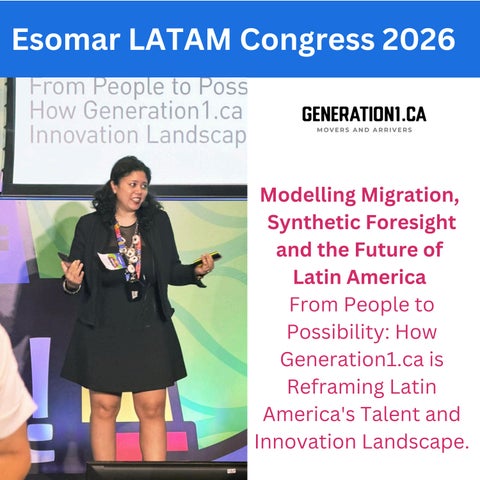




Arundati Dandapani, CEO and Founder

Our work advances three intersecting conversations across methodological innovation, policy research and foresight-driven storytelling. First, we reframe Latin American migration as a forward-looking system of capability formation, rather than a retrospective problem of population flows. Second, we demonstrate how census microdata combined with ethically governed synthetic populations can repair persistent representational gaps in transnational research. Third, drawing on empirical evidence from Canada (and, in later analysis, the United States), we show that social inclusion and AI readiness—rather than arrival characteristics—are the strongest predictors of immigrant retention. Public discourse and research literature continue to focus on what is already familiar: Latin American immigrants move to North America and face persistent structural, linguistic and institutional barriers during migration and settlement. Yet, data stories and narratives emerging from Generation1.ca’s more than 2,000member professional community association (where Latin American professionals represent the third-largest diaspora group after South Asia and Africa), point to a more expansive and underexplored reality.
Samantha, one of our immigrant members and a Generation1.ca blog competition winner, shares her experiences and motivation for moving:
“My partner and I decided to come to Canada from Mexico three years ago, attracted by the multiculturalism and to seek new opportunities. Fortunately, most of our new experiences were amazing, even though the cultural shock was inevitable. I consider that the biggest challenge has been navigating the job market and making connections, while integrating into new social circles. Mexicans are still searching for opportunities in the US over Canada unless they have an offer (job or college/university admission), but maybe this will change as it gets harder to go to the US.”
When migration is approached with intentional planning, particularly within Canada’s evolving opportunity landscape, Latin American diasporas across North America reveal significant untapped potential. Beyond permanent relocation to Canada or the United States, opportunity increasingly takes transnational forms, including remote work opportunities with North American firms, cross-border entrepreneurship and the activation of diaspora networks as powerful engines of economic reward, knowledge exchange, cultural circulation and innovation. When recognised and supported, these networks enable Latin American professionals to contribute meaningfully to North American labour, and innovation ecosystems while simultaneously strengthening talent pipelines and future-facing growth across Latin America at an unprecedented scale.
This paper’s author Arundati Dandapani lives in Toronto, Canada’s financial capital city known for its hyper-diversity with 51% of its residents being foreign-born, in a city where over 250 ethnicities and more than 170 languages are represented, with over half (57%) of the population identifying as a visible minority (defined as non-Caucasian: Asian, Black, Latin American or Arab), and nearly 1% Indigenous people. Sixteen countries each have populations exceeding 50,000 residents in the region, including approximately 337,000 people born in India, 300,000 from China and 200,000 from the Philippines, which means there are more people in the Toronto region who were born in Asia than the total populations of San Francisco or Dallas, which can seem surprising. There are also nearly twice as many people of Greek origin living in the Toronto region as there are residents in Santorini. Miami and Miami Beach are the only North American cities with higher foreign-born rates than Toronto. However, while the Toronto region reflects truly global migration patterns, more than three-quarters of immigrants in Miami come from Latin America (Ryan, 2019). At Generation1.ca, we know that a thinking society is one that moves —not only intellectually, but emotionally and collectively. In a country home to over 1.1 million Latin American and Hispanic-identifying communities, from salsa in St. Clair, to spontaneous street performances and cultural festivals, movement creates memories, ignites curiosity and builds cross-cultural empathy, making visible the everyday, embodied ways belonging is created often beyond the reach of policy, but at the heart of social cohesion (2025a).
In the south of Canada, New York is often referred to as the third largest city of Ecuador because of its significant Ecuadorian population (Generation1.ca, 2024a). According to Guido (founder and CEO of Asociación Red Ecuatoriana de Tenderos or RET [small national grocery stores] and his company SM Marketing Services), for countries in Latin America, uncertainty is the norm, survival is a mode of belonging and agility is a superpower (Generation1.ca, 2021). Guido is one of Generation1.ca’s immigrant and diaspora members who initially planned to move from Guayaquil, Ecuador to Canada, but since his fortunes turned favourably during the 2020-2021 COVID-19 global health pandemic, he decided to remain in Ecuador and build his career as a business entrepreneur selling marketing services, but also as a non-profit association leader of small Ecuadorian grocery stores. Immigration is a cornerstone of population growth around the world. Whether immigrants are supported or opposed, immigration policy becomes a top polarising topic in North America, Europe and globally. However, immigration is not limited to the movement of people from the East to the West.
The migration corridors are many, yet we have found in the years following COVID-19 particularly, there has been a vehement outbreak of negative discourse around the value(s) of immigrant capital to nation building when it comes to matters like social cohesion as well as cultural and/or civilisational identity.
Migration should be understood as an economic and innovation growth strategy, rather than a “deficit narrative” of brain drain or one-way labour extraction. Global migration is only pegged to grow: one-in-six in high income countries will be an immigrant by 2030 (Paez-Deggeller, 2025). Nevertheless, how does immigration impact talent and innovation in source and host countries and across diaspora networks and communities? With the range of debates on methodological certainty around trying to predict migration trends of Latin American immigrants abroad, we are not exactly travelling in the mayonnaise. This is a take on the Brazilian Portuguese idiom Viajando na maionese, roughly translating as “we are clueless”; in other words, we do have some signals of migration trends and opportunities in the future.
Short-term urgency of political and economic instability is a tempting prospect for people to move to foreign shores. The US is closer in proximity and has deeper, closer and vaster Latin American immigrant networks than Canada, which is farther away north, a less known destination, less populated and more extreme in climate conditions. However, Canada has had immigration-friendly family reunification policies at its core, a value most important to Latin American immigrants moving to North America, given the typically close-knit family structures that remain common across diverse societies across the region and abroad. The problem with moving to North America for Latin Americans is not a lack of immigrant ambition or capability, but a misalignment between lived transnational realities and the way populations are measured, supported and planned for in the US and/or Canada. While we have members across the US and Canada, much of the research experiments in this paper will only discuss Canada, with the US part of the study being presented live at the Latin America conference.
Just under half of Generation1.ca’s immigrant members moved here alone and without any connections on arrival. We asked: what do our immigrants need to succeed in the next three to five years? We found that networking and mentorship (41%), upskilling and education (24%), technological and AI literacy (19%), followed by recognition of foreign credentials (14%) will drive immigrant success in the near future (Generation1.ca, 2025b).
AI literacy is often cited as an area of opportunity that immigrants want to excel across groups and diasporas, and AI is being cited as a driver of change and catalyst for immigrant integration whether through AI-powered job matching, or AI-powered online government services and remote work. Our multi-year research shows that critical thinking, qualitative insight, AI literacy and intercultural competence are now foundational across every role. Immigrant professionals, when supported through intentional upskilling and bias-aware hiring, are among the strongest drivers of innovation in this new talent landscape. Latin America’s talent and innovation landscape is shaped as much by people as by possibility. Whether this possibility is of people moving out of their current countries for better opportunities like safety, political and economic stability or staying within the Latin American continent is a decision that is influenced by many factors.
It is important to note that the share of Latin American immigrants in the US has reduced between 2010 and 2021 from all countries in the region, with the exception of Venezuela, and Latin Americans immigrating to the US, which has typically been the most known and favourable destination for Latin American immigrants, has been on the decline overall (Moslimani, Lopez & Noé-Bustamante, 2023). However, the opposite also holds true for Canada, with more Latin American immigrants moving to Canada between 2001 and 2021 and the Latin American population tripling in Canada between 1996 and 2021 (Government of Canada, 2024).
Short-term urgency of political and economic instability is a tempting prospect for people to move to foreign shores. The US is closer in proximity and has deeper, closer and vaster Latin American immigrant networks than Canada, which is farther away north, a less known destination, less populated and more extreme in climate conditions. However, Canada has had immigration-friendly family reunification policies at its core, a value most important to Latin American immigrants moving to North America, given the typically close-knit family structures that remain common across diverse societies across the region and abroad. The problem with moving to North America for Latin Americans is not a lack of immigrant ambition or capability, but a misalignment between lived transnational realities and the way populations are measured, supported and planned for in the US and/or Canada. While we have members across the US and Canada, much of the research experiments in this paper will only discuss Canada, with the US part of the study being presented live at the Latin America conference.
Just under half of Generation1.ca’s immigrant members moved here alone and without any connections on arrival. We asked: what do our immigrants need to succeed in the next three to five years? We found that networking and mentorship (41%), upskilling and education (24%), technological and AI literacy (19%), followed by recognition of foreign credentials (14%) will drive immigrant success in the near future (Generation1.ca, 2025b). AI literacy is often cited as an area of opportunity that immigrants want to excel across groups and diasporas, and AI is being cited as a driver of change and catalyst for immigrant integration whether through AI-powered job matching, or AI-powered online government services and remote work. Our multi-year research shows that critical thinking, qualitative insight, AI literacy and intercultural competence are now f d ti l l
p p y, y p , g the capacity of research systems to adapt, include and redesign themselves under constraint. This distinction is particularly salient when comparing Latin America with North America two regions increasingly interconnected through migration, labour mobility, shared brands and transnational consumers, yet shaped by profoundly different research infrastructures.

According to ESOMAR, Canada and Latin America combined account for approximately 4% of global annual market research turnover, while currently experiencing the highest global growth rate at 11%. Within Latin America, growth remains uneven and over-indexed in specific markets: Argentina leads dramatically (201%), followed by the Caribbean and Mexico (19% each), Brazil (15%) and the Dominican Republic (9%). These figures point not simply to volatility, but to a region actively experimenting under structural constraint.
ESOMAR’s Global Market Research report (2025) estimates Latin America’s declared market research turnover at approximately US$1.53 billion in 2024, with projected growth of 4.1% in 2025. By comparison, North American markets are larger, more standardised and more paneldriven, benefitting from stable sampling frames, high digital penetration and institutionalised demand across public, private and civic sectors. Latin America, by contrast, remains more ad hoc–driven, reflecting fragmented population registers, uneven internet access, informal economies and persistent socio-economic inequality. Although online panel usage has increased significantly across Latin America, it continues to lag behind North America and Europe.
This gap is not merely technical; it exposes deeper methodological tensions around coverage error, non-response bias and cross-border comparability, particularly for mobile, informal and marginalised populations. Increasingly, multinational studies rely on global panels and remote collaboration tools, yet their demand remains primarily domestic, even when research questions are inherently transnational.
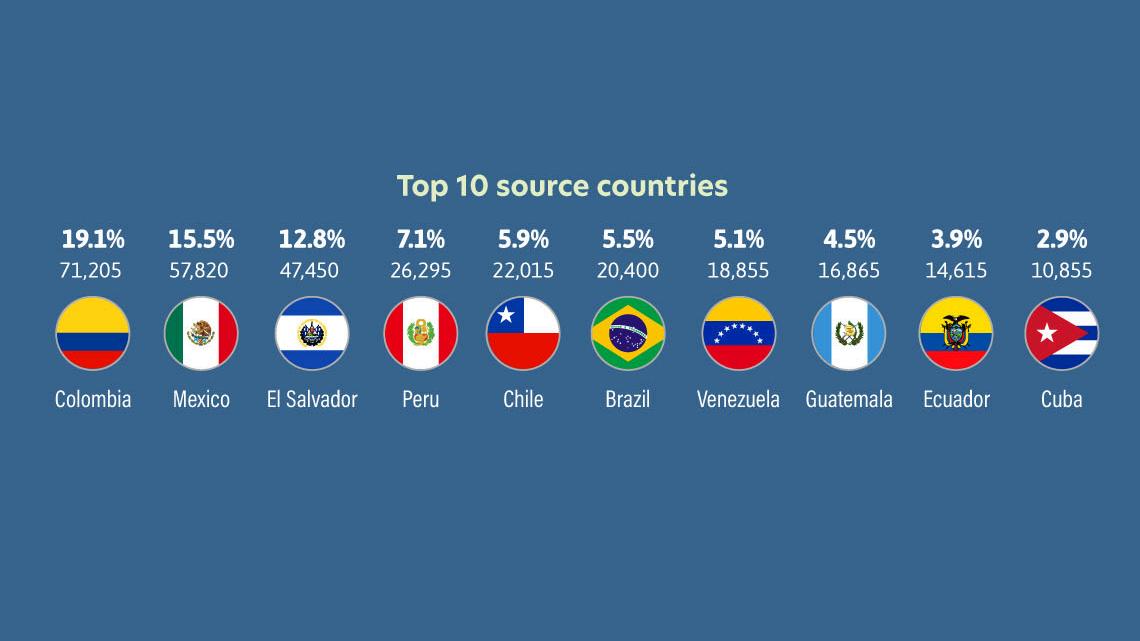
These proportions mirror the existing survey responses of GISS2025; It is within this methodological asymmetry (discussed above) that census-based microdata and ethically governed synthetic populations become a critical consideration of measuring and mapping diaspora immigrants abroad. Census microdata—when used as population-level scaffolding— provide a rare, harmonised baseline across Latin America, Canada and the US (Government of Canada, n.d.). When integrated with synthetic population techniques, they allow researchers to model underrepresented groups, test scenario-based futures and evaluate policy and market dynamics without compromising privacy or statistical integrity. In contexts where traditional sampling frames are incomplete, small or unstable, synthetic populations provide a means of extending representativeness while remaining firmly anchored in empirical, grounded truths. The critical prerequisite is high-quality source data—whether drawn from probability-based online panels, trusted community organisations’ membership lists (such as Generation1.ca) or other vetted and validated sources. Nothing carries greater credibility than a census and, when anonymised, privacy-preserving microdata can be projected to a full population through augmented survey modelling. The case for producing boosted, policy-relevant estimates is compelling.
This approach reframes Latin America, not as a methodological outlier, but as a frontline laboratory for adaptive research design. Hybrid sampling strategies, census-aligned weighting and synthetic augmentation are no longer experimental add-ons; they are increasingly necessary tools for producing comparable, governance-ready insights across the Americas. North America, often treated as the benchmark for methodological stability, stands to benefit directly from these innovations as migration, remote work and platform-mediated labour erode the assumptions underpinning legacy panels. This is precisely where Generation1.ca operates and why we partnered with Livepanel, an Argentina-based global research technology platform led by inter-disciplinary research business and technology veterans committed to the power of possibility, ethics and imagination in projecting futures for Latin America and beyond. As a North American professional community association grounded in immigrant and diasporic realities— many with lived, economic and professional ties to Latin America—Generation1.ca confronts representational gaps for our members daily (Generation1.ca, 2025c). Our research studies, observations and participation consistently show that immigrants are over-measured as consumers, under-counted as workers and inconsistently recognised as civic actors across datasets that traverse borders.
For Generation1.ca, the integration of census microdata and synthetic populations is not an abstract methodological preference; it is a strategic necessity. Migration, circular talent flows and cross-border entrepreneurship mean that data blind spots in Latin America directly distort North American labour market intelligence, workforce planning and inclusion strategies. Robust, comparable population modelling across the Americas underpins credible research on skills, mobility, innovation and democratic participation. In this sense, Latin America should not be viewed simply as a smaller or emerging research market; it is a testing ground for the future of global research, compelling the industry to rethink representation, data governance, and methodological imagination. Census-based microdata and synthetic populations are not merely tools of convenience they are essential instruments for building a research ecosystem capable of reflecting the lived realities of an increasingly mobile, interconnected and unequal world.
Projections on good quality datasets, even small, can offer robust options for understanding future impacts and possibilities into the far-reaching future of 2050. Analysis here draws on findings from our GISS2025 survey, which captures immigrant preparedness, aspirations, immigrant integration challenges and transnational opportunity pathways, often overlooked in nationally bounded migration and labour datasets. Our members from Latin America hail from nations as diverse as Brazil, Colombia, Mexico, Peru, Chile, Ecuador and Honduras. If we were to include the Caribbean region, we also have immigrants from Barbados, Haiti and Jamaica, but we treated the two regions of Latam and the Caribbean separately for this research because of different historical contexts, influences and aspirations.
Data quality remains a key challenge when researching the “mainstream” let alone hard-to-reach underrepresented consumers and citizens like immigrants, who are key members of North American societies, driving up OECD average in literacy rates and/or education levels, innovation and entrepreneurship versus native-born populations. Nevertheless, the barriers are also magnified. For example, it is well known that even though entrepreneurship among the foreignborn is the highest across the OECD, associated precarity attributed to self-employment is also high. Migration is treated as a problem of flow, not potential futures impacting the source and host countries. Mirgrants typically move and arrive in foreign countries to flee conflict, fill labour shortages or reunite with their families (OECD, 2026). However, the broader impact of immigrants maintaining ties with their homeland and families (culturally, socially, economically by sending money and gifts home) allows them to live wider, deeper, richer lives enhanced by both source and host countries.
This is an important part of the story that gets erased by policy and research systems still designed to measure movement, not meaning flows, not futures despite migrants actively reshaping both source and host countries in real time.
Migration research and policy have long privileged the measurement of movement counts of arrivals, departures, legal status changes and labour market absorption over the assessment of human potential. In Latin America, this has produced a narrative that frames migration primarily as a system under strain rather than as a reservoir of future capability. Migrants are visible in data when they create pressure on housing, employment or humanitarian systems abroad, but far less so when they carry skills, entrepreneurial ambition or innovation capacity that has yet to be activated. This flow-centric framing limits the kinds of questions institutions ask and the interventions they design. Synthetic foresight challenges this orientation by shifting analytical attention from retrospective flows to prospective contribution, modelling not only where people move to but also what they could become under different social, economic and policy conditions. Generation1.ca has been a long proponent of these global immigrant futures narratives, rooted in positive potential for all our immigrant diaspora from around the world, subjected unfortunately to deficit narratives of creating threats to native born populations or residents (Generation1.ca, 2025d).
By combining census-based microdata, synthetic populations and foresight modelling, we shift Latin America’s migration narrative from retrospective counts to future capacity enabling policymakers, educators and employers to anticipate, rather than react to, talent loss, misalignment or underutilisation. This work is grounded in responses to Generation1.ca surveys by members from Latin American countries and other global regions with significant migration streams to North America over the past decade. In this way, member responses have been used to generate privacy-protective training data. Leveraging open, trusted and anonymised census microdata, the approach supports neighbourhood-level modelling selecting synthetic profiles based on demographic attributes such as age, gender, ethnicity and geography (e.g., ZIP/postal code). The resulting synthetic populations closely mirror observed distributions, demonstrating high fidelity without relying on declarative or personally identifiable data.
The underlying technology we used with Livepanel is language- and country-agnostic, and does not rely on large language models. Fully encoded inputs ensure that neither questionnaire content nor individual responses are visible during modelling, and client data is never reused across projects. Where questionnaire interrelations are required, they remain confined to the same client context, eliminating the need for opt-outs while maintaining strong data governance and privacy protections. Synthetic data and synthetic audiences are expected to only play a growing role in 2026 due to their speed, cost efficiency and ability to model hard-to-reach populations. However, they do not replace robust, representative research (Generation1.ca, 2024b). While they can enrich datasets, synthetic approaches do not inherently increase statistical confidence and must be carefully validated and applied alongside expert judgment (Research Live, 2026). While our members number over 2,000 immigrants and supporting organisations, our surveyed samples were smaller. The surveyed immigrant community mimicked the larger membership and tend to be young (25 to 34 years of age), welleducated and new to North America, with a majority having less than three years in the region. Women dominate the surveyed participants, and the majority hold a bachelor’s degree or higher (Generation1.ca, 2025b).
This sample fits the OECD data, as in that most of the recent immigrants tend to be selected based on human capital, while their job market tends to be below their educational level (OECD, 2006). Service providers often fall outside of “communities of learning” and the sharing of good practice, which is essential to the development of more effective services for a community organisation like Generation1.ca, which is what we have avoided constantly as a non-profit committed to immigrant advancement. We have achieved this through professional and career supports and a roster and slate of member-focused activities, initiatives and credentials that foster upskilling, knowledge-sharing, connection-building, giving back to community and creating professional branding.
Immigrants overwhelmingly identify technological and structural change as the dominant drivers of future integration. Nearly three-quarters (74% to 77%) expect technology particularly AIenabled job matching and remote work to fundamentally reshape the immigration landscape. However, long-term optimism remains conditional on policy action, with over half of respondents calling for streamlined residency pathways and improved infrastructure to support population growth (Generation1.ca, 2025e). This perspective is reinforced by the OECD’s 2023 Settling In report, which identifies digital access as an increasingly central pillar of migrant success in host countries.
The evidence is unequivocal: improvements in quality of life for immigrants are constrained far less by cultural integration than by economic and structural barriers embedded in the Canadian system. Lower average scores in the dataset point to the high cost of living, limited access to professional employment and housing scarcity as the most significant impediments to immigrant well-being. While Canada continues to score highly on physical safety emotional quality of life remains fragile, undermined by financial stress, underemployment and pronounced loneliness, particularly among Latin American immigrants. National data from Statistics Canada reinforce this pattern, with 43% of recent immigrants reporting difficulty meeting financial needs, compared with 29% of the Canadian-born population, concluding that reduced life satisfaction is driven by structural exclusion rather than social misalignment.
The immigrant members surveyed are not seeking basic settlement supports; they are highly ambitious, digitally literate professionals navigating constrained labour markets. More than 80% prioritise active career advancement through job fairs, mentorship and employer-facing opportunities, signaling a decisive shift away from passive resource consumption toward the deliberate accumulation of social capital. This reflects a broader transformation in immigrant integration strategies: success is increasingly mediated by access to high-value professional networks rather than static directories or generic services. Labour-market evidence confirms that immigrants who prioritise networking experience faster wage growth, stronger job retention and improved career alignment in North America’s tightening skills economy (Dandapani, 2025).
Consistent with the highly social and intergenerational character of Latin American communities, nearly half of surveyed immigrants (46%) reported migrating with family members. Latin American immigrants approach life in Canada with clear-eyed determination rather than naïve optimism. Despite facing significant economic and structural barriers, 65% intend to remain in Canada long-term, signalling strong commitment and social fit. Crucially, success is most strongly associated with access to mentorship, professional networks and upskilling opportunities—not language acquisition or cultural adaptation, which rank comparatively low as barriers. This spotlights a critical insight: Latin American immigrants do not struggle to belong socially; they struggle to be absorbed economically into systems that undervalue foreign credentials, international experience and transnational skills.
Across both Latin American and non–Latin American groups in our GISS2025 study, economic and structural pressures cost of living, housing availability and employment misalignment dominate integration challenges. However, Latin American immigrants place significantly greater strategic emphasis on networking (85% versus 78%), recognising social capital as the most viable bridge into the labour market. At the same time, they report higher levels of loneliness, reflecting the emotional toll of navigating exclusionary systems, while actively striving for inclusion. Despite this, their commitment to long-term residency remains strong: evidence consistently shows that immigrants who combine professional networks with up-skilling achieve markedly stronger labour market integration, suggesting that social capital is not merely a support mechanism, but a decisive economic lever.
Taken together, these findings challenge persistent narratives that frame immigrant integration as a cultural or individual adjustment problem. Instead, they point to a systemic mismatch between immigrant capability and labour market absorption. Quality of life improves not through assimilation, but through access and belonging—to opportunity, networks and credible pathways into professional work, life and leadership. For Latin American immigrants in particular, social capital functions simultaneously as a source of resilience and a signal of structural failure. In short, when networks become essential for survival rather than advancement, the system not the immigrant requires reform.
Based on our work with Livepanel’s training and preparation files. Training files were trained on a blend of Generation1.ca member survey research data and census-based microdata for Canada and US, and ESOMAR’s 20 questions about AI have been answered here in terms of the use of AI provider for our training and prediction files (Livepanel, 2020). As we have seen so far, this research paper discusses specifically the Canada results in more detail from Generation1.ca’s global industry skills study, with the US data discussed in more detail in the Latin Ameirca conference presentation.
1. Expanded representation of hard-to-reach and mobile populations. By anchoring machinelearning survey augmentation to census microdata, the study meaningfully extends representation to immigrants and diasporic populations typically under-covered by panels. Synthetic populations allow inclusion of groups affected by non-response, irregular employment, linguistic barriers or geographic mobility without direct respondent burden, a criterion to be mindful of when researching immigrants.
2. Improved cross-border comparability across the Americas. Census-aligned modelling creates a shared population scaffold across Canada, the US and Latin America, enabling more credible comparison than panel-only designs. This is particularly valuable for transnational populations whose lived realities span multiple statistical regimes and labour markets.
3. Scenario testing for long-term futures: 2050 outlooks. Machine-learning–driven augmentation supports forward-looking analysis by simulating outcomes under alternative policy, technology, and labour market scenarios. This enables structured foresight on immigration, integration and workforce transformation that traditional survey methods struggle to sustain at scale.
4. Reduced reliance on fragile or biased panel infrastructures. Synthetic augmentation mitigates over-dependence on increasingly strained panels, especially where coverage is uneven or participation fatigue is high. Census microdata provide empirical grounding that improves stability relative to ad hoc weighting alone.
5. Stronger privacy and governance posture. Using census microdata as population-level scaffolding—combined with synthetic population generation—allows insights to be produced without exposing identifiable individuals. This strengthens compliance with privacy, data protection and ethical AI principles while preserving analytical utility.
Five critical caveats and active limitations
We have presented before on the pros and cons and contextual benefits and guardrails of using synthetic data in research, analysis and insights, and for the purpose of this paper as well as time evolves the list of critical caveats also grow (Generation1.ca, 2024c).
1. Model outputs are constrained by census definitions and lag. Census microdata reflect official categories, timing and policy assumptions that may lag fast-changing immigrant realities. Synthetic populations inherit these structural boundaries, which can understate emerging identities, informal work, entrepreneurship or undocumented transitions.
2. Synthetic precision does not equal ground truth. While augmentation improves coverage, synthetic data remain probabilistic representations not direct observations (Generation1.ca, 2024d). Findings should inform patterns, scenarios and directional insights rather than be interpreted as precise population counts or deterministic forecasts.
3. Risk of over-smoothing lived experience. Machine-learning models optimise for statistical coherence, which can unintentionally smooth sharp inequalities, emotional strain or intersectional disadvantage, particularly around loneliness, precarity or discrimination, unless qualitative or mixedmethod validation is incorporated.
4. Dependence on model assumptions and feature selection. Results are sensitive to modelling choices, including variable selection, weighting logic and training data quality. Without transparent documentation and sensitivity testing, augmented outputs risk appearing more authoritative than warranted.
5. Governance, transparency and interpretability remain essential. Even privacy-preserving synthetic methods require strong disclosure, human oversight and clear communication to avoid misinterpretation or misuse. Policymakers, sponsors and the public must understand how insights were generated, not just what they show.
Generation1.ca and Livepanel’s work on data preparation and training in this study demonstrates that machine-learning–based survey modelling, when anchored in census microdata, offers a powerful path forward for immigrant and diaspora research particularly in fragmented, transnational contexts. At the same time, its value depends on disciplined governance, transparent limitations and careful interpretation, especially when findings inform policy, funding or public narratives. For example, we are very close to our member narratives, stories and research, across our different forums and channels (1:1, mobile, e-mail, social media), allowing us to engage with the vast and varied perceptions, feelings, expectations and attitudes that prevail in this community, enough to train new datasets on it and model with census. We use good quality trusted data (real people, real stories, rich contextual data) and scale it for understanding future perspectives on migration corridors and the future of the Americas, both quantitatively via our surveys as well as qualitatively, through macro-socioeconomic analysis.
Across Latin America, large portions of human capital remain statistically invisible due to informality, credential non-recognition and fragmented data systems when their immigrants move abroad or migrate. Skilled individuals frequently appear in official datasets as underemployed, inactive or irregular, masking their actual capabilities and long-term potential. Evidence from regularisation programmes such as the dramatic increase in registered Venezuelan entrepreneurs following legal status recognition in Colombia illustrates how talent often becomes visible only after structural barriers are removed. Synthetic foresight responds to this misclassification by integrating multiple data sources to reconstruct plausible representations of skills, aspirations and trajectories that traditional systems fail to capture whether these are with ongoing conversations through diaspora networking or cultural exchange at broader storytelling opportunities and even stakeholder interviews. Rather than waiting for formal recognition to occur, synthetic modelling allows institutions to anticipate and design for talent that already exists but remains uncounted.
Tapping into Generation1.ca to activate knowledge flow, meaningful conversation and narrative wellness is central to advancing foresight capabilities. Our AfroRise Fellowship of Movers and Arrivers is one example of how we reconnect African diaspora immigrants with their dreams for their homelands. We are building similar diaspora circles across regions, including Latin America, with plans to publish shared visions of futures and create a living resource for immigrants and their evolving homelands (Generation1.ca, 2025f). The first of these anthologies, Our Dreams for Africa, will be released in February 2026 for Black History Month, and will also resonate strongly with Black Latin American immigrant communities. Refer to Figure 3 below.

Migration decisions are forward-looking, but existing data systems are not
Migration is inherently a future-oriented decision, shaped by expectations of opportunity, security, education and belonging. Individuals and families move based on what they believe life could look like, not solely on current conditions. Yet, the data systems used to study migration are overwhelmingly backward-looking, relying on administrative records and historical surveys that capture outcomes only after movement has occurred. This disconnect is particularly pronounced in Latin America, where migration is often driven by anticipated economic shifts, political cycles, climate risk and intergenerational planning. Synthetic foresight aligns method with reality by modeling expectations, pathways and alternative futures, enabling researchers to explore how different policy or market scenarios might influence decisions before they materialize in observable flows.
Institutions react too late: Foresight allows earlier intervention
Policy and institutional responses to migration are frequently triggered by visible crises: sudden inflows, labour shortages, housing pressures and then political backlash that triggers sentiments like “there are too many immigrants!” for example. By the time these signals appear in conventional data, opportunities for early, lower-cost and more humane intervention have often passed. This reactive posture is both inefficient and socially destabilising. Synthetic foresight offers a means of acting earlier by simulating future states—testing how investments in education, credential recognition, AI literacy or legal pathways might alter outcomes before displacement or exclusion occurs. In this sense, foresight is not speculative but preventive, enabling institutions to design systems that recognise and integrate talent before it becomes an emergency to manage. Pre-arrival immigrant services for example is an area of opportunity that has not been tapped into enough, and of which there is limited awareness and marketing (Planning for Canada, n.d.). Taken together, these dynamics point to a broader shift in how migration—and Latin America’s role within it—can be understood. Moving from people as units of movement to people as carriers of future possibility requires both new narratives and new methods.
Synthetic foresight provides the analytical infrastructure to support this shift, translating incomplete and fragmented data into actionable insights about emerging talent, innovation pathways and societal contribution. By reframing migration as a forward-looking system of capability formation rather than a retrospective problem of control, we position Latin America not at the margins of global transformation, but at its centre and as a region whose future is already present, however we choose to model it (Generation1.ca, 2025g).
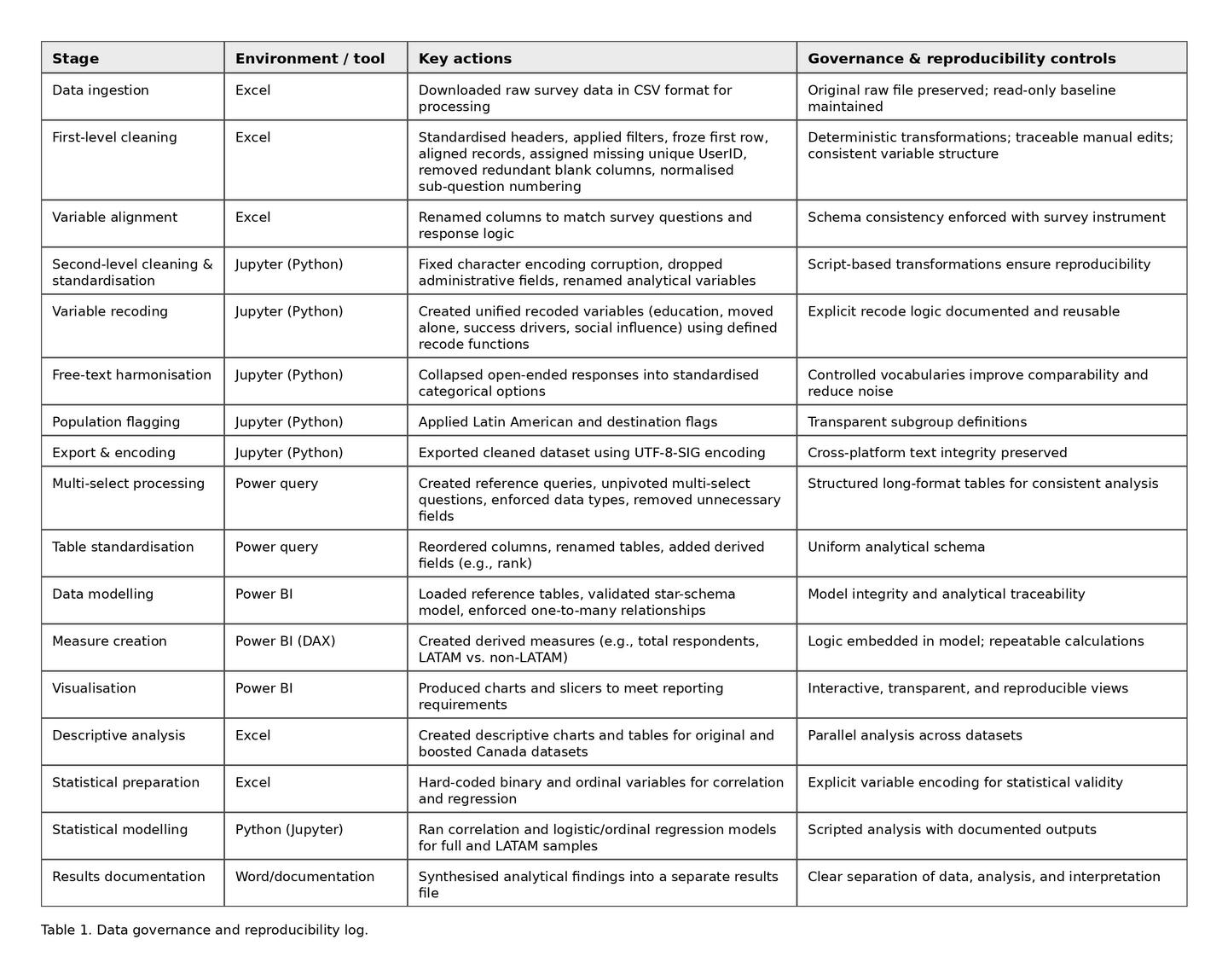
The methods used are detailed below (see Table 1), in a data governance and reproducibility log to understand the steps we took with the datasets once we had both to work with original with the boosted augment.
As the boosted and original datasets more or less mirrored, echoed and complemented each other and maintained reasonable gaps of differences, our research of a projected population (or the boosted set) enabled findings that point to clear actions for policy and institutions.
Generation1.ca immigrants overwhelmingly identify technology as the primary driver of future integration, with 74% to 77% expecting AI-enabled job matching and remote work to reshape immigration outcomes. However, sustained optimism depends on policy reform: over half call for streamlined residency pathways and improved infrastructure to support population growth. Evidence from OECD confirms that digital access is now a core determinant of successful migrant integration.
Quality of life is constrained less by cultural integration and more by structural factors, including high living costs, limited access to professional employment and housing availability. While physical safety remains high, emotional well-being is weakened by financial stress and loneliness, particularly among Latin American immigrants. Statistics Canada data also show that recent immigrants are significantly more likely than the Canadian-born population to struggle financially.
Immigrant respondents demonstrate high professional ambition and digital literacy, with 80% prioritising career advancement through job fairs, mentorship and professional networks rather than basic settlement services. This reflects a move toward “high-value” social capital acquisition, consistent with labour market evidence showing that networking accelerates wage growth and job retention.
Latin American immigrants express determined optimism, with 65% planning long-term residence in Canada despite economic and structural barriers. Success is strongly associated with access to mentorship and professional networks, while language and cultural barriers are relatively minor. OECD research consistently finds that immigrants who combine up-skilling with network access achieve stronger labour-market integration.
Prioritise social capital interventions for Latin American immigrants while addressing structural barriers
Both Latin American and non–Latin American immigrants identify cost of living, employment alignment and housing as primary integration challenges. However, Latin American immigrants place greater emphasis on networking (85% versus 78%) and report higher levels of loneliness, while maintaining strong long-term settlement intentions. This displays social capital as both a protective factor and a policy-relevant intervention point for improving labour market outcomes across North America.
Two other important findings emerged when we ran correlational and logistical regression analysis across all the variables that we thought would potentially influence our global immigrants’ intention to stay in or leave North America. An ordinal logistic regression of the boosted Canadian sample (n=464) shows that immigrants’ intentions to stay in North America are shaped more by social inclusion and future-oriented skill readiness than by arrival characteristics, with bias reducing stay intentions, AI readiness and full-time employment increasing them, and automation readiness showing a weak negative effect.
Date: Thu, 10 Jan 2026
Time: 21:23:03
No. observations: 464
Df residuals: 454
Df model: 8
Acts of bias and discrimination create immigrant churn
In the original dataset there was a near-equal split between those who reported bias (~40%) and those who reported none (~40%), with a grey area of ambiguity for the middle segment who indicated maybe, and others who weren’t sure. Analysis of the GISS2025 revealed a consistent and compelling pattern across the original sample, Latin American subsamples and the Boosted Canada dataset. However, social experience matters far more for immigrant retention in North America than employment status, skill level or migration pathway itself. Across all models, experiences of bias or discrimination emerge as the single strongest and in several cases the only statistically significant predictor of immigrants’ intentions to leave North America. This holds true in both the original dataset of immigrants to Canada (n=154) and the Boosted Canada dataset (n=464), where reported bias consistently predicts lower intentions to stay or stronger intentions to leave. These findings signal a critical insight: social inclusion and fairness are not peripheral to integration they are foundational to retention.
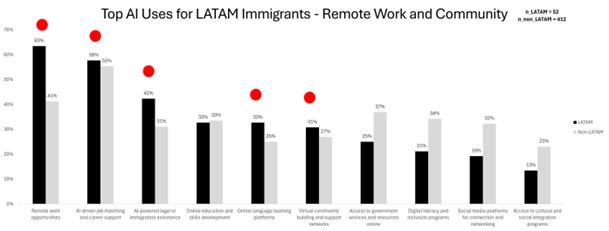
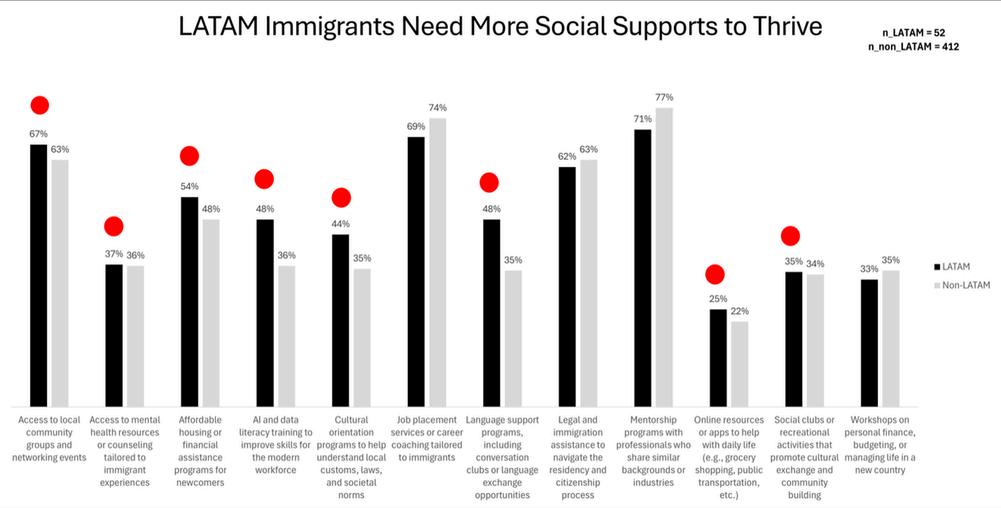
As we see in Figure 5, Latin American immigrants favour AI for opportunities like remote work (these could be cross-market like how Guido’s and Leonardo’s businesses operate) and job matching, with AI for legal help making top uses. Immigrants’ future-oriented skill readiness (particularly readiness to work in AI-enabled and technologically evolving labour markets), demonstrates a positive predictive relationship with intentions to remain in North America. In the boosted dataset, readiness for AI-enabled work reaches statistical significance, suggesting that immigrants who perceive themselves as equipped to thrive in a tech-enabled economy are more likely to envision a long-term future in the region.
Traditional employment indicators, such as full-time work, show only a modest positive association with retention and only in larger samples remaining substantially weaker predictors than social and technological variables. Among Latin American immigrants, arriving with family is positively associated with retention, while arriving with pre-existing connections is negatively associated, pointing to distinct regional or cohort-specific migration dynamics that merit further investigation. However, smaller subsample sizes in the original dataset limit the directional consistency of these findings. The members we surveyed were also older and mostly in the age band of 35 to 54 years of age, unlike others who skewed younger. Taken together, the evidence points to a multi-factorial model of immigrant retention, in which the most powerful determinants are not how immigrants enter a country or their immediate labour market status, but how they are treated socially and how prepared they feel for the future of work.
In short, the data portend that social inclusion keeps immigrants in North America; bias and discrimination push them away, and confidence in navigating a technologically transforming economy strengthens long-term settlement intentions. These corroborate what we hear from hundreds of conversations with our members each year at our forums and other channels, and are clear validations for why we offer AI, data and tech literacy as a key module for the Future Ready Innovators open access credential. This is a service we offer to our member community, as they navigate their careers and paths ahead in North America (Generation1.ca, 2025h). Latin American immigrants tend to seek more social forms of learning and supports, whether these are seeking more “career discussions” or “workshops and trainings” or mentorship opportunities, community-based support systems and forums for cultural exchange and networking more than others, according to our GISS2025.
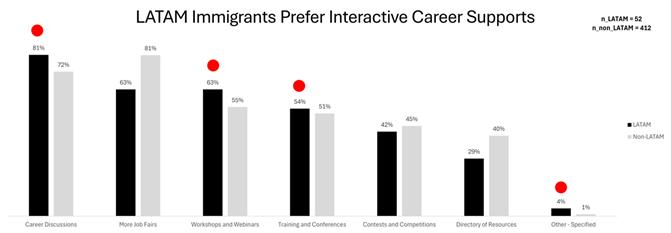
Figure 6
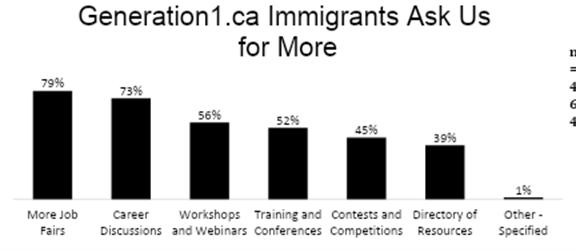
Figure 7. Generation1.ca GISS2025: Immigrant Futures Wave 2025, augmented with machine learning models and census microdata with Livepanel. These proportions mirror the existing survey responses of GISS2025.
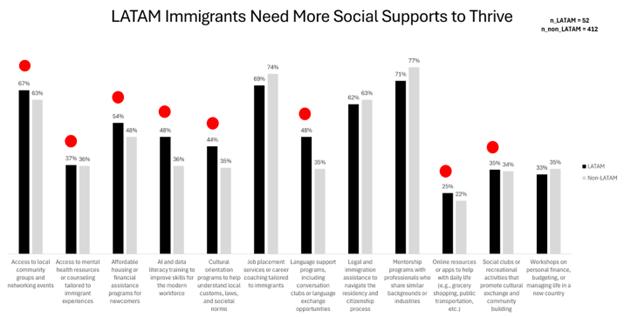
Figure 8. Generation1.ca GISS2025: Immigrant Futures Wave 2025, augmented with machine learning models and census microdata with Livepanel. These proportions mirror the existing survey responses of GISS2025.
world wants more Latin Americans and why
There is a famous Canadian bookstore chain Chapters long associated with the tagline “The world needs more Canada”. Yet, over the past decade, weakened foreign diplomacy, underinvestment in defence and a certain perception of narrowing of global ambition have dulled that appeal, especially visible across “high-touch” sectors like education and immigration. Canada’s image, once dynamic and outward-looking, appears frozen in time to questioning immigrants prompting renewed political efforts to reclaim relevance on the world stage (Generation1.ca, 2024e). Meanwhile, the world has been quietly signalling something else: it wants more talent-and people-rich economies and thus more Latin Americans. Countries such as Chile and Colombia illustrate this paradox clearly. Both have experienced high levels of internal and regional migration, particularly from Venezuela, while simultaneously ranking among the top source countries of Latin American migrants moving to Canada. These are societies shaped by mobility by resilience, adaptation and transnational exchange yet their people are too often framed narrowly as labour inputs rather than future-shaping actors. Popular culture captures this reality more honestly than policy discourse often does. The film I’m Still Here evokes life under military regimes—marked by disappearances, fear and resistance. Against this backdrop are quieter, contemporary stories of survival and renewal. Two Brazilian women Generation1.ca members, Leela and Maya, first met not in São Paulo or Rio, but in Toronto arriving separately through marketing degrees, finding one another and building a dual-income, mutually supportive life. They return home when they can, send money and gifts and celebrate Carnaval do Brasil each year living fully transnational lives enriched by both source and host countries. This is not migration as loss; it is migration as multiplication.

Immigration is among the most disruptive—and transformative—forces of the 21st century. By 2035, one-in-six people in high-income countries will be migrants. Yet as migration accelerates, research and policy systems remain trapped between data deluge and data deficit particularly when it comes to Latin America. We count arrivals, visas and remittances, but fail to model futures: circular mobility, diasporic capital, cultural exchange and the innovation that emerges when people belong to more than one place at once. This is not about passports, but about possibilities and about a growing breed of culturally empowered and engaged global immigrant who benefits from and gives back to diasporic ties with homes as big as their hearts.
The world does not simply need more workers; it needs more Latin American futures in which creativity, adaptability and transnational intelligence are fully recognised, measured and valued. Until research systems evolve to capture this complexity, we will continue to underestimate not only immigrants, but ourselves—as host and source nations and as global citizens striving to build talent-rich economies without losing the human at the heart of global research and citizenship.
– The End -
Copyright & Citation Statement
Copyright © 2026 Generation1.ca. All rights reserved.
This handbook is the property of Generation1.ca and is intended solely for educational and non-commercial purposes. No part of this publication may be reproduced, distributed, or transmitted in any form or by any means electronic, photocopying, recording, or otherwise without prior written permission from the CEO of Generation1.ca. You may cite this work if referencing any portion of the content using the standard citation format below.
APA 7 Citation
Dandapani, A. (2026). Modelling Migration, Synthetic Foresight and the Future of Latin America: From People to Possibility: How Generation1.ca is Reframing the Talent and Innovation Landscape in Latin America. Generation1.ca.
Professor Arundati Dandapani, Chief Executive Officer and Founder, Generation1.ca,
Canada is the primary author of this work and extends her heartfelt thank you to Leonardo Valente, Chief Technology Officer and Founder, Livepanel, Argentina, (and their teams) for expert collaboration and feedback on the final presentation in Brazil and in enabling Generation1.ca’s use of Livepanel’s N-Infinite technology for the census microdata boost.
References:
Dandapani, A. (2025). Data talent futures: Who is missing and why it matters. Market Research Institute International. Avaiable: https://mrii.org/guest-blog-data-talent-futures-who-is-missing-and-why-it-matters/ ESOMAR. (2025). Global market research report 2025. Available: https://esomar.org/publications/globalmarket-research-2025
Generation1.ca. (2021). From the middle of the world to Vancouver 1/2. Available: https://generation1.ca/2021/05/20/from-the-middle-of-the-world-to-vancouver-1-2/ Generation1.ca. (2024a). Survival strategies for small grocers in Latin America: Leading by association. Available: https://generation1.ca/2024/11/16/survival-strategies-for-small-grocers-in-latin-america-leadingby-association/ Generation1.ca. (2024b). Generation1.ca in Greece. Available: https://generation1.ca/2024/08/22/generation1-ca-in-greece/ Generation1.ca. (2024c). The pitfalls and potential of an extraordinary imagination: Why synthetic data. Available: https://generation1.ca/2024/11/17/the-pitfalls-and-potential-of-an-extraordinary-imaginationwhy-synthetic-data/ Generation1.ca. (2024d). Empathy, immigrant journeys and synthetic data at ESOMAR Congress. Available: https://generation1.ca/2024/12/08/empathy-immigrant-journeys-and-synthetic-data-at-esomar-congress/ Generation1.ca. (2024e). Generation1.ca CEO wins ESOMAR's Best Paper of the Year Award. Available: https://generation1.ca/2024/09/13/generation1-ca-wins-esomars-best-paper-of-the-year-award/ Generation1.ca. (2025a). Salsa on St. Clair: Celebrating culture through dance. Available: https://generation1.ca/2025/07/07/salsa-on-st-clair-celebrating-culture-through-dance/ Generation1.ca. (2025b). Future-ready workforce skills for 2026. Available: https://generation1.ca/2025/12/25/future-ready-workforce-skills-for-2026/ Generation1.ca. (2025c). Leading the way with future-ready governance: Ethical AI, EDIB, and public-sector data practices. Available: https://generation1.ca/2025/12/01/leading-the-way-with-future-readygovernance-ethical-ai-edib-public-sector-data-practices/ Generation1.ca. (2025d). Understanding immigrant integration in North America with Generation1.ca. Available: https://generation1.ca/2025/08/18/understanding-immigrant-integration-in-north-america-withgeneration1-ca/ Generation1.ca. (2025e). Global Industry Skills Study (GISS) 2025: Boosted Canada dataset. Unpublished dataset.
Generation1.ca. (2025f). Generation1.ca at 10: Building futures for immigrants in North America. Available: https://generation1.ca/2025/09/09/generation1-ca-at-10-building-futures-for-immigrants-in-north-america/ Generation1.ca. (2025g). Breaking the myth: How the model minority stereotype fails South Asians in the global North. Available: https://generation1.ca/2025/03/28/breaking-the-myth-how-the-model-minoritystereotype-fails-south-asians-in-the-global-north/
Generation1.ca. (2025h). Future-ready innovators: Essential skills for a changing job market. Available: https://generation1.ca/2025/06/29/future-ready-innovators-essential-skills-for-a-changing-job-market/ Government of Canada. (2024). Immigration and ethnocultural diversity [Infographic]. Statistics Canada. Available: https://www150.statcan.gc.ca/n1/pub/11-627-m/11-627-m2024042-eng.htm
Government of Canada. (n.d.). Microdata. Statistics Canada. Available: https://www.statcan.gc.ca/en/microdata Livepanel. (2020). N-Infinite technology: ESOMAR AI 20 [White paper]. Available: https://ninfinite.livepanel.ai/Livepanel_ESOMAR_AI_20_English.pdf
Moslimani, M., Lopez, M. H., and Noé-Bustamante, L. (2023). 11 facts about Hispanic origin groups in the US. Pew Research Center. Available: https://www.pewresearch.org/short-reads/2023/08/16/11-facts-about-hispanicorigin-groups-in-the-us/ Organisation for Economic Co-operation and Development. (2006). From immigration to integration: Local solutions to a global challenge. OECD Publishing. Available: https://www.oecd.org/content/dam/oecd/en/publications/reports/2006/11/from-immigration-tointegration_g1gh76cd/9789264028968-en.pdf
Organisation for Economic Co-operation and Development. (2023). Indicators of immigrant integration: Settling in 2023. OECD Publishing. Available: https://doi.org/10.1787/1d2ac7d7-en Organisation for Economic Co-operation and Development. (2026). Migration. OECD Publishing. Available: https://www.oecd.org/en/topics/migration.htm
Paez-Deggeller, V. (2025). Top statistics on global migration and migrants, 2025. Migration Policy Institute. Available: https://www.migrationpolicy.org/article/top-statistics-global-migration-migrants-2025 Planning for Canada. (n.d.). Planning for Canada. Available: https://www.planningforcanada.ca/ Research Live. (2026). Preview of 2026: Synthetic data. Available: https://www.researchlive.com/article/features/preview-of-2026-synthetic-data/id/5145656
Ryan, A. (2019). How multicultural is Toronto? Let us count the ways…Toronto Global. Available: https://torontoglobal.ca/media-center/how-multicultural-is-toronto-let-us-count-the-ways/
Professor Arundati Dandapani, Chief Executive Officer and Founder, Generation1.ca, Canada is the primary author of this work and extends her heartfelt thank you to Leonardo Valente, Chief Technology Officer and Founder, Livepanel, Argentina, (and their teams) for expert collaboration and feedback on the final presentation in Brazil and in enabling Generation1.ca’s use of Livepanel’s N-Infinite technology for the census microdata boost.
Follow:
linkedin.com/company/generation1-ca/ Subscribe:
instagram.com/generation1.ca/
youtube.com/@Generation1.CA./

Culturally Significant - Generation1.ca newsletter Have Feedback or Want to Collaborate?
Contact:

Arundati Dandapani


Founder and CEO, Generation1.ca (X) @itadnura I (E) arundati@generation1 ca I (W) www generation1 ca