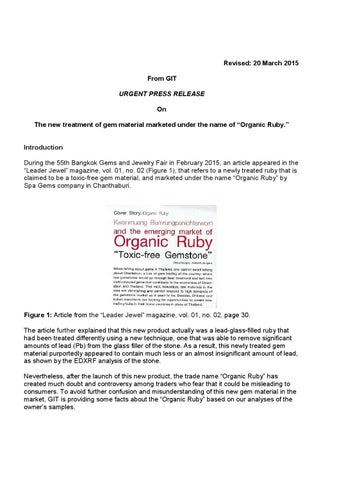
Revised: 20 March 2015 From GIT URGENT PRESS RELEASE On The new treatment of gem material marketed under the name of “Organic Ruby.” Introduction During the 55th Bangkok Gems and Jewelry Fair in February 2015, an article appeared in the “Leader Jewel” magazine, vol. 01, no. 02 (Figure 1), that refers to a newly treated ruby that is claimed to be a toxic-free gem material, and marketed under the name “Organic Ruby” by Spa Gems company in Chanthaburi.
Figure 1: Article from the “Leader Jewel” magazine, vol. 01, no. 02, page 30. The article further explained that this new product actually was a lead-glass-filled ruby that had been treated differently using a new technique, one that was able to remove significant amounts of lead (Pb) from the glass filler of the stone. As a result, this newly treated gem material purportedly appeared to contain much less or an almost insignificant amount of lead, as shown by the EDXRF analysis of the stone. Nevertheless, after the launch of this new product, the trade name “Organic Ruby” has created much doubt and controversy among traders who fear that it could be misleading to consumers. To avoid further confusion and misunderstanding of this new gem material in the market, GIT is providing some facts about the “Organic Ruby” based on our analyses of the owner’s samples.
Gemological Properties The basic gemological properties of this new product (Table 1) are consistent with those of lead-glass fracture-filled ruby, such as the presence of color flash effects, flattened gas bubbles (Figure 2), specific gravity (SG), and refractive indices (RI). Table 1: Gemological properties of newly treated (surface de-leaded) ruby.
Color RI SG Inclusions
Red Approx. 1.76-1.77 Av.4.00 Flattened bubbles, flash effect, open fissures with glass filler.
Figure 2: Photos of Flash effect (left) and flattened bubbles (right) commonly found in the newly treated ruby.
Advanced Instrument Analysis The X-ray images of the stones reveal the presence of heavy elements, i.e., lead (Pb), in the glass filler in fissures and cavities (Figure 3). Chemical analysis by EDXRF on the surface of the stone shows minor lead content as compared to those of the former lead-glass fracturefilled stones (Table 2 and Figure 4). It should be emphasized here that, due to the instrument capability, the EDXRF technique can merely analyze the chemical content at the stone’s surface only. The stability test, however, has not been performed on this product at this stage, yet.
2.55 ct
4.11 ct
22.39 ct
Figure 3: Photos (top row) and X-Ray images (bottom row) of traditional heated ruby without Pb (left), normal Pb-glass-filled ruby (middle) and newly treated (surface de-leaded) ruby (right).
Figure 4: EDXRF spectra of newly treated ruby (red spectrum) and ordinary Pb-glass-filled ruby (blue spectrum).
Table 2: Examples of chemical analysis on the stone’s surface by EDXRF.
Newly treated (surface de-leaded) ruby Oxide Wt% Al2O3 99.13 TiO2 0.01 V2O5 0.00 Cr2O5 0.10 Fe2O3 0.39 Ga2O3 0.01 PbO2 0.35
Normal Pb-glass filled ruby Oxide Wt% Al2O3 98.01 TiO2 0.02 V2O5 0.01 Cr2O5 0.16 Fe2O3 0.29 Ga2O3 0.02 PbO2 1.47
Conclusion Based on our preliminary testing, this newly treated stone is an improvement over the leadglass fracture-filled ruby. The stone was subsequently treated by a technique that was able to remove a large amount of lead from the glass filler in fissures and cavities near the stone’s surface. It is notable, however, that significant lead still remains in the glass filler found inside the stone’s fissures and cavities, as seen in the X-ray image (Figure 3). It appears that the trade name “Organic Ruby” is being used as a marketing strategy to imply a (surface only) lead-free product, and has nothing to do with any organic gem material derived from living plants or animals. A special meeting of academicians and traders, called by the GIT on Thursday 5th March 2015, resulted in the suggestion that, for proper disclosure of the product, a more appropriate trade name should be chosen other than the term, “Organic Ruby.” This remains to be discussed.