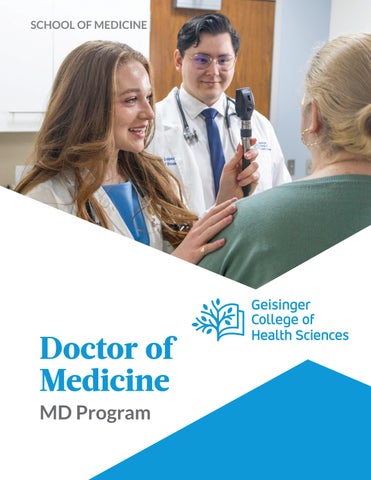
SCHOOL OF MEDICINE
Doctor of Medicine MD Program
Geisinger Commonwealth School of Medicine
Doctor of Medicine MD Program Table of contents Message from the president and dean......................... 1 Total Health Curriculum....................................................... 2 Spotlight: Sarah Pham............................................................. 6 Systems, Society and Humanism in Medicine.......... 7 Spotlight: Joaquim Diego Santos....................................... 8 Clinical presentation model............................................... 9 Regional campus model..................................................... 10 Geisinger experiences......................................................... 11 Spotlight: Dayna Picozzo.................................................... 12 Research and scholarship................................................. 13 Spotlight: Ahmad Higazy..................................................... 15 Student well-being................................................................ 16 Match maker............................................................................ 18 Abigail Geisinger Scholars Program........................... 22 Oral and Maxillofacial Surgery/ Medical Degree program................................................... 23 Apply............................................................................................. 24
Geisinger College of Health Sciences advances health through exceptional education, research and community engagement. We educate and support compassionate healthcare professionals and scholars dedicated to excellence, discovery and innovation. Our graduates are prepared to improve the quality and value of healthcare, optimize health outcomes, address the unique attributes of our region and its people, and promote well-being for all. Geisinger Commonwealth School of Medicine educates aspiring physicians and scientists to serve society using a community-based, patient-centered, interprofessional and evidencebased model of education that is committed to fairness and respect for all, promotes discovery and employs innovative techniques.
Geisinger Commonwealth School of Medicine is committed to non-discrimination in all employment and educational programs or activities. Concerns or questions may be directed to the Title IX coordinator whose contact information is available at geisinger.edu/titleix
Doctor of Medicine | MD Program
A message from the president and dean The best physicians master the science of medicine. That’s always been true. Yet modern medicine requires even more. Today’s doctors must also build trust, communicate expertly, evaluate evidence, use a wide array of complex diagnostic tools, effectively work in interprofessional teams demonstrating the utmost professionalism and optimize utilization of the health system. Given today’s complex landscape, doctors need the support of health systems aligned with the same goals, with teams that support each other and are committed to bettering the health of the communities being served. Value-based care, which prioritizes “upstream” solutions like disease prevention and population health, relies on physician leaders who understand complex systems just as intimately as the individual patient before them. Geisinger has been a leader in value-based care and health systems science long before these were buzzwords. Our visionary initiatives like ProvenCare® analyze how our doctors can best ensure positive outcomes. MyCode, with more than 350,000 sequenced genomes, is used to place precision medicine where it belongs —
in the clinic and in the hands of primary care providers. Our robust research arm is uniquely focused on discoveries that convert hypothesis to health. And while we use machine learning and AI and every technological tool to our patients’ advantage, we don’t forget that what our communities offer greatly influences health. That’s why our system innovates in care delivery, with groundbreaking programs like Food Is Health, that provides healthy, nutritious groceries for entire households, and 65 Forward, which recognizes the unique needs of an aging population. This is what makes our education uniquely Geisinger. Leveraging Geisinger’s acclaimed clinical and technological strengths, we emphasize active learning, early clinical exposure and community immersion. That’s why Geisinger graduates are known for authentic empathy, in addition to residency-ready knowledge and clinical skills. We educate the kind of doctors who will lead healthcare teams of the future. If this is the future physician you’d like to be, Geisinger is the place for you to learn. Sincerely, Julie Byerley, MD, MPH President, Geisinger College of Health Sciences Dean, Geisinger Commonwealth School of Medicine Executive Vice President and Chief Academic Officer, Geisinger
1
Total Health Curriculum The Total Health Curriculum is built on the science of learning and uses an evidence-based approach to train skilled, compassionate physicians who provide individualized care of patients and promote health in the communities they serve. In addition to providing a fully integrated and immersive educational experience in basic, clinical and health systems sciences, the curriculum emphasizes six longitudinal themes that compose the Systems, Society and Humanism in Medicine (SSHM) core: Community Immersion, Health Justice, Health Systems Citizenship, Personal and Professional Development, Population Health and Primary Care. We envision our Total Health Curriculum as a tree, like the tree of knowledge that forms our seal. The roots correspond to Phase 1 – Principles of Science and Practice, which encompasses foundational education rooted in basic, clinical and health system sciences. The trunk epitomizes Phase 2 – Core Clinical Immersion. With roots firmly planted, you will build a solid body of clinical experiences that begins early and grows in complexity and meaning. The trunk provides firm support for the branches, which represent Phase 3 – Career Differentiation and Exploration. During this phase, you will progress in the development of advanced clinical skills and training that suits your individual interests and career goals.
To view program objectives, visit: go.geisinger.edu/gcsomprogramobjectives
2
Doctor of Medicine | MD Program
At a glance: Total Health Curriculum
Phase 1
Principles of Medical Science and Practice Phase 1 includes three semesters. The curriculum is organized into integrated, system-based blocks and features learning through the Clinical Presentation Model and other active learning formats.
At a glance: Phase 1
3
Geisinger Commonwealth School of Medicine
Phase 2 Core Clinical Immersion Phase 2 begins with a 4-week Transition to Clerkship course. Subsequently, students are enrolled in five, 9-week clerkship blocks (Ambulatory, Neurosciences, Women’s and Children’s, Surgery and Medicine) inclusive of bridge weeks. Bridge weeks are periods between clerkship blocks during which you’ll complete assignments, take national board subject examinations and receive orientation for the next clerkship experience. Bridge weeks also allow you to explore subspecialty areas of interest, conduct research and/or meet with mentors and advisors. Phase 2 ends with the Transition to Phase 3 course. Additional features of the Phase 2 curriculum include longitudinal requirements in the disciplines of Radiology and Pathology/Diagnostic Medicine and a Career Pathways Program.
At a glance: Phase 2 Clinical blocks
Curriculum overview*
Transition to Clerkships
Hones clinical skills and provides necessary preparation for students to enter clinical learning environment full-time on their regional medical campuses.
Ambulatory
Outpatient clerkship inclusive of Family Medicine, Geriatrics, Pediatrics and Musculoskeletal Medicine.
Medicine
Inpatient and outpatient experience with exposure to general internal medicine and medicine subspecialty fields.
Women’s and Children’s
Combines the two clerkship disciplines of Pediatrics and Obstetrics and Gynecology (OB-GYN). Includes experiences in inpatient Pediatrics, newborn nursery and pediatric subspecialty areas as well as inpatient labor and delivery, gynecologic surgery and outpatient OB-GYN.
Neurosciences
Combines the two clerkship disciplines of Neurology and Psychiatry in both inpatient and outpatient settings.
Surgery
Core General Surgery rotations with experiences in both inpatient and outpatient settings.
Transition to Phase 3
Provides students with an opportunity to reflect on Phase 2, engage in residency planning and USMLE step preparation, and participate in advanced skill sessions to prepare students for the clinical requirements in Phase 3.
*Length of curriculum blocks is based on Medical Curriculum Committee review each year.
2025 Step 1 pass rate* Geisinger Commonwealth 100% National 4
93% *first-time examinees
Doctor of Medicine | MD Program
Phase 3 Career Differentiation and Exploration Phase 3 includes required core clinical rotations, expanded elective exploration opportunities and a formal Transition to Residency course.
At a glance: Phase 3 - Requirements for advanced clinical experiences* Activity
Curriculum overview*
Required rotations
Advanced clinical experiences including a subinternship, Critical Care Medicine selective, Emergency Medicine and SSHM selective, as well as a Preparation for Licensure course.
Elective opportunities
Wide array of elective opportunities are available to enhance your learning and expand knowledge in specialty areas, research, teaching and medical humanities.
Transition to residency
Required course designed to provide preparation for your transition into the graduate medical education phase of your training. *Length of curriculum blocks is based on Medical Curriculum Committee review each year.
Take a deeper dive into our curriculum by visiting: go.geisinger.edu/gcsomcurriculum
5
Student spotlight
Sarah Pham
Ms. Pham is a first-generation college graduate who grew up in Philadelphia, where her interest in healthcare began through a high school fundraising organization that supported Children’s Hospital of Philadelphia. Seeing the impact medicine had on children and families inspired her to pursue opportunities to learn more about science and patient care. That curiosity led her to a competitive neuroscience summer research program, where she discovered a passion for understanding the brain and the scientific questions that drive medicine forward. When Ms. Pham sought advice about applying to medical school, a childhood friend from their local Vietnamese community — then a second-year medical student at Geisinger — encouraged her to apply. “She told me how supportive the faculty were and how different the experience felt in a really positive way,” Ms. Pham said. “That encouraged me to apply.” She found her friend’s description accurate. “Medical school is rigorous, so having faculty you can speak with on a personal level is incredibly important,” she said.
6
“I’ve found Geisinger faculty to be approachable, encouraging and genuinely invested in helping students thrive.” Ms. Pham also values Geisinger’s collaborative culture. “What makes Geisinger so great is the community,” she said. “Upperclassmen are always eager to help and share what they’ve learned. There’s a real desire to support one another and help the next group of students succeed.” Beyond the classroom, she serves on the executive board of the Clinical Skills Club, helping organize workshops led by residents and physicians. She also contributes to Parkinson’s disease research through Geisinger Neurology. As she prepares to enter the clinical phase of medical school, Ms. Pham reflects on her growth. “Geisinger gives you opportunities to grow academically, professionally and personally,” she said. “The people I’ve met, the mentors I’ve had and the patients I’ve encountered have all helped shape the physician I want to become.”
Doctor of Medicine | MD Program
Systems, Society, and Humanism in Medicine (SSHM) A strength of our Total Health Curriculum is the integration of six longitudinal themes that transform socially responsible students into socially accountable leaders in the healthcare system and their communities. These themes foster the development of compassionate and adaptable physicians dedicated to a person-centered approach to improving the health and well-being of the patients and communities they serve.
1.
Community Immersion: Provides you with the skills to understand the needs of your patients and your communities through the practices of narrative, cultural and structural humility, and to embrace engagement and involvement with communities in your area of practice, including service learning.
2.
Health Justice: Encourages you to examine how social, structural, epistemic and health system forces shape health outcomes, access to care and patient experiences and prepares you to work toward improving the systems that shape healthcare delivery.
3.
Health System Citizenship: Prepares future doctors to contribute to quality improvement, participate in early adoption of technology and function in teambased models of care. This theme delves deeply into healthcare delivery science and leverages the strength of Geisinger’s value-based care model to focus on system improvement.
4.
Personal and Professional Development: Lays the foundation to begin shaping attitudes, skills and behaviors needed to commit to a social contract, participate in a community of practice, navigate uncertainty and ambiguity, and improve health through service to individuals and communities.
5.
Population Health: Prepares you for individual and population-oriented prevention and health promotion efforts with a focus on wellness, epidemiologic and statistical methods, reduction of disease burden and improvement of health outcomes in patient populations and communities.
6.
Primary Care: Focuses attention on the most critical health need in the nation and centers the future physician’s approach on wellness and disease prevention, regardless of medical specialty.
7
Student spotlight
Joaquim Diego Santos Joaquim Diego Santos was born in the Philippines and emigrated to the United States with his family at age 3. Growing up with parents who worked in healthcare, Mr. Santos was immersed in medicine from a young age. But his journey truly began to take shape in college, where he interned in an operating room, gained certification as an emergency medical technician (EMT) and engaged in clinical research.
to run a clinic in Guatemala.
During his EMT training, he first encountered Geisinger through a Life Flight paramedic crew.
Mr. Santos is eager to continue researching, traveling the world and growing in clinical skills and knowledge at Geisinger.
“Being an EMT taught me how to think on my feet and adapt,” he noted. “But more importantly, it taught me to meet patients where they are.” Mr. Santos applied to Geisinger College of Health Sciences’ School of Medicine, where he has the freedom and encouragement to explore his interests in research and global health. “My favorite thing about Geisinger is the flexibility to explore your interests,” he said. “I wanted to continue doing clinical research and practice medicine abroad. Even in my first year, I was able to accomplish both.” His continued research has won him a competitive Alpha Omega Alpha Kuckein research fellowship. His proposal aims to develop a quality-of-life survey specific to mitochondrial disease. And his passion for global health has taken him abroad with a team of Geisinger attendings, residents and medical students
8
“My longitudinal clinical experiences and community immersion project at Geisinger really helped in Guatemala,” he said. “Very early on, we learn how to take patient histories and conduct physical exams. For my community immersion project, I visit elementary schools and teach the kids about science topics and how we use all our medical tools.”
“I’m so excited to keep learning more,” he said. “It’s important that physicians experience other cultures and how other healthcare systems work. And I’m excited to go into the clinical setting and gain more confidence. I want to lead with empathy and compassion and my experiences at Geisinger are making that possible.”
Doctor of Medicine | MD Program
Clinical Presentation Model Traditional medical education relies on teaching basic, clinical and health system science concepts; however, these concepts must be well integrated and appropriately framed in clinical context. The Phase 1 curriculum uses the Clinical Presentation Model to integrate content and contextualize the curriculum. This model is aligned with the core clinical condition framework that anchors the Phase 2 curriculum and represents the mode by which a patient presents to a physician and is the basis of diagnosis and management. Big picture: The weekly structure of the Phase 1 curriculum begins and ends with a focus on the patient, specifically the patient’s clinical presentation.
Deconstruct and independent learning: Each clinical presentation is broken down into its basic science, clinical science and SSHM content. You will use resources in our knowledge repository to focus on learning objectives in preparation for in-class work. Experiencing: Large and small group active learning activities are designed to have you apply knowledge in a clinical context. Reassemble big picture: For each clinical presentation, student groups will summarize material for their classmates, re-integrating all content in a large group interactive session.
Basic science
Clinical presentation
Clinical science
Independent learning
Experiencing
Student summary
Doing, observing
Reassemble big picture
SSHM
Big picture
Deconstruct and independent learning
9
Geisinger Commonwealth School of Medicine
Regional campus model The School of Medicine offers a community-based model of medical education with four regional clinical campuses: Central (Danville), Guthrie (Sayre), Northeast (Scranton and Wilkes-Barre) and West (Lewistown and State College).
Students are responsible for arranging and funding their own transportation to and from all assigned clinical sites, including those located off-campus or outside the immediate vicinity of the Medical Sciences Building (Scranton) and the School of Nursing (Lewistown). This includes travel for required clerkships, electives, intern or externships, and other clinical learning experiences.
Each campus offers: •
Outstanding clinical training
•
Abundant, diverse clinical experiences
•
Strong mentorship by faculty
•
Community service programs and activities
•
Opportunities for research and scholarship
To explore our regional campuses, visit: go.geisinger.edu/gcsomregionalcampuses
Tompkins Schuyler Steuben Tioga
Chemung N E W
Y O R K
P E N N S Y L V A N I A
Sayre Tioga
Susquehanna
Bradford Wayne Wyoming
Lackawanna
Scranton
Sullivan Lycoming
Pike
Clinton Columbia
Wilkes-Barre Luzerne
Monroe
Montour Union
Centre
Snyder
Danville Northumberland Schuylkill
Lewistown Mifflin
Carbon
Juniata Perry
10
Regions
Huntingdon
■ Guthrie ■ Northeast
■ Central ■ West
A
•
N
I
A
V Y Campus locations: L E Y S S Geisinger Commonwealth Counties N R E N (MD admissions) outlined: J E P
E
W
Doctor of Medicine | MD Program
Geisinger experiences Learning communities We follow the well-known adage “it takes a village” by offering students a ready-made “village” of faculty, interprofessional staff and peers within the larger school community that engages you in your personal and professional identity formation. Community well-being As a system, Geisinger has devoted significant resources to examining the unique health needs of the communities it serves and proposing novel solutions that can be applied locally but transferred globally. Our impact is felt economically (Geisinger has an annual $15.7 billion positive impact on Pennsylvania’s economy), but more importantly, it’s felt in the ways our presence uplifts our neighbors and improves the region’s quality of life through initiatives like: •
REACH-HEI (Regional Education Academy for Careers in Health – Higher Education Initiative), an out-of-school experience that provides academic enrichment opportunities for students.
•
The Edward R. Leahy Jr. Clinic For The Uninsured is a collaboration between the University of Scranton and Geisinger that provides free, non-emergency healthcare to uninsured Lackawanna County residents. The clinic provides high-quality care in a welcoming, respectful and compassionate environment. It offers teaching, learning, research and service opportunities to Geisinger Commonwealth School of Medicine faculty, students and volunteers.
•
The Food Is Health Program provides patients with Type 2 diabetes (and their household) with enough healthy food to make 10 nutritious meals each week — and a clinical care team that moves them toward better health.
•
Geisinger 65 Forward is primary care designed exclusively for patients 65 and older, featuring more time with physicians, social and educational activities and all ancillary services offered under one roof.
•
Family- and Community-Centered Experience is a required component of the Phase 1 curriculum that partners you with community members to learn about their experiences of health and healthcare, helping you to better understand the social drivers of health, to hone your communication skills and to develop narrative and cultural humility through active listening and reflection
Global Health Experience Students in Phases 1 and 3 can participate in a global health experience in Guatemala, providing patient care in rural communities, practicing language skills and learning from community health workers. The Center for Medical Humanities Launched in 2025, the Center for Medical Humanities fosters a multidisciplinary approach to understanding health, illness and healthcare by integrating perspectives from the humanities, arts and social sciences to promote a model of humility that values patients, providers, learners and faculty. Students can participate in research projects, electives and medical humanities workshops and activities that compliment their required curriculum. GME enriches the UME experience The medical student/resident relationship is mutually enriching. Residents and fellows teach and mentor, and you’ll benefit from seeing what residency/fellowship is really like. Geisinger has more than 650 residents and fellows, comprising 80 independently accredited residency and fellowship programs, which encompass Accreditation Council for Graduate Medical Education physician programs, as well as dental, podiatry, pharmacy and others.
More than 2,000 Geisinger College of Health Sciences faculty members comprise a robust and varied group of highly specialized professionals dedicated to educating and training the next generation of healthcare professionals.
11
Student spotlight
Dayna Picozzo
Dayna Picozzo, a member of Geisinger School of Medicine’s MD Class of 2028, wanted to be a doctor ever since childhood, when she received a stethoscope and miniature anatomy skeleton for Christmas. “After that, there wasn’t really any other career I thought about,” she said. Yet, even with a dream — and a medical school in her hometown of Scranton — Ms. Picozzo wasn’t sure how to reach her goal. After graduating with her bachelor’s degree, she was left to figure out the next steps on her own. Without adequate advising and proper planning, she took the MCAT. But she quickly learned that a degree and test score weren’t enough to get into medical school. She spent the next several years working as a medical scribe and completed a post-baccalaureate degree but was still lost on what to do next. “It’s so hard when you don’t have the proper guidance,” she said. The turning point? When she enrolled in Geisinger’s Master of Biomedical Sciences program, which has an excellent reputation for guiding students into medical school.
12
“This master’s program completely changed me as a student,” she said. “It helped me with my personal statement, improving my GPA, volunteering and research. The masters touched on everything — even how to formulate and effectively complete your application for med school.” The program even helped her prepare to take the MCAT again. “Before, I reached a certain plateau on all my practice tests, and no matter how hard I tried, I just couldn’t get over it,” she said. “But, after finishing the master’s, I broke through. The program really taught me how to analyze and critically think through that exam.” Today, Ms. Picozzo is an Abigail Geisinger Scholar in her third year of medical school. “I love Geisinger and the Scholars program,” she said. “It’s always been my dream to become a physician and to practice here in my hometown.” No matter what specialty Ms. Picozzo chooses, her patients will have a physician who is tenacious, compassionate and resilient. “It’s been an exciting journey so far,” she said. “I’m looking forward to what is to come.”
Doctor of Medicine | MD Program
Student research and scholarship At the School of Medicine, students have many opportunities to engage in research and scholarship throughout their education. The Office of Student Research and Scholarship offers short- and longterm research programs, like the Spring Student Research Symposium, the Summer Research Immersion Program (SRIP) and the Medical Research Honors Program (MRHP). Conducted over 8 weeks during the summer after the first year of medical school, SRIP provides students with the opportunity to work alongside faculty mentors on a variety of projects. These projects may include laboratory-based biomedical research, public health initiatives, and community or clinical studies focused on addressing healthcare challenges. Participants are required to submit an abstract and present their research findings at the Summer Research Immersion Program Symposium through an oral or poster presentation. MRHP is an intensive longitudinal research program that enables participants to advance fundamental
scientific knowledge, refine scholarly communication and foster a mindset of lifelong learning. Students must submit a research project proposal, write a thesis and deliver an oral defense to complete the multi-year program. The research experience is guided by a research mentor, a thesis advisory committee and the program director. Additionally, students write abstracts, present posters and publish findings while building their thesis defense. Students who meet all program requirements will graduate with an honors distinction in research. Students will find multiple occasions to present and publish their research findings, including presenting at the annual Spring Research Symposium or submitting their scholarly and creative work for publication in our Journal for Scholarly Research in Progress (SCRIP). This journal is published annually in both print and online mediums and is edited and produced with the assistance of student editors engaged in the editorial process.
To learn more, visit: go.geisinger.edu/researchandscholarship
13
Geisinger Commonwealth School of Medicine
MyCode: Personalizing healthcare A major theme of Geisinger’s research is to personalize healthcare by discovering ways to empower doctors to discern differences in patients — genetic, environmental or social — that impact health, quality and outcomes. Anchoring this theme is the MyCode® Community Health Initiative, a systemwide biobank storing blood and other samples for research use. MyCode analyzes the DNA of volunteers and has surpassed its latest goal of 350,000 participants. Researchers use this vast body of data to transform knowledge of the genome into powerful intelligence that is personally relevant to individual patients. MyCode research has already been translated into ways to diagnose certain medical conditions earlier — even before symptoms appear — and to implement new treatments or medications to manage them.
Medical Marijuana Academic Clinical Research Center In 2022, the School of Medicine was certified as a Medical Marijuana Academic Clinical Research Center (ACRC) by the Pennsylvania Department of Health as part of the state’s medical marijuana research program. Through our partnership with Ascend Wellness Holdings, we support research in medical marijuana that aligns with Geisinger’s expertise in addiction medicine, pharmacy, epidemiology, behavioral sciences, bioethics, data science, education and genomics. Geisinger’s Center for Substance Use Research and Education prioritizes research that is patient-centered and emphasizes the role of patients, providers and other health decision-makers as strategic partners. In this way, the School of Medicine is expanding our scientific understanding of the potential benefits and harms of cannabis on the health of patients.
Artificial intelligence (AI) at Geisinger Our award-winning team of experts creates, implements and evaluates AI applications that enhance patient care, improve operational efficiency and support data-driven decision-making across our system. From identifying at-risk patients to streamlining operations for better care to providing powerful tools that enhance human expertise, we push the boundaries of what’s possible to turn complex healthcare challenges into opportunities for innovation. We apply state of the art AI, machine learning (ML) and data science approaches to develop models and design workflows using AI/ML tools that improve patient outcomes and reduce costs, making better health more accessible.
14
Student spotlight
Ahmad Higazy
When Ahmad Higazy arrived at Geisinger College of Health Sciences, he envisioned a future caring for patients as a psychiatrist. Today, however — thanks to opportunities at Geisinger — he sees himself as a physician scientist, with research an essential part of his career.
Mr. Higazy gained access to resources rarely available to medical students elsewhere. “Being able to leverage Geisinger’s 20-plus years of EHR data alongside the genomic data from MyCode is incredible,” he said. “There are only about a dozen or so institutions in the world with data like this.”
A fourth-year medical student, Mr. Higazy earned his bachelor’s degree in molecular biology from Princeton University. His interest in medicine was shaped in part by volunteer experiences in addiction psychiatry, where he worked with syringe services programs and witnessed the challenges faced by people with substance use disorders. Those experiences reinforced his desire to serve vulnerable populations and led him toward a career in psychiatry.
Those resources have enabled him to pursue an ambitious research project focused on adrenal gland volume. Using artificial intelligence, researchers at the Mirshahi lab trained an AI model capable of analyzing CT scans and calculating organ volumes across about 1 million imaging studies — work that would be impractical for radiologists to perform manually. Mr. Higazy’s role is to investigate how adrenal gland size correlates with clinical outcomes and genetic factors.
Geisinger’s strong emphasis on patient-centered care initially drew him to the School of Medicine, but the institution’s research environment opened unexpected doors. Through the Summer Research Immersion Program and later the Medical Research Honors Program, Mr. Higazy discovered opportunities to explore questions at the intersection of medicine, genomics, artificial intelligence and population health.
Through the Medical Research Honors Program, Mr. Higazy has developed skills that extend far beyond traditional medical training.
A key factor was finding mentorship in the laboratory of Tooraj Mirshahi, PhD. Working alongside researchers and bioinformatics experts in Danville,
“I have been able to build a Swiss-army knife of research skills, from statistical modeling for disease prediction to integrating genomics into clinical care,” he said. “These are all skills I will leverage throughout my career to improve patient outcomes.”
15
Geisinger Commonwealth School of Medicine
Student well-being Taking a 360-degree approach to medical education and support for our students, we offer a wealth of resources that comprehensively encompass the domains that contribute to a person’s overall sense of well-being. Resource examples Geisinger Student Health Services (SHS): SHS minimizes health-related challenges with learning. The SHS office staff and website provide information and referral to urgent care, primary and specialty care, health insurance and credentialing. Geisinger Student Psychological Services (SPS): SPS provides students with free and confidential services. This structure provides resources and care coordination across all counseling resources at the Medical Sciences Building and at all regional campus sites. These resources include counselors in SPS, TimelyCare, and referral to local providers. TimelyCare is a digital solution that offers ondemand 24/7 access to mental health and medical care facilitated by a rich network of culturally attuned clinicians. Services include scheduled counseling, health coaching, yoga, meditation and self-care resources.
Center for Student Well-being: The center prioritizes student well-being through a comprehensive, mission-driven approach that integrates engagement, support and community through wellness programming. With more than 90 student organizations supported by dedicated funding and mentorship, students are empowered to build meaningful connections and leadership skills. The center anchors this effort, offering individualized solo sessions and access to community resources, while sponsoring over 150 annual wellness events that engage the majority of the student body. Signature initiatives including the peer mentoring program, leadership institute, a food pantry and the medical student council wellness committee are complemented by affinity groups and robust campus programming. The center takes the initiative to meet individually with every first-year medical student to discuss an individualized approach to making sure there is knowledge of opportunities for engagement, information on all the clubs and activities sponsored by the center, as well as coordination and connection to the resources available for support. The Center for Student Well-Being fosters a collaborative environment where students thrive academically while maintaining balance, belonging and a strong sense of community. Geisinger Peer Support: Peer Navigators are a student-led group that support peers in addressing academic stress, interpersonal conflicts, imposter syndrome, feelings of isolation and general mental health concerns. CARE Team: The CARE Team provides support and referral services to students experiencing stress. By partnering with members of the community, the CARE Team strives to promote individual well-being and success while prioritizing community safety.
16
Geisinger Commonwealth School of Medicine
17
Geisinger Commonwealth School of Medicine
Match maker Career Pathways Program The Career Pathways Program is a longitudinal component of the Total Health Curriculum designed to assist you in your professional identity formation, using the “Careers in Medicine” (CiM) model to support all phases of the career decision-making process.
The Match An abundance of resources help you match in residency programs that are best aligned with your career and personal interests. The Division of Student Affairs’ Center for Career Development uses a combination of specialty advising, mentoring and the longitudinal Career Pathways Program to help you identify your specialty interests and future residency. You’ll begin the process of career exploration in Phase 1 with specialty events, mentoring resources and individual meetings.
18
During Phase 2 and Phase 3, you’ll learn about the process of applying to residency through a series of workshops, panel discussions and didactic sessions. Collaborative meetings will be held among the regional teams and specialty advisors to best support you throughout this process. National and institutional match data helps you successfully gain interviews and ultimately match to a residency program that best fits with their values, skills and attributes. You’ll receive strategic advising regarding the application submission and alumni provide peer mentoring, as needed.
19
Geisinger Commonwealth School of Medicine
Match Day 2026
Match 2026 Our medical students participated in the match experience hosted by the National Resident Matching Program. Students interviewed across the country with residency programs in a wide range of specialties and programs. Anesthesiology • CMSRU/Cooper University Hospital-NJ • Geisinger Health System-PA • Hosp of the Univ of PA • Montefiore Med Ctr/Einstein-NY • Texas Tech U Affil-Lubbock • UPMC Medical Education-PA Dermatology • CMSRU/Cooper University Hospital-NJ Emergency Medicine • Carolinas Med Ctr-NC • CMSRU/Cooper University Hospital-NJ • Rutgers-Community Med Ctr-NJ • Temple Univ Hosp-PA • UPMC Medical Education-PA • Wellspan Health York Hosp-PA • Yale-New Haven Hosp-CT
20
Family Medicine • AHS Overlook Hospital-NJ • Cambridge Health Alliance-MA • Corewell Health Lakeland-MI • Geisinger Health System-PA • Kaiser Permanente-Santa Rosa-CA • Novant Health-NC • Penn State Hershey Med Ctr-PA • UMass Chan Medical School-MA • University of Rochester Med Ctr-NY • UPMC Williamsport-PA • Wellspan Health York Hosp-PA General Surgery • Albany Med Ctr-NY • BayCare Health System-FL • Geisinger Health System-PA • NYU Grossman Long Island SOM-NY • UMass Chan Medical School-MA Internal Medicine • B I Deaconess Med Ctr-MA • Dartmouth-Hitchcock Med Ctr-NH • Geisinger Health System-PA • NYU Grossman Long Island SOM-NY
Doctor of Medicine | MD Program
Internal Medicine (cont’d) • Rutgers-R W Johnson Medical School-NJ • St Joseph Hospital SCL Health-CO • SUNY Upstate Med University-NY • U Colorado SOM-Denver • UC Riverside SOM-CA • UPMC Medical Education-PA Interventional Radiology (Integ) • Yale-New Haven Hosp-CT Medicine-Primary • Thomas Jefferson Univ-PA Medicine-Psychiatry • Medical University of SC Neurology • Cleveland Clinic Fdn-OH • Geisinger Health System-PA • Hosp of the Univ of PA • St Lukes Hosp Anderson-PA • SUNY Upstate Med University-NY • U South Alabama Hospitals • UMass Chan Medical School-MA • UPMC Medical Education-PA Obstetrics-Gynecology • Geisinger Health System-PA • Lehigh Valley Hosp-PA • U Maryland Med Ctr • Zucker SOM-Northwell Staten Island Univ-NY Ophthalmology • Geisinger Health System-PA Orthopaedic Surgery • Geisinger Health System-PA • Guthrie/Robert Packer Hosp-PA • Virginia Commonwealth U Hlth Sys Pathology-AP/CP Hosp of the Univ of PA
Pediatrics • Stanford Health Care-CA • Tower Health/St Christophers Hosp-PA • U Miami/Jackson Health System-FL • U Texas HSC-San Antonio • Virginia Commonwealth U Hlth Sys Pediatrics-Primary • UPMC Medical Education-PA Psychiatry • George Washington Univ-DC • HMH-Jersey Shore Univ Med Ctr-NJ • Lehigh Valley Hosp-PA • Penn Highlands Healthcare-PA • Rutgers-R W Johnson Medical School-NJ • St Lukes Hosp Anderson-PA • Thomas Jefferson Univ-PA • Tower Health/Reading Hospital-PA • U Maryland Med Ctr • West Virginia University SOM Radiology-Diagnostic • AHS Morristown Med Ctr-NJ • Geisinger Health System-PA • Lahey Clinic-MA • St Lukes Hosp Anderson-PA • Thomas Jefferson Univ-PA • U Cincinnati Med Ctr-OH • UPMC Medical Education-PA • Virginia Commonwealth U Hlth Sys • Wake Forest Baptist Med Ctr-NC Surgery-Prelim • Geisinger Health System-PA Thoracic Surgery/Cardiac • U Kentucky COM-Lexington Urology • Suny at Stony Brook Residency Program Vascular Surgery • University of Rochester Med Ctr-NY
Satisfaction with Geisinger Commonwealth graduates’* preparation for residency by their residency program directors range from 98% to 100% across all categories. *MD Class of 2025
21
Geisinger Commonwealth School of Medicine
Abigail Geisinger Scholars Program Geisinger believes that the future of medicine lies in robust primary care — care that anticipates and prevents disease, focuses on wellness and recognizes mental health and well-being as fundamental to stronger, more resilient communities. That’s why the Abigail Geisinger Scholars Program focuses on the following specialties: • Family medicine • General internal medicine • Medicine-pediatrics • Pediatrics
Interested in applying?
Our scholars program frees medical students from the financial concerns that often derail their dreams. Abigail Geisinger Scholars will: • Get relief from overwhelming medical school debt. • Receive a monthly stipend • Become a Geisinger-employed physician in one of the specialties listed above upon completion of residency training. One year of service equals one year of support.
You are considered for admission into the MD program before interviewing for the Abigail Geisinger Scholars Program. You are selected to participate in this program based on merit, mission alignment, likelihood of staying at Geisinger beyond the service obligation and the interview assessment.
Submit an American Medical College Application Service® (AMCAS®) primary application and Geisinger Commonwealth secondary application. • Answer “yes” to the first question on the Geisinger Commonwealth secondary application regarding interest in applying for the Abigail Geisinger Scholars Program. • Complete the question regarding primary care and provide any updates to your experiences that align with the Abigail Geisinger Scholars Program.
Accelerated Pathway Programs
Finish medical school and residency in less time This program allows accepted Abigail Geisinger Scholars to complete medical school in 3 years, followed by a pathway into a residency in one of the following programs: • Family medicine residency at Geisinger Lewistown Hospital • Family medicine residency at the Kistler Clinic of Geisinger South Wilkes-Barre • General internal medicine residency at Geisinger Wyoming Valley Medical Center • General internal medicine residency at Geisinger Medical Center • Pediatrics residency at Geisinger Medical Center • Neurology residency at Geisinger Medical Center Overview • Early immersion/orientation with staff/faculty and our residency programs
To learn more, visit geisinger.edu/abigailscholars. 22
• Longitudinal Clinical Experience (LCE) at participating residencies early in the curriculum • Scholarly summer immersion program with participating residencies • Students spend one half-day per week in a continuity practice aligned with their residency during Phase 2 and 3 of the curriculum. Advantages • Medical school completion in 3 years • Rigorous programing aimed for time efficiency and robust experiences • Advising and mentoring by residency program physicians and residents • Peer collaboration and fellowship • Pathway into participating Geisinger-sponsored residency programs
Doctor of Medicine | MD Program
Oral and Maxillofacial Surgery/ Medical Degree program The 6-year integrated Oral and Maxillofacial Surgery/Medical Degree program includes the awarding of: •
Medical degree (MD) from Geisinger School of Medicine
•
Certificate in general surgery
•
Certificate in oral and maxillofacial surgery
Accredited by the Liaison Committee on Medical Education, the Accreditation Council for Graduate Medical Education and the Commission on Dental Accreditation, the OMS-MD track has been carefully designed to provide a comprehensive approach to the medical school and residency components of the program.
As a trainee in the OMS-MD program, you’ll be awarded your MD diploma at the end of your third year (OMS-MD 3), before starting your general surgery preliminary internship. Upon completing the program, you’re eligible for examination by the American Board of Oral and Maxillofacial Surgery. Application to the Geisinger OMS-MD program is available through the American Dental Education Association Postdoctoral Application Support Service (ADEA PASS). All completed applications are reviewed holistically, and select candidates are invited to interview for the OMS-MD program track.
23
Geisinger Commonwealth School of Medicine
Apply Find our Policy on Criminal Background Check and Drug Screening here: go.geisinger.edu/backgrounddrugscreening.
Admission requirements To seek admission to the School of Medicine: 1.
Be a U.S. citizen or permanent resident of the United States at time of application.
2.
Have received your bachelor’s degree from an accredited U.S. or Canadian institution prior to matriculation.
3.
24
Complete all required criminal background checks and drug screens. If you are accepted, Certiphi Screening Inc. will contact you via email about the criminal background check process. The following checks are required by July 1 of the matriculating year: Criminal Background Check, Child Abuse History, Pennsylvania Access to Criminal History and FBI fingerprinting. Furthermore, accepted applicants must submit and satisfactorily complete a drug screening prior to matriculation and within the time frame designated by the Admissions Office.
4.
Report any legal or academic actions taken against you from the time of application submission to AMCAS and matriculation at the School of Medicine to the Admissions Office.
5.
Attend the School of Medicine’s mandatory orientation program.
6.
Meet the School of Medicine’s Technical Standards with or without a reasonable accommodation. If you have a disability, you must provide medical documentation detailing the disability and the type of accommodation needed to meet the Technical Standards. Depending on the need for the accommodation, the Accessibilities Committee will review the information you supplied to determine your ability to meet the Technical Standards with reasonable accommodations.
You’re responsible for meeting all the above requirements. Failure to do so may result in the rescinding of the admission offer.
3.
• All AMCAS verified applicants will automatically receive a secondary application.
Application process
• Application fee is $100. • Candidates in receipt of an AMCAS Fee Assistance Program (FAP) waiver may submit a PDF copy of the form to mdadmissions@geisinger.edu.
To apply to the MD program: 1.
Complete an application through the online American Medical College Application Service (AMCAS), the national application for U.S. MD programs. • AMCAS application completion includes an application fee and all supporting documents as requested. • The School of Medicine will only consider verified AMCAS applications (incomplete applications will not be reviewed).
2.
Submit letters of recommendation via AMCAS Letters. • You are required to submit one preprofessional/pre-health/committee letter or three evaluation/recommendation letters from faculty who are familiar with your career goals and academic coursework. Applicants may submit a maximum of 4 total letters. • The admissions committee will consider additional letters that highlight and support facets of an applicant’s portfolio not previously addressed, and are submitted via the AMCAS Letter Service. Applicants may submit a maximum of 4 total letters. • For non-traditional students, the admissions committee will consider letters of recommendation written by people who have firsthand knowledge of your strengths, work ethic, abilities and commitment to the field of medicine.
Complete the Geisinger Commonwealth Secondary Application.
4.
Take the Association of American Medical Colleges (AAMC) PREview™ Professional Readiness Exam. • We encourage you to take the AAMC PREview™ exam. We will consider scores as one part of our admissions process.
Interviewing After reviewing your application materials, we’ll notify you if you’ll be offered an interview for the MD program. All candidates will interview using the Multiple Mini Interview (MMI) format.
Contact us Geisinger Commonwealth School of Medicine Geisinger College of Health Sciences 525 Pine St., Scranton, PA 18509 Call: 570-504-9068 Text: 570-904-2084 mdadmissions@geisinger.edu geisinger.edu/gcsom
25
MD Class of 2030
New student profile - 126 students
Pennsylvania residents:
81
School of Medicine counties:
23 Pennsylvania
35
colleges/universities
46 out of state
colleges/universities
35
are Abigail Geisinger Scholars
13 Average undergraduate GPA:
3.87
Men
Average undergraduate science GPA:
Women
62
First in their families to graduate college
64
3.84 Average undergraduate all other GPA:
3.92 23
are E01/E02 status Average MCAT 2015: th
514 (89 )
23 average age (ranges from 21 to 38)
(AAMC Socioeconomic Status Indicators)
percentile
3170100-8/26-HD/SKL