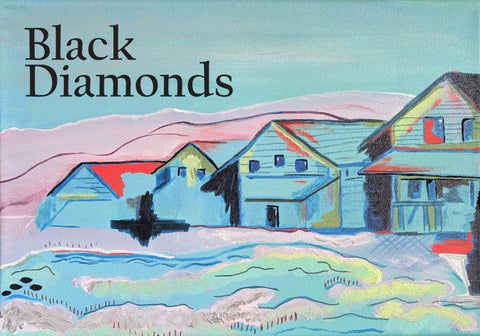
Black Diamonds
AN ARTS & LITERARY MAGAZINE GEISINGER COMMONWEALTH SCHOOL OF MEDICINE VOLUME 13 | 2026
Cover Image Houses Springing Up after Rain Iris Johnston, Senior Library Specialist
Black Diamonds is an arts and literary magazine of Geisinger Commonwealth School of Medicine. All content is the property of each respective author/artist. No part of this magazine may be reproduced without the permission of the author/artisit of each submission Geisinger Commonwealth School of Medicine is committed to non-discrimination in all employment and educational opportunities. Concernes or questions may be directed to the title IX coordinator whose contact information is available at Geisinger.edu/titleix.
Black Diamonds the practice of attention Simple People 6 Seaside heights, Hurricane sandy 7 sonder 8 to the first year student i was 9 light against structure 12 Structure Against Light 13 Watching Cars 14 To Be a patient, a doctor, a healer 15 distal phalanges 17 shingles and me 18 the contagion of medical work 19 contagion of life 20 sunrise in the jungle 21
atitlan drift 22 covenant 23 meowmento mori 24 New rule for doctors 25 Star- 26 -fall 27 chief complaint 28 the language of connection 29 Meghavaani 32 a spoonful of sugar 33 anatomy of fall 34 betrayal 35 California's snow 36 dunmore cemetery 37 unbound 38
F
or thousands of people living in northeastern Pennsylvania (NEPA) during the 19th and 20th centuries, coal was precious. It was the black diamond they mined and the substance that supported their
lives. Formed in ancient times under the massive pressure of the sediment above it, coal became the foundation of an entire economy in NEPA. That economy has all but vanished from this part of the country, but today, NEPA is witnessing the formation of a new and valuable resource. Created under the pressure of a great need for future physicians, Geisinger Commonwealth School of Medicine now exists. New students are coming in to NEPA every year to begin the process of being transformed into physicians through the steady, constant pressures of medical school. And like the rich veins of coal that extended through the region, these future physicians are now stretched across counties in northeastern and central Pennsylvania. For many of these students and their teachers, the arts are an important part of life outside of medicine. Our hope is that this journal can serve as a showcase for their expression and be an inspiration to those who read it.
Zachary Wolfe, MD MD Class of 2015
The Practice of Attention Amanda Caleb, PhD, MPH Editor-in-Chief The poet Mary Oliver famously asked, “Tell me, what is it you plan to do with your one wild and precious life?” Implicit within that question is another: What are you paying attention to? Attention is often understood as a simple act of observation. Yet it is never neutral. It shapes what we notice, what we overlook, and what we come to understand about ourselves and others. To pay attention is to make a choice. It is to pause long enough for something familiar to reveal unexpected depth. In this issue of Black Diamonds, we explore the power and practice of attention. It asks us to slow down and look again. It draws us toward people, memories, places, and moments that might otherwise pass unnoticed. It invites us to linger with experiences that resist easy explanation. Rather than offering tidy resolutions, this issue invites us to remain with complexity and reconsider what we think we know. To attend closely is to discover that the particular often contains the universal. A remembered phrase. A bedside conversation. A family ritual. An ordinary object. A fleeting image. These details matter not because they are extraordinary, but because they are specific. Through them, larger questions of identity, care, grief, belonging, memory, and meaning come into view. The pieces gathered here suggest that significance is often found not by seeking something new, but by paying closer attention to what is already present. The Black Diamonds editorial board invites you into this collection with time and attention. Some pieces reveal themselves immediately; others unfold more gradually. Let this issue be a space where attention becomes more than observation. A space where familiar stories, images, and experiences invite a second look. A space where what seemed settled reveals new layers of meaning. Yet the habits of attention this issue invites are increasingly uncommon. We live in a world that rewards speed, certainty, and immediate interpretation. This collection asks for something different: time, curiosity, and a willingness to linger with complexity.
Simple People Of ‘simple people’ during visit times, Attendings hope for easy meds and recs. These days all seem to vex the mind. Who is the one that needs to be rechecked?
Oliver Klemmer MD Class of 2028
Can I be better than all this noise? Compassion seems to laugh inside my soul. The last begotten seed of one’s own prior voice, So too will I endure and remain whole. For love and feelings drive my day-to-day, One must be truthful to their selflessness. The pressure in the hospital may stray An eager mind that hopes not to regress. So long as I can strive to remain pure, So will my love for patient care endure.
6
Seaside Heights Hurricane Sandy Iris Johnston, Senior Library Specialist Exploring the memories of my grandmother's neighborhood in the aftermath of Hurricane Sandy in 2012.
7
Sonder Sonder I read stories burned into bones weaved and twisted into DNA revealed in the grooves of lips carved into brows, etched into eyes riverbeds in the dermal canvas
Wonder
Julia Ma MD Class of 2026
at the mountains of the mind untouched ancient lakes of knowledge marvel at the halls of bile and salt bearing witness to a history long forgotten in excrement
Thunder
Ponder
in the hallowed chambers with the song of waterfalls Course through arteries and tubules with cleansing fire or suffocating myrrh Released by the nephron dams
on the storehouses of the soul above vast fields of neurons and tendons scored by intestinal catacombs as memories of grief, dirt, mirth, dust are honored in heaving echoes of corporal
Liver encased in a lipid kaleidoscope lymphocytes with extra keys lost in mazes of the splenic cave suspended among red sieves tested in white garrisons
Prayer
8
To The First-Year Student I Was Nitya Deshmukh MD Class of 2026 Dear Nitya, Congrats on getting into medical school! I know that you’re sad about leaving the city and all of your friends, and I know you think that you feel bad about “not being good enough” to get into a “better school”, but I gotta tell you; getting into medical school, getting into residency, succeeding in this field is equal parts hard work and luck. You can never tell who is making decisions in the background, what they think of you, what other choices they have to weigh. All you can do is trust that you’re going to do whatever you can. The first year of medical school is going to be very hard for you. Remember in college when you thought you had dyslexia, because you couldn’t focus? Or when you would stay up until four shoving information into your brain? I know that you are terrified that medical school means that you will need to put in even more work, but I have to tell you something very important. You have ADHD. You’ve had it forever, it turns out, but you’re good at hiding it, good at thinking that you just need to work harder. The truth is that there’s no amount of hard work that can replace the fact that you have ADHD. You are going to need to be incredibly lucky that some very special people decide to believe in you, that they will push to fight to keep you here. Because the truth is that if you keep hiding and pretending things will be alright, you will not become a doctor and you will fail out of medical school. This will be some of the worst moments of your life when you will need to reckon with who you are; 9
who you would be if you weren’t in school, the thing that you’ve been trained to do and asked to do your whole life. The good thing is that you get incredibly lucky, and you get treatment. People decide to give you a second chance, and that second chance makes all the difference. Your repeated first year and second year of medical school feel charmed after that; you cannot believe that other people exist like this normally. Sometimes, even now, I still feel like that. And then finally, you get to work in the hospital, and while everyone says this is the worst year of medical school, it’s actually your best. You get to actually find out who you are outside of school, and that is a person who loves being with other people. You realize that you want to spend your time talking to others to help them, making connections. You are going to lose track of the number of patients who want to give you a hug. By the time you graduate medical school, you will have laid hands on over 500 patients. You will get to move to the best apartment you have ever had, get a new sibling in your sister-in-law, see your brother become a father. It’s not like the year is easy; you are exhausted, stressed, unsure how to balance not knowing everything with the expectation of performing perfection. Thankfully, the people who are teaching you are incredibly wonderful people. Residents who will become friends that you care for dearly, attendings who you know you can reach out to at the drop of the hat because they will take care of you, friends and classmates that you treasure for the trips and parties and times spent gossiping and complaining in equal measure. You will get to have a new relationship with your dad, who you finally have a shared language with; every day you get to call him and tell him about a patient you saw, he gets to tell you about a patient he saw and you get to see how he is starting to reminisce over 50 years of medical practice, and is beginning to retire. That’s a very strange experience to have, and you’re very lucky that for two weeks, you get to rotate at the same hospital that you were born at and where he works.
10
You’re also going to get hit by a semi-truck. This will be the scariest thing that ever happens to you. The luck thing is real; the EMTs told you that everyone else tends to die in accidents like yours, you walked away with a spinal fracture that heals within 3 months. This incident will make you realize that you are beginning to lose yourself in medicine; when your first words to 911 are “How am I going to make it to my rotation tomorrow?”, there’s some shifting of priorities that need to happen. Thankfully, the people who teach you are incredibly kind, and they take care of you. Friends will bring you what you need, your partner will help you move, insurance will get you a new car. (It is a very nice car.) You are also going to get to experience an incredibly joy and finally own pets. The little kitten that you see at the shelter your very first year of medical school will be the most important creature in your life. Little Nora, who you had to fight to bring home because she was a black cat and it was October, is lying curled up in my arms while I type this to you. The day the vet told you that there was cancer in her leg, you were rotating in the ICU and you went to a closet and sobbed. She’s okay now. She runs and jumps and is free of pain with three legs and the month that she got the amputation was filled with so much gratitude for your friends who kept you company as you slept on the floor with her, and the friends who snuck out lap pads and sterile gloves to remove her drain. And now she has a friend, little Billy, who squeals up at you every time you look at him, also asleep next to me while I type. The two cats like each other (I think). And when you’re facing graduation, with some incredible programs on your rank list, you will realize that you were actually very capable of all of this. Your success is because you got very lucky and you worked very hard, and you realized who you are. You love to take care of people, and some very prestigious places saw that. Nitya, you’ll be just fine. Maybe invest in a better vacuum sooner, though. Love, Nitya
11
Structure Against Light Amy Kennalley MD Class of 2027 A rigid grid breaking light into fragments.
12
Light Against Structure Amy Kennalley MD Class of 2027 Light entering and reshaping a structured space.
13
Watching Cars
I walked to the clinic passing three red cars which meant it was going to be a bad day. She lay on the bed, And they said she wore a stone mask on her face, But her face was just skin and teeth and eyes and nares, And her chart said she was a drinker, But she was a drinker of alcohol, soda, water, and soup, since she’d drunk many things, And her lab results read too high or too low, But in her body the numbers were neither higher nor lower than themselves. So I took a chance, Calling three transplant centers, where one’d give her a liver and the other two wouldn’t, Without knowing which is which, I picked the first. Learning the second wanted nothing to do with her, I was led between the first and the third, And at first supposed it was 50/50, But thinking again chose the third. I walked to the clinic passing three red cars which meant it was going to be a bad day. But against long odds, I resigned to play that ambiguous, exacting game anyway.
Alexander Greenstone MD Class of 2026
14
To Be a Patient, a Doctor, a Healer To be a patient is to experience To be lost, de-souled, and damned by disease To be plagued with a fight between It and I, fearing both pathology and lack thereof To try reaching the same heights with a shorter ladder and no helping hand To want to create beauty from pain, to be expected to create beauty from pain To be susceptible, whether to viruses or instructions To be forced to rise above, forced to carry, forced to reminisce To grapple with pathos, ideally not for self, perhaps for treatment To double your malignancy, snowball into cycles of limits causing limitations Endure the dissonance of gifts and curses growing from the same roots To be perceived as humean, a spectacle To stand with broken columns, feel winter inside
Colleen Jordan, MBS MD Class of 2026
To speak and hope to be heard, to repeat and hope to be heard To have things done to you To be a doctor is to know To know normal within a privilege of context To focus and pinpoint, to exclude and compute To preserve the concrete and reason complexly, not simply To decompose, evaluate, test To be sure To look, behold, and wonder To know the criteria indicating the wallpaper is yellow To supplement a natural balance with an artificial one To know the disease by the sum of the symptoms To be miraculous yet catastrophic To be proud, but not God To be a healer is to understand To appreciate that history is alive, a narrative outperforms computation 15
To comprehend the validity of restitution, chaos, and quest To deem value does not come from etiology, but treatment still depends on it To grasp there is no humean, only human, all unique inalienable individuals To see with lost there is found, and the path towards Spring is shared To fight between best for one or for all To open doors but know they may not stay that way To fathom wellness can be genuine even if caused by an illness To know a person is more than the sum of their symptoms To understand numerals represent numbers To exchange Hawthorne-colored glasses for spirit spectacles To recognize how systems fracture our social contract but to do your best anyways
16
Distal Phalanges Rakhi Ratanjee MD Class of 2027 A hand, resting amongst an outcropping of rocks, calls me to examine, to assess, but I see no malformation - only anatomical variation. Valley of Fire, your anatomy lures me in.
17
Shingles and Me Julia Ma MD Class of 2026 Photograph of natural items capturing the time I had shingles.
18
The Contagion of Medical Work As I sat beside her quiet bed, Her fragile thoughts hung thin with dread. I saw it written on her face, A weary soul, a slowing pace. We spoke of home, of simple air, Of sunlight drifting through a chair. “No tests,” she said. “No needles more. No probing hands. Close the door.” A modest plea, no grand requestJust peace, just stillness, just let me rest. On rounds we came in ordered line, Bed six of eighteen - by design. An urgent chart, a ticking clock, Another case, another knock. Routine exam, rehearsed refrain, Yet hers was more than charted pain. Of all the labs, of all the scans, It was her words I held in hand. Physicians speak of patient grace, Yet rush from face to waiting face.
We treat the heart, the lung, the fallAnd sometimes miss the soul in all. To stay intact, we build our shelves, Compartmentalized versions of ourselves. We tuck away what makes us feelAs if emotion blunts the steel. But in her room, I understood: Compassion does not dull the good. The charts may close, the metrics endYet life seeps in where we attend.
Justin Hunter MD Class of 2026
19
The Contagion of Life On a random Tuesday afternoon, the hospital hums in numbers. Potassium 4.1, Troponin eight, Oxygen ninety-three percent. It is easy to live here, inside the clean geometry of labs, where suffering becomes bullet points and EPIC plans. I feel the relief of distance. The stillness when a patient is sedated, The safety of not being asked what I cannot fix, The sterile rooms, sterile thoughts. But in another room, a chair pulled close to the bed. Bad news resting between us. Instead of prognosis we speak Of his dog, Of Sunday dinners, Of music he misses playing too loud.
Jordan Salvato MD Class of 2026
Yet the air feels warmer. The room becomes less a container for illness and more a place, where a life is still unfolding. The contagion of life is risky. It carries grief and helplessness. It asks me to feel what I cannot cure. But it also carries A connection A reminder A medicine
We are not only about sterilizing disease, but about sitting close enough To witness a life that is more than vital signs.
Nothing changes. The monitor. The IV still drips. The disease does not loosen its grip.
20
Sunrise in the Jungle Amanda Caleb, PhD, MPH Professor of Medical Humanities Taken while hiking a volcano in Guatemala.
21
Atitlán Drift Amanda Caleb, PhD, MPH Professor of Medical Humanities Early morning photograph of Lago de Atitlán, Guatemala.
22
Covenant Dear one who comes from far away lay the sandals from your path today Share your stories of the golden past and tell of days that never last
Julia Ma MD Class of 2026
I will wash your feet and bless your face in everlasting frankincense I will promise to carry your cross, delight in your joys, grieve your loss Sing to me your story I will write it down Let me teach you our ways as we dig our roots and raise our hands to heav’n I will lift your voice among the noise Let us light the lantern to rejoice In health and sickness, I’ll abide and keep you safe in ocean wide Let us learn to live together 23
Meowmento Mori Iris Johnston Senior Library Specialist I chose this pattern (by TheEmbroideryPlaceAU) to remember that the eternity after that grey, sad moment of death is full of new life. R.I.P. Newman.
24
New Rule for Doctors I think my doc should be a trusty guide to teach me (and to help preserve my life). I think it’s pretty close to suicide
that puts us on a social pinnacle. We went to med school and got filled with facts, but they’re not all our patients really need. to hand some random lad a sharpened knife. They’ve seen enough to date of cookbook And who can blame me for my prejudice? hacks The patient role demands an act of faith! who we don’t know for sure know how to read. I’m sure that we can all agree on this: You wouldn’t let your grandma see a wraith. Since being human earns this skeptic’s trust, the human touch, from now on, is a must. The doctor needs to look me in the eye, and bare for me a human attitude. For me, at least, a far too polished guy is just, potentially, a deadly dude.
Dominic Gregorio, MMS MD Class of 2026
Like shiny pots and cookware down below, it’s what’s inside the thing that really counts. What stainless science outwardly can’t show is what I frantically must now denounce. The kitchen has a recipe to use, the counters, there, are cleaned with chemicals. It’s not the stuff we spray, inject, infuse
25
StarRakhi Ratanjee MD Class of 2027 A man gazes, mesmerized, as fireworks burst across the vast Atlantic Ocean on the Fourth of July. The sky, the next great frontier of mankind, opens its arms with a radiant promise of a bright future - celebrate, it says - strive for your dreams.
26
-Fall Rakhi Ratanjee MD Class of 2027 Sometimes, however, that American dream falls fracturing into an infinitesimal collection of pieces scattered too far apart to pick up. We mourn, cry and look toward the sky again fight another day.
27
Chief Complaint Chief complaint: Chest pain. EKG result: normal. Troponins: normal. Pro-BNP: normal. Electrolytes: normal. Slightly elevated total cholesterol. Chest xray did not show dissection or pulmonary edema or other pulmonary etiologies. No evidence of heart failure. Pain meds given but did not treat her soul. The one that ached over her son who had just survived a month in the ICU Whom she watched like a mother bear until the nurses knew her name Whom she bore and loved as he dove into fermented ecstasy and destroyed his liver and kidneys. She gave him her impeccable fashion sense
an eye for luxurious decor a desire for all things beautiful Torn between motherhood and self-preservation hanging between duty and justice Her heart carried her furious love that slipped from her mind and seeped into her bones Her feet carried her to his bedside again and again to proclaim “I love you even so” in tight hand holds in wiping sweat from his brow in nights on the recliner and praying for his return. She carved him into her hands and bears the scars forever. Chief complaint: Heartache.
Julia Ma MD Class of 2026
28
The Language of Connection
Lakshmi Ilango MD Class of 2026
“¿La cuidarás y te asegurarás de que sobreviva?” an elderly man asked, his eyes glistening with hope. I hesitated and looked toward his daughters, silently asking for help translating the weight of his words. “He’s asking if you’ll look out for her, if you’ll take care of her and make sure she survives,” one of them clarified gently. Their mother had just been admitted to the ICU with respiratory failure, renal failure, and profound hemodynamic instability. Earlier, a video interpreter had been called so the physician could obtain consent for a central line. The risks and benefits were explained carefully, as they always must be. Yet the conversation felt fragmented with technology inserting a thin but palpable barrier between fear and understanding. There were pauses, slight delays, and moments when emotion got lost in translation. Eventually, the family agreed to proceed despite the risks, and they were escorted to the waiting room.
29
I walked with them. In awkward but earnest Spanish, I tried to offer reassurance. I explained that although every procedure carries risks that must be discussed, central lines are placed frequently in the ICU so it is a good decision that they had agreed. The elderly man suddenly stopped and looked at me with surprise. “¿Hablas español?” “A little,” I nodded, and his face brightened. He shook my hand firmly and asked where I was from and how I learned Spanish. He then talked about his hometown. For a few moments, the suffocating heaviness of uncertainty seemed to lift. The clinical space softened into something more human. But by stepping into their language and choosing to meet them more personally, I felt they entrusted me with something far greater than I deserved. Language became more than communication; it became connection. And connection created expectation. “¿La cuidarás y te asegurarás de que sobreviva?” I knew the limits of my role. I would not even be there the next day. “We will try our best” I told him and that I would check on them later that afternoon. I tried to balance honesty with hope. The afternoon pulled me away with other responsibilities. When I returned, the family was gone. The next day was my day off. Later that Sunday, I checked the chart. She had died and I will probably never see that family again. 30
I still think about that question. Did I offer comfort and humanity in a moment of fear? Or did my presence unintentionally give them false hope? I wanted them to feel seen, not as a “case,” not as a room number, but as a family that had a place in this hospital. I wanted them to feel respected in their language and culture. I wanted them to know they were not alone. Medicine does not promise survival. It promises effort. It promises presence. It promises to try. That day, I learned that speaking someone’s language is powerful, but what we communicate without meaning to may be even more powerful. I could not save her. I could not fulfill the promise hidden inside his question. What I could offer was honesty, compassion, and my willingness to stand beside them, even briefly. I hope that was enough.
31
Meghavaani Divya Sundararajan MD Class of 2027 Titled "Meghavaani," meaning "voice of the clouds," this fantasy-inspired piece draws from the rich cultural imagery of South Asian history and mythology.
32
A Spoonful of Sugar She came in on a Monday, not quite three and less than half the size she should be. Her history told a story, in both what was written and what was not. It wasn’t a very happy one. I was wary of her at first. She was so easily upset, and I hoped that the calm of her quiet, sterile room would bring her peace.
Cameron Jones MD Class of 2026
Her answer came in plaintive cries and tiny fists outstretched against the mesh walls of her crib toward my retreating back. I drew out my visits before rounds, assessments of her heart and musculature broken up by picture books and toys. My early evenings gradually lengthened to make time for feeding her supper, where I got to be the first to see her take the spoon for herself. Her change was incremental and obvious, in steadily increasing weight and more smiles each day. My own change was understated but profound, hidden in a deeper connection to my work and growing peace of mind. I swapped tips with the nurses who spent her first days so carefully washing and combing her hair so that she wouldn’t itch. Her little victories became ours together, not something to be marked down in her chart but a group celebration and shared joy. She left on a Friday. It was the happiest and the hardest day of her stay. I got to say goodbye, holding her during rounds. She was a different child by this point, and I was a different doctor. We shared a smile before she left.
33
Anatomy of Fall Amy Kennalley MD Class of 2027 A study of change at its most delicate scale.
34
Betrayal Just a flash A whisper of a thought A familiar voice A harbinger of danger A kaleidoscope of emotion Fear Panic
Dread The essence of impending doom Sounds splinter and shatter Building to a cacophony Overlapping Interrupting Interfering All in chaotic silence An undeniable pull A demand for obedience Irrefutable insistence Unspoken yet understood Marching orders in my skin Obstinance redirected Compliance essential Obedience compulsory A primal instinct
Alanna M. Bright, MEd Curriculum Coordinator, School of Graduate Education Like breath for the drowning Danger lingers No options No alternatives Pressure builds Surrounds Constricts An abusive, familiar embrace Fear detonates Thoughts Rules Demands Unbidden, unwanted Autonomy restricted Weakness laid bare Rendered helpless Booming insistence Overpowers quiet logic No certainty but in repetition Do it again And again And again And again
Unfinished
Non-compliant Incomplete Urgency in every heartbeat Internal mayhem Skewing thoughts Evading reason Fractured echoes persist Reverberate Do it now Do it again Do it right Until the beast is sated A hint of calm Heartbeats slow Panic settles into peace A temporary truce Coveted quiet Until the voice begins the cycle anew Treason of the highest order Because the voice is mine But out of my control
35
California's Snow Rakhi Ratanjee MD Class of 2027 During a winter of heavy rains, Badwater Basin, a salt flat spanning nearly 200 square miles in Death Valley National Park, offers forth a rare sight: snow and water. Nestled at 282 feet below sea level at the lowest point in North America, sodium chloride crystals mingle with pockets of water, reminding us that beauty can be found in the most unusual places. 36
Dunmore Cemetery Iris Johnston Senior Library Specialist The idiosyncratic architecture in the Dunmore Cemetery, with its Masonic pyramid and elaborate mausoleums, gives the place an air of whimsy.
37
Unbound Most days, I don’t cry. Most days, I remember you in measured doses, an effort to control my grief so it doesn’t overwhelm.
Amanda Caleb, PhD, MPH Professor of Medical Humanities And one for the long years of watching you recede— your voice still reaching outward, but no longer finding me.
I miss you in layers. I miss the last version of you, too: But you never did things in small the way your eyes would soften measures. when I said your name, You arrive the way you always did: even if you didn’t know why. unannounced, expansive. Your own sound of silence In the tang of the orange marmalade that asked nothing I spread on my toast. but that I stay. in the opening chords of Simon & Garfunkel Sometimes I wonder spilling into the room. which loss hurts more: Suddenly, you are there, the first forgetting or singing a little too loudly, the final goodbye. off-key and unselfconscious. And I am sobbing I don’t try to stop it anymore: even louder. the tears, the singing. I understand something There are two griefs living in me. I couldn’t before: One for the father who filled you are not homeward a room with stories bound. You are and steady warmth. unbound, freed
from names you could not reach, from stories that would not stay. What remains is what did not leave with you.
38
COMMITTEE
Amanda Caleb, PhD, MPH Editor in chief Jacob Kornilow CHIEF Layout Designer
Iris Johnston Staff Editorial Assistant Karen Ephlin, MD Staff Editorial Assistant Alanna bright, mEd Staff Editorial Assistant RANJITA SURESH StUDENT Editorial Assistant CAROLINE VIRONE StUDENT Editorial Assistant 39
40