SCHOOL OF MEDICINE
Abigail Geisinger Scholars Program
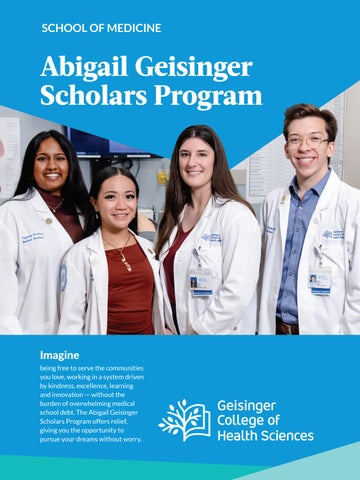
Imagine being free to serve the communities you love, working in a system driven by kindness, excellence, learning and innovation — without the burden of overwhelming medical school debt. The Abigail Geisinger Scholars Program offers relief, giving you the opportunity to pursue your dreams without worry.
Table of contents Introduction............................................................................... 1 Scholar spotlight: Theresa Pham.................................... 2 Plans for healthier communities.................................... 3 Scholar spotlight: Anthony Soto Ramos................... 5 Unique, primary-care focused programs.................. 6 Scholar spotlight: Alison Ross.......................................... 7 Accelerated Pathway Programs.................................... 8 Meet the team/Apply........................................................... 9 Scholar spotlight: Nicholas Gershey....... back cover
Geisinger College of Health Sciences advances health through exceptional education, research and community engagement. We educate and support compassionate healthcare professionals and scholars dedicated to excellence, discovery and innovation. Our graduates are prepared to improve the quality and value of healthcare, optimize health outcomes, address the unique attributes of our region and its people, and promote well-being for all. Geisinger Commonwealth School of Medicine educates aspiring physicians and scientists to serve society using a community-based, patient-centered, interprofessional and evidence-based model of education that is committed to fairness and respect for all, promotes discovery and employs innovative techniques.
The Abigail Geisinger Scholars Program: What happens when better health is built on primary care? Medical students like you share the same dream: A career that builds lifelong personal relationships with patients and places you at the center of your community as a trusted source of knowledge and compassion.
innovation and technological advance we make. Through the Abigail Geisinger Scholars Program, we back that pledge with relief from overwhelming medical school debt, as well as a $2,000 per month stipend during your years at Geisinger Commonwealth School of Medicine.
Geisinger supports the ideals of its future doctors by putting primary care where it belongs — at the forefront of every
1 1
Scholar spotlight Theresa Pham Supported to serve
Her early experiences inspired her to pursue a field where relationships can grow over time — in primary care — and to work with underserved populations.
Theresa Pham, the daughter of Vietnamese immigrants, dreamed of a career in medicine since childhood. Her dedication to service makes primary care a perfect fit, and she is pursuing her “calling” as a member of the Abigail Geisinger Scholars Program.
Ms. Pham said Geisinger’s curriculum reflects the kind of physician she hopes to become. She regularly encounters scenarios that highlight factors in a patient’s life beyond their diagnosis, such as housing instability, financial strains and transportation challenges.
Ms. Pham sought hands-on experience in medicine early. As a college student, she became a certified nursing assistant and volunteered with hospice to help patients navigate complex medical and emotional challenges.
The Abigail Scholars program has been transformative. “I want to do primary care. And to know I can afford to do it — that’s a really big deal.”
“Listening is a crucial skill,” she said. “Caregivers need to understand that every person is unique, even if they have the same diagnosis as another patient.” She also taught immigrants English and helped lead a large, free mobile clinic in Scranton. There, she gained firsthand insight into the barriers many patients face, from affordability to access to care.
Along with providing crucial financial support, the program also offers structured advising, early exposure to practicing primary care physicians and strong mentorship. Wherever she practices, Ms. Pham said, her focus will remain on expanding access to care and continuing to volunteer in free clinics, providing every patient with the care they need.
2
Geisinger’s plans for healthier communities In 2017, the Arnold P. Gold Foundation’s Richard Levin, MD, offered a blunt observation: “Doctors enter the profession to help and care for humans,” he said. “They do not sign up to be scribes or billing agents.” His statement struck at the heart of what plagues modern medicine, and particularly primary care and psychiatry — namely, inefficiencies and bureaucratic barriers that frustrate both doctor and patient and make good healthcare anything but easy.
the level of care patients received in primary care settings. For patients, this means more intermediate care services, such as IV infusions, and behavioral health services available right in the clinic. For physicians, primary care redesign removed excessive administrative burdens that negatively affect provider well-being. Today, Geisinger’s transformed clinics are frustration-free zones staffed by interdisciplinary teams that make primary care easier for patients and more rewarding for doctors. For example, patients long annoyed by having “homework” like getting lab work done or a prescription filled can now get all these services and more in one visit.
Thanks to Geisinger’s redesign of primary care, the bond between primary care doctor and patient that should be at the heart of good health has been restored. The redesign had two simple goals: to make primary care a joy to practice for doctors and to ramp up
3
“When I started my career, before primary care redesign, it was up to the physician to get everything done for the patient,” said Kim Kovalick, DO, a family medicine physician at Geisinger Kingston. “Now, we have a care team that collaborates in the care of our patients. From the moment I walk in the door, I have many team members who help me provide great care. For example, a nurse will give recommended immunizations before I even walk in the room. They order blood work and preventive screenings such as mammograms and DEXA/bone density tests.
We can take more time with patients with complicated medical conditions and have a team approach to make sure the patient has all the resources they need.” She added, “If patients have multiple medical problems — congestive heart failure or diabetes, for example — we have a care team that can help out with the patients’ needs. We also have dietitians and medical pharmacists to help educate our patients. All these team members have helped to not only reduce physician burnout, but also improve overall care.”
4
Scholar spotlight Anthony Soto Ramos From mentee to mentor
Today, he is an Abigail Geisinger Scholar planning a career in primary care.
Long before he ever stepped into a medical school classroom, Anthony Soto Ramos was already practicing one of the most essential skills in medicine: listening — and translating. At just 7 years old, he accompanied family members to medical appointments in Hazleton, serving as their interpreter. By age 8, he wanted to be a doctor.
“At Geisinger, they invest in all of the people who live in the area to see them become healthier,” he said. And he is determined to multiply that investment. “I want to volunteer in the community and see where there are gaps in healthcare,” he said.
That dream came closer to reality in middle school, when he was introduced to the Geisinger College of Health Sciences’ REACH-HEI program, which immersed him in hands-on science workshops led by medical students and physicians. He was able to see himself pursuing a career in medicine. And he found mentors who helped him forge a path no one in his immediate family had traveled. “They helped me navigate everything from college applications to financial aid to preparing for graduate study,” Mr. Soto Ramos recalls.
5
He is also now mentoring REACH-HEI students and leading workshops on the medical school admissions process, giving back to the next generation of students. “That mentorship has been an extremely crucial part of my journey,” he said. “I hope that I can now be that person for someone else.”
We immerse our students in these unique, primary-carefocused programs: Research
Geisinger 65 Forward
Abigail Geisinger Scholars have opportunities to take part in research centered around primary care.
These primary care clinics are tailored to meet the unique needs of those age 55+. People get longer appointments, social activities, wellness classes and VIP-level, personalized care. Everything the patient needs is under one roof in a calm, relaxing environment.
Fresh Food Farmacy This program offers nutritious groceries for eligible patients referred by their physician to help better control their diabetes in light of food insecurity. The program also supplies food for the patients’ families. Eligible patients and their families can enjoy better health, which is a priority for Geisinger.
LIFE Geisinger
MyCode Community Health Initiative This precision-medicine project analyzes the DNA of registered patientparticipants, improving healthcare by finding ways to diagnose medical conditions earlier — even before symptoms appear — and developing new ways to manage these diseases.
6
LIFE Geisinger is a program for adults 55 and older designed to give patients the support they need to live at home independently while using comprehensive daily living and health services. An experienced team coordinates care based on individual needs, offering caregivers relief and support. Federally Qualified Health Centers Scholars can take part in experiences at federally funded nonprofit health centers, providing care regardless of a patient’s ability to pay.
Scholar spotlight Alison Ross A lifelong passion for medicine finds its home at Geisinger
Now pursuing internal medicine, Ms. Ross is the first Accelerated Pathway Program Scholar in the Danville program. “Internal medicine is like solving puzzles,” she said. “It lets you put all the pieces together.”
Pennsylvania native Alison Ross always felt a deep connection to medicine, shaped by personal experience with illness. “Medical care was always part of my life,” she said. “I really connected with every one of my doctors. I was constantly telling them, ‘I’m going to be you when I grow up.’” Her interest deepened when several family members passed away from cancer. A desire to understand its causes and treatments guided her undergraduate years at the University of Pittsburgh, where she majored in molecular biology, minored in chemistry and bioengineering and earned a certificate in the conceptual foundations of medicine, a track that included topics like morality and medicine. That track shifted her focus toward primary care. “It’s great to be able to treat diseases like cancer, but what if we prevent it from happening or catch it early enough that people don’t need life-altering surgeries?” she said.
7
The Accelerated Pathway Program, which allows students to transition directly into residency after 3 years of medical school, was a perfect fit for Ms. Ross. “It’s a unique opportunity to expedite my journey into becoming a doctor,” she said. “I’ve already started working with the Danville internal medicine residency program.” Ms. Ross is most excited about providing longitudinal care. “I’d much rather keep patients healthy than see them only when they get sick,” she said. “Quality of life is one of the most important things in medicine.” Her advice to prospective students? “Talk to the people here,” she said. “One of the most appealing aspects of Geisinger is its people and the sense of warmth and family you get when you come on campus. Everyone is here to support you and wants you to succeed.”
Accelerated Pathway Programs Finish medical school and residency in less time Abigail Geisinger Scholars accepted to the Accelerated Pathway Programs complete medical school in 3 years, followed by a pathway into a residency in one of Geisinger’s following programs: • • • • • •
Family medicine residency at Geisinger Lewistown Hospital Family medicine residency at the Kistler Clinic of Geisinger South Wilkes-Barre General internal medicine residency at Geisinger Wyoming Valley Medical Center General internal medicine residency at Geisinger Medical Center Neurology residency at Geisinger Medical Center Pediatrics residency at Geisinger Medical Center
This means students in the Accelerated Pathway Programs enter residency 1 year earlier than their peers, allowing them to start serving their community sooner.
Overview
Advantages
• Accelerated training allows students to meet all medical education program objectives and earn their medical degree in 3 years • Early immersion/orientation with staff/faculty and our residency programs • Longitudinal Clinical Experience (LCE) at participating residencies early in the curriculum • Scholarly summer immersion program with participating residencies • Students spend one half-day per week in a continuity practice aligned with their residency during Phase 2 and 3 of the curriculum
• Medical school completion in 3 years • Rigorous programming aimed at time efficiency and robust experiences • Advising and mentoring by residency program physicians and residents • Peer collaboration and fellowship • Pathway into a Geisingersponsored residency of your medical school training
8
Meet the team Abigail Geisinger Scholars Program Kim Kovalick, DO Assistant Dean, Abigail Scholars
Anja Landis, MD Director of Abigail Geisinger Scholars Program
How the Abigail Geisinger Scholars Program works: Geisinger believes the future of medicine lies in robust primary care — care that anticipates and prevents disease, focuses on wellness and recognizes health and well-being as fundamental to stronger, more resilient communities. That’s why the Abigail Geisinger Scholars Program focuses on the following specialties: • Family medicine • General internal medicine • Medicine-pediatrics • Pediatrics
Nino Cimino Curriculum Coordinator for Primary Care
Admissions Michele Schmude, EdD, MBA Vice Provost for Enrollment Management
Our program frees medical students from the financial concerns that could derail their dreams. As an Abigail Geisinger Scholar, you will: • Get relief from overwhelming medical school debt. • Receive a $2,000 per month stipend. • Become a Geisinger-employed physician in one of the specialties listed above upon completion of residency training. One year of service equals one year of support.
Deidre Jones Associate Director of Admissions 570-504-9068 • mdadmissions@geisinger.edu 570-504-9068 • mdadmissions@geisinger.edu
Interested in applying? Submit an American Medical College Application Service® (AMCAS®) primary application and Geisinger Commonwealth secondary application. • •
Answer “yes” to the first question on the Geisinger Commonwealth secondary application regarding interest in applying for the Abigail Geisinger Scholars Program. Complete the question regarding primary care and provide any updates to your experiences that align with the Abigail Geisinger Scholars Program.
You are considered for admission into the MD program before interviewing for the Abigail Geisinger Scholars Program. You are selected to participate in this program based on financial need, merit, mission alignment, likelihood of staying at Geisinger beyond the service obligation and interview assessment. To learn more, visit go.geisinger.edu/abigailcare
525 Pine St. Scranton, PA 18509 Call: 570-504-9068 go.geisinger.edu/abigailcare mdadmissions@geisinger.edu
Scholar spotlight and the Abigail Geisinger Scholars Program helps me fulfill that goal.”
Nicholas Gershey Medicine is the highest form of service Nick Gershey was inspired by his hometown medical school that was rapidly gaining prominence for its commitment to serving the community. “Having a medical school focused so much on my own neighbors was a wonderful thing,” he said. “As a kid, I always wanted to give back,
Through Geisinger College of Health Sciences Pathway Programs, Mr. Gershey volunteered at a local middle school, sharing his journey with students. “My community immersion project was meant to show kids they can become the next generation of physicians,” he said. Mr. Gershey is especially interested in internal medicine-pediatrics, a specialty he discovered through the program’s seminar series. “Hearing about the lives of these physicians, how they conduct themselves every day and hearing about why they do medicine — it’s been one of the program’s great benefits.” The seminar series also reinforced medicine’s service mission. “The focus on service and community is what keeps me motivated,” he said.
Geisinger College of Health Sciences is committed to nondiscrimination in all employment and educational programs or activities. Concerns or questions may be directed to the Title IX coordinator whose contact information is available at geisinger.edu/titleix.
3171450-7/26-HDAV/SKL