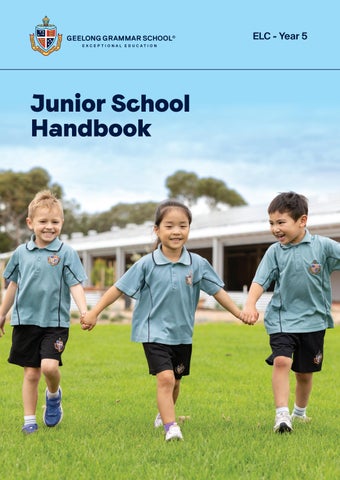
ELC - Year 5
Junior School Handbook
1
JUNIOR SCHOOL – HANDBOOK
A new chapter for Geelong Grammar School 01 | General information WELCOME OUR PHILOSOPHY NURTURING THE WHOLE CHILD PRIMARY YEARS PROGRAMME REGGIO EMILIA APPROACH
02 | ELC Information INTRODUCTION TO ELC LEARNING FRAMEWORK CURRICULUM ATTENDANCE PROCEDURE
03 | Junior School Information CURRICULUM AND CO-CURRICULAR ATTENDANCE PROCEDURE CULTURE AND ENVIRONMENT STUDENT LEADERSHIP
04 | Essential Information A–Z UNIFORM DETAILS
Playing and learning in
WADAWURRUNG country
Junior School, Corio Campus A place of learning, with and through nature The new Junior School unites the heritage of Bostock House with the possibilities of Corio Campus. Grounded in the International Baccalaureate Primary Years Programme (PYP), it offers an inquiry-driven education within a nature-based environment designed to foster curiosity, wellbeing and creativity.
JUNIOR SCHOOL – HANDBOOK
3
General Information
4
JUNIOR SCHOOL – HANDBOOK
01
G E N E R A L I N F O R M AT I O N
Welcome Welcome to Geelong Grammar School, a vibrant and pioneering community that provides exceptional learning opportunities built on real-world experiences and genuine human connections. Since 1855, our School has advanced a proud heritage through innovation that champions a well-rounded, modern education for young people. ONE SCHOOL, SEAMLESS PATHWAYS 2026 marked a historic milestone, with the transition of our Early Learning and Junior Years students to the Corio Campus. With purpose-built facilities embedded within the environmentally oriented landscapes of Limeburners Bay, this handbook provides key information relevant to commencing the GGS journey on a site that bookends exceptional education.
JUNIOR SCHOOL – HANDBOOK
5
5
01
G E N E R A L I N F O R M AT I O N
From the Head of Junior School There is something quite special about arriving at Junior School. As you cross the wooden bridge and make your way through the landscape, the pace seems to change. The natural bush setting, open spaces and peaceful surrounds create a sense of calm and possibility; a place where children can slow down, look closely, wonder and explore. And then there are the cows and sheep in the paddock, fish in the dam and sticks to collect for building huts. These everyday moments are part of what makes Junior School so distinctive. Here, nature is not simply something we look at; it is part of our children’s experience of school and an important part of how they learn. The environment serves as our third teacher. Drawing on the Reggio Emilia Approach to learning and the International Baccalaureate Primary Years Programme (PYP), we thoughtfully consider how spaces can invite curiosity, encourage collaboration, provoke questions and make learning visible. Our environment is designed to be explored, interpreted and shaped by the children who inhabit it. Learning begins with their questions and grows through rich experiences, meaningful relationships and opportunities to investigate the world around them. Whether they are learning in the classroom, wandering through the bushland, observing nature, building, creating, collaborating or simply finding a quiet place to think, our students are encouraged to be active participants in their learning. And as part of a vibrant ELC–Year 12 community, Junior School students will learn alongside older and younger peers; creating opportunities for mentoring, collaboration, shared experiences and a genuine sense of belonging. These connections extend across the Geelong Grammar School campuses, allowing our youngest learners to feel part of something much bigger, while still enjoying the intimacy and care of a Junior School community. We invite you to explore the possibilities of a Junior School where learning, community and environment come together to create something truly special. Sondra Wolfenden Head of Junior School
6
JUNIOR SCHOOL – HANDBOOK
JUNIOR SCHOOL – HANDBOOK
7
01
G E N E R A L I N F O R M AT I O N
Our Philosophy Our purpose centres on the pursuit of shaping a world worth living in. For us, this means enabling wisdom within ourselves and others, so that each of us can make a positive difference in the world around us.
As a School, we have earned a reputation for pioneering and progressive choices in education. Such choices are founded upon balanced and holistic education for our young people; optimising our students’ academic agency and efficacy is aligned with appreciating how essential it is to support each learner athletically, creatively, emotionally, intellectually, morally, socially and spiritually. Ultimately, we want to energise the gifts within every child so that they are engaged in the world in a personalised and meaningful way, purposeful in their own pathway and confident in their capabilities.
Th e
e ap sh orld worth living aw in
Our Purpose
to
po king a sitive dif ma fer f o en rit ce i p s
Intersecting the science of learning with the art of teaching to shape a world worth living in
Our Actions Courage Curiosity Compassion Civility Connection
8
Our Focus Enabling wisdom
JUNIOR SCHOOL – HANDBOOK
01
G E N E R A L I N F O R M AT I O N
WE HAVE THREE STRATEGIC EDUCATIONAL PILLARS. These pillars underpin our approach to an Exceptional Education. It is our vision that all students, at every campus, will experience learning across these pillars in a significant way.
Adventure Education Experiential learning through and with nature
Positive Education Placing wellbeing at the heart of our learning community
Creative Education Cultivating the skills of communication, collaboration, critical thinking, problem posing and problem solving
JUNIOR SCHOOL – HANDBOOK
Adventure Education builds on the lessons of the School’s transformational Timbertop programme, which helps our students develop confidence and competence in practical ways, promoting independence, self-reliance and resilience.
Positive Education brings together the science of positive psychology with contemporary teaching to encourage individuals, schools and communities to flourish. Positive Education focuses on specific skills that assist students to strengthen their relationships, build positive emotions, enhance personal resilience, promote mindfulness and encourage a healthy lifestyle.
Creative Education teaches the skills and attitudes to be creative in any context. Creative Education prioritises educators as facilitators, coaches and collaborators in the classroom and moves away from the silos of knowledge-based, exam-based, standardised learning to an education that recognises the common skills which lie between subjects.
9
01
G E N E R A L I N F O R M AT I O N
Nurturing the Whole Child Junior School reflects our holistic student-centred philosophy, where individualised support and exceptional opportunities allow every child to grow in confidence and explore their unique talents and interests. We want our students to enjoy positive learning experiences that engage and challenge in ways that extend beyond core academics, ensuring they are well prepared for future learning.
LEARNING FRAMEWORK
LEARNING COMMUNITIES
We believe in the powerful and experiential ways it connects our students to the vibrant world of learning, supporting them to deeply investigate their world, encouraging critical and creative thinking and promoting active citizenship with global perspectives. The Primary Years Programme (PYP) provides the learning framework that guides us in delivering the Australian curriculum to our students. In the Early Learning Centre, we are also influenced by the Reggio Emilia Approach combined with the PYP.
As a PYP school, we bring a contemporary structure to our teaching and learning that is growth orientated, supporting every young learner to develop and pursue appropriate learning goals. Each child is unique and different in development, maturation, personality and ability. To cater for this, we have three learning communities that allow us to move students between individual work and group work, as well as among fluid and diverse groupings, in response to student needs and the requirements of inquiry-based learning. The learning communities are:
Through the PYP, the subject areas of maths, language, science, social studies, information technology, the arts, physical education and library are integrated into ‘transdisciplinary themes’, helping students make connections between the subjects, thereby facilitating more effective learning.
- Early Learning Community (ELC to Prep) - Year 1 and Year 2 Learning Community - Year 3 to Year 5 Learning Community Each learning community is made up of a team of educators who work alongside each other in collaborating for shared units of inquiry and other learning opportunities. Collaborative planning and teaching practices between year levels and across diverse groupings ensure that all students are supported and extended. Through a differentiated learning approach, our students can experience the satisfaction of challenge and achievement, which leads to enhanced motivation and engagement.
10
JUNIOR SCHOOL – HANDBOOK
JUNIOR SCHOOL – HANDBOOK
11
01
G E N E R A L I N F O R M AT I O N
Primary Years Programme (PYP) Designed for students aged three to 12, the PYP provides the knowledge, concepts, skills, personal attributes and the capacity to take action, all of which younger students need to equip them for successful lives, both now and in the future. The PYP provides an ideal foundation for children to become successful, lifelong learners by developing their: - social and emotional well-being - independence, as they take responsibility for their own learning - international mindedness - understanding of the world and their ability to function effectively within it - attitudes and dispositions for learning - ability to take mindful, appropriate and sustainable student-initiated action
THE IB LEARNER PROFILE The attributes of the learner profile represent a broad range of human capacities and responsibilities that encompass intellectual, personal, emotional and social growth. The development and demonstration of these attributes are foundational to learners becoming internationally minded, active and caring community members who respect themselves, others and the world around them. The learner profile and ethos behind it applies to all of us, for we are all continually learning. Parents are encouraged to attend curriculum information evenings to learn more about the PYP.
- language skills; all students study an additional language by the age of seven.
12
JUNIOR SCHOOL – HANDBOOK
01
G E N E R A L I N F O R M AT I O N
SIX TRANSDISCIPLINARY THEMES Learning in the PYP is underpinned by six transdisciplinary themes that are explored through relevant, challenging and engaging units, using knowledge, skills and concepts derived from six subject areas. Each of the themes are selected for their global significance and relevance to the real world.
Young learners explore the commonalities of human experience by investigating these themes through a programme of inquiry. The six transdisciplinary themes are:
we are Who
re we Whece andare tim pla e in
An inquiry into the nature of self; beliefs and values; personal, physical, mental, social and spiritual health; human relationships including families, friends, communities and cultures; rights and responsibilities; what it means to be human.
An inquiry into orientation in place and time; personal histories; homes and journeys; explorations and migrations of humankind; the relationships between and the interconnectedness of individuals and civilizations from local and global perspectives.
An inquiry into the ways in which we discover and express ideas, feelings, nature, culture, beliefs and values; the ways in which we reflect on, extend and enjoy our creativity; our appreciation of the aesthetic.
An inquiry into the natural world and its laws; the interaction between the natural world (physical and biological) and human societies; how humans use their understanding of scientific principles; the impact of scientific and technological advances on society and on the environment.
An inquiry into the interconnectedness of human-made systems and communities; the structure and function of organisations; societal decision making; economic activities and their impact on humankind and the environment.
An inquiry into the rights and responsibilities in the struggle to share finite resources with other people and with other living things; communities and the relationships within and between them; access to equal opportunities; peace and conflict resolution.
Ho
Ho
Sh
H wt
he worl
rk d wo
JUNIOR SCHOOL – HANDBOOK
s
ww ise e organ o u r s e l ve s
es
ow
express ours e el w v
ari
n g th e p l a n
et
13
01
G E N E R A L I N F O R M AT I O N
The Reggio Emilia Approach The Reggio Emilia Approach is an educational philosophy which originated in the northern Italian city of Reggio Emilia. We are a Reggio-inspired school, drawing on elements of the philosophy with consideration for the context and needs of our community. The principles of the Reggio Emilia Approach are:
The image of the child
We see the child as strong, competent, curious and resourceful, with enormous potential — a constructor of knowledge, actively seeking to make meaning of their world. The hundred languages of expression
The ‘hundred languages’ is a metaphor for the extraordinary potential of children. Children possess a hundred languages, or ways of expression, to understand and encounter others, for instance, drawing, painting, sculpting, acting and moving. Equal value is given to verbal and nonverbal ways of expression. Collaboration and interaction
Once educators have prepared an environment rich in materials and possibilities, they observe and listen to the children in order to know how to proceed with their work. Learning is viewed not as a linear process but as a spiral progression, with our educators as partners in the learning process. Our environment is ‘the third teacher’
Educators intentionally organise, support and plan various spaces for children to immerse themselves in. Daily schedules are planned to ensure that there is a balance between individual, small and large group activities, child directed and educator-initiated activities, and inside as well as outside experiences.
14
The power of documentation
Our written records and visual images detail children’s learning, development and experiences. This documentation provides a vehicle for reflection and communication with children, families and the School community. The three subjects of education: children, families and teachers
Education for each child is not considered in isolation, but seen in relation to the family, other children, educators, the environment of the school, the community and wider society. We focus on developing a sense of community, based on respect for others, openness, constructive co-existence and listening. The role of the educator
The role of the educator involves four major components: co-constructors, researchers, documenters and advocates for children. The role of parents
Parents are an essential component of the programme, a competent and active part of their children's learning experience. Source: Foundations of the Reggio Emilia Approach, Lella Gandini.
JUNIOR SCHOOL – HANDBOOK
Early Learning Centre (ELC) Information
JUNIOR SCHOOL – HANDBOOK
15
02
E L C I N F O R M AT I O N
Welcome to the Early Learning Centre, the first step in your child's adventure at Geelong Grammar School. Our Philosophy
Inspired by the Reggio Emilia Approach, the Early Learning Centre views children as capable, curious and active participants in their own learning. Each child brings unique strengths, perspectives and ways of communicating that enrich our community. Central to our philosophy is the belief that children should be listened to, valued and heard. Through warm, responsive relationships, we create a sense of belonging where children's ideas, questions and interests help shape curriculum and learning experiences. Children are recognised as active citizens with rights, responsibilities and the capacity to contribute meaningfully to their families, the ELC and the wider world. We encourage them to make choices, express their thinking, collaborate with others and develop confidence as capable learners. Play-Based Learning
Play is at the heart of learning in our ELC. Through play, children explore ideas, solve problems, develop relationships, communicate their thinking and make sense of the world around them. Purposeful, engaging environments support children to take an active role in their learning and foster deep, meaningful inquiry.
16
The Environment as the Third Teacher
Inspired by Reggio Emilia, we recognise the environment as a powerful contributor to learning. Carefully designed spaces, natural materials and open-ended resources invite curiosity, creativity, collaboration and exploration, encouraging children to develop and extend their own ideas. Learning also extends beyond the classroom through a strong connection with nature and our Bush Kinder programme. Regular experiences in natural environments foster confidence, resilience, independence and a sense of belonging, while nurturing respect for Country and the living world. Bush Kinder
Bush Kinder extends our philosophy into the natural environment, where children are encouraged to investigate, wonder, collaborate, take appropriate risks and develop a deep connection with nature and Country. Through hands-on experiences and sensory exploration, children learn to observe, question and wonder. Everyday elements of the natural world become catalysts for inquiry, helping children develop environmental awareness and an understanding of their responsibilities as active and caring members of their community. Sharon Couch Acting Head of Early Learning
JUNIOR SCHOOL – HANDBOOK
02
E L C I N F O R M AT I O N
Learning Framework Our bespoke learning programme is influenced by the Reggio Emilia Approach and Positive Education, and guided by the IB PYP, the national Early Years Learning Framework (EYLF) and the Victorian Early Years Learning and Development Framework (VEYLDF).
Belonging
Being
Becoming
Knowing where and with whom they belong
Engaging in here and now
Learning and growing through experiences
EARLY YEARS LEARNING FRAMEWORK (EYLF)
There are five identified learning outcomes expected for all children from birth to five years, including their transition to school. They are:
The EYLF recognises that children learn at different rates, in different ways and at different times. It also acknowledges that children’s learning is dynamic, complex and holistic. Physical, social, emotional, personal, spiritual, creative, cognitive and linguistic aspects of learning are all intricately interwoven and interrelated.
- Children have a strong sense of identity
Fundamental to the EYLF is the concept of belonging, being and becoming.
to the Early Years Learning Framework for Australia
JUNIOR SCHOOL – HANDBOOK
- Children are connected with and contribute to their world - Children have a strong sense of wellbeing - Children are confident and involved learners - Children are effective communicators Source: Educators Belonging, Being & Becoming: Educators' Guide
17
02
E L C I N F O R M AT I O N
Curriculum
ART
Art is a valued daily component of the ELC programme. Dedicated areas, both indoors and outdoors, encourage children to design, explore, create, manipulate, build, experiment, construct and translate their ideas. Artworks may be individual or group-based and are celebrated and displayed ardently.
SPECIALIST LEARNING
In addition to the dynamic educational classroom experience, our ELC programme is enriched with a range of specialist learning activities. Access to specialist programmes depends upon your child’s days of attendance.
LANGUAGE (CHINESE)
The focus on the Chinese learning in the ELC is listening and speaking with our Specialist Teacher. The children are immersed in hearing the language and engage in playing language games, singing, role-playing and storytelling.
LIBRARY
A weekly visit to our school library enables the children to borrow stories and books, listen to stories read by our Teacher Librarian, as well as become familiar with the processes involved in utilising a library as an educational, information-rich resource centre that supports our learning in the ELC.
PERCEPTUAL MOTOR PROGRAMME (PMP)
PMP is a movement programme for children in the ELC to Year 1. It aims to teach children the Fundamental Movement Skills (FMS), and includes floor sessions, games, and indoor and outdoor games. FMS includes kicking, catching, striking, jumping, bouncing, hopping, skipping, balancing, crawling, bowling and climbing.
MUSIC
Music is an important component of the weekly programme. Children learn through movement and dance, singing, listening, creating and playing percussion instruments in order to develop initial rhythmic, aural and vocal skills. Experiences are planned to encourage children to create, listen, compose and share music. In addition to these experiences, the children attend a specialist Music session every week.
PERFORMING ARTS
Performing Arts encourages the natural instincts of children to sing and play with our Performing Arts Specialist Teacher. Their imaginative thinking is enriched and stimulated through shared activities that includes fantasy play, singing, dancing and sharing music. Dramatisation of favourite stories occurs throughout the year. The children also can perform in whole school environments — at assemblies, special parent events and the end of year festival concert.
RELIGIOUS AND VALUES EDUCATION
We are an Anglican School and Christian values and concepts such as love, honesty, friendship and sharing are incorporated into all aspects of our daily life. These are also explored through discussions relevant to real-life experiences and children are encouraged to articulate their thoughts and feelings, and to respect others. Cultural and spiritual celebrations significant to individual children are explored as they arise throughout the year. Each term the ELC children join the primary children in attending church services at the Chapel of All Saints at the Corio Campus.
INCLUSIVE LEARNING
We acknowledge the individual differences of children, recognising that each child is unique, and all children exhibit a wide range of abilities, interests and learning styles. Where support is required for individual children and in consultation with the child’s family, appropriate services are sourced.
18
JUNIOR SCHOOL – HANDBOOK
JUNIOR SCHOOL – HANDBOOK
19
02
E L C I N F O R M AT I O N
Attendance Procedures Signing in and out
For safety and security reasons, the daily attendance record book must be signed on arrival and departure. This is located in the entrance of the ELC, unless there are extenuating circumstances, in which case your child will be signed in at the school entry gate. Please nominate the name of the parent, guardian or authorised nominee who will be collecting your child at the end of the day. Your child cannot leave the ELC with someone who is not an authorised nominee. (Authorised nominees are the people who have been granted permission to collect your child, as per your child’s enrolment form.) Please ensure that we are updated in writing of any changes to your nominated authorised contacts.
20
What to do on arrival and departure On arrival at the ELC, parents/ guardians are asked to: - Sign your child in - Encourage your child to put their bag away - Remind your child to wash their hands - Please ensure that your child has sunscreen applied prior to arrival. At the end of the day, we ask that you: - Meet your child and collect their belongings - Sign your child out of the ELC Both arrival and pickup are important times which allow our educators the opportunity to discuss the day and provide you with the opportunity to ask questions or pass on relevant information.
Absences
If your child will be absent due to illness or unforeseen circumstances, please telephone the ELC on +61 3 5221 6744 as soon as possible. For planned short absences, parents should notify the Head of Early Learning via email and copy in the Junior School office email address (juniorschool@ggs.vic.edu.au). Requests for longer periods of absence, for example holidays, should be emailed to the Junior School office and marked attention to the Head of Junior School with details of the reason and proposed dates of non-attendance. Late collection and authorised contacts
If you are unable to collect your child, it is preferable that written notice be given. In the event of an emergency, please contact the Junior School office on +61 3 5221 7760 or ELC on +61 3 5221 6744. If your child is not collected by 3.30pm, they will be entered into the Out of Hours programme. We will continue to try reaching parents and emergency contacts until we receive a response. Charges will apply, as per the Junior School Out of Hours fee schedule.
JUNIOR SCHOOL – HANDBOOK
Junior School Information
JUNIOR SCHOOL – HANDBOOK
21
03
J U N I O R S C H O O L I N F O R M AT I O N
Curriculum and co-curricular Curriculum and co-curricular experiences at Junior School support all learners to be challenged and engaged through their ELC-Year 5 journey. The knowledge, skills and conceptual understandings outlined in the Australian Curriculum are brought to life through globally relevant units of work that encourage learners to transfer their knowledge to new and novel contexts. Co-curricular experiences develop the whole learner, exposing them to experiences and ideas that have a long-lasting impact on each learner's self-image, confidence and capacity to excel in a complex world.
ENGLISH
Language is our major means of thinking and communicating. It is fundamental to engaging with the world; it underpins and permeates the whole curriculum. The development of fundamental language skills entails not only learning language, but also learning about language and through language. We nurture an appreciation of the richness of language, including a love of literature.
MATHEMATICS
Mathematics is an integral part of daily life and all students endeavour to develop mathematical thinking skills in order to understand relevant concepts and strengthen their ability to transfer these into practical situations at home, school and in daily life. We want students to become confident users of the language of mathematics and look upon mathematics as a way of thinking, analysing and solving problems. Mathematical understanding of numbers, measurement, data handling, space and shape, and pattern and function are developed through exploration and activities that are physical and realistic.
SCIENCE
SOCIAL STUDIES
Science is embedded within the PYP units of inquiry and develops the students’ curiosity for the natural world and its phenomena. It builds the students’ skills and confidence to inquire into the world’s behaviour whilst learning about important scientific principles. Through investigation, students are involved in processes where theories are tested and opinions or hypotheses are challenged. This develops their critical and analytical thinking, whilst also nurturing their open-mindedness and sense of wonder. Through Social Studies, students learn about people in relation to their past, their present, their future, their environment and their society. Social Studies encourages curiosity and develops an understanding of a rapidly changing world. They develop the skills and knowledge needed to actively participate in their classroom, their school, their community and the world, to understand themselves in relation to their communities. The Arts are a fundamental means of expression and communication in all societies. Drama, Music and Visual Arts are offered to all students as part of the curriculum. Students learn ways of experiencing, developing, presenting and understanding ideas, emotions, values and cultural beliefs. They learn to take risks, be imaginative and develop self-confidence.
THE ARTS
To celebrate growth in the Arts, students participate throughout the year in drama productions, music performances and exhibitions of their artwork. Individual Tuition Programme
Individual music tuition is offered to Junior School students. Specialist tutors lead these lessons and the service is a convenient, optional extra for parents to choose. Lessons usually run for 30 minutes per week, typically during the school day. Instrument hire is available for some of the instruments.
22
JUNIOR SCHOOL – HANDBOOK
03
J U N I O R S C H O O L I N F O R M AT I O N
CHINESE LANGUAGE
Additional language learning is a fundamental part of our curriculum and forms part of the overall language programme. The Chinese curriculum is constructed with two main intentions: to develop a love of an additional language through understanding and developing the skills needed to decode and interpret language, and to build cultural understandings associated with the study of the Chinese culture and lifestyle. Through Physical Education, students work to increase their knowledge and develop skills, positive beliefs, attitudes and values about physical activity. Students are provided with opportunities to learn and practise skills and behaviours that support a healthy and active lifestyle. PERCEPTUAL MOTOR PROGRAMME
PHYSICAL EDUCATION
The Perceptual Motor Programme (PMP) is a movement-based programme that helps younger students improve their eye/hand and eye/foot coordination, fitness, balance, locomotion and eye-tracking skills. Students in ELC, Prep and Year 1 participate in weekly PMP sessions. FUNDAMENTAL MOTOR SKILLS PROGRAMME
All students from Prep through to Year 5 take part in the Fundamental Motor Skills programme. Fundamental motor skills include throwing, catching, kicking, striking, bouncing, running, leaping and jumping. All students participate in skill sessions and activities on a weekly basis. SPORT
Year 3 to Year 5 students participate in weekly Sport sessions that involve applying their physical education skills in game situations. Local sporting facilities and the facilities at Corio Campus are used for these Sport sessions. All students participate in annual sporting events such as swimming lessons, House sport events, and the Whole School Athletics Day. The Library provides a warm and welcoming environment and fosters the love and use of literature for a variety of purposes.
LIBRARY
Students develop information skills, strategies and an appreciation of language and literature that will assist them to become informed decision makers and lifelong learners. Therefore, our Library programme is a central component of the PYP. Information Literacy sessions enable students to develop research skills, which enables them to question critically and evaluate relevant material for Units of Inquiry. Students are also supported to develop an awareness of cyber-safety. The Library enhances learning throughout the year by providing students with access to an extensive, contemporary literature collection, ‘Browse and Borrow’ sessions and experiences with visiting authors.
RELIGIOUS AND VALUES EDUCATION
Christian values and concepts such as love, honesty, friendship and sharing are incorporated into all aspects of our daily life. These are also explored through discussions relevant to real-life experiences and children are encouraged to articulate their thoughts and feelings, and to respect others. Students attend church services at the Chapel of All Saints at Corio Campus throughout the year.
DIGITAL TECHNOLOGIES
Our technology-rich world now demands that we adapt, collaborate and work with a variety of Information and Communication Technology (ICT). Students at Junior School learn about technology as well as learn through technology and have access to devices such as iPads and laptops. Promoting responsible and ethical digital citizenship is a fundamental part of the students’ learning.
JUNIOR SCHOOL – HANDBOOK
23
03
J U N I O R S C H O O L I N F O R M AT I O N
Attendance procedures
24
ABSENCE If your child will be absent from school due to illness or unforeseen circumstances, please telephone reception on +61 3 5221 7760, or submit an absentee note through the Hive App before 9.30am. For planned short absences, parents should email their child’s class teacher and copy in the Junior School office email address (juniorschool@ggs.vic.edu. au). Requests for longer periods of absence, for example holidays, should be emailed to the Junior School office and marked attention to the Head of Junior School with details of the reason and proposed dates of non-attendance.
LATE ARRIVALS AND EARLY DEPARTURES Students should arrive at school in time for roll call at 9.00am. Students arriving after 9.00am are required to report to the Junior School office with their parent. Parents are asked to sign their child in before heading to class. Parents who need to collect their child prior to 3.30pm are asked to go to the Junior School office and sign out prior to collecting their child from the classroom.
JUNIOR SCHOOL – HANDBOOK
JUNIOR SCHOOL – HANDBOOK
25
03
J U N I O R S C H O O L I N F O R M AT I O N
BELONGING Culture and NURTURING AND INCLUSIVITY environment
At GGS, we champion a strong culture of community, inclusivity and belonging. We are committed to nurturing an equitable and inclusive society, and wholeheartedly embrace the diversity and myriad of learning opportunities that every child and every family brings with their unique identity, life experience and background.
BUDDY PROGRAMME The buddy programme in Prep and Year 5 is a wonderful opportunity for children of different ages to come together and learn from each other, meeting, connecting and engaging in a range of shared activities. By incorporating buddies into our school, we help to facilitate a happy and connected student community.
26
CONNECTION TO THE ENVIRONMENT AND INDIGENOUS CULTURE We place immense emphasis on supporting children to become environmentally responsible and develop a connection to their natural world. We also acknowledge the Aboriginal and Torres Strait Islander peoples as the traditional owners and custodians of these lands and recognise our responsibility in educating our children about Australia’s cultural heritage and Indigenous perspective. Our educators work closely with our First Nations Student Coordinator to provide meaningful learning in Aboriginal and Torres Strait Islander cultures, traditions, histories and experiences. This can encompass all subject areas through a combination of classroom learning, projects, incursions, excursions and co-curricular activities.
JUNIOR SCHOOL – HANDBOOK
JUNIOR SCHOOL – HANDBOOK
27
28
JUNIOR SCHOOL – HANDBOOK
03
Student leadership Leadership experiences start in the ELC. Students across all year levels are provided with opportunities to assume roles of responsibility.
JUNIOR SCHOOL – HANDBOOK
J U N I O R S C H O O L I N F O R M AT I O N
Opportunities to develop leadership can include: in assembly, in the classroom, in the buddy programme, and in sport, music, drama and other daily activities. Through this, students begin to develop a deeper understanding of the School's core values of courage, compassion and curiosity, and develop confidence in their ability to manage challenges and contribute within the School community.
ACTION AND SERVICE Action is a key element within the PYP. It is the core of student agency and is integral to the PYP learning process and to the programme’s overarching outcome of international mindedness. By taking individual and collective action, our students come to understand the responsibilities associated with being internationally minded and to appreciate the benefits of working with and serving others for a shared purpose. When students see tangible actions that they can choose to take to make a difference, they see themselves as competent, capable and active agents of change.
29
Essential Information A–Z Assembly
Assemblies take place regularly throughout the year and provide an opportunity for the whole school to come together. Birthdays
We value the opportunity to connect with children and their families, which can include celebrating a child’s birthday. Our birthday rituals focus on making the child feel valued and an important part of our School community, which we believe helps to foster self-esteem, companionship and kindness. For health and safety reasons, we do not include food or special treats as part of the celebration. If for any reason you do not want your child’s birthday recognised in class, please let us know. If you are inviting children to a birthday party, please pass invitations directly to the educators who will organise for these to be distributed discreetly. Buses
Please contact the Junior School office for information regarding bus travel to and from School. Further information about the bus service can be found on Hive. Calendar
Term dates can be found on the GGS website. The community calendar of events is available via Hive. Families are also made aware of upcoming events relating to Junior School through the Junior School Newsletter via Hive.
30
Adventures (Junior School only)
year, the booklist will be charged in the term of commencement.
Adventures provide an opportunity for students to develop independence, strengthen connections and try new things. Each year, our Year 3 and Year 4 learning community experience a three-day adventure; whilst our Year 5 cohort embark on a four-day adventure.
Communication
Celebrations
We take part in many celebrations throughout the year, including Easter, Grandparents/Mothers/Fathers/ Special Persons days, Book Week, Christmas and our School Nativity. Throughout the year, we celebrate many special days focusing on individual, local, national and international events and occasions. Each term our School comes together (ELC - Year 5) to celebrate and acknowledge our connection to country, giving thanks to the beautiful landscape where Geelong Grammar School sits. Church services
Choosing to be a part of GGS is to choose to live and learn in a community where Christian values of love, forgiveness, compassion, hope, inclusion, justice and diversity are central to our character and present in all that we do. Attending Chapel each term allows our young learners to become familiar with the customs of the Anglican Church, and to take part in the quiet reflection time. Our Chaplains welcome and lead us through the service each term. Parents and family are welcome to attend. Classroom resources (Junior School only) The class resources required for students each year will be ordered by the School and managed by the class teacher. The resource items include the GGS diary and a stationery pack. These items will be charged to your School Fee account as ‘Booklist’ in Term 1 each year. For new students starting throughout the
Our online Portal and Learning Management System (LMS), the Hive, is the primary communication channel between parents and the School. Additionally, staff will use a variety of strategies to communicate with you about your child and their learning via email, telephone or face to face conversations. Students also have access to a wellbeing diary which may be used as a communication tool as well. Excursions/ incursions
Excursions and incursions play an important role in supporting children’s learning. Junior School students take part in a wide range of excursions and incursions designed to enhance their learning experiences. We value the environment, community organisations and other experts to help us to learn. For excursions and incursions, sporting programmes and events, nearby parks and gardens, we will ask parents/guardians to sign a consent form at the beginning of the year. Please note that any excursions or incursions which include adventure-based activities or students having to stay overnight will require your informed consent on each occasion. Parents and guardians are notified in advance when these excursions will be occurring. (ELC only) Parents will be notified in advance of all excursions and asked to fill in a consent form. Fee payments
For any school fee account enquiries, please contact the Accounts Department:
p: +61 3 5273 9200
e: accountssupport@ggs.vic.edu.au
TOORAK CAMPUS JUNIOR – REFERENCE SCHOOL – HANDBOOK
04
Food and drink
In the interest of good health and sustainability, we encourage children to eat healthy nutritious foods to support their learning and interactions. We encourage you to supply food in labelled, reusable containers along with a reusable water bottle each day. An icepack during the warmer weather will help to keep your child’s food at a safe temperature range. A separate snack container for snacks, rather than a large amount of lunch included in one container, is preferable. Please be mindful that we are a Nut aware school, this includes Nutella, peanut butter and some biscuits and muesli bars. For ideas on types of foods to include in your child’s lunch, please visit: https://heas.health.vic.gov.au/ resources/food-drink-ideas/ healthy-lunchboxes/ House (Junior School only)
Each student, from Prep to Year 5, belongs to a House. The House names and correlating colours are Austin (blue), Morres (purple), School (yellow) and Volum (red). Independent toileting (ELC only)
Toileting accidents may happen occasionally. If this occurs, your child will be supported, comforted, and treated with care and dignity. Jewellery
Students are encouraged to keep their jewellery at home. Students may wear plain studs or sleepers. Hair ribbons and ties should be the School colours and can be purchased from the Uniform Shop.
E S S E N T I A L I N F O R M AT I O N
Library
Students can borrow books from the School’s well-resourced library. In order to do so, please ensure your child has their clearly labelled library bag on the day that is allocated for library borrowing. Lost property
We strongly encourage families to name all items brought into school. We will return lost items to children where possible. Unnamed items will be placed in the lost property basket which is located in Reception. Parents and children are welcome to look for items at any time. Before School Care (ELC only)
ELC provides before school care from 8:00 - 8:45am within the Early Learning Centre.
What to bring -
GGS hat (wide-brimmed)
-
Coat or rain jacket: as appropriate
-
-
Roll-on sunscreen: for use all year round.
Morning Tea and Lunch: see ‘Food and drink’
School bag: a bag tag or object that clearly identifies your child’s bag is a helpful accessory on the outside of the bag
(ELC only) -
Spare set of clothes: all children need to have at least one set of spare clothes, which can be left in their locker in case of accidents, messy play, or a change in weather conditions. Please name all items of clothing and footwear.
After School Care
After school care for both Junior School and ELC students takes place within the ELC. Junior School students who have signed up for this service will take the shuttle bus to the ELC. Parking
The speed limit on the main road at Corio Campus is 30 km/h. When entering the Junior school or ELC carpark , please ensure speed is reduced to 10 km/h. We also ask that all drivers take particular care when reversing, as there are many young children moving through the car park. Parents and carers are asked to please use the designated crossing areas and to hold children’s hands when moving through the car park.
TOORAKSCHOOL JUNIOR CAMPUS ––HANDBOOK REFERENCE HANDBOOK
31
04
E S S E N T I A L I N F O R M AT I O N
Uniform
SPORTS UNIFORM
- GGS sport jacket: GGS blue (optional) - GGS track pants: black (optional) - Microfleece GGS jumper: black
All students are asked to wear the correct uniform to School. Prep to Year 5 students wear the Academic uniform on days when they do not have Physical Education. This is confirmed at the start of the year. ELC students are required to wear the sports uniform throughout the week. Hats are compulsory in Term 1 and Term 4 with both academic and sports uniform. All items are to be clearly labelled.
ACADEMIC UNIFORM Summer (Terms 1 & 4)
- Blazer: grey with blue trim
- Jumper: grey with blue trim
- Dress or grey poly wool shorts
- Short-sleeve or long-sleeve blue shirt - Trousers: grey poly wool
- White socks mid-calf or short grey socks
- Tie: blue with grey stripe (optional)
- Shoes: black lace-up (polishable), prep may wear velcro shoes
- GGS polo top
- House polo top
- Black shorts with logo
- Socks: white with blue trim - Sneakers/Sports runners
ADDITIONAL ITEMS - GGS backpack
- GGS sports bag (Hav-a-Sak)
- GGS pencil case: students new to the School are supplied with a large pencil case, charged to the School Account. In Years 1-5, a small pencil case is optional. - GGS library bag
- GGS drink bottle
STUDENT PRESENTATION AND GROOMING We kindly ask that hair is well-groomed, clean and combed. Extremes in hairstyle, colour or length are discouraged. Make-up and nail polish is not to be worn. Hair below shoulder length should be tied back with a hair-coloured or School-coloured tie. Black shoes should be kept clean and polished.
Winter (Terms 2 & 3)
Our uniform is an expression of community and pride. We kindly ask students and parents to ensure they are well presented when in public.
- Short-sleeve or long-sleeve blue shirt
UNIFORM SHOP
- Hat: blue wide brimmed with GGS crest - Grey kilt or pinafore
- Blue short-sleeve or long-sleeve shirt
- Grey Trousers or grey poly wool shorts
- Long grey socks with blue stripe or black tights
- Tie: blue with grey stripe (optional)
- Shoes: black lace-up (polishable), prep may wear velcro shoes - Hat: blue wide brimmed with GGS crest
The uniform can be purchased from the GGS Uniform Shop, which is situated on the second level of the Handbury Centre for Wellbeing at our Corio Campus. The shop sells both the GGS academic and sports uniform, including new and pre-loved. Parents are advised to make an appointment when purchasing their child’s uniform, by telephoning +61 3 5273 9329 or email uniformshop@ggs.vic.edu.au When shopping for a student new to the School, please allow 45 minutes to one hour to have the complete uniform fitted correctly. Opening hours
Uniform Shop opening hours are communicated on Hive.
32
TOORAK CAMPUS JUNIOR – REFERENCE SCHOOL – HANDBOOK
TOORAKSCHOOL JUNIOR CAMPUS ––HANDBOOK REFERENCE HANDBOOK
33
04
E S S E N T I A L I N F O R M AT I O N
TERM DATES Term dates are available via the Hive intranet and GGS website
POLICIES & PROCEDURES School policies and procedures, including the Child Safety Policy, Code of Conduct Policy and Inclusivity Policy, are available in Hive.
CONTACT INFORMATION The Junior School office is open between the hours of 8.30am and 4.30pm. Please do not hesitate to contact our friendly staff for any matters.
School Office: +61 3 5221 7760 ELC Office: +61 3 5221 6744 E: juniorschool@ggs.vic.edu.au IT Support: support@ggs.vic.edu.au
34
JUNIOR SCHOOL – HANDBOOK
JUNIOR SCHOOL – HANDBOOK
35
JUNIOR SCHOOL 50 Biddlecombe Avenue Corio, Victoria Australia, 3214 T +61 3 5221 7760 E juniorschool@ggs.vic.edu.au CRICOS 00143G